EP4401033A1 - Bildverarbeitungssystem, bildverarbeitungsverfahren und programm - Google Patents
Bildverarbeitungssystem, bildverarbeitungsverfahren und programm Download PDFInfo
- Publication number
- EP4401033A1 EP4401033A1 EP22930174.2A EP22930174A EP4401033A1 EP 4401033 A1 EP4401033 A1 EP 4401033A1 EP 22930174 A EP22930174 A EP 22930174A EP 4401033 A1 EP4401033 A1 EP 4401033A1
- Authority
- EP
- European Patent Office
- Prior art keywords
- target
- image
- background
- fraud
- foreground
- Prior art date
- Legal status (The legal status is an assumption and is not a legal conclusion. Google has not performed a legal analysis and makes no representation as to the accuracy of the status listed.)
- Pending
Links
Images




Classifications
-
- G—PHYSICS
- G07—CHECKING-DEVICES
- G07D—HANDLING OF COINS OR VALUABLE PAPERS, e.g. TESTING, SORTING BY DENOMINATIONS, COUNTING, DISPENSING, CHANGING OR DEPOSITING
- G07D7/00—Testing specially adapted to determine the identity or genuineness of valuable papers or for segregating those which are unacceptable, e.g. banknotes that are alien to a currency
- G07D7/20—Testing patterns thereon
- G07D7/2016—Testing patterns thereon using feature extraction, e.g. segmentation, edge detection or Hough-transformation
-
- G—PHYSICS
- G06—COMPUTING OR CALCULATING; COUNTING
- G06T—IMAGE DATA PROCESSING OR GENERATION, IN GENERAL
- G06T7/00—Image analysis
- G06T7/10—Segmentation; Edge detection
- G06T7/194—Segmentation; Edge detection involving foreground-background segmentation
-
- G—PHYSICS
- G06—COMPUTING OR CALCULATING; COUNTING
- G06T—IMAGE DATA PROCESSING OR GENERATION, IN GENERAL
- G06T3/00—Geometric image transformations in the plane of the image
- G06T3/14—Transformations for image registration, e.g. adjusting or mapping for alignment of images
-
- G—PHYSICS
- G06—COMPUTING OR CALCULATING; COUNTING
- G06T—IMAGE DATA PROCESSING OR GENERATION, IN GENERAL
- G06T7/00—Image analysis
-
- G—PHYSICS
- G06—COMPUTING OR CALCULATING; COUNTING
- G06T—IMAGE DATA PROCESSING OR GENERATION, IN GENERAL
- G06T7/00—Image analysis
- G06T7/90—Determination of colour characteristics
-
- G—PHYSICS
- G07—CHECKING-DEVICES
- G07D—HANDLING OF COINS OR VALUABLE PAPERS, e.g. TESTING, SORTING BY DENOMINATIONS, COUNTING, DISPENSING, CHANGING OR DEPOSITING
- G07D7/00—Testing specially adapted to determine the identity or genuineness of valuable papers or for segregating those which are unacceptable, e.g. banknotes that are alien to a currency
- G07D7/20—Testing patterns thereon
- G07D7/202—Testing patterns thereon using pattern matching
Definitions
- the present disclosure relates to an image processing system, an image processing method, and a program.
- Patent Literature 1 there is described a technology of estimating fraud relating to an identity verification document as follows. Specifically, after a user uploads to a server an image showing an identity verification document including a face photograph as a foreground and a face photograph showing the face taken on the spot, the server determines whether or not the face photograph in the identity verification document and the face photograph showing the face taken on the spot match each other or are similar to each other.
- Patent Literature 1 when a malicious user uses a face photograph showing the own face to falsify the identity verification document, the face photograph in the identity verification document shown in the image and the face photograph showing the face taken on the spot match each other or are similar to each other, and hence the fraud cannot be detected.
- an estimation accuracy for the fraud relating to the foreground cannot be sufficiently increased.
- One object of the present disclosure is to increase an estimation accuracy for fraud relating to a foreground.
- an image processing system including: a target image acquisition module configured to acquire a target image showing a target foreground that is a foreground being an estimation target for fraud and a target background being a background of the target foreground; and an estimation module configured to estimate fraud relating to the target foreground based on the target background shown in the target image.
- the estimation accuracy for the fraud relating to the foreground is increased.
- FIG. 1 is a diagram for illustrating an example of an overall configuration of the image processing system.
- an image processing system 1 includes a server 10 and a user terminal 20.
- the server 10 and the user terminal 20 are connectable to a network N, which is the Internet, a LAN, or the like.
- the server 10 is a server computer.
- the server 10 includes a control unit 11, a storage unit 12, and a communication unit 13.
- the control unit 11 includes at least one processor.
- the storage unit 12 includes a volatile memory that is a RAM or the like and a non-volatile memory that is a flash memory or the like.
- the communication unit 13 includes at least one of a communication interface for wired connection or a communication interface for wireless communication.
- the user terminal 20 is a computer of a user.
- the user terminal 20 is a smartphone, a tablet terminal, a personal computer, or a wearable terminal.
- a control unit 21, a storage unit 22, and a communication unit 23 may have the same physical configurations as the physical configurations of the control unit 11, the storage unit 12, and the communication unit 13, respectively.
- An operation unit 24 is an input device such as a touch panel.
- a display unit 25 is a liquid crystal display or an organic EL display.
- a photographing unit 26 includes at least one camera.
- Programs stored in the storage units 12 and 22 may be supplied via the network N.
- At least one of the server 10 or the user terminal 20 may include a reading unit (for example, an optical disc drive or a memory card slot) for reading a computer-readable information storage medium, or an input/output unit (for example, a USB port) for data input from/output to an external device.
- a reading unit for example, an optical disc drive or a memory card slot
- an input/output unit for example, a USB port
- a program stored on an information storage medium may be supplied via the reading unit or the input/output unit.
- the image processing system 1 is only required to include at least one computer, and is not limited to the example of FIG. 1 .
- the image processing system 1 may include only the server 10, and may not include the user terminal 20.
- the user terminal 20 exists outside the image processing system 1.
- the image processing system 1 may include only the user terminal 20, and may not include the server 10.
- the server 10 exists outside the image processing system 1.
- the image processing system 1 may include at least one computer other than the server 10 and the user terminal 20. In this case, the server 10 and the user terminal 20 exist outside the image processing system 1.
- This embodiment takes as an example a case in which the image processing system 1 estimates fraud in electronic know your customer (eKYC).
- the eKYC is identity verification executed electronically. Any service can use the eKYC.
- the eKYC is usable in a communication service, a financial service, an electronic settlement service, an electronic commerce service, an insurance service, or a government service.
- the image processing system 1 can be applied to a scene other than the eKYC.
- the image processing system 1 can also be applied to KYC, which is not classified into the eKYC.
- the image processing described in this embodiment can also be applied to a scene other than the identity verification.
- identity verification which uses an identity verification document (identification) is executed.
- the identity verification document is a document which can verify the identity.
- a driver's license is described as an example of the identity verification document.
- the identity verification document is a type of an official document.
- the identity verification document may be of any type, and is not limited to the driver's license.
- the identity verification document may be a personal identification number card, an insurance card, a certificate of residence, or a passport.
- the image processing system 1 estimates whether or not the identity verification document is fraudulent based on an image showing the identity verification document.
- the identity verification document being an estimation target for the fraud is hereinafter referred to as "target foreground.”
- An image showing the target foreground is referred to as "target image.”
- a background shown in the target image is referred to as "target background.”
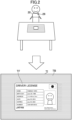
- FIG. 2 is a view for illustrating an example of a scene in which a user captures the target foreground.
- a target foreground TF is a fictitious driver's license.
- a target background TB is a towel.
- the user terminal 20 acquires a target image TI generated by the photographing unit 26.
- the target image TI the target foreground TF being the driver's license and the target background TB being a part of the towel are shown.
- the user terminal 20 transmits the target image TI to the server 10.
- the server 10 receives the target image TI, the eKYC is executed.
- the eKYC itself, a publicly-known method can be used.
- a malicious user arranges a plurality of falsified driver's licenses on the towel, successively captures the driver's licenses, and successively uploads the plurality of target images TI.
- the target background TB Similar towel cloths are shown as the target background TB.
- a fraudulent target foreground TF may be shown in the target image TI showing a specific target background TB, and hence the target background TB is considered as information useful in estimating the fraud.
- the image processing system 1 estimates the fraud by focusing on the target background TB.
- FIG. 3 is a diagram for illustrating an example of processing executed by the image processing system 1.
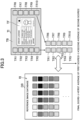
- the server 10 stores a reference image database DB which stores a plurality of reference images RI.
- the reference images RI are images referred to in order to estimate the fraud.
- the reference image RI shows a background in an image showing an actually uploaded fraudulent identity verification document.
- a fraudulent identity verification document is hereinafter referred to as "fraudulent foreground.”
- a background of the fraudulent foreground is referred to as "fraudulent background.”
- An image showing the fraudulent foreground and the fraudulent background is referred to as "fraudulent image.”
- the reference image RI is created by cutting out a portion of the fraudulent image in which the fraudulent background is shown. For example, when a fraudulent image in which another fraudulent background, such as a flooring, a desk pad, a mat, a carpet, bedding, a desk, a box, or a sofa, is shown is uploaded, the reference image RI showing this another fraudulent background is created. It is assumed that reference images RI showing various fraudulent backgrounds are stored in the reference image database DB.
- the server 10 when the server 10 receives the target image TI from the user terminal 20, the server 10 acquires target regions TR1 to TR10 showing the target background TB from the target image TI.
- the target regions TR1 to TR5 are acquired from a left side of the target foreground TF
- the target regions TR6 to TR10 are acquired from a right side of the target foreground TF.
- target regions TR When the target regions TR1 to TR10 are not distinguished from one another, the target regions TR1 to TR10 are hereinafter simply referred to as "target regions TR.”
- the number of target regions TR may be any number, and is not limited to 10.
- the number of target regions TR may be one to nine, or eleven or more.
- the server 10 calculates a first score and a second score relating to similarity between the target regions TR and the reference images RI based thereon.
- the first score indicates similarity in terms of pattern.
- similarity in terms of color has no influence on the first score, or has low influence on the first score.
- the first score is calculated through use of a Gabor filter.
- the second score indicates similarity in terms of color.
- similarity in terms of pattern has no influence on the second score, or has low influence on the second score.
- the second score is calculated through use of a color histogram.
- the server 10 calculates the first score and the second score for each of combinations between the target regions TR and the reference images RI.
- the server 10 calculates k ⁇ n first scores and k ⁇ n second scores.
- the server 10 calculates a first average being an average of the kxn first scores and a second average being an average of the k ⁇ n second scores.
- the server 10 calculates a final score by adding a value obtained by multiplying the first average by a coefficient ⁇ ( ⁇ is a numerical value equal to or larger than 0) and a value obtained by multiplying the second average by a coefficient ⁇ ( ⁇ is a numerical value equal to or larger than 0) .
- a case in which each of the coefficients ⁇ and ⁇ is 0.5 is described, but each of the coefficients ⁇ and ⁇ may be any numerical value.
- the coefficient ⁇ may be any value of from 0.01 to 0.99
- the coefficient ⁇ may be a value obtained by subtracting ⁇ from 1.
- a sum of the coefficients ⁇ and ⁇ may be a value other than 1. It is assumed that the coefficients ⁇ and ⁇ are specified by an administrator of the image processing system 1.
- the final score indicates an overall similarity between the plurality of target regions TR and the plurality of reference images RI.
- a higher first score and a higher second score mean a higher degree of similarity. That is, a lower first score and a lower second score mean a lower degree of similarity.
- a higher final score means a higher degree of similarity. That is, a lower final score means a lower degree of similarity.
- the server 10 estimates that the target foreground TF is fraud.
- first score and the second score may mean a lower degree of similarity. That is, a lower first score and a lower second score may mean a higher degree of similarity.
- a lower final score means a higher degree of similarity. That is, a higher final score means a lower degree of similarity.
- a lower first score may mean a higher degree of similarity
- a higher second score may mean a lower degree of similarity
- a higher first score may mean a lower degree of similarity
- a lower second score may mean a higher degree of similarity.
- a higher first score may mean a higher degree of similarity
- a lower second score may mean a higher degree of similarity. That is, a lower first score may mean a lower degree of similarity, and a higher second score may mean a lower degree of similarity. Also in this case, it is only required to calculate the final score after a reciprocal of the value of any one of the first score and the second score or a difference of this value from a predetermined value is calculated.
- a target image TI having a relatively high final score is set as a target of a manual check preferentially over a target image TI having a relatively low final score.
- the manual check is a visual check by human eyes.
- the image processing system 1 estimates whether or not the target foreground TF is fraud based on the target background TB shown in the target image TI, to thereby increase the estimation accuracy for the fraud. Details of the image processing system 1 is now described.
- FIG. 4 is a function block diagram for illustrating an example of functions implemented in the image processing system 1.
- the server 10 includes a data storage unit 100, a target image acquisition module 101, a reference image acquisition module 102, and an estimation module 103.
- the data storage unit 100 is implemented by the storage unit 12.
- the target image acquisition module 101, the reference image acquisition module 102, and the estimation module 103 are implemented by the control unit 11.
- the data storage unit 100 stores data required for the estimation of the fraud.
- the data storage unit 100 stores a reference image database DB.
- the reference image database DB any number of reference images RI may be stored, and, for example, one to several tens, one hundred to several thousands, or a larger number of reference images RI may be stored in the reference image database DB.
- the reference image RI is created based on a fraudulent image. It is only required that at least one reference image RI be created from one fraudulent image, and a plurality of reference images RI may be created from one fraudulent image.
- the creation of the reference image RI is automated by a program prepared in advance, but the reference image RI may manually be created by the administrator of the image processing system 1.
- This program is hereinafter referred to as "creation program for the reference image RI.”
- creation program for the reference image RI separation processing of separating a portion of a fraudulent background from a fraudulent image and acquisition processing of acquiring a reference image RI from this separated portion and storing the acquired reference image RI in the reference image database DB are defined.
- the creation program for the reference image RI is executed by the server 10 or another computer.
- the separation processing may include processing of detecting a contour of the fraudulent foreground from the fraudulent image through use of publicly-known contour extraction processing and processing of extracting a region outside the contour of the fraudulent foreground from the fraudulent image.
- the separation processing may be processing of separating the fraudulent background through use of a background subtraction method.
- the acquisition processing is processing of acquiring a region having a predetermined vertical width and a predetermined horizontal width from a predetermined position in the fraudulent background as the reference image RI.
- This embodiment takes as an example a case in which the vertical width and the horizontal width of the reference image RI and a vertical width and a horizontal width of the target region TR are the same, but at least one of the vertical width or the horizontal width of the reference image RI and at least one of the vertical width or the horizontal width of the target region TR may be different from each other.
- the acquisition processing may include processing of executing image processing such as noise removal on a part of the fraudulent image extracted by the separation processing, to thereby acquire the reference image RI.
- the data stored in the data storage unit 100 is not limited to the reference image database DB.
- the data storage unit 100 can store any data.
- the data storage unit 100 may store a fraudulent image database in which each of a plurality of fraudulent images is stored.
- the data storage unit 100 may store a target image database in which each of a plurality of target images TI is stored. In the target image database, an estimation result obtained by the estimation module 103 may be stored.
- the target image acquisition module 101 acquires the target image TI showing the target foreground TF which is the foreground being the estimation target for the fraud and the target background TB being the background of the target foreground TF.
- the target image TI may be stored in the target image database in advance.
- the target image database may be stored in the data storage unit 100, or may be stored in a computer other than the server 10 or an external information storage medium.
- the target image acquisition module 101 may acquire the target image TI from the target image database.
- the target foreground TF may be an identity verification document other than the driver's license. Examples of the other identity verification document are as described above.
- the target foreground TF may be a foreground other than the identity verification document.
- the target foreground TF may be a document, such as a certificate, a receipt, a bill, an application, an in-house foreground, a government foreground, a financial statement, a newspaper, a magazine, another book, a signboard, a poster, or an advertisement, or a product traded in an electronic commerce service or a flea market service.
- the image processing system 1 can be applied to a scene in which fraud of any target foreground TF is to be estimated.
- the target image TI is an image generated by the photographing unit 26 capturing the target foreground TF.
- the target image TI may be a still image generated in a still image mode or individual images (frames) included in a motion image generated in a motion image mode.
- the target image acquisition module 101 may successively acquire a plurality of target images TI by successively capturing the target foregrounds TF.
- the target image acquisition module 101 may acquire the target image TI generated by not the photographing unit 26, but other image generation means, such as a scanner, a copying machine, or a multifunction machine.
- the target image TI is not limited to a photograph showing a state of an actual space, and may be a computer graphic or an image obtained by adding digital information such as a string to a photograph.
- the target image TI is a computer graphic
- the target foreground TF is an electronic foreground.
- the target background TB is an electronic background.
- the target image TI may be an image which is not classified into the computer graphic.
- the target image TI may be an image generated by document creation software.
- the target image TI may be in any file format.
- the target image TI is not required to be in a so-called image file format such as JPEG or PNG, or may be in a document file format such as PDF or another file format.
- the target foreground TF is a subject captured by the photographing unit 26.
- the target background TB is another object on which the subject is placed.
- the towel corresponds to another object. It is only required that the another object be an object spread under the target foreground TF, and is not limited to the towel.
- the another object may be another object, such as a flooring, a desk pad, a mat, a carpet, furniture, bedding, a desk, a box, or a sofa.
- the target image TI at least part of the another object is shown as the target background TB.
- the target foreground TF is not required to be captured under the state in which the target foreground TF is placed on the another object.
- the target foreground TF may be captured under a state in which the user holds the target foreground TF by hand, under a state in which the target foreground TF is suspended from something, or under a state in which the target foreground TF adheres to something.
- the target background TB such as a wall, a partition, furniture, an electrical appliance, a ceiling, a plant, or another scene, is shown. It is only required that the target background TB be a portion of the target image TI other than the target foreground TF, and those exemplified target backgrounds TB are possibly information useful for the estimation for the fraud.
- the reference image acquisition module 102 acquires the reference image RI showing the reference background being a background for reference.
- the reference background is a background to be referred to in order to estimate the fraud of the target foreground TF.
- the reference background can also be considered as a background to be compared with the target background TB.
- the reference image RI is a portion of the fraudulent background of the fraudulent image showing the fraudulent foreground being a foreground which is fraudulent and the fraudulent background being a background of the fraudulent foreground.
- the reference background is the fraudulent background is exemplified.
- the reference background may be a background other than the fraudulent background. That is, the reference background is not required to be the fraudulent background itself.
- the reference background may be a background obtained by applying image processing such as the noise removal to the fraudulent background, a virtual background created through use of the computer graphics, or a background which is created through use of a machine learning model and looks like a real background.
- the reference background may be a background captured by the own camera of the administrator of the image processing system 1. It is only required that the reference background can serve as a reference at the time of the fraud estimation.
- the reference images RI are stored in the reference image database DB, and hence the reference image acquisition module 102 acquires the reference images RI from the reference image database DB.
- the reference images RI may be stored in a computer other than the server 10 or an external information storage medium. In this case, the reference image acquisition module 102 may acquire the reference images RI from the another computer or the external information storage medium.
- the reference image RI is not required to be prepared in advance, and may be created on the spot by the creation program for the reference image RI described above.
- the estimation module 103 estimates the fraud relating to the target foreground TF based on the target background TB shown in the target image TI.
- This embodiment takes as an example the case in which the estimation module 103 estimates the fraud based on both of the pattern and the color of the target background TB shown in the target image TI, but the estimation module 103 may estimate the fraud based on only one of the pattern and the color of the target background TB shown in the target image TI.
- the estimation module 103 may estimate the fraud based on an element other than the pattern and the color of the target background TB shown in the target image TI. Examples of the another element are described later.
- the estimation module 103 estimates the fraud based on the target background TB shown in the target image TI and the reference backgrounds shown in the reference images RI.
- the reference background is shown in the entire reference image RI, but the reference background may be shown only in a part of the reference image RI.
- the estimation module 103 may estimate the fraud by determining whether or not the target background TB shown in the target image TI and the reference background shown in the reference image RI are the same as or similar to each other.
- the similarity may be determined through use of an algorithm for similar image search employed in a search engine, a template matching method of comparing with a template image, a method which uses a machine learning model such as a neural network or vision transformer, or a method employed in a programming language such as Python.
- This embodiment takes as an example a case in which the estimation module 103 calculates a score relating to the degree of fraud, to thereby estimate the fraud. Further, as an example of this score, the first score, the second score, and the final score are described. When the first score, the second score, and the final score are not distinguished from one another, the first score, the second score, and the final score are simply referred to as "scores.” In this embodiment, it is assumed that the score is not binary, and has intermediate values. That is, the score can express the degree of fraud not at two levels, but at three or more levels. In this embodiment, the fraud is estimated based on the similarity to the reference image RI, and hence the degree of fraud can be considered as a degree of similarity to the reference image RI.
- This embodiment takes as an example a case in which the score is expressed in a numerical value, but the score may be expressed in another index such as a character or another symbol. Moreover, a case in which a higher numerical value of the score means a higher degree of fraud is exemplified, but a lower numerical value of the score may mean a higher degree of fraud. It is only required that a certain correlation exist between the numerical value of the score and the degree of fraud. The same applies to the case in which the score is expressed in an index other than the numerical value. For example, when the score is expressed in the alphabet, it is only required that a correlation that the degree of fraud is higher as the position in the order in alphabet becomes later exist.
- the estimation module 103 acquires the first score relating to the fraud based on the target background TB shown in the target image TI and a first evaluation method.
- the first evaluation method is a method based on the pattern of the target background TB.
- the first evaluation method is a method which uses the Gabor filter.
- the Gabor filter is a type of a linear filer used for texture analysis and the like.
- the Gabor filter extracts a specific frequency component in each predetermined direction in a local region in an image.
- the estimation module 103 acquires the first score based on a difference between a frequency component of the target background TB and a frequency component of the reference image RI.
- This embodiment takes as an example a case in which the estimation module 103 masks the portion of the target foreground TF of the target image TI, and then calculates the frequency component, but the estimation module 103 may calculate the frequency component without masking this portion.
- a smaller difference between the frequency components means a higher degree of similarity.
- a higher first score means a higher degree of similarity, and hence the estimation module 103 calculates the first score such that the first score is higher as the difference between the frequency components is smaller.
- the first evaluation method may be a method other than the Gabor filter.
- the first evaluation method may be a method which uses a local binary pattern, an iris filter, or a linear filter or nonlinear filter which is not classified thereinto.
- the first evaluation method may be a method other than the method of evaluating the pattern.
- the first evaluation method may be a method of evaluating a degree of a deviation of an arrangement of feature points from a reference.
- the feature point is a point indicating a feature portion in the target image TI.
- publicly-known various methods can be used, and, for example, SIFT, KAZE, or AKAZE may be used.
- the estimation module 103 acquires the second score relating to the fraud based on the target background TB shown in the target image TI and a second evaluation method different from the first evaluation method.
- the second evaluation method is a method based on the color of the target background TB.
- the second evaluation method is a method which uses the color histogram.
- the color histogram is a distribution indicating an appearance frequency of each color. As the number of pixels in a certain color is larger, the appearance frequency of this color becomes higher.
- publicly-known various methods employed in a programing language such as Python can be used.
- the estimation module 103 acquires the second score based on a difference between a color histogram of the target background TB and a color histogram of the reference image RI.
- This embodiment takes as an example a case in which the estimation module 103 masks the portion of the target foreground TF of the target image TI and then creates the color histogram, but the estimation module 103 may create the color histogram without masking this portion.
- a smaller difference between the color histograms means a higher degree of similarity.
- a higher second score means a higher degree of similarity, and hence the estimation module 103 calculates the second score such that the second score is higher as the difference between the color histograms is smaller.
- the second evaluation method may be a method other than the color histogram.
- the second evaluation method may be a method which uses a machine learning model capable of estimating the similarity in color.
- the second evaluation method may be a method other than the method of evaluating the color.
- the first evaluation method is the method which uses the Gabor filter
- the second evaluation method may be a method which uses the local binary pattern.
- the first evaluation method is the method which uses the color histogram
- the second evaluation method may be the method which uses the Gabor filter.
- the first evaluation method and the second evaluation method may be any other combination.
- the estimation module 103 estimates the fraud based on the first score and the second score.
- This embodiment takes as an example the case in which the estimation module 103 calculates the final score based on the first score and the second score, but the estimation module 103 may estimate the fraud without calculating the final score.
- the estimation module 103 may estimate that the fraud has occurred when at least one of the first score or the second score is equal to or higher than a threshold value.
- the estimation module 103 may estimate that the fraud has occurred when the number of target regions TR having at least one of the first score or the second score equal to or higher than a threshold value is equal to or larger than a threshold value.
- the estimation module 103 estimates the fraud based on the final score.
- a higher final score means a higher degree of the fraud, and hence the estimation module 103 estimates that the fraud has been conducted when the final score is equal to or higher than a threshold value.
- the estimation module 103 estimates that the fraud has not been conducted when the final score is lower than the threshold value.
- the estimation module 103 records an estimation result of the fraud in the data storage unit 100 or transmits the estimation result to a terminal of the administrator.
- the estimation module 103 may record the value of the final score in the data storage unit 100 directly as the estimation result of the fraud or may transmit this value to the terminal of the administrator directly as the estimation result of the fraud.
- the estimation module 103 acquires the plurality of target regions TR in which the target background TB is shown from the target image TI.
- the estimation module 103 estimates the fraud based on the target background TB shown in each of the plurality of target regions TR. For example, the estimation module 103 calculates the first score and the second score for each target region TR.
- the estimation module 103 calculates the final score based the first average of the first scores of the plurality of target regions TR and the second average of the second scores of the plurality of target regions TR, to thereby estimate the fraud.
- This embodiment takes as an example the case in which the estimation module 103 identifies at least one portion determined in advance in the target image TI as at least one target region TR, but the estimation module 103 may identify the at least one target region TR by executing background separation processing on the target image TI.
- the background separation processing itself, publicly-known processing can be used.
- the background separation processing may be background separation processing of identifying a portion other than the contour of the target foreground TF detected by the contour detection processing as the target region TR.
- the estimation module 103 may estimate the fraud by acquiring not the score having the intermediate values, but acquiring a binary label indicating whether or not the fraud has been conducted. Moreover, this embodiment takes as an example a case in which the estimation module 103 estimates the fraud not based on the target foreground TF shown in the target image TI, but on the target background TB shown in the target image TI, but the estimation module 103 may estimate the fraud based on both of the target foreground TF and the target background TB shown in the target image TI.
- the estimation module 103 may estimate the fraud by calculating only one of the first score and the second score without calculating both of the first score and the second score. Moreover, the estimation module 103 is only required to estimate the fraud based on the target background TB shown in the target image TI, and the method of estimating the fraud by the estimation module 103 is not limited to the above-mentioned example.
- the estimation module 103 may estimate the fraud based on the another element described above.
- the another element may be the number of feature points, an arrangement of the feature points, a brightness in the target image TI, or an embedded expression in the machine learning.
- the estimation module 103 may estimate the fraud not based on the reference images RI, but by determining whether or not the pattern of the target background TB shown in the target image TI is a predetermined pattern or similar to the predetermined pattern.
- the state in which the patterns are similar to each other means a state in which the degree of similarity between the patterns is equal to or higher than a predetermined degree.
- a method itself of determining the similarity between the patterns publicly-known various methods can be used.
- the method may be a method which uses the Gabor filter or the local binary pattern.
- the estimation module 103 may estimate the fraud not based on the reference images RI, but by determining whether or not the color of the target background TB shown in the target image TI is a predetermined color or similar to the predetermined color.
- the state in which the colors are similar to each other means a state in which the degree of similarity between the colors is equal to or higher than a predetermined degree.
- publicly-known methods can be used.
- the method may be a method which uses the color histogram.
- the estimation module 103 may estimate the fraud by inputting the target image TI into a machine learning model which has learned various fraudulent backgrounds.
- the machine learning model has learned the reference images RI as training data.
- the machine learning model has learned the training data including pairs each of which is a combination of the reference image RI and a label indicating the fraud.
- the estimation module 103 inputs the target image TI into the machine learning model, the machine learning model calculates a feature amount of the target image TI and outputs a label corresponding to the feature amount.
- the estimation module 103 may estimate the fraud by acquiring the label output from the machine learning model.
- the user terminal 20 includes a data storage unit 200 and a transmission module 201.
- the data storage unit 200 is implemented by the storage unit 22.
- the transmission module 201 is implemented by the control unit 21.
- the data storage unit 200 stores data required to acquire the target image TI.
- the data storage unit 200 stores the target image TI generated by the photographing unit 26.
- the data storage unit 200 may store the target image TI generated by a camera other than the photographing unit 26 or the like.
- the transmission module 201 transmits the target image TI to the server 10.
- the transmission module 201 transmits the target image TI generated by the photographing unit 26 to the server 10.
- the transmission module 201 may transmit the target image TI stored in the data storage unit 200 to the server 10.
- FIG. 5 is a flowchart for illustrating an example of processing executed by the image processing system 1.
- the user terminal 20 acquires the target image TI generated by the photographing unit 26 (Step S1).
- the user terminal 20 transmits the target image TI to the server 10 (Step S2).
- the server 10 receives the target image TI (Step S3), the server 10 acquires the reference image RI from the reference image database DB (Step S4).
- the server 10 calculates the first scores based on the target image TI and the reference image RI (Step S5).
- the server 10 calculates the second scores based on the target image TI and the reference image RI (Step S6).
- the server 10 determines whether or not the first scores and the second scores have been calculated by using all of the reference images RI (Step S7). When it is determined that a reference image RI for which the first scores and the second scores have not been calculated exists (N in Step S7), the process returns to Step S4, and the first scores and the second scores are calculated for a next reference image RI.
- the server 10 calculates the final score based on the first scores and the second scores of all of the reference images RI (Step S8).
- the server 10 determines whether or not the final score is equal to or higher than the threshold value (Step S9).
- the server 10 estimates that the target foreground TF is fraudulent, and executes processing for preferentially performing the manual check (Step S10).
- the server 10 stores the target image TI received in Step S3 in a database for storing target images TI being the target of the manual check.
- the server 10 estimates that the target foreground TF is not fraudulent, and does not execute the processing step of Step S10.
- the image processing system 1 estimates the fraud relating to the target foreground TF based on the target background TB shown in the target image TI.
- the estimation accuracy for the fraud increases by focusing on not the target foreground TF being the estimation target for the fraud, but the target background TB being background thereof.
- the tendency may be used as a clue for discovering the fraud of the target foreground TF.
- Various technologies seem to exist as the technology of estimating the fraud by focusing on the target foreground TF being the foreground of the target image TI.
- the estimation accuracy for the fraud increases by intentionally focusing on the target background TB, which seems not to exist as the related art.
- the estimation accuracy for the fraud increases more.
- the fraud may be estimated through use of only the method described in this embodiment, but the fraud may be estimated in comprehensive consideration of other elements such as the target foreground TF and a location of the user terminal 20. In this case, the method described in this embodiment serves as one of pieces of information for decision when the fraud is finally estimated.
- the image processing system 1 estimates the fraud based on the target background TB shown in the target image TI and the reference backgrounds shown in the reference images RI.
- the reference images RI serving as the reference are used to estimate the fraud, and hence the estimation accuracy for the fraud increases more.
- a malicious user uses a reference image RI showing a fraudulent background existing on the rear of a fraudulent foreground actually falsified to try to conduct the fraud again, a similar fraudulent background may be created.
- the fraud can accurately be estimated.
- the fraud can be estimated by the administrator of the image processing system 1 preparing the reference images RI, and hence the reference used to estimate the fraud can easily be specified by the administrator.
- the reference image RI in this embodiment is the portion of the fraudulent background of the fraudulent image.
- the image processing system 1 estimates the fraud based on the first score and the second score.
- the fraud is multilaterally estimated through use of the plurality of estimation methods, and hence the estimation accuracy for the fraud increases more.
- the first evaluation method in this embodiment is the method based on the pattern of the target background TB.
- the second evaluation method in this embodiment is the method based on the color of the target background TB.
- the image processing system 1 estimates the fraud based on the final score based on the first score and the second score.
- the fraud can be estimated based on the one index such as the final score, and hence the fraud can be estimated based on the index which can easily be evaluated. For example, when the final score is to be presented to the administrator of the image processing system 1, the administrator is only required to see the one index such as the final score, and hence can easily determine whether or not the fraud has been conducted.
- the image processing system 1 estimates the fraud based on the target background TB shown in each of the plurality of target regions TR acquired from within the target image TI.
- the fraud can be estimated in comprehensive consideration of the plurality of portions in the target image TI, and hence the estimation accuracy for the fraud increases more. For example, when a tendency of the fraud does not appear in a certain portion of the target image TI, but the tendency of the fraud appears in another portion thereof, the fraud can be estimated from the tendency in the another portion.
- the target background TB in this embodiment is the another object on which the subject to be captured by the photographing unit 26 is placed.
- the target foreground TF in this embodiment is the identity verification document.
- the fraud is falsification of the identity verification document. As a result, the accuracy for estimating the fraud of the identity verification document increases.
- FIG. 6 is a diagram for illustrating an example of functions implemented in modification examples.
- the server 10 includes a fraud date-and-time acquisition module 104, a fraud count acquisition module 105, a first identification module 106, a second identification module 107, and a display control module 108.
- Each of the fraud date-and-time acquisition module 104, the fraud count acquisition module 105, the first identification module 106, the second identification module 107, and the display control module 108 is implemented by the control unit 11.
- FIG. 7 is a table for showing an example of the reference image database DB in the modification examples.
- the reference image database DB actual data on the reference images RI, fraud dates and times, numbers of times of fraud, types of the reference backgrounds, and types of reference foregrounds are stored.
- Other information may be stored in the reference image database DB, and the information stored in the reference image database DB is not limited to the example of FIG. 7 .
- information on a fraudulent image from which the reference image RI was created may be stored in the reference image database DB. In this case, of a plurality of reference images RI created from one certain fraudulent image, only a predetermined number of reference images RI may be compared with the target image TI.
- the actual data on the reference image RI is image data on the reference image RI.
- the reference image RI may be in any data format such as JPEG or PNG.
- the fraud date and time are a date and time at which the actual fraud was conducted.
- the fraud date and time are a date and time of creation, a date and time of update, or a date and time of access included in a property of a fraudulent image being the source of the reference image RI.
- the fraud date and time may be a date and time at which the fraudulent image was uploaded.
- the fraud date and time may be a date and time of creation, a date and time of update, or a date and time of access included in a property of the reference image RI. In this case, the fraud date and time may be included in actual data on the reference image RI.
- the number of times of the fraud is the number of times the fraud has actually been conducted.
- the number of times of the fraud is the number of times of the fraud conducted for a background which is the same as or similar to the fraudulent background shown in the reference image RI.
- the reference background type is information indicating a type of an object shown as the reference background.
- the reference background type is the same as the type of the fraudulent background.
- the reference foreground type is information indicating a type of a foreground shown as the reference foreground corresponding to the reference background.
- the reference foreground type is the same as the type of the fraudulent foreground being the foreground shown in the fraudulent image.
- the tendency of a malicious user may change in real time.
- old reference images RI each created based on a fraudulent image on which fraud was conducted a certain time ago and recent reference images RI each created based on a fraudulent image on which fraud was conducted recently may be mixed.
- estimation matching a recent tendency of the fraud can be executed.
- the image processing system 1 includes the fraud date-and-time acquisition module 104.
- the fraud date-and-time acquisition module 104 acquires the fraud date and time associated with the reference image RI.
- the fraud dates and times are stored in the reference image database DB, and hence the fraud date-and-time acquisition module 104 refers to the reference image database DB to acquire the fraud date and time.
- the fraud date and time may be stored in a database other than the reference image database DB, a computer other than the server 10, or an external information storage medium.
- the fraud date-and-time acquisition module 104 is only required to acquire the fraud date and time from the another database, the another computer, or the external information storage medium.
- the fraud date and time is not required to be data independent of the reference image RI, and may be included as a part of the actual data (for example, a part of the property) on the reference image RI.
- the estimation module 103 in Modification Example 1 estimates the fraud based on the target background TB shown in the target image TI, the fraudulent backgrounds shown in the reference images RI, and the fraud dates and times. For example, the estimation module 103 calculates at least one of the first scores or the second scores based on not only the target background TB and the fraudulent background, but also the fraud date and time. The estimation module 103 determines weight coefficients such that a weight coefficient of at least one of a calculation expression for the first score or a calculation expression for the second score increases as the elapsed time since the fraud date and time is shorter (as the fraud date and time are more recent), to thereby calculate at least one of the first scores or the second scores.
- the estimation module 103 in Modification Example 1 is only required to estimate the fraud in consideration of not only the target background TB and the fraudulent backgrounds, but also the fraud dates and times, and the method of estimating the fraud based on the fraud dates and times is not limited to the above-mentioned example.
- the estimation module 103 may estimate the fraud by using, of the reference images RI stored in the reference image database DB, only reference images RI each having an elapsed time since the fraud date and time shorter than a threshold value or only reference images RI acquired in such a manner that the number of reference images RI is larger as the elapsed time since the fraud date and time is shorter.
- the estimation module 103 may determine the above-mentioned weight coefficients based on the elapsed time since the fraud date and time, or the weight coefficients may be the same values regardless of the elapsed time since the fraud date and time.
- the estimation module 103 determines the weight coefficients not based on the elapsed time since the fraud date and time, but such that the weight coefficients for the reference images RI having the fraud dates and times included in the specific period are large, to thereby calculate at least one of the first scores or the second scores.
- the estimation module 103 may estimate the fraud by using, of the reference images RI stored in the reference image database DB, only reference images RI each having the fraud date and time included in the specific period or only reference images RI acquired in such a manner that the number of reference images RI each having the fraud date and time included in the specific period is larger.
- the image processing system 1 estimates the fraud based on the target background TB shown in the target image TI, the fraudulent backgrounds shown in the reference images RI, and the fraud dates and times. As a result, the fraud can be estimated by using not only the target background TB and the fraudulent backgrounds, but also the fraud dates and times, and hence the estimation accuracy for the fraud increases.
- reference images RI showing fraudulent backgrounds relating to frequent occurrence of the fraud and reference images RI not relating to the frequent occurrence of the fraud may be mixed.
- the reference images RI showing the fraudulent backgrounds relating to the frequent occurrence of the fraud are considered more important than the reference images RI not relating to the frequent occurrence of the fraud to estimate the fraud, an estimation accuracy for the frequently-occurring fraud increases.
- the image processing system 1 includes the fraud count acquisition module 105.
- the fraud count acquisition module 105 further includes the fraud count acquisition module 105 which acquires the number of times of the fraud associated with the reference image RI.
- the number of times of the fraud is stored in the reference image database DB, and hence the fraud count acquisition module 105 refers to the reference image database DB to acquire the number of times of the fraud.
- the number of times of the fraud may be stored in a database other than the reference image database DB, a computer other than the server 10, or an external information storage medium.
- the fraud count acquisition module 105 is only required to acquire the number of times of the fraud from the another database, the another computer, or the external information storage medium.
- the number of times of the fraud is not required to be data independent of the reference image RI, and may be included as a part of the actual data (for example, a part of the property) on the reference image RI.
- the estimation module 103 in Modification Example 2 estimates the fraud based on the target background TB shown in the target image TI, the fraudulent backgrounds shown in the reference images RI, and the number of times of the fraud. For example, the estimation module 103 calculates at least one of the first scores or the second scores based on not only the target background TB and the fraudulent background, but also the number of times of the fraud. The estimation module 103 determines weight coefficients such that the weight coefficient of at least one of the calculation expression for the first score or the calculation expression for the second score increases as the number of times of the fraud is larger (as the fraud occurs more frequently), to thereby calculate at least one of the first scores or the second scores.
- the estimation module 103 in Modification Example 2 is only required to estimate the fraud in consideration of not only the target background TB and the fraudulent backgrounds, but also the number of times of the fraud, and the method of estimating the fraud based on the number of times of the fraud is not limited to the above-mentioned example.
- the estimation module 103 may estimate the fraud by using, of the reference images RI stored in the reference image database DB, only reference images RI each having the number of times of the fraud equal to or larger than a threshold value or only reference images RI acquired in such a manner that the number of reference images RI is larger as the number of times of the fraud is larger.
- the estimation module 103 may determine the above-mentioned weight coefficients based on the number of times of the fraud, or the weight coefficients may be the same values regardless of the number of times of the fraud.
- the image processing system 1 estimates the fraud based further on the target background TB shown in the target image TI, the fraudulent backgrounds shown in the reference images RI, and the number of times of the fraud. As a result, the fraud can be estimated by using not only the target background TB and the fraudulent backgrounds, but also the number of times of the fraud, and hence the estimation accuracy for the fraud increases.
- Reference images RI showing various fraudulent backgrounds may be mixed in the reference image database DB.
- the reference image database DB a large number of reference images RI are stored, and hence the reference images RI serving as the target of the comparison increase. Consequently, a processing load on the server 10 possibly becomes higher.
- the image processing system 1 includes the first identification module 106.
- the first identification module 106 identifies a target background type being a type of the target background TB based on the target image TI.
- the first identification module 106 identifies the target background type based on a machine learning model.
- the machine learning model has learned training data including pairs each of which is a combination of a training image showing a training background being a background for the training and the type of the training background.
- the machine learning model may be created through use of a neural network, an adversarial network, or a vision transformer.
- a learning method corresponding to a machine learning method used in the machine learning model can be used.
- the training of the machine learning model may be executed through use of a learning method such as an error backpropagation method or a gradient descent method.
- a machine learning model which uses the neural network is exemplified.
- the first identification module 106 inputs the target image TI into the machine learning model.
- the machine learning model executes convolution of the target image TI to calculate a feature amount, and outputs the target background type corresponding to the feature amount.
- the first identification module 106 acquires the target background type output from the machine learning model, to thereby identify the target background type.
- the identification method for the target background type it is only required to use a method for classifying an image, and the identification method is not limited to the method which uses the machine learning model.
- the first identification module 106 may identify the target background type through use of a pattern matching method.
- the data storage unit 100 stores template images of various backgrounds.
- the first identification module 106 identifies the target background type based on the target image TI and the template images. For example, the first identification module 106 identifies a type of a background shown in a template having the highest similarity calculated through use of the pattern matching method as the target background type. It is assumed that the type of the background is associated with the template image.
- the reference image acquisition module 102 in Modification Example 3 acquires, from the reference image database DB in which the reference background type being the type of the reference background and the reference image RI are associated with each other, the reference image RI having the same reference background type as the target background type.
- the reference image acquisition module 102 acquires a reference image RI having a reference background type "towel.”
- a target background type "flooring” is identified by the first identification module 106
- the reference image acquisition module 102 acquires a reference image RI having a reference background type "flooring.” Processing of the estimation module 103 to be executed after the acquisition of the reference image RI is the same as that in the embodiment or that in Modification Examples 1 to 3.
- the image processing system 1 acquires a reference image RI having the same reference background type as the target background type from the reference image database DB.
- the number of reference images RI used to estimate the fraud decreases, and hence the processing load on the server 10 can be reduced.
- a speed of the processing for estimating the fraud can be increased.
- Reference images RI useful for estimating the fraud can be used, and hence the estimation accuracy for the fraud can be guaranteed.
- the image processing system 1 includes the second identification module 107.
- the second identification module 107 identifies the target foreground type.
- the second identification module 107 identifies the target foreground type by acquiring a target foreground type specified by the user who uploads the target image TI.
- Modification Example 4 a case in which the user specifies one target foreground document is described, but the user may specify a plurality of target foreground types.
- FIG. 8 is a view for illustrating an example of screens displayed on the user terminal 20 in Modification Example 4.
- a specification screen SC1 for the user to specify the target foreground type is displayed on the user terminal 20 on the user terminal 20.
- the identity verification document can be specified from four types including the driver's license, the personal identification number card, the insurance card, and the passport.
- the identity verification document which can be specified by the user may be of any type, and is not limited to the four types.
- the user may be allowed to select the identity verification document from two types, three types, or five or more types of identity verification documents.
- the user uses a button B10 of the specification screen SC1 to specify the target foreground type.
- a photographing screen SC2 for capturing the target foreground TF is displayed on the user terminal 20.
- a display area A20 of the photographing screen SC2 a captured image continuously generated by the photographing unit 26 is displayed.
- the photographing unit 26 captures the identity verification document, to thereby generate the target image TI.
- the target image TI is uploaded to the server 10, and a completion screen SC3 indicating completion of the upload is displayed on the user terminal 20.
- the user terminal 20 transmits type identification information indicating the target foreground type specified by the user through use of the button B10 to the server 10 together with the target image TI.
- the type identification information indicates the specified type of the four types of identity verification documents.
- the server 10 receives the target image TI and the type identification information.
- the second identification module 107 identifies the target foreground type by referring to the type identification information.
- the identification method for the target foreground type is not limited to the method of referring to the target foreground type specified by the user.
- the second identification module 107 may identify the target foreground type by executing image processing on the target image TI. This image processing may be publicly-known processing used for object recognition.
- the second identification module 107 may identify the target foreground type based on a machine learning model which has learned various shapes of the foreground.
- the second identification module 107 may identify the target foreground type through use of pattern matching based on template images of the various foregrounds.
- the administrator of the image processing system 1 may visually confirm the target foreground type. In this case, the second identification module 107 identifies the target foreground type by acquiring a visual confirmation result from the terminal of the administrator.
- the reference image acquisition module 102 in Modification Example 4 acquires, from the reference image database DB in which the reference foreground type being the type of the reference foreground corresponding to the reference background and the reference image RI are associated with each other, the reference image RI having the same reference foreground type as the target foreground type.
- the reference image acquisition module 102 acquires a reference image RI having a reference foreground type "driver's license.”
- a target foreground type "insurance card” is identified by the second identification module 107
- the reference image acquisition module 102 acquires a reference image RI having a reference foreground type "insurance card.” Processing of the estimation module 103 to be executed after the acquisition of the reference image RI is the same as that in the embodiment or that in Modification Examples 1 to 4.
- the image processing system 1 acquires a reference image RI having the same reference foreground type as the target foreground type from the reference image database DB.
- the number of reference images RI used to estimate the fraud decreases, and hence the processing load on the server 10 can be reduced.
- a speed of the processing for estimating the fraud can be increased.
- Reference images RI useful for estimating the fraud can be used, and hence the estimation accuracy for the fraud can be guaranteed.
- the estimation module 103 may shape the target image TI such that the target foreground TF in the target image TI takes a predetermined shape, to thereby estimate the fraud based on the target background TB shown in the shaped target image TI.
- the processing itself of estimating the fraud is different from that in the embodiment in such a point that the shaped target image TI is used, but is the same as that in the embodiment in other points.
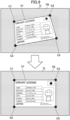
- FIG. 9 is a view for illustrating an example of the processing of shaping the target image TI.
- the estimation module 103 executes contour extraction processing (edge detection processing) on the target image TI, to thereby extract a contour of the target foreground TF.
- the estimation module 103 extracts four corners C1 to C4 of the target foreground TF from the contour of the target foreground TF.
- the estimation module 103 shapes the target image TI such that a positional relationship among the four corners C1 to C4 achieves a predetermined positional relationship.
- the shaping itself for the target image TI it is only required to use publicly-known image processing, and, for example, an affine transformation, a projection transformation, or a similarity transformation can be used.
- the method of shaping the target image TI is not limited to the example of FIG. 9 .
- the estimation module 103 may shape the target image TI by using not the four corners C1 to C4, but any two or three of the corners C1 to C4.
- the estimation module 103 may use feature points other than the corners C1 to C4 to shape the target image TI.
- the estimation module 103 may shape the target image TI based on at least one of feature points on the contour other than the corners C1 to C4 of the target foreground TF or feature points inside the target foreground TF. In this case, the estimation module 103 shapes the target image TI so that a positional relationship among the plurality of feature points achieves a predetermined positional relationship.
- the image processing system 1 estimates the fraud based on the target background TB shown in the target image TI shaped such that the target foreground TF in the target image TI takes the predetermined shape.
- the portion showing the target background TB can more easily be identified, and hence the estimation accuracy for the fraud increases.
- the target image TI is shaped such that the target foreground TF takes the predetermined shape and hence the target background TB is also shaped consequently, with the result that the fraud can be estimated after the target background TB is shaped into the state in which the fraud is easily estimated.
- the user terminal 20 may display a guide for guiding the user to capture the target background TB to a certain extent.
- FIG. 10 is a view for illustrating an example of the photographing screen in Modification Example 6.
- the image processing system 1 according to Modification Example 6 includes the display control module 108.
- the display control module 108 causes the user terminal 20 to display a guide G22 for causing the target background TB to be shown in the target image TI to a certain extent.
- the display control module 108 is implemented by the server 10, and hence the display control module 108 generates display data on the photographing screen SC2 including the guide G22 and transmits the display data to the user terminal 20, to thereby cause the user terminal 20 to display the guide G22.
- the display data is only required to be data for causing the user terminal 20 to display a certain screen, and may be in any data format.
- the display data may be in the HTML format.
- the display data may be in a format (for example, an image data format such as JPEG or PNG) which can be handled by the application.
- the guide G22 is smaller than the display area A20.
- a certain distance is provided between each end of the display area A20 and each end of the guide G22, and hence the target background TB is displayed between those ends.
- a vertical width and a horizontal width of the display area A20 match a vertical width and a horizontal width of the target image TI, respectively.
- the guide G22 is set such that the target regions TR1 to RT10 are contained in a portion of the display area A20 other than the guide G22. It is assumed that information indicating the vertical width and the horizontal width of the guide G22 are stored in the data storage unit 100.
- the target image acquisition module 101 in Modification Example 6 acquires the target image TI captured by the user terminal 20 under a state in which the guide G22 is displayed.
- Modification Example 6 is different from the embodiment in that the guide G22 is displayed at the time of the photographing by the user, but the acquisition method itself for the target image TI and the estimation method itself for the fraud are the same as those in the embodiment.
- the guide G22 is not required to be displayed through the control on the server 10 side, and, in this case, it is assumed that the display control module 108 is included in the user terminal 20.
- the display control module 108 of the user terminal 20 is only required to display the guide G22 based on an application stored in the data storage unit 200.
- the image processing system 1 acquires the target image TI captured by the user terminal 20 under the state in which the guide is displayed.
- the target background TB required to estimate the fraud can sufficiently be included in the target image TI, and hence the estimation accuracy for the fraud increases.
- Modification Examples 1 to 6 described above may be combined with one other.
- the target foreground be an object being the estimation target for a certain type of fraud, and is not limited to the document.
- the target foreground may be the product.
- a certain feature may exist in the background when a malicious third party captures and puts a counterfeit product being a fraudulent product on sale.
- the image processing system 1 estimates whether or not the product is fraudulent based on the target background TB shown in the target image TI. In this case, it is only required that processing in which the identity verification document described in the embodiment is replaced by the product be executed.
- the processing described as processing to be executed on the server 10 may be executed on the user terminal 20.
- the estimation by the estimation module 103 may be executed by an application stored in the user terminal 20.
- the processing by each of the target image acquisition module 101, the reference image acquisition module 102, and the estimation module 103 may be distributed to the server 10 and the user terminal 20. When the processing is distributed, the data required for the image processing may appropriately be transmitted between the server 10 and the user terminal 20.
- the image processing system may be configured as described below.
Landscapes
- Engineering & Computer Science (AREA)
- Physics & Mathematics (AREA)
- General Physics & Mathematics (AREA)
- Computer Vision & Pattern Recognition (AREA)
- Theoretical Computer Science (AREA)
- Image Analysis (AREA)
- Studio Circuits (AREA)
- Closed-Circuit Television Systems (AREA)
Applications Claiming Priority (1)
| Application Number | Priority Date | Filing Date | Title |
|---|---|---|---|
| PCT/JP2022/043818 WO2024116249A1 (ja) | 2022-11-28 | 2022-11-28 | 画像処理システム、画像処理方法、及びプログラム |
Publications (2)
| Publication Number | Publication Date |
|---|---|
| EP4401033A1 true EP4401033A1 (de) | 2024-07-17 |
| EP4401033A4 EP4401033A4 (de) | 2024-07-17 |
Family
ID=89718127
Family Applications (1)
| Application Number | Title | Priority Date | Filing Date |
|---|---|---|---|
| EP22930174.2A Pending EP4401033A4 (de) | 2022-11-28 | 2022-11-28 | Bildverarbeitungssystem, bildverarbeitungsverfahren und programm |
Country Status (5)
| Country | Link |
|---|---|
| US (1) | US20250078283A1 (de) |
| EP (1) | EP4401033A4 (de) |
| JP (1) | JP7426544B1 (de) |
| TW (1) | TWI879234B (de) |
| WO (1) | WO2024116249A1 (de) |
Family Cites Families (9)
| Publication number | Priority date | Publication date | Assignee | Title |
|---|---|---|---|---|
| JP5714452B2 (ja) * | 2011-08-29 | 2015-05-07 | 任天堂株式会社 | 情報処理装置、情報処理プログラム、情報処理方法および情報処理システム |
| MX388591B (es) * | 2016-06-30 | 2025-03-20 | Daewoong Pharmaceutical Co Ltd | Derivados de pirazolopirimidina como inhibidor de cinasa. |
| JP6925615B2 (ja) * | 2017-06-15 | 2021-08-25 | テンソル・コンサルティング株式会社 | 本人確認書類の真偽判定システム、方法およびプログラム |
| CN107944339B (zh) * | 2017-10-20 | 2020-01-21 | 阿里巴巴集团控股有限公司 | 一种证件验证、身份验证方法和装置 |
| JP6741137B2 (ja) * | 2018-11-14 | 2020-08-19 | 大日本印刷株式会社 | 本人認証システム、認証器、プログラム及び本人認証方法 |
| JP7387261B2 (ja) * | 2018-11-27 | 2023-11-28 | キヤノン株式会社 | 情報処理装置、情報処理方法及びプログラム |
| SG10202005117PA (en) * | 2020-06-01 | 2021-02-25 | Alipay Labs Singapore Pte Ltd | Methods and Apparatuses for Identity Document Processing |
| JP7019007B1 (ja) * | 2020-09-28 | 2022-02-14 | 楽天グループ株式会社 | 照合システム、照合方法及びプログラム |
| JP7843466B2 (ja) * | 2022-07-29 | 2026-04-10 | パナソニックIpマネジメント株式会社 | 認証画像取得装置、認証画像取得方法および認証画像取得プログラム |
-
2022
- 2022-11-28 JP JP2023547698A patent/JP7426544B1/ja active Active
- 2022-11-28 US US18/550,678 patent/US20250078283A1/en active Pending
- 2022-11-28 EP EP22930174.2A patent/EP4401033A4/de active Pending
- 2022-11-28 WO PCT/JP2022/043818 patent/WO2024116249A1/ja not_active Ceased
-
2023
- 2023-11-16 TW TW112144280A patent/TWI879234B/zh active
Also Published As
| Publication number | Publication date |
|---|---|
| JP7426544B1 (ja) | 2024-02-01 |
| TWI879234B (zh) | 2025-04-01 |
| EP4401033A4 (de) | 2024-07-17 |
| US20250078283A1 (en) | 2025-03-06 |
| JPWO2024116249A1 (de) | 2024-06-06 |
| TW202431119A (zh) | 2024-08-01 |
| WO2024116249A1 (ja) | 2024-06-06 |
Similar Documents
| Publication | Publication Date | Title |
|---|---|---|
| Benalcazar et al. | Synthetic id card image generation for improving presentation attack detection | |
| US11023708B2 (en) | Within document face verification | |
| US10055640B2 (en) | Classification of feature information into groups based upon similarity, and apparatus, image processing method, and computer-readable storage medium thereof | |
| EP3185146A1 (de) | Informationsverarbeitungsvorrichtung | |
| CN110415113A (zh) | 金融数据处理方法、装置、服务器及可读存储介质 | |
| CN108389053B (zh) | 支付方法、装置、电子设备及可读存储介质 | |
| JP2014191416A (ja) | サービス利用者確認装置 | |
| Tapia et al. | First competition on presentation attack detection on id card | |
| CN109074498A (zh) | 用于pos区域的访问者跟踪方法和系统 | |
| WO2002009024A1 (en) | Identity systems | |
| US11995907B2 (en) | Distributed computer system for document authentication | |
| CN111325705B (zh) | 图像处理方法、装置、设备及存储介质 | |
| EP4401033A1 (de) | Bildverarbeitungssystem, bildverarbeitungsverfahren und programm | |
| CN111401438B (zh) | 图像分拣方法、装置及系统 | |
| CN106611417B (zh) | 将视觉元素分类为前景或背景的方法及装置 | |
| JP6806955B1 (ja) | 情報処理装置、情報処理システム、情報処理方法、及びプログラム | |
| Tyagi et al. | Unconstrained face recognition quality: A review | |
| JP2010198199A (ja) | 情報提供システム及び情報提供方法 | |
| CN112307902A (zh) | 一种打印照片的人脸防伪方法及其装置 | |
| US20190347474A1 (en) | Hybrid deep learning method for gender classification | |
| CN114202786B (zh) | 一种人脸检测识别方法及装置、电子设备、存储介质 | |
| Marciniak et al. | Face recognition from low resolution images | |
| JP6813039B2 (ja) | 画像処理装置及び画像処理プログラム | |
| JPH11283036A (ja) | 対象物検出装置及び対象物検出方法 | |
| CN111429156A (zh) | 一种手机使用的人工智能识别系统及其应用 |
Legal Events
| Date | Code | Title | Description |
|---|---|---|---|
| STAA | Information on the status of an ep patent application or granted ep patent |
Free format text: STATUS: UNKNOWN |
|
| STAA | Information on the status of an ep patent application or granted ep patent |
Free format text: STATUS: THE INTERNATIONAL PUBLICATION HAS BEEN MADE |
|
| PUAI | Public reference made under article 153(3) epc to a published international application that has entered the european phase |
Free format text: ORIGINAL CODE: 0009012 |
|
| STAA | Information on the status of an ep patent application or granted ep patent |
Free format text: STATUS: REQUEST FOR EXAMINATION WAS MADE |
|
| 17P | Request for examination filed |
Effective date: 20230915 |
|
| A4 | Supplementary search report drawn up and despatched |
Effective date: 20240429 |
|
| AK | Designated contracting states |
Kind code of ref document: A1 Designated state(s): AL AT BE BG CH CY CZ DE DK EE ES FI FR GB GR HR HU IE IS IT LI LT LU LV MC ME MK MT NL NO PL PT RO RS SE SI SK SM TR |
|
| RIC1 | Information provided on ipc code assigned before grant |
Ipc: G06T 7/00 20170101AFI20251218BHEP Ipc: G07D 7/20 20160101ALI20251218BHEP Ipc: G07D 7/202 20160101ALI20251218BHEP |
|
| GRAP | Despatch of communication of intention to grant a patent |
Free format text: ORIGINAL CODE: EPIDOSNIGR1 |
|
| STAA | Information on the status of an ep patent application or granted ep patent |
Free format text: STATUS: GRANT OF PATENT IS INTENDED |
|
| DAV | Request for validation of the european patent (deleted) | ||
| DAX | Request for extension of the european patent (deleted) | ||
| INTG | Intention to grant announced |
Effective date: 20260206 |