EP4397288A1 - Geteilte bildung einheitlicher substrate - Google Patents
Geteilte bildung einheitlicher substrate Download PDFInfo
- Publication number
- EP4397288A1 EP4397288A1 EP23216755.1A EP23216755A EP4397288A1 EP 4397288 A1 EP4397288 A1 EP 4397288A1 EP 23216755 A EP23216755 A EP 23216755A EP 4397288 A1 EP4397288 A1 EP 4397288A1
- Authority
- EP
- European Patent Office
- Prior art keywords
- substrate
- nip
- laminate
- width
- vibration energy
- Prior art date
- Legal status (The legal status is an assumption and is not a legal conclusion. Google has not performed a legal analysis and makes no representation as to the accuracy of the status listed.)
- Granted
Links
Images















Classifications
-
- A—HUMAN NECESSITIES
- A61—MEDICAL OR VETERINARY SCIENCE; HYGIENE
- A61F—FILTERS IMPLANTABLE INTO BLOOD VESSELS; PROSTHESES; DEVICES PROVIDING PATENCY TO, OR PREVENTING COLLAPSING OF, TUBULAR STRUCTURES OF THE BODY, e.g. STENTS; ORTHOPAEDIC, NURSING OR CONTRACEPTIVE DEVICES; FOMENTATION; TREATMENT OR PROTECTION OF EYES OR EARS; BANDAGES, DRESSINGS OR ABSORBENT PADS; FIRST-AID KITS
- A61F13/00—Bandages or dressings; Absorbent pads
- A61F13/15—Absorbent pads, e.g. sanitary towels, swabs or tampons for external or internal application to the body; Supporting or fastening means therefor; Tampon applicators
- A61F13/15577—Apparatus or processes for manufacturing
- A61F13/15707—Mechanical treatment, e.g. notching, twisting, compressing, shaping
- A61F13/15739—Sealing, e.g. involving cutting
-
- A—HUMAN NECESSITIES
- A61—MEDICAL OR VETERINARY SCIENCE; HYGIENE
- A61F—FILTERS IMPLANTABLE INTO BLOOD VESSELS; PROSTHESES; DEVICES PROVIDING PATENCY TO, OR PREVENTING COLLAPSING OF, TUBULAR STRUCTURES OF THE BODY, e.g. STENTS; ORTHOPAEDIC, NURSING OR CONTRACEPTIVE DEVICES; FOMENTATION; TREATMENT OR PROTECTION OF EYES OR EARS; BANDAGES, DRESSINGS OR ABSORBENT PADS; FIRST-AID KITS
- A61F13/00—Bandages or dressings; Absorbent pads
- A61F13/15—Absorbent pads, e.g. sanitary towels, swabs or tampons for external or internal application to the body; Supporting or fastening means therefor; Tampon applicators
- A61F13/15577—Apparatus or processes for manufacturing
- A61F13/15699—Forming webs by bringing together several webs, e.g. by laminating or folding several webs, with or without additional treatment of the webs
-
- A—HUMAN NECESSITIES
- A61—MEDICAL OR VETERINARY SCIENCE; HYGIENE
- A61F—FILTERS IMPLANTABLE INTO BLOOD VESSELS; PROSTHESES; DEVICES PROVIDING PATENCY TO, OR PREVENTING COLLAPSING OF, TUBULAR STRUCTURES OF THE BODY, e.g. STENTS; ORTHOPAEDIC, NURSING OR CONTRACEPTIVE DEVICES; FOMENTATION; TREATMENT OR PROTECTION OF EYES OR EARS; BANDAGES, DRESSINGS OR ABSORBENT PADS; FIRST-AID KITS
- A61F13/00—Bandages or dressings; Absorbent pads
- A61F13/15—Absorbent pads, e.g. sanitary towels, swabs or tampons for external or internal application to the body; Supporting or fastening means therefor; Tampon applicators
- A61F13/15577—Apparatus or processes for manufacturing
- A61F13/15707—Mechanical treatment, e.g. notching, twisting, compressing, shaping
-
- A—HUMAN NECESSITIES
- A61—MEDICAL OR VETERINARY SCIENCE; HYGIENE
- A61F—FILTERS IMPLANTABLE INTO BLOOD VESSELS; PROSTHESES; DEVICES PROVIDING PATENCY TO, OR PREVENTING COLLAPSING OF, TUBULAR STRUCTURES OF THE BODY, e.g. STENTS; ORTHOPAEDIC, NURSING OR CONTRACEPTIVE DEVICES; FOMENTATION; TREATMENT OR PROTECTION OF EYES OR EARS; BANDAGES, DRESSINGS OR ABSORBENT PADS; FIRST-AID KITS
- A61F13/00—Bandages or dressings; Absorbent pads
- A61F13/15—Absorbent pads, e.g. sanitary towels, swabs or tampons for external or internal application to the body; Supporting or fastening means therefor; Tampon applicators
- A61F13/56—Supporting or fastening means
- A61F13/62—Mechanical fastening means ; Fabric strip fastener elements, e.g. hook and loop
- A61F13/622—Fabric strip fastener elements, e.g. hook and loop
- A61F13/625—Fabric strip fastener elements, e.g. hook and loop characterised by the hook
-
- B—PERFORMING OPERATIONS; TRANSPORTING
- B29—WORKING OF PLASTICS; WORKING OF SUBSTANCES IN A PLASTIC STATE IN GENERAL
- B29C—SHAPING OR JOINING OF PLASTICS; SHAPING OF MATERIAL IN A PLASTIC STATE, NOT OTHERWISE PROVIDED FOR; AFTER-TREATMENT OF THE SHAPED PRODUCTS, e.g. REPAIRING
- B29C65/00—Joining or sealing of preformed parts, e.g. welding of plastics materials; Apparatus therefor
- B29C65/02—Joining or sealing of preformed parts, e.g. welding of plastics materials; Apparatus therefor by heating, with or without pressure
- B29C65/08—Joining or sealing of preformed parts, e.g. welding of plastics materials; Apparatus therefor by heating, with or without pressure using ultrasonic vibrations
- B29C65/083—Joining or sealing of preformed parts, e.g. welding of plastics materials; Apparatus therefor by heating, with or without pressure using ultrasonic vibrations using a rotary sonotrode or a rotary anvil
- B29C65/086—Joining or sealing of preformed parts, e.g. welding of plastics materials; Apparatus therefor by heating, with or without pressure using ultrasonic vibrations using a rotary sonotrode or a rotary anvil using a rotary anvil
-
- B—PERFORMING OPERATIONS; TRANSPORTING
- B29—WORKING OF PLASTICS; WORKING OF SUBSTANCES IN A PLASTIC STATE IN GENERAL
- B29C—SHAPING OR JOINING OF PLASTICS; SHAPING OF MATERIAL IN A PLASTIC STATE, NOT OTHERWISE PROVIDED FOR; AFTER-TREATMENT OF THE SHAPED PRODUCTS, e.g. REPAIRING
- B29C65/00—Joining or sealing of preformed parts, e.g. welding of plastics materials; Apparatus therefor
- B29C65/02—Joining or sealing of preformed parts, e.g. welding of plastics materials; Apparatus therefor by heating, with or without pressure
- B29C65/08—Joining or sealing of preformed parts, e.g. welding of plastics materials; Apparatus therefor by heating, with or without pressure using ultrasonic vibrations
- B29C65/083—Joining or sealing of preformed parts, e.g. welding of plastics materials; Apparatus therefor by heating, with or without pressure using ultrasonic vibrations using a rotary sonotrode or a rotary anvil
- B29C65/087—Joining or sealing of preformed parts, e.g. welding of plastics materials; Apparatus therefor by heating, with or without pressure using ultrasonic vibrations using a rotary sonotrode or a rotary anvil using both a rotary sonotrode and a rotary anvil
-
- B—PERFORMING OPERATIONS; TRANSPORTING
- B29—WORKING OF PLASTICS; WORKING OF SUBSTANCES IN A PLASTIC STATE IN GENERAL
- B29C—SHAPING OR JOINING OF PLASTICS; SHAPING OF MATERIAL IN A PLASTIC STATE, NOT OTHERWISE PROVIDED FOR; AFTER-TREATMENT OF THE SHAPED PRODUCTS, e.g. REPAIRING
- B29C65/00—Joining or sealing of preformed parts, e.g. welding of plastics materials; Apparatus therefor
- B29C65/02—Joining or sealing of preformed parts, e.g. welding of plastics materials; Apparatus therefor by heating, with or without pressure
- B29C65/10—Joining or sealing of preformed parts, e.g. welding of plastics materials; Apparatus therefor by heating, with or without pressure using hot gases (e.g. combustion gases) or flames coming in contact with at least one of the parts to be joined
-
- B—PERFORMING OPERATIONS; TRANSPORTING
- B29—WORKING OF PLASTICS; WORKING OF SUBSTANCES IN A PLASTIC STATE IN GENERAL
- B29C—SHAPING OR JOINING OF PLASTICS; SHAPING OF MATERIAL IN A PLASTIC STATE, NOT OTHERWISE PROVIDED FOR; AFTER-TREATMENT OF THE SHAPED PRODUCTS, e.g. REPAIRING
- B29C65/00—Joining or sealing of preformed parts, e.g. welding of plastics materials; Apparatus therefor
- B29C65/72—Joining or sealing of preformed parts, e.g. welding of plastics materials; Apparatus therefor by combined operations or combined techniques, e.g. welding and stitching
-
- B—PERFORMING OPERATIONS; TRANSPORTING
- B29—WORKING OF PLASTICS; WORKING OF SUBSTANCES IN A PLASTIC STATE IN GENERAL
- B29C—SHAPING OR JOINING OF PLASTICS; SHAPING OF MATERIAL IN A PLASTIC STATE, NOT OTHERWISE PROVIDED FOR; AFTER-TREATMENT OF THE SHAPED PRODUCTS, e.g. REPAIRING
- B29C65/00—Joining or sealing of preformed parts, e.g. welding of plastics materials; Apparatus therefor
- B29C65/78—Means for handling the parts to be joined, e.g. for making containers or hollow articles, e.g. means for handling sheets, plates, web-like materials, tubular articles, hollow articles or elements to be joined therewith; Means for discharging the joined articles from the joining apparatus
- B29C65/7858—Means for handling the parts to be joined, e.g. for making containers or hollow articles, e.g. means for handling sheets, plates, web-like materials, tubular articles, hollow articles or elements to be joined therewith; Means for discharging the joined articles from the joining apparatus characterised by the feeding movement of the parts to be joined
- B29C65/7888—Means for handling of moving sheets or webs
- B29C65/7894—Means for handling of moving sheets or webs of continuously moving sheets or webs
-
- B—PERFORMING OPERATIONS; TRANSPORTING
- B29—WORKING OF PLASTICS; WORKING OF SUBSTANCES IN A PLASTIC STATE IN GENERAL
- B29C—SHAPING OR JOINING OF PLASTICS; SHAPING OF MATERIAL IN A PLASTIC STATE, NOT OTHERWISE PROVIDED FOR; AFTER-TREATMENT OF THE SHAPED PRODUCTS, e.g. REPAIRING
- B29C66/00—General aspects of processes or apparatus for joining preformed parts
- B29C66/01—General aspects dealing with the joint area or with the area to be joined
- B29C66/02—Preparation of the material, in the area to be joined, prior to joining or welding
- B29C66/022—Mechanical pre-treatments, e.g. reshaping
- B29C66/0222—Mechanical pre-treatments, e.g. reshaping without removal of material, e.g. cleaning by air blowing or using brushes
-
- B—PERFORMING OPERATIONS; TRANSPORTING
- B29—WORKING OF PLASTICS; WORKING OF SUBSTANCES IN A PLASTIC STATE IN GENERAL
- B29C—SHAPING OR JOINING OF PLASTICS; SHAPING OF MATERIAL IN A PLASTIC STATE, NOT OTHERWISE PROVIDED FOR; AFTER-TREATMENT OF THE SHAPED PRODUCTS, e.g. REPAIRING
- B29C66/00—General aspects of processes or apparatus for joining preformed parts
- B29C66/01—General aspects dealing with the joint area or with the area to be joined
- B29C66/02—Preparation of the material, in the area to be joined, prior to joining or welding
- B29C66/024—Thermal pre-treatments
- B29C66/0242—Heating, or preheating, e.g. drying
-
- B—PERFORMING OPERATIONS; TRANSPORTING
- B29—WORKING OF PLASTICS; WORKING OF SUBSTANCES IN A PLASTIC STATE IN GENERAL
- B29C—SHAPING OR JOINING OF PLASTICS; SHAPING OF MATERIAL IN A PLASTIC STATE, NOT OTHERWISE PROVIDED FOR; AFTER-TREATMENT OF THE SHAPED PRODUCTS, e.g. REPAIRING
- B29C66/00—General aspects of processes or apparatus for joining preformed parts
- B29C66/01—General aspects dealing with the joint area or with the area to be joined
- B29C66/05—Particular design of joint configurations
- B29C66/10—Particular design of joint configurations particular design of the joint cross-sections
- B29C66/11—Joint cross-sections comprising a single joint-segment, i.e. one of the parts to be joined comprising a single joint-segment in the joint cross-section
- B29C66/112—Single lapped joints
- B29C66/1122—Single lap to lap joints, i.e. overlap joints
-
- B—PERFORMING OPERATIONS; TRANSPORTING
- B29—WORKING OF PLASTICS; WORKING OF SUBSTANCES IN A PLASTIC STATE IN GENERAL
- B29C—SHAPING OR JOINING OF PLASTICS; SHAPING OF MATERIAL IN A PLASTIC STATE, NOT OTHERWISE PROVIDED FOR; AFTER-TREATMENT OF THE SHAPED PRODUCTS, e.g. REPAIRING
- B29C66/00—General aspects of processes or apparatus for joining preformed parts
- B29C66/40—General aspects of joining substantially flat articles, e.g. plates, sheets or web-like materials; Making flat seams in tubular or hollow articles; Joining single elements to substantially flat surfaces
- B29C66/41—Joining substantially flat articles ; Making flat seams in tubular or hollow articles
- B29C66/43—Joining a relatively small portion of the surface of said articles
-
- B—PERFORMING OPERATIONS; TRANSPORTING
- B29—WORKING OF PLASTICS; WORKING OF SUBSTANCES IN A PLASTIC STATE IN GENERAL
- B29C—SHAPING OR JOINING OF PLASTICS; SHAPING OF MATERIAL IN A PLASTIC STATE, NOT OTHERWISE PROVIDED FOR; AFTER-TREATMENT OF THE SHAPED PRODUCTS, e.g. REPAIRING
- B29C66/00—General aspects of processes or apparatus for joining preformed parts
- B29C66/80—General aspects of machine operations or constructions and parts thereof
- B29C66/81—General aspects of the pressing elements, i.e. the elements applying pressure on the parts to be joined in the area to be joined, e.g. the welding jaws or clamps
- B29C66/818—General aspects of the pressing elements, i.e. the elements applying pressure on the parts to be joined in the area to be joined, e.g. the welding jaws or clamps characterised by the cooling constructional aspects, or by the thermal or electrical insulating or conducting constructional aspects of the welding jaws or of the clamps ; comprising means for compensating for the thermal expansion of the welding jaws or of the clamps
- B29C66/8181—General aspects of the pressing elements, i.e. the elements applying pressure on the parts to be joined in the area to be joined, e.g. the welding jaws or clamps characterised by the cooling constructional aspects, or by the thermal or electrical insulating or conducting constructional aspects of the welding jaws or of the clamps ; comprising means for compensating for the thermal expansion of the welding jaws or of the clamps characterised by the cooling constructional aspects
- B29C66/81811—General aspects of the pressing elements, i.e. the elements applying pressure on the parts to be joined in the area to be joined, e.g. the welding jaws or clamps characterised by the cooling constructional aspects, or by the thermal or electrical insulating or conducting constructional aspects of the welding jaws or of the clamps ; comprising means for compensating for the thermal expansion of the welding jaws or of the clamps characterised by the cooling constructional aspects of the welding jaws
- B29C66/81812—General aspects of the pressing elements, i.e. the elements applying pressure on the parts to be joined in the area to be joined, e.g. the welding jaws or clamps characterised by the cooling constructional aspects, or by the thermal or electrical insulating or conducting constructional aspects of the welding jaws or of the clamps ; comprising means for compensating for the thermal expansion of the welding jaws or of the clamps characterised by the cooling constructional aspects of the welding jaws the welding jaws being cooled from the outside, e.g. by blowing a gas or spraying a liquid
-
- B—PERFORMING OPERATIONS; TRANSPORTING
- B29—WORKING OF PLASTICS; WORKING OF SUBSTANCES IN A PLASTIC STATE IN GENERAL
- B29C—SHAPING OR JOINING OF PLASTICS; SHAPING OF MATERIAL IN A PLASTIC STATE, NOT OTHERWISE PROVIDED FOR; AFTER-TREATMENT OF THE SHAPED PRODUCTS, e.g. REPAIRING
- B29C66/00—General aspects of processes or apparatus for joining preformed parts
- B29C66/80—General aspects of machine operations or constructions and parts thereof
- B29C66/83—General aspects of machine operations or constructions and parts thereof characterised by the movement of the joining or pressing tools
- B29C66/834—General aspects of machine operations or constructions and parts thereof characterised by the movement of the joining or pressing tools moving with the parts to be joined
- B29C66/8341—Roller, cylinder or drum types; Band or belt types; Ball types
-
- B—PERFORMING OPERATIONS; TRANSPORTING
- B29—WORKING OF PLASTICS; WORKING OF SUBSTANCES IN A PLASTIC STATE IN GENERAL
- B29C—SHAPING OR JOINING OF PLASTICS; SHAPING OF MATERIAL IN A PLASTIC STATE, NOT OTHERWISE PROVIDED FOR; AFTER-TREATMENT OF THE SHAPED PRODUCTS, e.g. REPAIRING
- B29C66/00—General aspects of processes or apparatus for joining preformed parts
- B29C66/80—General aspects of machine operations or constructions and parts thereof
- B29C66/83—General aspects of machine operations or constructions and parts thereof characterised by the movement of the joining or pressing tools
- B29C66/834—General aspects of machine operations or constructions and parts thereof characterised by the movement of the joining or pressing tools moving with the parts to be joined
- B29C66/8341—Roller, cylinder or drum types; Band or belt types; Ball types
- B29C66/83411—Roller, cylinder or drum types
- B29C66/83413—Roller, cylinder or drum types cooperating rollers, cylinders or drums
-
- B—PERFORMING OPERATIONS; TRANSPORTING
- B29—WORKING OF PLASTICS; WORKING OF SUBSTANCES IN A PLASTIC STATE IN GENERAL
- B29C—SHAPING OR JOINING OF PLASTICS; SHAPING OF MATERIAL IN A PLASTIC STATE, NOT OTHERWISE PROVIDED FOR; AFTER-TREATMENT OF THE SHAPED PRODUCTS, e.g. REPAIRING
- B29C66/00—General aspects of processes or apparatus for joining preformed parts
- B29C66/80—General aspects of machine operations or constructions and parts thereof
- B29C66/83—General aspects of machine operations or constructions and parts thereof characterised by the movement of the joining or pressing tools
- B29C66/834—General aspects of machine operations or constructions and parts thereof characterised by the movement of the joining or pressing tools moving with the parts to be joined
- B29C66/8341—Roller, cylinder or drum types; Band or belt types; Ball types
- B29C66/83411—Roller, cylinder or drum types
- B29C66/83415—Roller, cylinder or drum types the contact angle between said rollers, cylinders or drums and said parts to be joined being a non-zero angle
-
- A—HUMAN NECESSITIES
- A61—MEDICAL OR VETERINARY SCIENCE; HYGIENE
- A61F—FILTERS IMPLANTABLE INTO BLOOD VESSELS; PROSTHESES; DEVICES PROVIDING PATENCY TO, OR PREVENTING COLLAPSING OF, TUBULAR STRUCTURES OF THE BODY, e.g. STENTS; ORTHOPAEDIC, NURSING OR CONTRACEPTIVE DEVICES; FOMENTATION; TREATMENT OR PROTECTION OF EYES OR EARS; BANDAGES, DRESSINGS OR ABSORBENT PADS; FIRST-AID KITS
- A61F13/00—Bandages or dressings; Absorbent pads
- A61F13/15—Absorbent pads, e.g. sanitary towels, swabs or tampons for external or internal application to the body; Supporting or fastening means therefor; Tampon applicators
- A61F13/15577—Apparatus or processes for manufacturing
- A61F2013/15821—Apparatus or processes for manufacturing characterized by the apparatus for manufacturing
- A61F2013/15861—Apparatus or processes for manufacturing characterized by the apparatus for manufacturing for bonding
- A61F2013/15878—Apparatus or processes for manufacturing characterized by the apparatus for manufacturing for bonding by thermal bonding
-
- A—HUMAN NECESSITIES
- A61—MEDICAL OR VETERINARY SCIENCE; HYGIENE
- A61F—FILTERS IMPLANTABLE INTO BLOOD VESSELS; PROSTHESES; DEVICES PROVIDING PATENCY TO, OR PREVENTING COLLAPSING OF, TUBULAR STRUCTURES OF THE BODY, e.g. STENTS; ORTHOPAEDIC, NURSING OR CONTRACEPTIVE DEVICES; FOMENTATION; TREATMENT OR PROTECTION OF EYES OR EARS; BANDAGES, DRESSINGS OR ABSORBENT PADS; FIRST-AID KITS
- A61F13/00—Bandages or dressings; Absorbent pads
- A61F13/15—Absorbent pads, e.g. sanitary towels, swabs or tampons for external or internal application to the body; Supporting or fastening means therefor; Tampon applicators
- A61F13/15577—Apparatus or processes for manufacturing
- A61F2013/15821—Apparatus or processes for manufacturing characterized by the apparatus for manufacturing
- A61F2013/15934—Apparatus or processes for manufacturing characterized by the apparatus for manufacturing for making non-woven
-
- B—PERFORMING OPERATIONS; TRANSPORTING
- B29—WORKING OF PLASTICS; WORKING OF SUBSTANCES IN A PLASTIC STATE IN GENERAL
- B29L—INDEXING SCHEME ASSOCIATED WITH SUBCLASS B29C, RELATING TO PARTICULAR ARTICLES
- B29L2031/00—Other particular articles
- B29L2031/48—Wearing apparel
- B29L2031/4871—Underwear
- B29L2031/4878—Diapers, napkins
Definitions
- the present disclosure relates generally to unitary formation of protrusions on substrates and more specifically to unitary formation of protrusions on substrates in which protrusion formation is performed independently of attachment to a second substrate.
- the disclosure also relates to a laminate for an absorbent article comprising a first substrate comprising intermittent integrally formed protrusions and unformed areas between the intermittent integrally formed protrusions, wherein the protrusions are formed substantially from the first substrate, and wherein the first substrate has a first width and a second substrate joined to the first substrate, the second substrate having a second width, wherein the second width is greater than the first width.
- the first substrate may be joined to the second substrate in the formed areas and/or in the unformed areas.
- Disposed on refers to a positional state indicating that one object or material is arranged in a position adjacent to the position of another object or material. The term does not require or exclude the presence of intervening objects, materials, or layers.
- Nonwoven refers to nonwoven laminates that may comprise melt-blown, carded or other film layers in addition to or instead of spunbonded layers.
- the first substrate may be narrower or wider than a second substrate.
- the first substrate may be chosen to improve quality, reduce failure modes, or to enable higher line speeds.
- the first substrate may have a high basis weight.
- the first substrate may be a film, nonwoven, or laminate. Portions of the first substrate may fill the hook cavities in a mold roll. A membrane formed intermediate protrusion sites by this first substrate may be thin.
- the first substrate may be nominally continuous, without fibers. This continuous substrate may avoid a known issue of poor fiber-fiber bonds within a protrusion, which may occur when related art nonwoven substrates are utilized as the precursor material.
- constituent fibers of a nonwoven substrate may only partially or weakly bond together during unitary formation in a protrusion region, a membrane region or at the junction between protrusion and membrane regions.
- a second substrate may then be introduced adjacent the first substrate, while the first substrate is on the first mold roll.
- This second substrate may be a nonwoven, film, or laminate.
- the basis weight of the second substrate may be reduced or lower than the first substrate, as the first substrate may provide a substantial proportional of material to form hooks.
- the second substrate is a reinforcement film or nonwoven
- the second substrate may have a higher basis weight that the first substrate.
- a second sonotrode may bond the second substrate to the first substrate.
- Said bonding may comprise melting, and re-solidification, mechanical entanglement, or a combination of mechanisms.
- the first substrate to second substrate attachment region may be larger than a cross-sectional area of the protrusions. Forces from the protrusions, which may be hooks, may be spread over a larger area at the transition from first to second substrates.
- Said second substrate may fill voids intermediate fibrous regions of said first substrate.
- Said second substrate may act to increase a compressive and/or shear stress in said first substrate, which may enhance bonding intermediate fibers of said first substrate, second substrate, or multiple substrates.
- a higher preheat temperature may be possible, which may aid hook formation.
- a first side may be heated to or past a softening or melting point, with a second side remaining in a solid phase for transport.
- a first side and/or a second side may be heated to or past a melting point, with a core region intermediate the first and second sides remaining in a solid phase for transport. It is known from testing that heating of a nonwoven substrate tends to result in uneven shrinkage, melting, and wrinkling. Utilizing a film substrate may mitigate these issues.
- the first substrate may comprise a film, a nonwoven, a nonwoven with film layers, or other laminates.
- the first substrate may comprise a film with fibrous reinforcement, the reinforcement may comprise polymer fibers, a nonwoven, cellulose, or cellulosic fibers.
- the first substrate may comprise a nonwoven comprising at least one bi-component fiber.
- the bi-component fiber may comprise a first chemical species in a core region and a second chemical species in a sheath region. In alternate embodiments, the first and second chemical species may be disposed side by side, islands in the sea, eccentric, as sheets, or in other geometric relationships.
- Flattening may occur between smooth rolls, a patterned roll and a smooth roll, and/or between two patterned rolls.
- the flattened region may comprise a plurality of regions in the machine direction MD or cross-direction CD, the flattened regions may correspond with protrusion formation regions in a mold roll or first device.
- the protrusion or hook formation pattern may be chosen to correspond with a thermal bond flattened pattern in precursor nonwoven.
- the flattening step may occur on a separate machine as a precursor to hook formation.
- flattening may be against a mold roll or first device.
- the second substrate may form a film in a second patch region proximate a first patch region formed at the first sonotrode.
- the first and second substrate layers may intermix and/or entangle in the patch region(s).
- the first sonotrode may be a blade sonotrode. In other embodiments, the first sonotrode may be a rotary sonotrode.
- the rotary sonotrode may comprise a rotary sonotrode with support means, such as bearings, disposed on a first and second position with a working surface of the sonotrode intermediate the supporting means.
- the rotary system may exhibit high compression forces, such as 1kN, 3kN, 5N, or 10kN per patch. Discrete materials may be added to the material infeed. In practice, the different thicknesses of material are difficult, as the substrates may slide relative to each other in the formation process.
- a first substrate may be highly beneficial to secondary fasteners, as it may enable a thin high-strength film substrate to be positioned in a cross-direction CD strip with a hook patch, which may be shaped.
- a second substrate in this use case may comprise a landing zone material of a diaper, which may commonly have large loops of material. High basis weights of landing zone material to facilitate good hook formation may be cost prohibitive. Separating the hook formation may enable a relatively narrow strip of high basis weight film to enable hook formation with a relatively low basis weight of landing zone to minimize product cost. Separating hook formation from landing zone may reduce the complex performance requirements of each functional material, thus enabling a wider range of constituent materials.
- the first substrate may be wide and the second substrate narrow.
- the first substrate may be a non-woven, which may be pressed into a plurality of cavities in a mold roll. Protrusions such as hooks may be formed by this process.
- a second, narrow substrate may be introduced adjacent a second surface of the first substrate.
- the second substrate may be a film, high basis weight non-woven, laminate, and/or liquid polymer.
- a second bonding step which may comprise a sonotrode, thermal bonding, crimping, or a combination of methods, may then bond this second substrate to the first substrate.
- the second substrate may reinforce the base of protrusions, such as hooks.
- the second substrate may complete a packout process of a plurality of hook cavities.
- this reinforcement may occur at a higher pressure to cause material flow due to a localized high basis weight region.
- the laminate formed by this process may have hooks or other protrusions on one side, and a strong reinforcement layer on a second side.
- the surface of the product outside a hook patch may thus present a soft, aesthetically pleasing non-woven appearance, even when the reinforcement patch is a film or high basis weight non-woven.
- a first substrate may comprise a film or high basis weight nonwoven to create high strength primary hooks.
- a second substrate may comprise a nonwoven utilized as a fastener tab.
- the fastener tab may be continuous or discrete.
- the fastener tabs may be nested, such that a first and second fastener tab regions are cut from a single strip of nonwoven, film, or laminate.
- primary hook fastener patches are disposed on a substrate in a nested configuration, the hook patches may be disposed in a single line or a plurality of lines.
- the method disclosed herein of discrete first substrates is well suited to primary fasteners.
- a discrete first substrate patch on a fastening tab second substrate may prevent or inhibit a rough aesthetic at a cut edge of the fastener tab.
- a partial thermal bond may be created in place of or in conjunction with a second ultrasonic bonding step.
- the methods disclosed here are suitable for mechanical fasteners utilized in a pants style diaper.
- refastenable diapers may require a high performance hook.
- the method of a high localized basis weight of a first substrate in a cross-direction CD region bonded to a wider second substrate, which may be a carrier non-woven or laminate, may create a strip of hooks regions in one or more lanes of a hook laminate.
- the intermediate laminate containing hooks may be cut into discrete patches and turned, such as 90°, prior to attachment to a diaper web.
- Such construction may comprise making two lanes of hooks in a first substrate, applying a second carrier nonwoven substrate, bonding the two webs together, cutting the laminate into a patch, turning the laminate patch 90°, spacing the hook containing laminate patch in a machine direction MD along a belted diaper continuous web, bonding the hook containing laminate patch to the belted pant diaper, and cutting between hook elements to create individual diaper pants with a complete waistband and a refastenable element.
- Various embodiments may relate to a disposal tape in which the first substrate may be a film, nonwoven, or laminate and the second substrate may be a carrier web.
- One or more lanes of machine direction MD oriented strips of hooks may be made on a common mold roll or first device.
- the strips may be continuous or intermittent hooks.
- the strips may contain shaped elements at edges of intermittent strips.
- the lanes may be slit, cut, or separated into a plurality of spaced apart substrates.
- the spaced apart substrates may be wound onto one or a plurality of cores or other transport mechanisms and may subsequently be fed into an absorbent article converting line.
- Such construction may comprise making at least one region of hooks in a first substrate, applying a second carrier nonwoven substrate, bonding the two webs together, cutting the laminate into a patch, turning the laminate patch 90°, spacing the hook containing laminate patch in a machine direction MD along a absorbent article backsheet, belt or other outward facing region of the absorbent article, and bonding the hook containing laminate patch to the absorbent article.
- a portion of the carrier may be folded over the disposal hooks before or after application.
- a portion of the carrier may be folded over the disposal hooks before or after cutting.
- a portion of the carrier may be folded over the disposal hooks before or after turning.
- Feminine hygiene pads may utilize hooks for temporary bonds to a panty, for wing attachment to a pad or panty, to attach disposable liners, or as a quiet and discreet covering layer. These applications may utilize a low basis weight nonwoven material as the second substrate.
- the second substrate in many of these product embodiments may have unique properties which make the second substrate unsuitable for unitary hook formation per the methods disclosed in related art.
- Non-limiting examples may include soft aesthetics or low basis weight.
- Addition of a region of first substrate chosen to improve hook or other protrusion performance may enable unique combinations and product benefit vectors.
- a significant advantage may be increased production rate, which may lower product cost.
- Several of these embodiments are preferentially made as one or a plurality of machine direction MD lanes, which are then cut and turned prior to application and bonding on a product.
- Various embodiments relate to the use of printed substrates with graphics or insignia.
- the methods disclosed here may enable a more aesthetically pleasing graphic appearance, by separating the hook formation process from the lamination of a second substrate to the first substrate.
- the first substrate may be transparent.
- the first substrate may be a film, to reduce diffraction at inter-fiber boundaries which may be common in a rotary formed hook patch.
- Nonwoven or other fibrous pre-cursor substrates may retain a fibrous appearance at a small scale.
- the second substrate may be printed. The printing on the second substrate may be distorted less by the bonding operation at the second sonotrode. As the hook cavities are already substantially or completely filled at this point in the process, the second substrate may remain flatter at the boundary between substrates.
- Bond sites intermediate hook or protrusion regions on a mold roll or first device may have a shape, pattern, or insignia.
- a second sonotrode and/or heat may be used to form a matching shape the first and/or second substrate.
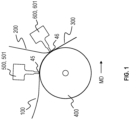
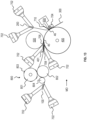
- Fig. 1 is an example illustrating a schematic side view of a method and an apparatus for forming a laminate 300.
- a first device 400, a second device 500, and a third device 600 may be provided.
- a first nip 45 may be formed between the first device 400 and the second device 500.
- a second nip 46 may be formed between the first device 400 and the third device 600.
- the first device 400 may be a mold roll.
- the second device 500 may comprise a first source of vibration energy 501.
- the third device 600 may comprise a second source of vibration energy 601.
- the second device 500 may be any type of sonotrode, including but not limited to a blade sonotrode (as shown in Fig. 1 ) or a rotary sonotrode.
- the third device 600 may be any type of sonotrode, including but not limited to a blade sonotrode (as shown in Fig. 1 ) or a rotary sonotrode.
- a first substrate 100 may be conveyed in a machine direction MD through the first nip 45.
- the first source of vibration energy 601 may apply energy to the first substrate 100 in the first nip 45 to cause a portion of the first substrate 100 to be heated adequately to flow into and fill a plurality of shaped recesses on an outer surface of the first device, which will be described in greater detail with reference to Fig. 3 .
- the altered first substrate 100 and a second substrate 200 may both be conveyed through the second nip 46.
- the second source of vibration energy 601 may apply energy to the second substrate 100 and/or to the first substrate 100 to bond the first substrate 100 to the second substrate 200, thereby forming a laminate 300.
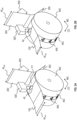
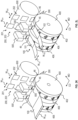
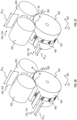
- Fig. 2A, Fig. 2B , Fig. 2C, Fig. 2D , Fig. 2E, Fig. 2F , Fig. 2G, Fig. 2H , Fig. 21 , Fig. 2J , Fig. 2K, Fig. 2L , Fig. 2M, Fig. 2N , Fig. 2O, Fig. 2P , Fig. 2Q, Fig. 2R , Fig. 2S, Fig. 2T , Fig. 2U, Fig. 2V , Fig. 2W, and Fig. 2X cooperate to illustrate some non-limiting variations of a method and an apparatus for forming a laminate 300.
- the first substrate 100 may have a width W 100 in a cross direction CD.
- the first substrate 100 may comprise a plurality of strips.
- a first strip 101 of the plurality of strips may have a width W 101 in a cross direction CD.
- a second strip 102 of the plurality of strips may have a width W 102 in a cross direction CD.
- the first substrate 100 may comprise a plurality of discrete segments 103.
- the second substrate 200 may have a width W 200 in the cross direction CD.
- the second substrate 200 may comprise a plurality of strips.
- a first strip 201 of the plurality of strips may have a width W 201 in a cross direction CD.
- a second strip 202 of the plurality of strips may have a width W 202 in a cross direction CD.
- the second substrate 200 may comprise a plurality of discrete segments 203.
- the first device 400 may comprise an outer surface 402 having one or more raised portions 406 disposed thereon.
- the first substrate 100 in any form, may be passed through the first nip 45 formed between the first device 400 and the second device 500.
- Both the first substrate 100 and the second substrate in any form, may be passed through the second nip 46 formed between the first device 400 and the third device 600.
- the combined widths W 201 , W 202 of the plurality of strips 201, 202 that make up the second substrate 200 are less equal than the width W 100 of the first substrate 100.
- the first substrate 100 may comprise a plurality of strips 101, 102 and the second substrate 200 may comprise a plurality of strips 201, 202.
- the second device 500 and/or the third device 600 may be any type of sonotrode, including but not limited to a blade sonotrode or a rotary sonotrode.
- the first substrate 100 and/or the second substrate 200 comprises a plurality of discrete sheets 103, 203
- the first substrate 100 and/or the second substrate 200 may be prefabricated into the pluralities of discrete sheets 103, 203.
- the discrete sheets 103, 203 may be cut in-line.
- the discrete sheets 103, 203 may be transferred through the process via one or more vacuum-assisted rollers, as will be discussed hereinafter.
- Fig. 4 is an example illustrating a schematic cross-sectional view of a recess 408 of a raised portion 406 of the first device 400.
- the recess 408 may have a shape 410 configured to produce hook-shaped projections, which may be used as a component of a hook-and-loop-type fastener.
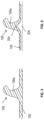
- Fig. 5 is an example illustrating a schematic cross-sectional view of a hook fastener 106 formed in the first substrate 100.
- the hook fastener 106 may have a hook body 106a that extends above a surface of the first substrate 100.
- Fig. 6 is an example illustrating a schematic cross-sectional view of a hook fastener 106 formed in the first substrate 100, as shown in Fig. 5 .
- a second substrate 200 has been joined or bonded to the first substrate 100.
- a portion 204of the second substrate may be distributed into the hook body 106a as a result of the bonding operation performed in the second nip 46.
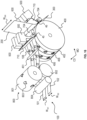
- Fig. 7 is an example illustrating a schematic side view of a method and an apparatus for forming a laminate 300.
- the first device 500 comprising a first source of vibration energy 501
- the second device 600 comprising a second source of vibration energy 601
- a first web handling device 451 may be positioned upstream of the first device 500.
- a second web handling device 461 may be positioned upstream of the second device 600.
- the web handling devices 451, 461 may maintain a desired degree of tension on the first substrate 100 and the second substrate 200 as the substrates 100, 200 are conveyed through the first nip 45 and the second nip 46.
- the web handling devices 451, 461 may be any type of web handling device, including but not limited to a web spreading device, a flat bar, a bar roller, or an idler roll.
- a flat stationary bar may be preferred according to various configurations to reduce web wrinkles upon heating, which were observed with some idler rolls.
- the method and apparatus may further comprise one or more preheaters 702.
- the preheaters 702 may apply heated air to the first substrate 100 before the first substrate 100 enters the first nip 45.
- An upper heat shield 706 and a lower heat shield 708 may be disposed between the preheaters 702 to deflect the heated air away from portions of the substrate that do not need to be preheated.
- the first substrate 100 may be conveyed between the upper heat shield 706 and the lower heat shield 708.
- Similar preheaters may be used to preheat the second substrate 200, as will be illustrated hereinafter.
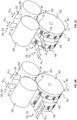
- Fig. 8 is an example illustrating a schematic side view of a method and an apparatus for forming a laminate 300, the method employing and the apparatus including a plurality of preheaters 702 and a flattening roller 800.
- the flattening apparatus 800 may comprise a first flattening roller 801 and a second flattening roller 802.
- a third nip 80 may be formed between the first flattening roller 801 and the second flattening roller 802.
- the first substrate 100 may be conveyed through the third nip 80.
- the first flattening roller 801 may comprise one or more raised portions 803 that may press the first substrate against the second flattening roller 802 to create flatten portions 108 (see: Fig. 9 ) of the first substrate 100.
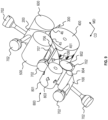
- Fig. 17 is an example illustrating a schematic perspective view of a method and an apparatus for forming a laminate from two primary substrates and one secondary substrate, the method employing a plurality of preheaters 702 and a flattening apparatus 800.
- each the plurality of strips 101, 102 may be heated with one or more preheaters 702 both upstream of the flattening apparatus 800 and upstream of the first nip 45.
- the upper heat shield 706 and the lower heat shield 708 may include a plurality of apertures 707 to allow warm air from the plurality of preheaters 702 to reach the plurality of strips 101, 102.
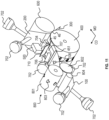
- Fig. 24 is an example illustrating a schematic top view of a laminated substrate comprising a plurality of substrates, some having altered portions, the laminated substrate having bond sites only between the altered portions. More specifically, the first strip 101 and/or the second strip 102 may be bonded to the second substrate 200, via bonds 304 in unaltered or unformed areas 110 disposed between and/or around the altered areas 104, as illustrated in Fig. 22 .
- Suitable mechanical fastening components may be provided by interlocking geometric shaped materials, such as hooks, loops, bulbs, mushrooms, arrowheads, balls on stems, male and female mating components, buckles, snaps, or the like.
- the back joining portions 36 (one on each side of the absorbent article 10) may comprise loop fasteners and the front joining portions 38 may comprise complementary hook fasteners.
- the back joining portions 36 may comprise hook fasteners and the front joining portions 38 may comprise complementary loop fasteners.
- the hooks fasteners may be integral with the back or front joining portions or may be manufactured from a portion of the back or front joining portions.
- the absorbent article 10 may further comprise one or more disposal fasteners 24, wherein the disposal fastener 24 is a disposal tab 26.
- the disposal tab 26 may be attached to each of the back ears 18 and extend in part transversely outward of the respective back ears for opposed relationship with the corresponding front ears in the wear configuration.
- the back ears 18 or front ears 20 may comprise a disposal tab extending beyond the back or front joining portions 36, 38.
- Each disposal tab 26 may comprise an attachment region 28 at which the disposal tab 26 is attached to the respective outer surface of the back or front ears 18, 20 of the absorbent article 10, and a fastener region 30 extending transversely outward from the attachment region 28.
- the disposal tab 26 may be integral with and form part of back ears 18 or front ears 20.
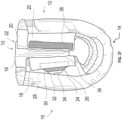
- Fig. 28 is a schematic plan view of an example absorbent article in a flat, uncontracted state with the wearer-facing surface facing the viewer.
- the body-facing surface 9 of the absorbent article 10 is facing the viewer.
- the article 10 includes one or more lateral extension elements in the form of an ear, including for example front ears 40 disposed in a first waist region and/or back ears 42 disposed in a second waist region. Fastener attachment arms 42 may extend from the back ears 44.
- a leg gasketing system 48 may extend between the first waist region and the second waist region and may include elastic elements 46 to form one or more leg cuffs.
- the article 10 may also comprise a primary fastening system.
- a primary fastening system may comprise a fastening component 50, which may comprise one or more fastening elements 52 which cause the component to engage with another surface, such as a receiving component.
- fastening elements comprise hooks.
- Receiving components may comprise material adapted to fastenably cooperate with fastening elements, such as a section or patch adapted to serve as cooperative loops material, to provide a hook-and-loop fastening system combination.
Landscapes
- Engineering & Computer Science (AREA)
- Mechanical Engineering (AREA)
- Health & Medical Sciences (AREA)
- Public Health (AREA)
- Biomedical Technology (AREA)
- Heart & Thoracic Surgery (AREA)
- Vascular Medicine (AREA)
- Life Sciences & Earth Sciences (AREA)
- Animal Behavior & Ethology (AREA)
- General Health & Medical Sciences (AREA)
- Epidemiology (AREA)
- Veterinary Medicine (AREA)
- Manufacturing & Machinery (AREA)
- Thermal Sciences (AREA)
- Physics & Mathematics (AREA)
- Chemical & Material Sciences (AREA)
- Combustion & Propulsion (AREA)
- Laminated Bodies (AREA)
- Absorbent Articles And Supports Therefor (AREA)
- Lining Or Joining Of Plastics Or The Like (AREA)
Priority Applications (1)
| Application Number | Priority Date | Filing Date | Title |
|---|---|---|---|
| EP25225619.3A EP4696485A3 (de) | 2023-01-04 | 2023-12-14 | Geteilte bildung einheitlicher substrate |
Applications Claiming Priority (1)
| Application Number | Priority Date | Filing Date | Title |
|---|---|---|---|
| US202363478400P | 2023-01-04 | 2023-01-04 |
Related Child Applications (2)
| Application Number | Title | Priority Date | Filing Date |
|---|---|---|---|
| EP25225619.3A Division EP4696485A3 (de) | 2023-01-04 | 2023-12-14 | Geteilte bildung einheitlicher substrate |
| EP25225619.3A Division-Into EP4696485A3 (de) | 2023-01-04 | 2023-12-14 | Geteilte bildung einheitlicher substrate |
Publications (2)
| Publication Number | Publication Date |
|---|---|
| EP4397288A1 true EP4397288A1 (de) | 2024-07-10 |
| EP4397288B1 EP4397288B1 (de) | 2026-02-04 |
Family
ID=89223271
Family Applications (2)
| Application Number | Title | Priority Date | Filing Date |
|---|---|---|---|
| EP23216755.1A Active EP4397288B1 (de) | 2023-01-04 | 2023-12-14 | Geteilte bildung einheitlicher substrate |
| EP25225619.3A Pending EP4696485A3 (de) | 2023-01-04 | 2023-12-14 | Geteilte bildung einheitlicher substrate |
Family Applications After (1)
| Application Number | Title | Priority Date | Filing Date |
|---|---|---|---|
| EP25225619.3A Pending EP4696485A3 (de) | 2023-01-04 | 2023-12-14 | Geteilte bildung einheitlicher substrate |
Country Status (2)
| Country | Link |
|---|---|
| US (1) | US20240216183A1 (de) |
| EP (2) | EP4397288B1 (de) |
Families Citing this family (1)
| Publication number | Priority date | Publication date | Assignee | Title |
|---|---|---|---|---|
| US20240140048A1 (en) * | 2022-10-31 | 2024-05-02 | The Procter & Gamble Company | System and method for forming protrusions in a substrate used to manufacture absorbent articles |
Citations (5)
| Publication number | Priority date | Publication date | Assignee | Title |
|---|---|---|---|---|
| US5059277A (en) * | 1986-02-28 | 1991-10-22 | The Procter & Gamble Company | Adhesive-free bonding of continuously moving webs to form laminate web |
| US8784772B2 (en) | 2007-03-22 | 2014-07-22 | The Johns Hopkins University | Urothelial differentiation of urothelial carcinoma: a bladder cancer stem cell model |
| US10105787B2 (en) * | 2015-06-05 | 2018-10-23 | GM Global Technology Operations LLC | Systems and methods for ultrasonic welding |
| US20210162675A1 (en) * | 2018-04-17 | 2021-06-03 | Woodwelding Ag | Method and installation for joining a cover layer to an object |
| US11331222B2 (en) * | 2016-03-24 | 2022-05-17 | Daio Paper Corporation | Method for forming elastic film stretchable structure, and absorbent article |
Family Cites Families (2)
| Publication number | Priority date | Publication date | Assignee | Title |
|---|---|---|---|---|
| US9944764B2 (en) * | 2013-05-23 | 2018-04-17 | 3M Innovative Properties Company | Reticulated thermoplastic film and method of making the same |
| FR3079166B1 (fr) * | 2018-03-21 | 2023-10-20 | Aplix Sa | Ensemble lamine, couche culotte comprenant un tel ensemble et procede de fabrication d'un tel ensemble |
-
2023
- 2023-12-14 US US18/539,402 patent/US20240216183A1/en active Pending
- 2023-12-14 EP EP23216755.1A patent/EP4397288B1/de active Active
- 2023-12-14 EP EP25225619.3A patent/EP4696485A3/de active Pending
Patent Citations (5)
| Publication number | Priority date | Publication date | Assignee | Title |
|---|---|---|---|---|
| US5059277A (en) * | 1986-02-28 | 1991-10-22 | The Procter & Gamble Company | Adhesive-free bonding of continuously moving webs to form laminate web |
| US8784772B2 (en) | 2007-03-22 | 2014-07-22 | The Johns Hopkins University | Urothelial differentiation of urothelial carcinoma: a bladder cancer stem cell model |
| US10105787B2 (en) * | 2015-06-05 | 2018-10-23 | GM Global Technology Operations LLC | Systems and methods for ultrasonic welding |
| US11331222B2 (en) * | 2016-03-24 | 2022-05-17 | Daio Paper Corporation | Method for forming elastic film stretchable structure, and absorbent article |
| US20210162675A1 (en) * | 2018-04-17 | 2021-06-03 | Woodwelding Ag | Method and installation for joining a cover layer to an object |
Also Published As
| Publication number | Publication date |
|---|---|
| US20240216183A1 (en) | 2024-07-04 |
| EP4696485A2 (de) | 2026-02-18 |
| EP4397288B1 (de) | 2026-02-04 |
| EP4696485A3 (de) | 2026-03-11 |
Similar Documents
| Publication | Publication Date | Title |
|---|---|---|
| US20260000552A1 (en) | Elastic laminates and methods for assembling elastic laminates for absorbent articles | |
| US8557077B2 (en) | Method of producing a pants-type diaper | |
| EP1427369B1 (de) | Verfahren zur herstellung von formkörpern aus bahnmaterialien | |
| JP5002832B2 (ja) | 複合弾性シートの製造方法および装置 | |
| US8460495B2 (en) | Method for producing absorbent article with stretch film side panel and application of intermittent discrete components of an absorbent article | |
| US8491741B2 (en) | Method of forming elastomeric laminates having targeted elastic properties for use in personal care articles | |
| CA2221578A1 (en) | Method and apparatus for producing a composite web having transverse stretch | |
| CN103945806A (zh) | 短裤型穿着用物品的制造方法 | |
| US9089453B2 (en) | Method for producing absorbent article with stretch film side panel and application of intermittent discrete components of an absorbent article | |
| CN105581873B (zh) | 生产用于吸收性卫生用品的后片的方法和吸收性卫生用品 | |
| EP4397288B1 (de) | Geteilte bildung einheitlicher substrate | |
| CN101528169A (zh) | 可拉伸层压制品 | |
| EP4098234B1 (de) | Verfahren und vorrichtung zur herstellung des bundteiles eines am körper tragbaren artikels | |
| EP4096606B1 (de) | Elastischer bund zur verwendung in einem absorbierenden kleidungsstück und verfahren zur herstellung desselben | |
| WO2026050040A1 (en) | Refastenable pant with hook on insert and method of producing refastenable pant | |
| EP2813199B1 (de) | Verfahren zur Herstellung absorbierender Artikel mit Dehnfolienseitenwand |
Legal Events
| Date | Code | Title | Description |
|---|---|---|---|
| PUAI | Public reference made under article 153(3) epc to a published international application that has entered the european phase |
Free format text: ORIGINAL CODE: 0009012 |
|
| STAA | Information on the status of an ep patent application or granted ep patent |
Free format text: STATUS: THE APPLICATION HAS BEEN PUBLISHED |
|
| AK | Designated contracting states |
Kind code of ref document: A1 Designated state(s): AL AT BE BG CH CY CZ DE DK EE ES FI FR GB GR HR HU IE IS IT LI LT LU LV MC ME MK MT NL NO PL PT RO RS SE SI SK SM TR |
|
| STAA | Information on the status of an ep patent application or granted ep patent |
Free format text: STATUS: REQUEST FOR EXAMINATION WAS MADE |
|
| 17P | Request for examination filed |
Effective date: 20241216 |
|
| GRAP | Despatch of communication of intention to grant a patent |
Free format text: ORIGINAL CODE: EPIDOSNIGR1 |
|
| STAA | Information on the status of an ep patent application or granted ep patent |
Free format text: STATUS: GRANT OF PATENT IS INTENDED |
|
| INTG | Intention to grant announced |
Effective date: 20250912 |
|
| GRAS | Grant fee paid |
Free format text: ORIGINAL CODE: EPIDOSNIGR3 |
|
| GRAA | (expected) grant |
Free format text: ORIGINAL CODE: 0009210 |
|
| STAA | Information on the status of an ep patent application or granted ep patent |
Free format text: STATUS: THE PATENT HAS BEEN GRANTED |
|
| AK | Designated contracting states |
Kind code of ref document: B1 Designated state(s): AL AT BE BG CH CY CZ DE DK EE ES FI FR GB GR HR HU IE IS IT LI LT LU LV MC ME MK MT NL NO PL PT RO RS SE SI SK SM TR |
|
| REG | Reference to a national code |
Ref country code: CH Ref legal event code: F10 Free format text: ST27 STATUS EVENT CODE: U-0-0-F10-F00 (AS PROVIDED BY THE NATIONAL OFFICE) Effective date: 20260204 Ref country code: GB Ref legal event code: FG4D |
|
| REG | Reference to a national code |
Ref country code: DE Ref legal event code: R096 Ref document number: 602023011582 Country of ref document: DE |
|
| REG | Reference to a national code |
Ref country code: IE Ref legal event code: FG4D |