EP4397237A2 - Vorrichtung zur kontinuierlichen blutzuckermessung - Google Patents
Vorrichtung zur kontinuierlichen blutzuckermessung Download PDFInfo
- Publication number
- EP4397237A2 EP4397237A2 EP24177612.9A EP24177612A EP4397237A2 EP 4397237 A2 EP4397237 A2 EP 4397237A2 EP 24177612 A EP24177612 A EP 24177612A EP 4397237 A2 EP4397237 A2 EP 4397237A2
- Authority
- EP
- European Patent Office
- Prior art keywords
- unit
- sensor
- needle
- housing
- applicator
- Prior art date
- Legal status (The legal status is an assumption and is not a legal conclusion. Google has not performed a legal analysis and makes no representation as to the accuracy of the status listed.)
- Pending
Links
Images




















Classifications
-
- A—HUMAN NECESSITIES
- A61—MEDICAL OR VETERINARY SCIENCE; HYGIENE
- A61B—DIAGNOSIS; SURGERY; IDENTIFICATION
- A61B5/00—Measuring for diagnostic purposes; Identification of persons
- A61B5/15—Devices for taking samples of blood
- A61B5/150007—Details
- A61B5/150206—Construction or design features not otherwise provided for; manufacturing or production; packages; sterilisation of piercing element, piercing device or sampling device
-
- A—HUMAN NECESSITIES
- A61—MEDICAL OR VETERINARY SCIENCE; HYGIENE
- A61B—DIAGNOSIS; SURGERY; IDENTIFICATION
- A61B5/00—Measuring for diagnostic purposes; Identification of persons
- A61B5/0002—Remote monitoring of patients using telemetry, e.g. transmission of vital signals via a communication network
- A61B5/0015—Remote monitoring of patients using telemetry, e.g. transmission of vital signals via a communication network characterised by features of the telemetry system
- A61B5/0024—Remote monitoring of patients using telemetry, e.g. transmission of vital signals via a communication network characterised by features of the telemetry system for multiple sensor units attached to the patient, e.g. using a body or personal area network
-
- A—HUMAN NECESSITIES
- A61—MEDICAL OR VETERINARY SCIENCE; HYGIENE
- A61B—DIAGNOSIS; SURGERY; IDENTIFICATION
- A61B5/00—Measuring for diagnostic purposes; Identification of persons
- A61B5/145—Measuring characteristics of blood in vivo, e.g. gas concentration or pH-value ; Measuring characteristics of body fluids or tissues, e.g. interstitial fluid or cerebral tissue
- A61B5/14532—Measuring characteristics of blood in vivo, e.g. gas concentration or pH-value ; Measuring characteristics of body fluids or tissues, e.g. interstitial fluid or cerebral tissue for measuring glucose, e.g. by tissue impedance measurement
-
- A—HUMAN NECESSITIES
- A61—MEDICAL OR VETERINARY SCIENCE; HYGIENE
- A61B—DIAGNOSIS; SURGERY; IDENTIFICATION
- A61B5/00—Measuring for diagnostic purposes; Identification of persons
- A61B5/15—Devices for taking samples of blood
- A61B5/150007—Details
- A61B5/150374—Details of piercing elements or protective means for preventing accidental injuries by such piercing elements
- A61B5/150381—Design of piercing elements
- A61B5/150389—Hollow piercing elements, e.g. canulas, needles, for piercing the skin
-
- A—HUMAN NECESSITIES
- A61—MEDICAL OR VETERINARY SCIENCE; HYGIENE
- A61B—DIAGNOSIS; SURGERY; IDENTIFICATION
- A61B5/00—Measuring for diagnostic purposes; Identification of persons
- A61B5/15—Devices for taking samples of blood
- A61B5/151—Devices specially adapted for taking samples of capillary blood, e.g. by lancets, needles or blades
- A61B5/15101—Details
- A61B5/15103—Piercing procedure
- A61B5/15107—Piercing being assisted by a triggering mechanism
- A61B5/15113—Manually triggered, i.e. the triggering requires a deliberate action by the user such as pressing a drive button
-
- A—HUMAN NECESSITIES
- A61—MEDICAL OR VETERINARY SCIENCE; HYGIENE
- A61B—DIAGNOSIS; SURGERY; IDENTIFICATION
- A61B5/00—Measuring for diagnostic purposes; Identification of persons
- A61B5/15—Devices for taking samples of blood
- A61B5/151—Devices specially adapted for taking samples of capillary blood, e.g. by lancets, needles or blades
- A61B5/15186—Devices loaded with a single lancet, i.e. a single lancet with or without a casing is loaded into a reusable drive device and then discarded after use; drive devices reloadable for multiple use
- A61B5/15188—Constructional features of reusable driving devices
- A61B5/1519—Constructional features of reusable driving devices comprising driving means, e.g. a spring, for propelling the piercing unit
-
- A—HUMAN NECESSITIES
- A61—MEDICAL OR VETERINARY SCIENCE; HYGIENE
- A61B—DIAGNOSIS; SURGERY; IDENTIFICATION
- A61B5/00—Measuring for diagnostic purposes; Identification of persons
- A61B5/68—Arrangements of detecting, measuring or recording means, e.g. sensors, in relation to patient
- A61B5/6846—Arrangements of detecting, measuring or recording means, e.g. sensors, in relation to patient specially adapted to be brought in contact with an internal body part, i.e. invasive
-
- A—HUMAN NECESSITIES
- A61—MEDICAL OR VETERINARY SCIENCE; HYGIENE
- A61B—DIAGNOSIS; SURGERY; IDENTIFICATION
- A61B5/00—Measuring for diagnostic purposes; Identification of persons
- A61B5/68—Arrangements of detecting, measuring or recording means, e.g. sensors, in relation to patient
- A61B5/6846—Arrangements of detecting, measuring or recording means, e.g. sensors, in relation to patient specially adapted to be brought in contact with an internal body part, i.e. invasive
- A61B5/6847—Arrangements of detecting, measuring or recording means, e.g. sensors, in relation to patient specially adapted to be brought in contact with an internal body part, i.e. invasive mounted on an invasive device
- A61B5/6848—Needles
-
- A—HUMAN NECESSITIES
- A61—MEDICAL OR VETERINARY SCIENCE; HYGIENE
- A61B—DIAGNOSIS; SURGERY; IDENTIFICATION
- A61B2560/00—Constructional details of operational features of apparatus; Accessories for medical measuring apparatus
- A61B2560/06—Accessories for medical measuring apparatus
- A61B2560/063—Devices specially adapted for delivering implantable medical measuring apparatus
Definitions
- Diabetes is a chronic medical condition that is common in modern people, and in the Republic of Korea, there are 2 million diabetes patients, about 5% of the total population.
- Diabetes occurs when the absolute level of the sugar level in blood is high due to the absolute deficiency or relative insufficiency of insulin, produced by the pancreas, caused by various reasons such as obesity, stress, poor eating habits, and inherited hereditary factors and imbalance regarding glucose in the blood.
- Diabetes is characterized by substantial absence of subjective symptoms at the beginning of the condition, when diabetes progresses, diabetes-specific symptoms such as overdrink, overeat, polyuria, weight loss, weariness, skin itchiness, and lower ability of naturally healing on injury on hands and feet are shown, and further progression of diabetes leads to complications such as visual disturbances, hypertension, kidney disease, paralysis, periodontal disease, muscle spasms and neuralgia, as well as gangrene.
- diabetes-specific symptoms such as overdrink, overeat, polyuria, weight loss, weariness, skin itchiness, and lower ability of naturally healing on injury on hands and feet are shown, and further progression of diabetes leads to complications such as visual disturbances, hypertension, kidney disease, paralysis, periodontal disease, muscle spasms and neuralgia, as well as gangrene.
- CGMSs continuous glucose monitoring systems
- the blood-collecting glucose monitoring system performs the glucose measurement by collecting blood by pricking a pain-sensitive fingertip with a needle by the diabetes patients themselves, and therefore, the blood collecting process may cause pain and aversion.
- the CGMSs which can continuously measure glucose levels by inserting a needle-shaped sensor into a portion of the human body, such as the belly or an arm, which is less pain sensitive, have been undertaken, and furthermore, research and development of non-invasive glucose monitoring systems for measuring glucose without collecting blood have been actively undertaken.
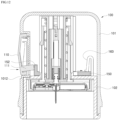
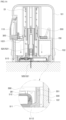
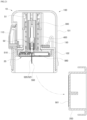
- a continuous glucose measurement apparatus may comprise: a body attachable unit configured to be insertedly attachable to a body to extract body fluid and periodically measure blood glucose; and an applicator in which the body attachable unit is coupled, the applicator configured to outwardly discharge the body attachable unit according to manipulation of a user so that the body attachable unit is insertedly attached to the body, wherein the body attachable unit may comprise: a housing configured to be outwardly discharged by the applicator, a sensor unit installed to the housing, wherein one end portion of the sensor unit outwardly protrudes from the housing to be inserted into the body according to outwardly discharging movement of the housing, and a needle unit covering the one end portion of the sensor unit and configured to be separably coupled to the housing to be inserted into the body together with the sensor unit according to the outwardly discharging movement of the housing, and wherein the applicator may comprise a needle extracting unit configured to extract and remove the needle unit from the body by moving the needle
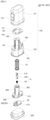
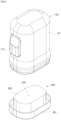
- the protection cap (200) as a separate element may be separatably coupled to the lower end portion of the main case (100) to protect the inside of the body attachable unit (20).
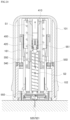
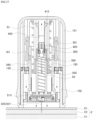
- the pressure button (110) is installed at the main case (100) for pressure operation by the user, and a shooting plate (150) configured to be movable according to the pressure operation of the pressure button (110) may be movably coupled to the inside of the main case (100).
- the pressure button (110) can perform pressurizing operation by manipulated by the user only in a state that it is slidingly moved to the pressure standard mode state, and therefore the pressure operation caused by the user's mistake can be prevented and it is possible to use safely.
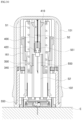
- the pressure button (110) is changed to the pressure standby mode state and the pressurizing operation is performed as shown in FIG. 12 , the pressure button (110) the pressure rod (111) of the pressure button (110) applies pressure to and moves the shooting plate (150).
- the hook guide unit may have a structure with convex and concave surfaces on the inner surface of the inner case (102), the convex surface applies pressure to the sensor fixing hook (330) and the concave surface releases the sensor fixing hook (330) from the pressure application, and the concave is formed to release the sensor fixing hook (330) from the pressure application in a state that the sensor fixing hook (330) is moved together with the plunger body (300) to the second location.
- the main case (100) includes return prevention means for preventing the plunger body (300) returning to the first location after the plunger body (300) is moved to the second location.
- the return prevention hook (161) is configured to be interlocked with the interlocking body (340) by elastic restoring force in the operation of be interlocked with the interlocking body (340).
- the return prevention hook (161) may be configured to have a structure comprising a rotatable body (1611) elastically rotatably coupled around a rotary shaft (1613) and at one side of the inner case (102), and a hook body (1612) slantly protruding from the inner side surface of the rotatable body (1611) in a downward and inward direction.
- the rotary axis (1613) is configured to elastically support the rotatable body (1611) in a inward and protruding direction of the hook body (1612) by applying elastic force according to a material character of elastic material.
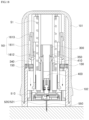
- the state of the operation of the return prevention hook (161) will be described in detail, and if the plunger body (300) is moved to the second location by the operation of the pressure button (110) in a state that the plunger body (300) is positioned at the first location as shown in FIG. 17 , the hook body (1612) is pressurized by the interlocking body (340) of the plunger body (200) during the movement of the plunger body (300) to the second location as illustrated in FIG. 18 , and then the return prevention hook (161) is elastically rotated in a clockwise direction (an outward direction) around the rotary axis (1613). After that, if the movement of the plunger body (300) to the second location is completed as shown in FIG.
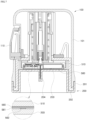
- the needle extracting body (400) is interlockedly coupled to the plunger body (300), and for this purpose, a separate elastic hook (410) configured to be elastically transformable is provided at the needle discharge body (400), and the elastic hook (410) is elastically biased in a direction interlockedly coupled to the hook interlocking unit (350) of the plunger body (300). Accordingly, if the plunger body (300) is linearly moved from the first location to the second location according to the operation of the pressure button (110), the needle extracting body (400) is also linearly moved to the second location together with the plunger body (300).
- a needle extracting pressurizing unit (130) configured to pressurize the elastic hook (410) in an inward direction so that the elastic hook (410) is released from the interlock with the hook interlocking unit (350) of the plunger body (300) according to the movement of the needle extracting body (400) to the second location is included in the inner case (102).
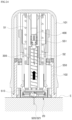
- the needle extracting body (400) linearly moves from the first location to the second location together with the plunger body (300) as illustrated in FIG. 19 , at the same time the elastic hook (410) of the needle extracting body (400) is pressurized by the needle extracting pressurizing unit (130) and is released from the state interlocked with the hook interlocking unit (350), and therefore the needle extracting body (400) is upwardly return-moved toward the first location by the elastic force of the needle extracting elastic spring (S2) as shown in FIG. 20 .
- the needle extracting body (400) is coupled with the needle head (551) of the needle unit (550) through an end of a needle head coupling unit (420), during the operation that the needle extracting body (400) is upwardly return-moved, the needle unit (550) is moved together and removed from the human body.
- the needle head coupling unit (420) is formed at the lower end portion of the needle extracting body (400) by a form of being interlockedly coupled to the coupling groove (552) formed at the needle head (551).
- a needle supporting block may be coupled to the needle attachable body (400), and the needle supporting block is configured to downwardly support an upper end of the needle unit (550) so that the needle unit (550) cannot be upwardly moved with respect to the needle extracting body (400).
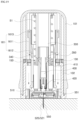
- the needle extracting body (400) is upwardly return-moved by the needle extracting elastic spring (S2) as illustrated in FIG. 24 .
- the needle unit (550) is extracted and removed from the human body (E).
- a needle discharging means (N) removes the needle unit (550) from the human body before the insertion of the sensor unit (520) of the body attachable unit (20) is completed may be provided.
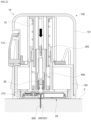
- the needle extracting body (400) and the body attachable unit (20) are moved together with the plunger body from the first location toward the second location, and in in this operation, after passing through the third location which is the intermediate section, the needle extracting body (400) and the body attachable unit (20) are moved to the second location.
- the body attachable unit (20) and the plunger body (300) is continuously discharged outwardly to the second location by the plunger elastic spring (S 1) and the sensor unit (520) is inserted into the human body (E).
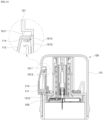
- the sensor unit (520) of the body attachable unit (20) is inserted into the skin layer of the human body to measure blood sugar level, as shown in FIG. 26 , the skin layer may consist of an outer skin layer (E1), a dermal layer (E2) and a subcutaneous layer (E3) in a direction from a outmost surface toward an inside, and the sensor unit (520) is formed to protrude from the housing so that one end portion of the sensor unit (520) can be inserted into the subcutaneous layer (E3) in the state that the housing (510) contacts the skin.
- the skin layer may consist of an outer skin layer (E1), a dermal layer (E2) and a subcutaneous layer (E3) in a direction from a outmost surface toward an inside, and the sensor unit (520) is formed to protrude from the housing so that one end portion of the sensor unit (520) can be inserted into the subcutaneous layer (E3) in the state that the housing (510) contacts the skin.
- the sensor unit (520) in the process that the sensor unit (520) is inserted into the human body skin, the sensor unit (520) penetrates the dermal layer (E2) and the subcutaneous layer (E3) and are inserted after penetrating the outer skin layer (E1), and during this insertion operation of the sensor unit (520), the sensor unit (520) can penetrate the dermal layer (E2) and the subcutaneous layer (E3) by itself without the guide of the needle unit (550) because the dermal layer (E2) and the subcutaneous layer (E3) are relatively less hard.
- the compression-type needle extracting elastic spring (S2) have both ends which are coupled to the plunger body (300) and the needle extracting body (400), and is arranged in a compressed form and is configured to return-move the needle extracting body (400) toward the first location by tension restoration elastic force.
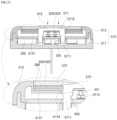
- the electrical contact point (531) is formed at the PCB board (530) to be electrically connected with the sensor unit (520), and the wireless communication chip (540) is installed to the PCB board (530) to transmit the glucose measurement result measured by the sensor unit (520) to an external terminal.
- the wireless communication chip (540) is installed at the inside of the body attachable unit (20) to transmit the glucose measurement result measured by the sensor unit (520) to an external terminal.
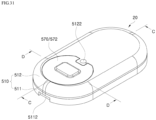
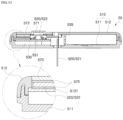
- the housing (510) may have a separate pressurizing operation module (570) activated by the operation of the user to connect the other end portion of the sensor unit (520) and the electrical contact point (531) of the PCB board (530) by the operation of the user.
- a separate pressurizing operation module (570) activated by the operation of the user to connect the other end portion of the sensor unit (520) and the electrical contact point (531) of the PCB board (530) by the operation of the user.
- the seal processing means at the coupling portion between the button cover (572) and the housing (510) may be configured to use a double-side tape (580).
- a double-side tape (580) For example, one side of the double-side tape (580) is adhered to the other portion of the sensor unit (520), such as one side of the sensor body unit (522), along its circumferential edge, the other side of the double-side tape (580) is adhered to the inner-side surface of the button cover (572) along its circumferential edge, and this double-side tape (580) can seal the circumferential edge of the button cover (572).
- the contact status can be stably maintained for stable measurement of blood glucose, and for this, the movable pressurizing body (571) is formed to be fixedly positioned in a state that the movable pressurizing body (571) is moved in a pressurized direction by the urging force.
- the interlocking projection (5124) may be formed at the sensor supporting unit (5121) of the housing (510), at least two guide fixing units (5123) separated to each other, formed along a circumferential direction and having a structure covering the protruding guide unit (5711) of the movable pressurizing body (571) are formed at the sensor supporting unit (5121) of the housing (510) as illustrated in FIG. 36 , and the interlocking protrusion (5124) may be formed at each guide fixing unit (5123). Additionally, each guide fixing unit (5123) may be arranged in a structure being elastically supported by the elastic supporting unit (5125) which is configured to be elastically transformable.
- the guide fixing unit (5123) is elastically transformed and makes the movement of the movable pressurizing body (571) smooth
- the guide fixing unit (5123) is elastically returned and the locking hook (5712) is interlockedly coupled to the interlocking projection (5124), and because the guide fixing unit (5123) is elastically supported by the elastic supporting unit (5125), the interlocking coupling state between the locking hook (5712) and the interlocking projection (5124) is stably maintained.
- the sensor unit (520) may consist of the sensor body unit (522) and the sensor probe unit (521) as described above, and a pressure transforming unit (523) configured to be transformed by the pressurizing movement of the movable pressurizing body (571) and contacted to the electric contact point (531) of the PCB board (530) may be formed at the sensor body unit (522).
- the pressure transforming unit (523) comprise a first cut area (5231) having a structure cut along a first cut line (5232) formed at the center section of the sensor body unit (522) as illustrated in FIG. 37 , and the first cut area (5231) may be formed to be transformable by the pressure applied by the movable pressurizing body (571).
- the pressure transforming unit (523) further comprise a second cut section (5233) positioned at the center section of the sensor body unit (522) and having a structure cut along a second cut line (5234) formed at the outer section of the first cut line (5232), and the first cut area (5231) and the second cut area (5233) may be formed to be transformable by the pressure applied by the movable pressurizing body (571).
- the first cut line (5232) is formed as an partially opened structure in a closed loop
- the second cut line (5234) is formed to have an opened section at the position opposing to the opened section of the first cut line (5232) and formed in a closed-loop structure surrounding the opened section of the first cut line (5232).
- a first cut section (5231) of the pressure transforming unit (523) is downwardly elastically transformed as illustrated in FIGS. 38 (a) and (b)
- a second cut section (5233) formed at an outer section of the first cut are (5231) is downwardly elastically transformed sequentially, and therefore because the first cut section (5231) directly contacting the electric contact point (531) of the PCB board (530) contact the electric contact point (531) of the PCB board (530) in a relatively horizontal state, the contacting state to the electric contact point (531) of the sensor body unit (522) can be more stably maintained.
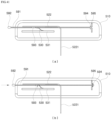
- a plurality of electric contact points (531) electrically contacting the sensor body unit (522) may protrude toward the sensor body unit (522), and the protruding height of at least one of the plurality of electric contact points (531) may be higher than the rest.
- the protruding height of one of the electric contact points (531) is formed be higher than the other of the electric contact points (531), and therefore clearance distances d1, d2 are formed differently from each other.
- the sensor body unit (522) of the senor unit (520) and the electric contact point (531) of the PCB board are disposed to be separated from each other, but can contact each other by the pressure operation of the user.
- the housing (531) may be formed in a very thin structure, it may be difficult of stably maintaining the separation state between the sensor body unit (522) and the electric contact point (531) in the housing (510).
- the sensor body unit (522) and the electric contact point (531) may be manufactured and distributed to customers in a state that the sensor body unit (522) and the electric contact point (531) contact each other by the manufacture and assembly tolerance and other reasons before the pressure operation of the user.
- the protruding height of at least one of the plurality of electric contact points (531) is higher that the rest of the electric contact points (531) as described above, only the electric contact point (531) having the highest protruding height may contact the sensor body unit (522) and the other electric contact points (531) may maintain a separation state from the sensor body nit (522). This is because the highest protruding contact point (531) can perform the function of upwardly supporting the sensor body unit (522).
- the plurality of electric contact points (531) may be configured to elastically transformable and be formed to elastically protruding from the PCB board (530), and such an elastic force may perform the desired function of support and contact associated with the sensor body unit (522).
- the operation of the body attachable unit (20) is not initiated. Accordingly, the operation of the sensor unit (520), the wireless communication chip (540), and other components is not initiated, and the power supply by the battery (535) may not be initiated.
- This operation initiation prevention function can result from simple means for setting the circuit pattern of the PCB board (530) to be activated only when all of the plurality of the electric contact points (531) contact the sensor body unit (522).
- the pressurizing operation module (570) may need to be formed so that the movement distance of the movable pressurizing body (571) can be greater than the separation distance between the lowest protruding electric contact point (531) among the plurality of the electric contact points (531) and the sensor body unit (522).
- FIGS. 40 to 42 are conceptual views of various configuration of a contact point connection module according to embodiments of the present disclosure.
- the contact point connection module (590) may be configured to comprise a movable plate (591) disposed between the sensor body unit (522) and the electric contact point (531) of the PCB board (530) and installed to be movable according to the operation of the user inside the housing as illustrated in FIG. 40 .
- the movable plate (591) may be configured to be unable to return to the first location again so that the position of the movable plate (591) is fixed in a state that it is moved to the second location.
- a contact point connection unit (596) made of conductive material may be additionally installed to the movable plate (591). This may be configured in a structure that the contact point connection unit (596) is installed to a portion where the penetrating hole (593) of the movable plate (591) is formed, and the electric contact point (531) and the sensor body unit (522) are electrically connected and contacted to each other by the contact point connection unit (596) when the movable plate (591) is moved.
Landscapes
- Health & Medical Sciences (AREA)
- Life Sciences & Earth Sciences (AREA)
- Physics & Mathematics (AREA)
- Engineering & Computer Science (AREA)
- Molecular Biology (AREA)
- General Health & Medical Sciences (AREA)
- Biophysics (AREA)
- Biomedical Technology (AREA)
- Heart & Thoracic Surgery (AREA)
- Medical Informatics (AREA)
- Veterinary Medicine (AREA)
- Surgery (AREA)
- Animal Behavior & Ethology (AREA)
- Pathology (AREA)
- Public Health (AREA)
- Hematology (AREA)
- Emergency Medicine (AREA)
- Optics & Photonics (AREA)
- Manufacturing & Machinery (AREA)
- Computer Networks & Wireless Communication (AREA)
- Measurement Of The Respiration, Hearing Ability, Form, And Blood Characteristics Of Living Organisms (AREA)
Priority Applications (1)
| Application Number | Priority Date | Filing Date | Title |
|---|---|---|---|
| EP26151540.7A EP4699535A2 (de) | 2018-07-31 | 2019-06-07 | Vorrichtung zur kontinuierlichen blutzuckermessung |
Applications Claiming Priority (3)
| Application Number | Priority Date | Filing Date | Title |
|---|---|---|---|
| KR1020180089339A KR102222045B1 (ko) | 2018-07-31 | 2018-07-31 | 연속 혈당 측정 장치 |
| PCT/KR2019/006840 WO2020027423A1 (ko) | 2018-07-31 | 2019-06-07 | 연속 혈당 측정 장치 |
| EP19844623.9A EP3831298B1 (de) | 2018-07-31 | 2019-06-07 | Vorrichtung zur kontinuierlichen blutzuckermessung |
Related Parent Applications (2)
| Application Number | Title | Priority Date | Filing Date |
|---|---|---|---|
| EP19844623.9A Division EP3831298B1 (de) | 2018-07-31 | 2019-06-07 | Vorrichtung zur kontinuierlichen blutzuckermessung |
| EP19844623.9A Division-Into EP3831298B1 (de) | 2018-07-31 | 2019-06-07 | Vorrichtung zur kontinuierlichen blutzuckermessung |
Related Child Applications (1)
| Application Number | Title | Priority Date | Filing Date |
|---|---|---|---|
| EP26151540.7A Division EP4699535A2 (de) | 2018-07-31 | 2019-06-07 | Vorrichtung zur kontinuierlichen blutzuckermessung |
Publications (2)
| Publication Number | Publication Date |
|---|---|
| EP4397237A2 true EP4397237A2 (de) | 2024-07-10 |
| EP4397237A3 EP4397237A3 (de) | 2024-09-04 |
Family
ID=69231228
Family Applications (5)
| Application Number | Title | Priority Date | Filing Date |
|---|---|---|---|
| EP26151540.7A Pending EP4699535A2 (de) | 2018-07-31 | 2019-06-07 | Vorrichtung zur kontinuierlichen blutzuckermessung |
| EP24177612.9A Pending EP4397237A3 (de) | 2018-07-31 | 2019-06-07 | Vorrichtung zur kontinuierlichen blutzuckermessung |
| EP24177620.2A Pending EP4397239A3 (de) | 2018-07-31 | 2019-06-07 | Vorrichtung zur kontinuierlichen blutzuckermessung |
| EP24177616.0A Withdrawn EP4397238A3 (de) | 2018-07-31 | 2019-06-07 | Vorrichtung zur kontinuierlichen blutzuckermessung |
| EP19844623.9A Active EP3831298B1 (de) | 2018-07-31 | 2019-06-07 | Vorrichtung zur kontinuierlichen blutzuckermessung |
Family Applications Before (1)
| Application Number | Title | Priority Date | Filing Date |
|---|---|---|---|
| EP26151540.7A Pending EP4699535A2 (de) | 2018-07-31 | 2019-06-07 | Vorrichtung zur kontinuierlichen blutzuckermessung |
Family Applications After (3)
| Application Number | Title | Priority Date | Filing Date |
|---|---|---|---|
| EP24177620.2A Pending EP4397239A3 (de) | 2018-07-31 | 2019-06-07 | Vorrichtung zur kontinuierlichen blutzuckermessung |
| EP24177616.0A Withdrawn EP4397238A3 (de) | 2018-07-31 | 2019-06-07 | Vorrichtung zur kontinuierlichen blutzuckermessung |
| EP19844623.9A Active EP3831298B1 (de) | 2018-07-31 | 2019-06-07 | Vorrichtung zur kontinuierlichen blutzuckermessung |
Country Status (8)
| Country | Link |
|---|---|
| US (5) | US20210282675A1 (de) |
| EP (5) | EP4699535A2 (de) |
| JP (1) | JP7060757B2 (de) |
| KR (1) | KR102222045B1 (de) |
| AU (1) | AU2019315233B2 (de) |
| ES (1) | ES3036439T3 (de) |
| HU (1) | HUE073160T2 (de) |
| WO (1) | WO2020027423A1 (de) |
Families Citing this family (17)
| Publication number | Priority date | Publication date | Assignee | Title |
|---|---|---|---|---|
| US12610742B2 (en) | 2019-11-25 | 2026-04-21 | Aita Bio Inc. | Micropump and method of fabricating the same |
| KR102331552B1 (ko) * | 2020-03-03 | 2021-11-29 | 주식회사 아이센스 | 연속 혈당 측정 장치 |
| KR102331553B1 (ko) * | 2020-03-03 | 2021-11-29 | 주식회사 아이센스 | 연속 혈당 측정 장치 |
| KR102608069B1 (ko) * | 2020-09-16 | 2023-12-01 | 이오플로우(주) | 니들 어셈블리 및 이를 포함하는 약액 주입 장치 |
| KR102557857B1 (ko) * | 2021-03-04 | 2023-07-24 | 주식회사 아이센스 | 연속 혈당 측정장치용 어플리케이터 |
| JP7824330B2 (ja) * | 2021-06-29 | 2026-03-04 | アイセンス,インコーポレーテッド | 経皮性センサー用アプリケーター及びアプリケーター組立体 |
| EP4344629A4 (de) * | 2021-06-29 | 2025-05-21 | i-Sens, Inc. | Applikator für transkutanen sensor und applikatoranordnung |
| KR102534848B1 (ko) * | 2021-06-29 | 2023-05-30 | 주식회사 아이센스 | 생체 정보 측정용 센서 유닛 |
| EP4344625A4 (de) * | 2021-06-29 | 2025-05-14 | i-Sens, Inc. | Applikator für transkutanen sensor und applikatoranordnung |
| KR102597679B1 (ko) * | 2021-08-05 | 2023-11-03 | 주식회사 아이센스 | 경피성 센서용 어플리케이터 및 어플리케이터 조립체 |
| KR102566020B1 (ko) * | 2021-08-05 | 2023-08-16 | 주식회사 아이센스 | 경피성 센서용 어플리케이터 및 어플리케이터 조립체 |
| KR102565316B1 (ko) * | 2021-08-05 | 2023-08-10 | 주식회사 아이센스 | 경피성 센서용 어플리케이터 및 어플리케이터 조립체 |
| CN116172549B (zh) * | 2021-11-26 | 2025-08-12 | 上海微创生命科技有限公司 | 医疗装置 |
| CN114391834A (zh) * | 2021-11-27 | 2022-04-26 | 苏州百孝医疗科技有限公司 | 体表附接单元 |
| CN114451889B (zh) * | 2021-12-22 | 2023-12-26 | 天津九安医疗电子股份有限公司 | 一种经皮分析物传感器插入装置 |
| WO2026065102A1 (zh) * | 2024-09-27 | 2026-04-02 | 上海移宇科技有限公司 | 分析物检测装置的小型化安装单元 |
| WO2026065103A1 (zh) * | 2024-09-27 | 2026-04-02 | 上海移宇科技有限公司 | 分析物检测装置的小型化安装单元 |
Family Cites Families (15)
| Publication number | Priority date | Publication date | Assignee | Title |
|---|---|---|---|---|
| US7381184B2 (en) * | 2002-11-05 | 2008-06-03 | Abbott Diabetes Care Inc. | Sensor inserter assembly |
| US8452368B2 (en) * | 2004-07-13 | 2013-05-28 | Dexcom, Inc. | Transcutaneous analyte sensor |
| US20100198034A1 (en) | 2009-02-03 | 2010-08-05 | Abbott Diabetes Care Inc. | Compact On-Body Physiological Monitoring Devices and Methods Thereof |
| MX2012000778A (es) * | 2009-08-07 | 2012-07-30 | Unomedical As | Dispositivo de suministro con sensor y una o mas canulas. |
| DK3622883T3 (da) * | 2010-03-24 | 2021-07-19 | Abbott Diabetes Care Inc | Indførerer til medicinsk indretning og fremgangsmåder til at indføre og anvende medicinske indretninger |
| KR101145668B1 (ko) | 2010-11-22 | 2012-05-24 | 전자부품연구원 | 연속 혈당 측정 시스템 |
| JP5952411B2 (ja) * | 2012-09-24 | 2016-07-13 | テルモ株式会社 | センサ挿入装置 |
| US10194843B2 (en) | 2014-09-03 | 2019-02-05 | Nova Biomedical Corporation | Subcutaneous sensor inserter and method |
| US9724698B2 (en) * | 2014-09-05 | 2017-08-08 | Steven Cottam | Grinding mill |
| JP6618486B2 (ja) * | 2015-01-27 | 2019-12-11 | テルモ株式会社 | センサ挿入装置及びセンサ挿入装置セット |
| US20170112533A1 (en) * | 2015-10-21 | 2017-04-27 | Dexcom, Inc. | Transcutaneous analyte sensors, applicators therefor, and associated methods |
| ES2976108T3 (es) * | 2015-12-30 | 2024-07-23 | Dexcom Inc | Sistemas y métodos de sensor de analito transcutáneo |
| US10765369B2 (en) * | 2016-04-08 | 2020-09-08 | Medtronic Minimed, Inc. | Analyte sensor |
| KR101773583B1 (ko) * | 2016-06-03 | 2017-09-01 | 주식회사 아이센스 | 연속 혈당 측정기용 어플리케이터 |
| EP3406193B1 (de) * | 2017-05-23 | 2021-12-08 | Roche Diabetes Care GmbH | Sensorsystem und verfahren zur herstellung davon |
-
2018
- 2018-07-31 KR KR1020180089339A patent/KR102222045B1/ko active Active
-
2019
- 2019-06-07 EP EP26151540.7A patent/EP4699535A2/de active Pending
- 2019-06-07 JP JP2021503129A patent/JP7060757B2/ja active Active
- 2019-06-07 EP EP24177612.9A patent/EP4397237A3/de active Pending
- 2019-06-07 EP EP24177620.2A patent/EP4397239A3/de active Pending
- 2019-06-07 US US17/261,171 patent/US20210282675A1/en not_active Abandoned
- 2019-06-07 EP EP24177616.0A patent/EP4397238A3/de not_active Withdrawn
- 2019-06-07 EP EP19844623.9A patent/EP3831298B1/de active Active
- 2019-06-07 WO PCT/KR2019/006840 patent/WO2020027423A1/ko not_active Ceased
- 2019-06-07 ES ES19844623T patent/ES3036439T3/es active Active
- 2019-06-07 AU AU2019315233A patent/AU2019315233B2/en active Active
- 2019-06-07 HU HUE19844623A patent/HUE073160T2/hu unknown
-
2024
- 2024-05-23 US US18/672,036 patent/US20240306955A1/en not_active Abandoned
- 2024-05-23 US US18/672,029 patent/US12396665B2/en active Active
- 2024-05-23 US US18/672,034 patent/US20240306954A1/en not_active Abandoned
-
2025
- 2025-08-04 US US19/290,273 patent/US20250352095A1/en active Pending
Also Published As
| Publication number | Publication date |
|---|---|
| EP4397238A3 (de) | 2024-09-04 |
| EP4397237A3 (de) | 2024-09-04 |
| EP3831298A1 (de) | 2021-06-09 |
| AU2019315233B2 (en) | 2022-06-23 |
| EP3831298C0 (de) | 2025-07-09 |
| US20250352095A1 (en) | 2025-11-20 |
| EP3831298B1 (de) | 2025-07-09 |
| US20210282675A1 (en) | 2021-09-16 |
| ES3036439T3 (en) | 2025-09-18 |
| KR102222045B1 (ko) | 2021-03-04 |
| JP7060757B2 (ja) | 2022-04-26 |
| NZ772745A (en) | 2023-09-29 |
| EP4397238A2 (de) | 2024-07-10 |
| EP3831298A4 (de) | 2021-09-08 |
| HUE073160T2 (hu) | 2026-01-28 |
| US20240306955A1 (en) | 2024-09-19 |
| EP4397239A3 (de) | 2024-09-04 |
| US20240306953A1 (en) | 2024-09-19 |
| EP4699535A2 (de) | 2026-02-25 |
| KR20200014002A (ko) | 2020-02-10 |
| WO2020027423A1 (ko) | 2020-02-06 |
| AU2019315233A1 (en) | 2021-03-04 |
| US12396665B2 (en) | 2025-08-26 |
| US20240306954A1 (en) | 2024-09-19 |
| EP4397239A2 (de) | 2024-07-10 |
| JP2021531875A (ja) | 2021-11-25 |
Similar Documents
| Publication | Publication Date | Title |
|---|---|---|
| US12396665B2 (en) | Continuous blood glucose measurement apparatus | |
| AU2022231709B2 (en) | Continuous glucose monitoring device | |
| AU2019316453B2 (en) | Body attachment unit for continuous glucose monitoring | |
| AU2019313138B2 (en) | Body attachment unit for continuous blood glucose monitoring | |
| EP4656127A2 (de) | Vorrichtung zur kontinuierlichen blutzuckermessung | |
| AU2019316455B2 (en) | Continuous blood glucose measurement device | |
| AU2019314013B2 (en) | Body attachment unit for continuous blood glucose monitoring | |
| NZ772741B2 (en) | Continuous glucose measurement apparatus | |
| NZ772745B2 (en) | Continuous glucose measurement apparatus |
Legal Events
| Date | Code | Title | Description |
|---|---|---|---|
| PUAI | Public reference made under article 153(3) epc to a published international application that has entered the european phase |
Free format text: ORIGINAL CODE: 0009012 |
|
| STAA | Information on the status of an ep patent application or granted ep patent |
Free format text: STATUS: REQUEST FOR EXAMINATION WAS MADE |
|
| 17P | Request for examination filed |
Effective date: 20240523 |
|
| AC | Divisional application: reference to earlier application |
Ref document number: 3831298 Country of ref document: EP Kind code of ref document: P |
|
| AK | Designated contracting states |
Kind code of ref document: A2 Designated state(s): AL AT BE BG CH CY CZ DE DK EE ES FI FR GB GR HR HU IE IS IT LI LT LU LV MC MK MT NL NO PL PT RO RS SE SI SK SM TR |
|
| REG | Reference to a national code |
Ref country code: DE Ref legal event code: R079 Free format text: PREVIOUS MAIN CLASS: A61B0005145000 Ipc: A61B0005150000 |
|
| PUAL | Search report despatched |
Free format text: ORIGINAL CODE: 0009013 |
|
| AK | Designated contracting states |
Kind code of ref document: A3 Designated state(s): AL AT BE BG CH CY CZ DE DK EE ES FI FR GB GR HR HU IE IS IT LI LT LU LV MC MK MT NL NO PL PT RO RS SE SI SK SM TR |
|
| RIC1 | Information provided on ipc code assigned before grant |
Ipc: A61B 5/145 20060101ALI20240729BHEP Ipc: A61B 5/00 20060101ALI20240729BHEP Ipc: A61B 5/15 20060101AFI20240729BHEP |
|
| STAA | Information on the status of an ep patent application or granted ep patent |
Free format text: STATUS: EXAMINATION IS IN PROGRESS |
|
| 17Q | First examination report despatched |
Effective date: 20250626 |
|
| GRAP | Despatch of communication of intention to grant a patent |
Free format text: ORIGINAL CODE: EPIDOSNIGR1 |
|
| STAA | Information on the status of an ep patent application or granted ep patent |
Free format text: STATUS: GRANT OF PATENT IS INTENDED |