EP4395313A1 - Image processing apparatus and method - Google Patents
Image processing apparatus and method Download PDFInfo
- Publication number
- EP4395313A1 EP4395313A1 EP24155290.0A EP24155290A EP4395313A1 EP 4395313 A1 EP4395313 A1 EP 4395313A1 EP 24155290 A EP24155290 A EP 24155290A EP 4395313 A1 EP4395313 A1 EP 4395313A1
- Authority
- EP
- European Patent Office
- Prior art keywords
- transform
- flag
- chrominance
- primary
- inverse
- Prior art date
- Legal status (The legal status is an assumption and is not a legal conclusion. Google has not performed a legal analysis and makes no representation as to the accuracy of the status listed.)
- Pending
Links
- 238000000034 method Methods 0.000 title claims abstract description 651
- 238000012545 processing Methods 0.000 title claims abstract description 252
- 230000003044 adaptive effect Effects 0.000 claims abstract description 451
- 230000008569 process Effects 0.000 claims description 599
- 238000003672 processing method Methods 0.000 claims description 9
- 230000006866 deterioration Effects 0.000 abstract description 45
- 238000009795 derivation Methods 0.000 description 172
- 230000015654 memory Effects 0.000 description 70
- 230000006870 function Effects 0.000 description 65
- 238000013139 quantization Methods 0.000 description 65
- 238000005516 engineering process Methods 0.000 description 63
- 238000010586 diagram Methods 0.000 description 46
- 230000005540 biological transmission Effects 0.000 description 41
- 239000000872 buffer Substances 0.000 description 40
- 230000000694 effects Effects 0.000 description 37
- 238000004891 communication Methods 0.000 description 34
- 238000003384 imaging method Methods 0.000 description 29
- 238000006243 chemical reaction Methods 0.000 description 26
- 238000003860 storage Methods 0.000 description 24
- 230000005236 sound signal Effects 0.000 description 20
- 230000009467 reduction Effects 0.000 description 15
- 230000003287 optical effect Effects 0.000 description 12
- 239000004065 semiconductor Substances 0.000 description 11
- 230000002542 deteriorative effect Effects 0.000 description 7
- OSWPMRLSEDHDFF-UHFFFAOYSA-N methyl salicylate Chemical compound COC(=O)C1=CC=CC=C1O OSWPMRLSEDHDFF-UHFFFAOYSA-N 0.000 description 7
- 230000011664 signaling Effects 0.000 description 7
- 230000002829 reductive effect Effects 0.000 description 6
- 230000003321 amplification Effects 0.000 description 5
- 238000000605 extraction Methods 0.000 description 5
- 230000010354 integration Effects 0.000 description 5
- 238000003199 nucleic acid amplification method Methods 0.000 description 5
- 239000000284 extract Substances 0.000 description 4
- 230000010365 information processing Effects 0.000 description 4
- 230000036961 partial effect Effects 0.000 description 4
- 230000004044 response Effects 0.000 description 4
- 239000000470 constituent Substances 0.000 description 3
- 238000012937 correction Methods 0.000 description 3
- 238000012360 testing method Methods 0.000 description 3
- 230000008859 change Effects 0.000 description 2
- 101150089388 dct-5 gene Proteins 0.000 description 2
- 238000009826 distribution Methods 0.000 description 2
- 244000144972 livestock Species 0.000 description 2
- 239000011159 matrix material Substances 0.000 description 2
- 230000000116 mitigating effect Effects 0.000 description 2
- 238000011946 reduction process Methods 0.000 description 2
- NAWXUBYGYWOOIX-SFHVURJKSA-N (2s)-2-[[4-[2-(2,4-diaminoquinazolin-6-yl)ethyl]benzoyl]amino]-4-methylidenepentanedioic acid Chemical compound C1=CC2=NC(N)=NC(N)=C2C=C1CCC1=CC=C(C(=O)N[C@@H](CC(=C)C(O)=O)C(O)=O)C=C1 NAWXUBYGYWOOIX-SFHVURJKSA-N 0.000 description 1
- VBRBNWWNRIMAII-WYMLVPIESA-N 3-[(e)-5-(4-ethylphenoxy)-3-methylpent-3-enyl]-2,2-dimethyloxirane Chemical compound C1=CC(CC)=CC=C1OC\C=C(/C)CCC1C(C)(C)O1 VBRBNWWNRIMAII-WYMLVPIESA-N 0.000 description 1
- 241000251468 Actinopterygii Species 0.000 description 1
- 241000271566 Aves Species 0.000 description 1
- 241000938605 Crocodylia Species 0.000 description 1
- 241000196324 Embryophyta Species 0.000 description 1
- 241000238631 Hexapoda Species 0.000 description 1
- 241000023320 Luma <angiosperm> Species 0.000 description 1
- 241000124008 Mammalia Species 0.000 description 1
- 230000001133 acceleration Effects 0.000 description 1
- 230000003796 beauty Effects 0.000 description 1
- 239000003990 capacitor Substances 0.000 description 1
- 230000010267 cellular communication Effects 0.000 description 1
- 230000000295 complement effect Effects 0.000 description 1
- 238000011161 development Methods 0.000 description 1
- 238000005401 electroluminescence Methods 0.000 description 1
- 238000001914 filtration Methods 0.000 description 1
- 238000005286 illumination Methods 0.000 description 1
- 230000006872 improvement Effects 0.000 description 1
- 230000002427 irreversible effect Effects 0.000 description 1
- 210000003127 knee Anatomy 0.000 description 1
- 239000004973 liquid crystal related substance Substances 0.000 description 1
- 238000004519 manufacturing process Methods 0.000 description 1
- 230000007246 mechanism Effects 0.000 description 1
- 229910044991 metal oxide Inorganic materials 0.000 description 1
- 150000004706 metal oxides Chemical class 0.000 description 1
- 238000005065 mining Methods 0.000 description 1
- 238000012986 modification Methods 0.000 description 1
- 230000004048 modification Effects 0.000 description 1
- 238000012544 monitoring process Methods 0.000 description 1
- 238000005457 optimization Methods 0.000 description 1
- 230000002093 peripheral effect Effects 0.000 description 1
- 230000002265 prevention Effects 0.000 description 1
- 238000007639 printing Methods 0.000 description 1
- 230000002441 reversible effect Effects 0.000 description 1
- 230000035939 shock Effects 0.000 description 1
- 239000007787 solid Substances 0.000 description 1
- 230000003068 static effect Effects 0.000 description 1
- 239000013589 supplement Substances 0.000 description 1
- 238000012546 transfer Methods 0.000 description 1
Images

































Classifications
-
- H—ELECTRICITY
- H04—ELECTRIC COMMUNICATION TECHNIQUE
- H04N—PICTORIAL COMMUNICATION, e.g. TELEVISION
- H04N19/00—Methods or arrangements for coding, decoding, compressing or decompressing digital video signals
- H04N19/60—Methods or arrangements for coding, decoding, compressing or decompressing digital video signals using transform coding
- H04N19/61—Methods or arrangements for coding, decoding, compressing or decompressing digital video signals using transform coding in combination with predictive coding
-
- H—ELECTRICITY
- H04—ELECTRIC COMMUNICATION TECHNIQUE
- H04N—PICTORIAL COMMUNICATION, e.g. TELEVISION
- H04N19/00—Methods or arrangements for coding, decoding, compressing or decompressing digital video signals
- H04N19/10—Methods or arrangements for coding, decoding, compressing or decompressing digital video signals using adaptive coding
- H04N19/102—Methods or arrangements for coding, decoding, compressing or decompressing digital video signals using adaptive coding characterised by the element, parameter or selection affected or controlled by the adaptive coding
- H04N19/103—Selection of coding mode or of prediction mode
- H04N19/107—Selection of coding mode or of prediction mode between spatial and temporal predictive coding, e.g. picture refresh
-
- H—ELECTRICITY
- H04—ELECTRIC COMMUNICATION TECHNIQUE
- H04N—PICTORIAL COMMUNICATION, e.g. TELEVISION
- H04N19/00—Methods or arrangements for coding, decoding, compressing or decompressing digital video signals
- H04N19/10—Methods or arrangements for coding, decoding, compressing or decompressing digital video signals using adaptive coding
- H04N19/102—Methods or arrangements for coding, decoding, compressing or decompressing digital video signals using adaptive coding characterised by the element, parameter or selection affected or controlled by the adaptive coding
- H04N19/12—Selection from among a plurality of transforms or standards, e.g. selection between discrete cosine transform [DCT] and sub-band transform or selection between H.263 and H.264
-
- H—ELECTRICITY
- H04—ELECTRIC COMMUNICATION TECHNIQUE
- H04N—PICTORIAL COMMUNICATION, e.g. TELEVISION
- H04N19/00—Methods or arrangements for coding, decoding, compressing or decompressing digital video signals
- H04N19/10—Methods or arrangements for coding, decoding, compressing or decompressing digital video signals using adaptive coding
- H04N19/134—Methods or arrangements for coding, decoding, compressing or decompressing digital video signals using adaptive coding characterised by the element, parameter or criterion affecting or controlling the adaptive coding
- H04N19/157—Assigned coding mode, i.e. the coding mode being predefined or preselected to be further used for selection of another element or parameter
-
- H—ELECTRICITY
- H04—ELECTRIC COMMUNICATION TECHNIQUE
- H04N—PICTORIAL COMMUNICATION, e.g. TELEVISION
- H04N19/00—Methods or arrangements for coding, decoding, compressing or decompressing digital video signals
- H04N19/10—Methods or arrangements for coding, decoding, compressing or decompressing digital video signals using adaptive coding
- H04N19/169—Methods or arrangements for coding, decoding, compressing or decompressing digital video signals using adaptive coding characterised by the coding unit, i.e. the structural portion or semantic portion of the video signal being the object or the subject of the adaptive coding
- H04N19/17—Methods or arrangements for coding, decoding, compressing or decompressing digital video signals using adaptive coding characterised by the coding unit, i.e. the structural portion or semantic portion of the video signal being the object or the subject of the adaptive coding the unit being an image region, e.g. an object
- H04N19/176—Methods or arrangements for coding, decoding, compressing or decompressing digital video signals using adaptive coding characterised by the coding unit, i.e. the structural portion or semantic portion of the video signal being the object or the subject of the adaptive coding the unit being an image region, e.g. an object the region being a block, e.g. a macroblock
-
- H—ELECTRICITY
- H04—ELECTRIC COMMUNICATION TECHNIQUE
- H04N—PICTORIAL COMMUNICATION, e.g. TELEVISION
- H04N19/00—Methods or arrangements for coding, decoding, compressing or decompressing digital video signals
- H04N19/10—Methods or arrangements for coding, decoding, compressing or decompressing digital video signals using adaptive coding
- H04N19/169—Methods or arrangements for coding, decoding, compressing or decompressing digital video signals using adaptive coding characterised by the coding unit, i.e. the structural portion or semantic portion of the video signal being the object or the subject of the adaptive coding
- H04N19/186—Methods or arrangements for coding, decoding, compressing or decompressing digital video signals using adaptive coding characterised by the coding unit, i.e. the structural portion or semantic portion of the video signal being the object or the subject of the adaptive coding the unit being a colour or a chrominance component
-
- H—ELECTRICITY
- H04—ELECTRIC COMMUNICATION TECHNIQUE
- H04N—PICTORIAL COMMUNICATION, e.g. TELEVISION
- H04N19/00—Methods or arrangements for coding, decoding, compressing or decompressing digital video signals
- H04N19/70—Methods or arrangements for coding, decoding, compressing or decompressing digital video signals characterised by syntax aspects related to video coding, e.g. related to compression standards
Definitions
- Non-Patent Literature 1 Although the adaptive primary transform can be applied only to luminance (Y), it is not applied to chrominances (Cb and Cr). Thus, there is concern of the coding efficiency of the primary transform for the chrominances deteriorating more in comparison to that for luminance.
- the present disclosure takes the above circumstances into consideration and aims to curb deterioration in coding efficiency.
- the information regarding the inverse orthogonal transform can include an adaptive primary transform flag indicating whether an adaptive inverse primary transform of adaptively selecting one from a plurality of different inverse orthogonal transforms and using the selected transform as an inverse primary transform is to be applied.
- the information regarding the inverse orthogonal transform can include a primary transform identifier indicating which inverse primary transform is to be applied to inverse primary transforms in a vertical direction and a horizontal direction.
- a value of the primary transform identifier of chrominance can be set to a value of the primary transform identifier of luminance in a case in which the adaptive primary transform flag of chrominance is true, and can be set to a predetermined value in a case in which the adaptive primary transform flag of chrominance is false.
- the inverse orthogonal transform unit can perform the inverse primary transform as the inverse orthogonal transform.
- the inverse orthogonal transform unit can perform an inverse primary horizontal transform which is the inverse primary transform in the horizontal direction and an inverse primary vertical transform which is the inverse primary transform in the vertical direction as the inverse orthogonal transform.
- a value of the adaptive primary transform flag of chrominance can be set to a value of the adaptive primary transform flag of luminance in a case in which a prediction type of a coding block to which a transform block to be processed belongs is inter prediction.
- a value of the adaptive primary transform flag of chrominance can be set to a value of the adaptive primary transform flag of luminance in a case in which a prediction type of a coding block to which a transform block to be processed belongs is inter prediction or a case in which the prediction type is intra prediction of which a prediction mode is intra block copy.
- a value of the adaptive primary transform flag of chrominance can be set to a value of the adaptive primary transform flag of luminance in a case in which a prediction type of a coding block to which a transform block to be processed belongs is inter prediction or a case in which the prediction type is intra prediction in which prediction modes for luminance and chrominance match each other.
- a value of the adaptive primary transform flag of chrominance can be set to a value of the adaptive primary transform flag of luminance in a case in which a chrominance adaptive primary transform information inference flag indicating whether the adaptive primary transform flag of chrominance is to be inferred on the basis of the adaptive primary transform flag of luminance is true.
- a value of the adaptive primary transform flag of chrominance can be set to a value of the adaptive primary transform flag of luminance in a case in which a size of a short side of a transform block to be processed of chrominance is greater than or equal to a predetermined threshold value.
- the inverse orthogonal transform unit can be configured to perform an inverse primary horizontal transform which is an inverse primary transform in a horizontal direction and an inverse primary vertical transform which is an inverse primary transform in a vertical direction as the inverse orthogonal transform, a transform type of the inverse primary horizontal transform can be set on the basis of a horizontal transform set and a primary horizontal transform specifying flag in a case in which a size of a picture width of a transform block to be processed of chrominance is greater than a predetermined threshold value, and a transform type of the inverse primary vertical transform can be set on the basis of a vertical transform set and a primary vertical transform specifying flag in a case in which a size of a picture height of the transform block to be processed of chrominance is greater than a predetermined threshold value.
- the information regarding the inverse orthogonal transform can include a transform skip flag indicating whether an inverse orthogonal transform process is to be skipped.
- a value of the transform skip flag of chrominance can be set to a value of the transform skip flag of luminance.
- the information regarding the inverse orthogonal transform can include a secondary transform identifier indicating which inverse secondary transform is to be applied.
- a value of the secondary transform identifier of chrominance can be set to a value of the secondary transform identifier of luminance.
- An image processing method of the first aspect of the present technology is an image processing method including: performing an inverse orthogonal transform of chrominance using information regarding the inverse orthogonal transform of chrominance derived on the basis of information regarding an inverse orthogonal transform of luminance.
- An image processing apparatus of a second aspect of the present technology is an image processing apparatus including: an orthogonal transform unit configured to perform an orthogonal transform of chrominance using information regarding the orthogonal transform of chrominance derived on the basis of information regarding an orthogonal transform of luminance.
- An image processing method of the second aspect of the present technology is an image processing method including: performing an orthogonal transform of chrominance using information regarding the orthogonal transform of chrominance derived on the basis of information regarding an orthogonal transform of luminance.
- an inverse orthogonal transform of chrominance is performed using information regarding the inverse orthogonal transform of chrominance derived on the basis of information regarding an inverse orthogonal transform of luminance.
- images can be processed. Particularly, deterioration in coding efficiency can be curbed.
- Non-Patent Literature 1 Joint Exploration Test Model 4 (JEM 4)
- JEM 4 Joint Exploration Test Model 4
- the maximum size of a coding tree unit (CTU) is expanded from 128 ⁇ 128 to 256 ⁇ 256.
- CTU coding tree unit
- binary trees in the horizontal/vertical directions have been introduced, and accordingly, rectangular transform blocks have also been introduced in addition to square transform blocks.
- an adaptive primary transform (Adaptive Multiple Core Transforms (AMT)) of adaptively selecting a primary transform from a plurality of different orthogonal transforms for each primary transform in a horizontal direction PThor (which is also referred to as a primary horizontal transform) and a primary transform PTver in a vertical direction (which is also referred to as a primary vertical transform) of each transform block for luminance is disclosed.
- AMT Adaptive Multiple Core Transforms
- an adaptive primary transform flag apt_flag (which is also referred to as amt_flag, cu_pt_flag, or emt_flag) indicating whether or not an adaptive primary transform for luminance is to be executed in the unit of a transform block of luminance (which is also referred to as a luminance transform block) is 0 (false)
- a discrete cosine transform (DCT)-II or a discrete sine transform (DST)-VII is (uniquely) decided using mode information as an orthogonal transform applied to a horizontal primary transform and a vertical primary transform,.
- an adaptive primary transform flag apt_flag of luminance is 1 (true) as in the table (LUT_TrSetToTrTypIdx) illustrated in FIG 1
- the DST-VII, the DCT-VIII, and the like illustrated in FIG 1 indicate types of orthogonal transform, and each of the functions shown in the table of FIG 2 is used for them.
- orthogonal transform in the selected transform set TrSet is selected using a primary horizontal transform specifying flag pt_hor_flag.
- which orthogonal transform in the selected transform set TrSet is to be applied to the primary vertical transform is selected using a primary vertical transform specifying flag pt_ver_flag.
- these are derived from the definition table of transform sets (LUTTrSetToTrTypeIdx) illustrated in FIG 1 using the primary ⁇ horizontal, vertical ⁇ transform set TrSet ⁇ H,V ⁇ , and the primary ⁇ horizontal, vertical ⁇ transform specifying flag pt_ ⁇ hor, ver ⁇ _flag as arguments as illustrated in the following formulas (5) and (6).
- TrTypeIdxH LUT _ TrSetToTrTypeIdx TrSetH pt _ hor _ flag
- TrTypeIdxV LUT _ TrSetToTrTypeIdx TrSetV pt _ ver _ flag
- cbf_luma cbf[x0][y0][COMPONENT_Y]
- the adaptive primary transform enabled flag apt_enabled_flag shown in A of FIG 4 is information regarding permission for an adaptive primary transform as illustrated in B of FIG 4 .
- the value of the flag is 1 (true)
- it indicates that information regarding the adaptive primary transform is present in the encoded data.
- the value of the flag is 0 (false)
- it indicates that no information regarding the adaptive primary transform is present in the encoded data.
- information regarding an (inverse) orthogonal transform for a chrominance is derived on the basis of information regarding an (inverse) orthogonal transform for luminance. That is, using the information regarding the (inverse) orthogonal transform for a chrominance derived on the basis of the (inverse) orthogonal transform for luminance, the (inverse) orthogonal transform for a chrominance is performed. For example, using the information regarding the (inverse) orthogonal transform for a chrominance derived on the basis of the (inverse) orthogonal transform for luminance, an (inverse) orthogonal transform unit that performs the (inverse) orthogonal transform for a chrominance is provided in an image processing apparatus.
- an adaptive (inverse) primary transform is not employed for a chrominance, and an adaptive primary transform flag apt_flag and a primary transform identifier pt_idx for the chrominance are omitted at all times as indicated in the row of No. #0. Since no adaptive (inverse) primary transform is used in such cases, there is concern of coding efficiency deteriorating as described above.
- the adaptive primary transform flag of luminance can be used only in the case of the inter prediction mode in which tendencies of residual signals are similar, and thus it is possible to curb deterioration in coding efficiency.
- the value of the adaptive primary transform flag apt_flag[Cb/Cr] of a chrominance may be set to the value of the adaptive primary transform flag apt_flag [Y] of luminance as indicated in the row of No.
- the value of the adaptive primary transform flag apt_flag[Cb/Cr] of a chrominance may be set to the value of the adaptive primary transform flag apt_flag [Y] of luminance, and in a case in which the size of the short side of the transform block is smaller than the threshold value, the value of the adaptive primary transform flag apt_flag[Cb/Cr] of a chrominance may be set to 0 (false).
- the adaptive (inverse) primary transform is set to be applicable to the chrominance as well and further, for example, the size of the picture width of a transform block with the chrominance to be processed is equal to or smaller than a predetermined threshold value as indicated in the row of No. #7, the transform type of the (inverse) primary horizontal transform may be set to a predetermined transform type, and in a case in which the size of the picture width of the transform block is greater than the threshold value, the transform type of the (inverse) primary horizontal transform may be set on the basis of a horizontal transform set and a primary horizontal transform specifying flag.
- the transform type of the (inverse) primary vertical transform may be set to a predetermined transform type, and in a case in which the size of the picture height of the transform block is greater than the threshold value, the transform type of the (inverse) primary vertical transform may be set on the basis of a vertical transform set and a primary vertical transform specifying flag.
- each of the cases described above may be combined with row of No. #7, like the case in the row of No. #8. In this manner, effects obtained in each of the cases can be exhibited.
- each of the above-described cases can also be combined with another case that is not described above. For example, in a case in which the prediction type of a coding block to be processed is intra prediction in the case of the row of No. #2, the adaptive primary transform flag apt_flag[Cb/Cr] of a chrominance may be transmitted (signaled).
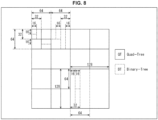
- Shapes of a coding unit (CU), a prediction unit (PU), and a TU which are partial regions (processing units) of a moving image in a bit stream (encoded data) will be described here.
- the CUs, PUs, and transform units (TUs) illustrated in FIG 8 are CUs, PUs, and TUs of a quad tree plus binary tree (QTBT) described in JVET-C0024, "EE2.1: Quadtree plus binary tree structure integration with JEM tools.”
- QTBT quad tree plus binary tree
- a tree structure in a quad tree (Quad-Tree) shape or a binary tree (Binary-Tree) shape in a horizontal direction or a vertical direction is consequently formed.
- a size of a largest coding unit is 128 ⁇ 128, there is a possibility of a size of a CU (a size in a horizontal direction w ⁇ a size in a vertical direction h) being a size of a square such as 128 ⁇ 128, 64 ⁇ 64, 32 ⁇ 32, 16 ⁇ 16, 8 ⁇ 8, or 4 ⁇ 4 as well as a size of a rectangle such as 128 ⁇ 64, 128 ⁇ 32, 128 ⁇ 16, 128 ⁇ 8, 128 ⁇ 4, 64 ⁇ 128, 32 ⁇ 128, 16 ⁇ 128, 8 ⁇ 128, 4 ⁇ 128, 64 ⁇ 32, 64 ⁇ 16, 64 ⁇ 8, 64 ⁇ 4, 32 ⁇ 64, 16 ⁇ 64, 8 ⁇ 64, 4 ⁇ 64, 32 ⁇ 16, 32 ⁇ 8, 32 ⁇ 4, 16 ⁇ 32, 8 ⁇ 32, 4 ⁇ 32, 16 ⁇ 8, 16 ⁇ 4, 8 ⁇ 16, 4 ⁇ 16, 8 ⁇ 4, or 4 ⁇
- a TU includes a transform block of luminance (Y) and a transform block of a chrominance (Cb/Cr).
- Y luminance
- Cb/Cr transform block of a chrominance
- a color format 4:2:0 (e.g., YUV420)
- the proportion of a picture size of a chrominance to a picture size of luminance with respect to a picture height and a picture width is 1/2.
- the size of a transform block of luminance is 8 ⁇ 4
- the size of a corresponding transform block of a chrominance is 4 ⁇ 2.
- the proportion of a picture size of a chrominance to a picture size of luminance is 1/2 with respect to a picture height and 1 with respect to a picture width.
- the size of a transform block for a corresponding chrominance is 8 ⁇ 2.
- the proportion of the picture size of a chrominance to the picture size of luminance is 1 with respect to the picture height and 1 with respect to the picture width.
- the size of a transform block of luminance is 8 ⁇ 4
- the size of a transform block of a corresponding chrominance is 8 ⁇ 4.
- luminance (Y) and chrominance (Cb/Cr) may be encoded as different CUs. Since the luminance and chrominance can have different CU division structures in this case, an effect of improving coding efficiency of I-slices is exhibited.
- description will be provided below on the assumption that information of luminance and chrominance is included in the same CU for the sake of convenience, the invention is not limited thereto.
- FIG 9 is a block diagram illustrating an example of a configuration of an image decoding apparatus which is an aspect of an image processing apparatus to which the present technology has been applied.
- the image decoding apparatus 100 illustrated in FIG 9 is an apparatus that decodes encoded data obtained by encoding a predictive residual of an image and a predictive image as in the AVC or HEVC.
- the image decoding apparatus 100 implements, for example, a technology proposed by HEVC or the Joint Video Exploration Team (JVET).
- JVET Joint Video Exploration Team
- the image decoding apparatus 100 has a decoding unit 111, an inverse quantization unit 112, an inverse transform unit 113, an arithmetic operation unit 114, a frame memory 115, and a prediction unit 116.
- the prediction unit 116 has an intra prediction unit and an inter prediction unit which are not illustrated.
- the image decoding apparatus 100 is an apparatus for generating a moving image #2 by decoding encoded data #1 (a bit stream).
- the decoding unit 111 receives an input of the encoded data #1 and performs variable length decoding on a syntax value of each of syntax elements from a bit string of the encoded data #1 in accordance with a decision of a syntax table. Furthermore, each syntax element includes information such as header information Hinfo, prediction mode information Pinfo, transform information Tinfo, and residual information Rinfo.
- Header information Hinfo such as VPS/SPS/PPS/slice header SH includes information that defines image sizes (a picture width PicWidth and a picture height PicHeight), bit depths (luminance bitDepthY and chrominance bitDepthC), a maximum value of a CU size MaxCUSize/a minimum value thereof MinCUSize, a maximum depth of quadtree split (also referred to as quad-tree split) MaxQTDepth/a minimum depth thereof MinQTDepth, a maximum depth of binary tree split (binary-tree split) MaxBTDepth/a minimum depth thereof MinBTDepth, a maximum value of a transform skip block MaxTSSize (also referred to as a maximum transform skip block size), an on/off flag of each encoding tool (also referred to as an enabled flag), and the like.
- image sizes a picture width PicWidth and a picture height PicHeight
- bit depths luminance bitDepthY and chrominance bitDep
- an on/off flag of an encoding tool included in the header information Hinfo for example, an on/off flag for transform and quantization processes which will be introduced below.
- the on/off flag of the encoding tool can also be interpreted as a flag indicating whether or not syntax for the encoding tool is present in encoded data.
- a value of the on/off flag is 1 (true)
- it indicates that the encoding tool is available in a case in which a value of the on/off flag is 0 (false)
- An adaptive primary transform enabled flag apt_enabled_flag (also referred to as adaptive_primary_transform_enabled_flag, adaptive_pt_enabled flag, of amt_enabled_flag) is a flag indicating whether an encoding tool that can select an adaptive primary transform (also referred to as an adaptive primary transform) as one of a transform process and an inverse process thereto is available.
- a secondary transform enabled flag st_enabled_flag is a flag indicating whether an encoding tool that performs a secondary transform/an inverse secondary transform as one of a transform process and an inverse process thereto is available or not.
- a transform skip flag enabled flag ts_enabled_flag is a flag indicating whether or not two-dimensional transform skip or one-dimensional transform skip is available as one of a transform process and an inverse process thereto.
- the two-dimensional transform skip is an encoding tool that skips an orthogonal transform and an inverse process (inverse orthogonal transform) thereto including a primary transform and a secondary transform.
- the one-dimensional transform skip is an encoding tool that skips a primary transform in a horizontal direction or a vertical direction and an inverse transform (inverse primary transform) corresponding thereto among primary transforms, and a secondary transform and an inverse secondary transform thereto.
- IPinfo e.g., prev intra luma_pred flag, mpm_idx, rem_intr
- the transform information Tinfo may include syntax of, for example, a picture width size TBWidth and a picture height size TBHeight of a transform block to be processed, a transform quantization bypass flag transquant_bypass_flag indicating whether or not (inverse) transform and (inverse) quantization processes are to be skipped, a transform skip flag ts_flag indicating whether or not two-dimensional transform skip is to be applied, an adaptive primary transform flag apt_flag indicating whether an adaptive primary transform is to be applied to a target transform block , a primary transform identifier pt_idx indicating which (inverse) primary transform is to be applied between(inverse) primary transforms in the vertical direction and the horizontal direction, a secondary transform identifier st_idx (also referred to as dnsst_idx, nsst_idx, or rot_idx) indicating which(inverse) secondary transform is to be applied, a scan identifier scanIdx, a
- the inverse quantization unit 112 receives an input of the transform information Tinfo and the quantized transform coefficient level level, performs scaling (inverse quantization) on the value of the quantized transform coefficient level level on the basis of the transform information Tinfo, and outputs the transform coefficient that has undergone inverse quantization Coeff_IQ to the inverse transform unit 113.
- the inverse transform unit 113 receives an input of the transform coefficient Coeff_IQ, the transform information Tinfo, and the prediction mode information Pinfo, applies an inverse transform on the transform coefficient Coeff_IQ on the basis of the transform information Tinfo, the prediction mode information Pinfo, and the like, derives a predictive residual D', and outputs the predictive residual to the arithmetic operation unit 114.
- the inverse transform is the inverse process of the transform process performed on the encoding side or the like.
- an inverse orthogonal transform such as an inverse process to an orthogonal transform performed on an encoding side or the like is included in the inverse transform.
- the arithmetic operation unit 114 receives an input of the predictive residual D' and a predictive image P supplied from the prediction unit 116, adds the predictive residual D' to the predictive image P (predictive signal) corresponding to the predictive residual D' as illustrated in the following formula (8), derives a local decoded image Rec, and supplies the local decoded image to the frame memory 115 or the outside of the image decoding apparatus 100.
- Rec D ′ + P
- the prediction unit 116 receives an input of the prediction mode information Pinfo, generates the predictive image P using, as a reference image, the decoded image stored in the frame memory 115 specified by the prediction mode information PInfo using a prediction method specified by the prediction mode information Pinfo, and outputs the predictive image to the arithmetic operation unit 114.
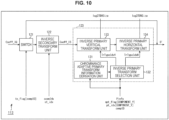
- FIG 10 is a block diagram illustrating an example of the main configuration of the inverse transform unit 113 of the image decoding apparatus 100 of FIG 9 .
- the inverse transform unit 113 includes a switch 121, an inverse secondary transform unit 122, and an inverse primary transform unit 123 as illustrated in FIG 9 .
- the switch 121 skips the inverse secondary transform unit 122 and the inverse primary transform unit 123, and outputs the transform coefficient Coeff_IQ as predictive residual D'.
- the inverse secondary transform unit 122 performs a process relating to an inverse secondary transform that is the inverse process to a secondary transform which is a predetermined transform process, for example, an orthogonal transform, or the like.
- the inverse secondary transform unit 122 receives an input of a secondary transform identifier st_idx, a scan identifier scanIdx indicating a scanning method of a transform coefficient and the transform coefficient Coeff_IQ, derives a transform coefficient Coeff_IS (also referred to as a primary transform coefficient Coeff_P) that has undergone an inverse secondary transform, and supplies the transform coefficient to the inverse primary transform unit 123.
- a secondary transform identifier st_idx a scan identifier scanIdx indicating a scanning method of a transform coefficient and the transform coefficient Coeff_IQ
- Coeff_IS also referred to as a primary transform coefficient Coeff_P
- the inverse primary transform unit 123 performs a process relating to an inverse primary transform that is the inverse process to a primary transform that is a predetermined transform process, for example, an orthogonal transform.
- the inverse primary transform unit 123 receives inputs of a color signal identifier compID, adaptive primary transform flag apt_flag [COMPONENT_Y] of luminance, a primary transform identifier of luminance pt_idx[COMPONENT_Y], prediction mode information PInfo, sizes of a transform block (a logarithmic value of the picture width log2TBWSize and a logarithmic value of the picture height log2TBHSize), and the transform coefficient Coeff_IS that has undergone the inverse secondary transform.
- the apt_flag derivation unit 151 may derive the adaptive primary transform flag apt_flag[compID] of the chrominance as illustrated in the following formula (10) with reference to a residual data presence flag cbf_luma of luminance.
- apt _ flag compID cbf _ luma ? apt _ flag COMPONENT _ Y : 0
- the pt_idx derivation unit 152 performs a process relating to the derivation of a primary transform identifier pt_idx of a chrominance.
- pt _ idx compID apt _ flag compID ? pt _ idx COMPONENT_Y : predetermined value
- the pt_idx derivation unit 152 further sets the primary transform identifier pt_idx[compID] of the chrominance transform block to the value of the primary transform identifier for the luminance transform block pt_idx[COMPONENT_Y] corresponding to the chrominance transform block. In other cases, a predetermined value is set.
- the chrominance adaptive primary transform information derivation unit 131 can derive the adaptive primary transform information of the chrominance transform block on the basis of the adaptive primary transform information of luminance corresponding to the chrominance transform block. Therefore, it is possible to reduce the decoding processing amount without decoding the adaptive primary transform information of the chrominance transform block from the encoded data.
- IntraPredMode indicates intra block copy (IBC or IntraBC; also referred to as "in-screen motion compensation"
- a transform set identifier dedicated to inter prediction may be allocated. Since inter prediction and intra block copy tend to have similar residual in general, it is reasonable to allocate the same transform set.
- a transform set identifier dedicated to intra block copy may be allocated.
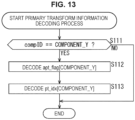
- the decoding unit 111 executes a primary transform information decoding process in Step S101.
- a primary transform information decoding process An example of the flow of the primary transform information decoding process will be described with reference to the flowchart of FIG 13 .
- Step S112 the decoding unit 111 can decode the adaptive primary transform flag apt_flag [COMPONENT_Y] of luminance included in the encoded data #1.
- Step S113 the decoding unit 111 can decode the primary transform identifier pt_idx[COMPONENT_Y] of luminance included in the encoded data #1.
- the primary transform information decoding process ends.
- TrTypeIdxV predetermined value
- the inverse transform unit 113 included in the image decoding apparatus 100 can apply the inverse adaptive primary transform selected for luminance to the transform block of the chrominance in a case in which a residual signal of a chrominance shows a similar tendency to a residual signal of luminance. Therefore, the inverse primary transform process can be performed on the residual signal of the chrominance with further improved coding efficiency than in the related art. In addition, the processing amounts of encoding and decoding can be reduced while mitigating deterioration in coding efficiency for the chrominance in comparison to the case in which the adaptive primary transform flag apt_flag and the primary transform identifier pt_idx are explicitly decoded for each of luminance and the chrominance.
- the derivation of the adaptive primary transform flag of the chrominance may be limited to a case in which the prediction type is an inter CU.
- the adaptive primary transform flag apt_flag[compID] with respect to the transform block of the chrominance is set on the basis of the adaptive primary transform flag apt_flag[COMPONENT_Y] of a transform block of luminance corresponding to the transform block of the chrominance.
- the value of the adaptive primary transform flag apt_flag[compID] with respect to the transform block of the chrominance is set to 0 (false).
- Step S152 the apt_flag derivation unit 151 sets a value of the adaptive primary transform flag apt_flag [COMPONENT_Y] of luminance for the value of the adaptive primary transform flag apt_flag[compID] of the chrominance as in the case of Step S131 of FIG 15 .
- Step S154 the process proceeds to Step S154.
- Step S153 the apt_flag derivation unit 151 sets the adaptive primary transform flag apt_flag[compID] of the chrominance to 0 (false).
- Step S154 the process proceeds to Step S154.
- Step S154 to Step S156 is executed similarly to each of the processes of Step S132 to Step S134 of FIG 15 .
- the chrominance adaptive primary transform information derivation process ends, and the process returns to FIG 14 .
- the prediction type is intra prediction
- intra prediction modes are different between luminance and the chrominance.
- the residual signals of the luminance and the chrominance show different tendencies
- the adaptive primary transform information of the luminance is applied to the chrominance, there is a possibility of coding efficiency deteriorating. Therefore, by applying the adaptive primary transform information of the luminance to the chrominance only in the case in which the chrominance adaptive primary transform information derivation process is executed as illustrated in FIG 17 and the prediction type is inter prediction, a decrease in coding efficiency can be further curbed than in the case of FIG 15 .
- the derivation of the adaptive primary transform flag of the chrominance may be limited to an inter CU or an intra CU and when a luminance intra prediction mode is intra block copy (in-screen motion compensation).
- the adaptive primary transform flag apt_flag[compID] with respect to the transform block of the chrominance is set on the basis of the adaptive primary transform flag apt_flag[COMPONENT_Y] with respect to the transform block of luminance corresponding to the transform block of the chrominance.
- the value of the adaptive primary transform flag apt_flag[compID] with respect to the transform block of the chrominance is set to 0 (false).
- the conditional determination may be performed using the intra prediction mode IntraPredModeY of luminance in the above-described formula (19).
- Step S172 the apt_flag derivation unit 151 determines whether or not the intra prediction mode IntraPredModeC of the chrominance is intra block copy (IntraBC). In a case in which the mode is determined to be intra block copy (IntraBC), the process proceeds to Step S173. In addition, the prediction type CUPredMode of the CU to which the transform block to be processed belongs is determined to be inter prediction (MODE_INTER) in Step S171, the process proceeds to Step S173.
- the prediction type CUPredMode of the CU to which the transform block to be processed belongs is determined to be inter prediction (MODE_INTER) in Step S171, the process proceeds to Step S173.
- Step S173 the apt_flag derivation unit 151 sets a value of the adaptive primary transform flag apt_flag [COMPONENT Y] of luminance for the value of the adaptive primary transform flag apt_flag[compID] of the chrominance as in the case of Step S131 of FIG 15 .
- Step S173 ends, the process proceeds to Step S175.
- Step S175 to Step S177 is executed similarly to each of the processes of Step S132 to Step S134 of FIG 15 .
- the chrominance adaptive primary transform information derivation process ends, and the process returns to FIG 14 .
- the derivation of the adaptive primary transform flag of the chrominance may be limited to an inter CU or an intra CU and when a luminance intra prediction mode are equivalent to a chrominance intra prediction mode.
- the adaptive primary transform flag apt _flag[compID] of the transform block of the chrominance is set on the basis of the adaptive primary transform flag apt_flag[COMPONENT_Y] with respect to the transform block of luminance corresponding to the transform block of the chrominance.
- the value of the adaptive primary transform flag apt _flag[compID] with respect to the transform block of the chrominance is set to 0 (false).
- the flowchart corresponds to the flowchart of FIG 15 .
- the apt_flag derivation unit 151 determines whether or not the prediction type CUPredMode of a CU to which a transform block to be processed belongs is inter prediction (MODE_INTER) in Step S181. In a case in which the prediction type is determined to be intra prediction, the process proceeds to Step S182.
- Step S182 the apt_flag derivation unit 151 determines whether or not the intra prediction mode IntraPredModeC of the chrominance is equal to the intra prediction mode IntraPredModeY of luminance. In a case in which the modes are equal, the process proceeds to Step S183. In addition, the intra prediction mode IntraPredModeC of the chrominance is determined not to be equal to the intra prediction mode IntraPredModeY of luminance in Step S 182, the process proceeds to Step S184.
- the prediction type of the CU is intra prediction, that is, luminance and the chrominance have the equal intra prediction mode
- residual signals of luminance and the chrominance have similar tendencies.
- the adaptive primary transform information of luminance can be applied to the chrominance in the case in which the prediction type is intra prediction and the intra prediction mode of luminance has the same value as the intra prediction mode of the chrominance, and thus coding efficiency can be further improved than in the case of
- a flag indicating whether or not information regarding an adaptive primary transform of a chrominance is set on the basis of an adaptive primary transform of luminance may be added and the setting of the information regarding the adaptive primary transform of the chrominance may be controlled using the flag.
- the adaptive primary transform flag apt_flag [COMPONENT_Y] of luminance is 1 (true)
- the transform skip flag ts_flag[compID] of the color signal corresponding to the color signal identifier compID is 0 (false)
- the transform quantization bypass flag flag is 0 (false)
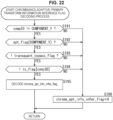
- the chrominance adaptive primary transform information inference flag chroma_apt_info_infer_flag is decoded.
- the value of the chrominance adaptive primary transform information inference flag chroma_apt_info_infer_flag is inferred to be 0.
- the decoding unit 111 performs such decoding in Step S101 of FIG 12 by executing the chrominance adaptive primary transform information inference flag decoding process.
- An example of the flow of the chrominance adaptive primary transform information inference flag decoding process will be described with reference to the flowchart of FIG 22 .
- Step S193 the decoding unit 111 determines whether or not the transform quantization bypass flag transquant_bypass_flag is 1 (true). In a case in which the transform quantization bypass flag is determined to be 0 (false) (! transquant_bypass_flag), the process proceeds to Step S194. In Step S194, the decoding unit 111 determines whether or not the transform skip flag ts_flag[compID] of the color signal corresponding to the color signal identifier compID is 1 (true). In a case in which the transform skip flag ts_flag[compID] is determined to be 0 (false) (! ts_flag[compID]), the process proceeds to Step S195.
- Step S195 the decoding unit 111 decodes the chrominance adaptive primary transform information inference flag chroma_apt_info_infer_flag[compID] corresponding to the color signal identifier compID from a bit string of the encoded data #1 and outputs the result as a part of transform information Tinfo.
- the chrominance adaptive primary transform information inference flag decoding process ends, and the process returns to FIG 12 .
- the chrominance adaptive primary transform information inference flag decoding process ends, and the process returns to FIG 12 .
- adaptive primary transform information of luminance is to be applied to a chrominance can be explicitly controlled on the basis of the chrominance adaptive primary transform information inference flag with respect to signals showing difference tendencies in residual of luminance and residual of the chrominance. Therefore, the adaptive primary transform can be applied to the chrominance with higher efficiency than in the case of FIG 15 , and thus coding efficiency can be improved.
- Step S212 to Step S216 is executed similarly to each of the processes of Step S202 to Step S206 of FIG 23 .
- the process of Step S215 or Step S216 ends, the chrominance adaptive primary transform information derivation process ends, and the process returns to FIG 14 .
- the inverse primary transform selection unit 132 determines the type of an orthogonal transform to be applied to an inverse transform of each direction on the basis of the correspondence table of transform sets and transform types (LUT_TrSetToTrTypeIdx) shown in FIG 1 , a primary ⁇ horizontal, vertical ⁇ transform set TrSet ⁇ H,V ⁇ , and a primary ⁇ horizontal, vertical ⁇ transform specifying flag pt_ ⁇ hor,ver ⁇ _flag, the technology is not limited thereto.
- the transform type of each direction may be determined further with reference to the size of the transform block of the chrominance.
- Step S145 of FIG 16 An example of the flow of the primary vertical transform type derivation process executed in Step S145 of FIG 16 as described above will be described with reference to the flowchart of FIG 26 .
- the inverse primary transform selection unit 132 determines whether or not the processing object is a transform block of luminance in Step S231. In a case in which the processing object is determined to be a transform block of a chrominance, the process proceeds to Step S232. In Step S232, the inverse primary transform selection unit 132 determines whether or not the picture height of the transform block of the chrominance (the logarithmic value log2TBHSize of the picture height) is equal to or smaller than the threshold value TH.
- the adaptive primary transform flag apt_flag and the primary transform identifier pt_idx have been described as information regarding the (inverse) orthogonal transform in the first embodiment, details of the information regarding the (inverse) orthogonal transform are arbitrary and are not limited to the parameters.
- a transform skip flag ts_flag indicating whether the (inverse) orthogonal transform process is to be skipped may be included as illustrated in the table of FIG 6 .
- a transform skip flag ts_flag of a chrominance is transmitted (signaled) from an encoding side to a decoding side as indicated in the row of No. #0. If transform skip flags ts_flag not only of luminance but also a chrominance are explicated encoded as described above, there is concern of the code amount increasing and coding efficiency deteriorating. In this case, the encoding side also should perform the settings and encoding of the transform skip flag ts_flag for each of signals (Y, Cb, and Cr) and thus there is also concern of the processing amount increasing. In addition, the decoding side should decode the transform skip flag ts_flag for each of the signals (Y, Cb, and Cr) and thus there is concern of the processing amount increasing.
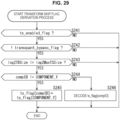
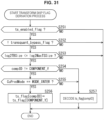
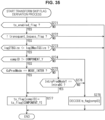
- the value of the transform skip flag ts_flag[compID] of the chrominance may be set to the value of the transform skip flag ts_flag[COMPONENT_Y] of luminance, and in a case in which the prediction type of the coding block is intra prediction in which the prediction modes for luminance and the chrominance do not match each other, the transform skip flag ts_flag[compID] of the chrominance may be signaled (i.e., the transform skip flag ts_flag[compID] of the chrominance can be decoded from the encoded data). In this manner, the value of the transform skip flag ts_flag of luminance can be used only in the case of the prediction mode in which the residual signals thereof show similar tendencies
- the value of the transform skip flag ts_flag[compID] of the chrominance may be set to the value of the transform skip flag ts_flag[COMPONENT_Y] of luminance, and in a case in which the prediction type of the coding block is intra prediction of which the prediction mode is not intra block copy, the transform skip flag ts_flag[compID] of the chrominance may be signaled (i.e., the transform skip flag ts_flag[compID] of the chrominance can be decoded from the encoded data). In this manner, the value of the transform skip flag ts_flag of luminance can be used only in the case of the prediction mode in which the residual signals thereof show similar tendencies, and thus deterioration in coding efficiency can be further curbed
- a chrominance transform skip information inference flag chroma_ts_info_infer_flag indicating whether the transform skip flag ts_flag[compID] of the chrominance is to be inferred on the basis of the transform skip flag ts_flag[COMPONENT_Y] of luminance is 1 (true), for example, as indicated in the row of No.
- the value of the transform skip flag ts_flag[copmID] of the chrominance may be set to the value of the transform skip flag ts_flag[COMPONENT_Y] of luminance, and in a case in which the chrominance transform skip information inference flag chroma_ts_info_infer_flag is 0 (false), the transform skip flag ts_flag[compID] of the chrominance may be signaled (i.e., the transform skip flag ts_flag[compID] of the chrominance can be decoded from the encoded data).
- Step S257 is executed similarly to the process of Step S246 of FIG 29 . That is, the decoding unit 111 decodes the encoded data and thereby obtains the signaled transform skip flag ts_flag[compID]. When the process of Step S257 ends, the transform skip flag derivation process ends.
- the value of the transform skip flag ts_flag[copmID] of the chrominance may be set to the value of the transform skip flag ts_flag[COMPONENT_Y] of luminance, and in the case in which the chrominance transform skip information inference flag chroma_ts_info_infer_flag is 0 (false), the transform skip flag ts_flag[compID] of the chrominance may be signaled (i.e., the transform skip flag ts_flag[compID] of the chrominance can be decoded from the encoded data).
- the encoding side should perform the settings and encoding of the secondary transform identifier st_idx for each of signals (Y, Cb, and Cr), and thus there is concern of the processing amount increasing.
- the decoding side should decode the secondary transform identifier st_idx for each of the signals (Y, Cb, and Cr), and thus there is concern of the processing amount increasing.
- each of the above-described cases can be arbitrarily combined similarly to the case of FIG 7 . In this manner, the effects obtained in each of the cases can be exhibited. In addition, each of the above-described cases can also be combined with other cases that are not described above.
- transmission (encoding and decoding) of the secondary transform identifier chroma_st_idx of the chrominance can be omitted, and thus deterioration in coding efficiency can be curbed.
- an increase in a load of encoding and decoding can be curbed as well.
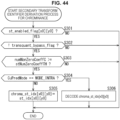
- the value of the secondary transform identifier chroma_st_idx of the chrominance may be set to the value of the secondary transform identifier st_idx of luminance as described with reference to the row of No. #2 of FIG 39 , and in the case in which the prediction type of the coding block is intra prediction, the secondary transform identifier chroma_st_idx of the chrominance may be signaled (i.e., the secondary transform identifier chroma_st_idx of the chrominance can be decoded from the encoded data).
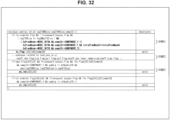
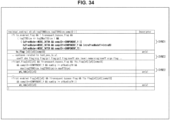
- FIG 45 An example of syntax of a TU in that case is illustrated in FIG 45 .
- the secondary transform identifier chroma_st_idx is signaled.
- the secondary transform identifier chroma_st_idx of the chrominance is set to the secondary transform identifier st_idx of luminance.
- Step S316 is executed similarly to the process of Step S305 of FIG 44 .
- the process of Step S317 is executed similarly to the process of Step S306 of FIG 44 .
- transmission (encoding and decoding) of the secondary transform identifier chroma_st_idx of the chrominance can be omitted using the value of the secondary transform identifier st_idx of luminance only in the case of the prediction mode in which the tendencies of the residual signals are similar, and thus deterioration in coding efficiency can be curbed.
- an increase in a load of encoding and decoding can be curbed as well.
- the value of the secondary transform identifier chroma_st_idx of the chrominance is set to the value of the secondary transform identifier st_idx of luminance.
- the secondary transform identifier chroma_st_idx of the chrominance may be signaled (i.e., the secondary transform identifier chroma_st_idx of the chrominance can be decoded from the encoded data).
- FIG 47 An example of syntax of a TU in that case is illustrated in FIG 47 .
- the secondary transform identifier st_idx is not signaled only in a case in which the identifier is of the chrominance and the prediction type is inter prediction, or a case in which the identifier is of the chrominance and prediction type is intra prediction of which the prediction mode is intra block copy. That is, in this case, the secondary transform identifier chroma_st_idx is set using the secondary transform identifier st_idx of luminance.
- Step S324 the process proceeds to Step S325.
- Step S326 the process proceeds to Step S326.
- Step S326 is executed similarly to the process of Step S316 of FIG 46 . That is, the decoding unit 111 sets the value of the secondary transform identifier chroma_st_idx of the chrominance to the secondary transform identifier st_idx of luminance.
- the secondary transform identifier derivation process for the chrominance ends.
- Step S327 is executed similarly to the process of Step S317 of FIG 46 . That is, the decoding unit 111 can decode the encoded data and thereby obtains the signaled secondary transform identifier st_idx.
- the secondary transform identifier derivation process for the chrominance ends.
- transmission (encoding and decoding) of the secondary transform identifier st_Idx of the chrominance can be omitted using the value of the secondary transform identifier st_idx of luminance only in the case of the prediction mode in which the tendencies of the residual signals are similar, and thus deterioration in coding efficiency can be curbed.
- an increase in a load of encoding and decoding can be curbed as well.
- the value of the secondary transform identifier chroma_st_idx of the chrominance may be set to the value of the secondary transform identifier st_idx of luminance, and in the case in which the chrominance secondary transform identifier inference flag chroma_st_idx_infer_flag is 0 (false), the secondary transform identifier st_idx of the chrominance may be signaled (i.e., the secondary transform identifier chroma_st_idx of the chrominance can be decoded from the encoded data).
- FIG 49 An example of syntax of a TU in that case is illustrated in FIG 49 .
- the chrominance secondary transform identifier inference flag chroma_st_idx_infer_flag is set and then the secondary transform identifier chroma_st_idx of the chrominance is signaled in accordance with the value, or the identifier is obtained from the secondary transform identifier st_idx of luminance is controlled.
- Step S334 the decoding unit 111 decodes and acquires the chrominance secondary transform identifier inference flag chroma_st_idx_infer_flag.
- Step S335 the decoding unit 111 determines whether or not the acquired chrominance secondary transform identifier inference flag chroma_st_idx_infer_flag is true. In a case in which the chrominance secondary transform identifier inference flag chroma_st_idx_infer_flag is determined to be true, the process proceeds to Step S336. In addition, chrominance secondary transform identifier inference flag chroma_st_idx_infer_flag is determined to be false, the process proceeds to Step S337.
- Step S336 is executed similarly to the process of Step S326 of FIG 48 . That is, the decoding unit 111 sets the value of the secondary transform identifier chroma_st_idx of the chrominance to the value of the secondary transform identifier st_idx of luminance.
- the secondary transform identifier derivation process for the chrominance ends.
- Step S337 is executed similarly to the process of Step S327 of FIG 48 . That is, the decoding unit 111 can decode the encoded data and thereby obtains the signaled secondary transform identifier chroma_st_idx of the chrominance.
- the secondary transform identifier derivation process for the chrominance ends.
- FIG 51 is a block diagram illustrating an example of the main configuration of an image encoding apparatus which is an aspect of the image processing apparatus to which the present technology is applied.
- the image encoding apparatus 400 illustrated in FIG 51 is an image encoding apparatus corresponding to the image decoding apparatus 100 of FIG 9 and generates encoded data (bit stream) which has been decoded by the image decoding apparatus 100 by encoding an imaging using an encoding method corresponding to a decoding method used by the image decoding apparatus 100.
- the image encoding apparatus 400 implements, for example, a technology proposed by HEVC or JVET.
- FIG 51 illustrates main configurations such as flows of processing units and data, and the like, and FIG 51 is not illustrating entire configurations. That is, there may be processing units in the image encoding apparatus 400 that are not illustrated as blocks in FIG 51 or flows of processes and data that are not indicated by arrows and the like in FIG 51 .
- the control unit 411 divides a moving image #2 into blocks which are units of processing (CUs, PUs, transform blocks, etc.) on the basis of the block size of the units of processing specified from the outside or in advance, and inputs an image I corresponding to the divided blocks to the arithmetic operation unit 412.
- the control unit 411 determines encoding parameters (header information Hinfo, prediction mode information Pinfo, transform information Tinfo, etc.) to be supplied to each of the blocks, for example, on the basis of Rate-Distortion Optimization (RDO).
- RDO Rate-Distortion Optimization
- the arithmetic operation unit 412 receives the input of the image I corresponding to the blocks which are the units of processing and a predictive image P supplied from the prediction unit 420, subtracts the predictive image P from the image I as indicated in the formula (25), thereby derives predictive residual D, and supplies the predictive residual to the transform unit 413.
- D I ⁇ P
- the encoding unit 415 is an inverse process to the decoding unit 111 ( FIG 9 ), transforms the encoding parameters (the header information, the prediction mode information Pinfo, and the transform information Tinfo) supplied from the control unit 411, and the quantized transform coefficient level level supplied from the quantization unit 414 into syntax values of each of syntax elements in accordance with the definitions of a syntax table, makes each of the syntax values into variable length codes (e.g., arithmetic code), and thereby generates bit strings.
- variable length codes e.g., arithmetic code
- the encoding unit 415 derives residual information RInfo from the quantized transform coefficient level level, makes the residual information RInfo into variable length codes, and generates bit strings. In addition, the encoding unit 415 multiplexes the bit strings of each of the syntax elements that have been made into variable length codes, and then generates and outputs encoded data #1.
- the inverse quantization unit 416 is a processing unit similar to the inverse quantization unit 112 ( FIG 9 ) and performs a process similar to that of the inverse quantization unit 112 in the image encoding apparatus 400.
- the inverse transform unit 417 is a processing unit similar to the inverse transform unit 113 ( FIG 9 ) and performs a process similar to that of the inverse transform unit 113d in the image encoding apparatus 400.
- the frame memory 419 is a processing unit similar to the frame memory 115 ( FIG 9 ) and performs a process similar to that of the frame memory 115 in the image encoding apparatus 400.
- the prediction unit 420 is a processing unit similar to the prediction unit 116 ( FIG 9 ) and performs a process similar to that of the prediction unit 116 in the image encoding apparatus 400.
- the primary transform unit 432 and the secondary transform unit 433 are skipped, and the predictive residual D is output as a transform coefficient Coeff.
- the primary transform unit 432 performs a process relating to a primary transform that is a predetermined transform process, for example, an orthogonal transform.
- the primary transform is an inverse process of the inverse primary transform executed by the inverse primary transform unit 123 or the like of the image decoding apparatus 100.
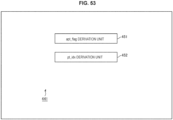
- FIG 53 is a functional block diagram illustrating an example of the main configuration of the chrominance adaptive primary transform information derivation unit 441.
- the chrominance adaptive primary transform information derivation unit 441 has an apt_flag derivation unit 451 and a pt_idx derivation unit 452.
- the apt_flag derivation unit 451 performs a process relating to the derivation of the adaptive primary transform flag apt_flag of the chrominance.
- the pt_idx derivation unit 452 performs a process relating to the derivation of the primary transform identifier pt_idx of the chrominance.
- the chrominance adaptive primary transform information derivation unit 441 can derive the adaptive primary transform information of the chrominance transform block on the basis of the adaptive primary transform information of luminance corresponding to the chrominance transform block. Therefore, it is possible to reduce the encoding processing amount without encoding the adaptive primary transform information of the chrominance transform block.
- the primary transform selection unit 442 receives an input of the prediction mode information PInfo, the color signal identifier compID, the adaptive primary transform flag apt_flag[compID] of the color signal corresponding to the color signal identifier compID, and the primary transform identifier pt_idx[compID] of the color signal corresponding to the color signal identifier compID.
- the primary transform selection unit 442 derives the transform type TrTypeIdxH of the primary horizontal transform and the transform type TrTypeIdxV of the primary vertical transform of the color signal specified by the color signal identifier compID with reference to the prediction mode information PInfo, the color signal identifier compID, the adaptive primary transform flag apt_flag[compID] of the color signal corresponding to the color signal identifier compID, and the primary transform identifier pt_idx[compID] of the color signal corresponding to the color signal identifier compID.
- the primary transform selection unit 442 supplies the derived transform type TrTypeIdxH of the primary horizontal transform to the primary horizontal transform unit 443.
- the primary transform selection unit 442 supplies the derive transform type TrTypeIdxV of the primary vertical transform to the primary vertical transform unit 444.
- the secondary transform unit 433 skips the secondary transform, and outputs the transform coefficient Coeff_P that has undergone the primary transform as the transform coefficient Coeff_S that has undergone the secondary transform.
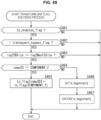
- each of the processes of Step S461 to Step S464 of FIG 59 is executed similarly to each of the processes of Step S241 to Step S244 of the transform skip flag derivation process of FIG 29 .
- the transform skip flag encoding process ends.
- the decoding side can similarly derive the transform skip flag ts_flag[compID] of the transform block in the case of the chrominance and inter prediction from the transform skip flag ts_flag[COMPONENT_Y] of luminance, and thus the flag is not signaled.
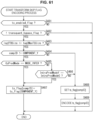
- the transform skip flag encoding process ends. That is, in this case, also in the case of intra prediction in which the prediction modes for luminance and the chrominance match each other as well as under the condition of ⁇ Modified example 1>, the tendencies of the residual signals are similar, and thus, the transform skip flag ts_flag[compID] is not signaled.
- the value of the transform skip flag ts_flag[compID] of the chrominance may be set to the value of the transform skip flag ts_flag[COMPONENT_Y] of luminance
- the transform skip flag ts_flag[compID] of the chrominance may be signaled (i.e., the transform skip flag ts_flag[compID] of the chrominance can be decoded from the encoded data).
- the transform skip flag encoding process ends.
- Step S494 the control unit 411 sets an arbitrary value for the transform skip flag ts_flag[compID]. Then, in Step S499, the control unit 411 supplies the transform skip flag ts_flag[compID] to the encoding unit 415 to cause the flag to be encoded.
- Step S489 ends, the transform skip flag encoding process ends.
- the transform skip flag ts_flag[compID] of luminance and the transform skip flag ts_flag[compID] of the transform block for intra prediction of which the prediction mode is not intra block copy are signaled (transmitted).
- the decoding side can obtain the transform skip flag ts_flag[compID] through extraction and decoding using a bit stream.
- the transform skip flag ts_flag of luminance and the transform skip flag ts_flag of the transform block for intra prediction of which the prediction mode is not intra block copy are signaled, and other transform skip flags ts_flag are not signaled.
- transmission (encoding and decoding) of the transform skip flag ts_flag of the chrominance can be omitted only in the case of the inter prediction mode in which the tendencies of the residual signals are similar, and thus deterioration in coding efficiency can be curbed.
- an increase in a load of encoding and decoding can be curbed as well.
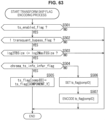
- the value of the transform skip flag ts_flag[copmID] of the chrominance may be set to the value of the transform skip flag ts_flag[COMPONENT_Y] of luminance, and in the case in which the chrominance transform skip information inference flag chroma_ts_info_infer_flag is 0 (false), the transform skip flag ts_flag[compID] of the chrominance may be signaled (i.e., the transform skip flag ts_flag[compID] of the chrominance can be decoded from the encoded data).
- the transform skip flag encoding process ends.
- Step S504 the control unit 411 sets an arbitrary value for the transform skip flag ts_flag[compID]. Then, the control unit 411 supplies the transform skip flag ts_flag[compID] to the encoding unit 415 and causes the flag to be encoded in Step S507.
- the transform skip flag encoding process ends.
- a secondary transform identifier st_idx indicating which (inverse) secondary transform is to be applied may be included in information regarding an (inverse) orthogonal transform.
- a secondary transform identifier chroma_st_idx of a chrominance common for Cb and Cr
- a secondary transform identifier st_idx[Y] of luminance for example, an increase in overhead of the code amount of the syntax by which the chrominance (Cb or Cr) is signaled can be curbed as well.
- a secondary transform identifier st_idx of a chrominance may be inferred from a secondary transform identifier st_idx of luminance at all times as indicated in the row of No. #1 of FIG 39 .
- the secondary transform identifier chroma_st_idx of the chrominance may be set to the value of secondary transform identifier st_idx of luminance.
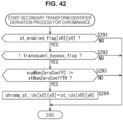
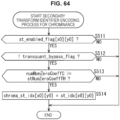
- each of the processes of Step S511 to Step S514 of FIG 64 is executed similarly to each of the processes of Step S291 to Step S294 of the chrominance secondary transform identifier encoding process of FIG 42 .
- transmission (encoding and decoding) of the secondary transform identifier chroma_ts_flag of the chrominance can be omitted, and thus deterioration in coding efficiency can be curbed.
- an increase in a load of encoding and decoding can be curbed as well.
- the value of the secondary transform identifier chroma_st_idx of the chrominance may be set to the value of the secondary transform identifier st_idx of luminance as described with reference to the row of No. #2 of FIG 39 , and in the case in which the prediction type of the coding block is intra prediction, the secondary transform identifier chroma_st_idx of the chrominance may be signaled (i.e., the secondary transform identifier chroma_st_idx of the chrominance can be decoded from the encoded data).
- control unit 411 executes the secondary transform identifier encoding process for the chrominance and controls encoding of the secondary transform identifier chroma_st_idx of the chrominance.
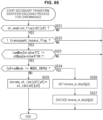
- An example of the flow of the secondary transform identifier encoding process for the chrominance will be described with reference to the flowchart of FIG 65 .
- each of the processes of Step S521 to Step S524 of FIG 65 is executed similarly to each of the processes of Step S301 to Step S304 of the chrominance secondary transform identifier encoding process of FIG 44 .
- Step S525 the secondary transform identifier encoding process for the chrominance ends.
- the decoding side can similarly derive the secondary transform identifier chroma_st_idx of the transform block in the case of the chrominance and inter prediction from the secondary transform identifier st_idx of luminance, and thus the identifier is not signaled.
- transmission (encoding and decoding) of the secondary transform identifier chroma_st_idx of the chrominance can be omitted only in the case of the inter prediction mode in which the tendencies of the residual signals are similar, and thus deterioration in coding efficiency can be curbed.
- an increase in a load of encoding and decoding can be curbed as well.
- the value of the secondary transform identifier chroma_st_idx of the chrominance is set to the value of the secondary transform identifier st_idx of luminance.
- Step S537 the control unit 411 sets an arbitrary value for secondary transform identifier chroma_st_idx of the chrominance. Then, in Step S538, the control unit 411 supplies the secondary transform identifier chroma_st_idx of the chrominance to the encoding unit 415 to cause the identifier to be encoded.
- Step S538 ends, the secondary transform identifier encoding process for the chrominance ends.
- the value of the secondary transform identifier chroma_st_idx of the chrominance is set to the value of the secondary transform identifier st_idx of luminance.
- Step S546 the secondary transform identifier encoding process for the chrominance ends.
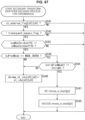
- Step S556 the process proceeds to Step S558.
- Step S558 the control unit 411 sets the secondary transform identifier chroma_st_idx of the chrominance.
- Step S559 the control unit 411 supplies the identifier to the encoding unit 415 to cause the identifier to be encoded.
- the present technology can be applied to arbitrary image encoding and decoding in which a primary transform and a secondary transform (an inverse secondary change and an inverse primary transform) are performed. That is, specifications of a transform (inverse transform), quantization (inverse quantization), encoding (decoding), prediction, and the like are arbitrary and are not limited to the above-described examples. For example, with respect to a transform (inverse transform), (inverse) transforms (i.e., three or more (inverse) transforms) other than an (inverse) primary transform and an (inverse) secondary transform may be performed.
- encoding (decoding) may be of a reversible method or an irreversible method.
- quantization (inverse quantization), prediction, or the like may be omitted.
- a process which is not described above such as a filtering process may be performed.
- the present technology is applicable to weather observation systems and weather observation devices for observing weather, temperature, humidity, wind speed, sunshine duration, and the like. Furthermore, in one example, the present technology is also applicable to systems, devices, or the like for observing ecology of wildlife such as birds, fish, reptiles, amphibians, mammals, insects, plants, and the like.
- the series of processes described above can be applied to a multi-view image encoding and decoding system that performs encoding and decoding of multi-view images including images with a plurality of views (view).
- the present technology may be applied to encoding and decoding of each view (view).
- the series of processes described above can be applied to a hierarchical image encoding (scalable encoding) and decoding system that performs encoding and decoding on hierarchical images that have been made into a plurality of layers (hierarchies) to have a scalability function with respect to a predetermined parameter.
- the present technology may be applied to encoding and decoding of each of the hierarchies (layers).
- FIG 69 is a block diagram illustrating an exemplary hardware configuration of a computer that executes the series of processes described above according to a program.
- a central processing unit (CPU) 801, read-only memory (ROM) 802, and random access memory (RAM) 803 are interconnected through a bus 804.
- an input/output interface 810 is also connected to the bus 804.
- An input unit 811, an output unit 812, a storage unit 813, a communication unit 814, and a drive 815 are connected to the input/output interface 810.
- the series of processes described above are performed by having the CPU 801 load a program stored in the storage unit 813 into the RAM 803 via the input/output interface 810 and the bus 804, and execute the program, for example. Additionally, data required for the CPU 801 to execute various processes and the like is also stored in the RAM 803 as appropriate.
- the program executed by the computer (CPU 801) may be applied by being recorded onto the removable medium 821 as an instance of packaged media or the like, for example.
- the program may be installed in the storage unit 813 via the input/output interface 810 by inserting the removable medium 821 into the drive 815.
- the program may also be provided via a wired or wireless transmission medium such as a local area network, the Internet, or digital satellite broadcasting.
- the program may be received by the communication unit 814 and installed in the storage unit 813.
- the program may also be preinstalled in the ROM 802 or the storage unit 813.
- FIG 70 illustrates an example of a schematic configuration of a television apparatus to which the above-described embodiment is applied.
- the television apparatus 900 has an antenna 901, a tuner 902, a demultiplexer 903, a decoder 904, a video signal processing unit 905, a display unit 906, an audio signal processing unit 907, a speaker 908, an external interface (I/F) unit 909, a control unit 910, a user interface (I/F) unit 911, and a bus 912.
- I/F external interface
- control unit 910 control unit 910
- I/F user interface
- a module is a part that collects several interrelated partial functions into a unified function.
- the specific physical configuration may be any configuration, but for example, it is conceivable to dispose and integrate multiple processors with respective functions, electronic circuit elements such as resistors and capacitors, other devices, and the like onto a circuit board or the like. It is also conceivable to combine a module with another module, processor, or the like to create a new module.
- FIG 75 illustrates one example of a schematic configuration of the video processor 1332 ( FIG 74 ) applying the present technology.
- the encode/decode engine 1407 executes a process of encoding image data as well as a process of decoding a video stream, which is data in which image data is encoded. For example, the encode/decode engine 1407 encodes image data read from the frame memory 1405, and successively writes the encoded data to the video ES buffer 1408A as a video stream. Also, for example, the encode/decode engine 1407 successively reads and decodes a video stream from the video ES buffer 1408B, and writes the decoded data to the frame memory 1405 as image data. During this encoding and decoding, the encode/decode engine 1407 uses the frame memory 1405 as a work area. Also, the encode/decode engine 1407 outputs a synchronization signal to the memory control unit 1406 at the timing of starting the process for each macroblock, for example.
- the audio ES buffer 1409A buffers and supplies an audio stream generated by the audio encoder 1410 to the multiplexer (MUX) 1412.
- the audio ES buffer 1409B buffers and supplies an audio stream supplied from the demultiplexer (DMUX) 1413 to the audio decoder 1411.
- the stream buffer 1414 buffers a transport stream acquired via the connectivity 1321, the broadband modem 1333, and the like, for example, and at a predetermined timing, or on the basis of an external request or the like, supplies the transport stream to the demultiplexer (DMUX) 1413.
- DMUX demultiplexer
- the stream buffer 1414 buffers file data read out from any of various types of recording media in the connectivity 1321 or the like, for example, and at a predetermined timing, or on the basis of an external request or the like, supplies the file data to the demultiplexer (DMUX) 1413.
- DMUX demultiplexer
- the encode/decode engine 1407 may include the functions of the image encoding apparatus 400 or the functions of the image decoding apparatus 100 described above, or both.
- the video processor 1332 is able to obtain effects similar to each of the embodiments described above with reference to FIGS. 1 to 68 .
- the control unit 1511 controls the operation of each processing unit in the video processor 1332, such as the display interface 1512, the display engine 1513, the image processing engine 1514, and the codec engine 1516.
- the control unit 1511 includes a main CPU 1531, a sub CPU 1532, and a system controller 1533, for example.
- the main CPU 1531 executes a program or the like for controlling the operation of each processing unit in the video processor 1332.
- the main CPU 1531 generates control signals in accordance with the program or the like, and supplies the control signals to each processing unit (in other words, controls the operation of each processing unit).
- the sub CPU 1532 fulfills a supplementary role to the main CPU 1531.
- the sub CPU 1532 executes child processes, subroutines, and the like of the program or the like executed by the main CPU 1531.
- the system controller 1533 controls the operations of the main CPU 1531 and the sub CPU 1532, such as specifying programs to be executed by the main CPU 1531 and the sub CPU 1532.
- the display engine 1513 under control by the control unit 1511, performs various conversion processes such as format conversion, size conversion, and gamut conversion on the image data to match the hardware specs of the monitor apparatus or the like that is to display the image.
- the image processing engine 1514 under control by the control unit 1511 performs predetermined image processing on the image data, such as filter processing for improving image quality, for example.
- the codec engine 1516 executes processes related to the encoding and decoding of image data.
- the encoding/decoding method supported by the codec engine 1516 may be any method, and there may be one or multiple such methods.
- the codec engine 1516 may be provided with a codec function for multiple encoding/decoding methods, and may be configured to encode or decode image data by selecting from among the multiple methods.
- the MPEG-2 Video 1541 is a function block that encodes and decodes image data according to the MPEG-2 method.
- the AVC/H.264 1542 is a function block that encodes and decodes image data according to the AVC method.
- the HEVC/H.265 1543 is a function block that encodes and decodes image data according to the HEVC method.
- the HEVC/H.265 (Scalable) 1544 is a function block that scalably encodes and scalably decodes image data according to the HEVC method.
- the HEVC/H.265 (Multi-view) 1545 is a function block that multi-view encodes and multi-view decodes image data according to the HEVC method.
- the MPEG-DASH 1551 is a function block that transmits and receives image data according to the MPEG Dynamic Adaptive Streaming over HTTP (MPEG-DASH) method.
- MPEG-DASH is a technology that uses the Hypertext Transfer Protocol (HTTP) to stream video, one feature of which being that appropriate encoded data is selected and transmitted in units of segments from among multiple sets of encoded data having different resolutions or the like prepared in advance.
- HTTP Hypertext Transfer Protocol
- the MPEG-DASH 1551 executes the generation, transmission control, and the like of a stream conforming to the standard, while for the encoding/decoding of image data, the MPEG-2 Video 1541 to the HEVC/H.265 (Multi-view) 1545 are used.
- the multiplexer/demultiplexer (MUX DMUX) 1518 multiplexes and demultiplexes various image-related data, such as a bit stream of encoded data, image data, a video signal, and the like.
- the multiplexing/demultiplexing method may be any method.
- the multiplexer/demultiplexer (MUX DMUX) 1518 is not only able to collect multiple pieces of data into a single piece of data, but also add predetermined header information and the like to the data.
- the multiplexer/demultiplexer (MUX DMUX) 1518 is not only able to divide a single piece of data into multiple pieces of data, but also add predetermined header information and the like to each divided piece of data.
- the multiplexer/demultiplexer (MUX DMUX) 1518 is able to convert the format of data by multiplexing/demultiplexing.
- the multiplexer/demultiplexer (MUX DMUX) 1518 is able to convert the bit stream to a transport stream, which is a bit stream in a format for transmission, or to data in a file format (file data) for recording.
- the inverse conversion is also possible.
- a transport stream is received from an external network through the connectivity 1321, the broadband modem 1333, or the like
- the transport stream is supplied to the multiplexer/demultiplexer (MUX DMUX) 1518 through the network interface 1519 and demultiplexed, and decoded by the codec engine 1516.
- the image data obtained by the decoding of the codec engine 1516 is, for example, subjected to predetermined image processing by the image processing engine 1514, subjected to a predetermined conversion by the display engine 1513, supplied to the connectivity 1321 or the like for example through the display interface 1512, and the image is displayed on a monitor.
- the image data obtained by the decoding of the codec engine 1516 is re-encoded by the codec engine 1516, multiplexed and converted to file data by the multiplexer/demultiplexer (MUX DMUX) 1518, output to the connectivity 1321 or the like for example through the video interface 1520, and recorded on any of various types of recording media.
- MUX DMUX multiplexer/demultiplexer
- file data of encoded data in which image data is encoded that is read out from a recording medium not illustrated by the connectivity 1321 or the like is supplied to the multiplexer/demultiplexer (MUX DMUX) 1518 through the video interface 1520 and demultiplexed, and decoded by the codec engine 1516.
- the image data obtained by the decoding of the codec engine 1516 is subjected to predetermined image processing by the image processing engine 1514, subjected to a predetermined conversion by the display engine 1513, supplied to the connectivity 1321 or the like for example through the display interface 1512, and the image is displayed on a monitor.
- the exchange of image data and other data between each of the processing units inside the video processor 1332 is performed by utilizing the internal memory 1515 and the external memory 1312, for example. Additionally, the power management module 1313 controls the supply of power to the control unit 1511, for example.
- the video processor 1332 configured in this way, it is sufficient to apply the present technology according to the embodiments described above to the codec engine 1516.
- the codec engine 1516 it is sufficient for the codec engine 1516 to include the functions of the image encoding apparatus 400 or the functions of the image decoding apparatus 100 described above, or both.
- the video processor 1332 is able to obtain effects similar to each of the embodiments described above with reference to FIGS. 1 to 68 .
- the present technology i.e., the functions of the image encoding apparatus 400
- the present technology may be realized by hardware such as a logic circuit or the like, may be realized by software such as an embedded program, or may be realized by both of the above.
- the configuration of the video processor 1332 may be any configuration, and may be a configuration other than the two examples described above.
- the video processor 1332 may be configured as a single semiconductor chip, but may also be configured as multiple semiconductor chips. For example, a three-dimensionally stacked LSI chip in which multiple semiconductors are stacked is possible. Also, a configuration realized by multiple LSI chips is possible.
- the video set 1300 can be embedded into any of various types of apparatus that process image data.
- the video set 1300 can be embedded into the television apparatus 900 ( FIG 70 ), the mobile telephone 920 ( FIG 71 ), the recording/reproducing apparatus 940 ( FIG 72 ), the imaging apparatus 960 ( FIG 73 ), and the like.
- the apparatus is able to obtain effects similar to each of the embodiments described above with reference to FIGS. 1 to 68 .
- the video processor 1332 is included, even a part of each configuration of the video set 1300 described above can be carried out as a configuration applying the present technology. For example, it is possible to carry out only the video processor 1332 as a video processor applying the present technology. Also, for example, the processor illustrated by the dashed line 1341 as described above, the video module 1311, and the like can be carried out as a processor, module, or the like applying the present technology. Furthermore, for example, the video module 1311, the external memory 1312, the power management module 1313, and the front-end module 1314 can also be combined and carried out as a video unit 1361 applying the present technology. With any of these configurations, it is possible to obtain effects similar to each of the embodiments described above with reference to FIGS. 1 to 68 .
- any type of configuration can be embedded into any of various types of apparatus that process image data, similarly to the case of the video set 1300.
- the video processor 1332, the processor illustrated by the dashed line 1341, the video module 1311, or the video unit 1361 can be embedded into the television apparatus 900 ( FIG 70 ), the mobile telephone 920 ( FIG 71 ), the recording/reproducing apparatus 940 ( FIG 72 ), the imaging apparatus 960 ( FIG 73 ), and the like.
- the apparatus is able to obtain effects similar to each of the embodiments described above with reference to FIGS. 1 to 68 , similarly to the video set 1300.
- the network system 1600 illustrated in FIG 77 is a system in which devices exchange information regarding images (moving images) with each other over a network.
- the cloud service 1601 of the network system 1600 is a system that provides a service related to images (moving images) to terminals such as a computer 1611, audio-visual (AV) equipment 1612, a mobile information processing terminal 1613, and an Internet of Things (IoT) device 1614 communicably connected to the cloud service 1601.
- the cloud service 1601 provides a service of supplying image (moving image) content to terminals, like what is called video streaming (on-demand or live streaming).
- the cloud service 1601 provides a backup service that receives and stores image (moving image) content from terminals.
- the cloud service 1601 provides a service of mediating the exchange of image (moving image) content between terminals.
- the physical configuration of the cloud service 1601 may be any configuration.
- the cloud service 1601 may include various servers, such as a server that saves and manages moving images, a server that delivers moving images to terminals, a server that acquires moving images from terminals, and a server that manages users (terminals) and payments, as well as any type of network, such as the Internet or a LAN.
- the computer 1611 includes an information processing apparatus such as a personal computer, server, or workstation, for example.
- the AV equipment 1612 includes image processing apparatus such as a television receiver, a hard disk recorder, a game console, or a camera, for example.
- the mobile information processing terminal 1613 includes a mobile information processing apparatus such as a notebook personal computer, a tablet terminal, a mobile telephone, or a smartphone, for example.
- the IoT device 1614 includes any object that executes image-related processing, such as a machine, an electric appliance, a piece of furniture, some other thing, an IC tag, or a card-shaped device, for example.
- the present technology When the present technology is applied to the network system 1600 as above, and image (moving image) data is exchanged between terminals or between a terminal and the cloud service 1601, the image data may be encoded/decoded as described above in each of the embodiments.
- the terminals (from the computer 1611 to the IoT device 1614) and the cloud service 1601 each may include the functions of the image encoding apparatus 400 and the image decoding apparatus 100 described above. In this manner, the terminals (from the computer 1611 to the IoT device 1614) that exchange image data and the cloud service 1601 can obtain similar effects to those of each of the embodiments described above with reference to FIG 1 to FIG 68 .
- a "flag" is information for identifying each of a plurality of states including not only information to be used to identify two state of true (1) or false (0) but also information that can identify three or more states. Therefore, a value that the "flag” can have may be, for example, a binary value of 1 or 0, or a ternary or higher value. That is, the number of bits constituting the "flag" is arbitrary, and may be one or more bits.
- the terms “combine”, “multiplex”, “attach”, “integrate”, “include”, “store”, “push into”, “put into, “insert”, and the like mean combining a plurality of objects into one, for example, combining encoded data and metadata into a single data item, which means one usage of "associated with” described above.
- the present technology can also be implemented by any of configurations constituting an apparatus or a system, for example, a processor as a large scale integration (LSI) and the like, a module using a plurality of processors and the like, a unit using a plurality of modules and the like, a set in which other functions are further added to a set, or the like (i.e., a partial configuration of an apparatus).
- LSI large scale integration
- modules using a plurality of processors and the like
- a unit using a plurality of modules and the like i.e., a partial configuration of an apparatus.
- an element described as a single device may be divided and configured as a plurality of devices (or processing units).
- elements described as a plurality of devices (or processing units) above may be configured collectively as a single device (or processing unit).
- an element other than those described above may be added to the configuration of each device (or processing unit).
- a part of the configuration of a given device (or processing unit) may be included in the configuration of another device (or another processing unit) as long as the configuration or operation of the system as a whole is substantially the same.
- the present technology can adopt a configuration of cloud computing which performs processing by allocating and sharing one function by a plurality of devices through a network.
- any plurality of the present technologies described in this specification can be performed alone independently of each other, unless a contradiction arises.
- any plurality of the present technologies can be performed in combination.
- a part or all of the present technology described in any of the embodiments can be performed in combination with a part or all of the present technology described in another embodiment.
- any of a part or all of the present technologies described above can be performed in combination with another technology that is not described above.
- a value of the adaptive primary transform flag of chrominance is set to a value of the adaptive primary transform flag of luminance in a case in which a prediction type of a coding block to which a transform block to be processed belongs is inter prediction.
- An image processing method comprising: performing an orthogonal transform of chrominance using information regarding the orthogonal transform of chrominance derived on a basis of information regarding an orthogonal transform of luminance.
Landscapes
- Engineering & Computer Science (AREA)
- Multimedia (AREA)
- Signal Processing (AREA)
- Physics & Mathematics (AREA)
- Discrete Mathematics (AREA)
- General Physics & Mathematics (AREA)
- Compression Or Coding Systems Of Tv Signals (AREA)
Applications Claiming Priority (3)
| Application Number | Priority Date | Filing Date | Title |
|---|---|---|---|
| JP2016256732 | 2016-12-28 | ||
| EP17887195.0A EP3565249A4 (en) | 2016-12-28 | 2017-12-15 | IMAGE PROCESSING DEVICE AND METHOD |
| PCT/JP2017/045042 WO2018123644A1 (ja) | 2016-12-28 | 2017-12-15 | 画像処理装置および方法 |
Related Parent Applications (1)
| Application Number | Title | Priority Date | Filing Date |
|---|---|---|---|
| EP17887195.0A Division EP3565249A4 (en) | 2016-12-28 | 2017-12-15 | IMAGE PROCESSING DEVICE AND METHOD |
Publications (1)
| Publication Number | Publication Date |
|---|---|
| EP4395313A1 true EP4395313A1 (en) | 2024-07-03 |
Family
ID=62708047
Family Applications (2)
| Application Number | Title | Priority Date | Filing Date |
|---|---|---|---|
| EP24155290.0A Pending EP4395313A1 (en) | 2016-12-28 | 2017-12-15 | Image processing apparatus and method |
| EP17887195.0A Withdrawn EP3565249A4 (en) | 2016-12-28 | 2017-12-15 | IMAGE PROCESSING DEVICE AND METHOD |
Family Applications After (1)
| Application Number | Title | Priority Date | Filing Date |
|---|---|---|---|
| EP17887195.0A Withdrawn EP3565249A4 (en) | 2016-12-28 | 2017-12-15 | IMAGE PROCESSING DEVICE AND METHOD |
Country Status (10)
| Country | Link |
|---|---|
| US (3) | US20210243475A1 (https=) |
| EP (2) | EP4395313A1 (https=) |
| JP (1) | JP7067487B2 (https=) |
| KR (1) | KR102476148B1 (https=) |
| CN (1) | CN110100438B (https=) |
| AU (1) | AU2017387752B2 (https=) |
| BR (1) | BR112019012707A2 (https=) |
| CA (1) | CA3041856A1 (https=) |
| RU (1) | RU2759052C2 (https=) |
| WO (1) | WO2018123644A1 (https=) |
Families Citing this family (25)
| Publication number | Priority date | Publication date | Assignee | Title |
|---|---|---|---|---|
| JP2019017066A (ja) * | 2017-07-03 | 2019-01-31 | パナソニック インテレクチュアル プロパティ コーポレーション オブ アメリカPanasonic Intellectual Property Corporation of America | 符号化装置、復号装置、符号化方法及び復号方法 |
| WO2019009129A1 (ja) * | 2017-07-03 | 2019-01-10 | パナソニック インテレクチュアル プロパティ コーポレーション オブ アメリカ | 符号化装置、復号装置、符号化方法及び復号方法 |
| CN115190297B (zh) * | 2017-12-28 | 2025-09-02 | 松下电器(美国)知识产权公司 | 编码方法、解码方法、编码装置和解码装置 |
| WO2020035829A1 (en) * | 2018-08-16 | 2020-02-20 | Beijing Bytedance Network Technology Co., Ltd. | Coefficient dependent coding of transform matrix selection |
| AU2018217336B2 (en) * | 2018-08-17 | 2025-04-24 | Canon Kabushiki Kaisha | Method, apparatus and system for encoding and decoding a transformed block of video samples |
| EP3836543A1 (en) * | 2018-09-02 | 2021-06-16 | Lg Electronics Inc. | Image coding method based on multiple transform selection and device therefor |
| BR112021005238A2 (pt) * | 2018-09-20 | 2021-06-15 | Nokia Technologies Oy | um método e um aparelho para codificação e decodificação de material de imagem/vídeo digital |
| US11218694B2 (en) * | 2018-09-24 | 2022-01-04 | Qualcomm Incorporated | Adaptive multiple transform coding |
| CN112806018B (zh) | 2018-10-05 | 2024-05-17 | 韩国电子通信研究院 | 图像编码/解码方法和设备以及存储比特流的记录介质 |
| KR102755805B1 (ko) * | 2018-10-05 | 2025-01-21 | 비보 모바일 커뮤니케이션 컴퍼니 리미티드 | 변환 계수 코딩 방법 및 그 장치 |
| EP3881546A4 (en) | 2018-12-04 | 2022-01-26 | Huawei Technologies Co., Ltd. | VIDEO ENCODER, VIDEO DECODER, AND CORRESPONDING METHOD |
| KR102331303B1 (ko) | 2018-12-20 | 2021-11-26 | 주식회사 엘지화학 | 디엔계 고무 라텍스, 이의 제조방법 및 이를 포함하는 코어-쉘 구조의 그라프트 공중합체 |
| WO2020145582A1 (ko) * | 2019-01-07 | 2020-07-16 | 엘지전자 주식회사 | 이차 변환에 기반한 영상 코딩 방법 및 그 장치 |
| CN113711612B (zh) | 2019-04-20 | 2023-05-26 | 北京字节跳动网络技术有限公司 | 视频编解码中的色度语法元素的信令 |
| KR102860140B1 (ko) * | 2019-04-23 | 2025-09-16 | 두인 비전 컴퍼니 리미티드 | 다중 변환 행렬의 선택 및 컨텍스트 모델링 |
| US12172351B2 (en) * | 2019-05-17 | 2024-12-24 | Canon Virginia, Inc. | Manufacturing method, injection molding system, and mold |
| AU2019232801A1 (en) * | 2019-09-17 | 2021-04-01 | Canon Kabushiki Kaisha | Method, apparatus and system for encoding and decoding a block of video samples |
| JP7780618B2 (ja) * | 2019-05-17 | 2025-12-04 | キヤノン株式会社 | ビデオサンプルのブロックを符号化並びに復号するための方法、装置、及びシステム |
| CN115567707B (zh) | 2019-05-30 | 2025-05-13 | 抖音视界有限公司 | 一种处理视频数据的方法、装置、介质 |
| EP4032306A1 (en) | 2019-09-20 | 2022-07-27 | Nokia Technologies Oy | An apparatus, a method and a computer program for video coding and decoding |
| CN114731443A (zh) * | 2019-11-22 | 2022-07-08 | 索尼集团公司 | 图像处理装置和方法 |
| WO2021130071A1 (en) * | 2019-12-23 | 2021-07-01 | Interdigital Vc Holdings France | Residual processing for video encoding and decoding |
| CN114982232B (zh) | 2019-12-26 | 2025-09-16 | 日本放送协会 | 编码装置、解码装置和程序产品 |
| JP2021103871A (ja) * | 2019-12-26 | 2021-07-15 | マクセル株式会社 | 画像符号化方法および画像復号方法 |
| WO2021130374A1 (en) * | 2019-12-27 | 2021-07-01 | Interdigital Vc Holdings France | Transform coding for inter-predicted video data |
Citations (1)
| Publication number | Priority date | Publication date | Assignee | Title |
|---|---|---|---|---|
| GB2509670A (en) * | 2011-10-18 | 2014-07-09 | Kt Corp | Method for encoding image, method for decoding image, image encoder, and image decoder |
Family Cites Families (18)
| Publication number | Priority date | Publication date | Assignee | Title |
|---|---|---|---|---|
| EP2285119B1 (en) * | 1997-06-09 | 2015-08-05 | Hitachi, Ltd. | Image decoding method |
| JP3887178B2 (ja) * | 2001-04-09 | 2007-02-28 | 株式会社エヌ・ティ・ティ・ドコモ | 信号符号化方法及び装置並びに復号方法及び装置 |
| WO2011068527A1 (en) * | 2009-12-04 | 2011-06-09 | Thomson Licensing | Methods and apparatus for improved chroma transforms for inter frames in video encoding and decoding |
| JP2011259205A (ja) * | 2010-06-09 | 2011-12-22 | Sony Corp | 画像復号化装置と画像符号化装置およびその方法とプログラム |
| JP5741076B2 (ja) * | 2010-12-09 | 2015-07-01 | ソニー株式会社 | 画像処理装置及び画像処理方法 |
| GB2492333B (en) | 2011-06-27 | 2018-12-12 | British Broadcasting Corp | Video encoding and decoding using transforms |
| JP5707261B2 (ja) * | 2011-07-12 | 2015-04-22 | Kddi株式会社 | 動画像符号化装置、動画像復号装置、動画像符号化方法、動画像復号方法、およびプログラム |
| SI3197164T1 (sl) * | 2011-10-17 | 2021-03-31 | Kabushiki Kaisha Toshiba | Dekodirna naprava in postopek dekodiranja |
| EP3614670B1 (en) * | 2011-12-15 | 2021-02-03 | Tagivan Ii Llc | Signaling of luminance-chrominance coded block flags (cbf) in video coding |
| AU2012232992A1 (en) * | 2012-09-28 | 2014-04-17 | Canon Kabushiki Kaisha | Method, apparatus and system for encoding and decoding the transform units of a coding unit |
| US20150016516A1 (en) * | 2013-07-15 | 2015-01-15 | Samsung Electronics Co., Ltd. | Method for intra prediction improvements for oblique modes in video coding |
| AU2014202921B2 (en) * | 2014-05-29 | 2017-02-02 | Canon Kabushiki Kaisha | Method, apparatus and system for de-blocking a block of video samples |
| CN107211146A (zh) * | 2014-11-21 | 2017-09-26 | Vid拓展公司 | 一维变换模式和系数扫描顺序 |
| WO2016085229A1 (ko) * | 2014-11-27 | 2016-06-02 | 주식회사 케이티 | 비디오 신호 처리 방법 및 장치 |
| US10306229B2 (en) * | 2015-01-26 | 2019-05-28 | Qualcomm Incorporated | Enhanced multiple transforms for prediction residual |
| WO2016209125A1 (en) * | 2015-06-23 | 2016-12-29 | Telefonaktiebolaget Lm Ericsson (Publ) | Methods and arrangements for transcoding |
| CN108293136B (zh) * | 2015-09-23 | 2022-12-30 | 诺基亚技术有限公司 | 编码360度全景视频的方法、装置和计算机可读存储介质 |
| US10455228B2 (en) | 2016-03-21 | 2019-10-22 | Qualcomm Incorporated | Determining prediction parameters for non-square blocks in video coding |
-
2017
- 2017-12-15 CN CN201780079777.3A patent/CN110100438B/zh active Active
- 2017-12-15 KR KR1020197017452A patent/KR102476148B1/ko active Active
- 2017-12-15 RU RU2019119077A patent/RU2759052C2/ru active
- 2017-12-15 WO PCT/JP2017/045042 patent/WO2018123644A1/ja not_active Ceased
- 2017-12-15 US US16/468,451 patent/US20210243475A1/en not_active Abandoned
- 2017-12-15 BR BR112019012707-0A patent/BR112019012707A2/pt unknown
- 2017-12-15 EP EP24155290.0A patent/EP4395313A1/en active Pending
- 2017-12-15 EP EP17887195.0A patent/EP3565249A4/en not_active Withdrawn
- 2017-12-15 CA CA3041856A patent/CA3041856A1/en active Pending
- 2017-12-15 JP JP2018559044A patent/JP7067487B2/ja active Active
- 2017-12-15 AU AU2017387752A patent/AU2017387752B2/en active Active
-
2022
- 2022-08-16 US US17/888,943 patent/US11997316B2/en active Active
-
2024
- 2024-05-07 US US18/656,619 patent/US20240292031A1/en active Pending
Patent Citations (1)
| Publication number | Priority date | Publication date | Assignee | Title |
|---|---|---|---|---|
| GB2509670A (en) * | 2011-10-18 | 2014-07-09 | Kt Corp | Method for encoding image, method for decoding image, image encoder, and image decoder |
Non-Patent Citations (3)
| Title |
|---|
| CHOI K ET AL: "Adaptive Multiple Transform for Chroma", 2. JVET MEETING; 20-2-2016 - 26-2-2016; SAN DIEGO; (THE JOINT VIDEO EXPLORATION TEAM OF ISO/IEC JTC1/SC29/WG11 AND ITU-T SG.16 ); URL: HTTP://PHENIX.INT-EVRY.FR/JVET/,, no. JVET-B0033-v4, 21 February 2016 (2016-02-21), XP030150023 * |
| JIANLE CHEN QUALCOMM INC ET AL: "Algorithm Description of Joint Exploration Test Model 1", 1. JVET MEETING; 19-10-2015 - 21-10-2015; GENEVA; (THE JOINT VIDEO EXPLORATION TEAM OF ISO/IEC JTC1/SC29/WG11 AND ITU-T SG.16 ); URL: HTTP://PHENIX.INT-EVRY.FR/JVET/,, no. JVET-A1001, 24 February 2016 (2016-02-24), XP030150000 * |
| RAPPORTEUR Q6/16: "Future video coding: Joint Exploration Model 1 (JEM1) for future video coding investigation", ITU-T SG16 MEETING; 12-10-2015 - 23-10-2015; GENEVA,, no. T13-SG16-151012-TD-WP3-0213, 21 October 2015 (2015-10-21), XP030100762 * |
Also Published As
| Publication number | Publication date |
|---|---|
| KR102476148B1 (ko) | 2022-12-12 |
| JPWO2018123644A1 (ja) | 2019-11-21 |
| RU2019119077A (ru) | 2020-12-21 |
| EP3565249A4 (en) | 2019-12-18 |
| JP7067487B2 (ja) | 2022-05-16 |
| AU2017387752B2 (en) | 2022-08-25 |
| KR20190099410A (ko) | 2019-08-27 |
| EP3565249A1 (en) | 2019-11-06 |
| US20240292031A1 (en) | 2024-08-29 |
| RU2019119077A3 (https=) | 2021-04-05 |
| AU2017387752A1 (en) | 2019-07-11 |
| US20220394299A1 (en) | 2022-12-08 |
| US11997316B2 (en) | 2024-05-28 |
| CN110100438B (zh) | 2022-04-15 |
| CA3041856A1 (en) | 2018-07-05 |
| CN110100438A (zh) | 2019-08-06 |
| BR112019012707A2 (pt) | 2019-11-19 |
| US20210243475A1 (en) | 2021-08-05 |
| WO2018123644A1 (ja) | 2018-07-05 |
| RU2759052C2 (ru) | 2021-11-09 |
Similar Documents
| Publication | Publication Date | Title |
|---|---|---|
| EP4395313A1 (en) | Image processing apparatus and method | |
| AU2022235590B2 (en) | Image processing device and method | |
| US12231658B2 (en) | Image processing device and method | |
| AU2022203068B2 (en) | Apparatus and method for image processing | |
| US10728552B2 (en) | Image processing apparatus and method | |
| EP3606066A1 (en) | Image processing device and method | |
| CN106576176B (zh) | 图像编码设备和方法以及图像解码设备和方法 | |
| EP3481063A1 (en) | Image processing device and method | |
| WO2018150934A1 (ja) | 画像処理装置および方法 | |
| WO2018037949A1 (ja) | 画像処理装置および方法 |
Legal Events
| Date | Code | Title | Description |
|---|---|---|---|
| PUAI | Public reference made under article 153(3) epc to a published international application that has entered the european phase |
Free format text: ORIGINAL CODE: 0009012 |
|
| STAA | Information on the status of an ep patent application or granted ep patent |
Free format text: STATUS: REQUEST FOR EXAMINATION WAS MADE |
|
| 17P | Request for examination filed |
Effective date: 20240215 |
|
| AC | Divisional application: reference to earlier application |
Ref document number: 3565249 Country of ref document: EP Kind code of ref document: P |
|
| AK | Designated contracting states |
Kind code of ref document: A1 Designated state(s): AL AT BE BG CH CY CZ DE DK EE ES FI FR GB GR HR HU IE IS IT LI LT LU LV MC MK MT NL NO PL PT RO RS SE SI SK SM TR |