EP4393363A1 - Sauce spreading apparatus and edible product manufacturing system including same - Google Patents
Sauce spreading apparatus and edible product manufacturing system including same Download PDFInfo
- Publication number
- EP4393363A1 EP4393363A1 EP22861607.4A EP22861607A EP4393363A1 EP 4393363 A1 EP4393363 A1 EP 4393363A1 EP 22861607 A EP22861607 A EP 22861607A EP 4393363 A1 EP4393363 A1 EP 4393363A1
- Authority
- EP
- European Patent Office
- Prior art keywords
- agitation
- semi
- seasoning
- finished product
- introduction part
- Prior art date
- Legal status (The legal status is an assumption and is not a legal conclusion. Google has not performed a legal analysis and makes no representation as to the accuracy of the status listed.)
- Pending
Links
Images


Classifications
-
- A—HUMAN NECESSITIES
- A23—FOODS OR FOODSTUFFS; TREATMENT THEREOF, NOT COVERED BY OTHER CLASSES
- A23L—FOODS, FOODSTUFFS OR NON-ALCOHOLIC BEVERAGES, NOT OTHERWISE PROVIDED FOR; PREPARATION OR TREATMENT THEREOF
- A23L23/00—Soups; Sauces; Preparation or treatment thereof
-
- A—HUMAN NECESSITIES
- A23—FOODS OR FOODSTUFFS; TREATMENT THEREOF, NOT COVERED BY OTHER CLASSES
- A23P—SHAPING OR WORKING OF FOODSTUFFS, NOT FULLY COVERED BY A SINGLE OTHER SUBCLASS
- A23P20/00—Coating of foodstuffs; Coatings therefor; Making laminated, multi-layered, stuffed or hollow foodstuffs
- A23P20/10—Coating with edible coatings, e.g. with oils or fats
- A23P20/12—Apparatus or processes for applying powders or particles to foodstuffs, e.g. for breading; Such apparatus combined with means for pre-moistening or battering
- A23P20/13—Apparatus or processes for applying powders or particles to foodstuffs, e.g. for breading; Such apparatus combined with means for pre-moistening or battering involving agitation of the foodstuff inside a rotating apparatus, e.g. a drum
-
- A—HUMAN NECESSITIES
- A23—FOODS OR FOODSTUFFS; TREATMENT THEREOF, NOT COVERED BY OTHER CLASSES
- A23P—SHAPING OR WORKING OF FOODSTUFFS, NOT FULLY COVERED BY A SINGLE OTHER SUBCLASS
- A23P20/00—Coating of foodstuffs; Coatings therefor; Making laminated, multi-layered, stuffed or hollow foodstuffs
- A23P20/10—Coating with edible coatings, e.g. with oils or fats
- A23P20/15—Apparatus or processes for coating with liquid or semi-liquid products
- A23P20/18—Apparatus or processes for coating with liquid or semi-liquid products by spray-coating, fluidised-bed coating or coating by casting
-
- B—PERFORMING OPERATIONS; TRANSPORTING
- B01—PHYSICAL OR CHEMICAL PROCESSES OR APPARATUS IN GENERAL
- B01F—MIXING, e.g. DISSOLVING, EMULSIFYING OR DISPERSING
- B01F29/00—Mixers with rotating receptacles
- B01F29/60—Mixers with rotating receptacles rotating about a horizontal or inclined axis, e.g. drum mixers
-
- B—PERFORMING OPERATIONS; TRANSPORTING
- B01—PHYSICAL OR CHEMICAL PROCESSES OR APPARATUS IN GENERAL
- B01F—MIXING, e.g. DISSOLVING, EMULSIFYING OR DISPERSING
- B01F33/00—Other mixers; Mixing plants; Combinations of mixers
- B01F33/80—Mixing plants; Combinations of mixers
- B01F33/81—Combinations of similar mixers, e.g. with rotary stirring devices in two or more receptacles
- B01F33/812—Combinations of similar mixers, e.g. with rotary stirring devices in two or more receptacles in two or more alternative mixing receptacles, e.g. mixing in one receptacle and dispensing from another receptacle
-
- B—PERFORMING OPERATIONS; TRANSPORTING
- B01—PHYSICAL OR CHEMICAL PROCESSES OR APPARATUS IN GENERAL
- B01F—MIXING, e.g. DISSOLVING, EMULSIFYING OR DISPERSING
- B01F35/00—Accessories for mixers; Auxiliary operations or auxiliary devices; Parts or details of general application
- B01F35/20—Measuring; Control or regulation
- B01F35/22—Control or regulation
- B01F35/2201—Control or regulation characterised by the type of control technique used
- B01F35/2203—Controlling the mixing process by feed-forward, i.e. a parameter of the components to be mixed is measured and the feed values are calculated
-
- B—PERFORMING OPERATIONS; TRANSPORTING
- B01—PHYSICAL OR CHEMICAL PROCESSES OR APPARATUS IN GENERAL
- B01F—MIXING, e.g. DISSOLVING, EMULSIFYING OR DISPERSING
- B01F35/00—Accessories for mixers; Auxiliary operations or auxiliary devices; Parts or details of general application
- B01F35/20—Measuring; Control or regulation
- B01F35/22—Control or regulation
- B01F35/221—Control or regulation of operational parameters, e.g. level of material in the mixer, temperature or pressure
-
- B—PERFORMING OPERATIONS; TRANSPORTING
- B01—PHYSICAL OR CHEMICAL PROCESSES OR APPARATUS IN GENERAL
- B01F—MIXING, e.g. DISSOLVING, EMULSIFYING OR DISPERSING
- B01F35/00—Accessories for mixers; Auxiliary operations or auxiliary devices; Parts or details of general application
- B01F35/71—Feed mechanisms
- B01F35/717—Feed mechanisms characterised by the means for feeding the components to the mixer
- B01F35/71705—Feed mechanisms characterised by the means for feeding the components to the mixer using belts
-
- A—HUMAN NECESSITIES
- A23—FOODS OR FOODSTUFFS; TREATMENT THEREOF, NOT COVERED BY OTHER CLASSES
- A23L—FOODS, FOODSTUFFS OR NON-ALCOHOLIC BEVERAGES, NOT OTHERWISE PROVIDED FOR; PREPARATION OR TREATMENT THEREOF
- A23L19/00—Products from fruits or vegetables; Preparation or treatment thereof
- A23L19/03—Products from fruits or vegetables; Preparation or treatment thereof consisting of whole pieces or fragments without mashing the original pieces
- A23L19/05—Stuffed or cored products; Multilayered or coated products; Binding or compressing of original pieces
-
- A—HUMAN NECESSITIES
- A23—FOODS OR FOODSTUFFS; TREATMENT THEREOF, NOT COVERED BY OTHER CLASSES
- A23L—FOODS, FOODSTUFFS OR NON-ALCOHOLIC BEVERAGES, NOT OTHERWISE PROVIDED FOR; PREPARATION OR TREATMENT THEREOF
- A23L19/00—Products from fruits or vegetables; Preparation or treatment thereof
- A23L19/20—Products from fruits or vegetables; Preparation or treatment thereof by pickling, e.g. sauerkraut or pickles
-
- B—PERFORMING OPERATIONS; TRANSPORTING
- B01—PHYSICAL OR CHEMICAL PROCESSES OR APPARATUS IN GENERAL
- B01F—MIXING, e.g. DISSOLVING, EMULSIFYING OR DISPERSING
- B01F2101/00—Mixing characterised by the nature of the mixed materials or by the application field
- B01F2101/06—Mixing of food ingredients
Definitions
- a process of processing a given ingredient is required to produce food, and this processing may include not only washing or trimming ingredients, but also adding seasoning including other ingredients. Seasoning may be applied to the ingredients, and here, application may include bringing the seasoning into contact with surfaces of the ingredients as well as spreading the seasoning on a inside of the ingredients.
- salting foods may be made in this way. Pickled foods are foods, a storability of which is improved by adding salt, and include kimchi, pickled radish, pickled vegetables, and cucumber kimchi, and among them, kimchi, especially bunch kimchi is a representative example.
- bunch kimchi When bunch kimchi is made, whole cabbages wrapped in several layers of leaves may be cut and pickled in brine, seasoning may be applied, and then they may be aged. Seasoning used in making bunch kimchi may be kimchi filling including radish greens, red pepper powder, minced garlic, salted shrimp, and the like.
- seasoning is generally applied by an operator who grasps the pickled cabbage one by one near the storage tank and scoops up an appropriate amount of the kimchi filling.
- the operator picks up the kimchi filling with his or her eyes and applies it to the pickled cabbage, and thus there is a large difference between operators in the appropriate amount of seasoning, and it is not guaranteed that even the same operator will apply a uniform amount of seasoning. Because the entire process of applying the seasoning is done by the operator, each operator has to spend a very long time to produce one product to evenly apply the seasoning to the bunch kimchi, and thus a productivity of the overall product production process deteriorates.
- the present disclosure has been made to solve the above problems, and provides a seasoning applying apparatus that may uniformly apply seasoning to an edible product while improving a productivity of the edible product, and an edible product production system including the same.
- a seasoning applying apparatus includes an agitation part including an agitation module that agitates an introduced semi-finished product together with seasoning while being rotated to produce a product, an introduction part that moves the semi-finished product forward and deliver the semi-finished product to the agitation module, and a discharge part that moves the product discharged from the agitation part forward and provide the product to a workbench.
- an edible product production system includes a seasoning providing apparatus that provides seasoning to a raw material to form a semi-finished product, and a seasoning applying apparatus that applies the seasoning to the semi-finished product to form a product, and the seasoning applying apparatus includes an agitation part including a plurality of agitation modules that agitates the introduced semi-finished product together with the seasoning, and an introduction part that moves the semi-finished product delivered from the seasoning providing apparatus forward and selectively deliver the semi-finished product to any one of the plurality of agitation modules.
- FIG. 1 is a conceptual view of an edible product production system 100 according to an embodiment of the present disclosure.
- the edible product production system 100 includes a seasoning providing apparatus 2 and a seasoning applying apparatus 1.
- a raw material is introduced into the seasoning providing apparatus 2, and seasoning is supplied to the raw material from the seasoning providing apparatus 2 to form a semi-finished product "M" that is the raw material, on which the seasoning is applied, and the semi-finished product "M” is delivered to the seasoning applying apparatus 1, and thus, through the application of the seasoning to the semi-finished product "M", a product "P” that is the raw material, on which the seasoning is secondarily applied more uniformly, is formed and discharged.
- the seasoning may be provided in the form, in which the seasoning is discharged to the raw material.
- the raw material is pickled cabbage and the product "P" is bunch kimchi, but the kinds of the raw material and the product "P” that may be produced from the raw material are not limited thereto.
- a progress direction of an overall process of introducing the raw material, discharging the product "P", and delivering the semi-finished product "M” will be referred to as a reference direction.
- the seasoning applying apparatus 1 and the seasoning providing apparatus 2 may be arranged along the reference direction.
- the reference direction may be a direction on a straight line, but may not draw a straight line.
- the reference direction is assumed to be a forward direction, but the direction is not limited thereto.
- a forward direction, a rearward direction, a leftward direction, a rightward direction, an upward direction, a downward direction are expressions used for convenience of description, and may be relatively determined depending on directions, in which the edible product production system 100 and the components are disposed.
- FIG. 2 is a conceptual view of the seasoning applying apparatus 1 according to an embodiment of the present disclosure.
- FIG. 3 is a view conceptually illustrating a shape of the seasoning applying apparatus 1, viewed from a top according to an embodiment of the present disclosure.
- FIG. 4 is a view conceptually illustrating a shape of the seasoning applying apparatus 1, viewed from a lateral side according to an embodiment of the present disclosure.
- the seasoning applying apparatus 1 includes an introduction part 40 and an agitation part 10.
- the seasoning applying apparatus 1 may include a discharge part 60.
- the components of the seasoning applying apparatus 1 may be arranged one by one forward.
- the seasoning applying apparatus 1 may include a division part 20.
- the division part 20 is a part that transfers the semi-finished product "M" from a rear side to a front side of the introduction part 40 to transfer individual semi-finished products "M” to the introduction part 40.
- the division part 20 may include a conveyor belt that extends forward, and may transfer the semi-finished product "M” delivered from the seasoning providing apparatus 2 forward while being seated on an upper surface thereof.
- a speed, at which the division part 20 is driven may be higher than a driving speed of a semi-finished product discharge member of the seasoning providing apparatus 2.
- the semi-finished product counting part 30 may be located on a front side of the division part 20 and may receive the semi-finished products "M" from the division part 20, and may be located in a rear side of the introduction part 40 to deliver the semi-finished products "M", the images of which are acquired by the introduction part 40.
- the semi-finished product counting part 30 may include a conveyor belt as the counting conveyor as described above to transfer the semi-finished products "M", but the means used to transfer the semi-finished products "M" are not limited thereto, and various devices such as robot arms and rollers may be used as a means of movement.
- the optical sensor may also be an IR sensor that may recognize passing of an object, other than a camera.
- the introduction part 40 may be electrically connected to the processor.
- the processor is arranged such that the agitation opening 120 formed in any one of the two agitation modules 11 and 12 faces an upper side to control the introduction part 40 such an inclination degree of the introduction part 40 with respect to the forward direction becomes lower whereby the front end of the introduction part 40 is adjacent to the agitation openings 120 of the agitation openings 120 of the agitation modules 11 and 12 when the any one agitation module 11 and 12 may receive the semi-finished product "M".
- the second agitation module 12 is exemplarily in a state, in which it may receive the semi-finished product "M".
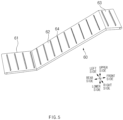
- FIG. 5 is a perspective view of a discharge part 60 of the seasoning applying apparatus 1 according to an embodiment of the present disclosure.
- the seasoning applying apparatus 1 may include a processor for control.
- the processor may be electrically connected to other components that constitute the seasoning applying apparatus 1, and may transmit control signals or receive data in the form of electrical signals.
- the division part 20 receives the semi-finished product "M" from the semi-finished product conveyor of the seasoning providing apparatus 2. As the processor controls and operates the division part 20, an interval between the semi-finished products "M” increases and the semi-finished products "M” may be separated.
- the processor may perform a control such that the semi-finished product "M” is delivered to, among the agitation modules 11 and 12, the agitation module 11 and 12 that is not currently performing an agitation operation.
- the processor may temporarily stop transferring the semi-finished product "M" forward by controlling the division part 20, the semi-finished product counting part 30, and the introduction part 40.
Landscapes
- Chemical & Material Sciences (AREA)
- Chemical Kinetics & Catalysis (AREA)
- Engineering & Computer Science (AREA)
- Food Science & Technology (AREA)
- Life Sciences & Earth Sciences (AREA)
- Polymers & Plastics (AREA)
- Oil, Petroleum & Natural Gas (AREA)
- Health & Medical Sciences (AREA)
- Nutrition Science (AREA)
- General Preparation And Processing Of Foods (AREA)
- Mechanical Engineering (AREA)
- Formation And Processing Of Food Products (AREA)
- Seasonings (AREA)
- Confectionery (AREA)
Abstract
Description
- The present disclosure relates to a seasoning applying apparatus for producing an edible product, and an edible product production system including the same.
- A process of processing a given ingredient is required to produce food, and this processing may include not only washing or trimming ingredients, but also adding seasoning including other ingredients. Seasoning may be applied to the ingredients, and here, application may include bringing the seasoning into contact with surfaces of the ingredients as well as spreading the seasoning on a inside of the ingredients. In general, salting foods may be made in this way. Pickled foods are foods, a storability of which is improved by adding salt, and include kimchi, pickled radish, pickled vegetables, and cucumber kimchi, and among them, kimchi, especially bunch kimchi is a representative example.
- When bunch kimchi is made, whole cabbages wrapped in several layers of leaves may be cut and pickled in brine, seasoning may be applied, and then they may be aged. Seasoning used in making bunch kimchi may be kimchi filling including radish greens, red pepper powder, minced garlic, salted shrimp, and the like.
- With the kimchi filling contained in a large-capacity storage tank, seasoning is generally applied by an operator who grasps the pickled cabbage one by one near the storage tank and scoops up an appropriate amount of the kimchi filling. However, when this method is used, the operator picks up the kimchi filling with his or her eyes and applies it to the pickled cabbage, and thus there is a large difference between operators in the appropriate amount of seasoning, and it is not guaranteed that even the same operator will apply a uniform amount of seasoning. Because the entire process of applying the seasoning is done by the operator, each operator has to spend a very long time to produce one product to evenly apply the seasoning to the bunch kimchi, and thus a productivity of the overall product production process deteriorates.
- The present disclosure has been made to solve the above problems, and provides a seasoning applying apparatus that may uniformly apply seasoning to an edible product while improving a productivity of the edible product, and an edible product production system including the same.
- According to an aspect of the present disclosure, a seasoning applying apparatus includes an agitation part including an agitation module that agitates an introduced semi-finished product together with seasoning while being rotated to produce a product, an introduction part that moves the semi-finished product forward and deliver the semi-finished product to the agitation module, and a discharge part that moves the product discharged from the agitation part forward and provide the product to a workbench.
- According to another aspect of the present disclosure, an edible product production system includes a seasoning providing apparatus that provides seasoning to a raw material to form a semi-finished product, and a seasoning applying apparatus that applies the seasoning to the semi-finished product to form a product, and the seasoning applying apparatus includes an agitation part including a plurality of agitation modules that agitates the introduced semi-finished product together with the seasoning, and an introduction part that moves the semi-finished product delivered from the seasoning providing apparatus forward and selectively deliver the semi-finished product to any one of the plurality of agitation modules.
- Accordingly, because a large amount of edible products may be produced in a short time, productivity may be improved and seasoning may be uniformly applied to the edible product.
-
-
FIG. 1 is a conceptual view of an edible product production system according to an embodiment of the present disclosure. -
FIG. 2 is a conceptual view of a seasoning applying apparatus according to an embodiment of the present disclosure. -
FIG. 3 is a view conceptually illustrating a shape of a seasoning applying apparatus, viewed from a top according to an embodiment of the present disclosure. -
FIG. 4 is a view conceptually illustrating a shape of the seasoning applying apparatus, viewed from the side according to an embodiment of the present disclosure. -
FIG. 5 is a perspective view of a discharge part of a seasoning applying apparatus according to an embodiment of the present disclosure. - This application claims the benefit of priority to
Korean Patent Application No. 10-2021-0111979, filed in the Korean Intellectual Property Office on August 24, 2021 - Hereinafter, embodiments of the present disclosure will be described in detail with reference to the accompanying drawings. In adding reference numerals to the components of the drawings, it is noted that the same components are denoted by the same reference numerals even when they are drawn in different drawings. Furthermore, in describing the embodiments of the present disclosure, when it is determined that a detailed description of related known configurations and functions may hinder understanding of the embodiments of the present disclosure, a detailed description thereof will be omitted.
- Furthermore, in describing the components of the embodiments of the present disclosure, terms, such as first, second, "A", "B", (a), and (b) may be used. The terms are simply for distinguishing the components, and the essence, the sequence, and the order of the corresponding components are not limited by the terms. When it is described that a certain component is "connected to", "coupled to" or "electrically connected to" a second component, it should be understood that the component may be directly connected or electrically connected to the second component, but a third component may be "connected" or "electrically connected" between the components.
-
FIG. 1 is a conceptual view of an edibleproduct production system 100 according to an embodiment of the present disclosure. - Referring to the drawing, the edible
product production system 100 according to an embodiment of the present disclosure includes aseasoning providing apparatus 2 and aseasoning applying apparatus 1. A raw material is introduced into theseasoning providing apparatus 2, and seasoning is supplied to the raw material from theseasoning providing apparatus 2 to form a semi-finished product "M" that is the raw material, on which the seasoning is applied, and the semi-finished product "M" is delivered to theseasoning applying apparatus 1, and thus, through the application of the seasoning to the semi-finished product "M", a product "P" that is the raw material, on which the seasoning is secondarily applied more uniformly, is formed and discharged. The seasoning may be provided in the form, in which the seasoning is discharged to the raw material. In the specification of the present disclosure, it is assumed in a description thereof that the raw material is pickled cabbage and the product "P" is bunch kimchi, but the kinds of the raw material and the product "P" that may be produced from the raw material are not limited thereto. - A progress direction of an overall process of introducing the raw material, discharging the product "P", and delivering the semi-finished product "M" will be referred to as a reference direction. The
seasoning applying apparatus 1 and theseasoning providing apparatus 2 may be arranged along the reference direction. The reference direction may be a direction on a straight line, but may not draw a straight line. In an embodiment of the present disclosure, the reference direction is assumed to be a forward direction, but the direction is not limited thereto. Furthermore, in the specification of the present disclosure, a forward direction, a rearward direction, a leftward direction, a rightward direction, an upward direction, a downward direction are expressions used for convenience of description, and may be relatively determined depending on directions, in which the edibleproduct production system 100 and the components are disposed. -
FIG. 2 is a conceptual view of theseasoning applying apparatus 1 according to an embodiment of the present disclosure.FIG. 3 is a view conceptually illustrating a shape of theseasoning applying apparatus 1, viewed from a top according to an embodiment of the present disclosure.FIG. 4 is a view conceptually illustrating a shape of theseasoning applying apparatus 1, viewed from a lateral side according to an embodiment of the present disclosure. - Referring to the drawings, the
seasoning applying apparatus 1 according to an embodiment of the present disclosure includes anintroduction part 40 and anagitation part 10. Theseasoning applying apparatus 1 may include adischarge part 60. The components of theseasoning applying apparatus 1 may be arranged one by one forward. - The
seasoning applying apparatus 1 according to an embodiment of the present disclosure may include adivision part 20. Thedivision part 20 is a part that transfers the semi-finished product "M" from a rear side to a front side of theintroduction part 40 to transfer individual semi-finished products "M" to theintroduction part 40. Thedivision part 20 may include a conveyor belt that extends forward, and may transfer the semi-finished product "M" delivered from theseasoning providing apparatus 2 forward while being seated on an upper surface thereof. For thedivision part 20 to divide the semi-finished products "M" into individual ones and deliver the to theintroduction part 40, a speed, at which thedivision part 20 is driven, may be higher than a driving speed of a semi-finished product discharge member of theseasoning providing apparatus 2. Thedivision part 20 may transfer the semi-finished products "M" along a forward direction at a higher speed than at a speed, at which the semi-finished product "M" is received, to increase an interval between the semi-finished products "M" whereby the semi-finished products "M" may be individually distinguished as much as possible. - The
seasoning applying apparatus 1 according to an embodiment of the present disclosure may include a semi-finishedproduct counting part 30. The semi-finishedproduct counting part 30 counts the number of the passing semi-finished products "M", and then delivers the semi-finished products "M" to theintroduction part 40. The semi-finished product counting part 3 may include a counting conveyor for transferring the semi-finished products "M" and an optical sensor, and may count the number of the semi-finished products "M" seated on an upper side of the counting conveyor. The optical sensor may be a camera that acquires images of the counting conveyor, through which the semi-finished products "M" pass, and may recognize and count the semi-finished products from these images. The semi-finishedproduct counting part 30 may be electrically connected to a processor, which will be described later, and may transmit the number of acquired images or semi-finished products "M" to the processor. The processor may perform calculations by using the number of received images or semi-finished products "M", and may control the components of theseasoning applying apparatus 1 based on this. The details of a specific control will be described later. - The semi-finished
product counting part 30 may be located on a front side of thedivision part 20 and may receive the semi-finished products "M" from thedivision part 20, and may be located in a rear side of theintroduction part 40 to deliver the semi-finished products "M", the images of which are acquired by theintroduction part 40. The semi-finishedproduct counting part 30 may include a conveyor belt as the counting conveyor as described above to transfer the semi-finished products "M", but the means used to transfer the semi-finished products "M" are not limited thereto, and various devices such as robot arms and rollers may be used as a means of movement. Furthermore, the optical sensor may also be an IR sensor that may recognize passing of an object, other than a camera. - The
introduction part 40 moves the semi-finished product "M" forward and selectively delivers it to one of the twoagitation modules agitation part 10, which will be described later. Theintroduction part 40 may transfer the semi-finished product "M" that has passed through the semi-finishedproduct counting part 30 to theagitation part 10. - The
introduction part 40 may be a swing conveyor. The swing conveyor is a device that transfers a seated object along an extension direction, but may control a direction it faces. The twoagitation modules first agitation module 11 and asecond agitation module 12, and theintroduction part 40 may have a first state, in which the semi-finished product "M" is provided to thefirst agitation module 11, and a second state, in which the semi-finished product "M" is provided to thesecond agitation module 12. In the first state, a front end of theintroduction part 40 may be located adjacent to thefirst agitation module 11, and in the second state, the front end of theintroduction part 40 may be located adjacent to thesecond agitation module 12. - To have the above-described first state and second state, the
introduction part 40 may be located at the rear end, and may be rotated about an imaginary line that extends in an upward/downward direction. Thefirst agitation module 11 and thesecond agitation module 12 may be arranged along the leftward/rightward direction, and as theintroduction part 40 is rotated, a position of the front end of theintroduction part 40 be moved along the leftward/rightward to be adjacent to thefirst agitation module 11 or adjacent to thesecond agitation module 12. However, in the case of the imaginary line that is a rotation axis of theintroduction part 40, as long as the position of the front end of theintroduction part 40 may be moved to the left side or right side according to the rotation of theintroduction part 40, it may also extend in another direction. - The
introduction part 40 may have a shape that is inclined upward with respect to the forward direction. Accordingly, the semi-finished product "M" seated on theintroduction part 40 may be lifted while moving forward. The semi-finished product "M" that has reached the front end of theintroduction part 40 may drop into theagitation openings 120 located on the upper sides of theagitation modules agitation modules - The
introduction part 40 may be electrically connected to the processor. The processor is arranged such that the agitation opening 120 formed in any one of the twoagitation modules introduction part 40 such an inclination degree of theintroduction part 40 with respect to the forward direction becomes lower whereby the front end of theintroduction part 40 is adjacent to theagitation openings 120 of theagitation openings 120 of theagitation modules agitation module second agitation module 12 is exemplarily in a state, in which it may receive the semi-finished product "M". - After the processor completes the introduction of the semi-finished product "M" to the
agitation module introduction part 40 increases whereby theintroduction part 40 is controlled such the front end of theintroduction part 40 becomes far away from theagitation module introduction part 40 described above, theseasoning applying apparatus 1 according to an embodiment of the present disclosure may allow the semi-finished product "M" to be introduced into theagitation modules agitation modules introduction part 40 when theagitation modules - In a modification of an embodiment of the present disclosure, instead of using a swing conveyor, a lift method, in which the division part, the semi-finished product counting part, and the introduction part are moved as a whole in the leftward/rightward direction by a movement apparatus, may be used. When the semi-finished product "M" is counted by the semi-finished product counting part and it is determined into which
agitation module corresponding agitation module corresponding agitation module - The
agitation part 10 is a component for agitating the semi-finished product "M" together with the seasoning. Theagitation part 10 may include twoagitation modules agitation modules - The
agitation module agitation modules agitation modules agitation modules agitation modules agitation modules - To enable rotation of the
agitation modules seasoning applying apparatus 1 according to the embodiment may include a drivingpart 50 including two drivingmodules agitation modules module support 521 that is fixed to the ground, and amotor 522 that is connected to theagitation module agitation module modules agitation modules modules agitation modules first driving module 51 may be connected to thefirst agitation module 11, and thesecond driving module 52 may be connected to thesecond agitation module 12. - Each of the
agitation modules agitation modules agitation modules agitation modules - The
agitation module agitation vessel 121 and adoor 122. Theagitation vessel 121 refers to a cylindrical vessel having an agitation space in an interior thereof. Thedoor 122 is coupled to theagitation vessel 121 to open and close anagitation opening 120 formed in theagitation vessel 121. The processor may be electrically connected to the drivingpart 50 and theagitation part 10, and may control the rotation of theagitation vessel 121 and the opening and closing of theagitation vessel 121. Theagitation opening 120 may be formed on a curved outer surface of theagitation vessel 121. - The
door 122 may include a plate-shaped cover part that covers the agitation opening 120, and an opening/closing cylinder that is coupled to the cover part and theagitation vessel 121. The opening/closing cylinder may be a hydraulic cylinder. As the opening/closing cylinder is operated, the cover part may be attached to a peripheral area of the agitation opening 120 to close the agitation opening 120 or may deviate from the surrounding area of the agitation opening 120 to open theagitation opening 120. The opening/closing cylinder may be coupled to theagitation vessel 121 and the cover part such that the cover part is moved while being sliding along a circumferential direction of theagitation vessel 121, and a guide rail for guiding the movement and the position of the cover part may be provided to an outer surface of the agitation vessel, and thus, the cover part may be guided by the guide rail. - The
agitation module agitation vessel 121 to agitate the semi-finished product "M" and the seasoning that are introduced into the agitation space. The blade may have a shape that protrudes inward from an inner surface of theagitation vessel 121, and may have a shape that is bent or inclined in the forward/rearward direction or the leftward/rightward direction while protruding inward. The blades may also function to agitate the seasoning and the semi-finished product "M", but may be rotated to discharge the remaining seasoning through the agitation opening 120 in a state, in which the agitation opening 120 is disposed to face a lower side and is opened. Furthermore, when the semi-finished product "M" is introduced into theagitation vessel 121 through the agitation opening 120, the semi-finished product "M" may be rotated to be prevented from dropping to a bottom of theagitation vessel 121 at once and being damaged. The blades may be rotated together with theagitation vessel 121, but may also be rotated relative to theagitation vessel 121. - The
agitation modules agitation modules agitation modules -
FIG. 5 is a perspective view of adischarge part 60 of theseasoning applying apparatus 1 according to an embodiment of the present disclosure. - The
seasoning applying apparatus 1 according to an embodiment of the present disclosure may include adischarge part 60. Thedischarge part 60 moves the product "P" discharged from theagitation part 10 forward and provides it to aworkbench 70. Thedischarge part 60 may include a conveyor belt that extends forward, and may transfer the semi-finished product "M" discharged from theagitation modules agitation module door 122 may be opened whereby the product "P" may drop into thedischarge part 60 by an own weight thereof. - A shooter may be disposed between the
discharge part 60 and theagitation module discharge part 60 while not dropping to a wrong position. The shooter may have a shape of a funnel, a cross-sectional area of which decreases as it goes downward. - A
rear end 61 of thedischarge part 60 may be located on a lower side of theagitation module agitation module rear end 61 of thedischarge part 60 may extend forward and may be formed perpendicular to the upward/downward direction. Anintermediate portion 62 of thedischarge part 60 may have a shape that is inclined upward with respect to the forward direction. Afront end 63 of thedischarge part 60 may be connected to theworkbench 70, and may deliver the product "P" to theworkbench 70. Theworkbench 70 configured such that the operator completes the seasoning applying operation for the product P may be located on an upper side of arear end 61 of thedischarge part 60. Thedischarge part 60 may have the above-described shape whereby theworkbench 70 may be located at a height that is suitable for the operator to perform an operation, and thedischarge part 60 may deliver the product "P" to theworkbench 70. - The
discharge part 60 may include a plurality of discharge steps 64. The discharge steps 64 may extend in the leftward/rightward direction at a specific interval along the forward/rearward direction, and may be formed to protrude from a surface of thedischarge part 60. They may be stop steps that ensures that the product "P" is stably transferred forward and upward while not rolling reversely due to own weights thereof at theintermediate portion 62 of thedischarge part 60, at which thedischarge step 64 has a shape that faces a right upper side. Structures that are similar to the discharge steps 64 may also be formed in theintroduction part 40. - The
seasoning applying apparatus 1 according to an embodiment of the present disclosure may include a processor for control. The processor may be electrically connected to other components that constitute theseasoning applying apparatus 1, and may transmit control signals or receive data in the form of electrical signals. - The processor generates and transmits control signals that control each component. A micro controller unit (MCU), a central processing unit (CPU), a field programmable gate array (FPGA), an application specific integrated circuit (ASIC), and the like may be used as processors, but the types thereof are not limited thereto.
- Control commands performed by the processor may be stored and utilized in a storage medium, and the storage medium may be a device, such as a hard disk drive (HDD), a solid state drive (SSD), a server, a volatile medium, or a non-volatile medium, but the types are not limited thereto. Furthermore, data required by the processor to perform tasks may be stored in the storage medium.
- The processor may control an overall product production process by the
seasoning applying apparatus 1. Hereinafter, the product production process of the edibleproduct production system 100 performed under the control of the processor will be described in order according to movement of the raw material, semi-finished product "M", or product "P". - When sub-materials, such as a raw materials and seasoning, are introduced, the edible
product production system 100 cleans the raw material and sub-materials by using compressed air and steam, and identifies whether it is suitable for introduction inspection standards by analyzing states of the raw material and the sub-materials by using cameras or sensors. The raw material and the sub-materials that satisfy the standards may be distinguished and stored according to their respective storage conditions. For keeping, the raw material and the sub-materials may be refrigerated. - A process of removing foreign substances may be performed on the kept raw material. When the raw material is pickled cabbage, a process of removing leaves that are not suitable for use in manufacturing the product "P" may be performed. The raw material, on which the sorting process has been completed, is provided to the
seasoning providing apparatus 2. - After an amount of the seasoning that is to be discharged is set, and the operator or a transfer apparatus locates the raw material on a lower side of the nozzle, and transmit an operation start signal to the nozzle through manipulation of the switch or detection by a sensor to start the operation, the seasoning is discharged from the
seasoning providing apparatus 2 to the raw material. The semi-finished product "M" formed by discharging the seasoning onto the raw material is seated on the semi-finished product conveyor by the operator or a transfer mechanism and may be transferred along the reference direction. - The
division part 20 receives the semi-finished product "M" from the semi-finished product conveyor of theseasoning providing apparatus 2. As the processor controls and operates thedivision part 20, an interval between the semi-finished products "M" increases and the semi-finished products "M" may be separated. - The semi-finished product "M" is delivered to the semi-finished
product counting part 30 by thedivision part 20. The processor determines anagitation module product counting part 30, and operates the semi-finishedproduct counting part 30 by using thedetermined agitation module introduction part 40, and theintroduction part 40 is rotated to face thedetermined agitation module introduction part 40 such that the inclination degree of theintroduction part 40 with respect to the forward direction decreases such that the semi-finished product "M" may safely drop into theagitation module door 122 of thedetermined agitation module - For the processor to determine, to which of the two
agitation modules agitation modules introduction part 40 is more than a specific limit number. Through the identification operation, the processor may control theintroduction part 40 such that the semi-finished products "M" are delivered to theagitation modules agitation modules agitation modules agitation module agitation modules agitation modules division part 20, the semi-finishedproduct counting part 30, and theintroduction part 40. - The processor may arrange the
agitation modules agitation module agitation module introduction part 40 such that the front end of theintroduction part 40 is located adjacent to the agitation opening 120 of theagitation module agitation vessel 121 to ensure that the semi-finished product "M" is safely located in theagitation vessel 121, and some supplementary seasoning may be further introduced into theagitation vessel 121. The supplementary seasoning may be provided to theagitation module - When any
agitation module corresponding agitation module corresponding agitation module introduction part 40 with respect to the forward direction to allow theintroduction part 40 to deviate from the agitation opening 120 of thecorresponding agitation module door 122 to close theagitation opening 120. Thereafter, the processor controls theagitation module part 50 according to a preset program to agitate the semi-finished product "M" and the seasoning in theagitation module agitation module - When the agitation operation is completed, the processor rotates the
agitation module door 122 to drop the product "P" into thedischarge part 60 through the agitation opening 120 so that the product "P" is discharged from theagitation module agitation vessel 121 to discharge foreign substances, such as leaves separated from the remaining seasoning or the semi-finished product "M" through theagitation opening 120. The processor initializes the cumulative value of the limit number such that the semi-finished product "M" may be introduced again into theagitation module door 122 to close theagitation opening 120. - The product "P" discharged to the
discharge part 60 is transferred forward and upward by thedischarge part 60 and is delivered to theworkbench 70. A scale for acquiring and identifying a weight of the product "P" may be disposed in theworkbench 70, and the operator may identify the weight of the delivered product "P", and may add the leaves or the seasoning when the weight is less than a lower limit of a specific reference weight range and may carrying out a weight calibration by removing the leaves from the product "P" when the weight is more than the upper light of the reference weight range whereby the weight of the product "P" is located in the reference weight range. Finally, it may be identified whether the weight of the corrected product "P" is within the reference weight range by using a scale. - Thereafter, the product "P" may be introduced into a pouch by the operator or a packaging device, and is packaged internally by fastening and sealing the pouch by using a cable tie or a clip. The internally packaged products may pass through an X-ray metal detector for a metal inspection, and the internally packaged products that have passed the X-ray metal detector may be externally packaged with packaging paper. Some stamps may be placed on the internally packaged products. The externally packaged products may be refrigerated.
- In the above, even though all the components constituting the embodiment of the present disclosure have been described as being combined or operated in combination, the present disclosure is not necessarily limited to this embodiment. That is, as long as it is within the scope of the purpose of the present disclosure, all of the components may be operated by selectively combining one or more of them. In addition, terms such as "include," "comprise," or "have" described above mean that the corresponding component may be present, unless specifically stated to the contrary, and thus do not exclude other components. Rather, it should be interpreted as being able to include other components. Unless otherwise defined, all terms used herein, including technical or scientific terms, have the same meanings as those generally understood by those skilled in the art to which the present disclosure pertains. Such terms as those defined in a generally used dictionary are to be interpreted as having meanings equal to the contextual meanings in the relevant field of art, and are not to be interpreted as having ideal or excessively formal meanings unless clearly defined as having such in the present application.
- The above description is a simple exemplary description of the technical spirits of the present disclosure, and an ordinary person in the art, to which the present disclosure pertains, may make various corrections and modifications without departing from the essential characteristics of the present disclosure. Therefore, the embodiments disclosed in the present disclosure are not for limiting the technical spirits of the present disclosure but for describing them, and the scope of the technical spirits of the present disclosure is not limited by the embodiments. The protection scope of the present disclosure should be construed by the following claims, and all the technical spirits in the equivalent range should be construed as being included in the scope of the present disclosure.
Claims (15)
- A seasoning applying apparatus comprising:an agitation part including an agitation module configured to agitate an introduced semi-finished product together with seasoning while being rotated to produce a product;an introduction part configured to move the semi-finished product forward and deliver the semi-finished product to the agitation module; anda discharge part configured to move the product discharged from the agitation part forward and provide the product to a workbench.
- The seasoning applying apparatus of claim 1, wherein two agitation modules are provided, and
wherein the introduction part is configured to selectively deliver the semi-finished product to any one of the two agitation modules. - The seasoning applying apparatus of claim 2, further comprising:a semi-finished product counting part configured to count the semi-finished product and deliver the counted semi-finished product to the introduction part; anda processor electrically connected to the introduction part and the semi-finished product counting part,wherein the introduction part is configured to deliver the semi-finished product exiting from the semi-finished product counting part to the agitation part, andwherein the processor determines an agitation module, to which the semi-finished product having passed through the semi-finished product counting part is to be delivered, based on the number of the semi-finished products, which is acquired by the semi-finished product counting part, and controls the introduction part such that the semi-finished product having passed through the semi-finished product counting part is delivered to the determined agitation module.
- The seasoning applying apparatus of claim 3, wherein the processor identifies whether a sum of the number of the semi-finished products introduced into the two agitation modules and not discharged and the number of the semi-finished products transferred by the introduction part is more than a specific limit number, and controls the introduction part such that the semi-finished products are delivered to the agitation modules being not more than the limit number.
- The seasoning applying apparatus of claim 4, further comprising: a division part configured to transfer the semi-finished products from a rear side to a front side of the introduction part to deliver the individual semi-finished products to the introduction part.
- The seasoning applying apparatus of claim 2, wherein the introduction part is a swing conveyor having a first state, in which a front end of the introduction part is located adjacent to, among the two agitation modules, a first agitation module such that the semi-finished product is provided to the first agitation module, and a second state, in which the front end of the introduction part is located adjacent to, among the two agitation modules, a second agitation module such that the semi-finished product is provided to the second agitation module.
- The seasoning applying apparatus of claim 2, further comprising:a processor electrically connected to the introduction part,wherein the processor controls the introduction part such that an inclination degree of the introduction part with respect to a front side becomes lower whereby an agitation opening formed in any one of the two agitation modules is disposed to face an upper side such that a front end of the introduction part becomes closer to the agitation opening when the any one agitation module is able to receive the semi-finished product.
- The seasoning applying apparatus of claim 2, wherein the two agitation modules are arranged along a leftward/rightward direction, and are configured to be rotated while a direction being parallel to the leftward/rightward direction is taken as an axial direction thereof.
- The seasoning applying apparatus of claim 1, wherein the agitation module is formed in a cylindrical shape.
- The seasoning applying apparatus of claim 1, wherein the agitation module includes a tubular agitation vessel having an agitation space in an interior thereof, and a door coupled to the agitation vessel to open and close the agitation opening formed in the agitation vessel.
- The seasoning applying apparatus of claim 10, wherein the agitation module further includes a blade rotatably coupled to an inside of the agitation vessel to agitate the semi-finished product and the seasoning, which are introduced into the agitation space.
- The seasoning applying apparatus of claim 11, further comprising:a processor electrically connected to the agitation part,wherein the processor rotates the blade to discharge remaining seasoning through the agitation opening in a state, in which the agitation opening is disposed to face a lower side and is opened.
- The seasoning applying apparatus of claim 1, further comprising:a processor electrically connected to the agitation part,wherein the processor performs a control to rotate the agitation module in one direction and an opposite direction to the one direction.
- The seasoning applying apparatus of claim 1, wherein a rear end of the discharge part is located on a lower side of the agitation module such that the product discharged downward from the agitation module is seated thereon, and an intermediate portion of the discharge part has a shape inclined upward with respect to a front side.
- An edible product production system comprising:a seasoning providing apparatus configured to provide seasoning to a raw material to form a semi-finished product; anda seasoning applying apparatus configured to apply the seasoning to the semi-finished product to form a product,wherein the seasoning applying apparatus includes:an agitation part including a plurality of agitation modules configured to agitate the introduced semi-finished product together with the seasoning; andan introduction part configured to move the semi-finished product delivered from the seasoning providing apparatus forward and selectively deliver the semi-finished product to any one of the plurality of agitation modules.
Applications Claiming Priority (2)
| Application Number | Priority Date | Filing Date | Title |
|---|---|---|---|
| KR1020210111979A KR102360928B1 (en) | 2021-08-24 | 2021-08-24 | Sauce spreading apparatus and edible product manufacturing system including same |
| PCT/KR2022/012045 WO2023027397A1 (en) | 2021-08-24 | 2022-08-11 | Sauce spreading apparatus and edible product manufacturing system including same |
Publications (2)
| Publication Number | Publication Date |
|---|---|
| EP4393363A1 true EP4393363A1 (en) | 2024-07-03 |
| EP4393363A4 EP4393363A4 (en) | 2025-08-20 |
Family
ID=80254311
Family Applications (1)
| Application Number | Title | Priority Date | Filing Date |
|---|---|---|---|
| EP22861607.4A Pending EP4393363A4 (en) | 2021-08-24 | 2022-08-11 | SAUCE DISTRIBUTION DEVICE AND SYSTEM FOR PRODUCING AN EDIBLE PRODUCT THEREOF |
Country Status (6)
| Country | Link |
|---|---|
| US (1) | US20240349773A1 (en) |
| EP (1) | EP4393363A4 (en) |
| KR (1) | KR102360928B1 (en) |
| CN (1) | CN117858649A (en) |
| AU (1) | AU2022332758B2 (en) |
| WO (1) | WO2023027397A1 (en) |
Families Citing this family (2)
| Publication number | Priority date | Publication date | Assignee | Title |
|---|---|---|---|---|
| KR102360928B1 (en) * | 2021-08-24 | 2022-02-14 | 씨제이제일제당 (주) | Sauce spreading apparatus and edible product manufacturing system including same |
| KR102817466B1 (en) * | 2022-02-15 | 2025-06-05 | 김성민 | Kkakdugi mixing device |
Family Cites Families (12)
| Publication number | Priority date | Publication date | Assignee | Title |
|---|---|---|---|---|
| US5698252A (en) * | 1995-05-31 | 1997-12-16 | Nabisco Technology Company | Topical application of particulates for production of reduced fat, low fat, and no-fat baked goods and snacks |
| DE10011795A1 (en) * | 2000-03-14 | 2001-09-20 | Stoever Produktion Gmbh & Co K | Diced raw potato coated with liquid starch and turned in rotating drum prior to frying |
| KR101347429B1 (en) * | 2012-11-27 | 2014-01-22 | 한국식품연구원 | Automatic kimchi cabbage salting apparatus by soaking and draining |
| GB201315303D0 (en) * | 2013-08-28 | 2013-10-09 | Ishida Europ Ltd | Apparatus for Seasoning Food Product |
| KR101357613B1 (en) * | 2013-08-29 | 2014-02-04 | 김광영 | Process for low salt kimchi using quick salting technology with low amount of salt |
| KR101444761B1 (en) * | 2013-11-19 | 2014-09-30 | 한국식품연구원 | A mechanical device that kimchi sauce stuffed into the cabbage |
| AU2014395099B2 (en) * | 2014-05-22 | 2018-11-08 | General Mills, Inc. | Continuous coating method |
| JP6399489B2 (en) * | 2015-01-23 | 2018-10-03 | 株式会社一山機械 | Food stirring and conveying device and food stirring and conveying system |
| KR102064061B1 (en) * | 2018-03-28 | 2020-01-08 | 한국식품연구원 | Mixing apparatus for kimchi seasoning |
| KR102162960B1 (en) * | 2019-04-26 | 2020-10-07 | 나옥주 | Device for Mixing Food Material |
| KR102670023B1 (en) | 2020-03-04 | 2024-05-27 | 주식회사 디비하이텍 | Organic light emitting diode display device and manufacturing method thereof |
| KR102360928B1 (en) * | 2021-08-24 | 2022-02-14 | 씨제이제일제당 (주) | Sauce spreading apparatus and edible product manufacturing system including same |
-
2021
- 2021-08-24 KR KR1020210111979A patent/KR102360928B1/en active Active
-
2022
- 2022-08-11 EP EP22861607.4A patent/EP4393363A4/en active Pending
- 2022-08-11 WO PCT/KR2022/012045 patent/WO2023027397A1/en not_active Ceased
- 2022-08-11 AU AU2022332758A patent/AU2022332758B2/en active Active
- 2022-08-11 US US18/686,316 patent/US20240349773A1/en active Pending
- 2022-08-11 CN CN202280057900.2A patent/CN117858649A/en active Pending
Also Published As
| Publication number | Publication date |
|---|---|
| WO2023027397A1 (en) | 2023-03-02 |
| AU2022332758B2 (en) | 2026-01-15 |
| CN117858649A (en) | 2024-04-09 |
| EP4393363A4 (en) | 2025-08-20 |
| US20240349773A1 (en) | 2024-10-24 |
| KR102360928B1 (en) | 2022-02-14 |
| AU2022332758A1 (en) | 2024-03-14 |
Similar Documents
| Publication | Publication Date | Title |
|---|---|---|
| US20240349773A1 (en) | Sauce spreading apparatus and edible product manufacturing system including same | |
| EP2925150B1 (en) | A food processing system and a corresponding method for sorting, weighing, conveying and marinating solid food products | |
| JP7329046B2 (en) | Slack separation apparatus and method | |
| EP4393364A1 (en) | Sauce supplying apparatus and edible product manufacturing system including same | |
| EP3727040B1 (en) | Coating of food products with a particulate coating material | |
| JP6786556B2 (en) | A solid matter supply device and a food manufacturing device equipped with the solid matter supply device. | |
| US9961908B2 (en) | Apparatus for applying particulate matter to a substrate | |
| US5537915A (en) | Foodstuff dispensing machine | |
| KR102812900B1 (en) | Stick type food manufacturing system, stick type food shaping apparatus and topping application apparatus for stick type food | |
| JPS6211569A (en) | Coating device | |
| US8142828B2 (en) | Tumble breading system, and related method | |
| EP3618646B1 (en) | Apparatus and method for coating product in flavouring | |
| JP2663236B2 (en) | Method and apparatus for producing flour-kneaded food material | |
| US20250017424A1 (en) | Food chopping machine, in particular for making pesto | |
| EP4268597A1 (en) | Stick-type food preparation system, stick-type food forming apparatus, and topping applying apparatus for stick-type foods | |
| JP7320436B2 (en) | Noodle individual serving cooking and filling device and noodle individual serving cooking and filling method | |
| JP3683579B2 (en) | Weighing seasoning system | |
| GB2596069A (en) | Slack separation apparatus and method | |
| EP1331460A2 (en) | Apparatus for continuous centrifugation, particularly for leaf food products | |
| HK40001905B (en) | System for the conservation and dosage of ingredients and method for the dosage and deposition of ingredients on a substrate |
Legal Events
| Date | Code | Title | Description |
|---|---|---|---|
| STAA | Information on the status of an ep patent application or granted ep patent |
Free format text: STATUS: THE INTERNATIONAL PUBLICATION HAS BEEN MADE |
|
| PUAI | Public reference made under article 153(3) epc to a published international application that has entered the european phase |
Free format text: ORIGINAL CODE: 0009012 |
|
| STAA | Information on the status of an ep patent application or granted ep patent |
Free format text: STATUS: REQUEST FOR EXAMINATION WAS MADE |
|
| 17P | Request for examination filed |
Effective date: 20240325 |
|
| AK | Designated contracting states |
Kind code of ref document: A1 Designated state(s): AL AT BE BG CH CY CZ DE DK EE ES FI FR GB GR HR HU IE IS IT LI LT LU LV MC MK MT NL NO PL PT RO RS SE SI SK SM TR |
|
| DAV | Request for validation of the european patent (deleted) | ||
| DAX | Request for extension of the european patent (deleted) | ||
| A4 | Supplementary search report drawn up and despatched |
Effective date: 20250721 |
|
| RIC1 | Information provided on ipc code assigned before grant |
Ipc: A47J 43/08 20060101AFI20250715BHEP Ipc: A23L 23/00 20160101ALI20250715BHEP Ipc: A47J 43/07 20060101ALI20250715BHEP Ipc: A23P 20/13 20160101ALI20250715BHEP Ipc: A23P 20/18 20160101ALI20250715BHEP |