EP4390545A1 - Photosensitive resin composition and display device - Google Patents
Photosensitive resin composition and display device Download PDFInfo
- Publication number
- EP4390545A1 EP4390545A1 EP22858689.7A EP22858689A EP4390545A1 EP 4390545 A1 EP4390545 A1 EP 4390545A1 EP 22858689 A EP22858689 A EP 22858689A EP 4390545 A1 EP4390545 A1 EP 4390545A1
- Authority
- EP
- European Patent Office
- Prior art keywords
- group
- resin composition
- photosensitive resin
- pigment
- alkali
- Prior art date
- Legal status (The legal status is an assumption and is not a legal conclusion. Google has not performed a legal analysis and makes no representation as to the accuracy of the status listed.)
- Pending
Links
Images

Classifications
-
- C—CHEMISTRY; METALLURGY
- C09—DYES; PAINTS; POLISHES; NATURAL RESINS; ADHESIVES; COMPOSITIONS NOT OTHERWISE PROVIDED FOR; APPLICATIONS OF MATERIALS NOT OTHERWISE PROVIDED FOR
- C09D—COATING COMPOSITIONS, e.g. PAINTS, VARNISHES OR LACQUERS; FILLING PASTES; CHEMICAL PAINT OR INK REMOVERS; INKS; CORRECTING FLUIDS; WOODSTAINS; PASTES OR SOLIDS FOR COLOURING OR PRINTING; USE OF MATERIALS THEREFOR
- C09D4/00—Coating compositions, e.g. paints, varnishes or lacquers, based on organic non-macromolecular compounds having at least one polymerisable carbon-to-carbon unsaturated bond ; Coating compositions, based on monomers of macromolecular compounds of groups C09D183/00 - C09D183/16
- C09D4/06—Organic non-macromolecular compounds having at least one polymerisable carbon-to-carbon unsaturated bond in combination with a macromolecular compound other than an unsaturated polymer of groups C09D159/00 - C09D187/00
-
- G—PHYSICS
- G02—OPTICS
- G02B—OPTICAL ELEMENTS, SYSTEMS OR APPARATUS
- G02B5/00—Optical elements other than lenses
- G02B5/20—Filters
-
- G—PHYSICS
- G03—PHOTOGRAPHY; CINEMATOGRAPHY; ANALOGOUS TECHNIQUES USING WAVES OTHER THAN OPTICAL WAVES; ELECTROGRAPHY; HOLOGRAPHY
- G03F—PHOTOMECHANICAL PRODUCTION OF TEXTURED OR PATTERNED SURFACES, e.g. FOR PRINTING, FOR PROCESSING OF SEMICONDUCTOR DEVICES; MATERIALS THEREFOR; ORIGINALS THEREFOR; APPARATUS SPECIALLY ADAPTED THEREFOR
- G03F7/00—Photomechanical, e.g. photolithographic, production of textured or patterned surfaces, e.g. printing surfaces; Materials therefor, e.g. comprising photoresists; Apparatus specially adapted therefor
- G03F7/004—Photosensitive materials
-
- C—CHEMISTRY; METALLURGY
- C09—DYES; PAINTS; POLISHES; NATURAL RESINS; ADHESIVES; COMPOSITIONS NOT OTHERWISE PROVIDED FOR; APPLICATIONS OF MATERIALS NOT OTHERWISE PROVIDED FOR
- C09D—COATING COMPOSITIONS, e.g. PAINTS, VARNISHES OR LACQUERS; FILLING PASTES; CHEMICAL PAINT OR INK REMOVERS; INKS; CORRECTING FLUIDS; WOODSTAINS; PASTES OR SOLIDS FOR COLOURING OR PRINTING; USE OF MATERIALS THEREFOR
- C09D135/00—Coating compositions based on homopolymers or copolymers of compounds having one or more unsaturated aliphatic radicals, each having only one carbon-to-carbon double bond, and at least one being terminated by a carboxyl radical, and containing at least another carboxyl radical in the molecule, or of salts, anhydrides, esters, amides, imides or nitriles thereof; Coating compositions based on derivatives of such polymers
- C09D135/02—Homopolymers or copolymers of esters
-
- C—CHEMISTRY; METALLURGY
- C09—DYES; PAINTS; POLISHES; NATURAL RESINS; ADHESIVES; COMPOSITIONS NOT OTHERWISE PROVIDED FOR; APPLICATIONS OF MATERIALS NOT OTHERWISE PROVIDED FOR
- C09D—COATING COMPOSITIONS, e.g. PAINTS, VARNISHES OR LACQUERS; FILLING PASTES; CHEMICAL PAINT OR INK REMOVERS; INKS; CORRECTING FLUIDS; WOODSTAINS; PASTES OR SOLIDS FOR COLOURING OR PRINTING; USE OF MATERIALS THEREFOR
- C09D163/00—Coating compositions based on epoxy resins; Coating compositions based on derivatives of epoxy resins
- C09D163/10—Epoxy resins modified by unsaturated compounds
-
- C—CHEMISTRY; METALLURGY
- C09—DYES; PAINTS; POLISHES; NATURAL RESINS; ADHESIVES; COMPOSITIONS NOT OTHERWISE PROVIDED FOR; APPLICATIONS OF MATERIALS NOT OTHERWISE PROVIDED FOR
- C09D—COATING COMPOSITIONS, e.g. PAINTS, VARNISHES OR LACQUERS; FILLING PASTES; CHEMICAL PAINT OR INK REMOVERS; INKS; CORRECTING FLUIDS; WOODSTAINS; PASTES OR SOLIDS FOR COLOURING OR PRINTING; USE OF MATERIALS THEREFOR
- C09D7/00—Features of coating compositions, not provided for in group C09D5/00; Processes for incorporating ingredients in coating compositions
- C09D7/20—Diluents or solvents
-
- C—CHEMISTRY; METALLURGY
- C09—DYES; PAINTS; POLISHES; NATURAL RESINS; ADHESIVES; COMPOSITIONS NOT OTHERWISE PROVIDED FOR; APPLICATIONS OF MATERIALS NOT OTHERWISE PROVIDED FOR
- C09D—COATING COMPOSITIONS, e.g. PAINTS, VARNISHES OR LACQUERS; FILLING PASTES; CHEMICAL PAINT OR INK REMOVERS; INKS; CORRECTING FLUIDS; WOODSTAINS; PASTES OR SOLIDS FOR COLOURING OR PRINTING; USE OF MATERIALS THEREFOR
- C09D7/00—Features of coating compositions, not provided for in group C09D5/00; Processes for incorporating ingredients in coating compositions
- C09D7/40—Additives
- C09D7/41—Organic pigments; Organic dyes
-
- C—CHEMISTRY; METALLURGY
- C09—DYES; PAINTS; POLISHES; NATURAL RESINS; ADHESIVES; COMPOSITIONS NOT OTHERWISE PROVIDED FOR; APPLICATIONS OF MATERIALS NOT OTHERWISE PROVIDED FOR
- C09D—COATING COMPOSITIONS, e.g. PAINTS, VARNISHES OR LACQUERS; FILLING PASTES; CHEMICAL PAINT OR INK REMOVERS; INKS; CORRECTING FLUIDS; WOODSTAINS; PASTES OR SOLIDS FOR COLOURING OR PRINTING; USE OF MATERIALS THEREFOR
- C09D7/00—Features of coating compositions, not provided for in group C09D5/00; Processes for incorporating ingredients in coating compositions
- C09D7/40—Additives
- C09D7/60—Additives non-macromolecular
- C09D7/61—Additives non-macromolecular inorganic
-
- G—PHYSICS
- G03—PHOTOGRAPHY; CINEMATOGRAPHY; ANALOGOUS TECHNIQUES USING WAVES OTHER THAN OPTICAL WAVES; ELECTROGRAPHY; HOLOGRAPHY
- G03F—PHOTOMECHANICAL PRODUCTION OF TEXTURED OR PATTERNED SURFACES, e.g. FOR PRINTING, FOR PROCESSING OF SEMICONDUCTOR DEVICES; MATERIALS THEREFOR; ORIGINALS THEREFOR; APPARATUS SPECIALLY ADAPTED THEREFOR
- G03F7/00—Photomechanical, e.g. photolithographic, production of textured or patterned surfaces, e.g. printing surfaces; Materials therefor, e.g. comprising photoresists; Apparatus specially adapted therefor
- G03F7/0005—Production of optical devices or components in so far as characterised by the lithographic processes or materials used therefor
- G03F7/0007—Filters, e.g. additive colour filters; Components for display devices
-
- G—PHYSICS
- G03—PHOTOGRAPHY; CINEMATOGRAPHY; ANALOGOUS TECHNIQUES USING WAVES OTHER THAN OPTICAL WAVES; ELECTROGRAPHY; HOLOGRAPHY
- G03F—PHOTOMECHANICAL PRODUCTION OF TEXTURED OR PATTERNED SURFACES, e.g. FOR PRINTING, FOR PROCESSING OF SEMICONDUCTOR DEVICES; MATERIALS THEREFOR; ORIGINALS THEREFOR; APPARATUS SPECIALLY ADAPTED THEREFOR
- G03F7/00—Photomechanical, e.g. photolithographic, production of textured or patterned surfaces, e.g. printing surfaces; Materials therefor, e.g. comprising photoresists; Apparatus specially adapted therefor
- G03F7/004—Photosensitive materials
- G03F7/027—Non-macromolecular photopolymerisable compounds having carbon-to-carbon double bonds, e.g. ethylenic compounds
-
- G—PHYSICS
- G03—PHOTOGRAPHY; CINEMATOGRAPHY; ANALOGOUS TECHNIQUES USING WAVES OTHER THAN OPTICAL WAVES; ELECTROGRAPHY; HOLOGRAPHY
- G03F—PHOTOMECHANICAL PRODUCTION OF TEXTURED OR PATTERNED SURFACES, e.g. FOR PRINTING, FOR PROCESSING OF SEMICONDUCTOR DEVICES; MATERIALS THEREFOR; ORIGINALS THEREFOR; APPARATUS SPECIALLY ADAPTED THEREFOR
- G03F7/00—Photomechanical, e.g. photolithographic, production of textured or patterned surfaces, e.g. printing surfaces; Materials therefor, e.g. comprising photoresists; Apparatus specially adapted therefor
- G03F7/004—Photosensitive materials
- G03F7/027—Non-macromolecular photopolymerisable compounds having carbon-to-carbon double bonds, e.g. ethylenic compounds
- G03F7/028—Non-macromolecular photopolymerisable compounds having carbon-to-carbon double bonds, e.g. ethylenic compounds with photosensitivity-increasing substances, e.g. photoinitiators
-
- G—PHYSICS
- G03—PHOTOGRAPHY; CINEMATOGRAPHY; ANALOGOUS TECHNIQUES USING WAVES OTHER THAN OPTICAL WAVES; ELECTROGRAPHY; HOLOGRAPHY
- G03F—PHOTOMECHANICAL PRODUCTION OF TEXTURED OR PATTERNED SURFACES, e.g. FOR PRINTING, FOR PROCESSING OF SEMICONDUCTOR DEVICES; MATERIALS THEREFOR; ORIGINALS THEREFOR; APPARATUS SPECIALLY ADAPTED THEREFOR
- G03F7/00—Photomechanical, e.g. photolithographic, production of textured or patterned surfaces, e.g. printing surfaces; Materials therefor, e.g. comprising photoresists; Apparatus specially adapted therefor
- G03F7/004—Photosensitive materials
- G03F7/027—Non-macromolecular photopolymerisable compounds having carbon-to-carbon double bonds, e.g. ethylenic compounds
- G03F7/032—Non-macromolecular photopolymerisable compounds having carbon-to-carbon double bonds, e.g. ethylenic compounds with binders
-
- G—PHYSICS
- G03—PHOTOGRAPHY; CINEMATOGRAPHY; ANALOGOUS TECHNIQUES USING WAVES OTHER THAN OPTICAL WAVES; ELECTROGRAPHY; HOLOGRAPHY
- G03F—PHOTOMECHANICAL PRODUCTION OF TEXTURED OR PATTERNED SURFACES, e.g. FOR PRINTING, FOR PROCESSING OF SEMICONDUCTOR DEVICES; MATERIALS THEREFOR; ORIGINALS THEREFOR; APPARATUS SPECIALLY ADAPTED THEREFOR
- G03F7/00—Photomechanical, e.g. photolithographic, production of textured or patterned surfaces, e.g. printing surfaces; Materials therefor, e.g. comprising photoresists; Apparatus specially adapted therefor
- G03F7/004—Photosensitive materials
- G03F7/038—Macromolecular compounds which are rendered insoluble or differentially wettable
- G03F7/0388—Macromolecular compounds which are rendered insoluble or differentially wettable with ethylenic or acetylenic bands in the side chains of the photopolymer
-
- G—PHYSICS
- G03—PHOTOGRAPHY; CINEMATOGRAPHY; ANALOGOUS TECHNIQUES USING WAVES OTHER THAN OPTICAL WAVES; ELECTROGRAPHY; HOLOGRAPHY
- G03F—PHOTOMECHANICAL PRODUCTION OF TEXTURED OR PATTERNED SURFACES, e.g. FOR PRINTING, FOR PROCESSING OF SEMICONDUCTOR DEVICES; MATERIALS THEREFOR; ORIGINALS THEREFOR; APPARATUS SPECIALLY ADAPTED THEREFOR
- G03F7/00—Photomechanical, e.g. photolithographic, production of textured or patterned surfaces, e.g. printing surfaces; Materials therefor, e.g. comprising photoresists; Apparatus specially adapted therefor
- G03F7/004—Photosensitive materials
- G03F7/09—Photosensitive materials characterised by structural details, e.g. supports, auxiliary layers
- G03F7/105—Photosensitive materials characterised by structural details, e.g. supports, auxiliary layers having substances, e.g. indicators, for forming visible images
-
- H—ELECTRICITY
- H10—SEMICONDUCTOR DEVICES; ELECTRIC SOLID-STATE DEVICES NOT OTHERWISE PROVIDED FOR
- H10F—INORGANIC SEMICONDUCTOR DEVICES SENSITIVE TO INFRARED RADIATION, LIGHT, ELECTROMAGNETIC RADIATION OF SHORTER WAVELENGTH OR CORPUSCULAR RADIATION
- H10F39/00—Integrated devices, or assemblies of multiple devices, comprising at least one element covered by group H10F30/00, e.g. radiation detectors comprising photodiode arrays
- H10F39/80—Constructional details of image sensors
- H10F39/805—Coatings
- H10F39/8053—Colour filters
-
- H—ELECTRICITY
- H10—SEMICONDUCTOR DEVICES; ELECTRIC SOLID-STATE DEVICES NOT OTHERWISE PROVIDED FOR
- H10K—ORGANIC ELECTRIC SOLID-STATE DEVICES
- H10K59/00—Integrated devices, or assemblies of multiple devices, comprising at least one organic light-emitting element covered by group H10K50/00
- H10K59/10—OLED displays
- H10K59/12—Active-matrix OLED [AMOLED] displays
- H10K59/122—Pixel-defining structures or layers, e.g. banks
-
- H—ELECTRICITY
- H10—SEMICONDUCTOR DEVICES; ELECTRIC SOLID-STATE DEVICES NOT OTHERWISE PROVIDED FOR
- H10K—ORGANIC ELECTRIC SOLID-STATE DEVICES
- H10K59/00—Integrated devices, or assemblies of multiple devices, comprising at least one organic light-emitting element covered by group H10K50/00
- H10K59/10—OLED displays
- H10K59/17—Passive-matrix OLED displays
- H10K59/173—Passive-matrix OLED displays comprising banks or shadow masks
Definitions
- Such an organic electroluminescent device generally has a structure in which a translucent first electrode formed on the light extraction side and a non-transmissive second electrode formed on the other side are formed on a substrate, and an organic light emitting layer in which each pixel of red, green, blue, etc. is defined is formed between first and second electrodes. Further, a pixel defining layer pattern is formed between each pixel to divide and define these pixels, and such a pixel defining layer pattern is usually formed as a barrier rib pattern having an inverted taper structure.
- a pixel defining layer pattern formed using a conventional photosensitive resin composition has insufficient residual film characteristics, adhesive force to substrates, etc., and/or reliability. Therefore, there is a continuing need to develop a photosensitive resin composition that can improve the overall characteristics of the pixel defining layer pattern.
- a photosensitive resin composition comprising:
- the cured film may comprise,
- the (meth)acrylate is intended to include both acrylate and methacrylate.
- the photosensitive resin composition includes an alkali-soluble resin having the above-mentioned structure, it can exhibit greatly improved light transmittance, photoreactivity with a photoinitiator, etc. and sensitivity, despite the inclusion of a black pigment or a pigment mixture exhibiting a black color.
- the conjugation structure due to the inclusion of an aromatic ring and optionally an alicyclic ring can improve the light transmittance of the photosensitive resin composition. Therefore, the photosensitive resin composition of one embodiment enables the formation of excellent barrier rib and pixel defining layer pattern even under exposure conditions of relatively small amount of light.
- the composition of one embodiment includes a predetermined alkali-soluble resin.
- This alkali-soluble resin has a ring structure such as an aromatic ring in the molecule, and contains a phenolic-derived repeating unit having two or more, or three or more phenolic hydroxy groups.
- the repeating unit may have 3 or more, or 3 to 8, or 3 to 7 ring structures of an aromatic ring and optionally an alicyclic ring, and may have 3 or more phenolic hydroxy groups, as a whole.
- the above-mentioned alkali-soluble resin may comprise one or more selected from the group consisting of the following Chemical Formulas 1 and 2:
- the photosensitive resin composition of one embodiment includes a polyfunctional compound having a plurality of photocurable unsaturated functional groups.
- a polyfunctional compound may cause a photocuring reaction with the above-mentioned alkali-soluble resin in the exposed part of the photosensitive resin composition under the mediation of a photoinitiator to form a crosslinked structure, and can define a barrier rib and a pixel defining layer pattern that are not removed by the developer.
- the photosensitive resin composition of one embodiment includes a pigment including a black pigment or a pigment mixture exhibiting a black color in a mixture state.
- a black pigment or pigment mixture is included in order to improve visibility or contrast of the display device by suppressing light reflection of the photosensitive resin composition and the cured film.
- the light resistance and optical density of a cured film formed from the composition can be further improved.
- photoinitiators include one or more selected from the group consisting of 2-octanedione-1 [(4-phenylthio)phenyl]-2-benzoyl-oxime, 1-[9-ethyl-6-(2-methylbenzoyl)-9H-carbazol-3-yl]ethanone-1-O-acetyloxime, (E)-2-(acetoxyimino)-1-(9,9-diethyl-9H-fluorene-2-yl)butanone and phenyl(4-methoxyphenyl)iodonium arsenic hexafluoride, and a variety of other photoinitiators can be used.
- Example 16 Chemical Formula 3A (Mw: 2000) 80.0 Pigment 4 (particle size: 100nm, 100 pts. wt.) 2.5 Chemical Formula 18 (5 pts. wt.)
- Example 17 Chemical Formula 4A (Mw: 4000) 90.0 Pigment 5 (particle size: 150nm, 30 pts. wt.) 5.0 Chemical Formula 19 (10 pts. wt.)
- Example 18 Chemical Formula 5A (Mw: 6000) 100.0 Pigment 6 (particle size: 200nm, 40 pts. wt.) 7.5 Chemical Formula 20 (15 pts.
- the weight average molecular weight of each alkali-soluble resin prepared in Preparation Examples and Comparative Preparation Examples was measured through GPC analysis.
- Example 1 O 1.0 ⁇ ⁇ ⁇ ⁇ Example 2 O 0.7 ⁇ ⁇ ⁇ ⁇ Example 3 ⁇ 1.9 ⁇ ⁇ ⁇ ⁇ Example 4 ⁇ 1.9 ⁇ ⁇ ⁇ ⁇ Example 5 ⁇ 2.2 ⁇ ⁇ ⁇ ⁇ Example 6 ⁇ 2.4 ⁇ ⁇ ⁇ ⁇ Example 7 ⁇ 2.8 ⁇ ⁇ ⁇ ⁇ Example 8 ⁇ 1.9 ⁇ ⁇ ⁇ ⁇ Example 9 O 1.3 ⁇ ⁇ ⁇ ⁇ Example 10 O 1.2 ⁇ ⁇ ⁇ Example 11 O 1.5 ⁇ ⁇ ⁇ ⁇ Example 12 O 1.9 ⁇ ⁇ ⁇ ⁇ Example 13 O 2.3 ⁇ ⁇ ⁇ ⁇ Example 14 ⁇ 1.5 ⁇ ⁇ ⁇ ⁇ Example 15 ⁇ 3.0 ⁇ ⁇ ⁇ ⁇ Example 16 ⁇ 2.9 ⁇ ⁇ ⁇ O Example 17 ⁇ 0.9 ⁇ ⁇ ⁇ O
Landscapes
- Physics & Mathematics (AREA)
- Chemical & Material Sciences (AREA)
- General Physics & Mathematics (AREA)
- Engineering & Computer Science (AREA)
- Wood Science & Technology (AREA)
- Organic Chemistry (AREA)
- Life Sciences & Earth Sciences (AREA)
- Materials Engineering (AREA)
- Spectroscopy & Molecular Physics (AREA)
- Architecture (AREA)
- Structural Engineering (AREA)
- Optics & Photonics (AREA)
- Microelectronics & Electronic Packaging (AREA)
- Inorganic Chemistry (AREA)
- Materials For Photolithography (AREA)
- Electroluminescent Light Sources (AREA)
Abstract
Description
- The present invention relates to a photosensitive resin composition that not only has excellent optical density and light resistance, but also has improved transmittance, photoreactivity, and sensitivity, and thus can be preferably applicable to form a pixel defining layer pattern of various display devices, such as an organic electroluminescent device, and a display device manufactured using the same.
- Recently, organic electroluminescent devices have been widely applied as display devices in various electronic devices to which thin displays are applied, such as smartphones, tablet PCs, and TVs.
- Such an organic electroluminescent device generally has a structure in which a translucent first electrode formed on the light extraction side and a non-transmissive second electrode formed on the other side are formed on a substrate, and an organic light emitting layer in which each pixel of red, green, blue, etc. is defined is formed between first and second electrodes. Further, a pixel defining layer pattern is formed between each pixel to divide and define these pixels, and such a pixel defining layer pattern is usually formed as a barrier rib pattern having an inverted taper structure.
- Such a pixel defining layer pattern is generally formed using a photosensitive resin composition containing a black pigment in order to prevent a decrease in visibility and contrast of the display device due to reflection of external light. When a pixel defining layer pattern is formed with such a black pigment-containing photosensitive resin composition, the pixel defining layer pattern exhibits high light-shielding properties and can suppress reflection of external light, whereby display devices such as organic electroluminescent devices can exhibit excellent visibility.
- Typically, it has previously been known that the pixel defining layer pattern can be formed using a photosensitive resin composition which comprises an alkali-soluble resins such as a polyimide resin having a photocurable functional group, a black pigment, a polyfunctional compound having a photocurable functional group, and photoinitiator.
- By the way, when forming barrier rib and pixel defining layer patterns using such conventional photosensitive resin compositions, there was a drawback that the finally formed barrier rib pattern, etc. exhibit inferior optical density and light resistance, whereby the photostability of the pixel defining layer pattern is not sufficient. In addition, there was also a problem that the overall light transmittance of the photosensitive resin composition is reduced due to the action of the black pigment, resulting in deterioration of photoreactivity and sensitivity.
- In addition, a pixel defining layer pattern formed using a conventional photosensitive resin composition has insufficient residual film characteristics, adhesive force to substrates, etc., and/or reliability. Therefore, there is a continuing need to develop a photosensitive resin composition that can improve the overall characteristics of the pixel defining layer pattern.
- It is an object of the present invention to provide a photosensitive resin composition that not only has excellent optical density and light resistance, but also has improved transmittance, photoreactivity, and sensitivity, and thus can be preferably applicable to form a pixel defining layer pattern of various display devices, such as an organic electroluminescent device.
- It is another object of the present invention to provide a display device which comprises a pixel defining layer pattern using the cured film formed from the photosensitive resin composition, and thus exhibits not only excellent light resistance and photostability, but also excellent residual film characteristics, adhesive force, and reliability.
- In one aspect of the present invention, there is provided a photosensitive resin composition comprising:
- an alkali-soluble resin;
- a polyfunctional compound having a plurality of photocurable unsaturated functional groups;
- a pigment including a black pigment or a pigment mixture exhibiting a black color in a mixture state; and
- a photoinitiator,
- wherein the alkali-soluble resin is a resin having a repeating unit derived from a phenolic compound having two or more phenolic hydroxy groups, and a plurality of photocurable unsaturated functional groups at both ends of the main chain.
- In another aspect of the present invention, there is provided a display device comprising:
- a substrate;
- red, green and blue pixels defined on the substrate; and
- a pixel defining layer pattern that is formed between the pixels, and includes a cured film of the photosensitive resin composition.
- In such a display device, the cured film may comprise,
- an alkali-soluble resin that is cured and crosslinked through the photocurable unsaturated functional group of the polyfunctional compound, and
- a pigment including a black pigment or a pigment mixture that represents a black color dispersed in the cured and crosslinked alkali-soluble resin.
- The photosensitive resin composition described herein has a repeating unit structure derived from a phenolic compound having a specific structure, and includes an alkali-soluble resin having a plurality of photocurable unsaturated functional groups.
- As the photosensitive resin composition includes such a specific alkali-soluble resin, it enables the formation of a cured film that exhibits excellent optical density and light resistance. Further, despite the inclusion of a black pigment or a pigment mixture exhibiting a black color, the photosensitive resin composition can exhibit significantly improved light transmittance, photoreactivity, and sensitivity, thereby enabling formation of excellent barrier rib and pixel defining layer pattern even under exposure conditions of relatively small amount of light.
- In addition, the pixel defining layer pattern formed from the photosensitive resin composition can exhibit excellent reliability, adhesive force, and residual film characteristics, and therefore can be very preferably applied to form a pixel defining layer pattern that defines pixels of various display devices such as organic electroluminescent devices.
-
FIG. 1 shows an ITO substrate including a patterned cured film and deposited EL and Al for reliability evaluation. - The present invention will be described in more detail below. Terms or words used in the present specification and claims should not be construed as limited to ordinary or dictionary terms, and the present invention should be construed with meanings and concepts that are consistent with the technical idea of the present invention based on the principle that the inventors may appropriately define concepts of the terms to appropriately describe their own invention in the best way.
- The terms "comprise," "include", "have", etc. are used herein to specify the presence of stated feature, region, integer, step, action, element and/or component, but do not preclude the presence or addition of other feature, region, integer, step, action, element and/or component.
- As used herein, the (meth)acrylate is intended to include both acrylate and methacrylate.
- Further, as used herein, "(repeating) unit derived" from a phenolic compound, etc. may collectively refer to any unit linking structure, repeating structure or unit structure of a polymer (or resin), which can be formed by reacting a phenolic compound with another compound or by polymerizing the phenolic compound itself.
- Hereinafter, exemplary embodiments of the present invention will be described in detail so that those skilled in the art can easily carry out them. The present invention can be modified in various different ways, and is not limited to the embodiments set forth herein.
- According to one embodiment of the present invention, there is provided a photosensitive resin composition comprising:
- an alkali-soluble resin;
- a polyfunctional compound having a plurality of photocurable unsaturated functional groups;
- a pigment including a black pigment or a pigment mixture exhibiting a black color in a mixture state; and
- a photoinitiator,
- wherein the alkali-soluble resin is a resin having a repeating unit derived from a phenolic compound having two or more phenolic hydroxy groups, and a plurality of photocurable unsaturated functional groups at both ends of the main chain.
- The photosensitive resin composition of one embodiment comprises an alkali-soluble resin having a repeating unit structure derived from a phenolic compound that has a plurality of phenolic hydroxy groups and contains a ring structure such as an aromatic ring. In a specific example, the repeating unit may include three or more ring structures of aromatic rings and/or optionally alicyclic rings. In a more specific example, at least a part of the aromatic ring may have 1 or 2 phenolic hydroxy groups, and the repeating unit has 2 to 6 aromatic rings and 0 to 4 alicyclic rings in the molecule, and thus may have 3 or more, or 3 to 6, or 3 to 5 phenolic hydroxy groups, as a whole.
- Further, in such an alkali-soluble resin, a plurality of photocurable unsaturated functional groups capable of causing a curing reaction upon exposure to light are bonded to at least both ends of the main chain. In a specific example, the photocurable unsaturated functional group may be, for example, bonded to a repeating unit derived from a phenolic compound through an ether (-O-) linking group derived from a phenolic hydroxy group.
- It was confirmed that as the photosensitive resin composition includes an alkali-soluble resin having the above-mentioned structure, it can exhibit greatly improved light transmittance, photoreactivity with a photoinitiator, etc. and sensitivity, despite the inclusion of a black pigment or a pigment mixture exhibiting a black color. This appears to be because the conjugation structure due to the inclusion of an aromatic ring and optionally an alicyclic ring can improve the light transmittance of the photosensitive resin composition. Therefore, the photosensitive resin composition of one embodiment enables the formation of excellent barrier rib and pixel defining layer pattern even under exposure conditions of relatively small amount of light.
- Further, it was confirmed that due to the interaction of the alkali-soluble resin and the black pigment or pigment mixture, the cured film formed from the photosensitive resin composition of one embodiment may exhibit excellent optical density and light resistance.
- Further, the alkali-soluble resin may have a polystyrene-converted weight average molecular weight (Mw) of at least 1,000 or more, or 2,000 to 30,000. Thereby, the photosensitive resin composition can be further improved in the above-mentioned light transmittance, sensitivity, photoreactivity, and light resistance.
- Unlike the same, when the structure of the alkali-soluble resin, for example, the ring structure or the number of phenolic hydroxy groups, or the weight average molecular weight range is outside the above-mentioned range, it was confirmed that the sensitivity, light transmittance or the like of the composition may be reduced, or the optical density and light resistance may be reduced, so that the adhesive force and residual film characteristics of the cured film, barrier rib, and pixel defining layer pattern formed from the photosensitive resin composition can be significantly reduced.
- Unlike the same, when the photosensitive resin composition of one embodiment is used, it is possible to form a pixel defining layer pattern that exhibits excellent reliability, light resistance, adhesive force, residual film characteristics, and the like. Therefore, the composition of one embodiment can be very preferably applicable to form a pixel defining layer pattern that defines pixels of various display devices, such as an organic electroluminescent device.
- Now, the photosensitive resin composition of one embodiment will be described in more detail for each component.
- First, the composition of one embodiment includes a predetermined alkali-soluble resin. This alkali-soluble resin has a ring structure such as an aromatic ring in the molecule, and contains a phenolic-derived repeating unit having two or more, or three or more phenolic hydroxy groups. According to a specific example, the repeating unit may have 3 or more, or 3 to 8, or 3 to 7 ring structures of an aromatic ring and optionally an alicyclic ring, and may have 3 or more phenolic hydroxy groups, as a whole.
- In a more specific example, at least a part of the aromatic rings may have one or two phenolic hydroxy groups, the repeating unit has 2 to 6 aromatic rings and 0 to 4 alicyclic rings in the molecule, and thus may have a total of 3 or more, or 3 to 6, or 3 to 5 phenolic hydroxy groups, as a whole.
- The repeating unit derived from such a phenol-based compound has a structure in which the phenolic hydroxy group of the phenol-based compound is polymerized in an epoxidized state as confirmed in specific examples described later. Such a repeating unit can be bonded to a photocurable unsaturated functional group through an ether (-O-) linkage group derived from the phenolic hydroxy group, or the like, and such photocurable unsaturated functional groups may be bonded to at least both ends of the main chain of the alkali-soluble resin.
- In a more specific example, the repeating unit has a structure in which a plurality of photocurable unsaturated functional groups, for example, a (meth)acrylate-based functional group, are bonded to at least a part of the epoxidized phenolic hydroxy group, and simultaneously may have, for example, a structure in which an alkali-soluble functional group selected from the group consisting of hydrogen, a hydroxy group, an alkoxy group having 1 to 5 carbon atoms, a carbonyl group, a carboxy group, and the like is directly bonded, or such an alkali-soluble functional group-containing substituent is bonded.
- As the alkali-soluble resin has repeating units derived from a specific phenolic compound, the composition of one embodiment may exhibit improved light transmittance and sensitivity, and may exhibit excellent photoreactivity with a polyfunctional compound under the mediation of a photoinitiator. Thereby, it is possible to form a cured film that is excellent in light resistance and optical density, as well as various properties such as adhesive force and residual film characteristics.
- In addition, the photocurable unsaturated functional group contained in the alkali-soluble resin can be photocured with the photocurable unsaturated functional group of the polyfunctional compound under the mediation of a photoinitiator in the exposed part, and thus no longer has alkali solubility and can remain in the barrier rib and pixel defining layer patterns.
- In addition, due to the presence of alkali-soluble functional groups in the resin, the photosensitive resin composition can be developed and removed in the unexposed part by an alkaline developer, for example, an aqueous tetramethylammonium hydroxide solution. More specifically, the alkali-soluble resin can be developed and removed in the unexposed part by the alkaline developer, for example, a 2.38 wt.% tetramethylammonium hydroxide aqueous solution, at a development rate of 200 to 2,000 Å/sec.
- The alkali-soluble resin having the above-mentioned structural characteristics may have, for example, a structure of the following General Formula 1:
<General Formula 1> (AB)-(ZBA)p-(BA)
wherein, in General Formula 1, A is a photocurable unsaturated functional group, each B is independently an organic group including an alkali-soluble functional group selected from the group consisting of hydrogen, a hydroxy group, an alkoxy group having 1 to 5 carbon atoms, a carbonyl group and a carboxyl group, Z is a repeating unit derived from a phenolic compound having two or more phenolic hydroxy groups, and p is an integer of 2 to 100. - In a more specific example, the above-mentioned alkali-soluble resin may comprise one or more selected from the group consisting of the following Chemical Formulas 1 and 2:


- wherein, in Chemical Formulas 1 and 2,
- R1 and R4 each independently represent a functional group derived from a phenolic compound having 3 to 8 aromatic rings or alicyclic rings in the molecule and having 3 or more phenolic hydroxy groups,
- R2, R3, R5, R6 and R7 each independently represent a substituent including an alkali-soluble functional group selected from the group consisting of hydrogen, a hydroxy group, an alkoxy group having 1 to 5 carbon atoms, a carbonyl group, and a carboxy group,
- R2' and R5' are each independently hydrogen or ORs, where R8 each independently represents a substituent including an alkali-soluble functional group selected from the group consisting of hydrogen, a hydroxy group, an alkoxy group having 1 to 5 carbon atoms, a carbonyl group, and a carboxyl group, and
- n is the number of repetitions and represents an integer of 2 to 100.
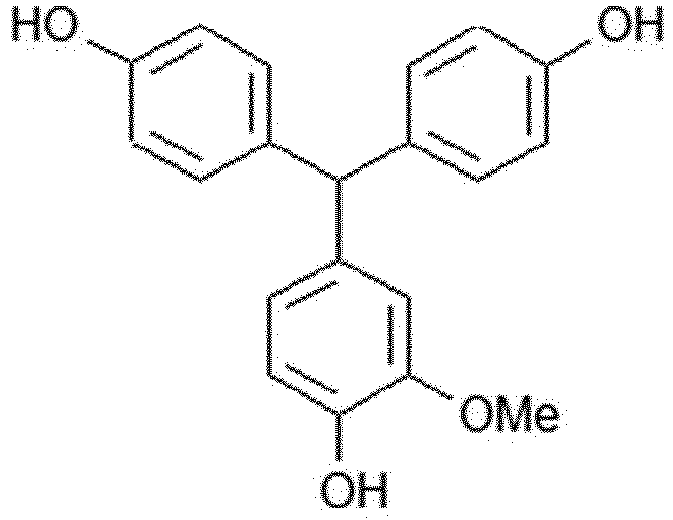
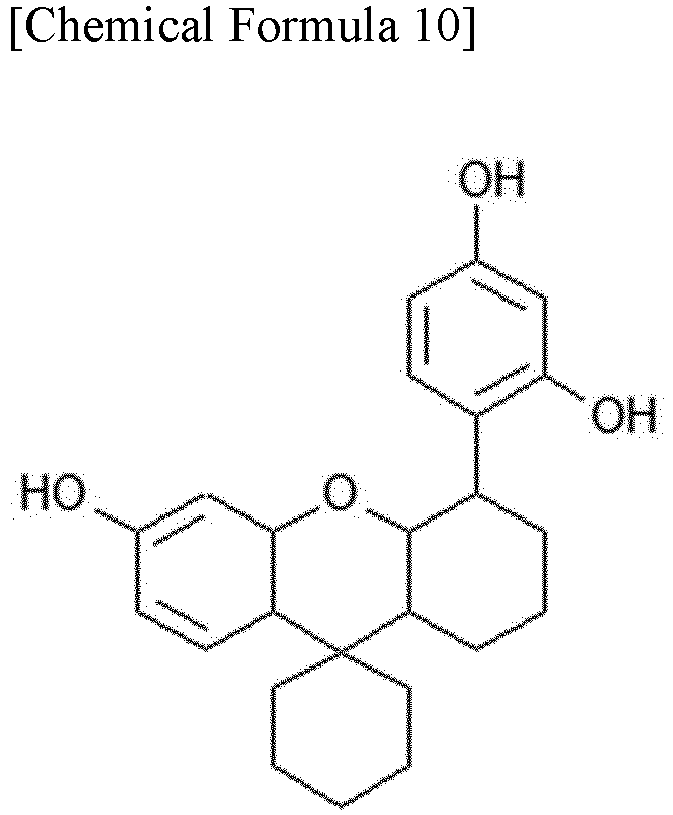
- Further, the R2, R3, R5, R6 and R7 of Chemical Formulas 1 and 2 may each independently include one or more alicyclic structures. For example, the R2, R3, R5, R6 and R7 of Chemical Formulas 1 and 2 may each independently include one to three alicyclic structures. In a more specific example, the repeating unit included in the alkali-soluble resin may include a functional group (linking structure) derived from a specific phenolic compound. Specific examples of the R1 and R4 as such functional groups (connected structures) include functional groups (linking structure) derived from phenolic compounds selected from the group consisting of the following Chemical Formulas 3 to 17:


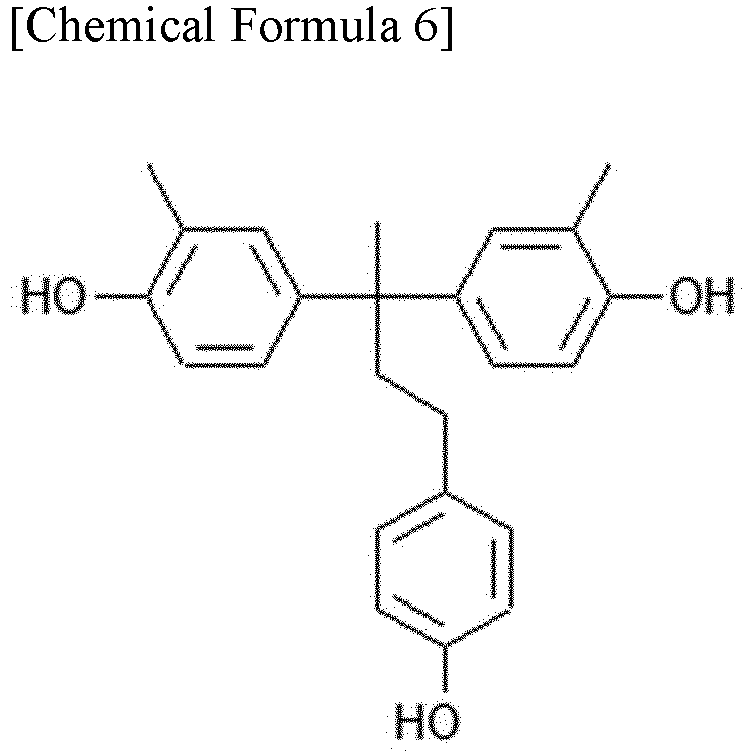


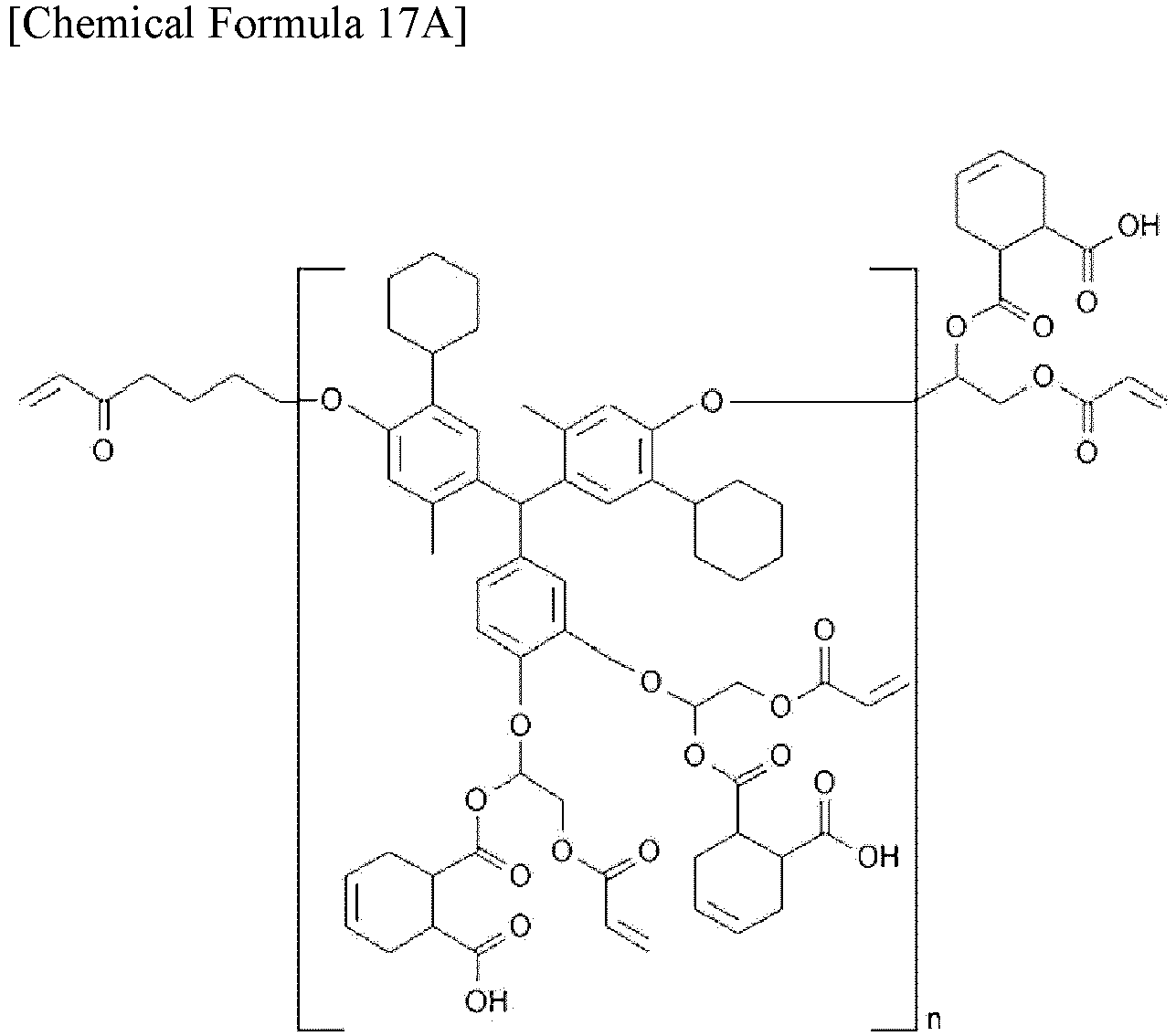
- Specific examples of the above-mentioned alkali-soluble resin may include one or more selected from the group consisting of the following Chemical Formulas 3A to 17A. In addition, it goes without saying that it may also have various structures encompassed by Chemical Formulas 1 or 2:


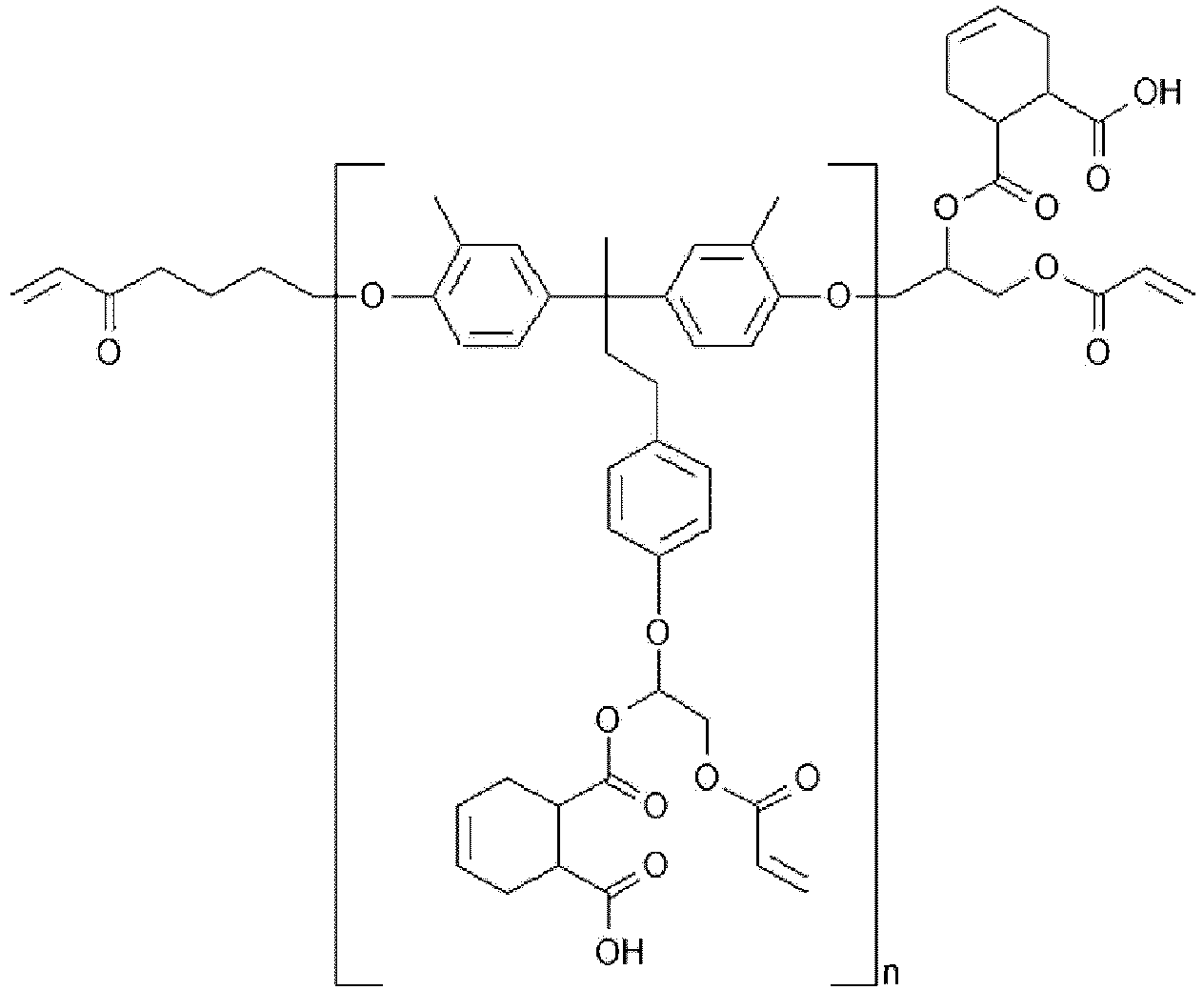


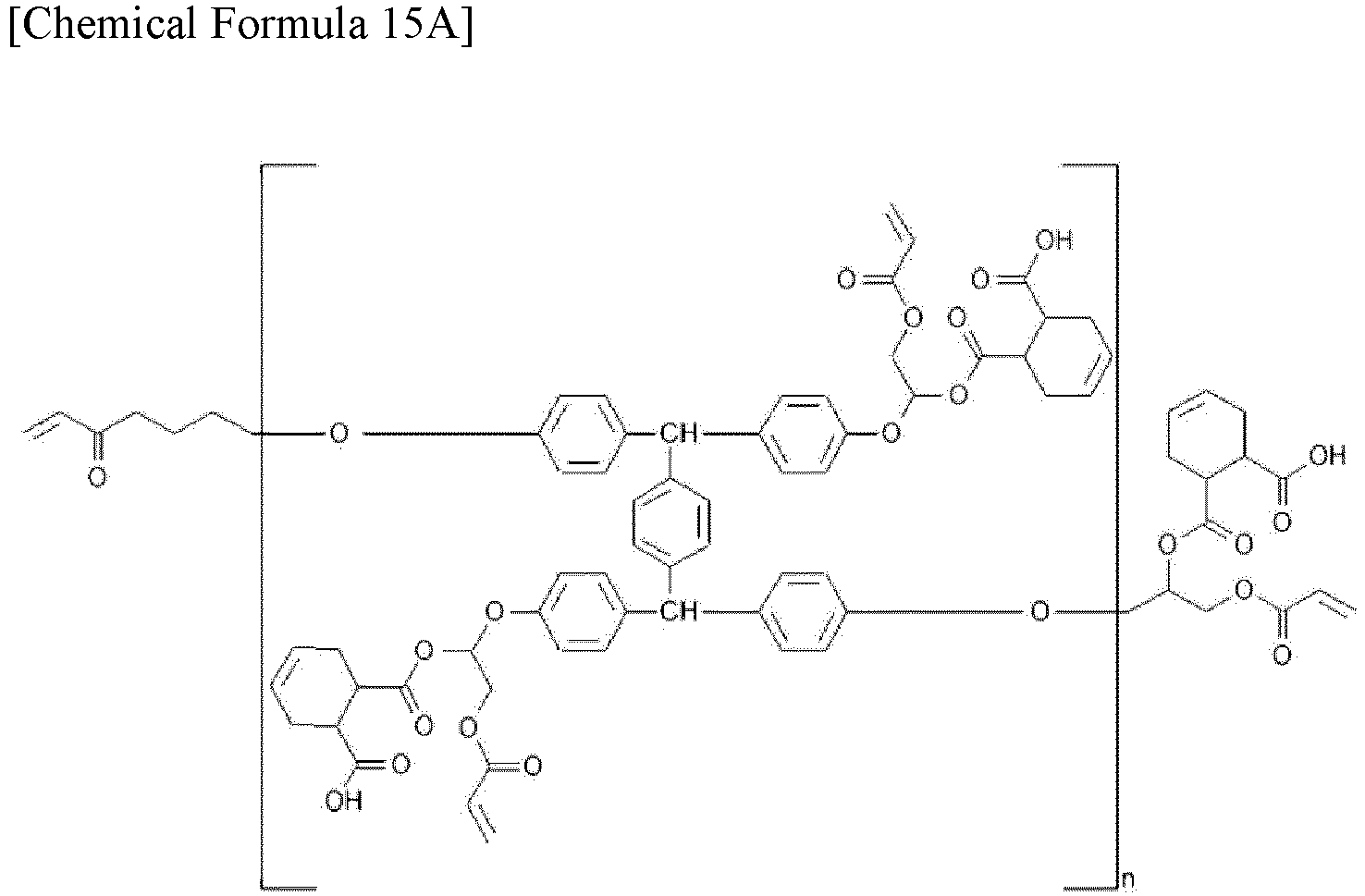


- Meanwhile, as the degree of polymerization of the above-mentioned alkali-soluble resin is adjusted to have a polystyrene-converted weight average molecular weight of 1,000 or more, or 2,000 to 30,000, or 2,000 to 20,000, the composition of one embodiment can be further improved in light transmittance, sensitivity, and photoreactivity, and a cured film formed from the composition of one embodiment, etc. can be further improved in light resistance, optical density, adhesive force, and residual film characteristics. If this weight average molecular weight is outside the above-mentioned range, the sensitivity or photoreactivity of the alkali-soluble resin may decrease, the residual film characteristics or adhesive force of the cured film may deteriorate, or the light resistance may become insufficient.
- In addition, the above-mentioned alkali-soluble resin can be produced by a method comprising: a step of reacting the above-mentioned phenolic compound with an epoxidizing agent such as epichlorohydrin to epoxidize at least a part of the phenolic hydroxy group; a step of polymerizing the epoxidized compound to have a degree of polymerization of n; a step of reacting the polymer with a (meth)acrylic acid or a derivative thereof to bind a photocurable unsaturated functional group such as a (meth)acrylate-based functional group to at least a part of the epoxidized phenolic hydroxy group; and optionally, a step of introducing an alkali-soluble functional group into a polymer (resin) to which the photocurable unsaturated functional group is bonded.
- Herein, the epoxidizing agent may be added and used at an equivalent weight that is equal to or less than the phenolic hydroxy group. If the equivalent weight of the epoxidizing agent added is higher than the phenolic hydroxy group, no residual hydroxyl groups remain and the polymerization process may not proceed properly. Further, in the polymerization step, a preferable degree of polymerization and weight average molecular weight of the alkali-soluble resin can be achieved by controlling the polymerization temperature and time.
- Meanwhile, the progress of each of the above-mentioned reaction steps may depend on normal epoxidation reaction conditions, polymerization conditions, (meth)acrylation reaction conditions, and the like, and the specific reaction conditions and progress methods are described in Preparation Examples described later, and thus, further description thereof will be omitted.
- Meanwhile, the photosensitive resin composition of one embodiment includes a polyfunctional compound having a plurality of photocurable unsaturated functional groups. Such a polyfunctional compound may cause a photocuring reaction with the above-mentioned alkali-soluble resin in the exposed part of the photosensitive resin composition under the mediation of a photoinitiator to form a crosslinked structure, and can define a barrier rib and a pixel defining layer pattern that are not removed by the developer.
- Such a polyfunctional compound may have various photocurable unsaturated functional groups, and may more suitably have the same type of unsaturated functional group as the above-mentioned alkali-soluble resin, for example, a (meth)acrylate-based functional group.
- In a more specific example, the polyfunctional compound may be a monomer or oligomer having 2 to 20 (meth)acrylate-based functional groups, and for example, one or more selected from the group consisting of a (meth)acrylate-based compound such as an alkyl (meth)acrylate-based compound or a hydroxy (meth)acrylate-based compound, an aliphatic urethane (meth)acrylate-based compound, an aromatic urethane (meth)acrylate-based compound, and an epoxy (meth)acrylate-based compound may be used.
- More specific examples of such polyfunctional compounds include one or more selected from the group consisting of dipentaerythritol hexaacrylate, dipentaerythritol pentaacrylate, ditrimethylolpropane tetraacrylate, trimethylolpropane triacrylate, tricyclodecane dimethanol diacrylate and 1,6-hexanediol diacrylate.
- However, the type of the polyfunctional compound is not particularly limited, and any polyfunctional compound, such as a polyfunctional (meth)acrylate compound that have previously been known to be usable in photosensitive resin compositions or are commercially available, can be used without particular limitation.
- Meanwhile, the photosensitive resin composition of one embodiment includes a pigment including a black pigment or a pigment mixture exhibiting a black color in a mixture state. Such a black pigment or pigment mixture is included in order to improve visibility or contrast of the display device by suppressing light reflection of the photosensitive resin composition and the cured film. In addition, by including such a black pigment or the like, the light resistance and optical density of a cured film formed from the composition can be further improved.
- As the black pigment, either an organic black pigment or an inorganic black pigment can be used. For example, one or more black pigments selected from the group consisting of aniline black, perylene black, titanium black, cyanine black, lignin black, lactam-based black, and carbon black can be used without particular limitation.
- Further, the pigment may include a pigment mixture in which a plurality of pigments having different colors are mixed to exhibit a black color as a whole. According to a more specific example, such a pigment mixture includes two or more selected from red pigment, blue pigment, yellow pigment, green pigment and violet pigment, and may exhibit a black color in a mixture state as a whole.
- Herein, specific examples of pigments having different colors for obtaining the pigment mixture may include one or more selected from the group consisting of C.I. Pigment Yellow, C.I. Pigment Red, C.I. Pigment Violet, C.I. Pigment Blue and C.I. Pigment Green. In addition, it goes without saying that various additional pigments can also be used. That is, a plurality of pigments having different colors are mixed according to a mixing ratio obvious to those skilled in the art to obtain a pigment mixture exhibiting a black color as a whole, which can be included in the composition of one embodiment.
- Meanwhile, it goes without saying that in addition to the black pigment or pigment mixture described above, additional pigments having different colors as described above may be further included.
- The pigment containing the black pigment or pigment mixture described above may be a particulate pigment having a particle size of 100 to 200 nm. By using a pigment with such a fine particle size, the light resistance and visibility of the display device can be further improved.
- Further, the pigment may be mixed with other components in the form of a pigment dispersion dispersed in an organic solvent, for example, one or more organic solvents selected from the group consisting of propylene glycol methyl ether, gamma butyrolactone, propylene glycol methyl ether acetate, and ethyl lactate, so that the pigment can be appropriately mixed with other components and uniformly dispersed or dissolved.
- Meanwhile, the composition of one embodiment further includes a photoinitiator. Such a photoinitiator can initiate and promote the photocuring and crosslinking reaction between the alkali-soluble resin and the polyfunctional compound in the exposed part.
- As such a photoinitiator, any photoinitiator that has been known to be usable in photosensitive resin compositions can be used without particular limitation, and examples thereof include one or more selected from the group consisting of a carbazole-based initiator, an oxime ester-based initiator, an aminoalkylphenone-based initiator and an acylphosphine oxide-based initiator. More specific examples of such photoinitiators include one or more selected from the group consisting of 2-octanedione-1 [(4-phenylthio)phenyl]-2-benzoyl-oxime, 1-[9-ethyl-6-(2-methylbenzoyl)-9H-carbazol-3-yl]ethanone-1-O-acetyloxime, (E)-2-(acetoxyimino)-1-(9,9-diethyl-9H-fluorene-2-yl)butanone and phenyl(4-methoxyphenyl)iodonium arsenic hexafluoride, and a variety of other photoinitiators can be used.
- The photosensitive resin composition of the one embodiment mentioned above may comprise 45 to 100 parts by weight of the polyfunctional compound; 25 to 100 parts by weight of the pigment; and 2 to 30 parts by weight of the photoinitiator, based on 100 parts by weight of the alkali-soluble resin. If the content of each component is outside the above-mentioned range, the visibility of the display device may decrease, the light resistance, optical density, residual film characteristics, and adhesive force of the cured film may decrease, or the sensitivity, photoreactivity, light transmittance or the like of the composition may decrease.
- Meanwhile, the composition of one embodiment may, in addition to the above-mentioned components, further include a crosslinking agent that further reacts with the alkali-soluble resin and/or polyfunctional compound in the exposed part to introduce an additional crosslinked structure into the cured film. Examples of such crosslinking agents may include a compound having one or more crosslinking groups selected from the group consisting of an alkoxy group having 1 to 10 carbon atoms such as a methoxy group or an ethoxy group, an alkoxyalkyl group having 1 to 15 carbon atoms such as an alkoxymethyl group or alkoxyethyl group, a hydroxy group, an epoxy group, and an oxetanyl group.
- In a more specific example, the crosslinking agent may include one or more selected from the group consisting of the following Chemical Formulas 18 to 29. In addition, various compounds having the above-mentioned crosslinking group can be used without particular limitation:


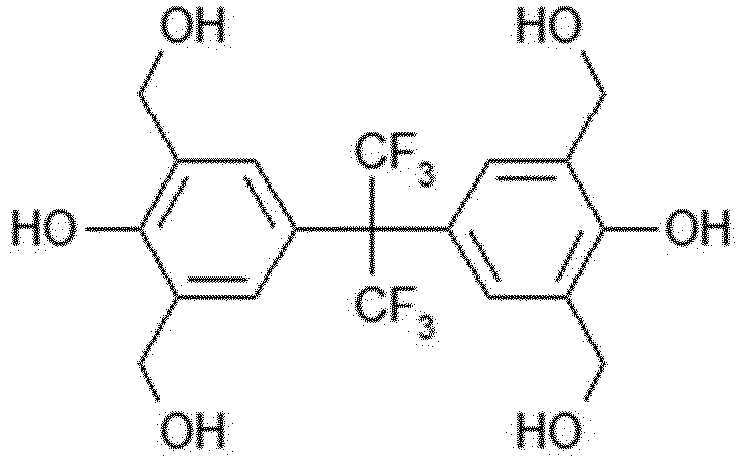


- The above-mentioned crosslinking agent may be contained in an amount of 0.1 to 30 parts by weight based on 100 parts by weight of the alkali-soluble resin. If the content of the crosslinking agent is excessively high, there may be a problem that the adhesive force decreases due to an increase of developability in an unexposed part.
- Meanwhile, the photosensitive resin composition of one embodiment may further include a solvent or an organic solvent for dispersing each of the above-mentioned components. Such an organic solvent may be included in an amount such that the solid content of the entire composition is 10 to 50% by weight, so as to easily perform processes such as solvent removal while uniformly the solvent or dispersing each of the above-mentioned components.
- The type of such organic solvents is not particularly limited, and any solvent previously known to be usable in the photosensitive resin composition, for example, one or more organic solvents selected from the group consisting of an aromatic hydrocarbon-based solvent, an aliphatic hydrocarbon-based solvent, an ester-based solvent, an ether-based solvent, an alcohol-based solvent, an amide-based solvent and a ketone-based solvent may be used.
- Meanwhile, the above-mentioned photosensitive resin composition is applied onto the target substrate, the part where the barrier rib or pixel defining layer pattern will remain is exposed through a photomask, and the composition of the exposed part is photocured. The composition of the remaining unexposed part is treated with an alkaline developer, for example, a 2.38 wt.% aqueous solution of tetramethylammonium hydroxide, and can be formed in the form of a cured film, more specifically, a barrier rib pattern having an inverted taper structure or a pixel defining layer pattern.
- However, the specific progress conditions of such a pattern forming method depend on the pattern forming conditions of general photosensitive resin compositions and are also described in Examples described later, and thus, further description thereof will be omitted.
- Meanwhile, according to another embodiment of the invention, a display device comprising a cured film/barrier rib pattern formed from the composition of one embodiment as a pixel defining layer pattern is provided. Such a display device comprises a substrate; red, green and blue pixels defined on the substrate; and a pixel defining layer pattern that is formed between the pixels, and includes a cured film of the photosensitive resin composition according to the one embodiment.
- As the display device of the other embodiment includes a cured film formed from the composition of one embodiment as a pixel defining layer pattern, it can have excellent visibility and contrast, and the pixel defining layer pattern can exhibit excellent light resistance, residual film characteristics, reliability, and adhesive force to the substrate.
- For example, the cured film has an optical density (OD) defined by the following Mathematical Equation 1 of 0.5 to 3.0 , and thus can exhibit excellent light resistance:

- In the display device of the other embodiment, the cured film comprises a polyfunctional compound contained in the composition of one embodiment, and a resin matrix in which the photocurable unsaturated functional groups contained in the alkali-soluble resin and the crosslinking group of the optionally contained crosslinking agent are cured to form a crosslinked structure. The cured film may also have a chemical structure that includes a pigment including a black pigment or a pigment mixture showing a black color dispersed in such a resin matrix, i.e., a cured and crosslinked alkali-soluble resin.
- Meanwhile, the display device of the other embodiments mentioned above may be a variety of display devices such as an organic electroluminescent device (OLED device), and may have a general structure of each display device except for including a pixel defining layer pattern formed from the composition of one embodiment, and thus, a detailed description will be omitted.
- Hereinafter, the preferred examples are provided for better understanding. However, these examples are for illustrative purposes only, and the invention is not intended to be limited by these examples.
-

- An alkali-soluble resin having a structure of Chemical Formula 3A was synthesized by the method described below.
- First, 2.0 equivalents of epichlorohydrin was added to 4,4-[1-[4-[1-(1,4-hydroxyphenyl)-1-methylethyl]phenyl]ethylidene]bisphenol of Chemical Formula 3, and propylene glycol monomethyl ether monoacetate as a solvent was added in the presence of triethylamine so that the solid content was 80 wt.% of the reaction solution. The mixture was reacted at 100°C for 24 hours to obtain a reactive epoxy carboxylate compound solution. At this time, the degree of polymerization, number of repetitions n, and weight average molecular weight of the compound were adjusted by controlling the reaction time (Thereby, the weight average molecular weight of the alkali-soluble resin included in each example described later was adjusted).
- Subsequently, 2-hydroxypropyl acrylate was added and reacted at 55°C for 24 hours to obtain an alkali-soluble resin in which the epoxy of the phenolic compound was acrylated. Finally, phthalic anhydride was added and reacted at 100°C for 24 hours to obtain the final alkali-soluble resin.
-


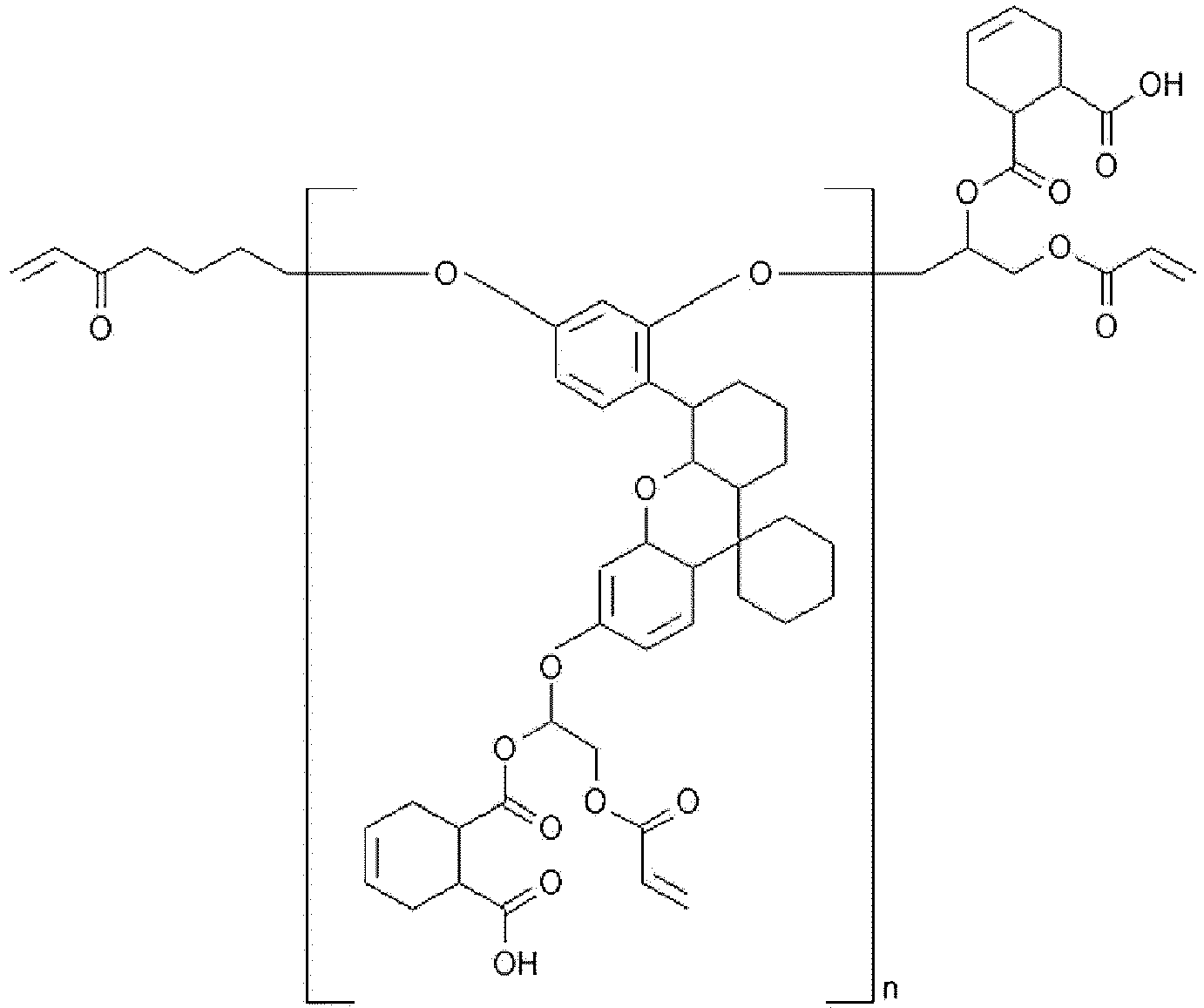





- Alkali-soluble resins of Preparation Examples 2 to 15 represented by Chemical Formulas 4A to 17A were respectively obtained in the same manner as in Preparation Example 1, except that as the phenolic compound in Preparation Example 1, the compounds selected from Chemical Formulas 4 to 17 are used instead of the compound of Chemical Formula 3.
- In Preparation Examples 2 to 15, the degree of polymerization, number of repetitions n, and weight average molecular weight of the alkali-soluble resin were also adjusted by controlling the reaction time of the first reaction step (Thereby, the weight average molecular weight of the alkali-soluble resin included in each Example described later was adjusted).
-


- Alkali-soluble resins of Comparative Preparation Examples 1 and 2 represented by Chemical Formula 30 or 31 were respectively obtained in the same manner as in Preparation Example 1, except that as the phenol-based compound in Preparation Example 1, a cresol novolac compound or a biphenyl-containing compound was used instead of the compound of Chemical Formula 3 .
- In Comparative Preparation Examples 1 and 2, the degree of polymerization, number of repetitions n, and weight average molecular weight of the alkali-soluble resin were also adjusted by controlling the reaction time of the first reaction step (thereby, the weight average molecular weight of the alkali-soluble resin included in each Comparative Example described later was adjusted).
- In accordance with the compositions summarized in Tables 1 to 3 below, the alkali-soluble resin, polyfunctional compound, pigment, photoinitiator, crosslinking agent, and organic solvent of polyethylene glycol methyl ether acetate (PGMEA) were uniformly mixed while stirring so to have a solid content of about 20 wt.%. Thereby, photosensitive resin compositions of Examples and Comparative Examples were prepared. At this time, the composition of the black pigment represented by each pigment number was the same as summarized in Table 1, the composition of the polyfunctional compound and photoinitiator used in each of the Examples and Comparative Examples were the same as summarized in Table 2, and the composition of the entire photosensitive resin composition was the same as summarized in Table 3.
- The photosensitive resin composition was spin-coated onto an ITO substrate and then prebaked in an oven at a temperature of 100 to 120°C for 2 minutes to form a cured film. At this time, the cured film was formed to have a thickness of about 1µm.
[Table 1] Composition of pigment Black S 0100 CF C. I. Pigment Red 254 C. I. Pigment Blue 15:6 C. I. Pigment Violet 29 Carbon Block Pigment 1 100 Pigment 2 45 40 15 Pigment 3 100 Pigment 4 90 10 Pigment 5 90 10 Pigment 6 90 10 * The content of each pigment is represented by parts by weight, based on 100 parts by weight of the total pigment.
* Pigment 2 is a mixture of red, blue and violet pigments, exhibiting a black color as a whole.[Table 2] Composition of photoinitiator and polyfunctional compound Photoinitiator (pts. wt.) Polyfunctional compound (pts. wt.) Photoi nitiator 1 Photoi nitiator 2 Photoi nitiator 3 Photoi nitiator 4 DPHA DPPA DTTA TPTA TCDA 1,6-Hexanediol diacrylate Example 1 0.0 7.5 7.5 7.5 0.0 30.0 15.0 0.0 30.0 15.0 Example 2 0.0 0.0 7.5 7.5 0.0 30.0 15.0 5.0 30.0 20.0 Example 3 0.0 0.0 0.0 7.5 5.0 25.0 10.0 5.0 25.0 20.0 Example 4 2.5 0.0 0.0 0.0 5.0 25.0 10.0 10.0 25.0 5.0 Example 5 2.5 2.5 0.0 0.0 10.0 20.0 5.0 10.0 20.0 5.0 Example 6 2.5 2.5 2.5 0.0 10.0 20.0 5.0 15.0 20.0 10.0 Example 7 5.0 2.5 2.5 2.5 15.0 15.0 0.0 15.0 15.0 10.0 Example 8 5.0 5.0 2.5 2.5 15.0 15.0 0.0 20.0 15.0 15.0 Example 9 5.0 5.0 5.0 2.5 20.0 10.0 15.0 20.0 10.0 15.0 Example 10 7.5 5.0 5.0 5.0 20.0 10.0 15.0 25.0 10.0 20.0 Example 11 7.5 7.5 5.0 5.0 25.0 5.0 10.0 25.0 5.0 20.0 Example 12 7.5 7.5 7.5 5.0 25.0 5.0 10.0 30.0 5.0 5.0 Example 13 0.0 7.5 7.5 7.5 30.0 0.0 5.0 30.0 0.0 5.0 Example 14 0.0 0.0 7.5 7.5 30.0 0.0 5.0 0.0 0.0 10.0 Example 15 0.0 0.0 0.0 7.5 0.0 30.0 0.0 0.0 30.0 10.0 Example 16 2.5 0.0 0.0 0.0 0.0 30.0 0.0 5.0 30.0 15.0 Example 17 2.5 2.5 0.0 0.0 5.0 25.0 15.0 5.0 25.0 15.0 Example 18 2.5 2.5 2.5 0.0 5.0 25.0 15.0 10.0 25.0 20.0 Example 19 5.0 2.5 2.5 2.5 10.0 20.0 10.0 10.0 20.0 20.0 Example 20 5.0 5.0 2.5 2.5 10.0 20.0 10.0 15.0 20.0 5.0 Example 21 5.0 5.0 5.0 2.5 15.0 15.0 5.0 15.0 15.0 5.0 Example 22 7.5 5.0 5.0 5.0 15.0 15.0 5.0 20.0 15.0 10.0 Example 23 7.5 7.5 5.0 5.0 20.0 10.0 0.0 20.0 10.0 10.0 Example 24 7.5 7.5 7.5 5.0 20.0 10.0 0.0 25.0 10.0 15.0 Example 25 0.0 7.5 7.5 7.5 25.0 5.0 15.0 25.0 5.0 15.0 Example 26 0.0 0.0 7.5 7.5 25.0 5.0 15.0 30.0 5.0 20.0 Example 27 0.0 0.0 0.0 7.5 30.0 0.0 10.0 30.0 0.0 20.0 Example 28 2.5 0.0 0.0 0.0 30.0 0.0 10.0 0.0 0.0 5.0 Example 29 2.5 2.5 0.0 0.0 0.0 30.0 5.0 0.0 30.0 5.0 Example 30 2.5 2.5 2.5 0.0 0.0 30.0 5.0 5.0 30.0 10.0 Comparati ve Example 1 0.0 0.0 0.0 7.5 5.0 25.0 10.0 5.0 25.0 20.0 Comparati ve Example 2 2.5 0.0 0.0 0.0 5.0 25.0 10.0 10.0 25.0 5.0 Comparati ve Example 3 2.5 2.5 0.0 0.0 10.0 20.0 5.0 10.0 20.0 5.0 Comparati ve Example 4 2.5 2.5 2.5 0.0 10.0 20.0 5.0 15.0 20.0 10.0 * In the photosensitive resin composition of each of Examples and Comparative Examples, the relative content of each photoinitiator and crosslinking agent contained in 100 parts by weight of the alkali-soluble resin is represented by parts by weight.
*Name of 1 photoinitiator compound:
1. Initiator 1: 1,2-octanedione-1[(4-phenylthio)phenyl]-2-benzoyl-oxime;
2. Initiator 2: 1-[9-ethyl-6-(2-methylbenzoyl)-9H-carbazol-3-yl]ethanone-1-O-acetyloxime;
3. Initiator 3: (E)-2-(acetoxyimino)-1-(9,9-diethyl-9H-fluoren-2-yl)butanone;
4. Initiator 4: Phenyl(4-methoxyphenyl) iodonium arsenic hexafluoride
* Neme of crosslinking agent compound:
1. DPHA: dipentaerythritol hexaacrylate;
2. DPPA: dipentaerythritol pentaacrylate;
3. DTTA: ditrimethylolpropane tetraacrylate;
4. TPTA: trimethylolpropane triacrylate;
5. TCDA: Tricyclodecane dimethanol diacrylate.[Table 3] Composition of photosensitive resin composition Alkali-soluble resin 100 pts. wt. (Chemical Formula, Mw) Polyfunctional compound (total pts. wt.) Black Pigment (Pigment No., particle size, pts. wt.) Photoinitiator (total pts. wt.) Crosslinking agent (Chemical Formula, pts. wt.) Example 1 Chemical Formula 3A(Mw: 2000) 90.0 Pigment 1 (particle size: 100nm, 30 pts. wt.) 22.5 Not included Example 2 Chemical Formula 4A(Mw: 4000) 100.0 Pigment 2 (particle size: 150nm, 40 pts. wt.) 15.0 Not included Example 3 Chemical Formula 5A(Mw: 6000) 90.0 Pigment 3 (particle size: 200nm, 50 pts. wt.) 7.5 Not included Example 4 Chemical Formula 6A(Mw: 8000) 80.0 Pigment 4 (particle size: 100nm, 60 pts. wt.) 2.5 Not included Example 5 Chemical Formula 7A(Mw: 10000) 70.0 Pigment 5 (particle size: 150nm, 70 pts. wt.) 5.0 Not included Example 6 Chemical Formula 8A(Mw: 12000) 80.0 Pigment 6 (particle size: 200nm, 80 pts. wt.) 7.5 Not included Example 7 Chemical Formula 9A(Mw: 14000) 70.0 Pigment 1 (particle size: 100nm, 90 pts. wt.) 12.5 Not included Example 8 Chemical Formula 10A (Mw: 16000) 80.0 Pigment 2 (particle size: 150nm, 100 pts. wt.) 15.0 Not included Example 9 Chemical Formula 11A (Mw: 20000) 90.0 Pigment 3 (particle size: 200nm, 30 pts. wt.) 17.5 Not included Example 10 Chemical Formula 12A (Mw: 22000) 100.0 Pigment 4 (particle size: 100nm, 40 pts. wt.) 22.5 Not included Example 11 Chemical Formula 13A (Mw: 24000) 90.0 Pigment 5 (particle size: 150nm, 50 pts. wt.) 25.0 Not included Example 12 Chemical Formula 14A (Mw: 26000) 80.0 Pigment 6 (particle size: 200nm, 60 pts. wt.) 27.5 Not included Example 13 Chemical Formula 15A (Mw: 28000) 70.0 Pigment 1 (particle size: 100nm, 70 pts. wt.) 22.5 Not included Example 14 Chemical Formula 16A (Mw: 30000) 45.0 Pigment 2 (particle size: 150nm, 80 pts. wt.) 15.0 Not included Example 15 Chemical Formula 17A (Mw: 2000) 70.0 Pigment 3 (particle size: 200nm, 90 pts. wt.) 7.5 Not included Example 16 Chemical Formula 3A (Mw: 2000) 80.0 Pigment 4 (particle size: 100nm, 100 pts. wt.) 2.5 Chemical Formula 18 (5 pts. wt.) Example 17 Chemical Formula 4A (Mw: 4000) 90.0 Pigment 5 (particle size: 150nm, 30 pts. wt.) 5.0 Chemical Formula 19 (10 pts. wt.) Example 18 Chemical Formula 5A (Mw: 6000) 100.0 Pigment 6 (particle size: 200nm, 40 pts. wt.) 7.5 Chemical Formula 20 (15 pts. wt.) Example 19 Chemical Formula 6A (Mw: 8000) 90.0 Pigment 1 (particle size: 100nm, 50 pts. wt.) 12.5 Chemical Formula 21 (20 pts. wt.) Example 20 Chemical Formula 7A (Mw: 10000) 80.0 Pigment 2 (particle size: 150nm, 60 pts. wt.) 15.0 Chemical Formula 22 (5 pts. wt.) Example 21 Chemical Formula 8A (Mw: 12000) 70.0 Pigment 3 (particle size: 200nm, 70 pts. wt.) 17.5 Chemical Formula 23 (10 pts. wt.) Example 22 Chemical Formula 9A (Mw: 14000) 80.0 Pigment 4 (particle size: 100nm, 80 pts. wt.) 22.5 Chemical Formula 24 (15 pts. wt.) Example 23 Chemical Formula 10A (Mw: 16000) 70.0 Pigment 5 (particle size: 150nm, 90 pts. wt.) 25.0 Chemical Formula 25 (20 pts. wt.) Example 24 Chemical Formula 11A (Mw: 20000) 80.0 Pigment 6 (particle size: 200nm, 100 pts. wt.) 27.5 Chemical Formula 26 (5 pts. wt.) Example 25 Chemical Formula 12A (Mw: 22000) 90.0 Pigment 1 (particle size: 100nm, 30 pts. wt.) 22.5 Chemical Formula 27 (10 pts. wt.) Example 26 Chemical Formula 13A (Mw: 24000) 100.0 Pigment 2 (particle size: 150nm, 40 pts. wt.) 15.0 Chemical Formula 28 (15 pts. wt.) Example 27 Chemical Formula 14A (Mw: 26000) 90.0 Pigment 3 (particle size: 200nm, 50 pts. wt.) 7.5 Chemical Formula 29 (20 pts. wt.) Example 28 Chemical Formula 15A (Mw: 28000) 45.0 Pigment 4 (particle size: 100nm, 60 pts. wt.) 2.5 Chemical Formula 18 (5 pts. wt.) Example 29 Chemical Formula 16A (Mw: 30000) 70.0 Pigment 5 (particle size: 150nm, 70 pts. wt.) 5.0 Chemical Formula 19 (10 pts. wt.) Example 30 Chemical Formula 17A (Mw: 2000) 80.0 Pigment 6 (particle size: 200nm, 80 pts. wt.) 7.5 Chemical Formula 20 (15 pts. wt.) Comparative Example 1 Chemical Formula 30 (Mw: 6500) 90.0 Pigment 3 (particle size: 200nm, 50 pts. wt.) 7.5 Chemical Formula 19 (5 pts. wt.) Comparative Example 2 Chemical Formula 30 (Mw: 5700) 80.0 Pigment 4 (particle size: 100nm, 60 pts. wt.) 2.5 Chemical Formula 20 (10 pts. wt.) Comparative Example 3 Chemical Formula 31 (Mw: 6000) 70.0 Pigment 5 (particle size: 150nm, 70 pts. wt.) 5.0 Chemical Formula 21 (15 pts. wt.) Comparative Example 4 Chemical Formula 31 (Mw: 3000) 80.0 Pigment 6 (particle size: 200nm, 80 pts. wt.) 7.5 Chemical Formula 22 (20 pts. wt.) * In the photosensitive resin composition of each of Examples and Comparative Examples, the relative total content of each remaining component contained in 100 parts by weight of the alkali-soluble resin is represented by parts by weight. - The weight average molecular weight of each alkali-soluble resin prepared in Preparation Examples and Comparative Preparation Examples was measured through GPC analysis.
- More specifically, the GPC analysis was performed using KF-803, KF-802 and KF-801 columns as Waters 2695 and PDA 996 equipment, and measurement was performed using polystyrene as a standard material in the column, and using tetrahydrofuran as a mobile phase under the condition of a flow rate of 1ml/min. The Mw of each alkali-soluble resin measured in this way is summarized in Table 3 above.
- The cured films formed in Examples and Comparative Examples were irradiated with ultraviolet rays having an intensity of 20 mW/cm2 at 365 to 435 nm for 1 to 20 seconds at 1 second intervals using a predetermined pattern mask. Next, the films were developed with a 2.38 wt.% aqueous solution of tetramethylammonium hydroxide at 23°C for 1 minute, and then washed with ultrapure water for 1 minute.
- For final curing, heating was performed at 260°C for 60 minutes in an oven to obtain a cured film pattern. Using SEM, the exposure amount at which the residual film rate was saturated was measured using sensitivity based on a 20 µm Line & Space CD standard.
- Based on the exposure amount at which the residual film rate was saturated, each film was evaluated as 100 mJ or less: Ⓞ, 100 ~ 200 mJ: ∘, and 200 mJ or more: X, and the results are summarized in Table 4 below.
- In the cured film pattern forming process which is the same in the sensitivity evaluation, the remaining steps were performed similarly without intervening the pattern mask to produce a cured film with a thickness of 1.0 µm after final curing, and then the transmittance of this cured film at 550 nm was measured using an optical density meter (361T, Xlite) to determine the optical density for a thickness of 1 µm.
- This optical density was calculated from the light transmittance according to the following Mathematical Equation 1:

- The corresponding OD evaluation results are summarized and shown in Table 4 below.
- A cured film was formed in the same manner as in the sensitivity evaluation, and then the residue of this cured film were measured at a 20 µm Contact Hole using an optical microscope (OLS-4100, Olympus), It was evaluated as ○ if no residues existed, and as X if residues existed, respectively, and the results are summarized and shown in Table 4 below.
- A cured film was formed in the same manner as in the sensitivity evaluation, and then the adhesive force of this cured film was measured at a 20 µm Contact Hole using an optical microscope (OLS-4100, Olympus). It was evaluated as ○ if there was no abnormality in adhesive force, and as X if peel-off occurred, respectively, and the results are summarized and shown in Table 4 below.
- A cured film was formed in the same manner as in the sensitivity evaluation, the straightness of this cured film was measured at a 20 µm Contact Hole using an optical microscope (OLS-4100, Olympus). It was evaluated as ○ if straightness was excellent, and as X if straightness was inferior, respectively, and the results are summarized and shown in Table 4 below.
- A cured film was formed in the same manner as in the evaluation of sensitivity, and a cured film pattern was formed on an ITO substrate patterned in the form shown in
FIG. 1 , and EL was deposited. Al was deposited on the upper part using a cathode electrode, and the encapsulation step was performed. Based on 85°C and 85% RH, the time (T97) during which luminance was dropped by 3% with the device turned on was evaluated. It was evaluated as ○ if 1000 hours or more were secured, and as X if less than 1000 hours was secured, respectively, and the evaluation results are summarized and shown in Table 4 below.Table 4 Sensitivity Optical density (OD) Residue Adhesive force Straightness Reliability Example 1 Ⓞ 1.0 ○ ○ ○ ○ Example 2 Ⓞ 0.7 ○ ○ ○ ○ Example 3 ○ 1.9 ○ ○ ○ ○ Example 4 ○ 1.9 ○ ○ ○ ○ Example 5 ○ 2.2 ○ ○ ○ ○ Example 6 ○ 2.4 ○ ○ ○ ○ Example 7 ○ 2.8 ○ ○ ○ ○ Example 8 ○ 1.9 ○ ○ ○ ○ Example 9 Ⓞ 1.3 ○ ○ ○ ○ Example 10 Ⓞ 1.2 ○ ○ ○ ○ Example 11 Ⓞ 1.5 ○ ○ ○ ○ Example 12 Ⓞ 1.9 ○ ○ ○ ○ Example 13 Ⓞ 2.3 ○ ○ ○ ○ Example 14 ○ 1.5 ○ ○ ○ ○ Example 15 ○ 3.0 ○ ○ ○ ○ Example 16 ○ 2.9 ○ ○ ○ Ⓞ Example 17 ○ 0.9 ○ ○ ○ Ⓞ Example 18 ○ 1.2 ○ ○ ○ Ⓞ Example 19 ○ 1.6 ○ ○ ○ Ⓞ Example 20 ○ 1.5 ○ ○ ○ ○ Example 21 Ⓞ 2.5 ○ ○ ○ Ⓞ Example 22 Ⓞ 2.4 ○ ○ ○ Ⓞ Example 23 Ⓞ 2.7 ○ ○ ○ Ⓞ Example 24 Ⓞ 2.9 ○ ○ ○ Ⓞ Example 25 Ⓞ 1.0 ○ ○ ○ Ⓞ Example 26 Ⓞ 0.7 ○ ○ ○ Ⓞ Example 27 ○ 1.9 ○ ○ ○ Ⓞ Example 28 ○ 1.9 ○ ○ ○ Ⓞ Example 29 ○ 2.2 ○ ○ ○ Ⓞ Example 30 ○ 2.4 ○ ○ ○ Ⓞ Comparative Example 1 ○ 0.9 X ○ X X Comparative Example 2 ○ 1.9 X ○ X X Comparative Example 3 ○ 2.2 X ○ X X Comparative Example 4 ○ 2.4 X ○ X X - Referring to Table 4 , it was confirmed that when forming a cured film and pattern using the photosensitive resin composition of Examples containing a predetermined alkali-soluble resin and a black pigment or mixture, various characteristics such as sensitivity, OD, residue, adhesive force, pattern straightness, and reliability were excellent.
- On the other hand, it was confirmed that when using the photosensitive resin compositions of Comparative Examples 1 to 4 containing an alkali-soluble resin different from that of Examples, one or more of the various characteristics of the cured film and its pattern appeared to be inferior.
Claims (24)
- A photosensitive resin composition comprising:an alkali-soluble resin;a polyfunctional compound having a plurality of photocurable unsaturated functional groups;a pigment including a black pigment or a pigment mixture exhibiting a black color in a mixture state; anda photoinitiator,wherein the alkali-soluble resin is a resin having a repeating unit derived from a phenolic compound having two or more phenolic hydroxy groups, and a plurality of photocurable unsaturated functional groups at both ends of the main chain.
- The photosensitive resin composition of claim 1, wherein the repeating unit derived from a phenolic compound is bonded to the photocurable unsaturated functional group through an ether (-O-) linking group.
- The photosensitive resin composition of claim 1, wherein the repeating unit derived from a phenolic compound has 2 to 6 aromatic rings and 0 to 4 alicyclic rings in the molecule.
- The photosensitive resin composition of claim 1, wherein the alkali-soluble resin includes a structure of the following General Formula 1:
[General Formula 1] (AB)-(ZBA)p-(BA)
wherein, in General Formula 1,A is a photocurable unsaturated functional group,each B is independently an organic group including an alkali-soluble functional group selected from the group consisting of hydrogen, a hydroxy group, an alkoxy group having 1 to 5 carbon atoms, a carbonyl group and a carboxyl group,Z is a repeating unit derived from a phenolic compound having two or more phenolic hydroxy groups, andP is an integer of 2 to 100. - The photosensitive resin composition of claim 1, wherein the alkali-soluble resin has a polystyrene converted weight average molecular weight (Mw) of 1000 or more.
- The photosensitive resin composition of claim 1, wherein the photocurable unsaturated functional group bonded to the alkali-soluble resin or the polyfunctional compound is a (meth)acrylate-based functional group.
- The photosensitive resin composition of claim 1, wherein the alkali-soluble resin comprises one or more selected from the group consisting of the following Chemical Formulas 1 and 2:

 wherein, in Chemical Formulas 1 and 2,R1 and R4 each independently represent a functional group derived from a phenolic compound having 3 to 8 aromatic rings or alicyclic rings in the molecule and having 3 or more phenolic hydroxy groups,R2, R3, R5, R6 and R7 each independently represent a substituent including an alkali-soluble functional group selected from the group consisting of hydrogen, a hydroxy group, an alkoxy group having 1 to 5 carbon atoms, a carbonyl group, and a carboxy group,R2' and R5' are each independently hydrogen or ORs, where R8 each independently represents a substituent including an alkali-soluble functional group selected from the group consisting of hydrogen, a hydroxy group, an alkoxy group having 1 to 5 carbon atoms, a carbonyl group, and a carboxyl group, andn is the number of repetitions and represents an integer of 2 to 100.
 - The photosensitive resin composition of claim 7, wherein the R2, R3, R5, R6 and R7 of Chemical Formulas 1 and 2 each independently include one or more alicyclic structures.
- The photosensitive resin composition of claim 7, wherein the R1 and R4 represent a functional group derived from a phenolic compound selected from the group consisting of the following Chemical Formulas 3 to 17:





- The photosensitive resin composition of claim 1, wherein the alkali-soluble resin comprises one or more selected from the group consisting of the following Chemical Formulas 3A to 17A:


- The photosensitive resin composition of claim 6, wherein the polyfunctional compound is a monomer or oligomer having 2 to 20 (meth)acrylate-based functional groups, and includes one or more selected from the group consisting of a (meth)acrylate-based compound, an aliphatic urethane (meth)acrylate-based compound, an a0romatic urethane (meth)acrylate-based compound and an epoxy (meth)acrylate-based compound.
- The photosensitive resin composition of claim 1, wherein the black pigment includes one or more selected from the group consisting of aniline black, perylene black, titanium black, cyanine black, lignin black, lactam-based black, and carbon black.
- The photosensitive resin composition of claim 1, wherein the pigment mixture includes two or more selected from red pigment, blue pigment, yellow pigment, green pigment, and violet pigment, and exhibits a black color in a mixture state.
- The photosensitive resin composition of claim 1, wherein the black pigment or the pigment mixture has a particle size of 100 to 200 nm.
- The photosensitive resin composition of claim 1, wherein the photoinitiator includes one or more selected from the group consisting of a carbazole-based initiator, an oxime ester-based initiator, an aminoalkylphenone-based initiator and an acylphosphine oxide-based initiator.
- The photosensitive resin composition of claim 1, which comprises:45 to 100 parts by weight of the polyfunctional compound;25 to 100 parts by weight of the pigment; and2 to 30 parts by weight of the photoinitiator,based on 100 parts by weight of the alkali-soluble resin.
- The photosensitive resin composition of claim 1, further comprising:
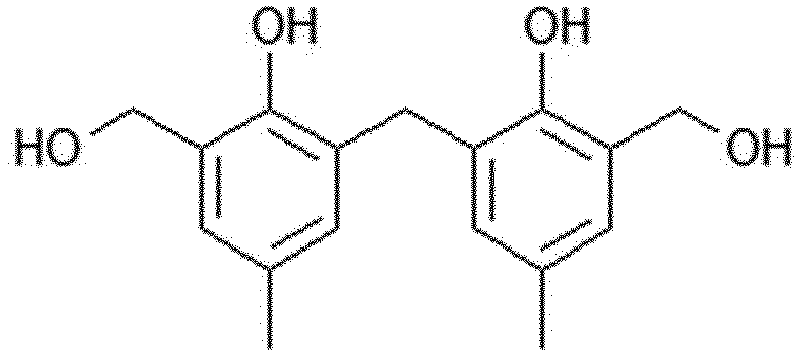
a crosslinking agent having one or more crosslinking groups selected from the group consisting of an alkoxy group having 1 to 10 carbon atoms, an alkoxyalkyl group having 1 to 15 carbon atoms, a hydroxy group, an epoxy group, and an oxetanyl group. - The photosensitive resin composition of claim 17, wherein the crosslinking agent includes one or more selected from the group consisting of the following Chemical Formulas 18 to 29:




- The photosensitive resin composition of claim 17, which comprises 0.1 to 30 parts by weight of the crosslinking agent based on 100 parts by weight of the alkali-soluble resin.
- The photosensitive resin composition of claim 1, wherein the photosensitive resin composition further comprises an organic solvent and has a solid content of 10 to 50% by weight.
- The photosensitive resin composition of claim 20, wherein the organic solvent includes one or more selected from the group consisting of an aromatic hydrocarbon-based solvent, an aliphatic hydrocarbon-based solvent, an ester-based solvent, an ether-based solvent, an alcohol-based solvent, an amide-based solvent, and a ketone-based solvent.
- A display device comprising:a substrate;red, green and blue pixels defined on the substrate; anda pixel defining layer pattern that is formed between the pixels, and includes a cured film of the photosensitive resin composition according to any one of claims 1 to 21.
- The display device of claim 22, wherein the cured film has an optical density (OD) defined by the following Mathematical Equation 1 of 0.5 to 3.0:

- The display device of claim 22, which is an organic electroluminescent device (OLED device).
Applications Claiming Priority (2)
| Application Number | Priority Date | Filing Date | Title |
|---|---|---|---|
| KR1020210109222A KR20230027438A (en) | 2021-08-19 | 2021-08-19 | Photo-sensitive composition and display device |
| PCT/KR2022/012133 WO2023022452A1 (en) | 2021-08-19 | 2022-08-12 | Photosensitive resin composition and display device |
Publications (2)
| Publication Number | Publication Date |
|---|---|
| EP4390545A1 true EP4390545A1 (en) | 2024-06-26 |
| EP4390545A4 EP4390545A4 (en) | 2025-10-15 |
Family
ID=85240744
Family Applications (1)
| Application Number | Title | Priority Date | Filing Date |
|---|---|---|---|
| EP22858689.7A Pending EP4390545A4 (en) | 2021-08-19 | 2022-08-12 | Light-sensitive resin composition and display device |
Country Status (7)
| Country | Link |
|---|---|
| US (1) | US20240209216A1 (en) |
| EP (1) | EP4390545A4 (en) |
| JP (1) | JP2024530704A (en) |
| KR (1) | KR20230027438A (en) |
| CN (1) | CN117859096A (en) |
| TW (1) | TW202309107A (en) |
| WO (1) | WO2023022452A1 (en) |
Family Cites Families (6)
| Publication number | Priority date | Publication date | Assignee | Title |
|---|---|---|---|---|
| DE3520113A1 (en) * | 1985-06-05 | 1986-12-11 | Basf Ag, 6700 Ludwigshafen | VINYLESTER RESIN |
| JP2009075261A (en) * | 2007-09-19 | 2009-04-09 | Nippon Kayaku Co Ltd | Photosensitive resin composition, and microchip obtained using the same |
| JP5885269B2 (en) * | 2011-06-20 | 2016-03-15 | 日本化薬株式会社 | Negative photosensitive resin composition and cured product thereof |
| KR101953936B1 (en) * | 2014-08-28 | 2019-03-04 | 동우 화인켐 주식회사 | Black photosensitive resin composition, black matrix and image display device having the same |
| WO2018180592A1 (en) * | 2017-03-28 | 2018-10-04 | 東レ株式会社 | Photosensitive resin composition, cured film, element equipped with cured film, organic el display device equipped with cured film, cured film production method, and organic el display device production method |
| KR102557109B1 (en) * | 2017-03-29 | 2023-07-20 | 도레이 카부시키가이샤 | Negative photosensitive resin composition, cured film, element and organic EL display provided with cured film, and manufacturing method thereof |
-
2021
- 2021-08-19 KR KR1020210109222A patent/KR20230027438A/en active Pending
-
2022
- 2022-08-12 CN CN202280056224.7A patent/CN117859096A/en active Pending
- 2022-08-12 JP JP2024510225A patent/JP2024530704A/en active Pending
- 2022-08-12 EP EP22858689.7A patent/EP4390545A4/en active Pending
- 2022-08-12 WO PCT/KR2022/012133 patent/WO2023022452A1/en not_active Ceased
- 2022-08-18 TW TW111131063A patent/TW202309107A/en unknown
-
2024
- 2024-02-17 US US18/444,658 patent/US20240209216A1/en active Pending
Also Published As
| Publication number | Publication date |
|---|---|
| CN117859096A (en) | 2024-04-09 |
| KR20230027438A (en) | 2023-02-28 |
| JP2024530704A (en) | 2024-08-23 |
| WO2023022452A1 (en) | 2023-02-23 |
| TW202309107A (en) | 2023-03-01 |
| EP4390545A4 (en) | 2025-10-15 |
| US20240209216A1 (en) | 2024-06-27 |
Similar Documents
| Publication | Publication Date | Title |
|---|---|---|
| TWI461843B (en) | Photosensitive resin composition being curable at low temperature | |
| JP4821206B2 (en) | Photosensitive coloring composition for color filter and color filter | |
| KR101631059B1 (en) | Color resist composition and color filter using the same | |
| JP4437651B2 (en) | Photosensitive resin composition and color filter using the same | |
| JP4911256B1 (en) | Dye dispersion, photosensitive resin composition for color filter, color filter, liquid crystal display device, and organic light emitting display device | |
| CN101930177B (en) | Coloring composition, color filter and color liquid crystal display device | |
| JP4489564B2 (en) | Photosensitive resin composition and color filter using the same | |
| TWI459133B (en) | Radiation sensitive composition for formation of colouring layer, color filter and color liquid crystal display element | |
| KR101593227B1 (en) | Liquidrepellent resin composition | |
| JP2007034119A5 (en) | ||
| WO2008078953A1 (en) | Black matrix high sensitive photoresist composition for liquid crystal display and black matrix prepared by using the same | |
| JP5668539B2 (en) | Coloring composition for color filter, color filter, and color liquid crystal display element | |
| KR20090034774A (en) | Photosensitive resin composition for black resists containing polyfunctional thiol compound, black matrix for color filters using the same, and color filter | |
| JP6700710B2 (en) | Photosensitive resin composition for black column spacer, black column spacer, liquid crystal display device, method for producing photosensitive resin composition for black column spacer, method for producing black column spacer, and method for producing liquid crystal display device | |
| JP6606055B2 (en) | Colored photosensitive resin composition, color filter produced using the same, and image display device | |
| KR20240026179A (en) | Photosensitive colored resin composition, cured product, color filter, display device, and method for producing a laminate of an organic light-emitting element and an external light anti-reflection film | |
| WO2024171742A1 (en) | Photosensitive colored resin composition, display device, and method for manufacturing laminate of organic light emitting element and external-light antireflection film | |
| JPWO2007102474A1 (en) | Active energy ray-curable composition and method for producing the same | |
| JP2008233605A (en) | Photosensitive resist composition for color filter and color filter | |
| US20240209216A1 (en) | Photosensitive resin composition and display device | |
| JP2009169049A (en) | Photosensitive resist composition for color filter and color filter | |
| JP4736679B2 (en) | Cured film for liquid crystal display | |
| JP2003255120A (en) | Resin composition for color filter | |
| JP7248573B2 (en) | Oxime ester compound and photopolymerization initiator containing said compound | |
| KR102890781B1 (en) | Colored Photosensitive Resin Composition, Color Filter and Display Device |
Legal Events
| Date | Code | Title | Description |
|---|---|---|---|
| STAA | Information on the status of an ep patent application or granted ep patent |
Free format text: STATUS: THE INTERNATIONAL PUBLICATION HAS BEEN MADE |
|
| PUAI | Public reference made under article 153(3) epc to a published international application that has entered the european phase |
Free format text: ORIGINAL CODE: 0009012 |
|
| STAA | Information on the status of an ep patent application or granted ep patent |
Free format text: STATUS: REQUEST FOR EXAMINATION WAS MADE |
|
| 17P | Request for examination filed |
Effective date: 20240216 |
|
| AK | Designated contracting states |
Kind code of ref document: A1 Designated state(s): AL AT BE BG CH CY CZ DE DK EE ES FI FR GB GR HR HU IE IS IT LI LT LU LV MC MK MT NL NO PL PT RO RS SE SI SK SM TR |
|
| DAV | Request for validation of the european patent (deleted) | ||
| DAX | Request for extension of the european patent (deleted) | ||
| REG | Reference to a national code |
Ref country code: DE Ref legal event code: R079 Free format text: PREVIOUS MAIN CLASS: G03F0007004000 Ipc: G03F0007105000 |
|
| A4 | Supplementary search report drawn up and despatched |
Effective date: 20250915 |
|
| RIC1 | Information provided on ipc code assigned before grant |
Ipc: G03F 7/105 20060101AFI20250909BHEP Ipc: G03F 7/028 20060101ALI20250909BHEP Ipc: G02B 5/20 20060101ALI20250909BHEP Ipc: G03F 7/038 20060101ALI20250909BHEP Ipc: G03F 7/027 20060101ALI20250909BHEP Ipc: G03F 7/00 20060101ALI20250909BHEP |