EP4387178A1 - Signalübertragungsverfahren und -vorrichtung - Google Patents
Signalübertragungsverfahren und -vorrichtung Download PDFInfo
- Publication number
- EP4387178A1 EP4387178A1 EP21957056.1A EP21957056A EP4387178A1 EP 4387178 A1 EP4387178 A1 EP 4387178A1 EP 21957056 A EP21957056 A EP 21957056A EP 4387178 A1 EP4387178 A1 EP 4387178A1
- Authority
- EP
- European Patent Office
- Prior art keywords
- modulation symbol
- signal
- modulation
- sequence
- amplitude
- Prior art date
- Legal status (The legal status is an assumption and is not a legal conclusion. Google has not performed a legal analysis and makes no representation as to the accuracy of the status listed.)
- Pending
Links
Images


Classifications
-
- H—ELECTRICITY
- H04—ELECTRIC COMMUNICATION TECHNIQUE
- H04L—TRANSMISSION OF DIGITAL INFORMATION, e.g. TELEGRAPHIC COMMUNICATION
- H04L27/00—Modulated-carrier systems
- H04L27/32—Carrier systems characterised by combinations of two or more of the types covered by groups H04L27/02, H04L27/10, H04L27/18 or H04L27/26
- H04L27/34—Amplitude- and phase-modulated carrier systems, e.g. quadrature-amplitude modulated carrier systems
-
- H—ELECTRICITY
- H04—ELECTRIC COMMUNICATION TECHNIQUE
- H04L—TRANSMISSION OF DIGITAL INFORMATION, e.g. TELEGRAPHIC COMMUNICATION
- H04L27/00—Modulated-carrier systems
- H04L27/26—Systems using multi-frequency codes
- H04L27/2601—Multicarrier modulation systems
- H04L27/2626—Arrangements specific to the transmitter only
- H04L27/2627—Modulators
- H04L27/2634—Inverse fast Fourier transform [IFFT] or inverse discrete Fourier transform [IDFT] modulators in combination with other circuits for modulation
- H04L27/26362—Subcarrier weighting equivalent to time domain filtering, e.g. weighting per subcarrier multiplication
-
- H—ELECTRICITY
- H04—ELECTRIC COMMUNICATION TECHNIQUE
- H04L—TRANSMISSION OF DIGITAL INFORMATION, e.g. TELEGRAPHIC COMMUNICATION
- H04L27/00—Modulated-carrier systems
- H04L27/02—Amplitude-modulated carrier systems, e.g. using on-off keying; Single sideband or vestigial sideband modulation
-
- H—ELECTRICITY
- H04—ELECTRIC COMMUNICATION TECHNIQUE
- H04L—TRANSMISSION OF DIGITAL INFORMATION, e.g. TELEGRAPHIC COMMUNICATION
- H04L27/00—Modulated-carrier systems
- H04L27/26—Systems using multi-frequency codes
-
- H—ELECTRICITY
- H04—ELECTRIC COMMUNICATION TECHNIQUE
- H04L—TRANSMISSION OF DIGITAL INFORMATION, e.g. TELEGRAPHIC COMMUNICATION
- H04L27/00—Modulated-carrier systems
- H04L27/26—Systems using multi-frequency codes
- H04L27/2601—Multicarrier modulation systems
- H04L27/2602—Signal structure
- H04L27/2605—Symbol extensions, e.g. Zero Tail, Unique Word [UW]
-
- H—ELECTRICITY
- H04—ELECTRIC COMMUNICATION TECHNIQUE
- H04L—TRANSMISSION OF DIGITAL INFORMATION, e.g. TELEGRAPHIC COMMUNICATION
- H04L27/00—Modulated-carrier systems
- H04L27/26—Systems using multi-frequency codes
- H04L27/2601—Multicarrier modulation systems
- H04L27/2614—Peak power aspects
-
- H—ELECTRICITY
- H04—ELECTRIC COMMUNICATION TECHNIQUE
- H04L—TRANSMISSION OF DIGITAL INFORMATION, e.g. TELEGRAPHIC COMMUNICATION
- H04L27/00—Modulated-carrier systems
- H04L27/32—Carrier systems characterised by combinations of two or more of the types covered by groups H04L27/02, H04L27/10, H04L27/18 or H04L27/26
- H04L27/34—Amplitude- and phase-modulated carrier systems, e.g. quadrature-amplitude modulated carrier systems
- H04L27/3405—Modifications of the signal space to increase the efficiency of transmission, e.g. reduction of the bit error rate, bandwidth, or average power
- H04L27/3411—Modifications of the signal space to increase the efficiency of transmission, e.g. reduction of the bit error rate, bandwidth, or average power reducing the peak to average power ratio or the mean power of the constellation; Arrangements for increasing the shape gain of a signal set
-
- H—ELECTRICITY
- H04—ELECTRIC COMMUNICATION TECHNIQUE
- H04L—TRANSMISSION OF DIGITAL INFORMATION, e.g. TELEGRAPHIC COMMUNICATION
- H04L27/00—Modulated-carrier systems
- H04L27/32—Carrier systems characterised by combinations of two or more of the types covered by groups H04L27/02, H04L27/10, H04L27/18 or H04L27/26
- H04L27/34—Amplitude- and phase-modulated carrier systems, e.g. quadrature-amplitude modulated carrier systems
- H04L27/36—Modulator circuits; Transmitter circuits
-
- Y—GENERAL TAGGING OF NEW TECHNOLOGICAL DEVELOPMENTS; GENERAL TAGGING OF CROSS-SECTIONAL TECHNOLOGIES SPANNING OVER SEVERAL SECTIONS OF THE IPC; TECHNICAL SUBJECTS COVERED BY FORMER USPC CROSS-REFERENCE ART COLLECTIONS [XRACs] AND DIGESTS
- Y02—TECHNOLOGIES OR APPLICATIONS FOR MITIGATION OR ADAPTATION AGAINST CLIMATE CHANGE
- Y02D—CLIMATE CHANGE MITIGATION TECHNOLOGIES IN INFORMATION AND COMMUNICATION TECHNOLOGIES [ICT], I.E. INFORMATION AND COMMUNICATION TECHNOLOGIES AIMING AT THE REDUCTION OF THEIR OWN ENERGY USE
- Y02D30/00—Reducing energy consumption in communication networks
- Y02D30/70—Reducing energy consumption in communication networks in wireless communication networks
Definitions
- This application relates to the field of wireless communication technologies, and in particular, to a signal transmission method and an apparatus.
- IoT internet-of-things
- battery life of an internet-of-things terminal has greatly increased maintenance difficulty and costs of the terminal, and has become a major bottleneck restricting the development of the internet-of-things.
- Passive backscatter (backscatter) communication performed based on technologies of wireless power transmission, envelope demodulation, and backscattering modulation is expected to resolve problems of terminal life and maintenance, thereby making next generation passive IoT (passive IoT) with ultra-low-cost, high-density, and maintenance-free terminals possible.
- a downlink signal is generally modulated in an amplitude shift keying (amplitude shift keying, ASK) or on-off keying (on-off keying, OOK) manner, so that a terminal may implement demodulation with extremely low power consumption.
- the terminal may be classified into a passive terminal and a semi-passive terminal based on whether the terminal is powered by a battery.
- the passive terminal is not powered by a battery.
- the passive terminal needs to rectify a radio frequency signal in a downlink, and use a direct current voltage output after the rectification as a power supply for use by an analog circuit and a digital circuit.
- the semi-passive terminal is powered by a battery and does not depend on the rectification output of the downlink signal.
- the wireless local area network (wireless local area network, WLAN) standard 802.11ba defines a downlink wake-up operating mode.
- WLAN wireless local area network
- the AP may generate a wake-up signal in a multicarrier on-off keying (multicarrier on-off keying, MC-OOK) manner.
- MC-OOK multicarrier on-off keying
- An existing cellular system does not support generating an ASK signal.
- An OOK wake-up signal waveform generated by the WLAN AP in the MC-OOK modulation scheme has a large envelope ripple, and is unfavorable for a wake-up receiver of the STA to demodulate.
- the wake-up signal waveform occupies a large bandwidth in frequency domain, resulting in low spectral efficiency and large out-of-band spurious emission.
- This application provides a signal transmission method and an apparatus, to reduce an envelope ripple of a transmission signal.
- a signal transmission method may be executed by a base station, or may be executed by an apparatus with a function similar to that of a base station.
- the base station may obtain a first bit sequence, and map the first bit sequence to a first modulation symbol sequence.
- a value of each modulation symbol in the first modulation symbol sequence belongs to a first constellation point set, and the first constellation point set includes K modulation symbols.
- Each of the K modulation symbols has a different amplitude. K ⁇ 2, and K is an integer.
- the base station may perform a discrete Fourier transform (discrete fourier transform, DFT) on each modulation symbol in the first modulation symbol sequence to obtain a second modulation symbol sequence, and then perform weighting on the second modulation symbol sequence to obtain a third modulation symbol sequence.
- the base station may perform an inverse discrete Fourier transform (inverse fast fourier transform, IFFT) on the third modulation symbol sequence to obtain a first signal.
- the base station may send a second signal, where the second signal includes the first signal.
- an envelope ripple of the signal generated by the base station in time domain is small. This facilitates demodulation of the transmission signal by a terminal.
- each of the K modulation symbols has a different amplitude and each of the K modulation symbols has a same phase.
- each of the K modulation symbols has a different amplitude and each of the K modulation symbols has a different phase.
- the base station may generate an ASK signal; and when each modulation symbol has a different amplitude and a different phase, the base station may generate an amplitude and phase-shift keying (amplitude and phase-shift keying, APSK) signal.
- APSK amplitude and phase-shift keying
- the base station may obtain an original bit sequence, and perform line encoding on the original bit sequence to obtain an encoded bit sequence.
- the base station may perform a bit repetition operation on the encoded bit sequence to obtain the first bit sequence.
- the base station may optimize a characteristic of a data bit waveform through line encoding. This facilitates demodulation of a downlink signal by the terminal.
- the base station may implement an adjustment function of a transmission rate by using the bit repetition operation.
- the second signal includes a plurality of orthogonal frequency division multiplexing (orthogonal frequency division multiplexing, OFDM) symbols.
- the first signal is one of the plurality of OFDM symbols.
- Guard interval data is included before each OFDM symbol in the second signal.
- the guard interval data before the first signal includes one of the following: N pieces of data or N zeros from front to back in the first signal, where N is a positive integer.
- the guard interval data may exist between each first signal, and the guard interval data has a small impact on the envelope ripple of the transmission signal.
- the K modulation symbols are K points in any one of the following constellation diagrams: a 16 quadrature amplitude modulation (quadrature amplitude modulation, QAM) constellation diagram, a 64QAM constellation diagram, a 256QAM constellation diagram, a 1024QAM constellation diagram, a 4096QAM constellation diagram, or an APSK constellation diagram.
- Modulation symbol mapping using the constellation points in the constellation diagram can be compatible with a modulation scheme of an existing cellular system.
- a weighting coefficient may be one of the following: a coefficient of a raised cosine filter, a coefficient of a square-root raised cosine filter, a coefficient of a sine filter, or a coefficient of a brick-wall filter.
- An envelope ripple of the ASK signal can be reduced by performing weighting on data on which a DFT is performed.
- K 2.
- the base station may obtain a second bit sequence, and map the second bit sequence to a fourth modulation symbol sequence.
- a value of each modulation symbol in the fourth modulation symbol sequence belongs to a second constellation point set, and the second constellation point set includes a third modulation symbol and a fourth modulation symbol.
- An amplitude of the third modulation symbol is different from an amplitude of the fourth modulation symbol.
- a ratio of the amplitude of the third modulation symbol to the amplitude of the fourth modulation symbol is different from a ratio of an amplitude of a first modulation symbol to an amplitude of a second modulation symbol.
- the base station may perform a discrete Fourier transform DFT on each modulation symbol in the fourth modulation symbol sequence to obtain a fifth modulation symbol sequence, and then perform weighting on the fifth modulation symbol sequence to obtain a sixth modulation symbol sequence.
- the base station may perform an inverse discrete Fourier transform IFFT on the sixth modulation symbol sequence to obtain a third signal.
- the base station may send the third signal.
- the base station may select different constellation points in the constellation diagram to generate transmission signals with different modulation depths, and flexibly allocate the power between useful signal strength and carrier power, thereby meeting different requirements for high charging power and high signal power.
- the communication apparatus includes a processing unit and a transceiver unit.
- the processing unit is configured to obtain a first bit sequence, and map the first bit sequence to a first modulation symbol sequence.
- a value of each modulation symbol in the first modulation symbol sequence belongs to a first constellation point set, and the first constellation point set includes K modulation symbols.
- Each of the K modulation symbols has a different amplitude. K ⁇ 2 and K is an integer.
- the processing unit is further configured to: perform a discrete Fourier transform DFT on each modulation symbol in the first modulation symbol sequence to obtain a second modulation symbol sequence, perform weighting on the second modulation symbol sequence to obtain a third modulation symbol sequence, and then perform an inverse discrete Fourier transform IFFT on the third modulation symbol sequence to obtain a first signal.
- the transceiver unit is configured to send a second signal, where the second signal includes the first signal.
- each of the K modulation symbols has a different amplitude and each of the K modulation symbols has a same phase.
- each of the K modulation symbols has a different amplitude and each of the K modulation symbols has a different phase.
- the processing unit when obtaining the first bit sequence, is specifically configured to obtain an original bit sequence, perform line encoding on the original bit sequence to obtain an encoded bit sequence, and then perform a bit repetition operation on the encoded bit sequence to obtain the first bit sequence.
- the second signal includes a plurality of orthogonal frequency division multiplexing OFDM symbols
- the first signal is one of the plurality of OFDM symbols.
- Guard interval data is included before each OFDM symbol in the second signal.
- the guard interval data before the first signal includes one of the following: N pieces of data or N zeros from front to back in the first signal, where N is a positive integer.
- the K modulation symbols are K points in any one of the following constellation diagrams: a 16 quadrature amplitude modulation QAM constellation diagram, a 64QAM constellation diagram, a 256QAM constellation diagram, a 1024QAM constellation diagram, a 4096QAM constellation diagram, or an amplitude and phase-shift keying APSK constellation diagram.
- the first constellation point set includes a first modulation symbol and a second modulation symbol.
- the processing unit is further configured to obtain a second bit sequence, and map the second bit sequence to a fourth modulation symbol sequence.
- a value of each modulation symbol in the fourth modulation symbol sequence belongs to a second constellation point set, and the second constellation point set includes a third modulation symbol and a fourth modulation symbol.
- An amplitude of the third modulation symbol is different from an amplitude of the fourth modulation symbol.
- a ratio of the amplitude of the third modulation symbol to the amplitude of the fourth modulation symbol is different from a ratio of an amplitude of the first modulation symbol to an amplitude of the second modulation symbol.
- the processing unit is further configured to perform a discrete Fourier transform DFT on each modulation symbol in the fourth modulation symbol sequence to obtain a fifth modulation symbol sequence, perform weighting on the fifth modulation symbol sequence to obtain a sixth modulation symbol sequence, and then perform an inverse discrete Fourier transform IFFT on the sixth modulation symbol sequence to obtain a third signal.
- the transceiver unit is further configured to send the third signal.
- a communication apparatus includes a processor.
- the processor is coupled to a memory.
- the memory is configured to store a computer program or instructions.
- the processor is configured to execute the computer program or the instructions, to implement the method according to the possible implementations of the foregoing aspects.
- the memory may be located inside or outside the apparatus. There are one or more processors.
- this application provides a communication apparatus, including a processor and an interface circuit.
- the interface circuit is configured to communicate with another apparatus.
- the processor is configured to implement the method according to the possible implementations of the foregoing aspects.
- a communication apparatus includes a logic circuit and an input/output interface.
- the logic circuit is configured to: map a first bit sequence to a first modulation symbol sequence, where a value of each modulation symbol in the first modulation symbol sequence belongs to a first constellation point set, the first constellation point set includes K modulation symbols, each of the K modulation symbols has a different amplitude, each of the K modulation symbol has a same phase, K ⁇ 2, and K is an integer; perform a DFT on each modulation symbol in the first modulation symbol sequence to obtain a second modulation symbol sequence; perform weighting on the second modulation symbol sequence to obtain a third modulation symbol sequence; and perform an IFFT on the third modulation symbol sequence to obtain a first signal.
- the input/output interface is configured to output a second signal, where the second signal includes the first signal.
- this application further provides a chip system, including a processor, configured to perform the method according to the possible implementations of the foregoing aspects.
- this application further provides a computer program product, including computer-executable instructions.
- a communication apparatus executes the instructions on a computer, the method according to the possible implementations of the foregoing aspects is performed.
- this application further provides a computer-readable storage medium.
- the computer-readable storage medium stores a computer program or instructions. When the instructions are run on a communication apparatus, the method according to the possible implementations of the foregoing aspects is performed.
- the WLAN standard 802.11ba defines a downlink wake-up operating mode.
- the STA When no data is transmitted between an AP and a STA, the STA is in a sleep mode.
- the AP may generate a wake-up signal in an MC-OOK manner.
- the STA may encode an information bit by using a wake-up radio (wake-up radio, WUR) encoder (encoder), and select, based on an encoded bit, a to-be-sent waveform. Specifically, when the encoded bit is 1, an On symbol generated by an on waveform generator (on waveform generator, On-WG) is selected for sending. When the encoded bit is 0, an off symbol generated by an off waveform generator (off waveform generator, Off-WG) is selected for sending.
- WUR wake-up radio
- the On symbol generated by the On-WG is constructed by using 13 subcarriers in a center of a 64-point inverse discrete Fourier transform (inverse discrete fourier transform, IDFT) with a sampling rate of 20 MHz. Specifically, 12 subcarriers whose subcarrier index numbers are -6, -5, ..., -1, 1, ..., 5, and 6 use a non-zero input, and the other subcarrier is set to zero as an input, and then 64-point IDFT processing is performed. After data output after the 64-point IDFT is randomized through symbol randomization, last 16 pieces of data are added before 64 sampling points through inserting a guard interval (guard interval, GI), to generate 80 sampling points.
- the Off symbol is all-zero data generated by the Off-WG.
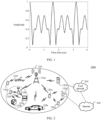
- a waveform of an On symbol generated by using a subcarrier reference sequence ⁇ -1, 1, 1, 1, -1, 1, 0, -1, -1, -1, 1, -1, -1 ⁇ defined in 802.11ba is shown in FIG. 1 .
- a waveform envelope of the On symbol in time domain has a large ripple, and occupies a large bandwidth.
- a single OFDM symbol can transmit only one symbol, resulting in low spectral efficiency and large out-of-band spurious emission.
- a rate and a modulation depth of the On symbol are fixed and cannot be adjusted flexibly.
- a conventional ASK or OOK signal is incompatible with an OFDM signal, and an existing long term evolution (long term evolution, LTE) cellular communication system and an existing new radio (new radio, NR) cellular communication system cannot generate an ASK signal or an OOK signal with a stable envelope.
- long term evolution long term evolution, LTE
- new radio new radio
- FIG. 2 is a schematic architectural diagram of a communication system 1000 to which an embodiment of this application is applied.
- the communication system includes a radio access network 100 and a core network 200.
- the communication system 1000 may further include an internet 300.
- the radio access network 100 may include at least one radio access network device (for example, 110a and 110b in FIG. 2 ), and may further include at least one terminal (for example, 120a to 120j in FIG. 2 ).
- the terminal is connected to the radio access network device in a wireless manner.
- the radio access network device is connected to the core network in a wireless or wired manner.
- a core network device and the radio access network device may be independent and different physical devices, or functions of the core network device and logical functions of the radio access network device may be integrated into a same physical device, or some functions of the core network device and some functions of the radio access network device may be integrated into one physical device.
- a wired or wireless manner may be used for connection between terminals and between radio access network devices.
- FIG. 2 is merely a schematic diagram.
- the communication system may further include another network device, for example, may further include a wireless relay device and a wireless backhaul device which are not shown in FIG. 2 .
- the radio access network device may also be referred to as a network device.
- the radio access network device may be a base station (base station), an evolved NodeB (evolved NodeB, eNodeB), a transmission reception point (transmission reception point, TRP), a next generation NodeB (next generation NodeB, gNB) in a 5th generation (5th generation, 5G) mobile communication system, a next generation NodeB in a 6th generation (6th generation, 6G) mobile communication system, a base station in a future mobile communication system, an access node in a Wi-Fi system, or the like.
- the radio access network device may alternatively be a module or unit that implements some functions of the base station, for example, may be a central unit (central unit, CU), or may be a distributed unit (distributed unit, DU).
- the CU implements functions of a radio resource control protocol and a packet data convergence protocol (packet data convergence protocol, PDCP) of the base station, and may further implement a function of a service data adaptation protocol (service data adaptation protocol, SDAP).
- the DU implements functions of a radio link control layer and a medium access control (medium access control, MAC) layer of the base station, and may further implement functions of some or all physical layers.
- MAC medium access control
- the radio access network device may be a macro base station (for example, 110a in FIG. 2 ), or may be a micro base station or an indoor station (for example, 110b in FIG. 2 ), or may be a relay node, a donor node, or the like.
- a specific technology and a specific device form used by the radio access network device are not limited in embodiments of this application. For ease of description, the following uses an example in which the base station is used as the radio access network device for description.
- the terminal may also be referred to as a terminal device, user equipment (user equipment, UE), a mobile station, a mobile terminal, or the like.
- the terminal may be widely used in various scenarios, for example, a device-to-device (device-to-device, D2D) scenario, a vehicle-to-everything (vehicle-to-everything, V2X) communication scenario, a machine-type communication (machine-type communication, MTC) scenario, an internet-of-things (internet of things, IOT) scenario, a virtual reality scenario, an augmented reality scenario, an industrial control scenario, an automatic driving scenario, a telemedicine scenario, a smart grid scenario, a smart furniture scenario, a smart office scenario, a smart wearable scenario, a smart transportation scenario, and a smart city scenario.
- a device-to-device device-to-device, D2D
- V2X vehicle-to-everything
- MTC machine-type communication
- IOT internet-of-
- the terminal may be a mobile phone, a tablet computer, a computer with a wireless transceiver function, a wearable device, a vehicle, an uncrewed aerial vehicle, a helicopter, an aircraft, a ship, a robot, a robot arm, a smart home device, or the like.
- a specific technology and a specific device form used by the terminal are not limited in embodiments of this application.
- the base station and the terminal may be at fixed locations, or may be movable.
- the base station and the terminal may be deployed on land, including an indoor device, an outdoor device, a handheld device, or a vehicle-mounted device; may be deployed on water; or may be deployed on an aircraft, a balloon, and an artificial satellite in the air.
- Application scenarios of the base station and the terminal are not limited in embodiments of this application.
- Roles of the base station and the terminal may be relative.
- a helicopter or an uncrewed aerial vehicle 120i in FIG. 2 may be configured as a mobile base station.
- the terminal 120i is the base station.
- 120i is the terminal.
- 110a and 120i communicate with each other via a wireless air interface protocol.
- 110a and 120i may alternatively communicate with each other via an interface protocol between base stations.
- 110a, 120i is also the base station. Therefore, both the base station and the terminal may be collectively referred to as communication apparatuses.
- 110a and 110b in FIG. 2 may be referred to as communication apparatuses having a base station function
- 120a to 120j in FIG. 2 may be referred to as communication apparatuses having a terminal function.
- Communication between the base station and the terminal, between the base stations, and between the terminals may be performed through a licensed spectrum, or may be performed through an unlicensed spectrum, or may be performed through both the licensed spectrum and the unlicensed spectrum. Communication may be performed through a spectrum below 6 gigahertz (gigahertz, GHz), or may be performed through a spectrum above 6 GHz, or may be performed through both the spectrum below 6 GHz and the spectrum above 6 GHz.
- a spectrum resource used for wireless communication is not limited in embodiments of this application.
- a function of the base station may be performed by a module (for example, a chip) in the base station, or may be performed by a control subsystem including the function of the base station.
- the control subsystem including the function of the base station herein may be a control center in the foregoing application scenarios, such as the smart grid scenario, the industrial control scenario, the smart transportation scenario, and the smart city scenario.
- a function of the terminal may alternatively be performed by a module (for example, a chip or a modem) in the terminal, or may be performed by an apparatus including the function of the terminal.
- the base station sends a downlink signal or downlink information to the terminal, where the downlink information is carried on a downlink channel.
- the terminal sends an uplink signal or uplink information to the base station, where the uplink information is carried on an uplink channel.
- the terminal needs to establish a wireless connection to a cell controlled by the base station.
- the cell that establishes a wireless connection to the terminal is referred to as a serving cell of the terminal.
- the terminal is further interfered by a signal from a neighboring cell.
- a signal may include a data channel, a control channel, and a reference signal.
- Transmission of a signal may be uplink transmission, that is, the terminal sends the signal to the base station; or may be downlink transmission, that is, the base station sends the signal to the terminal.
- transmitting may be interchanged with sending and/or receiving.
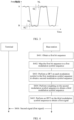
- FIG. 4 is an example flowchart of a signal transmission method according to an embodiment of this application.
- the signal transmission method provided in this application is described by using a base station and a terminal as execution bodies. It may be understood that the transmission method provided in this application may also be performed by an apparatus used in a base station or an apparatus used in a terminal, for example, a chip. The method may include the following operations.
- the base station obtains a first bit sequence.
- the first bit sequence may be an original bit sequence.
- the first bit sequence may be obtained by performing line encoding and a bit repetition operation on an original bit sequence.
- the base station may generate the original bit sequence, and perform line encoding on the original bit sequence.
- line encoding For example, Manchester (Manchester) encoding and pulse interval encoding (pulse interval encoding, PIE) may be performed on the original bit sequence to obtain an encoded bit sequence.
- PIE pulse interval encoding
- the base station may perform a bit repetition operation on the encoded bit sequence.
- a quantity of repetitions of a bit 1 may be the same as a quantity of repetitions of a bit 0, or a quantity of repetitions of a bit 1 may be different from a quantity of repetitions of a bit 0.
- the quantities of repetitions of the bit 1 and the bit 0 may be predefined by the base station.
- the base station may perform PIE encoding on the original bit sequence.
- the bit “0” is encoded into a bit sequence "10”
- the bit “1” is encoded into a bit sequence "1110”.
- an obtained encoded bit sequence is "101110111010111010111010”. It is assumed that the quantities of repetitions of the bit "0" and the bit "1” are predefined as 2. In other words, "0" in the encoded bit sequence is repeated as "00”, and “1” in the encoded bit sequence is repeated as "11”. Therefore, after a bit repetition operation is performed on the encoded bit sequence, an obtained first bit sequence may be "110011111100111111001100111111001100111111001100.
- the base station may implement an adjustment function of a transmission rate based on the bit repetition operation, and may flexibly adjust a transmission rate of a signal.
- the base station maps the first bit sequence to a first modulation symbol sequence.
- the base station may perform mapping based on points included in a first constellation point set.
- a value of each modulation symbol in the first modulation symbol sequence belongs to the first constellation point set.
- the first constellation point set may include K modulation symbols, and each of the K modulation symbols has a different amplitude. K ⁇ 2, and K is an integer.
- the first constellation point set may be K points in a constellation diagram, for example, may be K points in an ASK constellation diagram, a 16QAM constellation diagram, a 64QAM constellation diagram, a 256QAM constellation diagram, a 1024QAM constellation diagram, a 4096QAM constellation diagram, or an APSK constellation diagram.
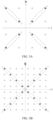
- the 16QAM constellation diagram, the 64QAM constellation diagram, and the 256QAM constellation diagram are shown in FIG. 5A to FIG. 5C .
- FIG. 5A is a schematic diagram of 16QAM constellation points according to an embodiment of this application.
- FIG. 5B is a schematic diagram of 64QAM constellation points according to an embodiment of this application.
- FIG. 5C is a schematic diagram of 256QAM constellation points according to an embodiment of this application.
- a horizontal coordinate is a real part
- a vertical coordinate is an imaginary part.
- constellation points within an ellipse in any quadrant have a same phase.
- the first constellation point set may include two points within an ellipse in the first quadrant, the second quadrant, the third quadrant, or the fourth quadrant shown in FIG. 5A .
- the first constellation point set may include two to four points within an ellipse in the first quadrant, the second quadrant, the third quadrant, or the fourth quadrant shown in FIG. 5B .
- the first constellation point set may include two to eight points within an ellipse in the first quadrant, the second quadrant, the third quadrant, or the fourth quadrant shown in FIG. 5C .
- the base station may generate an ASK signal.
- each of the K modulation symbols has a different phase.
- the first constellation point set may be K points in any constellation diagram shown in FIG. 5Ato FIG. 5C . Any two of the K points cannot be constellation points within an ellipse in a same quadrant.
- the base station may generate an APSK signal.
- the base station may map the first bit sequence to the first modulation symbol sequence by using the first constellation point set in any one of the foregoing constellation diagrams.
- each modulation symbol included in the first constellation point set has a different amplitude and a same phase for description. It is assumed that the first constellation point set includes a point with a largest amplitude and a point with a smallest amplitude within an ellipse in the first quadrant in the 256QAM constellation diagram. The bit "0" may be mapped to the point with a smallest amplitude, and the bit "1" may be mapped to the point with a largest amplitude.
- the base station may first map one bit to eight bits based on the first constellation point set.
- the bit “0” is mapped to "00001111”
- the bit “1” is mapped to "00111111”.
- the first bit sequence "110011111100111001100111111001100111111001100” may be mapped to "0011111100111111000011110000111100111111001111110011111100111111111111111 0000111100001111001111110011111100111111001111110011111111111111111111111110 01111110011111100001111000011110011111100111111001111110011111100111111001111110011111100001111100 001111000011110011111100111000011110000111100111111001111110011111100111001 1111100111000011110000111100111111001111110011111100111111001 11111001110000111100001111001111110011111100111111111001 11111001110000111100001111001111110011
- d(i) represents a modulation symbol
- j is a complex number unit
- b(8i) is the first bit in an i th group of eight bits in the first bit sequence
- b(8i+1) is the second bit in the i th group of eight bits in the first bit sequence
- b(8i+2) is the third bit in the i th group of eight bits in the first bit sequence
- b(8i+3) is the fourth bit in the i th group of eight bits in the first bit sequence
- b(8i+4) is the fifth bit in the i th group of eight bits in the first bit sequence
- b(8i+5) is the sixth bit in the i th group of eight bits in the first bit sequence
- b(8i+6) is the seventh bit in the i th group of eight bits in the first bit sequence
- b(8i+7) is the eighth bit in the i th group of eight bits in the first bit sequence.
- the base station may map the first bit sequence "110011111100111111001100111111001100111111001100" to a first modulation symbol sequence " 15 170 1 + j , 15 170 1 + j , 1 170 1 + j , 1 170 1 + j , 15 170 1 + j , 15 170 1 + j , 15 170 ( 1 + j ) , 15 170 1 + j , 15 170 1 + j , 15 170 1 + j , 15 170 1 + j , 1 170 1 + j , 15 170 1 + j , 15 170 ( 1 + j ) , 15 170 1 + j , 15 170 1 + j , 15 170 1 + j , 15 170 1 + j , 15 170 1 + j , 15 170 1 + j , 15 170 1 + j , 15 170 1 + j , 15 170 1 + j , 15 170 1
- each modulation symbol included in the first constellation point set has a different amplitude and a different phase for description.
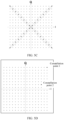
- the first constellation point set includes two constellation points shown in FIG. 5D : a constellation point 1 and a constellation point 2.
- the bit "0" may be mapped to the constellation point 1
- the bit "1" may be mapped to the constellation point 2.
- the base station may first map one bit to eight bits based on the first constellation point set.
- the bit “0” is mapped to "00110110”
- the bit “1” is mapped to "00111111”.
- the first bit sequence "110011111100111111001100111111001100111001100” may be mapped to "001111110011100110110001101100011111100111111001111110011111100111111111 001101100011011000111111001111110011111100111111001111110011011000110110 0011111100111001101100011011000111111001111110011111100111100111001111110 01101100011011000111111001111110011011000111111001111110011111100111001111110 01111110011011000110110001111110011100110110001111110011111100111001111110 01111110011011000110110001111110011100110110001111110011111100111001111110 011111100110110001101100011111100111111
- the base station may map the foregoing bit sequence to the first modulation symbol sequence by using the foregoing formula (1). Based on the foregoing formula (1), "00110110” is mapped to a complex number 1 170 11 + 3 j , and "00111111” is mapped to 15 170 1 + j .
- the base station may map the first bit sequence to a first modulation symbol sequence " 15 170 1 + j , 15 170 1 + j , 1 170 11 + 3 j , 1 170 11 + 3 j , 15 170 ( 1 + j ) , 15 170 1 + j , 15 170 1 + j , 15 170 1 + j , 1 170 1 + j , 15 170 1 + j , 1 170 11 + 3j , 1 170 ( 11 + 3 j ) , 15 170 1 + j , 15 170 1 + j , 15 170 1 + j , 15 170 1 + j , 15 170 1 + j , 15 170 1 + j , 1 170 ( 11 + 3 j ) , 1 170 11 + 3 j , 15 170 1 + j + 15 170 1 + j + 15 170 1 + j + 15 170 1 + j , 1 170 ( 11 + 3 j
- S403 The base station performs a DFT on each modulation symbol in the first modulation symbol sequence to obtain a second modulation symbol sequence.
- a quantity of DFT points may be 12, 24, 36, or the like. This is not specifically limited in this application.
- the base station may determine the quantity of DFT points based on a frequency domain resource and a subcarrier spacing that can be occupied. Specifically, a 4G or 5G mobile communication system is used as an example. If the subcarrier spacing is 15 kHz, and a bandwidth of an available frequency domain resource is 180 kHz, 12 subcarriers may be provided to generate an ASK signal. In this case, the quantity of DFT points is 12, which is equal to a quantity of the available subcarriers.
- S404 The base station performs frequency domain weighting on the second modulation symbol sequence to obtain a third modulation symbol sequence.
- the base station may perform the frequency domain weighting on the second modulation symbol sequence.
- a frequency domain weighting coefficient may be a coefficient of a raised cosine filter, a coefficient of a square-root cosine filter, a coefficient of a sine filter, a coefficient of a brick-wall filter, or the like. This is not specifically limited in this application.
- frequency domain weighting may be understood as multiplying modulation symbols in the second modulation symbol by the frequency domain weighting coefficient.
- the base station performs a 12-point DFT on the first modulation symbol sequence.
- the DFT is performed on every group of 12 modulation symbols to obtain the second modulation symbol sequence.
- the first modulation symbol sequence may be divided into four groups.
- each group of modulation symbols has a same frequency domain weighting coefficient, and the modulation symbols in a group have different frequency domain weighting coefficients.
- the frequency domain weighting coefficients of the modulation symbols in a group are "0.49987801, 0.64357300, 0.77451606, 0.88324531, 0.95891583, 0.99648732, 1, 0.99648732, 0.95891583, 0.88324531, 0.77451606, and 0.64357300" respectively.
- the base station may multiply the four groups of modulation symbols by corresponding frequency domain weighting coefficients respectively to obtain a third modulation symbol.
- S405 The base station performs an IFFT on a third modulation symbol sequence to obtain a first signal.
- a quantity of IFFT points may be different from the quantity of DFT points.
- the base station may map the third modulation symbol to the subcarriers respectively.
- service data in the 4G or 5G communication system may also be mapped to unused subcarriers, so that an ASK signal or an OOK signal and an OFDM signal may be generated simultaneously.
- the base station sends a second signal, and a corresponding terminal receives the second signal.
- the base station may generate a plurality of OFDM symbols by using S401 to S405, that is, generate a plurality of first signals.
- the second signal sent by the base station may include a plurality of OFDM symbols, and the first signal is one of the plurality of OFDM symbols.
- an envelope ripple of the ASK signal generated by the base station in time domain is small, and the signal occupies a small bandwidth, so that high spectral efficiency is achieved.
- the technical solutions provided in embodiments of this application may be compatible with a cellular physical layer parameter, and may be applicable to an LTE cellular system and an NR cellular system.
- guard interval data may be included before each OFDM symbol.
- guard interval data before the first signal may be data of N sampling points from back to front in the first signal, namely, a cyclic prefix (cyclic prefix, CP). If the CP is used as the guard interval data, the 4G or 5G communication system may be compatible.
- a cyclic prefix cyclic prefix, CP
- the guard interval data may be N pieces of data from front to back in the first signal, that is, data of first N sampling points in the first signal.
- the guard interval data may be N zeros.
- N is a positive integer.
- N herein is determined or predefined based on an empirical value. This is not specifically limited in this application. If the guard interval data shown in (b) or the guard interval data shown in (c) in FIG. 6 is used, the envelope ripple may be reduced.
- second signals shown in FIG. 7A to FIG. 7D may be generated.
- FIG. 7A is a schematic diagram of a generated second signal without guard interval data according to an embodiment of this application.
- An input original bit sequence includes four OFDM symbols, a subcarrier spacing is 15 kHz, and a length of a single OFDM symbol is 66.67 ⁇ s. It can be learned from FIG. 7A that, compared with an existing OOK signal (the OOK signal shown in FIG. 1 ), the second signal generated in this embodiment of this application has a smaller envelope ripple in time domain, and a single OFDM symbol in the second signal includes multi-bit data information, so that higher spectral efficiency is achieved.
- FIG. 7B shows a generated second signal whose guard interval data is a CP according to an embodiment of this application. This manner may be compatible with a physical layer parameter of the LTE cellular system and a physical layer parameter of the NR cellular system.
- FIG. 7C shows a generated second signal whose guard interval data is data of first N sampling points of a first signal according to an embodiment of this application. It can be learned from FIG. 7C that, an envelope ripple of the second signal is smaller than an envelope ripple of the second signal shown in FIG. 7B . This is more conducive to demodulating the ASK signal by a terminal side.
- FIG. 7D shows a generated second signal whose guard interval data is N zeros according to an embodiment of this application. It can be learned from FIG. 7D that an envelope ripple of the second signal is greater than an envelope ripple shown in FIG. 8 , but is not greatly different from the envelope ripple of the second signal shown in FIG. 7B . In addition, an amplitude change of the second signal shown in FIG. 7D is greater than an amplitude change of the second signal shown in FIG. 7C , but is not greatly different from an amplitude change of the second signal shown in FIG. 7B .
- a second signal shown in FIG. 8 may be generated. It can be learned from FIG. 8 that, compared with an existing OOK signal (the OOK signal shown in FIG. 1 ), the second signal generated in this embodiment of this application has a smaller envelope ripple in time domain, and a single OFDM symbol in the second signal includes multi-bit data information, so that higher spectral efficiency is achieved.
- the base station may generate a plurality of second signals with different modulation depths. Specifically, when mapping the first bit sequence to the first modulation symbol sequence, the base station may determine different first constellation point sets for mapping based on the modulation depths. It is assumed that there are two modulation symbols in the first constellation point set. The two modulation symbols may be any two points in any group of constellation points in any constellation diagram shown in FIG. 5A to FIG. 5C . Table 1 below shows modulation depths that can be achieved by a 16QAM modulation scheme, a 64QAM modulation scheme, and a 256QAM modulation scheme.
- Table 1 Table of modulation depths achieved by each modulation scheme Modulation scheme Amplitude ratio of a constellation point Achievable ASK modulation depth 16QAM 3:1 66.7% 64QAM 7:5 to 7:1 28.6% to 85.7% 256QAM 15:13 to 15:1 13.3% to 93.3%
- a modulation depth of a generated first signal is a maximum modulation depth that can be achieved in the modulation scheme. If the first point identified from right to left and the second point identified from right to left in the constellation points in the first quadrant are selected as the first constellation point set, a modulation depth of a generated first signal is a minimum modulation depth that can be achieved in the modulation scheme.
- the base station may generate second signals with different modulation depths based on different requirements and modulation depths that can be achieved in the foregoing modulation schemes.
- the base station intends to change the modulation depth to generate a third signal.
- the base station may select a second constellation point set.
- the second constellation point set may include a third modulation symbol and a fourth modulation symbol.
- An amplitude of the third modulation symbol is different from an amplitude of the fourth modulation symbol.
- a phase of the third modulation symbol may be the same as or different from a phase of the fourth modulation symbol.
- a ratio of the amplitude of the third modulation symbol to the amplitude of the fourth modulation symbol is different from a ratio of an amplitude of a first modulation symbol in the first constellation point set to an amplitude of a second modulation symbol in the first constellation point set.
- the base station may perform a DFT, weighting, and an IFFT on symbols in the fourth modulation symbol sequence to obtain the third signal. In this way, a modulation depth of the obtained third signal is different from that of the second signal.
- the base station may also obtain a fourth signal based on the second constellation point set.
- the fourth signal may include a plurality of third signals, and guard interval data is added before each third signal.
- guard interval data before the third signal refer to the guard interval data before the first signal. Details are not described herein again.
- an obtained second bit sequence may be "110011111100111111001100111111001100111111001100”.
- the second constellation point set may include a constellation point 1 and a constellation point 2 in a constellation diagram shown in FIG. 9 .
- the base station may first map one bit to eight bits based on the second constellation point set. The bit “0” is mapped to "00111100", and the bit "1" is mapped to "00111111”.
- the second bit sequence "110011111100111001100111111001100111111001100” may be mapped to "00111111001111110011110000111100001111110011111100111111001111110011111111111111111100001111000 01111110011111100111100001111000011111100111111001111110011111100111111001111110011110011111100111100001111000 0111111001111110011110000111100001111110011111100111111001111110011111100111001 111110011111100111100111001111000011111100111100111111001 1111100111111001111000011110000111111001111001110011110000111100" by using the second constellation point set.
- the base station may map the foregoing bit sequence to the fourth modulation symbol sequence by using the foregoing formula (1).
- "00111100” is mapped to a complex number 13 170 1 + j
- "00111111” is mapped to 15 170 1 + j .
- the base station may map the second bit sequence "110011111100111111001100111111001100111111001100" to the fourth modulation symbol sequence " 15 170 1 + j , 15 170 1 + j , 13 170 1 + j , 13 170 1 + j , 15 170 1 + j , 15 170 1 + j , 15 170 ( 1 + j ) , 15 170 1 + j , 15 170 1 + j , 15 170 1 + j , 15 170 1 + j , 13 170 1 + j , 13 170 1 + j , 15 170 1 + j , 15 170 ( 1 + j ) , 15 170 1 + j , 15 170 1 + j , 15 170 1 + j , 15 170 1 + j , 15 170 1 + j , 15 170 1 + j , 13 170 1 + j , 15 170 ( 1 + j ) , 15 1
- the base station may perform a DFT, weighting, and an IFFT on the modulation symbols in the fourth modulation symbol sequence to obtain the third signal.
- FIG. 10 is a schematic diagram of a generated fourth signal according to an embodiment of this application.
- Added guard interval data is a CP.
- an amplitude range of each third signal in the fourth signal in FIG. 10 is 0.82 to 1, and an amplitude does not change greatly, but an average value is large. Therefore, an obtained ASK modulated signal has low useful signal power and high carrier power, thereby meeting a requirement of a passive terminal for high charging power.
- an amplitude range of each first signal in the second signal shown in FIG. 7A is 0 to 1, and an amplitude changes greatly but an average value is small. In this case, an obtained ASK modulated signal has high useful signal power and low carrier power, thereby meeting a requirement of a semi-passive terminal for high useful signal power.
- the base station may flexibly change a modulation depth of a transmission signal, and flexibly allocate power between useful signal power and carrier power, thereby meeting different requirements of the passive terminal for high charging power and the semi-passive terminal for high signal power.
- the base station and the terminal include corresponding hardware structures and/or software modules for performing the functions.
- a person skilled in the art should be easily aware that, based on units and method steps in the examples described in embodiments disclosed in this application, this application can be implemented by hardware or a combination of hardware and computer software. Whether a function is performed by hardware or hardware driven by computer software depends on a particular application and a design constraint of the technical solutions.
- FIG. 11 and FIG. 12 are schematic structural diagrams of possible communication apparatuses according to embodiments of this application.
- the communication apparatuses may be configured to implement the function of the base station in the foregoing method embodiments. Therefore, beneficial effects of the foregoing method embodiments can also be achieved.
- the communication apparatus may be the base station 110a or 110b shown in FIG. 1 , or may be a module (for example, a chip) used in the base station.
- a communication apparatus 1100 includes a processing unit 1110 and a transceiver unit 1120.
- the communication apparatus 1100 is configured to implement the function of the base station in the method embodiment shown in FIG. 4 .
- the processing unit 1110 is configured to: obtain a first bit sequence, map the first bit sequence to a first modulation symbol sequence, perform a DFT on each modulation symbol in the first modulation symbol sequence to obtain a second modulation symbol sequence, perform weighting on the second modulation symbol sequence to obtain a third modulation symbol sequence, and perform an IFFT on the third modulation symbol sequence to obtain a first signal.
- the transceiver unit 1120 is configured to send a second signal, where the second signal includes the first signal.
- processing unit 1110 and the transceiver unit 1120 directly refer to related descriptions in the method embodiments shown in FIG. 4 to FIG. 10 .
- a communication device 1200 includes a processor 1210 and an interface circuit 1220.
- the processor 1210 and the interface circuit 1220 are coupled to each other.
- the interface circuit 1220 may be a transceiver or an input/output interface.
- the communication device 1200 may further include a memory 1230.
- the memory is configured to store instructions executed by the processor 1210, or store input data required by the processor 1210 to run instructions, or store data generated after the processor 1210 runs instructions.
- the processor 1210 is configured to implement a function of the foregoing processing unit 1110
- the interface circuit 1220 is configured to implement a function of the foregoing transceiver unit 1120.
- the base station module implements the function of the base station in the foregoing method embodiment.
- the base station module receives information from another module (for example, a radio frequency module or an antenna) in the base station, where the information is sent by a terminal to the base station; or the base station module sends information to another module (for example, a radio frequency module or an antenna) in the base station, where the information is sent by the base station to a terminal.
- the base station module herein may be a baseband chip in the base station, or may be a DU or another module.
- the DU herein may be a DU in an open radio access network (open radio access network, O-RAN) architecture.
- the processor in embodiments of this application may be a central processing unit (Central Processing Unit, CPU), or may be another general-purpose processor, a digital signal processor (Digital Signal Processor, DSP), an application-specific integrated circuit (Application-Specific Integrated Circuit, ASIC), a field programmable gate array (Field Programmable Gate Array, FPGA), or another programmable logical device, a transistor logic device, a hardware component, or any combination thereof.
- the general-purpose processor may be a microprocessor or any regular processor.
- the method steps in embodiments of this application may be implemented in a hardware manner, or may be implemented in a manner of executing software instructions by the processor.
- the software instructions may include a corresponding software module.
- the software module may be stored in a random access memory, a flash memory, a read-only memory, a programmable read-only memory, an erasable programmable read-only memory, an electrically erasable programmable read-only memory, a register, a hard disk, a removable hard disk, a CD-ROM, or any other form of storage medium well-known in the art.
- a storage medium is coupled to a processor, so that the processor can read information from the storage medium and write information into the storage medium.
- the storage medium may also be a component of the processor.
- the processor and the storage medium may be located in an ASIC.
- the ASIC may be located in a base station or a terminal.
- the processor and the storage medium may alternatively exist in a base station or a terminal as discrete components.
- All or some of the foregoing embodiments may be implemented by using software, hardware, firmware, or any combination thereof.
- software is used to implement the embodiments, all or a part of the embodiments may be implemented in a form of a computer program product.
- the computer program product includes one or more computer programs or instructions. When the computer programs or instructions are loaded and executed on a computer, all or some of the procedures or functions in embodiments of this application are executed.
- the computer may be a general-purpose computer, a dedicated computer, a computer network, a network device, user equipment, or another programmable apparatus.
- the computer programs or instructions may be stored in a computer-readable storage medium, or may be transmitted from a computer-readable storage medium to another computer-readable storage medium.
- the computer programs or instructions may be transmitted from a website, a computer, a server, or a data center to another website, computer, server, or data center in a wired or wireless manner.
- the computer-readable storage medium may be any available medium accessible by a computer, or a data storage device, such as, a server or a data center, integrating one or more available media.
- the available medium may be a magnetic medium, for example, a floppy disk, a hard disk, or a magnetic tape; or may be an optical medium, for example, a digital video disc; or may be a semiconductor medium, for example, a solid-state drive.
- the computer-readable storage medium may be a volatile or non-volatile storage medium, or may include two types of storage media: a volatile storage medium and a non-volatile storage medium.
- At least one means one or more
- a plurality of means two or more.
- the term “and/or” describes an association relationship for describing associated objects and represents that three relationships may exist.
- a and/or B may represent the following cases: Only A exists, both A and B exist, and only B exists, where A and B may be in a singular form or a plural form.
- a character “/” generally indicates that associated objects are in an "or” relationship.
- the character “/” indicates that associated objects are in a "division” relationship.
- “Including at least one of A, B, and C” may represent: including A; including B; including C; including A and B; including A and C; including B and C; and including A, B, and C.
Landscapes
- Engineering & Computer Science (AREA)
- Computer Networks & Wireless Communication (AREA)
- Signal Processing (AREA)
- Physics & Mathematics (AREA)
- Discrete Mathematics (AREA)
- General Physics & Mathematics (AREA)
- Mathematical Physics (AREA)
- Digital Transmission Methods That Use Modulated Carrier Waves (AREA)
- Mobile Radio Communication Systems (AREA)
Applications Claiming Priority (1)
| Application Number | Priority Date | Filing Date | Title |
|---|---|---|---|
| PCT/CN2021/118598 WO2023039766A1 (zh) | 2021-09-15 | 2021-09-15 | 一种信号传输方法和装置 |
Publications (2)
| Publication Number | Publication Date |
|---|---|
| EP4387178A1 true EP4387178A1 (de) | 2024-06-19 |
| EP4387178A4 EP4387178A4 (de) | 2024-10-02 |
Family
ID=85602251
Family Applications (1)
| Application Number | Title | Priority Date | Filing Date |
|---|---|---|---|
| EP21957056.1A Pending EP4387178A4 (de) | 2021-09-15 | 2021-09-15 | Signalübertragungsverfahren und -vorrichtung |
Country Status (4)
| Country | Link |
|---|---|
| US (1) | US20240223428A1 (de) |
| EP (1) | EP4387178A4 (de) |
| CN (1) | CN117941327A (de) |
| WO (1) | WO2023039766A1 (de) |
Families Citing this family (4)
| Publication number | Priority date | Publication date | Assignee | Title |
|---|---|---|---|---|
| CN117955789A (zh) * | 2023-05-12 | 2024-04-30 | 中兴通讯股份有限公司 | 通信方法、装置及存储介质 |
| CN121368880A (zh) * | 2024-03-29 | 2026-01-20 | 北京小米移动软件有限公司 | 通信方法、装置和存储介质 |
| WO2025231621A1 (zh) * | 2024-05-07 | 2025-11-13 | 北京小米移动软件有限公司 | 通信方法、装置和存储介质 |
| WO2025231862A1 (zh) * | 2024-05-10 | 2025-11-13 | Oppo广东移动通信有限公司 | 通信方法、装置、设备、介质和程序产品 |
Family Cites Families (12)
| Publication number | Priority date | Publication date | Assignee | Title |
|---|---|---|---|---|
| WO2012114700A1 (en) * | 2011-02-22 | 2012-08-30 | Nec Corporation | Wireless transmitting apparatus, wireless transmitting method, and wireless transmitting program |
| CN103095628B (zh) * | 2011-10-31 | 2016-03-30 | 华为技术有限公司 | 一种降低带外辐射的发射方法、接收方法及装置 |
| CN104486284B (zh) * | 2014-12-19 | 2017-06-30 | 中国地质大学(武汉) | 基于增强型六维64psk星座的正交频分复用方法 |
| CN110710174B (zh) * | 2017-04-06 | 2024-08-13 | 中兴通讯股份有限公司 | 用于无线通信波形生成的方法和装置 |
| US10601629B2 (en) * | 2017-08-09 | 2020-03-24 | Futurewei Technologies, Inc. | Virtual lookup table for probabilistic constellation shaping |
| CN109274629B (zh) * | 2018-11-19 | 2019-05-17 | 济南大学 | Ofdm系统中峰值功率优化方法及发射系统 |
| CN111371718B (zh) * | 2018-12-26 | 2022-10-14 | 深圳市力合微电子股份有限公司 | 一种无线通信系统的非循环前导信号生成方法 |
| CN112054982B (zh) * | 2019-06-06 | 2022-05-17 | 华为技术有限公司 | 一种信号的发送、接收方法及通信装置 |
| US11770285B2 (en) * | 2019-11-11 | 2023-09-26 | Samsung Electronics Co., Ltd. | Method and device for transmitting data in wireless communication system |
| KR102931717B1 (ko) * | 2020-04-09 | 2026-02-26 | 삼성전자 주식회사 | 무선 통신 시스템에서 상향링크 데이터 전송 방법 및 장치 |
| CN111901276A (zh) * | 2020-06-22 | 2020-11-06 | 中兴通讯股份有限公司 | 数据调制方法、装置、设备和存储介质 |
| FR3116169A1 (fr) * | 2020-11-10 | 2022-05-13 | Orange | Procédé de télécommunication avec codage binaire à symboles à répétition et dispositifs correspondants |
-
2021
- 2021-09-15 CN CN202180102324.4A patent/CN117941327A/zh active Pending
- 2021-09-15 WO PCT/CN2021/118598 patent/WO2023039766A1/zh not_active Ceased
- 2021-09-15 EP EP21957056.1A patent/EP4387178A4/de active Pending
-
2024
- 2024-03-14 US US18/604,700 patent/US20240223428A1/en active Pending
Also Published As
| Publication number | Publication date |
|---|---|
| EP4387178A4 (de) | 2024-10-02 |
| US20240223428A1 (en) | 2024-07-04 |
| WO2023039766A1 (zh) | 2023-03-23 |
| CN117941327A (zh) | 2024-04-26 |
Similar Documents
| Publication | Publication Date | Title |
|---|---|---|
| US20240223428A1 (en) | Signal transmission method and apparatus | |
| EP3902184A1 (de) | Drahtloskommunikationsverfahren und -vorrichtung | |
| EP4187830A1 (de) | Verfahren zum senden und empfangen eines phasenverfolgungsreferenzsignals und kommunikationsvorrichtung | |
| CN118318491B (zh) | 非地面网络中的卫星通信的方法和装置 | |
| EP3937444B1 (de) | Verfahren und vorrichtung zur datenkomprimierung | |
| EP4415457A1 (de) | Signalübertragungsverfahren und -vorrichtung | |
| US20250106091A1 (en) | Communication method and communication apparatus | |
| CN118631386A (zh) | 通信方法及装置 | |
| EP3892058B1 (de) | Halborthogonale mehrfachzugriffskommunikation von ppdu und bestätigung | |
| EP4415317A1 (de) | Signalübertragungsverfahren und -vorrichtung | |
| EP3840281B1 (de) | Kommunikationsverfahren und -vorrichtung | |
| EP4319076A1 (de) | Kommunikationsverfahren und -vorrichtung | |
| EP4672687A1 (de) | Informationsübertragungsverfahren und -vorrichtung | |
| WO2023246422A1 (zh) | 数据处理方法和数据处理装置 | |
| EP4657790A1 (de) | Signalübertragungsverfahren und -vorrichtung | |
| CN108288990B (zh) | 发送方式确定方法及通信节点 | |
| WO2025227370A1 (zh) | 信号传输方法、装置、设备、介质和程序产品 | |
| WO2025161925A1 (zh) | 通信方法及装置 | |
| CN121690946A (zh) | 通信方法及通信设备 | |
| WO2026016452A1 (zh) | 信息指示方法、装置、设备、介质和程序产品 | |
| WO2025161924A1 (zh) | 通信方法及装置 | |
| WO2026007722A1 (zh) | 数能同传的通信方法、装置以及存储介质 | |
| EP4727042A1 (de) | Signalübertragungsverfahren und kommunikationsvorrichtung | |
| WO2025157082A1 (zh) | 通信方法和通信装置 | |
| CN120834901A (zh) | 通信方法和通信装置 |
Legal Events
| Date | Code | Title | Description |
|---|---|---|---|
| STAA | Information on the status of an ep patent application or granted ep patent |
Free format text: STATUS: THE INTERNATIONAL PUBLICATION HAS BEEN MADE |
|
| PUAI | Public reference made under article 153(3) epc to a published international application that has entered the european phase |
Free format text: ORIGINAL CODE: 0009012 |
|
| STAA | Information on the status of an ep patent application or granted ep patent |
Free format text: STATUS: REQUEST FOR EXAMINATION WAS MADE |
|
| 17P | Request for examination filed |
Effective date: 20240314 |
|
| AK | Designated contracting states |
Kind code of ref document: A1 Designated state(s): AL AT BE BG CH CY CZ DE DK EE ES FI FR GB GR HR HU IE IS IT LI LT LU LV MC MK MT NL NO PL PT RO RS SE SI SK SM TR |
|
| A4 | Supplementary search report drawn up and despatched |
Effective date: 20240902 |
|
| RIC1 | Information provided on ipc code assigned before grant |
Ipc: H04L 27/02 20060101ALI20240827BHEP Ipc: H04L 27/34 20060101ALI20240827BHEP Ipc: H04L 27/26 20060101AFI20240827BHEP |
|
| DAV | Request for validation of the european patent (deleted) | ||
| DAX | Request for extension of the european patent (deleted) |