EP4385657A1 - Robotersystem und steuerung - Google Patents
Robotersystem und steuerung Download PDFInfo
- Publication number
- EP4385657A1 EP4385657A1 EP23212028.7A EP23212028A EP4385657A1 EP 4385657 A1 EP4385657 A1 EP 4385657A1 EP 23212028 A EP23212028 A EP 23212028A EP 4385657 A1 EP4385657 A1 EP 4385657A1
- Authority
- EP
- European Patent Office
- Prior art keywords
- screw
- robot
- screw tightening
- command
- generation module
- Prior art date
- Legal status (The legal status is an assumption and is not a legal conclusion. Google has not performed a legal analysis and makes no representation as to the accuracy of the status listed.)
- Withdrawn
Links
Images





Classifications
-
- B—PERFORMING OPERATIONS; TRANSPORTING
- B25—HAND TOOLS; PORTABLE POWER-DRIVEN TOOLS; MANIPULATORS
- B25J—MANIPULATORS; CHAMBERS PROVIDED WITH MANIPULATION DEVICES
- B25J9/00—Program-controlled manipulators
- B25J9/16—Program controls
- B25J9/1679—Program controls characterised by the tasks executed
- B25J9/1687—Assembly, peg and hole, palletising, straight line, weaving pattern movement
-
- B—PERFORMING OPERATIONS; TRANSPORTING
- B25—HAND TOOLS; PORTABLE POWER-DRIVEN TOOLS; MANIPULATORS
- B25J—MANIPULATORS; CHAMBERS PROVIDED WITH MANIPULATION DEVICES
- B25J9/00—Program-controlled manipulators
- B25J9/16—Program controls
- B25J9/1602—Program controls characterised by the control system, structure, architecture
-
- B—PERFORMING OPERATIONS; TRANSPORTING
- B23—MACHINE TOOLS; METAL-WORKING NOT OTHERWISE PROVIDED FOR
- B23Q—DETAILS, COMPONENTS, OR ACCESSORIES FOR MACHINE TOOLS, e.g. ARRANGEMENTS FOR COPYING OR CONTROLLING; MACHINE TOOLS IN GENERAL CHARACTERISED BY THE CONSTRUCTION OF PARTICULAR DETAILS OR COMPONENTS; COMBINATIONS OR ASSOCIATIONS OF METAL-WORKING MACHINES, NOT DIRECTED TO A PARTICULAR RESULT
- B23Q15/00—Automatic control or regulation of feed movement, cutting velocity or position of tool or work
- B23Q15/007—Automatic control or regulation of feed movement, cutting velocity or position of tool or work while the tool acts upon the workpiece
- B23Q15/013—Control or regulation of feed movement
-
- B—PERFORMING OPERATIONS; TRANSPORTING
- B25—HAND TOOLS; PORTABLE POWER-DRIVEN TOOLS; MANIPULATORS
- B25J—MANIPULATORS; CHAMBERS PROVIDED WITH MANIPULATION DEVICES
- B25J11/00—Manipulators not otherwise provided for
- B25J11/005—Manipulators for mechanical processing tasks
-
- B—PERFORMING OPERATIONS; TRANSPORTING
- B25—HAND TOOLS; PORTABLE POWER-DRIVEN TOOLS; MANIPULATORS
- B25J—MANIPULATORS; CHAMBERS PROVIDED WITH MANIPULATION DEVICES
- B25J15/00—Gripping heads and other end effectors
- B25J15/0019—End effectors other than grippers
-
- B—PERFORMING OPERATIONS; TRANSPORTING
- B25—HAND TOOLS; PORTABLE POWER-DRIVEN TOOLS; MANIPULATORS
- B25J—MANIPULATORS; CHAMBERS PROVIDED WITH MANIPULATION DEVICES
- B25J9/00—Program-controlled manipulators
- B25J9/16—Program controls
- B25J9/1628—Program controls characterised by the control loop
- B25J9/1633—Program controls characterised by the control loop compliant, force, torque control, e.g. combined with position control
-
- B—PERFORMING OPERATIONS; TRANSPORTING
- B25—HAND TOOLS; PORTABLE POWER-DRIVEN TOOLS; MANIPULATORS
- B25J—MANIPULATORS; CHAMBERS PROVIDED WITH MANIPULATION DEVICES
- B25J9/00—Program-controlled manipulators
- B25J9/16—Program controls
- B25J9/1628—Program controls characterised by the control loop
- B25J9/1653—Program controls characterised by the control loop parameters identification, estimation, stiffness, accuracy, error analysis
-
- B—PERFORMING OPERATIONS; TRANSPORTING
- B25—HAND TOOLS; PORTABLE POWER-DRIVEN TOOLS; MANIPULATORS
- B25J—MANIPULATORS; CHAMBERS PROVIDED WITH MANIPULATION DEVICES
- B25J9/00—Program-controlled manipulators
- B25J9/16—Program controls
- B25J9/1656—Program controls characterised by programming, planning systems for manipulators
- B25J9/1664—Program controls characterised by programming, planning systems for manipulators characterised by motion, path, trajectory planning
-
- G—PHYSICS
- G05—CONTROLLING; REGULATING
- G05B—CONTROL OR REGULATING SYSTEMS IN GENERAL; FUNCTIONAL ELEMENTS OF SUCH SYSTEMS; MONITORING OR TESTING ARRANGEMENTS FOR SUCH SYSTEMS OR ELEMENTS
- G05B2219/00—Program-control systems
- G05B2219/30—Nc systems
- G05B2219/45—Nc applications
- G05B2219/45091—Screwing robot, tighten or loose bolt
Definitions
- Screw tightening processing represents an exemplary application of the robot.
- Japanese Patent Laying-Open No. 2021-122867 discloses an automatic screw tightening apparatus that can lessen impact torque caused at the time of seating by controlling by switching a rotation velocity of a bit engaged with a screw before the screw is seated on a workpiece in screwing of the screw into the workpiece.
- the background art described above discloses a configuration to switch the rotation velocity (setting value) of the bit.
- Mechanical disturbance such as resistance caused in a screw tightening process, however, may vary an actual rotation velocity of the bit.
- a velocity of downward movement of a screw tightening driver or a height thereof should also be adjusted in conformity with the variation. Time and efforts are required for adjustment of the velocity of downward movement of the screw tightening driver or the height thereof in accordance with such a rotation velocity of the bit.
- the present invention provides a technique for positioning of a screw tightening driver in coordination with rotation of a screw.
- a robot system includes a robot to which a screw tightening driver for screw tightening is attached as an end effector and a controller that controls the robot.
- the controller includes a first command generation module that generates a command for rotation of the screw tightening driver in accordance with a predetermined operation profile and a second command generation module that generates a command to move the screw tightening driver along a predetermined direction by displacement calculated in accordance with the command generated by the first command generation module.
- a position of the screw based on engagement of the screw can be controlled by rotation of the screw tightening driver in accordance with the predetermined operation profile.
- an appropriate position of the screw tightening driver can be determined in accordance with the position of the screw.
- the operation profile may define change in cumulative angle of the screw tightening driver with respect to time. According to this configuration, a process of engagement of the screw can be controlled in accordance with a purpose.
- the second command generation module may output as the command, second displacement calculated by multiplying first displacement indicated by the command generated by the first command generation module by a coefficient. According to this configuration, the second displacement with linearity thereof being maintained with respect to the first displacement indicated by the command generated by the first command generation module can be outputted as the command.
- the coefficient may be determined depending on a lead of a screw rotationally driven by the screw tightening driver.
- a distance over which the screw advances can appropriately be calculated in correspondence with the number of times of rotation of the screw.
- a corresponding coefficient among a plurality of coefficients may be selected in accordance with a type of the screw rotationally driven by the screw tightening driver. Preferably, appropriate control can be achieved even when the robot handles a plurality of types of screws.
- a processor of the controller may be configured to execute a control program.
- the control program may include functional blocks that define the first command generation module and the second command generation module, respectively. According to this configuration, positioning of the screw tightening driver in coordination with rotation of the screw tightening driver can be achieved simply by incorporating the functional blocks into the control program.
- a controller that controls a robot to which a screw tightening driver for screw tightening is attached as an end effector.
- the controller includes a first command generation module that generates a command for rotation of the screw tightening driver in accordance with a predetermined operation profile and a second command generation module that generates a command to move the screw tightening driver along a predetermined direction by displacement calculated in accordance with the command generated by the first command generation module.
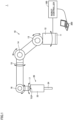
- Fig. 1 is a schematic diagram showing the exemplary overall configuration of robot system 1 according to the present embodiment.
- robot system 1 includes an articulated robot (hereinafter simply referred to as a "robot 10") and a robot controller 100 that controls robot 10.
- robot 10 articulated robot
- robot controller 100 that controls robot 10.
- Robot 10 includes a base 11 and a plurality of movable portions 12, 13, 14, 15, 16, and 17. Movable portions 12, 13, 14, 15, 16, and 17 correspond to joints of robot 10. Each of movable portions 12, 13, 14, 15, 16, and 17 drives a link constituting robot 10 along a rotation axis as illustrated in Fig. 1 .
- a screw tightening driver 20 for screw tightening is attached as an end effector to robot 10. More specifically, screw tightening driver 20 as the end effector is attached to a tip of an arm of robot 10.
- Screw tightening driver 20 includes a rotational drive portion 22 and a driver bit 24 mechanically connected to rotational drive portion 22.
- Driver bit 24 is engaged with a hole provided in a head of a screw and the screw is rotationally driven by rotational drive portion 22 with driver bit 24 being interposed.
- Rotational drive portion 22 contains a motor 37 (see Fig. 2 ) which will be described later.
- a load sensor 18 that detects a load generated in the end effector (screw tightening driver 20) may be provided in a portion where the end effector is attached to the arm of robot 10 or in the vicinity thereof.
- An information processing apparatus 200 may be connected to robot controller 100.
- Information processing apparatus 200 which is typically a general-purpose computer presents information from robot controller 100 to a user and gives any command to robot controller 100 according to a user operation.
- Fig. 2 is a schematic diagram illustrating a hardware configuration example of robot system 1 according to the present embodiment.
- robot 10 includes motors 31, 32, 33, 34, 35, and 36 corresponding to movable portions 12, 13, 14, 15, 16, and 17, respectively, and drivers 41, 42, 43, 44, 45, and 46 that drive motors 31, 32, 33, 34, 35, and 36, respectively.
- Robot 10 also includes a driver 47 that drives motor 37 provided in screw tightening driver 20.
- Robot 10 further includes load sensor 18 and a teaching pendant 26.
- Load sensor 18 detects a load generated in the end effector or the like.
- Teaching pendant 26 performs teaching or the like of robot 10 according to a user operation.
- Teaching pendant 26 may be constructed as being attachable to and removable from robot 10.
- Drivers 41, 42, 43, 44, 45, 46, and 47, load sensor 18, and teaching pendant 26 are electrically connected to robot controller 100 with an interface 40 being interposed.
- Robot controller 100 is a kind of computer, and includes a processor 102, a memory 104, an interface 106, and a storage 110 as main hardware components. These components are electrically connected via a bus 108.
- Processor 102 typically includes a central processing unit (CPU), a micro processing unit (MPU), and the like.
- Memory 104 typically includes a volatile storage device such as a dynamic random access memory (DRAM) or a static random access memory (SRAM).
- Storage 110 typically includes a non-volatile storage device such as a solid state disk (SSD) or a flash memory.
- Storage 110 stores a system program 112 for achieving basic processing and a control program 114.
- Control program 114 includes computer-readable instructions for controlling robot 10.
- Processor 102 reads system program 112 and control program 114 stored in storage 110, expands the programs in main memory 104, and executes the programs, thereby implementing processing for controlling robot 10 as described later.
- Interface 106 exchanges signals and/or data between robot controller 100 and robot 10.
- commands for controlling drivers 41, 42, 43, 44, 45, 46, and 47 are transmitted from robot controller 100 to robot 10
- detection results of load sensor 18 are transmitted from robot 10 to robot controller 100.
- FIG. 2 illustrates the configuration example in which necessary processing is provided by processor 102 executing the program
- a part or all of the provided processing may be implemented using a dedicated hardware circuit (for example, an application specific integrated circuit (ASIC), a field-programmable gate array (FPGA), or the like).
- ASIC application specific integrated circuit
- FPGA field-programmable gate array
- Fig. 2 illustrates an example in which robot controller 100 is provided independently of robot 10, some or all of the functions and processes provided by robot controller 100 may be incorporated in robot 10.
- robot controller 100 may be mounted as a controller dedicated to robot control, or may be mounted using a general-purpose programmable controller (PLC) or a personal computer.
- PLC general-purpose programmable controller
- robot controller 100 may be achieved by using computing resources on a network called cloud.
- robot system 1 may be mounted in any manner.
- a spring is provided between rotational drive portion 22 and driver bit 24, and a distance therebetween increases with external force applied to driver bit 24.
- Robot system 1 provides a configuration that more readily allows control for synchronization between an operation of screw tightening driver 20 and an operation of robot 10.
- Fig. 3 is a schematic diagram showing an exemplary functional configuration provided by a control program 114 for robot system 1 according to the present embodiment.
- a module shown in Fig. 3 is typically implemented by execution of control program 114 by processor 102 of robot controller 100.
- robot controller 100 includes a rotational drive command generation module 130, a robot operation command generation module 140, and a kinematics module 150 as the functional configuration.
- Rotational drive command generation module 130 generates a rotational drive command value in accordance with a predetermined operation profile 132. Specifically, rotational drive command generation module 130 generates a command for rotation of screw tightening driver 20 (rotational drive portion 22) in accordance with operation profile 132.
- the rotational drive command value may be, for example, a rotation angle (rotation position), the number of rotations, a rotation velocity, or the like for each control cycle, for motor 37 of rotational drive portion 22.
- Rotational drive command generation module 130 outputs displacement in accordance with the rotational drive command value generated in accordance with operation profile 132.
- the displacement is calculated in accordance with operation profile 132.
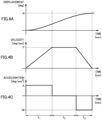
- Figs. 4A to 4C are time charts showing exemplary operation profile 132 of screw tightening driver 20 of robot system 1 according to the present embodiment.
- Fig. 4A shows a cumulative angle (displacement) of rotational drive portion 22
- Fig. 4B shows the rotation velocity of rotational drive portion 22
- Fig. 4C shows a rotation acceleration of rotational drive portion 22.
- rotational drive portion 22 rotates until the cumulative angle reaches R [deg] during periods T1, T2, and T3.
- Period T1 is an acceleration period
- period T2 is a period of operation at a constant velocity
- period T3 is a deceleration period.
- a duration of each of periods T1, T2, and T3 and cumulative angle R can freely be set.
- operation profile 132 may define change in cumulative angle of screw tightening driver 20 (rotational drive portion 22) with respect to time.
- the operation profile may define change in rotation velocity and rotation acceleration of screw tightening driver 20 (rotational drive portion 22) with respect to time.
- robot operation command generation module 140 generates a robot position command value.
- the robot position command value is generally a value (a position in three dimensions and an attitude in the three dimensions) that designates the position and the attitude of the tip of the arm (tool center point (TCP)) (see Fig. 1 ), and it may be a coordinate value in a global coordinate system or a coordinate value in a robot coordinate system.
- Robot operation command generation module 140 calculates the robot position command value in accordance with the displacement from rotational drive command generation module 130 and a screw lead 144, for an axis designated by slave axis designation 142. Specifically, robot operation command generation module 140 generates a command to move screw tightening driver 20 along a predetermined direction by the displacement calculated in accordance with a robot operation command generated by rotational drive command generation module 130.
- Fig. 5 is a diagram for illustrating screw lead 144 in robot system 1 according to the present embodiment.
- a groove 51 is provided in a screw 50.
- a distance (pitch) between adjacent grooves 51 corresponds to the "lead" of screw 50.
- the lead means a distance of advance of screw 50 in an axial direction when screw 50 makes one rotation.
- screw 50 moves toward the screw hole by one pitch. This amount of movement corresponds to the lead.
- the lead may be the same as the pitch, however, it may not be the same depending on a structure of screw 50.
- the distance over which screw 50 moves toward the screw hole can accurately be calculated.
- screw tightening driver 20 attached to the tip of the arm of robot 10 moves along a direction of advance of screw 50 (assumed, for example, as a Z-axis direction) in coordination with rotation of rotational drive portion 22 is assumed.
- An operation start position P RZS represents a position of robot 10 at which the robot starts a screw tightening operation.
- Robot operation command generation module 140 thus outputs as the robot position command value, the displacement calculated by multiplying the displacement indicated by the rotational drive command value generated by rotational drive command generation module 130 by a coefficient.
- the coefficient such as screw lead 144 may be determined depending on the lead of screw 50 rotationally driven by screw tightening driver 20.
- a plurality of screw leads 144 may be prepared in accordance with the type of the screw.
- one of the plurality of prepared screw leads 144 is selected in accordance with a screw of interest.
- a corresponding coefficient among a plurality of coefficients may be selected in accordance with the type of screw 50 rotationally driven by screw tightening driver 20.
- the tip of the arm of robot 10 operates in coordination with rotation of rotational drive portion 22. Therefore, the position of screw tightening driver 20 can appropriately be controlled with advance of screw 50.
- Kinematics module 150 calculates a robot operation command value that supports a position or an angle of each joint based on the robot position command value from robot operation command generation module 140, in accordance with kinematics of robot 10.
- Fig. 6 is a diagram showing exemplary control program 114 for implementing the exemplary functional configuration shown in Fig. 3 .
- control program 114 includes a functional block 1140 for designation of operation profile 132, a functional block 1141 for setting of a master axis, and a functional block 1142 for synchronization control of the robot.
- Functional block 1140 is an instruction for defining rotational drive command generation module 130 ( Fig. 3 ). More specifically, an axis controlled in accordance with operation profile 132 is designated in functional block 1140. In the example shown in Fig. 6 , a variable 1143 indicating screw tightening driver 20 (motor 37 that drives rotational drive portion 22) is set at each of an Axis input and an Axis output of functional block 1140.
- Operation profile 132 is set in functional block 1140.
- information indicating operation profile 132 is inputted to a plurality of inputs 1144 such as Position, Velocity, acceleration, Deceleration, Jerk, Direction, BufferMode, MoveMode, and the like of functional block 1140.
- Functional block 1141 and functional block 1142 are instructions for defining robot operation command generation module 140 ( Fig. 3 ).
- a robot and an axis that operate in a manner following a master axis are designated in functional block 1141.
- a variable 1145 indicating a robot of interest is set at each of a Robot input and a Robot output of functional block 1141, and a variable indicating the Z axis is designated at a MasterID input of functional block 1141.
- the master axis is designated in functional block 1141.
- variable 1143 indicating screw tightening driver 20 (motor 37 that drives rotational drive portion 22) is set at each of the Axis input and the Axis output of functional block 1141.
- a variable 1147 indicating a ratio between displacement of the master axis and displacement caused in the slave axis is set at an AxisData input of functional block 1141.
- Functional block 1142 is an instruction for activating synchronization control. As an Enable input of functional block 1142 is activated, robot 10 is controlled to be in synchronization in coordination with the operation of screw tightening driver 20.
- Figs. 7A to 7E are schematic diagrams showing exemplary operations of robot system 1 according to the present embodiment.
- Figs. 7A to 7E show an example in which robot 10 assembles screw 50 to a screw hole 54 provided in a workpiece 52 to which the screw is to be assembled.
- robot 10 itself is not shown but driver bit 24 of screw tightening driver 20 attached to the tip of the arm of robot 10 is mainly shown.
- robot controller 100 gives a control command to robot 10 to move screw tightening driver 20 to a position of start of approach to workpiece 52 while screw 50 is attached to driver bit 24 (for example, screw tightening driver 20 is provided with a not-shown attachment-by-suction structure) (see Fig. 7A ).
- robot controller 100 activates control for synchronization between screw tightening driver 20 and robot 10 (see Fig. 7B ). Specifically, robot controller 100 gives screw tightening driver 20 a command for rotational drive of rotational drive portion 22 in accordance with operation profile 132 and gives robot 10 a command for movement of screw tightening driver 20 to a position in accordance with the number of times of rotation (displacement) of rotational drive portion 22.
- Robot controller 100 lowers the rotation velocity of rotational drive portion 22 before a seating surface of the head of screw 50 is seated in workpiece 52 or an object to be fastened, in accordance with operation profile 132 (see Fig. 7C ). Robot controller 100 then stops the rotation of rotational drive portion 22 in accordance with operation profile 132 while the seating surface of the head of screw 50 is seated (see Fig. 7D ).
- Screw tightening driver 20 of robot controller 100 thus decelerates immediately before the head of screw 50 is seated.
- the screw tightening driver then stops at the time when the head of screw 50 is seated.
- Such a behavior of screw tightening driver 20 is defined in operation profile 132.
- Synchronization control may be deactivated when the head of screw 50 is seated.
- robot controller 100 gives robot 10 a control command to move screw tightening driver 20 upward to a prescribed height ( Fig. 7E ).
- Screw tightening processing is completed through such a series of operations.
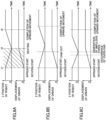
- Figs. 8 to 8C are time charts showing exemplary operations of robot system 1 according to the present embodiment.
- Figs. 8A to 8C each show a time chart of the position in the Z-axis direction of robot 10 and a time chart of the cumulative angle (displacement) of screw tightening driver 20.
- Fig. 8A is the time chart of the operation including synchronization control of robot system 1.
- screw tightening driver 20 of robot 10 starts approach to workpiece 52 from the operation start position.
- synchronization control has been activated, and rotational drive portion 22 of screw tightening driver 20 rotates and screw tightening driver 20 moves toward the screw hole in accordance with operation profile 132.
- the rotation velocity of rotational drive portion 22 has stopped in a state where the seating surface of the head of screw 50 is seated.
- screw tightening driver 20 of robot 10 moves upward and upward movement is completed at time t3.
- Figs. 8B and 8C show the time charts when rotation control of screw tightening driver 20 and position control of screw tightening driver 20 are not appropriately adjusted, rather than synchronization control in accordance with the present embodiment.
- the time chart shown in Fig. 8B shows an example of delay of movement of screw tightening driver 20 as compared with advance of the screw by screw tightening driver 20.
- movement of screw tightening driver 20 is delayed as compared with movement of the screw toward the screw hole as a result of rotational drive of the screw, cam out which is disengagement of driver bit 24 and the head of the screw from each other may occur.
- the time chart shown in Fig. 8C shows an example in which screw tightening driver 20 moves fast as compared with advance of the screw by screw tightening driver 20. As shown in Fig. 8C , as movement of screw tightening driver 20 is greater relative to movement of the screw toward the screw hole as a result of rotational drive of the screw, excessive load may be applied from driver bit 24 to the head of the screw and impulsive force may be generated at the time of seating or the like.
- synchronization control determines the position of screw tightening driver 20 in coordination with rotation of screw tightening driver 20. Therefore, the screw can appropriately be tightened without adjustment by trial and error.
- Fig. 9 is a flowchart showing an exemplary procedure of creation of control program 114 executed in robot controller 100 of robot system 1 according to the present embodiment.
- a user determines operation profile 132 of screw tightening driver 20 (step S2).
- Operation profile 132 of screw tightening driver 20 may be designed in accordance with a screw of interest or may be obtained by measurement of an actual operation of screw tightening driver 20.
- control program 114 sets an operation axis (motor 37 that drives rotational drive portion 22) of screw tightening driver 20 as the master axis (step S6). Setting of the master axis is described in control program 114.
- step S8 The user then makes setting such that robot 10 operates in synchronization with the set master axis (step S8). Setting of the operation is described in control program 114.
- Control program 114 is created through the processing procedure as set forth above.
- the screw tightening driver is rotated in accordance with the predetermined operation profile, so that the position of the screw by engagement of the screw can be controlled.
- the appropriate position of the screw tightening driver can be determined in accordance with the position of the screw.
- the operation profile is appropriately designed so that possibility of generation of impulsive force at the time of seating of the screw or the like can be lowered without the need for a sensor or the like.
- the rotation velocity of the screw tightening driver may be varied by mechanical disturbance such as friction caused in a reduction gear or resistance caused between the screw and the screw hole.
- the velocity or the position (the velocity of downward movement or the height by way of example) of the screw tightening driver can automatically be adjusted in accordance with the mechanical disturbance.
- Such automatic adjustment of the velocity or the position of the screw tightening driver can prevent, without bothersome adjustment, cam out due to delayed downward movement of the screw tightening driver (inability to follow the advance of the screw) and any damage on the head of the screw due to fast downward movement of the screw tightening driver (excessive pressing of the screw).
Landscapes
- Engineering & Computer Science (AREA)
- Mechanical Engineering (AREA)
- Robotics (AREA)
- Automation & Control Theory (AREA)
- Manipulator (AREA)
Applications Claiming Priority (1)
| Application Number | Priority Date | Filing Date | Title |
|---|---|---|---|
| JP2022198026A JP2024083929A (ja) | 2022-12-12 | 2022-12-12 | ロボットシステムおよびコントローラ |
Publications (1)
| Publication Number | Publication Date |
|---|---|
| EP4385657A1 true EP4385657A1 (de) | 2024-06-19 |
Family
ID=88969712
Family Applications (1)
| Application Number | Title | Priority Date | Filing Date |
|---|---|---|---|
| EP23212028.7A Withdrawn EP4385657A1 (de) | 2022-12-12 | 2023-11-24 | Robotersystem und steuerung |
Country Status (3)
| Country | Link |
|---|---|
| US (1) | US20240189986A1 (de) |
| EP (1) | EP4385657A1 (de) |
| JP (1) | JP2024083929A (de) |
Citations (2)
| Publication number | Priority date | Publication date | Assignee | Title |
|---|---|---|---|---|
| US20180215038A1 (en) * | 2017-01-27 | 2018-08-02 | Seiko Epson Corporation | Control device and robot system |
| JP2021122867A (ja) | 2020-01-31 | 2021-08-30 | 日東精工株式会社 | 自動ねじ締め装置 |
-
2022
- 2022-12-12 JP JP2022198026A patent/JP2024083929A/ja active Pending
-
2023
- 2023-11-17 US US18/512,176 patent/US20240189986A1/en not_active Abandoned
- 2023-11-24 EP EP23212028.7A patent/EP4385657A1/de not_active Withdrawn
Patent Citations (2)
| Publication number | Priority date | Publication date | Assignee | Title |
|---|---|---|---|---|
| US20180215038A1 (en) * | 2017-01-27 | 2018-08-02 | Seiko Epson Corporation | Control device and robot system |
| JP2021122867A (ja) | 2020-01-31 | 2021-08-30 | 日東精工株式会社 | 自動ねじ締め装置 |
Also Published As
| Publication number | Publication date |
|---|---|
| US20240189986A1 (en) | 2024-06-13 |
| JP2024083929A (ja) | 2024-06-24 |
Similar Documents
| Publication | Publication Date | Title |
|---|---|---|
| US10618164B2 (en) | Robot system having learning control function and learning control method | |
| US11000949B2 (en) | Robot for controlling learning in view of operation in production line, and method of controlling the same | |
| US9718187B2 (en) | Robot controlling method, robot apparatus, program, recording medium, and method for manufacturing assembly component | |
| EP1477284B1 (de) | Antriebssteuerverfahren und antriebssteuerung | |
| US10646995B2 (en) | Robot that carries out learning control in applications requiring constant speeds, and control method thereof | |
| US20090200978A1 (en) | Robot controller having component protecting function and robot control method | |
| US20180085921A1 (en) | Robot control device, robot, and robot system | |
| US12172312B2 (en) | Method of generating control program for robot, storage medium, and teaching apparatus | |
| JPH0215956A (ja) | 倣い制御ロボット | |
| JP3681431B2 (ja) | 直交座標系上で柔らかさが調節可能なサーボ系 | |
| JP7459530B2 (ja) | 教示方法およびロボットシステム | |
| US11141855B2 (en) | Robot system, method of controlling robot arm, recording medium, and method of manufacturing an article | |
| CN105312885A (zh) | 齿轮组装系统及齿轮组装方法 | |
| US9827673B2 (en) | Robot controller inhibiting shaking of tool tip in robot equipped with travel axis | |
| JPH07319547A (ja) | ロボットの倣い制御方法 | |
| JP2017056549A (ja) | ロボット装置、ロボット制御方法、プログラム、記録媒体及び組立部品の製造方法 | |
| EP4385657A1 (de) | Robotersystem und steuerung | |
| JP2006215807A (ja) | ロボット制御装置および制御方法 | |
| EP4245477A1 (de) | Robotersystem und steuerung | |
| US12251840B2 (en) | Force control parameter adjustment method and force control parameter adjustment apparatus | |
| JP2009196030A (ja) | 産業用ロボットの出力トルク制限回路 | |
| JP2023135018A (ja) | ロボットシステム、制御方法および制御プログラム | |
| US20250214244A1 (en) | Robot teleoperation system and method | |
| US20250100151A1 (en) | Control method of robot and robot system | |
| JP2020183021A (ja) | 制御方法、制御プログラム、記録媒体、ロボットシステム、ロボット装置、生産システム、物品の製造方法および外部入力装置 |
Legal Events
| Date | Code | Title | Description |
|---|---|---|---|
| PUAI | Public reference made under article 153(3) epc to a published international application that has entered the european phase |
Free format text: ORIGINAL CODE: 0009012 |
|
| STAA | Information on the status of an ep patent application or granted ep patent |
Free format text: STATUS: REQUEST FOR EXAMINATION WAS MADE |
|
| 17P | Request for examination filed |
Effective date: 20231124 |
|
| AK | Designated contracting states |
Kind code of ref document: A1 Designated state(s): AL AT BE BG CH CY CZ DE DK EE ES FI FR GB GR HR HU IE IS IT LI LT LU LV MC ME MK MT NL NO PL PT RO RS SE SI SK SM TR |
|
| STAA | Information on the status of an ep patent application or granted ep patent |
Free format text: STATUS: THE APPLICATION HAS BEEN WITHDRAWN |
|
| 18W | Application withdrawn |
Effective date: 20250730 |