EP4382291A1 - Article having water- and oil-repellent surface layer - Google Patents
Article having water- and oil-repellent surface layer Download PDFInfo
- Publication number
- EP4382291A1 EP4382291A1 EP22852899.8A EP22852899A EP4382291A1 EP 4382291 A1 EP4382291 A1 EP 4382291A1 EP 22852899 A EP22852899 A EP 22852899A EP 4382291 A1 EP4382291 A1 EP 4382291A1
- Authority
- EP
- European Patent Office
- Prior art keywords
- group
- bond
- formula
- monovalent
- independently
- Prior art date
- Legal status (The legal status is an assumption and is not a legal conclusion. Google has not performed a legal analysis and makes no representation as to the accuracy of the status listed.)
- Pending
Links
Classifications
-
- C—CHEMISTRY; METALLURGY
- C03—GLASS; MINERAL OR SLAG WOOL
- C03C—CHEMICAL COMPOSITION OF GLASSES, GLAZES OR VITREOUS ENAMELS; SURFACE TREATMENT OF GLASS; SURFACE TREATMENT OF FIBRES OR FILAMENTS MADE FROM GLASS, MINERALS OR SLAGS; JOINING GLASS TO GLASS OR OTHER MATERIALS
- C03C17/00—Surface treatment of glass, not in the form of fibres or filaments, by coating
- C03C17/34—Surface treatment of glass, not in the form of fibres or filaments, by coating with at least two coatings having different compositions
- C03C17/42—Surface treatment of glass, not in the form of fibres or filaments, by coating with at least two coatings having different compositions at least one coating of an organic material and at least one non-metal coating
-
- C—CHEMISTRY; METALLURGY
- C03—GLASS; MINERAL OR SLAG WOOL
- C03C—CHEMICAL COMPOSITION OF GLASSES, GLAZES OR VITREOUS ENAMELS; SURFACE TREATMENT OF GLASS; SURFACE TREATMENT OF FIBRES OR FILAMENTS MADE FROM GLASS, MINERALS OR SLAGS; JOINING GLASS TO GLASS OR OTHER MATERIALS
- C03C23/00—Other surface treatment of glass not in the form of fibres or filaments
- C03C23/0005—Other surface treatment of glass not in the form of fibres or filaments by irradiation
- C03C23/006—Other surface treatment of glass not in the form of fibres or filaments by irradiation by plasma or corona discharge
-
- C—CHEMISTRY; METALLURGY
- C03—GLASS; MINERAL OR SLAG WOOL
- C03C—CHEMICAL COMPOSITION OF GLASSES, GLAZES OR VITREOUS ENAMELS; SURFACE TREATMENT OF GLASS; SURFACE TREATMENT OF FIBRES OR FILAMENTS MADE FROM GLASS, MINERALS OR SLAGS; JOINING GLASS TO GLASS OR OTHER MATERIALS
- C03C23/00—Other surface treatment of glass not in the form of fibres or filaments
- C03C23/0075—Cleaning of glass
-
- C—CHEMISTRY; METALLURGY
- C08—ORGANIC MACROMOLECULAR COMPOUNDS; THEIR PREPARATION OR CHEMICAL WORKING-UP; COMPOSITIONS BASED THEREON
- C08G—MACROMOLECULAR COMPOUNDS OBTAINED OTHERWISE THAN BY REACTIONS ONLY INVOLVING UNSATURATED CARBON-TO-CARBON BONDS
- C08G65/00—Macromolecular compounds obtained by reactions forming an ether link in the main chain of the macromolecule
- C08G65/002—Macromolecular compounds obtained by reactions forming an ether link in the main chain of the macromolecule from unsaturated compounds
- C08G65/005—Macromolecular compounds obtained by reactions forming an ether link in the main chain of the macromolecule from unsaturated compounds containing halogens
- C08G65/007—Macromolecular compounds obtained by reactions forming an ether link in the main chain of the macromolecule from unsaturated compounds containing halogens containing fluorine
-
- C—CHEMISTRY; METALLURGY
- C08—ORGANIC MACROMOLECULAR COMPOUNDS; THEIR PREPARATION OR CHEMICAL WORKING-UP; COMPOSITIONS BASED THEREON
- C08G—MACROMOLECULAR COMPOUNDS OBTAINED OTHERWISE THAN BY REACTIONS ONLY INVOLVING UNSATURATED CARBON-TO-CARBON BONDS
- C08G65/00—Macromolecular compounds obtained by reactions forming an ether link in the main chain of the macromolecule
- C08G65/02—Macromolecular compounds obtained by reactions forming an ether link in the main chain of the macromolecule from cyclic ethers by opening of the heterocyclic ring
- C08G65/32—Polymers modified by chemical after-treatment
- C08G65/329—Polymers modified by chemical after-treatment with organic compounds
- C08G65/336—Polymers modified by chemical after-treatment with organic compounds containing silicon
-
- C—CHEMISTRY; METALLURGY
- C09—DYES; PAINTS; POLISHES; NATURAL RESINS; ADHESIVES; COMPOSITIONS NOT OTHERWISE PROVIDED FOR; APPLICATIONS OF MATERIALS NOT OTHERWISE PROVIDED FOR
- C09D—COATING COMPOSITIONS, e.g. PAINTS, VARNISHES OR LACQUERS; FILLING PASTES; CHEMICAL PAINT OR INK REMOVERS; INKS; CORRECTING FLUIDS; WOODSTAINS; PASTES OR SOLIDS FOR COLOURING OR PRINTING; USE OF MATERIALS THEREFOR
- C09D171/00—Coating compositions based on polyethers obtained by reactions forming an ether link in the main chain; Coating compositions based on derivatives of such polymers
-
- C—CHEMISTRY; METALLURGY
- C09—DYES; PAINTS; POLISHES; NATURAL RESINS; ADHESIVES; COMPOSITIONS NOT OTHERWISE PROVIDED FOR; APPLICATIONS OF MATERIALS NOT OTHERWISE PROVIDED FOR
- C09D—COATING COMPOSITIONS, e.g. PAINTS, VARNISHES OR LACQUERS; FILLING PASTES; CHEMICAL PAINT OR INK REMOVERS; INKS; CORRECTING FLUIDS; WOODSTAINS; PASTES OR SOLIDS FOR COLOURING OR PRINTING; USE OF MATERIALS THEREFOR
- C09D5/00—Coating compositions, e.g. paints, varnishes or lacquers, characterised by their physical nature or the effects produced; Filling pastes
- C09D5/16—Antifouling paints; Underwater paints
- C09D5/1656—Antifouling paints; Underwater paints characterised by the film-forming substance
- C09D5/1662—Synthetic film-forming substance
-
- C—CHEMISTRY; METALLURGY
- C03—GLASS; MINERAL OR SLAG WOOL
- C03C—CHEMICAL COMPOSITION OF GLASSES, GLAZES OR VITREOUS ENAMELS; SURFACE TREATMENT OF GLASS; SURFACE TREATMENT OF FIBRES OR FILAMENTS MADE FROM GLASS, MINERALS OR SLAGS; JOINING GLASS TO GLASS OR OTHER MATERIALS
- C03C2217/00—Coatings on glass
- C03C2217/70—Properties of coatings
- C03C2217/76—Hydrophobic and oleophobic coatings
-
- C—CHEMISTRY; METALLURGY
- C03—GLASS; MINERAL OR SLAG WOOL
- C03C—CHEMICAL COMPOSITION OF GLASSES, GLAZES OR VITREOUS ENAMELS; SURFACE TREATMENT OF GLASS; SURFACE TREATMENT OF FIBRES OR FILAMENTS MADE FROM GLASS, MINERALS OR SLAGS; JOINING GLASS TO GLASS OR OTHER MATERIALS
- C03C2217/00—Coatings on glass
- C03C2217/70—Properties of coatings
- C03C2217/78—Coatings specially designed to be durable, e.g. scratch-resistant
-
- C—CHEMISTRY; METALLURGY
- C03—GLASS; MINERAL OR SLAG WOOL
- C03C—CHEMICAL COMPOSITION OF GLASSES, GLAZES OR VITREOUS ENAMELS; SURFACE TREATMENT OF GLASS; SURFACE TREATMENT OF FIBRES OR FILAMENTS MADE FROM GLASS, MINERALS OR SLAGS; JOINING GLASS TO GLASS OR OTHER MATERIALS
- C03C2218/00—Methods for coating glass
- C03C2218/10—Deposition methods
- C03C2218/11—Deposition methods from solutions or suspensions
- C03C2218/111—Deposition methods from solutions or suspensions by dipping, immersion
-
- C—CHEMISTRY; METALLURGY
- C03—GLASS; MINERAL OR SLAG WOOL
- C03C—CHEMICAL COMPOSITION OF GLASSES, GLAZES OR VITREOUS ENAMELS; SURFACE TREATMENT OF GLASS; SURFACE TREATMENT OF FIBRES OR FILAMENTS MADE FROM GLASS, MINERALS OR SLAGS; JOINING GLASS TO GLASS OR OTHER MATERIALS
- C03C2218/00—Methods for coating glass
- C03C2218/10—Deposition methods
- C03C2218/11—Deposition methods from solutions or suspensions
- C03C2218/112—Deposition methods from solutions or suspensions by spraying
-
- C—CHEMISTRY; METALLURGY
- C03—GLASS; MINERAL OR SLAG WOOL
- C03C—CHEMICAL COMPOSITION OF GLASSES, GLAZES OR VITREOUS ENAMELS; SURFACE TREATMENT OF GLASS; SURFACE TREATMENT OF FIBRES OR FILAMENTS MADE FROM GLASS, MINERALS OR SLAGS; JOINING GLASS TO GLASS OR OTHER MATERIALS
- C03C2218/00—Methods for coating glass
- C03C2218/10—Deposition methods
- C03C2218/15—Deposition methods from the vapour phase
- C03C2218/151—Deposition methods from the vapour phase by vacuum evaporation
-
- C—CHEMISTRY; METALLURGY
- C03—GLASS; MINERAL OR SLAG WOOL
- C03C—CHEMICAL COMPOSITION OF GLASSES, GLAZES OR VITREOUS ENAMELS; SURFACE TREATMENT OF GLASS; SURFACE TREATMENT OF FIBRES OR FILAMENTS MADE FROM GLASS, MINERALS OR SLAGS; JOINING GLASS TO GLASS OR OTHER MATERIALS
- C03C2218/00—Methods for coating glass
- C03C2218/10—Deposition methods
- C03C2218/15—Deposition methods from the vapour phase
- C03C2218/152—Deposition methods from the vapour phase by cvd
-
- C—CHEMISTRY; METALLURGY
- C03—GLASS; MINERAL OR SLAG WOOL
- C03C—CHEMICAL COMPOSITION OF GLASSES, GLAZES OR VITREOUS ENAMELS; SURFACE TREATMENT OF GLASS; SURFACE TREATMENT OF FIBRES OR FILAMENTS MADE FROM GLASS, MINERALS OR SLAGS; JOINING GLASS TO GLASS OR OTHER MATERIALS
- C03C2218/00—Methods for coating glass
- C03C2218/30—Aspects of methods for coating glass not covered above
- C03C2218/31—Pre-treatment
-
- C—CHEMISTRY; METALLURGY
- C08—ORGANIC MACROMOLECULAR COMPOUNDS; THEIR PREPARATION OR CHEMICAL WORKING-UP; COMPOSITIONS BASED THEREON
- C08G—MACROMOLECULAR COMPOUNDS OBTAINED OTHERWISE THAN BY REACTIONS ONLY INVOLVING UNSATURATED CARBON-TO-CARBON BONDS
- C08G2650/00—Macromolecular compounds obtained by reactions forming an ether link in the main chain of the macromolecule
- C08G2650/02—Macromolecular compounds obtained by reactions forming an ether link in the main chain of the macromolecule characterized by the type of post-polymerisation functionalisation
- C08G2650/04—End-capping
Definitions
- This invention relates to an article comprising a glass substrate and a water/oil repellent surface layer having excellent water/oil repellent, abrasion resistant, and glide properties.
- fluoropolyether-containing polymers When coated and cured to the surface of substrates of metals, porcelain, glass, or plastics, fluoropolyether-containing polymers form a water/oil repellent layer (antifouling coating thin layer) on the surface of the substrates to provide the substrates with an ability to prevent oil and fat staining, fingerprint staining and otherwise staining.
- fluoropolyether-containing polymers are used to form an antifouling coating thin layer on the surface of touch panel displays of portable electronic terminals, terminal casings or other parts (see Patent Documents 1 to 6: JP 6260579 , JP 6828744 , JP 5761305 , JP 6451279 , JP 6741074 , and JP 6617853 ).
- Patent Document 1 JP 6260579 Patent Document 2: JP 6828744 Patent Document 3: JP 5761305 Patent Document 4: JP 6451279 Patent Document 5: JP 6741074 Patent Document 6: JP 6617853 Patent Document 7: WO 2014/097388 Patent Document 8: JP-A 2020-132498 Patent Document 9: JP-A 2020-090652 Patent Document 10: JP 5655215 Patent Document 11: JP 6601492 Patent Document 12: JP 5494656 Patent Document 13: WO 2019/035271 Patent Document 14: JP 6569831 Patent Document 15: JP-A 2011-116947 Patent Document 16: JP-A 2007-197425 Patent Document 17: JP-A 2007-297589 Patent Document 18: JP-A 2007-297543 Patent Document 19: JP-A 2008-088412 Patent Document 20: JP-A 2008-144144 Patent Document 21: JP-A 2010-031184 Patent Document 22: JP-A 2010-047516 Patent Document 23: JP-A 2011
- An object of the invention which has been made under the above-mentioned circumstances, is to provide an article comprising a glass substrate and a water/oil repellent surface layer thereon having excellent water/oil repellent, abrasion resistant, and gliding properties.
- an article comprising a glass substrate, an underlayer formed mainly of silicon oxide on the outer surface of the glass substrate, and a water/oil repellent surface layer formed on the outer surface of the underlayer fails to exhibit satisfactory abrasion durability when the silicon oxide underlayer has a high film density.
- the inventors have found that when the silicon oxide underlayer has a film density of 1.8 to 2.2 g/cm 3 and the water/oil repellent surface layer is formed mainly of a cured product of a fluoropolyether-containing polymer having a hydrolyzable silyl group and/or a partial hydrolytic condensate thereof, and the fluoropolyether-containing polymer having a hydrolyzable silyl group contains a fluoropolyether-containing polymer of a specific structure to be described later, the resulting water/oil repellent surface layer has excellent water/oil repellency, abrasion durability, and gliding properties.
- the invention provides an article having a water/oil repellent surface layer as defined below.
- the article comprising a glass substrate, an underlayer formed mainly of silicon oxide on the outer surface of the glass substrate and having a specific film density, and a water/oil repellent surface layer formed on the outer surface of the underlayer and based on a cured product of a fluoropolyether-containing polymer of specific structure having a hydrolyzable silyl group and/or a partial hydrolytic condensate thereof according to the invention exhibits excellent water/oil repellency, abrasion durability, and gliding properties.
- the invention provides an article comprising a glass substrate, a silicon oxide underlayer, and a water/oil repellent surface layer.
- the invention is characterized in that the water/oil repellent surface layer is formed on the outer surface of the silicon oxide-based underlayer on the glass substrate from a surface treating agent containing a fluoropolyether-containing polymer of specific structure having a hydrolyzable silyl group and/or a partial hydrolytic condensate thereof.
- the glass used as the substrate examples include soda glass, crown glass, lead glass, borosilicate glass, crystallized glass, quartz glass, aluminosilicate glass, Tempax, Pyrex ® , and Neoserum, but are not limited thereto. It is noted that the glass may have been treated by chemical strengthening or physical strengthening.
- the glass substrate may have a plate, film or other shape.
- the glass substrate used herein is not particularly limited and any of the above-mentioned glass substrates may be advantageously used.
- the substrate may include a matrix of such material and a functional layer formed thereon.
- Exemplary of the functional layer are an antireflective layer and a hard coat layer.
- the surface of the glass substrate may be pretreated prior to formation of the silicon oxide underlayer.
- the pretreatment provides for tight adhesion between the glass substrate and the silicon oxide underlayer, achieving high abrasion durability.
- the method of pretreatment of the glass substrate is not particularly limited as long as any contaminants can be removed from the glass substrate surface and the glass substrate surface be rendered hydrophilic.
- exemplary of the pretreatment are alcohol washing treatment with alcohols such as ethanol and 2-propanol, alkaline cleaning treatment with alkaline cleaning agents, plasma cleaning treatment with oxygen or argon plasma, and radical cleaning treatment with OH radicals. These treatments may be used in combination.
- the alkaline cleaning treatment with an alkaline cleaning agent is preferred, and the plasma cleaning treatment or radical cleaning treatment with OH radicals is more preferred. More preferably, the alkaline cleaning treatment with an alkaline cleaning agent is followed by the plasma cleaning treatment or radical cleaning treatment with OH radicals.
- the effect of pretreatment of the glass substrate is ascertained by the degree of hydrophilicity on the glass substrate surface.
- Hydrophilicity can be evaluated in terms of a contact angle with water on the substrate.
- a contact angle of up to 40° is preferred, more preferably up to 20°, even more preferably up to 10°.
- the contact angle with water is measured according to JIS R 3257: 1999.
- the silicon oxide underlayer is a silicon oxide film.
- the method of forming the silicon oxide film may be dry coating or wet coating. Suitable dry coating methods include physical vapor deposition (PVD) and chemical vapor deposition (CVD). Suitable wet coating methods include use of silica nano-particles, a sol-gel method using silicon alkoxide, and silica glass conversion by reaction of polysilazane with water.
- the CVD method used herein may be thermal CVD, reactive species-assisted CVD, or photo-assisted CVD. From the standpoint of preventing the glass substrate temperature from elevating, the reactive species-assisted CVD is preferably used.
- the reactive species-assisted CVD method involves chemical reaction of a precursor with reactive species to convert the precursor to silicon oxide and depositing silicon oxide on a glass substrate.
- the reactive species include ions, electrons and radicals in an oxygen-containing plasma, and OH radicals created from ozone gas and an unsaturated hydrocarbon gas (e.g., ethylene gas).
- the method of forming a silicon oxide film by the CVD method utilizing an oxygen-containing plasma is exemplified by the methods described in Patent Documents 9 and 10 ( JP-A 2020-090652 and JP 5655215 ).
- the method of forming a silicon oxide film by the CVD method utilizing OH radicals is exemplified by the method described in Patent Document 14 ( JP 6569831 ).
- Silicon compounds are used as the precursor to silicon oxide.
- SiH 4 , Si 2 H 6 , tetraethoxysilane, hexamethyldisiloxane, and hexamethyldisilazane are useful.
- tetraethoxysilane, hexamethyldisiloxane, and hexamethyldisilazane are preferred.
- the glass substrate temperature is preferably set from 30°C to lower than 150°C, more preferably from 30°C to 140°C when SiH 4 is used as the precursor, and preferably from 30°C to lower than 250°C, more preferably from 30°C to 150°C when tetraethoxysilane, hexamethyldisiloxane or hexamethyldisilazane is used as the precursor. Since this setting prevents silicon oxide from the closest packing during film formation, a film density as defined below is achieved.
- silica nano-particles belonging to the wet coating method is exemplified by the method described in Patent Document 13 ( WO 2019/035271 ). By this method, a film density of approximately 2.0 g/cm 3 is achievable.
- the sol-gel method using silicon alkoxide belonging to the wet coating method is exemplified by the method described in Patent Document 29 ( JP-A 2007-011033 ).
- polysilazane belonging to the wet coating method is exemplified by a method involving applying perhydropolysilazane as the precursor by spraying, brush coating, spin coating or dip coating and allowing the precursor to stand in an ambient atmosphere to convert it to silicon oxide.
- This method is exemplified by the method described in Patent Document 10 ( JP 5655215 ).
- the ambient temperature is preferably 15 to 30°C
- the humidity (relative humidity) is preferably 30 to 95% RH
- the holding time is preferably about 12 to 36 hours.
- the silicon oxide underlayer has a film density of 1.8 to 2.2 g/cm 3 , preferably 1.80 to 2.20 g/cm 3 , more preferably 1.84 to 2.15 g/cm 3 . If the film density of the silicon oxide underlayer is less than 1.8 g/cm 3 , which means that more voids are present in the silicon oxide underlayer, the adhesion between the silicon oxide underlayer and the water/oil repellent surface layer is improved due to the increased surface area, but the strength of the silicon oxide underlayer itself is lowered. If the film density exceeds 2.2 g/cm 3 , the strength of the silicon oxide underlayer itself is kept, but the adhesion between the silicon oxide underlayer and the water/oil repellent surface layer is lowered.
- the film density of the silicon oxide underlayer can be measured by X-ray reflectometry (XRR).
- XRR X-ray reflectometry
- the film density of the silicon oxide underlayer falls within the above-defined range as long as the silicon oxide film is formed by the aforementioned method under the aforementioned conditions.
- the silicon oxide underlayer preferably has a film thickness of 3 to 300 nm, more preferably 3 to 200 nm. If the film thickness of the silicon oxide underlayer is less than 3 nm, the adhesion between the silicon oxide underlayer and the water/oil repellent surface layer is sometimes lost due to the presence of voids in the silicon oxide underlayer. If the film thickness exceeds 300 nm, the adhesion between the silicon oxide underlayer and the water/oil repellent surface layer may become poor due to shortage of the strength of the silicon oxide underlayer itself.
- the film thickness of the silicon oxide underlayer can be measured by X-ray reflectometry (XRR).
- the silicon oxide underlayer preferably has an in-film hydrogen concentration of from 2 at% to 8 at%, more preferably from 4 at% to 7 at%.
- the in-film hydrogen concentration of the silicon oxide underlayer can be measured by the Rutherford back-scattering method.
- the surface of the silicon oxide underlayer may be treated prior to formation of the water/oil repellent surface layer.
- the pretreatment ensures to enhance the adhesion between the silicon oxide underlayer and the water/oil repellent surface layer, achieving high abrasion durability.
- the method of pretreating the silicon oxide underlayer is not particularly limited as long as any contaminants can be removed from the surface of the silicon oxide underlayer.
- plasma cleaning treatment with an oxygen plasma or argon plasma, and radical cleaning treatment with OH radicals are preferably used.
- the plasma cleaning treatment is preferred.
- the water/oil repellent surface layer is composed mainly of a cured product of a fluoropolyether-containing polymer having a hydrolyzable silyl group and/or a partial hydrolytic condensate thereof.
- the water/oil repellent surface layer is formed on the silicon oxide underlayer using a surface treating agent containing a fluoropolyether-containing polymer having a hydrolyzable silyl group and/or a partial hydrolytic condensate thereof.
- fluoropolyether-containing polymer having a hydrolyzable silyl group use may be made of the compounds described in Patent Documents 1 to 6 and 15 to 28 ( JP 6260579 , JP 6828744 , JP 5761305 , JP 6451279 , JP 6741074 , JP 6617853 , JP-A 2011-116947 , JP-A 2007-197425 , JP-A 2007-297589 , JP-A 2007-297543 , JP-A 2008-088412 , JP-A 2008-144144 , JP-A 2010-031184 , JP-A 2010-047516 , JP-A 2011-178835 , JP-A 2014-084405 , JP-A 2014-105235 , JP-A 2013-253228 , JP-A 2014-218635 , and WO 2013/121984 ).
- the fluoropolyether-containing polymer having a hydrolyzable silyl group is described in further detail.
- the fluoropolyether-containing polymer having a hydrolyzable silyl group has at least 2 groups, preferably 2 or 3 groups (or hydrolyzable silyl groups) represented by the formula (11): wherein R is a C 1 -C 4 alkyl group or phenyl group, X is independently a hydrolyzable group, and a is 2 or 3, at one or more ends, preferably 1 to 3 ends of the molecule (i.e., at least 2, preferably 2 to 9, more preferably 2 to 6 hydrolyzable silyl groups per molecule) and preferably has a polyfluorooxyalkylene structure represented by -(C b F 2b O) m - wherein b is an integer of 1 to 6 independently for each unit and m is an integer of 1 to 250, in the molecule.
- X is each independently a hydrolyzable group.
- X include C 1 -C 10 alkoxy groups such as methoxy, ethoxy, propoxy, isopropoxy, butoxy, isobutoxy, sec-butoxy, and tert-butoxy, C 2 -C 10 alkoxy-substituted alkoxy groups such as methoxymethoxy, methoxyethoxy, ethoxymethoxy, and ethoxyethoxy, C 2 -C 10 acyloxy groups such as acetoxy and propionoxy, C 2 -C 10 alkenyloxy groups such as vinyloxy, allyloxy, propenoxy, and isopropenoxy, and halogen groups such as chloro, bromo and iodo. Inter alia, methoxy, ethoxy, isopropenoxy and chloro are preferred.
- R is a C 1 -C 4 alkyl group such as methyl, ethyl, propyl or butyl, or phenyl group, with methyl and ethyl being preferred.
- a is 2 or 3, preferably 3 from the aspects of reactivity and adhesion to the substrate.
- b is an integer of 1 to 6, preferably 1 to 4 independently for each unit, and m is an integer of 1 to 250, preferably 1 to 140.
- Examples of the repeating unit represented by -C b F 2b O- include units of the following formulae: -CF 2 O-, -CF 2 CF 2 O-, -CF 2 CF 2 CF 2 O-, -CF(CF 3 )CF 2 O-, -CF 2 CF 2 CF 2 CF 2 O-, -CF 2 CF 2 CF 2 CF 2 CF 2 O-, and -C(CF 3 ) 2 O-.
- repeating units of the following formulae are especially preferred: -CF 2 O- and -CF 2 CF 2 O-.
- the polyfluorooxyalkylene structure may be composed of repeating units of one type or repeating units of two or more types as illustrated above.
- the fluoropolyether-containing polymer having a hydrolyzable silyl group contains one or more fluoropolyether-containing polymers having the following formula (1), (4) or (7). More preferably, the fluoropolyether-containing polymer having a hydrolyzable silyl group consists of one or more fluoropolyether-containing polymers having the formula (1), (4) or (7). [Chem. 13] A 1 -Rf-D (1)
- Rf is a divalent polyfluorooxyalkylene structure-containing group: -C d F 2d -O-(CF 2 O) p (C 2 F 4 O) q (C 3 F 6 O) r (C 4 F 8 O) s (C 5 F 10 O) t (C 6 F 12 O) u -C d F 2d - wherein d is an integer of 0 to 5 independently for each unit, p, q, r, s, t, and u are each independently an integer of 0 to 150, the sum of p, q, r, s, t, and u is an integer of 1 to 250, each unit may be straight or branched, the repeating units in parentheses with subscripts p, q, r, s, t, and u may be randomly arranged, A 1 is a monovalent fluorinated hydrocarbon group which is terminated with CF 3 - or CF 2 H- and may contain oxygen, or D,
- Rf is as defined above
- a 2 is a monovalent fluorinated hydrocarbon group which is terminated with CF 3 - or CF 2 H- and may contain oxygen, or G
- G is independently a monovalent group having the formula (5): wherein W is as defined above, B is hydrogen or -OS, S is hydrogen, a C 1 -C 10 monovalent hydrocarbon group, or a monovalent group having the formula (6): wherein T is a single bond or divalent group, L is independently a C 1 -C 4 divalent hydrocarbon group, E is a C 1 -C 6 monovalent hydrocarbon group or W, l is an integer of 0 to 20. [Chem. 19] A 3 -Rf-J (7)
- Rf is as defined above
- a 3 is a monovalent fluorinated hydrocarbon group which is terminated with CF 3 - or CF 2 H- and may contain oxygen
- J is independently a monovalent group having the formula (8): wherein S is as defined above, V is a single bond or a C 2 -C 15 divalent hydrocarbon group which may contain an ether bond
- M is independently a monovalent group having the formula (9): wherein Y, S, and W are as defined above, f is an integer of 1 to 3, and e is 1 or 2, J contains at least two W.
- Rf is a divalent polyfluorooxyalkylene (or perfluoropolyether) structure-containing group: -C d F 2d -O-(CF 2 O) p (C 2 F 4 O) q (C 3 F 6 O) r (C 4 F 8 O) s (C 5 F 10 O) t (C 6 F 12 O) u -C d F 2d - wherein d is an integer of 0 to 5 independently for each unit, preferably an integer of 0 to 2, more preferably 0 or 1, p, q, r, s, t, and u are each independently an integer of 0 to 150, preferably an integer of 0 to 100, more preferably an integer of 0 to 60, the sum of p, q, r, s, t, and u is an integer of 1 to 250, preferably an integer of 3 to 140, more preferably an integer of 7 to 70. Each unit may be straight or branched.
- the repeating units in parent
- the divalent polyfluorooxyalkylene structure-containing group Rf is exemplified by the following structures. [Chem. 23] -C d' F 2d' -O-(C 2 F 4 O) q'- C d' F 2d' - -C d' F 2d' -O-(C 3 F 6 O) r' -C d' -F 2d' - -C d' F 2d' -O-(CF 2 O) p' (C 2 F 4 O) q' -C d' F 2d' - -C d' F 2d' -O-(C 2 F 4 O) q' (C 4 F 8 O) s' -C d' F 2d' - -C d' F 2d' -O-(CF 2 O) p' (C 2 F 4 O) q' - (C 3 F 6 O) r' C d' F 2d' -O-(
- Each unit may be straight or branched.
- the repeating units in parentheses with subscripts p', q', r', s', t', and u' may be randomly arranged.
- the subscript d' is an integer of 0 to 5 independently for each unit, and the unit with d' may be straight or branched.
- a 1 is a monovalent fluorinated hydrocarbon group which is terminated with CF 3 - or CF 2 H- and may contain oxygen, or D which is a monovalent group having the formula (2): -Q-Z(W) ⁇ .
- the monovalent fluorinated hydrocarbon group which is terminated with CF 3 - or CF 2 H- and may contain oxygen is preferably a C 1 -C 6 fluoroalkyl group, more preferably a group giving a polymer terminated with CF 3 - or CF 2 H-.
- a 1 -Rf-D D is independently a monovalent group having the formula (2). [Chem. 25] -Q-Z(W) ⁇ ( 2 )
- Q is a single bond or a divalent organic group.
- Q is desirably an unsubstituted or substituted divalent hydrocarbon group of 1 to 15 carbon atoms, preferably 2 to 15 carbon atoms, which may contain at least one bond selected from the group consisting of an amide bond (e.g., unsubstituted amide bond, N-methyl-substituted amide bond, or N-phenyl-substituted amide bond), ether bond, ester bond, sulfide bond, urethane bond, siloxane bond, triazine bond, diorganosilylene moiety (e.g., dialkylsilylene moiety such as dimethylsilylene), silarylene bond (e.g., silphenylene bond), and silalkylene bond (e.g., silethylene bond), more desirably an unsubstituted or fluorine-substituted divalent hydrocarbon group of
- silalkylene bond examples of the silalkylene bond and silarylene bond are shown below.
- R 1 which may be the same or different is a C 1 -C 8 , preferably C 1 -C 4 alkyl group such as methyl, ethyl, propyl or butyl, or a C 6 -C 10 aryl group such as phenyl.
- R 2 is a C 1 -C 4 alkylene group such as methylene, ethylene or propylene (trimethylene or methylethylene), or a C 6 -C 10 arylene group such as phenylene.
- v is an integer of 2 to 4.
- Z is a tri- to octavalent group, preferably silicon, nitrogen or a tri- to octavalent organopolysiloxane residue having a siloxane bond, more preferably a tri- to octavalent, most preferably tri- or tetravalent group selected from straight, branched or cyclic organopolysiloxane residues of 3 to 13 silicon atoms, preferably 3 to 5 silicon atoms.
- Z may contain a silalkylene structure (typically silethylene structure) in which two silicon atoms are linked by an alkylene group such as ethylene, i.e., Si-(CH 2 ) n -Si wherein n is an integer of 2 to 6, preferably 2 to 4.
- silalkylene structure typically silethylene structure
- ethylene i.e., Si-(CH 2 ) n -Si wherein n is an integer of 2 to 6, preferably 2 to 4.
- the tri- to octavalent organopolysiloxane residue having a siloxane bond is exemplified by the following groups.
- R 1 is as defined above, g is an integer of 3 to 12, preferably 3 or 4, h is an integer of 3 to 8, preferably 3 or 4, j is an integer of 0 to 8, preferably 0 or 1, h+j is an integer of 3 to 13, preferably 3 to 5, and k is 2 or 3.
- R 4 is independently R 1 or a group having the following formula (a): wherein R 1 is as defined above, j 1 is an integer of 1 to 6, preferably 1, the valence bond on the left side is attached to Si, and R 5 is independently a single bond or a group having the following formula (b): wherein R 2 and R 4 are as defined above, j2 is an integer of 0 to 6, preferably 0 to 3, j3 is an integer of 0 to 6, preferably 0 to 2, the repeating units within parentheses may be randomly arranged, the valence bond on the left side is attached to Si, and at least one R 4 is a group having formula (a).
- W is independently a monovalent hydrolyzable silyl-containing group having the formula (3): wherein R, X and "a" are as defined above, Y is a single bond or a divalent hydrocarbon group which may contain at least one moiety selected from fluorine, silicon and siloxane bond.
- R, X and "a” are as defined for R, X and “a” in formula (11) and as exemplified for R, X and "a” in formula (11).
- Y is a single bond or a divalent hydrocarbon group of preferably 1 to 20 carbon atoms which may contain at least one moiety selected from fluorine, silicon and siloxane bond.
- the divalent hydrocarbon group which may contain at least one moiety selected from fluorine, silicon and siloxane bond include C 1 -C 10 alkylene groups, C 1 -C 10 alkylene groups containing fluorine, alkylene groups containing C 6 -C 8 arylene moiety (i.e., alkylene-arylene groups), divalent groups having alkylene groups linked via a silalkylene structure or silarylene structure, and divalent groups in which C 2 -C 10 alkylene groups are attached to the valence bonds of a divalent straight organopolysiloxane residue of 2 to 10 silicon atoms or a divalent branched or cyclic organopolysiloxane residue of 3 to 10 silicon atoms.
- a 1 and Rf are as defined above.
- Rf is as defined above and as exemplified above for Rf in formula (1).
- a 2 is a monovalent fluorinated hydrocarbon group which is terminated with CF 3 - or CF 2 H- and may contain oxygen, or G which is a monovalent group having the formula (5): -C(B)(W) 2 .
- the monovalent fluorinated hydrocarbon group which is terminated with CF 3 - or CF 2 H- and may contain oxygen is preferably a C 1 -C 6 fluoroalkyl group, more preferably a group giving a polymer terminated with CF 3 - or CF 2 H-.
- Examples of the monovalent fluorinated hydrocarbon group which is terminated with CF 3 - or CF 2 H- and may contain oxygen, represented by A 2 , include the following groups.
- a 2 -Rf-G G is independently a monovalent group having the formula (5).
- W is as defined above and as exemplified above for W in formula (2).
- B is hydrogen or -OS.
- S is hydrogen, a C 1 -C 10 monovalent hydrocarbon group, or a monovalent group having the following formula (6).
- Examples of the C 1 -C 10 monovalent hydrocarbon group represented by S include alkyl groups such as methyl, ethyl, propyl, butyl, pentyl, hexyl and octyl, alkenyl groups such as vinyl and allyl, aryl groups such as phenyl and tolyl, and aralkyl groups such as benzyl and phenylethyl. Inter alia, C 1 -C 3 alkyl groups and phenyl are preferred.
- T is a single bond or divalent group, preferably a single bond or a C 2 -C 20 divalent hydrocarbon group which may contain at least one bond selected from the group consisting of silicon, siloxane bond, silalkylene bond (e.g., silethylene bond or silpropylene bond), silarylene bond (e.g., silphenylene bond), and diorganosilylene moiety (e.g., dialkylsilylene moiety such as dimethylsilylene or dialkoxysilylene moiety such as dimethoxysilylene), a divalent siloxane bond, silalkylene group or diorganosilylene group.
- Examples of the group T other than a single bond are shown below. It is noted that the valence bond on the right side in the following structure is preferably attached to L or E.
- L is independently a C 1 -C 4 divalent hydrocarbon group, typically alkylene group such as methylene, ethylene, propylene (trimethylene or methylethylene) or butylene (tetramethylene).
- alkylene group such as methylene, ethylene, propylene (trimethylene or methylethylene) or butylene (tetramethylene).
- LO tetramethylene
- the number of carbon atoms may be identical or different.
- l is an integer of 0 to 20, preferably an integer of 0 to 10, more preferably 0 to 6. It is noted that when (LO) is contained, l is preferably at least 1, more preferably at least 2.
- E is a C 1 -C 6 monovalent hydrocarbon group such as a C 1 -C 4 alkyl group, e.g., methyl, ethyl, propyl or butyl or phenyl, or W.
- W is as defined above and as exemplified above for W in formula (2).
- a 2 and Rf are as defined above.
- Rf is as defined above and as exemplified above for Rf in formula (1).
- the monovalent fluorinated hydrocarbon group which is terminated with CF 3 - or CF 2 H- and may contain oxygen is preferably a C 1 -C 6 fluoroalkyl group, more preferably a group giving a polymer terminated with CF 3 -or CF 2 H-.
- a 3 oxygen
- a 3 -Rf-J J is independently a group having the formula (8), J containing at least 2 W.
- S is as defined above and as exemplified above for S.
- e is 1 or 2, preferably 1.
- M is independently a monovalent group having the formula (9).
- Y, S, and W are as defined above and as exemplified above for Y in formula (3), S and W in formula (2).
- f is an integer of 1 to 3.
- a 3 and Rf are as defined above.
- the surface treating agent for forming the water/oil repellent surface layer in the inventive article comprises a fluoropolyether-containing polymer having a hydrolyzable silyl group and/or a partial hydrolytic condensate thereof.
- the surface treating agent may be a mixture (i.e., fluoropolyether-containing polymer composition) comprising the fluoropolyether-containing polymer having a hydrolyzable silyl group and/or the partial hydrolytic condensate thereof and a fluoropolyether-containing polymer having the formula (10), free of a hydrolyzable silyl group, which is referred to as hydrolyzable silyl group-free polymer, and/or a partial (hydrolytic) condensate thereof.
- the term "partial (hydrolytic) condensate” refers to a partial condensate or partial hydrolytic condensate. [Chem. 59] A 4 -Rf-A 4 (10)
- Rf is as defined above and as exemplified above for Rf in formula (1).
- a 4 is independently a monovalent fluorinated hydrocarbon group which is terminated with CF 3 - or CF 2 H- and may contain oxygen, or -OR 3 , -COOR 3 or -PO(OR 3 ) 2 wherein R 3 is hydrogen or a C 1 -C 10 monovalent hydrocarbon group.
- a 4 is independently a monovalent fluorinated hydrocarbon group which is terminated with CF 3 - or CF 2 H- and may contain oxygen, or -OR 3 , -COOR 3 or -PO(OR 3 ) 2 .
- Examples of the monovalent fluorinated hydrocarbon group which is terminated with CF 3 - or CF 2 H- and may contain oxygen are as exemplified above for the monovalent fluorinated hydrocarbon group which is terminated with CF 3 - or CF 2 H- and may contain oxygen, represented by A 1 .
- R 3 is hydrogen or a C 1 -C 10 monovalent hydrocarbon group.
- the monovalent hydrocarbon group include alkyl groups such as methyl, ethyl, propyl, butyl, pentyl, hexyl and octyl, alkenyl groups such as vinyl and allyl, aryl groups such as phenyl and tolyl, and aralkyl groups such as benzyl and phenylethyl.
- R 3 is preferably hydrogen, C 1 -C 3 alkyl group or phenyl group.
- Examples of -OR 3 , -COOR 3 and -PO(OR 3 ) 2 , represented by A 4 , include -OH, -OCH 3 , -COOH, -COOCH 3 , -PO(OH) 2 , -OC 2 H 5 , and -COOC 2 H 5 .
- fluoropolyether-containing polymer having formula (10) examples are shown below. [Chem. 60] CF 3 -O-(CF 2 O) p" (C 2 F 4 O) q" (C 3 F 6 O) r" (C 4 F 8 O) s" (C 5 F 10 O) t" (C 6 F 12 O) u" -CF 3 CF 3 -O-(CF 2 O) p" (C 2 F 4 O) q" (C 3 F 6 O) r" (C 4 F 8 O) s" (C 5 F 10 O) t" (C 6 F 12 O) u" -CF 2 -COOH CF 3 -O-(CF 2 O) p" (C 2 F 4 O) q" (C 3 F 6 O) r" (C 4 F 8 O) s" (C 5 F 10 O) t" (C 6 F 12 O) u" -CF 2 -COOH CF 3 -O-(CF 2 O) p
- p", q", r", s", t", and u are each independently an integer of 0 to 150, the sum of p", q", r", s", t", and u" is 12 to 250, each unit may be straight or branched, the repeating units in parentheses with subscripts p", q", r", s", t", and u" may be randomly arranged.
- the surface treating agent for forming the water/oil repellent surface layer in the inventive article comprises at least one of fluoropolyether-containing polymers each having at least 2 hydrolyzable silyl groups at one end of the molecular chain, represented by the above formulae (1), (4) and (7) and/or partial hydrolytic condensates thereof (single end type polymer), or at least one of fluoropolyether-containing polymers each having at least 2 hydrolyzable silyl groups at both ends of the molecular chain, represented by the above formulae (1), (4) and (7) and/or partial hydrolytic condensates thereof (dual end type polymer), a mixture containing at least one single end type polymer and at least one dual end type polymer, or a mixture (i.e., fluoropolyether-containing polymer composition) containing any one of the foregoing and a hydrolyzable silyl group-free polymer.
- fluoropolyether-containing polymers each having at least 2 hydrolyzable sily
- the hydrolyzable silyl group-free polymer is desirably 0.01 to 30 mol%, more desirably 0.1 to 10 mol% of the overall fluoropolyether-containing polymer composition consisting of the single end type polymer and/or dual end type polymer and the hydrolyzable silyl group-free polymer.
- the fluoropolyether-containing polymer having a hydrolyzable silyl group and/or partial hydrolytic condensate thereof, or the fluoropolyether-containing polymer composition preferably has a number average molecular weight (Mn) of 1,000 to 20,000.
- the number average molecular weight is more preferably 2,000 to 10,000, even more preferably 3,000 to 8,000.
- the number average molecular weight can be computed from a ratio of characteristic peak strengths in 19 F-NMR spectroscopy.
- the fluoropolyether-containing polymer having a hydrolyzable silyl group and/or partial hydrolytic condensate thereof, or the fluoropolyether-containing polymer composition, having a Mn in the above-defined range, is obtainable by rectification or molecular distillation of the fluoropolyether-containing polymer having a hydrolyzable silyl group and/or partial hydrolytic condensate thereof, or the fluoropolyether-containing polymer composition.
- the fluoropolyether-containing polymer having a hydrolyzable silyl group and/or partial hydrolytic condensate thereof, or the fluoropolyether-containing polymer composition, having a Mn in the above-defined range is also obtainable by previously modifying the fluorine compound used in the synthesis of the fluoropolyether-containing polymer so as to have a Mn in the above-defined range.
- hydrolytic condensation catalysts may be added, if necessary, for example, organotin compounds (e.g., dibutyltin dimethoxide and dibutyltin dilaurate), and organotitanium compounds (e.g., tetra-n-butyl titanate), organic acids (e.g., acetic acid, methanesulfonic acid and fluorine-modified carboxylic acid), and inorganic acids (e.g., hydrochloric acid and sulfuric acid).
- organotin compounds e.g., dibutyltin dimethoxide and dibutyltin dilaurate
- organotitanium compounds e.g., tetra-n-butyl titanate
- organic acids e.g., acetic acid, methanesulfonic acid and fluorine-modified carboxylic acid
- inorganic acids e.g., hydrochloric acid and sulfuric acid
- the addition amount is a catalytic amount and typically 0.01 to 5 parts by weight, especially 0.1 to 1 part by weight per 100 parts by weight of the fluoropolyether-containing polymer having a hydrolyzable silyl group and/or partial hydrolytic condensate thereof.
- the surface treating agent may also contain a solvent.
- the solvent may be preferably selected from fluorine-modified aliphatic hydrocarbon-based solvents (e.g., perfluoroheptane and perfluorooctane), fluorine-modified olefin-based solvents (e.g., methoxyperfluoroheptene), fluorine-modified aromatic hydrocarbon-based solvents (e.g., m-xylene hexafluoride, benzotrifluoride, and 1,3-trifluoromethylbenzene), fluorine-modified ether-based solvents (e.g., methyl perfluorobutyl ether, ethyl perfluorobutyl ether, and perfluoro(2-butyltetrahydrofuran)), fluorine-modified alkyl amine-based solvents (e.g., perfluorotributylamine and perfluorotripentylamine), hydro
- fluorine-modified solvents also referred to as fluorinated solvents
- fluorinated solvents are desirable in view of solubility and wettability.
- 1,3-trifluoromethylbenzene, m-xylene hexafluoride, perfluoro(2-butyltetrahydrofuran), perfluorotributylamine, and ethyl perfluorobutyl ether are preferred.
- Two or more solvents may be mixed.
- the solvent capable of uniformly dissolving the fluoropolyether-containing polymer having a hydrolyzable silyl group and/or partial hydrolytic condensate thereof or the fluoropolyether-containing polymer composition.
- the fluoropolyether-containing polymer having a hydrolyzable silyl group and/or partial hydrolytic condensate thereof is dissolved in the solvent, the optimum concentration is not particularly limited and may be selected as appropriate depending on how to apply the surface treating agent.
- the polymer is typically dissolved in the solvent so as to provide a concentration of 0.01 to 30% by weight, preferably 0.02 to 25% by weight, more preferably 0.05 to 20% by weight.
- any of well-known techniques such as brush coating, dipping (or immersion), spraying, and evaporation or physical vapor deposition (PVD) may be used.
- PVD physical vapor deposition
- spraying or dipping is preferred.
- the heating means used for evaporation deposition may be either resistance heating or electron beam heating and is not particularly limited.
- the formation of the water/oil repellent surface layer is preferably followed by curing treatment.
- the curing treatment involves exposure to an environment at a temperature of 20 to 200°C and a relative humidity of up to 95% for at least 0.5 hour.
- the conditions for the curing treatment may be suitably adjusted depending on a particular technique for forming the water/oil repellent surface layer.
- preferred conditions for direct coating include 60 to 150°C, up to 85% RH, and 30 minutes to 24 hours
- preferred conditions for evaporation deposition include 25 to 150°C, up to 85% RH, and 30 minutes to 24 hours.
- the water/oil repellent surface layer typically has a film thickness of 0.1 to 100 nm, preferably 1 to 20 nm.
- the thickness of the water/oil repellent surface layer may be measured by the aforementioned XRR or spectral ellipsometry.
- Mn number average molecular weight
- a chemically strengthened glass substrate (Gorilla by Corning Inc., size 100 mm ⁇ 50 mm ⁇ 0.7 mm thick) was dipped in an alkaline cleaning liquid (aqueous solution of Semi-Clean L.G.L by Yokohama Oils & Fats Industry Co., Ltd. diluted to 5% by weight) and ultrasonically cleaned for 5 minutes. Then the glass substrate was dipped in ion exchanged water and ultrasonically cleaned for 6 minutes. The glass substrate was dried by ejecting compressed air to blow off water.
- an alkaline cleaning liquid aqueous solution of Semi-Clean L.G.L by Yokohama Oils & Fats Industry Co., Ltd. diluted to 5% by weight
- the glass substrate after alkaline cleaning was treated on its surface with an oxygen/argon mixture plasma under the following conditions.
- Treatment device PDC510 (Yamato Scientific Co., Ltd.)
- Oxygen gas flow rate 10 sccm (standard cubic centimeters)
- Argon gas flow rate 100 sccm Treating pressure: 60 Pa
- RF supply power 250 W Treating time: 30 seconds
- the film thickness and film density of the silicon oxide underlayer were measured by the X-ray reflectometry. Specifically, the film thickness and density were determined by simulation fitting of the measured profile.
- the silicon oxide underlayer-bearing glass substrate was set in a vacuum evaporation system of resistance heating type (VTR-350M by ULVAC Inc.).
- a droplet (5 ⁇ L) of a surface treating agent was placed in the resistance heater chamber, which was evacuated.
- the power fed for resistance heating was adjusted such that the maximum evaporation rate measured by a quartz oscillator film thickness meter which was spaced ⁇ 20 cm apart from the resistance heater chamber might be 1.0 nm/sec.
- the evaporation rate read by the quartz oscillator film thickness meter decreased to 0.1 nm/sec, resistance heating was continued for a further 100 seconds.
- the chamber was opened to air.
- the glass substrate having a fluoropolyether-containing polymer deposited thereon was obtained.
- the glass substrate having a fluoropolyether-containing polymer deposited thereon was allowed to stand in an environment of 25°C and RH 50% for 24 hours, during which the water/oil repellent surface layer was cured and fixed.
- the glass substrate bearing a water/oil repellent surface layer of fluoropolyether-containing polymer having a film thickness of 10 nm was obtained.
- the film thickness of the water/oil repellent surface layer was computed by quantitatively measuring the strength of X-ray fluorescence attributable to fluorine element by means of X-ray fluorescence spectrometer (Rigaku Inc., tradename X-ray fluorescence spectrometer Primini), and plotting on the calibration line.
- a substrate bearing a water/oil repellent surface layer of fluoropolyether-containing polymer was prepared by the same procedure as in Example 1 except that the deposition time was adjusted such that the silicon oxide underlayer might have a film thickness of 100 nm.
- a substrate bearing a water/oil repellent surface layer of fluoropolyether-containing polymer was prepared by the same procedure as in Example 1 except that the deposition time was adjusted such that the silicon oxide underlayer might have a film thickness of 200 nm.
- a substrate bearing a water/oil repellent surface layer of fluoropolyether-containing polymer was prepared by the same procedure as in Example 1 except that the conditions for forming the silicon oxide underlayer were changed as below such that the silicon oxide underlayer might have a film thickness of 200 nm and a film density of 2.2 g/cm 3 .
- Precursor material hexamethyldisilazane
- Substrate temperature 150°C Treating gas (flow rate): ozone gas (200 sccm) ethylene gas (20 sccm) hexamethyldisilazane (5 sccm) nitrogen gas (15 sccm)
- a substrate bearing a water/oil repellent surface layer of fluoropolyether-containing polymer was prepared by the same procedure as in Example 1 except that the silicon oxide underlayer was formed by the following method.
- a glass substrate which had been subjected to alkaline cleaning and plasma cleaning as in Example 1 was dip coated with a water dispersion of silica nano-particles, forming a silicon oxide underlayer having a film thickness of 4 nm and a film density of 2.0 g/cm 3 .
- the coating conditions are shown below. average particle size of silica nano-particles: 2 nm concentration of silica nano-particles: 0.1 wt% dipping time: 30 sec pull-up speed: 0.5 mm/sec drying conditions: 150°C, 30 min
- a substrate bearing a water/oil repellent surface layer of fluoropolyether-containing polymer was prepared by the same procedure as in Example 5 except that a silicon oxide underlayer having a film thickness of 10 nm was formed under the following dipping conditions.
- average particle size of silica nano-particles 2 nm concentration of silica nano-particles: 0.1 wt% dipping time: 30 sec pull-up speed: 3.0 mm/sec drying conditions: 150°C, 30 min
- a substrate bearing a water/oil repellent surface layer of fluoropolyether-containing polymer was prepared by the same procedure as in Example 1 except that a silicon oxide underlayer was formed by the following method.
- a glass substrate which had been subjected to alkaline cleaning and plasma cleaning as in Example 1 was spray coated with a perhydropolysilazane solution (Aquamica NP-140-01 by AZ Electronic Materials) and allowed to stand in an ambient atmosphere of 25°C and RH 85% for 24 hours for curing, forming a silicon oxide underlayer having a film thickness of 10 nm and a film density of 2.0 g/cm 3 .
- a perhydropolysilazane solution (Aquamica NP-140-01 by AZ Electronic Materials)
- a substrate bearing a water/oil repellent surface layer of fluoropolyether-containing polymer was prepared by the same procedure as in Example 7 except that the curing conditions for the silicon oxide underlayer were standing in an ambient atmosphere of 25°C and RH 40% for 24 hours.
- a substrate bearing a water/oil repellent surface layer of fluoropolyether-containing polymer was prepared by the same procedure as in Example 8 except that the silicon oxide underlayer had a film thickness of 100 nm.
- a substrate bearing a water/oil repellent surface layer of fluoropolyether-containing polymer was prepared by the same procedure as in Example 6 except that the surface treating agent of Compound B was used.
- a substrate bearing a water/oil repellent surface layer of fluoropolyether-containing polymer was prepared by the same procedure as in Example 6 except that the surface treating agent of Compound C was used.
- a substrate bearing a water/oil repellent surface layer of fluoropolyether-containing polymer was prepared by the same procedure as in Example 7 except that the curing conditions for the silicon oxide underlayer were standing in an ambient atmosphere of 25°C and RH 5% for 24 hours.
- a substrate bearing a water/oil repellent surface layer of fluoropolyether-containing polymer was prepared by the same procedure as in Comparative Example 1 except that the silicon oxide underlayer had a film thickness of 100 nm.
- a substrate bearing a water/oil repellent surface layer of fluoropolyether-containing polymer was prepared by the same procedure as in Example 1 except that the silicon oxide underlayer was formed by the following method.
- a silicon oxide underlayer having a film thickness of 5 nm and a film density of 2.3 g/cm 3 was deposited by electron beam evaporation of silicon oxide.
- the deposition conditions are shown below.
- a substrate bearing a water/oil repellent surface layer of fluoropolyether-containing polymer was prepared by the same procedure as in Comparative Example 3 except that the silicon oxide underlayer had a film thickness of 100 nm.
- a substrate bearing a water/oil repellent surface layer of fluoropolyether-containing polymer was prepared by the same procedure as in Comparative Example 3 except that the silicon oxide underlayer had a film thickness of 200 nm.
- a substrate bearing a water/oil repellent surface layer of fluoropolyether-containing polymer was prepared by the same procedure as in Example 1 except that the silicon oxide underlayer was formed by the following method.
- a silicon oxide underlayer was deposited by the plasma-assisted CVD method. Under the following treatment conditions, a silicon oxide underlayer having a film thickness of 10 nm and a film density of 2.4 g/cm 3 was formed.
- Precursor material SiH 4
- Treating pressure: 150 Pa Treating gas (flow rate ratio): SiH 4 : N 2 O : H 2 1 : 30 : 180
- a substrate bearing a water/oil repellent surface layer of fluoropolyether-containing polymer was prepared by the same procedure as in Comparative Example 6 except that the silicon oxide underlayer had a film thickness of 100 nm.
- a substrate bearing a water/oil repellent surface layer of fluoropolyether-containing polymer was prepared by the same procedure as in Comparative Example 6 except that the silicon oxide underlayer had a film thickness of 200 nm.
- a substrate bearing a water/oil repellent surface layer of fluoropolyether-containing polymer was prepared by the same procedure as in Comparative Example 3 except that the surface treating agent of Compound B was used.
- a substrate bearing a water/oil repellent surface layer of fluoropolyether-containing polymer was prepared by the same procedure as in Comparative Example 3 except that the surface treating agent of Compound C was used.
- the glass substrate having the silicon oxide underlayer and the water/oil repellent surface layer prepared above was measured for a contact angle with water (indicative of water repellency) on the water/oil repellent surface layer (droplet 2 ⁇ l, temperature 25°C, relative humidity 40%).
- the rating is excellent ( ⁇ ) for a contact angle with water of 112° or greater, good (O) for a contact angle of 108° to less than 112°, fair ( ⁇ ) for a contact angle of 100° to less than 108°, and poor ( ⁇ ) for a contact angle of less than 100°, with the results shown in Table 1.
- the glass substrate having the silicon oxide underlayer and the water/oil repellent surface layer prepared above was measured for a coefficient of dynamic friction.
- the surface was rubbed with a non-woven fabric (Bemcot M-3II by Asahi Kasei Corp.) at a load of 100 gf/cm 2 and a rubbing speed of 500 mm/min.
- the coefficient of dynamic friction is an index for evaluating glide resistance
- the rating is excellent ( ⁇ ) for a coefficient of less than 0.05, good (O) for a coefficient of 0.05 to less than 0.1, fair ( ⁇ ) for a coefficient of 0.1 to less than 0.2, and poor ( ⁇ ) for a coefficient of 0.2 or greater, with the results shown in Table 1.
- the test environment conditions include 25°C and RH 40%.
- the frictionally abraded portion was measured for a contact angle with water.
- the index of eraser abrasion durability Provided that the number of reciprocal friction cycles within which a contact angle with water of 100° or greater is maintained is the index of eraser abrasion durability, the sample is rated excellent ( ⁇ ) for an index of eraser abrasion durability of 20,000 cycles or greater, good (O) for an index of eraser abrasion durability of 15,000 cycles to less than 20,000 cycles, fair ( ⁇ ) for an index of eraser abrasion durability of 10,000 cycles to less than 15,000 cycles, and poor ( ⁇ ) for an index of eraser abrasion durability of less than 10,000 cycles, with the results shown in Table 1.
- the test environment conditions include 25°C and RH 40%.
Landscapes
- Chemical & Material Sciences (AREA)
- Organic Chemistry (AREA)
- Chemical Kinetics & Catalysis (AREA)
- Engineering & Computer Science (AREA)
- Life Sciences & Earth Sciences (AREA)
- Materials Engineering (AREA)
- General Chemical & Material Sciences (AREA)
- Geochemistry & Mineralogy (AREA)
- Health & Medical Sciences (AREA)
- Medicinal Chemistry (AREA)
- Polymers & Plastics (AREA)
- Wood Science & Technology (AREA)
- Physics & Mathematics (AREA)
- Plasma & Fusion (AREA)
- Toxicology (AREA)
- Polyethers (AREA)
- Materials Applied To Surfaces To Minimize Adherence Of Mist Or Water (AREA)
- Surface Treatment Of Glass (AREA)
- Laminated Bodies (AREA)
Abstract
Description
- This invention relates to an article comprising a glass substrate and a water/oil repellent surface layer having excellent water/oil repellent, abrasion resistant, and glide properties.
- When coated and cured to the surface of substrates of metals, porcelain, glass, or plastics, fluoropolyether-containing polymers form a water/oil repellent layer (antifouling coating thin layer) on the surface of the substrates to provide the substrates with an ability to prevent oil and fat staining, fingerprint staining and otherwise staining. Specifically, fluoropolyether-containing polymers are used to form an antifouling coating thin layer on the surface of touch panel displays of portable electronic terminals, terminal casings or other parts (see Patent Documents 1 to 6:
JP 6260579 JP 6828744 JP 5761305 JP 6451279 JP 6741074 JP 6617853 - For the antifouling coating thin layer on the touch panel display surface, not only the antifouling properties, but also the feeling on swiping of the touch panel (smooth gliding and comfortable touch feeling) are considered important. Good feeling on swiping corresponds to a low coefficient of friction (see Patent Document 4:
JP 6451279 - Since the water/oil repellent layer is subject to friction and abrasion by fingers, clothing and stylus pens during service and thus loses water/oil repellent and antifouling properties, an underlayer of silicon oxide is formed below the water/oil repellent layer for providing durability (see Patent Documents 7 to 13:
WO 2014/097388 ,JP-A 2020-132498 JP-A 2020-090652 JP 5655215 JP 6601492 JP 5494656 WO 2019/035271 ). - The use of the silicon oxide underlayer, however, sometimes fails to establish sufficient abrasion durability.
-
Patent Document 1: JP 6260579 Patent Document 2: JP 6828744 Patent Document 3: JP 5761305 Patent Document 4: JP 6451279 Patent Document 5: JP 6741074 Patent Document 6: JP 6617853 Patent Document 7: WO 2014/097388 Patent Document 8: JP-A 2020-132498 Patent Document 9: JP-A 2020-090652 Patent Document 10: JP 5655215 Patent Document 11: JP 6601492 Patent Document 12: JP 5494656 Patent Document 13: WO 2019/035271 Patent Document 14: JP 6569831 Patent Document 15: JP-A 2011-116947 Patent Document 16: JP-A 2007-197425 Patent Document 17: JP-A 2007-297589 Patent Document 18: JP-A 2007-297543 Patent Document 19: JP-A 2008-088412 Patent Document 20: JP-A 2008-144144 Patent Document 21: JP-A 2010-031184 Patent Document 22: JP-A 2010-047516 Patent Document 23: JP-A 2011-178835 Patent Document 24: JP-A 2014-084405 Patent Document 25: JP-A 2014-105235 Patent Document 26: JP-A 2013-253228 Patent Document 27: JP-A 2014-218639 Patent Document 28: WO 2013/121984 Patent Document 29: JP-A 2007-011033 - An object of the invention, which has been made under the above-mentioned circumstances, is to provide an article comprising a glass substrate and a water/oil repellent surface layer thereon having excellent water/oil repellent, abrasion resistant, and gliding properties.
- Making extensive investigations to attain the above object, the inventors found that an article comprising a glass substrate, an underlayer formed mainly of silicon oxide on the outer surface of the glass substrate, and a water/oil repellent surface layer formed on the outer surface of the underlayer fails to exhibit satisfactory abrasion durability when the silicon oxide underlayer has a high film density.
- Continuing further investigations, the inventors have found that when the silicon oxide underlayer has a film density of 1.8 to 2.2 g/cm3 and the water/oil repellent surface layer is formed mainly of a cured product of a fluoropolyether-containing polymer having a hydrolyzable silyl group and/or a partial hydrolytic condensate thereof, and the fluoropolyether-containing polymer having a hydrolyzable silyl group contains a fluoropolyether-containing polymer of a specific structure to be described later, the resulting water/oil repellent surface layer has excellent water/oil repellency, abrasion durability, and gliding properties.
- Accordingly, the invention provides an article having a water/oil repellent surface layer as defined below.
- [1] An article comprising a glass substrate, an underlayer formed mainly of silicon oxide on the outer surface of the glass substrate, and a water/oil repellent surface layer formed on the outer surface of the underlayer, wherein the silicon oxide underlayer has a film density of 1.8 to 2.2 g/cm3, the water/oil repellent surface layer is based on a cured product of a fluoropolyether-containing polymer having a hydrolyzable silyl group and/or a partial hydrolytic condensate thereof, and the fluoropolyether-containing polymer having a hydrolyzable silyl group contains at least one fluoropolyether-containing polymer having the formula (1), (4) or (7):
[Chem. 1]
A1-Rf-D (1)
wherein Rf is a divalent polyfluorooxyalkylene structure-containing group: -CdF2d-O-(CF2O)p(C2F4O)q(C3F6O)r(C4F8O)s(C5F10O)t(C6F12O)u-CdF2d- wherein d is an integer of 0 to 5 independently for each unit, p, q, r, s, t, and u are each independently an integer of 0 to 150, the sum of p, q, r, s, t, and u is an integer of 1 to 250, each unit may be straight or branched, the repeating units in parentheses with subscripts p, q, r, s, t, and u may be randomly arranged, A1 is a monovalent fluorinated hydrocarbon group which is terminated with CF3- or CF2H- and may contain oxygen, or D, D is independently a monovalent group having the formula (2):
[Chem. 2]
-Q-Z(W)α (2)
wherein Q is a single bond or a divalent organic group, Z is a tri- to octavalent group, α is an integer of 2 to 7, W is independently a monovalent hydrolyzable silyl-containing group having the formula (3):
[Chem. 4]
A2-Rf-G (4)
wherein Rf is as defined above, A2 is a monovalent fluorinated hydrocarbon group which is terminated with CF3- or CF2H- and may contain oxygen, or G, G is independently a monovalent group having the formula (5):

[Chem. 7]
A3-Rf-J (7)
wherein Rf is as defined above, A3 is a monovalent fluorinated hydrocarbon group which is terminated with CF3- or CF2H- and may contain oxygen, or J, J is independently a monovalent group having the formula (8):

- [2] The article of [1] wherein in formula (2), Q is a C1-C15 substituted or unsubstituted divalent hydrocarbon group which may contain at least one bond selected from the group consisting of amide bond, ether bond, ester bond, sulfide bond, urethane bond, siloxane bond, triazine bond, diorganosilylene moiety, silphenylene bond and silalkylene bond, and Z is a tri- to octavalent group selected from silicon, nitrogen, and tri- to octavalent organopolysiloxane residues containing a siloxane bond.
- [3] The article of [1] wherein in formula (6), T is a single bond or a C2-C20 divalent hydrocarbon group which may contain at least one bond selected from the group consisting of silicon, siloxane bond, silalkylene bond, silarylene bond, and diorganosilylene moiety, a divalent siloxane bond, silalkylene group or diorganosilylene group.
- [4] The article of any one of [1] to [3] wherein the water/oil repellent surface layer contains a cured product of at least one fluoropolyether-containing polymer having the formula (1), (4) or (7), and/or a partial hydrolytic condensate thereof, and a fluoropolyether-containing polymer having the formula (10):
[Chem. 10]
A4-Rf-A4 (10)
wherein Rf is a divalent polyfluorooxyalkylene structure-containing group: -CdF2d-O-(CF2O)p(C2F4O)q(C3F6O)r(C4F8O)s(C5F10O)t(C6F12O)u-CdF2d- wherein d is an integer of 0 to 5 independently for each unit, p, q, r, s, t, and u are each independently an integer of 0 to 150, the sum of p, q, r, s, t, and u is an integer of 1 to 250, each unit may be straight or branched, the repeating units in parentheses with subscripts p, q, r, s, t, and u may be randomly arranged, and A4 is independently a monovalent fluorinated hydrocarbon group which is terminated with CF3- or CF2H- and may contain oxygen, or -OR3, -COOR3 or -PO(OR3)2 wherein R3 is hydrogen or a C1-C10 monovalent hydrocarbon group, and/or a partial (hydrolytic) condensate thereof. - [5] The article of any one of [1] to [4] wherein the silicon oxide underlayer has a film thickness of 3 to 300 nm.
- [6] The article of any one of [1] to [5] wherein the water/oil repellent surface layer is formed by a physical vapor deposition (PVD) method, spraying method or dipping method.
- [7] The article of any one of [1] to [6] wherein the glass substrate has been pretreated by alkaline cleaning and/or plasma cleaning.
- The article comprising a glass substrate, an underlayer formed mainly of silicon oxide on the outer surface of the glass substrate and having a specific film density, and a water/oil repellent surface layer formed on the outer surface of the underlayer and based on a cured product of a fluoropolyether-containing polymer of specific structure having a hydrolyzable silyl group and/or a partial hydrolytic condensate thereof according to the invention exhibits excellent water/oil repellency, abrasion durability, and gliding properties.
- The invention provides an article comprising a glass substrate, a silicon oxide underlayer, and a water/oil repellent surface layer. In particular, the invention is characterized in that the water/oil repellent surface layer is formed on the outer surface of the silicon oxide-based underlayer on the glass substrate from a surface treating agent containing a fluoropolyether-containing polymer of specific structure having a hydrolyzable silyl group and/or a partial hydrolytic condensate thereof.
- Examples of the glass used as the substrate include soda glass, crown glass, lead glass, borosilicate glass, crystallized glass, quartz glass, aluminosilicate glass, Tempax, Pyrex®, and Neoserum, but are not limited thereto. It is noted that the glass may have been treated by chemical strengthening or physical strengthening.
- The glass substrate may have a plate, film or other shape.
- The glass substrate used herein is not particularly limited and any of the above-mentioned glass substrates may be advantageously used. The substrate may include a matrix of such material and a functional layer formed thereon. Exemplary of the functional layer are an antireflective layer and a hard coat layer.
- The surface of the glass substrate may be pretreated prior to formation of the silicon oxide underlayer. The pretreatment provides for tight adhesion between the glass substrate and the silicon oxide underlayer, achieving high abrasion durability.
- The method of pretreatment of the glass substrate is not particularly limited as long as any contaminants can be removed from the glass substrate surface and the glass substrate surface be rendered hydrophilic. Exemplary of the pretreatment are alcohol washing treatment with alcohols such as ethanol and 2-propanol, alkaline cleaning treatment with alkaline cleaning agents, plasma cleaning treatment with oxygen or argon plasma, and radical cleaning treatment with OH radicals. These treatments may be used in combination. Inter alia, the alkaline cleaning treatment with an alkaline cleaning agent is preferred, and the plasma cleaning treatment or radical cleaning treatment with OH radicals is more preferred. More preferably, the alkaline cleaning treatment with an alkaline cleaning agent is followed by the plasma cleaning treatment or radical cleaning treatment with OH radicals.
- The effect of pretreatment of the glass substrate is ascertained by the degree of hydrophilicity on the glass substrate surface. Hydrophilicity can be evaluated in terms of a contact angle with water on the substrate. A contact angle of up to 40° is preferred, more preferably up to 20°, even more preferably up to 10°. The contact angle with water is measured according to JIS R 3257: 1999.
- The silicon oxide underlayer is a silicon oxide film. The method of forming the silicon oxide film may be dry coating or wet coating. Suitable dry coating methods include physical vapor deposition (PVD) and chemical vapor deposition (CVD). Suitable wet coating methods include use of silica nano-particles, a sol-gel method using silicon alkoxide, and silica glass conversion by reaction of polysilazane with water.
- The CVD method used herein may be thermal CVD, reactive species-assisted CVD, or photo-assisted CVD. From the standpoint of preventing the glass substrate temperature from elevating, the reactive species-assisted CVD is preferably used.
- The reactive species-assisted CVD method involves chemical reaction of a precursor with reactive species to convert the precursor to silicon oxide and depositing silicon oxide on a glass substrate. As used herein, the reactive species include ions, electrons and radicals in an oxygen-containing plasma, and OH radicals created from ozone gas and an unsaturated hydrocarbon gas (e.g., ethylene gas). For example, the method of forming a silicon oxide film by the CVD method utilizing an oxygen-containing plasma is exemplified by the methods described in Patent Documents 9 and 10 (
JP-A 2020-090652 JP 5655215 JP 6569831 - Silicon compounds are used as the precursor to silicon oxide. For example, SiH4, Si2H6, tetraethoxysilane, hexamethyldisiloxane, and hexamethyldisilazane are useful. Inter alia, tetraethoxysilane, hexamethyldisiloxane, and hexamethyldisilazane are preferred.
- CVD conditions during the formation of a silicon oxide film are set as appropriate in accordance with the type of glass substrate and precursor. Since the film density of silicon oxide varies depending on the temperature of the glass substrate, the glass substrate temperature is preferably set from 30°C to lower than 150°C, more preferably from 30°C to 140°C when SiH4 is used as the precursor, and preferably from 30°C to lower than 250°C, more preferably from 30°C to 150°C when tetraethoxysilane, hexamethyldisiloxane or hexamethyldisilazane is used as the precursor. Since this setting prevents silicon oxide from the closest packing during film formation, a film density as defined below is achieved.
- The use of silica nano-particles belonging to the wet coating method is exemplified by the method described in Patent Document 13 (
WO 2019/035271 ). By this method, a film density of approximately 2.0 g/cm3 is achievable. - The sol-gel method using silicon alkoxide belonging to the wet coating method is exemplified by the method described in Patent Document 29 (
JP-A 2007-011033 - The use of polysilazane belonging to the wet coating method is exemplified by a method involving applying perhydropolysilazane as the precursor by spraying, brush coating, spin coating or dip coating and allowing the precursor to stand in an ambient atmosphere to convert it to silicon oxide. This method is exemplified by the method described in Patent Document 10 (
JP 5655215 - The silicon oxide underlayer has a film density of 1.8 to 2.2 g/cm3, preferably 1.80 to 2.20 g/cm3, more preferably 1.84 to 2.15 g/cm3. If the film density of the silicon oxide underlayer is less than 1.8 g/cm3, which means that more voids are present in the silicon oxide underlayer, the adhesion between the silicon oxide underlayer and the water/oil repellent surface layer is improved due to the increased surface area, but the strength of the silicon oxide underlayer itself is lowered. If the film density exceeds 2.2 g/cm3, the strength of the silicon oxide underlayer itself is kept, but the adhesion between the silicon oxide underlayer and the water/oil repellent surface layer is lowered. The film density of the silicon oxide underlayer can be measured by X-ray reflectometry (XRR). In the practice of the invention, the film density of the silicon oxide underlayer falls within the above-defined range as long as the silicon oxide film is formed by the aforementioned method under the aforementioned conditions.
- The silicon oxide underlayer preferably has a film thickness of 3 to 300 nm, more preferably 3 to 200 nm. If the film thickness of the silicon oxide underlayer is less than 3 nm, the adhesion between the silicon oxide underlayer and the water/oil repellent surface layer is sometimes lost due to the presence of voids in the silicon oxide underlayer. If the film thickness exceeds 300 nm, the adhesion between the silicon oxide underlayer and the water/oil repellent surface layer may become poor due to shortage of the strength of the silicon oxide underlayer itself. The film thickness of the silicon oxide underlayer can be measured by X-ray reflectometry (XRR).
- The silicon oxide underlayer preferably has an in-film hydrogen concentration of from 2 at% to 8 at%, more preferably from 4 at% to 7 at%. The in-film hydrogen concentration of the silicon oxide underlayer can be measured by the Rutherford back-scattering method.
- The surface of the silicon oxide underlayer may be treated prior to formation of the water/oil repellent surface layer. The pretreatment ensures to enhance the adhesion between the silicon oxide underlayer and the water/oil repellent surface layer, achieving high abrasion durability.
- The method of pretreating the silicon oxide underlayer is not particularly limited as long as any contaminants can be removed from the surface of the silicon oxide underlayer. For example, plasma cleaning treatment with an oxygen plasma or argon plasma, and radical cleaning treatment with OH radicals are preferably used. When pretreatment is carried out, the plasma cleaning treatment is preferred.
- The water/oil repellent surface layer is composed mainly of a cured product of a fluoropolyether-containing polymer having a hydrolyzable silyl group and/or a partial hydrolytic condensate thereof. The water/oil repellent surface layer is formed on the silicon oxide underlayer using a surface treating agent containing a fluoropolyether-containing polymer having a hydrolyzable silyl group and/or a partial hydrolytic condensate thereof. As the fluoropolyether-containing polymer having a hydrolyzable silyl group, use may be made of the compounds described in Patent Documents 1 to 6 and 15 to 28 (
JP 6260579 JP 6828744 JP 5761305 JP 6451279 JP 6741074 JP 6617853 JP-A 2011-116947 JP-A 2007-197425 JP-A 2007-297589 JP-A 2007-297543 JP-A 2008-088412 JP-A 2008-144144 JP-A 2010-031184 JP-A 2010-047516 JP-A 2011-178835 JP-A 2014-084405 JP-A 2014-105235 JP-A 2013-253228 JP-A 2014-218635 WO 2013/121984 ). - The fluoropolyether-containing polymer having a hydrolyzable silyl group is described in further detail.
- The fluoropolyether-containing polymer having a hydrolyzable silyl group has at least 2 groups, preferably 2 or 3 groups (or hydrolyzable silyl groups) represented by the formula (11):

- In formula (11), X is each independently a hydrolyzable group. Examples of X include C1-C10 alkoxy groups such as methoxy, ethoxy, propoxy, isopropoxy, butoxy, isobutoxy, sec-butoxy, and tert-butoxy, C2-C10 alkoxy-substituted alkoxy groups such as methoxymethoxy, methoxyethoxy, ethoxymethoxy, and ethoxyethoxy, C2-C10 acyloxy groups such as acetoxy and propionoxy, C2-C10 alkenyloxy groups such as vinyloxy, allyloxy, propenoxy, and isopropenoxy, and halogen groups such as chloro, bromo and iodo. Inter alia, methoxy, ethoxy, isopropenoxy and chloro are preferred.
- In formula (11), R is a C1-C4 alkyl group such as methyl, ethyl, propyl or butyl, or phenyl group, with methyl and ethyl being preferred.
- In formula (11), "a" is 2 or 3, preferably 3 from the aspects of reactivity and adhesion to the substrate.
- Examples of the group having formula (11) are shown below.

- In the polyfluorooxyalkylene structure represented by -(CbF2bO)m-, b is an integer of 1 to 6, preferably 1 to 4 independently for each unit, and m is an integer of 1 to 250, preferably 1 to 140.
- Examples of the repeating unit represented by -CbF2bO- include units of the following formulae:
-CF2O-,
-CF2CF2O-,
-CF2CF2CF2O-,
-CF(CF3)CF2O-,
-CF2CF2CF2CF2O-,
-CF2CF2CF2CF2CF2CF2O-,
and
-C(CF3)2O-.
- Of these, repeating units of the following formulae are especially preferred:
-CF2O-
and
-CF2CF2O-.
- The polyfluorooxyalkylene structure may be composed of repeating units of one type or repeating units of two or more types as illustrated above.
- In the invention, the fluoropolyether-containing polymer having a hydrolyzable silyl group contains one or more fluoropolyether-containing polymers having the following formula (1), (4) or (7). More preferably, the fluoropolyether-containing polymer having a hydrolyzable silyl group consists of one or more fluoropolyether-containing polymers having the formula (1), (4) or (7).
[Chem. 13]
A1-Rf-D (1)
- Herein Rf is a divalent polyfluorooxyalkylene structure-containing group: -CdF2d-O-(CF2O)p(C2F4O)q(C3F6O)r(C4F8O)s(C5F10O)t(C6F12O)u-CdF2d- wherein d is an integer of 0 to 5 independently for each unit, p, q, r, s, t, and u are each independently an integer of 0 to 150, the sum of p, q, r, s, t, and u is an integer of 1 to 250, each unit may be straight or branched, the repeating units in parentheses with subscripts p, q, r, s, t, and u may be randomly arranged, A1 is a monovalent fluorinated hydrocarbon group which is terminated with CF3- or CF2H- and may contain oxygen, or D, D is independently a monovalent group having the formula (2):
[Chem. 14]
-Q-Z(W)α ( 2 )
wherein Q is a single bond or a divalent organic group, Z is a tri- to octavalent group, α is an integer of 2 to 7, W is independently a monovalent hydrolyzable silyl-containing group having the formula (3):
[Chem. 16]
A2-Rf-G (4)
- Herein Rf is as defined above, A2 is a monovalent fluorinated hydrocarbon group which is terminated with CF3- or CF2H- and may contain oxygen, or G, G is independently a monovalent group having the formula (5):


[Chem. 19]
A3-Rf-J (7)
- Herein Rf is as defined above, A3 is a monovalent fluorinated hydrocarbon group which is terminated with CF3- or CF2H- and may contain oxygen, or J, J is independently a monovalent group having the formula (8):


- First, the fluoropolyether-containing polymer having the formula (1) is described.
[Chem. 22]
A1-Rf-D ( 1)
- In formula (1), Rf is a divalent polyfluorooxyalkylene (or perfluoropolyether) structure-containing group:
-CdF2d-O-(CF2O)p(C2F4O)q(C3F6O)r(C4F8O)s(C5F10O)t(C6F12O)u-CdF2d- wherein d is an integer of 0 to 5 independently for each unit, preferably an integer of 0 to 2, more preferably 0 or 1, p, q, r, s, t, and u are each independently an integer of 0 to 150, preferably an integer of 0 to 100, more preferably an integer of 0 to 60, the sum of p, q, r, s, t, and u is an integer of 1 to 250, preferably an integer of 3 to 140, more preferably an integer of 7 to 70. Each unit may be straight or branched. The repeating units in parentheses with subscripts p, q, r, s, t, and u may be randomly arranged. - The divalent polyfluorooxyalkylene structure-containing group Rf is exemplified by the following structures.
[Chem. 23]
-Cd'F2d'-O-(C2F4O)q'-Cd'F2d'-
-Cd'F2d'-O-(C3F6O)r'-Cd'-F2d'-
-Cd'F2d'-O-(CF2O)p'(C2F4O)q'-Cd'F2d'-
-Cd'F2d'-O-(C2F4O)q'(C4F8O)s'-Cd'F2d'-
-Cd'F2d'-O-(CF2O)p'(C2F4O)q' -(C3F6O)r'Cd'F2d'-
-Cd'F2d'-O-(C2F4O)q'(C4F8O)s' -(C6F12O)u'Cd'F2d'-
-Cd'F2d'-O-(CF2O)p'(C2F4O)q'(C3F6O)r'(C5F10O)t'-Cd'F2d'-
-Cd'F2d'-O-(CF2O)p'(C2F4O)q'(C3F6O)r'(C4F8O)s'(C5F10O)t'(C6F12O)u'-Cd'F2d'-
-Herein p', q', r', s', t', and u' are each independently an integer of 1 to 150, the sum of p', q', r', s', t', and u' is an integer of 12 to 250. Each unit may be straight or branched. The repeating units in parentheses with subscripts p', q', r', s', t', and u' may be randomly arranged. The subscript d' is an integer of 0 to 5 independently for each unit, and the unit with d' may be straight or branched. - In formula (1): A1-Rf-D, A1 is a monovalent fluorinated hydrocarbon group which is terminated with CF3- or CF2H- and may contain oxygen, or D which is a monovalent group having the formula (2): -Q-Z(W)α. The monovalent fluorinated hydrocarbon group which is terminated with CF3- or CF2H- and may contain oxygen is preferably a C1-C6 fluoroalkyl group, more preferably a group giving a polymer terminated with CF3- or CF2H-.
- Examples of the monovalent fluorinated hydrocarbon group which is terminated with CF3- or CF2H- and may contain oxygen, represented by A1, include the following groups.
[Chem. 24]
CF2H- CF3- C2F5- C3F7- C4F9-
C3F7OCFHCF2OCH2- CF3OCFHCF2OCH2-
CF3OC3F6OCFHCF2OCH2-
- In formula (1): A1-Rf-D, D is independently a monovalent group having the formula (2).
[Chem. 25]
-Q-Z(W)α ( 2 )
- In formula (2), Q is a single bond or a divalent organic group. Besides a single bond, Q is desirably an unsubstituted or substituted divalent hydrocarbon group of 1 to 15 carbon atoms, preferably 2 to 15 carbon atoms, which may contain at least one bond selected from the group consisting of an amide bond (e.g., unsubstituted amide bond, N-methyl-substituted amide bond, or N-phenyl-substituted amide bond), ether bond, ester bond, sulfide bond, urethane bond, siloxane bond, triazine bond, diorganosilylene moiety (e.g., dialkylsilylene moiety such as dimethylsilylene), silarylene bond (e.g., silphenylene bond), and silalkylene bond (e.g., silethylene bond), more desirably an unsubstituted or fluorine-substituted divalent hydrocarbon group of 1 to 12 carbon atoms, preferably 2 to 12 carbon atoms, which may contain the aforementioned bond.
- Examples of the silalkylene bond and silarylene bond are shown below.

- Herein, R1 which may be the same or different is a C1-C8, preferably C1-C4 alkyl group such as methyl, ethyl, propyl or butyl, or a C6-C10 aryl group such as phenyl. R2 is a C1-C4 alkylene group such as methylene, ethylene or propylene (trimethylene or methylethylene), or a C6-C10 arylene group such as phenylene.
- Examples of the group Q other than a single bond are shown below. In the following structures, preferably the valence bond on the left is attached to Rf and the valence bond on the right is attached to Z.

- Herein v is an integer of 2 to 4.
- In formula (2): -Q-Z(W)α, Z is a tri- to octavalent group, preferably silicon, nitrogen or a tri- to octavalent organopolysiloxane residue having a siloxane bond, more preferably a tri- to octavalent, most preferably tri- or tetravalent group selected from straight, branched or cyclic organopolysiloxane residues of 3 to 13 silicon atoms, preferably 3 to 5 silicon atoms. Z may contain a silalkylene structure (typically silethylene structure) in which two silicon atoms are linked by an alkylene group such as ethylene, i.e., Si-(CH2)n-Si wherein n is an integer of 2 to 6, preferably 2 to 4.
- Also, the tri- to octavalent organopolysiloxane residue having a siloxane bond is exemplified by the following groups.

- Herein R1 is as defined above, g is an integer of 3 to 12, preferably 3 or 4, h is an integer of 3 to 8, preferably 3 or 4, j is an integer of 0 to 8, preferably 0 or 1, h+j is an integer of 3 to 13, preferably 3 to 5, and k is 2 or 3.

- Herein R4 is independently R1 or a group having the following formula (a):


- Exemplary structures of Z are shown below.


- In formula (2): -Q-Z(W)α, W is independently a monovalent hydrolyzable silyl-containing group having the formula (3):

- In formula (3), R, X and "a" are as defined for R, X and "a" in formula (11) and as exemplified for R, X and "a" in formula (11).
- In formula (3), Y is a single bond or a divalent hydrocarbon group of preferably 1 to 20 carbon atoms which may contain at least one moiety selected from fluorine, silicon and siloxane bond. Examples of the divalent hydrocarbon group which may contain at least one moiety selected from fluorine, silicon and siloxane bond include C1-C10 alkylene groups, C1-C10 alkylene groups containing fluorine, alkylene groups containing C6-C8 arylene moiety (i.e., alkylene-arylene groups), divalent groups having alkylene groups linked via a silalkylene structure or silarylene structure, and divalent groups in which C2-C10 alkylene groups are attached to the valence bonds of a divalent straight organopolysiloxane residue of 2 to 10 silicon atoms or a divalent branched or cyclic organopolysiloxane residue of 3 to 10 silicon atoms.
- Examples of the group Y other than a single bond are shown below.

- Examples of the group having formula (3) are shown below.

- In formula (2): -Q-Z(W)α, α indicative of the number of W is an integer of 2 to 7.
- Examples of the group having formula (2): -Q-Z(W)α, that is D in formula (1), are shown below.

- Examples of the fluoropolyether-containing polymer having formula (1) are shown below.
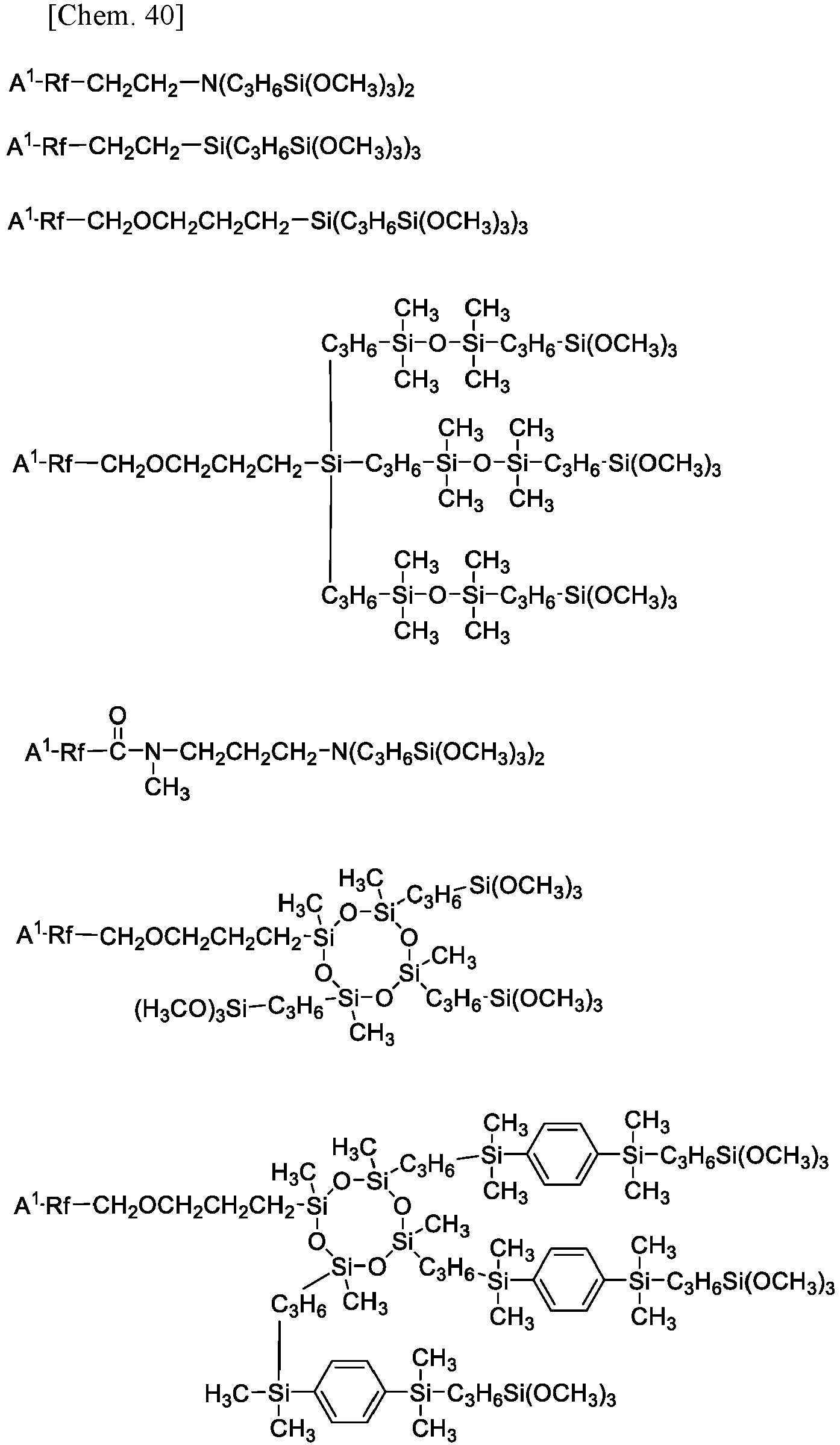
- Herein A1 and Rf are as defined above.
- Next, the fluoropolyether-containing polymer having the formula (4) is described.
[Chem. 41]
A2-Rf-G (4)
- In formula (4), Rf is as defined above and as exemplified above for Rf in formula (1).
- In formula (4): A2-Rf-G, A2 is a monovalent fluorinated hydrocarbon group which is terminated with CF3- or CF2H- and may contain oxygen, or G which is a monovalent group having the formula (5): -C(B)(W)2. The monovalent fluorinated hydrocarbon group which is terminated with CF3- or CF2H- and may contain oxygen is preferably a C1-C6 fluoroalkyl group, more preferably a group giving a polymer terminated with CF3- or CF2H-.
- Examples of the monovalent fluorinated hydrocarbon group which is terminated with CF3- or CF2H- and may contain oxygen, represented by A2, include the following groups.

- In formula (4): A2-Rf-G, G is independently a monovalent group having the formula (5).

- In formula (5), W is as defined above and as exemplified above for W in formula (2).
- In formula (5): -C(B)(W)2, B is hydrogen or -OS. S is hydrogen, a C1-C10 monovalent hydrocarbon group, or a monovalent group having the following formula (6).

- Examples of the C1-C10 monovalent hydrocarbon group represented by S include alkyl groups such as methyl, ethyl, propyl, butyl, pentyl, hexyl and octyl, alkenyl groups such as vinyl and allyl, aryl groups such as phenyl and tolyl, and aralkyl groups such as benzyl and phenylethyl. Inter alia, C1-C3 alkyl groups and phenyl are preferred.
- In formula (6): -T-(LO)1-E, T is a single bond or divalent group, preferably a single bond or a C2-C20 divalent hydrocarbon group which may contain at least one bond selected from the group consisting of silicon, siloxane bond, silalkylene bond (e.g., silethylene bond or silpropylene bond), silarylene bond (e.g., silphenylene bond), and diorganosilylene moiety (e.g., dialkylsilylene moiety such as dimethylsilylene or dialkoxysilylene moiety such as dimethoxysilylene), a divalent siloxane bond, silalkylene group or diorganosilylene group. Examples of the group T other than a single bond are shown below. It is noted that the valence bond on the right side in the following structure is preferably attached to L or E.
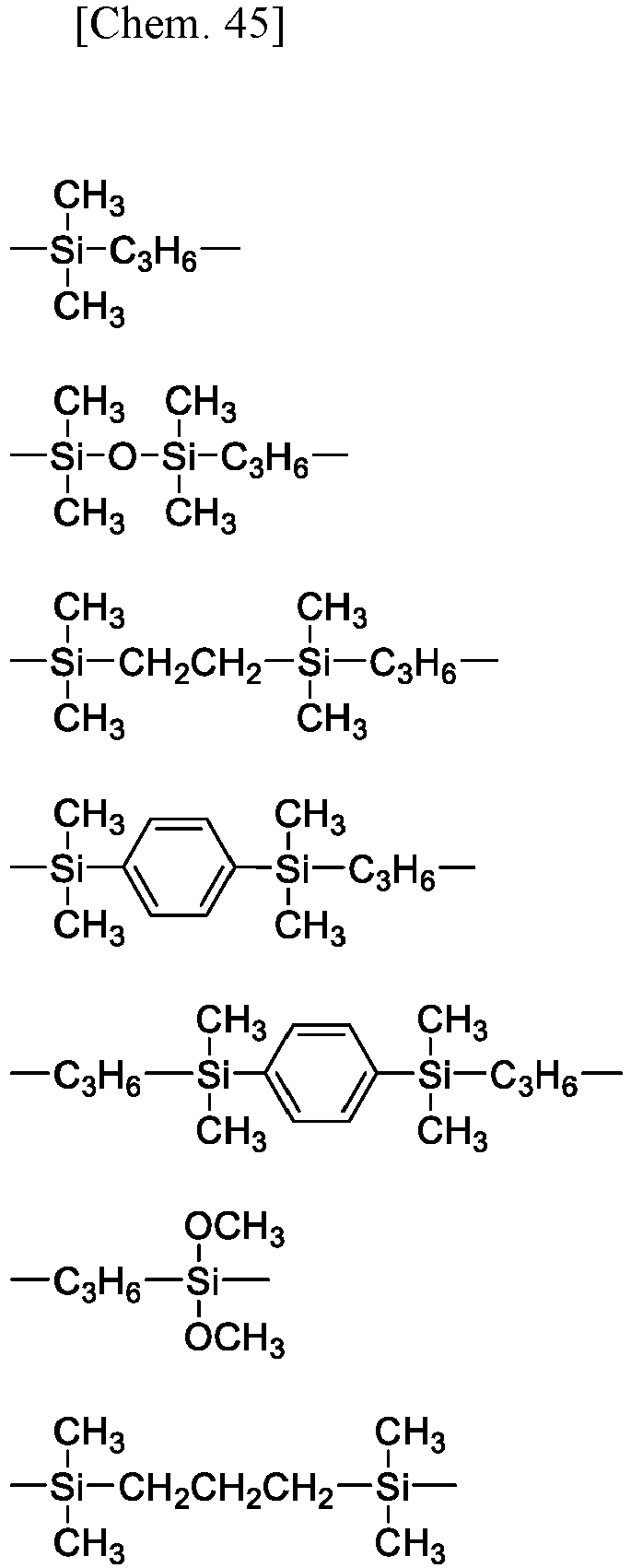
- In formula (6): -T-(LO)1-E, L is independently a C1-C4 divalent hydrocarbon group, typically alkylene group such as methylene, ethylene, propylene (trimethylene or methylethylene) or butylene (tetramethylene). For (LO) units, the number of carbon atoms may be identical or different.
- In formula (6): -T-(LO)1-E, l is an integer of 0 to 20, preferably an integer of 0 to 10, more preferably 0 to 6. It is noted that when (LO) is contained, l is preferably at least 1, more preferably at least 2.
- In formula (6): -T-(LO)1-E, E is a C1-C6 monovalent hydrocarbon group such as a C1-C4 alkyl group, e.g., methyl, ethyl, propyl or butyl or phenyl, or W. W is as defined above and as exemplified above for W in formula (2).
- Examples of the monovalent group having formula (6): -T-(LO)1-E are shown below.

- Examples of the monovalent group having formula (5): -C(B)(W)2, represented by G in formula (4), are shown below.
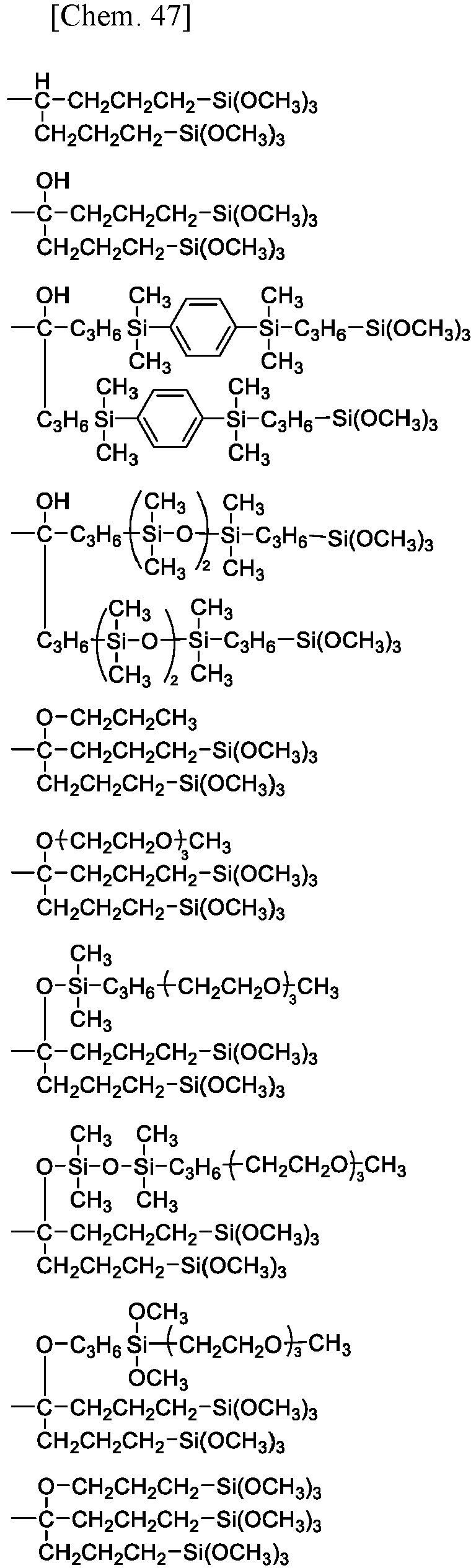
- Examples of the fluoropolyether-containing polymer having formula (4) are shown below.

- Herein A2 and Rf are as defined above.
- Next, the fluoropolyether-containing polymer having the formula (7) is described.
[Chem. 49]
A3-Rf-J (7)
- In formula (7), Rf is as defined above and as exemplified above for Rf in formula (1).
- In formula (7): A3-Rf-J, A3 is a monovalent fluorinated hydrocarbon group which is terminated with CF3- or CF2H- and may contain oxygen, or J, which is a monovalent group having the formula (8): -V-C(=O)N(S)2-e(M)e. The monovalent fluorinated hydrocarbon group which is terminated with CF3- or CF2H- and may contain oxygen is preferably a C1-C6 fluoroalkyl group, more preferably a group giving a polymer terminated with CF3-or CF2H-.
- Examples of the monovalent fluorinated hydrocarbon group which is terminated with CF3- or CF2H- and may contain oxygen, represented by A3, are shown below.
[Chem. 50] CF2H- CF3- C2F5- C3F7 C4F9- C3F7OCFHCF2OCH2- CF3OCFHCF2OCH2- CF3OC3F6OCFHCF2OCH2-
- In formula (7): A3-Rf-J, J is independently a group having the formula (8), J containing at least 2 W.

- In formula (8), S is as defined above and as exemplified above for S.
- In formula (8), Visa single bond or a C2-C15 divalent hydrocarbon group which may contain an ether bond. Examples of the group V other than a single bond are shown below. It is noted that the valence bond on the right side in the following structure is preferably attached to the carbon atom (-C(=O)-).
[Chem. 52] -CH2OCH2- -CH2OCH2CH2CH2CH2- -CH2CH2CH2OCH2CH2CH2-
- In formula (8), e is 1 or 2, preferably 1.
- In formula (8), M is independently a monovalent group having the formula (9).

- In formula (9), Y, S, and W are as defined above and as exemplified above for Y in formula (3), S and W in formula (2).
- In formula (9), f is an integer of 1 to 3.
- Examples of the monovalent group having formula (9): -Y-C(S)3-f(W)f, represented by M in formula (8), are shown below.
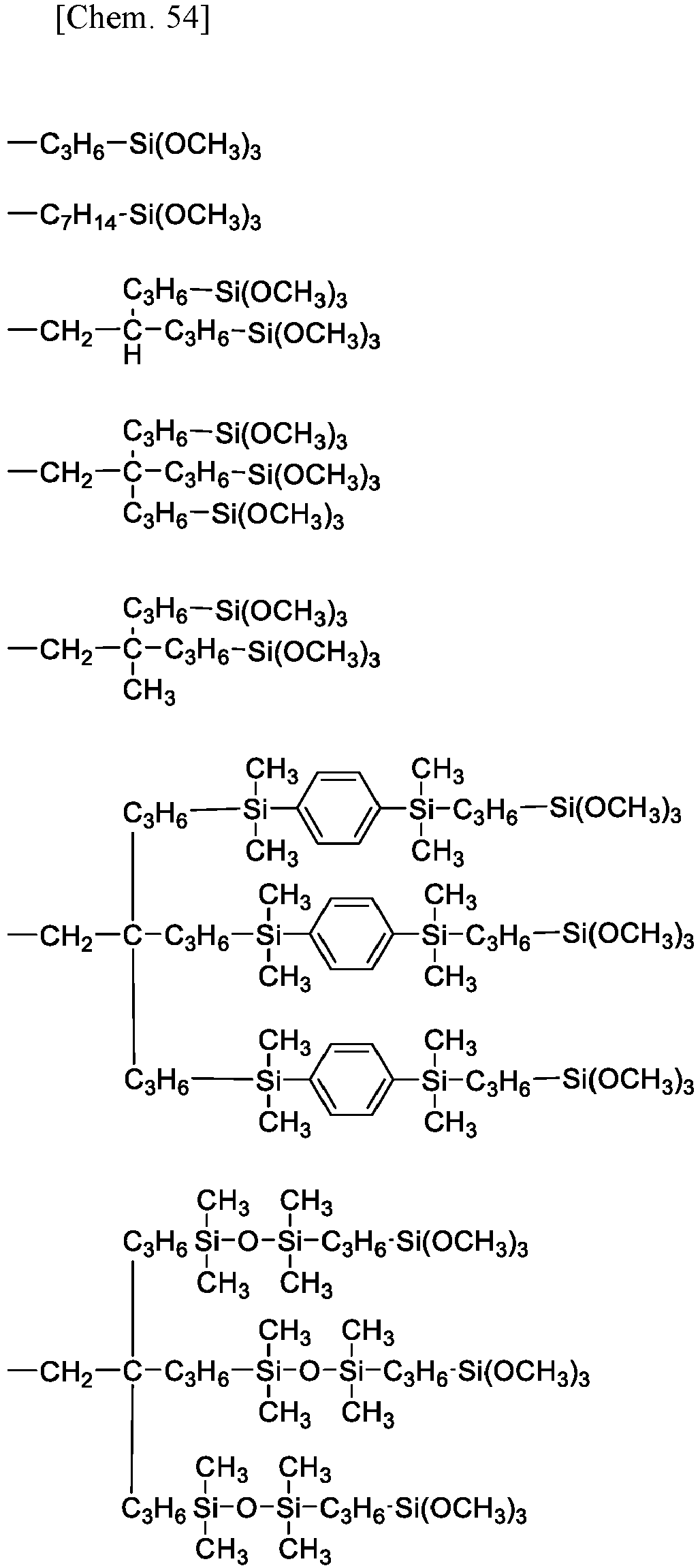
- Examples of the monovalent group having formula (8): -V-C(=O)N(S)2-e(M)e are shown below.


- Examples of the fluoropolyether-containing polymer having formula (7) are shown below.


- Herein A3 and Rf are as defined above.
- The surface treating agent for forming the water/oil repellent surface layer in the inventive article comprises a fluoropolyether-containing polymer having a hydrolyzable silyl group and/or a partial hydrolytic condensate thereof. The surface treating agent may be a mixture (i.e., fluoropolyether-containing polymer composition) comprising the fluoropolyether-containing polymer having a hydrolyzable silyl group and/or the partial hydrolytic condensate thereof and a fluoropolyether-containing polymer having the formula (10), free of a hydrolyzable silyl group, which is referred to as hydrolyzable silyl group-free polymer, and/or a partial (hydrolytic) condensate thereof. As used herein, the term "partial (hydrolytic) condensate" refers to a partial condensate or partial hydrolytic condensate.
[Chem. 59]
A4-Rf-A4 (10)
- Herein Rf is as defined above and as exemplified above for Rf in formula (1). A4 is independently a monovalent fluorinated hydrocarbon group which is terminated with CF3- or CF2H- and may contain oxygen, or -OR3, -COOR3 or -PO(OR3)2 wherein R3 is hydrogen or a C1-C10 monovalent hydrocarbon group.
- In formula (10), A4 is independently a monovalent fluorinated hydrocarbon group which is terminated with CF3- or CF2H- and may contain oxygen, or -OR3, -COOR3 or -PO(OR3)2. Examples of the monovalent fluorinated hydrocarbon group which is terminated with CF3- or CF2H- and may contain oxygen are as exemplified above for the monovalent fluorinated hydrocarbon group which is terminated with CF3- or CF2H- and may contain oxygen, represented by A1.
- Herein, R3 is hydrogen or a C1-C10 monovalent hydrocarbon group. Examples of the monovalent hydrocarbon group include alkyl groups such as methyl, ethyl, propyl, butyl, pentyl, hexyl and octyl, alkenyl groups such as vinyl and allyl, aryl groups such as phenyl and tolyl, and aralkyl groups such as benzyl and phenylethyl. R3 is preferably hydrogen, C1-C3 alkyl group or phenyl group.
- Examples of -OR3, -COOR3 and -PO(OR3)2, represented by A4, include -OH, -OCH3, -COOH, -COOCH3, -PO(OH)2, -OC2H5, and -COOC2H5.
- Examples of the fluoropolyether-containing polymer having formula (10) are shown below.
[Chem. 60]
CF3-O-(CF2O)p"(C2F4O)q"(C3F6O)r"(C4F8O)s"(C5F10O)t"(C6F12O)u"-CF3
CF3-O-(CF2O)p"(C2F4O)q"(C3F6O)r"(C4F8O)s"(C5F10O)t"(C6F12O)u"-CF2-COOH
CF3-O-(CF2O)p"(C2F4O)q"(C3F6O)r"(C4F8O)s"(C5F10O)t"(C6F12O)u"-CF2-COOCH3
CF3-O-(CF2O)p"(C2F4O)q"(C3F6O)r"(C4F8O)s"(C5F10O)t"(C6F12O)u"-CF2-PO(OH)2
CF3-O-(CF2O)p"(C2F4O)q"(C3F6O)r"(C4F8O)s"(C5F10O)t"(C6F12O)u"-CF2-OH
CF3-O-(CF2O)p"(C2F4O)q"-(C3F8O)r"-(C4F8O)s"(C5F10O)t"(C6F12O)u"-CF2-OCH3
HOOC-CF2-O-(CF2O)p"(C2F4O)q"(C3F6O)r"(C4F8O)s"(C5F10O)t"(C6F12O)u"-CF2-COOH
HO-CF2-O-(CF2O)p"(C2F4O)q"(C3F6O)r"(C4F8O)s"(C5F10O)t"(C6F12O)u"-CF2-OH
- Herein, p", q", r", s", t", and u" are each independently an integer of 0 to 150, the sum of p", q", r", s", t", and u" is 12 to 250, each unit may be straight or branched, the repeating units in parentheses with subscripts p", q", r", s", t", and u" may be randomly arranged.
- The surface treating agent for forming the water/oil repellent surface layer in the inventive article comprises at least one of fluoropolyether-containing polymers each having at least 2 hydrolyzable silyl groups at one end of the molecular chain, represented by the above formulae (1), (4) and (7) and/or partial hydrolytic condensates thereof (single end type polymer), or at least one of fluoropolyether-containing polymers each having at least 2 hydrolyzable silyl groups at both ends of the molecular chain, represented by the above formulae (1), (4) and (7) and/or partial hydrolytic condensates thereof (dual end type polymer), a mixture containing at least one single end type polymer and at least one dual end type polymer, or a mixture (i.e., fluoropolyether-containing polymer composition) containing any one of the foregoing and a hydrolyzable silyl group-free polymer.
- In the surface treating agent comprising the fluoropolyether-containing polymer mixture (fluoropolyether-containing polymer composition), although the mixing ratio of the single end type polymer and/or dual end type polymer to the hydrolyzable silyl group-free polymer is not particularly limited, the hydrolyzable silyl group-free polymer is desirably 0.01 to 30 mol%, more desirably 0.1 to 10 mol% of the overall fluoropolyether-containing polymer composition consisting of the single end type polymer and/or dual end type polymer and the hydrolyzable silyl group-free polymer.
- In the surface treating agent, the fluoropolyether-containing polymer having a hydrolyzable silyl group and/or partial hydrolytic condensate thereof, or the fluoropolyether-containing polymer composition preferably has a number average molecular weight (Mn) of 1,000 to 20,000. The number average molecular weight is more preferably 2,000 to 10,000, even more preferably 3,000 to 8,000. Notably, the number average molecular weight can be computed from a ratio of characteristic peak strengths in 19F-NMR spectroscopy.
- The fluoropolyether-containing polymer having a hydrolyzable silyl group and/or partial hydrolytic condensate thereof, or the fluoropolyether-containing polymer composition, having a Mn in the above-defined range, is obtainable by rectification or molecular distillation of the fluoropolyether-containing polymer having a hydrolyzable silyl group and/or partial hydrolytic condensate thereof, or the fluoropolyether-containing polymer composition.
- The fluoropolyether-containing polymer having a hydrolyzable silyl group and/or partial hydrolytic condensate thereof, or the fluoropolyether-containing polymer composition, having a Mn in the above-defined range, is also obtainable by previously modifying the fluorine compound used in the synthesis of the fluoropolyether-containing polymer so as to have a Mn in the above-defined range.
- To the surface treating agent, hydrolytic condensation catalysts may be added, if necessary, for example, organotin compounds (e.g., dibutyltin dimethoxide and dibutyltin dilaurate), and organotitanium compounds (e.g., tetra-n-butyl titanate), organic acids (e.g., acetic acid, methanesulfonic acid and fluorine-modified carboxylic acid), and inorganic acids (e.g., hydrochloric acid and sulfuric acid). Of these, acetic acid, tetra-n-butyl titanate, dibutyltin dilaurate, and fluorine-modified carboxylic acid are desirable. The addition amount is a catalytic amount and typically 0.01 to 5 parts by weight, especially 0.1 to 1 part by weight per 100 parts by weight of the fluoropolyether-containing polymer having a hydrolyzable silyl group and/or partial hydrolytic condensate thereof.
- The surface treating agent may also contain a solvent. The solvent may be preferably selected from fluorine-modified aliphatic hydrocarbon-based solvents (e.g., perfluoroheptane and perfluorooctane), fluorine-modified olefin-based solvents (e.g., methoxyperfluoroheptene), fluorine-modified aromatic hydrocarbon-based solvents (e.g., m-xylene hexafluoride, benzotrifluoride, and 1,3-trifluoromethylbenzene), fluorine-modified ether-based solvents (e.g., methyl perfluorobutyl ether, ethyl perfluorobutyl ether, and perfluoro(2-butyltetrahydrofuran)), fluorine-modified alkyl amine-based solvents (e.g., perfluorotributylamine and perfluorotripentylamine), hydrocarbon-based solvents (e.g., petroleum benzine, mineral spirits, toluene and xylene), and ketone-based solvents (e.g., acetone, methyl ethyl ketone and methyl isobutyl ketone). Inter alia, fluorine-modified solvents, also referred to as fluorinated solvents, are desirable in view of solubility and wettability. Especially, 1,3-trifluoromethylbenzene, m-xylene hexafluoride, perfluoro(2-butyltetrahydrofuran), perfluorotributylamine, and ethyl perfluorobutyl ether are preferred.
- Two or more solvents may be mixed. Preferred is the solvent capable of uniformly dissolving the fluoropolyether-containing polymer having a hydrolyzable silyl group and/or partial hydrolytic condensate thereof or the fluoropolyether-containing polymer composition. When the fluoropolyether-containing polymer having a hydrolyzable silyl group and/or partial hydrolytic condensate thereof is dissolved in the solvent, the optimum concentration is not particularly limited and may be selected as appropriate depending on how to apply the surface treating agent. The polymer is typically dissolved in the solvent so as to provide a concentration of 0.01 to 30% by weight, preferably 0.02 to 25% by weight, more preferably 0.05 to 20% by weight.
- In forming the water/oil repellent surface layer from the surface treating agent, any of well-known techniques such as brush coating, dipping (or immersion), spraying, and evaporation or physical vapor deposition (PVD) may be used. Inter alia, PVD, spraying or dipping is preferred. In case of PVD, the heating means used for evaporation deposition may be either resistance heating or electron beam heating and is not particularly limited.
- The formation of the water/oil repellent surface layer is preferably followed by curing treatment. The curing treatment involves exposure to an environment at a temperature of 20 to 200°C and a relative humidity of up to 95% for at least 0.5 hour. The conditions for the curing treatment may be suitably adjusted depending on a particular technique for forming the water/oil repellent surface layer. For example, preferred conditions for direct coating (brush coating, dipping or spraying) include 60 to 150°C, up to 85% RH, and 30 minutes to 24 hours, and preferred conditions for evaporation deposition include 25 to 150°C, up to 85% RH, and 30 minutes to 24 hours.
- The water/oil repellent surface layer typically has a film thickness of 0.1 to 100 nm, preferably 1 to 20 nm. The thickness of the water/oil repellent surface layer may be measured by the aforementioned XRR or spectral ellipsometry.
- Examples and Comparative Examples are given below for illustrating the invention although the invention is not limited thereto. In Examples, the number average molecular weight (Mn) is computed from a ratio of characteristic peak strengths in 19F-NMR spectroscopy.
- A chemically strengthened glass substrate (Gorilla by Corning Inc., size 100 mm × 50 mm × 0.7 mm thick) was dipped in an alkaline cleaning liquid (aqueous solution of Semi-Clean L.G.L by Yokohama Oils & Fats Industry Co., Ltd. diluted to 5% by weight) and ultrasonically cleaned for 5 minutes. Then the glass substrate was dipped in ion exchanged water and ultrasonically cleaned for 6 minutes. The glass substrate was dried by ejecting compressed air to blow off water.
- The glass substrate after alkaline cleaning was treated on its surface with an oxygen/argon mixture plasma under the following conditions.
Treatment device: PDC510 (Yamato Scientific Co., Ltd.) Oxygen gas flow rate: 10 sccm (standard cubic centimeters) Argon gas flow rate: 100 sccm Treating pressure: 60 Pa RF supply power: 250 W Treating time: 30 seconds - The CVD method described in Patent Document 14 (
JP 6569831 Precursor material: tetraethoxysilane Substrate temperature: 30°C Treating gas (flow rate): ozone gas (150 sccm) ethylene gas (50 sccm) tetraethoxysilane (1 sccm) nitrogen gas (15 sccm) - The film thickness and film density of the silicon oxide underlayer were measured by the X-ray reflectometry. Specifically, the film thickness and density were determined by simulation fitting of the measured profile.
- The measuring conditions are shown below.
Analyzer: SmartLab (Rigaku Corp.) X-ray source: rotating anode (Cu), output 45 kV, 200 mA Incident optical system: Ge (111) asymmetric beam compression crystal Detector solar slit: 5.0° Slit: incident side IS = 0.05 mm detector side RS1 = 0.1 mm, RS2 = 0.1 mm Scanning conditions: scanning axis 2θ/ω scanning speed 0.2°/min step width 0.002° - The silicon oxide underlayer-bearing glass substrate was set in a vacuum evaporation system of resistance heating type (VTR-350M by ULVAC Inc.). A droplet (5 µL) of a surface treating agent was placed in the resistance heater chamber, which was evacuated. When the chamber was evacuated to or below an internal pressure of 3 × 10⁻³ Pa, resistance heating was started. The power fed for resistance heating was adjusted such that the maximum evaporation rate measured by a quartz oscillator film thickness meter which was spaced ~20 cm apart from the resistance heater chamber might be 1.0 nm/sec. After the evaporation rate read by the quartz oscillator film thickness meter decreased to 0.1 nm/sec, resistance heating was continued for a further 100 seconds. After a standby time of 5 minutes for cooling, the chamber was opened to air. The glass substrate having a fluoropolyether-containing polymer deposited thereon was obtained.
- The glass substrate having a fluoropolyether-containing polymer deposited thereon was allowed to stand in an environment of 25°C and RH 50% for 24 hours, during which the water/oil repellent surface layer was cured and fixed. The glass substrate bearing a water/oil repellent surface layer of fluoropolyether-containing polymer having a film thickness of 10 nm was obtained.
- The film thickness of the water/oil repellent surface layer was computed by quantitatively measuring the strength of X-ray fluorescence attributable to fluorine element by means of X-ray fluorescence spectrometer (Rigaku Inc., tradename X-ray fluorescence spectrometer Primini), and plotting on the calibration line.
- The surface treating agent was prepared by dissolving Compound A (Mn 4,000) having the formula shown below in a fluorochemical solvent (Novec HFE-7200 by 3M) to a concentration of 20% by weight.

- A substrate bearing a water/oil repellent surface layer of fluoropolyether-containing polymer was prepared by the same procedure as in Example 1 except that the deposition time was adjusted such that the silicon oxide underlayer might have a film thickness of 100 nm.
- A substrate bearing a water/oil repellent surface layer of fluoropolyether-containing polymer was prepared by the same procedure as in Example 1 except that the deposition time was adjusted such that the silicon oxide underlayer might have a film thickness of 200 nm.
- A substrate bearing a water/oil repellent surface layer of fluoropolyether-containing polymer was prepared by the same procedure as in Example 1 except that the conditions for forming the silicon oxide underlayer were changed as below such that the silicon oxide underlayer might have a film thickness of 200 nm and a film density of 2.2 g/cm3.
Precursor material: hexamethyldisilazane Substrate temperature: 150°C Treating gas (flow rate): ozone gas (200 sccm) ethylene gas (20 sccm) hexamethyldisilazane (5 sccm) nitrogen gas (15 sccm) - A substrate bearing a water/oil repellent surface layer of fluoropolyether-containing polymer was prepared by the same procedure as in Example 1 except that the silicon oxide underlayer was formed by the following method.
- A glass substrate which had been subjected to alkaline cleaning and plasma cleaning as in Example 1 was dip coated with a water dispersion of silica nano-particles, forming a silicon oxide underlayer having a film thickness of 4 nm and a film density of 2.0 g/cm3. The coating conditions are shown below.
average particle size of silica nano-particles: 2 nm concentration of silica nano-particles: 0.1 wt% dipping time: 30 sec pull-up speed: 0.5 mm/sec drying conditions: 150°C, 30 min - A substrate bearing a water/oil repellent surface layer of fluoropolyether-containing polymer was prepared by the same procedure as in Example 5 except that a silicon oxide underlayer having a film thickness of 10 nm was formed under the following dipping conditions.
average particle size of silica nano-particles: 2 nm concentration of silica nano-particles: 0.1 wt% dipping time: 30 sec pull-up speed: 3.0 mm/sec drying conditions: 150°C, 30 min - A substrate bearing a water/oil repellent surface layer of fluoropolyether-containing polymer was prepared by the same procedure as in Example 1 except that a silicon oxide underlayer was formed by the following method.
- A glass substrate which had been subjected to alkaline cleaning and plasma cleaning as in Example 1 was spray coated with a perhydropolysilazane solution (Aquamica NP-140-01 by AZ Electronic Materials) and allowed to stand in an ambient atmosphere of 25°C and RH 85% for 24 hours for curing, forming a silicon oxide underlayer having a film thickness of 10 nm and a film density of 2.0 g/cm3.
- A substrate bearing a water/oil repellent surface layer of fluoropolyether-containing polymer was prepared by the same procedure as in Example 7 except that the curing conditions for the silicon oxide underlayer were standing in an ambient atmosphere of 25°C and RH 40% for 24 hours.
- A substrate bearing a water/oil repellent surface layer of fluoropolyether-containing polymer was prepared by the same procedure as in Example 8 except that the silicon oxide underlayer had a film thickness of 100 nm.
- A substrate bearing a water/oil repellent surface layer of fluoropolyether-containing polymer was prepared by the same procedure as in Example 1 except that the surface treating agent was prepared by dissolving Compound B (Mn 4,000) having the formula shown below in a fluorochemical solvent (Novec HFE-7200 by 3M) to a concentration of 20% by weight.

- A substrate bearing a water/oil repellent surface layer of fluoropolyether-containing polymer was prepared by the same procedure as in Example 6 except that the surface treating agent of Compound B was used.
- A substrate bearing a water/oil repellent surface layer of fluoropolyether-containing polymer was prepared by the same procedure as in Example 1 except that the surface treating agent was prepared by dissolving Compound C (Mn 4,000) having the formula shown below in a fluorochemical solvent (Novec HFE-7200 by 3M) to a concentration of 20% by weight.

- A substrate bearing a water/oil repellent surface layer of fluoropolyether-containing polymer was prepared by the same procedure as in Example 6 except that the surface treating agent of Compound C was used.
- A substrate bearing a water/oil repellent surface layer of fluoropolyether-containing polymer was prepared by the same procedure as in Example 7 except that the curing conditions for the silicon oxide underlayer were standing in an ambient atmosphere of 25°C and RH 5% for 24 hours.
- A substrate bearing a water/oil repellent surface layer of fluoropolyether-containing polymer was prepared by the same procedure as in Comparative Example 1 except that the silicon oxide underlayer had a film thickness of 100 nm.
- A substrate bearing a water/oil repellent surface layer of fluoropolyether-containing polymer was prepared by the same procedure as in Example 1 except that the silicon oxide underlayer was formed by the following method.
- On a glass substrate which had been subjected to alkaline cleaning and plasma cleaning as in Example 1, a silicon oxide underlayer having a film thickness of 5 nm and a film density of 2.3 g/cm3 was deposited by electron beam evaporation of silicon oxide. The deposition conditions are shown below.
Evaporation source: SiO2 granules (2 mm) Ultimate pressure: 1×10⁻³ Pa Deposition rate: 1 nm/sec - A substrate bearing a water/oil repellent surface layer of fluoropolyether-containing polymer was prepared by the same procedure as in Comparative Example 3 except that the silicon oxide underlayer had a film thickness of 100 nm.
- A substrate bearing a water/oil repellent surface layer of fluoropolyether-containing polymer was prepared by the same procedure as in Comparative Example 3 except that the silicon oxide underlayer had a film thickness of 200 nm.
- A substrate bearing a water/oil repellent surface layer of fluoropolyether-containing polymer was prepared by the same procedure as in Example 1 except that the silicon oxide underlayer was formed by the following method.
- On a glass substrate which had been subjected to alkaline cleaning and plasma cleaning as in Example 1, a silicon oxide underlayer was deposited by the plasma-assisted CVD method. Under the following treatment conditions, a silicon oxide underlayer having a film thickness of 10 nm and a film density of 2.4 g/cm3 was formed.
Precursor material: SiH4 Substrate temperature: 150°C RF plasma source supply power: 300 W Treating pressure: 150 Pa Treating gas (flow rate ratio): SiH4 : N2O : H2 = 1 : 30 : 180 - A substrate bearing a water/oil repellent surface layer of fluoropolyether-containing polymer was prepared by the same procedure as in Comparative Example 6 except that the silicon oxide underlayer had a film thickness of 100 nm.
- A substrate bearing a water/oil repellent surface layer of fluoropolyether-containing polymer was prepared by the same procedure as in Comparative Example 6 except that the silicon oxide underlayer had a film thickness of 200 nm.
- A substrate bearing a water/oil repellent surface layer of fluoropolyether-containing polymer was prepared by the same procedure as in Comparative Example 3 except that the surface treating agent of Compound B was used.
- A substrate bearing a water/oil repellent surface layer of fluoropolyether-containing polymer was prepared by the same procedure as in Comparative Example 3 except that the surface treating agent of Compound C was used.
- Using a contact angle meter Drop Master (Kyowa Interface Science Co., Ltd.), the glass substrate having the silicon oxide underlayer and the water/oil repellent surface layer prepared above was measured for a contact angle with water (indicative of water repellency) on the water/oil repellent surface layer (droplet 2 µl, temperature 25°C, relative humidity 40%). The rating is excellent (⊚) for a contact angle with water of 112° or greater, good (O) for a contact angle of 108° to less than 112°, fair (△) for a contact angle of 100° to less than 108°, and poor (×) for a contact angle of less than 100°, with the results shown in Table 1.
- All the samples of Examples and Comparative Examples had an initial contact angle with water of 112° or greater, indicating excellent water repellency.
- Using a surface property tester (Type 14FW by Shinto Scientific Co., Ltd.), the glass substrate having the silicon oxide underlayer and the water/oil repellent surface layer prepared above was measured for a coefficient of dynamic friction. The surface was rubbed with a non-woven fabric (Bemcot M-3II by Asahi Kasei Corp.) at a load of 100 gf/cm2 and a rubbing speed of 500 mm/min. Provided that the coefficient of dynamic friction is an index for evaluating glide resistance, the rating is excellent (⊚) for a coefficient of less than 0.05, good (O) for a coefficient of 0.05 to less than 0.1, fair (△) for a coefficient of 0.1 to less than 0.2, and poor (×) for a coefficient of 0.2 or greater, with the results shown in Table 1. The test environment conditions include 25°C and RH 40%.
- The samples of Examples 1 to 10, 12 and Comparative Examples 1 to 9 had a coefficient of dynamic friction of less than 0.05, indicating excellent glide.
- Using a reciprocal abrasion tester (Type 40 by Shinto Scientific Co., Ltd.), the glass substrate having the silicon oxide underlayer and the water/oil repellent surface layer prepared above was tested under the following conditions.
Rubbing material: eraser (Minoan Co., diameter 6 mm) Load: 1 kgf Reciprocal distance: 40 mm Reciprocal moving speed: 40 cycles/min Total number of friction cycles: 20,000 cycles - Every 1,000 reciprocal friction cycles, the frictionally abraded portion was measured for a contact angle with water. Provided that the number of reciprocal friction cycles within which a contact angle with water of 100° or greater is maintained is the index of eraser abrasion durability, the sample is rated excellent (⊚) for an index of eraser abrasion durability of 20,000 cycles or greater, good (O) for an index of eraser abrasion durability of 15,000 cycles to less than 20,000 cycles, fair (△) for an index of eraser abrasion durability of 10,000 cycles to less than 15,000 cycles, and poor (×) for an index of eraser abrasion durability of less than 10,000 cycles, with the results shown in Table 1. The test environment conditions include 25°C and RH 40%.
[Table 1] Glass substrate Silicon oxide underlayer Water/oil repellent surface layer Initial water repellency Gliding property Abrasion durability Formation method Film thickness (nm) Film density (g/cm3) Compound Film thickness (nm) Example 1 Gorilla glass CVD 5 2.0 (A) 10 ⊚ ⊚ ⊚ Example 2 Gorilla glass CVD 100 2.0 (A) 10 ⊚ ⊚ ○ Example 3 Gorilla glass CVD 200 2.0 (A) 9 ⊚ ⊚ ○ Example 4 Gorilla glass CVD 200 2.2 (A) 9 ⊚ ⊚ ⊚ Example 5 Gorilla glass silica nano-particles 4 2.0 (A) 10 ⊚ ⊚ ○ Example 6 Gorilla glass silica nano-particles 10 2.0 (A) 10 ⊚ ⊚ ⊚ Example 7 Gorilla glass polysilazane 10 2.0 (A) 10 ⊚ ⊚ ⊚ Example 8 Gorilla glass polysilazane 10 1.8 (A) 8 ⊚ ⊚ ⊚ Example 9 Gorilla glass polysilazane 100 1.8 (A) 8 ⊚ ⊚ ○ Example 10 Gorilla glass CVD 5 2.0 (B) 9 ⊚ ⊚ ○ Example 11 Gorilla glass silica nano-particles 10 2.0 (B) 9 ⊚ Δ ⊚ Example 12 Gorilla glass CVD 5 2.0 (C) 8 ⊚ ⊚ Δ Example 13 Gorilla glass silica nano-particles 10 2.0 (C) 8 ⊚ Δ ⊚ Comparative Example 1 Gorilla glass polysilazane 10 1.7 (A) 9 ⊚ ⊚ Δ Comparative Example 2 Gorilla glass polysilazane 100 1.7 (A) 9 ⊚ ⊚ × Comparative Example 3 Gorilla glass PVD 5 2.3 (A) 10 ⊚ ⊚ Δ Comparative Example 4 Gorilla glass PVD 100 2.3 (A) 10 ⊚ ⊚ × Comparative Example 5 Gorilla glass PVD 200 2.3 (A) 10 ⊚ ⊚ × Comparative Example 6 Gorilla glass plasma-assisted CVD 10 2.4 (A) 10 ⊚ ⊚ Δ Comparative Example 7 Gorilla glass plasma-assisted CVD 100 2.4 (A) 9 ⊚ ⊚ × Comparative Example 8 Gorilla glass plasma-assisted CVD 200 2.4 (A) 9 ⊚ ⊚ × Comparative Example 9 Gorilla glass PVD 5 2.3 (B) 9 ⊚ ⊚ × Comparative Example 10 Gorilla glass PVD 5 2.3 (C) 9 ⊚ Δ ×
Claims (7)
- An article comprising a glass substrate, an underlayer formed mainly of silicon oxide on the outer surface of the glass substrate, and a water/oil repellent surface layer formed on the outer surface of the underlayer, wherein the silicon oxide underlayer has a film density of 1.8 to 2.2 g/cm3, the water/oil repellent surface layer is based on a cured product of a fluoropolyether-containing polymer having a hydrolyzable silyl group and/or a partial hydrolytic condensate thereof, and the fluoropolyether-containing polymer having a hydrolyzable silyl group contains at least one fluoropolyether-containing polymer having the formula (1), (4) or (7):
[Chem. 1]
A1-Rf-D ( 1 )
wherein Rf is a divalent polyfluorooxyalkylene structure-containing group: -CaF2d-O-(CF2O)p(C2F4O)q(C3F6O)r(C4F8O)s(C5F10O)t(C6F12O)u-CdF2d- wherein d is an integer of 0 to 5 independently for each unit, p, q, r, s, t, and u are each independently an integer of 0 to 150, the sum of p, q, r, s, t, and u is an integer of 1 to 250, each unit may be straight or branched, the repeating units in parentheses with subscripts p, q, r, s, t, and u may be randomly arranged, A1 is a monovalent fluorinated hydrocarbon group which is terminated with CF3- or CF2H- and may contain oxygen, or D, D is independently a monovalent group having the formula (2):
[Chem. 2]
-Q-Z(W)α ( 2 )
wherein Q is a single bond or a divalent organic group, Z is a tri- to octavalent group, α is an integer of 2 to 7, W is independently a monovalent hydrolyzable silyl-containing group having the formula (3):
[Chem. 4]
A2-Rf-G ( 4 )
wherein Rf is as defined above, A2 is a monovalent fluorinated hydrocarbon group which is terminated with CF3- or CF2H- and may contain oxygen, or G, G is independently a monovalent group having the formula (5):

[Chem. 7]
A3-Rf-J (7)
wherein Rf is as defined above, A3 is a monovalent fluorinated hydrocarbon group which is terminated with CF3- or CF2H- and may contain oxygen, or J, J is independently a monovalent group having the formula (8):
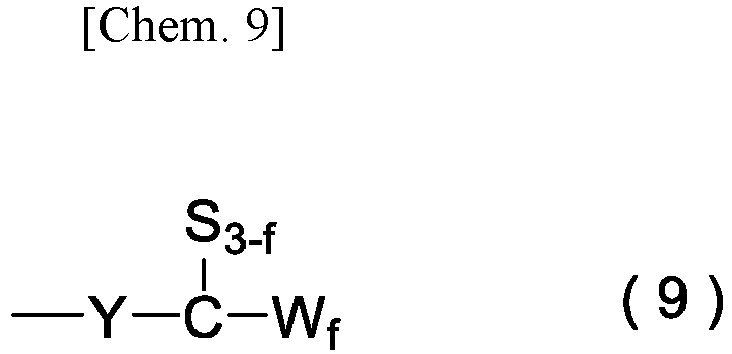
- The article of claim 1 wherein in formula (2), Q is a C1-C15 substituted or unsubstituted divalent hydrocarbon group which may contain at least one bond selected from the group consisting of amide bond, ether bond, ester bond, sulfide bond, urethane bond, siloxane bond, triazine bond, diorganosilylene moiety, silphenylene bond and silalkylene bond, and Z is a tri- to octavalent group selected from silicon, nitrogen, and tri- to octavalent organopolysiloxane residues containing a siloxane bond.
- The article of claim 1 wherein in formula (6), T is a single bond or a C2-C20 divalent hydrocarbon group which may contain at least one bond selected from the group consisting of silicon, siloxane bond, silalkylene bond, silarylene bond, and diorganosilylene moiety, a divalent siloxane bond, silalkylene group or diorganosilylene group.
- The article of any one of claims 1 to 3 wherein the water/oil repellent surface layer contains a cured product of at least one fluoropolyether-containing polymer having the formula (1), (4) or (7), and/or a partial hydrolytic condensate thereof, and a fluoropolyether-containing polymer having the formula (10):
[Chem. 10]
A4-Rf-A4 ( 10 )
wherein Rf is a divalent polyfluorooxyalkylene structure-containing group: -CaF2d-O-(CF2O)p(C2F4O)q(C3F6O)r(C4FsO)s(C5F10O)t(C6F12O)u-CaF2d- wherein d is an integer of 0 to 5 independently for each unit, p, q, r, s, t, and u are each independently an integer of 0 to 150, the sum of p, q, r, s, t, and u is an integer of 1 to 250, each unit may be straight or branched, the repeating units in parentheses with subscripts p, q, r, s, t, and u may be randomly arranged, and A4 is independently a monovalent fluorinated hydrocarbon group which is terminated with CF3- or CF2H- and may contain oxygen, or -OR3, -COOR3 or -PO(OR3)2 wherein R3 is hydrogen or a C1-C10 monovalent hydrocarbon group, and/or a partial (hydrolytic) condensate thereof. - The article of any one of claims 1 to 4 wherein the silicon oxide underlayer has a film thickness of 3 to 300 nm.
- The article of any one of claims 1 to 5 wherein the water/oil repellent surface layer is formed by a physical vapor deposition (PVD) method, spraying method or dipping method.
- The article of any one of claims 1 to 6 wherein the glass substrate has been pretreated by alkaline cleaning and/or plasma cleaning.
Applications Claiming Priority (2)
| Application Number | Priority Date | Filing Date | Title |
|---|---|---|---|
| JP2021128680 | 2021-08-05 | ||
| PCT/JP2022/028767 WO2023013476A1 (en) | 2021-08-05 | 2022-07-26 | Article having water- and oil-repellent surface layer |
Publications (2)
| Publication Number | Publication Date |
|---|---|
| EP4382291A1 true EP4382291A1 (en) | 2024-06-12 |
| EP4382291A4 EP4382291A4 (en) | 2025-07-09 |
Family
ID=85154501
Family Applications (1)
| Application Number | Title | Priority Date | Filing Date |
|---|---|---|---|
| EP22852899.8A Pending EP4382291A4 (en) | 2021-08-05 | 2022-07-26 | ARTICLES WITH WATER AND OIL REPELLENT SURFACE LAYER |
Country Status (7)
| Country | Link |
|---|---|
| US (1) | US20240286953A1 (en) |
| EP (1) | EP4382291A4 (en) |
| JP (2) | JP7838582B2 (en) |
| KR (1) | KR20240042469A (en) |
| CN (1) | CN117794741A (en) |
| TW (1) | TW202323214A (en) |
| WO (1) | WO2023013476A1 (en) |
Families Citing this family (2)
| Publication number | Priority date | Publication date | Assignee | Title |
|---|---|---|---|---|
| EP4382290A4 (en) * | 2021-08-05 | 2025-07-30 | Shinetsu Chemical Co | ARTICLES WITH WATER AND OIL-REPELLENT SURFACE LAYER |
| CN117401910A (en) * | 2022-07-08 | 2024-01-16 | 大金工业株式会社 | laminated body |
Family Cites Families (50)
| Publication number | Priority date | Publication date | Assignee | Title |
|---|---|---|---|---|
| JPS5494656U (en) | 1977-12-16 | 1979-07-04 | ||
| JPS5655215U (en) | 1979-09-30 | 1981-05-14 | ||
| JPS6016812Y2 (en) | 1980-09-26 | 1985-05-24 | 株式会社日立製作所 | Vented structure |
| ES2000920A6 (en) | 1985-07-18 | 1988-04-01 | Guala Angelo Spa | A dispenser of generic paste products and specifically toothpaste. |
| JPS6451279U (en) | 1987-09-24 | 1989-03-29 | ||
| JPH061492A (en) | 1992-06-19 | 1994-01-11 | Fuji Xerox Co Ltd | Sheet jam removing device for image forming device |
| JP3213633B2 (en) | 1992-06-30 | 2001-10-02 | エヌティエヌ株式会社 | Rotation transmission device |
| JPH0656983A (en) | 1992-08-05 | 1994-03-01 | Toray Ind Inc | Method for producing polycarbonate crystalline powder and method for producing high molecular weight polycarbonate |
| JPH0674107A (en) | 1992-08-25 | 1994-03-15 | Aisan Ind Co Ltd | Evaporation fuel treatment device |
| JPH0682874A (en) | 1992-09-04 | 1994-03-25 | Canon Inc | Shutter control device |
| JP2007011033A (en) | 2005-06-30 | 2007-01-18 | Fujifilm Holdings Corp | Antireflection film, polarizing plate using the same and display device |
| JP5064012B2 (en) | 2005-12-26 | 2012-10-31 | 信越化学工業株式会社 | Fluorine-containing organopolysiloxane, surface treatment agent containing the same, and article surface-treated with the surface treatment agent |
| JP5126869B2 (en) | 2006-01-25 | 2013-01-23 | 信越化学工業株式会社 | Fluorine-containing organopolysiloxane, surface treatment agent containing the same, and article treated with the surface treatment agent |
| JP4761057B2 (en) | 2006-05-01 | 2011-08-31 | 信越化学工業株式会社 | SUBSTRATE HAVING COMPOSITE HARD COAT LAYER WITH ANTIFOIDING COATING AGENT FIXED TO HARD COATING LAYER |
| JP5008192B2 (en) | 2006-09-08 | 2012-08-22 | 信越化学工業株式会社 | Perfluoropolyether-polyorganosiloxane copolymer and surface treatment agent containing the same |
| JP2008144144A (en) | 2006-11-15 | 2008-06-26 | Shin Etsu Chem Co Ltd | Coating agent composition |
| JP4709256B2 (en) | 2008-07-30 | 2011-06-22 | 信越化学工業株式会社 | Perfluoroether part-containing polymer and surface treatment agent containing the polymer |
| JP4666667B2 (en) | 2008-08-21 | 2011-04-06 | 信越化学工業株式会社 | Fluorine-containing surface treatment agent and article treated with the surface treatment agent |
| CN102171299B (en) | 2008-10-01 | 2013-10-16 | 株式会社T&K | Coating composition, antifouling treatment method, and antifouling base material |
| WO2010125964A1 (en) | 2009-04-30 | 2010-11-04 | コニカミノルタホールディングス株式会社 | Water-repelling member, and glass for vehicles |
| JP2010285574A (en) * | 2009-06-15 | 2010-12-24 | Konica Minolta Holdings Inc | Water repellent coated article, architectural window glass and vehicle window glass |
| JP5669257B2 (en) | 2009-10-27 | 2015-02-12 | 信越化学工業株式会社 | Fluorooxyalkylene group-containing polymer composition, surface treatment agent containing the composition, and article surface-treated with the surface treatment agent |
| JP5375668B2 (en) | 2010-02-26 | 2013-12-25 | 信越化学工業株式会社 | Perfluoroether group-containing organopolysiloxane and surface treatment composition, article and optical component |
| JP5235026B2 (en) * | 2010-09-28 | 2013-07-10 | 信越化学工業株式会社 | Fluorooxyalkylene group-containing polymer composition, surface treatment agent containing the composition, and article surface-treated with the surface treatment agent |
| WO2013121984A1 (en) | 2012-02-17 | 2013-08-22 | 旭硝子株式会社 | Fluorine-containing ether compound, fluorine-containing ether composition and coating fluid, and substrate having surface-treated layer and method for producing said substrate |
| WO2013168514A1 (en) | 2012-05-10 | 2013-11-14 | ダイキン工業株式会社 | Fluoropolyether group-containing silicone compound |
| JP5814209B2 (en) | 2012-10-24 | 2015-11-17 | 信越化学工業株式会社 | Coating agent composition, surface treatment agent containing the composition, and article surface-treated with the surface treatment agent |
| CN104769009B (en) | 2012-11-05 | 2017-08-11 | 大金工业株式会社 | Containing perfluor (poly-) ether silane compound |
| JP5768805B2 (en) | 2012-11-26 | 2015-08-26 | 信越化学工業株式会社 | Perfluoropolyether-modified polysilazane, method for producing the same, surface treatment agent, and article treated with the surface treatment agent |
| CN104870683B (en) | 2012-12-18 | 2018-08-31 | 株式会社爱发科 | Film-forming method and film-forming apparatus |
| JP6451279B2 (en) | 2014-03-31 | 2019-01-16 | 信越化学工業株式会社 | Fluoropolyether group-containing polymer-modified silane, surface treatment agent and article |
| JP6164144B2 (en) * | 2014-03-31 | 2017-07-19 | 信越化学工業株式会社 | Fluorine-containing coating agent and article treated with the coating agent |
| JP6274083B2 (en) * | 2014-11-17 | 2018-02-07 | 信越化学工業株式会社 | Water- and oil-repellent treatment agent having heat resistance, method for producing the same, and article |
| JP6260579B2 (en) | 2015-05-01 | 2018-01-17 | 信越化学工業株式会社 | Fluoropolyether group-containing polymer-modified silane, surface treatment agent and article |
| JP6601492B2 (en) | 2015-05-22 | 2019-11-06 | ダイキン工業株式会社 | Method for producing article having surface treatment layer |
| JP6390521B2 (en) * | 2015-06-03 | 2018-09-19 | 信越化学工業株式会社 | Fluoropolyether group-containing polymer-modified silane |
| JP6763136B2 (en) * | 2015-12-18 | 2020-09-30 | Jnc株式会社 | Organic-inorganic addition copolymer and silicon oxide film obtained by using it |
| WO2017141707A1 (en) * | 2016-02-17 | 2017-08-24 | 信越化学工業株式会社 | Fluoropolyether group-containing polymer-modified silane, surface treatment agent and article |
| JP6828744B2 (en) | 2016-06-10 | 2021-02-10 | 信越化学工業株式会社 | Fluoropolyester group-containing polymers, surface treatment agents and articles |
| EP3533818B1 (en) * | 2016-10-27 | 2024-01-17 | Daikin Industries, Ltd. | Perfluoro(poly)ether group-containing silane compound |
| JP6741074B2 (en) | 2016-10-31 | 2020-08-19 | Agc株式会社 | Fluorine-containing ether composition, coating liquid and article |
| KR102526826B1 (en) | 2017-03-15 | 2023-04-27 | 에이지씨 가부시키가이샤 | Fluorinated ether compositions, coating solutions and articles |
| JP6954754B2 (en) * | 2017-03-24 | 2021-10-27 | Hoya株式会社 | Lens with water-repellent anti-reflective coating and its manufacturing method |
| CN111032337B (en) * | 2017-08-17 | 2023-02-10 | 信越化学工业株式会社 | Water-repellent member and method of manufacturing water-repellent member |
| WO2019077947A1 (en) * | 2017-10-20 | 2019-04-25 | 信越化学工業株式会社 | Fluorine-containing coating agent composition, surface treatment agent and article |
| CN111902564B (en) | 2018-03-28 | 2022-01-11 | 株式会社明电舍 | Oxide film forming method |
| JP7211423B2 (en) * | 2018-08-20 | 2023-01-24 | 信越化学工業株式会社 | Water- and oil-repellent member and method for manufacturing water- and oil-repellent member |
| EP3858943B1 (en) | 2018-09-28 | 2024-02-28 | Daikin Industries, Ltd. | Surface treatment agent |
| JP2020132498A (en) | 2019-02-22 | 2020-08-31 | Agc株式会社 | Manufacturing method of glass substrate with antifouling layer and glass substrate with antifouling layer |
| WO2020171091A1 (en) * | 2019-02-22 | 2020-08-27 | Agc株式会社 | Contamination prevention layer-attched glass substrate and method for manufacturing contamination prevention layer-attached glass substrate |
-
2022
- 2022-07-26 EP EP22852899.8A patent/EP4382291A4/en active Pending
- 2022-07-26 WO PCT/JP2022/028767 patent/WO2023013476A1/en not_active Ceased
- 2022-07-26 KR KR1020247006582A patent/KR20240042469A/en active Pending
- 2022-07-26 CN CN202280054076.5A patent/CN117794741A/en active Pending
- 2022-07-26 JP JP2023540275A patent/JP7838582B2/en active Active
- 2022-07-26 US US18/294,696 patent/US20240286953A1/en active Pending
- 2022-08-03 TW TW111129120A patent/TW202323214A/en unknown
-
2026
- 2026-01-22 JP JP2026008644A patent/JP2026063322A/en active Pending
Also Published As
| Publication number | Publication date |
|---|---|
| EP4382291A4 (en) | 2025-07-09 |
| JP2026063322A (en) | 2026-04-10 |
| WO2023013476A1 (en) | 2023-02-09 |
| US20240286953A1 (en) | 2024-08-29 |
| TW202323214A (en) | 2023-06-16 |
| JPWO2023013476A1 (en) | 2023-02-09 |
| KR20240042469A (en) | 2024-04-02 |
| JP7838582B2 (en) | 2026-04-01 |
| CN117794741A (en) | 2024-03-29 |
Similar Documents
| Publication | Publication Date | Title |
|---|---|---|
| KR102887549B1 (en) | Fluorine-containing coating agent composition, surface treatment agent and article | |
| EP2154176B1 (en) | Perfluoroether moiety-containing polymer and a surface treating agent comprising the same | |
| KR102441819B1 (en) | Water/oil-repellent treatment agent having heat resistance, method of preparation, and treated article | |
| CN104946104B (en) | The coating composition of fluorochemical and the product handled with it | |
| EP2725078B1 (en) | Coating composition, surface treating material containing said composition, and article whose surface is treated with said surface treating material | |
| EP2982702A1 (en) | Fluorine-containing ether compound, fluorine-containing ether composition, and coating solution, as well as substrate having surface layer, and method for manufacturing same | |
| EP4137547A1 (en) | Surface treatment agent including fluoropolyether group?containing polymer and/or partial (hydrolysis) condensate of same, and article | |
| EP3309165B1 (en) | Surface treatment agent | |
| JP2026063322A (en) | Method for improving the wear resistance of a water-repellent and oil-repellent surface layer in articles having a water-repellent and oil-repellent surface layer. | |
| EP4403593A1 (en) | Fluoropolyether-group-containing polymer, surface treatment agent, and article | |
| EP4509546A1 (en) | Fluoropolyether group-containing polymer, surface treatment agent, and article | |
| EP4382290A1 (en) | Article having water- and oil-repellent surface layer | |
| US11155672B2 (en) | Surface treatment agent | |
| EP4585646A1 (en) | Fluorine-containing composition, surface treatment agent, and article | |
| EP4545586A1 (en) | Fluoropolyether group-containing polymer, surface treatment agent, and article | |
| EP4389848A1 (en) | Surface-treated article, and method for improving uvc resistance of water-repellent article | |
| JP7831589B2 (en) | Method for manufacturing water-repellent and oil-repellent articles and method for improving the water and oil removal properties of water-repellent and oil-repellent articles | |
| EP4265413A1 (en) | Surface treatment agent and article treated with said surface treatment agent | |
| KR20230135211A (en) | Surface Treatment INCLUDING PERFLUOROPOLYETHER-BASED SILATRANE COMPOUND and METHOD FOR FORMING A COATING LAYER | |
| US20260092183A1 (en) | Surface layer | |
| WO2026070650A1 (en) | Thin film | |
| JP2021035725A (en) | Manufacturing method of articles with functional layers and articles with functional layers | |
| WO2025142475A1 (en) | Aqueous primer composition, water-repellent article, and method for producing water-repellent article | |
| EP4600305A1 (en) | Fluoropolyether group-containing polymer composition, coating agent, article, and method for modifying surface of article | |
| WO2025013661A1 (en) | Light-transmitting article and method for improving alkali resistance of light-transmitting article |
Legal Events
| Date | Code | Title | Description |
|---|---|---|---|
| STAA | Information on the status of an ep patent application or granted ep patent |
Free format text: STATUS: THE INTERNATIONAL PUBLICATION HAS BEEN MADE |
|
| PUAI | Public reference made under article 153(3) epc to a published international application that has entered the european phase |
Free format text: ORIGINAL CODE: 0009012 |
|
| STAA | Information on the status of an ep patent application or granted ep patent |
Free format text: STATUS: REQUEST FOR EXAMINATION WAS MADE |
|
| 17P | Request for examination filed |
Effective date: 20240214 |
|
| AK | Designated contracting states |
Kind code of ref document: A1 Designated state(s): AL AT BE BG CH CY CZ DE DK EE ES FI FR GB GR HR HU IE IS IT LI LT LU LV MC MK MT NL NO PL PT RO RS SE SI SK SM TR |
|
| DAV | Request for validation of the european patent (deleted) | ||
| DAX | Request for extension of the european patent (deleted) | ||
| A4 | Supplementary search report drawn up and despatched |
Effective date: 20250610 |
|
| RIC1 | Information provided on ipc code assigned before grant |
Ipc: C09D 171/00 20060101ALI20250603BHEP Ipc: C08G 65/336 20060101ALI20250603BHEP Ipc: C08G 65/00 20060101ALI20250603BHEP Ipc: C03C 23/00 20060101ALI20250603BHEP Ipc: C03C 17/42 20060101ALI20250603BHEP Ipc: B32B 27/30 20060101ALI20250603BHEP Ipc: B32B 17/06 20060101AFI20250603BHEP |