EP4379870A1 - Oxidation-resistant catalyst for fuel cell, method of manufacturing the same, and fuel cell including the same - Google Patents
Oxidation-resistant catalyst for fuel cell, method of manufacturing the same, and fuel cell including the same Download PDFInfo
- Publication number
- EP4379870A1 EP4379870A1 EP23191385.6A EP23191385A EP4379870A1 EP 4379870 A1 EP4379870 A1 EP 4379870A1 EP 23191385 A EP23191385 A EP 23191385A EP 4379870 A1 EP4379870 A1 EP 4379870A1
- Authority
- EP
- European Patent Office
- Prior art keywords
- metal
- fuel cell
- carbon
- catalyst
- precursor
- Prior art date
- Legal status (The legal status is an assumption and is not a legal conclusion. Google has not performed a legal analysis and makes no representation as to the accuracy of the status listed.)
- Pending
Links
- 239000003054 catalyst Substances 0.000 title claims abstract description 62
- 239000000446 fuel Substances 0.000 title claims abstract description 57
- 230000003647 oxidation Effects 0.000 title abstract description 14
- 238000007254 oxidation reaction Methods 0.000 title abstract description 14
- 238000004519 manufacturing process Methods 0.000 title abstract description 6
- OKTJSMMVPCPJKN-UHFFFAOYSA-N Carbon Chemical compound [C] OKTJSMMVPCPJKN-UHFFFAOYSA-N 0.000 claims abstract description 81
- BASFCYQUMIYNBI-UHFFFAOYSA-N platinum Chemical compound [Pt] BASFCYQUMIYNBI-UHFFFAOYSA-N 0.000 claims abstract description 72
- 229910052799 carbon Inorganic materials 0.000 claims abstract description 65
- 229910052697 platinum Inorganic materials 0.000 claims abstract description 27
- 229910044991 metal oxide Inorganic materials 0.000 claims abstract description 7
- 150000004706 metal oxides Chemical class 0.000 claims abstract description 7
- GWEVSGVZZGPLCZ-UHFFFAOYSA-N Titan oxide Chemical compound O=[Ti]=O GWEVSGVZZGPLCZ-UHFFFAOYSA-N 0.000 claims description 95
- 229910052751 metal Inorganic materials 0.000 claims description 74
- 239000002184 metal Substances 0.000 claims description 74
- 238000000034 method Methods 0.000 claims description 37
- 239000002243 precursor Substances 0.000 claims description 36
- 238000010894 electron beam technology Methods 0.000 claims description 26
- 239000011259 mixed solution Substances 0.000 claims description 25
- 230000008093 supporting effect Effects 0.000 claims description 18
- 239000000243 solution Substances 0.000 claims description 15
- 239000006185 dispersion Substances 0.000 claims description 12
- XOLBLPGZBRYERU-UHFFFAOYSA-N tin dioxide Chemical compound O=[Sn]=O XOLBLPGZBRYERU-UHFFFAOYSA-N 0.000 claims description 8
- 238000001035 drying Methods 0.000 claims description 7
- XLOMVQKBTHCTTD-UHFFFAOYSA-N Zinc monoxide Chemical compound [Zn]=O XLOMVQKBTHCTTD-UHFFFAOYSA-N 0.000 claims description 6
- QXYJCZRRLLQGCR-UHFFFAOYSA-N dioxomolybdenum Chemical compound O=[Mo]=O QXYJCZRRLLQGCR-UHFFFAOYSA-N 0.000 claims description 6
- 229910021389 graphene Inorganic materials 0.000 claims description 6
- VNWKTOKETHGBQD-UHFFFAOYSA-N methane Chemical compound C VNWKTOKETHGBQD-UHFFFAOYSA-N 0.000 claims description 6
- 238000001914 filtration Methods 0.000 claims description 5
- 230000001678 irradiating effect Effects 0.000 claims description 5
- 229910002804 graphite Inorganic materials 0.000 claims description 4
- 239000010439 graphite Substances 0.000 claims description 4
- 238000011065 in-situ storage Methods 0.000 claims description 4
- 229910003074 TiCl4 Inorganic materials 0.000 claims description 3
- 239000006230 acetylene black Substances 0.000 claims description 3
- 239000002134 carbon nanofiber Substances 0.000 claims description 3
- 239000006232 furnace black Substances 0.000 claims description 3
- 125000003253 isopropoxy group Chemical group [H]C([H])([H])C([H])(O*)C([H])([H])[H] 0.000 claims description 3
- 238000002156 mixing Methods 0.000 claims description 3
- 239000002048 multi walled nanotube Substances 0.000 claims description 3
- 239000002109 single walled nanotube Substances 0.000 claims description 3
- 229910052719 titanium Inorganic materials 0.000 claims description 3
- XJDNKRIXUMDJCW-UHFFFAOYSA-J titanium tetrachloride Chemical compound Cl[Ti](Cl)(Cl)Cl XJDNKRIXUMDJCW-UHFFFAOYSA-J 0.000 claims description 3
- GRUMUEUJTSXQOI-UHFFFAOYSA-N vanadium dioxide Chemical compound O=[V]=O GRUMUEUJTSXQOI-UHFFFAOYSA-N 0.000 claims description 3
- 239000002245 particle Substances 0.000 abstract description 10
- 230000007797 corrosion Effects 0.000 abstract description 6
- 238000005260 corrosion Methods 0.000 abstract description 6
- 230000003197 catalytic effect Effects 0.000 abstract description 3
- 230000001976 improved effect Effects 0.000 abstract description 2
- HEMHJVSKTPXQMS-UHFFFAOYSA-M Sodium hydroxide Chemical compound [OH-].[Na+] HEMHJVSKTPXQMS-UHFFFAOYSA-M 0.000 description 12
- 230000008569 process Effects 0.000 description 10
- 239000010936 titanium Substances 0.000 description 10
- LFQSCWFLJHTTHZ-UHFFFAOYSA-N Ethanol Chemical compound CCO LFQSCWFLJHTTHZ-UHFFFAOYSA-N 0.000 description 8
- 230000000052 comparative effect Effects 0.000 description 8
- 230000015556 catabolic process Effects 0.000 description 7
- 238000006731 degradation reaction Methods 0.000 description 7
- 238000002411 thermogravimetry Methods 0.000 description 7
- 239000002131 composite material Substances 0.000 description 6
- KWYUFKZDYYNOTN-UHFFFAOYSA-M Potassium hydroxide Chemical compound [OH-].[K+] KWYUFKZDYYNOTN-UHFFFAOYSA-M 0.000 description 5
- 238000002441 X-ray diffraction Methods 0.000 description 5
- 238000004458 analytical method Methods 0.000 description 5
- 239000001257 hydrogen Substances 0.000 description 5
- 229910052739 hydrogen Inorganic materials 0.000 description 5
- 239000012528 membrane Substances 0.000 description 5
- 239000000203 mixture Substances 0.000 description 5
- 239000002105 nanoparticle Substances 0.000 description 5
- 238000006722 reduction reaction Methods 0.000 description 5
- QVGXLLKOCUKJST-UHFFFAOYSA-N atomic oxygen Chemical compound [O] QVGXLLKOCUKJST-UHFFFAOYSA-N 0.000 description 4
- 238000010586 diagram Methods 0.000 description 4
- 230000000694 effects Effects 0.000 description 4
- 230000006872 improvement Effects 0.000 description 4
- 229910000069 nitrogen hydride Inorganic materials 0.000 description 4
- 229910052760 oxygen Inorganic materials 0.000 description 4
- 239000001301 oxygen Substances 0.000 description 4
- 239000003002 pH adjusting agent Substances 0.000 description 4
- 239000005518 polymer electrolyte Substances 0.000 description 4
- 238000012546 transfer Methods 0.000 description 4
- CSCPPACGZOOCGX-UHFFFAOYSA-N Acetone Chemical compound CC(C)=O CSCPPACGZOOCGX-UHFFFAOYSA-N 0.000 description 3
- LYCAIKOWRPUZTN-UHFFFAOYSA-N Ethylene glycol Chemical compound OCCO LYCAIKOWRPUZTN-UHFFFAOYSA-N 0.000 description 3
- PEDCQBHIVMGVHV-UHFFFAOYSA-N Glycerine Chemical compound OCC(O)CO PEDCQBHIVMGVHV-UHFFFAOYSA-N 0.000 description 3
- KFZMGEQAYNKOFK-UHFFFAOYSA-N Isopropanol Chemical compound CC(C)O KFZMGEQAYNKOFK-UHFFFAOYSA-N 0.000 description 3
- OKKJLVBELUTLKV-UHFFFAOYSA-N Methanol Chemical compound OC OKKJLVBELUTLKV-UHFFFAOYSA-N 0.000 description 3
- 239000006229 carbon black Substances 0.000 description 3
- MTHSVFCYNBDYFN-UHFFFAOYSA-N diethylene glycol Chemical compound OCCOCCO MTHSVFCYNBDYFN-UHFFFAOYSA-N 0.000 description 3
- 238000011156 evaluation Methods 0.000 description 3
- 150000002431 hydrogen Chemical class 0.000 description 3
- 230000001965 increasing effect Effects 0.000 description 3
- 238000012986 modification Methods 0.000 description 3
- 230000004048 modification Effects 0.000 description 3
- 229910021650 platinized titanium dioxide Inorganic materials 0.000 description 3
- 238000011160 research Methods 0.000 description 3
- 239000002904 solvent Substances 0.000 description 3
- UFHFLCQGNIYNRP-UHFFFAOYSA-N Hydrogen Chemical compound [H][H] UFHFLCQGNIYNRP-UHFFFAOYSA-N 0.000 description 2
- LRHPLDYGYMQRHN-UHFFFAOYSA-N N-Butanol Chemical compound CCCCO LRHPLDYGYMQRHN-UHFFFAOYSA-N 0.000 description 2
- VYPSYNLAJGMNEJ-UHFFFAOYSA-N Silicium dioxide Chemical compound O=[Si]=O VYPSYNLAJGMNEJ-UHFFFAOYSA-N 0.000 description 2
- CDBYLPFSWZWCQE-UHFFFAOYSA-L Sodium Carbonate Chemical compound [Na+].[Na+].[O-]C([O-])=O CDBYLPFSWZWCQE-UHFFFAOYSA-L 0.000 description 2
- MCMNRKCIXSYSNV-UHFFFAOYSA-N Zirconium dioxide Chemical compound O=[Zr]=O MCMNRKCIXSYSNV-UHFFFAOYSA-N 0.000 description 2
- 230000005540 biological transmission Effects 0.000 description 2
- 238000006243 chemical reaction Methods 0.000 description 2
- 230000005611 electricity Effects 0.000 description 2
- 238000002474 experimental method Methods 0.000 description 2
- 230000014509 gene expression Effects 0.000 description 2
- 239000004615 ingredient Substances 0.000 description 2
- 238000002347 injection Methods 0.000 description 2
- 239000007924 injection Substances 0.000 description 2
- 239000012212 insulator Substances 0.000 description 2
- 150000002500 ions Chemical class 0.000 description 2
- 239000000463 material Substances 0.000 description 2
- 230000037361 pathway Effects 0.000 description 2
- BWHMMNNQKKPAPP-UHFFFAOYSA-L potassium carbonate Chemical compound [K+].[K+].[O-]C([O-])=O BWHMMNNQKKPAPP-UHFFFAOYSA-L 0.000 description 2
- BDERNNFJNOPAEC-UHFFFAOYSA-N propan-1-ol Chemical compound CCCO BDERNNFJNOPAEC-UHFFFAOYSA-N 0.000 description 2
- 230000009467 reduction Effects 0.000 description 2
- 230000027756 respiratory electron transport chain Effects 0.000 description 2
- 238000004904 shortening Methods 0.000 description 2
- XLYOFNOQVPJJNP-UHFFFAOYSA-N water Substances O XLYOFNOQVPJJNP-UHFFFAOYSA-N 0.000 description 2
- KLFRPGNCEJNEKU-FDGPNNRMSA-L (z)-4-oxopent-2-en-2-olate;platinum(2+) Chemical compound [Pt+2].C\C([O-])=C\C(C)=O.C\C([O-])=C\C(C)=O KLFRPGNCEJNEKU-FDGPNNRMSA-L 0.000 description 1
- VHUUQVKOLVNVRT-UHFFFAOYSA-N Ammonium hydroxide Chemical compound [NH4+].[OH-] VHUUQVKOLVNVRT-UHFFFAOYSA-N 0.000 description 1
- BVKZGUZCCUSVTD-UHFFFAOYSA-M Bicarbonate Chemical compound OC([O-])=O BVKZGUZCCUSVTD-UHFFFAOYSA-M 0.000 description 1
- 229910005226 Ga2O2 Inorganic materials 0.000 description 1
- 229910002621 H2PtCl6 Inorganic materials 0.000 description 1
- 229910018944 PtBr2 Inorganic materials 0.000 description 1
- 229910019032 PtCl2 Inorganic materials 0.000 description 1
- 229910019029 PtCl4 Inorganic materials 0.000 description 1
- QAOWNCQODCNURD-UHFFFAOYSA-N Sulfuric acid Chemical compound OS(O)(=O)=O QAOWNCQODCNURD-UHFFFAOYSA-N 0.000 description 1
- 239000002253 acid Substances 0.000 description 1
- 238000004220 aggregation Methods 0.000 description 1
- 230000002776 aggregation Effects 0.000 description 1
- 239000000956 alloy Substances 0.000 description 1
- 229910045601 alloy Inorganic materials 0.000 description 1
- QGZKDVFQNNGYKY-UHFFFAOYSA-N ammonia Natural products N QGZKDVFQNNGYKY-UHFFFAOYSA-N 0.000 description 1
- 239000000969 carrier Substances 0.000 description 1
- 238000006555 catalytic reaction Methods 0.000 description 1
- CETPSERCERDGAM-UHFFFAOYSA-N ceric oxide Chemical compound O=[Ce]=O CETPSERCERDGAM-UHFFFAOYSA-N 0.000 description 1
- 229910000422 cerium(IV) oxide Inorganic materials 0.000 description 1
- 229910052681 coesite Inorganic materials 0.000 description 1
- 230000000295 complement effect Effects 0.000 description 1
- 229910052906 cristobalite Inorganic materials 0.000 description 1
- 230000007547 defect Effects 0.000 description 1
- 230000006866 deterioration Effects 0.000 description 1
- 238000005087 graphitization Methods 0.000 description 1
- 150000004677 hydrates Chemical class 0.000 description 1
- 238000010348 incorporation Methods 0.000 description 1
- 230000001939 inductive effect Effects 0.000 description 1
- 230000005764 inhibitory process Effects 0.000 description 1
- 230000000977 initiatory effect Effects 0.000 description 1
- 238000005259 measurement Methods 0.000 description 1
- 239000012702 metal oxide precursor Substances 0.000 description 1
- 150000002739 metals Chemical class 0.000 description 1
- 230000001617 migratory effect Effects 0.000 description 1
- 239000012046 mixed solvent Substances 0.000 description 1
- GNRSAWUEBMWBQH-UHFFFAOYSA-N nickel(II) oxide Inorganic materials [Ni]=O GNRSAWUEBMWBQH-UHFFFAOYSA-N 0.000 description 1
- 231100000956 nontoxicity Toxicity 0.000 description 1
- 239000007800 oxidant agent Substances 0.000 description 1
- 230000001590 oxidative effect Effects 0.000 description 1
- -1 platinum ions Chemical class 0.000 description 1
- KGRJUMGAEQQVFK-UHFFFAOYSA-L platinum(2+);dibromide Chemical compound Br[Pt]Br KGRJUMGAEQQVFK-UHFFFAOYSA-L 0.000 description 1
- 229910000027 potassium carbonate Inorganic materials 0.000 description 1
- 238000010248 power generation Methods 0.000 description 1
- 238000002360 preparation method Methods 0.000 description 1
- 238000006479 redox reaction Methods 0.000 description 1
- 239000000523 sample Substances 0.000 description 1
- 239000000377 silicon dioxide Substances 0.000 description 1
- 238000004513 sizing Methods 0.000 description 1
- 229910000029 sodium carbonate Inorganic materials 0.000 description 1
- 229910052682 stishovite Inorganic materials 0.000 description 1
- 239000000126 substance Substances 0.000 description 1
- 150000005846 sugar alcohols Polymers 0.000 description 1
- 230000001629 suppression Effects 0.000 description 1
- FBEIPJNQGITEBL-UHFFFAOYSA-J tetrachloroplatinum Chemical compound Cl[Pt](Cl)(Cl)Cl FBEIPJNQGITEBL-UHFFFAOYSA-J 0.000 description 1
- 239000004408 titanium dioxide Substances 0.000 description 1
- 230000007704 transition Effects 0.000 description 1
- 229910052905 tridymite Inorganic materials 0.000 description 1
- 238000001132 ultrasonic dispersion Methods 0.000 description 1
Images








Classifications
-
- H—ELECTRICITY
- H01—ELECTRIC ELEMENTS
- H01M—PROCESSES OR MEANS, e.g. BATTERIES, FOR THE DIRECT CONVERSION OF CHEMICAL ENERGY INTO ELECTRICAL ENERGY
- H01M4/00—Electrodes
- H01M4/86—Inert electrodes with catalytic activity, e.g. for fuel cells
- H01M4/90—Selection of catalytic material
- H01M4/92—Metals of platinum group
- H01M4/925—Metals of platinum group supported on carriers, e.g. powder carriers
- H01M4/926—Metals of platinum group supported on carriers, e.g. powder carriers on carbon or graphite
-
- H—ELECTRICITY
- H01—ELECTRIC ELEMENTS
- H01M—PROCESSES OR MEANS, e.g. BATTERIES, FOR THE DIRECT CONVERSION OF CHEMICAL ENERGY INTO ELECTRICAL ENERGY
- H01M4/00—Electrodes
- H01M4/86—Inert electrodes with catalytic activity, e.g. for fuel cells
- H01M4/8605—Porous electrodes
-
- H—ELECTRICITY
- H01—ELECTRIC ELEMENTS
- H01M—PROCESSES OR MEANS, e.g. BATTERIES, FOR THE DIRECT CONVERSION OF CHEMICAL ENERGY INTO ELECTRICAL ENERGY
- H01M4/00—Electrodes
- H01M4/86—Inert electrodes with catalytic activity, e.g. for fuel cells
- H01M4/8647—Inert electrodes with catalytic activity, e.g. for fuel cells consisting of more than one material, e.g. consisting of composites
-
- H—ELECTRICITY
- H01—ELECTRIC ELEMENTS
- H01M—PROCESSES OR MEANS, e.g. BATTERIES, FOR THE DIRECT CONVERSION OF CHEMICAL ENERGY INTO ELECTRICAL ENERGY
- H01M4/00—Electrodes
- H01M4/86—Inert electrodes with catalytic activity, e.g. for fuel cells
- H01M4/88—Processes of manufacture
-
- H—ELECTRICITY
- H01—ELECTRIC ELEMENTS
- H01M—PROCESSES OR MEANS, e.g. BATTERIES, FOR THE DIRECT CONVERSION OF CHEMICAL ENERGY INTO ELECTRICAL ENERGY
- H01M4/00—Electrodes
- H01M4/86—Inert electrodes with catalytic activity, e.g. for fuel cells
- H01M4/88—Processes of manufacture
- H01M4/8803—Supports for the deposition of the catalytic active composition
-
- H—ELECTRICITY
- H01—ELECTRIC ELEMENTS
- H01M—PROCESSES OR MEANS, e.g. BATTERIES, FOR THE DIRECT CONVERSION OF CHEMICAL ENERGY INTO ELECTRICAL ENERGY
- H01M4/00—Electrodes
- H01M4/86—Inert electrodes with catalytic activity, e.g. for fuel cells
- H01M4/88—Processes of manufacture
- H01M4/8825—Methods for deposition of the catalytic active composition
- H01M4/8846—Impregnation
-
- H—ELECTRICITY
- H01—ELECTRIC ELEMENTS
- H01M—PROCESSES OR MEANS, e.g. BATTERIES, FOR THE DIRECT CONVERSION OF CHEMICAL ENERGY INTO ELECTRICAL ENERGY
- H01M4/00—Electrodes
- H01M4/86—Inert electrodes with catalytic activity, e.g. for fuel cells
- H01M4/88—Processes of manufacture
- H01M4/8878—Treatment steps after deposition of the catalytic active composition or after shaping of the electrode being free-standing body
-
- H—ELECTRICITY
- H01—ELECTRIC ELEMENTS
- H01M—PROCESSES OR MEANS, e.g. BATTERIES, FOR THE DIRECT CONVERSION OF CHEMICAL ENERGY INTO ELECTRICAL ENERGY
- H01M4/00—Electrodes
- H01M4/86—Inert electrodes with catalytic activity, e.g. for fuel cells
- H01M4/88—Processes of manufacture
- H01M4/8878—Treatment steps after deposition of the catalytic active composition or after shaping of the electrode being free-standing body
- H01M4/8882—Heat treatment, e.g. drying, baking
-
- H—ELECTRICITY
- H01—ELECTRIC ELEMENTS
- H01M—PROCESSES OR MEANS, e.g. BATTERIES, FOR THE DIRECT CONVERSION OF CHEMICAL ENERGY INTO ELECTRICAL ENERGY
- H01M4/00—Electrodes
- H01M4/86—Inert electrodes with catalytic activity, e.g. for fuel cells
- H01M4/90—Selection of catalytic material
- H01M4/9016—Oxides, hydroxides or oxygenated metallic salts
-
- H—ELECTRICITY
- H01—ELECTRIC ELEMENTS
- H01M—PROCESSES OR MEANS, e.g. BATTERIES, FOR THE DIRECT CONVERSION OF CHEMICAL ENERGY INTO ELECTRICAL ENERGY
- H01M4/00—Electrodes
- H01M4/86—Inert electrodes with catalytic activity, e.g. for fuel cells
- H01M4/90—Selection of catalytic material
- H01M4/9075—Catalytic material supported on carriers, e.g. powder carriers
- H01M4/9083—Catalytic material supported on carriers, e.g. powder carriers on carbon or graphite
-
- H—ELECTRICITY
- H01—ELECTRIC ELEMENTS
- H01M—PROCESSES OR MEANS, e.g. BATTERIES, FOR THE DIRECT CONVERSION OF CHEMICAL ENERGY INTO ELECTRICAL ENERGY
- H01M4/00—Electrodes
- H01M4/86—Inert electrodes with catalytic activity, e.g. for fuel cells
- H01M4/90—Selection of catalytic material
- H01M4/92—Metals of platinum group
- H01M4/921—Alloys or mixtures with metallic elements
-
- H—ELECTRICITY
- H01—ELECTRIC ELEMENTS
- H01M—PROCESSES OR MEANS, e.g. BATTERIES, FOR THE DIRECT CONVERSION OF CHEMICAL ENERGY INTO ELECTRICAL ENERGY
- H01M4/00—Electrodes
- H01M4/86—Inert electrodes with catalytic activity, e.g. for fuel cells
- H01M4/90—Selection of catalytic material
- H01M4/92—Metals of platinum group
- H01M4/925—Metals of platinum group supported on carriers, e.g. powder carriers
-
- Y—GENERAL TAGGING OF NEW TECHNOLOGICAL DEVELOPMENTS; GENERAL TAGGING OF CROSS-SECTIONAL TECHNOLOGIES SPANNING OVER SEVERAL SECTIONS OF THE IPC; TECHNICAL SUBJECTS COVERED BY FORMER USPC CROSS-REFERENCE ART COLLECTIONS [XRACs] AND DIGESTS
- Y02—TECHNOLOGIES OR APPLICATIONS FOR MITIGATION OR ADAPTATION AGAINST CLIMATE CHANGE
- Y02E—REDUCTION OF GREENHOUSE GAS [GHG] EMISSIONS, RELATED TO ENERGY GENERATION, TRANSMISSION OR DISTRIBUTION
- Y02E60/00—Enabling technologies; Technologies with a potential or indirect contribution to GHG emissions mitigation
- Y02E60/30—Hydrogen technology
- Y02E60/50—Fuel cells
Definitions
- the present disclosure relates to an oxidation-resistant catalyst, and more particularly, to an oxidation-resistant catalyst for fuel cells, in which a catalyst support is suitable for application to fuel cells and has excellent electrical conductivity, a method of preparing the same, and a fuel cell using the same.
- Hydrogen which is attracting attention as a next-generation eco-friendly energy source, is a power source that will lead the transition to a hydrogen economy society, and as one of these power sources, a polymer electrolyte membrane fuel cell (PEMFC) is an energy conversion device that can convert chemical energy into electrical energy that can be used for transportation and building power generation by using electricity generated in the process of combining hydrogen and oxygen, which are fuels.
- PEMFC polymer electrolyte membrane fuel cell
- the operating principle of fuel cells is that fuel (hydrogen, methanol, etc.) is fed to an anode, where the fuel is oxidized by a catalyst, while electrons are released and conducted through an external load to a cathode, where the oxidant is reduced by a catalyst again to produce water, generating electricity (non-patented reference, Yun Wang et al., Applied Energy 88 (2011) 981-1007 ).
- the main fields of research for fuel cell catalysts are research on manufacturing catalysts in a size of several nanometers in order to increase their activity, and research on causing material transfer with high efficiency by evenly supporting them on a carbon carrier having a high specific surface area.
- carbon carriers maximize the reaction efficiency by inducing high-dispersion supporting of platinum nanoparticles, which are the active points of the catalyst, and smoothly transfer the electrons generated by the catalytic reaction to output devices.
- carbon black is used as the carbon carrier.
- hydrogen which is the fuel
- a high potential of more than 1.2 V affects the carbon
- a potential higher than 0.207 V the standard potential for carbon oxidation, causes carbon corrosion. This reduces the performance and lifespan of the fuel cell.
- metal oxides with high resistance to oxidation such as CeO 2 , SiO 2 , NiO, SnO 2 , TiO 2 , ZrO 2 , Ga 2 O 2 , are considered alternatives to carbon supports, and TiO 2 has been widely studied as a catalyst support due to low costs, abundance, non-toxicity, and high stability to acid bases.
- TiO 2- supported Pt catalysts show higher catalytic stability compared to carbon-based supported catalysts after catalyst degradation protocols due to the high oxidation resistance of TiO 2 , and TiO 2 support is considered to be a material that ultimately increases electrochemical durability.
- Pt/TiO 2 catalyst exhibits low redox activity, which is likely due to the suppression of the migratory flow of electrons, which are generated during the redox reaction, by the low electrical conductivity of the insulating properties of TiO 2 .
- An objective of the present disclosure is to provide an oxidation-resistant catalyst for fuel cells in which a catalyst support has excellent electrical conductivity and a method of producing the same.
- An aspect of the present disclosure provides a method of producing a catalyst for a fuel cell includes forming a carbon support dispersion solution, forming a first metal precursor-mixed solution by mixing a solution of a first metal precursor with the carbon support dispersion solution, supporting a first metal by irradiating an electron beam on the first metal precursor-mixed solution, injecting a second metal precursor into a first metal-supported mixed solution, supporting a second metal by irradiating an electron beam on a second metal precursor-injected mixed solution, and obtaining a second metal-supported carbon support.
- the carbon support may include at least one selected from reduced graphene oxide, graphene, graphite, single-walled carbon nanotubes, multi-walled carbon nanotubes, carbon nanohorns, carbon nanofibers, acetylene black, and furnace black.
- the first metal precursor may include, as a metal oxide precursor, at least one of precursors of oxides selected from TiO 2 , SnO 2 , ZnO, VO 2 , In 2 O 2 , NiO, MoO 2 , WO 2 , and CuO.
- the first metal precursor may include at least one selected from TiCl 4 , C 12 H 28 O 4 Ti, Ti(OC 2 H 5 ) 4 , Ti(OBu) 4 , C 12 H 28 O 4 Ti, and [(CH 3 ) 2 CHO] 2 Ti(C 5 H 7 O 2 ) 2 .
- a pH of the first metal precursor-mixed solution may be adjusted to be basic.
- the electron beam in the supporting of the first metal, may be irradiated for 30 minutes or less.
- the size of the first metal which is supported may be 50 nm or less.
- the second metal precursor may be a platinum (Pt) precursor.
- the second metal precursor may be injected in-situ.
- a pH of the mixed solution may be adjusted to be basic.
- the electron beam in the supporting of the second metal, may be irradiated for 20 minutes or less.
- the obtaining the second metal-supported carbon support may include filtering and then drying the mixed solution to which the electron beam has been irradiated.
- Another aspect provides a catalyst for a fuel cell, prepared by using the method.
- Another aspect provides a fuel cell including the catalyst for a fuel cell.
- the fuel cell catalyst according to the present disclosure has oxidation resistance characteristics of metal oxide while maintaining electrical conductivity of the carbon support. Accordingly, catalytic activity of platinum particles, which are the active points in fuel cells, can be improved, and metal oxides can prevent platinum particles from directly interacting with carbon supports, thereby resolving the problem of carbon corrosion at the platinum/carbon interface.
- first and second are not intended to be limiting, but are used to distinguish one component from another.
- FIG. 1 is a flowchart sequentially illustrating a method of manufacturing a fuel cell catalyst according to an embodiment of the present disclosure.
- the present disclosure provides a method of producing a catalyst for a fuel cell, the method including forming a carbon support dispersion solution (S100), forming a first metal precursor-mixed solution (S200), supporting a first metal (S300), injecting a second metal precursor (S400), supporting a second metal (S500), and obtaining a second metal-supported carbon support (S600).
- S100 carbon support dispersion solution
- S200 first metal precursor-mixed solution
- S300 supporting a first metal
- S400 second metal precursor
- S500 supporting a second metal
- the forming the carbon support dispersion solution (S100) may be dispersing a carbon support in a solvent.
- the carbon support may include at least one carbon support selected from reduced graphene oxide, graphene, graphite, single-walled carbon nanotubes, multi-walled carbon nanotubes, carbon nanohorns, carbon nanofibers, acetylene black, and furnace black.
- the solvent may be a mixed solvent including water and alcohol.
- the alcohol included in the solvent may be a polyhydric alcohol, and may include at least one selected from acetone, ethanol, isopropyl alcohol, ethanol, n-propyl alcohol, butanol, ethylene glycol, diethylene glycol, and glycerol.
- a commonly used dispersion process may be used to prepare the carbon support dispersion solution, and for example, an ultrasonic dispersion process may be used. This dispersing process may be performed under the conditions including 3 seconds of operation-1 second of stop and the Amplitude intensity of 50% or less.
- a solution of a first metal precursor is mixed with the carbon support dispersion solution to form the first metal precursor-mixed solution.
- the first metal precursor may include, as a precursor of a metal oxide, one or more precursors of oxides selected from TiO 2 , SnO 2 , ZnO, VO 2 , In 2 O 2 , NiO, MoO 2 , WO 2 , and CuO.
- the first metal precursor may include one or more selected from TiCl 4 , C 12 H 28 O 4 Ti, Ti(OC 2 H 5 ) 4 , Ti(OBu) 4 , C 12 H 28 O 4 Ti, and [(CH 3 ) 2 CHO] 2 Ti(C 5 H 7 O 2 ) 2 , but is not limited thereto.
- the first metal precursor-mixed solution may be formed by injecting the first metal precursor solution into the carbon support dispersion solution.
- the injection rate may be 5 mL/min to 20 mL/min.
- the pH of the first metal precursor-mixed solution may be adjusted to be basic.
- any method can be used as long as the method can adjust the pH.
- the pH can be adjusted by metering injecting a pH adjusting agent.
- a pH adjusting agent At least one of conventional pH adjusting agents such as NaOH, KOH, and aqueous ammonia may be used, but embodiments are not limited thereto.
- the pH range may be a pH of 7 to 14.
- the pH may be adjusted to be 7 to 8 by using 1 M NaOH.
- an electron beam may be irradiated to the first metal precursor-mixed solution.
- the electron beam may have energy of 0.1 MeV to 2 MeV, and an applied current may be 0.1 mA to 20 mA.
- the irradiation time of the electron beam may be at least 1 minute and not more than 30 minutes; at least 1 minute and not more than 25 minutes; at least 1 minute and not more than 20 minutes; at least 1 minute and not more than 15 minutes; at least 1 minute and not more than 10 minutes; or at least 1 minute and not more than 5 minutes.
- the irradiation time of the electron beam may be at least 1 minute and not more than 5 minutes.
- the electron beam may be irradiated for an appropriate time according to the type of the first metal.
- the size of the supported first metal may be 1 nm to 50 nm; 1 nm to 40 nm; 1 nm to 30 nm; 1 nm to 20 nm; 1 nm to 10 nm; 5 nm to 50 nm; 5 nm to 40 nm; 5 nm to 30 nm; 5 nm to 20 nm; 5 nm to 10 nm; 10 nm to 50 nm; 10 nm to 40 nm; 10 nm to 30 nm; 10 nm to 20 nm; 15 nm to 50 nm; 15 nm to 40 nm; 15 nm to 30 nm, or 15 nm to 20 nm.
- the physical distance thereof to the carbon support becomes small and the moving distance of electrons is shortened, thereby addressing the issue of low electrical conductivity of the first metal.
- the second metal precursor may be injected into the first metal precursor-mixed solution in which the first metal is supported.
- the second metal precursor may be a platinum (Pt) precursor.
- the Pt precursor may include at least one of H 2 PtCl 6 , H 6 Cl 2 N 2 Pt, PtCl 2 , PtBr 2 , platinum acetylacetonate, K 2 (PtCl 4 ), H 2 Pt(OH) 6 , Pt(NO 3 ) 2 , [Pt(NH 3 ) 4 ]Cl 2 , [Pt(NH 3 ) 4 ](HCO 3 ) 2 , [Pt(NH 3 ) 4 ](Oac) 2 , (NH 4 ) 2 PtBr 6 , (NH 3 ) 2 PtCl 6 , and hydrates thereof.
- embodiments are not limited thereto.
- the injecting of the second metal precursor may be injecting in-situ, but is not limited thereto.
- the injection rate may be 5 mL/min to 20 mL/min.
- the reduction of platinum is induced by continuously generated accelerated electrons to synthesize an oxidation-resistant catalyst support in a short time, resulting in a highly durable fuel cell catalyst.
- the injecting the second metal precursor may include adjusting the pH of the mixed solution to be basic.
- any method can be used as long as the method can adjust the pH.
- the pH can be adjusted by metering injecting a pH adjusting agent.
- At least one of conventional pH adjusting agents such as NaOH, Na 2 CO 3 , KOH, K 2 CO 3 , or H 2 SO 4 may be used, but embodiments are not limited thereto.
- the pH range may be a pH of 7 to 14.
- the pH may be adjusted to be 10 to 11 by using 1 M NaOH.
- an electron beam may be irradiated to the second metal precursor-mixed solution to alloy the second metal.
- the electron beam may have energy of 0.1 MeV to 2 MeV, and an applied current may be 0.1 mA to 20 mA.
- the irradiation time of the electron beam may be at least 10 seconds and not more than 20 minutes; at least 10 seconds and not more than 15 minutes; at least 10 seconds and not more than 10 minutes; at least 10 seconds and not more than 5 minutes; at least or 10 seconds and not more than 1 minute.
- the irradiation time of the electron beam may be at least 1 minute.
- the electron beam may be irradiated for an appropriate time according to the type of the second metal.
- the obtaining the second metal-supported carbon support (S600) may be obtaining a catalyst for a fuel cell in which the second metal is supported.
- This process may include filtering and then drying the precursor mixture solution which has been irradiated with the electron beam.
- the method of filtration is not particularly limited.
- a vacuum filter may be used for the filtering.
- the method of drying is not particularly limited.
- drying may be performed in an oven. In an embodiment, when drying in an oven, drying may be performed at a temperature of not more than 100 °C, for example, 60 °C.
- FIGS. 2A to 2C are diagrams schematically showing a fuel cell catalyst of the related art and a fuel cell catalyst according to an embodiment of the present disclosure.
- FIG. 2A shows a diagram of a platinum/carbon catalyst of the related art
- FIG. 2B shows a diagram of a catalyst in which platinum is supported by a physically mixed TiO 2 / carbon support
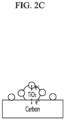
- FIG. 2C shows a diagram of a fuel cell catalyst according to the present disclosure.
- FIG. 2B illustrates a catalyst in which platinum is supported after simply mixing micron-sized TiO 2 agglomerates with a carbon support. Carbon and TiO 2 agglomerates are non-uniformly mixed, and thus, due to the TiO 2 agglomerates, which are considered as insulators, the passage of electrons generated during the oxygen reduction reaction is inhibited and performance degradation may occur.
- TiO 2 particles are nano-sized to reduce the physical distance to carbon, which has the effect of shortening the electron travel distance, thereby solving the low electrical conductivity of TiO 2 .
- the corrosion of carbon at the platinum/carbon interface which is known to reduce the durability of conventional catalysts, can be addressed.
- Another aspect of the present disclosure provides a catalyst for a fuel cell manufactured by the manufacturing method and a fuel cell including the catalyst for a fuel cell.
- the fuel cell may be a polymer electrolyte fuel cell, and a membrane electrode assembly of the polymer electrolyte fuel cell may include an anode, a cathode, and a polymer electrolyte membrane therebetween, and at least one of the anode and the cathode may include the catalyst of the present disclosure.
- TEM analysis was performed on a fuel cell catalyst in which TiO 2 sized at least 50 nm was physically mixed with a carbon support, followed by supporting platinum (Comparative Example), and a fuel cell catalyst in accordance with an embodiment of the present disclosure (Example).
- micron-sized TiO 2 is non-uniformly present in the carbon support, and platinum particles are non-uniformly supported on the TiO 2 and the carbon surface.
- platinum catalyst supported on the surface of TiO 2 having insulator properties may eventually lead to a loss of electrochemical performance due to the inhibition of the transfer pathway of electrons generated during the oxygen reduction reaction.
- FIGS. 3C and 3D it was observed that TiO 2 nanoparticles with a size of about 10 nm were uniformly mixed on the carbon support, and platinum particles were also uniformly supported in the nanosized TiO 2 /C composite.
- FIG. 2C since TiO 2 is uniformly supported, aggregation between metals can be suppressed during the preparation of the platinum catalyst.
- nano-sizing the particle size of TiO 2 it is expected to reduce the electrical resistance and suppress the loss of electrochemical performance by shortening the transfer pathway of electrons generated during the oxygen reduction reaction on the platinum surface.
- X-ray diffraction pattern analysis was performed on the carbon support at 40 kV and 20 mA using a Rigaku 1200, a Cu-K ⁇ light source, and a Ni ⁇ -filter.
- the average grain size of carbon was determined using the Debye-Scherer equation from the 2 ⁇ reflection peak for the graphite lattice plane.
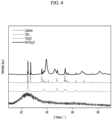
- FIG. 4 The experimental results are shown in FIG. 4 .
- the phase of Anatase TiO 2 was identified, and after platinum was supported (Pt/TiO 2 /C), the face-centered cubic (fcc) structure of platinum was identified at 39.6°, 46.1°, 67.1°, and 80.9°.
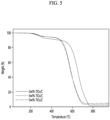
- TGA analysis was performed on TiO 2- supported carbon support (TiO 2 /C) according to an embodiment of present disclosure while controlling the content of TiO 2 , and the experimental method is shown in FIG. 5 .
- FIG. 5 it can be seen that 2.05 wt%, 3.14 wt%, and 5.1 wt. Titanium dioxide were supported.
- TGA was performed on a catalyst in which 50 wt% platinum was supported by commercial carbon black and a catalyst according to the present disclosure in which Pt is supported by a TiO 2 /C composite, and experimental results are shown in FIG. 6 .
- a support containing 3 wt% of TiO 2 was used, and referring to FIG. 6 , it can be seen that the TiO 2 /C composite used a support containing 3 wt% TiO 2 , and the amount of the metal after platinum was supported was found to be 53.05%,
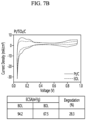
- FIGS. 7A and 7B The experimental results are shown in FIGS. 7A and 7B .
- ECSA initial electrochemical surface area
- the rate of decrease in performance compared to the initial ECSA performance was 28.3% for Example and 53.8% for Comparative Example. This suggests that the nano-sized oxidation-resistant TiO 2 inhibits the corrosion of carbon generated during degradation and improves the durability of the membrane electrode junction while maintaining the dispersion of platinum particles.
- Example and Comparative Examples were found to be 0.52 S/cm and 0.17 S/cm, and when the pressure was increased to 20 MPa, 9.63 S/cm and 5.11 S/cm, respectively.
- the enhanced electrical conductivity despite the presence of insulating TiO 2 is attributed to the incorporation of carbon into the carrier.
- the improvement in electrical conductivity in Example compared to the Comparative Examples is believed to be due to the reduction in the electrical resistance distance by the nano-sized TiO 2 , resulting in an improvement in electrical conductivity.
Landscapes
- Chemical & Material Sciences (AREA)
- Chemical Kinetics & Catalysis (AREA)
- Electrochemistry (AREA)
- General Chemical & Material Sciences (AREA)
- Engineering & Computer Science (AREA)
- Manufacturing & Machinery (AREA)
- Materials Engineering (AREA)
- Physics & Mathematics (AREA)
- Thermal Sciences (AREA)
- Composite Materials (AREA)
- Catalysts (AREA)
Abstract
Provided are an oxidation-resistant catalyst for fuel cells, a manufacturing method thereof, and a fuel cell including the same. In the case of the catalyst for a fuel cell according to the present disclosure, the fuel cell catalyst according to the present disclosure has oxidation-resistant features of a metal oxide while maintaining the electrical conductivity of a carbon support. Accordingly, catalytic activity of platinum particles, which are the active points in fuel cells, can be improved, and metal oxides can prevent platinum particles from directly interacting with carbon supports, thereby resolving the problem of carbon corrosion at the platinum/carbon interface.
Description
- The present disclosure relates to an oxidation-resistant catalyst, and more particularly, to an oxidation-resistant catalyst for fuel cells, in which a catalyst support is suitable for application to fuel cells and has excellent electrical conductivity, a method of preparing the same, and a fuel cell using the same.
- Hydrogen, which is attracting attention as a next-generation eco-friendly energy source, is a power source that will lead the transition to a hydrogen economy society, and as one of these power sources, a polymer electrolyte membrane fuel cell (PEMFC) is an energy conversion device that can convert chemical energy into electrical energy that can be used for transportation and building power generation by using electricity generated in the process of combining hydrogen and oxygen, which are fuels.
- The operating principle of fuel cells is that fuel (hydrogen, methanol, etc.) is fed to an anode, where the fuel is oxidized by a catalyst, while electrons are released and conducted through an external load to a cathode, where the oxidant is reduced by a catalyst again to produce water, generating electricity (non-patented reference, Yun Wang et al., Applied Energy 88 (2011) 981-1007).
- The main fields of research for fuel cell catalysts are research on manufacturing catalysts in a size of several nanometers in order to increase their activity, and research on causing material transfer with high efficiency by evenly supporting them on a carbon carrier having a high specific surface area. In this case, carbon carriers maximize the reaction efficiency by inducing high-dispersion supporting of platinum nanoparticles, which are the active points of the catalyst, and smoothly transfer the electrons generated by the catalytic reaction to output devices.
- In general, carbon black is used as the carbon carrier. However, during the starting and stopping process of fuel cell operation, outside air entering the electrode is mixed with hydrogen, which is the fuel, and a high potential of more than 1.2 V affects the carbon, and a potential higher than 0.207 V, the standard potential for carbon oxidation, causes carbon corrosion. This reduces the performance and lifespan of the fuel cell.
- As a countermeasure, attempts are being made to increase the crystallinity of the carbon carrier surface by high-temperature graphitization to increase the inherent oxidation initiation temperature of carbon, thereby suppressing corrosion caused by fuel cell electrode degradation.
- Alternatively, metal oxides with high resistance to oxidation, such as CeO2, SiO2, NiO, SnO2, TiO2, ZrO2, Ga2O2, are considered alternatives to carbon supports, and TiO2 has been widely studied as a catalyst support due to low costs, abundance, non-toxicity, and high stability to acid bases.
- In particular, TiO2-supported Pt catalysts show higher catalytic stability compared to carbon-based supported catalysts after catalyst degradation protocols due to the high oxidation resistance of TiO2, and TiO2 support is considered to be a material that ultimately increases electrochemical durability.
- However, Pt/TiO2 catalyst exhibits low redox activity, which is likely due to the suppression of the migratory flow of electrons, which are generated during the redox reaction, by the low electrical conductivity of the insulating properties of TiO2.
- In order to complement the insulating properties of TiO2, studies are being conducted to physically mix relatively highly conductive carbon with TiO2 to increase the electron transfer efficiency. However, micron-sized TiO2 and carbon aggregates are inhomogeneously mixed, causing defects in the electron transfer channels in the electrode and eventually causing performance degradation of the membrane electrode assembly.
- An objective of the present disclosure is to provide an oxidation-resistant catalyst for fuel cells in which a catalyst support has excellent electrical conductivity and a method of producing the same.
- An aspect of the present disclosure provides a method of producing a catalyst for a fuel cell includes forming a carbon support dispersion solution, forming a first metal precursor-mixed solution by mixing a solution of a first metal precursor with the carbon support dispersion solution, supporting a first metal by irradiating an electron beam on the first metal precursor-mixed solution, injecting a second metal precursor into a first metal-supported mixed solution, supporting a second metal by irradiating an electron beam on a second metal precursor-injected mixed solution, and obtaining a second metal-supported carbon support.
- In an embodiment, the carbon support may include at least one selected from reduced graphene oxide, graphene, graphite, single-walled carbon nanotubes, multi-walled carbon nanotubes, carbon nanohorns, carbon nanofibers, acetylene black, and furnace black.
- In an embodiment, the first metal precursor may include, as a metal oxide precursor, at least one of precursors of oxides selected from TiO2, SnO2, ZnO, VO2, In2O2, NiO, MoO2, WO2, and CuO.
- In an embodiment, the first metal precursor may include at least one selected from TiCl4, C12H28O4Ti, Ti(OC2H5)4, Ti(OBu)4, C12H28O4Ti, and [(CH3)2CHO]2Ti(C5H7O2)2.
- In an embodiment, in the forming of the first metal precursor-mixed solution, a pH of the first metal precursor-mixed solution may be adjusted to be basic.
- In an embodiment, in the supporting of the first metal, the electron beam may be irradiated for 30 minutes or less.
- In an embodiment, in the supporting of the first metal, the size of the first metal which is supported may be 50 nm or less.
- In an embodiment, the second metal precursor may be a platinum (Pt) precursor.
- In an embodiment, the second metal precursor may be injected in-situ.
- In an embodiment, in the injecting of the second metal precursor, a pH of the mixed solution may be adjusted to be basic.
- In an embodiment, in the supporting of the second metal, the electron beam may be irradiated for 20 minutes or less.
- In an embodiment, the obtaining the second metal-supported carbon support may include filtering and then drying the mixed solution to which the electron beam has been irradiated.
- Another aspect provides a catalyst for a fuel cell, prepared by using the method.
- Another aspect provides a fuel cell including the catalyst for a fuel cell.
- The fuel cell catalyst according to the present disclosure has oxidation resistance characteristics of metal oxide while maintaining electrical conductivity of the carbon support. Accordingly, catalytic activity of platinum particles, which are the active points in fuel cells, can be improved, and metal oxides can prevent platinum particles from directly interacting with carbon supports, thereby resolving the problem of carbon corrosion at the platinum/carbon interface.
-
-
FIG. 1 is a flowchart sequentially illustrating a method of manufacturing a fuel cell catalyst according to an embodiment of the present disclosure. -
FIGS. 2A to 2C schematically illustrate a conventional fuel cell catalyst and a fuel cell catalyst according to an embodiment of the present disclosure. -
FIGS. 3A to 3D show transmission electron microscope (TEM) images of a fuel cell catalyst according to an embodiment of the present disclosure and a fuel cell catalyst of the related art. -
FIG. 4 shows an X-ray diffraction (XRD) result of a TiO2-supported carbon support according to an embodiment of the present disclosure. -
FIG. 5 shows the results of thermogravimetric analysis (TGA) for the TiO2-supported carbon support according to an embodiment of the present disclosure. -
FIG. 6 shows the results of TGA analysis of commercial carbon black and a fuel cell catalyst according to an embodiment of the present disclosure. -
FIGS. 7A and7B show results of analyzing the performance of a fuel cell catalyst according to an embodiment of the present disclosure and a fuel cell catalyst of the related art. -
FIG. 8 shows the results of evaluating electrical conductivity of: a TiO2 - supported carbon support according to an embodiment of the present disclosure; and a mixture in which TiO2 is supported on a carbon support of the related art. - an embodiment of the present disclosure is shown in the accompanying drawings. However, this inventive concept may be embodied in many different forms, and should not be construed as being limited to the embodiments described herein. Rather, these embodiments are provided so that this disclosure will be thorough and complete, and will fully convey the scope of the inventive concept to those skilled in the art. Like reference numerals denote like components.
- Terms used in this specification are for describing only specific embodiments and are not intended to limit the present inventive concept. The singular form used herein is intended to include the plural form including "at least one" unless the context clearly dictates otherwise. "At least one" should not be construed as limiting to the singular. The term "and/or" used herein includes a combination of one or more of the listed items. The terms "including" and/or "comprising" as used in the Detailed Description specify the presence of the stated features, areas, integers, processes, actions, components, and/or ingredients and do not preclude the presence or addition of one or more other features, areas, integers, processes, actions, components, ingredients, and/or groups thereof.
- Unless defined otherwise, all terms (including technical and scientific terms) used herein have the same meaning as commonly understood by one of ordinary skill in the art to which this disclosure belongs. It will also be understood that terms, as defined in commonly used dictionaries, are to be construed to have a meaning consistent with their meaning in the context of the relevant art and this disclosure, and are not to be construed in an idealized or overly formal sense.
- While particular embodiments have been described, currently unforeseen or unforeseen alternatives, modifications, variations, improvements and substantial equivalents may occur to applicants or those skilled in the art. Accordingly, the appended claims as filed and as may be amended are intended to embrace all such alternatives, modifications, variations, improvements and substantial equivalents.
- In the following embodiments, terms such as first and second are not intended to be limiting, but are used to distinguish one component from another.
- In the following embodiments, singular expressions include plural expressions unless the context clearly indicates otherwise.
- When an embodiment is otherwise implementable, a specific process sequence may be performed differently from the described sequence. For example, two processes described in succession may be performed substantially simultaneously, or may be performed in an order reverse to the order described.
-
FIG. 1 is a flowchart sequentially illustrating a method of manufacturing a fuel cell catalyst according to an embodiment of the present disclosure. - Referring to
FIG. 1 , the present disclosure provides a method of producing a catalyst for a fuel cell, the method including forming a carbon support dispersion solution (S100), forming a first metal precursor-mixed solution (S200), supporting a first metal (S300), injecting a second metal precursor (S400), supporting a second metal (S500), and obtaining a second metal-supported carbon support (S600). - In an embodiment of the present disclosure, the forming the carbon support dispersion solution (S100) may be dispersing a carbon support in a solvent.
- In an embodiment, the carbon support may include at least one carbon support selected from reduced graphene oxide, graphene, graphite, single-walled carbon nanotubes, multi-walled carbon nanotubes, carbon nanohorns, carbon nanofibers, acetylene black, and furnace black.
- The solvent may be a mixed solvent including water and alcohol. The alcohol included in the solvent may be a polyhydric alcohol, and may include at least one selected from acetone, ethanol, isopropyl alcohol, ethanol, n-propyl alcohol, butanol, ethylene glycol, diethylene glycol, and glycerol.
- A commonly used dispersion process may be used to prepare the carbon support dispersion solution, and for example, an ultrasonic dispersion process may be used. This dispersing process may be performed under the conditions including 3 seconds of operation-1 second of stop and the Amplitude intensity of 50% or less.
- In the forming a first metal precursor-mixed solution (S200), a solution of a first metal precursor is mixed with the carbon support dispersion solution to form the first metal precursor-mixed solution.
- The first metal precursor may include, as a precursor of a metal oxide, one or more precursors of oxides selected from TiO2, SnO2, ZnO, VO2, In2O2, NiO, MoO2, WO2, and CuO. For example, the first metal precursor may include one or more selected from TiCl4, C12H28O4Ti, Ti(OC2H5)4, Ti(OBu)4, C12H28O4Ti, and [(CH3)2CHO]2Ti(C5H7O2)2, but is not limited thereto.
- The first metal precursor-mixed solution may be formed by injecting the first metal precursor solution into the carbon support dispersion solution. The injection rate may be 5 mL/min to 20 mL/min.
- Meanwhile, the pH of the first metal precursor-mixed solution may be adjusted to be basic.
- In this regard, any method can be used as long as the method can adjust the pH. The pH can be adjusted by metering injecting a pH adjusting agent. At least one of conventional pH adjusting agents such as NaOH, KOH, and aqueous ammonia may be used, but embodiments are not limited thereto. For example, the pH range may be a pH of 7 to 14. In an embodiment, the pH may be adjusted to be 7 to 8 by using 1 M NaOH.
- In the supporting the first metal (S300), an electron beam may be irradiated to the first metal precursor-mixed solution.
- The electron beam may have energy of 0.1 MeV to 2 MeV, and an applied current may be 0.1 mA to 20 mA. When an electron beam is irradiated under the above conditions, ions of the first metal are reduced and the first metal is supported on the carbon support.
- The irradiation time of the electron beam may be at least 1 minute and not more than 30 minutes; at least 1 minute and not more than 25 minutes; at least 1 minute and not more than 20 minutes; at least 1 minute and not more than 15 minutes; at least 1 minute and not more than 10 minutes; or at least 1 minute and not more than 5 minutes. For example, the irradiation time of the electron beam may be at least 1 minute and not more than 5 minutes.
- In the irradiating the electron beam, the electron beam may be irradiated for an appropriate time according to the type of the first metal.
- In the supporting the first metal, the size of the supported first metal may be 1 nm to 50 nm; 1 nm to 40 nm; 1 nm to 30 nm; 1 nm to 20 nm; 1 nm to 10 nm; 5 nm to 50 nm; 5 nm to 40 nm; 5 nm to 30 nm; 5 nm to 20 nm; 5 nm to 10 nm; 10 nm to 50 nm; 10 nm to 40 nm; 10 nm to 30 nm; 10 nm to 20 nm; 15 nm to 50 nm; 15 nm to 40 nm; 15 nm to 30 nm, or 15 nm to 20 nm.
- When the first metal is supported in these size ranges, the physical distance thereof to the carbon support becomes small and the moving distance of electrons is shortened, thereby addressing the issue of low electrical conductivity of the first metal.
- In the injecting the second metal precursor (S400), the second metal precursor may be injected into the first metal precursor-mixed solution in which the first metal is supported.
- The second metal precursor may be a platinum (Pt) precursor. The Pt precursor may include at least one of H2PtCl6, H6Cl2N2Pt, PtCl2, PtBr2, platinum acetylacetonate, K2(PtCl4), H2Pt(OH)6, Pt(NO3)2, [Pt(NH3)4]Cl2, [Pt(NH3)4](HCO3)2, [Pt(NH3)4](Oac)2, (NH4)2PtBr6, (NH3)2PtCl6, and hydrates thereof. However, embodiments are not limited thereto.
- The injecting of the second metal precursor may be injecting in-situ, but is not limited thereto. The injection rate may be 5 mL/min to 20 mL/min.
- According to an embodiment, when platinum ions are injected in-situ, the reduction of platinum is induced by continuously generated accelerated electrons to synthesize an oxidation-resistant catalyst support in a short time, resulting in a highly durable fuel cell catalyst.
- The injecting the second metal precursor may include adjusting the pH of the mixed solution to be basic. In this regard, any method can be used as long as the method can adjust the pH. The pH can be adjusted by metering injecting a pH adjusting agent. At least one of conventional pH adjusting agents such as NaOH, Na2CO3, KOH, K2CO3, or H2SO4 may be used, but embodiments are not limited thereto. For example, the pH range may be a pH of 7 to 14. In an embodiment, the pH may be adjusted to be 10 to 11 by using 1 M NaOH.
- In the supporting the second metal (S50), an electron beam may be irradiated to the second metal precursor-mixed solution to alloy the second metal.
- The electron beam may have energy of 0.1 MeV to 2 MeV, and an applied current may be 0.1 mA to 20 mA. When an electron beam is irradiated under the above conditions, ions of the second metal are reduced and the second metal is alloyed on the carbon support.
- The irradiation time of the electron beam may be at least 10 seconds and not more than 20 minutes; at least 10 seconds and not more than 15 minutes; at least 10 seconds and not more than 10 minutes; at least 10 seconds and not more than 5 minutes; at least or 10 seconds and not more than 1 minute. For example, the irradiation time of the electron beam may be at least 1 minute. The electron beam may be irradiated for an appropriate time according to the type of the second metal.
- The obtaining the second metal-supported carbon support (S600) may be obtaining a catalyst for a fuel cell in which the second metal is supported. This process may include filtering and then drying the precursor mixture solution which has been irradiated with the electron beam. The method of filtration is not particularly limited. For example, a vacuum filter may be used for the filtering. The method of drying is not particularly limited. For example, drying may be performed in an oven. In an embodiment, when drying in an oven, drying may be performed at a temperature of not more than 100 °C, for example, 60 °C.
-
FIGS. 2A to 2C are diagrams schematically showing a fuel cell catalyst of the related art and a fuel cell catalyst according to an embodiment of the present disclosure.FIG. 2A shows a diagram of a platinum/carbon catalyst of the related art,FIG. 2B shows a diagram of a catalyst in which platinum is supported by a physically mixed TiO2/ carbon support, andFIG. 2C shows a diagram of a fuel cell catalyst according to the present disclosure. - In the case of the platinum/carbon catalyst illustrated in
FIG. 2A , it is known that during accelerated degradation, oxidation of the carbon support causes platinum metal to elute and agglomerate, leading to accelerated utilization and degradation of platinum. -
FIG. 2B illustrates a catalyst in which platinum is supported after simply mixing micron-sized TiO2 agglomerates with a carbon support. Carbon and TiO2 agglomerates are non-uniformly mixed, and thus, due to the TiO2 agglomerates, which are considered as insulators, the passage of electrons generated during the oxygen reduction reaction is inhibited and performance degradation may occur. - On the other hand, as shown in
FIG. 2C , in the case of a fuel cell catalyst prepared by electron beam irradiation according to an embodiment of the present disclosure, TiO2 particles are nano-sized to reduce the physical distance to carbon, which has the effect of shortening the electron travel distance, thereby solving the low electrical conductivity of TiO2. Moreover, by preventing the platinum particles from directly interacting with the carbon support, the corrosion of carbon at the platinum/carbon interface, which is known to reduce the durability of conventional catalysts, can be addressed. - Another aspect of the present disclosure provides a catalyst for a fuel cell manufactured by the manufacturing method and a fuel cell including the catalyst for a fuel cell.
- The fuel cell may be a polymer electrolyte fuel cell, and a membrane electrode assembly of the polymer electrolyte fuel cell may include an anode, a cathode, and a polymer electrolyte membrane therebetween, and at least one of the anode and the cathode may include the catalyst of the present disclosure.
- Hereinafter, the present disclosure will be described in detail through experimental examples.
- However, the experimental examples to be described later are only to specifically illustrate the present disclosure in one aspect, and the present disclosure is not limited thereto.
- TEM analysis was performed on a fuel cell catalyst in which TiO2 sized at least 50 nm was physically mixed with a carbon support, followed by supporting platinum (Comparative Example), and a fuel cell catalyst in accordance with an embodiment of the present disclosure (Example).
- The experimental results are shown in
FIGS. 3A and3B for Comparative Example and inFIGS. 3C and3D for Example. - Referring to
FIGS. 3A and3B , micron-sized TiO2 is non-uniformly present in the carbon support, and platinum particles are non-uniformly supported on the TiO2 and the carbon surface. As a result, as shown inFIG. 2B , it is believed that the platinum catalyst supported on the surface of TiO2 having insulator properties may eventually lead to a loss of electrochemical performance due to the inhibition of the transfer pathway of electrons generated during the oxygen reduction reaction. - On the other hand,
FIGS. 3C and3D , it was observed that TiO2 nanoparticles with a size of about 10 nm were uniformly mixed on the carbon support, and platinum particles were also uniformly supported in the nanosized TiO2/C composite. As shown inFIG. 2C , since TiO2 is uniformly supported, aggregation between metals can be suppressed during the preparation of the platinum catalyst. In addition, by nano-sizing the particle size of TiO2, it is expected to reduce the electrical resistance and suppress the loss of electrochemical performance by shortening the transfer pathway of electrons generated during the oxygen reduction reaction on the platinum surface. - XRD pattern analysis was performed on TiO2-supported carbon support (TiO2/C) according to an example of present disclosure, and the experimental method is as follows.
- X-ray diffraction pattern analysis was performed on the carbon support at 40 kV and 20 mA using a Rigaku 1200, a Cu-Kα light source, and a Ni β-filter. The average grain size of carbon was determined using the Debye-Scherer equation from the 2θ reflection peak for the graphite lattice plane.
- The experimental results are shown in
FIG. 4 . Referring toFIG. 4 , in the case of the synthesized TiO2/C complex, the phase of Anatase TiO2 was identified, and after platinum was supported (Pt/TiO2/C), the face-centered cubic (fcc) structure of platinum was identified at 39.6°, 46.1°, 67.1°, and 80.9°. - TGA analysis was performed on TiO2-supported carbon support (TiO2/C) according to an embodiment of present disclosure while controlling the content of TiO2, and the experimental method is shown in
FIG. 5 . Referring toFIG. 5 , it can be seen that 2.05 wt%, 3.14 wt%, and 5.1 wt. Titanium dioxide were supported. - TGA was performed on a catalyst in which 50 wt% platinum was supported by commercial carbon black and a catalyst according to the present disclosure in which Pt is supported by a TiO2/C composite, and experimental results are shown in
FIG. 6 . For the TiO2/C composite, a support containing 3 wt% of TiO2 was used, and referring toFIG. 6 , it can be seen that the TiO2/C composite used a support containing 3 wt% TiO2, and the amount of the metal after platinum was supported was found to be 53.05%, - With respect to each of a catalyst for a fuel cell (Example, 50 wt% Pt/TiO2/C) according to an embodiment of the present disclosure and a fuel cell catalyst of the related art (Comparative Example, 50 wt% Pt/C) in which platinum is supported on a carbon carrier of the related art, the performance of unit cells were measured, and obtained measurements were compared.
- The experimental results are shown in
FIGS. 7A and7B . Referring toFIGS. 7A and7B , it was confirmed that the initial electrochemical surface area (ECSA) performances of Example and Comparative Example were similar to each other as being 94.2 m2/g and 95.8 m2/g, respectively. That is, the platinum utilization rate was maintained despite the presence of insulating TiO2. - Thereafter, after additional catalyst deterioration evaluation, the rate of decrease in performance compared to the initial ECSA performance was 28.3% for Example and 53.8% for Comparative Example. This suggests that the nano-sized oxidation-resistant TiO2 inhibits the corrosion of carbon generated during degradation and improves the durability of the membrane electrode junction while maintaining the dispersion of platinum particles.
- Four-probe conductivity for a nanonized TiO2/carbon composite (electron beam-based composite, Example) according to an embodiment of the present disclosure and a mixture in which TiO2 is supported on a carbon support of the related art (carbon-TiO2 simple mixture, Comparative Example) were compared with each other.
- Experimental results are shown in
FIG. 8 . The electrical conductivity of each catalyst carrier was analyzed with increasing applied pressure. Referring toFIG. 8 , it was confirmed that, for each case, the electrical conductivities of TiO2 oxide were similar to each other as being 8.86 × 10⁻⁵ S/cm from the initial 2.33 × 10⁻⁵ S/cm even as the pressure was increased. This is due to insulating TiO2. - The initial conductivities of Example and Comparative Examples were found to be 0.52 S/cm and 0.17 S/cm, and when the pressure was increased to 20 MPa, 9.63 S/cm and 5.11 S/cm, respectively. The enhanced electrical conductivity despite the presence of insulating TiO2 is attributed to the incorporation of carbon into the carrier. In particular, the improvement in electrical conductivity in Example compared to the Comparative Examples is believed to be due to the reduction in the electrical resistance distance by the nano-sized TiO2, resulting in an improvement in electrical conductivity.
- As such, the present disclosure has been described with reference to an embodiment shown in the drawings, but this is merely an example, and those skilled in the art will understand that various modifications and variations of the embodiment can be made therefrom. Therefore, the true technical protection scope of the present disclosure should be determined by the technical spirit of the appended claims.
Claims (14)
- A method of producing a catalyst for a fuel cell, the method comprising:forming a carbon support dispersion solution;forming a first metal precursor-mixed solution by mixing a solution of a first metal precursor with the carbon support dispersion solution;supporting a first metal by irradiating the first metal precursor-mixed solution with an electron beam;injecting a second metal precursor into a first metal-supported mixed solution;supporting a second metal by irradiating an electron beam on a second metal precursor-injected mixed solution; andobtaining a carbon support on which the second metal is supported.
- The method of claim 1, wherein
the carbon support comprises at least one selected from reduced graphene oxide, graphene, graphite, single-walled carbon nanotubes, multi-walled carbon nanotubes, carbon nanohorns, carbon nanofibers, acetylene black, and furnace black. - The method of claim 1, whereinthe first metal precursor comprises, as a precursor of a metal oxide,at least one precursor of oxides selected from TiO2, SnO2, ZnO, VO2, In2O2, NiO, MoO2, WO2, and CuO.
- The method of claim 1, wherein
the first metal precursor comprises at least one selected from TiCl4, C12H28O4Ti, Ti(OC2H5)4, Ti(OBu)4, C12H28O4Ti, and [(CH3)2CHO]2Ti(C5H7O2)2. - The method of claim 1, wherein
in the forming of the first metal precursor-mixed solution, a pH of the first metal precursor-mixed solution is adjusted to be basic. - The method of claim 1, wherein in the supporting of the first metal, the electron beam is irradiated for 30 minutes or less.
- The method of claim 1, wherein in the supporting of the first metal, the size of the first metal which is supported is 50 nm or less.
- The method of claim 1, wherein the second metal precursor is a platinum (Pt) precursor.
- The method of claim 1, wherein the second metal precursor is injected by an in-situ method.
- The method of claim 1, wherein in the injecting of the second metal precursor, a pH of the mixed solution is adjusted to be basic.
- The method of claim 1, wherein in the supporting of the second metal, an electron beam may be irradiated for 20 minutes or less.
- The method of claim 1, wherein the obtaining the second metal-supported carbon support comprises filtering and then drying the mixed solution to which the electron beam has been irradiated.
- A catalyst for a fuel cell, prepared by the method of claim 1.
- A fuel cell comprising the catalyst of claim 13.
Applications Claiming Priority (2)
| Application Number | Priority Date | Filing Date | Title |
|---|---|---|---|
| KR20220164278 | 2022-11-30 | ||
| KR1020230011983A KR102941720B1 (en) | 2022-11-30 | 2023-01-30 | Oxidation resistant catalyst for fuel cell, manufacturing method thereof and fuel cell comprising the same |
Publications (1)
| Publication Number | Publication Date |
|---|---|
| EP4379870A1 true EP4379870A1 (en) | 2024-06-05 |
Family
ID=87575978
Family Applications (1)
| Application Number | Title | Priority Date | Filing Date |
|---|---|---|---|
| EP23191385.6A Pending EP4379870A1 (en) | 2022-11-30 | 2023-08-14 | Oxidation-resistant catalyst for fuel cell, method of manufacturing the same, and fuel cell including the same |
Country Status (2)
| Country | Link |
|---|---|
| US (1) | US20240178409A1 (en) |
| EP (1) | EP4379870A1 (en) |
Citations (7)
| Publication number | Priority date | Publication date | Assignee | Title |
|---|---|---|---|---|
| US8603931B2 (en) * | 2006-10-31 | 2013-12-10 | Samsung Sdi Co., Ltd. | Method of preparing catalyst for fuel cell |
| CN102751101B (en) * | 2012-07-11 | 2016-06-15 | 北京大学 | A kind of platinum/graphene nano matrix material and its preparation method and application |
| WO2019031792A1 (en) * | 2017-08-07 | 2019-02-14 | 주식회사 알티엑스 | Method for producing catalyst for fuel cell |
| WO2019093765A2 (en) * | 2017-11-07 | 2019-05-16 | 광주과학기술원 | Multifunctional supported non-platinum catalyst for vehicle fuel cell and preparation method therefor |
| JP6638879B2 (en) * | 2015-01-22 | 2020-01-29 | 国立研究開発法人物質・材料研究機構 | Trace amount platinum-supported ceria nanowire, method for producing the same, and use thereof |
| KR102155534B1 (en) * | 2018-10-17 | 2020-09-15 | 광주과학기술원 | Non-platinum based oxygen reduction catalyst and method for its preparation |
| US20210143442A1 (en) * | 2019-11-07 | 2021-05-13 | Hyundai Mobis Co., Ltd. | Catalyst for fuel cell and manufacturing method thereof |
-
2023
- 2023-08-14 EP EP23191385.6A patent/EP4379870A1/en active Pending
- 2023-08-18 US US18/452,247 patent/US20240178409A1/en active Pending
Patent Citations (7)
| Publication number | Priority date | Publication date | Assignee | Title |
|---|---|---|---|---|
| US8603931B2 (en) * | 2006-10-31 | 2013-12-10 | Samsung Sdi Co., Ltd. | Method of preparing catalyst for fuel cell |
| CN102751101B (en) * | 2012-07-11 | 2016-06-15 | 北京大学 | A kind of platinum/graphene nano matrix material and its preparation method and application |
| JP6638879B2 (en) * | 2015-01-22 | 2020-01-29 | 国立研究開発法人物質・材料研究機構 | Trace amount platinum-supported ceria nanowire, method for producing the same, and use thereof |
| WO2019031792A1 (en) * | 2017-08-07 | 2019-02-14 | 주식회사 알티엑스 | Method for producing catalyst for fuel cell |
| WO2019093765A2 (en) * | 2017-11-07 | 2019-05-16 | 광주과학기술원 | Multifunctional supported non-platinum catalyst for vehicle fuel cell and preparation method therefor |
| KR102155534B1 (en) * | 2018-10-17 | 2020-09-15 | 광주과학기술원 | Non-platinum based oxygen reduction catalyst and method for its preparation |
| US20210143442A1 (en) * | 2019-11-07 | 2021-05-13 | Hyundai Mobis Co., Ltd. | Catalyst for fuel cell and manufacturing method thereof |
Non-Patent Citations (1)
| Title |
|---|
| YUN WANG ET AL., APPLIED ENERGY, vol. 88, 2011, pages 981 - 1007 |
Also Published As
| Publication number | Publication date |
|---|---|
| US20240178409A1 (en) | 2024-05-30 |
Similar Documents
| Publication | Publication Date | Title |
|---|---|---|
| Yu et al. | Graphene–CeO2 hybrid support for Pt nanoparticles as potential electrocatalyst for direct methanol fuel cells | |
| KR100745736B1 (en) | Carbon nanotubes, supported catalysts including the same, and fuel cells using the supported catalysts | |
| EP2634850A1 (en) | Composite, catalyst including the same, fuel cell and lithium air battery including the same | |
| KR102044875B1 (en) | Catalyst layer including radical scavenger for polymer electrolyte membrane fuel cell | |
| EP2680350B1 (en) | Supporter for fuel cell, method of preparing same, and electrode for fuel cell, membrane-electrode assembly for a fuel cell, and fuel cell system including same | |
| Lohmann et al. | The next generation solid acid fuel cell electrodes: stable, high performance with minimized catalyst loading | |
| KR20180013499A (en) | Fe-N-C ELECTROCATALYST, METHOD OF MANUFACTURNING THE SAME AND FUEL CELL COMPRISING Fe-N-C ELECTROCATALYST | |
| JP6372695B2 (en) | Conductive particles, carrier material using the same, fuel cell device and water electrolysis device | |
| US9466842B2 (en) | Fuel cell electrode catalyst including a core containing platinum, a transition metal, and a nonmetal element and a shell containing platinum and the nonmetal element electrode including the same, and method for preparing the same | |
| Chiang et al. | The effect of carbon supports on the performance of platinum/carbon nanotubes for proton exchange membrane fuel cells | |
| JP5757884B2 (en) | Method for producing electrode catalyst for fuel cell and use thereof | |
| EP4379870A1 (en) | Oxidation-resistant catalyst for fuel cell, method of manufacturing the same, and fuel cell including the same | |
| KR20220136035A (en) | Catalyst for fuel cell comprising transition metal oxide, preparation method thereof, and fuel cell using the same | |
| KR102764969B1 (en) | Radical Scavenging Composite, Method for Preparing the Same, and Fuel Cell Comprising the Same | |
| CN101811062B (en) | Catalyst based on non-noble metal and preparation method thereof, electrode and fuel cell containing catalyst | |
| Amirinejad et al. | Promotion of catalytic activity of Pt@ Al-Ti doped ZnO nanostructured anodes for direct methanol fuel cells | |
| KR102941720B1 (en) | Oxidation resistant catalyst for fuel cell, manufacturing method thereof and fuel cell comprising the same | |
| US10005066B2 (en) | Catalyst carrier and method for producing the same | |
| Liu et al. | High efficiency CeO2/CNTs modified Pt/CNTs catalysts for electrochemical oxidation of methanol | |
| JP7139567B2 (en) | Oxidation catalyst for fuel cell, method for producing the same, and fuel cell | |
| CN102656730B (en) | Electrochemical reactor and active layer integrated into said reactor | |
| KR102142568B1 (en) | Method for Forming Catalyst Support for Fuel Cell and Electrode for Fuel Cell | |
| US20240304831A1 (en) | Catalyst for fuel cell, method of manufacturing the same, and fuel cell including the same | |
| Zabielaitė et al. | MnO 2 nanoparticles supported on graphitic carbon nitride as an electrocatalyst for oxygen reduction and evolution | |
| Jang et al. | Hydroxyl group's effects on the activity and durability of supported carbon–TiO 2 for proton exchange membrane fuel cells |
Legal Events
| Date | Code | Title | Description |
|---|---|---|---|
| PUAI | Public reference made under article 153(3) epc to a published international application that has entered the european phase |
Free format text: ORIGINAL CODE: 0009012 |
|
| STAA | Information on the status of an ep patent application or granted ep patent |
Free format text: STATUS: REQUEST FOR EXAMINATION WAS MADE |
|
| 17P | Request for examination filed |
Effective date: 20230926 |
|
| AK | Designated contracting states |
Kind code of ref document: A1 Designated state(s): AL AT BE BG CH CY CZ DE DK EE ES FI FR GB GR HR HU IE IS IT LI LT LU LV MC ME MK MT NL NO PL PT RO RS SE SI SK SM TR |