EP4378323A2 - Salzigkeitswahrnehmungsverstärkende verbindungen - Google Patents
Salzigkeitswahrnehmungsverstärkende verbindungen Download PDFInfo
- Publication number
- EP4378323A2 EP4378323A2 EP24170412.1A EP24170412A EP4378323A2 EP 4378323 A2 EP4378323 A2 EP 4378323A2 EP 24170412 A EP24170412 A EP 24170412A EP 4378323 A2 EP4378323 A2 EP 4378323A2
- Authority
- EP
- European Patent Office
- Prior art keywords
- saltiness
- food product
- enhancing compound
- salt
- perception enhancing
- Prior art date
- Legal status (The legal status is an assumption and is not a legal conclusion. Google has not performed a legal analysis and makes no representation as to the accuracy of the status listed.)
- Pending
Links
Images

Classifications
-
- A—HUMAN NECESSITIES
- A23—FOODS OR FOODSTUFFS; TREATMENT THEREOF, NOT COVERED BY OTHER CLASSES
- A23L—FOODS, FOODSTUFFS OR NON-ALCOHOLIC BEVERAGES, NOT OTHERWISE PROVIDED FOR; PREPARATION OR TREATMENT THEREOF
- A23L27/00—Spices; Flavouring agents or condiments; Artificial sweetening agents; Table salts; Dietetic salt substitutes; Preparation or treatment thereof
- A23L27/40—Table salts; Dietetic salt substitutes
-
- A—HUMAN NECESSITIES
- A23—FOODS OR FOODSTUFFS; TREATMENT THEREOF, NOT COVERED BY OTHER CLASSES
- A23L—FOODS, FOODSTUFFS OR NON-ALCOHOLIC BEVERAGES, NOT OTHERWISE PROVIDED FOR; PREPARATION OR TREATMENT THEREOF
- A23L27/00—Spices; Flavouring agents or condiments; Artificial sweetening agents; Table salts; Dietetic salt substitutes; Preparation or treatment thereof
- A23L27/88—Taste or flavour enhancing agents
-
- A—HUMAN NECESSITIES
- A21—BAKING; EDIBLE DOUGHS
- A21D—TREATMENT OF FLOUR OR DOUGH FOR BAKING, e.g. BY ADDITION OF MATERIALS; BAKING; BAKERY PRODUCTS
- A21D13/00—Finished or partly finished bakery products
- A21D13/06—Products with modified nutritive value, e.g. with modified starch content
-
- A—HUMAN NECESSITIES
- A23—FOODS OR FOODSTUFFS; TREATMENT THEREOF, NOT COVERED BY OTHER CLASSES
- A23L—FOODS, FOODSTUFFS OR NON-ALCOHOLIC BEVERAGES, NOT OTHERWISE PROVIDED FOR; PREPARATION OR TREATMENT THEREOF
- A23L19/00—Products from fruits or vegetables; Preparation or treatment thereof
- A23L19/10—Products from fruits or vegetables; Preparation or treatment thereof of tuberous or like starch containing root crops
- A23L19/12—Products from fruits or vegetables; Preparation or treatment thereof of tuberous or like starch containing root crops of potatoes
- A23L19/18—Roasted or fried products, e.g. snacks or chips
-
- A—HUMAN NECESSITIES
- A23—FOODS OR FOODSTUFFS; TREATMENT THEREOF, NOT COVERED BY OTHER CLASSES
- A23L—FOODS, FOODSTUFFS OR NON-ALCOHOLIC BEVERAGES, NOT OTHERWISE PROVIDED FOR; PREPARATION OR TREATMENT THEREOF
- A23L2/00—Non-alcoholic beverages; Dry compositions or concentrates therefor; Preparation or treatment thereof
- A23L2/52—Adding ingredients
- A23L2/56—Flavouring or bittering agents
-
- A—HUMAN NECESSITIES
- A23—FOODS OR FOODSTUFFS; TREATMENT THEREOF, NOT COVERED BY OTHER CLASSES
- A23L—FOODS, FOODSTUFFS OR NON-ALCOHOLIC BEVERAGES, NOT OTHERWISE PROVIDED FOR; PREPARATION OR TREATMENT THEREOF
- A23L23/00—Soups; Sauces; Preparation or treatment thereof
-
- A—HUMAN NECESSITIES
- A23—FOODS OR FOODSTUFFS; TREATMENT THEREOF, NOT COVERED BY OTHER CLASSES
- A23L—FOODS, FOODSTUFFS OR NON-ALCOHOLIC BEVERAGES, NOT OTHERWISE PROVIDED FOR; PREPARATION OR TREATMENT THEREOF
- A23L27/00—Spices; Flavouring agents or condiments; Artificial sweetening agents; Table salts; Dietetic salt substitutes; Preparation or treatment thereof
- A23L27/10—Natural spices, flavouring agents or condiments; Extracts thereof
-
- A—HUMAN NECESSITIES
- A23—FOODS OR FOODSTUFFS; TREATMENT THEREOF, NOT COVERED BY OTHER CLASSES
- A23L—FOODS, FOODSTUFFS OR NON-ALCOHOLIC BEVERAGES, NOT OTHERWISE PROVIDED FOR; PREPARATION OR TREATMENT THEREOF
- A23L33/00—Modifying nutritive qualities of foods; Dietetic products; Preparation or treatment thereof
- A23L33/10—Modifying nutritive qualities of foods; Dietetic products; Preparation or treatment thereof using additives
- A23L33/105—Plant extracts, their artificial duplicates or their derivatives
Definitions
- compositions including a salt component and a sodium-free saltiness-perception enhancing compound, seasoned food products including such compositions, and methods of producing and using such compositions are described.
- the sodium-free saltiness-perception enhancing compound may be gentisic acid 5- O - ⁇ -D xylopyranoside and/or kukoamine A.
- a seasoning composition having enhanced salt intensity includes a salt component and a sodium-free saltiness-perception enhancing compound (also referred to as the saltiness-perception enhancing compound).
- the sodium-free saltiness-perception enhancing compound includes at least one of gentisic acid 5- O - ⁇ -D xylopyranoside or kukoamine A.
- the seasoning composition exhibits a mean saltiness intensity that is about the same as a second seasoning compound that has an amount of the salt component that is greater than the salt component in the seasoning composition and that does not contain the saltiness-perception enhancing compound.
- the second seasoning compound may have an amount of the salt component that is from about 5 wt% to about 67 wt% greater than the salt component in the seasoning composition of this embodiment.
- the second seasoning compound may have an amount of the salt component that is from about 10 wt% to about 50 wt% greater than the salt component in the seasoning composition, or from about 15 wt% to about 30 wt% greater than the salt component in the seasoning composition, or from about 20 wt% to about 30 wt% greater than the salt component in the seasoning composition.
- the second seasoning compound may have an amount of the salt component that is about 20 wt% greater than the salt component in the seasoning composition.
- the seasoning composition may include, by weight, from about 96.9941 % to about 99.9965% of the salt component and from about 0.0035% to 3.70% of the saltiness-perception enhancing compound.
- the seasoning composition may include, by weight, from about 99.11% to about 99.9625% of the salt component and from about 0.0375% to 0.89% of the saltiness-perception enhancing compound, or from about 99.87% to about 99.9555% of the salt component and from about 0.0445% to 0.13% of the saltiness-perception enhancing compound.
- the seasoning composition may include, by weight, from about 96.4% to about 97.34% of the salt component and from about 2.66% to 3.70% of the saltiness-perception enhancing compound.
- the salt component may comprise any salt fit for human consumption, and may include sodium chloride, or "salt", natural sea salts or sea salt blends, alone or in various combinations with potassium chloride.
- the sodium-free saltiness-perception enhancing compound may be derived from any suitable natural or plant-based source and may be produced in any suitable manner.
- the saltiness-perception enhancing compound may be derived from a plant that includes a modified level of the saltiness-perception enhancing compound relative to a wild-type individual of the same taxon. Suitable plants include, but are not limited to members of the Solanaceae family.
- the saltiness-perception enhancing compound is derived from Solanum tuberosum , such as from an individual of the species Solanum tuberosum that includes a modified level of the saltiness-perception enhancing compound relative to a wild-type individual of the same taxon.
- a seasoned food product includes a food product and a seasoning composition that includes the sodium-free saltiness-perception enhancing compound such that the seasoning composition enhances a salt intensity of the seasoned food product.
- the food product may be any edible food product.
- the food product may be a solid food or a liquid food, such as a soup or other liquid food product.
- the food product may be a ready to eat snack food product.
- the snack food product can be any snack food product known in the art, such as tortilla chips, potato chips, corn chips, extruded snacks, pretzels, crispy breads, popcorn, nuts, or nut clusters.
- the food substrate is a shelf-stable ready-to-eat snack food with a moisture content of less than about 3% by weight.
- the snack food product is derived from potatoes.
- the seasoned food product may exhibit a mean saltiness intensity that is about the same as a second seasoned food product that has an amount of the salt component that is greater than the salt component in the seasoning composition and that does not contain the saltiness-perception enhancing compound.
- a method of producing a seasoning composition includes mixing a salt component with the sodium-free saltiness-perception enhancing compound.
- a method of reducing sodium intake includes providing a composition that includes a food product, a salt component, and a sodium-free saltiness-perception enhancing compound that includes the at least one of gentisic acid 5- O - ⁇ -D xylopyranoside or kukoamine A.
- the saltiness-perception enhancing compound enhances the salt taste of the food product.
- a quantity of the food product may include about 5 wt% to about 40 wt% less sodium chloride (NaCl) than an equal quantity of a conventional food product of the same type.
- the food product may include about 20 wt% to about 30 wt% less sodium chloride than the equal quantity of a conventional food product of the same type.
- the food product may include about 20 wt% less sodium chloride than the equal quantity of a conventional food product of the same type.
- the quantity of the food product may exhibit a mean saltiness intensity that is about the same as the equal quantity of the conventional food product of the same type.
- a seasoning composition providing enhanced salt intensity to a food product.
- the seasoning composition includes at least one of gentisic acid 5- O - ⁇ -D xylopyranoside or kukoamine A and exhibits a mean saltiness intensity that is greater than a second seasoning compound that has an amount of the salt component that is the same as the salt component in the seasoning composition and that does not contain the saltiness-perception enhancing compound.
- Seasoning compositions including a salt component and a sodium-free saltiness-perception enhancing compound that includes gentisic acid 5- O - ⁇ -D xylopyranoside and/or kukoamine A, seasoned food products including such compositions, and methods of producing and using such compositions are described.
- the sodium-free saltiness-perception enhancing compounds may be derived from Solanum tuberosum and may be applied, with a salt component, to food products to eliminate or attenuate the reduction in saltiness that would otherwise accompany a reduction in the amount of the salt component applied to the food product. In this manner, the seasoning compositions, seasoned food products, and methods of the present disclosure enable the development of food products having lower sodium levels without compromising on the salt taste that meets consumer expectations.
- gentisic acid 5- O - ⁇ -D xylopyranoside and kukoamine A compounds endogenous to potatoes and some other species on which food products may be based (e.g., tomato or cucumber), have been shown to enhance the perception of saltiness when topically applied, alone or in combination with one another, to food products without adding sodium or off-flavors to the food product.
- gentisic acid 5- O - ⁇ -D xylopyranoside and kukoamine A may not necessarily need to be labeled when applied to food products based on such species, thereby facilitating simple food labels desired by consumers.
- endogenous levels of gentisic acid 5- O - ⁇ -D xylopyranoside and/or kukoamine A may be insufficient to significantly enhance the perception of saltiness of the substances from which the gentisic acid 5- O - ⁇ -D xylopyranoside and/or kukoamine A are derived.
- potato refers to a member of the species Solanum tuberosum.
- saltiness may refer to the saltiness intensity of a compound, a composition, and/or a food product determined by an individual tasting a sample of the compound, the composition, and/or the food product and rating its saltiness intensity using a designated scale, such as the 15-point saltiness scale described herein.
- the described seasoning compositions can include a salt component and a sodium-free saltiness-perception enhancing compound.
- the salt component may comprise any salt fit for human consumption, and may include sodium chloride, or "salt", natural sea salts or sea salt blends, alone or in various combinations with potassium chloride.
- the sodium-free saltiness-perception enhancing compound includes at least one of gentisic acid 5- O - ⁇ -D xylopyranoside or kukoamine A.
- the saltiness-perception enhancing compound includes both gentisic acid 5-O- ⁇ -D xylopyranoside and kukoamine A
- the gentisic acid 5- O - ⁇ -D xylopyranoside and kukoamine A may be combined in any suitable proportion.
- a quantity (e.g., by weight) of gentisic acid 5- O - ⁇ -D xylopyranoside may provide a greater saltiness-enhancing effect than an equal quantity of kukoamine A.
- the saltiness-perception enhancing compound may be derived from Solanum tuberosum.
- the saltiness-perception enhancing compound may be derived from an individual of the species Solanum tuberosum that includes a modified level of the saltiness-perception enhancing compound relative to a wild-type individual of the same taxon.
- the modified (e.g., increased) level of the saltiness-perception enhancing compound in such an individual may be achieved via a breeding or genetic engineering strategy.
- the seasoning composition may include, by weight, from about 99.941% to about 99.9965% of the salt component and from about 0.0035% to about 0.059% of the saltiness-perception enhancing compound.
- a seasoning composition for topical application to a solid food may include, by weight, about 99.835% of the salt component and about 0.0165% of the saltiness-perception enhancing compound, or about 99.978% of the salt component and about 0.0218% of the saltiness-perception enhancing compound.
- a seasoning composition used in liquid foods may include, by weight, about 99.941% of the salt component and about 0.059% of the saltiness-perception enhancing compound.
- the seasoning composition exhibits a mean saltiness intensity that is about the same as a second seasoning compound that has an amount of the salt component that is greater than the salt component in the seasoning composition and that does not contain the saltiness-perception enhancing compound.
- the second seasoning compound may have an amount of the salt component that is from about 5 wt% to about 40 wt% greater than the salt component in the seasoning composition, such as about 20 wt% to about 30 wt% greater or about 20 wt% greater, while having a substantially similar mean saltiness intensity as the seasoning composition.
- the measurement of mean saltiness based on the 15-point saltiness scale will be described below.
- the application of one or more of the saltiness-perception enhancing compounds to a food product, as part of a seasoning composition also including a salt component, may enable a reduction of up to about 40 wt% of the salt component applied to a food product while eliminating or attenuating the concomitant reduction in saltiness that would otherwise occur.
- a seasoning composition providing enhanced salt intensity to a food product in which the seasoning composition includes a salt component and the saltiness-perception enhancing compound.
- the seasoning composition exhibits a mean saltiness intensity that is greater than a second seasoning compound that has an amount of the salt component that is the same as the salt component in the seasoning composition and that does not contain the saltiness-perception enhancing compound.
- the seasoning composition may be applied to any edible food product, including, but not limited to, solid food products such as meat, poultry, fish, products derived from roots, tubers, fruits, vegetables, grains, and/or legumes.
- meat, poultry, and fish products include those from any suitable animal or plant-based meat substitute.
- Other solid food products may include ready-to-eat snack food products.
- the snack food product can be any snack food product known in the art, such as tortilla chips, potato chips, corn chips, extruded snacks, pretzels, crispy breads, popcorn, nuts, nut clusters, seeds, crackers, cookies, and the like.
- Other solid food products may include cheese and cheese products, or other dairy products (e.g., butter), in a solid, semi-solid, or even liquid state.
- Still other solid food products may include, cereals, breads, pastas, muffins, bagels, and the like.
- the food substrate is a shelf-stable ready-to-eat snack food with a moisture content of less than about 3% by weight.
- the snack food product is derived from potatoes.
- the food product is based on species in which the saltiness-perception enhancing compound (i.e., gentisic acid 5- O - ⁇ -D xylopyranoside and/or kukoamine A) naturally occurs, such as potato, tomato, or cucumber, the saltiness-perception enhancing compound may not necessarily need be labeled, thereby facilitating simple food labels desired by consumers.
- the saltiness-perception enhancing compound i.e., gentisic acid 5- O - ⁇ -D xylopyranoside and/or kukoamine A
- the seasoning composition may be applied to or included with a liquid food product.
- Liquid food products may include, but are not limited to, water, performance and flavored waters, sports drinks, carbonated flavor water such as soda pop, dairy and non-dairy beverages, juices, syrups, cocoa, tea, beer, other consumable beverages, and/ soups or other liquid food products.
- the seasoned food products include a food product and the seasoning composition described above.
- the food product may include any of the food products described above.
- the seasoned food product may exhibit a mean saltiness intensity that is about the same as a second seasoned food product that has an amount of the salt component that is greater than the salt component in the seasoning composition and that does not contain the saltiness-perception enhancing compound.
- a quantity of the seasoned food product may include less of the salt component (e.g., by percent weight) than an equal quantity of a comparable seasoned food product that does not include the sodium-free saltiness-perception enhancing compound while providing a substantially similar salty taste.
- the seasoning composition may be produced by mixing a salt component with the sodium-free saltiness-perception enhancing compound.
- the sodium-free saltiness-perception enhancing compound may be used to reduce sodium intake by a human or non-human animal.
- the sodium-free saltiness-perception enhancing compound may be applied alone or in combination with a salt component to a food product.
- a given quantity (e.g., by weight) of the food product provided in such methods may have a substantially similar salt taste as an equal quantity of a conventional food product of the same type that does not include the composition, while including about 5 wt% to 40 wt% less sodium chloride than the equal quantity of the conventional food product. More specifically, the quantity of the food product may have a substantially similar salt taste as the equal quantity of a conventional food product of the same type that does not include the composition, while including about 20 wt% to 30 wt% less sodium chloride than the equal quantity of the conventional food product, or, even more specifically, about 20 wt% less sodium chloride than the equal quantity of the conventional food product.
- the food product may be provided instead of the conventional food product to reduce an individual's sodium intake.
- gentisic acid 5- O - ⁇ -D xylopyranoside and/or kukoamine A may be used to enhance the salt taste of a food product.
- food product is provided and a composition that includes gentisic acid 5- O- ⁇ -D xylopyranoside and/or kukoamine A is added to the food product.
- a given quantity (e.g., by weight) of the food product provided in such methods may have a substantially similar salt taste as an equal quantity of a conventional food product of the same type that does not include the composition, while including about 5 wt% to 40 wt% less sodium chloride than the equal quantity of the conventional food product. More specifically, the quantity of the food product may have a substantially similar salt taste as the equal quantity of a conventional food product of the same type that does not include the composition, while including about 20 wt% to 30 wt% less sodium chloride than the equal quantity of the conventional food product, or, even more specifically, about 20 wt% less sodium chloride than the equal quantity of the conventional food product.
- the food product may have an enhanced salt taste relative to a food product that has about 5 wt% to 40 wt% less sodium chloride than the conventional food product but does not include the saltiness-perception enhancing compound.
- the following description illustrates exemplary methods of (a) conducting sensory-guided liquid chromatography (LC) fractionation to identify compounds in potato and unsalted potato chips that enhance saltiness perception and (b) utilizing sensory recombination studies to validate the saltiness-perception enhancement provided by the identified compounds.
- the results of the exemplary methods described below indicate that the identified saltiness-enhancing compounds (i.e., gentisic acid 5- O - ⁇ -D xylopyranoside and kukoamine A), when applied to a food product alone or in combination, enable at least a 20% reduction in the amount of salt applied to a food product without a significant loss of saltiness intensity.
- Fig. 1 shows a fractionation workflow 10 for the identification of compounds that enhance saltiness perception present in the unsalted potato chips.
- 200 g unsalted potato chips were homogenized and extracted in a 2 L volume of 30% EtOH and 70% H 2 O for 12 hours (12). The extract was centrifuged for 15 minutes at 3200 rpm and the resulting supernatant collected (14). The supernatant was subjected to ultrafiltration through 3 kDa cutoff membranes (16) and the resulting permeate was collected (18). Ethanol was removed from the permeate and the permeate was freeze-dried (20). The freeze-dried permeate was subjected to solid phase extraction (22) to yield a hydrophobic isolate (24). Multi-dimensional sensory-guided fractionation was carried out (26), as further discussed below, and the saltiness-perception enhancing compounds were identified (28).
- the methanolic isolate from Block 24 of Fig. 1 was subjected to preparative LCMS-QqQ Xevo TQD using a 5 ⁇ m, 50 mm x 50 mm XBridge C18 column, resulting in 16 fractions.
- Sodium and potassium quantification for each fraction was carried out and all fractions were adjusted to 60 mM Na (equivalent to 0.35% NaCl).
- the fractions were pH adjusted to pH ⁇ 6.6 to match the pH of the potato chips prior to sensory analysis.
- the fractions were then diluted to achieve the equivalent of 2 g of the unsalted potato chips in 1 mL of water.
- the panelists rated the saltiness enhancement of each fraction sample relative to the saltiness of the control sample on a five-point scale, with rating of zero corresponding to no difference in saltiness, a rating of one corresponding to a threshold difference (i.e., the fraction sample having greater saltiness than the control by a barely perceptible degree), a rating of two corresponding to a weak difference, a rating of three corresponding to a moderate difference, and a rating of four corresponding to a strong difference.
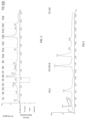
- Fig. 2 shows the first dimension LC fractionation chromatogram resulting from the workflow of Fig. 1 , divided into sixteen fractions F1-F16, and the mean sensory ratings of saltiness enhancement for each fraction relative to the control assigned by the panelists. As can be seen in Fig. 2 , only fraction F5 was rated as having an enhanced saltiness (30) relative to the control. Fraction F5 thus was selected for second dimension LC fractionation and further analysis.
- Fig. 3 shows the LC fractionation chromatogram of fraction F5 resulting from the second dimension of the multi-dimensional sensory-guided fractionation.
- Sub-fractions of fraction F5 were evaluated by panelists as described above, and three sub-fractions F5.2, F5.5, and F5.6 were identified as having an enhanced saltiness relative to the control.
- the saltiness-enhancing compounds corresponding to sub-fractions F5.2, F5.5, and F5.6 were quantified and identified as the following:
- Gentisic acid 5- O - ⁇ -D xylopyranoside and kukoamine A were then isolated from potatoes and potato chips for use in further sensory analysis. Five kg of potatoes and three kg of potato chips were subjected to ultrafiltration and solid phase extraction substantially as discussed above with respect to Fig. 1 . Multidimensional fractionation was carried out to yield gentisic acid 5- O - ⁇ -D xylopyranoside and kukoamine A at > 95% purity.
- sample set (1) Twelve panelists rated saltiness intensity using a 15-point scale, in duplicate.
- the saltiness references provided were 0 points (water), 2.5 points (0.2% NaCl), 5 points (0.35% NaCl), and 8.5 points (0.5% NaCl).
- Table 2 Tukey HSD All-Pairwise Comparisons Sample Analysis Sample Composition (per L water) Mean Saltiness Intensity 1 4.40 g NaCl 7.2 A 3.52 g NaCl; 20% reduced salt 5.4 B 2.64 g NaCl; 40% reduced salt 4.4 C
- sample set (2) Eight panelists rated saltiness intensity using a 15-point scale, in duplicate.
- the saltiness references provided were 0 points (water), 2.5 points (0.2% NaCl), 5 points (0.35% NaCl), and 8.5 points (0.5% NaCl).
- the sensory dosage concentrations of the saltiness-enhancing compounds of the samples of sample set (2) is shown below in Table 3.
- Table 3 Sensory Dosage Concentrations Concentration (mg per L or Kg) Compound 1x Dosage 3x Dosage Gentisic acid 5- O - ⁇ -D xylopyranoside 0.44 1.32 Kukoamine A 1.57 4.70
- Panelist evaluation of sample set (3) Twelve panelists rated saltiness intensity using a 15-point scale, in duplicate.
- the saltiness references provided were 0 points (water), 2.5 points (0.2% NaCl), 5 points (0.35% NaCl), and 8.5 points (0.5% NaCl).
- the panelists rated all aqueous samples as being significantly different from each other and rated both the 20% and 40% NaCl reduction-level samples as significantly less salty than the control.
- Panelist evaluation of sample set (4) Nine panelists rated saltiness intensity using a 15-point scale, in duplicate.
- the saltiness references provided were 0 points (water), 2.5 points (0.2% NaCl), 5 points (0.35% NaCl), and 8.5 points (0.5% NaCl).
- gentisic acid 5- O - ⁇ -D xylopyranoside, kukoamine A and L-tryptophan were demonstrated to have salt-enhancing activity when applied topically to 20% and 40% salt reduced potato chips at the 1x dosage.
- application of one or more of the identified saltiness-perception enhancing compounds to a food product may enable a reduction of up to about 40 wt% of the amount of salt applied to a food product while eliminating or attenuating the concomitant reduction in saltiness that would otherwise occur.
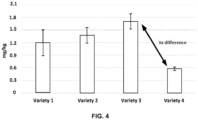
- Fig. 4 shows the variation in the concentrations gentisic acid 5- O - ⁇ -D xylopyranoside present in the four varieties of potato. As shown in Fig. 4 , the concentration of gentisic acid 5- O - ⁇ -D xylopyranoside present in potato variety #3 was determined to be about three times greater than the concentration of gentisic acid 5- O - ⁇ -D xylopyranoside present in potato variety #4.
- Panelists participated in 3 chip training sessions to familiarize themselves with the full salt sample and the chip evaluation protocol.
- the full salt chip sample was presented to panelists alongside the NaCl solution references.
- a previous FREC panel rated the full salt chip an intensity of 6, and this was deemed appropriate by this panel.
- the full salt chip was used as a chip reference 6 throughout the panel.
- panelists evaluated crushed chip samples with varying levels of NaCl concentrations following the protocol described below. Feedback calibration was utilized throughout chip training, and extra samples were available to the panel to retaste as necessary.
Landscapes
- Life Sciences & Earth Sciences (AREA)
- Food Science & Technology (AREA)
- Nutrition Science (AREA)
- Health & Medical Sciences (AREA)
- Engineering & Computer Science (AREA)
- Polymers & Plastics (AREA)
- Chemical & Material Sciences (AREA)
- Botany (AREA)
- Mycology (AREA)
- General Health & Medical Sciences (AREA)
- Seasonings (AREA)
- Preparation Of Fruits And Vegetables (AREA)
- Organic Low-Molecular-Weight Compounds And Preparation Thereof (AREA)
- Pharmaceuticals Containing Other Organic And Inorganic Compounds (AREA)
- Detergent Compositions (AREA)
Applications Claiming Priority (3)
| Application Number | Priority Date | Filing Date | Title |
|---|---|---|---|
| US17/168,464 US20220248732A1 (en) | 2021-02-05 | 2021-02-05 | Saltiness-Perception Enhancing Compounds |
| PCT/US2022/015062 WO2022169940A1 (en) | 2021-02-05 | 2022-02-03 | Saltiness-perception enhancing compounds |
| EP22710776.0A EP4287846A1 (de) | 2021-02-05 | 2022-02-03 | Salzigkeitswahrnehmungsverstärkende verbindungen |
Related Parent Applications (1)
| Application Number | Title | Priority Date | Filing Date |
|---|---|---|---|
| EP22710776.0A Division EP4287846A1 (de) | 2021-02-05 | 2022-02-03 | Salzigkeitswahrnehmungsverstärkende verbindungen |
Publications (2)
| Publication Number | Publication Date |
|---|---|
| EP4378323A2 true EP4378323A2 (de) | 2024-06-05 |
| EP4378323A3 EP4378323A3 (de) | 2024-08-21 |
Family
ID=80780724
Family Applications (2)
| Application Number | Title | Priority Date | Filing Date |
|---|---|---|---|
| EP24170412.1A Pending EP4378323A3 (de) | 2021-02-05 | 2022-02-03 | Salzigkeitswahrnehmungsverstärkende verbindungen |
| EP22710776.0A Pending EP4287846A1 (de) | 2021-02-05 | 2022-02-03 | Salzigkeitswahrnehmungsverstärkende verbindungen |
Family Applications After (1)
| Application Number | Title | Priority Date | Filing Date |
|---|---|---|---|
| EP22710776.0A Pending EP4287846A1 (de) | 2021-02-05 | 2022-02-03 | Salzigkeitswahrnehmungsverstärkende verbindungen |
Country Status (6)
| Country | Link |
|---|---|
| US (1) | US20220248732A1 (de) |
| EP (2) | EP4378323A3 (de) |
| AU (1) | AU2022218158A1 (de) |
| CA (1) | CA3203112A1 (de) |
| MX (1) | MX2023009061A (de) |
| WO (1) | WO2022169940A1 (de) |
Family Cites Families (10)
| Publication number | Priority date | Publication date | Assignee | Title |
|---|---|---|---|---|
| AT502589B1 (de) * | 2002-04-18 | 2009-06-15 | Vis Vitalis Lizenz & Handels | Verfahren zur lebensmitteltechnischen gewinnung von kartoffelsaft-produkten |
| KR100517738B1 (ko) * | 2003-06-03 | 2005-09-30 | 김영숙 | 구기자를 함유한 누룽지 스넥 및 그 제조 방법 |
| CN101829075B (zh) * | 2010-04-27 | 2011-07-20 | 中国人民解放军第三军医大学第一附属医院 | 苦柯胺a和苦柯胺b的用途 |
| US9066974B1 (en) * | 2010-11-13 | 2015-06-30 | Sirbal Ltd. | Molecular and herbal combinations for treating psoriasis |
| CA2900710C (en) * | 2013-02-08 | 2023-08-08 | General Mills, Inc. | Reduced sodium food products |
| CN104418761A (zh) * | 2013-09-03 | 2015-03-18 | 香港城市大学 | 苦可胺的分离方法 |
| ITRM20130599A1 (it) * | 2013-10-31 | 2015-05-01 | Gennaro Bencivenga | Composizione nutraceutica di alimenti vegetali. |
| CN108473528B (zh) * | 2015-10-29 | 2026-01-16 | 弗门尼舍公司 | 高强度甜味剂 |
| CN109068681A (zh) * | 2016-02-22 | 2018-12-21 | 艾维贝合作公司 | 冷冻浓缩的根或块茎汁 |
| KR102171518B1 (ko) * | 2019-02-21 | 2020-10-29 | 한양대학교 에리카산학협력단 | 지골피 추출물을 유효성분으로 함유하는 근 위축 예방 또는 치료용 조성물 |
-
2021
- 2021-02-05 US US17/168,464 patent/US20220248732A1/en not_active Abandoned
-
2022
- 2022-02-03 CA CA3203112A patent/CA3203112A1/en active Pending
- 2022-02-03 WO PCT/US2022/015062 patent/WO2022169940A1/en not_active Ceased
- 2022-02-03 MX MX2023009061A patent/MX2023009061A/es unknown
- 2022-02-03 EP EP24170412.1A patent/EP4378323A3/de active Pending
- 2022-02-03 EP EP22710776.0A patent/EP4287846A1/de active Pending
- 2022-02-03 AU AU2022218158A patent/AU2022218158A1/en active Pending
Also Published As
| Publication number | Publication date |
|---|---|
| EP4378323A3 (de) | 2024-08-21 |
| CA3203112A1 (en) | 2022-08-11 |
| US20220248732A1 (en) | 2022-08-11 |
| AU2022218158A9 (en) | 2024-09-12 |
| AU2022218158A1 (en) | 2023-07-06 |
| WO2022169940A1 (en) | 2022-08-11 |
| MX2023009061A (es) | 2023-08-16 |
| EP4287846A1 (de) | 2023-12-13 |
Similar Documents
| Publication | Publication Date | Title |
|---|---|---|
| Yano et al. | Quantitation of carotenoids in raw and processed fruits in Japan | |
| CN101902926B (zh) | 鲜味活性级分及其制备方法 | |
| EP4417063B1 (de) | Essigsäurehaltiges nahrungsmittel oder getränk | |
| EP4066652B1 (de) | Essigsäure enthaltendes nahrungsmittel oder getränk | |
| Andrade et al. | Effect of different quantities of miracle fruit on sour and bitter beverages | |
| Yargatti et al. | Sensory impacts and consumer acceptability of using dates as analternative functional sweetener in traditional Indian sweets | |
| EP4378323A2 (de) | Salzigkeitswahrnehmungsverstärkende verbindungen | |
| EP4442801A1 (de) | Essigsäurehaltiges nahrungsmittel oder getränk | |
| SG11202112697RA (en) | Non-alcoholic beerlike beverage | |
| Sotirov et al. | Agro-ecological and technological quality of some apples | |
| JP2012187096A (ja) | 醤油様調味料 | |
| EP4094586A1 (de) | Essigsäure enthaltendes nahrungsmittel oder getränk | |
| Idris et al. | Production, proximate, mineral and sensory evaluation of non-alcoholic beverage from tubers: Sweetpotato and Tigernut | |
| KR102258362B1 (ko) | 문경약돌을 먹인 한우의 사골농축액을 이용한 다용도 간장소스 조성물 및 그 제조방법 | |
| Govindarajan et al. | Citrus fruits. Part II. Chemistry, technology, and quality evaluation. C. quality evaluation | |
| Tchonkouang et al. | Development of a Novel Formulation of a Functional Tomato Sauce | |
| EP3649875A1 (de) | Emulgiertes flüssiges würzmittel mit bestandteilen | |
| EP2819526B1 (de) | Nahrungsmittelprodukte mit modulierter intensität des nachgeschmacks sowie verfahren zu davon herstellung | |
| Badifu et al. | Use of mango mesocarp flour to enrich the provitamin A content of a complementary food blend of maize and soya bean flours for porridge | |
| Senphan et al. | Low-sodium Chaya Leaf Seasoning Powder with Potassium Chloride Substitution: Nutritional, Antioxidant, and Microbial Quality Assessment. | |
| KR101611813B1 (ko) | 오징어 젓갈 소스 및 이의 제조방법 | |
| Pomasa et al. | Formulation of supplemented thai custard spread using jackfruit rag and sugar replacement with stevia | |
| EP3997987B1 (de) | Lebensmittelprodukt mit substanz aus erhitztem gemüse, lebensmittelprodukt mit verarbeiteter substanz aus gekochtem gemüse, verfahren zur herstellung davon und verfahren zur verminderung des unerwünschten geschmacks von gemüse | |
| Ngameni Tchonkouang et al. | Development of a novel formulation of a functional tomato sauce | |
| KOUAKOUA et al. | Effect of different fruit blends on the acidity of saba senegalensis pulp |
Legal Events
| Date | Code | Title | Description |
|---|---|---|---|
| PUAI | Public reference made under article 153(3) epc to a published international application that has entered the european phase |
Free format text: ORIGINAL CODE: 0009012 |
|
| STAA | Information on the status of an ep patent application or granted ep patent |
Free format text: STATUS: THE APPLICATION HAS BEEN PUBLISHED |
|
| AC | Divisional application: reference to earlier application |
Ref document number: 4287846 Country of ref document: EP Kind code of ref document: P |
|
| AK | Designated contracting states |
Kind code of ref document: A2 Designated state(s): AL AT BE BG CH CY CZ DE DK EE ES FI FR GB GR HR HU IE IS IT LI LT LU LV MC MK MT NL NO PL PT RO RS SE SI SK SM TR |
|
| P01 | Opt-out of the competence of the unified patent court (upc) registered |
Free format text: CASE NUMBER: APP_33821/2024 Effective date: 20240606 |
|
| REG | Reference to a national code |
Ref country code: DE Ref legal event code: R079 Free format text: PREVIOUS MAIN CLASS: A23L0027000000 Ipc: A23L0027100000 |
|
| PUAL | Search report despatched |
Free format text: ORIGINAL CODE: 0009013 |
|
| AK | Designated contracting states |
Kind code of ref document: A3 Designated state(s): AL AT BE BG CH CY CZ DE DK EE ES FI FR GB GR HR HU IE IS IT LI LT LU LV MC MK MT NL NO PL PT RO RS SE SI SK SM TR |
|
| RIC1 | Information provided on ipc code assigned before grant |
Ipc: A23L 33/105 20160101ALI20240718BHEP Ipc: A21D 13/06 20170101ALI20240718BHEP Ipc: A23L 27/00 20160101ALI20240718BHEP Ipc: A23L 27/10 20160101AFI20240718BHEP |
|
| STAA | Information on the status of an ep patent application or granted ep patent |
Free format text: STATUS: REQUEST FOR EXAMINATION WAS MADE |
|
| 17P | Request for examination filed |
Effective date: 20250219 |
|
| STAA | Information on the status of an ep patent application or granted ep patent |
Free format text: STATUS: EXAMINATION IS IN PROGRESS |
|
| 17Q | First examination report despatched |
Effective date: 20260302 |