EP4377429B1 - Cleaning product for a central heating system - Google Patents
Cleaning product for a central heating system Download PDFInfo
- Publication number
- EP4377429B1 EP4377429B1 EP23700237.3A EP23700237A EP4377429B1 EP 4377429 B1 EP4377429 B1 EP 4377429B1 EP 23700237 A EP23700237 A EP 23700237A EP 4377429 B1 EP4377429 B1 EP 4377429B1
- Authority
- EP
- European Patent Office
- Prior art keywords
- cleaning product
- water
- cream
- gel
- amphoteric surfactant
- Prior art date
- Legal status (The legal status is an assumption and is not a legal conclusion. Google has not performed a legal analysis and makes no representation as to the accuracy of the status listed.)
- Active
Links
Images
Classifications
-
- C—CHEMISTRY; METALLURGY
- C11—ANIMAL OR VEGETABLE OILS, FATS, FATTY SUBSTANCES OR WAXES; FATTY ACIDS THEREFROM; DETERGENTS; CANDLES
- C11D—DETERGENT COMPOSITIONS; USE OF SINGLE SUBSTANCES AS DETERGENTS; SOAP OR SOAP-MAKING; RESIN SOAPS; RECOVERY OF GLYCEROL
- C11D1/00—Detergent compositions based essentially on surface-active compounds; Use of these compounds as a detergent
- C11D1/88—Ampholytes; Electroneutral compounds
-
- C—CHEMISTRY; METALLURGY
- C02—TREATMENT OF WATER, WASTE WATER, SEWAGE, OR SLUDGE
- C02F—TREATMENT OF WATER, WASTE WATER, SEWAGE, OR SLUDGE
- C02F1/00—Treatment of water, waste water, or sewage
- C02F1/68—Treatment of water, waste water, or sewage by addition of specified substances, e.g. trace elements, for ameliorating potable water
- C02F1/685—Devices for dosing the additives
- C02F1/686—Devices for dosing liquid additives
-
- C—CHEMISTRY; METALLURGY
- C02—TREATMENT OF WATER, WASTE WATER, SEWAGE, OR SLUDGE
- C02F—TREATMENT OF WATER, WASTE WATER, SEWAGE, OR SLUDGE
- C02F5/00—Softening water; Preventing scale; Adding scale preventatives or scale removers to water, e.g. adding sequestering agents
- C02F5/08—Treatment of water with complexing chemicals or other solubilising agents for softening, scale prevention or scale removal, e.g. adding sequestering agents
- C02F5/10—Treatment of water with complexing chemicals or other solubilising agents for softening, scale prevention or scale removal, e.g. adding sequestering agents using organic substances
-
- C—CHEMISTRY; METALLURGY
- C11—ANIMAL OR VEGETABLE OILS, FATS, FATTY SUBSTANCES OR WAXES; FATTY ACIDS THEREFROM; DETERGENTS; CANDLES
- C11D—DETERGENT COMPOSITIONS; USE OF SINGLE SUBSTANCES AS DETERGENTS; SOAP OR SOAP-MAKING; RESIN SOAPS; RECOVERY OF GLYCEROL
- C11D11/00—Special methods for preparing compositions containing mixtures of detergents
- C11D11/0094—Process for making liquid detergent compositions, e.g. slurries, pastes or gels
-
- C—CHEMISTRY; METALLURGY
- C11—ANIMAL OR VEGETABLE OILS, FATS, FATTY SUBSTANCES OR WAXES; FATTY ACIDS THEREFROM; DETERGENTS; CANDLES
- C11D—DETERGENT COMPOSITIONS; USE OF SINGLE SUBSTANCES AS DETERGENTS; SOAP OR SOAP-MAKING; RESIN SOAPS; RECOVERY OF GLYCEROL
- C11D17/00—Detergent materials or soaps characterised by their shape or physical properties
- C11D17/0008—Detergent materials or soaps characterised by their shape or physical properties aqueous liquid non soap compositions
- C11D17/003—Colloidal solutions, e.g. gels; Thixotropic solutions or pastes
-
- C—CHEMISTRY; METALLURGY
- C11—ANIMAL OR VEGETABLE OILS, FATS, FATTY SUBSTANCES OR WAXES; FATTY ACIDS THEREFROM; DETERGENTS; CANDLES
- C11D—DETERGENT COMPOSITIONS; USE OF SINGLE SUBSTANCES AS DETERGENTS; SOAP OR SOAP-MAKING; RESIN SOAPS; RECOVERY OF GLYCEROL
- C11D17/00—Detergent materials or soaps characterised by their shape or physical properties
- C11D17/04—Detergent materials or soaps characterised by their shape or physical properties combined with or containing other objects
- C11D17/041—Compositions releasably affixed on a substrate or incorporated into a dispensing means
- C11D17/042—Water soluble or water disintegrable containers or substrates containing cleaning compositions or additives for cleaning compositions
- C11D17/043—Liquid or thixotropic (gel) compositions
-
- C—CHEMISTRY; METALLURGY
- C11—ANIMAL OR VEGETABLE OILS, FATS, FATTY SUBSTANCES OR WAXES; FATTY ACIDS THEREFROM; DETERGENTS; CANDLES
- C11D—DETERGENT COMPOSITIONS; USE OF SINGLE SUBSTANCES AS DETERGENTS; SOAP OR SOAP-MAKING; RESIN SOAPS; RECOVERY OF GLYCEROL
- C11D17/00—Detergent materials or soaps characterised by their shape or physical properties
- C11D17/04—Detergent materials or soaps characterised by their shape or physical properties combined with or containing other objects
- C11D17/041—Compositions releasably affixed on a substrate or incorporated into a dispensing means
- C11D17/042—Water soluble or water disintegrable containers or substrates containing cleaning compositions or additives for cleaning compositions
- C11D17/045—Multi-compartment
-
- C—CHEMISTRY; METALLURGY
- C11—ANIMAL OR VEGETABLE OILS, FATS, FATTY SUBSTANCES OR WAXES; FATTY ACIDS THEREFROM; DETERGENTS; CANDLES
- C11D—DETERGENT COMPOSITIONS; USE OF SINGLE SUBSTANCES AS DETERGENTS; SOAP OR SOAP-MAKING; RESIN SOAPS; RECOVERY OF GLYCEROL
- C11D3/00—Other compounding ingredients of detergent compositions covered in group C11D1/00
- C11D3/0005—Other compounding ingredients characterised by their effect
- C11D3/0073—Anticorrosion compositions
-
- C—CHEMISTRY; METALLURGY
- C11—ANIMAL OR VEGETABLE OILS, FATS, FATTY SUBSTANCES OR WAXES; FATTY ACIDS THEREFROM; DETERGENTS; CANDLES
- C11D—DETERGENT COMPOSITIONS; USE OF SINGLE SUBSTANCES AS DETERGENTS; SOAP OR SOAP-MAKING; RESIN SOAPS; RECOVERY OF GLYCEROL
- C11D3/00—Other compounding ingredients of detergent compositions covered in group C11D1/00
- C11D3/16—Organic compounds
- C11D3/26—Organic compounds containing nitrogen
- C11D3/28—Heterocyclic compounds containing nitrogen in the ring
-
- C—CHEMISTRY; METALLURGY
- C11—ANIMAL OR VEGETABLE OILS, FATS, FATTY SUBSTANCES OR WAXES; FATTY ACIDS THEREFROM; DETERGENTS; CANDLES
- C11D—DETERGENT COMPOSITIONS; USE OF SINGLE SUBSTANCES AS DETERGENTS; SOAP OR SOAP-MAKING; RESIN SOAPS; RECOVERY OF GLYCEROL
- C11D3/00—Other compounding ingredients of detergent compositions covered in group C11D1/00
- C11D3/16—Organic compounds
- C11D3/26—Organic compounds containing nitrogen
- C11D3/30—Amines; Substituted amines ; Quaternized amines
-
- C—CHEMISTRY; METALLURGY
- C11—ANIMAL OR VEGETABLE OILS, FATS, FATTY SUBSTANCES OR WAXES; FATTY ACIDS THEREFROM; DETERGENTS; CANDLES
- C11D—DETERGENT COMPOSITIONS; USE OF SINGLE SUBSTANCES AS DETERGENTS; SOAP OR SOAP-MAKING; RESIN SOAPS; RECOVERY OF GLYCEROL
- C11D3/00—Other compounding ingredients of detergent compositions covered in group C11D1/00
- C11D3/16—Organic compounds
- C11D3/34—Organic compounds containing sulfur
- C11D3/3409—Alkyl -, alkenyl -, cycloalkyl - or terpene sulfates or sulfonates
-
- C—CHEMISTRY; METALLURGY
- C11—ANIMAL OR VEGETABLE OILS, FATS, FATTY SUBSTANCES OR WAXES; FATTY ACIDS THEREFROM; DETERGENTS; CANDLES
- C11D—DETERGENT COMPOSITIONS; USE OF SINGLE SUBSTANCES AS DETERGENTS; SOAP OR SOAP-MAKING; RESIN SOAPS; RECOVERY OF GLYCEROL
- C11D3/00—Other compounding ingredients of detergent compositions covered in group C11D1/00
- C11D3/16—Organic compounds
- C11D3/36—Organic compounds containing phosphorus
- C11D3/361—Phosphonates, phosphinates or phosphonites
-
- C—CHEMISTRY; METALLURGY
- C11—ANIMAL OR VEGETABLE OILS, FATS, FATTY SUBSTANCES OR WAXES; FATTY ACIDS THEREFROM; DETERGENTS; CANDLES
- C11D—DETERGENT COMPOSITIONS; USE OF SINGLE SUBSTANCES AS DETERGENTS; SOAP OR SOAP-MAKING; RESIN SOAPS; RECOVERY OF GLYCEROL
- C11D3/00—Other compounding ingredients of detergent compositions covered in group C11D1/00
- C11D3/16—Organic compounds
- C11D3/37—Polymers
- C11D3/3746—Macromolecular compounds obtained by reactions only involving carbon-to-carbon unsaturated bonds
- C11D3/378—(Co)polymerised monomers containing sulfur, e.g. sulfonate
-
- C—CHEMISTRY; METALLURGY
- C23—COATING METALLIC MATERIAL; COATING MATERIAL WITH METALLIC MATERIAL; CHEMICAL SURFACE TREATMENT; DIFFUSION TREATMENT OF METALLIC MATERIAL; COATING BY VACUUM EVAPORATION, BY SPUTTERING, BY ION IMPLANTATION OR BY CHEMICAL VAPOUR DEPOSITION, IN GENERAL; INHIBITING CORROSION OF METALLIC MATERIAL OR INCRUSTATION IN GENERAL
- C23F—NON-MECHANICAL REMOVAL OF METALLIC MATERIAL FROM SURFACE; INHIBITING CORROSION OF METALLIC MATERIAL OR INCRUSTATION IN GENERAL; MULTI-STEP PROCESSES FOR SURFACE TREATMENT OF METALLIC MATERIAL INVOLVING AT LEAST ONE PROCESS PROVIDED FOR IN CLASS C23 AND AT LEAST ONE PROCESS COVERED BY SUBCLASS C21D OR C22F OR CLASS C25
- C23F11/00—Inhibiting corrosion of metallic material by applying inhibitors to the surface in danger of corrosion or adding them to the corrosive agent
- C23F11/08—Inhibiting corrosion of metallic material by applying inhibitors to the surface in danger of corrosion or adding them to the corrosive agent in other liquids
- C23F11/10—Inhibiting corrosion of metallic material by applying inhibitors to the surface in danger of corrosion or adding them to the corrosive agent in other liquids using organic inhibitors
-
- C—CHEMISTRY; METALLURGY
- C02—TREATMENT OF WATER, WASTE WATER, SEWAGE, OR SLUDGE
- C02F—TREATMENT OF WATER, WASTE WATER, SEWAGE, OR SLUDGE
- C02F2103/00—Nature of the water, waste water, sewage or sludge to be treated
- C02F2103/02—Non-contaminated water, e.g. for industrial water supply
- C02F2103/023—Water in cooling circuits
-
- C—CHEMISTRY; METALLURGY
- C11—ANIMAL OR VEGETABLE OILS, FATS, FATTY SUBSTANCES OR WAXES; FATTY ACIDS THEREFROM; DETERGENTS; CANDLES
- C11D—DETERGENT COMPOSITIONS; USE OF SINGLE SUBSTANCES AS DETERGENTS; SOAP OR SOAP-MAKING; RESIN SOAPS; RECOVERY OF GLYCEROL
- C11D2111/00—Cleaning compositions characterised by the objects to be cleaned; Cleaning compositions characterised by non-standard cleaning or washing processes
- C11D2111/10—Objects to be cleaned
- C11D2111/14—Hard surfaces
- C11D2111/20—Industrial or commercial equipment, e.g. reactors, tubes or engines
Definitions
- the present invention relates to a cleaning product, particularly for use in a central heating or cooling system, and to methods of manufacturing the cleaning product and cleaning a central heating or cooling system using the cleaning product.
- the liquid cleaner is provided in a container such as a bottle or a drum. It can be added into the system via a radiator, using a pressurised can, via a flushing pump, or poured into a filter, for example. In a commercial system, the liquid cleaner may instead be added via a dosing pot installed as part of the central heating system. Once added into the central heating system, the liquid cleaner helps to subsequently flush out the corrosion, scale and other debris that have built up.
- Liquid cleaner is usually provided in bottles of 500ml or 1 litre, although larger volumes from 5 litres to 1000 litres may be provided for commercial use.
- a liquid cleaner sold under the trade mark Adey MC3+ (RTM) Cleaner has a concentrated formula for cleaning a central heating system.
- a typical domestic central heating system may have around 100 to 125 litres of system water.
- Around 300ml of liquid cleaner can be used to clean a 125 litre system, using the Adey MC3+ (RTM) Rapide cleaner for example, which corresponds to a dose of around 0.24% v/v.
- RTM Adey MC3+
- ingredients of the liquid cleaner would precipitate or crystallise out of solution due to the solubility limit of the liquid.
- concentrated liquid cleaner presents a safety risk, particularly in respect of potential contact with the skin or eyes, and appropriate care must be taken during use. If the liquid is spilled, then it must be disposed of appropriately because its chemical constituents can present an environmental hazard.
- a cleaner product in the form of a solid, dissolvable tablet.
- a solid tablet product is known under the trade mark Flamco (RTM) RedProtect Cleaner RP2
- another solid tablet product is known under the trade mark DosaFil (RTM) for commercial systems.
- RTM Flamco
- RTM DosaFil
- a cleaning product in the form of a cream or gel for use in a central heating or cooling system, the cleaning product comprising: at least 20% complexing agent (or agents), at least 5% dispersing agent (or agents), at least 5% amphoteric surfactant (or surfactants), and less than 20% water.
- the cleaning product may be encapsulated in a water-soluble film or provided in a container.
- the product can be added into a central heating or cooling system via a filter or dosing pot, for example, typically by opening a lid of the filter or dosing pot. If packaged in a water-soluble film, the film will be dissolved by the system water over a period of minutes and release the cleaning product into the system water. Once introduced into the system water, the product quickly disperses compared to a solid tablet-based product, providing immediate protection for the central heating/cooling system without the risk of forming clumps of material which may clog the system.
- At least one of the ingredients may be suspended in the cream or gel.
- the complexing agent may be suspended in the cream/gel, or the dispersing agent may be suspended, or the amphoteric agent may be suspended, or combinations thereof. That is not to say that the entirety of a particular ingredient is suspended, but at least some of it may be depending on the amount of water present and the relative solubility of each ingredient.
- the water-soluble film may be a polymer film such as a poly(vinyl alcohol) film.
- the complexing agent may be provided in solution, such as aqueous solution.
- the organosulfur compound(s) can aid dispersal of debris in the central heating or cooling system, in order for debris to be flushed from the system.
- the debris may be magnetic or non-magnetic.
- the cleaning product can therefore have a secondary function of minimising corrosion of the pipework and other internal portions of the central heating/cooling system.
- the cleaning product may be a cream/gel which contains 30-80% of organophosphorus compound as a complexing agent, around 5-15% organosulfur compound as a dispersing agent, around 5-15% amphoteric surfactant, around 10-15% water, and 2-10% corrosion inhibitor. This provides a highly concentrated cream or gel cleaning product.
- the cleaning formulation may consist essentially only of complexing agent(s), dispersant(s), surfactant(s), optionally corrosion inhibitor(s), and water.
- the cleaning product may include a second solvent, in addition to water.
- the second solvent may be an organic solvent.
- the cleaning product may include a glycol, such as ethylene glycol, diethylene glycol or propylene glycol. This can be suitable for aiding dissolution of some ingredients when preparing the cream / gel. It will be appreciated that another diol, triol or suitable compound comprising multiple hydroxyl groups may be provided alternatively or in addition.
- a glycol such as ethylene glycol, diethylene glycol or propylene glycol. This can be suitable for aiding dissolution of some ingredients when preparing the cream / gel. It will be appreciated that another diol, triol or suitable compound comprising multiple hydroxyl groups may be provided alternatively or in addition.
- a first group of the ingredients may be provided in a first compartment of the water-soluble film or container.
- a second group of the ingredients may be provided in a second compartment of the water-soluble film or container.
- Each group of ingredients may individually comprise less than 20% water.
- ingredients can still separately dissolve or form a cream/gel or other emulsion in less than 20% water, and whilst packaged separately they can still be added to the central heating/cooling system at the same time.
- the cleaning product may be used in a central heating system or central cooling system.
- the cleaning product may be used in other circulation systems where there is metal pipework or conduits, particularly where the pipework/conduits convey water.
- a method of manufacturing a cleaning product for a central heating or cooling system comprising the steps of mixing ingredients including a complexing agent, a dispersing agent, and an amphoteric surfactant into a quantity of water, forming a cream or gel comprising at least 20% complexing agent, at least 5% dispersing agent, at least 5% amphoteric surfactant, and less than 20% water.
- At least one of the ingredients may be suspended or become suspended in the cream or gel.
- One or more of the ingredients may be powdered, and may be suspended in the cream or gel.
- the ingredients may be mixed together as a single phase solution.
- the solution may be thickened e.g. by adding a viscosity modifier (or thickening agent) or by evaporating water, to thicken the solution. Any suitable thickening agent may be used, if suitably compatible with the other ingredients. It will be appreciated that the solution may be thickened by other means and it is not essential to add a viscosity modifier. Once thickened, the cream or gel may form.
- the first and second cleaning product components may be encapsulated in a water-soluble film in respective first and second compartments of that film, or in separate (or discrete) water-soluble films.
- kits of parts for a cleaning product may include one or more first capsules / units of water-soluble film containing the first cleaning product component, and one or more second capsules / units of water-soluble film containing the second cleaning product component. Each capsule or pod may then be added to the system water.
- a kit of cleaning product for use in a central heating or cooling system comprising a first cleaning product component in a first container (such as water-soluble film) and a second cleaning product component in a second container (such as water-soluble film), in which the first and second cleaning product components together comprise at least 20% complexing agent, at least 5% dispersing agent, at least 5% amphoteric surfactant, and optionally corrosion inhibitor, and in which the first and second cleaning product components each independently comprise less than 20% water.
- the kit may include any feature or features presented with respect to other aspects of the invention.
- the cleaning product components may each include any subset of the ingredients, such that together they provide the required combination of cleaning product ingredients.
- a method of cleaning a central heating or cooling system comprising introducing a cleaning product of the first aspect of the invention, or made by the method of the second aspect of the invention, into fluid of the central heating or cooling system.
- the cleaning product may be flushed out of the central heating or cooling system. This is typically followed by filling the central heating system with a new quantity of water which does not contain the cleaning product.
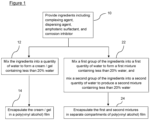
- Figure 1 shows two different ways of making a cleaning product for use in cleaning a central heating system or central cooling system.
- the first step 10 is to provide ingredients including the complexing agent, dispersing agent, amphoteric surfactant, and optionally corrosion inhibitor. These ingredients can be mixed together in a quantity of water to provide a cleaning formulation in a second step 12, and encapsulated in water-soluble film such as poly(vinyl alcohol) film in a third step 14.
- the complexing agent may include sodium phosphonate, for example, although other phosphonates and organophosphorus compounds may be suitable as complexing agents for metal ions and/or compounds in a central heating/cooling system.
- the complexing agent may be a powder, such as anhydrous powder.
- the relative amount of complexing agent may be about 20% to 40% of the final cleaning product. For example, for 100g of cream/gel, the amount of complexing agent may be 20g to 40g. However, in some embodiments, up to about 80% or 85% complexing agent may be provided.
- the dispersing agent may include polymeric sulfonic acid, for example, although other sulfonic acids and organosulfur compounds may be suitable as dispersing agents for breaking down or dissolving debris such as metal compounds or ions in a central heating/cooling system.
- the dispersing agent may be a solid or powder, such as an anhydrous solid or powder.
- the relative amount of dispersing agent should be about 5% to 15% of the final cleaning product. For 100g of cream/gel, the amount of complexing agent would be 5g to 15g.
- the amphoteric surfactant may include alanine, for example, although other amino acids or low-foaming amphoteric surfactants may be suitable for use in the cleaning product.
- the surfactant may be a powder, such as anhydrous powder.
- the relative amount of amphoteric surfactant should be about 5% to 15% of the final cleaning product. For 100g of cream/gel, the amount of amphoteric surfactant would be 5g to 15g.
- the corrosion inhibitor may include benzotriazole and triethanolamine, for example, although other suitable corrosion inhibitors may be provided instead of or in addition to those compounds.
- the relative amount of corrosion inhibitor compounds should total about 2% to 10% of the final cleaning product.
- the mixing step 12 involves mixing the ingredients into less than 20g of water when using the amounts of ingredients noted above.
- the amount of water may be 10g to 15g.
- the water may be heated (whilst remaining liquid) to maximise the extent to which it can dissolve the ingredients, for example at around 50°C.
- the mixing may involve stirring in a reaction vessel.
- the ingredients may be mixed in sequentially, or altogether at the same time in other embodiments. It may sometimes be preferable to dissolve the minor ingredients into the water first.
- the corrosion inhibitor, the amphoteric surfactant and/or the dispersing agent may be mixed into the water first, followed by the complexing agent. Mixing in the major ingredient, i.e. the complexing agent, may then form the cream/gel product with some ingredient being suspended in the cream/gel that forms. Ingredient that becomes suspended may include precipitate from solution and/or ingredient which was not previously dissolved in the water.
- the order in which ingredients are added may be dependent on the solubility of a given ingredient in the cream / gel. That is, one ingredient which does not tend to dissolve into the cream / gel as well as the other ingredients may be added last.
- a liquid mixture may be prepared comprising all but one of the ingredients. Once done, the last ingredient (which may be in the form of a powder) may be added. This may thicken the mixture and suspend the powder homogenously in the cream / gel to give a single cleaning product formulation.
- the cream/gel formed following the mixing step can be encapsulated in water-soluble film in step 14, such as poly(vinyl alcohol) film, which is so far unknown for a central heating system cleaner.
- the relatively low water content of the cream/gel means that the cleaning product 130 can be provided in a single compartment of the film, without dissolving the cream/gel dissolving the film.
- the cream/gel is stable for storage at room temperature in the water-soluble film over an extended period of time.
- the cream/gel has a significantly higher relative concentration of cleaning chemicals, and a significantly lower relative concentration of water, compared to prior art cleaning formulations for a central heating system.
- the cream or gel may be concentrated enough that a suitable dose for a typical domestic central heating system is about 200ml, for example.
- the volume of cream/gel in a given capsule or pod of the product may be less than this, in which case multiple capsules / pods can be used for treating the system.
- the number of capsules required can be scaled according to the size of the central heating system, and optionally the amount of time since it was previously cleaned.
- the ingredients are again provided in the first step 10. However, they are then divided into two groups of ingredients.
- the groups are mixed 22 into separate quantities of water to prepare first and second cleaning product compositions, which are encapsulated 24 in separate compartments of water-soluble film.
- first and second cleaning product compositions may be a cream or gel.
- the separate compartments may be part of completely different capsules / films, or may be discrete compartments within different parts of the same capsule / film.
- a first group of the ingredients may include the amphoteric surfactant, the corrosion inhibitor(s) and the dispersing agent, whilst the second group of ingredients may include the complexing agent.
- the first group of the ingredients may include the amphoteric surfactant, the corrosion inhibitor(s), the dispersing agent and some of the complexing agent, whilst the second group may include the remainder of the complexing agent. It will be appreciated that the groups may each be selected to independently include any combination of the ingredients.
- the amount of water used for mixing with each group of ingredients should be less than 20% of the total weight / volume of that group, to mitigate dissolution of the film by the cleaning product composition.
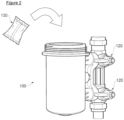
- Figure 2 shows a cleaning product 130 where the ingredients are provided in a water-soluble film.
- two products 130 may be provided as a kit, together containing the ingredients of the cleaning product.
- a filter 100 is connected to a central heating system (not shown) by means of inlet and outlet valves 120.
- the filter 100 has first been isolated from the system by shutting valves 120.
- the filter lid (not shown) has also been removed.
- the cleaning product 130 is then added into the filter 100 via the open end.
- the lid can then be secured to the filter 100 and the valves 120 opened.
- the number of products 130 added to the filter may vary according to the amount of product required to dose the particular size of system being cleaned.
- the number of products 130 used is normally less than the internal volume of the filter, leaving room for a magnet attached to the lid to fit into the filter when the lid is secured to it.
- the film of the cleaning product 130 dissolves in the central heating system water over a short time, typically on the order of minutes. This releases the cleaning product cream/gel, which dissolves or disperses into the system water. Where the cream/gel includes a suspended ingredient or ingredients, those ingredients can also dissolve or disperse into the system water.
- the ingredients provide a cleaning action by dislodging debris and unwanted contaminants (particularly metals and their compounds) within the central heating system pipework and radiators.
- the ingredients are circulated within the central heating system for a period of time to allow the cleaning action to occur. This may take a minimum of around an hour, for example, although the amount of time required will to some extent depend on the size of the system and how long it has been since it was last cleaned (i.e. how dirty / clogged the system is). In some cases, the cleaning product may be left in for a period of days or a few weeks (up to 28 days), for example. Corrosion inhibitor should be provided to mitigate corrosion to the central heating / cooling system during that time.
- the system can be drained and flushed through with fresh water.
- the system is then re-filled as usual. This may include dosing the re-filled system water with a suitable amount of corrosion inhibitor.
Landscapes
- Chemical & Material Sciences (AREA)
- Engineering & Computer Science (AREA)
- Organic Chemistry (AREA)
- Life Sciences & Earth Sciences (AREA)
- Chemical Kinetics & Catalysis (AREA)
- Wood Science & Technology (AREA)
- Oil, Petroleum & Natural Gas (AREA)
- Hydrology & Water Resources (AREA)
- Dispersion Chemistry (AREA)
- Environmental & Geological Engineering (AREA)
- Water Supply & Treatment (AREA)
- Metallurgy (AREA)
- Mechanical Engineering (AREA)
- General Chemical & Material Sciences (AREA)
- Materials Engineering (AREA)
- Health & Medical Sciences (AREA)
- Medicinal Chemistry (AREA)
- Detergent Compositions (AREA)
- Confectionery (AREA)
Applications Claiming Priority (2)
| Application Number | Priority Date | Filing Date | Title |
|---|---|---|---|
| GB202200169 | 2022-01-07 | ||
| PCT/GB2023/050012 WO2023131788A1 (en) | 2022-01-07 | 2023-01-05 | Cleaning product for a central heating system |
Publications (3)
| Publication Number | Publication Date |
|---|---|
| EP4377429A1 EP4377429A1 (en) | 2024-06-05 |
| EP4377429C0 EP4377429C0 (en) | 2025-06-25 |
| EP4377429B1 true EP4377429B1 (en) | 2025-06-25 |
Family
ID=84981119
Family Applications (1)
| Application Number | Title | Priority Date | Filing Date |
|---|---|---|---|
| EP23700237.3A Active EP4377429B1 (en) | 2022-01-07 | 2023-01-05 | Cleaning product for a central heating system |
Country Status (6)
| Country | Link |
|---|---|
| EP (1) | EP4377429B1 (pl) |
| CN (1) | CN118510876A (pl) |
| CA (1) | CA3242126A1 (pl) |
| GB (1) | GB2627664A (pl) |
| PL (1) | PL4377429T3 (pl) |
| WO (1) | WO2023131788A1 (pl) |
Family Cites Families (5)
| Publication number | Priority date | Publication date | Assignee | Title |
|---|---|---|---|---|
| US4810405A (en) * | 1987-10-21 | 1989-03-07 | Dearborn Chemical Company, Limited | Rust removal and composition thereof |
| EP3315488A1 (en) * | 2016-10-28 | 2018-05-02 | Elé Corporation | Amino acid based amphoteric surfactant |
| CN112226772B (zh) * | 2019-07-15 | 2022-06-24 | 中国石油化工股份有限公司 | 复合缓蚀剂和使用该复合缓蚀剂抑制费托合成反应水中碳钢腐蚀的方法 |
| GB2591292B (en) * | 2020-01-27 | 2024-08-14 | Adey Holdings 2008 Ltd | Corrosion inhibitor for a central heating system |
| GB2597080B (en) | 2020-07-14 | 2022-11-23 | Adey Holdings 2008 Ltd | Automatic testing and dosing of central heating and/or cooling systems |
-
2023
- 2023-01-05 WO PCT/GB2023/050012 patent/WO2023131788A1/en not_active Ceased
- 2023-01-05 GB GB2408048.3A patent/GB2627664A/en active Pending
- 2023-01-05 PL PL23700237.3T patent/PL4377429T3/pl unknown
- 2023-01-05 EP EP23700237.3A patent/EP4377429B1/en active Active
- 2023-01-05 CN CN202380016416.XA patent/CN118510876A/zh active Pending
- 2023-01-05 CA CA3242126A patent/CA3242126A1/en active Pending
Also Published As
| Publication number | Publication date |
|---|---|
| CN118510876A (zh) | 2024-08-16 |
| EP4377429C0 (en) | 2025-06-25 |
| EP4377429A1 (en) | 2024-06-05 |
| WO2023131788A1 (en) | 2023-07-13 |
| PL4377429T3 (pl) | 2025-10-06 |
| GB2627664A (en) | 2024-08-28 |
| CA3242126A1 (en) | 2023-07-13 |
| GB202408048D0 (en) | 2024-07-24 |
Similar Documents
| Publication | Publication Date | Title |
|---|---|---|
| ES2367706T3 (es) | Sistema y composición para limpiar e inhibir la corrosión para superficies de aluminio o metales coloreados y aleaciones de los mismos en condiciones alcalinas. | |
| US20080061269A1 (en) | Non-aqueous heat transfer fluid and use thereof | |
| CN108315748A (zh) | 一种金属清洗剂及其制备方法 | |
| JP2008291276A (ja) | 無毒性のエチレングリコール系不凍液/伝熱流体濃厚物および不凍液/伝熱流体 | |
| WO2003072676A1 (en) | Additive compositions for cooling systems | |
| JPS59205484A (ja) | 腐食抑制機能液体 | |
| EP4377429B1 (en) | Cleaning product for a central heating system | |
| CZ20011852A3 (cs) | Způsob opracování a čištění kovů | |
| EP2625257B1 (en) | Cleaning efficacy of metal-safe solid for automated instrument processing | |
| EP2609185B1 (en) | Liquid cleaner for automated instrument processing | |
| CN108949119A (zh) | 环保多效型发动机试机冷却液 | |
| GB2591292A (en) | Corrosion inhibitor for a central heating system | |
| CN101313059B (zh) | 组合物和方法 | |
| EP3022280B1 (en) | Mild alkaline solid instrument cleaner | |
| JPS58133382A (ja) | 塩化カルシウムブライン用防食剤 | |
| JP2002301496A (ja) | スケール除去及び防止剤 | |
| EP3470379B1 (en) | Water-soluble capsule containing a solution with a treatment agent for treating swimming pool waters | |
| RU2129591C1 (ru) | Моющее средство для обработки молочного оборудования | |
| JP3389064B2 (ja) | 水系防食剤及び防食方法 | |
| PT1621521E (pt) | Processo para a eliminação de depósitos em instalações de abastecimento de água e a sua utilização | |
| WO2025207432A1 (en) | Compositions and methods of treating metal surfaces in surface preparation processes | |
| JPS6116797B2 (pl) | ||
| JP2010159382A (ja) | 封水剤組成物 | |
| JPS60260699A (ja) | 銅材質を含む配管用洗浄剤組成物 | |
| CN116855951A (zh) | 一种铝合金用清洗剂及其制备方法和应用 |
Legal Events
| Date | Code | Title | Description |
|---|---|---|---|
| STAA | Information on the status of an ep patent application or granted ep patent |
Free format text: STATUS: UNKNOWN |
|
| STAA | Information on the status of an ep patent application or granted ep patent |
Free format text: STATUS: THE INTERNATIONAL PUBLICATION HAS BEEN MADE |
|
| PUAI | Public reference made under article 153(3) epc to a published international application that has entered the european phase |
Free format text: ORIGINAL CODE: 0009012 |
|
| STAA | Information on the status of an ep patent application or granted ep patent |
Free format text: STATUS: REQUEST FOR EXAMINATION WAS MADE |
|
| 17P | Request for examination filed |
Effective date: 20240226 |
|
| AK | Designated contracting states |
Kind code of ref document: A1 Designated state(s): AL AT BE BG CH CY CZ DE DK EE ES FI FR GB GR HR HU IE IS IT LI LT LU LV MC ME MK MT NL NO PL PT RO RS SE SI SK SM TR |
|
| RAP3 | Party data changed (applicant data changed or rights of an application transferred) |
Owner name: ADEY HOLDINGS (2008) LIMITED |
|
| RAP3 | Party data changed (applicant data changed or rights of an application transferred) |
Owner name: ADEY HOLDINGS (2008) LIMITED |
|
| RAP3 | Party data changed (applicant data changed or rights of an application transferred) |
Owner name: ADEY HOLDINGS (2008) LIMITED |
|
| GRAP | Despatch of communication of intention to grant a patent |
Free format text: ORIGINAL CODE: EPIDOSNIGR1 |
|
| STAA | Information on the status of an ep patent application or granted ep patent |
Free format text: STATUS: GRANT OF PATENT IS INTENDED |
|
| RIC1 | Information provided on ipc code assigned before grant |
Ipc: C02F 103/02 20060101ALN20250213BHEP Ipc: C02F 1/68 20230101ALI20250213BHEP Ipc: C23F 11/10 20060101ALI20250213BHEP Ipc: C02F 5/10 20230101ALI20250213BHEP Ipc: C11D 17/04 20060101ALI20250213BHEP Ipc: C11D 17/00 20060101ALI20250213BHEP Ipc: C11D 11/00 20060101ALI20250213BHEP Ipc: C11D 3/37 20060101ALI20250213BHEP Ipc: C11D 3/36 20060101ALI20250213BHEP Ipc: C11D 3/34 20060101ALI20250213BHEP Ipc: C11D 3/30 20060101ALI20250213BHEP Ipc: C11D 3/28 20060101ALI20250213BHEP Ipc: C11D 3/00 20060101ALI20250213BHEP Ipc: C11D 1/88 20060101AFI20250213BHEP |
|
| DAV | Request for validation of the european patent (deleted) | ||
| DAX | Request for extension of the european patent (deleted) | ||
| INTG | Intention to grant announced |
Effective date: 20250224 |
|
| GRAS | Grant fee paid |
Free format text: ORIGINAL CODE: EPIDOSNIGR3 |
|
| GRAA | (expected) grant |
Free format text: ORIGINAL CODE: 0009210 |
|
| STAA | Information on the status of an ep patent application or granted ep patent |
Free format text: STATUS: THE PATENT HAS BEEN GRANTED |
|
| AK | Designated contracting states |
Kind code of ref document: B1 Designated state(s): AL AT BE BG CH CY CZ DE DK EE ES FI FR GB GR HR HU IE IS IT LI LT LU LV MC ME MK MT NL NO PL PT RO RS SE SI SK SM TR |
|
| REG | Reference to a national code |
Ref country code: GB Ref legal event code: FG4D |
|
| REG | Reference to a national code |
Ref country code: CH Ref legal event code: EP |
|
| REG | Reference to a national code |
Ref country code: CH Ref legal event code: EP |
|
| REG | Reference to a national code |
Ref country code: IE Ref legal event code: FG4D |
|
| REG | Reference to a national code |
Ref country code: DE Ref legal event code: R096 Ref document number: 602023004332 Country of ref document: DE |
|
| U01 | Request for unitary effect filed |
Effective date: 20250723 |
|
| U07 | Unitary effect registered |
Designated state(s): AT BE BG DE DK EE FI FR IT LT LU LV MT NL PT RO SE SI Effective date: 20250730 |
|
| PG25 | Lapsed in a contracting state [announced via postgrant information from national office to epo] |
Ref country code: GR Free format text: LAPSE BECAUSE OF FAILURE TO SUBMIT A TRANSLATION OF THE DESCRIPTION OR TO PAY THE FEE WITHIN THE PRESCRIBED TIME-LIMIT Effective date: 20250926 |
|
| PG25 | Lapsed in a contracting state [announced via postgrant information from national office to epo] |
Ref country code: HR Free format text: LAPSE BECAUSE OF FAILURE TO SUBMIT A TRANSLATION OF THE DESCRIPTION OR TO PAY THE FEE WITHIN THE PRESCRIBED TIME-LIMIT Effective date: 20250625 |
|
| PG25 | Lapsed in a contracting state [announced via postgrant information from national office to epo] |
Ref country code: RS Free format text: LAPSE BECAUSE OF FAILURE TO SUBMIT A TRANSLATION OF THE DESCRIPTION OR TO PAY THE FEE WITHIN THE PRESCRIBED TIME-LIMIT Effective date: 20250925 |
|
| U20 | Renewal fee for the european patent with unitary effect paid |
Year of fee payment: 4 Effective date: 20251031 |