EP4375997B1 - Verkleinerte decodierung - Google Patents
Verkleinerte decodierung Download PDFInfo
- Publication number
- EP4375997B1 EP4375997B1 EP24165642.0A EP24165642A EP4375997B1 EP 4375997 B1 EP4375997 B1 EP 4375997B1 EP 24165642 A EP24165642 A EP 24165642A EP 4375997 B1 EP4375997 B1 EP 4375997B1
- Authority
- EP
- European Patent Office
- Prior art keywords
- window
- length
- coefficients
- frame
- audio decoder
- Prior art date
- Legal status (The legal status is an assumption and is not a legal conclusion. Google has not performed a legal analysis and makes no representation as to the accuracy of the status listed.)
- Active
Links
Images



Classifications
-
- G—PHYSICS
- G10—MUSICAL INSTRUMENTS; ACOUSTICS
- G10L—SPEECH ANALYSIS TECHNIQUES OR SPEECH SYNTHESIS; SPEECH RECOGNITION; SPEECH OR VOICE PROCESSING TECHNIQUES; SPEECH OR AUDIO CODING OR DECODING
- G10L19/00—Speech or audio signals analysis-synthesis techniques for redundancy reduction, e.g. in vocoders; Coding or decoding of speech or audio signals, using source filter models or psychoacoustic analysis
- G10L19/02—Speech or audio signals analysis-synthesis techniques for redundancy reduction, e.g. in vocoders; Coding or decoding of speech or audio signals, using source filter models or psychoacoustic analysis using spectral analysis, e.g. transform vocoders or subband vocoders
-
- G—PHYSICS
- G10—MUSICAL INSTRUMENTS; ACOUSTICS
- G10L—SPEECH ANALYSIS TECHNIQUES OR SPEECH SYNTHESIS; SPEECH RECOGNITION; SPEECH OR VOICE PROCESSING TECHNIQUES; SPEECH OR AUDIO CODING OR DECODING
- G10L19/00—Speech or audio signals analysis-synthesis techniques for redundancy reduction, e.g. in vocoders; Coding or decoding of speech or audio signals, using source filter models or psychoacoustic analysis
- G10L19/02—Speech or audio signals analysis-synthesis techniques for redundancy reduction, e.g. in vocoders; Coding or decoding of speech or audio signals, using source filter models or psychoacoustic analysis using spectral analysis, e.g. transform vocoders or subband vocoders
- G10L19/0212—Speech or audio signals analysis-synthesis techniques for redundancy reduction, e.g. in vocoders; Coding or decoding of speech or audio signals, using source filter models or psychoacoustic analysis using spectral analysis, e.g. transform vocoders or subband vocoders using orthogonal transformation
-
- G—PHYSICS
- G10—MUSICAL INSTRUMENTS; ACOUSTICS
- G10L—SPEECH ANALYSIS TECHNIQUES OR SPEECH SYNTHESIS; SPEECH RECOGNITION; SPEECH OR VOICE PROCESSING TECHNIQUES; SPEECH OR AUDIO CODING OR DECODING
- G10L19/00—Speech or audio signals analysis-synthesis techniques for redundancy reduction, e.g. in vocoders; Coding or decoding of speech or audio signals, using source filter models or psychoacoustic analysis
- G10L19/02—Speech or audio signals analysis-synthesis techniques for redundancy reduction, e.g. in vocoders; Coding or decoding of speech or audio signals, using source filter models or psychoacoustic analysis using spectral analysis, e.g. transform vocoders or subband vocoders
- G10L19/022—Blocking, i.e. grouping of samples in time; Choice of analysis windows; Overlap factoring
Definitions
- the present application is concerned with a downscaled decoding concept.
- the MPEG-4 Enhanced Low Delay AAC usually operates at sample rates up to 48 kHz, which results in an algorithmic delay of 15ms. For some applications, e.g. lip-sync transmission of audio, an even lower delay is desirable.
- AAC-ELD already provides such an option by operating at higher sample rates, e.g. 96 kHz, and therefore provides operation modes with even lower delay, e.g. 7.5 ms. However, this operation mode comes along with an unnecessary high complexity due to the high sample rate.
- the solution to this problem is to apply a downscaled version of the filter bank and therefore, to render the audio signal at a lower sample rate, e.g. 48kHz instead of 96 kHz.
- the downscaling operation is already part of AAC-ELD as it is inherited from the MPEG-4 AAC-LD codec, which serves as a basis for AAC-ELD.
- AAC-LD The downscaled operation mode or AAC-LD is described for AAC-LD in ISO/IEC 14496-3:2009 in section 4.6.17.2.7 "Adaptation to systems using lower sampling rates” as follows: “In certain applications it may be necessary to integrate the low delay decoder into an audio system running at lower sampling rates (e.g. 16 kHz) while the nominal sampling rate of the bitstream payload is much higher (e.g. 48 kHz, corresponding to an algorithmic codec delay of approx. 20 ms). In such cases, it is favorable to decode the output of the low delay codec directly at the target sampling rate rather than using an additional sampling rate conversion operation after decoding.
- lower sampling rates e.g. 16 kHz
- the nominal sampling rate of the bitstream payload e.g. 48 kHz, corresponding to an algorithmic codec delay of approx. 20 ms.
- decoding for lower sampling rates reduces both memory and computational requirements, but may not produce exactly the same output as a full-bandwidth decoding, followed by band limiting and sample rate conversion.
- AAC-LD works with a standard MDCT framework and two window shapes, i.e. sine-window and low-overlap-window. Both windows are fully described by formulas and therefore, window coefficients for any transformation lengths can be determined.
- AAC-ELD codec shows two major differences:
- the IMDCT algorithm using the low delay MDCT window is described in 4.6.20.2 in [1], which is very similar to the standard IMDCT version using e.g. the sine window.
- the coefficients of the low delay MDCT windows (480 and 512 samples frame size) are given in Table 4.A.15 and 4.A.16 in [1]. Please note that the coefficients cannot be determined by a formula, as the coefficients are the result of an optimization algorithm.
- Fig. 9 shows a plot of the window shape for frame size 512.
- the filter banks of the LD-SBR module are downscaled as well. This ensures that the SBR module operates with the same frequency resolution and therefore, no more adaptions are required.
- the present invention is based on the finding that a downscaled version of an audio decoding procedure may more effectively and/or at improved compliance maintenance be achieved if the synthesis window used for downscaled audio decoding is a downsampled version of a reference synthesis window involved in the non-downscaled audio decoding procedure by downsampling by the downsampling factor by which the downsampled sampling rate and the original sampling rate deviate, and downsampled using a segmental interpolation in segments of 1/4 of the frame length.
- Advantageous aspects of the present application are the subject of dependent claims. Preferred embodiments of the present application are described below with respect to the figures, among which:
- AAC-ELD uses low delay MDCT windows.
- the subsequently explained proposal for forming a downscaled mode for AAC-ELD uses a segmental spline interpolation algorithm which maintains the perfect reconstruction property (PR) of the LD-MDCT window with a very high precision. Therefore, the algorithm allows the generation of window coefficients in the direct form, as described in ISO/IEC 14496-3:2009, as well as in the lifting form, as described in [2], in a compatible way. This means both implementations generate 16bit-conform output.
- the interpolation of Low Delay MDCT window is performed as follows.
- a spline interpolation is to be used for generating the downscaled window coefficients to maintain the frequency response and mostly the perfect reconstruction property (around 170dB SNR).
- the interpolation needs to be constraint in certain segments to maintain the perfect reconstruction property.
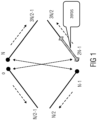
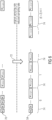
- the window coefficients c covering the DCT kernel of the transformation see also Figure 1 , c(1024)..c(2048)
- the coefficients c (0) ... c ( 2N - 1) are listed along the diamond shape.
- the N /4 zeros in the window coefficients, which are responsible for the delay reduction of the filter bank, are marked using a bold arrow.
- Fig. 1 shows the dependencies of the coefficients caused by the folding involved in the MDCT and also the points where the interpolation needs to be constraint in order to avoid any undesired dependencies.
- the second constraint is not only required for the segment containing the zeros but also for the other segments. Knowing that some coefficients in the DCT kernel were not determined by the optimization algorithm but were determined by formula (1) to enable PR, several discontinuities in the window shape can be explained, e.g. around c(1536+128) in Figure 1 . In order to minimize the PR error, the interpolation needs to stop at such points, which appear in a N/4 grid.
- N corresponds to the length of the DCT kernel whereas hereinabove, in the claims, and the subsequently described generalized embodiments, N corresponds to the frame length, namely the mutual overlap length of the DCT kernels, i.e. the half of the DCT kernel length. Accordingly, while N was indicated to be 512 hereinabove, for example, it is indicated to be 1024 in the following.
- ER AAC LD can change the playout sample rate in order to avoid additional resampling steps (see 4.6.17.2.7).
- ER AAC ELD can apply similar downscaling steps using the Low Delay MDCT window and the LD-SBR tool.
- the downscaling factor is limited to multiples of 2.
- the downscaled frame size needs to be an integer number.
- the algorithm is also able to generate downscaled lifting coefficients of the LD-MDCT.
- the Low Delay SBR tool is used in conjunction with ELD, this tool can be downscaled to lower sample rates, at least for downscaling factors of a multiple of 2.
- the downscale factor F controls the number of bands used for the CLDFB analysis and synthesis filter bank. The following two paragraphs describe a downscaled CLDFB analysis and synthesis filter bank, see also 4.6.19.4.
- the downscaling of the CLDFB can be applied for the real valued versions of the low power SBR mode as well. For illustration, please also consider 4.6.19.5.
- This subclause describes the Low Delay MDCT filter bank utilized in the AAC ELD encoder.
- the core MDCT algorithm is mostly unchanged, but with a longer window, such that n is now running from -N to N-1 (rather than from 0 to N-1)
- the window length N (based on the sine window) is 1024 or 960.
- the window length of the low-delay window is 2*N.
- the synthesis filter bank is modified compared to the standard IMDCT algorithm using a sine window in order to adopt a low-delay filter bank.
- the core IMDCT algorithm is mostly unchanged, but with a longer window, such that n is now running up to 2N-1 (rather than up to N-1).
- the windowing and overlap-add is conducted in the following way:
- the length N window is replaced by a length 2N window with more overlap in the past, and less overlap to the future (N/8 values are actually zero).
- embodiments of the present application are not restricted to an audio decoder performing a downscaled version of AAC-ELD decoding.
- embodiments of the present application may, for instance, be derived by forming an audio decoder capable of performing the inverse transformation process in a downscaled manner only without supporting or using the various AAC-ELD specific further tasks such as, for instance, the scale factor-based transmission of the spectral envelope, TNS (temporal noise shaping) filtering, spectral band replication (SBR) or the like.
- TNS temporary noise shaping
- SBR spectral band replication
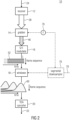
- Fig. 2 illustrates the steps performed by the decoder of Fig. 2 .
- the audio decoder of Fig. 2 which is generally indicated using reference sign 10, comprises a receiver 12, a grabber 14, a spectral-to-time modulator 16, a windower 18 and a time domain aliasing canceler 20, all of which are connected in series to each other in the order of their mentioning.
- the interaction and functionality of blocks 12 to 20 of audio decoder 10 are described in the following with respect to Fig. 3 .
- blocks 12 to 20 may be implemented in software, programmable hardware or hardware such as in the form of a computer program, an FPGA or appropriately programmed computer, programmed microprocessor or application specific integrated circuit with the blocks 12 to 20 representing respective subroutines, circuit paths or the like.
- the audio decoder 10 of Fig. 2 is configured to, - and the elements of the audio decoder 10 are configured to appropriately cooperate - in order to decode an audio signal 22 from a data stream 24 with a noteworthiness that audio decoder 10 decodes signal 22 at a sampling rate being 1/F th of the sampling rate at which the audio signal 22 has been transform coded into data stream 24 at the encoding side.
- F may, for instance, be any rational number greater than one.
- the audio decoder may be configured to operate at different or varying downscaling factors F or at a fixed one. Alternatives are described in more detail below.
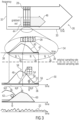
- Fig. 3 illustrates the spectral coefficients using small boxes or squares 28 arranged in a spectrotemporal manner along a time axis 30 which runs horizontally in Fig. 3 , and a frequency axis 32 which runs vertically in Fig. 3 , respectively.
- the spectral coefficients 28 are transmitted within data stream 24.
- the manner in which the spectral coefficients 28 have been obtained, and thus the manner via which the spectral coefficients 28 represent the audio signal 22, is illustrated in Fig. 3 at 34, which illustrates for a portion of time axis 30 how the spectral coefficients 28 belonging to, or representing the respective time portion, have been obtained from the audio signal.
- coefficients 28 as transmitted within data stream 24 are coefficients of a lapped transform of the audio signal 22 so that the audio signal 22, sampled at the original or encoding sampling rate, is partitioned into immediately temporally consecutive and nonoverlapping frames of a predetermined length N, wherein N spectral coefficients are transmitted in data stream 24 for each frame 36. That is, transform coefficients 28 are obtained from the audio signal 22 using a critically sampled lapped transform.
- each column of the temporal sequence of columns of spectral coefficients 28 corresponds to a respective one of frames 36 of the sequence of frames.
- the N spectral coefficients 28 are obtained for the corresponding frame 36 by a spectrally decomposing transform or time-to-spectral modulation, the modulation functions of which temporally extend, however, not only across the frame 36 to which the resulting spectral coefficients 28 belong, but also across E + 1 previous frames, wherein E may be any integer or any even numbered integer greater than zero. That is, the spectral coefficients 28 of one column of the spectrogram at 26 which belonged to a certain frame 36 are obtained by applying a transform onto a transform window, which in addition the respective frame comprises E + 1 frames lying in the past relative to the current frame. The spectral decomposition of the samples of the audio signal within this transform window 38, which is illustrated in Fig.
- the analysis window 40 comprises a zero-interval 42 at the temporal leading end thereof so that the encoder does not need to await the corresponding portion of newest samples within the current frame 36 so as to compute the spectral coefficients 28 for this current frame 36.
- transform coefficients 28 belonging to a current frame 36 are obtained by windowing and spectral decomposition of samples of the audio signal within a transform window 38 which comprises the current frame as well as temporally preceding frames and which temporally overlaps with the corresponding transform windows used for determining the spectral coefficients 28 belonging to temporally neighboring frames.
- the audio encoder having transform coded audio signal 22 into data stream 24 may be controlled via a psychoacoustic model or may use a psychoacoustic model to keep the quantization noise and quantizing the spectral coefficients 28 unperceivable for the hearer and/or below a masking threshold function, thereby determining scale factors for spectral bands using which the quantized and transmitted spectral coefficients 28 are scaled.
- the scale factors would also be signaled in data stream 24.
- the audio encoder may have been a TCX (transform coded excitation) type of encoder.
- the audio signal would have had subject to a linear prediction analysis filtering before forming the spectrotemporal representation 26 of spectral coefficients 28 by applying the lapped transform onto the excitation signal, i.e. the linear prediction residual signal.
- the linear prediction coefficients could be signaled in data stream 24 as well, and a spectral uniform quantization could be applied in order to obtain the spectral coefficients 28.
- the description brought forward so far has also been simplified with respect to the frame length of frames 36 and/or with respect to the low delay window function 40.
- the audio signal 22 may have been coded into data stream 24 in a manner using varying frame sizes and/or different windows 40.
- the description brought forward in the following concentrates on one window 40 and one frame length, although the subsequent description may easily be extended to a case where the entropy encoder changes these parameters during coding the audio signal into the data stream.
- receiver 12 receives data stream 24 and receives thereby, for each frame 36, N spectral coefficients 28, i.e. a respective column of coefficients 28 shown in Fig. 3 .
- N spectral coefficients 28 i.e. a respective column of coefficients 28 shown in Fig. 3 .
- the temporal length of the frames 36 measured in samples of the original or encoding sampling rate, is N as indicated in Fig. 3 at 34, but the audio decoder 10 of Fig. 2 is configured to decode the audio signal 22 at a reduced sampling rate.
- the audio decoder 10 supports, for example, merely this downscaled decoding functionality described in the following.
- audio decoder 10 would be able to reconstruct the audio signal at the original or encoding sampling rate, but may be switched between the downscaled decoding mode and a non-downscaled decoding mode with the downscaled decoding mode coinciding with the audio decoder's 10 mode of operation as subsequently explained.
- audio encoder 10 could be switched to a downscaled decoding mode in the case of a low battery level, reduced reproduction environment capabilities or the like. Whenever the situation changes the audio decoder 10 could, for instance, switch back from the downscaled decoding mode to the non-downscaled one.
- the audio signal 22 is reconstructed at a sampling rate at which frames 36 have, at the reduced sampling rate, a lower length measured in samples of this reduced sampling rate, namely a length of N/F samples at the reduced sampling rate.
- the output of receiver 12 is the sequence of N spectral coefficients, namely one set of N spectral coefficients, i.e. one column in Fig. 3 , per frame 36. It already turned out from the above brief description of the transform coding process for forming data stream 24 that receiver 12 may apply various tasks in obtaining the N spectral coefficients per frame 36.
- Receiver 12 uses entropy decoding in order to read the spectral coefficients 28 from the data stream 24.
- Receiver 12 also spectrally shapes the spectral coefficients read from the data stream with scale factors provided in the data stream and/or scale factors derived by linear prediction coefficients conveyed within data stream 24.
- receiver 12 may obtain scale factors from the data stream 24, namely on a per frame and per subband basis, and use these scale factors in order to scale the scale factors conveyed within the data stream 24.
- receiver 12 may derive scale factors from linear prediction coefficients conveyed within the data stream 24, for each frame 36, and use these scale factors in order to scale the transmitted spectral coefficients 28.
- Receiver 12 performs gap filling in order to synthetically fill zero-quantized portions within the sets of N spectral coefficients 18 per frame.
- receiver 12 may apply a TNS-synthesis filter onto a transmitted TNS filter coefficient per frame to assist the reconstruction of the spectral coefficients 28 from the data stream with the TNS coefficients also being transmitted within the data stream 24.
- the just outlined possible tasks of receiver 12 shall be understood as a non-exclusive list of possible measures and receiver 12 may perform further or other tasks in connection with the reading of the spectral coefficients 28 from data stream 24.
- Grabber 14 thus receives from receiver 12 the spectrogram 26 of spectral coefficients 28 and grabs, for each frame 36, a low frequency fraction 44 of the N spectral coefficients of the respective frame 36, namely the N/F lowest-frequency spectral coefficients.
- spectral-to-time modulator 16 receives from grabber 14 a stream or sequence 46 of N/F spectral coefficients 28 per frame 36, corresponding to a low-frequency slice out of the spectrogram 26, spectrally registered to the lowest frequency spectral coefficients illustrated using index "0" in Fig. 3 , and extending till the spectral coefficients of index N/F - 1.
- the spectral-to-time modulator 16 subjects, for each frame 36, the corresponding low-frequency fraction 44 of spectral coefficients 28 to an inverse transform 48 having modulation functions of length (E + 2) ⁇ N/F temporally extending over the respective frame and E + 1 previous frames as illustrated at 50 in Fig. 3 , thereby obtaining a temporal portion of length (E + 2) ⁇ N/F, i.e. a not-yet windowed time segment 52. That is, the spectral-to-time modulator may obtain a temporal time segment of (E + 2) ⁇ N/F samples of reduced sampling rate by weighting and summing modulation functions of the same length using, for instance, the first formulae of the proposed replacement section A.4 indicated above.
- the newest N/F samples of time segment 52 belong to the current frame 36.
- the modulation functions may, as indicated, be cosine functions in case of the inverse transform being an inverse MDCT, or sine functions in case of the inverse transform being an inverse MDCT, for instance.
- windower 52 receives, for each frame, a temporal portion 52, the N/F samples at the leading end thereof temporally corresponding to the respective frame while the other samples of the respective temporal portion 52 belong to the corresponding temporally preceding frames.
- Windower 18 windows, for each frame 36, the temporal portion 52 using a unimodal synthesis window 54 of length (E + 2) ⁇ N/F comprising a zero-portion 56 of length 1/4 ⁇ N/F at a leading end thereof, i.e. 1/F ⁇ N/F zero-valued window coefficients, and having a peak 58 within its temporal interval succeeding, temporally, the zero-portion 56, i.e. the temporal interval of temporal portion 52 not covered by the zero-portion 52.
- a unimodal synthesis window 54 of length (E + 2) ⁇ N/F comprising a zero-portion 56 of length 1/4 ⁇ N/F at a leading end thereof, i.e. 1/F ⁇ N/F zero-valued window coefficients
- the latter temporal interval may be called the non-zero portion of window 58 and has a length of 7/4 ⁇ N/F measured in samples of the reduced sampling rate, i.e. 7/4 ⁇ N/F window coefficients.
- the windower 18 weights, for instance, the temporal portion 52 using window 58. This weighting or multiplying 58 of each temporal portion 52 with window 54 results in a windowed temporal portion 60, one for each frame 36, and coinciding with the respective temporal portion 52 as far as the temporal coverage is concerned.
- the windowing processing which may be used by window 18 is described by the formulae relating z i,n to x i,n , where x i,n corresponds to the aforementioned temporal portions 52 not yet windowed and z i,n corresponds to the windowed temporal portions 60 with i indexing the sequence of frames/windows, and n indexing, within each temporal portion 52/60, the samples or values of the respective portions 52/60 in accordance with a reduced sampling rate.
- the time domain aliasing canceler 20 receives from windower 18 a sequence of windowed temporal portions 60, namely one per frame 36.
- Canceler 20 subjects the windowed temporal portions 60 of frames 36 to an overlap-add process 62 by registering each windowed temporal portion 60 with its leading N/F values to coincide with the corresponding frame 36.
- a trailing-end fraction of length (E + 1)/(E + 2) of the windowed temporal portion 60 of a current frame i.e. the remainder having length (E + 1) ⁇ N/F, overlaps with a corresponding equally long leading end of the temporal portion of the immediately preceding frame.
- the time domain aliasing canceler 20 may operate as shown in the last formula of the above proposed version of section A.4, where out i,n corresponds to the audio samples of the reconstructed audio signal 22 at the reduced sampling rate.
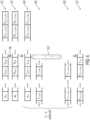
- Fig. 4 uses both the nomenclature applied in the above-proposed section A.4 and the reference signs applied in Figs. 3 and 4 .
- x 0,0 to x 0,(E+2) ⁇ N/F-1 represents the 0 th temporal portion 52 obtained by the spatial-to-temporal-modulator 16 for the 0 th frame 36.
- the first index of x indexes the frames 36 along the temporal order, and the second index of x orders the samples of the temporal along the temporal order, the inter-sample pitch belonging to the reduced sample rate. Then, in Fig.
- w 0 to w (E+2) ⁇ N/F-1 indicate the window coefficients of window 54.
- the index of w is such that index 0 corresponds to the oldest and index (E + 2) ⁇ N/F - 1 corresponds to the newest sample value when the window 54 is applied to the respective temporal portion 52.
- the indices of z have the same meaning as for x. In this manner, modulator 16 and windower 18 act for each frame indexed by the first index of x and z.
- Canceler 20 sums up E + 2 windowed temporal portions 60 of E + 2 immediately consecutive frames with offsetting the samples of the windowed temporal portions 60 relative to each other by one frame, i.e. by the number of samples per frame 36, namely N/F, so as to obtain the samples u of one current frame, here u -(E+1),0 ... u -(E+1),N/F-1) .
- the first index of u indicates the frame number and the second index orders the samples of this frame along the temporal order.
- the canceller joins the reconstructed frames thus obtained so that the samples of the reconstructed audio signal 22 within the consecutive frames 36 follow each other according to u -(E+1),0 ...
- Fig. 5 illustrates a possible exploitation of the fact that, among the just windowed samples contributing to the audio samples u of frame -(E + 1), the ones corresponding to, or having been windowed using, the zero-portion 56 of window 54, namely z -(E+1),(E+7/4) ⁇ N/F ... z -(E+1),(E+2) ⁇ N/F-1 are zero valued.
- canceler 20 instead of obtaining all N/F samples within the -(E+1) th frame 36 of the audio signal u using E+2 addends, canceler 20 computes the leading end quarter thereof, namely u -(E+1),(E+7/4) ⁇ N/F ...
- the windower could even leave out, effectively, the performance of the weighting 58 with respect to the zero-portion 56.
- the audio decoder 10 of Fig. 2 reproduces, in a downscaled manner, the audio signal coded into data stream 24.
- the audio decoder 10 uses a window function 54 which is itself a downsampled version of a reference synthesis window of length (E+2) ⁇ N.
- this downsampled version i.e. window 54, is obtained by downsampling the reference synthesis window by a factor of F, i.e.
- the downsampling factor using a segmental interpolation, namely in segments of length 1/4 ⁇ N when measured in the not yet downscaled regime, in segments of length 1/4 N/F in the downsampled regime, in segments of quarters of a frame length of frames 36, measured temporally and expressed independently from the sampling rate.
- the interpolation is, thus, performed, thus yielding 4 ⁇ (E+2) times 1/4 ⁇ N/F long segments which, concatenated, represent the downsampled version of the reference synthesis window of length (E+2) ⁇ N. See Fig. 6 for illustration.
- FIG. 6 shows the synthesis window 54 which is unimodal and used by the audio decoder 10 in accordance with a downsampled audio decoding procedure underneath the reference synthesis window 70 which his of length (E+2) ⁇ N. That is, by the downsampling procedure 72 leading from the reference synthesis window 70 to the synthesis window 54 actually used by the audio decoder 10 for downsampled decoding, the number of window coefficients is reduced by a factor of F.
- the nomenclature of Figs. 5 and 6 has been adhered to, i.e. w is used in order to denote the downsampled version window 54, while w' has been used to denote the window coefficients of the reference synthesis window 70.
- the reference synthesis window 70 is processed in segments 74 of equal length. In number, there are (E+2) ⁇ 4 such segments 74. Measured in the original sampling rate, i.e. in the number of window coefficients of the reference synthesis window 70, each segment 74 is 1/4 ⁇ N window coefficients w' long, and measured in the reduced or downsampled sampling rate, each segment 74 is 1/4 ⁇ N/F window coefficients w long.
- the synthesis window 54 used by audio decoder 10 for the downsampled decoding would represent a poor approximation of the reference synthesis window 70, thereby not fulfilling the request for guaranteeing conformance testing of the downscaled decoding relative to the non-downscaled decoding of the audio signal from data stream 24.
- the downsampling 72 involves an interpolation procedure according to which the majority of the window coefficients w i of the downsampled window 54, namely the ones positioned offset from the borders of segments 74, depend by way of the downsampling procedure 72 on more than two window coefficients w' of the reference window 70.
- the downsampling procedure 72 is a segmental interpolation procedure.
- the synthesis window 54 is a concatenation of spline functions of length 1/4 ⁇ N/F. Cubic spline functions are used. Such an example has been outlined above in section A.1 where the outer for-next loop sequentially looped over segments 74 wherein, in each segment 74, the downsampling or interpolation 72 involved a mathematical combination of consecutive window coefficients w' within the current segment 74 at, for example, the first for next clause in the section "calculate vector r needed to calculate the coefficients c".
- the interpolation applied in segments may, however, also be chosen differently. That is, the interpolation is not restricted to splines or cubic splines. Rather, linear interpolation or any other interpolation method may be used as well.
- the segmental implementation of the interpolation would cause the computation of samples of the downscaled synthesis window, i.e. the outmost samples of the segments of the downscaled synthesis window, neighboring another segment, to not depend on window coefficients of the reference synthesis window residing in different segments.
- windower 18 obtains the downsampled synthesis window 54 from a storage where the window coefficients w i of this downsampled synthesis window 54 have been stored after having been obtained using the downsampling 72.
- the audio decoder 10 may comprise a segmental downsampler 76 performing the downsampling 72 of Fig. 6 on the basis of the reference synthesis window 70.
- the audio decoder 10 of Fig. 2 may be configured to support merely one fixed downsampling factor F or may support different values.
- the audio decoder 10 may be responsive to an input value for F as illustrated in Fig. 2 at 78.
- the grabber 14, for instance, may be responsive to this value F in order to grab, as mentioned above, the N/F spectral values per frame spectrum.
- the optional segmental downsampler 76 may also be responsive to this value of F an operate as indicated above.
- the S/T modulator 16 may be responsive to F either in order to, for example, computationally derive downscaled/downsampled versions of the modulation functions, downscaled/downsampled relative to the ones used in not-downscaled operation mode where the reconstruction leads to the full audio sample rate.
- the modulator 16 would also be responsive to F input 78, as modulator 16 would use appropriately downsampled versions of the modulation functions and the same holds true for the windower 18 and canceler 20 with respect to an adaptation of the actual length of the frames in the reduced or downsampled sampling rate.
- F may lie between 1.5 and 10, both inclusively.
- the decoder of Fig. 2 and 3 or any modification thereof outlined herein may be implemented so as to perform the spectral-to-time transition using a lifting implementation of the Low Delay MDCT as taught in, for example, EP 2 378 516 B1 .
- Fig. 8 illustrates an implementation of the decoder using the lifting concept.
- the S/T modulator 16 performs exemplarily an inverse DCT-IV and is shown as followed by a block representing the concatenation of the windower 18 and the time domain aliasing canceller 20.
- the modulator 16 comprises an inverse type-iv discrete cosine transform frequency/time converter. Instead of outputing sequences of (E+2)N/F long temporal portions 52, it merely outputs temporal portions 52 of length 2 ⁇ N/F, all derived from the sequence of N/F long spectra 46, these shortened portions 52 corresponding to the DCT kernel, i.e. the 2 ⁇ N/F newest samples of the horrwhile described portions.
- the apparatus further comprises a lifter 80 which may be interpreted as a part of the modulator 16 and windower 18 since the lifter 80 compensates the fact the modulator and the windower restricted their processing to the DCT kernel instead of processing the extension of the modulation functions and the synthesis window beyond the kernel towards the past which extension was introduced to compensate for the zero portion 56.
- a lifter 80 which may be interpreted as a part of the modulator 16 and windower 18 since the lifter 80 compensates the fact the modulator and the windower restricted their processing to the DCT kernel instead of processing the extension of the modulation functions and the synthesis window beyond the kernel towards the past which extension was introduced to compensate for the zero portion 56.
- the window w i contains the peak values on the right side in this formulation, i.e. between the indices 2M and 4M - 1.
- l n with n 0...
- an audio decoder 10 configured to decode an audio signal 22 at a first sampling rate from a data stream 24 into which the audio signal is transform coded at a second sampling rate, the first sampling rate being 1/F th of the second sampling rate
- the audio decoder of Fig. 2 may be accompanied with a low delay SBR tool.
- the following outlines, for instance, how the AAC-ELD coder extended to support the above-proposed downscaled operating mode, would operate when using the low delay SBR tool.
- the filter banks of the low delay SBR module are downscaled as well. This ensures that the SBR module operates with the same frequency resolution and therefore no more adaptations are required.
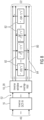
- Fig. 7 outlines the signal path of the AAC-ELD decoder operating at 96 kHz, with frame size of 480 samples, in downsampled SBR mode and with a downscaling factor F of 2.
- the bitstream equals the data stream 24 discussed previously with respect to Figs. 3 to 6 , but is additionally accompanied by parametric SBR data assisting the spectral shaping of a spectral replicate of a spectral extension band extending the spectra frequency of the audio signal obtained by the downscaled audio decoding at the output of the inverse low delay MDCT block, the spectral shaping being performed by the SBR decoder.
- the AAC decoder retrieves all of the necessary syntax elements by appropriate parsing and entropy decoding.
- the AAC decoder may partially coincide with the receiver 12 of the audio decoder 10 which, in Fig. 7 , is embodied by the inverse low delay MDCT block.
- F is exemplarily equal to 2. That is, the inverse low delay MDCT block of Fig. 7 outputs, as an example for the reconstructed audio signal 22 of Fig. 2 , a 48 kHz time signal downsampled at half the rate at which the audio signal was originally coded into the arriving bitstream.
- the CLDFB analysis block subdivides this 48 kHz time signal, i.e.
- the CLDFB analysis and synthesis filter bank can be completely described as outlined in the above example of section A.2.
Landscapes
- Engineering & Computer Science (AREA)
- Physics & Mathematics (AREA)
- Acoustics & Sound (AREA)
- Multimedia (AREA)
- Signal Processing (AREA)
- Health & Medical Sciences (AREA)
- Audiology, Speech & Language Pathology (AREA)
- Human Computer Interaction (AREA)
- Spectroscopy & Molecular Physics (AREA)
- Computational Linguistics (AREA)
- Compression, Expansion, Code Conversion, And Decoders (AREA)
- Transmission Systems Not Characterized By The Medium Used For Transmission (AREA)
- Signal Processing Not Specific To The Method Of Recording And Reproducing (AREA)
- Stereophonic System (AREA)
- Reduction Or Emphasis Of Bandwidth Of Signals (AREA)
- Signal Processing For Digital Recording And Reproducing (AREA)
- Two-Way Televisions, Distribution Of Moving Picture Or The Like (AREA)
Claims (6)
- Audiodecodierer (10), der dazu konfiguriert ist, ein Audiosignal (22) bei einer ersten Abtastrate aus einem Datenstrom (24), in den das Audiosignal bei einer zweiten Abtastrate transformationscodiert ist, zu decodieren, wobei die erste Abtastrate 1/Fth der zweiten Abtastrate ist, wobei der Audiodecodierer (10) Folgendes umfasst:einen Empfänger (12), der dazu konfiguriert ist, pro Rahmen einer Länge N des Audiosignals N Spektralkoeffizienten (28) zu empfangen;einen Greifer (14), der dazu konfiguriert ist, für jeden Rahmen einen Niederfrequenzanteil einer Länge N/F aus den N Spektralkoeffizienten (28) herauszugreifen;einen Spektral-Zeit-Modulator (16), der dazu konfiguriert ist, für jeden Rahmen (36) den Niederfrequenzanteil einer inversen Transformation zu unterziehen, die Modulationsfunktionen einer Länge (E + 2) · N/F aufweist, die sich zeitlich über den jeweiligen Rahmen und E + 1 vorhergehende Rahmen erstrecken, um einen zeitlichen Abschnitt einer Länge (E + 2) · N/F zu erhalten;einen Fensterer (18), der dazu konfiguriert ist, für jeden Rahmen (36) den zeitlichen Abschnitt unter Verwendung eines Synthesefensters einer Länge (E + 2) · N/F zu fenstern, das einen Nullabschnitt einer Länge 1/4 · N/F an einem vorderen Ende davon umfasst und eine Spitze innerhalb eines zeitlichen Intervalls des Synthesefensters aufweist, wobei das zeitliche Intervall auf den Nullabschnitt folgt und eine Länge 7/4 · N/F aufweist, so dass der Fensterer einen gefensterten zeitlichen Abschnitt einer Länge (E + 2) · N/F erhält; undeinen Zeitbereich-Aliasing-Aufheber (20), der dazu konfiguriert ist, den gefensterten zeitlichen Abschnitt der Rahmen einem Überlappungsadditionsprozess zu unterziehen, so dass ein Hinteres-Ende-Anteil einer Länge (E + 1)/(E + 2) des gefensterten zeitlichen Abschnitts eines aktuellen Rahmens ein vorderes Ende einer Länge (E + 1)/(E + 2) des gefensterten zeitlichen Abschnitts eines vorhergehenden Rahmens überlappt,wobei die inverse Transformation eine inverse MDCT oder eine inverse MDST ist, undwobei das Synthesefenster eine abwärtsabgetastete Version eines Referenzsynthesefensters einer Länge (E + 2) · N ist, die um einen Faktor von F durch eine segmentäre Interpolation in Segmenten einer Länge 1/4 · N abwärtsabgetastet wird,wobei das Synthesefenster eine Verkettung von Spline-Funktionen einer Länge 1/4 · N/F ist,wobei der Empfänger dazu konfiguriert ist, Entropiedecodierung zu verwenden, um die Spektralkoeffizienten aus dem Datenstrom zu lesen und die Spektralkoeffizienten mit Skalenfaktoren, die in dem Datenstrom bereitgestellt werden, oder Skalenfaktoren, die durch innerhalb des Datenstroms (24) beförderte lineare Prädiktionskoeffizienten abgeleitet werden, spektral zu formen, undwobei der Empfänger dazu konfiguriert ist, eine Lückenfüllung durchzuführen, um null-quantisierte Abschnitte innerhalb der N Spektralkoeffizienten synthetisch zu füllen.
- Audiodecodierer (10) gemäß Anspruch 1, wobei der Audiodecodierer (10) dazu konfiguriert ist, verschiedene Werte für F zu unterstützen.
- Audiodecodierer (10) gemäß Anspruch 1 oder 2, wobei F zwischen einschließlich 1,5 und einschließlich 10 liegt.
- Audiodecodierer (10) gemäß einem der vorhergehenden Ansprüche, wobei das Referenzsynthesefenster unimodal ist.
- Audiodecodierer (10) gemäß einem der vorhergehenden Ansprüche, wobei der Audiodecodierer (10) dazu konfiguriert ist, die Interpolation derart durchzuführen, dass eine Mehrheit der Koeffizienten des Synthesefensters von mehr als zwei Koeffizienten des Referenzsynthesefensters abhängt.
- Audiodecodierer (10) gemäß einem der vorhergehenden Ansprüche, wobei der Fensterer (18) und der Zeitbereich-Aliasing-Aufheber zusammenwirken, so dass der Fensterer den Nullabschnitt beim Gewichten des zeitlichen Abschnitts unter Verwendung des Synthesefensters überspringt und der Zeitbereich-Aliasing-Aufheber (20) einen entsprechenden nicht-gewichteten Abschnitt des gefensterten zeitlichen Abschnitts in dem Überlappungsadditionsprozess nicht berücksichtigt, so dass lediglich E+1 gefensterte zeitliche Abschnitte aufsummiert werden, um den entsprechenden nicht-gewichteten Abschnitt eines entsprechenden Rahmens zu ergeben, und E+2 gefensterte Abschnitte innerhalb eines Restes des entsprechenden Rahmens aufsummiert werden.
Applications Claiming Priority (5)
| Application Number | Priority Date | Filing Date | Title |
|---|---|---|---|
| EP15172282 | 2015-06-16 | ||
| EP15189398.9A EP3107096A1 (de) | 2015-06-16 | 2015-10-12 | Verkleinerte decodierung |
| EP16730777.6A EP3311380B1 (de) | 2015-06-16 | 2016-06-10 | Downscaling einer dekodierung von audiosignalen |
| PCT/EP2016/063371 WO2016202701A1 (en) | 2015-06-16 | 2016-06-10 | Downscaled decoding |
| EP23174593.6A EP4239632B1 (de) | 2015-06-16 | 2016-06-10 | Verkleinerte decodierung |
Related Parent Applications (3)
| Application Number | Title | Priority Date | Filing Date |
|---|---|---|---|
| EP16730777.6A Division EP3311380B1 (de) | 2015-06-16 | 2016-06-10 | Downscaling einer dekodierung von audiosignalen |
| EP23174593.6A Division EP4239632B1 (de) | 2015-06-16 | 2016-06-10 | Verkleinerte decodierung |
| EP23174593.6A Division-Into EP4239632B1 (de) | 2015-06-16 | 2016-06-10 | Verkleinerte decodierung |
Publications (4)
| Publication Number | Publication Date |
|---|---|
| EP4375997A2 EP4375997A2 (de) | 2024-05-29 |
| EP4375997A3 EP4375997A3 (de) | 2024-07-24 |
| EP4375997B1 true EP4375997B1 (de) | 2025-01-29 |
| EP4375997C0 EP4375997C0 (de) | 2025-01-29 |
Family
ID=53483698
Family Applications (11)
| Application Number | Title | Priority Date | Filing Date |
|---|---|---|---|
| EP15189398.9A Withdrawn EP3107096A1 (de) | 2015-06-16 | 2015-10-12 | Verkleinerte decodierung |
| EP23174598.5A Active EP4231287B1 (de) | 2015-06-16 | 2016-06-10 | Verkleinerte decodierung |
| EP23174593.6A Active EP4239632B1 (de) | 2015-06-16 | 2016-06-10 | Verkleinerte decodierung |
| EP23174596.9A Active EP4239633B1 (de) | 2015-06-16 | 2016-06-10 | Verkleinerte decodierung |
| EP23174595.1A Active EP4235658B1 (de) | 2015-06-16 | 2016-06-10 | Downscaling einer dekodierung von audiosignalen |
| EP24165637.0A Active EP4386745B1 (de) | 2015-06-16 | 2016-06-10 | Verkleinerte decodierung |
| EP16730777.6A Active EP3311380B1 (de) | 2015-06-16 | 2016-06-10 | Downscaling einer dekodierung von audiosignalen |
| EP24165638.8A Active EP4386746B1 (de) | 2015-06-16 | 2016-06-10 | Verkleinerte decodierung |
| EP24165639.6A Active EP4365895B1 (de) | 2015-06-16 | 2016-06-10 | Verkleinerte decodierung |
| EP24165642.0A Active EP4375997B1 (de) | 2015-06-16 | 2016-06-10 | Verkleinerte decodierung |
| EP23174592.8A Active EP4239631B1 (de) | 2015-06-16 | 2016-06-10 | Verkleinerte decodierung |
Family Applications Before (9)
| Application Number | Title | Priority Date | Filing Date |
|---|---|---|---|
| EP15189398.9A Withdrawn EP3107096A1 (de) | 2015-06-16 | 2015-10-12 | Verkleinerte decodierung |
| EP23174598.5A Active EP4231287B1 (de) | 2015-06-16 | 2016-06-10 | Verkleinerte decodierung |
| EP23174593.6A Active EP4239632B1 (de) | 2015-06-16 | 2016-06-10 | Verkleinerte decodierung |
| EP23174596.9A Active EP4239633B1 (de) | 2015-06-16 | 2016-06-10 | Verkleinerte decodierung |
| EP23174595.1A Active EP4235658B1 (de) | 2015-06-16 | 2016-06-10 | Downscaling einer dekodierung von audiosignalen |
| EP24165637.0A Active EP4386745B1 (de) | 2015-06-16 | 2016-06-10 | Verkleinerte decodierung |
| EP16730777.6A Active EP3311380B1 (de) | 2015-06-16 | 2016-06-10 | Downscaling einer dekodierung von audiosignalen |
| EP24165638.8A Active EP4386746B1 (de) | 2015-06-16 | 2016-06-10 | Verkleinerte decodierung |
| EP24165639.6A Active EP4365895B1 (de) | 2015-06-16 | 2016-06-10 | Verkleinerte decodierung |
Family Applications After (1)
| Application Number | Title | Priority Date | Filing Date |
|---|---|---|---|
| EP23174592.8A Active EP4239631B1 (de) | 2015-06-16 | 2016-06-10 | Verkleinerte decodierung |
Country Status (20)
| Country | Link |
|---|---|
| US (10) | US10431230B2 (de) |
| EP (11) | EP3107096A1 (de) |
| JP (10) | JP6637079B2 (de) |
| KR (10) | KR102660436B1 (de) |
| CN (6) | CN114255772B (de) |
| AR (5) | AR105006A1 (de) |
| AU (1) | AU2016278717B2 (de) |
| BR (1) | BR112017026724B1 (de) |
| CA (6) | CA3150683C (de) |
| ES (9) | ES3015008T3 (de) |
| FI (1) | FI3311380T3 (de) |
| HU (8) | HUE068659T2 (de) |
| MX (1) | MX2017016171A (de) |
| MY (2) | MY178530A (de) |
| PL (9) | PL4239632T3 (de) |
| PT (1) | PT3311380T (de) |
| RU (1) | RU2683487C1 (de) |
| TW (1) | TWI611398B (de) |
| WO (1) | WO2016202701A1 (de) |
| ZA (1) | ZA201800147B (de) |
Families Citing this family (4)
| Publication number | Priority date | Publication date | Assignee | Title |
|---|---|---|---|---|
| EP3107096A1 (de) * | 2015-06-16 | 2016-12-21 | Fraunhofer-Gesellschaft zur Förderung der angewandten Forschung e.V. | Verkleinerte decodierung |
| WO2017129270A1 (en) * | 2016-01-29 | 2017-08-03 | Fraunhofer-Gesellschaft zur Förderung der angewandten Forschung e.V. | Apparatus and method for improving a transition from a concealed audio signal portion to a succeeding audio signal portion of an audio signal |
| CN115050378B (zh) * | 2022-05-19 | 2024-06-07 | 腾讯科技(深圳)有限公司 | 音频编解码方法及相关产品 |
| KR20250063814A (ko) | 2023-10-27 | 2025-05-09 | 삼성디스플레이 주식회사 | 표시 패널 |
Family Cites Families (58)
| Publication number | Priority date | Publication date | Assignee | Title |
|---|---|---|---|---|
| US5729556A (en) * | 1993-02-22 | 1998-03-17 | Texas Instruments | System decoder circuit with temporary bit storage and method of operation |
| US6092041A (en) * | 1996-08-22 | 2000-07-18 | Motorola, Inc. | System and method of encoding and decoding a layered bitstream by re-applying psychoacoustic analysis in the decoder |
| SG54383A1 (en) * | 1996-10-31 | 1998-11-16 | Sgs Thomson Microelectronics A | Method and apparatus for decoding multi-channel audio data |
| KR100335611B1 (ko) | 1997-11-20 | 2002-10-09 | 삼성전자 주식회사 | 비트율 조절이 가능한 스테레오 오디오 부호화/복호화 방법 및 장치 |
| US6351730B2 (en) * | 1998-03-30 | 2002-02-26 | Lucent Technologies Inc. | Low-complexity, low-delay, scalable and embedded speech and audio coding with adaptive frame loss concealment |
| EP0957580B1 (de) * | 1998-05-15 | 2008-04-02 | Thomson | Verfahren und Vorrichtung zur Abtastratenumsetzung von Audiosignalen |
| US6226608B1 (en) * | 1999-01-28 | 2001-05-01 | Dolby Laboratories Licensing Corporation | Data framing for adaptive-block-length coding system |
| EP1440433B1 (de) | 2001-11-02 | 2005-05-04 | Matsushita Electric Industrial Co., Ltd. | Vorrichtung zur kodierung und dekodierung von audiosignalen |
| RU2325046C2 (ru) * | 2002-07-16 | 2008-05-20 | Конинклейке Филипс Электроникс Н.В. | Аудиокодирование |
| CN1328707C (zh) * | 2002-07-19 | 2007-07-25 | 日本电气株式会社 | 音频解码设备以及解码方法 |
| FR2852172A1 (fr) * | 2003-03-04 | 2004-09-10 | France Telecom | Procede et dispositif de reconstruction spectrale d'un signal audio |
| US20050047793A1 (en) * | 2003-08-28 | 2005-03-03 | David Butler | Scheme for reducing low frequency components in an optical transmission network |
| EP1692686A1 (de) | 2003-12-04 | 2006-08-23 | Koninklijke Philips Electronics N.V. | Audiosignal-codierung |
| CN1677492A (zh) * | 2004-04-01 | 2005-10-05 | 北京宫羽数字技术有限责任公司 | 一种增强音频编解码装置及方法 |
| JP4626261B2 (ja) * | 2004-10-21 | 2011-02-02 | カシオ計算機株式会社 | 音声符号化装置及び音声符号化方法 |
| US7720677B2 (en) | 2005-11-03 | 2010-05-18 | Coding Technologies Ab | Time warped modified transform coding of audio signals |
| CN101379555B (zh) * | 2006-02-07 | 2013-03-13 | Lg电子株式会社 | 用于编码/解码信号的装置和方法 |
| US8036903B2 (en) | 2006-10-18 | 2011-10-11 | Fraunhofer-Gesellschaft Zur Foerderung Der Angewandten Forschung E.V. | Analysis filterbank, synthesis filterbank, encoder, de-coder, mixer and conferencing system |
| ES2996584T3 (en) * | 2006-10-25 | 2025-02-12 | Fraunhofer Ges Forschung | Method for audio signal processing |
| EP2538405B1 (de) * | 2006-11-10 | 2015-07-08 | Panasonic Intellectual Property Corporation of America | Vorrichtung und Verfahren zum Dekodieren von einem Parameter eines CELP-kodierten Sprachsignals |
| AU2008261287B2 (en) * | 2007-06-11 | 2010-12-16 | Fraunhofer-Gesellschaft Zur Foerderung Der Angewandten Forschung E.V. | Audio encoder for encoding an audio signal having an impulse- like portion and stationary portion, encoding methods, decoder, decoding method; and encoded audio signal |
| EP2077550B8 (de) * | 2008-01-04 | 2012-03-14 | Dolby International AB | Audiokodierer und -dekodierer |
| MY181231A (en) * | 2008-07-11 | 2020-12-21 | Fraunhofer Ges Zur Forderung Der Angenwandten Forschung E V | Audio encoder and decoder for encoding and decoding audio samples |
| MX2011000375A (es) | 2008-07-11 | 2011-05-19 | Fraunhofer Ges Forschung | Codificador y decodificador de audio para codificar y decodificar tramas de una señal de audio muestreada. |
| ES2683077T3 (es) * | 2008-07-11 | 2018-09-24 | Fraunhofer-Gesellschaft zur Förderung der angewandten Forschung e.V. | Codificador y decodificador de audio para codificar y decodificar tramas de una señal de audio muestreada |
| KR101381513B1 (ko) * | 2008-07-14 | 2014-04-07 | 광운대학교 산학협력단 | 음성/음악 통합 신호의 부호화/복호화 장치 |
| US8983831B2 (en) | 2009-02-26 | 2015-03-17 | Panasonic Intellectual Property Corporation Of America | Encoder, decoder, and method therefor |
| TWI643187B (zh) * | 2009-05-27 | 2018-12-01 | 瑞典商杜比國際公司 | 從訊號的低頻成份產生該訊號之高頻成份的系統與方法,及其機上盒、電腦程式產品、軟體程式及儲存媒體 |
| CN102648494B (zh) | 2009-10-08 | 2014-07-02 | 弗兰霍菲尔运输应用研究公司 | 多模式音频信号解码器、多模式音频信号编码器、使用基于线性预测编码的噪声塑形的方法 |
| WO2011048100A1 (en) * | 2009-10-20 | 2011-04-28 | Fraunhofer-Gesellschaft zur Förderung der angewandten Forschung e.V. | Audio encoder, audio decoder, method for encoding an audio information, method for decoding an audio information and computer program using an iterative interval size reduction |
| EP4571739A1 (de) | 2009-10-20 | 2025-06-18 | Fraunhofer-Gesellschaft zur Förderung der angewandten Forschung e.V. | Audiosignalcodierer, audiosignaldecodierer, verfahren zur codierung oder decodierung eines audiosignals unter verwendung einer aliasing-unterdrückung |
| WO2011048118A1 (en) | 2009-10-20 | 2011-04-28 | Fraunhofer Gesellschaft zur Förderung der angewandten Forschung e.V. | Audio signal encoder, audio signal decoder, method for providing an encoded representation of an audio content, method for providing a decoded representation of an audio content and computer program for use in low delay applications |
| EP2375409A1 (de) | 2010-04-09 | 2011-10-12 | Fraunhofer-Gesellschaft zur Förderung der angewandten Forschung e.V. | Audiocodierer, Audiodecodierer und zugehörige Verfahren zur Verarbeitung von Mehrkanal-Audiosignalen mithilfe einer komplexen Vorhersage |
| WO2011147950A1 (en) * | 2010-05-28 | 2011-12-01 | Fraunhofer-Gesellschaft zur Förderung der angewandten Forschung e.V. | Low-delay unified speech and audio codec |
| BR122021003688B1 (pt) * | 2010-08-12 | 2021-08-24 | Fraunhofer-Gesellschaft Zur Forderung Der Angewandten Forschung E. V. | Reamostrar sinais de saída de codecs de áudio com base em qmf |
| CN103403799B (zh) * | 2010-10-06 | 2015-09-16 | 弗兰霍菲尔运输应用研究公司 | 用于针对合成统一语音和音频编解码器(usac)处理音频信号和提供较高时间粒度的设备和方法 |
| CN103282958B (zh) * | 2010-10-15 | 2016-03-30 | 华为技术有限公司 | 信号分析器、信号分析方法、信号合成器、信号合成方法、变换器和反向变换器 |
| SG192721A1 (en) * | 2011-02-14 | 2013-09-30 | Fraunhofer Ges Forschung | Apparatus and method for encoding and decoding an audio signal using an aligned look-ahead portion |
| US9037456B2 (en) | 2011-07-26 | 2015-05-19 | Google Technology Holdings LLC | Method and apparatus for audio coding and decoding |
| CN102419978B (zh) * | 2011-08-23 | 2013-03-27 | 展讯通信(上海)有限公司 | 音频解码器、音频解码的频谱重构方法及装置 |
| EP2777041B1 (de) * | 2011-11-10 | 2016-05-04 | Nokia Technologies Oy | Verfahren und vorrichtung zur erkennung einer tonabtastrate |
| US9530424B2 (en) * | 2011-11-11 | 2016-12-27 | Dolby International Ab | Upsampling using oversampled SBR |
| WO2013142650A1 (en) * | 2012-03-23 | 2013-09-26 | Dolby International Ab | Enabling sampling rate diversity in a voice communication system |
| WO2013186344A2 (en) * | 2012-06-14 | 2013-12-19 | Dolby International Ab | Smooth configuration switching for multichannel audio rendering based on a variable number of received channels |
| CN104488026A (zh) * | 2012-07-12 | 2015-04-01 | 杜比实验室特许公司 | 使用饱和参数调制将数据嵌入立体声音频中 |
| EP2903004A4 (de) * | 2012-09-24 | 2016-11-16 | Samsung Electronics Co Ltd | Verfahren und vorrichtung zum verbergen von frame-fehlern sowie verfahren und vorrichtung zur audiodecodierung |
| EP2720222A1 (de) * | 2012-10-10 | 2014-04-16 | Fraunhofer-Gesellschaft zur Förderung der angewandten Forschung e.V. | Vorrichtung und Verfahren zur wirksamen Synthese von Sinosoiden und Sweeps durch Verwendung spektraler Muster |
| ES2736309T3 (es) * | 2013-02-20 | 2019-12-27 | Fraunhofer Ges Forschung | Aparato y procedimiento para codificar o descodificar una señal de audio utilizando una superposición que depende de una ubicación de transitorios |
| CN104078048B (zh) * | 2013-03-29 | 2017-05-03 | 北京天籁传音数字技术有限公司 | 一种声音解码装置及其方法 |
| IN2015MN02784A (de) * | 2013-04-05 | 2015-10-23 | Dolby Int Ab | |
| TWI557727B (zh) * | 2013-04-05 | 2016-11-11 | 杜比國際公司 | 音訊處理系統、多媒體處理系統、處理音訊位元流的方法以及電腦程式產品 |
| KR102028888B1 (ko) * | 2013-04-05 | 2019-11-08 | 돌비 인터네셔널 에이비 | 오디오 인코더 및 디코더 |
| EP2830058A1 (de) * | 2013-07-22 | 2015-01-28 | Fraunhofer-Gesellschaft zur Förderung der angewandten Forschung e.V. | Frequenzbereichsaudiocodierung mit Unterstützung von Transformationslängenschaltung |
| EP2830063A1 (de) * | 2013-07-22 | 2015-01-28 | Fraunhofer-Gesellschaft zur Förderung der angewandten Forschung e.V. | Vorrichtung, Verfahren und Computerprogramm zum Dekodieren eines kodierten Audiosignals |
| CN103632674B (zh) * | 2013-12-17 | 2017-01-04 | 魅族科技(中国)有限公司 | 一种音频信号的处理方法及装置 |
| EP2980795A1 (de) | 2014-07-28 | 2016-02-03 | Fraunhofer-Gesellschaft zur Förderung der angewandten Forschung e.V. | Audiokodierung und -decodierung mit Nutzung eines Frequenzdomänenprozessors, eines Zeitdomänenprozessors und eines Kreuzprozessors zur Initialisierung des Zeitdomänenprozessors |
| CN107112024B (zh) | 2014-10-24 | 2020-07-14 | 杜比国际公司 | 音频信号的编码和解码 |
| EP3107096A1 (de) * | 2015-06-16 | 2016-12-21 | Fraunhofer-Gesellschaft zur Förderung der angewandten Forschung e.V. | Verkleinerte decodierung |
-
2015
- 2015-10-12 EP EP15189398.9A patent/EP3107096A1/de not_active Withdrawn
-
2016
- 2016-06-03 TW TW105117582A patent/TWI611398B/zh active
- 2016-06-10 EP EP23174598.5A patent/EP4231287B1/de active Active
- 2016-06-10 ES ES24165638T patent/ES3015008T3/es active Active
- 2016-06-10 KR KR1020237034196A patent/KR102660436B1/ko active Active
- 2016-06-10 CN CN202111617877.1A patent/CN114255772B/zh active Active
- 2016-06-10 CN CN202111617610.2A patent/CN114255770A/zh active Pending
- 2016-06-10 ES ES23174595T patent/ES2995310T3/es active Active
- 2016-06-10 CA CA3150683A patent/CA3150683C/en active Active
- 2016-06-10 KR KR1020237034197A patent/KR102756194B1/ko active Active
- 2016-06-10 ES ES24165637T patent/ES3012833T3/es active Active
- 2016-06-10 KR KR1020227020909A patent/KR102502643B1/ko active Active
- 2016-06-10 EP EP23174593.6A patent/EP4239632B1/de active Active
- 2016-06-10 KR KR1020227020910A patent/KR102588135B1/ko active Active
- 2016-06-10 ES ES24165642T patent/ES3014549T3/es active Active
- 2016-06-10 PL PL23174593.6T patent/PL4239632T3/pl unknown
- 2016-06-10 PT PT167307776T patent/PT3311380T/pt unknown
- 2016-06-10 KR KR1020237034199A patent/KR102660438B1/ko active Active
- 2016-06-10 MY MYPI2017001760A patent/MY178530A/en unknown
- 2016-06-10 KR KR1020227020911A patent/KR102502644B1/ko active Active
- 2016-06-10 HU HUE23174596A patent/HUE068659T2/hu unknown
- 2016-06-10 CA CA3150666A patent/CA3150666C/en active Active
- 2016-06-10 PL PL24165642.0T patent/PL4375997T3/pl unknown
- 2016-06-10 PL PL23174595.1T patent/PL4235658T3/pl unknown
- 2016-06-10 MX MX2017016171A patent/MX2017016171A/es active IP Right Grant
- 2016-06-10 EP EP23174596.9A patent/EP4239633B1/de active Active
- 2016-06-10 PL PL23174598.5T patent/PL4231287T3/pl unknown
- 2016-06-10 EP EP23174595.1A patent/EP4235658B1/de active Active
- 2016-06-10 ES ES16730777T patent/ES2950408T3/es active Active
- 2016-06-10 HU HUE23174593A patent/HUE068655T2/hu unknown
- 2016-06-10 EP EP24165637.0A patent/EP4386745B1/de active Active
- 2016-06-10 CA CA3150643A patent/CA3150643A1/en active Pending
- 2016-06-10 WO PCT/EP2016/063371 patent/WO2016202701A1/en not_active Ceased
- 2016-06-10 PL PL24165638.8T patent/PL4386746T3/pl unknown
- 2016-06-10 KR KR1020227020912A patent/KR102503707B1/ko active Active
- 2016-06-10 EP EP16730777.6A patent/EP3311380B1/de active Active
- 2016-06-10 HU HUE24165639A patent/HUE071380T2/hu unknown
- 2016-06-10 HU HUE23174598A patent/HUE069047T2/hu unknown
- 2016-06-10 CN CN201680047160.9A patent/CN108028046B/zh active Active
- 2016-06-10 CA CA3150675A patent/CA3150675C/en active Active
- 2016-06-10 ES ES23174593T patent/ES2991689T3/es active Active
- 2016-06-10 EP EP24165638.8A patent/EP4386746B1/de active Active
- 2016-06-10 KR KR1020207019023A patent/KR102412485B1/ko active Active
- 2016-06-10 PL PL23174596.9T patent/PL4239633T3/pl unknown
- 2016-06-10 HU HUE24165642A patent/HUE070484T2/hu unknown
- 2016-06-10 CA CA2989252A patent/CA2989252C/en active Active
- 2016-06-10 EP EP24165639.6A patent/EP4365895B1/de active Active
- 2016-06-10 MY MYPI2020004334A patent/MY198898A/en unknown
- 2016-06-10 ES ES23174596T patent/ES2991697T3/es active Active
- 2016-06-10 EP EP24165642.0A patent/EP4375997B1/de active Active
- 2016-06-10 EP EP23174592.8A patent/EP4239631B1/de active Active
- 2016-06-10 RU RU2018101193A patent/RU2683487C1/ru active
- 2016-06-10 HU HUE24165638A patent/HUE070469T2/hu unknown
- 2016-06-10 BR BR112017026724-1A patent/BR112017026724B1/pt active IP Right Grant
- 2016-06-10 ES ES23174598T patent/ES2992248T3/es active Active
- 2016-06-10 HU HUE24165637A patent/HUE070470T2/hu unknown
- 2016-06-10 PL PL24165637.0T patent/PL4386745T3/pl unknown
- 2016-06-10 ES ES24165639T patent/ES3026538T3/es active Active
- 2016-06-10 KR KR1020177036140A patent/KR102131183B1/ko active Active
- 2016-06-10 CN CN202111617731.7A patent/CN114255771B/zh active Active
- 2016-06-10 FI FIEP16730777.6T patent/FI3311380T3/fi active
- 2016-06-10 PL PL16730777.6T patent/PL3311380T3/pl unknown
- 2016-06-10 KR KR1020237034198A patent/KR102660437B1/ko active Active
- 2016-06-10 CA CA3150637A patent/CA3150637C/en active Active
- 2016-06-10 PL PL24165639.6T patent/PL4365895T3/pl unknown
- 2016-06-10 HU HUE23174595A patent/HUE069432T2/hu unknown
- 2016-06-10 CN CN202111617514.8A patent/CN114255768B/zh active Active
- 2016-06-10 JP JP2017565693A patent/JP6637079B2/ja active Active
- 2016-06-10 AU AU2016278717A patent/AU2016278717B2/en active Active
- 2016-06-10 CN CN202111617515.2A patent/CN114255769B/zh active Active
- 2016-06-15 AR ARP160101779A patent/AR105006A1/es unknown
-
2017
- 2017-12-15 US US15/843,358 patent/US10431230B2/en active Active
-
2018
- 2018-01-09 ZA ZA2018/00147A patent/ZA201800147B/en unknown
-
2019
- 2019-08-23 US US16/549,914 patent/US11062719B2/en active Active
- 2019-12-19 JP JP2019228825A patent/JP6839260B2/ja active Active
-
2020
- 2020-07-30 AR ARP200102150A patent/AR119541A2/es active IP Right Grant
- 2020-07-30 AR ARP200102148A patent/AR119537A2/es active IP Right Grant
- 2020-11-19 AR ARP200103208A patent/AR120507A2/es active IP Right Grant
- 2020-11-19 AR ARP200103207A patent/AR120506A2/es active IP Right Grant
-
2021
- 2021-02-12 JP JP2021020355A patent/JP7089079B2/ja active Active
- 2021-07-02 US US17/367,037 patent/US11670312B2/en active Active
- 2021-10-29 US US17/515,242 patent/US11341978B2/en active Active
- 2021-10-29 US US17/515,286 patent/US11341980B2/en active Active
- 2021-10-29 US US17/515,267 patent/US11341979B2/en active Active
-
2022
- 2022-06-09 JP JP2022093393A patent/JP7322248B2/ja active Active
- 2022-06-09 JP JP2022093395A patent/JP7323679B2/ja active Active
- 2022-06-09 JP JP2022093394A patent/JP7322249B2/ja active Active
-
2023
- 2023-04-25 US US18/139,252 patent/US12159638B2/en active Active
- 2023-05-09 US US18/195,250 patent/US12154580B2/en active Active
- 2023-05-09 US US18/195,213 patent/US12165662B2/en active Active
- 2023-05-09 US US18/195,220 patent/US12154579B2/en active Active
- 2023-07-27 JP JP2023122204A patent/JP7623438B2/ja active Active
- 2023-08-29 JP JP2023139245A patent/JP7574379B2/ja active Active
- 2023-08-29 JP JP2023139246A patent/JP7573704B2/ja active Active
- 2023-08-29 JP JP2023139247A patent/JP7627314B2/ja active Active
Also Published As
Similar Documents
| Publication | Publication Date | Title |
|---|---|---|
| US12159638B2 (en) | Downscaled decoding | |
| HK40107596A (en) | Downscaled decoding | |
| HK40107596B (en) | Downscaled decoding | |
| HK40093233A (en) | Downscaled decoding | |
| HK40093233B (en) | Downscaled decoding | |
| HK40110151B (en) | Downscaled decoding | |
| HK40110151A (en) | Downscaled decoding | |
| HK40109144B (en) | Downscaled decoding | |
| HK40109144A (en) | Downscaled decoding | |
| HK40110150B (en) | Downscaled decoding | |
| HK40110150A (en) | Downscaled decoding | |
| HK40092585B (en) | Downscaled decoding of audio signals | |
| HK40092585A (en) | Downscaled decoding of audio signals | |
| HK40092415B (en) | Downscaled decoding | |
| HK40092415A (en) | Downscaled decoding | |
| HK40092223A (en) | Downscaled decoding | |
| HK40092223B (en) | Downscaled decoding | |
| HK40092416A (en) | Downscaled decoding | |
| HK1247730B (en) | Downscaled decoding of audio signals |
Legal Events
| Date | Code | Title | Description |
|---|---|---|---|
| PUAI | Public reference made under article 153(3) epc to a published international application that has entered the european phase |
Free format text: ORIGINAL CODE: 0009012 |
|
| STAA | Information on the status of an ep patent application or granted ep patent |
Free format text: STATUS: THE APPLICATION HAS BEEN PUBLISHED |
|
| AC | Divisional application: reference to earlier application |
Ref document number: 3311380 Country of ref document: EP Kind code of ref document: P Ref document number: 4239632 Country of ref document: EP Kind code of ref document: P |
|
| AK | Designated contracting states |
Kind code of ref document: A2 Designated state(s): AL AT BE BG CH CY CZ DE DK EE ES FI FR GB GR HR HU IE IS IT LI LT LU LV MC MK MT NL NO PL PT RO RS SE SI SK SM TR |
|
| REG | Reference to a national code |
Ref country code: DE Ref legal event code: R079 Free format text: PREVIOUS MAIN CLASS: G10L0019022000 Ipc: G10L0019020000 Ref document number: 602016091136 Country of ref document: DE |
|
| PUAL | Search report despatched |
Free format text: ORIGINAL CODE: 0009013 |
|
| AK | Designated contracting states |
Kind code of ref document: A3 Designated state(s): AL AT BE BG CH CY CZ DE DK EE ES FI FR GB GR HR HU IE IS IT LI LT LU LV MC MK MT NL NO PL PT RO RS SE SI SK SM TR |
|
| RIC1 | Information provided on ipc code assigned before grant |
Ipc: G10L 19/022 20130101ALI20240614BHEP Ipc: G10L 19/02 20130101AFI20240614BHEP |
|
| STAA | Information on the status of an ep patent application or granted ep patent |
Free format text: STATUS: REQUEST FOR EXAMINATION WAS MADE |
|
| REG | Reference to a national code |
Ref country code: HK Ref legal event code: DE Ref document number: 40107596 Country of ref document: HK |
|
| 17P | Request for examination filed |
Effective date: 20240927 |
|
| RBV | Designated contracting states (corrected) |
Designated state(s): AL AT BE BG CH CY CZ DE DK EE ES FI FR GB GR HR HU IE IS IT LI LT LU LV MC MK MT NL NO PL PT RO RS SE SI SK SM TR |
|
| GRAP | Despatch of communication of intention to grant a patent |
Free format text: ORIGINAL CODE: EPIDOSNIGR1 |
|
| STAA | Information on the status of an ep patent application or granted ep patent |
Free format text: STATUS: GRANT OF PATENT IS INTENDED |
|
| INTG | Intention to grant announced |
Effective date: 20241119 |
|
| GRAS | Grant fee paid |
Free format text: ORIGINAL CODE: EPIDOSNIGR3 |
|
| GRAA | (expected) grant |
Free format text: ORIGINAL CODE: 0009210 |
|
| STAA | Information on the status of an ep patent application or granted ep patent |
Free format text: STATUS: THE PATENT HAS BEEN GRANTED |
|
| AC | Divisional application: reference to earlier application |
Ref document number: 3311380 Country of ref document: EP Kind code of ref document: P Ref document number: 4239632 Country of ref document: EP Kind code of ref document: P |
|
| AK | Designated contracting states |
Kind code of ref document: B1 Designated state(s): AL AT BE BG CH CY CZ DE DK EE ES FI FR GB GR HR HU IE IS IT LI LT LU LV MC MK MT NL NO PL PT RO RS SE SI SK SM TR |
|
| REG | Reference to a national code |
Ref country code: GB Ref legal event code: FG4D |
|
| REG | Reference to a national code |
Ref country code: CH Ref legal event code: EP |
|
| REG | Reference to a national code |
Ref country code: DE Ref legal event code: R096 Ref document number: 602016091136 Country of ref document: DE |
|
| REG | Reference to a national code |
Ref country code: IE Ref legal event code: FG4D |
|
| U01 | Request for unitary effect filed |
Effective date: 20250218 |
|
| U07 | Unitary effect registered |
Designated state(s): AT BE BG DE DK EE FI FR IT LT LU LV MT NL PT RO SE SI Effective date: 20250224 |
|
| REG | Reference to a national code |
Ref country code: ES Ref legal event code: FG2A Ref document number: 3014549 Country of ref document: ES Kind code of ref document: T3 Effective date: 20250423 |
|
| U20 | Renewal fee for the european patent with unitary effect paid |
Year of fee payment: 10 Effective date: 20250402 |
|
| REG | Reference to a national code |
Ref country code: SK Ref legal event code: T3 Ref document number: E 46202 Country of ref document: SK |
|
| REG | Reference to a national code |
Ref country code: HU Ref legal event code: AG4A Ref document number: E070484 Country of ref document: HU |
|
| PG25 | Lapsed in a contracting state [announced via postgrant information from national office to epo] |
Ref country code: RS Free format text: LAPSE BECAUSE OF FAILURE TO SUBMIT A TRANSLATION OF THE DESCRIPTION OR TO PAY THE FEE WITHIN THE PRESCRIBED TIME-LIMIT Effective date: 20250429 |
|
| PGFP | Annual fee paid to national office [announced via postgrant information from national office to epo] |
Ref country code: MC Payment date: 20250623 Year of fee payment: 10 |
|
| PGFP | Annual fee paid to national office [announced via postgrant information from national office to epo] |
Ref country code: PL Payment date: 20250529 Year of fee payment: 10 |
|
| PGFP | Annual fee paid to national office [announced via postgrant information from national office to epo] |
Ref country code: GB Payment date: 20250611 Year of fee payment: 10 |
|
| PG25 | Lapsed in a contracting state [announced via postgrant information from national office to epo] |
Ref country code: IS Free format text: LAPSE BECAUSE OF FAILURE TO SUBMIT A TRANSLATION OF THE DESCRIPTION OR TO PAY THE FEE WITHIN THE PRESCRIBED TIME-LIMIT Effective date: 20250529 |
|
| PGFP | Annual fee paid to national office [announced via postgrant information from national office to epo] |
Ref country code: NO Payment date: 20250626 Year of fee payment: 10 |
|
| PG25 | Lapsed in a contracting state [announced via postgrant information from national office to epo] |
Ref country code: HR Free format text: LAPSE BECAUSE OF FAILURE TO SUBMIT A TRANSLATION OF THE DESCRIPTION OR TO PAY THE FEE WITHIN THE PRESCRIBED TIME-LIMIT Effective date: 20250129 |
|
| PGFP | Annual fee paid to national office [announced via postgrant information from national office to epo] |
Ref country code: HU Payment date: 20250530 Year of fee payment: 10 |
|
| PGFP | Annual fee paid to national office [announced via postgrant information from national office to epo] |
Ref country code: GR Payment date: 20250623 Year of fee payment: 10 |
|
| PGFP | Annual fee paid to national office [announced via postgrant information from national office to epo] |
Ref country code: TR Payment date: 20250528 Year of fee payment: 10 Ref country code: SK Payment date: 20250523 Year of fee payment: 10 |
|
| PGFP | Annual fee paid to national office [announced via postgrant information from national office to epo] |
Ref country code: CZ Payment date: 20250522 Year of fee payment: 10 |
|
| PGFP | Annual fee paid to national office [announced via postgrant information from national office to epo] |
Ref country code: IE Payment date: 20250618 Year of fee payment: 10 |
|
| REG | Reference to a national code |
Ref country code: GR Ref legal event code: EP Ref document number: 20250400863 Country of ref document: GR Effective date: 20250613 |
|
| PG25 | Lapsed in a contracting state [announced via postgrant information from national office to epo] |
Ref country code: SM Free format text: LAPSE BECAUSE OF FAILURE TO SUBMIT A TRANSLATION OF THE DESCRIPTION OR TO PAY THE FEE WITHIN THE PRESCRIBED TIME-LIMIT Effective date: 20250129 |
|
| PGFP | Annual fee paid to national office [announced via postgrant information from national office to epo] |
Ref country code: ES Payment date: 20250701 Year of fee payment: 10 |
|
| PGFP | Annual fee paid to national office [announced via postgrant information from national office to epo] |
Ref country code: CH Payment date: 20250701 Year of fee payment: 10 |