EP4372833B1 - Verfahren zur herstellung einer vorlithiierten elektrode und lithium-ionen-batteriezelle - Google Patents
Verfahren zur herstellung einer vorlithiierten elektrode und lithium-ionen-batteriezelle Download PDFInfo
- Publication number
- EP4372833B1 EP4372833B1 EP22208678.7A EP22208678A EP4372833B1 EP 4372833 B1 EP4372833 B1 EP 4372833B1 EP 22208678 A EP22208678 A EP 22208678A EP 4372833 B1 EP4372833 B1 EP 4372833B1
- Authority
- EP
- European Patent Office
- Prior art keywords
- electrode
- layer
- lithium
- lithiated
- pet
- Prior art date
- Legal status (The legal status is an assumption and is not a legal conclusion. Google has not performed a legal analysis and makes no representation as to the accuracy of the status listed.)
- Active
Links
Images

Classifications
-
- H—ELECTRICITY
- H01—ELECTRIC ELEMENTS
- H01M—PROCESSES OR MEANS, e.g. BATTERIES, FOR THE DIRECT CONVERSION OF CHEMICAL ENERGY INTO ELECTRICAL ENERGY
- H01M4/00—Electrodes
- H01M4/02—Electrodes composed of, or comprising, active material
- H01M4/13—Electrodes for accumulators with non-aqueous electrolyte, e.g. for lithium-accumulators; Processes of manufacture thereof
- H01M4/134—Electrodes based on metals, Si or alloys
-
- H—ELECTRICITY
- H01—ELECTRIC ELEMENTS
- H01M—PROCESSES OR MEANS, e.g. BATTERIES, FOR THE DIRECT CONVERSION OF CHEMICAL ENERGY INTO ELECTRICAL ENERGY
- H01M4/00—Electrodes
- H01M4/02—Electrodes composed of, or comprising, active material
- H01M4/04—Processes of manufacture in general
- H01M4/0402—Methods of deposition of the material
- H01M4/0404—Methods of deposition of the material by coating on electrode collectors
-
- H—ELECTRICITY
- H01—ELECTRIC ELEMENTS
- H01M—PROCESSES OR MEANS, e.g. BATTERIES, FOR THE DIRECT CONVERSION OF CHEMICAL ENERGY INTO ELECTRICAL ENERGY
- H01M4/00—Electrodes
- H01M4/02—Electrodes composed of, or comprising, active material
- H01M4/13—Electrodes for accumulators with non-aqueous electrolyte, e.g. for lithium-accumulators; Processes of manufacture thereof
- H01M4/139—Processes of manufacture
-
- H—ELECTRICITY
- H01—ELECTRIC ELEMENTS
- H01M—PROCESSES OR MEANS, e.g. BATTERIES, FOR THE DIRECT CONVERSION OF CHEMICAL ENERGY INTO ELECTRICAL ENERGY
- H01M10/00—Secondary cells; Manufacture thereof
- H01M10/05—Accumulators with non-aqueous electrolyte
- H01M10/052—Li-accumulators
- H01M10/0525—Rocking-chair batteries, i.e. batteries with lithium insertion or intercalation in both electrodes; Lithium-ion batteries
-
- H—ELECTRICITY
- H01—ELECTRIC ELEMENTS
- H01M—PROCESSES OR MEANS, e.g. BATTERIES, FOR THE DIRECT CONVERSION OF CHEMICAL ENERGY INTO ELECTRICAL ENERGY
- H01M10/00—Secondary cells; Manufacture thereof
- H01M10/42—Methods or arrangements for servicing or maintenance of secondary cells or secondary half-cells
- H01M10/4235—Safety or regulating additives or arrangements in electrodes, separators or electrolyte
-
- H—ELECTRICITY
- H01—ELECTRIC ELEMENTS
- H01M—PROCESSES OR MEANS, e.g. BATTERIES, FOR THE DIRECT CONVERSION OF CHEMICAL ENERGY INTO ELECTRICAL ENERGY
- H01M4/00—Electrodes
- H01M4/02—Electrodes composed of, or comprising, active material
- H01M4/04—Processes of manufacture in general
- H01M4/043—Processes of manufacture in general involving compressing or compaction
- H01M4/0435—Rolling or calendering
-
- H—ELECTRICITY
- H01—ELECTRIC ELEMENTS
- H01M—PROCESSES OR MEANS, e.g. BATTERIES, FOR THE DIRECT CONVERSION OF CHEMICAL ENERGY INTO ELECTRICAL ENERGY
- H01M4/00—Electrodes
- H01M4/02—Electrodes composed of, or comprising, active material
- H01M4/13—Electrodes for accumulators with non-aqueous electrolyte, e.g. for lithium-accumulators; Processes of manufacture thereof
-
- H—ELECTRICITY
- H01—ELECTRIC ELEMENTS
- H01M—PROCESSES OR MEANS, e.g. BATTERIES, FOR THE DIRECT CONVERSION OF CHEMICAL ENERGY INTO ELECTRICAL ENERGY
- H01M4/00—Electrodes
- H01M4/02—Electrodes composed of, or comprising, active material
- H01M4/13—Electrodes for accumulators with non-aqueous electrolyte, e.g. for lithium-accumulators; Processes of manufacture thereof
- H01M4/131—Electrodes based on mixed oxides or hydroxides, or on mixtures of oxides or hydroxides, e.g. LiCoOx
-
- H—ELECTRICITY
- H01—ELECTRIC ELEMENTS
- H01M—PROCESSES OR MEANS, e.g. BATTERIES, FOR THE DIRECT CONVERSION OF CHEMICAL ENERGY INTO ELECTRICAL ENERGY
- H01M4/00—Electrodes
- H01M4/02—Electrodes composed of, or comprising, active material
- H01M4/13—Electrodes for accumulators with non-aqueous electrolyte, e.g. for lithium-accumulators; Processes of manufacture thereof
- H01M4/133—Electrodes based on carbonaceous material, e.g. graphite-intercalation compounds or CFx
-
- H—ELECTRICITY
- H01—ELECTRIC ELEMENTS
- H01M—PROCESSES OR MEANS, e.g. BATTERIES, FOR THE DIRECT CONVERSION OF CHEMICAL ENERGY INTO ELECTRICAL ENERGY
- H01M4/00—Electrodes
- H01M4/02—Electrodes composed of, or comprising, active material
- H01M4/13—Electrodes for accumulators with non-aqueous electrolyte, e.g. for lithium-accumulators; Processes of manufacture thereof
- H01M4/139—Processes of manufacture
- H01M4/1393—Processes of manufacture of electrodes based on carbonaceous material, e.g. graphite-intercalation compounds or CFx
-
- H—ELECTRICITY
- H01—ELECTRIC ELEMENTS
- H01M—PROCESSES OR MEANS, e.g. BATTERIES, FOR THE DIRECT CONVERSION OF CHEMICAL ENERGY INTO ELECTRICAL ENERGY
- H01M4/00—Electrodes
- H01M4/02—Electrodes composed of, or comprising, active material
- H01M4/13—Electrodes for accumulators with non-aqueous electrolyte, e.g. for lithium-accumulators; Processes of manufacture thereof
- H01M4/139—Processes of manufacture
- H01M4/1395—Processes of manufacture of electrodes based on metals, Si or alloys
-
- H—ELECTRICITY
- H01—ELECTRIC ELEMENTS
- H01M—PROCESSES OR MEANS, e.g. BATTERIES, FOR THE DIRECT CONVERSION OF CHEMICAL ENERGY INTO ELECTRICAL ENERGY
- H01M4/00—Electrodes
- H01M4/02—Electrodes composed of, or comprising, active material
- H01M4/36—Selection of substances as active materials, active masses, active liquids
- H01M4/38—Selection of substances as active materials, active masses, active liquids of elements or alloys
- H01M4/381—Alkaline or alkaline earth metals elements
- H01M4/382—Lithium
-
- H—ELECTRICITY
- H01—ELECTRIC ELEMENTS
- H01M—PROCESSES OR MEANS, e.g. BATTERIES, FOR THE DIRECT CONVERSION OF CHEMICAL ENERGY INTO ELECTRICAL ENERGY
- H01M4/00—Electrodes
- H01M4/02—Electrodes composed of, or comprising, active material
- H01M4/36—Selection of substances as active materials, active masses, active liquids
- H01M4/58—Selection of substances as active materials, active masses, active liquids of inorganic compounds other than oxides or hydroxides, e.g. sulfides, selenides, tellurides, halogenides or LiCoFy; of polyanionic structures, e.g. phosphates, silicates or borates
- H01M4/583—Carbonaceous material, e.g. graphite-intercalation compounds or CFx
-
- H—ELECTRICITY
- H01—ELECTRIC ELEMENTS
- H01M—PROCESSES OR MEANS, e.g. BATTERIES, FOR THE DIRECT CONVERSION OF CHEMICAL ENERGY INTO ELECTRICAL ENERGY
- H01M4/00—Electrodes
- H01M4/02—Electrodes composed of, or comprising, active material
- H01M4/36—Selection of substances as active materials, active masses, active liquids
- H01M4/58—Selection of substances as active materials, active masses, active liquids of inorganic compounds other than oxides or hydroxides, e.g. sulfides, selenides, tellurides, halogenides or LiCoFy; of polyanionic structures, e.g. phosphates, silicates or borates
- H01M4/583—Carbonaceous material, e.g. graphite-intercalation compounds or CFx
- H01M4/587—Carbonaceous material, e.g. graphite-intercalation compounds or CFx for inserting or intercalating light metals
-
- H—ELECTRICITY
- H01—ELECTRIC ELEMENTS
- H01M—PROCESSES OR MEANS, e.g. BATTERIES, FOR THE DIRECT CONVERSION OF CHEMICAL ENERGY INTO ELECTRICAL ENERGY
- H01M4/00—Electrodes
- H01M4/02—Electrodes composed of, or comprising, active material
- H01M2004/026—Electrodes composed of, or comprising, active material characterised by the polarity
- H01M2004/027—Negative electrodes
-
- H—ELECTRICITY
- H01—ELECTRIC ELEMENTS
- H01M—PROCESSES OR MEANS, e.g. BATTERIES, FOR THE DIRECT CONVERSION OF CHEMICAL ENERGY INTO ELECTRICAL ENERGY
- H01M4/00—Electrodes
- H01M4/02—Electrodes composed of, or comprising, active material
- H01M2004/026—Electrodes composed of, or comprising, active material characterised by the polarity
- H01M2004/028—Positive electrodes
-
- Y—GENERAL TAGGING OF NEW TECHNOLOGICAL DEVELOPMENTS; GENERAL TAGGING OF CROSS-SECTIONAL TECHNOLOGIES SPANNING OVER SEVERAL SECTIONS OF THE IPC; TECHNICAL SUBJECTS COVERED BY FORMER USPC CROSS-REFERENCE ART COLLECTIONS [XRACs] AND DIGESTS
- Y02—TECHNOLOGIES OR APPLICATIONS FOR MITIGATION OR ADAPTATION AGAINST CLIMATE CHANGE
- Y02E—REDUCTION OF GREENHOUSE GAS [GHG] EMISSIONS, RELATED TO ENERGY GENERATION, TRANSMISSION OR DISTRIBUTION
- Y02E60/00—Enabling technologies; Technologies with a potential or indirect contribution to GHG emissions mitigation
- Y02E60/10—Energy storage using batteries
Definitions
- the present invention is directed to a method of fabricating a pre-lithiated electrode and a lithium-ion battery cell comprising said pre-lithiated electrode.
- Li-ion batteries have played a role in the development of current generation mobile devices, microelectronics and electric vehicles.
- a typical Li-ion battery is made of a positive electrode (cathode), a negative electrode (anode), an electrolyte to conduct ions, a porous separator membrane, which is generally an electrical insulator, between the two electrodes to keep them physically apart, and a surrounding packaging.
- the rapid advancement and complex requirements of the energy storage industry requires lithium-ion batteries with improved energy density and cycle life.
- the improved energy density can be achieved with anodes containing silicon or silicon oxide.
- the drawback of this material is a higher demand of lithium leading to reduced cycle life, i.e. less cyclable lithium.
- Reduced cyclable lithium results in a reduced usable cell capacity.
- the addition of lithium during lithium-ion battery production, known as pre-lithiation, is used to compensate for these lithium losses.
- anode pre-lithiation methods exist including chemical pre-lithiation, electrochemical pre-lithiation, and stabilized lithium metal powder.
- US 2022/0052307 A1 discloses an in-line contact pre-lithiation. Further, the application of thin lithium foil for direct contact pre-lithiation of anodes within lithium ion battery production is disclosed by Benedikt Stumper et al., Procedia CIRP 93(2020), 156-161 .
- the problem underlying the present invention is to provide an improved method for fabricating a pre-lithiated electrode and a lithium-ion battery cell comprising said pre-lithiated electrode, said method being industrially applicable and allowing efficient and homogeneous transfer of lithium to the electrode without compromising the quality of the electrode.
- One aspect of the invention relates to a method of fabricating a pre-lithiated electrode, comprising:
- a further aspect of the invention relates to a lithium-ion battery cell, comprising:
- said method further comprises separating the PET sheet from the surface of the layer of anode material to form the pre-lithiated electrode.
- the PET layer has a thickness of about 20 ⁇ m to about 200 ⁇ m, more preferably of about 30 ⁇ m to 80 ⁇ m, in particular about 50 ⁇ m.
- the PET layer further comprises a release layer.
- said release layer has a thickness of about 0.005 ⁇ m to about 2 ⁇ m.
- calendering the layer of lithium metal comprises applying uniform pressure to a back surface of the carrier substrate, wherein the uniform pressure is a pressure ranging from about 1.9 MPa to about 8.9 MPa, preferably from about 3.2 MPa to about 5.3 MPa (not according to the invention unless embraced by the claims).
- Calendering the layer of lithium metal and the prefabricated electrode together comprises transferring the layer of lithium metal and the prefabricated electrode through a pair of calendering rolls.
- the method further comprises heating the front roll to a temperature in the range of from about 40°C to about 75°C, more preferably from about 60°C to about 70°C, in particular about 65°C.
- the method further comprises heating the back roll to a temperature in the range of from about 40°C to about 75°C, more preferably from about 60°C to about 70°C, in particular about 65°C.
- the prefabricated electrode is a negative electrode comprising a Cu carrier foil.
- said Cu carrier foil has a thickness of about 6 ⁇ m to about 12 ⁇ m, in particular about 8 ⁇ m.
- the prefabricated electrode is a negative electrode comprising a carbonaceous material, silicon, silicon oxide or combinations thereof.
- the carbonaceous material is selected from natural graphite, artificial graphite, or combinations thereof.
- the prefabricated electrode is a negative electrode having a coating, said coating preferably comprising SiO y C z , wherein y is from 0 to 2 and z is 0 or 1.
- the coating is a double-sided coating.
- the coating has a thickness of about 10 ⁇ m to about 80 ⁇ m.
- the layer of lithium metal has a thickness from about 3 ⁇ m to about 15 ⁇ m, more preferably from about 6 ⁇ m to about 12 ⁇ m, in particular about 9.3 ⁇ m.
- the lithium layer needs to be passivated, preferably by CO 2 .
- the gap between the calendering rolls is from about 160 ⁇ m to about 200 ⁇ m, preferably from about 170 ⁇ m to about 190 ⁇ m, more preferably about 180 ⁇ m.
- the pressure applied to the back surface of the carrier substrate can be defined in kN.
- Calendering the layer of lithium metal comprises applying uniform pressure to a back surface of the carrier substrate, wherein the uniform pressure is a pressure ranging from about 0.7 kN to about 0.8 kN, preferably about 0.75 kN.
- the method further comprises incorporating the pre-lithiated electrode into an electrochemical cell further comprising a positive electrode, a separator, and an electrolyte.
- a further aspect of the invention relates to a lithium-ion battery cell, comprising:
- each of the pre-lithiated electrode and the positive electrode are in a fully charged position.
- each of the pre-lithiated electrode and the positive electrode are in a partially charged position.
- the pre-lithiated electrode is completely lithiated in the fully charged position and the positive electrode is completely delithiated in the fully charged position.
- the present specification is not limited to the use of a Li-PET sheet, although only the use of a Li-PET sheet is embraced by the claims.
- the present specification therefore discloses a method of fabricating a pre-lithiated electrode, comprising:
- the carrier substrate is a PET substrate.
- the carrier substrate is a sheet.
- the preferred embodiments set out above for claimed method including the use of a Li-PET sheet are also applicable to the method including the use of a carrier substrate.
- the method is implemented as a roll-to-roll process.
- sheet as used herein is intended to designate a flexible material to which lithium is applied.
- the term is not limited to a specific geometrical shape, such as a layer, but also includes material that is wound into a roll.
- the following describes the claimed method of fabricating a pre-lithiated electrode and the claimed lithium-ion battery cell.
- each of the terms “comprising', “having” and “containing”, including grammatical variants thereof, are meant in a non-exhaustive sense to mean “including”, but not necessarily “composed of”, and does not exclude elements in addition to those explicitly recited as being present.
- the terms “comprising”, “having” and “containing”, and grammatical variants thereof, indicate that components other than those explicitly recited may, but need not, be present. As such these terms include as a limiting case embodiments in which no other elements than those recited are present, e.g. in the commonly accepted sense of "consisting of”.
- PET denotes the known polymeric material polyethylene terephthalate.
- PET also includes a derivative of PET.
- the PET or the derivative of PET can be replaced by a carrier substrate, provided that the carrier substrate is flexible and ensures the adhesion of the lithium layer and its release under pressure, ensures the adhesion of the release layer, is chemically inert with respect to the release layer and lithium, and is stable under pressure in the selected pressure range.
- any feature within any aspect or embodiment of the invention may be combined with any feature within any other aspect or embodiment of the invention, and the skilled person understands such combination as being encompassed in the original disclosure of the present application.
- the term “about” shall be understood as encompassing and disclosing a range of variability above and below an indicated specific value, said percentage values being relative to the specific recited value itself, as follows.
- the term “about” may denote variability of ⁇ 5.0%.
- the term “about” may denote variability of ⁇ 4.0%.
- the term “about” may denote variability of ⁇ 3.0%.
- the term “about” may denote variability of ⁇ 2.0%.
- the term “about” may denote variability of ⁇ 1.0%.
- the term “about”, in reference to the particular recited value, may denote that exact particular value itself, irrespective of any explicit mention that this exact particular value is included; even in the absence of an explicit indication that the term “about” includes the particular exact recited value, this exact particular value is still included in the range of variation created by the term “about”, and is therefore disclosed.
- the pre-lithiation method described herein is applicable to Li-ion batteries using solid electrolytes (e.g., solid-state batteries) as well as Li-ion batteries, which use liquid or polymer electrolytes.
- solid electrolytes e.g., solid-state batteries
- Li-ion batteries which use liquid or polymer electrolytes.
- the claimed method involves the pre-lithiation of anode materials with a lithium coated substrate, preferably PET, by way of direct contact.
- Direct contact is an effective way to pre-lithiate the anode material as this creates excellent surface contact between the lithium and the anode layer.
- the method described herein can be slotted into current battery production lines.
- the carrier substrate for lithium preferably PET, is a flexible substrate, which can be used in roll-to-roll coating.
- the calender rolls must be about 100% cylindrical to ensure uniform pressure distribution. Uniform pressure distribution means a pressure distribution on the surface of no more than +/-5%.
- the front roll is the roll that points to the subsequent process and the back roll is the roll that points away from the subsequent process.
- roll In a roll-to-roll process, roll is defined as coiled strip material. During the process run, the unwound material is in the process as a strip and can then be separated directly into electrodes or rewound as a roll. This roll can have a cyclindrical or substantially cyclindrical shape.
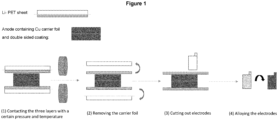
- Figures 1 illustrates a material flow according to the invention. This material flow is further illustrated by pictures in Figures 2 to 5 .
- the material flow in Figure 1 can be correlated to the pictures in Figures 2 to 5 as follows:
- the Li-PET sheet is pressed to an anode, which is preferably a Cu carrier foil having a double-sided coating containing SiO y C z , wherein y is 0-2 and z is 0 or 1.
- anode which is preferably a Cu carrier foil having a double-sided coating containing SiO y C z , wherein y is 0-2 and z is 0 or 1.
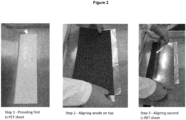
- FIGS 2 to 5 further illustrate the material flow according to Figure 1 as described above.
- Figure 2 show the provision of a first Li-PET sheet (step 1), the aligning of an anode on top of said first Li-PET sheet (step 2), and the aligning of a second Li-PET sheet on top of the anode to achieve a three-layered structure of Li-PET sheet/anode/Li-PET sheet (step 3).
- Figure 3 shows the calendering of the three-layered structure of Li-PET sheet/anode/Li-PET sheet of Figure 2 (step 4) and the removal of the carrier substrate (PET) to obtain a pre-lithiated anode sheet (step 5).
- the calendering of the three-layered structure of Li-PET sheet/anode/Li-PET sheet according to step 4 is preferably carried out with a front roll having a temperature in the range of from about 40°C to about 75°C, more preferably from about 60°C to about 70°C, and in particular about 65°C, and a back roll having preferably a temperature in the range of from about 40°C to about 75°C, more preferably from about 60°C to about 70°C, and in particular about 65°C.
- a homogeneous transfer of lithium can, however, also be achieved at room temperature, as discussed below.
- the friction between the calendering rolls can be within the range of about +/- 2%.
- the sheet is preferably processed through the calendering rolls at a speed that ensures a homogeneous temperature of +/- 2 °C.
- the sheet is therefore preferably processed at a speed of about 0.1-5 m/min, more preferably at a speed of about 2 m/min.
- the sheet may be pre-heated.
- Step 4 further preferably comprises applying uniform pressure to a back surface of the carrier substrate, wherein the uniform pressure is a pressure ranging from about 1.9 MPa to about 8.9 MPa, preferably from about 3.2 MPa to about 5.3 MPa (not according to the invention unless embraced by the claims).
- the gap between the calendering rolls in step 4 is preferably from about 160 ⁇ m to about 200 ⁇ m, more preferably from about 170 ⁇ m to about 190 ⁇ m, and in particular about 180 ⁇ m.
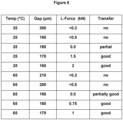
- the table in Figure 6 shows five experiments at a temperature of 25°C with decreasing gap widths of 200 ⁇ m, 190 ⁇ m, 180 ⁇ m, 170 ⁇ m and 160 ⁇ m.
- the selected temperature and gap widths led to increasing L-forces of ⁇ 0.2 kN, ⁇ 0.5 kN, 0.5 kN, 1.5 kN and 2 kN, respectively.
- lower gap widths are associated with higher pressures.
- the column under the heading "Transfer” in Figure 6 evaluates the transfer of lithium to the anode material. There was no transfer at L-forces of ⁇ 0.2 kN or ⁇ 0.5 kN. There was a partial transfer at an L-force of 0.5 kN. There was a good transfer at L-forces of 1.5 and 2 kN (not according to the invention unless embraced by the claims).
- the table in Figure 6 further shows five experiments at a temperature of 25°C with decreasing gap widths of 210 ⁇ m, 200 ⁇ m, 190 ⁇ m, 180 ⁇ m, and 170 ⁇ m.
- the selected temperature and gap widths led to L-forces of ⁇ 0.2 kN, ⁇ 0.5 kN, 0.5 kN, 0.75 kN and 1 kN, respectively.
- There was a good transfer at L-forces of 0.75 and 1 kN (not according to the invention unless embraced by the claims).
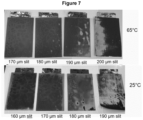
- a good transfer of lithium to the anode material is characterized by a high level of homogeneity in the application of lithium, as can be taken from Figure 7 .
- the pictures in Figure 7 reveal that the application is homogeneous for experiments conducted at 25°C with 160 or 170 ⁇ m slit (i.e. gap width) or at 65°C with 170 or 180 ⁇ m slit (not according to the invention unless embraced by the claims).
- the experiments demonstrate that the higher the temperature, the lower the pressure required for good transfer.
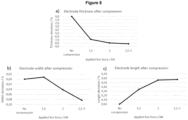
- Figure 8 shows effects of applied pressure on the deviation of thickness, width and length of the electrode at room temperature.
- the first graph shows the electrode compression in terms of thickness deviation in %.
- the second graph shows the electrode width in terms of width deviation in %.
- the third graph shows the electrode length in terms of length deviation in %.
- the pressure can be further reduced by applying the lithium foil at higher temperatures. This reduces the deformation of the electrode, which does not change the properties of the electrode despite pre-lithiation.
- the pre-lithiated anode sheet obtained in step 5 of Figure 3 is preferably stored for no more than 3 hours before cutting according to step 7 of Figure 4 (see below) at a temperature in the range from 5 to 20°C, preferably from 5 to 10°C.
- the storage time of no more than 3 hours is calculated from step 4 of Figure 3 .
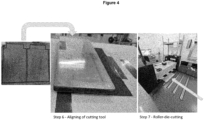
- Figure 4 shows the aligning of a cutting tool to the pre-lithiated anode sheet of Figure 3 (step 6) and the subsequent roller-die-cutting (step 7).
- the step of cutting is not limited to roller-die-cutting and can be effected by any other suitable cutting technique.
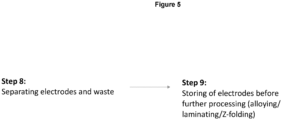
- Figure 5 shows the step of separating electrodes and waste (step 8) and the step of storing the electrodes before further processing (such as alloying/laminating/Z-folding) (step 9).
- the alloying time in a step of alloying the electrode is generally in the range from 12 to 72 hours and is preferably in the range from 18 to 28 hours.
- the alloying temperature can be in the range from 20 to 60°C and is preferably at about room temperature, as more side reactions occur with higher temperatures.
- the alloying atmosphere can be a dry room (having a dew point of about -50°C) or a CO 2 atmosphere.
- the alloying atmosphere should not be any of argon (Ar), nitrogen (N 2 ) or vaccum, as such an atmosphere would entail too many side reactions.
- the present inventors have surprisingly found a method of fabricating a pre-lithiated electrode that is industrially applicable, allowing an efficient homogeneous transfer of lithium to an anode material without compressing the anode material or leading to any decomposition reaction on the anode.
- the pre-lithiated electrode can be used as part of a high performance lithium-ion battery cell, which requires high electric current and high energy density.
Landscapes
- Chemical & Material Sciences (AREA)
- Engineering & Computer Science (AREA)
- Chemical Kinetics & Catalysis (AREA)
- Electrochemistry (AREA)
- General Chemical & Material Sciences (AREA)
- Materials Engineering (AREA)
- Manufacturing & Machinery (AREA)
- Inorganic Chemistry (AREA)
- Battery Electrode And Active Subsutance (AREA)
Claims (13)
- Verfahren zur Herstellung einer vorlithiierten Elektrode, umfassend:Anordnen einer Li-PET-Folie, die eine Schicht aus Lithiummetall umfasst, neben einer vorgefertigten Elektrode, die eine Schicht aus Anodenmaterial umfasst;Inkontaktbringen einer Oberfläche der Schicht aus Anodenmaterial mit einer Oberfläche der Schicht aus Lithiummetall; undKalandrieren der Lithiummetallschicht und der vorgefertigten Elektrode miteinander,wobei das Kalandrieren das Überführen der Lithiummetallschicht und der vorgefertigten Elektrode durch ein Paar Kalanderwalzen umfasst,wobei das Kalandrieren ferner das Aufbringen eines gleichmäßigen Drucks auf eine Rückseite der PET-Folie umfasst, wobei der gleichmäßige Druck ein Druck im Bereich von etwa 0,7 kN bis etwa 0,8 kN ist,wobei die vordere Walze und/oder die hintere Walze auf eine Temperatur im Bereich von etwa 40°C bis etwa 75°C erhitzt wird, undPET für Polyethylenterephthalat oder ein Derivat von Polyethylenterephthalat steht.
- Das Verfahren nach Anspruch 1, ferner umfassend:
Trennen der PET-Folie von der Oberfläche der Schicht aus Anodenmaterial, um die vorlithiierte Elektrode zu bilden, wobei die PET-Schicht vorzugsweise eine Dicke von etwa 20 µm bis etwa 200 µm aufweist. - Das Verfahren nach Anspruch 1 oder 2, wobei die PET-Schicht ferner eine Trennschicht umfasst, wobei die Trennschicht vorzugsweise eine Dicke von etwa 0,005 µm bis etwa 1 µm aufweist.
- Das Verfahren nach einem der Ansprüche 1 bis 3, ferner umfassend das Erhitzen der vorderen Walze auf eine Temperatur im Bereich von etwa 40°C bis etwa 75°C, vorzugsweise von etwa 60°C bis etwa 70°C, insbesondere etwa 65°C.
- Das Verfahren nach einem der Ansprüche 1 bis 4, ferner umfassend das Erhitzen der hinteren Walze auf eine Temperatur im Bereich von etwa 40°C bis etwa 75°C, vorzugsweise von etwa 60°C bis etwa 70°C, insbesondere etwa 65°C.
- Das Verfahren nach einem der Ansprüche 1 bis 5, wobei die vorgefertigte Elektrode eine negative Elektrode ist, die eine Cu-Trägerfolie umfasst, wobei die Cu-Trägerfolie vorzugsweise eine Dicke von etwa 6 µm bis etwa 12 µm aufweist.
- Das Verfahren nach einem der Ansprüche 1 bis 6, wobei die vorgefertigte Elektrode eine negative Elektrode ist, die ein kohlenstoffhaltiges Material, Silizium, Siliziumoxid oder Kombinationen davon umfasst, wobei das kohlenstoffhaltige Material vorzugsweise aus natürlichem Graphit, künstlichem Graphit oder Kombinationen davon ausgewählt ist.
- Das Verfahren nach einem der Ansprüche 1 bis 7, wobei die vorgefertigte Elektrode eine negative Elektrode mit einer Beschichtung ist, wobei die Beschichtung vorzugsweise SiOyCz umfasst, wobei y 0 bis 2 und z 0 oder 1 ist.
- Das Verfahren nach Anspruch 8, wobei die Beschichtung eine doppelseitige Beschichtung ist und/oder eine Dicke von etwa 10 µm bis etwa 80 µm aufweist.
- Das Verfahren nach einem der Ansprüche 1 bis 9, wobei der Spalt zwischen den Kalanderwalzen etwa 160 µm bis etwa 200 µm, vorzugsweise etwa 170 µm bis etwa 190 µm, besonders bevorzugt etwa 180 µm beträgt.
- Das Verfahren nach einem der Ansprüche 1 bis 10, ferner umfassend den Einbau der vorlithiierten Elektrode in eine elektrochemische Zelle, die außerdem eine positive Elektrode, einen Separator und einen Elektrolyten umfasst.
- Lithium-Ionen-Batteriezelle, umfassend:eine vorlithiierte Elektrode, die nach dem Verfahren gemäß einem der Ansprüche 1 bis 11 hergestellt wurde;eine positive Elektrode umfassend Oxide eines Übergangsmetalls; undeinen Elektrolyten, wobei der Elektrolyt aus einem festen Elektrolyten, einem flüssigen Elektrolyten oder einem Polymerelektrolyten ausgewählt ist.
- Die Lithium-lonen-Batteriezelle nach Anspruch 12, wobei sich sowohl die vorlithiierte Elektrode als auch die positive Elektrode in einer voll geladenen Position befinden, vorzugsweise wobei die vorlithiierte Elektrode in der voll geladenen Position vollständig lithiiert ist und die positive Elektrode in der voll geladenen Position vollständig delithiiert ist.
Priority Applications (4)
| Application Number | Priority Date | Filing Date | Title |
|---|---|---|---|
| EP22208678.7A EP4372833B1 (de) | 2022-11-21 | 2022-11-21 | Verfahren zur herstellung einer vorlithiierten elektrode und lithium-ionen-batteriezelle |
| PCT/EP2023/079946 WO2024110147A1 (en) | 2022-11-21 | 2023-10-26 | Method of fabricating a pre-lithiated electrode and lithium-ion battery cell |
| US18/494,985 US20240170643A1 (en) | 2022-11-21 | 2023-10-26 | Method of fabricating a pre-lithiated electrode and lithium-ion battery cell |
| CN202311408433.6A CN118057633A (zh) | 2022-11-21 | 2023-10-26 | 预锂化电极的制作方法和锂离子电池单元 |
Applications Claiming Priority (1)
| Application Number | Priority Date | Filing Date | Title |
|---|---|---|---|
| EP22208678.7A EP4372833B1 (de) | 2022-11-21 | 2022-11-21 | Verfahren zur herstellung einer vorlithiierten elektrode und lithium-ionen-batteriezelle |
Publications (2)
| Publication Number | Publication Date |
|---|---|
| EP4372833A1 EP4372833A1 (de) | 2024-05-22 |
| EP4372833B1 true EP4372833B1 (de) | 2024-10-30 |
Family
ID=84361046
Family Applications (1)
| Application Number | Title | Priority Date | Filing Date |
|---|---|---|---|
| EP22208678.7A Active EP4372833B1 (de) | 2022-11-21 | 2022-11-21 | Verfahren zur herstellung einer vorlithiierten elektrode und lithium-ionen-batteriezelle |
Country Status (4)
| Country | Link |
|---|---|
| US (1) | US20240170643A1 (de) |
| EP (1) | EP4372833B1 (de) |
| CN (1) | CN118057633A (de) |
| WO (1) | WO2024110147A1 (de) |
Family Cites Families (2)
| Publication number | Priority date | Publication date | Assignee | Title |
|---|---|---|---|---|
| WO2021253318A1 (zh) * | 2020-06-18 | 2021-12-23 | 天津中能锂业有限公司 | 超薄锂条预制件、复合负极及其制备方法和电池 |
| JP2023537922A (ja) | 2020-08-11 | 2023-09-06 | アプライド マテリアルズ インコーポレイテッド | インライン接触プレリチウム化 |
-
2022
- 2022-11-21 EP EP22208678.7A patent/EP4372833B1/de active Active
-
2023
- 2023-10-26 US US18/494,985 patent/US20240170643A1/en active Pending
- 2023-10-26 CN CN202311408433.6A patent/CN118057633A/zh active Pending
- 2023-10-26 WO PCT/EP2023/079946 patent/WO2024110147A1/en not_active Ceased
Also Published As
| Publication number | Publication date |
|---|---|
| EP4372833A1 (de) | 2024-05-22 |
| WO2024110147A1 (en) | 2024-05-30 |
| US20240170643A1 (en) | 2024-05-23 |
| CN118057633A (zh) | 2024-05-21 |
Similar Documents
| Publication | Publication Date | Title |
|---|---|---|
| JP7417642B2 (ja) | 統合された保護層ツールを用いたリチウム堆積 | |
| EP3959764B1 (de) | Oberflächenschutz einer lithium-metall-anode | |
| KR102162773B1 (ko) | 프리-슬리팅 공정을 포함하는 이차전지용 전극의 제조 방법 | |
| US7307831B2 (en) | Method of manufacturing electrode and electrode | |
| EP2006942A2 (de) | Sekundärbatterie, herstellungsverfahren dafür und system dafür | |
| US20200083506A1 (en) | Ceramic coating on separator for batteries | |
| TW202213840A (zh) | 進線接觸之預鋰化 | |
| JP4831946B2 (ja) | 非水電解質電池 | |
| Stumper et al. | Application of thin lithium foil for direct contact prelithiation of anodes within lithium-ion battery production | |
| KR102264657B1 (ko) | 가이드 롤러를 포함하는 전극시트 압연 장치 | |
| US20240021776A1 (en) | Method of manufacturing an anode structure, vacuum deposition system, anode structure, and lithium battery layer stack | |
| KR102124822B1 (ko) | 널링부가 형성된 전극 탭을 포함하는 전극 가공물 및 이를 제조하기 위한 장치 | |
| EP3598555B1 (de) | Elektrode, elektrodenanordnung und verfahren zu deren herstellung | |
| CN216928627U (zh) | 锂铜复合带、锂铜复合负极和电池 | |
| EP4372833B1 (de) | Verfahren zur herstellung einer vorlithiierten elektrode und lithium-ionen-batteriezelle | |
| CN114695837B (zh) | 非水电解液二次电池用电极的制造方法和制造装置 | |
| KR20190113628A (ko) | 리튬 이온 전지 집전체용 압연 동박 및 리튬 이온 전지 | |
| KR20240090091A (ko) | 전극 제조 장치 및 방법 | |
| KR20260054369A (ko) | 전극시트 압연장치 | |
| WO2025125485A1 (en) | Method of manufacturing an electrode foil |
Legal Events
| Date | Code | Title | Description |
|---|---|---|---|
| PUAI | Public reference made under article 153(3) epc to a published international application that has entered the european phase |
Free format text: ORIGINAL CODE: 0009012 |
|
| STAA | Information on the status of an ep patent application or granted ep patent |
Free format text: STATUS: REQUEST FOR EXAMINATION WAS MADE |
|
| 17P | Request for examination filed |
Effective date: 20231215 |
|
| AK | Designated contracting states |
Kind code of ref document: A1 Designated state(s): AL AT BE BG CH CY CZ DE DK EE ES FI FR GB GR HR HU IE IS IT LI LT LU LV MC ME MK MT NL NO PL PT RO RS SE SI SK SM TR |
|
| GRAP | Despatch of communication of intention to grant a patent |
Free format text: ORIGINAL CODE: EPIDOSNIGR1 |
|
| STAA | Information on the status of an ep patent application or granted ep patent |
Free format text: STATUS: GRANT OF PATENT IS INTENDED |
|
| INTG | Intention to grant announced |
Effective date: 20240620 |
|
| GRAS | Grant fee paid |
Free format text: ORIGINAL CODE: EPIDOSNIGR3 |
|
| P01 | Opt-out of the competence of the unified patent court (upc) registered |
Free format text: CASE NUMBER: APP_47732/2024 Effective date: 20240820 |
|
| GRAA | (expected) grant |
Free format text: ORIGINAL CODE: 0009210 |
|
| STAA | Information on the status of an ep patent application or granted ep patent |
Free format text: STATUS: THE PATENT HAS BEEN GRANTED |
|
| AK | Designated contracting states |
Kind code of ref document: B1 Designated state(s): AL AT BE BG CH CY CZ DE DK EE ES FI FR GB GR HR HU IE IS IT LI LT LU LV MC ME MK MT NL NO PL PT RO RS SE SI SK SM TR |
|
| REG | Reference to a national code |
Ref country code: GB Ref legal event code: FG4D |
|
| REG | Reference to a national code |
Ref country code: CH Ref legal event code: EP |
|
| REG | Reference to a national code |
Ref country code: IE Ref legal event code: FG4D |
|
| REG | Reference to a national code |
Ref country code: DE Ref legal event code: R096 Ref document number: 602022007238 Country of ref document: DE |
|
| REG | Reference to a national code |
Ref country code: LT Ref legal event code: MG9D |
|
| REG | Reference to a national code |
Ref country code: NL Ref legal event code: MP Effective date: 20241030 |
|
| PG25 | Lapsed in a contracting state [announced via postgrant information from national office to epo] |
Ref country code: HR Free format text: LAPSE BECAUSE OF FAILURE TO SUBMIT A TRANSLATION OF THE DESCRIPTION OR TO PAY THE FEE WITHIN THE PRESCRIBED TIME-LIMIT Effective date: 20241030 Ref country code: PT Free format text: LAPSE BECAUSE OF FAILURE TO SUBMIT A TRANSLATION OF THE DESCRIPTION OR TO PAY THE FEE WITHIN THE PRESCRIBED TIME-LIMIT Effective date: 20250228 Ref country code: IS Free format text: LAPSE BECAUSE OF FAILURE TO SUBMIT A TRANSLATION OF THE DESCRIPTION OR TO PAY THE FEE WITHIN THE PRESCRIBED TIME-LIMIT Effective date: 20250228 |
|
| PG25 | Lapsed in a contracting state [announced via postgrant information from national office to epo] |
Ref country code: FI Free format text: LAPSE BECAUSE OF FAILURE TO SUBMIT A TRANSLATION OF THE DESCRIPTION OR TO PAY THE FEE WITHIN THE PRESCRIBED TIME-LIMIT Effective date: 20241030 Ref country code: NL Free format text: LAPSE BECAUSE OF FAILURE TO SUBMIT A TRANSLATION OF THE DESCRIPTION OR TO PAY THE FEE WITHIN THE PRESCRIBED TIME-LIMIT Effective date: 20241030 |
|
| REG | Reference to a national code |
Ref country code: AT Ref legal event code: MK05 Ref document number: 1737823 Country of ref document: AT Kind code of ref document: T Effective date: 20241030 |
|
| PG25 | Lapsed in a contracting state [announced via postgrant information from national office to epo] |
Ref country code: BG Free format text: LAPSE BECAUSE OF FAILURE TO SUBMIT A TRANSLATION OF THE DESCRIPTION OR TO PAY THE FEE WITHIN THE PRESCRIBED TIME-LIMIT Effective date: 20241030 |
|
| PG25 | Lapsed in a contracting state [announced via postgrant information from national office to epo] |
Ref country code: ES Free format text: LAPSE BECAUSE OF FAILURE TO SUBMIT A TRANSLATION OF THE DESCRIPTION OR TO PAY THE FEE WITHIN THE PRESCRIBED TIME-LIMIT Effective date: 20241030 |
|
| PG25 | Lapsed in a contracting state [announced via postgrant information from national office to epo] |
Ref country code: NO Free format text: LAPSE BECAUSE OF FAILURE TO SUBMIT A TRANSLATION OF THE DESCRIPTION OR TO PAY THE FEE WITHIN THE PRESCRIBED TIME-LIMIT Effective date: 20250130 |
|
| PG25 | Lapsed in a contracting state [announced via postgrant information from national office to epo] |
Ref country code: AT Free format text: LAPSE BECAUSE OF FAILURE TO SUBMIT A TRANSLATION OF THE DESCRIPTION OR TO PAY THE FEE WITHIN THE PRESCRIBED TIME-LIMIT Effective date: 20241030 Ref country code: LV Free format text: LAPSE BECAUSE OF FAILURE TO SUBMIT A TRANSLATION OF THE DESCRIPTION OR TO PAY THE FEE WITHIN THE PRESCRIBED TIME-LIMIT Effective date: 20241030 Ref country code: GR Free format text: LAPSE BECAUSE OF FAILURE TO SUBMIT A TRANSLATION OF THE DESCRIPTION OR TO PAY THE FEE WITHIN THE PRESCRIBED TIME-LIMIT Effective date: 20250131 |
|
| PG25 | Lapsed in a contracting state [announced via postgrant information from national office to epo] |
Ref country code: PL Free format text: LAPSE BECAUSE OF FAILURE TO SUBMIT A TRANSLATION OF THE DESCRIPTION OR TO PAY THE FEE WITHIN THE PRESCRIBED TIME-LIMIT Effective date: 20241030 |
|
| PG25 | Lapsed in a contracting state [announced via postgrant information from national office to epo] |
Ref country code: RS Free format text: LAPSE BECAUSE OF FAILURE TO SUBMIT A TRANSLATION OF THE DESCRIPTION OR TO PAY THE FEE WITHIN THE PRESCRIBED TIME-LIMIT Effective date: 20250130 |
|
| REG | Reference to a national code |
Ref country code: DE Ref legal event code: R082 Ref document number: 602022007238 Country of ref document: DE Representative=s name: TER MEER STEINMEISTER & PARTNER PATENTANWAELTE, DE Ref country code: DE Ref legal event code: R082 Ref document number: 602022007238 Country of ref document: DE Representative=s name: FINNEGAN, HENDERSON, FARABOW, GARRETT & DUNNER, DE |
|
| PG25 | Lapsed in a contracting state [announced via postgrant information from national office to epo] |
Ref country code: SM Free format text: LAPSE BECAUSE OF FAILURE TO SUBMIT A TRANSLATION OF THE DESCRIPTION OR TO PAY THE FEE WITHIN THE PRESCRIBED TIME-LIMIT Effective date: 20241030 |
|
| PG25 | Lapsed in a contracting state [announced via postgrant information from national office to epo] |
Ref country code: MC Free format text: LAPSE BECAUSE OF FAILURE TO SUBMIT A TRANSLATION OF THE DESCRIPTION OR TO PAY THE FEE WITHIN THE PRESCRIBED TIME-LIMIT Effective date: 20241030 |
|
| PG25 | Lapsed in a contracting state [announced via postgrant information from national office to epo] |
Ref country code: DK Free format text: LAPSE BECAUSE OF FAILURE TO SUBMIT A TRANSLATION OF THE DESCRIPTION OR TO PAY THE FEE WITHIN THE PRESCRIBED TIME-LIMIT Effective date: 20241030 |
|
| PG25 | Lapsed in a contracting state [announced via postgrant information from national office to epo] |
Ref country code: LU Free format text: LAPSE BECAUSE OF NON-PAYMENT OF DUE FEES Effective date: 20241121 |
|
| PG25 | Lapsed in a contracting state [announced via postgrant information from national office to epo] |
Ref country code: EE Free format text: LAPSE BECAUSE OF FAILURE TO SUBMIT A TRANSLATION OF THE DESCRIPTION OR TO PAY THE FEE WITHIN THE PRESCRIBED TIME-LIMIT Effective date: 20241030 |
|
| PG25 | Lapsed in a contracting state [announced via postgrant information from national office to epo] |
Ref country code: RO Free format text: LAPSE BECAUSE OF FAILURE TO SUBMIT A TRANSLATION OF THE DESCRIPTION OR TO PAY THE FEE WITHIN THE PRESCRIBED TIME-LIMIT Effective date: 20241030 |
|
| PG25 | Lapsed in a contracting state [announced via postgrant information from national office to epo] |
Ref country code: SK Free format text: LAPSE BECAUSE OF FAILURE TO SUBMIT A TRANSLATION OF THE DESCRIPTION OR TO PAY THE FEE WITHIN THE PRESCRIBED TIME-LIMIT Effective date: 20241030 |
|
| PG25 | Lapsed in a contracting state [announced via postgrant information from national office to epo] |
Ref country code: CZ Free format text: LAPSE BECAUSE OF FAILURE TO SUBMIT A TRANSLATION OF THE DESCRIPTION OR TO PAY THE FEE WITHIN THE PRESCRIBED TIME-LIMIT Effective date: 20241030 |
|
| PG25 | Lapsed in a contracting state [announced via postgrant information from national office to epo] |
Ref country code: IT Free format text: LAPSE BECAUSE OF FAILURE TO SUBMIT A TRANSLATION OF THE DESCRIPTION OR TO PAY THE FEE WITHIN THE PRESCRIBED TIME-LIMIT Effective date: 20241030 |
|
| REG | Reference to a national code |
Ref country code: DE Ref legal event code: R097 Ref document number: 602022007238 Country of ref document: DE |
|
| REG | Reference to a national code |
Ref country code: BE Ref legal event code: MM Effective date: 20241130 |
|
| PLBE | No opposition filed within time limit |
Free format text: ORIGINAL CODE: 0009261 |
|
| STAA | Information on the status of an ep patent application or granted ep patent |
Free format text: STATUS: NO OPPOSITION FILED WITHIN TIME LIMIT |
|
| PG25 | Lapsed in a contracting state [announced via postgrant information from national office to epo] |
Ref country code: SE Free format text: LAPSE BECAUSE OF FAILURE TO SUBMIT A TRANSLATION OF THE DESCRIPTION OR TO PAY THE FEE WITHIN THE PRESCRIBED TIME-LIMIT Effective date: 20241030 |
|
| 26N | No opposition filed |
Effective date: 20250731 |
|
| PG25 | Lapsed in a contracting state [announced via postgrant information from national office to epo] |
Ref country code: BE Free format text: LAPSE BECAUSE OF NON-PAYMENT OF DUE FEES Effective date: 20241130 |
|
| PG25 | Lapsed in a contracting state [announced via postgrant information from national office to epo] |
Ref country code: FR Free format text: LAPSE BECAUSE OF NON-PAYMENT OF DUE FEES Effective date: 20241230 |
|
| PG25 | Lapsed in a contracting state [announced via postgrant information from national office to epo] |
Ref country code: IE Free format text: LAPSE BECAUSE OF NON-PAYMENT OF DUE FEES Effective date: 20241121 |
|
| PGFP | Annual fee paid to national office [announced via postgrant information from national office to epo] |
Ref country code: DE Payment date: 20251126 Year of fee payment: 4 |
|
| REG | Reference to a national code |
Ref country code: GB Ref legal event code: 732E Free format text: REGISTERED BETWEEN 20260129 AND 20260204 Ref country code: CH Ref legal event code: U11 Free format text: ST27 STATUS EVENT CODE: U-0-0-U10-U11 (AS PROVIDED BY THE NATIONAL OFFICE) Effective date: 20260225 |
|
| REG | Reference to a national code |
Ref country code: DE Ref legal event code: R082 Ref document number: 602022007238 Country of ref document: DE Representative=s name: FINNEGAN, HENDERSON, FARABOW, GARRETT & DUNNER, DE |