EP4372016A1 - Olefinpolymerisationsverfahren unter verwendung einer antistatischen zusammensetzung - Google Patents
Olefinpolymerisationsverfahren unter verwendung einer antistatischen zusammensetzung Download PDFInfo
- Publication number
- EP4372016A1 EP4372016A1 EP22208336.2A EP22208336A EP4372016A1 EP 4372016 A1 EP4372016 A1 EP 4372016A1 EP 22208336 A EP22208336 A EP 22208336A EP 4372016 A1 EP4372016 A1 EP 4372016A1
- Authority
- EP
- European Patent Office
- Prior art keywords
- series
- section
- vertical sections
- heating
- polymerization
- Prior art date
- Legal status (The legal status is an assumption and is not a legal conclusion. Google has not performed a legal analysis and makes no representation as to the accuracy of the status listed.)
- Withdrawn
Links
Images


Classifications
-
- C—CHEMISTRY; METALLURGY
- C08—ORGANIC MACROMOLECULAR COMPOUNDS; THEIR PREPARATION OR CHEMICAL WORKING-UP; COMPOSITIONS BASED THEREON
- C08L—COMPOSITIONS OF MACROMOLECULAR COMPOUNDS
- C08L23/00—Compositions of homopolymers or copolymers of unsaturated aliphatic hydrocarbons having only one carbon-to-carbon double bond; Compositions of derivatives of such polymers
- C08L23/02—Compositions of homopolymers or copolymers of unsaturated aliphatic hydrocarbons having only one carbon-to-carbon double bond; Compositions of derivatives of such polymers not modified by chemical after-treatment
- C08L23/10—Homopolymers or copolymers of propene
- C08L23/12—Polypropene
-
- C—CHEMISTRY; METALLURGY
- C08—ORGANIC MACROMOLECULAR COMPOUNDS; THEIR PREPARATION OR CHEMICAL WORKING-UP; COMPOSITIONS BASED THEREON
- C08F—MACROMOLECULAR COMPOUNDS OBTAINED BY REACTIONS ONLY INVOLVING CARBON-TO-CARBON UNSATURATED BONDS
- C08F110/00—Homopolymers of unsaturated aliphatic hydrocarbons having only one carbon-to-carbon double bond
- C08F110/04—Monomers containing three or four carbon atoms
- C08F110/06—Propene
-
- B—PERFORMING OPERATIONS; TRANSPORTING
- B01—PHYSICAL OR CHEMICAL PROCESSES OR APPARATUS IN GENERAL
- B01J—CHEMICAL OR PHYSICAL PROCESSES, e.g. CATALYSIS OR COLLOID CHEMISTRY; THEIR RELEVANT APPARATUS
- B01J8/00—Chemical or physical processes in general, conducted in the presence of fluids and solid particles; Apparatus for such processes
- B01J8/08—Chemical or physical processes in general, conducted in the presence of fluids and solid particles; Apparatus for such processes with moving particles
- B01J8/085—Feeding reactive fluids
-
- B—PERFORMING OPERATIONS; TRANSPORTING
- B01—PHYSICAL OR CHEMICAL PROCESSES OR APPARATUS IN GENERAL
- B01J—CHEMICAL OR PHYSICAL PROCESSES, e.g. CATALYSIS OR COLLOID CHEMISTRY; THEIR RELEVANT APPARATUS
- B01J8/00—Chemical or physical processes in general, conducted in the presence of fluids and solid particles; Apparatus for such processes
- B01J8/08—Chemical or physical processes in general, conducted in the presence of fluids and solid particles; Apparatus for such processes with moving particles
- B01J8/087—Heating or cooling the reactor
-
- B—PERFORMING OPERATIONS; TRANSPORTING
- B01—PHYSICAL OR CHEMICAL PROCESSES OR APPARATUS IN GENERAL
- B01J—CHEMICAL OR PHYSICAL PROCESSES, e.g. CATALYSIS OR COLLOID CHEMISTRY; THEIR RELEVANT APPARATUS
- B01J8/00—Chemical or physical processes in general, conducted in the presence of fluids and solid particles; Apparatus for such processes
- B01J8/18—Chemical or physical processes in general, conducted in the presence of fluids and solid particles; Apparatus for such processes with fluidised particles
- B01J8/1818—Feeding of the fluidising gas
- B01J8/1827—Feeding of the fluidising gas the fluidising gas being a reactant
-
- B—PERFORMING OPERATIONS; TRANSPORTING
- B01—PHYSICAL OR CHEMICAL PROCESSES OR APPARATUS IN GENERAL
- B01J—CHEMICAL OR PHYSICAL PROCESSES, e.g. CATALYSIS OR COLLOID CHEMISTRY; THEIR RELEVANT APPARATUS
- B01J8/00—Chemical or physical processes in general, conducted in the presence of fluids and solid particles; Apparatus for such processes
- B01J8/18—Chemical or physical processes in general, conducted in the presence of fluids and solid particles; Apparatus for such processes with fluidised particles
- B01J8/1836—Heating and cooling the reactor
-
- C—CHEMISTRY; METALLURGY
- C08—ORGANIC MACROMOLECULAR COMPOUNDS; THEIR PREPARATION OR CHEMICAL WORKING-UP; COMPOSITIONS BASED THEREON
- C08F—MACROMOLECULAR COMPOUNDS OBTAINED BY REACTIONS ONLY INVOLVING CARBON-TO-CARBON UNSATURATED BONDS
- C08F2/00—Processes of polymerisation
- C08F2/001—Multistage polymerisation processes characterised by a change in reactor conditions without deactivating the intermediate polymer
-
- C—CHEMISTRY; METALLURGY
- C08—ORGANIC MACROMOLECULAR COMPOUNDS; THEIR PREPARATION OR CHEMICAL WORKING-UP; COMPOSITIONS BASED THEREON
- C08F—MACROMOLECULAR COMPOUNDS OBTAINED BY REACTIONS ONLY INVOLVING CARBON-TO-CARBON UNSATURATED BONDS
- C08F2/00—Processes of polymerisation
- C08F2/002—Scale prevention in a polymerisation reactor or its auxiliary parts
-
- C—CHEMISTRY; METALLURGY
- C08—ORGANIC MACROMOLECULAR COMPOUNDS; THEIR PREPARATION OR CHEMICAL WORKING-UP; COMPOSITIONS BASED THEREON
- C08F—MACROMOLECULAR COMPOUNDS OBTAINED BY REACTIONS ONLY INVOLVING CARBON-TO-CARBON UNSATURATED BONDS
- C08F2/00—Processes of polymerisation
- C08F2/002—Scale prevention in a polymerisation reactor or its auxiliary parts
- C08F2/005—Scale prevention in a polymerisation reactor or its auxiliary parts by addition of a scale inhibitor to the polymerisation medium
-
- C—CHEMISTRY; METALLURGY
- C08—ORGANIC MACROMOLECULAR COMPOUNDS; THEIR PREPARATION OR CHEMICAL WORKING-UP; COMPOSITIONS BASED THEREON
- C08F—MACROMOLECULAR COMPOUNDS OBTAINED BY REACTIONS ONLY INVOLVING CARBON-TO-CARBON UNSATURATED BONDS
- C08F2/00—Processes of polymerisation
- C08F2/002—Scale prevention in a polymerisation reactor or its auxiliary parts
- C08F2/007—Scale prevention in the auxiliary parts
-
- C—CHEMISTRY; METALLURGY
- C08—ORGANIC MACROMOLECULAR COMPOUNDS; THEIR PREPARATION OR CHEMICAL WORKING-UP; COMPOSITIONS BASED THEREON
- C08F—MACROMOLECULAR COMPOUNDS OBTAINED BY REACTIONS ONLY INVOLVING CARBON-TO-CARBON UNSATURATED BONDS
- C08F2/00—Processes of polymerisation
- C08F2/01—Processes of polymerisation characterised by special features of the polymerisation apparatus used
-
- C—CHEMISTRY; METALLURGY
- C08—ORGANIC MACROMOLECULAR COMPOUNDS; THEIR PREPARATION OR CHEMICAL WORKING-UP; COMPOSITIONS BASED THEREON
- C08F—MACROMOLECULAR COMPOUNDS OBTAINED BY REACTIONS ONLY INVOLVING CARBON-TO-CARBON UNSATURATED BONDS
- C08F4/00—Polymerisation catalysts
- C08F4/42—Metals; Metal hydrides; Metallo-organic compounds; Use thereof as catalyst precursors
- C08F4/44—Metals; Metal hydrides; Metallo-organic compounds; Use thereof as catalyst precursors selected from light metals, zinc, cadmium, mercury, copper, silver, gold, boron, gallium, indium, thallium, rare earths or actinides
- C08F4/60—Metals; Metal hydrides; Metallo-organic compounds; Use thereof as catalyst precursors selected from light metals, zinc, cadmium, mercury, copper, silver, gold, boron, gallium, indium, thallium, rare earths or actinides together with refractory metals, iron group metals, platinum group metals, manganese, rhenium technetium or compounds thereof
- C08F4/62—Refractory metals or compounds thereof
- C08F4/64—Titanium, zirconium, hafnium or compounds thereof
- C08F4/646—Catalysts comprising at least two different metals, in metallic form or as compounds thereof, in addition to the component covered by group C08F4/64
- C08F4/6465—Catalysts comprising at least two different metals, in metallic form or as compounds thereof, in addition to the component covered by group C08F4/64 containing silicium
-
- C—CHEMISTRY; METALLURGY
- C08—ORGANIC MACROMOLECULAR COMPOUNDS; THEIR PREPARATION OR CHEMICAL WORKING-UP; COMPOSITIONS BASED THEREON
- C08F—MACROMOLECULAR COMPOUNDS OBTAINED BY REACTIONS ONLY INVOLVING CARBON-TO-CARBON UNSATURATED BONDS
- C08F4/00—Polymerisation catalysts
- C08F4/42—Metals; Metal hydrides; Metallo-organic compounds; Use thereof as catalyst precursors
- C08F4/44—Metals; Metal hydrides; Metallo-organic compounds; Use thereof as catalyst precursors selected from light metals, zinc, cadmium, mercury, copper, silver, gold, boron, gallium, indium, thallium, rare earths or actinides
- C08F4/60—Metals; Metal hydrides; Metallo-organic compounds; Use thereof as catalyst precursors selected from light metals, zinc, cadmium, mercury, copper, silver, gold, boron, gallium, indium, thallium, rare earths or actinides together with refractory metals, iron group metals, platinum group metals, manganese, rhenium technetium or compounds thereof
- C08F4/62—Refractory metals or compounds thereof
- C08F4/64—Titanium, zirconium, hafnium or compounds thereof
- C08F4/65—Pretreating the metal or compound covered by group C08F4/64 before the final contacting with the metal or compound covered by group C08F4/44
- C08F4/652—Pretreating with metals or metal-containing compounds
- C08F4/654—Pretreating with metals or metal-containing compounds with magnesium or compounds thereof
- C08F4/6543—Pretreating with metals or metal-containing compounds with magnesium or compounds thereof halides of magnesium
-
- B—PERFORMING OPERATIONS; TRANSPORTING
- B01—PHYSICAL OR CHEMICAL PROCESSES OR APPARATUS IN GENERAL
- B01J—CHEMICAL OR PHYSICAL PROCESSES, e.g. CATALYSIS OR COLLOID CHEMISTRY; THEIR RELEVANT APPARATUS
- B01J2208/00—Processes carried out in the presence of solid particles; Reactors therefor
- B01J2208/00008—Controlling the process
- B01J2208/00017—Controlling the temperature
- B01J2208/00106—Controlling the temperature by indirect heat exchange
- B01J2208/00168—Controlling the temperature by indirect heat exchange with heat exchange elements outside the bed of solid particles
- B01J2208/00256—Controlling the temperature by indirect heat exchange with heat exchange elements outside the bed of solid particles in a heat exchanger for the heat exchange medium separate from the reactor
-
- B—PERFORMING OPERATIONS; TRANSPORTING
- B01—PHYSICAL OR CHEMICAL PROCESSES OR APPARATUS IN GENERAL
- B01J—CHEMICAL OR PHYSICAL PROCESSES, e.g. CATALYSIS OR COLLOID CHEMISTRY; THEIR RELEVANT APPARATUS
- B01J2208/00—Processes carried out in the presence of solid particles; Reactors therefor
- B01J2208/00796—Details of the reactor or of the particulate material
- B01J2208/00823—Mixing elements
- B01J2208/00831—Stationary elements
- B01J2208/00849—Stationary elements outside the bed, e.g. baffles
Definitions
- the present disclosure relates to a process for the preparation of polyolefins comprising the use of an antistatic composition injected at a specific step of the process.
- the present disclosure relates also to a plant for the preparation of polyolefins comprising a slurry polymerization reactor and apparatus for mixing and injecting an antistatic composition downstream said slurry polymerization reactor.
- Antistatic agents are used in processes for the polymerization of olefins to avoid electrostatic charging in order to reduce wall sheeting and formation of polymer agglomerates in the polymerization reactor or in downstream equipment such as degassing and recovery vessels.
- antistatic agents are also called antifouling agents, polymerization process aids, activity inhibitors, productivity inhibitors or kinetic modifiers.
- the antistatic agents comprise antistatically-acting compounds which have polar functional groups such as acid or ester groups, amine or amide groups or hydroxyl or ether groups.
- antistatically-acting compounds are polysulfone copolymers, polymeric polyamines, polyalcohols, hydroxyesters of polyalcohols, salts of alkylarylsulfonic acids, polysiloxanes, alkoxyamines, polyglycol ethers, etc.
- US 5,410,002 discloses a polymerization process in which antistatic compounds are used to eliminate or reduce the build-up of polymer particles on the walls of a gas-phase polymerization reactor. Those antistatic compounds are capable of selectively inhibiting the polymerization on polymer particles smaller than 850 ⁇ m, the latter being responsible for fouling problems and polymer sheeting.
- a class of those antistatic/antifouling compounds are the N-alkyl diethanolamines, such as Atmer 163 commercialized by Croda.
- a drawback of antistatic agents used in the polymerization of olefins is that they may negatively impact the activity of olefin polymerization catalysts. Also, their use is sometimes affected by constraints due to the need of obtaining polyolefins fit for application in food, beverage and medical packaging.
- WO2017/108337 A1 discloses a process for the preparation of polyolefins comprising the use of an antistatic composition comprising: (a) a compound of formula R-OH, wherein R represents hydrogen or a linear or branched, saturated alkyl group having from 1 to 15 carbon atoms; and (b) an oligomeric or polymeric organic compound having one or more terminal hydroxyl groups and a specific viscosity. It is also disclosed the slurry polymerization of liquid propylene carried out in a loop reactor followed by a gas-phase polymerization carried out in fluidized-bed reactor, with the injection of the antistatic composition that can be implemented in several steps of the process, e.g., downstream the loop reactor or in the gas-phase reactor.
- the polymer slurry is continuously recirculated in the loop reactor, but a fraction of it is continuously discharged to a transfer line comprising a pipe provided with heating means.
- the discharge into the transfer line involves a pressure drop, so that liquid propylene is evaporated by the heating means distributed along a suitable length of the pipe at lower pressure than that inside the loop reactor and a turbulent flow comprising polymer and gaseous monomers is generated.
- the pipe of the transfer line is bent one or more times, depending on the size of the plant and other factors.
- the point of addition of the antistatic composition is critical, and that a partial deposit of the antistatic composition in the transfer line can occur if the injection point is not properly selected. More particularly, due to a non-efficient dispersion, a highly viscous layer of antistatic composition is deposited on the walls of the transfer line and reacts with the cocatalyst and with polymer fines present in the liquid slurry to create a fouling, which affects the operability of downstream equipment.
- the present disclosure provides a process for the preparation of polyolefins comprising the step of polymerizing an olefin in the liquid phase in the presence of a polymerization catalyst and of an antistatic composition comprising, with respect to the total weight of the antistatic composition:
- the present disclosure also provides a plant for the preparation of polyolefins comprising at least a slurry polymerization reactor, a transfer line for the polymer slurry formed in said reactor, an apparatus for mixing and injecting an antistatic composition in said transfer line, and a solid-gas separation apparatus connected to said transfer line at the end thereof;
- the present disclosure provides a process for the polymerization of olefins, such as 1-olefins, i.e., hydrocarbons having terminal double bonds, without being restricted thereto.
- Typical 1-olefins are linear or branched 1-alkenes having from 2 to 12 carbon atoms, in particular linear 1-alkenes having from 2 to 10 carbon atoms such as ethylene, propylene, 1-butene, 1-pentene, 1-hexene, 1-heptene, 1-octene, 1-decene or branched 1-alkenes having from 2 to 10 carbon atoms such as 4-methyl-1-pentene, conjugated and non-conjugated dienes such as 1,3-butadiene, 1,4-hexadiene or 1,7-octadiene or vinylaromatic compounds such as styrene or substituted styrene.
- Olefins that can be polymerized with the process of the present disclosure include those in which the double bond is part of a cyclic structure which can have one or more ring systems. Examples are cyclopentene, norbornene, tetracyclododecene or methylnorbornene or dienes such as 5-ethylidene-2-norbornene, norbornadiene or ethylnorbornadiene. It is also possible to polymerize mixtures of two or more olefins.
- the process can be used for the homopolymerization or copolymerization of ethylene or for the homopolymerization or copolymerization of propylene.
- comonomers for use in ethylene polymerization are 1-alkenes having from 3 to 8 carbon atoms such as 1-butene, 1-pentene, 1-hexene and/or 1-octene in amount of up to 20 wt.% or from 0.01 wt.% to 15 wt.%, or from 0.05 wt.% to 12 wt.%.
- comonomers for use in propylene polymerization are ethylene and/or 1 butene and/or 1-hexene in amount of up to 40 wt.% or from 0.5 wt.% to 35 wt.%.
- the process of the present disclosure allows the preparation of any types of common olefin polymers.
- the prepared olefin polymers can be broad molecular weight olefin polymers and, particularly, multimodal olefin polymers whereby the term multimodal refers to the modality of the molecular weight distribution.
- multimodal shall include bimodal.
- Such polymers can be obtained from polymerizing olefins in a cascade of two or more polymerization reactors or in different zones of a multizone reactor under different reaction conditions.
- the "modality" indicates how many different polymerization conditions were utilized to prepare the polyolefin, independently whether this modality of the molecular weight distribution can be recognized as separated maxima in a gel permeation chromatography (GPC) curve or not.
- the olefin polymer can also have a comonomer distribution.
- the average comonomer content of polymer chains with a higher molecular weight is higher than the average comonomer content of polymer chains with a lower molecular weight. It is however also possible to employ identical or very similar reaction conditions in all polymerization reactors of the reaction cascade and so prepare narrow molecular weight or monomodal olefin polymers.
- the polymerization of olefins can be carried out using customary olefin polymerization catalysts. That means the polymerization can be carried out using titanium-based Ziegler-Natta-catalysts, Phillips catalysts based on chromium oxide, or single-site catalysts.
- single-site catalysts are catalysts based on chemically uniform transition metal coordination compounds.
- mixtures of two or more of these catalysts for the polymerization of olefins.
- Such mixed catalysts may be designated as hybrid catalysts.
- catalysts for the process of the present disclosure are Ziegler-Natta catalysts comprising:
- Component (i) can be prepared by contacting a magnesium halide, a titanium compound having at least a Ti-halogen bond, and optionally an electron donor compound.
- the magnesium halide can be MgCl 2 in active form which is widely known from the patent literature as a support for Ziegler-Natta catalysts.
- the titanium compounds can be TiCl 4 or TiCl 3 .
- Ti-haloalcoholates of formula Ti(OR) n-y X y , where n is the valence of titanium, y is a number between 1 and n-1 X is halogen and R is a hydrocarbon radical having from 1 to 10 carbon atoms, can also be used.
- Electron donor compounds for preparing Ziegler type catalysts are for example alcohols, glycols, esters, ketones, amines, amides, nitriles, alkoxysilanes and aliphatic ethers. These electron donor compounds can be used alone or in mixtures with other electron donor compounds.
- solid catalyst components which may be used are those based on a chromium oxide supported on a refractory oxide, such as silica, and activated by a heat treatment.
- Catalysts obtainable from those components consist of chromium (VI) trioxide chemically fixed on silica gel. These catalysts are produced under oxidizing conditions by heating the silica gels that have been doped with chromium(III)salts (precursor or precatalyst). During this heat treatment, the chromium(III) oxidizes to chromium(VI), the chromium(VI) is fixed and the silica gel hydroxyl group is eliminated as water.
- Still other solid catalyst components which may be used are single-site catalysts supported on a carrier, such as metallocene catalysts comprising:
- the molar ratio of component (a) to alkylaluminum compound introduced into the polymerization reactor is from 0.05 to 3, or from 0.1 to 2, or from 0.5 to 1.
- the catalysts may be optionally subjected to prepolymerization before being fed to the polymerization reactor.
- the prepolymerization occurs in a loop reactor,
- the prepolymerization of the catalyst system may be carried out at a low temperature, in a range of from 0°C to 60°C.
- the process of the present disclosure can be carried out in any polymerization plant comprising one or more liquid-phase polymerization reactor and optionally one or more gas-phase polymerization reactors.
- liquid-phase reactors are loop reactors and continuously stirred tank reactors (CSTR).
- gas-phase reactors include fluidized bed reactors.
- the process of the present disclosure can be carried in two or more cascade reactors, giving rise to a sequential multistage polymerization process. For instance, a liquid-phase loop reactor can be used to prepare a first polymer component, which is successively fed to a gas-phase reactor to prepare a second polymer component. Accordingly, an olefin polymer endowed with a multi-modal molecular weight distribution can be obtained, as well as an olefin copolymer comprising two or more components having a different comonomer content.
- the polymerization process includes a gas-phase polymerization, i.e., the solid polymers are obtained from a gas-phase of the monomer or the monomers.
- gas-phase polymerizations may be carried out at pressures of from 0.1 to 20 MPa, or from 0.5 to 10 MPa, or from 1.0 to 5 MPa and polymerization temperatures from 40 to 150°C or from 65 to 125°C.
- Gas-phase polymerization reactors can be, for example, horizontally or vertically stirred reactor, fluidized bed gas-phase reactors or multizone circulating reactors.
- Fluidized-bed polymerization reactors are reactors in which the polymerization takes place in a bed of polymer particles which is maintained in a fluidized state by feeding in gas at the lower end of a reactor, for example below a gas distribution grid having the function of dispensing the gas flow, and taking off the gas again at its upper end.
- the reactor gas is then returned to the lower end to the reactor via a recycle line equipped with a compressor and a heat exchanger.
- the circulated reactor gas is, for example, a mixture of the olefins to be polymerized, inert gases such as nitrogen and/or lower alkanes such as ethane, propane, butane, pentane or hexane and optionally a molecular weight regulator such as hydrogen.
- nitrogen or propane can be used as inert gas, if appropriate in combination with further lower alkanes.
- the velocity of the reactor gas has to be sufficiently high firstly to fluidize the mixed bed of finely divided polymer present in the tube serving as polymerization zone and secondly to remove the heat of polymerization effectively.
- the polymerization can also be carried out in a condensed or super-condensed mode, in which part of the circulating reaction gas is cooled to below the dew point and returned to the reactor separately as a liquid and a gas-phase or together as a two-phase mixture in order to make additional use of the enthalpy of vaporization for cooling the reaction gas.
- the polymer slurry withdrawn from the slurry polymerization step is made to advance along a path comprising a horizontal section and a series of vertical sections connected by bent sections.
- the path of the polymer slurry comprises from 1 to 13 vertical sections connected by bent sections, preferably from 3 to 9 vertical sections.
- the first vertical section of the path of the polymer slurry comprises a first portion not subjected to heating and a second portion subjected to heating, and the other vertical sections downstream the first vertical section also comprise portions subjected to heating, so that at the end of the path said polymer slurry is converted into a two-phase stream comprising polymer particles and gaseous monomers, which are separated in a solid-gas separation step.
- the antistatic composition is added to the polymer slurry in the first portion not subjected to heating of the first section of the series of vertical sections.
- the first portion not subjected to heating of the first section of the series of vertical sections is shorter than the second portion subjected to heating of the first section of the series of vertical sections.
- the first portion not subjected to heating is equal to or less than 1/3 of the length of the second portion subjected to heating of the first vertical section.
- the process for the preparation of polyolefins comprises feeding the polymer particles separated in the solid-gas separation step to a gas-phase polymerization step to be subjected to further polymerization.
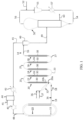
- FIG. 1 is a diagrammatic representation and has to be considered illustrative and not limitative of the scope of the invention.
- the slurry polymerization of liquid propylene is carried out in a loop reactor 10.
- catalyst components, co-catalyst, and propylene and optionally comonomers are introduced into the loop reactor, as shown by arrow 12.
- the solid component can be fed as such or in a pre-polymerized form.
- Loop reactor 10 may be the first polymerization reactor of the process, or there can be other reactor(s) upstream reactor 10.
- reactor 10 can receive from line 12 a polymer produced in other upstream reactor(s) or a prepolymer and/or a polymerization catalyst or catalyst component.
- feed lines for catalyst, monomer, molecular weight regulator and other possible ingredients have been omitted for simplicity.
- the transfer line 14 consists of a pipe 16 comprising a horizontal section 18 and a series of vertical sections 20, 22, 24, 26, 28 connected by bent sections 21, 23, 25, 27.
- the vertical sections of pipe 16 are equipped with heating means 30, for example steam jackets.
- the horizontal section 18 can or cannot be equipped with heating means.
- the first vertical section 20 of the series of vertical sections comprises a first portion 20a not equipped with heating means, and a second portion 20b equipped with heating means 30.
- the first portion 20a is shorter than the second section 20b.
- the first portion 20a is equal to or less than 1/3 of the length of the second portion 20b of the first vertical section 20.
- Fig. 1 shows a series of 5 vertical sections for the pipe 16, but, depending on the size of the plant and other factors, pipe 16 may comprise from 1 to 12 vertical sections connected by bent sections, preferably from 3 to 9 vertical sections.
- an antistatic composition is injected in the first portion 20a of the first vertical section 20 of pipe 16.
- the antistatic composition comprises (with respect to the total weight of the antistatic composition):
- the compound (a) of formula R-OH is water.
- the compound (a) of formula R-OH is an alcohol selected from methanol, ethanol, 1-propanol, 1-butanol, 1-pentanol, 1-hexanol, 1-heptanol, 1-octanol, 1-nonanol, 1-decanol, undecan-1-ol, dodecan-1-ol, tridecan-1-ol, 1-tetradecanol, pentadecan-1-ol, isobutanol, isoamyl alcohol, 2-methyl-1-propanol, phenethyl alcohol, tryptophol, isopropanol, 2-butanol, 2-pentanol, 2-hexanol, 2-heptanol, cyclohexanol, tert-butyl alcohol, tert-amyl alcohol, 2-methyl-2-pentanol, 2-methylhexan-2-o
- the oligomeric or polymeric organic compound (b) has a viscosity at 40°C (DIN 51562) of 30-2000 mm 2 /sec, or of 50-1500 mm 2 /sec, or of 100-1000 mm 2 /sec, or of 150-500 mm 2 /sec, or of 200-400 mm 2 /sec, or of 250-300 mm 2 /sec, or of 260-285 mm 2 /sec.
- the preferred viscosity at 40°C (DIN 51562) of the oligomeric or polymeric organic compound (b) is in the range of 260 to 285 mm 2 /sec.
- the oligomeric or polymeric organic compound (b) is selected from alcohols, polyethers, polyalcohols, hydroxyesters of polyalcohols, polyglycol ethers, polyglycol esters and derivatives thereof.
- the oligomeric or polymeric organic compound (b) is a polyether and, more specifically, an alkylene-oxide-derived polymer comprising on average from 10 to 200 repeating units --(CH 2 -CHR-O)-, with R being hydrogen or an alkyl group having from 1 to 6 carbon atoms.
- all of terminal groups of the alkylene-oxide-derived polymer are -OH groups.
- the alkylene-oxide-derived polymer is a random copolymer of ethylene oxide and of other alkylene oxides, and the repeating units --(CH 2 -CH 2 -O) n - derived from ethylene oxide to repeating units --(CH 2 -CHR'-O) m - derived from the other alkylene oxides, with R' being an alkyl group having from 1 to 6 carbon atoms, are present in a ratio n : m in the range of from 6 : 1 to 1 : 1, or in the range of from 5 : 1 to 1.5 : 1, or further in the range of from 4 : 1 to 2 : 1.
- the alkylene-oxide-derived polymer is a linear polymer of general formula (I) HO-(CH 2 -CH 2 -O) n -(CH 2 -CHR'-O) m -H (I) wherein R' is an alkyl group having from 1 to 6 carbon atoms, or an alkyl group having from 1 to 3 carbon atoms, or a methyl group; n is in the range of from 10 to 180, or from 20 to 100, or from 30 to 50; m is in the range of from 2 to 120, or from 10 to 80, or from 10 to 40; n and m denoting the average number of repeating units.
- R' is an alkyl group having from 1 to 6 carbon atoms, or an alkyl group having from 1 to 3 carbon atoms, or a methyl group
- n is in the range of from 10 to 180, or from 20 to 100, or from 30 to 50
- m is in the range of from 2 to 120, or from 10 to 80,
- alkylene-oxide-derived polymer is a random copolymer of ethylene oxide and propylene oxide.
- the ethylene oxide/propylene oxide copolymer is a linear ethylene oxide/propylene oxide copolymer of general formula (II) HO-(CH 2 -CH 2 -O) n -(CH 2 -CH(CH 3 )-O) m -H (II) wherein n is in the range of from 10 to 180, or from 20 to 100, or from 30 to 50 and m is in the range of from 2 to 120, or from 10 to 80, or from 10 to 40.
- general formula (II) HO-(CH 2 -CH 2 -O) n -(CH 2 -CH(CH 3 )-O) m -H
- Alkylene-oxide-derived polymers for use in the process of the present disclosure can be prepared by reacting ethylene oxide and the other alkylene oxides, such as propylene oxide, with polyhydric alcohols like diols, e.g., ethylene glycol, triols, e.g. glycerol, or polyols such as e.g. pentaerythritol. The reaction with diols results in linear polymers.
- diols e.g., ethylene glycol, triols, e.g. glycerol
- polyols such as e.g. pentaerythritol.
- the oligomeric or polymeric organic compound (b) is water-soluble.
- water-soluble means soluble in water at room temperature, i.e., at about 23°C.
- the amount of antistatic composition introduced into the polymerization reactor is from 1 to 5000 ppm per weight, or from 10 to 3000 ppm per weight, or from 50 to 1000 ppm per weight referring to the weight of the prepared polyolefin.
- the amount of component (a) introduced into the polymerization reactor is from 1 to 70 ppm per weight, or from 1 to 50 ppm per weight, or from 2 to 40 ppm per weight, or from 2 to 30 ppm per weight, or from 3 to 30 ppm per weight, or from 3 to 20 ppm per weight referring to the weight of the prepared polyolefin.
- the amount of component (a) in the antistatic composition introduced into the polymerization reactor is from 0.5 to 50 % by weight, or from 3 to 30 % by weight, or from 5 to 15 % by weight with respect to the total weight of antistatic composition.
- the amount of component (b) in the antistatic composition introduced into the polymerization reactor is from 50 to 99.5 % by weight, or from 70 to 97 % by weight, or from 85 to 95 % by weight with respect to the total weight of antistatic composition.
- the antistatic composition of the present disclosure can be provided to the polymerization process as a pre-prepared mixture.
- components (a) and (b) of the antistatic composition can be separately provided to the polymerization process.
- the antistatic composition or individual components thereof can be fed to the polymerization reactor in a flow of saturated or unsaturated hydrocarbon having from 2 to 6 carbon atoms that, according to an embodiment, can be a monomer, such as propylene, and, according to another embodiment, an alkane, such as propane.
- the monomer and the alkane can be either in liquid or gas form.
- the antistatic composition is injected by means of apparatus 32, in which the components of the composition are mixed, as shown schematically in Fig. 2 .
- apparatus 32 is a static mixer in which the antistatic composition, or the components thereof, and the hydrocarbon are mixed so to create an emulsion of small droplets of the antistatic agent dispersed in the hydrocarbon continuous phase.
- static mixer 32 the energy needed for mixing comes from a loss in pressure as fluids flow through the static mixer.
- the mixer elements 34 are contained in a cylindrical housing, typically made of stainless steel.
- arrow 36 designates the feed of the antistatic composition, in which components (a) and (b) have been pre-mixed, and arrow 37 the feed of hydrocarbon.
- the polymer slurry Upon discharge from reactor 10 the polymer slurry is depressurized and heated in the jacketed portions of the series of vertical sections 20, 22, 24, 26, 28. If the horizontal section 18 is equipped with heating means it is also possible to start heating the polymer slurry in the horizontal section. Under these conditions liquid propylene is evaporated and a turbulent flow is generated inside the pipe 16.
- a two-phase stream containing evaporated monomers and polymer particles is conveyed to flash chamber 40, where the pressure is decreased: the particles of solid polymer fall by gravity towards the bottom of flash chamber 40, while the gaseous monomers flow upwards to the top of chamber 40, where are collected and sent via line 41 to a monomer recovery section comprising a cooler 42, a monomer make-up unit 44 and a compressor 46.
- a monomer recovery section comprising a cooler 42, a monomer make-up unit 44 and a compressor 46.
- Fresh propylene supplied as shown by arrow 45 and recycled propylene from flash chamber 40 are fed via line 48 to loop reactor 10 for continued polymerization.
- Propylene polymer discharged from flash tank 40 is transferred via line 49 to a fluidized-bed gas-phase reactor 50, where a propylene copolymer, for example an ethylene propylene elastomeric copolymer, is generated on the homo-PP particles coming from the loop reactor 10.
- Reactor 50 can be operated at a pressure comprised between 10 and 30 bar and at a temperature comprised between 50 and 110°C.
- fresh monomers 52 are fed to reactor 50 through line 54, unreacted monomers are recycled through line 56 equipped with a compressor 55 and a heat exchanger 57 placed downstream the compressor 55.
- An heterophasic copolymer or impact PP is discharged from line 40.
- Such product can be the end product of the polymerization process; thus, it is transferred to the finishing section of the plant, or can be transferred to a second gas-phase reactor (not shown) for enrichment in the copolymer fraction.
- the different or else identical polymerization processes can also, if desired, be connected in series and thus form a polymerization cascade.
- a parallel arrangement of reactors using two or more different or identical processes is also possible.
- the polymerization processes in the gas-phase reactors according to the present disclosure are carried out in the presence of an alkane having from 3 to 5 carbon atoms as polymerization diluent, e.g., in the presence of propane.
- the polymerization process includes two liquid-phase loop reactors.
- the slurry polymerization of liquid propylene is carried out in a first loop reactor 10 and in a second loop reactor 10'.
- catalyst components, co-catalyst, and propylene and optionally comonomers are introduced into the loop reactor, as shown by arrow 12.
- the solid component can be fed as such or in a pre-polymerized form.
- a second loop reactor 10' receives from line 11 the polymer produced in upstream reactor 10 and optionally additional catalyst components, co-catalyst, comonomers and propylene are introduced in the second loop reactor, as shown by arrow 12'.
- transfer line 14 comprises pipe 16 comprising a horizontal section 18 and a series of vertical sections 20, 22, 24, 26, 28 connected by bent sections 21, 23, 25, 27 and up to the flash chamber 40. These components are exactly the same as described for Fig. 1 , therefore reference is made to the description of Fig. 1 for the details of such components.
- the polymer discharged from flash chamber 40 is transferred via line 49 to a finishing section, not shown.
- the process of the present disclosure provides a possibility for preparing an olefin polymer by preventing, or minimizing, the formation of fouling in the pipe that transfers the polymer slurry from the discharge of the slurry loop reactor to the apparatus for the separation of the polymer particles from the evaporated unreacted monomers and gases, which can be a flash chamber and/or a gas/solid filter.
- the process of the present disclosure provides also a possibility to prevent or minimize the tendency of the olefin polymer particles to stick to the walls of gas-phase reactors, for example when the transfer line feeds the polymer particle to a second polymerization step in a gas-phase reactor, as shown in Fig. 1 .
- This does not only reduce the risk of forming chunks or wall sheeting, which mostly leads to an unavoidable shut-down of the polymerization reactor because of plugging the discharge line, but also improves the fluid-dynamics of the reactor and avoids its fluctuations.
- Using the antistatic composition and adding it to the polymer slurry as described in the present disclosure does not only result in a process for the polymerization of olefins which is simple to carry out, but the polymerization process has also a good operability. That means that the tendency for forming polymer deposits on the rector wall, i.e., reactor fouling, for forming lumps and for forming fines, i.e., for forming very small polyolefin particles, is reduced. Moreover, the activity of the catalyst is improved or at least not impaired and the product properties of the prepared polyolefins are not deteriorated.
- a solid catalyst component was prepared with the procedure described in Example 1of EP0 728 769 B.
- the solid catalyst component prepared as described above was contacted with aluminum-triethyl (TEAL) and with cyclohexylmethyldimethoxysilane (donor C) under the conditions reported in Table 1.
- TEAL aluminum-triethyl
- donor C cyclohexylmethyldimethoxysilane
- the activated catalyst discharged from the activation vessel was continuously fed, together with liquid propylene, to a prepolymerization loop reactor operated at the conditions reported in Table 1.
- the polymerization run was conducted in continuous mode in two loop reactors operated in series, according to the set-up of Fig. 3 , and at the same operating conditions.
- the prepolymerized catalyst was discharged from the prepolymerization reactor and was continuously fed to the liquid phase loop reactor10.
- a propylene homopolymer was prepared in the liquid loop reactors.
- Liquid propylene was continuously fed to the loop reactors 10, 10'.
- Make-up propylene and hydrogen as molecular weight regulator were fed to the loop reactors 10, 10' via lines 48a, 48b.
- a polypropylene slurry was discharged from the loop reactors 10, 10', and allowed to continuously flow through transfer line 14 comprising a pipe 16 having an horizontal section 18 and a series of vertical sections 20, 22, 24, 26 and 28, each externally heated by steam jackets 30 in which hot steam is circulated.
- An antistatic composition comprising 7 %w of water and 93 %w of Polyglykol PE-K 270 commercialized by Clariant was fed by means of the static mixer 32 in the first portion 20a not equipped with heating means of the first vertical section 20 of pipe 16.
- the flow rate of the antistatic composition feed was such as to obtain in the polymer an amount of antistatic of 440 ppm (wt).
- the polymer slurry entered the steam jacketed portion 30 of section 20 of pipe 16, and then in the other sections 22, 24, 26 and 28, also equipped with jackets 30, wherein the slurry was heated up to reach a temperature of 75°C with consequent evaporation of the liquid phase.
- a flash tank 40 Successively the stream of polypropylene and evaporated propylene obtained at the outlet of the pipe 16 was sent to a flash tank 40, where the evaporated monomer was separated from the polymer particles.
- the tangential entry of the above stream ensured a gas/solid separation by centrifugal effect.
- the flash tank 40 was operated at the pressure of 18 bar.
- the particles of solid polymer fell by gravity towards the bottom of the tank, while the gaseous phase exiting from the top was sent to the monomer recovery section.
- Polypropylene particles were discharged from the bottom of flash tank 40 and conveyed to the downstream finishing section.
- the temperature inside the pipe 16 downstream the injection of the antistatic composition was constantly controlled in cascade with the pressure of the steam supplied to the jacketed portions of the pipe to detect whether the heat exchange at the jacketed portions of the pipe was effective or if a fouling occurred inside pipe 16, in which case an insulation effect was detected and higher steam pressure, which is indicative of higher steam supply temperature, was required to evaporate the liquid phase.
- Example 1 no insulation effect was detected as the steam supply pressure indicates a normal operating value, showing that no fouling occurred and thus that the addition of the antistatic composition was effective and ensured a very stable operation of the plant for the duration of the trial.
- Example 1 was repeated with the difference that the same antistatic agent was injected into the transfer line 14, at the beginning of the horizontal section 18, at the point designated with 17.
- the antistatic effect was lower, as shown by a much higher pressure of the steam supplied to the jackets of pipes 30 at similar operating conditions in terms of production rate, antistatic feed flow rate and controlled temperature of the process gas separated in the flash drum, as reported in Table 1 below, which indicated the formation of an insulation layer inside the pipe 16.
Landscapes
- Chemical & Material Sciences (AREA)
- Organic Chemistry (AREA)
- Chemical Kinetics & Catalysis (AREA)
- Health & Medical Sciences (AREA)
- Medicinal Chemistry (AREA)
- Polymers & Plastics (AREA)
- Engineering & Computer Science (AREA)
- Combustion & Propulsion (AREA)
- Materials Engineering (AREA)
- Addition Polymer Or Copolymer, Post-Treatments, Or Chemical Modifications (AREA)
Priority Applications (6)
| Application Number | Priority Date | Filing Date | Title |
|---|---|---|---|
| EP22208336.2A EP4372016A1 (de) | 2022-11-18 | 2022-11-18 | Olefinpolymerisationsverfahren unter verwendung einer antistatischen zusammensetzung |
| KR1020257016246A KR20250107829A (ko) | 2022-11-18 | 2023-11-16 | 정전기 방지 조성물의 사용을 포함하는 올레핀 중합 공정 |
| EP23806009.9A EP4619449A1 (de) | 2022-11-18 | 2023-11-16 | Olefinpolymerisationsverfahren unter verwendung einer antistatischen zusammensetzung |
| US19/128,665 US20260008913A1 (en) | 2022-11-18 | 2023-11-16 | Olefin polymerization process comprising the use of an antistatic composition |
| PCT/EP2023/082142 WO2024105209A1 (en) | 2022-11-18 | 2023-11-16 | Olefin polymerization process comprising the use of an antistatic composition |
| CN202380077954.XA CN120166999A (zh) | 2022-11-18 | 2023-11-16 | 包括使用抗静电组合物的烯烃聚合方法 |
Applications Claiming Priority (1)
| Application Number | Priority Date | Filing Date | Title |
|---|---|---|---|
| EP22208336.2A EP4372016A1 (de) | 2022-11-18 | 2022-11-18 | Olefinpolymerisationsverfahren unter verwendung einer antistatischen zusammensetzung |
Publications (1)
| Publication Number | Publication Date |
|---|---|
| EP4372016A1 true EP4372016A1 (de) | 2024-05-22 |
Family
ID=84439759
Family Applications (2)
| Application Number | Title | Priority Date | Filing Date |
|---|---|---|---|
| EP22208336.2A Withdrawn EP4372016A1 (de) | 2022-11-18 | 2022-11-18 | Olefinpolymerisationsverfahren unter verwendung einer antistatischen zusammensetzung |
| EP23806009.9A Pending EP4619449A1 (de) | 2022-11-18 | 2023-11-16 | Olefinpolymerisationsverfahren unter verwendung einer antistatischen zusammensetzung |
Family Applications After (1)
| Application Number | Title | Priority Date | Filing Date |
|---|---|---|---|
| EP23806009.9A Pending EP4619449A1 (de) | 2022-11-18 | 2023-11-16 | Olefinpolymerisationsverfahren unter verwendung einer antistatischen zusammensetzung |
Country Status (5)
| Country | Link |
|---|---|
| US (1) | US20260008913A1 (de) |
| EP (2) | EP4372016A1 (de) |
| KR (1) | KR20250107829A (de) |
| CN (1) | CN120166999A (de) |
| WO (1) | WO2024105209A1 (de) |
Citations (5)
| Publication number | Priority date | Publication date | Assignee | Title |
|---|---|---|---|---|
| US5410002A (en) | 1992-01-31 | 1995-04-25 | Spherilene S.R.L. | Process for the gas-phase polymerization of alpha-olefins |
| EP0728769A1 (de) | 1995-02-21 | 1996-08-28 | Montell North America Inc. | Komponente und Katalysatore für die Olefinpolymerisation |
| US20090156758A1 (en) * | 2005-09-19 | 2009-06-18 | Basell Poliolefine Italia S.R.L. | Gas-Phase Process for the Poymerization of Olefins |
| US8822609B2 (en) * | 2006-02-24 | 2014-09-02 | Total Research & Technology Feluy | Method for transforming a single reactor line |
| WO2017108337A1 (en) | 2015-12-21 | 2017-06-29 | Basell Poliolefine Italia S.R.L. | Olefin polymerization process in the presence of antistatic composition |
-
2022
- 2022-11-18 EP EP22208336.2A patent/EP4372016A1/de not_active Withdrawn
-
2023
- 2023-11-16 EP EP23806009.9A patent/EP4619449A1/de active Pending
- 2023-11-16 WO PCT/EP2023/082142 patent/WO2024105209A1/en not_active Ceased
- 2023-11-16 KR KR1020257016246A patent/KR20250107829A/ko active Pending
- 2023-11-16 US US19/128,665 patent/US20260008913A1/en active Pending
- 2023-11-16 CN CN202380077954.XA patent/CN120166999A/zh active Pending
Patent Citations (5)
| Publication number | Priority date | Publication date | Assignee | Title |
|---|---|---|---|---|
| US5410002A (en) | 1992-01-31 | 1995-04-25 | Spherilene S.R.L. | Process for the gas-phase polymerization of alpha-olefins |
| EP0728769A1 (de) | 1995-02-21 | 1996-08-28 | Montell North America Inc. | Komponente und Katalysatore für die Olefinpolymerisation |
| US20090156758A1 (en) * | 2005-09-19 | 2009-06-18 | Basell Poliolefine Italia S.R.L. | Gas-Phase Process for the Poymerization of Olefins |
| US8822609B2 (en) * | 2006-02-24 | 2014-09-02 | Total Research & Technology Feluy | Method for transforming a single reactor line |
| WO2017108337A1 (en) | 2015-12-21 | 2017-06-29 | Basell Poliolefine Italia S.R.L. | Olefin polymerization process in the presence of antistatic composition |
Also Published As
| Publication number | Publication date |
|---|---|
| US20260008913A1 (en) | 2026-01-08 |
| WO2024105209A1 (en) | 2024-05-23 |
| EP4619449A1 (de) | 2025-09-24 |
| KR20250107829A (ko) | 2025-07-14 |
| CN120166999A (zh) | 2025-06-17 |
Similar Documents
| Publication | Publication Date | Title |
|---|---|---|
| EP0820474B1 (de) | Verfahren zur verhinderung von belagbildung und verfaulen in gasphasenreaktoren | |
| CN104918967B (zh) | 用于处理通过气相聚合所获得的聚烯烃颗粒的方法 | |
| CN101627058B (zh) | 利用烷基铝的分阶段加入的气相丙烯聚合法 | |
| EP4019555B1 (de) | Olefinpolymerisationsverfahren unter verwendung eines antistatischen mittels für das metallocen-olefinpolymerisationsverfahren | |
| KR102476624B1 (ko) | 올레핀의 기상 중합을 위한 공정 | |
| EP2711379A1 (de) | Verfahren zur Gasphasenpolymerisation von Olefinen | |
| KR20240108512A (ko) | 슬러리 중합에서의 에틸렌 중합체의 제조 방법 | |
| CN110114133B (zh) | 将流体进料至气相聚合反应器中的方法 | |
| EP3394110B1 (de) | Verfahren zur olefinpolymerisierung in gegenwart einer antistatischen zusammensetzung | |
| RU2466144C2 (ru) | Способ полимеризации олефинов | |
| JP2009509017A (ja) | オレフィン類の気相重合方法 | |
| US20260008913A1 (en) | Olefin polymerization process comprising the use of an antistatic composition | |
| JP5501384B2 (ja) | 水平撹拌気相反応器で製造されるポリオレフィン材料の分子量分布の拡大法 | |
| EP4720138A1 (de) | Verfahren zur polymerisation von olefinen | |
| JPS6217603B2 (de) |
Legal Events
| Date | Code | Title | Description |
|---|---|---|---|
| PUAI | Public reference made under article 153(3) epc to a published international application that has entered the european phase |
Free format text: ORIGINAL CODE: 0009012 |
|
| STAA | Information on the status of an ep patent application or granted ep patent |
Free format text: STATUS: THE APPLICATION HAS BEEN PUBLISHED |
|
| AK | Designated contracting states |
Kind code of ref document: A1 Designated state(s): AL AT BE BG CH CY CZ DE DK EE ES FI FR GB GR HR HU IE IS IT LI LT LU LV MC ME MK MT NL NO PL PT RO RS SE SI SK SM TR |
|
| STAA | Information on the status of an ep patent application or granted ep patent |
Free format text: STATUS: THE APPLICATION IS DEEMED TO BE WITHDRAWN |
|
| 18D | Application deemed to be withdrawn |
Effective date: 20241123 |