EP4371815A1 - Kindersicherheitssitz - Google Patents
Kindersicherheitssitz Download PDFInfo
- Publication number
- EP4371815A1 EP4371815A1 EP21950024.6A EP21950024A EP4371815A1 EP 4371815 A1 EP4371815 A1 EP 4371815A1 EP 21950024 A EP21950024 A EP 21950024A EP 4371815 A1 EP4371815 A1 EP 4371815A1
- Authority
- EP
- European Patent Office
- Prior art keywords
- seat
- connector
- child safety
- usage state
- safety seat
- Prior art date
- Legal status (The legal status is an assumption and is not a legal conclusion. Google has not performed a legal analysis and makes no representation as to the accuracy of the status listed.)
- Pending
Links
Images







Classifications
-
- B—PERFORMING OPERATIONS; TRANSPORTING
- B60—VEHICLES IN GENERAL
- B60N—SEATS SPECIALLY ADAPTED FOR VEHICLES; VEHICLE PASSENGER ACCOMMODATION NOT OTHERWISE PROVIDED FOR
- B60N2/00—Seats specially adapted for vehicles; Arrangement or mounting of seats in vehicles
- B60N2/24—Seats specially adapted for vehicles; Arrangement or mounting of seats in vehicles for particular purposes or particular vehicles
- B60N2/26—Seats specially adapted for vehicles; Arrangement or mounting of seats in vehicles for particular purposes or particular vehicles for children
- B60N2/28—Seats readily mountable on, and dismountable from, existing seats or other parts of the vehicle
- B60N2/2887—Fixation to a transversal anchorage bar, e.g. isofix
- B60N2/2893—Fixation to a transversal anchorage bar, e.g. isofix coupled to the seat sub-frame
-
- B—PERFORMING OPERATIONS; TRANSPORTING
- B60—VEHICLES IN GENERAL
- B60N—SEATS SPECIALLY ADAPTED FOR VEHICLES; VEHICLE PASSENGER ACCOMMODATION NOT OTHERWISE PROVIDED FOR
- B60N2/00—Seats specially adapted for vehicles; Arrangement or mounting of seats in vehicles
- B60N2/24—Seats specially adapted for vehicles; Arrangement or mounting of seats in vehicles for particular purposes or particular vehicles
- B60N2/26—Seats specially adapted for vehicles; Arrangement or mounting of seats in vehicles for particular purposes or particular vehicles for children
- B60N2/28—Seats readily mountable on, and dismountable from, existing seats or other parts of the vehicle
- B60N2/2821—Seats readily mountable on, and dismountable from, existing seats or other parts of the vehicle having a seat and a base part
- B60N2/2824—Seats readily mountable on, and dismountable from, existing seats or other parts of the vehicle having a seat and a base part part of the base being supported by the vehicle frame
-
- B—PERFORMING OPERATIONS; TRANSPORTING
- B60—VEHICLES IN GENERAL
- B60N—SEATS SPECIALLY ADAPTED FOR VEHICLES; VEHICLE PASSENGER ACCOMMODATION NOT OTHERWISE PROVIDED FOR
- B60N2/00—Seats specially adapted for vehicles; Arrangement or mounting of seats in vehicles
- B60N2/24—Seats specially adapted for vehicles; Arrangement or mounting of seats in vehicles for particular purposes or particular vehicles
- B60N2/26—Seats specially adapted for vehicles; Arrangement or mounting of seats in vehicles for particular purposes or particular vehicles for children
- B60N2/28—Seats readily mountable on, and dismountable from, existing seats or other parts of the vehicle
- B60N2/2821—Seats readily mountable on, and dismountable from, existing seats or other parts of the vehicle having a seat and a base part
- B60N2/2827—Seats readily mountable on, and dismountable from, existing seats or other parts of the vehicle having a seat and a base part part of the base being supported by the seat sub-frame
-
- B—PERFORMING OPERATIONS; TRANSPORTING
- B60—VEHICLES IN GENERAL
- B60N—SEATS SPECIALLY ADAPTED FOR VEHICLES; VEHICLE PASSENGER ACCOMMODATION NOT OTHERWISE PROVIDED FOR
- B60N2/00—Seats specially adapted for vehicles; Arrangement or mounting of seats in vehicles
- B60N2/24—Seats specially adapted for vehicles; Arrangement or mounting of seats in vehicles for particular purposes or particular vehicles
- B60N2/26—Seats specially adapted for vehicles; Arrangement or mounting of seats in vehicles for particular purposes or particular vehicles for children
- B60N2/28—Seats readily mountable on, and dismountable from, existing seats or other parts of the vehicle
- B60N2/2857—Seats readily mountable on, and dismountable from, existing seats or other parts of the vehicle characterised by the peculiar orientation of the child
- B60N2/286—Seats readily mountable on, and dismountable from, existing seats or other parts of the vehicle characterised by the peculiar orientation of the child forward facing
-
- B—PERFORMING OPERATIONS; TRANSPORTING
- B60—VEHICLES IN GENERAL
- B60N—SEATS SPECIALLY ADAPTED FOR VEHICLES; VEHICLE PASSENGER ACCOMMODATION NOT OTHERWISE PROVIDED FOR
- B60N2/00—Seats specially adapted for vehicles; Arrangement or mounting of seats in vehicles
- B60N2/24—Seats specially adapted for vehicles; Arrangement or mounting of seats in vehicles for particular purposes or particular vehicles
- B60N2/26—Seats specially adapted for vehicles; Arrangement or mounting of seats in vehicles for particular purposes or particular vehicles for children
- B60N2/28—Seats readily mountable on, and dismountable from, existing seats or other parts of the vehicle
- B60N2/2857—Seats readily mountable on, and dismountable from, existing seats or other parts of the vehicle characterised by the peculiar orientation of the child
- B60N2/2863—Seats readily mountable on, and dismountable from, existing seats or other parts of the vehicle characterised by the peculiar orientation of the child backward facing
-
- B—PERFORMING OPERATIONS; TRANSPORTING
- B60—VEHICLES IN GENERAL
- B60N—SEATS SPECIALLY ADAPTED FOR VEHICLES; VEHICLE PASSENGER ACCOMMODATION NOT OTHERWISE PROVIDED FOR
- B60N2/00—Seats specially adapted for vehicles; Arrangement or mounting of seats in vehicles
- B60N2/24—Seats specially adapted for vehicles; Arrangement or mounting of seats in vehicles for particular purposes or particular vehicles
- B60N2/26—Seats specially adapted for vehicles; Arrangement or mounting of seats in vehicles for particular purposes or particular vehicles for children
- B60N2/28—Seats readily mountable on, and dismountable from, existing seats or other parts of the vehicle
- B60N2/2869—Seats readily mountable on, and dismountable from, existing seats or other parts of the vehicle rotatable about a vertical axis
-
- B—PERFORMING OPERATIONS; TRANSPORTING
- B60—VEHICLES IN GENERAL
- B60N—SEATS SPECIALLY ADAPTED FOR VEHICLES; VEHICLE PASSENGER ACCOMMODATION NOT OTHERWISE PROVIDED FOR
- B60N2/00—Seats specially adapted for vehicles; Arrangement or mounting of seats in vehicles
- B60N2/24—Seats specially adapted for vehicles; Arrangement or mounting of seats in vehicles for particular purposes or particular vehicles
- B60N2/26—Seats specially adapted for vehicles; Arrangement or mounting of seats in vehicles for particular purposes or particular vehicles for children
- B60N2/28—Seats readily mountable on, and dismountable from, existing seats or other parts of the vehicle
- B60N2/2875—Seats readily mountable on, and dismountable from, existing seats or other parts of the vehicle inclinable, as a whole or partially
-
- B—PERFORMING OPERATIONS; TRANSPORTING
- B60—VEHICLES IN GENERAL
- B60N—SEATS SPECIALLY ADAPTED FOR VEHICLES; VEHICLE PASSENGER ACCOMMODATION NOT OTHERWISE PROVIDED FOR
- B60N2/00—Seats specially adapted for vehicles; Arrangement or mounting of seats in vehicles
- B60N2/24—Seats specially adapted for vehicles; Arrangement or mounting of seats in vehicles for particular purposes or particular vehicles
- B60N2/26—Seats specially adapted for vehicles; Arrangement or mounting of seats in vehicles for particular purposes or particular vehicles for children
- B60N2/28—Seats readily mountable on, and dismountable from, existing seats or other parts of the vehicle
- B60N2/2887—Fixation to a transversal anchorage bar, e.g. isofix
Definitions
- the present disclosure relates to the field of children products, and in particular to a child safety seat.
- the child safety seat in prior art usually comprises a seat body and an ISOFIX connector fixedly arranged at the bottom of the seat body, the seat body comprises a base, a seat that can rotatably mounted on the base, and a locking mechanism that locks the base and seat relative to each other, the ISOFIX connector can only extend in a fixed direction relative to the seat body, so users can only connect the seat body to the vehicle seat through the ISOFIX connector in a forward usage state, or can only connect the seat body to the vehicle seat through the ISOFIX connector in a reverse usage state, which requires multiple ways to connect the child safety seat to the vehicle seat, making the structure of the child safety seat more complex and inconvenient to operate.
- the present disclosure provides a child safety seat with a simple structure that can be connected to a vehicle seat through an ISOFIX connector in both forward and reverse usage states.
- a child safety seat comprises a seat body and a connector connected to the seat body for connecting to a vehicle seat, the child safety seat has a forward usage state and a reverse usage state, the connector is movably arranged on the seat body, and the connector is configured to protrude forward or rearward relative to the seat body to connect to the vehicle seat, and the relative movement between the seat body and the connector enables the child safety seat to switch between the forward usage state and the reverse usage state for installation.
- the connector is rotatably connected to the seat body through a rotating shaft that extends obliquely along an up-down direction, and the rotating shaft is fixedly connected to the connector.
- the rotating shaft in the forward usage state, extends obliquely and downwards from front to rear, and in the reverse usage state, the rotating shaft extends obliquely and upwards from front to rear.
- the rotating shaft is arranged to extend obliquely in a specific direction, so that when the seat body is rotated to the reverse usage state, the upper portion of a backrest of the seat body can tilt downwards, making it convenient for young children to ride; when the seat body is rotated to the forward usage state, the backrest of the seat body leans against the vehicle seat, making it convenient for older children to ride.
- an angle between the axis of the rotating shaft and the plane where an upper surface of the connector is located is an obtuse angle, preferably the obtuse angle ranges from 100° - 110°.
- a first connecting piece capable of being connected to or separated from the connector is arranged on the seat body and behind the rotating shaft
- a second connecting piece capable of being connected to or separated from the connector is arranged on the seat body and in front of the rotating shaft, and when the connector is connected to the first connecting piece, the safety seat is in the forward usage state; when the connector is connected to the second connecting piece, the safety seat is in the reverse usage state; when the connector is separated from the first connecting piece and the second connecting piece, the connector moves relative to the seat body.
- the connector comprises a connector body rotatably connected to the bottom of the seat body through the rotating shaft, and a third connecting piece fixedly arranged on the connector body for connecting to or separating from the first connecting piece or the second connecting piece, wherein the third connecting piece extends obliquely along an up-down direction.
- the connector body whether in the forward or reverse usage state of the safety seat, always extends horizontally to facilitate connection with the ISOFIX interface of the vehicle seat.
- the first connecting piece and the second connecting piece are respectively a first connecting rod and a second connecting rod extended along the left-right direction of the seat body, simplifying the structure of the vehicle seat.
- the third connecting piece is provided with a through hole for inserting or separating from the first connecting rod or the second connecting rod.
- the third connecting piece in the forward usage state, extends obliquely and downwards from front to rear.
- the safe seat further comprises a locking mechanism for locking the safety seat in the forward usage state or the reverse usage state
- the locking mechanism comprises a locking member movable arranged on one of the seat body and the connector, a first locking slot and a second locking slot that are arranged on the other one of the seat body and the connector respectively on two opposite sides of the rotating shaft and fitted to insert or separate from the locking member, and when the locking member is inserted into any one of the first locking slot and the second locking slot, the locking mechanism locks the safety seat in the forward usage state or the reverse usage state; when the locking member is separated from both the first locking slot and the second locking slot, the locking mechanism is unlocked.
- the connector comprises a connector body rotatably connected to the bottom of the seat body through the rotating shaft, and a third connecting piece fixedly arranged on the connector body, the locking member is slidably connected to the third connecting piece, the locking mechanism further comprises an elastic element arranged between the locking member and the connector body such that the locking member tends to be inserted into the first locking slot or the second locking slot, and the locking member has an operating portion for operating the locking member to tend to separate from both the first locking slot and the second locking slot.
- first locking slot and the second locking slot are respectively opened on the seat body and the first locking slot is located behind the second locking slot, and when the locking member is inserted into the first locking slot, the locking mechanism locks the safety seat in the forward usage state; when the locking member is inserted into the second locking slot, the locking mechanism locks the safety seat in the reverse usage state;
- the third connecting piece connected to or separated from the first connecting piece or the second connecting piece and the third connecting piece slidably connected to the locking member may be the same component, or may be two different components.
- two connectors are symmetrically provided on the left and right sides of the seat body, and the connector on each side comprises a connector body rotatably connected to the bottom of the seat body and a third connecting piece fixedly arranged on the connector body
- the connector body comprises a connecting frame that is rotatably connected to the bottom of the seat body and a joint that is slidably connected to the connecting frame along the front-rear direction of the seat body and is used for connecting to the vehicle seat
- the joint is configured to extend from one end portion of the connecting frame to connect to the vehicle seat, and the length of the joint extending from the connecting frame is adjustable
- the third connecting piece is fixedly arranged on the connecting frame
- the third connecting piece is configured to be connected to or separated from the front or rear of the seat body.
- the joint has an opening for connecting the ISOFIX interface on the vehicle seat, and when the safety seat is in the forward usage state or the reverse usage state, the opening faces opposite to the forward moving direction of the vehicle.
- the joint is further provided with a movable locking hook portion within the opening for coordinating and connecting to the vehicle seat, and the movable locking hook portion is configured to be folded or extended relative to the upper side wall of the opening.
- the joint also extends forward or rearward relative to the seat body to connect to the vehicle seat, and when the child safety seat is in the forward usage state, the joint extends rearward relative to the seat body to connect to the vehicle seat; when the child safety seat is in the reverse usage state, the joint extends forward relative to the seat body to connect to the vehicle seat.
- the connector when the safety seat is in the forward usage state, the connector extends rearward relative to the seat body to connect to the vehicle seat; when the safety seat is in the reverse usage state, the connector extends forward relative to the seat body to connect to the vehicle seat.
- a lower surface of the seat body has a first support surface that extends horizontally when the child safety seat is in the forward usage state, and when the child safety seat is in the forward usage state, the child safety seat is in a sitting-posture state; a rear surface of the seat body has a second support surface that extends horizontally when the child safety seat is in the reverse usage state, and when the child safety seat is in the reverse usage state, the child safety seat is in a lying-posture state.
- an angle formed between the plane where the first support surface is located and the plane where the second support surface is located is an acute angle, further preferably, the acute angle formed between the plane where the first support surface is located and the plane where the second support surface is located is 5° to 60°; and/or, in the reverse usage state, an angle formed between the plane where the first support surface is located and the horizontal plane is an acute angle, further preferably, in the reverse usage state, the acute angle formed between the plane where the first support surface is located and the horizontal plane is 25° to 35°.
- the seat body is an integrated structure.
- the child safety seat of the present disclosure can be switched between the forward usage state and the reverse usage state only by rotating the connector relative to the seat body and then installed in the forward or reverse direction, which is convenient to operate, and compared with traditional safety seats, the present disclosure can use the connector to connect to the vehicle seat in both the forward usage state and the reverse usage state, simplifying the structure of the seat body, making the structure of the child safety seat simpler and more convenient to process.
- a feature when referred to as “fixed” or “connected” to another feature, it can be directly fixed or connected to another feature, or it can be indirectly fixed or connected to another feature.
- the terms “mount”, “communicate”, and “connect” should be understood in a broad sense, for example, it may be fixedly connected or detachably connected, or integrated; it may be mechanically connected or electrically connected; it can be directly connected or indirectly connected through an intermediate medium, or it can be the internal communication of two elements.
- the specific meanings of the above terms in the present disclosure can be understood according to specific situations.
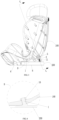
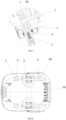
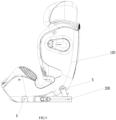
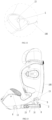
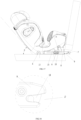
- a child safety seat as shown in Figures 1 to 19 , comprises a seat body 100 and connector 200 rotatably connected to the bottom of the seat body 100 through a rotating shaft 1 that extends obliquely along an up-down direction and used to connect to a vehicle seat, the connector 200 can also protrude forward or rearward relative to the seat body 100 to connect to the vehicle seat, wherein the term "forward” in the present disclosure refers to the direction in which a child faces when riding on the child safety seat, and “rearward” in the present disclosure refers to the direction in which a child backs when riding on the child safety seat, the child safety seat has a forward usage state and a reverse usage state, and is installed by switching between the forward usage state and the reverse usage states through relative rotation between the seat body 100 and connector 200, wherein in the forward usage state of the present disclosure, the direction in which a child faces when riding on the child safety seat is the same as the forward moving direction of the vehicle, while in the reverse usage state, the direction in which a child faces when riding on the child
- a lower surface of the seat body 100 has a first support surface M that extends horizontally when the child safety seat is in the forward usage state, and when the child safety seat is in the forward usage state, the child safety seat is in a sitting-posture state; a rear surface of the seat body 100 has a second support surface N that extends horizontally when the child safety seat is in the reverse usage state, and when the child safety seat is in the reverse usage state, it is in a lying-posture state.
- an angle ⁇ between the plane where the rear surface of the seat body 1 leans and the horizontal plane is larger than that in the lying-posture state
- an angle ⁇ between the plane where the rear surface of the seat body 1 leans (this plane is a virtual plane in the lying-posture state) and the horizontal plane is larger
- the plane where the rear surface of the seat body 1 leans in the sitting-posture state and the lying-posture state refers to the plane where the cutting plane at the same position on the rear surface of seat body 1 is located, while in the sitting-posture state, the plane where the rear surface of seat body 1 leans is the plane where the front surface of the vehicle seat is located.
- an angle ⁇ formed between the plane where the first support surface M is located and the plane where the second support surface N is located is an acute angle, the angle ⁇ ranges from 5° to 60°, in the reverse usage state, due to that the second support surface N is located on the horizontal plan, an angle formed between the plane where the first support surface M is located and the horizontal plane is also the angle ⁇ , an acute angle, preferably, the angle ⁇ formed between the plane where the first support surface M is located and the horizontal plane ranges from 25° to 35°, compared to the arrangement where the first support surface M extends horizontally in both in the forward usage state and the reverse usage state, the provision of the first support surface M and the second support surface N in the child safety seat in this embodiment is to provide a greater angle of inclination and a more comfortable lying position for the child in the reverse usage state, correspondingly, in order to cooperate with the lying posture in the reverse usage state, in the forward usage state, the rotating shaft 1 extends downwards and obliquely from front to rear, and
- a first connecting piece capable of being connected to or separated from the connector 200 is arranged on the seat body 100 and behind the rotating shaft 1
- a second connecting piece capable of being connected to or separated from the connector 200 is arranged on the seat body 100 and in front of the rotating shaft 1, and in order to simplify the structure of the child safety seat, the first connecting piece and the second connecting piece are respectively a first connecting rod 5 and a second connecting rod 6 extended along the left-right direction of the seat body 100.
- the connector 200 is symmetrically provided on the left and right sides of the seat body 100, and correspondingly, both the first connecting rod 5 and the second connecting rod 6 are arranged on the left and right sides of the seat body 100, respectively.
- the connector 200 on each side comprises a connector body and a third connecting piece 10 fixedly arranged on the connector body
- the connector body comprises a connecting frame 8 that is rotatably connected to the bottom of the seat body 100 through the rotating shaft 1 and a joint 9 that is slidably connected to the connecting frame 8 along the front-rear direction of the seat body 100 and is used for connecting to the vehicle seat
- the joint 9 can be extended from one end portion of the connecting frame 8 to connect to the vehicle seat, and the length of the joint 9 extending from the connecting frame 8 is adjustable
- the joint 9 has an opening 17 for connecting the ISOFIX interface on the vehicle seat
- a movable locking hook portion 18 is further arranged within the opening 17 for coordinating and connecting to the vehicle seat
- the movable locking hook portion 18 can be folded or extended relative to the upper side wall of the opening 17, the movable locking hook portion 18 also has an opening
- the third connecting piece 10 is fixedly arranged on the connecting frame 8.
- the connectors 200 on the two sides are respectively connected to or separated from two ends of the first connecting rod 5 or the second connecting rod 6, and when the connectors 200 on the two sides are respectively connected to the two ends of the first connecting rod 5, the child safety seat is in the forward usage state; when the connectors 200 on the two sides are respectively connected to the two ends of the second connecting rod 6, the child safety seat is in the reverse state; when the connectors 200 on the two sides are both separated from the first connecting rod 5 and the second connecting rod 6, the connectors 200 on the two sides can rotate relative to the seat body 100.
- the connector 200 is provided with a through hole 7 for inserting or separating from the first connecting rod 5 or the second connecting rod 6, the through hole 7 is opened on the third connecting piece 10, when the first connecting rod 5 or the second connecting rod 6 is inserted into the through hole 7, the connector 200 is connected to the first connecting rod 5 or the second connecting rod 6; when both the first connecting rod 5 and the second connecting rod 6 are separated from the through hole 7, both the first connecting rod 5 and the second connecting rod 6 are separated from the connector 200, and the connector 200 can be rotated relative to the seat body 100.
- first avoidance grooves 13 and second avoidance grooves 14 for avoiding the third connecting rod 10 are provided, and when the first connecting rod 5 or the second connecting rod 6 is inserted into the through hole 7 on the third connecting rod 10, the third connecting rod 10 is located inside the first avoidance groove 13 or the second avoidance groove 14.
- the existing connection relationship is sufficient for the connection relationship between the joint 9 and the connecting frame 8, which is not the focus, it is only necessary to ensure that joint 9 can extend from one end portion of the connecting frame 8 out of the connecting frame 8, and the length of the extension can be adjusted and accommodated in the connecting frame 8.
- the child safety seat further comprises a locking mechanism for locking the child safety seat in the forward usage state and the reverse usage state, the locking mechanism is arranged between the seat body 100 and the connector 200, and one locking mechanism is respectively arranged between the connectors 200 on the two sides and the seat body 100.
- the locking mechanism on each side comprises a locking member 2 slidably arranged on the connector 200, and a first locking slot 3 and a second locking slot 4 located at the bottom of the seat body 100 and on the front and rear sides of the rotating shaft 1, and fitted to insert or separate from the locking member 2, the first locking slot 3 is located behind the second locking slot 4, and when the locking member 2 is inserted and matched with the first locking slot 3, the locking mechanism locks the safety seat in the forward usage state; when the locking element 2 is inserted and matched with the second locking slot 4, the locking mechanism locks the safety seat in the reverse usage state; when the locking element 2 is separated from both the first locking slot 3 and the second locking slot 4, the locking mechanism is unlocked.
- the locking member 2 is slidably arranged on the third connecting piece 10, and the locking mechanism further comprises an elastic element 11 arranged between the locking member 2 and the connecting frame 8 to make the locking member 2 tend to be inserted into the first locking slot 3 or the second locking slot 4, the elastic member 11 is a spring, and the locking member 2 has an operating portion 2b for operating the locking member 2 to make the locking member 2 tend to be separated from the first locking slot 3 or the second locking slot 4, as shown in Figure 20 , the locking member 2 comprises a sliding portion 2a slidably arranged on the third connecting piece 10 and this operating portion 2b fixedly arranged on the sliding portion 2a, specifically, the sliding portion 2a is slidably arranged inside the third connecting piece 10 and one end portion of the sliding portion 2a passes through the third connecting piece 10 and is inserted into or separated from the first locking slot 3 or the second locking slot 4, a sliding groove 12 is disposed on the third connecting piece 10 at the corresponding position of the operating portion 2b along the sliding direction of the sliding portion 2a, and the operating portion 2
- the first locking slot 3 is opened on the upper groove wall of the first avoidance groove 13
- the second locking slot 4 is opened on the upper groove wall of the second avoidance groove 14
- a through groove is opened on the sliding portion 2a of the locking member 2 corresponding to the through hole 7 of the third connecting piece 10, and when the first connecting rod 5 or the second connecting rod 6 is inserted into the through hole 7, the first connecting rod 5 or the second connecting rod 6 is also inserted into the through groove and can slide relative to the through groove.
- the third connecting piece 10 is used to connect to or separate from the seat body 100, and the locking member 2 and the elastic member 11 are respectively arranged inside the third connecting piece 10, greatly simplifying the structure of the safety seat.
- the rotating shaft 1 is extended obliquely in an up-down direction, and the lower end portion of the rotating shaft 1 is fixedly connected to the connecting frame 8, an inserting hole is opened at the bottom of the seat body 100 corresponding to the position of the rotating shaft 1, the rotating shaft 1 is inserted into the inserting hole and rotates in the inserting hole, and the upper end portion of the rotating shaft 1 is further provided with a position limit element 16 for preventing the rotating shaft 1 from sliding out of the inserting hole and preventing the connector 200 from detaching from the seat body 100.
- a third avoidance groove 15 is opened at the bottom of the seat body 100 corresponding to the position of the connecting frame 8 of the connector 200 to avoid the rotation of the connecting frame 8, and the connector 200 rotates 180° around the axis of the rotating shaft 1.
- the connecting frame 8 is divided into a connecting frame segment I and a connecting frame segment II at the connection between the rotating shaft 1 and the connecting frame 8, the length of the connecting frame segment II is longer than that of the connecting frame segment I, the third connecting piece 10 is fixed on the connecting frame segment II, the third avoidance groove 15 is used to avoid the connecting frame segment I, and when the safety seat is in the forward usage state or the reverse usage state, the upper surface of the connecting frame segment I is in contact with the upper groove wall of the third avoidance groove 15, to achieve further support and stability for connector 200, the angle between the axis of rotating shaft 1 and the plane where the upper surface of the connecting frame segment II ranges from 100° - 110°.
- the connector 200 is separated from the vehicle seat, and then the operating portion 2b of the locking member 2 is operated to slide the sliding portion 2a downwards and compress the elastic element 11, thereby causing the sliding portion 2a to detach from the first locking slot 3, as shown in Figure 7 , the locking mechanism is unlocked, and the operating portion 2b is released, and the sliding portion 2a slides upwards and resets under the action of the elastic element 11.
- the third connecting piece 10 of the connector 200 is separated from the first connecting rod 5, and the connector 200 is rotated around the rotating shaft 1, as shown in Figures 11 to 14 , until the third connecting piece 10 is connected to the second connecting rod 6, the operating portion 2b is operated to slide the sliding portion 2a downwards and continue to rotate the connector 200, and when the connector 200 is rotated by 180 °, the operating portion 2b is released, and the sliding portion 2a is inserted into the second locking slot 4 under the action of the elastic element 11, the locking mechanism is locked, and the connector 200 is fixed relative to the seat body 100.
- the seat body 100 is reversely installed on the vehicle seat, so that the second support surface N of the seat body 100 extends horizontally as a support, the connecting frame 8 of the connector 200 extends horizontally, and the joint 9 of the connector 200 slides out of the connecting frame 8 and is connected to the ISOFIX interface of the vehicle seat, as shown in Figures 15 to 17 , the joint 9 of the connector 200 slides forward relative to the seat body 1 out of the connecting frame 8 and is connected to the ISOFIX interface of the vehicle seat, the opening 17 on the joint 9 faces towards the front of the child safety seat, and the opening of the movable locking hook portion 18 is still arranged downwards.
- the opening 17 of the joint 9 is always opposite to the forward moving direction of the vehicle, and the opening of the movable locking hook portion 18 is always arranged downwards to facilitate coordination with the ISOFIX interface of the vehicle seat.
- the safety seat can be reversed only by operating the connector 200 to rotate relative to the seat body 100, and then installed in the forward or reverse direction, which is convenient to operate, and compared with traditional safety seats, it greatly simplifies the structure of the seat body 100, making the structure of the child safety seat simpler and more convenient to process.
Landscapes
- Engineering & Computer Science (AREA)
- Health & Medical Sciences (AREA)
- Child & Adolescent Psychology (AREA)
- General Health & Medical Sciences (AREA)
- Aviation & Aerospace Engineering (AREA)
- Transportation (AREA)
- Mechanical Engineering (AREA)
- Seats For Vehicles (AREA)
Applications Claiming Priority (2)
| Application Number | Priority Date | Filing Date | Title |
|---|---|---|---|
| CN202110793853.5A CN113665444A (zh) | 2021-07-14 | 2021-07-14 | 一种儿童安全座椅 |
| PCT/CN2021/139481 WO2023284253A1 (zh) | 2021-07-14 | 2021-12-20 | 一种儿童安全座椅 |
Publications (2)
| Publication Number | Publication Date |
|---|---|
| EP4371815A1 true EP4371815A1 (de) | 2024-05-22 |
| EP4371815A4 EP4371815A4 (de) | 2025-07-02 |
Family
ID=78539273
Family Applications (1)
| Application Number | Title | Priority Date | Filing Date |
|---|---|---|---|
| EP21950024.6A Pending EP4371815A4 (de) | 2021-07-14 | 2021-12-20 | Kindersicherheitssitz |
Country Status (4)
| Country | Link |
|---|---|
| US (1) | US20240308398A1 (de) |
| EP (1) | EP4371815A4 (de) |
| CN (2) | CN113665444A (de) |
| WO (1) | WO2023284253A1 (de) |
Families Citing this family (2)
| Publication number | Priority date | Publication date | Assignee | Title |
|---|---|---|---|---|
| CN113665444A (zh) * | 2021-07-14 | 2021-11-19 | 好孩子儿童用品有限公司 | 一种儿童安全座椅 |
| CN115891785A (zh) * | 2022-11-24 | 2023-04-04 | 珠海阳光儿童用品有限公司 | 一种具有可换向连接的isofix连接器的儿童安全座椅 |
Family Cites Families (18)
| Publication number | Priority date | Publication date | Assignee | Title |
|---|---|---|---|---|
| US6209957B1 (en) * | 1999-06-10 | 2001-04-03 | Britax Child Safety Inc. | Child safety seat |
| FR2889826B1 (fr) * | 2005-08-17 | 2008-10-17 | Equipbaby Uk Ltd | Siege de securite destine a installer un bebe ou un tres jeune enfant sur un siege de vehicule. |
| US8789886B2 (en) * | 2011-02-04 | 2014-07-29 | Bp Children's Products Hk Co., Limited | Child safety seat |
| CN202098306U (zh) * | 2011-06-10 | 2012-01-04 | 宝钜(中国)儿童用品有限公司 | 儿童安全座椅 |
| DE102012013268B4 (de) * | 2011-10-20 | 2017-10-12 | Wonderland Nurserygoods Co., Ltd. | Einstellbarer Verankerungsmechanismus und dazugehöriger Kindersitz |
| CN103057444B (zh) * | 2011-10-20 | 2016-02-24 | 明门香港股份有限公司 | 儿童安全座椅及其可调整锚定机构 |
| CN104802670A (zh) * | 2015-05-13 | 2015-07-29 | 上海童璨婴童用品有限公司 | 0-1-2-3组带isofix接口连接器的儿童安全座椅 |
| CN104890542B (zh) * | 2015-06-29 | 2018-03-20 | 广东奥迪动漫玩具有限公司 | 0‑1‑2‑3组带isofix接口的儿童安全座椅 |
| CN204978312U (zh) * | 2015-06-29 | 2016-01-20 | 上海童璨婴童用品有限公司 | 0-1-2-3组带isofix接口的儿童安全座椅 |
| CN204712918U (zh) * | 2015-06-29 | 2015-10-21 | 上海童璨婴童用品有限公司 | 0-1-2-3组带isofix接口的儿童安全座椅 |
| CN105291912A (zh) * | 2015-12-03 | 2016-02-03 | 上海迈纶塑料制品有限公司 | 具有换向装置且带isofix接口的儿童安全座椅 |
| CN205365305U (zh) * | 2016-01-21 | 2016-07-06 | 宁波永驰婴童用品有限公司 | 带isofix组件的儿童安全座椅 |
| CN105936227A (zh) * | 2016-06-18 | 2016-09-14 | 金余和 | 带一环解锁机构的提蓝安全座椅 |
| CN106965717A (zh) * | 2017-05-05 | 2017-07-21 | 重庆宏立至信汽车部件制造有限公司 | 可前后换向的儿童安全座椅isofix安装结构 |
| CN206704011U (zh) * | 2017-05-05 | 2017-12-05 | 重庆宏立至信汽车部件制造有限公司 | 一种前后快速换向的isofix儿童安全座椅 |
| CN207311198U (zh) * | 2017-09-05 | 2018-05-04 | 好孩子儿童用品有限公司 | 儿童汽车座 |
| CN210416319U (zh) * | 2019-05-22 | 2020-04-28 | 好孩子儿童用品有限公司 | 儿童安全座椅 |
| CN113665444A (zh) * | 2021-07-14 | 2021-11-19 | 好孩子儿童用品有限公司 | 一种儿童安全座椅 |
-
2021
- 2021-07-14 CN CN202110793853.5A patent/CN113665444A/zh not_active Withdrawn
- 2021-12-20 EP EP21950024.6A patent/EP4371815A4/de active Pending
- 2021-12-20 CN CN202180097821.XA patent/CN117241964A/zh active Pending
- 2021-12-20 WO PCT/CN2021/139481 patent/WO2023284253A1/zh not_active Ceased
- 2021-12-20 US US18/577,786 patent/US20240308398A1/en active Pending
Also Published As
| Publication number | Publication date |
|---|---|
| CN113665444A (zh) | 2021-11-19 |
| EP4371815A4 (de) | 2025-07-02 |
| CN117241964A (zh) | 2023-12-15 |
| US20240308398A1 (en) | 2024-09-19 |
| WO2023284253A1 (zh) | 2023-01-19 |
Similar Documents
| Publication | Publication Date | Title |
|---|---|---|
| EP4371815A1 (de) | Kindersicherheitssitz | |
| CA2418541A1 (en) | Child seat | |
| CN114454786B (zh) | 幼儿汽车载具及其防前后误用的载具本体 | |
| CN113306468A (zh) | 一种头枕支架的滑动锁定机构以及汽车座椅头枕支架 | |
| CN211107645U (zh) | 一种座椅可旋转的儿童推车 | |
| WO2024060975A1 (zh) | 一种汽车安全座椅 | |
| CN216611331U (zh) | 可折叠座兜及具有该座兜的婴儿推车 | |
| CN210416319U (zh) | 儿童安全座椅 | |
| CN212709630U (zh) | 折叠操作简便的座椅及设有该座椅的婴儿车 | |
| CN217575321U (zh) | 一种儿童推车 | |
| CN113682213B (zh) | 一种集成于汽车座椅上的儿童安全座椅 | |
| GB2427130A (en) | Vehicle seat with detachable child seat | |
| CN214874354U (zh) | 儿童汽车安全座椅 | |
| CN109774772A (zh) | 一种童车 | |
| CN112277742A (zh) | 儿童汽车安全座椅 | |
| CN113306464A (zh) | 一种儿童安全座椅 | |
| CN217074485U (zh) | 儿童用品 | |
| CN211195938U (zh) | 一种儿童安全座椅及其角度调节机构 | |
| CN219270528U (zh) | 一种靠背调节结构及座椅 | |
| CN214284184U (zh) | 餐椅的铰链结构 | |
| CN221893164U (zh) | 儿童推车 | |
| CN219191991U (zh) | 一种儿童安全座椅的底座结构及儿童安全座椅 | |
| CN223830709U (zh) | 一种儿童餐椅 | |
| CN213735155U (zh) | 一种婴儿车座椅收折结构 | |
| CN222372951U (zh) | 一种座位机构及载具 |
Legal Events
| Date | Code | Title | Description |
|---|---|---|---|
| STAA | Information on the status of an ep patent application or granted ep patent |
Free format text: STATUS: THE INTERNATIONAL PUBLICATION HAS BEEN MADE |
|
| PUAI | Public reference made under article 153(3) epc to a published international application that has entered the european phase |
Free format text: ORIGINAL CODE: 0009012 |
|
| STAA | Information on the status of an ep patent application or granted ep patent |
Free format text: STATUS: REQUEST FOR EXAMINATION WAS MADE |
|
| 17P | Request for examination filed |
Effective date: 20240111 |
|
| AK | Designated contracting states |
Kind code of ref document: A1 Designated state(s): AL AT BE BG CH CY CZ DE DK EE ES FI FR GB GR HR HU IE IS IT LI LT LU LV MC MK MT NL NO PL PT RO RS SE SI SK SM TR |
|
| DAV | Request for validation of the european patent (deleted) | ||
| DAX | Request for extension of the european patent (deleted) | ||
| A4 | Supplementary search report drawn up and despatched |
Effective date: 20250603 |
|
| RIC1 | Information provided on ipc code assigned before grant |
Ipc: B60N 2/28 20060101AFI20250527BHEP |