EP4370570B1 - Zweikomponentige polyurethanklebstoffzusammensetzung zur folienlaminierung in einer heissabfüllanwendung - Google Patents
Zweikomponentige polyurethanklebstoffzusammensetzung zur folienlaminierung in einer heissabfüllanwendung Download PDFInfo
- Publication number
- EP4370570B1 EP4370570B1 EP21751764.8A EP21751764A EP4370570B1 EP 4370570 B1 EP4370570 B1 EP 4370570B1 EP 21751764 A EP21751764 A EP 21751764A EP 4370570 B1 EP4370570 B1 EP 4370570B1
- Authority
- EP
- European Patent Office
- Prior art keywords
- isocyanate
- polyol
- adhesive
- weight
- adhesive composition
- Prior art date
- Legal status (The legal status is an assumption and is not a legal conclusion. Google has not performed a legal analysis and makes no representation as to the accuracy of the status listed.)
- Active
Links
Images
Classifications
-
- C—CHEMISTRY; METALLURGY
- C09—DYES; PAINTS; POLISHES; NATURAL RESINS; ADHESIVES; COMPOSITIONS NOT OTHERWISE PROVIDED FOR; APPLICATIONS OF MATERIALS NOT OTHERWISE PROVIDED FOR
- C09J—ADHESIVES; NON-MECHANICAL ASPECTS OF ADHESIVE PROCESSES IN GENERAL; ADHESIVE PROCESSES NOT PROVIDED FOR ELSEWHERE; USE OF MATERIALS AS ADHESIVES
- C09J175/00—Adhesives based on polyureas or polyurethanes; Adhesives based on derivatives of such polymers
- C09J175/04—Polyurethanes
- C09J175/12—Polyurethanes from compounds containing nitrogen and active hydrogen, the nitrogen atom not being part of an isocyanate group
-
- C—CHEMISTRY; METALLURGY
- C09—DYES; PAINTS; POLISHES; NATURAL RESINS; ADHESIVES; COMPOSITIONS NOT OTHERWISE PROVIDED FOR; APPLICATIONS OF MATERIALS NOT OTHERWISE PROVIDED FOR
- C09J—ADHESIVES; NON-MECHANICAL ASPECTS OF ADHESIVE PROCESSES IN GENERAL; ADHESIVE PROCESSES NOT PROVIDED FOR ELSEWHERE; USE OF MATERIALS AS ADHESIVES
- C09J175/00—Adhesives based on polyureas or polyurethanes; Adhesives based on derivatives of such polymers
- C09J175/04—Polyurethanes
- C09J175/06—Polyurethanes from polyesters
-
- C—CHEMISTRY; METALLURGY
- C08—ORGANIC MACROMOLECULAR COMPOUNDS; THEIR PREPARATION OR CHEMICAL WORKING-UP; COMPOSITIONS BASED THEREON
- C08G—MACROMOLECULAR COMPOUNDS OBTAINED OTHERWISE THAN BY REACTIONS ONLY INVOLVING UNSATURATED CARBON-TO-CARBON BONDS
- C08G18/00—Polymeric products of isocyanates or isothiocyanates
- C08G18/06—Polymeric products of isocyanates or isothiocyanates with compounds having active hydrogen
- C08G18/28—Polymeric products of isocyanates or isothiocyanates with compounds having active hydrogen characterised by the compounds used containing active hydrogen
- C08G18/40—High-molecular-weight compounds
- C08G18/42—Polycondensates having carboxylic or carbonic ester groups in the main chain
- C08G18/4205—Polycondensates having carboxylic or carbonic ester groups in the main chain containing cyclic groups
- C08G18/4208—Polycondensates having carboxylic or carbonic ester groups in the main chain containing cyclic groups containing aromatic groups
- C08G18/4211—Polycondensates having carboxylic or carbonic ester groups in the main chain containing cyclic groups containing aromatic groups derived from aromatic dicarboxylic acids and dialcohols
-
- B—PERFORMING OPERATIONS; TRANSPORTING
- B32—LAYERED PRODUCTS
- B32B—LAYERED PRODUCTS, i.e. PRODUCTS BUILT-UP OF STRATA OF FLAT OR NON-FLAT, e.g. CELLULAR OR HONEYCOMB, FORM
- B32B7/00—Layered products characterised by the relation between layers; Layered products characterised by the relative orientation of features between layers, or by the relative values of a measurable parameter between layers, i.e. products comprising layers having different physical, chemical or physicochemical properties; Layered products characterised by the interconnection of layers
- B32B7/04—Interconnection of layers
- B32B7/12—Interconnection of layers using interposed adhesives or interposed materials with bonding properties
-
- C—CHEMISTRY; METALLURGY
- C08—ORGANIC MACROMOLECULAR COMPOUNDS; THEIR PREPARATION OR CHEMICAL WORKING-UP; COMPOSITIONS BASED THEREON
- C08G—MACROMOLECULAR COMPOUNDS OBTAINED OTHERWISE THAN BY REACTIONS ONLY INVOLVING UNSATURATED CARBON-TO-CARBON BONDS
- C08G18/00—Polymeric products of isocyanates or isothiocyanates
- C08G18/06—Polymeric products of isocyanates or isothiocyanates with compounds having active hydrogen
- C08G18/28—Polymeric products of isocyanates or isothiocyanates with compounds having active hydrogen characterised by the compounds used containing active hydrogen
- C08G18/2805—Compounds having only one group containing active hydrogen
- C08G18/285—Nitrogen containing compounds
- C08G18/2865—Compounds having only one primary or secondary amino group; Ammonia
-
- C—CHEMISTRY; METALLURGY
- C08—ORGANIC MACROMOLECULAR COMPOUNDS; THEIR PREPARATION OR CHEMICAL WORKING-UP; COMPOSITIONS BASED THEREON
- C08G—MACROMOLECULAR COMPOUNDS OBTAINED OTHERWISE THAN BY REACTIONS ONLY INVOLVING UNSATURATED CARBON-TO-CARBON BONDS
- C08G18/00—Polymeric products of isocyanates or isothiocyanates
- C08G18/06—Polymeric products of isocyanates or isothiocyanates with compounds having active hydrogen
- C08G18/28—Polymeric products of isocyanates or isothiocyanates with compounds having active hydrogen characterised by the compounds used containing active hydrogen
- C08G18/2805—Compounds having only one group containing active hydrogen
- C08G18/288—Compounds containing at least one heteroatom other than oxygen or nitrogen
- C08G18/289—Compounds containing at least one heteroatom other than oxygen or nitrogen containing silicon
-
- C—CHEMISTRY; METALLURGY
- C08—ORGANIC MACROMOLECULAR COMPOUNDS; THEIR PREPARATION OR CHEMICAL WORKING-UP; COMPOSITIONS BASED THEREON
- C08G—MACROMOLECULAR COMPOUNDS OBTAINED OTHERWISE THAN BY REACTIONS ONLY INVOLVING UNSATURATED CARBON-TO-CARBON BONDS
- C08G18/00—Polymeric products of isocyanates or isothiocyanates
- C08G18/06—Polymeric products of isocyanates or isothiocyanates with compounds having active hydrogen
- C08G18/28—Polymeric products of isocyanates or isothiocyanates with compounds having active hydrogen characterised by the compounds used containing active hydrogen
- C08G18/40—High-molecular-weight compounds
- C08G18/42—Polycondensates having carboxylic or carbonic ester groups in the main chain
- C08G18/4205—Polycondensates having carboxylic or carbonic ester groups in the main chain containing cyclic groups
- C08G18/4208—Polycondensates having carboxylic or carbonic ester groups in the main chain containing cyclic groups containing aromatic groups
- C08G18/4211—Polycondensates having carboxylic or carbonic ester groups in the main chain containing cyclic groups containing aromatic groups derived from aromatic dicarboxylic acids and dialcohols
- C08G18/4216—Polycondensates having carboxylic or carbonic ester groups in the main chain containing cyclic groups containing aromatic groups derived from aromatic dicarboxylic acids and dialcohols from mixtures or combinations of aromatic dicarboxylic acids and aliphatic dicarboxylic acids and dialcohols
-
- C—CHEMISTRY; METALLURGY
- C08—ORGANIC MACROMOLECULAR COMPOUNDS; THEIR PREPARATION OR CHEMICAL WORKING-UP; COMPOSITIONS BASED THEREON
- C08G—MACROMOLECULAR COMPOUNDS OBTAINED OTHERWISE THAN BY REACTIONS ONLY INVOLVING UNSATURATED CARBON-TO-CARBON BONDS
- C08G18/00—Polymeric products of isocyanates or isothiocyanates
- C08G18/06—Polymeric products of isocyanates or isothiocyanates with compounds having active hydrogen
- C08G18/28—Polymeric products of isocyanates or isothiocyanates with compounds having active hydrogen characterised by the compounds used containing active hydrogen
- C08G18/40—High-molecular-weight compounds
- C08G18/42—Polycondensates having carboxylic or carbonic ester groups in the main chain
- C08G18/4205—Polycondensates having carboxylic or carbonic ester groups in the main chain containing cyclic groups
- C08G18/423—Polycondensates having carboxylic or carbonic ester groups in the main chain containing cyclic groups containing cycloaliphatic groups
-
- C—CHEMISTRY; METALLURGY
- C08—ORGANIC MACROMOLECULAR COMPOUNDS; THEIR PREPARATION OR CHEMICAL WORKING-UP; COMPOSITIONS BASED THEREON
- C08G—MACROMOLECULAR COMPOUNDS OBTAINED OTHERWISE THAN BY REACTIONS ONLY INVOLVING UNSATURATED CARBON-TO-CARBON BONDS
- C08G18/00—Polymeric products of isocyanates or isothiocyanates
- C08G18/06—Polymeric products of isocyanates or isothiocyanates with compounds having active hydrogen
- C08G18/28—Polymeric products of isocyanates or isothiocyanates with compounds having active hydrogen characterised by the compounds used containing active hydrogen
- C08G18/40—High-molecular-weight compounds
- C08G18/42—Polycondensates having carboxylic or carbonic ester groups in the main chain
- C08G18/4244—Polycondensates having carboxylic or carbonic ester groups in the main chain containing oxygen in the form of ether groups
- C08G18/4247—Polycondensates having carboxylic or carbonic ester groups in the main chain containing oxygen in the form of ether groups derived from polyols containing at least one ether group and polycarboxylic acids
- C08G18/425—Polycondensates having carboxylic or carbonic ester groups in the main chain containing oxygen in the form of ether groups derived from polyols containing at least one ether group and polycarboxylic acids the polyols containing one or two ether groups
-
- C—CHEMISTRY; METALLURGY
- C08—ORGANIC MACROMOLECULAR COMPOUNDS; THEIR PREPARATION OR CHEMICAL WORKING-UP; COMPOSITIONS BASED THEREON
- C08G—MACROMOLECULAR COMPOUNDS OBTAINED OTHERWISE THAN BY REACTIONS ONLY INVOLVING UNSATURATED CARBON-TO-CARBON BONDS
- C08G18/00—Polymeric products of isocyanates or isothiocyanates
- C08G18/06—Polymeric products of isocyanates or isothiocyanates with compounds having active hydrogen
- C08G18/70—Polymeric products of isocyanates or isothiocyanates with compounds having active hydrogen characterised by the isocyanates or isothiocyanates used
- C08G18/72—Polyisocyanates or polyisothiocyanates
- C08G18/74—Polyisocyanates or polyisothiocyanates cyclic
- C08G18/75—Polyisocyanates or polyisothiocyanates cyclic cycloaliphatic
- C08G18/751—Polyisocyanates or polyisothiocyanates cyclic cycloaliphatic containing only one cycloaliphatic ring
- C08G18/752—Polyisocyanates or polyisothiocyanates cyclic cycloaliphatic containing only one cycloaliphatic ring containing at least one isocyanate or isothiocyanate group linked to the cycloaliphatic ring by means of an aliphatic group
- C08G18/753—Polyisocyanates or polyisothiocyanates cyclic cycloaliphatic containing only one cycloaliphatic ring containing at least one isocyanate or isothiocyanate group linked to the cycloaliphatic ring by means of an aliphatic group containing one isocyanate or isothiocyanate group linked to the cycloaliphatic ring by means of an aliphatic group having a primary carbon atom next to the isocyanate or isothiocyanate group
- C08G18/755—Polyisocyanates or polyisothiocyanates cyclic cycloaliphatic containing only one cycloaliphatic ring containing at least one isocyanate or isothiocyanate group linked to the cycloaliphatic ring by means of an aliphatic group containing one isocyanate or isothiocyanate group linked to the cycloaliphatic ring by means of an aliphatic group having a primary carbon atom next to the isocyanate or isothiocyanate group and at least one isocyanate or isothiocyanate group linked to a secondary carbon atom of the cycloaliphatic ring, e.g. isophorone diisocyanate
-
- C—CHEMISTRY; METALLURGY
- C08—ORGANIC MACROMOLECULAR COMPOUNDS; THEIR PREPARATION OR CHEMICAL WORKING-UP; COMPOSITIONS BASED THEREON
- C08G—MACROMOLECULAR COMPOUNDS OBTAINED OTHERWISE THAN BY REACTIONS ONLY INVOLVING UNSATURATED CARBON-TO-CARBON BONDS
- C08G18/00—Polymeric products of isocyanates or isothiocyanates
- C08G18/06—Polymeric products of isocyanates or isothiocyanates with compounds having active hydrogen
- C08G18/70—Polymeric products of isocyanates or isothiocyanates with compounds having active hydrogen characterised by the isocyanates or isothiocyanates used
- C08G18/72—Polyisocyanates or polyisothiocyanates
- C08G18/77—Polyisocyanates or polyisothiocyanates having heteroatoms in addition to the isocyanate or isothiocyanate nitrogen and oxygen or sulfur
- C08G18/778—Polyisocyanates or polyisothiocyanates having heteroatoms in addition to the isocyanate or isothiocyanate nitrogen and oxygen or sulfur silicon
-
- C—CHEMISTRY; METALLURGY
- C08—ORGANIC MACROMOLECULAR COMPOUNDS; THEIR PREPARATION OR CHEMICAL WORKING-UP; COMPOSITIONS BASED THEREON
- C08G—MACROMOLECULAR COMPOUNDS OBTAINED OTHERWISE THAN BY REACTIONS ONLY INVOLVING UNSATURATED CARBON-TO-CARBON BONDS
- C08G18/00—Polymeric products of isocyanates or isothiocyanates
- C08G18/06—Polymeric products of isocyanates or isothiocyanates with compounds having active hydrogen
- C08G18/70—Polymeric products of isocyanates or isothiocyanates with compounds having active hydrogen characterised by the isocyanates or isothiocyanates used
- C08G18/72—Polyisocyanates or polyisothiocyanates
- C08G18/77—Polyisocyanates or polyisothiocyanates having heteroatoms in addition to the isocyanate or isothiocyanate nitrogen and oxygen or sulfur
- C08G18/78—Nitrogen
- C08G18/79—Nitrogen characterised by the polyisocyanates used, these having groups formed by oligomerisation of isocyanates or isothiocyanates
- C08G18/791—Nitrogen characterised by the polyisocyanates used, these having groups formed by oligomerisation of isocyanates or isothiocyanates containing isocyanurate groups
- C08G18/792—Nitrogen characterised by the polyisocyanates used, these having groups formed by oligomerisation of isocyanates or isothiocyanates containing isocyanurate groups formed by oligomerisation of aliphatic and/or cycloaliphatic isocyanates or isothiocyanates
-
- C—CHEMISTRY; METALLURGY
- C08—ORGANIC MACROMOLECULAR COMPOUNDS; THEIR PREPARATION OR CHEMICAL WORKING-UP; COMPOSITIONS BASED THEREON
- C08G—MACROMOLECULAR COMPOUNDS OBTAINED OTHERWISE THAN BY REACTIONS ONLY INVOLVING UNSATURATED CARBON-TO-CARBON BONDS
- C08G18/00—Polymeric products of isocyanates or isothiocyanates
- C08G18/06—Polymeric products of isocyanates or isothiocyanates with compounds having active hydrogen
- C08G18/70—Polymeric products of isocyanates or isothiocyanates with compounds having active hydrogen characterised by the isocyanates or isothiocyanates used
- C08G18/72—Polyisocyanates or polyisothiocyanates
- C08G18/77—Polyisocyanates or polyisothiocyanates having heteroatoms in addition to the isocyanate or isothiocyanate nitrogen and oxygen or sulfur
- C08G18/78—Nitrogen
- C08G18/79—Nitrogen characterised by the polyisocyanates used, these having groups formed by oligomerisation of isocyanates or isothiocyanates
- C08G18/791—Nitrogen characterised by the polyisocyanates used, these having groups formed by oligomerisation of isocyanates or isothiocyanates containing isocyanurate groups
- C08G18/795—Nitrogen characterised by the polyisocyanates used, these having groups formed by oligomerisation of isocyanates or isothiocyanates containing isocyanurate groups formed by oligomerisation of mixtures of aliphatic and/or cycloaliphatic isocyanates or isothiocyanates with aromatic isocyanates or isothiocyanates
-
- C—CHEMISTRY; METALLURGY
- C09—DYES; PAINTS; POLISHES; NATURAL RESINS; ADHESIVES; COMPOSITIONS NOT OTHERWISE PROVIDED FOR; APPLICATIONS OF MATERIALS NOT OTHERWISE PROVIDED FOR
- C09J—ADHESIVES; NON-MECHANICAL ASPECTS OF ADHESIVE PROCESSES IN GENERAL; ADHESIVE PROCESSES NOT PROVIDED FOR ELSEWHERE; USE OF MATERIALS AS ADHESIVES
- C09J5/00—Adhesive processes in general; Adhesive processes not provided for elsewhere, e.g. relating to primers
- C09J5/06—Adhesive processes in general; Adhesive processes not provided for elsewhere, e.g. relating to primers involving heating of the applied adhesive
-
- C—CHEMISTRY; METALLURGY
- C09—DYES; PAINTS; POLISHES; NATURAL RESINS; ADHESIVES; COMPOSITIONS NOT OTHERWISE PROVIDED FOR; APPLICATIONS OF MATERIALS NOT OTHERWISE PROVIDED FOR
- C09J—ADHESIVES; NON-MECHANICAL ASPECTS OF ADHESIVE PROCESSES IN GENERAL; ADHESIVE PROCESSES NOT PROVIDED FOR ELSEWHERE; USE OF MATERIALS AS ADHESIVES
- C09J7/00—Adhesives in the form of films or foils
- C09J7/30—Adhesives in the form of films or foils characterised by the adhesive composition
- C09J7/35—Heat-activated
-
- C—CHEMISTRY; METALLURGY
- C09—DYES; PAINTS; POLISHES; NATURAL RESINS; ADHESIVES; COMPOSITIONS NOT OTHERWISE PROVIDED FOR; APPLICATIONS OF MATERIALS NOT OTHERWISE PROVIDED FOR
- C09J—ADHESIVES; NON-MECHANICAL ASPECTS OF ADHESIVE PROCESSES IN GENERAL; ADHESIVE PROCESSES NOT PROVIDED FOR ELSEWHERE; USE OF MATERIALS AS ADHESIVES
- C09J9/00—Adhesives characterised by their physical nature or the effects produced, e.g. glue sticks
-
- C—CHEMISTRY; METALLURGY
- C09—DYES; PAINTS; POLISHES; NATURAL RESINS; ADHESIVES; COMPOSITIONS NOT OTHERWISE PROVIDED FOR; APPLICATIONS OF MATERIALS NOT OTHERWISE PROVIDED FOR
- C09J—ADHESIVES; NON-MECHANICAL ASPECTS OF ADHESIVE PROCESSES IN GENERAL; ADHESIVE PROCESSES NOT PROVIDED FOR ELSEWHERE; USE OF MATERIALS AS ADHESIVES
- C09J2301/00—Additional features of adhesives in the form of films or foils
- C09J2301/10—Additional features of adhesives in the form of films or foils characterized by the structural features of the adhesive tape or sheet
- C09J2301/12—Additional features of adhesives in the form of films or foils characterized by the structural features of the adhesive tape or sheet by the arrangement of layers
-
- C—CHEMISTRY; METALLURGY
- C09—DYES; PAINTS; POLISHES; NATURAL RESINS; ADHESIVES; COMPOSITIONS NOT OTHERWISE PROVIDED FOR; APPLICATIONS OF MATERIALS NOT OTHERWISE PROVIDED FOR
- C09J—ADHESIVES; NON-MECHANICAL ASPECTS OF ADHESIVE PROCESSES IN GENERAL; ADHESIVE PROCESSES NOT PROVIDED FOR ELSEWHERE; USE OF MATERIALS AS ADHESIVES
- C09J2301/00—Additional features of adhesives in the form of films or foils
- C09J2301/30—Additional features of adhesives in the form of films or foils characterized by the chemical, physicochemical or physical properties of the adhesive or the carrier
- C09J2301/304—Additional features of adhesives in the form of films or foils characterized by the chemical, physicochemical or physical properties of the adhesive or the carrier the adhesive being heat-activatable, i.e. not tacky at temperatures inferior to 30°C
-
- C—CHEMISTRY; METALLURGY
- C09—DYES; PAINTS; POLISHES; NATURAL RESINS; ADHESIVES; COMPOSITIONS NOT OTHERWISE PROVIDED FOR; APPLICATIONS OF MATERIALS NOT OTHERWISE PROVIDED FOR
- C09J—ADHESIVES; NON-MECHANICAL ASPECTS OF ADHESIVE PROCESSES IN GENERAL; ADHESIVE PROCESSES NOT PROVIDED FOR ELSEWHERE; USE OF MATERIALS AS ADHESIVES
- C09J2400/00—Presence of inorganic and organic materials
- C09J2400/10—Presence of inorganic materials
- C09J2400/16—Metal
- C09J2400/163—Metal in the substrate
-
- C—CHEMISTRY; METALLURGY
- C09—DYES; PAINTS; POLISHES; NATURAL RESINS; ADHESIVES; COMPOSITIONS NOT OTHERWISE PROVIDED FOR; APPLICATIONS OF MATERIALS NOT OTHERWISE PROVIDED FOR
- C09J—ADHESIVES; NON-MECHANICAL ASPECTS OF ADHESIVE PROCESSES IN GENERAL; ADHESIVE PROCESSES NOT PROVIDED FOR ELSEWHERE; USE OF MATERIALS AS ADHESIVES
- C09J2423/00—Presence of polyolefin
- C09J2423/006—Presence of polyolefin in the substrate
-
- C—CHEMISTRY; METALLURGY
- C09—DYES; PAINTS; POLISHES; NATURAL RESINS; ADHESIVES; COMPOSITIONS NOT OTHERWISE PROVIDED FOR; APPLICATIONS OF MATERIALS NOT OTHERWISE PROVIDED FOR
- C09J—ADHESIVES; NON-MECHANICAL ASPECTS OF ADHESIVE PROCESSES IN GENERAL; ADHESIVE PROCESSES NOT PROVIDED FOR ELSEWHERE; USE OF MATERIALS AS ADHESIVES
- C09J2467/00—Presence of polyester
- C09J2467/006—Presence of polyester in the substrate
Definitions
- the present invention relates to a two-component polyurethane adhesive composition for film lamination in hot filling application. Further, the present invention relates to method of manufacturing a laminate by using the two-component polyurethane adhesive composition and the laminate obtainable by the described method.
- the flexible package when filled with a food or other product and closed or sealed can be readily changed in shape.
- the flexible package is typically prepared from two layers of flexible packaging material that are overlaid and sealed around most of their periphery to form a cavity inside.
- the two layers of flexible packaging material are heat sealed by applying heat and pressure to fuse the layers together around a thin portion of the package periphery.
- Food or other product is placed in the cavity through an opening and the opening is closed by heat sealing the layers together.
- the sealed package and enclosed product can be heated for preservation purposes. In some demanding applications such as hot filling, the sealed package has to withstand high temperatures up to 90°C.
- Flexible packaging material is prepared by laminating two or more layers of film. Each film is chosen for specific properties.
- a flexible packaging material can be a lamination of three layers.
- the inner layer will contact the packaged product.
- Polypropylene has desirable product contact properties as well as heat sealability and can be used as an inner layer.
- the middle layer will provide a barrier to moisture, oxygen and/or light.
- Metal films or foils have desirable barrier properties and metal films such as aluminium foil can be used as a middle layer.
- the outer layer will provide protection for the package and also provides a surface for printing information such as contents, packaging date, warnings, etc. Polyester films are tough, can receive printing ink and can be used as an outer layer.
- Flexible packaging material can range in thickness from about 1 ⁇ m to about 75 ⁇ m.
- Each layer of the flexible packaging material is bonded to the adjacent layer by an adhesive.
- Adhesive can be applied to the layer from a solution in a suitable solvent using gravure or smooth roll coating cylinders or from a solvent-free state using special application machinery and that layer is laminated to another layer.
- the laminated packaging material is dried if necessary and accumulated in rolls. The rolls are kept in storage for a predetermined amount of time to allow the adhesive to cure before use in some applications.
- polyurethane based adhesives are preferred for use in flexible packaging materials because of their many desirable properties including good adhesion to the materials in each layer, high bonding strength, resistance to heat such as from heat sealing or retorting, and resistance to chemically aggressive products.
- an isocyanate-containing polyurethane prepolymer obtained by the reaction of excess diisocyanate with a polyether and/or polyester containing two or more active hydrogen groups per molecule is used in combination with a second component.
- the second component is usually a polyether polyol and/or a polyester polyol. The two components are combined just before use and in a predetermined ratio and applied on one of the film surfaces and the coated film is laminated to another substrate.
- GLYMO 3-glycidyloxypropyltrimethoxysilane
- polyurethane adhesives for hot filling applications must withstand high thermal and chemical requirements without decreasing the adhesive strength and the ease for application. Therefore, it would be desirable to provide a polyurethane adhesive composition containing no GLYMO or other epoxidized silane for bonding flexible films for packaging, especially in high-temperature food contact and medical retort applications.
- a first object of the invention is to provide a two-component polyurethane adhesive composition
- a polyol component comprises at least one polyester polyol being a reaction product of at least one cycloaliphatic polyol, at least one heterocyclic polyol, at least one linear or branched aliphatic polyol, and at least one polyfunctional carboxylic acid
- the isocyanate component comprises at least one alkoxysilane functionalized isocyanate compound having no epoxide group, at least one aromatic isocyanate-functionalized compound, and at least one aliphatic or alicyclic isocyanate-functionalized compound, the cured adhesive thereof, and the manufacturing method thereof.
- Another object of the invention is to provide a laminate of flexible packaging comprising the cured adhesive and the manufacturing method thereof.
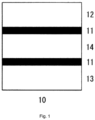
- Figure 1 shows a sectional view of a food packaging film according to the present invention.
- a molecular weight of a polymer refers to the average number weight M n , unless stated otherwise.
- the number average molecular weight M n of a polymer can, for example, be determined by gel permeation chromatography (GPC) according to DIN 55674 with THF as the eluent. If not stated otherwise, all given molecular weights are those determined by GPC, calibrated with polystyrene standards.
- the average molecular weight M w can also be determined by GPC, as described for M n .
- the disclosed two-component polyurethane adhesive composition comprises or consists of a polyol component and an isocyanate component, wherein the polyol component comprises at least one polyester polyol being a reaction product of at least one cycloaliphatic polyol, at least one heterocyclic polyol, at least one linear or branched aliphatic polyol, and at least one polyfunctional carboxylic acid, and the isocyanate component comprises at least one alkoxysilane functionalized isocyanate compound having no epoxide group, at least one aromatic isocyanate-functionalized compound, and at least one aliphatic or alicyclic isocyanate-functionalized compound.
- the two-component polyurethane adhesive composition comprises essentially no, and preferably no alkoxysilane having epoxide group, such as GLYMO.
- the polyol component and the isocyanate component are stored separately and mixed in a predetermined ratio just before use.
- the polyol component in the two-component polyurethane adhesive composition comprises or consists of a polyester polyol obtained from a reaction mixture comprising at least one cycloaliphatic polyol, at least one heterocyclic polyol, at least one linear or branched aliphatic polyol, and at least one polyfunctional carboxylic acid.
- the polyester polyol used in the adhesive composition as long as it has no negative effect on the properties of the adhesive composition and the cured adhesive.
- the polyester polyol has a molecular weight M n of 200 to 20,000 g/mol, in particular 1,000 to 10,000 g/mol.
- the polyester polyol preferably may have an acid value of 0.1 to 2 mgKOH/g.
- the adhesive composition for food packaging films of the present invention has a viscosity more suited for application and is excellent in adhesion to a film.
- the "acid value" of the polyester polyol according to the present invention is expressed by a calculated value of a number of milligrams of potassium hydroxide which is needed to neutralize the acid. Therefore, even though the acid groups exist as a base in an actual system, they are assumed as a free acid.
- the “acid value” according to the present invention is determined by dissolving the polyester polyol in a solvent, adding phenolphthalein as an indicator, and titrating with a 0.1 mol/I potassium hydroxide-ethanol solution according to DIN 53240.
- the polyester polyol may have a hydroxyl value of 5 to 350 mgKOH/g.
- the adhesive composition for food packaging films of the present invention has a viscosity more suited for application and is more excellent in adhesion to a film.
- the hydroxyl value means a number of mgs of potassium hydroxide which is required to neutralize acetic acid bonding to the hydroxyl group when 1 g of the resin is acetylated.
- the "hydroxyl value" according to the present invention is determined according to DIN 51558 by adding an acetylation reagent to the polyester polyol, heating with a glycerine solution, allowing to cool, then adding phenolphthalein as an indicator, and titrating with a potassium hydroxide-ethanol solution.
- the polyester polyol may have a glass transition temperature of -20°C to 100°C.
- the glass transition temperature of the polyester polyol is measured using a differential scanning calorimeter. With respect to a proper amount of a sample, a DSC curve was measured at a temperature rise rate of 10°C/minute and the temperature of an inflection point of the obtained DSC curve was regarded as the glass transition temperature.
- the polyester polyol appears in liquid form at room temperature. Such polyester polyol can provide ease for further processing in formulating the adhesive composition.
- the cycloaliphatic polyol may have one, two or more rings and two or more hydroxy groups.
- the cycloaliphatic polyol is selected from 1,4-cyclohexanedimethanol, cyclobutanediol, cyclopentanediol, 1,4-cyclohexanediol, cycloheptanediol, cyclooctanediol, cyclohexanedimethanol, tricyclo[5.2.1.0.2.6]decanedimethanol, bicyclo[4.3.0]-nonanediol, dicyclohexanediol, tricyclo[5.3.1.1]dodecanediol, bicyclo[4.3.0]nonanedimethanol, tricyclo[5.3.1.1]dodecanediethanol, spiro[3.4]octanediol, butylcyclohexanedio
- the cycloaliphatic polyol is selected from 1,4-cyclohexanedimethanol, 1,4-cyclohexanediol, and mixture thereof.
- the cycloaliphatic polyol is 1,4-cyclohexanedimethanol (CHDM).
- the cycloaliphatic polyol is present in the reaction mixture of the polyester polyol in an amount of 1% to 25% by weight, and preferably 2% to 20% by weight based on the weight of the reaction mixture. If the amount is lower, the adhesion performance may be deteriorated. If the amount is higher, the obtained polyester polyol may be in solid form even at reaction temperature and cannot be further processed.
- the heterocyclic polyol may have one, two or more rings, and preferably have two or more rings and two or more hydroxy groups. It may be selected from 1,4:3,6-dianhydrohexitol (such as isosorbide, isomannide, or isoidide), spiroglycol, 2,4:3,5-di-O-methylenemannitol, and 2,3:4,5-di-O-methylenegalactose, and preferably is selected from isosorbide, spiroglycol, 2,4:3,5-di-O-methylenemannitol, and 2,3:4,5-di-O-methylenegalactose as shown below, and in particular is isosorbide.
- 1,4:3,6-dianhydrohexitol such as isosorbide, isomannide, or isoidide
- spiroglycol 2,4:3,5-di-O-methylenemannitol
- the heterocyclic polyol is present in the reaction mixture of the polyester polyol in an amount of 1% to 40% by weight, preferably 2% to 30% by weight based on the weight of the reaction mixture.
- the linear or branched aliphatic polyol may have a low molecular weight and two or more hydroxy groups.
- Examples of the linear or branched aliphatic polyol are ethylene glycol, propylene glycol (such as 1,2-propylene glycol and 1,3-propylene glycol), glycerol, pentaerythritol, trimethylolpropane, 1,4,6-octanetriol, butanediol, pentanediol, hexanediol, dodecanediol, octanediol, chloropentanediol, glycerol monoallyl ether, glycerol monoethyl ether, diethylene glycol, 2-ethylhexanediol-1,4, 1,2,6-hexanetriol, 1,3,5-hexanetriol, 1,3-bis-(2-hydroxyethoxy)propane.
- neopentyl glycol and hexanediol are not used in the adhesive composition due to the concern of migration potential.
- the linear or branched aliphatic polyol is present in the reaction mixture of the polyester polyol in an amount of 1% to 40% by weight, preferably 2% to 25% by weight based on the weight of the reaction mixture.
- the polyester polyols are preparable by polycondensation of the above-mentioned polyols with a substoichiometric amount of a polyfunctional carboxylic acid to form polyester polyols according to preparation method known in the art.
- a polyfunctional carboxylic acid Preferably the polyfunctional carboxylic acids have from 2 to 14 carbon atoms, such as dicarboxylic acids and/or tricarboxylic acids, or their reactive derivatives.
- dicarboxylic acid examples include oxalic acid, malonic acid, succinic acid, glutaric acid, adipic acid, pimelic acid, suberic acid, azelaic acid, sebacic acid, decanedioic acid, 2-methylsuccinic acid, 2-methyladipic acid, 3-methyladipic acid, 3-methylpentanedioic acid, 2-methyloctanedioic acid, 3,8-dimethyldecanedioic acid, 3,7-dimethyldecanedioic acid, phthalic acid, terephthalic acid, isophthalic acid, naphthalenedicarboxylic acid, trimellitic acid, trimesic acid, cyclohexanedicarboxylic acid and the like.
- dicarboxylic acids are used alone or in combination.
- carboxylic anhydride examples include acetic anhydride, propionic anhydride, succinic anhydride, maleic anhydride, phthalic anhydride, and trimellitic anhydride. These dicarboxylic anhydrides are used alone or in combination.
- the polyfunctional carboxylic acids are selected from adipic acid, azelaic acid, terephthalic acid, isophthalic acid and mixture thereof.
- the polyfunctional carboxylic acid is present in the reaction mixture of the polyester polyol in an amount of 30% to 70% by weight, preferably 35% to 60% by weight based on the weight of the reaction mixture.
- the reaction mixture may optionally comprise at least one catalyst to accelerate the reaction of the polyols and the polyfunctional carboxylic acid.
- Suitable catalysts are, for example, compounds corresponding to general formula I: M(OR 1 ) x (I) in which M is a metal selected from the group consisting of aluminium, titanium, magnesium or zirconium and R 1 stands for the same or different, linear or branched hydrocarbon radicals containing 1 to 8 carbon atoms and x has a value of 2, 3 or 4.
- Suitable catalysts are, for example, aluminium alkoxides, titanium alkoxides, magnesium alkoxides and zirconium alkoxides.
- catalysts are, for example, aluminium trimethoxide, aluminium triethoxide, aluminium triisopropoxide, aluminium trisec.butoxide, aluminium tritert.butoxide, titanium(IV) methoxide, titanium(IV) ethoxide, titanium(IV) isopropoxide, titanium(IV) butoxide, titanium(IV) 2-ethylhexoxide, zirconium(IV) ethoxide, zirconium(IV) propoxide, zirconium(IV) butoxide, zirconium(IV) isopropoxide, zirconium(IV) tert.butoxide, magnesium methoxide, magnesium ethoxide, magnesium butoxide, magnesium propoxide or magnesium phenoxide.
- tin compounds more particularly organotin carboxylates, such as dibutyltin dilaurate, dibutyltin diacetate, dibutyltin bis-(2-ethylhexanoate) or other organotin compounds, such as dibutyltin oxide, dibutyltin dimethoxide, dibutyltin dibromide, dibutyltin dichloride, ditert.butyltin dichloride, dimethyltin dibromide, dimethyltin dichloride, diphenyltin dichloride or tin octoate.
- organotin carboxylates such as dibutyltin dilaurate, dibutyltin diacetate, dibutyltin bis-(2-ethylhexanoate) or other organotin compounds, such as dibutyltin oxide, dibutyltin dimethoxide, dibutyltin dibromide,
- Suitable catalysts are compounds which contain at least one metal selected from the group consisting of antimony, iron, cobalt, nickel, copper, chromium, manganese, molybdenum, tungsten or lead.
- the oxides, halides, carboxylates, phosphates or organometallic compounds of the metals mentioned are particularly suitable.
- particularly suitable catalysts include iron acetate, iron benzoate, iron naphthenates; iron acetyl acetonates, manganese acetate, manganese naphthenate and manganese acetyl acetonate.
- the catalyst is present in the reaction mixture of the polyester polyol in an amount of 0% to 0.1% by weight, preferably 0.0001% to 0.05% by weight based on the weight of the reaction mixture.
- a typical preparation method comprises the steps (1) providing at least one cycloaliphatic polyol, at least one heterocyclic polyol, at least one linear or branched aliphatic polyol, and at least one polyfunctional carboxylic acid to form a mixture, (2) heating stepwise the mixture to 200°C to 220°C and maintaining 20 to 40 hours under nitrogen flow, (3) reducing the pressure stepwise to 10-300 mbar to complete the reaction, and (4) cooling the reaction mixture when the acid value of the reaction mixture is no more than 2, and obtaining a polyester polyol, wherein at least one catalyst is optionally added in the mixture in step (1) and/or (2).
- polyacetals and polyether polyols may be also added in the polyol component.
- polyacetals are meant compounds obtainable from glycols reacted with aldehydes, for example, diethylene glycol or hexanediol or a mixture thereof condensed with formaldehyde.
- aldehydes for example, diethylene glycol or hexanediol or a mixture thereof condensed with formaldehyde.
- Polyacetals which can be used in the context of the disclosure may likewise be obtained by the polymerization of cyclic acetals.
- the polyether polyol preferably a polyether diol which comprises primary hydroxyl groups or a mixture of primary and secondary hydroxyl groups may also be comprised in the polyol component.
- suitable polyether polyols are polyoxyalkylene polyols such as polyethylene glycol, polypropylene glycol, polytetramethylene glycol and polybutylene glycol. Also, homopolymers or copolymers of the listed polyoxyalkylene polyols as well as mixtures thereof are suitable for the purpose of the present invention.
- Particularly suitable copolymers are those comprising an adduct of a compound selected from the group consisting of ethylene glycol, propylene glycol, diethylene glycol, propylene glycol, triethylene glycol, 2-ethylhexandiol-1,3-glycerine, trimethylolpropane, trimethylolethane, tris(hydroxyphenyl)propane, triethanolamine and triisopropylamine with at least one compound selected from the group consisting of ethylene oxide, propylene oxide and butylene oxide.
- polystyrene resin examples include polystyrene resin.
- Polycarbonates can be obtained, for example, by reacting diols, such as propylene glycol, butane-1,4-diol or hexan-1,6-diol, diethylene glycol, triethylene glycol or tetraethylene glycol, or mixtures of two or more thereof, with diaryl carbonates, for example, diphenyl carbonate, or phosgene.
- diols such as propylene glycol, butane-1,4-diol or hexan-1,6-diol
- diethylene glycol triethylene glycol or tetraethylene glycol
- diaryl carbonates for example, diphenyl carbonate, or phosgene.
- polyacrylates which carry hydroxy groups are suitable used in the polyol component.
- polyacrylates are obtainable, for example, by polymerizing ethylenically unsaturated monomers which carry an OH group.
- Monomers of this kind are obtainable, for example, by esterifying ethylenically unsaturated carboxylic acids and difunctional alcohols, the alcohol generally being present in a slight excess.
- ethylenically unsaturated carboxylic acids suitable for this purpose are acrylic acid, methacrylic acid, crotonic acid or maleic acid.
- Corresponding esters carrying OH groups are, for example, 2-hydroxyethyl acrylate, 2-hydroxyethyl methacrylate, 2-hydroxypropyl acrylate, 2-hydroxypropyl acrylate, 2-hydroxypropyl methacrylate, 3-hydroxypropyl acrylate or 3-hydroxypropylmethacrylate or mixtures of two or more thereof.
- the reaction mixture from which the polyester polyol according to the invention is obtained comprises, based on the total weight of the reaction mixture:
- the isocyanate component is reacted with the polyol component so as to extend the chain length of the polyol to obtain a polyurethane adhesive.
- the isocyanate component comprises or consists of at least one alkoxysilane functionalized isocyanate compound having no epoxide group, at least one aromatic isocyanate-functionalized compound, and at least one aliphatic or alicyclic isocyanate-functionalized compound.
- the alkoxysilane functionalized isocyanate compound having no epoxide group are known in the art and can be a reaction product of at least one aliphatic or alicyclic isocyanate-functionalized compound and at least one hydrolyzable alkoxysilane compound having no epoxide group.
- Such alkoxysilane functionalized isocyanate compound can be prepared in accordance with EP 0158893 A1 by reacting for example, at least one hydrolyzable alkoxysilane compound having no epoxide group with an excess of at least one aliphatic or alicyclic isocyanate-functionalized compound.
- the aliphatic or alicyclic isocyanate-functionalized compound may be any one of an aliphatic isocyanate and an alicyclic isocyanate monomer and/or oligomer such as dimer or trimer as long as the objective adhesive of the present invention can be obtained. It is preferred to include an aliphatic isocyanate or an alicyclic isocyanate monomer or oligomer, considering the adhesive is used for food packaging applications.
- the "aliphatic isocyanate” means a monomer or oligomer which has a chain-like hydrocarbon chain to which an isocyanate group is directly bonded, and also has no cyclic hydrocarbon chain.
- the "aliphatic isocyanate” may have an aromatic ring, but the isocyanate group is not bonded directly to the aromatic ring.
- the cyclic hydrocarbon chain does not contain aromatic rings.
- the "alicyclic isocyanate” means a monomer or oligomer which has a cyclic hydrocarbon chain, and may have a chain-like hydrocarbon chain.
- the isocyanate group may be directly bonded to the cyclic hydrocarbon chain, or may be directly bonded to a chain-like hydrocarbon chain which may be present.
- the “alicyclic isocyanate” may have an aromatic ring, the isocyanate group is not directly bonded to the aromatic ring.
- 4,4'-diphenylmethane diisocyanate corresponds to the aromatic isocyanate, since the isocyanate group is directly bonded to the aromatic ring.
- xylylene diisocyanate corresponds to the aliphatic isocyanate, although it has an aromatic ring, since the isocyanate group is not directly bonded to the aromatic ring and is bonded to the methylene group.
- the aromatic ring may have a ring-fused structure in which two or more benzene rings are condensed.
- aliphatic isocyanate examples include 1,2-ethylene diisocyanate, 1,4-tetramethylene diisocyanate, 1,6-hexamethylene diisocyanate (HDI), 2,2,4(2,4,4)-trimethyl-1,6-hexamethylene diisocyanate (TMDI), 1,9-diisocyanato-5-methylnonane, 1,8-diisocyanato-2,4-dimethyloctane, 1,12-dodecane diisocyanate, ⁇ , ⁇ '-diisocyanatodipropyl ether, 3-isocyanatomethyl-3,5,5-trimethylcyclohexyl isocyanate (isophorone diisocyanate, IPDI), 1,4-diisocyanatomethyl-2,3,5,6-tetramethylcyclohexane, 2-methyl-1,5-diisocyanatopentane (MPDI), 2-ethyl-1,4-diis
- alicyclic isocyanate examples include 5-isocyanato-1-isocyanatomethyl-1,3,3-trimethylcyclohexane (isophorone diisocyanate), 1,3-bis(isocyanatomethyl)cyclohexane (hydrogenated xylylene diisocyanate), bis(4-isocyanatocyclohexyl)methane (hydrogenated diphenylmethane diisocyanate), 1,4-diisocyanatocyclohexane and the oligomer thereof.
- the aliphatic or alicyclic isocyanate-functionalized compound is also preferably a compound having 3 or more isocyanate groups.
- Such isocyanate-functionalized compound is preferably an adduct of various polyisocyanates with polyols such as 2-methylpentane-2,4-diol and trimethylolpropane, such as an adduct of diisocyanate such as HDI, XDI, and IPDI with trimethylolpropane, and a trimer having an isocyanurate ring.
- polyisocyanate-modified product a carbodiimide group, a uretdione group, a uretonimine group, a burette group reacted with water, a group of isocyanurate groups, or a modified product having two or more of these groups can be used.
- the aliphatic or alicyclic isocyanate-functionalized compound is selected from IPDI, HDI, XDI, their adducts, their oligomers and the mixture of above.
- hydrolyzable silane compounds having no epoxide group are used.
- Such hydrolyzable silane compounds which have at least one functional group that is reactive toward isocyanate groups are known to the skilled person.
- Functional groups reactive toward isocyanate groups are, in particular, OH groups, thiol groups, carboxyl groups, primary and secondary amino groups, and mixtures thereof, preferably carboxyl groups, primary and secondary amino groups, and mixtures thereof, more preferably primary and secondary amino groups.
- hydrolyzable silane compounds which contain at least one primary and/or secondary amino group are 3-aminopropyltrimethoxysilane (APS), 3-aminopropyltriethoxysilane, 3-aminopropyltriisopropoxysilane, 2-aminoethyl-trimethoxysilane, 2-amino ethyltriethoxysilane, 2-aminoethyltriisopropoxysilane, amino methyltrimethoxysilane, aminomethyltriethoxysilane, aminomethyl-triisopropoxysilane, 3-(2-aminoethyl)aminopropyltrimethoxysilane, 3-(2-aminoethyl)aminopropyltriethoxysilane, 3-(2-aminoethyl)aminopropyltriiso-propoxysilane, 2-(2-aminoethyl)aminoethyltrimethoxysilane
- hydrolyzable silane compounds which contain at least one thiol group are 3-mercaptopropyltrimethoxysilane, 3-mercaptopropyltriethoxysilane, 3-mercaptopropyltriisopropoxysilane, 2-mercaptoethyltrimethoxysilane, 2-mercaptoethyltriethoxysilane and/or 2-mercaptoethyltriisopropoxysilane.
- bis[ ⁇ -(triethoxysilyl)propyl]amine and bis[ ⁇ -(trimethoxysilyl)propyl]amine are particularly preferred as the hydrolyzable silane compound.
- the at least one alkoxysilane functionalized isocyanate compound is present in isocyanate component in an amount of 1% to 40% by weight, preferably 5% to 20% by weight based on the weight of the isocyanate component.
- the isocyanate component further comprises at least one aromatic isocyanate-functionalized compound.
- aromatic isocyanate-functionalized compound include but not limited to 2,4- or 4,4'-diphenyl methane diisocyanate (MDI), the isomers of toluene diisocyanate (TDI), naphthalene-1,5-diisocyanate (NDI), the adduct thereof, the oligomer thereof, and the mixture of above.
- MDI is not preferred.
- the aromatic isocyanate-functionalized compound is selected from the isomers of toluene diisocyanate (TDI) such as 2,4-TDI or 2,6-TDI and its oligomers, for example Loctite LA 5000 commercially available from Henkel.
- TDI toluene diisocyanate
- 2,4-TDI or 2,6-TDI 2,6-TDI
- Loctite LA 5000 commercially available from Henkel.
- the at least one aromatic isocyanate-functionalized compound is present in the isocyanate component in an amount of 30% to 90% by weight, preferably 40% to 70% by weight based on the weight of the isocyanate component.
- the isocyanate component further comprises at least one aliphatic or alicyclic isocyanate-functionalized compound.
- the aliphatic or alicyclic isocyanate-functionalized compound may be any one of an aliphatic isocyanate and an alicyclic isocyanate monomer and/or oligomer such as dimer or trimer as long as the objective adhesive of the present invention can be obtained. It is preferred to include an aliphatic isocyanate or an alicyclic isocyanate monomer or oligomer, considering the adhesive is used for food packaging applications.
- aliphatic isocyanate examples include 1,2-ethylene diisocyanate, 1,4-tetramethylene diisocyanate, 1,6-hexamethylene diisocyanate (HDI), 2,2,4(2,4,4)-trimethyl-1,6-hexamethylene diisocyanate (TMDI), 1,9-diisocyanato-5-methylnonane, 1,8-diisocyanato-2,4-dimethyloctane, 1,12-dodecane diisocyanate, ⁇ , ⁇ '-diisocyanatodipropyl ether, 3-isocyanatomethyl-3,5,5-trimethylcyclohexyl isocyanate (isophorone diisocyanate, IPDI), 1,4-diisocyanatomethyl-2,3,5,6-tetramethylcyclohexane, 2-methyl-1,5-diisocyanatopentane (MPDI), 2-ethyl-1,4-diis
- alicyclic isocyanate examples include 5-isocyanato-1-isocyanatomethyl-1,3,3-trimethylcyclohexane (isophorone diisocyanate), 1,3-bis(isocyanatomethyl)cyclohexane (hydrogenated xylylene diisocyanate), bis(4-isocyanatocyclohexyl)methane (hydrogenated diphenylmethane diisocyanate), 1,4-diisocyanatocyclohexane and the oligomer thereof.
- the aliphatic or alicyclic isocyanate-functionalized compound is also preferably a compound having 3 or more isocyanate groups.
- Such isocyanate-functionalized compound is preferably an adduct of various polyisocyanates with polyols such as 2-methylpentane-2,4-diol and trimethylolpropane, such as an adduct of diisocyanate such as HDI, XDI, and IPDI with trimethylolpropane, and a trimer having an isocyanurate ring.
- polyisocyanate-modified product a carbodiimide group, a uretdione group, a uretonimine group, a burette group reacted with water, a group of isocyanurate groups, or a modified product having two or more of these groups can be used.
- the aliphatic or alicyclic isocyanate-functionalized compound is selected from IPDI, HDI, XDI, their adducts, their oligomers and the mixture of above.
- the aliphatic or alicyclic isocyanate-functionalized compounds used as the reactant of the alkoxysilane functionalized isocyanate compound having no epoxide group and as the single ingredient in the isocyanate component can be the same or different.
- the aliphatic or alicyclic isocyanate-functionalized compounds used as the reactant of the alkoxysilane functionalized isocyanate compound having no epoxide group and as the single ingredient in the isocyanate component are selected from HDI and its oligomers such as HDI trimer.
- the at least one aliphatic or alicyclic isocyanate-functionalized compound used as single component is present in the isocyanate component in an amount of 1% to 50% by weight, preferably 10% to 40% by weight based on the weight of the isocyanate component.
- the isocyanate component usually has an NCO content of from 10 to 25 wt.% (determined according to Spielberger, DIN EN ISO 11909:2007-05), preferably 15 to 20 wt.%, and have an average NCO functionality of from 1 to 3.
- the ratio by weight of the polyol and isocyanate components is from 15:1 to 1:5, preferably is from 12:1 to 1:3, and more preferably from 10:1 to 2:1.
- the inventors have found that without using GLYMO as adhesive promoter, the adhesive compositions maintain an excellent property portfolio such as bonding strength as well as heat seal strength, and thus is suitable for being used in film lamination in hot filling application.
- composition according to the invention may further comprise additives.
- additives may be used to affect the properties of the composition, for example the mechanical properties and thermal conductivity.
- the one or more additives are selected from the group consisting of additional filler, pigments, rheology modifiers, drying agents, flame retardants, curing agents, surface active agents and anti-foaming agents.
- the additives may be comprised in the polyol component and/or the isocyanate component as long as they are inert to the other ingredient.
- a catalyst can be used in combination with the aliphatic or alicyclic isocyanate-functionalized compound.
- a catalyst When a catalyst is used, a crosslinking reaction between the hydroxyl group of the polyol component and the isocyanate group of the isocyanate component is promoted.
- the catalyst include tertiary amine compounds and organometallic compounds.
- tertiary amine compound examples include triethylamine, triethylenediamine, N,N-dimethylbenzylamine, N-methylmorpholine, diazabicycloundecene (also known as DBU), and the like.
- organometallic compound examples include a tin compound and a non-tin compound.
- tin compound examples include dibutyltin dichloride, dibutyltin oxide, dibutyltin dibromide, dibutyltin dimaleate, dibutyltin dilaurate (also known as DBTDL), dibutyltin diacetate, dibutyltin sulfide, tributyltin sulfide, tributyltin oxide, Examples include tributyltin acetate, triethyltin ethoxide, tributyltin ethoxide, dioctyltin oxide, tributyltin chloride, tributyltin trichloroacetate, and tin 2-ethylhexanoate.
- non-tin compounds include titanium compounds such as dibutyltitanium dichloride, tetrabutyltitanate, and butoxytitanium trichloride, lead compounds such as lead oleate, lead 2-ethylhexanoate, lead benzoate, and lead naphthenate.
- -Iron compounds such as iron ethylhexanoate and iron 2,4-pentadionate
- cobalt compounds such as cobalt benzoate and cobalt 2-ethylhexanoate
- zinc compounds such as zinc naphthenate and zinc 2-ethylhexanoate and zirconium naphthenate.
- diazabicycloundecene alias: DBU
- dibutyltin dilaurate alias: DBTDL
- zinc 2-ethylhexanoate alias: DBU
- the catalyst can be used alone or in combination of two or more.
- the adhesive composition according to the present invention may contain at least one solvent or contain no solvent.
- organic solvents would include heterocyclic, aliphatic, or aromatic hydrocarbons such as toluene, isophorone, xylene, mono- or polyhydric alcohols such as ethylhexanol, butoxypropanol, isopropanol, butyl diglycol, methanol, ethanol, propanol, and butanol, ethers such as diethylene glycol dimethyl ether and dipropylene glycol methyl ether, ethyl glycol and butyl glycol, esters such as ethyl acetate, butyl acetate, pentyl acetate, or ethyl ethoxypropionate, ketones such as cyclohexanone, methyl ethyl ketone (MEK), methyl amyl ketone, methyl isobutyl ketone (MIBK), and acetan
- the polyol component is preferably mixed in an amount of 50 to 95 parts by weight (in terms of solid content), more preferably 60 to 90 parts by weight, and most preferably 70 to 90 parts by weight, based on 100 parts by weight of the total weight of all components.
- the polyol component is blended in an amount within the above range, the bonding strength and heat seal strength of the adhesive for food packaging films of the present invention are more improved.
- the adhesive composition for hot filling food packaging films of the present invention can be produced by mixing the components and the optional additives. There is no particular limitation on the mixing method, as long as the objective adhesive for food packaging films of the present invention can be obtained. There is also no particular limitation on the order of mixing components.
- the adhesive composition for food packaging films according to the present invention can be produced without requiring a special mixing method and a special order of mixing. Thus, the obtained adhesive for food packaging films is excellent in both bonding strength and heat seal strength.
- the cured adhesive has a bonding strength of no less than 3 N/15mm, and preferably no less than 4 N/15mm after stored for 7 days according to DIN 53357.
- the cured adhesive has a bonding strength of no less than 3 N/15mm, and preferably no less than 4 N/15mm after stored for 14 days according to DIN 53357.
- the cured adhesive has a heat seal strength of no less than 40 N/15mm, and preferably no less than 55 N/15mm after being cured at 40°C for 7 days and tested at 23°C according to DIN 55529.
- the cured adhesive has a heat seal strength of no less than 40 N/15mm, and preferably no less than 55 N/15mm after being cured at 40°C for 14 days and tested at 23°C according to DIN 55529.
- the cured adhesive has a heat seal strength of no less than 15 N/15mm, and preferably no less than 20 N/15mm after being cured at 40°C for 14 days and tested at 90°C according to DIN 55529.
- the present invention is directed to a flexible packaging material comprising a first layer comprised of a first polyolefin or first polyester; a second layer comprised of a second polyolefin, which may be the same or different from the first polyolefin, a second polyester, which may be the same as or different from the first polyester, or a metal foil; and cured adhesive of the present invention bonding the first layer to the second layer.
- the present invention is directed to a method of making a flexible film laminate, comprising: combining the components of polyurethane adhesive composition according to the present invention at a predetermined weight ratio to form an adhesive mixture; disposing the adhesive mixture on at least a portion of one surface of a first flexible film, joining the first flexible film and a second flexible film wherein the adhesive mixture is interposed between the first flexible film and the second flexible film; and curing the adhesive mixture.
- the film or films to be coated and adhered to each other using the adhesive compositions may be comprised of any of the materials known in the art to be suitable for use in flexible packaging, including both polymeric and metallic materials as well as paper (including treated or coated paper).
- Thermoplastics are particularly preferred for use as at least one of the layers.
- the materials chosen for individual layers in a laminate are selected to achieve specific desired combinations of properties, e.g., mechanical strength, tear resistance, elongation, puncture resistance, flexibility/stiffness, gas and water vapor permeability, oil and grease permeability, heat sealability, adhesiveness, optical properties (e.g., clear, translucent, opaque), formability, merchantability and relative cost.
- Individual layers may be pure polymers or blends of different polymers.
- the polymeric layers are often formulated with colorants, anti-slip, anti-block, and anti-static processing aids, plasticizers, lubricants, fillers, stabilizers and the like to enhance certain layer characteristics.
- the polymer surface may be treated or coated, if so desired.
- a film of polymer may be metallized by depositing a thin metal vapor such as aluminium onto the film's surface. Metallization may enhance the barrier properties of the finished laminate.
- the polymer film surface may also be coated with anti-fog additive or the like or subjected to a pretreatment with electrical or corona discharges, or ozone or other chemical agents to increase its adhesive receptivity.
- a coating of an inorganic oxide such as SiOx or AlOx may also be present on the polymer surface (for example, an SiOx- or AlOx-coated PET film).
- One or more layers of the laminate may also comprise a metal film or foil, such as aluminium foil, or the like.
- the metal foil will preferably have a thickness of about 5 to 100 ⁇ m.
- the individual films comprising the laminates can be prepared in widely varying thicknesses, for example, from about 5 to about 200 microns.
- the films, foils, and laminating adhesive composition can be assembled into the laminate by using any one or more of the several conventional procedures known in the art for such purpose.
- the adhesive formulation may be applied to the surface of one or both of two films/foils by means of extrusion, brushes, rollers, blades, spraying or the like and the film/foil surfaces bearing the adhesive composition brought together and passed through a set of rollers (often referred to as nip rollers) which press together the film/foils having the adhesive composition between the films/foils.
- the resulting laminate may be rolled or wound onto a reel for ageing.
- the adhesive may be applied by conventional techniques; e.g., a 3/4-roller coating mechanism in the case of the use of a solvent-free system, or a 2-roller coating mechanism in the case of the use of a solvent-containing system.
- the coating weight at which the adhesive formulation can be applied to the surface of a film layer is in the range of about 0.1 to about 10 g/m 2 , and more typically about 2.0 to about 6.0 g/m 2 .
- the adhesive compositions are believed to be largely chemically cured through the reaction of the formulation constituents containing isocyanate groups and the constituents containing hydroxyl or other active hydrogen groups.
- curing can also be accomplished at least in part through moisture curing. Although sufficient moisture may be inherently present on the film or foil surfaces for this purpose, water may also be deliberately introduced through conventional methods if so desired.
- Laminates prepared in accordance with the present disclosure may be used for packaging purposes in the same manner as conventional or known flexible laminated packaging films.
- the laminates are particularly suitable for forming into flexible pouch-shaped container vessels capable of being filed with a foodstuff and sealed.
- two rectangular or square sheets of the laminate may be piled in the desired configuration or arrangement; preferably, the two layers of the two sheets which face each other are capable of being heat-sealed to each other.
- Three peripheral portions of the piled assembly are then heat-sealed to form the pouch. Heat-sealing can easily be accomplished by means of a heating bar, heating knife, heating wire, impulse sealer, ultrasonic sealer, or induction heating sealer.
- the foodstuff is thereafter packed in the so-formed pouch. If necessary, gasses injurious to the foodstuff such as air are removed by known means such as vacuum degasification, hot packing, boiling degasification, or steam jetting or vessel deformation.
- the pouch opening is then sealed using heat. The packed pouch may be heated at a later time.
- FIG. 1 shows a sectional view of a food packaging film 10.
- This food packaging film 10 is a laminate comprising one metal foil 14 and two plastic films 12 and 13, and the plastic films 12 and 13 are adhered on both sides of the metal foil 14 by using adhesive layers 11, respectively.
- the plastic film 12 is preferably, for example, a polyethylene terephthalate (PET) film
- the film 13 is preferably a polyolefin film, more preferably a PE film.
- the metal foil 14 is inserted between them.
- the metal foil 14 may be, for example, an aluminum foil.
- the film 12 is bonded to the metal foil 14, and the film 13 is bonded to the metal foil 14 by the adhesive layers 11 for food packaging films, respectively.
- the film to be laminated include plastic films produced from polyethylene terephthalates, nylons, polyethylenes, polypropylenes, and polyvinyl chlorides; metal foils such as aluminum foil; deposited films such as metal deposited films and silica deposited films; metal films produced from stainless steel, steel, copper, and lead.
- the thickness of the film to be laminated, for example, plastic film is preferably within a range of 5 to 200 ⁇ m.
- Diacid is a mixture of adipic acid, isophthalic acid, terephthalic acid and azelaic acid which are commercially available from Sigma-Aldrich.
- Diol is a mixture of diethylene glycol (DEG) obtained from SABIC and 1,2-propane diol obtained from BASF.
- DEG diethylene glycol
- CHDM 1,4-Cyclohexanedimethanol
- Isosorbide was obtained from Roquette under the trade name of POLYSORB PA.
- Titanium(IV)isopropoxide was obtained from Sigma-Aldrich.
- IPDI is an isophorone diisocyanate monomer obtained from Covestro under the trade name of Desmodur I.
- HDI is a 1,6-hexamethylene diisocyanate (HDI) trimer obtained from Covestro under the trade name of Desmodur N 3300.
- Loctite LA 5000 is a TDI based polyisocyanate commercially available from Henkel.
- Bis-AMEO is a bis[ ⁇ -(triethoxysilyl)propyl]amine obtained from Evonik under the trade name of Dynasylan 1122.
- Bis-AMMO is a bis[ ⁇ -(trimethoxysilyl)propyl]amine (bis-AMMO) obtained from Evonik under the trade name of Dynasylan 1124.
- Loctite LA 2775-21 is a polyester polyol component comprising GLYMO as adhesion promoter, commercially available from Henkel.
- Polyester polyol 1 (inventive)
- Polyester polyol 2 (comparative)
- Examples of adhesive compositions for food packaging films were produced by mixing the respective components according to the formulations shown in Table 1 in ethyl acetate. Table 1.
- Formulations of adhesive compositions (mixing ratio by weight) Formulation Ex. 1 Ex. 2 CEx. 1 CEx. 2 CEx. 3 Polyester polyol 1 6.5 6.5 - - 6.5 Polyester polyol 2 - - - 6.5 - LA 2775-21 - - 5 - - Isocyanate Component 1 1 - - - - Isocyanate Component 2 - 1 - 1 - Isocyanate Component 3 - - - - 1 LA 5000 - - 1 - - -
- the adhesive compositions for food packaging films and samples for evaluation test were produced as follows.
- polyester polyols according to the invention were each converted together with an NCO-terminated compound to a laminating adhesive. A constant addition ratio NCO/OH was chosen.
- the reactive adhesive mixture obtained was diluted with ethyl acetate to a solid content of 25%.
- the substrates to be coated were formatted to DIN A4 size.
- a PET/Aluminium carrier foil duplex was coated with 4 g/m 2 of the reactive adhesive mixture.
- the carrier film thus coated was then dried for 1 minutes at 90°C in a drying oven. Then the polyethylene film was pressed against the coated side.
- the composites produced in this way were cured under pressure (weighted 8 kg) between metal plates at 40°C in the drying oven.
- Bonding strength after storage at 40 °C after 7 days and 14 days After the laminates were prepared and stored at 40 °C for 7 and 14 days, the bonding strength values of the adhesive were measured according to DIN 53357.
- the inventive examples exhibited excellent bonding strength and heat seal strength even after being treated under high demanding conditions.
- the bonding strength and heat seal strength of the other comparative examples using adhesive composition having no CHDM, conventional polyol or isocyanate component were deteriorated compared to the inventive examples.
Landscapes
- Chemical & Material Sciences (AREA)
- Organic Chemistry (AREA)
- Health & Medical Sciences (AREA)
- Chemical Kinetics & Catalysis (AREA)
- Medicinal Chemistry (AREA)
- Polymers & Plastics (AREA)
- Polyurethanes Or Polyureas (AREA)
- Adhesives Or Adhesive Processes (AREA)
- Adhesive Tapes (AREA)
- Wrappers (AREA)
- Laminated Bodies (AREA)
Claims (14)
- 2K-PU-Klebstoffzusammensetzung, umfassend eine Polyolkomponente und eine Isocyanatkomponente, wobeidie Polyolkomponente mindestens ein Polyesterpolyol umfasst, das aus einer Reaktionsmischung erhalten wird, die, bezogen auf das Gesamtgewicht der Reaktionsmischung, bezogen auf das Gesamtgewicht der Reaktionsmischung, umfasst,zu 1 bis 25 Gew.-% mindestens ein cycloaliphatisches Polyol,zu 1 bis 40 Gew.-% mindestens ein heterocyclisches Polyol,zu 1 bis 40 Gew.-% mindestens ein lineares oder verzweigtes aliphatisches Polyol undzu 30 bis 70 Gew.-% mindestens eine polyfunktionelle Carbonsäure, unddie Isocyanatkomponente mindestens eine alkoxysilanfunktionalisierte Isocyanatverbindung ohne Epoxidgruppe, mindestens eine aromatische isocyanatfunktionalisierte Verbindung und mindestens eine aliphatische oder alicyclische isocyanatfunktionalisierte Verbindung umfasst.
- Klebstoffzusammensetzung nach Anspruch 1, wobei das cycloaliphatische Polyol einen oder mehrere Ringe aufweist, vorzugsweise ausgewählt aus 1,4-Cyclohexandimethanol, Cyclobutandiol, Cyclopentandiol, 1,4-Cyclohexandiol, Cycloheptandiol, Cyclooctandiol, Cyclohexandimethanol, Tricyclo[5.2.1.0.2.6]decandimethanol, Bicyclo[4.3.0]-nonandiol, Dicyclohexandiol, Tricyclo[5.3.1.1]dodecandiol, Bicyclo[4.3.0]nonandimethanol, Tricyclo[5.3.1.1]dodecandiethanol, Spiro[3.4]octandiol, Butylcyclohexandiol, 1,1'-Bicyclohexylidendiol, Cyclohexantriol, hydriertem Bisphenol A, 1,3-Adamantandiol und Kombinationen davon.
- Klebstoffzusammensetzung nach Anspruch 1 oder 2, wobei das heterocyclische Polyol aus 1,4:3,6-Dianhydrohexitol, Spiroglycol, 2,4:3,5-Di-O-methylenmannit und 2,3:4,5-Di-O-methylengalactose und Kombinationen davon ausgewählt ist.
- Klebstoffzusammensetzung nach einem der Ansprüche 1 bis 3, wobei die alkoxysilanfunktionalisierte Isocyanatverbindung ein Reaktionsprodukt aus mindestens einer aliphatischen oder alicyclischen isocanatfunktionalisierten Verbindung und mindestens einer hydrolisierbaren Alkoxysilanverbindung ohne Epoxidgruppe ist, vorzugsweise umfassend eine funktionelle Gruppe, die reaktiv auf Isocyanatgruppen ist, vorzugsweise Hydroxygruppen, Thiolgruppen, Carboxylgruppen, primären und sekundären Aminogruppen und Mischungen davon, stärker bevorzugt Carboxylgruppen, primären und sekundären Aminogruppen und Mischungen davon und insbesondere primären und sekundären Aminogruppen.
- Klebstoffzusammensetzung nach Anspruch 4, wobei die aliphatische oder alicyclische isocyanatfunktionalisierte Verbindung ausgewählt ist aus 1,6-Hexamethylendiisocyanat (HDI), Isophorondiisocyanat (IPDI), Xylyldiisocyanat (XDI), dem Addukt davon, dem Oligomer davon und der Mischung der oben genannten.
- Klebstoffzusammensetzung nach Anspruch 4 oder 5, wobei die aromatische isocyanatfunktionalisierte Verbindung aus Toluoldiisocyanat (TDI), dem Addukt davon, dem Oligomer davon und der Mischung der obigen ausgewählt ist.
- Klebstoffzusammensetzung nach Anspruch 4, wobei die hydrolysierbare Alkoxysilanverbindung ohne Epoxidgruppe, ausgewählt ist aus α-Aminomethyltrimethoxysilan, α-Aminomethylmethyldimethoxysilan, α-Aminomethyldimethylmethoxysilan, α-Aminomethyltriethoxysilan, α-Aminomethylmethyldiethoxysilan, α-Aminomethyldimethylethoxysilan, γ-Aminopropyltrimethoxysilan, γ-Aminopropylmethyldimethoxysilan, γ-Aminopropyldimethylmethoxysilan, γ-Aminopropyltriethoxysilan, γ-Aminopropylmethyldiethoxysilan, γ-Aminopropyldimethylethoxysilan, N-2(Aminoethyl)α-aminomethyltrimethoxysilan, N-2(Aminoethyl)α-aminomethylmethyldimethoxysilan, N-2(Aminoethyl)α-aminomethyldimethylmethoxysilan, N-2(Aminoethyl)α-aminomethyltriethoxysilan, N-2(Aminoethyl)α-aminomethylmethyldiethoxysilan, N-2(Aminoethyl)α-aminomethyldimethylethoxysilan, Bis-(trimethoxysilylpropyl)amin, Bis-(methyldimethoxysilylpropyl)amin, Bis-(dimethylmethoxysilylpropyl)amin, Bis-(triethoxysilylpropyl)amin, Bis-(methyldiethoxysilylpropyl)amin, Bis-(dimethylethoxysilylpropyl)amin und Mischungen davon, und vorzugsweise ausgewählt ist aus Bis-(trimethoxysilylpropyl)amin und/oder Bis-(methyldimethoxysilylpropyl)amin.
- Klebstoffzusammensetzung nach einem der Ansprüche 1 bis 7, wobei das Gewichtsverhältnis der Polyol- und Isocyanatkomponenten von 15 : 1 bis 1 : 5 beträgt.
- Gehärteter Klebstoff, erhältlich durch ein Härten einer Klebstoffzusammensetzung nach einem der Ansprüche 1 bis 8.
- Gehärteter Klebstoff nach Anspruch 10, der eine Verschweißfestigkeit von nicht weniger als 40 N/15 mm, und vorzugsweise nicht weniger als 55 N/15 mm aufweist, nach 7-tägiger Härtung bei 40 °C und Prüfung bei 23 °C gemäß DIN 55529.
- Gehärteter Klebstoff nach Anspruch 10, der eine Verschweißfestigkeit von nicht weniger als 40 N/15 mm, und vorzugsweise nicht weniger als 55 N/15 mm aufweist, nach 14-tägiger Härtung bei 40 °C und Prüfung bei 23 °C gemäß DIN 55529.
- Gehärteter Klebstoff nach Anspruch 10, der eine Verschweißfestigkeit von nicht weniger als 15 N/15 mm, und vorzugsweise nicht weniger als 20 N/15 mm aufweist, nach 14-tägiger Härtung bei 40 °C und Prüfung bei 90 °C gemäß DIN 55529.
- Flexibles Verpackungsmaterial, umfassend eine erste Schicht, bestehend aus einem ersten Polyolefin oder einem ersten Polyester; eine zweite Schicht, bestehend aus einem zweiten Polyolefin, welches mit dem ersten Polyolefin identisch oder davon verschieden sein kann, einem zweiten Polyester, welcher mit dem ersten Polyester identisch oder davon verschieden sein kann, oder einer Metallfolie; und gehärteten Klebstoff nach einem der Ansprüche 9 bis 12, der die erste Schicht mit der zweiten Schicht verklebt.
- Verfahren zum Fertigen eines flexiblen Folienlaminats, umfassend:Kombinieren der Komponenten der 2K-PU-Klebstoffzusammensetzung nach Anspruch 1 in einem zuvor bestimmten Gewichtsverhältnis, um eine Klebstoffmischung auszubilden;Aufbringen der Klebstoffmischung auf mindestens einen Teil einer Oberfläche einer ersten flexiblen Folie, Verbinden der ersten flexiblen Folie und einer zweiten flexiblen Folie, wobei die Klebstoffmischung zwischen der ersten flexiblen Folie und der zweiten flexiblen Folie angeordnet ist; Aushärten der Klebstoffmischung.
Priority Applications (1)
| Application Number | Priority Date | Filing Date | Title |
|---|---|---|---|
| PL21751764.8T PL4370570T3 (pl) | 2021-07-16 | 2021-07-16 | Dwuskładnikowa poliuretanowa kompozycja klejowa do laminowania folii w zastosowaniu związanym z napełnianiem na gorąco |
Applications Claiming Priority (1)
| Application Number | Priority Date | Filing Date | Title |
|---|---|---|---|
| PCT/EP2021/069921 WO2023284975A1 (en) | 2021-07-16 | 2021-07-16 | Two-component polyurethane adhesive composition for film lamination in hot filling application |
Publications (2)
| Publication Number | Publication Date |
|---|---|
| EP4370570A1 EP4370570A1 (de) | 2024-05-22 |
| EP4370570B1 true EP4370570B1 (de) | 2025-05-14 |
Family
ID=77249803
Family Applications (1)
| Application Number | Title | Priority Date | Filing Date |
|---|---|---|---|
| EP21751764.8A Active EP4370570B1 (de) | 2021-07-16 | 2021-07-16 | Zweikomponentige polyurethanklebstoffzusammensetzung zur folienlaminierung in einer heissabfüllanwendung |
Country Status (8)
| Country | Link |
|---|---|
| US (1) | US20250002767A1 (de) |
| EP (1) | EP4370570B1 (de) |
| JP (1) | JP7824396B2 (de) |
| KR (1) | KR20240035460A (de) |
| CN (1) | CN117715951A (de) |
| ES (1) | ES3033183T3 (de) |
| PL (1) | PL4370570T3 (de) |
| WO (1) | WO2023284975A1 (de) |
Families Citing this family (2)
| Publication number | Priority date | Publication date | Assignee | Title |
|---|---|---|---|---|
| ES3033003T3 (en) * | 2021-07-16 | 2025-07-29 | Henkel Ag & Co Kgaa | Two-component polyurethane adhesive composition for film lamination |
| WO2025194294A1 (en) * | 2024-03-18 | 2025-09-25 | Henkel Ag & Co. Kgaa | Heat-curable adhesive film and method for preparing the same |
Family Cites Families (11)
| Publication number | Priority date | Publication date | Assignee | Title |
|---|---|---|---|---|
| JPS617317A (ja) | 1984-03-29 | 1986-01-14 | ユニオン、カ−バイド、コ−ポレ−シヨン | シラン含有イソシアネ−トプレポリマ− |
| CA2776141A1 (en) * | 2009-10-02 | 2011-04-07 | Basf Se | Reduced-odor polyol composition and method of producing same |
| EP2439224B1 (de) | 2010-10-08 | 2014-06-25 | Nitto Europe N.V | Polyesterbasierte Haftmittel mit einem Heterobizyklus |
| CN103998500B (zh) * | 2011-09-26 | 2016-03-30 | 巴斯夫欧洲公司 | 包括聚氨酯凝胶的单层柔性泡沫体 |
| US20180187049A1 (en) * | 2015-06-29 | 2018-07-05 | Basf Se | Reactive hot melt adhesive |
| KR102442964B1 (ko) * | 2016-08-09 | 2022-09-14 | 코베스트로 도이칠란트 아게 | 실란-관능성 중합체성 폴리우레탄 |
| JP6416450B1 (ja) | 2017-02-06 | 2018-10-31 | ユニチカ株式会社 | ポリエステル樹脂組成物、接着剤および積層体 |
| RU2020111126A (ru) | 2017-09-05 | 2021-09-20 | Дау Глоубл Текнолоджиз Ллк | Двухкомпонентные клеевые композиции на основе растворителя и способы их получения |
| US20220010182A1 (en) | 2018-07-26 | 2022-01-13 | Sun Chemical Corporation | Flexible food packaging laminates |
| EP3660072A1 (de) * | 2018-11-30 | 2020-06-03 | Henkel AG & Co. KGaA | Polyesterpolyol auf der basis von erneuerbaren rohstoffen |
| JP7809194B2 (ja) | 2021-07-16 | 2026-01-30 | ヘンケル・アクチェンゲゼルシャフト・ウント・コムパニー・コマンディットゲゼルシャフト・アウフ・アクチェン | フィルムラミネートのためのポリウレタン接着剤組成物 |
-
2021
- 2021-07-16 PL PL21751764.8T patent/PL4370570T3/pl unknown
- 2021-07-16 EP EP21751764.8A patent/EP4370570B1/de active Active
- 2021-07-16 US US18/578,936 patent/US20250002767A1/en active Pending
- 2021-07-16 JP JP2024502184A patent/JP7824396B2/ja active Active
- 2021-07-16 ES ES21751764T patent/ES3033183T3/es active Active
- 2021-07-16 CN CN202180100583.3A patent/CN117715951A/zh active Pending
- 2021-07-16 WO PCT/EP2021/069921 patent/WO2023284975A1/en not_active Ceased
- 2021-07-16 KR KR1020247001138A patent/KR20240035460A/ko active Pending
Also Published As
| Publication number | Publication date |
|---|---|
| CN117715951A (zh) | 2024-03-15 |
| JP7824396B2 (ja) | 2026-03-04 |
| JP2024526793A (ja) | 2024-07-19 |
| US20250002767A1 (en) | 2025-01-02 |
| WO2023284975A9 (en) | 2023-11-02 |
| WO2023284975A1 (en) | 2023-01-19 |
| EP4370570A1 (de) | 2024-05-22 |
| KR20240035460A (ko) | 2024-03-15 |
| PL4370570T3 (pl) | 2025-09-15 |
| ES3033183T3 (en) | 2025-07-31 |
Similar Documents
| Publication | Publication Date | Title |
|---|---|---|
| US20240352293A1 (en) | Solvent-Based Polyurethane Adhesive Composition for Bonding Flexible Packaging Material | |
| TW201942308A (zh) | 反應性接著劑、積層薄膜及包裝體 | |
| EP4370570B1 (de) | Zweikomponentige polyurethanklebstoffzusammensetzung zur folienlaminierung in einer heissabfüllanwendung | |
| EP4370568B1 (de) | Zweikomponenten-polyurethanklebstoffzusammensetzung für folienlaminierung | |
| EP4370571B1 (de) | Polyurethanklebstoffzusammensetzung für folienlaminierung | |
| EP4370569B1 (de) | Zweikomponenten-polyurethanklebstoffzusammensetzung mit einer ethoxysilanfunktionalisierten isocyanatverbindung zur folienlaminierung | |
| EP4706962A1 (de) | Einkomponentige polyurethanklebstoffzusammensetzung zur folienlaminierung | |
| EP3997151B1 (de) | Zusammensetzungen auf lösungsmittelbasis | |
| TW202102562A (zh) | 無溶劑組合物 |
Legal Events
| Date | Code | Title | Description |
|---|---|---|---|
| STAA | Information on the status of an ep patent application or granted ep patent |
Free format text: STATUS: UNKNOWN |
|
| STAA | Information on the status of an ep patent application or granted ep patent |
Free format text: STATUS: THE INTERNATIONAL PUBLICATION HAS BEEN MADE |
|
| PUAI | Public reference made under article 153(3) epc to a published international application that has entered the european phase |
Free format text: ORIGINAL CODE: 0009012 |
|
| STAA | Information on the status of an ep patent application or granted ep patent |
Free format text: STATUS: REQUEST FOR EXAMINATION WAS MADE |
|
| 17P | Request for examination filed |
Effective date: 20231212 |
|
| AK | Designated contracting states |
Kind code of ref document: A1 Designated state(s): AL AT BE BG CH CY CZ DE DK EE ES FI FR GB GR HR HU IE IS IT LI LT LU LV MC MK MT NL NO PL PT RO RS SE SI SK SM TR |
|
| DAV | Request for validation of the european patent (deleted) | ||
| DAX | Request for extension of the european patent (deleted) | ||
| GRAP | Despatch of communication of intention to grant a patent |
Free format text: ORIGINAL CODE: EPIDOSNIGR1 |
|
| STAA | Information on the status of an ep patent application or granted ep patent |
Free format text: STATUS: GRANT OF PATENT IS INTENDED |
|
| INTG | Intention to grant announced |
Effective date: 20250224 |
|
| GRAS | Grant fee paid |
Free format text: ORIGINAL CODE: EPIDOSNIGR3 |
|
| GRAA | (expected) grant |
Free format text: ORIGINAL CODE: 0009210 |
|
| STAA | Information on the status of an ep patent application or granted ep patent |
Free format text: STATUS: THE PATENT HAS BEEN GRANTED |
|
| AK | Designated contracting states |
Kind code of ref document: B1 Designated state(s): AL AT BE BG CH CY CZ DE DK EE ES FI FR GB GR HR HU IE IS IT LI LT LU LV MC MK MT NL NO PL PT RO RS SE SI SK SM TR |
|
| REG | Reference to a national code |
Ref country code: GB Ref legal event code: FG4D |
|
| REG | Reference to a national code |
Ref country code: CH Ref legal event code: EP |
|
| REG | Reference to a national code |
Ref country code: IE Ref legal event code: FG4D |
|
| REG | Reference to a national code |
Ref country code: DE Ref legal event code: R096 Ref document number: 602021030811 Country of ref document: DE |
|
| P01 | Opt-out of the competence of the unified patent court (upc) registered |
Free format text: CASE NUMBER: APP_23781/2025 Effective date: 20250519 |
|
| REG | Reference to a national code |
Ref country code: NL Ref legal event code: FP |
|
| REG | Reference to a national code |
Ref country code: ES Ref legal event code: FG2A Ref document number: 3033183 Country of ref document: ES Kind code of ref document: T3 Effective date: 20250731 |
|
| PGFP | Annual fee paid to national office [announced via postgrant information from national office to epo] |
Ref country code: NL Payment date: 20250721 Year of fee payment: 5 |
|
| PG25 | Lapsed in a contracting state [announced via postgrant information from national office to epo] |
Ref country code: PT Free format text: LAPSE BECAUSE OF FAILURE TO SUBMIT A TRANSLATION OF THE DESCRIPTION OR TO PAY THE FEE WITHIN THE PRESCRIBED TIME-LIMIT Effective date: 20250915 Ref country code: FI Free format text: LAPSE BECAUSE OF FAILURE TO SUBMIT A TRANSLATION OF THE DESCRIPTION OR TO PAY THE FEE WITHIN THE PRESCRIBED TIME-LIMIT Effective date: 20250514 |
|
| PGFP | Annual fee paid to national office [announced via postgrant information from national office to epo] |
Ref country code: ES Payment date: 20250828 Year of fee payment: 5 |
|
| PGFP | Annual fee paid to national office [announced via postgrant information from national office to epo] |
Ref country code: DE Payment date: 20250722 Year of fee payment: 5 |
|
| REG | Reference to a national code |
Ref country code: LT Ref legal event code: MG9D |
|
| PG25 | Lapsed in a contracting state [announced via postgrant information from national office to epo] |
Ref country code: NO Free format text: LAPSE BECAUSE OF FAILURE TO SUBMIT A TRANSLATION OF THE DESCRIPTION OR TO PAY THE FEE WITHIN THE PRESCRIBED TIME-LIMIT Effective date: 20250814 Ref country code: GR Free format text: LAPSE BECAUSE OF FAILURE TO SUBMIT A TRANSLATION OF THE DESCRIPTION OR TO PAY THE FEE WITHIN THE PRESCRIBED TIME-LIMIT Effective date: 20250815 |
|
| PGFP | Annual fee paid to national office [announced via postgrant information from national office to epo] |
Ref country code: PL Payment date: 20250703 Year of fee payment: 5 Ref country code: TR Payment date: 20250811 Year of fee payment: 5 Ref country code: IT Payment date: 20250829 Year of fee payment: 5 |
|
| REG | Reference to a national code |
Ref country code: AT Ref legal event code: MK05 Ref document number: 1794764 Country of ref document: AT Kind code of ref document: T Effective date: 20250514 |
|
| PG25 | Lapsed in a contracting state [announced via postgrant information from national office to epo] |
Ref country code: BG Free format text: LAPSE BECAUSE OF FAILURE TO SUBMIT A TRANSLATION OF THE DESCRIPTION OR TO PAY THE FEE WITHIN THE PRESCRIBED TIME-LIMIT Effective date: 20250514 |
|
| PGFP | Annual fee paid to national office [announced via postgrant information from national office to epo] |
Ref country code: GB Payment date: 20250724 Year of fee payment: 5 |
|
| PG25 | Lapsed in a contracting state [announced via postgrant information from national office to epo] |
Ref country code: HR Free format text: LAPSE BECAUSE OF FAILURE TO SUBMIT A TRANSLATION OF THE DESCRIPTION OR TO PAY THE FEE WITHIN THE PRESCRIBED TIME-LIMIT Effective date: 20250514 |
|
| PG25 | Lapsed in a contracting state [announced via postgrant information from national office to epo] |
Ref country code: AT Free format text: LAPSE BECAUSE OF FAILURE TO SUBMIT A TRANSLATION OF THE DESCRIPTION OR TO PAY THE FEE WITHIN THE PRESCRIBED TIME-LIMIT Effective date: 20250514 |
|
| PGFP | Annual fee paid to national office [announced via postgrant information from national office to epo] |
Ref country code: FR Payment date: 20250725 Year of fee payment: 5 |
|
| PGFP | Annual fee paid to national office [announced via postgrant information from national office to epo] |
Ref country code: CH Payment date: 20250801 Year of fee payment: 5 |
|
| PG25 | Lapsed in a contracting state [announced via postgrant information from national office to epo] |
Ref country code: RS Free format text: LAPSE BECAUSE OF FAILURE TO SUBMIT A TRANSLATION OF THE DESCRIPTION OR TO PAY THE FEE WITHIN THE PRESCRIBED TIME-LIMIT Effective date: 20250814 |
|
| PG25 | Lapsed in a contracting state [announced via postgrant information from national office to epo] |
Ref country code: IS Free format text: LAPSE BECAUSE OF FAILURE TO SUBMIT A TRANSLATION OF THE DESCRIPTION OR TO PAY THE FEE WITHIN THE PRESCRIBED TIME-LIMIT Effective date: 20250914 |
|
| PG25 | Lapsed in a contracting state [announced via postgrant information from national office to epo] |
Ref country code: LV Free format text: LAPSE BECAUSE OF FAILURE TO SUBMIT A TRANSLATION OF THE DESCRIPTION OR TO PAY THE FEE WITHIN THE PRESCRIBED TIME-LIMIT Effective date: 20250514 |
|
| PG25 | Lapsed in a contracting state [announced via postgrant information from national office to epo] |
Ref country code: SM Free format text: LAPSE BECAUSE OF FAILURE TO SUBMIT A TRANSLATION OF THE DESCRIPTION OR TO PAY THE FEE WITHIN THE PRESCRIBED TIME-LIMIT Effective date: 20250514 Ref country code: DK Free format text: LAPSE BECAUSE OF FAILURE TO SUBMIT A TRANSLATION OF THE DESCRIPTION OR TO PAY THE FEE WITHIN THE PRESCRIBED TIME-LIMIT Effective date: 20250514 |
|
| PG25 | Lapsed in a contracting state [announced via postgrant information from national office to epo] |
Ref country code: CZ Free format text: LAPSE BECAUSE OF FAILURE TO SUBMIT A TRANSLATION OF THE DESCRIPTION OR TO PAY THE FEE WITHIN THE PRESCRIBED TIME-LIMIT Effective date: 20250514 |
|
| PG25 | Lapsed in a contracting state [announced via postgrant information from national office to epo] |
Ref country code: EE Free format text: LAPSE BECAUSE OF FAILURE TO SUBMIT A TRANSLATION OF THE DESCRIPTION OR TO PAY THE FEE WITHIN THE PRESCRIBED TIME-LIMIT Effective date: 20250514 |
|
| PG25 | Lapsed in a contracting state [announced via postgrant information from national office to epo] |
Ref country code: SK Free format text: LAPSE BECAUSE OF FAILURE TO SUBMIT A TRANSLATION OF THE DESCRIPTION OR TO PAY THE FEE WITHIN THE PRESCRIBED TIME-LIMIT Effective date: 20250514 |
|
| PG25 | Lapsed in a contracting state [announced via postgrant information from national office to epo] |
Ref country code: RO Free format text: LAPSE BECAUSE OF FAILURE TO SUBMIT A TRANSLATION OF THE DESCRIPTION OR TO PAY THE FEE WITHIN THE PRESCRIBED TIME-LIMIT Effective date: 20250514 |
|
| PG25 | Lapsed in a contracting state [announced via postgrant information from national office to epo] |
Ref country code: LU Free format text: LAPSE BECAUSE OF NON-PAYMENT OF DUE FEES Effective date: 20250716 |
|
| PLBE | No opposition filed within time limit |
Free format text: ORIGINAL CODE: 0009261 |
|
| STAA | Information on the status of an ep patent application or granted ep patent |
Free format text: STATUS: NO OPPOSITION FILED WITHIN TIME LIMIT |
|
| REG | Reference to a national code |
Ref country code: CH Ref legal event code: L10 Free format text: ST27 STATUS EVENT CODE: U-0-0-L10-L00 (AS PROVIDED BY THE NATIONAL OFFICE) Effective date: 20260325 |