EP4370326B1 - Verbundscheibe mit opakem maskierungsbereich und teiltransparenter reflektierender beschichtung - Google Patents
Verbundscheibe mit opakem maskierungsbereich und teiltransparenter reflektierender beschichtung Download PDFInfo
- Publication number
- EP4370326B1 EP4370326B1 EP22733389.5A EP22733389A EP4370326B1 EP 4370326 B1 EP4370326 B1 EP 4370326B1 EP 22733389 A EP22733389 A EP 22733389A EP 4370326 B1 EP4370326 B1 EP 4370326B1
- Authority
- EP
- European Patent Office
- Prior art keywords
- composite pane
- functional element
- pane
- area
- region
- Prior art date
- Legal status (The legal status is an assumption and is not a legal conclusion. Google has not performed a legal analysis and makes no representation as to the accuracy of the status listed.)
- Active
Links
Images

Classifications
-
- B—PERFORMING OPERATIONS; TRANSPORTING
- B32—LAYERED PRODUCTS
- B32B—LAYERED PRODUCTS, i.e. PRODUCTS BUILT-UP OF STRATA OF FLAT OR NON-FLAT, e.g. CELLULAR OR HONEYCOMB, FORM
- B32B17/00—Layered products essentially comprising sheet glass, or glass, slag, or like fibres
- B32B17/06—Layered products essentially comprising sheet glass, or glass, slag, or like fibres comprising glass as the main or only constituent of a layer, next to another layer of a specific material
- B32B17/10—Layered products essentially comprising sheet glass, or glass, slag, or like fibres comprising glass as the main or only constituent of a layer, next to another layer of a specific material of synthetic resin
- B32B17/10005—Layered products essentially comprising sheet glass, or glass, slag, or like fibres comprising glass as the main or only constituent of a layer, next to another layer of a specific material of synthetic resin laminated safety glass or glazing
- B32B17/10009—Layered products essentially comprising sheet glass, or glass, slag, or like fibres comprising glass as the main or only constituent of a layer, next to another layer of a specific material of synthetic resin laminated safety glass or glazing characterized by the number, the constitution or treatment of glass sheets
- B32B17/10064—Layered products essentially comprising sheet glass, or glass, slag, or like fibres comprising glass as the main or only constituent of a layer, next to another layer of a specific material of synthetic resin laminated safety glass or glazing characterized by the number, the constitution or treatment of glass sheets comprising at least two glass sheets, only one of which being an outer layer
-
- B—PERFORMING OPERATIONS; TRANSPORTING
- B32—LAYERED PRODUCTS
- B32B—LAYERED PRODUCTS, i.e. PRODUCTS BUILT-UP OF STRATA OF FLAT OR NON-FLAT, e.g. CELLULAR OR HONEYCOMB, FORM
- B32B17/00—Layered products essentially comprising sheet glass, or glass, slag, or like fibres
- B32B17/06—Layered products essentially comprising sheet glass, or glass, slag, or like fibres comprising glass as the main or only constituent of a layer, next to another layer of a specific material
- B32B17/10—Layered products essentially comprising sheet glass, or glass, slag, or like fibres comprising glass as the main or only constituent of a layer, next to another layer of a specific material of synthetic resin
- B32B17/10005—Layered products essentially comprising sheet glass, or glass, slag, or like fibres comprising glass as the main or only constituent of a layer, next to another layer of a specific material of synthetic resin laminated safety glass or glazing
- B32B17/10009—Layered products essentially comprising sheet glass, or glass, slag, or like fibres comprising glass as the main or only constituent of a layer, next to another layer of a specific material of synthetic resin laminated safety glass or glazing characterized by the number, the constitution or treatment of glass sheets
- B32B17/10036—Layered products essentially comprising sheet glass, or glass, slag, or like fibres comprising glass as the main or only constituent of a layer, next to another layer of a specific material of synthetic resin laminated safety glass or glazing characterized by the number, the constitution or treatment of glass sheets comprising two outer glass sheets
-
- B—PERFORMING OPERATIONS; TRANSPORTING
- B32—LAYERED PRODUCTS
- B32B—LAYERED PRODUCTS, i.e. PRODUCTS BUILT-UP OF STRATA OF FLAT OR NON-FLAT, e.g. CELLULAR OR HONEYCOMB, FORM
- B32B1/00—Layered products having a non-planar shape
-
- B—PERFORMING OPERATIONS; TRANSPORTING
- B32—LAYERED PRODUCTS
- B32B—LAYERED PRODUCTS, i.e. PRODUCTS BUILT-UP OF STRATA OF FLAT OR NON-FLAT, e.g. CELLULAR OR HONEYCOMB, FORM
- B32B17/00—Layered products essentially comprising sheet glass, or glass, slag, or like fibres
- B32B17/06—Layered products essentially comprising sheet glass, or glass, slag, or like fibres comprising glass as the main or only constituent of a layer, next to another layer of a specific material
- B32B17/10—Layered products essentially comprising sheet glass, or glass, slag, or like fibres comprising glass as the main or only constituent of a layer, next to another layer of a specific material of synthetic resin
- B32B17/10005—Layered products essentially comprising sheet glass, or glass, slag, or like fibres comprising glass as the main or only constituent of a layer, next to another layer of a specific material of synthetic resin laminated safety glass or glazing
- B32B17/10165—Functional features of the laminated safety glass or glazing
- B32B17/10174—Coatings of a metallic or dielectric material on a constituent layer of glass or polymer
- B32B17/10183—Coatings of a metallic or dielectric material on a constituent layer of glass or polymer being not continuous, e.g. in edge regions
-
- B—PERFORMING OPERATIONS; TRANSPORTING
- B32—LAYERED PRODUCTS
- B32B—LAYERED PRODUCTS, i.e. PRODUCTS BUILT-UP OF STRATA OF FLAT OR NON-FLAT, e.g. CELLULAR OR HONEYCOMB, FORM
- B32B17/00—Layered products essentially comprising sheet glass, or glass, slag, or like fibres
- B32B17/06—Layered products essentially comprising sheet glass, or glass, slag, or like fibres comprising glass as the main or only constituent of a layer, next to another layer of a specific material
- B32B17/10—Layered products essentially comprising sheet glass, or glass, slag, or like fibres comprising glass as the main or only constituent of a layer, next to another layer of a specific material of synthetic resin
- B32B17/10005—Layered products essentially comprising sheet glass, or glass, slag, or like fibres comprising glass as the main or only constituent of a layer, next to another layer of a specific material of synthetic resin laminated safety glass or glazing
- B32B17/10165—Functional features of the laminated safety glass or glazing
- B32B17/10174—Coatings of a metallic or dielectric material on a constituent layer of glass or polymer
- B32B17/10183—Coatings of a metallic or dielectric material on a constituent layer of glass or polymer being not continuous, e.g. in edge regions
- B32B17/10192—Coatings of a metallic or dielectric material on a constituent layer of glass or polymer being not continuous, e.g. in edge regions patterned in the form of columns or grids
-
- B—PERFORMING OPERATIONS; TRANSPORTING
- B32—LAYERED PRODUCTS
- B32B—LAYERED PRODUCTS, i.e. PRODUCTS BUILT-UP OF STRATA OF FLAT OR NON-FLAT, e.g. CELLULAR OR HONEYCOMB, FORM
- B32B17/00—Layered products essentially comprising sheet glass, or glass, slag, or like fibres
- B32B17/06—Layered products essentially comprising sheet glass, or glass, slag, or like fibres comprising glass as the main or only constituent of a layer, next to another layer of a specific material
- B32B17/10—Layered products essentially comprising sheet glass, or glass, slag, or like fibres comprising glass as the main or only constituent of a layer, next to another layer of a specific material of synthetic resin
- B32B17/10005—Layered products essentially comprising sheet glass, or glass, slag, or like fibres comprising glass as the main or only constituent of a layer, next to another layer of a specific material of synthetic resin laminated safety glass or glazing
- B32B17/10165—Functional features of the laminated safety glass or glazing
- B32B17/10174—Coatings of a metallic or dielectric material on a constituent layer of glass or polymer
- B32B17/10201—Dielectric coatings
-
- B—PERFORMING OPERATIONS; TRANSPORTING
- B32—LAYERED PRODUCTS
- B32B—LAYERED PRODUCTS, i.e. PRODUCTS BUILT-UP OF STRATA OF FLAT OR NON-FLAT, e.g. CELLULAR OR HONEYCOMB, FORM
- B32B17/00—Layered products essentially comprising sheet glass, or glass, slag, or like fibres
- B32B17/06—Layered products essentially comprising sheet glass, or glass, slag, or like fibres comprising glass as the main or only constituent of a layer, next to another layer of a specific material
- B32B17/10—Layered products essentially comprising sheet glass, or glass, slag, or like fibres comprising glass as the main or only constituent of a layer, next to another layer of a specific material of synthetic resin
- B32B17/10005—Layered products essentially comprising sheet glass, or glass, slag, or like fibres comprising glass as the main or only constituent of a layer, next to another layer of a specific material of synthetic resin laminated safety glass or glazing
- B32B17/10165—Functional features of the laminated safety glass or glazing
- B32B17/10174—Coatings of a metallic or dielectric material on a constituent layer of glass or polymer
- B32B17/10201—Dielectric coatings
- B32B17/10211—Doped dielectric layer, electrically conductive, e.g. SnO2:F
-
- B—PERFORMING OPERATIONS; TRANSPORTING
- B32—LAYERED PRODUCTS
- B32B—LAYERED PRODUCTS, i.e. PRODUCTS BUILT-UP OF STRATA OF FLAT OR NON-FLAT, e.g. CELLULAR OR HONEYCOMB, FORM
- B32B17/00—Layered products essentially comprising sheet glass, or glass, slag, or like fibres
- B32B17/06—Layered products essentially comprising sheet glass, or glass, slag, or like fibres comprising glass as the main or only constituent of a layer, next to another layer of a specific material
- B32B17/10—Layered products essentially comprising sheet glass, or glass, slag, or like fibres comprising glass as the main or only constituent of a layer, next to another layer of a specific material of synthetic resin
- B32B17/10005—Layered products essentially comprising sheet glass, or glass, slag, or like fibres comprising glass as the main or only constituent of a layer, next to another layer of a specific material of synthetic resin laminated safety glass or glazing
- B32B17/10165—Functional features of the laminated safety glass or glazing
- B32B17/10174—Coatings of a metallic or dielectric material on a constituent layer of glass or polymer
- B32B17/1022—Metallic coatings
-
- B—PERFORMING OPERATIONS; TRANSPORTING
- B32—LAYERED PRODUCTS
- B32B—LAYERED PRODUCTS, i.e. PRODUCTS BUILT-UP OF STRATA OF FLAT OR NON-FLAT, e.g. CELLULAR OR HONEYCOMB, FORM
- B32B17/00—Layered products essentially comprising sheet glass, or glass, slag, or like fibres
- B32B17/06—Layered products essentially comprising sheet glass, or glass, slag, or like fibres comprising glass as the main or only constituent of a layer, next to another layer of a specific material
- B32B17/10—Layered products essentially comprising sheet glass, or glass, slag, or like fibres comprising glass as the main or only constituent of a layer, next to another layer of a specific material of synthetic resin
- B32B17/10005—Layered products essentially comprising sheet glass, or glass, slag, or like fibres comprising glass as the main or only constituent of a layer, next to another layer of a specific material of synthetic resin laminated safety glass or glazing
- B32B17/10165—Functional features of the laminated safety glass or glazing
- B32B17/10174—Coatings of a metallic or dielectric material on a constituent layer of glass or polymer
- B32B17/1022—Metallic coatings
- B32B17/10229—Metallic layers sandwiched by dielectric layers
-
- B—PERFORMING OPERATIONS; TRANSPORTING
- B32—LAYERED PRODUCTS
- B32B—LAYERED PRODUCTS, i.e. PRODUCTS BUILT-UP OF STRATA OF FLAT OR NON-FLAT, e.g. CELLULAR OR HONEYCOMB, FORM
- B32B17/00—Layered products essentially comprising sheet glass, or glass, slag, or like fibres
- B32B17/06—Layered products essentially comprising sheet glass, or glass, slag, or like fibres comprising glass as the main or only constituent of a layer, next to another layer of a specific material
- B32B17/10—Layered products essentially comprising sheet glass, or glass, slag, or like fibres comprising glass as the main or only constituent of a layer, next to another layer of a specific material of synthetic resin
- B32B17/10005—Layered products essentially comprising sheet glass, or glass, slag, or like fibres comprising glass as the main or only constituent of a layer, next to another layer of a specific material of synthetic resin laminated safety glass or glazing
- B32B17/10165—Functional features of the laminated safety glass or glazing
- B32B17/10247—Laminated safety glass or glazing containing decorations or patterns for aesthetic reasons
- B32B17/10256—Laminated safety glass or glazing containing decorations or patterns for aesthetic reasons created by printing techniques
- B32B17/10266—Laminated safety glass or glazing containing decorations or patterns for aesthetic reasons created by printing techniques on glass pane
-
- B—PERFORMING OPERATIONS; TRANSPORTING
- B32—LAYERED PRODUCTS
- B32B—LAYERED PRODUCTS, i.e. PRODUCTS BUILT-UP OF STRATA OF FLAT OR NON-FLAT, e.g. CELLULAR OR HONEYCOMB, FORM
- B32B17/00—Layered products essentially comprising sheet glass, or glass, slag, or like fibres
- B32B17/06—Layered products essentially comprising sheet glass, or glass, slag, or like fibres comprising glass as the main or only constituent of a layer, next to another layer of a specific material
- B32B17/10—Layered products essentially comprising sheet glass, or glass, slag, or like fibres comprising glass as the main or only constituent of a layer, next to another layer of a specific material of synthetic resin
- B32B17/10005—Layered products essentially comprising sheet glass, or glass, slag, or like fibres comprising glass as the main or only constituent of a layer, next to another layer of a specific material of synthetic resin laminated safety glass or glazing
- B32B17/10165—Functional features of the laminated safety glass or glazing
- B32B17/10293—Edge features, e.g. inserts or holes
-
- B—PERFORMING OPERATIONS; TRANSPORTING
- B32—LAYERED PRODUCTS
- B32B—LAYERED PRODUCTS, i.e. PRODUCTS BUILT-UP OF STRATA OF FLAT OR NON-FLAT, e.g. CELLULAR OR HONEYCOMB, FORM
- B32B17/00—Layered products essentially comprising sheet glass, or glass, slag, or like fibres
- B32B17/06—Layered products essentially comprising sheet glass, or glass, slag, or like fibres comprising glass as the main or only constituent of a layer, next to another layer of a specific material
- B32B17/10—Layered products essentially comprising sheet glass, or glass, slag, or like fibres comprising glass as the main or only constituent of a layer, next to another layer of a specific material of synthetic resin
- B32B17/10005—Layered products essentially comprising sheet glass, or glass, slag, or like fibres comprising glass as the main or only constituent of a layer, next to another layer of a specific material of synthetic resin laminated safety glass or glazing
- B32B17/10165—Functional features of the laminated safety glass or glazing
- B32B17/10293—Edge features, e.g. inserts or holes
- B32B17/10302—Edge sealing
-
- B—PERFORMING OPERATIONS; TRANSPORTING
- B32—LAYERED PRODUCTS
- B32B—LAYERED PRODUCTS, i.e. PRODUCTS BUILT-UP OF STRATA OF FLAT OR NON-FLAT, e.g. CELLULAR OR HONEYCOMB, FORM
- B32B17/00—Layered products essentially comprising sheet glass, or glass, slag, or like fibres
- B32B17/06—Layered products essentially comprising sheet glass, or glass, slag, or like fibres comprising glass as the main or only constituent of a layer, next to another layer of a specific material
- B32B17/10—Layered products essentially comprising sheet glass, or glass, slag, or like fibres comprising glass as the main or only constituent of a layer, next to another layer of a specific material of synthetic resin
- B32B17/10005—Layered products essentially comprising sheet glass, or glass, slag, or like fibres comprising glass as the main or only constituent of a layer, next to another layer of a specific material of synthetic resin laminated safety glass or glazing
- B32B17/10165—Functional features of the laminated safety glass or glazing
- B32B17/10339—Specific parts of the laminated safety glass or glazing being colored or tinted
- B32B17/10348—Specific parts of the laminated safety glass or glazing being colored or tinted comprising an obscuration band
-
- B—PERFORMING OPERATIONS; TRANSPORTING
- B32—LAYERED PRODUCTS
- B32B—LAYERED PRODUCTS, i.e. PRODUCTS BUILT-UP OF STRATA OF FLAT OR NON-FLAT, e.g. CELLULAR OR HONEYCOMB, FORM
- B32B17/00—Layered products essentially comprising sheet glass, or glass, slag, or like fibres
- B32B17/06—Layered products essentially comprising sheet glass, or glass, slag, or like fibres comprising glass as the main or only constituent of a layer, next to another layer of a specific material
- B32B17/10—Layered products essentially comprising sheet glass, or glass, slag, or like fibres comprising glass as the main or only constituent of a layer, next to another layer of a specific material of synthetic resin
- B32B17/10005—Layered products essentially comprising sheet glass, or glass, slag, or like fibres comprising glass as the main or only constituent of a layer, next to another layer of a specific material of synthetic resin laminated safety glass or glazing
- B32B17/10165—Functional features of the laminated safety glass or glazing
- B32B17/10431—Specific parts for the modulation of light incorporated into the laminated safety glass or glazing
- B32B17/10467—Variable transmission
- B32B17/10495—Variable transmission optoelectronic, i.e. optical valve
-
- B—PERFORMING OPERATIONS; TRANSPORTING
- B32—LAYERED PRODUCTS
- B32B—LAYERED PRODUCTS, i.e. PRODUCTS BUILT-UP OF STRATA OF FLAT OR NON-FLAT, e.g. CELLULAR OR HONEYCOMB, FORM
- B32B17/00—Layered products essentially comprising sheet glass, or glass, slag, or like fibres
- B32B17/06—Layered products essentially comprising sheet glass, or glass, slag, or like fibres comprising glass as the main or only constituent of a layer, next to another layer of a specific material
- B32B17/10—Layered products essentially comprising sheet glass, or glass, slag, or like fibres comprising glass as the main or only constituent of a layer, next to another layer of a specific material of synthetic resin
- B32B17/10005—Layered products essentially comprising sheet glass, or glass, slag, or like fibres comprising glass as the main or only constituent of a layer, next to another layer of a specific material of synthetic resin laminated safety glass or glazing
- B32B17/10165—Functional features of the laminated safety glass or glazing
- B32B17/10431—Specific parts for the modulation of light incorporated into the laminated safety glass or glazing
- B32B17/10467—Variable transmission
- B32B17/10495—Variable transmission optoelectronic, i.e. optical valve
- B32B17/10504—Liquid crystal layer
-
- B—PERFORMING OPERATIONS; TRANSPORTING
- B32—LAYERED PRODUCTS
- B32B—LAYERED PRODUCTS, i.e. PRODUCTS BUILT-UP OF STRATA OF FLAT OR NON-FLAT, e.g. CELLULAR OR HONEYCOMB, FORM
- B32B17/00—Layered products essentially comprising sheet glass, or glass, slag, or like fibres
- B32B17/06—Layered products essentially comprising sheet glass, or glass, slag, or like fibres comprising glass as the main or only constituent of a layer, next to another layer of a specific material
- B32B17/10—Layered products essentially comprising sheet glass, or glass, slag, or like fibres comprising glass as the main or only constituent of a layer, next to another layer of a specific material of synthetic resin
- B32B17/10005—Layered products essentially comprising sheet glass, or glass, slag, or like fibres comprising glass as the main or only constituent of a layer, next to another layer of a specific material of synthetic resin laminated safety glass or glazing
- B32B17/10165—Functional features of the laminated safety glass or glazing
- B32B17/10431—Specific parts for the modulation of light incorporated into the laminated safety glass or glazing
- B32B17/10467—Variable transmission
- B32B17/10495—Variable transmission optoelectronic, i.e. optical valve
- B32B17/10513—Electrochromic layer
-
- B—PERFORMING OPERATIONS; TRANSPORTING
- B32—LAYERED PRODUCTS
- B32B—LAYERED PRODUCTS, i.e. PRODUCTS BUILT-UP OF STRATA OF FLAT OR NON-FLAT, e.g. CELLULAR OR HONEYCOMB, FORM
- B32B17/00—Layered products essentially comprising sheet glass, or glass, slag, or like fibres
- B32B17/06—Layered products essentially comprising sheet glass, or glass, slag, or like fibres comprising glass as the main or only constituent of a layer, next to another layer of a specific material
- B32B17/10—Layered products essentially comprising sheet glass, or glass, slag, or like fibres comprising glass as the main or only constituent of a layer, next to another layer of a specific material of synthetic resin
- B32B17/10005—Layered products essentially comprising sheet glass, or glass, slag, or like fibres comprising glass as the main or only constituent of a layer, next to another layer of a specific material of synthetic resin laminated safety glass or glazing
- B32B17/10165—Functional features of the laminated safety glass or glazing
- B32B17/10431—Specific parts for the modulation of light incorporated into the laminated safety glass or glazing
- B32B17/10467—Variable transmission
- B32B17/10495—Variable transmission optoelectronic, i.e. optical valve
- B32B17/10532—Suspended particle layer
-
- B—PERFORMING OPERATIONS; TRANSPORTING
- B32—LAYERED PRODUCTS
- B32B—LAYERED PRODUCTS, i.e. PRODUCTS BUILT-UP OF STRATA OF FLAT OR NON-FLAT, e.g. CELLULAR OR HONEYCOMB, FORM
- B32B17/00—Layered products essentially comprising sheet glass, or glass, slag, or like fibres
- B32B17/06—Layered products essentially comprising sheet glass, or glass, slag, or like fibres comprising glass as the main or only constituent of a layer, next to another layer of a specific material
- B32B17/10—Layered products essentially comprising sheet glass, or glass, slag, or like fibres comprising glass as the main or only constituent of a layer, next to another layer of a specific material of synthetic resin
- B32B17/10005—Layered products essentially comprising sheet glass, or glass, slag, or like fibres comprising glass as the main or only constituent of a layer, next to another layer of a specific material of synthetic resin laminated safety glass or glazing
- B32B17/1055—Layered products essentially comprising sheet glass, or glass, slag, or like fibres comprising glass as the main or only constituent of a layer, next to another layer of a specific material of synthetic resin laminated safety glass or glazing characterized by the resin layer, i.e. interlayer
- B32B17/10651—Layered products essentially comprising sheet glass, or glass, slag, or like fibres comprising glass as the main or only constituent of a layer, next to another layer of a specific material of synthetic resin laminated safety glass or glazing characterized by the resin layer, i.e. interlayer comprising colorants, e.g. dyes or pigments
- B32B17/1066—Layered products essentially comprising sheet glass, or glass, slag, or like fibres comprising glass as the main or only constituent of a layer, next to another layer of a specific material of synthetic resin laminated safety glass or glazing characterized by the resin layer, i.e. interlayer comprising colorants, e.g. dyes or pigments imparting a tint in certain regions only, i.e. shade band
-
- B—PERFORMING OPERATIONS; TRANSPORTING
- B32—LAYERED PRODUCTS
- B32B—LAYERED PRODUCTS, i.e. PRODUCTS BUILT-UP OF STRATA OF FLAT OR NON-FLAT, e.g. CELLULAR OR HONEYCOMB, FORM
- B32B17/00—Layered products essentially comprising sheet glass, or glass, slag, or like fibres
- B32B17/06—Layered products essentially comprising sheet glass, or glass, slag, or like fibres comprising glass as the main or only constituent of a layer, next to another layer of a specific material
- B32B17/10—Layered products essentially comprising sheet glass, or glass, slag, or like fibres comprising glass as the main or only constituent of a layer, next to another layer of a specific material of synthetic resin
- B32B17/10005—Layered products essentially comprising sheet glass, or glass, slag, or like fibres comprising glass as the main or only constituent of a layer, next to another layer of a specific material of synthetic resin laminated safety glass or glazing
- B32B17/1055—Layered products essentially comprising sheet glass, or glass, slag, or like fibres comprising glass as the main or only constituent of a layer, next to another layer of a specific material of synthetic resin laminated safety glass or glazing characterized by the resin layer, i.e. interlayer
- B32B17/10761—Layered products essentially comprising sheet glass, or glass, slag, or like fibres comprising glass as the main or only constituent of a layer, next to another layer of a specific material of synthetic resin laminated safety glass or glazing characterized by the resin layer, i.e. interlayer containing vinyl acetal
-
- B—PERFORMING OPERATIONS; TRANSPORTING
- B32—LAYERED PRODUCTS
- B32B—LAYERED PRODUCTS, i.e. PRODUCTS BUILT-UP OF STRATA OF FLAT OR NON-FLAT, e.g. CELLULAR OR HONEYCOMB, FORM
- B32B17/00—Layered products essentially comprising sheet glass, or glass, slag, or like fibres
- B32B17/06—Layered products essentially comprising sheet glass, or glass, slag, or like fibres comprising glass as the main or only constituent of a layer, next to another layer of a specific material
- B32B17/10—Layered products essentially comprising sheet glass, or glass, slag, or like fibres comprising glass as the main or only constituent of a layer, next to another layer of a specific material of synthetic resin
- B32B17/10005—Layered products essentially comprising sheet glass, or glass, slag, or like fibres comprising glass as the main or only constituent of a layer, next to another layer of a specific material of synthetic resin laminated safety glass or glazing
- B32B17/1055—Layered products essentially comprising sheet glass, or glass, slag, or like fibres comprising glass as the main or only constituent of a layer, next to another layer of a specific material of synthetic resin laminated safety glass or glazing characterized by the resin layer, i.e. interlayer
- B32B17/1077—Layered products essentially comprising sheet glass, or glass, slag, or like fibres comprising glass as the main or only constituent of a layer, next to another layer of a specific material of synthetic resin laminated safety glass or glazing characterized by the resin layer, i.e. interlayer containing polyurethane
-
- B—PERFORMING OPERATIONS; TRANSPORTING
- B32—LAYERED PRODUCTS
- B32B—LAYERED PRODUCTS, i.e. PRODUCTS BUILT-UP OF STRATA OF FLAT OR NON-FLAT, e.g. CELLULAR OR HONEYCOMB, FORM
- B32B17/00—Layered products essentially comprising sheet glass, or glass, slag, or like fibres
- B32B17/06—Layered products essentially comprising sheet glass, or glass, slag, or like fibres comprising glass as the main or only constituent of a layer, next to another layer of a specific material
- B32B17/10—Layered products essentially comprising sheet glass, or glass, slag, or like fibres comprising glass as the main or only constituent of a layer, next to another layer of a specific material of synthetic resin
- B32B17/10005—Layered products essentially comprising sheet glass, or glass, slag, or like fibres comprising glass as the main or only constituent of a layer, next to another layer of a specific material of synthetic resin laminated safety glass or glazing
- B32B17/1055—Layered products essentially comprising sheet glass, or glass, slag, or like fibres comprising glass as the main or only constituent of a layer, next to another layer of a specific material of synthetic resin laminated safety glass or glazing characterized by the resin layer, i.e. interlayer
- B32B17/10788—Layered products essentially comprising sheet glass, or glass, slag, or like fibres comprising glass as the main or only constituent of a layer, next to another layer of a specific material of synthetic resin laminated safety glass or glazing characterized by the resin layer, i.e. interlayer containing ethylene vinylacetate
-
- B—PERFORMING OPERATIONS; TRANSPORTING
- B32—LAYERED PRODUCTS
- B32B—LAYERED PRODUCTS, i.e. PRODUCTS BUILT-UP OF STRATA OF FLAT OR NON-FLAT, e.g. CELLULAR OR HONEYCOMB, FORM
- B32B17/00—Layered products essentially comprising sheet glass, or glass, slag, or like fibres
- B32B17/06—Layered products essentially comprising sheet glass, or glass, slag, or like fibres comprising glass as the main or only constituent of a layer, next to another layer of a specific material
- B32B17/10—Layered products essentially comprising sheet glass, or glass, slag, or like fibres comprising glass as the main or only constituent of a layer, next to another layer of a specific material of synthetic resin
- B32B17/10005—Layered products essentially comprising sheet glass, or glass, slag, or like fibres comprising glass as the main or only constituent of a layer, next to another layer of a specific material of synthetic resin laminated safety glass or glazing
- B32B17/10807—Making laminated safety glass or glazing; Apparatus therefor
- B32B17/10899—Making laminated safety glass or glazing; Apparatus therefor by introducing interlayers of synthetic resin
- B32B17/10935—Making laminated safety glass or glazing; Apparatus therefor by introducing interlayers of synthetic resin as a preformed layer, e.g. formed by extrusion
-
- B—PERFORMING OPERATIONS; TRANSPORTING
- B32—LAYERED PRODUCTS
- B32B—LAYERED PRODUCTS, i.e. PRODUCTS BUILT-UP OF STRATA OF FLAT OR NON-FLAT, e.g. CELLULAR OR HONEYCOMB, FORM
- B32B27/00—Layered products comprising a layer of synthetic resin
- B32B27/06—Layered products comprising a layer of synthetic resin as the main or only constituent of a layer, which is next to another layer of the same or of a different material
- B32B27/08—Layered products comprising a layer of synthetic resin as the main or only constituent of a layer, which is next to another layer of the same or of a different material of synthetic resin
-
- B—PERFORMING OPERATIONS; TRANSPORTING
- B32—LAYERED PRODUCTS
- B32B—LAYERED PRODUCTS, i.e. PRODUCTS BUILT-UP OF STRATA OF FLAT OR NON-FLAT, e.g. CELLULAR OR HONEYCOMB, FORM
- B32B27/00—Layered products comprising a layer of synthetic resin
- B32B27/18—Layered products comprising a layer of synthetic resin characterised by the use of special additives
-
- B—PERFORMING OPERATIONS; TRANSPORTING
- B32—LAYERED PRODUCTS
- B32B—LAYERED PRODUCTS, i.e. PRODUCTS BUILT-UP OF STRATA OF FLAT OR NON-FLAT, e.g. CELLULAR OR HONEYCOMB, FORM
- B32B27/00—Layered products comprising a layer of synthetic resin
- B32B27/30—Layered products comprising a layer of synthetic resin comprising vinyl (co)polymers; comprising acrylic (co)polymers
-
- B—PERFORMING OPERATIONS; TRANSPORTING
- B32—LAYERED PRODUCTS
- B32B—LAYERED PRODUCTS, i.e. PRODUCTS BUILT-UP OF STRATA OF FLAT OR NON-FLAT, e.g. CELLULAR OR HONEYCOMB, FORM
- B32B27/00—Layered products comprising a layer of synthetic resin
- B32B27/30—Layered products comprising a layer of synthetic resin comprising vinyl (co)polymers; comprising acrylic (co)polymers
- B32B27/304—Layered products comprising a layer of synthetic resin comprising vinyl (co)polymers; comprising acrylic (co)polymers comprising vinyl halide (co)polymers, e.g. PVC, PVDC, PVF, PVDF
-
- B—PERFORMING OPERATIONS; TRANSPORTING
- B32—LAYERED PRODUCTS
- B32B—LAYERED PRODUCTS, i.e. PRODUCTS BUILT-UP OF STRATA OF FLAT OR NON-FLAT, e.g. CELLULAR OR HONEYCOMB, FORM
- B32B27/00—Layered products comprising a layer of synthetic resin
- B32B27/30—Layered products comprising a layer of synthetic resin comprising vinyl (co)polymers; comprising acrylic (co)polymers
- B32B27/306—Layered products comprising a layer of synthetic resin comprising vinyl (co)polymers; comprising acrylic (co)polymers comprising vinyl acetate or vinyl alcohol (co)polymers
-
- B—PERFORMING OPERATIONS; TRANSPORTING
- B32—LAYERED PRODUCTS
- B32B—LAYERED PRODUCTS, i.e. PRODUCTS BUILT-UP OF STRATA OF FLAT OR NON-FLAT, e.g. CELLULAR OR HONEYCOMB, FORM
- B32B27/00—Layered products comprising a layer of synthetic resin
- B32B27/32—Layered products comprising a layer of synthetic resin comprising polyolefins
-
- B—PERFORMING OPERATIONS; TRANSPORTING
- B32—LAYERED PRODUCTS
- B32B—LAYERED PRODUCTS, i.e. PRODUCTS BUILT-UP OF STRATA OF FLAT OR NON-FLAT, e.g. CELLULAR OR HONEYCOMB, FORM
- B32B27/00—Layered products comprising a layer of synthetic resin
- B32B27/36—Layered products comprising a layer of synthetic resin comprising polyesters
-
- B—PERFORMING OPERATIONS; TRANSPORTING
- B32—LAYERED PRODUCTS
- B32B—LAYERED PRODUCTS, i.e. PRODUCTS BUILT-UP OF STRATA OF FLAT OR NON-FLAT, e.g. CELLULAR OR HONEYCOMB, FORM
- B32B27/00—Layered products comprising a layer of synthetic resin
- B32B27/40—Layered products comprising a layer of synthetic resin comprising polyurethanes
-
- B—PERFORMING OPERATIONS; TRANSPORTING
- B32—LAYERED PRODUCTS
- B32B—LAYERED PRODUCTS, i.e. PRODUCTS BUILT-UP OF STRATA OF FLAT OR NON-FLAT, e.g. CELLULAR OR HONEYCOMB, FORM
- B32B3/00—Layered products comprising a layer with external or internal discontinuities or unevennesses, or a layer of non-planar shape; Layered products comprising a layer having particular features of form
- B32B3/02—Layered products comprising a layer with external or internal discontinuities or unevennesses, or a layer of non-planar shape; Layered products comprising a layer having particular features of form characterised by features of form at particular places, e.g. in edge regions
-
- B—PERFORMING OPERATIONS; TRANSPORTING
- B32—LAYERED PRODUCTS
- B32B—LAYERED PRODUCTS, i.e. PRODUCTS BUILT-UP OF STRATA OF FLAT OR NON-FLAT, e.g. CELLULAR OR HONEYCOMB, FORM
- B32B3/00—Layered products comprising a layer with external or internal discontinuities or unevennesses, or a layer of non-planar shape; Layered products comprising a layer having particular features of form
- B32B3/02—Layered products comprising a layer with external or internal discontinuities or unevennesses, or a layer of non-planar shape; Layered products comprising a layer having particular features of form characterised by features of form at particular places, e.g. in edge regions
- B32B3/06—Layered products comprising a layer with external or internal discontinuities or unevennesses, or a layer of non-planar shape; Layered products comprising a layer having particular features of form characterised by features of form at particular places, e.g. in edge regions for securing layers together; for attaching the product to another member, e.g. to a support, or to another product, e.g. groove/tongue, interlocking
-
- B—PERFORMING OPERATIONS; TRANSPORTING
- B32—LAYERED PRODUCTS
- B32B—LAYERED PRODUCTS, i.e. PRODUCTS BUILT-UP OF STRATA OF FLAT OR NON-FLAT, e.g. CELLULAR OR HONEYCOMB, FORM
- B32B3/00—Layered products comprising a layer with external or internal discontinuities or unevennesses, or a layer of non-planar shape; Layered products comprising a layer having particular features of form
- B32B3/02—Layered products comprising a layer with external or internal discontinuities or unevennesses, or a layer of non-planar shape; Layered products comprising a layer having particular features of form characterised by features of form at particular places, e.g. in edge regions
- B32B3/08—Layered products comprising a layer with external or internal discontinuities or unevennesses, or a layer of non-planar shape; Layered products comprising a layer having particular features of form characterised by features of form at particular places, e.g. in edge regions characterised by added members at particular parts
-
- B—PERFORMING OPERATIONS; TRANSPORTING
- B32—LAYERED PRODUCTS
- B32B—LAYERED PRODUCTS, i.e. PRODUCTS BUILT-UP OF STRATA OF FLAT OR NON-FLAT, e.g. CELLULAR OR HONEYCOMB, FORM
- B32B3/00—Layered products comprising a layer with external or internal discontinuities or unevennesses, or a layer of non-planar shape; Layered products comprising a layer having particular features of form
- B32B3/26—Layered products comprising a layer with external or internal discontinuities or unevennesses, or a layer of non-planar shape; Layered products comprising a layer having particular features of form characterised by a particular shape of the outline of the cross-section of a continuous layer; characterised by a layer with cavities or internal voids ; characterised by an apertured layer
- B32B3/266—Layered products comprising a layer with external or internal discontinuities or unevennesses, or a layer of non-planar shape; Layered products comprising a layer having particular features of form characterised by a particular shape of the outline of the cross-section of a continuous layer; characterised by a layer with cavities or internal voids ; characterised by an apertured layer characterised by an apertured layer, the apertures going through the whole thickness of the layer, e.g. expanded metal, perforated layer, slit layer regular cells B32B3/12
-
- B—PERFORMING OPERATIONS; TRANSPORTING
- B32—LAYERED PRODUCTS
- B32B—LAYERED PRODUCTS, i.e. PRODUCTS BUILT-UP OF STRATA OF FLAT OR NON-FLAT, e.g. CELLULAR OR HONEYCOMB, FORM
- B32B5/00—Layered products characterised by the non- homogeneity or physical structure, i.e. comprising a fibrous, filamentary, particulate or foam layer; Layered products characterised by having a layer differing constitutionally or physically in different parts
- B32B5/14—Layered products characterised by the non- homogeneity or physical structure, i.e. comprising a fibrous, filamentary, particulate or foam layer; Layered products characterised by having a layer differing constitutionally or physically in different parts characterised by a layer differing constitutionally or physically in different parts, e.g. denser near its faces
- B32B5/142—Variation across the area of the layer
-
- B—PERFORMING OPERATIONS; TRANSPORTING
- B32—LAYERED PRODUCTS
- B32B—LAYERED PRODUCTS, i.e. PRODUCTS BUILT-UP OF STRATA OF FLAT OR NON-FLAT, e.g. CELLULAR OR HONEYCOMB, FORM
- B32B7/00—Layered products characterised by the relation between layers; Layered products characterised by the relative orientation of features between layers, or by the relative values of a measurable parameter between layers, i.e. products comprising layers having different physical, chemical or physicochemical properties; Layered products characterised by the interconnection of layers
- B32B7/04—Interconnection of layers
- B32B7/12—Interconnection of layers using interposed adhesives or interposed materials with bonding properties
-
- B—PERFORMING OPERATIONS; TRANSPORTING
- B32—LAYERED PRODUCTS
- B32B—LAYERED PRODUCTS, i.e. PRODUCTS BUILT-UP OF STRATA OF FLAT OR NON-FLAT, e.g. CELLULAR OR HONEYCOMB, FORM
- B32B2255/00—Coating on the layer surface
- B32B2255/10—Coating on the layer surface on synthetic resin layer or on natural or synthetic rubber layer
-
- B—PERFORMING OPERATIONS; TRANSPORTING
- B32—LAYERED PRODUCTS
- B32B—LAYERED PRODUCTS, i.e. PRODUCTS BUILT-UP OF STRATA OF FLAT OR NON-FLAT, e.g. CELLULAR OR HONEYCOMB, FORM
- B32B2255/00—Coating on the layer surface
- B32B2255/20—Inorganic coating
-
- B—PERFORMING OPERATIONS; TRANSPORTING
- B32—LAYERED PRODUCTS
- B32B—LAYERED PRODUCTS, i.e. PRODUCTS BUILT-UP OF STRATA OF FLAT OR NON-FLAT, e.g. CELLULAR OR HONEYCOMB, FORM
- B32B2255/00—Coating on the layer surface
- B32B2255/20—Inorganic coating
- B32B2255/205—Metallic coating
-
- B—PERFORMING OPERATIONS; TRANSPORTING
- B32—LAYERED PRODUCTS
- B32B—LAYERED PRODUCTS, i.e. PRODUCTS BUILT-UP OF STRATA OF FLAT OR NON-FLAT, e.g. CELLULAR OR HONEYCOMB, FORM
- B32B2255/00—Coating on the layer surface
- B32B2255/28—Multiple coating on one surface
-
- B—PERFORMING OPERATIONS; TRANSPORTING
- B32—LAYERED PRODUCTS
- B32B—LAYERED PRODUCTS, i.e. PRODUCTS BUILT-UP OF STRATA OF FLAT OR NON-FLAT, e.g. CELLULAR OR HONEYCOMB, FORM
- B32B2307/00—Properties of the layers or laminate
- B32B2307/20—Properties of the layers or laminate having particular electrical or magnetic properties, e.g. piezoelectric
- B32B2307/202—Conductive
-
- B—PERFORMING OPERATIONS; TRANSPORTING
- B32—LAYERED PRODUCTS
- B32B—LAYERED PRODUCTS, i.e. PRODUCTS BUILT-UP OF STRATA OF FLAT OR NON-FLAT, e.g. CELLULAR OR HONEYCOMB, FORM
- B32B2307/00—Properties of the layers or laminate
- B32B2307/20—Properties of the layers or laminate having particular electrical or magnetic properties, e.g. piezoelectric
- B32B2307/204—Di-electric
-
- B—PERFORMING OPERATIONS; TRANSPORTING
- B32—LAYERED PRODUCTS
- B32B—LAYERED PRODUCTS, i.e. PRODUCTS BUILT-UP OF STRATA OF FLAT OR NON-FLAT, e.g. CELLULAR OR HONEYCOMB, FORM
- B32B2307/00—Properties of the layers or laminate
- B32B2307/20—Properties of the layers or laminate having particular electrical or magnetic properties, e.g. piezoelectric
- B32B2307/206—Insulating
-
- B—PERFORMING OPERATIONS; TRANSPORTING
- B32—LAYERED PRODUCTS
- B32B—LAYERED PRODUCTS, i.e. PRODUCTS BUILT-UP OF STRATA OF FLAT OR NON-FLAT, e.g. CELLULAR OR HONEYCOMB, FORM
- B32B2307/00—Properties of the layers or laminate
- B32B2307/40—Properties of the layers or laminate having particular optical properties
- B32B2307/402—Coloured
-
- B—PERFORMING OPERATIONS; TRANSPORTING
- B32—LAYERED PRODUCTS
- B32B—LAYERED PRODUCTS, i.e. PRODUCTS BUILT-UP OF STRATA OF FLAT OR NON-FLAT, e.g. CELLULAR OR HONEYCOMB, FORM
- B32B2307/00—Properties of the layers or laminate
- B32B2307/40—Properties of the layers or laminate having particular optical properties
- B32B2307/402—Coloured
- B32B2307/4023—Coloured on the layer surface, e.g. ink
-
- B—PERFORMING OPERATIONS; TRANSPORTING
- B32—LAYERED PRODUCTS
- B32B—LAYERED PRODUCTS, i.e. PRODUCTS BUILT-UP OF STRATA OF FLAT OR NON-FLAT, e.g. CELLULAR OR HONEYCOMB, FORM
- B32B2307/00—Properties of the layers or laminate
- B32B2307/40—Properties of the layers or laminate having particular optical properties
- B32B2307/402—Coloured
- B32B2307/4026—Coloured within the layer by addition of a colorant, e.g. pigments, dyes
-
- B—PERFORMING OPERATIONS; TRANSPORTING
- B32—LAYERED PRODUCTS
- B32B—LAYERED PRODUCTS, i.e. PRODUCTS BUILT-UP OF STRATA OF FLAT OR NON-FLAT, e.g. CELLULAR OR HONEYCOMB, FORM
- B32B2307/00—Properties of the layers or laminate
- B32B2307/40—Properties of the layers or laminate having particular optical properties
- B32B2307/41—Opaque
-
- B—PERFORMING OPERATIONS; TRANSPORTING
- B32—LAYERED PRODUCTS
- B32B—LAYERED PRODUCTS, i.e. PRODUCTS BUILT-UP OF STRATA OF FLAT OR NON-FLAT, e.g. CELLULAR OR HONEYCOMB, FORM
- B32B2307/00—Properties of the layers or laminate
- B32B2307/40—Properties of the layers or laminate having particular optical properties
- B32B2307/412—Transparent
-
- B—PERFORMING OPERATIONS; TRANSPORTING
- B32—LAYERED PRODUCTS
- B32B—LAYERED PRODUCTS, i.e. PRODUCTS BUILT-UP OF STRATA OF FLAT OR NON-FLAT, e.g. CELLULAR OR HONEYCOMB, FORM
- B32B2307/00—Properties of the layers or laminate
- B32B2307/40—Properties of the layers or laminate having particular optical properties
- B32B2307/414—Translucent
-
- B—PERFORMING OPERATIONS; TRANSPORTING
- B32—LAYERED PRODUCTS
- B32B—LAYERED PRODUCTS, i.e. PRODUCTS BUILT-UP OF STRATA OF FLAT OR NON-FLAT, e.g. CELLULAR OR HONEYCOMB, FORM
- B32B2307/00—Properties of the layers or laminate
- B32B2307/40—Properties of the layers or laminate having particular optical properties
- B32B2307/416—Reflective
-
- B—PERFORMING OPERATIONS; TRANSPORTING
- B32—LAYERED PRODUCTS
- B32B—LAYERED PRODUCTS, i.e. PRODUCTS BUILT-UP OF STRATA OF FLAT OR NON-FLAT, e.g. CELLULAR OR HONEYCOMB, FORM
- B32B2307/00—Properties of the layers or laminate
- B32B2307/70—Other properties
- B32B2307/71—Resistive to light or to UV
-
- B—PERFORMING OPERATIONS; TRANSPORTING
- B32—LAYERED PRODUCTS
- B32B—LAYERED PRODUCTS, i.e. PRODUCTS BUILT-UP OF STRATA OF FLAT OR NON-FLAT, e.g. CELLULAR OR HONEYCOMB, FORM
- B32B2307/00—Properties of the layers or laminate
- B32B2307/70—Other properties
- B32B2307/732—Dimensional properties
- B32B2307/737—Dimensions, e.g. volume or area
- B32B2307/7375—Linear, e.g. length, distance or width
- B32B2307/7376—Thickness
-
- B—PERFORMING OPERATIONS; TRANSPORTING
- B32—LAYERED PRODUCTS
- B32B—LAYERED PRODUCTS, i.e. PRODUCTS BUILT-UP OF STRATA OF FLAT OR NON-FLAT, e.g. CELLULAR OR HONEYCOMB, FORM
- B32B2605/00—Vehicles
- B32B2605/08—Cars
-
- B—PERFORMING OPERATIONS; TRANSPORTING
- B60—VEHICLES IN GENERAL
- B60J—WINDOWS, WINDSCREENS, NON-FIXED ROOFS, DOORS, OR SIMILAR DEVICES FOR VEHICLES; REMOVABLE EXTERNAL PROTECTIVE COVERINGS SPECIALLY ADAPTED FOR VEHICLES
- B60J1/00—Windows; Windscreens; Accessories therefor
- B60J1/08—Windows; Windscreens; Accessories therefor arranged at vehicle sides
Definitions
- the invention relates to a composite pane with a transparent see-through area and an opaque masking area and to the use thereof.
- Composite panes are common glazing in the automotive and architectural sectors. They consist of an outer pane and an inner pane that are connected to one another via a thermoplastic intermediate layer. Various types of functional elements are often embedded in the intermediate layer, which provide the composite pane with a desired function. An example of such functional elements are IR-reflective and/or heatable coatings. Another example are functional elements with electrically controllable optical properties, for example SPD functional elements ( suspended particle device ), PDLC functional elements ( polymer dispersed liquid crystal ) or electrochromic functional elements. The optical properties of such functional elements and the composite panes equipped with them, in particular their light transmission or light scattering, can be controlled by an applied electrical voltage.
- SPD functional elements suspended particle device
- PDLC functional elements polymer dispersed liquid crystal
- electrochromic functional elements electrochromic functional elements
- the side edges of the functional elements typically do not extend to the side edges of the composite pane, so that the functional elements are safely embedded in the composite pane and protected from corrosion and damage. If the side edge of the functional element were in the see-through area of the composite pane, it would be disturbing to the viewer and would reduce the aesthetic value of the composite pane.
- the masking area is typically formed by an opaque, usually black cover print on the outer pane and the inner pane.
- WO2017157626A1 referred to.
- WO2020094324A1 and WO2014174308A1 reveal composite panes with embedded functional elements and opaque masking areas.
- the present invention is based on the object of providing an improved composite pane with a functional element, a transparent see-through area and an opaque masking area, in which the masking area is designed in an aesthetically pleasing manner.
- the composite pane according to the invention comprises at least one outer pane and one inner pane, which are connected to one another via a thermoplastic intermediate layer.
- the composite pane is intended to separate the interior from the external environment in a window opening (in particular a window opening of a vehicle, but alternatively also a window opening of a building or a room).
- the inner pane refers to the pane facing the interior.
- the outer pane refers to the pane facing the external environment.
- the outer pane and the inner pane each have an outer and an inner surface and a circumferential side edge surface running between them.
- the outer surface refers to the main surface which is intended to face the external environment in the installed position.
- the inner surface refers to the main surface which is intended to face the external environment in the installed position. In the sense of the invention, the inner surface refers to the main surface which is intended to face the external environment in the installed position. Main surface which is intended to face the interior in the installed position.
- the interior-side surface of the outer pane and the exterior-side surface of the inner pane face each other and are connected to one another by the thermoplastic intermediate layer.
- the outer pane and the inner pane are preferably glass panes, particularly preferably made of soda-lime glass, as is usual for window panes.
- One or both of the panes can also be made of other types of glass, for example quartz glass, borosilicate glass or aluminosilicate glass, or of rigid clear plastics, for example polycarbonate or polymethyl methacrylate.
- the panes can be clear or tinted or colored.
- the thicknesses of the outer pane and the inner pane are independently preferably from 0.5 mm to 5 mm, particularly preferably from 1 mm to 3 mm.
- the intermediate layer is preferably made of at least one thermoplastic film (connecting film).
- the at least one film (connecting film) is preferably based on polyvinyl butyral (PVB), ethylene vinyl acetate (EVA), or polyurethane (PU), particularly preferably based on PVB.
- PVB polyvinyl butyral
- EVA ethylene vinyl acetate
- PU polyurethane
- the thickness of each thermoplastic film is preferably from 0.2 mm to 2 mm, particularly preferably from 0.3 mm to 1 mm.
- films, in particular PVB films, with standard thicknesses of 0.38 mm or 0.76 mm can be used.
- the composite pane according to the invention has an opaque masking area and a transparent see-through area.
- the masking area refers to an area of the composite pane through which it is not possible to see through.
- the light transmission of the masking area is preferably essentially 0%.
- the see-through area refers to an area of the glass pane that allows a view through the glass pane and which therefore has a certain transparency or at least translucency.
- the light transmission of the see-through area is preferably at least 10%, particularly preferably at least 20%. If the functional element according to the invention has electrically controllable optical properties, these details refer to the transparent state of the functional element (maximum light transmission and/or minimum light scattering).
- the masking area surrounds the see-through area like a frame.
- the masking area is therefore arranged all the way around the see-through area.
- the masking area forms the edge area of the composite pane at least in sections. This means that the masking area borders at least on a section of the side edge of the composite pane.
- the masking area is formed by an opaque element which is arranged on the outside of the functional element. This means that the opaque element in question is closer to the external environment than the functional element. This prevents the side edge of the functional element from being seen from the outside.
- the masking region is formed by a masking print on the interior-side surface of the outer pane facing the intermediate layer.
- the interior-side surface of the inner pane is provided with the masking print, which prevents visibility through the composite pane and creates the masking region.
- Such masking prints are particularly common in the vehicle sector, especially for windshields, rear windows and roof windows.
- the masking print typically contains a pigment and glass frits. The glass frits can be melted and the masking print can thereby be permanently bonded (fused) to the glass surface. The pigment ensures the opacity of the masking region.
- the masking print is preferably printed on the outer pane, especially using a screen printing process.
- the pigment is typically a black pigment, for example pigment black ( carbon black ), aniline black, bone black, iron oxide black, spinel black and/or graphite.
- the cover print preferably has a thickness of 5 ⁇ m to 50 ⁇ m, particularly preferably 8 ⁇ m to 25 ⁇ m.
- the inner pane can optionally also be provided with a cover print, in particular its interior-side surface.
- the masking area using a tinted or colored film in the intermediate layer.
- a thermoplastic connecting film between the functional element and the outer pane can be tinted in the masking area, or a connecting layer can be composed of several sections of different films, with a tinted film being used in the masking area and a clear film in the see-through area.
- An opaque film is inserted into the intermediate layer between the functional element and the outer pane.
- another opaque element can be arranged in the masking area on the inside side of the functional element. This also prevents the side edge of the functional element from being seen from the inside.
- the inner pane can also be provided with a masking print, particularly its surface on the inside, or there can be an opaque film between the functional element and the inner pane.
- the intermediate layer has a functional element.
- the intermediate layer contains a functional element
- the intermediate layer is equipped with a functional element or a functional element is embedded in the intermediate layer.
- the functional element is therefore arranged between the outer pane and the inner pane and can optionally be in direct contact with the surface of the outer pane and/or the inner pane facing the intermediate layer.
- the functional element is arranged in particular flatly between the outer pane and the inner pane, essentially parallel to the said panes.
- a functional element is understood to be a flat, particularly layered or film-like element or component that provides the see-through area of the composite pane with an additional function or property.
- This can, for example, relate to the color, the effect on electromagnetic radiation, a heating function or the possibility of electrically controlling the optical properties (particularly the degree of light transmission or light scattering).
- the functional element covers the entire see-through area of the composite pane. This means that the functional element is arranged between the outer pane and the inner pane in such a way that the entire see-through area is covered by the functional element. Light that passes through the see-through area of the composite pane therefore always passes through the functional element.
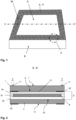
- At least one area of the side edge of the functional element does not extend to the side edge of the composite pane. At least one area of the side edge of the functional element is therefore not flush with the side edge of the
- the functional element is arranged in a masking area on the composite pane, which in turn is formed by the (essentially flush) side edges of the inner pane, the outer pane and the intermediate layer. Instead, the said area of the side edge of the functional element is set back from the side edge of the composite pane and is arranged in the masking area.
- the functional element therefore has an area that is larger than that of the see-through area, but smaller than that of the entire composite pane.
- the entire peripheral side edge of the functional element does not extend to the side edge of the composite pane, but is arranged in the masking area. There is therefore no area of the side edge of the functional element that is flush with the side edge of the composite pane.
- the peripheral side edge of the functional element is thus set back from the side edge of the composite pane.
- the distance between the side edge of the functional element and the side edge of the composite pane is at least 15 mm in order to ensure a stable connection between the outer pane and the inner pane in the edge area and to prevent moisture from penetrating the functional element.
- the side edge of the functional element does not extend to the side edge of the composite pane, direct contact between the functional element and the surrounding atmosphere can be prevented. Instead, the functional element is completely embedded in the composite pane. This is particularly advantageous if the functional element contains metallic components that can corrode when in contact with the atmosphere. In a particularly advantageous embodiment, the functional element therefore contains metal, in particular at least one thin layer based on a metal.
- the side edge of the functional element is located in the masking area, it is not visible to the viewer. A visible side edge would be distracting and reduce the aesthetic value of the composite pane.
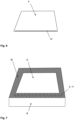
- the outside surface of the outer pane facing away from the intermediate layer has a pattern of coated areas in the masking area, which are provided with a partially transparent reflective coating.
- the said pattern is present in at least one section of the masking area and can optionally extend beyond the masking area to the see-through area. designed to be more aesthetically pleasing to an outside observer.
- the masking area is then less noticeable. This is particularly advantageous for panes where there is usually no masking strip, which would therefore be particularly noticeable to the observer (for example, composite panes in the architectural field or vehicle side windows, particularly side windows that can be raised and lowered).
- the interior-side surface of the inner pane facing away from the intermediate layer can optionally also be provided with a pattern of coated areas with the partially transparent reflective coating, which also makes the masking area more aesthetically pleasing to an inside-side observer.
- a partially transparent reflective coating is understood to mean a coating which transmits a significant proportion of the electromagnetic radiation striking it in the visible spectral range from 380 nm to 780 nm and reflects a likewise significant proportion of said radiation, so that the integrated light transmission and the integrated light reflection are each at least 10%, preferably at least 15%, particularly preferably at least 20%, measured with a light source D65 when the coating is applied to a clear soda-lime glass pane with a thickness of 3.85 mm.
- the light reflection is measured at an incident and observation angle of 10°, taking into account not only the directed reflection but also the diffuse reflection.
- the integrated light transmission under the conditions mentioned is from 60% to 90%, in particular from 70% to 80%, and the integrated light reflection is from 10% to 40%, in particular from 20% to 30%.
- the pattern of coated areas means that in the masking area, in addition to the coated areas, there are also uncoated areas that are not provided with the partially transparent reflective coating.
- the masking area is therefore not completely covered with the partially transparent reflective coating.
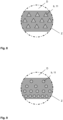
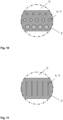
- the pattern is preferably designed in such a way that the coated areas are not connected to one another. Instead, the coated areas are isolated from one another in such a way that each coated area is separated from the others by an overall connected uncoated area.
- the coated areas are formed in an island-like manner.
- the pattern of coated areas is preferably designed such that the surface coverage of the coated areas (i.e. the proportion of coated areas in the total area of the pattern) is from 5% to 90%, particularly preferably from 10% to 50%, very particularly preferably from 20% to 40%.
- coated areas can, for example, be in the form of geometric figures or in the form of symbols or logos, for example the company logo of the glass manufacturer or vehicle manufacturer (in the case of a vehicle window).
- each coated region is preferably at least 0.2 mm, particularly preferably at least 0.4 mm, very particularly preferably from 0.4 mm to 15 mm.
- the distance between adjacent coated regions is preferably at least 0.5 mm, and the distance of the coated regions from the side edge of the composite pane is preferably at least 1.5 mm.
- the functional element can be designed in different ways.
- the functional element has a reflective effect on electromagnetic radiation that passes through the see-through area, in particular on infrared (IR) or ultraviolet radiation components. This can improve thermal comfort in the interior by preventing excessive heating as a result of solar radiation.
- the functional element can, for example, be a coating that is applied to the interior surface of the outer pane or to the outside surface of the inner pane.
- the coating is particularly preferably an IR-reflective coating that consists of a stack of thin layers that contains at least one layer based on a metal, in particular based on silver.
- the functional element can also be a coated polymer film, with a carrier film being provided with such an IR-reflective coating.
- the carrier film is usually based on polyethylene terephthalate (PET) and has a thickness of 20 ⁇ m to 200 ⁇ m.
- the coated polymer film is preferably arranged between two connecting films of the intermediate layer.
- the functional element has a heating function so that the composite pane can be heated electrically.
- a thin-film coating is used here of the type described above as an IR-reflective coating, either deposited on the outer pane or the inner pane. or on a carrier film.
- the electrically conductive coating is electrically contacted and connected to an external voltage source so that it can be heated by an electric current flow.
- the two poles of the voltage source are typically connected to opposite side edges of the coating.
- the functional element can also be a colored coating or a colored, coated or printed film to change the color of the see-through area.
- the functional element has electrically controllable optical properties.
- a functional element contains an active layer or layer sequence which is arranged between a first and a second surface electrode.
- the active layer or layer sequence has the variable optical properties which can be controlled by an electrical voltage applied to the surface electrodes.
- the variable optical properties relate in particular to the degree of light transmission and/or the degree of light scattering, whereby light in the sense of the invention is understood to mean in particular visible light in the spectral range from 380 nm to 780 nm.
- Electrically controllable optical properties in the sense of the invention are understood to mean in particular properties which are continuously controllable. In principle, however, it is also conceivable that the electrically controllable optical properties can only be switched between two discrete states. It is also conceivable that the electrically controllable optical properties can be switched between more than two discrete states.
- the electrically controllable functional element can be a PDLC functional element ( polymer dispersed liquid crystal ).
- PDLC functional elements contain an active layer between the surface electrodes.
- the active layer is a PDLC layer and contains liquid crystals which are embedded in a polymer matrix.
- PDLC functional elements are typically operated with alternating voltage. If no voltage is applied to the surface electrodes, the liquid crystals are aligned in a disordered manner, which leads to a strong scattering of the light passing through the active layer. If a voltage is applied to the surface electrodes, the liquid crystals align in a common direction and the transmission of light through the active layer is increased.
- Such a functional element is made, for example, of DE 102008026339 A1
- the term PDLC is to be interpreted broadly in the sense of the invention and includes related functional elements, which are based on the alignment of liquid crystals, for example PNLC ( polymer networked liquid crystal ) functional elements.
- the electrically controllable functional element can alternatively be an SPD functional element ( suspended particle device ).
- SPD functional elements contain an active layer between the surface electrodes.
- the active layer contains suspended particles, which are preferably embedded in a viscous matrix.
- SPD functional elements are operated with alternating voltage. The absorption of light by the active layer can be changed by applying a voltage to the surface electrodes, which leads to a change in the orientation of the suspended particles.
- Such functional elements are made, for example, of EP 0876608 B1 and WO 2011033313 A1 known.
- the electrically controllable functional element can alternatively be an electroluminescent functional element.
- the active layer contains electroluminescent materials, which can be inorganic or organic (OLED). By applying a voltage to the surface electrodes, the luminescence of the active layer is stimulated.
- Such functional elements are made, for example, of US 2004227462 A1 and WO 2010112789 A2 known.
- the electrochromic layer is the actual carrier of the electrically controllable optical properties. It is an electrochemically active layer whose light transmission depends on the degree of ion storage.
- the ions for example H + -, Li + , Na + - or K + -ions
- the electrolyte layer spatially separates the electrochromic layer from the electrochromic layer and serves to migrate ions. If a direct voltage of suitable polarity is applied to the surface electrodes, ions migrate from the ion storage layer through the Electrolyte layer into the electrochromic layer, whereupon the optical properties (colour, light transmission) of the electrochromic layer are changed depending on the extent of the ions that have migrated.
- Suitable electrochromic layers contain electrochromic materials, for example inorganic oxides (such as tungsten oxide or vanadium oxide), complex compounds (such as Prussian blue) or conductive polymers (such as 3,4-polyethylenedioxythiophene (PEDOT) or polyaniline).
- inorganic oxides such as tungsten oxide or vanadium oxide
- complex compounds such as Prussian blue
- conductive polymers such as 3,4-polyethylenedioxythiophene (PEDOT) or polyaniline).
- Electrochromic functional elements are made, for example, from WO 2012007334 A1 , US 20120026573 A1 , WO 2010147494 A1 and EP 1862849 A1 known.
- the electrolyte layer is typically formed as a film of organic or inorganic, electrically insulating material with high ion conductivity, for example based on lithium phosphorus oxynitride.
- the ion storage layer is either permanently transparent (pure ion storage) or has an electrochromic behavior that is opposite to that of the electrochromic layer.
- An example of a pure ion storage layer is layers containing a mixed oxide of titanium and cerium; examples of anodic electrochromic ion storage layers are layers containing iridium oxide or nickel oxide.
- Electrochromic functional elements are particularly preferred because they have a slow switching behavior compared to other controllable functional elements. This means that the user does not perceive a simultaneous and homogeneous change in the optical properties in the event of a switching process, i.e. the transparent area is not darkened simultaneously and homogeneously, for example. Instead, the change in the optical properties starts at the point where the surface electrodes are connected to the voltage source and spreads noticeably into the other areas of the functional element.
- This inhomogeneous, partially delayed change in the optical properties can seem unusual to the user and be disturbing.
- the pattern according to the invention on printed areas with the partially transparent reflective coating can be used in this case to visually accompany the spread of the change in the optical properties.
- the pattern can indicate a direction that corresponds to the direction of the spread of the change in the optical properties, so that the inhomogeneous, delayed switching behavior is perceived as less disturbing, if not even desirable. Suitable and preferred designs of the pattern will be discussed later.
- the surface electrodes of the functional elements with electrically controllable optical properties are preferably transparent, which in the sense of the invention means that they have a light transmission in the visible spectral range of at least 50%, preferably at least 70%, particularly preferably at least 80%.
- the surface electrodes are in particular electrically conductive thin films or thin film stacks.
- the surface electrodes preferably contain at least one metal, a metal alloy or a transparent conductive oxide ( transparent conducting oxide, TCO).
- the surface electrodes particularly preferably contain at least one transparent conductive oxide.
- the surface electrodes can be formed, for example, on the basis of silver, gold, copper, nickel, chromium, tungsten, indium tin oxide ( ITO), gallium-doped or aluminum-doped zinc oxide and/or fluorine-doped or antimony-doped tin oxide, preferably on the basis of silver or ITO, in particular ITO.
- the surface electrodes preferably have a thickness of 10 nm to 2 ⁇ m, particularly preferably from 20 nm to 1 ⁇ m, very particularly preferably from 30 nm to 500 nm and in particular from 50 nm to 200 nm.
- a thin layer is formed on the basis of a material, this means in the sense of the invention that the layer consists largely of the material (more than 50 wt. %, preferably more than 90 wt. %, particularly more than 99 wt. %), whereby the layer can contain other materials to a small extent, for example dopants.
- the functional element with electrically controllable optical properties can be formed directly on the interior surface of the outer pane or on the exterior surface of the inner pane.
- the functional element is formed as a multilayer film.
- the multilayer film is a layer stack, wherein the layers of the layer stack comprise at least a first carrier film, the first surface electrode, the active layer or the active layer sequence, the second surface electrode and a second carrier film, which are arranged flatly one above the other in this order.
- the layers of the layer stack are permanently and stably connected to one another, for example by gluing or lamination.
- Multilayer films of this type are typically commercially available and can, for example, be purchased from a glass manufacturer, cut to the required size and stored in the composite pane.
- the carrier films preferably contain at least one thermoplastic polymer or are based on it, particularly preferably polyethylene terephthalate (PET), polypropylene, polyvinyl chloride, fluorinated ethylene propylene, polyvinyl fluoride or ethylene tetrafluoroethylene, very particularly preferably PET.
- PET polyethylene terephthalate
- the thickness of each carrier film is preferably from 0.05 mm to 1 mm, particularly preferably from 0.1 mm to 0.5 mm, in particular from 0.1 mm to 0.2 mm. Carrier films with such a low thickness advantageously achieve a low thickness of the glazing in which the multilayer film is to be used. On the other hand, effective protection of the active layer and the electrically conductive layers is ensured.
- the carrier films are preferably not damaged in the process according to the invention, i.e. the insulation line does not extend to the carrier films.
- the side edge of the multilayer film can be sealed, for example by fusing the carrier films or by means of a (preferably polymeric) tape.
- This can protect the active layer, in particular against components (in particular plasticizers) of the intermediate layer of a composite pane in which the multilayer film is embedded, diffusing into the active layer, which can lead to degradation of the functional element.
- the multilayer film is preferably embedded in the intermediate layer of the composite pane.
- each carrier film is preferably connected to one of the panes via at least one thermoplastic connecting film.
- the connection is made under the influence of heat, vacuum and/or pressure using methods known per se.
- the two said connecting films on both sides of the multilayer film preferably protrude all the way around the multilayer film. It is particularly preferred for the side edges of the multilayer film to be surrounded all the way around by a frame-like third thermoplastic connecting film. This has a recess into which the multilayer film is inserted.
- the surface electrodes of the functional element with electrically controllable optical properties are preferably electrically contacted by means of so-called busbars . These are preferably designed as strips of an electrically conductive foil, for example a copper foil.
- the width of the busbars is preferably from 1 mm to 10 mm, for example about 5 mm.
- the thickness of the busbars is preferably from 50 ⁇ m to 200 ⁇ m, for example about 90 ⁇ m.
- busbars are preferably arranged in the edge area of the functional element in direct contact with the surface electrodes.
- the busbars are arranged in particular completely in the masking area of the composite pane so that they are not visible.
- the busbars are in turn connected to the voltage source by means of electrical cables.
- the functional element typically has a substantially polygonal shape that follows the shape of the composite pane, for example substantially the shape of a rectangle, a triangle or a trapezoid.
- the shape may have slight deviations from the strictly geometric polygon, for example the sides may be slightly curved instead of straight.
- the peripheral side edge of the functional element has several sections that are straight or slightly curved (i.e. that have a constant or continuously changing direction of extension), with adjacent sections being separated from one another by corners at which the direction of extension changes abruptly.
- the surface electrodes are preferably electrically contacted by a respective current collecting bar in at least one section of the peripheral edge region of the functional element.
- the current collecting bar of the first surface electrode and the current collecting bar of the second surface electrode are particularly preferably arranged in the same section of the peripheral edge region and in particular are arranged substantially flush.
- the current collecting bars are very particularly preferably arranged along a large part of at least one of the sides of the polygonal shape (for example along at least 80% or at least 90% of said side).
- the section of the masking area in which the busbars are arranged is provided with the pattern of coated areas with the partially transparent reflective coating.
- the pattern preferably extends over at least 80% of the width of the masking area, particularly preferably at least 90%, in particular essentially the entire width.
- This frame-like masking area will also essentially have a polygonal shape, corresponding to the shape of the composite pane.
- the pattern of coated areas is then present at least in the area in which the busbars are arranged; in particular, the entire side of the polygonal masking area in which the busbars are arranged is provided with the pattern.
- This is particularly advantageous for functional elements with comparatively slow switching behavior, i.e. in particular for electrochromic functional elements, because the change in the optical properties spreads from the busbars across the see-through area of the composite pane.
- the direction of propagation can be indicated by the pattern of printed areas assigned to the busbars, so that the inhomogeneous switching behavior appears less disturbing or even desirable to the user.
- the current busbars are attached (completely or interrupted) all the way around the surface electrodes.
- the current busbars are therefore not only attached to one side of the functional element, but along the entire peripheral edge area. This is particularly advantageous for functional elements with comparatively slow switching behavior, in particular for electrochromic functional elements, because the peripheral electrical contact leads to a faster change in the optical properties after a switching process. The change in the optical properties then starts from the peripheral edge of the see-through area and spreads to the middle of the see-through area, which is also referred to as the "iris effect".
- the current busbars can be formed from a single peripheral strip of an electrically conductive film (completely peripheral, whereby there can be a gap between the ends of the peripheral strip).
- the current busbars can also have gaps (interrupted peripheral). They can be composed of several strips of an electrically conductive film, and there can be gaps between the strips, in particular at the corners of the polygonal functional element. However, at least 80% of the peripheral edge area of the surface electrodes should be provided with the current collecting bars, preferably at least 90%, in particular at least 95%.
- the masking area surrounds the see-through area like a frame and covers the peripheral side edge of the functional element and the peripheral current collecting bars. In this case, the masking area is completely peripherally covered with the pattern of coated areas.
- the pattern of printed areas assigned to the surrounding busbars can indicate the direction of propagation towards the center of the see-through area, so that the iris effect appears less disturbing or even desirable to the user.
- the surrounding busbars are made up of several strips of an electrically conductive film, the individual strips can optionally be electrically contacted independently of one another. This makes it possible to create independent switching areas in the see-through area.
- the individual strips are connected, for example, via thin wires to a control unit, such as a flexible circuit board laminated into the composite pane.
- the wires preferably have a diameter of 90 ⁇ m to 110 ⁇ m.
- the wires should be at least 5 mm apart from one another and at least 6 mm from the side edge of the composite pane. The wires should also run completely in the masking area.
- the partially transparent reflective coating preferably contains a metal oxide.
- the metal is particularly preferably selected from the group consisting of aluminum, tin, titanium, copper, chromium, cobalt, iron, manganese, zirconium, cerium, yttrium, silver, gold, platinum and palladium.
- the coating can also contain mixtures of the oxides mentioned or mixed oxides of the metals mentioned. With such metal oxides, visually appealing partially transparent reflective properties can be achieved.
- the content of metal oxide in the reflective coating is preferably at least 70%, particularly preferably at least 80%, very particularly preferably at least 90%.
- the thickness of the partially transparent reflective coating is preferably from 5 ⁇ m to 50 ⁇ m, particularly preferably from 8 ⁇ m to 16 ⁇ m. This achieves particularly good results.
- the partially transparent reflective coating is preferably applied to the coated areas using a printing process, i.e. printed on.
- the coating is applied to the coated areas as a printing paste and then dried or baked.
- the screen printing process is particularly preferred.
- the printing paste is printed through a fine-meshed fabric.
- the printing ink is applied, for example, with a Rubber squeegee pressed through the fabric.
- a stencil for example made of metal or plastic, is typically arranged on the fabric, which has areas that are permeable to the printing paste, next to areas that are impermeable to the printing paste, thereby determining the geometric shape of the print, in this case the pattern of printed areas.
- the fabric itself can be designed with permeable and impermeable areas and thus act as a stencil itself.
- the coating can also be applied manually instead of printed, for example with a brush.
- the printing paste typically contains a solvent.
- the solvents used are preferably alcohols, glycols (for example polypropylene glycols) or derivatives thereof.
- the printing paste also preferably contains a thickener, for example a cellulose derivative or polyacrylic acid.
- Such pastes for producing reflective layers are commercially available, for example from Ferro GmbH.
- such coatings are known from the patent literature, for example from WO2005063645 .
- the partially transparent reflective coating can be printed onto the outer pane before or after the composite pane is manufactured.
- the outer pane or the composite pane
- the heat treatment can also be carried out in several steps, for example a drying step at 50°C to 180°C and a baking step (calcination) at 200°C to 1000°C, in particular at 400°C to 700°C.
- the partially transparent reflective coating is particularly preferably a sol-gel coating, i.e. it is produced on the coated areas using the sol-gel process.
- a sol containing the precursors of the coating is prepared and matured.
- the maturation can cause hydrolysis of the Precursors and/or a (partial) reaction between the precursors (in particular a partial aggregation by polycondensation).
- this sol is referred to as a precursor sol and preferably contains metal oxide precursors in a solvent.
- the metal oxide precursors can be present, for example, as organometallic compounds, as metal alkoxides or as metal carboxylates.
- the metal for example the metal alkoxide or carboxylate
- the metal is stabilized by ligands in the form of a chemical complex, whereby the reactivity can be reduced and the resistance of the sol to air humidity can be improved.
- 2,4-diketones for example, are common ligands.
- the solvent of the sol is preferably alcohol, ether or glycol.
- Alcohols such as ethanol, n-propanol, isopranol or butanol are particularly preferred.
- glycols such as di-, tri-, tetra-, penta- or hexamers of ethylene glycol, polypropylene glycols (for example dipropylene glycol, tripropylene glycol or tetrapropylene glycol) and derivatives thereof.
- ethers such as dimethyl ether or diethyl ether. Mixtures of the solvents mentioned can also be used.
- the sol preferably contains thickeners, particularly preferably cellulose derivatives (such as methyl cellulose or ethyl cellulose) or polyacrylic acids.
- the thickeners can be used to adjust the viscosity of the sol, particularly with regard to the printing process for applying the sol (as a printing paste) to the pane surface.
- the solvent or thickener also acts as a complexing agent for the metal oxide precursors if they are appropriately chosen. In this case, additional ligands do not need to be added.
- the sol may also contain typical additives as are common in the field of sol-gel technology and known to the person skilled in the art.
- the sol is deposited on the outside surface of the outer pane, preferably printed as a printing paste. Drying can then take place by evaporating solvent. This drying can be carried out at ambient temperature or by separate heating (for example with a temperature of up to 120 °C). Before the solution is applied, the surface is typically cleaned using methods known per se.
- the sol is then condensed, creating the coating according to the invention.
- the condensation can include a temperature treatment, for example at a temperature of 500 °C to 700 °C.
- Crosslinking processes typically take place among the precursors, whereby the precursors first combine to form aggregates (aggregation, typically by hydrolysis of the precursors and polycondensation reactions among them) and these are then crosslinked to form a gel (gelation).
- the aggregation can also take place partially in solution before it is applied to the surface of the pane.
- the partially transparent reflective coating is color-coordinated with the functional element, so that the coating and the functional element have a similar, ideally essentially the same color when darkened. This leads to particularly aesthetic results.
- electrochromic functional elements which are characterized by a significant color (compared, for example, to SPD or PDLC functional elements).
- the coverage density of the pattern of coated areas decreases in the direction of the see-through area.
- the area coverage depends on the distance to the see-through area, with the area coverage increasing with increasing distance to the see-through area. This is particularly advantageous for functional elements with comparatively slow switching behavior, i.e. in particular for electrochromic functional elements.
- the change in the optical properties of the see-through area is not perceived by the user as simultaneous and homogeneous, but rather it spreads noticeably from the edge of the see-through area (which is a short distance from the busbar) in towards the centre of the pane.
- This direction of the delayed change in the optical properties is optically indicated by the inhomogeneous pattern of coated areas, the area coverage of which decreases towards the see-through area, so that the user perceives the delay as less disturbing, if not even as deliberately designed.
- the coverage density of the pattern of coated areas increases towards the see-through area.
- the pattern of coated areas is formed from lines or stripes that are directed towards the see-through area.
- the coated areas are formed in the form of lines or stripes and their direction of extension points towards the see-through area.
- This embodiment is also advantageous for functional elements with comparatively slow switching behavior, in particular for electrochromic functional elements.
- the direction of the delayed change in the optical properties is optically indicated by the orientation of the lines or stripes, so that the user perceives the delay as less disturbing, if not even as deliberately designed.
- the functional element should be protected from ultraviolet (UV) and infrared (IR) components of solar radiation, which can lead to degradation. Protection from UV radiation is preferably achieved by a thermoplastic layer between the functional element and the outer pane containing UV blockers. Protection from IR radiation is preferably achieved by an IR-reflective coating.
- the IR-reflective coating can be arranged directly on the outer pane, in particular on its interior-side surface. If both a cover print and an IR-reflective coating are arranged on the interior-side surface of the inner pane, the cover print can optionally have decomposing properties compared to the IR-reflective coating, so that the latter is automatically removed in the areas of the cover print.
- the IR-reflective coating can be arranged above or below the cover print (relative to the outer pane). Typical IR-reflective coatings are thin-film stacks with at least one silver-based layer.
- the IR-reflective coating can also be provided on a carrier film and embedded in the intermediate layer between the functional element and the outer pane.
- the coated carrier film is preferably placed between two Connecting films are arranged.
- Carrier films are typically made from PET and have a thickness of 20 ⁇ m to 200 ⁇ m.
- the composite pane according to the invention can be produced by methods known per se.
- the outer pane and the inner pane are arranged with the layers of the intermediate layer located between them including the functional element to form a layer stack and laminated together, for example by autoclave processes, vacuum bag processes, vacuum ring processes, calender processes, vacuum laminators or combinations thereof.
- the connection of the outer pane and the inner pane via the intermediate layer is usually carried out under the influence of heat, vacuum and/or pressure.
- the application of the partially transparent reflective coating to the outside surface of the outer pane can take place before or after the lamination of the composite pane.
- the partially transparent reflective coating is, as already described, preferably applied by printing processes and formed by a sol-gel process.
- the composite pane can be flat or curved in one or both spatial directions, as is common for vehicle windows in passenger cars.
- the outer pane and the inner pane are curved before they are laminated to form the composite pane.
- the partially transparent reflective coating is preferably applied before the panes are bent, as the coating is easier to apply on flat panes.
- the invention also includes the use of a composite pane according to the invention as a vehicle pane, particularly preferably as a vehicle side window, in particular a side window that can be opened and raised and lowered. Since the masking area is unusual in such panes, the partially transparent reflective coating according to the invention, which makes it less visually conspicuous, has a particularly advantageous effect here.
- the composite pane can also be used as another type of vehicle pane, for example as a windshield, roof pane or rear window. It is also possible to use the composite pane in the architectural field, for example as a window pane in a building or room inside a building or as a glass facade.
- Figure 1 and Figure 2 each show a detail of a composite pane according to the invention.
- the composite pane is intended, for example, as an openable, i.e. raiseable and lowerable, side window of a passenger car.
- the composite pane comprises an outer pane 1 and an inner pane 2, which are connected to one another via an intermediate layer 3.
- the outer pane 1 and the inner pane 2 are made of clear soda-lime glass with a thickness of 2.1 mm.
- the outer pane 1 faces the outside environment
- the inner pane 2 faces the vehicle interior.
- the outer pane 1 has an outside surface I and an inside surface II.
- the inner pane 2 also has an outside surface III and an inside surface IV. In the installed position, the outside surfaces I, III face the outside environment, the inside surfaces II, IV face the vehicle interior.
- the composite pane has a central transparent see-through area D and an opaque masking area M surrounding it in a frame-like manner.
- the opaque masking area M is realized by a cover print 10 on the interior-side surfaces II, IV of the outer pane 1 and the inner pane 2.
- the cover print 10 is made of a black enamel, which contains a black pigment and glass frits and is burned into the surfaces II, IV.
- the masking area M surrounds the area of the side window that is visible when closed in a peripheral edge area.
- the composite pane has a mounting area B, which is always arranged within the vehicle body and serves to connect the composite pane to the mechanism for raising and lowering it.
- the mounting area B can have holes and/or mounting elements that are not shown.
- the intermediate layer 3 comprises a total of three thermoplastic layers 3a, 3b, 3c, each of which is formed by a thermoplastic PVB film.
- the first thermoplastic layer 3a is connected to the outer pane 1, has a thickness of 0.76 mm, for example, and contains UV blockers.
- the second thermoplastic layer 3b is connected to the inner pane 2 and has a thickness of 0.38 mm, for example.
- the third thermoplastic layer 3c in between has a thickness of 0.38 mm, for example, and is formed with a cutout into which a functional element 4 with electrically controllable optical properties is inserted in a substantially precise manner, i.e. approximately flush on all sides.
- the third thermoplastic layer 3c thus forms a kind of passpartout or frame for the approximately 0.4 mm thick functional element 4, which does not extend to the side edges of the composite pane, but is encapsulated all around in thermoplastic material and is thus protected.
- the functional element 4 is an electrochromic multilayer film that can be switched from a transparent, uncolored state to a colored state with reduced light transmission.
- the functional element 4 completely covers the see-through area D and extends into the masking area M, where its side edges are arranged so that they are not visible.
- the light transmission of the see-through area D can be electrically controlled by the user via the functional element 4.
- the functional element 4 is protected from UV radiation by the UV-blocking first thermoplastic layer 3a.
- a sun protection coating 13 is arranged on the interior surface II of the outer pane 1.
- the sun protection coating 13 is, for example, a sputtered thin-film stack with one or more silver layers.
- a peripheral edge area of the outer pane 1 is not covered with the sun protection coating 13, so that it has no contact with the atmosphere and is protected from is protected against corrosion.
- the side edges of the sun protection coating 13 are also arranged in the masking area M.
- the masking area M can also be realized by an opaque colored area of at least one of the thermoplastic layers 3a, 3b, 3c instead of the cover print 10.
- the IR protection can also be realized by an IR-reflecting film instead of the sun protection coating 13 on the outer pane 1.
- Such films consist, for example, of a PET carrier film with an IR-reflecting coating.
- the IR-reflecting film is inserted between two layers of the intermediate layer 3, in particular between the first thermoplastic layer 3a and a further thermoplastic layer which is arranged between the first thermoplastic layer 3a and the outer pane 1.
- the further thermoplastic layer can, for example, be designed as a PVB film with a thickness of 0.38 mm.
- the outside surface I of the outer pane 1 is provided with a pattern of coated areas b, which have a partially transparent reflective coating 11.
- the coating 11 is a sol-gel coating which was applied to the surface I by screen printing. It contains metal oxide, for example titanium oxide, and has a thickness of preferably from 50 nm to 200 nm, for example 70 nm.
- the pattern with the coated areas b serves to make the masking area more aesthetically pleasing. Since masking areas for side windows are unusual, the viewer perceives the masking area M as less disturbing due to the coated area b.
- FIG 3 and Figure 4 each show a detail of the functional element 4 from Figure 1
- the functional element 4 is an electrochromic multilayer film.
- the multilayer film is limited by a first carrier film 8 and a second carrier film 9.
- the carrier films 8, 9 are made of PET and have a thickness of, for example, 0.125 mm.
- the carrier films 8, 9 are each provided with an ITO coating with a thickness of approximately 100 nm, which forms a first surface electrode 6 and a second surface electrode 7.
- An active layer sequence 5 is arranged between the surface electrodes 6, 7.
- the layer sequence 5 is an electrochromic layer sequence and consists of an ion storage layer 5a, an electrolyte layer 5b and an electrochromic layer 5c.
- ions can be Migration from the ion storage layer 5a through the electrolyte layer 5b into the electrochromic layer 5c and vice versa can be stimulated.
- the proportion of ions in the electrochromic layer 5c determines its optical properties, in particular the light transmittance and the color.
- Both surface electrodes 6, 7 are each electrically contacted all the way around with a current busbar 12.
- the current busbars 12 are used to connect the surface electrodes 6, 7 to an external voltage source in order to provide the electrical voltage required to control the optical properties.
- the current busbars 12 are arranged in the masking area M.
- Each current busbar 12 is made of a single strip of copper foil which completely surrounds the respective surface electrode 6, 7, with a gap only being present between the ends of the strip.
- Circumferential busbars 12 are advantageous for electrochromic functional elements 4, as these have a comparatively slow switching behavior.
- the circumferential electrical contacting achieves a faster change in the optical properties of the see-through area D. Nevertheless, the observer does not perceive the change in the optical properties as homogeneous - instead, it starts from the edge area of the see-through area D and continues noticeably towards the center. This observation is also referred to as the "iris effect".
- the pattern according to the invention of printed areas b can be used to indicate the direction of the delayed change in the optical properties and to present this iris effect as deliberately created, which increases the aesthetic value of the composite pane. Possible designs of the pattern are shown in the Figures 8 to 11 shown as an example.
- Figure 5 shows a further embodiment of the functional element 4 with circumferential busbars 12.
- the busbars 12 are each composed of several strips of copper foil, whereby gaps can form between adjacent strips. This embodiment can be compared to that of the Figure 3 be preferred for manufacturing reasons. It also opens up the possibility of electrically controlling the individual strips of the busbars 12 independently, so that independent switching areas are realized whose optical properties can be controlled independently of one another.
- Figure 6 and Figure 7 each show a detail of a further embodiment of the composite pane according to the invention, which is also an opening side window of a passenger car.
- Figure 6 shows a top view of the functional element 4 with the busbars 12,
- Figure 7 a top view of the composite pane equipped with it.
- the design is basically the same as that of the Figures 1 to 4
- the difference is that the busbars 12 are not arranged all the way around, but only along the lower edge of the functional element 4.
- the change in the optical properties of the electrochromic functional element 4 therefore starts from the lower edge and continues towards the upper edge.
- the "iris effect” one could speak here of a "sunrise effect”.
- the section of the masking area M in which the busbars are arranged is provided with the pattern of printed areas b, adjacent to the lower edge of the see-through area D (start of the change in the optical properties).
- Figure 8 shows section Z from Figure 1 enlarged in an embodiment of the pattern according to the invention of coated areas b.
- the pattern is homogeneous, i.e. the coated areas b are evenly distributed and identically formed.
- the individual coated areas b are shown as triangles by way of example, but can also have any other shapes.
- the triangle symbolizes a shape with a preferred direction (upward-pointing tip of the triangle), which is directed towards the see-through area. This makes it possible to indicate the direction of the change in the optical properties despite the homogeneity of the pattern.
- Figure 9 shows section Z from Figure 1 enlarged in a further embodiment of the pattern according to the invention of coated areas b.
- the pattern is not homogeneous. Instead, the surface coverage of the coating 11 decreases in the direction of the see-through area D. This can indicate the direction of the change in the optical properties.
- the individual printed areas b are identical to the same shape and size. The change in the surface coverage is achieved by a decrease in the number of printed areas b per unit area in the direction of the transparent area D.
- the individual coated areas b are shown as circles as an example, but can also have any other shape, for example the company logo of the vehicle manufacturer.
- Figure 10 shows section Z from Figure 1 enlarged in a further embodiment of the pattern of coated areas b according to the invention.
- the pattern is not homogeneous here either. Instead, the surface coverage of the coating 11 decreases in the direction of the see-through area D. This can indicate the direction of the change in the optical properties.
- the change in the surface coverage is realized by the size of the individual printed areas becoming smaller in the direction of the see-through area D.
- the individual coated areas b are shown as circles by way of example, but can also have any other shape, for example the company logo of the vehicle manufacturer.
- Figure 11 shows section Z from Figure 1 enlarged in a further embodiment of the pattern of coated areas b according to the invention.
- the individual coated areas b are linearly formed as thin strips which are directed towards the see-through area D. This allows the direction of the change in the optical properties to be indicated.
Landscapes
- Chemical & Material Sciences (AREA)
- Crystallography & Structural Chemistry (AREA)
- Engineering & Computer Science (AREA)
- Mechanical Engineering (AREA)
- Laminated Bodies (AREA)
Description
- Die Erfindung betrifft eine Verbundscheibe mit einem transparenten Durchsichtsbereich und einem opaken Maskierungsbereich sowie deren Verwendung.
- Verbundscheiben sind im Fahrzeug- und Architekturbereich als Verglasungen üblich. Sie bestehen aus einer Außenscheibe und einer Innenscheibe, die über eine thermoplastische Zwischenschicht miteinander verbunden sind. Häufig sind dabei verschieden geartete Funktionselemente in die Zwischenschicht eingelagert, welche die Verbundscheibe mit einer gewünschten Funktion versehen. Ein Beispiel für solche Funktionselemente sind IR-reflektierende und/oder beheizbare Beschichtungen. Ein weiteres Beispiel sind Funktionselemente mit elektrisch steuerbaren optischen Eigenschaften, beispielsweise SPD-Funktionselemente (suspended particle device), PDLC-Funktionselemente (polymer dispersed liquid crystal) oder elektrochrome Funktionselemente. Die optischen Eigenschaften solcher Funktionselemente und der damit ausgestatteten Verbundscheiben, insbesondere deren Lichttransmission oder Lichtstreuung, kann durch eine angelegte elektrische Spannung gesteuert werden.
- Die Seitenkanten der Funktionselemente erstrecken sich typischerweise nicht bis zu den Seitenkanten der Verbundscheibe, damit die Funktionselemente sicher und geschützt vor Korrosion und Beschädigung in der Verbundscheibe eingelagert sind. Befände sich die Seitenkante des Funktionselements im Durchsichtsbereich der Verbundscheibe, so würde sie dem Betrachter störend auffallen und den ästhetischen Wert der Verbundscheibe herabsetzen. Dies gilt in besonderem Maße für Funktionselemente, die elektrisch kontaktiert werden müssen, beispielsweise beheizbare Schichten oder Funktionselemente mit elektrisch steuerbaren optischen Eigenschaften. Die elektrische Kontaktierung erfolgt in der Regel mittels Stromsammelschienen und elektrischen Kabeln, welche ebenfalls für den Betrachter nicht sichtbar sein sollten. Es ist daher üblich, die Verbundscheibe mit einem opaken Maskierungsbereich zu versehen, typischerweise umlaufend in einem peripheren Randbereich, mit dem die Seitenkante des Funktionselements sowie eine etwaige elektrische Kontaktierung gleichsam versteckt wird. Der Maskierungsbereich wird typischerweise durch einen opaken, meist schwarzen Abdeckdruck auf der Außenscheibe und der Innenscheibe ausgebildet. Beispielhaft sei auf
WO2017157626A1 verwiesen. - Auch
WO2020094324A1 undWO2014174308A1 offenbaren Verbundscheiben mit eingelagerten Funktionselementen und opaken Maskierungsbereichen. - Im Fahrzeugbereich sind solche opaken Maskierungsbereich für Windschutzscheiben, Heckscheiben und Dachscheiben seit langem üblich, um den zum Einbau verwendeten Klebstoff vor UV-Strahlung zu schützen. Bei anderen Scheiben, beispielsweise bei Fahrzeug-Seitenscheiben oder Gebäudeverglasungen, sind Maskierungsbereiche dagegen nicht üblich und fallen dem Betrachter daher als ungewöhnlich und optisch wenig ansprechend auf. Es besteht daher Bedarf an Verbundscheiben mit opaken Maskierungsbereichen, welche ästhetisch ansprechend sind und vom Betrachter als wenige störend empfunden werden.
- Aus den nachveröffentlichten internationalen Patentanmeldungen
WO2022117955A1 undWO2022073894A1 sind aufgedruckte teiltransparente reflektierende Beschichtungen bekannt, welche Metalloxide enthalten. - Der vorliegenden Erfindung liegt die Aufgabe zugrunde, eine verbesserte Verbundscheibe mit einem Funktionselement, einem transparenten Durchsichtsbereich und einem opaken Maskierungsbereich bereitzustellen, bei welcher der Maskierungsbereich ästhetisch ansprechend gestaltet ist.
- Die Aufgabe wird gelöst durch eine Verbundscheibe gemäß dem unabhängigen Anspruch 1. Bevorzugte Ausgestaltungen gehen aus den Unteransprüchen hervor.
- Die erfindungsgemäße Verbundscheibe umfasst mindestens eine Außenscheibe und eine Innenscheibe, die über eine thermoplastische Zwischenschicht miteinander verbunden sind. Die Verbundscheibe ist dafür vorgesehen, in einer Fensteröffnung (insbesondere einer Fensteröffnung eines Fahrzeugs, alternativ aber auch einer Fensteröffnung eines Gebäudes oder eines Raums) den Innenraum gegenüber der äußeren Umgebung abzutrennen. Mit Innenscheibe wird im Sinne der Erfindung die dem Innenraum zugewandte Scheibe bezeichnet. Mit Außenscheibe wird die der äußeren Umgebung zugewandte Scheibe bezeichnet. Die Außenscheibe und die Innenscheibe weisen jeweils eine außenseitige und eine innenraumseitige Oberfläche auf und eine dazwischen verlaufende, umlaufende Seitenkantenfläche. Mit außenseitiger Oberfläche wird im Sinne der Erfindung diejenige Hauptfläche bezeichnet, welche dafür vorgesehen ist, in Einbaulage der äußeren Umgebung zugewandt zu sein. Mit innenraumseitiger Oberfläche wird im Sinne der Erfindung diejenige Hauptfläche bezeichnet, welche dafür vorgesehen ist, in Einbaulage dem Innenraum zugewandt zu sein. Die innenraumseitige Oberfläche der Außenscheibe und die außenseitige Oberfläche der Innenscheibe sind einander zugewandt und durch die thermoplastische Zwischenschicht miteinander verbunden.
- Die Außenscheibe und die Innenscheibe sind bevorzugt Glasscheiben, besonders bevorzugt gefertigt aus Kalk-Natron-Glas, wie es für Fensterscheiben üblich ist. Eine oder beide der Scheiben können aber auch aus anderen Glassorten gefertigt sein, beispielsweise Quarzglas, Borosilikatglas oder Aluminosilikatglas, oder aus starren klaren Kunststoffen, beispielsweise Polycarbonat oder Polymethylmethacrylat. Die Scheiben können klar sein oder auch getönt oder gefärbt. Die Dicken der Außenscheibe und der Innenscheibe betragen unabhängig voneinander bevorzugt von 0,5 mm bis 5 mm, besonders bevorzugt von 1 mm bis 3 mm.
- Die Zwischenschicht ist bevorzugt aus mindestens einer thermoplastischen Folie (Verbindefolie) ausgebildet. Die mindestens eine Folie (Verbindefolie) sind bevorzugt auf Basis von Polyvinylbutyral (PVB), Ethylenvinylacetat (EVA), oder Polyurethan (PU), besonders bevorzugt auf Basis von PVB. Das bedeutet, dass die Folie mehrheitlich das besagte Material enthält (Anteil von größer als 50 Gew.-%) und daneben optional weitere Bestandteile enthalten kann, beispielsweise Weichmacher, Stabilisatoren, UV- oder IR-Absorber. Die Dicke jeder thermoplastischen Folie beträgt bevorzugt von 0,2 mm bis 2 mm, besonders bevorzugt von 0,3 mm bis 1 mm. Beispielsweise können Folien, insbesondere PVB-Folien, mit den Standarddicken von 0,38 mm oder 0,76 mm verwendet werden.
- Die erfindungsgemäße Verbundscheibe weist einen opaken Maskierungsbereich und einen transparenten Durchsichtsbereich auf. Mit Maskierungsbereich wird im Sinne der Erfindung ein Bereich der Verbundscheibe bezeichnet, durch den eine Durchsicht nicht möglich ist. Die Lichttransmission des Maskierungsbereichs beträgt bevorzugt im Wesentlichen 0%. Mit Durchsichtsbereich wird im Sinne der Erfindung ein Bereich der Glasscheibe bezeichnet, der eine Durchsicht durch die Glasscheibe ermöglicht und der daher eine gewisse Transparenz oder zumindest Transluzenz aufweist. Die Lichttransmission des Durchsichtsbereichs beträgt bevorzugt mindestens 10%, besonders bevorzugt mindestens 20%. Sollte das erfindungsgemäße Funktionselement elektrisch steuerbare optische Eigenschaften aufweisen, so beziehen sich diese Angaben auf den transparenten Zustand des Funktionselements (maximale Lichttransmission und/oder minimale Lichtstreuung).
- In einer typischen Ausgestaltung umgibt der Maskierungsbereich den Durchsichtsbereich rahmenartig. Der Maskierungsbereich ist also umlaufend um den Durchsichtsbereich angeordnet. Typischerweise bildet der Maskierungsbereich dabei zumindest abschnittsweise den Randbereich der Verbundscheibe. Damit ist gemeint, dass der Maskierungsbereich zumindest an einen Abschnitt der Seitenkante der Verbundscheibe angrenzt.
- Der Maskierungsbereich ist durch ein opakes Element ausgebildet, welches außenseitig zum Funktionselement angeordnet ist. Das bedeutet, dass das besagte opake Element einen geringeren Abstand zur äußeren Umgebung aufweist als das Funktionselement. Der Blick auf die Seitenkante des Funktionselements von außen wird dadurch verhindert.
- In einer bevorzugten Ausgestaltung ist der Maskierungsbereich durch einen Abdeckdruck auf der zur Zwischenschicht hingewandten, innenraumseitigen Oberfläche der Außenscheibe ausgebildet. Anders ausgedrückt ist die innenraumseitige Oberfläche der Innenscheibe mit dem Abdeckdruck versehen, wodurch die Durchsicht durch die Verbundscheibe verhindert wird und der Maskierungsbereich entsteht. Solche Abdeckdrucke sind insbesondere im Fahrzeugbereich verbreitet, insbesondere für Windschutzscheiben, Heckscheiben und Dachscheiben. Der Abdeckdruck enthält typischerweise ein Pigment und Glasfritten Die Glasfritten können aufgeschmolzen und der Abdeckdruck dadurch dauerhaft mit der Glasoberfläche verbunden (verschmolzen) werden. Das Pigment sorgt für die Opazität des Maskierungsbereichs. Der Abdeckdruck wird bevorzugt auf die Außenscheibe aufgedruckt, insbesondere im Siebdruckverfahren. Das Pigment ist typischerweise ein Schwarzpigment, beispielsweise Pigmentruß (Carbon Black), Anilinschwarz, Beinschwarz, Eisenoxidschwarz, Spinellschwarz und/oder Graphit. Der Abdeckdruck weist bevorzugt eine Dicke von 5 µm bis 50 µm auf, besonders bevorzugt von 8 µm bis 25 µm. Die Innenscheibe kann optional ebenfalls mit einem Abdeckdruck versehen sein, insbesondere ihre innenraumseitige Oberfläche.
- Alternativ ist es aber auch möglich, den Maskierungsbereich durch eine getönte oder gefärbte Folie in der Zwischenschicht auszubilden. So kann beispielsweise mindestens eine thermoplastische Verbindefolie zwischen dem Funktionselement und der Außenscheibe im Maskierungsbereich getönt sein beziehungsweise eine Verbindeschicht aus mehreren Abschnitten unterschiedlicher Folien zusammengesetzt sein, wobei im Maskierungsbereich eine getönte und im Durchsichtsbereich eine klare Folie verwendet wird. Alternativ kann auch eine opake Folie in die Zwischenschicht zwischen dem Funktionselement und der Außenscheibe eingelegt werden.
- Optional kann auch innenraumseitig zum Funktionselement ein weiteres opakes Element im Maskierungsbereich angeordnet sein. Dadurch wird auch der Blick auf die Seitenkante des Funktionselements von innen verhindert. Beispielsweise kann auch die Innenscheibe mit einem Abdeckdruck versehen sind, insbesondere ihre innenraumseitige Oberfläche, oder es kann eine opake Folie zwischen Funktionselement und Innenscheibe vorhanden sein.
- Die Zwischenschicht weist, neben den Verbindefolien, ein Funktionselement auf. Anders ausgedrückt enthält die Zwischenschicht ein Funktionselement, ist die Zwischenschicht mit einem Funktionselement ausgestattet oder ist ein Funktionselement in die Zwischenschicht eingelagert. Das Funktionselement ist also zwischen der Außenscheibe und der Innenscheibe angeordnet und kann optional in direktem Berührungskontakt mit der zur Zwischenschicht hingewandten Oberfläche der Außenscheibe und/oder der Innenscheibe haben. Das Funktionselement ist insbesondere flächig zwischen der Außenscheibe und der Innenscheibe angeordnet, im Wesentlichen parallel zu den besagten Scheiben.
- Unter einem Funktionselement wird im Sinne der Erfindung ein flächiges, insbesondere schicht- oder folienartiges Element oder Bauteil verstanden, welches den Durchsichtsbereich der Verbundscheibe mit einer zusätzlichen Funktion oder Eigenschaft versieht. Dies kann beispielsweise die Farbe betreffen, die Wirkung auf elektromagnetische Strahlung, eine Heizfunktion oder die Möglichkeit, die optischen Eigenschaften (insbesondere den Grad der Lichttransmission oder Lichtstreuung) elektrisch zu steuern.
- Das Funktionselement deckt den gesamten Durchsichtsbereich der Verbundscheibe ab. Damit ist gemeint, dass das Funktionselement derart zwischen der Außenscheibe und der Innenscheibe angeordnet ist, dass der gesamte Durchsichtsbereich mit dem Funktionselement versehen ist. Licht, dass durch den Durchsichtsbereich der Verbundscheibe hindurchtritt, tritt also zwangsläufig immer auch durch das Funktionselement hindurch.
- Erfindungsgemäß erstreckt sich zumindest ein Bereich der Seitenkante des Funktionselements sich nicht bis zur Seitenkante der Verbundscheibe. Zumindest ein Bereich der Seitenkante des Funktionselements ist also nicht bündig mit der Seitenkante der Verbundscheibe angeordnet, welche wiederum durch die (im Wesentlichen bündigen) Seitenkante der Innenscheibe, der Außenscheibe und der Zwischenschicht gebildet wird. Stattdessen ist der besagte Bereich der Seitenkante des Funktionselements gegenüber der Seitenkante der Verbundscheibe zurückgesetzt und im Maskierungsbereich angeordnet. Das Funktionselement weist also eine Fläche auf, die größer ist also diejenige des Durchsichtsbereichs, aber kleiner als diejenige der gesamten Verbundscheibe.
- Typischerweise erstreckt sich die gesamte umlaufende Seitenkante des Funktionselements nicht bis zur Seitenkante der Verbundscheibe, sondern ist im Maskierungsbereich angeordnet. Es liegt also kein Bereich der Seitenkante des Funktionselements vor, der mit der Seitenkante der Verbundscheiben bündig angeordnet ist. Die umlaufende Seitenkante des Funktionselements ist also gleichsam gegenüber der Seitenkante der Verbundscheibe zurückgesetzt. Der Abstand der Seitenkante des Funktionselements zur Seitenkante der Verbundscheibe beträgt in einer vorteilhaften Ausgestaltung mindestens 15 mm, um eine stabile Verbindung von Außenscheibe und Innenscheibe im Randbereich zu gewährleisten und das Eindringen von Feuchtigkeit in das Funktionselement zu verhindern.
- Dadurch, dass sich die Seitenkante des Funktionselements nicht bis zur Seitenkante der Verbundscheibe erstreckt, kann ein direkter Kontakt zwischen dem Funktionselement und der umgebenden Atmosphäre verhindert werden. Das Funktionselement ist stattdessen vollständig in der Verbundscheibe eingelagert. Dies ist besonders dann vorteilhaft, wenn die das Funktionselement metallische Bestandteile enthält, welche bei Kontakt zur Atmosphäre korrodieren können. In einer besonders vorteilhaften Ausgestaltung enthält das Funktionselement daher Metall, insbesondere mindestens eine Dünnschicht auf Basis eines Metalls.
- Dadurch, dass die Seitenkante des Funktionselements im Maskierungsbereich angeordnet ist, ist sie für den Betrachter nicht sichtbar. Eine sichtbare Seitenkante würde störend auffallen und den ästhetischen Wert der Verbundscheibe herabsetzen.
- Erfindungsgemäß weist die von der Zwischenschicht abgewandte, außenseitige Oberfläche der Außenscheibe im Maskierungsbereich ein Muster von beschichteten Bereichen auf, welche mit einer teiltransparenten reflektierenden Beschichtung versehen sind. Das besagte Muster ist zumindest in einem Abschnitt des Maskierungsbereichs vorhanden und kann sich optional über den Maskierungsbereich hinaus auf den Durchsichtsbereich erstrecken. Durch einen außenseitigen Betrachter ästhetisch ansprechender gestaltet. Das ist der große Vorteil der Erfindung. Der Maskierungsbereich fällt dann weniger störend auf. Dies ist insbesondere für solche Scheiben besonders vorteilhaft, bei denen üblicherweise kein Maskierungsstreifen vorhanden ist, die den Betrachter also in besonderem Maße störend auffallen würden (beispielsweise Verbundscheiben im Architekturbereich oder Fahrzeug-Seitenscheiben, insbesondere heb- und senkbare Seitenscheiben). Die von der Zwischenschicht abgewandte, innenraumseitige Oberfläche der Innenscheibe kann optional ebenfalls mit einem Muster von beschichteten Bereichen mit der teiltransparenten reflektierenden Beschichtung versehen sein, wodurch der Maskierungsbereich auch für einen innenraumseitigen Betrachter ästhetischer gestaltet wird.
- Unter einer teiltransparenten reflektierenden Beschichtung wird im Sinne der Erfindung eine Beschichtung verstanden, welche einen signifikanten Anteil der auf sie treffenden elektromagnetischen Strahlung im sichtbaren Spektralbereich von 380 nm bis 780 nm transmittiert und einen ebenfalls signifikanten Anteil besagter Strahlung reflektiert, so dass die integrierte Lichttransmission und die integrierte Lichtreflexion jeweils mindestens 10%, bevorzugt mindestens 15%, besonders bevorzugt mindestens 20% betragen, gemessen mit einer Lichtquelle D65, wenn die Beschichtung auf eine klare Kalk-Natron-Glasscheibe mit einer Dicke von 3,85 mm aufgebracht ist. Die Lichtreflexion wird dabei unter einem Einstrahl- und Beobachtungswinkel von 10° gemessen, wobei neben der gerichteten Reflexion auch die diffuse Reflexion berücksichtigt wird. Besonders bevorzugt beträgt die integrierte Lichttransmission unter den genannten Bedingungen von 60% bis 90%, insbesondere von 70% bis 80%, und die integrierte Lichtreflexion von 10% bis 40%, insbesondere von 20% bis 30%.
- Mit dem Muster von beschichteten Bereichen ist gemeint, dass im Maskierungsbereich neben den beschichteten Bereichen auch unbeschichtete Bereiche vorliegen, welche nicht mit der teiltransparenten reflektierenden Beschichtung versehen sind. Der Maskierungsbereich ist also nicht vollständig mit der teiltransparenten reflektierenden Beschichtung versehen. Das Muster ist bevorzugt derart gestaltet, dass die beschichteten Bereiche untereinander nicht zusammenhängen. Stattdessen sind die beschichteten Bereiche derart voneinander isoliert, dass jeder beschichtete Bereich von den anderen durch einen insgesamt zusammenhängenden unbeschichteten Bereich getrennt ist. Die beschichteten Bereiche sind gleichsam inselartig ausgebildet. Das Muster von beschichteten Bereiche ist bevorzugt derart ausgestaltet, dass die Flächenbelegung der beschichteten Bereiche (also der Anteil beschichteter Bereiche an der Gesamtfläche des Musters) von 5% bis 90% beträgt, besonders bevorzugt von 10% bis 50%, ganz besonders bevorzugt von 20% bis 40%.
- Die beschichteten Bereiche können beispielsweise in Form geometrische Figuren ausgebildet sein oder in Form von Symbolen oder Logos, beispielsweise das Firmenlogo des Glasherstellers oder Fahrzeugherstellers (im Falle eine Fahrzeugscheibe).
- Die Ausdehnung jedes beschichteten Bereichs beträgt bevorzugt mindestens 0,2 mm, besonders bevorzugt mindestens 0,4 mm, ganz besonders bevorzugt von 0,4 mm bis 15 mm. Der Abstand benachbarter beschichteter Bereiche beträgt bevorzugt mindestens 0,5 mm, und der Abstand der beschichteten Bereiche von der Seitenkante der Verbundscheibe bevorzugt mindestens 1,5 mm.
- Das Funktionselement kann auf unterschiedliche Art ausgebildet sein. In einer Ausgestaltung wirkt das Funktionselement reflektierend auf elektromagnetische Strahlung, die durch den Durchsichtsbereich tritt, insbesondere auf infrarote (IR) oder ultraviolette Strahlungsanteile. Dadurch kann der thermische Komfort im Innenraum verbessert werden, indem eine übermäßige Aufheizung infolge der Sonneneinstrahlung vermieden wird. Das Funktionselement kann beispielsweise eine Beschichtung sein, welche auf der innenraumseitigen Oberfläche der Außenscheibe oder auf der außenseitigen Oberfläche der Innenscheibe aufgebracht ist. Besonders bevorzugt ist die Beschichtung eine IR-reflektierende Beschichtung, welche aus einem Stapel dünner Schichten besteht, der mindestens eine Schicht auf Basis eines Metalls enthält, insbesondere auf Basis von Silber. Das Funktionselement kann auch eine beschichtete Polymerfolie sein, wobei eine Trägerfolie mit einer solchen IR-reflektierenden Beschichtung versehen ist. Die Trägerfolie ist üblicherweise auf Basis von Polyethylenterephthalat (PET) ausgebildet und weist eine Dicke von 20 µm bis 200 µm auf. Die beschichtete Polymerfolie ist bevorzugt zwischen zwei Verbindefolien der Zwischenschicht angeordnet.
- In einer weiteren Ausgestaltung weist das Funktionselement eine Heizfunktion auf, so dass die Verbundscheibe elektrisch beheizt werden kann. Bevorzugt wird hierbei eine Dünnschicht-Beschichtung verwendet von der Art, wie sie vorstehend als IR-reflektierende Beschichtung beschrieben wurde, entweder abgeschieden auf die Außenscheibe oder die Innenscheibe oder auf einer Trägerfolie. Die elektrisch leitfähige Beschichtung wird elektrisch kontaktiert und mit einer externen Spannungsquelle verbunden, so dass sie durch einen elektrischen Stromfluss erwärmt werden kann. Die beiden Pole der Spannungsquelle sind typischerweise an einander gegenüberliegenden Seitenkanten der Beschichtung angeschlossen.
- Das Funktionselement kann auch eine gefärbte Beschichtung oder eine gefärbte, beschichtete oder bedruckte Folie sein, um die Farbe des Durchsichtsbereichs zu verändern.
- In einer weiteren Ausgestaltung ist weist das Funktionselement elektrisch steuerbare optische Eigenschaften auf. Ein solches Funktionselement enthält eine aktive Schicht oder Schichtfolge, welche zwischen einer ersten und einer zweiten Flächenelektrode angeordnet ist. Die aktive Schicht oder Schichtenfolge weist die veränderlichen optischen Eigenschaften auf, welche durch eine an die Flächenelektroden angelegte elektrische Spannung gesteuert werden können. Die veränderlichen optischen Eigenschaften betreffen insbesondere den Grad der Lichttransmission und/oder den Grad der Lichtstreuung, wobei unter Licht im Sinne der Erfindung insbesondere sichtbares Licht im Spektralbereich von 380 nm bis 780 nm verstanden wird. Unter elektrisch steuerbaren optischen Eigenschaften werden im Sinne der Erfindung insbesondere solche Eigenschaften verstanden, die stufenlos steuerbar sind. Grundsätzlich ist es aber auch denkbar, dass die elektrisch steuerbaren optischen Eigenschaften nur zwischen zwei diskreten Zuständen geschaltet werden können. Ebenso ist es denkbar, dass die elektrisch steuerbaren optischen Eigenschaften zwischen mehr als zwei diskreten Zuständen geschaltet werden können.
- Das elektrisch steuerbare Funktionselement kann ein PDLC-Funktionselement (polymer dispersed liquid crystal) sein. PDLC-Funktionselemente enthalten eine aktive Schicht zwischen den Flächenelektroden. Die aktive Schicht ist eine PDLC-Schicht und enthält Flüssigkristalle, welche in eine Polymermatrix eingelagert sind. PDLC-Funktionselemente werden typischerweise mit Wechselspannung betrieben. Wird an die Flächenelektroden keine Spannung angelegt, so sind die Flüssigkristalle ungeordnet ausgerichtet, was zu einer starken Streuung des durch die aktive Schicht tretenden Lichts führt. Wird an die Flächenelektroden eine Spannung angelegt, so richten sich die Flüssigkristalle in einer gemeinsamen Richtung aus und die Transmission von Licht durch die aktive Schicht wird erhöht. Ein solches Funktionselement ist beispielsweise aus
DE 102008026339 A1 bekannt. Der Ausdruck PDLC ist im Sinne der Erfindung breit auszulegen und schließt artverwandte Funktionselemente ein, die auf der Ausrichtung von Flüssigkristallen beruhen, beispielsweise PNLC-Funktionselemente (polymer networked liquid crystal). - Das elektrisch steuerbare Funktionselement kann alternativ ein SPD-Funktionselement (suspended particle device) sein. SPD-Funktionselemente enthalten eine aktive Schicht zwischen den Flächenelektroden. Die aktive Schicht enthält suspendierte Partikel, welche bevorzugt in eine zähflüssige Matrix eingelagert sind. SPD-Funktionselemente werden mit Wechselspannung betrieben. Die Absorption von Licht durch die aktive Schicht ist durch das Anlegen einer Spannung an die Flächenelektroden veränderbar, welche zu einer Orientierungsänderung der suspendierten Partikel führt. Solche Funktionselemente sind beispielsweise aus
EP 0876608 B1 undWO 2011033313 A1 bekannt. - Das elektrisch steuerbare Funktionselement kann alternativ ein elektrolumineszentes Funktionselement sein. Dabei enthält die aktive Schicht elektrolumineszente Materialen, welche anorganisch oder organisch (OLED) sein können. Durch Anlegen einer Spannung an die Flächenelektroden wird die Lumineszenz der aktiven Schicht angeregt. Solche Funktionselemente sind beispielsweise aus
US 2004227462 A1 undWO 2010112789 A2 bekannt. - In einer besonders bevorzugten Ausgestaltung ist das elektrisch steuerbare Funktionselement ein elektrochromes Funktionselement. Elektochrome Funktionselemente enthalten eine aktive Schichtenfolge zwischen den Flächenelektroden (elektrochrome Schichtenfolge). Die aktive Schichtenfolge umfasst in der angegebenen Reihenfolge flächig übereinander angeordnet:
- eine Ionenspeicherschicht,
- eine Elektrolytschicht und
- eine elektrochrome Schicht.
- Die elektrochrome Schicht ist eigentlicher Träger der elektrisch steuerbaren optischen Eigenschaften. Sie ist eine elektrochemisch aktive Schicht, deren Lichttransmission vom Einlagerungsgrad von Ionen abhängig ist. Die Ionen (beispielsweise H+-, Li+, Na+- oder K+-Ionen) werden in der Ionenspeicherschicht gespeichert und durch diese bereitgestellt. Die Elektrolytschicht trennt die elektrochrome Schicht räumlich von der elektrochromen Schicht und dient der Wanderung von Ionen. Wird eine Gleichspannung geeigneter Polarität an die Flächenelektroden angelegt, so wandern Ionen aus der Ionenspeicherschicht durch die Elektrolytschicht in die elektrochrome Schicht, woraufhin die optischen Eigenschaften (Farbe, Lichttransmission) der elektrochromen Schicht in Abhängigkeit vom Ausmaß der eingewanderten Ionen geändert werden. Wird Gleichspannung der entgegengesetzten Polarität an die Flächenelektroden angelegt, so wandern die Ionen zurück aus der elektrochromen Schicht durch die Elektrolyschicht in die Ionenspeicherschicht und die optischen Eigenschaften der elektrochromen Schicht ändern sich in der entgegengesetzten Art. Wird keine Spannung an die Flächenelektroden angelegt, so bleibt der momentane Zustand stabil. Geeignete elektrochrome Schichten enthalten elektrochrome Materialien, beispielsweise anorganische Oxide (wie Wolframoxid oder Vanadiumoxid), Komplexverbindungen (wie Berliner Blau) oder leitfähige Polymere (wie 3,4-Polyethylendioxythiophen (PEDOT) oder Polyanilin). Elektrochrome Funktionselemente sind beispielsweise aus
WO 2012007334 A1 ,US 20120026573 A1 ,WO 2010147494 A1 undEP 1862849 A1 bekannt. Die Elektrolytschicht ist typischerweise als Film organischen oder anorganischen, elektrisch isolierenden Materials mit hoher Ionenleitfähigkeit ausgebildet, beispielsweise auf Basis von Lithiumphosphoroxynitrid. Die Ionenspeicherschicht ist entweder dauerhaft transparent (reiner Ionenspeicher) oder weist ein der elektrochromen Schicht gegensätzliches elektrochromes Verhalten auf. Ein Beispiel für einen reinen Ionenspeicher sind Schichten enthaltend ein Mischoxid aus Titan und Cer, Beispiele für anodisch elektrochrome lonenspeicherschichten sind Schichten enthaltend Iridiumoxid oder Nickeloxid. - Elektrochrome Funktionselemente sind deshalb besonders bevorzugt, weil sie verglichen mit anderen steuerbaren Funktionselemente ein langsames Schaltverhalten aufweisen. Dies hat zur Folge, dass der Benutzer im Falle eines Schaltvorgangs keine simultane und homogene Änderung der optischen Eigenschaften wahrnimmt, der Durchsichtsbereich also beispielsweise nicht simultan und homogen abgedunkelt wird. Stattdessen geht die Änderung der optischen Eigenschaften von der Stelle aus, an denen die Flächenelektroden an die Spannungsquelle angeschlossen sind, und breitet sich merklich in die übrigen Bereiche des Funktionselements aus. Diese inhomogene, bereichsweise verzögerte Änderung der optischen Eigenschaften kann dem Benutzer ungewöhnlich erscheinen und störend auffallen. Das erfindungsgemäße Muster an bedruckten Bereichen mit der teiltransparenten reflektierenden Beschichtung kann in diesem Fall dazu eingesetzt werden, die Ausbreitung der Änderung der optischen Eigenschaften gleichsam optisch zu begleiten. Durch das Muster kann eine Richtung angedeutet werden, welche mit der Richtung der Ausbreitung der Änderung der optischen Eigenschaften übereinstimmt, so dass das inhomogene, verzögerte Schaltverhalten als weniger störend, wenn nicht sogar erwünscht wahrgenommen wird. Hierfür geeignete und bevorzugte Ausgestaltungen des Musters werden an späterer Stelle diskutiert.
- Die Flächenelektroden der Funktionselemente mit elektrisch steuerbaren optischen Eigenschaften sind bevorzugt transparent, was im Sinne der Erfindung bedeutet, dass sie eine Lichttransmission im sichtbaren Spektralbereich von mindestens 50% aufweisen, bevorzugt mindestens 70%, besonders bevorzugt mindestens 80%. Die Flächenelektroden sind insbesondere elektrisch leitfähige Dünnschichten oder Dünnschichtstapel. Die Flächenelektroden enthalten bevorzugt zumindest ein Metall, eine Metalllegierung oder ein transparentes leitfähiges Oxid (transparent conducting oxide, TCO). Die Flächenelektroden enthalten besonders bevorzugt zumindest ein transparentes leitfähiges Oxid. Die Flächenelektroden können beispielsweise auf Basis von Silber, Gold, Kupfer, Nickel, Chrom, Wolfram, Indium-Zinnoxid (indium tin oxide, ITO), Gallium-dotiertem oder Aluminiumdotiertem Zinkoxid und/oder Fluor-dotiertem oder Antimon-dotiertem Zinnoxid ausgebildet sein, bevorzugt auf Basis von Silber oder ITO, insbesondere ITO. Die Flächenelektroden weisen bevorzugt eine Dicke von 10 nm bis 2 µm auf, besonders bevorzugt von 20 nm bis 1 µm, ganz besonders bevorzugt von 30 nm bis 500 nm und insbesondere von 50 nm bis 200 nm. Ist eine Dünnschicht auf Basis eines Materials ausgebildet, so bedeutet dies im Sinne der Erfindung, dass die Schicht größtenteils aus dem Material besteht (mehr als 50 Gew.-%, bevorzugt mehr als 90 Gew.- %, besonders mehr als 99 Gew.-%), wobei die Schicht in geringem Maße andere Materialen enthalten kann, beispielsweise Dotierungen.
- Das Funktionselement mit elektrisch steuerbaren optischen Eigenschaften kann direkt auf der innenraumseitigen Oberfläche der Außenscheibe oder auf der außenseitigen Oberfläche der Innenscheibe ausgebildet sein. In einer bevorzugten Ausgestaltung ist das Funktionselement jedoch als Mehrschichtfolie ausgebildet. Die Mehrschichtfolie ist ein Schichtstapel, wobei die Schichten des Schichtstapels zumindest eine erste Trägerfolie, die erste Flächenelektrode, die aktive Schicht beziehungsweise die aktive Schichtenfolge, die zweite Flächenelektrode und eine zweite Trägerfolie umfassen, welche in dieser Reihenfolge flächig übereinander angeordnet sind. Die Schichten des Schichtstapels sind dauerhaft stabil miteinander verbunden, beispielsweise durch Kleben oder Lamination. Mehrschichtfolien dieser Art sind typischerweise kommerziell erhältlich und können beispielsweise durch einen Glashersteller zugekauft, in die erforderliche Größe zurechtgeschnitten und in die Verbundscheibe eingelagert werden.
- Die Trägerfolien enthalten bevorzugt zumindest ein thermoplastisches Polymer beziehungsweise sind auf Basis davon ausgebildet, besonders bevorzugt Polyethylenterephthalat (PET), Polypropylen, Polyvinylchlorid, fluorinierte Ethylen-Propylene, Polyvinylfluorid oder Ethylen-Tetrafluorethylen, ganz besonders bevorzugt PET. Das ist besonders vorteilhaft im Hinblick auf die Stabilität der Mehrschichtfolie. Die Dicke jeder Trägerfolie beträgt bevorzugt von 0,05 mm bis 1 mm, besonders bevorzugt von 0,1 mm bis 0,5 mm, insbesondere von 0,1 mm bis 0,2 mm. Durch Trägerfolien mit einer solchen geringen Dicke wird zum einen vorteilhaft eine geringe Dicke der Verglasung, in der die Mehrschichtfolie eingesetzt werden soll, erreicht. Zum anderen wird ein effektiver Schutz der aktiven Schicht und der elektrisch leitfähigen Schichten gewährleistet. Die Trägerfolien werden bei dem erfindungsgemäßen Verfahren bevorzugt nicht geschädigt, das heißt die Isolierungslinie erstreckt sich nicht auf die Trägerfolien.
- Die Seitenkante der Mehrschichtfolie kann versiegelt werden, beispielsweise durch Verschmelzen der Trägerfolien oder durch ein (bevorzugt polymeres) Band. So kann die aktive Schicht geschützt werden, insbesondere davor, dass Bestandteile (insbesondere Weichmacher) der Zwischenschicht einer Verbundscheibe, in welche die Mehrschichtfolie eingelagert ist, in die aktive Schicht hineindiffundieren, was zu einer Degradation des Funktionselements führen kann.
- Die Mehrschichtfolie ist bevorzugt in die Zwischenschicht der Verbundscheibe eingelagert. Dazu ist jede Trägerfolie bevorzugt über mindestens eine thermoplastische Verbindungsfolie mit jeweils einer der Scheiben verbunden. Die Verbindung erfolgt unter Einwirkung von Hitze, Vakuum und/oder Druck nach an sich bekannten Verfahren. Die beiden besagten Verbindungsfolien beidseitig der Mehrschichtfolie ragen bevorzugt umlaufend über die Mehrschichtfolie hinaus. Besonders bevorzugt ist sind die Seitenkanten der Mehrschichtfolie umlaufend von einer rahmenartigen dritten thermoplastischen Verbindungsfolie umgeben. Diese weist eine Aussparung auf, in welche die Mehrschichtfolie eingelegt ist.
- Die Flächenelektroden des Funktionselements mit elektrisch steuerbaren optischen Eigenschaften werden bevorzugt mittels sogenannter Stromsammelschienen (Sammelleiter, busbars) elektrisch kontaktiert. Diese sind bevorzugt als Streifen einer elektrisch leitfähigen Folie ausgebildet, beispielsweise einer Kupfer-Folie. Die Breite der Stromsammelschienen beträgt bevorzugt von 1 mm bis 10 mm, beispielsweise etwa 5 mm. Die Dicke der Stromsammelschienen beträgt bevorzugt von 50 µm bis 200 µm, beispielsweise etwa 90 µm.
- Diese Stromsammelschienen sind bevorzugt im Randbereich des Funktionselements in direktem Berührungskontakt zu den Flächenelektroden angeordnet. Die Stromsammelschienen sind insbesondere vollständig im Maskierungsbereich der Verbundscheibe angeordnet, so dass sie nicht sichtbar sind. Die Stromsammelschienen sind ihrerseits mittels elektrischer Kabel mit der Spannungsquelle verbunden.
- Das Funktionselement weist typischerweise eine im Wesentlichen polygonale Form auf, die sich nach der Form der Verbundscheibe richtet, beispielsweise im Wesentlichen die Form eines Rechtecks, eines Dreiecks oder eines Trapezes. Die Form kann leichte Abweichungen gegenüber dem streng geometrischen Polygon aufweisen, beispielsweise können die Seiten leicht gekrümmt sein statt gerade. Die umlaufende Seitenkante des Funktionselements weist aber mehrere Abschnitte auf, die gerade oder leicht gekrümmt sind (die also eine konstante oder sich kontinuierlich ändernde Erstreckungsrichtung aufweisen), wobei benachbarte Abschnitte durch Ecken voneinander getrennt sind, an denen sich die Erstreckungsrichtung abrupt ändert.
- Die Flächenelektroden sind bevorzugt in zumindest einem Abschnitt des umlaufenden Randbereichs des Funktionselements durch jeweils eine Stromsammelschiene elektrisch kontaktiert. Besonders bevorzugt sind dabei die Stromsammelschiene der ersten Flächenelektrode und die Stromsammelschiene der zweiten Flächenelektrode in demselben Abschnitt des umlaufenden Randbereichs und insbesondere im Wesentlichen bündig angeordnet. Ganz besonders bevorzugt sind die Stromsammelschienen entlang eines Großteils mindestens einer der Seiten der polygonalen Form angeordnet (beispielsweise entlang mindestens 80% oder mindestens 90% der besagten Seite).
- In diesem Fall ist zumindest der Abschnitt des Maskierungsbereichs, in dem die Stromsammelschienen angeordnet sind, mit dem Muster von beschichteten Bereichen mit der teiltransparenten reflektierenden Beschichtung versehen. In dem besagten Abschnitt erstreckt sich das Musters bevorzugt über mindestens 80% der Breite des Maskierungsbereichs, besonders bevorzugt mindestens 90%, insbesondere im Wesentlichen die gesamte Breite. Ist das Funktionselement (und auch die Verbundscheibe) im Wesentlichen polygonal ausgebildet und die Stromsammelschienen an einer der Seiten des Polygons angeordnet, insbesondere entlang eines Großteils dieser Seite, so wird zumindest für den üblichen Fall, dass das Funktionselement vollständig innerhalb der Zwischenschicht eingelagert ist und sich nirgends bis zur Seitenkante der Verbundscheibe erstreckt, ein rahmenartiger Maskierungsbereich vorhanden sein, um die umlaufende Seitenkante des Funktionselements zu kaschieren. Dieser rahmenartige Maskierungsbereich wird, der Form der Verbundscheibe entsprechend, ebenfalls im Wesentlichen eine polygonale Form aufweisen. Das Muster beschichteter Bereiche ist dann mindestens in dem Bereich vorhanden, in dem auch die Stromsammelschienen angeordnet sind, insbesondere ist die gesamte Seite des polygonalen Maskierungsbereichs mit dem Muster versehen, in der die Stromsammelschienen angeordnet sind. Das ist insbesondere bei Funktionselementen mit vergleichsweise langsamem Schaltverhalten vorteilhaft, insbesondere also bei elektrochromen Funktionselementen, weil sich die Änderung der optischen Eigenschaften ausgehend von den Stromsammelschienen über den Durchsichtsbereich der Verbundscheibe ausbreiten. Durch das Muster bedruckter Bereiche, das den Stromsammelschienen zugeordnet ist, kann die Ausbreitungsrichtung angedeutet werden, so dass das inhomogene Schaltverhalten dem Benutzer weniger störend oder sogar erwünscht erscheint.
- In einer besonders bevorzugten Ausgestaltung sind die Stromsammelschienen (vollständig oder unterbrochen) umlaufend an den Flächenelektroden angebracht. Die Stromsammelschienen sind also nicht nur an einer Seite des Funktionselements angebracht, sondern entlang des gesamten umlaufenden Randbereichs. Das ist insbesondere bei Funktionselementen mit vergleichsweise langsamem Schaltverhalten vorteilhaft, insbesondere also bei elektrochromen Funktionselementen, weil die umlaufende elektrische Kontaktierung zu einer schnelleren Änderung der optischen Eigenschaften nach einem Schaltvorgang führt. Die Änderung der optischen Eigenschaften geht dann vom umlaufenden Rand des Durchsichtsbereich aus und breitet sich in die Mitte des Durchsichtsbereich aus, was auch als "Iris-Effekt" bezeichnet wird. Die Stromsammelschienen können aus einem einzelnen umlaufenden Streifen einer elektrisch leitfähigen Folie ausgebildet werden (vollständig umlaufend, wobei eine Lücke zwischen den Enden des umlaufenden Streifens vorhanden sein kann). Die Stromsammelschienen können alternativ aber auch Lücken aufweisen (unterbrochen umlaufend). Sie können aus mehreren Streifen einer elektrisch leitfähigen Folie zusammengesetzt sein, und zwischen den Streifen können Lücken sein, insbesondere an den Ecken des polygonalen Funktionselements. Allerdings sollten mindestens 80% des umlaufenden Randbereichs der Flächenelektroden mit den Stromsammelschienen versehen sein, bevorzugt mindestens 90%, insbesondere mindestens 95%. Der Maskierungsbereich umgibt den Duchsichtsbereich rahmenartig und bedeckt die umlaufende Seitenkante des Funktionselements und die umlaufenden Stromsammelschienen. In diesem Fall ist der Maskierungsbereich vollständig umlaufend mit dem Muster von beschichteten Bereichen versehen. Durch das Muster bedruckter Bereiche, das den umlaufenden Stromsammelschienen zugeordnet ist, kann die Ausbreitungsrichtung in Richtung der Mitte des Durchsichtsbereichs angedeutet werden, so dass der Iris-Effekt dem Benutzer weniger störend oder sogar erwünscht erscheint.
- Sind die umlaufenden Stromsammelschienen aus mehreren Streifen einer elektrisch leitfähigen Folie zusammengesetzt, so können die einzelnen Streifen optional unabhängig voneinander elektrisch kontaktiert sein. So können unabhängige Schaltbereiche im Durchsichtsbereich realisiert werden. Die einzelnen Streifen sind beispielsweise über dünne Drähte mit einer Steuereinheit, beispielsweise einer in die Verbundscheibe einlaminierten flexiblen Leiterplatte, verbunden. Die Drähte weisen bevorzugt einen Durchmesser von 90 µm bis 110 µm auf. Aus praktischen und elektrischen Gründen sollten die Drähte einen Abstand von mindestens 5 mm voneinander aufweisen und mindestens 6 mm von der Seitenkante der Verbundscheibe entfernt sein. Auch die Drähte sollten vollständig im Maskierungsbereich verlaufen.
- Die teiltransparente reflektierende Beschichtung enthält bevorzugt ein Metalloxid. Das Metall ist dabei besonders bevorzugt ausgewählt aus der Gruppe bestehend aus Aluminium, Zinn, Titan, Kupfer, Chrom, Cobalt, Eisen, Mangan, Zirkonium, Cer, Yttrium, Silber, Gold, Platin und Palladium. Die Beschichtung kann auch Mischungen der genannten Oxide enthalten oder Mischoxide der genannten Metalle. Mit solchen Metalloxiden lassen sich optisch ansprechende teiltransparente reflektierende Eigenschaften erreichen. Der Gehalt an Metalloxid in der reflektierenden Beschichtung beträgt bevorzugt mindestens 70%, besonders bevorzugt mindestens 80%, ganz besonders bevorzugt mindestens 90%.
- Die Dicke der teiltransparenten reflektierenden Beschichtung beträgt bevorzugt von 5 µm bis 50 µm, besonders bevorzugt von 8 µm bis 16 µm. Damit werden besonders gute Ergebnisse erzielt.
- Die teiltransparente reflektierende Beschichtung ist bevorzugt mit einem Druckverfahren auf die beschichteten Bereiche aufgebracht, also aufgedruckt. Die Beschichtung wird dabei als Druckpaste auf die beschichteten Bereiche aufgebracht und dort getrocknet oder eingebrannt.
- Besonders bevorzugt ist das Siebdruckverfahren. Dabei wird die Druckpaste durch ein feinmaschiges Gewebe hindurch gedruckt. Die Druckfarbe wird beispielsweise mit einer Gummirakel durch das Gewebe hindurchgepresst. Auf dem Gewebe ist typischerweise eine Schablone, beispielsweise aus Metall oder Kunststoff, angeordnet, welche Bereiche aufweist, die für die Druckpaste durchlässig sind, neben Bereichen, die für die Druckpaste undurchlässig sind, wodurch die geometrische Form des Drucks festgelegt wird, im vorliegenden Fall das Muster bedruckter Bereiche. Statt der Verwendung einer Schablone kann das Gewebe selbst mit durchlässigen und undurchlässigen Bereichen ausgebildet sein und somit selbst als Schablone fungieren.
- Alternativ sind aber auch andere Druckverfahren anwendbar, wie Tampondruck oder Stempeldruck. Alternativ kann die Beschichtung auch manuell aufgetragen statt gedruckt werden, beispielsweise mit einem Pinsel.
- Die Druckpaste enthalt neben dem reflektierenden Material (insbesondere Metalloxid) typischerweise ein Lösungsmittel. Als Lösungsmittel werden bevorzugt Alkohole, Glykole (beispielsweise Polypropylenglykole) oder Derivate davon. Die Druckpaste enthält außerdem bevorzugt ein Verdickungsmittel, beispielsweise ein Cellulosederivat oder Polyacrylsäure.
- Derartige Pasten zur Herstellung von Reflexionsschichten sind im Handel erhältlich, beispielsweise von der Firma Ferro GmbH. Zudem sind solche Beschichtungen aus der Patentliteratur bekannt, beispielsweise aus
WO2005063645 . - Das Aufdrucken der teiltransparenten reflektierenden Beschichtung auf die Außenscheibe kann vor oder nach der Herstellung der Verbundscheibe erfolgen. Nach dem Aufdrucken der Druckpaste wird die Außenscheibe (beziehungsweise die Verbundscheibe) einer Temperaturbehandlung unterzogen, wobei das Lösungsmittel durch Verdampfen ausgetrieben wird und die Beschichtung auf der Oberfläche der Außenscheibe fixiert wird. Die Temperaturbehandlung kann auch in mehreren Schritten erfolgen, beispielsweise ein Trocknungsschritt bei 50°C bis 180°C und ein Einbrennschritt (Kalzination) bei 200°C bis 1000°C, insbesondere bei 400°C bis 700°C.
- Die teiltransparente reflektierende Beschichtung ist besonders bevorzugt eine Sol-Gel-Beschichtung, wird also im Sol-Gel-Verfahren auf den beschichteten Bereichen erzeugt. Dadurch sind mechanisch und chemisch stabile Beschichtungen mit guten teiltransparenten Eigenschaften zugänglich. Zunächst wird dabei ein Sol, welches die Präkursoren der Beschichtung enthält, bereitgestellt und gereift. Die Reifung kann eine Hydrolyse der Präkursoren beinhalten und/oder eine (partielle) Reaktion zwischen den Präkursoren (insbesondere eine partielle Aggregation durch Polykondensation). Dieses Sol wird im Sinne der Erfindung als Präkursoren-Sol bezeichnet und enthält bevorzugt Metalloxid-Präkursoren in einem Lösungsmittel. Die Metalloxid-Präkursoren können beispielsweise als metallorganische Verbindungen, als Metall-Alkoholate oder als Metall-Carboxylate vorliegen. In einer bevorzugten Ausführung wird das Metall (beispielsweise des Metall-Alkoholats oder - Carboxylats) dabei durch Liganden in Form eines chemischen Komplexes stabilisiert, wodurch die Reaktivität herabgesetzt werden kann und die Beständigkeit des Sols gegen Luftfeuchtigkeit verbessert werden kann. Als Liganden sind beispielsweise 2,4-Diketone gebräuchlich.
- Das Lösungsmittel des Sols ist bevorzugt Alkohol, Ether oder Glykol. Besonders bevorzugt sind Alkohole wie Ethanol, n-Propanol, Isopranol oder Butanol. Besonders bevorzugt sind außerdem Glykole wie Di-, Tri-, Tetra-, Penta- oder Hexamere von Ethylenglycol, Polypropylenglykole (beispielsweise Dipropylenglycol, Tripropylenglycol oder Tetrapropylenglycol) sowie Derivate davon. Besonders bevorzugt ist außerdem Ether wie Dimethylether oder Diethylether. Es können auch Mischungen der genannten Lösemittel verwendet werden.
- Außer den Präkursoren und dem Lösungsmittel enthält das Sol bevorzugt Verdickungsmittel, besonders bevorzugt Cellulose-Derivate (wie Methyl-Cellulose oder Ethyl-Cellulose) oder Polyacrylsäuren. Durch die Verdickungsmittel kann die Viskosität des Sols angepasst werden, insbesondere im Hinblick auf den Druckprozess zum Aufbringen des Sols (als Druckpaste) auf die Scheibenoberfläche.
- Es ist möglich, dass das Lösungsmittel oder das Verdickungsmittel auch als Komplexbildner für die Metalloxid-Präkursoren fungiert, wenn sie geeignet gewählt sind. In diesem Fall müssen nicht eigens zusätzliche Liganden zugesetzt werden.
- Das Sol kann außerdem typische Additive enthalten, wie sie im Bereich der Sol-Gel-Technologie üblich und dem Fachmann bekannt sind.
- Das Sol wird auf der außenseitigen Oberfläche der Außenscheibe abgeschieden, bevorzugt als Druckpaste aufgedruckt. Im Anschluss kann eine Trocknung erfolgen, wobei Lösungsmittel verdampft wird. Diese Trocknung kann bei Umgebungstemperatur oder durch gesonderte Beheizung erfolgen (beispielsweise mit einer Temperatur bis zu 120 °C). Vor dem Aufbringen der Lösung wird die Oberfläche typischerweise gereinigt durch an sich bekannte Verfahren.
- Anschließend wird das Sol kondensiert, wodurch die erfindungsgemäße Beschichtung entsteht. Die Kondensation kann eine Temperaturbehandlung umfassen, beispielsweise bei einer Temperatur von 500 °C bis 700 °C. Dabei finden typischerweise Vernetzungsprozesse unter den Präkursoren statt, wobei sich die Präkursoren zunächst zu Aggregaten verbinden (Aggregation, typischerweise durch Hydrolyse der Präkursoren und Polykondensationsreaktionen unter ihnen) und diese anschließend zu einem Gel vernetzt werden (Gelierung). Die Aggregation kann auch schon teilweise in Lösung erfolgen, bevor diese auf die Scheibenoberfläche aufgebracht wird.
- In einer besonders vorteilhaften Ausgestaltung ist die teiltransparente reflektierende Beschichtung farblich auf das Funktionselement abgestimmt, so dass die Beschichtung und das Funktionselement im abgedunkelten Zustand einen ähnlichen, idealerweise im Wesentlichen denselben Farbton aufweisen. Dies führt zu besonders ästhetischen Ergebnissen. Das ist insbesondere bei elektrochromen Funktionselementen vorteilhaft, die sich durch eine signigikante Färbung auszeichnen (verglichen beispielsweise mit SPD- oder PDLC-Funktionselementen).
- In einer vorteilhaften Ausgestaltung nimmt die Belegungsdichte des Musters von beschichteten Bereichen in Richtung zum Durchsichtsbereich ab. Damit ist gemeint, das der unbeschichtete Flächenanteil des Musters in Richtung zum Durchsichtsbereich zunimmt und der beschichtete Flächenanteil in Richtung zum Durchsichtsbereich abnimmt. Dies kann dadurch realisiert werden, dass die Anzahl der beschichteten Bereiche pro Flächeneinheit in Richtung zum Durchsichtsbereich abnimmt und/oder dadurch, dass die Größe der beschichteten Bereiche in Richtung zum Durchsichtsbereich abnimmt. Die Flächenbelegung hängt als vom Abstand zum Durchsichtsbereich ab, wobei die Flächenbelegung mit wachsendem Abstand zum Durchsichtsbereich höher wird. Das ist insbesondere bei Funktionselementen mit vergleichsweise langsamem Schaltverhalten vorteilhaft, insbesondere also bei elektrochromen Funktionselementen. Bei solchen Funktionselementen wird die Änderung der optischen Eigenschaften des Durchsichtsbereichs vom Nutzer nicht als simultan-homogen wahrgenommen, sondern sie breitet sich merklich vom Rand des Durchsichtsbereichs (welcher einen geringen Abstand zur Stromsammelschiene hat) in Richtung der Scheibenmitte aus. Diese Richtung der zeitlich verzögerten Änderung der optischen Eigenschaften wird durch das inhomogene Muster beschichteter Bereiche, dessen Flächenbelegung in Richtung zum Durchsichtsbereich abnimmt, gleichsam optisch angedeutet, wodurch der Nutzer die Verzögerung als weniger störend, wenn nicht sogar als bewusst gestaltet wahrnimmt. Je nach Anwendungsfall ist es alternativ aber auch möglich, dass die Belegungsdichte des Musters von beschichteten Bereichen in Richtung zum Durchsichtsbereich zunimmt.
- In einer weiteren vorteilhaften Ausgestaltung ist das Muster von beschichteten Bereichen aus Linien oder Streifen ausgebildet, welche auf den Durchsichtsbereich gerichtet ist. Anders ausgedrückt sind die beschichteten Bereiche linien- oder streifenartig ausgebildet und ihre Erstreckungsrichtung weist auf den Durchsichtsbereich. Auch diese Ausgestaltung ist bei Funktionselementen mit vergleichsweise langsamem Schaltverhalten vorteilhaft, insbesondere also bei elektrochromen Funktionselementen. Die Richtung der zeitlich verzögerten Änderung der optischen Eigenschaften wird durch die Orientierung der Linien oder Streifen gleichsam optisch angedeutet, wodurch der Nutzer die Verzögerung als weniger störend, wenn nicht sogar als bewusst gestaltet wahrnimmt.
- Idealerweise sollte das Funktionselement vor ultravioletten (UV) und infraroten (IR) Anteilen der Sonnenstrahlung geschützt werden, welche zu einer Degradation desselben führen können. Der Schutz vor UV-Strahlung erfolgt bevorzugt dadurch, dass eine thermoplastische Schicht zwischen Funktionselement und Außenscheibe UV-Blocker enthält. Der Schutz vor IR-Strahlung erfolgt bevorzugt durch eine IR-reflektierende Beschichtung. Die IR-reflektierende Beschichtung kann direkt auf der Außenscheibe angeordnet sein, insbesondere auf ihrer innenraumseitigen Oberfläche. Sind sowohl ein Abdeckdruck als auch eine IR-reflektierende Beschichtung auf der innenraumseitigen Oberfläche der Innenscheibe angeordnet, so kann der Abdeckdruck optional zersetzende Eigenschaften gegenüber der IR-reflektierende Beschichtung, so dass letztere in den Bereichen des Abdeckdrucks automatisch entfernt wird. Die IR-reflektierende Beschichtung kann ober- oder unterhalb des Abdeckdrucks angeordnet sein (bezogen auf die Außenscheibe). Typische IR-reflektierende Beschichtungen sind Dünnschichtstapel mit mindestens einer Schicht auf Basis von Silber.
- Die IR-reflektierende Beschichtung kann aber auch auf einer Trägerfolie bereitgestellt werden und in die Zwischenschicht eingelagert werden, zwischen Funktionselement und Außenscheibe. Dazu wird die beschichtete Trägerfolie bevorzugt zwischen zwei Verbindefolien angeordnet. Trägerfolien sind typischerweise auf Basis von PET ausgebildet und weisen eine Dicke von 20 µm bis 200 µm auf.
- Die erfindungsgemäße Verbundscheibe kann hergestellt werden durch an sich bekannte Verfahren. Die Außenscheibe und die Innenscheibe werden mit den zwischen ihnen befindlichen Schichten der Zwischenschicht samt Funktionselement zu einem Schichtstapel angeordnet und miteinander laminiert, beispielsweise durch Autoklavverfahren, Vakuumsackverfahren, Vakuumringverfahren, Kalanderverfahren, Vakuumlaminatoren oder Kombinationen davon. Die Verbindung von Außenscheibe und Innenscheibe über die Zwischenschicht erfolgt dabei üblicherweise unter Einwirkung von Hitze, Vakuum und/oder Druck. Das Aufbringen der teiltransparenten reflektierenden Beschichtung auf die außenseitige Oberfläche der Außenscheibe kann vor oder nach der Lamination der Verbundscheibe erfolgen. Die teiltransparente reflektierende Beschichtung wird, wie bereits beschrieben, bevorzugt durch Druckverfahren aufgebracht und durch ein Sol-Gel-Verfahren gebildet.
- Der Verbundscheibe kann plan sein oder in einer oder beiden Raumrichtungen gebogen, wie es insbesondere für Fahrzeugscheiben von Personenkraftwägen üblich ist. Typischerweise werden die Außenscheibe und die Innenscheibe gebogen, bevor sie zur Verbundscheibe laminiert werden. Das Aufbringen der teiltransparenten reflektierenden Beschichtung erfolgt bevorzugt vor dem Biegen der Scheiben, da die Beschichtung auf planen Scheiben einfacher auszuführen ist.
- Die Erfindung umfasst außerdem die Verwendung einer erfindungsgemäßen Verbundscheibe als Fahrzeugscheibe, besonders bevorzugt als Fahrzeug-Seitenscheibe, insbesondere zu öffnende, heb- und senkbare Seitenscheibe. Da der Maskierungsbereich bei solchen Scheiben unüblich ist, wirkt sich die erfindungsgemäße teiltransparente reflektierende Beschichtung, welche ihn optisch weniger auffällig gestaltet, hier in besonderes Weise vorteilhaft aus. Die Verbundscheibe kann aber auch als eine andere Art von Fahrzeugscheibe verwendet werden, beispielsweise als Windschutzscheibe, Dachscheibe oder Heckscheibe. Ebenso ist es möglich, die Verbundscheibe im Architekturbereich zu verwenden, beispielsweise als Fensterscheibe eines Gebäudes oder Raums im Innern eines Gebäudes oder als Glasfassade.
- Die Erfindung wird anhand einer Zeichnung und Ausführungsbeispielen näher erläutert. Die Zeichnung ist eine schematische Darstellung und nicht maßstabsgetreu. Die Zeichnung schränkt die Erfindung in keiner Weise ein. Es zeigen:
- Fig. 1
- eine Draufsicht auf eine Ausgestaltung einer erfindungsgemäßen Verbundscheibe,
- Fig. 2
- einen Querschnitt entlang X-X' durch die Verbundscheibe nach
Figur 1 , - Fig. 3
- eine Draufsicht auf das Funktionselement der Verbundscheibe nach
Figur 1 , - Fig. 4
- einen Querschnitt entlang Y-Y' durch das Funktionselement aus
Figur 3 , - Fig. 5
- eine Draufsicht auf eine weitere Ausgestaltung des Funktionselements,
- Fig. 6
- eine Draufsicht auf eine weitere Ausgestaltung des Funktionselements,
- Fig. 7
- eine Draufsicht auf eine Verbundscheibe mit dem Funktionselement nach
Figur 6 , - Fig. 8
- eine vergrößerte Ansicht des Ausschnitts Z aus
Figur 1 in einer Ausgestaltung der Erfindung, - Fig. 9
- eine vergrößerte Ansicht des Ausschnitts Z in einer weiteren Ausgestaltung,
- Fig. 10
- eine vergrößerte Ansicht des Ausschnitts Z in einer weiteren Ausgestaltung und
- Fig. 11
- eine vergrößerte Ansicht des Ausschnitts Z in einer weiteren Ausgestaltung,
-
Figur 1 und Figur 2 zeigen je ein Detail einer erfindungsgemäßen Verbundscheibe. Die Verbundscheibe ist beispielhaft als zu öffnende, also heb- und senkbare Seitenscheibe eines Personenkraftwagens vorgesehen. Die Verbundscheibe umfasst eine Außenscheibe 1 und eine Innenscheibe 2, die über eine Zwischenschicht 3 miteinander verbunden sind. Die Außenscheibe 1 und die Innenscheibe 2 bestehen aus klarem Kalk-Natron-Glas mit einer Dicke von 2,1 mm. Die Außenscheibe 1 ist in Einbaulage der äußeren Umgebung zugewandt, die Innenscheibe 2 dem Fahrzeuginnenraum. Die Außenscheibe 1 weist eine außenseitige Oberfläche I und eine innenraumseitige Oberfläche II auf. Ebenso weist die Innenscheibe 2 eine außenseitige Oberfläche III und eine innenraumseitige Oberfläche IV auf. Die außenseitige Oberfläche I, III sind in Einbaulage der äußeren Umgebung zugewandt, die innenraumseitigen Oberfläche II, IV dem Fahrzeuginnenraum. - Die Verbundscheibe weist einen zentralen transparenten Durchsichtsbereich D auf und einen diesen rahmenartig umgebenden, opaken Maskierungsbereich M. Der opake Maskierungsbereich M ist durch einen Abdeckdruck 10 auf den innenraumseitigen Oberflächen II, IV der Außenscheibe 1 und der Innenscheibe 2 realisiert. Der Abdeckdruck 10 ist aus einer schwarzen Emaille ausgebildet, welche ein Schwarzpigment und Glasfritten enthält und in die Oberflächen II, IV eingebrannt ist. Der Maskierungsbereich M umgibt den im geschlossenen Zustand sichtbaren Bereich der Seitenscheibe in einem umlaufenden Randbereich. Unterhalb des Markierungsbereichs M und des Durchsichtsbereichs D weist die Verbundscheibe einen Montagebereich B auf, der stets innerhalb der Fahrzeugkarosserie angeordnet ist und der Anbindung der Verbundscheibe an den Mechanismus zum Heben und Senken derselben dient. Dazu kann der Montagebereich B nicht dargestellte Löcher und/oder Montageelemente aufweisen.
- Die Zwischenschicht 3 umfasst insgesamt drei thermoplastischen Schichten 3a, 3b, 3c, die jeweils durch eine thermoplastische PVB-Folie ausgebildet sind. Die erste thermoplastische Schicht 3a ist mit der Außenscheibe 1 verbunden, weist beispielsweise eine Dicke von 0,76 mm auf und enthält UV-Blocker. Die zweite thermoplastische Schicht 3b ist mit der Innenscheibe 2 verbunden und weist beispielsweise eine Dicke von 0,38 mm auf. Die dazwischenliegende dritte thermoplastische Schicht 3c weist beispielsweise eine Dicke von 0,38 mm auf und ist mit einem Ausschnitt ausgebildet, in welchen ein Funktionselement 4 mit elektrisch steuerbaren optischen Eigenschaften im Wesentlichen passgenau, das heißt an allen Seiten etwa bündig, eingelegt ist. Die dritte thermoplastische Schicht 3c bildet also gleichsam eine Art Passepartout oder Rahmen für das etwa 0,4 mm dicke Funktionselement 4, welches sich nicht bis zu den Seitenkanten der Verbundscheibe erstreckt, sondern rundum in thermoplastisches Material eingekapselt und dadurch geschützt ist. Das Funktionselement 4 ist eine elektrochrome Mehrschichtfolie, die von einem transparenten, ungefärbten Zustand in einen gefärbten Zustand mit verminderter Lichttransmission geschaltet werden kann.
- Das Funktionselement 4 deckt den Durchsichtsbereich D komplett ab und erstreckt sich in den Maskierungsbereich M, wo seine Seitenkanten angeordnet sind, so dass diese nicht sichtbar sind. Die Lichttransmission des Durchsichtsbereichs D kann durch das Funktionselement 4 vom Nutzer elektrisch gesteuert werden.
- Das Funktionselement 4 ist durch die UV-blockende erste thermoplastische Schicht 3a vor UV-Strahlung geschützt. Um das Funktionselement 4 auf vor infraroten Anteilen des Sonnenlichts zu schützen, ist auf der innenraumseitigen Oberfläche II der Außenscheibe 1 eine Sonnenschutzbeschichtung 13 abgeordnet. Die Sonnenschutzbeschichtung 13 ist beispielsweise ein aufgesputterter Dünnschichtstapel mit einer oder mehreren Silberschichten. Ein umlaufender Randbereich der Außenscheibe 1 ist nicht mit der Sonnenschutzbeschichtung 13, so dass diese keinen Kontakt zur Atmosphäre hat und vor Korrosion geschützt ist. Die Seitenkanten der Sonnenschutzbeschichtung 13 sind ebenfalls im Maskierungsbereich M angeordnet.
- Es sind Abwandlungen der dargestellten Ausgestaltung denkbar. So kann der Maskierungsbereich M statt durch den Abdeckdruck 10 auch durch einen opak eingefärbten Bereich mindestens einer der thermoplastischen Schichten 3a, 3b, 3c realisiert sein. Der IR-Schutz kann statt durch die Sonnenschutzbeschichtung 13 auf der Außenscheibe 1 auch durch eine IR-reflektierende Folie realisiert werden. Solche Folien bestehen beispielsweise aus einer PET-Trägerfolie mit einer IR-reflektierenden Beschichtung. Typischerweise sie die IR-reflektierende Folie zwischen zwei Schichten der Zwischenschicht 3 eingelegt, insbesondere zwischen der ersten thermoplastischen Schicht 3a und einer weiteren thermoplastischen Schicht, welche zwischen der ersten thermoplastischen Schicht 3a und der Außenscheibe 1 angeordnet ist. Die weitere thermoplastische Schicht kann beispielsweise als PVB-Folie mit einer Dicke von 0,38 mm ausgebildet sein.
- Im Maskierungsbereich M ist die außenseitige Oberfläche I der Außenscheibe 1 mit einem Muster von beschichteten Bereichen b versehen, welche eine teiltransparente reflektierende Beschichtung 11 aufweisen. Die Beschichtung 11 ist eine Sol-Gel-Beschichtung, welche durch Siebdruck auf die Oberfläche I aufgebracht wurde. Sie enthält Metalloxid, beispielsweise Titanoxid, und weist eine Dicke von bevorzugt von 50 nm bis 200 nm auf, beispielsweise 70 nm auf. Das Muster mit den beschichteten Bereichen b dient dazu, den Maskierungsbereich ästhetisch ansprechender zu gestalten. Da Maskierungsbereiche für Seitenscheiben unüblich sind, nimmt der Betrachter den Maskierungsbereich M aufgrund der beschichteten Bereich b weniger störend war.
-
Figur 3 und Figur 4 zeigen je ein Detail des Funktionselements 4 ausFigur 1 . Das Funktionselement 4 ist eine elektrochrome Mehrschichtfolie. Die Mehrschichtfolie wird begrenzt durch eine erste Trägerfolie 8 und eine zweite Trägerfolie 9. Die Trägerfolien 8, 9 bestehen aus PET und weisen eine Dicke von beispielsweise 0,125 mm auf. Die Trägerfolien 8, 9 sind jeweils mit einer Beschichtung aus ITO mit einer Dicke von etwa 100 nm versehen, welche eine erste Flächenelektroden 6 und eine zweite Flächenelektroden 7 ausbilden. Zwischen den Flächenelektroden 6, 7 ist eine aktive Schichtenfolge 5 angeordnet. Die Schichtenfolge 5 ist eine elektrochrome Schichtenfolge und besteht aus einer Ionenspeicherschicht 5a, einer Elektrolytschicht 5b und einer elektrochromen Schicht 5c. Durch eine an die Flächenelektroden 6, 7 angelegte Gleichspannung können Ionen zur Wanderung aus der Ionenspeicherschicht 5a durch die Elektrolytschicht 5b in die elektrochrome Schicht 5c und umgekehrt angeregt werden. Den Anteil an Ionen in der elektrochromen Schicht 5c bestimmt deren optische Eigenschaften, insbesondere den Lichttransmissionsgrad und die Farbe. - Beide Flächenelektroden 6, 7 sind umlaufend mit jeweils einer Stromsammelschiene 12 elektrisch kontaktiert. Die Stromsammelschienen 12 dienen dem Anschluss der Flächenelektroden 6, 7 an eine externe Spannungsquelle, um die zur Steuerung der optischen Eigenschaften erforderliche elektrische Spannung bereitzustellen. Die Stromsammelschienen 12 sind im Maskierungsbereich M angeordnet. Jede Stromsammelschiene 12 ist aus einen einzelnen Streifen einer Kupferfolie ausgebildet, welcher die jeweilige Flächenelektrode 6, 7 vollständig umläuft, wobei lediglich zwischen den Enden des Streifens eine Lücke vorhanden ist.
- Umlaufende Stromsammelschienen 12 sind bei elektrochromen Funktionselementen 4 vorteilhaft, da diese ein vergleichsweise langsames Schaltverhalten aufweisen. Durch die umlaufende elektrische Kontaktierung wird eine schnellere Änderung der optischen Eigenschaften des Durchsichtsbereichs D erreicht. Dennoch nimmt der Betrachter die Änderung der optischen Eigenschaften nicht als homogen war - sie geht stattdessen vom Randbereich des Durchsichtsbereichs D aus und setzt sich merklich hin zum Zentrum fort. Diese Beobachtung wird auch als "Iris-Effekt" bezeichnet. Das erfindungsgemäße Muster aus bedruckten Bereichen b kann genutzt werden, um die Richtung der verzögerten Änderung der optischen Eigenschaften anzudeuten und diesen Iris-Effekt als bewusst erzeugt darzustellen, was den ästhetischen Wert der Verbundscheibe steigert. Mögliche Ausgestaltungen des Musters sind in den
Figuren 8 bis 11 beispielhaft dargestellt. -
Figur 5 zeigt eine weitere Ausgestaltung des Funktionselements 4 mit umlaufenden Stromsammelschienen 12. Die Stromsammelschienen 12 sind jeweils aus mehreren Streifen einer Kupferfolie zusammengesetzt, wobei sich zwischen benachbarten Streifen Lücken ausbilden können. Diese Ausführung kann gegenüber derjenigen derFigur 3 aus herstellungstechnischen Gründen bevorzugt sein. Außerdem eröffnet sie die Möglichkeit, die einzelnen Streifen der Stromsammelschienen 12 unabhängig elektrisch anzusteuern, so dass unabhängige Schaltbereiche realisiert werden, deren optische Eigenschaften unabhängig voneinander steuerbar sind. -
Figur 6 und Figur 7 zeigen je ein Detail einer weiteren Ausgestaltung der erfindungsgemäßen Verbundscheibe, die ebenfalls eine zu öffnende Seitenscheibe eines Personenkraftwagens ist.Figur 6 zeigt eine Draufsicht auf das Funktionselement 4 mit den Sammelschienen 12,Figur 7 eine Draufsicht auf die damit ausgestattete Verbundscheibe. - Die Ausgestaltung ist grundsätzlich ebenso aufgebaut wie diejenige der
Figuren 1 bis 4 . Der Unterschied liegt darin, dass die Stromsammelschienen 12 nicht umlaufend, sondern nur entlang der Unterkante des Funktionselements 4 angeordnet sind. Die Änderung der optischen Eigenschaften des elektrochromen Funktionselements 4 geht daher von der Unterkante aus und setzt sich in Richtung der Oberkante fort. In Anlehnung an den "Iris-Effekt" könnte man hier von einem "Sonnenaufgangseffekt" sprechen. Um die Richtung der verzögerten Änderung der optischen Eigenschaften anzudeuten, ist in diesem Fall nur der Abschnitt des Maskierungsbereichs M mit dem Muster aus bedruckten Bereichen b versehen, in dem die Stromsammelschienen angeordnet sind, angrenzend an die Unterkante des Durchsichtsbereich D (Ausgang der Änderung der optischen Eigenschaften). Alternativ ist es auch möglich, zusätzlich den gegenüberliegenden Abschnitt des Maskierungsbereichs M angrenzend an die Oberkante des Durchsichtsbereichs D mit dem Muster zu versehen (Endpunkt der Änderung der optischen Eigenschaften). Ebenfalls ist es alternativ auch in dieser Ausgestaltung möglich, den gesamtem Maskierungsbereichs M umlaufend mit dem Muster zu versehen. -
Figur 8 zeigt den Ausschnitt Z ausFigur 1 vergrößert in einer Ausgestaltung des erfindungsgemäßen Musters von beschichteten Bereichen b. Das Muster ist homogen, das heißt die beschichteten Bereiche b sind gleichverteilt und identisch ausgebildet. Die einzelnen beschichteten Bereiche b sind beispielhaft als Dreiecke dargestellt, können aber auch beliebige andere Formen aufweisen. Das Dreieck symbolisiert eine Form mit einer Vorzugsrichtung (nach oben gerichtete Spitze des Dreiecks), welche auf den Durchsichtsbereich gerichtet ist. Dadurch kann trotz der Homogenität des Musters die Richtung der Änderung der optischen Eigenschaften angedeutet werden. -
Figur 9 zeigt den Ausschnitt Z ausFigur 1 vergrößert in einer weiteren Ausgestaltung des erfindungsgemäßen Musters von beschichteten Bereichen b. Das Muster ist nicht homogen. Stattdessen nimmt die Flächenbelegung der Beschichtung 11 in Richtung zum Durchsichtsbereich D ab. Dadurch kann die Richtung der Änderung der optischen Eigenschaften angedeutet werden. Die einzelnen bedruckten Bereiche b sind identisch mit gleicher Form und Größe ausgebildet. Die Änderung der Flächenbelegung ist durch eine Abnahme der Anzahl der bedruckten Bereiche b pro Flächeneinheit in Richtung zum Durchsichtsbereich D realisiert. Die einzelnen beschichteten Bereiche b sind beispielhaft als Kreise dargestellt, können aber auch beliebige andere Formen aufweisen, beispielsweise das Firmenlogo des Fahrzeugherstellers. -
Figur 10 zeigt den Ausschnitt Z ausFigur 1 vergrößert in einer weiteren Ausgestaltung des erfindungsgemäßen Musters von beschichteten Bereichen b. Das Muster ist auch hier nicht homogen. Stattdessen nimmt die Flächenbelegung der Beschichtung 11 in Richtung zum Durchsichtsbereich D ab. Dadurch kann die Richtung der Änderung der optischen Eigenschaften angedeutet werden. Die Änderung der Flächenbelegung dadurch realisiert, dass die Größe der einzelnen bedruckten Bereiche in Richtung zum Durchsichtsbereich D geringer wird. Die einzelnen beschichteten Bereiche b sind beispielhaft als Kreise dargestellt, können aber auch beliebige andere Formen aufweisen, beispielsweise das Firmenlogo des Fahrzeugherstellers. -
Figur 11 zeigt den Ausschnitt Z ausFigur 1 vergrößert in einer weiteren Ausgestaltung des erfindungsgemäßen Musters von beschichteten Bereichen b. Die einzelnen beschichteten Bereiche b sind linienartig als dünne Streifen ausgebildet, welche auf den Durchsichtsbereich D gerichtet sind. Dadurch kann die Richtung der Änderung der optischen Eigenschaften angedeutet werden. -
- (1)
- Außenscheibe
- (2)
- Innenscheibe
- (3)
- thermoplastische Zwischenschicht
- (3a)
- erste Schicht der Zwischenschicht 3
- (3b)
- zweite Schicht der Zwischenschicht 3
- (3c)
- dritte Schicht der Zwischenschicht 3
- (4)
- Funktionselement
- (5)
- aktive Schichtenfolge des Funktionselements 4
- (5a)
- Ionenspeicherschicht einer elektrochromen Schichtenfolge 5
- (5b)
- Elektrolytschicht einer elektrochromen Schichtenfolge 5
- (5c)
- elektrochrome Schicht einer elektrochromen Schichtenfolge 5
- (6)
- erste Flächenelektrode des Funktionselements 4
- (7)
- zweite Flächenelektrode des Funktionselements 4
- (8)
- erste Trägerfolie des Funktionselements 4
- (9)
- zweite Trägerfolie des Funktionselements 4
- (10)
- Abdeckdruck
- (11)
- teiltransparenten reflektierenden Beschichtung
- (12)
- Stromsammelschiene
- (13)
- Sonnenschutzbeschichtung
- (I)
- außenseitige Oberfläche der Außenscheibe 1
- (II)
- innenraumseitige Oberfläche der Außenscheibe 1
- (III)
- außenseitige Oberfläche der Innenscheibe 2
- (IV)
- innenraumseitige Oberfläche der Innenscheibe 2
- (M)
- opaker Maskierungsbereich der Verbundscheibe
- (D)
- transparenter Durchsichtsbereich der Verbundscheibe
- (B)
- Montagebereich der Verbundscheibe
- (b)
- beschichteter Bereich der außenseitigen Oberfläche I der Außenscheibe 1
- X - X'
- Schnittlinie
- Y - Y'
- Schnittlinie
- Z
- vergrößerter Bereich
Claims (14)
- Verbundscheibe, umfassend eine Außenscheibe (1) und eine Innenscheibe (2), die über eine thermoplastische Zwischenschicht (3) miteinander verbunden sind,wobei die Verbundscheibe einen opaken Maskierungsbereich (M) und einen transparenten Durchsichtsbereich (D) aufweist,wobei die Zwischenschicht (3) ein Funktionselement (4) aufweist, welches den gesamten Durchsichtsbereich (D) abdeckt,wobei zumindest ein Bereich der Seitenkante des Funktionselements (4) sich nicht bis zur Seitenkante der Verbundscheibe erstreckt, sondern im Maskierungsbereich (M) angeordnet ist,und wobei die von der Zwischenschicht (3) abgewandte Oberfläche (I) der Außenscheibe (1) im Maskierungsbereich (M) ein Muster von beschichteten Bereichen (b) aufweist, welche mit einer teiltransparenten reflektierenden Beschichtung (11) versehen sind,wobei die teiltransparente reflektierende Beschichtung (11) einen signifikanten Anteil der auf sie treffenden elektromagnetischen Strahlung im sichtbaren Spektralbereich von 380 nm bis 780 nm transmittiert und einen ebenfalls signifikanten Anteil besagter Strahlung reflektiert, so dass die integrierte Lichttransmission und die integrierte Lichtreflexion jeweils mindestens 10% betragen, gemessen wie in der Beschreibung angegeben.
- Verbundscheibe nach Anspruch 1, wobei der Maskierungsbereich (M) den Durchsichtsbereich (D) rahmenartig umgibt.
- Verbundscheibe nach Anspruch 1 oder 2, wobei der Maskierungsbereich (M) durch einen Abdeckdruck (10) auf der zur Zwischenschicht (3) hingewandten Oberfläche (II) der Außenscheibe (1) ausgebildet ist oder durch eine getönte oder gefärbte Folie in der Zwischenschicht (3).
- Verbundscheibe nach Anspruch 3, wobei das Funktionselement (4) ein elektrochromes Funktionselement ist, umfassend eine elektrochrome aktive Schichtenfolge (5) zwischen zwei Flächenelektroden (6, 7).
- Verbundscheibe nach Anspruch 4, wobei die Flächenelektroden (6, 7) in zumindest einem Abschnitt des Randbereichs des Funktionselements (4) durch jeweils eine Stromsammelschiene (12) elektrisch kontaktiert sind, wobei die Stromsammelschienen (12) im Maskierungsbereich (M) angeordnet sind und wobei zumindest der Abschnitt des Maskierungsbereichs (M), in dem die Stromsammelschienen (12) angeordnet sind, mit dem Muster von beschichteten Bereichen (b) versehen ist.
- Verbundscheibe nach Anspruch 4 oder 5, wobei- die Stromsammelschienen (12) umlaufend an den Flächenelektroden (6, 7) angebracht sind,- der Maskierungsbereich (M) den Durchsichtsbereich (D) rahmenartig umgibt und- der Maskierungsbereich (M) umlaufend mit dem Muster von beschichteten Bereichen (b) versehen ist.
- Verbundscheibe nach einem der Ansprüche 1 bis 6, wobei die teiltransparente reflektierende Beschichtung (11) auf die beschichteten Bereiche (b) aufgedruckt ist, bevorzugt durch ein Siebdruckverfahren.
- Verbundscheibe nach einem der Ansprüche 1 bis 7, wobei die teiltransparente reflektierende Beschichtung (11) eine Sol-Gel-Beschichtung ist.
- Verbundscheibe nach einem der Ansprüche 1 bis 8, wobei die teiltransparente reflektierende Beschichtung (11) Metalloxid enthält.
- Verbundscheibe nach Anspruch 9, wobei das Metall ausgewählt ist aus der Gruppe bestehend aus Aluminium, Zinn, Titan, Kupfer, Chrom, Cobalt, Eisen, Mangan, Zirkonium, Cer, Yttrium, Silber, Gold, Platin und Palladium.
- Verbundscheibe nach einem der Ansprüche 1 bis 10, wobei die Dicke der teiltransparenten reflektierenden Beschichtung (11) von 5 µm bis 50 µm beträgt, bevorzugt von 8 µm bis 16 µm.
- Verbundscheibe nach einem der Ansprüche 1 bis 11, wobei die Belegungsdichte des Musters von beschichteten Bereichen (b) in Richtung zum Durchsichtsbereich (D) abnimmt.
- Verbundscheibe nach einem der Ansprüche 1 bis 11, wobei das Muster von beschichteten Bereichen (b) aus auf den Durchsichtsbereich (D) gerichteten Linien oder Streifen ausgebildet ist.
- Verwendung einer Verbundscheibe nach einem der Ansprüche 1 bis 13 als Fahrzeugscheibe, insbesondere als Fahrzeug-Seitenscheibe.
Applications Claiming Priority (2)
| Application Number | Priority Date | Filing Date | Title |
|---|---|---|---|
| EP21184948 | 2021-07-12 | ||
| PCT/EP2022/065843 WO2023285044A1 (de) | 2021-07-12 | 2022-06-10 | Verbundscheibe mit opaken maskierungsbereich und teiltransparenter reflektierender beschichtung |
Publications (2)
| Publication Number | Publication Date |
|---|---|
| EP4370326A1 EP4370326A1 (de) | 2024-05-22 |
| EP4370326B1 true EP4370326B1 (de) | 2025-02-19 |
Family
ID=76890821
Family Applications (1)
| Application Number | Title | Priority Date | Filing Date |
|---|---|---|---|
| EP22733389.5A Active EP4370326B1 (de) | 2021-07-12 | 2022-06-10 | Verbundscheibe mit opakem maskierungsbereich und teiltransparenter reflektierender beschichtung |
Country Status (4)
| Country | Link |
|---|---|
| US (1) | US20240190110A1 (de) |
| EP (1) | EP4370326B1 (de) |
| CN (1) | CN115812044B (de) |
| WO (1) | WO2023285044A1 (de) |
Families Citing this family (5)
| Publication number | Priority date | Publication date | Assignee | Title |
|---|---|---|---|---|
| DE102024100675A1 (de) * | 2024-01-10 | 2025-07-10 | Webasto SE | Kraftfahrzeugscheibe und Kraftfahrzeug mit derartiger Kraftfahrzeugscheibe |
| FR3163602A1 (fr) * | 2024-06-20 | 2025-12-26 | Saint-Gobain Glass France | VITRAGE feuilleté illuminable DE vehicule, VEhicule AVEC UN TEL VITRAGE feuilleté illuminable |
| FR3163605A1 (fr) * | 2024-06-20 | 2025-12-26 | Saint-Gobain Glass France | VITRAGE feuilleté illuminable DE vehicule, VEhicule AVEC UN TEL VITRAGE feuilleté illuminable |
| FR3163604A1 (fr) * | 2024-06-20 | 2025-12-26 | Saint-Gobain Glass France | VITRAGE feuilleté illuminable DE vehicule, VEhicule AVEC UN TEL VITRAGE feuilleté illuminable |
| WO2026077638A1 (de) * | 2024-10-11 | 2026-04-16 | Saint-Gobain Sekurit France | Verbundscheibe für ein fahrzeug |
Family Cites Families (23)
| Publication number | Priority date | Publication date | Assignee | Title |
|---|---|---|---|---|
| DE19544127C1 (de) | 1995-11-27 | 1997-03-20 | Gimsa Jan Dr | Verfahren und Vorrichtung zur Erzeugung von Resonanzerscheinungen in Partikelsuspensionen und ihre Verwendung |
| EP0997266A1 (de) * | 1998-10-30 | 2000-05-03 | SOCIETA' ITALIANA VETRO - SIV - S.p.A. | Verbundglasscheiben |
| FR2791147B1 (fr) * | 1999-03-19 | 2002-08-30 | Saint Gobain Vitrage | Dispositif electrochimique du type dispositif electrocommandable a proprietes optiques et/ou energetiques variables |
| TWI260945B (en) | 2003-05-16 | 2006-08-21 | Toyota Ind Corp | Light-emitting apparatus and method for forming the same |
| DE10359884A1 (de) | 2003-12-19 | 2005-07-21 | Ferro Gmbh | Substrate mit einer transparenten, spiegelnden Metalloxid-Teilbeschichtung, deren Herstellung und Anwendung |
| FR2901891B1 (fr) | 2006-05-30 | 2008-09-26 | Schefenacker Vision Systems Fr | Cellule electrochrome, son utilisation dans la realisation d'une vitre ou d'un retroviseur et son procede de realisation. |
| DE102008026339A1 (de) | 2008-05-31 | 2009-12-03 | Saint-Gobain Sekurit Deutschland Gmbh & Co. Kg | Elektrisch schaltbares Sichtschutzfenster |
| FR2944148B1 (fr) | 2009-04-02 | 2012-03-02 | Saint Gobain | Procede de fabrication d'une structure a surface texturee pour dispositif a diode electroluminescente organique et structure a surface texturee obtenue par ce procede |
| PT104635A (pt) | 2009-06-16 | 2010-12-16 | Univ Nova De Lisboa | Dispositivo electrocrómico e método para a sua produção |
| GB0916379D0 (en) | 2009-09-18 | 2009-10-28 | Pilkington Group Ltd | Laminated glazing |
| FR2962818B1 (fr) | 2010-07-13 | 2013-03-08 | Saint Gobain | Dispositif electrochimique a proprietes de transmission optique et/ou energetique electrocommandables. |
| DE102010031866A1 (de) * | 2010-07-21 | 2012-01-26 | Schott Ag | Silikonbeschichtung als Versiegelungsschicht für eine Dekorbeschichtung |
| US8164818B2 (en) | 2010-11-08 | 2012-04-24 | Soladigm, Inc. | Electrochromic window fabrication methods |
| MX374232B (es) * | 2012-08-01 | 2025-03-05 | Saint Gobain | Panel de acristalamiento con medios de conexion electrica. |
| GB201307495D0 (en) * | 2013-04-25 | 2013-06-12 | Pilkington Group Ltd | Laminated glazing |
| EP3034297A1 (de) * | 2014-12-19 | 2016-06-22 | AGC Glass Europe | Verbundverglasung |
| FR3044972B1 (fr) * | 2015-12-14 | 2017-12-22 | Saint Gobain | Pare-brise feuillete de vehicule avec signaletique lumineuse interne. |
| US10675954B2 (en) | 2016-03-17 | 2020-06-09 | Saint-Gobain Glass France | Windshield with electrically controllable sun visor |
| PL3610323T3 (pl) * | 2017-04-12 | 2021-04-19 | Saint-Gobain Glass France | Szyba wielowarstwowa z elementem funkcjonalnym o właściwościach optycznych sterowalnych elektrycznie |
| WO2019068419A1 (de) * | 2017-10-04 | 2019-04-11 | Saint-Gobain Glass France | Verbundscheibe mit elektrisch steuerbaren optischen eigenschaften |
| WO2020094324A1 (de) | 2018-11-05 | 2020-05-14 | Saint-Gobain Glass France | Verbundscheibe mit einem funktionselement und abdeckdruck |
| WO2022073894A1 (de) | 2020-10-05 | 2022-04-14 | Saint-Gobain Glass France | Fahrzeugscheibe für head-up-display |
| FR3116756B1 (fr) | 2020-12-02 | 2023-05-19 | Saint Gobain | Vitrage feuilleté avec propriétés optiques contrôlables électriquement pour véhicule muni d’une inscription imprimée réfléchissante semi-transparente sur la face extérieure d’un véhicule |
-
2022
- 2022-06-10 EP EP22733389.5A patent/EP4370326B1/de active Active
- 2022-06-10 WO PCT/EP2022/065843 patent/WO2023285044A1/de not_active Ceased
- 2022-06-10 US US18/554,591 patent/US20240190110A1/en active Pending
- 2022-06-10 CN CN202280002716.8A patent/CN115812044B/zh active Active
Also Published As
| Publication number | Publication date |
|---|---|
| CN115812044B (zh) | 2025-12-16 |
| WO2023285044A1 (de) | 2023-01-19 |
| US20240190110A1 (en) | 2024-06-13 |
| EP4370326A1 (de) | 2024-05-22 |
| CN115812044A (zh) | 2023-03-17 |
Similar Documents
| Publication | Publication Date | Title |
|---|---|---|
| EP4370326B1 (de) | Verbundscheibe mit opakem maskierungsbereich und teiltransparenter reflektierender beschichtung | |
| EP3870439B1 (de) | Verbundscheibe mit segmentartig schaltbarem funktionselement mit elektrisch steuerbaren optischen eigenschaften | |
| EP2888106B1 (de) | Verbundscheibe mit elektrisch schaltbaren optischen eigenschaften | |
| EP3870440B1 (de) | Verbundscheibe mit segmentartig schaltbarem funktionselement mit elektrisch steuerbaren optischen eigenschaften | |
| EP2452227B1 (de) | Elektrochrome schichtstruktur und verfahren zu deren herstellung | |
| EP2931673B1 (de) | Transparente scheibe mit elektrisch leitfähiger beschichtung | |
| EP4136502A1 (de) | Funktionselement mit elektrisch steuerbaren optischen eigenschaften | |
| EP2630098A1 (de) | Transparente scheibe | |
| EP3890968B1 (de) | Verbundscheibe mit funktionselement mit elektrisch steuerbaren optischen eigenschaften und konzentrationsgradient der aktiven substanz | |
| EP3676661A1 (de) | Isolierverglasung mit elektrischem anschlusselement | |
| WO2023072673A1 (de) | Verfahren zum schalten einer verbundscheibe mit elektrochromem funktionselement | |
| WO2021180779A1 (de) | Verbundscheibe, verfahren zum herstellen der verbundscheibe und verwendung der verbundscheibe | |
| WO2023072501A1 (de) | Verbundscheibe mit heizwiderstandsschicht | |
| DE102008033617A1 (de) | Transparente Scheibe mit einer beheizbaren Beschichtung und niederohmigen leitenden Strukturen | |
| WO2019166210A1 (de) | Verbundscheibe mit infrarotstrahlung reflektierendem element | |
| EP4281285A1 (de) | Verbundscheibe mit elektrisch steuerbaren optischen eigenschaften und steuereinheit | |
| DE202021104310U1 (de) | Verbundscheibe mit elektrisch steuerbaren optischen Eigenschaften und blau gefärbter Zwischenschicht | |
| WO2020094324A1 (de) | Verbundscheibe mit einem funktionselement und abdeckdruck | |
| WO2022258402A1 (de) | Scheibe mit muster-förmiger funktionsbeschichtung | |
| WO2021209391A1 (de) | Verglasung mit sensorschaltfläche | |
| EP4408663B1 (de) | Funktionselement mit elektrisch steuerbaren optischen eigenschaften | |
| EP4701853A1 (de) | Verbundscheibe mit elektrisch steuerbaren optischen eigenschaften | |
| WO2024170192A1 (de) | Verbundscheibe mit elektrisch steuerbaren optischen eigenschaften | |
| WO2025061383A1 (de) | Funktionselementanordnung mit steuerbaren optischen eigenschaften | |
| WO2026046621A1 (de) | Verbundscheibe für ein kraftfahrzeug |
Legal Events
| Date | Code | Title | Description |
|---|---|---|---|
| STAA | Information on the status of an ep patent application or granted ep patent |
Free format text: STATUS: UNKNOWN |
|
| STAA | Information on the status of an ep patent application or granted ep patent |
Free format text: STATUS: THE INTERNATIONAL PUBLICATION HAS BEEN MADE |
|
| PUAI | Public reference made under article 153(3) epc to a published international application that has entered the european phase |
Free format text: ORIGINAL CODE: 0009012 |
|
| STAA | Information on the status of an ep patent application or granted ep patent |
Free format text: STATUS: REQUEST FOR EXAMINATION WAS MADE |
|
| 17P | Request for examination filed |
Effective date: 20231212 |
|
| AK | Designated contracting states |
Kind code of ref document: A1 Designated state(s): AL AT BE BG CH CY CZ DE DK EE ES FI FR GB GR HR HU IE IS IT LI LT LU LV MC MK MT NL NO PL PT RO RS SE SI SK SM TR |
|
| DAV | Request for validation of the european patent (deleted) | ||
| DAX | Request for extension of the european patent (deleted) | ||
| GRAP | Despatch of communication of intention to grant a patent |
Free format text: ORIGINAL CODE: EPIDOSNIGR1 |
|
| STAA | Information on the status of an ep patent application or granted ep patent |
Free format text: STATUS: GRANT OF PATENT IS INTENDED |
|
| INTG | Intention to grant announced |
Effective date: 20241114 |
|
| GRAS | Grant fee paid |
Free format text: ORIGINAL CODE: EPIDOSNIGR3 |
|
| GRAA | (expected) grant |
Free format text: ORIGINAL CODE: 0009210 |
|
| STAA | Information on the status of an ep patent application or granted ep patent |
Free format text: STATUS: THE PATENT HAS BEEN GRANTED |
|
| AK | Designated contracting states |
Kind code of ref document: B1 Designated state(s): AL AT BE BG CH CY CZ DE DK EE ES FI FR GB GR HR HU IE IS IT LI LT LU LV MC MK MT NL NO PL PT RO RS SE SI SK SM TR |
|
| REG | Reference to a national code |
Ref country code: GB Ref legal event code: FG4D Free format text: NOT ENGLISH |
|
| REG | Reference to a national code |
Ref country code: CH Ref legal event code: EP |
|
| REG | Reference to a national code |
Ref country code: DE Ref legal event code: R096 Ref document number: 502022002964 Country of ref document: DE |
|
| REG | Reference to a national code |
Ref country code: IE Ref legal event code: FG4D Free format text: LANGUAGE OF EP DOCUMENT: GERMAN |
|
| RAP2 | Party data changed (patent owner data changed or rights of a patent transferred) |
Owner name: SAINT-GOBAIN SEKURIT FRANCE |
|
| REG | Reference to a national code |
Ref country code: DE Ref legal event code: R081 Ref document number: 502022002964 Country of ref document: DE Owner name: SAINT-GOBAIN SEKURIT FRANCE, FR Free format text: FORMER OWNER: SAINT-GOBAIN GLASS FRANCE, COURBEVOIE, FR |
|
| REG | Reference to a national code |
Ref country code: NL Ref legal event code: MP Effective date: 20250219 |
|
| PG25 | Lapsed in a contracting state [announced via postgrant information from national office to epo] |
Ref country code: RS Free format text: LAPSE BECAUSE OF FAILURE TO SUBMIT A TRANSLATION OF THE DESCRIPTION OR TO PAY THE FEE WITHIN THE PRESCRIBED TIME-LIMIT Effective date: 20250519 |
|
| PG25 | Lapsed in a contracting state [announced via postgrant information from national office to epo] |
Ref country code: FI Free format text: LAPSE BECAUSE OF FAILURE TO SUBMIT A TRANSLATION OF THE DESCRIPTION OR TO PAY THE FEE WITHIN THE PRESCRIBED TIME-LIMIT Effective date: 20250219 |
|
| PG25 | Lapsed in a contracting state [announced via postgrant information from national office to epo] |
Ref country code: PL Free format text: LAPSE BECAUSE OF FAILURE TO SUBMIT A TRANSLATION OF THE DESCRIPTION OR TO PAY THE FEE WITHIN THE PRESCRIBED TIME-LIMIT Effective date: 20250219 |
|
| PGFP | Annual fee paid to national office [announced via postgrant information from national office to epo] |
Ref country code: DE Payment date: 20250429 Year of fee payment: 4 |
|
| PG25 | Lapsed in a contracting state [announced via postgrant information from national office to epo] |
Ref country code: ES Free format text: LAPSE BECAUSE OF FAILURE TO SUBMIT A TRANSLATION OF THE DESCRIPTION OR TO PAY THE FEE WITHIN THE PRESCRIBED TIME-LIMIT Effective date: 20250219 |
|
| REG | Reference to a national code |
Ref country code: LT Ref legal event code: MG9D |
|
| PG25 | Lapsed in a contracting state [announced via postgrant information from national office to epo] |
Ref country code: NO Free format text: LAPSE BECAUSE OF FAILURE TO SUBMIT A TRANSLATION OF THE DESCRIPTION OR TO PAY THE FEE WITHIN THE PRESCRIBED TIME-LIMIT Effective date: 20250519 Ref country code: IS Free format text: LAPSE BECAUSE OF FAILURE TO SUBMIT A TRANSLATION OF THE DESCRIPTION OR TO PAY THE FEE WITHIN THE PRESCRIBED TIME-LIMIT Effective date: 20250619 |
|
| PG25 | Lapsed in a contracting state [announced via postgrant information from national office to epo] |
Ref country code: NL Free format text: LAPSE BECAUSE OF FAILURE TO SUBMIT A TRANSLATION OF THE DESCRIPTION OR TO PAY THE FEE WITHIN THE PRESCRIBED TIME-LIMIT Effective date: 20250219 |
|
| PG25 | Lapsed in a contracting state [announced via postgrant information from national office to epo] |
Ref country code: HR Free format text: LAPSE BECAUSE OF FAILURE TO SUBMIT A TRANSLATION OF THE DESCRIPTION OR TO PAY THE FEE WITHIN THE PRESCRIBED TIME-LIMIT Effective date: 20250219 |
|
| PG25 | Lapsed in a contracting state [announced via postgrant information from national office to epo] |
Ref country code: PT Free format text: LAPSE BECAUSE OF FAILURE TO SUBMIT A TRANSLATION OF THE DESCRIPTION OR TO PAY THE FEE WITHIN THE PRESCRIBED TIME-LIMIT Effective date: 20250620 Ref country code: LV Free format text: LAPSE BECAUSE OF FAILURE TO SUBMIT A TRANSLATION OF THE DESCRIPTION OR TO PAY THE FEE WITHIN THE PRESCRIBED TIME-LIMIT Effective date: 20250219 |
|
| PGFP | Annual fee paid to national office [announced via postgrant information from national office to epo] |
Ref country code: FR Payment date: 20250508 Year of fee payment: 4 |
|
| PG25 | Lapsed in a contracting state [announced via postgrant information from national office to epo] |
Ref country code: BG Free format text: LAPSE BECAUSE OF FAILURE TO SUBMIT A TRANSLATION OF THE DESCRIPTION OR TO PAY THE FEE WITHIN THE PRESCRIBED TIME-LIMIT Effective date: 20250219 Ref country code: GR Free format text: LAPSE BECAUSE OF FAILURE TO SUBMIT A TRANSLATION OF THE DESCRIPTION OR TO PAY THE FEE WITHIN THE PRESCRIBED TIME-LIMIT Effective date: 20250520 |
|
| PGFP | Annual fee paid to national office [announced via postgrant information from national office to epo] |
Ref country code: AT Payment date: 20250721 Year of fee payment: 4 |
|
| REG | Reference to a national code |
Ref country code: GB Ref legal event code: 732E Free format text: REGISTERED BETWEEN 20250703 AND 20250709 |
|
| PG25 | Lapsed in a contracting state [announced via postgrant information from national office to epo] |
Ref country code: SE Free format text: LAPSE BECAUSE OF FAILURE TO SUBMIT A TRANSLATION OF THE DESCRIPTION OR TO PAY THE FEE WITHIN THE PRESCRIBED TIME-LIMIT Effective date: 20250219 |
|
| PG25 | Lapsed in a contracting state [announced via postgrant information from national office to epo] |
Ref country code: SM Free format text: LAPSE BECAUSE OF FAILURE TO SUBMIT A TRANSLATION OF THE DESCRIPTION OR TO PAY THE FEE WITHIN THE PRESCRIBED TIME-LIMIT Effective date: 20250219 |
|
| PG25 | Lapsed in a contracting state [announced via postgrant information from national office to epo] |
Ref country code: DK Free format text: LAPSE BECAUSE OF FAILURE TO SUBMIT A TRANSLATION OF THE DESCRIPTION OR TO PAY THE FEE WITHIN THE PRESCRIBED TIME-LIMIT Effective date: 20250219 |
|
| PG25 | Lapsed in a contracting state [announced via postgrant information from national office to epo] |
Ref country code: IT Free format text: LAPSE BECAUSE OF FAILURE TO SUBMIT A TRANSLATION OF THE DESCRIPTION OR TO PAY THE FEE WITHIN THE PRESCRIBED TIME-LIMIT Effective date: 20250219 |
|
| PG25 | Lapsed in a contracting state [announced via postgrant information from national office to epo] |
Ref country code: EE Free format text: LAPSE BECAUSE OF FAILURE TO SUBMIT A TRANSLATION OF THE DESCRIPTION OR TO PAY THE FEE WITHIN THE PRESCRIBED TIME-LIMIT Effective date: 20250219 Ref country code: CZ Free format text: LAPSE BECAUSE OF FAILURE TO SUBMIT A TRANSLATION OF THE DESCRIPTION OR TO PAY THE FEE WITHIN THE PRESCRIBED TIME-LIMIT Effective date: 20250219 |
|
| PG25 | Lapsed in a contracting state [announced via postgrant information from national office to epo] |
Ref country code: RO Free format text: LAPSE BECAUSE OF FAILURE TO SUBMIT A TRANSLATION OF THE DESCRIPTION OR TO PAY THE FEE WITHIN THE PRESCRIBED TIME-LIMIT Effective date: 20250219 |
|
| PG25 | Lapsed in a contracting state [announced via postgrant information from national office to epo] |
Ref country code: SK Free format text: LAPSE BECAUSE OF FAILURE TO SUBMIT A TRANSLATION OF THE DESCRIPTION OR TO PAY THE FEE WITHIN THE PRESCRIBED TIME-LIMIT Effective date: 20250219 |
|
| REG | Reference to a national code |
Ref country code: DE Ref legal event code: R097 Ref document number: 502022002964 Country of ref document: DE |
|
| PLBE | No opposition filed within time limit |
Free format text: ORIGINAL CODE: 0009261 |
|
| STAA | Information on the status of an ep patent application or granted ep patent |
Free format text: STATUS: NO OPPOSITION FILED WITHIN TIME LIMIT |
|
| REG | Reference to a national code |
Ref country code: CH Ref legal event code: L10 Free format text: ST27 STATUS EVENT CODE: U-0-0-L10-L00 (AS PROVIDED BY THE NATIONAL OFFICE) Effective date: 20251231 |
|
| REG | Reference to a national code |
Ref country code: CH Ref legal event code: H13 Free format text: ST27 STATUS EVENT CODE: U-0-0-H10-H13 (AS PROVIDED BY THE NATIONAL OFFICE) Effective date: 20260127 |
|
| 26N | No opposition filed |
Effective date: 20251120 |
|
| PG25 | Lapsed in a contracting state [announced via postgrant information from national office to epo] |
Ref country code: MC Free format text: LAPSE BECAUSE OF FAILURE TO SUBMIT A TRANSLATION OF THE DESCRIPTION OR TO PAY THE FEE WITHIN THE PRESCRIBED TIME-LIMIT Effective date: 20250219 |
|
| PG25 | Lapsed in a contracting state [announced via postgrant information from national office to epo] |
Ref country code: LU Free format text: LAPSE BECAUSE OF NON-PAYMENT OF DUE FEES Effective date: 20250610 |
|
| REG | Reference to a national code |
Ref country code: BE Ref legal event code: MM Effective date: 20250630 |
|
| PG25 | Lapsed in a contracting state [announced via postgrant information from national office to epo] |
Ref country code: IE Free format text: LAPSE BECAUSE OF NON-PAYMENT OF DUE FEES Effective date: 20250610 |
|
| PG25 | Lapsed in a contracting state [announced via postgrant information from national office to epo] |
Ref country code: BE Free format text: LAPSE BECAUSE OF NON-PAYMENT OF DUE FEES Effective date: 20250630 |
|
| PG25 | Lapsed in a contracting state [announced via postgrant information from national office to epo] |
Ref country code: CH Free format text: LAPSE BECAUSE OF NON-PAYMENT OF DUE FEES Effective date: 20250630 |