EP4367155B1 - Photo- und wärmehärtbares harz zur verwendung in additiven fertigungsverfahren - Google Patents
Photo- und wärmehärtbares harz zur verwendung in additiven fertigungsverfahren Download PDFInfo
- Publication number
- EP4367155B1 EP4367155B1 EP22741240.0A EP22741240A EP4367155B1 EP 4367155 B1 EP4367155 B1 EP 4367155B1 EP 22741240 A EP22741240 A EP 22741240A EP 4367155 B1 EP4367155 B1 EP 4367155B1
- Authority
- EP
- European Patent Office
- Prior art keywords
- resin
- nco
- meth
- acrylate
- groups
- Prior art date
- Legal status (The legal status is an assumption and is not a legal conclusion. Google has not performed a legal analysis and makes no representation as to the accuracy of the status listed.)
- Active
Links
Images


Classifications
-
- C—CHEMISTRY; METALLURGY
- C08—ORGANIC MACROMOLECULAR COMPOUNDS; THEIR PREPARATION OR CHEMICAL WORKING-UP; COMPOSITIONS BASED THEREON
- C08F—MACROMOLECULAR COMPOUNDS OBTAINED BY REACTIONS ONLY INVOLVING CARBON-TO-CARBON UNSATURATED BONDS
- C08F283/00—Macromolecular compounds obtained by polymerising monomers on to polymers provided for in subclass C08G
-
- C—CHEMISTRY; METALLURGY
- C08—ORGANIC MACROMOLECULAR COMPOUNDS; THEIR PREPARATION OR CHEMICAL WORKING-UP; COMPOSITIONS BASED THEREON
- C08G—MACROMOLECULAR COMPOUNDS OBTAINED OTHERWISE THAN BY REACTIONS ONLY INVOLVING UNSATURATED CARBON-TO-CARBON BONDS
- C08G18/00—Polymeric products of isocyanates or isothiocyanates
- C08G18/02—Polymeric products of isocyanates or isothiocyanates of isocyanates or isothiocyanates only
- C08G18/022—Polymeric products of isocyanates or isothiocyanates of isocyanates or isothiocyanates only the polymeric products containing isocyanurate groups
-
- B—PERFORMING OPERATIONS; TRANSPORTING
- B29—WORKING OF PLASTICS; WORKING OF SUBSTANCES IN A PLASTIC STATE IN GENERAL
- B29C—SHAPING OR JOINING OF PLASTICS; SHAPING OF MATERIAL IN A PLASTIC STATE, NOT OTHERWISE PROVIDED FOR; AFTER-TREATMENT OF THE SHAPED PRODUCTS, e.g. REPAIRING
- B29C64/00—Additive manufacturing, i.e. manufacturing of three-dimensional [3D] objects by additive deposition, additive agglomeration or additive layering, e.g. by 3D printing, stereolithography or selective laser sintering
- B29C64/10—Processes of additive manufacturing
- B29C64/106—Processes of additive manufacturing using only liquids or viscous materials, e.g. depositing a continuous bead of viscous material
- B29C64/112—Processes of additive manufacturing using only liquids or viscous materials, e.g. depositing a continuous bead of viscous material using individual droplets, e.g. from jetting heads
-
- B—PERFORMING OPERATIONS; TRANSPORTING
- B29—WORKING OF PLASTICS; WORKING OF SUBSTANCES IN A PLASTIC STATE IN GENERAL
- B29C—SHAPING OR JOINING OF PLASTICS; SHAPING OF MATERIAL IN A PLASTIC STATE, NOT OTHERWISE PROVIDED FOR; AFTER-TREATMENT OF THE SHAPED PRODUCTS, e.g. REPAIRING
- B29C64/00—Additive manufacturing, i.e. manufacturing of three-dimensional [3D] objects by additive deposition, additive agglomeration or additive layering, e.g. by 3D printing, stereolithography or selective laser sintering
- B29C64/10—Processes of additive manufacturing
- B29C64/106—Processes of additive manufacturing using only liquids or viscous materials, e.g. depositing a continuous bead of viscous material
- B29C64/124—Processes of additive manufacturing using only liquids or viscous materials, e.g. depositing a continuous bead of viscous material using layers of liquid which are selectively solidified
-
- B—PERFORMING OPERATIONS; TRANSPORTING
- B29—WORKING OF PLASTICS; WORKING OF SUBSTANCES IN A PLASTIC STATE IN GENERAL
- B29C—SHAPING OR JOINING OF PLASTICS; SHAPING OF MATERIAL IN A PLASTIC STATE, NOT OTHERWISE PROVIDED FOR; AFTER-TREATMENT OF THE SHAPED PRODUCTS, e.g. REPAIRING
- B29C64/00—Additive manufacturing, i.e. manufacturing of three-dimensional [3D] objects by additive deposition, additive agglomeration or additive layering, e.g. by 3D printing, stereolithography or selective laser sintering
- B29C64/10—Processes of additive manufacturing
- B29C64/165—Processes of additive manufacturing using a combination of solid and fluid materials, e.g. a powder selectively bound by a liquid binder, catalyst, inhibitor or energy absorber
-
- B—PERFORMING OPERATIONS; TRANSPORTING
- B29—WORKING OF PLASTICS; WORKING OF SUBSTANCES IN A PLASTIC STATE IN GENERAL
- B29C—SHAPING OR JOINING OF PLASTICS; SHAPING OF MATERIAL IN A PLASTIC STATE, NOT OTHERWISE PROVIDED FOR; AFTER-TREATMENT OF THE SHAPED PRODUCTS, e.g. REPAIRING
- B29C71/00—After-treatment of articles without altering their shape; Apparatus therefor
- B29C71/02—Thermal after-treatment
-
- B—PERFORMING OPERATIONS; TRANSPORTING
- B33—ADDITIVE MANUFACTURING TECHNOLOGY
- B33Y—ADDITIVE MANUFACTURING, i.e. MANUFACTURING OF THREE-DIMENSIONAL [3D] OBJECTS BY ADDITIVE DEPOSITION, ADDITIVE AGGLOMERATION OR ADDITIVE LAYERING, e.g. BY 3D PRINTING, STEREOLITHOGRAPHY OR SELECTIVE LASER SINTERING
- B33Y10/00—Processes of additive manufacturing
-
- B—PERFORMING OPERATIONS; TRANSPORTING
- B33—ADDITIVE MANUFACTURING TECHNOLOGY
- B33Y—ADDITIVE MANUFACTURING, i.e. MANUFACTURING OF THREE-DIMENSIONAL [3D] OBJECTS BY ADDITIVE DEPOSITION, ADDITIVE AGGLOMERATION OR ADDITIVE LAYERING, e.g. BY 3D PRINTING, STEREOLITHOGRAPHY OR SELECTIVE LASER SINTERING
- B33Y40/00—Auxiliary operations or equipment, e.g. for material handling
- B33Y40/20—Post-treatment, e.g. curing, coating or polishing
-
- B—PERFORMING OPERATIONS; TRANSPORTING
- B33—ADDITIVE MANUFACTURING TECHNOLOGY
- B33Y—ADDITIVE MANUFACTURING, i.e. MANUFACTURING OF THREE-DIMENSIONAL [3D] OBJECTS BY ADDITIVE DEPOSITION, ADDITIVE AGGLOMERATION OR ADDITIVE LAYERING, e.g. BY 3D PRINTING, STEREOLITHOGRAPHY OR SELECTIVE LASER SINTERING
- B33Y70/00—Materials specially adapted for additive manufacturing
-
- C—CHEMISTRY; METALLURGY
- C08—ORGANIC MACROMOLECULAR COMPOUNDS; THEIR PREPARATION OR CHEMICAL WORKING-UP; COMPOSITIONS BASED THEREON
- C08F—MACROMOLECULAR COMPOUNDS OBTAINED BY REACTIONS ONLY INVOLVING CARBON-TO-CARBON UNSATURATED BONDS
- C08F2/00—Processes of polymerisation
- C08F2/46—Polymerisation initiated by wave energy or particle radiation
- C08F2/48—Polymerisation initiated by wave energy or particle radiation by ultraviolet or visible light
- C08F2/50—Polymerisation initiated by wave energy or particle radiation by ultraviolet or visible light with sensitising agents
-
- C—CHEMISTRY; METALLURGY
- C08—ORGANIC MACROMOLECULAR COMPOUNDS; THEIR PREPARATION OR CHEMICAL WORKING-UP; COMPOSITIONS BASED THEREON
- C08F—MACROMOLECULAR COMPOUNDS OBTAINED BY REACTIONS ONLY INVOLVING CARBON-TO-CARBON UNSATURATED BONDS
- C08F220/00—Copolymers of compounds having one or more unsaturated aliphatic radicals, each having only one carbon-to-carbon double bond, and only one being terminated by only one carboxyl radical or a salt, anhydride ester, amide, imide or nitrile thereof
- C08F220/02—Monocarboxylic acids having less than ten carbon atoms; Derivatives thereof
- C08F220/10—Esters
- C08F220/12—Esters of monohydric alcohols or phenols
- C08F220/16—Esters of monohydric alcohols or phenols of phenols or of alcohols containing two or more carbon atoms
- C08F220/18—Esters of monohydric alcohols or phenols of phenols or of alcohols containing two or more carbon atoms with acrylic or methacrylic acids
- C08F220/1811—C10or C11-(Meth)acrylate, e.g. isodecyl (meth)acrylate, isobornyl (meth)acrylate or 2-naphthyl (meth)acrylate
-
- C—CHEMISTRY; METALLURGY
- C08—ORGANIC MACROMOLECULAR COMPOUNDS; THEIR PREPARATION OR CHEMICAL WORKING-UP; COMPOSITIONS BASED THEREON
- C08F—MACROMOLECULAR COMPOUNDS OBTAINED BY REACTIONS ONLY INVOLVING CARBON-TO-CARBON UNSATURATED BONDS
- C08F220/00—Copolymers of compounds having one or more unsaturated aliphatic radicals, each having only one carbon-to-carbon double bond, and only one being terminated by only one carboxyl radical or a salt, anhydride ester, amide, imide or nitrile thereof
- C08F220/02—Monocarboxylic acids having less than ten carbon atoms; Derivatives thereof
- C08F220/10—Esters
- C08F220/26—Esters containing oxygen in addition to the carboxy oxygen
- C08F220/28—Esters containing oxygen in addition to the carboxy oxygen containing no aromatic rings in the alcohol moiety
- C08F220/281—Esters containing oxygen in addition to the carboxy oxygen containing no aromatic rings in the alcohol moiety and containing only one oxygen, e.g. furfuryl (meth)acrylate or 2-methoxyethyl (meth)acrylate
-
- C—CHEMISTRY; METALLURGY
- C08—ORGANIC MACROMOLECULAR COMPOUNDS; THEIR PREPARATION OR CHEMICAL WORKING-UP; COMPOSITIONS BASED THEREON
- C08F—MACROMOLECULAR COMPOUNDS OBTAINED BY REACTIONS ONLY INVOLVING CARBON-TO-CARBON UNSATURATED BONDS
- C08F222/00—Copolymers of compounds having one or more unsaturated aliphatic radicals, each having only one carbon-to-carbon double bond, and at least one being terminated by a carboxyl radical and containing at least one other carboxyl radical in the molecule; Salts, anhydrides, esters, amides, imides, or nitriles thereof
- C08F222/10—Esters
- C08F222/1006—Esters of polyhydric alcohols or polyhydric phenols
- C08F222/102—Esters of polyhydric alcohols or polyhydric phenols of dialcohols, e.g. ethylene glycol di(meth)acrylate or 1,4-butanediol dimethacrylate
-
- C—CHEMISTRY; METALLURGY
- C08—ORGANIC MACROMOLECULAR COMPOUNDS; THEIR PREPARATION OR CHEMICAL WORKING-UP; COMPOSITIONS BASED THEREON
- C08F—MACROMOLECULAR COMPOUNDS OBTAINED BY REACTIONS ONLY INVOLVING CARBON-TO-CARBON UNSATURATED BONDS
- C08F222/00—Copolymers of compounds having one or more unsaturated aliphatic radicals, each having only one carbon-to-carbon double bond, and at least one being terminated by a carboxyl radical and containing at least one other carboxyl radical in the molecule; Salts, anhydrides, esters, amides, imides, or nitriles thereof
- C08F222/10—Esters
- C08F222/1006—Esters of polyhydric alcohols or polyhydric phenols
- C08F222/106—Esters of polycondensation macromers
- C08F222/1063—Esters of polycondensation macromers of alcohol terminated polyethers
-
- C—CHEMISTRY; METALLURGY
- C08—ORGANIC MACROMOLECULAR COMPOUNDS; THEIR PREPARATION OR CHEMICAL WORKING-UP; COMPOSITIONS BASED THEREON
- C08F—MACROMOLECULAR COMPOUNDS OBTAINED BY REACTIONS ONLY INVOLVING CARBON-TO-CARBON UNSATURATED BONDS
- C08F283/00—Macromolecular compounds obtained by polymerising monomers on to polymers provided for in subclass C08G
- C08F283/006—Macromolecular compounds obtained by polymerising monomers on to polymers provided for in subclass C08G on to polymers provided for in C08G18/00
-
- C—CHEMISTRY; METALLURGY
- C08—ORGANIC MACROMOLECULAR COMPOUNDS; THEIR PREPARATION OR CHEMICAL WORKING-UP; COMPOSITIONS BASED THEREON
- C08G—MACROMOLECULAR COMPOUNDS OBTAINED OTHERWISE THAN BY REACTIONS ONLY INVOLVING UNSATURATED CARBON-TO-CARBON BONDS
- C08G18/00—Polymeric products of isocyanates or isothiocyanates
- C08G18/06—Polymeric products of isocyanates or isothiocyanates with compounds having active hydrogen
- C08G18/08—Processes
- C08G18/09—Processes comprising oligomerisation of isocyanates or isothiocyanates involving reaction of a part of the isocyanate or isothiocyanate groups with each other in the reaction mixture
- C08G18/092—Processes comprising oligomerisation of isocyanates or isothiocyanates involving reaction of a part of the isocyanate or isothiocyanate groups with each other in the reaction mixture oligomerisation to isocyanurate groups
-
- C—CHEMISTRY; METALLURGY
- C08—ORGANIC MACROMOLECULAR COMPOUNDS; THEIR PREPARATION OR CHEMICAL WORKING-UP; COMPOSITIONS BASED THEREON
- C08G—MACROMOLECULAR COMPOUNDS OBTAINED OTHERWISE THAN BY REACTIONS ONLY INVOLVING UNSATURATED CARBON-TO-CARBON BONDS
- C08G18/00—Polymeric products of isocyanates or isothiocyanates
- C08G18/06—Polymeric products of isocyanates or isothiocyanates with compounds having active hydrogen
- C08G18/08—Processes
- C08G18/10—Prepolymer processes involving reaction of isocyanates or isothiocyanates with compounds having active hydrogen in a first reaction step
-
- C—CHEMISTRY; METALLURGY
- C08—ORGANIC MACROMOLECULAR COMPOUNDS; THEIR PREPARATION OR CHEMICAL WORKING-UP; COMPOSITIONS BASED THEREON
- C08G—MACROMOLECULAR COMPOUNDS OBTAINED OTHERWISE THAN BY REACTIONS ONLY INVOLVING UNSATURATED CARBON-TO-CARBON BONDS
- C08G18/00—Polymeric products of isocyanates or isothiocyanates
- C08G18/06—Polymeric products of isocyanates or isothiocyanates with compounds having active hydrogen
- C08G18/08—Processes
- C08G18/16—Catalysts
- C08G18/22—Catalysts containing metal compounds
- C08G18/24—Catalysts containing metal compounds of tin
- C08G18/244—Catalysts containing metal compounds of tin tin salts of carboxylic acids
-
- C—CHEMISTRY; METALLURGY
- C08—ORGANIC MACROMOLECULAR COMPOUNDS; THEIR PREPARATION OR CHEMICAL WORKING-UP; COMPOSITIONS BASED THEREON
- C08G—MACROMOLECULAR COMPOUNDS OBTAINED OTHERWISE THAN BY REACTIONS ONLY INVOLVING UNSATURATED CARBON-TO-CARBON BONDS
- C08G18/00—Polymeric products of isocyanates or isothiocyanates
- C08G18/06—Polymeric products of isocyanates or isothiocyanates with compounds having active hydrogen
- C08G18/28—Polymeric products of isocyanates or isothiocyanates with compounds having active hydrogen characterised by the compounds used containing active hydrogen
- C08G18/40—High-molecular-weight compounds
- C08G18/42—Polycondensates having carboxylic or carbonic ester groups in the main chain
- C08G18/44—Polycarbonates
-
- C—CHEMISTRY; METALLURGY
- C08—ORGANIC MACROMOLECULAR COMPOUNDS; THEIR PREPARATION OR CHEMICAL WORKING-UP; COMPOSITIONS BASED THEREON
- C08G—MACROMOLECULAR COMPOUNDS OBTAINED OTHERWISE THAN BY REACTIONS ONLY INVOLVING UNSATURATED CARBON-TO-CARBON BONDS
- C08G18/00—Polymeric products of isocyanates or isothiocyanates
- C08G18/06—Polymeric products of isocyanates or isothiocyanates with compounds having active hydrogen
- C08G18/28—Polymeric products of isocyanates or isothiocyanates with compounds having active hydrogen characterised by the compounds used containing active hydrogen
- C08G18/40—High-molecular-weight compounds
- C08G18/48—Polyethers
-
- C—CHEMISTRY; METALLURGY
- C08—ORGANIC MACROMOLECULAR COMPOUNDS; THEIR PREPARATION OR CHEMICAL WORKING-UP; COMPOSITIONS BASED THEREON
- C08G—MACROMOLECULAR COMPOUNDS OBTAINED OTHERWISE THAN BY REACTIONS ONLY INVOLVING UNSATURATED CARBON-TO-CARBON BONDS
- C08G18/00—Polymeric products of isocyanates or isothiocyanates
- C08G18/06—Polymeric products of isocyanates or isothiocyanates with compounds having active hydrogen
- C08G18/28—Polymeric products of isocyanates or isothiocyanates with compounds having active hydrogen characterised by the compounds used containing active hydrogen
- C08G18/40—High-molecular-weight compounds
- C08G18/48—Polyethers
- C08G18/4854—Polyethers containing oxyalkylene groups having four carbon atoms in the alkylene group
-
- C—CHEMISTRY; METALLURGY
- C08—ORGANIC MACROMOLECULAR COMPOUNDS; THEIR PREPARATION OR CHEMICAL WORKING-UP; COMPOSITIONS BASED THEREON
- C08G—MACROMOLECULAR COMPOUNDS OBTAINED OTHERWISE THAN BY REACTIONS ONLY INVOLVING UNSATURATED CARBON-TO-CARBON BONDS
- C08G18/00—Polymeric products of isocyanates or isothiocyanates
- C08G18/06—Polymeric products of isocyanates or isothiocyanates with compounds having active hydrogen
- C08G18/28—Polymeric products of isocyanates or isothiocyanates with compounds having active hydrogen characterised by the compounds used containing active hydrogen
- C08G18/67—Unsaturated compounds having active hydrogen
- C08G18/671—Unsaturated compounds having only one group containing active hydrogen
- C08G18/672—Esters of acrylic or alkyl acrylic acid having only one group containing active hydrogen
-
- C—CHEMISTRY; METALLURGY
- C08—ORGANIC MACROMOLECULAR COMPOUNDS; THEIR PREPARATION OR CHEMICAL WORKING-UP; COMPOSITIONS BASED THEREON
- C08G—MACROMOLECULAR COMPOUNDS OBTAINED OTHERWISE THAN BY REACTIONS ONLY INVOLVING UNSATURATED CARBON-TO-CARBON BONDS
- C08G18/00—Polymeric products of isocyanates or isothiocyanates
- C08G18/06—Polymeric products of isocyanates or isothiocyanates with compounds having active hydrogen
- C08G18/70—Polymeric products of isocyanates or isothiocyanates with compounds having active hydrogen characterised by the isocyanates or isothiocyanates used
- C08G18/72—Polyisocyanates or polyisothiocyanates
- C08G18/73—Polyisocyanates or polyisothiocyanates acyclic
-
- C—CHEMISTRY; METALLURGY
- C08—ORGANIC MACROMOLECULAR COMPOUNDS; THEIR PREPARATION OR CHEMICAL WORKING-UP; COMPOSITIONS BASED THEREON
- C08G—MACROMOLECULAR COMPOUNDS OBTAINED OTHERWISE THAN BY REACTIONS ONLY INVOLVING UNSATURATED CARBON-TO-CARBON BONDS
- C08G18/00—Polymeric products of isocyanates or isothiocyanates
- C08G18/06—Polymeric products of isocyanates or isothiocyanates with compounds having active hydrogen
- C08G18/70—Polymeric products of isocyanates or isothiocyanates with compounds having active hydrogen characterised by the isocyanates or isothiocyanates used
- C08G18/72—Polyisocyanates or polyisothiocyanates
- C08G18/74—Polyisocyanates or polyisothiocyanates cyclic
- C08G18/75—Polyisocyanates or polyisothiocyanates cyclic cycloaliphatic
- C08G18/751—Polyisocyanates or polyisothiocyanates cyclic cycloaliphatic containing only one cycloaliphatic ring
- C08G18/752—Polyisocyanates or polyisothiocyanates cyclic cycloaliphatic containing only one cycloaliphatic ring containing at least one isocyanate or isothiocyanate group linked to the cycloaliphatic ring by means of an aliphatic group
- C08G18/753—Polyisocyanates or polyisothiocyanates cyclic cycloaliphatic containing only one cycloaliphatic ring containing at least one isocyanate or isothiocyanate group linked to the cycloaliphatic ring by means of an aliphatic group containing one isocyanate or isothiocyanate group linked to the cycloaliphatic ring by means of an aliphatic group having a primary carbon atom next to the isocyanate or isothiocyanate group
- C08G18/755—Polyisocyanates or polyisothiocyanates cyclic cycloaliphatic containing only one cycloaliphatic ring containing at least one isocyanate or isothiocyanate group linked to the cycloaliphatic ring by means of an aliphatic group containing one isocyanate or isothiocyanate group linked to the cycloaliphatic ring by means of an aliphatic group having a primary carbon atom next to the isocyanate or isothiocyanate group and at least one isocyanate or isothiocyanate group linked to a secondary carbon atom of the cycloaliphatic ring, e.g. isophorone diisocyanate
-
- C—CHEMISTRY; METALLURGY
- C08—ORGANIC MACROMOLECULAR COMPOUNDS; THEIR PREPARATION OR CHEMICAL WORKING-UP; COMPOSITIONS BASED THEREON
- C08G—MACROMOLECULAR COMPOUNDS OBTAINED OTHERWISE THAN BY REACTIONS ONLY INVOLVING UNSATURATED CARBON-TO-CARBON BONDS
- C08G18/00—Polymeric products of isocyanates or isothiocyanates
- C08G18/06—Polymeric products of isocyanates or isothiocyanates with compounds having active hydrogen
- C08G18/70—Polymeric products of isocyanates or isothiocyanates with compounds having active hydrogen characterised by the isocyanates or isothiocyanates used
- C08G18/72—Polyisocyanates or polyisothiocyanates
- C08G18/77—Polyisocyanates or polyisothiocyanates having heteroatoms in addition to the isocyanate or isothiocyanate nitrogen and oxygen or sulfur
- C08G18/78—Nitrogen
- C08G18/7806—Nitrogen containing -N-C=0 groups
- C08G18/7818—Nitrogen containing -N-C=0 groups containing ureum or ureum derivative groups
- C08G18/7837—Nitrogen containing -N-C=0 groups containing ureum or ureum derivative groups containing allophanate groups
-
- C—CHEMISTRY; METALLURGY
- C08—ORGANIC MACROMOLECULAR COMPOUNDS; THEIR PREPARATION OR CHEMICAL WORKING-UP; COMPOSITIONS BASED THEREON
- C08G—MACROMOLECULAR COMPOUNDS OBTAINED OTHERWISE THAN BY REACTIONS ONLY INVOLVING UNSATURATED CARBON-TO-CARBON BONDS
- C08G18/00—Polymeric products of isocyanates or isothiocyanates
- C08G18/06—Polymeric products of isocyanates or isothiocyanates with compounds having active hydrogen
- C08G18/70—Polymeric products of isocyanates or isothiocyanates with compounds having active hydrogen characterised by the isocyanates or isothiocyanates used
- C08G18/72—Polyisocyanates or polyisothiocyanates
- C08G18/77—Polyisocyanates or polyisothiocyanates having heteroatoms in addition to the isocyanate or isothiocyanate nitrogen and oxygen or sulfur
- C08G18/78—Nitrogen
- C08G18/79—Nitrogen characterised by the polyisocyanates used, these having groups formed by oligomerisation of isocyanates or isothiocyanates
- C08G18/791—Nitrogen characterised by the polyisocyanates used, these having groups formed by oligomerisation of isocyanates or isothiocyanates containing isocyanurate groups
- C08G18/792—Nitrogen characterised by the polyisocyanates used, these having groups formed by oligomerisation of isocyanates or isothiocyanates containing isocyanurate groups formed by oligomerisation of aliphatic and/or cycloaliphatic isocyanates or isothiocyanates
-
- C—CHEMISTRY; METALLURGY
- C08—ORGANIC MACROMOLECULAR COMPOUNDS; THEIR PREPARATION OR CHEMICAL WORKING-UP; COMPOSITIONS BASED THEREON
- C08G—MACROMOLECULAR COMPOUNDS OBTAINED OTHERWISE THAN BY REACTIONS ONLY INVOLVING UNSATURATED CARBON-TO-CARBON BONDS
- C08G18/00—Polymeric products of isocyanates or isothiocyanates
- C08G18/06—Polymeric products of isocyanates or isothiocyanates with compounds having active hydrogen
- C08G18/70—Polymeric products of isocyanates or isothiocyanates with compounds having active hydrogen characterised by the isocyanates or isothiocyanates used
- C08G18/81—Unsaturated isocyanates or isothiocyanates
- C08G18/8141—Unsaturated isocyanates or isothiocyanates masked
- C08G18/815—Polyisocyanates or polyisothiocyanates masked with unsaturated compounds having active hydrogen
- C08G18/8158—Polyisocyanates or polyisothiocyanates masked with unsaturated compounds having active hydrogen with unsaturated compounds having only one group containing active hydrogen
- C08G18/8175—Polyisocyanates or polyisothiocyanates masked with unsaturated compounds having active hydrogen with unsaturated compounds having only one group containing active hydrogen with esters of acrylic or alkylacrylic acid having only one group containing active hydrogen
-
- C—CHEMISTRY; METALLURGY
- C09—DYES; PAINTS; POLISHES; NATURAL RESINS; ADHESIVES; COMPOSITIONS NOT OTHERWISE PROVIDED FOR; APPLICATIONS OF MATERIALS NOT OTHERWISE PROVIDED FOR
- C09D—COATING COMPOSITIONS, e.g. PAINTS, VARNISHES OR LACQUERS; FILLING PASTES; CHEMICAL PAINT OR INK REMOVERS; INKS; CORRECTING FLUIDS; WOODSTAINS; PASTES OR SOLIDS FOR COLOURING OR PRINTING; USE OF MATERIALS THEREFOR
- C09D175/00—Coating compositions based on polyureas or polyurethanes; Coating compositions based on derivatives of such polymers
- C09D175/04—Polyurethanes
- C09D175/08—Polyurethanes from polyethers
-
- C—CHEMISTRY; METALLURGY
- C09—DYES; PAINTS; POLISHES; NATURAL RESINS; ADHESIVES; COMPOSITIONS NOT OTHERWISE PROVIDED FOR; APPLICATIONS OF MATERIALS NOT OTHERWISE PROVIDED FOR
- C09D—COATING COMPOSITIONS, e.g. PAINTS, VARNISHES OR LACQUERS; FILLING PASTES; CHEMICAL PAINT OR INK REMOVERS; INKS; CORRECTING FLUIDS; WOODSTAINS; PASTES OR SOLIDS FOR COLOURING OR PRINTING; USE OF MATERIALS THEREFOR
- C09D175/00—Coating compositions based on polyureas or polyurethanes; Coating compositions based on derivatives of such polymers
- C09D175/04—Polyurethanes
- C09D175/14—Polyurethanes having carbon-to-carbon unsaturated bonds
- C09D175/16—Polyurethanes having carbon-to-carbon unsaturated bonds having terminal carbon-to-carbon unsaturated bonds
-
- B—PERFORMING OPERATIONS; TRANSPORTING
- B29—WORKING OF PLASTICS; WORKING OF SUBSTANCES IN A PLASTIC STATE IN GENERAL
- B29K—INDEXING SCHEME ASSOCIATED WITH SUBCLASSES B29B, B29C OR B29D, RELATING TO MOULDING MATERIALS OR TO MATERIALS FOR MOULDS, REINFORCEMENTS, FILLERS OR PREFORMED PARTS, e.g. INSERTS
- B29K2033/00—Use of polymers of unsaturated acids or derivatives thereof as moulding material
- B29K2033/04—Polymers of esters
- B29K2033/12—Polymers of methacrylic acid esters, e.g. PMMA, i.e. polymethylmethacrylate
-
- B—PERFORMING OPERATIONS; TRANSPORTING
- B29—WORKING OF PLASTICS; WORKING OF SUBSTANCES IN A PLASTIC STATE IN GENERAL
- B29K—INDEXING SCHEME ASSOCIATED WITH SUBCLASSES B29B, B29C OR B29D, RELATING TO MOULDING MATERIALS OR TO MATERIALS FOR MOULDS, REINFORCEMENTS, FILLERS OR PREFORMED PARTS, e.g. INSERTS
- B29K2075/00—Use of PU, i.e. polyureas or polyurethanes or derivatives thereof, as moulding material
-
- C—CHEMISTRY; METALLURGY
- C08—ORGANIC MACROMOLECULAR COMPOUNDS; THEIR PREPARATION OR CHEMICAL WORKING-UP; COMPOSITIONS BASED THEREON
- C08G—MACROMOLECULAR COMPOUNDS OBTAINED OTHERWISE THAN BY REACTIONS ONLY INVOLVING UNSATURATED CARBON-TO-CARBON BONDS
- C08G2115/00—Oligomerisation
- C08G2115/02—Oligomerisation to isocyanurate groups
-
- C—CHEMISTRY; METALLURGY
- C08—ORGANIC MACROMOLECULAR COMPOUNDS; THEIR PREPARATION OR CHEMICAL WORKING-UP; COMPOSITIONS BASED THEREON
- C08G—MACROMOLECULAR COMPOUNDS OBTAINED OTHERWISE THAN BY REACTIONS ONLY INVOLVING UNSATURATED CARBON-TO-CARBON BONDS
- C08G2150/00—Compositions for coatings
-
- C—CHEMISTRY; METALLURGY
- C08—ORGANIC MACROMOLECULAR COMPOUNDS; THEIR PREPARATION OR CHEMICAL WORKING-UP; COMPOSITIONS BASED THEREON
- C08G—MACROMOLECULAR COMPOUNDS OBTAINED OTHERWISE THAN BY REACTIONS ONLY INVOLVING UNSATURATED CARBON-TO-CARBON BONDS
- C08G2350/00—Acoustic or vibration damping material
Definitions
- the present invention relates to a resin comprising a (meth)acrylate-functional compound, an NCO-functional polyisocyanate, a radical starter and a catalyst.
- the invention also relates to a method of curing such a resin, cured resins and articles of manufacture.
- the invention is set out in the appended set of claims.
- US 2018/264719 A1 relates to a method of forming a three-dimensional object, comprising: (a) providing a carrier and a fill level, and optionally an optically transparent member having a build surface defining said fill level, said carrier and said fill level having a build region therebetween; (b) mixing a first precursor liquid and a second precursor liquid to produce a polymerizable liquid comprising a mixture of (i) a light polymerizable liquid first component, and (ii) a second solidifiable component that is different from said first component, and wherein: (i') at least one reactant of said second solidifiable component is contained in said first precursor liquid, and (ii') at least one reactant or catalyst of said second solidifiable component is contained in said second precursor liquid; then (c) filling said build region with said polymerizable liquid; (d) irradiating said build region with light (through said optically transparent member when present) to form a solid polymer scaffold from said first component and also advancing said carrier
- US 2018/133953 A1 discloses a process for producing an object from a precursor comprises the steps of: depositing a free-radically crosslinked resin atop a carrier to obtain a ply of a construction material joined to the carrier which corresponds to a first selected cross section of the precursor; depositing a free-radically crosslinked resin atop a previously applied ply of the construction material to obtain a further ply of the construction material which corresponds to a further selected cross section of the precursor and which is joined to the previously applied ply; repeating step II) until the precursor is formed; wherein the depositing of a free-radically crosslinked resin at least in step II) is effected by exposure and/or irradiation of a selected region of a free-radically crosslinkable resin corresponding to the respectively selected cross section of the object and wherein the free-radically crosslinkable resin has a viscosity (23° C, DIN EN ISO 2884-1) of ⁇ 5 mPa ⁇ s to ⁇ 100000 mPa ⁇
- WO 2018/178025 A1 relates to a process for producing an article made of a build material, wherein the build material comprises free-radically crosslinkable groups, NCO groups and groups having Zerewitinoff-active H atoms and the article is a three-dimensional article and/or a layer. During and/or after production of the article the build material is heated to a temperature of ⁇ 50°C and the build material comprises one or more thermolatent tin compounds.
- WO 2018/104223 A1 discloses a process for producing an object from a precursor, comprising the steps of: I) depositing a free-radically crosslinked resin atop a carrier to obtain a ply of a construction material joined to the carrier which corresponds to a first selected cross section of the precursor; II) depositing a free-radically crosslinked resin atop a previously applied ply of the construction material to obtain a further ply of the construction material which corresponds to a further selected cross section of the precursor and which is joined to the previously applied ply; III) repeating step II) until the precursor is formed.
- the depositing of a free-radically crosslinked resin at least in step II) is effected by introducing energy to a selected region of a free-radically crosslinkable resin corresponding to the respectively selected cross section of the object.
- the free-radically crosslinkable resin has a viscosity (23°C, DIN EN ISO 2884-1) of ⁇ 5 mPa ⁇ s to ⁇ 100 000 mPa ⁇ s.
- Step III) is followed by a further step IV): treating the precursor obtained after step III) under conditions sufficient for at least partially deblocking NCO groups present in the free-radically crosslinked resin of the obtained precursor and reacting the thus obtained functional groups with compounds having at least two Zerewitinoff-active H atoms to obtain the object.
- US 2020/0140707 A1 relates to a method for producing an object in an additive manufacturing process from a precursor and comprises the following steps: I) depositing a layer of a radically cross-linkable construction material, which corresponds to a first selected cross-section of the precursor, on a carrier; II) depositing a layer of a radically cross-linkable construction material, which corresponds to a further selected cross-section of the precursor, on a previously applied layer of the radically cross-linked construction material; III) repeating step II) until the precursor is formed.
- the radically cross-linkable construction material comprises a thermoplastic radically cross-linkable polyurethane with a urethane group content of ⁇ 5% by weight and a photoinitiator.
- the radically cross-linkable construction material is also heated to a processing temperature that is greater than the melting point of the radically cross-linkable polyurethane.
- the precursor having a temperature of 20 °C. is defined as the object, or step IV) is performed: IV) performing a chemical reaction in the precursor obtained after step III) so that the object is obtained.
- the present invention has the object of providing a resin that can be used in an additive manufacturing process which after curing has a higher flexibility than pure acrylate-based resins.
- a resin according to claim 1 is provided.
- a method of curing a resin according to claim 8 a photo-cured resin obtainable or obtained after step II) of the method is the subject of claim 13.
- a thermally cured resin obtainable or obtained after step III) of the method is the subject of claim 14 and an article of manufacture comprising a photo-cured resin and/or a thermally cured resin is the subject of claim 15.
- the resin comprises: A) a multifunctional (meth)acrylate; B) an NCO-functional polyurethane; C) a radical starter and D) a catalyst.
- the multifunctional (meth)acrylate A) has a viscosity at 23 °C as determined according to DIN EN ISO 2884-1 of ⁇ 10000 mPa ⁇ s
- the NCO-functional polyurethane B) has an average NCO group functionality of ⁇ 2 and an equivalent molecular weight with respect to NCO groups of ⁇ 300 g/mol
- the catalyst D) is an isocyanate trimerization catalyst and the resin is free from NCO-reactive compounds or, if NCO-reactive compounds are present in the resin, the molar ratio of NCO groups to NCO-reactive groups is ⁇ 5:1.
- Such resins have two curing pathways: a radiation-curing of (meth)acrylate groups and a thermally induced trimerization, in particular leading to isocyanurate formation, of NCO groups.
- a radiation-curing of (meth)acrylate groups and a thermally induced trimerization, in particular leading to isocyanurate formation, of NCO groups.
- a (meth)acrylic network in the dual polymer network can have a glass transition temperature of, for example, around 0 °C.
- the second glass transition temperature results from the NCO group trimer network derived from NCO-functional polyurethanes and may, for example, also be around 0 °C. This transition temperature may be tuned by the choice of any polyol in the compound B) as well as the molecular weight of B).
- Cured materials based on the resins according to the invention display a higher elongation at break than comparable systems purely based on (meth)acrylates. These elongation at break values are understood as a proxy for the flexibility of the material. Moreover, the tensile strengths are higher for cured materials obtained from resins according to the invention than for pure (meth)acrylate systems. The combination of increased tensile strength and increased elongation results in an increase of the toughness. The combination of improved properties enables the use of the materials described as energy absorber or damping materials. Furthermore, without wishing to be bound by theory, it is envisaged that in at least some embodiments of the combined networks one network takes over the function that in other materials a solid filler would. Hence the need for solid fillers is obviated, making the recycling of the combined network material more feasible.
- Multifunctional (meth)acrylates A) are such (meth)acrylates having, in the case of monomeric (meth)acrylates, two, three or more (meth)acrylate groups per molecule or, in the case of polymeric (meth)acrylates, an average of ⁇ 1.5 and preferably ⁇ 2 (meth)acrylate groups per molecule.
- Preferred multifunctional (meth)acrylates A) are 1.4-butanediol di(meth)acrylate, 1.3-butylene glycol di(meth)acrylate, diethylene glycol di(meth)acrylate, dipropylene glycol di(meth)acrylate, di-trimethylolpropane di(meth)acrylate, 1.6-hexandiol di(meth)acrylate, neopentyl glycol di(meth)acrylate, pentaerythritol tri(meth)acrylate, polyethylene glycol di(meth)acrylate, polypropylene glycol di(meth)acrylate, tetraethylene glycol di(meth)acrylate, triethylene glycol diacrylate, trimethylolpropane tri(meth)acrylate, tripropylene glycol di(meth)acrylate, polyester diol di(meth)acrylate, polycarbonate diol di(meth)acrylate, polyethylene glycol di(meth)
- the NCO-functional polyurethane B) has an average NCO group functionality of ⁇ 2 and an equivalent molecular weight with respect to NCO groups of ⁇ 300 g/mol.
- the average NCO group functionality is ⁇ 2 to ⁇ 4 and more preferred ⁇ 2 to ⁇ 3.
- the equivalent molecular weight with respect to NCO groups is preferably ⁇ 400 g/mol to ⁇ 2000 g/mol and more preferred ⁇ 600 g/mol to ⁇ 1000 g/mol.
- the equivalent molecular weight can be determined by first titrating, for example according to DIN EN ISO 14896, a sample in order to determine the NCO content, expressed as weight-percentage based on the total weight of the polyisocyanate ("%NCO").
- the equivalent molecular weight of the polyisocyanate with respect to NCO groups is calculated by dividing the product of the molecular weight of an NCO group (42 g/mol) and a factor of 100 by the %NCO value.
- the NCO-functional polyurethanes B) may be obtained from the reaction of a difunctional polyol with a large excess of diisocyanate.
- the molar ratio of NCO groups to NCO-reactive groups may be ⁇ 5:1, or even ⁇ 10:1.
- Suitable diisocyanates are, for example, those having a molecular weight in the range from 140 to 400 g/mol and having aliphatically, cycloaliphatically, araliphatically and/or aromatically bonded isocyanate groups, for example 1.4-diisocyanatobutane (BDI), 1.5-diisocyanatopentane (PDI), 1.6-diisocyanatohexane (HDI), 2-methyl-1.5-diisocyanatopentane, 1.5-diisocyanato-2.2-dimethylpentane, 2.2,4- or 2.4,4-trimethyl-1.6-diisocyanatohexane, 1.10-diisocyanatodecane, 1.3- and 1.4-diisocyanatocyclohexane, 1.4-diisocyanato-3.3,5-trimethylcyclohexane, 1.3-diisocyanato-2-methyl
- Suitable polyols are preferably linear polyether polyols, polyester polyols, polyacrylate polyols, polyepoxide polyols or polycarbonate polyols.
- the molecular weight of the polyol can be 500 g/mol to 4000 g/mol, preferably 900 g/mol to 2500 g/mol.
- the radical starter C) can be a thermal initiator and/or a photoinitiator.
- thermal initiators C) include azobisisobutyronitrile (AIBN), dibenzoyl peroxide (BPO), tert.-butyl hydroperoxide (TBHP), di-tert.-butyl peroxide (DTBP), cumyl peroxyneodecanoate, 2.2'-azobis(4-methoxy-2.4-dimethylvaleronitrile (V-70) and their mixtures.
- Photoinitiators C) can be Norrish type I (cleavage), Norrish type II (abstraction) or cationic photoinitiators.
- Specific examples are Irgacur ® 500 (a mixture of benzophenone and (1-hydroxycyclohexyl)phenylketone), Irgacure ® 819 DW (phenylbis-(2, 4, 6-trimethylbenzoyl)phosphine oxide), Esacure ® KIP EM (oligo-[2-hydroxy-2-methyl-1-[4-(1-methylvinyl)-phenyl]-propanones]) and Ivocerin ® (bis(4-methoxybenzoyl)diethylgermanium).
- a preferred photoinitiator is 2-hydroxy-2-methylpropiophenone, commercially available as Omnirad ® 1173.
- Another preferred photoinitiator system is a mixture commercially available as Omnirad ® BL 750. Mixtures of the aforementioned photoinitiator compounds or systems may also be employed.
- the radical starter is generally employed in a concentration, based on the amount of employed curable component, of 0.01 to 6.0 weight-%, preferably of 0.5 to 4.0 weight-% and particularly preferably of 2.0 to 3.0 weight-%.
- the isocyanate trimerization catalyst can generally be employed in an amount, based on the NCO-functional polyurethane B), of 0.0005 to 5.0 weight-%, preferably of 0.1 to 2.0 weight-% and particularly preferably of 0.5 to 1 weight-%.
- the photoinitiator C) is selected from: ⁇ -hydroxyphenylketones, benzildimethylketal, 2,4,6-trimethylbenzoyldiphenyl-phosphine oxide and/or bis(4-methoxybenzoyl)diethylgermanium and the catalyst D) is selected from: potassium acetate, potassium acetate in combination with a crown ether, potassium acetate in combination with a polyethylene glycol, potassium acetate in combination with a polypropylene glycol, tin ethylhexanoate, sodium phenoxide, potassium hydroxide, trioctyl phosphine and/or tributyltin oxide.
- the resin is free from NCO-reactive compounds or, if NCO-reactive compounds are present in the resin, the molar ratio of NCO groups to NCO-reactive groups is ⁇ 5:1.
- NCO-reactive compounds to be avoided include monoalcohols, polyols, monoamines and polyamines. The goal here should be to avoid the formation of a polyurethane or polyurea network as much as possible. "Free from” is to be understood as meaning that technically unavoidable traces are included, but no deliberate addition of such NCO-reactive compounds has taken place. If, for some reason, NCO-reactive compounds have to be present in the resin then the molar ratio of NCO groups to NCO reactive groups is preferably ⁇ 10:1, more preferred ⁇ 20:1 and most preferred ⁇ 100:1.
- the resin further comprises a monomeric mono(meth)acrylate.
- This serves as a reactive thinner.
- Preferred are isobornyl methacrylate (IBOMA), tetrahydrofuryl acrylate (THFA), isobutyl(meth)acrylate, n-butyl(meth)acrylate, isopropyl(meth)acrylate, n-propyl(meth)acrylate, ethyl(meth)acrylate, 2 ethyl-hexyl methacrylate or a mixture of at least two of the aforementioned substances.
- IBOMA isobornyl methacrylate
- THFA tetrahydrofuryl acrylate
- isobutyl(meth)acrylate n-butyl(meth)acrylate
- isopropyl(meth)acrylate n-propyl(meth)acrylate
- ethyl(meth)acrylate 2 ethyl-hex
- the resin further comprises a second polyisocyanate with an average NCO group functionality of ⁇ 2 and an equivalent molecular weight with respect to NCO groups of ⁇ 300 g/mol.
- a second polyisocyanate with an average NCO group functionality of ⁇ 2 and an equivalent molecular weight with respect to NCO groups of ⁇ 300 g/mol.
- examples are allophanates, biurets, uretdiones, isocyanurates, iminooxadiazinediones or a mixture of at least two of the aforementioned polyisocyanates.
- a particularly preferred second polyisocyanate is an allophanate having the following structure where o and p are, independently of each other, 4, 5 or 6 and where R is an alkyl rest having 1 to 6 carbon atoms:
- the multifunctional (meth)acrylate A) has a viscosity at 23 °C as determined according to DIN EN ISO 2884-1, of ⁇ 1 mPa ⁇ s to ⁇ 1000 mPa ⁇ s. Preferred viscosities are ⁇ 5 mPa ⁇ s to ⁇ 500 mPa ⁇ s.
- radical starter C) is present in an amount of ⁇ 3 weight-%, based on the total weight of the acrylic phase and the catalyst D) is present in an amount of ⁇ 1 weight-%, based on the weight of the polyisocyanate B).
- the multifunctional (meth)acrylate A) and the NCO-functional polyurethane B) are present in a weight ratio between 2:1 and 1:3, based on the total weight of A) and B).
- the isocyanate trimerization catalyst comprises tin(II)ethylhexanoate.
- Another aspect of the invention is a method of curing a resin, comprising: I) providing a resin; II) generating radicals from radical starters present in the resin, thereby obtaining a radically cured resin and III) heating the radically cured resin of step II), thereby obtaining a thermally cured resin.
- the resin is a resin according to the invention
- the radicals initiate a reaction between (meth)acrylate groups in the resin
- the radically cured resin is heated to a temperature of ⁇ 50 °C, thereby initiating a trimerization reaction of isocyanate groups in the resin and steps II) and III) can take place simultaneously or subsequently.
- the method according to the invention reflects the dual-cure approach where irradiation of the resin, thermally or by radiation (for example with infrared, visible or ultraviolet light), solidifies the liquid or plastic starting material under formation of a (meth)acrylate polymer network and thermally curing builds the isocyanurate network which results in combined networks.
- Temperatures in step III) are preferably ⁇ 50 °C to ⁇ 150 °C and more preferred ⁇ 90 °C to ⁇ 110 °C. If a thermally induced radical curing of the resin is desired in step II), the temperatures in step II) are preferably ⁇ 50 °C to ⁇ 150 °C and more preferred ⁇ 90 °C to ⁇ 110 °C. In the event that a subsequent execution of step II) as a thermally induced radical curing step followed by step III) is desired the temperature of step II) is lower than the temperature of step III).
- An embodiment of the method with photochemical curing in step II) comprises: I) providing a resin; II) irradiating the resin, thereby obtaining a photo-cured resin and III) heating the photo-cured resin of step II), thereby obtaining a thermally cured resin.
- the resin is a resin according to the invention with the radical starter C) being a photoinitiator.
- irradiating the resin initiates a reaction between (meth)acrylate groups in the resin and in step III) the photo-cured resin is heated to a temperature of ⁇ 50 °C, thereby initiating a trimerization reaction of isocyanate groups in the resin.
- step I) the resin is provided as a coating on a substrate.
- the thermal curing step can then serve to harden shadow areas that have not been sufficiently irradiated with light.
- step II) the resin is selectively irradiated according to a pre-determined cross-section of a target article to be manufactured and the selective irradiation is repeated until a pre-determined intermediate article comprising the photo-cured resin is obtained and in step III) the intermediate article is heated to a temperature of ⁇ 50 °C, thereby obtaining the target article.
- This embodiment encompasses additive manufacturing processes such as stereolithography (SLA) and DLP.
- SLA stereolithography
- DLP stereolithography
- the thermal curing step III) can take place outside of the SLA or DLP system the space-time-yield of finished products with respect to available number of SLA or DLP machines can be increased.
- step II) the resin is selectively applied onto a surface according to a pre-determined cross-section of a target article to be manufactured and the selective application and irradiation according to step II) is repeated until a pre-determined intermediate article comprising the photo-cured resin is obtained and in step III) the intermediate article is heated to a temperature of ⁇ 50 °C, thereby obtaining the target article.
- the surface can be a powder surface.
- the method according to this embodiment resembles a binder jetting process. Alternatively, the process can be a so-called photopolymer jetting process.
- the irradiation in step II) does not need to be selective. The irradiation of the entire build platform would then be sufficient.
- step III) is performed at a temperature of ⁇ 80 °C to ⁇ 120 °C for a time of ⁇ 4 hours to ⁇ 24 hours.
- the invention is furthermore directed towards a photo-cured resin obtainable or obtained after step II) of a method according to the invention and towards a thermally cured resin obtainable or obtained after step III) of a method according to the invention.
- a further aspect of the invention is an article of manufacture comprising a photo-cured resin according to the invention and/or a thermally cured resin according to the invention.
- articles include medical devices, personalized medical articles, replicated medical implants, dental articles, sterilization containers and footwear components.
- the isocyanate Allo-1 was a low viscosity allophanate based on HDI with an isocyanate content of approx. 20.0 % according to ISO 11909, a viscosity at 23 °C of approx. 500 mPa ⁇ s according to ISO 3219/A.3 and an isocyanate group functionality of approximately 2.5.
- the equivalent weight with respect to NCO groups was 210 g/mol.
- Allo-1 was sourced from Covestro Deutschland AG and was used as received.
- Polytetrahydrofurane (Polyol-2) was purchased from BASF.
- the photoinitiators Omnirad BL750 and Omnirad 1173 were sourced from IGM Resins.
- the inhibitor 2,5-bis(5-tert-butyl-2-benzoxazolyl)thiophene was purchased from sigma Aldrich and used as received.
- the (meth)acrylates mentioned below (IBOMA, DPGDA, THFA, PEGDA 700 g/mol) were purchased from sigma Aldrich and used as received.
- the acrylates used were: Acrylate Functionality Viscosity [mPa ⁇ s] Dipropyleneglycol diacrylate (DPGDA) 2 15 Isobornylmethacrylate (IBOMA) 1 8 Tetrahydrofurylacrylate (THFA) 1 8 Polyethyleneglycol diacrylate 700 g/mol (PEGDA700) 2 110 Polyurethane diacrylate as mentioned in tables 5 and 6 2 8000
- Films were prepared on a Superfici Modulo UVM Plus machine, equipped with gallium- and mercury radiation sources with a total energy input of 1300 mJ/cm 2 .
- FTIR-spectra were measured on a Bruker FTIR Spectrometer Tensor II equipped with an ATR crystal.
- Prints were performed on an ANYCUBIC PhotonS with a UV-LED light source of 405 nm.
- STL files were created using ANYCUBI Photon slicer.
- the layer thickness was 100 ⁇ m and the printing parameters were chosen according to the respective formulation (see table 5).
- NCO-terminated polyurethanes were prepared according to literature with slight modifications ( Driest, P. J.; Dijkstra, D. J.; Stamatialis, D.; Grijpma, D. W., The Trimerization of Isocyanate-Functionalized Prepolymers: An Effective Method for Synthesizing Well-Defined Polymer Networks. Macromolecular Rapid Communications 2019, 40 (9), 1800867 ).
- HDI or IPDI were heated to 100 °C under nitrogen atmosphere in a three-necked flask equipped with a stirrer, a condenser and a thermometer.
- NCO:OH molar ratio of 10:1 / 10:1
- the product was transferred to a thin-film evaporator to remove excess HDI or IPDI at 140 °C or 150 °C, respectively, and reduced pressure (typically 10 -2 mbar).
- reduced pressure typically 10 -2 mbar.
- the HDI/ IPDI monomer content was determined by GC.
- NCO-functional polyurethanes were obtained as clear and viscous resins. All polyurethanes were analyzed by GPC.
- Table 1 gives data of the NCO-terminated polyurethanes ("ISO") synthesized and their corresponding viscosities measured according to DIN EN ISO 2884-1.
- Cured products based on acrylic and isocyanate-terminal precursors were prepared by mixing different amounts of an NCO-terminated polyurethane with low viscous (meth)acrylates, the photoinitiator (Omnirad 1173) as well as tin(II)ethylhexanoate as a trimerization catalyst. All samples were prepared by mixing the substances for two minutes. Subsequently, thin films were applied onto a glass substrate that has been pretreated with soy lecithin solution to facilitate removal, using a 400 ⁇ m doctor blade. These films were then cured under gallium and mercury irradiation with a total energy input of 1300 mJ ⁇ cm -2 .
- the films were placed into the oven for 12 h at 100 °C, until all isocyanate groups were converted, as determined by FTIR-spectroscopy.
- the present of isocyanates has been determined by IR-spectroscopy (2265 cm -1 ).
- the photoinitiator was Omnirad BL 750 and additionally an inhibitor was added ( ⁇ 0.1 weight-%) in order to avoid dark curing and to increase build resolution.
- 3D prints were performed on an ANYCUBIC PhotonS with a UV-LED light source of 405 nm.
- STL files were created using ANYCUBI Photon slicer.
- the layer thickness was 100 ⁇ m and the printing parameters were chosen according to the respective formulation (see table 5).
- Tables 1a and 1b show the results of inventive cured formulations 1-4.
- Table 2 and 3 show the results of inventive and comparative example formulations.
- Table 4 gives three examples that have been printed on a conventional DLP-printer.
- Table 5 gives an example with a high molecular weight acrylate for comparison.
- Table 6 gives more comparative examples which highlight the effect of a purely acrylic polymer network.
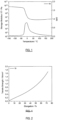
- FIG. 1 shows E' and tan ⁇ curves for the material obtained in example 19.
- Table 4 # 19 20 21 ISO-3 [g] 59.7 49.7 ISO-1 [g] 49.7 THFA [g] 24.9 23.9 24.9 PEGDA 700 [g] 24.9 15.9 24.9 Omnirad BL 750 [g] 0.25 0.2 0.25 Desmorapid SO [g] 0.25 0.3 0.25 2,5-bis(5-tert-butyl-2-benzoxazolyl)thiophene [g] 0.025 0.02 0.025 Tensile Strength [N/mm 2 ] 2.7 2.5 4.5 Elongation at Break 76 287 148 Printing Parameters Bottom Layers / Time [s] 20 21 20 No.
- FIG. 1 shows a DMA curve of example 19.
- the material has a glass transition temperature at about 0 °C with a stable plateau modulus at higher temperatures with a storage modulus of 7 ⁇ 10 6 MPa.
- FIG. 2 gives the corresponding tensile curve, measured at 23 °C.
- the sample shows high flexibility with elongations of more than 70%. The flexibility is further shown in FIG. 3 .
- the hysteresis reveals a permanent deformation of only 5%, illustrating elastic behavior of the sample.
- FIG 4 shows a DMA curve of samples prepared with ISO-3 (examples 14 to 17). Being in the glass transition region at 23 °C the material shows high flexibility as proven in the tensile curves shown in FIG 5 .
- FIG 6 shows the effect of an additional polyisocyanate in examples 15 vs. 15a that increases the crosslinking density, resulting in a stable plateau modulus.
Landscapes
- Chemical & Material Sciences (AREA)
- Organic Chemistry (AREA)
- Health & Medical Sciences (AREA)
- Chemical Kinetics & Catalysis (AREA)
- Medicinal Chemistry (AREA)
- Polymers & Plastics (AREA)
- Engineering & Computer Science (AREA)
- Materials Engineering (AREA)
- Manufacturing & Machinery (AREA)
- Physics & Mathematics (AREA)
- Mechanical Engineering (AREA)
- Optics & Photonics (AREA)
- Life Sciences & Earth Sciences (AREA)
- Wood Science & Technology (AREA)
- Thermal Sciences (AREA)
- Polyurethanes Or Polyureas (AREA)
- Polymerisation Methods In General (AREA)
- Graft Or Block Polymers (AREA)
- Paints Or Removers (AREA)
Claims (15)
- Harz, umfassend:A) ein multifunktionelles (Meth)acrylat,B) ein NCO-funktionelles Polyurethan,C) einen Radikalstarter undD) einen Katalysator,dadurch gekennzeichnet, dassdas multifunktionelle (Meth)acrylat A) eine Viskosität bei 23 °C gemäß Bestimmung nach DIN EN ISO 2884-1 von ≤ 10.000 mPa·s aufweist,das NCO-funktionelle Polyurethan B) eine durchschnittliche NCO-Gruppen-Funktionalität von ≥ 2 und ein Äquivalentmolekulargewicht in Bezug auf NCO-Gruppen von > 300 g/mol aufweist,es sich bei dem Katalysator D) um einen Isocyanattrimerisierungskatalysator handelt unddass das Harz frei von NCO-reaktiven Verbindungen ist oder dann, wenn NCO-reaktive Verbindungen in dem Harz vorliegen, das Molverhältnis von NCO-Gruppen zu NCO-reaktiven Gruppen ≥ 5:1 ist.
- Harz nach Anspruch 1, ferner umfassend ein monomeres Mono(meth)acrylat.
- Harz nach Anspruch 1, ferner umfassend ein zweites Polyisocyanat mit einer durchschnittlichen NCO-Gruppen-Funktionalität von ≥ 2 und einem Äquivalentmolekulargewicht in Bezug auf NCO-Gruppen von < 300 g/mol.
- Harz nach einem der Ansprüche 1 bis 3, wobei das multifunktionelle (Meth)acrylat A) eine Viskosität bei 23 °C gemäß Bestimmung nach DIN EN ISO 2884-1 von ≥ 1 mPa·s bis ≤ 1000 mPa·s aufweist.
- Harz nach einem der Ansprüche 1 bis 4, wobei der Radikalstarter C) in einer Menge von ≤ 3 Gew.-%, bezogen auf das Gesamtgewicht der Acrylphase, vorliegt und der Katalysator D) in einer Menge von ≤ 1 Gew.-%, bezogen auf das Gewicht des Polyisocyanats B), vorliegt.
- Harz nach einem der Ansprüche 1 bis 5, wobei das multifunktionelle (Meth)acrylat A) und das NCO-funktionelle Polyurethan B) in einem Gewichtsverhältnis zwischen 2:1 und 1:3, bezogen auf das Gesamtgewicht von A) und B), vorliegen.
- Harz nach einem der Ansprüche 1 bis 6, wobei der Isocyanattrimerisierungskatalysator Zinn(II)-ethylhexanoat umfasst.
- Verfahren zum Härten eines Harzes, umfassend:I) Bereitstellen eines Harzes;II) Erzeugen von Radikalen aus in dem Harz vorliegenden Radikalstartern, wodurch ein radikalisch gehärtetes Harz erhalten wird, undIII) Erhitzen des radikalisch gehärteten Harzes aus Schritt II), wodurch ein thermisch gehärtetes Harz erhalten wird;dadurch gekennzeichnet, dassin Schritt I) das Harz ein Harz nach einem der Ansprüche 1 bis 7 ist;in Schritt II) die Radikale eine Reaktion zwischen (Meth)acrylatgruppen in dem Harz initiieren;in Schritt III) das radikalisch gehärtete Harz auf eine Temperatur von ≥ 50 °C erhitzt wird, wodurch eine Trimerisierungsreaktion von Isocyanatgruppen in dem Harz initiiert wird, undwobei die Schritte II) und III) gleichzeitig oder aufeinanderfolgend stattfinden können.
- Verfahren nach Anspruch 8, wobei in Schritt I) das Harz als Beschichtung auf einem Substrat bereitgestellt wird.
- Verfahren nach Anspruch 8, wobei:in Schritt II) das Harz gemäß einem vorbestimmten Querschnitt eines anzufertigenden Zielartikels selektiv bestrahlt wird und die selektive Bestrahlung wiederholt wird, bis ein vorbestimmter Zwischenartikel, der das photogehärtete Harz umfasst, erhalten wird, undin Schritt III) der Zwischenartikel auf eine Temperatur von ≥ 50 °C erhitzt wird, wodurch der Zielartikel erhalten wird.
- Verfahren nach Anspruch 8, wobei:vor Schritt II) das Harz gemäß einem vorbestimmten Querschnitt eines anzufertigenden Zielartikels selektiv auf eine Oberfläche aufgebracht wird und die selektive Aufbringung und Bestrahlung gemäß Schritt II) wiederholt wird, bis ein vorbestimmter Zwischenartikel, der das photogehärtete Harz umfasst, erhalten wird, undin Schritt III) der Zwischenartikel auf eine Temperatur von ≥ 50 °C erhitzt wird, wodurch der Zielartikel erhalten wird.
- Verfahren nach einem der Ansprüche 8 bis 11, wobei Schritt III) bei einer Temperatur von ≥ 80 °C bis ≤ 120 °C über einen Zeitraum von ≥ 4 Stunden bis ≤ 24 Stunden durchgeführt wird.
- Photogehärtetes Harz, erhältlich oder erhalten nach Schritt II) eines Verfahrens nach einem der Ansprüche 8 bis 12.
- Thermisch gehärtetes Harz, erhältlich oder erhalten nach Schritt III) eines Verfahrens nach einem der Ansprüche 8 bis 12.
- Erzeugnis, umfassend ein photogehärtetes Harz nach Anspruch 13 und/oder ein thermisch gehärtetes Harz nach Anspruch 14.
Applications Claiming Priority (2)
| Application Number | Priority Date | Filing Date | Title |
|---|---|---|---|
| EP21184735.5A EP4116348A1 (de) | 2021-07-09 | 2021-07-09 | Photo- und wärmehärtbares harz zur verwendung in additiven fertigungsverfahren |
| PCT/EP2022/068143 WO2023280683A1 (en) | 2021-07-09 | 2022-06-30 | Photo- and thermally curable resin useful in additive manufacturing processes |
Publications (2)
| Publication Number | Publication Date |
|---|---|
| EP4367155A1 EP4367155A1 (de) | 2024-05-15 |
| EP4367155B1 true EP4367155B1 (de) | 2025-03-26 |
Family
ID=76859478
Family Applications (2)
| Application Number | Title | Priority Date | Filing Date |
|---|---|---|---|
| EP21184735.5A Pending EP4116348A1 (de) | 2021-07-09 | 2021-07-09 | Photo- und wärmehärtbares harz zur verwendung in additiven fertigungsverfahren |
| EP22741240.0A Active EP4367155B1 (de) | 2021-07-09 | 2022-06-30 | Photo- und wärmehärtbares harz zur verwendung in additiven fertigungsverfahren |
Family Applications Before (1)
| Application Number | Title | Priority Date | Filing Date |
|---|---|---|---|
| EP21184735.5A Pending EP4116348A1 (de) | 2021-07-09 | 2021-07-09 | Photo- und wärmehärtbares harz zur verwendung in additiven fertigungsverfahren |
Country Status (6)
| Country | Link |
|---|---|
| US (1) | US20250002627A1 (de) |
| EP (2) | EP4116348A1 (de) |
| JP (1) | JP2024524577A (de) |
| CN (1) | CN117651725A (de) |
| IL (1) | IL309745A (de) |
| WO (1) | WO2023280683A1 (de) |
Families Citing this family (1)
| Publication number | Priority date | Publication date | Assignee | Title |
|---|---|---|---|---|
| AT527521B1 (de) * | 2023-09-01 | 2025-06-15 | Univ Wien Tech | Isocyanurate |
Family Cites Families (8)
| Publication number | Priority date | Publication date | Assignee | Title |
|---|---|---|---|---|
| DE10025304A1 (de) * | 2000-05-22 | 2001-11-29 | Bayer Ag | Mischungen wässriger Bindemittel |
| US9579412B2 (en) * | 2011-09-29 | 2017-02-28 | Covestro Deutschland Ag | Fast-curing alkoxysilane spray foams |
| JP7189015B2 (ja) * | 2015-12-22 | 2022-12-13 | カーボン,インコーポレイテッド | 二重硬化樹脂を用いた積層造形のための二重前駆体樹脂システム |
| JP7216644B2 (ja) * | 2016-11-14 | 2023-02-01 | コベストロ、ドイチュラント、アクチエンゲゼルシャフト | 前駆体から物体を製造する方法、および付加製造法におけるラジカル架橋性樹脂の使用 |
| JP7138105B2 (ja) | 2016-12-05 | 2022-09-15 | コベストロ、ドイチュラント、アクチエンゲゼルシャフト | 前駆体から物体を作製するための方法および積層造形法におけるラジカル架橋性樹脂の使用 |
| EP3381959A1 (de) | 2017-03-27 | 2018-10-03 | Covestro Deutschland AG | Dual cure-verfahren unter verwendung von thermisch latenten zinnkatalysatoren |
| EP3645598B1 (de) | 2017-06-30 | 2024-06-19 | Stratasys, Inc. | Additives herstellungsverfahren mit einem thermoplastischen radikalisch vernetzbaren aufbaumaterial |
| US11135765B2 (en) * | 2017-08-11 | 2021-10-05 | Carbon, Inc. | Serially curable resins useful in additive manufacturing |
-
2021
- 2021-07-09 EP EP21184735.5A patent/EP4116348A1/de active Pending
-
2022
- 2022-06-30 US US18/576,829 patent/US20250002627A1/en active Pending
- 2022-06-30 WO PCT/EP2022/068143 patent/WO2023280683A1/en not_active Ceased
- 2022-06-30 EP EP22741240.0A patent/EP4367155B1/de active Active
- 2022-06-30 CN CN202280048674.1A patent/CN117651725A/zh active Pending
- 2022-06-30 IL IL309745A patent/IL309745A/en unknown
- 2022-06-30 JP JP2024500412A patent/JP2024524577A/ja active Pending
Also Published As
| Publication number | Publication date |
|---|---|
| US20250002627A1 (en) | 2025-01-02 |
| IL309745A (en) | 2024-02-01 |
| CN117651725A (zh) | 2024-03-05 |
| EP4116348A1 (de) | 2023-01-11 |
| EP4367155A1 (de) | 2024-05-15 |
| JP2024524577A (ja) | 2024-07-05 |
| WO2023280683A1 (en) | 2023-01-12 |
Similar Documents
| Publication | Publication Date | Title |
|---|---|---|
| CN109923143B (zh) | 由前体制造物体的方法和可自由基交联的树脂在增材制造法中的用途 | |
| EP3548522B1 (de) | Verfahren zur herstellung eines gegenstandes aus einem vorläufer und verwendung eines radikalisch vernetzbaren harzes in einem additiven fertigungsverfahren | |
| CN110799566A (zh) | 使用热塑性的可自由基交联构建材料的增材制造方法 | |
| CN110461898B (zh) | 使用热潜伏性锡催化剂的双重固化法 | |
| US20250002627A1 (en) | Photo- and thermally curable resin useful in additive manufacturing processes | |
| EP3554787B1 (de) | Verfahren zur herstellung eines 3d-gedruckten, schaumgefüllten gegenstandes | |
| US20240409751A1 (en) | Photo- and thermally curable resin useful in additive manufacturing processes | |
| US20240239946A1 (en) | Photo- and thermally curable resin useful for additive manufacturing | |
| CN116635439A (zh) | 固化性聚氨酯树脂组合物、固化物及层叠体 | |
| KR20220026190A (ko) | 3d 프린트용 아크릴-폴리우레탄 화합물 및 이를 포함하는 uv 경화액 조성물 | |
| US20240067762A1 (en) | Photo-curable compositions | |
| WO2024033289A1 (en) | A photocurable oligomer containing uretdione groups, method of preparing the oligomer and dual-cure resin composition containing the oligomer thereof | |
| WO2023012000A1 (en) | Dual-cure resin composition comprising uretdione-containing compound and its use in 3d printing |
Legal Events
| Date | Code | Title | Description |
|---|---|---|---|
| STAA | Information on the status of an ep patent application or granted ep patent |
Free format text: STATUS: UNKNOWN |
|
| STAA | Information on the status of an ep patent application or granted ep patent |
Free format text: STATUS: THE INTERNATIONAL PUBLICATION HAS BEEN MADE |
|
| PUAI | Public reference made under article 153(3) epc to a published international application that has entered the european phase |
Free format text: ORIGINAL CODE: 0009012 |
|
| STAA | Information on the status of an ep patent application or granted ep patent |
Free format text: STATUS: REQUEST FOR EXAMINATION WAS MADE |
|
| 17P | Request for examination filed |
Effective date: 20231214 |
|
| AK | Designated contracting states |
Kind code of ref document: A1 Designated state(s): AL AT BE BG CH CY CZ DE DK EE ES FI FR GB GR HR HU IE IS IT LI LT LU LV MC MK MT NL NO PL PT RO RS SE SI SK SM TR |
|
| DAV | Request for validation of the european patent (deleted) | ||
| DAX | Request for extension of the european patent (deleted) | ||
| GRAP | Despatch of communication of intention to grant a patent |
Free format text: ORIGINAL CODE: EPIDOSNIGR1 |
|
| STAA | Information on the status of an ep patent application or granted ep patent |
Free format text: STATUS: GRANT OF PATENT IS INTENDED |
|
| RIC1 | Information provided on ipc code assigned before grant |
Ipc: C08F 283/00 20060101ALI20241023BHEP Ipc: C08F 290/06 20060101ALI20241023BHEP Ipc: C08G 18/02 20060101ALI20241023BHEP Ipc: C08G 18/24 20060101ALI20241023BHEP Ipc: C08G 18/44 20060101ALI20241023BHEP Ipc: C08G 18/48 20060101ALI20241023BHEP Ipc: C08G 18/67 20060101ALI20241023BHEP Ipc: C08G 18/73 20060101ALI20241023BHEP Ipc: C08G 18/75 20060101ALI20241023BHEP Ipc: C09D 175/08 20060101ALI20241023BHEP Ipc: C09D 175/16 20060101ALI20241023BHEP Ipc: B33Y 70/00 20200101ALI20241023BHEP Ipc: C08G 18/81 20060101ALI20241023BHEP Ipc: C08G 18/10 20060101AFI20241023BHEP |
|
| INTG | Intention to grant announced |
Effective date: 20241104 |
|
| GRAS | Grant fee paid |
Free format text: ORIGINAL CODE: EPIDOSNIGR3 |
|
| GRAA | (expected) grant |
Free format text: ORIGINAL CODE: 0009210 |
|
| STAA | Information on the status of an ep patent application or granted ep patent |
Free format text: STATUS: THE PATENT HAS BEEN GRANTED |
|
| AK | Designated contracting states |
Kind code of ref document: B1 Designated state(s): AL AT BE BG CH CY CZ DE DK EE ES FI FR GB GR HR HU IE IS IT LI LT LU LV MC MK MT NL NO PL PT RO RS SE SI SK SM TR |
|
| REG | Reference to a national code |
Ref country code: GB Ref legal event code: FG4D |
|
| REG | Reference to a national code |
Ref country code: CH Ref legal event code: EP |
|
| REG | Reference to a national code |
Ref country code: DE Ref legal event code: R096 Ref document number: 602022012325 Country of ref document: DE |
|
| REG | Reference to a national code |
Ref country code: IE Ref legal event code: FG4D |
|
| P01 | Opt-out of the competence of the unified patent court (upc) registered |
Free format text: CASE NUMBER: APP_14745/2025 Effective date: 20250326 |
|
| PG25 | Lapsed in a contracting state [announced via postgrant information from national office to epo] |
Ref country code: RS Free format text: LAPSE BECAUSE OF FAILURE TO SUBMIT A TRANSLATION OF THE DESCRIPTION OR TO PAY THE FEE WITHIN THE PRESCRIBED TIME-LIMIT Effective date: 20250626 |
|
| PG25 | Lapsed in a contracting state [announced via postgrant information from national office to epo] |
Ref country code: FI Free format text: LAPSE BECAUSE OF FAILURE TO SUBMIT A TRANSLATION OF THE DESCRIPTION OR TO PAY THE FEE WITHIN THE PRESCRIBED TIME-LIMIT Effective date: 20250326 |
|
| PGFP | Annual fee paid to national office [announced via postgrant information from national office to epo] |
Ref country code: DE Payment date: 20250611 Year of fee payment: 4 |
|
| REG | Reference to a national code |
Ref country code: NL Ref legal event code: FP |
|
| REG | Reference to a national code |
Ref country code: LT Ref legal event code: MG9D |
|
| PG25 | Lapsed in a contracting state [announced via postgrant information from national office to epo] |
Ref country code: NO Free format text: LAPSE BECAUSE OF FAILURE TO SUBMIT A TRANSLATION OF THE DESCRIPTION OR TO PAY THE FEE WITHIN THE PRESCRIBED TIME-LIMIT Effective date: 20250626 |
|
| PGFP | Annual fee paid to national office [announced via postgrant information from national office to epo] |
Ref country code: NL Payment date: 20250611 Year of fee payment: 4 Ref country code: BE Payment date: 20250611 Year of fee payment: 4 |
|
| PG25 | Lapsed in a contracting state [announced via postgrant information from national office to epo] |
Ref country code: HR Free format text: LAPSE BECAUSE OF FAILURE TO SUBMIT A TRANSLATION OF THE DESCRIPTION OR TO PAY THE FEE WITHIN THE PRESCRIBED TIME-LIMIT Effective date: 20250326 |
|
| PG25 | Lapsed in a contracting state [announced via postgrant information from national office to epo] |
Ref country code: LV Free format text: LAPSE BECAUSE OF FAILURE TO SUBMIT A TRANSLATION OF THE DESCRIPTION OR TO PAY THE FEE WITHIN THE PRESCRIBED TIME-LIMIT Effective date: 20250326 |
|
| PGFP | Annual fee paid to national office [announced via postgrant information from national office to epo] |
Ref country code: FR Payment date: 20250610 Year of fee payment: 4 |
|
| PG25 | Lapsed in a contracting state [announced via postgrant information from national office to epo] |
Ref country code: GR Free format text: LAPSE BECAUSE OF FAILURE TO SUBMIT A TRANSLATION OF THE DESCRIPTION OR TO PAY THE FEE WITHIN THE PRESCRIBED TIME-LIMIT Effective date: 20250627 Ref country code: BG Free format text: LAPSE BECAUSE OF FAILURE TO SUBMIT A TRANSLATION OF THE DESCRIPTION OR TO PAY THE FEE WITHIN THE PRESCRIBED TIME-LIMIT Effective date: 20250326 |
|
| PG25 | Lapsed in a contracting state [announced via postgrant information from national office to epo] |
Ref country code: SE Free format text: LAPSE BECAUSE OF FAILURE TO SUBMIT A TRANSLATION OF THE DESCRIPTION OR TO PAY THE FEE WITHIN THE PRESCRIBED TIME-LIMIT Effective date: 20250326 |
|
| REG | Reference to a national code |
Ref country code: AT Ref legal event code: MK05 Ref document number: 1778962 Country of ref document: AT Kind code of ref document: T Effective date: 20250326 |
|
| PG25 | Lapsed in a contracting state [announced via postgrant information from national office to epo] |
Ref country code: SM Free format text: LAPSE BECAUSE OF FAILURE TO SUBMIT A TRANSLATION OF THE DESCRIPTION OR TO PAY THE FEE WITHIN THE PRESCRIBED TIME-LIMIT Effective date: 20250326 |
|
| PG25 | Lapsed in a contracting state [announced via postgrant information from national office to epo] |
Ref country code: PT Free format text: LAPSE BECAUSE OF FAILURE TO SUBMIT A TRANSLATION OF THE DESCRIPTION OR TO PAY THE FEE WITHIN THE PRESCRIBED TIME-LIMIT Effective date: 20250728 Ref country code: ES Free format text: LAPSE BECAUSE OF FAILURE TO SUBMIT A TRANSLATION OF THE DESCRIPTION OR TO PAY THE FEE WITHIN THE PRESCRIBED TIME-LIMIT Effective date: 20250326 |
|
| PG25 | Lapsed in a contracting state [announced via postgrant information from national office to epo] |
Ref country code: IT Free format text: LAPSE BECAUSE OF FAILURE TO SUBMIT A TRANSLATION OF THE DESCRIPTION OR TO PAY THE FEE WITHIN THE PRESCRIBED TIME-LIMIT Effective date: 20250326 Ref country code: PL Free format text: LAPSE BECAUSE OF FAILURE TO SUBMIT A TRANSLATION OF THE DESCRIPTION OR TO PAY THE FEE WITHIN THE PRESCRIBED TIME-LIMIT Effective date: 20250326 |
|
| PG25 | Lapsed in a contracting state [announced via postgrant information from national office to epo] |
Ref country code: AT Free format text: LAPSE BECAUSE OF FAILURE TO SUBMIT A TRANSLATION OF THE DESCRIPTION OR TO PAY THE FEE WITHIN THE PRESCRIBED TIME-LIMIT Effective date: 20250326 |
|
| PGFP | Annual fee paid to national office [announced via postgrant information from national office to epo] |
Ref country code: CH Payment date: 20250701 Year of fee payment: 4 |
|
| PG25 | Lapsed in a contracting state [announced via postgrant information from national office to epo] |
Ref country code: EE Free format text: LAPSE BECAUSE OF FAILURE TO SUBMIT A TRANSLATION OF THE DESCRIPTION OR TO PAY THE FEE WITHIN THE PRESCRIBED TIME-LIMIT Effective date: 20250326 |
|
| PG25 | Lapsed in a contracting state [announced via postgrant information from national office to epo] |
Ref country code: RO Free format text: LAPSE BECAUSE OF FAILURE TO SUBMIT A TRANSLATION OF THE DESCRIPTION OR TO PAY THE FEE WITHIN THE PRESCRIBED TIME-LIMIT Effective date: 20250326 |
|
| PG25 | Lapsed in a contracting state [announced via postgrant information from national office to epo] |
Ref country code: SK Free format text: LAPSE BECAUSE OF FAILURE TO SUBMIT A TRANSLATION OF THE DESCRIPTION OR TO PAY THE FEE WITHIN THE PRESCRIBED TIME-LIMIT Effective date: 20250326 |
|
| PG25 | Lapsed in a contracting state [announced via postgrant information from national office to epo] |
Ref country code: IS Free format text: LAPSE BECAUSE OF FAILURE TO SUBMIT A TRANSLATION OF THE DESCRIPTION OR TO PAY THE FEE WITHIN THE PRESCRIBED TIME-LIMIT Effective date: 20250726 |
|
| REG | Reference to a national code |
Ref country code: DE Ref legal event code: R097 Ref document number: 602022012325 Country of ref document: DE |
|
| PG25 | Lapsed in a contracting state [announced via postgrant information from national office to epo] |
Ref country code: DK Free format text: LAPSE BECAUSE OF FAILURE TO SUBMIT A TRANSLATION OF THE DESCRIPTION OR TO PAY THE FEE WITHIN THE PRESCRIBED TIME-LIMIT Effective date: 20250326 |
|
| PG25 | Lapsed in a contracting state [announced via postgrant information from national office to epo] |
Ref country code: CZ Free format text: LAPSE BECAUSE OF FAILURE TO SUBMIT A TRANSLATION OF THE DESCRIPTION OR TO PAY THE FEE WITHIN THE PRESCRIBED TIME-LIMIT Effective date: 20250326 |
|
| PG25 | Lapsed in a contracting state [announced via postgrant information from national office to epo] |
Ref country code: MC Free format text: LAPSE BECAUSE OF FAILURE TO SUBMIT A TRANSLATION OF THE DESCRIPTION OR TO PAY THE FEE WITHIN THE PRESCRIBED TIME-LIMIT Effective date: 20250326 |
|
| PLBE | No opposition filed within time limit |
Free format text: ORIGINAL CODE: 0009261 |
|
| STAA | Information on the status of an ep patent application or granted ep patent |
Free format text: STATUS: NO OPPOSITION FILED WITHIN TIME LIMIT |
|
| REG | Reference to a national code |
Ref country code: CH Ref legal event code: L10 Free format text: ST27 STATUS EVENT CODE: U-0-0-L10-L00 (AS PROVIDED BY THE NATIONAL OFFICE) Effective date: 20260211 |
|
| PG25 | Lapsed in a contracting state [announced via postgrant information from national office to epo] |
Ref country code: LU Free format text: LAPSE BECAUSE OF NON-PAYMENT OF DUE FEES Effective date: 20250630 |
|
| 26N | No opposition filed |
Effective date: 20260105 |
|
| PG25 | Lapsed in a contracting state [announced via postgrant information from national office to epo] |
Ref country code: IE Free format text: LAPSE BECAUSE OF NON-PAYMENT OF DUE FEES Effective date: 20250630 |