EP4366123A1 - Spannungsentzerrer für sekundärbatteriezelle - Google Patents
Spannungsentzerrer für sekundärbatteriezelle Download PDFInfo
- Publication number
- EP4366123A1 EP4366123A1 EP22904352.6A EP22904352A EP4366123A1 EP 4366123 A1 EP4366123 A1 EP 4366123A1 EP 22904352 A EP22904352 A EP 22904352A EP 4366123 A1 EP4366123 A1 EP 4366123A1
- Authority
- EP
- European Patent Office
- Prior art keywords
- rechargeable battery
- circuit
- voltage
- charging
- current
- Prior art date
- Legal status (The legal status is an assumption and is not a legal conclusion. Google has not performed a legal analysis and makes no representation as to the accuracy of the status listed.)
- Pending
Links
Images


Classifications
-
- H—ELECTRICITY
- H01—ELECTRIC ELEMENTS
- H01M—PROCESSES OR MEANS, e.g. BATTERIES, FOR THE DIRECT CONVERSION OF CHEMICAL ENERGY INTO ELECTRICAL ENERGY
- H01M10/00—Secondary cells; Manufacture thereof
- H01M10/42—Methods or arrangements for servicing or maintenance of secondary cells or secondary half-cells
- H01M10/48—Accumulators combined with arrangements for measuring, testing or indicating the condition of cells, e.g. the level or density of the electrolyte
-
- H—ELECTRICITY
- H02—GENERATION; CONVERSION OR DISTRIBUTION OF ELECTRIC POWER
- H02J—ELECTRIC POWER NETWORKS; CIRCUIT ARRANGEMENTS OR SYSTEMS FOR SUPPLYING OR DISTRIBUTING ELECTRIC POWER; SYSTEMS FOR STORING ELECTRIC ENERGY
- H02J7/00—Circuit arrangements for charging or discharging batteries or for supplying loads from batteries
- H02J7/50—Circuit arrangements for charging or discharging batteries or for supplying loads from batteries acting upon multiple batteries simultaneously or sequentially
- H02J7/52—Circuit arrangements for charging or discharging batteries or for supplying loads from batteries acting upon multiple batteries simultaneously or sequentially for charge balancing, e.g. equalisation of charge between batteries
- H02J7/56—Active balancing, e.g. using capacitor-based, inductor-based or DC-DC converters
-
- H—ELECTRICITY
- H01—ELECTRIC ELEMENTS
- H01M—PROCESSES OR MEANS, e.g. BATTERIES, FOR THE DIRECT CONVERSION OF CHEMICAL ENERGY INTO ELECTRICAL ENERGY
- H01M10/00—Secondary cells; Manufacture thereof
- H01M10/42—Methods or arrangements for servicing or maintenance of secondary cells or secondary half-cells
- H01M10/44—Methods for charging or discharging
-
- H—ELECTRICITY
- H02—GENERATION; CONVERSION OR DISTRIBUTION OF ELECTRIC POWER
- H02J—ELECTRIC POWER NETWORKS; CIRCUIT ARRANGEMENTS OR SYSTEMS FOR SUPPLYING OR DISTRIBUTING ELECTRIC POWER; SYSTEMS FOR STORING ELECTRIC ENERGY
- H02J7/00—Circuit arrangements for charging or discharging batteries or for supplying loads from batteries
- H02J7/34—Parallel operation in networks using both storage and other DC sources, e.g. providing buffering
- H02J7/345—Parallel operation in networks using both storage and other DC sources, e.g. providing buffering using capacitors as storage or buffering devices
-
- H—ELECTRICITY
- H02—GENERATION; CONVERSION OR DISTRIBUTION OF ELECTRIC POWER
- H02J—ELECTRIC POWER NETWORKS; CIRCUIT ARRANGEMENTS OR SYSTEMS FOR SUPPLYING OR DISTRIBUTING ELECTRIC POWER; SYSTEMS FOR STORING ELECTRIC ENERGY
- H02J7/00—Circuit arrangements for charging or discharging batteries or for supplying loads from batteries
- H02J7/60—Circuit arrangements for charging or discharging batteries or for supplying loads from batteries including safety or protection arrangements
- H02J7/64—Circuit arrangements for charging or discharging batteries or for supplying loads from batteries including safety or protection arrangements against overvoltage
-
- H—ELECTRICITY
- H02—GENERATION; CONVERSION OR DISTRIBUTION OF ELECTRIC POWER
- H02J—ELECTRIC POWER NETWORKS; CIRCUIT ARRANGEMENTS OR SYSTEMS FOR SUPPLYING OR DISTRIBUTING ELECTRIC POWER; SYSTEMS FOR STORING ELECTRIC ENERGY
- H02J2207/00—Details of circuit arrangements for charging or discharging batteries or supplying loads from batteries
- H02J2207/20—Charging or discharging characterised by the power electronics converter
-
- Y—GENERAL TAGGING OF NEW TECHNOLOGICAL DEVELOPMENTS; GENERAL TAGGING OF CROSS-SECTIONAL TECHNOLOGIES SPANNING OVER SEVERAL SECTIONS OF THE IPC; TECHNICAL SUBJECTS COVERED BY FORMER USPC CROSS-REFERENCE ART COLLECTIONS [XRACs] AND DIGESTS
- Y02—TECHNOLOGIES OR APPLICATIONS FOR MITIGATION OR ADAPTATION AGAINST CLIMATE CHANGE
- Y02E—REDUCTION OF GREENHOUSE GAS [GHG] EMISSIONS, RELATED TO ENERGY GENERATION, TRANSMISSION OR DISTRIBUTION
- Y02E60/00—Enabling technologies; Technologies with a potential or indirect contribution to GHG emissions mitigation
- Y02E60/10—Energy storage using batteries
Definitions
- the present invention relates to an equalisation circuit for equalising voltages of series-connected rechargeable battery cells.
- Electric storage devices are roughly classified into rechargeable batteries and capacitors.
- Rechargeable batteries have large capacities, while capacitors have small capacities compared to rechargeable batteries, but can be recharged quickly and have long life in charge/discharge cycle capabilities.
- the terminal voltages of individual rechargeable battery module in which rechargeable battery cells and capacitors parallelly connected to each rechargeable battery cell must be equalised to ensure safe and efficient charging and discharging capabilities, and voltage equalisation devices are installed in each rechargeable battery cell and capacitor cell in a rechargeable battery module and capacitor module.
- a cause of voltage imbalance is due to a variety of physical characteristics discrepancies associated with energy storage device degradation, including capacity variation during manufacturing process, capacity decrease variation associated with charge/discharge cycles, internal resistance variation and change, self-discharge variation, connection terminal and wiring resistance, ambient temperature change, and temperature imbalance over storage devices, in addition to capacity variation during manufacturing energy storage devices.
- rechargeable battery modules or capacitor modules are connected in series and used as energy storage devices. In this case, not only cell voltage equalisation within each module but also voltage equalisation between modules must be performed. This electronic circuit performs voltage equalisation function over each cell in modules and each module.
- Patent Document 1 CN103138314A
- Non-Patent Document 1 Capacitor Based Battery Balancing System, Mohamed Daowd, Noshin Omar, Peter Van Den Bossche, Joeri Van Mierlo, World Electric Vehicle Journal Vol. 5 - ISSN 2032-6653 Page 0385-0393
- a power supply for charging is usually connected to the top positive pole and the bottom negative pole of the battery module and supply current for charging thereof.
- a voltage equalisation device is connected to prevent voltage imbalance between the rechargeable battery cells.
- the rechargeable battery cell If the current supplied by the charging power supply in the above configuration exceeds the amount of current that can be redistributed by the voltage equalisation device, the rechargeable battery cell is charged with its maximum rated charging voltage. This will cause damage to the rechargeable battery cell, resulting in reduced capacity and reduced service life.
- the output voltage of the charging power supply is fully charged voltage of one rechargeable battery cell.
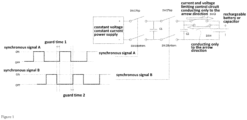
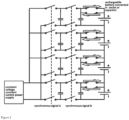
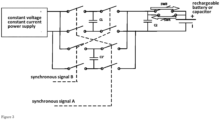
- the constant-current and constant-voltage charging power supply supplies charging current to all rechargeable battery cells via switched capacitors connected in parallel thereto.
- SW1 in Fig. 4 , Fig. 6 , and Fig. 8 is connected to the charging power supply, and SW1 in Fig. 5 , Fig. 7 , and Fig. 9 is closed so that the charging power supply is connected to a constant current and constant voltage charging power supply to the constant charge voltage constant current circuit.
- the switched capacitors operate automatically and autonomously to reduce the voltage difference between the voltage of all individual rechargeable battery cells or capacitors and the voltage generated by the charging power supply, the voltage of all rechargeable battery cells becomes same as the voltage generated by the charging power supply after sufficient time, and cell charging and cell voltage equalisation are completed.
- This section describes cell voltage equalisation during discharge (see Fig. 4 ). Power is supplied from the discharge circuit to the charging power supply and is discharged while operating in the same manner as charging and equalizing the rechargeable battery cell voltages. As a result, all rechargeable battery cell voltages are equalised during discharge in the same manner as charging.
- a switch that detects the direction of the current so that power is not supplied directly from the common circuit to the rechargeable battery modules and that disconnects when it detects charging current that flows directly to the rechargeable battery modules , is inserted into the common charging/discharging circuit. Power is supplied upper stream of the switch to the input of the charging power source. If the discharging circuit and charging circuit for the rechargeable battery modules are separate circuits, the charging circuit is connected to the charging power supply.
- constant voltage constant current power supplies 1 and 2 may be operated simultaneously or only one of them may be operated.
- constant voltage constant current power supplies 1 and 2 must be operating.
- balancing amongst rechargeable battery modules are supplies may be operated simultaneously, or either one of them may be operated. If not coupled, constant voltage constant current power supply 1 and 2 should both be operated.
- constant voltage constant current power supplies 1 and 2 may be operated simultaneously, or either one of them may be operated. When not coupled, both constant voltage current power supplies 1 and 2 should be operated.
- the current flowing from the rechargeable battery cell with higher voltage to the rechargeable battery cell with lower voltage is added to the current via charging power supply and thereby the rechargeable battery cell that has lower voltage can become sooner high voltage than in the case that the circuit configuration described in claim 5 having no additional circuit and the rechargeable battery cell that has higher voltage can become sooner lower voltage.
- the mono-directional current switches enable the time for voltage equalisation short.
- the over-voltage detection and limiting circuit described in claim 6 operates to prevent high voltage from being applied to the rechargeable battery cells due to charging circuit malfunction, parts failure, wire breakage, short circuit, or interference, and to limit the charging voltage to individual rechargeable battery cells when the charging voltage of each battery cell needs to be changed.
- the voltage generated by the charging power supply is the highest charging voltage amongst rechargeable battery cells. If there is no need to change the charging voltage of individual rechargeable battery cells and no need for a circuit to prevent battery cell damages due to a single circuit or system failure, the desired equalisation process can be performed by shorting the input and output without implementing this overvoltage detection and limiting circuits.
- Only one of the aforementioned over-voltage detection and limiting circuits may be installed right after the constant voltage constant current circuit for charging and right before the switched capacitors. When other over-voltage detection and limiting circuits are removed, the voltage limiting circuits functions only as a safety device for the charging power supply circuit.
- the current limit must be set to a current value less than or equal to the allowable charging current of the rechargeable battery cells.
- the current limit must be set to a current value less than or equal to the allowable charging current of the rechargeable battery cells.
- the charging power supply is generating a current large enough to charge all the rechargeable battery cells connected in series with a high charging current, if the voltage of one or a few cells is low, due to the nature of a switched capacitor, the charging current may concentrate only on those low voltage cells and exceed the allowable charging current value of those rechargeable battery cells .
- a current and voltage limiting control circuit is necessary. However, this circuit can be removed only when the charging current does not exceed the allowable charging current of the rechargeable battery cell under any circumstances.
- This circuit also serves as a safety circuit to prevent excessive charging current due to charging circuit failure, parts failure, wire breakage, short circuit, or mishandling as described above.
- the voltage limiting circuits and current limiting circuits described in claim 1 may be either in front of the other in the current flow, or they may be a circuit to limit current and voltage in the same circuit.
- the constant voltage constant current power supplies when equipped with an operation signal input, is appropriately operated or stopped by software control, hardware control, or both. It may be a circuit without an operation signal input.
- Circuits of switched capacitors can be appropriately operated or deactivated by software control, hardware control, or both, when the circuits of switched capacitors have operating signal input.
- the witched capacitor circuits may be circuits that have no operating signal input.
- SW1 in Figs. 5 , 7 , and 9 is not a simple switch, but can be a switching circuit that closes when current flows from the charging power supply to the discharge circuit.
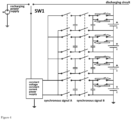
- Figure 4 shows a system including one of the rechargeable battery modules and both a charge circuit and a discharge circuit are separately used.
- a constant voltage constant current power supply for charging a rechargeable battery module is provided wherein the output voltage is set as fully charged voltage of one rechargeable battery cell.
- the entire rechargeable battery modules are charged by supplying charging current to all individual rechargeable battery cells via switched capacitors connected in parallel to this charging power supply.
- This section describes the cell voltage equalisation operation during charging. Since the discharge circuit and the charging circuit of the rechargeable battery module are separate ones, the charging circuit is connected to the charging power supply by using SW1.
- the switched capacitors operate automatically and autonomously to reduce the voltage difference between the voltage of each individual rechargeable battery cell and the voltage generated by the charging power supply, after a sufficient time, the voltage of all rechargeable battery cells becomes the same as the voltage generated by the charging power supply, and equalisation cell charging and cell voltage equalisation are completed.
- This section describes the equalisation of cell voltages during discharge, in which SW1 connects the discharging circuit to the charging power supply.
- the over-voltage detection and limiting circuits described in claim 6 operate to prevent high voltage from being applied to the rechargeable battery cells due to charging circuit malfunction, parts failure, wire breakage, short circuit, or interference, and to limit the charging voltage to individual battery cells when the charging voltage of each battery cell needs to be changed.
- the voltage of the charging power supply becomes the voltage of the highest charging voltage of the rechargeable battery cell. If there is no need to change the charging voltage of individual rechargeable battery cells and no need for a circuit to prevent battery cell damages due to a single circuit or system failure, the desired equalisation process can be performed by shorting the input and output without implementing this overvoltage detection and limiting circuits.
- over-voltage detection and limiting circuits Only one of the aforementioned over-voltage detection and limiting circuits may be installed in between the constant voltage constant current circuit for charging and the switched capacitors. When other over-voltage detection limiting control circuits are removed, the voltage limiting circuit functions only as a safety device for the charging power supply circuit.
- the current limit must be set to a current value less than or equal to the allowable charging current of the rechargeable battery cells.
- the charging power supply is generating a current large enough to charge all the rechargeable battery cells connected in series with a high charging current, if the voltage of one or a few cells is low, due to the nature of a switched capacitors, the charging current may concentrate only on those low voltage cells and exceed the allowable charging current value of those rechargeable battery cells.
- a current and voltage limiting control circuit is necessary. However, this circuit can be removed only when the charging current does not exceed the allowable charging current of the rechargeable battery cell under any circumstances.
- This circuit also serves as a safety circuit to prevent excessive charging current due to a charging circuit failure, parts failure, wire breakage, short circuit, or mishandling as described above.
- the voltage-limiting circuit and current-limiting circuit described in claim 1 may be either in front of the other in the current flow, or they may be current limiting and voltage limiting control circuits in the same circuit.
- the constant voltage constant current power supplies when equipped with an operation signal input, is operated or stopped according to appropriate conditions by software control, hardware control, or both. It may be a circuit without an operation signal input.
- Switched capacitor circuits can be operated or deactivated by software control, hardware control, or both, according to appropriate conditions when having operating signal input. It may be a circuit that has no operating signal input.
- a constant voltage constant current power supply for charging rechargeable battery module is provided charging wherein the output voltage is set as fully charged voltage of one rechargeable battery cell.
- the entire rechargeable battery modules are charged by supplying charging current to all individual rechargeable battery cells via switched capacitors connected in parallel to this charging power supply.
- This section describes operation of the cell voltage equalisation during charging.
- SW1 is closed and power is supplied from the charging power supply to the charging power supply. Since the switched capacitors operate automatically and autonomously to reduce the voltage difference between all individual rechargeable battery cell voltages and the voltage generated by the charging power supply, after a sufficient time, the voltages of all rechargeable battery cells are same as that generated by the charging power supply and then cell charging and cell voltage equalisation are completed.
- the power is supplied from the discharge circuit to the charging power supply and discharge while equalising the voltages of the rechargeable battery cells in same way as during charging. This ensures that all voltages of rechargeable battery cells are same during discharge, same as during charging.
- a switch that shuts off a circuit when charging current directly flowing to the rechargeable battery modules are detected for the purpose that power is not supplied to the rechargeable battery modules directly from such commonly used circuit as the discharging circuits and the charging circuit, inserted in the charging and discharging common circuit . Power is supplied from the upstream of this switch to the charging power input.
- the over-voltage detection and limiting circuits described in claim 6 can operate to prevent high voltage to the rechargeable battery cells due to charging circuit malfunction, parts failure, wire breakage, short circuit, or interference, and to limit the charging voltage to individual rechargeable battery cells when the charging voltage of each battery cell needs to be changed.
- the voltage generated by the charging power supply is the highest charging voltage amongst rechargeable battery cells.
- over-voltage detection and limiting circuits Only one of the over-voltage detection and limiting circuits may be installed in between the over-voltage detection limiting control circuits for charging and the switched capacitors. If other overvoltage detection limiting circuits are removed, the voltage limiting circuit functions only as a safety device for the charging power supply circuit.
- the current limit must be set to a current value less than or equal to the allowable charging current of the rechargeable battery cells.
- the current limit must be set to a current value less than or equal to the allowable charging current of the rechargeable battery cells.
- the charging power supply is generating a current large enough to charge all the rechargeable battery cells connected in series with a high charging current, if the voltage of one or a few cells is low, due to the nature of switched capacitors, the charging current may concentrate only on those low voltage cells and exceed the allowable charging current value of those rechargeable battery cells .
- a current and voltage limiting control circuit is necessary. However, this circuit can be removed only when the charging current does not exceed the allowable charging current of the rechargeable battery cell under any circumstances.
- This circuit also serves as a safety circuit to prevent excessive charging current due to a charging circuit failure, parts failure, wire breakage, short circuit, or mishandling as described above.
- the voltage-limiting circuit and current-limiting circuits described in claim 1 may be either in front of the other in the current flow, or they may be current limiting and voltage limiting control circuits in the same circuit.
- the constant voltage constant current power supply when equipped with an operation signal input, is operated or stopped according to appropriate conditions by software control, hardware control, or both. It may be a circuit without an operation signal input.
- Switched capacitor circuits can be operated or deactivated by software control, hardware control or both, according to appropriate conditions when having operating signal input. It may be a circuit that has no operating signal input.
- a constant voltage constant current power supply for charging rechargeable battery module is provided wherein the output voltage is set as fully charged voltage of one rechargeable battery cell.
- the entire rechargeable battery modules are charged by supplying charging current to all individual rechargeable battery cells via switched capacitors connected in parallel to the charging power supplies.
- This section describes operation of the cell voltage equalization operation during charging. Since the discharge circuit and the charging circuit of the rechargeable battery module are separate ones, the charging circuit is connected to the charging power supplies by using SW1.
- the switched capacitors operates automatically and autonomously to reduce the voltage difference between the voltage of each individual rechargeable battery cell and the voltage generated by the charging power supplies, after a sufficient time, the voltage of all rechargeable battery cells becomes the same as the voltage generated by the charging power supply, and equalisation cell charging and cell voltage equalisation are completed.
- This section describes the equalisation of cell voltages during discharge, in which SW1 connects the discharging circuit to the charging power supply.
- constant voltage constant current power supplies 1 and 2 may be operated simultaneously, or only one of them may be operated. In case that A and A' in Figure 6 are not coupled, constant voltage constant current power supplies 1 and 2 must be operating.
- a and A' in Figure 6 must be coupled when performing cell equalisation during discharge.
- the constant voltage constant current power supplies 1 and 2 may be operated simultaneously, or either one of them may be operated.
- the current flowing from the rechargeable battery cell with higher voltage to the rechargeable battery cell with lower voltage is added to the current via charging power supply and thereby the rechargeable battery cell that has lower voltage can become sooner high voltage than in the case that the circuit configuration described in claim 5 having no additional circuit and the rechargeable battery cell that has higher voltage can become sooner lower voltage.
- the over-voltage detection and limiting circuits described in claim 6 operates to prevent high voltage from being applied to the rechargeable battery cells due to charging circuit malfunction, parts failure, wire breakage, short circuit, or interference, and to limit the charging voltage to individual rechargeable battery cells when the charging voltage of each battery cell needs to be changed.
- the voltage generated by the charging power supply is the highest charging voltage amongst rechargeable battery cells. If there is no need to change the charging voltage of individual rechargeable battery cells and no need for a circuit to prevent battery cell damages due to a single circuit or system failure, the desired equalisation process can be performed by shorting the input and output without implementing the over-voltage detection and limiting circuits.
- over-voltage detection and limiting circuits Only one of the aforementioned over-voltage detection and limiting circuits may be installed right after the constant voltage constant current circuit for charging and right before the switched capacitors. When other over-voltage detection limiting control circuits are removed, the voltage limiting circuit functions only as a safety device for the charging power supply circuit.
- the current limit must be set to a current value less than or equal to the allowable charging current of the rechargeable battery cells.
- the current limit must be set to a current value less than or equal to the allowable charging current of the rechargeable battery cells.
- the charging power supplies are generating a current large enough to charge all the rechargeable battery cells connected in series with a high charging current, if the voltage of one or a few cells is low, due to the nature of switched capacitors, the charging current may concentrate only on those low voltage cells and exceed the allowable charging current value of those rechargeable battery cells .
- a current and voltage limiting control circuit is necessary. However, this circuit can be removed only when the charging current does not exceed the allowable charging current of the rechargeable battery cell under any circumstances.
- This circuit also serves as a safety circuit to prevent excessive charging current due to a charging circuit failure, parts failure, wire breakage, short circuit, or mishandling as described above.
- the voltage-limiting circuit and current-limiting circuit described in claim 1 may be either in front of the other in the current flow, or they may be current limiting and voltage limiting control circuits in the same circuit.
- the constant voltage constant current power supply when equipped with an operation signal input, is operated or stopped according to appropriate conditions by software control, hardware control, or both. It may be a circuit without an operation signal input.
- Switched capacitor circuits can be operated or deactivated by software control, hardware control, or both, according to appropriate conditions when having operating signal input. It may be a circuit that has no operating signal input.
- Constant voltage constant current power supplies for charging rechargeable battery modules are provided wherein the output voltage is set as fully charged voltage of one rechargeable battery cell.
- the entire rechargeable battery modules charged by supplying charging current to all individual rechargeable battery cells via switched capacitors connected in parallel to this charging power supply.
- SW1 is closed and power is supplied from the charging power supply to the charging power supply circuit.
- the switched capacitors operate automatically and autonomously to reduce the voltage difference between the voltage of each individual rechargeable battery cell and the voltage generated by the charging power supplies, after a sufficient time, the voltage of all rechargeable battery cells becomes same as the voltage generated by the charging power supplies , and equalisation cell charging and cell voltage equalisation are completed.
- This section describes the equalisation of cell voltages during discharge, in which SW1 opens, power being supplied to the rechargeable battery from a discharging circuit to the power supplies for charging, discharges the rechargeable battery cell in a fashion of equalizing voltages while operating in the same manner as charging. As a result, all rechargeable battery cell voltages are equalised in discharging same as in charging.
- the discharging circuit and the charging circuits are commonly used for rechargeable battery, a switch that shuts off a circuit when charging current directly flowing to the rechargeable battery modules is detected for the purpose that power is not supplied to the rechargeable batteries directly from such commonly used circuit as the discharging circuits and the charging circuit is inserted in the charging and discharging common circuit. Power is supplied from the upstream of the switch to the input of the charging power supplies.
- the voltages of the rechargeable battery modules must be balanced with each other.
- constant voltage constant current power supplies 1 and 2 may be operated simultaneously or only one of them may be operated.
- constant voltage constant current power supplies 1 and 2 must be operating.
- the constant voltage constant current power supplies 1 and 2 may be operated simultaneously, or either one of them may be operated.
- the current flowing from the rechargeable battery cell with higher voltage to the rechargeable battery cell with lower voltage is added to the current via charging power supply and thereby the rechargeable battery cell that has lower voltage can become sooner high voltage than in the case that the circuit configuration described in claim 5 having no additional circuit and the rechargeable battery cell that has higher voltage can become sooner lower voltage.
- the over-voltage detection and limiting circuits described in claim 6 operates to prevent high voltage from being applied to the rechargeable battery cells due to charging circuit malfunction, parts failure, wire breakage, short circuit, or interference, and to limit the charging voltage to individual rechargeable battery cells when the charging voltage of each battery cell needs to be changed.
- the voltage generated by the charging power supply is the highest charging voltage amongst rechargeable battery cells. If there is no need to change the charging voltage of individual rechargeable battery cells and no need for a circuit to prevent battery cell damages due to a single circuit or system failure, the desired equalisation process can be performed by shorting the input and output without implementing this overvoltage detection and limiting circuits.
- over-voltage detection and limiting circuits Only one of the aforementioned over-voltage detection and limiting circuits may be installed in between the constant voltage constant current circuit for charging and the switched capacitors. When other over-voltage detection limiting control circuits are removed, the voltage limiting circuit functions only as a safety device for the charging power supply circuit.
- the current limit must be set to a current value less than or equal to the allowable charging current of the rechargeable battery cells.
- the current limit must be set to a current value less than or equal to the allowable charging current of the rechargeable battery cells.
- the charging power supplies are generating a current large enough to charge all the rechargeable battery cells connected in series with a high charging current, if the voltage of one or a few cells is low, due to the nature of a switched capacitors, the charging current may concentrate only on those low voltage cells and exceed the allowable charging current value of those rechargeable battery cells. In order to prevent this, a current and voltage limiting control circuit is necessary. However, this circuit can be removed only when the charging current does not exceed the allowable charging current of the rechargeable battery cell under any circumstances. This circuit also serves as a safety circuit to prevent excessive charging current due to a charging circuit failure, parts failure, wire breakage, short circuit, or mishandling as described above.
- the voltage-limiting circuit and current-limiting circuit described in claim 1 may be either in front of the other in the current flow, or they may be current limiting and voltage limiting control circuits in the same circuit.
- the constant voltage constant current power supply when equipped with an operation signal input, is operated or stopped according to appropriate conditions by software control, hardware control, or both. It may be a circuit without an operation signal input.
- Switched capacitor circuits can be operated or deactivated by software control, hardware control, or both, according to appropriate conditions when having operating signal input. It may be a circuit that has no operating signal input.
- Figure 8 describes a circuit in which two rechargeable battery modules are connected in parallel and the charge and discharge circuits are separated.
- Constant voltage constant current power supplies for charging rechargeable battery module is provided with the output voltage being fully charged voltage of one rechargeable battery cell.
- the entire rechargeable battery modules are charged by supplying charging current to all individual rechargeable battery cells via switched capacitors connected in parallel to this charging power supply.
- This section describes operation of the cell voltage equalization operation during charging. Since the discharge circuit and the charging circuit of the rechargeable battery module are separate ones, the charging circuit is connected to the charging power supply by using SW1.
- the switched capacitors operates automatically and autonomously to reduce the voltage difference between the voltage of each individual rechargeable battery cell and the voltage generated by the charging power supplies , after a sufficient time, the voltage of all rechargeable battery cells becomes the same as the voltage generated by the charging power supplies , and equalisation cell charging and cell voltage equalisation are completed.
- This section describes the equalisation of cell voltages during discharge, in which SW1 connects a discharging circuit to the power supplies for charging.
- switches that conducts only when current is output to all rechargeable battery module output sections shall be provided.
- module-to-module cell equalisation should be carried out to equalise the current load on each module. If inhibition or degradation of rechargeable battery modules is not a consideration, module-to-module cell equalisation may not be executed.
- module-to-module cell equalisation should be carried out to equalise the current load on each module. If inhibition or degradation of rechargeable battery modules is not a consideration, module-to-module cell equalisation may not be executed.
- a and A' in Figure 8 may or may not be coupled.
- constant voltage constant current power 1 and 2 may be operated simultaneously, or either one of them may be operated. If not coupled, constant voltage constant current power 1 and 2 should both be operated.
- the current flowing from the rechargeable battery cell with higher voltage to the rechargeable battery cell with lower voltage is added to the current via charging power supply and thereby the rechargeable battery cell that has lower voltage can become sooner high voltage than in the case that the circuit configuration described in claim 5 having no additional circuit and the rechargeable battery cell that has higher voltage can become sooner lower voltage.
- the over-voltage detection and limiting circuits described in claim 6 operates to prevent high voltage from being applied to the rechargeable battery cells due to charging circuit malfunction, parts failure, wire breakage, short circuit, or interference, and to limit the charging voltage to individual rechargeable battery cells when the charging voltage of each battery cell needs to be changed.
- the voltage generated by the charging power supply is the highest charging voltage amongst rechargeable battery cells. If there is no need to change the charging voltage of individual rechargeable battery cells and no need for a circuit to prevent battery cell damages due to a single circuit or system failure, the desired equalization process can be performed by shorting the input and output without implementing the overvoltage detection and limiting circuits .
- over-voltage detection and limiting circuits Only one of the aforementioned over-voltage detection and limiting circuits may be installed right after the constant voltage constant current circuit for charging and right before the switched capacitors. When other over-voltage detection limiting control circuits are removed, the voltage limiting circuit functions only as a safety device for the charging power supply circuit.
- the current limit must be set to a current value less than or equal to the allowable charging current of the rechargeable battery cells.
- the current limit must be set to a current value less than or equal to the allowable charging current of the rechargeable battery cells.
- the charging power supplies are generating a current large enough to charge all the rechargeable battery cells connected in series with a high charging current, if the voltage of one or a few cells is low, due to the nature of a switched capacitors, the charging current may concentrate only on those low voltage cells and exceed the allowable charging current value of those rechargeable battery cells. In order to prevent this, a current and voltage limiting control circuit is necessary. However, this circuit can be removed only when the charging current does not exceed the allowable charging current of the rechargeable battery cell under any circumstances. This circuit also serves as a safety circuit to prevent excessive charging current due to a charging circuit failure, parts failure, wire breakage, short circuit, or mishandling as described above.
- the voltage-limiting circuits and current-limiting circuits described in claim 1 may be either in front of the other in the current flow, or they may be current limiting and voltage limiting control circuits in the same circuit.
- the constant voltage constant current power supply when equipped with an operation signal input, is operated or stopped according to appropriate conditions by software control, hardware control, or both. It may be a circuit without an operation signal input.
- Switched capacitor circuits can be operated or deactivated by software control, hardware control, or both, according to appropriate conditions when having operating signal input. It may be a circuit that has no operating signal input.
- Figure 9 describes a circuit in which two rechargeable battery modules are connected in parallel and the charge and discharge circuits are separated.
- a constant voltage constant current power supplies for charging rechargeable battery module is provided with the output voltage being fully charged voltage of one rechargeable battery cell.
- the entire rechargeable battery module is charged by supplying charging current to all individual rechargeable battery cells via switched capacitors connected in parallel to this charging power supply.
- SW1 is closed and power is supplied from the charging power supplies to the charging power supply circuit.
- the switched capacitors operate automatically and autonomously to reduce the voltage difference between the voltage of each individual rechargeable battery cell and the voltage generated by the charging power supplies, after a sufficient time, the voltage of all rechargeable battery cells becomes the same as the voltage generated by the charging power supplies, and equalization cell charging and cell voltage equalization are completed.
- This section describes the equalization of cell voltages during discharge, in which power being supplied to the rechargeable battery from the discharging circuit to the power supply for charging, discharges the rechargeable battery cell in fashion of equalizing voltages while operating in the same manner as charging. As a result, all rechargeable battery cell voltages are equalized in discharging same as in charging.
- switches that shuts off a circuit when charging current directly flowing to the rechargeable battery modules is detected for the purpose that power is not supplied to the rechargeable battery directly from such commonly used circuit as the discharging circuit and the charging circuits, is inserted in the charging and discharging common circuit. Power is supplied from the upstream of the switches to the charging power input.
- switches that conduct only when current is output to all rechargeable battery modules output sections shall be provided.
- module-to-module cell equalization should be carried out to equalize the current load on each module. If inhibition or degradation of rechargeable battery modules is not a consideration, module-to-module cell equalization may not be executed.
- B and B' in Figure 9 When performing module-to-module battery cell equalization during charging, B and B' in Figure 9 may or may not be coupled. When B and B' in Figure 9 are coupled, constant voltage constant current power supplies 1 and 2 may be operated simultaneously, or either one of them may be operated. If not coupled, constant voltage constant current power 1 and 2 should both be operated.
- the current flowing from the rechargeable battery cell with higher voltage to the rechargeable battery cell with lower voltage is added to the current via charging power supply and thereby the rechargeable battery cell that has lower voltage can become sooner high voltage than in the case that the circuit configuration described in claim 5 having no additional circuit and the rechargeable battery cell that has higher voltage can become sooner lower voltage.
- the mono-directional current switches enable the time for voltage equalisation short.
- the over-voltage detection and limiting circuits described in claim 6 operates to prevent high voltage from being applied to the rechargeable battery cells due to charging circuit malfunction, parts failure, wire breakage, short circuit, or interference, and to limit the charging voltage to individual rechargeable battery cells when the charging voltage of each battery cell needs to be changed.
- the voltage generated by the charging power supply is the highest charging voltage amongst rechargeable battery cells. If there is no need to change the charging voltage of individual rechargeable battery cells and no need for a circuit to prevent battery cell damages due to a single circuit or system failure, the desired equalisation process can be performed by shorting the input and output without implementing the over-voltage detection and limiting circuits .
- over-voltage detection and limiting circuits Only one of the aforementioned over-voltage detection and limiting circuits may be installed in between the constant voltage constant current circuit for charging and the switched capacitors. When other over-voltage detection limiting control circuits are removed, the voltage limiting circuit functions only as a safety device for the charging power supply circuits.
- the current limit must be set to a current value less than or equal to the allowable charging current of the rechargeable battery cells.
- the current limit must be set to a current value less than or equal to the allowable charging current of the rechargeable battery cells.
- the charging power supply is generating a current large enough to charge all the rechargeable battery cells connected in series with a high charging current, if the voltage of one or a few cells is low, due to the nature of switched capacitors , the charging current may concentrate only on those low voltage cells and exceed the allowable charging current value of those rechargeable battery cells .
- a current and voltage limiting control circuit is necessary. However, this circuit can be removed only when the charging current does not exceed the allowable charging current of the rechargeable battery cell under any circumstances.
- This circuit also serves as a safety circuit to prevent excessive charging current due to a charging circuit failure, parts failure, wire breakage, short circuit, or mishandling as described above.
- the voltage-limiting circuit and current-limiting circuit described in claim 1 may be either in front of the other in the current flow, or they may be current limiting and voltage limiting control circuits in the same circuit.
- the constant voltage constant current power supply when equipped with an operation signal input, is operated or stopped according to appropriate conditions by software control, hardware control, or both. It may be a circuit without an operation signal input.
- Switched capacitor circuits can be operated or deactivated by software control, hardware control, or both, according to appropriate conditions when having operating signal input. It may be a circuit that has no operating signal input.
- the circuit can be made similar to a module with two series-connected modules.
- This section describes a case in which three or more rechargeable battery modules are connected in series and the charge circuit and discharge circuit are the same circuit.
- the three series-connected rechargeable battery modules can be the same circuit as that of two series-connected modules.
- This section describes a circuit in which three or more rechargeable battery modules are connected in parallel and the charge and discharge circuits are separated.
- three rechargeable battery modules connected in parallel can be the same circuit as that of two rechargeable battery modules connected in parallel where one is two modules connected in parallel and the other one is a single module.
- This section describes a circuit in which three or more rechargeable battery modules are connected in parallel and the charge and discharge circuits are separated.
- three rechargeable battery modules connected in parallel can be the same circuit as that of two rechargeable battery modules connected in parallel where one is two modules connected in parallel and the other one is a single module.
- This section describes the case in which a circuit configured in a way that two or more rechargeable battery modules are connected in series and more than two of such circuits are connected in parallel.
- the above circuit can be regarded as such two or more such single module is connected in parallel.
- All of the constant current and constant voltage power supplies for charging rechargeable battery cells are generally so far non-isolated power supplies, however isolated power supplies may also be used. In the case of non-isolated power supplies, the output negative terminal and input negative terminal are at the same electrical potential. If an isolated power supply is used and the cathodes of multiple power supplies are coupled, the anode of the power supply should also be connected to the corresponding power supply.
Landscapes
- Engineering & Computer Science (AREA)
- Power Engineering (AREA)
- Manufacturing & Machinery (AREA)
- Chemical & Material Sciences (AREA)
- Chemical Kinetics & Catalysis (AREA)
- Electrochemistry (AREA)
- General Chemical & Material Sciences (AREA)
- Charge And Discharge Circuits For Batteries Or The Like (AREA)
- Secondary Cells (AREA)
Applications Claiming Priority (2)
| Application Number | Priority Date | Filing Date | Title |
|---|---|---|---|
| JP2021209939A JP7543606B2 (ja) | 2021-12-07 | 2021-12-07 | 二次電池セル電圧均等化装置 |
| PCT/JP2022/045952 WO2023106425A1 (ja) | 2021-12-07 | 2022-12-07 | 二次電池セル電圧均等化装置 |
Publications (2)
| Publication Number | Publication Date |
|---|---|
| EP4366123A1 true EP4366123A1 (de) | 2024-05-08 |
| EP4366123A4 EP4366123A4 (de) | 2024-12-04 |
Family
ID=86730678
Family Applications (1)
| Application Number | Title | Priority Date | Filing Date |
|---|---|---|---|
| EP22904352.6A Pending EP4366123A4 (de) | 2021-12-07 | 2022-12-07 | Spannungsentzerrer für sekundärbatteriezelle |
Country Status (4)
| Country | Link |
|---|---|
| US (1) | US20240332992A1 (de) |
| EP (1) | EP4366123A4 (de) |
| JP (1) | JP7543606B2 (de) |
| WO (1) | WO2023106425A1 (de) |
Families Citing this family (1)
| Publication number | Priority date | Publication date | Assignee | Title |
|---|---|---|---|---|
| WO2025225473A1 (ja) * | 2024-04-24 | 2025-10-30 | 株式会社ミネルバ・ラボ | 二次電池電圧均等化充電装置および電源パッケージ |
Family Cites Families (6)
| Publication number | Priority date | Publication date | Assignee | Title |
|---|---|---|---|---|
| JP2007020368A (ja) * | 2005-07-11 | 2007-01-25 | Komatsu Ltd | 蓄電素子の電圧均等化装置および方法 |
| KR101076786B1 (ko) * | 2009-01-30 | 2011-10-25 | 한국과학기술원 | 직렬연결 배터리 스트링을 위한 지능제어 전하균일 장치 및방법 |
| CN102064568A (zh) * | 2010-10-11 | 2011-05-18 | 中国科学院青岛生物能源与过程研究所 | 可堆叠的串联锂电池主动均衡及保护系统 |
| CN103138314B (zh) | 2011-11-29 | 2016-04-27 | 东莞钜威新能源有限公司 | 一种电池电量均衡电路及电池系统 |
| US20140266003A1 (en) * | 2013-03-15 | 2014-09-18 | Atieva, Inc. | Cell balancing through a switched capacitor level shifter |
| JP6305159B2 (ja) * | 2014-03-31 | 2018-04-04 | Tocキャパシタ株式会社 | 蓄電モジュール電圧均等化回路 |
-
2021
- 2021-12-07 JP JP2021209939A patent/JP7543606B2/ja active Active
-
2022
- 2022-12-07 EP EP22904352.6A patent/EP4366123A4/de active Pending
- 2022-12-07 WO PCT/JP2022/045952 patent/WO2023106425A1/ja not_active Ceased
-
2024
- 2024-06-06 US US18/735,189 patent/US20240332992A1/en active Pending
Also Published As
| Publication number | Publication date |
|---|---|
| WO2023106425A1 (ja) | 2023-06-15 |
| US20240332992A1 (en) | 2024-10-03 |
| JP2023084627A (ja) | 2023-06-19 |
| JP7543606B2 (ja) | 2024-09-03 |
| EP4366123A4 (de) | 2024-12-04 |
Similar Documents
| Publication | Publication Date | Title |
|---|---|---|
| KR102847214B1 (ko) | 배터리 시스템 | |
| EP2419987B1 (de) | Batteriesysteme und betriebsverfahren dafür | |
| US7821231B1 (en) | Rechargeable battery assembly and power system using same | |
| US7825629B2 (en) | Method and system for cell equalization with charging sources and shunt regulators | |
| JP2013078242A (ja) | 電源装置 | |
| US20060097696A1 (en) | Method and system for cell equalization with isolated charging sources | |
| JP2018537947A (ja) | バッテリ・システム | |
| US10193356B2 (en) | Electrochemical energy accumulator and balancing method | |
| US20170237269A1 (en) | Battery charge-discharge balancing circuit assembly | |
| CN106849288B (zh) | 一种电池模组连接电路和储能装置 | |
| US20150048795A1 (en) | Charge control apparatus and charge control method | |
| JP5916429B2 (ja) | 組電池制御システムおよび組電池制御方法 | |
| US20180205239A1 (en) | Power supply module with lithium ion capacitor | |
| US20240332992A1 (en) | Voltage equalization device for rechargeable battery cells | |
| CN117543740A (zh) | 蓄电系统 | |
| US12046930B2 (en) | Battery system | |
| CN102761154A (zh) | 电源装置 | |
| JP6932607B2 (ja) | 直流給電システム | |
| JP2005253273A (ja) | 直流電力供給システム | |
| JP2013172551A (ja) | 組電池充電システムおよび組電池充電方法 | |
| JP2008079364A (ja) | 充放電装置 | |
| KR20180035080A (ko) | 배터리 셀 밸런싱 회로 | |
| KR20170071836A (ko) | 배터리 셀 밸런싱 장치 | |
| CN112952939B (zh) | 一种串联电池组及其容量均衡方法 | |
| JP2025064381A (ja) | 蓄電池システム |
Legal Events
| Date | Code | Title | Description |
|---|---|---|---|
| STAA | Information on the status of an ep patent application or granted ep patent |
Free format text: STATUS: THE INTERNATIONAL PUBLICATION HAS BEEN MADE |
|
| PUAI | Public reference made under article 153(3) epc to a published international application that has entered the european phase |
Free format text: ORIGINAL CODE: 0009012 |
|
| STAA | Information on the status of an ep patent application or granted ep patent |
Free format text: STATUS: REQUEST FOR EXAMINATION WAS MADE |
|
| 17P | Request for examination filed |
Effective date: 20240130 |
|
| AK | Designated contracting states |
Kind code of ref document: A1 Designated state(s): AL AT BE BG CH CY CZ DE DK EE ES FI FR GB GR HR HU IE IS IT LI LT LU LV MC ME MK MT NL NO PL PT RO RS SE SI SK SM TR |
|
| REG | Reference to a national code |
Ref country code: DE Ref legal event code: R079 Free format text: PREVIOUS MAIN CLASS: H02J0007020000 Ipc: H02J0007000000 |
|
| A4 | Supplementary search report drawn up and despatched |
Effective date: 20241106 |
|
| RIC1 | Information provided on ipc code assigned before grant |
Ipc: H02J 7/34 20060101ALI20241030BHEP Ipc: H02J 7/00 20060101AFI20241030BHEP |
|
| DAV | Request for validation of the european patent (deleted) | ||
| DAX | Request for extension of the european patent (deleted) | ||
| STAA | Information on the status of an ep patent application or granted ep patent |
Free format text: STATUS: EXAMINATION IS IN PROGRESS |
|
| 17Q | First examination report despatched |
Effective date: 20250804 |