EP4362994B1 - Vernetzte hyaluronsäurezusammensetzung mit lokalanästhetika - Google Patents
Vernetzte hyaluronsäurezusammensetzung mit lokalanästhetika Download PDFInfo
- Publication number
- EP4362994B1 EP4362994B1 EP22740376.3A EP22740376A EP4362994B1 EP 4362994 B1 EP4362994 B1 EP 4362994B1 EP 22740376 A EP22740376 A EP 22740376A EP 4362994 B1 EP4362994 B1 EP 4362994B1
- Authority
- EP
- European Patent Office
- Prior art keywords
- formula
- composition
- hyaluronic acid
- crosslinked hyaluronic
- iii
- Prior art date
- Legal status (The legal status is an assumption and is not a legal conclusion. Google has not performed a legal analysis and makes no representation as to the accuracy of the status listed.)
- Active
Links
Classifications
-
- A—HUMAN NECESSITIES
- A61—MEDICAL OR VETERINARY SCIENCE; HYGIENE
- A61K—PREPARATIONS FOR MEDICAL, DENTAL OR TOILETRY PURPOSES
- A61K9/00—Medicinal preparations characterised by special physical form
- A61K9/06—Ointments; Bases therefor; Other semi-solid forms, e.g. creams, sticks, gels
-
- A—HUMAN NECESSITIES
- A61—MEDICAL OR VETERINARY SCIENCE; HYGIENE
- A61K—PREPARATIONS FOR MEDICAL, DENTAL OR TOILETRY PURPOSES
- A61K45/00—Medicinal preparations containing active ingredients not provided for in groups A61K31/00 - A61K41/00
- A61K45/06—Mixtures of active ingredients without chemical characterisation, e.g. antiphlogistics and cardiaca
-
- A—HUMAN NECESSITIES
- A61—MEDICAL OR VETERINARY SCIENCE; HYGIENE
- A61K—PREPARATIONS FOR MEDICAL, DENTAL OR TOILETRY PURPOSES
- A61K47/00—Medicinal preparations characterised by the non-active ingredients used, e.g. carriers or inert additives; Targeting or modifying agents chemically bound to the active ingredient
- A61K47/06—Organic compounds, e.g. natural or synthetic hydrocarbons, polyolefins, mineral oil, petrolatum or ozokerite
- A61K47/08—Organic compounds, e.g. natural or synthetic hydrocarbons, polyolefins, mineral oil, petrolatum or ozokerite containing oxygen, e.g. ethers, acetals, ketones, quinones, aldehydes, peroxides
- A61K47/10—Alcohols; Phenols; Salts thereof, e.g. glycerol; Polyethylene glycols [PEG]; Poloxamers; PEG/POE alkyl ethers
-
- A—HUMAN NECESSITIES
- A61—MEDICAL OR VETERINARY SCIENCE; HYGIENE
- A61K—PREPARATIONS FOR MEDICAL, DENTAL OR TOILETRY PURPOSES
- A61K47/00—Medicinal preparations characterised by the non-active ingredients used, e.g. carriers or inert additives; Targeting or modifying agents chemically bound to the active ingredient
- A61K47/30—Macromolecular organic or inorganic compounds, e.g. inorganic polyphosphates
- A61K47/36—Polysaccharides; Derivatives thereof, e.g. gums, starch, alginate, dextrin, hyaluronic acid, chitosan, inulin, agar or pectin
-
- A—HUMAN NECESSITIES
- A61—MEDICAL OR VETERINARY SCIENCE; HYGIENE
- A61K—PREPARATIONS FOR MEDICAL, DENTAL OR TOILETRY PURPOSES
- A61K8/00—Cosmetics or similar toiletry preparations
- A61K8/18—Cosmetics or similar toiletry preparations characterised by the composition
- A61K8/30—Cosmetics or similar toiletry preparations characterised by the composition containing organic compounds
- A61K8/33—Cosmetics or similar toiletry preparations characterised by the composition containing organic compounds containing oxygen
- A61K8/39—Derivatives containing from 2 to 10 oxyalkylene groups
-
- A—HUMAN NECESSITIES
- A61—MEDICAL OR VETERINARY SCIENCE; HYGIENE
- A61K—PREPARATIONS FOR MEDICAL, DENTAL OR TOILETRY PURPOSES
- A61K8/00—Cosmetics or similar toiletry preparations
- A61K8/18—Cosmetics or similar toiletry preparations characterised by the composition
- A61K8/30—Cosmetics or similar toiletry preparations characterised by the composition containing organic compounds
- A61K8/40—Cosmetics or similar toiletry preparations characterised by the composition containing organic compounds containing nitrogen
- A61K8/42—Amides
-
- A—HUMAN NECESSITIES
- A61—MEDICAL OR VETERINARY SCIENCE; HYGIENE
- A61K—PREPARATIONS FOR MEDICAL, DENTAL OR TOILETRY PURPOSES
- A61K8/00—Cosmetics or similar toiletry preparations
- A61K8/18—Cosmetics or similar toiletry preparations characterised by the composition
- A61K8/30—Cosmetics or similar toiletry preparations characterised by the composition containing organic compounds
- A61K8/49—Cosmetics or similar toiletry preparations characterised by the composition containing organic compounds containing heterocyclic compounds
- A61K8/4906—Cosmetics or similar toiletry preparations characterised by the composition containing organic compounds containing heterocyclic compounds with one nitrogen as the only hetero atom
- A61K8/4926—Cosmetics or similar toiletry preparations characterised by the composition containing organic compounds containing heterocyclic compounds with one nitrogen as the only hetero atom having six membered rings
-
- A—HUMAN NECESSITIES
- A61—MEDICAL OR VETERINARY SCIENCE; HYGIENE
- A61K—PREPARATIONS FOR MEDICAL, DENTAL OR TOILETRY PURPOSES
- A61K8/00—Cosmetics or similar toiletry preparations
- A61K8/18—Cosmetics or similar toiletry preparations characterised by the composition
- A61K8/30—Cosmetics or similar toiletry preparations characterised by the composition containing organic compounds
- A61K8/49—Cosmetics or similar toiletry preparations characterised by the composition containing organic compounds containing heterocyclic compounds
- A61K8/4986—Cosmetics or similar toiletry preparations characterised by the composition containing organic compounds containing heterocyclic compounds with sulfur as the only hetero atom
-
- A—HUMAN NECESSITIES
- A61—MEDICAL OR VETERINARY SCIENCE; HYGIENE
- A61K—PREPARATIONS FOR MEDICAL, DENTAL OR TOILETRY PURPOSES
- A61K8/00—Cosmetics or similar toiletry preparations
- A61K8/18—Cosmetics or similar toiletry preparations characterised by the composition
- A61K8/72—Cosmetics or similar toiletry preparations characterised by the composition containing organic macromolecular compounds
- A61K8/73—Polysaccharides
- A61K8/735—Mucopolysaccharides, e.g. hyaluronic acid; Derivatives thereof
-
- A—HUMAN NECESSITIES
- A61—MEDICAL OR VETERINARY SCIENCE; HYGIENE
- A61K—PREPARATIONS FOR MEDICAL, DENTAL OR TOILETRY PURPOSES
- A61K9/00—Medicinal preparations characterised by special physical form
- A61K9/0012—Galenical forms characterised by the site of application
- A61K9/0019—Injectable compositions; Intramuscular, intravenous, arterial, subcutaneous administration; Compositions to be administered through the skin in an invasive manner
- A61K9/0024—Solid, semi-solid or solidifying implants, which are implanted or injected in body tissue
-
- A—HUMAN NECESSITIES
- A61—MEDICAL OR VETERINARY SCIENCE; HYGIENE
- A61L—METHODS OR APPARATUS FOR STERILISING MATERIALS OR OBJECTS IN GENERAL; DISINFECTION, STERILISATION OR DEODORISATION OF AIR; CHEMICAL ASPECTS OF BANDAGES, DRESSINGS, ABSORBENT PADS OR SURGICAL ARTICLES; MATERIALS FOR BANDAGES, DRESSINGS, ABSORBENT PADS OR SURGICAL ARTICLES
- A61L27/00—Materials for grafts or prostheses or for coating grafts or prostheses
- A61L27/14—Macromolecular materials
- A61L27/20—Polysaccharides
-
- A—HUMAN NECESSITIES
- A61—MEDICAL OR VETERINARY SCIENCE; HYGIENE
- A61L—METHODS OR APPARATUS FOR STERILISING MATERIALS OR OBJECTS IN GENERAL; DISINFECTION, STERILISATION OR DEODORISATION OF AIR; CHEMICAL ASPECTS OF BANDAGES, DRESSINGS, ABSORBENT PADS OR SURGICAL ARTICLES; MATERIALS FOR BANDAGES, DRESSINGS, ABSORBENT PADS OR SURGICAL ARTICLES
- A61L27/00—Materials for grafts or prostheses or for coating grafts or prostheses
- A61L27/14—Macromolecular materials
- A61L27/26—Mixtures of macromolecular compounds
-
- A—HUMAN NECESSITIES
- A61—MEDICAL OR VETERINARY SCIENCE; HYGIENE
- A61L—METHODS OR APPARATUS FOR STERILISING MATERIALS OR OBJECTS IN GENERAL; DISINFECTION, STERILISATION OR DEODORISATION OF AIR; CHEMICAL ASPECTS OF BANDAGES, DRESSINGS, ABSORBENT PADS OR SURGICAL ARTICLES; MATERIALS FOR BANDAGES, DRESSINGS, ABSORBENT PADS OR SURGICAL ARTICLES
- A61L27/00—Materials for grafts or prostheses or for coating grafts or prostheses
- A61L27/50—Materials characterised by their function or physical properties, e.g. injectable or lubricating compositions, shape-memory materials, surface modified materials
-
- A—HUMAN NECESSITIES
- A61—MEDICAL OR VETERINARY SCIENCE; HYGIENE
- A61L—METHODS OR APPARATUS FOR STERILISING MATERIALS OR OBJECTS IN GENERAL; DISINFECTION, STERILISATION OR DEODORISATION OF AIR; CHEMICAL ASPECTS OF BANDAGES, DRESSINGS, ABSORBENT PADS OR SURGICAL ARTICLES; MATERIALS FOR BANDAGES, DRESSINGS, ABSORBENT PADS OR SURGICAL ARTICLES
- A61L27/00—Materials for grafts or prostheses or for coating grafts or prostheses
- A61L27/50—Materials characterised by their function or physical properties, e.g. injectable or lubricating compositions, shape-memory materials, surface modified materials
- A61L27/52—Hydrogels or hydrocolloids
-
- A—HUMAN NECESSITIES
- A61—MEDICAL OR VETERINARY SCIENCE; HYGIENE
- A61L—METHODS OR APPARATUS FOR STERILISING MATERIALS OR OBJECTS IN GENERAL; DISINFECTION, STERILISATION OR DEODORISATION OF AIR; CHEMICAL ASPECTS OF BANDAGES, DRESSINGS, ABSORBENT PADS OR SURGICAL ARTICLES; MATERIALS FOR BANDAGES, DRESSINGS, ABSORBENT PADS OR SURGICAL ARTICLES
- A61L27/00—Materials for grafts or prostheses or for coating grafts or prostheses
- A61L27/50—Materials characterised by their function or physical properties, e.g. injectable or lubricating compositions, shape-memory materials, surface modified materials
- A61L27/54—Biologically active materials, e.g. therapeutic substances
-
- A—HUMAN NECESSITIES
- A61—MEDICAL OR VETERINARY SCIENCE; HYGIENE
- A61P—SPECIFIC THERAPEUTIC ACTIVITY OF CHEMICAL COMPOUNDS OR MEDICINAL PREPARATIONS
- A61P23/00—Anaesthetics
- A61P23/02—Local anaesthetics
-
- A—HUMAN NECESSITIES
- A61—MEDICAL OR VETERINARY SCIENCE; HYGIENE
- A61P—SPECIFIC THERAPEUTIC ACTIVITY OF CHEMICAL COMPOUNDS OR MEDICINAL PREPARATIONS
- A61P41/00—Drugs used in surgical methods, e.g. surgery adjuvants for preventing adhesion or for vitreum substitution
-
- A—HUMAN NECESSITIES
- A61—MEDICAL OR VETERINARY SCIENCE; HYGIENE
- A61Q—SPECIFIC USE OF COSMETICS OR SIMILAR TOILETRY PREPARATIONS
- A61Q19/00—Preparations for care of the skin
-
- A—HUMAN NECESSITIES
- A61—MEDICAL OR VETERINARY SCIENCE; HYGIENE
- A61Q—SPECIFIC USE OF COSMETICS OR SIMILAR TOILETRY PREPARATIONS
- A61Q19/00—Preparations for care of the skin
- A61Q19/08—Anti-ageing preparations
-
- A—HUMAN NECESSITIES
- A61—MEDICAL OR VETERINARY SCIENCE; HYGIENE
- A61K—PREPARATIONS FOR MEDICAL, DENTAL OR TOILETRY PURPOSES
- A61K2800/00—Properties of cosmetic compositions or active ingredients thereof or formulation aids used therein and process related aspects
- A61K2800/10—General cosmetic use
-
- A—HUMAN NECESSITIES
- A61—MEDICAL OR VETERINARY SCIENCE; HYGIENE
- A61K—PREPARATIONS FOR MEDICAL, DENTAL OR TOILETRY PURPOSES
- A61K2800/00—Properties of cosmetic compositions or active ingredients thereof or formulation aids used therein and process related aspects
- A61K2800/80—Process related aspects concerning the preparation of the cosmetic composition or the storage or application thereof
- A61K2800/91—Injection
-
- A—HUMAN NECESSITIES
- A61—MEDICAL OR VETERINARY SCIENCE; HYGIENE
- A61L—METHODS OR APPARATUS FOR STERILISING MATERIALS OR OBJECTS IN GENERAL; DISINFECTION, STERILISATION OR DEODORISATION OF AIR; CHEMICAL ASPECTS OF BANDAGES, DRESSINGS, ABSORBENT PADS OR SURGICAL ARTICLES; MATERIALS FOR BANDAGES, DRESSINGS, ABSORBENT PADS OR SURGICAL ARTICLES
- A61L2300/00—Biologically active materials used in bandages, wound dressings, absorbent pads or medical devices
- A61L2300/40—Biologically active materials used in bandages, wound dressings, absorbent pads or medical devices characterised by a specific therapeutic activity or mode of action
- A61L2300/402—Anaestetics, analgesics, e.g. lidocaine
-
- A—HUMAN NECESSITIES
- A61—MEDICAL OR VETERINARY SCIENCE; HYGIENE
- A61L—METHODS OR APPARATUS FOR STERILISING MATERIALS OR OBJECTS IN GENERAL; DISINFECTION, STERILISATION OR DEODORISATION OF AIR; CHEMICAL ASPECTS OF BANDAGES, DRESSINGS, ABSORBENT PADS OR SURGICAL ARTICLES; MATERIALS FOR BANDAGES, DRESSINGS, ABSORBENT PADS OR SURGICAL ARTICLES
- A61L2430/00—Materials or treatment for tissue regeneration
- A61L2430/24—Materials or treatment for tissue regeneration for joint reconstruction
-
- A—HUMAN NECESSITIES
- A61—MEDICAL OR VETERINARY SCIENCE; HYGIENE
- A61L—METHODS OR APPARATUS FOR STERILISING MATERIALS OR OBJECTS IN GENERAL; DISINFECTION, STERILISATION OR DEODORISATION OF AIR; CHEMICAL ASPECTS OF BANDAGES, DRESSINGS, ABSORBENT PADS OR SURGICAL ARTICLES; MATERIALS FOR BANDAGES, DRESSINGS, ABSORBENT PADS OR SURGICAL ARTICLES
- A61L2430/00—Materials or treatment for tissue regeneration
- A61L2430/34—Materials or treatment for tissue regeneration for soft tissue reconstruction
Definitions
- the present invention belongs to the field of hyaluronic acid compositions, and particularly to compositions containing hyaluronic acid crosslinked with polyglycerol polyglycidyl ether and local anesthetic agents.
- LA local anesthetic
- a local anesthetic is a medication that causes absence of pain sensation in a specific location of the body without a loss of consciousness, as opposed to a general anesthetic.
- the LA interrupt neural conduction by inhibiting the influx (uptake) of sodium ions. In most cases, this follows their diffusion through the neural membrane into the axoplasm, where they enter sodium channels and prevent them from assuming an active or open state.
- Local anesthetic agents are formed by a lipophilic group (aromatic ring), a hydrophilic group (tertiary amine) and an intermediate linkage group (ester or amide). It is known that each of these groups (components) confers distinct properties to the anesthetic molecule in terms of lipid and water solubility, which is important for having an efficient duration of action and a short onset time (i.e. time interval between the end of total local anesthetic administration and complete sensory or motor block). On one hand, it seems that the aromatic ring improves the liposolubility of the LA, which can be further enhanced by aliphatic substitutions on the amine group.
- aromatic ring improves the liposolubility of the LA, which can be further enhanced by aliphatic substitutions on the amine group.
- the amine group may exist as neutral (not-ionized) tertiary amine, or as a positively charged quaternary salt (ionized).
- the positively charged form (having the quaternary ammonium salt) is water soluble and therefore not bioavailable (i.e. non-active).
- the positively charged form (even without being the bioavailable active form) can be actively involved in the mechanism of action of the anesthetics, allowing anesthetic cations to be more firmly attached to proteins located at receptor sites, enlarging the duration of the local anesthetic action.
- local anesthetics are administered in form of a sterile injectable dosage form containing a salt of the LA (such as hydrochloride salt) and a hydrogel made of a crosslinked polysaccharide (such as hyaluronic acid).
- a salt of the LA such as hydrochloride salt
- a hydrogel made of a crosslinked polysaccharide such as hyaluronic acid
- the (hydrochloride) salt of the local anesthetic contained in the hydrogel is mainly in its water soluble positively charged form (i.e. non-active form of the local anesthetic) avoiding thus the precipitation of the liposoluble form at the physiological pH of the hydrogel (i.e. the active form of the local anesthetic), increasing undesirable the onset time of the LA and compromising the efficiency of the local anesthetic by reducing the penetration capacity of the LA into the neurons.
- the crosslinked hyaluronic acids (hydrogels) having a high cross-linking degree exhibit inappropriate poor flow property.
- the percentage of crosslinking contributes positively to the elasticity and viscosity of the hydrogel but compromises the extrudability properties through fine needles, causing pain and also inflammatory reaction as a response to the mechanical injury to the tissue (caused by the penetration of the needle during injection and by the forces that the viscoelastic hydrogel exerts on the surrounding tissues.).
- (crosslinked) hyaluronic acid (HA) can also be naturally degraded in the organism by reactive oxygen species (ROS) leading to an additional transient inflammatory reaction.
- ROS reactive oxygen species
- the stability of the anesthetic neutral form can alter the stability of the anesthetic neutral form, contributing to the anesthetic therapeutic effect, and particularly to the onset time and the duration of the therapeutic effect.
- these factors can be related either to the characteristics of the local anesthetic (such as its chemical structure) or the characteristic of the hyaluronic acid hydrogel (chemical composition, degree of crosslinking and the presence of additional dissolved compounds, osmolarity and/or ionic strength), the osmolarity and/or ionic strength of the medium in which the local anesthetic is dissolved (i.e. the crosslinked hydrogel) as well as the sterilization method used for its administration.
- the characteristics of the local anesthetic such as its chemical structure
- the characteristic of the hyaluronic acid hydrogel chemical composition, degree of crosslinking and the presence of additional dissolved compounds, osmolarity and/or ionic strength
- WO2021064006 discloses hyperbranched polyglycerol polyglycidyl ethers (PPE) having a molecular weight from 750 to 15000 Da, and an epoxy equivalent weight from 183 to 7.000 g/eq. It also discloses crosslinked polysaccharide hydrogels obtainable by crosslinking the polysaccharides with the hyperbranched polyglycerol polyglycidyl ethers.
- PPE polyglycerol polyglycidyl ethers
- the preparation of PPE cross-linked hyaluronic acids which is described in section 2.1.1.1 of the examples includes a step c in which the PPE cross-linked hyaluronic acid is washed with acidic water solution from 48 to 120 hours to remove unreacted materials and by-products, to neutralize alkaline catalyst and restore the pH of the PPE cross-linked hyaluronic acid to 6.5-7.4. This document is silent about the presence of free polyglycerols in the hydrogel.
- hydrogels of crosslinked hyaluronic acid hydrogels containing anesthetic agents have been disclosed in the state of the art.
- hydrogels of hyaluronic acid crosslinked with 1,4-butanediol diglycidyl ether (BDDE) and anesthetic agents having improved rheological properties (physical properties) have been disclosed in the state of the art.
- injectable aqueous compositions of hydrogel containing hyaluronic acid crosslinked with 1,4-butanediol diglycidyl ether (BDDE) and anesthetic agents and one or more polyols chosen form glycerol, sorbitol, propylene glycol, mannitol, erythritol, xylitol, maltitol and lactitol showed an improved stability to the degradation of a hyaluronic acid-based gel in vivo (enzymatic degradation by hyaluronidases, free-radical degradation, thermal degradation at 37° C) improving the shelf-life of the hydrogel.
- mannitol is used in form of a hyperosmolar solution that can cause severe adverse effects (as edema) due to recall of water or fluids in the injection site. Therefore, the use of hyperosmolar mannitol solution is not indicated in long term applications, and not recommended (unacceptable) in form of hyperosmolar solution for osteoarticular, intradermal or intraocular applications.
- the inventors of the present invention have surprisingly provided a safety and stable crosslinked hyaluronic acid local anesthetic containing composition that allows enhancing the release of the active form of the local anesthetic contained in it, resulting in a fast therapeutic effect (reduction of the onset time of action).
- a safety and stable crosslinked hyaluronic acid local anesthetic containing composition that allows enhancing the release of the active form of the local anesthetic contained in it, resulting in a fast therapeutic effect (reduction of the onset time of action).
- the non-active form of Local Anesthetic is mainly released from the hydrogel.
- the crosslinked hyaluronic acid composition comprising a specific concentration of free polyglycerols and a PPE crosslinked hyaluronic acid having appropriate mechanical properties, low enzymatic/oxidative degradation rate, and adequate biocompatibility for being used in in vivo applications without causing the undesirable side effects associate to its administration, particularly to its injectable application.
- the inventors have found that the combination of a hyaluronic acid crosslinked with polyglycerol diglycidyl ether (PPE), and the specific concentration of free polyglycerols disclosed in the present invention allows reducing the pain and inflammatory undesirable side effects associated with the administration of HA's compositions, because a reduction of the onset of the anesthetic agent is achieved. This short onset is associated with the fastest action of the local anesthetics, caused by an increased bioavailability of the local anesthetic active form but without compromising the mechanical properties of the hyaluronic acid.
- PPE polyglycerol diglycidyl
- the inventors attribute the increased bioavailability of the local anesthetic (increasing the percentage of the active form of the local anesthetic) to a combination of the controlled concentration of the free polyglycerols, their molecular weight along with the structure of the crosslinker PPE which also positively affect the kinetic release of the local anesthetic from the hydrogel to the surrounding tissues.
- the mechanical properties and the degradation resistance of the PPE cross-linked hyaluronic acid to a combination effect of the structure of the crosslinker along with its cohesive properties derived from the (covalent and non-covalent) interactions between the HA and the PPE the interaction of the PPE with the HA creates a dense three-dimensional HA network that holds the hydrogel matrix intact and limits the enzyme's ability to infiltrate the implant and degrade the 3D-network even at low cross-linking degree.
- the composition of the present invention allows having inside the 3D- HA network a pKa value of the local anesthetic closer to the physiological pH, resulting in having inside the 3D- HA network a higher concentration of the active form (i.e. the liposoluble form at the physiological pH) of the local anesthetic than the theoretical concentration predicted by the Henderson-Hasselbalch equation at a given physiologically acceptable pH.
- This increased amount of the active form of the local anesthetic inside results in turn in the reduction of the onset time.
- the experimentally pKa value of the local anesthetic located inside the 3D-HA composition of the present invention is lower than the theoretically pKa value.
- the inventors have also demonstrated a strong correlation between this in vivo rapid onset and efficacy of the anesthetics disclosed in the present invention, with 3D- HA network, along with the presence of a specific concentration of free polyglycerols.
- composition of the invention and particularly the synergic effect of the combination of the PPE crosslinker and the free polyglycerols confers the change in the bioavailability of the Local Anesthetic inside the hydrogel and the rapid diffusion of the drug from it.
- amphiphilic character of the PPE used as crosslinker confers an unexpected stabilization of the active form of the anesthetic inside the matrix.
- This causes a quantitative increment in the percentage of the bioavailable form (form B) of the anesthetic agent in comparison to the percentage predicted by thermodynamic equation and found in products known in the state of the art (i.e.
- thermodynamic pKa value is decreased from 2.5% to 10% of its predicted value); at the same time, the three-dimensional structure of the crosslinked HA contributes to a fastest kinetic release of the anesthetic agent from the 3D-crosslinked matrix of the HA, resulting in a rapid diffusion of the active form of the drug (shortening its onset).
- composition of the invention comprising the PPE crosslinked HA, the specific concentration of free polyglycerols and the anesthetic agents exhibits good flow properties. Besides, as it is mentioned above, the injection of the composition of the present invention renders low or no inflammation and pain perception by the patients during and after its application.
- the composition of the present invention has (a) such amphiphilic character of the hyperbranched PPE crosslinker, (b) such specific concentration of free hyperbranched polyols fragments, and (c) such molecular weight of the free hyperbranched polyols that the combination of them allow increasing the liposoluble active form of the local anesthetic inside the composition (i.e. having a form of the local anesthetic higher than the molar concentration expected according to the Handerson-Hasselbach equation).
- the crosslinked 3D matrix of the hydrogel composition of the present invention i.e. physical property
- the first aspect of the invention relates to a composition according to claim 1 comprising
- compositions comprising crosslinked hyaluronic acid are obtainable by the process disclosed herein.
- the second aspect of the invention relates to a process for the preparation of the first aspect of the invention
- the third aspect of the invention relates to the composition of the first aspect of the invention for use in therapy.
- the fourth aspect of the invention relates to the use of the composition of the first aspect of the invention in cosmetic; particularly as dermal filler.
- the fifth aspect of the invention relates to the use of the composition of the first aspect of the invention as carrier; particularly as drug-delivery system.
- any ranges given include both the lower and the upper endpoints of the range. Ranges given, such as temperatures, times, weights, and the like, should be considered approximate, unless specifically stated.
- the term “about” or “around” as used herein refers to a range of values ⁇ 10% of a specified value. For example, the expression “about 0.5" or “around 0.5” includes ⁇ 10% of 0.5, i.e. from 0.45 to 0.55.
- percentage (%) by weight refers to the percentage of each ingredient in relation to the total weight of the composition.
- the first aspect of the present invention refers to a composition
- a composition comprising: a) one or more crosslinked hyaluronic acids selected from the group consisting of one or more of crosslinked hyaluronic acids of formula (I); one or more of crosslinked hyaluronic acids of formula (II); and a mixture of one or more crosslinked hyaluronic acids of formula (I) and one or more of crosslinked hyaluronic acids of formula (II).
- the composition of the first aspect of the invention comprises: a) one or more crosslinked hyaluronic acids of formula (I).
- the composition of the first aspect of the invention comprises: a) one or more crosslinked hyaluronic acids of formula (II). In an embodiment, the composition of the first aspect of the invention comprises: a) a mixture of one or more crosslinked hyaluronic acids of formula (I) and one or more of crosslinked hyaluronic acids of formula (II).
- hyaluronic acid refers to an anionic non-sulphated glycosaminoglycan (GAG) having a linear high molecular weight polysaccharide that consists of repeating monomers of D-glucuronic acid and N-acetyl-D-glucosamine, linked via alternating ⁇ -(1 ⁇ 4) and ⁇ -(1 ⁇ 3) glycosidic bonds.
- GAG anionic non-sulphated glycosaminoglycan
- hyaluronic acid also encompasses its physiological acceptable salt such as pharmaceutically or cosmetically acceptable salt of hyaluronic acid.
- the crosslinked polysaccharide of the present invention is one wherein the polysaccharide is a pharmaceutically or cosmetically acceptable salt of hyaluronic acid.
- hyaluronic acid salt There is no limitation on the type of hyaluronic acid salt that can be used, as long as they are pharmaceutically or cosmetically acceptable when used for therapeutic or cosmetic purposes.
- Hyaluronic acid and a salt thereof may differ in some physical properties, but they are equivalent for the purposes of the present invention and the skin-friendly properties of hyaluronic acid are extensible to a pharmaceutically or cosmetically acceptable salt, in particular to its sodium salt (or sodium hyaluronate) and potassium salt (potassium hyaluronate).
- physiologically acceptable salt refers to a salt physiologically tolerated by the patient (such as mammals including humans being).
- the term “pharmaceutically acceptable salt” refers to the salt appropriate for use in pharmaceutical technology for the preparation of compositions for medical use and, the term “cosmetically acceptable salt” or “dermatologically acceptable salt” used interchangeably in this document refers to the salt appropriate for use in human skin contact without toxicity, incompatibility, instability, inappropriate allergic response, among others.
- pharmaceutical or cosmetically acceptable salt covers commonly used salts such as e.g. alkaline metal salts.
- the preparation of pharmaceutically acceptable salts of hyaluronic acid can be carried out by methods known in the technique.
- Non-limiting examples of pharmaceutical or cosmetically acceptable salts of hyaluronic acid appropriate for the present invention include inorganic salts such as sodium hyaluronate, magnesium hyaluronate, potassium hyaluronate, zinc hyaluronate and cobalt hyaluronate, as well as organic salts such as tetrabutylammonium hyaluronate.
- the pharmaceutically or cosmetically acceptable salt of hyaluronic acid is a salt of a selected alkaline metal of sodium salt ( CAS No: 9067-32-7 ) or potassium salt ( CAS No: 31799-91-4 ).
- the composition of the invention is one wherein the concentration of the hyaluronic acid in the crosslinked hyaluronic acid of formula (I) or formula (II) is from 1 to 50 mg/ml; particularly from 10 to 30 mg/ml.
- concentration of the hyaluronic acid can be measured by any appropriate method disclosed in the state of the art. In the present invention the concentration of the hyaluronic acid is measured by gravimetric measurement of dry residue obtained after dehydration of the hydrogel in ventilated oven at 105°C for a suitable time.
- the composition of the invention is one wherein the molecular weight of the hyaluronic acid of the crosslinked hyaluronic acid of formula (I) or formula (II) is from 100 to 3000 kDa measured by size exclusion chromatography (SEC); particularly from 250 to 2000 kDa.
- SEC size exclusion chromatography
- the hyaluronic acid of the present invention is a "crosslinked” hyaluronic acid.
- the term “crosslinked” refers to a hyaluronic acid that have three-dimensional crosslink network wherein the network is formed by a starting hyaluronic acid that has been collapsed by one or more crosslinking agents.
- crosslinking refers in the polymer science field to the use of cross-links to promote a difference in the physical properties of the polymers (hyaluronic acid).
- crosslink refers to bonds that is formed by the aperture of the epoxide ring of the crosslinking agent of the present invention by the hydroxyl group of the hyaluronic acid.
- crosslinker or “crosslinking agent” which is herein used interchangeably refers to a compound having the ability to cross-link one or more hyaluronic acid chains.
- crosslinking percentage percentage (%) of crosslinking
- cross-linking degree percentage (%) of crosslinking
- abbreviation “C.D.” have the same meaning and they are used interchangeable. They refer to the ratio between the crosslinked modified hyaluronic acid monomeric units and the unmodified hyaluronic acid monomeric units expressed in percentage.
- C.D. cross-linking degree
- MW rep. unit is 401 Da which is the molecular weight of the hyaluronic monomeric repeating unit, M e is mathematically calculated using the inverse formula of the following equation 2: wherein:
- the composition of the first aspect of the invention comprises: A) one or more crosslinked hyaluronic acids of formula (I), or alternatively of formula (II) have a crosslinking percentage from 0.03% to 0.9%; particularly from 0.045 to 0.077%.
- the crosslinking percentage is measured from the value of G' obtained by rheological measurements using the equation 1 as defined above.
- the composition of the first aspect of the invention comprises: a) a mixture of one or more crosslinked hyaluronic acids of formula (I) and one or more of crosslinked hyaluronic acids of formula (II). All the embodiments mentioned above for the compositions comprising one or more crosslinked hyaluronic acids of formula (I) or alternatively of formula (II), also apply for the composition comprising a mixture of one or more crosslinked hyaluronic acids of formula (I) and one or more of crosslinked hyaluronic acids of formula (II).
- the composition of the first aspect of the invention comprises: a) one or more crosslinked hyaluronic acids selected from the group consisting of one or more crosslinked hyaluronic acids of formula (I); one or more of crosslinked hyaluronic acids of formula (II); and a mixture of one or more crosslinked hyaluronic acids of formula (I) and one or more of crosslinked hyaluronic acids of formula (II); wherein the one or more crosslinked hyaluronic acids of formula (I) or of formula (II) are obtainable by using one or more polyglycerol diglycidyl ether (PPE) crosslinking agents.
- PPE polyglycerol diglycidyl ether
- the composition of the first aspect of the invention comprises: a) one or more crosslinked hyaluronic acids of formula (I), or alternatively of formula (II) obtained by using the crosslinker PPE having an average EEW from 100 to 7.000g/eq; particularly from 100 to 600g/eq measured by ultrasonication-assisted rapid titration with HCl.
- the term "epoxy equivalent weight”, “average EEW” and the abbreviation "EEW” have the same meaning and they are used interchangeable.
- the EEW is the weight of crosslinking agent, in grams, which contains one gram-equivalent of epoxy.
- EEW refers to the content of epoxy groups present in one gram of the crosslinking agents disclosed in the present invention and expressed in g/eq.
- the EEW was experimentally measured using the quantitative ultrasonication-assisted titration with HCl for the rapid determination of epoxides disclosed in the state of the art (cf. He, Z., et al., "Ultrasonication-assisted rapid determination of epoxide values in polymer mixtures containing epoxy resin". Analytical Methods, 2014, vol. 6(12), pp. 4257-4261 ).
- the composition of the first aspect of the invention comprises: a) one or more crosslinked hyaluronic acids of formula (I), or alternatively of formula (II) obtained by using the crosslinker PPE having a Mw from 204 to 15.000 Da, particularly from 204 to 3.500 Da, measured by size exclusion chromatography (SEC).
- SEC size exclusion chromatography
- the mass average molecular mass can be determined by static light scattering, small angle neutron scattering, X-ray scattering, and sedimentation velocity. In the present application the Mw is determinate by size exclusion chromatography (SEC).
- the composition of the first aspect of the invention comprises: a) one or more crosslinked hyaluronic acids selected from the group consisting of one or more crosslinked hyaluronic acids of formula (I); one or more of crosslinked hyaluronic acids of formula (II); and a mixture of one or more crosslinked hyaluronic acids of formula (I) and one or more of crosslinked hyaluronic acids of formula (II); wherein the one or more crosslinked hyaluronic acids of formula (I) or of formula (II) are obtainable by using as a crosslinker a polyglycerol diglycidyl ether (PPE) having a Mw from 204 to 15.000 g/mole; and EEW from 100 to 7.000 g/eq.
- PPE polyglycerol diglycidyl ether
- the composition of the first aspect of the invention comprises: a) one or more crosslinked hyaluronic acids selected from the group consisting of one or more crosslinked hyaluronic acids of formula (I); one or more of crosslinked hyaluronic acids of formula (II); and a mixture of one or more crosslinked hyaluronic acids of formula (I) and one or more of crosslinked hyaluronic acids of formula (II); wherein the one or more crosslinked hyaluronic acids of formula (I) or of formula (II) are obtainable by using as a crosslinker a polyglycerol diglycidyl ether (PPE) having a Mw from 204 to 3.500 g/mole; and EEW from 100 to 600 g/eq.
- PPE polyglycerol diglycidyl ether
- the composition of the first aspect of the invention comprises: a) one or more crosslinked hyaluronic acids of formula (I), or alternatively of formula (II) have a crosslinking percentage from 0.03% to 0.9%; and obtained by using the crosslinker PPE having a Mw from 204 to 15.000 g/mole; and EEW from 100 to 7.000 g/eq.
- the composition of the first aspect of the invention comprises: a) one or more crosslinked hyaluronic acids of formula (I), or alternatively of formula (II) have a crosslinking percentage from 0.045% to 0.077%; and obtained by using the crosslinker PPE having a Mw from 204 to 3.500 g/mole; and EEW from 100 to 600 g/eq.
- the composition of the first aspect of the invention comprises: a) one or more crosslinked hyaluronic acids selected from the group consisting of one or more crosslinked hyaluronic acids of formula (I); one or more of crosslinked hyaluronic acids of formula (II); and a mixture of one or more crosslinked hyaluronic acids of formula (I) and one or more of crosslinked hyaluronic acids of formula (II); wherein the amount of R 2 is lower than 2 ppm on the total weight of the crosslinked hyaluronic acid of formula (I) and of formula (II).
- the amount of R 2 is experimentally measured using the quantitative ultrasonication-assisted titration with HCl for the rapid determination of epoxides disclosed in He, Z., et al., "Ultrasonication-assisted rapid determination of epoxide values in polymer mixtures containing epoxy resin". Analytical Methods, 2014, vol. 6(12), pp. 4257-4261 .
- the first aspect of the present invention refers to a composition
- a composition comprising: B) one or more polyglycerols selected from the group consisting of one or more polyglycerols of formula (III); one or more polyglycerols of formula (IV); and a mixture of one or more polyglycerols of formula (III) and one or more polyglycerols of formula (IV).
- the composition of the first aspect of the invention comprises: B) one or more polyglycerols of formula (III).
- the composition of the first aspect of the invention comprises: B) one or more polyglycerols of formula (IV).
- polyglycerols of formula (III) or the polyglycerols of formula (IV) can also name as “free” polyglycerols of formula (III) or “free” polyglycerols of formula (IV), respectively.
- the composition of the first aspect of the invention comprises: B) one or more polyglycerols of formula (III) or formula (IV) are obtainable by using one or more polyglycerol diglycidyl ether (PPE) crosslinking agents having a weight average molecular weight (M w ) from 240 to 3.700 Da measured by size exclusion chromatography coupled with UV-visible and Mass detector (SEC/UV/MS); particularly from 314 to 1129 Da.
- PPE polyglycerol diglycidyl ether
- M w weight average molecular weight
- SEC/UV/MS UV-visible and Mass detector
- the composition has a concentration of polyglycerols of formula (III) or of formula (IV) in the composition from 0.45 to 25 mg/mL; particularly from 2 to 20 mg/mL.
- concentration of the polyglycerols of formula (III) or of formula (IV) can be measured by any appropriate method disclosed in the state of the art. In the present invention the concentration of the polyglycerols of formula (III) or of formula (IV) is measured by size exclusion chromatography coupled with UV-visible and Mass detector (SEC/UV/MS).
- composition of the invention is one wherein the one or more polyglycerols of formula (III) or formula (IV) are selected from the group consisting of:
- the composition of the first aspect of the invention comprises: B) a mixture of one or more polyglycerols of formula (III) and one or more polyglycerols of formula (IV). All the embodiments mentioned above for the compositions comprising B) one or more polyglycerols of formula (III) or alternatively one or more polyglycerols of formula (IV) also apply for the composition comprising a mixture of one or more polyglycerols of formula (III) and one or more polyglycerols of formula (IV).
- the first aspect of the present invention refers to a composition comprising: C) an effective amount of one or more local anesthetic agents or a salt thereof.
- the term “anesthetic” refers to an agent that causes loss of sensation in a human or other mammal with or without the loss of consciousness. More particularly, the term “local anesthetic” refers to an anesthetic agent that induces local anaesthesia by reversibly inhibiting peripheral nerve excitation and/or conduction.
- the term "effective amount” refers to an amount of one or more local anesthetic agent that produces the above-mentioned anesthetic effect, e.g., a partial or total loss of sensation, inhibition of sensory perception, or inhibition of motor function.
- Local anesthetics suitable for use in the present invention include, but are not limited to, those anesthetic agents or salts thereof comprising at least one lipophilic moiety and a hydrophilic moiety selected from the group consisting of ambucaine, amolanone, amylocaine, articaine, benoxinate, benzocaine, betoxycaine, biphenamine, bupivacaine, butacaine, butamben, butanilicaine, butethamine, butoxycaine, chloroprocaine, cocaethylene, cocaine, cyclomethycaine, dibucaine, dimethisoquin, dimethocaine, diperodon, dicyclomine, ecgonidine, ecgonine, etidocaine, beta-eucaine, euprocin, fenalcomine, farmocaine, fomocaine, hexylcaine, hydroxytetracaine, isobutyl p-aminobenzoate, leuci
- the composition of the invention is one wherein the local anesthetic agents or a salt thereof is selected from the group consisting of amide-based local anesthetics such as lidocaine, mepivacaine, articaine or a mixture thereof. In an embodiment, the composition of the invention is one wherein the local anesthetic agents or a salt thereof is lidocaine or a salt thereof. In an embodiment, the composition of the invention is one wherein the local anesthetic agents or a salt thereof is mepivacaine or a salt thereof. In an embodiment, the composition of the invention is one wherein the local anesthetic agents or a salt thereof is articaine or a salt thereof.
- the salts of local anesthetic encompasses salts formed from acceptable non-toxic acids including inorganic or organic acids.
- the salts There is no limitation regarding the salts, except that they must be therapeutically or cosmetic acceptable when they are used for pharmaceutical or cosmetic purposes, respectively. Most of the acceptable salts are commercially available. If not, these salts can be prepared following the processes disclosed in the state of the art, which involves starting from acceptable non-toxic acids, including inorganic and organic acids.
- Such acids include for instance acetic, benzenesulfonic, benzoic, camphor sulfonic, citric, ethansulfonic, fumaric, gluconic, glutamic, hydrobromic, hydrochloric, lactic, maleic, malic, mandelic, methanesulfonic, phosphoric, succinic, sulfuric, tartaric, p-toluensulfonic acid and hydrochloride.
- they can be prepared from the parent compound, which contains a basic moiety, by conventional chemical methods.
- salts are, for example, prepared by reacting the free base form of this compound with a stoichiometric amount of the appropriate acceptable acid in water or in an organic solvent or in a mixture of them.
- pharmaceutically acceptable salts used herein encompasses any salt formed from pharmaceutically acceptable non-toxic acids as defined above.
- cosmetic acceptable salts used herein encompasses any salt formed from cosmetic acceptable non-toxic acids as defined above.
- the composition of the invention is one wherein the local anesthetic agents is in form of a salt.
- the composition of the invention comprises lidocaine hydrochloride salt.
- the composition of the invention comprises mepivacaine hydrochloride salt.
- the composition of the invention comprises articaine hydrochloride salt.
- the composition of the present invention comprises: C) an effective amount of one or more local anesthetic agents or a salt thereof, having an experimental pKa value calculated by the Henderson-Hasselbalch equation that is from 2.5 to 10% less than the predicted thermodynamic pKa value calculated by the Henderson-Hasselbalch equation.
- thermodynamic pKa value (abbreviated as pKaT) is the pKa value tabulated in the state of the art (cf. cf. René. Levy et al. "Determination of thermodynamic dissociation constants of local anaesthetic amines: influence of ionic strength" J. Pharm. Pharmac., 1972, vol. 24, pp. 841-847 ), and calculated from the dissociation equilibrium constant of a weak acid in absence of perturbating equilibrium agents (cf. René. Levy et al.).
- pKaS is the pKa experimentally calculated, using the Henderson-Hasselbalch equation, starting from pH, [B] and [BH+] values measured experimentally using respectively pHmeter and by size exclusion chromatography coupled with UV-visible and Mass detector (SEC/UV/MS) in presence of perturbating equilibrium agents (i.e. free polyglycerols and PPE crosslinked hyaluronic acid).
- the value of the pKa corresponds to the thermodynamic pKa value for each local anesthetic tabulated in the state of the art as defined above (cf. René. Levy et al. "Determination of thermodynamic dissociation constants of local anaesthetic amines: influence of ionic strength" J. Pharm. Pharmac., 1972, vol. 24, pp. 841-847 ).
- the composition of the present invention comprises: C) an effective amount of lidocaine or a salt thereof as one or more local anesthetic agents and having an experimental pKa value from 7.2 to 7.8 calculated by the Henderson-Hasselbalch equation.
- the composition of the present invention comprises: C) an effective amount of mepivacaine or a salt thereof as one or more local anesthetic agents and having an experimental pKa value from 7.1 to 7.7 calculated by the Henderson-Hasselbalch equation.
- the composition of the present invention comprises: C) an effective amount of articaine or a salt thereof as one or more local anesthetic agents and having an experimental pKa value from 7.0 to 7.5 calculated by the Henderson-Hasselbalch equation.
- the composition of the present invention comprises: C) an effective amount of one or more local anesthetic agents or a salt thereof, having a percentage of neutral form B of the local anesthetic determined by GC/MS that is from 40% to 160% higher than the predicted value calculated by the Henderson-Hasselbalch equation as disclosed in the present invention.
- the composition of the present invention comprises: C) an effective amount of lidocaine or a salt thereof as one or more local anesthetic agents and having from 25% to 63% of the percentage of neutral form B of lidocaine or a salt thereof determined by GC/MS at about pH 7.4. In an embodiment, the composition of the present invention comprises: C) an effective amount of lidocaine or a salt thereof as one or more local anesthetic agents and having from 17% to 34% of the percentage of neutral form B of lidocaine or a salt thereof determined by GC/MS at about pH 7.2.
- the composition of the present invention comprises: C) an effective amount of lidocaine or a salt thereof as one or more local anesthetic agents and having from 12% to 25% of the percentage of neutral form B of lidocaine or a salt thereof determined by GC/MS at about pH 7.0.
- the composition of the present invention comprises: C) an effective amount of mepivacaine or a salt thereof as one or more local anesthetic agents and having from 29% to 65% of the percentage of neutral form B of mepivacaine or a salt thereof determined by GC/MS at about pH 7.4. In an embodiment, the composition of the present invention comprises: C) an effective amount of mepivacaine or a salt thereof as one or more local anesthetic agents and having from 21% to 40% of the percentage of neutral form B of mepivacaine or a salt thereof determined by GC/MS at about pH 7.2.
- the composition of the present invention comprises: C) an effective amount of mepivacaine or a salt thereof as one or more local anesthetic agents and having from 15% to 26% of the percentage of neutral form B of mepivacaine or a salt thereof determined by GC/MS at about pH 7.0.
- the composition of the present invention comprises: C) an effective amount of articaine or a salt thereof as one or more local anesthetic agents and having from 41% to 70% of the percentage of neutral form B of articaine or a salt thereof determined by GC/MS at about pH 7.4. In an embodiment, the composition of the present invention comprises: C) an effective amount of articaine or a salt thereof as one or more local anesthetic agents and having from 29% to 50% of the percentage of neutral form B of articaine or a salt thereof determined by GC/MS at about pH 7.2.
- the composition of the present invention comprises: C) an effective amount of articaine or a salt thereof as one or more local anesthetic agents and having from 21% to 40% of the percentage of neutral form B of articaine or a salt thereof determined by GC/MS at about pH 7.0.
- composition of the present invention optionally comprises D) one or more acceptable excipients or carriers.
- the composition comprises: D) one or more acceptable excipients or carriers.
- the appropriate excipients and/or carriers, their amounts as well as the experimental process conditions for their preparation, can readily be determined by those skilled in the art according to the field and the type of formulation being prepared.
- the composition of the invention is a "pharmaceutical composition” which comprises: a therapeutically effective amount of the one or more crosslinked hyaluronic acids of formula (I), of formula (II) or a mixture thereof; a therapeutically effective amount of the one or more polyglycerols of formula (III) or formula (IV) or a mixture thereof; a therapeutically effective amount of one or more anesthetic agents, and optionally, one or more pharmaceutically acceptable excipients or carriers.
- pharmaceutical composition refers to a composition suitable for use in the pharmaceutical technology with medical use.
- the dose of the therapeutically effective amount of crosslinked hyaluronic acids, polyglycerols, and anesthetic agents administered according to this invention will of course be determined by the particular circumstances surrounding the case, including the compound administered, the route of administration, the particular condition being treated, and the similar considerations.
- the pharmaceutical compositions of the present invention can comprise one or more pharmaceutically acceptable excipients or carriers.
- pharmaceutically acceptable excipients or carriers refers to that excipients or carriers suitable for use in the pharmaceutical technology for preparing compositions with medical use.
- the composition is a cosmetic composition which comprises a cosmetically effective amount of the one or more crosslinked hyaluronic acids of formula (I), of formula (II) or a mixture thereof; a cosmetically effective amount of the one or more polyglycerols of formula (III) or formula (IV) or a mixture thereof; a cosmetically effective amount of one or more anesthetic agents, and optionally, one or more cosmetically acceptable excipients or carriers.
- the cosmetic composition of the present invention is designed to apply to the body the appropriate amount (“cosmetically effective amount") to improve its appearance or to beautify, preserve, condition, cleanse, color or protect the skin, nails, or hair (cf. Academic press Dictionary of Science and Technology, 1992, pp.
- cosmetic compositions are adjectivally used for a non-medical application.
- cosmetically acceptable or “dermatological acceptable” which is herein used interchangeably refers to that excipients or carriers suitable for use in contact with human skin without undue toxicity, incompatibility, instability, allergic response, among others.
- the topical pharmaceutical or topical cosmetic compositions defined above comprise appropriate excipients or carriers for topical administration that can be pharmaceutically or cosmetically acceptable excipients, including, but not limited to, repairing cutaneous barrier function agent, a hydrating agent, an emollient, an emulsifier, a thickener, a humectant, a pH-regulating agent, an antioxidant, a preservative agent, a vehicle, or their mixtures.
- the excipients or carriers used have affinity for the skin, are well tolerated, stable, and are used in an amount adequate to provide the desired consistency, and ease application.
- the compositions of the present invention may contain other ingredients, such as fragrances, colorants, and other components known in the state of the art for use in topical formulations.
- compositions of the invention can be formulated in several forms that include, but are not limited to, solutions, aerosols and non-aerosol sprays, creams, powders, mousses, lotions, gels, sticks, ointments, pastes, shampoos, shower gel, body washes or face washes and emulsions.
- the pharmaceutical or cosmetic composition is an injectable composition.
- the pharmaceutical or cosmetic composition is an injectable composition selected from the group consisting of intramuscular, subcutaneous, or intravenous application.
- the pharmaceutical or cosmetic compositions of the present invention are in form of parenteral compositions suitable for their injection, infusion, or implantation into the body.
- the parenteral compositions defined above should be sterile, and pyrogen-free, and they can be in form of liquid such as solutions, emulsions, or suspensions, or in solid form packaged in either single-dose or multidose containers suitably diluted before use.
- Parenteral compositions can comprise appropriate excipients or carriers for parenteral administration that can be pharmaceutical or cosmetic excipients, including, but not limited to, solvents, suspending agents, buffering agents, substances to make the preparation isotonic with blood, stabilizers, or antimicrobial preservatives.
- excipients should be kept to a minimum. When excipients are used, they should not adversely affect the stability, bioavailability, safety, or efficacy of the polymers and/or the active agents, or cause toxicity or undue local irritation. There should not be any incompatibility between any of the components of the dosage form.
- the composition of the present invention has enhanced physical properties (rheological) and chemical properties (concentration of free polyglycerols andPPE crosslinked hydrogel) to provide an unexpectedly improvement in the amount of liposoluble (active) form of the local anesthetic and its faster release from the hydrogel matrix composition of the present invention, resulting in a reduction of the onset of the local anesthetic.
- the composition of the first aspect of the invention is one having a storage modulus G' from 10 to 1500 Pa; particularly from 30 to 700 Pa measured at 1.0Hz.
- the process for the preparation of the composition of the invention comprises:
- the process for the preparation of the composition of the invention comprises:
- the process for the preparation of the composition of the invention comprises:
- the process for the preparation of the composition of the invention is one wherein:
- the process for the preparation of the composition of the fist aspect of the invention comprises:
- step (vi), or alternatively step (vi'); or alternatively step (vi") is performed by the addition of such appropriate amount of an acidic water solution to obtain a pH from 6.5-7.4 and a concentration of polyglycerols of formula (III) or formula (IV) or mixture thereof in the composition is from 0.45 to 25 mg/mL.
- appropriate acidic water solution examples include, but it is not limited to strong and weak inorganic (mineral) acids such as hydrochloric acid, sulphuric acid, orthophosphoric acid, boric acid, nitric acid and strong and weak organic acids such as acetic acid, lactic acid, formic acid, citric acid, oxalic acid, uric acid, malic acid, tartaric acid, or mixture thereof.
- strong and weak inorganic (mineral) acids such as hydrochloric acid, sulphuric acid, orthophosphoric acid, boric acid, nitric acid and strong and weak organic acids such as acetic acid, lactic acid, formic acid, citric acid, oxalic acid, uric acid, malic acid, tartaric acid, or mixture thereof.
- all embodiments mentioned above and below of the process for the preparation of the composition of the fist aspect of the invention further comprises additional step (vi), or alternatively additional step (vi'), or alternatively step (vi").
- step i), or alternatively step i'), or alternatively step i" is performed at a temperature from 10 to 50°C; particularly about 30°C. In an embodiment, step i), or alternatively step i'), or alternatively step i"), is performed for 1 to 48 h; particularly about 8h.
- step ii), or alternatively step ii'), or alternatively step ii") is performed at a temperature from 10 to 50°C; particularly about 25°C. In an embodiment, step ii), or alternatively step ii'), or alternatively step ii"), is performed for 1 to 8 h; particularly about 2h.
- the process comprises step iii), or alternatively step iii'), or alternatively step iii" In an embodiment, if one or more excipients or carriers (D), then the process comprises step iii), or alternatively step iii'), or alternatively step iii") which is performed for 1 to 8 h; particularly about 2h.
- the process comprises a sterilizing step iv), or alternatively step iv'), or alternatively step iv").
- the process comprises a sterilizing step iv), or alternatively step iv'), or alternatively step iv") which is performed at a temperature from 120 to 135°C; particularly from 121 to 130°C.
- the process comprises a sterilizing step iv), or alternatively step iv'), or alternatively step iv").
- the process comprises a sterilizing step iv), or alternatively step iv'), or alternatively step iv" which is performed at a temperature from 121 to 126°C.
- the process comprises a sterilizing step iv), or alternatively step iv'), or alternatively step iv").
- the process comprises a sterilizing step iv), or alternatively step iv'), or alternatively step iv") which is performed for 1 min to 20min; particularly for 3min to 15min.
- the process comprises a sterilizing step iv), or alternatively step iv'), or alternatively step iv").
- the process comprises a sterilizing step iv), or alternatively step iv'), or alternatively step iv") which is performed for 10 min to 15min.
- the process comprises a sterilizing step iv), or alternatively step iv'), or alternatively step iv").
- the process comprises a sterilizing step iv), or alternatively step iv'), or alternatively step iv") which is performed at a121°C for 15 min.
- the process comprises a sterilizing step iv), or alternatively step iv'), or alternatively step iv").
- the process comprises a sterilizing step iv), or alternatively step iv'), or alternatively step iv") which is performed at a126°C for 10 min.
- the process comprises a sterilizing step iv), or alternatively step iv'), or alternatively step iv").
- the process comprises a sterilizing step iv), or alternatively step iv'), or alternatively step iv") which is performed at a 134°C for 3 min.
- the sterilization step can be performed according to methods well known in the state of the art.
- the sterilization step is performed by a method selected from the group consisting of filtration, autoclaving, heating, irradiation, and combination thereof; preferably the sterilization step is performed by steam sterilized in autoclave; particularly following the pharmacopeia accepted procedures reported in the EN ISO 17665-1 (Sterilization of health care products - Moist heat Part 1: requirements for the development, validation and routine control of a sterilization process for medical device (e.g. 15 min at 121°C).
- the process further comprising a previous step before the sterilizing step iv), or alternatively step iv'), or alternatively step iv") which comprises conditioning the composition; particularly filling syringes with the composition of the invention. It is advantageous because the sterile composition thus obtained after steps iv), or alternatively step iv'), or alternatively step iv") is a ready-to-use sterile injectable composition.
- the process comprises step v), or alternatively step v'), or alternatively step v").
- the alkaline solution of step a) or alternatively of step c) comprises a base selected from the group consisting of physiologically acceptable alkaline metal or ammonium hydroxides (Na, K), alkaline earth metal hydroxides (Mg, Ca, Sr), physiologically acceptable heavy metal hydroxides (Fe, Al, Co, Cu, Se, Zn, Cr, Ni), physiologically acceptable quaternary ammonium cations hydroxides, physiologically acceptable heavy metal or ammonium hydrogen carbonate (NH 4 , Fe, Al, Co, Cu, Se, Zn, Cr, Ni) and mixture thereof.
- physiologically acceptable alkaline metal or ammonium hydroxides Na, K
- alkaline earth metal hydroxides Mg, Ca, Sr
- physiologically acceptable heavy metal hydroxides Fe, Al, Co, Cu, Se, Zn, Cr, Ni
- physiologically acceptable quaternary ammonium cations hydroxides physiologically acceptable heavy metal or ammonium hydrogen carbonate (NH 4 , Fe, Al, Co, Cu, Se
- physiologically acceptable refers to a non-toxic material that is compatible with a biological system such as a cell, cell culture, tissue, or organism.
- a biological system such as a cell, cell culture, tissue, or organism.
- the biological system is a living organism, such as a mammal, particularly a human.
- the alkaline solution of step a) or alternatively of step c) comprises an alkaline metal or ammonium hydroxide selected from the group consisting of potassium hydroxide (KOH), sodium hydroxide (NaOH), ammonium hydroxide and a mixture thereof; particularly sodium hydroxide.
- KOH potassium hydroxide
- NaOH sodium hydroxide
- ammonium hydroxide a mixture thereof; particularly sodium hydroxide.
- the alkaline solution of step a) or alternatively of step c) comprises an alkaline earth metal hydroxide selected from the group consisting of magnesium hydroxide, calcium hydroxide, strontium hydroxide and a mixture thereof.
- the alkaline solution of step a) or alternatively of step c) comprises a heavy metal hydroxide selected from the group consisting of iron hydroxide, aluminium hydroxide, cobalt hydroxide, selenium hydroxide, tin hydroxide, chromium hydroxide, nickel hydroxide and a mixture thereof.
- a heavy metal hydroxide selected from the group consisting of iron hydroxide, aluminium hydroxide, cobalt hydroxide, selenium hydroxide, tin hydroxide, chromium hydroxide, nickel hydroxide and a mixture thereof.
- the alkaline solution of step a) or alternatively of step c) comprises a quaternary ammonium hydroxides of formula HONR 6 R 7 R 8 R 9 wherein each one of R 6 , R 7 , R 8 and R 9 is independently selected from the group consisting of (C 1 -C 8 ) alkyl, or alternatively two of R 5 , R 6 , R 7 and R 9 form a (C 5 -C 6 ) cycloalkyl ring.
- the alkaline solution of step a) or alternatively of step c) comprises heavy metal or ammonium hydrogen carbonate selected from the group consisting of iron hydrogen carbonate, aluminium hydrogen carbonate, cobalt hydrogen carbonate, Cupper hydrogen carbonate, selenium hydrogen carbonate, zinc hydrogen carbonate, chromium hydrogen carbonate, nickel hydrogen carbonate, ammonium hydrogen carbonate and a mixture thereof; particularly sodium hydrogen carbonate.
- heavy metal or ammonium hydrogen carbonate selected from the group consisting of iron hydrogen carbonate, aluminium hydrogen carbonate, cobalt hydrogen carbonate, Cupper hydrogen carbonate, selenium hydrogen carbonate, zinc hydrogen carbonate, chromium hydrogen carbonate, nickel hydrogen carbonate, ammonium hydrogen carbonate and a mixture thereof; particularly sodium hydrogen carbonate.
- the alkaline solution of step a) or alternatively of step c) comprises from 1 to 50 percent by weight of 1,3-GDE or alternatively of 1,2-GDE.
- the alkaline solution of step a) or alternatively of step c) comprises an alkaline hydroxide and comprises from 1 to 50 percent by weight of 1,3-GDE or alternatively of 1,2-GDE.
- the alkaline solution of step a) or alternatively of step c) comprises an alkaline hydroxide selected from the group consisting of potassium hydroxide (KOH), sodium hydroxide (NaOH) and a mixture thereof and comprises from 1 to 50 percent by weight of 1,3-GDE or alternatively of 1,2-GDE.
- the alkaline solution of step a) or alternatively of step c) comprises sodium hydroxide (NaOH) and comprises from 1 to 50 percent by weight of 1,3-GDE or alternatively of 1,2-GDE.
- NaOH sodium hydroxide
- 1,3-GDE and 1,2-GDE have been previously disclosed in the state of the art, and they are commercially available (cf. experimental section).
- step a) or alternatively step c) of the process of the invention is performed at room temperature.
- room temperature refers to a temperature at about 25 to 35°C.
- step a) or alternatively step c) of the process of the invention is performed in the presence of a solvent.
- step a) or alternatively step c) of the process of the invention is performed in the presence of a solvent selected from the group consisting of water, (C 1 -C 4 ) alkyl-OH, (C 1 -C 4 ) alkyl-CO-(C 1 -C 4 ) alkyl, (C 1 -C 4 ) alkyl-CO-O-(C 1 -C 4 ) alkyl, (C 1 -C 4 ) alkyl-CN, and mixtures thereof.
- a solvent selected from the group consisting of water, (C 1 -C 4 ) alkyl-OH, (C 1 -C 4 ) alkyl-CO-(C 1 -C 4 ) alkyl, (C 1 -C 4 ) alkyl-CO-O-(C 1 -C 4 ) alkyl, (C 1 -C 4 ) alkyl-CN, and mixtures thereof.
- step a) or alternatively step c) of the process of the invention is performed in the presence of a solvent selected from the group consisting of methanol, ethanol, 1-propanol, 2-propanol, acetone, acetonitrile, ethyl acetate and mixture thereof; particularly the solvent is water.
- a solvent selected from the group consisting of methanol, ethanol, 1-propanol, 2-propanol, acetone, acetonitrile, ethyl acetate and mixture thereof; particularly the solvent is water.
- alkyl refers to a saturated straight, or branched hydrocarbon chain which contains the number of carbon atoms specified in the description or claims. Examples include, among others, the group methyl, ethyl, propyl, isopropyl, butyl, isobutyl, sec-butyl, and tert-butyl.
- step b) or alternatively step d) is performed by submitting the 1,3-GDE or alternatively the 1,2-GDE at a temperature from 10 to 80°C for a period from 1 min to 30 days during which self-polymerization of GDE take places.
- step b) or alternatively step d) is performed by submitting the 1,3-GDE or alternatively the 1,2-GDE at a temperature in the range from 50 to 80 °C for a period from 1 minute to 500 minutes. In an embodiment, step b) or alternatively step d) is performed by submitting the 1,3-GDE or alternatively the 1,2-GDE at a temperature in the range from 50 to 80°C for a period from 5 to 60 minutes.
- step b) or alternatively step d) is performed by submitting the 1,3-GDE or alternatively the 1,2-GDE at a temperature in the range from 10 to 40°C for a period from 1 day to 30 days. In an embodiment, step b) or alternatively step d) is performed by submitting the 1,3-GDE or alternatively the 1,2-GDE at a temperature from 10 to 40 °C for a period from 2 day to 7 days.
- composition of the first aspect of the invention is obtainable by the process as defined above.
- expressions "obtainable”, “obtained” and equivalent expressions are used interchangeably, and in any case, the expression “obtainable” encompasses the expression “obtained”. All embodiments disclosed above for the process for the preparation and also for the composition per se also apply to the composition obtainable by the process of the invention.
- composition of the first aspect of the invention can be used in the pharmaceutical field.
- the composition of the invention is a pharmaceutical composition as defined above for use in therapy.
- the composition of the invention is a pharmaceutical composition as defined above for use in the treatment of a disease or condition that involves a deficit and/or impairment of hyaluronic acid.
- the composition of the invention is a pharmaceutical composition as defined above for use in the treatment of a disease or condition that involves a deficit and/or impairment of hyaluronic acid selected from the group consisting of joint and bones diseases such as osteoarthritis, facial and body hypovolumetries, facial and body asymmetries; wound healing, detached retina or other eye injuries, tissues and mucosa inflammation, ear and sinus infections, and to reduce burning, itching, and painful that occur with thinning tissues and mucosa.
- joint and bones diseases such as osteoarthritis, facial and body hypovolumetries, facial and body asymmetries
- wound healing detached retina or other eye injuries, tissues and mucosa inflammation, ear and sinus infections, and to reduce burning, itching, and painful that occur with thinning tissues and mucosa.
- This aspect could be also formulated as the use of the pharmaceutical composition of the first aspect of the invention as defined above for the preparation of a medicament. It also relates to a method for the treatment of a mammal suffering or susceptible of suffer a disease or condition involving a deficit and/or impairment of hyaluronic acid, such as those mentioned above. This aspect could be also formulated as the use of the pharmaceutical composition of the invention for the preparation of a medicament for the treatment of a disease or condition involving a deficit and/or impairment of hyaluronic acid, such as those mentioned above.
- the composition of the first aspect of the invention can be used in the cosmetic field. In an embodiment, the composition of the invention is a cosmetic composition as defined above useful as skin care agent.
- skin care agent encompasses an agent capable of ameliorating at least one of the following symptoms: roughness, flakiness, dehydration, tightness, chapping, and lack of elasticity.
- the composition of the invention is a cosmetic composition as defined above useful as dermal filler (also known as soft tissue augmentation agent) as skin care agent.
- composition of the first aspect of the invention is a drug delivery system; particularly as a delivery system of pharmaceutical active ingredients, diagnostic agents, cosmetic compounds, peptides, proteins, antibodies, vaccines, polynucleotides, vitamins, antioxidants, and genes.
- LC refers to methods that implies a liquid chromatography technique, which historically are termed using different acronyms such as High-Performance Liquid chromatography (HPLC), Gel Permeation Chromatography (GPC), Size Exclusion Chromatography (SEC), etc. depending of used columns or the chemical nature of the mobile phase (aqueous or organic).
- HPLC High-Performance Liquid chromatography
- GPC Gel Permeation Chromatography
- SEC Size Exclusion Chromatography
- UV-visible detectors such as Ultra Violet (UV), UV-visible (UV-vis), Mass (MS), refractive index (RI), light scattering (LS), etc. coupled with the column are also possible, depending of the chemical nature of the analyte to be detected and quantified.
- Quantitative method for the measurement of the non-volatile compounds was evaluated by size exclusion chromatography coupled with UV-visible and Mass detector SEC/UV/MS chromatographic instrument for the total amount of Local Anesthetics.
- Quantitative method for the measurement of the average weight average molecular weight (Mw), Number average molecular weight (Mn) and polydispersity (Mw/Mn) was evaluated by size exclusion chromatography coupled with light scattering detector SEC/LS.
- Quantitative method for the measurement of the epoxy equivalent weight (EEW) was evaluated by ultrasonic assisted titration. Quantitative method for the measuring pH was calculated by direct reading of pHmeter equipped with an electrode directly immersed in the hydrogel. Quantitative method for the measuring Osmolality was calculated by direct reading of osmometer equipped with the probe directly immersed in the hydrogel.
- 1,3-GDE (Denacol ® EX-313) was dissolved at room temperature in a portion of solution A to form an alkaline solution containing from 1 to 50 percent of 1,3-GDE by weight based on total solution weight (Solution C1). Solution C1 was then left to react at controlled temperature in the range between 10 and 80 °C for a period comprised from 1min to 30 days during which self-polymerization of 1,3-GDE take place giving Polyglycerol Polyglycidyl Ethers disclosed in Table 1 (Examples 1-5).
- the weigh average molecular weight (Mw) and the epoxy content of the obtained PPE, measured as Epoxy Equivalent Weight expressed as percentage of EEW of starting GDE, of the PPE obtained following the process as defined above was analytically monitored over time using respectively GPC instrument equipped with light scattering detector and quantitative titration with HCl as previously described. Before each analysis, the self-polymerization reaction of GDE was stopped by adding 1M hydrochloric acid solution and PBS to neutralize alkaline catalyst and restore the pH of the Polyglycerol Polyglycidyl Ether solution to 7.0.
- PPE crosslinked hyaluronic acids were prepared following the process as defined below:
- Step A Preparation of the PPE 1-5 following the process disclosed above.
- Step B Preparation of crosslinked hyaluronic acid
- Hyaluronic acid (HA) dry powder was gently dissolved at room temperature (25°C) in a portion of solution A (or directly added to solution C3) to form an alkaline solution containing from 5 to 15 percent of hydrated HA by weight based on total solution weight (Solution B).
- the solution C3 is then added to the solution B to provide an alkaline solution with a hydroxide concentration in the final solution in the range from 0.25 and 0.75M and with a ratio of HA and PPE from 2 to 12.5% w/w (expressed as weight ratio of PPE to dry polysaccharide).
- Alternative B2 The solution C3 is then added to the solution B to provide an alkaline solution with a hydroxide concentration in the final solution in the range from 0.25 and 0.75M, a concentration of HA in the final solution in the range from 8 to 10% by weight in relation to the total weight, and a concentration of PPE in the final solution in the range from 0.2 to 1% by weight in relation to the total weight.
- the ratio expressed as weight ratio of PPE to dry polysaccharide is from 2 to 40% w/w expressed as weight ratio of PPE to dry polysaccharide.
- the resulting alkaline solution consisting of hyaluronic acid (HA), PPE and NaOH is then thoroughly mixed at room temperature.
- the homogenous solution was then left to react at controlled temperature in the range between 20 and 50°C for a period comprised from 1 to 48 hours.
- Step C Purification and Isolation of the crosslinked polysaccharide
- the PPE cross-linked hyaluronic acid (hydrogel) was then washed with acidic water solution (1M hydrochloric acid and PBS) to remove unreacted materials and by-products, to neutralize alkaline catalyst and restore the pH of the PPE cross-linked hyaluronic acid (hydrogel) to 6.5-7.4 by ion exchange and to reach the desired final concentration of HA in the PPE cross-linked hyaluronic acid hydrogel from 1 to 50 mg/mL as shown in Tables below.
- acidic water solution (1M hydrochloric acid and PBS)
- the one or more local anesthetic agents as hydrochloride salt dry powder were gently dissolved at room temperature (25°C) in a portion of phosphate buffered saline solution to form a local anesthetic solution containing from 1 to 20 percent of local anesthetic by weight based on total solution weight having acceptable physiological pH (Solution D).
- the solution D is then added and mixed to the washed PPE cross-linked hyaluronic acid hydrogel obtained in previous section to reach the desired final concentration of HA and local anesthetic (LA) in the PPE cross-linked hyaluronic acid hydrogel respectively from 1 to 50 mg/mL for the HA and from 0.1 to 10 mg/mL for the Local Anesthetic.
- LA local anesthetic
- the PPE cross-linked hyaluronic acid (hydrogel) containing the local anesthetic could be optionally dehydrated under vacuum at 30°C or lyophilized (freeze-dried) and stored for following use or analysis.
- the PPE cross-linked hyaluronic acid (hydrogel) obtained in previous section containing the local anesthetic was filled into syringes and steam sterilized in autoclave following the pharmacopeia accepted procedures reported in the EN ISO 17665-1, Sterilization of health care products - Moist heat Part 1: requirements for the development, validation, and routine control of a sterilization process for medical device (e.g. 15 min at 121°C).
- the PPE cross-linked hyaluronic acid (hydrogel) containing the local anesthetic could be optionally dehydrated under vacuum at 30°C or lyophilized (freeze-dried) and stored for following use or analysis.
- HA (a) Cross-linker C.D. (%) Conc. free PG (b) Free PG MW range pH Conc LA (c) %B (d) pKa S 16 25 PPE 1 0.1624 2.497 1129 ⁇ 2310 7.4 3 62.41 7.18 17 25 PPE 2 0.2163 0.774 611 ⁇ 1629 7.4 3 54.44 7.32 18 25 PPE 3 0.2779 0.452 314 ⁇ 759 7.4 3 48.70 7.44 19 15 PPE 4 0.1337 0.266 314 ⁇ 759 7.4 3 46.58 7.46 20 25 PPE 4 0.2850 0.426 314 ⁇ 759 7.4 3 40.59 7.57 21 15 PPE 5 0.1357 0.243 314 ⁇ 759 7.4 3 49.93 7.40 22 25 PPE 5 0.2882 0.412 314 ⁇ 759 7.4 3 48.04 7.43 23 25 PPE 5 0.2904 0.412 314 ⁇
- HA (a) Cross-linker C.D. (%) Conc. free PG (b) Free PG MW range pH Conc LA (c) %B (d) pKa S 31 25 PPE 1 0.2003 2.126 1129 ⁇ 3129 7.4 3 60.56 7.21 32 25 PPE 2 0.2657 0.650 611 ⁇ 1944 7.4 3 52.74 7.35 33 25 PPE 3 0.3419 0.374 314 ⁇ 1129 7.4 3 49.41 7.41 34 15 PPE 3 0.1575 0.225 314 ⁇ 1129 7.4 3 41.71 7.55 35 20 PPE 3 0.2431 0.306 314 ⁇ 1129 7.4 3 41.82 7.54 36 30 PPE 3 0.4369 0.409 314 ⁇ 1129 7.4 3 47.51 7.44 37 25 PPE 3 0.3461 0.374 314 ⁇ 1129 7.4 1 49.47 7.41 38 25 PPE 3 0.3398 0.374 314 ⁇
- HA (a) Cross-linker C.D. (%) Conc. free PG (b) Free PG MW range pH Conc LA (c) %B (d) pKa S 51 25 PPE 1 0.2003 2.126 1129 ⁇ 3129 7.4 3 67.81 7.08 52 25 PPE 2 0.2657 0.650 611 ⁇ 1944 7.4 3 64.43 7.14 53 25 PPE 3 0.3419 0.374 314 ⁇ 1129 7.4 3 56.79 7.28 54 15 PPE 3 0.1575 0.225 314 ⁇ 1129 7.4 3 53.74 7.33 55 20 PPE 3 0.2431 0.306 314 ⁇ 1129 7.4 3 56.85 7.28 56 30 PPE 3 0.4369 0.409 314 ⁇ 1129 7.4 3 60.23 7.22 57 25 PPE 3 0.3461 0.374 314 ⁇ 1129 7.4 1 61.28 7.20 58 25 PPE 3 0.3398 0.374
- HA (a) Cross-linker C.D. (%) Conc. free PG (b) Free PG MW range pH Conc LA (c) %B (d) pKa S 61 25 PPE 1 0.1624 2.497 1129 ⁇ 2310 7.4 3 70.07 7.03 62 25 PPE 2 0.2163 0.774 611 ⁇ 1629 7.4 3 66.81 7.10 63 25 PPE 3 0.2779 0.452 314 ⁇ 759 7.4 3 59.36 7.24 64 15 PPE 3 0.1317 0.276 314 ⁇ 759 7.4 3 56.36 7.29 65 20 PPE 3 0.1984 0.380 314 ⁇ 759 7.4 3 59.42 7.23 66 30 PPE 3 0.3606 0.515 314 ⁇ 759 7.4 3 62.73 7.17 67 25 PPE 3 0.2701 0.452 314 ⁇ 759 7.4 1 63.75 7.15 68 25
- the PPE cross-linked HA conjugate of the present invention were obtained using the PPE at different MW and EEW as reported in table 1.
- the PPE cross-linked HA conjugate ranged from 15 to 30 mg/mL of crosslinked hyaluronic acid concentration, which means showing different crosslinking degrees disclosed in corresponding tables above.
- the PPE cross-linked HA conjugate contains polyglycerols whose MW and concentration were measured by SEC/UV/MS.
- the PPE cross-linked HA conjugate of the present invention contains a percentage of neutral form B of local anesthetic much higher than the predicted thermodynamic value from Henderson-Hasselbalch equation, e.g. at pH 7.4. Therefore, the pKa S experimentally calculated for the local anesthetic at a fixed pH value calculated by means of the Henderson-Hasselbalch equation, using experimental concentrations of B and BH + are much lower than the thermodynamic pKa.
- thermodynamic pKa value (calculated from the ratio B/BH+) is decreased from 2.5% to 10% of its predicted value.
- its experimental pKa is from 2.5% to 10% lower than the respectively predicted thermodynamic pKa.
- the B form is increased from 40% to 160% of its value know in the state of the art (predicted thermodynamic pKa value).
- the comparative conjugates BDDE crosslinked hyaluronic acid and local anesthetic are those prepared from BDDE instead of PPE and the further addition of glycerol or mannitol to the conjugate thus obtained.
- BDDE was dissolved at room temperature in a distilled water to form a neutral solution containing from 0.2 to 2 percent of BDDE by weight based on total solution weight (Solution C1).
- BDDE was dissolved at room temperature in a portion of solution A to form an alkaline solution containing from 1 to 10 percent of BDDE by weight based on total solution weight (Solution C2).
- Solution C (C1 neutral or C2 alkaline) is then added to the solution B to provide an alkaline solution with a hydroxide concentration in the final solution in the range from 0.25 and 0.75M and with the desired ratio of HA and BDDE.
- the resulting alkaline solution consisting of HA, BDDE and NaOH is then thoroughly mixed at room temperature.
- the homogenous solution was then left to react at controlled temperature in the range between 20 and 50 °C for a period comprised from 30 min to 48 hours.
- the comparative BDDE cross-linked hyaluronic acid (hydrogel) was then washed with acidic water solution (1M hydrochloric acid and PBS) from 48 to 120 hours to remove unreacted materials and by products, to neutralize alkaline catalyst and restore the pH of hydrogel to 6.5-7.4 by ion exchange and to reach the concentration of HA in the comparative BDDE cross-linked hyaluronic acid (hydrogel) from 1 to 50 mg/mL.
- the glycerol or alternatively the mannitol was added directly to the washed hydrogel.
- the one or more local anesthetic agents as hydrochloride salt dry powder were gently dissolved at room temperature (25°C) in a portion of phosphate buffered saline solution to form a local anesthetic solution containing from 1 to 20 percent of local anesthetic by weight based on total solution weight having acceptable physiological pH (Solution D).
- the solution D is then added and mixed to the washed BDDE cross-linked hyaluronic acid hydrogel further containing the glycerol or mannitol obtained in previous section to reach the desired final concentration of HA (from 1 to 50 mg/mL), for the glycerol or mannitol (from 1 to 50 mg/mL) and local anesthetic (LA) (from 0.1 to 10 mg/mL)
- the comparative BDDE cross-linked hyaluronic acid (hydrogel) containing the free glycerol or mannitol and the local anesthetic was filled into syringes and steam sterilized in autoclave following the pharmacopeia accepted procedures reported in the EN ISO 17665-1, Sterilization of health care products - Moist heat Part 1: requirements for the development, validation, and routine control of a sterilization process for medical device (e.g. 15 min at 121°C).
- the comparative BDDE cross-linked HA conjugate falling outside of the scope of the present invention were obtained using different amount of BDDE.
- the comparative BDDE cross-linked HA conjugate ranged from 15 to 30 mg/mL of crosslinked hyaluronic acid concentration, which means showing different crosslinking degrees disclosed in corresponding tables above.
- the comparative BDDE cross-linked HA conjugate contains free polyols (glycerol or mannitol) in the range of 0.5 to 25mg/mL.
- the comparative BDDE cross-linked HA conjugate contains a percentage of neutral form B of local anesthetic comparable to the predicted thermodynamic value from Henderson-Hasselbalch equation, e.g. at pH 7.4. Therefore, the pKa S experimentally calculated for the local anesthetic at a fixed pH value calculated by means of the Henderson-Hasselbalch equation, using experimental concentrations of B and BH + are not statistically different from the thermodynamic pKa.
- the compounds were considered only if the peak area in the sample solutions was 3 times greater than the signal/noise ratio, imposed as parameter in the instrument software.
- the quantification was performed as difference between the peak area in the sample solution and the peak area of the blank solution.
- the concentration of each compound was calculated by the abundance of its mass signals from the Total Ion Chromatogram (TIC), for the techniques using the UV-Vis detector, the concentration of each compound was calculated using the equation derived from the calibration curve obtained by several concentration of the pure compound.
- TIC Total Ion Chromatogram
- Concentration of free polyglycerols are expressed in mg/mL, concentration of ionized form of local anesthetic BH + was combined with concentration of neutral form B found using GC/MS in order to obtain the percentage of B over the total LA (B+BH + ), the percentage of B and experimental pKa S reported in tables above.
- Example Solution An aliquot of the "Sample Solution” was extracted 1:1 with CH 2 Cl 2 and organic phase was analysed by UV-Vis spectrophotometer for the determination of the neutral fraction of Local Anesthetics (B).
- the concentration of each compound was calculated using the equation derived from the calibration curve obtained by several concentration of the pure compound.
- a solution containing the local anesthetic was prepared dissolving at room temperature powder local anesthetic in phosphate buffered saline solution (PBS) to form a local anesthetic phosphate buffered saline containing from 0.1 to 10 percent of the local anesthetic by weight based on total solution weight, the pH of the solution was adjusted to 7.4 using NaOH 0.2M and HCl 0.2M.
- PBS phosphate buffered saline solution
- the concentration of the released local anesthetic was calculated using the equation derived from the calibration curve obtained by several concentration of the pure local anesthetic.
- the calibration curve with local anesthetic standard solutions was obtained by an UV-Vis spectrophotometer using a quartz cell of 1 cm optical path. Absorption spectra were acquired in the range 200 ⁇ 300 nm.
- Percentage of the total amount of lidocaine after 1,2, 48 and 120 hours of release in water from the PBS, from sterilized PPE (Example 18) and comparative sterilized BDDE (Comp. Ex. 75) crosslinked hyaluronic acid is summarised in Table 17 below: Table 17 KINETIC RELEASE OF LIDOCAINE FROM STERILIZED HYALURONIC ACID TIME (h) From PBS (%) From BDDE/HA (%) Comp. Ex. 75 From PPE/HA (%) Ex.
- the neutral form B of the released lidocaine is much higher than the predicted thermodynamic value from Henderson-Hasselbalch equation and consequently, the apparent pKa S is much lower than the thermodynamic pKa, confirming the results reported in tables above.
- the onset of local anesthetics depends on their pKa, at the physiological pH value of 7.4, the local anesthetic having the shortest onset is that whose pKa is the closest to 7.4, since its liposoluble and bioavailable form will be that which will penetrate the epineurium and the neuronal membrane, thereafter, allowing the active ingredient molecule to be more rapidly available for blocking the sodium channels.
- the onset depends on the ratio B/BH + (or %B) at the moment of the injection and the rate of the conversion from BH + to B, that could be influenced in vivo by many factors.
- the ionization constant (pKa), specific for each anesthetic predicts the proportion of molecules that exists in each of these states.
- the pH of the anesthetic water solution and the pKa of the local anesthetic are therefore the most important factors influencing the onset of the local anesthetics.
- hydrogels Ex. 1, Ex.2 and Ex. 3 have the fastest onset of lidocaine at pH 7.24, pH 7.38 and 7.50, respectively.
- the comparative hydrogels known in the state of the art cf. Tables 8-15
- the fastest onset is at pH 7.9 for lidocaine, 7.8 for mepivacaine and 7.6 for articaine, respectively. Therefore, all of the comparative hydrogels have the fastest onset at a pH above 7.4 that are not considered physiological for injectable hyaluronic acid hydrogels (6.9-7.4).
- the local anesthetic (Lidocaine-LA) was released from each tested sample to the external PBS solution at different ratio. As it was shown in Tables 16-17, the lidocaine solution in non-sterilized and sterilized PBS control shown the fastest release and 100% of the lidocaine was released within 120 hours. However, the lidocaine release from the non-sterilized and sterilized PPE crosslinked hyaluronic acid of the present invention were faster than the comparative non-sterilized and sterilized BDDE crosslinked hyaluronic acid, respectively.
- the sterilized PPE crosslinked HA of the present invention has a slightly higher kinetic release of lidocaine than the non-sterilized PPE crosslinked HA (probably attributed to the lower crosslinking degree of the non-sterilized ones due to thermal degradation in the sterilization process).
Landscapes
- Health & Medical Sciences (AREA)
- Life Sciences & Earth Sciences (AREA)
- Animal Behavior & Ethology (AREA)
- General Health & Medical Sciences (AREA)
- Public Health (AREA)
- Veterinary Medicine (AREA)
- Chemical & Material Sciences (AREA)
- Epidemiology (AREA)
- Medicinal Chemistry (AREA)
- Dermatology (AREA)
- Pharmacology & Pharmacy (AREA)
- Oral & Maxillofacial Surgery (AREA)
- Transplantation (AREA)
- Birds (AREA)
- Engineering & Computer Science (AREA)
- Biomedical Technology (AREA)
- General Chemical & Material Sciences (AREA)
- Chemical Kinetics & Catalysis (AREA)
- Inorganic Chemistry (AREA)
- Anesthesiology (AREA)
- Nuclear Medicine, Radiotherapy & Molecular Imaging (AREA)
- Organic Chemistry (AREA)
- Neurosurgery (AREA)
- Dispersion Chemistry (AREA)
- Molecular Biology (AREA)
- Emergency Medicine (AREA)
- Oil, Petroleum & Natural Gas (AREA)
- Surgery (AREA)
- Bioinformatics & Cheminformatics (AREA)
- Gerontology & Geriatric Medicine (AREA)
- Pharmaceuticals Containing Other Organic And Inorganic Compounds (AREA)
- Medicinal Preparation (AREA)
- Cosmetics (AREA)
- Medicines That Contain Protein Lipid Enzymes And Other Medicines (AREA)
Claims (11)
- Eine Zusammensetzung umfassend:A) eine oder mehrere vernetzte Hyaluronsäuren, die aus der Gruppe ausgewählt sind, die aus einer oder mehreren vernetzten Hyaluronsäuren der Formel (I);
 einer oder mehreren vernetzten Hyaluronsäuren der Formel (II);
 und einer Mischung aus einer oder mehreren vernetzten Hyaluronsäuren der Formel (I) und einer oder mehreren vernetzten Hyaluronsäuren der Formel (II) besteht;B) ein oder mehrere Polyglycerole, die aus der Gruppe ausgewählt sind, die aus einem oder mehreren Polyglycerolen der Formel (III);
 einem oder mehreren Polyglycerolen der Formel (IV);
 und einer Mischung aus einem oder mehreren Polyglycerolen der Formel (III) und einem oder mehreren Polyglycerolen der Formel (IV) besteht;C) ein oder mehrere Lokalanästhetika oder ein Salz davon; undD) wahlweise, einen bzw. eine oder mehrere akzeptable Hilfsstoffe oder Trägersubstanzen;wobei:jedes R1 unabhängig ausgewählt ist aus der Gruppe bestehend aus R2, R4 und R5;R2 ist:
 R4 ist:
 R5 ist:
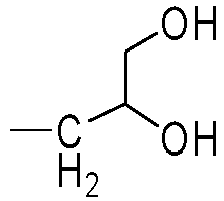 jedes R6 = R5 ist;b eine ganze Zahl ist, die ausgewählt ist aus der Gruppe bestehend aus 1 bis 70;c eine ganze Zahl ist, die ausgewählt ist aus der Gruppe bestehend aus 0 bis 70;d eine ganze Zahl ist, die ausgewählt ist aus der Gruppe bestehend aus 0 bis 70;e eine ganze Zahl ist, die ausgewählt ist aus der Gruppe bestehend aus 1 bis 50;f eine ganze Zahl ist, die ausgewählt ist aus der Gruppe bestehend aus 0 bis 50;g eine ganze Zahl ist, die ausgewählt ist aus der Gruppe bestehend aus 0 bis 50;die vernetzten Hyaluronsäuren der Formel (I) oder der Formel (II) einen Vernetzungsprozentsatz (C.D., cross-linking degree) von 0,030 bis 0,900 %, gemessen wie in der Beschreibung offenbart, haben;die Polyglycerole der Formel (III) oder der Formel (IV) ein Gewichtsmittel des Molekulargewichts (Mw) von 240 bis 3.700 Da haben, gemessen durch Größenausschlusschromatographie in Verbindung mit einem UV-Vis- und Massendetektor (SEC/UV/MS); unddie Konzentration von Polyglycerolen der Formel (III) oder der Formel (IV) oder einer Mischung davon in der Zusammensetzung von 0,45 bis 25 mg/mL reicht;mit der Maßgabe, dass:in den vernetzten Hyaluronsäuren der Formel (I) oder der Formel (II) mindestens ein R1 = R4 ist;wobei:- wenn die Zusammensetzung (a) eine vernetzte Hyaluronsäure der Formel (I) umfasst, dann ist die Zusammensetzung durch ein Verfahren erhältlich, das Folgendes umfasst:i) Vernetzung einer Hyaluronsäure mit einer Verbindung der Formel (V)
 jedes R7 = R2 ist;R2 ist:
 b eine ganze Zahl ist, die ausgewählt ist aus der Gruppe bestehend aus 1 bis 70;c eine ganze Zahl ist, die ausgewählt ist aus der Gruppe bestehend aus 0 bis 70;d eine ganze Zahl ist, die ausgewählt ist aus der Gruppe bestehend aus 0 bis 70;(ii) In-Kontakt-bringen der in Schritt (i) erhaltenen Mischung umfassend (A) eine oder mehrere vernetzte Hyaluronsäuren der Formel (I) und (B) ein oder mehrere Polyglycerole der Formel (III) oder der Formel (IV) mit dem einen oder den mehreren Anästhetika (C);(iii) wahlweise, In-Kontakt-bringen der in Schritt (ii) erhaltenen Mischung mit dem bzw. der einen oder den mehreren Hilfsstoffen oder Trägersubstanzen (D); und(iv) wahlweise, Sterilisieren der in Schritt (iii) erhaltenen Mischung;wobei das Verfahren ferner einen zusätzlichen Waschschritt (vi) nach dem Schritt (i) umfasst;oder ersatzweise,- wenn die Zusammensetzung (a) eine vernetzte Hyaluronsäure der Formel (II) umfasst, dann ist die Zusammensetzung durch ein Verfahren erhältlich, das Folgendes umfasst:i') Vernetzung einer Hyaluronsäure mit einer Verbindung der Formel (VI)
 jedes R7 = R2 ist;R2 ist
 b eine ganze Zahl ist, die ausgewählt ist aus der Gruppe bestehend aus 1 bis 70;c eine ganze Zahl ist, die ausgewählt ist aus der Gruppe bestehend aus 0 bis 70;d eine ganze Zahl ist, die ausgewählt ist aus der Gruppe bestehend aus 0 bis 70;(ii') In-Kontakt-bringen der in Schritt (i') erhaltenen Mischung umfassend (A) eine oder mehrere vernetzte Hyaluronsäuren der Formel (II) und (B) ein oder mehrere Polyglycerole der Formel (III) oder der Formel (IV) mit dem einen oder den mehreren Anästhetika (C);(iii') wahlweise, In-Kontakt-bringen der in Schritt (II') erhaltenen Mischung mit dem bzw. der einen oder den mehreren Hilfsstoffen oder Trägersubstanzen (D); und(iv') wahlweise, Sterilisieren der in Schritt (iii') erhaltenen Mischung;wobei das Verfahren ferner einen zusätzlichen Waschschritt (vi') nach dem Schritt (i') umfasst;oder ersatzweise,- wenn die Zusammensetzung (a) eine Mischung aus einer vernetzten Hyaluronsäure der Formel (I) und der Formel (II) umfasst; dann ist die Zusammensetzung durch ein Verfahren erhältlich, das Folgendes umfasst:i") Vernetzen einer Hyaluronsäure mit einer Mischung umfassend die Verbindung der Formel (V)
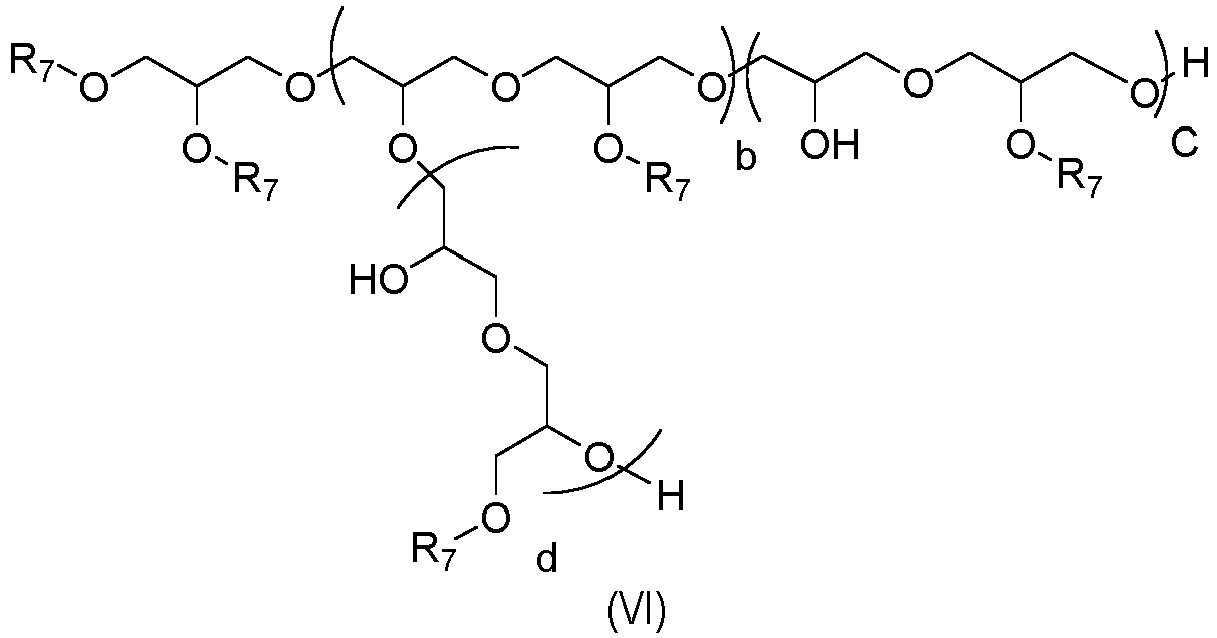 jedes R7 = R2 ist;R2 ist:
 b eine ganze Zahl ist, die ausgewählt ist aus der Gruppe bestehend aus 1 bis 70;c eine ganze Zahl ist, die ausgewählt ist aus der Gruppe bestehend aus 0 bis 70;d eine ganze Zahl ist, die ausgewählt ist aus der Gruppe bestehend aus 0 bis 70;(ii") In-Kontakt-bringen der in Schritt (i") erhaltenen Mischung umfassend (A) eine oder mehrere vernetzte Hyaluronsäuren der Formel (I) und der Formel (II) und (B) ein oder mehrere Polyglycerole der Formel (III) oder der Formel (IV) mit dem einen oder den mehreren Anästhetika (C);(iii") wahlweise, In-Kontakt-bringen der in Schritt (ii") erhaltenen Mischung mit dem bzw. der einen oder den mehreren Hilfsstoffen oder Trägersubstanzen (D); und(iv") wahlweise, Sterilisieren der in Schritt (iii") erhaltenen Mischung;wobei das Verfahren ferner einen zusätzlichen Waschschritt (vi") nach dem Schritt (i") umfasst;wobei der Schritt (vi) oder ersatzweise der Schritt (vi'); oder ersatzweise der Schritt (vi") durch Hinzufügen von einer solchen geeigneten Menge einer sauren Wasserlösung, um einen pH-Wert von 6,5-7,4 und eine Konzentration von Polyglycerolen der Formel (III) oder der Formel (IV) oder einer Mischung davon in der Zusammensetzung von 0,45 bis 25 mg/mL zu erhalten, durchgeführt wird.
 - Die Zusammensetzung nach Anspruch 1, wobei die vernetzte Hyaluronsäure der Formel (I), oder der Formel (II), oder eine Mischung davon, unter Verwendung von Polyglycerolpolyglycidylether (PPE) als Vernetzer mit einem Gewichtsmittel des Molekulargewichts von 204 bis 15000 Da, gemessen durch das Verfahren durch Größenausschlusschromatographie (SEC, size exclusion chromatography), und einem Epoxyäquivalentgewicht von 100 bis 7000 g/eq, gemessen durch ultraschallunterstützte schnelle Titration mit HCl, erhalten wird.
- Die Zusammensetzung nach einem der Ansprüche 1 bis 2, wobei das eine oder die mehreren Polyglycerole der Formel (III) oder der Formel (IV) ausgewählt sind aus der Gruppe bestehend aus:einer Verbindung der Formel (1);
 einer Verbindung der Formel (2);
 einer Verbindung der Formel (3);
 einer Verbindung der Formel (4);
 einer Verbindung der Formel (5);
 einer Verbindung der Formel (6);
 und einer Mischung davon.
 - Die Zusammensetzung nach einem der Ansprüche 1 bis 3, wobei die Konzentration der Hyaluronsäure in der vernetzten Hyaluronsäure der Formel (I) oder der Formel (II) von 1 bis 50 mg/ml reicht.
- Die Zusammensetzung nach einem der Ansprüche 1 bis 4, wobei das Gewichtsmittel des Molekulargewichts der Hyaluronsäure der vernetzten Hyaluronsäure der Formel (I) oder der Formel (II) von 100 bis 3000 kDa, gemessen durch das Verfahren durch Größenausschlusschromatographie (SEC), reicht.
- Die Zusammensetzung nach einem der Ansprüche 1 bis 5, wobei das Lokalanästhetikum ausgewählt ist aus der Gruppe bestehend aus Ambucain, Amolanon, Amyokain, Articain, Benoxinat, Benzocain, Betoxycain, Biphenamin, Bupivacain, Butacain, Butamben, Butanilicain, Butethamin, Butoxycain, Chlorprokain, Cocaethylen, Kokain, Cyclomethycain, Dibucain, Dimethyisoquin, Dimethocain, Diperodon, Dicyclomin, Ecgonidin, Ecgonin, Etidocain, Beta-Eucain, Euprocin, Fenalcomin, Farmocain, Fomocain, Hexylcain, Hydroxytetracain, Isobutyl-p-aminobenzoat, Leucinocainmesylat, Levoxadrol, Lidocain, Mepivacain, Meprylcain, Metabutoxycain, Myrtecain, Naepain, Octacain, Orthocain, Oxethazain, Parethoxycain, Phenacain, Phenol, Piperocain, Piridocain, Polidocanol, Pramoxin, Prilocain, Prokain, Propanocain, Proparacain, Propipocain, Propoxycain, Pseudococain, Pyrrocain, Ropivacain, Salicylalkohol, Tetracain, Tolcain, Trimecain, Zolamin, und einer Mischung davon.
- Die Zusammensetzung nach einem der Ansprüche 1 bis 6, wobei:- wenn die Zusammensetzung (a) eine vernetzte Hyaluronsäure der Formel (I) umfasst, dann ist die Zusammensetzung durch ein Verfahren erhältlich, das Folgendes umfasst:i) Vernetzen einer Hyaluronsäure mit einer Verbindung der Formel (V), die:ein Gewichtsmittel des Molekulargewichts (Mw) von 204 bis 15.000 Da, gemessen durch das Verfahren durch Größenausschlusschromatographie (SEC); undein Epoxidäquivalentgewicht von 100 bis 7.000 g/eq, gemessen durch ultraschallunterstützte schnelle Titration mit HCl, hat;oder ersatzweise,- wenn die Zusammensetzung (a) eine vernetzte Hyaluronsäure der Formel (II) umfasst, dann ist die Zusammensetzung durch ein Verfahren erhältlich, das Folgendes umfasst:i') Vernetzen einer Hyaluronsäure mit einer Verbindung der Formel (VI), die:ein Gewichtsmittel des Molekulargewichts (Mw) von 204 bis 15.000 Da, gemessen durch das Verfahren durch Größenausschlusschromatographie (SEC); undein Epoxidäquivalentgewicht von 100 bis 7.000 g/eq, gemessen durch ultraschallunterstützte schnelle Titration mit HCl, hat;oder ersatzweise,- wenn die Zusammensetzung (a) eine Mischung aus einer vernetzten Hyaluronsäure der Formel (I) und der Formel (II) umfasst; dann ist die Zusammensetzung durch ein Verfahren erhältlich, das Folgendes umfasst:i") Vernetzen einer Hyaluronsäure mit einer Mischung umfassend die Verbindung der Formel (V) und die Verbindung der Formel (VI) , die:ein Gewichtsmittel des Molekulargewichts (Mw) von 204 bis 15.000 Da, gemessen durch das Verfahren durch Größenausschlusschromatographie (SEC); undein Epoxidäquivalentgewicht von 100 bis 7.000 g/eq, gemessen durch ultraschallunterstützte schnelle Titration mit HCl, hat.
- Die Zusammensetzung nach einem der Ansprüche 1 bis 7, wobei:- wenn die Zusammensetzung (a) eine vernetzte Hyaluronsäure der Formel (I) umfasst, dann ist die Zusammensetzung durch ein Verfahren erhältlich, welches einen zusätzlichen Schritt (v) nach dem Schritt (ii); oder ersatzweise nach dem Schritt (iii), oder ersatzweise nach dem Schritt (iv) umfasst, umfassend die Zugabe einer Verbindung der Formel (III), einer Verbindung der Formel (IV) oder einer Mischung davon;
oder ersatzweise,- wenn die Zusammensetzung (a) eine vernetzte Hyaluronsäure der Formel (II) umfasst, dann ist die Zusammensetzung durch ein Verfahren erhältlich, welches einen zusätzlichen Schritt (v') nach dem Schritt (ii'); oder ersatzweise nach dem Schritt (iii'), oder ersatzweise nach dem Schritt (iv') umfasst, umfassend die Zugabe einer Verbindung der Formel (III), einer Verbindung der Formel (IV) oder einer Mischung davon;
oder ersatzweise,- wenn die Zusammensetzung (a) eine Mischung aus einer vernetzten Hyaluronsäure der Formel (I) und der Formel (II) umfasst; dann ist die Zusammensetzung durch ein Verfahren erhältlich, welches einen zusätzlichen Schritt (v") nach dem Schritt (ii"); oder ersatzweise nach dem Schritt (iii") oder ersatzweise nach dem Schritt (iv") umfasst, der die Zugabe einer Verbindung der Formel (III), einer Verbindung der Formel (IV) oder einer Mischung davon umfasst. - Die Zusammensetzung nach einem der Ansprüche 1 bis 8, welche in Form einer injizierbaren Zusammensetzung ist.
- Die Zusammensetzung wie in einem der Ansprüche 1 bis 9 definiert, welche eine pharmazeutische Zusammensetzung ist, umfassend:eine therapeutisch wirksame Menge der einen oder der mehreren vernetzten Hyaluronsäuren der Formel (I), der Formel (II) oder einer Mischung davon;eine therapeutisch wirksame Menge des einen oder der mehreren Polyglycerole der Formel (III) oder der Formel (IV) oder einer Mischung davon;eine therapeutisch wirksame Menge eines oder mehrerer Anästhetika undwahlweise, einen bzw. eine oder mehrere pharmazeutisch akzeptable Hilfsstoffe oder Trägersubstanzen; zur Verwendung in der Therapie;oder ersatzweise,die Verwendung einer Zusammensetzung wie in einem der Ansprüche 1 bis 9 definiert, welche eine kosmetische Zusammensetzung ist, umfassend:eine kosmetisch wirksame Menge der einen oder der mehreren vernetzten Hyaluronsäuren der Formel (I), der Formel (II) oder einer Mischung davon;eine kosmetisch wirksame Menge des einen oder der mehreren Polyglycerole der Formel (III) oder der Formel (IV) oder einer Mischung davon;eine kosmetisch wirksame Menge eines oder mehrerer Anästhetika undwahlweise, einen bzw. eine oder mehrere kosmetisch akzeptable Hilfsstoffe oder Trägersubstanzen als Hautpflegemittel; insbesondere als Hautfüllstoff.
- Verwendung einer Zusammensetzung wie in einem der Ansprüche 1 bis 10 definiert, als Trägersubstanz; insbesondere als Arzneimittelabgabesystem.
Applications Claiming Priority (2)
| Application Number | Priority Date | Filing Date | Title |
|---|---|---|---|
| EP21183109 | 2021-07-01 | ||
| PCT/EP2022/068056 WO2023275241A1 (en) | 2021-07-01 | 2022-06-30 | Crosslinked hyaluronic acid composition with local anesthetics |
Publications (3)
| Publication Number | Publication Date |
|---|---|
| EP4362994A1 EP4362994A1 (de) | 2024-05-08 |
| EP4362994B1 true EP4362994B1 (de) | 2025-03-12 |
| EP4362994C0 EP4362994C0 (de) | 2025-03-12 |
Family
ID=76744682
Family Applications (1)
| Application Number | Title | Priority Date | Filing Date |
|---|---|---|---|
| EP22740376.3A Active EP4362994B1 (de) | 2021-07-01 | 2022-06-30 | Vernetzte hyaluronsäurezusammensetzung mit lokalanästhetika |
Country Status (10)
| Country | Link |
|---|---|
| US (1) | US12329856B2 (de) |
| EP (1) | EP4362994B1 (de) |
| JP (1) | JP2024524990A (de) |
| KR (1) | KR20240029774A (de) |
| CN (1) | CN117597153A (de) |
| AR (1) | AR126276A1 (de) |
| ES (1) | ES3029221T3 (de) |
| MX (1) | MX2023014960A (de) |
| PL (1) | PL4362994T3 (de) |
| WO (1) | WO2023275241A1 (de) |
Family Cites Families (6)
| Publication number | Priority date | Publication date | Assignee | Title |
|---|---|---|---|---|
| TWI251596B (en) * | 2002-12-31 | 2006-03-21 | Ind Tech Res Inst | Method for producing a double-crosslinked hyaluronate material |
| ES2310948B2 (es) * | 2005-02-25 | 2009-09-16 | Universidade De Santiago De Compostela | Procedimiento de obtencion de hidrogeles de ciclodextrinas con glicidileteres, las composiciones obtenidas y sus aplicaciones. |
| FR3015290B1 (fr) * | 2013-12-23 | 2017-01-13 | Lab Vivacy | Compositions d'acide hyaluronique compreant de la mepivacaine |
| US10130578B2 (en) * | 2015-07-23 | 2018-11-20 | Johnson & Johnson Consumer Inc. | Topical delivery of skin compositions having low pH |
| KR102201482B1 (ko) * | 2019-07-29 | 2021-01-13 | 주식회사 피움바이오 | 주입력이 우수한 가교된 히알루론산 기반 기능성 생체 적합성 고분자 복합체의 제조 방법 |
| WO2021064006A1 (en) * | 2019-10-01 | 2021-04-08 | Biopolimeri S.R.L. | A hyperbranched polyglycerol polyglycidyl ether and its use as crosslinker for polysaccharides |
-
2022
- 2022-06-29 AR ARP220101705A patent/AR126276A1/es unknown
- 2022-06-30 KR KR1020247003665A patent/KR20240029774A/ko active Pending
- 2022-06-30 ES ES22740376T patent/ES3029221T3/es active Active
- 2022-06-30 US US18/575,483 patent/US12329856B2/en active Active
- 2022-06-30 EP EP22740376.3A patent/EP4362994B1/de active Active
- 2022-06-30 JP JP2023579167A patent/JP2024524990A/ja active Pending
- 2022-06-30 CN CN202280047173.1A patent/CN117597153A/zh active Pending
- 2022-06-30 MX MX2023014960A patent/MX2023014960A/es unknown
- 2022-06-30 PL PL22740376.3T patent/PL4362994T3/pl unknown
- 2022-06-30 WO PCT/EP2022/068056 patent/WO2023275241A1/en not_active Ceased
Also Published As
| Publication number | Publication date |
|---|---|
| ES3029221T3 (en) | 2025-06-23 |
| EP4362994A1 (de) | 2024-05-08 |
| KR20240029774A (ko) | 2024-03-06 |
| US12329856B2 (en) | 2025-06-17 |
| WO2023275241A1 (en) | 2023-01-05 |
| MX2023014960A (es) | 2024-02-16 |
| AR126276A1 (es) | 2023-10-04 |
| EP4362994C0 (de) | 2025-03-12 |
| PL4362994T3 (pl) | 2025-07-07 |
| JP2024524990A (ja) | 2024-07-09 |
| CN117597153A (zh) | 2024-02-23 |
| US20240293311A1 (en) | 2024-09-05 |
Similar Documents
| Publication | Publication Date | Title |
|---|---|---|
| EP3433284B1 (de) | Modifizierte hyaluronsäure, verfahren zur herstellung davon und verwendung | |
| US10307362B2 (en) | Dermal injectable sterile composition | |
| EP3324931B1 (de) | In-situ-vernetzbare polysaccharidzusammensetzungen und verwendungen davon | |
| CN104394934B (zh) | 包含至少一种透明质酸及至少一种蔗糖八硫酸酯水溶性盐的在水性介质中的组合物 | |
| US11857682B2 (en) | Hyaluronate compositions and soft tissue fillers | |
| EP4038105B1 (de) | Hochverzweigtes polyglycerinpolyglycidylether und dessen verwendung als vernetzer für polysaccharide | |
| US12329856B2 (en) | Crosslinked hyaluronic acid composition with local anesthetics | |
| EP3162813A1 (de) | Verfahren zur abreicherung von epoxidsorten in vernetzten polysaccharidgelzusammensetzungen und dadurch erhaltene zusammensetzungen | |
| HK40112606A (en) | Crosslinked hyaluronic acid composition with local anesthetics | |
| HK40112606B (en) | Crosslinked hyaluronic acid composition with local anesthetics |
Legal Events
| Date | Code | Title | Description |
|---|---|---|---|
| STAA | Information on the status of an ep patent application or granted ep patent |
Free format text: STATUS: UNKNOWN |
|
| STAA | Information on the status of an ep patent application or granted ep patent |
Free format text: STATUS: THE INTERNATIONAL PUBLICATION HAS BEEN MADE |
|
| PUAI | Public reference made under article 153(3) epc to a published international application that has entered the european phase |
Free format text: ORIGINAL CODE: 0009012 |
|
| STAA | Information on the status of an ep patent application or granted ep patent |
Free format text: STATUS: REQUEST FOR EXAMINATION WAS MADE |
|
| 17P | Request for examination filed |
Effective date: 20240201 |
|
| AK | Designated contracting states |
Kind code of ref document: A1 Designated state(s): AL AT BE BG CH CY CZ DE DK EE ES FI FR GB GR HR HU IE IS IT LI LT LU LV MC MK MT NL NO PL PT RO RS SE SI SK SM TR |
|
| DAV | Request for validation of the european patent (deleted) | ||
| DAX | Request for extension of the european patent (deleted) | ||
| GRAP | Despatch of communication of intention to grant a patent |
Free format text: ORIGINAL CODE: EPIDOSNIGR1 |
|
| STAA | Information on the status of an ep patent application or granted ep patent |
Free format text: STATUS: GRANT OF PATENT IS INTENDED |
|
| INTG | Intention to grant announced |
Effective date: 20241010 |
|
| REG | Reference to a national code |
Ref country code: HK Ref legal event code: DE Ref document number: 40112606 Country of ref document: HK |
|
| GRAL | Information related to payment of fee for publishing/printing deleted |
Free format text: ORIGINAL CODE: EPIDOSDIGR3 |
|
| GRAS | Grant fee paid |
Free format text: ORIGINAL CODE: EPIDOSNIGR3 |
|
| GRAA | (expected) grant |
Free format text: ORIGINAL CODE: 0009210 |
|
| STAA | Information on the status of an ep patent application or granted ep patent |
Free format text: STATUS: THE PATENT HAS BEEN GRANTED |
|
| AK | Designated contracting states |
Kind code of ref document: B1 Designated state(s): AL AT BE BG CH CY CZ DE DK EE ES FI FR GB GR HR HU IE IS IT LI LT LU LV MC MK MT NL NO PL PT RO RS SE SI SK SM TR |
|
| REG | Reference to a national code |
Ref country code: GB Ref legal event code: FG4D |
|
| REG | Reference to a national code |
Ref country code: CH Ref legal event code: EP |
|
| REG | Reference to a national code |
Ref country code: DE Ref legal event code: R096 Ref document number: 602022011774 Country of ref document: DE |
|
| REG | Reference to a national code |
Ref country code: IE Ref legal event code: FG4D |
|
| U01 | Request for unitary effect filed |
Effective date: 20250326 |
|
| U07 | Unitary effect registered |
Designated state(s): AT BE BG DE DK EE FI FR IT LT LU LV MT NL PT RO SE SI Effective date: 20250402 |
|
| REG | Reference to a national code |
Ref country code: ES Ref legal event code: FG2A Ref document number: 3029221 Country of ref document: ES Kind code of ref document: T3 Effective date: 20250623 |
|
| PG25 | Lapsed in a contracting state [announced via postgrant information from national office to epo] |
Ref country code: RS Free format text: LAPSE BECAUSE OF FAILURE TO SUBMIT A TRANSLATION OF THE DESCRIPTION OR TO PAY THE FEE WITHIN THE PRESCRIBED TIME-LIMIT Effective date: 20250612 |
|
| PGFP | Annual fee paid to national office [announced via postgrant information from national office to epo] |
Ref country code: MC Payment date: 20250604 Year of fee payment: 4 |
|
| PGFP | Annual fee paid to national office [announced via postgrant information from national office to epo] |
Ref country code: PL Payment date: 20250602 Year of fee payment: 4 |
|
| PGFP | Annual fee paid to national office [announced via postgrant information from national office to epo] |
Ref country code: NO Payment date: 20250627 Year of fee payment: 4 |
|
| PG25 | Lapsed in a contracting state [announced via postgrant information from national office to epo] |
Ref country code: HR Free format text: LAPSE BECAUSE OF FAILURE TO SUBMIT A TRANSLATION OF THE DESCRIPTION OR TO PAY THE FEE WITHIN THE PRESCRIBED TIME-LIMIT Effective date: 20250312 |
|
| PG25 | Lapsed in a contracting state [announced via postgrant information from national office to epo] |
Ref country code: GR Free format text: LAPSE BECAUSE OF FAILURE TO SUBMIT A TRANSLATION OF THE DESCRIPTION OR TO PAY THE FEE WITHIN THE PRESCRIBED TIME-LIMIT Effective date: 20250613 |
|
| PGFP | Annual fee paid to national office [announced via postgrant information from national office to epo] |
Ref country code: TR Payment date: 20250620 Year of fee payment: 4 |
|
| PGFP | Annual fee paid to national office [announced via postgrant information from national office to epo] |
Ref country code: IE Payment date: 20250627 Year of fee payment: 4 |
|
| U20 | Renewal fee for the european patent with unitary effect paid |
Year of fee payment: 4 Effective date: 20250702 |
|
| PG25 | Lapsed in a contracting state [announced via postgrant information from national office to epo] |
Ref country code: SM Free format text: LAPSE BECAUSE OF FAILURE TO SUBMIT A TRANSLATION OF THE DESCRIPTION OR TO PAY THE FEE WITHIN THE PRESCRIBED TIME-LIMIT Effective date: 20250312 |
|
| PGFP | Annual fee paid to national office [announced via postgrant information from national office to epo] |
Ref country code: ES Payment date: 20250701 Year of fee payment: 4 |
|
| PGFP | Annual fee paid to national office [announced via postgrant information from national office to epo] |
Ref country code: CH Payment date: 20250701 Year of fee payment: 4 |
|
| PG25 | Lapsed in a contracting state [announced via postgrant information from national office to epo] |
Ref country code: CZ Free format text: LAPSE BECAUSE OF FAILURE TO SUBMIT A TRANSLATION OF THE DESCRIPTION OR TO PAY THE FEE WITHIN THE PRESCRIBED TIME-LIMIT Effective date: 20250312 |
|
| PG25 | Lapsed in a contracting state [announced via postgrant information from national office to epo] |
Ref country code: SK Free format text: LAPSE BECAUSE OF FAILURE TO SUBMIT A TRANSLATION OF THE DESCRIPTION OR TO PAY THE FEE WITHIN THE PRESCRIBED TIME-LIMIT Effective date: 20250312 |
|
| PG25 | Lapsed in a contracting state [announced via postgrant information from national office to epo] |
Ref country code: IS Free format text: LAPSE BECAUSE OF FAILURE TO SUBMIT A TRANSLATION OF THE DESCRIPTION OR TO PAY THE FEE WITHIN THE PRESCRIBED TIME-LIMIT Effective date: 20250712 |
|
| PLBE | No opposition filed within time limit |
Free format text: ORIGINAL CODE: 0009261 |
|
| STAA | Information on the status of an ep patent application or granted ep patent |
Free format text: STATUS: NO OPPOSITION FILED WITHIN TIME LIMIT |
|
| REG | Reference to a national code |
Ref country code: CH Ref legal event code: L10 Free format text: ST27 STATUS EVENT CODE: U-0-0-L10-L00 (AS PROVIDED BY THE NATIONAL OFFICE) Effective date: 20260121 |
|
| 26N | No opposition filed |
Effective date: 20251215 |