EP4353884A1 - Verfahren zur herstellung von haltbaren biologisch abbaubaren mischgarnen, vorrichtung zur herstellung von mischgarnen und mit diesem verfahren hergestellte mischgarne - Google Patents
Verfahren zur herstellung von haltbaren biologisch abbaubaren mischgarnen, vorrichtung zur herstellung von mischgarnen und mit diesem verfahren hergestellte mischgarne Download PDFInfo
- Publication number
- EP4353884A1 EP4353884A1 EP22819010.4A EP22819010A EP4353884A1 EP 4353884 A1 EP4353884 A1 EP 4353884A1 EP 22819010 A EP22819010 A EP 22819010A EP 4353884 A1 EP4353884 A1 EP 4353884A1
- Authority
- EP
- European Patent Office
- Prior art keywords
- yarn
- yarns
- mixed
- biodegradable
- fibres
- Prior art date
- Legal status (The legal status is an assumption and is not a legal conclusion. Google has not performed a legal analysis and makes no representation as to the accuracy of the status listed.)
- Withdrawn
Links
Images



Classifications
-
- D—TEXTILES; PAPER
- D02—YARNS; MECHANICAL FINISHING OF YARNS OR ROPES; WARPING OR BEAMING
- D02G—CRIMPING OR CURLING FIBRES, FILAMENTS, THREADS, OR YARNS; YARNS OR THREADS
- D02G3/00—Yarns or threads, e.g. fancy yarns; Processes or apparatus for the production thereof, not otherwise provided for
- D02G3/22—Yarns or threads characterised by constructional features, e.g. blending, filament/fibre
- D02G3/38—Threads in which fibres, filaments, or yarns are wound with other yarns or filaments, e.g. wrap yarns, i.e. strands of filaments or staple fibres are wrapped by a helically wound binder yarn
-
- D—TEXTILES; PAPER
- D02—YARNS; MECHANICAL FINISHING OF YARNS OR ROPES; WARPING OR BEAMING
- D02G—CRIMPING OR CURLING FIBRES, FILAMENTS, THREADS, OR YARNS; YARNS OR THREADS
- D02G1/00—Producing crimped or curled fibres, filaments, yarns, or threads, giving them latent characteristics
- D02G1/16—Producing crimped or curled fibres, filaments, yarns, or threads, giving them latent characteristics using jets or streams of turbulent gases, e.g. air, steam
-
- D—TEXTILES; PAPER
- D02—YARNS; MECHANICAL FINISHING OF YARNS OR ROPES; WARPING OR BEAMING
- D02J—FINISHING OR DRESSING OF FILAMENTS, YARNS, THREADS, CORDS, ROPES OR THE LIKE
- D02J1/00—Modifying the structure or properties resulting from a particular structure; Modifying, retaining, or restoring the physical form or cross-sectional shape, e.g. by use of dies or squeeze rollers
- D02J1/08—Interlacing constituent filaments without breakage thereof, e.g. by use of turbulent air streams
-
- D—TEXTILES; PAPER
- D10—INDEXING SCHEME ASSOCIATED WITH SUBLASSES OF SECTION D, RELATING TO TEXTILES
- D10B—INDEXING SCHEME ASSOCIATED WITH SUBLASSES OF SECTION D, RELATING TO TEXTILES
- D10B2401/00—Physical properties
- D10B2401/12—Physical properties biodegradable
Definitions
- the present invention relates to the technological sector of Textile Engineering and concerns a process for producing mixed yarns comprising at least one yarn spun from natural or artificial fibres and at least one air-textured or flat filament yarn being synthetic or artificial.
- the present invention relates to mixed yarns derived from this process.
- the need and duty to protect the environment from the massive overflow of oil-based raw materials from irregular processes in the textile chain, polluting and non-biodegradable and/or non-chemically recycled raw materials, is the new purpose of industries and consumers.
- the textile chain is complex and there is little communication between the beginning of the chain, relating to fibres and yarns - the soul of the garment, and the end of the chain being the direct sale of clothes in shops to consumers.
- Document BR 10 2018 075494 7 describes a process for producing mixed yarns and mixed yarns obtained by coupling or adding or attaching spun yarns and cut fibre. This process uses compressed air injection with a pressure ranging from 0.5 to 8 Bar in order to enable the filaments to create interlacing points. It also operates at winding packing bobbin speeds ranging from 50 to 1200m/min.
- Document EP 0 161 572 describes a method for producing a mixed yarn of at least one false twist textured filament yarn made from synthetic thermoplastic material and at least one twisted staple fibre yarn made from natural cotton fibres with the application of air injection. This document indicates the use of elastomer or polyurethane yarn, for a better fixation of the yarns.
- Document EP 0 119 044 describes a process for the production of a partially orientated, synthetic, polymeric, continuous filament yarn with high shrinkage potential. This process results in an oriented fibre and necessarily applies a steam chamber.
- Document KR 100 725 042 describes with yarns made from synthetic fibre material which are produced by a process using a tray in a vacuum suction-type mixing unit and, at the same time, monofilament yarn material using high-pressure air through feed rollers. This process necessarily involves heat treatment and a vacuum suction unit.
- Document KR 100 752 277 describes complex finished yarns comprising one or two or more synthetic fibre material yarns and one or two or more of the main natural fibres of short fibre material yarns are mixed complex finished yarns. In the process described in this document, a sequence of air tubes is used to provide these complex yarns.
- Document US 5,680,684 describes a method of air blending comprising: imparting a degree of blend to at least one synthetic yarn with another synthetic yarn; providing a series of signals with a fluctuation of 1/f; and varying the degree of blend imparted to the yarn corresponding to a varied strength of the series of signals with a fluctuation of 1/f. This document does not deal with mixed yarns (natural and artificial fibre).
- Document US 2016/0010246 describes a blended yarn comprising a continuous thermoplastic resin fibre and a continuous reinforcing fibre as fibre components, which has twist, the continuous reinforcing fibre being a carbon fibre and/or a glass fibre.
- Document US 6,564,438 describes a method for treating a composite continuous filament yarn: comprising an air jet yarn texturisation step and a yarn heating step.
- Document PI 0701681-6 discloses equipment for the production of mixed yarns comprising a rectangular piece preferably made of aluminium which includes a yarn guide preferably located in the upper front and left part, and in its central portion there are 3 pulleys of different diameters and axial to each other by means of the shaft; the first pulley feeds the equipment with the effect yarn (a), the second pulley determines the amount of effect yarn (a), the proportion of which can vary from 1% to 200%, and the third pulley feeds the equipment with the mixed yarn (b); two tubes intercept the piece perpendicularly through these tubes the primary yarns coming from the bobbin Rack enter the equipment; in the centre back of the rectangular piece there is a brake pulley and a bearing with two bearings. By means of weights, the nylon cord that semi-circles the third brake pulley paralyses the rotation of the pulleys.
- a problem that can be detected in the state of the art is that these mixed yarn production processes are applied to winding machine, where spun yarns from natural material or from natural and artificial blends via vortex, ring spinning machine and/or rotor are previously produced and require a new process applied to winding machine that are not interconnected in the main textile production chain (production of mixed yarns via vortex, ring spinning machine and rotor), and these spun yarns present on winding machines are interlaced to a virgin synthetic filament that is not recycled, let alone biodegradable, to become the final product.
- Another problem with the state of the art is that the fibres of the spun yarns and the oligomers are dispersed by the injection nozzle when the mixed yarns are interlaced, contaminating the entire production of mixed yarns and making it impossible to diversify the product compositions being manufactured simultaneously. In addition, this contamination of oligomers and dispersed fibres puts the safety of professionals on the mixed yarn production line at risk.
- Another problem is that the use of spring-loaded washers tensioners that apply a constant tension to different types of continuous filaments at high speed does not produce the right interlacing points in the final product yarn.
- a solution to these problems is provided by the present invention, through a production process for mixed yarns that can be easily incorporated into existing production lines, through a single and independent device (plug & play), which receives spun yarns from vortex, ring spinneret and rotor processes and interlace them to synthetic and/or artificial filament in a single main production flow, through concentrated jets of compressed air to create interlacing points, in which biodegradable and recycled continuous filaments have greater elongation, not requiring the use of spring-loaded washers tensioners and not requiring the use of a filament feeder.
- plug & play which receives spun yarns from vortex, ring spinneret and rotor processes and interlace them to synthetic and/or artificial filament in a single main production flow
- concentrated jets of compressed air to create interlacing points, in which biodegradable and recycled continuous filaments have greater elongation, not requiring the use of spring-loaded washers tensioners and not requiring the use of a filament feeder.
- this device operates in a closed container, reducing the dispersion of fibres in the air, which increases the operating time of the machines before they need to be cleaned, and avoids the contamination of the production line by fibres and oligomers, which makes it possible to produce yarns with different raw material compositions in the same physical space, giving more versatility to the factory floor.
- Another objective of the present invention is to provide a process for producing textile yarns that prevents chemical pollution of textiles and textile fibres in the environment and especially in the oceans, since it uses a lighter purging solution for cleaning, less use of baths for dyeing biodegradable and/or chemically recycled synthetic filaments, filaments that have already been dope-dyed and also prevents the release of natural and/or artificial fibres during the use and washing of clothes.
- Another objective of the present invention is to provide a device that is compatible with automated processes for the production of mixed yarns, in line with global trends in Industry 4.0.
- Another objective of the present invention is to provide an automated process for the production of mixed yarns that can be controlled by artificial intelligence algorithms.
- Another objective of the present invention is to provide an automatically operating container that allows the process of interlacing the spun yarn and the synthetic filament to take place in a confined space, but which also allows automatic yarn splicing by automatically opening the container.
- Another objective of the present invention is to improve the exact quality of the raw material compositions of mixed yarns.
- Another objective of the present invention is to improve the process of spinning close-blend yarns by adding at least one air-texturised or flat filament and/or at least one natural and/or artificially spun yarn in the last stage of the process of the vortex yarns, rotor filament and ring filament of the winders that are interconnected to the process, creating a new hybrid of mixed yarns.
- Another objective of the present invention is to prevent a large stock of mixed yarns and to lead the production of mixed yarns by interlacing spun yarn and filament applied to a secondary flow of mixed yarns produced in winding machine that are not interconnected to the process, using virgin raw materials that are easy to sell rather than a mixed yarn that is more specifically sold.
- Another objective of the present invention is to improve the process of spinning natural and artificial spun yarns by adding at least one recycled filament and/or one that contains part of the recycled raw material that is air-texturised or flat with nano-technology characteristics embedded in the internal molecules of the filaments, creating a new and wide range of comfortable and functional mixed yarns.
- Another objective of the present invention is to provide a process for producing mixed yarns that mitigates contamination of the production line by fibres and oligomers and offers greater safety for workers and the environment.
- Another objective of the present invention is to provide a more efficient and productive process and product as the filament is introduced at the end of the mixed yarn process, causing fewer breaks in the spun yarns and/or recycled spun yarns due to the resistance of the filaments, requiring less splicer action.
- the present invention achieves these and/or other objectives by means of a process for producing mixed yarns that comprises the following stages:
- the present invention achieves these and/or other objectives by means of durable biodegradable and/or recycled mixed yarns obtainable by means of the above process.
- the present invention relates to a process for the production of mixed yarns made from compressed air interlacing points, said process being able to be specially assembled and/or adapted to spun yarn machines in existing or future spinning mills.
- the process of the present invention uses compressed air textured filaments and/or flat filaments, all of which are artificial and/or synthetic, biodegradable and/or chemically recycled, interwoven with natural and/or artificial spun fibre yarns.
- the invention presents a unique solution for automation in the production of mixed yarns, through a containerised device for automatic opening and closing in the event of a yarn break or other stoppages in the production flow.
- the process of the present invention comprises the following steps:
- the mixed yarns 13, spun yarns 11 and continuous filament yarns 12 are guided at all stages by means of yarn guides and ceramic eyelets 18 with rounded ends, so as to minimise the chances of each yarn breaking.
- the process covered by the present invention comprises the spinning of natural or artificial fibre yarns spun on vortex, rotor and ring spinning machines. These spun yarns 11 can be received for the interlacing process from the respective vortex, rotor and ring spinning machines, or they can be adapted or interconnected directly in the last winding stage of the mixed yarn in the packing bobbin preparation, ready for use.
- This first realisation includes the following features:
- the final mixed yarn product also contains another natural or artificial spun fibre yarn in addition to the one already being produced in the linked spinning process, this will be done. It should be noted that the major production requirement is to put at least one synthetic or artificial biodegradable continuous filament yarn into the spun yarn production process.
- Another advantage in relation to the final product is that the process of interlacing a spun yarn with a continuous filament carried out by device 01 generates interlacing points in which the space between the interlacing points is not exactly the same, generating a better visual appearance, which prevents the marking of uniform bars and lines on the fabrics, promoting a blending and uniformisation of yarns. This effect is generated by the inconsistencies in the nature of the union of a spun yarn and a filament.
- the spun yarns 11 come directly from the spun yarn spinning line and are compatible with the most popular methods for spinning spun yarns: vortex (11a), rotor (11b) and ring spinning (11c).
- the continuous filament yarn with or without another spun yarn comes from the bobbin holders rack. Both yarns meet to be parallelised before entering the manual or automatic container and before entering the compressed air nozzle at a distance of 60cm to 10cm, depending on the machine to be used.
- the tensioners can be left loose without tension by passing through the centre orifice of spring-loaded washers tensioner 14 and with the light weight of the ceramic plates alone. This gives a specific tension of 0 gram-force from the tension-free starting point of the spring-loaded washers tensioners 14. Also, if the continuous filament 12 has an elongation of less than 15.70, it is preferable to apply 1 gram-force to the spring-loaded washers tensioners 14.
- the tension applied to the spring-loaded washers tensioners is preferable for the tension applied to the spring-loaded washers tensioners to vary between 15 and 25 grams, depending on the elongation coefficient of the raw material chosen.
- the tension is regulated according to the raw material already stipulated in the process, for example:
- This tension which is exerted on all the yarns, is important for the parallelisation of yarns with different raw materials at the entrance to the compressed air nozzle, where the more stretchness yarn will exert resistant interlacing points on the less stretchness yarns, balancing the difference in elongation between the different raw materials and enabling resistant interlacing points to be used in high-speed fabric machines without causing any visual defects and guaranteeing high fabric machine running efficiency.
- the spun yarn 11 is led to a yarn interlacing device 01, through an inlet 04 of a container 02 and the continuous filament 12 is also led to the inlet 04 of said container 02, where the spun yarn 11 and the continuous filament 12 are interlaced.
- interlacing device 01 comprises a container 02 and a lid 03 with hinge 03a.
- Container 02 comprises a yarn inlet 04 and outlet 05, and an opening 06.
- the container also has the function of protecting the production line from oligomer and fibre contaminants that are dispersed during the compressed air jets that carry out the interlacing.
- Container 02 has a coupling orifice 08 to which an automatic central waste vacuum extraction device is coupled.
- lid 03 can be configured to open automatically.
- the injection nozzle 07 usually changes the type of ceramic insert orifice that the compressed air is entering and forms a differentiated whirlwind that is stronger or less strong. This orifice, along with all the other stages, is also important in forming the interlacing points between yarns made from different raw materials.
- the choice of ceramic insert orifice depends on the final count yarn of the mixed yarn to be produced and the raw material. It is preferable to use the factor of the thickness of the mixed yarn count yarn; the thicker the yarn, the larger the orifice and the thinner, the smaller the orifice. Median count yarn between 60Ne and 20Ne result in the selection of a orifice that is widely commercialised on the market.
- container 02 can include a ceramic insert 10 with the function of creating the whirlwind for interlacing the yarns, and sensors for monitoring the quality of the yarn and the condition of the nozzle 07, as shown in Figures 11 and 12 .
- An advantage of the present invention is that less mass of natural or artificial spun yarn needs to be used.
- the spun yarn is finer and has fewer short fibres on its periphery of the yarn, increasing the quality and durability of the yarns, for the production of a yarn of the same count yarn when compared to conventional 100% natural or artificial yarn. It also generates less fibre dispersion in the environment.
- the whirlwind formed by nozzle 07 is able to remove a multitude of molecules and poorly attached fibres, which are contained inside container 02 and are sucked up by the hoover connected to coupling orifice 08.
- the mixed yarn production process is not contaminated by process residues, reducing the frequency of machine cleaning and maintenance.
- lid 03 of container 02 allows the interlacing process to continue in the event of yarn breakage, or any situations in which both the spun yarn 11 and the continuous filament 12 need to be replaced in the nozzle 07 to resume the mixed yarn interlacing process.
- the automatic opening is configured to work in synchronisation with the yarn splicing elements of the machine itself used in vortex, ring spinning and rotor processes, for when there is a break in the mixed yarn.
- an automated arm captures the mixed yarn 13 produced, at the breaking point, and performs the movement of joining the breaking point of the yarn by moving its broken end to the splicer located before the interlacing device 01.
- the broken yarn is passed through nozzle 07 inside container 02, and the splice is made by the splicer before the entrance to Device (1) without the need for human assistance on automated machines, and the process of interlacing mixed yarn 13 can continue with a constant production flow, allowing the interlacing process to continue in the event of yarn breakage, or any situations in which both the spun yarn 11 and the continuous filament 12 need to be put back into the nozzle 07 to resume the mixed yarn interlacing process. This process can be carried out without compromising the visual and structural characteristics of the mixed yarn.
- suction through the suction coupling orifice 08 must be interrupted. This interruption can be made by a solenoid valve or similar.
- a second preferred embodiment of the process covered by the present invention comprises spinning natural or artificial fibre spun yarns on a vortex, the rotor and ring spinning being adapted to or mounted on non-interconnected winding machine 16.
- This realisation is more costly because it has one more stage for preparing the mixed yarn compared to the first preferred realisation, but it can be very attractive for developing smaller-scale flexible manufacturing of new materials without spending a lot of resources, whereas the production of mixed yarns directly linked to the main spun yarn production process is more efficient, but has less adaptability compared to the process applied in non-linked winding bobbins machines.
- the second realisation can be made in parallel to the first, in order to develop the market or meet specific demands for materials that are not being worked on in the first realisation, and can be easily adapted to the first realisation if large-scale production is required.
- the second preferred embodiment is very similar to the first with the following difference: the spun yarn does not come from the linked spinning process.
- both the plurality of continuous filament and the plurality of spun yarns come from the holders of the racks 19 not linked to the main production of spun yarn 11.
- the continuous filament 12 and the spun yarn 11 pass through tensioners 14 from the rack 19 and are passed through multiple ceramic yarn guides 18 (eyelets).
- the yarn guide 18 serves to direct the yarns through the interlacing process. They then pass through multiple spring-loaded washers tensioners with ceramic plates.
- the spun yarn 11 is led to inlet 04 of container 02 and the continuous filament 12 is led to said inlet 04 of said container 02, where the spun yarn 11 and the continuous filament 12 are interlaced by means of air injection.
- container 02 which contains the raw materials during the yarn interlacing process.
- This container 02 completely isolates the nozzle 07 responsible for joining the spun yarn and the continuous filament, as shown in figures 10 and 12 .
- the automatic hoover for textile waste such as oligomers and fibres which is connected to the central hoover of each machine/equipment, is attached to the back of container 02, which is fixed to the machine and does not interfere with the opening and closing of automatic or manual container 02. With the hoover, there is no need to stop the machine spindle to clean the nozzle and the container walls. Only this function of vacuuming and depositing for correct waste disposal.
- Interlacing device 01 can have sensing cameras inside or outside container 02 to monitor the process and the quality of the yarn. In this way, an algorithm controlled by artificial intelligence can be taught (from the term machine learning) to identify the structures of the mixed yarn, and thus have the controller issue commands to the various tanners on the production line, controlling the quality of the final mixed yarn in relation to a reference.
- the interlacing device 01 may contain a sensor for monitoring the state of the injector nozzle.
- Fibre should be understood as the unit of matter, characterised by its flexibility, fineness and high ratio between length and fineness, whose properties make it capable of being transformed into spun yarn. This definition also applies to determining the size of a natural fibre, synthetic or artificial fibre. Fibres cut or discontinued according to different cutting lengths, thus corresponding to the English term "staple”, cut or discontinuous synthetic fibres are not part of the present invention because they have already been scientifically analysed by several technical institutes. Synthetic staple fiber are one of the major causes of microfibre synthetic pollution in the oceans, a large part of which comes mainly from industrial products and processes containing cut or discontinuous synthetic fibres.
- any material from the three kingdoms of nature that has the capacity to produce spun yarn is considered to be a staple fibre.
- figure 1 illustrates the textile industry chain.
- the fibres also have biological properties, which are analysed technically in terms of the circular and sustainable nature of the textile industry:
- Cotton fibre Pesticides are used in more than 95% of the world's cotton production, making them a major problem for this crop. Its productivity in terms of crops is estimated at 1,685 kilos of cotton lint per hectare. The world's annual production of cotton lint currently stands at 25 million tonnes. These figures reveal the pollution of pesticides being dumped on the ground, contaminating rivers and groundwater, dumping tonnes of pesticides into the oceans every day, already impacting the oceans by acidifying the waters and exterminating corals, destroying the life cycle of the oceans and damaging the algae in the production of oxygen that keeps the earth and living beings alive.
- cotton is a natural plant that was chosen in the industrial revolution because of its economic interest for a few producers and because it is difficult to process compared to other natural fibres, it has reduced competition between producers, creating a huge economic interest around it and marketed on a large scale for a few.
- the need for a lot of water per hectare of land is a detrimental factor if cotton fibre is to be marketed on a large scale in times of climate change. 53% of cotton plantations are irrigated, which corresponds to 73% of production. The average consumption in this production is calculated at around 10,000 litres of water per kilo of fibre produced. The most widely used system is furrow flooding, which is considered less efficient.
- the drip technique can help reduce water consumption, for example: it is estimated that drip irrigation reduces the amount of water used by at least 16 to 30 per cent compared to flood or furrow systems, but even so water consumption is high.
- cotton from the field to the end product consumes an average of 2,33 thousand litres of water per kilo of fibre. And considering only the production cycle of the raw material, it's 1,700 litres per kilo of fibre produced. And considering that the estimated world population will be 10 billion people by 2050, cotton fibre will not become sustainable because there will be competition between drinking water consumption and planting for food.
- cotton fibres processed in the textile industry carry many chemical agents that are harmful to the environment, specifically in soil; microorganisms are unable to feed on the broken cellulose molecule because of the barrier formed by chemical agents, textile cleaning products, bleaches, heat treatment, bactericidal or viral treatments.
- dyes, oils and other chemical agents used to process the fibre into clothing make it impossible for it to biodegrade in the soil.
- Linen fibres are obtained from a natural source that brings sophistication, versatility and durability to the fashion textile market. However, it is a very expensive fibre economically. From planting to the preparation of the fibre and the final finishing of the fabric and garment, the impacts on the environment are minimal and almost non-existent. Its cultivation requires up to twenty times less water than cotton and minimal amounts of fertiliser. In addition, flax does not harm the soil and is easily incorporated into the rotation cycle along with other crops. Its fibres are processed with little use of electricity and with the help of natural agents such as rain and sun, without the use of pesticides and practically all the waste from its production is used by other industries such as cosmetics, food and paper. It is a very versatile fibre for a new green textile economy.
- Hemp fibres like flax fibres, are obtained from a natural source that brings sophistication, versatility and durability to the fashion textile market. However, it is a very expensive fibre economically. From planting to the preparation of the fibre and the final finishing of the fabric and garment, the impacts on the environment are minimal and almost non-existent. Its cultivation requires no irrigation water compared to cotton, it doesn't need fertilisers, in addition, hemp doesn't harm the soil and is easily incorporated into the rotation cycle along with other crops, the processing of its fibres is done with little use of electricity and with the help of natural agents such as rain and sun, without the use of pesticides and practically all the waste from its production is used by other industries such as cosmetics, food and paper. A very versatile fibre for a new green textile economy.
- Banana fibres are obtained from a natural source that brings sophistication, versatility, durability and resistance to the fashion textile market and the technical industrial market, such as the production of organic surfboards.
- this is a market with no industrial economic flow so far. From planting to the preparation of the fibre and the final finishing of the fabric and garment, the impact on the environment is non-existent. Its cultivation requires no irrigated water.
- the banana tree does not harm the soil, the processing of its fibres is done with little use of solar electricity and with the help of natural agents such as rain and sun, without the use of pesticides and practically all the waste from its production is used by other industries such as cosmetics, food and paper.
- Natural silk fibre is a continuous protein thread. Since natural silk fibre is made up of two parts - fibroin and sericin - both can be analysed separately. Fibroin makes up 75-90% of the fibre and sericin 10-25%. There are also small traces of wax, fat and salts. Fibroin and sericin are similar compounds and are classified as protein.
- Animal wool fibre fabric made from wool acts as a thermal insulator, doesn't get as hot in the sun (it keeps the body temperature on average 5 to 8 degrees lower than synthetic fabrics exposed to the sun), "breathes" on the body, is naturally elastic and therefore more comfortable and doesn't wrinkle. Wool is an animal fibre. Its average composition is as follows: Carbon - 50 per cent, Hydrogen - 7 per cent, Oxygen - 22 to 25 per cent, Nitrogen - 16 to 17 per cent, Sulphur - 2 to 4 per cent.
- Acetate fibre acetate is a chemical textile fibre obtained from a chemical compound of cellulose. Its name is taken from one of the chemicals used: acetic acid. Acetate fibres should not be confused with viscose fibres, with which they were originally incorporated, mistakenly forming a single category. Their physical and chemical properties, as well as their reaction to dyes, are different from those of viscose.
- the artificial viscose fibre is mechanically processed: it does not require the use of water or polluting chemicals.
- the raw material for viscose comes from the cellulose of Eucalyptus trees, the Pinus family. It does not require irrigation to grow. It uses water from the local rainfall. Its soil also needs to be reclaimed for replanting. It does not need pesticides. A tree that grows quickly, reaching adulthood in 5 years and being used to make cellulose pulp.
- This mechanically processed cellulose generates an exceptional fibre for textile sustainability. It is a silkier and moister yarn. A fibre and yarn that is more comfortable to the touch. It is also a fibre that biodegrades more quickly in soil than cotton and/or other fibres and degrades 67% in saline environments in the oceans. It is an excellent fibre for outgrowing cotton and having a balance of sustainable planting and a circular market between the two species of raw material. It is also a strong candidate to take over the market from cotton and closed-chemical cycle artificial viscose fibre
- Artificial viscose fibre has a closed chemical cycle: it requires highly polluting chemical products to dilute the viscose and it is necessary to close the cycle and reprocess its by-products so that they can be sent to companies that need the material as a raw material and that also use it in a safe and closed way.
- the raw material for viscose comes from the cellulose of the Eucalyptus tree, the Pinus family. It does not require irrigation to grow. It uses water from the local rainfall. Its soil also needs to be reclaimed for replanting. It does not need pesticides. A tree that grows quickly, reaching adulthood in 5 years and being used to make cellulose pulp. Economically and commercially, this type of viscose yarn-making process exists on a large scale.
- lyocell viscose fibre requires far fewer chemicals to dilute the viscose. Fewer by-products for companies that need the material as a raw material and that also use it in a safe and closed way.
- the raw material for lyocell viscose comes from the cellulose of the Eucalyptus tree, the Pinus family. It does not require irrigation to grow. It uses water from the local rainfall. Its soil also needs to be reclaimed for replanting. It does not need pesticides. A tree that grows quickly, reaching adulthood in 5 years and being used to make cellulose pulp. Economically and commercially, this type of viscose yarn-making process exists on a large scale.
- Fermentation fibre from biological raw materials requires much less or no chemical products for fermentation and can extract the cellulose to obtain discontinuous fibre or continuous filament.
- Fibre blending is a traditional process in which fibres of different nature and/or properties are combined in terms of length, fineness, colour, etc. Fibre blends are nothing new, as they began to reveal their importance many years ago. The oldest fibre blend was created in England, consisting of 55% wool and 45% cotton. The aim was to obtain a fabric that was pleasant to the touch, light in weight, not felt-like and washable. A fabric specially made for hunting was initially a mixture of cotton and wool.
- Levels of blends For a specific use, a blend of fibres, which complements the qualities of the other, should perform better than a fabric made with 100% of one of the component fibres. It is very difficult to generalise or specify in percentage terms, because the percentage varies with the species of fibre, its construction and the expected performance Textile Fibres. For example, a small amount of nylon (15 per cent) increases the strength of wool, but 60 per cent of the same nylon is needed to increase the strength of rayon. For the stability of a flat fabric, 50 per cent polyester mixed with wool is satisfactory, but 75 per cent is needed for a knitted fabric. Fibre manufacturers usually make recommendations and provide assistance to industries in order to maintain the good image of the performance of the fibre they produce on the market.
- Polyester is often mixed with cotton, wool, viscose, acetate, etc.
- the most common compositions are as follows: POLYESTER X COTTON, WOOL, etc 50% - 50% 55% - 45% 60% - 40% 65% - 35% 67% - 33% 80% - 20% 85% - 15% POLYESTER - COTTON 67% - 33% (*) (*) This mixture is widely used.
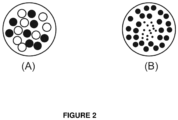
- Traditional blending can be: intimate, fibre blending, mechanical and yarn blending (twisting). Fibre blending in spinning can be carried out at any stage of the operation, for example at the opening and when passing through the draw frame. The nature of the fibres to be mixed determines the most appropriate place for mixing. Examples: polyester/cotton - at the draw frame Asbestos/viscose/ceramic - at the opening
- FIG. 2 illustrates the following aspects in letters (a) and (b):
- the mixing of bales is of paramount importance for the good performance of the Spinning Mill, because it creates uniformity, helps to consume lower quality cotton and waste, as well as avoiding changes in machine settings, improving yields.
- table 1 below shows the properties of some fibres, based on which we can make mixtures to achieve certain results:
- Figure 3 illustrates a diagram of a ring spinning process, rotor process and vortex process (compressed air). The present invention is based on these processes with the addition of a step involving assembly and adaptation of the technology which will be described later.
- Each artificial and synthetic biodegradable continuous filament is textured with interlacing points made by a whirlwind of compressed air in its filaments as they pass through the air nozzle, known as compressed air texturing tangling or interlacing points in the continuous filament manufacturing process in the extruder.
- This textile process uses compressed air to manufacture a single continuous air-textured filament. It is a procedure to create more resistance, a pleasant touch and different textural effects in the final product.
- This process was developed to eliminate twisting processes between filaments and false twisting texturise between filaments.
- Mixed yarns that use this type of false-twist filament are rarely produced and are almost discontinued. It is still used by some people who have machines for a small and limited type of textile product. It has already caused and36 routinely caused serious problems in the production of fabrics on textile machines.
- the performance of the texturising process is generally assessed on the basis of stitch frequency, stability and stitch uniformity. There are factors that affect the properties of the mixed yarn and the factors are categorised as:
- Nano technological filaments greatly expand the possibilities of sensors with an Internet of Things function, making it possible to manufacture fabrics capable of analysing the human body in real time, for health monitoring, physical performance, early detection of diseases and even medical treatments.
- the electronic filaments built up until now have all been analogue - they carry a continuous optical or electrical signal.
- a digital fibre makes it possible to encode and process discrete bits of information - 0s and 1s - directly, greatly simplifying the design of so-called smart clothes.
- the new filament was created by placing hundreds of silicon microelectrodes on a preform, which was then used to create a polymer filament from recycled chemicals. By precisely controlling the flow of the polymer, it was possible to create a filament with a continuous electrical connection between the microparticles over tens of metres.
- Types of filament that are biodegradable and/or chemically recycled and/or contain recycled raw materials such as bi-component filaments that combine raw materials from natural and synthetic sources in a single filament :
- Recycled polyethylene terephthalate, recycled polybutylene terephthalate, recycled polytrimethylene terephthalate Biodegradable polyester, biodegradable polyamide, recycled polyamide, biodegradable polylactic acid, biodegradable lyocell, biodegradable rayon, biodegradable acetate, filaments of fermented natural raw materials, filaments of/other natural animal or vegetable cellulose chains such as: milk, sugar cane, orange, spider web, mushroom, beetroot....
- the most commonly used filaments are recycled polyethylene terephthalate, biodegradable polyamide, recycled polyamide, biodegradable rayon and biodegradable and/or chemically recycled polylactic acid, polyhydroxyanate (PHA), polybutylene succinate (PBS) and lyocell filament.
- polyester 50/36 Dtex the fineness of the filament in DTEX and 36 is the number of filaments in the continuous filament.
- the air-textured filaments there are also flat, untextured filaments with DTEX count yarn close to the textured yarns used in the present invention.
- the filaments can have various formats for specific textile functionalities, improving the productivity of our activities. For example, trilobal (star), cross, round or flat shapes.
- the purpose of the present invention is to combine the use of biodegradable and/or recycled filaments air-textured with compressed air or flat biodegradable and/or recycled filaments creating interlacing points between spun yarns from natural and artificial biodegradable fibres, by means of an air injection nozzle that performs a whirlwind of compressed air creating interlacing points near the final stage of yarn production in spinning mills.
- the present invention has numerous technical and economic advantages when compared to the state of the art, some of which are listed below:
- the table shows the wires tested: Yarn Description Category Technical Specification Composition PLA 76/32 Biodegradable/Recycled DTEX 89 100% PLA PA 60 ECO Z Biodegradable/Recycled DTEX 58,6 100% PA PA 60/60 OP AM ECO Biodegradable/Recycled DTEX 63 100% PA PA 80/68 SOUL ECO Biodegradable/Recycled DTEX 85 100% PA PA 44/34 TEXT.
Landscapes
- Engineering & Computer Science (AREA)
- Textile Engineering (AREA)
- Physics & Mathematics (AREA)
- Fluid Mechanics (AREA)
- Mechanical Engineering (AREA)
- Yarns And Mechanical Finishing Of Yarns Or Ropes (AREA)
Applications Claiming Priority (2)
| Application Number | Priority Date | Filing Date | Title |
|---|---|---|---|
| BR102021011444-4A BR102021011444A2 (pt) | 2021-06-11 | 2021-06-11 | Processo de produção de fios mistos biodegradáveis duráveis e fios mistos obtidos por meio do referido processo |
| PCT/BR2022/050215 WO2022256900A1 (pt) | 2021-06-11 | 2022-06-11 | Processo de produção de fios mistos biodegradáveis duráveis, dispositivo de produção de fios mistos e fios mistos obtidos por meio do referido processo |
Publications (2)
| Publication Number | Publication Date |
|---|---|
| EP4353884A1 true EP4353884A1 (de) | 2024-04-17 |
| EP4353884A4 EP4353884A4 (de) | 2025-04-30 |
Family
ID=84424454
Family Applications (1)
| Application Number | Title | Priority Date | Filing Date |
|---|---|---|---|
| EP22819010.4A Withdrawn EP4353884A4 (de) | 2021-06-11 | 2022-06-11 | Verfahren zur herstellung von haltbaren biologisch abbaubaren mischgarnen, vorrichtung zur herstellung von mischgarnen und mit diesem verfahren hergestellte mischgarne |
Country Status (3)
| Country | Link |
|---|---|
| EP (1) | EP4353884A4 (de) |
| BR (1) | BR102021011444A2 (de) |
| WO (1) | WO2022256900A1 (de) |
Families Citing this family (1)
| Publication number | Priority date | Publication date | Assignee | Title |
|---|---|---|---|---|
| IT202300024909A1 (it) * | 2023-11-23 | 2025-05-23 | Manteco S P A | Metodo e sistema di produzione ottimizzata di un nuovo filato |
Family Cites Families (18)
| Publication number | Priority date | Publication date | Assignee | Title |
|---|---|---|---|---|
| JPS5740313Y2 (de) * | 1979-11-14 | 1982-09-04 | ||
| JPS59173335A (ja) | 1983-03-02 | 1984-10-01 | エンタ−プライズ・マシ−ン・アンド・デイベロツプメント・コ−ポレ−シヨン | 糸の製造方法 |
| DE3561334D1 (en) * | 1984-05-15 | 1988-02-11 | Heberlein & Co Ag | Method for making a blended yarn |
| JP2917094B2 (ja) | 1994-05-24 | 1999-07-12 | 日清紡績株式会社 | エア交絡方法及びエア交絡機 |
| TW538153B (en) | 1998-03-03 | 2003-06-21 | Heberlein Fibertechnology Inc | Process for air-jet texturing of frill yarn and yarn-finishing device and the application thereof |
| DE29902103U1 (de) * | 1999-02-08 | 2000-06-15 | Heberlein Fasertechnologie Ag, Wattwil | Vorrichtung zur Verbindung eines Endlosfilamentgarnes und eines Stapelfasergarnes |
| KR100752277B1 (ko) | 2006-10-02 | 2007-08-29 | 안병훈 | 복합 가공사, 그의 제조방법 및 그의 제조장치 |
| KR100725042B1 (ko) | 2006-10-23 | 2007-06-07 | 안병훈 | 다중혼합 가공사, 그의 제조방법 및 그의 제조장치 |
| BRPI0704157B1 (pt) | 2007-01-30 | 2018-07-17 | Fios Texteis H Marin Ltda | processo de produção de fios mistos e fios mistos obtidos |
| BRPI0701681B1 (pt) | 2007-05-04 | 2018-02-14 | Fios Texteis H. Marin Ltda. | Equipamento para produção de fios mistos |
| ATE524585T1 (de) * | 2007-07-25 | 2011-09-15 | Oerlikon Textile Components | Vorrichtung zur behandlung eines multifilen fadens |
| DE202009000965U1 (de) * | 2009-01-26 | 2009-06-18 | Rpe Technologies Gmbh | Garnbehandlungsvorrichtung |
| JP2014173196A (ja) | 2013-03-06 | 2014-09-22 | Gifu Univ | 混繊糸、織物および編み物、複合材料、並びに、複合材料の製造方法 |
| CN108486714A (zh) * | 2018-04-25 | 2018-09-04 | 江南大学 | 喷气涡流混纺纱的加工装置和方法 |
| CN108774770B (zh) * | 2018-06-19 | 2021-05-14 | 苏州大学 | 一种采用高速拉伸空喷变形工艺制备涤锦空喷变形混纤丝的方法 |
| BR102018075494A2 (pt) * | 2018-12-07 | 2020-06-16 | Antonio Herminio Marin | Processo de produção de fios mistos e fios mistos obtidos acoplado ou adicionado ou anexado em fiações de fios fiados e fibra cortada. |
| KR20200142321A (ko) * | 2019-06-12 | 2020-12-22 | 송영미 | 커버링 원사의 제조방법 |
| BR102019012508A2 (pt) * | 2019-06-17 | 2020-12-29 | Antonio Herminio Marin | processo de produção de fios mistos ecológicos, sustentáveis e fios mistos obtidos |
-
2021
- 2021-06-11 BR BR102021011444-4A patent/BR102021011444A2/pt active Search and Examination
-
2022
- 2022-06-11 EP EP22819010.4A patent/EP4353884A4/de not_active Withdrawn
- 2022-06-11 WO PCT/BR2022/050215 patent/WO2022256900A1/pt not_active Ceased
Also Published As
| Publication number | Publication date |
|---|---|
| EP4353884A4 (de) | 2025-04-30 |
| WO2022256900A1 (pt) | 2022-12-15 |
| BR102021011444A2 (pt) | 2022-12-27 |
Similar Documents
| Publication | Publication Date | Title |
|---|---|---|
| Karmakar | Chemical technology in the pre-treatment processes of textiles | |
| Wulfhorst et al. | Textile technology | |
| Gries et al. | Textile technology: an introduction | |
| CN100424237C (zh) | 香蕉纤维及其制法、使用它的混纺纱以及纤维构造物 | |
| US20090173055A1 (en) | Composite cotton and polyester yarn and method for making same | |
| Jabbar et al. | Textile raw materials | |
| EP1679394A1 (de) | Fasergarn und damit hergestelltes textiles flächengebilde | |
| US20090293443A1 (en) | Composite regenerated cotton and bast fiber yarn and method for making the same | |
| Negm et al. | Cotton fibres, picking, ginning, spinning and weaving | |
| US20090173054A1 (en) | Composite cotton and hemp yarn and method for making the same | |
| EP4202095B1 (de) | Garn | |
| KR101825928B1 (ko) | 헴프 혼방 단사 제조 방법 | |
| Macarthur et al. | Fibres, yarns and fabrics: an introduction to production, structure and properties | |
| Singh et al. | Woven terry fabrics: Manufacturing and quality management | |
| EP4353884A1 (de) | Verfahren zur herstellung von haltbaren biologisch abbaubaren mischgarnen, vorrichtung zur herstellung von mischgarnen und mit diesem verfahren hergestellte mischgarne | |
| Vhanbatte | Background and type of textile materials processed in textile industry | |
| Achaw et al. | Textile and fabric manufacture | |
| Hussain et al. | Textile engineering: An introduction | |
| Hann | Innovation in linen manufacture | |
| US20240018696A1 (en) | Method for processing fibrous matter from waste material | |
| Khare | Principles of spinning: fibres and blow room cotton processing in spinning | |
| US11608573B2 (en) | Production process of circular and sustainable mixed yarns and mixed yarns obtained | |
| KR101325839B1 (ko) | 닥나무를 이용한 화섬혼방사 제조방법 | |
| Afzali et al. | Engineering nanotextiles: Design of textile products | |
| Ahmad et al. | Textile raw materials |
Legal Events
| Date | Code | Title | Description |
|---|---|---|---|
| STAA | Information on the status of an ep patent application or granted ep patent |
Free format text: STATUS: THE INTERNATIONAL PUBLICATION HAS BEEN MADE |
|
| PUAI | Public reference made under article 153(3) epc to a published international application that has entered the european phase |
Free format text: ORIGINAL CODE: 0009012 |
|
| STAA | Information on the status of an ep patent application or granted ep patent |
Free format text: STATUS: REQUEST FOR EXAMINATION WAS MADE |
|
| 17P | Request for examination filed |
Effective date: 20240111 |
|
| AK | Designated contracting states |
Kind code of ref document: A1 Designated state(s): AL AT BE BG CH CY CZ DE DK EE ES FI FR GB GR HR HU IE IS IT LI LT LU LV MC MK MT NL NO PL PT RO RS SE SI SK SM TR |
|
| DAV | Request for validation of the european patent (deleted) | ||
| DAX | Request for extension of the european patent (deleted) | ||
| A4 | Supplementary search report drawn up and despatched |
Effective date: 20250327 |
|
| RIC1 | Information provided on ipc code assigned before grant |
Ipc: D02J 1/08 20060101ALI20250321BHEP Ipc: D02G 3/04 20060101ALI20250321BHEP Ipc: D02G 1/16 20060101AFI20250321BHEP |
|
| STAA | Information on the status of an ep patent application or granted ep patent |
Free format text: STATUS: THE APPLICATION IS DEEMED TO BE WITHDRAWN |
|
| 18D | Application deemed to be withdrawn |
Effective date: 20251016 |