EP4353675A1 - Structural body including boron, hydrogen, and oxygen, and method for producing same - Google Patents
Structural body including boron, hydrogen, and oxygen, and method for producing same Download PDFInfo
- Publication number
- EP4353675A1 EP4353675A1 EP22820295.8A EP22820295A EP4353675A1 EP 4353675 A1 EP4353675 A1 EP 4353675A1 EP 22820295 A EP22820295 A EP 22820295A EP 4353675 A1 EP4353675 A1 EP 4353675A1
- Authority
- EP
- European Patent Office
- Prior art keywords
- hydrogen
- oxygen
- boron
- bonds
- transmittance
- Prior art date
- Legal status (The legal status is an assumption and is not a legal conclusion. Google has not performed a legal analysis and makes no representation as to the accuracy of the status listed.)
- Withdrawn
Links
Images


Classifications
-
- C—CHEMISTRY; METALLURGY
- C01—INORGANIC CHEMISTRY
- C01B—NON-METALLIC ELEMENTS; COMPOUNDS THEREOF; METALLOIDS OR COMPOUNDS THEREOF NOT COVERED BY SUBCLASS C01C
- C01B3/00—Hydrogen; Gaseous mixtures containing hydrogen; Separation of hydrogen from mixtures containing it; Purification of hydrogen; Reversible storage of hydrogen
- C01B3/02—Production of hydrogen; Production of gaseous mixtures containing hydrogen
- C01B3/04—Production of hydrogen; Production of gaseous mixtures containing hydrogen by decomposition of inorganic compounds
-
- C—CHEMISTRY; METALLURGY
- C01—INORGANIC CHEMISTRY
- C01B—NON-METALLIC ELEMENTS; COMPOUNDS THEREOF; METALLOIDS OR COMPOUNDS THEREOF NOT COVERED BY SUBCLASS C01C
- C01B35/00—Boron; Compounds thereof
- C01B35/08—Compounds containing boron and nitrogen, phosphorus, oxygen, sulfur, selenium or tellurium
- C01B35/10—Compounds containing boron and oxygen
- C01B35/1045—Oxyacids
-
- B—PERFORMING OPERATIONS; TRANSPORTING
- B01—PHYSICAL OR CHEMICAL PROCESSES OR APPARATUS IN GENERAL
- B01J—CHEMICAL OR PHYSICAL PROCESSES, e.g. CATALYSIS OR COLLOID CHEMISTRY; THEIR RELEVANT APPARATUS
- B01J47/00—Ion-exchange processes in general; Apparatus therefor
- B01J47/016—Modification or after-treatment of ion-exchangers
-
- C—CHEMISTRY; METALLURGY
- C01—INORGANIC CHEMISTRY
- C01B—NON-METALLIC ELEMENTS; COMPOUNDS THEREOF; METALLOIDS OR COMPOUNDS THEREOF NOT COVERED BY SUBCLASS C01C
- C01B3/00—Hydrogen; Gaseous mixtures containing hydrogen; Separation of hydrogen from mixtures containing it; Purification of hydrogen; Reversible storage of hydrogen
- C01B3/0005—Reversible storage of hydrogen, e.g. by hydrogen getters or electrodes
- C01B3/001—Reversible storage of hydrogen, e.g. by hydrogen getters or electrodes characterised by the uptaking media; Treatment thereof
- C01B3/0078—Composite solid storage media, e.g. mixtures of polymers and metal hydrides, coated solid compounds or structurally heterogeneous solid compounds
-
- C—CHEMISTRY; METALLURGY
- C01—INORGANIC CHEMISTRY
- C01B—NON-METALLIC ELEMENTS; COMPOUNDS THEREOF; METALLOIDS OR COMPOUNDS THEREOF NOT COVERED BY SUBCLASS C01C
- C01B35/00—Boron; Compounds thereof
- C01B35/02—Boron; Borides
- C01B35/026—Higher boron hydrides, i.e. containing at least three boron atoms
-
- C—CHEMISTRY; METALLURGY
- C01—INORGANIC CHEMISTRY
- C01B—NON-METALLIC ELEMENTS; COMPOUNDS THEREOF; METALLOIDS OR COMPOUNDS THEREOF NOT COVERED BY SUBCLASS C01C
- C01B35/00—Boron; Compounds thereof
- C01B35/08—Compounds containing boron and nitrogen, phosphorus, oxygen, sulfur, selenium or tellurium
- C01B35/10—Compounds containing boron and oxygen
-
- C—CHEMISTRY; METALLURGY
- C01—INORGANIC CHEMISTRY
- C01B—NON-METALLIC ELEMENTS; COMPOUNDS THEREOF; METALLOIDS OR COMPOUNDS THEREOF NOT COVERED BY SUBCLASS C01C
- C01B6/00—Hydrides of metals including fully or partially hydrided metals, alloys or intermetallic compounds ; Compounds containing at least one metal-hydrogen bond, e.g. (GeH3)2S, SiH GeH; Monoborane or diborane; Addition complexes thereof
- C01B6/06—Hydrides of aluminium, gallium, indium, thallium, germanium, tin, lead, arsenic, antimony, bismuth or polonium; Monoborane; Diborane; Addition complexes thereof
- C01B6/10—Monoborane; Diborane; Addition complexes thereof
-
- C—CHEMISTRY; METALLURGY
- C01—INORGANIC CHEMISTRY
- C01P—INDEXING SCHEME RELATING TO STRUCTURAL AND PHYSICAL ASPECTS OF SOLID INORGANIC COMPOUNDS
- C01P2002/00—Crystal-structural characteristics
- C01P2002/60—Compounds characterised by their crystallite size
-
- C—CHEMISTRY; METALLURGY
- C01—INORGANIC CHEMISTRY
- C01P—INDEXING SCHEME RELATING TO STRUCTURAL AND PHYSICAL ASPECTS OF SOLID INORGANIC COMPOUNDS
- C01P2002/00—Crystal-structural characteristics
- C01P2002/80—Crystal-structural characteristics defined by measured data other than those specified in group C01P2002/70
- C01P2002/82—Crystal-structural characteristics defined by measured data other than those specified in group C01P2002/70 by IR- or Raman-data
Definitions
- the present invention relates to A structure comprising boron, hydrogen, and oxygen, and a method for preparing the same. According to the present invention, hydrogen can be stored efficiently.
- Hydrogen is a clean secondary energy that can be stored and transported. Hydrogen is a gas at normal temperature and pressure, and must be brought to an extremely low temperature (-253 °C) to liquefy. In liquid state, it is difficult to store and transport large amounts safely and at high density. Therefore, it is difficult to store and transport large amounts of hydrogen in liquid form safely and at high density.
- the object of the present invention is to provide an excellent method for storing and transporting hydrogen.
- the present inventors have conducted intensive studies into an excellent method for storing and transporting hydrogen, and as a result, surprisingly found that, a hydrogen boride sheet with specific physical properties can store a large amount of hydrogen.
- the present invention is based on the above findings.
- the present invention relates to:
- the hydrogen boride sheet of the present invention more hydrogen can be stored and transported compared to conventional hydrogen boride sheets. It is possible to produce hydrogen boride sheets that can store a large amount of hydrogen.
- the structure of the present invention has B-H-B bonds, B-H bonds, and B-OH bonds, and comprises boron, hydrogen, and oxygen.
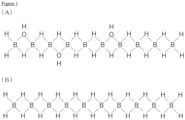
- the structure of the present invention comprises boron, hydrogen, and oxygen, that has B-H-B bonds, B-H bonds, and B-OH bonds. Therefore, as shown in Fig. 1(A) , it has a structure of (BH)n(BOH)m which is a combination of BH and BOH. In Fig. 1(B) , the three-dimensional structure of an ideal structure consisting only of boron and hydrogen is shown.
- the transmittance at 1400 cm -1 (a) in the FT-IR spectrum indicates "B-H-B bonds"
- the transmittance at 2500 cm -1 (b) in the FT-IR spectrum indicates “B-H bonds”
- the transmittance at 3200cm -1 (c) in the FT-IR spectrum indicates "B-OH bonds.”
- the lower the transmittance means the greater the content of each bond.
- the transmittance of each wavelength is a relative transmittance when the baseline is defined as 100%, and the baseline is set with the value of 1725cm -1 as 100%.
- the lower limit of a/c is not limited, but is 0.80 or more, preferably 0.82 or more, more preferably 0.84 or more, even more preferably 0.86 or more, and most preferably 0.88 or more.
- the upper limit of a/c is not limited, but is 0.96 or less, preferably 0.95 or less, and more preferably 0.94 or less. The lower limit and the upper limit can be combined each other. The above ranges allow for the storage and transport of a large amount of hydrogen.
- the lower limit of b/c is not limited, but is 0.95 or more, preferably 0.98 or more, more preferably 1.01 or more, even more preferably 1.02 or more, and most preferably 1.03 or more.
- the upper limit of b/c is not limited, but is 1.12 or less, preferably 1.10 or less, and more preferably 1.08 or less, even more preferably 1.07 or less, and most preferably1.06 or less.
- the lower limit and the upper limit can be combined each other. The above ranges allow for the storage and transport of a large amount of hydrogen.
- the structure of the present invention preferably satisfy (3)d ⁇ b.
- d is the transmittance at 700 cm -1 in the FT-IR spectrum.
- Both of the transmittances at 2500 cm -1 (b) and 700 cm -1 (d) mean the transmittance of the "B-H bonds", and the difference in wavenumbers indicates the difference in the vibrational species of the B-H bonds.
- the wavenumber of b indicates the stretching vibration of the B-H bonds
- the wavenumber of d indicates the bending vibration of the B-H bonds.
- FT-IR analysis it is generally considered that the smaller the wavenumber, the weaker the bond. Therefore, when d is equal to or less than b, it is presumed that hydrogen is preferentially released from the B-H bond, which is relatively weak, and that the efficient release of hydrogen from the structure will be possible.
- the present invention is not limited by the above presumption.
- the transmittance at 3200 cm -1 (c) in the FT-IR spectrum indicates "B-OH bonds.”
- the lower the transmittance (c) means the greater the content of "B-OH bonds.” Therefore, when the value of b/c is large, there are many "B-OH bonds” and few “B-H bonds.” Conversely, when the value of b/c is small, there are fewer "B-OH bonds” and more "B-H bonds", and a large amount of hydrogen can be stored.
- the measurement method of FT-IR spectra is not particularly limited, but the methods commonly used in this field can be used.
- the measurement methods there may be mentioned total reflection method, transmission method, diffuse reflection method, vertical-incidence transmission method, or infrared microscopy method.
- the total reflection method (Attenuated Total Reflection Spectroscopy: ATR spectroscopy) is preferrable.
- the wavenumber range to be measured is, for example, 4500 to 600cm -1 .
- a thickness of the structure of the present invention is not particularly limited, but is 0.23 nm to 0.50 nm.
- the length in at least one direction (for example, the length in the X direction or the Y direction in Fig. 1B ) is 100 nm or more. If the length of at least one direction in the structure of the present invention is 100 nm or more, the structure of the present invention can be effectively used as a storage material for hydrogen.
- the size (area) of the structure of the present invention is not particularly limited.
- the size of the structure of the present invention can be formed to any size by the method for preparing the structure of the present invention described below.
- the structure of the present invention is a substance with a crystalline structure.
- the bonding force between boron atoms (B) forming hexagonal rings and the bonding force between boron atom (B) and hydrogen atom (H) are strong. Therefore, even if multiple stacked crystals (agglomerates) are formed in the manufacturing process, the structure of the present invention can be easily cleaved along the crystal plane and separated (collected) as a single two-dimensional sheet, as is the case with graphite.
- the method for preparing a structure of the present invention comprises the step of mixing a metal diboride having an MB 2 type structure (wherein M is at least one selected from the group consisting of Al, Mg, Ta, Zr, Re, Cr, Ti, and V), and an ion exchange resin in which ion-exchangeable ions with the metal ions constituting the metal diboride are coordinated, in a polar organic solvent (hereinafter, sometimes referred to as mixing step).
- metal diboride having MB 2 type structure one having a hexagonal ring structure is used.
- AlB 2 aluminum diboride
- magnesium diboride (MgB 2 ) tantalum diboride
- TaB 2 zirconium diboride
- ZrB 2 zirconium diboride
- ReB 2 rhenium diboride
- CrB 2 chromium diboride
- TiB 2 titanium diboride
- VB 2 vanadium diboride
- Magnesium diboride is preferred because it can be easily ion-exchanged with ion-exchange resins in polar organic solvent.
- the crystallite size of the above metal diboride having MB 2 type structure is not particularly limited as long as it is possible to produce a structure in which the effects of the present invention can be obtained.
- the average crystallite size is preferably 2 to 5 ⁇ m, 2 to 3 ⁇ m in one embodiment, 3 to 5 ⁇ m in another embodiment. The above ranges allow more hydrogen to be stored.
- the method for measuring crystallite size is not particularly limited, but it can be measured preferably by X-ray diffraction (XRD).
- the diffraction intensity of MB 2 powder on the 2 ⁇ axis can be measured by the ⁇ -2 ⁇ method of powder diffraction.
- the MB 2 powder is fixed in a sample holder for powder measurement.
- the sample holder in which the MB 2 powder is fixed is placed on the sample holder fixture of the XRD apparatus.
- the powder is measured by the ⁇ -2 ⁇ method.
- a commonly used wavelength such as a Cu target (wavelength: 1.54 ⁇ ) or a Mo target (wavelength: 0.7 ⁇ ) can be used.
- the crystallite size L (m) is calculated by the following Scherrer's formula from the width at half maximum ⁇ (radians) of the diffraction peak, the X-ray wavelength ⁇ (m), the diffraction angle ⁇ (radians), and the crystal shape factor K (unitless, 0.9 is often used to approximate the crystal shape).
- L K ⁇ ⁇ / ⁇ ⁇ cos ⁇
- the diffraction angle varies depending on which crystal plane of MB2 the diffraction occurred at, and thus the crystallite size is calculated for each diffraction angle.
- the obtained crystallite size is the average value. Furthermore, the average range of crystallite size is measured from the range of crystallite sizes calculated from each diffraction
- Ion-exchange resin in which ion-exchangeable ions with the metal ions constituting the metal diboride are coordinated is not particularly limited.
- the ion-exchange resin for example, there may be mentioned a polymer of styrene having a functional group coordinating ion-exchangeable ions with the metal ions constituting the metal diboride (hereafter referred to as "functional group ⁇ "), a polymer of divinylbenzene with functional group ⁇ , a copolymer of styrene with functional group ⁇ and divinylbenzene with functional group ⁇ , or the like.
- the functional group ⁇ includes, for example, a sulfo group, a carboxyl group, or the like. Among these, sulfo group is preferrable because it can be easily ion-exchanged with metal ions constituting the metal diboride in polar organic solvents.
- the polar organic solvent is not particularly limited, but there may be mentioned acetonitrile, N,N-dimethylformamide, methanol, or the like. Among these, acetonitrile is preferrable because it does not contain oxygen.
- the metal diboride and ion exchange resin are put into a polar organic solvent, and the mixed solution containing the polar organic solvent, metal diboride, and ion exchange resin is stirred to bring the metal diboride and ion exchange resin into contact sufficiently.
- the metal ions constituting the metal diboride and the ions of the functional group ⁇ of the ion exchange resin are ion-exchanged, to produce the structure of the present invention, i.e., the hydrogen boride sheet, that is formed by the boron atoms and the atoms derived from the functional group ⁇ of the ion exchange resin.
- magnesium diboride is used as the metal diboride and an ion exchange resin having sulfo groups is used as the ion exchange resin
- the magnesium ion (Mg+) of magnesium diboride is replaced by the hydrogen ion (H+) of the sulfo group of the ion exchange resin to produce the hydrogen boride sheet of the present invention consisting of the boron atom (B) and hydrogen atom (H) as described above.
- the mixing step it is preferable to gently proceed the ion-exchange reaction between the metal ions constituting the metal diboride and the ions of the functional group ⁇ of the ion exchange resin, without applying ultrasound or the like to the mixed solution.
- the temperature of the mixed solution is preferably 15°C to 35°C.
- the time for stirring the mixed solution is not particularly limited, but is, for example, 700 to 7000 minutes.
- the mixing step is performed under an inert atmosphere consisting of inert gases such as nitrogen (N2) or argon (Ar).
- inert gases such as nitrogen (N2) or argon (Ar).
- the mixed solution is preferably filtered (hereinafter sometimes referred to as a filtration step) after the stirring has been completed.
- the filtration method of the mixed solution is not particularly limited. For example, spontaneous filtration, reduced-pressure filtration, pressurized filtration, and centrifugal filtration are used. Further, as the filter media, filter paper based on cellulose, membrane filters, or filter plates in which cellulose, glass fiber, or the like are compression-mold, is used.
- the filter size is not particularly limited as long as it is possible to produce a structure that achieves the effects of the present invention.
- the filter size is 5 ⁇ m or less, preferably 4 ⁇ m or less, more preferably 3 ⁇ m or less, more preferably 2 ⁇ m or less, and most preferably 1 ⁇ m or less.
- the lower limit of filter size is not limited, but 0.1 ⁇ m or more is preferable from the viewpoint of shortening the filtration time.
- the solution containing the product which is separated from the precipitate by filtration and collected, is spontaneously dried or is dried by heating, to obtain only the final product.
- the product is the hydrogen boride sheet formed by boron atoms and hydrogen atoms derived from the functional group ⁇ of the ion exchange resin.
- the method for producing molecular hydrogen (H 2 ) comprises the step of irradiating the structure with ultraviolet ray.
- the wavelength of the ultraviolet ray used is not particularly limited as long as molecular hydrogen (H 2 ) is evolved from the structure, but ultraviolet ray in the range of 10 nm to 400 nm can be used.
- UV ray sources is not particularly limited, but, there may be mentioned mercury xenon lamps, high pressure mercury UV lamps, low pressure mercury UV lamps, ultraviolet ray LEDs, ultraviolet ray LDs or metal halide UV lamps.
- MgB 2 with a crystallite particle size of 3-5 ⁇ m was used to prepare a hydrogen boride sheet.
- ion exchange resin (Amberlite IR120B H type made by Organo) was wetted with 20mL of acetonitrile solvent and was allowed to stand in a draft overnight.
- 500 mg of MgB 2 was weighed and charged into a 500-mL flask.
- the mixture of the ion exchange resin and acetonitrile solvent was filtered through a funnel, and the ion exchange resin was removed.
- the ion exchange resin and 200 mL of acetonitrile were charged into the flask containing MgB 2 .
- a stirrer was placed in the flask and the flask was left for 3 days while stirring.
- Nitrogen was supplied into the flask during stirring to reduce the exposure of the samples to the atmosphere.
- the resulting solution was filtered through a 5 ⁇ m filter. Filtration was carried out under a nitrogen atmosphere. To remove the solvent from the solution, it was solvent-dried under reduced pressure to obtain a yellow powder of 100 mg.
- Crystallite size K ⁇ / ⁇ cos ⁇
- Example 1 Comparative Example 1 100 0.182 0.249 0.249 101 0.214 0.316 0.316 002 0.258 0.331 0.331 110 0.225 0.342 0.342 102 0.284 0.514 0.514 201 0.274 0.452 0.452 112 0.335 0.531 0.531 [Table 2]
- Example 1 Comparative Example 1 Average crystallite size calculated by Scherrer's equation Maximum value 5 3 3 Minimum value 3 2 2
- MgB 2 with a crystallite particle size of 2-3 ⁇ m was used to prepare a hydrogen boride sheet.
- Example 2 The procedure described in Example 1 was repeated to obtain a yellow powder of 90 mg., except that MgB 2 with a crystallite particle size of 2-3 ⁇ m was used, and a 2 ⁇ m filter was used.
- the results of XRD measurements and calculations using Scherrer's equation are shown in Fig. 3 and Tables 1 and 2.
- the average crystallite size of MgB 2 was 2 to 3 ⁇ m.
- MgB 2 with a crystallite particle size of 2-3 ⁇ m was used to prepare a hydrogen boride sheet.
- Example 2 The procedure described in Example 1 was repeated to obtain a yellow powder of 95 mg., except that MgB 2 with a crystallite particle size of 2-3 ⁇ m was used.
- the results of XRD measurements and calculations using Scherrer's equation are shown in Fig. 4 and Tables 1 and 2.
- the average crystallite size of MgB 2 was 2 to 3 ⁇ m.
- Example 1 Comparative Example 1 a 85.95 78.10 79.72 b 94.26 94.54 93.75 c 91.79 89.17 82.14 d 87.44 77.58 78.91 a(BHB)/c(BOH) 0.94 0.88 0.97 B(BH)/c(BOH) 1.03 1.06 1.15
- the hydrogen boride sheets obtained in Examples 1 and 2 and Comparative Example 1 was irradiated with ultraviolet ray to measure the production amount of molecular hydrogen (H 2 ).
- the samples After irradiation, the samples turned brown. When viewed from the side, about half of the sample in the thickness direction turned brown. Therefore, it was considered that about 5 mg of the sample reacted to the light irradiation. Accordingly, the weight of the sample was assumed to be 5 mg, and the weight of hydrogen produced per sample weight and the volume of hydrogen produced per sample volume were calculated from the volume of the chamber and the integrated value of hydrogen concentration. The results are shown in Table 5. In the calculation per volume, the density of the hydrogen boride sheet is assumed to be equal to the density of boron and it was calculated.
- Example 1 Example 2 Comparative Example 1 Weight of hydrogen produced (wt%) 3.1 2.4 2.0 Volume of hydrogen produced (g/L) 62 48 40 Compared with Comparative Example 1, the hydrogen boride sheets obtained in Examples 1 and 2 are considered to be capable of storing and releasing a large amount of hydrogen.
- the structure of the present invention can be used for storage and transport of hydrogen and can produce a large amount of molecular hydrogen (H 2 ).
Landscapes
- Chemical & Material Sciences (AREA)
- Organic Chemistry (AREA)
- Inorganic Chemistry (AREA)
- Chemical Kinetics & Catalysis (AREA)
- Engineering & Computer Science (AREA)
- Combustion & Propulsion (AREA)
- Health & Medical Sciences (AREA)
- General Health & Medical Sciences (AREA)
- Hydrogen, Water And Hydrids (AREA)
- Solid-Sorbent Or Filter-Aiding Compositions (AREA)
Abstract
Description
- The present invention relates to A structure comprising boron, hydrogen, and oxygen, and a method for preparing the same. According to the present invention, hydrogen can be stored efficiently.
- Hydrogen is a clean secondary energy that can be stored and transported. Hydrogen is a gas at normal temperature and pressure, and must be brought to an extremely low temperature (-253 °C) to liquefy. In liquid state, it is difficult to store and transport large amounts safely and at high density. Therefore, it is difficult to store and transport large amounts of hydrogen in liquid form safely and at high density.
- As the methods to store and transport hydrogen, there may be mentioned methods using high-pressure tanks, absorbing alloys or the like. However, these methods have a low hydrogen storage per weight or volume. As a method for storing a large amount of hydrogen, a method using hydrogen boride sheet has been developed (
Patent literature 1 and Non-Patent literatures 1-3). However, further improvements are expected to increase the amount of hydrogen storage. - [PATENT LITERATURE 1]
WO 2018/074518 -
- [NON-PATENT LITERATURE 1] Chem (U.S.A.) 2020, vol.6, p406-
- [NON-PATENT LITERATURE 2] nature communications (Great Britain) 2019, vol. 10, p4880-
- [NON-PATENT LITERATURE 3] Journal of the American Chemical Society (U.S.A.) 2017, vol.139, p13761-13769
- The object of the present invention is to provide an excellent method for storing and transporting hydrogen.
- The present inventors have conducted intensive studies into an excellent method for storing and transporting hydrogen, and as a result, surprisingly found that, a hydrogen boride sheet with specific physical properties can store a large amount of hydrogen.
- The present invention is based on the above findings.
- Accordingly, the present invention relates to:
- [1] a structure comprising boron, hydrogen, and oxygen, that has B-H-B bonds, B-H bonds, and B-OH bonds, and in the measurement of FT-IR spectra, the following formulas are satisfied:


- [2] a method for preparing a structure comprising boron, hydrogen, and oxygen, comprising the step of mixing a metal diboride having an MB2 type structure (wherein M is at least one selected from the group consisting of Al, Mg, Ta, Zr, Re, Cr, Ti, and V), and an ion exchange resin in which ion-exchangeable ions with the metal ions constituting the metal diboride are coordinated, in a polar organic solvent,
wherein an average crystallite size of the metal diboride according to Scherrer's equation is 2 to 5 µm, - [3] the method for preparing a structure comprising boron, hydrogen, and oxygen, of the item [2], wherein the average crystallite size of the metal diboride according to Scherrer's equation is 3 to 5 µm,
- [4] the method for preparing a structure comprising boron, hydrogen, and oxygen, of the item [2], wherein the average crystallite size of the metal diboride according to Scherrer's equation is 2 to 3 µm.
- [5] the method for preparing a structure comprising boron, hydrogen, and oxygen, of the items [2] to [4], comprising the step of filtering with a filter of 3 µm or less after the mixing step,
- [6] the method for preparing a structure comprising boron, hydrogen, and oxygen, of the items [2] to [5], wherein the ion exchange resin has a sulfo group,
- [7] the method for preparing a structure comprising boron, hydrogen, and oxygen, of the items [2] to [6], wherein the polar organic solvent is acetonitrile or methanol, and
- [8] A method for producing molecular hydrogen (H2) comprising the step of irradiating the structure of the item [1] with ultraviolet rays
- According to the hydrogen boride sheet of the present invention, more hydrogen can be stored and transported compared to conventional hydrogen boride sheets. It is possible to produce hydrogen boride sheets that can store a large amount of hydrogen.
-
-
FIG. 1 is a diagram schematically showing the structure of a hydrogen boride sheet containing boron, hydrogen, and oxygen (A) and a three-dimensional diagram showing an ideal hydrogen boride sheet structure consisting only of boron and hydrogen (B). -
FIG. 2 is a chart showing the analytical results of MgB2 by X-ray diffraction used in Example 1 (A), Example 2, and Comparative Example 1. -
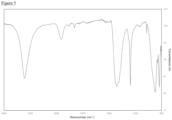
FIG. 3 is a chart showing the analytical results of the FT-IR spectrum of the hydrogen boride sheet obtained in Example 1. -
FIG. 4 is a chart showing the analytical results of the FT-IR spectrum of the hydrogen boride sheet obtained in Example 2. -
FIG. 5 is a chart showing the analytical results of the FT-IR spectrum of the hydrogen boride sheet obtained in Comparative Example 1. - The structure of the present invention has B-H-B bonds, B-H bonds, and B-OH bonds, and comprises boron, hydrogen, and oxygen.
- The structure of the present invention comprises boron, hydrogen, and oxygen, that has B-H-B bonds, B-H bonds, and B-OH bonds. Therefore, as shown in
Fig. 1(A) , it has a structure of (BH)n(BOH)m which is a combination of BH and BOH. InFig. 1(B) , the three-dimensional structure of an ideal structure consisting only of boron and hydrogen is shown. The structure comprising boron, hydrogen, and oxygen of the present invention has a structure in which a part of hydrogen (H) is substituted with a hydroxyl group (OH), and is represented by BHn(OH)m (n+m=1). - When measuring the FT-IR spectrum of the structure of the present invention, the following formulas are satisfied:


- The transmittance at 1400 cm-1 (a) in the FT-IR spectrum indicates "B-H-B bonds", the transmittance at 2500 cm-1 (b) in the FT-IR spectrum indicates "B-H bonds", and the transmittance at 3200cm-1 (c) in the FT-IR spectrum indicates "B-OH bonds." The lower the transmittance means the greater the content of each bond.
- The transmittance of each wavelength is a relative transmittance when the baseline is defined as 100%, and the baseline is set with the value of 1725cm-1 as 100%.
- The lower limit of a/c is not limited, but is 0.80 or more, preferably 0.82 or more, more preferably 0.84 or more, even more preferably 0.86 or more, and most preferably 0.88 or more. The upper limit of a/c is not limited, but is 0.96 or less, preferably 0.95 or less, and more preferably 0.94 or less. The lower limit and the upper limit can be combined each other. The above ranges allow for the storage and transport of a large amount of hydrogen.
- The lower limit of b/c is not limited, but is 0.95 or more, preferably 0.98 or more, more preferably 1.01 or more, even more preferably 1.02 or more, and most preferably 1.03 or more. The upper limit of b/c is not limited, but is 1.12 or less, preferably 1.10 or less, and more preferably 1.08 or less, even more preferably 1.07 or less, and most preferably1.06 or less. The lower limit and the upper limit can be combined each other. The above ranges allow for the storage and transport of a large amount of hydrogen.
- The structure of the present invention preferably satisfy (3)d^b. Herein, d is the transmittance at 700 cm-1 in the FT-IR spectrum.
- Both of the transmittances at 2500 cm-1 (b) and 700 cm-1 (d) mean the transmittance of the "B-H bonds", and the difference in wavenumbers indicates the difference in the vibrational species of the B-H bonds. The wavenumber of b indicates the stretching vibration of the B-H bonds, and the wavenumber of d indicates the bending vibration of the B-H bonds. Further, in FT-IR analysis, it is generally considered that the smaller the wavenumber, the weaker the bond. Therefore, when d is equal to or less than b, it is presumed that hydrogen is preferentially released from the B-H bond, which is relatively weak, and that the efficient release of hydrogen from the structure will be possible. However, the present invention is not limited by the above presumption.
- In the structures of the present invention, i.e., hydrogen boride sheets, when the hydrogen boride sheet is irradiated with ultraviolet light, hydrogen atoms in B-H bonds become molecular hydrogen (H2) and are released from the hydrogen boride sheet. On the other hand, hydrogen atoms in B-OH bonds are not released from the hydrogen boride sheet. In the hydrogen boride sheet, if there are more B-H bonds than B-OH bonds, the amount of released molecular hydrogen (H2) is larger. That is to say, more hydrogen can be stored therein and transported.
- The transmittance at 3200 cm-1 (c) in the FT-IR spectrum indicates "B-OH bonds." The lower the transmittance (c) means the greater the content of "B-OH bonds." Therefore, when the value of b/c is large, there are many "B-OH bonds" and few "B-H bonds." Conversely, when the value of b/c is small, there are fewer "B-OH bonds" and more "B-H bonds", and a large amount of hydrogen can be stored.
- The measurement method of FT-IR spectra is not particularly limited, but the methods commonly used in this field can be used. As the measurement methods, there may be mentioned total reflection method, transmission method, diffuse reflection method, vertical-incidence transmission method, or infrared microscopy method. The total reflection method (Attenuated Total Reflection Spectroscopy: ATR spectroscopy) is preferrable.
- For example, it is measured by ATR method using PIKE MIRacle ATR. It is preferable to take a sample four times and measure them under one condition. The wavenumber range to be measured is, for example, 4500 to 600cm-1.
- A thickness of the structure of the present invention is not particularly limited, but is 0.23 nm to 0.50 nm. In the structure of the present invention, it is preferrable that the length in at least one direction (for example, the length in the X direction or the Y direction in
Fig. 1B ) is 100 nm or more. If the length of at least one direction in the structure of the present invention is 100 nm or more, the structure of the present invention can be effectively used as a storage material for hydrogen. - The size (area) of the structure of the present invention is not particularly limited. The size of the structure of the present invention can be formed to any size by the method for preparing the structure of the present invention described below.
- The structure of the present invention is a substance with a crystalline structure. In addition, in the structure of the present invention, the bonding force between boron atoms (B) forming hexagonal rings and the bonding force between boron atom (B) and hydrogen atom (H) are strong. Therefore, even if multiple stacked crystals (agglomerates) are formed in the manufacturing process, the structure of the present invention can be easily cleaved along the crystal plane and separated (collected) as a single two-dimensional sheet, as is the case with graphite.
- The method for preparing a structure of the present invention comprises the step of mixing a metal diboride having an MB2 type structure (wherein M is at least one selected from the group consisting of Al, Mg, Ta, Zr, Re, Cr, Ti, and V), and an ion exchange resin in which ion-exchangeable ions with the metal ions constituting the metal diboride are coordinated, in a polar organic solvent (hereinafter, sometimes referred to as mixing step).
- As the metal diboride having MB2 type structure, one having a hexagonal ring structure is used. For example, aluminum diboride (AlB2), magnesium diboride (MgB2), tantalum diboride (TaB2), zirconium diboride (ZrB2), rhenium diboride (ReB2), chromium diboride (CrB2), titanium diboride (TiB2), or vanadium diboride (VB2) are used. Magnesium diboride is preferred because it can be easily ion-exchanged with ion-exchange resins in polar organic solvent.
- The crystallite size of the above metal diboride having MB2 type structure is not particularly limited as long as it is possible to produce a structure in which the effects of the present invention can be obtained. However, the average crystallite size is preferably 2 to 5 µm, 2 to 3 µm in one embodiment, 3 to 5 µm in another embodiment. The above ranges allow more hydrogen to be stored.
- The method for measuring crystallite size is not particularly limited, but it can be measured preferably by X-ray diffraction (XRD).
- The diffraction intensity of MB2 powder on the 2Θ axis can be measured by the Θ-2Θ method of powder diffraction. Specifically, the MB2 powder is fixed in a sample holder for powder measurement. The sample holder in which the MB2 powder is fixed, is placed on the sample holder fixture of the XRD apparatus. The powder is measured by the Θ-2Θ method. As an X-ray source, a commonly used wavelength such as a Cu target (wavelength: 1.54Å) or a Mo target (wavelength: 0.7Å) can be used. From the obtained diffraction pattern, the crystallite size L (m) is calculated by the following Scherrer's formula from the width at half maximum β (radians) of the diffraction peak, the X-ray wavelength λ (m), the diffraction angle Θ (radians), and the crystal shape factor K (unitless, 0.9 is often used to approximate the crystal shape).

- The diffraction angle varies depending on which crystal plane of MB2 the diffraction occurred at, and thus the crystallite size is calculated for each diffraction angle. The obtained crystallite size is the average value. Furthermore, the average range of crystallite size is measured from the range of crystallite sizes calculated from each diffraction
- Ion-exchange resin in which ion-exchangeable ions with the metal ions constituting the metal diboride are coordinated, is not particularly limited. As the ion-exchange resin, for example, there may be mentioned a polymer of styrene having a functional group coordinating ion-exchangeable ions with the metal ions constituting the metal diboride (hereafter referred to as "functional group α"), a polymer of divinylbenzene with functional group α, a copolymer of styrene with functional group α and divinylbenzene with functional group α, or the like. The functional group α includes, for example, a sulfo group, a carboxyl group, or the like. Among these, sulfo group is preferrable because it can be easily ion-exchanged with metal ions constituting the metal diboride in polar organic solvents.
- The polar organic solvent is not particularly limited, but there may be mentioned acetonitrile, N,N-dimethylformamide, methanol, or the like. Among these, acetonitrile is preferrable because it does not contain oxygen.
- In the mixing step, the metal diboride and ion exchange resin are put into a polar organic solvent, and the mixed solution containing the polar organic solvent, metal diboride, and ion exchange resin is stirred to bring the metal diboride and ion exchange resin into contact sufficiently. As a result, the metal ions constituting the metal diboride and the ions of the functional group α of the ion exchange resin are ion-exchanged, to produce the structure of the present invention, i.e., the hydrogen boride sheet, that is formed by the boron atoms and the atoms derived from the functional group α of the ion exchange resin.
- For example, when magnesium diboride is used as the metal diboride and an ion exchange resin having sulfo groups is used as the ion exchange resin, the magnesium ion (Mg+) of magnesium diboride is replaced by the hydrogen ion (H+) of the sulfo group of the ion exchange resin to produce the hydrogen boride sheet of the present invention consisting of the boron atom (B) and hydrogen atom (H) as described above.
- In the mixing step, it is preferable to gently proceed the ion-exchange reaction between the metal ions constituting the metal diboride and the ions of the functional group α of the ion exchange resin, without applying ultrasound or the like to the mixed solution.
- When the mixed solution is stirred, the temperature of the mixed solution is preferably 15°C to 35°C.
- The time for stirring the mixed solution is not particularly limited, but is, for example, 700 to 7000 minutes.
- In addition, the mixing step is performed under an inert atmosphere consisting of inert gases such as nitrogen (N2) or argon (Ar).
- In the method for preparing a structure of the present invention, the mixed solution is preferably filtered (hereinafter sometimes referred to as a filtration step) after the stirring has been completed. The filtration method of the mixed solution is not particularly limited. For example, spontaneous filtration, reduced-pressure filtration, pressurized filtration, and centrifugal filtration are used. Further, as the filter media, filter paper based on cellulose, membrane filters, or filter plates in which cellulose, glass fiber, or the like are compression-mold, is used.
- For example, when the membrane filter is used, the filter size is not particularly limited as long as it is possible to produce a structure that achieves the effects of the present invention. For example, the filter size is 5 µm or less, preferably 4 µm or less, more preferably 3 µm or less, more preferably 2 µm or less, and most preferably 1 µm or less. The lower limit of filter size is not limited, but 0.1 µm or more is preferable from the viewpoint of shortening the filtration time.
- The solution containing the product, which is separated from the precipitate by filtration and collected, is spontaneously dried or is dried by heating, to obtain only the final product. The product is the hydrogen boride sheet formed by boron atoms and hydrogen atoms derived from the functional group α of the ion exchange resin.
- The method for producing molecular hydrogen (H2) comprises the step of irradiating the structure with ultraviolet ray. The wavelength of the ultraviolet ray used is not particularly limited as long as molecular hydrogen (H2) is evolved from the structure, but ultraviolet ray in the range of 10 nm to 400 nm can be used.
- UV ray sources is not particularly limited, but, there may be mentioned mercury xenon lamps, high pressure mercury UV lamps, low pressure mercury UV lamps, ultraviolet ray LEDs, ultraviolet ray LDs or metal halide UV lamps.
- The present invention now will be further illustrated by, but is by no means limited to, the following Examples.
- In this example, MgB2 with a crystallite particle size of 3-5 µm was used to prepare a hydrogen boride sheet.
- 30mL of ion exchange resin (Amberlite IR120B H type made by Organo) was wetted with 20mL of acetonitrile solvent and was allowed to stand in a draft overnight. In a glove box, 500 mg of MgB2 was weighed and charged into a 500-mL flask. The mixture of the ion exchange resin and acetonitrile solvent was filtered through a funnel, and the ion exchange resin was removed. The ion exchange resin and 200 mL of acetonitrile were charged into the flask containing MgB2. A stirrer was placed in the flask and the flask was left for 3 days while stirring. Nitrogen was supplied into the flask during stirring to reduce the exposure of the samples to the atmosphere. The resulting solution was filtered through a 5 µm filter. Filtration was carried out under a nitrogen atmosphere. To remove the solvent from the solution, it was solvent-dried under reduced pressure to obtain a yellow powder of 100 mg.
- The crystallite size of MgB2 used was measured by X-ray diffraction. XRD Θ-2Θ measurements were performed on MgB2, and the crystallite size was calculated from the width at half maximum of the obtained diffraction peaks using Scherrer's formula below.

- K: crystal structure factor (generally 0.9 (Reference 1)), λ: X ray wavelength (15.4nm in this case)
- β: width at half maximum of X ray diffraction peaks, Θ: diffraction angle of X ray (Reference article: A.Monshi et al., World Journal of Science and Engineering Vol.2 154-160(2012)
- The results of XRD measurements and calculations using Scherrer's equation are shown in
Fig. 2 and Tables 1 and 2. The average crystallite size of MgB2 was 3 to 5 µm.[Table 1] Diffraction crystal plane Width at half maximum (degrees) Example 1 Example 2 Comparative Example 1 100 0.182 0.249 0.249 101 0.214 0.316 0.316 002 0.258 0.331 0.331 110 0.225 0.342 0.342 102 0.284 0.514 0.514 201 0.274 0.452 0.452 112 0.335 0.531 0.531 [Table 2] Example 1 Example 2 Comparative Example 1 Average crystallite size calculated by Scherrer's equation Maximum value 5 3 3 Minimum value 3 2 2 - In this example, MgB2 with a crystallite particle size of 2-3 µm was used to prepare a hydrogen boride sheet.
- The procedure described in Example 1 was repeated to obtain a yellow powder of 90 mg., except that MgB2 with a crystallite particle size of 2-3 µm was used, and a 2µm filter was used. The results of XRD measurements and calculations using Scherrer's equation are shown in
Fig. 3 and Tables 1 and 2. The average crystallite size of MgB2 was 2 to 3 µm. - In this comparative example, MgB2 with a crystallite particle size of 2-3 µm was used to prepare a hydrogen boride sheet.
- The procedure described in Example 1 was repeated to obtain a yellow powder of 95 mg., except that MgB2 with a crystallite particle size of 2-3 µm was used. The results of XRD measurements and calculations using Scherrer's equation are shown in
Fig. 4 and Tables 1 and 2. The average crystallite size of MgB2 was 2 to 3 µm. - FT-IR spectra of the hydrogen boride sheets obtained in Examples 1 and 2 and in Comparative Example 1 were measured using an ATR measurement unit.
- About 10 mg of the powder of hydrogen boride sheet was placed on a crystal (diamond) used for the total reflection of infrared light. The powder was pressed down with a pin and adhered to the crystal. The ATR measurement unit was set in the FT-IR apparatus, and infrared light was incident from the crystal side, and the light obtained by total reflection from the crystal was dispersed. The result obtained without powder was used as a background, and this background data was subtracted from the powder data to measure the transmittance of the hydrogen boride sheets.
- The results of the measurements of the hydrogen boride sheets of Examples 1 and 2 and of
Comparison 1 are shown inFigs. 3 to 5 , respectively. - In the hydrogen boride sheets of Example 1 and 2 and Comparative Example 1, The averaged values of transmittance ratios a/c and b/c were calculated for the spectra obtained for each sample, assuming that the transmittance at 1400 cm-1 is due to B-H-B bonds (a), the transmittance at 2500 cm-1 is due to B-H bonds (b), and the transmittance at 3200 cm-1 is due to B-OH bonds (c). The averaged values for each synthesis condition are shown in Table 3. A smaller transmittance ratio indicates a higher content. That is, a larger value indicates a higher content of BOH.
[Table 3] Example 1 Example 2 Comparative Example 1 a 85.95 78.10 79.72 b 94.26 94.54 93.75 c 91.79 89.17 82.14 d 87.44 77.58 78.91 a(BHB)/c(BOH) 0.94 0.88 0.97 B(BH)/c(BOH) 1.03 1.06 1.15 - The hydrogen boride sheets obtained in Examples 1 and 2 and Comparative Example 1 was irradiated with ultraviolet ray to measure the production amount of molecular hydrogen (H2).
- A sample of 10 mg was placed in a sealed container. A quartz glass was used for the window of the sealed container to allow light to penetrate during UV irradiation against the sample. Argon gas flowed into the sealed container at a rate of 10 mL/min. The samples were irradiated with UV light at a distance of 10 cm using a mercury xenon lamp, and the concentration of produced hydrogen gas was measured by a micro GC. Changes in hydrogen concentration were measured for 480 minutes. The integrated values of hydrogen concentration obtained for each sample during the measurement time are shown in Table 4.
[Table 4] Example 1 Example 2 Comparative Example 1 Integrated values of hydrogen concentration (ppm) 280397 213476 176858 - After irradiation, the samples turned brown. When viewed from the side, about half of the sample in the thickness direction turned brown. Therefore, it was considered that about 5 mg of the sample reacted to the light irradiation. Accordingly, the weight of the sample was assumed to be 5 mg, and the weight of hydrogen produced per sample weight and the volume of hydrogen produced per sample volume were calculated from the volume of the chamber and the integrated value of hydrogen concentration. The results are shown in Table 5. In the calculation per volume, the density of the hydrogen boride sheet is assumed to be equal to the density of boron and it was calculated.
[Table 5] Example 1 Example 2 Comparative Example 1 Weight of hydrogen produced (wt%) 3.1 2.4 2.0 Volume of hydrogen produced (g/L) 62 48 40 - The structure of the present invention can be used for storage and transport of hydrogen and can produce a large amount of molecular hydrogen (H2).
Claims (8)
- A structure comprising boron, hydrogen, and oxygen, that has B-H-B bonds, B-H bonds, and B-OH bonds, and in the measurement of FT-IR spectra, the following formulas are satisfied:


- A method for preparing a structure comprising boron, hydrogen, and oxygen, comprising the step of mixing a metal diboride having an MB2 type structure (wherein M is at least one selected from the group consisting of Al, Mg, Ta, Zr, Re, Cr, Ti, and V), and an ion exchange resin in which ion-exchangeable ions with the metal ions constituting the metal diboride are coordinated, in a polar organic solvent,
wherein an average crystallite size of the metal diboride according to Scherrer's equation is 2 to 5 µm. - The method for preparing a structure comprising boron, hydrogen, and oxygen, according to claim 2, wherein the average crystallite size of the metal diboride according to Scherrer's equation is 3 to 5 µm.
- The method for preparing a structure comprising boron, hydrogen, and oxygen, according to claim 2, wherein the average crystallite size of the metal diboride according to Scherrer's equation is 2 to 3 µm.
- The method for preparing a structure comprising boron, hydrogen, and oxygen, according to any one of claims 2 to 4, comprising the step of filtering with a filter of 3 µm or less after the mixing step.
- The method for preparing a structure comprising boron, hydrogen, and oxygen, according to any one of claims 2 to 5, wherein the ion exchange resin has a sulfo group.
- The method for preparing a structure comprising boron, hydrogen, and oxygen, according to any one of claims 2 to 6, wherein the polar organic solvent is acetonitrile or methanol.
- A method for producing molecular hydrogen (H2) comprising the step of irradiating the structure according to claim 1 with ultraviolet rays.
Applications Claiming Priority (2)
| Application Number | Priority Date | Filing Date | Title |
|---|---|---|---|
| JP2021096732A JP2022188581A (en) | 2021-06-09 | 2021-06-09 | Structures containing boron, hydrogen, and oxygen, and production method of the same |
| PCT/JP2022/023238 WO2022260116A1 (en) | 2021-06-09 | 2022-06-09 | Structural body including boron, hydrogen, and oxygen, and method for producing same |
Publications (1)
| Publication Number | Publication Date |
|---|---|
| EP4353675A1 true EP4353675A1 (en) | 2024-04-17 |
Family
ID=84425236
Family Applications (1)
| Application Number | Title | Priority Date | Filing Date |
|---|---|---|---|
| EP22820295.8A Withdrawn EP4353675A1 (en) | 2021-06-09 | 2022-06-09 | Structural body including boron, hydrogen, and oxygen, and method for producing same |
Country Status (5)
| Country | Link |
|---|---|
| US (1) | US20240279072A1 (en) |
| EP (1) | EP4353675A1 (en) |
| JP (1) | JP2022188581A (en) |
| CN (1) | CN117425617A (en) |
| WO (1) | WO2022260116A1 (en) |
Family Cites Families (9)
| Publication number | Priority date | Publication date | Assignee | Title |
|---|---|---|---|---|
| US1944598A (en) * | 1929-10-22 | 1934-01-23 | Chem Fab Grunau Landshoff & Me | Process for the manufacture of boric acid |
| JP5532949B2 (en) * | 2010-01-19 | 2014-06-25 | トヨタ自動車株式会社 | Hydrogenation method of hydrogen storage material |
| CN103303867A (en) * | 2013-07-09 | 2013-09-18 | 河北工业大学 | Method for synthesizing ammonia borane |
| CN106458582B (en) * | 2014-06-13 | 2020-03-20 | 南威尔士大学商业服务有限公司 | Synthesis and hydrogen storage characteristics of metal hydrides |
| JP6727080B2 (en) * | 2016-09-02 | 2020-07-22 | 国立大学法人九州大学 | Organic light emitting device and light emitting material and compound used therefor |
| WO2018074518A1 (en) * | 2016-10-18 | 2018-04-26 | 国立大学法人筑波大学 | Sheet containing two-dimensional borohydride and production method for sheet containing two-dimensional boron compound |
| JP7079932B2 (en) * | 2018-06-22 | 2022-06-03 | 国立大学法人東京工業大学 | Hydrogen generation method, hydrogen generation system and fuel cell system |
| JP2021028285A (en) * | 2019-08-09 | 2021-02-25 | 国立大学法人 筑波大学 | Layered hydrogen boride |
| WO2021095619A1 (en) * | 2019-11-15 | 2021-05-20 | 国立大学法人東京工業大学 | Two dimensional borohydride-containing sheet manufacturing method, two dimensional borohydride-containing sheet composition, and method for manufacturing same |
-
2021
- 2021-06-09 JP JP2021096732A patent/JP2022188581A/en active Pending
-
2022
- 2022-06-09 CN CN202280040401.2A patent/CN117425617A/en active Pending
- 2022-06-09 US US18/567,845 patent/US20240279072A1/en active Pending
- 2022-06-09 EP EP22820295.8A patent/EP4353675A1/en not_active Withdrawn
- 2022-06-09 WO PCT/JP2022/023238 patent/WO2022260116A1/en not_active Ceased
Also Published As
| Publication number | Publication date |
|---|---|
| JP2022188581A (en) | 2022-12-21 |
| CN117425617A (en) | 2024-01-19 |
| WO2022260116A1 (en) | 2022-12-15 |
| US20240279072A1 (en) | 2024-08-22 |
Similar Documents
| Publication | Publication Date | Title |
|---|---|---|
| Chi et al. | XPS and FTIR investigations of the transient photocatalytic decomposition of surface carbon contaminants from anatase TiO2 in UHV starved water/oxygen environments | |
| Ozawa et al. | Black phosphorus synthesized by solvothermal reaction from red phosphorus and its catalytic activity for water splitting | |
| Hamilton et al. | Dissolution of albite glass and crystal | |
| US8974578B2 (en) | Porous polymer networks and ion-exchange media and metal-polymer composites made therefrom | |
| Janus et al. | Azo dyes decomposition on new nitrogen-modified anatase TiO2 with high adsorptivity | |
| Roy et al. | Supported ammonia borane decomposition through enhanced homopolar B–B coupling | |
| Colman et al. | Photopolymerization of carbon disulfide yields the high-pressure-phase (CS2) X | |
| Pavlenko et al. | Effect of SiO2 crystal structure on the stability of polymer composites exposed to vacuum ultraviolet radiation | |
| Manandhar et al. | Rapid sol–gel synthesis of nanodiamond aerogel | |
| Francke et al. | Synthesis and characterization of Al 3+, Cr 3+, Fe 3+ and Ga 3+ hydroxyfluorides: correlations between structural features, thermal stability and acidic properties | |
| US20240279072A1 (en) | Structural body including boron, hydrogen, and oxygen, and method for producing same | |
| TW201632461A (en) | Use of silicon-containing particles for protection of industrial materials from UV radiation | |
| Corradetti et al. | Nanocrystalline titanium carbide/carbon composites as irradiation targets for isotopes production | |
| IL294341A (en) | High-purity tungsten(vi) oxytetrachloride and process for preparing same | |
| Rosso et al. | Insight on MWW siliceous zeolites: From 2D precursors toward 3D structure | |
| Calatayud et al. | Highly photoactive anatase nanoparticles obtained using trifluoroacetic acid as an electron scavenger and morphological control agent | |
| Civiš et al. | Oxygen-isotope exchange between CO2 and solid Ti18O2 | |
| Bodalyov et al. | Mechanism of formation of titanium dioxide crystallites in the reaction of titanium tetrachloride with magnesium hydrosilicate nanotubes | |
| Kumar et al. | Nanoparticles of uranium oxide occluded in MCM-41 silica host: Influence of synthesis condition on the size and the chemisorption behavior | |
| WO2024057944A1 (en) | Composition containing borohydride sheet and carrier, and hydrogen release method using same | |
| Ershov et al. | Formation of long-lived clusters and silver nucleation in the γ-irradiation of aqueous silver perchlorate solutions containing polyphosphate | |
| Morgan et al. | Deposition of Carbon Particulates Surfaces on Zeolites by Electron-Beam Evaporation of Graphite | |
| Rosell III et al. | Molten salt synthesis of hexagonal boron nitride for ultrafiltration | |
| Pyoryshkov et al. | Effect of preparation conditions on the ordering of structural elements in vanadium pentoxide xerogels | |
| US20230011182A1 (en) | Solar production of hydrogen using defect engineered boron-rich photocalysts |
Legal Events
| Date | Code | Title | Description |
|---|---|---|---|
| STAA | Information on the status of an ep patent application or granted ep patent |
Free format text: STATUS: THE INTERNATIONAL PUBLICATION HAS BEEN MADE |
|
| PUAI | Public reference made under article 153(3) epc to a published international application that has entered the european phase |
Free format text: ORIGINAL CODE: 0009012 |
|
| STAA | Information on the status of an ep patent application or granted ep patent |
Free format text: STATUS: REQUEST FOR EXAMINATION WAS MADE |
|
| 17P | Request for examination filed |
Effective date: 20231206 |
|
| AK | Designated contracting states |
Kind code of ref document: A1 Designated state(s): AL AT BE BG CH CY CZ DE DK EE ES FI FR GB GR HR HU IE IS IT LI LT LU LV MC MK MT NL NO PL PT RO RS SE SI SK SM TR |
|
| DAV | Request for validation of the european patent (deleted) | ||
| DAX | Request for extension of the european patent (deleted) | ||
| STAA | Information on the status of an ep patent application or granted ep patent |
Free format text: STATUS: THE APPLICATION IS DEEMED TO BE WITHDRAWN |
|
| 18D | Application deemed to be withdrawn |
Effective date: 20250103 |