EP4352124B1 - Open cell flexible isocyanate-based foams having a low exotherm during foaming - Google Patents
Open cell flexible isocyanate-based foams having a low exotherm during foaming Download PDFInfo
- Publication number
- EP4352124B1 EP4352124B1 EP22732144.5A EP22732144A EP4352124B1 EP 4352124 B1 EP4352124 B1 EP 4352124B1 EP 22732144 A EP22732144 A EP 22732144A EP 4352124 B1 EP4352124 B1 EP 4352124B1
- Authority
- EP
- European Patent Office
- Prior art keywords
- range
- reactive
- foam
- isocyanate
- volume
- Prior art date
- Legal status (The legal status is an assumption and is not a legal conclusion. Google has not performed a legal analysis and makes no representation as to the accuracy of the status listed.)
- Active
Links
Images
Classifications
-
- C—CHEMISTRY; METALLURGY
- C08—ORGANIC MACROMOLECULAR COMPOUNDS; THEIR PREPARATION OR CHEMICAL WORKING-UP; COMPOSITIONS BASED THEREON
- C08G—MACROMOLECULAR COMPOUNDS OBTAINED OTHERWISE THAN BY REACTIONS ONLY INVOLVING UNSATURATED CARBON-TO-CARBON BONDS
- C08G18/00—Polymeric products of isocyanates or isothiocyanates
- C08G18/06—Polymeric products of isocyanates or isothiocyanates with compounds having active hydrogen
- C08G18/08—Processes
- C08G18/09—Processes comprising oligomerisation of isocyanates or isothiocyanates involving reaction of a part of the isocyanate or isothiocyanate groups with each other in the reaction mixture
- C08G18/095—Processes comprising oligomerisation of isocyanates or isothiocyanates involving reaction of a part of the isocyanate or isothiocyanate groups with each other in the reaction mixture oligomerisation to carbodiimide or uretone-imine groups
-
- C—CHEMISTRY; METALLURGY
- C08—ORGANIC MACROMOLECULAR COMPOUNDS; THEIR PREPARATION OR CHEMICAL WORKING-UP; COMPOSITIONS BASED THEREON
- C08G—MACROMOLECULAR COMPOUNDS OBTAINED OTHERWISE THAN BY REACTIONS ONLY INVOLVING UNSATURATED CARBON-TO-CARBON BONDS
- C08G18/00—Polymeric products of isocyanates or isothiocyanates
- C08G18/06—Polymeric products of isocyanates or isothiocyanates with compounds having active hydrogen
- C08G18/08—Processes
- C08G18/16—Catalysts
- C08G18/161—Catalysts containing two or more components to be covered by at least two of the groups C08G18/166, C08G18/18 or C08G18/22
- C08G18/163—Catalysts containing two or more components to be covered by at least two of the groups C08G18/166, C08G18/18 or C08G18/22 covered by C08G18/18 and C08G18/22
-
- C—CHEMISTRY; METALLURGY
- C08—ORGANIC MACROMOLECULAR COMPOUNDS; THEIR PREPARATION OR CHEMICAL WORKING-UP; COMPOSITIONS BASED THEREON
- C08G—MACROMOLECULAR COMPOUNDS OBTAINED OTHERWISE THAN BY REACTIONS ONLY INVOLVING UNSATURATED CARBON-TO-CARBON BONDS
- C08G18/00—Polymeric products of isocyanates or isothiocyanates
- C08G18/06—Polymeric products of isocyanates or isothiocyanates with compounds having active hydrogen
- C08G18/08—Processes
- C08G18/16—Catalysts
- C08G18/166—Catalysts not provided for in the groups C08G18/18 - C08G18/26
- C08G18/168—Organic compounds
-
- C—CHEMISTRY; METALLURGY
- C08—ORGANIC MACROMOLECULAR COMPOUNDS; THEIR PREPARATION OR CHEMICAL WORKING-UP; COMPOSITIONS BASED THEREON
- C08G—MACROMOLECULAR COMPOUNDS OBTAINED OTHERWISE THAN BY REACTIONS ONLY INVOLVING UNSATURATED CARBON-TO-CARBON BONDS
- C08G18/00—Polymeric products of isocyanates or isothiocyanates
- C08G18/06—Polymeric products of isocyanates or isothiocyanates with compounds having active hydrogen
- C08G18/08—Processes
- C08G18/16—Catalysts
- C08G18/18—Catalysts containing secondary or tertiary amines or salts thereof
- C08G18/1833—Catalysts containing secondary or tertiary amines or salts thereof having ether, acetal, or orthoester groups
-
- C—CHEMISTRY; METALLURGY
- C08—ORGANIC MACROMOLECULAR COMPOUNDS; THEIR PREPARATION OR CHEMICAL WORKING-UP; COMPOSITIONS BASED THEREON
- C08G—MACROMOLECULAR COMPOUNDS OBTAINED OTHERWISE THAN BY REACTIONS ONLY INVOLVING UNSATURATED CARBON-TO-CARBON BONDS
- C08G18/00—Polymeric products of isocyanates or isothiocyanates
- C08G18/06—Polymeric products of isocyanates or isothiocyanates with compounds having active hydrogen
- C08G18/08—Processes
- C08G18/16—Catalysts
- C08G18/18—Catalysts containing secondary or tertiary amines or salts thereof
- C08G18/20—Heterocyclic amines; Salts thereof
- C08G18/2045—Heterocyclic amines; Salts thereof containing condensed heterocyclic rings
- C08G18/2063—Heterocyclic amines; Salts thereof containing condensed heterocyclic rings having two nitrogen atoms in the condensed ring system
-
- C—CHEMISTRY; METALLURGY
- C08—ORGANIC MACROMOLECULAR COMPOUNDS; THEIR PREPARATION OR CHEMICAL WORKING-UP; COMPOSITIONS BASED THEREON
- C08G—MACROMOLECULAR COMPOUNDS OBTAINED OTHERWISE THAN BY REACTIONS ONLY INVOLVING UNSATURATED CARBON-TO-CARBON BONDS
- C08G18/00—Polymeric products of isocyanates or isothiocyanates
- C08G18/06—Polymeric products of isocyanates or isothiocyanates with compounds having active hydrogen
- C08G18/08—Processes
- C08G18/16—Catalysts
- C08G18/22—Catalysts containing metal compounds
- C08G18/225—Catalysts containing metal compounds of alkali or alkaline earth metals
-
- C—CHEMISTRY; METALLURGY
- C08—ORGANIC MACROMOLECULAR COMPOUNDS; THEIR PREPARATION OR CHEMICAL WORKING-UP; COMPOSITIONS BASED THEREON
- C08G—MACROMOLECULAR COMPOUNDS OBTAINED OTHERWISE THAN BY REACTIONS ONLY INVOLVING UNSATURATED CARBON-TO-CARBON BONDS
- C08G18/00—Polymeric products of isocyanates or isothiocyanates
- C08G18/06—Polymeric products of isocyanates or isothiocyanates with compounds having active hydrogen
- C08G18/28—Polymeric products of isocyanates or isothiocyanates with compounds having active hydrogen characterised by the compounds used containing active hydrogen
- C08G18/30—Low-molecular-weight compounds
- C08G18/32—Polyhydroxy compounds; Polyamines; Hydroxyamines
- C08G18/3203—Polyhydroxy compounds
- C08G18/3206—Polyhydroxy compounds aliphatic
-
- C—CHEMISTRY; METALLURGY
- C08—ORGANIC MACROMOLECULAR COMPOUNDS; THEIR PREPARATION OR CHEMICAL WORKING-UP; COMPOSITIONS BASED THEREON
- C08G—MACROMOLECULAR COMPOUNDS OBTAINED OTHERWISE THAN BY REACTIONS ONLY INVOLVING UNSATURATED CARBON-TO-CARBON BONDS
- C08G18/00—Polymeric products of isocyanates or isothiocyanates
- C08G18/06—Polymeric products of isocyanates or isothiocyanates with compounds having active hydrogen
- C08G18/28—Polymeric products of isocyanates or isothiocyanates with compounds having active hydrogen characterised by the compounds used containing active hydrogen
- C08G18/40—High-molecular-weight compounds
- C08G18/48—Polyethers
- C08G18/4804—Two or more polyethers of different physical or chemical nature
-
- C—CHEMISTRY; METALLURGY
- C08—ORGANIC MACROMOLECULAR COMPOUNDS; THEIR PREPARATION OR CHEMICAL WORKING-UP; COMPOSITIONS BASED THEREON
- C08G—MACROMOLECULAR COMPOUNDS OBTAINED OTHERWISE THAN BY REACTIONS ONLY INVOLVING UNSATURATED CARBON-TO-CARBON BONDS
- C08G18/00—Polymeric products of isocyanates or isothiocyanates
- C08G18/06—Polymeric products of isocyanates or isothiocyanates with compounds having active hydrogen
- C08G18/28—Polymeric products of isocyanates or isothiocyanates with compounds having active hydrogen characterised by the compounds used containing active hydrogen
- C08G18/40—High-molecular-weight compounds
- C08G18/48—Polyethers
- C08G18/4825—Polyethers containing two hydroxy groups
-
- C—CHEMISTRY; METALLURGY
- C08—ORGANIC MACROMOLECULAR COMPOUNDS; THEIR PREPARATION OR CHEMICAL WORKING-UP; COMPOSITIONS BASED THEREON
- C08G—MACROMOLECULAR COMPOUNDS OBTAINED OTHERWISE THAN BY REACTIONS ONLY INVOLVING UNSATURATED CARBON-TO-CARBON BONDS
- C08G18/00—Polymeric products of isocyanates or isothiocyanates
- C08G18/06—Polymeric products of isocyanates or isothiocyanates with compounds having active hydrogen
- C08G18/28—Polymeric products of isocyanates or isothiocyanates with compounds having active hydrogen characterised by the compounds used containing active hydrogen
- C08G18/40—High-molecular-weight compounds
- C08G18/48—Polyethers
- C08G18/4829—Polyethers containing at least three hydroxy groups
-
- C—CHEMISTRY; METALLURGY
- C08—ORGANIC MACROMOLECULAR COMPOUNDS; THEIR PREPARATION OR CHEMICAL WORKING-UP; COMPOSITIONS BASED THEREON
- C08G—MACROMOLECULAR COMPOUNDS OBTAINED OTHERWISE THAN BY REACTIONS ONLY INVOLVING UNSATURATED CARBON-TO-CARBON BONDS
- C08G18/00—Polymeric products of isocyanates or isothiocyanates
- C08G18/06—Polymeric products of isocyanates or isothiocyanates with compounds having active hydrogen
- C08G18/28—Polymeric products of isocyanates or isothiocyanates with compounds having active hydrogen characterised by the compounds used containing active hydrogen
- C08G18/65—Low-molecular-weight compounds having active hydrogen with high-molecular-weight compounds having active hydrogen
- C08G18/66—Compounds of groups C08G18/42, C08G18/48, or C08G18/52
- C08G18/6666—Compounds of group C08G18/48 or C08G18/52
- C08G18/667—Compounds of group C08G18/48 or C08G18/52 with compounds of group C08G18/32 or polyamines of C08G18/38
- C08G18/6674—Compounds of group C08G18/48 or C08G18/52 with compounds of group C08G18/32 or polyamines of C08G18/38 with compounds of group C08G18/3203
-
- C—CHEMISTRY; METALLURGY
- C08—ORGANIC MACROMOLECULAR COMPOUNDS; THEIR PREPARATION OR CHEMICAL WORKING-UP; COMPOSITIONS BASED THEREON
- C08G—MACROMOLECULAR COMPOUNDS OBTAINED OTHERWISE THAN BY REACTIONS ONLY INVOLVING UNSATURATED CARBON-TO-CARBON BONDS
- C08G18/00—Polymeric products of isocyanates or isothiocyanates
- C08G18/06—Polymeric products of isocyanates or isothiocyanates with compounds having active hydrogen
- C08G18/70—Polymeric products of isocyanates or isothiocyanates with compounds having active hydrogen characterised by the isocyanates or isothiocyanates used
- C08G18/72—Polyisocyanates or polyisothiocyanates
- C08G18/74—Polyisocyanates or polyisothiocyanates cyclic
- C08G18/76—Polyisocyanates or polyisothiocyanates cyclic aromatic
- C08G18/7657—Polyisocyanates or polyisothiocyanates cyclic aromatic containing two or more aromatic rings
- C08G18/7664—Polyisocyanates or polyisothiocyanates cyclic aromatic containing two or more aromatic rings containing alkylene polyphenyl groups
-
- C—CHEMISTRY; METALLURGY
- C08—ORGANIC MACROMOLECULAR COMPOUNDS; THEIR PREPARATION OR CHEMICAL WORKING-UP; COMPOSITIONS BASED THEREON
- C08G—MACROMOLECULAR COMPOUNDS OBTAINED OTHERWISE THAN BY REACTIONS ONLY INVOLVING UNSATURATED CARBON-TO-CARBON BONDS
- C08G2110/00—Foam properties
- C08G2110/0008—Foam properties flexible
-
- C—CHEMISTRY; METALLURGY
- C08—ORGANIC MACROMOLECULAR COMPOUNDS; THEIR PREPARATION OR CHEMICAL WORKING-UP; COMPOSITIONS BASED THEREON
- C08G—MACROMOLECULAR COMPOUNDS OBTAINED OTHERWISE THAN BY REACTIONS ONLY INVOLVING UNSATURATED CARBON-TO-CARBON BONDS
- C08G2110/00—Foam properties
- C08G2110/0041—Foam properties having specified density
- C08G2110/005—< 50kg/m3
-
- C—CHEMISTRY; METALLURGY
- C08—ORGANIC MACROMOLECULAR COMPOUNDS; THEIR PREPARATION OR CHEMICAL WORKING-UP; COMPOSITIONS BASED THEREON
- C08G—MACROMOLECULAR COMPOUNDS OBTAINED OTHERWISE THAN BY REACTIONS ONLY INVOLVING UNSATURATED CARBON-TO-CARBON BONDS
- C08G2110/00—Foam properties
- C08G2110/0041—Foam properties having specified density
- C08G2110/0058—≥50 and <150kg/m3
Definitions
- the present invention relates to processes for forming flexible polyurethane foams more in particular low-density flexible polyurethane foams with mainly open cells and low air flow resistivities, said processes being characterized as foaming processes avoiding the use of water as blowing agent and having a low exotherm during foaming thereby reducing the risk of scorching during production.
- the present invention also relates to flexible polyurethane foams more in particular low-density polyurethane flexible foams with mainly open cells and low air flow resistivities having a density in the range 12 up to 50 kg/m 3 which are less friable, more stiff and more temperature stable than the water-blown low density flexible polyurethane foams.
- the invention is related to the use of flexible polyurethane foams for sound absorption and/or sound insulation, more in particular in automotive applications.
- EP 0 381 324 A1 discloses a method for making rigid PU/PIR foams, wherein the reactive composition contains a carbodiimide-forming catalyst and less than 1 wt.-% of water.
- EP 0 381 324 A1 discloses a method for making flexible PU/PIRfoams, wherein the reaction is carried put at an NCO index of less than 200 in presence of water as blowing agent.
- WO 2014/113379 A1 discloses a method for making rigid PU/PIR foams, wherein thereaction mixture comprises a carboddimide-forming catayst and water as blowing agent.
- US 5 089 534 A discloses a process for making flexible PU/PIR foams, which leads to a reduced scorch. In US 5 089 534 A , the reaction mixture contains a carbodiimide-forming catalyst and and water as blowing agent and the reaction is carried out at an NCO index of less than 200.
- Another solution in the state of the art involves reducing the reaction exotherm from ongoing chemical reactions during foaming by means of reducing the overall OH value of the polyol blend, but that often results in reduced foam strength.
- additives to the reactive mixture such as anti-scorching agents (e.g. antioxidants).
- the ultimate goal would be to achieve a low density mainly open cell polyurethane flexible or semi-rigid foam which:
- the flexible polyurethane foams according to the invention have a suitable level of air flow and cell openness (having an open-cell content at least 80% by volume, preferably 90 to 95% by volume calculated on the total volume of the foam and measured according to ASTM D6226-10) which makes them suitable for use in applications wherein good sound absorption and/or sound insulation are required.
- the present invention discloses low density ( ⁇ 100 kg/m 3 ) flexible polyurethane foams with a predominantly open-cell structure with an open-cell content of at least 50% by volume, preferably at least 80%, more preferably in the range 90-95 % based on the total volume of the foam which have a low exotherm during foaming. Therefore, the present invention discloses a reactive mixture for making a low density polyurethane and/or polyisocyanurate comprising flexible foam having an apparent density below 100 kg/m 3 and a predominantly open-cell structure with an open-cell content of ⁇ 50 % by volume calculated on the total volume of the foam and measured according to ASTM D6226. 10, said reactive mixture comprising mixing at an isocyanate index of at least 200 following ingredients to form a reactive mixture:
- reaction mixture according to the invention gives rise to a foaming process with a low reaction exotherm ( ⁇ 120°C, preferably ⁇ 110°C, more preferably ⁇ 100°C ) during foaming. As a result, these foams are much less likely to undergo scorching when produced on larger industrial scale. Additionally, the presence of at least one carbodiimide forming catalyst gives rise to better foam properties such as less friable, more stiff and more temperature stable.
- the reactive mixture contains less than ⁇ 1wt%, preferably less than 0.75wt%, more preferably less than 0.5wt%, and even more preferably less than 0.25wt%water calculated on the total weight of the reactive mixture.
- the ingredients b) up to e) are first combined and then reacted with the polyisocyanate composition.
- the foams may be made according to a free rise process, a moulding process, a slabstock process, a lamination process or spray process.
- the ingredients may be fed independently to the mixing head of a foaming machine.
- the polyols, the catalysts and the optional ingredients are premixed before they are mixed with the polyisocyanate.
- the densities of the foams may range from 12 to 80 kg/m 3 , preferably from 12 to 65 kg/m 3 and more preferably from 12 to 50 kg/m 3 .
- the low density flexible foam according to the invention is a free rise flexible foam having densities ⁇ 50 kg/m 3 , preferably ⁇ 35 kg/m 3 , more preferably ⁇ 20 kg/m 3 .
- the low density flexible foam according to the invention is a sprayed foam using state of the art spray technology for polyurethane foaming.
- the process for making the low density flexible foam according to the invention comprises at least the steps of:
- the step of mixing of the polyisocyanate composition with the pre-mixed (isocyanate reactive) composition obtained in step i) to form a reactive mixture is performed using a 2-component high pressure mixing system.
- the step of mixing of the polyisocyanate composition with the pre-mixed (isocyanate reactive) composition obtained in step i) to form a reactive mixture is performed using a 2-component dynamic mixing system.
- the reaction exotherm is sufficient to obtain a foamed structure.
- the method for making the flexible foam according to the invention is performed at an isocyanate index higher than 200, preferably higher than 300, more preferably higher than 400, even more preferably in the range 500-2000 and most preferably in the range 800-1500.
- the low density flexible foam according to the invention has an open-cell content of ⁇ 50 % by volume, preferably ⁇ 60 % by volume, more preferably ⁇ 75 % by volume, even more preferably ⁇ 90 % by volume calculated on the total volume of the foam and measured according to ASTM D6226-10.
- the carbodiimide forming catalyst is a phospholene oxide compound, preferably selected from 1-methyl-1-oxophospholene, 1-ethyl-1-oxophospholene, 1-butyl-1-oxophospholene, 1-(2-ethylhexyl)-1-oxophospholene, 1-methyl-1-thiophospholene, 1-(2-chloroethyl)-1-oxophospholene, 1-phenyl-1-oxophospholene, 1-p-tolyl-1-oxophospholene, 1-chloromethyl-1-oxophospholene, 1,3-dimethyl-1-oxophospholene, 1,2-dimethyl-1-oxophospholene, 1-methyl-3-chloro-1-oxophospholene, 1-methyl-3-bromo-1-oxophospholene, 1-chlorophenyl-1-oxophospholene, 1,3,4-trimethyl-1-oxophospholene, 1,2,4-trimethyl-1-oxophospholene, 1,2,2-trimethyl-1-oxo
- Especially preferred carbodiimide forming catalyst include the isomers of 1-methyl-1-oxophospholene, 1-ethyl-1-oxophospholene, 1-propyl-1-oxophospholene, or mixtures thereof seen their compatibility with polyurethane-forming compositions.
- the carbodiimide forming catalyst is used in a catalytic quantity sufficient to promote the formation of carbodiimide linkages within the polymer.
- the amount of carbodiimide forming catalyst is in the range up to 5 wt%, preferably up to 4 wt%, more preferably up to 3 wt%, and even more preferably up to 2wt% based on total weight of the reactive mixture.
- the quantity of carbodiimide forming catalyst is in the range 0.5 wt% up to 3 wt%, preferably in the range 1 wt% to 2.5 wt% based on total weight of the reactive mixture.
- the catalyst composition comprises at least a carbodiimide forming catalyst compound in an amount of at least 50 wt%, preferably in an amount of at least 75 wt%, more preferably in an amount of at least 90 wt% based on the total weight of all catalyst compounds in the catalyst composition.
- the at least one polyurethane forming catalyst is a gelling and/or blowing catalyst and preferably selected from metal salt catalysts, such as organotins, and amine compounds, such as triethylenediamine (TEDA), N-methylimidazole, 1,2-dimethylimidazole, N-methylmorpholine, N-ethylmorpholine, triethylamine, N,N'-dimethylpiperazine, 1,3,5-tris(dimethylaminopropyl)hexahydrotriazine, 2,4,6-tris(dimethylaminomethyl)phenol, N-methyldicyclohexylamine, pentamethyldipropylene triamine, N-methyl-N'-(2-dimethylamino)-ethyl-piperazine, tributylamine, pentamethyldiethylenetriamine, hexamethyltriethylenetetramine, heptamethyltetraethylenepentamine, dimethylamin
- the polyurethane forming catalyst compound should be present in the reactive composition in a catalytically effective amount.
- Commercially available blowing and gelling catalysts are Jeffcat ® DPA (typical gelling catalyst), Jeffcat ® ZF10 (typical blowing catalyst), Jeffcat ® Z130 (typical gelling catalyst), Dabco ® NE300 (typical blowing catalyst), Dabco ® NE1091 (typical gelling catalyst) and Dabco ® NE1550 (typical gelling catalyst).
- the at least one polyisocyanurate forming catalyst (also referred to as trimerization catalyst) is selected from organic salts, preferably from alkali metal, earth alkali metal and/or quaternary ammonium organic salts such as potassium acetate, potassium hexanoate, potassium ethylhexanoate, potassium octanoate, potassium lactate, N-hydroxypropyl trimethyl ammonium octanoate, N-hydroxypropyl trimethyl ammonium formate and mixtures thereof.
- organic salts preferably from alkali metal, earth alkali metal and/or quaternary ammonium organic salts such as potassium acetate, potassium hexanoate, potassium ethylhexanoate, potassium octanoate, potassium lactate, N-hydroxypropyl trimethyl ammonium octanoate, N-hydroxypropyl trimethyl ammonium formate and mixtures thereof.
- the total amount of polyurethane and/or polyisocyanurate forming catalyst in the catalyst composition according to the invention is in the range 0-3 wt%, preferably in the range 0-2 wt%, more preferably in the range 0.1-1.5 wt% based on the total weight of the reactive mixture.
- the total amount of catalyst compounds in the catalyst composition according to the invention is in the range 0.5 wt% - 5 wt%, preferably in the range 1 wt% - 4 wt%, more preferably in the range 1 wt%-3wt% based on the total weight of the reactive mixture.
- no physical blowing agents are added to the reactive mixture.
- a blowing agent composition may be added to the reactive mixture, said blowing agent composition comprising physical blowing agents and/or non isocyanate-reactive chemical blowing agents thereby avoiding the use of isocyanate-reactive chemical blowing agents such as water.
- a blowing agent composition may be added to the reactive mixture.
- the water content should be less than 1 wt% water, preferably less than 0.75 wt% water, more preferably less than 0.5 wt%, and even more preferably less than 0.25 wt% calculated on the total weight of the reactive mixture.
- no water as reactive chemical blowing agent having isocyanate reactive group is added to the reactive mixture used to make the low density flexible foam according to the invention.
- a blowing agent composition may be added to the reactive mixture, said blowing agent composition comprising physical blowing agents.
- Suitable physical blowing agents may be selected from isobutene, methylformate, dimethyl ether, methylene chloride, acetone, t-butanol, argon, krypton, xenon, chloro fluoro carbons (CFCs), hydro fluoro carbons (HFCs), hydro chloro fluoro carbons (HCFCs), hydro fluoro olefins (HFO's), Hydro Chloro Fluoro Olefins (HCFO's), and hydrocarbons such as pentane, isopentane and cyclopentane and mixtures thereof.
- a blowing agent composition may be added to the reactive mixture, said blowing agent composition comprising physical blowing agents selected from at least CO 2 and/or N 2 .
- a blowing agent composition may be added to the reactive mixture, said blowing agent composition comprising physical blowing agents selected from at least HFO blowing agents and/or HCFO blowing agents.
- a blowing agent composition may be added to the reactive mixture, said blowing agent composition comprising non isocyanate-reactive chemical blowing agents.
- suitable examples include but are not limited to 1,1'-azobisformamide, sodium bicarbonate, p-toluene sulfonyl hydrazide, 4,4'-oxybis(benzenesulfonyl)hydrazine and p-toluenesulfonylsemicarbazide.
- the amount of blowing agents (optionally) added in the reactive mixture can vary based on, for example, the intended use and application of the foam product and the desired foam stiffness and density.
- a blowing agent composition may be added to the reactive mixture, said blowing agent composition and the amount of blowing agents used in the reactive mixture is in the range 5 to 60 parts by weight, more preferably from 10 to 30 parts by weight per hundred weight parts isocyanate reactive compounds (polyol) in order to produce a low density flexible foam having a density ⁇ 100 kg/m 3 , densities in the range 10-90 kg/m 3 , densities from 12-80 kg/m 3 and preferably 12-65 kg/m 3 and most preferably 12-50 kg/m 3 .
- the polyisocyanates are selected from difunctional isocyanates (diisocyanates), preferably selected from aliphatic diisocyanates selected from hexamethylene diisocyanate, isophorone diisocyanate, methylene dicyclohexyl diisocyanate and cyclohexane diisocyanate and/or from aromatic diisocyanates selected from toluene diisocyanate (TDI), naphthalene diisocyanate, tetramethylxylene diisocyanate, phenylene diisocyanate, toluidine diisocyanate and, in particular, diphenylmethane diisocyanate (MDI).
- diisocyanates difunctional isocyanates
- MDI diphenylmethane diisocyanate
- the polyisocyanate composition used in the process of the present invention contains mixtures of 4,4'-diphenylmethane diisocyanate with one or more other organic diisocyanates, especially other diphenylmethane diisocyanates, for example the 2,4'-isomer optionally in conjunction with the 2,2'-isomer.
- the polyisocyanate compounds in the polyisocyanate composition may also be isocyanate-terminated prepolymer which is prepared by reaction of an excessive amount of the polyisocyanate with a suitable polyol in order to obtain a prepolymer having the indicated NCO value.
- Methods to prepare prepolymers have been described in the art.
- the relative amounts of polyisocyanate and polyol depend on their equivalent weights and on the desired NCO value and can be determined easily by those skilled in the art.
- the NCO value of the isocyanate-terminated prepolymer is preferably above 5wt%, more preferably above 10%, most preferably above 15wt%.
- the isocyanate reactive composition comprises high molecular weight isocyanate reactive compounds (polyols) selected from polyether, polyester and/or polyether-polyester polyols.
- polyols high molecular weight isocyanate reactive compounds
- said high molecular weight polyols have a molecular weight in the range 500-20000 g/mol, more preferably in the range 500 g/mol up to 10000 g/mol, more preferably in the range 500 g/mol up to 5000 g/mol, most preferably in the range 650 g/mol up to 4000 g/mol.
- Suitable high molecular weight polyols have molecular weights of 650 g/mol, 1000 g/mol and 2000 g/mol.
- Suitable high molecular weight polyols which may be used in the isocyanate reactive composition include hydroxyl-terminated reaction products of dihydric alcohols such as ethylene glycol, propylene glycol, diethylene glycol, 1,4-butanediol, neopentyl glycol, 2-methyl-1,3-propanediol, 1,6-hexanediol or cyclohexane dimethanol or mixtures of such dihydric alcohols, and dicarboxylic acids or their ester-forming derivatives, for example succinic, glutaric and adipic acids or their dimethyl esters, sebacic acid, phthalic anhydride, tetrachlorophthalic anhydride or dimethyl terephthalate or mixtures thereof.
- Polycaprolactones and unsaturated polyesterpolyols should also be considered. Polyesteramides may be obtained by the inclusion of aminoalcohols such as ethanolamine in polyesterification mixtures.
- the isocyanate reactive composition comprises at least one low molecular weight isocyanate reactive compound (chain extender) having a molecular weight ⁇ 500 g/mol, preferably a molecular weight in the range 45 up to 500 g/mol, more preferably in the range 50 up to 250 g/mol.
- chain extender low molecular weight isocyanate reactive compound
- Suitable chain extenders in the isocyanate composition include diols, such as aliphatic diols like ethylene glycol, 1,3-propanediol, 2-methyl-1,3-propanediol, 1,4-butanediol, 1,5-pentanediol, 1,6-hexanediol, 1,8-octanediol, 1,9-nonanediol, 1,10-decanediol, 1,12-dodecanediol, 1,2-propanediol, 1,3-butanediol, 2,3-butanediol, 1,3-pentanediol, 2-ethyl-butanediol, 1,2-hexanediol, 1,2-octanediol, 1,2-decanediol, 3-methylpentane-1,5-diol, 2-methyl-2,4-
- chain extenders include aminoalcohols such as ethanolamine, N-methyldiethanolamine and the like, diamines, hydrazines, triazines such as caprinoguanamine (6-Nonyl-1,3,5-triazine-2,4-diamine) and hydrazides and mixtures thereof.
- the isocyanate reactive composition might further comprise solid polymer particles such as styrene-based polymer particles.
- styrene polymer particles include so-called "SAN" particles of styrene-acrylonitrile.
- polymer polyols may be added as an additional polyol in the isocyanate reactive composition.
- HYPERLITE ® Polyol 1639 is a Polyether polyol modified with a styrene-acrylonitrile polymer (SAN) with a solid content of approximately 41 wt% (also referred to as polymer polyol).
- the reactive mixture and/or isocyanate reactive composition may comprise fillers such as wood chips, wood dust, wood flakes, wooden plates; paper and cardboard, both shredded or layered; sand, vermiculite, clay, cement and other silicates; ground rubber, ground thermoplastics, ground thermoset materials; honeycombs of any material, like cardboard, aluminium, wood and plastics; metal particles and plates; cork in particulate form or in layers; natural fibers, like flax, hemp and sisal fibers; synthetic fibers, like polyamide, polyolefin, polyaramide, polyester and carbon fibers; mineral fibers, like glass fibers and rock wool fibers; mineral fillers like BaSO 4 and CaCO 3 ; nanoparticles, like clays, inorganic oxides and carbons; glass beads, ground glass, hollow glass beads; expanded or expandable beads; untreated or treated waste, like milled, chopped, crushed or ground waste and in particular fly ash; woven and non-woven textiles; and combinations of two or more of these materials
- Suitable surfactant may be selected from silicon surfactants such as commercially available Tegostab ® B8494, Tegostab ® B8466 and Tegostab ® B8416.
- All reactants can be reacted at once or can be reacted in a sequential manner. By prior mixing all or part of the isocyanate-reactive compounds solutions or suspensions or dispersions are obtained.
- the various components used in the manufacture of the compositions of the invention can in fact be added in any order.
- the process can be selected from a bulk process, either batch or continuous process including cast process.
- the low density flexible foam according to the invention is a low density foam with a predominantly open-cell structure having
- the low density flexible foam according to the invention is a low density foam with a predominantly open-cell structure having typical values of an acoustic flexible foams such as:
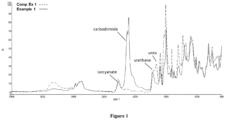
- Figure 1 illustrates the carbodiimide formation by the presence of an intense peak in FTIR spectra at ⁇ 2100cm-1.
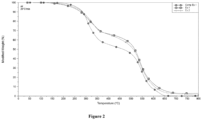
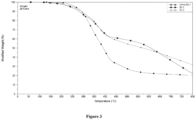
- Figure 2 and Figure 3 are TGA plots illustrating the improved temperature resistance of Examples 1 and 2 according to the invention compared to Comparative Example 1, under both air and nitrogen environments in the ranges 300-550°C and 300-800°C.
- the start of mixing all ingredients together is set at zero.
- Cream time is defined as when the mixture starts to foam.
- Tack free time is defined as when the surface of the foam stops being tacky to the touch.
- End of rise time is defined as when the foam reaches its maximum height.
- Table 1 Foam formulations Chemical (pbw) Comp Ex.
Landscapes
- Chemical & Material Sciences (AREA)
- Health & Medical Sciences (AREA)
- Chemical Kinetics & Catalysis (AREA)
- Medicinal Chemistry (AREA)
- Polymers & Plastics (AREA)
- Organic Chemistry (AREA)
- Polyurethanes Or Polyureas (AREA)
Applications Claiming Priority (2)
| Application Number | Priority Date | Filing Date | Title |
|---|---|---|---|
| EP21178735 | 2021-06-10 | ||
| PCT/EP2022/065229 WO2022258530A1 (en) | 2021-06-10 | 2022-06-03 | Open cell flexible isocyanate-based foams having a low exotherm during foaming |
Publications (2)
| Publication Number | Publication Date |
|---|---|
| EP4352124A1 EP4352124A1 (en) | 2024-04-17 |
| EP4352124B1 true EP4352124B1 (en) | 2025-04-23 |
Family
ID=76374978
Family Applications (1)
| Application Number | Title | Priority Date | Filing Date |
|---|---|---|---|
| EP22732144.5A Active EP4352124B1 (en) | 2021-06-10 | 2022-06-03 | Open cell flexible isocyanate-based foams having a low exotherm during foaming |
Country Status (7)
| Country | Link |
|---|---|
| US (1) | US20240279379A1 (pl) |
| EP (1) | EP4352124B1 (pl) |
| CN (1) | CN117460753A (pl) |
| CA (1) | CA3220754A1 (pl) |
| MX (1) | MX2023014671A (pl) |
| PL (1) | PL4352124T3 (pl) |
| WO (1) | WO2022258530A1 (pl) |
Family Cites Families (4)
| Publication number | Priority date | Publication date | Assignee | Title |
|---|---|---|---|---|
| GB8902228D0 (en) * | 1989-02-01 | 1989-03-22 | Ici Plc | Carbodiimide-isocyanurate rigid foams |
| US5089534A (en) * | 1990-03-23 | 1992-02-18 | The Dow Chemical Company | Process for preparing flexible polyurethane foam |
| JPH0570544A (ja) * | 1991-08-29 | 1993-03-23 | Dow Chem Nippon Kk | 軟質ポリウレタンフオ−ムの製法 |
| CA2898036C (en) * | 2013-01-15 | 2021-01-26 | Basf Se | Rigid foam |
-
2022
- 2022-06-03 CA CA3220754A patent/CA3220754A1/en active Pending
- 2022-06-03 EP EP22732144.5A patent/EP4352124B1/en active Active
- 2022-06-03 US US18/566,687 patent/US20240279379A1/en active Pending
- 2022-06-03 MX MX2023014671A patent/MX2023014671A/es unknown
- 2022-06-03 CN CN202280041163.7A patent/CN117460753A/zh active Pending
- 2022-06-03 PL PL22732144.5T patent/PL4352124T3/pl unknown
- 2022-06-03 WO PCT/EP2022/065229 patent/WO2022258530A1/en not_active Ceased
Also Published As
| Publication number | Publication date |
|---|---|
| WO2022258530A1 (en) | 2022-12-15 |
| EP4352124A1 (en) | 2024-04-17 |
| MX2023014671A (es) | 2024-01-12 |
| CA3220754A1 (en) | 2022-12-15 |
| US20240279379A1 (en) | 2024-08-22 |
| PL4352124T3 (pl) | 2025-07-14 |
| CN117460753A (zh) | 2024-01-26 |
Similar Documents
| Publication | Publication Date | Title |
|---|---|---|
| EP2464684B1 (en) | Foams and foamable compositions containing halogenated olefin blowing agents | |
| EP3935096B1 (en) | Hcfo-containing isocyanate-reactive compositions, related foam-forming compositions and pur-pir foams | |
| EP3935097B1 (en) | Polyol blends and their use in producing pur-pir foam-forming compositions | |
| TWI891677B (zh) | 低密度熱塑性聚氨酯可撓性發泡體之原位形成 | |
| US11970565B2 (en) | HCFO-containing isocyanate-reactive compositions, related foam-forming compositions and flame retardant PUR-PIR foams | |
| EP4352124B1 (en) | Open cell flexible isocyanate-based foams having a low exotherm during foaming | |
| EP3688060B1 (en) | Polyurethane rigid foam system with enhanced polyol shelf life and stability | |
| US11827735B1 (en) | HFO-containing isocyanate-reactive compositions, related foam-forming compositions and flame retardant PUR-PIR foams | |
| EP4240783B1 (en) | Elastomeric polyurethane-polyurea comprising water blown foam having improved mechanical properties | |
| WO2020023223A1 (en) | A foam composition and a foam composite made therefrom | |
| RU2829440C1 (ru) | Формирование in situ термопластичных полиуретановых эластичных пен низкой плотности | |
| EP4543956A1 (en) | Flexible and semi-rigid polyimide comprising foams with superior heat resistance | |
| JP5732845B2 (ja) | 軟質ポリウレタンフォーム製造用触媒組成物、及びそれを用いた軟質ポリウレタンフォームの製造法 | |
| JP2026504595A (ja) | 再生ポリオールを含有するポリウレタンフォーム材のための安定剤 | |
| HK1166338A (en) | Foams and foamable compositions containing halogenated olefin blowing agents | |
| HK1166338B (en) | Foams and foamable compositions containing halogenated olefin blowing agents |
Legal Events
| Date | Code | Title | Description |
|---|---|---|---|
| STAA | Information on the status of an ep patent application or granted ep patent |
Free format text: STATUS: UNKNOWN |
|
| STAA | Information on the status of an ep patent application or granted ep patent |
Free format text: STATUS: THE INTERNATIONAL PUBLICATION HAS BEEN MADE |
|
| PUAI | Public reference made under article 153(3) epc to a published international application that has entered the european phase |
Free format text: ORIGINAL CODE: 0009012 |
|
| STAA | Information on the status of an ep patent application or granted ep patent |
Free format text: STATUS: REQUEST FOR EXAMINATION WAS MADE |
|
| 17P | Request for examination filed |
Effective date: 20240110 |
|
| AK | Designated contracting states |
Kind code of ref document: A1 Designated state(s): AL AT BE BG CH CY CZ DE DK EE ES FI FR GB GR HR HU IE IS IT LI LT LU LV MC MK MT NL NO PL PT RO RS SE SI SK SM TR |
|
| DAV | Request for validation of the european patent (deleted) | ||
| DAX | Request for extension of the european patent (deleted) | ||
| GRAP | Despatch of communication of intention to grant a patent |
Free format text: ORIGINAL CODE: EPIDOSNIGR1 |
|
| STAA | Information on the status of an ep patent application or granted ep patent |
Free format text: STATUS: GRANT OF PATENT IS INTENDED |
|
| INTG | Intention to grant announced |
Effective date: 20241122 |
|
| GRAS | Grant fee paid |
Free format text: ORIGINAL CODE: EPIDOSNIGR3 |
|
| GRAA | (expected) grant |
Free format text: ORIGINAL CODE: 0009210 |
|
| STAA | Information on the status of an ep patent application or granted ep patent |
Free format text: STATUS: THE PATENT HAS BEEN GRANTED |
|
| AK | Designated contracting states |
Kind code of ref document: B1 Designated state(s): AL AT BE BG CH CY CZ DE DK EE ES FI FR GB GR HR HU IE IS IT LI LT LU LV MC MK MT NL NO PL PT RO RS SE SI SK SM TR |
|
| P01 | Opt-out of the competence of the unified patent court (upc) registered |
Free format text: CASE NUMBER: APP_12852/2025 Effective date: 20250317 |
|
| REG | Reference to a national code |
Ref country code: GB Ref legal event code: FG4D |
|
| REG | Reference to a national code |
Ref country code: CH Ref legal event code: EP |
|
| REG | Reference to a national code |
Ref country code: DE Ref legal event code: R096 Ref document number: 602022013612 Country of ref document: DE |
|
| REG | Reference to a national code |
Ref country code: IE Ref legal event code: FG4D |
|
| PGFP | Annual fee paid to national office [announced via postgrant information from national office to epo] |
Ref country code: DE Payment date: 20250626 Year of fee payment: 4 |
|
| PGFP | Annual fee paid to national office [announced via postgrant information from national office to epo] |
Ref country code: FR Payment date: 20250624 Year of fee payment: 4 |
|
| PGFP | Annual fee paid to national office [announced via postgrant information from national office to epo] |
Ref country code: AT Payment date: 20250721 Year of fee payment: 4 |
|
| PGFP | Annual fee paid to national office [announced via postgrant information from national office to epo] |
Ref country code: TR Payment date: 20250624 Year of fee payment: 4 |
|
| REG | Reference to a national code |
Ref country code: NL Ref legal event code: MP Effective date: 20250423 |
|
| PG25 | Lapsed in a contracting state [announced via postgrant information from national office to epo] |
Ref country code: NL Free format text: LAPSE BECAUSE OF FAILURE TO SUBMIT A TRANSLATION OF THE DESCRIPTION OR TO PAY THE FEE WITHIN THE PRESCRIBED TIME-LIMIT Effective date: 20250423 |
|
| REG | Reference to a national code |
Ref country code: AT Ref legal event code: MK05 Ref document number: 1787725 Country of ref document: AT Kind code of ref document: T Effective date: 20250423 |
|
| PG25 | Lapsed in a contracting state [announced via postgrant information from national office to epo] |
Ref country code: FI Free format text: LAPSE BECAUSE OF FAILURE TO SUBMIT A TRANSLATION OF THE DESCRIPTION OR TO PAY THE FEE WITHIN THE PRESCRIBED TIME-LIMIT Effective date: 20250423 Ref country code: PT Free format text: LAPSE BECAUSE OF FAILURE TO SUBMIT A TRANSLATION OF THE DESCRIPTION OR TO PAY THE FEE WITHIN THE PRESCRIBED TIME-LIMIT Effective date: 20250825 Ref country code: ES Free format text: LAPSE BECAUSE OF FAILURE TO SUBMIT A TRANSLATION OF THE DESCRIPTION OR TO PAY THE FEE WITHIN THE PRESCRIBED TIME-LIMIT Effective date: 20250423 |
|
| REG | Reference to a national code |
Ref country code: LT Ref legal event code: MG9D |
|
| PG25 | Lapsed in a contracting state [announced via postgrant information from national office to epo] |
Ref country code: GR Free format text: LAPSE BECAUSE OF FAILURE TO SUBMIT A TRANSLATION OF THE DESCRIPTION OR TO PAY THE FEE WITHIN THE PRESCRIBED TIME-LIMIT Effective date: 20250724 Ref country code: NO Free format text: LAPSE BECAUSE OF FAILURE TO SUBMIT A TRANSLATION OF THE DESCRIPTION OR TO PAY THE FEE WITHIN THE PRESCRIBED TIME-LIMIT Effective date: 20250723 |
|
| PGFP | Annual fee paid to national office [announced via postgrant information from national office to epo] |
Ref country code: PL Payment date: 20250523 Year of fee payment: 4 Ref country code: IT Payment date: 20250630 Year of fee payment: 4 |
|
| PG25 | Lapsed in a contracting state [announced via postgrant information from national office to epo] |
Ref country code: BG Free format text: LAPSE BECAUSE OF FAILURE TO SUBMIT A TRANSLATION OF THE DESCRIPTION OR TO PAY THE FEE WITHIN THE PRESCRIBED TIME-LIMIT Effective date: 20250423 |
|
| PG25 | Lapsed in a contracting state [announced via postgrant information from national office to epo] |
Ref country code: AT Free format text: LAPSE BECAUSE OF FAILURE TO SUBMIT A TRANSLATION OF THE DESCRIPTION OR TO PAY THE FEE WITHIN THE PRESCRIBED TIME-LIMIT Effective date: 20250423 Ref country code: HR Free format text: LAPSE BECAUSE OF FAILURE TO SUBMIT A TRANSLATION OF THE DESCRIPTION OR TO PAY THE FEE WITHIN THE PRESCRIBED TIME-LIMIT Effective date: 20250423 |
|
| PG25 | Lapsed in a contracting state [announced via postgrant information from national office to epo] |
Ref country code: RS Free format text: LAPSE BECAUSE OF FAILURE TO SUBMIT A TRANSLATION OF THE DESCRIPTION OR TO PAY THE FEE WITHIN THE PRESCRIBED TIME-LIMIT Effective date: 20250723 |
|
| PG25 | Lapsed in a contracting state [announced via postgrant information from national office to epo] |
Ref country code: IS Free format text: LAPSE BECAUSE OF FAILURE TO SUBMIT A TRANSLATION OF THE DESCRIPTION OR TO PAY THE FEE WITHIN THE PRESCRIBED TIME-LIMIT Effective date: 20250823 |
|
| PG25 | Lapsed in a contracting state [announced via postgrant information from national office to epo] |
Ref country code: LV Free format text: LAPSE BECAUSE OF FAILURE TO SUBMIT A TRANSLATION OF THE DESCRIPTION OR TO PAY THE FEE WITHIN THE PRESCRIBED TIME-LIMIT Effective date: 20250423 |
|
| PG25 | Lapsed in a contracting state [announced via postgrant information from national office to epo] |
Ref country code: DK Free format text: LAPSE BECAUSE OF FAILURE TO SUBMIT A TRANSLATION OF THE DESCRIPTION OR TO PAY THE FEE WITHIN THE PRESCRIBED TIME-LIMIT Effective date: 20250423 Ref country code: SM Free format text: LAPSE BECAUSE OF FAILURE TO SUBMIT A TRANSLATION OF THE DESCRIPTION OR TO PAY THE FEE WITHIN THE PRESCRIBED TIME-LIMIT Effective date: 20250423 |
|
| PG25 | Lapsed in a contracting state [announced via postgrant information from national office to epo] |
Ref country code: CZ Free format text: LAPSE BECAUSE OF FAILURE TO SUBMIT A TRANSLATION OF THE DESCRIPTION OR TO PAY THE FEE WITHIN THE PRESCRIBED TIME-LIMIT Effective date: 20250423 |
|
| PG25 | Lapsed in a contracting state [announced via postgrant information from national office to epo] |
Ref country code: EE Free format text: LAPSE BECAUSE OF FAILURE TO SUBMIT A TRANSLATION OF THE DESCRIPTION OR TO PAY THE FEE WITHIN THE PRESCRIBED TIME-LIMIT Effective date: 20250423 |
|
| REG | Reference to a national code |
Ref country code: DE Ref legal event code: R097 Ref document number: 602022013612 Country of ref document: DE |
|
| PG25 | Lapsed in a contracting state [announced via postgrant information from national office to epo] |
Ref country code: SK Free format text: LAPSE BECAUSE OF FAILURE TO SUBMIT A TRANSLATION OF THE DESCRIPTION OR TO PAY THE FEE WITHIN THE PRESCRIBED TIME-LIMIT Effective date: 20250423 |
|
| REG | Reference to a national code |
Ref country code: CH Ref legal event code: H13 Free format text: ST27 STATUS EVENT CODE: U-0-0-H10-H13 (AS PROVIDED BY THE NATIONAL OFFICE) Effective date: 20260127 |
|
| PG25 | Lapsed in a contracting state [announced via postgrant information from national office to epo] |
Ref country code: MC Free format text: LAPSE BECAUSE OF FAILURE TO SUBMIT A TRANSLATION OF THE DESCRIPTION OR TO PAY THE FEE WITHIN THE PRESCRIBED TIME-LIMIT Effective date: 20250423 |
|
| PG25 | Lapsed in a contracting state [announced via postgrant information from national office to epo] |
Ref country code: LU Free format text: LAPSE BECAUSE OF NON-PAYMENT OF DUE FEES Effective date: 20250603 |
|
| REG | Reference to a national code |
Ref country code: BE Ref legal event code: MM Effective date: 20250630 |
|
| PLBE | No opposition filed within time limit |
Free format text: ORIGINAL CODE: 0009261 |
|
| STAA | Information on the status of an ep patent application or granted ep patent |
Free format text: STATUS: NO OPPOSITION FILED WITHIN TIME LIMIT |
|
| REG | Reference to a national code |
Ref country code: CH Ref legal event code: L10 Free format text: ST27 STATUS EVENT CODE: U-0-0-L10-L00 (AS PROVIDED BY THE NATIONAL OFFICE) Effective date: 20260304 |
|
| PG25 | Lapsed in a contracting state [announced via postgrant information from national office to epo] |
Ref country code: RO Free format text: LAPSE BECAUSE OF FAILURE TO SUBMIT A TRANSLATION OF THE DESCRIPTION OR TO PAY THE FEE WITHIN THE PRESCRIBED TIME-LIMIT Effective date: 20250423 |
|
| 26N | No opposition filed |
Effective date: 20260126 |
|
| PG25 | Lapsed in a contracting state [announced via postgrant information from national office to epo] |
Ref country code: IE Free format text: LAPSE BECAUSE OF NON-PAYMENT OF DUE FEES Effective date: 20250603 |
|
| PG25 | Lapsed in a contracting state [announced via postgrant information from national office to epo] |
Ref country code: BE Free format text: LAPSE BECAUSE OF NON-PAYMENT OF DUE FEES Effective date: 20250630 |
|
| PG25 | Lapsed in a contracting state [announced via postgrant information from national office to epo] |
Ref country code: CH Free format text: LAPSE BECAUSE OF NON-PAYMENT OF DUE FEES Effective date: 20250630 |