EP4351978B1 - Versandbehälter und verpackungskissenanordnung - Google Patents
Versandbehälter und verpackungskissenanordnung Download PDFInfo
- Publication number
- EP4351978B1 EP4351978B1 EP22740617.0A EP22740617A EP4351978B1 EP 4351978 B1 EP4351978 B1 EP 4351978B1 EP 22740617 A EP22740617 A EP 22740617A EP 4351978 B1 EP4351978 B1 EP 4351978B1
- Authority
- EP
- European Patent Office
- Prior art keywords
- horizontal layer
- sidewalls
- regions
- pair
- shipping container
- Prior art date
- Legal status (The legal status is an assumption and is not a legal conclusion. Google has not performed a legal analysis and makes no representation as to the accuracy of the status listed.)
- Active
Links
Images




Classifications
-
- B—PERFORMING OPERATIONS; TRANSPORTING
- B65—CONVEYING; PACKING; STORING; HANDLING THIN OR FILAMENTARY MATERIAL
- B65D—CONTAINERS FOR STORAGE OR TRANSPORT OF ARTICLES OR MATERIALS, e.g. BAGS, BARRELS, BOTTLES, BOXES, CANS, CARTONS, CRATES, DRUMS, JARS, TANKS, HOPPERS, FORWARDING CONTAINERS; ACCESSORIES, CLOSURES, OR FITTINGS THEREFOR; PACKAGING ELEMENTS; PACKAGES
- B65D5/00—Rigid or semi-rigid containers of polygonal cross-section, e.g. boxes, cartons or trays, formed by folding or erecting one or more blanks made of paper
- B65D5/42—Details of containers or of foldable or erectable container blanks
- B65D5/44—Integral, inserted or attached portions forming internal or external fittings
- B65D5/50—Internal supporting or protecting elements for contents
- B65D5/5028—Elements formed separately from the container body
- B65D5/5035—Paper elements
- B65D5/5059—Paper panels presenting one or more openings or recesses in wich at least a part of the contents are located
-
- B—PERFORMING OPERATIONS; TRANSPORTING
- B65—CONVEYING; PACKING; STORING; HANDLING THIN OR FILAMENTARY MATERIAL
- B65D—CONTAINERS FOR STORAGE OR TRANSPORT OF ARTICLES OR MATERIALS, e.g. BAGS, BARRELS, BOTTLES, BOXES, CANS, CARTONS, CRATES, DRUMS, JARS, TANKS, HOPPERS, FORWARDING CONTAINERS; ACCESSORIES, CLOSURES, OR FITTINGS THEREFOR; PACKAGING ELEMENTS; PACKAGES
- B65D81/00—Containers, packaging elements, or packages, for contents presenting particular transport or storage problems, or adapted to be used for non-packaging purposes after removal of contents
- B65D81/02—Containers, packaging elements, or packages, for contents presenting particular transport or storage problems, or adapted to be used for non-packaging purposes after removal of contents specially adapted to protect contents from mechanical damage
- B65D81/05—Containers, packaging elements, or packages, for contents presenting particular transport or storage problems, or adapted to be used for non-packaging purposes after removal of contents specially adapted to protect contents from mechanical damage maintaining contents at spaced relation from package walls, or from other contents
- B65D81/127—Containers, packaging elements, or packages, for contents presenting particular transport or storage problems, or adapted to be used for non-packaging purposes after removal of contents specially adapted to protect contents from mechanical damage maintaining contents at spaced relation from package walls, or from other contents using rigid or semi-rigid sheets of shock-absorbing material
- B65D81/133—Containers, packaging elements, or packages, for contents presenting particular transport or storage problems, or adapted to be used for non-packaging purposes after removal of contents specially adapted to protect contents from mechanical damage maintaining contents at spaced relation from package walls, or from other contents using rigid or semi-rigid sheets of shock-absorbing material of a shape specially adapted to accommodate contents, e.g. trays
-
- B—PERFORMING OPERATIONS; TRANSPORTING
- B65—CONVEYING; PACKING; STORING; HANDLING THIN OR FILAMENTARY MATERIAL
- B65D—CONTAINERS FOR STORAGE OR TRANSPORT OF ARTICLES OR MATERIALS, e.g. BAGS, BARRELS, BOTTLES, BOXES, CANS, CARTONS, CRATES, DRUMS, JARS, TANKS, HOPPERS, FORWARDING CONTAINERS; ACCESSORIES, CLOSURES, OR FITTINGS THEREFOR; PACKAGING ELEMENTS; PACKAGES
- B65D25/00—Details of other kinds or types of rigid or semi-rigid containers
- B65D25/02—Internal fittings
- B65D25/10—Devices to locate articles in containers
- B65D25/108—Devices, e.g. plates, presenting apertures through which the articles project
-
- B—PERFORMING OPERATIONS; TRANSPORTING
- B65—CONVEYING; PACKING; STORING; HANDLING THIN OR FILAMENTARY MATERIAL
- B65D—CONTAINERS FOR STORAGE OR TRANSPORT OF ARTICLES OR MATERIALS, e.g. BAGS, BARRELS, BOTTLES, BOXES, CANS, CARTONS, CRATES, DRUMS, JARS, TANKS, HOPPERS, FORWARDING CONTAINERS; ACCESSORIES, CLOSURES, OR FITTINGS THEREFOR; PACKAGING ELEMENTS; PACKAGES
- B65D71/00—Bundles of articles held together by packaging elements for convenience of storage or transport, e.g. portable segregating carrier for plural receptacles such as beer cans or pop bottles; Bales of material
- B65D71/40—Bundles of articles held together by packaging elements for convenience of storage or transport, e.g. portable segregating carrier for plural receptacles such as beer cans or pop bottles; Bales of material comprising a plurality of articles held together only partially by packaging elements formed by folding a blank or several blanks
- B65D71/403—Bundles of articles held together by packaging elements for convenience of storage or transport, e.g. portable segregating carrier for plural receptacles such as beer cans or pop bottles; Bales of material comprising a plurality of articles held together only partially by packaging elements formed by folding a blank or several blanks formed by folding several blanks
-
- B—PERFORMING OPERATIONS; TRANSPORTING
- B65—CONVEYING; PACKING; STORING; HANDLING THIN OR FILAMENTARY MATERIAL
- B65D—CONTAINERS FOR STORAGE OR TRANSPORT OF ARTICLES OR MATERIALS, e.g. BAGS, BARRELS, BOTTLES, BOXES, CANS, CARTONS, CRATES, DRUMS, JARS, TANKS, HOPPERS, FORWARDING CONTAINERS; ACCESSORIES, CLOSURES, OR FITTINGS THEREFOR; PACKAGING ELEMENTS; PACKAGES
- B65D2581/00—Containers, packaging elements, or packages, for contents presenting particular transport or storage problems, or adapted to be used for non-packaging purposes after removal of contents
- B65D2581/02—Containers, packaging elements, or packages, for contents presenting particular transport or storage problems, or adapted to be used for non-packaging purposes after removal of contents specially adapted to protect contents from mechanical damage
- B65D2581/05—Containers, packaging elements, or packages, for contents presenting particular transport or storage problems, or adapted to be used for non-packaging purposes after removal of contents specially adapted to protect contents from mechanical damage maintaining contents at spaced relation from package walls, or from other contents
- B65D2581/051—Details of packaging elements for maintaining contents at spaced relation from package walls, or from other contents
- B65D2581/052—Materials
- B65D2581/053—Paper in general, e.g. paperboard, carton, molded paper
Definitions
- Shipping containers and packaging cushions can be employed in logistics transportation and package shipment as an assembly to contain objects. Some of the objects can be broken as the shipping container travels through a distribution channel.
- Existing packages are often designed for bulk retail distribution on pallets, and as such lack sufficient shock and vibration absorption or packaging cushions to protect non-palletized shipments of fragile goods.
- Other options include engineered protective packaging cushions, such as formed foam bottle carriers.
- engineered packaging cushions are generally tailored to specific product shapes and requires expensive tooling to produce.
- FR 2738228 describes packaging that has a plain rear panel parallel to the long axis of the bottle.
- a front panel has two areas having a connecting tongue parallel to the first panel.
- An upper panel, perpendicular to the long axis of the bottle, is connected to the front and rear panels and has an opening of the same size as the bottle body.
- An intermediate upper panel, parallel to the upper panel, has a similar sized opening.
- An intermediate lower panel parallel to the upper panels has a smaller hole corresponding to the end of the bottle neck.
- a lower panel parallel to the end of the bottle neck has an intermediate sized hole.
- WO 2015/049702 describes packaging that is created starting from small-sized punched cardboard that is refolded and assembled, in order to protect the glass bottles from damage due to impacts or accidental drops during the transport or storage phase.
- the packaging consists of two distinct tubular elements that are each assembled starting from a punched cardboard sheet; a first element forms the upper part or so-called cap, while the second, lower element forms the base.
- material is removed in unnecessary points and the thickness is reinforced in the points found to be more subject to stress during transport. This leads to the upper tubular section of the cap which is open on the front, presenting only a support flap which permits the formation of support protuberances.
- Embodiments include packaging for a shipping container as defined in claim 1.
- each of the first, second, third, fourth, and fifth sets of perforations form lines between a first common edge and a second common edge.
- the first common edge and the second common edge are each common to the first region, the second regions, and the third regions.
- the second sidewall regions include retaining tab structures formed at each of the first common edge and the second common edge.
- each of the sixth, seventh, and eight sets of perforations form lines between a third common edge and a fourth common edge.
- the third common edge and the fourth common edge are each common to the fourth region and the fifth regions.
- the fifth sidewall regions include retaining tab structures formed at each of the third common edge and the fourth common edge.
- a shipping container assembly includes a shipping container, a bottom structure, and a top structure.
- the bottom structure retains multiple objects in a spaced-apart arrangement within the shipping container.
- the bottom structure includes a first paperboard sheet folded to form a first set of layers.
- the first set of layers includes a first horizontal layer including multiple first apertures. Each of the first apertures are sized to retain a first end of one of the objects.
- the first set of layers includes a second horizontal layer below and spaced apart from the first horizontal layer.
- the second horizontal layer includes a substantially flat surface below the first apertures.
- the first set of layers includes a third horizontal layer below and spaced apart from the second horizontal layer.
- the top structure retains the multiple objects in a spaced-apart arrangement within the shipping container.
- the top structure includes a second paperboard sheet folded to form a second set of layers.
- the second set of layers includes a fourth horizontal layer including multiple second apertures. Each of the second apertures are sized to retain a second end of one of the objects. Each of the second apertures are arranged to align with one of the first apertures of the bottom structure when the bottom structure and the top structure are positioned in the shipping container.
- the second set of layers includes a fifth horizontal layer above and spaced apart from the fourth horizontal layer.
- the second apertures are smaller than the first apertures.
- the first apertures and the second apertures are the same shape.
- the first apertures and the second apertures are a shape of a circle, a square, or a rectangle.
- each of the bottom structure, the top structure, and the shipping container are double walled corrugated cardboard.
- the bottom structure includes first sidewalls coupling the first horizontal layer to the third horizontal layer, second sidewalls coupling the third horizontal layer to the second horizontal layer, and a height of the first sidewalls is greater than a height of the second sidewalls.
- At least one of the second sidewalls include a retaining tab to create a friction fit with another one of the second sidewalls and retain the bottom structure in a folded form.
- the first sidewalls are sized to maintain the first horizontal layer spaced apart from the third horizontal layer.
- the second sidewalls are sized to maintain the second horizontal layer spaced apart from the third horizontal layer.
- At least one of the second sidewalls include at least one support tab extending between the second horizontal layer and the first horizontal layer.
- a height of the at least one support tab is substantially the same as a distance by which the second horizontal layer is spaced apart from the first horizontal layer.
- the second sidewalls include a first pair of sidewalls and a second pair of sidewalls.
- the first pair of sidewalls is located at opposite outer edges of the second horizontal layer and the second pair of sidewalls is located approximately midway between the first pair.
- the second pair of sidewalls include retaining tabs to create a friction fit between the second pair of sidewalls and retain the bottom structure in a folded form.
- each sidewall of both the first pair and the second pair of sidewalls include at least one support tab extending between the second horizontal layer and the first horizontal layer.
- the top structure includes third sidewalls coupling the fourth horizontal layer to the fifth horizontal layer.
- the third sidewalls are sized to maintain the fourth horizontal layer spaced apart from the fifth horizontal layer.
- the third sidewalls include at least four sidewalls of substantially equal height.
- At least one of the third sidewalls include a retaining tab to create a friction fit with another one of the third sidewalls and retain the top structure in a folded form.
- the second apertures are sized to form a friction fit with the second end of the objects.
- the objects are breakable vessels.
- a width and a length of the bottom structure substantially match inner dimensions of the shipping container and a width and a length of the top structure substantially match the inner dimensions of the shipping container.
- the shipping assembly includes a shipping container, bottom structure, and a top structure.
- the bottom structure retains multiple objects in a spaced-apart arrangement within the shipping container.
- the bottom structure includes a first paperboard sheet folded to form a first set of layers.
- the first set of layers includes a first horizontal layer including multiple first apertures. Each first aperture is sized to retain a first end of one of the objects.
- the first set of layers includes a second horizontal layer below and spaced apart from the first horizontal layer.
- the second horizontal layer includes a substantially flat surface below the first apertures.
- the bottom structure includes at least one support tab extending between the second horizontal layer and the first horizontal layer.
- the bottom structure includes a third horizontal layer below and spaced apart from the second horizontal layer.
- the bottom structure includes first sidewalls coupling the first horizontal layer to the third horizontal layer.
- the first sidewalls are sized to maintain the first horizontal layer spaced apart from the third horizontal layer.
- the bottom structure includes second sidewalls coupling the third horizontal layer to the second horizontal layer.
- the second sidewalls are sized to maintain the second horizontal layer spaced apart from the third horizontal layer
- the top structure retains the multiple objects in a spaced-apart arrangement within the shipping container.
- the top structure includes a second paperboard sheet folded to form a second set of layers.
- the second set of layers includes a fourth horizontal layer including multiple second apertures.
- Each second aperture is sized to retain a second end of one of the objects.
- Each second aperture is arranged to align with one of the first apertures of the bottom structure when the bottom structure and the top structure are positioned in the shipping container.
- the top structure includes a fifth horizontal layer above and spaced apart from the fourth horizontal layer.
- the top structure includes third sidewalls coupling the fourth horizontal layer to the third horizontal layer. The third sidewalls are sized to maintain the fourth horizontal layer spaced apart from the fifth horizontal layer.
- Implementations provide a shipping assembly that uses environmental friendly, recyclable, and sustainable materials to economically ship fragile consumer goods directly to consumers.
- implementations of the present disclosure can be made from recyclable paperboard for lightweight items or corrugated board for heavyweight items.
- implementations can be unfolded and reused for different size/shape objects.
- Implementations provide sufficient shock and vibration absorption or packaging cushion to prevent or minimize damage during transit.
- implementations are configured to include shock absorbing zones and/or retain objects in a fixed position spaced away from each other and from the sides of a shipping box where the objects could be impacted if the box is mishandled.
- Implementations can also be manufactured at significantly lower cost than current engineered packaging cushion solutions.
- implementations of shipping assemblies disclosed herein do not require expensive upfront-tooling setups required for engineered solutions. Instead, implementations can be formed simply press cutting and perforating flat sheets paperboard or corrugated board.
- implementations of the packaging can be stored and shipped as flat sheets, thereby, making more efficient use of storage and shipping space for the shipping assembly components themselves. Because the shipping assemblies are formed from flat paperboard, or corrugated board, the apertures used to secure objects can be cut to various sizes to accommodate many different size/shaped objects without the need to retool a manufacturing line and/or replace molding dies.
- a distribution channel for sending and receiving shipments generally employs shipping containers and packaging cushions to protect the shipped objects.
- the objects can include breakable objects. Breakable objects can crack, fracture, or shatter when a threshold force or repetitive threshold force is transmitted to the breakable object.
- the breakable objects can be glass. Some breakable objects can be filled with liquid. When the threshold force or the repetitive threshold force breakable object cracks, fractures, or shatters, the breakable object cracks, fractures, or shatters and the contents (e.g., liquid, powder, gas) can flow out of the breakable object and contaminate other breakable objects. Additionally, pieces of broken objects or the contents of the broken objects can harm the user.
- While most shipping containers for breakable objects are made of recyclable corrugated boards, some of the traditional shipping containers for breakable objects are made of plastic or wood which make recycling shipping containers difficult and costly. If not recycled, those plastic or wood shipping containers may be sent to land-fills directly, end up at land-fills, or are dumped into the ocean where they remain and do not be decomposed, polluting the land or ocean. Additionally, these plastic materials may contaminate water and/or injure fish or other marine animals.
- the present disclosure describes a shipping assembly (e.g., packaging) that can be made from flat sheets of paperboard or corrugated board.
- the paperboard or corrugated board is cut and perforated according to unique patters that permit it to be folded into top and bottom cushion support structures that provide shock absorption for breakable objects placed in a shipping container.
- FIG. 1 illustrates a perspective view of an exemplary shipping assembly 100.
- the shipping assembly 100 includes a shipping container 102, a bottom cushion support structure 112, and a top cushion support structure 114.
- One or more objects 110a - 110f can be placed in the shipping container 102 for shipment.
- the shipping container 102 can be a box.
- the shipping container 102 is defined by six surfaces.
- a first surface (not shown) is a bottom to the box.
- a second surface 104a, a third surface 104b, a fourth surface 104c, and a fifth surface 104d define the sides of the box.
- a top surface 106 of the shipping container is defined by four top panels 108a - 108d which fold together to create the top surface. Two or more of the top panels 108a - 108d are fastened together to seal the shipping container 102 shut. For example, top panels 108a and 108c can be folded toward an interior of the shipping container 102 and then the top panels 108b and 108d can be folded toward each other and taped together with a packing tape (not shown) by the user.
- the shipping container 102 can be rectangular (as shown). Alternatively, the shipping container 102 can be square, triangular, or circular.
- the shipping container 102 can be paperboard, corrugated board.
- the corrugated board can be single walled or double walled.
- the corrugated board can be paper or plastic.
- the shipping assembly 100 includes the bottom cushion support structure 112 and the top cushion support structure 114.
- the cushion support structures 112, 114 retain the objects 110a-110f in a spaced-apart arrangement within the shipping container 102 and provides shock absorption for the objects 110a-110f.
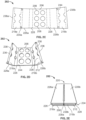
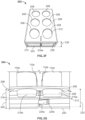
- FIG. 2A is a top view an example unfolded bottom cushion support structure 112 of FIG. 1 and FIG. 2B is a side view an example folded bottom cushion support structure of FIG. 1 .
- the unfolded bottom cushion support structure 112 is a paperboard sheet 202 which can be folded to form a folded bottom cushion support structure 112 (e.g., as shown in FIGS. 2C - 2G ).
- the paperboard sheet 202 can be a corrugated board sheet.
- the sheet 202 is formed into multiple regions 206, 228a, 228b, 226a, 226b, 230a, 230b, 218a, 218b, 230c, and 230d each separated by perforations 244.
- the regions when folded at the perforations 244, form multiple layers (e.g., first or top layer 206, second or middle layer 212, and third or bottom layer 220).
- the center region forms the first or top layer 206.
- the top layer 206 includes multiple apertures 208.
- a pair of sidewall regions 228a, 228b border the center region (e.g., layer 206) on opposite sides. When folded, the sidewall regions 228a, 228b will form outer sidewalls 228 of the bottom cushion support structure 112.
- a pair of second regions 226a, 226b border each of the two sidewall regions 228a, 228b. When folded, the second regions 226a, 226b will form the bottom layer 220 of the bottom cushion support structure 112.
- a second pair of sidewall regions 230a, 230b border the second regions 226a, 226b.
- the second pair of sidewall regions 230a, 230b will from a first set of sidewalls 228 that support the middle layer 212 and separate the middle layer 212 from the bottom layer 220.
- a pair of third regions 218a, 218b, border the second set of sidewall regions 230a, 230b.
- the third pair of regions 218a, 218b will form the middle layer 212 of the support structure.
- a third pair of sidewall regions 230c, 230d border the third regions 218a, 218b. When folded the third pair of sidewall regions will form a second set of sidewalls 228 that support the middle layer 212 and separate the middle layer 212 from the bottom layer 220.
- one or both of the second and third pairs of sidewall regions 230a-230d can include support tabs 236.
- the support tabs 236 are sized such that when the bottom cushion support structure is folded, the support tabs 236 provide additional structural support to the bottom of the top layer 206. As shown in FIG. 2B , the support tabs 236 extend between the middle layer 212 and the top layer 206 and act as pillars to support the top layer 206 above the middle layer 212.
- the second pair of sidewall regions 230a, 230b can include interlocking tabs 234a-234d.
- the interlocking tabs 234a-234d can be used to retain the bottom cushion support structure 112 in the folded configuration, e.g., as shown in FIGS. 2B and 2G .
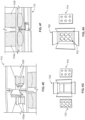
- FIGS. 2C - 2G illustrate the steps of folding the bottom cushion support structure 112 of FIG. 1 .
- the first paperboard sheet 202 is folded to form a first set of layers 206, 212, 220.
- the first set of layers 206, 212, 220 includes a first horizontal layer 206.
- the horizontal layer 206 includes multiple first apertures 208. Each of the first apertures 208 are sized to retain first ends 210a - 210f of each of the shipping objects 110a - 110f, respectively.
- Each of the first apertures 208 can be the shape of a circle (e.g., as shown in FIG. 2A ), a square, or a rectangle. Each of the first apertures 208 can be the same shape. Alternatively, one or more of first apertures 208 can be different shapes. Each of the first apertures 208 are sized to form a friction fit with the respective first ends 210a - 210f of the shipping objects 110a - 110f.
- the first set of layers 206, 212, 220 includes a second horizontal layer 212.
- the second horizontal layer 212 is below the first horizontal layer 206.
- the second horizontal layer 212 is spaced apart from the first horizontal layer 206 by a height 216.
- the second horizontal layer 212 serves as a floor upon which the objects 110 sit when place in the apertures 208 of the bottom cushion support structure 112.
- the second horizontal layer 212 is a substantially flat surface below the multiple first apertures 208.
- the second horizontal layer 212 is formed by a pair of second regions 218a and 218b.
- the first set of layers 206, 212, 220 includes a third horizontal layer 220.
- the third horizontal layer 220 is below the second horizontal layer 212.
- the third horizontal layer 220 is spaced apart from the second horizontal layer 212 by a distance 224. This distance 224 provides separation between the objects 110 and the outer packaging of a shipping box in which the objects 110 are contained.
- the distance 224 between layers 212 and 220 also absorbs shock and provides some protection for the objects 110 against impact to the shipping container 102.
- the third horizontal layer 220 is a substantially flat surface below the second horizontal layer 212.
- the third horizontal layer 220 is formed by a pair of third regions 226a and 226b.
- the bottom cushion support structure 112 includes sidewalls coupling each of the three horizontal layers 206, 212, and 220. For instance, a first set of sidewalls 228 couple the first horizontal layer 206 to the third horizontal layer 220. A second set of sidewalls 230 couple each of the pair of the third regions 226a and 226b which make up the third horizontal layer 220 to each of the pair of second regions 218a and 218b which make up the second horizontal layer 212.
- a height 232 of the first sidewalls 228 is greater than the height 224.
- the height 224 also corresponds to the height of the second sidewalls 230.
- the first sidewalls 228 are sized to maintain the first horizontal layer 206 spaced apart from the third horizontal layer 220 and from the second horizontal layer 212.
- the second sidewalls 230 are sized to maintain the second horizontal layer 212 spaced apart from the third horizontal layer 220.
- Bottom cushion support structure 112 includes a first retaining tab 234a on one of the second sidewalls 230.
- the first retaining tab 234a creates a friction fit with the opposing/adjoining other second sidewall 230 to retain the bottom cushion support structure 112 in a folded form.
- the first retaining tab 234a can engage a second retaining tab 234b on the other second sidewall 230, substantially similar to the first retaining tab 234a to create the friction fit.
- the first retaining tab 234a and the second retaining tab 234b form a pair of retaining tabs.
- Another pair of retaining tabs 234c and 234d can be positioned on an opposite side of the second sidewalls 230 to create another friction fit to retain the bottom cushion support structure 112 in the folded form.
- the second sidewalls 230 can include two pair of sidewalls 230 supporting and extending between the second horizontal layer 212 and the third horizontal layer 220.
- One pair of sidewalls 230 are located at opposite outer edges (e.g., 238a, 238b shown in FIG. 2A , respectively, of the second horizontal layer 212.
- the other pair of sidewalls 230 are located approximately midway between the first pair of sidewalls 230.
- This second pair of sidewalls 230 are adjacent to each other, when the bottom cushion support structure 112 is in a folded configuration, and can include retaining tabs 234a-234d.
- the second pair of sidewalls 230 can include the pair of retaining tabs 234c and 234d previously described.
- the pair of retaining tabs 234c and 234d are positioned on an opposite side of the second sidewalls 230 from the sidewalls 230 to create another friction fit to retain the bottom cushion support structure 112 in the folded form.
- each sidewall 230 of both the first pair and the second pair of sidewalls 230 include at least one of support tabs 236 extending between the second horizontal layer 212 and the first horizontal layer 206.
- Bottom cushion support structure 112 includes support tabs 236.
- the support tabs 236 are coupled to and extend from one of the pair of second regions 218a which make up the second horizontal layer 212.
- the support tabs 236 are coupled to and extend from the other of the pair of second regions 218b which make up the second horizontal layer 212.
- the support tabs 236 are coupled to and extend from the sidewall regions (e.g., 230a-230d shown in FIG. 2A ) that form the second sidewalls 230.
- the support tabs 236 extend between the second horizontal layer 212 and the first horizontal layer 206.
- the support tabs 236 support and space the first horizontal layer 206 from the second horizontal layer 212.
- the height of at least one of the support tabs 236, which is the same as height 216, can be substantially the same as a distance by which the second horizontal layer 212 is spaced apart from the first horizontal layer 206.
- Each of the portions of the bottom cushion support structure 112 (the first horizontal layer 206, the first sidewalls 228, the pair of the third regions 226a and 226b, the second sidewalls 230, the pair of second regions 218a and 218b, and the second pair of sidewalls 230) have two common edges 246a and 246b.
- each of the regions of the bottom cushion support structure 112 are separated from each other by perforations 244.
- the regions of the unfolded bottom cushion support structure 112 are folded along the perforations 244 to form the folded bottom cushion support structure 112.
- the perforations 244 extend from the common edge 246a to the common edge 246b.
- the shipping assembly 100 includes the top cushion support structure 114.
- the top cushion support structure 114 retains the one or more shipping objects 110a - 110f in a spaced-apart arrangement within the shipping container 102.
- the top cushion support structure 114 is generally similar to the bottom cushion support structure 112 previously described.
- FIG. 3A is a top view an example unfolded top cushion support structure 114 of FIG. 1 and FIG. 3B is a side view an example folded top cushion support structure 114 of FIG. 1 .
- the unfolded top cushion support structure 114 is a paperboard sheet 200 which can be folded to form a folded top cushion support structure 114 (e.g., as shown in FIGS. 3C - 3G ).
- the paperboard sheet 200 can be a corrugated board sheet.
- the sheet 200 is formed into multiple regions 304, 322a, 322b, 320a, 320b, 322c, and 322d each separated by perforations 326.
- the regions when folded at the perforations 326, form multiple layers (e.g., fourth or bottom layer 304, and fifth or top layer 312) and sidewalls.
- the center region forms the fourth or bottom layer 304 of the top cushion support structure 114.
- the bottom layer 304 includes multiple apertures 306.
- a pair of sidewall regions 322a, 322b border the center region (e.g., layer 304) on opposite sides. When folded, the sidewall regions 322a, 322b will form outer sidewalls 318 of the top cushion support structure 114.
- a pair of second regions 320a, 320b border each of the two sidewall regions 322a, 322b. When folded, the second regions 320a, 320b will form the top layer 312 of the top cushion support structure 114.
- a second pair of sidewall regions 322c, 322d border the second regions 320a, 320b. When folded, the second pair of sidewall regions 322c, 322d will from a second set of sidewalls 318 that support the top layer 312 and separate the top layer 312 from the bottom layer 304.
- the second pair of sidewall regions 322c, 322d can include interlocking tabs 324a-324d.
- the interlocking tabs 324a-324d can be used to retain the top cushion support structure 114 in the folded configuration, e.g., as shown in FIGS. 3B and 3G .
- FIGS. 3C - 3G illustrate the steps of folding the top cushion support structure of FIG. 1 .
- the top cushion support structure 114 includes a second paperboard sheet 200 folded to form a second set of layers 302 (shown in FIGS. 3D - 3G ) to retain the one or more shipping objects 110a - 110f in a spaced-apart arrangement within the shipping container 102.
- the second set of layers 302 includes a fourth horizontal layer 304.
- the fourth horizontal layer 304 includes multiple second apertures 306.
- the second aperture 306 is sized to retain a second end 308a of the first shipping object 110a.
- each of the second apertures 306 are sized to retain second ends 308b - 308f of each of the objects 110b - 110f, respectively.
- Each of the second apertures 306 are arranged to align with one of the first apertures 208 of the bottom cushion support structure 112 when the bottom cushion support structure 112 the top cushion support structure 114 are positioned in the shipping container 102.
- Each of the second apertures 306 can be the shape of a circle (as shown in FIGS. 3A - 3G ), a square, or a rectangle. Each of the second apertures 306 can be the same shape. Alternatively, one or more of second apertures 306 can be different shapes. Each of the second apertures 306 are sized to form a friction fit with the respective second ends 308a - 308f of the shipping objects 110a - 110f.
- the first apertures 208 and the second apertures 306 are the same shape.
- the shipping object is a circular glass bottle and both the first apertures 208 and the second apertures 306 are round.
- the first apertures 208 and the second apertures 306 are the different shapes.
- the first ends 210a - 210f of the shipping objects 110a - 110f can be square (not shown), while the respective second ends 308a - 308f of the shipping objects 110a - 110f are circular, such as shown in FIG. 3G with a cap 310a covering an opening (not shown) of the shipping object 110a for pouring the contents out of the shipping object 110a.
- the second apertures 306 are smaller than the first apertures 208.
- a diameter 308 (shown in FIG. 3A ) of the second aperture 306 can be smaller than a diameter 242 (shown in FIG. 2A ) of the first aperture 208a.
- the second apertures 306 are larger than the first apertures 208.
- a diameter 308 (shown in FIG. 3A ) of the second aperture 306 can be larger than the diameter 242 (shown in FIG. 2A ) of the first aperture 208.
- the second apertures 306 are the same size as the first apertures 208.
- a diameter 308 (shown in FIG. 3A ) of the second aperture 306 is the same as the diameter 242 (shown in FIG. 2A ) of the first aperture 208.
- the second set of layers 302 includes a fifth horizontal layer 312.
- the fifth horizontal layer 312 is above fourth horizontal layer 304.
- the fifth horizontal layer 312 is spaced apart from the fourth horizontal layer 304 by a height 316 (shown in FIGS. 3E and 3G ).
- the fifth horizontal layer 312 includes two separate regions 320a and 320b.
- the top cushion support structure 114 includes third sidewalls 318.
- the third sidewalls 318 couple the fourth horizontal layer 304 to the fifth horizontal layer 312.
- the third sidewalls 318 are sized to maintain the fourth horizontal layer 304 spaced apart from the fifth horizontal layer 312.
- the third sidewalls comprise at least four sidewalls.
- all of the third sidewalls 318 e.g., sidewall regions 322a-322d are all of substantially equal height.
- the top cushion support structure 114 includes a retaining tab 324a.
- the retaining tab 324a is mechanically coupled to the third sidewall 318.
- the retaining tab 324a creates a friction fit with the third sidewalls 318.
- the top cushion support structure 114 includes retraining tabs 324b - 324d, substantially similar to retaining tab 324a. Referring to FIGS. 3D - 3E and 3G , retaining tabs 324a and 324b engage to retain the top cushion support structure 114 in a folded form. Likewise, retaining tabs 324c and 324d engage to retain the top cushion support structure 114 in a folded form.
- a width 116 and a length 118 of the bottom cushion support structure 112 substantially match inner dimensions of the shipping container 102.
- a width 120 and a length 122 of the top cushion support structure 114 substantially match the inner dimensions of the shipping container 102.
- Each of the portions of the top cushion support structure 114 (the fourth horizontal layer 304, the sidewall portions 322a-322d of the third sidewall 318, and the two regions 320a and 320b of the fifth horizontal layer 312) have two common edges 328a and 328b.
- each of the regions of the top cushion support structure 114 are separated from each other by perforations 326.
- the regions of the unfolded top cushion support structure 114 are folded along the perforations 326 to form the folded top cushion support structure 114.
- the perforations 326 extend from the common edge 328a to the common edge 328b.
- FIGS. 2C-2G illustrate a method of folding the unfolded paperboard sheet bottom cushion support structure 112 (shown in FIG. 2A ) into the folded paperboard sheet bottom cushion support structure 112 (shown in FIG. 2G ).
- FIGS. 2B-2D progressively show the second pair of sidewalls 230 folded over the pair of second regions 218a and 218b, which then continue to fold over the second sidewalls 230 to contact the pair of the third regions 226a and 226b and fully expose the support tabs 236. The folding continues until the support tabs 236 contact the first horizontal layer 206 and the first sidewalls 228 contact.
- the retaining tab 234a is engaged to the retaining tab 234b and the retaining tab 234c is engaged to the retaining tab 234d to retain the bottom cushion support structure 112 in a folded form.
- FIGS. 3C - 3G illustrate a method of folding the unfolded paperboard sheet top cushion support structure 114 (shown in FIG. 3A ) into the folded paperboard sheet top cushion support structure 114 (shown in FIG. 3F ).
- FIGS. 3B-3D progressively show the first portion 322c and a second portion 322d (the third sidewall 318) folded inward over two separate regions 320a and 320b of the fifth horizontal layer 312, respectively. These are then folded over the third sidewalls 318a and 318b until the sidewall region 322c and the sidewall region 322d contact (shown in FIGS. 3D and 3E ).
- the retaining tab 324a is engaged to the retaining tab 324b and the retaining tab 324c is engaged to the retaining tab 324d to retain the top cushion support structure 114 in a folded form.
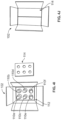
- FIGS. 4A- 4I illustrate steps of a method of assembling the shipping assembly of FIG. 1 .
- FIGS. 4A - 4I progressively show the shipping objects 110a - 110f being coupled to the folded bottom cushion support structure 112 and the folded top cushion support structure 114 without a shipping container 102 for illustrative purposes.
- the folded bottom cushion support structure 112 and the folded top cushion support structure 114 are shown.
- the first apertures 208 are visible on the first horizontal layer 206.
- the second horizontal layer 212 is visible through the first apertures 208.
- the shipping objects 110a - 110f are placed in the first apertures 208.
- the shipping objects 110a - 110f are pressed through the first apertures 208 until the shipping objects 110a - 110f contact the second horizontal layer 212.
- the second apertures 306 are placed over the shipping objects 110a - 110f and couple to the shipping objects 110a - 110f.
- FIG. 4E shows the second ends 308e and 308f of two shipping objects 110e and 110f inside the top cushion support structure 114.
- FIG. 4F show the first ends 210e and 210f of two shipping objects 110e and 110f inside the bottom cushion support structure 112.
- FIGS. 4G - 4J progressively show the shipping objects 110a - 110f being coupled to the folded bottom cushion support structure 112 and the folded top cushion support structure 114 into the shipping container 102.
- FIG. 4G shows the folded bottom cushion support structure 112, the folded top cushion support structure 114, and the shipping container 102 prepared for loading the shipping objects 110a - 110f.
- FIG. 4H shows the folded bottom cushion support structure 112 placed inside the shipping container 102.
- FIG. 4I shows the shipping objects 110a - 110f placed into the folded bottom cushion support structure 112 inside the shipping container 102.
- FIG. 4J shows the folded top cushion support structure 114 placed onto the shipping objects 110a - 110f (no longer seen) inside the shipping container 102.
Landscapes
- Engineering & Computer Science (AREA)
- Mechanical Engineering (AREA)
- Buffer Packaging (AREA)
- Cartons (AREA)
Claims (16)
- Verpackung für einen Versandbehälter, umfassend:
ein erstes Kartonblatt (202), das dazu ausgelegt ist, zu einer Bodenstruktur (112) für in den Versandbehälter platzierte Objekte gefaltet zu werden, wobei das erste Kartonblatt Folgendes umfasst:einen ersten Bereich (206), der eine Vielzahl von ersten Öffnungen (208) umfasst;ein Paar erster Seitenwandbereiche (228), wobei jeder der ersten Seitenwandbereiche mit einer gegenüberliegenden Seite des ersten Bereichs verbunden und davon durch einen ersten Satz von Perforationen (244) getrennt ist;ein Paar zweiter Bereiche (226), wobei jeder der zweiten Bereiche mit verschiedenen der ersten Seitenwandbereiche (228) verbunden und davon durch einen zweiten Satz von Perforationen (244) getrennt ist;ein Paar zweiter Seitenwandbereiche (230), wobei jeder der zweiten Seitenwandbereiche (230) mit verschiedenen der zweiten Bereiche (226) verbunden und davon durch einen dritten Satz von Perforationen (244) getrennt ist; undein Paar dritter Bereiche (218), wobei jeder der dritten Bereiche mit verschiedenen der zweiten Seitenwandbereiche (230) verbunden und davon durch einen vierten Satz von Perforationen (244) getrennt ist; undein Paar dritter Seitenwandbereiche (230), wobei jeder der dritten Seitenwandbereiche mit verschiedenen der dritten Bereiche (218) verbunden und davon durch einen fünften Satz von Perforationen (244) getrennt ist; undein zweites Kartonblatt (200), das dazu ausgelegt ist, zu einer oberen Struktur (114) für die Objekte gefaltet zu werden, wobei das zweite Kartonblatt Folgendes umfasst:einen vierten Bereich (304), der eine Vielzahl von zweiten Öffnungen (306) umfasst;ein Paar vierter Seitenwandbereiche (322a, b), wobei jeder der vierten Seitenwandbereiche mit einer gegenüberliegenden Seite des vierten Bereichs (304) verbunden und davon durch einen sechsten Satz von Perforationen (326) getrennt ist;ein Paar fünfter Bereiche (320), wobei jeder der fünften Bereiche mit verschiedenen der vierten Seitenwandbereiche (322a, b) verbunden und davon durch einen siebten Satz von Perforationen (326) getrennt ist; undein Paar fünfter Seitenwandbereiche (322c, d), wobei jeder der fünften Seitenwandbereiche mit verschiedenen der fünften Bereiche (320) auf gegenüberliegenden Seiten des vierten Bereichs (320) verbunden und von den verschiedenen der fünften Bereiche (320) durch einen achten Satz von Perforationen (326) getrennt ist. - Verpackung für den Versandbehälter nach Anspruch 1, wobei jeder des ersten, zweiten, dritten, vierten und fünften Satzes von Perforationen (244) Linien zwischen einer ersten gemeinsamen Kante (246) und einer zweiten gemeinsamen Kante (246) bildet, wobei die erste gemeinsame Kante und die zweite gemeinsame Kante jeweils dem ersten Bereich, den zweiten Bereichen und den dritten Bereichen gemeinsam sind.
- Verpackung für den Versandbehälter nach Anspruch 2, wobei die zweiten Seitenwandbereiche Haltelaschenstrukturen (234) umfassen, die an jeder der ersten gemeinsamen Kante und der zweiten gemeinsamen Kante (246) gebildet sind.
- Verpackung für den Versandbehälter nach Anspruch 1, wobei jeder des sechsten, siebten und achten Satzes von Perforationen Linien zwischen einer dritten gemeinsamen Kante (328) und einer vierten gemeinsamen Kante (328) bildet, wobei die dritte gemeinsame Kante und die vierte gemeinsame Kante jeweils dem vierten Bereich und den fünften Bereichen gemeinsam sind.
- Verpackung für den Versandbehälter nach Anspruch 4, wobei die fünften Seitenwandbereiche Haltelaschenstrukturen (324) umfassen, die an jeder der dritten gemeinsamen Kante (328) und der vierten gemeinsamen Kante (328) gebildet sind.
- Versandanordnung, umfassend:einen Versandbehälter; unddie Verpackung für den Versandbehälter nach einem der vorhergehenden Ansprüche, wobei:
die Bodenstruktur dazu ausgelegt ist, die Objekte in einer beabstandeten Anordnung innerhalb des Versandbehälters zu halten, wobei die Bodenstruktur das erste Kartonblatt umfasst, das gefaltet ist, um einen ersten Satz von Schichten zu bilden, wobei der erste Satz von Schichten Folgendes umfasst:den ersten Bereich, der eine erste horizontale Schicht (206) bildet, die die Vielzahl von ersten Öffnungen (208) umfasst, wobei jede erste Öffnung so bemessen ist, dass sie ein erstes Ende eines der Objekte hält,das Paar dritter Bereiche (218), die eine zweite horizontale Schicht (212) unterhalb und beabstandet von der ersten horizontalen Schicht (206) bilden, wobei die zweite horizontale Schicht eine im Wesentlichen ebene Oberfläche unterhalb der Vielzahl von ersten Öffnungen umfasst, unddas Paar zweiter Bereiche (226), die eine dritte horizontale Schicht (220) unterhalb und beabstandet von der zweiten horizontalen Schicht (212) bilden; unddie obere Struktur (114) dazu ausgelegt ist, die Vielzahl von Objekten in einer beabstandeten Anordnung innerhalb des Versandbehälters zu halten, wobei die obere Struktur ein zweites Kartonblatt umfasst, das gefaltet ist, um einen zweiten Satz von Schichten zu bilden, wobei der zweite Satz von Schichten Folgendes umfasst:den vierten Bereich, der eine vierte horizontale Schicht (304) bildet, die die Vielzahl von zweiten Öffnungen (306) umfasst, wobei jede zweite Öffnung so bemessen ist, dass sie ein zweites Ende eines der Objekte hält, und jede zweite Öffnung so angeordnet ist, dass sie mit einer der ersten Öffnungen der Bodenstruktur ausgerichtet ist, wenn die Bodenstruktur und die obere Struktur im Versandbehälter positioniert sind, unddie fünften Bereiche (320), die eine fünfte horizontale Schicht (312) oberhalb und beabstandet von der vierten horizontalen Schicht bilden. - Versandanordnung nach Anspruch 6, wobei die Bodenstruktur Folgendes umfasst:das Paar erster Seitenwandbereiche (228), die erste Seitenwände (228) bilden, die die erste horizontale Schicht (206) mit der dritten horizontalen Schicht (220) verbinden;das Paar zweiter Seitenwandbereiche (230), die zweite Seitenwände (230) bilden, die die dritte horizontale Schicht (220) mit der zweiten horizontalen Schicht (212) verbinden; undwobei eine Höhe der ersten Seitenwände (228) größer als eine Höhe der zweiten Seitenwände (230) ist.
- Versandanordnung nach Anspruch 7, wobei mindestens eine der zweiten Seitenwände eine Haltelasche umfasst, die dazu ausgelegt ist, eine Reibpassung mit einer anderen der zweiten Seitenwände zu erzeugen und die Bodenstruktur in einer gefalteten Form zu halten, wobei beispielsweise das zweite Paar Seitenwände Haltelaschen umfasst, die dazu ausgelegt sind, eine Reibpassung zwischen dem zweiten Paar Seitenwände zu erzeugen und die Bodenstruktur in einer gefalteten Form zu halten.
- Versandanordnung nach Anspruch 2, wobei entweder:die ersten Seitenwände (228) so bemessen sind, dass sie die erste horizontale Schicht von der dritten horizontalen Schicht beabstandet halten; oderdie zweiten Seitenwände (230) so bemessen sind, dass sie die zweite horizontale Schicht von der dritten horizontalen Schicht beabstandet halten.
- Versandanordnung nach Anspruch 7, wobei mindestens eine der zweiten Seitenwände mindestens eine Stützlasche (236) umfasst, die sich zwischen der zweiten horizontalen Schicht und der ersten horizontalen Schicht erstreckt, und
wobei optional eine Höhe der mindestens einen Stützlasche im Wesentlichen gleich einem Abstand (216) ist, um den die zweite horizontale Schicht von der ersten horizontalen Schicht beabstandet ist. - Versandanordnung nach Anspruch 7, wobei die zweiten Seitenwände (230) ein erstes Paar Seitenwände und ein zweites Paar Seitenwände umfassen, wobei sich das erste Paar an gegenüberliegenden äußeren Kanten der zweiten horizontalen Schicht befindet und sich das zweite Paar ungefähr in der Mitte zwischen dem ersten Paar befindet.
- Versandanordnung nach Anspruch 11, wobei jede Seitenwand sowohl des ersten Paars als auch des zweiten Paars Seitenwände mindestens eine Stützlasche (236) umfasst, die sich zwischen der zweiten horizontalen Schicht (212) und der ersten horizontalen Schicht (206) erstreckt.
- Versandanordnung nach Anspruch 11, wobei die obere Struktur dritte Seitenwände (318) umfasst, die die vierte horizontale Schicht (304) mit der fünften horizontalen Schicht (312) verbinden, und wobei die dritten Seitenwände (318) so bemessen sind, dass sie die vierte horizontale Schicht von der fünften horizontalen Schicht beabstandet halten und gebildet werden, wenn das Paar vierter Seitenwandbereiche (322) und das Paar fünfter Seitenwandbereiche (322c, d) gefaltet werden, und
wobei optional die dritten Seitenwände (318) mindestens vier Seitenwände mit im Wesentlichen gleicher Höhe umfassen, und wobei mindestens eine der dritten Seitenwände (318) eine Haltelasche (324) umfasst, die dazu ausgelegt ist, eine Reibpassung mit einer anderen der dritten Seitenwände zu erzeugen und die obere Struktur in einer gefalteten Form zu halten. - Versandanordnung nach Anspruch 6, ferner umfassend die Objekte, wobei die ersten Öffnungen so bemessen sind, dass sie eine Reibpassung mit dem ersten Ende der Objekte bilden, und wobei die zweiten Öffnungen so bemessen sind, dass sie eine Reibpassung mit dem zweiten Ende der Objekte bilden.
- Versandanordnung nach Anspruch 6, wobei eine Breite und eine Länge der Bodenstruktur im Wesentlichen mit den Innenabmessungen des Versandbehälters übereinstimmen, und wobei eine Breite und eine Länge der oberen Struktur im Wesentlichen mit den Innenabmessungen des Versandbehälters übereinstimmen.
- Versandanordnung, umfassend:einen Versandbehälter; unddie Verpackung für den Versandbehälter nach einem der Ansprüche 1 bis 5, wobei: die Bodenstruktur dazu ausgelegt ist, die Objekte in einer beabstandeten Anordnung innerhalb des Versandbehälters zu halten, wobei die Bodenstruktur das erste Kartonblatt umfasst, das gefaltet ist, um einen ersten Satz von Schichten zu bilden, wobei der erste Satz von Schichten Folgendes umfasst:den ersten Bereich, der eine erste horizontale Schicht (206) bildet, die eine Vielzahl von ersten Öffnungen umfasst, wobei jede erste Öffnung so bemessen ist, dass sie ein erstes Ende eines der Objekte hält;das Paar dritter Bereiche (218), die eine zweite horizontale Schicht (212) unterhalb und beabstandet von der ersten horizontalen Schicht (206) bilden, wobei die zweite horizontale Schicht (212) eine im Wesentlichen ebene Oberfläche unterhalb der Vielzahl von ersten Öffnungen und mindestens eine Stützlasche umfasst, die sich zwischen der zweiten horizontalen Schicht und der ersten horizontalen Schicht erstreckt;das Paar zweiter Bereiche (226), die eine dritte horizontale Schicht (220) unterhalb und beabstandet von der zweiten horizontalen Schicht (212) bilden;das Paar erster Seitenwandbereiche (228), die erste Seitenwände (228) bilden, die die erste horizontale Schicht mit der dritten horizontalen Schicht verbinden, wobei die ersten Seitenwände so bemessen sind, dass sie die erste horizontale Schicht von der dritten horizontalen Schicht beabstandet halten;das Paar zweiter Seitenwandbereiche (230), die zweite Seitenwände (230) bilden, die die dritte horizontale Schicht mit der zweiten horizontalen Schicht verbinden, wobei die zweiten Seitenwände so bemessen sind, dass sie die zweite horizontale Schicht (212) von der dritten horizontalen Schicht (220) beabstandet halten; unddie obere Struktur (114) dazu ausgelegt ist, die Vielzahl von Objekten in einer beabstandeten Anordnung innerhalb des Versandbehälters zu halten, wobei die obere Struktur ein zweites Kartonblatt umfasst, das gefaltet ist, um einen zweiten Satz von Schichten zu bilden, wobei der zweite Satz von Schichten Folgendes umfasst:den vierten Bereich, der eine vierte horizontale Schicht (304) bildet, die die Vielzahl von zweiten Öffnungen (306) umfasst, wobei jede zweite Öffnung so bemessen ist, dass sie ein zweites Ende eines der Objekte hält, und jede zweite Öffnung so angeordnet ist, dass sie mit einer der ersten Öffnungen der Bodenstruktur ausgerichtet ist, wenn die Bodenstruktur und die obere Struktur im Versandbehälter positioniert sind;die fünften Bereiche (320), die eine fünfte horizontale Schicht (312) oberhalb und beabstandet von der vierten horizontalen Schicht (304) bilden; unddas Paar vierter Seitenwandbereiche (322) und das Paar fünfter Seitenwandbereiche (322c, d), die gefaltet sind, um dritte Seitenwände (318) zu bilden, die die vierte horizontale Schicht mit der dritten horizontalen Schicht verbinden, und wobei die dritten Seitenwände so bemessen sind, dass sie die vierte horizontale Schicht (340) von der fünften horizontalen Schicht (312) beabstandet halten.
Applications Claiming Priority (2)
| Application Number | Priority Date | Filing Date | Title |
|---|---|---|---|
| US17/346,092 US11820574B2 (en) | 2021-06-11 | 2021-06-11 | Shipping container and packaging cushion assembly |
| PCT/US2022/032174 WO2022260953A1 (en) | 2021-06-11 | 2022-06-03 | Shipping container and packaging cushion assembly |
Publications (3)
| Publication Number | Publication Date |
|---|---|
| EP4351978A1 EP4351978A1 (de) | 2024-04-17 |
| EP4351978B1 true EP4351978B1 (de) | 2025-03-19 |
| EP4351978C0 EP4351978C0 (de) | 2025-03-19 |
Family
ID=82482705
Family Applications (1)
| Application Number | Title | Priority Date | Filing Date |
|---|---|---|---|
| EP22740617.0A Active EP4351978B1 (de) | 2021-06-11 | 2022-06-03 | Versandbehälter und verpackungskissenanordnung |
Country Status (6)
| Country | Link |
|---|---|
| US (2) | US11820574B2 (de) |
| EP (1) | EP4351978B1 (de) |
| JP (1) | JP2024520958A (de) |
| CN (1) | CN117794825A (de) |
| CA (1) | CA3222742A1 (de) |
| WO (1) | WO2022260953A1 (de) |
Families Citing this family (1)
| Publication number | Priority date | Publication date | Assignee | Title |
|---|---|---|---|---|
| IT202100008003A1 (it) * | 2021-03-31 | 2022-10-01 | Nakuru S R L | Sistema di imballaggio perfezionato. |
Family Cites Families (20)
| Publication number | Priority date | Publication date | Assignee | Title |
|---|---|---|---|---|
| US2367345A (en) * | 1941-11-12 | 1945-01-16 | Gardner Richardson Co | Protective package |
| US2459921A (en) * | 1945-03-31 | 1949-01-25 | P F Comer | Bottle carrier |
| US2682949A (en) * | 1950-09-13 | 1954-07-06 | Atlantic Carton Corp | Carton |
| US2760631A (en) | 1952-10-30 | 1956-08-28 | Celanese Colombiana | Container |
| US3115247A (en) * | 1960-06-10 | 1963-12-24 | Hauser Theodor | Packing for ampoules or the like |
| US3258190A (en) * | 1965-06-28 | 1966-06-28 | Mead Corp | Bottle carrier insert |
| US3498449A (en) * | 1965-10-20 | 1970-03-03 | Joseph C Spery | Carriers for containers having chimeless bottoms |
| US3682597A (en) * | 1969-12-30 | 1972-08-08 | Interstate Foods Corp | Apparatus for testing fatty acids content in edible oils and protective shipper therefor |
| US4029204A (en) * | 1975-06-23 | 1977-06-14 | Federal Paper Board Company, Inc. | Bottle package |
| US4545485A (en) * | 1984-08-01 | 1985-10-08 | The Mead Corporation | Bottle carrier chime engaging flap structure |
| US4533047A (en) * | 1984-08-01 | 1985-08-06 | The Mead Corporation | Heel retaining structure on bottle carrier |
| FR2738228B1 (fr) | 1995-09-01 | 1997-12-05 | Emin Leydier Emballages | Cale individuelle pour bouteille et flan pour la realisation d'une telle cale |
| US5590786A (en) * | 1995-09-26 | 1997-01-07 | Jaycox; Donald L. | Package for liquid containers |
| DE29621264U1 (de) | 1996-12-06 | 1997-02-13 | Ertel, Rüdiger, 76863 Herxheim | Verpackung für den Transport von Flaschen in aufrechter Stellung |
| AUPP876799A0 (en) * | 1999-02-19 | 1999-03-18 | Skypac International Pty Ltd | Transport package for bottles |
| US7258235B2 (en) * | 2004-08-31 | 2007-08-21 | An-Hsia Liu | Fiberboard carton with secured die cut insert |
| US8230997B1 (en) * | 2007-11-02 | 2012-07-31 | Mcwilliams Glenn P | Bottle support for packaging and shipping |
| WO2015049702A1 (en) | 2013-10-02 | 2015-04-09 | Nakuru Srl | Packaging for the transport of bottles or similar |
| US20150210457A1 (en) * | 2014-01-24 | 2015-07-30 | Paul DiMauro | Bottle shipping system |
| EP3490897A1 (de) * | 2016-08-01 | 2019-06-05 | Craft Beer Importers Canada Inc | Verpackungseinsatz für einen adventkalander und/oder bierverpackungsbehälter |
-
2021
- 2021-06-11 US US17/346,092 patent/US11820574B2/en active Active
-
2022
- 2022-06-03 CA CA3222742A patent/CA3222742A1/en active Pending
- 2022-06-03 EP EP22740617.0A patent/EP4351978B1/de active Active
- 2022-06-03 JP JP2023575943A patent/JP2024520958A/ja active Pending
- 2022-06-03 CN CN202280054441.2A patent/CN117794825A/zh active Pending
- 2022-06-03 WO PCT/US2022/032174 patent/WO2022260953A1/en not_active Ceased
-
2023
- 2023-10-10 US US18/483,633 patent/US12214950B2/en active Active
Also Published As
| Publication number | Publication date |
|---|---|
| EP4351978A1 (de) | 2024-04-17 |
| WO2022260953A1 (en) | 2022-12-15 |
| US20220396410A1 (en) | 2022-12-15 |
| CN117794825A (zh) | 2024-03-29 |
| JP2024520958A (ja) | 2024-05-27 |
| US20240034539A1 (en) | 2024-02-01 |
| US11820574B2 (en) | 2023-11-21 |
| EP4351978C0 (de) | 2025-03-19 |
| CA3222742A1 (en) | 2022-12-15 |
| US12214950B2 (en) | 2025-02-04 |
Similar Documents
| Publication | Publication Date | Title |
|---|---|---|
| US11643268B2 (en) | Apparatus and methods for packaging and shipping wine bottles | |
| CN104470820B (zh) | 具有物品保护结构部的纸箱 | |
| US5462171A (en) | Shock-absorbing package | |
| CN101395069B (zh) | 用于容器的包装 | |
| US7882950B2 (en) | Wine bottle packaging and carrier formed of cardboard sheet | |
| US20090072015A1 (en) | Blanks for Containers | |
| US8230997B1 (en) | Bottle support for packaging and shipping | |
| US10633140B1 (en) | Boxes, blanks and associated methods | |
| US20060266672A1 (en) | Recyclable package | |
| ES2373517T3 (es) | Envase de cartón. | |
| CN101395070A (zh) | 用于容器的包装 | |
| CN106103293A (zh) | 具有插入件的纸盒 | |
| US7766180B2 (en) | Collapsible bulk cage liner | |
| EP4351978B1 (de) | Versandbehälter und verpackungskissenanordnung | |
| US7828195B2 (en) | Bottle sleeves | |
| US6945404B2 (en) | Single piece organizer | |
| WO2022100984A1 (en) | A cardboard tray, an assembly of the cardboard tray and a foil, a sheet of cardboard arranged for being folded into the cardboard tray | |
| US6817472B1 (en) | Packaging component and containment system particularly useful for packaging radiators | |
| WO2017089742A1 (en) | Stackable box | |
| US6783005B2 (en) | Liner | |
| US20210253294A1 (en) | Multi piece corrugated box assemblies, blanks, and systems for heavy bag in box dispensed products | |
| KR200497980Y1 (ko) | 활용성을 높인 포장용 박스 | |
| US20230356909A1 (en) | Retention packaging system | |
| GB2421019A (en) | Blank for a pillow-shaped container with tamper-evident features | |
| MXPA04006200A (es) | Preforma de bandeja convertible y contenedor. |
Legal Events
| Date | Code | Title | Description |
|---|---|---|---|
| STAA | Information on the status of an ep patent application or granted ep patent |
Free format text: STATUS: UNKNOWN |
|
| STAA | Information on the status of an ep patent application or granted ep patent |
Free format text: STATUS: THE INTERNATIONAL PUBLICATION HAS BEEN MADE |
|
| PUAI | Public reference made under article 153(3) epc to a published international application that has entered the european phase |
Free format text: ORIGINAL CODE: 0009012 |
|
| STAA | Information on the status of an ep patent application or granted ep patent |
Free format text: STATUS: REQUEST FOR EXAMINATION WAS MADE |
|
| 17P | Request for examination filed |
Effective date: 20231211 |
|
| AK | Designated contracting states |
Kind code of ref document: A1 Designated state(s): AL AT BE BG CH CY CZ DE DK EE ES FI FR GB GR HR HU IE IS IT LI LT LU LV MC MK MT NL NO PL PT RO RS SE SI SK SM TR |
|
| P01 | Opt-out of the competence of the unified patent court (upc) registered |
Effective date: 20240503 |
|
| DAV | Request for validation of the european patent (deleted) | ||
| DAX | Request for extension of the european patent (deleted) | ||
| GRAP | Despatch of communication of intention to grant a patent |
Free format text: ORIGINAL CODE: EPIDOSNIGR1 |
|
| STAA | Information on the status of an ep patent application or granted ep patent |
Free format text: STATUS: GRANT OF PATENT IS INTENDED |
|
| INTG | Intention to grant announced |
Effective date: 20241028 |
|
| GRAS | Grant fee paid |
Free format text: ORIGINAL CODE: EPIDOSNIGR3 |
|
| GRAA | (expected) grant |
Free format text: ORIGINAL CODE: 0009210 |
|
| STAA | Information on the status of an ep patent application or granted ep patent |
Free format text: STATUS: THE PATENT HAS BEEN GRANTED |
|
| AK | Designated contracting states |
Kind code of ref document: B1 Designated state(s): AL AT BE BG CH CY CZ DE DK EE ES FI FR GB GR HR HU IE IS IT LI LT LU LV MC MK MT NL NO PL PT RO RS SE SI SK SM TR |
|
| REG | Reference to a national code |
Ref country code: GB Ref legal event code: FG4D |
|
| REG | Reference to a national code |
Ref country code: CH Ref legal event code: EP |
|
| REG | Reference to a national code |
Ref country code: IE Ref legal event code: FG4D |
|
| REG | Reference to a national code |
Ref country code: DE Ref legal event code: R096 Ref document number: 602022012030 Country of ref document: DE |
|
| U01 | Request for unitary effect filed |
Effective date: 20250319 |
|
| U07 | Unitary effect registered |
Designated state(s): AT BE BG DE DK EE FI FR IT LT LU LV MT NL PT RO SE SI Effective date: 20250325 |
|
| P04 | Withdrawal of opt-out of the competence of the unified patent court (upc) registered |
Free format text: CASE NUMBER: APP_13928/2025 Effective date: 20250321 |
|
| PG25 | Lapsed in a contracting state [announced via postgrant information from national office to epo] |
Ref country code: RS Free format text: LAPSE BECAUSE OF FAILURE TO SUBMIT A TRANSLATION OF THE DESCRIPTION OR TO PAY THE FEE WITHIN THE PRESCRIBED TIME-LIMIT Effective date: 20250619 |
|
| PG25 | Lapsed in a contracting state [announced via postgrant information from national office to epo] |
Ref country code: NO Free format text: LAPSE BECAUSE OF FAILURE TO SUBMIT A TRANSLATION OF THE DESCRIPTION OR TO PAY THE FEE WITHIN THE PRESCRIBED TIME-LIMIT Effective date: 20250619 |
|
| PG25 | Lapsed in a contracting state [announced via postgrant information from national office to epo] |
Ref country code: HR Free format text: LAPSE BECAUSE OF FAILURE TO SUBMIT A TRANSLATION OF THE DESCRIPTION OR TO PAY THE FEE WITHIN THE PRESCRIBED TIME-LIMIT Effective date: 20250319 |
|
| U20 | Renewal fee for the european patent with unitary effect paid |
Year of fee payment: 4 Effective date: 20250606 |
|
| PG25 | Lapsed in a contracting state [announced via postgrant information from national office to epo] |
Ref country code: GR Free format text: LAPSE BECAUSE OF FAILURE TO SUBMIT A TRANSLATION OF THE DESCRIPTION OR TO PAY THE FEE WITHIN THE PRESCRIBED TIME-LIMIT Effective date: 20250620 |
|
| PG25 | Lapsed in a contracting state [announced via postgrant information from national office to epo] |
Ref country code: SM Free format text: LAPSE BECAUSE OF FAILURE TO SUBMIT A TRANSLATION OF THE DESCRIPTION OR TO PAY THE FEE WITHIN THE PRESCRIBED TIME-LIMIT Effective date: 20250319 |
|
| PG25 | Lapsed in a contracting state [announced via postgrant information from national office to epo] |
Ref country code: ES Free format text: LAPSE BECAUSE OF FAILURE TO SUBMIT A TRANSLATION OF THE DESCRIPTION OR TO PAY THE FEE WITHIN THE PRESCRIBED TIME-LIMIT Effective date: 20250319 |
|
| PG25 | Lapsed in a contracting state [announced via postgrant information from national office to epo] |
Ref country code: PL Free format text: LAPSE BECAUSE OF FAILURE TO SUBMIT A TRANSLATION OF THE DESCRIPTION OR TO PAY THE FEE WITHIN THE PRESCRIBED TIME-LIMIT Effective date: 20250319 |
|
| PG25 | Lapsed in a contracting state [announced via postgrant information from national office to epo] |
Ref country code: CZ Free format text: LAPSE BECAUSE OF FAILURE TO SUBMIT A TRANSLATION OF THE DESCRIPTION OR TO PAY THE FEE WITHIN THE PRESCRIBED TIME-LIMIT Effective date: 20250319 |
|
| PG25 | Lapsed in a contracting state [announced via postgrant information from national office to epo] |
Ref country code: SK Free format text: LAPSE BECAUSE OF FAILURE TO SUBMIT A TRANSLATION OF THE DESCRIPTION OR TO PAY THE FEE WITHIN THE PRESCRIBED TIME-LIMIT Effective date: 20250319 |
|
| PG25 | Lapsed in a contracting state [announced via postgrant information from national office to epo] |
Ref country code: IS Free format text: LAPSE BECAUSE OF FAILURE TO SUBMIT A TRANSLATION OF THE DESCRIPTION OR TO PAY THE FEE WITHIN THE PRESCRIBED TIME-LIMIT Effective date: 20250719 |