EP4351970B1 - Luftfahrzeug mit einer brennstoffzelle und verfahren zum betrieb einer brennstoffzelle eines luftfahrzeugs - Google Patents
Luftfahrzeug mit einer brennstoffzelle und verfahren zum betrieb einer brennstoffzelle eines luftfahrzeugs Download PDFInfo
- Publication number
- EP4351970B1 EP4351970B1 EP22726586.5A EP22726586A EP4351970B1 EP 4351970 B1 EP4351970 B1 EP 4351970B1 EP 22726586 A EP22726586 A EP 22726586A EP 4351970 B1 EP4351970 B1 EP 4351970B1
- Authority
- EP
- European Patent Office
- Prior art keywords
- air
- fuel cell
- aircraft
- air duct
- duct
- Prior art date
- Legal status (The legal status is an assumption and is not a legal conclusion. Google has not performed a legal analysis and makes no representation as to the accuracy of the status listed.)
- Active
Links
Images

Classifications
-
- B—PERFORMING OPERATIONS; TRANSPORTING
- B64—AIRCRAFT; AVIATION; COSMONAUTICS
- B64D—EQUIPMENT FOR FITTING IN OR TO AIRCRAFT; FLIGHT SUITS; PARACHUTES; ARRANGEMENT OR MOUNTING OF POWER PLANTS OR PROPULSION TRANSMISSIONS IN AIRCRAFT
- B64D41/00—Power installations for auxiliary purposes
-
- B—PERFORMING OPERATIONS; TRANSPORTING
- B64—AIRCRAFT; AVIATION; COSMONAUTICS
- B64D—EQUIPMENT FOR FITTING IN OR TO AIRCRAFT; FLIGHT SUITS; PARACHUTES; ARRANGEMENT OR MOUNTING OF POWER PLANTS OR PROPULSION TRANSMISSIONS IN AIRCRAFT
- B64D27/00—Arrangement or mounting of power plants in aircraft; Aircraft characterised by the type or position of power plants
- B64D27/02—Aircraft characterised by the type or position of power plants
- B64D27/30—Aircraft characterised by electric power plants
- B64D27/35—Arrangements for on-board electric energy production, distribution, recovery or storage
- B64D27/355—Arrangements for on-board electric energy production, distribution, recovery or storage using fuel cells
-
- H—ELECTRICITY
- H01—ELECTRIC ELEMENTS
- H01M—PROCESSES OR MEANS, e.g. BATTERIES, FOR THE DIRECT CONVERSION OF CHEMICAL ENERGY INTO ELECTRICAL ENERGY
- H01M8/00—Fuel cells; Manufacture thereof
- H01M8/02—Details
- H01M8/0202—Collectors; Separators, e.g. bipolar separators; Interconnectors
- H01M8/0258—Collectors; Separators, e.g. bipolar separators; Interconnectors characterised by the configuration of channels, e.g. by the flow field of the reactant or coolant
- H01M8/0265—Collectors; Separators, e.g. bipolar separators; Interconnectors characterised by the configuration of channels, e.g. by the flow field of the reactant or coolant the reactant or coolant channels having varying cross sections
-
- H—ELECTRICITY
- H01—ELECTRIC ELEMENTS
- H01M—PROCESSES OR MEANS, e.g. BATTERIES, FOR THE DIRECT CONVERSION OF CHEMICAL ENERGY INTO ELECTRICAL ENERGY
- H01M8/00—Fuel cells; Manufacture thereof
- H01M8/04—Auxiliary arrangements, e.g. for control of pressure or for circulation of fluids
- H01M8/04007—Auxiliary arrangements, e.g. for control of pressure or for circulation of fluids related to heat exchange
- H01M8/04067—Heat exchange or temperature measuring elements, thermal insulation, e.g. heat pipes, heat pumps, fins
-
- H—ELECTRICITY
- H01—ELECTRIC ELEMENTS
- H01M—PROCESSES OR MEANS, e.g. BATTERIES, FOR THE DIRECT CONVERSION OF CHEMICAL ENERGY INTO ELECTRICAL ENERGY
- H01M8/00—Fuel cells; Manufacture thereof
- H01M8/04—Auxiliary arrangements, e.g. for control of pressure or for circulation of fluids
- H01M8/04082—Arrangements for control of reactant parameters, e.g. pressure or concentration
- H01M8/04089—Arrangements for control of reactant parameters, e.g. pressure or concentration of gaseous reactants
- H01M8/04111—Arrangements for control of reactant parameters, e.g. pressure or concentration of gaseous reactants using a compressor turbine assembly
-
- B—PERFORMING OPERATIONS; TRANSPORTING
- B64—AIRCRAFT; AVIATION; COSMONAUTICS
- B64D—EQUIPMENT FOR FITTING IN OR TO AIRCRAFT; FLIGHT SUITS; PARACHUTES; ARRANGEMENT OR MOUNTING OF POWER PLANTS OR PROPULSION TRANSMISSIONS IN AIRCRAFT
- B64D41/00—Power installations for auxiliary purposes
- B64D2041/005—Fuel cells
-
- B—PERFORMING OPERATIONS; TRANSPORTING
- B64—AIRCRAFT; AVIATION; COSMONAUTICS
- B64D—EQUIPMENT FOR FITTING IN OR TO AIRCRAFT; FLIGHT SUITS; PARACHUTES; ARRANGEMENT OR MOUNTING OF POWER PLANTS OR PROPULSION TRANSMISSIONS IN AIRCRAFT
- B64D27/00—Arrangement or mounting of power plants in aircraft; Aircraft characterised by the type or position of power plants
- B64D27/02—Aircraft characterised by the type or position of power plants
- B64D27/30—Aircraft characterised by electric power plants
- B64D27/34—All-electric aircraft
-
- Y—GENERAL TAGGING OF NEW TECHNOLOGICAL DEVELOPMENTS; GENERAL TAGGING OF CROSS-SECTIONAL TECHNOLOGIES SPANNING OVER SEVERAL SECTIONS OF THE IPC; TECHNICAL SUBJECTS COVERED BY FORMER USPC CROSS-REFERENCE ART COLLECTIONS [XRACs] AND DIGESTS
- Y02—TECHNOLOGIES OR APPLICATIONS FOR MITIGATION OR ADAPTATION AGAINST CLIMATE CHANGE
- Y02E—REDUCTION OF GREENHOUSE GAS [GHG] EMISSIONS, RELATED TO ENERGY GENERATION, TRANSMISSION OR DISTRIBUTION
- Y02E60/00—Enabling technologies; Technologies with a potential or indirect contribution to GHG emissions mitigation
- Y02E60/30—Hydrogen technology
- Y02E60/50—Fuel cells
-
- Y—GENERAL TAGGING OF NEW TECHNOLOGICAL DEVELOPMENTS; GENERAL TAGGING OF CROSS-SECTIONAL TECHNOLOGIES SPANNING OVER SEVERAL SECTIONS OF THE IPC; TECHNICAL SUBJECTS COVERED BY FORMER USPC CROSS-REFERENCE ART COLLECTIONS [XRACs] AND DIGESTS
- Y02—TECHNOLOGIES OR APPLICATIONS FOR MITIGATION OR ADAPTATION AGAINST CLIMATE CHANGE
- Y02T—CLIMATE CHANGE MITIGATION TECHNOLOGIES RELATED TO TRANSPORTATION
- Y02T90/00—Enabling technologies or technologies with a potential or indirect contribution to GHG emissions mitigation
- Y02T90/40—Application of hydrogen technology to transportation, e.g. using fuel cells
Definitions
- the invention relates to an aircraft with a fuel cell and a method for operating a fuel cell of an aircraft with an air supply device for operating the fuel cell and for cooling a heat exchanger connected to the fuel cell.
- Fuel cells arranged in aircraft generate large amounts of heat, which are dissipated via heat exchangers. Accordingly, the heat exchangers of fuel cells operated in aircraft, particularly when they are used to generate the aircraft's propulsion energy, are often arranged within an area through which air flows, such as the engine nacelle or within an air duct, so that ram air and/or propeller downwash air can be used to cool at least one heat exchanger of the fuel cell(s). An air flow is usually directed onto at least one cooling surface of the heat exchanger in order to absorb thermal energy from the heat exchanger.
- fuel cells In addition to a fuel, fuel cells also require an oxidizing agent to operate, which in the case of fuel cells used in aircraft is usually formed from air or the oxygen it contains, with the air being compressed to achieve a high level of efficiency of the fuel cell.
- oxidizing agent in the case of fuel cells used in aircraft is usually formed from air or the oxygen it contains, with the air being compressed to achieve a high level of efficiency of the fuel cell.
- a disadvantage of known air supply systems is the deterioration of the aerodynamics of the aircraft due to devices for collecting and directing ram air and/or propeller downwash, as well as the energy required to compress the air before it is fed to the fuel cell.
- An aircraft with an air supply system for fuel cells is EP 3 043 408 A
- Further exemplary air supply systems for fuel cells are known from the documents US2020075971A1 and US2007298308A1 known.
- an aircraft with a fuel cell and an air supply device for supplying air for operating the fuel cell and for cooling a heat exchanger connected to the fuel cell is proposed.
- the aircraft has at least one air duct, the cross section of which widens in the direction of air flow after an air inlet opening in at least one area of the peripheral surface.
- the air duct has at least one flow opening in the at least one widening area of the peripheral surface, through which air can be discharged for operating the fuel cell.
- the invention relates to aircraft, such as in particular airplanes, helicopters or unmanned aircraft, which have at least one fuel cell with a heat exchanger connected to cool the fuel cell.
- the heat exchanger is designed to release heat energy, for example via cooling surfaces, in particular to the environment. An air flow passing over the cooling surfaces can absorb heat energy from the heat exchanger.
- a fuel cell is an electrochemical device that generates heat and electrical energy from a fuel and an oxidizing agent.
- Known fuel cells use, for example, hydrogen as fuel and, in particular, oxygen contained in the ambient air as an oxidizing agent.
- Fuel cells are usually designed in the form of fuel cell stacks, which in the description of the invention are referred to simply as "fuel cells" based on common usage.
- the aircraft has at least one air duct with at least one air inlet opening, which is arranged at least predominantly in the direction of flight of the aircraft in order to supply air from the surroundings of the aircraft to the air duct, particularly during flight.
- the at least one air inlet opening is arranged at a suitable position on the outer skin of the aircraft, such as in particular on a fuselage or a wing.
- the air inlet opening is positioned such that ram pressure air or propeller downwash is supplied to the air duct through it.
- the air duct is designed in such a way that its cross section widens in the direction of air flow after the air inlet opening in at least one area of the circumferential surface. Accordingly, the air duct is designed in the manner of a diffuser, whereby the flow speed of the air flowing through this section is reduced, with the air pressure increasing at the same time.
- the cross section of the air duct widens in at least one area of the wall, so that the wall is designed to widen in at least one area, for example with an opening angle arranged at an angle to the longitudinal direction of the air duct.
- the wall can have a larger or smaller opening angle in at least one other area of the air duct cross section, for example, or be aligned parallel to the longitudinal direction of the air duct.
- the wall can also be designed to widen evenly and/or at least in sections rotationally symmetrically distributed over the circumference.
- the air duct has at least one flow opening in the at least one widening area of the peripheral surface, through which air can be discharged from the air duct for operating the fuel cell.
- the at least one flow opening is designed and arranged in such a way that air flowing directly past or along the wall of the widening area of the peripheral surface is discharged through it. This is particularly advantageous in areas that widen with larger opening angles, in which there is a risk of the boundary layer of the air flow becoming detached.
- the ideally laminar boundary layer can be stabilized and the risk of the air flow becoming detached can be reduced.
- one or more evenly or otherwise suitably distributed flow openings of the same or different size can be arranged in an expanding area of the peripheral surface.
- the proposed design of the air duct with an expanding cross-section of the air duct after the air inlet opening in at least one expanding area leads to a diffuser effect on the air flowing through the air duct, which results in a reduction of the flow rate with a simultaneous increase in pressure. Because the air pressure increases in the air duct after an inlet opening, the air that can be discharged through the at least one flow opening also has an increased pressure, so that the energy required to compress the air supplied to the fuel cell for operation can be reduced accordingly.
- the proposed solution enables functional integration based on increasing the air pressure with a simultaneous reduction in the flow rate of the air in order to improve the cooling effect for the heat exchanger and the supply of compressed air to the fuel cell, and also to reduce the risk of the air detaching from the wall in the widening area of the air duct.
- the heat exchanger is arranged in the expanded cross-section of the air duct.
- the diffuser effect of the expanding air duct in the flow direction in front of the expanded cross-section of the air duct leads to a reduction in the flow velocity of the admitted air while simultaneously increasing the pressure. This makes it possible to achieve favorable air flow conditions for the removal of thermal energy from cooling surfaces of a heat exchanger arranged in the expanded cross-section of the air duct.
- the cross-section of the air duct is reduced in the direction of flow in front of an air outlet opening.
- the cross-section of the air duct is reduced in at least one area of the circumferential surface. This tapering area of the air duct is arranged in particular behind the at least one heat exchanger.
- the cross-section of the air duct is reduced in at least one area of the wall, so that the wall is tapered in the at least one area, for example with a tapering angle arranged at an angle to the longitudinal direction of the air duct.
- the wall can have a larger or smaller tapering angle in at least one other area of the air duct cross-section, for example, or can be aligned parallel to the longitudinal direction of the air duct.
- the wall can also be tapered evenly and/or at least in sections rotationally symmetrically distributed over the circumference.
- the air duct is designed in the manner of a nozzle, whereby the flow speed of the air flowing through this section increases while the air pressure decreases.
- the nozzle-like design of the air duct in front of an air outlet opening leads to an acceleration of the air flow and thus to an increased flow velocity of the outflowing air, which results in an additional thrust effect for the aircraft.
- the air duct has at least one air supply opening for supplying exhaust air from the fuel cell in front of an air outlet opening.
- the exhaust air from the fuel cell is thus fed back into the air duct from which it was taken.
- additional heat enthalpy is fed into the air duct, which further increases the total enthalpy of the air flowing out in front of the air outlet opening and thus further enhances the protective effect.
- the at least one flow opening is connected to an air supply channel for supplying air to the fuel cell, in particular as an oxidizing agent for operation and/or for cooling the fuel cell.
- the air supply channel has a compressor device for compressing the air before supplying the air to the fuel cell.
- the compressor device can be provided for sucking the air out of the air channel through the flow opening.
- the air that can be discharged from the air channel through the flow opening regularly has a higher pressure than the environment.
- the pressure gradient between the air channel and the air supply channel to the fuel cell can already be sufficient to discharge air from the air channel through the at least one flow opening.
- a suitable pressure gradient can be generated by means of the compressor device in order to supply a sufficient amount of air from the air duct to the fuel cell.
- the air can be further compressed by means of the compressor device before being supplied to the fuel cell in order to set a suitable air pressure for operating the fuel cell, in particular with a suitable efficiency.
- the fuel cell is part of the flight propulsion system.
- the energy generated by the fuel cell can be the main propulsion source for the flight propulsion system or supplement it.
- the energy generated by the fuel cell is at least partially made available for devices other than the aircraft's propulsion system, such as for driving auxiliary units or for the on-board power supply.
- a method for operating a fuel cell of an aircraft with an air supply device for operating the fuel cell and for cooling a heat exchanger connected to the fuel cell is proposed.
- the aircraft has at least one air duct, the cross section of which widens in the direction of air flow after an air inlet opening in at least one region of the circumferential surface, in which at least one flow opening for discharging air for operating the fuel cell is arranged.
- air is guided through the air inlet opening into the air duct.
- the air inlet opening can of course also be designed in several parts.
- the air inlet opening is usually arranged in the direction of flight at a position of the aircraft that is particularly favorable for taking in ram pressure air and/or propeller downwash, whereby sufficient air is guided into the air duct during a flight phase.
- additional devices such as at least one fan wheel or the like to be provided for guiding air through the air inlet opening into the air duct.
- the air in the air duct is compressed after the air inlet opening.
- the cross-section of the air duct proposed for carrying out the method expands in the direction of air flow after the air inlet opening in at least one area of the peripheral surface. Accordingly, the air duct is designed in the manner of a diffuser, whereby the flow speed of the air flowing through this section is reduced and the air pressure increases at the same time. It is of course also possible to provide further devices in the air duct, in particular for additional compression of the air.
- compressed air is discharged from the air duct through the at least one flow opening and guided to the fuel cell.
- the at least one flow opening is designed and arranged in such a way that air flowing directly past or along the wall of the expanding region of the peripheral surface can be discharged through it. In this way, a stabilization of the ideally laminar boundary layer on the wall of the air duct and a reduction in the risk of the air flow separating in expanding regions of the air duct can be achieved.
- the air discharged from the air duct through the at least one flow opening, in particular compressed by the diffuser effect in the air duct, is directed to at least one cooling surface of the heat exchanger.
- the diffuser effect of the expanding cross-section of the air duct increases the pressure of the air, but at the same time the flow speed also decreases, so that the proposed method also creates favorable flow conditions for the air to absorb heat when it passes over the cooling surfaces of the at least one heat exchanger.
- the air is discharged from the air duct again, in particular into the environment, whereby the air has absorbed energy during the method to generate additional thrust.
- the proposed method thus enables an energy-efficient supply of air to at least one fuel cell for its operation and for cooling the heat exchanger connected to it.
- the method can also provide additional thrust for the aircraft.
- the air is discharged through the at least one flow opening using suction, so that the air is sucked out through the at least one flow opening.
- suction can be generated in particular with a compressor device arranged in the air supply duct from the flow opening to the fuel cell.
- One embodiment of the method has a further step of compressing the air guided from the flow opening to the fuel cell.
- This step may also be necessary in particular if the pressure of the air taken from the air duct via the at least one flow opening is lower than is required to supply the fuel cell for its operation.
- the suction can be generated in particular with a compressor arranged in the air supply duct from the flow opening to the fuel cell.
- a common compressor device in particular arranged in the air supply line, for a combination of discharging the air through the at least one flow opening using suction and for compressing the air guided to the fuel cell.
- One embodiment of the method has, as a further step, accelerating the air in the air duct after the at least one heat exchanger.
- the air can thus provide additional thrust for the aircraft when it is subsequently discharged to the environment. Since a lower speed of the air flow is advantageous for absorbing thermal energy from the heat exchanger, acceleration of the air advantageously only takes place after the absorption of thermal energy from the heat exchanger. In particular, this acceleration can take place by tapering the cross-section of the air duct after the heat exchanger.
- the energetic enrichment of the air at the heat exchanger enables a higher acceleration and flow speed at the air outlet opening and thus the achievement of additional thrust when the air is discharged to the environment.
- One embodiment of the method has, as a further step, feeding the exhaust air from the fuel cell into the air duct after the heat exchanger.
- the exhaust air from the fuel cell has a higher thermal enthalpy than the ambient air, so that by feeding the exhaust air into the air duct after the heat exchanger, in particular in conjunction with an acceleration of the air in this section of the air duct, additional thrust is enabled when discharging the air from the air outlet opening to the environment.
- the aircraft is designed according to at least one aspect of the aircraft described above.
- the aircraft can have one or more features and properties of the aircraft described above, in particular for carrying out the proposed method.
- the features and properties of the proposed aircraft and the proposed method presented also represent features and properties for at least optional embodiments of the aircraft and the method and should therefore also be considered as disclosed for the respective reciprocal aspects.
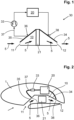
- Fig. 1 shows a schematic representation of an air supply device 30 of an exemplary aircraft according to the invention.
- the air supply device 30 is connected to a fuel cell 20 in order to supply air to it for operation.
- the fuel cell 20 is cooled by a heat exchanger 21 which is arranged in an air duct 10.
- the cross-section of the air duct widens in the flow direction 5 of the air after an air inlet opening 11 in a region 35 of the peripheral surface.
- the air duct 10 has a flow opening 36 in the at least one widening region 35 of the peripheral surface, through which air can be supplied to the fuel cell 20 by means of an air supply duct 37 for its operation.
- the air supply duct 37 has a compressor device 33 for compressing the air before it is supplied to the fuel cell 20 and/or for sucking the air out of the air duct 10 through the flow opening 36.
- the heat exchanger 21 is arranged in the expanded cross-section of the air duct 10.
- the cross-section of the air duct 10 decreases in the flow direction 5 after the heat exchanger 21 before the air outlet opening 12 in at least one region 34.
- the air duct 10 has an air supply opening 38 in the tapering region 34 for supplying exhaust air from the fuel cell 20.
- Fig. 2 shows a schematic representation of a section of an exemplary aircraft 1 according to the invention with a section through an air duct 10.
- the aircraft 1 has a fuel cell 20 and an air supply device 30 for supplying air to operate the fuel cell 20 and for cooling a heat exchanger 21 connected to the fuel cell 20.
- the aircraft 1 or the air supply device 30 has at least one air duct 10, the cross section of which widens in the flow direction 5 of the air after an air inlet opening 11 in at least one region 35 of the peripheral surface.
- the air duct 10 has at least one flow opening 36 in the at least one widening region 35 of the peripheral surface, through which air can be discharged to operate the fuel cell 20.
- the fuel cell 20 of the exemplary embodiment represents part of the flight propulsion of the aircraft 1.
- the heat exchanger 21 is arranged in the expanded cross-section of the air duct 10.
- the cross-section of the air duct 10 decreases in the flow direction 5 after the heat exchanger 21 before the air outlet opening 12 in at least one region 34.
- the air duct 10 has at least one air supply opening 38 in the decreasing region 34 for supplying exhaust air to the fuel cell 20.
- the at least one flow opening 36 is connected to an air supply channel 37 for supplying the air to the fuel cell 20, wherein a compressor device 33 is arranged in the air supply channel 37 for compressing the air before supplying it to the fuel cell 20 and/or for sucking the air out of the air channel 10 through the flow opening 36.
- Fig. 3 shows a schematic representation of a flow chart of the method according to the invention for operating a fuel cell 20 of an aircraft 1.
- An exemplary embodiment of such an aircraft is shown for example in Fig. 2
- the aircraft 1 has an air supply device 30 for operating a fuel cell 20 and for cooling a heat exchanger 21 connected to the fuel cell 20.
- the aircraft 1 also has at least one air duct 10, the cross section of which widens in the flow direction 5 of the air after an air inlet opening 11 in at least one region 35 of the circumferential surface, in which a flow opening 36 for discharging air for operating the fuel cell 20 is arranged.
- a first method step a air is guided through the air inlet opening 11 into the air channel 10 and in a second step b), the air in the air channel 10 after the air inlet opening 11 is compressed, for example by means of a diffuser effect formed in the air channel.
- a third method step c) compressed air is discharged from the air channel 10 through a flow opening 36 and in a next step d) is guided to supply the fuel cell 20.
- step d1) the air guided from the flow opening 36 to the fuel cell 20 is compressed. This step is carried out in particular when if the pressure of the air taken from the air duct via at least one flow opening is lower than that required to supply the fuel cell for its operation.
- the air compressed after the air inlet opening 11 in the air duct 10 is directed to at least one cooling surface of the heat exchanger 21 in order to absorb thermal energy from the heat exchanger 21 and to dissipate it from there.
- step e1) the air in the air duct 10 is accelerated after flowing over the heat exchanger 21 so that the air can provide additional thrust for the aircraft 1 when it is subsequently discharged to the environment.
- step e1) the exhaust air from the fuel cell 20 is fed into the air duct 10 after flowing over the heat exchanger 21, whereby additional mass and enthalpy are supplied to the air flow, which also enables additional thrust when the air is discharged from the air outlet opening 12 to the environment.
- step f) of the proposed method the air is discharged from the air duct 10 again, in particular through the air outlet opening 12.
- the air has absorbed energy to generate additional thrust, which is available for propelling the aircraft 1 depending on the positioning and design of the air outlet opening 12.
Landscapes
- Engineering & Computer Science (AREA)
- Life Sciences & Earth Sciences (AREA)
- Manufacturing & Machinery (AREA)
- Sustainable Development (AREA)
- Sustainable Energy (AREA)
- Chemical & Material Sciences (AREA)
- Chemical Kinetics & Catalysis (AREA)
- Electrochemistry (AREA)
- General Chemical & Material Sciences (AREA)
- Aviation & Aerospace Engineering (AREA)
- Fuel Cell (AREA)
- Cooling, Air Intake And Gas Exhaust, And Fuel Tank Arrangements In Propulsion Units (AREA)
Description
- Die Erfindung betrifft ein Luftfahrzeug mit einer Brennstoffzelle sowie ein Verfahren zum Betrieb einer Brennstoffzelle eines Luftfahrzeugs mit einer Luftversorgungseinrichtung zum Betrieb der Brennstoffzelle sowie zum Kühlen eines mit der Brennstoffzelle verbundenen Wärmetauschers.
- In Luftfahrzeugen angeordnete Brennstoffzellen erzeugen große Wärmemengen, welche über Wärmetauscher abgeführt werden. Entsprechend werden die Wärmetauscher von in Luftfahrzeugen betriebenen Brennstoffzellen, insbesondere wenn diese zum Erzeugen der Antriebsenergie des Luftfahrzeugs eingesetzt werden, häufig so innerhalb eines luftdurchströmten Bereichs wie der Triebwerksgondel oder innerhalb eines Luftkanals angeordnet, dass Staudruckluft (ram air) und/ oder Propeller-Abwind (downwash air) zur Kühlung wenigstens eines Wärmetauschers der Brennstoffzelle(n) verwendet werden können. Dabei wird üblicherweise ein Luftstrom auf wenigstens eine Kühlfläche des Wärmetauschers geleitet, um Wärmeenergie vom Wärmetauscher aufzunehmen. Darüber hinaus benötigen Brennstoffzellen für deren Betrieb neben einem Brennstoff ein Oxidationsmittel, welches im Falle von in Luftfahrzeugen eingesetzten Brennstoffzellen üblicherweise von Luft bzw. dem darin enthaltenen Sauerstoff gebildet wird, wobei die Luft zum Erreichen eines hohen Wirkungsgrads der Brennstoffzelle verdichtet wird. Nachteilig an bekannten Luftversorgungseinrichtungen ist die sich durch Einrichtungen zum Aufnehmen und Leiten von Staudruckluft und/ oder Propeller-Abwind verschlechternde Aerodynamik des Luftfahrzeugs sowie die zum Verdichten der Luft vor deren Zuführung zur Brennstoffzelle erforderliche Energie.
- Ein Luftfahrzeug mit einer Luftversorgungseinrichtung für Brennstoffzellen ist aus
EP 3 043 408 A bekannt. Weitere beispielhafte Luftversorgungseinrichtungen für Brennstoffzellen sind aus den DokumentenUS2020075971A1 undUS2007298308A1 bekannt. - Hiervon ausgehend ist es eine Aufgabe der vorliegenden Erfindung, ein verbessertes Luftfahrzeug mit einer Brennstoffzelle und einer Luftversorgungseinrichtung vorzuschlagen. Ferner wird ein verbessertes Verfahren zum Betrieb einer Brennstoffzelle eines Luftfahrzeugs mit einer Luftversorgungseinrichtung zur Verfügung gestellt. Dies wird erfindungsgemäß durch die Lehre der unabhängigen Ansprüche erreicht. Vorteilhafte Ausgestaltungen der Erfindung sind Gegenstand der Unteransprüche.
- Zur Lösung der Aufgabe wird ein Luftfahrzeug mit einer Brennstoffzelle und einer Luftversorgungseinrichtung zum Zuführen von Luft zum Betrieb der Brennstoffzelle sowie zum Kühlen eines mit der Brennstoffzelle verbundenen Wärmetauschers vorgeschlagen. Das Luftfahrzeug weist dabei wenigstens einen Luftkanal auf, dessen Querschnitt sich in Strömungsrichtung der Luft nach einer Lufteinlassöffnung in wenigstens einem Bereich der Umfangsfläche erweitert. Der Luftkanal weist in dem wenigstens einen sich erweiternden Bereich der Umfangsfläche wenigstens eine Durchströmungsöffnung auf, durch welche Luft zum Betrieb der Brennstoffzelle abführbar ist.
- Die Erfindung betrifft Luftfahrzeuge, wie insbesondere Flugzeuge, Hubschrauber oder auch unbemannte Fluggeräte, welche wenigstens eine Brennstoffzelle mit einem zur Kühlung der Brennstoffzelle verbundenen Wärmetauscher aufweisen. Dabei ist der Wärmetauscher dazu eingerichtet, Wärmeenergie beispielsweise über Kühlflächen insbesondere an die Umgebung abzugeben. Ein die Kühlflächen überstreichender Luftstrom kann dabei Wärmeenergie vom Wärmetauscher aufnehmen. Als Brennstoffzelle wird eine elektrochemische Vorrichtung bezeichnet, die Wärme und elektrische Energie aus einem Brennstoff und einem Oxidationsmittel erzeugt. Bekannte Brennstoffzellen nutzen beispielsweise Wasserstoff als Brennstoff und insbesondere in der Umgebungsluft enthaltenen Sauerstoff als Oxidationsmittel. Brennstoffzellen sind üblicherweise in Form von Brennstoffzellenstapeln ausgebildet, welche im Rahmen der Beschreibung der Erfindung angelehnt an den üblichen Sprachgebrauch vereinfacht als "Brennstoffzelle" bezeichnet werden.
- Das Luftfahrzeug weist wenigstens einen Luftkanal mit wenigstens einer Lufteinlassöffnung auf, welche wenigstens überwiegend in Flugrichtung des Luftfahrzeugs angeordnet ist, um dem Luftkanal insbesondere während des Flugs Luft aus der Umgebung des Luftfahrzeugs zuzuführen. Die wenigstens eine Lufteinlassöffnung ist dabei an einer geeigneten Position an der Außenhaut des Luftfahrzeugs wie insbesondere an einem Rumpf oder einer Tragfläche angeordnet. Insbesondere ist die Lufteinlassöffnung so positioniert, dass durch diese dem Luftkanal Staudruckluft oder Propeller-Abwind zugeführt wird.
- Der Luftkanal ist dabei so ausgeführt, dass sich dessen Querschnitt in Strömungsrichtung der Luft nach der Lufteinlassöffnung in wenigstens einem Bereich der Umfangsfläche erweitert. Entsprechend ist der Luftkanal in der Art eines Diffusors ausgebildet, wodurch sich die Strömungsgeschwindigkeit der diesen Abschnitt durchströmenden Luft verringert, wobei der Luftdruck gleichzeitig steigt. Der Querschnitt des Luftkanals erweitert sich dabei in wenigstens einem Bereich der Wandung, so dass diese in dem wenigstens einen Bereich sich erweiternd ausgebildet ist, beispielsweise mit einem geneigt gegenüber der Längsrichtung des Luftkanals angeordneten Öffnungswinkel. Gleichzeitig kann die Wandung in wenigstens einem anderen Bereich des Luftkanalquerschnitts beispielsweise einen größeren oder kleineren Öffnungswinkel aufweisen oder parallel zur Längsrichtung des Luftkanals ausgerichtet sein. Grundsätzlich kann die Wandung auch gleichmäßig und/ oder zumindest abschnittsweise rotationssymmetrisch über den Umfang verteilt sich erweiternd ausgebildet sein.
- Bei der vorgeschlagenen Gestaltung weist der Luftkanal in dem wenigstens einen sich erweiternden Bereich der Umfangsfläche wenigstens eine Durchströmungsöffnung auf, durch welche Luft zum Betrieb der Brennstoffzelle aus dem Luftkanal abführbar ist. Insbesondere ist die wenigstens eine Durchströmungsöffnung dabei so ausgeführt und angeordnet, dass durch diese unmittelbar an der Wandung des sich erweiternden Bereichs der Umfangsfläche vorbei- bzw. entlangströmende Luft abgeführt wird. Dies ist insbesondere bei sich mit größeren Öffnungswinkeln erweiternden Bereichen vorteilhaft, in welchen die Gefahr des Ablösens der Grenzschicht des Luftstroms besteht. Durch das Abführen der an der Wandung vorbeiströmenden Luft kann eine Stabilisierung der idealerweise laminaren Grenzschicht und eine Verringerung der Ablösegefahr der Luftströmung erreicht werden kann. Insbesondere unter Berücksichtigung der Strömungsverhältnisse an Umfangsfläche können in einem sich erweiternden Bereich der Umfangsfläche daher eine oder mehrere gleichmäßig oder in anderer Weise geeignet verteilte Durchströmungsöffnungen gleicher oder unterschiedlicher Größe angeordnet sein.
- Die vorgeschlagene Gestaltung des Luftkanals mit sich erweiternden Querschnitt des Luftkanals nach der Lufteinlassöffnung in wenigstens einem sich erweiternden Bereich, führt zu einer Diffusorwirkung auf die den Luftkanal durchströmenden Luft, welche in einer Verringerung der Strömungsgeschwindigkeit bei gleichzeitiger Druckerhöhung resultiert. Dadurch, dass im Luftkanal nach einer Einlassöffnung der Luftdruck steigt, weist auch die durch die wenigstens eine Durchströmungsöffnung abführbare Luft einen erhöhten Druck auf, so dass der Energieaufwand zum Verdichten der für den Betrieb der Brennstoffzelle dieser zugeführten Luft entsprechend reduzierbar ist. Auf diese Weise ermöglicht die vorgeschlagene Lösung eine Funktionsintegration basierend auf der Erhöhung des Luftdrucks bei einer gleichzeitigen Verringerung der Strömungsgeschwindigkeit der Luft, um die Kühlwirkung für den Wärmetauscher sowie die Zuführung verdichteter Luft zur Brennstoffzelle zu verbessern und darüber hinaus das Risiko eines Ablösens der Luft von der Wandung im sich erweiternden Bereich des Luftkanals zu verringern.
- Bei einer Ausführungsform des Luftfahrzeugs ist der Wärmetauscher in dem erweiterten Querschnitt des Luftkanals angeordnet. Wie bereits dargelegt führt die Diffusorwirkung des sich erweiternden Luftkanals in Strömungsrichtung vor dem erweiterten Querschnitt des Luftkanals zu einer Verringerung der Strömungsgeschwindigkeit der eingelassenen Luft bei gleichzeitiger Druckerhöhung. Damit können günstige Strömungsbedingungen der Luft für das Abführen von Wärmeenergie von Kühlflächen eines in dem erweiterten Querschnitt des Luftkanals angeordneten Wärmetauschers erreicht werden.
- Bei einer Ausführungsform des Luftfahrzeugs verringert sich der Querschnitt des Luftkanals in Strömungsrichtung vor einer Luftauslassöffnung. Dabei verringert sich der Querschnitt des Luftkanals in wenigstens einem Bereich der Umfangsfläche. Dieser sich verjüngendem Bereich des Luftkanals ist insbesondere hinter dem wenigstens einen Wärmetauscher angeordnet. Der Querschnitt des Luftkanals verringert sich dabei in wenigstens einem Bereich der Wandung, so dass diese in dem wenigstens einen Bereich sich verjüngend ausgebildet ist, beispielsweise mit einem geneigt gegenüber der Längsrichtung des Luftkanals angeordneten Verjüngungswinkel. Gleichzeitig kann die Wandung in wenigstens einem anderen Bereich des Luftkanalquerschnitts beispielsweise einen größeren oder kleineren Verjüngungswinkel aufweisen oder parallel zur Längsrichtung des Luftkanals ausgerichtet sein. Grundsätzlich kann die Wandung auch gleichmäßig und/ oder zumindest abschnittsweise rotationssymmetrisch über den Umfang verteilt sich verjüngend ausgebildet sein. Entsprechend ist der Luftkanal in der Art einer Düse ausgebildet, wodurch die Strömungsgeschwindigkeit der diesen Abschnitt durchströmenden Luft steigt, während der Luftdruck sinkt. Die düsenartige Gestaltung des Luftkanals vor einer Luftauslassöffnung führt zu einer Beschleunigung des Luftstroms und so zu einer erhöhten Strömungsgeschwindigkeit der ausströmenden Luft, woraus eine zusätzliche Schubwirkung für das Luftfahrzeug resultiert.
- Bei einer Ausführungsform des Luftfahrzeugs weist der Luftkanal wenigstens eine Luftzufuhröffnung zum Zuführen von Abluft der Brennstoffzelle vor einer Luftauslassöffnung auf. So wird die Abluft der Brennstoffzelle wieder dem Luftkanal zugeführt, aus dem sie entnommen wurde. Darüber hinaus wird dem Luftkanal dabei zusätzliche Wärmeenthalpie zugeführt, welche die Gesamtenthalpie der ausströmenden Luft vor der Luftauslassöffnung zusätzlich erhöht und damit die Schutzwirkung weiter verstärkt.
- Bei einer Ausführungsform des Luftfahrzeugs ist die wenigstens eine Durchströmungsöffnung mit einem Luftzufuhrkanal zum Zuführen der Luft zur Brennstoffzelle, insbesondere als Oxidationsmittel für den Betrieb und/ oder zum Kühlen der Brennstoffzelle verbunden. Der Luftzufuhrkanal weist dabei eine Verdichtereinrichtung zum Verdichten der Luft vor dem Zuführen der Luft zur Brennstoffzelle auf. Gleichzeitig oder alternativ kann die Verdichtereinrichtung zum Absaugen der Luft durch die Durchströmungsöffnung aus dem Luftkanal vorgesehen sein. Insbesondere durch die Diffusorwirkung in dem Bereich, in dem die wenigstens eine Durchströmungsöffnung angeordnet ist, weist die durch die Durchströmungsöffnung aus dem Luftkanal abführbare Luft regelmäßig einen erhöhten Druck gegenüber der Umgebung auf. Abhängig von den Randbedingungen (insbesondere Umgebungsdruck, Umgebungstemperatur, Fluggeschwindigkeit, Gestaltung des Luftkanals) kann das Druckgefälle zwischen dem Luftkanal und dem Luftzufuhrkanal zur Brennstoffzelle bereits ausreichen, um Luft durch die wenigstens eine Durchströmungsöffnung aus dem Luftkanal abzuführen. Insbesondere wenn kein ausreichendes Druckgefälle vorliegt, kann mittels der Verdichtereinrichtung ein geeignetes Druckgefälle erzeugt werden, um eine ausreichende Menge Luft aus dem Luftkanal zur Brennstoffzelle zu führen. Zusätzlich oder alternativ kann die Luft mittels der Verdichtereinrichtung vor dem Zuführen zur Brennstoffzelle insbesondere weiter verdichtet werden, um einen geeigneten Druck der Luft zum Betreiben der Brennstoffzelle insbesondere mit einem geeigneten Wirkungsgrad einzustellen.
- Bei einer Ausführungsform des Luftfahrzeugs ist die Brennstoffzelle Teil des Flugantriebs. Dabei kann die mittels der Brennstoffzelle erzeugte Energie die Hauptantriebsquelle für den Flugantrieb sein oder diesen ergänzen. Bei einer anderen Ausführungsform des Luftfahrzeugs wird die mittels der Brennstoffzelle erzeugte Energie wenigstens teilweise für andere als Antriebseinrichtungen des Fluggeräts zur Verfügung gestellt, wie beispielsweise zum Antrieb von Hilfsaggregaten oder für die Bordstromversorgung.
- In einem weiteren Aspekt der Erfindung wird ein Verfahren zum Betreiben einer Brennstoffzelle eines Luftfahrzeugs mit einer Luftversorgungseinrichtung für den Betrieb der Brennstoffzelle sowie zum Kühlen eines mit der Brennstoffzelle verbundenen Wärmetauschers vorgeschlagen. Das Luftfahrzeug weist dabei wenigstens einen Luftkanal auf, dessen Querschnitt sich in Strömungsrichtung der Luft nach einer Lufteinlassöffnung in wenigstens einem Bereich der Umfangsfläche erweitert, in welchem wenigstens eine Durchströmungsöffnung zum Abführen von Luft zum Betrieb der Brennstoffzelle angeordnet ist.
- Das Verfahren weist die folgenden Schritte auf:
- a) Führen von Luft durch die Lufteinlassöffnung in den Luftkanal;
- b) Verdichten der Luft im Luftkanal nach der Lufteinlassöffnung;
- c) Abführen von verdichteter Luft aus dem Luftkanal durch die wenigstens eine Durchströmungsöffnung;
- d) Führen der Luft von der Durchströmungsöffnung zur Brennstoffzelle;
- e) Leiten der verdichteten Luft auf wenigstens eine Kühlfläche des Wärmetauschers; und
- f) Abführen der Luft aus dem Luftkanal.
- In einem ersten Verfahrensschritt wird Luft durch die Lufteinlassöffnung in den Luftkanal geführt. Die Lufteinlassöffnung kann selbstverständlich auch mehrteilig ausgeführt sein. Üblicherweise ist die Lufteinlassöffnung in Flugrichtung an einer insbesondere zur Aufnahme von Staudruckluft und/ oder Propeller-Abwind günstigen Position des Luftfahrzeugs angeordnet, wodurch in einer Flugphase ausreichend Luft in den Luftkanal geführt wird. Selbstverständlich ist es auch möglich, dass zusätzliche Einrichtungen wie wenigstens ein Lüfterrad oder dergleichen zum Führen von Luft durch die Lufteinlassöffnung in den Luftkanal vorgesehen sind.
- In einem weiteren Schritt wird die Luft im Luftkanal nach der Lufteinlassöffnung verdichtet. Der Querschnitt des zur Durchführung des Verfahrens vorgeschlagenen Luftkanals erweitert sich in Strömungsrichtung der Luft nach der Lufteinlassöffnung in wenigstens einem Bereich der Umfangsfläche. Entsprechend ist der Luftkanal in der Art eines Diffusors ausgebildet, wodurch sich die Strömungsgeschwindigkeit der diesen Abschnitt durchströmenden Luft verringert und der Luftdruck gleichzeitig steigt. Selbstverständlich ist es auch möglich, weitere Einrichtungen im Luftkanal zur insbesondere zusätzlichen Verdichtung der Luft vorzusehen.
- In weiteren Verfahrensschritten wird verdichtete Luft durch die wenigstens eine Durchströmungsöffnung aus dem Luftkanal abgeführt und zur Brennstoffzelle geführt. Die wenigstens eine Durchströmungsöffnung ist dabei insbesondere so ausgeführt und angeordnet, dass durch diese unmittelbar an der Wandung des sich erweiternden Bereichs der Umfangsfläche vorbei- bzw. entlangströmende Luft abgeführt werden kann. Auf diese Weise kann eine Stabilisierung der idealerweise laminaren Grenzschicht an der Wandung des Luftkanals und eine Verringerung der Ablösegefahr der Luftströmung in sich erweiternden Bereichen des Luftkanals erreicht werden.
- In einem weiteren Schritt wird die durch die wenigstens eine Durchströmungsöffnung aus dem Luftkanal abgeführte insbesondere durch die Diffusorwirkung im Luftkanal verdichtete Luft auf wenigstens eine Kühlfläche des Wärmetauschers geleitet. Durch die Diffusorwirkung des sich erweiternden Querschnitt des Luftkanals steigt der Druck der Luft, gleichzeitig sinkt aber auch die Strömungsgeschwindigkeit, so dass durch das vorgeschlagene Verfahren zusätzlich günstige Strömungsbedingungen zur Wärmeaufnahme der Luft beim Überstreichen von Kühlflächen des wenigstens einen Wärmetauschers hergestellt werden. Schließlich wird die Luft wieder aus dem Luftkanal insbesondere in die Umgebung abgeführt, wobei die Luft während dem Verfahren Energie zum Erzeugen eines zusätzlichen Schubs aufgenommen hat.
- Das vorgeschlagene Verfahren ermöglicht so eine energetisch günstige Versorgung wenigstens einer Brennstoffzelle mit Luft zu deren Betrieb sowie zur Kühlung des mit dieser verbundenem Wärmetauschers. Abhängig von der Gestaltung des Luftkanals kann durch das Verfahren auch zusätzlicher Schub für das Luftfahrzeug zur Verfügung gestellt werden.
- Bei einer Ausführungsform des Verfahrens erfolgt das Abführen der Luft durch die wenigstens eine Durchströmungsöffnung mithilfe eines Sogs, so dass die Luft durch die wenigstens eine Durchströmungsöffnung abgesaugt wird. Dies kann insbesondere dann erforderlich sein, wenn das Druckgefälle an der wenigstens einen Durchströmungsöffnung nicht ausreicht, um eine ausreichende Luftmenge aus dem Luftkanal abzuführen. Der Sog kann dabei insbesondere mit einer im Luftzufuhrkanal von der Durchströmungsöffnung zur Brennstoffzelle angeordneten Verdichtereinrichtung erzeugt werden.
- Eine Ausführungsform des Verfahrens weist als weiteren Schritt ein Verdichten der von der Durchströmungsöffnung zur Brennstoffzelle geführten Luft auf. Auch dieser Schritt kann insbesondere dann erforderlich sein, wenn der Druck der über die wenigstens eine Durchströmungsöffnung aus dem Luftkanal entnommenen Luft geringer ist, als zur Zuführung zur Brennstoffzelle für deren Betrieb nötig ist. Der Sog kann dabei insbesondere mit einem im Luftzufuhrkanal von der Durchströmungsöffnung zur Brennstoffzelle angeordneten Verdichter erzeugt werden. Insbesondere ist es möglich, für eine Kombination des Abführens der Luft durch die wenigstens eine Durchströmungsöffnung mithilfe eines Sogs sowie zum Verdichten der zur Brennstoffzelle geführten Luft eine gemeinsame, insbesondere in der Luftzuführleitung angeordneten Verdichtereinrichtung zu verwenden.
- Eine Ausführungsform des Verfahrens weist als weiteren Schritt ein Beschleunigen der Luft im Luftkanal nach dem wenigstens einem Wärmetauscher auf. Damit kann die Luft bei einem nachfolgenden Abführen an die Umgebung zusätzlichen Schub für das Luftfahrzeug zur Verfügung stellen. Da für das Aufnehmen von Wärmeenergie vom Wärmetauscher eine geringere Geschwindigkeit der Luftströmung vorteilhaft ist, erfolgt ein Beschleunigen der Luft vorteilhaft erst nach der Aufnahme von Wärmeenergie vom Wärmetauscher. Insbesondere kann dieses Beschleunigen durch eine Verjüngung des Querschnitts des Luftkanals nach dem Wärmetauscher erfolgen. Die am Wärmetauscher erfolgte energetische Anreicherung der Luft ermöglicht eine höhere Beschleunigung und Strömungsgeschwindigkeit an der Luftauslassöffnung und damit das Erreichen eines zusätzlichen Schubs beim Abführen der Luft an die Umgebung.
- Eine Ausführungsform des Verfahrens weist als weiteren Schritt ein Zuführen der Abluft aus der Brennstoffzelle in den Luftkanal nach dem Wärmetauscher auf. Die Abluft der Brennstoffzelle weist eine gegenüber der Umgebungsluft erhöhte Wärmeenthalpie auf, so dass durch das Zuführen der Abluft in den Luftkanal nach dem Wärmetauscher, insbesondere in Verbindung mit einer Beschleunigung der Luft in diesem Abschnitt des Luftkanals, zusätzlicher Schub beim Abführen der Luft aus der Luftauslassöffnung an die Umgebung ermöglicht wird.
- Bei einer Ausführung des Verfahrens zum Betrieb einer Brennstoffzelle eines Luftfahrzeugs ist das Luftfahrzeug gemäß wenigstens einem Aspekt des vorausgehend beschriebenen Luftfahrzeugs ausgebildet. Insbesondere kann das Luftfahrzeug ein oder mehrere Merkmale und Eigenschaften des vorausgehend beschriebenen Luftfahrzeugs aufweisen, insbesondere zur Durchführung des vorgeschlagenen Verfahrens.
- Da das vorgeschlagene Luftfahrzeugs sowie das vorgeschlagene Verfahrens auf einem gemeinsamen Grundgedanken beruhen, stellen die dargestellten Merkmale und Eigenschaften des vorgeschlagenen Luftfahrzeugs sowie auch des vorgeschlagenen Verfahrens wechselweise auch Merkmale und Eigenschaften für wenigstens optionale Ausgestaltungen des Luftfahrzeugs und des Verfahren dar und sollen daher auch jeweils für die wechselweisen Aspekte als offenbart gelten.
- Weitere Merkmale, Vorteile und Anwendungsmöglichkeiten der Erfindung ergeben sich aus der nachfolgenden Beschreibung im Zusammenhang mit den Figuren. Es zeigt
- Fig. 1
- eine schematische Darstellung einer Luftversorgungseinrichtung eines beispielhaften erfindungsgemäßen Luftfahrzeugs;
- Fig. 2
- eine schematische Darstellung eines Ausschnitts eines beispielhaften erfindungsgemäßen Luftfahrzeugs; und
- Fig. 3
- eine schematische Darstellung eines Ablaufdiagramms des erfindungsgemäßen Verfahrens.
-
Fig. 1 zeigt eine schematische Darstellung einer Luftversorgungseinrichtung 30 eines beispielhaften erfindungsgemäßen Luftfahrzeugs. Die Luftversorgungseinrichtung 30 ist mit einer Brennstoffzelle 20 verbunden, um dieser Luft zum Betrieb zuzuführen. Die Kühlung der Brennstoffzelle 20 erfolgt durch einen Wärmetauscher 21, welcher in einem Luftkanal 10 angeordnet ist. Der Querschnitt des Luftkanals erweitert sich in Strömungsrichtung 5 der Luft nach einer Lufteinlassöffnung 11 in einem Bereich 35 der Umfangsfläche. Darüber hinaus weist der Luftkanal 10 in dem wenigstens einen sich erweiternden Bereich 35 der Umfangsfläche eine Durchströmungsöffnung 36 auf, durch welche der Brennstoffzelle 20 mittels einem Luftzufuhrkanal 37 Luft für deren Betrieb zuführbar ist. Der Luftzufuhrkanal 37 weist eine Verdichtereinrichtung 33 zum Verdichten der Luft vor dem Zuführen zur Brennstoffzelle 20 und/ oder zum Absaugen der Luft durch die Durchströmungsöffnung 36 aus dem Luftkanal 10 auf. - In der schematischen Darstellung in
Fig. 1 ist der Wärmetauscher 21 in dem erweiterten Querschnitt des Luftkanals 10 angeordnet. Der Querschnitt des Luftkanals 10 verringert sich in Strömungsrichtung 5 nach dem Wärmetauscher 21 vor der Luftauslassöffnung 12 in wenigstens einem Bereich 34. Dabei weist der Luftkanal 10 in dem sich verjüngenden Bereich 34 eine Luftzufuhröffnung 38 zum Zuführen von Abluft der Brennstoffzelle 20 auf. -
Fig. 2 zeigt eine schematische Darstellung eines Ausschnitts eines beispielhaften erfindungsgemäßen Luftfahrzeugs 1 mit einem Schnitt durch einen Luftkanal 10. Das Luftfahrzeug 1 weist eine Brennstoffzelle 20 und eine Luftversorgungseinrichtung 30 zum Zuführen von Luft zum Betrieb der Brennstoffzelle 20 sowie zum Kühlen eines mit der Brennstoffzelle 20 verbundenen Wärmetauschers 21 auf. Das Luftfahrzeug 1 bzw. die Luftversorgungseinrichtung 30 weist wenigstens einen Luftkanal 10 auf, dessen Querschnitt sich in Strömungsrichtung 5 der Luft nach einer Lufteinlassöffnung 11 in wenigstens einem Bereich 35 der Umfangsfläche erweitert. Der Luftkanal 10 weist in dem wenigstens einen sich erweiternden Bereich 35 der Umfangsfläche wenigstens eine Durchströmungsöffnung 36 auf, durch welche Luft zum Betrieb der Brennstoffzelle 20 abführbar ist. Die Brennstoffzelle 20 der beispielhaften Ausführungsform stellt einen Teil des Flugantriebs des Luftfahrzeugs 1 dar. - In der dargestellten beispielhaften Ausführungsform des vorgeschlagenen Luftfahrzeugs 1 ist der Wärmetauscher 21 in dem erweiterten Querschnitt des Luftkanals 10 angeordnet. Der Querschnitt des Luftkanals 10 verringert sich in Strömungsrichtung 5 nach dem Wärmetauscher 21 vor der Luftauslassöffnung 12 in wenigstens einem Bereich 34. Dabei weist der Luftkanal 10 in dem sich verringernden Bereich 34 wenigstens eine Luftzufuhröffnung 38 zum Zuführen von Abluft der Brennstoffzelle 20 auf.
- Die wenigstens eine Durchströmungsöffnung 36 ist mit einem Luftzufuhrkanal 37 zum Zuführen der Luft zur Brennstoffzelle 20 verbunden, wobei im Luftzufuhrkanal 37 eine Verdichtereinrichtung 33 angeordnet ist, zum Verdichten der Luft vor dem Zuführen zur Brennstoffzelle 20 und/ oder zum Absaugen der Luft durch die Durchströmungsöffnung 36 aus dem Luftkanal 10.
-
Fig. 3 zeigt eine schematische Darstellung eines Ablaufdiagramms des erfindungsgemäßen Verfahrens zum Betrieb einer Brennstoffzelle 20 eines Luftfahrzeugs 1. Eine beispielshafte Ausführung eine solche Luftfahrzeugs ist beispielsweise inFig. 2 dargestellt. Das Luftfahrzeug 1 weist eine Luftversorgungseinrichtung 30 zum Betreiben einer Brennstoffzelle 20 sowie zum Kühlen eines mit der Brennstoffzelle 20 verbundenen Wärmetauschers 21 auf. Ferner weist das Luftfahrzeug 1 wenigstens einen Luftkanal 10 auf, dessen Querschnitt sich in Strömungsrichtung 5 der Luft nach einer Lufteinlassöffnung 11 in wenigstens einem Bereich 35 der Umfangsfläche erweitert, in welchem eine Durchströmungsöffnung 36 zum Abführen von Luft zum Betrieb der Brennstoffzelle 20 angeordnet ist. - In einem ersten Verfahrensschritt a) wird Luft durch die Lufteinlassöffnung 11 in den Luftkanal 10 geführt und in einem zweiten Schritt b) wird die Luft im Luftkanal 10 nach der Lufteinlassöffnung 11 beispielsweise mittels einer im Luftkanal ausgebildete Diffusorwirkung verdichtet. In einem dritten Verfahrensschritt c) wird verdichtete Luft durch eine Durchströmungsöffnung 36 aus dem Luftkanal 10 abgeführt und in einem nächsten Schritt d) zur Versorgung der Brennstoffzelle 20 geführt.
- In einem optionalen Verfahrensschritt d1) wird die von der Durchströmungsöffnung 36 zur Brennstoffzelle 20 geführte Luft verdichtet. Dieser Schritt wird insbesondere dann durchgeführt, wenn der Druck der über die wenigstens eine Durchströmungsöffnung aus dem Luftkanal entnommenen Luft geringer ist, als zur Zuführung zur Brennstoffzelle für deren Betrieb nötig ist.
- In einem nächsten Verfahrensschritt e) wird die nach der Lufteinlassöffnung 11 im Luftkanal 10 verdichtete Luft auf wenigstens eine Kühlfläche des Wärmetauschers 21 geleitet, um Wärmeenergie vom Wärmetauscher 21 aufzunehmen und von dort abzuführen.
- In einem weiteren optionalen Verfahrensschritt e1) erfolgt ein Beschleunigen der Luft im Luftkanal 10 nach dem Überströmen des Wärmetauscher 21, damit die Luft bei einem nachfolgenden Abführen an die Umgebung zusätzlichen Schub für das Luftfahrzeug 1 zur Verfügung stellen kann. In einem noch weiteren optionalen Verfahrensschritt e1) erfolgt ein Zuführen der Abluft aus der Brennstoffzelle 20 in den Luftkanal 10 nach dem Überströmen des Wärmetauschers 21, wodurch dem Luftstrom zusätzliche Masse und Enthalpie zugeführt wird, wodurch auch ein zusätzlicher Schub beim Abführen der Luft aus der Luftauslassöffnung 12 an die Umgebung ermöglicht wird.
- Schließlich wird in einem weiteren Verfahrensschritt f) des vorgeschlagenen Verfahrens die Luft insbesondere durch die Luftauslassöffnung 12 wieder aus dem Luftkanal 10 abgeführt. Insbesondere hat die Luft während dem Verfahren Energie zum Erzeugen eines zusätzlichen Schubs aufgenommen, welcher abhängig von der Positionierung und Gestaltung der Luftauslassöffnung 12 zum Vortrieb des Luftfahrzeugs 1 zur Verfügung steht.
-
- 1
- Luftfahrzeug
- 5
- Strömungsrichtung
- 10
- Luftkanal
- 11
- Lufteinlassöffnung
- 12
- Luftauslassöffnung
- 20
- Brennstoffzelle
- 21
- Wärmetauscher
- 30
- Luftversorgungseinrichtung
- 33
- Verdichtereinrichtung
- 34
- sich verringernder Bereich der Umfangsfläche des Luftkanals
- 35
- sich erweiternder Bereich der Umfangsfläche des Luftkanals
- 36
- Durchströmungsöffnung
- 37
- Luftzufuhrkanal
- 38
- Luftzufuhröffnung
Claims (12)
- Luftfahrzeug mit einer Brennstoffzelle (20) und einer Luftversorgungseinrichtung (30) zum Zuführen von Luft zum Betrieb der Brennstoffzelle (20) sowie zum Kühlen eines mit der Brennstoffzelle (20) verbundenen Wärmetauschers (21), wobei das Luftfahrzeug (1) wenigstens einen Luftkanal (10) aufweist, dessen Querschnitt sich in Strömungsrichtung (5) der Luft nach einer Lufteinlassöffnung (11) in wenigstens einem Bereich (35) der Umfangsfläche erweitert, dadurch gekennzeichnet, dass der Luftkanal (10) in dem wenigstens einen sich erweiternden Bereich (35) der Umfangsfläche wenigstens eine Durchströmungsöffnung (36) aufweist, durch welche Luft zum Betrieb der Brennstoffzelle (20) abführbar ist.
- Luftfahrzeug nach Anspruch 1, dadurch gekennzeichnet, dass der Wärmetauscher (21) in dem erweiterten Querschnitt des Luftkanals (10) angeordnet ist.
- Luftfahrzeug nach wenigstens einem der vorhergehenden Ansprüche, dadurch gekennzeichnet, dass sich der Querschnitt des Luftkanals (10) in Strömungsrichtung (5) vor einer Luftauslassöffnung (12) verringert.
- Luftfahrzeug nach wenigstens einem der vorhergehenden Ansprüche, dadurch gekennzeichnet, dass der Luftkanal (10) wenigstens eine Luftzufuhröffnung (38) zum Zuführen von Abluft der Brennstoffzelle (20) vor einer Luftauslassöffnung (12) aufweist.
- Luftfahrzeug nach wenigstens einem der vorhergehenden Ansprüche, dadurch gekennzeichnet, dass die wenigstens eine Durchströmungsöffnung (36) mit einem Luftzufuhrkanal (37) zum Zuführen der Luft zur Brennstoffzelle (20) verbunden ist, wobei der Luftzufuhrkanal (37) mit einer Verdichtereinrichtung (33) zum Verdichten der Luft vor dem Zuführen zur Brennstoffzelle (20) und/ oder zum Absaugen der Luft durch die Durchströmungsöffnung (36) aus dem Luftkanal (10) verbunden ist.
- Luftfahrzeug nach wenigstens einem der vorhergehenden Ansprüche, dadurch gekennzeichnet, dass die Brennstoffzelle (20) Teil des Flugantriebs ist.
- Verfahren zum Betrieb einer Brennstoffzelle (20) eines Luftfahrzeugs (1) mit einer Luftversorgungseinrichtung (30) zum Betreiben der Brennstoffzelle (20) sowie zum Kühlen eines mit der Brennstoffzelle (20) verbundenen Wärmetauschers (21), wobei das Luftfahrzeug (1) wenigstens einen Luftkanal (10) aufweist, dessen Querschnitt sich in Strömungsrichtung (5) der Luft nach einer Lufteinlassöffnung (11) in wenigstens einem Bereich (35) der Umfangsfläche erweitert, in welchem eine Durchströmungsöffnung (36) zum Abführen von Luft zum Betrieb der Brennstoffzelle (20) angeordnet ist, wobei das Verfahren folgende Schritte umfasst:a) Führen von Luft durch die Lufteinlassöffnung (11) in den Luftkanal;b) Verdichten der Luft im Luftkanal (10) nach der Lufteinlassöffnung (11);c) Abführen von verdichteter Luft aus dem Luftkanal (10) durch die wenigstens eine Durchströmungsöffnung (36);d) Führen der Luft von der Durchströmungsöffnung (36) zur Brennstoffzelle (20);e) Leiten der verdichteten Luft auf wenigstens eine Kühlfläche des Wärmetauschers (21); undf) Abführen der Luft aus dem Luftkanal (10).
- Verfahren zum Betrieb einer Brennstoffzelle eines Luftfahrzeugs gemäß Anspruch 7, dadurch gekennzeichnet, dass das Abführen der Luft durch die wenigstens eine Durchströmungsöffnung (36) mithilfe eines Sogs erfolgt.
- Verfahren zum Betrieb einer Brennstoffzelle eines Luftfahrzeugs gemäß einem der Ansprüche 7 oder 8, gekennzeichnet durch den weiteren Schritt:
d1) Verdichten der von der Durchströmungsöffnung (36) zur Brennstoffzelle (20) geführten Luft. - Verfahren zum Betrieb einer Brennstoffzelle eines Luftfahrzeugs gemäß einem der Ansprüche 7 bis 9, gekennzeichnet durch den weiteren Schritt:
e1) Beschleunigen der Luft vor dem Abführen aus dem Luftkanal (10). - Verfahren zum Betrieb einer Brennstoffzelle eines Luftfahrzeugs gemäß einem der Ansprüche 7 bis 10, gekennzeichnet durch den weiteren Schritt:
e2) Zuführen der Abluft aus der Brennstoffzelle (20) vor dem Abführen der Luft aus dem Luftkanal (10). - Verfahren zum Betrieb einer Brennstoffzelle eines Luftfahrzeugs gemäß einem der Ansprüche 7 bis 11, dadurch gekennzeichnet, dass das Luftfahrzeug (1) gemäß wenigstens einem der Ansprüche 1 bis 6 ausgebildet ist.
Applications Claiming Priority (2)
| Application Number | Priority Date | Filing Date | Title |
|---|---|---|---|
| DE102021115226.7A DE102021115226A1 (de) | 2021-06-11 | 2021-06-11 | Luftfahrzeug mit einer Brennstoffzelle und Verfahren zum Betrieb einer Brennstoffzelle eines Luftfahrzeugs |
| PCT/DE2022/100385 WO2022258104A1 (de) | 2021-06-11 | 2022-05-19 | Luftfahrzeug mit einer brennstoffzelle und verfahren zum betrieb einer brennstoffzelle eines luftfahrzeugs |
Publications (2)
| Publication Number | Publication Date |
|---|---|
| EP4351970A1 EP4351970A1 (de) | 2024-04-17 |
| EP4351970B1 true EP4351970B1 (de) | 2025-02-12 |
Family
ID=81854615
Family Applications (1)
| Application Number | Title | Priority Date | Filing Date |
|---|---|---|---|
| EP22726586.5A Active EP4351970B1 (de) | 2021-06-11 | 2022-05-19 | Luftfahrzeug mit einer brennstoffzelle und verfahren zum betrieb einer brennstoffzelle eines luftfahrzeugs |
Country Status (6)
| Country | Link |
|---|---|
| US (1) | US12559250B2 (de) |
| EP (1) | EP4351970B1 (de) |
| BR (1) | BR112023025613A2 (de) |
| CA (1) | CA3222960A1 (de) |
| DE (1) | DE102021115226A1 (de) |
| WO (1) | WO2022258104A1 (de) |
Families Citing this family (1)
| Publication number | Priority date | Publication date | Assignee | Title |
|---|---|---|---|---|
| WO2025165383A2 (en) * | 2023-04-03 | 2025-08-07 | Joby Aero, Inc. | High efficiency air intake system and aircraft using same |
Family Cites Families (17)
| Publication number | Priority date | Publication date | Assignee | Title |
|---|---|---|---|---|
| DE746905C (de) | 1940-12-24 | 1944-12-27 | Einrichtung zur Verhinderung des Abreissens der Stroemung in steilwandigen Diffusoren | |
| US5114103A (en) | 1990-08-27 | 1992-05-19 | General Electric Company | Aircraft engine electrically powered boundary layer bleed system |
| DE10028450A1 (de) | 2000-06-08 | 2002-04-18 | Xcellsis Gmbh | Verfahren und Vorrichtung zur Verminderung des aerodynamischen Widerstandes von Flugzeugen durch Absaugung von Grenzschichströmungen |
| DE10361657B4 (de) | 2003-12-30 | 2008-06-26 | Airbus Deutschland Gmbh | Kühlungsluftversorgungssystem für die Kühlung verschiedener Kühlungsluft benötigender Systeme in einem Flugzeug |
| US8557448B2 (en) * | 2005-01-13 | 2013-10-15 | Toyota Jidosha Kabushiki Kaisha | Fuel cell and fuel cell separator |
| DE102007023685B3 (de) | 2007-05-22 | 2008-10-30 | Airbus Deutschland Gmbh | Stauluftbasiertes Kühl- und Ventilationssystem für ein Luftfahrzeug |
| DE102007019820B4 (de) | 2007-04-26 | 2012-03-08 | Airbus Operations Gmbh | Kühlsystem durch Grenzschichtabsaugung |
| DE102008009274B4 (de) | 2008-02-15 | 2011-06-01 | Airbus Operations Gmbh | System und Verfahren zur Belüftung eines Bereichs, insbesondere eines explosionsgefährdeten Bereichs eines Luftfahrzeugs |
| DE102008002116B4 (de) | 2008-05-30 | 2014-04-10 | Airbus Operations Gmbh | Vorrichtung und Verfahren zur Abluftkühlung von Flugzeugklimaanlagen |
| GB201416407D0 (en) | 2014-09-17 | 2014-10-29 | Rolls Royce Plc | Aircraft environmental control system air duct arrangement |
| DE102015100185A1 (de) | 2015-01-08 | 2016-07-14 | Airbus Operations Gmbh | Brennstoffzellensystem für ein Flugzeug und Verfahren zum Bereitstellen eines Inertgases in einem Flugzeug |
| US10978723B2 (en) * | 2018-09-05 | 2021-04-13 | Honeywell International Inc. | Fuel cell secondary power and thermal management systems |
| US11414199B2 (en) * | 2019-03-01 | 2022-08-16 | Textron Innovations Inc. | Fuel cell powered line-replaceable thrust module |
| FR3097202B1 (fr) * | 2019-06-14 | 2024-02-23 | Airbus | Systeme autonome de propulsion a helice pour un aeronef, ledit systeme autonome de propulsion a helice comportant une pile a combustible |
| FR3104139B1 (fr) * | 2019-12-09 | 2021-12-17 | Airbus | Systeme de propulsion pour un aeronef, ledit systeme de propulsion comportant une pile a combustible |
| GB2594706A (en) * | 2020-04-29 | 2021-11-10 | Gkn Aerospace Services Ltd | Motor drive system |
| EP4067236B1 (de) * | 2021-03-29 | 2024-12-25 | Airbus Operations (S.A.S.) | Elektrisches antriebssystem für ein luftfahrzeug |
-
2021
- 2021-06-11 DE DE102021115226.7A patent/DE102021115226A1/de active Pending
-
2022
- 2022-05-19 EP EP22726586.5A patent/EP4351970B1/de active Active
- 2022-05-19 BR BR112023025613A patent/BR112023025613A2/pt unknown
- 2022-05-19 WO PCT/DE2022/100385 patent/WO2022258104A1/de not_active Ceased
- 2022-05-19 US US18/568,642 patent/US12559250B2/en active Active
- 2022-05-19 CA CA3222960A patent/CA3222960A1/en active Pending
Also Published As
| Publication number | Publication date |
|---|---|
| EP4351970A1 (de) | 2024-04-17 |
| CA3222960A1 (en) | 2022-12-15 |
| BR112023025613A2 (pt) | 2024-02-27 |
| US12559250B2 (en) | 2026-02-24 |
| DE102021115226A1 (de) | 2022-12-15 |
| US20240294264A1 (en) | 2024-09-05 |
| WO2022258104A1 (de) | 2022-12-15 |
Similar Documents
| Publication | Publication Date | Title |
|---|---|---|
| DE60016474T2 (de) | Strömungsmaschine mit einem mit einer Abkühlvorrichtung versehenen Untersetzungsgetriebe | |
| DE60312409T2 (de) | Turbinenstarter mit Schaufelspitzenluftbeaufschlagung für ein Turbinentriebwerk | |
| DE60223439T3 (de) | Doppelter Einlass eines Strahltriebwerks | |
| EP1112930B1 (de) | Klimatisierungssystem für Flugzeugkabinen | |
| DE60110426T2 (de) | Klimatisierungssystem mit zwei air-cycle-maschinen | |
| DE102006042584B4 (de) | Luftzufuhrsystem eines Flugzeuges sowie Verfahren zum Vermischen zweier Luftströme in einem Luftzufuhrsystem | |
| EP2136052A1 (de) | Turboproptriebwerk mit einer Vorrichtung zum Erzeugen eines Kühlluftstroms | |
| DE102010005902B4 (de) | Flugzeug mit mindestens einem druckbeaufschlagten Rumpfbereich und mindestens einem nicht druckbeaufschlagten Bereich sowie Verfahren zum Belüften eines nicht druckbeaufschlagten Bereichs eines Flugzeugs | |
| EP3938279A1 (de) | Luftfahrzeug mit wärmekraftmaschine und einrichtung zur nutzung des abgases der wärmekraftmaschine | |
| EP2488412B1 (de) | Strömungskörper insbesondere für luftfahrzeuge | |
| DE2833678A1 (de) | Triebwerkssystem fuer senkrecht/ kurzstart- und kurzlandeflugzeuge | |
| EP2096293A2 (de) | Flugzeugtriebwerk mit mehreren Gebläsen | |
| DE2839599A1 (de) | Verfahren zum simulieren eines gasturbinentriebwerks und triebwerkssimulator fuer mehrzweckflugzeuge | |
| DE102016223531B4 (de) | Kabinenabluftunterstützt betreibbare Flugzeugklimaanlage mit einem pneumatisch angetriebenen Umgebungsluftkompressor | |
| EP4351970B1 (de) | Luftfahrzeug mit einer brennstoffzelle und verfahren zum betrieb einer brennstoffzelle eines luftfahrzeugs | |
| EP0807576A2 (de) | Ejektor-Ölkühlsystem für ein Flugzeug-Hilfstriebwerk | |
| DE2147828A1 (de) | Turboluftstrahltriebwerk | |
| DE102008027275A1 (de) | Luftatmende Gondel mit integriertem Turbolader | |
| EP3564127B1 (de) | Flugzeugkühlsystem und flugzeug mit flugzeugkühlsystem | |
| DE102015122491A1 (de) | Kühlsystem und Kraftfahrzeug | |
| DE1506569B2 (de) | Kurz- oder senkrechtstartfaehiges strahlgetriebenes flugzeug | |
| DE714285C (de) | Vorrichtung zur Verwertung der Energie der Auspuffgase von Brennkraftmaschinen | |
| DE102011011488B4 (de) | Transportvorrichtung zum Austransportieren von Kühlmedium aus einer Kühlmediumleitung sowie Kühlvorrichtung | |
| EP4222054B1 (de) | Vorrichtung und verfahren zum kühlen eines wärmetauschers | |
| DE3509767A1 (de) | Verfahren und einrichtung fuer die energie- und klimafrischlufterzeugung von flugzeugen |
Legal Events
| Date | Code | Title | Description |
|---|---|---|---|
| STAA | Information on the status of an ep patent application or granted ep patent |
Free format text: STATUS: UNKNOWN |
|
| STAA | Information on the status of an ep patent application or granted ep patent |
Free format text: STATUS: THE INTERNATIONAL PUBLICATION HAS BEEN MADE |
|
| PUAI | Public reference made under article 153(3) epc to a published international application that has entered the european phase |
Free format text: ORIGINAL CODE: 0009012 |
|
| STAA | Information on the status of an ep patent application or granted ep patent |
Free format text: STATUS: REQUEST FOR EXAMINATION WAS MADE |
|
| 17P | Request for examination filed |
Effective date: 20231108 |
|
| AK | Designated contracting states |
Kind code of ref document: A1 Designated state(s): AL AT BE BG CH CY CZ DE DK EE ES FI FR GB GR HR HU IE IS IT LI LT LU LV MC MK MT NL NO PL PT RO RS SE SI SK SM TR |
|
| GRAP | Despatch of communication of intention to grant a patent |
Free format text: ORIGINAL CODE: EPIDOSNIGR1 |
|
| STAA | Information on the status of an ep patent application or granted ep patent |
Free format text: STATUS: GRANT OF PATENT IS INTENDED |
|
| DAV | Request for validation of the european patent (deleted) | ||
| DAX | Request for extension of the european patent (deleted) | ||
| INTG | Intention to grant announced |
Effective date: 20240913 |
|
| GRAS | Grant fee paid |
Free format text: ORIGINAL CODE: EPIDOSNIGR3 |
|
| GRAA | (expected) grant |
Free format text: ORIGINAL CODE: 0009210 |
|
| STAA | Information on the status of an ep patent application or granted ep patent |
Free format text: STATUS: THE PATENT HAS BEEN GRANTED |
|
| AK | Designated contracting states |
Kind code of ref document: B1 Designated state(s): AL AT BE BG CH CY CZ DE DK EE ES FI FR GB GR HR HU IE IS IT LI LT LU LV MC MK MT NL NO PL PT RO RS SE SI SK SM TR |
|
| REG | Reference to a national code |
Ref country code: GB Ref legal event code: FG4D Free format text: NOT ENGLISH |
|
| REG | Reference to a national code |
Ref country code: CH Ref legal event code: EP |
|
| REG | Reference to a national code |
Ref country code: DE Ref legal event code: R096 Ref document number: 502022002890 Country of ref document: DE |
|
| REG | Reference to a national code |
Ref country code: IE Ref legal event code: FG4D Free format text: LANGUAGE OF EP DOCUMENT: GERMAN |
|
| REG | Reference to a national code |
Ref country code: NL Ref legal event code: MP Effective date: 20250212 |
|
| PG25 | Lapsed in a contracting state [announced via postgrant information from national office to epo] |
Ref country code: RS Free format text: LAPSE BECAUSE OF FAILURE TO SUBMIT A TRANSLATION OF THE DESCRIPTION OR TO PAY THE FEE WITHIN THE PRESCRIBED TIME-LIMIT Effective date: 20250512 |
|
| PG25 | Lapsed in a contracting state [announced via postgrant information from national office to epo] |
Ref country code: FI Free format text: LAPSE BECAUSE OF FAILURE TO SUBMIT A TRANSLATION OF THE DESCRIPTION OR TO PAY THE FEE WITHIN THE PRESCRIBED TIME-LIMIT Effective date: 20250212 |
|
| PG25 | Lapsed in a contracting state [announced via postgrant information from national office to epo] |
Ref country code: PL Free format text: LAPSE BECAUSE OF FAILURE TO SUBMIT A TRANSLATION OF THE DESCRIPTION OR TO PAY THE FEE WITHIN THE PRESCRIBED TIME-LIMIT Effective date: 20250212 |
|
| PGFP | Annual fee paid to national office [announced via postgrant information from national office to epo] |
Ref country code: DE Payment date: 20250519 Year of fee payment: 4 |
|
| PG25 | Lapsed in a contracting state [announced via postgrant information from national office to epo] |
Ref country code: ES Free format text: LAPSE BECAUSE OF FAILURE TO SUBMIT A TRANSLATION OF THE DESCRIPTION OR TO PAY THE FEE WITHIN THE PRESCRIBED TIME-LIMIT Effective date: 20250212 |
|
| REG | Reference to a national code |
Ref country code: LT Ref legal event code: MG9D |
|
| PG25 | Lapsed in a contracting state [announced via postgrant information from national office to epo] |
Ref country code: NO Free format text: LAPSE BECAUSE OF FAILURE TO SUBMIT A TRANSLATION OF THE DESCRIPTION OR TO PAY THE FEE WITHIN THE PRESCRIBED TIME-LIMIT Effective date: 20250512 Ref country code: IS Free format text: LAPSE BECAUSE OF FAILURE TO SUBMIT A TRANSLATION OF THE DESCRIPTION OR TO PAY THE FEE WITHIN THE PRESCRIBED TIME-LIMIT Effective date: 20250612 |
|
| PG25 | Lapsed in a contracting state [announced via postgrant information from national office to epo] |
Ref country code: NL Free format text: LAPSE BECAUSE OF FAILURE TO SUBMIT A TRANSLATION OF THE DESCRIPTION OR TO PAY THE FEE WITHIN THE PRESCRIBED TIME-LIMIT Effective date: 20250212 |
|
| PG25 | Lapsed in a contracting state [announced via postgrant information from national office to epo] |
Ref country code: HR Free format text: LAPSE BECAUSE OF FAILURE TO SUBMIT A TRANSLATION OF THE DESCRIPTION OR TO PAY THE FEE WITHIN THE PRESCRIBED TIME-LIMIT Effective date: 20250212 |
|
| PG25 | Lapsed in a contracting state [announced via postgrant information from national office to epo] |
Ref country code: PT Free format text: LAPSE BECAUSE OF FAILURE TO SUBMIT A TRANSLATION OF THE DESCRIPTION OR TO PAY THE FEE WITHIN THE PRESCRIBED TIME-LIMIT Effective date: 20250612 Ref country code: LV Free format text: LAPSE BECAUSE OF FAILURE TO SUBMIT A TRANSLATION OF THE DESCRIPTION OR TO PAY THE FEE WITHIN THE PRESCRIBED TIME-LIMIT Effective date: 20250212 |
|
| PGFP | Annual fee paid to national office [announced via postgrant information from national office to epo] |
Ref country code: FR Payment date: 20250521 Year of fee payment: 4 |
|
| PG25 | Lapsed in a contracting state [announced via postgrant information from national office to epo] |
Ref country code: GR Free format text: LAPSE BECAUSE OF FAILURE TO SUBMIT A TRANSLATION OF THE DESCRIPTION OR TO PAY THE FEE WITHIN THE PRESCRIBED TIME-LIMIT Effective date: 20250513 Ref country code: BG Free format text: LAPSE BECAUSE OF FAILURE TO SUBMIT A TRANSLATION OF THE DESCRIPTION OR TO PAY THE FEE WITHIN THE PRESCRIBED TIME-LIMIT Effective date: 20250212 |
|
| PGFP | Annual fee paid to national office [announced via postgrant information from national office to epo] |
Ref country code: AT Payment date: 20250721 Year of fee payment: 4 |
|
| PG25 | Lapsed in a contracting state [announced via postgrant information from national office to epo] |
Ref country code: SE Free format text: LAPSE BECAUSE OF FAILURE TO SUBMIT A TRANSLATION OF THE DESCRIPTION OR TO PAY THE FEE WITHIN THE PRESCRIBED TIME-LIMIT Effective date: 20250212 |
|
| PG25 | Lapsed in a contracting state [announced via postgrant information from national office to epo] |
Ref country code: SM Free format text: LAPSE BECAUSE OF FAILURE TO SUBMIT A TRANSLATION OF THE DESCRIPTION OR TO PAY THE FEE WITHIN THE PRESCRIBED TIME-LIMIT Effective date: 20250212 |
|
| PG25 | Lapsed in a contracting state [announced via postgrant information from national office to epo] |
Ref country code: DK Free format text: LAPSE BECAUSE OF FAILURE TO SUBMIT A TRANSLATION OF THE DESCRIPTION OR TO PAY THE FEE WITHIN THE PRESCRIBED TIME-LIMIT Effective date: 20250212 |
|
| PG25 | Lapsed in a contracting state [announced via postgrant information from national office to epo] |
Ref country code: IT Free format text: LAPSE BECAUSE OF FAILURE TO SUBMIT A TRANSLATION OF THE DESCRIPTION OR TO PAY THE FEE WITHIN THE PRESCRIBED TIME-LIMIT Effective date: 20250212 |
|
| PG25 | Lapsed in a contracting state [announced via postgrant information from national office to epo] |
Ref country code: EE Free format text: LAPSE BECAUSE OF FAILURE TO SUBMIT A TRANSLATION OF THE DESCRIPTION OR TO PAY THE FEE WITHIN THE PRESCRIBED TIME-LIMIT Effective date: 20250212 Ref country code: CZ Free format text: LAPSE BECAUSE OF FAILURE TO SUBMIT A TRANSLATION OF THE DESCRIPTION OR TO PAY THE FEE WITHIN THE PRESCRIBED TIME-LIMIT Effective date: 20250212 |
|
| PG25 | Lapsed in a contracting state [announced via postgrant information from national office to epo] |
Ref country code: RO Free format text: LAPSE BECAUSE OF FAILURE TO SUBMIT A TRANSLATION OF THE DESCRIPTION OR TO PAY THE FEE WITHIN THE PRESCRIBED TIME-LIMIT Effective date: 20250212 |
|
| PG25 | Lapsed in a contracting state [announced via postgrant information from national office to epo] |
Ref country code: SK Free format text: LAPSE BECAUSE OF FAILURE TO SUBMIT A TRANSLATION OF THE DESCRIPTION OR TO PAY THE FEE WITHIN THE PRESCRIBED TIME-LIMIT Effective date: 20250212 |
|
| REG | Reference to a national code |
Ref country code: DE Ref legal event code: R097 Ref document number: 502022002890 Country of ref document: DE |
|
| PLBE | No opposition filed within time limit |
Free format text: ORIGINAL CODE: 0009261 |
|
| STAA | Information on the status of an ep patent application or granted ep patent |
Free format text: STATUS: NO OPPOSITION FILED WITHIN TIME LIMIT |
|
| REG | Reference to a national code |
Ref country code: CH Ref legal event code: H13 Free format text: ST27 STATUS EVENT CODE: U-0-0-H10-H13 (AS PROVIDED BY THE NATIONAL OFFICE) Effective date: 20251223 |
|
| REG | Reference to a national code |
Ref country code: CH Ref legal event code: L10 Free format text: ST27 STATUS EVENT CODE: U-0-0-L10-L00 (AS PROVIDED BY THE NATIONAL OFFICE) Effective date: 20251224 |
|
| PG25 | Lapsed in a contracting state [announced via postgrant information from national office to epo] |
Ref country code: LU Free format text: LAPSE BECAUSE OF NON-PAYMENT OF DUE FEES Effective date: 20250519 |
|
| PG25 | Lapsed in a contracting state [announced via postgrant information from national office to epo] |
Ref country code: CH Free format text: LAPSE BECAUSE OF NON-PAYMENT OF DUE FEES Effective date: 20250531 |
|
| 26N | No opposition filed |
Effective date: 20251113 |
|
| REG | Reference to a national code |
Ref country code: BE Ref legal event code: MM Effective date: 20250531 |
|
| PG25 | Lapsed in a contracting state [announced via postgrant information from national office to epo] |
Ref country code: MC Free format text: LAPSE BECAUSE OF FAILURE TO SUBMIT A TRANSLATION OF THE DESCRIPTION OR TO PAY THE FEE WITHIN THE PRESCRIBED TIME-LIMIT Effective date: 20250212 |
|
| PGFP | Annual fee paid to national office [announced via postgrant information from national office to epo] |
Ref country code: GB Payment date: 20260324 Year of fee payment: 5 |
|
| PG25 | Lapsed in a contracting state [announced via postgrant information from national office to epo] |
Ref country code: IE Free format text: LAPSE BECAUSE OF NON-PAYMENT OF DUE FEES Effective date: 20250519 |
|
| PG25 | Lapsed in a contracting state [announced via postgrant information from national office to epo] |
Ref country code: BE Free format text: LAPSE BECAUSE OF NON-PAYMENT OF DUE FEES Effective date: 20250531 |