EP4351850B1 - Säge zum schneiden von hartem material - Google Patents
Säge zum schneiden von hartem material Download PDFInfo
- Publication number
- EP4351850B1 EP4351850B1 EP22747905.2A EP22747905A EP4351850B1 EP 4351850 B1 EP4351850 B1 EP 4351850B1 EP 22747905 A EP22747905 A EP 22747905A EP 4351850 B1 EP4351850 B1 EP 4351850B1
- Authority
- EP
- European Patent Office
- Prior art keywords
- saw
- wall
- major surface
- housing
- side wall
- Prior art date
- Legal status (The legal status is an assumption and is not a legal conclusion. Google has not performed a legal analysis and makes no representation as to the accuracy of the status listed.)
- Active
Links
Images



Classifications
-
- B—PERFORMING OPERATIONS; TRANSPORTING
- B23—MACHINE TOOLS; METAL-WORKING NOT OTHERWISE PROVIDED FOR
- B23D—PLANING; SLOTTING; SHEARING; BROACHING; SAWING; FILING; SCRAPING; LIKE OPERATIONS FOR WORKING METAL BY REMOVING MATERIAL, NOT OTHERWISE PROVIDED FOR
- B23D59/00—Accessories specially designed for sawing machines or sawing devices
- B23D59/001—Measuring or control devices, e.g. for automatic control of work feed pressure on band saw blade
- B23D59/002—Measuring or control devices, e.g. for automatic control of work feed pressure on band saw blade for the position of the saw blade
-
- B—PERFORMING OPERATIONS; TRANSPORTING
- B28—WORKING CEMENT, CLAY, OR STONE
- B28D—WORKING STONE OR STONE-LIKE MATERIALS
- B28D1/00—Working stone or stone-like materials, e.g. brick, concrete or glass, not provided for elsewhere; Machines, devices, tools therefor
- B28D1/02—Working stone or stone-like materials, e.g. brick, concrete or glass, not provided for elsewhere; Machines, devices, tools therefor by sawing
- B28D1/04—Working stone or stone-like materials, e.g. brick, concrete or glass, not provided for elsewhere; Machines, devices, tools therefor by sawing with circular or cylindrical saw-blades or saw-discs
- B28D1/045—Sawing grooves in walls; sawing stones from rocks; sawing machines movable on the stones to be cut
-
- E—FIXED CONSTRUCTIONS
- E01—CONSTRUCTION OF ROADS, RAILWAYS, OR BRIDGES
- E01C—CONSTRUCTION OF, OR SURFACES FOR, ROADS, SPORTS GROUNDS, OR THE LIKE; MACHINES OR AUXILIARY TOOLS FOR CONSTRUCTION OR REPAIR
- E01C23/00—Auxiliary devices or arrangements for constructing, repairing, reconditioning, or taking-up road or like surfaces
- E01C23/06—Devices or arrangements for working the finished surface; Devices for repairing or reconditioning the surface of damaged paving; Recycling in place or on the road
- E01C23/09—Devices or arrangements for working the finished surface; Devices for repairing or reconditioning the surface of damaged paving; Recycling in place or on the road for forming cuts, grooves, or recesses, e.g. for making joints or channels for markings, for cutting-out sections to be removed; for cleaning, treating, or filling cuts, grooves, recesses, or fissures; for trimming paving edges
- E01C23/0906—Devices or arrangements for working the finished surface; Devices for repairing or reconditioning the surface of damaged paving; Recycling in place or on the road for forming cuts, grooves, or recesses, e.g. for making joints or channels for markings, for cutting-out sections to be removed; for cleaning, treating, or filling cuts, grooves, recesses, or fissures; for trimming paving edges for forming, opening-out, cleaning, drying or heating cuts, grooves, recesses or, excluding forming, cracks, e.g. cleaning by sand-blasting or air-jet ; for trimming paving edges
- E01C23/0926—Devices or arrangements for working the finished surface; Devices for repairing or reconditioning the surface of damaged paving; Recycling in place or on the road for forming cuts, grooves, or recesses, e.g. for making joints or channels for markings, for cutting-out sections to be removed; for cleaning, treating, or filling cuts, grooves, recesses, or fissures; for trimming paving edges for forming, opening-out, cleaning, drying or heating cuts, grooves, recesses or, excluding forming, cracks, e.g. cleaning by sand-blasting or air-jet ; for trimming paving edges with power-driven tools, e.g. vibrated, percussive cutters
- E01C23/0933—Devices or arrangements for working the finished surface; Devices for repairing or reconditioning the surface of damaged paving; Recycling in place or on the road for forming cuts, grooves, or recesses, e.g. for making joints or channels for markings, for cutting-out sections to be removed; for cleaning, treating, or filling cuts, grooves, recesses, or fissures; for trimming paving edges for forming, opening-out, cleaning, drying or heating cuts, grooves, recesses or, excluding forming, cracks, e.g. cleaning by sand-blasting or air-jet ; for trimming paving edges with power-driven tools, e.g. vibrated, percussive cutters rotary, e.g. circular-saw joint cutters
Definitions
- the present invention is related generally to equipment for cutting hard materials, and more particularly to a saw for cutting hard materials according to the preamble of claim 1.
- the present invention provides a saw, according to claim 1, for cutting a hard material, such as concrete, rock (e.g., granite and slate) and asphalt, among others.
- the saw includes a housing on which is mounted a motor, an arbor on which a saw blade can be attached, a shield, a cut-depth guide, a guide wheel and a mounting plate, where pressure applied through the mounting plate to the guide wheel helps to maintain a cut depth of the saw blade in the hard material, where the cut depth is determined by the position of the guide wheel relative the housing as will be discussed herein.
- the housing of the saw includes a first side wall and a second side wall.
- the motor is mounted to the first side wall of the housing and the arbor is mounted to the second side wall of the housing.
- the motor includes a drive shaft.
- the arbor includes a first end and a second end opposite the first end.
- the first end of the arbor can receive a saw blade having a circumferential cutting edge and the second end of the arbor is coupled to the drive shaft of the motor, where the drive shaft of the motor turns the second end of the arbor to rotate the circumferential cutting edge of the saw blade.
- the arbor is in a fixed position relative to the housing of the saw. Besides its rotational motion the arbor cannot and does not change positions relative the housing.
- the shield mounted to the housing includes a top wall that covers at least a portion of the first end of the arbor.
- the top wall has a first major surface space directly across from the first end of the arbor to receive the saw blade and a second major surface opposite the first major surface.
- the second major surface includes an elongate mark that aligns with the circumferential cutting edge of the saw blade when mounted on the first end of the arbor.
- the cut-depth guide on the housing includes a depth post, a sleeve to receive the depth post and a latch mounted to the sleeve.
- the sleeve includes an interior surface that defines an opening that at least partially surrounds the depth post and through which the depth post can move relative the sleeve.
- the depth post has a first end, a second end opposite the first end along a longitudinal axis and has two or more of a surface that are each spaced at a predetermined interval from each other along the longitudinal axis.
- the latch has a first portion that releasably engages the surface of the depth post to fix the position of the depth post relative to the sleeve.
- the guide wheel extends from the first end of the depth post, where the guide wheel includes a peripheral surface that can contact the hard surface.
- the latch includes a pin having a first end and a second end spaced longitudinally from the first end, where the pin defines the first portion of the latch that releasably engages the surface of the depth post.
- the sleeve of the cut-depth guide can include a first pin guide wall having a first surface defining a first opening to the interior surface of the sleeve and a second pin guide wall having a second surface defining a second opening to the interior surface of the sleeve.
- the first opening and the second opening to the interior surface of the sleeve are concentrically aligned, where the first pin guide wall and the second pin guide wall releasably receive at least the first portion defined by the pin.
- the pin can extend through the opening in the front latch wall, the first opening in the first pin guide wall and at least partially through the second opening in the second pin guide wall to position the first end of the pin distal to the opening in the front latch wall and the first opening in the first pin guide wall.
- a handle can be attached to the pin, where the handle can be positioned proximal to the first major surface of the front latch wall.
- the latch can further include a spring positioned between the second surface of the front latch wall and the first pin guide wall, where a first portion of the spring is joined to the pin such that a force applied to the handle to move the first end of the pin further away from both the first major surface and the second major surface of the front latch wall compresses the spring.
- the housing can further include a front housing wall extending between the first side wall and the second side wall of the housing define a socket to receive the guide wheel.
- the two or more of the surface of the depth post can include a terminal surface to receive the first portion of the latch to fix the guide wheel at least partially within the housing so that only a portion of the peripheral surface that contacts the hard material when the mounting plate transfers pressure from the machine to the guide wheel extends from the socket to place the saw blade at a full depth cutting position for the saw.
- the first side wall and the second side wall of the housing can each have the shape of a convex polygon having five peripheral straight edges that define five corners.
- a first edge is parallel with both the first major surface and the second major surface of the mounting plate;
- a second edge extends from both the first major surface and the second major surface of the mounting plate to form a first corner having an interior angle of approximately 83 degrees with the first edge;
- a third edge extends from both the first major surface and the second major surface of the mounting plate to form a second corner having an interior angle of approximately 81 degrees with the first edge;
- a fourth edge extends from the third edge to form a third corner having an interior angle of approximately 172 degrees with the third edge;
- a fifth edge extends from the fourth edge to form a fourth corner having an interior angle of approximately 90 degrees with the fourth edge, and extends from the third edge to form a fifth corner having an interior angle of approximately 114 degrees with the third edge.
- the shield can further include a first portion and second portion joined to the first portion with a hinge, where the first portion of the shield is mounted to the housing and the second portion of the shield can pivot relative the first portion of the shield and the housing around the hinge.
- the cut-depth guide 112/212/312/412 and the guide wheel 114/214/414 help to accurately control the depth of the cut, as discussed herein.
- the cut-depth guide 112/212/312/412 of the present disclosure can be quickly and easily adjusted to predetermined cut depths without the need for special tools or equipment. This ability to quickly and easily adjusted to predetermined cut depths is important when cutting over utilities, as discussed above, in addition to helping to conserve the life of the diamond saw blade used on the saw 100/200/300/400 of the present disclosure.
- the housing 102/202/302/402 of the saw includes a first side wall 118/218/418 and a second side wall 120/220.
- the motor 104/204 is mounted to the first side wall 118/218/418 of the housing 102/202/302/402.
- the motor 104/204 includes a drive shaft, which rotates from power provided by a hydraulic circuit, as discussed herein. Mounting the motor 104/204 to the first side wall 118/218/418 of the housing 102/202/302/402 can be accomplished with one or more fasteners, where the fasteners can include bolts with associated nuts that are used to mount the motor 104/204 to the first side wall 118/218/418 of the housing 102/202/302/402. The use of other fasteners is also possible.
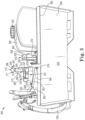
- Fig. 4 provides an illustration of the openings in the first side wall 118/218/418 by which the motor 104/204 is mounted to the housing 102/202/302/402.
- Examples of hydraulic motors useful for the present disclosure include a vane motor, a piston motor such as a radial piston motor or a bent axis piston motor, an orbital motor, and a gear motor, as are all known in the art.
- the motor 104/204 is a fixed displacement gear motor, as is known in the art.
- the use of the fixed displacement gear motor allows for a fixed rotation per minute (rpm) output for the motor 104/204.
- a variable displacement motor could be used to allow for different rpm ranges for the motor 104/204.
- other motors could also be used, such as an electrical motor.
- the single hydraulic circuit 124/224 can also incorporate additional components that allow for a variety of features.
- the single hydraulic circuit 124/224 can further include an in-line check valve 132, which allows for the saw blade 108/208/408 to come to a stop in a rapid fashion once the power from the auxiliary hydraulic power supply is stopped.
- the single hydraulic circuit 124/224 can further include, if desired, one or more hydraulic cushioning valves, which can help to absorb hydraulic surges at the start-up of the motor 104/204.
- the arbor 206 is mounted to the second side wall 120/220 of the housing 102/202/302/402.
- the arbor 206 includes a first end 234 and a second end 236 opposite the first end 234.
- the first end 234 of the arbor 206 can receive the saw blade 108/208/408 having a circumferential cutting edge 138/238 and the second end 236 of the arbor 206 is coupled to the drive shaft of the motor 104/204.
- the motor 104/204 can be used to turn the second end 236 of the arbor 206 to rotate the circumferential cutting edge 138/238 of the saw blade 108/208/408.
- the alignment of the circumferential cutting edge 138/238 of the saw blade 108/208/408 will not change relative to the first major surface 259/359/459 and the second major surface 161 of the mounting plate 116/216/316/416 (discussed herein) and always remain aligned (e.g., parallel) with the direction of travel of the machine 122/222/422 when cutting.
- the saw 100/200/300/400 of the present disclosure includes one or more of a bearing mount 246 that attaches the arbor 206 to the housing 102/202/302/402.
- the bearing mount 246 can include a bearing, such as a ball bearing, having a defined opening through which the shaft 248 of the arbor 206 passes.
- Examples of the bearing mount 246 for the present disclosure include, but are not limited to, flange bearings (e.g., four bolt flange bearings) and pillow block bearings (solid or split), among others.
- the bearing mount 246 help to constrain the relative motion of the arbor 206 to just rotational motion around the longitudinal axis 244 of the arbor 206, as discussed herein.
- the shaft 248 of the arbor 206 is supported by the bearing mount 246 is such a way that no lateral or end forces are transferred to the motor 104/204.
- the second end 236 of the arbor 206 is coupled to the drive shaft of the motor 104/204.
- a universal joint 250 can be used to connect the second end of the arbor 206 to the drive shaft of the motor 104/204.
- An example of the universal joint 250 includes a jaw type coupler (e.g., a Lovejoy ® L Type Standard Jaw Coupling) that connects the second end 236 of the arbor 206 to the drive shaft of the motor 104/204.
- other couplers for joining the second end 236 of the arbor 206 to the drive shaft of the motor 104/204 include a direct coupler system such as a double roller chain coupler. Other coupling systems are also possible.
- the saw blade 108/208/408 for the present embodiments can be a diamond saw blade, which can include different configurations such as segmented diamond saw blades, continuous rim diamond saw blades and turbo diamond saw blades as are known in the art.
- the diamond saw blade for the present disclosure can include a bond hardness, diamond concentration and diamond grit size, as are known in the art, that are suitable for cutting the hard material.
- the shield 110/210/310/410 is mounted to the housing 102/202/302/402 of the saw 100/200/300/400.
- the shield 110/210/310/410 includes a top wall 152/352/452 that covers at least a portion of the first end 234 of the arbor 206.
- the top wall 152/352/452 has a first major surface 254 space directly across from the first end of the arbor 206 to receive the saw blade 108/208/408, as discussed herein, and a second major surface 156/256/356/456 opposite the first major surface 254. As illustrated in Figs.
- the second major surface 156/256/356/456 includes an elongate mark 158/258/358/458 that is positioned on the second major surface 156/256/356/456 of the shield 110/210/310/410 to align with the circumferential cutting edge 138/238 of the saw blade 108/208/408 when it is mounted on the first end 234 of the arbor 206.
- the elongate mark 158/258/358/458 can be stripe formed with paint, tape or some differentiating elongate indicator that marks the position of the circumferential cutting edge 138/238 of the saw blade 108/208/408 to help the operator of the saw 100/200/300/400 seated in the machine 122/222/422 to accurately align the desired cut.
- the shield 110/210/310/410 of the present disclosure can further include a first portion 160/260/360/460 and a second portion 162/262/462 joined to the first portion with a hinge 164/364.
- the first portion 160/260/360/460 of the shield 110/210/310/410 is mounted to the housing 102/202/302/402 and the second portion 162/262/462 of the shield 110/210/310/410 can pivot relative the first portion 160/260/360/460 of the shield and the housing 102/202/302/402 around the hinge 164/364.
- the shield 110/210/310/410 can also include one or more of a spring 166/266 (e.g., a coil spring), where a first end of the spring 166/266 is joined to the first portion 160/260/360/460 of the shield 110/210/310/410 and a second end of the spring is joined to the second portion 162/262/462 of the shield 110/210/310/410.
- the spring 166/266 can help to keep the second portion 162/262/462 of the shield 110/210/310/410 in either a closed position as seen in Figs. 1-3 or in an open position, seen in Fig. 4 , where more of the saw blade 108/208/408 is exposed for a variety of purposes.
- placing the second portion 162/262/462 of the shield 110/210/310/410 in the open position allows the saw blade 108/208/408 to be mounted or changed on the arbor 206.
- placing the second portion 162/262/462 of the shield 110/210/310/410 in the open position allows the saw blade 108/208/408 to be used to cut a curb (e.g., a stone or concrete edging to a street, parking lot or a path) or to allow cuts to be made up to or very close to a wall.
- a curb e.g., a stone or concrete edging to a street, parking lot or a path
- the saw 100/200/300/400 of the present disclosure can further include a cut indicator 168/368/468 mounted to the housing 102/202/302/402.
- the cut indicator 168/368/468 can be mounted to the housing 102/202/302/402 through one or more of a hinge 170/370/470.
- the cut indicator 168/368/468 can further include a cut point indicator 172/372, which points to the location where the cut will be made with the saw blade 108/208/408, and a wheel 174/374/474 that helps to maintain a distance between the cut point indicator 172/372 and the surface to be cut.
- the cut point indicator 172/372 and the elongate mark 158/258/358/458 on the second major surface 156 of the shield 110/210/310/410 align to allow the operator seated in the machine 122/222/422 to accurately align the desired cut.
- the saw 100/200/300/400 of the present disclosure can further include one or more additional alignment tools, such as a laser cut guideline, or other such cut guide lights.
- the cut-depth guide 112/212/312/412 on the housing 102/202/302/402 includes a depth post 176/276/376/476, a sleeve 178/378/478 to receive the depth post 176/276/376/476 and a latch 180/380/480 mounted to the sleeve 178/378/478.
- the sleeve 178/378/478 includes an interior surface 282/482 that defines an opening 284/384/484 that at least partially surrounds the depth post 176/276/376/476 and through which the depth post 176/276/376/476 can move relative the sleeve 178/378/478.
- the depth post 176/276/376/476 has a first end 186/286/486, a second end 188/288/388/488 opposite the first end 186/286/486 along a longitudinal axis 190/290/390/490.
- the housing 102/202/302/402 of the saw 100/200/300/400 can further include a top wall 192/392/492 connected to the first side wall 118/218/418 and the second side wall 120/220.
- the top wall 192/392/492 includes a first major surface 194/394/494 and a second major surface 296 opposite the first major surface 194/394/494, and a surface 298 extending between the first major surface 194/394/494 and the second major surface 296 to define an opening 201.
- the sleeve 178/378/478 of the cut-depth guide 112/212/312/412 extends in a common direction away from both the first major surface 194/394/494 and the second major surface 296 of the top wall 192/392/492, where the opening 201 through the top wall 192/392/492 aligns with the opening 284/384/484 in the sleeve 178/378/478 of the cut-depth guide 112/212/312/412 to allow the depth post 176/276/376/476 to move through the openings 284/384/484 and 201 relative the sleeve 178/378/478.
- the depth post 476 includes two or more of a surface 403 that are each spaced at a predetermined interval from each other along the longitudinal axis 490 of the depth post 476.
- the depth post 176/276/376/476 further includes the guide wheel 114/214/314/414, as discussed herein, where the guide wheel 114/214/314/414 extends from the first end 186/286/486 of the depth post 176/276/376/476, where the guide wheel 114/214/314/414 includes a peripheral surface 105/205/405 that can contact the hard surface.
- the depth post 176/276/376/476/474 can be a tube having a variety of cross-sectional shapes, such as oval and polygonal such as triangular, rectangular, and square, among others. As illustrated in Figs. 1-4 , the depth post 176/276/376/476/474 can be a tube 107/207/307/407 having a square cross-sectional shape that includes a first wall 109/209/309/409 and a second wall 111/211/311/411 opposite the first wall 109/209/309/409.
- the first wall 109/209/309/409 includes two or more of the surfaces 403 to define a first series of holes 413 spaced at the predetermined interval from each other along the longitudinal axis 490 of the depth post 476 and the second wall 111/211/311/411 includes two or more of the surfaces 403 to define a second series of holes 415 spaced at the predetermined interval from each other along the longitudinal axis 490.
- the first series of holes 413 and the second series of holes 415 form concentrically aligned pairs of holes that can receive a pin 419 of the latch 180/380/480, as will be discussed herein.
- the latch 180/380/480 has a first portion 417 that releasably engages the surface 403 of the depth post 476 to fix the position of the depth post 476 relative to the sleeve 178/378/478.
- the first portion 417 of the latch 180/380/480 can take the form of a pin 419 having a first end 421 and a second end 423 spaced longitudinally from the first end 421.
- the pin 419 defines the first portion 417 of the latch 180/380/480 that releasably engages the surface 403 of the depth post 476.
- the sleeve 178/378/478 of the cut-depth guide 112/212/312/412 can include a first pin guide wall 425 having a first surface 427 defining a first opening 429 to the interior surface 484 of the sleeve 178/378/478 and a second pin guide wall 431 having a second surface 433 defining a second opening 435 to the interior surface 484 of the sleeve 178/378/478.
- the first opening 429 and the second opening 435 to the interior surface 484 of the sleeve 178/378/478 are concentrically aligned.
- the latch 180/380/480 can further include a yoke 137/337/437 having a front latch wall 139/339/439, a first side wall 141/341/441 and a second side wall 143/343/443 opposite the first side wall 141/341/441.
- the front latch wall 139/339/439 includes a first major surface 445 and a second major surface 447 opposite the first major surface 445.
- the front latch wall 139/339/439 joins the first side wall 141/341/441 and the second side wall 143/343/443 and where both the first side wall 141/341/441 and the second side wall 143/343/443 extend in a common direction from the sleeve 178/378/478 of the cut-depth guide 112/212/312/412.
- the front latch wall 139/339/439 further including a surface 449 extending between the first major surface 445 and the second major surface 447 to define an opening 451 that concentrically aligns with the first opening 429 of the first pin guide wall 425 and the second opening 435 of the second pin guide wall 431.
- the pin 419 can extend through the opening 451 in the front latch wall 139/339/439, the first opening 429 in the first pin guide wall 425 and at least partially through the second opening 435 in the second pin guide wall 431 to position the first end 421 of the pin 419 distal to the opening 451 in the front latch wall 139/339/439 and the first opening 429 in the first pin guide wall 425.
- a handle 153/353/453 can be attached to the pin 419, where the handle 153/353/453 can be positioned proximal to the first major surface 445 of the front latch wall 139/339/439.
- the latch 180/380/480 can further include a spring 455 positioned between the second major surface 447 of the front latch wall 139/339/439 and the first pin guide wall 425, where a first portion 457 of the spring 455 is joined to the pin 419 such that a force applied to the handle 153/353/453 to move the first end 421 of the pin 419 further away from both the first major surface 445 and the second major surface 447 of the front latch wall 139/339/439 compresses the spring 455.
- the mounting plate 116/216/316/416 of the saw 100/200/300/400 includes a first major surface 259/359/459 and a second major surface 161 opposite the first major surface 259/359/459.
- the first major surface 259/359/459 has a cleat 363/463 for releasably joining the saw 100/200/300/400 to the machine 122/222/422 that provides power to operate the motor 104/204 of the saw 100/200/300/400.
- the first side wall 118/218/418 and the second side wall 120/220 of housing 102/202/302/402 are coupled to the second major surface 161 of the mounting plate 116/216/316/416, where the first side wall 118/218/418 and the second side wall 120/220 of housing 102/202/302/402 extend in a common direction away from both the first major surface 259/359/459 and the second major surface 161 of the mounting plate 116/216/316/416.
- the mounting plate 116/216/316/416 can transfer pressure from the machine 122/222/422 to the guide wheel 114/214/314/414 extending from the first end of the depth post 176/276/476 to maintain a cut depth of the saw blade 108/208/408 determined by the position of the depth post 176/276/476 relative to the sleeve 178/378/478, as discussed herein.
- the housing 102/202/302/402 can further include a front housing wall 165/465 extending between the first side wall 118/218/418 and the second side wall 120/220 of the housing 102/202/302/402 define a socket 267 to receive the guide wheel 114/214/314/414.
- the two or more of the surface 403 of the depth post 476 can include a terminal surface 469 to receive the first portion 417 of the latch 180/380/480 to fix the guide wheel 114/214/314/414 at least partially within the socket 267 of the housing 102/202/302/402 so that only a portion of the peripheral surface 105/205/405 of the guide wheel 114/214/314/414 that contacts the hard material when the mounting plate transfers pressure from the machine to the guide wheel 114 extends from the socket 267 to place the saw blade 108/208/408 at a full depth cutting position for the saw 100/200/300/400.
- the front housing wall 165/465 includes a first major planar surface 171 and a second major planar surface 273 opposite the first major planar surface 171.
- first portion 160/260/360/460 of the shield 110/210/310/410 mounted to the housing 102/202/302/402 extends distally from both the first major planar surface 171 and the second major planar surface 273 of the front housing wall 165/465.
- the motor 104/204 is mounted on the first side wall 118/218/418 so that it does not limit the cutting depth of the saw 100/200/300/400.
- the fourth edge 485 of each of the first side wall 118/218/418 and the second side wall 120/220 of the housing 102/202/302/402 is approximately parallel with the planar surface of the hard material.
Landscapes
- Engineering & Computer Science (AREA)
- Mining & Mineral Resources (AREA)
- Mechanical Engineering (AREA)
- Architecture (AREA)
- Civil Engineering (AREA)
- Structural Engineering (AREA)
- Sawing (AREA)
Claims (15)
- Eine Säge (100, 200, 300, 400) zum Schneiden eines harten Materials, wobei die Säge (100, 200, 300, 400) umfassend:ein Gehäuse (102, 202, 302, 402) mit einer ersten Seitenwand (118, 218, 418) und einer zweiten Seitenwand Wand (120, 220) aufweist;einen Motor (104, 204), der an der ersten Seitenwand des Gehäuses (102, 202, 302, 402) montiert ist, wobei der Motor (104, 204) eine Antriebswelle beinhaltet;einen Dorn (206), der an der zweiten Seitenwand des Gehäuses (102, 202, 302, 402) montiert ist, wobei der Dorn (206) ein erstes Ende (234) und ein zweites Ende gegenüber dem ersten Ende (234) aufweist, wobei das erste Ende (234) eine Sägeklinge (108, 208, 408) aufnehmen kann, die eine Umfangsschneide hat, Schneidkante aufnehmen kann, wobei die Antriebswelle des Motors (104, 204) das zweite Ende des Dorns (206) dreht, (206) dreht, um die Umfangsschneide (138, 238) des Sägeblattes (108, 208, 408) zu drehen, dadurch gekennzeichnet, dass sich der Dorn (206) in einer festen Position relativ zu dem Gehäuse (102, 202, 302, 402) der Säge (100, 200, 300, 400) befindet;eine Abschirmung (110, 210, 310, 410), die an dem Gehäuse (102, 202, 302, 402) montiert ist, wobei die Abschirmung (110, 210, 310, 410) eine obere Wand aufweist, die zumindest einen Teil des ersten Endes (243) des Dorns (206) bedeckt, wobei die obere Wand einen ersten großen Flächenraum direkt gegenüber dem ersten Ende (234) des Dorns (206), um die Sägeblatt (108, 208, 408) aufzunehmen, und eine zweite Hauptfläche Oberfläche gegenüber der ersten Hauptoberfläche, wobei die zweite Hauptoberfläche eine längliche Markierung aufweist, die mit der Umfangsschneide (138, 238) der Sägeblatts (108, 208, 408) ausgerichtet ist, wenn sie auf dem ersten Ende (234) des Dorns (206) montiert ist;eine Schnitttiefenführung (112, 212, 312, 412) am Gehäuse (102, 202, 302, 402), wobei die Schnitttiefenführung (112, 212, 312, 412) einen Tiefenpfosten (176, 276, 376, 476), eine Hülse (178, 378, 478) zum den Tiefenpfosten (176, 276, 376, 476) aufzunehmen und eine Verriegelung (180, 380, 480), die an der Hülse (178, 378, 478) montiert ist, wobei:die Hülse (178, 378, 478) eine Innenfläche (282, 482) aufweist, die eine Öffnung (284, 384, 484) definiert, die den Tiefenpfosten (176, 276, 376, 476) zumindest teilweise umgibt (176, 276, 376, 476) umgibt und durch die sich der Tiefenpfosten (176, 276, 376, 476) sich relativ zur Hülse (178, 378, 478) bewegen kann;der Tiefenpfosten (176, 276, 376, 476) ein erstes Ende (186, 286, 486), ein zweites Ende (188, 288, 388, 488) gegenüber dem ersten Ende (186, 286, 486) entlang einer Längsachse (190, 290, 390, 490) und hat zwei oder mehr Oberflächen, die jeweils in einem vorgegebenen Abstand voneinander entlang der Längsachse (190, 290, 390, 490) beabstandet sind; unddie Verriegelung (180, 380, 480) weist einen ersten Abschnitt (417) auf, der lösbar in Eingriff die Oberfläche (403) des Tiefenpfostens (476) in Eingriff nimmt, um die Position des Tiefenpfostens (476) relativ zu der Hülse (178, 378, 478) zu fixieren;ein Führungsrad (114, 214, 414), das sich von dem ersten Ende (186, 286, 486) des Tiefen-Tiefenpfostens (176, 276, 376, 476) erstreckt, wobei das Führungsrad (114, 214, 414) eine Umfangsfläche (105, 205, 405) aufweist, die die harte Oberfläche berühren kann; undeine Montageplatte (116, 216, 316, 416) mit einer ersten Hauptfläche (259, 359, 459) und einer zweite Hauptfläche (161) gegenüber der ersten Hauptfläche (259, 359, 459), wobei die ersteHauptfläche (259, 359, 459) eine Klammer zum lösbaren Verbinden der Säge (100, 200, 300, 400) mit einer Maschine (122, 222, 422) zum Bereitstellen von Leistung zum Betreiben des Motors (104, 204) der Säge (100, 200, 300, 400) bereitstellt, wobei die erste Seitenwand (118, 218, 418) und die zweite Seitenwand (120, 220) des Gehäuses (102, 202, 302, 402) an die zweite Hauptfläche (161) gekoppelt sind und sich in eine gemeinsamen Richtung weg von sowohl der ersten Hauptfläche (259, 359, 459) als auch der zweiten Hauptfläche Oberfläche (161) der Montageplatte (116, 216, 316, 416) weg verlaufen, wobei die Säge (100, 200, 300, 400) so konfiguriert ist, dass die Ausrichtung der Umfangs-Schneidkante (138, 238) des Sägeblattes (108, 208, 408) sich nicht relativ zu der ersten Hauptfläche (259, 359, 459) und der zweiten Hauptfläche (161) der Montageplatte (116, 216, 316, 416) nicht ändert, und wobei die Montageplatte (116, 216, 316, 416) Druck von der Maschine (122, 222, 422) auf das Führungsrad (114, 214, 414) übertragen kann, das sich von dem ersten Ende (234) des Tiefenpfostens erstreckt, um eine Schnitttiefe des Sägeblattes (108, 208, 408) aufrechtzuerhalten, die durch die Position des Tiefenpfostens (176, 276, 376, 476) relativ zur Hülse (178, 378, 478) bestimmt wird.
- Die Säge (100, 200, 300, 400) nach Anspruch 1, wobei der Dorn (206) eine Längsachse Achse (190, 290, 390, 490) beinhaltet, die sich zwischen dem ersten Ende (234) und dem zweiten Ende (236) des Achse (206) erstreckt, wobei sich die Längsachse (190, 290, 390, 490) relativ zu dem Gehäuse (102, 202, 302, 402) der Säge (100, 200, 300, 400) nicht bewegen kann.
- Die Säge (100, 200, 300, 400) nach Anspruch 1, wobei die Säge nur einen von einem Hydraulikmotors beinhaltet, wobei der Motor (104, 204), der an der ersten Seitenwand (118, 218, 418) des Gehäuses (102, 202, 302, 402) montiert ist, der von der Leistung eines Hilfs-Hydraulikaggregat der Maschine (122, 222, 422) angetrieben wird.
- Die Säge nach Anspruch 3, wobei die gesamte Leistung, die durch die Hilfshydraulikversorgung der Maschine (122, 222, 422) bereitgestellt wird, verwendet wird, um den Hydraulikmotor zu betreiben; oderwobei die Säge ein in Reihe geschaltetes Rückschlagventil enthält, das hydraulisch mit dem HydraulikmotorMotor gekoppelt ist.
- Die Säge nach einem der Ansprüche 1-4, wobei ein Universalgelenk das zweite Ende (236) des Dorns (206) mit der Antriebswelle des Motors (104, 204) verbindet.
- Die Säge nach Anspruch 5, wobei das Universalgelenk ein Backentypkoppler ist, der das zweites Ende (236) des Dorns (206) mit der Antriebswelle des Motors (104, 204) verbindet.
- Die Säge nach einem der Ansprüche 1-6, wobei eine oder mehrere Lagerhalterungen (246) den Dorn (206) am Gehäuse (102, 202, 302, 402) befestigt; oder
wobei das Gehäuse (102, 202, 302, 402) ferner eine obere Wand (192, 392, 492) beinhaltet, die mit der ersten Seitenwand (118, 218, 418) und der zweiten Seitenwand (120, 220) verbunden ist, wobei die obere Wand (192, 392, 492) aufweist:eine erste Hauptfläche (194, 394, 494) und eine zweite Hauptfläche (298) gegenüber der ersten Hauptfläche (194, 394, 494); undeine Fläche, die sich zwischen der ersten Hauptfläche (194, 394, 494) und der zweiten Hauptfläche (298) erstreckt, um eine Öffnung (284, 384, 484) zu definieren;wobei sich die Hülse (178, 378, 478) der Schnitttiefenführung (112, 212, 312, 412) in eine gemeinsame Richtung weg von sowohl der ersten Hauptfläche (194, 394, 494) als auch der zweiten Hauptfläche Fläche (296) der oberen Wand (192, 392, 492) weg erstreckt, und wobei die Öffnung (201) durch die obere Wand (192, 292, 492) mit der Öffnung (201) in der Hülse (178, 378, 478) der Schnitttiefenführung (112, 212, 312, 412) ausrichtet, (112, 212, 312, 412) aus, damit sich der Tiefenpfosten (176, 276, 376, 476) durch die Öffnungen (284, 384, 484, 201) relativ zur Hülse (178, 378, 478) bewegt. - Die Säge (100, 200, 300, 400) nach einem der Ansprüche 1-7, wobei die Verriegelung (180, 380, 480) einen Stift (419) beinhaltet, der ein erstes Ende (421) und ein zweites Ende (423) aufweist, die in Längsrichtung von dem ersten Ende (421) beabstandet ist, wobei der Stift den ersten Abschnitt (417) der Verriegelung (180, 380, 480) definiert, der lösbar in die Oberfläche (403) des Tiefenpfostens (476) eingreift; und
wobei die Hülse (178, 378, 478) der Schnitttiefenführung (112, 212, 312, 412) eine erste Stiftführungswand (425) mit einer ersten Oberfläche (427), die eine erste Öffnung (429) zur Innenfläche (484) der Hülse (178, 378, 478) definiert, und eine zweite Stiftführungswand (431) mit einer zweiten Oberfläche (433) aufweist, die eine zweite Öffnung (435) zur Innenfläche (484) der Hülse (178, 378, 478) definiert, wobei die erste Öffnung (429) und die zweite Öffnung (435) zur Innenfläche (484) der Hülse (178, 378, 478) konzentrisch ausgerichtet sind und wobei die erste Stiftführungswand (425) und die zweite Stiftführungswand (431) zumindest den ersten Abschnitt (417), die durch den Stift (419) definiert ist. - Die Säge (100, 200, 300, 400) nach Anspruch 8, wobei der Tiefenpfosten (176, 276, 376, 476, 474) ein Rohr (107, 207, 307, 407) mit einer quadratischen Querschnittsform ist, die eine erste Wand (109, 209, 309, 409) und eine zweite Wand (111, 211, 311, 411) gegenüber der ersten Wand (109, 209, 309, 409) gegenüberliegt, wobei die erste Wand (109, 209, 309, 409) zwei oder mehr der Flächen (403) beinhaltet, um eine erste Reihe von Löchern (413) zu definieren, die in dem vorgegebenen Abstand voneinander entlang der Längsachse (490) beabstandet sind, und die zweite Wand (111, 211, 311, 411) zwei oder mehr der Flächen (403), um eine zweite Reihe von Löchern (415) zu definieren, die in dem vorbestimmten Intervall voneinander entlang der Längsachse (490) beabstandet sind und wobei die erste Reihe von Löchern (413) und die zweite Reihe von Löchern (415) konzentrisch ausgerichtete Lochpaare bilden, die den Stift (419) aufnehmen können.
- Die Säge (100, 200, 300, 400) nach einem der Ansprüche 8-9, wobei die Verriegelung (180, 380, 480) ferner ein Joch (137, 337, 437) beinhaltet, das Folgendes aufweist:eine vordere Verriegelungswand (139, 339, 439) mit einer ersten Hauptfläche (445) und einer zweiten Hauptfläche (447) gegenüber der ersten Hauptfläche (445);eine erste Seitenwand (141, 341, 441) und eine zweite Seitenwand (143, 343, 443) gegenüber der ersten Seitenwand (143, 343, 443), wobei die Vorderwand (139, 339, 439) die erste Seitenwand (141, 341, 441) und der zweiten Seitenwand (143, 343, 443) verbindet und wobei sowohl die erste Seitenwand (141, 341, 441) als auch die zweite Seitenwand (143, 343, 443) sich in einergemeinsamen Richtung von der Hülse (178, 378, 478) der Schnitttiefenführung (112, 212, 312, 412) erstrecken, wobei die vordere Verriegelungswand (139, 339, 439) ferner eine Oberfläche (449) beinhaltet, die sich zwischen der ersten Hauptfläche (445) und der zweiten Hauptfläche (447) erstreckt, um eine Öffnung (451) definiert, die sich konzentrisch mit der ersten Öffnung (429) der ersten Stiftführungswand und der zweiten Öffnung (435) der zweiten Stiftführungswand (431) konzentrisch ausrichtet, wobei der Stift (419) sich durch die Öffnung (435) in der vorderen Verriegelungswand (139, 339, 439), die erste Öffnung (429) in der ersten Stiftführungswand (425) und zumindest teilweise durch diezweiten Öffnung (435) in der zweiten Stiftführungswand (431), um das erste Ende (421) des des Stifts (419) distal zur Öffnung (451) in der vorderen Verriegelungswand (139, 339, 439) und der ersten Öffnung (429) in der ersten Stiftführungswand (425) zu positionieren;einen Griff (153, 353, 453), der an dem Stift (419) angebracht ist, wobei der Griff (153, 353, 453) proximal zu der ersten Hauptfläche (445) der vorderen Verriegelungswand (139, 339, 439); undeine Feder (455), die zwischen der zweiten Oberfläche der vorderen Verriegelungswand (139, 339, 439) und der ersten Stiftführungswand (425) positioniert ist, wobei ein erster Abschnitt (417) der Feder (455) mit dem Stift (419) zusammengefügt ist, so dass eine Kraft, die auf den Griff ausgeübt wird, um das erste Ende (421) des Stifts (419) weiter weg von sowohl der ersten Hauptfläche (445) als auch der zweiten Hauptfläche (447) der vorderen Verriegelungswand (139, 339, 439) weiter weg bewegt, die Feder (455) zusammengedrückt wird (455).
- Die Säge (100, 200, 300, 400) nach einem der Ansprüche 1-10, wobei das Gehäuse (102, 202, 302, 402) ferner eine vordere Gehäusewand (165, 465) beinhaltet, die sich zwischen der ersten Seitenwand (118, 218, 418) und der zweiten Seitenwand (120, 220) des Gehäuses (102, 202, 302, 402) erstreckt, wobei das vordere Gehäuse eine Buchse (267) definiert, um das Führungsrad (114, 214, 314, 414) aufzunehmen.
- Die Säge (100, 200, 300, 400) nach Anspruch 11, wobei die zwei oder mehr der Fläche (403) des Tiefenpfostens (476) eine Anschlussfläche (469) beinhaltet, um den ersten Abschnitt (417) der Verriegelung (180, 380, 480) aufzunehmen, um das Führungsrad (114, 214, 314, 414) zumindest teilweise innerhalb des Gehäuse (102, 202, 302, 402) zu fixieren, so dass nur ein Teil der Umfangsfläche (105, 205, 405), die das harte Material berührt, wenn die Montageplatte Druck von der Maschine auf das Führungsrad (114) überträgt, sich von der Buchse (267) erstreckt, um das Sägeblatt (108, 208, 408) in eine volle Schneidposition für die Säge (100, 200, 300, 400) zu platzieren; oderwobei die vordere Gehäusewand (165, 465) eine erste Hauptebene (171) und eine zweite Hauptebenfläche (273) gegenüber der ersten Hauptebenfläche (171) beinhaltet, wobei die erste Hauptebenfläche (171) und die zweite Hauptebenfläche (273) in etwa senkrecht zu einer ebenen Fläche des harten Materials sind, das durch die Säge (100, 200, 300, 400) geschnitten wird, wenn die Sägeblatt (108, 208, 408) an der vollen Tiefenschneidposition ist; oderwobei die erste Seitenwand (118, 218, 418) und die zweite Seitenwand (120, 220) des Gehäuses (102, 202, 302, 402) jeweils die Form eines konvexen Polygons mit fünf peripheren geraden Kanten aufweisen, die fünf Ecken definieren, wobei:eine erste Kante (475) parallel sowohl der ersten Hauptfläche (259, 359, 459) als auch der zweiten Hauptfläche (161) der Montageplatte (116, 216, 316, 416) parallel ist;eine zweite Kante (477) sich sowohl von der ersten Hauptfläche (259, 359, 459) als auch der zweiten Hauptfläche (161) der Befestigungsplatte (116, 216, 316, 416) erstreckt, um eine erste Ecke (479) mit einem Innenwinkel von etwa 83 Grad mit der ersten Kante (475);eine dritte Kante (481) sich sowohl von der ersten Hauptfläche (259, 359, 459) als auch der zweiten Hauptfläche (161) der Montageplatte (116, 216, 316, 416) erstreckt, um eine zweite Ecke (483) mit einem Innenwinkel von etwa 81 Grad mit der ersten Kante (475) bildet;eine vierte Kante (475) sich von der dritten Kante (481) erstreckt, um eine dritte Ecke (487) zu bilden, mit einem Innenwinkel von etwa 172 Grad mit der dritten Kante (481); und eine fünfte Kante (489) sich von der vierten Kante (485) erstreckt, um eine vierte Ecke (491) mit einem Innenwinkel von ungefähr 90 Grad mit der vierten Kante (485) aufweist und sich von der dritten Kante (481) zu einer fünften Ecke (493) mit einem Innenwinkel von ungefähr 114 Grad mit der dritten Kante (481) aufweist.
- Die Säge (100, 200, 300, 400) nach Anspruch 12, wobei, wenn die Sägeblatt (108, 208, 408) in der Schnittposition mit voller Tiefe befindet, die vierte Kante (485) jeder der ersten Seitenwand (118, 218, 418) und der zweiten Seitenwand (120, 220) des Gehäuses (102, 202, 3020, 402) ungefähr parallel zur ebenen Fläche des harten Materials ist.
- Die Säge (100, 200, 300, 400) nach einem der Ansprüche 11-13, wobei nur ein Teil der Abschirmung (110, 210, 310, 410), die an dem Gehäuse (102, 202, 302, 402) montiert ist, sich distal von sowohl der ersten Hauptebenfläche (171) als auch der zweiten Hauptebenfläche (273) der vorderen Gehäusewand (165, 465) erstreckt.
- Die Säge (100, 200, 300, 400) nach einem der Ansprüche 1-14, wobei die Abschirmung (110, 210, 310, 410) einen ersten Abschnitt (160, 260, 360, 460) und einen zweiten Abschnitt (162, 262, 462) beinhaltet, die ersten Abschnitt (160, 260, 360, 460) mit einem Scharnier verbunden sind, wobei der erste Abschnitt (160, 260, 360, 460) der Abschirmung (110, 210, 310, 410) an dem Gehäuse (102, 202, 302, 402) montiert ist und der zweite Abschnitt (162, 262, 462) der Abschirmung (110, 210, 310, 410) kann sich relativ zum ersten Abschnitt (160, 260, 360, 460) der Abschirmung und dem Gehäuse (102, 202, 302, 402) um das Scharnier (164, 364) schwenken kann; oderwobei die Säge (100, 200, 300, 400) ferner einen Tank (195, 295, 395, 495) beinhaltet, der an der Montageplatte (116, 216, 316, 416) montiert ist, wobei der Tank (195, 295, 395, 495) einen (197, 397, 497) zum Aufnehmen eines Fluids und einen Tankauslass (199), durch den das Fluid strömen kann;eine Pumpe (1-101) mit einem Pumpeneinlass, der fluidisch an den Tankauslass (199) gekoppelt ist, und einem Pumpenauslass zum Pumpen des Fluids aus dem Tank (195, 295, 395, 495);ein Ventil (1-103) mit einem Ventileinlass, der fluidisch an den Pumpenauslass gekoppelt ist, und einem Ventilauslass, wobei das Ventil (1-103) eine Strömungsrate des Fluids von der Pumpe (1-101) einstellen kann; undeine Auslassdüse (1-105), die mit dem Ventilauslass fluidisch gekoppelt ist, wobei die Auslassdüse (1-105) an einer Position benachbart zu der Abschirmung (110, 210, 310, 410) angeordnet ist, um das Fluid zu der Sägeklinge zuzuführen (108, 208, 408).
Applications Claiming Priority (2)
| Application Number | Priority Date | Filing Date | Title |
|---|---|---|---|
| US202163243913P | 2021-09-14 | 2021-09-14 | |
| PCT/US2022/036522 WO2023043523A1 (en) | 2021-09-14 | 2022-07-08 | Saw for cutting hard material |
Publications (3)
| Publication Number | Publication Date |
|---|---|
| EP4351850A1 EP4351850A1 (de) | 2024-04-17 |
| EP4351850B1 true EP4351850B1 (de) | 2025-07-02 |
| EP4351850C0 EP4351850C0 (de) | 2025-07-02 |
Family
ID=82703050
Family Applications (1)
| Application Number | Title | Priority Date | Filing Date |
|---|---|---|---|
| EP22747905.2A Active EP4351850B1 (de) | 2021-09-14 | 2022-07-08 | Säge zum schneiden von hartem material |
Country Status (4)
| Country | Link |
|---|---|
| US (1) | US20240279887A1 (de) |
| EP (1) | EP4351850B1 (de) |
| CA (1) | CA3227420A1 (de) |
| WO (1) | WO2023043523A1 (de) |
Family Cites Families (11)
| Publication number | Priority date | Publication date | Assignee | Title |
|---|---|---|---|---|
| DE1628917B1 (de) * | 1967-03-30 | 1974-02-28 | Teutoburger Maschinenfabrik Gm | Vorrichtung zum Aufteilen von Formatplatten |
| US4840431A (en) * | 1988-07-26 | 1989-06-20 | Diamond Products, Inc. | Portable rotary power saw |
| US4878713A (en) * | 1988-12-09 | 1989-11-07 | Alitec Corporation | Pavement planing machine |
| US5725282A (en) * | 1996-08-20 | 1998-03-10 | Stone Construction Equipment, Inc. | Adjustable handles for road surface cutting saws |
| US6308424B1 (en) * | 1998-07-21 | 2001-10-30 | Black & Decker Inc. | Circular saw |
| US6203112B1 (en) * | 1999-05-03 | 2001-03-20 | American Standards Construction Corp. | Attachable road cutting apparatus |
| US7114494B2 (en) * | 1999-09-17 | 2006-10-03 | Husqvarna Professional Outdoor Products Inc. | Fluid pickup assembly and blade guard for a pavement treatment apparatus |
| US20040251646A1 (en) * | 2003-06-10 | 2004-12-16 | Erbach Steven Alden | Universal mobile base |
| US9259849B2 (en) * | 2007-05-24 | 2016-02-16 | Clark Equipment Company | Vehicle-mounted hydraulic slab cutter |
| JP6249214B2 (ja) * | 2013-12-19 | 2017-12-20 | パナソニックIpマネジメント株式会社 | 電動丸鋸 |
| US9505147B2 (en) * | 2014-09-10 | 2016-11-29 | Triumph Ingenuity LLC | Cutting platform and method of using the same |
-
2022
- 2022-07-08 EP EP22747905.2A patent/EP4351850B1/de active Active
- 2022-07-08 US US18/571,513 patent/US20240279887A1/en active Pending
- 2022-07-08 CA CA3227420A patent/CA3227420A1/en active Pending
- 2022-07-08 WO PCT/US2022/036522 patent/WO2023043523A1/en not_active Ceased
Also Published As
| Publication number | Publication date |
|---|---|
| WO2023043523A1 (en) | 2023-03-23 |
| US20240279887A1 (en) | 2024-08-22 |
| EP4351850C0 (de) | 2025-07-02 |
| CA3227420A1 (en) | 2023-03-23 |
| EP4351850A1 (de) | 2024-04-17 |
Similar Documents
| Publication | Publication Date | Title |
|---|---|---|
| US4986314A (en) | Apparatus for carrying out repair works on a damaged pipeline which a person cannot get through | |
| US4310198A (en) | Hydraulic power supply vehicle for concrete cutting and boring tools | |
| US6698477B1 (en) | Split wheel stump cutter with replaceable tooth blocks and cutting teeth | |
| US7367367B2 (en) | Replaceable tooth block for split wheel stump cutter | |
| US8839778B2 (en) | Hydraulically-actuated, horizontal flush-cut radial concrete saw and trip hazard removal method | |
| US20090166444A1 (en) | Method for Attaching a Blower Unit to Industrial Equipment and Apparatus Used Therewith and Methods for Using the Same | |
| EP0221731A1 (de) | Vorrichtung zum Aufbrechen und Entfernen von Pflaster mittels eines Hochdruckflüssigkeitsstrahles | |
| US6623342B1 (en) | Support accessory for power hand tool | |
| KR101719362B1 (ko) | 파쇄에 의한 고착물제거가 가능한 하수관 유지 보수용 로봇 | |
| AU2002255413A1 (en) | Tool unit, cutting or sawing machine and method for cutting or sawing | |
| EP4351850B1 (de) | Säge zum schneiden von hartem material | |
| US20140102432A1 (en) | Cooling System For Concrete Saw | |
| EP0034622A1 (de) | Motorkupplung für eine kettensäge | |
| US20080304915A1 (en) | Method and Device For Attaching a Subsea Cutting Apparatus | |
| US9422678B1 (en) | Cutting attachment apparatus and method | |
| US20140345170A1 (en) | Method and Apparatus for Underwater Dredging | |
| US20020195869A1 (en) | Single arm support apparatus for a rockwheel | |
| US12313096B2 (en) | Forklift hydraulic motor based industrial driver apparatus | |
| JP2892123B2 (ja) | 穿孔方法 | |
| US20170362798A1 (en) | System and method to drive vacuum excavator | |
| CN201120500Y (zh) | 防爆型液压带锯 | |
| KR20090093317A (ko) | 맨홀보수용 멀티 노면 절단장치 | |
| US20060103235A1 (en) | Crawler type traveling apparatus and pivot shaft | |
| US20030033736A1 (en) | Snowblower powered by the machinery's hydraulic system | |
| US11338410B1 (en) | Dust removal assembly for use with disc grinder |
Legal Events
| Date | Code | Title | Description |
|---|---|---|---|
| STAA | Information on the status of an ep patent application or granted ep patent |
Free format text: STATUS: UNKNOWN |
|
| STAA | Information on the status of an ep patent application or granted ep patent |
Free format text: STATUS: THE INTERNATIONAL PUBLICATION HAS BEEN MADE |
|
| PUAI | Public reference made under article 153(3) epc to a published international application that has entered the european phase |
Free format text: ORIGINAL CODE: 0009012 |
|
| STAA | Information on the status of an ep patent application or granted ep patent |
Free format text: STATUS: REQUEST FOR EXAMINATION WAS MADE |
|
| 17P | Request for examination filed |
Effective date: 20240111 |
|
| AK | Designated contracting states |
Kind code of ref document: A1 Designated state(s): AL AT BE BG CH CY CZ DE DK EE ES FI FR GB GR HR HU IE IS IT LI LT LU LV MC MK MT NL NO PL PT RO RS SE SI SK SM TR |
|
| STAA | Information on the status of an ep patent application or granted ep patent |
Free format text: STATUS: EXAMINATION IS IN PROGRESS |
|
| 17Q | First examination report despatched |
Effective date: 20240705 |
|
| DAV | Request for validation of the european patent (deleted) | ||
| DAX | Request for extension of the european patent (deleted) | ||
| GRAP | Despatch of communication of intention to grant a patent |
Free format text: ORIGINAL CODE: EPIDOSNIGR1 |
|
| STAA | Information on the status of an ep patent application or granted ep patent |
Free format text: STATUS: GRANT OF PATENT IS INTENDED |
|
| INTG | Intention to grant announced |
Effective date: 20250127 |
|
| GRAS | Grant fee paid |
Free format text: ORIGINAL CODE: EPIDOSNIGR3 |
|
| GRAA | (expected) grant |
Free format text: ORIGINAL CODE: 0009210 |
|
| STAA | Information on the status of an ep patent application or granted ep patent |
Free format text: STATUS: THE PATENT HAS BEEN GRANTED |
|
| RAP1 | Party data changed (applicant data changed or rights of an application transferred) |
Owner name: SIMEX ENGINEERING S.R.L. |
|
| RIN1 | Information on inventor provided before grant (corrected) |
Inventor name: HILSGEN, TROY |
|
| AK | Designated contracting states |
Kind code of ref document: B1 Designated state(s): AL AT BE BG CH CY CZ DE DK EE ES FI FR GB GR HR HU IE IS IT LI LT LU LV MC MK MT NL NO PL PT RO RS SE SI SK SM TR |
|
| REG | Reference to a national code |
Ref country code: GB Ref legal event code: FG4D |
|
| REG | Reference to a national code |
Ref country code: CH Ref legal event code: EP |
|
| REG | Reference to a national code |
Ref country code: DE Ref legal event code: R096 Ref document number: 602022016985 Country of ref document: DE |
|
| REG | Reference to a national code |
Ref country code: IE Ref legal event code: FG4D |
|
| U01 | Request for unitary effect filed |
Effective date: 20250724 |
|
| U07 | Unitary effect registered |
Designated state(s): AT BE BG DE DK EE FI FR IT LT LU LV MT NL PT RO SE SI Effective date: 20250731 |
|
| U20 | Renewal fee for the european patent with unitary effect paid |
Year of fee payment: 4 Effective date: 20250825 |
|
| PG25 | Lapsed in a contracting state [announced via postgrant information from national office to epo] |
Ref country code: IS Free format text: LAPSE BECAUSE OF FAILURE TO SUBMIT A TRANSLATION OF THE DESCRIPTION OR TO PAY THE FEE WITHIN THE PRESCRIBED TIME-LIMIT Effective date: 20251102 |
|
| PG25 | Lapsed in a contracting state [announced via postgrant information from national office to epo] |
Ref country code: NO Free format text: LAPSE BECAUSE OF FAILURE TO SUBMIT A TRANSLATION OF THE DESCRIPTION OR TO PAY THE FEE WITHIN THE PRESCRIBED TIME-LIMIT Effective date: 20251002 |
|
| PG25 | Lapsed in a contracting state [announced via postgrant information from national office to epo] |
Ref country code: HR Free format text: LAPSE BECAUSE OF FAILURE TO SUBMIT A TRANSLATION OF THE DESCRIPTION OR TO PAY THE FEE WITHIN THE PRESCRIBED TIME-LIMIT Effective date: 20250702 |
|
| PG25 | Lapsed in a contracting state [announced via postgrant information from national office to epo] |
Ref country code: GR Free format text: LAPSE BECAUSE OF FAILURE TO SUBMIT A TRANSLATION OF THE DESCRIPTION OR TO PAY THE FEE WITHIN THE PRESCRIBED TIME-LIMIT Effective date: 20251003 |
|
| PG25 | Lapsed in a contracting state [announced via postgrant information from national office to epo] |
Ref country code: CZ Free format text: LAPSE BECAUSE OF FAILURE TO SUBMIT A TRANSLATION OF THE DESCRIPTION OR TO PAY THE FEE WITHIN THE PRESCRIBED TIME-LIMIT Effective date: 20250702 |
|
| PG25 | Lapsed in a contracting state [announced via postgrant information from national office to epo] |
Ref country code: PL Free format text: LAPSE BECAUSE OF FAILURE TO SUBMIT A TRANSLATION OF THE DESCRIPTION OR TO PAY THE FEE WITHIN THE PRESCRIBED TIME-LIMIT Effective date: 20250702 |
|
| PG25 | Lapsed in a contracting state [announced via postgrant information from national office to epo] |
Ref country code: RS Free format text: LAPSE BECAUSE OF FAILURE TO SUBMIT A TRANSLATION OF THE DESCRIPTION OR TO PAY THE FEE WITHIN THE PRESCRIBED TIME-LIMIT Effective date: 20251002 |
|
| PG25 | Lapsed in a contracting state [announced via postgrant information from national office to epo] |
Ref country code: ES Free format text: LAPSE BECAUSE OF FAILURE TO SUBMIT A TRANSLATION OF THE DESCRIPTION OR TO PAY THE FEE WITHIN THE PRESCRIBED TIME-LIMIT Effective date: 20250702 |
|
| REG | Reference to a national code |
Ref country code: CH Ref legal event code: H13 Free format text: ST27 STATUS EVENT CODE: U-0-0-H10-H13 (AS PROVIDED BY THE NATIONAL OFFICE) Effective date: 20260224 |
|
| PG25 | Lapsed in a contracting state [announced via postgrant information from national office to epo] |
Ref country code: SM Free format text: LAPSE BECAUSE OF FAILURE TO SUBMIT A TRANSLATION OF THE DESCRIPTION OR TO PAY THE FEE WITHIN THE PRESCRIBED TIME-LIMIT Effective date: 20250702 |
|
| PG25 | Lapsed in a contracting state [announced via postgrant information from national office to epo] |
Ref country code: CH Free format text: LAPSE BECAUSE OF NON-PAYMENT OF DUE FEES Effective date: 20250731 |
|
| PG25 | Lapsed in a contracting state [announced via postgrant information from national office to epo] |
Ref country code: SK Free format text: LAPSE BECAUSE OF FAILURE TO SUBMIT A TRANSLATION OF THE DESCRIPTION OR TO PAY THE FEE WITHIN THE PRESCRIBED TIME-LIMIT Effective date: 20250702 |