EP4350588A1 - Order processing method and apparatus, server and storage medium - Google Patents
Order processing method and apparatus, server and storage medium Download PDFInfo
- Publication number
- EP4350588A1 EP4350588A1 EP22810309.9A EP22810309A EP4350588A1 EP 4350588 A1 EP4350588 A1 EP 4350588A1 EP 22810309 A EP22810309 A EP 22810309A EP 4350588 A1 EP4350588 A1 EP 4350588A1
- Authority
- EP
- European Patent Office
- Prior art keywords
- order
- vehicle
- user
- target vehicle
- instruction
- Prior art date
- Legal status (The legal status is an assumption and is not a legal conclusion. Google has not performed a legal analysis and makes no representation as to the accuracy of the status listed.)
- Pending
Links
Images

Classifications
-
- G—PHYSICS
- G06—COMPUTING OR CALCULATING; COUNTING
- G06Q—INFORMATION AND COMMUNICATION TECHNOLOGY [ICT] SPECIALLY ADAPTED FOR ADMINISTRATIVE, COMMERCIAL, FINANCIAL, MANAGERIAL OR SUPERVISORY PURPOSES; SYSTEMS OR METHODS SPECIALLY ADAPTED FOR ADMINISTRATIVE, COMMERCIAL, FINANCIAL, MANAGERIAL OR SUPERVISORY PURPOSES, NOT OTHERWISE PROVIDED FOR
- G06Q10/00—Administration; Management
- G06Q10/02—Reservations, e.g. for tickets, services or events
-
- G—PHYSICS
- G06—COMPUTING OR CALCULATING; COUNTING
- G06Q—INFORMATION AND COMMUNICATION TECHNOLOGY [ICT] SPECIALLY ADAPTED FOR ADMINISTRATIVE, COMMERCIAL, FINANCIAL, MANAGERIAL OR SUPERVISORY PURPOSES; SYSTEMS OR METHODS SPECIALLY ADAPTED FOR ADMINISTRATIVE, COMMERCIAL, FINANCIAL, MANAGERIAL OR SUPERVISORY PURPOSES, NOT OTHERWISE PROVIDED FOR
- G06Q10/00—Administration; Management
- G06Q10/06—Resources, workflows, human or project management; Enterprise or organisation planning; Enterprise or organisation modelling
- G06Q10/063—Operations research, analysis or management
- G06Q10/0631—Resource planning, allocation, distributing or scheduling for enterprises or organisations
-
- G—PHYSICS
- G06—COMPUTING OR CALCULATING; COUNTING
- G06Q—INFORMATION AND COMMUNICATION TECHNOLOGY [ICT] SPECIALLY ADAPTED FOR ADMINISTRATIVE, COMMERCIAL, FINANCIAL, MANAGERIAL OR SUPERVISORY PURPOSES; SYSTEMS OR METHODS SPECIALLY ADAPTED FOR ADMINISTRATIVE, COMMERCIAL, FINANCIAL, MANAGERIAL OR SUPERVISORY PURPOSES, NOT OTHERWISE PROVIDED FOR
- G06Q10/00—Administration; Management
- G06Q10/06—Resources, workflows, human or project management; Enterprise or organisation planning; Enterprise or organisation modelling
- G06Q10/063—Operations research, analysis or management
- G06Q10/0631—Resource planning, allocation, distributing or scheduling for enterprises or organisations
- G06Q10/06315—Needs-based resource requirements planning or analysis
-
- G—PHYSICS
- G06—COMPUTING OR CALCULATING; COUNTING
- G06Q—INFORMATION AND COMMUNICATION TECHNOLOGY [ICT] SPECIALLY ADAPTED FOR ADMINISTRATIVE, COMMERCIAL, FINANCIAL, MANAGERIAL OR SUPERVISORY PURPOSES; SYSTEMS OR METHODS SPECIALLY ADAPTED FOR ADMINISTRATIVE, COMMERCIAL, FINANCIAL, MANAGERIAL OR SUPERVISORY PURPOSES, NOT OTHERWISE PROVIDED FOR
- G06Q30/00—Commerce
- G06Q30/06—Buying, selling or leasing transactions
- G06Q30/0601—Electronic shopping [e-shopping]
- G06Q30/0633—Managing shopping lists, e.g. compiling or processing purchase lists
- G06Q30/0635—Managing shopping lists, e.g. compiling or processing purchase lists replenishment orders; recurring orders
-
- G—PHYSICS
- G06—COMPUTING OR CALCULATING; COUNTING
- G06Q—INFORMATION AND COMMUNICATION TECHNOLOGY [ICT] SPECIALLY ADAPTED FOR ADMINISTRATIVE, COMMERCIAL, FINANCIAL, MANAGERIAL OR SUPERVISORY PURPOSES; SYSTEMS OR METHODS SPECIALLY ADAPTED FOR ADMINISTRATIVE, COMMERCIAL, FINANCIAL, MANAGERIAL OR SUPERVISORY PURPOSES, NOT OTHERWISE PROVIDED FOR
- G06Q30/00—Commerce
- G06Q30/06—Buying, selling or leasing transactions
- G06Q30/0601—Electronic shopping [e-shopping]
- G06Q30/0639—Locating goods or services, e.g. based on physical position of the goods or services within a shopping facility
-
- G—PHYSICS
- G06—COMPUTING OR CALCULATING; COUNTING
- G06Q—INFORMATION AND COMMUNICATION TECHNOLOGY [ICT] SPECIALLY ADAPTED FOR ADMINISTRATIVE, COMMERCIAL, FINANCIAL, MANAGERIAL OR SUPERVISORY PURPOSES; SYSTEMS OR METHODS SPECIALLY ADAPTED FOR ADMINISTRATIVE, COMMERCIAL, FINANCIAL, MANAGERIAL OR SUPERVISORY PURPOSES, NOT OTHERWISE PROVIDED FOR
- G06Q50/00—Information and communication technology [ICT] specially adapted for implementation of business processes of specific business sectors, e.g. utilities or tourism
- G06Q50/40—Business processes related to the transportation industry
-
- G—PHYSICS
- G06—COMPUTING OR CALCULATING; COUNTING
- G06Q—INFORMATION AND COMMUNICATION TECHNOLOGY [ICT] SPECIALLY ADAPTED FOR ADMINISTRATIVE, COMMERCIAL, FINANCIAL, MANAGERIAL OR SUPERVISORY PURPOSES; SYSTEMS OR METHODS SPECIALLY ADAPTED FOR ADMINISTRATIVE, COMMERCIAL, FINANCIAL, MANAGERIAL OR SUPERVISORY PURPOSES, NOT OTHERWISE PROVIDED FOR
- G06Q50/00—Information and communication technology [ICT] specially adapted for implementation of business processes of specific business sectors, e.g. utilities or tourism
- G06Q50/40—Business processes related to the transportation industry
- G06Q50/43—Business processes related to the sharing of vehicles, e.g. car sharing
- G06Q50/47—Passenger ride requests, e.g. ride-hailing
-
- H—ELECTRICITY
- H04—ELECTRIC COMMUNICATION TECHNIQUE
- H04W—WIRELESS COMMUNICATION NETWORKS
- H04W4/00—Services specially adapted for wireless communication networks; Facilities therefor
- H04W4/02—Services making use of location information
-
- H—ELECTRICITY
- H04—ELECTRIC COMMUNICATION TECHNIQUE
- H04W—WIRELESS COMMUNICATION NETWORKS
- H04W4/00—Services specially adapted for wireless communication networks; Facilities therefor
- H04W4/30—Services specially adapted for particular environments, situations or purposes
- H04W4/40—Services specially adapted for particular environments, situations or purposes for vehicles, e.g. vehicle-to-pedestrians [V2P]
-
- B—PERFORMING OPERATIONS; TRANSPORTING
- B60—VEHICLES IN GENERAL
- B60Q—ARRANGEMENT OF SIGNALLING OR LIGHTING DEVICES, THE MOUNTING OR SUPPORTING THEREOF OR CIRCUITS THEREFOR, FOR VEHICLES IN GENERAL
- B60Q1/00—Arrangement of optical signalling or lighting devices, the mounting or supporting thereof or circuits therefor
- B60Q1/26—Arrangement of optical signalling or lighting devices, the mounting or supporting thereof or circuits therefor the devices being primarily intended to indicate the vehicle, or parts thereof, or to give signals, to other traffic
- B60Q1/2611—Indicating devices mounted on the roof of the vehicle
-
- B—PERFORMING OPERATIONS; TRANSPORTING
- B60—VEHICLES IN GENERAL
- B60Q—ARRANGEMENT OF SIGNALLING OR LIGHTING DEVICES, THE MOUNTING OR SUPPORTING THEREOF OR CIRCUITS THEREFOR, FOR VEHICLES IN GENERAL
- B60Q1/00—Arrangement of optical signalling or lighting devices, the mounting or supporting thereof or circuits therefor
- B60Q1/26—Arrangement of optical signalling or lighting devices, the mounting or supporting thereof or circuits therefor the devices being primarily intended to indicate the vehicle, or parts thereof, or to give signals, to other traffic
- B60Q1/50—Arrangement of optical signalling or lighting devices, the mounting or supporting thereof or circuits therefor the devices being primarily intended to indicate the vehicle, or parts thereof, or to give signals, to other traffic for indicating other intentions or conditions, e.g. request for waiting or overtaking
- B60Q1/543—Arrangement of optical signalling or lighting devices, the mounting or supporting thereof or circuits therefor the devices being primarily intended to indicate the vehicle, or parts thereof, or to give signals, to other traffic for indicating other intentions or conditions, e.g. request for waiting or overtaking for indicating other states or conditions of the vehicle
-
- G—PHYSICS
- G07—CHECKING-DEVICES
- G07B—TICKET-ISSUING APPARATUS; FARE-REGISTERING APPARATUS; FRANKING APPARATUS
- G07B13/00—Taximeters
- G07B13/02—Details; Accessories
- G07B13/04—Details; Accessories for indicating fare or state of hire
- G07B13/045—Details; Accessories for indicating fare or state of hire with indicating means on the outside of the vehicle
Definitions
- the present application relates to the technical field of cruising taxis and online appointment vehicle appointment, in particular to an order processing method, apparatus, server and storage medium.
- the cruising taxi is a component of urban comprehensive transportation system. Take the responsibility of supplementing urban public transportation capacity, providing personalized transportation services to the public.
- urban comprehensive transportation system Take the responsibility of supplementing urban public transportation capacity, providing personalized transportation services to the public.
- new business formats in the industry integrating traditional transportation and the internet are booming, online appointment vehicle has become an important way for users to travel.
- the traditional cruising taxi adopts some online appointment vehicle platforms to accept the online vehicle appointment order, but the realization mode is only a change of the order accepting mode.
- the cruising taxis do not completely replace online appointment vehicles in some scenarios, the cruising taxi cannot meet the needs of users who need real online appointment vehicle.
- the existing online appointment vehicle does not have the capability of receiving orders offline, so that the cruising taxi and the online appointment vehicle cannot be well fused, even the management of the cruising taxi and the online appointment vehicle is opposite to each other, and the transport capacity resource is wasted.
- the invention solves the problem that the existing cruising taxi and the online appointment vehicle cannot be really integrated.
- an order processing method including:
- the operating state change instruction is a roof light hiding instruction; sending the operating state change instruction to the target vehicle includes: sending the roof light hiding instruction to the target vehicle, the roof light hiding instruction configured to cause the target vehicle to hide a roof light.
- step of selecting the target vehicle to send the order distribution information according to the order request includes:
- determining the set of to-be-received-order vehicles within the preset range of the riding location of the user according to the order request includes:
- the set of to-be-received-order vehicles includes at least one to-be-received-order vehicle; selecting the target vehicle from the set of to-be-received-order vehicles according to the set order distribution rule includes:
- the order processing method further includes:
- the method further includes: sending a roof light display change instruction to the target vehicle if the required vehicle model set by the user is a cruise vehicle model; wherein the roof light display change instruction is configured to change a passenger carrying state displayed by the roof light of the target vehicle to a reserved passenger carrying state .
- an order processing apparatus including:
- the operating state change instruction is a roof light hiding instruction
- the instruction sending module includes: a roof light hiding instruction sending unit, configured to send the roof light hiding instruction to the target vehicle, wherein the roof light hiding instruction is configured to enabling the target vehicle to hide the roof light.
- the order distribution information sending module includes:
- the to-be-received-order-set determining unit includes:
- the set of to-be-received-order-vehicles includes at least one to-be-received-order-vehicle; the target vehicle selecting unit includes:
- the apparatus further includes:
- the apparatus further includes: a roof light display change instruction sending unit, configured to send a roof light display change instruction to the target vehicle if the required vehicle model set by the user is a cruise vehicle model; the roof light display change instruction is used for changing a passenger carrying state displayed by the roof light of the target vehicle to a reserved passenger carrying state.
- a roof light display change instruction sending unit configured to send a roof light display change instruction to the target vehicle if the required vehicle model set by the user is a cruise vehicle model
- the roof light display change instruction is used for changing a passenger carrying state displayed by the roof light of the target vehicle to a reserved passenger carrying state.
- an embodiment of this application discloses an apparatuserver, and the apparatus includes a processor and a memory, wherein at least one instruction or at least one program is stored in the memory, and the at least one instruction or the at least one program is loaded by the processor and executes the order processing method described above.
- an embodiment of the present application discloses a computer readable storage medium, in which at least one instruction or at least one program is stored, and the at least one instruction or the at least one program is loaded and executed by a processor to implement the order processing method as described above.
- the order processing method directly distributes an online appointment vehicle order of a user to a designated target vehicle, an instruction is sent to a target vehicle according to a required vehicle model set by a user when the user places an order, so that the target vehicle changes the operation state of the target vehicle, the actions of picking an order and refusing to accept an order by a cruising taxi driver are avoided, the traveling convenience of the user is ensured, the vehicle receiving the order can meet the requirements of the user, and the user experience is improved.
- the online appointment vehicle is also called online appointment vehicle, the online appointment vehicle can be implemented by means of access online appointment vehicle platform to obtain single passenger-carrying.
- the cruising taxi also called cruise vehicle, conventional cruising taxis accept passengers' recruitment by cruise on urban roads, to accept the offer of passengers.
- the online appointment vehicles can meet the needs of users in different travel scenarios, which can bring great convenience for users to travel.
- the online appointment vehicle platform usually adopts the way to grab orders to distribute users' orders, there is a mismatch between the service supply and demand in the spatial and temporal distribution of online appointment vehicle booking, resulting in the demand for online appointment vehicle booking in some areas in some periods of time cannot be met, and there is an excess supply of online appointment vehicle booking capacity in some areas of other periods of time.
- the operation of cruising taxis is usually regulated by the government and subject to the government's scheduling and allocation of transport capacity resources, which can meet the public interests to the greatest extent.
- the existing cruising taxi can also receive orders through the access to the online appointment vehicle platform, but because the cruising taxi is usually a unified sample, it cannot meet the personalized needs of users.
- This application embodiment provides a two-car integration scheme based on the advantages of online appointment vehicle and cruising taxi.
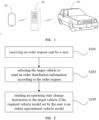
- FIG. 1 is a schematic diagram of an application environment of an order processing method provided by an embodiment of this application.
- the application environment may include a user terminal 101, a server 102, and a vehicle terminal 103.
- user terminals 101 may include, but are not limited to, smartphones, desktop computers, tablets, laptops, smart speakers, digital assistants, augmented reality (AR)/ virtual reality (VR) devices, smart wear-ables and other types of electronic devices. It can also be software that runs on the above electronic devices, such as applications, small programs, etc.
- the operating systems running on the device may include, but are not limited to, Android, IOS, Linux, Windows, Unix, etc.
- server 102 is used to receive the order information sent by the user terminal 101 and send the order information to the specified vehicle terminal 103.
- server 102 can be the background server of the online appointment vehicle platform.
- server 102 can be an independent physical server, a server cluster consisting of multiple physical servers, or a distributed system. It can also be a cloud server that provides cloud services, cloud databases, cloud computing, cloud functions, cloud storage, Online services, cloud communications, middleware services, domain name services, security services, CDN (Content Delivery Online), and big data and artificial intelligence platforms and other basic cloud computing services.
- vehicle terminal 103 is a remote communication terminal arranged on the vehicle.
- the vehicle terminal 103 can receive information and instructions sent by the server 102, and in some cases can control the vehicle device according to the instructions sent by the server 102.
- the vehicle refers to the vehicle that is connected to the online appointment vehicle platform and can provide online appointment vehicle services. Different from the cruising taxi and online appointment vehicle in the prior art, the vehicle in the embodiment of this application is a dual-purpose vehicle that can act as both a cruising taxi and an online appointment vehicle. In the actual operation process, the vehicle can not only cruise on the city road to accept passenger orders on the roadside, but also access the online appointment vehicle platform, according to the needs of users to transform into an online appointment vehicle to accept online orders.
- FIG. 1 is only an application environment of the order processing method provided herein.
- the user terminal 101 can be the user client of the registered online appointment vehicle platform, and the vehicle terminal 103 can be the vehicle accessing the online appointment vehicle platform.
- the number of user terminal 101 and vehicle terminal 103 can be many.
- the one user terminal 101 and one vehicle terminal 103 shown in FIG.1 do not qualify this application.
- FIG.2 is a flow diagram of an order processing method provided in this application embodiment.
- This specification provides the operation steps of the method such as embodiments or flow charts, but it may include more or less operation steps based on routine or uncreative labor.
- the sequence of steps listed in the embodiments is only one way in which the sequence of steps is executed, and does not represent a unique sequence of execution. In the actual system or server product execution, it can be executed sequentially or in parallel according to the embodiments or the methods shown in the attached drawings (such as parallel processor or multi-threaded processing environment).
- the method is applied to a server and can include the following steps: S201: receiving an order request sent by a user.
- the user when the user needs to book an online appointment vehicle for going out, the user sends an order request to the server through the user terminal held by the user.
- the order request includes information about the required vehicle model set by the user.
- the required vehicle model refers to the required vehicle model of the user, including online appointment vehicle and cruising taxi.
- S203 selecting the target vehicle to send an order distribution information according to the order request.
- the target vehicle is selected among the vehicles connected to the online appointment vehicle platform to distribute the user's order.
- S205 sending an operating state change instruction to the target vehicle if the required vehicle model set by the user is an online appointment vehicle model.
- the server controls the vehicle according to the required vehicle model set in the user's order request to ensure that the model meets the user's needs.
- the server determines that the required vehicle model set by the user is the online appointment vehicle model, the server will send the operating state change instruction to the target vehicle.
- the operating state change instruction is used to change the operational state of the target vehicle.
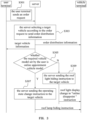
- FIG.3 is a schematic diagram of the interaction flow of an order processing method provided by this application embodiment.
- the interaction sides of the order processing method are user terminal, server and vehicle terminal respectively, including the following steps: S301: the user terminal sending an order request.
- the user before using the user terminal for online appointment vehicle booking, the user interacts with the server through the user terminal, submits identity verification information to complete account registration, and then conducts online appointment vehicle booking on the online appointment vehicle platform by logging in the account.
- the user sends an order request to the server through the user terminal it holds.
- the order request also includes the information of the required vehicle model set by the user.
- the required vehicle model refers to the type of vehicle the user needs, which is mainly divided into online appointment vehicle and cruising taxi.
- the online appointment vehicle referred to here refers to a vehicle with a common private vehicle shape
- the cruising taxi refers to a vehicle with the same shape as the cruising taxi visible on the ordinary road.
- it is obviously more appropriate to arrive at the destination by online appointment vehicle booking For example, in some cities, the cost of online appointment vehicle booking is cheaper than that of cruising taxis, and users are more inclined to use online appointment vehicle booking to travel. For another example, some users will think that the cruising taxi is safer and more inclined to use the cruising taxi to travel. Based on the above scenario, the user will pre-set the required vehicle model when sending the order request.
- the existing technology it is obviously only possible to match the corresponding model for the user according to the required vehicle model set by the user. That is, if the required vehicle model set by the user is an online appointment vehicle model, the online appointment vehicle platform can only match the user with the online appointment vehicle; if the required vehicle model set by the user is a cruising taxi model, the online appointment vehicle platform can only match the user with the cruising taxi.
- the vehicle connected to the online appointment vehicle platform is a dual-use integrated vehicle, the vehicle can act as both an online appointment vehicle and a cruising vehicle. Therefore, when the user's order is assigned to the vehicle, according to the required model set by the user, the vehicle shape can be changed by controlling the action of the on-board device, so that the shape of the vehicle is presented as a cruising taxi or an online appointment vehicle.
- the vehicle in this application can act as both an online appointment vehicle and a cruising taxi
- the vehicles accessing the online appointment vehicle hailing platform are not limited to the above-mentioned dual-purpose vehicles, but can also access ordinary online appointment vehicle and a cruising taxi at the same time.
- the dual-purpose vehicle can also be used as a supplement to the online appointment vehicle or cruising taxi, and when the capacity of the required model set by the user is insufficient, the dual-purpose model can be matched as a supplement to the capacity.
- the user terminal sends an order request to the server, and correspondingly, the server receives the order request sent by the user.
- the server performs further processing based on the information set by the user for the required vehicle model included in the order request.
- S303 the server selecting the target vehicle to send an order information according to the order request.
- the target vehicle is selected from the vehicles connected to the online appointment vehicle platform to undertake the order.
- the server directly selects the target vehicle to send the order, instead of sending the order by the driver of the cruising taxi, which can effectively avoid the behavior of the driver to pick up the order and refuse the load.
- the server selects the target vehicle and distributes the order according to the vehicle preference information in the order information and the order distribution rules of the online appointment vehicle platform.
- FIG.4 is a schematic diagram of the process of selecting the target vehicle to send order information according to the order request provided by this application embodiment, as shown in FIG.4 , selecting the target vehicle to send order information according to the order request includes: S401: determining the set of to-be-received-order vehicles within the preset range of a riding location of the user according to the order request.
- the server first obtains the user's riding location from the order information contained in the order request, and then determines the vehicles that can undertake the order within a certain distance from the user's riding location to constitute the set of to-be-received-order vehicles.
- the server determines the set of to-be-received-order vehicles within the preset range of the user's riding location according to the order request.
- the server needs to determine all the operating vehicles that access the online appointment vehicle platform within the preset range of the user's riding location according to the order request. Then, the server determines the idle vehicles in all operating vehicles to constitute the set of to-be-received-order vehicle.
- a vehicle with an idle operating state will be displayed on the online appointment vehicle platform corresponding to the vehicle waiting for an order.
- There are two types of vehicles in the operating state to carry passengers one is completing the order issued by the online appointment vehicle platform, at which time the server will have the corresponding record information. The other is when the vehicle is cruising on the road to accept passenger pick-up orders.
- Empty vehicles can accept orders, after the start of the service to the online appointment vehicle platform, it will report the order signal immediately, and the server will record the vehicle as carrying passenger status.
- the online appointment vehicle platform will no longer send online appointment orders to the vehicle.
- the vehicle in the state of carrying passengers can also estimate the end time of the order according to its trip information, route information, etc., when the end time of the order is within the preset range, the online appointment vehicle platform can also distribute the order in advance. Vehicles whose operating state is stopped are also recorded in the server, and the server filters them out when determining the set of to-be-received-order vehicles.
- the online appointment vehicle platform can also specify certain incentive measures to improve the driver's enthusiasm for receiving orders.
- the server can also schedule vehicles based on the number of orders for a preset period of time in an area compared with the number of available vehicles. As an optional embodiment, the server first determines the number of orders sent by users in the preset area within a preset period of time, and then obtains the number of vehicles in the preset area whose operating state is idle.
- Scheduling information can be enforcement information for certain vehicles, or it can be guided broadcast information to get vehicles to a predetermined area and increase the number of vehicles that can receive orders in that area.
- S403 selecting the target vehicle from the set of to-be-received-order vehicles according to a set order distribution rule.
- the server selects the target vehicle in the collection of vehicles to be received according to the order distribution rule set by the platform.
- the set of to-be-received-order vehicle includes at least one to-be-received-order vehicle.
- the server selects the target vehicle from the set of to-be-received-order vehicle according to the set order distribution rules, including: obtaining the current location and drivable distance of the vehicle to be received.
- the order pre-estimated distance is determined based on the current location, the riding location and the destination of the user. Determine the target vehicle based on the drivable distance and the order pre-estimated distance.
- the server monitors the running status of the vehicle in real time.
- the server selects the target vehicle for ordering, it first determines the drivable distance of the vehicle. For example, the battery shortage of pure electric vehicles on the way to complete the order will bring a bad experience to the user. Therefore, when the remaining power of the vehicle is not enough to support long-distance orders, the vehicle cannot be selected to undertake long-distance orders.
- the server calculates the distance that each vehicle in the collection needs to travel to complete the order according to the current location of the vehicle, the user's driving place and the destination. By comparing with the respective drivable distance of the vehicle, the vehicle that can complete the order is determined as the target vehicle.
- the server selects the vehicle according to the preference information set in the user's order request, such as requiring the driver to receive orders, service score, driving age, etc., which is greater than the preset value, so as to obtain the target vehicle that meets the user's expectations.
- the server can also send information about available vehicles to the user terminal, and the user can choose the vehicle to undertake the order.
- S405 sending the order information to the target vehicle.
- the server determines the target vehicle, it sends the order information to the target vehicle, notifies the driver to complete the order, and sends the information of the target vehicle to the user terminal to remind the user.
- S305 the server determining whether the required vehicle set by the user is an online appointment vehicle model.
- the server controls the vehicle according to the required vehicle model set in the user's order request to ensure that the model meets the user's needs.
- the server determines whether the required vehicle model set by the user is an online appointment vehicle model, if it is, then perform step S307, if not, then go to step S309.
- the online appointment vehicle platform can directly determine the set of to-be-received-order vehicle of the corresponding model according to the required vehicle model set by the user when determining the set of to-be-received-order vehicle.
- the server needs to determine all the operating online appointment vehicles that access the online appointment platform within the preset range of the user's riding location according to the order request. Then, the server determines that the operating state of the online appointment vehicle is idle in all the online appointment vehicle to constitute the set of to-be-received-order vehicle.
- S307 the server sending operating state change instructions to the target vehicle.
- the server when the server determines that the required vehicle model set by the user is an online appointment vehicle, the server will send an operating state change instruction to the target vehicle.
- the operating state change instruction is used to change the operating state of the target vehicle.
- an operating state change order can be sent to the target vehicle at the same time as the order distribution information.
- the operating state change instruction can be sent to the target vehicle after the order distribution information is sent to the vehicle terminal.
- the operating state change instruction can also be included in the order distribution information, that is, the order sending information carries the operating state change instruction, and after receiving the order distribution information, the vehicle terminal can obtain the operating state change instruction by analyzing the order distribution information.
- the vehicle is equipped with an on-board device to mark the operating state of the vehicle, which can also be a device to distinguish the online appointment vehicle and the cruising taxi, such as the roof light.
- the main difference between the online appointment vehicle and the cruising taxi in terms of appearance is that the top of the body of the cruising taxi is set up with a roof light for displaying the operating state, while the top of the body of the online appointment vehicle has no roof light.
- the operational state change instruction is the roof light hiding instruction
- the server sends the roof light hiding instruction to the target vehicle, and after receiving the roof light hiding instruction, the vehicle terminal in the target vehicle controls the target vehicle hide the roof light.
- the roof light of the target vehicle is installed on the vehicle body through the lifting mechanism, and when the vehicle terminal receives the roof light hiding instruction, the lifting mechanism is controlled to lift, and then the roof light is driven down, so that the roof light is hidden in the body.
- the roof light of the target vehicle is installed on the body through the folding mechanism, and when the vehicle terminal receives the hiding instruction of the roof light, the folding mechanism is controlled to drive the roof light to turn over, so that the roof light is hidden inside the body.
- the on-board device is a roof light only as an optional embodiment, and the on-board device used in the implementation of this application to distinguish the device of the online appointment vehicle from the cruising taxi is not limited to the roof light, but may also be other on-board devices.
- the two sides of the vehicle door is set with a sign of the vehicle type of the display screen, the display screen can display the vehicle's passenger status, when the vehicle terminal receives the operating state change instruction, by changing the display content on the display screen, such as the same color as the body, so that the appearance of the vehicle is consistent with the online appointment vehicle.
- the server when the server determines that the required model set by the user is not an online appointment vehicle model, that is, when the server determines that the required model set by the user is a cruising taxi model, the server will send instructions to the target vehicle to change the display of the roof light.
- the roof light display change instruction is used to change the passenger status displayed on the roof light of the target vehicle to the reserved passenger carrying status.
- the vehicle is used as a cruising taxi on the road to accept the passenger's recruitment order, while waiting to accept the online appointment vehicle platform to send the online appointment order.
- the overhead light on the vehicle is used to show the carrying passenger state of the vehicle.
- the carrying passenger state of the vehicle displayed on the roof light can include the status of "empty”, “carrying passengers", “online appointment ", etc. Passengers who make a call at the side of the road can know the carrying passenger status of the vehicle by observing the words displayed on the roof light.
- the server determines that the required vehicle set by the user is the cruise vehicle model, the server will send the instruction to the target vehicle to change the roof light display to "online appointment ".
- the roof light is not limited to indicating the passenger carrying passenger state of the vehicle by displaying words, but can also indicate the passenger carrying passenger status of the vehicle by displaying different colors.
- the vehicle is idle, by displaying red, the vehicle is in the state of carrying passengers, and by displaying yellow, the vehicle is in the state of online appointment.
- the server changes the offline operating state of the vehicle when the vehicle accepts the online appointment order by sending the change instruction of the roof light to the target vehicle, so as to avoid the misunderstanding of the offline passengers.
- the carry passenger state of the vehicle is recorded on the server, achieving the unity of the actual operating carrying passenger status of the vehicle online and offline.
- the server is convenient to send orders to the vehicle according to the actual carrying passenger state of the vehicle, reducing the error of distribution orders.
- the vehicle when the vehicle completes the current order, it sends the order completion information to the server through the vehicle terminal to enter the state of waiting for the order again.
- the server receives the order completion information sent by the vehicle terminal on the target vehicle.
- the server sends the roof light display instruction to the target vehicle according to the order completion information, which is used to make the target vehicle display the hidden roof light.
- the server learns that the target vehicle has completed the previous order, and then matches the order for the vehicle again according to the vehicle location. Or vehicles cruise the road by displaying overhead lights to receive pickup orders.
- the order completion information sent by the vehicle terminal to the server includes audio and video data, order data and other information during the completion of the order.
- the order processing method described in this application example can meet the needs of users in different travel scenarios and bring great convenience to users' travel.
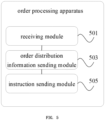
- FIG. 5 is a structural diagram of an order processing apparatus provided by this application embodiment, as shown in FIG. 5 .
- the apparatus includes:
- the operating state change instruction is the roof light hiding instruction
- the instruction sending module 505 includes: a roof light hiding instruction sending unit, configured to send the roof light hiding instruction to the target vehicle, wherein the roof light hiding instruction is configured to enabling the target vehicle to hide the roof light;
- the order distribution information sending module 503 includes:
- the to-be-received-order-set determining unit includes:
- the apparatus further includes:
- the apparatus further includes: a roof light display change instruction sending unit, configured to send a roof light display change instruction to the target vehicle if the required vehicle model set by the user is a cruise vehicle model; the roof light display change instruction is used for changing a passenger carrying state displayed by the roof light of the target vehicle to a reserved passenger carrying state.
- a roof light display change instruction sending unit configured to send a roof light display change instruction to the target vehicle if the required vehicle model set by the user is a cruise vehicle model
- the roof light display change instruction is used for changing a passenger carrying state displayed by the roof light of the target vehicle to a reserved passenger carrying state.
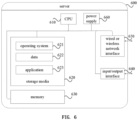
- FIG.6 is the hardware structure block diagram of a server for an order processing method provided by this application embodiment.
- the server 600 can vary considerably depending on configuration or performance, and can include one or more Central Processing Units (CPU) 610 (the processor 610 may include, but is not limited to, a processing apparatus such as a microprocessor MCU or programmable logic apparatus FPGA), a memory for storing data 630, a storage medium 620 for storing one or more applications 623 or data 622 (for example, one or more mass storage apparatus).
- the memory 630 and the storage medium 620 May be temporary or persistent storage.
- the program stored in the storage medium 620 may consist of one or more modules, each module may consist of a series of instruction operations on the server. Further, the CPU 610 can be set up to communicate with the storage medium 620 to perform a series of command operations in the storage medium 620 on the server 600.
- Server 600 can also include one or more than one power supply 660, one or more than one wired or wireless network interface, 650 a, 640, or more than one input/output interface, and/or one or more than one operating system 621, for example, Windows ServerTM Mac OS XTM, UnixTM, LinuxTM, FreeBSDTM and so on.
- the input/output interface 640 can be used to receive or send data over a network.
- the above network concrete example may include a wireless network provided by the communication provider of server 600.
- the input/output Interface 640 includes a Network Interface Controller (NIC) that can communicate with the Internet by connecting to other network apparatus via a base station.
- the input/output interface 640 can be a Radio Frequency (RF) module, which is used to communicate wirelessly with the Internet.
- NIC Network Interface Controller
- RF Radio Frequency
- the structure shown in FIG.6 is only indicative and does not limit the structure of the said electronic apparatus.
- the server 600 could also include more or fewer components than shown in FIG.6 , or have a different configuration than shown in FIG.6 .
- Embodiments of the present application also provide a computer-readable storage medium in which at least one instruction or at least one program is stored and at least one instruction or at least one program is loaded and executed by the processor to implement the order processing method described above.
- the storage medium may be located on at least one of the multiple network servers of the computer network.
- the storage media may include, but are not limited to, USB flash drives, Read-Only Memory (ROM), Random Access Memory (RAM), portable hard disks, magnetic disks, or optical disks, and other media that can store program code.
- the order processing method described in this application example can meet the needs of users in different travel scenarios and bring great convenience to users' travel.
- the order processing method sends the user's online appointment vehicle order directly to the designated target vehicle, and sends instructions to the target vehicle according to the required vehicle model set by the user when placing the order, so that the target vehicle can change its own operating state, which not only avoids the behavior of the cruising taxi driver, but also ensures the user's travel convenience. It also ensures that the vehicle receiving the order can meet the needs of the user and improve the user experience. By unifying the online and offline operating state of vehicles, the order acceptance rate of vehicles is improved.
Landscapes
- Business, Economics & Management (AREA)
- Engineering & Computer Science (AREA)
- Human Resources & Organizations (AREA)
- Economics (AREA)
- Strategic Management (AREA)
- Theoretical Computer Science (AREA)
- General Physics & Mathematics (AREA)
- Marketing (AREA)
- General Business, Economics & Management (AREA)
- Physics & Mathematics (AREA)
- Tourism & Hospitality (AREA)
- Development Economics (AREA)
- Entrepreneurship & Innovation (AREA)
- Finance (AREA)
- Accounting & Taxation (AREA)
- Operations Research (AREA)
- Quality & Reliability (AREA)
- Signal Processing (AREA)
- Computer Networks & Wireless Communication (AREA)
- Educational Administration (AREA)
- Game Theory and Decision Science (AREA)
- Health & Medical Sciences (AREA)
- General Health & Medical Sciences (AREA)
- Primary Health Care (AREA)
- Mechanical Engineering (AREA)
- Management, Administration, Business Operations System, And Electronic Commerce (AREA)
- Traffic Control Systems (AREA)
Abstract
Description
- The present application relates to the technical field of cruising taxis and online appointment vehicle appointment, in particular to an order processing method, apparatus, server and storage medium.
- The cruising taxi is a component of urban comprehensive transportation system. Take the responsibility of supplementing urban public transportation capacity, providing personalized transportation services to the public. In recent years, with the rapid development of the mobile internet industry, new business formats in the industry integrating traditional transportation and the internet are booming, online appointment vehicle has become an important way for users to travel. In order to actively and steadily advance the reform of the taxi industry, encourage innovation, promote transformation, to better meet the travel needs of the people, the "Guiding Opinions of the General Office of the State Council on Deepening Reform and Promoting the Healthy Development of the Taxi Industry" pointed out that seize the favorable opportunity to implement the "Internet +" action, adhere to the problem-oriented approach, and promote the transformation and upgrading of cruising taxis, standardize online appointment vehicle operations, and promote the integrated development of the two business formats.
- In the prior art, the traditional cruising taxi adopts some online appointment vehicle platforms to accept the online vehicle appointment order, but the realization mode is only a change of the order accepting mode. The cruising taxis do not completely replace online appointment vehicles in some scenarios, the cruising taxi cannot meet the needs of users who need real online appointment vehicle. The existing online appointment vehicle does not have the capability of receiving orders offline, so that the cruising taxi and the online appointment vehicle cannot be well fused, even the management of the cruising taxi and the online appointment vehicle is opposite to each other, and the transport capacity resource is wasted.
- The invention solves the problem that the existing cruising taxi and the online appointment vehicle cannot be really integrated.
- In order to solve the above technical problem, in a first aspect, an embodiment of this application discloses an order processing method, including:
- receiving an order request sent by a user; the order request including an information of the required vehicle model set by the user;
- selecting a target vehicle according to the order request to send order distribution information;
- sending an operating state change instruction to the target vehicle if the required vehicle model set by the user is an online appointment vehicle model; wherein the operating state change instruction is configured to cause the target vehicle to change an operating state.
- Further, the operating state change instruction is a roof light hiding instruction; sending the operating state change instruction to the target vehicle includes:
sending the roof light hiding instruction to the target vehicle, the roof light hiding instruction configured to cause the target vehicle to hide a roof light. - Further, the step of selecting the target vehicle to send the order distribution information according to the order request includes:
- determining a set of to-be-received-order vehicles within a preset range of a riding location of the user according to the order request;
- selecting the target vehicle from the set of to-be-received-order vehicles according to a set order distribution rule;
- transmitting the order distribution information to the target vehicle.
- Further, determining the set of to-be-received-order vehicles within the preset range of the riding location of the user according to the order request includes:
- determining all operating vehicles that access an online appointment vehicle platform within the preset range of the riding location of the user, according to the order request;
- among all the operating vehicles, determining the vehicles whose operating state is idle constitute the set of to-be-received-order vehicles.
- Further, the set of to-be-received-order vehicles includes at least one to-be-received-order vehicle; selecting the target vehicle from the set of to-be-received-order vehicles according to the set order distribution rule includes:
- obtaining a current location and a drivable distance of the to-be-received-order vehicle;
- determining an order pre-estimated distance according to the current location, the riding location and a destination of the user;
- determining the target vehicle according to the drivable distance and the order pre-estimated distance.
- Further, after the sending the operating state change instruction to the target vehicle, the order processing method further includes:
- receiving an order completion information sent by the target vehicle;
- sending a roof light display instruction to the target vehicle according to the order completion information; the roof light display instruction configured to cause the target vehicle to display the hidden roof light.
- Further, the method further includes:
sending a roof light display change instruction to the target vehicle if the required vehicle model set by the user is a cruise vehicle model; wherein the roof light display change instruction is configured to change a passenger carrying state displayed by the roof light of the target vehicle to a reserved passenger carrying state . - In a second aspect, an embodiment of the present application discloses an order processing apparatus, including:
- a receiving module, receiving an order request sent by a user; the order request including an information of a required vehicle model set by the user;
- an order distribution information sending module, configured to select a target vehicle to send order distribution information according to the order request;
- an instruction sending module, configured to send an operating state change instruction to the target vehicle if the required vehicle model set by the user is an online appointment vehicle model; the operating state change instruction configured to cause the target vehicle to change an operating state.
- In an optional embodiment, the operating state change instruction is a roof light hiding instruction; the instruction sending module includes:
a roof light hiding instruction sending unit, configured to send the roof light hiding instruction to the target vehicle, wherein the roof light hiding instruction is configured to enabling the target vehicle to hide the roof light. - In an alternative embodiment, the order distribution information sending module includes:
- a to-be-received-order-vehicle set determining unit, configured to determine a set of to-be-received-order-vehicles within a preset range of a riding location of the user according to the order request;
- a target vehicle selecting unit, configured to select the target vehicle from the set of to-be-received-order vehicles according to a set order distribution rule;
- a transmission unit, configured to transmitting the order distribution information to the target vehicle.
- In an alternative embodiment, the to-be-received-order-set determining unit includes:
- an operating vehicle determining subunit, configured to determine all operating vehicles accessing the access an online appointment vehicle platform within the preset range of the riding location of the user according to the order request;
- an idle vehicle determination subunit, configured to determine that vehicles whose operating state is idle constitute the set of to-be-received-order vehicles, among the all operating vehicles.
- In an alternative embodiment, the set of to-be-received-order-vehicles includes at least one to-be-received-order-vehicle; the target vehicle selecting unit includes:
- a location obtaining subunit, configured to obtain a current location and a drivable distance of the to-be-received-order vehicle;
- a distance determining subunit, configured to determine an order pre-estimated distance according to the current location, the riding location and the destination of the user;
- a target vehicle determining unit, configured to determine the target vehicle according to the drivable distance and the order pre-estimated distance.
- In an alternative embodiment, the apparatus further includes:
- an order completion information receiving module, configured to receive an order completion information sent by the target vehicle;
- a roof light display instruction sending unit, configured to send a roof light display instruction to the target vehicle according to the order completion information; the roof light display instruction is for causing the target vehicle to display the hidden roof light.
- In an alternative embodiment, the apparatus further includes:
a roof light display change instruction sending unit, configured to send a roof light display change instruction to the target vehicle if the required vehicle model set by the user is a cruise vehicle model; the roof light display change instruction is used for changing a passenger carrying state displayed by the roof light of the target vehicle to a reserved passenger carrying state. - In a third aspect, an embodiment of this application discloses an apparatuserver, and the apparatus includes a processor and a memory, wherein at least one instruction or at least one program is stored in the memory, and the at least one instruction or the at least one program is loaded by the processor and executes the order processing method described above.
- In a fourth aspect, an embodiment of the present application discloses a computer readable storage medium, in which at least one instruction or at least one program is stored, and the at least one instruction or the at least one program is loaded and executed by a processor to implement the order processing method as described above.
- The order processing method, the order processing apparatus, the server and the storage medium provided by the embodiments of the present application have the following technical effects:
- the order processing method directly distributes an online appointment vehicle order of a user to a designated target vehicle, an instruction is sent to a target vehicle according to a required vehicle model set by a user when the user places an order, so that the target vehicle changes the operation state of the target vehicle, the actions of picking an order and refusing to accept an order by a cruising taxi driver are avoided, the traveling convenience of the user is ensured, the vehicle receiving the order can meet the requirements of the user, and the user experience is improved.
- In order to more clearly illustrate the technical solutions and advantages in the embodiments of the present application or the prior art, a brief introduction of the drawings required to be used in the description of the embodiments or the prior art is presented below. It is obvious that the drawings described below are only some embodiments of the present application. Other drawings can also be obtained from these drawings.
-
FIG. 1 is a schematic diagram of an application environment of an order processing method according to an embodiment of this application; -
FIG. 2 is a schematic flowchart of an order processing method according to an embodiment of the present disclosure; -
FIG. 3 is a schematic interactive flow diagram of an order processing method according to an embodiment of the present disclosure; -
FIG. 4 is a schematic flowchart of a method for selecting a target vehicle to send order distribution information according to an order request according to an embodiment of the present disclosure; -
FIG. 5 is a schematic structural diagram of an order processing apparatus according to an embodiment of this application; -
FIG. 6 is a block diagram of a hardware structure of a server of an order processing method according to an embodiment of the present disclosure. - In combination with the accompanying drawings in the embodiments of the present application, the technical solutions in the embodiments of the present application are clearly and completely described. Obviously, the described embodiments are only a part of the embodiments of the present application, and not all the embodiments are based on the embodiments in the present application, all other embodiments obtained by those of ordinary skill in the art without creative efforts belong to the protection scope of the present application.
- It should be noted that, the terms "first", "second" and the like in the description and claims of the present application and in the above-mentioned drawings are used to distinguish between similar objects, it should be understood that the data so used may be interchanged under appropriate circumstances, rather than being used to describe a particular sequence or precedence. So that the embodiments of the application described herein can be practiced in an order other than those illustrated or described herein, the terms "comprising" and "having" and any variations thereof, it is intended to cover a non-exclusive inclusion, e.g., a process, method, system, product, or server that includes a series of steps or elements, is not necessarily limited to those steps or elements that are expressly listed, but may include other steps or elements that are not expressly listed or are inherent to such process, method, product, or apparatus.
- The online appointment vehicle is also called online appointment vehicle, the online appointment vehicle can be implemented by means of access online appointment vehicle platform to obtain single passenger-carrying. The cruising taxi, also called cruise vehicle, conventional cruising taxis accept passengers' recruitment by cruise on urban roads, to accept the offer of passengers. The online appointment vehicles can meet the needs of users in different travel scenarios, which can bring great convenience for users to travel. However, because the online appointment vehicle platform usually adopts the way to grab orders to distribute users' orders, there is a mismatch between the service supply and demand in the spatial and temporal distribution of online appointment vehicle booking, resulting in the demand for online appointment vehicle booking in some areas in some periods of time cannot be met, and there is an excess supply of online appointment vehicle booking capacity in some areas of other periods of time. The operation of cruising taxis is usually regulated by the government and subject to the government's scheduling and allocation of transport capacity resources, which can meet the public interests to the greatest extent. The existing cruising taxi can also receive orders through the access to the online appointment vehicle platform, but because the cruising taxi is usually a unified sample, it cannot meet the personalized needs of users. This application embodiment provides a two-car integration scheme based on the advantages of online appointment vehicle and cruising taxi.
- Please refer to
FIG. 1. FIG. 1 is a schematic diagram of an application environment of an order processing method provided by an embodiment of this application. As shown inFIG. 1 , the application environment may include auser terminal 101, aserver 102, and avehicle terminal 103. - In this application embodiment, the user sends an online vehicle appointment order through the
user terminal 101. Optionally,user terminals 101 may include, but are not limited to, smartphones, desktop computers, tablets, laptops, smart speakers, digital assistants, augmented reality (AR)/ virtual reality (VR) devices, smart wear-ables and other types of electronic devices. It can also be software that runs on the above electronic devices, such as applications, small programs, etc. Optionally, the operating systems running on the device may include, but are not limited to, Android, IOS, Linux, Windows, Unix, etc. - In this application embodiment,
server 102 is used to receive the order information sent by theuser terminal 101 and send the order information to the specifiedvehicle terminal 103. Optionally,server 102 can be the background server of the online appointment vehicle platform. Optionally,server 102 can be an independent physical server, a server cluster consisting of multiple physical servers, or a distributed system. It can also be a cloud server that provides cloud services, cloud databases, cloud computing, cloud functions, cloud storage, Online services, cloud communications, middleware services, domain name services, security services, CDN (Content Delivery Online), and big data and artificial intelligence platforms and other basic cloud computing services. - In this application embodiment,
vehicle terminal 103 is a remote communication terminal arranged on the vehicle. Thevehicle terminal 103 can receive information and instructions sent by theserver 102, and in some cases can control the vehicle device according to the instructions sent by theserver 102. The vehicle refers to the vehicle that is connected to the online appointment vehicle platform and can provide online appointment vehicle services. Different from the cruising taxi and online appointment vehicle in the prior art, the vehicle in the embodiment of this application is a dual-purpose vehicle that can act as both a cruising taxi and an online appointment vehicle. In the actual operation process, the vehicle can not only cruise on the city road to accept passenger orders on the roadside, but also access the online appointment vehicle platform, according to the needs of users to transform into an online appointment vehicle to accept online orders. - In addition, it should be noted that
FIG. 1 is only an application environment of the order processing method provided herein. In practical applications, theuser terminal 101 can be the user client of the registered online appointment vehicle platform, and thevehicle terminal 103 can be the vehicle accessing the online appointment vehicle platform. The number ofuser terminal 101 andvehicle terminal 103 can be many. The oneuser terminal 101 and onevehicle terminal 103 shown inFIG.1 do not qualify this application. - The following is a specific embodiment of an order processing method in this application.
FIG.2 is a flow diagram of an order processing method provided in this application embodiment. This specification provides the operation steps of the method such as embodiments or flow charts, but it may include more or less operation steps based on routine or uncreative labor. The sequence of steps listed in the embodiments is only one way in which the sequence of steps is executed, and does not represent a unique sequence of execution. In the actual system or server product execution, it can be executed sequentially or in parallel according to the embodiments or the methods shown in the attached drawings (such as parallel processor or multi-threaded processing environment). As shown inFIG.2 , the method is applied to a server and can include the following steps:
S201: receiving an order request sent by a user. - In this application embodiment, when the user needs to book an online appointment vehicle for going out, the user sends an order request to the server through the user terminal held by the user. The order request includes information about the required vehicle model set by the user. The required vehicle model refers to the required vehicle model of the user, including online appointment vehicle and cruising taxi.
- S203: selecting the target vehicle to send an order distribution information according to the order request.
- In this application embodiment, after the server receives the order request sent by the user terminal, according to the order information contained in the order request, the target vehicle is selected among the vehicles connected to the online appointment vehicle platform to distribute the user's order.
- S205: sending an operating state change instruction to the target vehicle if the required vehicle model set by the user is an online appointment vehicle model.
- In this application embodiment, after determining the target vehicle, the server controls the vehicle according to the required vehicle model set in the user's order request to ensure that the model meets the user's needs. When the server determines that the required vehicle model set by the user is the online appointment vehicle model, the server will send the operating state change instruction to the target vehicle. The operating state change instruction is used to change the operational state of the target vehicle.
- Based on the above order processing method applied to the server, the following describes the specific interaction process of the server to execute the order processing method.
FIG.3 is a schematic diagram of the interaction flow of an order processing method provided by this application embodiment. As shown inFIG.3 , the interaction sides of the order processing method are user terminal, server and vehicle terminal respectively, including the following steps:
S301: the user terminal sending an order request. - In this application embodiment, before using the user terminal for online appointment vehicle booking, the user interacts with the server through the user terminal, submits identity verification information to complete account registration, and then conducts online appointment vehicle booking on the online appointment vehicle platform by logging in the account. When the user needs to book an online appointment vehicle, the user sends an order request to the server through the user terminal it holds. In addition to the basic information of the order such as the departure, destination and time of the ride, the order request also includes the information of the required vehicle model set by the user. The required vehicle model refers to the type of vehicle the user needs, which is mainly divided into online appointment vehicle and cruising taxi. The online appointment vehicle referred to here refers to a vehicle with a common private vehicle shape, and the cruising taxi refers to a vehicle with the same shape as the cruising taxi visible on the ordinary road. In some scenarios, such as when the user attends a business occasion, it is obviously more appropriate to arrive at the destination by online appointment vehicle booking. For example, in some cities, the cost of online appointment vehicle booking is cheaper than that of cruising taxis, and users are more inclined to use online appointment vehicle booking to travel. For another example, some users will think that the cruising taxi is safer and more inclined to use the cruising taxi to travel. Based on the above scenario, the user will pre-set the required vehicle model when sending the order request. In the existing technology, it is obviously only possible to match the corresponding model for the user according to the required vehicle model set by the user. That is, if the required vehicle model set by the user is an online appointment vehicle model, the online appointment vehicle platform can only match the user with the online appointment vehicle; if the required vehicle model set by the user is a cruising taxi model, the online appointment vehicle platform can only match the user with the cruising taxi. In the embodiment of this application, since the vehicle connected to the online appointment vehicle platform is a dual-use integrated vehicle, the vehicle can act as both an online appointment vehicle and a cruising vehicle. Therefore, when the user's order is assigned to the vehicle, according to the required model set by the user, the vehicle shape can be changed by controlling the action of the on-board device, so that the shape of the vehicle is presented as a cruising taxi or an online appointment vehicle.
- It should be noted that although the vehicle in this application can act as both an online appointment vehicle and a cruising taxi, the vehicles accessing the online appointment vehicle hailing platform are not limited to the above-mentioned dual-purpose vehicles, but can also access ordinary online appointment vehicle and a cruising taxi at the same time. In some embodiments, the dual-purpose vehicle can also be used as a supplement to the online appointment vehicle or cruising taxi, and when the capacity of the required model set by the user is insufficient, the dual-purpose model can be matched as a supplement to the capacity.
- In this application embodiment, the user terminal sends an order request to the server, and correspondingly, the server receives the order request sent by the user. The server performs further processing based on the information set by the user for the required vehicle model included in the order request.
- S303: the server selecting the target vehicle to send an order information according to the order request.
- In this application embodiment, after the server receives the order request sent by the user terminal, according to the order information contained in the order request, the target vehicle is selected from the vehicles connected to the online appointment vehicle platform to undertake the order. In some scenarios, such as a business circle in the travel peak hours, in a period of time, multiple users at the same time to the online appointment vehicle platform to issue orders, if it is through the driver to grab orders to distribute orders, it is bound to cause the travel distance of a long order is received, and the travel distance of the order no one wants to. In this application embodiment, the server directly selects the target vehicle to send the order, instead of sending the order by the driver of the cruising taxi, which can effectively avoid the behavior of the driver to pick up the order and refuse the load.
- In this application embodiment, the server selects the target vehicle and distributes the order according to the vehicle preference information in the order information and the order distribution rules of the online appointment vehicle platform.
FIG.4 is a schematic diagram of the process of selecting the target vehicle to send order information according to the order request provided by this application embodiment, as shown inFIG.4 , selecting the target vehicle to send order information according to the order request includes:
S401: determining the set of to-be-received-order vehicles within the preset range of a riding location of the user according to the order request. - In this application embodiment, the server first obtains the user's riding location from the order information contained in the order request, and then determines the vehicles that can undertake the order within a certain distance from the user's riding location to constitute the set of to-be-received-order vehicles. As an optional embodiment, the server determines the set of to-be-received-order vehicles within the preset range of the user's riding location according to the order request. First, the server needs to determine all the operating vehicles that access the online appointment vehicle platform within the preset range of the user's riding location according to the order request. Then, the server determines the idle vehicles in all operating vehicles to constitute the set of to-be-received-order vehicle. There may be multiple vehicles connected to the online appointment vehicle platform near the user's riding location, and the operating states in these vehicles include idle state, passenger state and stopped operation state. A vehicle with an idle operating state will be displayed on the online appointment vehicle platform corresponding to the vehicle waiting for an order. There are two types of vehicles in the operating state to carry passengers, one is completing the order issued by the online appointment vehicle platform, at which time the server will have the corresponding record information. The other is when the vehicle is cruising on the road to accept passenger pick-up orders. Empty vehicles can accept orders, after the start of the service to the online appointment vehicle platform, it will report the order signal immediately, and the server will record the vehicle as carrying passenger status. In general, if the vehicle is in the state of carrying passengers, the online appointment vehicle platform will no longer send online appointment orders to the vehicle. In some embodiments, the vehicle in the state of carrying passengers can also estimate the end time of the order according to its trip information, route information, etc., when the end time of the order is within the preset range, the online appointment vehicle platform can also distribute the order in advance. Vehicles whose operating state is stopped are also recorded in the server, and the server filters them out when determining the set of to-be-received-order vehicles.
- It should be noted that for some pure electric vehicles that access the online appointment vehicle platform, when the vehicle is charging, it can also be set to the idle state to wait for the online order, so as to achieve uninterrupted parking and improve the driver's order rate.
- In some scenarios, such as peak travel times, there may be no to-be-received-order vehicles with idle operating state near the user's riding location. At this point, the scope of screening can be expanded to cover more vehicles. Of course, for drivers who receive orders from a distance, the online appointment vehicle platform can also specify certain incentive measures to improve the driver's enthusiasm for receiving orders. In addition to the above measures, the server can also schedule vehicles based on the number of orders for a preset period of time in an area compared with the number of available vehicles. As an optional embodiment, the server first determines the number of orders sent by users in the preset area within a preset period of time, and then obtains the number of vehicles in the preset area whose operating state is idle. If the number of vehicles is less than or equal to the number of orders, it sends scheduling information to all operating vehicles in the access online appointment vehicle platform. Scheduling information can be enforcement information for certain vehicles, or it can be guided broadcast information to get vehicles to a predetermined area and increase the number of vehicles that can receive orders in that area.
- S403: selecting the target vehicle from the set of to-be-received-order vehicles according to a set order distribution rule.
- In this application embodiment, the server selects the target vehicle in the collection of vehicles to be received according to the order distribution rule set by the platform. As an optional embodiment, the set of to-be-received-order vehicle includes at least one to-be-received-order vehicle. The server selects the target vehicle from the set of to-be-received-order vehicle according to the set order distribution rules, including: obtaining the current location and drivable distance of the vehicle to be received. The order pre-estimated distance is determined based on the current location, the riding location and the destination of the user. Determine the target vehicle based on the drivable distance and the order pre-estimated distance. Specifically, the server monitors the running status of the vehicle in real time. When the server selects the target vehicle for ordering, it first determines the drivable distance of the vehicle. For example, the battery shortage of pure electric vehicles on the way to complete the order will bring a bad experience to the user. Therefore, when the remaining power of the vehicle is not enough to support long-distance orders, the vehicle cannot be selected to undertake long-distance orders. The server calculates the distance that each vehicle in the collection needs to travel to complete the order according to the current location of the vehicle, the user's driving place and the destination. By comparing with the respective drivable distance of the vehicle, the vehicle that can complete the order is determined as the target vehicle.
- In some embodiments, under the premise of ensuring that the drivable distance of the vehicle can complete the order, the server selects the vehicle according to the preference information set in the user's order request, such as requiring the driver to receive orders, service score, driving age, etc., which is greater than the preset value, so as to obtain the target vehicle that meets the user's expectations. In other embodiments, the server can also send information about available vehicles to the user terminal, and the user can choose the vehicle to undertake the order.
- S405: sending the order information to the target vehicle.
- In this application embodiment, after the server determines the target vehicle, it sends the order information to the target vehicle, notifies the driver to complete the order, and sends the information of the target vehicle to the user terminal to remind the user.
- S305: the server determining whether the required vehicle set by the user is an online appointment vehicle model.
- In this application embodiment, after determining the target vehicle, the server controls the vehicle according to the required vehicle model set in the user's order request to ensure that the model meets the user's needs. Optionally, the server determines whether the required vehicle model set by the user is an online appointment vehicle model, if it is, then perform step S307, if not, then go to step S309.
- It should be noted that the above judgment process for required vehicle model set by the user is for the online appointment and cruise dual-purpose vehicles. For ordinary online appointment vehicles and cruising taxis, the online appointment vehicle platform can directly determine the set of to-be-received-order vehicle of the corresponding model according to the required vehicle model set by the user when determining the set of to-be-received-order vehicle. As an example, if the required vehicle model set by the user is an online appointment vehicle, the server needs to determine all the operating online appointment vehicles that access the online appointment platform within the preset range of the user's riding location according to the order request. Then, the server determines that the operating state of the online appointment vehicle is idle in all the online appointment vehicle to constitute the set of to-be-received-order vehicle.
- S307: the server sending operating state change instructions to the target vehicle.
- In this application embodiment, when the server determines that the required vehicle model set by the user is an online appointment vehicle, the server will send an operating state change instruction to the target vehicle. The operating state change instruction is used to change the operating state of the target vehicle. Optionally, an operating state change order can be sent to the target vehicle at the same time as the order distribution information. Optionally, the operating state change instruction can be sent to the target vehicle after the order distribution information is sent to the vehicle terminal. In some embodiments, the operating state change instruction can also be included in the order distribution information, that is, the order sending information carries the operating state change instruction, and after receiving the order distribution information, the vehicle terminal can obtain the operating state change instruction by analyzing the order distribution information. The vehicle is equipped with an on-board device to mark the operating state of the vehicle, which can also be a device to distinguish the online appointment vehicle and the cruising taxi, such as the roof light. Generally speaking, the main difference between the online appointment vehicle and the cruising taxi in terms of appearance is that the top of the body of the cruising taxi is set up with a roof light for displaying the operating state, while the top of the body of the online appointment vehicle has no roof light. In an optional embodiment, the operational state change instruction is the roof light hiding instruction, the server sends the roof light hiding instruction to the target vehicle, and after receiving the roof light hiding instruction, the vehicle terminal in the target vehicle controls the target vehicle hide the roof light. As an optional implementation, the roof light of the target vehicle is installed on the vehicle body through the lifting mechanism, and when the vehicle terminal receives the roof light hiding instruction, the lifting mechanism is controlled to lift, and then the roof light is driven down, so that the roof light is hidden in the body. As another alternative implementation, the roof light of the target vehicle is installed on the body through the folding mechanism, and when the vehicle terminal receives the hiding instruction of the roof light, the folding mechanism is controlled to drive the roof light to turn over, so that the roof light is hidden inside the body.
- It should be understood that the on-board device is a roof light only as an optional embodiment, and the on-board device used in the implementation of this application to distinguish the device of the online appointment vehicle from the cruising taxi is not limited to the roof light, but may also be other on-board devices. For example, the two sides of the vehicle door is set with a sign of the vehicle type of the display screen, the display screen can display the vehicle's passenger status, when the vehicle terminal receives the operating state change instruction, by changing the display content on the display screen, such as the same color as the body, so that the appearance of the vehicle is consistent with the online appointment vehicle.
- S309: the server sending a roof light display change instruction to the target vehicle.
- In this application embodiment, when the server determines that the required model set by the user is not an online appointment vehicle model, that is, when the server determines that the required model set by the user is a cruising taxi model, the server will send instructions to the target vehicle to change the display of the roof light. The roof light display change instruction is used to change the passenger status displayed on the roof light of the target vehicle to the reserved passenger carrying status. Under normal circumstances, the vehicle is used as a cruising taxi on the road to accept the passenger's recruitment order, while waiting to accept the online appointment vehicle platform to send the online appointment order. The overhead light on the vehicle is used to show the carrying passenger state of the vehicle. As an example, the carrying passenger state of the vehicle displayed on the roof light can include the status of "empty", "carrying passengers", "online appointment ", etc. Passengers who make a call at the side of the road can know the carrying passenger status of the vehicle by observing the words displayed on the roof light. When the server determines that the required vehicle set by the user is the cruise vehicle model, the server will send the instruction to the target vehicle to change the roof light display to "online appointment ". In some embodiments, the roof light is not limited to indicating the passenger carrying passenger state of the vehicle by displaying words, but can also indicate the passenger carrying passenger status of the vehicle by displaying different colors. For example, by displaying green, the vehicle is idle, by displaying red, the vehicle is in the state of carrying passengers, and by displaying yellow, the vehicle is in the state of online appointment. The server changes the offline operating state of the vehicle when the vehicle accepts the online appointment order by sending the change instruction of the roof light to the target vehicle, so as to avoid the misunderstanding of the offline passengers. Moreover, the carry passenger state of the vehicle is recorded on the server, achieving the unity of the actual operating carrying passenger status of the vehicle online and offline. The server is convenient to send orders to the vehicle according to the actual carrying passenger state of the vehicle, reducing the error of distribution orders.
- In this application embodiment, when the vehicle completes the current order, it sends the order completion information to the server through the vehicle terminal to enter the state of waiting for the order again. As an optional embodiment, the server receives the order completion information sent by the vehicle terminal on the target vehicle. The server sends the roof light display instruction to the target vehicle according to the order completion information, which is used to make the target vehicle display the hidden roof light. When the vehicle terminal sends the order completion information to the server, the server learns that the target vehicle has completed the previous order, and then matches the order for the vehicle again according to the vehicle location. Or vehicles cruise the road by displaying overhead lights to receive pickup orders. Optionally, the order completion information sent by the vehicle terminal to the server includes audio and video data, order data and other information during the completion of the order.
- The order processing method described in this application example can meet the needs of users in different travel scenarios and bring great convenience to users' travel.
- This application embodiment also provides an order processing apparatus.
FIG. 5 is a structural diagram of an order processing apparatus provided by this application embodiment, as shown inFIG. 5 . The apparatus includes: - a
receiving module 501, receiving an order request sent by a user; the order request including information a required vehicle model set by the user; - an order distribution
information sending module 503, configured to select a target vehicle to send order distribution information according to the order request; - an
instruction sending module 505, configured to send the operating state change instruction to the target vehicle if the required vehicle model set by the user is the online appointment vehicle model; the operating state change instruction configured to cause the target vehicle to change an operating state. - In one optional embodiment, the operating state change instruction is the roof light hiding instruction; the
instruction sending module 505 includes:
a roof light hiding instruction sending unit, configured to send the roof light hiding instruction to the target vehicle, wherein the roof light hiding instruction is configured to enabling the target vehicle to hide the roof light; - In an optional embodiment, the order distribution
information sending module 503 includes: - a to-be-received-order-vehicle set determining unit, configured to determine a set of to-be-received-order-vehicles within a preset range of a riding location of the user according to the order request;
- a target vehicle selecting unit, configured to select the target vehicle from the set of to-be-received-order vehicles according to a set order distribution rule;
- a transmission unit, configured to transmitting the order distribution information to the target vehicle.
- In an optional embodiment, the to-be-received-order-set determining unit includes:
- an operating vehicle determining subunit, configured to determine all operating vehicles accessing the access an online appointment vehicle platform within the preset range of the riding location of the user according to the order request;
- an idle vehicle determination subunit, configured to determine that vehicles whose operating state is idle constitute the set of to-be-received-order vehicles, among the all operating vehicles.
- the set of to-be-received-order-vehicles includes at least one to-be-received-order-vehicle; the target vehicle selecting unit includes:
- a location obtaining subunit, configured to obtain a current location and a drivable distance of the to-be-received-order vehicle;
- a distance determining subunit, configured to determine an order pre-estimated distance according to the current location, the riding location and the destination of the user;
- a target vehicle determining unit, configured to determine the target vehicle according to the drivable distance and the order pre-estimated distance.
- In an alternative embodiment, the apparatus further includes:
- an order completion information receiving module, configured to receive an order completion information sent by the target vehicle;
- a roof light display instruction sending unit, configured to send a roof light display instruction to the target vehicle according to the order completion information; the roof light display instruction is for causing the target vehicle to display the hidden roof light.
- In an alternative embodiment, the apparatus further includes:
a roof light display change instruction sending unit, configured to send a roof light display change instruction to the target vehicle if the required vehicle model set by the user is a cruise vehicle model; the roof light display change instruction is used for changing a passenger carrying state displayed by the roof light of the target vehicle to a reserved passenger carrying state. - The apparatus and method embodiments in this application are based on the same application idea.
- The method embodiments provided in this application may be executed in a computer terminal, server, or similar computing apparatus. Taking running on a server as an example,
FIG.6 is the hardware structure block diagram of a server for an order processing method provided by this application embodiment. As shown inFIG.6 , theserver 600 can vary considerably depending on configuration or performance, and can include one or more Central Processing Units (CPU) 610 (theprocessor 610 may include, but is not limited to, a processing apparatus such as a microprocessor MCU or programmable logic apparatus FPGA), a memory for storingdata 630, astorage medium 620 for storing one ormore applications 623 or data 622 (for example, one or more mass storage apparatus). Wherein, thememory 630 and thestorage medium 620 May be temporary or persistent storage. The program stored in thestorage medium 620 may consist of one or more modules, each module may consist of a series of instruction operations on the server. Further, theCPU 610 can be set up to communicate with thestorage medium 620 to perform a series of command operations in thestorage medium 620 on theserver 600.Server 600 can also include one or more than onepower supply 660, one or more than one wired or wireless network interface, 650 a, 640, or more than one input/output interface, and/or one or more than oneoperating system 621, for example, Windows ServerTM Mac OS XTM, UnixTM, LinuxTM, FreeBSDTM and so on. - The input/
output interface 640 can be used to receive or send data over a network. The above network concrete example may include a wireless network provided by the communication provider ofserver 600. In one example, the input/output Interface 640 includes a Network Interface Controller (NIC) that can communicate with the Internet by connecting to other network apparatus via a base station. In one example, the input/output interface 640 can be a Radio Frequency (RF) module, which is used to communicate wirelessly with the Internet. - It may be understood by persons of ordinary skill in the art that the structure shown in
FIG.6 is only indicative and does not limit the structure of the said electronic apparatus. For example, theserver 600 could also include more or fewer components than shown inFIG.6 , or have a different configuration than shown inFIG.6 . - Embodiments of the present application also provide a computer-readable storage medium in which at least one instruction or at least one program is stored and at least one instruction or at least one program is loaded and executed by the processor to implement the order processing method described above.
- Optionally, in this embodiment, the storage medium may be located on at least one of the multiple network servers of the computer network. Optionally, in this embodiment, the storage media may include, but are not limited to, USB flash drives, Read-Only Memory (ROM), Random Access Memory (RAM), portable hard disks, magnetic disks, or optical disks, and other media that can store program code.
- The order processing method described in this application example can meet the needs of users in different travel scenarios and bring great convenience to users' travel. The order processing method sends the user's online appointment vehicle order directly to the designated target vehicle, and sends instructions to the target vehicle according to the required vehicle model set by the user when placing the order, so that the target vehicle can change its own operating state, which not only avoids the behavior of the cruising taxi driver, but also ensures the user's travel convenience. It also ensures that the vehicle receiving the order can meet the needs of the user and improve the user experience. By unifying the online and offline operating state of vehicles, the order acceptance rate of vehicles is improved.
- It should be noted that the above order of embodiments in this application is only for description and does not represent the merits of embodiments. Specific embodiments of this specification are described above. Other embodiments are within the scope of the attached claims. In some cases, the actions or steps described in the claim may be performed in a different order than in the embodiment and still achieve the desired result. In addition, the process depicted in the accompanying diagram does not necessarily require a specific sequence or sequential sequence to achieve the desired result. In some embodiments, multitasking and parallel processing are also possible or may be advantageous.
- Each embodiment in this specification is described in a progressive manner, and the same and similar parts of each embodiment can be referred to each other. Each embodiment focuses on the differences from other embodiments. In particular, for the apparatus embodiments, the description is relatively simple because it is basically similar to the method embodiments, and the relevant points can be referred to the partial description of the method embodiments.
- A person of ordinary skill in the art may understand that all or part of the steps to achieve the above embodiments may be performed by hardware or by a program instructing the relevant hardware, and that the program may be stored in a computer readable storage medium, such as read-only memory, disk or optical disc.
- The above is only a better embodiment of this application and is not intended to limit this application. Any modification, equivalent replacement, improvement, etc. made within the spirit and principles of this application shall be covered by this application.
Claims (10)
- An order processing method, characterized in that, the method comprises:receiving an order request sent by a user; the order request comprising an information of a required vehicle model set by the user;selecting a target vehicle according to the order request to send an order distribution information;sending an operating state change instruction to the target vehicle if the required vehicle model set by the user is an online appointment vehicle model; wherein the operating state change instruction is configured to cause the target vehicle to change an operating state.
- The order processing method according to claim 1, characterized in that, the operating state change instruction is a roof lamp hiding instruction; sending the operating state change instruction to the target vehicle comprises:
sending the roof light hiding instruction to the target vehicle, the roof light hiding instruction configured to cause the target vehicle to hide a roof light. - The order processing method according to claim 1, characterized in that, selecting the target vehicle according to the order request to send order distribution information comprises:determining a set of to-be-received-order vehicles within a preset range of a riding location of the user according to the order request;selecting the target vehicle from the set of to-be-received-order vehicles according to a set order distribution rule;transmitting the order distribution information to the target vehicle.
- The order processing method according to claim 3, characterized in that, determining the set of to-be-received-order vehicles within the preset range of the riding location of the user according to the order request comprises:determining all operating vehicles that access an online appointment vehicle platform within the preset range of the riding location of the user, according to the order request;among all the operating vehicles, determining the vehicles whose operating state is idle constitute the set of to-be-received-order vehicles.
- The order processing method according to claim 4, characterized in that, the set of to-be-received-order vehicles comprises at least one to-be-received-order vehicle; selecting the target vehicle from the set of to-be-received-order vehicles according to the set order distribution rule comprises:obtaining a current location and a drivable distance of the to-be-received-order vehicle;determining an order pre-estimated distance according to the current location, the riding location and a destination of the user;determining the target vehicle according to the drivable distance and the order pre-estimated distance.
- The order processing method according to claim 1, characterized in that, after the sending the operating state change instruction to the target vehicle, the order processing method further comprises:receiving an order completion information sent by the target vehicle;sending a roof light display instruction to the target vehicle according to the order completion information; the roof light display instruction configured to cause the target vehicle to display the hidden roof light.
- The order processing method according to claim 1, characterized in that, the method further comprises:
sending a roof light display change instruction to the target vehicle if the required vehicle model set by the user is a cruise vehicle model; wherein the roof light display change instruction is configured to change a passenger carrying state displayed by the roof light of the target vehicle to a reserved passenger carrying state. - An order processing apparatus, characterized in that, the apparatus comprises:a receiving module, receiving an order request sent by a user; the order request comprising an information of a required vehicle model set by the user;an order distribution information sending module, configured to select a target vehicle to send order distribution information according to the order request;an instruction sending module, configured to send an operating state change instruction to the target vehicle if the required vehicle model set by the user is an online appointment vehicle model; the operating state change instruction configured to cause the target vehicle to change an operating state.
- A server, characterized in that, the apparatus comprises a processor and a memory, in the memory at least one instruction or at least one program is stored, the at least one instruction or the at least one program is loaded by the processor and can be used for implementing the order processing method according to any one of claims 1-7.
- A computer readable storage medium, characterized in that, the storage medium stored therein at least one instruction or at least one program, the at least one instruction or at least one program is loaded and executed by a processor to implement the order processing method as claimed in any one of claims 1-7.
Applications Claiming Priority (2)
| Application Number | Priority Date | Filing Date | Title |
|---|---|---|---|
| CN202110585719.6A CN113393003B (en) | 2021-05-27 | 2021-05-27 | An order processing method, device, server and storage medium |
| PCT/CN2022/089961 WO2022247580A1 (en) | 2021-05-27 | 2022-04-28 | Order processing method and apparatus, server and storage medium |
Publications (2)
| Publication Number | Publication Date |
|---|---|
| EP4350588A1 true EP4350588A1 (en) | 2024-04-10 |
| EP4350588A4 EP4350588A4 (en) | 2025-04-09 |
Family
ID=77619214
Family Applications (1)
| Application Number | Title | Priority Date | Filing Date |
|---|---|---|---|
| EP22810309.9A Pending EP4350588A4 (en) | 2021-05-27 | 2022-04-28 | Order processing method and apparatus, server and storage medium |
Country Status (5)
| Country | Link |
|---|---|
| US (1) | US12124974B2 (en) |
| EP (1) | EP4350588A4 (en) |
| KR (1) | KR102950326B1 (en) |
| CN (1) | CN113393003B (en) |
| WO (1) | WO2022247580A1 (en) |
Families Citing this family (5)
| Publication number | Priority date | Publication date | Assignee | Title |
|---|---|---|---|---|
| CN113393003B (en) | 2021-05-27 | 2023-11-24 | 浙江吉利控股集团有限公司 | An order processing method, device, server and storage medium |
| JP7548149B2 (en) * | 2021-07-21 | 2024-09-10 | トヨタ自動車株式会社 | Remotely driven taxi system, mobility service management method, and remotely driven taxi management device |
| CN114066704B (en) * | 2021-10-29 | 2025-07-22 | 广汽本田汽车有限公司 | Control method and device for network about vehicle-mounted equipment and storage medium |
| CN114579213A (en) * | 2022-03-03 | 2022-06-03 | 首约科技(北京)有限公司 | Method for getting off network car booking order according to configuration operation vehicle type |
| CN114980456A (en) * | 2022-05-25 | 2022-08-30 | 拼途(北京)信息技术有限公司 | Control method, control device, storage medium and vehicle-mounted terminal for dome light |
Family Cites Families (32)
| Publication number | Priority date | Publication date | Assignee | Title |
|---|---|---|---|---|
| US4259660A (en) * | 1978-10-10 | 1981-03-31 | Dorothy Oliver | Retractable roof top sign for automotive vehicles |
| JP4886132B2 (en) * | 2001-09-28 | 2012-02-29 | 株式会社富士通ソーシアルサイエンスラボラトリ | Taxi dispatch processing system and dispatch center server |
| AU2010325793B2 (en) * | 2009-12-04 | 2015-03-12 | Uber Technologies, Inc. | System and method for arranging transport amongst parties through use of mobile devices |
| US20210233442A1 (en) * | 2012-09-12 | 2021-07-29 | Delorean, Llc | Elevating and descending sign |
| AU2014362378A1 (en) * | 2013-12-11 | 2016-06-23 | Uber Technologies, Inc. | Optimizing selection of drivers for transport requests |
| CN203666546U (en) * | 2013-12-17 | 2014-06-25 | 北京汽车股份有限公司 | Car roof lamp box structure and car with same |
| US9536271B2 (en) * | 2014-05-16 | 2017-01-03 | Uber Technologies, Inc. | User-configurable indication device for use with an on-demand transport service |
| US9904900B2 (en) * | 2015-06-11 | 2018-02-27 | Bao Tran | Systems and methods for on-demand transportation |
| CN106228383A (en) * | 2016-07-12 | 2016-12-14 | 百度在线网络技术(北京)有限公司 | A kind of generate the method and apparatus that information invited by order |
| CN108229710A (en) * | 2017-01-06 | 2018-06-29 | 胡兴旺 | Internet about vehicle |
| CN107122836A (en) | 2017-04-14 | 2017-09-01 | 上海雷腾软件股份有限公司 | A kind of method and apparatus for vehicle distribute leaflets |
| US10032181B1 (en) * | 2017-05-24 | 2018-07-24 | Uber Technologies, Inc. | Determining a topological location of a client device using received radio signatures |
| KR101989848B1 (en) * | 2017-08-22 | 2019-06-17 | 이창율 | Taxi security lights and an empty car lights control devices and systems |
| CN109460840B (en) * | 2017-09-06 | 2021-02-19 | 北京嘀嘀无限科技发展有限公司 | Internet trip order processing method, device and equipment |
| US10545507B2 (en) * | 2017-09-27 | 2020-01-28 | Uatc, Llc | Cellular device location discovery systems and methods for autonomous vehicles |
| CN108171961A (en) * | 2017-11-30 | 2018-06-15 | 中国科学院自动化研究所 | Comprehensive scheduling system and method for online car-hailing and taxis |
| CN109936819B (en) * | 2017-12-15 | 2021-04-30 | 北京嘀嘀无限科技发展有限公司 | Method, device and equipment for recommending boarding points |
| EP3543824A1 (en) * | 2018-03-21 | 2019-09-25 | InterDigital CE Patent Holdings | Retractable display device |
| US10583775B2 (en) * | 2018-04-25 | 2020-03-10 | Ford Global Technologies, Llc | Vehicle light assembly |
| WO2019219088A1 (en) * | 2018-05-18 | 2019-11-21 | Beijing Didi Infinity Technology And Development Co., Ltd. | Systems and methods for order allocation |
| US11194399B2 (en) * | 2018-06-30 | 2021-12-07 | Chian Chiu Li | Systems and methods for implementing hailing request |
| US11067400B2 (en) | 2018-11-29 | 2021-07-20 | International Business Machines Corporation | Request and provide assistance to avoid trip interruption |
| CN111526170B (en) * | 2019-02-01 | 2022-10-04 | 北京嘀嘀无限科技发展有限公司 | Push method, display method, device, server, terminal and storage medium |
| KR102194632B1 (en) * | 2019-03-05 | 2020-12-24 | 주식회사 모토브 | Method for dispatching general vehicles to support an emergency response and control system supporting the same |
| CN111754796A (en) * | 2019-03-27 | 2020-10-09 | 浙江吉智新能源汽车科技有限公司 | A method and device for prompting online car-hailing to pick up and park |
| CN113095531A (en) * | 2019-08-20 | 2021-07-09 | 南京领行科技股份有限公司 | Order dispatching method and device |
| CN111243110A (en) * | 2020-03-16 | 2020-06-05 | 王海刚 | Indication method, system and device of vehicle operation state and automobile |
| CN111523690A (en) * | 2020-03-25 | 2020-08-11 | 浙江吉利控股集团有限公司 | A method, device, terminal and storage medium for processing an order for a cruise car online booking |
| CN111445287A (en) * | 2020-03-27 | 2020-07-24 | 汉海信息技术(上海)有限公司 | Order processing method and device |
| CN111724239B (en) | 2020-06-29 | 2022-06-10 | 南京领行科技股份有限公司 | Vehicle order distribution method, equipment and medium |
| CN112017001B (en) * | 2020-08-28 | 2024-12-17 | 北京嘀嘀无限科技发展有限公司 | Network contract vehicle type recommendation method and device, electronic equipment and storage medium |
| CN113393003B (en) | 2021-05-27 | 2023-11-24 | 浙江吉利控股集团有限公司 | An order processing method, device, server and storage medium |
-
2021
- 2021-05-27 CN CN202110585719.6A patent/CN113393003B/en active Active
-
2022
- 2022-04-28 KR KR1020237030370A patent/KR102950326B1/en active Active
- 2022-04-28 US US18/277,781 patent/US12124974B2/en active Active
- 2022-04-28 EP EP22810309.9A patent/EP4350588A4/en active Pending
- 2022-04-28 WO PCT/CN2022/089961 patent/WO2022247580A1/en not_active Ceased
Also Published As
| Publication number | Publication date |
|---|---|
| US12124974B2 (en) | 2024-10-22 |
| EP4350588A4 (en) | 2025-04-09 |
| US20240127129A1 (en) | 2024-04-18 |
| KR20230144052A (en) | 2023-10-13 |
| CN113393003B (en) | 2023-11-24 |
| CN113393003A (en) | 2021-09-14 |
| KR102950326B1 (en) | 2026-04-10 |
| WO2022247580A1 (en) | 2022-12-01 |
Similar Documents
| Publication | Publication Date | Title |
|---|---|---|
| US12124974B2 (en) | Method, apparatus and storage medium for vehicle requests and roof-light display management | |
| JP6656787B2 (en) | Managing interchangeable EV rechargeable parking spaces | |
| JP6964617B2 (en) | Schedule management systems, mobiles, programs and methods | |
| US12570274B2 (en) | Infrastructure-based collaborative automated parking and location management | |
| CN110956351B (en) | Order allocation method and device, server and computer readable storage medium | |
| Jäger et al. | Agent-based simulation of a shared, autonomous and electric on-demand mobility solution | |
| CN106651175A (en) | Unmanned vehicle operation management system, general control platform, branch control platform, vehicle-mounted computation device and computer readable storage medium | |
| TW202034278A (en) | Method and system for providing transportation service | |
| CN112434980A (en) | Efficient automatic dispatching method and system for public service vehicles | |
| CN112561379A (en) | Regional network taxi appointment-oriented scheduling method | |
| US20190285425A1 (en) | Managing a fleet of vehicles | |
| CN114489108B (en) | Mobile service system and method for providing mobile service | |
| CN112262418A (en) | Vehicle management system and vehicle management method | |
| JP2022021873A (en) | Information processor, method for processing information, and program | |
| CN111461375A (en) | Service system and method for automatically driving automobile by intelligent network contract | |
| JP2020166754A (en) | Information processing equipment, mobiles, programs and methods | |
| KR102315188B1 (en) | The method and system for providing mobility service by using self-driving car | |
| CN115409346B (en) | Scheduling method and system for park low-speed unmanned vehicles and management cloud platform | |
| CN107767202A (en) | A kind of car method and device of the special train based on timesharing lease | |
| CN111612286A (en) | Order allocation method and device, electronic equipment and storage medium | |
| JP2021006959A (en) | Device, program and method for vehicle allocation management | |
| Howell et al. | New mobility in the right-of-way | |
| CN113793195A (en) | Network appointment order processing method and device, computer equipment and readable storage medium | |
| CN119313533B (en) | Mountain land shared flying car operation method, device, equipment and storage medium | |
| JP2023094094A (en) | Program and information processing apparatus |
Legal Events
| Date | Code | Title | Description |
|---|---|---|---|
| STAA | Information on the status of an ep patent application or granted ep patent |
Free format text: STATUS: THE INTERNATIONAL PUBLICATION HAS BEEN MADE |
|
| PUAI | Public reference made under article 153(3) epc to a published international application that has entered the european phase |
Free format text: ORIGINAL CODE: 0009012 |
|
| STAA | Information on the status of an ep patent application or granted ep patent |
Free format text: STATUS: REQUEST FOR EXAMINATION WAS MADE |
|
| 17P | Request for examination filed |
Effective date: 20230717 |
|
| AK | Designated contracting states |
Kind code of ref document: A1 Designated state(s): AL AT BE BG CH CY CZ DE DK EE ES FI FR GB GR HR HU IE IS IT LI LT LU LV MC MK MT NL NO PL PT RO RS SE SI SK SM TR |
|
| DAV | Request for validation of the european patent (deleted) | ||
| DAX | Request for extension of the european patent (deleted) | ||
| A4 | Supplementary search report drawn up and despatched |
Effective date: 20250306 |
|
| RIC1 | Information provided on ipc code assigned before grant |
Ipc: H04W 4/40 20180101ALI20250228BHEP Ipc: H04W 4/02 20180101ALI20250228BHEP Ipc: G07B 13/04 20060101ALI20250228BHEP Ipc: G06Q 30/0601 20230101ALI20250228BHEP Ipc: B60Q 1/26 20060101ALI20250228BHEP Ipc: G06Q 50/40 20240101ALI20250228BHEP Ipc: G06Q 10/0631 20230101ALI20250228BHEP Ipc: G06Q 10/02 20120101AFI20250228BHEP |