EP4350182B1 - Mehrwegeventil - Google Patents
Mehrwegeventil Download PDFInfo
- Publication number
- EP4350182B1 EP4350182B1 EP23201738.4A EP23201738A EP4350182B1 EP 4350182 B1 EP4350182 B1 EP 4350182B1 EP 23201738 A EP23201738 A EP 23201738A EP 4350182 B1 EP4350182 B1 EP 4350182B1
- Authority
- EP
- European Patent Office
- Prior art keywords
- valve
- rotor
- housing body
- upper housing
- valve rotor
- Prior art date
- Legal status (The legal status is an assumption and is not a legal conclusion. Google has not performed a legal analysis and makes no representation as to the accuracy of the status listed.)
- Active
Links
Images









Classifications
-
- F—MECHANICAL ENGINEERING; LIGHTING; HEATING; WEAPONS; BLASTING
- F16—ENGINEERING ELEMENTS AND UNITS; GENERAL MEASURES FOR PRODUCING AND MAINTAINING EFFECTIVE FUNCTIONING OF MACHINES OR INSTALLATIONS; THERMAL INSULATION IN GENERAL
- F16K—VALVES; TAPS; COCKS; ACTUATING-FLOATS; DEVICES FOR VENTING OR AERATING
- F16K11/00—Multiple-way valves, e.g. mixing valves; Pipe fittings incorporating such valves
- F16K11/10—Multiple-way valves, e.g. mixing valves; Pipe fittings incorporating such valves with two or more closure members not moving as a unit
- F16K11/20—Multiple-way valves, e.g. mixing valves; Pipe fittings incorporating such valves with two or more closure members not moving as a unit operated by separate actuating members
- F16K11/22—Multiple-way valves, e.g. mixing valves; Pipe fittings incorporating such valves with two or more closure members not moving as a unit operated by separate actuating members with an actuating member for each valve, e.g. interconnected to form multiple-way valves
-
- F—MECHANICAL ENGINEERING; LIGHTING; HEATING; WEAPONS; BLASTING
- F16—ENGINEERING ELEMENTS AND UNITS; GENERAL MEASURES FOR PRODUCING AND MAINTAINING EFFECTIVE FUNCTIONING OF MACHINES OR INSTALLATIONS; THERMAL INSULATION IN GENERAL
- F16K—VALVES; TAPS; COCKS; ACTUATING-FLOATS; DEVICES FOR VENTING OR AERATING
- F16K11/00—Multiple-way valves, e.g. mixing valves; Pipe fittings incorporating such valves
- F16K11/02—Multiple-way valves, e.g. mixing valves; Pipe fittings incorporating such valves with all movable sealing faces moving as one unit
- F16K11/06—Multiple-way valves, e.g. mixing valves; Pipe fittings incorporating such valves with all movable sealing faces moving as one unit comprising only sliding valves, i.e. sliding closure elements
- F16K11/072—Multiple-way valves, e.g. mixing valves; Pipe fittings incorporating such valves with all movable sealing faces moving as one unit comprising only sliding valves, i.e. sliding closure elements with pivoted closure members
- F16K11/074—Multiple-way valves, e.g. mixing valves; Pipe fittings incorporating such valves with all movable sealing faces moving as one unit comprising only sliding valves, i.e. sliding closure elements with pivoted closure members with flat sealing faces
- F16K11/0743—Multiple-way valves, e.g. mixing valves; Pipe fittings incorporating such valves with all movable sealing faces moving as one unit comprising only sliding valves, i.e. sliding closure elements with pivoted closure members with flat sealing faces with both the supply and the discharge passages being on one side of the closure plates
-
- F—MECHANICAL ENGINEERING; LIGHTING; HEATING; WEAPONS; BLASTING
- F16—ENGINEERING ELEMENTS AND UNITS; GENERAL MEASURES FOR PRODUCING AND MAINTAINING EFFECTIVE FUNCTIONING OF MACHINES OR INSTALLATIONS; THERMAL INSULATION IN GENERAL
- F16K—VALVES; TAPS; COCKS; ACTUATING-FLOATS; DEVICES FOR VENTING OR AERATING
- F16K11/00—Multiple-way valves, e.g. mixing valves; Pipe fittings incorporating such valves
- F16K11/02—Multiple-way valves, e.g. mixing valves; Pipe fittings incorporating such valves with all movable sealing faces moving as one unit
- F16K11/08—Multiple-way valves, e.g. mixing valves; Pipe fittings incorporating such valves with all movable sealing faces moving as one unit comprising only taps or cocks
- F16K11/085—Multiple-way valves, e.g. mixing valves; Pipe fittings incorporating such valves with all movable sealing faces moving as one unit comprising only taps or cocks with cylindrical plug
-
- F—MECHANICAL ENGINEERING; LIGHTING; HEATING; WEAPONS; BLASTING
- F16—ENGINEERING ELEMENTS AND UNITS; GENERAL MEASURES FOR PRODUCING AND MAINTAINING EFFECTIVE FUNCTIONING OF MACHINES OR INSTALLATIONS; THERMAL INSULATION IN GENERAL
- F16K—VALVES; TAPS; COCKS; ACTUATING-FLOATS; DEVICES FOR VENTING OR AERATING
- F16K11/00—Multiple-way valves, e.g. mixing valves; Pipe fittings incorporating such valves
- F16K11/10—Multiple-way valves, e.g. mixing valves; Pipe fittings incorporating such valves with two or more closure members not moving as a unit
- F16K11/20—Multiple-way valves, e.g. mixing valves; Pipe fittings incorporating such valves with two or more closure members not moving as a unit operated by separate actuating members
- F16K11/24—Multiple-way valves, e.g. mixing valves; Pipe fittings incorporating such valves with two or more closure members not moving as a unit operated by separate actuating members with an electromagnetically-operated valve, e.g. for washing machines
-
- F—MECHANICAL ENGINEERING; LIGHTING; HEATING; WEAPONS; BLASTING
- F16—ENGINEERING ELEMENTS AND UNITS; GENERAL MEASURES FOR PRODUCING AND MAINTAINING EFFECTIVE FUNCTIONING OF MACHINES OR INSTALLATIONS; THERMAL INSULATION IN GENERAL
- F16K—VALVES; TAPS; COCKS; ACTUATING-FLOATS; DEVICES FOR VENTING OR AERATING
- F16K27/00—Construction of housing; Use of materials therefor
-
- F—MECHANICAL ENGINEERING; LIGHTING; HEATING; WEAPONS; BLASTING
- F16—ENGINEERING ELEMENTS AND UNITS; GENERAL MEASURES FOR PRODUCING AND MAINTAINING EFFECTIVE FUNCTIONING OF MACHINES OR INSTALLATIONS; THERMAL INSULATION IN GENERAL
- F16K—VALVES; TAPS; COCKS; ACTUATING-FLOATS; DEVICES FOR VENTING OR AERATING
- F16K27/00—Construction of housing; Use of materials therefor
- F16K27/04—Construction of housing; Use of materials therefor of sliding valves
- F16K27/044—Construction of housing; Use of materials therefor of sliding valves slide valves with flat obturating members
- F16K27/045—Construction of housing; Use of materials therefor of sliding valves slide valves with flat obturating members with pivotal obturating members
-
- F—MECHANICAL ENGINEERING; LIGHTING; HEATING; WEAPONS; BLASTING
- F16—ENGINEERING ELEMENTS AND UNITS; GENERAL MEASURES FOR PRODUCING AND MAINTAINING EFFECTIVE FUNCTIONING OF MACHINES OR INSTALLATIONS; THERMAL INSULATION IN GENERAL
- F16K—VALVES; TAPS; COCKS; ACTUATING-FLOATS; DEVICES FOR VENTING OR AERATING
- F16K3/00—Gate valves or sliding valves, i.e. cut-off apparatus with closing members having a sliding movement along the seat for opening and closing
- F16K3/02—Gate valves or sliding valves, i.e. cut-off apparatus with closing members having a sliding movement along the seat for opening and closing with flat sealing faces; Packings therefor
- F16K3/04—Gate valves or sliding valves, i.e. cut-off apparatus with closing members having a sliding movement along the seat for opening and closing with flat sealing faces; Packings therefor with pivoted closure members
- F16K3/10—Gate valves or sliding valves, i.e. cut-off apparatus with closing members having a sliding movement along the seat for opening and closing with flat sealing faces; Packings therefor with pivoted closure members with special arrangements for separating the sealing faces or for pressing them together
-
- F—MECHANICAL ENGINEERING; LIGHTING; HEATING; WEAPONS; BLASTING
- F01—MACHINES OR ENGINES IN GENERAL; ENGINE PLANTS IN GENERAL; STEAM ENGINES
- F01P—COOLING OF MACHINES OR ENGINES IN GENERAL; COOLING OF INTERNAL-COMBUSTION ENGINES
- F01P7/00—Controlling of coolant flow
- F01P7/14—Controlling of coolant flow the coolant being liquid
- F01P2007/146—Controlling of coolant flow the coolant being liquid using valves
Definitions
- the present disclosure relates to multi-way valves, and particularly to multi-way valves for controlling the flow of heating and/or fluid to various thermal fluid circuits in a vehicle. More particularly, the present disclosure relates to an electro mechanical multi-way valve.
- CN 112 606 676 A discloses a known multi-way valve included in an automobile thermal management system having a layered integrated structure comprising a bottom plate, and upper and lower shells formed with multiple containing grooves.
- a multi-way valve in accordance with the present disclosure includes a valve housing and a valve flow controller positioned in the housing to control the flow of fluid through the valve housing.
- the flow of heating and/or fluid is controlled to direct fluid to different thermal fluid circuits in a vehicle.
- the valve housing includes a lower housing body coupled to a manifold of the thermal fluid circuits, an upper housing body coupled to the lower housing body, and a housing cover.
- the upper housing body is shaped to define a first valve cavity and a second valve cavity in fluid communication with the first valve cavity through a basin defined by the lower housing body.
- the housing cover is coupled to the upper housing body to close top openings of the first and second valve cavities.
- the valve flow controller includes a first valve rotor arranged in the first valve cavity of the upper housing body and a second valve rotor arranged in the second valve cavity of the upper housing.
- the first valve rotor is configured to rotate relative to the upper housing body about a first rotor axis and the second valve rotor is configured to rotate relative to the upper housing body about a second rotor axis that is parallel to the first rotor axis.
- the first and second valve rotors cooperate to define a plurality of flow paths in the valve housing when the first and second valves are rotated about the respective rotor axes to control the flow of fluid through the upper housing body and the lower housing body.
- the valve flow controller of the multi-way valve further includes actuators each coupled to the respective valve rotors to control rotation of the valve rotors about the respective rotor axis.
- the actuators rotate the first and second valve rotor to different predetermined positions relative to the valve housing to establish different flow paths through the housing.
- the first valve rotor is formed to include a plurality of first rotor through holes that extend axially through the first valve rotor relative to the first rotor axis.
- the first rotor through holes extend axially through the first valve rotor so that the flow of fluid is able to flow axially through the first valve rotor parallel to the first rotor axis and into the valve housing.
- the first rotor through holes are spaced apart circumferentially around the first rotor axis and each align with one housing aperture formed in a floor of the upper valve housing in each of the different predetermined positions.
- the multi-way vale further includes a sealing system configured to form a seal engagement between the first valve rotor and the upper housing body of the valve housing.
- the sealing system includes a plurality of seals that are axially press-fit into the upper housing body around the apertures formed in the floor so that each of the seals engage an axially facing surface of the first valve rotor.
- the sealing system further includes a biasing assembly configured to apply an axial force on the first valve rotor when the first valve rotor is in preselected positions relative to the upper housing body.
- the biasing assembly selectively applies the axial force to the first valve rotor to urge the first valve rotor into a predetermined level of engagement with the seals when the first valve rotor is in one of the different preselected positions.
- This increased engagement of the first valve rotor with the seals improves sealing between the first valve rotor and the upper housing body and reduces leakage therebetween.
- This increased engagement of the first valve rotor with the seals applied only at preselected positions also reduces the amount of torque needed to rotate the first rotor between various positions and reduces wear on the seals themselves.
- the lower housing body of the multi-way valve may have an inlet opening that opens into the connecting passageway between the first and second valve cavities.
- the upper housing body and the lower housing body of the multi-way valve maybe formed as a single piece component.
- the valve housing of the multi-way valve may include a housing gasket located axially between the lower housing body and the upper housing body of the valve housing.
- a multi-way valve may comprise a valve housing including a lower housing body, an upper housing body coupled to the lower housing body and shaped to define a first valve cavity and a second valve cavity in fluid communication with the first valve cavity, and a housing cover coupled to the upper housing body to close top openings of the first and second valve cavities, a valve flow controller including a first valve rotor arranged in the first valve cavity of the upper housing body and configured to rotate relative to the upper housing body about a first rotor axis and a second valve rotor arranged in the second valve cavity of the upper housing body and configured to rotate relative to the upper housing body about a second rotor axis that is parallel to the first rotor axis, the first and second valve rotors cooperate to define a plurality of flow paths when the first and second valves are rotated about the respective rotor axes to a plurality of different predetermined positions to control a flow of fluid through the upper housing body and the lower housing body, and a sealing system including a plurality of seals
- the biasing means of the multi-way valve may include cam ramps on a axially facing surface of the housing cover of the valve housing and a cam surface on the first valve rotor configured to engage the cam ramps on the upper housing cover as the first valve rotor rotates about the first rotor axis to the plurality of different predetermined positions.
- the cam surface of the multi-way valve may raise at 45-degree intervals around the first rotor axis and the cam ramps on the upper housing cover are each aligned with one housing aperture formed in the upper housing body of the valve housing.
- the plurality of seals of the multi-way valve may comprise Teflon material.
- the first valve rotor of the multi-way valve maybe formed to include a plurality of first rotor through holes that extend axially through the first valve rotor relative to the first rotor axis so that the flow of fluid is able to flow axially through the first valve rotor parallel to the first rotor axis.
- the first valve rotor of the multi-way valve may include a first valve rotor body and at least one valve rotor cover coupled to the first valve rotor body.
- the first valve rotor body of the multi-way valve may include a first valve rotor hub, a first valve rotor plate that extends radially outward from the first valve rotor hub and circumferentially around the first valve rotor hub relative to the first rotor axis, and a first flow divider wall that extends axially away from the first valve rotor plate, the first flow divider wall extends around at least two first rotor through holes of the plurality of first rotor through holes, and the first valve rotor cover couples to the first flow divider wall to close a top opening.
- the first valve rotor body of the multi-way valve may include a second flow divider wall that extends that extends axially away from the first valve rotor plate, the second flow divider wall extends around at least two first rotor through holes of the plurality of first rotor through holes, and the first valve rotor further may include another valve rotor cover coupled to the second flow divider wall to close a top.
- the second rotor valve of the multi-way valve may include a second valve rotor plate and a plurality of second valve rotor walls that extend axially away from the second valve rotor plate and spaced apart circumferentially to define a plurality of second valve ports, and wherein the second valve rotor plate is formed to include a second rotor through hole that extends axially through the second valve rotor relative to the second rotor axis so that the flow of fluid is able to flow axially through the second valve rotor parallel to the second rotor axis.
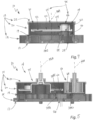
- FIG. 1 An illustrative multi-way valve 10 configured to control the flow of fluid to various thermal fluid circuits in a vehicle is shown in Fig. 1 .
- the multi-way valve 10 includes a valve housing 12, a valve flow controller 14, and a sealing system 16.
- the valve flow controller 14 is arranged in the valve housing 12 to control flow through the valve housing 12.
- the sealing system 16 is configured to seal between the valve housing 12 and the valve flow controller 14.
- the valve flow controller 14 includes a first valve rotor 38 arranged in a first valve cavity 30 formed by the valve housing 12, a second valve rotor 40 arranged in a second valve cavity 32 formed by the valve housing 12, and actuators 28 as shown in Figs. 1-6 .
- the first valve rotor 38 is configured to rotate relative to the valve housing 12 about a first rotor axis 38A and the second valve rotor 40 is configured to rotate relative to the valve housing 12 about a second rotor axis 40A.
- the second rotor axis 40A is parallel to the first rotor axis 38A.
- Each actuator 28 is coupled to one of the valve rotors 38, 40 to drive rotation of the corresponding valve rotor 38, 40.
- the first and second valve rotors 38, 40 cooperate to define a plurality of flow paths through the valve housing 12. As the first and second valve rotors 38, 40 are rotated about the respective rotor axes 38A, 40A to different set positions, the first and second valve rotors 38, 40 form different flow paths to control a flow of fluid through the valve housing 12 to different thermal fluid circuits.
- the different modes of the multi-way valve 10 are shown in Fig. 7 .
- the first and second valve rotors 38, 40 are in different predetermined positions in each of the different modes A-E to form the different flow paths through the valve housing 12.
- the multi-way valve 10 and/or each of the actuators 28 may include a control unit that is preprogrammed with the different modes A-E.
- the first valve rotor 38 is formed to include a plurality of first rotor through holes 42 that extend axially through the first valve rotor 38 relative to the first rotor axis 38A and are spaced apart circumferentially around the first rotor axis 38A as shown in Figs. 2-6 .
- the first rotor through holes 42 extend axially through the first valve rotor 38 so that the flow of fluid is able to flow axially through the first valve rotor 38 parallel to the first rotor axis 38A.
- the sealing system 16 uses press-fit seals that are each press fit into apertures in the valve housing 12
- valves may have more complex passageways through the valve housing, which complicates sealing and increases the pressure drop as the fluid has to make more turns/changes direction more.
- the complex passageways may increase the potential for leaks across the different passageways.
- These valves may incorporate seals to seal between the passageways, but adding seals may require the actuator to have an increased torque capability to overcome the friction of the seals between the different components.
- valves may use a Teflon material for the seals. This may make manufacturing a multi-way valve expensive, especially as other valves have complex passageways with large, complex seals that may need large amounts of Teflon material.
- the multi-way valve 10 of the present disclosure includes first valve rotor 38 with axially extending through holes 42 so that the pressure drop is reduced. Additionally, the seals 76 are press-fit into the upper housing body 20 to engage the axially facing surface 38S of the first valve rotor 38, thereby reducing the contract surface area of the seals 76 with the first valve rotor 38. This not only improves sealing between the holes 42 and the apertures 34A-G in the upper housing body 20 because the flow path is less complicated, but the sealing system 16 also uses less material for the seals and reduces the friction on the first valve rotor 38.
- the valve housing includes a lower housing body 18, an upper housing body 20, and a valve housing cover 22 as shown in Figs. 1-6 .
- the lower housing body 18 is coupled to a manifold of the thermal fluid circuits.
- the upper housing body 20 is coupled to the lower housing body 18.
- the valve housing cover 22 is coupled to the upper housing body 20 to close top openings of the first and second valve cavities 30, 32.
- the valve housing 12 further includes a manifold gasket 17 and a housing gasket 19 as shown in Figs. 2 , 4, and 5 .
- the manifold gasket 17 is located axially between the manifold and the lower housing body 18.
- the housing gasket 19 is located axially between the lower housing body 18 and the upper housing body 20 of the valve housing 12.
- the lower housing body 18 is formed to include a plurality of lower housing passageways 24A-G as shown in Figs. 2-4 .
- the plurality of lower housing passageways 24A-G are in fluid communication with different thermal fluid circuits.
- the plurality of lower housing passageways 24A-G are in fluid communication with at least one of the first valve cavity 30 and the second valve cavity 32 of the upper housing body 20 through the corresponding apertures 34A-G.
- the plurality of lower housing passageways 24A-G includes a connecting passageway 24A that is in fluid communication with both the first and second valve cavities 30, 32.
- the connecting passageway 24A of the lower housing body 18 has an inlet opening 26 that opens into the connecting passageway 24A as shown in Fig. 4 .
- the inlet opening 26 opens into the connecting passageway 24A between the first and second valve cavities 30, 32 in the illustrative embodiment.
- the upper housing body 20 is shaped to define the first valve cavity 30 and the second valve cavity 32 as shown in Figs. 2-6 .
- the second valve cavity 32 is in fluid communication with the first valve cavity 30 through the connecting passageway 24A of the lower housing body 18.
- the upper housing body 20 is also formed to include a plurality of upper housing apertures 34A-G as shown in Figs. 2-6 .
- Each upper housing aperture 34A-G of the plurality of upper housing apertures 34A-G is in fluid communication with one passageway 24A-G of the corresponding lower housing passageways 24A-G.
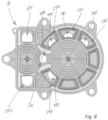
- the plurality of upper housing apertures 34A-G includes a first aperture 34A1, a second aperture 34B, a third aperture 34C, a fourth aperture 34D, a fifth aperture 34E, a sixth aperture 34F, a seventh aperture 34G, and an either aperture 34A2 as shown in Figs. 6 and 7A-E .
- the first aperture 34A1, the second aperture 34B, the third aperture 34C, the fourth aperture 34D, and the fifth aperture 34E open into the first valve cavity 30.
- the sixth aperture 34F, the seventh aperture 34G, and the either aperture 34A2 open into the second valve cavity 32.
- the first and eighth apertures 34A1, 34A2 are in fluid communication with the connecting passageway 24A of the plurality of lower housing passageways 24A-G.
- Each of the seals 76 of the sealing system 16 are press-fit into one of the second aperture 34B, the third aperture 34C, the fourth aperture 34D, and the fifth aperture 34E as shown in Fig. 4 .
- Each seal 76 engages an axially facing surface 38S of the first valve rotor 38.
- the valve flow controller 14 includes the first valve rotor 38, also referred to as the main valve rotor 38, and the second valve rotor 40, also referred to as the throttle valve rotor 40.
- the main valve rotor 38 is arranged in the first valve cavity 30 of the upper housing body 20 and the throttle valve rotor 40 is arranged in the second valve cavity 32 of the upper housing body 20.
- the main valve rotor 38 is configured to rotate relative to the upper housing body 20 about the first rotor axis 38A and the throttle valve rotor 40 is configured to rotate relative to the upper housing body 20 about the second rotor axis 40A.
- the first and second valve rotors 38, 40 cooperate to define a plurality of flow paths through the upper housing body 20 and the lower housing body 18. As the first and second valve rotors 38, 40 are rotated about the respective rotor axes 38A, 40A to different set positions, the first and second valve rotors 38, 40 form different flow paths to control the flow of fluid through the upper housing apertures 34A-G of the upper housing body 20 and the lower housing passageways 24A-G of the lower housing body 18.
- the first valve rotor 38 includes a first valve rotor body 44 and at least one valve rotor cover 46 coupled to the first valve rotor body 44 as shown in Figs. 2-6 .
- the first valve rotor body 44 includes a first valve rotor hub 50, a first valve rotor plate 52, and a first flow divider wall 54 as shown in Fig. 6 .
- the first valve rotor plate 52 extends radially outward from the first valve rotor hub 50 and extends circumferentially around the first valve rotor hub 50 relative to the first rotor axis 38A.
- the first valve rotor plate 52 is flat or planar.
- the first rotor through holes 42 extend axially through the first valve rotor plate 52 in the illustrative embodiment.
- the first flow divider wall 54 extends axially away from the first valve rotor plate 52.
- the first flow divider wall 54 extends around at least two first rotor through holes 42 of the plurality of first rotor through holes 42 as shown in Fig. 6 .
- the first valve rotor cover 46 couples to the first flow divider wall 54 to block off the two first rotor through holes 42 surrounded by the first rotor flow divider wall 54 from the other through holes 42.
- the first flow divider wall 54 and the valve rotor cover 46 define a chamber that is separated from the rest of the first valve cavity 30. In this way, the fluid flows directly between the two first rotor through holes 42 surrounded by the first flow divider wall 54 through the chamber.
- the first valve rotor plate 52 controls the flow to each aperture 34A1, 34B, 34C, 34D, 34E included in the upper housing apertures 34A-G as shown in Figs. 7A-7E .
- the first valve rotor plate 52 controls the flow to each aperture 34A1, 34B, 34C, 34D, 34E by aligning different first rotor through holes 42 with different apertures 34A1, 34B, 34C, 34D, 34E in the different predetermined positions.
- portions of the first valve rotor plate 52 covers one of the apertures 34A1, 34B, 34C, 34D, 34E to block the flow of fluid therethrough.
- the first valve rotor plate 52 has dead spots without a through hole 42. In this way, when the first valve rotor 38 is in certain predetermined positions, the first valve rotor plate 52 blocks flow through one of the upper housing apertures 34A-G. Rather, the seal 76 engages the dead spot on the first valve rotor 38 so that the corresponding upper housing aperture 34A-G is covered and blocked.
- the second valve rotor 40 includes a second valve rotor plate 60 and a plurality of second valve rotor walls 62, 64, 66 as shown in Fig. 6 .
- the second valve rotor plate 60 is formed to define a second rotor through hole 68 that extends axially through the second valve rotor plate 60 relative to the second rotor axis 40A so that the flow of fluid is able to flow axially through the throttle valve rotor 40 parallel to the second rotor axis 40A.
- the second rotor through hole 68 extends circumferentially partway about the second rotor axis 40A in the illustrative embodiment.
- the second valve rotor walls 62, 64, 66 extend axially away from the second valve rotor plate 60.
- the second valve rotor walls 62, 64, 66 are spaced apart circumferentially to define a plurality of second valve rotor ports 70, 72, 74.
- the second valve rotor walls 62, 64, 66 vary the amount of fluid flowing through the apertures 34A2, 34F, 34G included in the plurality of upper housing apertures 34A-G.
- the different valve rotor walls 62, 64, 66 partially open, fully open, or close the apertures 34A2, 34F, 34G in the different predetermined positions to control therethrough.
- a portion of the second valve rotor plate 60 covers the eighth aperture 34A2 to block the flow of fluid therethrough.
- the different modes of the multi-way valve 10 are shown in Fig. 7 .
- the first mode or mode A is shown in Fig. 7A .
- the second mode or mode B is shown in Fig. 7B .
- the third mode or mode C is shown in Fig. 7C .
- the fourth mode or mode D is shown in Fig. 7D .
- the fifth mode or mode E is shown in Fig. 7E .
- the main valve rotor 38 is in a MAIN VALVE ROTOR FIRST position and the throttle valve rotor 40 is in a THROTTLE VALVE ROTOR FIRST position.
- the main valve rotor 38 connects the first aperture 34A1 to the second aperture 34B, connects the third aperture 34C and the fifth aperture 34E, and covers the fourth aperture 34D to form the first flow path.
- the first flow divider wall 54 surrounds the third and fifth apertures 34C, 34E.
- the throttle valve rotor 40 covers the eight aperture 34A2 to block flow from the connecting passageway 24A and connects the sixth aperture 34F and the seventh aperture 34G.
- mode B the main valve rotor 38 stays in the MAIN VALVE ROTOR FIRST position, while the throttle valve rotor 40 moves to a THROTTLE configuration.
- the throttle valve rotor 40 has rotated to uncover the eight aperture 34A2 to allow flow from the connecting passageway 24A through the eighth aperture 34A2.
- the throttle valve rotor 40 can rotate about the second rotor axis 40A to vary, or throttle, the flow through the sixth and seventh apertures 34F, G.
- mode C the main valve rotor 38 stays in the MAIN VALVE ROTOR FIRST position and the throttle valve rotor 40 moves to a THROTTLE VALVE ROTOR SECOND position.
- the hole 68 is aligned with the eighth aperture 34A2 such that one of the second valve rotor wall 66 covers the sixth aperture 34F of the upper housing body 20 to block flow therethrough. In this way, the eight aperture 34A2 is connected to the seventh aperture 34G
- mode D the throttle valve rotor 40 stays in the THROTTLE VALVE ROTOR FIRST position, while the main valve rotor 38 moves to a MAIN VALVE ROTOR SECOND position.
- MAIN VALVE ROTOR SECOND position the main valve rotor 38 has rotated to connect the second aperture 34B and the third aperture 34C, to connect the first aperture 34A1 and the fourth aperture 34D, to cover the fifth aperture 34E.
- the second and third apertures 34B, 34C are surrounded by the first flow divider wall 54.
- mode E the main valve rotor 38 moves to a MAIN VALVE ROTOR THIRD position, while the throttle valve rotor 40 is in the THROTTLE configuration.
- the main valve rotor 38 In the MAIN VALVE ROTOR THIRD position, the main valve rotor 38 has rotated to connect all the apertures 34A-G.
- the multi-way valve 10 and/or each of the actuators 28 may include the control unit configured to direct the actuators 28 to move each of the valve rotors 38, 40 to the different predetermined positions in each of the different modes A-E. Based on where the vehicle needs fluid, the control unit would direct the actuators 28 to move each of the valve rotors 38, 40 to one of the positions for the desired mode.
- FIG. 9-13 Another embodiment of a multi-way valve 210 in accordance with the present disclosure is shown in Figs. 9-13 .
- the multi-way valve 210 is substantially similar to the multi-way valve 10 shown in Figs. 1-8 and described herein. Accordingly, similar reference numbers in the 200 series indicate features that are common between the multi-way valve 10 and the multi-way valve 210.
- the description of the multi-way valve 10 is incorporated by reference to apply to the multi-way valve 210, except in instances when it conflicts with the specific description and the drawings of the multi-way valve 210.
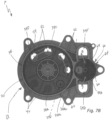
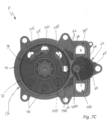
- the multi-way valve 210 includes a valve housing 212, a valve flow controller 214, and a sealing system 216 as shown in Figs. 9-11 .
- the valve flow controller 214 is arranged in the valve housing 212 to control flow through the valve housing 212.
- the valve flow controller 214 includes first and second valve rotors 238, 240.
- the sealing system 216 is configured to seal between the valve housing 212 and the valve flow controller 214.
- the sealing system 216 includes the press-fit seals (not shown) and a biasing assembly 274 as shown in Figs. 9 and 10 .
- the press-fit seals are each press fit into a corresponding upper housing aperture formed in the upper housing body 220 of the valve housing 212 and engage an axially facing surface 238S of the first valve rotor 238.
- the biasing assembly 274 is configured to selectively apply an axial force F on the first valve rotor 238 to urge the first valve rotor 238 into engagement with the plurality of seals when the first valve rotor 238 is in one of the different predetermined positions in each of the modes A-E to improve sealing between the first valve rotor 238 and the upper housing body 220.
- the biasing assembly 274 selectively applies the axial force F to increase friction between the first valve rotor 238 and the seals at the different predetermined positions, but removes the axial force when the first valve rotor 238 rotates to reduce the friction between the first valve rotor 238 and the seals. In this way, the torque needed to rotate the first valve rotor 238 is reduced and the wear on the seals is reduced.
- the seals are made of a Teflon material in the illustrative embodiment.
- the biasing assembly 274 includes cam ramps 276 formed on an axially facing 222S surface of the housing cover 222 of the valve housing 212 and a cam surface 278 formed on the first valve rotor 238 as shown in Figs. 9-13 .
- the cam ramps 276 are equally spaced apart circumferentially about the first rotor axis 238A.
- the cam surface 278 is configured to engage the cam ramps 276 on the housing cover 222 as the first valve rotor 238 rotates about the first rotor axis 238A to the plurality of different predetermined positions.
- the cam surface 278 is formed on an axially facing surface 250S of the first valve rotor hub 250 as shown in Figs. 10-12 .
- the cam surface 278 is raised at 45-degree intervals around the first rotor axis 238A.
- the cam ramps 276 on the housing cover 222 are each circumferentially aligned with one upper housing aperture 234A1, 234B, 234C, 234D, 234E formed in the upper housing body 220 of the valve housing 212.
- the raised portions 278P of the cam surface 278 engages one of the cam ramps 276 in each of the different predetermined positions to cause the axial force F to be applied to the first valve rotor 238.
- the raised portions 278P of the cam surface 278 disengage the cam ramps 276 so that the axial force F is removed and the torque needed to rotate the first valve rotor 238 is reduced.
- the cam ramps 276 are fixed on the housing cover 222.
- the cam surface 278 on the first valve rotor 238 rides against the cam ramps 276 in a circular manner and applies downward axial force F to the first valve rotor 238 when aligned with the high point 278P of the cam surface 278.
- This force F generates a contact pressure between the underside of the first valve rotor 238 and the elastomer seal press-fit into the upper housing body 220.
- the increased contact pressure and resulting increase in friction are only generated when the through hole 242 is aligned with the seal. This reduces friction and torque on the actuator during movement between seal points.
- FIG. 9-13 Another embodiment of a multi-way valve 310 in accordance with the present disclosure is shown in Figs. 9-13 .
- the multi-way valve 310 is substantially similar to the multi-way valve 10 shown in Figs. 1-8 and described herein. Accordingly, similar reference numbers in the 300 series indicate features that are common between the multi-way valve 10 and the multi-way valve 310.
- the description of the multi-way valve 10 is incorporated by reference to apply to the multi-way valve 310, except in instances when it conflicts with the specific description and the drawings of the multi-way valve 310.
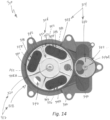
- the multi-way valve 310 includes a valve housing 312, a valve flow controller 314, and a sealing system (not shown) as shown in Figs. 14-16 .
- the valve flow controller 314 is arranged in the valve housing 312 to control flow through the valve housing 312.
- the sealing system 316 is configured to seal between the valve housing 312 and the valve flow controller 314.
- valve housing 312 has a greater number of upper housing apertures 334A-K than the valve housing 12. In this way, the multi-way valve 310 is configured to control the flow through more thermal fluid circuits.
- the lower housing body 318 of the valve housing 312 is formed to include a plurality of lower housing passageways 324A-K as shown in Fig. 16 .
- the plurality of lower housing passageways 324A-K are in fluid communication with different thermal fluid circuits.
- the plurality of lower housing passageways 324A-K are in fluid communication with at least one of a first valve cavity 330 and a second valve cavity 332 of the upper housing body 220 through the corresponding apertures 334A-G.
- the upper housing body 320 is also formed to include a plurality of upper housing apertures 334A-K as shown in Fig. 15 .
- Each aperture 334A-K of the plurality of upper housing apertures 334A-K is in fluid communication with one passageway 324A-K of the corresponding lower housing passageways 324A-K.
- Each of the seals 376 of the sealing system 316 are press-fit into one of the apertures 334A1, 334B, 334C, 334D, 334E, 334F, 334G, 334H as shown in Fig. 15 .
- Each seal engages an axially facing surface of the first valve rotor 338.
- the valve flow controller 314 includes the first valve rotor 338, also referred to as the main valve rotor 38, and the second valve rotor 340, also referred to as the throttle valve rotor 340.
- the main valve rotor 338 is arranged in the first valve cavity 330 of the upper housing body 320 and the throttle valve rotor 340 is arranged in the second valve cavity 332 of the upper housing body 20.
- the main valve rotor 338 is configured to rotate relative to the upper housing body 320 about the first rotor axis 338A and the throttle valve rotor 340 is configured to rotate relative to the upper housing body 20 about the second rotor axis 340A.
- the first and second valve rotors 338, 340 cooperate to define a plurality of flow paths through the upper housing body 320 and the lower housing body 318 much like the first and second valve rotors 38, 40 in Figs. 1-9 . However, there are more possible modes since there are a greater number of upper housing apertures 334A-K. As the first and second valve rotors 338, 340 are rotated about the respective rotor axes 38A, 40A to different set positions, the first and second valve rotors 338, 340 form different flow paths to control the flow of fluid through valve housing 312.
- the first valve rotor 338 includes a first valve rotor body 344 and three valve rotor covers 346, 347, 348 as shown in Fig. 14 . Each of the valve rotor covers 346, 347, 348 are coupled to the first valve rotor body 344.
- the first valve rotor body 344 includes a first valve rotor hub 350, a first valve rotor plate 352, and three flow divider walls 354, 356, 358 as shown in Fig. 14 .
- the first valve rotor plate 352 extends radially outward from the first valve rotor hub 350 and extends circumferentially around the first valve rotor hub 350 relative to the first rotor axis 338A.
- the first rotor through holes 342 extend axially through the first valve rotor plate 352 in the illustrative embodiment.
- Each of the flow divider walls 354, 356, 358 extends axially away from the first valve rotor plate 352.
- each of the flow divider walls 354, 356, 358 extends around at least two first rotor through holes 342 of the plurality of first rotor through holes 342 as suggested in Fig. 14 .
- the first valve rotor cover 346 couples to the first flow divider wall 354, the second valve rotor cover 347 couples to the second flow divider wall 356, and the third valve rotor cover 348 couples to the third flow divider wall 358.
Landscapes
- Engineering & Computer Science (AREA)
- General Engineering & Computer Science (AREA)
- Mechanical Engineering (AREA)
- Physics & Mathematics (AREA)
- Electromagnetism (AREA)
- Multiple-Way Valves (AREA)
Claims (15)
- Ein Mehrwegeventil (10, 210, 310); umfassendein Ventilgehäuse (12, 212, 312), das einen unteren Gehäusekörper (18, 318), der mit einem Verteiler von thermischen Fluidkreisläufen verbunden ist, einen oberen Gehäusekörper (20, 320), der mit dem unteren Gehäusekörper (18, 318) verbunden und so geformt ist, dass er einen ersten Ventilhohlraum (30, 330) und einen zweiten Ventilhohlraum (32, 332) definiert, der mit dem ersten Ventilhohlraum (30, 330) durch den unteren Gehäusekörper (18, 318) in Fluidverbindung steht, und einen Gehäusedeckel (22, 222) enthält, der mit dem oberen Gehäusekörper (20, 320) verbunden ist, um obere Öffnungen des ersten und des zweiten Ventilhohlraums (30, 330, 32, 332) zu schließen, wobei der untere Gehäusekörper (18, 318) so ausgebildet ist, dass er eine Vielzahl von unteren Gehäusedurchgängen enthält, und der erste und der zweite Ventilhohlraum (30, 330, 32, 332) des oberen Gehäusekörpers (20, 320) in Fluidverbindung mit der Vielzahl von unteren Gehäusedurchgängen stehen, undeinen Ventildurchflussregler (14, 214, 314), der einen ersten Ventilrotor (38, 238, 338), der in dem ersten Ventilhohlraum (30, 330) des oberen Gehäusekörpers (20, 320) angeordnet und dazu eingerichtet ist, sich relativ zu dem oberen Gehäusekörper (20, 320) um eine erste Rotorachse (38A, 238A, 338A) zu drehen, und einen zweiten Ventilrotor (40, 340) enthält, der in dem zweiten Ventilhohlraum (32, 332) des oberen Gehäusekörpers (20, 320) angeordnet und dazu eingerichtet ist, sich relativ zu dem oberen Gehäusekörper (20, 320) um eine zweite Rotorachse zu drehen, die parallel zu der ersten Rotorachse (38A, 238A, 338A) ist, wobei der erste und der zweite Ventilrotor zusammenwirken, um eine Vielzahl von Strömungspfaden zu definieren, wenn das erste und das zweite Ventil um die jeweilige Rotorachse in eine Vielzahl von verschiedenen vorbestimmten Positionen gedreht werden, um eine Strömung von Fluid durch den oberen Gehäusekörper (20, 320) und den unteren Gehäusekörper (18, 318) zu steuern,wobei der erste Ventilrotor (38, 238, 338) so ausgebildet ist, dass er eine Vielzahl von ersten Rotordurchgangslöchern enthält, die sich axial durch den ersten Ventilrotor (38, 238, 338) relativ zu der ersten Rotorachse (38A, 238A, 338A) erstrecken, so dass der Fluidstrom in der Lage ist, axial durch den ersten Ventilrotor (38, 238, 338) parallel zu der ersten Rotorachse (38A, 238A, 338A) zu fließen.
- Das Mehrwegeventil (10, 210, 310) nach Anspruch 1, wobei der erste Ventilrotor (38, 238, 338) einen ersten Ventilrotorkörper und mindestens einen Ventilrotordeckel enthält, der mit dem ersten Ventilrotorkörper verbunden ist.
- Das Mehrwegeventil (10, 210, 310) nach Anspruch 2, wobei der erste Ventilrotorkörper eine erste Ventilrotornabe, eine erste Ventilrotorplatte, die sich von der ersten Ventilrotornabe radial nach außen und in Umfangsrichtung um die erste Ventilrotornabe relativ zur ersten Rotorachse (38A, 238A, 338A) erstreckt, und eine erste Strömungsteilerwand (54, 354) enthält, die sich axial von der ersten Ventilrotorplatte weg erstreckt, wobei sich die erste Strömungsteilerwand (54, 354) um mindestens zwei erste Rotordurchgangslöcher der Vielzahl von ersten Rotordurchgangslöchern herum erstreckt, und der erste Ventilrotordeckel mit der ersten Strömungsteilerwand (54, 354) verbunden ist, um eine durch die erste Strömungsteilerwand (54, 354) gebildete obere Öffnung zu schließen.
- Das Mehrwegeventil (10, 210, 310) nach Anspruch 3, wobei der erste Ventilrotorkörper ferner eine zweite Strömungsteilerwand (356) enthält, die sich axial von der ersten Ventilrotorplatte weg erstreckt, wobei sich die zweite Strömungsteilerwand (356) um mindestens zwei erste Rotordurchgangslöcher der Vielzahl von ersten Rotordurchgangslöchern herum erstreckt, und der erste Ventilrotor (38, 238, 338) ferner einen weiteren Ventilrotordeckel enthält, der mit der zweiten Strömungsteilerwand (356) verbunden ist, um eine von der zweiten Strömungsteilerwand (356) gebildete obere Öffnung zu schließen.
- Das Mehrwegeventil (10, 210, 310) nach Anspruch 4, wobei der erste Ventilrotorkörper ferner eine dritte Strömungsteilerwand (358) enthält, die sich axial von der ersten Ventilrotorplatte weg erstreckt, wobei sich die dritte Strömungsteilerwand (358) um mindestens zwei erste Rotordurchgangslöcher der Vielzahl von ersten Rotordurchgangslöchern herum erstreckt, und der erste Ventilrotor (38, 238, 338) ferner einen weiteren Ventilrotordeckel enthält, der mit der dritten Strömungsteilerwand (358) verbunden ist, um eine von der dritten Strömungsteilerwand (358) gebildete obere Öffnung zu schließen.
- Das Mehrwegeventil (10, 210, 310) nach Anspruch 3, wobei das zweite Rotorventil eine zweite Ventilrotorplatte und eine Vielzahl von zweiten Ventilrotorwänden enthält, die sich axial von der zweiten Ventilrotorplatte weg erstrecken und in Umfangsrichtung voneinander beabstandet sind, um eine Vielzahl von zweiten Ventilöffnungen zu definieren, und wobei die zweite Ventilrotorplatte so ausgebildet ist, dass sie ein zweites Rotordurchgangsloch enthält, das sich axial durch den zweiten Ventilrotor (40, 340) relativ zur zweiten Rotorachse erstreckt, so dass der Fluidstrom in der Lage ist, axial durch den zweiten Ventilrotor (40, 340) parallel zur zweiten Rotorachse zu fließen.
- Das Mehrwegeventil (10, 210, 310) nach einem der Ansprüche 1 bis 6, ferner umfassend ein Dichtungssystem, das eine Vielzahl von Dichtungen enthält, die jeweils in eine entsprechende obere Gehäuseöffnung, die im oberen Gehäusekörper (20, 320) des Ventilgehäuses (12, 212, 312) ausgebildet ist, pressgepasst sind und mit einer axial ausgerichteten Oberfläche des ersten Ventilrotors (38, 238, 338) in Eingriff stehen.
- Das Mehrwegeventil (10, 210, 310) nach Anspruch 7, wobei das Dichtungssystem ferner Vorspannmittel zum Aufbringen einer axialen Kraft auf den ersten Ventilrotor (38, 238, 338) enthält, um den ersten Ventilrotor (38, 238, 338) in Eingriff mit der Vielzahl von Dichtungen zu drängen, wenn sich der erste Ventilrotor (38, 238, 338) in einer der Vielzahl der verschiedenen vorbestimmten Positionen befindet, um die Abdichtung zwischen dem ersten Ventilrotor (38, 238, 338) und dem oberen Gehäusekörper (20, 320) zu verbessern und um die axiale Kraft auf den ersten Ventilrotor (38, 238, 338) zu entfernen, um Reibung zwischen dem ersten Ventilrotor (38, 238, 338) und der Vielzahl von Dichtungen zu verringern, wenn der erste Ventilrotor (38, 238, 338) um die erste Rotorachse (38A, 238A, 338A) von einer Position zu einer anderen Position gedreht wird, die in der Vielzahl der verschiedenen vorbestimmten Positionen enthalten ist.
- Das Mehrwegeventil (10, 210, 310) nach Anspruch 8, wobei das Vorspannmittel Nockenrampen auf einer axial ausgerichteten Fläche des Gehäusedeckels (22, 222) des oberen Gehäusekörpers (20, 320) und eine Nockenfläche auf dem ersten Ventilrotor (38, 238, 338) enthält, die dazu eingerichtet ist, mit den Nockenrampen auf dem Gehäusedeckel (22, 222) in Eingriff zu kommen, wenn sich der erste Ventilrotor (38, 238, 338) um die erste Rotorachse (38A, 238A, 338A) in die Vielzahl von verschiedenen vorbestimmten Positionen dreht.
- Das Mehrwegeventil (10, 210, 310) nach Anspruch 9, wobei die Nockenfläche in 45-Grad-Intervallen um die erste Rotorachse (38A, 238A, 338A) angehoben ist und die Nockenrampen auf dem Gehäusedeckel (22, 222) jeweils mit einer oberen Gehäuseöffnung ausgerichtet sind, die im oberen Gehäusekörper (20, 320) des Ventilgehäuses (12, 212, 312) gebildet ist.
- Das Mehrwegeventil (10, 210, 310) nach Anspruch 7, wobei das Dichtungssystem ferner eine Vorspannanordnung enthält, die dazu eingerichtet ist, selektiv eine axiale Kraft auf den ersten Ventilrotor (38, 238, 338) auszuüben, um den ersten Rotor in Eingriff mit der Vielzahl von Dichtungen zu drängen, wenn sich der erste Ventilrotor (38, 238, 338) in einer der Vielzahl von verschiedenen vorbestimmten Positionen befindet, um die Abdichtung zwischen dem ersten Ventilrotor (38, 238, 338) und dem oberen Gehäusekörper (20, 320) zu verbessern.
- Das Mehrwegeventil (10, 210, 310) nach Anspruch 11, wobei das Vorspannmittel Nockenrampen auf einer axial ausgerichteten Fläche des Gehäusedeckels (22, 222) des Ventilgehäuses (12, 212, 312) und eine Nockenfläche auf dem ersten Ventilrotor (38, 238, 338) enthält, die dazu eingerichtet ist, mit den Nockenrampen auf dem oberen Gehäusedeckel (22, 222) in Eingriff zu kommen, wenn sich der erste Ventilrotor (38, 238, 338) um die erste Rotorachse (38A, 238A, 338A) in die Vielzahl von verschiedenen vorbestimmten Positionen dreht.
- Das Mehrwegeventil (10, 210, 310) nach Anspruch 12, wobei die Nockenfläche in 45-Grad-Intervallen um die erste Rotorachse (38A, 238A, 338A) angehoben ist und die Nockenrampen auf dem oberen Gehäusedeckel (22, 222) jeweils mit einer im oberen Gehäusekörper (20, 320) des Ventilgehäuses (12, 212, 312) gebildeten oberen Gehäuseöffnung ausgerichtet sind.
- Das Mehrwegeventil (10, 210, 310) nach einem der Ansprüche 1 bis 6, wobei der untere Gehäusekörper (18, 318) einen Gehäusedurchgang mit Endöffnungen bildet, die mit einer Öffnung im oberen Gehäusekörper (20, 320), die in den ersten Ventilhohlraum (30, 330) mündet, und einer weiteren Öffnung im oberen Gehäusekörper (20, 320), die in den zweiten Ventilhohlraum (32, 332) mündet, fluchten, so dass der erste und der zweite Ventilhohlraum (30, 330, 32, 332) in Fluidverbindung stehen.
- Das Mehrwegeventil (10, 210, 310) nach einem der Ansprüche 1 bis 14, wobei der obere Gehäusekörper (20, 320) und der untere Gehäusekörper (18, 318) des Mehrwegeventils als ein einstückiges Bauteil ausgebildet sind.
Applications Claiming Priority (1)
| Application Number | Priority Date | Filing Date | Title |
|---|---|---|---|
| US202263414205P | 2022-10-07 | 2022-10-07 |
Publications (3)
| Publication Number | Publication Date |
|---|---|
| EP4350182A1 EP4350182A1 (de) | 2024-04-10 |
| EP4350182C0 EP4350182C0 (de) | 2025-04-02 |
| EP4350182B1 true EP4350182B1 (de) | 2025-04-02 |
Family
ID=86405786
Family Applications (1)
| Application Number | Title | Priority Date | Filing Date |
|---|---|---|---|
| EP23201738.4A Active EP4350182B1 (de) | 2022-10-07 | 2023-10-05 | Mehrwegeventil |
Country Status (3)
| Country | Link |
|---|---|
| US (1) | US12422050B2 (de) |
| EP (1) | EP4350182B1 (de) |
| CN (2) | CN117847264A (de) |
Families Citing this family (3)
| Publication number | Priority date | Publication date | Assignee | Title |
|---|---|---|---|---|
| CN118705420A (zh) * | 2023-09-18 | 2024-09-27 | 广东德昌电机有限公司 | 电动阀及热管理模组 |
| EP4553350A1 (de) | 2023-11-10 | 2025-05-14 | Stant USA Corp. | Mehrwegeventil mit durchflussregler |
| US20250341259A1 (en) * | 2024-05-03 | 2025-11-06 | Stant Usa Corp. | Multi-way valve with seal having decoupled seal force vectors for reduced valve actuation power requirements |
Family Cites Families (58)
| Publication number | Priority date | Publication date | Assignee | Title |
|---|---|---|---|---|
| US2209992A (en) * | 1938-03-19 | 1940-08-06 | Chester T Mcgill | Multiport lift-turn valve |
| GB905924A (en) | 1960-03-02 | 1962-09-12 | English Electric Co Ltd | Improvements in and relating to the control of the cooling water system of condensers, for example in a steam turbine plant |
| US3742979A (en) * | 1972-03-02 | 1973-07-03 | G Woodling | Rotary valve device having a plurality of controlled working passages |
| US3927693A (en) | 1974-10-11 | 1975-12-23 | Minnesota Mining & Mfg | High-pressure valve |
| US4429717A (en) | 1981-09-04 | 1984-02-07 | Montgomery Robert N | Valve for controlling the flow of semi-liquid compositions |
| FR2685944B1 (fr) * | 1992-01-08 | 1995-05-19 | Snecma | Valve rotative de distribution de fluide et ensemble de valves en faisant application. |
| US5431189A (en) | 1994-02-17 | 1995-07-11 | Jones; Ronald H. | Flow control manifold and gauge |
| US5529758A (en) | 1995-05-15 | 1996-06-25 | Houston; Reagan | Three-bed rotary valve and fume incineration system |
| US6245233B1 (en) | 1997-11-26 | 2001-06-12 | Chih Wen Lu | Water filtering apparatus with water flow switch valve device |
| DE19932313A1 (de) * | 1999-07-10 | 2001-01-18 | Daimler Chrysler Ag | Steuervorrichtung für den Kühl- und Heizungskreislauf einer Brennkraftmaschine |
| US6347644B1 (en) * | 2000-03-03 | 2002-02-19 | Chemical Engineering Corporation | Bypass valve for water treatment system |
| FR2827356B1 (fr) * | 2001-07-11 | 2004-11-05 | Valeo Thermique Moteur Sa | Vanne de commande a disques pour circuit de circulation fluide |
| DE10153222B4 (de) | 2001-10-31 | 2012-07-12 | Grohe Ag | Mischventil |
| FR2844571B1 (fr) | 2002-09-18 | 2008-02-29 | Valeo Thermique Moteur Sa | Vanne de commande pour un circuit de fluide et circuit comportant cette vanne |
| AU2003284365A1 (en) | 2002-10-30 | 2004-06-07 | Kinetico Incorporated | Bypass valve |
| US20080223464A1 (en) | 2007-03-15 | 2008-09-18 | Merrell Douglas E | Flow Diverters for Valves, Valves, and In-Floor Pool Cleaning Systems |
| US7819948B2 (en) * | 2007-10-29 | 2010-10-26 | Air Products And Chemicals, Inc. | Rotary valve |
| US9371921B2 (en) | 2009-06-23 | 2016-06-21 | Nordson Corporation | Multi-port valve |
| US8375990B2 (en) | 2010-02-24 | 2013-02-19 | Masco Corporation Of Indiana | Mixing valve including dual flow control |
| US8336319B2 (en) | 2010-06-04 | 2012-12-25 | Tesla Motors, Inc. | Thermal management system with dual mode coolant loops |
| US20140053931A1 (en) | 2012-08-23 | 2014-02-27 | Nordson, Inc. | Multiple port stopcock valve |
| US9212751B2 (en) | 2012-09-28 | 2015-12-15 | Robertshaw Controls Company | Valve system and method |
| US9347577B2 (en) * | 2013-08-30 | 2016-05-24 | Flextronics Automotive, Inc. | Combined thermal management unit |
| DE102015210241A1 (de) | 2014-06-05 | 2015-12-17 | Schaeffler Technologies AG & Co. KG | Drehventil mit einem isolierenden Verteilungskörper |
| CN204610957U (zh) * | 2015-04-10 | 2015-09-02 | 张辛悦 | 磨盘回转式同步换向阀 |
| US9777469B2 (en) | 2015-09-27 | 2017-10-03 | Geann Industrial Co. Ltd. | Control valve in water channel |
| US10344877B2 (en) | 2015-12-01 | 2019-07-09 | Tesla Motors, Inc. | Multi-port valve with multiple operation modes |
| WO2017125914A1 (en) * | 2016-01-18 | 2017-07-27 | Ham-Let (Israel - Canada ) Ltd. | Stream switching valve with synchronizing mechanism |
| US10665908B2 (en) | 2016-06-23 | 2020-05-26 | Tesla, Inc. | Heating and cooling reservoir for a battery powered vehicle |
| CN106090315B (zh) * | 2016-07-13 | 2018-08-07 | 北汽福田汽车股份有限公司 | 一种暖风流量控制机构、车载空调系统及车辆 |
| EP3550189B1 (de) | 2016-11-29 | 2024-05-01 | Zhejiang Sanhua Intelligent Controls Co., Ltd. | Flussregelungsvorrichtung |
| US10556481B2 (en) | 2017-06-26 | 2020-02-11 | Toyota Motor Engineering & Manufacturing North America, Inc. | Systems and methods for providing heating and cooling to a vehicle cabin of autonomous vehicles |
| US11440376B2 (en) | 2017-08-04 | 2022-09-13 | Tesla, Inc. | Technologies for manifolds |
| US11168797B2 (en) | 2017-08-24 | 2021-11-09 | Vitesco Technologies USA, LLC | Combination multi-port valve |
| US10967702B2 (en) | 2017-09-07 | 2021-04-06 | Tesla, Inc. | Optimal source electric vehicle heat pump with extreme temperature heating capability and efficient thermal preconditioning |
| CN107893865A (zh) | 2017-10-30 | 2018-04-10 | 台州市国人温控卫浴设备有限公司 | 一种可承高压的恒温水龙头 |
| CN107940029B (zh) | 2017-11-14 | 2019-10-25 | 珠海格力电器股份有限公司 | 两位八通阀及电车空调系统 |
| US11084404B2 (en) | 2018-03-23 | 2021-08-10 | Tesla, Inc. | Vehicle seat with integrated temperature-control system |
| GB2579183A (en) * | 2018-11-22 | 2020-06-17 | Johnson Electric Int Ag | Disc valve assembly |
| US11175265B2 (en) * | 2019-03-04 | 2021-11-16 | Valeo Instruments Company, L.P. | Valve for high and ultra-high pressure liquid chromatography |
| CN210770428U (zh) | 2019-06-24 | 2020-06-16 | 盾安环境技术有限公司 | 三通水阀 |
| EP4077988B1 (de) * | 2019-12-19 | 2024-08-21 | Hella Gmbh & Co. Kgaa | Ventilsystem |
| WO2022057588A1 (zh) | 2020-09-21 | 2022-03-24 | 浙江盾安人工环境股份有限公司 | 管件连接结构、多通换向阀及空调系统 |
| CN112606676A (zh) * | 2020-12-28 | 2021-04-06 | 的卢技术有限公司 | 一种新能源汽车热管理系统零部件分层集成结构 |
| CN112682541B (zh) * | 2020-12-31 | 2025-06-13 | 四川芯智热控技术有限公司 | 车用热管理集成水阀及流道控制方法 |
| CN114688306A (zh) | 2020-12-31 | 2022-07-01 | 浙江三花汽车零部件有限公司 | 控制阀以及热管理组件 |
| DE102021101096A1 (de) | 2021-01-20 | 2022-07-21 | HELLA GmbH & Co. KGaA | Pumpenanordnung für ein Fahrzeug und Kühlmittelsystem für ein Fahrzeug mit einer Pumpenanordnung |
| CN214743520U (zh) | 2021-01-28 | 2021-11-16 | 箭牌家居集团股份有限公司 | 一种前置切换阀 |
| CN115199778A (zh) | 2021-04-13 | 2022-10-18 | 广东德昌电机有限公司 | 阀门 |
| CN214999563U (zh) | 2021-04-27 | 2021-12-03 | 浙江银轮机械股份有限公司 | 多通阀 |
| CN215059741U (zh) * | 2021-05-24 | 2021-12-07 | 浙江盾安人工环境股份有限公司 | 控制阀 |
| US20220390027A1 (en) * | 2021-06-08 | 2022-12-08 | Robert Bosch Gmbh | Rotary Disc Valve |
| US11585451B2 (en) * | 2021-06-08 | 2023-02-21 | Robert Bosch Llc | Rotary disc valve |
| US11572957B2 (en) * | 2021-06-08 | 2023-02-07 | Robert Bosch Gmbh | Rotary disc valve |
| CN217207877U (zh) | 2021-12-29 | 2022-08-16 | 浙江银轮机械股份有限公司 | 多通阀及其热管理系统 |
| CN114635991B (zh) | 2022-02-23 | 2023-03-21 | 海力达汽车科技有限公司 | 一种电子阀 |
| CN217539713U (zh) | 2022-04-24 | 2022-10-04 | 联合汽车电子有限公司 | 多通阀阀芯、阀体及多通阀 |
| CN221780053U (zh) | 2024-02-05 | 2024-09-27 | 海力达汽车科技有限公司 | 五通比例阀及热管理模块 |
-
2022
- 2022-11-16 CN CN202211438119.8A patent/CN117847264A/zh active Pending
- 2022-11-16 CN CN202223103159.5U patent/CN219082326U/zh active Active
-
2023
- 2023-10-05 EP EP23201738.4A patent/EP4350182B1/de active Active
- 2023-10-06 US US18/482,205 patent/US12422050B2/en active Active
Also Published As
| Publication number | Publication date |
|---|---|
| EP4350182C0 (de) | 2025-04-02 |
| EP4350182A1 (de) | 2024-04-10 |
| US12422050B2 (en) | 2025-09-23 |
| CN117847264A (zh) | 2024-04-09 |
| US20240117888A1 (en) | 2024-04-11 |
| CN219082326U (zh) | 2023-05-26 |
Similar Documents
| Publication | Publication Date | Title |
|---|---|---|
| EP4350182B1 (de) | Mehrwegeventil | |
| JP2009150556A (ja) | 方向制御弁 | |
| US11644112B2 (en) | Seal for rotary plug valve | |
| JP7714971B2 (ja) | ロータリバルブ | |
| US8936043B2 (en) | Rotary valve | |
| US20200256475A1 (en) | Valve | |
| US20240151318A1 (en) | Multi-way valve | |
| US20240229942A1 (en) | Throttle valve | |
| CN222543101U (zh) | 多路阀 | |
| US20240318733A1 (en) | Multi-way valve | |
| US12385570B2 (en) | Multi-way valve with dual actuators | |
| US20240229946A1 (en) | Multi-way valve with single valve rotor | |
| KR100512423B1 (ko) | 유압제어용 스풀밸브 | |
| JPH1194100A (ja) | 弁装置 | |
| EP3680523B1 (de) | Ventil | |
| CN113302423B (zh) | 具有至少一个换向阀的阀组件以及具有这种阀组件的离合器装置 | |
| US20250155033A1 (en) | Multi-way disc valve with flow controller | |
| EP0838622A1 (de) | Durchflussregelvorrichtung mit hohem Druckverlust | |
| KR102690515B1 (ko) | 멀티웨이밸브 장치 | |
| JP6705494B2 (ja) | バルブ装置および流体制御装置 | |
| KR20250102548A (ko) | 밸브 장치 | |
| CN120777381A (zh) | 旋转盘阀 | |
| CN120402669A (zh) | 一种多通水阀阀芯结构 | |
| JP2024535382A (ja) | バルブアセンブリ | |
| KR19980047163A (ko) | 압력 보상형 3방 밸브 |
Legal Events
| Date | Code | Title | Description |
|---|---|---|---|
| PUAI | Public reference made under article 153(3) epc to a published international application that has entered the european phase |
Free format text: ORIGINAL CODE: 0009012 |
|
| STAA | Information on the status of an ep patent application or granted ep patent |
Free format text: STATUS: THE APPLICATION HAS BEEN PUBLISHED |
|
| AK | Designated contracting states |
Kind code of ref document: A1 Designated state(s): AL AT BE BG CH CY CZ DE DK EE ES FI FR GB GR HR HU IE IS IT LI LT LU LV MC ME MK MT NL NO PL PT RO RS SE SI SK SM TR |
|
| STAA | Information on the status of an ep patent application or granted ep patent |
Free format text: STATUS: REQUEST FOR EXAMINATION WAS MADE |
|
| GRAP | Despatch of communication of intention to grant a patent |
Free format text: ORIGINAL CODE: EPIDOSNIGR1 |
|
| STAA | Information on the status of an ep patent application or granted ep patent |
Free format text: STATUS: GRANT OF PATENT IS INTENDED |
|
| 17P | Request for examination filed |
Effective date: 20241008 |
|
| RBV | Designated contracting states (corrected) |
Designated state(s): AL AT BE BG CH CY CZ DE DK EE ES FI FR GB GR HR HU IE IS IT LI LT LU LV MC ME MK MT NL NO PL PT RO RS SE SI SK SM TR |
|
| INTG | Intention to grant announced |
Effective date: 20241107 |
|
| GRAS | Grant fee paid |
Free format text: ORIGINAL CODE: EPIDOSNIGR3 |
|
| GRAA | (expected) grant |
Free format text: ORIGINAL CODE: 0009210 |
|
| STAA | Information on the status of an ep patent application or granted ep patent |
Free format text: STATUS: THE PATENT HAS BEEN GRANTED |
|
| AK | Designated contracting states |
Kind code of ref document: B1 Designated state(s): AL AT BE BG CH CY CZ DE DK EE ES FI FR GB GR HR HU IE IS IT LI LT LU LV MC ME MK MT NL NO PL PT RO RS SE SI SK SM TR |
|
| REG | Reference to a national code |
Ref country code: GB Ref legal event code: FG4D |
|
| REG | Reference to a national code |
Ref country code: CH Ref legal event code: EP |
|
| REG | Reference to a national code |
Ref country code: IE Ref legal event code: FG4D |
|
| U01 | Request for unitary effect filed |
Effective date: 20250402 |
|
| U07 | Unitary effect registered |
Designated state(s): AT BE BG DE DK EE FI FR IT LT LU LV MT NL PT RO SE SI Effective date: 20250408 |
|
| PG25 | Lapsed in a contracting state [announced via postgrant information from national office to epo] |
Ref country code: ES Free format text: LAPSE BECAUSE OF FAILURE TO SUBMIT A TRANSLATION OF THE DESCRIPTION OR TO PAY THE FEE WITHIN THE PRESCRIBED TIME-LIMIT Effective date: 20250402 |
|
| PG25 | Lapsed in a contracting state [announced via postgrant information from national office to epo] |
Ref country code: NO Free format text: LAPSE BECAUSE OF FAILURE TO SUBMIT A TRANSLATION OF THE DESCRIPTION OR TO PAY THE FEE WITHIN THE PRESCRIBED TIME-LIMIT Effective date: 20250702 Ref country code: GR Free format text: LAPSE BECAUSE OF FAILURE TO SUBMIT A TRANSLATION OF THE DESCRIPTION OR TO PAY THE FEE WITHIN THE PRESCRIBED TIME-LIMIT Effective date: 20250703 |
|
| PG25 | Lapsed in a contracting state [announced via postgrant information from national office to epo] |
Ref country code: PL Free format text: LAPSE BECAUSE OF FAILURE TO SUBMIT A TRANSLATION OF THE DESCRIPTION OR TO PAY THE FEE WITHIN THE PRESCRIBED TIME-LIMIT Effective date: 20250402 |
|
| PG25 | Lapsed in a contracting state [announced via postgrant information from national office to epo] |
Ref country code: HR Free format text: LAPSE BECAUSE OF FAILURE TO SUBMIT A TRANSLATION OF THE DESCRIPTION OR TO PAY THE FEE WITHIN THE PRESCRIBED TIME-LIMIT Effective date: 20250402 |
|
| PG25 | Lapsed in a contracting state [announced via postgrant information from national office to epo] |
Ref country code: RS Free format text: LAPSE BECAUSE OF FAILURE TO SUBMIT A TRANSLATION OF THE DESCRIPTION OR TO PAY THE FEE WITHIN THE PRESCRIBED TIME-LIMIT Effective date: 20250702 |
|
| PG25 | Lapsed in a contracting state [announced via postgrant information from national office to epo] |
Ref country code: IS Free format text: LAPSE BECAUSE OF FAILURE TO SUBMIT A TRANSLATION OF THE DESCRIPTION OR TO PAY THE FEE WITHIN THE PRESCRIBED TIME-LIMIT Effective date: 20250802 |
|
| U20 | Renewal fee for the european patent with unitary effect paid |
Year of fee payment: 3 Effective date: 20251027 |