EP4349079B1 - Bewegungsabhängige sendeleistungsverwaltung - Google Patents
Bewegungsabhängige sendeleistungsverwaltung Download PDFInfo
- Publication number
- EP4349079B1 EP4349079B1 EP22724325.0A EP22724325A EP4349079B1 EP 4349079 B1 EP4349079 B1 EP 4349079B1 EP 22724325 A EP22724325 A EP 22724325A EP 4349079 B1 EP4349079 B1 EP 4349079B1
- Authority
- EP
- European Patent Office
- Prior art keywords
- motion
- sar
- detected
- communication device
- detected motion
- Prior art date
- Legal status (The legal status is an assumption and is not a legal conclusion. Google has not performed a legal analysis and makes no representation as to the accuracy of the status listed.)
- Active
Links
Images




Classifications
-
- H—ELECTRICITY
- H04—ELECTRIC COMMUNICATION TECHNIQUE
- H04W—WIRELESS COMMUNICATION NETWORKS
- H04W52/00—Power management, e.g. Transmission Power Control [TPC] or power classes
- H04W52/04—Transmission power control [TPC]
- H04W52/18—TPC being performed according to specific parameters
- H04W52/28—TPC being performed according to specific parameters using user profile, e.g. mobile speed, priority or network state, e.g. standby, idle or non-transmission
- H04W52/285—TPC being performed according to specific parameters using user profile, e.g. mobile speed, priority or network state, e.g. standby, idle or non-transmission taking into account the mobility of the user
-
- H—ELECTRICITY
- H04—ELECTRIC COMMUNICATION TECHNIQUE
- H04B—TRANSMISSION
- H04B17/00—Monitoring; Testing
- H04B17/30—Monitoring; Testing of propagation channels
- H04B17/309—Measuring or estimating channel quality parameters
- H04B17/318—Received signal strength
-
- H—ELECTRICITY
- H04—ELECTRIC COMMUNICATION TECHNIQUE
- H04W—WIRELESS COMMUNICATION NETWORKS
- H04W4/00—Services specially adapted for wireless communication networks; Facilities therefor
- H04W4/02—Services making use of location information
- H04W4/029—Location-based management or tracking services
-
- H—ELECTRICITY
- H04—ELECTRIC COMMUNICATION TECHNIQUE
- H04W—WIRELESS COMMUNICATION NETWORKS
- H04W52/00—Power management, e.g. Transmission Power Control [TPC] or power classes
- H04W52/04—Transmission power control [TPC]
- H04W52/30—Transmission power control [TPC] using constraints in the total amount of available transmission power
- H04W52/36—Transmission power control [TPC] using constraints in the total amount of available transmission power with a discrete range or set of values, e.g. step size, ramping or offsets
- H04W52/367—Power values between minimum and maximum limits, e.g. dynamic range
-
- A—HUMAN NECESSITIES
- A61—MEDICAL OR VETERINARY SCIENCE; HYGIENE
- A61B—DIAGNOSIS; SURGERY; IDENTIFICATION
- A61B5/00—Measuring for diagnostic purposes; Identification of persons
- A61B5/103—Measuring devices for testing the shape, pattern, colour, size or movement of the body or parts thereof, for diagnostic purposes
- A61B5/11—Measuring movement of the entire body or parts thereof, e.g. head or hand tremor or mobility of a limb
Definitions
- Communication devices emit electromagnetic radio frequency signals to transmit and receive data.
- Safety concerns about absorbed radiation from the radio frequency signals transmitted have led regulatory bodies, such as the Federal Communications Commission, to set Specific Absorption Rate (SAR) regulations limiting the amount of radiation absorbed by a user of a communication device.
- SAR Specific Absorption Rate
- Compliance with SAR regulations often involves reducing the transmission power of communication antennas in the communication device, which generally reduces transmission performance.
- US 8989792 B1 describes a user device obtains motion data from an inertial sensor included in the user device.
- the user device receives a command to transmit information at a specified transmit power level.
- the user device determines, based on the motion data, whether the presence of a human body part is detected. When the presence of a human body part is detected, the user device reduces a current transmit power level below the specified transmit power level.
- a method of managing transmission power of a communication device includes detecting motion of the communication device using a motion sensor, classifying detected motion according to one or more motion classification conditions using one or more motion classification parameters, adjusting the one or more motion classification parameters applied to the classifying operation, responsive to the classifying operation, classifying the detected motion according to the one or more motion classification conditions using the one or more adjusted motion classification parameters, and adjusting the transmission power of the communication device based at least in part on the one or more motion classification conditions and the one or more adjusted motion classification parameters, responsive to the operation of classifying using the one or more adjusted motion classification parameters.
- Consumer electronic devices may be equipped with wireless communication circuitry emitting radio frequency (RF) electromagnetic fields that can be absorbed by human tissue positioned in close proximity to the wireless communication circuitry.
- the wireless communications circuitry may transmit and receive RF signals in mobile telephone RF bands, LTE RF bands, Wi-Fi network RF bands, and GPS RF bands.
- RF radio frequency
- SAR absorption rate
- RF radio frequency
- FCC Federal Communications Commission
- Different regulations may be imposed for different types of devices (e.g., phone, tablet computer) and for different body parts (e.g., torso, hands, legs) in the proximity of an RF transmitting antenna.
- Such restrictions may be satisfied by reducing the transmitted RF signal strength when a dielectric body (e.g., a human body part) is detected in the proximity of the transmitting antenna.
- Such proximity detection can be performed in a variety of ways, such as capacitive sensing or other means of measuring signal interference.
- Tunable classification parameters may include one or more of a sensitivity to detected motion, a sampling frequency of the detected motion, a variable window of sampling over which samples of detected motions may be assessed, frequency discrimination (e.g., between frequencies representing a SAR IN MOTION state and frequencies representing a SAR STATIONARY state), a magnitude of the detected motion (perhaps overall average magnitude or magnitude in certain frequencies), conditions used to ascertain whether the detected motion corresponds to a predetermined motion profile, and the motion profiles characterizing likely user interaction based on the detection motion and the like.
- frequency discrimination e.g., between frequencies representing a SAR IN MOTION state and frequencies representing a SAR STATIONARY state
- a magnitude of the detected motion perhaps overall average magnitude or magnitude in certain frequencies
- conditions used to ascertain whether the detected motion corresponds to a predetermined motion profile e.g., whether the detected motion corresponds to a predetermined motion profile
- the motion profiles characterizing likely user interaction based on the detection motion and the like.
- Classification conditions are used to classify the detected motion signal as being in a SAR motion state. Classification conditions may be used to determine whether the tunable classification parameters are adjusted, perhaps based on the detected SAR motion state and/or a predefined motion profile. Classification conditions may include without limitation comparisons, for example, between detected motions and one or more of thresholds or motion profiles. For example, the communication device may use the classification conditions to determine whether the detected motion is characteristic of a particular anticipated and/or predefined type of motion and/or represents either SAR IN MOTION or SAR STATIONARY states. The classification conditions may also be dynamic, perhaps responsive to adjustments made to the classification parameters and/or hysteresis with respect to prior SAR motion states.
- Tunable classification parameters may provide better resolution to emphasize the distinctions between likely user interactions and, consequently, between SAR motion states.
- FIG. 1 illustrates an example communication device system 100.
- the communication device 104 is any device capable of communicating wirelessly using electromagnetic radiation, for example, radio frequencies.
- the communication device 104 illustrated in FIG. 1 is a laptop, but it should be appreciated that any communication device that uses electronic communication is contemplated, for example, a mobile phone, desktop computer, server, tablet, hybrid 2-in-1 system.
- the communication device 104 may have one or more electronic transmitters 112.
- the one or more electronic transmitters 112 are elements that transmit electronic communications.
- the electronic transmitters 112 may include one or more of antennas, transceivers, and other communications components and may be configured to transmit in one or more electromagnetic frequency bands.
- the communication device 104 includes one or more motion sensors 114.
- the one or more motion sensors 114 are elements that detect motion of the communication device 104. It should be appreciated that the one or more motion sensors 114 may be implemented in software, dedicated hardware, or any combination thereof.
- a motion sensor 114 detects the motion of the communication device 104 in a location at which the motion sensor 114 is located on or in the communication device 104. The motion sensor 114 can therefore be used to discern between SAR motion states in the communication device 104.
- the motion sensor 114 includes a motion detector.
- the motion detector is an element that detects motion.
- the motion detector may be any element that detects motion, for example, a sensor that detects acceleration or changes in physical motion (e.g., a gyro, an accelerometer, etc.), a sensor that detects reflections of electromagnetic radiation (e.g., LIDAR, RADAR, etc.), or a sensor that detects reflections of sound (e.g., SONAR).
- the motion detector is a sensor that detects acceleration or changes in physical motion
- the sensor may be selected to satisfy an acceptable sensitivity minimum, for example, +/-125 degrees per second per least significant bit.
- the sampling rate when returning to a SAR STATIONARY state from a SAR IN MOTION state, the sampling rate may be returned to an originally provisioned level. Varying the sample rate may allow for better focus on samples in order to more quickly escape a SAR IN MOTION state, perhaps allowing for better performance.
- the signal discriminator is an element that removes particular frequencies or frequency ranges from a signal representing the detected motion.
- the frequencies or frequency ranges removed may be a tunable classification parameter.
- the signal discriminator may be, for example, one or more of a high pass filter, low pass filter, bandpass filter, or digital software filter.
- the signal discriminator may be tunable to exclude frequencies likely indicative of background motion and include frequencies indicative of motion representing likely user interaction with the communication device 104. Examples of frequency ranges to be rolled off may include frequencies higher than one of 2 Hertz (Hz), 5 Hz, 10 Hz, 30 Hz, and 45 Hz.
- the signal discriminator may change the rolled-off frequencies dynamically.
- the frequency ranges may be adjusted to better focus on the frequencies that represent user interaction with the communication device 104. If the detected motion in these frequencies is sufficiently low, the classification condition of the detected motion may be reclassified as indicating a SAR STATIONARY state, perhaps allowing an expansion of the frequencies accounted for in the signal. Distinguishing between frequencies that are attributable to human interaction may allow a better and simpler comparison for whether a threshold is meaningfully met for magnitudes of motion in the relevant frequencies.
- n represents a particular sample of detected motion, with x(n) being a signal representing detected motion in an x-direction, y(n) being a signal representing detected motion in a y-direction, and z(n) being a signal representing detected motion in a z-direction.
- the x(n), y(n), and z(n) directional signals are squared and summed to yield R(n), a sum of squares representing a direction-independent magnitude of energy in the signals.
- the smoother may use a mean-squared function or a root-mean-squared function to smooth the direction-independent magnitude of energy in the signal.
- An example of a mean squared representation is shown in equation (2).
- Mean Squared 1 K + 1 ⁇ ⁇ ⁇ K / 2 K / 2 R n
- the sensitivity may be lowered responsive to the classifier of the controller classifying the detected motion as indicative of a SAR STATIONARY state. Increasing sensitivity may allow the device to more quickly determine that the device can be brought to a SAR STATIONARY state with better transmission performance.
- the motion sensor 114 may include a controller.
- the controller may be used, for example, to classify one or more periods of detected motion according to classification conditions, determine which classification parameters to adjust relative to the detected motion, determine to what particular type of motion profile the detected motion corresponds, determine the extent to which any power is adjusted, determine whether a classifier classifies according to a classification condition a detected motion as indicative of a SAR IN MOTION state or SAR STATIONARY state, or determine an output to transmit to the communication device 104 to allow the communication device 104 (e.g., its processor and memory and software systems) to determine a motion profile or SAR motion state, and what output to transmit to instruct a power adjuster to adjust power.
- the communication device 104 e.g., its processor and memory and software systems
- the threshold may also be dynamic if certain signal elements are emphasized or omitted, perhaps based on a motion profile. For example, if the magnitude of more recent samples is increased for emphasis, the magnitude of the threshold may need to be correspondingly increased in order to account for the artificial increase in signal energy.
- the use of a dynamic threshold allows for more dynamic processing of different expected motion profiles and different expected use cases of the communication device 104.
- the communication device 104 may benefit from using appropriate thresholds for appropriate circumstances.
- a basis for comparison of whether detected motion represents SAR IN MOTION state user interaction motion or SAR STATIONARY state background motion may be a noise floor.
- a noise floor typically represents motion attributed to elements of the device itself and, perhaps, minor motion indicative of stationary or relatively stationary environments.
- a mean square representation as shown above in equation 2 (or, alternatively, a root mean square as shown in equation 3), may be used in a stationary environment. This may set a baseline for expected background motion for interaction with inanimate elements.
- a threshold may be set relative to a determined noise floor associated with, for example, one or more of the type of device, a motion profile to applied, and a baseline or default noise floor.
- the controller may itself classify a detected motion according to a classification condition (e.g., a SAR motion state) or may indicate as much to a monitoring service of the communication device 104 to classify the SAR motion state.
- a classification condition e.g., a SAR motion state
- the monitoring service may take as input the outputs of more than one controller of the plurality of motion sensors 114 to classify a SAR motion state and, correspondingly, determine whether transmission power needs to be backed off or may be increased.
- An implementation of classifying according to a classification condition may be comparing a Mean Ratio with a threshold value.
- the Mean Ratio is represented in equation 4 as a Mean(Human), a mean of detected motion signal energy when a user interacts with the communication device 104, divided by a Mean(Inanimate), a mean of detected motion signal energy when a user does not interact with the communication device 104.
- the threshold value for the Mean Ratio may vary depending on circumstances, for example, one or more of a sensitivity to motion (where recent sample energies or other elements of the signal may receive greater weight relative to other elements), a motion profile representing the expected type of motion detected.
- the motion sensor 114 may determine the motion detected represents user interaction with the communication device 104.
- the motion sensor 114 may, on its own, one or more of trigger the SAR motion state and adjust the transmission power of the communication device 104.
- the motion sensor 114 may transmit the output of the Mean Ratio comparison to the threshold to an element of the communication device 104 to allow the communication device 104 to determine or classify, perhaps in concert with other outputs of other motion sensors 114, one or more of a SAR motion state, power transmission adjustment instructions, and a relevant or appropriate motion profile corresponding to a pattern of activity associated with the detected motion(s).
- the controller may also maintain the SAR IN MOTION state for a period of time, perhaps a decay interval.
- a decay interval is a period of time or corresponding samples over which the SAR IN MOTION state remains triggered based on the detected motion continuing to indicate SAR IN MOTION.
- the decay interval may require a certain time frame or a number of samples over which the detected motion indicates no user interaction motion before a SAR IN MOTION state is no longer triggered.
- a decay interval may require 15 seconds or 15 samples where a classification condition (e.g., threshold) is not met, indicating the device is experiencing only background motion indicating a SAR STATIONARY state.
- the decay interval may be increased if the detected motion indicates there has been a longer or more pronounced pattern of user engagement with the communication device 104.
- the decay interval may be decreased if the detected motion indicates that there has been no or a short or less pronounced pattern of user engagement with the communication device 104.
- the decay interval over which a SAR motion state may be based at least in part on the detected motion is maintained.
- the ability to manipulate the decay interval may also allow for a more versatile SAR state control mechanism. If the communication device 104 identifies that the signal has sufficiently decayed or that the signal that triggered a SAR IN MOTION state is erroneous or fleeting, the decay interval can be reduced or otherwise modified to accommodate.
- the controller may responsively adjust one or more of the classification parameters based on whether the one or more classification conditions are satisfied.
- the controller may further responsively adjust the one or more classification conditions responsive to the satisfaction of the one or more classification conditions, based on one or more of the satisfaction of the one or more classification conditions and any adjustments made to the classification parameters.
- a next detected motion sample may be sufficient (e.g., yield a signal of sufficient energy magnitude) to satisfy a classification condition (e.g., exceed a threshold), such that the device is determined to likely be in a SAR IN MOTION state.
- the controller may focus more on the motion by increasing the motion sensitivity, perhaps by means of a sensitivity tuner.
- the sensitivity may be changed by giving different weights to samples and/or frequency elements in the samples.
- the controller may alternatively or additionally correspondingly change the threshold to better focus the detection of the motion.
- the controller may alternatively or additionally modify the sample rate to get a more or less precise reading of the motion detected.
- the controller may alternatively or additionally expand or contract a variable window in order to adjust the smoothness of the representation of the signal magnitude for comparison.
- the controller may alternatively or additionally modify the decay interval, perhaps requiring more or fewer samples indicating a SAR STATIONARY state before transitioning from a SAR IN MOTION state to a SAR STATIONARY state.
- the motion sensor 114 may be in communication with a SAR manager, perhaps by means of a platform sensor application programming interface. Depending on the capabilities of the platform, the motion sensor 114 may be part of a default sensor stack, or a platform environment may provide an original equipment manufacturer the ability to create a custom sensor that can be accessed like a regular sensor via the platform sensor API.
- the motion sensor 114 may have elements that malfunction and/or fail to report results as expected. These may trigger a sensor failure state in the controller of the communication device 104. In a sensor failure state, the communication device may default to transmission power indicative of a SAR IN MOTION state to be safe. Implementations may further have a sensor sleep state. If no subscription is active, the controller or SAR manager may default to a SAR safety state while the SAR motion framework is in sleep states.
- FIG. 2 illustrates another example communication device system 200.
- the system 200 has a communication device 204 with a motion sensor 214, a power adjuster 230, and a transmitter 212.
- the communication device 204, the transmitter 212, and the motion sensor 214 may be implementations of the communication device 104, the transmitter 112, and the motion sensor 114, respectively.
- the motion sensor 214 may be positioned or coupled in the communication device 204 such that the motion detector 222 is shielded from or distant from the motion of internal componentry of the communication device.
- the motion detector 222 may need to be shielded from or compensate for fan motion, speaker motion, drive motion, actuator motion, or any other known internal motion of the communication device 204.
- the motion sensor 214 may also be installed proximal to one or more electronic transmitters, such that any motion detected by the motion detector 222 is indicative of the motion of the electronic transmitters to which the motion detector 222 is proximate.
- the sampler may increase the sampling rate in order to better focus on the detected motion, perhaps to allow for precise detection of when a user is no longer engaged with the communication device and allow for a quicker transition to a SAR STATIONARY state.
- the sample rate may be decreased in some circumstances, for example, when a sufficient period (perhaps a decay interval) has passed in which the detected motion no longer indicates that a user is engaged with the communication device 204 such that the classification condition transitions the SAR Motion state from a SAR IN MOTION state to a SAR STATIONARY state.
- the frequency renderer (not shown) renders sampled motions detected into a frequency domain signal from a time/sample domain signal. Implementations exist where rendering the signal in a frequency domain representation is unnecessary, such that the motion sensor 214 can operate on frequency domain elements using the time-domain signal.
- the signal discriminator 244 is an element that removes particular frequencies or frequency ranges from a signal representing the detected motion.
- the frequencies or frequency ranges removed may be a tunable classification parameter.
- the signal discriminator may be, for example, one or more of a high pass filter, low pass filter, bandpass filter, or digital software filter.
- the signal discriminator may be tunable to exclude frequencies predetermine to likely be indicative of background motion and include frequencies indicative of motion predetermined to likely representing user interaction with the communication device 104.
- the signal discriminator 244 may change the rolled-off frequencies dynamically. For instance, if a sufficient level of detected motion to classify detected motion as a SAR IN MOTION state, the frequency ranges may be adjusted to better focus on the frequencies that represent user interaction with the communication device 204. If the detected motion in these frequencies is sufficiently low, the detected motion may be reclassified according to a classification condition as SAR STATIONARY, perhaps allowing an expansion of the frequencies accounted for in the signal.
- the smoother 246 may use a mean-squared function or a root-mean-squared function to smooth the direction-independent magnitude of energy in the signal.
- a mean squared representation is shown in equation (2).
- An example of a root-mean-squared representation is shown in equation (3).
- the number of samples in the variable window may be a tunable classification parameter to adjust the sensitivity to the detected motion.
- numbers and ranges of numbers of samples in a variable window include, for example, 20 samples, 200 samples, at least 20 samples, at least 200 samples, between 20 and 200 samples.
- the variable window may be narrowed to include fewer samples when, for example, a classifier of the controller classifies a detected motion as indicative of a SAR IN MOTION STATE. This narrowing of the field may give more resolution to the signal.
- the variable window may be expanded to include more samples or a smaller time frame when, for example, a classifier of the controller classifies a detected motion as indicative of a SAR STATIONARY state.
- the smoother 246 may otherwise tune sensitivity to detected motion using a sensitivity tuner 226.
- the sensitivity tuner 226 is an element that varies sensitivity of the motion sensor 214 to a detected motion to particular samples of or frequency elements in the detected motion.
- the sensitivity may be modified by giving different weight to elements of the signal, for example, different weight to certain frequencies in the signal representing the detected motion, to certain samples (e.g., more recent samples) in the signal representing the detected motion, or other elements of the signal representing the detected motion.
- the sensitivity tuner 226 may increase sensitivity to detected motion when the classifier of the controller 228 classifies a detected motion as indicative of a SAR IN MOTION state.
- the sensitivity may be lowered responsive to the classifier of the controller classifying the detected motion as indicative of a SAR STATIONARY state.
- the motion sensor 214 may include the controller 228, although the controller 228 may be implemented separately.
- the controller 228 may be used, for example, to classify one or more of detected motions according to classification conditions, determine which classification parameters to adjust relative to the detected motion, determine to what particular type of motion profile the detected motion corresponds, determine the extent to which any power is adjusted, determine whether a classifier classifies according to a classification condition a detected motion as indicative of a SAR IN MOTION state or SAR STATIONARY state, or determine an output to transmit to the communication device 204 to allow the communication device 204 (e.g., its processor and memory and software systems) to determine a motion profile or SAR motion state, and what output to transmit to instruct a power adjuster to adjust power.
- the communication device 204 e.g., its processor and memory and software systems
- the threshold may also be dynamic if certain signal elements are emphasized or omitted, perhaps based on a motion profile. For example, if the magnitude of more recent samples is increased for emphasis, the magnitude of the threshold may need to be correspondingly increased in order to account for the artificial increase in signal energy. Another example may be that the threshold needs to be reduced when certain frequencies are omitted to account for the expected loss of energy in the excluded elements.
- a basis for comparison of whether detected motion represents SAR IN MOTION state user interaction motion or SAR STATIONARY state background motion may be a noise floor.
- a noise floor typically represents motion attributed to elements of the device itself and, perhaps, minor motion indicative of stationary or relatively stationary environments.
- a mean square representation as shown above in equation 2 (or, alternatively, a root mean square as shown in equation 3), may be used in a stationary environment. This may set a baseline for expected background motion for interaction with inanimate elements.
- a threshold may be set relative to a determined noise floor for certain circumstances, for example, one or more of the type of communication device 204, a motion profile applied, and a baseline or default noise floor.
- Detection of a process indicating user interaction may be sufficient to trigger a SAR IN MOTION state and compel the controller 228 or another element of the communication device 204 to adjust transmission power (perhaps using a power adjuster 230) to the transmitters 212 in the communication device 204.
- the sensitivity may be adjusted to better determine a specific motion profile, such that any transmission power adjustments made are based on a motion profile.
- the controller 228 or SAR manager may include or be in communication with the power adjuster 230 responsible for adjusting the transmission power of the communication device 204.
- the power adjuster 230 may adjust the power based at least in part on one or more motion classification conditions and one or more adjusted motion classification parameters, responsive to the operation of classifying using the one or more adjusted motion classification parameters.
- the transmission power may be reduced when the communication device 204 switches to a SAR IN MOTION state and may be increased when the communication device 204 switches to a SAR STATIONARY state.
- the motion sensor 214 may adjust the one or more motion classification parameters based at least in part on a predefined motion profile
- the controller 228 may itself classify a detected motion according to a classification condition (e.g., a SAR motion state) or may indicate as much to a monitoring service of the communication device 204 to classify the SAR motion state.
- a classification condition e.g., a SAR motion state
- the monitoring service may take as input the outputs of more than one controller 228 of the plurality of motion sensors 214 to classify a SAR motion state and, correspondingly, determine whether transmission power needs to be adjusted.
- An implementation of classifying according to a classification condition may be comparing a Mean Ratio with a threshold value.
- a mean ratio may be calculated using equation 4.
- the threshold value for the Mean Ratio may vary depending on circumstances, for example, one or more of a sensitivity to motion (where recent sample energies or other elements of the signal may receive greater weight relative to other elements), a motion profile representing the expected type of motion detected.
- Implementations of the Mean Ratio may include, for example, ratios of 1.2, 1.3, 1.4, 1.5, 1.6, 1.7, 1.8, 1.9, 2, 2.1, 2.2, 2.3, 2.4, 2.5, 2.6, or 2.7 or may be in ranges of Mean Ratios, for example ranges 1.2-2, 1.2-2.5, 1.8-2.2, 1.9-2.1.
- the threshold may be increased in order to accommodate artificial increases in the signal energy to increase sensitivity or to better account for particular motion profiles.
- the threshold may be decreased in order to accommodate artificial decreases in the signal energy (e.g., excluding signal energy of certain excluded signal elements) to decrease sensitivity or to better account for particular motion profiles.
- the motion sensor 214 may determine the motion detected represents user interaction with the communication device 204.
- the motion sensor 214 may, on its own, classify one or more of the detected motion according to a classification condition (e.g., SAR motion state) and adjust the transmission power of the communication device 204.
- a classification condition e.g., SAR motion state
- the motion sensor 214 may transmit the output of the Mean Ratio comparison to the threshold to an element of the communication device 204 to allow the communication device 204 to determine or classify, perhaps in concert with other outputs of other motion sensors 214, one or more of a SAR motion state, power transmission adjustment instructions, and a relevant or appropriate motion profile corresponding to a pattern of activity associated with the detected motion(s).
- the controller may also maintain the SAR IN MOTION state for a period of time, perhaps a decay interval.
- a decay interval is a period of time or corresponding samples over which the SAR IN MOTION state remains triggered based on the detected motion continuing to indicate SAR IN MOTION.
- the decay interval may require a certain time frame or a number of samples over which the detected motion indicates no user interaction motion before a SAR IN MOTION state is no longer triggered.
- a decay interval may require 15 seconds or 15 samples where a classification condition (e.g., threshold) is not met, indicating the device is experiencing only background motion of a SAR STATIONARY state.
- the decay interval may be dynamically responsive to any of, without limitation, the detected motion, a motion profile, a classification parameter, a classification condition, and a SAR state.
- the decay interval over which a SAR motion state is maintained may be based at least in part on the detected motion.
- the decay interval may be increased if the detected motion indicates there has been a longer or more pronounced pattern of user engagement with the communication device 204.
- the decay interval may be decreased if the detected motion indicates that there has been no or a short or less pronounced pattern of user engagement with the communication device 204.
- the controller 228 may responsively adjust one or more of the classification parameters based on whether the one or more classification conditions are satisfied.
- the controller may further responsively adjust the one or more classification conditions responsive to the satisfaction of the one or more classification conditions, based on one or more of the satisfaction of the one or more classification conditions and any adjustments made to the classification parameters.
- the controller 228 may alternatively or additionally modify the sample rate to get a more or less precise reading of the motion detected.
- the controller 228 may alternatively or additionally expand or contract a variable window in order to adjust the smoothness of the representation of the signal magnitude for comparison.
- the controller 228 may alternatively or additionally modify the decay interval, perhaps requiring more or fewer samples indicating a SAR STATIONARY state before transitioning from a SAR IN MOTION state to a SAR STATIONARY state.
- the motion sensor 214 may have elements that malfunction and/or fail to report results as expected. These may trigger a sensor failure state in the controller of the communication device 204. In a sensor failure state, the communication device 204 may default to transmission power indicative of a SAR IN MOTION state to be safe. Implementations may further have a sensor sleep state. If no subscription is active, the controller 228 and/or SAR manager may default to a SAR safety state while the SAR motion framework is in sleep states.
- the SAR management system of the communication device 304 and/or a controller of the motion sensor may determine to increase or maintain maximum transmitter power in the communication device 304. If one or more of the classification parameters had been adjusted to accommodate a SAR IN MOTION state prior to the use case 300, the classification conditions and classification parameters may be readjusted to accommodate a SAR STATIONARY state.
- the use case 300 may also be classified as a communication device on an inanimate surface with no user engagement motion profile. Further, classification parameters may be adjusted accordingly.
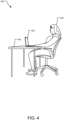
- FIG. 4 illustrates another example use case 400 of the motion sensor.
- the use case 400 shows a communication device 404, an inanimate surface 406, and a seated user 402.
- the communication device 404 may be an implementation of communication device 104.
- the inanimate surface 406 is shown as a table on which the communication device 404 rests.
- the user is engaged with the communication device 404.
- the communication device 404 and its motion sensor detect motion indicative of user interaction with the communication device 404.
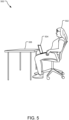
- FIG. 5 illustrates yet another example use case 500 of the motion sensor.
- the use case 500 shows a communication device 504, an inanimate surface 506, and a seated user 502.
- the communication device 504 may be an implementation of communication device 104.
- the communication device 504 does not rest on an inanimate surface but on the user's lap.
- the communication device 504 and its motion sensor detect motion indicative of user interaction with the communication device 504 via the motions of the lap.
- a classifier classifies the detected motion as a SAR IN MOTION when compared with background noise attributable to elements of the communication device 404, 504 and the inanimate surface 406, 506. Consequently, the SAR management system of the communication device 404, 504 and/or a controller of the motion sensor may adjust transmitter power in the communication device 404, 504. if prior to use cases 400 and 500, one or more of the classification conditions and classification parameters had been adjusted to accommodate a SAR STATIONARY state, the classification conditions and classification parameters may be further adjusted to accommodate a SAR IN MOTION state. In these use cases 400, 500, a controller may increase sensitivity to motion in order to focus on the minor differences in motion attributable to human interaction with the communication device.
- FIG. 6 illustrates example operations 600 of use of a motion sensor.
- a detection operation 602 detects motion.
- Detection operation 602 may use a motion detector of a motion sensor to detect the motion.
- the motion sensor may have signal processing elements, for example, one or more of a sampler, a frequency renderer, a signal discriminator, and a smoother.
- the detection operation 602 may optionally have a sampling operation that samples detected motion to produce a discrete detected motion signal.
- the sampler may have a sample rate which may be a tunable classification parameter.
- the detection operation 602 may optionally have a signal discriminating operation that removes particular frequencies or frequency ranges from a signal representing the detected motion.
- the frequencies or frequency ranges removed may be a tunable classification parameter.
- the signal discriminator may be, for example, one or more of a high pass filter, low pass filter, bandpass filter, digital software filter.
- the signal discriminator may be tunable to exclude frequencies likely indicative of background motion and include frequencies indicative of motion representing likely user interaction with the communication device.
- the detection operation 602 may optionally have a smoothing operation that uses a smoother to smooth the signal.
- the smoother may help to reduce the effect of outliers and/or noise in the signal representing the detected motion.
- the smoother may render the signal into an energy representation.
- the smoother may use a mean square or root mean square average for smoothing energy representation of consecutive or otherwise related samples.
- the motion detector may demonstrate detected motion in more than one axis (e.g., x, y, and z axes from a particular reference).
- a direction-independent magnitude of the energy in the signals for each sample can be determined by taking the square of the signal representing detected in each coordinate and summing them. This can be seen in equation 1, described above.
- the smoother may use a mean-squared function or a root-mean-squared function to smooth the direction-independent magnitude of energy in the signal over a variable window.
- An example of a mean squared representation is shown in equation (2).
- An example of a root-mean-squared representation is shown in equation (3).
- the detection operation 602 may have a sensitivity tuning operation that uses a sensitivity tuner to vary the sensitivity of the motion sensor to a detected motion.
- the sensitivity to motion may be a tunable classification parameter.
- the sensitivity may be modified by giving different weight to elements of the signal, for example, different weight to certain frequencies in the signal representing the detected motion, to certain samples (e.g., more recent samples) in the signal representing the detected motion, other elements of the signal representing the detected motion.
- the motion detector may be tuned to provide an output to a classifier of a controller.
- Classifying operation 604 classifies detected motion according to one or more classification conditions using one or more tunable parameters. Some (perhaps not yet adjusted) tunable classification parameters may have been applied at the detection operation 602.
- the controller may receive the output of the motion detector and classify, using a classifier, the detected motion.
- the classifier may classify the detected motion by assessing the output of the detection operation 602 according to classification conditions.
- the classification condition may be a comparison of magnitudes of individual frequency components rather than an overall magnitude of the signal energy. For example, magnitudes of certain frequencies can be compared with respect to expected motion profiles to determine a most likely motion profile that corresponds to the distribution of magnitudes of energy of the signal at different frequencies.
- the motion detector may be able to detect motions specific to a human body, for example, one or more of cardiovascular heartbeat, pulse, other measures of blood flow, or other natural human motions. Detection of a process indicating user interaction, even if it is small in magnitude, may be sufficient to trigger a SAR IN MOTION state classification
- the controller may itself classify a detected motion according to a classification condition (e.g., a SAR motion state) or may indicate as much to a monitoring service of the communication device to classify the SAR motion state.
- a classification condition e.g., a SAR motion state
- the monitoring service may take as input the outputs of more than one controller of the plurality of motion sensors to classify a SAR motion state and, correspondingly, determine whether transmission power needs to be backed off or may be increased.
- An implementation of a classification condition used in the classifying operation may be a comparison of a Mean Ratio with a threshold value.
- a mean ratio may be calculated using equation 4.
- the threshold value for the Mean Ratio may vary depending on circumstances, for example, one or more of a sensitivity to motion (where recent sample energies or other elements of the signal may receive greater weight relative to other elements), a motion profile representing the expected type of motion detected.
- Implementations of the Mean Ratio may include, for example, ratios of 1.2, 1.3, 1.4, 1.5, 1.6, 1.7, 1.8, 1.9, 2, 2.1, 2.2, 2.3, 2.4, 2.5, 2.6, or 2.7 or may be in ranges of Mean Ratios, for example ranges 1.2-2, 1.2-2.5, 1.8-2.2, 1.9-2.1.
- the classifying operation 604 may also maintain the SAR IN MOTION state for a period of time, perhaps a decay interval.
- a decay interval is a period of time or corresponding samples over which the SAR IN MOTION state remains triggered based on the detected motion continuing to indicate SAR IN MOTION.
- the decay interval may require a certain time frame or a number of samples over which the detected motion indicates no user interaction motion before a SAR IN MOTION state is no longer triggered.
- a decay interval may require 15 seconds or 15 samples where a classification condition (e.g., threshold) is not met, indicating the device is experiencing only background motion indicating a SAR STATIONARY state.
- the decay interval over which a SAR motion state is maintained may be based at least in part on the detected motion.
- Adjusting operation 606 adjusts one or more classification parameters applied to the classifying operation.
- the adjusting operation 606 may be responsive to the classifying operation 604.
- the controller may responsively adjust one or more of the classification parameters based on whether the detected motion has been classified according to the classification conditions as being in a particular SAR motion state.
- the controller may further responsively adjust the one or more classification conditions responsive to the satisfaction of the one or more classification conditions, based on one or more of the satisfaction of the one or more classification conditions and any adjustments made to the classification parameters.
- the adjusting operation 606 may adjust the threshold to better focus the detection of the motion.
- the threshold may also be dynamic if certain signal elements are emphasized or omitted, perhaps based on a motion profile. For example, if the magnitude of more recent samples is increased for emphasis, the magnitude of the threshold may need to be correspondingly increased in order to account for the artificial increase in signal energy. Another example may be that the threshold needs to be reduced when certain frequencies are omitted to account for the expected loss of energy in the excluded elements.
- a basis for comparison of whether detected motion represents SAR IN MOTION state user interaction motion or SAR STATIONARY state background motion may be a noise floor.
- the motion sensor 114 may transmit the output of the Mean Ratio comparison to the threshold to an element of the communication device 104 to allow the communication device 104 to determine or classify, perhaps in concert with other outputs of other motion sensors 114, one or more of a SAR motion state, power transmission adjustment instructions, and a relevant or appropriate motion profile corresponding to a pattern of activity associated with the detected motion(s). It should be appreciated that if a decision is made by the controller or another element of the communication device to tune the motion sensor to better distinguish from background noise, the threshold may be dynamically changed to account for the increased sensitivity.
- the motion sensor may adjust the one or more motion classification parameters based at least in part on a predefined motion profile
- the adjusting operation 606 may alternatively or additionally modify the sample rate to get a more or less precise reading of the motion detected.
- the sampler may increase the sampling rate in order to better focus on the detected motion, perhaps to allow for precise detection of when a user is no longer engaged with the communication device and allow for a quicker transition to a SAR STATIONARY state.
- the sample rate may be decreased in some circumstances, for example, when a sufficient period (perhaps a decay interval) has passed in which the detected motion no longer indicates that a user is engaged with the communication device 204 such that the classification condition transitions the SAR Motion state from a SAR IN MOTION state to a SAR STATIONARY state.
- the adjusting operation 606 may alternatively or additionally expand or narrow a variable window in order to adjust the smoothness of the representation of the signal magnitude for comparison.
- the number of samples in the variable window may be a tunable classification parameter to adjust the sensitivity to the detected motion. Examples of numbers and ranges of numbers of samples in a variable window include 20 samples, 200 samples, at least 20 samples, at least 200 samples, and between 20 and 200 samples.
- the variable window may be narrowed to include fewer samples when, for example, a classifier of the controller classifies a detected motion as indicative of a SAR IN MOTION STATE. This narrowing of the field may give more resolution to the signal.
- the variable window may be expanded to include more samples or a smaller time frame when, for example, a classifier of the controller classifies a detected motion as indicative of a SAR STATIONARY state.
- the controller may alternatively or additionally modify the decay interval, perhaps requiring more or fewer samples indicating a SAR STATIONARY state before transitioning from a SAR IN MOTION state to a SAR STATIONARY state.
- the decay interval may be increased if the detected motion indicates there has been a longer or more pronounced pattern of user engagement with the communication device.
- the decay interval may be decreased if the detected motion indicates that there has been no or a short or less pronounced pattern of user engagement with the communication device.
- the adjusting operation 606 may adjust the sensitivity by giving different weights to samples and/or frequency elements in the samples. For example, if a SAR IN MOTION state is triggered, greater weight may be given to more recent samples and/or to frequency elements likely representing human interaction.
- Adjusting operation 610 is adjusting the transmission power based on one or more motion classification conditions and one or more adjusted motion classification parameters using the one or more adjusted motion classification parameters.
- the adjusting operation 610 may be responsive to the classifying operation 608.
- the power provided to the transmitters in the communication device may be adjusted by one or more of a controller in the motion sensor or a SAR manager in the communication device. For example, if the classifying operation 608 represents a transition from a SAR IN MOTION state to a SAR STATIONARY state, the transmission power supplied to the transmitters may be increased. If the classifying operation 608 represents a transition from a SAR STATIONARY state to a SAR IN MOTION state, the transmission power to the transmitters may be decreased.
- the motion sensor may be in communication with a SAR manager, perhaps by means of a platform sensor application programming interface.
- the motion sensor may be part of a default sensor stack, or a platform environment may provide an original equipment manufacturer the ability to create a custom sensor that can be accessed like a regular sensor via the platform sensor API.
- each motion sensor may be in communication with a SAR manager, perhaps by means of a platform sensor application programming interface.
- the motion sensor may be part of a default sensor stack or a platform environment may provide an original equipment manufacturer the ability to create a custom sensor that can be accessed like a regular sensor via the platform sensor API.
- the SAR manager may collect the outputs of the plurality of motion sensors to determine an overall profile of motion corresponding to a specific pattern of user interaction or non-interaction.
- each of the operations 700 of the method shown in FIG. 7 is a distinct operation.
- operations 702-704 may not be distinct operations.
- the method shown in FIG. 7 may not have all of the above operations and/or may have other operations in addition to or instead of those listed above.
- the operations 700 of the method shown in FIG. 7 may be performed in another order. Subsets of the operations listed above as part of the method shown in FIG. 7 may be used to form their own method.
- the operations 700 of the method may be repeated in any combination and order any number of times, for example, continuously or selectively looping, in order to dynamically determine SAR motion states and corresponding transmission powers.
- FIG. 8 illustrates an example comparison between SAR IN MOTION and SAR STATIONARY states 800.
- Graphs 860A and 860B represent time-domain signals of detected motion for scenarios where the communication device is on a lap and where the communication device is on an inanimate surface, respectively.
- Graphs 870A and 870B are frequency domain representations of elements of 860A and 860B, respectively.
- the graph 860B includes an ordinate axis 862B, representing time in seconds, and an abscissa axis 864B, representing detected motion signal magnitude.
- An average threshold 850 over a given time is shown to be about 0.25. While the data looks to have elements above and below the threshold, the average of the signal data over the relevant averaging period has a value of 0.1667. This average value is lower than the average threshold 850 of about 0.25. Therefore, a controller would classify the motion represented in graph 860B as indicating a SAR STATIONARY state of a communication device on an inanimate surface.
- the human interaction of a lap engaging the communication device provides higher amplitudes of certain frequencies representing the engagement.
- the spikes seen in the 0-5 Hz range and in the 17-32 Hz range of the graph 870A that are not present in the graph 870B can be distinguished as potential human interaction motion.
- a controller of the motion sensor may determine the detected motion based on amplitudes at human-interaction-relevant frequencies indicate human interaction with the communication device and may classify the detected motion as indicating a SAR IN MOTION state.
- the communication device whether by the controller or other elements of the communication device, may determine to backoff power in response to determining a SAR IN MOTION state as in the graph 870A.
- the controller may further adjust classification parameters depending on the classification. For example, if a motion indicative of SAR IN MOTION states is detected, the sensitivity of a sensitivity tuner may be adjusted to further hone in on whether the motion is SAR motion. The threshold may be correspondingly adjusted to account for any artificial change in signal energy due to tuning of the motion sensor.
- the motion sensor may adjust the one or more motion classification parameters based at least in part on the predefined motion profile
- FIG. 9 illustrates an example communication device 900 for implementing the features and operations of the described technology.
- the communication device 900 may embody a remote-control device or a physical controlled device and is an example network-connected and/or network-capable device and may be a client device, such as a laptop, mobile device, desktop, tablet; a server/cloud device; an internet-of-things device; an electronic accessory; or another electronic device.
- the communication device 900 includes one or more processor(s) 902 and a memory 904.
- the memory 904 generally includes both volatile memory (e.g., RAM) and nonvolatile memory (e.g., flash memory).
- An operating system 910 resides in the memory 904 and is executed by the processor(s) 902.
- the communication device 900 may be an implementation of communication device 104.
- the communication device may also have one or more motion sensors 914.
- one or more modules or segments such as applications 950, a SAR management API, a SAR manager, machine, learning algorithms, SAR motion frameworks, motion detectors, classifiers, parameter adjusters, samplers, signal discriminators, smoothers, signal processors, sensitivity tuners, controllers, transmission power adjusters, transmitters, and inferential algorithms are loaded into the operating system 910 on the memory 904 and/or storage 920 and executed by processor(s) 902.
- the storage 920 may include one or more tangible storage media devices and may store SAR motion profiles, SAR motion states, SAR management protocols, SAR instructions, SAR backoff instructions, power transmission adjustment instructions, machine learning algorithms, SAR motion tables, transmission power management tables, classification parameters, classification conditions, controller outputs, thresholds, discriminated frequencies, sample numbers, sensitivity tunings, decay intervals, frequencies indicating user interaction, inferential algorithms, frequencies indicating background motion, locally and globally unique identifiers, requests, responses, and other data and be local to the communication device 900 or may be remote and communicatively connected to the communication device 900.
- the communication device 900 includes a power supply 916, which is powered by one or more batteries or other power sources and which provides power to other components of the communication device 900.
- the power supply 916 may also be connected to an external power source that overrides or recharges the built-in batteries or other power sources.
- the communication device 900 may include one or more input devices 934 such that a user may enter commands and information (e.g., a keyboard or mouse). These and other input devices may be coupled to the server by one or more interfaces 938, such as a serial port interface, parallel port, or universal serial bus (USB).
- the communication device 900 may further include a display 922, such as a touch screen display.
- the communication device 900 may include a variety of tangible processor-readable storage media and intangible processor-readable communication signals.
- Tangible processor-readable storage can be embodied by any available media that can be accessed by the communication device 900 and includes both volatile and nonvolatile storage media, removable and non-removable storage media.
- Tangible processor-readable storage media excludes communications signals (e.g., signals per se) and includes volatile and nonvolatile, removable and non-removable storage media implemented in any method or technology for storage of information such as processor-readable instructions, data structures, program modules, or other data.
- Tangible processor-readable storage media includes, but is not limited to, RAM, ROM, EEPROM, flash memory or other memory technology, CDROM, digital versatile disks (DVD) or other optical disk storage, magnetic cassettes, magnetic tape, magnetic disk storage or other magnetic storage devices, or any other tangible medium which can be used to store the desired information and which can be accessed by the communication device 900.
- intangible processor-readable communication signals may embody processor-readable instructions, data structures, program modules, or other data resident in a modulated data signal, such as a carrier wave or other signal transport mechanism.
- modulated data signal means a signal that has one or more of its characteristics set or changed in such a manner as to encode information in the signal.
- intangible communication signals include signals traveling through wired media such as a wired network or direct-wired connection, and wireless media such as acoustic, RF, infrared, and other wireless media.
- processors and storage may be integrated together into one or more hardware logic components.
- Such hardware-logic components may include field-programmable gate arrays (FPGAs), program- and application-specific integrated circuits (PASIC/ASICs), program- and application-specific standard products (PSSP/ASSPs), system-on-a-chip (SOC), and complex programmable logic devices (CPLDs), for example.
- FPGAs field-programmable gate arrays
- PASIC/ASICs program- and application-specific integrated circuits
- PSSP/ASSPs program- and application-specific standard products
- SOC system-on-a-chip
- CPLDs complex programmable logic devices
- module may be used to describe an aspect of a remote-control device and/or a physical controlled device implemented to perform a particular function. It will be understood that different modules, programs, and/or engines may be instantiated from the same application, service, code block, object, library, routine, API, function, etc. Likewise, the same module, program, and/or engine may be instantiated by different applications, services, code blocks, objects, routines, APIs, functions, etc.
- module,” “program,” and engine” may encompass individual or groups of executable files, data files, libraries, drivers, scripts, database records, etc.
- a "service,” as used herein, is an application program executable across one or multiple user sessions.
- a service may be available to one or more system components, programs, and/or other services.
- a service may run on one or more server computing devices.
Landscapes
- Engineering & Computer Science (AREA)
- Computer Networks & Wireless Communication (AREA)
- Signal Processing (AREA)
- Quality & Reliability (AREA)
- Physics & Mathematics (AREA)
- Electromagnetism (AREA)
- Mobile Radio Communication Systems (AREA)
- Radar Systems Or Details Thereof (AREA)
Claims (14)
- Verfahren (600) zum Verwalten der Sendeleistung eines Kommunikationsgeräts (204), umfassend:Erfassen (602) einer Bewegung des Kommunikationsgeräts (204) unter Verwendung eines Bewegungssensors (114);Klassifizieren (604) einer erfassten Bewegung gemäß einer oder mehreren Bewegungsklassifizierungsbedingungen unter Verwendung eines oder mehrerer Bewegungsklassifizierungsparameter, wobei die eine oder die mehreren Bewegungsklassifizierungsbedingungen klassifizieren, ob die erfasste Bewegung einen SAR IN MOTION-Zustand anzeigt, der eine Benutzerinteraktion mit dem Kommunikationsgerät darstellt, oder einen SAR STATIONARY-Zustand, der anzeigt, dass ein Benutzer nicht mit dem Kommunikationsgerät (204) interagiert;Anpassen (606) des einen oder der mehreren Bewegungsklassifizierungsparameter, die auf den Klassifizierungsvorgang (604) angewendet werden, als Reaktion auf den Klassifizierungsvorgang (604), wobei der Vorgang des Anpassens des einen oder der mehreren Bewegungsklassifizierungsparameter Anpassen einer Empfindlichkeit gegenüber der erfassten Bewegung durch Folgendes umfasst:Erhöhen der Empfindlichkeit gegenüber der erfassten Bewegung, wenn das Klassifizieren der erfassten Bewegung die erfasste Bewegung als den SAR IN MOTION-Zustand anzeigend klassifiziert; undVerringern der Empfindlichkeit gegenüber der erfassten Bewegung, wenn das Klassifizieren der erfassten Bewegung die erfasste Bewegung als den SAR STATIONARY-Zustand anzeigend klassifiziert;Klassifizieren (608) der erfassten Bewegung gemäß der einen oder den mehreren Bewegungsklassifizierungsbedingungen unter Verwendung des einen oder der mehreren angepassten Bewegungsklassifizierungsparameter; undAnpassen (610) der Sendeleistung des Kommunikationsgeräts (204) zumindest teilweise basierend auf der einen oder den mehreren Bewegungsklassifizierungsbedingungen und dem einen oder den mehreren angepassten Bewegungsklassifizierungsparametern als Reaktion auf den Vorgang des Klassifizierens (608) unter Verwendung des einen oder der mehreren angepassten Bewegungsklassifizierungsparameter.
- Verfahren nach Anspruch 1, wobei der eine oder die mehreren Klassifizierungsparameter einen Schwellenwert umfassen, mit dem die erfasste Bewegung verglichen wird.
- Verfahren nach Anspruch 2, wobei der Schwellenwert ein Größenschwellenwert ist, der eine Größe der Signalenergie umfasst, mit der ein Signal verglichen wird, das eine Größe der erfassten Bewegung darstellt.
- Verfahren nach Anspruch 2 oder Anspruch 3, wobei das Anpassen der Empfindlichkeit gegenüber der erfassten Bewegung dynamisches Ändern des Schwellenwerts umfasst, um den Bewegungssensor zur besseren Unterscheidung von Hintergrundgeräuschen abzustimmen.
- Verfahren nach Anspruch 1, ferner umfassend:
als Reaktion auf das Klassifizieren (604) der erfassten Bewegung gemäß einer oder mehreren Bewegungsklassifizierungsbedingungen, das das Klassifizieren der erfassten Bewegung umfasst, die den SAR IN MOTION-Zustand anzeigt, Aufrechterhalten des SAR IN MOTION-Zustands für einen Zeitraum, der ein Abklingintervall umfasst. - Verfahren nach Anspruch 1, wobei:das Erhöhen der Empfindlichkeit gegenüber der erfassten Bewegung, wenn das Klassifizieren der erfassten Bewegung die erfasste Bewegung als den SAR IN MOTION-Zustand anzeigend klassifiziert, Einengen eines variablen Fensters durch Reduzieren einer Anzahl von Abtastwerten in dem variablen Fenster umfasst; unddas Verringern der Empfindlichkeit gegenüber der erfassten Bewegung, wenn das Klassifizieren der erfassten Bewegung die erfasste Bewegung als den SAR STATIONARY-Zustand anzeigend klassifiziert, Erweitern des variablen Fensters umfasst, um mehr Abtastwerte in das variable Fenster einzuschließen.
- Verfahren nach Anspruch 1, wobei:
das Anpassen der Empfindlichkeit gegenüber der erfassten Bewegung Zuweisen unterschiedlicher Gewichtungen zu Abtastwerten und/oder Frequenzelementen in den Abtastwerten umfasst, sodass, wenn das Klassifizieren der erfassten Bewegung die erfasste Bewegung als den SAR IN MOTION-Zustand anzeigend klassifiziert, ein Frequenzbereich zur besseren Fokussierung auf Frequenzen, die die Benutzerinteraktion mit dem Kommunikationsgerät darstellen, angepasst wird. - Verfahren nach Anspruch 1, ferner umfassend:
Abtasten der erfassten Bewegung unter Verwendung eines Abtasters, um ein diskretes Bewegungssignal zu erzeugen; und wobei:das Erhöhen der Empfindlichkeit gegenüber der erfassten Bewegung, wenn das Klassifizieren der erfassten Bewegung die erfasste Bewegung als den SAR IN MOTION-Zustand anzeigend klassifiziert, Erhöhen einer Abtastrate des Abtasters zur besseren Fokussierung auf die erfasste Bewegung umfasst; unddas Verringern der Empfindlichkeit gegenüber der erfassten Bewegung, wenn die Klassifizierung der erfassten Bewegung die erfasste Bewegung als den SAR STATIONARY-Zustand anzeigend klassifiziert, Zurücksetzen der Abtastrate auf ein ursprünglich bereitgestelltes Niveau umfasst. - Verfahren nach Anspruch 1, wobei die eine oder mehrere Bewegungsklassifizierungsbedingungen klassifizieren, ob die erfasste Bewegung ein vordefiniertes Bewegungsprofil anzeigt, das für ein bestimmtes Muster der Benutzerinteraktion mit dem Kommunikationsgerät repräsentativ ist.
- Verfahren nach Anspruch 9, wobei der Vorgang des Anpassens des einen oder der mehreren Bewegungsklassifizierungsparameter Folgendes umfasst:
Anpassen des einen oder der mehreren Bewegungsklassifizierungsparameter zumindest teilweise basierend auf dem vordefinierten Bewegungsprofil. - Verfahren nach Anspruch 9, wobei der Vorgang des Klassifizierens der erfassten Bewegung gemäß einer oder mehreren Bewegungsklassifizierungsbedingungen unter Verwendung eines oder mehrerer Bewegungsklassifizierungsparameter Folgendes umfasst:Messen einer Stärke eines Signals, das in der erfassten Bewegung erfasste Frequenzen darstellt, die menschliche Interaktion darstellen; undVergleichen der Stärke des Signals mit einem vorgegebenen Schwellenwert.
- Verfahren nach Anspruch 1, wobei der Vorgang des Anpassens des einen oder der mehreren Bewegungsklassifizierungsparameter einen Vorgang umfasst, um eines oder mehrere von Folgenden anzupassen:eine Abtastrate, mit der die erfasste Bewegung abgetastet wird;ein Abklingintervall, über das der SAR IN MOTION-Zustand, der zumindest teilweise auf der erfassten Bewegung basiert, aufrechterhalten wird;einen Schwellenwert, mit dem die erfasste Bewegung verglichen wird;ein Bewegungsprofil, mit dem die erfasste Bewegung verglichen wird; undein variables Fenster, über das die erfasste Bewegung in dem Klassifizierungsvorgang klassifiziert wird.
- Kommunikationsgerät (204) mit einem Prozessor (902) und einem Speicher (904), wobei der Prozessor (902) dazu konfiguriert ist, in dem Speicher (904) gespeicherte Vorgänge auszuführen, wobei die Vorgänge das Verfahren nach einem der Ansprüche 1 bis 12 umfassen.
- Ein oder mehrere materielle, prozessorlesbare Speichermedien (904), die Anweisungen zum Ausführen eines Prozesses (600) zum Anpassen einer Sendeleistung, der das Verfahren nach einem der Ansprüche 1 bis 12 umfasst, auf einem oder mehreren Prozessoren (902) und Schaltungen eines Kommunikationsgeräts (204) enthalten.
Applications Claiming Priority (2)
| Application Number | Priority Date | Filing Date | Title |
|---|---|---|---|
| US17/329,757 US11490338B1 (en) | 2021-05-25 | 2021-05-25 | Motion-responsive transmission power management |
| PCT/US2022/026856 WO2022250838A1 (en) | 2021-05-25 | 2022-04-29 | Motion-responsive transmission power management |
Publications (2)
| Publication Number | Publication Date |
|---|---|
| EP4349079A1 EP4349079A1 (de) | 2024-04-10 |
| EP4349079B1 true EP4349079B1 (de) | 2025-04-09 |
Family
ID=81748727
Family Applications (1)
| Application Number | Title | Priority Date | Filing Date |
|---|---|---|---|
| EP22724325.0A Active EP4349079B1 (de) | 2021-05-25 | 2022-04-29 | Bewegungsabhängige sendeleistungsverwaltung |
Country Status (4)
| Country | Link |
|---|---|
| US (1) | US11490338B1 (de) |
| EP (1) | EP4349079B1 (de) |
| CN (1) | CN117378251A (de) |
| WO (1) | WO2022250838A1 (de) |
Families Citing this family (10)
| Publication number | Priority date | Publication date | Assignee | Title |
|---|---|---|---|---|
| US12101725B2 (en) * | 2021-09-22 | 2024-09-24 | Apple Inc. | Transmission power control |
| KR102915206B1 (ko) * | 2021-09-23 | 2026-01-20 | 삼성전자주식회사 | 통신 전력을 백오프하는 방법 및 장치 |
| US20230139016A1 (en) * | 2021-11-02 | 2023-05-04 | Qualcomm Incorporated | Time-averaged radio frequency (rf) exposure per exposure scenario |
| US20230182748A1 (en) * | 2021-12-14 | 2023-06-15 | Hewlett-Packard Development Company, L.P. | Transmitter alterations based on vibration patterns |
| US12506505B2 (en) | 2022-05-16 | 2025-12-23 | Apple Inc. | Electronic devices with application-based radio-frequency exposure management |
| US12376047B2 (en) * | 2022-05-16 | 2025-07-29 | Apple Inc. | Control signaling reservation for radio-frequency exposure management |
| US12224786B2 (en) * | 2022-09-08 | 2025-02-11 | Mediatek Inc. | Dynamic tuning method for SAR and user equipment thereof |
| WO2024191105A1 (ko) * | 2023-03-10 | 2024-09-19 | 삼성전자주식회사 | 백 오프를 수행하는 전자 장치 및 동작 방법 |
| US20240421842A1 (en) * | 2023-06-14 | 2024-12-19 | Microsoft Technology Licensing, Llc | Transmission power management with parameterized assigned classification filters |
| US20250035668A1 (en) * | 2023-07-24 | 2025-01-30 | Stmicroelectronics International N.V. | Systems and methods for on-stationary surface detection |
Family Cites Families (44)
| Publication number | Priority date | Publication date | Assignee | Title |
|---|---|---|---|---|
| US4723124A (en) * | 1986-03-21 | 1988-02-02 | Grumman Aerospace Corporation | Extended SAR imaging capability for ship classification |
| US7394451B1 (en) | 2003-09-03 | 2008-07-01 | Vantage Controls, Inc. | Backlit display with motion sensor |
| US8154435B2 (en) * | 2008-08-22 | 2012-04-10 | Microsoft Corporation | Stability monitoring using synthetic aperture radar |
| US8989792B1 (en) | 2010-01-22 | 2015-03-24 | Amazon Technologies, Inc. | Using inertial sensors to trigger transmit power management |
| US8886980B2 (en) | 2010-03-29 | 2014-11-11 | Qualcomm Incorporated | Power efficient way of operating motion sensors |
| US9192436B2 (en) * | 2010-05-25 | 2015-11-24 | Covidien Lp | Flow rate verification monitor for fluid-cooled microwave ablation probe |
| US9468492B2 (en) * | 2010-06-03 | 2016-10-18 | Covidien Lp | Specific absorption rate measurement and energy-delivery device characterization using image analysis |
| US10588684B2 (en) * | 2010-07-19 | 2020-03-17 | Covidien Lp | Hydraulic conductivity monitoring to initiate tissue division |
| US8811918B2 (en) * | 2010-11-26 | 2014-08-19 | Broadcom Corporation | Distribution of transmit signal to multiple transmit antennas for reduction of measured specific absorption rate |
| US9770294B2 (en) * | 2011-01-05 | 2017-09-26 | Covidien Lp | Energy-delivery devices with flexible fluid-cooled shaft, inflow/outflow junctions suitable for use with same, and systems including same |
| US10335230B2 (en) * | 2011-03-09 | 2019-07-02 | Covidien Lp | Systems for thermal-feedback-controlled rate of fluid flow to fluid-cooled antenna assembly and methods of directing energy to tissue using same |
| WO2012143936A1 (en) | 2011-04-21 | 2012-10-26 | Muthukumar Prasad | Smart active antenna radiation pattern optimising system for mobile devices achieved by sensing device proximity environment with property, position, orientation, signal quality and operating modes |
| CN102510295B (zh) | 2011-10-12 | 2016-06-15 | 中兴通讯股份有限公司 | 降低sar峰值的无线终端及其降低sar峰值的方法 |
| US8515496B2 (en) * | 2011-12-15 | 2013-08-20 | Amazon Technologies, Inc. | Antenna deployment switching for data communication of a user device |
| US9692875B2 (en) * | 2012-08-31 | 2017-06-27 | Analog Devices, Inc. | Grip detection and capacitive gesture system for mobile devices |
| US20140213192A1 (en) * | 2013-01-31 | 2014-07-31 | Hewlett-Packard Development Company, L.P. | Specific absorption rate reduction |
| US9494675B2 (en) * | 2013-04-17 | 2016-11-15 | Applied Signals Intelligence, Inc. | System and method for nonlinear radar |
| US10180362B2 (en) * | 2013-05-08 | 2019-01-15 | New York University | System, method and computer-accessible medium for determining specific absorption rate obtained based on magnetic resonance imaging and temperature property measurements |
| US9813997B2 (en) | 2014-01-10 | 2017-11-07 | Microsoft Technology Licensing, Llc | Antenna coupling for sensing and dynamic transmission |
| EP3525524B1 (de) | 2014-05-30 | 2021-03-10 | Apple Inc. | Bestimmung einer vorrichtungskörperstelle |
| US9871545B2 (en) * | 2014-12-05 | 2018-01-16 | Microsoft Technology Licensing, Llc | Selective specific absorption rate adjustment |
| CN106034351A (zh) * | 2015-03-09 | 2016-10-19 | 联想(北京)有限公司 | 一种发射功率调整方法及电子设备 |
| KR20160140185A (ko) * | 2015-05-29 | 2016-12-07 | 삼성전자주식회사 | 통신 서비스를 수행하는 방법 및 이를 위한 장치 |
| US9531420B1 (en) | 2015-06-09 | 2016-12-27 | Dell Products L.P. | Systems and methods to control transmit power and specific absorption rate (SAR) for wireless devices |
| US10013038B2 (en) | 2016-01-05 | 2018-07-03 | Microsoft Technology Licensing, Llc | Dynamic antenna power control for multi-context device |
| US10127417B2 (en) * | 2016-01-08 | 2018-11-13 | Disney Enterprises, Inc. | Systems and methods for determining interaction states of wireless tags based on probability distributions |
| CN107157717A (zh) * | 2016-03-07 | 2017-09-15 | 维看公司 | 用于向盲人提供视觉信息的物体检测、分析及提示系统 |
| US9628124B1 (en) * | 2016-08-17 | 2017-04-18 | Intel Corporation | Sensor signals interference mitigation method and apparatus |
| US10514769B2 (en) * | 2016-10-16 | 2019-12-24 | Dell Products, L.P. | Volumetric tracking for orthogonal displays in an electronic collaboration setting |
| JP6868695B2 (ja) | 2016-12-16 | 2021-05-12 | マジック リープ, インコーポレイテッドMagic Leap,Inc. | 伝送出力電力を限定するための伝送アンテナのヒト身体への近接の決定 |
| US11042174B2 (en) * | 2017-02-03 | 2021-06-22 | Qualcomm Incorporated | System and method for thermal management of a wearable computing device based on proximity to a user |
| US10107627B2 (en) * | 2017-03-08 | 2018-10-23 | Northrop Grumman Systems Corporation | Adaptive navigation for airborne, ground and dismount applications (ANAGDA) |
| US10204504B1 (en) * | 2017-12-07 | 2019-02-12 | Htc Corporation | Electronic device and drop warning method |
| US10365364B1 (en) * | 2018-05-18 | 2019-07-30 | Zendar Inc. | Systems and methods for detecting objects |
| US11624909B2 (en) * | 2018-06-18 | 2023-04-11 | Magic Leap, Inc. | Head-mounted display systems with power saving functionality |
| CN112567287A (zh) * | 2018-06-18 | 2021-03-26 | 奇跃公司 | 具有帧调制功能的增强现实显示 |
| US11564598B2 (en) * | 2018-07-25 | 2023-01-31 | Ohio State Innovation Foundation | System and method for monitoring body kinematics |
| US11073584B2 (en) * | 2018-09-06 | 2021-07-27 | Canon Medical Systems Corporation | Magnetic resonance imaging apparatus |
| US11702280B2 (en) * | 2018-09-07 | 2023-07-18 | Hemal B. Kurani | Smart waste bin sensor device and methods for waste management system |
| US20200195290A1 (en) * | 2018-12-13 | 2020-06-18 | Microsoft Technology Licensing, Llc | Specific Absorption Rate (SAR) Back-Off |
| KR102706848B1 (ko) | 2018-12-20 | 2024-09-19 | 삼성전자주식회사 | 배열 안테나를 구비한 전자 장치 및 안테나 집합체의 전력 백오프 방법 |
| US11228810B1 (en) * | 2019-04-22 | 2022-01-18 | Matan Arazi | System, method, and program product for interactively prompting user decisions |
| US11510047B2 (en) * | 2019-08-12 | 2022-11-22 | Dell Products, Lp | Learning based wireless performance adjustment for mobile information handling system |
| US11231437B1 (en) * | 2020-09-25 | 2022-01-25 | United Arab Emirates University | Arm motion sensor system |
-
2021
- 2021-05-25 US US17/329,757 patent/US11490338B1/en active Active
-
2022
- 2022-04-29 WO PCT/US2022/026856 patent/WO2022250838A1/en not_active Ceased
- 2022-04-29 EP EP22724325.0A patent/EP4349079B1/de active Active
- 2022-04-29 CN CN202280037880.2A patent/CN117378251A/zh active Pending
Also Published As
| Publication number | Publication date |
|---|---|
| WO2022250838A1 (en) | 2022-12-01 |
| US11490338B1 (en) | 2022-11-01 |
| EP4349079A1 (de) | 2024-04-10 |
| CN117378251A (zh) | 2024-01-09 |
Similar Documents
| Publication | Publication Date | Title |
|---|---|---|
| US11490338B1 (en) | Motion-responsive transmission power management | |
| US12164696B2 (en) | Recognizing gestures based on wireless signals | |
| US10924145B2 (en) | Proximity-independent SAR mitigation | |
| US10154342B2 (en) | Spatial adaptation in multi-microphone sound capture | |
| RU2670416C1 (ru) | Взаимосвязь между антеннами для распознавания и динамической передачи | |
| CN113678018B (zh) | 雷达泄漏测量更新 | |
| US20200044612A1 (en) | Transmitter dynamic rf power control via vswr detection for wireless radios | |
| US11841455B1 (en) | Calibrating radar systems for movement detection | |
| JP2011024068A (ja) | コグニティブ無線通信における電力制御方法,コグニティブ無線通信システム,及び無線通信デバイス | |
| KR20130033426A (ko) | 연속파 초음파 신호들을 이용한 무접촉식 감지 및 제스쳐 인식 | |
| US20230079716A1 (en) | Radio frequency sensing for control of a media system | |
| US20150249886A1 (en) | Noise mitigation seating | |
| US20180293995A1 (en) | Ambient noise suppression | |
| US9258726B2 (en) | Methods and apparatus for spectral scanning within a network | |
| EP3828585A1 (de) | Fahrzeugsteuerung unter schwierigen radarstörbedingungen | |
| KR102171535B1 (ko) | Uwb 레이더의 수신 장치 및 수신 신호 처리 방법 | |
| US20240421842A1 (en) | Transmission power management with parameterized assigned classification filters | |
| CN120658322A (zh) | 一种数据信号自动调节方法、系统、存储介质及电子设备 | |
| US20260128754A1 (en) | Systems and methods for managing rf coexistence between accessories | |
| HK40037845A (en) | Proximity-independent sar mitigation | |
| KR20250077390A (ko) | 무선랜 신호 기반 동작 감지 방법 및 장치 | |
| CA3231199A1 (en) | Method and system for improving subjective sound rendering |
Legal Events
| Date | Code | Title | Description |
|---|---|---|---|
| STAA | Information on the status of an ep patent application or granted ep patent |
Free format text: STATUS: UNKNOWN |
|
| STAA | Information on the status of an ep patent application or granted ep patent |
Free format text: STATUS: THE INTERNATIONAL PUBLICATION HAS BEEN MADE |
|
| PUAI | Public reference made under article 153(3) epc to a published international application that has entered the european phase |
Free format text: ORIGINAL CODE: 0009012 |
|
| STAA | Information on the status of an ep patent application or granted ep patent |
Free format text: STATUS: REQUEST FOR EXAMINATION WAS MADE |
|
| 17P | Request for examination filed |
Effective date: 20231016 |
|
| AK | Designated contracting states |
Kind code of ref document: A1 Designated state(s): AL AT BE BG CH CY CZ DE DK EE ES FI FR GB GR HR HU IE IS IT LI LT LU LV MC MK MT NL NO PL PT RO RS SE SI SK SM TR |
|
| DAV | Request for validation of the european patent (deleted) | ||
| DAX | Request for extension of the european patent (deleted) | ||
| GRAP | Despatch of communication of intention to grant a patent |
Free format text: ORIGINAL CODE: EPIDOSNIGR1 |
|
| STAA | Information on the status of an ep patent application or granted ep patent |
Free format text: STATUS: GRANT OF PATENT IS INTENDED |
|
| INTG | Intention to grant announced |
Effective date: 20241113 |
|
| GRAS | Grant fee paid |
Free format text: ORIGINAL CODE: EPIDOSNIGR3 |
|
| P01 | Opt-out of the competence of the unified patent court (upc) registered |
Free format text: CASE NUMBER: APP_4671/2025 Effective date: 20250128 |
|
| GRAA | (expected) grant |
Free format text: ORIGINAL CODE: 0009210 |
|
| STAA | Information on the status of an ep patent application or granted ep patent |
Free format text: STATUS: THE PATENT HAS BEEN GRANTED |
|
| AK | Designated contracting states |
Kind code of ref document: B1 Designated state(s): AL AT BE BG CH CY CZ DE DK EE ES FI FR GB GR HR HU IE IS IT LI LT LU LV MC MK MT NL NO PL PT RO RS SE SI SK SM TR |
|
| REG | Reference to a national code |
Ref country code: GB Ref legal event code: FG4D |
|
| REG | Reference to a national code |
Ref country code: CH Ref legal event code: EP |
|
| REG | Reference to a national code |
Ref country code: DE Ref legal event code: R096 Ref document number: 602022012954 Country of ref document: DE |
|
| REG | Reference to a national code |
Ref country code: IE Ref legal event code: FG4D |
|
| PGFP | Annual fee paid to national office [announced via postgrant information from national office to epo] |
Ref country code: AT Payment date: 20250721 Year of fee payment: 4 |
|
| REG | Reference to a national code |
Ref country code: NL Ref legal event code: MP Effective date: 20250409 |
|
| PG25 | Lapsed in a contracting state [announced via postgrant information from national office to epo] |
Ref country code: NL Free format text: LAPSE BECAUSE OF FAILURE TO SUBMIT A TRANSLATION OF THE DESCRIPTION OR TO PAY THE FEE WITHIN THE PRESCRIBED TIME-LIMIT Effective date: 20250409 |
|
| REG | Reference to a national code |
Ref country code: AT Ref legal event code: MK05 Ref document number: 1784738 Country of ref document: AT Kind code of ref document: T Effective date: 20250409 |
|
| PG25 | Lapsed in a contracting state [announced via postgrant information from national office to epo] |
Ref country code: FI Free format text: LAPSE BECAUSE OF FAILURE TO SUBMIT A TRANSLATION OF THE DESCRIPTION OR TO PAY THE FEE WITHIN THE PRESCRIBED TIME-LIMIT Effective date: 20250409 Ref country code: PT Free format text: LAPSE BECAUSE OF FAILURE TO SUBMIT A TRANSLATION OF THE DESCRIPTION OR TO PAY THE FEE WITHIN THE PRESCRIBED TIME-LIMIT Effective date: 20250811 Ref country code: ES Free format text: LAPSE BECAUSE OF FAILURE TO SUBMIT A TRANSLATION OF THE DESCRIPTION OR TO PAY THE FEE WITHIN THE PRESCRIBED TIME-LIMIT Effective date: 20250409 |
|
| REG | Reference to a national code |
Ref country code: LT Ref legal event code: MG9D |
|
| PG25 | Lapsed in a contracting state [announced via postgrant information from national office to epo] |
Ref country code: NO Free format text: LAPSE BECAUSE OF FAILURE TO SUBMIT A TRANSLATION OF THE DESCRIPTION OR TO PAY THE FEE WITHIN THE PRESCRIBED TIME-LIMIT Effective date: 20250709 Ref country code: GR Free format text: LAPSE BECAUSE OF FAILURE TO SUBMIT A TRANSLATION OF THE DESCRIPTION OR TO PAY THE FEE WITHIN THE PRESCRIBED TIME-LIMIT Effective date: 20250710 |
|
| PG25 | Lapsed in a contracting state [announced via postgrant information from national office to epo] |
Ref country code: PL Free format text: LAPSE BECAUSE OF FAILURE TO SUBMIT A TRANSLATION OF THE DESCRIPTION OR TO PAY THE FEE WITHIN THE PRESCRIBED TIME-LIMIT Effective date: 20250409 |
|
| PG25 | Lapsed in a contracting state [announced via postgrant information from national office to epo] |
Ref country code: BG Free format text: LAPSE BECAUSE OF FAILURE TO SUBMIT A TRANSLATION OF THE DESCRIPTION OR TO PAY THE FEE WITHIN THE PRESCRIBED TIME-LIMIT Effective date: 20250409 |
|
| PG25 | Lapsed in a contracting state [announced via postgrant information from national office to epo] |
Ref country code: AT Free format text: LAPSE BECAUSE OF FAILURE TO SUBMIT A TRANSLATION OF THE DESCRIPTION OR TO PAY THE FEE WITHIN THE PRESCRIBED TIME-LIMIT Effective date: 20250409 Ref country code: HR Free format text: LAPSE BECAUSE OF FAILURE TO SUBMIT A TRANSLATION OF THE DESCRIPTION OR TO PAY THE FEE WITHIN THE PRESCRIBED TIME-LIMIT Effective date: 20250409 |
|
| PG25 | Lapsed in a contracting state [announced via postgrant information from national office to epo] |
Ref country code: RS Free format text: LAPSE BECAUSE OF FAILURE TO SUBMIT A TRANSLATION OF THE DESCRIPTION OR TO PAY THE FEE WITHIN THE PRESCRIBED TIME-LIMIT Effective date: 20250709 |
|
| PG25 | Lapsed in a contracting state [announced via postgrant information from national office to epo] |
Ref country code: IS Free format text: LAPSE BECAUSE OF FAILURE TO SUBMIT A TRANSLATION OF THE DESCRIPTION OR TO PAY THE FEE WITHIN THE PRESCRIBED TIME-LIMIT Effective date: 20250809 |
|
| PG25 | Lapsed in a contracting state [announced via postgrant information from national office to epo] |
Ref country code: LV Free format text: LAPSE BECAUSE OF FAILURE TO SUBMIT A TRANSLATION OF THE DESCRIPTION OR TO PAY THE FEE WITHIN THE PRESCRIBED TIME-LIMIT Effective date: 20250409 |
|
| REG | Reference to a national code |
Ref country code: CH Ref legal event code: H13 Free format text: ST27 STATUS EVENT CODE: U-0-0-H10-H13 (AS PROVIDED BY THE NATIONAL OFFICE) Effective date: 20251125 |
|
| PG25 | Lapsed in a contracting state [announced via postgrant information from national office to epo] |
Ref country code: LU Free format text: LAPSE BECAUSE OF NON-PAYMENT OF DUE FEES Effective date: 20250429 |
|
| REG | Reference to a national code |
Ref country code: BE Ref legal event code: MM Effective date: 20250430 |
|
| REG | Reference to a national code |
Ref country code: DE Ref legal event code: R097 Ref document number: 602022012954 Country of ref document: DE |
|
| PG25 | Lapsed in a contracting state [announced via postgrant information from national office to epo] |
Ref country code: SM Free format text: LAPSE BECAUSE OF FAILURE TO SUBMIT A TRANSLATION OF THE DESCRIPTION OR TO PAY THE FEE WITHIN THE PRESCRIBED TIME-LIMIT Effective date: 20250409 Ref country code: DK Free format text: LAPSE BECAUSE OF FAILURE TO SUBMIT A TRANSLATION OF THE DESCRIPTION OR TO PAY THE FEE WITHIN THE PRESCRIBED TIME-LIMIT Effective date: 20250409 |
|
| PG25 | Lapsed in a contracting state [announced via postgrant information from national office to epo] |
Ref country code: BE Free format text: LAPSE BECAUSE OF NON-PAYMENT OF DUE FEES Effective date: 20250430 |
|
| PG25 | Lapsed in a contracting state [announced via postgrant information from national office to epo] |
Ref country code: CH Free format text: LAPSE BECAUSE OF NON-PAYMENT OF DUE FEES Effective date: 20250430 |
|
| PG25 | Lapsed in a contracting state [announced via postgrant information from national office to epo] |
Ref country code: CZ Free format text: LAPSE BECAUSE OF FAILURE TO SUBMIT A TRANSLATION OF THE DESCRIPTION OR TO PAY THE FEE WITHIN THE PRESCRIBED TIME-LIMIT Effective date: 20250409 |
|
| PG25 | Lapsed in a contracting state [announced via postgrant information from national office to epo] |
Ref country code: EE Free format text: LAPSE BECAUSE OF FAILURE TO SUBMIT A TRANSLATION OF THE DESCRIPTION OR TO PAY THE FEE WITHIN THE PRESCRIBED TIME-LIMIT Effective date: 20250409 |
|
| PG25 | Lapsed in a contracting state [announced via postgrant information from national office to epo] |
Ref country code: SK Free format text: LAPSE BECAUSE OF FAILURE TO SUBMIT A TRANSLATION OF THE DESCRIPTION OR TO PAY THE FEE WITHIN THE PRESCRIBED TIME-LIMIT Effective date: 20250409 |
|
| PG25 | Lapsed in a contracting state [announced via postgrant information from national office to epo] |
Ref country code: IT Free format text: LAPSE BECAUSE OF FAILURE TO SUBMIT A TRANSLATION OF THE DESCRIPTION OR TO PAY THE FEE WITHIN THE PRESCRIBED TIME-LIMIT Effective date: 20250409 |
|
| PG25 | Lapsed in a contracting state [announced via postgrant information from national office to epo] |
Ref country code: MC Free format text: LAPSE BECAUSE OF FAILURE TO SUBMIT A TRANSLATION OF THE DESCRIPTION OR TO PAY THE FEE WITHIN THE PRESCRIBED TIME-LIMIT Effective date: 20250409 |
|
| PLBE | No opposition filed within time limit |
Free format text: ORIGINAL CODE: 0009261 |
|
| STAA | Information on the status of an ep patent application or granted ep patent |
Free format text: STATUS: NO OPPOSITION FILED WITHIN TIME LIMIT |
|
| REG | Reference to a national code |
Ref country code: CH Ref legal event code: L10 Free format text: ST27 STATUS EVENT CODE: U-0-0-L10-L00 (AS PROVIDED BY THE NATIONAL OFFICE) Effective date: 20260218 |
|
| PG25 | Lapsed in a contracting state [announced via postgrant information from national office to epo] |
Ref country code: RO Free format text: LAPSE BECAUSE OF FAILURE TO SUBMIT A TRANSLATION OF THE DESCRIPTION OR TO PAY THE FEE WITHIN THE PRESCRIBED TIME-LIMIT Effective date: 20250409 |
|
| 26N | No opposition filed |
Effective date: 20260112 |
|
| PGFP | Annual fee paid to national office [announced via postgrant information from national office to epo] |
Ref country code: GB Payment date: 20260319 Year of fee payment: 5 |
|
| PG25 | Lapsed in a contracting state [announced via postgrant information from national office to epo] |
Ref country code: IE Free format text: LAPSE BECAUSE OF NON-PAYMENT OF DUE FEES Effective date: 20250429 |
|
| PG25 | Lapsed in a contracting state [announced via postgrant information from national office to epo] |
Ref country code: FR Free format text: LAPSE BECAUSE OF NON-PAYMENT OF DUE FEES Effective date: 20250609 |
|
| PG25 | Lapsed in a contracting state [announced via postgrant information from national office to epo] |
Ref country code: CY Free format text: LAPSE BECAUSE OF FAILURE TO SUBMIT A TRANSLATION OF THE DESCRIPTION OR TO PAY THE FEE WITHIN THE PRESCRIBED TIME-LIMIT Effective date: 20250409 |
|
| PG25 | Lapsed in a contracting state [announced via postgrant information from national office to epo] |
Ref country code: LT Free format text: LAPSE BECAUSE OF FAILURE TO SUBMIT A TRANSLATION OF THE DESCRIPTION OR TO PAY THE FEE WITHIN THE PRESCRIBED TIME-LIMIT Effective date: 20250409 |
|
| PGFP | Annual fee paid to national office [announced via postgrant information from national office to epo] |
Ref country code: DE Payment date: 20260319 Year of fee payment: 5 |
|
| PG25 | Lapsed in a contracting state [announced via postgrant information from national office to epo] |
Ref country code: SE Free format text: LAPSE BECAUSE OF FAILURE TO SUBMIT A TRANSLATION OF THE DESCRIPTION OR TO PAY THE FEE WITHIN THE PRESCRIBED TIME-LIMIT Effective date: 20250409 |