EP4342396A2 - Clot retrieval device with outer sheath and inner catheter - Google Patents
Clot retrieval device with outer sheath and inner catheter Download PDFInfo
- Publication number
- EP4342396A2 EP4342396A2 EP24155946.7A EP24155946A EP4342396A2 EP 4342396 A2 EP4342396 A2 EP 4342396A2 EP 24155946 A EP24155946 A EP 24155946A EP 4342396 A2 EP4342396 A2 EP 4342396A2
- Authority
- EP
- European Patent Office
- Prior art keywords
- outer sheath
- proximal
- funnel catheter
- inner funnel
- luer
- Prior art date
- Legal status (The legal status is an assumption and is not a legal conclusion. Google has not performed a legal analysis and makes no representation as to the accuracy of the status listed.)
- Pending
Links
Images




Classifications
-
- A—HUMAN NECESSITIES
- A61—MEDICAL OR VETERINARY SCIENCE; HYGIENE
- A61B—DIAGNOSIS; SURGERY; IDENTIFICATION
- A61B17/00—Surgical instruments, devices or methods
- A61B17/22—Implements for squeezing-off ulcers or the like on inner organs of the body; Implements for scraping-out cavities of body organs, e.g. bones; for invasive removal or destruction of calculus using mechanical vibrations; for removing obstructions in blood vessels, not otherwise provided for
- A61B17/221—Gripping devices in the form of loops or baskets for gripping calculi or similar types of obstructions
-
- A—HUMAN NECESSITIES
- A61—MEDICAL OR VETERINARY SCIENCE; HYGIENE
- A61M—DEVICES FOR INTRODUCING MEDIA INTO, OR ONTO, THE BODY; DEVICES FOR TRANSDUCING BODY MEDIA OR FOR TAKING MEDIA FROM THE BODY; DEVICES FOR PRODUCING OR ENDING SLEEP OR STUPOR
- A61M25/00—Catheters; Hollow probes
- A61M25/01—Introducing, guiding, advancing, emplacing or holding catheters
- A61M25/0105—Steering means as part of the catheter or advancing means; Markers for positioning
- A61M25/0133—Tip steering devices
-
- A—HUMAN NECESSITIES
- A61—MEDICAL OR VETERINARY SCIENCE; HYGIENE
- A61B—DIAGNOSIS; SURGERY; IDENTIFICATION
- A61B17/00—Surgical instruments, devices or methods
- A61B17/32—Surgical cutting instruments
- A61B17/3205—Excision instruments
- A61B17/3207—Atherectomy devices working by cutting or abrading; Similar devices specially adapted for non-vascular obstructions
-
- A—HUMAN NECESSITIES
- A61—MEDICAL OR VETERINARY SCIENCE; HYGIENE
- A61M—DEVICES FOR INTRODUCING MEDIA INTO, OR ONTO, THE BODY; DEVICES FOR TRANSDUCING BODY MEDIA OR FOR TAKING MEDIA FROM THE BODY; DEVICES FOR PRODUCING OR ENDING SLEEP OR STUPOR
- A61M25/00—Catheters; Hollow probes
- A61M25/01—Introducing, guiding, advancing, emplacing or holding catheters
- A61M25/02—Holding devices, e.g. on the body
- A61M25/04—Holding devices, e.g. on the body in the body, e.g. expansible
-
- A—HUMAN NECESSITIES
- A61—MEDICAL OR VETERINARY SCIENCE; HYGIENE
- A61B—DIAGNOSIS; SURGERY; IDENTIFICATION
- A61B17/00—Surgical instruments, devices or methods
- A61B17/22—Implements for squeezing-off ulcers or the like on inner organs of the body; Implements for scraping-out cavities of body organs, e.g. bones; for invasive removal or destruction of calculus using mechanical vibrations; for removing obstructions in blood vessels, not otherwise provided for
- A61B2017/22072—Implements for squeezing-off ulcers or the like on inner organs of the body; Implements for scraping-out cavities of body organs, e.g. bones; for invasive removal or destruction of calculus using mechanical vibrations; for removing obstructions in blood vessels, not otherwise provided for with an instrument channel, e.g. for replacing one instrument by the other
-
- A—HUMAN NECESSITIES
- A61—MEDICAL OR VETERINARY SCIENCE; HYGIENE
- A61B—DIAGNOSIS; SURGERY; IDENTIFICATION
- A61B17/00—Surgical instruments, devices or methods
- A61B17/22—Implements for squeezing-off ulcers or the like on inner organs of the body; Implements for scraping-out cavities of body organs, e.g. bones; for invasive removal or destruction of calculus using mechanical vibrations; for removing obstructions in blood vessels, not otherwise provided for
- A61B2017/22079—Implements for squeezing-off ulcers or the like on inner organs of the body; Implements for scraping-out cavities of body organs, e.g. bones; for invasive removal or destruction of calculus using mechanical vibrations; for removing obstructions in blood vessels, not otherwise provided for with suction of debris
-
- A—HUMAN NECESSITIES
- A61—MEDICAL OR VETERINARY SCIENCE; HYGIENE
- A61B—DIAGNOSIS; SURGERY; IDENTIFICATION
- A61B17/00—Surgical instruments, devices or methods
- A61B17/22—Implements for squeezing-off ulcers or the like on inner organs of the body; Implements for scraping-out cavities of body organs, e.g. bones; for invasive removal or destruction of calculus using mechanical vibrations; for removing obstructions in blood vessels, not otherwise provided for
- A61B17/221—Gripping devices in the form of loops or baskets for gripping calculi or similar types of obstructions
- A61B2017/2215—Gripping devices in the form of loops or baskets for gripping calculi or similar types of obstructions having an open distal end
-
- A—HUMAN NECESSITIES
- A61—MEDICAL OR VETERINARY SCIENCE; HYGIENE
- A61B—DIAGNOSIS; SURGERY; IDENTIFICATION
- A61B17/00—Surgical instruments, devices or methods
- A61B17/32—Surgical cutting instruments
- A61B17/3205—Excision instruments
- A61B17/3207—Atherectomy devices working by cutting or abrading; Similar devices specially adapted for non-vascular obstructions
- A61B2017/320716—Atherectomy devices working by cutting or abrading; Similar devices specially adapted for non-vascular obstructions comprising means for preventing embolism by dislodged material
-
- A—HUMAN NECESSITIES
- A61—MEDICAL OR VETERINARY SCIENCE; HYGIENE
- A61B—DIAGNOSIS; SURGERY; IDENTIFICATION
- A61B2217/00—General characteristics of surgical instruments
- A61B2217/002—Auxiliary appliance
- A61B2217/005—Auxiliary appliance with suction drainage system
-
- A—HUMAN NECESSITIES
- A61—MEDICAL OR VETERINARY SCIENCE; HYGIENE
- A61B—DIAGNOSIS; SURGERY; IDENTIFICATION
- A61B2217/00—General characteristics of surgical instruments
- A61B2217/002—Auxiliary appliance
- A61B2217/007—Auxiliary appliance with irrigation system
-
- A—HUMAN NECESSITIES
- A61—MEDICAL OR VETERINARY SCIENCE; HYGIENE
- A61M—DEVICES FOR INTRODUCING MEDIA INTO, OR ONTO, THE BODY; DEVICES FOR TRANSDUCING BODY MEDIA OR FOR TAKING MEDIA FROM THE BODY; DEVICES FOR PRODUCING OR ENDING SLEEP OR STUPOR
- A61M25/00—Catheters; Hollow probes
- A61M25/01—Introducing, guiding, advancing, emplacing or holding catheters
- A61M25/0105—Steering means as part of the catheter or advancing means; Markers for positioning
- A61M25/0133—Tip steering devices
- A61M25/0147—Tip steering devices with movable mechanical means, e.g. pull wires
- A61M2025/015—Details of the distal fixation of the movable mechanical means
-
- A—HUMAN NECESSITIES
- A61—MEDICAL OR VETERINARY SCIENCE; HYGIENE
- A61M—DEVICES FOR INTRODUCING MEDIA INTO, OR ONTO, THE BODY; DEVICES FOR TRANSDUCING BODY MEDIA OR FOR TAKING MEDIA FROM THE BODY; DEVICES FOR PRODUCING OR ENDING SLEEP OR STUPOR
- A61M25/00—Catheters; Hollow probes
- A61M25/01—Introducing, guiding, advancing, emplacing or holding catheters
- A61M2025/0175—Introducing, guiding, advancing, emplacing or holding catheters having telescopic features, interengaging nestable members movable in relations to one another
-
- A—HUMAN NECESSITIES
- A61—MEDICAL OR VETERINARY SCIENCE; HYGIENE
- A61M—DEVICES FOR INTRODUCING MEDIA INTO, OR ONTO, THE BODY; DEVICES FOR TRANSDUCING BODY MEDIA OR FOR TAKING MEDIA FROM THE BODY; DEVICES FOR PRODUCING OR ENDING SLEEP OR STUPOR
- A61M2210/00—Anatomical parts of the body
- A61M2210/06—Head
- A61M2210/0625—Mouth
Definitions
- the present invention generally relates to devices and methods for removing blockages from blood vessels during intravascular medical treatments. More specifically, the present invention relates to a clot retrieval device comprising an outer sheath and an inner funnel catheter.
- Clot retrieval catheters and devices are used in mechanical thrombectomy for endovascular intervention, often in cases where patients are suffering from conditions such as acute ischemic stroke (AIS), myocardial infarction (MI), and pulmonary embolism (PE).
- AIS acute ischemic stroke
- MI myocardial infarction
- PE pulmonary embolism
- Accessing the neurovascular bed in particular is challenging with conventional technology, as the target vessels are small in diameter, remote relative to the site of insertion, and are highly tortuous.
- Traditional devices are often either too large in profile, lack the deliverability and flexibility needed to navigate tortuous vessels, difficult to administer and use, or are not effective at removing a clot when delivered to the target site.
- Any catheter design attempting to overcome these challenges with an expanding distal tip or structure would need to have the strength to grip the clot and exert a steady radial force in the expanded state.
- the same structure would also need to be sufficiently flexible and elastic to survive the severe mechanical strains imparted when navigating the tortuous vasculature when in a collapsed state.
- catheter designs can present challenges to operators in requiring the management and relative positioning of separate, catheters or other components without mechanisms to stabilize their positioning relative to one another or aid in deliverability of the components in an atraumatic manner. This can lead to traumatic or inaccurate deployment of the catheter and/or devices at the target site.
- the present design is aimed at providing an improved retrieval catheter which addresses the above-stated deficiencies.
- a clot retrieval catheter device it is an object of the present design to provide devices and methods to meet the above-stated needs. It is therefore desirable for a clot retrieval catheter device to have a large-mouth expandable tip for removal and easy retrieval of the clot while also having a collapsed state that is low-profile and sufficiently flexible for deliverability to the target site.
- the device should also incorporate treatment administration enhancements over existing designs to assist administrators in operating the device.
- a device which can have an outer sheath facilitating the introduction of microcatheters, guidewires, or any of a number of commercially available products to a target site within the vasculature.
- the outer sheath can be one or both of a guide catheter and an intermediate catheter.
- the outer sheath can have a distal end, a proximal end, a proximal luer containing the proximal end, and an internal lumen extending proximal of the distal end and terminating within the proximal luer.
- at least a portion of the distal end can be encompassed by a flexible membrane.
- an inner funnel catheter having an expandable distal tip.
- the expandable distal tip can have a supporting structure comprised of struts or a braided mesh.
- the inner funnel catheter may be pre-loaded into the outer sheath prior to the administration of the device to a target site.
- the inner funnel catheter can have a proximal end, a distal end, a proximal luer containing the proximal end, and an internal lumen extending proximal of the distal end and terminating within the luer.
- the inner funnel catheter can also have a rapid exchange shaft or guidewire extending proximal to the luer.
- the inner funnel catheter tip may be self-expanding and disposed at the distal end of the inner funnel catheter.
- the tip can have a collapsed delivery configuration and a radially expanded deployed configuration in which the tip assumes a substantially conical or funnel shape.
- the distal tip can be configured to radially self-expand when unconstrained distal of the distal end of the outer sheath.
- the tip In the collapsed state, the tip can have a radial dimension less than a maximum radial dimension of the tip.
- the tip When expanded, the tip can grow radially outward to form an open distal mouth.
- at least a portion of the tip can assume a diameter greater than the diameter of the outer sheath.
- the tip In the expanded state, the tip can contact, and form a seal with, the inner wall of a blood vessel.
- the large distal mouth can offer improved performance over conventional fixed-mouth designs.
- Traditional fixed-mouth catheters can be hindered by having firm, fibrin-rich clots lodge in the tip, or by having softer portions of the clot shear away.
- a significant portion of the suction is directed to fluid proximal of the tip, reducing the suction directed to the clot.
- clot shearing at the mouth of the catheter can be mitigated and the volume of fluid and clot distal of the tip secured.
- At least a portion of the tip of the inner funnel catheter can have a membrane disposed around it.
- a membrane can cover both the tip and some or all of the outer sheath.
- a membrane can be attached to the distal end of the outer sheath and expanded radially by the radial self-expansion of the distal tip.
- a membrane can be attached to both the inner diameter of the inner funnel catheter and the outer diameter of the outer sheath so that it is expanded radially by the radial self-expansion of the distal tip.
- the tip can be constructed from a sheet or tube stainless steel, or a superelastic shape memory alloy such as Nitinol.
- the tip can have a braided construction from wire or strip.
- the tip can be a lattice laser cut from a hypotube. The shape radial dimensions of the tip can be designed to atraumatically contact the circumference of the inner wall of a blood vessel.
- the distal end of the outer sheath can be delivered approximate a target site.
- the proximal luer of the outer sheath can be kept in a fixed position so as to maintain the positioning of the distal end of the outer sheath relative to the target site.
- the inner funnel catheter can be present inside the lumen of the outer sheath.
- the proximal luer of the inner funnel catheter can be moved distally towards the proximal luer of the outer sheath to advance the distal end of the inner funnel catheter towards the target site.
- the proximal luer of the inner funnel catheter can also be moved proximally away from the proximal luer of the outer sheath to retract the inner funnel catheter away from the target site.
- the proximal luer of the inner funnel catheter can connect axially to the proximal luer of the outer sheath.
- the proximal luer of the outer sheath can be located distally to the proximal luer of the funnel catheter.
- the connection between the luers may be accomplished via snap fit features, luer lock threads, a locking tab, or other suitable joining mechanisms.
- the proximal luer of the funnel catheter can contain a mechanism for changing the longitudinal position of the inner funnel catheter relative to the outer sheath.
- the proximal luer of the funnel catheter can contain a slider mechanism for moving the inner funnel catheter telescopically relative to a fixed position of the outer sheath. By moving the slider mechanism distally across the funnel catheter's proximal luer, the funnel catheter can be deployed to extend past the distal end of the outer sheath.
- the proximal luer of the outer sheath can have a slider mechanism for moving the outer sheath telescopically relative to a fixed position of the inner funnel catheter. Retracting the slider mechanism can retract the outer sheath body relative to the funnel catheter, allowing the expandable tip of the funnel catheter to be exposed and deployed in situ.
- the slider mechanism can deploy the inner funnel catheter by using a pulley pull wire set in the funnel catheter luer. Additionally, the slider can be advanced distally across the outer sheath's proximal luer to re-advance the outer sheath to encompass the distal end of the funnel catheter and return the configuration of the expandable tip of the funnel catheter to the collapsed state.
- the inner funnel catheter may be withdrawn from inside the outer sheath by fixing the position of the proximal luer of the outer sheath and retracting the proximal luer of the funnel catheter to extract the inner funnel catheter.
- a loading tool may be supplied to aid in re-advancing the funnel catheter through the outer sheath if the funnel catheter is replaced after removal.
- the loading tool can incorporate a split or semi-split design so that it can be peeled on or off the inner funnel catheter.
- the slider mechanism in the outer sheath's proximal luer can be retracted to retract the outer sheath relative to the inner funnel catheter.
- the expandable tip can be uncovered to expand and deploy just proximate the target site.
- the distal tip can have a collapsed delivery position axially within the outer sheath during advancement to the obstruction in the blood vessel.
- the distance between the distal end of the outer sheath and the distal end of the inner funnel catheter in the collapsed delivery position inside the outer sheath can be close to zero so that minimal movement is required to deploy the inner funnel catheter.
- the distance between the distal end of the outer sheath and the distal end of the inner funnel catheter can range between 1 to 100mm to facilitate the distal flexibility of the outer sheath.
- the collapsed delivery position of the distal tip is a distance between approximately 20-50 mm proximal of the distal end of the outer sheath.
- the mechanism for advancing or retracting the position of the outer sheath relative to the inner funnel catheter can be a rotating knob. Angular rotation of the knob can be translated into linear motion of the outer sheath. By rotating the knob in a counterclockwise or clockwise direction, the position of the outer sheath may be advanced distally or retracted proximally relative to the position of the inner funnel catheter.
- the inner funnel catheter luer can contain a port for connecting a syringe.
- Channels can be provided between the outer sheath luer and the funnel catheter luer so that both the inner funnel catheter and the outer sheath may be flushed simultaneously via fluid injected from a syringe connected to the port of the inner funnel catheter.
- a locking tab can connect the proximal luer of the inner funnel catheter to the proximal luer of the outer sheath.
- the locking tab can hold the outer sheath and inner funnel catheter together for advancement.
- the locking tab can be removed before deploying the funnel catheter, as the distance between the distal end of the outer catheter and the collapsed funnel during advancement has been maintained.
- the proximal luer of the inner funnel catheter and the proximal luer of the outer sheath can connect via a connection mechanism.
- This connection mechanism can include snap fit features, luer lock threads, or other joining mechanisms.
- proximal luer of the inner funnel catheter and the proximal luer of the outer sheath can later be disconnected and the proximal luer of the outer sheath moved distally away from the proximal luer of the inner funnel catheter to recover the inner funnel catheter within the outer sheath.
- the method can have some or all of the following steps and variations thereof, and the steps are recited in no particular order.
- the method can have the steps advancing an outer sheath comprising a distal end, a proximal end, and a proximal luer containing the proximal end into the vasculature; advancing an inner funnel catheter telescopically moveable within the outer sheath and comprising a proximal end, a distal end, and a proximal luer containing the proximal end through the outer sheath until an expandable distal tip of the inner funnel catheter extends distal of the distal end of the outer sheath and deploys adjacent to an obstructive thrombus; capturing the thrombus in the mouth of the inner funnel catheter; and retrieving the inner funnel catheter with the captured thrombus through the vasculature and out of the patient.
- the expandable tip of the inner funnel catheter When delivered to the target site, the expandable tip of the inner funnel catheter can be deployed to self-expand radially in order to contact the inner walls of the blood vessel.
- the profile of the tip can atraumatically seal against the vessel wall proximal of the target site. This can block vessel fluid proximal to the mouth and provides a large opening to easily receive the clot.
- the method may further include the step of coating the expandable distal tip with a membrane. Alternatively, this step could involve advancing the distal tip distally to expand a membrane attached to the distal end of the outer sheath, or a membrane connected to both the funnel catheter and the outer sheath.
- the step of advancing an inner funnel catheter through the outer sheath can comprise moving the proximal luer of the inner funnel catheter distally towards the proximal luer of the outer sheath to advance the distal end of the inner funnel catheter towards a target site.
- a locking mechanism can be used to hold the inner funnel catheter and outer sheath together for distal advancement.
- the locking mechanism can be one of a locking tab, snap fit feature, or luer lock thread.
- Moving the inner funnel catheter and the outer sheath telescopically relative to each other can be accomplished by utilizing a sliding mechanism or rotating knob.
- the proximal luer of the inner funnel catheter can have a slider mechanism for advancing or retracting the position of the funnel catheter relative to the outer sheath, and the method can further contain the step of moving the slider mechanism distally across the funnel catheter's proximal luer to deploy the distal end of the funnel catheter to extend past the distal end of the outer sheath.
- the proximal luer of the outer sheath can have a slider mechanism for advancing or retracting the position of the outer sheath relative to the funnel mechanism, and the method can further include the step of retracting the slider mechanism proximally to expose and thereby deploy the tip of the inner funnel catheter past the distal end of the outer sheath.
- the proximal luer of the outer sheath can have a rotating knob for advancing and retracting the position of the outer sheath relative to the inner funnel catheter, and the method can further include the step of rotating the knob to retract the outer sheath proximally relative to the inner funnel catheter.
- the step of capturing the thrombus into the mouth of the clot retrieval catheter can comprise using aspiration, thrombectomy devices, or other practices and medical devices known in the art.
- contrast media can be injected to allow a more thorough assessment of the degree to which the vessel is patent. Additional passes with the inner funnel catheter and/or clot retrieval device can be made if an obstruction remains in the vessel.
- the method can thus also have the step of maintaining the position of the outer sheath at the target site while the inner funnel catheter is retrieved. This can ensure access to the target site is not lost for subsequent retrieval attempts. Any remaining devices can then be removed from the patient once adequate recanalization of the target vessel is observed.
- the method can further have the step of flushing simultaneously both the outer sheath and inner funnel catheter to remove lodged or loose debris.
- a plurality of channels can be formed between the proximal luer of the outer sheath and the proximal luer of the inner funnel catheter to allow both to be flushed simultaneously.
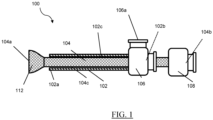
- a device 100 for removing an occlusive clot from a vessel of a patient can have an outer sheath 102 facilitating the introduction of microcatheters, guidewires, or any of a number of commercially available products to a target site within the vasculature.
- the outer sheath 102 can be one or both of a guide catheter and an intermediate catheter.
- the outer sheath 102 can have a distal end 102a, a proximal end 102b, a proximal luer 106 containing the proximal end 102b, and an internal lumen 102c extending proximal of the distal end 102a and terminating within the proximal luer 106.
- the lumen can direct aspiration from the proximal end 102a to the distal end 102b of the outer sheath 102.
- the outer sheath 102 can be positioned within the vasculature of a patient so that the distal end 102a is proximate a target occlusive clot.
- the system 100 can also have an inner funnel catheter 104 with an expanding distal tip 112.
- the inner funnel catheter 104 can be located within the outer sheath 102.
- the inner funnel catheter is concentric with and configured to move telescopically within the outer sheath 102.
- the inner funnel catheter 104 may be pre-loaded into the outer sheath 102 prior to the administration of the device 100 to a target site.
- the inner funnel catheter 104 may be inserted into the outer sheath 102 after the outer sheath 102 is positioned within the vasculature of a patient.
- the inner funnel catheter may have a proximal end 104b, a distal end 104a, a proximal luer 108 containing the proximal end 104b, and an internal lumen 104c extending proximal of the distal end 104a and terminating within the luer 108.
- the lumen can be defined by a tubular support, such as a polymeric and/or braided construction, and can be configured for the passage of guidewires, microcatheters, stent retrievers, and other such devices therethrough.
- the lumen can also direct aspiration from the proximal end 104b to the distal tip 112 of the inner funnel catheter.
- the inner funnel catheter 104 can also have a rapid exchange shaft or guidewire extending proximal to the luer 108 for manipulating and delivering the inner funnel catheter 104.
- the distal tip 112 as show in Fig. 2 , can be sized and configured such that when deployed at the target site, it expands to atraumatically contact the inner vessel walls to provide the maximum possible opening for aspirating or otherwise dislodging and receiving the clot.
- the expanded tip 112 can also provide flow arrest and prevent the unwanted aspiration of blood proximal to the tip 112.
- the inner funnel catheter 104 can be maneuvered independent of the outer sheath 102, and vice versa.
- the proximal sections of the inner funnel catheter 104 can have good thrust and trackability characteristics to aid in advancing it to the target location while more distal sections can be extremely flexible for navigating tortuous anatomy.
- the inner funnel catheter 104 can therefore have multiple designs, or be fabricated from multiple materials, to give a reducing stiffness profile along the length to minimize insertion and retraction forces.
- Features can also be incorporated which bias bending about certain planes or encourage twisting for ease of delivery to a target site.
- the inner funnel catheter 104 can be used in conjunction with separate mechanical devices, such as a thrombectomy device, for the removal of clots.
- the separate devices can be any of a number of commercially available clot retrieval products.
- the mechanical devices may be housed in a microcatheter which is movable relative to the inner funnel catheter 104.
- the microcatheter can be disposed within the lumen 104c of the inner funnel catheter.
- the proximal luer 108 of the inner funnel catheter can facilitate the forwarding of the microcatheter to the target site.
- the inner funnel catheter 104, microcatheter, and devices can be separately or simultaneously delivered to the target site through the outer sheath 102.
- the tip 112 of the inner funnel catheter 104 can be expanded to the deployed state.
- the thrombectomy device can then be deployed from the microcatheter to engage and capture an occlusive clot while aspirating through the expanded tip 112 of the inner funnel catheter 104 and/or the outer sheath 102.
- the tip 112 can have a collapsed delivery configuration and a radially expanded deployed configuration in which the tip assumes a substantially conical or funnel shape.
- the tip 112 can be comprised of a number of struts 140.
- the tip 112 In the collapsed state, the tip 112 can have a radial dimension less than a maximum radial dimension of the tip.
- the tip 112 When deployed, the tip 112 can first extend distal to the outer sheath 102 and then grow radially outward, with at least a portion of the tip assuming a diameter greater than the diameter of the outer sheath 102.
- the tip 112 In the expanded state, the tip 112 can contact, and form a seal with, the inner wall of the vessel.
- the tip 112 can be constructed from a sheet or tube stainless steel, or a superelastic shape memory alloy such as Nitinol. Alternately, the tip 112 can have a braided construction of strip or wire. The tip 112 can also be a lattice laser cut from a hypotube. The radial dimensions of the tip 112 can be sized to atraumatically contact the circumference of the inner wall of a blood vessel. The funnel shape formed by the tip 112 when expanded can improve aspiration efficiency, reduce friction, and lessen the risk of snagging on vessel openings or causing vessel trauma. The maximum radius of the tip 112 can be smaller, larger, or approximately the same size as the diameter of the target blood vessel.
- the device can further have a membrane 110 (not shown) disposed radially around at least a portion of the tip 112.
- a membrane 110 (not shown) disposed radially around at least a portion of the tip 112.
- the same or a different membrane or membranes can also cover some or all of the longitudinal shaft of the catheter.
- the inner funnel catheter 104 is shown within the outer sheath 102, with the proximal luer 108 of the inner funnel catheter located proximally to the proximal luer 106 of the outer sheath.
- the inner funnel catheter 104 and the outer sheath 102 in this configuration can be provided as standalone components to be used in conjunction with one another.
- the inner funnel catheter 104 and the outer sheath 102 can be supplied pre-assembled.
- the inner funnel catheter 104 can be placed into to the outer sheath 102 prior to deployment of the device 100 to a target site.
- Fig. 3a shows the inner funnel catheter 104 with the tip 112 in the collapsed configuration constrained within the outer sheath 102.
- the inner funnel catheter 104 in this figure has been preloaded in a collapsed configuration, although the inner funnel catheter 104 can be preloaded in a deployed configuration as well.
- Fig. 3b depicts the proximal luer 108 of the inner funnel catheter 104, which encompasses the proximal end 104b of the inner funnel catheter, moving distally towards the proximal luer 106 of the outer sheath 102 while the proximal luer of the outer sheath 106 remains in a fixed position.
- This distal movement moves the inner funnel catheter 104 telescopically towards the treatment site and beyond the distal end 102a of the outer sheath.
- the expanding distal tip 112 can deploy to facilitate removal of a clot via aspiration and/or another medical device delivered via microcatheter (not shown).
- the expanded funnel tip 112 can be configured to self-size in an atraumatic manner in a distally tapering blood vessel when being advanced distally of the outer catheter tip to the target treatment location.
- the tip provides a large distal mouth for aspirating the clot and can be sized to be nearly the same or just larger in diameter than the target vessel.
- the tip 112 can thus seal with the vessel or create enough of a restriction such that when aspiration is applied, blood and the clot distal of the mouth will be drawn into the inner funnel catheter 104 rather than blood proximal of the tip. If the expanded tip 112 does not seal, or no other seal exists between the outer or clot retrieval catheter and the inner wall of the vessel, then the suction applied to the clot can be ineffective as the less restricted flow proximal of the tip would dominate.
- the inner funnel catheter 104 can remain in a fixed location while the proximal luer of the outer sheath 106 is moved proximally towards the proximal luer of the inner funnel catheter 108, retracting the outer sheath 102 and exposing the inner funnel catheter 104 to deploy the expanding distal tip 112.
- This configuration can be more atraumatic as further distal advancement of the deployed funnel is not required and a fully expanded funnel does not need to be advanced distally through a blood vessel.
- proximal luer 108 of the inner funnel catheter 104 is moved proximally away from the static proximal luer of the outer sheath 102, causing the inner funnel catheter 104 to move proximally back inside the outer sheath 102 and the expandable distal tip 112 to be constrained back to the collapsed configuration.
- a firm or fibrin-rich clot is lodged in the tip, a complete re-sheathing of the tip may not be possible and the outer sheath 102 and inner funnel catheter 104 can be withdrawn in tandem.
- Figs. 4a-4c depict an example of the device 100 wherein a sliding mechanism 114 is located on the proximal luer 108 of the inner funnel catheter 104 to facilitate movement of the inner funnel catheter relative to the outer sheath 102.
- the proximal luer 108 of the inner funnel catheter is connected to the proximal luer 106 of the outer sheath.
- the proximal luer 108 of the inner funnel catheter and the proximal luer 106 of the outer sheath can be locked together for advancement through the vasculature prior to the administration of the device 100 to the treatment site.
- connection between the luers may be accomplished, for example, by snap fit features, luer lock threads, a locking tab, or other suitable joining mechanisms.
- the proximal luer 106 of the outer sheath is located distally to the proximal luer 108 of the funnel catheter.
- the expandable distal tip 112 of the inner funnel catheter 104 is in the collapsed form inside the outer sheath 102 for delivery.
- the sliding mechanism 114 of the proximal luer 108 of the funnel catheter 104 can interact with the proximal end 104b of the inner funnel catheter to telescopically advance or retract the position of the funnel catheter relative to the outer sheath 102.
- the slider mechanism 114 is depicted as having been moved distally across the proximal lure 108 of the inner funnel catheter, thereby moving the inner funnel catheter 104 to extend past the distal end 102a of the outer sheath and causing the distal tip 112 to deploy to the expanded configuration.
- the inner funnel catheter 104 may be withdrawn into the outer sheath 102 by retracting the slider mechanism 114 and maintaining the proximal luer 106 of the outer sheath in a fixed position while detaching and withdrawing proximally the proximal luer 108 of the inner funnel catheter.
- the inner funnel catheter 104 may be removed while the outer sheath 102 stays in place in the patient. If the inner funnel catheter 104 is removed, the outer sheath 102 can serve as an aspiration catheter or can maintain access to the target site for the inner funnel catheter 104 or other devices to be reinserted later. For example, if the lumen 104a of the inner funnel catheter is blocked by a captured clot, the outer sheath can remain in place while the inner funnel catheter is cleaned.
- At least one hemostasis valve can be attached to the inner funnel catheter 104 or its luer 108 and/or the outer sheath 102 and its luer 106.
- the proximal luer of the outer sheath 106 can also contain a side luer or port 106a for flushing.
- a loading tool can be supplied to aid in re-advancing the inner funnel catheter 104 through the outer sheath 102 if the inner funnel catheter is replaced after removal.
- the loading tool can incorporate a split or semi-split design so that it can be peeled on or off the inner funnel catheter 104.
- Figs. 5a-5c depict an example of the device 100 wherein a sliding mechanism 116 is located in or on the proximal luer 106 of the outer sheath 102 to facilitate movement of the outer sheath relative to the inner funnel catheter 104.
- the proximal luer 108 of the inner funnel catheter is connected to the proximal luer of the outer sheath 106.
- the proximal luer 108 of the inner funnel catheter and the proximal luer 106 of the outer sheath can be connected prior to advancement of the device 100 to the treatment site.
- the connection can be snap fit features, luer lock threads, a locking tab, or other joining mechanisms.
- the proximal luer of the outer sheath 106 is located distally to the proximal luer of the funnel catheter 108.
- the distal tip 112 of the inner funnel catheter 104 is in the collapsed form inside the outer sheath 102.
- the sliding mechanism 116 of the proximal luer 106 of the outer sheath 102 can advance or retract the position of the outer sheath relative to the inner funnel catheter 114.
- the distal tip 112 can be in a collapsed delivery position relative to the distal end 102a of the outer sheath 102.
- the distance D between the distal end of the outer sheath 102a and the distal end of the inner funnel catheter 104a can be close to zero so that minimal movement is required to deploy the inner funnel catheter.
- the distance D for the delivery position between the distal end of the outer sheath and the distal end of the inner funnel catheter can be approximately 1 to 100mm to maintain distal flexibility of the outer sheath.
- the distance between the distal end of the outer sheath and the distal end of the inner funnel catheter can be approximately 20 to 50mm so that the flexibility of the outer sheath is maintained for that distance.
- the distal tip 112 of the inner funnel catheter 104 can be exposed outside the outer sheath 102 at a target side as the outer sheath moves proximally relative to the inner funnel catheter 104.
- the slider mechanism 116 can interact with a pulley pull wire set or similar articulation mechanism in the funnel catheter luer 108.
- the slider mechanism 116 can also be advanced distally across the outer sheath's proximal luer 106 to re-sheath the distal end 104a of the funnel catheter and collapse the distal tip 112 of the inner funnel catheter 104.
- Fig. 5b allows for the inner funnel catheter 104 to be deployed in situ, which improves deployment accuracy relative to the target site and can create a more atraumatic vessel interaction as the expanding tip 112 is not advanced distally towards the target site.
- Fig. 5c depicts that the inner funnel catheter 104 may be withdrawn from the outer sheath 102 by maintaining the proximal luer 106 of the outer sheath in a fixed position and detaching and retracting the proximal luer 108 of the inner funnel catheter.
- the inner funnel catheter 104 may be removed while the outer sheath 102 remains in place, allowing the outer sheath 102 to serve as an aspiration catheter and maintain access to the target site.
- the proximal luer 106 of the outer sheath can also contain a side luer 106a for flushing.
- Figs. 6a-6c depict an example of the device 100 wherein a rotating knob 118 is located on the proximal luer of the outer sheath 106 to facilitate movement of the outer sheath 102 relative to the inner funnel catheter 104.
- the knob when the knob 118 is rotated, the knob can interact with the proximal end 102b of the outer sheath 102 to telescopically advance distally or retract proximally the outer sheath relative to the inner funnel catheter 104.
- a rotating luer set-up can also be used on the luer of the inner funnel catheter to extend or shorten its length relative to the outer sheath.
- the use of a knob 118 mechanism can minimize the length of the luer 106 for devices that include a long travel between the inner and outer catheters.
- the overall length of the device 100 should be in the range of commonly available catheters such that the device 100 can be used with commonly available balloon guides, intermediate catheters, microcatheters, and like devices.
- the device 100 can measure approximately 80 to 100cm in length.
- the device 100 can measure approximately 120 to 140cm in length.
- the device 100 can measure between 130 and 160cm in length.
- other lengths can be anticipated depending on the nature of the procedure.
- the inner funnel catheter luer 108 can contain a port for connecting a syringe or another fluid or vacuum source.
- a plurality of channels can be provided between the outer sheath luer 106 and the funnel catheter luer 108 so that both the inner funnel catheter 104 and the outer sheath 102 may be flushed simultaneously via fluid injected into to the port of the inner funnel catheter 104.
- rotating the knob 118 can retract the outer sheath 102 to uncover the inner funnel catheter 104 at a target site.
- the outer sheath 102 can move proximally relative to the inner funnel catheter 104 through the rotating knob mechanism 118, allowing deployment of the inner funnel catheter.
- the knob mechanism 118 can also be rotated in the opposite direction to re-encompass the distal end 104a of the funnel catheter and re-sheath the expanding tip 112 of the inner funnel catheter 104.
- Fig. 6c depicts that the inner funnel catheter 104 can be withdrawn from the outer sheath 102 by maintaining the proximal luer 106 of the outer sheath in a fixed position and detaching and retracting the proximal luer 108 of the inner funnel catheter. Similar to other examples, the inner funnel catheter 104 may be removed while the outer sheath 102 stays in place, to serve as an aspiration catheter and maintain access to the target site.
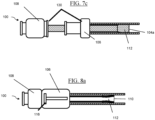
- Figs. 7a-7c depict an example of the device 100 wherein a locking tab 134 is located between the proximal luer 106 of the outer sheath 102 and the proximal luer 108 of inner funnel catheter 104.
- the locking tab 134 can be removed.
- the proximal luer 106 of the outer sheath can be moved proximally towards the proximal luer 108 of the inner funnel catheter to retract the outer sheath 102 relative to the position of the inner funnel catheter 104.
- the locking tab 134 allows the two catheters 102, 104 to remain static relative to one another during shipping, sterilization and advancement through the vascular bed.
- the outer sheath and inner funnel catheter can be capable of translation relative to one another.
- a connection mechanism can be provided to allow the luers to be temporarily connected during the procedure.
- This connection mechanism can include snap fit features 130 as depicted in Fig. 7c , luer lock threads, or other joining mechanisms.
- the proximal luer 108 of the inner funnel catheter and the proximal luer 106 of the outer sheath can later be disconnected by overcoming the snap fit 130 force.
- the inner funnel catheter 104 can then be withdrawn into the outer sheath 102 by maintaining the proximal luer of the outer sheath 106 in a fixed position and detaching and retracting the proximal luer of the inner funnel catheter 108.
- at least one hemostasis valve can be attached to the inner funnel catheter 104 or its luer 108 and/or the outer sheath 102 or its luer 106.
- Figs. 8a-8c are illustrations of an exemplary treatment device with a membrane according to aspects of the present invention.
- the tip 112 can be overlaid by the membrane 110.
- the struts of the tip can stretch the membrane surface radially to an increased curved, funnel-like profile.
- the membrane 110 can take a variety of different forms or configurations.
- the membrane 110 can be formed in a tubular profile with a highly elastic material such that the expanding of the tip 112 will impart a sufficient radial force to stretch the membrane 110 to the profile of the tip 112 when unconstrained.
- the membrane 110 can be, for example, a low-modulus elastomer.
- the elastomeric membrane 110 can create a gentle contact surface for sealing against the walls of the vessel when the tip 112 is deployed to the expanded configuration.
- the membrane 110 could be formed to include a soft elastomeric or gel rib on the outer surface to provide atraumatic contact with the vessel wall. The seal can allow for more efficient aspiration by focusing the suction distally and restricting fluid proximal of the tip, where there is no clot, from being drawn into the catheter.
- the membrane 110 can be reflowed or injection molded into the spaces during manufacturing.
- the membrane 110 can be adhered to the struts 140 of the tip 112 using heat. Elements such as submersion dwell time, substrate withdrawal speed, temperature, humidity, and number of cycles can all be modified to give the membrane 110 a desired and uniform profile. Alternatively, a loose or baggy membrane 110 can be placed over the mouth of the tip.
- the membrane 110 can be attached to the expanding distal tip 112 and can also be attached to some or all of the catheter shaft proximal of the tip.
- the membrane may also be encapsulated over the frame in the deployed state, such that it is compressed for delivery and recovers to its original shape upon expansion.
- An elastomeric material may be used for the membrane 110, or a material that does not exceed its elastic strain limit when collapsed into the outer catheter.
- the membrane 110 can encapsulate the expanding tip 112 such that the membrane 100 can be stretched between the struts of the tip 112 upon expansion.
- the membrane 110 can be formed as a tube and inverted to fold distally from inside the tip 112 and invert about the tip 112 to extend proximally along the outside surface of the tip 112.
- the configuration depicted in Fig. 8c does not fully encapsulate the tip 112 interstitially and therefore allows the structure of the tip 112 to expand freely within the membrane cover 110.
- the membrane configuration depicted in Fig. 8c thereby reduces the strain required to expand the membrane and reduces the radial force required by the tip 112 to expand.
- Figs. 9a-9b are illustrations of another exemplary treatment device with a membrane according to aspects of the present invention.
- the membrane 110 can be attached to the distal end of the outer sheath 102a .
- the membrane can have a tapered or reduced outer diameter OD which aids with advancing the device 100 atraumatically through the vasculature.
- the device 100 can be operated to move the inner funnel catheter 104 distally relative to the outer sheath 102, or the outer sheath 102 proximally relative to the inner funnel catheter 104, in any manner that deploys the expandable tip 112 of the inner funnel catheter just proximate a target site in accordance with Figs.
- Fig. 9a depicts the device in a configuration similar to that of Figs. 5a-5c with an outer sheath mechanism slider 116.
- the inner funnel catheter 104 can be moved distally to press into the membrane 110, or the outer sheath 102 can be moved proximally relative to the inner funnel catheter 104.
- the tip 112 flares into the membrane 110 and expands, causing the membrane 110 to expand in turn as seen in Fig. 9b .
- the membrane 110 can be elastomeric or baggy as described above.
- Figs. 10a-10b are illustrations of a further exemplary treatment device with a membrane according to aspects of the present invention.
- the membrane 110 is attached to the distal end of the outer sheath 102a and the inner surface of the inner funnel catheter 104.
- the membrane 110 is extends from an inner diameter ID of the inner funnel catheter 104 and inverts about an outer diameter OD to connect to the outer sheath 102.
- the device 100 can be operated to move the inner funnel catheter 104 distally relative to the outer sheath 102, or the outer sheath 102 proximally relative to the inner funnel catheter 104, in any manner that deploys the expandable tip 112 of the inner funnel catheter as with previously described examples.
- Fig. 10a the membrane 110 is attached to the distal end of the outer sheath 102a and the inner surface of the inner funnel catheter 104.
- the membrane 110 is extends from an inner diameter ID of the inner funnel catheter 104 and inverts about an outer diameter OD to connect to the outer sheath
- FIG. 10a depicts the device in a configuration similar to that of Figs. 5a-5c with an outer sheath slider mechanism 116.
- the membrane 110 moves with the tip 112 and expands.
- the outer frame of the inner funnel catheter 104 presses against the inner surface of the outer sheath 102 rather than the membrane, which reduces friction upon delivery and expansion.
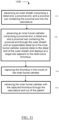
- Fig. 11 depicts a flow diagram outlining a method of use of the device.
- the method can have some or all of the following steps and variations thereof, and the steps are recited in no particular order.
- the method 1100 can have the steps of advancing an outer sheath comprising a distal end, a proximal end, and a proximal luer containing the proximal end into the vasculature (1110); advancing an inner funnel catheter comprising a proximal end, a distal end, and a proximal luer containing the proximal end through the outer sheath until an expandable distal tip of the inner funnel catheter extends distal to the distal end of the outer sheath and deploys adjacent to an obstructive thrombus (1120); capturing the thrombus in the mouth of the inner funnel catheter (1130); and retrieving the inner funnel catheter with the captured thrombus through the vasculature and out of the patient (1140).
- the outer sheath and inner funnel catheter can be advanced to the target site together or independently.
- the method can involve preloading the inner funnel catheter into the outer sheath.
- the system can then be flushed and advanced to the target site.
- a locking mechanism can hold the inner funnel catheter and outer sheath together.
- the mechanism can be, for example, one of a locking tab, snap fit feature, or luer lock thread.
- the expandable tip of the inner funnel catheter can be deployed to expand radially in order to contact the inner walls of the blood vessel.
- the profile of the tip can seal against the vessel wall proximal of the target site. This seals off vessel fluid proximal to the mouth and provides a large opening to easily receive the clot.
- the method can have the step of covering the expandable distal tip with a membrane.
- advancing the tip distally can expand a membrane attached to the distal end of the outer sheath.
- the membrane can be connected to the inner diameter of the funnel catheter and the outer diameter of the outer sheath.
- the step of advancing an inner funnel catheter through the outer sheath can involve moving the proximal luer of the inner funnel catheter distally towards the proximal luer of the outer sheath to advance the distal end of the inner funnel catheter towards a target site.
- the outer sheath and inner funnel catheter can be moved telescopically with respect to one another by a mechanism, where the mechanism can be a slider or rotating knob.
- the proximal luer of the inner funnel catheter can house a slider mechanism for advancing or retracting the position of the funnel catheter relative to the outer sheath, and the method can further comprise the step of moving the slider mechanism distally across the funnel catheter's proximal luer to deploy the distal end of the funnel catheter to extend beyond the distal end of the outer sheath.
- the proximal luer of the outer sheath can have the slider mechanism for advancing or retracting the position of the outer sheath relative to the inner funnel catheter, and the method can further comprise the step of retracting the slider mechanism proximally to expose and thereby deploy the tip of the inner funnel catheter beyond the distal end of the outer sheath.
- the proximal luer of the outer sheath can have a rotating knob for advancing and retracting the position of the outer sheath relative to the inner funnel catheter, and the method can further comprise the step of rotating the knob to retract the outer sheath proximally relative to the inner funnel catheter to expose the expandable tip. Re-sheathing the tip can involve the step of rotating the knob in the opposing direction.
- the step of capturing the thrombus into the mouth of the clot retrieval catheter can involve using aspiration, thrombectomy devices, or other devices and practices known in the art.
- the method can further have the step of maintaining the position of the outer sheath at the target site to serve as an aspiration catheter and to retain access to the target site while the inner funnel catheter and captured clot are withdrawn. Contrast media can be injected to check for vessel patency and if a blockage remains, aspiration can be directed through the outer sheath.
- the inner funnel catheter can also be re-advanced for aspiration. Then the outer sheath and inner funnel catheter can be removed together or independently.
- proximal luers of the device can have a port for flushing, and in some cases a plurality of channels can be formed between the proximal luer of the outer sheath and the proximal luer of the inner funnel catheter. The method can then further have the step of flushing the inner funnel catheter and outer sheath simultaneously using the channels.
- distal and proximal are used throughout the preceding description and are meant to refer to a positions and directions relative to a treating physician. As such, “distal” or distally” refer to a position distant to or a direction away from the physician. Similarly, “proximal” or “proximally” refer to a position near to or a direction towards the physician. Furthermore, the singular forms “a,” “an,” and “the” include plural referents unless the context clearly dictates otherwise.
- the terms “about” or “approximately” for any numerical values or ranges indicate a suitable dimensional tolerance that allows the part or collection of components to function for its intended purpose as described herein. More specifically, “about” or “approximately” may refer to the range of values ⁇ 20% of the recited value, e.g. "about 90%” may refer to the range of values from 71% to 99%.
Landscapes
- Health & Medical Sciences (AREA)
- Life Sciences & Earth Sciences (AREA)
- Surgery (AREA)
- Veterinary Medicine (AREA)
- Public Health (AREA)
- General Health & Medical Sciences (AREA)
- Engineering & Computer Science (AREA)
- Biomedical Technology (AREA)
- Heart & Thoracic Surgery (AREA)
- Animal Behavior & Ethology (AREA)
- Molecular Biology (AREA)
- Medical Informatics (AREA)
- Nuclear Medicine, Radiotherapy & Molecular Imaging (AREA)
- Vascular Medicine (AREA)
- Orthopedic Medicine & Surgery (AREA)
- Biophysics (AREA)
- Pulmonology (AREA)
- Anesthesiology (AREA)
- Hematology (AREA)
- Surgical Instruments (AREA)
Abstract
Description
- The present application claims the benefit of priority of
U.S. Provisional Patent Application No. 62/941,366, filed on November 27, 2019 - The present invention generally relates to devices and methods for removing blockages from blood vessels during intravascular medical treatments. More specifically, the present invention relates to a clot retrieval device comprising an outer sheath and an inner funnel catheter.
- Clot retrieval catheters and devices are used in mechanical thrombectomy for endovascular intervention, often in cases where patients are suffering from conditions such as acute ischemic stroke (AIS), myocardial infarction (MI), and pulmonary embolism (PE). Accessing the neurovascular bed in particular is challenging with conventional technology, as the target vessels are small in diameter, remote relative to the site of insertion, and are highly tortuous. Traditional devices are often either too large in profile, lack the deliverability and flexibility needed to navigate tortuous vessels, difficult to administer and use, or are not effective at removing a clot when delivered to the target site.
- The delivery of effective devices to the small and highly-branched cerebral artery system remains challenging, and conventional clot retrieval catheters suffer from a number of drawbacks. First, the diameters of catheters themselves must be small enough to avoid causing significant discomfort to the patient. The retrieval catheter must also be sufficiently flexible to navigate the vasculature and endure high strains, while also having the axial stiffness to offer smooth advancement along the route. Once at the target site, typical objects to be retrieved from the body are substantially larger in size than the catheter tip, making it more difficult to retrieve objects into the tip. For example, firm, fibrin-rich clots can often be difficult to extract as they can become lodged in the tip of traditional fixed-mouth catheters. Additionally, this lodging can cause softer portions to shear away from the firmer regions of the clot.
- Small diameters and fixed tip sizes are also less efficient at directing the aspiration necessary to remove blood and thrombus material during the procedure. The suction must be strong enough such that any fragmentation that may occur as a result of aspiration or the use of a mechanical thrombectomy device cannot migrate and occlude distal vessels. However, when aspirating with a fixed-mouth catheter, a significant portion of the aspiration flow ends up coming from vessel fluid proximal to the tip of the catheter, where there is no clot. This significantly reduces aspiration efficiency, lowering the success rate of clot removal.
- Any catheter design attempting to overcome these challenges with an expanding distal tip or structure would need to have the strength to grip the clot and exert a steady radial force in the expanded state. The same structure would also need to be sufficiently flexible and elastic to survive the severe mechanical strains imparted when navigating the tortuous vasculature when in a collapsed state.
- Further, other catheter designs can present challenges to operators in requiring the management and relative positioning of separate, catheters or other components without mechanisms to stabilize their positioning relative to one another or aid in deliverability of the components in an atraumatic manner. This can lead to traumatic or inaccurate deployment of the catheter and/or devices at the target site.
- The present design is aimed at providing an improved retrieval catheter which addresses the above-stated deficiencies.
- It is an object of the present design to provide devices and methods to meet the above-stated needs. It is therefore desirable for a clot retrieval catheter device to have a large-mouth expandable tip for removal and easy retrieval of the clot while also having a collapsed state that is low-profile and sufficiently flexible for deliverability to the target site. The device should also incorporate treatment administration enhancements over existing designs to assist administrators in operating the device. According to the present invention, there is provided a device which can have an outer sheath facilitating the introduction of microcatheters, guidewires, or any of a number of commercially available products to a target site within the vasculature. The outer sheath can be one or both of a guide catheter and an intermediate catheter. The outer sheath can have a distal end, a proximal end, a proximal luer containing the proximal end, and an internal lumen extending proximal of the distal end and terminating within the proximal luer. In some examples, at least a portion of the distal end can be encompassed by a flexible membrane.
- Within the outer sheath can be an inner funnel catheter having an expandable distal tip. The expandable distal tip can have a supporting structure comprised of struts or a braided mesh. The inner funnel catheter may be pre-loaded into the outer sheath prior to the administration of the device to a target site.
- The inner funnel catheter can have a proximal end, a distal end, a proximal luer containing the proximal end, and an internal lumen extending proximal of the distal end and terminating within the luer. The inner funnel catheter can also have a rapid exchange shaft or guidewire extending proximal to the luer.
- The inner funnel catheter tip may be self-expanding and disposed at the distal end of the inner funnel catheter. The tip can have a collapsed delivery configuration and a radially expanded deployed configuration in which the tip assumes a substantially conical or funnel shape. The distal tip can be configured to radially self-expand when unconstrained distal of the distal end of the outer sheath. In the collapsed state, the tip can have a radial dimension less than a maximum radial dimension of the tip. When expanded, the tip can grow radially outward to form an open distal mouth. In some examples, at least a portion of the tip can assume a diameter greater than the diameter of the outer sheath. In the expanded state, the tip can contact, and form a seal with, the inner wall of a blood vessel.
- The large distal mouth can offer improved performance over conventional fixed-mouth designs. Traditional fixed-mouth catheters can be hindered by having firm, fibrin-rich clots lodge in the tip, or by having softer portions of the clot shear away. In addition, when aspirating through a fixed-mouth catheter, a significant portion of the suction is directed to fluid proximal of the tip, reducing the suction directed to the clot. In addition, as the diameter of an expandable tip can be close to that of the vessel, clot shearing at the mouth of the catheter can be mitigated and the volume of fluid and clot distal of the tip secured.
- At least a portion of the tip of the inner funnel catheter can have a membrane disposed around it. In some examples, a membrane can cover both the tip and some or all of the outer sheath. For example, a membrane can be attached to the distal end of the outer sheath and expanded radially by the radial self-expansion of the distal tip. In another example, a membrane can be attached to both the inner diameter of the inner funnel catheter and the outer diameter of the outer sheath so that it is expanded radially by the radial self-expansion of the distal tip.
- The tip can be constructed from a sheet or tube stainless steel, or a superelastic shape memory alloy such as Nitinol. In another example, the tip can have a braided construction from wire or strip. In a further example, the tip can be a lattice laser cut from a hypotube. The shape radial dimensions of the tip can be designed to atraumatically contact the circumference of the inner wall of a blood vessel.
- In an example, the distal end of the outer sheath can be delivered approximate a target site. The proximal luer of the outer sheath can be kept in a fixed position so as to maintain the positioning of the distal end of the outer sheath relative to the target site. The inner funnel catheter can be present inside the lumen of the outer sheath. The proximal luer of the inner funnel catheter can be moved distally towards the proximal luer of the outer sheath to advance the distal end of the inner funnel catheter towards the target site. The proximal luer of the inner funnel catheter can also be moved proximally away from the proximal luer of the outer sheath to retract the inner funnel catheter away from the target site.
- In some examples, the proximal luer of the inner funnel catheter can connect axially to the proximal luer of the outer sheath. When connected, the proximal luer of the outer sheath can be located distally to the proximal luer of the funnel catheter. The connection between the luers may be accomplished via snap fit features, luer lock threads, a locking tab, or other suitable joining mechanisms.
- The proximal luer of the funnel catheter can contain a mechanism for changing the longitudinal position of the inner funnel catheter relative to the outer sheath. In one examples, the proximal luer of the funnel catheter can contain a slider mechanism for moving the inner funnel catheter telescopically relative to a fixed position of the outer sheath. By moving the slider mechanism distally across the funnel catheter's proximal luer, the funnel catheter can be deployed to extend past the distal end of the outer sheath.
- Alternatively, the proximal luer of the outer sheath can have a slider mechanism for moving the outer sheath telescopically relative to a fixed position of the inner funnel catheter. Retracting the slider mechanism can retract the outer sheath body relative to the funnel catheter, allowing the expandable tip of the funnel catheter to be exposed and deployed in situ. In one example, the slider mechanism can deploy the inner funnel catheter by using a pulley pull wire set in the funnel catheter luer. Additionally, the slider can be advanced distally across the outer sheath's proximal luer to re-advance the outer sheath to encompass the distal end of the funnel catheter and return the configuration of the expandable tip of the funnel catheter to the collapsed state.
- In some examples, the inner funnel catheter may be withdrawn from inside the outer sheath by fixing the position of the proximal luer of the outer sheath and retracting the proximal luer of the funnel catheter to extract the inner funnel catheter. A loading tool may be supplied to aid in re-advancing the funnel catheter through the outer sheath if the funnel catheter is replaced after removal. The loading tool can incorporate a split or semi-split design so that it can be peeled on or off the inner funnel catheter.
- In another example, the slider mechanism in the outer sheath's proximal luer can be retracted to retract the outer sheath relative to the inner funnel catheter. When the outer sheath is retracted, the expandable tip can be uncovered to expand and deploy just proximate the target site.
- The distal tip can have a collapsed delivery position axially within the outer sheath during advancement to the obstruction in the blood vessel. In some examples, the distance between the distal end of the outer sheath and the distal end of the inner funnel catheter in the collapsed delivery position inside the outer sheath can be close to zero so that minimal movement is required to deploy the inner funnel catheter. In another example, the distance between the distal end of the outer sheath and the distal end of the inner funnel catheter can range between 1 to 100mm to facilitate the distal flexibility of the outer sheath. In a more specific example, the collapsed delivery position of the distal tip is a distance between approximately 20-50 mm proximal of the distal end of the outer sheath.
- In another example, the mechanism for advancing or retracting the position of the outer sheath relative to the inner funnel catheter can be a rotating knob. Angular rotation of the knob can be translated into linear motion of the outer sheath. By rotating the knob in a counterclockwise or clockwise direction, the position of the outer sheath may be advanced distally or retracted proximally relative to the position of the inner funnel catheter.
- In some examples, the inner funnel catheter luer can contain a port for connecting a syringe. Channels can be provided between the outer sheath luer and the funnel catheter luer so that both the inner funnel catheter and the outer sheath may be flushed simultaneously via fluid injected from a syringe connected to the port of the inner funnel catheter.
- In another example, a locking tab can connect the proximal luer of the inner funnel catheter to the proximal luer of the outer sheath. The locking tab can hold the outer sheath and inner funnel catheter together for advancement. The locking tab can be removed before deploying the funnel catheter, as the distance between the distal end of the outer catheter and the collapsed funnel during advancement has been maintained. After the locking tab has been removed, the proximal luer of the inner funnel catheter and the proximal luer of the outer sheath can connect via a connection mechanism. This connection mechanism can include snap fit features, luer lock threads, or other joining mechanisms. The proximal luer of the inner funnel catheter and the proximal luer of the outer sheath can later be disconnected and the proximal luer of the outer sheath moved distally away from the proximal luer of the inner funnel catheter to recover the inner funnel catheter within the outer sheath.
- Also provided is a method for removing an occlusive obstruction from a blood vessel. The method can have some or all of the following steps and variations thereof, and the steps are recited in no particular order. The method can have the steps advancing an outer sheath comprising a distal end, a proximal end, and a proximal luer containing the proximal end into the vasculature; advancing an inner funnel catheter telescopically moveable within the outer sheath and comprising a proximal end, a distal end, and a proximal luer containing the proximal end through the outer sheath until an expandable distal tip of the inner funnel catheter extends distal of the distal end of the outer sheath and deploys adjacent to an obstructive thrombus; capturing the thrombus in the mouth of the inner funnel catheter; and retrieving the inner funnel catheter with the captured thrombus through the vasculature and out of the patient.
- When delivered to the target site, the expandable tip of the inner funnel catheter can be deployed to self-expand radially in order to contact the inner walls of the blood vessel. The profile of the tip can atraumatically seal against the vessel wall proximal of the target site. This can block vessel fluid proximal to the mouth and provides a large opening to easily receive the clot. For this reason, the method may further include the step of coating the expandable distal tip with a membrane. Alternatively, this step could involve advancing the distal tip distally to expand a membrane attached to the distal end of the outer sheath, or a membrane connected to both the funnel catheter and the outer sheath.
- In an example, the step of advancing an inner funnel catheter through the outer sheath can comprise moving the proximal luer of the inner funnel catheter distally towards the proximal luer of the outer sheath to advance the distal end of the inner funnel catheter towards a target site. Alternately, a locking mechanism can be used to hold the inner funnel catheter and outer sheath together for distal advancement. In some examples, the locking mechanism can be one of a locking tab, snap fit feature, or luer lock thread.
- Moving the inner funnel catheter and the outer sheath telescopically relative to each other can be accomplished by utilizing a sliding mechanism or rotating knob. In one example, the proximal luer of the inner funnel catheter can have a slider mechanism for advancing or retracting the position of the funnel catheter relative to the outer sheath, and the method can further contain the step of moving the slider mechanism distally across the funnel catheter's proximal luer to deploy the distal end of the funnel catheter to extend past the distal end of the outer sheath.
- In another example, the proximal luer of the outer sheath can have a slider mechanism for advancing or retracting the position of the outer sheath relative to the funnel mechanism, and the method can further include the step of retracting the slider mechanism proximally to expose and thereby deploy the tip of the inner funnel catheter past the distal end of the outer sheath.
- In a further example, the proximal luer of the outer sheath can have a rotating knob for advancing and retracting the position of the outer sheath relative to the inner funnel catheter, and the method can further include the step of rotating the knob to retract the outer sheath proximally relative to the inner funnel catheter.
- The step of capturing the thrombus into the mouth of the clot retrieval catheter can comprise using aspiration, thrombectomy devices, or other practices and medical devices known in the art.
- In many cases, after retrieving some or all of the occlusive clot, contrast media can be injected to allow a more thorough assessment of the degree to which the vessel is patent. Additional passes with the inner funnel catheter and/or clot retrieval device can be made if an obstruction remains in the vessel. The method can thus also have the step of maintaining the position of the outer sheath at the target site while the inner funnel catheter is retrieved. This can ensure access to the target site is not lost for subsequent retrieval attempts. Any remaining devices can then be removed from the patient once adequate recanalization of the target vessel is observed.
- To clean the outer sheath and inner funnel catheter between passes or at the conclusion of the procedure, the method can further have the step of flushing simultaneously both the outer sheath and inner funnel catheter to remove lodged or loose debris. A plurality of channels can be formed between the proximal luer of the outer sheath and the proximal luer of the inner funnel catheter to allow both to be flushed simultaneously.
- Other aspects and features of the present disclosure will become apparent to those of ordinary skill in the art, upon reviewing the following detailed description in conjunction with the accompanying figures.
- The above and further aspects of this invention are further discussed with the following description of the accompanying drawings, in which like numerals indicate like structural elements and features in various figures. The drawings are not necessarily to scale, emphasis instead being placed upon illustrating principles of the invention. The figures depict one or more implementations of the inventive devices, by way of example only, not by way of limitation. It is expected that those of skill in the art can conceive of and combine elements from multiple figures to better suit the needs of the user.
-
Fig. 1 is an illustration of a device having an outer sheath and an inner funnel catheter with the inner funnel catheter deployed according to aspects of the present invention; -
Fig. 2 is a closer view of an example of the tip of the inner funnel catheter in the deployed position according to aspects of the present invention; -
Figs. 3a-3c are illustrations of a treatment sequence of an exemplary treatment device to retrieve a clot according to aspects of the present invention; -
Figs. 4a-4c shows another treatment sequence of an exemplary treatment device to retrieve a clot according to aspects of the present invention; -
Figs. 5a-5c are views of another treatment sequence of an exemplary treatment device to retrieve a clot according to aspects of the present invention; -
Figs. 6a-6c depict another treatment sequence of an exemplary treatment device to retrieve a clot according to aspects of the present invention; -
Figs. 7a-7c illustrate another treatment sequence of an exemplary treatment device to retrieve a clot according to aspects of the present invention; -
Figs. 8a-8c show another exemplary treatment device with a membrane according to aspects of the present invention; -
Figs. 9a-9b are illustrations of another exemplary treatment device with a membrane according to aspects of the present invention; -
Figs. 10a-10b are views of an exemplary treatment device with a membrane according to aspects of the present invention; and -
Fig. 11 is a flow diagram outlining a method of use for the device according to aspects of the present invention. - Specific examples of the present invention are now described in detail with reference to the Figures, where identical reference numbers indicate elements which are functionally similar or identical.
- Accessing the various vessels within the vascular, whether they are coronary, pulmonary, or cerebral, involves well-known procedural steps and the use of a number of conventional, commercially-available accessory products. These products, such as angiographic materials, rotating hemostasis valves, and guidewires are widely used in laboratory and medical procedures. When these products are employed in conjunction with the system and methods of this invention in the description below, their function and exact constitution are not described in detail.
- Referring to the figures, in
Fig. 1 there is illustrated adevice 100 for removing an occlusive clot from a vessel of a patient according to this invention. Thedevice 100 can have anouter sheath 102 facilitating the introduction of microcatheters, guidewires, or any of a number of commercially available products to a target site within the vasculature. Theouter sheath 102 can be one or both of a guide catheter and an intermediate catheter. Theouter sheath 102 can have adistal end 102a, aproximal end 102b, aproximal luer 106 containing theproximal end 102b, and aninternal lumen 102c extending proximal of thedistal end 102a and terminating within theproximal luer 106. In addition to introducing other devices, the lumen can direct aspiration from theproximal end 102a to thedistal end 102b of theouter sheath 102. Theouter sheath 102 can be positioned within the vasculature of a patient so that thedistal end 102a is proximate a target occlusive clot. - The
system 100 can also have aninner funnel catheter 104 with an expandingdistal tip 112. Theinner funnel catheter 104 can be located within theouter sheath 102. In some examples, the inner funnel catheter is concentric with and configured to move telescopically within theouter sheath 102. Theinner funnel catheter 104 may be pre-loaded into theouter sheath 102 prior to the administration of thedevice 100 to a target site. Alternatively, theinner funnel catheter 104 may be inserted into theouter sheath 102 after theouter sheath 102 is positioned within the vasculature of a patient. - The inner funnel catheter may have a
proximal end 104b, adistal end 104a, aproximal luer 108 containing theproximal end 104b, and aninternal lumen 104c extending proximal of thedistal end 104a and terminating within theluer 108. The lumen can be defined by a tubular support, such as a polymeric and/or braided construction, and can be configured for the passage of guidewires, microcatheters, stent retrievers, and other such devices therethrough. The lumen can also direct aspiration from theproximal end 104b to thedistal tip 112 of the inner funnel catheter. Theinner funnel catheter 104 can also have a rapid exchange shaft or guidewire extending proximal to theluer 108 for manipulating and delivering theinner funnel catheter 104. Thedistal tip 112, as show inFig. 2 , can be sized and configured such that when deployed at the target site, it expands to atraumatically contact the inner vessel walls to provide the maximum possible opening for aspirating or otherwise dislodging and receiving the clot. The expandedtip 112 can also provide flow arrest and prevent the unwanted aspiration of blood proximal to thetip 112. - The
inner funnel catheter 104 can be maneuvered independent of theouter sheath 102, and vice versa. The proximal sections of theinner funnel catheter 104 can have good thrust and trackability characteristics to aid in advancing it to the target location while more distal sections can be extremely flexible for navigating tortuous anatomy. Theinner funnel catheter 104 can therefore have multiple designs, or be fabricated from multiple materials, to give a reducing stiffness profile along the length to minimize insertion and retraction forces. Features can also be incorporated which bias bending about certain planes or encourage twisting for ease of delivery to a target site. - The
inner funnel catheter 104 can be used in conjunction with separate mechanical devices, such as a thrombectomy device, for the removal of clots. The separate devices can be any of a number of commercially available clot retrieval products. The mechanical devices may be housed in a microcatheter which is movable relative to theinner funnel catheter 104. The microcatheter can be disposed within thelumen 104c of the inner funnel catheter. Theproximal luer 108 of the inner funnel catheter can facilitate the forwarding of the microcatheter to the target site. Theinner funnel catheter 104, microcatheter, and devices can be separately or simultaneously delivered to the target site through theouter sheath 102. Once the target site is reached, thetip 112 of theinner funnel catheter 104 can be expanded to the deployed state. The thrombectomy device can then be deployed from the microcatheter to engage and capture an occlusive clot while aspirating through the expandedtip 112 of theinner funnel catheter 104 and/or theouter sheath 102. - As depicted in
Fig. 2 , thetip 112 can have a collapsed delivery configuration and a radially expanded deployed configuration in which the tip assumes a substantially conical or funnel shape. Thetip 112 can be comprised of a number ofstruts 140. In the collapsed state, thetip 112 can have a radial dimension less than a maximum radial dimension of the tip. When deployed, thetip 112 can first extend distal to theouter sheath 102 and then grow radially outward, with at least a portion of the tip assuming a diameter greater than the diameter of theouter sheath 102. In the expanded state, thetip 112 can contact, and form a seal with, the inner wall of the vessel. - The
tip 112 can be constructed from a sheet or tube stainless steel, or a superelastic shape memory alloy such as Nitinol. Alternately, thetip 112 can have a braided construction of strip or wire. Thetip 112 can also be a lattice laser cut from a hypotube. The radial dimensions of thetip 112 can be sized to atraumatically contact the circumference of the inner wall of a blood vessel. The funnel shape formed by thetip 112 when expanded can improve aspiration efficiency, reduce friction, and lessen the risk of snagging on vessel openings or causing vessel trauma. The maximum radius of thetip 112 can be smaller, larger, or approximately the same size as the diameter of the target blood vessel. - The device can further have a membrane 110 (not shown) disposed radially around at least a portion of the
tip 112. The same or a different membrane or membranes can also cover some or all of the longitudinal shaft of the catheter. - In
Fig. 3a , theinner funnel catheter 104 is shown within theouter sheath 102, with theproximal luer 108 of the inner funnel catheter located proximally to theproximal luer 106 of the outer sheath. Theinner funnel catheter 104 and theouter sheath 102 in this configuration can be provided as standalone components to be used in conjunction with one another. As an alternative, theinner funnel catheter 104 and theouter sheath 102 can be supplied pre-assembled. Theinner funnel catheter 104 can be placed into to theouter sheath 102 prior to deployment of thedevice 100 to a target site.Fig. 3a shows theinner funnel catheter 104 with thetip 112 in the collapsed configuration constrained within theouter sheath 102. Theinner funnel catheter 104 in this figure has been preloaded in a collapsed configuration, although theinner funnel catheter 104 can be preloaded in a deployed configuration as well. -
Fig. 3b depicts theproximal luer 108 of theinner funnel catheter 104, which encompasses theproximal end 104b of the inner funnel catheter, moving distally towards theproximal luer 106 of theouter sheath 102 while the proximal luer of theouter sheath 106 remains in a fixed position. This distal movement moves theinner funnel catheter 104 telescopically towards the treatment site and beyond thedistal end 102a of the outer sheath. When theinner funnel catheter 104 is no longer constrained by theouter sheath 102a, the expandingdistal tip 112 can deploy to facilitate removal of a clot via aspiration and/or another medical device delivered via microcatheter (not shown). The expandedfunnel tip 112 can be configured to self-size in an atraumatic manner in a distally tapering blood vessel when being advanced distally of the outer catheter tip to the target treatment location. - The tip provides a large distal mouth for aspirating the clot and can be sized to be nearly the same or just larger in diameter than the target vessel. The
tip 112 can thus seal with the vessel or create enough of a restriction such that when aspiration is applied, blood and the clot distal of the mouth will be drawn into theinner funnel catheter 104 rather than blood proximal of the tip. If the expandedtip 112 does not seal, or no other seal exists between the outer or clot retrieval catheter and the inner wall of the vessel, then the suction applied to the clot can be ineffective as the less restricted flow proximal of the tip would dominate. - Alternatively, in
Fig. 3b , theinner funnel catheter 104 can remain in a fixed location while the proximal luer of theouter sheath 106 is moved proximally towards the proximal luer of theinner funnel catheter 108, retracting theouter sheath 102 and exposing theinner funnel catheter 104 to deploy the expandingdistal tip 112. This configuration can be more atraumatic as further distal advancement of the deployed funnel is not required and a fully expanded funnel does not need to be advanced distally through a blood vessel. - In
Fig. 3c , theproximal luer 108 of theinner funnel catheter 104 is moved proximally away from the static proximal luer of theouter sheath 102, causing theinner funnel catheter 104 to move proximally back inside theouter sheath 102 and the expandabledistal tip 112 to be constrained back to the collapsed configuration. For situations where a firm or fibrin-rich clot is lodged in the tip, a complete re-sheathing of the tip may not be possible and theouter sheath 102 andinner funnel catheter 104 can be withdrawn in tandem. -
Figs. 4a-4c depict an example of thedevice 100 wherein a slidingmechanism 114 is located on theproximal luer 108 of theinner funnel catheter 104 to facilitate movement of the inner funnel catheter relative to theouter sheath 102. InFig. 4a , theproximal luer 108 of the inner funnel catheter is connected to theproximal luer 106 of the outer sheath. Theproximal luer 108 of the inner funnel catheter and theproximal luer 106 of the outer sheath can be locked together for advancement through the vasculature prior to the administration of thedevice 100 to the treatment site. The connection between the luers may be accomplished, for example, by snap fit features, luer lock threads, a locking tab, or other suitable joining mechanisms. In the connected configuration, theproximal luer 106 of the outer sheath is located distally to theproximal luer 108 of the funnel catheter. InFig. 4a , the expandabledistal tip 112 of theinner funnel catheter 104 is in the collapsed form inside theouter sheath 102 for delivery. - The sliding
mechanism 114 of theproximal luer 108 of thefunnel catheter 104 can interact with theproximal end 104b of the inner funnel catheter to telescopically advance or retract the position of the funnel catheter relative to theouter sheath 102. InFig. 4b , theslider mechanism 114 is depicted as having been moved distally across theproximal lure 108 of the inner funnel catheter, thereby moving theinner funnel catheter 104 to extend past thedistal end 102a of the outer sheath and causing thedistal tip 112 to deploy to the expanded configuration. - As depicted in
Fig. 4c , theinner funnel catheter 104 may be withdrawn into theouter sheath 102 by retracting theslider mechanism 114 and maintaining theproximal luer 106 of the outer sheath in a fixed position while detaching and withdrawing proximally theproximal luer 108 of the inner funnel catheter. Theinner funnel catheter 104 may be removed while theouter sheath 102 stays in place in the patient. If theinner funnel catheter 104 is removed, theouter sheath 102 can serve as an aspiration catheter or can maintain access to the target site for theinner funnel catheter 104 or other devices to be reinserted later. For example, if thelumen 104a of the inner funnel catheter is blocked by a captured clot, the outer sheath can remain in place while the inner funnel catheter is cleaned. - At least one hemostasis valve (not shown) can be attached to the
inner funnel catheter 104 or itsluer 108 and/or theouter sheath 102 and itsluer 106. The proximal luer of theouter sheath 106 can also contain a side luer orport 106a for flushing. Additionally, a loading tool can be supplied to aid in re-advancing theinner funnel catheter 104 through theouter sheath 102 if the inner funnel catheter is replaced after removal. The loading tool can incorporate a split or semi-split design so that it can be peeled on or off theinner funnel catheter 104. -
Figs. 5a-5c depict an example of thedevice 100 wherein a slidingmechanism 116 is located in or on theproximal luer 106 of theouter sheath 102 to facilitate movement of the outer sheath relative to theinner funnel catheter 104. InFig. 5a , theproximal luer 108 of the inner funnel catheter is connected to the proximal luer of theouter sheath 106. Theproximal luer 108 of the inner funnel catheter and theproximal luer 106 of the outer sheath can be connected prior to advancement of thedevice 100 to the treatment site. As with other examples, the connection can be snap fit features, luer lock threads, a locking tab, or other joining mechanisms. In the connected configuration, the proximal luer of theouter sheath 106 is located distally to the proximal luer of thefunnel catheter 108. InFig. 5a , thedistal tip 112 of theinner funnel catheter 104 is in the collapsed form inside theouter sheath 102. - The sliding
mechanism 116 of theproximal luer 106 of theouter sheath 102 can advance or retract the position of the outer sheath relative to theinner funnel catheter 114. During delivery, thedistal tip 112 can be in a collapsed delivery position relative to thedistal end 102a of theouter sheath 102. In one example, the distance D between the distal end of theouter sheath 102a and the distal end of theinner funnel catheter 104a can be close to zero so that minimal movement is required to deploy the inner funnel catheter. In another example, the distance D for the delivery position between the distal end of the outer sheath and the distal end of the inner funnel catheter can be approximately 1 to 100mm to maintain distal flexibility of the outer sheath. Alternatively, the distance between the distal end of the outer sheath and the distal end of the inner funnel catheter can be approximately 20 to 50mm so that the flexibility of the outer sheath is maintained for that distance. - As depicted in
Fig. 5b , by retracting theslider mechanism 116 proximally across the proximal luer of theouter sheath 106, thedistal tip 112 of theinner funnel catheter 104 can be exposed outside theouter sheath 102 at a target side as the outer sheath moves proximally relative to theinner funnel catheter 104. Theslider mechanism 116 can interact with a pulley pull wire set or similar articulation mechanism in thefunnel catheter luer 108. Theslider mechanism 116 can also be advanced distally across the outer sheath'sproximal luer 106 to re-sheath thedistal end 104a of the funnel catheter and collapse thedistal tip 112 of theinner funnel catheter 104. - The configuration of
Fig. 5b allows for theinner funnel catheter 104 to be deployed in situ, which improves deployment accuracy relative to the target site and can create a more atraumatic vessel interaction as the expandingtip 112 is not advanced distally towards the target site. -
Fig. 5c depicts that theinner funnel catheter 104 may be withdrawn from theouter sheath 102 by maintaining theproximal luer 106 of the outer sheath in a fixed position and detaching and retracting theproximal luer 108 of the inner funnel catheter. Theinner funnel catheter 104 may be removed while theouter sheath 102 remains in place, allowing theouter sheath 102 to serve as an aspiration catheter and maintain access to the target site. Theproximal luer 106 of the outer sheath can also contain aside luer 106a for flushing. -
Figs. 6a-6c depict an example of thedevice 100 wherein arotating knob 118 is located on the proximal luer of theouter sheath 106 to facilitate movement of theouter sheath 102 relative to theinner funnel catheter 104. InFig 6a , when theknob 118 is rotated, the knob can interact with theproximal end 102b of theouter sheath 102 to telescopically advance distally or retract proximally the outer sheath relative to theinner funnel catheter 104. It is appreciated that a rotating luer set-up can also be used on the luer of the inner funnel catheter to extend or shorten its length relative to the outer sheath. - The use of a
knob 118 mechanism can minimize the length of theluer 106 for devices that include a long travel between the inner and outer catheters. The overall length of thedevice 100 should be in the range of commonly available catheters such that thedevice 100 can be used with commonly available balloon guides, intermediate catheters, microcatheters, and like devices. For example, for use with balloon guides thedevice 100 can measure approximately 80 to 100cm in length. For use with intermediate catheters, thedevice 100 can measure approximately 120 to 140cm in length. For use with microcatheters, thedevice 100 can measure between 130 and 160cm in length. Similarly, other lengths can be anticipated depending on the nature of the procedure. - The inner
funnel catheter luer 108 can contain a port for connecting a syringe or another fluid or vacuum source. A plurality of channels can be provided between theouter sheath luer 106 and thefunnel catheter luer 108 so that both theinner funnel catheter 104 and theouter sheath 102 may be flushed simultaneously via fluid injected into to the port of theinner funnel catheter 104. - As depicted in
Fig. 6b , rotating theknob 118 can retract theouter sheath 102 to uncover theinner funnel catheter 104 at a target site. Theouter sheath 102 can move proximally relative to theinner funnel catheter 104 through therotating knob mechanism 118, allowing deployment of the inner funnel catheter. Theknob mechanism 118 can also be rotated in the opposite direction to re-encompass thedistal end 104a of the funnel catheter and re-sheath the expandingtip 112 of theinner funnel catheter 104. -
Fig. 6c depicts that theinner funnel catheter 104 can be withdrawn from theouter sheath 102 by maintaining theproximal luer 106 of the outer sheath in a fixed position and detaching and retracting theproximal luer 108 of the inner funnel catheter. Similar to other examples, theinner funnel catheter 104 may be removed while theouter sheath 102 stays in place, to serve as an aspiration catheter and maintain access to the target site. -
Figs. 7a-7c depict an example of thedevice 100 wherein alocking tab 134 is located between theproximal luer 106 of theouter sheath 102 and theproximal luer 108 ofinner funnel catheter 104. As depicted inFig. 7b , thelocking tab 134 can be removed. Theproximal luer 106 of the outer sheath can be moved proximally towards theproximal luer 108 of the inner funnel catheter to retract theouter sheath 102 relative to the position of theinner funnel catheter 104. Thelocking tab 134 allows the twocatheters Fig. 7c , luer lock threads, or other joining mechanisms. Once the clot is reached, the expandingdistal tip 112 can be deployed as shown and the snap fit features 130 can lock the deployedinner funnel catheter 104 in place. - As depicted in
Fig. 7c , theproximal luer 108 of the inner funnel catheter and theproximal luer 106 of the outer sheath can later be disconnected by overcoming the snap fit 130 force. Theinner funnel catheter 104 can then be withdrawn into theouter sheath 102 by maintaining the proximal luer of theouter sheath 106 in a fixed position and detaching and retracting the proximal luer of theinner funnel catheter 108. As with other examples, at least one hemostasis valve can be attached to theinner funnel catheter 104 or itsluer 108 and/or theouter sheath 102 or itsluer 106. -
Figs. 8a-8c are illustrations of an exemplary treatment device with a membrane according to aspects of the present invention. In some examples, thetip 112 can be overlaid by themembrane 110. When thetip 112 is fully deployed, the struts of the tip can stretch the membrane surface radially to an increased curved, funnel-like profile. - The
membrane 110 can take a variety of different forms or configurations. Themembrane 110 can be formed in a tubular profile with a highly elastic material such that the expanding of thetip 112 will impart a sufficient radial force to stretch themembrane 110 to the profile of thetip 112 when unconstrained. Themembrane 110 can be, for example, a low-modulus elastomer. Theelastomeric membrane 110 can create a gentle contact surface for sealing against the walls of the vessel when thetip 112 is deployed to the expanded configuration. In another example, themembrane 110 could be formed to include a soft elastomeric or gel rib on the outer surface to provide atraumatic contact with the vessel wall. The seal can allow for more efficient aspiration by focusing the suction distally and restricting fluid proximal of the tip, where there is no clot, from being drawn into the catheter. - If the
tip 112 is cut from a hypotube, spaces, slots, or patterns can be laser-cut into the outer surface of the hypotube and themembrane 110 can be reflowed or injection molded into the spaces during manufacturing. Themembrane 110 can be adhered to thestruts 140 of thetip 112 using heat. Elements such as submersion dwell time, substrate withdrawal speed, temperature, humidity, and number of cycles can all be modified to give the membrane 110 a desired and uniform profile. Alternatively, a loose orbaggy membrane 110 can be placed over the mouth of the tip. - As depicted in
Fig. 8a , themembrane 110 can be attached to the expandingdistal tip 112 and can also be attached to some or all of the catheter shaft proximal of the tip. The membrane may also be encapsulated over the frame in the deployed state, such that it is compressed for delivery and recovers to its original shape upon expansion. An elastomeric material may be used for themembrane 110, or a material that does not exceed its elastic strain limit when collapsed into the outer catheter. - As depicted in
Fig. 8b , themembrane 110 can encapsulate the expandingtip 112 such that themembrane 100 can be stretched between the struts of thetip 112 upon expansion. Alternatively, as depicted inFig. 8c , themembrane 110 can be formed as a tube and inverted to fold distally from inside thetip 112 and invert about thetip 112 to extend proximally along the outside surface of thetip 112. The configuration depicted inFig. 8c does not fully encapsulate thetip 112 interstitially and therefore allows the structure of thetip 112 to expand freely within themembrane cover 110. The membrane configuration depicted inFig. 8c thereby reduces the strain required to expand the membrane and reduces the radial force required by thetip 112 to expand. -
Figs. 9a-9b are illustrations of another exemplary treatment device with a membrane according to aspects of the present invention. InFig. 9a , themembrane 110 can be attached to the distal end of theouter sheath 102a. The membrane can have a tapered or reduced outer diameter OD which aids with advancing thedevice 100 atraumatically through the vasculature. Thedevice 100 can be operated to move theinner funnel catheter 104 distally relative to theouter sheath 102, or theouter sheath 102 proximally relative to theinner funnel catheter 104, in any manner that deploys theexpandable tip 112 of the inner funnel catheter just proximate a target site in accordance withFigs. 3a-3c ,4a-4c ,5a-5c ,6a-6c , or7a-7c .Fig. 9a depicts the device in a configuration similar to that ofFigs. 5a-5c with an outersheath mechanism slider 116. By utilizing theslider mechanism 116, theinner funnel catheter 104 can be moved distally to press into themembrane 110, or theouter sheath 102 can be moved proximally relative to theinner funnel catheter 104. When unconstrained, thetip 112 flares into themembrane 110 and expands, causing themembrane 110 to expand in turn as seen inFig. 9b . Themembrane 110 can be elastomeric or baggy as described above. -
Figs. 10a-10b are illustrations of a further exemplary treatment device with a membrane according to aspects of the present invention. InFig. 10a , themembrane 110 is attached to the distal end of theouter sheath 102a and the inner surface of theinner funnel catheter 104. Themembrane 110 is extends from an inner diameter ID of theinner funnel catheter 104 and inverts about an outer diameter OD to connect to theouter sheath 102. Thedevice 100 can be operated to move theinner funnel catheter 104 distally relative to theouter sheath 102, or theouter sheath 102 proximally relative to theinner funnel catheter 104, in any manner that deploys theexpandable tip 112 of the inner funnel catheter as with previously described examples.Fig. 10a depicts the device in a configuration similar to that ofFigs. 5a-5c with an outersheath slider mechanism 116. When theinner funnel catheter 104 is advanced and/or the outer sheath is retracted, themembrane 110 moves with thetip 112 and expands. In the configuration shown inFig. 10b , the outer frame of theinner funnel catheter 104 presses against the inner surface of theouter sheath 102 rather than the membrane, which reduces friction upon delivery and expansion. -
Fig. 11 depicts a flow diagram outlining a method of use of the device. The method can have some or all of the following steps and variations thereof, and the steps are recited in no particular order. Themethod 1100 can have the steps of advancing an outer sheath comprising a distal end, a proximal end, and a proximal luer containing the proximal end into the vasculature (1110); advancing an inner funnel catheter comprising a proximal end, a distal end, and a proximal luer containing the proximal end through the outer sheath until an expandable distal tip of the inner funnel catheter extends distal to the distal end of the outer sheath and deploys adjacent to an obstructive thrombus (1120); capturing the thrombus in the mouth of the inner funnel catheter (1130); and retrieving the inner funnel catheter with the captured thrombus through the vasculature and out of the patient (1140). - It can be appreciated that the outer sheath and inner funnel catheter can be advanced to the target site together or independently. For example, the method can involve preloading the inner funnel catheter into the outer sheath. The system can then be flushed and advanced to the target site. For ease of simultaneous advancement to the target site, a locking mechanism can hold the inner funnel catheter and outer sheath together. The mechanism can be, for example, one of a locking tab, snap fit feature, or luer lock thread. When delivered to the target site, the expandable tip of the inner funnel catheter can be deployed to expand radially in order to contact the inner walls of the blood vessel. The profile of the tip can seal against the vessel wall proximal of the target site. This seals off vessel fluid proximal to the mouth and provides a large opening to easily receive the clot.
- The method can have the step of covering the expandable distal tip with a membrane. In an alternate example, advancing the tip distally can expand a membrane attached to the distal end of the outer sheath. In a further example, the membrane can be connected to the inner diameter of the funnel catheter and the outer diameter of the outer sheath.
- In some examples, the step of advancing an inner funnel catheter through the outer sheath can involve moving the proximal luer of the inner funnel catheter distally towards the proximal luer of the outer sheath to advance the distal end of the inner funnel catheter towards a target site.
- The outer sheath and inner funnel catheter can be moved telescopically with respect to one another by a mechanism, where the mechanism can be a slider or rotating knob. In one example, the proximal luer of the inner funnel catheter can house a slider mechanism for advancing or retracting the position of the funnel catheter relative to the outer sheath, and the method can further comprise the step of moving the slider mechanism distally across the funnel catheter's proximal luer to deploy the distal end of the funnel catheter to extend beyond the distal end of the outer sheath.
- In another example, the proximal luer of the outer sheath can have the slider mechanism for advancing or retracting the position of the outer sheath relative to the inner funnel catheter, and the method can further comprise the step of retracting the slider mechanism proximally to expose and thereby deploy the tip of the inner funnel catheter beyond the distal end of the outer sheath.
- In a further example, the proximal luer of the outer sheath can have a rotating knob for advancing and retracting the position of the outer sheath relative to the inner funnel catheter, and the method can further comprise the step of rotating the knob to retract the outer sheath proximally relative to the inner funnel catheter to expose the expandable tip. Re-sheathing the tip can involve the step of rotating the knob in the opposing direction.
- The step of capturing the thrombus into the mouth of the clot retrieval catheter can involve using aspiration, thrombectomy devices, or other devices and practices known in the art. When the thrombus is being retrieved, the method can further have the step of maintaining the position of the outer sheath at the target site to serve as an aspiration catheter and to retain access to the target site while the inner funnel catheter and captured clot are withdrawn. Contrast media can be injected to check for vessel patency and if a blockage remains, aspiration can be directed through the outer sheath. The inner funnel catheter can also be re-advanced for aspiration. Then the outer sheath and inner funnel catheter can be removed together or independently.
- In some cases, additional passes with the device may be required if the vessel is not patent. Between passes, it may be necessary to clean clot fragments and/or debris from the lumens of the inner funnel catheter and outer sheath. One or both or the proximal luers of the device can have a port for flushing, and in some cases a plurality of channels can be formed between the proximal luer of the outer sheath and the proximal luer of the inner funnel catheter. The method can then further have the step of flushing the inner funnel catheter and outer sheath simultaneously using the channels.
- The invention is not necessarily limited to the examples described, which can be varied in construction and detail. The terms "distal" and "proximal" are used throughout the preceding description and are meant to refer to a positions and directions relative to a treating physician. As such, "distal" or distally" refer to a position distant to or a direction away from the physician. Similarly, "proximal" or "proximally" refer to a position near to or a direction towards the physician. Furthermore, the singular forms "a," "an," and "the" include plural referents unless the context clearly dictates otherwise.
- As used herein, the terms "about" or "approximately" for any numerical values or ranges indicate a suitable dimensional tolerance that allows the part or collection of components to function for its intended purpose as described herein. More specifically, "about" or "approximately" may refer to the range of values ±20% of the recited value, e.g. "about 90%" may refer to the range of values from 71% to 99%.
- In describing example embodiments, terminology has been resorted to for the sake of clarity. It is intended that each term contemplates its broadest meaning as understood by those skilled in the art and includes all technical equivalents that operate in a similar manner to accomplish a similar purpose without departing from the scope and spirit of the invention. It is also to be understood that the mention of one or more steps of a method does not preclude the presence of additional method steps or intervening method steps between those steps expressly identified. Similarly, some steps of a method can be performed in a different order than those described herein without departing from the scope of the disclosed technology. For clarity and conciseness, not all possible combinations have been listed, and such variants are often apparent to those of skill in the art and are intended to be within the scope of the claims which follow.
-
- 1. A method of retrieving an obstructive thrombus from a blood vessel of a patient comprising the steps of:
- advancing an outer sheath comprising a distal end, a proximal end, and a proximal luer containing the proximal end into the vasculature;
- advancing an inner funnel catheter connected to and telescopically movable within the outer sheath, the inner funnel catheter comprising a proximal end, a distal end, and a proximal luer containing the proximal end through the outer sheath until an expandable distal tip of the inner funnel catheter extends distally to the distal end of the outer sheath and deploys at a target site adjacent to the obstructive thrombus;
- capturing the thrombus in the mouth of the inner funnel catheter; and
- retrieving the inner funnel catheter with the captured thrombus through the vasculature and out of the patient.
- 2. The method of
aspect 1, further comprising maintaining a position of the outer sheath at the target site while the inner funnel catheter is retrieved. - 3. The method of
aspect 1, further comprising advancing the distal tip distally to expand a membrane attached to the distal end of the outer sheath. - 4. The method of
aspect 1, further comprising moving telescopically, by a mechanism, the inner funnel catheter and the outer sheath relative to each other;
wherein the mechanism is one of a sliding mechanism or rotating knob. - 5. The method of
aspect 1, further comprising flushing simultaneously, by a plurality of channels formed between the proximal luer of the outer sheath and the proximal luer of the inner funnel catheter, both the outer sheath and inner funnel catheter. - 6. The method of
aspect 1, further comprising holding, by a locking mechanism, the inner funnel catheter and outer sheath together for distal advancement. - 7. The method of aspect 6, wherein the locking mechanism is one of a locking tab, snap fit feature, or luer lock thread.
- The following is a list of embodiments that may or may not be claimed hereinafter:
- 1. A device for retrieving an obstruction in a blood vessel comprising:
- an outer sheath comprising a distal end, a proximal end, a proximal luer encompassing the proximal end, and an internal lumen extending proximal of the distal end and terminating within the proximal luer; and
- an inner funnel catheter within the outer sheath comprising an expanding distal tip, a proximal end, a distal end located at the distal tip, a proximal luer encompassing the proximal end, and an internal lumen extending proximal of the distal end and terminating at the luer;
- the expanding distal tip configured to radially self-expand when unconstrained distal of the distal end of the outer sheath.
- 2. The device of
embodiment 1, further comprising a slider mechanism for moving the inner funnel catheter telescopically relative to a fixed position of the outer sheath. - 3. The device of embodiment 2, wherein the slider mechanism is positioned on the proximal luer of the inner funnel catheter.
- 4. The device of
embodiment 1, further compri sing a rotating knob configured for moving the outer sheath telescopically relative to a fixed position of the inner funnel catheter. - 5. The device of
embodiment 1, further comprising a slider mechanism for moving the outer sheath telescopically relative to a fixed position of the inner funnel catheter. - 6. The device of embodiment 5, wherein the slider mechanism is positioned on the proximal luer of the outer sheath.
- 7. The device of
embodiment 1 further comprising a locking tab located in between the proximal luer of the inner funnel catheter and the proximal luer of the outer sheath. - 8. The device of
embodiment 1, further comprising a snap fit connection between the proximal luer of the inner funnel catheter and the proximal luer of the outer sheath. - 9. The device of
embodiment 1, wherein the distal tip is at least partially encapsulated by a membrane. - 10. The device of
embodiment 1, wherein a membrane attached to the distal end of the outer sheath is expanded radially by the radial self-expansion of the distal tip. - 11. The device of
embodiment 1, wherein a membrane attached to the inner diameter of the inner funnel catheter and the outer diameter of the outer sheath is expanded radially by the radial self-expansion of the distal tip. - 12. The device of
embodiment 1, wherein the distal tip is in a collapsed delivery position within the outer sheath during advancement to the obstruction in the blood vessel. - 13. The device of embodiment 12, wherein the collapsed delivery position of the distal tip is a distance between approximately 20-50 mm proximal of the distal end of the outer sheath.
Claims (13)
- A device for retrieving an obstruction in a blood vessel comprising:an outer sheath comprising a distal end, a proximal end, a proximal luer encompassing the proximal end, and an internal lumen extending proximal of the distal end and terminating within the proximal luer; andan inner funnel catheter within the outer sheath comprising an expanding distal tip, a proximal end, a distal end located at the distal tip, a proximal luer encompassing the proximal end, and an internal lumen extending proximal of the distal end and terminating at the luer;the expanding distal tip configured to radially self-expand when unconstrained distal of the distal end of the outer sheath.
- The device of claim 1, further comprising a slider mechanism for moving the inner funnel catheter telescopically relative to a fixed position of the outer sheath.
- The device of claim 2, wherein the slider mechanism is positioned on the proximal luer of the inner funnel catheter.
- The device of claim 1, further comprising a rotating knob configured for moving the outer sheath telescopically relative to a fixed position of the inner funnel catheter.
- The device of claim 1, further comprising a slider mechanism for moving the outer sheath telescopically relative to a fixed position of the inner funnel catheter.
- The device of claim 5, wherein the slider mechanism is positioned on the proximal luer of the outer sheath.
- The device of claim 1 further comprising a locking tab located in between the proximal luer of the inner funnel catheter and the proximal luer of the outer sheath.
- The device of claim 1, further comprising a snap fit connection between the proximal luer of the inner funnel catheter and the proximal luer of the outer sheath.
- The device of claim 1, wherein the distal tip is at least partially encapsulated by a membrane.
- The device of claim 1, wherein a membrane attached to the distal end of the outer sheath is expanded radially by the radial self-expansion of the distal tip.
- The device of claim 1, wherein a membrane attached to the inner diameter of the inner funnel catheter and the outer diameter of the outer sheath is expanded radially by the radial self-expansion of the distal tip.
- The device of claim 1, wherein the distal tip is in a collapsed delivery position within the outer sheath during advancement to the obstruction in the blood vessel.
- The device of claim 12, wherein the collapsed delivery position of the distal tip is a distance between approximately 20-50 mm proximal of the distal end of the outer sheath.
Applications Claiming Priority (2)
| Application Number | Priority Date | Filing Date | Title |
|---|---|---|---|
| US201962941366P | 2019-11-27 | 2019-11-27 | |
| EP20209993.3A EP3827763B1 (en) | 2019-11-27 | 2020-11-26 | Clot retrieval device with outer sheath and inner catheter |
Related Parent Applications (2)
| Application Number | Title | Priority Date | Filing Date |
|---|---|---|---|
| EP20209993.3A Division-Into EP3827763B1 (en) | 2019-11-27 | 2020-11-26 | Clot retrieval device with outer sheath and inner catheter |
| EP20209993.3A Division EP3827763B1 (en) | 2019-11-27 | 2020-11-26 | Clot retrieval device with outer sheath and inner catheter |
Publications (2)
| Publication Number | Publication Date |
|---|---|
| EP4342396A2 true EP4342396A2 (en) | 2024-03-27 |
| EP4342396A3 EP4342396A3 (en) | 2024-06-26 |
Family
ID=73598726
Family Applications (2)
| Application Number | Title | Priority Date | Filing Date |
|---|---|---|---|
| EP24155946.7A Pending EP4342396A3 (en) | 2019-11-27 | 2020-11-26 | Clot retrieval device with outer sheath and inner catheter |
| EP20209993.3A Active EP3827763B1 (en) | 2019-11-27 | 2020-11-26 | Clot retrieval device with outer sheath and inner catheter |
Family Applications After (1)
| Application Number | Title | Priority Date | Filing Date |
|---|---|---|---|
| EP20209993.3A Active EP3827763B1 (en) | 2019-11-27 | 2020-11-26 | Clot retrieval device with outer sheath and inner catheter |
Country Status (6)
| Country | Link |
|---|---|
| US (1) | US11839725B2 (en) |
| EP (2) | EP4342396A3 (en) |
| JP (1) | JP7536618B2 (en) |
| KR (1) | KR20210066739A (en) |
| CN (1) | CN112842463A (en) |
| ES (1) | ES2978659T3 (en) |
Families Citing this family (39)
| Publication number | Priority date | Publication date | Assignee | Title |
|---|---|---|---|---|
| US10238406B2 (en) | 2013-10-21 | 2019-03-26 | Inari Medical, Inc. | Methods and apparatus for treating embolism |
| US10285720B2 (en) | 2014-03-11 | 2019-05-14 | Neuravi Limited | Clot retrieval system for removing occlusive clot from a blood vessel |
| US10441301B2 (en) | 2014-06-13 | 2019-10-15 | Neuravi Limited | Devices and methods for removal of acute blockages from blood vessels |
| US10265086B2 (en) | 2014-06-30 | 2019-04-23 | Neuravi Limited | System for removing a clot from a blood vessel |
| AU2016341439B2 (en) | 2015-10-23 | 2021-07-08 | Stryker Corporation | Intravascular treatment of vascular occlusion and associated devices, systems, and methods |
| CN116421266A (en) | 2016-10-24 | 2023-07-14 | 伊纳里医疗有限公司 | Device and method for treating vascular occlusion |
| DK3678731T3 (en) | 2017-09-06 | 2025-01-02 | Inari Medical Inc | HEMOSTASIS VALVES AND METHODS OF USE |
| EP3687424B8 (en) | 2017-09-30 | 2024-04-24 | Ceretrieve Ltd | Retrieval system |
| US11154314B2 (en) | 2018-01-26 | 2021-10-26 | Inari Medical, Inc. | Single insertion delivery system for treating embolism and associated systems and methods |
| US12285182B2 (en) | 2018-10-10 | 2025-04-29 | Innova Vascular, Inc. | Devices and methods for removing an embolus |
| ES2910600T3 (en) | 2019-03-04 | 2022-05-12 | Neuravi Ltd | Powered Clot Recovery Catheter |
| US11529495B2 (en) | 2019-09-11 | 2022-12-20 | Neuravi Limited | Expandable mouth catheter |
| CA3157521A1 (en) | 2019-10-16 | 2021-04-22 | Inari Medical, Inc. | Systems, devices, and methods for treating vascular occlusions |
| US11779364B2 (en) | 2019-11-27 | 2023-10-10 | Neuravi Limited | Actuated expandable mouth thrombectomy catheter |
| US11839725B2 (en) | 2019-11-27 | 2023-12-12 | Neuravi Limited | Clot retrieval device with outer sheath and inner catheter |
| US12539130B2 (en) | 2019-11-27 | 2026-02-03 | Neuravi Limited | Aspiration catheter, systems, and methods thereof |
| CN115460999A (en) | 2020-03-04 | 2022-12-09 | 施菲姆德控股有限责任公司 | Thrombus removal systems and related methods |
| US11944327B2 (en) | 2020-03-05 | 2024-04-02 | Neuravi Limited | Expandable mouth aspirating clot retrieval catheter |
| US11883043B2 (en) | 2020-03-31 | 2024-01-30 | DePuy Synthes Products, Inc. | Catheter funnel extension |
| US11759217B2 (en) | 2020-04-07 | 2023-09-19 | Neuravi Limited | Catheter tubular support |
| EP4663214A3 (en) | 2020-06-05 | 2026-02-25 | Inari Medical, Inc. | Recapturable funnel catheters, and associated systems |
| WO2022123565A1 (en) * | 2020-12-09 | 2022-06-16 | Ceretrive Ltd. | Retrieval system and method |
| US11872354B2 (en) | 2021-02-24 | 2024-01-16 | Neuravi Limited | Flexible catheter shaft frame with seam |
| US20220273323A1 (en) | 2021-03-01 | 2022-09-01 | Endovascular Engineering, Inc. | Aspiration devices for treatment of thrombosis including expandable distal ends and systems and methods thereof |
| US12599397B2 (en) | 2021-05-19 | 2026-04-14 | Shifamed Holdings, Llc | Thrombus removal systems and associated methods |
| EP4351452A4 (en) * | 2021-06-10 | 2025-03-26 | Shifamed Holdings, LLC | THROMBUS REMOVAL SYSTEMS AND ASSOCIATED PROCEDURES |
| CN113616276A (en) * | 2021-07-22 | 2021-11-09 | 广州易介医疗科技有限公司 | Suction catheter with deformable tip and method of use |
| US20230095102A1 (en) * | 2021-07-29 | 2023-03-30 | Neuravi Limited | Collapsible super-bore catheter |
| US11937839B2 (en) | 2021-09-28 | 2024-03-26 | Neuravi Limited | Catheter with electrically actuated expandable mouth |
| US12011186B2 (en) | 2021-10-28 | 2024-06-18 | Neuravi Limited | Bevel tip expandable mouth catheter with reinforcing ring |
| US20230137418A1 (en) * | 2021-11-03 | 2023-05-04 | Neuravi Limited | Super-bore catheter with braid supported flared tip |
| US12364496B2 (en) | 2022-01-11 | 2025-07-22 | Inari Medical, Inc. | Devices for removing clot material from intravascularly implanted devices, and associated systems and methods |
| US20230381482A1 (en) * | 2022-05-31 | 2023-11-30 | Neuravi Limited | Introducer Tool for an Aspiration Catheter |
| US20240016509A1 (en) * | 2022-07-14 | 2024-01-18 | Rishi Razdan | Umbrella Catheter Device |
| US12053192B2 (en) | 2022-09-01 | 2024-08-06 | Endovascular Engineering, Inc. | Systems, devices, and methods for aspiration, including expandable structures and rotatable shafts |
| JP2026501789A (en) | 2023-01-09 | 2026-01-16 | イナリ メディカル, インコーポレイテッド | Catheter for use with a clot treatment system - Patent Application 20070122997 |
| AU2024380408A1 (en) | 2023-11-16 | 2026-05-07 | Inari Medical, Inc. | Automatic locking and unlocking vacuum syringes, and associated systems and methods |
| US12465382B1 (en) | 2024-05-10 | 2025-11-11 | Inari Medical, Inc. | Mechanical thrombectomy assemblies with relief features, and associated devices, systems, and methods |
| US12594079B2 (en) | 2024-06-27 | 2026-04-07 | Muhammad Ali | Vacuum assisted occlusion of the left atrial appendage |
Family Cites Families (712)
| Publication number | Priority date | Publication date | Assignee | Title |
|---|---|---|---|---|
| US4324262A (en) | 1979-01-02 | 1982-04-13 | University Of Virginia Alumni Patents Foundation | Aspirating culture catheter and method of use |
| US4243040A (en) | 1979-09-17 | 1981-01-06 | Beecher William H | Extracting device for removing objects from human body passages |
| SE433445B (en) | 1981-04-16 | 1984-05-28 | Erik Gustav Percy Nordqvist | urinary catheter |
| US4351342A (en) | 1981-06-10 | 1982-09-28 | Wiita Bruce E | Balloon catheter |
| US4592356A (en) | 1984-09-28 | 1986-06-03 | Pedro Gutierrez | Localizing device |
| US4738666A (en) | 1985-06-11 | 1988-04-19 | Genus Catheter Technologies, Inc. | Variable diameter catheter |
| US4767404A (en) | 1986-07-14 | 1988-08-30 | R & S Associates Co. | Surgical suction device having a perforated sleeve |
| US4719924A (en) | 1986-09-09 | 1988-01-19 | C. R. Bard, Inc. | Small diameter steerable guidewire with adjustable tip |
| US4793348A (en) | 1986-11-15 | 1988-12-27 | Palmaz Julio C | Balloon expandable vena cava filter to prevent migration of lower extremity venous clots into the pulmonary circulation |
| US4873978A (en) | 1987-12-04 | 1989-10-17 | Robert Ginsburg | Device and method for emboli retrieval |
| US5011488A (en) | 1988-12-07 | 1991-04-30 | Robert Ginsburg | Thrombus extraction system |
| DE8910603U1 (en) | 1989-09-06 | 1989-12-07 | Günther, Rolf W., Prof. Dr. | Device for removing blood clots from arteries and veins |
| US5092839A (en) | 1989-09-29 | 1992-03-03 | Kipperman Robert M | Coronary thrombectomy |
| US5256144A (en) | 1989-11-02 | 1993-10-26 | Danforth Biomedical, Inc. | Low profile, high performance interventional catheters |
| US5122136A (en) | 1990-03-13 | 1992-06-16 | The Regents Of The University Of California | Endovascular electrolytically detachable guidewire tip for the electroformation of thrombus in arteries, veins, aneurysms, vascular malformations and arteriovenous fistulas |
| US5171233A (en) | 1990-04-25 | 1992-12-15 | Microvena Corporation | Snare-type probe |
| AU646666B2 (en) | 1990-05-14 | 1994-03-03 | Colin Nates | Surgical apparatus |
| US5449372A (en) | 1990-10-09 | 1995-09-12 | Scimed Lifesystems, Inc. | Temporary stent and methods for use and manufacture |
| EP0555362A4 (en) | 1990-10-29 | 1993-09-15 | Scimed Life Systems, Inc. | Guide catheter system for angioplasty balloon catheter |
| JPH05208014A (en) | 1991-04-10 | 1993-08-20 | Olympus Optical Co Ltd | Treating tool |
| US6309379B1 (en) | 1991-05-23 | 2001-10-30 | Lloyd K. Willard | Sheath for selective delivery of multiple intravascular devices and methods of use thereof |
| EP0680351B1 (en) | 1991-09-05 | 1998-08-05 | Mayo Foundation For Medical Education And Research | Flexible tubular device for use in medical applications |
| US5261916A (en) | 1991-12-12 | 1993-11-16 | Target Therapeutics | Detachable pusher-vasoocclusive coil assembly with interlocking ball and keyway coupling |
| US5234437A (en) | 1991-12-12 | 1993-08-10 | Target Therapeutics, Inc. | Detachable pusher-vasoocclusion coil assembly with threaded coupling |
| JP2552820B2 (en) | 1992-09-23 | 1996-11-13 | ターゲット セラピューティクス,インコーポレイテッド | Medical recovery equipment |
| US5396902A (en) | 1993-02-03 | 1995-03-14 | Medtronic, Inc. | Steerable stylet and manipulative handle assembly |
| US5538512A (en) | 1993-02-25 | 1996-07-23 | Zenzon; Wendy J. | Lubricious flow directed catheter |
| GB9308893D0 (en) | 1993-04-29 | 1993-06-16 | Special Trustees For The Unite | Apparatus for collecting data |
| US5897567A (en) | 1993-04-29 | 1999-04-27 | Scimed Life Systems, Inc. | Expandable intravascular occlusion material removal devices and methods of use |
| WO1995008945A2 (en) | 1993-09-20 | 1995-04-06 | Boston Scientific Corporation | Multiple biopsy sampling device |
| US5855598A (en) | 1993-10-21 | 1999-01-05 | Corvita Corporation | Expandable supportive branched endoluminal grafts |
| US5387226A (en) | 1994-01-14 | 1995-02-07 | Baxter International Inc. | Rapid exchange catheter |
| US5609627A (en) | 1994-02-09 | 1997-03-11 | Boston Scientific Technology, Inc. | Method for delivering a bifurcated endoluminal prosthesis |
| JPH10504738A (en) | 1994-07-08 | 1998-05-12 | マイクロベナ コーポレイション | Medical device forming method and vascular embolization device |
| US5520651A (en) | 1994-10-03 | 1996-05-28 | Conmed Corporation | Self releasing suction and irrigation apparatus and method of attachment |
| US5558652A (en) | 1994-10-06 | 1996-09-24 | B. Braun Medical, Inc. | Introducer with radiopaque marked tip and method of manufacture therefor |
| US5658296A (en) | 1994-11-21 | 1997-08-19 | Boston Scientific Corporation | Method for making surgical retrieval baskets |
| US5709704A (en) | 1994-11-30 | 1998-01-20 | Boston Scientific Corporation | Blood clot filtering |
| US5549626A (en) | 1994-12-23 | 1996-08-27 | New York Society For The Ruptured And Crippled Maintaining The Hospital For Special Surgery | Vena caval filter |
| WO1996023446A1 (en) | 1995-02-02 | 1996-08-08 | Boston Scientific Corporation | Surgical wire basket extractor |
| US6348056B1 (en) | 1999-08-06 | 2002-02-19 | Scimed Life Systems, Inc. | Medical retrieval device with releasable retrieval basket |
| US5645558A (en) | 1995-04-20 | 1997-07-08 | Medical University Of South Carolina | Anatomically shaped vasoocclusive device and method of making the same |
| US5639277A (en) | 1995-04-28 | 1997-06-17 | Target Therapeutics, Inc. | Embolic coils with offset helical and twisted helical shapes |
| US5938645A (en) | 1995-05-24 | 1999-08-17 | Boston Scientific Corporation Northwest Technology Center Inc. | Percutaneous aspiration catheter system |
| US5624461A (en) | 1995-06-06 | 1997-04-29 | Target Therapeutics, Inc. | Three dimensional in-filling vaso-occlusive coils |
| US5713853A (en) | 1995-06-07 | 1998-02-03 | Interventional Innovations Corporation | Methods for treating thrombosis |
| RU2157146C2 (en) | 1995-06-13 | 2000-10-10 | ВИЛЬЯМ КУК Европа, A/S | Device for performing implantation in blood vessels and hollow organs |
| JPH0919438A (en) | 1995-07-04 | 1997-01-21 | Asahi Optical Co Ltd | Basket-type grasping tool for endoscope |
| US5601600A (en) | 1995-09-08 | 1997-02-11 | Conceptus, Inc. | Endoluminal coil delivery system having a mechanical release mechanism |
| US5779716A (en) | 1995-10-06 | 1998-07-14 | Metamorphic Surgical Devices, Inc. | Device for removing solid objects from body canals, cavities and organs |
| US6168604B1 (en) | 1995-10-06 | 2001-01-02 | Metamorphic Surgical Devices, Llc | Guide wire device for removing solid objects from body canals |
| US6264663B1 (en) | 1995-10-06 | 2001-07-24 | Metamorphic Surgical Devices, Llc | Device for removing solid objects from body canals, cavities and organs including an invertable basket |
| US5827304A (en) | 1995-11-16 | 1998-10-27 | Applied Medical Resources Corporation | Intraluminal extraction catheter |
| US5769871A (en) | 1995-11-17 | 1998-06-23 | Louisville Laboratories, Inc. | Embolectomy catheter |
| US5695519A (en) | 1995-11-30 | 1997-12-09 | American Biomed, Inc. | Percutaneous filter for carotid angioplasty |
| US6168622B1 (en) | 1996-01-24 | 2001-01-02 | Microvena Corporation | Method and apparatus for occluding aneurysms |
| US6638293B1 (en) | 1996-02-02 | 2003-10-28 | Transvascular, Inc. | Methods and apparatus for blocking flow through blood vessels |
| US5895398A (en) | 1996-02-02 | 1999-04-20 | The Regents Of The University Of California | Method of using a clot capture coil |
| NL1002423C2 (en) | 1996-02-22 | 1997-08-25 | Cordis Europ | Temporary filter catheter. |
| US5728078A (en) | 1996-03-19 | 1998-03-17 | Powers Dental & Medical Technologies Inc. | Medical suctioning bacteria valve and related method |
| US5971938A (en) | 1996-04-02 | 1999-10-26 | Hart; Charles C. | Access device with expandable containment member |
| US5846251A (en) | 1996-07-22 | 1998-12-08 | Hart; Charles C. | Access device with expandable containment member |
| US6254571B1 (en) | 1996-04-18 | 2001-07-03 | Applied Medical Resources Corporation | Remote clot management |
| US6096053A (en) | 1996-05-03 | 2000-08-01 | Scimed Life Systems, Inc. | Medical retrieval basket |
| US5935139A (en) | 1996-05-03 | 1999-08-10 | Boston Scientific Corporation | System for immobilizing or manipulating an object in a tract |
| US6022336A (en) | 1996-05-20 | 2000-02-08 | Percusurge, Inc. | Catheter system for emboli containment |
| US5662671A (en) | 1996-07-17 | 1997-09-02 | Embol-X, Inc. | Atherectomy device having trapping and excising means for removal of plaque from the aorta and other arteries |
| US6066158A (en) | 1996-07-25 | 2000-05-23 | Target Therapeutics, Inc. | Mechanical clot encasing and removal wire |
| US6325819B1 (en) | 1996-08-19 | 2001-12-04 | Cook Incorporated | Endovascular prosthetic device, an endovascular graft prothesis with such a device, and a method for repairing an abdominal aortic aneurysm |
| US6520951B1 (en) | 1996-09-13 | 2003-02-18 | Scimed Life Systems, Inc. | Rapid exchange catheter with detachable hood |
| US5827321A (en) | 1997-02-07 | 1998-10-27 | Cornerstone Devices, Inc. | Non-Foreshortening intraluminal prosthesis |
| US5893869A (en) | 1997-02-19 | 1999-04-13 | University Of Iowa Research Foundation | Retrievable inferior vena cava filter system and method for use thereof |
| EP0934092A4 (en) | 1997-03-06 | 2008-03-26 | Boston Scient Scimed Inc | DEVICE AND METHOD FOR DISTAL PROTECTION |
| AU6688398A (en) | 1997-03-06 | 1998-09-22 | Percusurge, Inc. | Intravascular aspiration system |
| US5814064A (en) | 1997-03-06 | 1998-09-29 | Scimed Life Systems, Inc. | Distal protection device |
| US5947995A (en) | 1997-06-06 | 1999-09-07 | Samuels; Shaun Lawrence Wilkie | Method and apparatus for removing blood clots and other objects |
| US5904698A (en) | 1997-06-10 | 1999-05-18 | Applied Medical Resources Corporation | Surgical shaving device for use within body conduits |
| US5968057A (en) | 1997-06-18 | 1999-10-19 | Taheri; Syde A. | Apparatus for removing a blood clot from a vessel |
| US5911725A (en) | 1997-08-22 | 1999-06-15 | Boury; Harb N. | Intraluminal retrieval catheter |
| US6361545B1 (en) | 1997-09-26 | 2002-03-26 | Cardeon Corporation | Perfusion filter catheter |
| US6395014B1 (en) | 1997-09-26 | 2002-05-28 | John A. Macoviak | Cerebral embolic protection assembly and associated methods |
| US6066149A (en) | 1997-09-30 | 2000-05-23 | Target Therapeutics, Inc. | Mechanical clot treatment device with distal filter |
| US6099534A (en) | 1997-10-01 | 2000-08-08 | Scimed Life Systems, Inc. | Releasable basket |
| US6174318B1 (en) | 1998-04-23 | 2001-01-16 | Scimed Life Systems, Inc. | Basket with one or more moveable legs |
| US5908435A (en) | 1997-10-23 | 1999-06-01 | Samuels; Shaun L. W. | Expandable lumen device and method of use |
| IE980920A1 (en) | 1997-11-07 | 1999-05-19 | Salviac Ltd | An embolic protection device |
| US7491216B2 (en) | 1997-11-07 | 2009-02-17 | Salviac Limited | Filter element with retractable guidewire tip |
| US20040260333A1 (en) | 1997-11-12 | 2004-12-23 | Dubrul William R. | Medical device and method |
| US20100030256A1 (en) | 1997-11-12 | 2010-02-04 | Genesis Technologies Llc | Medical Devices and Methods |
| DE69839888D1 (en) | 1997-11-12 | 2008-09-25 | Genesis Technologies Llc | DEVICE FOR REMOVING OCCLUSIONS IN BIOLOGICAL PASSES |
| US20040199202A1 (en) | 1997-11-12 | 2004-10-07 | Genesis Technologies Llc | Biological passageway occlusion removal |
| US9498604B2 (en) | 1997-11-12 | 2016-11-22 | Genesis Technologies Llc | Medical device and method |
| JP3075355B2 (en) | 1998-02-05 | 2000-08-14 | オリンパス光学工業株式会社 | Basket type grasping forceps |
| US6602265B2 (en) | 1998-02-10 | 2003-08-05 | Artemis Medical, Inc. | Tissue separation medical device and method |
| JP2002502626A (en) | 1998-02-10 | 2002-01-29 | アーテミス・メディカル・インコーポレイテッド | Supplementary device and method of using the same |
| US6960222B2 (en) | 1998-03-13 | 2005-11-01 | Gore Enterprise Holdins, Inc. | Catheter having a funnel-shaped occlusion balloon of uniform thickness and methods of manufacture |
| US6423032B2 (en) | 1998-03-13 | 2002-07-23 | Arteria Medical Science, Inc. | Apparatus and methods for reducing embolization during treatment of carotid artery disease |
| US6500182B2 (en) | 1998-03-27 | 2002-12-31 | Cook Urological, Incorporated | Minimally-invasive medical retrieval device |
| EP1071375B8 (en) | 1998-04-23 | 2006-03-22 | Boston Scientific Limited | Medical retrieval device with loop basket |
| US6511492B1 (en) | 1998-05-01 | 2003-01-28 | Microvention, Inc. | Embolectomy catheters and methods for treating stroke and other small vessel thromboembolic disorders |
| IL124958A0 (en) | 1998-06-16 | 1999-01-26 | Yodfat Ofer | Implantable blood filtering device |
| US6165194A (en) | 1998-07-24 | 2000-12-26 | Micrus Corporation | Intravascular flow modifier and reinforcement device |
| US6656218B1 (en) | 1998-07-24 | 2003-12-02 | Micrus Corporation | Intravascular flow modifier and reinforcement device |
| US6306163B1 (en) | 1998-08-04 | 2001-10-23 | Advanced Cardiovascular Systems, Inc. | Assembly for collecting emboli and method of use |
| US6093199A (en) | 1998-08-05 | 2000-07-25 | Endovascular Technologies, Inc. | Intra-luminal device for treatment of body cavities and lumens and method of use |
| US6022343A (en) | 1998-09-03 | 2000-02-08 | Intratherapeutics, Inc. | Bridged coil catheter support structure |
| US6409683B1 (en) | 1998-09-30 | 2002-06-25 | Cordis Corporation | Medical guidewire with improved coil attachment |
| US6371963B1 (en) | 1998-11-17 | 2002-04-16 | Scimed Life Systems, Inc. | Device for controlled endoscopic penetration of injection needle |
| US5997939A (en) | 1998-11-24 | 1999-12-07 | Archer-Daniels-Midland Company | Weather-resistant protein supplement feeds, and methods of making same |
| US6102932A (en) | 1998-12-15 | 2000-08-15 | Micrus Corporation | Intravascular device push wire delivery system |
| US6165199A (en) | 1999-01-12 | 2000-12-26 | Coaxia, Inc. | Medical device for removing thromboembolic material from cerebral arteries and methods of use |
| US6161547A (en) | 1999-01-15 | 2000-12-19 | Coaxia, Inc. | Medical device for flow augmentation in patients with occlusive cerebrovascular disease and methods of use |
| US7018401B1 (en) | 1999-02-01 | 2006-03-28 | Board Of Regents, The University Of Texas System | Woven intravascular devices and methods for making the same and apparatus for delivery of the same |
| US20020138094A1 (en) | 1999-02-12 | 2002-09-26 | Thomas Borillo | Vascular filter system |
| US6146396A (en) | 1999-03-05 | 2000-11-14 | Board Of Regents, The University Of Texas System | Declotting method and apparatus |
| US20020169474A1 (en) | 1999-03-08 | 2002-11-14 | Microvena Corporation | Minimally invasive medical device deployment and retrieval system |
| US6673089B1 (en) | 1999-03-11 | 2004-01-06 | Mindguard Ltd. | Implantable stroke treating device |
| US6632236B2 (en) | 1999-03-12 | 2003-10-14 | Arteria Medical Science, Inc. | Catheter having radially expandable main body |
| US6893450B2 (en) | 1999-03-26 | 2005-05-17 | Cook Urological Incorporated | Minimally-invasive medical retrieval device |
| AU3844499A (en) | 1999-05-07 | 2000-11-21 | Salviac Limited | Improved filter element for embolic protection device |
| EP1176924B1 (en) | 1999-05-07 | 2005-01-12 | Salviac Limited | Improved filter element for embolic protection device |
| US6964672B2 (en) | 1999-05-07 | 2005-11-15 | Salviac Limited | Support frame for an embolic protection device |
| US7014647B2 (en) | 1999-05-07 | 2006-03-21 | Salviac Limited | Support frame for an embolic protection device |
| US6585756B1 (en) | 1999-05-14 | 2003-07-01 | Ernst P. Strecker | Implantable lumen prosthesis |
| US6350271B1 (en) | 1999-05-17 | 2002-02-26 | Micrus Corporation | Clot retrieval device |
| US6375668B1 (en) | 1999-06-02 | 2002-04-23 | Hanson S. Gifford | Devices and methods for treating vascular malformations |
| US6458139B1 (en) | 1999-06-21 | 2002-10-01 | Endovascular Technologies, Inc. | Filter/emboli extractor for use in variable sized blood vessels |
| US6179861B1 (en) | 1999-07-30 | 2001-01-30 | Incept Llc | Vascular device having one or more articulation regions and methods of use |
| US20020026211A1 (en) | 1999-12-23 | 2002-02-28 | Farhad Khosravi | Vascular device having emboli and thrombus removal element and methods of use |
| US7306618B2 (en) | 1999-07-30 | 2007-12-11 | Incept Llc | Vascular device for emboli and thrombi removal and methods of use |
| US6544279B1 (en) | 2000-08-09 | 2003-04-08 | Incept, Llc | Vascular device for emboli, thrombus and foreign body removal and methods of use |
| US6214026B1 (en) | 1999-07-30 | 2001-04-10 | Incept Llc | Delivery system for a vascular device with articulation region |
| US6530939B1 (en) | 1999-07-30 | 2003-03-11 | Incept, Llc | Vascular device having articulation region and methods of use |
| US6203561B1 (en) | 1999-07-30 | 2001-03-20 | Incept Llc | Integrated vascular device having thrombectomy element and vascular filter and methods of use |
| US6616679B1 (en) | 1999-07-30 | 2003-09-09 | Incept, Llc | Rapid exchange vascular device for emboli and thrombus removal and methods of use |
| US6346116B1 (en) | 1999-08-03 | 2002-02-12 | Medtronic Ave, Inc. | Distal protection device |
| US6245087B1 (en) | 1999-08-03 | 2001-06-12 | Embol-X, Inc. | Variable expansion frame system for deploying medical devices and methods of use |
| US6251122B1 (en) | 1999-09-02 | 2001-06-26 | Scimed Life Systems, Inc. | Intravascular filter retrieval device and method |
| US6146404A (en) | 1999-09-03 | 2000-11-14 | Scimed Life Systems, Inc. | Removable thrombus filter |
| US6315778B1 (en) | 1999-09-10 | 2001-11-13 | C. R. Bard, Inc. | Apparatus for creating a continuous annular lesion |
| US6454775B1 (en) | 1999-12-06 | 2002-09-24 | Bacchus Vascular Inc. | Systems and methods for clot disruption and retrieval |
| US6660013B2 (en) | 1999-10-05 | 2003-12-09 | Omnisonics Medical Technologies, Inc. | Apparatus for removing plaque from blood vessels using ultrasonic energy |
| US6652555B1 (en) | 1999-10-27 | 2003-11-25 | Atritech, Inc. | Barrier device for covering the ostium of left atrial appendage |
| US6425909B1 (en) | 1999-11-04 | 2002-07-30 | Concentric Medical, Inc. | Methods and devices for filtering fluid flow through a body structure |
| US6660021B1 (en) | 1999-12-23 | 2003-12-09 | Advanced Cardiovascular Systems, Inc. | Intravascular device and system |
| US6402771B1 (en) | 1999-12-23 | 2002-06-11 | Guidant Endovascular Solutions | Snare |
| US6575997B1 (en) | 1999-12-23 | 2003-06-10 | Endovascular Technologies, Inc. | Embolic basket |
| US9113936B2 (en) | 1999-12-23 | 2015-08-25 | Abbott Laboratories | Snare |
| US6520934B1 (en) | 1999-12-29 | 2003-02-18 | Advanced Cardiovascular Systems, Inc. | Catheter assemblies with flexible radiopaque marker |
| US6383206B1 (en) | 1999-12-30 | 2002-05-07 | Advanced Cardiovascular Systems, Inc. | Embolic protection system and method including filtering elements |
| US6663613B1 (en) | 2000-01-25 | 2003-12-16 | Bacchus Vascular, Inc. | System and methods for clot dissolution |
| US6540768B1 (en) | 2000-02-09 | 2003-04-01 | Cordis Corporation | Vascular filter system |
| US6391037B1 (en) | 2000-03-02 | 2002-05-21 | Prodesco, Inc. | Bag for use in the intravascular treatment of saccular aneurysms |
| WO2001067989A2 (en) | 2000-03-10 | 2001-09-20 | Don Michael T Anthony | Vascular embolism preventon device employing filters |
| US6695865B2 (en) | 2000-03-20 | 2004-02-24 | Advanced Bio Prosthetic Surfaces, Ltd. | Embolic protection device |
| US6632241B1 (en) | 2000-03-22 | 2003-10-14 | Endovascular Technologies, Inc. | Self-expanding, pseudo-braided intravascular device |
| US6514273B1 (en) | 2000-03-22 | 2003-02-04 | Endovascular Technologies, Inc. | Device for removal of thrombus through physiological adhesion |
| GB2369575A (en) | 2000-04-20 | 2002-06-05 | Salviac Ltd | An embolic protection system |
| US6592616B1 (en) | 2000-04-28 | 2003-07-15 | Advanced Cardiovascular Systems, Inc. | System and device for minimizing embolic risk during an interventional procedure |
| US6334864B1 (en) | 2000-05-17 | 2002-01-01 | Aga Medical Corp. | Alignment member for delivering a non-symmetric device with a predefined orientation |
| US6602271B2 (en) | 2000-05-24 | 2003-08-05 | Medtronic Ave, Inc. | Collapsible blood filter with optimal braid geometry |
| AUPQ831500A0 (en) | 2000-06-22 | 2000-07-13 | White, Geoffrey H. | Method and apparatus for performing percutaneous thromboembolectomies |
| EP1292244B1 (en) | 2000-06-23 | 2007-01-17 | Salviac Limited | Filter element for embolic protection device |
| US6565591B2 (en) | 2000-06-23 | 2003-05-20 | Salviac Limited | Medical device |
| US6663650B2 (en) | 2000-06-29 | 2003-12-16 | Concentric Medical, Inc. | Systems, methods and devices for removing obstructions from a blood vessel |
| EP1296728A4 (en) | 2000-06-29 | 2009-09-09 | Concentric Medical Inc | Systems, methods and devices for removing obstructions from a blood vessel |
| US20050288686A1 (en) | 2000-06-29 | 2005-12-29 | Concentric Medical, Inc., A Delaware Corporation | Systems, methods and devices for removing obstructions from a blood vessel |
| US7285126B2 (en) | 2000-06-29 | 2007-10-23 | Concentric Medical, Inc. | Systems, methods and devices for removing obstructions from a blood vessel |
| US20070208371A1 (en) | 2000-06-29 | 2007-09-06 | Concentric Medical, Inc. | Devices and methods for removing obstructions from a patient and methods for making obstruction removing devices |
| US7727243B2 (en) | 2000-06-29 | 2010-06-01 | Concentric Medical., Inc. | Systems, methods and devices for removing obstructions from a blood vessel |
| US6730104B1 (en) | 2000-06-29 | 2004-05-04 | Concentric Medical, Inc. | Methods and devices for removing an obstruction from a blood vessel |
| US20040073243A1 (en) | 2000-06-29 | 2004-04-15 | Concentric Medical, Inc., A Delaware Corporation | Systems, methods and devices for removing obstructions from a blood vessel |
| US6824545B2 (en) | 2000-06-29 | 2004-11-30 | Concentric Medical, Inc. | Systems, methods and devices for removing obstructions from a blood vessel |
| US7727242B2 (en) | 2000-06-29 | 2010-06-01 | Concentric Medical, Inc. | Systems, methods and devices for removing obstructions from a blood vessel |
| US7766921B2 (en) | 2000-06-29 | 2010-08-03 | Concentric Medical, Inc. | Systems, methods and devices for removing obstructions from a blood vessel |
| US8298257B2 (en) | 2000-06-29 | 2012-10-30 | Concentric Medical, Inc. | Systems, methods and devices for removing obstructions from a blood vessel |
| WO2002005888A1 (en) | 2000-06-30 | 2002-01-24 | Viacor Incorporated | Intravascular filter with debris entrapment mechanism |
| US6485501B1 (en) | 2000-08-11 | 2002-11-26 | Cordis Corporation | Vascular filter system with guidewire and capture mechanism |
| US7381198B2 (en) | 2000-08-23 | 2008-06-03 | Revascular Therapeutics, Inc. | Steerable distal support system |
| SE517247C2 (en) | 2000-09-13 | 2002-05-14 | Dan Lundgren | Strainer for suction tubes for surgical or dental use |
| US6589265B1 (en) | 2000-10-31 | 2003-07-08 | Endovascular Technologies, Inc. | Intrasaccular embolic device |
| US6602272B2 (en) | 2000-11-02 | 2003-08-05 | Advanced Cardiovascular Systems, Inc. | Devices configured from heat shaped, strain hardened nickel-titanium |
| US6740094B2 (en) | 2000-11-06 | 2004-05-25 | The Regents Of The University Of California | Shape memory polymer actuator and catheter |
| US7229472B2 (en) | 2000-11-16 | 2007-06-12 | Cordis Corporation | Thoracic aneurysm repair prosthesis and system |
| US6517551B1 (en) | 2000-11-22 | 2003-02-11 | George Mark Driskill | Intravascular foreign object retrieval catheter |
| US6726703B2 (en) | 2000-11-27 | 2004-04-27 | Scimed Life Systems, Inc. | Distal protection device and method |
| US6579308B1 (en) | 2000-11-28 | 2003-06-17 | Scimed Life Systems, Inc. | Stent devices with detachable distal or proximal wires |
| US7927784B2 (en) | 2000-12-20 | 2011-04-19 | Ev3 | Vascular lumen debulking catheters and methods |
| US6582448B1 (en) | 2000-12-21 | 2003-06-24 | Advanced Cardiovascular Systems, Inc. | Vessel occlusion device for embolic protection system |
| US6951569B2 (en) | 2000-12-27 | 2005-10-04 | Ethicon, Inc. | Surgical balloon having varying wall thickness |
| US6936059B2 (en) | 2001-01-16 | 2005-08-30 | Scimed Life Systems, Inc. | Endovascular guidewire filter and methods of use |
| AU2002324417A1 (en) | 2001-01-16 | 2002-12-03 | Incept Llc | Vascular device for emboli and thrombi removal |
| US6610077B1 (en) | 2001-01-23 | 2003-08-26 | Endovascular Technologies, Inc. | Expandable emboli filter and thrombectomy device |
| US7226464B2 (en) | 2001-03-01 | 2007-06-05 | Scimed Life Systems, Inc. | Intravascular filter retrieval device having an actuatable dilator tip |
| US6562066B1 (en) | 2001-03-02 | 2003-05-13 | Eric C. Martin | Stent for arterialization of the coronary sinus and retrograde perfusion of the myocardium |
| US6579302B2 (en) | 2001-03-06 | 2003-06-17 | Cordis Corporation | Total occlusion guidewire device |
| US7214237B2 (en) | 2001-03-12 | 2007-05-08 | Don Michael T Anthony | Vascular filter with improved strength and flexibility |
| WO2002083229A2 (en) | 2001-04-16 | 2002-10-24 | Medtronic Percusurge, Inc. | Aspiration catheters and method of use |
| US6814739B2 (en) | 2001-05-18 | 2004-11-09 | U.S. Endoscopy Group, Inc. | Retrieval device |
| US6635070B2 (en) | 2001-05-21 | 2003-10-21 | Bacchus Vascular, Inc. | Apparatus and methods for capturing particulate material within blood vessels |
| US6551341B2 (en) | 2001-06-14 | 2003-04-22 | Advanced Cardiovascular Systems, Inc. | Devices configured from strain hardened Ni Ti tubing |
| US6638245B2 (en) | 2001-06-26 | 2003-10-28 | Concentric Medical, Inc. | Balloon catheter |
| US6702782B2 (en) | 2001-06-26 | 2004-03-09 | Concentric Medical, Inc. | Large lumen balloon catheter |
| CA2452024C (en) | 2001-06-28 | 2010-09-14 | Lithotech Medical Ltd. | Foreign body retrieval device |
| US7338510B2 (en) | 2001-06-29 | 2008-03-04 | Advanced Cardiovascular Systems, Inc. | Variable thickness embolic filtering devices and method of manufacturing the same |
| JP4567918B2 (en) | 2001-07-02 | 2010-10-27 | テルモ株式会社 | Intravascular foreign matter removal wire and medical device |
| US6997939B2 (en) | 2001-07-02 | 2006-02-14 | Rubicon Medical, Inc. | Methods, systems, and devices for deploying an embolic protection filter |
| US8252040B2 (en) | 2001-07-20 | 2012-08-28 | Microvention, Inc. | Aneurysm treatment device and method of use |
| US8715312B2 (en) | 2001-07-20 | 2014-05-06 | Microvention, Inc. | Aneurysm treatment device and method of use |
| US6533800B1 (en) | 2001-07-25 | 2003-03-18 | Coaxia, Inc. | Devices and methods for preventing distal embolization using flow reversal in arteries having collateral blood flow |
| WO2003018085A2 (en) | 2001-08-22 | 2003-03-06 | Arteria Medical Science, Inc. | Apparatus and methods for treating stroke and controlling cerebral flow characteristics |
| US7063714B2 (en) * | 2001-08-22 | 2006-06-20 | Gore Enterprise Holdings, Inc. | Apparatus and methods for treating stroke and controlling cerebral flow characteristics |
| US6730107B2 (en) | 2001-08-23 | 2004-05-04 | Scimed Life Systems, Inc. | Single lumen rapid-exchange catheter |
| US6551342B1 (en) | 2001-08-24 | 2003-04-22 | Endovascular Technologies, Inc. | Embolic filter |
| US6652557B1 (en) * | 2001-08-29 | 2003-11-25 | Macdonald Kenneth A. | Mechanism for capturing debris generated during vascular procedures |
| US7175655B1 (en) | 2001-09-17 | 2007-02-13 | Endovascular Technologies, Inc. | Avoiding stress-induced martensitic transformation in nickel titanium alloys used in medical devices |
| US7749243B2 (en) | 2001-10-19 | 2010-07-06 | Boston Scientific Scimed, Inc. | Embolus extractor |
| US20040138692A1 (en) | 2003-01-13 | 2004-07-15 | Scimed Life Systems, Inc. | Embolus extractor |
| US7594926B2 (en) | 2001-11-09 | 2009-09-29 | Boston Scientific Scimed, Inc. | Methods, systems and devices for delivering stents |
| JP4350515B2 (en) | 2001-11-09 | 2009-10-21 | ルビコン・メデイカル・インコーポレイテツド | Stent delivery device |
| US6890340B2 (en) | 2001-11-29 | 2005-05-10 | Medtronic Vascular, Inc. | Apparatus for temporary intraluminal protection |
| US6837898B2 (en) | 2001-11-30 | 2005-01-04 | Advanced Cardiovascular Systems, Inc. | Intraluminal delivery system for an attachable treatment device |
| US7153320B2 (en) | 2001-12-13 | 2006-12-26 | Scimed Life Systems, Inc. | Hydraulic controlled retractable tip filter retrieval catheter |
| US6790196B2 (en) | 2001-12-18 | 2004-09-14 | Scimed Life Systems, Inc. | Aspirating devices for removal of thrombus/lipid from a body lumen |
| WO2003055413A2 (en) | 2001-12-21 | 2003-07-10 | Salviac Limited | A support frame for an embolic protection device |
| US8647359B2 (en) | 2002-01-10 | 2014-02-11 | Boston Scientific Scimed, Inc. | Distal protection filter |
| US7118539B2 (en) | 2002-02-26 | 2006-10-10 | Scimed Life Systems, Inc. | Articulating guide wire for embolic protection and methods of use |
| WO2003075793A1 (en) | 2002-03-06 | 2003-09-18 | Boston Scientific Limited | Medical retrieval device |
| US20030176884A1 (en) | 2002-03-12 | 2003-09-18 | Marwane Berrada | Everted filter device |
| US20030187495A1 (en) | 2002-04-01 | 2003-10-02 | Cully Edward H. | Endoluminal devices, embolic filters, methods of manufacture and use |
| US20030191493A1 (en) | 2002-04-05 | 2003-10-09 | Epstein Gordon H. | Device for clot retrieval and distal protection |
| US20030199917A1 (en) | 2002-04-22 | 2003-10-23 | Knudson Mark B. | Thrombus treatment with emboli management |
| US6685628B2 (en) | 2002-05-15 | 2004-02-03 | Dinh Q. Vu | Endoscopic balloon for spill-proof laparoscopic ovarian cystectomy |
| US20030236533A1 (en) | 2002-06-20 | 2003-12-25 | The Regents Of The University Of California | Shape memory polymer actuator and catheter |
| US7166120B2 (en) | 2002-07-12 | 2007-01-23 | Ev3 Inc. | Catheter with occluding cuff |
| US7232452B2 (en) | 2002-07-12 | 2007-06-19 | Ev3 Inc. | Device to create proximal stasis |
| US8425549B2 (en) | 2002-07-23 | 2013-04-23 | Reverse Medical Corporation | Systems and methods for removing obstructive matter from body lumens and treating vascular defects |
| US7058456B2 (en) | 2002-08-09 | 2006-06-06 | Concentric Medical, Inc. | Methods and devices for changing the shape of a medical device |
| DE10242444A1 (en) | 2002-09-11 | 2004-04-01 | pfm Produkte für die Medizin AG | extractor |
| FR2844492B1 (en) | 2002-09-12 | 2005-06-10 | Valeo Systemes Dessuyage | ARRANGEMENT FOR FASTENING A WIPER BLADE ON AN ARM |
| US20060100695A1 (en) | 2002-09-27 | 2006-05-11 | Peacock James C Iii | Implantable stent with modified ends |
| JP2006501969A (en) | 2002-10-10 | 2006-01-19 | マイクロ セラピューティックス インコーポレイテッド | Wire braid reinforced microcatheter |
| US6989021B2 (en) | 2002-10-31 | 2006-01-24 | Cordis Corporation | Retrievable medical filter |
| US8282678B2 (en) | 2002-11-13 | 2012-10-09 | Allium Medical Solutions Ltd. | Endoluminal lining |
| US7766973B2 (en) | 2005-01-19 | 2010-08-03 | Gi Dynamics, Inc. | Eversion resistant sleeves |
| JP4335814B2 (en) | 2002-12-23 | 2009-09-30 | リソテック メディカル リミテッド | Surgical apparatus for extracting foreign matter and method for manufacturing the same |
| US7323001B2 (en) | 2003-01-30 | 2008-01-29 | Ev3 Inc. | Embolic filters with controlled pore size |
| US7220271B2 (en) | 2003-01-30 | 2007-05-22 | Ev3 Inc. | Embolic filters having multiple layers and controlled pore size |
| US20040193107A1 (en) | 2003-02-07 | 2004-09-30 | Pierpont Family Limited Partnership | Angioplasty method and means for performing angioplasty |
| US20040199201A1 (en) | 2003-04-02 | 2004-10-07 | Scimed Life Systems, Inc. | Embolectomy devices |
| JP4731471B2 (en) | 2003-04-16 | 2011-07-27 | ジェネシス・テクノロジーズ・エルエルシー | Medical devices and methods |
| US7331976B2 (en) | 2003-04-29 | 2008-02-19 | Rex Medical, L.P. | Distal protection device |
| US7604649B2 (en) | 2003-04-29 | 2009-10-20 | Rex Medical, L.P. | Distal protection device |
| US7618434B2 (en) | 2003-05-12 | 2009-11-17 | University Of Florida Research Foundation, Inc. | Devices and methods for disruption and removal of luminal occlusions |
| EP2191790A3 (en) | 2003-05-19 | 2012-10-17 | SeptRx, Inc. | Tissue distention device and related methods for therapeutic intervention |
| EP1641401A4 (en) | 2003-06-11 | 2010-03-31 | Concentric Medical Inc | Systems, methods and devices for removing obstructions from a blood vessel |
| US7722634B2 (en) | 2003-07-03 | 2010-05-25 | Regents Of The University Of Minnesota | Medical device and method of intravenous filtration |
| US7220252B2 (en) | 2003-07-18 | 2007-05-22 | Polyzen, Inc. | Inflatable dual balloon catheter |
| US7316692B2 (en) | 2003-08-12 | 2008-01-08 | Boston Scientific Scimed, Inc. | Laser-cut clot puller |
| US20050049670A1 (en) | 2003-08-29 | 2005-03-03 | Jones Donald K. | Self-expanding stent and stent delivery system for treatment of vascular disease |
| US20050049669A1 (en) | 2003-08-29 | 2005-03-03 | Jones Donald K. | Self-expanding stent and stent delivery system with distal protection |
| WO2005025643A2 (en) | 2003-09-04 | 2005-03-24 | Secant Medical, Llc | Endovascular snare for capture and removal of arterial emboli |
| US8535344B2 (en) | 2003-09-12 | 2013-09-17 | Rubicon Medical, Inc. | Methods, systems, and devices for providing embolic protection and removing embolic material |
| US20050059993A1 (en) * | 2003-09-17 | 2005-03-17 | Kamal Ramzipoor | Embolectomy device |
| US8388630B2 (en) | 2003-09-18 | 2013-03-05 | Boston Scientific Scimed, Inc. | Medical retrieval devices and methods |
| US7371228B2 (en) | 2003-09-19 | 2008-05-13 | Medtronic Vascular, Inc. | Delivery of therapeutics to treat aneurysms |
| JP3660931B2 (en) | 2003-09-22 | 2005-06-15 | 新 石丸 | Thrombus embolus capture device |
| US7344550B2 (en) | 2003-10-21 | 2008-03-18 | Boston Scientific Scimed, Inc. | Clot removal device |
| US6994718B2 (en) | 2003-10-29 | 2006-02-07 | Medtronic Vascular, Inc. | Distal protection device for filtering and occlusion |
| US7220269B1 (en) | 2003-11-06 | 2007-05-22 | Possis Medical, Inc. | Thrombectomy catheter system with occluder and method of using same |
| US7744604B2 (en) | 2003-11-13 | 2010-06-29 | Lawrence Livermore National Security, Llc | Shape memory polymer medical device |
| JP2005160648A (en) | 2003-12-01 | 2005-06-23 | Terumo Corp | Wire and medical instrument for removing foreign body in blood vessel |
| US7651514B2 (en) | 2003-12-11 | 2010-01-26 | Boston Scientific Scimed, Inc. | Nose rider improvement for filter exchange and methods of use |
| JP4301935B2 (en) | 2003-12-26 | 2009-07-22 | テルモ株式会社 | Device for retaining embolus member |
| US8002822B2 (en) | 2004-01-22 | 2011-08-23 | Isoflux, Inc. | Radiopaque coating for biomedical devices |
| WO2005079678A1 (en) | 2004-02-19 | 2005-09-01 | Applied Medical Resources Corporation | Embolectomy capture sheath |
| US20050209673A1 (en) | 2004-03-04 | 2005-09-22 | Y Med Inc. | Bifurcation stent delivery devices |
| US20070118165A1 (en) | 2004-03-08 | 2007-05-24 | Demello Jonathan R | System and method for removal of material from a blood vessel using a small diameter catheter |
| US20080228209A1 (en) | 2004-03-08 | 2008-09-18 | Demello Richard M | System and method for removal of material from a blood vessel using a small diameter catheter |
| US20050228417A1 (en) | 2004-03-26 | 2005-10-13 | Teitelbaum George P | Devices and methods for removing a matter from a body cavity of a patient |
| US20080045881A1 (en) | 2004-03-26 | 2008-02-21 | University Of Southern California | Devices and methods for removing a matter from a body cavity of a patient |
| US7232462B2 (en) | 2004-03-31 | 2007-06-19 | Cook Incorporated | Self centering delivery catheter |
| US7654997B2 (en) | 2004-04-21 | 2010-02-02 | Acclarent, Inc. | Devices, systems and methods for diagnosing and treating sinusitus and other disorders of the ears, nose and/or throat |
| US9308382B2 (en) | 2004-06-10 | 2016-04-12 | Medtronic Urinary Solutions, Inc. | Implantable pulse generator systems and methods for providing functional and/or therapeutic stimulation of muscles and/or nerves and/or central nervous system tissue |
| US20060036211A1 (en) | 2004-07-29 | 2006-02-16 | X-Sten, Inc. | Spinal ligament modification kit |
| WO2006017714A2 (en) | 2004-08-04 | 2006-02-16 | Rebecca Delegge | Thermal transition methods and devices |
| DE102004040868A1 (en) | 2004-08-23 | 2006-03-09 | Miloslavski, Elina | Device for removing thrombi |
| US20060058837A1 (en) | 2004-09-10 | 2006-03-16 | Arani Bose | System and method for treating ischemic stroke |
| US9655633B2 (en) | 2004-09-10 | 2017-05-23 | Penumbra, Inc. | System and method for treating ischemic stroke |
| US7931659B2 (en) | 2004-09-10 | 2011-04-26 | Penumbra, Inc. | System and method for treating ischemic stroke |
| EP2468349B1 (en) | 2004-09-17 | 2019-03-06 | Codman & Shurtleff, Inc. | Thin film metallic devices for plugging aneurysms or vessels |
| CA2581272A1 (en) | 2004-09-22 | 2006-05-18 | Lee R. Guterman | Cranial aneurysm treatment arrangement |
| US20060089637A1 (en) | 2004-10-14 | 2006-04-27 | Werneth Randell L | Ablation catheter |
| US8562672B2 (en) | 2004-11-19 | 2013-10-22 | Medtronic, Inc. | Apparatus for treatment of cardiac valves and method of its manufacture |
| US20060149313A1 (en) | 2004-12-30 | 2006-07-06 | Edward Arguello | Distal protection apparatus with improved wall apposition |
| US7527637B2 (en) | 2005-01-07 | 2009-05-05 | Medtronic Vascular Inc. | Distal protection device for filtering and occlusion |
| US8057543B2 (en) | 2005-01-28 | 2011-11-15 | Greatbatch Ltd. | Stent coating for eluting medication |
| US8109941B2 (en) | 2005-02-28 | 2012-02-07 | Boston Scientific Scimed, Inc. | Distal release retrieval assembly and related methods of use |
| CA2602724A1 (en) | 2005-03-24 | 2006-09-28 | Cook Incorporated | Exchangeable delivery system with distal protection |
| US20060229638A1 (en) | 2005-03-29 | 2006-10-12 | Abrams Robert M | Articulating retrieval device |
| US7955345B2 (en) | 2005-04-01 | 2011-06-07 | Nexgen Medical Systems, Inc. | Thrombus removal system and process |
| US7955344B2 (en) | 2005-04-01 | 2011-06-07 | Nexgen Medical Systems, Inc. | Thrombus removal system and process |
| US8603122B2 (en) | 2005-04-01 | 2013-12-10 | Nexgen Medical Systems, Incorporated | Thrombus removal system and process |
| US20060282111A1 (en) | 2005-06-09 | 2006-12-14 | Baylor College Of Medicine | Segmented Embolectomy Catheter |
| US9636115B2 (en) | 2005-06-14 | 2017-05-02 | Stryker Corporation | Vaso-occlusive delivery device with kink resistant, flexible distal end |
| EP1895927A4 (en) | 2005-06-20 | 2011-03-09 | Medtronic Ablation Frontiers | Ablation catheter |
| US8109962B2 (en) | 2005-06-20 | 2012-02-07 | Cook Medical Technologies Llc | Retrievable device having a reticulation portion with staggered struts |
| US7850708B2 (en) | 2005-06-20 | 2010-12-14 | Cook Incorporated | Embolic protection device having a reticulated body with staggered struts |
| US7766934B2 (en) | 2005-07-12 | 2010-08-03 | Cook Incorporated | Embolic protection device with an integral basket and bag |
| US7771452B2 (en) | 2005-07-12 | 2010-08-10 | Cook Incorporated | Embolic protection device with a filter bag that disengages from a basket |
| US8187298B2 (en) | 2005-08-04 | 2012-05-29 | Cook Medical Technologies Llc | Embolic protection device having inflatable frame |
| US8123769B2 (en) | 2005-08-12 | 2012-02-28 | Cook Medical Technologies Llc | Thrombus removal device |
| US8702777B2 (en) | 2005-08-22 | 2014-04-22 | Incept, Llc | Steep-taper flared stents and apparatus and methods for delivering them |
| US20080188928A1 (en) | 2005-09-16 | 2008-08-07 | Amr Salahieh | Medical device delivery sheath |
| US8632562B2 (en) | 2005-10-03 | 2014-01-21 | Cook Medical Technologies Llc | Embolic protection device |
| US8182508B2 (en) | 2005-10-04 | 2012-05-22 | Cook Medical Technologies Llc | Embolic protection device |
| US8252017B2 (en) | 2005-10-18 | 2012-08-28 | Cook Medical Technologies Llc | Invertible filter for embolic protection |
| US20090221967A1 (en) | 2005-10-28 | 2009-09-03 | Carag Ag | Intravascular Device |
| ES2397630T3 (en) | 2005-11-09 | 2013-03-08 | Phenox Gmbh | Thrombus removal device |
| US8066036B2 (en) | 2005-11-17 | 2011-11-29 | Microvention, Inc. | Three-dimensional complex coil |
| DE102005059670A1 (en) | 2005-12-12 | 2007-06-14 | Phenox Gmbh | Device for removing thrombi from blood vessels |
| US7837702B2 (en) | 2005-12-21 | 2010-11-23 | Nexeon Medsystems, Inc. | Interventional catheter for retrograde use having embolic protection capability and methods of use |
| WO2007076480A2 (en) | 2005-12-23 | 2007-07-05 | Levy Elad I | Bifurcated aneurysm treatment arrangement |
| JP5301080B2 (en) | 2005-12-26 | 2013-09-25 | 株式会社ジャパンディスプレイ | Liquid crystal display |
| US20070149996A1 (en) | 2005-12-28 | 2007-06-28 | Medtronic Vascular, Inc. | Low profile filter |
| US7691124B2 (en) | 2006-01-31 | 2010-04-06 | Codman & Shurtleff, Inc. | Delivery of therapeutic devices |
| MX2008009863A (en) | 2006-02-01 | 2008-12-16 | Cleveland Clinic Foundation | Inflatable-deflatable passive exercise unit. |
| EP1986568B1 (en) | 2006-02-03 | 2017-04-05 | Covidien LP | Methods and devices for restoring blood flow within blocked vasculature |
| US9757260B2 (en) | 2006-03-30 | 2017-09-12 | Medtronic Vascular, Inc. | Prosthesis with guide lumen |
| US7846175B2 (en) | 2006-04-03 | 2010-12-07 | Medrad, Inc. | Guidewire and collapsable filter system |
| US20070239254A1 (en) | 2006-04-07 | 2007-10-11 | Chris Chia | System for percutaneous delivery and removal of a prosthetic valve |
| US20120150147A1 (en) | 2010-12-08 | 2012-06-14 | Penumbra, Inc. | System and method for treating ischemic stroke |
| US9615832B2 (en) | 2006-04-07 | 2017-04-11 | Penumbra, Inc. | Aneurysm occlusion system and method |
| GB0700560D0 (en) | 2007-01-11 | 2007-02-21 | Emcision Ltd | Device and method for the treatment of diseased tissue such as tumours |
| US20100016957A1 (en) | 2006-05-26 | 2010-01-21 | Edwin Jager | Device and method for controlled delivery of chemical substances |
| US20070288038A1 (en) | 2006-06-13 | 2007-12-13 | Frank Bimbo | Medical Retrieval Devices and Methods |
| CA2655026C (en) | 2006-06-15 | 2016-08-02 | Microvention, Inc. | Embolization device constructed from expansible polymer |
| JP5065710B2 (en) | 2006-06-20 | 2012-11-07 | テルモ株式会社 | Catheter assembly |
| US20080082107A1 (en) | 2006-07-21 | 2008-04-03 | John Miller | Devices and methods for removing obstructions from a cerebral vessel |
| US20100004607A1 (en) | 2006-07-21 | 2010-01-07 | Scott Wilson | Devices and methods for accessing a cerebral vessel |
| US7708704B2 (en) | 2006-07-31 | 2010-05-04 | Codman & Shurtleff, Pc | Interventional medical device component having an interrupted spiral section and method of making the same |
| AU2007285800A1 (en) | 2006-08-17 | 2008-02-21 | Nfocus Neuromedical, Inc. | Isolation devices for the treatment of aneurysms |
| US8834554B2 (en) | 2006-08-22 | 2014-09-16 | Abbott Cardiovascular Systems Inc. | Intravascular stent |
| DE102006044831A1 (en) | 2006-09-20 | 2008-04-03 | Phenox Gmbh | Device for removing thrombi from blood vessels |
| US9149609B2 (en) | 2006-10-16 | 2015-10-06 | Embolitech, Llc | Catheter for removal of an organized embolic thrombus |
| WO2008057554A1 (en) | 2006-11-08 | 2008-05-15 | Cook Incorporated | Thrombus removal device |
| EP2263605A1 (en) | 2006-11-20 | 2010-12-22 | SeptRx, Inc. | Device and method for preventing the undesired passage of emboli from a venous blood pool to an arterial blood pool |
| WO2008074027A1 (en) | 2006-12-13 | 2008-06-19 | Biomerix Corporation | Aneurysm occlusion devices |
| US7914549B2 (en) | 2007-01-05 | 2011-03-29 | Hesham Morsi | Mechanical embolectomy and suction catheter |
| EP2120737B1 (en) | 2007-02-05 | 2020-04-01 | Boston Scientific Limited | Thrombectomy apparatus |
| US8333783B2 (en) | 2007-02-16 | 2012-12-18 | Reverse Medical Corporation | Occlusion device and method of use |
| US8814925B2 (en) | 2007-03-20 | 2014-08-26 | Minvasys | Apparatus and methods for stent delivery with embolic protection |
| US20080243170A1 (en) | 2007-03-30 | 2008-10-02 | Boston Scientific Scimed, Inc. | Embolic capturing devices and methods |
| US10064635B2 (en) | 2007-04-17 | 2018-09-04 | Covidien Lp | Articulating retrieval devices |
| US8535334B2 (en) | 2007-04-17 | 2013-09-17 | Lazarus Effect, Inc. | Complex wire formed devices |
| US20080275488A1 (en) | 2007-05-01 | 2008-11-06 | Fleming James A | Extended duration removable medical filter |
| US20080275493A1 (en) | 2007-05-01 | 2008-11-06 | Victor Farmiga | Extended duration medical filter system with caged filter |
| EP2157937B1 (en) | 2007-06-04 | 2017-03-22 | Sequent Medical, Inc. | Devices for treatment of vascular defects |
| WO2008157256A1 (en) | 2007-06-13 | 2008-12-24 | Catharos Medical Systems, Inc. | Methods and devices for removal of a medical agent from a physiological efferent fluid collection site |
| US20090024157A1 (en) | 2007-07-18 | 2009-01-22 | Abbott Laboratories | Embolic protection device with open cell design |
| WO2009021071A2 (en) | 2007-08-06 | 2009-02-12 | Henson Michael R | Thrombectomy system and method |
| WO2009019664A2 (en) | 2007-08-07 | 2009-02-12 | Itgi Medical Ltd. | Method and devices useful for the treatment of aneurysms |
| JP2010268818A (en) | 2007-09-06 | 2010-12-02 | Will Fine:Kk | Intravascular clot recovering device |
| JP2009066178A (en) * | 2007-09-13 | 2009-04-02 | Goodman Co Ltd | Suction catheter |
| US8419748B2 (en) | 2007-09-14 | 2013-04-16 | Cook Medical Technologies Llc | Helical thrombus removal device |
| US9138307B2 (en) | 2007-09-14 | 2015-09-22 | Cook Medical Technologies Llc | Expandable device for treatment of a stricture in a body vessel |
| US8252018B2 (en) | 2007-09-14 | 2012-08-28 | Cook Medical Technologies Llc | Helical embolic protection device |
| US8585713B2 (en) | 2007-10-17 | 2013-11-19 | Covidien Lp | Expandable tip assembly for thrombus management |
| US9198687B2 (en) | 2007-10-17 | 2015-12-01 | Covidien Lp | Acute stroke revascularization/recanalization systems processes and products thereby |
| US10123803B2 (en) | 2007-10-17 | 2018-11-13 | Covidien Lp | Methods of managing neurovascular obstructions |
| US8066757B2 (en) | 2007-10-17 | 2011-11-29 | Mindframe, Inc. | Blood flow restoration and thrombus management methods |
| US9220522B2 (en) | 2007-10-17 | 2015-12-29 | Covidien Lp | Embolus removal systems with baskets |
| US8088140B2 (en) | 2008-05-19 | 2012-01-03 | Mindframe, Inc. | Blood flow restorative and embolus removal methods |
| US9827084B2 (en) | 2007-10-26 | 2017-11-28 | Embolitech, Llc | Intravascular guidewire filter system for pulmonary embolism protection and embolism removal or maceration |
| US8221358B2 (en) | 2007-11-20 | 2012-07-17 | Warsaw Orthopedic, Inc. | Devices and methods for delivering drug depots to a site beneath the skin |
| DE102007056946A1 (en) | 2007-11-27 | 2009-05-28 | Gunnar Pah | Device for filtering blood |
| WO2009073619A2 (en) | 2007-11-30 | 2009-06-11 | New England Association Of Gynecologic Laparoscopists, Llp | Transcervical excision and removal of tissue |
| WO2009076482A1 (en) | 2007-12-10 | 2009-06-18 | Incept, Llc | Retrieval apparatus and methods for use |
| US8075510B2 (en) | 2007-12-20 | 2011-12-13 | Vortex Medical, Inc. | Systems and methods for removing undesirable material within a circulatory system |
| US8506512B2 (en) | 2007-12-20 | 2013-08-13 | Angio Dynamics | Systems and methods for removing undesirable material within a circulatory system utilizing a balloon catheter |
| US8734374B2 (en) | 2007-12-20 | 2014-05-27 | Angiodynamics, Inc. | Systems and methods for removing undesirable material within a circulatory system during a surgical procedure |
| US10517617B2 (en) | 2007-12-20 | 2019-12-31 | Angiodynamics, Inc. | Systems and methods for removing undesirable material within a circulatory system utilizing a balloon catheter |
| US20110213290A1 (en) | 2007-12-20 | 2011-09-01 | Vortex Medical | Systems and Methods for Removing Undesirable Material Within a Circulatory System |
| WO2009086208A2 (en) | 2007-12-21 | 2009-07-09 | Microvention, Inc. | Hydrogel filaments for biomedical uses |
| JP5385302B2 (en) | 2007-12-26 | 2014-01-08 | ラザラス エフェクト, インコーポレイテッド | Recovery system and method of use |
| US8246672B2 (en) | 2007-12-27 | 2012-08-21 | Cook Medical Technologies Llc | Endovascular graft with separately positionable and removable frame units |
| US20090177206A1 (en) | 2008-01-08 | 2009-07-09 | Zimmer Spine, Inc. | Instruments, implants, and methods for fixation of vertebral compression fractures |
| US8021379B2 (en) | 2008-01-11 | 2011-09-20 | Medtronic Vascular, Inc. | Obstruction removal system |
| US8021380B2 (en) | 2008-01-11 | 2011-09-20 | Dustin Thompson | Obstruction removal system |
| CN103271761B (en) | 2008-01-14 | 2015-10-28 | 康文图斯整形外科公司 | For the apparatus and method of fracture repair |
| EP2247259A4 (en) | 2008-02-20 | 2014-02-26 | Murray Vascular Pty Ltd | A stent |
| CN103549986B (en) | 2008-02-22 | 2015-12-09 | 泰科保健集团有限合伙公司 | The thrombosis device agglomerate of removable combination |
| US8974518B2 (en) | 2008-03-25 | 2015-03-10 | Medtronic Vascular, Inc. | Eversible branch stent-graft and deployment method |
| JP2011516183A (en) | 2008-04-04 | 2011-05-26 | リバース メディカル コーポレイション | Multi-effect microcatheter system and method of use |
| US20090270815A1 (en) | 2008-04-29 | 2009-10-29 | Infraredx, Inc. | Catheter Priming System |
| WO2009135075A1 (en) | 2008-04-30 | 2009-11-05 | Medtronic, Inc. | Techniques for placing medical leads for electrical stimulation of nerve tissue |
| US8992591B2 (en) | 2008-05-07 | 2015-03-31 | Cook Medical Technologies Llc | Delivery system with low longitudinal compressibility |
| US20090292307A1 (en) | 2008-05-22 | 2009-11-26 | Nasser Razack | Mechanical embolectomy device and method |
| US20090299327A1 (en) | 2008-06-02 | 2009-12-03 | Lorna Vista Medical, Inc. | Inflatable medical devices |
| US8939991B2 (en) | 2008-06-08 | 2015-01-27 | Hotspur Technologies, Inc. | Apparatus and methods for removing obstructive material from body lumens |
| US9101382B2 (en) * | 2009-02-18 | 2015-08-11 | Hotspur Technologies, Inc. | Apparatus and methods for treating obstructions within body lumens |
| US8070694B2 (en) | 2008-07-14 | 2011-12-06 | Medtronic Vascular, Inc. | Fiber based medical devices and aspiration catheters |
| US8333796B2 (en) | 2008-07-15 | 2012-12-18 | Penumbra, Inc. | Embolic coil implant system and implantation method |
| EP2341845B1 (en) | 2008-07-22 | 2016-01-06 | Neuravi Limited | Clot capture systems |
| WO2011135556A1 (en) | 2010-04-28 | 2011-11-03 | Neuravi Limited | Clot engagement and removal systems |
| US9402707B2 (en) | 2008-07-22 | 2016-08-02 | Neuravi Limited | Clot capture systems and associated methods |
| US9232992B2 (en) | 2008-07-24 | 2016-01-12 | Aga Medical Corporation | Multi-layered medical device for treating a target site and associated method |
| US8465456B2 (en) | 2008-07-31 | 2013-06-18 | Boston Scientific Scimed, Inc. | Extendable aspiration catheter |
| AU2009279451B2 (en) * | 2008-08-08 | 2016-03-03 | Incept, Llc | Apparatus and methods for accessing and removing material from body lumens |
| DE102008038195A1 (en) | 2008-08-19 | 2010-02-25 | Phenox Gmbh | Device for opening occluded blood vessels |
| US8758364B2 (en) | 2008-08-29 | 2014-06-24 | Rapid Medical Ltd. | Device and method for clot engagement and capture |
| US9034008B2 (en) | 2008-08-29 | 2015-05-19 | Rapid Medical Ltd. | Device and method involving stabilization during clot removal |
| EP2301450B1 (en) | 2008-08-29 | 2011-11-23 | Rapid Medical Ltd. | Embolectomy device |
| US8864792B2 (en) | 2008-08-29 | 2014-10-21 | Rapid Medical, Ltd. | Device and method for clot engagement |
| US9005237B2 (en) | 2008-08-29 | 2015-04-14 | Rapid Medical Ltd. | Device and method for clot capture |
| US8721714B2 (en) | 2008-09-17 | 2014-05-13 | Medtronic Corevalve Llc | Delivery system for deployment of medical devices |
| DE202009001951U1 (en) | 2008-10-02 | 2010-03-04 | M T W - Endoskopie Inhaber Wolfgang Haag E.K. | Medical instrument |
| CA2739326A1 (en) | 2008-10-10 | 2010-04-15 | Intervalve, Inc. | Valvuloplasty catheter and methods |
| EP2349027A1 (en) | 2008-10-24 | 2011-08-03 | Rapid Medical Ltd. | Embolectomy device containing a distal and proximal effecter |
| US20100125326A1 (en) | 2008-11-20 | 2010-05-20 | Medtronic Vascular, Inc. | Braided Stent With a Shortenable Tether |
| US20110152920A1 (en) | 2008-12-02 | 2011-06-23 | Rapid Medical Ltd. | Embolectomy device |
| US20100191272A1 (en) | 2009-01-23 | 2010-07-29 | Salviac Limited | Distal access embolic protection system and methods of using the same |
| US8361095B2 (en) | 2009-02-17 | 2013-01-29 | Cook Medical Technologies Llc | Loop thrombectomy device |
| US20100211094A1 (en) | 2009-02-18 | 2010-08-19 | Cook Incorporated | Umbrella distal embolic protection device |
| EP2403440A1 (en) | 2009-02-20 | 2012-01-11 | Boston Scientific Scimed, Inc. | Balloon catheter for placemnt of a stent in a bifurcated vessel |
| WO2010102307A1 (en) | 2009-03-06 | 2010-09-10 | Lazarus Effect, Inc. | Retrieval systems and methods for use thereof |
| US20100249815A1 (en) | 2009-03-25 | 2010-09-30 | Cook Incorporated | Everted sheath thrombectomy device |
| JP5608731B2 (en) | 2009-04-15 | 2014-10-15 | マイクロベンション インコーポレイテッド | Implant delivery system |
| GB2470716B (en) | 2009-05-18 | 2013-10-23 | Cook Medical Technologies Llc | Thrombus retrieval device |
| DE102009042491A1 (en) | 2009-05-29 | 2010-12-02 | Aesculap Ag | Surgical instrument for use as shaver, has zone arranged in area of distal section, and drive element rotatably supported in shaft, where flexible section of element exhibits length in axial direction, which corresponds to length of zone |
| TR201907891T4 (en) | 2009-06-15 | 2019-06-21 | Perflow Medical Ltd | Apparatus for maintaining blood flow through a blocked vein. |
| US8758423B2 (en) | 2009-06-18 | 2014-06-24 | Graftcraft I Goteborg Ab | Device and method for treating ruptured aneurysms |
| US8357178B2 (en) | 2009-07-08 | 2013-01-22 | Concentric Medical, Inc. | Vascular and bodily duct treatment devices and methods |
| US8529596B2 (en) | 2009-07-08 | 2013-09-10 | Concentric Medical, Inc. | Vascular and bodily duct treatment devices and methods |
| US8795317B2 (en) | 2009-07-08 | 2014-08-05 | Concentric Medical, Inc. | Embolic obstruction retrieval devices and methods |
| US8357179B2 (en) | 2009-07-08 | 2013-01-22 | Concentric Medical, Inc. | Vascular and bodily duct treatment devices and methods |
| US8795345B2 (en) | 2009-07-08 | 2014-08-05 | Concentric Medical, Inc. | Vascular and bodily duct treatment devices and methods |
| JP5537081B2 (en) | 2009-07-28 | 2014-07-02 | 浜松ホトニクス株式会社 | Processing object cutting method |
| US8057497B1 (en) | 2009-07-28 | 2011-11-15 | Seshadri Raju | Thrombectomy removal device kit |
| US9452040B2 (en) | 2009-08-27 | 2016-09-27 | Boston Scientific Scimed Inc. | Embolic protection devices with an improved filter membrane |
| US20110054504A1 (en) | 2009-08-31 | 2011-03-03 | Boston Scientific Scimed, Inc. | Recanalization device with expandable cage |
| WO2011038017A1 (en) | 2009-09-22 | 2011-03-31 | Penumbra, Inc. | Manual actuation system for deployment of implant |
| US8357893B2 (en) | 2009-09-23 | 2013-01-22 | Ut-Battelle, Llc | Ion mobility sensor system |
| US20110071432A1 (en) | 2009-09-24 | 2011-03-24 | Carrillo Jr Oscar R | Fine Needle Aspiration Device with Distal Anchor |
| US20110077620A1 (en) | 2009-09-30 | 2011-03-31 | Debeer Nicholas C | Guide Catheters |
| US8372133B2 (en) | 2009-10-05 | 2013-02-12 | 480 Biomedical, Inc. | Polymeric implant delivery system |
| JP5990460B2 (en) | 2009-10-26 | 2016-09-14 | ポイエシス メディカル エルエルシー | Balloon coated catheter tip |
| JP2011101674A (en) | 2009-11-10 | 2011-05-26 | Nipro Corp | Thrombus capturing catheter and thrombus capturing device |
| US20110130756A1 (en) | 2009-12-01 | 2011-06-02 | Everson Jr David C | Vasculature device |
| DE102009056450A1 (en) | 2009-12-01 | 2011-06-09 | Acandis Gmbh & Co. Kg | Medical device for introduction into a hollow organ and method for producing such a device |
| DE102009056448B4 (en) | 2009-12-01 | 2011-11-10 | Acandis Gmbh & Co. Kg | Delivery system for a medical functional element |
| US9539081B2 (en) | 2009-12-02 | 2017-01-10 | Surefire Medical, Inc. | Method of operating a microvalve protection device |
| DE102010025661A1 (en) | 2010-02-05 | 2011-08-11 | Acandis GmbH & Co. KG, 76327 | Medical device for the release of concrements, method for producing such a device, treatment system with such a device and method for producing a treatment system |
| EP2531119A1 (en) | 2010-02-05 | 2012-12-12 | Stryker NV Operations Ltd | Multimode occlusion and stenosis treatment apparatus and method of use |
| CA2804254C (en) | 2010-02-23 | 2016-11-01 | Medina Medical, Inc. | Devices and methods for vascular recanalization |
| DE102010010848A1 (en) | 2010-03-10 | 2011-09-15 | Acandis Gmbh & Co. Kg | Medical device for removing concretions from hollow organs of the body |
| DE102010010849B4 (en) | 2010-03-10 | 2024-10-02 | Acandis Gmbh | Medical device for removing concretions from hollow body organs and method for producing such a device |
| GB2478592B (en) | 2010-03-12 | 2012-02-29 | Cook Medical Technologies Llc | Obstruction removal assembly and method |
| EP2558005B1 (en) | 2010-04-13 | 2022-03-30 | MIVI Neuroscience, Inc | Embolectomy devices for treatment of acute ischemic stroke condition |
| DE102010014778A1 (en) | 2010-04-13 | 2011-10-13 | Acandis Gmbh & Co. Kg | Medical device for e.g. removing thrombus from curved blood vessel, has suction opening turnable towards calculus such that calculus is connected with suction element over low pressure laterally transferable from line and suction element |
| CA2795740C (en) | 2010-04-14 | 2018-03-13 | Microvention, Inc. | Implant delivery device |
| US8764811B2 (en) | 2010-04-20 | 2014-07-01 | Medtronic Vascular, Inc. | Controlled tip release stent graft delivery system and method |
| US10220134B2 (en) | 2010-04-23 | 2019-03-05 | Mark D. Wieczorek | Transseptal access device and method of use |
| DE102010024085B4 (en) | 2010-06-17 | 2012-10-18 | Acandis Gmbh & Co. Kg | Delivery system for a medical functional element |
| US8876878B2 (en) | 2010-07-23 | 2014-11-04 | Medtronic, Inc. | Attachment mechanism for stent release |
| US8858497B2 (en) | 2010-09-07 | 2014-10-14 | Angio Dynamics, Inc. | Device and method for removing material from a hollow anatomical structure |
| US8616040B2 (en) | 2010-09-17 | 2013-12-31 | Medtronic Vascular, Inc. | Method of forming a drug-eluting medical device |
| US9039749B2 (en) | 2010-10-01 | 2015-05-26 | Covidien Lp | Methods and apparatuses for flow restoration and implanting members in the human body |
| EP2629684B1 (en) | 2010-10-22 | 2018-07-25 | Neuravi Limited | Clot engagement and removal system |
| US20120123466A1 (en) | 2010-11-12 | 2012-05-17 | Stryker Nv Operations, Ltd. | Axially variable radial pressure cages for clot capture |
| EP2646102A4 (en) | 2010-12-03 | 2017-12-06 | AngioDynamics, Inc. | Devices and methods for removing clots |
| US9351859B2 (en) | 2010-12-06 | 2016-05-31 | Covidien Lp | Vascular remodeling device |
| WO2012081020A1 (en) | 2010-12-12 | 2012-06-21 | Perflow Medical Ltd. | Method and apparatus for occlusion retrieval |
| WO2012088162A1 (en) | 2010-12-20 | 2012-06-28 | Microvention, Inc. | Polymer stents and methods of manufacture |
| KR101680420B1 (en) | 2011-02-04 | 2016-11-28 | 콘센트릭 메디칼, 인크. | Vascular and bodily duct treatment devices and methods |
| DE102011011510B4 (en) | 2011-02-17 | 2022-12-29 | Acandis Gmbh | Medical device for removing calculus and system with such a medical device |
| EP2683433B1 (en) | 2011-03-07 | 2020-04-29 | Stryker Corporation | Balloon catheter and support shaft for same |
| US9301769B2 (en) | 2011-03-09 | 2016-04-05 | Neuravi Limited | Clot retrieval device for removing clot from a blood vessel |
| US11259824B2 (en) | 2011-03-09 | 2022-03-01 | Neuravi Limited | Clot retrieval device for removing occlusive clot from a blood vessel |
| DE102011014586B3 (en) | 2011-03-21 | 2012-09-13 | Acandis Gmbh & Co. Kg | Medical device for treatment of hollow organs of the body, system with such a device and method for producing such a device |
| US20120283768A1 (en) | 2011-05-05 | 2012-11-08 | Sequent Medical Inc. | Method and apparatus for the treatment of large and giant vascular defects |
| US9486604B2 (en) | 2011-05-12 | 2016-11-08 | Medtronic, Inc. | Packaging and preparation tray for a delivery system |
| WO2012156924A1 (en) | 2011-05-17 | 2012-11-22 | Cardioflow Ltd. | Vascular occlusion and aspiration device |
| WO2012158668A1 (en) | 2011-05-17 | 2012-11-22 | Stryker Corporation | Method of fabricating an implantable medical device that includes one or more thin film polymer support layers |
| WO2012158883A1 (en) | 2011-05-19 | 2012-11-22 | Tyco Healthcare Group Lp | Vascular remodeling device |
| SG2014013320A (en) | 2011-05-23 | 2014-07-30 | Lazarus Effect Inc | Retrieval systems and methods for use thereof |
| WO2012166467A1 (en) | 2011-05-27 | 2012-12-06 | Stryker Corporation | Assembly for percutaneously inserting an implantable medical device, steering the device to a target location and deploying the device |
| US11026708B2 (en) | 2011-07-26 | 2021-06-08 | Thrombx Medical, Inc. | Intravascular thromboembolectomy device and method using the same |
| US10779855B2 (en) | 2011-08-05 | 2020-09-22 | Route 92 Medical, Inc. | Methods and systems for treatment of acute ischemic stroke |
| US8617200B2 (en) | 2011-08-17 | 2013-12-31 | Cook Medical Technologies Llc | Multi-layer filtration device |
| US20130046334A1 (en) | 2011-08-19 | 2013-02-21 | Donald K. Jones | Intralumenal retrieval system |
| US20130046333A1 (en) | 2011-08-19 | 2013-02-21 | Donald K. Jones | Intralumenal retrieval system |
| EP2755562B8 (en) | 2011-09-12 | 2017-01-25 | Highlife SAS | Treatment catheter system |
| CN103857348B (en) | 2011-09-27 | 2016-04-27 | 井上宽治 | Device for catching free matter in blood vessel |
| US20130085439A1 (en) | 2011-09-30 | 2013-04-04 | Tyco Healthcare Group Lp | Device to encourage blood circulation between dialysis |
| US9750565B2 (en) | 2011-09-30 | 2017-09-05 | Medtronic Advanced Energy Llc | Electrosurgical balloons |
| US12096951B2 (en) | 2011-10-05 | 2024-09-24 | Penumbra, Inc. | System and method for treating ischemic stroke |
| EP2770914A4 (en) | 2011-10-24 | 2015-09-16 | Rapid Medical Ltd | Clot removal devices and methods |
| US8771341B2 (en) | 2011-11-04 | 2014-07-08 | Reverse Medical Corporation | Protuberant aneurysm bridging device and method of use |
| WO2013071173A1 (en) | 2011-11-11 | 2013-05-16 | Dacuycuy Nathan John | Devices for removing vessel occlusions |
| US20130144328A1 (en) | 2011-12-06 | 2013-06-06 | Boston Scientific Scimed, Inc. | Expanding distal sheath with combined embolic protection |
| CN103997976B (en) | 2011-12-16 | 2016-11-16 | 斯瑞克公司 | Retrieval cage |
| GB2498349B (en) | 2012-01-10 | 2013-12-11 | Cook Medical Technologies Llc | Object capture device |
| EP2804547B1 (en) | 2012-01-15 | 2018-04-04 | Triticum Ltd. | Device for removing occlusions in a biological vessel |
| CN104159535A (en) | 2012-01-17 | 2014-11-19 | 波士顿科学西美德公司 | Renal nerve modulation devices and methods for making and using the same |
| DK2804548T3 (en) | 2012-01-17 | 2019-07-01 | Perflow Medical Ltd | APPLIANCE FOR UNCLUSION REMOVAL |
| DE102012101284A1 (en) | 2012-02-17 | 2013-09-05 | Acandis Gmbh & Co. Kg | Medical device with a grid structure and treatment system with such a medical device |
| US9522258B2 (en) | 2012-02-24 | 2016-12-20 | Cook Medical Technologies Llc | Clot removal system and method |
| WO2013131925A1 (en) | 2012-03-06 | 2013-09-12 | Highlife Sas | Treatment catheter member with encircling function |
| CA2867181C (en) | 2012-03-16 | 2020-08-11 | Microvention, Inc. | Stent and stent delivery device |
| US9717421B2 (en) | 2012-03-26 | 2017-08-01 | Medtronic, Inc. | Implantable medical device delivery catheter with tether |
| US9833625B2 (en) | 2012-03-26 | 2017-12-05 | Medtronic, Inc. | Implantable medical device delivery with inner and outer sheaths |
| US9242290B2 (en) | 2012-04-03 | 2016-01-26 | Medtronic Vascular, Inc. | Method and apparatus for creating formed elements used to make wound stents |
| US9700399B2 (en) | 2012-04-26 | 2017-07-11 | Medtronic Vascular, Inc. | Stopper to prevent graft material slippage in a closed web stent-graft |
| US9622892B2 (en) | 2012-04-26 | 2017-04-18 | Cook Medical Technologies Llc | Longitudinally reinforced sheath |
| US9549832B2 (en) | 2012-04-26 | 2017-01-24 | Medtronic Vascular, Inc. | Apparatus and methods for filling a drug eluting medical device via capillary action |
| EP2861129A1 (en) | 2012-05-29 | 2015-04-22 | Alvimedica Tibbi Ürünler Sanayi Ve Dis Ticaret A.S | A balloon dilatation catheter for treatment of paranasal sinus diseases |
| JP5238088B1 (en) | 2012-06-29 | 2013-07-17 | ハリマ化成株式会社 | Solder alloy, solder paste and electronic circuit board |
| US9445828B2 (en) | 2012-07-05 | 2016-09-20 | Cognition Medical Corp. | Methods, devices, and systems for postconditioning with clot removal |
| AU2013290294B2 (en) | 2012-07-09 | 2016-03-03 | Boston Scientific Scimed, Inc. | Expandable guide extension catheter |
| US9149190B2 (en) | 2012-07-17 | 2015-10-06 | Stryker Corporation | Notification system of deviation from predefined conditions |
| US9770251B2 (en) | 2012-08-13 | 2017-09-26 | Microvention, Inc. | Shaped removal device |
| US9308007B2 (en) | 2012-08-14 | 2016-04-12 | W. L. Gore & Associates, Inc. | Devices and systems for thrombus treatment |
| EP2885017B1 (en) | 2012-08-17 | 2019-04-24 | Boston Scientific Scimed, Inc. | Guide extension catheter |
| EP3042685B1 (en) | 2012-09-17 | 2020-01-29 | Boston Scientific Scimed, Inc. | Collarless guide extension catheter |
| US9504476B2 (en) | 2012-10-01 | 2016-11-29 | Microvention, Inc. | Catheter markers |
| US11419620B2 (en) | 2012-10-03 | 2022-08-23 | The University Of Toledo | Minimally invasive thrombectomy |
| BR112015008245B1 (en) | 2012-10-15 | 2022-09-27 | Microvention, Inc | POLYMERIC TREATMENT COMPOSITIONS |
| US9456834B2 (en) | 2012-10-31 | 2016-10-04 | Covidien Lp | Thrombectomy device with distal protection |
| US9314248B2 (en) | 2012-11-06 | 2016-04-19 | Covidien Lp | Multi-pivot thrombectomy device |
| US20140135811A1 (en) | 2012-11-13 | 2014-05-15 | Covidien Lp | Occlusive devices |
| US8784434B2 (en) | 2012-11-20 | 2014-07-22 | Inceptus Medical, Inc. | Methods and apparatus for treating embolism |
| US9539022B2 (en) | 2012-11-28 | 2017-01-10 | Microvention, Inc. | Matter conveyance system |
| WO2014089392A1 (en) | 2012-12-07 | 2014-06-12 | Medtronic, Inc. | Minimally invasive implantable neurostimulation system |
| US20140180377A1 (en) | 2012-12-20 | 2014-06-26 | Penumbra, Inc. | Aneurysm occlusion system and method |
| US9358021B2 (en) | 2013-01-09 | 2016-06-07 | Covidien Lp | Connection of an endovascular intervention device to a manipulation member |
| US10342546B2 (en) | 2013-01-14 | 2019-07-09 | Microvention, Inc. | Occlusive device |
| CA2897810A1 (en) | 2013-01-15 | 2014-07-24 | A.V. Medical Technologies, Ltd. | Infusion catheter with guidewire valving |
| US10688230B2 (en) | 2013-03-07 | 2020-06-23 | Circulite, Inc. | Malleable cannula |
| US20140257362A1 (en) | 2013-03-07 | 2014-09-11 | St. Jude Medical, Cardiology Division, Inc. | Filtering and removing particulates from bloodstream |
| US9539382B2 (en) | 2013-03-12 | 2017-01-10 | Medtronic, Inc. | Stepped catheters with flow restrictors and infusion systems using the same |
| US9642635B2 (en) | 2013-03-13 | 2017-05-09 | Neuravi Limited | Clot removal device |
| US20140277003A1 (en) | 2013-03-13 | 2014-09-18 | The Spectranetics Corporation | Material Capturing Guidewire |
| EP3009084B1 (en) | 2013-03-14 | 2017-09-13 | Stryker Corporation | Vaso-occlusive device delivery system |
| US9433429B2 (en) | 2013-03-14 | 2016-09-06 | Neuravi Limited | Clot retrieval devices |
| EP2967637B1 (en) | 2013-03-14 | 2017-01-25 | Boston Scientific Scimed, Inc. | Subintimal re-entry catheter with shape controlled balloon |
| EP2967572B1 (en) | 2013-03-14 | 2019-04-24 | Stryker Corporation | Vaso-occlusive device delivery system |
| US9539011B2 (en) | 2013-03-14 | 2017-01-10 | Stryker Corporation | Vaso-occlusive device delivery system |
| SI2967611T1 (en) | 2013-03-14 | 2019-04-30 | Neuravi Limited | Devices for removal of acute blockages from blood vessels |
| PL2967610T3 (en) | 2013-03-14 | 2019-07-31 | Neuravi Limited | A clot retrieval device for removing occlusive clot from a blood vessel |
| US9398966B2 (en) | 2013-03-15 | 2016-07-26 | Medtronic Vascular, Inc. | Welded stent and stent delivery system |
| US9545301B2 (en) | 2013-03-15 | 2017-01-17 | Covidien Lp | Coated medical devices and methods of making and using same |
| US9833252B2 (en) | 2013-03-15 | 2017-12-05 | Microvention, Inc. | Multi-component obstruction removal system and method |
| JP6636908B2 (en) | 2013-03-15 | 2020-01-29 | テルモ株式会社 | Embolism prevention device |
| US9724112B2 (en) | 2013-03-15 | 2017-08-08 | Cook Medical Technologies Llc | Shape memory metal emboli trap |
| US9393035B2 (en) | 2013-04-12 | 2016-07-19 | Yongyi Alan Yu | Systems and methods for restoring blood flow to a vessel |
| US9232956B2 (en) | 2013-04-16 | 2016-01-12 | Calcula Technologies, Inc. | Device for removing kidney stones |
| WO2014174437A1 (en) | 2013-04-22 | 2014-10-30 | Sandvik Intellectual Property Ab | Method for drug loading hydroxyapatite coated implant surfaces |
| US10111676B2 (en) | 2013-05-01 | 2018-10-30 | Cook Medical Technologies Llc | Looped clot retriever wire |
| WO2014178198A1 (en) | 2013-05-02 | 2014-11-06 | テルモ株式会社 | Blood clot removal device |
| ITMI20130816A1 (en) | 2013-05-20 | 2014-11-21 | Fabio Melchiorre | DEVICE TO INTRODUCE WITH EXPANDABLE ENDS |
| US9445928B2 (en) | 2013-05-30 | 2016-09-20 | Medtronic Vascular, Inc. | Delivery system having a single handed deployment handle for a retractable outer sheath |
| US20140364896A1 (en) | 2013-06-07 | 2014-12-11 | Abott Cardiovascular Systems, Inc. | Device, system, and method for thrombus retrieval |
| US9737306B2 (en) | 2013-06-14 | 2017-08-22 | Artventive Medical Group, Inc. | Implantable luminal devices |
| US9259237B2 (en) | 2013-07-12 | 2016-02-16 | Inceptus Medical, Llc | Methods and apparatus for treating pulmonary embolism |
| US10076399B2 (en) | 2013-09-13 | 2018-09-18 | Covidien Lp | Endovascular device engagement |
| US9675782B2 (en) | 2013-10-10 | 2017-06-13 | Medtronic Vascular, Inc. | Catheter pull wire actuation mechanism |
| US10383644B2 (en) | 2013-10-17 | 2019-08-20 | Covidien Lp | Mechanical thrombectomy with proximal occlusion |
| US10238406B2 (en) | 2013-10-21 | 2019-03-26 | Inari Medical, Inc. | Methods and apparatus for treating embolism |
| US9955978B2 (en) | 2013-10-25 | 2018-05-01 | Medtronic Vascular, Inc. | Tissue compression device with multi-chamber bladder |
| US9795400B2 (en) | 2013-11-13 | 2017-10-24 | Covidien Lp | Galvanically assisted attachment of medical devices to thrombus |
| GB2520482B (en) | 2013-11-15 | 2015-12-23 | Cook Medical Technologies Llc | Aneurysm closure device |
| US9833604B2 (en) | 2013-12-20 | 2017-12-05 | Microvention, Inc. | Delivery adapter |
| CA2934555C (en) | 2013-12-20 | 2020-07-07 | Microvention, Inc. | Device delivery system |
| US9265512B2 (en) | 2013-12-23 | 2016-02-23 | Silk Road Medical, Inc. | Transcarotid neurovascular catheter |
| JP6563925B2 (en) | 2013-12-24 | 2019-08-21 | ボストン サイエンティフィック サイムド,インコーポレイテッドBoston Scientific Scimed,Inc. | Medical recovery apparatus and method |
| US9173668B2 (en) | 2014-01-03 | 2015-11-03 | Legacy Ventures LLC | Clot retrieval system |
| US8900265B1 (en) | 2014-01-03 | 2014-12-02 | Legacy Ventures LLC | Clot retrieval system |
| US9962177B2 (en) | 2014-01-03 | 2018-05-08 | Legacy Ventures LLC | Clot retrieval system |
| US20150290437A1 (en) | 2014-02-13 | 2015-10-15 | Artventive Medical Group, Inc. | Luminal device delivery system |
| US20160066921A1 (en) | 2014-02-21 | 2016-03-10 | Neuravi Limited | DEVICE AND METHOD FOR ENDOVASCULAR TREATMENT OF ANEURYSMS USING EMBOLIC ePTFE |
| CA2940491C (en) | 2014-03-04 | 2022-06-07 | Likemark Medical, Inc. | Intravascular thromboembolectomy device having a plurality of clot engaging elements |
| US20150374391A1 (en) | 2014-03-07 | 2015-12-31 | Inceptus Medical, Llc | Methods and apparatus for treating small vessel thromboembolisms |
| WO2015138402A1 (en) | 2014-03-10 | 2015-09-17 | Trivascular, Inc. | Inflatable occlusion wire-balloon for aortic applications |
| US10285720B2 (en) | 2014-03-11 | 2019-05-14 | Neuravi Limited | Clot retrieval system for removing occlusive clot from a blood vessel |
| US9968740B2 (en) | 2014-03-25 | 2018-05-15 | Surefire Medical, Inc. | Closed tip dynamic microvalve protection device |
| EP3128962B1 (en) | 2014-04-08 | 2018-05-23 | Stryker Corporation | Implant delivery system |
| WO2015167997A1 (en) | 2014-04-30 | 2015-11-05 | Stryker Corporation | Implant delivery system and method of use |
| MX383240B (en) | 2014-05-18 | 2025-03-13 | Legacy Ventures LLC | CLOT RECOVERY SYSTEM. |
| EP3145423B1 (en) | 2014-05-20 | 2020-12-30 | Muffin Incorporated | Aneurysm stop pressure system |
| US9060777B1 (en) | 2014-05-28 | 2015-06-23 | Tw Medical Technologies, Llc | Vaso-occlusive devices and methods of use |
| EP3151904A4 (en) | 2014-06-04 | 2018-02-14 | Nfinium Vascular Technologies, LLC | Low radial force vascular device and method of occlusion |
| CN106470728A (en) | 2014-06-09 | 2017-03-01 | 因赛普特斯医学有限责任公司 | For treating retraction and aspirator and related system and the method for thromboembolism |
| US10792056B2 (en) | 2014-06-13 | 2020-10-06 | Neuravi Limited | Devices and methods for removal of acute blockages from blood vessels |
| US10441301B2 (en) | 2014-06-13 | 2019-10-15 | Neuravi Limited | Devices and methods for removal of acute blockages from blood vessels |
| US10265086B2 (en) | 2014-06-30 | 2019-04-23 | Neuravi Limited | System for removing a clot from a blood vessel |
| WO2016010995A1 (en) | 2014-07-15 | 2016-01-21 | Boston Scientific Scimed, Inc. | Medical retrieval devices |
| US9668898B2 (en) | 2014-07-24 | 2017-06-06 | Medtronic Vascular, Inc. | Stent delivery system having dynamic deployment and methods of manufacturing same |
| US9801657B2 (en) | 2014-09-12 | 2017-10-31 | Freudenberg Medical, Llc | Expandable introducer sheath |
| US9770577B2 (en) | 2014-09-15 | 2017-09-26 | Medtronic Xomed, Inc. | Pressure relief for a catheter balloon device |
| US9579484B2 (en) | 2014-09-19 | 2017-02-28 | Medtronic Vascular, Inc. | Sterile molded dispenser |
| EP3138465A4 (en) | 2014-10-01 | 2018-01-03 | Olympus Corporation | Endoscope bending tube and endoscope provided with endoscope bending tube |
| CN111375116A (en) | 2014-11-04 | 2020-07-07 | 祥丰医疗私人有限公司 | Flexible gradient conduit support frame |
| US20160135829A1 (en) | 2014-11-13 | 2016-05-19 | Angiodynamics, Inc. | Systems and methods for en bloc removal of undesirable material from passageways |
| EP3682821B1 (en) | 2014-11-26 | 2022-05-11 | Neuravi Limited | A clot retrieval device for removing an occlusive clot from a blood vessel |
| US10617435B2 (en) | 2014-11-26 | 2020-04-14 | Neuravi Limited | Clot retrieval device for removing clot from a blood vessel |
| CN205729569U (en) | 2014-12-31 | 2016-11-30 | 科迪斯公司 | Ink vessel transfusing implant |
| ES2577288B8 (en) * | 2015-01-13 | 2019-01-10 | Anaconda Biomed S L | Device for thrombectomy |
| CA2983072A1 (en) * | 2015-02-04 | 2016-08-11 | Route 92 Medical, Inc. | Rapid aspiration thrombectomy system and method |
| US9692557B2 (en) | 2015-02-04 | 2017-06-27 | Stryker European Holdings I, Llc | Apparatus and methods for administering treatment within a bodily duct of a patient |
| US10314699B2 (en) | 2015-03-13 | 2019-06-11 | St. Jude Medical, Cardiology Division, Inc. | Recapturable valve-graft combination and related methods |
| US10327896B2 (en) | 2015-04-10 | 2019-06-25 | Edwards Lifesciences Corporation | Expandable sheath with elastomeric cross sectional portions |
| US10603195B1 (en) | 2015-05-20 | 2020-03-31 | Paul Sherburne | Radial expansion and contraction features of medical devices |
| EP3603544B1 (en) | 2015-05-27 | 2023-05-10 | Angioworks Medical, B.V. | Devices for minimally invasive tissue removal |
| EP3316800B1 (en) | 2015-06-30 | 2019-05-01 | Boston Scientific Scimed, Inc. | Retrieval devices |
| CN104905873B (en) | 2015-07-09 | 2018-05-04 | 宁波胜杰康生物科技有限公司 | A kind of new intracavitary neoplasm cryoablation conduit and its operating method |
| US9999493B2 (en) | 2015-08-06 | 2018-06-19 | Kp Medcure, Inc. | Axial lengthening thrombus capture system |
| US10154905B2 (en) | 2015-08-07 | 2018-12-18 | Medtronic Vascular, Inc. | System and method for deflecting a delivery catheter |
| US10307168B2 (en) | 2015-08-07 | 2019-06-04 | Terumo Corporation | Complex coil and manufacturing techniques |
| EP3334354B1 (en) | 2015-08-11 | 2021-03-03 | Terumo Corporation | System for implant delivery |
| JP6816126B2 (en) | 2015-09-18 | 2021-01-20 | マイクロベンション インコーポレイテッドMicrovention, Inc. | Releasable delivery system |
| JP6816127B2 (en) | 2015-09-18 | 2021-01-20 | テルモ株式会社 | Vascular prosthesis |
| CN108156803B (en) | 2015-09-18 | 2021-05-04 | 泰尔茂株式会社 | Pushable Implant Delivery System |
| EP3349689B1 (en) | 2015-09-18 | 2023-12-27 | Microvention, Inc. | Implant retention, detachment, and delivery system |
| CN108024821B (en) | 2015-09-21 | 2020-10-30 | 斯瑞克公司 | embolectomy device |
| ES2788738T3 (en) | 2015-09-21 | 2020-10-22 | Stryker Corp | Embolectomy devices |
| US10172632B2 (en) | 2015-09-22 | 2019-01-08 | Medtronic Vascular, Inc. | Occlusion bypassing apparatus with a re-entry needle and a stabilization tube |
| US9463035B1 (en) | 2015-09-28 | 2016-10-11 | GW Medical LLC | Mechanical thrombectomy apparatuses and methods |
| US10327791B2 (en) | 2015-10-07 | 2019-06-25 | Medtronic Vascular, Inc. | Occlusion bypassing apparatus with a re-entry needle and a distal stabilization balloon |
| WO2017062383A1 (en) | 2015-10-07 | 2017-04-13 | Stryker Corporation | Multiple barrel clot removal devices |
| US10786302B2 (en) | 2015-10-09 | 2020-09-29 | Medtronic, Inc. | Method for closure and ablation of atrial appendage |
| US10271873B2 (en) | 2015-10-26 | 2019-04-30 | Medtronic Vascular, Inc. | Sheathless guide catheter assembly |
| AU2016344440B2 (en) | 2015-10-31 | 2020-11-05 | Neurovasc Technologies, Inc. | Embolus removal device with blood flow restriction and related methods |
| US20170147765A1 (en) | 2015-11-19 | 2017-05-25 | Penumbra, Inc. | Systems and methods for treatment of stroke |
| US10716915B2 (en) | 2015-11-23 | 2020-07-21 | Mivi Neuroscience, Inc. | Catheter systems for applying effective suction in remote vessels and thrombectomy procedures facilitated by catheter systems |
| US10631946B2 (en) | 2015-11-30 | 2020-04-28 | Penumbra, Inc. | System for endoscopic intracranial procedures |
| WO2017100472A1 (en) | 2015-12-09 | 2017-06-15 | Medtronic Vascular Inc. | Catheter with a lumen shaped as an identification symbol |
| WO2017097616A1 (en) | 2015-12-11 | 2017-06-15 | Neuravi Limited | Devices and methods for removal of acute blockages from blood vessels |
| US11771446B2 (en) | 2020-10-19 | 2023-10-03 | Anaconda Biomed, S.L. | Thrombectomy system and method of use |
| US10159568B2 (en) | 2015-12-14 | 2018-12-25 | Medtronic, Inc. | Delivery system having retractable wires as a coupling mechanism and a deployment mechanism for a self-expanding prosthesis |
| US10500046B2 (en) | 2015-12-14 | 2019-12-10 | Medtronic, Inc. | Delivery system having retractable wires as a coupling mechanism and a deployment mechanism for a self-expanding prosthesis |
| US10743883B2 (en) | 2015-12-30 | 2020-08-18 | Stryker European Holdings I, Llc | Embolic devices and methods of manufacturing same |
| US20170189033A1 (en) | 2016-01-06 | 2017-07-06 | Microvention, Inc. | Occlusive Embolic Coil |
| US10070950B2 (en) | 2016-02-09 | 2018-09-11 | Medtronic Vascular, Inc. | Endoluminal prosthetic assemblies, and associated systems and methods for percutaneous repair of a vascular tissue defect |
| AU2017217879B9 (en) | 2016-02-10 | 2021-08-19 | Microvention, Inc. | Intravascular treatment site access |
| AU2017218115B2 (en) | 2016-02-10 | 2020-03-05 | Microvention, Inc. | Devices for vascular occlusion |
| US10188500B2 (en) | 2016-02-12 | 2019-01-29 | Medtronic Vascular, Inc. | Stent graft with external scaffolding and method |
| JP7012655B2 (en) | 2016-02-24 | 2022-01-28 | インセプト、リミテッド、ライアビリティ、カンパニー | Flexible enhanced neurovascular catheter |
| US11490895B2 (en) | 2016-03-03 | 2022-11-08 | Boston Scientific Scimed, Inc. | Guide extension catheter with expandable balloon |
| US20170281331A1 (en) | 2016-03-31 | 2017-10-05 | Medtronic Vascular, Inc. | Endoluminal prosthetic devices having fluid-absorbable compositions for repair of a vascular tissue defect |
| EP4112111A1 (en) | 2016-03-31 | 2023-01-04 | Medtronic Vascular Inc. | Expandable introducer sheath |
| US10695542B2 (en) | 2016-04-04 | 2020-06-30 | Medtronic Vascular, Inc. | Drug coated balloon |
| US10252024B2 (en) | 2016-04-05 | 2019-04-09 | Stryker Corporation | Medical devices and methods of manufacturing same |
| US10441407B2 (en) | 2016-04-12 | 2019-10-15 | Medtronic Vascular, Inc. | Gutter filling stent-graft and method |
| US9987122B2 (en) | 2016-04-13 | 2018-06-05 | Medtronic Vascular, Inc. | Iliac branch device and method |
| US10010403B2 (en) | 2016-04-18 | 2018-07-03 | Medtronic Vascular, Inc. | Stent-graft prosthesis and method of manufacture |
| US20170304097A1 (en) | 2016-04-21 | 2017-10-26 | Medtronic Vascular, Inc. | Stent-graft delivery system having an inner shaft component with a loading pad or covering on a distal segment thereof for stent retention |
| JP6934935B2 (en) | 2016-04-25 | 2021-09-15 | ストライカー コーポレイションStryker Corporation | Inverted mechanical thrombectomy and intravascular use |
| JP6924256B2 (en) | 2016-04-25 | 2021-08-25 | ストライカー コーポレイションStryker Corporation | Pre-installed reversing tractor thrombectomy device and method |
| US10517711B2 (en) | 2016-04-25 | 2019-12-31 | Medtronic Vascular, Inc. | Dissection prosthesis system and method |
| US10940294B2 (en) | 2016-04-25 | 2021-03-09 | Medtronic Vascular, Inc. | Balloon catheter including a drug delivery sheath |
| ES2859656T3 (en) | 2016-04-25 | 2021-10-04 | Stryker Corp | Anti-jam and macerant thrombectomy appliances |
| US10191615B2 (en) | 2016-04-28 | 2019-01-29 | Medtronic Navigation, Inc. | Method and apparatus for image-based navigation |
| US11147952B2 (en) | 2016-04-28 | 2021-10-19 | Medtronic Vascular, Inc. | Drug coated inflatable balloon having a thermal dependent release layer |
| US10406011B2 (en) | 2016-04-28 | 2019-09-10 | Medtronic Vascular, Inc. | Implantable medical device delivery system |
| US10292844B2 (en) | 2016-05-17 | 2019-05-21 | Medtronic Vascular, Inc. | Method for compressing a stented prosthesis |
| CN113648518B (en) | 2016-06-01 | 2023-10-20 | 微仙美国有限公司 | Improved reinforced balloon catheter |
| JP6980703B2 (en) | 2016-06-03 | 2021-12-15 | ストライカー コーポレイションStryker Corporation | Inverting thrombectomy device |
| US11224459B2 (en) | 2016-06-30 | 2022-01-18 | Avinger, Inc. | Atherectomy catheter with shapeable distal tip |
| US10856981B2 (en) | 2016-07-08 | 2020-12-08 | Edwards Lifesciences Corporation | Expandable sheath and methods of using the same |
| US20180042623A1 (en) | 2016-08-11 | 2018-02-15 | Stanley Batiste | Blood Clot Aspiration Catheter |
| JP2019187458A (en) | 2016-08-29 | 2019-10-31 | テルモ株式会社 | Suction catheter, suction system, and treatment method |
| US10610668B2 (en) | 2016-10-05 | 2020-04-07 | Becton, Dickinson And Company | Catheter with an asymmetric tip |
| EP3522798A4 (en) * | 2016-10-06 | 2020-05-13 | Mivi Neuroscience, Inc. | HYDRAULIC DISPLACEMENT AND ELIMINATION OF THROMBUS CLOTS AND CATHETERS TO PERFORM HYDRAULIC DISPLACEMENT |
| CN116421266A (en) | 2016-10-24 | 2023-07-14 | 伊纳里医疗有限公司 | Device and method for treating vascular occlusion |
| AU2017254847A1 (en) | 2016-11-28 | 2018-06-14 | Neuravi Limited | Devices and methods for removal of acute blockages from blood vessels |
| US10806893B2 (en) | 2017-01-10 | 2020-10-20 | Surefire Medical, Inc. | Guiding catheter having shape-retentive distal end |
| US20180193050A1 (en) | 2017-01-10 | 2018-07-12 | Empire Technology Development Llc | Diverticulum inverting device |
| US10864350B2 (en) | 2017-01-20 | 2020-12-15 | Route 92 Medical, Inc. | Single operator intracranial medical device delivery systems and methods of use |
| EP3585305B1 (en) | 2017-02-23 | 2025-07-30 | Boston Scientific Scimed, Inc. | Medical drain device |
| WO2018178979A1 (en) | 2017-03-27 | 2018-10-04 | Append Medical Ltd. | Left atrial appendage closure |
| CN110520187B (en) | 2017-04-20 | 2021-11-02 | 朝日英达科株式会社 | catheter |
| US10499895B2 (en) | 2017-04-24 | 2019-12-10 | Medtronic Vascular, Inc. | Elastic introducer sheath |
| US11076879B2 (en) | 2017-04-26 | 2021-08-03 | Zeltiq Aesthetics, Inc. | Shallow surface cryotherapy applicators and related technology |
| AU2018204059A1 (en) | 2017-06-28 | 2019-01-17 | Neuravi Limited | Clot retrieval system for removing occlusive clot from a blood vessel |
| EP4085853B1 (en) | 2017-07-31 | 2024-07-24 | Boston Scientific Scimed, Inc. | Introducer system with expandable capabilities |
| EP3687424B8 (en) | 2017-09-30 | 2024-04-24 | Ceretrieve Ltd | Retrieval system |
| CN111246811B (en) | 2017-10-16 | 2023-05-02 | 上海沃比医疗科技有限公司 | Device and method for treating vascular occlusion |
| CN113974766B (en) * | 2018-01-19 | 2024-08-06 | 常州乐奥医疗科技股份有限公司 | Thrombolysis catheter |
| SG11202007428TA (en) | 2018-02-15 | 2020-09-29 | Abiomed Inc | Expandable introducer sheath for medical device |
| US11305095B2 (en) | 2018-02-22 | 2022-04-19 | Scientia Vascular, Llc | Microfabricated catheter having an intermediate preferred bending section |
| US11191556B2 (en) | 2018-03-01 | 2021-12-07 | Covidien Lp | Catheter including an expandable member |
| EP3761902A1 (en) | 2018-03-07 | 2021-01-13 | Innovative Cardiovascular Solutions, LLC | Embolic protection device |
| CN111867495A (en) | 2018-03-12 | 2020-10-30 | 纽瓦斯克医疗科技有限公司 | Blood flow protection device for ischemic stroke treatment |
| EP3764922A4 (en) | 2018-03-12 | 2022-01-12 | Xtract Medical, Inc. | Devices and methods for removing material from a patient |
| US11559663B2 (en) | 2018-06-05 | 2023-01-24 | Medtronic Vascular, Inc. | Catheter including slidable push grip |
| WO2020139979A1 (en) | 2018-12-27 | 2020-07-02 | C. R. Bard, Inc. | Extraction basket |
| ES2910600T3 (en) | 2019-03-04 | 2022-05-12 | Neuravi Ltd | Powered Clot Recovery Catheter |
| CN110141303B (en) | 2019-06-06 | 2022-09-02 | 赛诺神畅医疗科技有限公司 | Apparatus for breaking thrombus and sucking thrombus |
| WO2020257211A1 (en) | 2019-06-17 | 2020-12-24 | The Foundry, Llc | Hybrid expandable device |
| WO2021016213A1 (en) | 2019-07-19 | 2021-01-28 | Elixir Medical Corporation | Devices and methods for aspiration of thrombus |
| CN114667117A (en) | 2019-09-09 | 2022-06-24 | 施菲姆德控股有限责任公司 | Adjustable flow splitters and associated systems and methods |
| US12539130B2 (en) | 2019-11-27 | 2026-02-03 | Neuravi Limited | Aspiration catheter, systems, and methods thereof |
| US11839725B2 (en) | 2019-11-27 | 2023-12-12 | Neuravi Limited | Clot retrieval device with outer sheath and inner catheter |
| US11779364B2 (en) | 2019-11-27 | 2023-10-10 | Neuravi Limited | Actuated expandable mouth thrombectomy catheter |
| US20210196292A1 (en) | 2019-12-26 | 2021-07-01 | Neuravi Limited | Intravascular Catheter |
| EP4090222A1 (en) | 2020-01-16 | 2022-11-23 | Entellect Medical Holdings | A steerable shaft for interventional devices |
| AU2020429461A1 (en) | 2020-02-18 | 2022-09-22 | Vantis Vascular, Inc. | Intravascular delivery system and method for percutaneous coronary intervention |
| CN217960417U (en) | 2020-05-13 | 2022-12-06 | 爱德华兹生命科学公司 | Expandable sheath for deploying a medical device |
| WO2022020366A2 (en) | 2020-07-20 | 2022-01-27 | Elixir Medical Corporation | Devices and methods for aspiration of thrombus |
| DE202020107013U1 (en) | 2020-12-04 | 2021-01-07 | Biotronik Ag | Expandable insertion element, especially for catheter-supported aortic valve implantation |
| US11872354B2 (en) | 2021-02-24 | 2024-01-16 | Neuravi Limited | Flexible catheter shaft frame with seam |
-
2020
- 2020-11-24 US US17/103,302 patent/US11839725B2/en active Active
- 2020-11-26 KR KR1020200161116A patent/KR20210066739A/en not_active Ceased
- 2020-11-26 EP EP24155946.7A patent/EP4342396A3/en active Pending
- 2020-11-26 JP JP2020195757A patent/JP7536618B2/en active Active
- 2020-11-26 EP EP20209993.3A patent/EP3827763B1/en active Active
- 2020-11-26 ES ES20209993T patent/ES2978659T3/en active Active
- 2020-11-27 CN CN202011357242.8A patent/CN112842463A/en active Pending
Also Published As
| Publication number | Publication date |
|---|---|
| JP2021084033A (en) | 2021-06-03 |
| EP3827763A1 (en) | 2021-06-02 |
| US11839725B2 (en) | 2023-12-12 |
| EP3827763C0 (en) | 2024-03-27 |
| CN112842463A (en) | 2021-05-28 |
| US20210154433A1 (en) | 2021-05-27 |
| EP3827763B1 (en) | 2024-03-27 |
| EP4342396A3 (en) | 2024-06-26 |
| ES2978659T3 (en) | 2024-09-17 |
| KR20210066739A (en) | 2021-06-07 |
| JP7536618B2 (en) | 2024-08-20 |
Similar Documents
| Publication | Publication Date | Title |
|---|---|---|
| EP3827763B1 (en) | Clot retrieval device with outer sheath and inner catheter | |
| EP3827765B1 (en) | An aspiration catheter | |
| EP3705067B1 (en) | Funnel actuation systems | |
| EP4427686B1 (en) | Expandable mouth catheter | |
| EP3888570B1 (en) | Catheter funnel extension | |
| US11446045B2 (en) | Devices and methods for removal of acute blockages from blood vessels | |
| US20210077134A1 (en) | Devices and methods for removal of acute blockages from blood vessels | |
| US20160015403A1 (en) | Medical retrieval devices and methods | |
| WO2017097616A1 (en) | Devices and methods for removal of acute blockages from blood vessels | |
| EP3973895B1 (en) | Rotating frame thrombectomy device |
Legal Events
| Date | Code | Title | Description |
|---|---|---|---|
| PUAI | Public reference made under article 153(3) epc to a published international application that has entered the european phase |
Free format text: ORIGINAL CODE: 0009012 |
|
| STAA | Information on the status of an ep patent application or granted ep patent |
Free format text: STATUS: THE APPLICATION HAS BEEN PUBLISHED |
|
| AC | Divisional application: reference to earlier application |
Ref document number: 3827763 Country of ref document: EP Kind code of ref document: P |
|
| AK | Designated contracting states |
Kind code of ref document: A2 Designated state(s): AL AT BE BG CH CY CZ DE DK EE ES FI FR GB GR HR HU IE IS IT LI LT LU LV MC MK MT NL NO PL PT RO RS SE SI SK SM TR |
|
| PUAL | Search report despatched |
Free format text: ORIGINAL CODE: 0009013 |
|
| AK | Designated contracting states |
Kind code of ref document: A3 Designated state(s): AL AT BE BG CH CY CZ DE DK EE ES FI FR GB GR HR HU IE IS IT LI LT LU LV MC MK MT NL NO PL PT RO RS SE SI SK SM TR |
|
| RIC1 | Information provided on ipc code assigned before grant |
Ipc: A61B 17/221 20060101AFI20240517BHEP |
|
| STAA | Information on the status of an ep patent application or granted ep patent |
Free format text: STATUS: REQUEST FOR EXAMINATION WAS MADE |
|
| 17P | Request for examination filed |
Effective date: 20241101 |
|
| RBV | Designated contracting states (corrected) |
Designated state(s): AL AT BE BG CH CY CZ DE DK EE ES FI FR GB GR HR HU IE IS IT LI LT LU LV MC MK MT NL NO PL PT RO RS SE SI SK SM TR |