EP4337608B1 - Schaumverhütende magnesiumhydroxid-suspension - Google Patents
Schaumverhütende magnesiumhydroxid-suspension Download PDFInfo
- Publication number
- EP4337608B1 EP4337608B1 EP22727966.8A EP22727966A EP4337608B1 EP 4337608 B1 EP4337608 B1 EP 4337608B1 EP 22727966 A EP22727966 A EP 22727966A EP 4337608 B1 EP4337608 B1 EP 4337608B1
- Authority
- EP
- European Patent Office
- Prior art keywords
- suspension
- magnesium hydroxide
- particles
- mass
- masse
- Prior art date
- Legal status (The legal status is an assumption and is not a legal conclusion. Google has not performed a legal analysis and makes no representation as to the accuracy of the status listed.)
- Active
Links
Images
Classifications
-
- C—CHEMISTRY; METALLURGY
- C01—INORGANIC CHEMISTRY
- C01F—COMPOUNDS OF THE METALS BERYLLIUM, MAGNESIUM, ALUMINIUM, CALCIUM, STRONTIUM, BARIUM, RADIUM, THORIUM, OR OF THE RARE-EARTH METALS
- C01F5/00—Compounds of magnesium
- C01F5/14—Magnesium hydroxide
-
- C—CHEMISTRY; METALLURGY
- C02—TREATMENT OF WATER, WASTE WATER, SEWAGE, OR SLUDGE
- C02F—TREATMENT OF WATER, WASTE WATER, SEWAGE, OR SLUDGE
- C02F1/00—Treatment of water, waste water, or sewage
- C02F1/66—Treatment of water, waste water, or sewage by neutralisation; pH adjustment
-
- C—CHEMISTRY; METALLURGY
- C05—FERTILISERS; MANUFACTURE THEREOF
- C05D—INORGANIC FERTILISERS NOT COVERED BY SUBCLASSES C05B, C05C; FERTILISERS PRODUCING CARBON DIOXIDE
- C05D5/00—Fertilisers containing magnesium
-
- C—CHEMISTRY; METALLURGY
- C01—INORGANIC CHEMISTRY
- C01P—INDEXING SCHEME RELATING TO STRUCTURAL AND PHYSICAL ASPECTS OF SOLID INORGANIC COMPOUNDS
- C01P2004/00—Particle morphology
- C01P2004/51—Particles with a specific particle size distribution
-
- C—CHEMISTRY; METALLURGY
- C01—INORGANIC CHEMISTRY
- C01P—INDEXING SCHEME RELATING TO STRUCTURAL AND PHYSICAL ASPECTS OF SOLID INORGANIC COMPOUNDS
- C01P2004/00—Particle morphology
- C01P2004/60—Particles characterised by their size
- C01P2004/61—Micrometer sized, i.e. from 1-100 micrometer
-
- C—CHEMISTRY; METALLURGY
- C01—INORGANIC CHEMISTRY
- C01P—INDEXING SCHEME RELATING TO STRUCTURAL AND PHYSICAL ASPECTS OF SOLID INORGANIC COMPOUNDS
- C01P2006/00—Physical properties of inorganic compounds
- C01P2006/12—Surface area
-
- C—CHEMISTRY; METALLURGY
- C01—INORGANIC CHEMISTRY
- C01P—INDEXING SCHEME RELATING TO STRUCTURAL AND PHYSICAL ASPECTS OF SOLID INORGANIC COMPOUNDS
- C01P2006/00—Physical properties of inorganic compounds
- C01P2006/22—Rheological behaviour as dispersion, e.g. viscosity, sedimentation stability
-
- C—CHEMISTRY; METALLURGY
- C02—TREATMENT OF WATER, WASTE WATER, SEWAGE, OR SLUDGE
- C02F—TREATMENT OF WATER, WASTE WATER, SEWAGE, OR SLUDGE
- C02F2103/00—Nature of the water, waste water, sewage or sludge to be treated
- C02F2103/18—Nature of the water, waste water, sewage or sludge to be treated from the purification of gaseous effluents
Definitions
- the present invention relates to magnesium hydroxide suspensions and their uses, in particular in industrial processes requiring the use of alkaline agents and encountering foaming problems, such as agriculture, the food industry, textiles, inks and coatings, lubricants, the paper industry, biotechnologies and the water and gas treatment industry, more particularly in the field of the treatment of municipal and industrial effluents or the treatment of process water or wash water within an industrial process.
- aeration clarification, nitrification/denitrification, etc.
- biological microorganisms dephosphatation, biological, methanisation, etc.
- chemicals such as polymers or disinfectants.
- Other applications of this suspension are, for example, industrial transformation processes or bioprocesses involving a fermentation process (winemaking, beer production, etc.) or respiration.
- this suspension can also potentially be used during paper production, at all stages of its manufacture, from the production of paper pulp to its bleaching stage, including the treatment of process wastewater or even for recycling the latter, particularly during the deinking stage.
- the prior art contains various examples of formulation and use of magnesium hydroxide suspensions. These are typically concentrated suspensions of around 40 to 65% by mass of small particles per unit mass of suspension. Although there are many ways to formulate a suspension, two main production routes are distinguished in the state of the art: the suspension of solid particles of Mg(OH) 2 (or of pre-hydrated MgO) in water or the method in which Mg(OH) 2 is directly precipitated from a magnesium salt.
- Magnesium hydroxide suspensions are used in many applications as an alkali or alkaline agent (basic substance) such as neutralizing industrial acid discharges, adjusting pH in wastewater treatment or gas scrubbing process water, or in pulp bleaching.
- Using a suspension as opposed to using a powder product, has several advantages. These include easier handling (dosing, transportation) and the assurance of using a product with consistent characteristics compared to a product formulated at the end user's site.
- the performance of a magnesium hydroxide suspension is judged in light of two major criteria, its reactivity and its stability. These two parameters are intrinsically linked to the nature of the precursors and the method of preparation of the suspension directly influencing the physicochemical parameters of the latter, the most important parameters being the concentration of solid matter as well as the size, shape and porosity of the particles.
- the reactivity of a magnesium hydroxide suspension can be assimilated to the number of active sites per unit mass of the product and more broadly to the specific surface area (SSA) of the powder.
- SSA specific surface area
- the stability of a magnesium hydroxide suspension encompasses several sub-criteria, the latter being almost exclusively related to its implementation, use and handling including preparation, packaging, transport, flow, pumping, etc.
- the literature indicates that a suspension is pumpable when its viscosity level is such that its agitation (maintaining the suspension without sedimentation, re-homogenization, resuspension) and its movement (transport in a pipe, pumping) are facilitated.
- the rheological stability of a suspension is therefore generally reduced to its viscosity value.
- the viscosity of a Mg(OH) 2 suspension increases with increasing dry matter concentration in the suspension, with decreasing particle size of Mg(OH) 2 and increasing specific surface area of the latter.
- the viscosity of magnesium hydroxide suspensions does not increase when the solids concentration remains below 40% by mass. In this case, the suspension behaves like a Newtonian fluid. However, the viscosity levels are not sufficient to keep the magnesium hydroxide particles in suspension. The suspension then dephases very quickly and a bed of particles forms at the bottom of the container. This sediment is all the more coherent and difficult to disperse as the particles used are fine and reactive. Such a result is not possible because the suspension subsequently becomes unusable.
- a dispersing agent In order to reduce these effects when increasing the amount of dry matter, the addition of a dispersing agent is a well-known practice in the state of the art.
- the addition of a dispersant results in a decrease in viscosity by reducing the interactions between solid particles.
- the patent application US2017/0225961 discloses a list of dispersing agents which are particularly functional for magnesium hydroxide suspensions. These agents are intended to reduce the viscosity and therefore the negative effects associated with high viscosity values so that the suspension can thus cover interesting rheological properties. These are the main rheological additives used in suspension formulations.
- non-associative gelling agents or thickeners to increase the viscosity at low speed gradients.
- the properties brought to the medium following this addition are, for example, an exacerbated and non-thixotropic shear-thinning behavior and a higher flow threshold.
- the advantage of these additives is that they do not have a high gradient effect. They are often used to improve storage stability.
- These agents include cellulose derivatives, xanthan gum, alginates, polyvinyl alcohols (PVA), polyethylene glycol (PEG) or polyoxyethylenes (POE), polyvinylpyrrolidones (PVP) or certain members of the acrylic (co)polymer (ASE) family.
- magnesium hydroxide suspensions are generally linked to variations in the specific surface or the crystalline system of the particles but also to the re-agglomeration of particles between them leading to their sedimentation.
- the stability of a magnesium hydroxide suspension is generally evaluated in a temporal manner. A suspension that is not very dependent on aging sees its viscosity change little over time.
- Suspension ageing can take place under stationary conditions (resting phase), dynamic conditions (agitation phase) or mixed conditions (alternating resting and agitation). Ageing under stationary conditions is generally characterized by more or less rapid sedimentation depending on the particle size, generating areas where the dry matter concentration is higher.
- the aging phases of suspensions reflect common industrial practices (alternating storage and transport cycles). During these phases, agitation prevents sedimentation that is detrimental to product optimization. The more stable a suspension is (under the conditions defined above), the less energy this suspension will require to overcome its sedimentation. Furthermore, the better stability of a suspension will reduce the risks of clogging in areas of low turbulence, particularly in pump cavities or at bends encountered on the hydraulic path.
- the formulation of a magnesium hydroxide suspension with high reactivity and stability requires perfect control of the formulation of said suspensions, particularly in terms of the selection of the raw material and additives, their quantity, the sequence of addition of the latter and all physical treatments applied during suspension (agitation, grinding, dilution, etc.).
- the result of such an operation is a suspension in equilibrium where any disturbance linked to the addition of a post-production chemical compound can disturb this equilibrium and reduce the reactivity and/or stability performances of the product.
- Foaming problems can have adverse consequences on the proper conduct of an industrial process or a treatment process.
- the most commonly reported problem is the overflow of reactors containing the foaming liquid, causing safety problems (treatment of contaminated effluents) or loss of production (fermentation tanks).
- the subsequent cleaning associated with these overflows is often tedious.
- foaming problems can be solved in different ways.
- Mechanical methods can also be implemented such as installing a spraying device, a vacuum deaeration device, centrifugation, a wave generator or an electrostatic dust removal device. It is also possible to modify the temperature of the liquid. Indeed, an increase in the latter lowers the surface tension of the liquid. Finally, the injection of dry air is also a potential solution. provided that it is well controlled so as not to cause the generation of additional foam.
- these units installed on board merchant ships or cruise ships, are generally located in narrow and confined areas of the ship.
- the installation of auxiliary works or physical devices to disrupt the stabilization of the foam imposes too great technical, logistical and economic constraints.
- Another solution is to add an anti-foam agent directly into the process.
- the suspension according to the invention therefore comprises (a) magnesium hydroxide particles in a content of at least 40% by mass, advantageously at least 50% by mass, more advantageously at least 53% by mass, relative to the total mass of the suspension.
- the content of these particles (a) can even be up to 58% by mass and even up to 65-70% by mass.
- the magnesium hydroxide particles have a volume average size, specifically a volume average diameter, D 90 of less than 200 ⁇ m, preferably less than 100 ⁇ m, in particular less than 45 ⁇ m, more preferably less than 25 ⁇ m, even more preferably less than 15 ⁇ m, measured by a laser granulometer, specifically the Mastersizer 2000 from Malvern Instruments, more specifically obtained after dilution of the suspension to 20,000th and passage through the granulometer.
- the magnesium hydroxide particles have a volume average size, specifically a volume average diameter, D 50 of less than 40 ⁇ m, preferably less than 20 ⁇ m, in particular less than 7 ⁇ m, even more preferably less than 2.5 ⁇ m, measured by a laser granulometer, specifically the Mastersizer 2000 from Malvern Instruments, more specifically obtained after dilution of the suspension to 20,000th and passage through the granulometer.
- the specific surface area of the magnesium hydroxide particles is between 5 and 100m 2 /g measured by multipoint BET method by N 2 adsorption, in particular with Micromeritics Gemini VII equipment.
- the suspension according to the invention therefore further comprises (b) at least one dispersant, in a content of 0.001% to 5% by mass, advantageously from 0.01% to 5% by mass, in particular from 0.01% to 4% by mass, more advantageously from 0.1% to 5% by mass, in particular from 0.1% to 3% by mass, relative to the total mass of the magnesium hydroxide.
- the at least one dispersant is selected from the group consisting of homopolymers or copolymers of acrylic acid or methacrylic acid and their salts and a mixture thereof and lignosulfonates and their mixtures, in in particular selected from polycarboxylates, polyether polycarboxylates, polyacrylates, polyacrylate copolymers, acrylic and/or methacrylic copolymers, salts (in particular polyacrylate salts), such as sodium salts (in particular sodium polyacrylates) and a mixture thereof.
- the at least one dispersant is a polyether polycarboxylate or a polyacrylate, in particular a polyether polycarboxylate or polyacrylate salt, in particular a polyacrylate salt, more particularly a sodium polyacrylate.
- the dispersant may be in the form of an aqueous solution, in particular having a solids content of 40% by mass relative to the total mass of the aqueous dispersant solution.
- the dispersant is not or does not comprise alkyl benzene sulfonate, more advantageously it is not isopropylamine dodecyl benzene sulfonate.
- the suspension according to the invention further comprises (c) at least one anti-foaming agent, in a content of 0.001% to 5% by mass, advantageously from 0.005% to 1% by mass, more advantageously from 0.01% to 0.5% by mass, even more advantageously in a content of between 0.01% and 0.05% by mass, in particular in a content of between 0.01% and 0.04% relative to the total mass of the suspension, characterized in that the at least one anti-foaming agent does not comprise silicone oil.
- Said at least one anti-foaming agent does not comprise silicone oil (such as polydimethylsiloxanes in particular marketed by the company Kurita or by the company ArrMaz) or silicone product or polydimethylsiloxanes or silicone-based product or silicone oil-based product, more particularly with or without silica particles, more advantageously the anti-foaming agent is not a silicone oil, with or without particles silica, more particularly the antifoaming agent is not a polydimethylsiloxane with or without silica particles.
- silicone oil such as polydimethylsiloxanes in particular marketed by the company Kurita or by the company ArrMaz
- silicone product or polydimethylsiloxanes or silicone-based product or silicone oil-based product more particularly with or without silica particles
- the anti-foaming agent is not a silicone oil, with or without particles silica
- the antifoaming agent is not a polydimethylsiloxane with or
- the at least one anti-foaming agent is selected from the group consisting of organic oils (such as hydrocarbon oils), polyglycols, fatty acid esters or polyesters (such as polyester polyols esterified with natural fatty acids, in particular marketed by the company ArrMaz, natural fatty acid esters, in particular marketed by the company ArrMaz, and polyether polyols esterified with natural fatty acids, in particular marketed under the name Flofoam TM H by the company SNF) and mixtures thereof, said oils or polyglycols being able to contain organic particles (such as wax particles) or mineral particles (such as silica dioxide particles) in suspension.
- organic oils such as hydrocarbon oils
- polyglycols such as fatty acid esters or polyesters (such as polyester polyols esterified with natural fatty acids, in particular marketed by the company ArrMaz, natural fatty acid esters, in particular marketed by the company ArrMaz, and polyether polyols ester
- the at least one anti-foaming agent is selected from the group consisting of organic oils (such as hydrocarbon oils), fatty acid esters or polyesters (such as polyester polyols esterified by natural fatty acids in particular marketed by the company ArrMaz, natural fatty acid esters, in particular marketed by the company ArrMaz, and polyether polyols esterified by natural fatty acids, in particular marketed under the name Flofoam TM H by the company SNF) and mixtures thereof, said oils possibly containing organic particles (such as wax particles) in suspension.
- organic oils such as hydrocarbon oils
- fatty acid esters or polyesters such as polyester polyols esterified by natural fatty acids in particular marketed by the company ArrMaz, natural fatty acid esters, in particular marketed by the company ArrMaz, and polyether polyols esterified by natural fatty acids, in particular marketed under the name Flofoam TM H by the company SNF
- said oils possibly containing organic particles (
- the at least one anti-foaming agent is selected from the group consisting of organic oils (such as hydrocarbon oils), polyether polyols esterified by natural fatty acids (for example having a viscosity at 20°C of 200 mPa.s, and/or a density at 20°C of 0.92 g/cm 3 , in particular marketed under the name Flofoam TM H by the company SNF, and their mixtures, said oils possibly containing organic particles (such as wax particles) in suspension.
- organic oils such as hydrocarbon oils
- polyether polyols esterified by natural fatty acids for example having a viscosity at 20°C of 200 mPa.s, and/or a density at 20°C of 0.92 g/cm 3 , in particular marketed under the name Flofoam TM H by the company SNF, and their mixtures
- said oils possibly containing organic particles (such as wax particles) in suspension.
- the at least one anti-foaming agent is a dispersion of organic particles, in particular wax, in an organic oil, in particular a hydrocarbon oil, advantageously a dispersion of wax particles in a hydrocarbon oil. More particularly, the at least one anti-foaming agent has a viscosity at 20°C of 350 mPa.s, and/or a density at 20°C of 0.855 g/cm 3 , and may be commercially available under the name Flofoam TM D from the company SNF.
- the aqueous suspension of magnesium hydroxide according to the invention therefore advantageously comprises water (d) as the sole solvent.
- the suspension according to the invention may optionally further contain a non-associative thickener or gelling agent, in particular as described above (for example cellulose derivatives, xanthan gum, alginates, polyvinyl alcohols (PVA), polyethylene glycol (PEG) or polyoxyethylenes (POE), polyvinylpyrrolidones (PVP) or certain members of the acrylic (co)polymer (ASE) family), alkali salts (for example magnesium acetate, potassium nitrate), and acid conditioners (for example acetic acid, citric acid) or a mixture thereof.
- a non-associative thickener or gelling agent for example cellulose derivatives, xanthan gum, alginates, polyvinyl alcohols (PVA), polyethylene glycol (PEG) or polyoxyethylenes (POE), polyvinylpyrrolidones (PVP) or certain members of the acrylic (co)polymer (ASE) family), alkali salts (for example magnesium acetate,
- the aqueous suspension of magnesium hydroxide according to the invention consists essentially of, in particular of, the particles of magnesium hydroxide (a), the dispersant (b), the anti-foaming agent (c) and water (d) in the contents indicated above.
- the viscosity of the aqueous suspension of magnesium hydroxide according to the invention measured at 1.7 s -1 at 20°C with a Brookfield viscometer, is less than 1000 mPa.s, preferably less than 700 mPa.s, in particular less than 300 mPa.s.
- the aqueous suspension of magnesium hydroxide according to the invention is stable in the resting phase at room temperature.
- the result of its “ 7th day 2nd for test” is at least 90%.
- magnesium hydroxide suspension sample is poured into a 60 mL PP (polypropylene) or HDPE (high density polyethylene) bottle. The total weight of the whole is then measured as well as the height of the meniscus of the suspension relative to the base of the container. The sample is then left to stand for 7 or 14 days.
- PP polypropylene
- HDPE high density polyethylene
- the sediment level is located and the sediment height is measured relative to the base. Then, the container is opened and the product is allowed to flow for 30 seconds. Then the sample is closed and the residual mass is evaluated. The resulting mass corresponds to the mass of the “ 7th day or 14th day - 1st for test”. It is then compared to the initial mass of the sample and the extraction percentage is then calculated. Then the container is reacted and the product is again allowed to flow for 30 seconds. The sample is closed and the residual mass is evaluated. The resulting mass corresponds to the mass of the “ 7th day or 14th day 2nd for test” and is then compared to the initial mass of the sample. The result is then expressed as the ratio (in %) between the mass of the “ 7th day or 14th day 2nd for test” and the initial mass of the sample.
- the present invention further relates to the use of the aqueous suspension of magnesium hydroxide according to the invention for the treatment of gas washing water within an on-board wet or semi-wet flue gas desulfurization system, the treatment of effluents in a municipal or industrial treatment plant, in particular at the stages involving aeration (clarification, nitrification/denitrification, etc.), biological microorganisms (dephosphatation, biological, methanization, etc.) or the addition of chemicals such as polymers or disinfectants, in industrial transformation processes or bioprocesses involving a fermentation process (winemaking, beer production, etc.) or respiration or in the paper production process, in particular at all stages of its manufacture, from the production of the paper pulp to its bleaching stage including the treatment of wastewater from the process or even for the recycling of the latter, in particular during the deinking stage, or in agriculture.
- aeration clarification, nitrification/denitrification, etc.
- biological microorganisms dephosphatation, biological
- the aqueous suspension of magnesium hydroxide according to the invention is used in the fields of agriculture, the food industry, textiles, inks and coatings, lubricants, the paper industry, biotechnologies and the water and gas treatment industry, more particularly in the field of the treatment of municipal and industrial effluents or the treatment of process water or wash water within an industrial process.
- Example 1 Testing different anti-foaming agents
- the shape of the container and the quantity of liquid added were selected to accentuate the foaming phenomena.
- anti-foaming agent AM7 is not according to the invention
- antifoam agent AM7 Much more antifoam agent AM7 (30ppm) must be added to obtain an absence of foaming.
- antifoam agent AM4 is the agent with the greatest antifoaming power for the system in question.
- the other examples were carried out with this antifoam agent.
- Example 2 reactivity and stability tests of the suspension according to the invention containing the anti-foam AM4
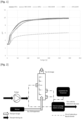
- test methodology is as follows: A dose of 1700 mg/L of magnesium hydroxide suspension is added to neutralize the effluent. The evolution of the pH of the solution is monitored as a function of time and plotted.
- the viscosity of the suspension according to the invention remains within the preferred viscosity scale obtained after formulation.
- Example 2.3 Foaming test with the antifoaming agent integrated into the suspension
- the results show that the antifoam agent AM4 is effective in reducing the foaming phenomenon caused by the simultaneous presence of solid particles and dispersant molecules in a system which may correspond to a situation of overdose in suspension of magnesium hydroxide.
- Example 3 full-scale test of the suspension according to the invention containing the anti-foam AM4
- Ship A is a container ship 400 m long and 60 m wide. Consuming heavy fuel oil (> 2% by mass of Sulphur), it complies with the regulations of the International Maritime Organisation (IMO) by carrying out a scrubbing of its exhaust gases, a wet desulphurisation with Close Loop operating cycles.
- IMO International Maritime Organization
- Ship A therefore needs an alkaline agent in order to neutralise the acidity brought about by the absorption of SO2 in its wash water.
- the alkaline chosen is a suspension of magnesium hydroxide.
- the storage tank is equipped with vents allowing the depressurization of the tank following the arrival of air in the latter due to transport in pipes not completely submerged.
- the extraction capacity of these vents is such that they are capable of extracting foam, much less dense than the carrier liquid, towards outside the tank. This foam overflows and settles on the deck of the ship. Once deposited, it coalesces and leaves a polluted liquid presenting a risk for passengers and personnel on board.
- magnesium hydroxide suspension according to the invention made it possible to eliminate the foaming problem not only for previously problematic operating conditions (engine load > 20%) but also in extreme main engine stress scenarios (up to engine load > 65%).
- magnesium hydroxide suspension according to the invention effectively addresses the problem of foaming during the treatment of gas washing water within an on-board wet or semi-wet flue gas desulfurization system.
Landscapes
- Chemical & Material Sciences (AREA)
- Organic Chemistry (AREA)
- Life Sciences & Earth Sciences (AREA)
- Inorganic Chemistry (AREA)
- Environmental & Geological Engineering (AREA)
- Water Supply & Treatment (AREA)
- Engineering & Computer Science (AREA)
- Hydrology & Water Resources (AREA)
- Geology (AREA)
- Chemical Kinetics & Catalysis (AREA)
- Emulsifying, Dispersing, Foam-Producing Or Wetting Agents (AREA)
- Compounds Of Alkaline-Earth Elements, Aluminum Or Rare-Earth Metals (AREA)
- Paper (AREA)
- Degasification And Air Bubble Elimination (AREA)
Claims (10)
- Wässrige Magnesiumhydroxid-Suspension, umfassend:a) mindestens 40 Ma%, in vorteilhafter Weise mindestens 50 Ma%, noch vorteilhafter mindestens 53 Ma%, bezogen auf die Gesamtmasse der Suspension, Magnesiumhydroxidpartikel;b) 0,001 bis 5 Ma%, in vorteilhafter Weise 0,01 bis 4 Ma%, noch vorteilhafter 0,1 bis 3 Ma%, bezogen auf die Gesamtmasse des Magnesiumhydroxids, mindestens eines Dispergiermittels, das vorzugsweise aus der Gruppe ausgewählt ist, die aus Homopolymeren oder Copolymeren der Acrylsäure oder Methacrylsäure und deren Salzen und einem Gemisch davon und Lignosulfonaten und deren Gemischen besteht, insbesondere gewählt aus Polycarboxylaten, Polyetherpolycarboxylaten, Polyacrylaten, Polyacrylat-Copolymeren, Acryl- und/oder Methacrylcopolymeren, Salzen und einem Gemisch davon, undc) 0,001 bis 5 Ma%, in vorteilhafter Weise 0,005 bis 1 Ma%, noch vorteilhafter 0,01 bis 0,5 Ma%, bezogen auf die Gesamtmasse der Suspension, mindestens eines Schaumverhütungsmittels, das in vorteilhafter Weise aus der Gruppe ausgewählt ist, die aus organischen Ölen, Polyglykolen, Fettsäureestern oder -polyestern und deren Gemischen besteht, wobei die Öle oder Polyglykole organische oder mineralische Partikel in Suspension enthalten können,dadurch gekennzeichnet, dass das mindestens eine Schaumverhütungsmittel kein Silikonöl umfasst.
- Wässrige Suspension nach Anspruch 1, dadurch gekennzeichnet, dass das mindestens eine Dispergiermittel ein Polyetherpolycarboxylat oder ein Polyacrylat ist, insbesondere ein Polyetherpolycarboxylat- oder Polyacrylatsalz, vor allem ein Natriumpolyacrylat.
- Wässrige Suspension nach einem der Ansprüche 1 oder 2, dadurch gekennzeichnet, dass das mindestens eine Schaumverhütungsmittel eine Dispersion von organischen Partikeln, insbesondere Wachs, in einem organischen Öl, insbesondere einem Kohlenwasserstofföl, in vorteilhafter Weise eine Dispersion von Wachspartikeln in einem Kohlenwasserstofföl, ist.
- Wässrige Suspension nach einem der Ansprüche 1 bis 3, dadurch gekennzeichnet, dass die Magnesiumhydroxidpartikel eine volumenmittlere Größe D90 unter 200 µm, vorzugsweise unter 45 µm, noch bevorzugter unter 15 µm, gemessen mit einem Lasergranulometer, aufweisen.
- Wässrige Suspension nach einem der Ansprüche 1 bis 4, dadurch gekennzeichnet, dass die Magnesiumhydroxidpartikel eine volumenmittlere Größe D50 unter 40 µm, vorzugsweise unter 7 µm, gemessen mit einem Lasergranulometer, aufweisen.
- Wässrige Suspension nach einem der Ansprüche 1 bis 5, dadurch gekennzeichnet, dass ihre Viskosität, gemessen bei 1,7 s-1 bei 20 °C mit einem Brookfield-Viskosimeter, unter 1000 mPa.s, vorzugsweise unter 700 mPa.s, beträgt.
- Wässrige Suspension nach einem der Ansprüche 1 bis 6, dadurch gekennzeichnet, dass sie in der Ruhephase bei Raumtemperatur stabil ist, insbesondere das Ergebnis ihres "7th day 2nd for test" mindestens 90 % beträgt.
- Wässrige Suspension nach einem der Ansprüche 1 bis 7, dadurch gekennzeichnet, dass die spezifische Oberfläche der Magnesiumhydroxidpartikel zwischen 5 und 100 m2/g liegt.
- Verwendung der wässrigen Suspension nach einem der Ansprüche 1 bis 8 zur Behandlung von Gaswaschwasser innerhalb eines eingebauten Rauchgasentschwefelungssystems im Nass- oder Halbnassverfahren, zur Behandlung von Abwässern in kommunalen oder industriellen Kläranlagen, in industriellen Verarbeitungsprozessen oder Bioprozessen, die einen Fermentations- oder Atmungsprozess beinhalten, oder im Papierherstellungsprozess oder in der Landwirtschaft.
- Verwendung nach Anspruch 9 als alkalisches Schaumverhütungsmittel.
Applications Claiming Priority (2)
| Application Number | Priority Date | Filing Date | Title |
|---|---|---|---|
| FR2105073A FR3122875B1 (fr) | 2021-05-14 | 2021-05-14 | Suspension d’hydroxyde de magnésium antimousse |
| PCT/FR2022/050886 WO2022238649A1 (fr) | 2021-05-14 | 2022-05-10 | Suspension d'hydroxyde de magnesium antimousse |
Publications (3)
| Publication Number | Publication Date |
|---|---|
| EP4337608A1 EP4337608A1 (de) | 2024-03-20 |
| EP4337608B1 true EP4337608B1 (de) | 2025-01-01 |
| EP4337608C0 EP4337608C0 (de) | 2025-01-01 |
Family
ID=76920917
Family Applications (1)
| Application Number | Title | Priority Date | Filing Date |
|---|---|---|---|
| EP22727966.8A Active EP4337608B1 (de) | 2021-05-14 | 2022-05-10 | Schaumverhütende magnesiumhydroxid-suspension |
Country Status (7)
| Country | Link |
|---|---|
| US (1) | US20240239678A1 (de) |
| EP (1) | EP4337608B1 (de) |
| KR (1) | KR20240007756A (de) |
| CN (1) | CN117580806A (de) |
| ES (1) | ES3015274T3 (de) |
| FR (1) | FR3122875B1 (de) |
| WO (1) | WO2022238649A1 (de) |
Citations (7)
| Publication number | Priority date | Publication date | Assignee | Title |
|---|---|---|---|---|
| GB2112767B (en) | 1981-11-25 | 1985-08-07 | Sandoz Ltd | Antifoaming agents |
| US4561897A (en) | 1983-01-24 | 1985-12-31 | Calgon Corporation | Aqueous stable magnesium hydroxide suspensions which are dispersible in oil |
| JPH1179736A (ja) | 1997-08-28 | 1999-03-23 | Nippon Zeon Co Ltd | 水酸化マグネシウムのスラリーの製造方法 |
| US20150283499A1 (en) | 2014-04-08 | 2015-10-08 | Premier Magnesia, Llc | High solids magnesium hydroxide sea water slurries |
| CN105565782A (zh) | 2015-12-15 | 2016-05-11 | 营口镁质材料研究院有限公司 | 用于氧化镁烧结体靶材的氢氧化镁悬浮浆料的制备方法 |
| US20170225961A1 (en) | 2016-02-04 | 2017-08-10 | Martin Marietta Magnesia Specialties, Llc | Process for producing a stabilized magnesium hydroxide slurry |
| CN112495150A (zh) | 2020-11-09 | 2021-03-16 | 浙江浙能迈领环境科技有限公司 | 适用于长时间存储的氢氧化镁高效悬浮液及其制备方法 |
Family Cites Families (4)
| Publication number | Priority date | Publication date | Assignee | Title |
|---|---|---|---|---|
| JPS5133520B2 (de) * | 1972-10-17 | 1976-09-20 | ||
| EP0114755B1 (de) * | 1983-01-24 | 1989-09-06 | Calgon Corporation | Stabile wässrige Magnesiumhydroxid-Suspensionen, die in Öl dispergierbar sind |
| US5624568A (en) * | 1996-01-17 | 1997-04-29 | Betzdearborn Inc. | Stabilization of magnesium hydroxide slurries |
| BR0302076A (pt) * | 2003-06-18 | 2005-03-22 | Servicios Ind Pe Oles S A De C | Uma suspensão estabilizada por longo perìodo para cobertura de mineral de ferro e um processo para a sua produção |
-
2021
- 2021-05-14 FR FR2105073A patent/FR3122875B1/fr active Active
-
2022
- 2022-05-10 WO PCT/FR2022/050886 patent/WO2022238649A1/fr not_active Ceased
- 2022-05-10 US US18/560,267 patent/US20240239678A1/en active Pending
- 2022-05-10 CN CN202280046487.XA patent/CN117580806A/zh active Pending
- 2022-05-10 KR KR1020237042945A patent/KR20240007756A/ko active Pending
- 2022-05-10 ES ES22727966T patent/ES3015274T3/es active Active
- 2022-05-10 EP EP22727966.8A patent/EP4337608B1/de active Active
Patent Citations (7)
| Publication number | Priority date | Publication date | Assignee | Title |
|---|---|---|---|---|
| GB2112767B (en) | 1981-11-25 | 1985-08-07 | Sandoz Ltd | Antifoaming agents |
| US4561897A (en) | 1983-01-24 | 1985-12-31 | Calgon Corporation | Aqueous stable magnesium hydroxide suspensions which are dispersible in oil |
| JPH1179736A (ja) | 1997-08-28 | 1999-03-23 | Nippon Zeon Co Ltd | 水酸化マグネシウムのスラリーの製造方法 |
| US20150283499A1 (en) | 2014-04-08 | 2015-10-08 | Premier Magnesia, Llc | High solids magnesium hydroxide sea water slurries |
| CN105565782A (zh) | 2015-12-15 | 2016-05-11 | 营口镁质材料研究院有限公司 | 用于氧化镁烧结体靶材的氢氧化镁悬浮浆料的制备方法 |
| US20170225961A1 (en) | 2016-02-04 | 2017-08-10 | Martin Marietta Magnesia Specialties, Llc | Process for producing a stabilized magnesium hydroxide slurry |
| CN112495150A (zh) | 2020-11-09 | 2021-03-16 | 浙江浙能迈领环境科技有限公司 | 适用于长时间存储的氢氧化镁高效悬浮液及其制备方法 |
Non-Patent Citations (5)
| Title |
|---|
| ANONYMOUS: "Antifoaming Agents, Emulsifiers and Surfactants Applications Notebook Complex Compounds, Simplified Analysis", THERMOSCIENTIFIC, 1 January 2016 (2016-01-01), XP093321353, Retrieved from the Internet <URL:https://documents.thermofisher.com/TFS-Assets/CMD/Application-Notes/AI-71477-Chromatography-Foods-Beverages-Antifoaming-Emulsifiers-Surfactants-AI71477-EN%201214S.pdf> |
| ANONYMOUS: "RHEALIS ™ DFOAM Foam - Technical Data Sheet", RHEALIS, 12 June 2025 (2025-06-12), XP093321404 |
| ANONYMOUS: "Technical Data - DEHSCOFIX® WL 660", INNOSPEC, 15 February 2018 (2018-02-15), XP093321359 |
| D10 - EXPERIMENTAL REPORT: ANTIFOAM TESTING |
| GARRETT P R: "The Science of Defoaming. Theory, Experiment adn Applications", 1 January 2014, CRC PRESS , ISBN: 978-1-4200-6041-6, article PETER R. GARRETT: "Appendix 4.1 & References", pages: 295 - 308, XP009564376 |
Also Published As
| Publication number | Publication date |
|---|---|
| KR20240007756A (ko) | 2024-01-16 |
| CN117580806A (zh) | 2024-02-20 |
| WO2022238649A1 (fr) | 2022-11-17 |
| EP4337608C0 (de) | 2025-01-01 |
| US20240239678A1 (en) | 2024-07-18 |
| EP4337608A1 (de) | 2024-03-20 |
| FR3122875A1 (fr) | 2022-11-18 |
| FR3122875B1 (fr) | 2024-07-19 |
| ES3015274T1 (en) | 2025-04-30 |
| ES3015274T3 (en) | 2025-05-14 |
Similar Documents
| Publication | Publication Date | Title |
|---|---|---|
| CA2672578A1 (fr) | Procede pour la clarification par flottation d'eaux difficiles, et installation pour sa mise en oeuvre | |
| FR2727874A1 (fr) | Procede pour la preparation d'un hydrocarbure visqueux dans des emulsions de solution tampon aqueuse | |
| US20200056105A1 (en) | Composition and method for oilfield water clarification processes | |
| EP4337608B1 (de) | Schaumverhütende magnesiumhydroxid-suspension | |
| WO2010012694A1 (fr) | Procede de traitement d'un liquide par flottation induite par des particules flottantes | |
| EP0130891A1 (de) | Zusammensetzungen von Biopolymeren und Verfahren zu deren Herstellung | |
| FR3029195B1 (fr) | Nouvelle composition pour faciliter le transport des boues | |
| US8491721B2 (en) | Method of cleaning and degassing a storage vessel | |
| EP3094394A1 (de) | Verfahren und vorrichtung zur behandlung von organischen abwässern | |
| FR3072666A1 (fr) | Procede et dispositif de traitement d'effluents d'unite de methanisation et unite de methanisation comportant un tel dispositif | |
| WO1993002963A1 (fr) | Procede de preparation d'une suspension aqueuse a base de sulfate de calcium | |
| FR3037084A1 (fr) | Procede de desencrage de papier de recuperation | |
| EP3405437B1 (de) | Verfahren zur behandlung von abwasser durch ozonierung | |
| WO2022144304A1 (fr) | Procédé de traitement de l'eau par adsorption sur charbon actif couplé à une adjonction d'ozone, et installation pour la mise en œuvre de ce procédé | |
| EP4496851A1 (de) | Konzentrierte silikon-antischaum-emulsion | |
| EP0844292B1 (de) | Zusammensetzung und ihre Anwendung zur Umsetzung von einem Schwefelwasserstoff und Schwefeldioxid enthaltenden Gas zu Schwefel | |
| EP1268095B1 (de) | Verfahren zur reinigung von mit kohlenwasserstoffen verseuchten böden | |
| US5071633A (en) | Method of improving handling characteristics of froth of elemental sulfur particles | |
| CN101759288A (zh) | 一种消除废水好氧活性污泥池中泡沫的消泡剂及其制备方法和应用 | |
| CN111470571A (zh) | 一种气浮助剂及应用该气浮助剂的污水处理工艺 | |
| TW202216648A (zh) | 泡沫控制劑 | |
| Ezeofor | Effect of Change in Hydrophilic-Lipophilic Balance (HLB) on the State of Stable Invert Emulsion Drilling Fluid | |
| RU2773848C1 (ru) | Способ очистки внутренней поверхности резервуара | |
| FR3091277A1 (fr) | Procédé et dispositif d’amélioration de la biodégradabilite d’une boue | |
| EP4341221A1 (de) | Verfahren und reaktor zur biologischen abwasserbehandlung |
Legal Events
| Date | Code | Title | Description |
|---|---|---|---|
| STAA | Information on the status of an ep patent application or granted ep patent |
Free format text: STATUS: UNKNOWN |
|
| STAA | Information on the status of an ep patent application or granted ep patent |
Free format text: STATUS: THE INTERNATIONAL PUBLICATION HAS BEEN MADE |
|
| PUAI | Public reference made under article 153(3) epc to a published international application that has entered the european phase |
Free format text: ORIGINAL CODE: 0009012 |
|
| STAA | Information on the status of an ep patent application or granted ep patent |
Free format text: STATUS: REQUEST FOR EXAMINATION WAS MADE |
|
| 17P | Request for examination filed |
Effective date: 20231116 |
|
| AK | Designated contracting states |
Kind code of ref document: A1 Designated state(s): AL AT BE BG CH CY CZ DE DK EE ES FI FR GB GR HR HU IE IS IT LI LT LU LV MC MK MT NL NO PL PT RO RS SE SI SK SM TR |
|
| DAV | Request for validation of the european patent (deleted) | ||
| DAX | Request for extension of the european patent (deleted) | ||
| GRAP | Despatch of communication of intention to grant a patent |
Free format text: ORIGINAL CODE: EPIDOSNIGR1 |
|
| STAA | Information on the status of an ep patent application or granted ep patent |
Free format text: STATUS: GRANT OF PATENT IS INTENDED |
|
| INTG | Intention to grant announced |
Effective date: 20241004 |
|
| GRAS | Grant fee paid |
Free format text: ORIGINAL CODE: EPIDOSNIGR3 |
|
| GRAA | (expected) grant |
Free format text: ORIGINAL CODE: 0009210 |
|
| STAA | Information on the status of an ep patent application or granted ep patent |
Free format text: STATUS: THE PATENT HAS BEEN GRANTED |
|
| AK | Designated contracting states |
Kind code of ref document: B1 Designated state(s): AL AT BE BG CH CY CZ DE DK EE ES FI FR GB GR HR HU IE IS IT LI LT LU LV MC MK MT NL NO PL PT RO RS SE SI SK SM TR |
|
| REG | Reference to a national code |
Ref country code: GB Ref legal event code: FG4D Free format text: NOT ENGLISH |
|
| REG | Reference to a national code |
Ref country code: CH Ref legal event code: EP |
|
| REG | Reference to a national code |
Ref country code: DE Ref legal event code: R096 Ref document number: 602022009403 Country of ref document: DE |
|
| REG | Reference to a national code |
Ref country code: IE Ref legal event code: FG4D Free format text: LANGUAGE OF EP DOCUMENT: FRENCH |
|
| U01 | Request for unitary effect filed |
Effective date: 20250103 |
|
| U07 | Unitary effect registered |
Designated state(s): AT BE BG DE DK EE FI FR IT LT LU LV MT NL PT RO SE SI Effective date: 20250115 |
|
| REG | Reference to a national code |
Ref country code: ES Ref legal event code: BA2A Ref document number: 3015274 Country of ref document: ES Kind code of ref document: T1 Effective date: 20250430 |
|
| U20 | Renewal fee for the european patent with unitary effect paid |
Year of fee payment: 4 Effective date: 20250519 |
|
| PG25 | Lapsed in a contracting state [announced via postgrant information from national office to epo] |
Ref country code: PL Free format text: LAPSE BECAUSE OF FAILURE TO SUBMIT A TRANSLATION OF THE DESCRIPTION OR TO PAY THE FEE WITHIN THE PRESCRIBED TIME-LIMIT Effective date: 20250101 |
|
| PGFP | Annual fee paid to national office [announced via postgrant information from national office to epo] |
Ref country code: ES Payment date: 20250610 Year of fee payment: 4 |
|
| PG25 | Lapsed in a contracting state [announced via postgrant information from national office to epo] |
Ref country code: IS Free format text: LAPSE BECAUSE OF FAILURE TO SUBMIT A TRANSLATION OF THE DESCRIPTION OR TO PAY THE FEE WITHIN THE PRESCRIBED TIME-LIMIT Effective date: 20250501 |
|
| PGFP | Annual fee paid to national office [announced via postgrant information from national office to epo] |
Ref country code: NO Payment date: 20250425 Year of fee payment: 4 |
|
| PGFP | Annual fee paid to national office [announced via postgrant information from national office to epo] |
Ref country code: IT Payment date: 20250531 Year of fee payment: 4 |
|
| PG25 | Lapsed in a contracting state [announced via postgrant information from national office to epo] |
Ref country code: HR Free format text: LAPSE BECAUSE OF FAILURE TO SUBMIT A TRANSLATION OF THE DESCRIPTION OR TO PAY THE FEE WITHIN THE PRESCRIBED TIME-LIMIT Effective date: 20250101 |
|
| PG25 | Lapsed in a contracting state [announced via postgrant information from national office to epo] |
Ref country code: GR Free format text: LAPSE BECAUSE OF FAILURE TO SUBMIT A TRANSLATION OF THE DESCRIPTION OR TO PAY THE FEE WITHIN THE PRESCRIBED TIME-LIMIT Effective date: 20250402 |
|
| PGFP | Annual fee paid to national office [announced via postgrant information from national office to epo] |
Ref country code: CH Payment date: 20250601 Year of fee payment: 4 |
|
| PGFP | Annual fee paid to national office [announced via postgrant information from national office to epo] |
Ref country code: TR Payment date: 20250421 Year of fee payment: 4 |
|
| PG25 | Lapsed in a contracting state [announced via postgrant information from national office to epo] |
Ref country code: CZ Free format text: LAPSE BECAUSE OF FAILURE TO SUBMIT A TRANSLATION OF THE DESCRIPTION OR TO PAY THE FEE WITHIN THE PRESCRIBED TIME-LIMIT Effective date: 20250101 |
|
| PLBI | Opposition filed |
Free format text: ORIGINAL CODE: 0009260 |
|
| PG25 | Lapsed in a contracting state [announced via postgrant information from national office to epo] |
Ref country code: SM Free format text: LAPSE BECAUSE OF FAILURE TO SUBMIT A TRANSLATION OF THE DESCRIPTION OR TO PAY THE FEE WITHIN THE PRESCRIBED TIME-LIMIT Effective date: 20250101 |
|
| PLAX | Notice of opposition and request to file observation + time limit sent |
Free format text: ORIGINAL CODE: EPIDOSNOBS2 |
|
| PG25 | Lapsed in a contracting state [announced via postgrant information from national office to epo] |
Ref country code: SK Free format text: LAPSE BECAUSE OF FAILURE TO SUBMIT A TRANSLATION OF THE DESCRIPTION OR TO PAY THE FEE WITHIN THE PRESCRIBED TIME-LIMIT Effective date: 20250101 |
|
| 26 | Opposition filed |
Opponent name: OMYA INTERNATIONAL AG Effective date: 20251001 |