EP4331985A1 - Modulares flüssigkeitsaufbewahrungs- und -abwurfsystem und flugzeug mit einem solchen system - Google Patents
Modulares flüssigkeitsaufbewahrungs- und -abwurfsystem und flugzeug mit einem solchen system Download PDFInfo
- Publication number
- EP4331985A1 EP4331985A1 EP23192069.5A EP23192069A EP4331985A1 EP 4331985 A1 EP4331985 A1 EP 4331985A1 EP 23192069 A EP23192069 A EP 23192069A EP 4331985 A1 EP4331985 A1 EP 4331985A1
- Authority
- EP
- European Patent Office
- Prior art keywords
- tank
- aircraft
- tubes
- opening
- tube
- Prior art date
- Legal status (The legal status is an assumption and is not a legal conclusion. Google has not performed a legal analysis and makes no representation as to the accuracy of the status listed.)
- Withdrawn
Links
Images




Classifications
-
- B—PERFORMING OPERATIONS; TRANSPORTING
- B64—AIRCRAFT; AVIATION; COSMONAUTICS
- B64D—EQUIPMENT FOR FITTING IN OR TO AIRCRAFT; FLIGHT SUITS; PARACHUTES; ARRANGEMENT OR MOUNTING OF POWER PLANTS OR PROPULSION TRANSMISSIONS IN AIRCRAFT
- B64D1/00—Dropping, ejecting, releasing or receiving articles, liquids, or the like, in flight
- B64D1/16—Dropping or releasing powdered, liquid, or gaseous matter, e.g. for fire-fighting
-
- A—HUMAN NECESSITIES
- A62—LIFE-SAVING; FIRE-FIGHTING
- A62C—FIRE-FIGHTING
- A62C3/00—Fire prevention, containment or extinguishing specially adapted for particular objects or places
- A62C3/02—Fire prevention, containment or extinguishing specially adapted for particular objects or places for area conflagrations, e.g. forest fires, subterranean fires
- A62C3/0228—Fire prevention, containment or extinguishing specially adapted for particular objects or places for area conflagrations, e.g. forest fires, subterranean fires with delivery of fire extinguishing material by air or aircraft
-
- A—HUMAN NECESSITIES
- A62—LIFE-SAVING; FIRE-FIGHTING
- A62C—FIRE-FIGHTING
- A62C3/00—Fire prevention, containment or extinguishing specially adapted for particular objects or places
- A62C3/02—Fire prevention, containment or extinguishing specially adapted for particular objects or places for area conflagrations, e.g. forest fires, subterranean fires
- A62C3/0228—Fire prevention, containment or extinguishing specially adapted for particular objects or places for area conflagrations, e.g. forest fires, subterranean fires with delivery of fire extinguishing material by air or aircraft
- A62C3/0235—Fire prevention, containment or extinguishing specially adapted for particular objects or places for area conflagrations, e.g. forest fires, subterranean fires with delivery of fire extinguishing material by air or aircraft by means of containers, e.g. buckets
Definitions
- the present invention relates to a system for storing and releasing fluid and more particularly water or products such as a retardant integrated into a host aircraft making it possible to convert it into a water bomber aircraft used for fighting fires in particular. of forests.
- the invention applies to all types of aircraft capable of receiving such a system and in particular to civil and military aircraft.
- the present invention aims to provide a modular water storage and release system capable of being easily introduced and removed from a host aircraft and capable of releasing water outside the aircraft at a sufficient rate.
- the present invention relates to a fluid storage and release system for a host aircraft comprising a fluid reservoir and at least one tube, characterized in that the reservoir is connected to said or all of said tubes which are extends longitudinally from the reservoir such that when installed in a host aircraft, the tube(s) conducts fluid to the longitudinal end of a rear door of the aircraft in the open position.
- the system is simple and easy to introduce and uninstall from a host aircraft.
- the invention provides at least one of the following optional characteristics, taken individually or in combination.
- the fluid storage and release system includes a transport and fixing support which with the reservoir and the tube(s) form a single piece.
- the transport and fixing support comprises a chassis comprising beams allowing the system to be transported and fixed in the aircraft.
- the chassis comprises lower longitudinal and/or transverse beams and the longitudinal and/or transverse beams comprise fixing means adapted for fixing to the aircraft.
- the transport and fixing support comprises a pallet on which is placed at least the tank allowing the system to be transported and fixed in the aircraft.
- the support has a determined length making it possible to distribute the load of the tank over said length.
- the system includes two tubes.
- the tubes are parallel to each other and the axes of the tubes are all included in the same plane.
- Pipes extend parallel to the tubes and one end of each pipe is connected to the tank and the other end extends in a direction different from the longitudinal direction of the tube(s).
- each pipe extends in a direction perpendicular to the longitudinal direction of the tube(s).
- the tank is provided with an opening at the top wall of the tank and a float in the tank for closing the opening when the tank is filled.
- the wall of the tank has a cavity towards the interior of the tank narrowing to the opening.
- the free end of the cavity is curved and is inserted into a narrowing of a float, the movement in a direction Z of the float then being blocked by a shoulder formed by an upper widening and a shoulder formed by a lower widening.
- the float is linked to a wall of the tank by an arm making it possible to guide the movement of the float and allow it to move away from and towards the opening and when applied against the opening to close it completely.
- a return spring connects the wall of the tank presenting the opening to the arm.
- the present invention also relates to the host aircraft comprising a rear door and an interior area into which is introduced a system having one or more of the aforementioned characteristics, the tubes of which extend to the longitudinal end of said rear door of the aircraft in the open position.
- the invention provides at least one of the following optional characteristics, taken individually or in combination.
- the tank is installed in an acceptable position relative to the center of gravity of the aircraft.
- the pipes extend over a distance allowing their end to come at a height laterally from the side edge of the rear door of the aircraft or set back towards the inside thereof.
- the following description refers to an orthonormal reference X, Y, Z (visible on the figures 1 and 2 ) in which the horizontal directions X,Y and vertical Z are defined with reference to an aircraft placed on horizontal ground.
- the three directions X, Y, Z are orthogonal to each other.
- the fuselage of the aircraft extends along a longitudinal direction X.
- the Y direction corresponds to the direction oriented transversely and horizontally with respect to the longitudinal direction
- Qualify as longitudinal respectively transverse, vertical means parallel to the longitudinal direction, respectively transverse, vertical.
- FIG 1 represents a military aircraft 2 type A400M (registered trademark) intended to be temporarily converted into a water bomber aircraft.
- the aircraft 2 includes a zone 4 offering useful interior free space. It also has a rear door 6 that can open in flight. There figure 1 represents door 6 in the closed position.
- the A400M is taken for illustrative purposes but other aircraft have similar characteristics, namely a zone 4 having a sufficient interior volume to accommodate a system 8 as described below and a rear door 6 allowing communication of zone 4 with the exterior of the aircraft could be suitable as a host aircraft 2.
- the fluid storage and release system 8 comprises a reservoir 10 of fluid arranged longitudinally and in the illustrated example of water, retardant or any other fluid used for fighting fire and at least one tube 12 extending longitudinally from the tank to which it is connected.
- Arrange or extend longitudinally means that the direction of the largest dimension is parallel to the longitudinal direction, namely the direction X.
- the fluid used is generally water but other types of fluid such as a retardant could be used depending on the fire to extinguish or even water combined with any type of product.
- the height Hr of the tank namely the largest dimension of the tank taken in the vertical Z direction, is greater than that Ht (largest dimension taken in the vertical Z direction) of the tube(s). 12.
- the height Ht corresponds to the diameter of cylindrical tubes of circular section like those shown in the figures.
- the height Hr is at least twice greater than the height Ht.
- the width Lr of the tank namely the largest dimension taken in the transverse direction Y, is greater than the largest width of the tube 12 or in the case of several tubes, the sum of the largest widths tubes 12: the width of a tube corresponds to its diameter for cylindrical tubes of circular section like those shown in the figures. Due to having a tube cross section of much smaller dimension than the cross section of the tank, the speed of the fluid flowing in the tube or tubes 12 from the tank is all the more important. These dimension ratios determine the flow velocity and are therefore chosen to have sufficient flow velocity for effective release of water from the aircraft.
- any other proportions in dimensions are possible.
- these can be arranged parallel to each other.
- all of the axes of the tubes are included in the same plane.
- two tubes 12 are provided but as seen previously any other number of tubes is possible.
- the two tubes 12 are cylindrical in shape with a circular section. They are parallel and their axes are included in the same plane parallel to the XY plane.
- the tubes extend in the longitudinal direction of the tank, namely in the direction of its length for a parallelepiped tank with a rectangular base and square section.
- the reservoir itself extending in a longitudinal direction. Any other embodiment is possible, namely tubes of different dimensions, positioned in different planes...
- the tube(s) extend so that once the system 8 is installed in the aircraft, the tube(s) 12 conduct the fluid to the end 20 longitudinally of the rear door 6 of the aircraft in the open position.
- the tubes 12 extend from the tank 10 to a water release device 14: their length is chosen so that one of the ends 16 of the tubes is connected with the tank 10 and the other end 18 with the device 14.
- the end 18 of the tubes once the system 8 in the release position, is located to the right of the end 20 (shown on the figure 4 ) free from the rear door 6.
- the release device 14 is entirely outside the cantilevered aircraft.
- the length of the tubes 12 also makes it possible to position the tank 10 at an acceptable distance from the center of gravity of the aircraft so as not to disturb its balance when it is filled and during release. The acceptable distance is in a known manner determined by a weight and balance diagram specific to each aircraft.
- the center of gravity of the tank alone filled with water is at an acceptable distance from the center of gravity of the aircraft.
- Each tube 12 is provided with a valve 13 at its connection with the tank.
- Each valve 13 is of known type, for example of type butterfly or conical shutter and will not be described further: it allows the communication between the tank and each tube to be opened and closed.
- one or more valves can also be positioned at the level of the release device 14 to adapt the water flow.
- the system 8 comprises valves 13 at the tank-tube connection and/or device 14-air connection external to the aircraft. Providing the tubes with valves 13 at their connection with the tank allows the aircraft to fly with the tank 10 filled with fluid and the tubes 12 empty.
- the tank By positioning the tank at an acceptable distance from the center of gravity of the aircraft, the balance of the aircraft is maintained. However, it is possible to move the tank to a position further from the center of gravity, for example to avoid the projection zone of the engine blades. In this case, providing the release device with valves makes it possible to fill the tubes (filled in flight) and to move the center of gravity of the complete system (compared to that of a system with empty tubes) so that it is at an acceptable distance from that of the aircraft.
- At least two pipes 22 extend in the longitudinal direction lower than that of the tubes 12.
- One of the ends 24 of the pipes is connected to the tank 10 and the other end 26 is located at the level of the rear door 6.
- the pipes 22 at the end 26 follow a direction different from the longitudinal direction and in the form illustrated a transverse direction. Indeed, the pipes 22 have a shape allowing their end 26 to come at the height transversely of the side edge of the rear door or set back relative to it towards the inside of the door so as to be able to close the door 6 during takeoff, landing and in certain phases of flight.
- the pipes 22 make it possible to supply the tank 10 from the ground.
- Each end 26 is connected to one or more vehicles on the ground, for example fire trucks, which allows the tank to be filled with water from the ground.
- the end 26 is designed to receive the typical flexible hose connectors of fire trucks.
- the plurality of pipes makes it possible to adapt the filling time. Being accessible from both sides of the aircraft allows a ground machine to park on either side of the aircraft knowing that it is also possible to have a machine on each side to speed up filling.
- three pipes 22 are provided along each of the two tubes 12, namely six pipes in all.
- the two so-called extremal tubes 12 in the case of more than two tubes correspond to the tubes located closest transversely to the walls of the aircraft.
- the pipes 22 are arranged at the lateral level of each of the extremal tubes 12 on the side opposite the adjacent tube.
- the pipes 22 are arranged one above the other along the vertical axis Z.
- the pipes 22 gradually move away transversely from the tubes 12. In the illustrated embodiment, the pipes move away until to be in a transverse direction Y at the edge of the rear door transversely. In the embodiment illustrated on the figure 4 , the end of the pipes 22 is located in the second half longitudinally of the rear door 6 closest to the end 20.
- the system 8 is provided with a means for warning people filling the tank that it is full. Several embodiments are possible.
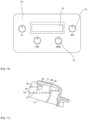
- the tank 10 includes an opening 21 and a float 78 in the tank.
- the float 78 rises until it closes the opening 21.
- a conduit 80 connects the top of the tank to one of the tubes 12.
- a conduit connects the tank via a side face thereof, preferably that at which the tubes are connected and one of the tubes 12.
- a valve closing the opening and supported by a valve spring whose force is greater than that exerted by the water.
- the float closes the tank in the same way as before.
- the pressure rises and exceeds the maximum threshold set by the valve: the valve can no longer be kept closed.
- the valve opens and discharges the water into tube 12. The person in charge of filling the tank, seeing the water flowing through tube 12, knows that the tank is filled.
- the float 78 is connected to an internal wall 82 of the tank.
- the wall 82 is the wall of the tank located in a plane YZ closest to the opening 21.
- the float 78 is connected to the wall 82 by an arm 84 making it possible to guide the movement of the float.
- the connection between the arm 84 and the wall 82 allows rotation in a plane XZ authorizing the float 78 to move away and approach the opening 21 and when in contact with the tank to close said opening 21.
- the arm 84 thus allows the float 78 when pushed in the direction Z by the water towards the opening 21 to automatically close the opening 21. Any other means allowing the float to come to bear against the opening when pushed back by the water is possible.
- a return spring 86 connects the internal wall 88 of the tank provided with the opening 21 to the arm 84.
- the function of the return spring 86 once the desired quantity of water has been expelled from the aircraft, is to return the arm 84 in its primary position, namely against the opening 21.
- the opening 21 being closed, if the tank has only been partially emptied and the plane finds itself in turbulence, the water cannot be projected outside the tank by the opening 21 which is closed using the float 78 held against the opening by the return spring 86.
- the wall 88 can have a particular shape at the level of the opening 21.
- the float 78 can also have any type of shape. According to the embodiments illustrated on the figures 10 and 11 , the wall 88 at the level of the opening 21 extends towards the interior of the tank so as to form a cavity 90 narrowing until it forms the opening 21 at its lowest in the direction Z (when the aircraft is on the ground and the wall 82 is parallel to the Z axis).
- overflow management is carried out differently and not shown. It is possible to provide a valve which opens from a certain pressure for example.
- the float 78 has a shape having a narrowing 92 at the central level in the Z direction (when the aircraft is on the ground and the wall 82 is parallel to the Z axis).
- the edge 94 of the cavity at the level of the opening 21 is curved and oriented inwards to be inserted at the level of the constriction 92 of the float 78. In this case, no return spring is necessary since the float is retained by the extremal edge 94 of the cavity 90, blocked by the shoulder 96 formed by the upper widening 98 of the float or by the shoulder 100 formed by the lower widening 102 thereof.
- the narrowing 92 has a certain length in the Z direction to allow the float 78 to move in the Z direction.
- the wall of the cavity 90 as well as the particular shape of the float shield any projection of water which could be made towards outside the tank through opening 21.
- the system 8 includes a transport and fixing support 15 which with the tank 10 and the tube(s) 12 form a single unit.
- the following description presents two embodiments of the support 15.
- the support 15 comprises a chassis 28 comprising beams making it possible to transport the tank and the tube(s) and to fix them in the aircraft and for example to the floor 9 thereof.
- the chassis 28, the tank 10 and the tube(s) 12 form a single unit capable of being loaded and unloaded from the aircraft.
- the beams include fixing means of known type to the aircraft and for example to the floor 9 of the aircraft.
- the figures illustrate a possible form of chassis but any other form making it possible to form a single piece with the tank and the tube(s) 12 to transport the system 8 in one piece in the aircraft or to unload from it. This as well as for fixing in the aircraft is possible.
- the chassis 28 comprises four longitudinal beams 30, four transverse beams 32 and four vertical beams 34 forming a parallelepiped frame 36 of rectangular section.
- the reservoir 10 is in contact with all of the beams but does not extend beyond the reinforcement 36 formed.
- the two lower longitudinal beams 30 are extended longitudinally on either side of the frame 36 by four lower longitudinal extension beams 38.
- the upper ends 40 of each vertical beam 34 are linked by another beam 42 inclined to the ends 44 of the lower longitudinal extension beams 38.
- THE inclined beams 42 form supports for the frame 36 to reinforce its solidity.
- the mass of the chassis is distributed over a certain length of floor 9 in order to avoid overloading it locally and damaging it.
- the chassis also allows the tank to be maintained in position on the floor 9 of the aircraft.
- the beams 42 located on the side of the tubes 12 frame them over part of their length and in particular at the level of the connection zone of the tubes 12 with the tank.
- the beams also make it possible to be adapted to receive means of fixing the system 8 to the floor 9 of the aircraft.
- the support 15 comprises a pallet on which is arranged at least the tank making it possible to transport the tank and the tube(s) and to fix them in the aircraft and for example to the floor 9 of it.
- the pallet, the tank 10 and the tube(s) 12 form a single unit capable of being loaded and unloaded from the aircraft.
- the pallet comprises fixing means of known type to the aircraft and for example to the floor of the aircraft. It is then sufficient to carry the pallet inside the aircraft and slide it on the floor 9 to position the system in the desired location, some floors being equipped with casters.
- the system 8 is in one piece forming a modular assembly capable of being integrated into a host aircraft.
- the modular system 8 presented thus makes it possible to be installed temporarily in a host aircraft and to avoid having to modify it to accommodate this system 8.
- the system 8 can be installed and uninstalled at will depending on the program of the host aircraft concerned.
- the support has a determined length making it possible to distribute the load of the tank over said length as seen above for the illustrated example of the chassis. According to a possible embodiment, the length of the support (chassis or pallet) is at least equal to the length of the tank 10.
- the water release device 14 can have any type of shape.
- the water release device can be summed up in its simplest form as an extension of the tubes 12 and be integrated into the system 8. Indeed it could be envisaged to allow the ends 18 of the tubes 12 of the rear door 6 to protrude beyond the end 20 thereof.
- the modular system 8 is equipped with a device 14 for releasing fluid and in the example described for releasing water.
- the purpose of the water release device 14 is to modify the direction of the flow. From a longitudinal direction, the device 14 allows the water flow to flow in a different direction.
- the device 14 makes it possible to release the water in an appropriate direction and for example perpendicular to the longitudinal direction, namely a vertical direction Z or close to a vertical direction if the aircraft in flight is not located not in a horizontal position.
- the device 14 also has another advantage which is to distribute the release into several flows whose use can be independently controlled for each of the flows, namely authorized or not. Thus, depending on the intensity of the fire, only part of the flow could be used, which makes it possible to save a quantity of water for another fire, another location of the fire or for other purposes.
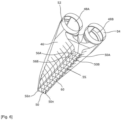
- the water release device comprises a closed tank 46 having at least one opening 48 for the entry of water and at least one opening 50 for the release of water towards the outside of the aircraft.
- the opening 48 has a shape allowing the tank to fit onto the tube(s) 12 so as to form a tight connection in a known manner.
- the tank has two openings 48A, 48B extending in the form of sleeves 52, 54 allowing connection with the tubes 12.
- the sleeves 52 , 54 have a cylindrical shape of circular section.
- the tank 46 comprises several independent openings 50A, 50B ... 50n.
- the openings 50A, 50B ... 50n abut each other.
- the openings 50A, 50B ... 50n are contiguous so as to circumscribe the whole in the same larger opening 51 of geometric shape determined by the shape of the openings 50A, 50B, ... 50n.
- each opening 50A, 50B ... 50n is rectangular in shape.
- the contiguous openings 50A, 50B ... 50n are circumscribed in the same large rectangular opening 51 split into several openings 50A, 50B, ... 50n.
- the openings 50A, 50B, ... 50n are included in a plan parallel to the XY, namely a plane perpendicular to a transverse plane YZ to the tubes.
- the openings 50A, 50B, ... 50n are oriented so as to guide the flows flowing through them towards the ground, namely in a vertical direction Z.
- the aircraft In flight, the aircraft can fly in a nose-up position.
- the rear door 6 in the open position can be located in the extension of the floor 9 of the aircraft.
- the release device 14 arranged beyond the door 6 but in its longitudinal extension is not in a horizontal position in flight.
- the plane in which the openings 50A, 50B...50n are arranged is chosen according to the desired water release direction.
- the tank has a shape making it possible to form water flow conduits 53A, 53B, ...
- each conduit 53n whose outlet orifice corresponds to each opening 50A, 50B ... 50n.
- the conduits are here of parallelepiped shape of rectangular section forming together a parallelepiped block of rectangular section whose outlet orifice corresponds to the rectangular opening 51.
- the external contours of the ducts could be rounded for aerodynamic purposes.
- the axis of each conduit 53A, 53B, ... 53n corresponds to the axis of the corresponding opening 50A, 50B ... 50n.
- the openings 50A, 50B ... 50n are each capable of being closed by a valve 55 taking, in the illustrated embodiment, the shape of a flap respectively 56A, 56B, ... 56n.
- each conduit 53A, 53B, ... 53n is provided with a flap 56A, 56B, ... 56n.
- the opening and closing of each shutter 56A, 56B,... 56n can be controlled independently for each shutter by a control device 58 described later.
- the flaps 56 make it possible to adjust the flow rate of released fluid.
- the tank 46 has the shape of a funnel, namely whose dimensions in a plane parallel to the XY plane decrease going vertically downwards, the largest dimension being at the height of the tubes so as to guide the water towards the opening(s) 50.
- the lowest part of the tank in the shape illustrated is the dimensions of the opening 51.
- the flaps 56 are each in the form of an articulated flat panel 60 around an axis parallel to the Y direction; the hinge pin is for each central panel longitudinally. In position open, the panels 60 are each in a plane parallel to the plane YZ and all parallel to each other.
- the panels 60 are in a plane parallel to the plane XY, contiguous, abutting each other without superposing each other, each closing the corresponding opening 50A, 50B, ... 50n and closing the aforementioned rectangular opening 51. Any other form of realization is possible.
- the tank 46 has a dimension in a plane parallel to the plane YZ decreasing longitudinally away from the openings 48. Any other shape of tank is possible as long as it has inlet openings 48 and openings 50 outlet allowing the change of direction of the flow to release the water in the direction of the fire and thus reduce its dispersion.
- the release device 14 is retractable. Indeed, to allow the rear door 6 to close, it is necessary that the device 14 does not protrude from the end 20 of the rear door.
- the release device is linked to the tube or said tubes 12 via a hinge arranged at the top of each of the tubes 12 and sleeves 52, 54 allowing the device to pivot around an axis transverse parallel to the direction Y.
- a peripheral seal is provided between the tube(s) 12 and the sleeve(s) 52, 54 to ensure sealing when the sleeve(s) are in the release position in the extension of the tube(s) 12.
- at least part of the tube(s) are made telescopically to be able to reduce in length and allow the release device 14 to no longer protrude from the end 20.
- the release device 14 is not retractable. Indeed, it is possible for certain host aircraft to fly with the rear door 6 open.
- the system 8 is controlled using a control device 58 capable of being manipulated directly by a pilot and/or a co-pilot and/or a third man in the cockpit and/or any other operator whose function is to trigger the release of water and/or prepare the appropriate quantity. Control could also be considered from the ground, the control device then being connected to the aircraft by any type of known wireless communication means.
- the device 58 represented by a rectangle in the aircraft in the example illustrated on the Figure 7 , is connected to system 8 to ensure control. According to the embodiment described above, the device 58 is connected to the valves 13 for closing the tubes 12 on the side of the tank and/or to the valves 55 (closing flaps 56).
- the device can be used by a third man 62 (only the seat on which he is intended to sit is shown) or from the cockpit 64 depending on the choice made by the pilot and/or the third man.
- a third man 62 only the seat on which he is intended to sit is shown
- the cockpit 64 depending on the choice made by the pilot and/or the third man.
- the following description presents a possible embodiment of the control device but any other form is possible.
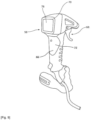
- the control device 58 is in the form of a gun 66 having a trigger 68, a control panel 70 and a handle 72 for gripping.
- the control panel 70 presents means of configuring several criteria having an influence on the necessary quantity of water to be released. Thus it is possible to control the quantity of water using the valves 13 and/or 55 presented previously and this according to different criteria.
- the gun 66 includes an internal processor in which an algorithm is programmed to determine the quantity of water and more precisely the necessary flow and the duration according to the criteria entered.
- the control panel 70 includes thumbwheel buttons 74 to incrementally adjust each criterion. Each button 74 allows you to adjust a criterion.
- the altitude (A) of release of the aircraft - the speed (PS) of the aircraft; - wind speed (WS); - the soil concerned (VH) and for example the height and/or type of vegetation and/or the type of soil.
- A the altitude
- PS speed
- WS wind speed
- VH soil concerned
- the quantity of water required is not necessarily the same.
- Peat or bitumen soils should not be considered in the same way.
- Other criteria may be added via such a control panel or in a different way.
- the release rate can vary depending on the ground over which the aircraft is flying. In this case, it is no longer with the help of a button that the ground concerned is entered but with a recorded map of the ground flown over.
- the control panel 70 has a display screen 76 for displaying information. So for example, when the altitude button is manipulated, the selected altitude is displayed on the screen 76.
- Other types of display can be used such as for example simple light emitting diodes (LEDs) or lines of diodes electroluminescent.
Landscapes
- Life Sciences & Earth Sciences (AREA)
- Biodiversity & Conservation Biology (AREA)
- Ecology (AREA)
- Forests & Forestry (AREA)
- Health & Medical Sciences (AREA)
- Public Health (AREA)
- Business, Economics & Management (AREA)
- Emergency Management (AREA)
- Engineering & Computer Science (AREA)
- Aviation & Aerospace Engineering (AREA)
- Buildings Adapted To Withstand Abnormal External Influences (AREA)
- Loading And Unloading Of Fuel Tanks Or Ships (AREA)
- Filling Or Discharging Of Gas Storage Vessels (AREA)
Applications Claiming Priority (1)
| Application Number | Priority Date | Filing Date | Title |
|---|---|---|---|
| FR2208679 | 2022-08-30 |
Publications (1)
| Publication Number | Publication Date |
|---|---|
| EP4331985A1 true EP4331985A1 (de) | 2024-03-06 |
Family
ID=84887938
Family Applications (1)
| Application Number | Title | Priority Date | Filing Date |
|---|---|---|---|
| EP23192069.5A Withdrawn EP4331985A1 (de) | 2022-08-30 | 2023-08-18 | Modulares flüssigkeitsaufbewahrungs- und -abwurfsystem und flugzeug mit einem solchen system |
Country Status (3)
| Country | Link |
|---|---|
| US (1) | US20240067338A1 (de) |
| EP (1) | EP4331985A1 (de) |
| CA (1) | CA3209704A1 (de) |
Citations (13)
| Publication number | Priority date | Publication date | Assignee | Title |
|---|---|---|---|---|
| GB497765A (en) * | 1936-06-27 | 1938-12-28 | Marinus Alfred Kjersgaard | Improvements in and relating to flushing tanks |
| US3698480A (en) * | 1971-07-12 | 1972-10-17 | Aero Union Corp | Dual tank air borne fire retardant dispensing system |
| US4195693A (en) * | 1976-04-30 | 1980-04-01 | Messerschmitt-Boelkow-Blohm Gmbh | Device for extinguishing fires from the air |
| FR2610894A1 (fr) * | 1987-02-16 | 1988-08-19 | Hercules Europ Center | Procede et appareillage pour projeter un produit liquide ou analogue, ou un objet solide, a partir d'un aeronef |
| CN2483433Y (zh) * | 2001-04-05 | 2002-03-27 | 付乃军 | 自动贮水箱 |
| DE102004041774A1 (de) * | 2004-08-28 | 2006-03-02 | Zoltan Von Mohos | Vorrichtung zur Aufnahme und/oder Abgabe von Flüssigkeiten aus einem Fluggerät |
| US20060260826A1 (en) * | 2004-01-10 | 2006-11-23 | Hutter Michael D | Portable airborne firefighting and sensing system |
| US7303168B1 (en) * | 2005-02-25 | 2007-12-04 | Lazes Richard J | Aircraft spraying conversion kit for use in extinguishing fires |
| CN102653951A (zh) * | 2012-01-11 | 2012-09-05 | 陈万明 | 双球冲便水箱 |
| US20140224935A1 (en) * | 2013-02-13 | 2014-08-14 | Richard J. Lazes | Aircraft Liquid Dispensing System |
| CN204572050U (zh) * | 2015-02-10 | 2015-08-19 | 四川省科建煤炭产业技术研究院有限公司 | 一种煤矿瓦斯抽采管路放水器 |
| EP3929080A1 (de) * | 2020-06-26 | 2021-12-29 | Aeroconseil SA | Brandbekämpfungsvorrichtung |
| CN216271131U (zh) * | 2021-10-28 | 2022-04-12 | 四川中成汇力科技有限公司 | 一种水箱防溢流装置 |
Family Cites Families (2)
| Publication number | Priority date | Publication date | Assignee | Title |
|---|---|---|---|---|
| US5549259A (en) * | 1994-02-17 | 1996-08-27 | Herlik; Edward C. | Innovative airtankers and innovative methods for aerial fire fighting |
| US6622966B1 (en) * | 2002-09-23 | 2003-09-23 | Mcconnell, Sr. John R. | System for extinguishing wild fires and method therefor |
-
2023
- 2023-08-18 CA CA3209704A patent/CA3209704A1/fr active Pending
- 2023-08-18 US US18/452,164 patent/US20240067338A1/en active Pending
- 2023-08-18 EP EP23192069.5A patent/EP4331985A1/de not_active Withdrawn
Patent Citations (13)
| Publication number | Priority date | Publication date | Assignee | Title |
|---|---|---|---|---|
| GB497765A (en) * | 1936-06-27 | 1938-12-28 | Marinus Alfred Kjersgaard | Improvements in and relating to flushing tanks |
| US3698480A (en) * | 1971-07-12 | 1972-10-17 | Aero Union Corp | Dual tank air borne fire retardant dispensing system |
| US4195693A (en) * | 1976-04-30 | 1980-04-01 | Messerschmitt-Boelkow-Blohm Gmbh | Device for extinguishing fires from the air |
| FR2610894A1 (fr) * | 1987-02-16 | 1988-08-19 | Hercules Europ Center | Procede et appareillage pour projeter un produit liquide ou analogue, ou un objet solide, a partir d'un aeronef |
| CN2483433Y (zh) * | 2001-04-05 | 2002-03-27 | 付乃军 | 自动贮水箱 |
| US20060260826A1 (en) * | 2004-01-10 | 2006-11-23 | Hutter Michael D | Portable airborne firefighting and sensing system |
| DE102004041774A1 (de) * | 2004-08-28 | 2006-03-02 | Zoltan Von Mohos | Vorrichtung zur Aufnahme und/oder Abgabe von Flüssigkeiten aus einem Fluggerät |
| US7303168B1 (en) * | 2005-02-25 | 2007-12-04 | Lazes Richard J | Aircraft spraying conversion kit for use in extinguishing fires |
| CN102653951A (zh) * | 2012-01-11 | 2012-09-05 | 陈万明 | 双球冲便水箱 |
| US20140224935A1 (en) * | 2013-02-13 | 2014-08-14 | Richard J. Lazes | Aircraft Liquid Dispensing System |
| CN204572050U (zh) * | 2015-02-10 | 2015-08-19 | 四川省科建煤炭产业技术研究院有限公司 | 一种煤矿瓦斯抽采管路放水器 |
| EP3929080A1 (de) * | 2020-06-26 | 2021-12-29 | Aeroconseil SA | Brandbekämpfungsvorrichtung |
| CN216271131U (zh) * | 2021-10-28 | 2022-04-12 | 四川中成汇力科技有限公司 | 一种水箱防溢流装置 |
Also Published As
| Publication number | Publication date |
|---|---|
| CA3209704A1 (fr) | 2024-02-29 |
| US20240067338A1 (en) | 2024-02-29 |
Similar Documents
| Publication | Publication Date | Title |
|---|---|---|
| EP3929080A1 (de) | Brandbekämpfungsvorrichtung | |
| FR2817828A1 (fr) | Appareil de largage de liquide pour un helicoptere | |
| FR2917376A1 (fr) | Meuble d'office d'aeronef et aeronef comportant un tel meuble | |
| WO2017207942A2 (fr) | Tourelle canon comportant au moins un magasin a munition et caisse a munitions destinee a equiper un tel magasin | |
| EP4331985A1 (de) | Modulares flüssigkeitsaufbewahrungs- und -abwurfsystem und flugzeug mit einem solchen system | |
| EP4331986B1 (de) | Steuervorrichtung auf basis mindestens eines parameterkriteriums eines flüssigkeitsausstosssystems für ein host-feuerkontrollflugzeug | |
| EP4331984B1 (de) | Vorrichtung zum auslösen von flüssigkeit in einer bestimmten richtung für ein flugzeug zur brandbekämpfung und flugzeug mit einer solchen vorrichtung | |
| FR3071227B1 (fr) | Drone de transport de conteneur | |
| EP2299000B1 (de) | Aufnahmebehälter für Abfälle, die von einem Straßenreinigungsfahrzeug aufgenommen werden | |
| FR3032990A1 (fr) | Mecanisme de vidage pour une benne a beton comportant un receptacle pour les fuites de laitance | |
| FR2918651A1 (fr) | Appareil de distribution comprenant un reservoir de stockage perfectionne. | |
| HUE031495T2 (en) | Fire extinguisher | |
| EP1966005B1 (de) | Logistikbox | |
| US7303168B1 (en) | Aircraft spraying conversion kit for use in extinguishing fires | |
| EP3002541B1 (de) | Sitz für fahrzeug | |
| WO2023062290A1 (fr) | Dispositif de lutte contre les incendies | |
| WO2014195620A1 (fr) | Dispositif de cloisonnement mobile integre a la console d'un vehicule | |
| FR2962947A1 (fr) | Agencement de siege d'automobile a dossier rabattable et vehicule comportant un tel agencement de siege | |
| EP2397361B1 (de) | Platte zum Abdecken eines Hohlraums auf der Rückseite eines Kraftfahrzeugsitzes | |
| FR2610894A1 (fr) | Procede et appareillage pour projeter un produit liquide ou analogue, ou un objet solide, a partir d'un aeronef | |
| FR2749126A1 (fr) | Tremie ravitailleuse pour un tracteur equipe d'un semoir | |
| EP2221231B1 (de) | Transporteinheit, die einen Rollwagen und mindestens zwei entsprechend angepasste Behälter umfasst | |
| FR2662905A1 (fr) | Appareil de pulverisation pour vehicule de traitement agricole. | |
| FR3106470A1 (fr) | Pulvérisateur pour l’épandage de produit(s) | |
| FR3006285A1 (fr) | Dispositif de cloisonnement integre a la console centrale d'un vehicule |
Legal Events
| Date | Code | Title | Description |
|---|---|---|---|
| PUAI | Public reference made under article 153(3) epc to a published international application that has entered the european phase |
Free format text: ORIGINAL CODE: 0009012 |
|
| STAA | Information on the status of an ep patent application or granted ep patent |
Free format text: STATUS: REQUEST FOR EXAMINATION WAS MADE |
|
| STAA | Information on the status of an ep patent application or granted ep patent |
Free format text: STATUS: EXAMINATION IS IN PROGRESS |
|
| 17P | Request for examination filed |
Effective date: 20230818 |
|
| AK | Designated contracting states |
Kind code of ref document: A1 Designated state(s): AL AT BE BG CH CY CZ DE DK EE ES FI FR GB GR HR HU IE IS IT LI LT LU LV MC ME MK MT NL NO PL PT RO RS SE SI SK SM TR |
|
| 17Q | First examination report despatched |
Effective date: 20240213 |
|
| STAA | Information on the status of an ep patent application or granted ep patent |
Free format text: STATUS: THE APPLICATION IS DEEMED TO BE WITHDRAWN |
|
| RBV | Designated contracting states (corrected) |
Designated state(s): AL AT BE BG CH CY CZ DE DK EE ES FI FR GB GR HR HU IE IS IT LI LT LU LV MC ME MK MT NL NO PL PT RO RS SE SI SK SM TR |
|
| 18D | Application deemed to be withdrawn |
Effective date: 20240614 |