EP4330025B1 - Method and system for cleaning an inner surface of a tyre - Google Patents
Method and system for cleaning an inner surface of a tyre Download PDFInfo
- Publication number
- EP4330025B1 EP4330025B1 EP22725497.6A EP22725497A EP4330025B1 EP 4330025 B1 EP4330025 B1 EP 4330025B1 EP 22725497 A EP22725497 A EP 22725497A EP 4330025 B1 EP4330025 B1 EP 4330025B1
- Authority
- EP
- European Patent Office
- Prior art keywords
- annular zone
- tyre
- cleaning
- laser beam
- energy density
- Prior art date
- Legal status (The legal status is an assumption and is not a legal conclusion. Google has not performed a legal analysis and makes no representation as to the accuracy of the status listed.)
- Active
Links
Images


Classifications
-
- B—PERFORMING OPERATIONS; TRANSPORTING
- B29—WORKING OF PLASTICS; WORKING OF SUBSTANCES IN A PLASTIC STATE IN GENERAL
- B29D—PRODUCING PARTICULAR ARTICLES FROM PLASTICS OR FROM SUBSTANCES IN A PLASTIC STATE
- B29D30/00—Producing pneumatic or solid tyres or parts thereof
- B29D30/0005—Pretreatment of tyres or parts thereof, e.g. preheating, irradiation, precuring
-
- B—PERFORMING OPERATIONS; TRANSPORTING
- B29—WORKING OF PLASTICS; WORKING OF SUBSTANCES IN A PLASTIC STATE IN GENERAL
- B29D—PRODUCING PARTICULAR ARTICLES FROM PLASTICS OR FROM SUBSTANCES IN A PLASTIC STATE
- B29D30/00—Producing pneumatic or solid tyres or parts thereof
- B29D30/06—Pneumatic tyres or parts thereof (e.g. produced by casting, moulding, compression moulding, injection moulding, centrifugal casting)
- B29D30/0681—Parts of pneumatic tyres; accessories, auxiliary operations
-
- B—PERFORMING OPERATIONS; TRANSPORTING
- B29—WORKING OF PLASTICS; WORKING OF SUBSTANCES IN A PLASTIC STATE IN GENERAL
- B29D—PRODUCING PARTICULAR ARTICLES FROM PLASTICS OR FROM SUBSTANCES IN A PLASTIC STATE
- B29D30/00—Producing pneumatic or solid tyres or parts thereof
- B29D30/0005—Pretreatment of tyres or parts thereof, e.g. preheating, irradiation, precuring
- B29D2030/0011—Surface activation of tyres or parts thereof, e.g. by plasma treatment
-
- B—PERFORMING OPERATIONS; TRANSPORTING
- B29—WORKING OF PLASTICS; WORKING OF SUBSTANCES IN A PLASTIC STATE IN GENERAL
- B29D—PRODUCING PARTICULAR ARTICLES FROM PLASTICS OR FROM SUBSTANCES IN A PLASTIC STATE
- B29D30/00—Producing pneumatic or solid tyres or parts thereof
- B29D30/06—Pneumatic tyres or parts thereof (e.g. produced by casting, moulding, compression moulding, injection moulding, centrifugal casting)
- B29D30/0681—Parts of pneumatic tyres; accessories, auxiliary operations
- B29D2030/0682—Inner liners
-
- B—PERFORMING OPERATIONS; TRANSPORTING
- B29—WORKING OF PLASTICS; WORKING OF SUBSTANCES IN A PLASTIC STATE IN GENERAL
- B29D—PRODUCING PARTICULAR ARTICLES FROM PLASTICS OR FROM SUBSTANCES IN A PLASTIC STATE
- B29D30/00—Producing pneumatic or solid tyres or parts thereof
- B29D30/06—Pneumatic tyres or parts thereof (e.g. produced by casting, moulding, compression moulding, injection moulding, centrifugal casting)
- B29D30/0681—Parts of pneumatic tyres; accessories, auxiliary operations
- B29D30/0685—Incorporating auto-repairing or self-sealing arrangements or agents on or into tyres
- B29D2030/0686—Incorporating sealants on or into tyres not otherwise provided for; auxiliary operations therefore, e.g. preparation of the tyre
-
- B—PERFORMING OPERATIONS; TRANSPORTING
- B29—WORKING OF PLASTICS; WORKING OF SUBSTANCES IN A PLASTIC STATE IN GENERAL
- B29D—PRODUCING PARTICULAR ARTICLES FROM PLASTICS OR FROM SUBSTANCES IN A PLASTIC STATE
- B29D30/00—Producing pneumatic or solid tyres or parts thereof
- B29D30/06—Pneumatic tyres or parts thereof (e.g. produced by casting, moulding, compression moulding, injection moulding, centrifugal casting)
- B29D30/0681—Parts of pneumatic tyres; accessories, auxiliary operations
- B29D30/0685—Incorporating auto-repairing or self-sealing arrangements or agents on or into tyres
Definitions
- the present invention relates to a method and to a system for cleaning an inner surface of a tyre.
- the sealing agent has a high level of viscosity.
- the sealing agent is applied to the inner surface (namely above the innerliner) of a pre-vulcanised tyre at the area of the tyre that comes into contact with the road (namely the area of the tyre wherein punctures can potentially occur).
- the sealing agent is applied at the tread and partially at the sidewalls.
- tyres that are internally provided with a sound-absorbing material (generally a sponge) for reducing the noise generated by a tyre rolling on a road surface.
- the sound-absorbing material is applied to the inner surface (namely above the innerliner) of an already vulcanised tyre and in particular it is glued to the inner surface of the tyre at the tread (namely at the area of the tyre that comes into contact with the road) and possibly also at part of the side walls.
- patent applications WO2017082162A1 and EP3281810A1 describe completely cleaning, and in the same way, the entire inner surface of the tyre; in this manner however the cleaning cycle is rather long and therefore, in order to have an hourly productivity that is suitable for the requirements of a production plant, it is necessary to provide numerous cleaning stations, all of which operate in parallel, with an associated increase in costs and dimensions.
- the patent applications EP3175974A1 and EP3175975A1 describe causing the laser beam that cleans the inner surface of the tyre to follow a discontinuous and non-linear (i.e.
- Patent document US 2019/248084 A1 discloses a tyre cleaning method and system having the features of the preambles of independent claims 1 and 15 respectively.
- the object of the present invention is to provide a method and a system for cleaning an inner surface of a tyre, which method and system for cleaning are free from the drawbacks described above and, in particular, make it possible to quickly perform a cleaning cycle, ensuring, at the same time, optimal adhesion of the sealing agent or of the sound-absorbing material to the inner surface under all conditions.
- a method and a system are provided for cleaning the inner surface of a tyre, according to that determined within the attached claims.
- the claims describe preferred embodiments of the present invention forming an integral part of the present description.
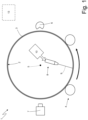
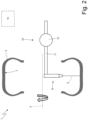
- the number 1 indicates, in the entirety thereof, a cleaning system 1 for cleaning (at least) part of the inner surface 2 (consisting of the innerliner) of a tyre 3 before the application of a sealing agent or of a sound-absorbing material.
- the tyre 3 has a toroidal shape that is delimited by an external surface and by the inner surface 2 opposite to the external surface, and the sealing agent or the sound-absorbing material are applied to (at least) part of the inner surface 2; before being able to apply the sealing agent or the sound-absorbing material to the inner surface 2 of the tyre 3, it is necessary to clean the inner surface 2 in order to eliminate any dirt and processing residues (for example residues from the releasing agent applied to the inner walls of the vulcanization mold).
- the cleaning system 1 comprises a support device 4 which is suitable for supporting the tyre 3 arranged in a vertical position, and that is also suitable for bringing the tyre 3 into rotation about an axis of rotation 5 that coincides with the central axis of symmetry.
- the support device 4 comprises an expansion gripper which is mounted rotating and that is suitable for internally gripping the tyre 3.
- the support device 4 comprises side rails (not illustrated) which hold the tyre 3 stable in the vertical position and comprises motorised rollers (illustrated schematically) whereupon the tyre 3 rests and is driven.
- the support device 4 is shaped differently and is suitable for supporting the tyre 3 which, rather than being arranged in a vertical position is instead arranged in a horizontal position.
- the cleaning system 1 comprises a position sensor 6 which is suitable for determining the angular position of the tyre 3 about the axis of rotation 5; the position sensor 6 may, for example, be an angular encoder coupled to one of the motorised rollers of the support device 4, or else the position sensor 6 may directly read the displacement of the tyre 3.
- the cleaning system 1 may comprise a camera 7 that faces the outer surface of the tyre 3 at a side wall and that is suitable for reading a graphical identification code (typically a bar code or similar) which is applied to the same side wall; in the case of tyres 4, the graphical identification code is always applied at the same position (also at the same angular position), and, therefore, when the camera 7 detects the presence of the graphical identification code, the corresponding angular position of the tyre 3 around the axis of rotation 5 is contextually determined in order to obtain an absolute angular reference for the angular position of the tyre 3 around the axis of rotation 5.
- the support device 4 comprises an angular position sensor (normally an encoder) that detects the angular position of the tyre 2 whilst the tyre 2 is rotated.
- the cleaning system 1 includes an emitter device 8 that is capable of emitting a laser beam 9 that is powerful enough to sublimate (evaporate) at least part of the foreign material present upon the inner surface 2 (consisting of the innerliner) of the tyre 3; such foreign material may include releasing agents (applied within the vulcanization mold) that can inhibit subsequent production processes.
- a laser beam 9 that is powerful enough to sublimate (evaporate) at least part of the foreign material present upon the inner surface 2 (consisting of the innerliner) of the tyre 3; such foreign material may include releasing agents (applied within the vulcanization mold) that can inhibit subsequent production processes.
- the laser beam 9 is consequently capable of cleaning the inner surface 2 of the tyre 3 without running the risk of damaging the inner surface 2 of the tyre 3.
- the cleaning system 1 comprises a handling device 10 that implements a relative movement between the emitter device 8 and the tyre 2 carried by the support device 4 (whether moving the support device 4, that carries the tyre 2 and holding stationary the emitter device 8 or else moving the emitter device 8 and holding stationary the support device 4 that carries the tyre 2).
- the handling device 10 positions the emitter device 8, respectively, inside the tyre 3 and outside the tyre 3, whilst during the cleaning cycle the movement device 10 moves the emitter device 8 axially (i.e., parallel to the axis of rotation 5) in relation to the tyre 2 from one side of the tyre 3 to the opposite side of the tyre 3 in order to allow the laser beam 9, emitted by the emitter device 8, to clean the entire inner surface 2 of the tyre 3.
- the handling device 10 can comprise a support arm 11, which at one end supports the emitter device 8 and an actuator 12, which axially translates the support arm 11 (i.e., parallel to the axis of rotation 5); according to an alternative embodiment, the handling device 10 can comprise a robotic arm having a greater number of degrees of freedom, as necessary, in order to initially insert the emitter device 8 into the tyre and to subsequently remove the emitter device 8 from the tyre.
- the handling device 10 holds stationary the emitter device 8 during the cleaning of a circular strip (obviously having a width equal to the width, i.e., to the axial dimension of the laser beam 9) of the inner surface 2 and moves the emitter device 8 axially (by one step), only between the end of the cleaning of a circular strip of the inner surface 2 and the beginning of the cleaning of the next and adjacent circular strip of the inner surface 2; in other words, a plurality of circular strips of the inner surface 2, that are independent therebetween and arranged one next to the other, are cleaned (generally with a certain mutual overlap, i.e., a new circular strip is more or less superimposed onto the adjacent circular strip).
- the movement device 10 axially and continuously moves the emitter device 8 in order to clean a single continuous strip (i.e., seamlessly) of the inner surface 2 having a spiral shape (also in this case, each loop of the spiral is more or less superimposed onto the previous spiral).
- the cleaning system 1 comprises a control unit 13, which supervises the operation of the same cleaning system 1 and, amongst other things, controls the activation and deactivation of the emitter device 8, regulates the rotational speed imparted by the support device 4, and controls the axial translational movement imparted by the movement device 10.
- the handling device 10 is actuated such as to insert the emitter device 8 inside the tyre 3 to be cleaned (or such as to arrange the tyre 3 to be cleaned around the emitter device 8).
- the support device 4 rotates the tyre 3 around the axis of rotation 5 and subsequently the emitter device 8 is activated such as to emit the laser beam 9, which is directed against the inner surface 2 of the tyre 3; at the same time, the handling device 10 is actuated such as to produce a relatively slow axial translation between the emitter device 8 and the tyre 2, in such a way that the laser beam 9 can clean the entire inner surface 2 of the tyre 3 from one end to the other.
- the emitter device 8 is deactivated and then the handling device 10 is actuated such as to extract the emitter device 8 from the tyre 3 (or such as to remove the tyre 3 from the emitter device 8) and thus allow the clean tyre 3 to be removed from the support device 4 and to fit a new tyre 3 to be cleaned to the support device 4, thereby initiating a new cleaning cycle.
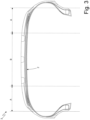
- annular zone A (composed of a series of circular strips or spirals of a fixed width and adjacent therebetween and partially overlapping) of the inner surface 2 in applying, by means of the laser beam 9, to the annular zone A a first surface energy density (generally measured in Joules/cm 2 ); furthermore, less thorough cleaning is carried out within (at least) an annular zone B (also composed of a series of circular strips or spirals of a fixed width and adjacent therebetween and partially overlapping) of the inner surface 2 in applying, by means of the laser beam 9, to the annular zone B a second surface energy density that is lower than the first surface energy density.
- the second surface energy density (applied to zone B) is between 35% and 50% of the first surface energy density (applied to zone A).
- the annular zone A is arranged in proximity to the side walls of the tyre 3 (i.e., at the outer edges of the tyre 3) in such a way as to be arranged at the opposite ends of the annular zone B (i.e., the annular zone B is arranged inside the annular zone A, i.e., the annular zone B is surrounded on the right and on the left by the annular zone A).
- the annular zone B is arranged at the centre of the tyre 3, i.e., it entirely occupies the centre of the tyre 3 and without interruption.
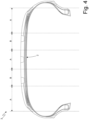
- the annular zone A is arranged both in proximity to the side walls of the tyre 3 and at the centre of the tyre 3, and therefore zone B is located within two semi-central bands on opposite sides of the annular zone A which is arranged at the centre.
- an intermediate cleaning cycle is performed within an annular zone C (composed of a series of circular strips or spirals of a fixed width and adjacent therebetween and partially overlapping) of the inner surface 2 in applying, by means of the laser beam 9, within the annular zone C a third surface energy density that is lower than the first surface energy density (applied within zone A) and higher than the second surface energy density (applied within zone B).
- the second surface energy density (applied within zone C) is between 60% and 80% of the first surface energy density (applied to zone A).
- the annular zone C is interposed between the annular zone A and the annular zone B.
- two or three zones A, B and C are provided for, each having a differing degree of cleanliness (i.e., a different surface energy density applied by the laser beam 9); according to other embodiments, not illustrated, more than three (for example four, five, six ...) zones A, B and C may be provided for, each having a different degree of cleanliness (i.e., a different surface energy density as applied by the 9 laser beam).
- the intensity of the laser beam 9, as emitted by the emitter device 8 is always kept constant (i.e., the emitter device 8 is always operated at the rated power, i.e., at the maximum possible power, in such a way as to always exploit all of the potential of the emitter device 8) and therefore, in order to increase or decrease the surface energy density applied to the inner surface 2 by the laser beam 9, the rotational speed of the tyre 3 about the axis of rotation 5 is decreased or increased.
- one passage (circular strip or spiral) of the laser beam 9 is partially superimposed onto a subsequent passage (circular strip or spiral) of the laser beam 9, such that the laser beam 9 passes over (at least in part) where it has previously passed.
- the degree of overlap between the various zones A, B and C in particular, the annular zone A has a first degree of overlap which is greater than a second degree of overlap of the annular zone B, whilst annular zone C has a third degree of overlap between the first degree of overlap of annular zone A and the second degree of overlap of annular zone B.
- the first degree of overlap of annular zone A is between 45% and 75%
- the second degree of overlap of annular zone B is between 15% and 35%
- the third degree of overlap of annular zone C is between 30% and 50% (a degree of overlap of 0% corresponds to the absence of an overlap, whilst a degree of overlap of 100% corresponds to a total overlap); these values are only examples and could also be different.
- the emitter device 8 is actuated such as to continuously emit the laser beam 9 in order to achieve continuous cleaning, i.e., without interruptions, along circular bands.
- the emitter device 8 is actuated such as to intermittently emit the laser beam 9 in order to perform intermittent cleaning (" checkerboard "), i.e., alternating clean areas with unclean areas, along circular bands.
- the cleaning system 1 described above has many advantages.
- the cleaning system 1 described above makes cleaning the inner surface 2 of the tyre 3 very quick; some experimental tests have shown that the cleaning system 1 described above can even be 50-60% faster than a similar known cleaning system. Furthermore, the cleaning system 1 described above ensures optimum adhesion of the sealing agent, or of the sound-absorbing material, to the inner surface 2.
- the cleaning system 1 described above is simple and inexpensive to implement insofar as, when compared to a similar known cleaning system, it essentially requires only software updates without any hardware modification (or at least with marginal hardware modifications).
Landscapes
- Engineering & Computer Science (AREA)
- Mechanical Engineering (AREA)
- Moulds For Moulding Plastics Or The Like (AREA)
- Laser Beam Processing (AREA)
- Tyre Moulding (AREA)
- Cleaning In General (AREA)
Priority Applications (1)
| Application Number | Priority Date | Filing Date | Title |
|---|---|---|---|
| RS20250582A RS66902B1 (sr) | 2021-04-27 | 2022-04-26 | Postupak i sistem za čišćenje unutrašnje površine gume |
Applications Claiming Priority (2)
| Application Number | Priority Date | Filing Date | Title |
|---|---|---|---|
| IT102021000010571A IT202100010571A1 (it) | 2021-04-27 | 2021-04-27 | Metodo e sistema di pulizia di una superficie interna di uno pneumatico |
| PCT/EP2022/061058 WO2022229190A1 (en) | 2021-04-27 | 2022-04-26 | Method and system for cleaning an inner surface of a tyre |
Publications (3)
| Publication Number | Publication Date |
|---|---|
| EP4330025A1 EP4330025A1 (en) | 2024-03-06 |
| EP4330025C0 EP4330025C0 (en) | 2025-05-28 |
| EP4330025B1 true EP4330025B1 (en) | 2025-05-28 |
Family
ID=76921186
Family Applications (1)
| Application Number | Title | Priority Date | Filing Date |
|---|---|---|---|
| EP22725497.6A Active EP4330025B1 (en) | 2021-04-27 | 2022-04-26 | Method and system for cleaning an inner surface of a tyre |
Country Status (10)
| Country | Link |
|---|---|
| US (1) | US12454110B2 (https=) |
| EP (1) | EP4330025B1 (https=) |
| JP (1) | JP2024517162A (https=) |
| CN (1) | CN117203043A (https=) |
| ES (1) | ES3036410T3 (https=) |
| HU (1) | HUE071900T2 (https=) |
| IT (1) | IT202100010571A1 (https=) |
| PL (1) | PL4330025T3 (https=) |
| RS (1) | RS66902B1 (https=) |
| WO (1) | WO2022229190A1 (https=) |
Family Cites Families (9)
| Publication number | Priority date | Publication date | Assignee | Title |
|---|---|---|---|---|
| US6369353B1 (en) * | 1998-02-20 | 2002-04-09 | The Goodyear Tire & Rubber Company | Robotic laser tire mold cleaning system and method of use |
| CN102472689B (zh) * | 2009-06-30 | 2015-01-14 | 米其林研究和技术股份有限公司 | 在沿轮胎胎圈的不同轨道位置通过烧蚀进行的均匀性校正 |
| US10343194B2 (en) | 2015-11-11 | 2019-07-09 | The Yokohama Rubber Co., Ltd. | Tire cleaning system |
| US10099440B2 (en) * | 2015-12-01 | 2018-10-16 | The Goodyear Tire & Rubber Company | Method of laser cleaning a tire inner surface, and a tire |
| US10086577B2 (en) | 2015-12-01 | 2018-10-02 | The Goodyear Tire & Rubber Company | Method of making a self-sealing tire, and a tire |
| EP3281810B1 (en) | 2016-08-10 | 2020-12-16 | 4JET Technologies GmbH | Tire processing method, computer program product and batch of tires |
| JP6909146B2 (ja) * | 2017-12-15 | 2021-07-28 | 株式会社ブリヂストン | ゴム部材の取付方法、及び、タイヤの製造方法 |
| JP2019107862A (ja) * | 2017-12-20 | 2019-07-04 | 株式会社ブリヂストン | 離型剤除去方法及びタイヤ |
| US11396150B2 (en) * | 2018-02-14 | 2022-07-26 | Android Industries Llc | Tire preparation for adhesive using laser ablation system and method |
-
2021
- 2021-04-27 IT IT102021000010571A patent/IT202100010571A1/it unknown
-
2022
- 2022-04-26 ES ES22725497T patent/ES3036410T3/es active Active
- 2022-04-26 PL PL22725497.6T patent/PL4330025T3/pl unknown
- 2022-04-26 JP JP2023565947A patent/JP2024517162A/ja active Pending
- 2022-04-26 US US18/286,833 patent/US12454110B2/en active Active
- 2022-04-26 WO PCT/EP2022/061058 patent/WO2022229190A1/en not_active Ceased
- 2022-04-26 EP EP22725497.6A patent/EP4330025B1/en active Active
- 2022-04-26 RS RS20250582A patent/RS66902B1/sr unknown
- 2022-04-26 CN CN202280031126.8A patent/CN117203043A/zh active Pending
- 2022-04-26 HU HUE22725497A patent/HUE071900T2/hu unknown
Also Published As
| Publication number | Publication date |
|---|---|
| US20240190092A1 (en) | 2024-06-13 |
| JP2024517162A (ja) | 2024-04-19 |
| HUE071900T2 (hu) | 2025-09-28 |
| ES3036410T3 (en) | 2025-09-18 |
| US12454110B2 (en) | 2025-10-28 |
| EP4330025C0 (en) | 2025-05-28 |
| IT202100010571A1 (it) | 2022-10-27 |
| PL4330025T3 (pl) | 2025-07-07 |
| CN117203043A (zh) | 2023-12-08 |
| WO2022229190A1 (en) | 2022-11-03 |
| RS66902B1 (sr) | 2025-07-31 |
| EP4330025A1 (en) | 2024-03-06 |
Similar Documents
| Publication | Publication Date | Title |
|---|---|---|
| KR102743545B1 (ko) | 타이어로부터 지느러미를 제거하는 방법 및 장치 | |
| EP2110270B1 (en) | Method of and apparatus for fitting or removing a motor vehicle tyre | |
| EP3141381B1 (en) | Release agent removal method, and a tire | |
| US11396150B2 (en) | Tire preparation for adhesive using laser ablation system and method | |
| JP7693987B2 (ja) | レーザ高速タイヤ清浄化装置 | |
| US7726374B2 (en) | Apparatus and method for obtaining labels | |
| EP4330025B1 (en) | Method and system for cleaning an inner surface of a tyre | |
| JPH1199524A (ja) | 金型クリーニング装置 | |
| EP0419050B1 (en) | Tire side member raising and pressure-joining apparatus | |
| JP2022006891A (ja) | タイヤ成形装置およびタイヤ成形方法 | |
| KR101601641B1 (ko) | 롤러 헤밍장치 | |
| US8900387B2 (en) | Methods and apparatus for stitching tire patches | |
| JP2006346930A (ja) | プレキュアトレッドの組付け方法および組付け装置 | |
| JP2026510885A (ja) | 空気入りタイヤ、タイヤ加工機、ホイール、方法、制御装置、及びコンピュータプログラム製品 | |
| JP2014144552A (ja) | プリセットビードの成形方法 | |
| JP2026510884A (ja) | 空気入りタイヤ、タイヤ加工機、ホイール、方法、制御装置、及びコンピュータプログラム製品 | |
| JP2010274468A (ja) | タイヤの製造方法および装置 | |
| WO2018051813A1 (ja) | 筒状部材の製造装置および方法 | |
| KR20190125621A (ko) | 원통 절단기 | |
| JP4487510B2 (ja) | ランフラット用支持体の製造方法及び装置 | |
| JP2008279709A (ja) | 空気入りタイヤの製造方法および装置 | |
| JP2002254500A (ja) | ブロー成形品の内周面にシールリップを成形する方法 |
Legal Events
| Date | Code | Title | Description |
|---|---|---|---|
| STAA | Information on the status of an ep patent application or granted ep patent |
Free format text: STATUS: UNKNOWN |
|
| STAA | Information on the status of an ep patent application or granted ep patent |
Free format text: STATUS: THE INTERNATIONAL PUBLICATION HAS BEEN MADE |
|
| PUAI | Public reference made under article 153(3) epc to a published international application that has entered the european phase |
Free format text: ORIGINAL CODE: 0009012 |
|
| STAA | Information on the status of an ep patent application or granted ep patent |
Free format text: STATUS: REQUEST FOR EXAMINATION WAS MADE |
|
| 17P | Request for examination filed |
Effective date: 20231127 |
|
| AK | Designated contracting states |
Kind code of ref document: A1 Designated state(s): AL AT BE BG CH CY CZ DE DK EE ES FI FR GB GR HR HU IE IS IT LI LT LU LV MC MK MT NL NO PL PT RO RS SE SI SK SM TR |
|
| DAV | Request for validation of the european patent (deleted) | ||
| DAX | Request for extension of the european patent (deleted) | ||
| GRAP | Despatch of communication of intention to grant a patent |
Free format text: ORIGINAL CODE: EPIDOSNIGR1 |
|
| STAA | Information on the status of an ep patent application or granted ep patent |
Free format text: STATUS: GRANT OF PATENT IS INTENDED |
|
| INTG | Intention to grant announced |
Effective date: 20241209 |
|
| GRAS | Grant fee paid |
Free format text: ORIGINAL CODE: EPIDOSNIGR3 |
|
| GRAA | (expected) grant |
Free format text: ORIGINAL CODE: 0009210 |
|
| STAA | Information on the status of an ep patent application or granted ep patent |
Free format text: STATUS: THE PATENT HAS BEEN GRANTED |
|
| AK | Designated contracting states |
Kind code of ref document: B1 Designated state(s): AL AT BE BG CH CY CZ DE DK EE ES FI FR GB GR HR HU IE IS IT LI LT LU LV MC MK MT NL NO PL PT RO RS SE SI SK SM TR |
|
| REG | Reference to a national code |
Ref country code: GB Ref legal event code: FG4D |
|
| REG | Reference to a national code |
Ref country code: CH Ref legal event code: EP |
|
| REG | Reference to a national code |
Ref country code: DE Ref legal event code: R096 Ref document number: 602022015225 Country of ref document: DE |
|
| REG | Reference to a national code |
Ref country code: IE Ref legal event code: FG4D |
|
| U01 | Request for unitary effect filed |
Effective date: 20250610 |
|
| U07 | Unitary effect registered |
Designated state(s): AT BE BG DE DK EE FI FR IT LT LU LV MT NL PT RO SE SI Effective date: 20250617 |
|
| REG | Reference to a national code |
Ref country code: ES Ref legal event code: FG2A Ref document number: 3036410 Country of ref document: ES Kind code of ref document: T3 Effective date: 20250918 |
|
| REG | Reference to a national code |
Ref country code: HU Ref legal event code: AG4A Ref document number: E071900 Country of ref document: HU |
|
| PG25 | Lapsed in a contracting state [announced via postgrant information from national office to epo] |
Ref country code: GR Free format text: LAPSE BECAUSE OF FAILURE TO SUBMIT A TRANSLATION OF THE DESCRIPTION OR TO PAY THE FEE WITHIN THE PRESCRIBED TIME-LIMIT Effective date: 20250829 Ref country code: NO Free format text: LAPSE BECAUSE OF FAILURE TO SUBMIT A TRANSLATION OF THE DESCRIPTION OR TO PAY THE FEE WITHIN THE PRESCRIBED TIME-LIMIT Effective date: 20250828 |
|
| PG25 | Lapsed in a contracting state [announced via postgrant information from national office to epo] |
Ref country code: HR Free format text: LAPSE BECAUSE OF FAILURE TO SUBMIT A TRANSLATION OF THE DESCRIPTION OR TO PAY THE FEE WITHIN THE PRESCRIBED TIME-LIMIT Effective date: 20250528 |
|
| PG25 | Lapsed in a contracting state [announced via postgrant information from national office to epo] |
Ref country code: IS Free format text: LAPSE BECAUSE OF FAILURE TO SUBMIT A TRANSLATION OF THE DESCRIPTION OR TO PAY THE FEE WITHIN THE PRESCRIBED TIME-LIMIT Effective date: 20250928 |
|
| PG25 | Lapsed in a contracting state [announced via postgrant information from national office to epo] |
Ref country code: SM Free format text: LAPSE BECAUSE OF FAILURE TO SUBMIT A TRANSLATION OF THE DESCRIPTION OR TO PAY THE FEE WITHIN THE PRESCRIBED TIME-LIMIT Effective date: 20250528 |
|
| PG25 | Lapsed in a contracting state [announced via postgrant information from national office to epo] |
Ref country code: CZ Free format text: LAPSE BECAUSE OF FAILURE TO SUBMIT A TRANSLATION OF THE DESCRIPTION OR TO PAY THE FEE WITHIN THE PRESCRIBED TIME-LIMIT Effective date: 20250528 |
|
| PG25 | Lapsed in a contracting state [announced via postgrant information from national office to epo] |
Ref country code: SK Free format text: LAPSE BECAUSE OF FAILURE TO SUBMIT A TRANSLATION OF THE DESCRIPTION OR TO PAY THE FEE WITHIN THE PRESCRIBED TIME-LIMIT Effective date: 20250528 |
|
| PLBE | No opposition filed within time limit |
Free format text: ORIGINAL CODE: 0009261 |
|
| STAA | Information on the status of an ep patent application or granted ep patent |
Free format text: STATUS: NO OPPOSITION FILED WITHIN TIME LIMIT |
|
| REG | Reference to a national code |
Ref country code: CH Ref legal event code: L10 Free format text: ST27 STATUS EVENT CODE: U-0-0-L10-L00 (AS PROVIDED BY THE NATIONAL OFFICE) Effective date: 20260409 |
|
| PGFP | Annual fee paid to national office [announced via postgrant information from national office to epo] |
Ref country code: PL Payment date: 20260325 Year of fee payment: 5 |
|
| U20 | Renewal fee for the european patent with unitary effect paid |
Year of fee payment: 5 Effective date: 20260319 |