EP4328328A1 - Supplied heat quantity estimation method, supplied heat quantity estimation apparatus, supplied heat quantity estimation program, and method for operating blast furnace - Google Patents
Supplied heat quantity estimation method, supplied heat quantity estimation apparatus, supplied heat quantity estimation program, and method for operating blast furnace Download PDFInfo
- Publication number
- EP4328328A1 EP4328328A1 EP22832513.0A EP22832513A EP4328328A1 EP 4328328 A1 EP4328328 A1 EP 4328328A1 EP 22832513 A EP22832513 A EP 22832513A EP 4328328 A1 EP4328328 A1 EP 4328328A1
- Authority
- EP
- European Patent Office
- Prior art keywords
- heat
- estimating
- blast furnace
- carried
- furnace
- Prior art date
- Legal status (The legal status is an assumption and is not a legal conclusion. Google has not performed a legal analysis and makes no representation as to the accuracy of the status listed.)
- Pending
Links
Images


Classifications
-
- C—CHEMISTRY; METALLURGY
- C21—METALLURGY OF IRON
- C21B—MANUFACTURE OF IRON OR STEEL
- C21B5/00—Making pig-iron in the blast furnace
- C21B5/006—Automatically controlling the process
-
- C—CHEMISTRY; METALLURGY
- C21—METALLURGY OF IRON
- C21B—MANUFACTURE OF IRON OR STEEL
- C21B7/00—Blast furnaces
- C21B7/24—Test rods or other checking devices
-
- C—CHEMISTRY; METALLURGY
- C21—METALLURGY OF IRON
- C21B—MANUFACTURE OF IRON OR STEEL
- C21B5/00—Making pig-iron in the blast furnace
- C21B5/008—Composition or distribution of the charge
-
- F—MECHANICAL ENGINEERING; LIGHTING; HEATING; WEAPONS; BLASTING
- F27—FURNACES; KILNS; OVENS; RETORTS
- F27B—FURNACES, KILNS, OVENS OR RETORTS IN GENERAL; OPEN SINTERING OR LIKE APPARATUS
- F27B1/00—Shaft or like vertical or substantially vertical furnaces
- F27B1/10—Details, accessories or equipment specially adapted for furnaces of these types
- F27B1/26—Arrangements of controlling devices
-
- F—MECHANICAL ENGINEERING; LIGHTING; HEATING; WEAPONS; BLASTING
- F27—FURNACES; KILNS; OVENS; RETORTS
- F27B—FURNACES, KILNS, OVENS OR RETORTS IN GENERAL; OPEN SINTERING OR LIKE APPARATUS
- F27B1/00—Shaft or like vertical or substantially vertical furnaces
- F27B1/10—Details, accessories or equipment specially adapted for furnaces of these types
- F27B1/28—Arrangements of monitoring devices, of indicators, of alarm devices
-
- F—MECHANICAL ENGINEERING; LIGHTING; HEATING; WEAPONS; BLASTING
- F27—FURNACES; KILNS; OVENS; RETORTS
- F27D—DETAILS OR ACCESSORIES OF FURNACES, KILNS, OVENS OR RETORTS, IN SO FAR AS THEY ARE OF KINDS OCCURRING IN MORE THAN ONE KIND OF FURNACE
- F27D19/00—Arrangements of controlling devices
-
- G—PHYSICS
- G01—MEASURING; TESTING
- G01K—MEASURING TEMPERATURE; MEASURING QUANTITY OF HEAT; THERMALLY-SENSITIVE ELEMENTS NOT OTHERWISE PROVIDED FOR
- G01K17/00—Measuring quantity of heat
-
- C—CHEMISTRY; METALLURGY
- C21—METALLURGY OF IRON
- C21B—MANUFACTURE OF IRON OR STEEL
- C21B2300/00—Process aspects
- C21B2300/04—Modeling of the process, e.g. for control purposes; CII
Definitions
- the present invention relates to a supply heat quantity estimating method, a supply heat quantity estimating device, a supply heat quantity estimating program, and a blast furnace operating method for estimating the quantity of heat supplied to pig iron in a blast furnace.
- the molten iron temperature in order to stably operate a blast furnace, it is necessary to maintain the molten iron temperature within a predetermined range. Specifically, when the molten iron temperature becomes low, the viscosity of the molten iron and slag generated together with the molten iron increases, and it becomes difficult to discharge the molten iron or the slag from a tap hole. On the other hand, when the molten iron temperature becomes high, the Si concentration in the molten iron increases, and the viscosity of the molten iron increases, and thus there is a high risk that the molten iron sticks to a tuyere and melts the tuyere.
- Patent Literature 1 discloses a furnace heat controlling method for a blast furnace, in which the molten iron temperature after a specific period of time is sequentially estimated from a displacement amount in a furnace heat index at the current time from a furnace heat index reference level corresponding to a target molten iron temperature, a displacement amount in a descending speed at the current time from a descending speed reference level of a furnace top corresponding to the target molten iron temperature, and time of influence of both of the displacement amounts to the molten iron temperature, and furnace heat control operation is performed so as to reduce fluctuations in the molten iron temperature based on the estimation result.
- Patent Literature 2 discloses a molten iron temperature estimating method for a blast furnace for estimating a future molten iron temperature based on operation data including an actual value of blast condition data including at least one of a blast temperature, a blast humidity, a blast volume, a pulverized coal blowing amount, or an oxygen enrichment amount in the blast furnace, an actual value of disturbance factor data including at least a solution loss carbon amount, and an actual value of the molten iron temperature, the method including: a data accumulation step of accumulating the operation data; a stationary state estimation model constructing step of constructing a stationary state estimation model for estimating a molten iron temperature in a stationary state from the operation data in the stationary state accumulated in the data accumulation step; a non-stationary state estimation model constructing step of constructing a non-stationary state estimation model for estimating a molten iron temperature in a non-stationary state from the operation data in the non-stationary state accumulated in the data accumulation step, the non-stationary state estimation model obtained
- the timing at which the molten iron temperature is highly likely to greatly fluctuate is when the quantity of molten iron produced changes due to a change in the rate of operation such as the blast volume in a blast furnace, and the quantity of pig iron changes with respect to the quantity of heat supplied into the blast furnace.
- the molten iron temperature greatly fluctuates when a so-called slip occurs in which the raw material stops descending due to the force of gas pushing up the raw material in the blast furnace exceeding the descending force of the raw material and then the height of the raw material surface rapidly drops when this relationship is canceled.
- Patent Literature 1 since the method described in Patent Literature 1 does not take into consideration factors such as carried-out sensible heat by blast sensible heat, which is considered to change due to an increase or decrease in the rate of operation, it is not possible to accurately estimate the quantity of heat supplied to pig iron when the rate of operation is greatly changed.
- the estimation accuracy of the molten iron temperature decreases when an operation change that has not been accumulated previously is performed.
- the estimation accuracy of the molten iron temperature is low as described above, there are many cases where the heat is excessively supplied, which brings about concerns about equipment trouble. Meanwhile, excessive use of a reducing material, which is a carbon source, is not preferable also from the perspective of reducing carbon dioxide emissions.
- the present invention has been made in view of the above disadvantages, and an object of the present invention is to provide a supply heat quantity estimating method, a supply heat quantity estimating device, and a supply heat quantity estimating program capable of accurately estimating the quantity of heat supplied to pig iron in a blast furnace even when the rate of operation greatly changes and, especially, when a slip occurs.
- Another object of the present invention is to provide a blast furnace operating method capable of accurately controlling the molten iron temperature within a predetermined range while maintaining the quantity of heat supplied to the pig iron in the blast furnace to an appropriate amount even when the rate of operation greatly changes and, especially, when a slip occurs.
- a supply heat quantity estimating method estimates a quantity of heat supplied to pig iron in a blast furnace from a quantity of heat supplied into the blast furnace and a production speed of molten iron in the blast furnace, and includes: an estimating step of estimating a change in carried-out sensible heat by in-furnace passing gas and a change in carried-in sensible heat supplied by a raw material preheated by the in-furnace passing gas, and estimating a quantity of heat supplied to the pig iron in the blast furnace in consideration of the changes in the carried-out sensible heat and the carried-in sensible heat that have been estimated, wherein the estimating step includes: a step of estimating the carried-out sensible heat in consideration of the quantity of heat released to an outside of the blast furnace by a slip, and estimating the change in the carried-in sensible heat in consideration of a change in a surface height of the raw material by the slip; and a step of estimating a quantity of heat held in a deadman coke present in the blast furnace, and estimating the quantity of
- the estimating step may include a step of estimating the carried-out sensible heat in consideration of the quantity of heat released to the outside of the blast furnace by the slip by calculating a multiplied value by multiplying specific heat of furnace top gas by a difference between a furnace top gas temperature and a reference temperature of the furnace top gas temperature and adding a value obtained by dividing the multiplied value by an ironmaking speed to the carried-out sensible heat.
- the estimating step may include a step of estimating the change in the carried-in sensible heat in consideration of the change in the surface height of the raw material due to the slip by obtaining a raw material temperature as a function of an integrated value of a difference between an estimated value and an actual value of the surface height of the raw material.
- a supply heat quantity estimating device estimates a quantity of heat supplied to pig iron in a blast furnace from a quantity of heat supplied into the blast furnace and a production speed of molten iron in the blast furnace, and includes: an estimating unit configured to estimate a change in carried-out sensible heat by in-furnace passing gas and a change in carried-in sensible heat supplied by a raw material preheated by the in-furnace passing gas, and estimate a quantity of heat supplied to the pig iron in the blast furnace in consideration of the changes in the carried-out sensible heat and the carried-in sensible heat that have been estimated, wherein the estimating unit is configured to estimate the carried-out sensible heat in consideration of the quantity of heat released to an outside of the blast furnace by a slip, estimate the change in the carried-in sensible heat in consideration of a change in a surface height of the raw material by the slip, estimate a quantity of heat held in a deadman coke present in the blast furnace, and estimate the quantity of heat supplied to the pig iron in the blast furnace in consideration of
- a supply heat quantity estimating program causes a computer to execute a process of estimating a quantity of heat supplied to pig iron in a blast furnace from a quantity of heat supplied into the blast furnace and a production speed of molten iron in the blast furnace, the supply heat quantity estimating program causing the computer to execute an estimating process of: estimating a change in carried-out sensible heat by in-furnace passing gas and a change in carried-in sensible heat supplied by a raw material preheated by the in-furnace passing gas and estimating a quantity of heat supplied to the pig iron in the blast furnace in consideration of the changes in the carried-out sensible heat and the carried-in sensible heat that have been estimated, wherein the estimating process includes: estimating the carried-out sensible heat in consideration of the quantity of heat released to an outside of the blast furnace by a slip, estimating the change in the carried-in sensible heat in consideration of a change in a surface height of the raw material by the slip, estimating a quantity of heat held in a deadman coke present
- a blast furnace operating method includes: a step of controlling the quantity of heat supplied into the blast furnace based on the quantity of heat supplied to the pig iron in the blast furnace estimated by the supply heat quantity estimating method according to the present invention.
- a supply heat quantity estimating method, a supply heat quantity estimating device, and a supply heat quantity estimating program according to the present invention it is possible to accurately estimate the quantity of heat supplied to pig iron in a blast furnace even when the rate of operation greatly changes and, especially, when a slip occurs.
- a blast furnace operating method according to the present invention it is possible to maintain the quantity of heat supplied to the pig iron in the blast furnace to an appropriate amount and to accurately control the molten iron temperature within a predetermined range even when the rate of operation greatly changes and, especially, when a slip occurs.
- FIG. 1 is a block diagram illustrating the configuration of the furnace heat controlling device as an embodiment of the present invention.
- a furnace heat controlling device 1 includes an information processing device, such as a computer, and controls the temperature of molten iron produced in a blast furnace 2 within a predetermined range by controlling the quantity of heat supplied to the melt iron in the blast furnace 2 from a tuyere provided in a lower portion of the blast furnace 2.
- the furnace heat controlling device 1 functions as a supply heat quantity estimating device according to the present invention.
- the furnace heat controlling device 1 having such a configuration accurately estimates the quantity of heat supplied to pig iron in the blast furnace 2 even when the rate of operation of the blast furnace 2 greatly changes and, especially, when a slip occurs, by execution of the furnace heat controlling process described below, maintains the quantity of heat supplied to the pig iron in the blast furnace 2 at an appropriate amount using the estimation result, and accurately controls the molten iron temperature within the predetermined range.
- a flow of the furnace heat controlling process as an embodiment of the present invention will be described with reference to FIG. 2 .
- the operation of the furnace heat controlling device 1 described below is implemented by an arithmetic processing device, such as a CPU in the information processing device included in the furnace heat controlling device 1, loading a program 1a from a storage unit such as a ROM to a temporary storage unit such as a RAM and executing the program 1a that has been loaded.
- the program 1a may be provided by being recorded in a computer-readable recording medium such as a CD-ROM, a flexible disk, a CD-R, or a DVD as a file in an installable format or an executable format.
- the program 1a may be stored in a computer connected to a network such as a telecommunication line such as the Internet, a telephone communication network such as a mobile phone, or a wireless communication network such as WiFi (registered trademark), and provided by being downloaded via the network.
- a network such as a telecommunication line such as the Internet, a telephone communication network such as a mobile phone, or a wireless communication network such as WiFi (registered trademark), and provided by being downloaded via the network.
- FIG. 2 is a flowchart illustrating a flow of the furnace heat controlling process as the embodiment of the present invention.
- the flowchart illustrated in FIG. 2 starts at the timing when an execution command of the furnace heat controlling process is input to the furnace heat controlling device 1, and in the furnace heat controlling process, in addition to the process of step S1 of estimating the quantity of heat supplied into the blast furnace with reaction heat balance (exothermic reaction heat and endothermic reaction heat), blast sensible heat, a heat loss (e.g. amount of heat removed from the furnace body), and others in the blast furnace that is performed in the related art, processes of step S2, step S3, and step S4 is further performed, and the flow proceeds to a process of step S5 of estimating the supply heat quantity by integrating these steps.
- reaction heat balance exothermic reaction heat and endothermic reaction heat
- blast sensible heat e.g. amount of heat removed from the furnace body
- a heat loss e.g. amount of heat removed from the furnace body
- step S1 of estimating the quantity of heat supplied into the blast furnace with reaction heat balance (exothermic reaction heat and endothermic reaction heat), blast sensible heat, a heat loss (e.g. amount of heat removed from the furnace body), and others in the blast furnace is performed in the related art, and the supply heat quantity at this point is denoted as Q 0 .
- reaction heat balance exothermic reaction heat and endothermic reaction heat
- blast sensible heat e.g. amount of heat removed from the furnace body
- a heat loss e.g. amount of heat removed from the furnace body
- the furnace heat controlling device 1 estimates sensible heat (gas-carried-out sensible heat) Q 7 carried out to an upper portion of the blast furnace 2 by gas (in-furnace passing gas) passing from a lower portion to the upper portion of the blast furnace 2.
- the gas-carried-out sensible heat Q 7 (MJ/t-p: amount of heat per ton of pig iron.
- t-p represents pig iron tonnage
- t-p represents pig iron tonnage
- step S2 By dividing the value obtained by adding the first multiplied value and the second multiplied value by the ironmaking speed, it is possible to accurately evaluate the gas-carried-out sensible heat Q 7 in consideration of the quantity of heat released to the outside of the furnace without exchanging heat with the raw material by a slip.
- step S2 the process of step S2 is completed, and the flow proceeds to the process of step S5.
- Q 7 ⁇ bosh ⁇ ⁇ C bosh , i ⁇ V bosh , i ⁇ TFT ⁇ T base + ⁇ top ⁇ ⁇ C top , i ⁇ V top , i ⁇ T top ⁇ T top , base ⁇ 1 Pig
- C bosh i denotes the specific heat (MJ/m 3 /°C) of a gas species i (nitrogen, carbon monoxide, and hydrogen) in the in-furnace passing gas (Bosch gas)
- C top i denotes the specific heat (MJ/m 3 /°C) of a gas species i (nitrogen, carbon monoxide, carbon dioxide, hydrogen, and water vapor) in the furnace top gas
- V bosh i denotes the flow rate (m 3 (s.t.p)/min) (m 3 (s.t.p): volume at 0°C and 1 atm (atmospheric pressure)) of the gas species i in the in-furnace passing gas
- V top i denotes the flow rate (m 3 (s.t.p)/min) of the gas species i in the furnace top gas
- TFT denotes the theoretical combustion temperature (°C)
- T base denotes the reference temperature (°C) (800 to 1200°C,
- the furnace heat controlling device 1 estimates sensible heat (raw-material-carried-in sensible heat) Q 8 carried in to the lower portion of the blast furnace 2 by a raw material supplied from the upper portion to the lower portion of the blast furnace 2.
- the raw material temperature T 1 is a function of the differential value of the difference ⁇ L surface between the estimated value and the actual value of the raw material surface height as in Equation (3) below.
- the raw material temperature T 1 decreases depending on the magnitude of the surface height of the raw material that has slipped, and thus it is possible to accurately evaluate a decrease in the quantity of heat carried into the lower part of the furnace by the raw material that is not heated well due to a slip.
- the surface height of a packed bed of the raw material in the blast furnace decreases.
- the surface height of the packed bed of the raw material is measured using a sensor, and an operation of replenishing the raw material and the coke to bring the surface height of the packed bed of the raw material to the original height is repeatedly performed each time the surface height of the packed bed of the raw material descends to a predetermined height.
- the volume of the raw material in the blast furnace itself decreases depending on the ironmaking speed, however, the descent of the raw material is inhibited at a certain position, and thus the surface height of the packed bed of the raw material is constant or only slightly descends. Therefore, by always obtaining the difference ⁇ L surface between the surface height of the packed bed of the raw material estimated from the ironmaking speed and a sensor measurement value, since a change amount d ⁇ L surface /dt when the difference is rapidly reduced represents the slip amount, and the influence of the raw material not heated well due to the slip can be evaluated depending on the magnitude of the quantity of the slip.
- step S3 the process of step S3 is completed, and the flow proceeds to the process of step S5.
- Q 8 ⁇ ⁇ ⁇ C j ⁇ R j ⁇ T 1 ⁇ T base
- C j denotes the specific heat (MJ/kg/°C) of a raw material j (coke, pig iron, and slag)
- R j denotes an intensity (kg/t-p) of the raw material j
- T 1 denotes the raw material temperature (°C) at the lower end of the cohesive zone
- T base denotes the reference temperature (°C)
- ⁇ denotes an influence coefficient modified depending on the blast furnace 2.
- the furnace heat controlling device 1 estimates the quantity of heat (coke holding heat quantity) Q 9 held in the deadman coke present in the lower portion of the blast furnace 2.
- the coke holding heat quantity Q 9 (MJ/t-p) can be obtained by multiplying a value obtained by subtracting a combustion consumption amount and a carbon amount discharged as dust from the coke intensity per ton of molten iron by a difference between a reference temperature and a theoretical combustion temperature and the specific heat C coke of coke and is expressed by the following Equation (4).
- the process of step S4 is completed, and the flow proceeds to the process of step S5.
- Q 9 ⁇ ⁇ C Coke ⁇ ⁇ ⁇ TFT ⁇ T base ⁇ CR ⁇ CR burn ⁇ PCR ⁇ C inPC + C sol + Dust ⁇ C indust 0.88
- C coke denotes the specific heat of coke (MJ/kg/°C)
- TFT denotes the theoretical combustion temperature (°C)
- T base denotes the reference temperature (°C)
- CR denotes a coke ratio (kg/t-p)
- CR burn denotes a combustion carbon ratio in front of the tuyere (amount of oxygen consumed in front of the tuyere by blown oxygen and humidification) (kg/t-p)
- PCR denotes a pulverized coal ratio (kg/t-p)
- C inPC denotes a carbon ratio in pulverized coal
- C sol denotes a solution loss carbon ratio (kg/t-p)
- Dust denotes a dust ratio (kg/t-p)
- C indust denotes a carbon ratio in dust
- ⁇ and ⁇ denote influence coefficients modified depending on the blast furnace 2.
- step S5 the furnace heat controlling device 1 estimates the quantity of heat supplied to the pig iron in the blast furnace 2 using the supply heat quantity Q 0 estimated in the process of step S1, the gas-carried-out sensible heat Q 7 estimated in the processes of steps S2 to S4, the material-carried-in sensible heat Q 8 , and the coke holding heat quantity Q 9 .
- the furnace heat controlling device 1 calculates a furnace heat index T Q (MJ/t-p) corresponding to the quantity of heat supplied to the pig iron in the blast furnace 2 by substituting the supply heat quantity Q 0 estimated in step S1, the gas-carried-out sensible heat Q 7 estimated in the process of steps S2 to S4, the material-carried-in sensible heat Q 8 , and the coke holding heat quantity Q 9 into the following Equation (5).
- T Q Q 0 ⁇ Q 7 + Q 8 ⁇ Q 9
- Q 0 denotes the quantity of heat supplied into the blast furnace by the reaction heat balance (exothermic reaction heat and endothermic reaction heat), the blast sensible heat, the heat loss (e.g. the quantity of heat removed from the furnace body), and others in the blast furnace, and an estimation method adopted in many cases in the supply heat quantity estimation of the related art can be applied.
- Equation (6) is conceivable.
- Q 1 denotes the combustion heat (MJ/t-p) of coke at the tip of the tuyere.
- the combustion heat Q 1 can be calculated by dividing a calorific value due to combustion of coke calculated from the amount of oxygen blown from the tuyere to the blast furnace per unit time by the amount of molten pig iron produced in the unit time.
- Q 2 denotes blast sensible heat (MJ/t-p) supplied to the blast furnace by the blast from the tuyere.
- the blast sensible heat Q 2 can be calculated by obtaining the quantity of heat input to the blast furnace by blast per unit time from the blast volume per unit time and a measured value of the blast temperature and dividing this value by the amount of molten pig iron produced in the unit time.
- Q 3 denotes solution loss reaction heat (MJ/t-p).
- the reaction heat can be calculated by obtaining the solution loss carbon amount from component values of the furnace top gas.
- the solution loss reaction heat Q 3 can be calculated by dividing the solution loss reaction heat by the amount of molten pig iron produced in the unit time.
- Q 4 denotes heat of decomposition (MJ/t-p) of moisture contained mainly in the blast.
- the heat of decomposition Q 4 can be calculated by dividing the heat of decomposition obtained from a measurement value of the blown moisture by the amount of molten pig iron produced in the unit time.
- Q 5 denotes a heat loss (for example, the quantity of heat removed by cooling water) from the furnace body (MJ/t-p).
- the quantity of heat removed Q 5 can be calculated by calculating the quantity of heat removed by the cooling water per unit time from the amount of the cooling water and a temperature difference between an inlet side and an outlet side of the cooling water of the blast furnace body and dividing the calculated amount of heat removed by the amount of molten pig iron produced in the unit time.
- Q 6 denotes the heat of decomposition (MJ/t-p) of a reducing material blown from the tuyere per unit time.
- the heat of decomposition Q 6 can be calculated by dividing the heat of decomposition by the amount of molten pig iron produced in the unit time.
- step S6 the furnace heat controlling device 1 controls the quantity of heat supplied from the tuyere into the blast furnace 2 based on the quantity of heat supplied to the pig iron in the blast furnace 2 estimated in the process of step S5, thereby maintaining the quantity of heat supplied to the pig iron in the blast furnace 2 at an appropriate amount and controlling the molten iron temperature within a predetermined range.
- the furnace heat controlling device 1 estimates a change in carried-out sensible heat to the upper portion of the blast furnace by the in-furnace passing gas and a change in carried-in sensible heat supplied to the lower portion of the blast furnace by the raw material preheated by the in-furnace passing gas and estimates the quantity of heat supplied to the pig iron in the blast furnace in consideration of the estimated changes in the carried-out sensible heat and carried-in sensible heat.
- the furnace heat controlling device 1 estimates the carried-out sensible heat in consideration of the quantity of heat released to the outside of the blast furnace by the slip, estimates the change in the carried-in sensible heat in consideration of the change in the surface height of the raw material by the slip, estimates the quantity of heat held in the deadman coke present in the blast furnace, and estimates the quantity of heat supplied to the pig iron in the blast furnace in consideration of the estimated amount of heat held in the deadman coke.
- This makes it possible to accurately estimate the quantity of heat supplied to the pig iron in the blast furnace even when the rate of operation such as the blast volume to the blast furnace greatly changes and, especially, when a slip occurs.
- this makes it possible to maintain the quantity of heat supplied to the pig iron in the blast furnace to an appropriate amount and to accurately control the molten iron temperature within a predetermined range even when the rate of operation greatly changes and, especially, when a slip occurs.
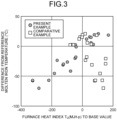
- Illustrated in FIG. 3 are results of comparison between each of the furnace heat index of the related art (estimated by Q 1 to Q 6 ) and the furnace heat index of the present invention (estimated by Q 1 to Q 9 ) at timing when a slip has occurred with the actual molten iron temperature (difference from the reference molten iron temperature).
- the furnace heat index of the present invention presents example
- a certain correlation between the furnace heat index and the molten iron temperature can be confirmed as compared with the furnace heat index of the related art (comparative example).
- Table 1 is a summary of standard deviations of the difference between the estimated molten iron temperature and the actual molten iron temperature in the cases where the factors of each example are taken into consideration. It can be seen that the estimation accuracy is improved in the case where the slip is considered (present example, in which the furnace heat index is estimated using Q 1 to Q 9 ) as compared with the case where the furnace heat index is estimated using only Q 1 to Q 6 as the furnace heat index of the related art (comparative example).
- a supply heat quantity estimating method capable of accurately estimating the quantity of heat supplied to pig iron in a blast furnace even when the rate of operation greatly changes and, especially, when a slip occurs.
- Another object of the present invention is to provide a blast furnace operating method capable of accurately controlling the molten iron temperature within a predetermined range while maintaining the quantity of heat supplied to the pig iron in the blast furnace to an appropriate amount even when the rate of operation greatly changes and, especially, when a slip occurs.
Landscapes
- Engineering & Computer Science (AREA)
- Chemical & Material Sciences (AREA)
- Materials Engineering (AREA)
- Organic Chemistry (AREA)
- Metallurgy (AREA)
- Manufacturing & Machinery (AREA)
- Mechanical Engineering (AREA)
- General Engineering & Computer Science (AREA)
- General Physics & Mathematics (AREA)
- Physics & Mathematics (AREA)
- Combustion & Propulsion (AREA)
- Manufacture Of Iron (AREA)
- Blast Furnaces (AREA)
- Waste-Gas Treatment And Other Accessory Devices For Furnaces (AREA)
- Investigating Or Analyzing Materials Using Thermal Means (AREA)
Abstract
Description
- The present invention relates to a supply heat quantity estimating method, a supply heat quantity estimating device, a supply heat quantity estimating program, and a blast furnace operating method for estimating the quantity of heat supplied to pig iron in a blast furnace.
- Generally, in order to stably operate a blast furnace, it is necessary to maintain the molten iron temperature within a predetermined range. Specifically, when the molten iron temperature becomes low, the viscosity of the molten iron and slag generated together with the molten iron increases, and it becomes difficult to discharge the molten iron or the slag from a tap hole. On the other hand, when the molten iron temperature becomes high, the Si concentration in the molten iron increases, and the viscosity of the molten iron increases, and thus there is a high risk that the molten iron sticks to a tuyere and melts the tuyere. Therefore, in order to stably operate a blast furnace, it is necessary to suppress the fluctuation of the molten iron temperature. From such a background, various methods for estimating the quantity of heat supplied into a blast furnace or the molten iron temperature are proposed. Specifically, Patent Literature 1 discloses a furnace heat controlling method for a blast furnace, in which the molten iron temperature after a specific period of time is sequentially estimated from a displacement amount in a furnace heat index at the current time from a furnace heat index reference level corresponding to a target molten iron temperature, a displacement amount in a descending speed at the current time from a descending speed reference level of a furnace top corresponding to the target molten iron temperature, and time of influence of both of the displacement amounts to the molten iron temperature, and furnace heat control operation is performed so as to reduce fluctuations in the molten iron temperature based on the estimation result. In addition,
Patent Literature 2 discloses a molten iron temperature estimating method for a blast furnace for estimating a future molten iron temperature based on operation data including an actual value of blast condition data including at least one of a blast temperature, a blast humidity, a blast volume, a pulverized coal blowing amount, or an oxygen enrichment amount in the blast furnace, an actual value of disturbance factor data including at least a solution loss carbon amount, and an actual value of the molten iron temperature, the method including: a data accumulation step of accumulating the operation data; a stationary state estimation model constructing step of constructing a stationary state estimation model for estimating a molten iron temperature in a stationary state from the operation data in the stationary state accumulated in the data accumulation step; a non-stationary state estimation model constructing step of constructing a non-stationary state estimation model for estimating a molten iron temperature in a non-stationary state from the operation data in the non-stationary state accumulated in the data accumulation step, the non-stationary state estimation model obtained by reducing dimensions of the stationary state estimation model; and a molten iron temperature estimating step of estimating a molten iron temperature from the stationary state estimation model and the non-stationary state estimation model that have been constructed. -
- Patent Literature 1:
JP H02-115311 A - Patent Literature 2:
JP 2008-144265 A - The timing at which the molten iron temperature is highly likely to greatly fluctuate is when the quantity of molten iron produced changes due to a change in the rate of operation such as the blast volume in a blast furnace, and the quantity of pig iron changes with respect to the quantity of heat supplied into the blast furnace. In particular, the molten iron temperature greatly fluctuates when a so-called slip occurs in which the raw material stops descending due to the force of gas pushing up the raw material in the blast furnace exceeding the descending force of the raw material and then the height of the raw material surface rapidly drops when this relationship is canceled. However, since the method described in Patent Literature 1 does not take into consideration factors such as carried-out sensible heat by blast sensible heat, which is considered to change due to an increase or decrease in the rate of operation, it is not possible to accurately estimate the quantity of heat supplied to pig iron when the rate of operation is greatly changed. In addition, in the method described in
Patent Literature 2, it is conceivable that the estimation accuracy of the molten iron temperature decreases when an operation change that has not been accumulated previously is performed. In addition, in a case where the estimation accuracy of the molten iron temperature is low as described above, there are many cases where the heat is excessively supplied, which brings about concerns about equipment trouble. Meanwhile, excessive use of a reducing material, which is a carbon source, is not preferable also from the perspective of reducing carbon dioxide emissions. - The present invention has been made in view of the above disadvantages, and an object of the present invention is to provide a supply heat quantity estimating method, a supply heat quantity estimating device, and a supply heat quantity estimating program capable of accurately estimating the quantity of heat supplied to pig iron in a blast furnace even when the rate of operation greatly changes and, especially, when a slip occurs. Another object of the present invention is to provide a blast furnace operating method capable of accurately controlling the molten iron temperature within a predetermined range while maintaining the quantity of heat supplied to the pig iron in the blast furnace to an appropriate amount even when the rate of operation greatly changes and, especially, when a slip occurs.
- A supply heat quantity estimating method according to the present invention estimates a quantity of heat supplied to pig iron in a blast furnace from a quantity of heat supplied into the blast furnace and a production speed of molten iron in the blast furnace, and includes: an estimating step of estimating a change in carried-out sensible heat by in-furnace passing gas and a change in carried-in sensible heat supplied by a raw material preheated by the in-furnace passing gas, and estimating a quantity of heat supplied to the pig iron in the blast furnace in consideration of the changes in the carried-out sensible heat and the carried-in sensible heat that have been estimated, wherein the estimating step includes: a step of estimating the carried-out sensible heat in consideration of the quantity of heat released to an outside of the blast furnace by a slip, and estimating the change in the carried-in sensible heat in consideration of a change in a surface height of the raw material by the slip; and a step of estimating a quantity of heat held in a deadman coke present in the blast furnace, and estimating the quantity of heat supplied to the pig iron in the blast furnace in consideration of the quantity of heat held in the deadman coke that has been estimated.
- Moreover, the estimating step may include a step of estimating the carried-out sensible heat in consideration of the quantity of heat released to the outside of the blast furnace by the slip by calculating a multiplied value by multiplying specific heat of furnace top gas by a difference between a furnace top gas temperature and a reference temperature of the furnace top gas temperature and adding a value obtained by dividing the multiplied value by an ironmaking speed to the carried-out sensible heat.
- Moreover, the estimating step may include a step of estimating the change in the carried-in sensible heat in consideration of the change in the surface height of the raw material due to the slip by obtaining a raw material temperature as a function of an integrated value of a difference between an estimated value and an actual value of the surface height of the raw material.
- A supply heat quantity estimating device according to the present invention estimates a quantity of heat supplied to pig iron in a blast furnace from a quantity of heat supplied into the blast furnace and a production speed of molten iron in the blast furnace, and includes: an estimating unit configured to estimate a change in carried-out sensible heat by in-furnace passing gas and a change in carried-in sensible heat supplied by a raw material preheated by the in-furnace passing gas, and estimate a quantity of heat supplied to the pig iron in the blast furnace in consideration of the changes in the carried-out sensible heat and the carried-in sensible heat that have been estimated, wherein the estimating unit is configured to estimate the carried-out sensible heat in consideration of the quantity of heat released to an outside of the blast furnace by a slip, estimate the change in the carried-in sensible heat in consideration of a change in a surface height of the raw material by the slip, estimate a quantity of heat held in a deadman coke present in the blast furnace, and estimate the quantity of heat supplied to the pig iron in the blast furnace in consideration of the quantity of heat held in the deadman coke that has been estimated.
- A supply heat quantity estimating program according to the present invention causes a computer to execute a process of estimating a quantity of heat supplied to pig iron in a blast furnace from a quantity of heat supplied into the blast furnace and a production speed of molten iron in the blast furnace, the supply heat quantity estimating program causing the computer to execute an estimating process of: estimating a change in carried-out sensible heat by in-furnace passing gas and a change in carried-in sensible heat supplied by a raw material preheated by the in-furnace passing gas and estimating a quantity of heat supplied to the pig iron in the blast furnace in consideration of the changes in the carried-out sensible heat and the carried-in sensible heat that have been estimated, wherein the estimating process includes: estimating the carried-out sensible heat in consideration of the quantity of heat released to an outside of the blast furnace by a slip, estimating the change in the carried-in sensible heat in consideration of a change in a surface height of the raw material by the slip, estimating a quantity of heat held in a deadman coke present in the blast furnace, and estimating the quantity of heat supplied to the pig iron in the blast furnace in consideration of the quantity of heat held in the deadman coke that has been estimated.
- A blast furnace operating method according to the present invention includes: a step of controlling the quantity of heat supplied into the blast furnace based on the quantity of heat supplied to the pig iron in the blast furnace estimated by the supply heat quantity estimating method according to the present invention.
- According to a supply heat quantity estimating method, a supply heat quantity estimating device, and a supply heat quantity estimating program according to the present invention, it is possible to accurately estimate the quantity of heat supplied to pig iron in a blast furnace even when the rate of operation greatly changes and, especially, when a slip occurs. In addition, according to a blast furnace operating method according to the present invention, it is possible to maintain the quantity of heat supplied to the pig iron in the blast furnace to an appropriate amount and to accurately control the molten iron temperature within a predetermined range even when the rate of operation greatly changes and, especially, when a slip occurs.
-
-
FIG. 1 is a block diagram illustrating a configuration of a furnace heat controlling device according to an embodiment of the present invention. -
FIG. 2 is a flowchart illustrating a flow of a furnace heat controlling process as an embodiment of the present invention. -
FIG. 3 is a diagram illustrating an example of relationships between an index of the related art and a temperature difference from a reference molten iron temperature and between the furnace heat index of the present invention and the temperature difference from the reference molten iron temperature. - Hereinafter, a configuration and operation of a furnace heat controlling device as an embodiment of the present invention to which a supply heat quantity estimating method and a supply heat quantity estimating device according to the present invention are applied will be described with reference to the drawings.
- First, with reference to
FIG. 1 , the configuration of the furnace heat controlling device as an embodiment of the present invention will be described.FIG. 1 is a block diagram illustrating the configuration of the furnace heat controlling device as an embodiment of the present invention. As illustrated inFIG. 1 , a furnace heat controlling device 1 according to an embodiment of the present invention includes an information processing device, such as a computer, and controls the temperature of molten iron produced in ablast furnace 2 within a predetermined range by controlling the quantity of heat supplied to the melt iron in theblast furnace 2 from a tuyere provided in a lower portion of theblast furnace 2. The furnace heat controlling device 1 functions as a supply heat quantity estimating device according to the present invention. - The furnace heat controlling device 1 having such a configuration accurately estimates the quantity of heat supplied to pig iron in the
blast furnace 2 even when the rate of operation of theblast furnace 2 greatly changes and, especially, when a slip occurs, by execution of the furnace heat controlling process described below, maintains the quantity of heat supplied to the pig iron in theblast furnace 2 at an appropriate amount using the estimation result, and accurately controls the molten iron temperature within the predetermined range. Hereinafter, a flow of the furnace heat controlling process as an embodiment of the present invention will be described with reference toFIG. 2 . - The operation of the furnace heat controlling device 1 described below is implemented by an arithmetic processing device, such as a CPU in the information processing device included in the furnace heat controlling device 1, loading a
program 1a from a storage unit such as a ROM to a temporary storage unit such as a RAM and executing theprogram 1a that has been loaded. Theprogram 1a may be provided by being recorded in a computer-readable recording medium such as a CD-ROM, a flexible disk, a CD-R, or a DVD as a file in an installable format or an executable format. Theprogram 1a may be stored in a computer connected to a network such as a telecommunication line such as the Internet, a telephone communication network such as a mobile phone, or a wireless communication network such as WiFi (registered trademark), and provided by being downloaded via the network. -
FIG. 2 is a flowchart illustrating a flow of the furnace heat controlling process as the embodiment of the present invention. The flowchart illustrated inFIG. 2 starts at the timing when an execution command of the furnace heat controlling process is input to the furnace heat controlling device 1, and in the furnace heat controlling process, in addition to the process of step S1 of estimating the quantity of heat supplied into the blast furnace with reaction heat balance (exothermic reaction heat and endothermic reaction heat), blast sensible heat, a heat loss (e.g. amount of heat removed from the furnace body), and others in the blast furnace that is performed in the related art, processes of step S2, step S3, and step S4 is further performed, and the flow proceeds to a process of step S5 of estimating the supply heat quantity by integrating these steps. The process of step S1 of estimating the quantity of heat supplied into the blast furnace with reaction heat balance (exothermic reaction heat and endothermic reaction heat), blast sensible heat, a heat loss (e.g. amount of heat removed from the furnace body), and others in the blast furnace is performed in the related art, and the supply heat quantity at this point is denoted as Q0. A preferred example of the processing in step S1 will be described later. - In the process of step S2, the furnace heat controlling device 1 estimates sensible heat (gas-carried-out sensible heat) Q7 carried out to an upper portion of the
blast furnace 2 by gas (in-furnace passing gas) passing from a lower portion to the upper portion of theblast furnace 2. Specifically, the gas-carried-out sensible heat Q7 (MJ/t-p: amount of heat per ton of pig iron. Hereinafter, t-p represents pig iron tonnage) can be calculated by (1) calculating a first multiplied value by multiplying a temperature difference between an estimated temperature (theoretical combustion temperature) of gas combusted in front of a tuyere and a reference temperature representing the temperature at an upper end of the lower portion of the blast furnace by the specific heat of the gas, (2) calculating a second multiplied value by multiplying the specific heat of furnace top gas by a difference between the furnace top gas temperature (temperature of furnace top exhaust gas) and a reference temperature of the furnace top gas temperature, and (3) dividing a value obtained by adding the first multiplied value and the second multiplied value by an ironmaking speed, and this is expressed by the following Equation (1). By dividing the value obtained by adding the first multiplied value and the second multiplied value by the ironmaking speed, it is possible to accurately evaluate the gas-carried-out sensible heat Q7 in consideration of the quantity of heat released to the outside of the furnace without exchanging heat with the raw material by a slip. As a result, the process of step S2 is completed, and the flow proceeds to the process of step S5.
- Where Cbosh, i denotes the specific heat (MJ/m3/°C) of a gas species i (nitrogen, carbon monoxide, and hydrogen) in the in-furnace passing gas (Bosch gas), Ctop, i denotes the specific heat (MJ/m3/°C) of a gas species i (nitrogen, carbon monoxide, carbon dioxide, hydrogen, and water vapor) in the furnace top gas, Vbosh, i denotes the flow rate (m3(s.t.p)/min) (m3(s.t.p): volume at 0°C and 1 atm (atmospheric pressure)) of the gas species i in the in-furnace passing gas, Vtop, i denotes the flow rate (m3 (s.t.p)/min) of the gas species i in the furnace top gas, TFT denotes the theoretical combustion temperature (°C), Tbase denotes the reference temperature (°C) (800 to 1200°C, preferably 900 to 1000°C), Ttop denotes the furnace top gas temperature (°C), Ttop, base denotes the reference temperature (°C) of the furnace top gas temperature (80 to 300°C, preferably 100 to 200°C), Pig denotes the ironmaking speed (t-p/min), and αbosh and αtop denote influence coefficients that are modified depending on the
blast furnace 2. These values can be acquired from a host computer 3 such as a process computer connected to the furnace heat controlling device 1 via a telecommunication line, for example. - In the process of step S3, the furnace heat controlling device 1 estimates sensible heat (raw-material-carried-in sensible heat) Q8 carried in to the lower portion of the
blast furnace 2 by a raw material supplied from the upper portion to the lower portion of theblast furnace 2. Specifically, the material-carried-in sensible heat Q8 (MJ/t-p) can be calculated by multiplying a temperature difference between the raw material temperature T1 (= 1450 to 1500°C) at a lower end of a cohesive zone and a reference temperature Tbase by the specific heat of the raw material as expressed by the following Equation (2). Note that the raw material temperature T1 is a function of the differential value of the difference ΔLsurface between the estimated value and the actual value of the raw material surface height as in Equation (3) below. According to the setting of the raw material temperature T1, it is possible to consider that the raw material temperature T1 decreases depending on the magnitude of the surface height of the raw material that has slipped, and thus it is possible to accurately evaluate a decrease in the quantity of heat carried into the lower part of the furnace by the raw material that is not heated well due to a slip. - Specifically, in a normal operation situation, since the volumes of the raw material and the coke in the blast furnace decrease depending on the ironmaking speed, the surface height of a packed bed of the raw material in the blast furnace decreases. Here, the surface height of the packed bed of the raw material is measured using a sensor, and an operation of replenishing the raw material and the coke to bring the surface height of the packed bed of the raw material to the original height is repeatedly performed each time the surface height of the packed bed of the raw material descends to a predetermined height. Meanwhile, immediately before the slip occurs, the volume of the raw material in the blast furnace itself decreases depending on the ironmaking speed, however, the descent of the raw material is inhibited at a certain position, and thus the surface height of the packed bed of the raw material is constant or only slightly descends. Therefore, by always obtaining the difference ΔLsurface between the surface height of the packed bed of the raw material estimated from the ironmaking speed and a sensor measurement value, since a change amount dΔLsurface/dt when the difference is rapidly reduced represents the slip amount, and the influence of the raw material not heated well due to the slip can be evaluated depending on the magnitude of the quantity of the slip. It is also possible to perform similar evaluation by always simply measuring the amount of change in the surface height of the packed bed of the raw material and deeming that a slip has occurred when the amount exceeds a threshold value. Note that, in a case where there is a plurality of measurement directions of the surface height of the packed bed of the raw material, similar evaluation may be performed for each of the measurement directions, and the influence may be proportionally obtained depending on the ratio of the measurement direction in which the slip has occurred, or the slip may be evaluated using the average value of the measurement directions. As a result, the process of step S3 is completed, and the flow proceeds to the process of step S5.

- Here, Cj denotes the specific heat (MJ/kg/°C) of a raw material j (coke, pig iron, and slag), Rj denotes an intensity (kg/t-p) of the raw material j, T1 denotes the raw material temperature (°C) at the lower end of the cohesive zone, Tbase denotes the reference temperature (°C), and β denotes an influence coefficient modified depending on the
blast furnace 2. These values can be acquired from, for example, the host computer 3.
- In the process of step S4, the furnace heat controlling device 1 estimates the quantity of heat (coke holding heat quantity) Q9 held in the deadman coke present in the lower portion of the
blast furnace 2. Specifically, the coke holding heat quantity Q9 (MJ/t-p) can be obtained by multiplying a value obtained by subtracting a combustion consumption amount and a carbon amount discharged as dust from the coke intensity per ton of molten iron by a difference between a reference temperature and a theoretical combustion temperature and the specific heat Ccoke of coke and is expressed by the following Equation (4). As a result, the process of step S4 is completed, and the flow proceeds to the process of step S5.
- Incidentally, Ccoke denotes the specific heat of coke (MJ/kg/°C), TFT denotes the theoretical combustion temperature (°C), Tbase denotes the reference temperature (°C), CR denotes a coke ratio (kg/t-p), CRburn denotes a combustion carbon ratio in front of the tuyere (amount of oxygen consumed in front of the tuyere by blown oxygen and humidification) (kg/t-p), PCR denotes a pulverized coal ratio (kg/t-p), CinPC denotes a carbon ratio in pulverized coal, Csol denotes a solution loss carbon ratio (kg/t-p), Dust denotes a dust ratio (kg/t-p), Cindust denotes a carbon ratio in dust, and γ and δ denote influence coefficients modified depending on the
blast furnace 2. These values can be acquired from, for example, the host computer 3. - In the process of step S5, the furnace heat controlling device 1 estimates the quantity of heat supplied to the pig iron in the
blast furnace 2 using the supply heat quantity Q0 estimated in the process of step S1, the gas-carried-out sensible heat Q7 estimated in the processes of steps S2 to S4, the material-carried-in sensible heat Q8, and the coke holding heat quantity Q9. Specifically, the furnace heat controlling device 1 calculates a furnace heat index TQ (MJ/t-p) corresponding to the quantity of heat supplied to the pig iron in theblast furnace 2 by substituting the supply heat quantity Q0 estimated in step S1, the gas-carried-out sensible heat Q7 estimated in the process of steps S2 to S4, the material-carried-in sensible heat Q8, and the coke holding heat quantity Q9 into the following Equation (5). As a result, the process of step S5 is completed, and the flow proceeds to the process of step S6.
- Incidentally, Q0 denotes the quantity of heat supplied into the blast furnace by the reaction heat balance (exothermic reaction heat and endothermic reaction heat), the blast sensible heat, the heat loss (e.g. the quantity of heat removed from the furnace body), and others in the blast furnace, and an estimation method adopted in many cases in the supply heat quantity estimation of the related art can be applied. As a preferable approach, Equation (6) is conceivable.

- Incidentally, Q1 denotes the combustion heat (MJ/t-p) of coke at the tip of the tuyere. The combustion heat Q1 can be calculated by dividing a calorific value due to combustion of coke calculated from the amount of oxygen blown from the tuyere to the blast furnace per unit time by the amount of molten pig iron produced in the unit time.
- Meanwhile, Q2 denotes blast sensible heat (MJ/t-p) supplied to the blast furnace by the blast from the tuyere. The blast sensible heat Q2 can be calculated by obtaining the quantity of heat input to the blast furnace by blast per unit time from the blast volume per unit time and a measured value of the blast temperature and dividing this value by the amount of molten pig iron produced in the unit time.
- In addition, Q3 denotes solution loss reaction heat (MJ/t-p). For this value, for example, as described in Patent Literature 1, the reaction heat can be calculated by obtaining the solution loss carbon amount from component values of the furnace top gas. The solution loss reaction heat Q3 can be calculated by dividing the solution loss reaction heat by the amount of molten pig iron produced in the unit time.
- Meanwhile, Q4 denotes heat of decomposition (MJ/t-p) of moisture contained mainly in the blast. The heat of decomposition Q4 can be calculated by dividing the heat of decomposition obtained from a measurement value of the blown moisture by the amount of molten pig iron produced in the unit time.
- In addition, Q5 denotes a heat loss (for example, the quantity of heat removed by cooling water) from the furnace body (MJ/t-p). In a case where the quantity of heat removed by cooling water is calculated as the heat loss, the quantity of heat removed Q5 can be calculated by calculating the quantity of heat removed by the cooling water per unit time from the amount of the cooling water and a temperature difference between an inlet side and an outlet side of the cooling water of the blast furnace body and dividing the calculated amount of heat removed by the amount of molten pig iron produced in the unit time.
- Q6 denotes the heat of decomposition (MJ/t-p) of a reducing material blown from the tuyere per unit time. The heat of decomposition Q6 can be calculated by dividing the heat of decomposition by the amount of molten pig iron produced in the unit time.
- In the process of step S6, the furnace heat controlling device 1 controls the quantity of heat supplied from the tuyere into the
blast furnace 2 based on the quantity of heat supplied to the pig iron in theblast furnace 2 estimated in the process of step S5, thereby maintaining the quantity of heat supplied to the pig iron in theblast furnace 2 at an appropriate amount and controlling the molten iron temperature within a predetermined range. As a result, the process of step S6 is completed, and a series of furnace heat controlling process ends. - As is apparent from the above description, in the furnace heat controlling process according to the embodiment of the present invention, the furnace heat controlling device 1 estimates a change in carried-out sensible heat to the upper portion of the blast furnace by the in-furnace passing gas and a change in carried-in sensible heat supplied to the lower portion of the blast furnace by the raw material preheated by the in-furnace passing gas and estimates the quantity of heat supplied to the pig iron in the blast furnace in consideration of the estimated changes in the carried-out sensible heat and carried-in sensible heat. In addition, the furnace heat controlling device 1 estimates the carried-out sensible heat in consideration of the quantity of heat released to the outside of the blast furnace by the slip, estimates the change in the carried-in sensible heat in consideration of the change in the surface height of the raw material by the slip, estimates the quantity of heat held in the deadman coke present in the blast furnace, and estimates the quantity of heat supplied to the pig iron in the blast furnace in consideration of the estimated amount of heat held in the deadman coke. This makes it possible to accurately estimate the quantity of heat supplied to the pig iron in the blast furnace even when the rate of operation such as the blast volume to the blast furnace greatly changes and, especially, when a slip occurs. In addition, this makes it possible to maintain the quantity of heat supplied to the pig iron in the blast furnace to an appropriate amount and to accurately control the molten iron temperature within a predetermined range even when the rate of operation greatly changes and, especially, when a slip occurs.
- Illustrated in
FIG. 3 are results of comparison between each of the furnace heat index of the related art (estimated by Q1 to Q6) and the furnace heat index of the present invention (estimated by Q1 to Q9) at timing when a slip has occurred with the actual molten iron temperature (difference from the reference molten iron temperature). As illustrated inFIG. 3 , in the furnace heat index of the present invention (present example), a certain correlation between the furnace heat index and the molten iron temperature (difference from the reference molten iron temperature) can be confirmed as compared with the furnace heat index of the related art (comparative example). In addition, shown in Table 1 is a summary of standard deviations of the difference between the estimated molten iron temperature and the actual molten iron temperature in the cases where the factors of each example are taken into consideration. It can be seen that the estimation accuracy is improved in the case where the slip is considered (present example, in which the furnace heat index is estimated using Q1 to Q9) as compared with the case where the furnace heat index is estimated using only Q1 to Q6 as the furnace heat index of the related art (comparative example). As a result, it can be seen that, by using the furnace heat index of the present invention, it possible to maintain the quantity of heat supplied to the pig iron in the blast furnace to an appropriate amount and to accurately control the molten iron temperature within a predetermined range even when the rate of operation greatly changes and, especially, when a slip occurs.Table 1 Comparative example Present example Index considered Q1 to Q6 Q1 to Q9 Standard deviation of actual molten iron temperature relative to estimated molten iron temperature 47.9 12.7 - Although the embodiments applied with the invention made by the present inventors have been described above, the present invention is not limited by the description and the drawings included as a part of the disclosure of the present invention according to the embodiments. That is, other embodiments, examples, operation technology, and the like implemented by those skilled in the art based on the present embodiments are all included in the scope of the invention.
- According to the present invention, it is possible to provide a supply heat quantity estimating method, a supply heat quantity estimating device, and a supply heat quantity estimating program capable of accurately estimating the quantity of heat supplied to pig iron in a blast furnace even when the rate of operation greatly changes and, especially, when a slip occurs. Another object of the present invention is to provide a blast furnace operating method capable of accurately controlling the molten iron temperature within a predetermined range while maintaining the quantity of heat supplied to the pig iron in the blast furnace to an appropriate amount even when the rate of operation greatly changes and, especially, when a slip occurs.
-
- 1
- FURNACE HEAT CONTROLLING DEVICE
- 1a
- PROGRAM
- 2
- BLAST FURNACE
- 3
- HOST COMPUTER
Claims (6)
- A supply heat quantity estimating method of estimating a quantity of heat supplied to pig iron in a blast furnace from a quantity of heat supplied into the blast furnace and a production speed of molten iron in the blast furnace, the supply heat quantity estimating method comprising:an estimating step of estimating a change in carried-out sensible heat by in-furnace passing gas and a change in carried-in sensible heat supplied by a raw material preheated by the in-furnace passing gas, and estimating a quantity of heat supplied to the pig iron in the blast furnace in consideration of the changes in the carried-out sensible heat and the carried-in sensible heat that have been estimated,wherein the estimating step includes:a step of estimating the carried-out sensible heat in consideration of the quantity of heat released to an outside of the blast furnace by a slip, and estimating the change in the carried-in sensible heat in consideration of a change in a surface height of the raw material by the slip; anda step of estimating a quantity of heat held in a deadman coke present in the blast furnace, and estimating the quantity of heat supplied to the pig iron in the blast furnace in consideration of the quantity of heat held in the deadman coke that has been estimated.
- The supply heat quantity estimating method according to claim 1, wherein the estimating step includes a step of estimating the carried-out sensible heat in consideration of the quantity of heat released to the outside of the blast furnace by the slip by calculating a multiplied value by multiplying specific heat of furnace top gas by a difference between a furnace top gas temperature and a reference temperature of the furnace top gas temperature and adding a value obtained by dividing the multiplied value by an ironmaking speed to the carried-out sensible heat.
- The supply heat quantity estimating method according to claim 1 or 2, wherein the estimating step includes a step of estimating the change in the carried-in sensible heat in consideration of the change in the surface height of the raw material due to the slip by obtaining a raw material temperature as a function of an integrated value of a difference between an estimated value and an actual value of the surface height of the raw material.
- A supply heat quantity estimating device for estimating a quantity of heat supplied to pig iron in a blast furnace from a quantity of heat supplied into the blast furnace and a production speed of molten iron in the blast furnace, the supply heat quantity estimating device comprising:an estimating unit configured toestimate a change in carried-out sensible heat by in-furnace passing gas and a change in carried-in sensible heat supplied by a raw material preheated by the in-furnace passing gas, andestimate a quantity of heat supplied to the pig iron in the blast furnace in consideration of the changes in the carried-out sensible heat and the carried-in sensible heat that have been estimated,wherein the estimating unit is configured toestimate the carried-out sensible heat in consideration of the quantity of heat released to an outside of the blast furnace by a slip,estimate the change in the carried-in sensible heat in consideration of a change in a surface height of the raw material by the slip,estimate a quantity of heat held in a deadman coke present in the blast furnace, andestimate the quantity of heat supplied to the pig iron in the blast furnace in consideration of the quantity of heat held in the deadman coke that has been estimated.
- A supply heat quantity estimating program for causing a computer to execute a process of estimating a quantity of heat supplied to pig iron in a blast furnace from a quantity of heat supplied into the blast furnace and a production speed of molten iron in the blast furnace, the supply heat quantity estimating program causing the computer to execute an estimating process of:estimating a change in carried-out sensible heat by in-furnace passing gas and a change in carried-in sensible heat supplied by a raw material preheated by the in-furnace passing gas and estimating a quantity of heat supplied to the pig iron in the blast furnace in consideration of the changes in the carried-out sensible heat and the carried-in sensible heat that have been estimated,wherein the estimating process includes:estimating the carried-out sensible heat in consideration of the quantity of heat released to an outside of the blast furnace by a slip,estimating the change in the carried-in sensible heat in consideration of a change in a surface height of the raw material by the slip,estimating a quantity of heat held in a deadman coke present in the blast furnace, andestimating the quantity of heat supplied to the pig iron in the blast furnace in consideration of the quantity of heat held in the deadman coke that has been estimated.
- A blast furnace operating method comprising:
a step of controlling the quantity of heat supplied into the blast furnace based on the quantity of heat supplied to the pig iron in the blast furnace estimated by the supply heat quantity estimating method according to any one of claims 1 to 3.
Applications Claiming Priority (2)
| Application Number | Priority Date | Filing Date | Title |
|---|---|---|---|
| JP2021106363 | 2021-06-28 | ||
| PCT/JP2022/014446 WO2023276352A1 (en) | 2021-06-28 | 2022-03-25 | Supplied heat quantity estimation method, supplied heat quantity estimation apparatus, supplied heat quantity estimation program, and method for operating blast furnace |
Publications (2)
| Publication Number | Publication Date |
|---|---|
| EP4328328A1 true EP4328328A1 (en) | 2024-02-28 |
| EP4328328A4 EP4328328A4 (en) | 2024-10-02 |
Family
ID=83354847
Family Applications (1)
| Application Number | Title | Priority Date | Filing Date |
|---|---|---|---|
| EP22832513.0A Pending EP4328328A4 (en) | 2021-06-28 | 2022-03-25 | METHOD FOR ESTIMATING AMOUNT OF SUPPLIED HEAT, APPARATUS FOR ESTIMATING AMOUNT OF SUPPLIED HEAT, PROGRAM FOR ESTIMATING AMOUNT OF SUPPLIED HEAT, AND METHOD FOR OPERATING BLAST FURNACE |
Country Status (7)
| Country | Link |
|---|---|
| US (1) | US20240368715A1 (en) |
| EP (1) | EP4328328A4 (en) |
| JP (1) | JP7140305B1 (en) |
| KR (1) | KR102922325B1 (en) |
| CN (1) | CN117413074A (en) |
| BR (1) | BR112023024969A2 (en) |
| TW (1) | TWI797001B (en) |
Families Citing this family (3)
| Publication number | Priority date | Publication date | Assignee | Title |
|---|---|---|---|---|
| CN116875749B (en) * | 2023-08-10 | 2024-08-06 | 广东中南钢铁股份有限公司 | Blast furnace sliding material heat supplementing method, device, equipment and storage medium |
| JP7790476B2 (en) * | 2024-05-23 | 2025-12-23 | Jfeスチール株式会社 | Blast furnace operational status evaluation method and operation method |
| CN118916850B (en) * | 2024-08-02 | 2025-11-25 | 马鞍山钢铁有限公司 | A method for predicting blast furnace collapse based on static pressure |
Family Cites Families (13)
| Publication number | Priority date | Publication date | Assignee | Title |
|---|---|---|---|---|
| AT363503B (en) * | 1979-12-18 | 1981-08-10 | Voest Alpine Ag | METHOD FOR CONTINUOUSLY MELTING MUCH PRE-REDUCED METAL MATERIALS, IN PARTICULAR IRON SPONGE, AND DEVICE FOR CARRYING OUT THIS METHOD |
| JPH02115311A (en) | 1988-10-25 | 1990-04-27 | Kawasaki Steel Corp | Method for controlling heat of blast furnace |
| JP3287242B2 (en) * | 1996-11-18 | 2002-06-04 | 住友金属工業株式会社 | Blast furnace heat prediction method |
| JP3718620B2 (en) * | 2000-06-09 | 2005-11-24 | 株式会社神戸製鋼所 | Fuel supply method and supply device for vertical furnace |
| JP2005107940A (en) * | 2003-09-30 | 2005-04-21 | Nippon Steel Corp | Hot metal temperature prediction apparatus, hot metal temperature prediction method, computer program, and computer-readable recording medium |
| JP4948304B2 (en) | 2006-11-13 | 2012-06-06 | 株式会社神戸製鋼所 | Blast furnace hot metal temperature prediction method |
| JP5546675B1 (en) * | 2012-12-07 | 2014-07-09 | 新日鉄住金エンジニアリング株式会社 | Blast furnace operating method and hot metal manufacturing method |
| JP2014118599A (en) * | 2012-12-17 | 2014-06-30 | Jfe Steel Corp | Method for controlling furnace heat in blast furnace |
| CN104212924B (en) * | 2014-09-03 | 2016-08-24 | 江苏省沙钢钢铁研究院有限公司 | A detection method of gas flow distribution in blast furnace |
| JP6624212B2 (en) * | 2017-03-01 | 2019-12-25 | Jfeスチール株式会社 | Blast furnace heat prediction device and blast furnace heat prediction method |
| EP3989013B1 (en) * | 2019-07-23 | 2024-02-14 | JFE Steel Corporation | Method for controlling process, operation guidance method, method for operating blast furnace, method for producing hot metal, and device for controlling process |
| CN111100957A (en) * | 2020-01-13 | 2020-05-05 | 北京大学 | A kind of high temperature liquid slag granulation and waste heat recovery method |
| CN111607671B (en) * | 2020-05-22 | 2024-07-16 | 马鞍山钢铁股份有限公司 | A steel slag sensible heat recovery system and use method thereof |
-
2022
- 2022-03-25 US US18/289,072 patent/US20240368715A1/en active Pending
- 2022-03-25 KR KR1020237038403A patent/KR102922325B1/en active Active
- 2022-03-25 CN CN202280038729.0A patent/CN117413074A/en active Pending
- 2022-03-25 EP EP22832513.0A patent/EP4328328A4/en active Pending
- 2022-03-25 JP JP2022534628A patent/JP7140305B1/en active Active
- 2022-03-25 BR BR112023024969A patent/BR112023024969A2/en active Search and Examination
- 2022-04-27 TW TW111115938A patent/TWI797001B/en active
Also Published As
| Publication number | Publication date |
|---|---|
| KR102922325B1 (en) | 2026-02-03 |
| TWI797001B (en) | 2023-03-21 |
| EP4328328A4 (en) | 2024-10-02 |
| TW202313990A (en) | 2023-04-01 |
| BR112023024969A2 (en) | 2024-02-20 |
| US20240368715A1 (en) | 2024-11-07 |
| CN117413074A (en) | 2024-01-16 |
| KR20230167112A (en) | 2023-12-07 |
| JPWO2023276352A1 (en) | 2023-01-05 |
| JP7140305B1 (en) | 2022-09-21 |
Similar Documents
| Publication | Publication Date | Title |
|---|---|---|
| US20240368715A1 (en) | Supply heat quantity estimating method, supply heat quantity estimating device, supply heat quantity estimating program, and blast furnace operating method | |
| KR102348892B1 (en) | Molten metal component estimation apparatus, molten metal component estimation method, and molten metal manufacturing method | |
| JP2017008349A (en) | Molten state estimation apparatus and molten state estimation method | |
| EP4335934A1 (en) | Supplied heat quantity estimation method, supplied heat quantity estimation device, supplied heat quantity estimation program, and operation method for blast furnace | |
| EP4332243A1 (en) | Supply heat quantity estimation method, supply heat quantity estimation device, supply heat quantity estimation program, and blast furnace operation method | |
| EP4335933A1 (en) | Supplied amount of heat estimation method, supplied amount of heat estimation device, supplied amount of heat estimation program, and blast furnace operation method | |
| JP2017115216A (en) | Molten component estimation device and molten component estimation method | |
| EP4289976A1 (en) | Supplied heat quantity estimation method, supplied heat quantity estimation device, and operation method for blast furnace | |
| RU2832272C2 (en) | Method for estimating amount of supplied heat, device for estimating amount of supplied heat, program for estimating amount of supplied heat and method for operating blast furnace | |
| WO2023276352A1 (en) | Supplied heat quantity estimation method, supplied heat quantity estimation apparatus, supplied heat quantity estimation program, and method for operating blast furnace | |
| RU2832255C2 (en) | Method for estimating amount of heat supplied, device for estimating amount of heat supplied, program for estimating amount of heat supplied, method for operating blast furnace | |
| JP7392897B2 (en) | Furnace state estimation device, furnace state estimation method, and molten steel manufacturing method | |
| RU2832801C2 (en) | Method for estimating amount of supplied heat, device for estimating amount of supplied heat, program for estimating amount of supplied heat and method for operating blast furnace | |
| KR102784167B1 (en) | Refining treatment control device and refining treatment control method | |
| RU2825340C1 (en) | Method of determining amount of supplied heat, device for determining amount of supplied heat and method of operating blast furnace | |
| WO2023276353A1 (en) | Supply heat quantity estimation method, supply heat quantity estimation device, supply heat quantity estimation program, and blast furnace operation method | |
| JPH1046215A (en) | Blast furnace heat management method | |
| WO2023276356A1 (en) | Supplied amount of heat estimation method, supplied amount of heat estimation device, supplied amount of heat estimation program, and blast furnace operation method | |
| JP6235197B2 (en) | Converter operation method | |
| EP4538396A1 (en) | Cold iron source solubility estimation device, cold iron source solubility estimation method, and refining treatment method for molten iron | |
| JPH08157917A (en) | Method for estimating the situation inside the furnace at the time of blast furnace blowing | |
| JPH0434606B2 (en) |
Legal Events
| Date | Code | Title | Description |
|---|---|---|---|
| STAA | Information on the status of an ep patent application or granted ep patent |
Free format text: STATUS: THE INTERNATIONAL PUBLICATION HAS BEEN MADE |
|
| PUAI | Public reference made under article 153(3) epc to a published international application that has entered the european phase |
Free format text: ORIGINAL CODE: 0009012 |
|
| STAA | Information on the status of an ep patent application or granted ep patent |
Free format text: STATUS: REQUEST FOR EXAMINATION WAS MADE |
|
| 17P | Request for examination filed |
Effective date: 20231123 |
|
| AK | Designated contracting states |
Kind code of ref document: A1 Designated state(s): AL AT BE BG CH CY CZ DE DK EE ES FI FR GB GR HR HU IE IS IT LI LT LU LV MC MK MT NL NO PL PT RO RS SE SI SK SM TR |
|
| A4 | Supplementary search report drawn up and despatched |
Effective date: 20240829 |
|
| DAV | Request for validation of the european patent (deleted) | ||
| DAX | Request for extension of the european patent (deleted) | ||
| RIC1 | Information provided on ipc code assigned before grant |
Ipc: F27D 19/00 20060101ALI20240823BHEP Ipc: F27B 1/28 20060101ALI20240823BHEP Ipc: F27B 1/26 20060101ALI20240823BHEP Ipc: C21B 7/24 20060101ALI20240823BHEP Ipc: C21B 5/00 20060101AFI20240823BHEP |
|
| STAA | Information on the status of an ep patent application or granted ep patent |
Free format text: STATUS: EXAMINATION IS IN PROGRESS |
|
| 17Q | First examination report despatched |
Effective date: 20250617 |