EP4326983B1 - System for extracting heated heavy fuel oil from an elongated storage tank - Google Patents
System for extracting heated heavy fuel oil from an elongated storage tank Download PDFInfo
- Publication number
- EP4326983B1 EP4326983B1 EP22717844.9A EP22717844A EP4326983B1 EP 4326983 B1 EP4326983 B1 EP 4326983B1 EP 22717844 A EP22717844 A EP 22717844A EP 4326983 B1 EP4326983 B1 EP 4326983B1
- Authority
- EP
- European Patent Office
- Prior art keywords
- convection shield
- shield
- convection
- inflow
- fuel oil
- Prior art date
- Legal status (The legal status is an assumption and is not a legal conclusion. Google has not performed a legal analysis and makes no representation as to the accuracy of the status listed.)
- Active
Links
Images

Classifications
-
- B—PERFORMING OPERATIONS; TRANSPORTING
- B63—SHIPS OR OTHER WATERBORNE VESSELS; RELATED EQUIPMENT
- B63J—AUXILIARIES ON VESSELS
- B63J2/00—Arrangements of ventilation, heating, cooling, or air-conditioning
- B63J2/12—Heating; Cooling
-
- B—PERFORMING OPERATIONS; TRANSPORTING
- B63—SHIPS OR OTHER WATERBORNE VESSELS; RELATED EQUIPMENT
- B63B—SHIPS OR OTHER WATERBORNE VESSELS; EQUIPMENT FOR SHIPPING
- B63B11/00—Interior subdivision of hulls
- B63B11/04—Constructional features of bunkers, e.g. structural fuel tanks, or ballast tanks, e.g. with elastic walls
-
- B—PERFORMING OPERATIONS; TRANSPORTING
- B63—SHIPS OR OTHER WATERBORNE VESSELS; RELATED EQUIPMENT
- B63H—MARINE PROPULSION OR STEERING
- B63H21/00—Use of propulsion power plant or units on vessels
-
- B—PERFORMING OPERATIONS; TRANSPORTING
- B63—SHIPS OR OTHER WATERBORNE VESSELS; RELATED EQUIPMENT
- B63H—MARINE PROPULSION OR STEERING
- B63H21/00—Use of propulsion power plant or units on vessels
- B63H21/38—Apparatus or methods specially adapted for use on marine vessels, for handling power plant or unit liquids, e.g. lubricants, coolants, fuels or the like
-
- B—PERFORMING OPERATIONS; TRANSPORTING
- B65—CONVEYING; PACKING; STORING; HANDLING THIN OR FILAMENTARY MATERIAL
- B65D—CONTAINERS FOR STORAGE OR TRANSPORT OF ARTICLES OR MATERIALS, e.g. BAGS, BARRELS, BOTTLES, BOXES, CANS, CARTONS, CRATES, DRUMS, JARS, TANKS, HOPPERS, FORWARDING CONTAINERS; ACCESSORIES, CLOSURES, OR FITTINGS THEREFOR; PACKAGING ELEMENTS; PACKAGES
- B65D88/00—Large containers
- B65D88/74—Large containers having means for heating, cooling, aerating or other conditioning of contents
-
- F—MECHANICAL ENGINEERING; LIGHTING; HEATING; WEAPONS; BLASTING
- F02—COMBUSTION ENGINES; HOT-GAS OR COMBUSTION-PRODUCT ENGINE PLANTS
- F02M—SUPPLYING COMBUSTION ENGINES IN GENERAL WITH COMBUSTIBLE MIXTURES OR CONSTITUENTS THEREOF
- F02M21/00—Apparatus for supplying engines with non-liquid fuels, e.g. gaseous fuels stored in liquid form
-
- F—MECHANICAL ENGINEERING; LIGHTING; HEATING; WEAPONS; BLASTING
- F02—COMBUSTION ENGINES; HOT-GAS OR COMBUSTION-PRODUCT ENGINE PLANTS
- F02M—SUPPLYING COMBUSTION ENGINES IN GENERAL WITH COMBUSTIBLE MIXTURES OR CONSTITUENTS THEREOF
- F02M21/00—Apparatus for supplying engines with non-liquid fuels, e.g. gaseous fuels stored in liquid form
- F02M21/08—Apparatus for supplying engines with non-liquid fuels, e.g. gaseous fuels stored in liquid form for non-gaseous fuels
- F02M21/10—Apparatus for supplying engines with non-liquid fuels, e.g. gaseous fuels stored in liquid form for non-gaseous fuels for fuels with low melting point, e.g. apparatus having heating means
-
- F—MECHANICAL ENGINEERING; LIGHTING; HEATING; WEAPONS; BLASTING
- F02—COMBUSTION ENGINES; HOT-GAS OR COMBUSTION-PRODUCT ENGINE PLANTS
- F02M—SUPPLYING COMBUSTION ENGINES IN GENERAL WITH COMBUSTIBLE MIXTURES OR CONSTITUENTS THEREOF
- F02M31/00—Apparatus for thermally treating combustion-air, fuel, or fuel-air mixture
- F02M31/02—Apparatus for thermally treating combustion-air, fuel, or fuel-air mixture for heating
-
- F—MECHANICAL ENGINEERING; LIGHTING; HEATING; WEAPONS; BLASTING
- F02—COMBUSTION ENGINES; HOT-GAS OR COMBUSTION-PRODUCT ENGINE PLANTS
- F02M—SUPPLYING COMBUSTION ENGINES IN GENERAL WITH COMBUSTIBLE MIXTURES OR CONSTITUENTS THEREOF
- F02M31/00—Apparatus for thermally treating combustion-air, fuel, or fuel-air mixture
- F02M31/02—Apparatus for thermally treating combustion-air, fuel, or fuel-air mixture for heating
- F02M31/12—Apparatus for thermally treating combustion-air, fuel, or fuel-air mixture for heating electrically
- F02M31/125—Fuel
Definitions
- the invention relates to the fuel system of a large vessel running on heavy fuel oil. More specifically it relates to a system for extracting heated heavy fuel oil from an elongated storage tank with low height.
- the invention describes a system for extraction of heated heavy fuel oil from an elongated heavy fuel oil storage tank.
- the system comprises a convection shield with closed top and side and a substantially open bottom, wherein the convection shield is mounted with a clearance between the bottom of the storage tank and the lower edge of the convection shield to allow for entry of heavy fuel oil into the convection shield through the open bottom,
- the inflow convection shield has the shape of an elongated rectangular volume with a top, two sides and an end piece at the outer end of the inflow convection shield and a bottom with a plurality of openings.
- the convection shield has a bulk heating valve mounted at the top of the convection shield.
- the system is provided with a second stage heater downstream of the convection shield, wherein the second stage heater comprises a second stage convection shield with a closed top and sides and a mainly closed bottom, a second stage heating element positioned inside the second stage convection shield, a second stage channel leading partially heated heavy fuel oil from the top of the second stage convection shield to the bottom of the second stage heater and a fuel suction line positioned inside the inflow convection shield.
- a fuel suction line is positioned inside the second stage convection shield near the top.
- the second stage convection shield has a bulk heating valve mounted at the top of the convection shield.
- the second stage convection shield has drain holes in the bottom of the second stage convection shield.
- the invention describes a system for extraction of heated heavy fuel oil from an elongated heavy fuel oil storage tank 1, typically used for fuel. It is particularly useful in heavy fuel oil tanks with low height. Usually, the extraction of heavy fuel oil is a slow process for example supplying an engine or consumer tank with fuel, but on some occasions a need for immediate emptying of the storage tank may arise.
- the system as seen in fig. 1 and 2 , comprises a convection shield 2 having a closed top 8 and closed sides 9 and a mainly open bottom side.
- the convection shield 2 is box shaped, or alternatively has the shape of an upside-down bucket or a hollow cylinder with a circular top.
- a heating element 3 is positioned inside the convection shield 2 and a convection flow 6 emerges when the heating element is heating the heavy fuel oil.
- An exemplary flow pattern is seen in figure 2 .
- the heated heavy fuel is extracted from inside of the convection shield 2 by means of a fuel suction line 4.
- the intake of the fuel suction line 4 is positioned in the upper end of the convection shield near the top where the temperature of the heavy fuel oil is high.
- the convection shield 2 is mounted near the bottom of the storage tank 1, but with a clearance between the bottom of the storage tank 1 and the lower edge of the convection shield to allow for entry of heavy fuel oil into the convection shield 2 through the open bottom.
- the clearance between the lower edge of the convection shield and the bottom of the storage tank is between 5 and 70 cm, more preferably between 10 and 15 cm.
- the invention describes an elongated inflow convection shield 10 with a closed upper part 11 comprising a top 12 and sides 13 and an end piece 14 at the outer end of the inflow convection shield 10.
- the inflow convection shield further comprises a lower part 16 with openings 17 and is mounted at the same height, or lower, as the lower edge of the convection shield to allow entry of heavy fuel oil into the convection shield through the openings in the lower part bottom.
- the inflow convection shield 10 has the shape of an elongated rectangular volume with an open bottom. The inflow convection shield is connected to the lower edge of the convection shield.
- an opening matching the cross-section of the inflow convection shield is cut into the lower side of the convection shield where the inflow convection shield is fastened, to allow unhindered flow of partially heated heavy fuel oil from the inflow convection shield 10 into the convection shield 2 for further heating.
- the convection shield and inflow convection shield are sharing a common interior allowing unhindered flow of heated heavy fuel oil from the inflow convection shield to the convection shield.
- the inflow convection shield extends along the bottom of the storage tank mainly at the same height as the lower edge of the convection shield. The effect of this is that heavy fuel oil is allowed to flow into the heated sections along a much longer distance.
- the inflow convection shield extends over more than 10% of the length of the storage tank 1, more preferably more than 30 %.
- the convection shield is positioned in the aft/stern side of the storage tank. This is advantageous because the ship is normally trimmed towards a lower stern and the convection shield will then be positioned at the lowest point in the storage tank. In other words, the convection shield is preferably positioned at the lowest point in the storage tank.
- a bulk heating valve 5 having an open and closed position, is mounted on the top 8 of the convection shield 2.
- heated heavy fuel oil will escape upwards from the convection shield and unheated oil will be drawn in from inflow convection shield 10 and from the bottom side of the convection shield 2 and a convection flow 7 will emerge in the bulk of the storage tank as indicated in fig. 5 .
- the closed position of the bulk heating valve 5 only the heavy fuel oil within the convection shield 2 will be heated.
- the size of the valve is between 2 and 30 % of the area of the top 8, more preferably between 2 and 10 %.
- a second stage heater 21 is connected downstream of the convection shield.
- the purpose of the second stage heater is to provide a more stable temperature because the low height of the convection shield, and consequently also the low height of the heating element 3, results in larger variations in the temperature of the heavy fuel oil entering the fuel suction line 4, which may result in the suction line clogging up.
- the second stage heater 21 comprises a second stage convection shield 19 with a closed top 9 and sides 8, a mainly closed bottom 24 and a second stage heating element 20.
- the bottom 24 of the secondary convection shield must be mainly closed in order to create a suction of heated heavy oil from the convection shield 2 to the secondary convection shield 19 because of the secondary fuel suction pipe 23 extracting heavy fuel oil from the secondary convection shield.
- the bottom 24 has drain holes.
- a second stage channel 22 leads partly heated heavy fuel oil from the top of the convection shield to the bottom of the second stage heater 21.
- a second stage fuel suction line 23 is positioned inside the second stage convection shield 19.
Landscapes
- Engineering & Computer Science (AREA)
- Chemical & Material Sciences (AREA)
- Mechanical Engineering (AREA)
- Combustion & Propulsion (AREA)
- General Engineering & Computer Science (AREA)
- Ocean & Marine Engineering (AREA)
- Chemical Kinetics & Catalysis (AREA)
- General Chemical & Material Sciences (AREA)
- Oil, Petroleum & Natural Gas (AREA)
- Feeding And Controlling Fuel (AREA)
- Loading And Unloading Of Fuel Tanks Or Ships (AREA)
Description
- The invention relates to the fuel system of a large vessel running on heavy fuel oil. More specifically it relates to a system for extracting heated heavy fuel oil from an elongated storage tank with low height.
- Most of the larger ships run on heavy fuel oil. This is a readily available fuel, but the viscosity is high, and it needs to be heated to enable flow of heavy fuel oil from storage tanks to consumer tanks. In prior art it has been customary to heat the entire storage tank of heavy fuel oil, thus wasting energy.
-
EP2630402 B1 describes a storage tank for heavy fuel oil or other high viscous fluids which is equipped with a convection shield with heating elements inside enabling pumping from the tank without having to heat the complete tank according to patent. - However, many storage tanks are positioned near the bottom of the ship and are often shaped as elongated rectangular volumes with low height. If a system according to
EP2630402 B1 is installed in such a storage tank in order to save energy on fuel heating two problems arise. One is that the entire tank is not heated when the bulk heating valve is open, because the convection pattern does not reach the far ends from the convection shield due to high viscosity during cold conditions. The second problem is that during cold conditions flow into the convection shield according toEP2630402 B1 becomes insufficient especially when the fuel level is low. The problem experienced during such conditions is that not enough fuel is able to enter the convection shield and consequently the fuel suction line will not function properly. - The object of the invention is to solve the mentioned problems and supply a reliable flow of fuel also during cold conditions.
- The present invention is set forth and characterized in the independent claims while the dependent claims describes other characteristics of the invention.
- In one aspect the invention describes a system for extraction of heated heavy fuel oil from an elongated heavy fuel oil storage tank. The system comprises a convection shield with closed top and side and a substantially open bottom, wherein the convection shield is mounted with a clearance between the bottom of the storage tank and the lower edge of the convection shield to allow for entry of heavy fuel oil into the convection shield through the open bottom,
- The system further comprises a heating element arranged inside the convection shield for heating the heavy fuel oil inside the convection shield and a fuel suction line arranged inside the convection shield for extracting heated heavy fuel oil from the heavy fuel oil storage tank. The system further comprises an elongated inflow convection shield, which in turn comprises a closed upper part comprising a top and sides, a lower part, with openings for throughflow, positioned at the same height or lower as the lower edge of the convection shield to allow entry of heavy fuel oil into the inflow convection shield through the lower part. The inflow convection shield is connected to the lower edge of the convection shield, sharing a common interior allowing unhindered flow of heated heavy fuel oil from the inflow convection shield to the convection shield. An inflow heating element is positioned along the length of and inside the inflow convection shield for heating the heavy fuel oil inside the inflow convection shield, and the inflow convection shield extends along the bottom of the storage tank in its longitudinal direction.
- In one embodiment the inflow heating element is a heating pipe running inside the inflow convection shield in a loop out from the convection shield (2) to the end piece and back again.
- In another embodiment the inflow convection shield has the shape of an elongated rectangular volume with a top, two sides and an end piece at the outer end of the inflow convection shield and a bottom with a plurality of openings.
- In yet another embodiment the inflow convection shield extends along more than 10 % of the length or width of the storage tank, preferably more than 30 % of the length of the storage tank.
- In yet another embodiment the convection shield has a bulk heating valve mounted at the top of the convection shield.
- In yet another embodiment the fuel suction line is positioned inside the convection shield near the top.
- In yet another embodiment the system is provided with a second stage heater downstream of the convection shield, wherein the second stage heater comprises a second stage convection shield with a closed top and sides and a mainly closed bottom, a second stage heating element positioned inside the second stage convection shield, a second stage channel leading partially heated heavy fuel oil from the top of the second stage convection shield to the bottom of the second stage heater and a fuel suction line positioned inside the inflow convection shield.
- In yet another embodiment a fuel suction line is positioned inside the second stage convection shield near the top.
- In yet another embodiment the second stage convection shield has a bulk heating valve mounted at the top of the convection shield.
- In yet another embodiment the second stage convection shield has drain holes in the bottom of the second stage convection shield.
- In a second aspect of the invention it is described an ocean-going vessel comprising a system according to the first aspect of the invention.
- The following drawings are appended to facilitate the understanding of the invention. The drawings show embodiments of the invention, which will now be described by way of example only.
-
Fig. 1 shows a convection shield having an inflow convection shield mounted. -
Fig. 2 shows a heavy fuel oil fuel tank with convection shield having a inflow convection shield mounted. -
Fig. 3 shows a cross section of an embodiment of an inflow convection shield mounted. -
Fig. 4 shows the embodiment fromfig. 2 with a second stage heater mounted and a typical flow pattern of heavy fuel oil through an active system. -
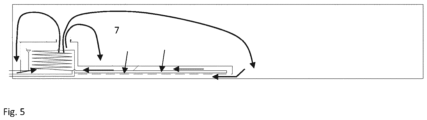
Fig. 5 shows a flow pattern in a storage tank using an embodiment of the invention with an open bulk heater valve. - The invention describes a system for extraction of heated heavy fuel oil from an elongated heavy fuel
oil storage tank 1, typically used for fuel. It is particularly useful in heavy fuel oil tanks with low height. Mostly, the extraction of heavy fuel oil is a slow process for example supplying an engine or consumer tank with fuel, but on some occasions a need for immediate emptying of the storage tank may arise. - The system, as seen in
fig. 1 and 2 , comprises aconvection shield 2 having a closedtop 8 and closedsides 9 and a mainly open bottom side. Typically, theconvection shield 2 is box shaped, or alternatively has the shape of an upside-down bucket or a hollow cylinder with a circular top. Aheating element 3 is positioned inside theconvection shield 2 and aconvection flow 6 emerges when the heating element is heating the heavy fuel oil. An exemplary flow pattern is seen infigure 2 . The heated heavy fuel is extracted from inside of theconvection shield 2 by means of afuel suction line 4. The intake of thefuel suction line 4 is positioned in the upper end of the convection shield near the top where the temperature of the heavy fuel oil is high. Theconvection shield 2 is mounted near the bottom of thestorage tank 1, but with a clearance between the bottom of thestorage tank 1 and the lower edge of the convection shield to allow for entry of heavy fuel oil into theconvection shield 2 through the open bottom. The clearance between the lower edge of the convection shield and the bottom of the storage tank is between 5 and 70 cm, more preferably between 10 and 15 cm. - In order to mitigate the problems mentioned earlier related to storage tanks with low height, the invention describes an elongated
inflow convection shield 10 with a closedupper part 11 comprising atop 12 andsides 13 and anend piece 14 at the outer end of theinflow convection shield 10. The inflow convection shield further comprises alower part 16 withopenings 17 and is mounted at the same height, or lower, as the lower edge of the convection shield to allow entry of heavy fuel oil into the convection shield through the openings in the lower part bottom. In one embodiment theinflow convection shield 10 has the shape of an elongated rectangular volume with an open bottom. The inflow convection shield is connected to the lower edge of the convection shield. Preferably an opening matching the cross-section of the inflow convection shield is cut into the lower side of the convection shield where the inflow convection shield is fastened, to allow unhindered flow of partially heated heavy fuel oil from theinflow convection shield 10 into theconvection shield 2 for further heating. The convection shield and inflow convection shield are sharing a common interior allowing unhindered flow of heated heavy fuel oil from the inflow convection shield to the convection shield. - An
inflow heating element 15 is positioned along the length of and inside theinflow convection shield 10. Preferably the inflow heating element is a heat pipe running in a loop out from theconvection shield 2 to theend piece 14 and back again. The heat pipe has a heating medium like steam or thermal fluid. - The inflow convection shield extends along the bottom of the storage tank mainly at the same height as the lower edge of the convection shield. The effect of this is that heavy fuel oil is allowed to flow into the heated sections along a much longer distance. Preferably the inflow convection shield extends over more than 10% of the length of the
storage tank 1, more preferably more than 30 %. Preferably the convection shield is positioned in the aft/stern side of the storage tank. This is advantageous because the ship is normally trimmed towards a lower stern and the convection shield will then be positioned at the lowest point in the storage tank. In other words, the convection shield is preferably positioned at the lowest point in the storage tank. - In one embodiment a
bulk heating valve 5, having an open and closed position, is mounted on thetop 8 of theconvection shield 2. In the open position heated heavy fuel oil will escape upwards from the convection shield and unheated oil will be drawn in frominflow convection shield 10 and from the bottom side of theconvection shield 2 and aconvection flow 7 will emerge in the bulk of the storage tank as indicated infig. 5 . In the closed position of thebulk heating valve 5 only the heavy fuel oil within theconvection shield 2 will be heated. The size of the valve is between 2 and 30 % of the area of the top 8, more preferably between 2 and 10 %. In other words, the invention will function as an ordinary convection shield when the bulk heating valve is in the closed position and as a bulk heater when thebulk heating valve 5 is in the open position. The size of the bulk heating valve will determine the rate of heat released from the convection shield into the bulk of the storage tank. In a storage tank with low height large parts of the heavy fuel oil will remain in the tank when the level has reached the height of thebulk heating valve 5, at which point the mentioned flow pattern will stop. - In one embodiment of the invention a
second stage heater 21 is connected downstream of the convection shield. The purpose of the second stage heater is to provide a more stable temperature because the low height of the convection shield, and consequently also the low height of theheating element 3, results in larger variations in the temperature of the heavy fuel oil entering thefuel suction line 4, which may result in the suction line clogging up. Thesecond stage heater 21 comprises a secondstage convection shield 19 with aclosed top 9 andsides 8, a mainly closed bottom 24 and a secondstage heating element 20. The bottom 24 of the secondary convection shield must be mainly closed in order to create a suction of heated heavy oil from theconvection shield 2 to thesecondary convection shield 19 because of the secondaryfuel suction pipe 23 extracting heavy fuel oil from the secondary convection shield. In one embodiment the bottom 24 has drain holes. Asecond stage channel 22 leads partly heated heavy fuel oil from the top of the convection shield to the bottom of thesecond stage heater 21. A second stagefuel suction line 23 is positioned inside the secondstage convection shield 19. -
- 1. Heavy fuel oil storage tank
- 2. Convection shield
- 3. Heating element
- 4. Fuel suction line
- 5. Bulk heating valve
- 6. Convection flow inside convection shield
- 7. Convection flow in the whole heavy fuel oil storage tank.
- 8. Top (of convection shield)
- 9. Side (of convection shield)
- 10. Inflow convection shield
- 11. Upper part of inflow convection shield
- 12. Top (of inflow convection shield)
- 13. Sides (of inflow convection shield)
- 14. End piece (of inflow convection shield)
- 15. Inflow heating element
- 16. Lower part
- 17. Openings
- 18. Convection chamber
- 19. Second stage convection shield
- 20. Second stage heating element
- 21. Second stage heater
- 22. Second stage channel
- 23. Second stage fuel suction line
- 24. Bottom of the second stage convection shield
Claims (11)
- System for extraction of heated heavy fuel oil from an elongated heavy fuel oil storage tank (1) comprising:a convection shield (2) with closed top (8) and sides (9) and a substantially open bottom, wherein the convection shield (2) is mounted with a clearance between the bottom of the storage tank (1) and the lower edge of the convection shield to allow for entry of heavy fuel oil into the convection shield through the open bottom,a heating element (3) arranged inside the convection shield (2) for heating the heavy fuel oil inside the convection shield,a fuel suction line (4) arranged inside the convection shield for extracting heated heavy fuel oil from the heavy fuel oil storage tank,characterized by an elongated inflow convection shield (10) comprising:wherein the inflow convection shield extends along the bottom of the storage tank in its longitudinal direction.a closed upper part (11) comprising a top (12) and sides (13),a lower part (16), with openings (17) for throughflow, positioned at the same height, or lower, as the lower edge of the convection shield (2) to allow entry of heavy fuel oil into the inflow convection shield through the lower part (16),wherein the inflow convection shield (10) is connected to the lower edge of the convection shield (2), sharing a common interior allowing flow of heated heavy fuel oil from the inflow convection shield to the convection shield, andwherein an inflow heating element (15) is positioned along the length of and inside the inflow convection shield (10) for heating the heavy fuel oil inside the inflow convection shield, and
- System according to claim 1 wherein the inflow heating element (15) is a heating pipe running inside the inflow convection shield (10) in a loop out from the convection shield (2) along the length of the inflow convection shield (10) and back again.
- System according to claim 1 or 2, wherein the inflow convection shield (10) has the shape of an elongated rectangular volume with a top (12), two sides (13) and an end piece (14) at the outer end of the inflow convection shield (10) and a bottom with a plurality of openings (17).
- System according to one of the previous claims, wherein the inflow convection shield (10) extends along more than 10 % of the length or width of the storage tank, preferably more than 30 % of the length of the storage tank.
- System according to one of the previous claims, wherein the convection shield has a bulk heating valve mounted at the top of the convection shield (2).
- System according to according to one of the previous claims, wherein the fuel suction line (4) is positioned inside the convection shield near the top.
- System according to according to one of the previous claims, wherein the system is provided with a second stage heater (21) downstream of the convection shield (2) comprising:a second stage convection shield (19) with closed top and sides and a mainly closed bottom,a second stage heating element (20) positioned inside the second stage convection shield,a second stage channel (22) leading partially heated heavy fuel oil from the top of the convection shield to the bottom of the second stage heater (21), anda second stage fuel suction line (23) positioned inside the second stage convection shield (19).
- System according to claim 7 wherein a fuel suction line (23) is positioned inside the second stage convection shield (19) near the top.
- System according to claim 7 or 8, wherein the second stage convection shield (19) has a bulk heating valve (5) mounted at the top of the second stage convection shield (19).
- System according to one of the previous claims 7-9, wherein the bottom (24) of the second stage convection shield (19) has drain holes.
- Ocean going vessel comprising a system according to according to one of the previous claims.
Applications Claiming Priority (2)
| Application Number | Priority Date | Filing Date | Title |
|---|---|---|---|
| NO20210481A NO346791B1 (en) | 2021-04-19 | 2021-04-19 | System for extracting heated heavy fuel oil from an elongated storage tank |
| PCT/EP2022/059503 WO2022223329A1 (en) | 2021-04-19 | 2022-04-08 | System for extracting heated heavy fuel oil from an elongated storage tank |
Publications (3)
| Publication Number | Publication Date |
|---|---|
| EP4326983A1 EP4326983A1 (en) | 2024-02-28 |
| EP4326983C0 EP4326983C0 (en) | 2025-05-07 |
| EP4326983B1 true EP4326983B1 (en) | 2025-05-07 |
Family
ID=81346368
Family Applications (1)
| Application Number | Title | Priority Date | Filing Date |
|---|---|---|---|
| EP22717844.9A Active EP4326983B1 (en) | 2021-04-19 | 2022-04-08 | System for extracting heated heavy fuel oil from an elongated storage tank |
Country Status (7)
| Country | Link |
|---|---|
| EP (1) | EP4326983B1 (en) |
| JP (1) | JP2024518659A (en) |
| KR (1) | KR20240041862A (en) |
| CN (1) | CN117203420A (en) |
| NO (1) | NO346791B1 (en) |
| PL (1) | PL4326983T3 (en) |
| WO (1) | WO2022223329A1 (en) |
Family Cites Families (14)
| Publication number | Priority date | Publication date | Assignee | Title |
|---|---|---|---|---|
| US1723082A (en) * | 1927-11-23 | 1929-08-06 | Hauck Mfg Co | Liquid-heating apparatus |
| JPS5863199U (en) * | 1981-10-26 | 1983-04-27 | 日本鋼管株式会社 | marine fuel tank |
| JPS6138395A (en) * | 1984-07-31 | 1986-02-24 | Nippon Kokan Kk <Nkk> | Heating of fuel oil tank |
| JPS63137800A (en) * | 1986-11-26 | 1988-06-09 | コンビナ−ト“コラボストロエネ” | Sludge dehydrator for ship |
| JP3026994U (en) * | 1995-08-07 | 1996-07-30 | 株式会社日本ハイヒート | Tank classification and temperature automatic adjustment device for making the heating of the highly viscous fuel heating tank of the ship most effective |
| DE202006010615U1 (en) * | 2005-09-26 | 2006-10-26 | Dbk David + Baader Gmbh | A method for melting frozen motor vehicle liquids at low ambient temperatures has a starter tank provided with a heating system |
| JP5046695B2 (en) * | 2007-03-16 | 2012-10-10 | 三機工業株式会社 | Suction heater and piping system |
| NO335368B1 (en) * | 2010-10-22 | 2014-12-01 | Octagone As | Device for delivery of oil from a storage tank containing heavy fuel oil |
| KR20120068437A (en) * | 2010-12-17 | 2012-06-27 | 삼성중공업 주식회사 | Fuel tank for ships |
| US20140245972A1 (en) * | 2013-02-12 | 2014-09-04 | Lester James Thiessen | Heat Exchanger for an Oil Storage Tank |
| CN204755145U (en) * | 2015-05-15 | 2015-11-11 | 上海船舶研究设计院 | Boats and ships fuel system of preheating |
| CN106369823B (en) * | 2016-10-19 | 2020-05-19 | 广州文冲船厂有限责任公司 | Ship fuel oil heating system |
| CN106741654B (en) * | 2016-11-25 | 2018-10-02 | 上海佳豪船海工程研究设计有限公司 | Marine fuel oil pre-heating system and method |
| CN211116318U (en) * | 2019-10-15 | 2020-07-28 | 上海齐耀科技集团有限公司 | Oil transportation system |
-
2021
- 2021-04-19 NO NO20210481A patent/NO346791B1/en unknown
-
2022
- 2022-04-08 PL PL22717844.9T patent/PL4326983T3/en unknown
- 2022-04-08 JP JP2024507060A patent/JP2024518659A/en active Pending
- 2022-04-08 KR KR1020237039824A patent/KR20240041862A/en active Pending
- 2022-04-08 EP EP22717844.9A patent/EP4326983B1/en active Active
- 2022-04-08 WO PCT/EP2022/059503 patent/WO2022223329A1/en not_active Ceased
- 2022-04-08 CN CN202280029394.6A patent/CN117203420A/en active Pending
Also Published As
| Publication number | Publication date |
|---|---|
| WO2022223329A1 (en) | 2022-10-27 |
| KR20240041862A (en) | 2024-04-01 |
| PL4326983T3 (en) | 2025-09-08 |
| CN117203420A (en) | 2023-12-08 |
| EP4326983A1 (en) | 2024-02-28 |
| EP4326983C0 (en) | 2025-05-07 |
| JP2024518659A (en) | 2024-05-01 |
| NO20210481A1 (en) | 2022-10-20 |
| NO346791B1 (en) | 2023-01-09 |
Similar Documents
| Publication | Publication Date | Title |
|---|---|---|
| US4098328A (en) | Cross-flow radiator deaeration system | |
| US6857419B1 (en) | Fuel vapor separator for internal combustion engine | |
| KR102719893B1 (en) | Expansion tanks, vehicle cooling systems and vehicles | |
| EP4326983B1 (en) | System for extracting heated heavy fuel oil from an elongated storage tank | |
| CN109969372B (en) | Internal and external circulation switching to adapt to the water cooling system of surface cleaning vessels in different waters | |
| CN105593484B (en) | Universal shut-off valve | |
| US3776456A (en) | Direct fired water heater thermal compensating dip tube | |
| US4422502A (en) | Integrated water box and expansion chamber device for a heat exchanger such as the radiator in the cooling circuit of an internal combustion engine | |
| TWI657010B (en) | Fuel oil transfer device | |
| US20060201454A1 (en) | Heat storage tank | |
| US7497751B1 (en) | Alternative cooling path system for a marine propulsion device | |
| US20100019054A1 (en) | Fluid containment and transfer vessel | |
| US6929520B1 (en) | Cooling method for a marine propulsion system | |
| KR101994684B1 (en) | Non-power type ballast tank anti-freezing device | |
| US20090056648A1 (en) | Protection for Heat Transfer Oil Boiler | |
| JP4774270B2 (en) | Fuel oil tank structure, ship, offshore structure | |
| KR101750950B1 (en) | Double pipe device of HFO storage tank | |
| KR20200000636U (en) | Apparatus for controlling viscosity of oil | |
| CN223305835U (en) | Expansion tank and engine cooling system | |
| KR200473227Y1 (en) | Overflow preventing device for sea chest vent | |
| US20240246691A1 (en) | Aircraft comprising a fuel tank | |
| WO2021116902A1 (en) | Air valve | |
| CN219460899U (en) | Novel water outlet nozzle and instant heating water dispenser | |
| KR20160091001A (en) | Storage Tank Having Double Compartment Panels To Improve Shifting Efficiency of Fuel Oil Shifter System For Marine Engines | |
| CN215756414U (en) | Quantitative adding device for anti-freezing solution |
Legal Events
| Date | Code | Title | Description |
|---|---|---|---|
| STAA | Information on the status of an ep patent application or granted ep patent |
Free format text: STATUS: UNKNOWN |
|
| STAA | Information on the status of an ep patent application or granted ep patent |
Free format text: STATUS: THE INTERNATIONAL PUBLICATION HAS BEEN MADE |
|
| PUAI | Public reference made under article 153(3) epc to a published international application that has entered the european phase |
Free format text: ORIGINAL CODE: 0009012 |
|
| STAA | Information on the status of an ep patent application or granted ep patent |
Free format text: STATUS: REQUEST FOR EXAMINATION WAS MADE |
|
| 17P | Request for examination filed |
Effective date: 20231117 |
|
| AK | Designated contracting states |
Kind code of ref document: A1 Designated state(s): AL AT BE BG CH CY CZ DE DK EE ES FI FR GB GR HR HU IE IS IT LI LT LU LV MC MK MT NL NO PL PT RO RS SE SI SK SM TR |
|
| DAV | Request for validation of the european patent (deleted) | ||
| DAX | Request for extension of the european patent (deleted) | ||
| GRAP | Despatch of communication of intention to grant a patent |
Free format text: ORIGINAL CODE: EPIDOSNIGR1 |
|
| STAA | Information on the status of an ep patent application or granted ep patent |
Free format text: STATUS: GRANT OF PATENT IS INTENDED |
|
| RIC1 | Information provided on ipc code assigned before grant |
Ipc: F02M 31/02 20190101ALI20241115BHEP Ipc: B63B 11/04 20060101ALI20241115BHEP Ipc: B63H 21/38 20060101ALI20241115BHEP Ipc: F02M 21/10 20060101AFI20241115BHEP |
|
| INTG | Intention to grant announced |
Effective date: 20241209 |
|
| GRAS | Grant fee paid |
Free format text: ORIGINAL CODE: EPIDOSNIGR3 |
|
| GRAA | (expected) grant |
Free format text: ORIGINAL CODE: 0009210 |
|
| STAA | Information on the status of an ep patent application or granted ep patent |
Free format text: STATUS: THE PATENT HAS BEEN GRANTED |
|
| AK | Designated contracting states |
Kind code of ref document: B1 Designated state(s): AL AT BE BG CH CY CZ DE DK EE ES FI FR GB GR HR HU IE IS IT LI LT LU LV MC MK MT NL NO PL PT RO RS SE SI SK SM TR |
|
| REG | Reference to a national code |
Ref country code: GB Ref legal event code: FG4D |
|
| REG | Reference to a national code |
Ref country code: CH Ref legal event code: EP |
|
| REG | Reference to a national code |
Ref country code: DE Ref legal event code: R096 Ref document number: 602022014318 Country of ref document: DE |
|
| REG | Reference to a national code |
Ref country code: IE Ref legal event code: FG4D |
|
| U01 | Request for unitary effect filed |
Effective date: 20250606 |
|
| U07 | Unitary effect registered |
Designated state(s): AT BE BG DE DK EE FI FR IT LT LU LV MT NL PT RO SE SI Effective date: 20250616 |
|
| PG25 | Lapsed in a contracting state [announced via postgrant information from national office to epo] |
Ref country code: ES Free format text: LAPSE BECAUSE OF FAILURE TO SUBMIT A TRANSLATION OF THE DESCRIPTION OR TO PAY THE FEE WITHIN THE PRESCRIBED TIME-LIMIT Effective date: 20250507 |
|
| PG25 | Lapsed in a contracting state [announced via postgrant information from national office to epo] |
Ref country code: NO Free format text: LAPSE BECAUSE OF FAILURE TO SUBMIT A TRANSLATION OF THE DESCRIPTION OR TO PAY THE FEE WITHIN THE PRESCRIBED TIME-LIMIT Effective date: 20250807 |
|
| PG25 | Lapsed in a contracting state [announced via postgrant information from national office to epo] |
Ref country code: HR Free format text: LAPSE BECAUSE OF FAILURE TO SUBMIT A TRANSLATION OF THE DESCRIPTION OR TO PAY THE FEE WITHIN THE PRESCRIBED TIME-LIMIT Effective date: 20250507 |
|
| PG25 | Lapsed in a contracting state [announced via postgrant information from national office to epo] |
Ref country code: RS Free format text: LAPSE BECAUSE OF FAILURE TO SUBMIT A TRANSLATION OF THE DESCRIPTION OR TO PAY THE FEE WITHIN THE PRESCRIBED TIME-LIMIT Effective date: 20250807 |
|
| PG25 | Lapsed in a contracting state [announced via postgrant information from national office to epo] |
Ref country code: IS Free format text: LAPSE BECAUSE OF FAILURE TO SUBMIT A TRANSLATION OF THE DESCRIPTION OR TO PAY THE FEE WITHIN THE PRESCRIBED TIME-LIMIT Effective date: 20250907 |
|
| PG25 | Lapsed in a contracting state [announced via postgrant information from national office to epo] |
Ref country code: SM Free format text: LAPSE BECAUSE OF FAILURE TO SUBMIT A TRANSLATION OF THE DESCRIPTION OR TO PAY THE FEE WITHIN THE PRESCRIBED TIME-LIMIT Effective date: 20250507 |
|
| PG25 | Lapsed in a contracting state [announced via postgrant information from national office to epo] |
Ref country code: CZ Free format text: LAPSE BECAUSE OF FAILURE TO SUBMIT A TRANSLATION OF THE DESCRIPTION OR TO PAY THE FEE WITHIN THE PRESCRIBED TIME-LIMIT Effective date: 20250507 |
|
| PG25 | Lapsed in a contracting state [announced via postgrant information from national office to epo] |
Ref country code: SK Free format text: LAPSE BECAUSE OF FAILURE TO SUBMIT A TRANSLATION OF THE DESCRIPTION OR TO PAY THE FEE WITHIN THE PRESCRIBED TIME-LIMIT Effective date: 20250507 |
|
| PLBE | No opposition filed within time limit |
Free format text: ORIGINAL CODE: 0009261 |
|
| STAA | Information on the status of an ep patent application or granted ep patent |
Free format text: STATUS: NO OPPOSITION FILED WITHIN TIME LIMIT |
|
| REG | Reference to a national code |
Ref country code: CH Ref legal event code: L10 Free format text: ST27 STATUS EVENT CODE: U-0-0-L10-L00 (AS PROVIDED BY THE NATIONAL OFFICE) Effective date: 20260318 |
|
| PGFP | Annual fee paid to national office [announced via postgrant information from national office to epo] |
Ref country code: GB Payment date: 20260311 Year of fee payment: 5 |
|
| 26N | No opposition filed |
Effective date: 20260210 |
|
| U20 | Renewal fee for the european patent with unitary effect paid |
Year of fee payment: 5 Effective date: 20260306 |
|
| PGFP | Annual fee paid to national office [announced via postgrant information from national office to epo] |
Ref country code: GR Payment date: 20260323 Year of fee payment: 5 Ref country code: PL Payment date: 20260220 Year of fee payment: 5 |