EP4316632A1 - Procédé pour la production d'hydroxyde de lithium (lioh) directement à partir de chlorure de lithium (licl), sans nécessiter une production intermédiaire de carbonate de lithium ou similaire - Google Patents
Procédé pour la production d'hydroxyde de lithium (lioh) directement à partir de chlorure de lithium (licl), sans nécessiter une production intermédiaire de carbonate de lithium ou similaire Download PDFInfo
- Publication number
- EP4316632A1 EP4316632A1 EP21931978.7A EP21931978A EP4316632A1 EP 4316632 A1 EP4316632 A1 EP 4316632A1 EP 21931978 A EP21931978 A EP 21931978A EP 4316632 A1 EP4316632 A1 EP 4316632A1
- Authority
- EP
- European Patent Office
- Prior art keywords
- lioh
- production
- equipment
- nacl
- lithium
- Prior art date
- Legal status (The legal status is an assumption and is not a legal conclusion. Google has not performed a legal analysis and makes no representation as to the accuracy of the status listed.)
- Withdrawn
Links
Images

Classifications
-
- C—CHEMISTRY; METALLURGY
- C01—INORGANIC CHEMISTRY
- C01D—COMPOUNDS OF ALKALI METALS, i.e. LITHIUM, SODIUM, POTASSIUM, RUBIDIUM, CAESIUM, OR FRANCIUM
- C01D15/00—Lithium compounds
- C01D15/02—Oxides; Hydroxides
-
- C—CHEMISTRY; METALLURGY
- C01—INORGANIC CHEMISTRY
- C01D—COMPOUNDS OF ALKALI METALS, i.e. LITHIUM, SODIUM, POTASSIUM, RUBIDIUM, CAESIUM, OR FRANCIUM
- C01D1/00—Oxides or hydroxides of sodium, potassium or alkali metals in general
- C01D1/04—Hydroxides
- C01D1/28—Purification; Separation
- C01D1/30—Purification; Separation by crystallisation
Definitions
- This invention patent application relates to a system for the production of lithium hydroxide (LiOH) directly from lithium chloride (LiCI), without the need for an intermediate production of lithium carbonate or the like.
- the invention refers to a system consisting of the equipment and arragenment necessary for the direct production of lithium hydroxide from lithium chloride.
- the system comprises interconnected main sub-systems, a subsystem for the production of high-purity LiOH.H2O, which comprises conversion and crystallization units, and subsystem for the production of NaCl, consisting of causticization and crystallization units, all of which enable the production of high-purity lithium hydroxide monohydrate, and sodium chloride as a byproduct of the system.
- lithium hydroxide which is mainly used in the production of lubricating greases capable of operating under extreme temperature and load conditions. Approximately 70% of the lubricating greases produced in the world contain lithium. Lithium hydroxide is also used in batteries and dyes.
- lithium is a metal whose properties are currently highly valued, including its high levels of electrical conductivity, low viscosity, in addition to its being very light and having a low thermal expansion coefficient. As a result of these qualities, lithium has multiple applications in the industrial sector and specifically in the field of batteries, given the current technological trend.
- Electromobility driven by environmental campaigns and regulations to reduce the use of fossil fuels, coupled with the technological development of electronic devices and energy storage systems, are all factors that are putting upward pressure on future lithium demand.
- lithium When taken from brine sources, lithium is usually extracted by pumping the brine to the surface for concentration in evaporation ponds, by means of a series of solar ponds (conventional method), ultimately producing a concentrated lithium chloride (LiCI) solution. This lithium-rich solution is then processed to produce lithium carbonate and then lithium hydroxide.
- LiCI lithium chloride
- the main lithium compounds that are marketed and produced are lithium carbonate (Li2CO3), lithium hydroxide monohydrate (LiOH.H2O), and lithium chloride (LiCI), with carbonate accounting for the largest output.
- lithium operations in salt flats is that the cost of pumping the brine, concentrating it in evaporation ponds, and then processing the solution in a plant to obtain lithium carbonate or hydroxide, is lower than mining it from ore.
- the latter type of mining involves processes similar to rock mining involving drilling, blasting, ore concentration and transportation.
- Lithium hydroxide (LiOH) is produced from Lithium Carbonate or Lithium Sulfate, and there are no commercial manufacturing alternatives from lithium chloride (LiCI).
- Patent Publication US 10648090 describes an integrated system for generating a lithium salt from a liquid resource, which consists of the following:
- publication RU2016103702 describes a Plant for obtaining high-purity lithium hydroxide monohydrate from natural brines containing lithium, comprising a device for obtaining primary lithium concentrate, connected by piping and fittings with the natural source of brine, a mother brine receiver, a vessel for collecting primary lithium concentrate, and a fresh water source; an electrolysis unit containing a membrane electrolyzer with a power supply; catholyte and anolyte tanks; catholyte and anolyte circulation pumps; gas separators for cathodic hydrogen and anodic chlorine; an evaporation unit to evaporate the lithium hydroxide solution and separate LiOH.H2O crystals, including an evaporator, a crystallizer, a condenser for condensate vapor, a centrifuge to separate LiOH ⁇ H2O crystals from the mother brine sources, a pump to supply catholyte for evaporation; an evaporator to concentrate a lithium chloride solution purified from impurities
- the system of this invention does not carry out concentration processes such as electrodialysis, nor reverse osmosis, nor electrochemical processes, such as electrolysis for conversion of LiCI into LiOH. Therefore, it is possible to have a system that operates under completely different principles for the formation of LiOH and its conversion from LiCI, based on the concept of fractional crystallization.
- the difference with the Russian patent is the conversion technology developed to transform LiCI into LiOH.H2O.
- conversion occurs by the chemical reaction of LiCI with NaOH, and separation from NaCl occurs by fractional crystallization.
- RU2016103702 they use an electrochemical method as conversion technology, where the process is carried out by applying energy to an electrochemical system using a membrane separating cations and anions.
- Each sub-system may include a purge for the benefit of the quality of the final product.
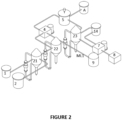
- the system for the production of lithium hydroxide (LiOH) directly from lithium chloride (LiCI), without the need for intermediate production of lithium carbonate or the like, consists of two sub-systems, a high purity LiOH.H 2 O production sub-system and a NaCl production sub-system.
- the system comprises a LiCI brine tank (1) and a tank of mother liquor from the NaCl sub-system (2), which are connected to the high purity LiOH production sub-system, which comprises a conversion equipment (3) from LiCI to crude LiOH.H2O.
- the conversion equipment (3) is a crystallizer equipment that generates a crude LiOH.H2O stream.
- the conversion equipment (3) is connected to a solid-liquid separation equipment (4) from which two streams are generated: a liquid solution (ML1) composed of mother liquor 1, which is fed from the solid-liquid separation equipment (4) to a tank (9) of mother liquor 1 at the inlet of the NaCl production sub-system; and a second stream composed of crude LiOH.H 2 O crystals which is fed from the same solid-liquid separation equipment (4) to a dilution tank (5) .
- Equipment (4) can be, for example, a centrifuge equipment.
- This dilution tank (5) is connected to at least one crystallizing equipment (6) where high purity LiOH,H 2 O is produced.
- tank (A) provides the necessary water for dissolving crude LiOH ⁇ H 2 O within tank (5).
- the LiOH.H 2 O crystallizing equipment is connected to a second solid-liquid separation equipment (7) which has two outputs from which two products are generated: one output with a solid stream of high purity LiOH.H 2 O crystals which is sent to a crystal drying unit (8); and another output with a liquid stream of pure LiOH liquor which can be recycled directly to crystallizer (6).
- the NaCl production sub-system is made up of said receiving tank (9) of mother liquor 1 and a NaOH tank (16), and both tanks in turn are connected to a causticizing unit (10), which is connected to an evaporation or water withdrawal system from the fed solution, and NaCl crystallizing unit (17). From the latter two outputs are generated; one is NaCl liquor that is connected to the NaCl liquor tank (13), being this NaCl liquor the mother liquor 2 (ML2) that is fed to the ML2 tank; and the other output is a NaCl pulp that is connected to a third solid-liquid separation equipment (11) from where the separation of NaCl crystals that are stored in the NaCl crystals unit (12) takes place.
- the NaCl or ML2 (13) liquor tank is connected to the initial NaCl liquor tank (2), and, thus, both sub-systems - the high purity LiOH.H 2 O production system and the NaCl production system - are connected via the mother liquor 1 and mother liquor 2 circuits, creating a circular system that enables the production of high-purity LiOH.H 2 O directly from LiCI brines, without NaCl co-precipitation.
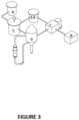
- the high purity LiOH.H 2 O production sub-system comprises at least two crystallization equipment for crude LiOH.H 2 O (21 and 22).
- the LiOH crystallization tanks can be arranged in series (as illustrated in figure 2 ).
- the crystallization equipment (22) is connected to the centrifuge (4), from which the mother liquor 1 (ML1) outlet is connected with the reception tank (9) of said ML1.
- the high purity LiOH production sub-system additionally comprises at least one high purity LiOH.H 2 O crystallization equipment (23).
- the crystallization equipment (23) is connected to a solid-liquid separation equipment (7), from which two outlets are generated: one corresponding to the high purity LiOH liquor outlet directed to the tank (14), which can recycles the stream directely to crystallization equipment (23) ; and another outlet corresponding to the high purity LiOH.H 2 O crystals, which is connected to the crystal drying unit (8).
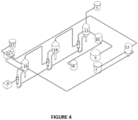
- the NaCl production sub-system comprises multiple evaporator systems and a crystallizer equipment, as illustrated in figure 4 .
- the NaCl crystallization sub-system comprises evaporator and crystallization equipment (17), (18) and (19), connected in series, where the causticizing equipment (10) - which is connected to the reception tank (9) of mother liquor 1(ML1) and to the NaOH tank (16) which feed the causticizing equipment (10) - is connected to the NaCl evaporation and crystallization system that initiates with the unit (17).
- the last equipment of the NaCl evaporation and crystallization system (19) is connected to a solid-liquid separation equipment (21), from which a solid flow exits towards the NaCl crystal storage equipment (12), since the NaCl liquor outlet of the solid-liquid equipment (21) can be connected directly to the NaCl liquor tank (13) and, from there, directly feed mother liquor 2 (ML2) to the NaCl liquor tank (2) at the start of the system.
- the unit (19) has an inlet from a steam generator (V). The cycle is closed with the steam outlet from the unit (17), through the outlet (S).
Landscapes
- Chemical & Material Sciences (AREA)
- Organic Chemistry (AREA)
- Engineering & Computer Science (AREA)
- Materials Engineering (AREA)
- Inorganic Chemistry (AREA)
- Organic Low-Molecular-Weight Compounds And Preparation Thereof (AREA)
- Inorganic Compounds Of Heavy Metals (AREA)
- Compounds Of Alkaline-Earth Elements, Aluminum Or Rare-Earth Metals (AREA)
Applications Claiming Priority (1)
| Application Number | Priority Date | Filing Date | Title |
|---|---|---|---|
| PCT/CL2021/050016 WO2022198343A1 (fr) | 2021-03-22 | 2021-03-22 | Procédé pour la production d'hydroxyde de lithium (lioh) directement à partir de chlorure de lithium (licl), sans nécessiter une production intermédiaire de carbonate de lithium ou similaire |
Publications (2)
| Publication Number | Publication Date |
|---|---|
| EP4316632A1 true EP4316632A1 (fr) | 2024-02-07 |
| EP4316632A4 EP4316632A4 (fr) | 2025-01-22 |
Family
ID=83394973
Family Applications (1)
| Application Number | Title | Priority Date | Filing Date |
|---|---|---|---|
| EP21931978.7A Withdrawn EP4316632A4 (fr) | 2021-03-22 | 2021-03-22 | Procédé pour la production d'hydroxyde de lithium (lioh) directement à partir de chlorure de lithium (licl), sans nécessiter une production intermédiaire de carbonate de lithium ou similaire |
Country Status (6)
| Country | Link |
|---|---|
| US (1) | US20240174527A1 (fr) |
| EP (1) | EP4316632A4 (fr) |
| CN (1) | CN117917967A (fr) |
| AU (1) | AU2021435424A1 (fr) |
| CA (1) | CA3213084A1 (fr) |
| WO (1) | WO2022198343A1 (fr) |
Families Citing this family (1)
| Publication number | Priority date | Publication date | Assignee | Title |
|---|---|---|---|---|
| WO2025155342A1 (fr) * | 2024-01-19 | 2025-07-24 | Albemarle Corporation | Procédés de récupération de valeurs de lithium à partir de saumures contenant du lithium |
Family Cites Families (11)
| Publication number | Priority date | Publication date | Assignee | Title |
|---|---|---|---|---|
| US4036713A (en) * | 1976-03-04 | 1977-07-19 | Foote Mineral Company | Process for the production of high purity lithium hydroxide |
| DE19645315C1 (de) * | 1996-11-04 | 1998-04-16 | Metallgesellschaft Ag | Verfahren zur Abtrennung von NaCl aus einer LiCl-Lösung |
| CN102016123A (zh) * | 2008-04-22 | 2011-04-13 | 凯米涛弗特公司 | 制备高纯度氢氧化锂和盐酸的方法 |
| AU2014203695B2 (en) * | 2013-07-09 | 2015-05-28 | Parkway Process Technologies Pty Ltd | Process for Manufacture of Sodium Hydroxide and Sodium Chloride Products from Waste Brine |
| WO2016070217A1 (fr) * | 2014-11-05 | 2016-05-12 | Reed Advanced Materials Pty Ltd | Production d'hydroxyde de lithium |
| RU2656452C2 (ru) * | 2016-02-04 | 2018-06-05 | Общество с ограниченной ответственностью "Экостар-Наутех" (ООО) "Экостар-Наутех" | Способ получения моногидрата гидроксида лития из рассолов и установка для его осуществления |
| CN205856014U (zh) * | 2016-07-15 | 2017-01-04 | 华陆工程科技有限责任公司 | 一种连续制备单水氢氧化锂的装置 |
| US10329160B2 (en) * | 2016-10-25 | 2019-06-25 | Malvi Technologies, Llc | Methods and equipment to make lithium hydroxide monohydrate from lithium salts |
| CN112352059A (zh) | 2018-02-17 | 2021-02-09 | 锂莱克解决方案公司 | 用于锂提取和转化的集成系统 |
| CN109516479B (zh) * | 2018-12-19 | 2021-10-08 | 中化国际新材料(河北)有限公司 | 电池级氢氧化锂的制备方法 |
| RU2713360C2 (ru) * | 2019-09-25 | 2020-02-04 | Общество с ограниченной ответственностью "Экостар-Наутех" | Способ получения моногидрата гидроксида лития из рассолов |
-
2021
- 2021-03-20 US US18/283,388 patent/US20240174527A1/en active Pending
- 2021-03-22 CA CA3213084A patent/CA3213084A1/fr active Pending
- 2021-03-22 AU AU2021435424A patent/AU2021435424A1/en not_active Abandoned
- 2021-03-22 WO PCT/CL2021/050016 patent/WO2022198343A1/fr not_active Ceased
- 2021-03-22 CN CN202180097724.0A patent/CN117917967A/zh active Pending
- 2021-03-22 EP EP21931978.7A patent/EP4316632A4/fr not_active Withdrawn
Also Published As
| Publication number | Publication date |
|---|---|
| AU2021435424A1 (en) | 2023-10-05 |
| CN117917967A (zh) | 2024-04-23 |
| US20240174527A1 (en) | 2024-05-30 |
| CA3213084A1 (fr) | 2022-09-29 |
| EP4316632A4 (fr) | 2025-01-22 |
| WO2022198343A1 (fr) | 2022-09-29 |
Similar Documents
| Publication | Publication Date | Title |
|---|---|---|
| RU2684384C1 (ru) | Способ и устройство для производства гидроксида лития и карбоната лития | |
| CN108341420B (zh) | 从高镁锂比盐湖卤水中直接制取氢氧化锂和碳酸锂的方法 | |
| US10661227B2 (en) | Method for producing lithium hydroxide and lithium carbonate | |
| CN104609633B (zh) | 一种含氨,含钠废水资源利用的方法和设备 | |
| US20240017216A1 (en) | Direct lithium extraction (dle) process with precursor hardness treatment and subsequent conversion to lioh monohydrate and li2co3 | |
| CN110065958A (zh) | 一种集成选择性电渗析和选择性双极膜电渗析处理盐湖卤水制备氢氧化锂的方法 | |
| US12258280B2 (en) | Method for concentrating and purifying eluate brine for the production of a purified lithium compound | |
| CN108341421B (zh) | 从高镁锂比盐湖卤水中直接制取碳酸锂的方法 | |
| RU2751710C2 (ru) | Способ получения моногидрата гидроксида лития высокой степени чистоты из материалов, содержащих карбонат лития или хлорид лития | |
| CN110395749A (zh) | 一种利用四隔室置换反应电渗析制备氯化锂的方法 | |
| EP0110033B1 (fr) | Traitement de saumures de chlorure de sodium pour cellules à membrane de production de chlore et d'alcali | |
| CN110683693A (zh) | 一种电渗析与反渗透集成转化法硫酸钠型废水处理的方法 | |
| EP0498919B1 (fr) | Purification de saumure de cellule à membrane pour la production de chlore et d'alcali | |
| JPH033747B2 (fr) | ||
| CN102372295A (zh) | 一种从卤水中分离镁和浓缩锂的方法 | |
| US20240174527A1 (en) | System for the production of lithium hydroxide (lioh) directly from lithium chloride (lici), without the need for the intermediate production of lithium carbonate or the like | |
| WO2016175613A1 (fr) | Procédé de fabrication d'hydroxyde de lithium et de carbonate de lithium, et dispositif correspondant | |
| HK40102532A (en) | System for the production of lithium hydroxide (lioh) directly from lithium chloride (lici), without the need for the intermediate production of lithium carbonate or the like | |
| US4888099A (en) | Process for the production of alkali metal chlorate | |
| US20250376384A1 (en) | Carbon dioxide negative direct lithium extraction (dle) process: bipolar electrodialysis (bped) to lithium hydroxide monohydrate and lithium carbonate | |
| JP7706177B2 (ja) | 低品位炭酸リチウムから高純度リチウム塩を得る方法 | |
| US20240367989A1 (en) | Preparation of lithium carbonate and lithium hydroxide | |
| US7250144B2 (en) | Perchlorate removal from sodium chlorate process | |
| CN219209534U (zh) | 一种以碳酸锂为原料制备氢氧化锂的生产系统 | |
| WO2026104527A1 (fr) | Procédés et appareil de régulation du bilan hydrique pendant l'électrolyse de saumure de chlorure de lithium |
Legal Events
| Date | Code | Title | Description |
|---|---|---|---|
| STAA | Information on the status of an ep patent application or granted ep patent |
Free format text: STATUS: THE INTERNATIONAL PUBLICATION HAS BEEN MADE |
|
| PUAI | Public reference made under article 153(3) epc to a published international application that has entered the european phase |
Free format text: ORIGINAL CODE: 0009012 |
|
| STAA | Information on the status of an ep patent application or granted ep patent |
Free format text: STATUS: REQUEST FOR EXAMINATION WAS MADE |
|
| 17P | Request for examination filed |
Effective date: 20231012 |
|
| AK | Designated contracting states |
Kind code of ref document: A1 Designated state(s): AL AT BE BG CH CY CZ DE DK EE ES FI FR GB GR HR HU IE IS IT LI LT LU LV MC MK MT NL NO PL PT RO RS SE SI SK SM TR |
|
| REG | Reference to a national code |
Ref country code: HK Ref legal event code: DE Ref document number: 40102532 Country of ref document: HK |
|
| DAV | Request for validation of the european patent (deleted) | ||
| DAX | Request for extension of the european patent (deleted) | ||
| REG | Reference to a national code |
Ref country code: DE Ref legal event code: R079 Free format text: PREVIOUS MAIN CLASS: B01D0061440000 Ipc: C01D0015020000 |
|
| A4 | Supplementary search report drawn up and despatched |
Effective date: 20241223 |
|
| RIC1 | Information provided on ipc code assigned before grant |
Ipc: C25B 1/16 20060101ALI20241217BHEP Ipc: C25B 1/00 20210101ALI20241217BHEP Ipc: B01D 61/44 20060101ALI20241217BHEP Ipc: C01D 15/02 20060101AFI20241217BHEP |
|
| STAA | Information on the status of an ep patent application or granted ep patent |
Free format text: STATUS: THE APPLICATION IS DEEMED TO BE WITHDRAWN |
|
| 18D | Application deemed to be withdrawn |
Effective date: 20250711 |