EP4311668A2 - Textile having insulation zones and pile zones - Google Patents
Textile having insulation zones and pile zones Download PDFInfo
- Publication number
- EP4311668A2 EP4311668A2 EP23215147.2A EP23215147A EP4311668A2 EP 4311668 A2 EP4311668 A2 EP 4311668A2 EP 23215147 A EP23215147 A EP 23215147A EP 4311668 A2 EP4311668 A2 EP 4311668A2
- Authority
- EP
- European Patent Office
- Prior art keywords
- layer
- woven layer
- nonwoven
- woven
- textile
- Prior art date
- Legal status (The legal status is an assumption and is not a legal conclusion. Google has not performed a legal analysis and makes no representation as to the accuracy of the status listed.)
- Granted
Links
Images




Classifications
-
- B—PERFORMING OPERATIONS; TRANSPORTING
- B32—LAYERED PRODUCTS
- B32B—LAYERED PRODUCTS, i.e. PRODUCTS BUILT-UP OF STRATA OF FLAT OR NON-FLAT, e.g. CELLULAR OR HONEYCOMB, FORM
- B32B5/00—Layered products characterised by the non- homogeneity or physical structure, i.e. comprising a fibrous, filamentary, particulate or foam layer; Layered products characterised by having a layer differing constitutionally or physically in different parts
- B32B5/22—Layered products characterised by the non- homogeneity or physical structure, i.e. comprising a fibrous, filamentary, particulate or foam layer; Layered products characterised by having a layer differing constitutionally or physically in different parts characterised by the presence of two or more layers which are next to each other and are fibrous, filamentary, formed of particles or foamed
- B32B5/24—Layered products characterised by the non- homogeneity or physical structure, i.e. comprising a fibrous, filamentary, particulate or foam layer; Layered products characterised by having a layer differing constitutionally or physically in different parts characterised by the presence of two or more layers which are next to each other and are fibrous, filamentary, formed of particles or foamed one layer being a fibrous or filamentary layer
- B32B5/26—Layered products characterised by the non- homogeneity or physical structure, i.e. comprising a fibrous, filamentary, particulate or foam layer; Layered products characterised by having a layer differing constitutionally or physically in different parts characterised by the presence of two or more layers which are next to each other and are fibrous, filamentary, formed of particles or foamed one layer being a fibrous or filamentary layer another layer next to it also being fibrous or filamentary
- B32B5/275—Layered products characterised by the non- homogeneity or physical structure, i.e. comprising a fibrous, filamentary, particulate or foam layer; Layered products characterised by having a layer differing constitutionally or physically in different parts characterised by the presence of two or more layers which are next to each other and are fibrous, filamentary, formed of particles or foamed one layer being a fibrous or filamentary layer another layer next to it also being fibrous or filamentary characterised by one woven fabric layer next to a non-woven fabric layer
-
- B—PERFORMING OPERATIONS; TRANSPORTING
- B32—LAYERED PRODUCTS
- B32B—LAYERED PRODUCTS, i.e. PRODUCTS BUILT-UP OF STRATA OF FLAT OR NON-FLAT, e.g. CELLULAR OR HONEYCOMB, FORM
- B32B3/00—Layered products comprising a layer with external or internal discontinuities or unevennesses, or a layer of non-planar shape; Layered products comprising a layer having particular features of form
- B32B3/26—Layered products comprising a layer with external or internal discontinuities or unevennesses, or a layer of non-planar shape; Layered products comprising a layer having particular features of form characterised by a particular shape of the outline of the cross-section of a continuous layer; characterised by a layer with cavities or internal voids ; characterised by an apertured layer
- B32B3/263—Layered products comprising a layer with external or internal discontinuities or unevennesses, or a layer of non-planar shape; Layered products comprising a layer having particular features of form characterised by a particular shape of the outline of the cross-section of a continuous layer; characterised by a layer with cavities or internal voids ; characterised by an apertured layer characterised by a layer having non-uniform thickness
-
- A—HUMAN NECESSITIES
- A41—WEARING APPAREL
- A41D—OUTERWEAR; PROTECTIVE GARMENTS; ACCESSORIES
- A41D31/00—Materials specially adapted for outerwear
- A41D31/04—Materials specially adapted for outerwear characterised by special function or use
- A41D31/06—Thermally protective, e.g. insulating
- A41D31/065—Thermally protective, e.g. insulating using layered materials
-
- B—PERFORMING OPERATIONS; TRANSPORTING
- B32—LAYERED PRODUCTS
- B32B—LAYERED PRODUCTS, i.e. PRODUCTS BUILT-UP OF STRATA OF FLAT OR NON-FLAT, e.g. CELLULAR OR HONEYCOMB, FORM
- B32B3/00—Layered products comprising a layer with external or internal discontinuities or unevennesses, or a layer of non-planar shape; Layered products comprising a layer having particular features of form
- B32B3/26—Layered products comprising a layer with external or internal discontinuities or unevennesses, or a layer of non-planar shape; Layered products comprising a layer having particular features of form characterised by a particular shape of the outline of the cross-section of a continuous layer; characterised by a layer with cavities or internal voids ; characterised by an apertured layer
- B32B3/266—Layered products comprising a layer with external or internal discontinuities or unevennesses, or a layer of non-planar shape; Layered products comprising a layer having particular features of form characterised by a particular shape of the outline of the cross-section of a continuous layer; characterised by a layer with cavities or internal voids ; characterised by an apertured layer characterised by an apertured layer, the apertures going through the whole thickness of the layer, e.g. expanded metal, perforated layer, slit layer regular cells B32B3/12
-
- B—PERFORMING OPERATIONS; TRANSPORTING
- B32—LAYERED PRODUCTS
- B32B—LAYERED PRODUCTS, i.e. PRODUCTS BUILT-UP OF STRATA OF FLAT OR NON-FLAT, e.g. CELLULAR OR HONEYCOMB, FORM
- B32B5/00—Layered products characterised by the non- homogeneity or physical structure, i.e. comprising a fibrous, filamentary, particulate or foam layer; Layered products characterised by having a layer differing constitutionally or physically in different parts
- B32B5/02—Layered products characterised by the non- homogeneity or physical structure, i.e. comprising a fibrous, filamentary, particulate or foam layer; Layered products characterised by having a layer differing constitutionally or physically in different parts characterised by structural features of a fibrous or filamentary layer
- B32B5/022—Non-woven fabric
-
- B—PERFORMING OPERATIONS; TRANSPORTING
- B32—LAYERED PRODUCTS
- B32B—LAYERED PRODUCTS, i.e. PRODUCTS BUILT-UP OF STRATA OF FLAT OR NON-FLAT, e.g. CELLULAR OR HONEYCOMB, FORM
- B32B5/00—Layered products characterised by the non- homogeneity or physical structure, i.e. comprising a fibrous, filamentary, particulate or foam layer; Layered products characterised by having a layer differing constitutionally or physically in different parts
- B32B5/02—Layered products characterised by the non- homogeneity or physical structure, i.e. comprising a fibrous, filamentary, particulate or foam layer; Layered products characterised by having a layer differing constitutionally or physically in different parts characterised by structural features of a fibrous or filamentary layer
- B32B5/024—Woven fabric
-
- B—PERFORMING OPERATIONS; TRANSPORTING
- B32—LAYERED PRODUCTS
- B32B—LAYERED PRODUCTS, i.e. PRODUCTS BUILT-UP OF STRATA OF FLAT OR NON-FLAT, e.g. CELLULAR OR HONEYCOMB, FORM
- B32B5/00—Layered products characterised by the non- homogeneity or physical structure, i.e. comprising a fibrous, filamentary, particulate or foam layer; Layered products characterised by having a layer differing constitutionally or physically in different parts
- B32B5/02—Layered products characterised by the non- homogeneity or physical structure, i.e. comprising a fibrous, filamentary, particulate or foam layer; Layered products characterised by having a layer differing constitutionally or physically in different parts characterised by structural features of a fibrous or filamentary layer
- B32B5/028—Net structure, e.g. spaced apart filaments bonded at the crossing points
-
- B—PERFORMING OPERATIONS; TRANSPORTING
- B32—LAYERED PRODUCTS
- B32B—LAYERED PRODUCTS, i.e. PRODUCTS BUILT-UP OF STRATA OF FLAT OR NON-FLAT, e.g. CELLULAR OR HONEYCOMB, FORM
- B32B5/00—Layered products characterised by the non- homogeneity or physical structure, i.e. comprising a fibrous, filamentary, particulate or foam layer; Layered products characterised by having a layer differing constitutionally or physically in different parts
- B32B5/02—Layered products characterised by the non- homogeneity or physical structure, i.e. comprising a fibrous, filamentary, particulate or foam layer; Layered products characterised by having a layer differing constitutionally or physically in different parts characterised by structural features of a fibrous or filamentary layer
- B32B5/06—Layered products characterised by the non- homogeneity or physical structure, i.e. comprising a fibrous, filamentary, particulate or foam layer; Layered products characterised by having a layer differing constitutionally or physically in different parts characterised by structural features of a fibrous or filamentary layer characterised by a fibrous or filamentary layer mechanically connected, e.g. by needling to another layer, e.g. of fibres, of paper
-
- B—PERFORMING OPERATIONS; TRANSPORTING
- B32—LAYERED PRODUCTS
- B32B—LAYERED PRODUCTS, i.e. PRODUCTS BUILT-UP OF STRATA OF FLAT OR NON-FLAT, e.g. CELLULAR OR HONEYCOMB, FORM
- B32B5/00—Layered products characterised by the non- homogeneity or physical structure, i.e. comprising a fibrous, filamentary, particulate or foam layer; Layered products characterised by having a layer differing constitutionally or physically in different parts
- B32B5/02—Layered products characterised by the non- homogeneity or physical structure, i.e. comprising a fibrous, filamentary, particulate or foam layer; Layered products characterised by having a layer differing constitutionally or physically in different parts characterised by structural features of a fibrous or filamentary layer
- B32B5/06—Layered products characterised by the non- homogeneity or physical structure, i.e. comprising a fibrous, filamentary, particulate or foam layer; Layered products characterised by having a layer differing constitutionally or physically in different parts characterised by structural features of a fibrous or filamentary layer characterised by a fibrous or filamentary layer mechanically connected, e.g. by needling to another layer, e.g. of fibres, of paper
- B32B5/067—Layered products characterised by the non- homogeneity or physical structure, i.e. comprising a fibrous, filamentary, particulate or foam layer; Layered products characterised by having a layer differing constitutionally or physically in different parts characterised by structural features of a fibrous or filamentary layer characterised by a fibrous or filamentary layer mechanically connected, e.g. by needling to another layer, e.g. of fibres, of paper characterised by the fibrous or filamentary layer being mechanically connected by hydroentangling
-
- B—PERFORMING OPERATIONS; TRANSPORTING
- B32—LAYERED PRODUCTS
- B32B—LAYERED PRODUCTS, i.e. PRODUCTS BUILT-UP OF STRATA OF FLAT OR NON-FLAT, e.g. CELLULAR OR HONEYCOMB, FORM
- B32B5/00—Layered products characterised by the non- homogeneity or physical structure, i.e. comprising a fibrous, filamentary, particulate or foam layer; Layered products characterised by having a layer differing constitutionally or physically in different parts
- B32B5/02—Layered products characterised by the non- homogeneity or physical structure, i.e. comprising a fibrous, filamentary, particulate or foam layer; Layered products characterised by having a layer differing constitutionally or physically in different parts characterised by structural features of a fibrous or filamentary layer
- B32B5/08—Layered products characterised by the non- homogeneity or physical structure, i.e. comprising a fibrous, filamentary, particulate or foam layer; Layered products characterised by having a layer differing constitutionally or physically in different parts characterised by structural features of a fibrous or filamentary layer the fibres or filaments of a layer being of different substances, e.g. conjugate fibres, mixture of different fibres
-
- B—PERFORMING OPERATIONS; TRANSPORTING
- B32—LAYERED PRODUCTS
- B32B—LAYERED PRODUCTS, i.e. PRODUCTS BUILT-UP OF STRATA OF FLAT OR NON-FLAT, e.g. CELLULAR OR HONEYCOMB, FORM
- B32B5/00—Layered products characterised by the non- homogeneity or physical structure, i.e. comprising a fibrous, filamentary, particulate or foam layer; Layered products characterised by having a layer differing constitutionally or physically in different parts
- B32B5/14—Layered products characterised by the non- homogeneity or physical structure, i.e. comprising a fibrous, filamentary, particulate or foam layer; Layered products characterised by having a layer differing constitutionally or physically in different parts characterised by a layer differing constitutionally or physically in different parts, e.g. denser near its faces
- B32B5/142—Variation across the area of the layer
-
- B—PERFORMING OPERATIONS; TRANSPORTING
- B32—LAYERED PRODUCTS
- B32B—LAYERED PRODUCTS, i.e. PRODUCTS BUILT-UP OF STRATA OF FLAT OR NON-FLAT, e.g. CELLULAR OR HONEYCOMB, FORM
- B32B5/00—Layered products characterised by the non- homogeneity or physical structure, i.e. comprising a fibrous, filamentary, particulate or foam layer; Layered products characterised by having a layer differing constitutionally or physically in different parts
- B32B5/22—Layered products characterised by the non- homogeneity or physical structure, i.e. comprising a fibrous, filamentary, particulate or foam layer; Layered products characterised by having a layer differing constitutionally or physically in different parts characterised by the presence of two or more layers which are next to each other and are fibrous, filamentary, formed of particles or foamed
- B32B5/24—Layered products characterised by the non- homogeneity or physical structure, i.e. comprising a fibrous, filamentary, particulate or foam layer; Layered products characterised by having a layer differing constitutionally or physically in different parts characterised by the presence of two or more layers which are next to each other and are fibrous, filamentary, formed of particles or foamed one layer being a fibrous or filamentary layer
- B32B5/26—Layered products characterised by the non- homogeneity or physical structure, i.e. comprising a fibrous, filamentary, particulate or foam layer; Layered products characterised by having a layer differing constitutionally or physically in different parts characterised by the presence of two or more layers which are next to each other and are fibrous, filamentary, formed of particles or foamed one layer being a fibrous or filamentary layer another layer next to it also being fibrous or filamentary
-
- B—PERFORMING OPERATIONS; TRANSPORTING
- B32—LAYERED PRODUCTS
- B32B—LAYERED PRODUCTS, i.e. PRODUCTS BUILT-UP OF STRATA OF FLAT OR NON-FLAT, e.g. CELLULAR OR HONEYCOMB, FORM
- B32B5/00—Layered products characterised by the non- homogeneity or physical structure, i.e. comprising a fibrous, filamentary, particulate or foam layer; Layered products characterised by having a layer differing constitutionally or physically in different parts
- B32B5/22—Layered products characterised by the non- homogeneity or physical structure, i.e. comprising a fibrous, filamentary, particulate or foam layer; Layered products characterised by having a layer differing constitutionally or physically in different parts characterised by the presence of two or more layers which are next to each other and are fibrous, filamentary, formed of particles or foamed
- B32B5/24—Layered products characterised by the non- homogeneity or physical structure, i.e. comprising a fibrous, filamentary, particulate or foam layer; Layered products characterised by having a layer differing constitutionally or physically in different parts characterised by the presence of two or more layers which are next to each other and are fibrous, filamentary, formed of particles or foamed one layer being a fibrous or filamentary layer
- B32B5/26—Layered products characterised by the non- homogeneity or physical structure, i.e. comprising a fibrous, filamentary, particulate or foam layer; Layered products characterised by having a layer differing constitutionally or physically in different parts characterised by the presence of two or more layers which are next to each other and are fibrous, filamentary, formed of particles or foamed one layer being a fibrous or filamentary layer another layer next to it also being fibrous or filamentary
- B32B5/262—Layered products characterised by the non- homogeneity or physical structure, i.e. comprising a fibrous, filamentary, particulate or foam layer; Layered products characterised by having a layer differing constitutionally or physically in different parts characterised by the presence of two or more layers which are next to each other and are fibrous, filamentary, formed of particles or foamed one layer being a fibrous or filamentary layer another layer next to it also being fibrous or filamentary characterised by one fibrous or filamentary layer being a woven fabric layer
-
- B—PERFORMING OPERATIONS; TRANSPORTING
- B32—LAYERED PRODUCTS
- B32B—LAYERED PRODUCTS, i.e. PRODUCTS BUILT-UP OF STRATA OF FLAT OR NON-FLAT, e.g. CELLULAR OR HONEYCOMB, FORM
- B32B5/00—Layered products characterised by the non- homogeneity or physical structure, i.e. comprising a fibrous, filamentary, particulate or foam layer; Layered products characterised by having a layer differing constitutionally or physically in different parts
- B32B5/22—Layered products characterised by the non- homogeneity or physical structure, i.e. comprising a fibrous, filamentary, particulate or foam layer; Layered products characterised by having a layer differing constitutionally or physically in different parts characterised by the presence of two or more layers which are next to each other and are fibrous, filamentary, formed of particles or foamed
- B32B5/24—Layered products characterised by the non- homogeneity or physical structure, i.e. comprising a fibrous, filamentary, particulate or foam layer; Layered products characterised by having a layer differing constitutionally or physically in different parts characterised by the presence of two or more layers which are next to each other and are fibrous, filamentary, formed of particles or foamed one layer being a fibrous or filamentary layer
- B32B5/26—Layered products characterised by the non- homogeneity or physical structure, i.e. comprising a fibrous, filamentary, particulate or foam layer; Layered products characterised by having a layer differing constitutionally or physically in different parts characterised by the presence of two or more layers which are next to each other and are fibrous, filamentary, formed of particles or foamed one layer being a fibrous or filamentary layer another layer next to it also being fibrous or filamentary
- B32B5/262—Layered products characterised by the non- homogeneity or physical structure, i.e. comprising a fibrous, filamentary, particulate or foam layer; Layered products characterised by having a layer differing constitutionally or physically in different parts characterised by the presence of two or more layers which are next to each other and are fibrous, filamentary, formed of particles or foamed one layer being a fibrous or filamentary layer another layer next to it also being fibrous or filamentary characterised by one fibrous or filamentary layer being a woven fabric layer
- B32B5/263—Layered products characterised by the non- homogeneity or physical structure, i.e. comprising a fibrous, filamentary, particulate or foam layer; Layered products characterised by having a layer differing constitutionally or physically in different parts characterised by the presence of two or more layers which are next to each other and are fibrous, filamentary, formed of particles or foamed one layer being a fibrous or filamentary layer another layer next to it also being fibrous or filamentary characterised by one fibrous or filamentary layer being a woven fabric layer next to one or more woven fabric layers
-
- B—PERFORMING OPERATIONS; TRANSPORTING
- B32—LAYERED PRODUCTS
- B32B—LAYERED PRODUCTS, i.e. PRODUCTS BUILT-UP OF STRATA OF FLAT OR NON-FLAT, e.g. CELLULAR OR HONEYCOMB, FORM
- B32B5/00—Layered products characterised by the non- homogeneity or physical structure, i.e. comprising a fibrous, filamentary, particulate or foam layer; Layered products characterised by having a layer differing constitutionally or physically in different parts
- B32B5/22—Layered products characterised by the non- homogeneity or physical structure, i.e. comprising a fibrous, filamentary, particulate or foam layer; Layered products characterised by having a layer differing constitutionally or physically in different parts characterised by the presence of two or more layers which are next to each other and are fibrous, filamentary, formed of particles or foamed
- B32B5/24—Layered products characterised by the non- homogeneity or physical structure, i.e. comprising a fibrous, filamentary, particulate or foam layer; Layered products characterised by having a layer differing constitutionally or physically in different parts characterised by the presence of two or more layers which are next to each other and are fibrous, filamentary, formed of particles or foamed one layer being a fibrous or filamentary layer
- B32B5/26—Layered products characterised by the non- homogeneity or physical structure, i.e. comprising a fibrous, filamentary, particulate or foam layer; Layered products characterised by having a layer differing constitutionally or physically in different parts characterised by the presence of two or more layers which are next to each other and are fibrous, filamentary, formed of particles or foamed one layer being a fibrous or filamentary layer another layer next to it also being fibrous or filamentary
- B32B5/265—Layered products characterised by the non- homogeneity or physical structure, i.e. comprising a fibrous, filamentary, particulate or foam layer; Layered products characterised by having a layer differing constitutionally or physically in different parts characterised by the presence of two or more layers which are next to each other and are fibrous, filamentary, formed of particles or foamed one layer being a fibrous or filamentary layer another layer next to it also being fibrous or filamentary characterised by one fibrous or filamentary layer being a non-woven fabric layer
-
- B—PERFORMING OPERATIONS; TRANSPORTING
- B32—LAYERED PRODUCTS
- B32B—LAYERED PRODUCTS, i.e. PRODUCTS BUILT-UP OF STRATA OF FLAT OR NON-FLAT, e.g. CELLULAR OR HONEYCOMB, FORM
- B32B5/00—Layered products characterised by the non- homogeneity or physical structure, i.e. comprising a fibrous, filamentary, particulate or foam layer; Layered products characterised by having a layer differing constitutionally or physically in different parts
- B32B5/22—Layered products characterised by the non- homogeneity or physical structure, i.e. comprising a fibrous, filamentary, particulate or foam layer; Layered products characterised by having a layer differing constitutionally or physically in different parts characterised by the presence of two or more layers which are next to each other and are fibrous, filamentary, formed of particles or foamed
- B32B5/24—Layered products characterised by the non- homogeneity or physical structure, i.e. comprising a fibrous, filamentary, particulate or foam layer; Layered products characterised by having a layer differing constitutionally or physically in different parts characterised by the presence of two or more layers which are next to each other and are fibrous, filamentary, formed of particles or foamed one layer being a fibrous or filamentary layer
- B32B5/26—Layered products characterised by the non- homogeneity or physical structure, i.e. comprising a fibrous, filamentary, particulate or foam layer; Layered products characterised by having a layer differing constitutionally or physically in different parts characterised by the presence of two or more layers which are next to each other and are fibrous, filamentary, formed of particles or foamed one layer being a fibrous or filamentary layer another layer next to it also being fibrous or filamentary
- B32B5/265—Layered products characterised by the non- homogeneity or physical structure, i.e. comprising a fibrous, filamentary, particulate or foam layer; Layered products characterised by having a layer differing constitutionally or physically in different parts characterised by the presence of two or more layers which are next to each other and are fibrous, filamentary, formed of particles or foamed one layer being a fibrous or filamentary layer another layer next to it also being fibrous or filamentary characterised by one fibrous or filamentary layer being a non-woven fabric layer
- B32B5/266—Layered products characterised by the non- homogeneity or physical structure, i.e. comprising a fibrous, filamentary, particulate or foam layer; Layered products characterised by having a layer differing constitutionally or physically in different parts characterised by the presence of two or more layers which are next to each other and are fibrous, filamentary, formed of particles or foamed one layer being a fibrous or filamentary layer another layer next to it also being fibrous or filamentary characterised by one fibrous or filamentary layer being a non-woven fabric layer next to one or more non-woven fabric layers
-
- B—PERFORMING OPERATIONS; TRANSPORTING
- B32—LAYERED PRODUCTS
- B32B—LAYERED PRODUCTS, i.e. PRODUCTS BUILT-UP OF STRATA OF FLAT OR NON-FLAT, e.g. CELLULAR OR HONEYCOMB, FORM
- B32B7/00—Layered products characterised by the relation between layers; Layered products characterised by the relative orientation of features between layers, or by the relative values of a measurable parameter between layers, i.e. products comprising layers having different physical, chemical or physicochemical properties; Layered products characterised by the interconnection of layers
- B32B7/02—Physical, chemical or physicochemical properties
- B32B7/023—Optical properties
-
- B—PERFORMING OPERATIONS; TRANSPORTING
- B32—LAYERED PRODUCTS
- B32B—LAYERED PRODUCTS, i.e. PRODUCTS BUILT-UP OF STRATA OF FLAT OR NON-FLAT, e.g. CELLULAR OR HONEYCOMB, FORM
- B32B7/00—Layered products characterised by the relation between layers; Layered products characterised by the relative orientation of features between layers, or by the relative values of a measurable parameter between layers, i.e. products comprising layers having different physical, chemical or physicochemical properties; Layered products characterised by the interconnection of layers
- B32B7/04—Interconnection of layers
- B32B7/05—Interconnection of layers the layers not being connected over the whole surface, e.g. discontinuous connection or patterned connection
-
- B—PERFORMING OPERATIONS; TRANSPORTING
- B32—LAYERED PRODUCTS
- B32B—LAYERED PRODUCTS, i.e. PRODUCTS BUILT-UP OF STRATA OF FLAT OR NON-FLAT, e.g. CELLULAR OR HONEYCOMB, FORM
- B32B2250/00—Layers arrangement
- B32B2250/03—3 layers
-
- B—PERFORMING OPERATIONS; TRANSPORTING
- B32—LAYERED PRODUCTS
- B32B—LAYERED PRODUCTS, i.e. PRODUCTS BUILT-UP OF STRATA OF FLAT OR NON-FLAT, e.g. CELLULAR OR HONEYCOMB, FORM
- B32B2250/00—Layers arrangement
- B32B2250/04—4 layers
-
- B—PERFORMING OPERATIONS; TRANSPORTING
- B32—LAYERED PRODUCTS
- B32B—LAYERED PRODUCTS, i.e. PRODUCTS BUILT-UP OF STRATA OF FLAT OR NON-FLAT, e.g. CELLULAR OR HONEYCOMB, FORM
- B32B2250/00—Layers arrangement
- B32B2250/20—All layers being fibrous or filamentary
-
- B—PERFORMING OPERATIONS; TRANSPORTING
- B32—LAYERED PRODUCTS
- B32B—LAYERED PRODUCTS, i.e. PRODUCTS BUILT-UP OF STRATA OF FLAT OR NON-FLAT, e.g. CELLULAR OR HONEYCOMB, FORM
- B32B2250/00—Layers arrangement
- B32B2250/40—Symmetrical or sandwich layers, e.g. ABA, ABCBA, ABCCBA
-
- B—PERFORMING OPERATIONS; TRANSPORTING
- B32—LAYERED PRODUCTS
- B32B—LAYERED PRODUCTS, i.e. PRODUCTS BUILT-UP OF STRATA OF FLAT OR NON-FLAT, e.g. CELLULAR OR HONEYCOMB, FORM
- B32B2255/00—Coating on the layer surface
- B32B2255/02—Coating on the layer surface on fibrous or filamentary layer
-
- B—PERFORMING OPERATIONS; TRANSPORTING
- B32—LAYERED PRODUCTS
- B32B—LAYERED PRODUCTS, i.e. PRODUCTS BUILT-UP OF STRATA OF FLAT OR NON-FLAT, e.g. CELLULAR OR HONEYCOMB, FORM
- B32B2262/00—Composition or structural features of fibres which form a fibrous or filamentary layer or are present as additives
- B32B2262/02—Synthetic macromolecular fibres
- B32B2262/0261—Polyamide fibres
-
- B—PERFORMING OPERATIONS; TRANSPORTING
- B32—LAYERED PRODUCTS
- B32B—LAYERED PRODUCTS, i.e. PRODUCTS BUILT-UP OF STRATA OF FLAT OR NON-FLAT, e.g. CELLULAR OR HONEYCOMB, FORM
- B32B2262/00—Composition or structural features of fibres which form a fibrous or filamentary layer or are present as additives
- B32B2262/02—Synthetic macromolecular fibres
- B32B2262/0276—Polyester fibres
-
- B—PERFORMING OPERATIONS; TRANSPORTING
- B32—LAYERED PRODUCTS
- B32B—LAYERED PRODUCTS, i.e. PRODUCTS BUILT-UP OF STRATA OF FLAT OR NON-FLAT, e.g. CELLULAR OR HONEYCOMB, FORM
- B32B2262/00—Composition or structural features of fibres which form a fibrous or filamentary layer or are present as additives
- B32B2262/06—Vegetal fibres
-
- B—PERFORMING OPERATIONS; TRANSPORTING
- B32—LAYERED PRODUCTS
- B32B—LAYERED PRODUCTS, i.e. PRODUCTS BUILT-UP OF STRATA OF FLAT OR NON-FLAT, e.g. CELLULAR OR HONEYCOMB, FORM
- B32B2262/00—Composition or structural features of fibres which form a fibrous or filamentary layer or are present as additives
- B32B2262/14—Mixture of at least two fibres made of different materials
-
- B—PERFORMING OPERATIONS; TRANSPORTING
- B32—LAYERED PRODUCTS
- B32B—LAYERED PRODUCTS, i.e. PRODUCTS BUILT-UP OF STRATA OF FLAT OR NON-FLAT, e.g. CELLULAR OR HONEYCOMB, FORM
- B32B2262/00—Composition or structural features of fibres which form a fibrous or filamentary layer or are present as additives
- B32B2262/14—Mixture of at least two fibres made of different materials
- B32B2262/144—Non-woven fabric
-
- B—PERFORMING OPERATIONS; TRANSPORTING
- B32—LAYERED PRODUCTS
- B32B—LAYERED PRODUCTS, i.e. PRODUCTS BUILT-UP OF STRATA OF FLAT OR NON-FLAT, e.g. CELLULAR OR HONEYCOMB, FORM
- B32B2262/00—Composition or structural features of fibres which form a fibrous or filamentary layer or are present as additives
- B32B2262/14—Mixture of at least two fibres made of different materials
- B32B2262/148—Woven fabric
-
- B—PERFORMING OPERATIONS; TRANSPORTING
- B32—LAYERED PRODUCTS
- B32B—LAYERED PRODUCTS, i.e. PRODUCTS BUILT-UP OF STRATA OF FLAT OR NON-FLAT, e.g. CELLULAR OR HONEYCOMB, FORM
- B32B2307/00—Properties of the layers or laminate
- B32B2307/30—Properties of the layers or laminate having particular thermal properties
- B32B2307/304—Insulating
-
- B—PERFORMING OPERATIONS; TRANSPORTING
- B32—LAYERED PRODUCTS
- B32B—LAYERED PRODUCTS, i.e. PRODUCTS BUILT-UP OF STRATA OF FLAT OR NON-FLAT, e.g. CELLULAR OR HONEYCOMB, FORM
- B32B2307/00—Properties of the layers or laminate
- B32B2307/40—Properties of the layers or laminate having particular optical properties
- B32B2307/402—Coloured
-
- B—PERFORMING OPERATIONS; TRANSPORTING
- B32—LAYERED PRODUCTS
- B32B—LAYERED PRODUCTS, i.e. PRODUCTS BUILT-UP OF STRATA OF FLAT OR NON-FLAT, e.g. CELLULAR OR HONEYCOMB, FORM
- B32B2307/00—Properties of the layers or laminate
- B32B2307/40—Properties of the layers or laminate having particular optical properties
- B32B2307/402—Coloured
- B32B2307/4026—Coloured within the layer by addition of a colorant, e.g. pigments, dyes
-
- B—PERFORMING OPERATIONS; TRANSPORTING
- B32—LAYERED PRODUCTS
- B32B—LAYERED PRODUCTS, i.e. PRODUCTS BUILT-UP OF STRATA OF FLAT OR NON-FLAT, e.g. CELLULAR OR HONEYCOMB, FORM
- B32B2307/00—Properties of the layers or laminate
- B32B2307/70—Other properties
- B32B2307/712—Weather resistant
-
- B—PERFORMING OPERATIONS; TRANSPORTING
- B32—LAYERED PRODUCTS
- B32B—LAYERED PRODUCTS, i.e. PRODUCTS BUILT-UP OF STRATA OF FLAT OR NON-FLAT, e.g. CELLULAR OR HONEYCOMB, FORM
- B32B2307/00—Properties of the layers or laminate
- B32B2307/70—Other properties
- B32B2307/718—Weight, e.g. weight per square meter
-
- B—PERFORMING OPERATIONS; TRANSPORTING
- B32—LAYERED PRODUCTS
- B32B—LAYERED PRODUCTS, i.e. PRODUCTS BUILT-UP OF STRATA OF FLAT OR NON-FLAT, e.g. CELLULAR OR HONEYCOMB, FORM
- B32B2307/00—Properties of the layers or laminate
- B32B2307/70—Other properties
- B32B2307/726—Permeability to liquids, absorption
- B32B2307/7265—Non-permeable
-
- B—PERFORMING OPERATIONS; TRANSPORTING
- B32—LAYERED PRODUCTS
- B32B—LAYERED PRODUCTS, i.e. PRODUCTS BUILT-UP OF STRATA OF FLAT OR NON-FLAT, e.g. CELLULAR OR HONEYCOMB, FORM
- B32B2307/00—Properties of the layers or laminate
- B32B2307/70—Other properties
- B32B2307/73—Hydrophobic
-
- B—PERFORMING OPERATIONS; TRANSPORTING
- B32—LAYERED PRODUCTS
- B32B—LAYERED PRODUCTS, i.e. PRODUCTS BUILT-UP OF STRATA OF FLAT OR NON-FLAT, e.g. CELLULAR OR HONEYCOMB, FORM
- B32B2307/00—Properties of the layers or laminate
- B32B2307/70—Other properties
- B32B2307/75—Printability
-
- B—PERFORMING OPERATIONS; TRANSPORTING
- B32—LAYERED PRODUCTS
- B32B—LAYERED PRODUCTS, i.e. PRODUCTS BUILT-UP OF STRATA OF FLAT OR NON-FLAT, e.g. CELLULAR OR HONEYCOMB, FORM
- B32B2437/00—Clothing
-
- B—PERFORMING OPERATIONS; TRANSPORTING
- B32—LAYERED PRODUCTS
- B32B—LAYERED PRODUCTS, i.e. PRODUCTS BUILT-UP OF STRATA OF FLAT OR NON-FLAT, e.g. CELLULAR OR HONEYCOMB, FORM
- B32B2437/00—Clothing
- B32B2437/02—Gloves, shoes
-
- B—PERFORMING OPERATIONS; TRANSPORTING
- B32—LAYERED PRODUCTS
- B32B—LAYERED PRODUCTS, i.e. PRODUCTS BUILT-UP OF STRATA OF FLAT OR NON-FLAT, e.g. CELLULAR OR HONEYCOMB, FORM
- B32B2437/00—Clothing
- B32B2437/04—Caps, helmets
Definitions
- aspects herein relate to a textile, and garments formed the textile, having insulation zones and pile zones formed from a combination of woven layers and nonwoven layers.
- Traditional garments that include, for example, insulation zones and pile zones are generally formed using a panel-type, cut-and-sew construction where seams are used to affix the textiles that form the insulation zones with the textiles that form the pile zones.
- the seam lines may introduce areas of structural weakness, may be aesthetically undesirable, and/or may cause chaffing or discomfort for wearers.
- a textile comprising: an insulation zone comprising a first woven layer, a second woven layer, and a nonwoven layer positioned between the first woven layer and the second woven layer, each of the first woven layer and the second woven layer being unaffixed from the nonwoven layer in the insulation zone; and a pile zone seamlessly extending from the insulation zone, the pile zone comprising the first woven layer, the second woven layer, and the nonwoven layer positioned between the first woven layer and the second woven layer, wherein fibers and/or filaments from the nonwoven layer are entangled with fibers, filaments, and/or yarns from each of the first woven layer and the second woven layer such that the first woven layer and the second woven layer are bound to the nonwoven layer in the pile zone.
- Clause 2 The textile according to clause 1, wherein the nonwoven layer comprises two or more nonwoven sheets, and wherein fibers and/or filaments from each of the two or more nonwoven sheets are entangled with each other.
- Clause 3 The textile according to clause 2, wherein a first nonwoven sheet of the two or more nonwoven sheets comprises a first visual property, and wherein a second nonwoven sheet of the two or more nonwoven sheets comprises a second visual property different from the first visual property.
- Clause 4 The textile according to clause 3, wherein the first visual property comprises a first color, and wherein the second visual property comprises a second color.
- Clause 5 The textile according to any of clauses 3 through 4, wherein the first visual property comprises a first pattern, and wherein the second visual property comprises a second pattern.
- Clause 6 The textile according to any of clauses 1 through 5, wherein the nonwoven layer has a weight from about 180 grams per square meter (gsm) to about 220 gsm.
- a garment comprising: an insulation zone comprising a first woven layer, a second woven layer, and a nonwoven layer positioned between the first woven layer and the second woven layer, wherein the first woven layer, the second woven layer, and the nonwoven layer comprise separate and distinct layers in the insulation zone; and a pile zone seamlessly extending from the insulation zone, the pile zone comprising the first woven layer, the second woven layer, and the nonwoven layer, wherein fibers and/or filaments from the nonwoven layer are entangled with fibers, filaments, and/or yarns from each of the first woven layer and the second woven layer in the pile zone such that the first woven layer and the second woven layer are bound to the nonwoven layer in the pile zone.
- Clause 8 The garment according to clause 7, wherein both of the first woven layer and the second woven layer are unaffixed from the nonwoven layer in the insulation zone.
- Clause 9 The garment according to any of clauses 7 through 8, wherein the nonwoven layer has a visual property different from a visual property of one or more of the first woven layer and the second woven layer.
- Clause 10 The garment according to any of clauses 7 through 9, wherein the nonwoven layer comprises two or more nonwoven sheets, and wherein fibers and/or filaments from each of the two or more nonwoven sheets are entangled with each other.
- Clause 11 The garment according to clause 10, wherein a first nonwoven sheet of the two or more nonwoven sheets comprises a first visual property, and wherein a second nonwoven sheet of the two or more nonwoven sheets comprises a second visual property different from the first visual property.
- Clause 12 The garment according to any of clauses 7 through 11, wherein the nonwoven layer has a weight from about 180 grams per square meter (gsm) to about 220 gsm.
- Clause 13 The garment according to any of clauses 7 through 12, wherein the insulation zone is positioned on the garment in areas corresponding to high heat loss areas of a wearer when the garment is in an as-worn configuration.
- a method of manufacturing a textile comprising: positioning a nonwoven layer between a first woven layer and a second woven layer to form a layered construction; and entangling fibers and/or filaments from the nonwoven layer with fibers, filaments, and/or yarns from each of the first woven layer and the second woven layer in a first area of the layered construction, wherein each of the first woven layer and the second woven layer remain unaffixed from the nonwoven layer in a second area of the layered construction.
- Clause 15 The method of manufacturing the textile according to clause 14, wherein the nonwoven layer is formed by positioning two or more nonwoven sheets adjacent to each other and entangling fibers and/or filaments from each of the two or more nonwoven sheets with each other using an entanglement process.
- Clause 16 The method of manufacturing the textile according to clause 15, wherein the entanglement process is executed in a direction from a first surface of the nonwoven layer toward a second surface of the nonwoven layer, and in a direction from the second surface of the nonwoven layer toward the first surface of the nonwoven layer.
- Clause 17 The method of manufacturing the textile according to any of clauses 14 through 16, wherein entangling the fibers and/or filaments from the nonwoven layer with the fibers, filaments, and/or yarns from each the first woven layer and the second woven layer comprises: positioning the first woven layer adjacent to a first surface of the nonwoven layer; executing a first entanglement process in a direction from the nonwoven layer toward the first woven layer; subsequently positioning the second woven layer adjacent to a second opposite surface of the nonwoven layer; and executing a second entanglement process in a direction from the first woven layer toward the second woven layer.
- Clause 18 The method of manufacturing the textile according to any of clauses 14 through 17, wherein the nonwoven layer has a weight from about 180 grams per square meter (gsm) to about 220 gsm.
- Clause 19 The method of manufacturing the textile according to any of clauses 14 through 18, wherein the nonwoven layer has a visual property different from a visual property of one or more of the first woven layer and the second woven layer.
- Clause 20 The method of manufacturing the textile according to clause 19, wherein the visual property of the nonwoven layer and the one or more of the first woven layer and the second woven layer comprises color.
- the insulation zone includes a first woven layer, a second woven layer, and a nonwoven layer positioned in a space between the first woven layer and the second woven layer.
- the first woven layer, the second woven layer, and the nonwoven layer are unaffixed from each other such that the first woven layer, the second woven layer, and the nonwoven layer are separate and distinct layers.
- the nonwoven layer includes a large number of spaces between the fibers and filaments that form the nonwoven layer which further helps to trap heated air and insulate a wearer.
- the pile zone includes the first woven layer, the second woven layer, and the nonwoven layer.
- fibers/filaments from the nonwoven layer extend into and through the first woven layer and the second woven layer and are entangled with fibers, filaments, and/or yarns from both the first woven layer and the second woven layer through, for example, an entanglement process such as, for example, needlepunching. Because of the entanglement of the nonwoven fibers/filaments with the first woven layer and the second woven layer, the first and second woven layers are bound or secured to the nonwoven layer in the pile zone.
- the pile zone has a fleece-like texture due to the fibers/filaments from the nonwoven layer extending through the first woven layer and the second woven layer.
- the pile zone contemplated herein may have weather-resistant properties due to the presence of the first woven layer and the second woven layer. For instance, in example aspects where the first woven layer and the second woven layer are tightly woven, the pile zone may exhibit wind-resistant properties. In additional example aspects where one or more of the first woven layer and the second woven layer are treated with a durable water repellant, the pile zone may be generally resistant to rain or precipitation.
- the insulation zone and the pile zone are formed from the same materials, aspects herein contemplate having a varied aesthetic between the insulation zone and the pile zone based on, for example, the entanglement process.
- the first and/or second woven layers may have a first visual property.
- the nonwoven layer may have a second visual property different from the first visual property.
- the insulation zone may primarily exhibit or display the first visual property associated with the first and/or second woven layer since the nonwoven layer is positioned between the first and second woven layers and may not be visible.
- the pile zone due to the entanglement of the fibers and filaments of the nonwoven layer with the fibers, filaments, and yarns of the first and/or second woven layers may exhibit or display a different visual property that is intermediate between the first visual property and the second visual property.
- the first and/or second woven layers may be white in color and the nonwoven layer may be grey in color.
- the insulation zone may primarily exhibit or display a white color, and the pile zone may have a heather grey and white appearance due to the mixture of the white yarns forming the first and/or second woven layers with the grey fibers/filaments forming the nonwoven layer.
- the term "garment” encompasses any number of products meant to be worn by a wearer including upper-body garments (e.g., shirts, jackets, hoodies, tank tops, pullovers), lower-body garments (e.g., pants, shorts, leggings), articles of footwear such as shoes or socks, articles of headwear (e.g., hats), gloves, sleeves (e.g., arm sleeves, calf sleeves), and the like.
- Positional terms used when describing the garment such as front, back, inner-facing surface, outer-facing surface, and the like are with respect to the garment being worn as intended with the wearer standing upright.
- the front of the upper-body garment is configured to cover, for instance, a front upper torso area and a front arm area (when the garment has sleeves), and the back of the upper-body garment is configured to cover a back upper torso area and a back arm area (when the garment has sleeves).
- the front of the lower-body garment is configured to cover, for instance, a front lower torso area and a front leg area of the wearer, and the back of the lower-body garment is configured to cover a back lower torso area and a back leg area.
- the inner-facing surface of the garment is configured to face inwardly (e.g., toward a body surface of a wearer), and the outer-facing surface of the garment is configured to face toward the external environment or away from the inner-facing surface of the garment. It is contemplated herein that, in some aspects, the inner-facing surface of the garment may comprise the innermost-facing surface of the garment. In some aspects, the outer-facing surface of the garment may comprise the outermost-facing surface of the garment.
- the term "yarn” as used herein may mean an assemblage of fibers or filaments that are twisted or laid together so as to form a continuous strand.
- the term “yarn” may also encompass a single monofilament that forms a continuous strand.
- the first and second woven layers described herein may be formed from yarns and the fibers or filaments that form the yarns.
- the nonwoven layer described herein may be formed from fibers and/or filaments.
- woven layer means a textile having a plurality of warp yarns and a plurality of weft yarns interwoven with the plurality of warp yarns, where the plurality of weft yarns extend generally orthogonal to the plurality of warp yarns.
- nonwoven layer refers to fibers or filaments that are held together by mechanical and/or chemical interactions without being in the form of a knit, woven, braided construction, or other structured construction.
- the nonwoven textile includes a collection of fibers or filaments that are mechanically manipulated to form a mat-like material. Stated differently nonwoven textiles are directly made from fibers or filaments.
- pile or "pile zone” as used herein means a textile, including a composite textile, having a raised surface formed from upright loops or strands of fibers/filaments.
- seamlessly extend means two areas or zones that extend from one another without seams.
- the insulation zone and the pile zone seamlessly extend from one another such that one or more warp yarns and/or a weft yarns in the insulation zone continuously and without interruption extend into the pile zone.
- visual property as used herein broadly means the visual impression created by a textile. This may be due to different characteristic of the yarns/fibers/filaments used to form the textile including differences in texture, denier, shine, color, and the like.
- pattern the term generally means a repeated decorative design.
- color the term generally relates to a color of a textile that may be afforded by dyes and/or colorants.
- color when describing, for example, a textile means an observable color of yarns/fibers/filaments that form the textile.
- a color may be any color that may be afforded to yarns/fibers/filaments using dyes, pigments, and/or colorants that are known in the art.
- yarns/fibers/filaments may be configured to have a color including, but not limited to red, orange, yellow, green, blue, indigo, violet, white, black, and shades thereof.
- a color may comprise a numerical color value, which may be determined by using instruments that objectively measure and/or calculate color values of a color of an object by standardizing and/or quantifying factors that may affect a perception of a color. Such instruments include, but are not limited to spectroradiometers, spectrophotometers, and the like.
- a "color" of a textile provided by yarns/fibers/filaments may comprise a numerical color value that is measured and/or calculated using spectroradiometers and/or spectrophotometers.
- numerical color values may be associated with a color space or color model, which is a specific organization of colors that provides color representations for numerical color values, and thus, each numerical color value corresponds to a singular color represented in the color space or color model.
- a color may be determined to be different from another color if a numerical color value of each color differs. Such a determination may be made by measuring and/or calculating a numerical color value of, for instance, a first textile having a first color with a spectroradiometer or a spectrophotometer, measuring and/or calculating a numerical color value of a second textile having a second color with the same instrument (i.e., if a spectrophotometer was used to measure the numerical color value of the first color, then a spectrophotometer is used to measure the numerical color value of the second color), and comparing the numerical color value of the first color with the numerical color value of the second color.
- the determination may be made by measuring and/or calculating a numerical color value of a first area of a textile with a spectroradiometer or a spectrophotometer, measuring and/or calculating a numerical color value of a second area of the textile having a second color with the same instrument, and comparing the numerical color value of the first color with the numerical color value of the second color. If the numerical color values are not equal, then the first color is different than the second color, and vice versa.
- a visual distinction between two colors may correlate with a percentage difference between the numerical color values of the first color and the second color, and the visual distinction will be greater as the percentage difference between the color values increases.
- a visual distinction may be based on a comparison between colors representations of the color values in a color space or model. For instance, when a first color has a numerical color value that corresponds to a represented color that is black or navy and a second color has a numerical color value that corresponds to a represented color that is red or yellow, a visual distinction between the first color and the second color is greater than a visual distinction between a first color with a represented color that is red and a second color with a represented color that is yellow.
- FIGs. 1 and 2 respectively depict a view of a first surface 101 and a second opposite surface 201 of an example textile 100.
- the textile 100 includes an insulation zone 110 and a pile zone 112.
- the first surface 101 of the insulation zone 110 is formed from a first woven layer 114.
- the first woven layer 114 may include nylon yarns, polyester yarns, a combination of nylon yarns and polyester yarns, and the like.
- the first woven layer 114 of the insulation zone 110 may form an outermost-facing surface of the garment.
- the first woven layer 114 may be tightly woven such that the first woven layer 114 is generally resistant to wind penetration and/or rain penetration.
- first woven layer 114 also helps to maintain heated air in the space between the first woven layer 114 and the second woven layer.
- first woven layer 114 may be treated with a durable water repellant finish to enhance the water-resistant or repellant properties of the first woven layer 114.
- the first woven layer 114 may have a visual property such as a color or a pattern.
- the first surface 101 of the pile zone 112 is formed from the first woven layer 114 and fibers/filaments 116 of a nonwoven layer that is positioned between the first woven layer 114 and the second woven layer as discussed below.
- the fibers/filaments 116 of the nonwoven layer extend through the first surface 101 in the pile zone 112 such that the fibers/filaments 116 of the nonwoven layer extend outwardly (i.e., in a positive z-direction) from a surface plane of the first woven layer 114.
- This configuration imparts a fleece-like texture to the pile zone 112. Due to the presence of the first woven layer 114, the pile zone 112 may also exhibit wind and rain resistant properties while providing a pleasing hand feel and a fleece-like aesthetic.
- the second surface 201 of the insulation zone 110 is formed from a second woven layer 214.
- the second woven layer 214 may include nylon yarns, polyester yarns, a combination of nylon yarns and polyester yarns, and the like.
- the second woven layer 214 of the insulation zone 110 may form an innermost-facing surface of the garment. Similar to the first woven layer 114, the second woven layer 214 may be tightly woven such that heated air trapped in the space between the first woven layer 114 and the second woven layer 214 is generally retained in the space to help warm or insulate a wearer.
- the second woven layer 214 may also have a visual property such as a color or a pattern. The visual property of the second woven layer 214 may be the same or different from the visual property of the first woven layer 114.
- the second surface 201 of the pile zone 112 is formed from the second woven layer 214 and the fibers/filaments 116 of the nonwoven layer that is positioned between the first woven layer 114 and the second woven layer 214.
- the fibers/filaments 116 of the nonwoven layer extend through the second surface 201 in the pile zone 112 such that the fibers/filaments 116 of the nonwoven layer extend outwardly (i.e., in a negative z-direction with respect to the fibers/filaments 116 extending through the first surface 101) from a surface plane of the second woven layer 214 to impart a fleece-like texture to the second surface 201 of the pile zone 112.
- the location of the pile zone 112 on the first surface 101 of the textile 100 corresponds to the location of the pile zone 112 on the second surface 201 of the textile 100.
- the location of the insulation zone 110 on the first surface 101 of the textile 100 corresponds to the location of the insulation zone 110 on the second surface 201 of the textile 100.
- the insulation zone 110 and the pile zone 112 are symmetrically located on the opposing surfaces 101 and 201 of the textile 100.
- FIG. 3 depicts a cross-section of the textile 100 taken through the insulation zone 110 and the pile zone 112.
- the insulation zone 110 includes the first woven layer 114 and the second woven layer 214.
- the first woven layer 114 includes a first surface 113 and a second surface 115 opposite the first surface 113.
- the first surface 113 of the first woven layer 114 forms the first surface 101 of the insulation zone 110 of the textile 100.
- the second woven layer 214 also includes a first surface 213 and a second surface 215 opposite the first surface 213.
- the first surface 213 of the second woven layer 214 forms the second surface 201 of the insulation zone 110 of the textile 100.
- a nonwoven layer 310 having a first surface 312 and a second surface 314 opposite the first surface 312 is positioned in a space formed between the first woven layer 114 and the second woven layer 214. More specifically, the first surface 312 of the nonwoven layer 310 is positioned adj acent to the second surface 115 of the first woven layer 114, and the second surface 314 of the nonwoven layer 310 is positioned adjacent to the second surface 215 of the second woven layer 214. As explained in additional detail below, the nonwoven layer 310 may include two or more nonwoven sheets that are entangled together.
- the fibers/filaments 116 of the nonwoven layer 310 may be formed from polyester fibers/filaments including recycled polyester fibers/filaments although other materials including natural materials are contemplated herein.
- the nonwoven layer 310 has a weight from about 150 grams per square meter (gsm) to about 250 gsm, from about 170 gsm to about 230 gsm, from about 190 gsm to about 210 gsm, or about 200 gsm.
- the term "about” means within ⁇ 10% of an indicated value.
- the weight of the nonwoven layer 310 may be measured using, for example, ISO3801 testing standard.
- the first woven layer 114, the nonwoven layer 310, and the second woven layer 214 are separate and distinct from each other such that a space, or a potential space, is maintained between the second surface 115 of the first woven layer 114 and the first surface 312 of the nonwoven layer 310 and between the second surface 215 of the second woven layer 214 and the second surface 314 of the nonwoven layer 310.
- the first woven layer 114, the nonwoven layer 310, and the second woven layer 214 are not affixed to each other or are unaffixed from each other.
- the spaces between the first woven layer 114, the second woven layer 214, and the nonwoven layer 310 trap heated air helping to insulate a wearer of a garment incorporating the textile 100. Additionally, spaces between the fibers/filaments 116 that form the nonwoven layer 310 also help to trap heated air further increasing the insulation features of the insulation zone 110.
- the pile zone 112 of the textile 100 seamlessly extends from the insulation zone 110 as shown in FIG. 3 .
- one or more warp or weft yarns in the insulation zone 110 extend continuously and without interruption into the pile zone 112.
- the pile zone 112 is created by an entanglement process whereby the fibers/filaments 116 of the nonwoven layer 310 are entangled with fibers, filaments, and/or yarns of the first woven layer 114 and the second woven layer 214.
- the integrity of the first woven layer 114 and the second woven layer 214 remains generally intact in the pile zone 112.
- the warp and weft yarns that form the first woven layer 114 and the second woven layer 214 remain generally interwoven in the pile zone 112.
- the fibers/filaments 116 of the nonwoven layer 310 extend into the first woven layer 114.
- the fibers/filaments 116 of the nonwoven layer 310 extend through the first woven layer 114 (i.e., extend through the first surface 113 of the first woven layer 114) such that the fibers/filaments 116 of the nonwoven layer 310 extend outwardly from the first surface 101 of the textile 100 in the pile zone 112.
- the fibers/filaments 116 of the nonwoven layer 310 extend into the second woven layer 214.
- the fibers/filaments 116 of the nonwoven layer 310 extend through the second woven layer 214 (i.e., extend through the first surface 213 of the second woven layer 214) such that the fibers/filaments 116 of the nonwoven layer 310 extend outwardly from the second surface 201 of the textile 100 in the pile zone 112. Due to the entanglement of the fibers/filaments 116 of the nonwoven layer 310 with the first woven layer 114 and the second woven layer 214 in the pile zone 112, the first woven layer 114 and the second woven layer 214 are bound or secured to the nonwoven layer 310 in the pile zone 112.
- the extension of the fibers/filaments 116 of the nonwoven layer 310 through the first woven layer 114 and the second woven layer 214 creates a pile or fleece-like texture on the first surface 101 and the second surface 201 of the textile 100 in the pile zone 112. This, in turn, provides a good hand feel and a pleasing aesthetic. Moreover, because the first woven layer 114 and the second woven layer 214 are present in the pile zone 112, the pile zone 112 also exhibits wind and/or rain resistant or repellant properties due to the tightly woven nature of the first woven layer 114 and/or the second woven layer 214.
- FIG. 4 illustrates a schematic of an example process 400 of forming the nonwoven layer 310.
- two or more nonwoven sheets are provided.
- the two or more nonwoven sheets may each be formed of a web of fibers that has undergone a carding and lapping process that generally aligns the fibers in one or more common directions that extend along an x, y plane and that achieves a desired basis weight.
- the web of fibers may also undergo a light needling process or mechanical entanglement process that entangles the fibers of the web to a degree such that the web of fibers forms a cohesive structure that can be manipulated (e.g., rolled on to a roller, un-rolled from the roller, stacked, and the like).
- the nonwoven sheets may also undergo one or more additional processing steps such as printing (digital printing, sublimation printing, ink jet printing, and the like).
- additional processing steps such as printing (digital printing, sublimation printing, ink jet printing, and the like).
- four nonwoven sheets 412, 414, 416, and 418 are provided.
- Each of the four nonwoven sheets 412, 414, 416, and 418 may have a basis weight from about 35 gsm to about 65 gsm, from about 40 gsm to about 60 gsm, from about 45 gsm to about 55 gsm, or about 50 gsm to achieve a desired basis weight for the nonwoven layer 310 of from about 150 gsm to about 250 gsm.
- the nonwoven sheets 412, 414, 416, and 418 may respectively have a visual property 420, 422, 424, and 426 as indicated by the different shading patterns.
- the visual properties 420, 422, 424, and 426 may be imparted through a printing process (digital printing, sublimation printing, inkjet printing, and the like). Additionally or alternatively, the visual properties 420, 422, 424, and 426 may be imparted by using dope-dyed fibers/filaments to form the nonwoven sheets 412, 414, 416, and 418. Although the visual properties 420, 422, 424, and 426 are shown as different, it is contemplated herein that two or more of the visual properties may be the same.
- the visual properties 420, 422, 424, and 426 may include a color, a pattern, a combination of a color and a pattern, and the like.
- the nonwoven sheets 412, 414, 416, and 418 are positioned or layered on top of each other to form a layered construction.
- the nonwoven sheets 412, 414, 416, and 418 may be arranged in a specific order although a random arrangement is also contemplated.
- a first entanglement process 432 is executed from a first side or surface of the layered construction through a second side or surface of the layered construction.
- a second entanglement process 434 is executed from the second side or surface of the layered construction through the first side or surface of the layered construction.
- the first and second entanglement processes 432 and 434 may comprise a mechanical process such as needlepunching or hydroentangling although other entanglement processes are contemplated herein.
- the first and second entanglement processes 432 and 434 causes the fibers/filaments from each of the nonwoven sheets 412, 414, 416, and 418 to become entangled thus affixing the nonwoven sheets 412, 414, 416, and 418 together into a cohesive single layer structure.
- the first and second entanglement processes 432 and 434 may be respectively executed a number of times such as two times up to seven times.
- the first and second entanglement processes 432 and 434 may each be executed five times to achieve a desired cohesiveness while still having a desired loft of the nonwoven layer 310.
- Step 436 depicts the nonwoven layer 310 formed from the entanglement of the fibers/filaments of the nonwoven sheets 412, 414, 416, and 418.
- the nonwoven layer 310 is shown as a continuous sheet without holes or apertures. It is contemplated herein that the nonwoven layer 310 may include holes or apertures. The holes or apertures may be formed during the entanglement process or they may be formed in a post-processing step using, for example, die cutting, laser cutting, water jet cutting, and the like.
- the visual property of the nonwoven layer 310 represents a composite or mixture of the respective visual properties 420, 422, 424, and 426 as indicated by the shading pattern in the step 436.
- the amount of entanglement between the different nonwoven sheets 412, 414, 416, and 418 influences the visual property of the resulting nonwoven layer 310.
- the visual properties 420 and 424 may comprise the color blue and the visual properties 422 and 426 may comprise the color yellow.
- the visual property of the nonwoven layer 310 may comprise a generally green color due to a greater degree of entanglement of the blue and yellow fibers and filaments.
- the visual property of the nonwoven layer 310 may comprise a heather color with blue areas intermixed with yellow areas.
- one of the nonwoven sheets such as the nonwoven sheet 412 or the nonwoven sheet 418, or an additional nonwoven sheet not shown may be added after the first and second entanglement processes 432 and 434 have been executed one or more times.
- a visual property that is present on the introduced nonwoven sheet may be more distinct or less intermixed in the resulting nonwoven layer 310.
- the nonwoven sheet 412 may be introduced after the first and second entanglement processes 432 and 434 have been executed, for instance, three times.
- the visual property 420 in this example may comprise a pattern such as diagonal stripes.
- the first and second entanglement processes 432 and 434 may be executed, for example, two more times to produce the nonwoven layer 310. Because the nonwoven sheet 412 is subject to less entanglement than the remaining nonwoven sheets 414, 416, and 418, the visual property 420 is more distinct than the visual properties 422, 424, and 426 in the resulting nonwoven layer 310.
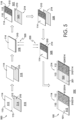
- FIG. 5 depicts a schematic of an example process 500 for forming the textile 100.
- the first woven layer 114 and the nonwoven layer 310 are provided.
- the first woven layer 114 includes a visual property 512
- the nonwoven layer 310 includes a visual property 514 as indicated by the shading patterns.
- the visual property 512 may be the same or different from the visual property 514.
- the visual properties 512 and 514 may include a color, a pattern, a combination of a color and a pattern, and the like.
- the second surface 115 of the first woven layer 114 is positioned adjacent to the first surface 312 of the nonwoven layer 310 to form a layered construction.
- a first entanglement process 520 such as needlepunching, is executed on a first area of the layered construction to at least partially form the pile zone 112. The first entanglement process 520 is executed in a direction from the nonwoven layer 310 toward the first woven layer 114 to entangle the fibers/filaments 116 from the nonwoven layer 310 with the fibers/filaments/yarns of the first woven layer 114.
- the first entanglement process 520 may be executed one time, although it is contemplated herein that the first entanglement process 520 may be executed more than one time. Executing the first entanglement process 520 in the direction from the nonwoven layer 310 toward the first woven layer 114 effectively secures or affixes the layers 114 and 310 together in the pile zone 112 due to greater fiber/filament availability in the nonwoven layer 310. In contrast, it has been found that executing an entanglement process in the direction from the first woven layer 114 toward the nonwoven layer 310 fails to secure the layers together because of less fiber/filament availability in the first woven layer 114.
- the needlepunching when needlepunching is used as the entanglement process, the needlepunching creates holes in the first woven layer 114 but generally fails to entangle the fibers/filaments/yarns from the first woven layer 114 with the fibers/filaments 116 of the nonwoven layer 310. It has also been found that needlepunching versus other mechanical entanglement processes such as hydroentangling, works better to secure the first woven layer 114 to the nonwoven layer 310. This is likely because hydroentanglement fails to generate enough force to push the fibers/filaments 116 of the nonwoven layer 310 into and through the first woven layer 114.
- the first woven layer 114 that is entangled with the nonwoven layer 310 in the pile zone 112 is depicted.
- the fibers/filaments 116 from the nonwoven layer 310 comprise a visual property 514 (e.g., a color)
- the visual property 514 is visible on the first surface 113 of the first woven layer 114 in the pile zone 112 due to the entanglement of the fibers/filaments 116 of the nonwoven layer 310 with the fibers/filaments/yarns of the first woven layer 114.
- the second woven layer 214 is provided.
- the second woven layer 214 comprises a visual property 524.
- the visual property 524 may the same or different from the visual property 512 and/or the visual property 514. Similar to the above, the visual property 524 may include a color, a pattern, a combination of a color and a pattern, and the like.
- the first surface 213 of the second woven layer 214 is positioned adjacent to the second surface 314 of the nonwoven layer 310 to form a layered construction.
- a second entanglement process 530 such as needlepunching, is executed on the area of the layered construction corresponding to the pile zone 112.
- the second entanglement process 530 is executed in a direction from the first woven layer 114 toward the second woven layer 214 to entangle the fibers/filaments 116 of the nonwoven layer 310, including the fibers/filaments 116 that are present within and on the first surface 113 of the first woven layer 114 with the fibers/filaments/yarns of the second woven layer 214.
- the second entanglement process 530 may be executed one time, although it is contemplated herein that the second entanglement process 530 may be executed more than one time. Similar to the first entanglement process 520, it has been found that needlepunching versus other mechanical entanglement processes such as hydroentangling, works better to secure the second woven layer 214 to the nonwoven layer 310 likely to the large amount of force able to be generated through the needlepunching process.
- Step 532 depicts the first surface 101 and the second surface 201 of the textile 100.
- the insulation zone 110 generally comprises the visual property 512 of the first woven layer 114
- the pile zone 112 generally comprises an intermixing of the visual property 512 of the first woven layer 114 and the visual property 514 of the nonwoven layer 310.
- the insulation zone 110 generally comprises the visual property 524 of the second woven layer 214
- the pile zone 112 generally comprises an intermixing of the visual property 514 of the nonwoven layer 310 and the visual property 524 of the second woven layer 214.
- first woven layer 114 and/or the second woven layer 214 may be translucent or partially translucent such that the visual property 514 of the nonwoven layer 310 is partially visible through the first woven layer 114 and/or the second woven layer 214 in the insulation zone 110 of the textile 100.
- the location, size, and shape of the insulation zone 110 and the pile zone 112 may vary from that shown.
- the process 500 as described utilizes two woven layers such as the first woven layer 114 and the second woven layer 214 and a nonwoven layer, such as the nonwoven layer 310 to produce a textile that includes both insulation zones and pile zones in a seamless construction.
- the process 500 produces a varied aesthetic between the insulation zones and the pile zones on a particular surface of the textile, as well as a varied aesthetic on both the first surface and the second surface of the textile.
- FIG. 6 depicts an upper-body garment 600 formed from the textile 100.
- the upper-body garment 600 is shown in the form of a vest having a torso portion 610, a neck opening 612, a waist opening 614, a first arm opening 616, and a second arm opening 618.
- a vest it is contemplated herein that the upper-body garment 600 may be in the form of a jacket with sleeves, a pullover, a shirt, a hoodie, and the like.
- the upper-body garment 600 includes an insulation zone 620 corresponding to the insulation zone 110 of the textile 100 and a pile zone 622 corresponding to the pile zone 112 of the textile 100.
- the location of the insulation zone 620 and the pile zone 622 may be based on, for instance, heat maps of a human body.
- the insulation zone 620 may be located on the upper-body garment 600 in areas corresponding to high heat loss of a wearer such as the upper front torso and the upper back torso
- the pile zone 622 may be located on the upper-body garment 600 in areas of less heat loss such as the lower front torso and the lower back torso.
- the size, shape, and number of the insulation zone 620 and the pile zone 622 on the upper-body garment 600 is illustrative only.
- the upper-body garment 600 may include multiple insulation zones and multiple pile zones. Any and all aspects, and any variation thereof, are contemplated as being within aspects herein.
- FIG. 7 depicts a lower-body garment 700 formed from the textile 100.
- the lower-body garment 700 is in the form of a pant that has a torso portion 710 with a waist opening 712, a first leg portion 714 with a first leg opening 716, and a second leg portion 718 with a second leg opening 720.
- the lower-body garment 700 may be in the form of a short, a tight, a capri, a unitard, and the like.
- the lower-body garment 700 includes insulation zones 722 located on the torso portion 710 and a lower aspect of the first leg portion 714 and the second leg portion 718.
- a pile zone 724 is located on an upper and mid aspect of the first leg portion 714 and the second leg portion 718.
- the location of the insulation zones 722 and the pile zones 724 may be based on heat maps of a human body.
- the size, shape, and number of the insulation zones 722 and the pile zones 724 is illustrative.
- the textile 100 may be used to form additional articles such as hats, gloves, extremity sleeves, socks, uppers, and the like.
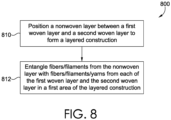
- FIG. 8 is a flow diagram of an example method 800 of manufacturing a textile such as the textile 100.
- a nonwoven layer such as the nonwoven layer 310 is positioned between a first woven layer, such as the first woven layer 114 and a second woven layer, such as the second woven layer 214 to form a layered construction.
- fibers and filaments from the nonwoven layer are entangled with fibers, filaments and/or yarns from each of the first woven layer and the second woven layer in a first area of the layered construction to form a pile zone. It is contemplated herein that in a second area of the layered construction corresponding to an insulation zone, the entanglement process is not executed such that the first woven layer, the second woven layer, and the nonwoven layer comprise separate and distinct layers.
- nonwoven layer is formed by entangling fibers and filaments from two or more nonwoven sheets together as described with respect to the process 400.
- the step 812 may include positioning the first woven layer adjacent to a first surface of the nonwoven layer and executing a first entanglement process in a direction from the nonwoven layer toward the first woven layer. After the first entanglement process is completed, the second woven layer is positioned adjacent to a second opposite surface of the nonwoven layer. A second entanglement process is then executed in a direction from the first woven layer toward the second woven layer to finish forming the pile zone.
- the visual properties of the nonwoven sheets used to form the nonwoven layer may be selected to achieve a desired visual property for the nonwoven layer.
- the visual properties of the first woven layer and the second woven layer may be selected to achieve a desired visual property for the insulation zone(s) and the pile zone(s) on the first surface of the textile as well as a desired visual property for the insulation zone(s) and the pile zone(s) on the second opposite surface of the textile.
- the visual properties of the textile may also be adjusted based on the degree of entanglement of the nonwoven sheets used to form the nonwoven layer and the degree of entanglement of the nonwoven layer with each of the first woven layer and the second woven layer.
- the present invention also relates to aspects, embodiments and features described in the following itemized list:
Landscapes
- Engineering & Computer Science (AREA)
- Textile Engineering (AREA)
- Physics & Mathematics (AREA)
- Thermal Sciences (AREA)
- Nonwoven Fabrics (AREA)
- Laminated Bodies (AREA)
- Professional, Industrial, Or Sporting Protective Garments (AREA)
- Manufacturing Of Multi-Layer Textile Fabrics (AREA)
- Woven Fabrics (AREA)
Abstract
Description
- Aspects herein relate to a textile, and garments formed the textile, having insulation zones and pile zones formed from a combination of woven layers and nonwoven layers.
- Traditional garments that include, for example, insulation zones and pile zones are generally formed using a panel-type, cut-and-sew construction where seams are used to affix the textiles that form the insulation zones with the textiles that form the pile zones. The seam lines may introduce areas of structural weakness, may be aesthetically undesirable, and/or may cause chaffing or discomfort for wearers.
- The following clauses represent example aspects of concepts contemplated herein. Any one of the following clauses may be combined in a multiple dependent manner to depend from one or more other clauses. Further, any combination of dependent clauses (clauses that explicitly depend from a previous clause) may be combined while staying within the scope of aspects contemplated herein. The following clauses are examples and are not limiting.
-
Clause 1. A textile comprising: an insulation zone comprising a first woven layer, a second woven layer, and a nonwoven layer positioned between the first woven layer and the second woven layer, each of the first woven layer and the second woven layer being unaffixed from the nonwoven layer in the insulation zone; and a pile zone seamlessly extending from the insulation zone, the pile zone comprising the first woven layer, the second woven layer, and the nonwoven layer positioned between the first woven layer and the second woven layer, wherein fibers and/or filaments from the nonwoven layer are entangled with fibers, filaments, and/or yarns from each of the first woven layer and the second woven layer such that the first woven layer and the second woven layer are bound to the nonwoven layer in the pile zone. - Clause 2. The textile according to
clause 1, wherein the nonwoven layer comprises two or more nonwoven sheets, and wherein fibers and/or filaments from each of the two or more nonwoven sheets are entangled with each other. - Clause 3. The textile according to clause 2, wherein a first nonwoven sheet of the two or more nonwoven sheets comprises a first visual property, and wherein a second nonwoven sheet of the two or more nonwoven sheets comprises a second visual property different from the first visual property.
- Clause 4. The textile according to clause 3, wherein the first visual property comprises a first color, and wherein the second visual property comprises a second color.
- Clause 5. The textile according to any of clauses 3 through 4, wherein the first visual property comprises a first pattern, and wherein the second visual property comprises a second pattern.
- Clause 6. The textile according to any of
clauses 1 through 5, wherein the nonwoven layer has a weight from about 180 grams per square meter (gsm) to about 220 gsm. - Clause 7. A garment comprising: an insulation zone comprising a first woven layer, a second woven layer, and a nonwoven layer positioned between the first woven layer and the second woven layer, wherein the first woven layer, the second woven layer, and the nonwoven layer comprise separate and distinct layers in the insulation zone; and a pile zone seamlessly extending from the insulation zone, the pile zone comprising the first woven layer, the second woven layer, and the nonwoven layer, wherein fibers and/or filaments from the nonwoven layer are entangled with fibers, filaments, and/or yarns from each of the first woven layer and the second woven layer in the pile zone such that the first woven layer and the second woven layer are bound to the nonwoven layer in the pile zone.
- Clause 8. The garment according to clause 7, wherein both of the first woven layer and the second woven layer are unaffixed from the nonwoven layer in the insulation zone.
- Clause 9. The garment according to any of clauses 7 through 8, wherein the nonwoven layer has a visual property different from a visual property of one or more of the first woven layer and the second woven layer.
- Clause 10. The garment according to any of clauses 7 through 9, wherein the nonwoven layer comprises two or more nonwoven sheets, and wherein fibers and/or filaments from each of the two or more nonwoven sheets are entangled with each other.
- Clause 11. The garment according to clause 10, wherein a first nonwoven sheet of the two or more nonwoven sheets comprises a first visual property, and wherein a second nonwoven sheet of the two or more nonwoven sheets comprises a second visual property different from the first visual property.
- Clause 12. The garment according to any of clauses 7 through 11, wherein the nonwoven layer has a weight from about 180 grams per square meter (gsm) to about 220 gsm.
- Clause 13. The garment according to any of clauses 7 through 12, wherein the insulation zone is positioned on the garment in areas corresponding to high heat loss areas of a wearer when the garment is in an as-worn configuration.
- Clause 14. A method of manufacturing a textile comprising: positioning a nonwoven layer between a first woven layer and a second woven layer to form a layered construction; and entangling fibers and/or filaments from the nonwoven layer with fibers, filaments, and/or yarns from each of the first woven layer and the second woven layer in a first area of the layered construction, wherein each of the first woven layer and the second woven layer remain unaffixed from the nonwoven layer in a second area of the layered construction.
- Clause 15. The method of manufacturing the textile according to clause 14, wherein the nonwoven layer is formed by positioning two or more nonwoven sheets adjacent to each other and entangling fibers and/or filaments from each of the two or more nonwoven sheets with each other using an entanglement process.
- Clause 16. The method of manufacturing the textile according to clause 15, wherein the entanglement process is executed in a direction from a first surface of the nonwoven layer toward a second surface of the nonwoven layer, and in a direction from the second surface of the nonwoven layer toward the first surface of the nonwoven layer.
- Clause 17. The method of manufacturing the textile according to any of clauses 14 through 16, wherein entangling the fibers and/or filaments from the nonwoven layer with the fibers, filaments, and/or yarns from each the first woven layer and the second woven layer comprises: positioning the first woven layer adjacent to a first surface of the nonwoven layer; executing a first entanglement process in a direction from the nonwoven layer toward the first woven layer; subsequently positioning the second woven layer adjacent to a second opposite surface of the nonwoven layer; and executing a second entanglement process in a direction from the first woven layer toward the second woven layer.
- Clause 18. The method of manufacturing the textile according to any of clauses 14 through 17, wherein the nonwoven layer has a weight from about 180 grams per square meter (gsm) to about 220 gsm.
- Clause 19. The method of manufacturing the textile according to any of clauses 14 through 18, wherein the nonwoven layer has a visual property different from a visual property of one or more of the first woven layer and the second woven layer.
- Clause 20. The method of manufacturing the textile according to clause 19, wherein the visual property of the nonwoven layer and the one or more of the first woven layer and the second woven layer comprises color.
- Examples of aspects herein are described in detail below with reference to the attached drawing figures, wherein:
-
FIG. 1 illustrates a view of a first surface of an example textile having an insulation zone and a pile zone in accordance with aspects herein; -
FIG. 2 illustrates a view of a second opposite surface of the example textile ofFIG. 1 and depicts the insulation zone and the pile zone in accordance with aspects herein; -
FIG. 3 illustrates a cross-sectional view of the example textile ofFIG. 1 in accordance with aspects herein; -
FIG. 4 illustrates a schematic of an example process for forming a nonwoven layer of the example textile ofFIG. 1 in accordance with aspects herein; -
FIG. 5 illustrates a schematic of an example process for forming the example textile ofFIG. 1 in accordance with aspects herein; -
FIG. 6 illustrates an example upper-body garment incorporating the example textile ofFIG. 1 in accordance with aspects herein; -
FIG. 7 illustrates an example lower-body garment incorporating the example textile ofFIG. 1 in accordance with aspects herein; and -
FIG. 8 illustrates a flow diagram of an example method of manufacturing the textile ofFIG. 1 in accordance with aspects herein. - The subject matter of the present invention is described with specificity herein to meet statutory requirements. However, the description itself is not intended to limit the scope of this disclosure. Rather, the inventors have contemplated that the claimed or disclosed subject matter might also be embodied in other ways, to include different steps or combinations of steps similar to the ones described in this document, in conjunction with other present or future technologies. Moreover, although the terms "step" and/or "block" might be used herein to connote different elements of methods employed, the terms should not be interpreted as implying any particular order among or between various steps herein disclosed unless and except when the order of individual steps is explicitly stated.
- Traditional articles of apparel that have insulation zones and pile zones (i.e., fleece-like zones) are generally formed using a panel-type, cut-and-sew construction where textiles used to form the insulation zone are seamed to textiles used to form the pile zone. The resultant seams may introduce areas of structural weakness, may create an undesirable aesthetic, and/or may cause chaffing or discomfort to a wearer. As well, textiles used to form traditional pile zones may lack features that make the textiles suitable for use in adverse weather conditions such as rain, snow, and/or wind.
- Aspects herein are directed to a textile, garments formed from the textile, and methods of manufacturing the textile, where the textile has an insulation zone and a pile zone that seamlessly extend from one another. As well, due to the construction of the pile zone, the pile zone includes features that make it more resistant to adverse weather conditions than typical pile textiles. In example aspects, the insulation zone includes a first woven layer, a second woven layer, and a nonwoven layer positioned in a space between the first woven layer and the second woven layer. In the insulation zone, the first woven layer, the second woven layer, and the nonwoven layer are unaffixed from each other such that the first woven layer, the second woven layer, and the nonwoven layer are separate and distinct layers. In addition to the spaces formed between the different layers which may be used to trap heated air, the nonwoven layer includes a large number of spaces between the fibers and filaments that form the nonwoven layer which further helps to trap heated air and insulate a wearer.
- The pile zone includes the first woven layer, the second woven layer, and the nonwoven layer. In the pile zone, fibers/filaments from the nonwoven layer extend into and through the first woven layer and the second woven layer and are entangled with fibers, filaments, and/or yarns from both the first woven layer and the second woven layer through, for example, an entanglement process such as, for example, needlepunching. Because of the entanglement of the nonwoven fibers/filaments with the first woven layer and the second woven layer, the first and second woven layers are bound or secured to the nonwoven layer in the pile zone. The pile zone has a fleece-like texture due to the fibers/filaments from the nonwoven layer extending through the first woven layer and the second woven layer. Unlike typical pile textiles in which tufts or loops integrally extend from a base textile which may not exhibit weather-resistant properties, the pile zone contemplated herein may have weather-resistant properties due to the presence of the first woven layer and the second woven layer. For instance, in example aspects where the first woven layer and the second woven layer are tightly woven, the pile zone may exhibit wind-resistant properties. In additional example aspects where one or more of the first woven layer and the second woven layer are treated with a durable water repellant, the pile zone may be generally resistant to rain or precipitation.
- Although the insulation zone and the pile zone are formed from the same materials, aspects herein contemplate having a varied aesthetic between the insulation zone and the pile zone based on, for example, the entanglement process. For example, the first and/or second woven layers may have a first visual property. The nonwoven layer may have a second visual property different from the first visual property. In this aspect, the insulation zone may primarily exhibit or display the first visual property associated with the first and/or second woven layer since the nonwoven layer is positioned between the first and second woven layers and may not be visible. The pile zone, due to the entanglement of the fibers and filaments of the nonwoven layer with the fibers, filaments, and yarns of the first and/or second woven layers may exhibit or display a different visual property that is intermediate between the first visual property and the second visual property. Using an example, the first and/or second woven layers may be white in color and the nonwoven layer may be grey in color. The insulation zone may primarily exhibit or display a white color, and the pile zone may have a heather grey and white appearance due to the mixture of the white yarns forming the first and/or second woven layers with the grey fibers/filaments forming the nonwoven layer.
- As used herein, the term "garment" encompasses any number of products meant to be worn by a wearer including upper-body garments (e.g., shirts, jackets, hoodies, tank tops, pullovers), lower-body garments (e.g., pants, shorts, leggings), articles of footwear such as shoes or socks, articles of headwear (e.g., hats), gloves, sleeves (e.g., arm sleeves, calf sleeves), and the like. Positional terms used when describing the garment such as front, back, inner-facing surface, outer-facing surface, and the like are with respect to the garment being worn as intended with the wearer standing upright. As such, when the garment is in the form of an upper-body garment, the front of the upper-body garment is configured to cover, for instance, a front upper torso area and a front arm area (when the garment has sleeves), and the back of the upper-body garment is configured to cover a back upper torso area and a back arm area (when the garment has sleeves). When the garment is in the form of a lower-body garment, the front of the lower-body garment is configured to cover, for instance, a front lower torso area and a front leg area of the wearer, and the back of the lower-body garment is configured to cover a back lower torso area and a back leg area. Similarly, the inner-facing surface of the garment is configured to face inwardly (e.g., toward a body surface of a wearer), and the outer-facing surface of the garment is configured to face toward the external environment or away from the inner-facing surface of the garment. It is contemplated herein that, in some aspects, the inner-facing surface of the garment may comprise the innermost-facing surface of the garment. In some aspects, the outer-facing surface of the garment may comprise the outermost-facing surface of the garment.
- The term "yarn" as used herein may mean an assemblage of fibers or filaments that are twisted or laid together so as to form a continuous strand. The term "yarn" may also encompass a single monofilament that forms a continuous strand. In example aspects, the first and second woven layers described herein may be formed from yarns and the fibers or filaments that form the yarns. The nonwoven layer described herein may be formed from fibers and/or filaments.
- The term "woven layer" means a textile having a plurality of warp yarns and a plurality of weft yarns interwoven with the plurality of warp yarns, where the plurality of weft yarns extend generally orthogonal to the plurality of warp yarns. The term "nonwoven layer" as used herein refers to fibers or filaments that are held together by mechanical and/or chemical interactions without being in the form of a knit, woven, braided construction, or other structured construction. In a particular aspect, the nonwoven textile includes a collection of fibers or filaments that are mechanically manipulated to form a mat-like material. Stated differently nonwoven textiles are directly made from fibers or filaments. The term "pile" or "pile zone" as used herein means a textile, including a composite textile, having a raised surface formed from upright loops or strands of fibers/filaments.
- The term "seamlessly extend" means two areas or zones that extend from one another without seams. With respect to the present disclosure, the insulation zone and the pile zone seamlessly extend from one another such that one or more warp yarns and/or a weft yarns in the insulation zone continuously and without interruption extend into the pile zone.
- The term "visual property" as used herein broadly means the visual impression created by a textile. This may be due to different characteristic of the yarns/fibers/filaments used to form the textile including differences in texture, denier, shine, color, and the like. With respect to the term "pattern," the term generally means a repeated decorative design. With respect to the term "color," the term generally relates to a color of a textile that may be afforded by dyes and/or colorants. Moreover, the term "color" when describing, for example, a textile means an observable color of yarns/fibers/filaments that form the textile. Such aspects contemplate that a color may be any color that may be afforded to yarns/fibers/filaments using dyes, pigments, and/or colorants that are known in the art. As such, yarns/fibers/filaments may be configured to have a color including, but not limited to red, orange, yellow, green, blue, indigo, violet, white, black, and shades thereof.
- Aspects related to a color further contemplate determining if one color is different from another color. In these aspects, a color may comprise a numerical color value, which may be determined by using instruments that objectively measure and/or calculate color values of a color of an object by standardizing and/or quantifying factors that may affect a perception of a color. Such instruments include, but are not limited to spectroradiometers, spectrophotometers, and the like. Thus, aspects herein contemplate that a "color" of a textile provided by yarns/fibers/filaments may comprise a numerical color value that is measured and/or calculated using spectroradiometers and/or spectrophotometers. Moreover, numerical color values may be associated with a color space or color model, which is a specific organization of colors that provides color representations for numerical color values, and thus, each numerical color value corresponds to a singular color represented in the color space or color model.
- In these aspects, a color may be determined to be different from another color if a numerical color value of each color differs. Such a determination may be made by measuring and/or calculating a numerical color value of, for instance, a first textile having a first color with a spectroradiometer or a spectrophotometer, measuring and/or calculating a numerical color value of a second textile having a second color with the same instrument (i.e., if a spectrophotometer was used to measure the numerical color value of the first color, then a spectrophotometer is used to measure the numerical color value of the second color), and comparing the numerical color value of the first color with the numerical color value of the second color. In another example, the determination may be made by measuring and/or calculating a numerical color value of a first area of a textile with a spectroradiometer or a spectrophotometer, measuring and/or calculating a numerical color value of a second area of the textile having a second color with the same instrument, and comparing the numerical color value of the first color with the numerical color value of the second color. If the numerical color values are not equal, then the first color is different than the second color, and vice versa.
- Further, it is also contemplated that a visual distinction between two colors may correlate with a percentage difference between the numerical color values of the first color and the second color, and the visual distinction will be greater as the percentage difference between the color values increases. Moreover, a visual distinction may be based on a comparison between colors representations of the color values in a color space or model. For instance, when a first color has a numerical color value that corresponds to a represented color that is black or navy and a second color has a numerical color value that corresponds to a represented color that is red or yellow, a visual distinction between the first color and the second color is greater than a visual distinction between a first color with a represented color that is red and a second color with a represented color that is yellow.
- Unless otherwise noted, all measurements provided herein are measured at standard ambient temperature and pressure (25 degrees Celsius or 298.15 K and 1 bar).
-
FIGs. 1 and 2 respectively depict a view of afirst surface 101 and a secondopposite surface 201 of anexample textile 100. Thetextile 100 includes aninsulation zone 110 and apile zone 112. With respect toFIG. 1 , thefirst surface 101 of theinsulation zone 110 is formed from a firstwoven layer 114. The firstwoven layer 114, in example aspects, may include nylon yarns, polyester yarns, a combination of nylon yarns and polyester yarns, and the like. When thetextile 100 is incorporated into a garment, the firstwoven layer 114 of theinsulation zone 110 may form an outermost-facing surface of the garment. In example aspects, the firstwoven layer 114 may be tightly woven such that the firstwoven layer 114 is generally resistant to wind penetration and/or rain penetration. Having a tightly woven first wovenlayer 114 also helps to maintain heated air in the space between the firstwoven layer 114 and the second woven layer. In further example aspects, the firstwoven layer 114 may be treated with a durable water repellant finish to enhance the water-resistant or repellant properties of the firstwoven layer 114. The firstwoven layer 114 may have a visual property such as a color or a pattern. - The
first surface 101 of thepile zone 112 is formed from the firstwoven layer 114 and fibers/filaments 116 of a nonwoven layer that is positioned between the firstwoven layer 114 and the second woven layer as discussed below. The fibers/filaments 116 of the nonwoven layer extend through thefirst surface 101 in thepile zone 112 such that the fibers/filaments 116 of the nonwoven layer extend outwardly (i.e., in a positive z-direction) from a surface plane of the firstwoven layer 114. This configuration imparts a fleece-like texture to thepile zone 112. Due to the presence of the firstwoven layer 114, thepile zone 112 may also exhibit wind and rain resistant properties while providing a pleasing hand feel and a fleece-like aesthetic. - With respect to
FIG. 2 , thesecond surface 201 of theinsulation zone 110 is formed from a secondwoven layer 214. The secondwoven layer 214, in example aspects, may include nylon yarns, polyester yarns, a combination of nylon yarns and polyester yarns, and the like. When thetextile 100 is incorporated into a garment, the secondwoven layer 214 of theinsulation zone 110 may form an innermost-facing surface of the garment. Similar to the firstwoven layer 114, the secondwoven layer 214 may be tightly woven such that heated air trapped in the space between the firstwoven layer 114 and the secondwoven layer 214 is generally retained in the space to help warm or insulate a wearer. The secondwoven layer 214 may also have a visual property such as a color or a pattern. The visual property of the secondwoven layer 214 may be the same or different from the visual property of the firstwoven layer 114. - The
second surface 201 of thepile zone 112 is formed from the secondwoven layer 214 and the fibers/filaments 116 of the nonwoven layer that is positioned between the firstwoven layer 114 and the secondwoven layer 214. The fibers/filaments 116 of the nonwoven layer extend through thesecond surface 201 in thepile zone 112 such that the fibers/filaments 116 of the nonwoven layer extend outwardly (i.e., in a negative z-direction with respect to the fibers/filaments 116 extending through the first surface 101) from a surface plane of the secondwoven layer 214 to impart a fleece-like texture to thesecond surface 201 of thepile zone 112. As shown, the location of thepile zone 112 on thefirst surface 101 of thetextile 100 corresponds to the location of thepile zone 112 on thesecond surface 201 of thetextile 100. Similarly, the location of theinsulation zone 110 on thefirst surface 101 of thetextile 100 corresponds to the location of theinsulation zone 110 on thesecond surface 201 of thetextile 100. Stated differently theinsulation zone 110 and thepile zone 112 are symmetrically located on the opposingsurfaces textile 100. -
FIG. 3 depicts a cross-section of thetextile 100 taken through theinsulation zone 110 and thepile zone 112. As shown, theinsulation zone 110 includes the firstwoven layer 114 and the secondwoven layer 214. The firstwoven layer 114 includes afirst surface 113 and asecond surface 115 opposite thefirst surface 113. In example aspects, thefirst surface 113 of the firstwoven layer 114 forms thefirst surface 101 of theinsulation zone 110 of thetextile 100. The secondwoven layer 214 also includes afirst surface 213 and asecond surface 215 opposite thefirst surface 213. In example aspects, thefirst surface 213 of the secondwoven layer 214 forms thesecond surface 201 of theinsulation zone 110 of thetextile 100. - A
nonwoven layer 310 having afirst surface 312 and asecond surface 314 opposite thefirst surface 312 is positioned in a space formed between the firstwoven layer 114 and the secondwoven layer 214. More specifically, thefirst surface 312 of thenonwoven layer 310 is positioned adj acent to thesecond surface 115 of the firstwoven layer 114, and thesecond surface 314 of thenonwoven layer 310 is positioned adjacent to thesecond surface 215 of the secondwoven layer 214. As explained in additional detail below, thenonwoven layer 310 may include two or more nonwoven sheets that are entangled together. In example aspects, the fibers/filaments 116 of thenonwoven layer 310 may be formed from polyester fibers/filaments including recycled polyester fibers/filaments although other materials including natural materials are contemplated herein. In example aspects, thenonwoven layer 310 has a weight from about 150 grams per square meter (gsm) to about 250 gsm, from about 170 gsm to about 230 gsm, from about 190 gsm to about 210 gsm, or about 200 gsm. As used herein, the term "about" means within ± 10% of an indicated value. The weight of thenonwoven layer 310 may be measured using, for example, ISO3801 testing standard. - In the
insulation zone 110, the firstwoven layer 114, thenonwoven layer 310, and the secondwoven layer 214 are separate and distinct from each other such that a space, or a potential space, is maintained between thesecond surface 115 of the firstwoven layer 114 and thefirst surface 312 of thenonwoven layer 310 and between thesecond surface 215 of the secondwoven layer 214 and thesecond surface 314 of thenonwoven layer 310. Stated differently, in theinsulation zone 110, the firstwoven layer 114, thenonwoven layer 310, and the secondwoven layer 214 are not affixed to each other or are unaffixed from each other. In theinsulation zone 110, the spaces between the firstwoven layer 114, the secondwoven layer 214, and thenonwoven layer 310 trap heated air helping to insulate a wearer of a garment incorporating thetextile 100. Additionally, spaces between the fibers/filaments 116 that form thenonwoven layer 310 also help to trap heated air further increasing the insulation features of theinsulation zone 110. - The
pile zone 112 of thetextile 100 seamlessly extends from theinsulation zone 110 as shown inFIG. 3 . Stated differently, one or more warp or weft yarns in theinsulation zone 110 extend continuously and without interruption into thepile zone 112. Thepile zone 112 is created by an entanglement process whereby the fibers/filaments 116 of thenonwoven layer 310 are entangled with fibers, filaments, and/or yarns of the firstwoven layer 114 and the secondwoven layer 214. In example aspects, the integrity of the firstwoven layer 114 and the secondwoven layer 214 remains generally intact in thepile zone 112. For example, the warp and weft yarns that form the firstwoven layer 114 and the secondwoven layer 214 remain generally interwoven in thepile zone 112. - As shown in
FIG. 3 , the fibers/filaments 116 of thenonwoven layer 310 extend into the firstwoven layer 114. In some example aspects, the fibers/filaments 116 of thenonwoven layer 310 extend through the first woven layer 114 (i.e., extend through thefirst surface 113 of the first woven layer 114) such that the fibers/filaments 116 of thenonwoven layer 310 extend outwardly from thefirst surface 101 of thetextile 100 in thepile zone 112. Similarly, the fibers/filaments 116 of thenonwoven layer 310 extend into the secondwoven layer 214. In some example aspects, the fibers/filaments 116 of thenonwoven layer 310 extend through the second woven layer 214 (i.e., extend through thefirst surface 213 of the second woven layer 214) such that the fibers/filaments 116 of thenonwoven layer 310 extend outwardly from thesecond surface 201 of thetextile 100 in thepile zone 112. Due to the entanglement of the fibers/filaments 116 of thenonwoven layer 310 with the firstwoven layer 114 and the secondwoven layer 214 in thepile zone 112, the firstwoven layer 114 and the secondwoven layer 214 are bound or secured to thenonwoven layer 310 in thepile zone 112. The extension of the fibers/filaments 116 of thenonwoven layer 310 through the firstwoven layer 114 and the secondwoven layer 214 creates a pile or fleece-like texture on thefirst surface 101 and thesecond surface 201 of thetextile 100 in thepile zone 112. This, in turn, provides a good hand feel and a pleasing aesthetic. Moreover, because the firstwoven layer 114 and the secondwoven layer 214 are present in thepile zone 112, thepile zone 112 also exhibits wind and/or rain resistant or repellant properties due to the tightly woven nature of the firstwoven layer 114 and/or the secondwoven layer 214. -
FIG. 4 illustrates a schematic of anexample process 400 of forming thenonwoven layer 310. At astep 410, two or more nonwoven sheets are provided. The two or more nonwoven sheets may each be formed of a web of fibers that has undergone a carding and lapping process that generally aligns the fibers in one or more common directions that extend along an x, y plane and that achieves a desired basis weight. The web of fibers may also undergo a light needling process or mechanical entanglement process that entangles the fibers of the web to a degree such that the web of fibers forms a cohesive structure that can be manipulated (e.g., rolled on to a roller, un-rolled from the roller, stacked, and the like). The nonwoven sheets may also undergo one or more additional processing steps such as printing (digital printing, sublimation printing, ink jet printing, and the like). In example aspects, fournonwoven sheets nonwoven sheets nonwoven layer 310 of from about 150 gsm to about 250 gsm. Thenonwoven sheets visual property visual properties visual properties nonwoven sheets visual properties visual properties - At a
step 428, thenonwoven sheets nonwoven layer 310, thenonwoven sheets step 430, afirst entanglement process 432 is executed from a first side or surface of the layered construction through a second side or surface of the layered construction. Additionally, asecond entanglement process 434 is executed from the second side or surface of the layered construction through the first side or surface of the layered construction. The first and second entanglement processes 432 and 434 may comprise a mechanical process such as needlepunching or hydroentangling although other entanglement processes are contemplated herein. The first and second entanglement processes 432 and 434 causes the fibers/filaments from each of thenonwoven sheets nonwoven sheets nonwoven layer 310, the first and second entanglement processes 432 and 434 may be respectively executed a number of times such as two times up to seven times. In one example aspect, the first and second entanglement processes 432 and 434 may each be executed five times to achieve a desired cohesiveness while still having a desired loft of thenonwoven layer 310. - Step 436 depicts the
nonwoven layer 310 formed from the entanglement of the fibers/filaments of thenonwoven sheets nonwoven layer 310 is shown as a continuous sheet without holes or apertures. It is contemplated herein that thenonwoven layer 310 may include holes or apertures. The holes or apertures may be formed during the entanglement process or they may be formed in a post-processing step using, for example, die cutting, laser cutting, water jet cutting, and the like. - Because the fibers/filaments from each of the
nonwoven sheets nonwoven layer 310 represents a composite or mixture of the respectivevisual properties step 436. In example aspects, the amount of entanglement between the differentnonwoven sheets nonwoven layer 310. Using an illustrative example, thevisual properties visual properties nonwoven layer 310 may comprise a generally green color due to a greater degree of entanglement of the blue and yellow fibers and filaments. When a lesser number of the first and second entanglement processes 432 and 434 are executed, the visual property of thenonwoven layer 310 may comprise a heather color with blue areas intermixed with yellow areas. - In one example aspect, one of the nonwoven sheets such as the
nonwoven sheet 412 or thenonwoven sheet 418, or an additional nonwoven sheet not shown may be added after the first and second entanglement processes 432 and 434 have been executed one or more times. By introducing a nonwoven sheet later in entanglement process, a visual property that is present on the introduced nonwoven sheet may be more distinct or less intermixed in the resultingnonwoven layer 310. In an illustrative example, thenonwoven sheet 412 may be introduced after the first and second entanglement processes 432 and 434 have been executed, for instance, three times. Thevisual property 420 in this example may comprise a pattern such as diagonal stripes. The first and second entanglement processes 432 and 434 may be executed, for example, two more times to produce thenonwoven layer 310. Because thenonwoven sheet 412 is subject to less entanglement than the remainingnonwoven sheets visual property 420 is more distinct than thevisual properties nonwoven layer 310. -
FIG. 5 depicts a schematic of anexample process 500 for forming thetextile 100. At astep 510, the firstwoven layer 114 and thenonwoven layer 310 are provided. The firstwoven layer 114 includes avisual property 512, and thenonwoven layer 310 includes avisual property 514 as indicated by the shading patterns. In example aspects, thevisual property 512 may be the same or different from thevisual property 514. Thevisual properties - At a
step 516, thesecond surface 115 of the firstwoven layer 114 is positioned adjacent to thefirst surface 312 of thenonwoven layer 310 to form a layered construction. At astep 518, afirst entanglement process 520, such as needlepunching, is executed on a first area of the layered construction to at least partially form thepile zone 112. Thefirst entanglement process 520 is executed in a direction from thenonwoven layer 310 toward the firstwoven layer 114 to entangle the fibers/filaments 116 from thenonwoven layer 310 with the fibers/filaments/yarns of the firstwoven layer 114. In example aspects, thefirst entanglement process 520 may be executed one time, although it is contemplated herein that thefirst entanglement process 520 may be executed more than one time. Executing thefirst entanglement process 520 in the direction from thenonwoven layer 310 toward the firstwoven layer 114 effectively secures or affixes thelayers pile zone 112 due to greater fiber/filament availability in thenonwoven layer 310. In contrast, it has been found that executing an entanglement process in the direction from the firstwoven layer 114 toward thenonwoven layer 310 fails to secure the layers together because of less fiber/filament availability in the firstwoven layer 114. For instance, when needlepunching is used as the entanglement process, the needlepunching creates holes in the firstwoven layer 114 but generally fails to entangle the fibers/filaments/yarns from the firstwoven layer 114 with the fibers/filaments 116 of thenonwoven layer 310. It has also been found that needlepunching versus other mechanical entanglement processes such as hydroentangling, works better to secure the firstwoven layer 114 to thenonwoven layer 310. This is likely because hydroentanglement fails to generate enough force to push the fibers/filaments 116 of thenonwoven layer 310 into and through the firstwoven layer 114. - At a
step 522, the firstwoven layer 114 that is entangled with thenonwoven layer 310 in thepile zone 112 is depicted. As further shown, because the fibers/filaments 116 from thenonwoven layer 310 comprise a visual property 514 (e.g., a color), thevisual property 514 is visible on thefirst surface 113 of the firstwoven layer 114 in thepile zone 112 due to the entanglement of the fibers/filaments 116 of thenonwoven layer 310 with the fibers/filaments/yarns of the firstwoven layer 114. At thestep 522, the secondwoven layer 214 is provided. In example aspects, the secondwoven layer 214 comprises avisual property 524. Thevisual property 524 may the same or different from thevisual property 512 and/or thevisual property 514. Similar to the above, thevisual property 524 may include a color, a pattern, a combination of a color and a pattern, and the like. - At a
step 526, thefirst surface 213 of the secondwoven layer 214 is positioned adjacent to thesecond surface 314 of thenonwoven layer 310 to form a layered construction. At astep 528, asecond entanglement process 530, such as needlepunching, is executed on the area of the layered construction corresponding to thepile zone 112. Thesecond entanglement process 530 is executed in a direction from the firstwoven layer 114 toward the secondwoven layer 214 to entangle the fibers/filaments 116 of thenonwoven layer 310, including the fibers/filaments 116 that are present within and on thefirst surface 113 of the firstwoven layer 114 with the fibers/filaments/yarns of the secondwoven layer 214. In example aspects, thesecond entanglement process 530 may be executed one time, although it is contemplated herein that thesecond entanglement process 530 may be executed more than one time. Similar to thefirst entanglement process 520, it has been found that needlepunching versus other mechanical entanglement processes such as hydroentangling, works better to secure the secondwoven layer 214 to thenonwoven layer 310 likely to the large amount of force able to be generated through the needlepunching process. - Step 532 depicts the
first surface 101 and thesecond surface 201 of thetextile 100. With respect to thefirst surface 101, and as noted above, theinsulation zone 110 generally comprises thevisual property 512 of the firstwoven layer 114, and thepile zone 112 generally comprises an intermixing of thevisual property 512 of the firstwoven layer 114 and thevisual property 514 of thenonwoven layer 310. With respect to thesecond surface 201 of thetextile 100, theinsulation zone 110 generally comprises thevisual property 524 of the secondwoven layer 214, and thepile zone 112 generally comprises an intermixing of thevisual property 514 of thenonwoven layer 310 and thevisual property 524 of the secondwoven layer 214. The depiction of theprocess 500 is illustrative only and it is contemplated herein that the visual properties may vary from those shown. For example, in some aspects, the firstwoven layer 114 and/or the secondwoven layer 214 may be translucent or partially translucent such that thevisual property 514 of thenonwoven layer 310 is partially visible through the firstwoven layer 114 and/or the secondwoven layer 214 in theinsulation zone 110 of thetextile 100. As well, the location, size, and shape of theinsulation zone 110 and thepile zone 112 may vary from that shown. - The
process 500 as described utilizes two woven layers such as the firstwoven layer 114 and the secondwoven layer 214 and a nonwoven layer, such as thenonwoven layer 310 to produce a textile that includes both insulation zones and pile zones in a seamless construction. Theprocess 500 produces a varied aesthetic between the insulation zones and the pile zones on a particular surface of the textile, as well as a varied aesthetic on both the first surface and the second surface of the textile. - The
textile 100 may be incorporated into a number of different garments. For example,FIG. 6 depicts an upper-body garment 600 formed from thetextile 100. The upper-body garment 600 is shown in the form of a vest having atorso portion 610, aneck opening 612, a waist opening 614, afirst arm opening 616, and asecond arm opening 618. Although shown as a vest, it is contemplated herein that the upper-body garment 600 may be in the form of a jacket with sleeves, a pullover, a shirt, a hoodie, and the like. - The upper-
body garment 600 includes aninsulation zone 620 corresponding to theinsulation zone 110 of thetextile 100 and apile zone 622 corresponding to thepile zone 112 of thetextile 100. The location of theinsulation zone 620 and thepile zone 622 may be based on, for instance, heat maps of a human body. For example, theinsulation zone 620 may be located on the upper-body garment 600 in areas corresponding to high heat loss of a wearer such as the upper front torso and the upper back torso, and thepile zone 622 may be located on the upper-body garment 600 in areas of less heat loss such as the lower front torso and the lower back torso. The size, shape, and number of theinsulation zone 620 and thepile zone 622 on the upper-body garment 600 is illustrative only. In an example aspect, the upper-body garment 600 may include multiple insulation zones and multiple pile zones. Any and all aspects, and any variation thereof, are contemplated as being within aspects herein. -
FIG. 7 depicts a lower-body garment 700 formed from thetextile 100. The lower-body garment 700 is in the form of a pant that has atorso portion 710 with awaist opening 712, a first leg portion 714 with afirst leg opening 716, and asecond leg portion 718 with asecond leg opening 720. Although shown as a pant, it is contemplated herein that the lower-body garment 700 may be in the form of a short, a tight, a capri, a unitard, and the like. - The lower-
body garment 700 includesinsulation zones 722 located on thetorso portion 710 and a lower aspect of the first leg portion 714 and thesecond leg portion 718. Apile zone 724 is located on an upper and mid aspect of the first leg portion 714 and thesecond leg portion 718. The location of theinsulation zones 722 and thepile zones 724 may be based on heat maps of a human body. The size, shape, and number of theinsulation zones 722 and thepile zones 724 is illustrative. - Although not shown, it is contemplated that the
textile 100 may be used to form additional articles such as hats, gloves, extremity sleeves, socks, uppers, and the like. -
FIG. 8 is a flow diagram of anexample method 800 of manufacturing a textile such as thetextile 100. At astep 810, a nonwoven layer, such as thenonwoven layer 310 is positioned between a first woven layer, such as the firstwoven layer 114 and a second woven layer, such as the secondwoven layer 214 to form a layered construction. At astep 812, fibers and filaments from the nonwoven layer are entangled with fibers, filaments and/or yarns from each of the first woven layer and the second woven layer in a first area of the layered construction to form a pile zone. It is contemplated herein that in a second area of the layered construction corresponding to an insulation zone, the entanglement process is not executed such that the first woven layer, the second woven layer, and the nonwoven layer comprise separate and distinct layers. - Aspects herein further contemplate that the nonwoven layer is formed by entangling fibers and filaments from two or more nonwoven sheets together as described with respect to the
process 400. - As illustrated in
FIG. 5 , thestep 812 may include positioning the first woven layer adjacent to a first surface of the nonwoven layer and executing a first entanglement process in a direction from the nonwoven layer toward the first woven layer. After the first entanglement process is completed, the second woven layer is positioned adjacent to a second opposite surface of the nonwoven layer. A second entanglement process is then executed in a direction from the first woven layer toward the second woven layer to finish forming the pile zone. - As described with respect to the
processes - Aspects of the present disclosure have been described with the intent to be illustrative rather than restrictive. Alternative aspects will become apparent to those skilled in the art that do not depart from its scope. A skilled artisan may develop alternative means of implementing the aforementioned improvements without departing from the scope of the present disclosure.
- It will be understood that certain features and subcombinations are of utility and may be employed without reference to other features and subcombinations and are contemplated within the scope of the claims. Not all steps listed in the various figures need be carried out in the specific order described.
- In view of the forgoing, the present invention also relates to aspects, embodiments and features described in the following itemized list:
-
Item 1. A textile comprising: an insulation zone comprising a first woven layer, a second woven layer, and a nonwoven layer positioned between the first woven layer and the second woven layer, each of the first woven layer and the second woven layer being unaffixed from the nonwoven layer in the insulation zone; and a pile zone seamlessly extending from the insulation zone, the pile zone comprising the first woven layer, the second woven layer, and the nonwoven layer positioned between the first woven layer and the second woven layer, wherein fibers/filaments from the nonwoven layer are entangled with one or more of fibers, filaments, and yarns from each of the first woven layer and the second woven layer such that the first woven layer and the second woven layer are bound to the nonwoven layer in the pile zone. - Item 2. The textile according to
item 1, wherein the nonwoven layer comprises two or more nonwoven sheets, and wherein fibers/filaments from each of the two or more nonwoven sheets are entangled with each other. - Item 3. The textile according to item 2, wherein a first nonwoven sheet of the two or more nonwoven sheets comprises a first visual property, and wherein a second nonwoven sheet of the two or more nonwoven sheets comprises a second visual property different from the first visual property.
- Item 4. The textile according to item 3, wherein the first visual property comprises a first color, and wherein the second visual property comprises a second color.
- Item 5. The textile according to any of items 3 through 4, wherein the first visual property comprises a first pattern, and wherein the second visual property comprises a second pattern.
- Item 6. The textile according to any of
items 1 through 5, wherein the nonwoven layer has a weight from about 180 grams per square meter (gsm) to about 220 gsm. - Item 7. A garment comprising: an insulation zone comprising a first woven layer, a second woven layer, and a nonwoven layer positioned between the first woven layer and the second woven layer, wherein the first woven layer, the second woven layer, and the nonwoven layer comprise separate and distinct layers in the insulation zone; and a pile zone seamlessly extending from the insulation zone, the pile zone comprising the first woven layer, the second woven layer, and the nonwoven layer, wherein fibers/filaments from the nonwoven layer are entangled with one or more of fibers, filaments, and yarns from each of the first woven layer and the second woven layer in the pile zone such that the first woven layer and the second woven layer are bound to the nonwoven layer in the pile zone.
- Item 8. The garment according to item 7, wherein both of the first woven layer and the second woven layer are unaffixed from the nonwoven layer in the insulation zone.
- Item 9. The garment according to any of items 7 through 8, wherein the nonwoven layer has a visual property different from a visual property of one or more of the first woven layer and the second woven layer.
- Item 10. The garment according to any of items 7 through 9, wherein the nonwoven layer comprises two or more nonwoven sheets, and wherein fibers/filaments from each of the two or more nonwoven sheets are entangled with each other.
- Item 11. The garment according to item 10, wherein a first nonwoven sheet of the two or more nonwoven sheets comprises a first visual property, and wherein a second nonwoven sheet of the two or more nonwoven sheets comprises a second visual property different from the first visual property.
- Item 12. The garment according to any of items 7 through 11, wherein the nonwoven layer has a weight from about 180 grams per square meter (gsm) to about 220 gsm.
- Item 13. The garment according to any of items 7 through 12, wherein the insulation zone is positioned on the garment in areas corresponding to high heat loss areas of a wearer when the garment is in an as-worn configuration.
- Item 14. A method of manufacturing a garment comprising: positioning a nonwoven layer between a first woven layer and a second woven layer to form a layered construction; and entangling fibers/filaments from the nonwoven layer with one or more of fibers, filaments, and yarns from each of the first woven layer and the second woven layer in a first area of the layered construction, wherein each of the first woven layer and the second woven layer remain unaffixed from the nonwoven layer in a second area of the layered construction.
- Item 15. The method of manufacturing the garment according to item 14, wherein the nonwoven layer is formed by positioning two or more nonwoven sheets adjacent to each other and entangling fibers/filaments from each of the two or more nonwoven sheets with each other using an entanglement process.
- Item 16. The method of manufacturing the garment according to any of items 14 through 15, wherein the entanglement process is executed in a direction from a first surface of the nonwoven layer toward a second surface of the nonwoven layer, and in a direction from the second surface of the nonwoven layer toward the first surface of the nonwoven layer.
- Item 17. The method of manufacturing the garment according to any of items 14 through 16, wherein entangling the fibers/filaments from the nonwoven layer with one or more of the fibers, filaments, and yarns from each the first woven layer and the second woven layer comprises: positioning the first woven layer adjacent to a first surface of the nonwoven layer; executing a first entanglement process in a direction from the nonwoven layer toward the first woven layer; subsequently positioning the second woven layer adjacent to a second opposite surface of the nonwoven layer; and executing a second entanglement process in a direction from the first woven layer toward the second woven layer.
- Item 18. The method of manufacturing the garment according to any of items 14 through 17, wherein the nonwoven layer has a weight from about 180 grams per square meter (gsm) to about 220 gsm.
- Item 19. The method of manufacturing the garment according to any of items 14 through 18, wherein the nonwoven layer has a visual property different from a visual property of one or more of the first woven layer and the second woven layer.
- Item 20. The method of manufacturing the garment according to item 19, wherein the visual property of the nonwoven layer and the one or more of the first woven layer and the second woven layer comprises color.
Claims (11)
- A method of forming a textile (100), comprising:positioning a woven layer (114) and a nonwoven layer (310) to form a layered construction; andexecuting a needlepunching process (520) on the layered construction one or more times to at least partially form a pile zone (112) and to entangle fibers/filaments (116) from the nonwoven layer (310) with fibers/filaments/yarns of the woven layer (114).
- The method of claim 1, wherein the executing the needlepunching process (520) includes partially forming the pile zone (112).
- The method of claim 1 or 2, wherein the woven layer (114) and the nonwoven layer (310) are secured or affixed together in the pile zone (112).
- The method of any one of the preceding claims, wherein the needlepunching process (520) is executed in a direction from the nonwoven layer (310) toward the woven layer (114) to entangle the fibers/filaments (116) from the nonwoven layer (310) with the fibers/filaments/yarns of the woven layer (114).
- The method of any one of the preceding claims, wherein the woven layer (114) includes a first visual property (512), wherein the nonwoven layer (310) includes a second visual property (514), and wherein the first visual property (512) is different from the second visual property (514).
- The method of claim 5, wherein the first and second visual properties (512, 514) include a color, a pattern, a combination of a color and/or a pattern.
- A textile (100), comprisinga layered construction of a woven layer (114) and a nonwoven layer (310),wherein the layered construction at least partially includes a pile zone (112) in which fibers/filaments (116) from the nonwoven layer (310) are entangled with fibers/filaments/yarns of the woven layer (114).
- The textile (100) of claim 7, wherein the layered construction partially includes the pile zone (112).
- The textile (100) of claim 7 or 8, wherein the woven layer (114) and the nonwoven layer (310) are secured or affixed together in the pile zone (112).
- The textile (100) of any one of claims 7 to 9, wherein the woven layer (114) includes a first visual property (512), the nonwoven layer (310) includes a second visual property (514), and the first visual property (512) is different from the second visual property (514).
- The textile (100) of claim 10, wherein the first and second visual properties (512, 514) include a color, a pattern, a combination of a color and/or a pattern.
Applications Claiming Priority (4)
| Application Number | Priority Date | Filing Date | Title |
|---|---|---|---|
| US202063013047P | 2020-04-21 | 2020-04-21 | |
| US17/203,051 US12427745B2 (en) | 2020-04-21 | 2021-03-16 | Textile having insulation zones and pile zones |
| EP21718351.6A EP4138602B1 (en) | 2020-04-21 | 2021-03-19 | Textile having insulation zones and pile zones |
| PCT/US2021/023079 WO2021216237A1 (en) | 2020-04-21 | 2021-03-19 | Textile having insulation zones and pile zones |
Related Parent Applications (2)
| Application Number | Title | Priority Date | Filing Date |
|---|---|---|---|
| EP21718351.6A Division-Into EP4138602B1 (en) | 2020-04-21 | 2021-03-19 | Textile having insulation zones and pile zones |
| EP21718351.6A Division EP4138602B1 (en) | 2020-04-21 | 2021-03-19 | Textile having insulation zones and pile zones |
Publications (3)
| Publication Number | Publication Date |
|---|---|
| EP4311668A2 true EP4311668A2 (en) | 2024-01-31 |
| EP4311668A3 EP4311668A3 (en) | 2024-04-10 |
| EP4311668B1 EP4311668B1 (en) | 2025-09-03 |
Family
ID=78080807
Family Applications (2)
| Application Number | Title | Priority Date | Filing Date |
|---|---|---|---|
| EP23215147.2A Active EP4311668B1 (en) | 2020-04-21 | 2021-03-19 | Textile having a pile zone |
| EP21718351.6A Active EP4138602B1 (en) | 2020-04-21 | 2021-03-19 | Textile having insulation zones and pile zones |
Family Applications After (1)
| Application Number | Title | Priority Date | Filing Date |
|---|---|---|---|
| EP21718351.6A Active EP4138602B1 (en) | 2020-04-21 | 2021-03-19 | Textile having insulation zones and pile zones |
Country Status (6)
| Country | Link |
|---|---|
| US (2) | US12427745B2 (en) |
| EP (2) | EP4311668B1 (en) |
| JP (1) | JP7763185B2 (en) |
| KR (1) | KR102820250B1 (en) |
| CN (2) | CN121608465A (en) |
| WO (1) | WO2021216237A1 (en) |
Families Citing this family (2)
| Publication number | Priority date | Publication date | Assignee | Title |
|---|---|---|---|---|
| KR20240074501A (en) | 2022-11-21 | 2024-05-28 | 현대모비스 주식회사 | Lens sheet and vehicle lamp |
| IT202300008229A1 (en) * | 2023-04-27 | 2024-10-27 | Pangaia Grado Zero S R L | Compact multilayer material and its preparation process, padding comprising the multilayer material, and garment comprising the padding |
Family Cites Families (38)
| Publication number | Priority date | Publication date | Assignee | Title |
|---|---|---|---|---|
| GB1095656A (en) * | 1964-09-08 | 1967-12-20 | Ici Ltd | Nonwoven fabrics and methods of making them |
| US3405674A (en) * | 1965-03-15 | 1968-10-15 | Kem Wove Ind Inc | Method of producing a quilted nonwoven textile product |
| US3794553A (en) * | 1969-01-15 | 1974-02-26 | Cikalon Vlies | Varicolored ornamentally designed needled non-woven fabrics |
| JPS52107366A (en) | 1976-02-27 | 1977-09-08 | Iws Nominee Co Ltd | Improved woven fabric and its manufacture |
| WO1980001086A1 (en) | 1978-11-15 | 1980-05-29 | Scapa Porritt Ltd | Papermakers felts |
| CA1213701A (en) | 1982-02-12 | 1986-11-12 | Howard W. Fingerhut | Composite insulation material |
| JPH0266233U (en) | 1988-11-01 | 1990-05-18 | ||
| US5246760A (en) * | 1991-03-13 | 1993-09-21 | Ludwig Krickl | Insulating element for building |
| US5458944A (en) | 1994-04-15 | 1995-10-17 | Fiberweb North America, Inc. | Stretchable tufted carpet and stretchable nonwoven carpet backing therefor |
| US5443893A (en) | 1994-05-20 | 1995-08-22 | Minnesota Mining And Manufacturing Company | Multilayer nonwoven thermal insulating batts |
| HUP9801332A2 (en) | 1995-03-16 | 1998-09-28 | Kimberly-Clark Worldwide, Inc. | Nonwoven laminate barrier material |
| AT1254U1 (en) * | 1995-08-02 | 1997-01-27 | Tumfart Kurt | INSULATION |
| DE19804940B4 (en) | 1998-02-07 | 2004-02-05 | Sächsisches Textilforschungsinstitut e.V. | Layered textile composite and process for its production |
| US6638605B1 (en) | 1999-11-16 | 2003-10-28 | Allegiance Corporation | Intermittently bonded nonwoven disposable surgical laminates |
| US6473910B2 (en) | 2000-12-20 | 2002-11-05 | Kimberly-Clark Worldwide, Inc. | Cooling garment |
| US7735149B2 (en) | 2003-04-01 | 2010-06-15 | Clemson University | Microclimate regulating garment and composite structure |
| EP1622474B1 (en) | 2003-05-12 | 2010-03-31 | Sundridge Tackle Limited | Garment including foam material |
| US20110119811A1 (en) | 2009-11-24 | 2011-05-26 | Mmi-Ipco, Llc | Insulated Composite Fabric |
| US20060084343A1 (en) * | 2004-10-14 | 2006-04-20 | Avgol Nonwovens Ltd. | Nonwowen web material with spunlaid and meltblown layers having absorbency and increased softness |
| US20060143767A1 (en) | 2004-12-14 | 2006-07-06 | Kaiyuan Yang | Breathable protective articles |
| FR2889033B1 (en) | 2005-07-29 | 2007-12-28 | Salomon Sa | CLOTHED GARMENT |
| US20080102725A1 (en) | 2006-11-01 | 2008-05-01 | Martin Patrick Lacey | Multi-layer nonwoven having a printed layer and products made therefrom |
| GB2444804B (en) | 2006-12-15 | 2009-04-01 | Speedo Int Ltd | Elasticated sports garments |
| US20090258180A1 (en) * | 2008-02-15 | 2009-10-15 | Chapman Thermal Products, Inc. | Layered thermally-insulating fabric with an insulating core |
| WO2012088189A1 (en) | 2010-12-20 | 2012-06-28 | Applied Ft Composite Solutions Inc. | Resilient pad composite and process for making same without a die |
| WO2013040045A1 (en) | 2011-09-12 | 2013-03-21 | Nike International Ltd. | Multilayered waterproof moisture management athletic garments |
| US9233520B2 (en) | 2012-03-28 | 2016-01-12 | W. L. Gore & Associates, Inc. | Laminated articles having discontinuous adhesive regions |
| US9320312B2 (en) | 2012-08-30 | 2016-04-26 | Nike, Inc. | Composite upper for shoe with selectively disposed bonding agent |
| CN104494216A (en) * | 2014-12-23 | 2015-04-08 | 佛山市南海威竣纺织有限公司 | Novel composite fabric as well as production device and production process thereof |
| US11457682B2 (en) * | 2015-04-30 | 2022-10-04 | The North Face Apparel Corp. | Baffle constructs for insulative fill materials |
| EP3168039A1 (en) | 2015-11-12 | 2017-05-17 | Head Technology GmbH | Multi-layer laminate |
| CA3003203A1 (en) | 2015-11-16 | 2017-05-26 | W.L. Gore & Associates Gmbh | Upper body garment |
| CN107548355A (en) | 2016-04-25 | 2018-01-05 | 山田菊夫 | Manufacturing method of composite fiber sheet, disposable fiber product using composite fiber sheet, glove, raincoat and disposable fiber product |
| JPWO2017188162A1 (en) | 2016-04-25 | 2019-02-28 | 山田 菊夫 | COMPOSITE FIBER SHEET, DISPOSABLE FIBER PRODUCT USING COMPOSITE FIBER SHEET, GLOVE, RAIN COAT AND METHOD FOR PRODUCING DISPOSABLE FIBER PRODUCT |
| US20180098584A1 (en) | 2016-10-06 | 2018-04-12 | Nike, Inc. | Insulated vented garment formed using sections of non-woven polymer material |
| CN207466016U (en) | 2017-09-08 | 2018-06-08 | 青岛新维纺织开发有限公司 | A kind of functional cloth with unidirectional lint |
| WO2019173341A1 (en) * | 2018-03-05 | 2019-09-12 | Other Lab, Llc | Thermally adaptive fabrics and methods of making same |
| CN110815962A (en) * | 2019-10-25 | 2020-02-21 | 武汉纺织大学 | Warp and weft knitted double-faced fabric and preparation method and processing system thereof |
-
2021
- 2021-03-16 US US17/203,051 patent/US12427745B2/en active Active
- 2021-03-19 WO PCT/US2021/023079 patent/WO2021216237A1/en not_active Ceased
- 2021-03-19 EP EP23215147.2A patent/EP4311668B1/en active Active
- 2021-03-19 KR KR1020227037492A patent/KR102820250B1/en active Active
- 2021-03-19 CN CN202511732696.1A patent/CN121608465A/en active Pending
- 2021-03-19 EP EP21718351.6A patent/EP4138602B1/en active Active
- 2021-03-19 CN CN202180029546.8A patent/CN115484846B/en active Active
- 2021-03-19 JP JP2022564012A patent/JP7763185B2/en active Active
-
2025
- 2025-09-09 US US19/323,479 patent/US20250381755A1/en active Pending
Also Published As
| Publication number | Publication date |
|---|---|
| KR20220156634A (en) | 2022-11-25 |
| KR102820250B1 (en) | 2025-06-13 |
| WO2021216237A1 (en) | 2021-10-28 |
| US20210321701A1 (en) | 2021-10-21 |
| EP4138602B1 (en) | 2024-01-31 |
| EP4311668A3 (en) | 2024-04-10 |
| JP2023523721A (en) | 2023-06-07 |
| CA3177370A1 (en) | 2021-10-28 |
| CN121608465A (en) | 2026-03-06 |
| US12427745B2 (en) | 2025-09-30 |
| EP4311668B1 (en) | 2025-09-03 |
| JP7763185B2 (en) | 2025-10-31 |
| US20250381755A1 (en) | 2025-12-18 |
| EP4138602A1 (en) | 2023-03-01 |
| CN115484846A (en) | 2022-12-16 |
| CN115484846B (en) | 2025-12-05 |
Similar Documents
| Publication | Publication Date | Title |
|---|---|---|
| US20250381755A1 (en) | Textile having insulation zones and pile zones | |
| TWI867671B (en) | Article of apparel and asymmetrical-faced composite nonwoven textile | |
| CN105852271B (en) | The sportswear of visual characteristic and/or moisture management characteristic with enhancing | |
| KR102905515B1 (en) | Printed synthetic nonwoven textile suitable for clothing and method for producing the same | |
| TWI836574B (en) | Composite nonwoven textile, apparel item, debossed and pleated finishes for composite nonwoven textiles suitable for apparel and methods for producing the same | |
| TW202346676A (en) | Asymmetrical-faced composite nonwoven textile and article of apparel | |
| US20060063453A1 (en) | Multi-color denier gradient fabric | |
| HK40084742A (en) | Textile having insulation zones and pile zones | |
| TWI879057B (en) | Garment with composite nonwoven textile | |
| US20260041172A1 (en) | Garment with composite nonwoven textile | |
| MXPA98004149A (en) | Entretela that comprises high number deheb tissues |
Legal Events
| Date | Code | Title | Description |
|---|---|---|---|
| PUAI | Public reference made under article 153(3) epc to a published international application that has entered the european phase |
Free format text: ORIGINAL CODE: 0009012 |
|
| STAA | Information on the status of an ep patent application or granted ep patent |
Free format text: STATUS: THE APPLICATION HAS BEEN PUBLISHED |
|
| AC | Divisional application: reference to earlier application |
Ref document number: 4138602 Country of ref document: EP Kind code of ref document: P |
|
| AK | Designated contracting states |
Kind code of ref document: A2 Designated state(s): AL AT BE BG CH CY CZ DE DK EE ES FI FR GB GR HR HU IE IS IT LI LT LU LV MC MK MT NL NO PL PT RO RS SE SI SK SM TR |
|
| REG | Reference to a national code |
Ref country code: DE Ref legal event code: R079 Free format text: PREVIOUS MAIN CLASS: B32B0007050000 Ipc: A41D0031060000 Ref document number: 602021038101 Country of ref document: DE |
|
| PUAL | Search report despatched |
Free format text: ORIGINAL CODE: 0009013 |
|
| AK | Designated contracting states |
Kind code of ref document: A3 Designated state(s): AL AT BE BG CH CY CZ DE DK EE ES FI FR GB GR HR HU IE IS IT LI LT LU LV MC MK MT NL NO PL PT RO RS SE SI SK SM TR |
|
| RIC1 | Information provided on ipc code assigned before grant |
Ipc: B32B 7/05 20190101ALI20240305BHEP Ipc: B32B 7/023 20190101ALI20240305BHEP Ipc: B32B 5/26 20060101ALI20240305BHEP Ipc: B32B 5/14 20060101ALI20240305BHEP Ipc: B32B 5/08 20060101ALI20240305BHEP Ipc: B32B 5/06 20060101ALI20240305BHEP Ipc: B32B 5/02 20060101ALI20240305BHEP Ipc: A41D 31/06 20190101AFI20240305BHEP |
|
| P01 | Opt-out of the competence of the unified patent court (upc) registered |
Effective date: 20240522 |
|
| STAA | Information on the status of an ep patent application or granted ep patent |
Free format text: STATUS: REQUEST FOR EXAMINATION WAS MADE |
|
| 17P | Request for examination filed |
Effective date: 20241010 |
|
| RBV | Designated contracting states (corrected) |
Designated state(s): AL AT BE BG CH CY CZ DE DK EE ES FI FR GB GR HR HU IE IS IT LI LT LU LV MC MK MT NL NO PL PT RO RS SE SI SK SM TR |
|
| STAA | Information on the status of an ep patent application or granted ep patent |
Free format text: STATUS: EXAMINATION IS IN PROGRESS |
|
| 17Q | First examination report despatched |
Effective date: 20241113 |
|
| GRAP | Despatch of communication of intention to grant a patent |
Free format text: ORIGINAL CODE: EPIDOSNIGR1 |
|
| STAA | Information on the status of an ep patent application or granted ep patent |
Free format text: STATUS: GRANT OF PATENT IS INTENDED |
|
| RIC1 | Information provided on ipc code assigned before grant |
Ipc: B32B 7/05 20190101ALI20250311BHEP Ipc: B32B 7/02 20190101ALI20250311BHEP Ipc: B32B 5/26 20060101ALI20250311BHEP Ipc: B32B 5/14 20060101ALI20250311BHEP Ipc: B32B 5/08 20060101ALI20250311BHEP Ipc: B32B 5/06 20060101ALI20250311BHEP Ipc: B32B 5/02 20060101ALI20250311BHEP Ipc: B32B 3/26 20060101ALI20250311BHEP Ipc: A41D 31/06 20190101AFI20250311BHEP |
|
| INTG | Intention to grant announced |
Effective date: 20250328 |
|
| GRAS | Grant fee paid |
Free format text: ORIGINAL CODE: EPIDOSNIGR3 |
|
| GRAA | (expected) grant |
Free format text: ORIGINAL CODE: 0009210 |
|
| STAA | Information on the status of an ep patent application or granted ep patent |
Free format text: STATUS: THE PATENT HAS BEEN GRANTED |
|
| AC | Divisional application: reference to earlier application |
Ref document number: 4138602 Country of ref document: EP Kind code of ref document: P |
|
| AK | Designated contracting states |
Kind code of ref document: B1 Designated state(s): AL AT BE BG CH CY CZ DE DK EE ES FI FR GB GR HR HU IE IS IT LI LT LU LV MC MK MT NL NO PL PT RO RS SE SI SK SM TR |
|
| REG | Reference to a national code |
Ref country code: CH Ref legal event code: EP |
|
| REG | Reference to a national code |
Ref country code: DE Ref legal event code: R096 Ref document number: 602021038101 Country of ref document: DE |
|
| REG | Reference to a national code |
Ref country code: IE Ref legal event code: FG4D |
|
| REG | Reference to a national code |
Ref country code: NL Ref legal event code: MP Effective date: 20250903 |
|
| PG25 | Lapsed in a contracting state [announced via postgrant information from national office to epo] |
Ref country code: NO Free format text: LAPSE BECAUSE OF FAILURE TO SUBMIT A TRANSLATION OF THE DESCRIPTION OR TO PAY THE FEE WITHIN THE PRESCRIBED TIME-LIMIT Effective date: 20251203 |
|
| REG | Reference to a national code |
Ref country code: LT Ref legal event code: MG9D |
|
| PG25 | Lapsed in a contracting state [announced via postgrant information from national office to epo] |
Ref country code: FI Free format text: LAPSE BECAUSE OF FAILURE TO SUBMIT A TRANSLATION OF THE DESCRIPTION OR TO PAY THE FEE WITHIN THE PRESCRIBED TIME-LIMIT Effective date: 20250903 |
|
| PG25 | Lapsed in a contracting state [announced via postgrant information from national office to epo] |
Ref country code: HR Free format text: LAPSE BECAUSE OF FAILURE TO SUBMIT A TRANSLATION OF THE DESCRIPTION OR TO PAY THE FEE WITHIN THE PRESCRIBED TIME-LIMIT Effective date: 20250903 |
|
| PGFP | Annual fee paid to national office [announced via postgrant information from national office to epo] |
Ref country code: FR Payment date: 20251231 Year of fee payment: 6 |
|
| PG25 | Lapsed in a contracting state [announced via postgrant information from national office to epo] |
Ref country code: GR Free format text: LAPSE BECAUSE OF FAILURE TO SUBMIT A TRANSLATION OF THE DESCRIPTION OR TO PAY THE FEE WITHIN THE PRESCRIBED TIME-LIMIT Effective date: 20251204 |
|
| PG25 | Lapsed in a contracting state [announced via postgrant information from national office to epo] |
Ref country code: SE Free format text: LAPSE BECAUSE OF FAILURE TO SUBMIT A TRANSLATION OF THE DESCRIPTION OR TO PAY THE FEE WITHIN THE PRESCRIBED TIME-LIMIT Effective date: 20250903 |
|
| PG25 | Lapsed in a contracting state [announced via postgrant information from national office to epo] |
Ref country code: LV Free format text: LAPSE BECAUSE OF FAILURE TO SUBMIT A TRANSLATION OF THE DESCRIPTION OR TO PAY THE FEE WITHIN THE PRESCRIBED TIME-LIMIT Effective date: 20250903 |
|
| PG25 | Lapsed in a contracting state [announced via postgrant information from national office to epo] |
Ref country code: PL Free format text: LAPSE BECAUSE OF FAILURE TO SUBMIT A TRANSLATION OF THE DESCRIPTION OR TO PAY THE FEE WITHIN THE PRESCRIBED TIME-LIMIT Effective date: 20250903 Ref country code: BG Free format text: LAPSE BECAUSE OF FAILURE TO SUBMIT A TRANSLATION OF THE DESCRIPTION OR TO PAY THE FEE WITHIN THE PRESCRIBED TIME-LIMIT Effective date: 20250903 |
|
| PG25 | Lapsed in a contracting state [announced via postgrant information from national office to epo] |
Ref country code: RS Free format text: LAPSE BECAUSE OF FAILURE TO SUBMIT A TRANSLATION OF THE DESCRIPTION OR TO PAY THE FEE WITHIN THE PRESCRIBED TIME-LIMIT Effective date: 20251203 |
|
| PG25 | Lapsed in a contracting state [announced via postgrant information from national office to epo] |
Ref country code: ES Free format text: LAPSE BECAUSE OF FAILURE TO SUBMIT A TRANSLATION OF THE DESCRIPTION OR TO PAY THE FEE WITHIN THE PRESCRIBED TIME-LIMIT Effective date: 20250903 |
|
| REG | Reference to a national code |
Ref country code: AT Ref legal event code: MK05 Ref document number: 1831868 Country of ref document: AT Kind code of ref document: T Effective date: 20250903 |
|
| PG25 | Lapsed in a contracting state [announced via postgrant information from national office to epo] |
Ref country code: NL Free format text: LAPSE BECAUSE OF FAILURE TO SUBMIT A TRANSLATION OF THE DESCRIPTION OR TO PAY THE FEE WITHIN THE PRESCRIBED TIME-LIMIT Effective date: 20250903 |
|
| PG25 | Lapsed in a contracting state [announced via postgrant information from national office to epo] |
Ref country code: SM Free format text: LAPSE BECAUSE OF FAILURE TO SUBMIT A TRANSLATION OF THE DESCRIPTION OR TO PAY THE FEE WITHIN THE PRESCRIBED TIME-LIMIT Effective date: 20250903 |
|
| PGFP | Annual fee paid to national office [announced via postgrant information from national office to epo] |
Ref country code: GB Payment date: 20260106 Year of fee payment: 6 |
|
| PGFP | Annual fee paid to national office [announced via postgrant information from national office to epo] |
Ref country code: DE Payment date: 20260102 Year of fee payment: 6 |
|
| PG25 | Lapsed in a contracting state [announced via postgrant information from national office to epo] |
Ref country code: AT Free format text: LAPSE BECAUSE OF FAILURE TO SUBMIT A TRANSLATION OF THE DESCRIPTION OR TO PAY THE FEE WITHIN THE PRESCRIBED TIME-LIMIT Effective date: 20250903 |
|
| PG25 | Lapsed in a contracting state [announced via postgrant information from national office to epo] |
Ref country code: IT Free format text: LAPSE BECAUSE OF FAILURE TO SUBMIT A TRANSLATION OF THE DESCRIPTION OR TO PAY THE FEE WITHIN THE PRESCRIBED TIME-LIMIT Effective date: 20250903 |
|
| PG25 | Lapsed in a contracting state [announced via postgrant information from national office to epo] |
Ref country code: IS Free format text: LAPSE BECAUSE OF FAILURE TO SUBMIT A TRANSLATION OF THE DESCRIPTION OR TO PAY THE FEE WITHIN THE PRESCRIBED TIME-LIMIT Effective date: 20260103 |
|
| PG25 | Lapsed in a contracting state [announced via postgrant information from national office to epo] |
Ref country code: PT Free format text: LAPSE BECAUSE OF FAILURE TO SUBMIT A TRANSLATION OF THE DESCRIPTION OR TO PAY THE FEE WITHIN THE PRESCRIBED TIME-LIMIT Effective date: 20260105 Ref country code: CZ Free format text: LAPSE BECAUSE OF FAILURE TO SUBMIT A TRANSLATION OF THE DESCRIPTION OR TO PAY THE FEE WITHIN THE PRESCRIBED TIME-LIMIT Effective date: 20250903 |
|
| PG25 | Lapsed in a contracting state [announced via postgrant information from national office to epo] |
Ref country code: EE Free format text: LAPSE BECAUSE OF FAILURE TO SUBMIT A TRANSLATION OF THE DESCRIPTION OR TO PAY THE FEE WITHIN THE PRESCRIBED TIME-LIMIT Effective date: 20250903 Ref country code: SK Free format text: LAPSE BECAUSE OF FAILURE TO SUBMIT A TRANSLATION OF THE DESCRIPTION OR TO PAY THE FEE WITHIN THE PRESCRIBED TIME-LIMIT Effective date: 20250903 |
|
| REG | Reference to a national code |
Ref country code: DE Ref legal event code: R097 Ref document number: 602021038101 Country of ref document: DE |
|
| PG25 | Lapsed in a contracting state [announced via postgrant information from national office to epo] |
Ref country code: LT Free format text: LAPSE BECAUSE OF FAILURE TO SUBMIT A TRANSLATION OF THE DESCRIPTION OR TO PAY THE FEE WITHIN THE PRESCRIBED TIME-LIMIT Effective date: 20250903 |
|
| PG25 | Lapsed in a contracting state [announced via postgrant information from national office to epo] |
Ref country code: DK Free format text: LAPSE BECAUSE OF FAILURE TO SUBMIT A TRANSLATION OF THE DESCRIPTION OR TO PAY THE FEE WITHIN THE PRESCRIBED TIME-LIMIT Effective date: 20250903 |
|
| PLBE | No opposition filed within time limit |
Free format text: ORIGINAL CODE: 0009261 |
|
| STAA | Information on the status of an ep patent application or granted ep patent |
Free format text: STATUS: NO OPPOSITION FILED WITHIN TIME LIMIT |
|
| REG | Reference to a national code |
Ref country code: CH Ref legal event code: L10 Free format text: ST27 STATUS EVENT CODE: U-0-0-L10-L00 (AS PROVIDED BY THE NATIONAL OFFICE) Effective date: 20260715 |
|
| 26N | No opposition filed |
Effective date: 20260604 |