EP4311256A1 - Zeitsynchronisationsverfahren für ein passives optisches netzwerk sowie elektronische vorrichtung und speichermedium - Google Patents
Zeitsynchronisationsverfahren für ein passives optisches netzwerk sowie elektronische vorrichtung und speichermedium Download PDFInfo
- Publication number
- EP4311256A1 EP4311256A1 EP21931318.6A EP21931318A EP4311256A1 EP 4311256 A1 EP4311256 A1 EP 4311256A1 EP 21931318 A EP21931318 A EP 21931318A EP 4311256 A1 EP4311256 A1 EP 4311256A1
- Authority
- EP
- European Patent Office
- Prior art keywords
- onu
- response time
- equalization delay
- configuration message
- equalization
- Prior art date
- Legal status (The legal status is an assumption and is not a legal conclusion. Google has not performed a legal analysis and makes no representation as to the accuracy of the status listed.)
- Pending
Links
Images




Classifications
-
- H—ELECTRICITY
- H04—ELECTRIC COMMUNICATION TECHNIQUE
- H04J—MULTIPLEX COMMUNICATION
- H04J3/00—Time-division multiplex systems
- H04J3/02—Details
- H04J3/06—Synchronising arrangements
- H04J3/0635—Clock or time synchronisation in a network
- H04J3/0682—Clock or time synchronisation in a network by delay compensation, e.g. by compensation of propagation delay or variations thereof, by ranging
-
- H—ELECTRICITY
- H04—ELECTRIC COMMUNICATION TECHNIQUE
- H04Q—SELECTING
- H04Q11/00—Selecting arrangements for multiplex systems
- H04Q11/0001—Selecting arrangements for multiplex systems using optical switching
- H04Q11/0062—Network aspects
- H04Q11/0067—Provisions for optical access or distribution networks, e.g. Gigabit Ethernet Passive Optical Network (GE-PON), ATM-based Passive Optical Network (A-PON), PON-Ring
-
- H—ELECTRICITY
- H04—ELECTRIC COMMUNICATION TECHNIQUE
- H04Q—SELECTING
- H04Q11/00—Selecting arrangements for multiplex systems
- H04Q11/0001—Selecting arrangements for multiplex systems using optical switching
- H04Q11/0005—Switch and router aspects
- H04Q2011/0037—Operation
- H04Q2011/0045—Synchronisation
-
- H—ELECTRICITY
- H04—ELECTRIC COMMUNICATION TECHNIQUE
- H04Q—SELECTING
- H04Q11/00—Selecting arrangements for multiplex systems
- H04Q11/0001—Selecting arrangements for multiplex systems using optical switching
- H04Q11/0062—Network aspects
- H04Q2011/0064—Arbitration, scheduling or medium access control aspects
Definitions
- the present disclosure relates to the technical field of communication, in particular to a method for time synchronization in a passive optical network, an electronic apparatus, and a storage medium.
- ONUs optical network units
- PONs passive optical networks
- different optical network units shall be compatible, so that the uplink data of each ONU would not collide.
- low delay-based ranging is supported only.
- the non-low-delay ONUs are not possible to carry out ranging by the traditional ranging method, nor do they support the low delay-based ranging.
- the ranging of the non-low-delay ONU is realized with the help of a low-delay ONU or a low-delay ranging instrument.
- the non-low-delay ONU reuses the ranging result and accesses the branch optical fiber.
- OLT does not consider the local time variation parameters (such as response time) of ONUs when calculating the equalization delay (EqD). Since the local time variation parameters of different ONUs are generally different, the ranging result for one ONU is generally dedicated to that ONU. Another ONU accessing the same branch optical fiber is not possible to use the existed ranging result of the ONU, which leads to the failure in time synchronization.
- EqD equalization delay
- an embodiment provides a method for time synchronization in a PON, which is applied to an OLT, the method includes, acquiring a first response time from a first ONU; performing a ranging calculation to the first ONU to acquire a first equalization time delay; generating an equalization delay configuration message according to the first response time and the first equalization delay; sending the equalization delay configuration message to a second ONU to configure a second equalization delay of the second ONU; where the first ONU and the second ONU access the same branch optical fiber.
- an embodiment provides a method for time synchronization in a PON, which is applied to a first ONU, and the method includes, sending a first response time to an OLT, to instruct the OLT to carry out the method applied to the OLT as described above.
- an embodiment provides a method for time synchronization in a PON, which is applied to a second ONU, the method includes, receiving an equalization delay configuration message from an OLT; configuring a second equalization delay of the second ONU according to the equalization delay configuration message; and the second equalization delay is acquired by the OLT through the method applied to the OLT as described above.
- an embodiment provides a method for time synchronization in a PON, which includes, sending a response time configuration instruction to a second ONU to configure the response time of the second ONU, so that the response time of the second ONU matches the response time of the first ONU; and where, the first ONU and the second ONU access the same branch optical fiber.
- an embodiment provides a method for time synchronization in a PON, which is applied to a second ONU, the method includes, receiving a response time configuration instruction; configuring a response time of the second ONU according to the response time configuration instruction so that the response time of the second ONU matches the response time of the first ONU; where, the first ONU and the second ONU access the same branch optical fiber.
- an embodiment provides a device for time synchronization in passive optical networks, the device includes, an acquisition module, which is configured to acquire a first response time from a first ONU; a calculation module, which is configured to perform ranging calculation to the first ONU to obtain a first equalization delay; a generating module, which is configured to generate an equalization delay configuration message according to the first response time and the first equalization delay, and a sending module, which is configured to send an equalization delay configuration message to a second ONU to configure a second equalization delay for the second ONU; where, the first ONU and the second ONU access the same branch optical fiber.
- an embodiment provides an electronic apparatus, which includes a memory, a processor, and a computer program stored in the memory and executable on the processor which, when executed by the processor, causes the processor to carry out any one of the methods as described above.
- an embodiment provides a computer-readable storage medium storing a computer-executable instruction which, when executed by a processor causes the processor to carry out any one of the methods as described above.
- references to “one embodiment” or “some embodiments” etc. described in the description of some embodiments of the present disclosure mean that specific features, structures or characteristics described in conjunction with this embodiment are included in one or more embodiments of the present disclosure.
- the phrases “in one embodiment”, “in some embodiments”, “in other embodiments” and “in further embodiments” appearing in different places in this description do not necessarily all refer to the same embodiment, but mean “one or more but not all embodiments” unless otherwise emphasized.
- the terms “include”, “contain”, “having” and their variations all mean “including but not limited to” unless otherwise specifically emphasized.
- Passive Optical Networks typically adopt a point-to-multipoint network structure, and the downlink data is broadcast.
- ODN Optical Distribution Network
- the data can reach the Optical Network Unit (ONU), and the ONU identifies the data distributed to itself according to the ONU-ID.
- ONT optical line terminal
- the protocol of PON stipulates that the logical distance of all ONUs should be compensated to the same level by means of time delay compensation.
- the distance from each ONU to the OLT is different, the signal transmission time in the optical fiber is also different. Therefore, it is necessary to measure the logical distance between each ONU and the OLT in order to calculate the Equalization Delay (EqD) of each ONU, and send the corresponding delay to the ONU at the registration stage.
- ONU delays the uplink data based on the downlink data and according to the allocated EqD to avoid collision between the uplink data of each ONU.
- different ONUs shall be compatible, to avoid collision of the uplink data of each ONU.
- low delay-based ranging is supported only.
- the non-low-delay ONUs are not possible to carry out ranging by the traditional ranging method, nor do they support the low delay-based ranging.
- the ranging of the non-low-delay ONU is realized with the help of a low-delay ONU or a low-delay ranging instrument.
- the non-low-delay ONU reuses the ranging result and accesses the branch optical fiber.
- OLT does not consider the local time variation parameters (such as response time) of ONUs when calculating the EqD. Since the local time variation parameters of different ONUs are generally different, the ranging result for one ONU is generally dedicated to that ONU. Another ONU accessing the same branch optical fiber is not possible to use the existing ranging result of the ONU, which leads to the failure in time synchronization. That is to say, although the response time is usually included in the calculation of EqD by OLT (the response time is typically taken as transmission delay during calculation), the EqD in practical use does not include the response time. Due to the differences in the response time of each ONU which is typically 35 ⁇ 1 ⁇ s, the EqD between ONUs cannot be reused.
- the response time is usually included in the calculation of EqD by OLT (the response time is typically taken as transmission delay during calculation)
- the EqD in practical use does not include the response time. Due to the differences in the response time of each ONU which is typically 35 ⁇ 1 ⁇ s, the EqD between
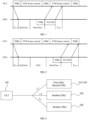
- FIGS. 1 and 2 depicts a schematic diagram showing the principle of ranging in a passive optical network
- FIG. 2 depicts a schematic diagram showing the operating sequence in a passive optical network
- PSBu denotes an uplink physical synchronization block
- PSBd denotes a downlink physical synchronization block
- PHY frame content denotes the physical frame content
- PLOAM denotes Physical layer Operations, Administration and Maintenance (PLOAM) channel.
- a ranging request sent by an OLT arrives at an ONU after a time of transmission delay passes.
- RspTime Response Time
- StartTime specifies the time for OLT to start uploading the response, which is typically set to 0 in PON ranging.
- T eqd is a value set by OLT according to the greatest optical fiber length, which is greater than or equal to the ONU with the farthest logical distance, and it is the round-trip delay for each ONU under the same PON port after delay compensation.
- the ONU must wait until the period of EqD passes, before processing the request of OLT, which can ensure the time synchronization of all ONUs under the same PON port.
- ONU does not report the local time variation parameters (such as response time, which is 35 ⁇ 1 ⁇ s as specified in the standard) to OLT.
- some embodiments of the present disclosure provide a method for time synchronization in PONs, an electronic apparatus, and a storage medium.
- the equalization delay or response time of the second ONU is matched with that of the first ONU.
- time synchronization can be realized when different ONUs access the branch optical fiber, thereby improving the compatibility of passive optical networks.
- the ONU can report its own response time related to ranging to the OLT during the activation of the ONU.
- the OLT can obtain the response time of the ONU during the normal operation of the ONU, such as the local response time of the ONU.
- the OLT can record this information and calculate the ranging result of the ONU, and calculates the ranging result of another ONU with this information between different ONUs, so that different ONUs can flexibly access in the same branch.
- the response time of each ONU can be set to be the same, so different ONUs can reuse EqD of other ONUs.
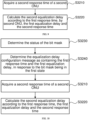
- FIG. 3 depicts a schematic diagram showing a system architecture in which a method for time synchronization in passive optical networks according to an embodiment of the present disclosure.
- the system architecture includes an optical line terminal (OLT) 100, a first optical network unit (ONU) 210/ a second ONU 220, and another ONU 230.
- the second ONU 220 is an ONU that accesses a passive optical network to take the place of the first ONU 210. That is, the second ONU 220 utilizes the same branch optical fiber as the first ONU 210.
- one or both of the first ONU 210 and the second ONU 220 may be a low-delay ONU or a non-low-delay ONU.
- OLT 100 is communicatively connected to each ONU through optical fibers.
- OLT 100 is communicatively connected with the first ONU/ second ONU through the first branch optical fiber L1.
- OLT 100 is communicatively connected with the other ONUs 230 through the second branch optical fiber L2 and the third branch optical fiber L3, respectively.
- the first ONU 210/ second ONU 220 is connected to a backhaul device 300 and a diagnosis and analysis system 100 through optical fibers.
- OLT 100 is communicatively connected with the first ONU/ second ONU through the first branch optical fiber L1.
- the second ONU 220 is an ONU that accesses a passive optical network to take the place of the first ONU 210. That is, the second ONU 220 utilizes the same branch optical fiber as the first ONU 210.
- the replacement of the first optical network unit ONU 210 by the second optical network unit ONU 220 can be a direct replacement or a replacement of the MAC chip of the ONU.
- FIG. 3 does not constitute a limitation to the embodiment of the present disclosure, and may include more or less components than those shown, or some components may be combined, or have different arrangements of components.
- each device can call its stored programs of time synchronization in passive optical networks to perform the method for time synchronization in passive optical networks.
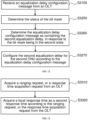
- FIG. 4 depicts a method for time synchronization in passive optical networks, which is applied to an OLT, the method includes the following operations.
- a first response time is acquired from a first ONU.
- a ranging calculation is carried out to the first ONU to obtain a first equalization delay (EqD).
- an equalization delay configuration message is generated according to the first response time and the first EqD.
- the equalization delay configuration message is sent to the second ONU to configure the second Eqd for the second ONU.
- the first ONU and the second ONU access the same branch optical fiber.
- S1100 may be performed in a plurality of communication processes between the OLT and ONUs. For example, in the discovery process during ONU activation, S 1100 is performed to obtain the response time from the first ONU, i.e., the first response time. S1100 may also be performed in the ranging process during ONU activation to obtain the first response time from the first ONU. And S 1100 may also be performed during the normal operation of the ONU to read the first response time from the first ONU.
- the embodiments of the present disclosure are not limited thereto.
- the first equalization delay obtained at S1200 can be utilized to configure the first ONU. That is, the first equalization delay is sent to the first ONU such that the first equalization delay of the first ONU is configured.
- the OLT can configure the first equalization delay of the first ONU through the equalization delay configuration message.
- the equalization delay configuration message may be a ranging result message (Ranging_Time message), and the contents of the ranging result message (Ranging_Time message) are shown in Table 2 below.
- the calculation of the second equalization delay can be carried out in the OLT or in the ONU (such as the second ONU).
- the embodiments of the present disclosure are not limited thereto.
- the equalization delay of the second ONU is configured through the OLT, so that the equalization delay of the second ONU is matched with that of the first ONU, and time synchronization can be realized when different ONUs access the branch optical fiber, thereby improving the compatibility of passive optical networks.
- the equalization delay configuration message includes a first response time and a first equalization delay.
- S1400 at which the equalization delay configuration message is sent to the second ONU to configure the second Eqd for the second ONU includes the following operations.
- the equalization delay configuration message is sent to the second ONU, to instruct the second ONU to calculate the second equalization delay according to the first response time, the first equalization delay, and the second response time of the second ONU.
- the calculation of the second EqD can be carried out in the second ONU.
- the OLT sends the first response time and the first equalization delay to the second ONU, during the generation of the equalization delay configuration message.
- the second ONU calculates the second equalization delay in conjunction with the local response time, i.e., the second response time.
- the first response time and the first equalization delay can be combined into a single one equalization delay configuration value, and a bit mask is set to indicate whether the equalization delay configuration message contains the response time, so as to be compatible with the protocol of the equalization delay configuration message sent by the OLT in the related schemes, as detailed below.
- the equalization delay configuration message further includes a bit mask.
- the bit mask set to the first state indicates that the equalization delay configuration message contains the first response time and the first equalization delay.
- a bit mask can be set in the equalization delay configuration message.
- the state of the bit mask indicates whether the equalization delay configuration message contains a response time.
- the first response time and the first equalization delay can be combined into a single one equalization delay configuration value.
- the bit mask set to the first state indicates that the equalization delay configuration value includes the first response time and the first equalization delay.
- the bit mask set to the second state indicates that the equalization delay configuration value includes the equalization delay (first equalization delay or second equalization delay, not including the response time).
- the equalization delay configuration message contains a second equalization delay.
- S1300 at which the equalization delay configuration message is generated according to the first response time and the first EqD includes the following operations.
- a second response time is acquired from a second ONU.
- the second equalization delay of the second ONU is calculated according to the first response time, the first equalization delay and the second response time.
- an equalization delay configuration message is generated according to the second equalization delay.
- the calculation of the second EqD can be carried out in the OLT.
- the OLT may obtain the second response time through S1310.
- the OLT can obtain the response time of the second ONU by means of the response information, Serial_Number_ONU message (ONU serial number report message, as shown in Table 1 below) in the related schemes.
- the OLT can also obtain the second response time from the second ONU by means of the response time feedback message (Response-Time message) as shown in Table 4 below.
- the equalization delay configuration message further includes a bit mask.
- the bit mask set to the second state indicates that the equalization delay configuration message contains the second equalization delay.
- a bit mask can be set in the equalization delay configuration message.
- the state of the bit mask indicates whether the equalization delay configuration message contains a response time.
- the first response time and the first equalization delay can be combined into a single one equalization delay configuration value.
- the bit mask set to the first state indicates that the equalization delay configuration value includes the first response time and the first equalization delay.
- the bit mask set to the second state indicates that the equalization delay configuration value includes the equalization delay (first equalization delay or second equalization delay, not including the response time).
- S1100 at which the first response time from the first ONU is acquired and stored, includes the following operations.
- one of, an SN request, a ranging request, or a response time acquisition request is sent to the first ONU.
- response information that carries the first response time is received from the first ONU.
- the SN request or ranging request may be a SN request or ranging request during ONU activation in the related scheme.
- the response time acquisition request may be a defined response time acquisition request, as shown in Table 3 below.
- the response information of the first ONU can be the Serial Number ONU message (ONU serial number report message) in the related scheme, as shown in Table 1 below.
- the response information of the first ONU can be a response time feedback message (Response-Time message), as shown in Table 4 below.
- the first ONU is a low-delay ONU
- the second ONU is a non-low-delay ONU
- the first ONU is a non-low-delay ONU
- the second ONU is a low-delay ONU.
- the first ONU is a low-delay ONU. If the first ONU needs to be replaced by a non-low-delay second ONU, the above method can be carried out to configure the equalization delay of the second ONU to achieve compatibility.
- the first ONU is a non-low delay ONU.
- both the first ONU and the second ONU can also be a low-delay ONU or a non-low-delay ONU, and the present disclosure is not limited thereto.
- the equalization delay of the second ONU is configured through the OLT, so that the equalization delay of the second ONU is matched with that of the first ONU, and time synchronization can be realized when different ONUs access the branch optical fiber, thereby improving the compatibility of passive optical networks.
- An embodiment of the present disclosure provides a method for time synchronization in passive optical networks, which is applied to a first ONU, the method includes the following operations.
- a first response time is sent to an OLT, to instruct the OLT to perform the method for time synchronization in passive optical networks as described above.
- S1100 to S1400 described in conjunction with FIG. 4 S2311 to S2313 described in conjunction with FIG. 5 , or S2321 to S2324 described in conjunction with FIG. 6 are carried out.
- the method for time synchronization in passive optical networks further includes the following operations.
- An equalization delay configuration message is received from the OLT to configure the first ONU. That is, the first equalization delay of the first ONU is configured by the first equalization delay sent to the first ONU.
- the equalization delay configuration message may be a ranging result message (Ranging_Time message), and the contents of the ranging result message (Ranging_Time message) are shown in Table 2 below.
- the equalization delay of the second ONU is configured through the OLT, so that the equalization delay of the second ONU is matched with that of the first ONU, and time synchronization can be realized when different ONUs access the branch optical fiber, thereby improving the compatibility of passive optical networks.
- the method before S2100 at which the first response time is sent to the OLT, the method further includes the following operations.
- one of, an SN request, a ranging request, or a response time acquisition request is acquired from an OLT.
- a local response time is acquired as a first response time according to one of, the SN request, the ranging request, or the response time acquisition request from the OLT.
- the OLT sends an SN request or a ranging request or a response time acquisition request to the first ONU by performing the above S1110.
- the first ONU obtains the SN request or ranging request or response time acquisition request from the OLT by performing S2200.
- the SN request or ranging request may be an SN request or ranging request during ONU activation in the related scheme.
- the response time acquisition request may be a defined response time acquisition request, as shown in Table 3 below.
- the response information of the first ONU can be the Serial_Number_ONU message (ONU serial number report message) in the related scheme, as shown in Table 1 below.
- the response information of the first ONU can be a response time feedback message (Response-Time message), as shown in Table 4 below.
- the equalization delay of the second ONU is configured through the OLT, so that the equalization delay of the second ONU is matched with that of the first ONU, and time synchronization can be realized when different ONUs access the branch optical fiber, thereby improving the compatibility of passive optical networks.
- An embodiment of the present disclosure provides a method for time synchronization in passive optical networks, which is applied to a second ONU. As shown in FIG. 8 , the method includes the following operations.
- an equalization delay configuration message is received from an OLT.
- a second equalization delay is configured for the second ONU according to the equalization delay configuration message; the second equalization delay is obtained by the OLT by performing the method for time synchronization in passive optical networks as described above.
- the second equalization delay is generated by the OLT performing the above S1100 to S1400 described in conjunction with FIG. 4 , S2311 to S2313 described in conjunction with FIG. 5 , or S2321 to S2324 described in conjunction with FIG. 6 .
- the equalization delay of the second ONU is configured through the OLT, so that the equalization delay of the second ONU is matched with that of the first ONU, and time synchronization can be realized when different ONUs access the branch optical fiber, thereby improving the compatibility of passive optical networks.
- the equalization delay configuration message includes a first response time and a first equalization delay.
- S3200 at which the second equalization delay is configured for the second ONU according to the equalization delay configuration message includes the following operations.
- a second response time of a second ONU is acquired.
- the second equalization delay is calculated according to the first response time, the first equalization delay and the second response time.
- the OLT performs the above S1410, at which an equalization delay configuration message is sent to the second ONU.
- the second ONU performs S3210 and S3220 to calculate the second equalization delay.
- the calculation of the second EqD can be carried out in the second ONU.
- the second ONU can obtain the local response time, i.e., the second response time through S3210.
- the second ONU calculates the second equalization delay in conjunction with the local response time, i.e., the second response time.
- the equalization delay configuration message further includes a bit mask.
- S3200 at which the second equalization delay is configured for the second ONU according to the equalization delay configuration message further includes the following operations.
- the state of the bit mask is determined.
- the equalization delay configuration message is determined as containing the first response time and the first equalization delay, in response to the bit mask being in the first state.
- the second ONU can identify whether the equalization delay configuration message contains the response time by the state of the bit mask. For example, the bit mask set to the first state, indicates that the equalization delay configuration value includes the first response time and the first equalization delay. Alternatively, the bit mask set to the second state, indicates that the equalization delay configuration value includes the equalization delay (first equalization delay or second equalization delay, not including the response time). In some embodiments, S3230 and S3240 precede S3210 and S3220. That is, when the bit mask is in the first state, it is determined that the equalization delay configuration message contains the first response time and the first equalization delay, and then the above S3210 and S3220 are performed to calculate the second equalization delay.
- the equalization delay configuration message contains a second equalization delay.
- the method for time synchronization in passive optical networks further includes the following operations.
- a second response time of a second ONU is acquired.
- the second response time is sent to the OLT, to instruct the OLT to calculate the second equalization delay according to the first response time, the first equalization delay and the second response time.
- S3300 and S3400 correspond to S1310 to S1330 described above.
- the ONU may send the second response time to the OLT by performing S3300 and S3400.
- the OLT can calculate the second equalization delay and generate an equalization delay configuration message by performing S1310 to S1330.
- the calculation of the second EqD can be carried out in the OLT.
- S3300 and S3400 precede S3100 and S3200.
- the second ONU may send a second response time to the OLT through S3300.
- the second ONU can send the second response time to the OLT by means of the response information, Serial Number ONU message (ONU serial number report message, as shown in Table 1 below) in the related schemes.
- the second ONU can also send the second response time to the OLT by means of the response time feedback message (Response-Time message) as shown in Table 4 below.
- the equalization delay configuration message further includes a bit mask.
- S3200 at which the second equalization delay is configured for the second ONU according to the equalization delay configuration message includes the following operations.
- the state of the bit mask is determined.
- the equalization delay configuration message is determined as containing the second equalization delay, in response to the bit mask being in the second state.
- the second equalization delay is configured for the second ONU according to the equalization delay configuration message.
- the second ONU can identify whether the equalization delay configuration message contains the response time by a state of the bit mask. For example, the bit mask set to the first state, indicates that the equalization delay configuration value includes the first response time and the first equalization delay. Alternatively, the bit mask set to the second state, indicates that the equalization delay configuration value includes the equalization delay (first equalization delay or second equalization delay, not including the response time).
- the equalization delay configuration message is determined as containing the second equalization delay, in response to the bit mask being in the second state, in that case, the second equalization delay can be directly employed.
- the method before S3300 at which the second response time of a second ONU is acquired the method includes the following operations.
- one of, an SN request, a ranging request, or a response time acquisition request is acquired from an OLT.
- a local response time is acquired as a second response time according to the SN request, the ranging request, or the response time acquisition request from the OLT.
- the SN request or ranging request may be a SN request or ranging request during ONU activation in the related scheme.
- the response time acquisition request may be a defined response time acquisition request, as shown in Table 3 below.
- the response information of the second ONU can be the Serial_Number_ONU message (ONU serial number report message in the related scheme, as shown in Table 1 below.
- the response information of the second ONU can also be a response time feedback message (Response-Time message), as shown in Table 4 below.
- the equalization delay of the second ONU is configured through the OLT, so that the equalization delay of the second ONU is matched with that of the first ONU, and time synchronization can be realized when different ONUs access the branch optical fiber, thereby improving the compatibility of passive optical networks.
- Scenario 1 acquisition of response time of ONU during activation.
- a first ONU reads the local response time (first response time) and reports the first response time to the OLT.
- the OLT records the first response time and ranging result (first equalization delay) of the first ONU.
- the OLT sends the first equalization delay and the first response time to the second ONU.
- the second ONU recalculates and applies its own second equalization delay according to the local response time (second response time). The following operations are included.
- the first ONU responds to the SN request or ranging request of the OLT, and carries the first response time in the response, as shown in Table 1 below, which is the response information, Serial_Number_ONU message (ONU serial number report message), where 17th-20th bytes carry the local response time.
- Table 1 Octet (bytes) Content Description 1-2 0x03FF Unassigned ONU-ID. 3 0x01 Message type ID "Serial_Number_ONU”. 4 0x00 Sequence number. 5-8 Vendor_ID
- the code set for the Vendor_ID is specified in [ATIS-0300220]. The four characters are mapped into the 4-byte field by taking each ASCII/ANSI character code and concatenating them.
- bytes 1-2 are 0x03FF, which identifies the unassigned ONU-ID.
- Byte 3 is 0x01, which identifies the message type is "ONU serial number report message”.
- Byte 4 is 0x00, which identifies the sequence number.
- Bytes 5-8 are the vendor's identifier.
- Bytes 9-12 are the serial number of the vendor.
- Bytes 13-16 identifies random delays.
- Bytes 17-20 identifies the response time.
- Bytes 21-40 are padding fields.
- Bytes 41-48 are check fields.
- the OLT calculates the ranging result of the ONU, records the first response time of the first ONU, and sends the ranging result to the first ONU according to the normal flow.
- the equalization delay configuration message can be a ranging result message (Ranging_Time message).
- the content of the ranging result message (Ranging_Time message) is shown in Table 2 below, where byte 5 is the bit mask (bit R).
- the first ONU After receiving the ranging result message (Ranging _Time message), the first ONU can directly configure its first equalization delay by the equalization delay configuration value.
- the second equalization delay is configured for the second ONU by Table 2.
- the bit R (bit mask) of byte 5 is set to 1 (first state), which indicates that the equalization delay configuration value, EqualizationDelay of bytes 6-9 is response time+equalization delay.
- the second ONU subtracts the local response time (second response time) from the EqualizationDelay of bytes 6-9, and the result of which is applied as the local equalization delay, EqD (the second equalization delay).
- Table 2 Octet (bytes) Content Description 1-2 ONU-ID Directed message to one ONU or broadcast message to all ONUs. As a broadcast to all ONUs, ONU-ID 0x03FF.
- EqualizationDelay contains the response time.
- Bit P 1-The delay in bytes 6-9 is absolute; ignore S.
- Bit P 0-The delay in bytes 6-9 is relative; S determines sign.
- Bit S 0-Positive: increase the current EqD by the specified value.
- Bit S 1-Negative: decrease the current EqD by the specified value.
- EqualizationDelay Equalization delay value, bit times with respect to the nominal upstream line rate of 2.48832 Gbit/s. 10-40 Padding Set to 0x00 by the transmitter; treated as "don't care" by the receiver. 41-48 MIC Message integrity check.
- Bytes 1-2 identifies ONU-ID.
- Byte 3 is 0x04, which identifies the message type is "ranging result message (Ranging_Time message)".
- Byte 4 is PLOAM sequence number.
- Byte 5 is a bit mask (with bit R) indicating how the equalization delay field shall be interpreted.
- Bytes 6-9 are the equalization delay configuration values.
- Bytes 10-40 are padding fields.
- Bytes 41-48 are check fields.
- bit R the first bit of byte 5 in ranging result message (Ranging_Time message) is originally served as a bit mask (bit R), which is modified to identify the state of the EqualizationDelay of bytes 6-9, thus improving the compatibility of the protocol.
- the response time of ONU may be or may not be fixed. That is, the response time of the same ONU for during each information processing can be the same or different.
- the response time of ONU is not fixed, it is necessary to recalculate the local equalization delay every time.
- Scenario 2 During the normal operation of ONU, OLT reads the response time of ONU.
- the OLT can request the first response time from the first ONU through a response time acquisition request message (Request_Response-Time message) as shown in Table 3.
- the first ONU can send the read first response time to the OLT through a response time feedback message (Response-Time message) as shown in Table 4.
- Table 3 Octet (bytes) Content Description 1-2 ONU-ID Directed message to one ONU. 3 0x14 Message type ID "Request_Response-Time”. 4 SeqNo Unicast PLOAM sequence number. 5-40 Padding Set to 0x00 by the transmitter; treated as "don't care" by the receiver. 41-48 MIC Message integrity check computed using the default PLOAM integrity key (see clause 15.8).
- Bytes 1-2 indicate ONU-ID.
- Byte 3 is 0x11, which identifies the message type is "response time feedback message”.
- Byte 4 identifiers PLOAM sequence number.
- Bytes 5-40 identifies the response time.
- Bytes 41-48 are check fields.
- the equalization delay of the second ONU can be configured through the ranging result message (Ranging_Time message) as shown in Table 2.
- bit R (bit mask) of byte 5 of the ranging result message is set to 1 (first state)
- the equalization delay configuration value, EqualizationDelay of bytes 6-9 is the first response time+first equalization delay.
- the non-low-delay ONU subtracts the local response time (second response time) from the EqualizationDelay of bytes 6-9, and the result of which is applied as the local equalization delay (the second equalization delay).
- Scenario 3 Acquisition of the response time of ONU during restart of the second ONU.
- the first ONU is a low-delay ONU and the second ONU is a non-low-delay ONU that replaces the first ONU.
- OLT can also acquire the second response time of the non-low delay ONU through message interaction in Table 3 and Table 4.
- the second equalization delay of the non-low-delay ONU is acquired and sent to the second ONU.
- An embodiment of the present disclosure provides a method for time synchronization in passive optical networks, the method includes the following operations.
- a response time configuration instruction is sent to a second ONU to configure the response time of the second ONU, so that the response time of the second ONU matches the response time of the first ONU.
- the first ONU and the second ONU access the same branch optical fiber.
- this method can be applied to an OLT, and can also be applied to the factory configuration equipment for ONU.
- the response time of all ONUs can be set to be the same, so different ONUs can reuse the equalization delay EqD of other ONUs.
- the second ONU can reuse the equalization delay of the first ONU.
- the response time of all ONU can be fixed, and ONU can obtain the response time, such as fixing the response time to the maximum value of 35+1 ⁇ s.
- the method set forth in the present disclosure can be applied to the factory configuration equipment for OLTs.
- the factory standard of ONU can be modified, and the response time can be modified to the maximum value of 35+1 ⁇ s. However, such modification is not compatible with the old fashion equipment.
- the method provided by some embodiments of the present disclosure can be applied to OLTs.
- OLT can allocate the response time to ONU through this message.
- the response time configuration instruction can be a Set_Response-time message as shown in Table 5 below.
- the ONU sets the local response time to the value indicated by the field of Response time in the Set Response-time message.
- Table 5 Octet (byte) Content Description 1-2 ONU-ID Directed message to one ONU. 3 0x13 Message type ID "Set_Response-Time". 4 SeqNo Unicast PLOAM sequence number. 5-8 Response time
- the OLT assigns the response time to the ONU. 9-40 Padding Set to 0x00 by the transmitter; treated as "don't care" by the receiver. 41-48 MIC Message integrity check computed using the default PLOAM integrity key (see clause 15.8).
- bytes 1-2 indicates the ONU-ID.
- the third byte is 0x13, which indicates that the message type is "Response Time Configuration Instruction";
- the fourth byte is PLOAM sequence number;
- the 5th-8th byte is the response time;
- Bytes 9-40 are padding fields;
- Bytes 41-48 are check fields.
- the response time of each ONU is the same, and the EqD of different ONUs on the same branch fiber is also the same, so the second ONU can reuse the EqD of the first ONU.
- a non-low-delay ONU can reuse the EqD of a low-delay ONU or a low-delay ranging instrument.
- the response time of the second ONU is configured through the OLT, so that the response time of the second ONU is matched with that of the first ONU, and time synchronization can be realized when different ONUs access the branch optical fiber, thereby improving the compatibility of passive optical networks.
- An embodiment of the present disclosure provides a method for time synchronization in passive optical networks, which is applied to a second ONU. As shown in FIG. 14 , the method includes the following operations.
- the response time of the second ONU is configured according to the response time configuration instruction, so that the response time of the second ONU matches the response time of the first ONU.
- the first ONU and the second ONU access the same branch optical fiber.
- the response time configuration instruction may come from the OLT, or may come from the factory configuration equipment for the ONU.
- the response time of all ONUs can be set to be the same, so different ONUs can reuse the equalization delay EqD of other ONUs.
- the second ONU can reuse the equalization delay of the first ONU.
- the response time of all ONU can be fixed, and ONU can obtain the response time, such as fixing the response time to the maximum value of 35+1 ⁇ s.
- the response time configuration instruction may come from the factory configuration equipment for the ONU.
- the factory standard of ONU can be modified, and the response time of ONU can be modified to the maximum value of 35+1 ⁇ s. However, such modification is not compatible with the old fashion equipment.
- the response time configuration instruction may come from the OLT.
- OLT can allocate the response time to ONU through this message.
- the response time configuration instruction can be a Set_Response-time message as shown in Table 5 below.
- the ONU sets the local response time to the value indicated by the field of Response_time in the Set_Response-time message.
- Table 5 Octet (byte) Content Description 1-2 ONU-ID Directed message to one ONU. 3 0x13 Message type ID "Set_Response-Time". 4 SeqNo Unicast PLOAM sequence number. 5-8 Response time
- the OLT assigns the response time to the ONU. 9-40 Padding Set to 0x00 by the transmitter; treated as "don't care" by the receiver. 41-48 MIC Message integrity check computed using the default PLOAM integrity key (see clause 15.8).
- Bytes 1-2 indicate the ONU-ID.
- Byte 3 is 0x13, which indicates that the message type is "Response Time Configuration Instruction”.
- Byte 4 is the PLOAM sequence number.
- Bytes 5-8 indicate the response time.
- Bytes 9-40 are padding fields.
- Bytes 41-48 are check fields.
- the response time of each ONU is the same, and the EqD of different ONUs on the same branch fiber is also the same, so the second ONU can reuse the EqD of the first ONU.
- a non-low-delay ONU can reuse the EqD of a low-delay ONU or a low-delay ranging instrument.
- the response time of the second ONU is configured through the OLT, so that the response time of the second ONU is matched with that of the first ONU, and time synchronization can be realized when different ONUs access the branch optical fiber, thereby improving the compatibility of passive optical networks.
- an embodiment of the present disclosure provides a device for time synchronization in passive optical networks, the device includes the following modules.
- An acquisition module 110 which is configured to acquire a first response time from a first ONU.
- a calculation module 120 which is configured to perform a ranging calculation to the first ONU to obtain a first equalization delay.
- a generating module 130 which is configured to generate an equalization delay configuration message according to the first response time and the first equalization delay.
- a sending module 140 which is configured to send an equalization delay configuration message to a second ONU to configure a second equalization delay for the second ONU.
- the first ONU and the second ONU access the same branch optical fiber.
- the acquisition module 110 is configured to perform the above operation S1100.
- the calculation module 120 is configured to perform the above operation S1200.
- the generating module 130 is configured to perform the above operation S1300.
- the sending module 140 is configured to perform the above operation S1400.
- the device for time synchronization in passive optical networks in this embodiment can be implemented as the device for time synchronization in passive optical networks in the system architecture of the embodiment shown in FIG. 3 .
- the device for time synchronization in passive optical networks in this embodiment can perform the method for time synchronization in passive optical networks in the embodiment shown in FIG. 4 .
- the device for time synchronization in passive optical networks in this embodiment the device for time synchronization in passive optical networks in the system architecture of the embodiment shown in FIG. 3 , and the method for time synchronization in passive optical networks in the embodiment shown in FIG. 4 all shall the same inventive concept, so these embodiments have the same implementation principle and technical effect, and which will not be described in detail here.
- An embodiment of the present disclosure provides an electronic apparatus, which includes a memory, a processor, and a computer program stored in the memory and executable on the processor which, when executed by the processor, causes the processor to carry out the method as described above.
- the memory can be configured to store non-transitory software programs and non-transitory computer-executable programs.
- the memory may include high-speed random-access memory and non-transitory memory, such as at least one disk memory device, flash memory device, or other non-transitory solid-state memory devices.
- the memory includes memories remotely located with respect to the processor, and these remote memories may be connected to the processor through a network. Examples of the above networks include, but are not limited to, the Internet, intranet, local area network, mobile communication network, and combinations thereof.
- the electronic apparatus in this embodiment can be implemented as the electronic apparatus in the system architecture of the embodiment shown in FIG. 3 .
- the electronic apparatus in this embodiment can perform the method for time synchronization in passive optical networks in the embodiment shown in FIG. 4 . That is, the electronic apparatus in this embodiment, the electronic apparatus in the system architecture of the embodiment shown in FIG. 3 , and the method for time synchronization in passive optical networks in the embodiment shown in FIG. 4 all shall the same inventive concept, so these embodiments have the same implementation principle and technical effect, and which will not be described in detail here.
- Non-transitory software programs and instructions for the method for time synchronization in passive optical networks in any one of the above embodiments are stored in a memory which when executed by a processor, causes the processor to carry out the method for time synchronization in passive optical networks of any one of the above embodiments, for example, operations S1100 to S1400 described in conjunction with FIG. 4 , S1310 to S1330 described in conjunction with FIG. 5 , S1110 to S1120 described in conjunction with FIG. 6 , S2200, S2300 and S2100 described in conjunction with FIG. 7 , S3100 to S3200 described in conjunction with FIG. 8 , S3210 to S3220 described in conjunction with FIG. 9 , S3240, S3210 and S3220 described in conjunction with FIG.
- An embodiment of the present disclosure provides a computer-readable storage medium storing a computer-executable instruction which when executed by a processor, causes the processor to carry out the method for time synchronization in a passive optical network as described above.
- the computer-readable medium stores a computer-executable program which, when executed by a processor or a controller (such as a processor in the diagnosis and analysis system 100), causes the processor or controller to carry out the method for time synchronization in passive optical networks of any one of the above embodiments, for example, operations S1100 to S1400 described in conjunction with FIG. 4 , S1310 to S1330 described in conjunction with FIG. 5 , S1110 to S1120 described in conjunction with FIG. 6 , S2200, S2300 and S2100 described in conjunction with FIG. 7 , S3100 to S3200 described in conjunction with FIG. 8 , S3210 to S3220 described in conjunction with FIG.
- a processor or a controller such as a processor in the diagnosis and analysis system 100
- An embodiment of the present disclosure provides a method for time synchronization in a PON, which is applied to an OLT, the method includes, acquiring a first response time from a first ONU; performing ranging calculation to the first ONU to acquire a first equalization time delay; generating an equalization delay configuration message according to the first response time and the first equalization delay; sending the equalization delay configuration message to a second ONU to configure a second equalization delay of the second ONU; where, the first ONU and the second ONU access the same branch optical fiber.
- the equalization delay or response time of the second ONU is configured through the OLT, so that the equalization delay or response time of the second ONU is matched with that of the first ONU, and time synchronization can be realized when different ONUs access the branch optical fiber, thereby improving the compatibility of passive optical networks.
- Computer storage medium includes, but is not limited to, RAM, ROM, EEPROM, flash memory or other memory technologies, CD-ROM, digital versatile disks (DVD) or other optical disk storage, magnetic boxes, tapes, magnetic disk storage or other magnetic storage devices, or any other medium that can be used to store desired information and accessible by a computer.
- communication media usually contains computer-readable instructions, data structures, program modules or other data in modulated data signals such as carrier waves or other transmission mechanisms, and can include any information delivery media.
Landscapes
- Engineering & Computer Science (AREA)
- Computer Networks & Wireless Communication (AREA)
- Signal Processing (AREA)
- Small-Scale Networks (AREA)
- Optical Communication System (AREA)
- Synchronisation In Digital Transmission Systems (AREA)
Applications Claiming Priority (2)
| Application Number | Priority Date | Filing Date | Title |
|---|---|---|---|
| CN202110284376.XA CN115119083A (zh) | 2021-03-17 | 2021-03-17 | 无源光网络时间同步方法、电子设备及存储介质 |
| PCT/CN2021/136142 WO2022193744A1 (zh) | 2021-03-17 | 2021-12-07 | 无源光网络时间同步方法、电子设备及存储介质 |
Publications (2)
| Publication Number | Publication Date |
|---|---|
| EP4311256A1 true EP4311256A1 (de) | 2024-01-24 |
| EP4311256A4 EP4311256A4 (de) | 2024-09-04 |
Family
ID=83321676
Family Applications (1)
| Application Number | Title | Priority Date | Filing Date |
|---|---|---|---|
| EP21931318.6A Pending EP4311256A4 (de) | 2021-03-17 | 2021-12-07 | Zeitsynchronisationsverfahren für ein passives optisches netzwerk sowie elektronische vorrichtung und speichermedium |
Country Status (6)
| Country | Link |
|---|---|
| US (1) | US12621592B2 (de) |
| EP (1) | EP4311256A4 (de) |
| CN (1) | CN115119083A (de) |
| BR (1) | BR112023018675A2 (de) |
| MX (1) | MX2023010832A (de) |
| WO (1) | WO2022193744A1 (de) |
Families Citing this family (1)
| Publication number | Priority date | Publication date | Assignee | Title |
|---|---|---|---|---|
| CN120730204A (zh) * | 2024-03-27 | 2025-09-30 | 中兴通讯股份有限公司 | Pon端口的倒换方法、电子设备及存储介质 |
Family Cites Families (10)
| Publication number | Priority date | Publication date | Assignee | Title |
|---|---|---|---|---|
| CN101290213B (zh) * | 2007-04-20 | 2011-12-21 | 华为技术有限公司 | 光纤长度测量方法、通信设备、通信系统 |
| US20100183316A1 (en) * | 2009-01-20 | 2010-07-22 | Telefonaktiebolaget L M Ericsson (Publ) | Methods and Systems for Dynamic Equalization Delay Passive Optical Networks |
| JP5315282B2 (ja) | 2010-04-01 | 2013-10-16 | 株式会社日立製作所 | 受動光網システム |
| US10020889B2 (en) * | 2015-03-25 | 2018-07-10 | Futurewei Technologies, Inc. | Channel ranging adjustment in multiple-wavelength passive optical networks (PONs) |
| CN106301642B (zh) | 2015-05-14 | 2018-11-09 | 深圳市中兴微电子技术有限公司 | 一种无源光网络系统的时钟同步方法及装置 |
| CN108242953B (zh) | 2016-12-26 | 2022-07-05 | 中兴通讯股份有限公司 | 一种onu测距方法、onu内部时延调整参数确定方法及装置 |
| CN110226299B (zh) * | 2017-02-28 | 2021-06-04 | 华为技术有限公司 | 无源光网络系统中通信的方法、光线路终端和光网络单元 |
| WO2018170836A1 (zh) | 2017-03-23 | 2018-09-27 | 华为技术有限公司 | 一种通信配置方法、光线路终端以及光网络单元 |
| CN109104646A (zh) | 2017-06-21 | 2018-12-28 | 中兴通讯股份有限公司 | 一种光网络单元注册方法及装置 |
| US20190356389A1 (en) | 2018-05-17 | 2019-11-21 | Nokia Solutions And Networks Oy | Method and apparatus for ranging new optical network unit in passive optical network system without impacting traffic of ranged optical network unit |
-
2021
- 2021-03-17 CN CN202110284376.XA patent/CN115119083A/zh active Pending
- 2021-12-07 BR BR112023018675A patent/BR112023018675A2/pt unknown
- 2021-12-07 MX MX2023010832A patent/MX2023010832A/es unknown
- 2021-12-07 EP EP21931318.6A patent/EP4311256A4/de active Pending
- 2021-12-07 WO PCT/CN2021/136142 patent/WO2022193744A1/zh not_active Ceased
- 2021-12-07 US US18/550,763 patent/US12621592B2/en active Active
Also Published As
| Publication number | Publication date |
|---|---|
| US20240163592A1 (en) | 2024-05-16 |
| EP4311256A4 (de) | 2024-09-04 |
| US12621592B2 (en) | 2026-05-05 |
| CN115119083A (zh) | 2022-09-27 |
| WO2022193744A1 (zh) | 2022-09-22 |
| MX2023010832A (es) | 2023-09-28 |
| BR112023018675A2 (pt) | 2023-10-03 |
Similar Documents
| Publication | Publication Date | Title |
|---|---|---|
| US10986427B2 (en) | Method, equipment, and system for detecting and authenticating terminal in passive optical network | |
| US11652564B2 (en) | Data communications system, optical line terminal, and baseband unit | |
| US8139950B2 (en) | Passive optical network system, optical line terminator and, communication method of passive optical network system | |
| US7936992B2 (en) | Apparatus of adjusting optical signal transmission timing | |
| CN102075820B (zh) | 在无源光网络中测距的方法和装置 | |
| US8965206B2 (en) | Network system, station-side apparatus, and method of controlling communications | |
| US20180316992A1 (en) | Dynamic bandwidth assignment method and apparatus, and passive optical network system | |
| CN108270749B (zh) | 一种虚拟光网络单元的注册方法及系统 | |
| EP2352238A1 (de) | Verfahren zur verzögerungssteuerung in einem passiven optischen netzwerk, optisches leitungsendgerät und passives optisches netzwerk | |
| EP2434666A1 (de) | Verfahren, vorrichtung und system zur erkennung von verknüpfungsfehlern | |
| EP4529324A1 (de) | Datenübertragungsverfahren und -vorrichtung | |
| CN112313890A (zh) | 多速率光网络单元(onu)激活 | |
| CN114567827A (zh) | 确定无源光网络传输时延的方法 | |
| KR20140083160A (ko) | 광 회선 단말 및 그것의 광 네트워크 단말 등록 방법 | |
| JP5315282B2 (ja) | 受動光網システム | |
| CN101252388B (zh) | 数据发送的方法及装置 | |
| EP2706716A2 (de) | Verfahren und vorrichtung zur datenverarbeitung in einem passiven optischen netzwerk | |
| CN110476374A (zh) | 无源光网络距离延伸器的控制和管理 | |
| US12621592B2 (en) | Time synchronization method for passive optical network, and electronic device and storage medium | |
| JP2011160022A (ja) | Ponシステム及び光信号送受信制御方法 | |
| CN101583053B (zh) | 一种由gpon系统处理非法光网络单元的方法 | |
| KR101679628B1 (ko) | Pon 구조 기반 정밀 시간 동기화 시스템 및 방법 | |
| KR100606027B1 (ko) | 수동형 광 가입자망을 통한 이더넷 프레임 전송시 왕복시간지연을 보상하는 방법 및 그 수동형 광 가입자망 시스템 | |
| EP4668773A1 (de) | Informationsanfrageverfahren, optische netzwerkeinheit und optisches leitungsendgerät | |
| US20230379072A1 (en) | Communication method and device |
Legal Events
| Date | Code | Title | Description |
|---|---|---|---|
| STAA | Information on the status of an ep patent application or granted ep patent |
Free format text: STATUS: THE INTERNATIONAL PUBLICATION HAS BEEN MADE |
|
| PUAI | Public reference made under article 153(3) epc to a published international application that has entered the european phase |
Free format text: ORIGINAL CODE: 0009012 |
|
| STAA | Information on the status of an ep patent application or granted ep patent |
Free format text: STATUS: REQUEST FOR EXAMINATION WAS MADE |
|
| 17P | Request for examination filed |
Effective date: 20231017 |
|
| AK | Designated contracting states |
Kind code of ref document: A1 Designated state(s): AL AT BE BG CH CY CZ DE DK EE ES FI FR GB GR HR HU IE IS IT LI LT LU LV MC MK MT NL NO PL PT RO RS SE SI SK SM TR |
|
| DAV | Request for validation of the european patent (deleted) | ||
| DAX | Request for extension of the european patent (deleted) | ||
| A4 | Supplementary search report drawn up and despatched |
Effective date: 20240806 |
|
| RIC1 | Information provided on ipc code assigned before grant |
Ipc: H04J 3/06 20060101ALI20240731BHEP Ipc: H04Q 11/00 20060101AFI20240731BHEP |
|
| STAA | Information on the status of an ep patent application or granted ep patent |
Free format text: STATUS: EXAMINATION IS IN PROGRESS |
|
| 17Q | First examination report despatched |
Effective date: 20251125 |