EP4310366B1 - Kraftübertragungsvorrichtung - Google Patents
Kraftübertragungsvorrichtung Download PDFInfo
- Publication number
- EP4310366B1 EP4310366B1 EP22769556.6A EP22769556A EP4310366B1 EP 4310366 B1 EP4310366 B1 EP 4310366B1 EP 22769556 A EP22769556 A EP 22769556A EP 4310366 B1 EP4310366 B1 EP 4310366B1
- Authority
- EP
- European Patent Office
- Prior art keywords
- oil
- rotation axis
- shaft
- gear
- case member
- Prior art date
- Legal status (The legal status is an assumption and is not a legal conclusion. Google has not performed a legal analysis and makes no representation as to the accuracy of the status listed.)
- Active
Links
Images





Classifications
-
- F—MECHANICAL ENGINEERING; LIGHTING; HEATING; WEAPONS; BLASTING
- F16—ENGINEERING ELEMENTS AND UNITS; GENERAL MEASURES FOR PRODUCING AND MAINTAINING EFFECTIVE FUNCTIONING OF MACHINES OR INSTALLATIONS; THERMAL INSULATION IN GENERAL
- F16H—GEARING
- F16H57/00—General details of gearing
- F16H57/02—Gearboxes; Mounting gearing therein
- F16H57/021—Shaft support structures, e.g. partition walls, bearing eyes, casing walls or covers with bearings
-
- B—PERFORMING OPERATIONS; TRANSPORTING
- B60—VEHICLES IN GENERAL
- B60K—ARRANGEMENT OR MOUNTING OF PROPULSION UNITS OR OF TRANSMISSIONS IN VEHICLES; ARRANGEMENT OR MOUNTING OF PLURAL DIVERSE PRIME-MOVERS IN VEHICLES; AUXILIARY DRIVES FOR VEHICLES; INSTRUMENTATION OR DASHBOARDS FOR VEHICLES; ARRANGEMENTS IN CONNECTION WITH COOLING, AIR INTAKE, GAS EXHAUST OR FUEL SUPPLY OF PROPULSION UNITS IN VEHICLES
- B60K1/00—Arrangement or mounting of electrical propulsion units
-
- F—MECHANICAL ENGINEERING; LIGHTING; HEATING; WEAPONS; BLASTING
- F16—ENGINEERING ELEMENTS AND UNITS; GENERAL MEASURES FOR PRODUCING AND MAINTAINING EFFECTIVE FUNCTIONING OF MACHINES OR INSTALLATIONS; THERMAL INSULATION IN GENERAL
- F16H—GEARING
- F16H48/00—Differential gearings
- F16H48/06—Differential gearings with gears having orbital motion
- F16H48/08—Differential gearings with gears having orbital motion comprising bevel gears
-
- F—MECHANICAL ENGINEERING; LIGHTING; HEATING; WEAPONS; BLASTING
- F16—ENGINEERING ELEMENTS AND UNITS; GENERAL MEASURES FOR PRODUCING AND MAINTAINING EFFECTIVE FUNCTIONING OF MACHINES OR INSTALLATIONS; THERMAL INSULATION IN GENERAL
- F16H—GEARING
- F16H48/00—Differential gearings
- F16H48/38—Constructional details
- F16H48/40—Constructional details characterised by features of the rotating cases
-
- F—MECHANICAL ENGINEERING; LIGHTING; HEATING; WEAPONS; BLASTING
- F16—ENGINEERING ELEMENTS AND UNITS; GENERAL MEASURES FOR PRODUCING AND MAINTAINING EFFECTIVE FUNCTIONING OF MACHINES OR INSTALLATIONS; THERMAL INSULATION IN GENERAL
- F16H—GEARING
- F16H57/00—General details of gearing
- F16H57/04—Features relating to lubrication or cooling or heating
- F16H57/042—Guidance of lubricant
- F16H57/0421—Guidance of lubricant on or within the casing, e.g. shields or baffles for collecting lubricant, tubes, pipes, grooves, channels or the like
- F16H57/0424—Lubricant guiding means in the wall of or integrated with the casing, e.g. grooves, channels, holes
-
- B—PERFORMING OPERATIONS; TRANSPORTING
- B60—VEHICLES IN GENERAL
- B60K—ARRANGEMENT OR MOUNTING OF PROPULSION UNITS OR OF TRANSMISSIONS IN VEHICLES; ARRANGEMENT OR MOUNTING OF PLURAL DIVERSE PRIME-MOVERS IN VEHICLES; AUXILIARY DRIVES FOR VEHICLES; INSTRUMENTATION OR DASHBOARDS FOR VEHICLES; ARRANGEMENTS IN CONNECTION WITH COOLING, AIR INTAKE, GAS EXHAUST OR FUEL SUPPLY OF PROPULSION UNITS IN VEHICLES
- B60K1/00—Arrangement or mounting of electrical propulsion units
- B60K2001/001—Arrangement or mounting of electrical propulsion units one motor mounted on a propulsion axle for rotating right and left wheels of this axle
-
- B—PERFORMING OPERATIONS; TRANSPORTING
- B60—VEHICLES IN GENERAL
- B60Y—INDEXING SCHEME RELATING TO ASPECTS CROSS-CUTTING VEHICLE TECHNOLOGY
- B60Y2306/00—Other features of vehicle sub-units
- B60Y2306/03—Lubrication
-
- B—PERFORMING OPERATIONS; TRANSPORTING
- B60—VEHICLES IN GENERAL
- B60Y—INDEXING SCHEME RELATING TO ASPECTS CROSS-CUTTING VEHICLE TECHNOLOGY
- B60Y2400/00—Special features of vehicle units
- B60Y2400/70—Gearings
- B60Y2400/73—Planetary gearings
-
- B—PERFORMING OPERATIONS; TRANSPORTING
- B60—VEHICLES IN GENERAL
- B60Y—INDEXING SCHEME RELATING TO ASPECTS CROSS-CUTTING VEHICLE TECHNOLOGY
- B60Y2410/00—Constructional features of vehicle sub-units
- B60Y2410/10—Housings
-
- B—PERFORMING OPERATIONS; TRANSPORTING
- B60—VEHICLES IN GENERAL
- B60Y—INDEXING SCHEME RELATING TO ASPECTS CROSS-CUTTING VEHICLE TECHNOLOGY
- B60Y2410/00—Constructional features of vehicle sub-units
- B60Y2410/102—Shaft arrangements; Shaft supports, e.g. bearings
-
- F—MECHANICAL ENGINEERING; LIGHTING; HEATING; WEAPONS; BLASTING
- F16—ENGINEERING ELEMENTS AND UNITS; GENERAL MEASURES FOR PRODUCING AND MAINTAINING EFFECTIVE FUNCTIONING OF MACHINES OR INSTALLATIONS; THERMAL INSULATION IN GENERAL
- F16H—GEARING
- F16H48/00—Differential gearings
- F16H48/38—Constructional details
- F16H2048/382—Methods for manufacturing differential gearings
-
- F—MECHANICAL ENGINEERING; LIGHTING; HEATING; WEAPONS; BLASTING
- F16—ENGINEERING ELEMENTS AND UNITS; GENERAL MEASURES FOR PRODUCING AND MAINTAINING EFFECTIVE FUNCTIONING OF MACHINES OR INSTALLATIONS; THERMAL INSULATION IN GENERAL
- F16H—GEARING
- F16H57/00—General details of gearing
- F16H57/02—Gearboxes; Mounting gearing therein
- F16H2057/02008—Gearboxes; Mounting gearing therein characterised by specific dividing lines or planes of the gear case
-
- F—MECHANICAL ENGINEERING; LIGHTING; HEATING; WEAPONS; BLASTING
- F16—ENGINEERING ELEMENTS AND UNITS; GENERAL MEASURES FOR PRODUCING AND MAINTAINING EFFECTIVE FUNCTIONING OF MACHINES OR INSTALLATIONS; THERMAL INSULATION IN GENERAL
- F16H—GEARING
- F16H57/00—General details of gearing
- F16H57/0018—Shaft assemblies for gearings
- F16H57/0025—Shaft assemblies for gearings with gearing elements rigidly connected to a shaft, e.g. securing gears or pulleys by specially adapted splines, keys or methods
-
- F—MECHANICAL ENGINEERING; LIGHTING; HEATING; WEAPONS; BLASTING
- F16—ENGINEERING ELEMENTS AND UNITS; GENERAL MEASURES FOR PRODUCING AND MAINTAINING EFFECTIVE FUNCTIONING OF MACHINES OR INSTALLATIONS; THERMAL INSULATION IN GENERAL
- F16H—GEARING
- F16H57/00—General details of gearing
- F16H57/02—Gearboxes; Mounting gearing therein
- F16H57/037—Gearboxes for accommodating differential gearings
-
- F—MECHANICAL ENGINEERING; LIGHTING; HEATING; WEAPONS; BLASTING
- F16—ENGINEERING ELEMENTS AND UNITS; GENERAL MEASURES FOR PRODUCING AND MAINTAINING EFFECTIVE FUNCTIONING OF MACHINES OR INSTALLATIONS; THERMAL INSULATION IN GENERAL
- F16H—GEARING
- F16H57/00—General details of gearing
- F16H57/04—Features relating to lubrication or cooling or heating
- F16H57/042—Guidance of lubricant
- F16H57/043—Guidance of lubricant within rotary parts, e.g. axial channels or radial openings in shafts
-
- F—MECHANICAL ENGINEERING; LIGHTING; HEATING; WEAPONS; BLASTING
- F16—ENGINEERING ELEMENTS AND UNITS; GENERAL MEASURES FOR PRODUCING AND MAINTAINING EFFECTIVE FUNCTIONING OF MACHINES OR INSTALLATIONS; THERMAL INSULATION IN GENERAL
- F16H—GEARING
- F16H57/00—General details of gearing
- F16H57/04—Features relating to lubrication or cooling or heating
- F16H57/045—Lubricant storage reservoirs, e.g. reservoirs in addition to a gear sump for collecting lubricant in the upper part of a gear case
-
- F—MECHANICAL ENGINEERING; LIGHTING; HEATING; WEAPONS; BLASTING
- F16—ENGINEERING ELEMENTS AND UNITS; GENERAL MEASURES FOR PRODUCING AND MAINTAINING EFFECTIVE FUNCTIONING OF MACHINES OR INSTALLATIONS; THERMAL INSULATION IN GENERAL
- F16H—GEARING
- F16H57/00—General details of gearing
- F16H57/04—Features relating to lubrication or cooling or heating
- F16H57/0457—Splash lubrication
-
- F—MECHANICAL ENGINEERING; LIGHTING; HEATING; WEAPONS; BLASTING
- F16—ENGINEERING ELEMENTS AND UNITS; GENERAL MEASURES FOR PRODUCING AND MAINTAINING EFFECTIVE FUNCTIONING OF MACHINES OR INSTALLATIONS; THERMAL INSULATION IN GENERAL
- F16H—GEARING
- F16H57/00—General details of gearing
- F16H57/04—Features relating to lubrication or cooling or heating
- F16H57/0467—Elements of gearings to be lubricated, cooled or heated
- F16H57/0469—Bearings or seals
- F16H57/0471—Bearing
-
- F—MECHANICAL ENGINEERING; LIGHTING; HEATING; WEAPONS; BLASTING
- F16—ENGINEERING ELEMENTS AND UNITS; GENERAL MEASURES FOR PRODUCING AND MAINTAINING EFFECTIVE FUNCTIONING OF MACHINES OR INSTALLATIONS; THERMAL INSULATION IN GENERAL
- F16H—GEARING
- F16H57/00—General details of gearing
- F16H57/04—Features relating to lubrication or cooling or heating
- F16H57/0467—Elements of gearings to be lubricated, cooled or heated
- F16H57/0479—Gears or bearings on planet carriers
-
- F—MECHANICAL ENGINEERING; LIGHTING; HEATING; WEAPONS; BLASTING
- F16—ENGINEERING ELEMENTS AND UNITS; GENERAL MEASURES FOR PRODUCING AND MAINTAINING EFFECTIVE FUNCTIONING OF MACHINES OR INSTALLATIONS; THERMAL INSULATION IN GENERAL
- F16H—GEARING
- F16H57/00—General details of gearing
- F16H57/04—Features relating to lubrication or cooling or heating
- F16H57/048—Type of gearings to be lubricated, cooled or heated
- F16H57/0482—Gearings with gears having orbital motion
- F16H57/0483—Axle or inter-axle differentials
-
- F—MECHANICAL ENGINEERING; LIGHTING; HEATING; WEAPONS; BLASTING
- F16—ENGINEERING ELEMENTS AND UNITS; GENERAL MEASURES FOR PRODUCING AND MAINTAINING EFFECTIVE FUNCTIONING OF MACHINES OR INSTALLATIONS; THERMAL INSULATION IN GENERAL
- F16H—GEARING
- F16H57/00—General details of gearing
- F16H57/04—Features relating to lubrication or cooling or heating
- F16H57/048—Type of gearings to be lubricated, cooled or heated
- F16H57/0482—Gearings with gears having orbital motion
- F16H57/0486—Gearings with gears having orbital motion with fixed gear ratio
-
- F—MECHANICAL ENGINEERING; LIGHTING; HEATING; WEAPONS; BLASTING
- F16—ENGINEERING ELEMENTS AND UNITS; GENERAL MEASURES FOR PRODUCING AND MAINTAINING EFFECTIVE FUNCTIONING OF MACHINES OR INSTALLATIONS; THERMAL INSULATION IN GENERAL
- F16H—GEARING
- F16H57/00—General details of gearing
- F16H57/08—General details of gearing of gearings with members having orbital motion
- F16H57/082—Planet carriers
-
- F—MECHANICAL ENGINEERING; LIGHTING; HEATING; WEAPONS; BLASTING
- F16—ENGINEERING ELEMENTS AND UNITS; GENERAL MEASURES FOR PRODUCING AND MAINTAINING EFFECTIVE FUNCTIONING OF MACHINES OR INSTALLATIONS; THERMAL INSULATION IN GENERAL
- F16H—GEARING
- F16H63/00—Control outputs from the control unit to change-speed- or reversing-gearings for conveying rotary motion or to other devices than the final output mechanism
- F16H63/02—Final output mechanisms therefor; Actuating means for the final output mechanisms
- F16H63/30—Constructional features of the final output mechanisms
- F16H63/34—Locking or disabling mechanisms
- F16H63/3416—Parking lock mechanisms or brakes in the transmission
- F16H63/3425—Parking lock mechanisms or brakes in the transmission characterised by pawls or wheels
Definitions
- the present invention relates to a power transmission device.
- Patent Documents 1 discloses a power transmission device with a bevel gear differential mechanism.
- the differential mechanism includes a pinion mate gear and a pinion mate shaft housed in a differential case.
- Patent Document 1 WO 2004/076891 A1
- EP 0 979 959 A1 discloses a power transmission device.
- a power transmission device includes;
- the freedom of assembly can be improved.
- a power transmission device is a device that has at least a power transmission mechanism.
- the power transmission device can be, for example, a gear mechanism and/or a differential gear mechanism.
- first and second elements are connected for power transmission.
- the input side of power is upstream, and the output side of power is downstream.
- the first and second elements may be connected via other elements (clutch, other gear mechanism, etc.).
- Predetermined direction can be, for example, axial direction, radial direction, gravity direction, vehicle travel direction (forward direction or backward direction of the vehicle), and the like.
- Predetermined direction can be, for example, axial direction, radial direction, gravity direction, vehicle travel direction (forward direction or backward direction of the vehicle), and the like.
- the phrase "in a predetermined direction of view, the first element (component, part, etc.) is positioned between the second element (component, part, etc.) and the third element (component, part, etc.)” means that when observed from the predetermined direction, the first element can be observed to be located between the second and third elements.
- the "predetermined direction” refers to the axial direction, radial direction, gravity direction, vehicle travel direction (forward or backward), etc.
- the first element can be said to be positioned between the second and third elements when viewed radially. If it is shown in the drawings that the first element is located between the second and third elements in a predetermined direction of view, it can be assumed that the description in the specification explains that the first element is positioned between the second and third elements in the predetermined direction of view.
- Axial direction refers to the axial direction of the rotating axis of the components that make up the power transmission device.
- Ring direction refers to the direction perpendicular to the rotating axis of the components that make up the power transmission device. Examples of components include motors, gear mechanisms, differential gear mechanisms, etc.
- the rotation elements (such as sun gear, carrier, ring gear) of the planetary gear mechanism are "fixed" to other elements, which means that they can be directly fixed or fixed via another member.
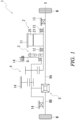
- FIG. 1 is a skeleton parts diagram illustrating a power transmission device 1.
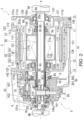
- FIG. 2 is a schematic sectional view illustrating the power transmission device 1.
- FIG. 3 is an enlarged view around the planetary reduction gear 4 of the power transmission device 1.
- FIG. 4 is an enlarged view around the differential mechanism 5 of the power transmission device 1.
- the power transmission device 1 has a motor 2, a planetary reduction gear 4 (reduction mechanism), and a differential mechanism 5.
- the power transmission device 1 also has drive shafts 9A and 9B and a park lock mechanism 3.
- the park lock mechanism 3, the planetary reduction gear 4, the differential mechanism 5, and the drive shafts 9A and 9B are provided.
- the planetary reduction gear 4 is connected downstream of the motor 2.
- the differential mechanism 5 is connected downstream of the planetary reduction gear 4.
- the drive shafts 9A and 9B are connected downstream of the differential mechanism 5.
- the drive shafts 9A and 9B are respectively connected to one side and the other side of the rotation axis X of the differential mechanism 5.
- the axis lines of the drive shafts 9A and 9B are coaxial with the rotation axis X of the motor 2.
- Each of the drive shafts 9A and 9B are connected to left and right drive wheels W of the vehicle.
- Motor 2 is a rotary electric machine having at least one of an electric motor function and a power generation function.
- the output rotation of the motor 2 is reduced by the planetary reduction gear 4 and input to the differential mechanism 5.
- the differential mechanism 5 transmits rotation to the drive wheels W through the drive shafts 9A and 9B.
- the main box 10 of the power transmission device 1 has a first box 11 that houses the motor 2 and a second box 12 that is extrapolated from the first box 11.
- the main box 10 also has a third box 13 that is assembled to the first box 11 and a fourth box 14 that is assembled to the second box 12.
- the first box 11 has a cylindrical support wall portion 111 and a flange-like joint portion 112 provided at one end 111a of the support wall portion 111.
- the first box 11 is provided in a direction in which the support wall portion 111 is aligned with the rotation axis X of the motor 2.
- the motor 2 is accommodated inside the support wall portion 111.
- the joint portion 112 is provided in a direction perpendicular to the rotation axis X.
- the joint portion 112 is formed with a larger outer diameter than the support wall portion 111.
- the second box 12 has a cylindrical circumferential wall portion 121, a flange-like joint portion 122 provided at one end 121a of the circumferential wall portion 121, and a flange-like joint portion 123 provided at the other end 121b of the circumferential wall portion 121.
- the circumferential wall portion 121 is formed with an inner diameter that can be fitted over the support wall portion 111 of the first box 11.
- the first box 11 and the second box 12 are assembled by fitting the circumferential wall portion 121 of the second box 12 over the support wall portion 111 of the first box 11.
- the joint portion 122 on the end 121a side of the circumferential wall portion 121 is in contact with the joint portion 112 of the first box 11 in the direction of the rotation axis X.
- These joint portions 122 and 112 are connected to each other by bolts (not shown).
- a plurality of grooves 111b are provided on the outer periphery of the support wall portion 111.
- the plurality of grooves 111b are provided at intervals in the direction of the rotation axis X.
- Each of the grooves 111b is provided over the entire circumference in the circumferential direction around the rotation axis X.
- the circumferential wall portion 121 of the second box 12 is inserted into the support wall portion 111 of the first box 11.
- the openings of the grooves 111b are closed by the circumferential wall portion 121.
- a plurality of cooling passages CP through which cooling water flows are formed between the support wall portion 111 and the circumferential wall portion 121.
- ring grooves 111c and 111c are formed on both sides of the area where the grooves 111b are provided.
- the seal rings 113 and 113 are fitted and attached to the ring grooves 111c and 111c, respectively.
- seal rings 113 press-fit into the inner circumference of the circumferential wall portion 121 extrapolated to the support wall portion 111, and seal the gap between the outer circumference of the support wall portion 111 and the inner circumference of the circumferential wall portion 121.
- the other end 121b of the second box 12 has a wall portion 120 extending on the inner diameter side.
- the wall portion 120 is provided in a direction perpendicular to the rotation axis X.
- An opening 120a through which the drive shaft 9A is inserted is provided in an area where the wall portion 120 intersects the rotation axis X.
- a cylindrical motor supporting portion 125 surrounding the opening 120a is provided.
- the motor supporting portion 125 is inserted inside the coil end 253b to be described later.
- the motor supporting portion 125 faces the end portion 21b of the rotor core 21 with a gap in the X-axis direction.
- the circumferential wall portion 121 of the second box 12 has a thicker radial thickness in a lower region in the vertical direction based on the mounting state of the power transmission device 1 on a vehicle than in an upper region.
- an oil pooling portion 128 penetrating in the axial direction of the rotation axis X is provided.
- the oil pooling portion 128 communicates with an axial oil passage 138 provided in the joint portion 132 of the third box 13 through a communication hole 112a.
- the communication hole 112a is provided in the joint portion 112 of the first box 11.
- the third box 13 has a wall portion 130 orthogonal to the rotation axis X.
- a joint portion 132 forming a ring shape when viewed from the direction of the rotation axis X is provided on the outer peripheral portion of the wall portion 130.
- the third box 13 is located on the opposite side (right side in the figure) from the differential mechanism 5 when viewed from the first box 11.
- the joint portion 132 of the third box 13 is joined to the joint portion 112 of the first box 11 from the direction of the rotation axis X.
- the third box 13 and the first box 11 are connected to each other by bolts (not shown). In this state, the opening of the first box 11 on the joint portion 122 side (right side in the figure) of the support wall portion 111 is blocked by the third box 13.
- a through-hole 130a of the drive shaft 9A is provided at the center of the wall portion 130.
- a lip seal RS is provided on the inner circumference of the through-hole 130a.
- the lip seal RS elastically contacts an unillustrated lip portion with the outer circumference of the drive shaft 9A.
- the gap between the inner circumference of the through-hole 130a and the outer circumference of the drive shaft 9A is sealed by the lip seal RS.
- a circumferential wall portion 131 surrounding the through-hole 130a is provided on the side of the first box 11 (left side in the figure) of the wall portion 130.
- the drive shaft 9A is supported by bearing B4 through the inner circumference of the circumferential wall portion 131.
- a motor supporting portion 135 is provided on the motor 2 side (left side in the figure) from the circumferential wall portion 131.
- the motor supporting portion 135 forms a cylindrical shape surrounding the rotation axis X at a distance.
- the connecting wall 136 is formed with a larger outer diameter than the circumferential wall portion 131 on the wall portion 130 side (right side in the figure).
- the connecting wall 136 is provided in the direction along the rotation axis X and extends away from the motor 2.
- the connecting wall 136 connects the motor supporting portion 135 and the wall portion 130 of the third box 13.
- the motor supporting portion 135 is supported by the third box 13 via a connecting wall 136.
- the inside of the motor supporting portion 135 is penetrated by one end 20a of the motor shaft 20 from the motor 2 side to the circumferential wall portion 131 side.
- a bearing B1 is supported on the inner circumference of the motor supporting portion 135.
- the outer circumference of the motor shaft 20 is supported by the motor supporting portion 135 via the bearing B1.
- a lip seal RS is provided in a position adjacent to the bearing B1.
- Oil holes 136a to be described later are opened on the inner circumference of the connecting wall 136 in the third box 13.
- the oil OL flows into the internal space Sc surrounded by the connecting wall 136 through the oil hole 136a.
- the lip seal RS is provided to prevent the oil OL inside the connecting wall 136 from flowing into the motor 2 side.
- the fourth box 14 has a circumferential wall portion 141 that surrounds the outer periphery of the planetary reduction gear 4 and the differential mechanism 5, and a flange-like joint portion 142 provided at the end on the side of the second box 12 in the circumferential wall portion 141.
- the fourth box 14 functions as a box that accommodates the planetary reduction gear 4 and the differential mechanism 5.
- the fourth box 14 is located on the differential mechanism 5 side (left side in the drawing) when viewed from the second box 12.
- the joint portion 142 of the fourth box 14 is joined to the joint portion 123 of the second box 12 from the direction of the rotation axis X.
- the fourth box 14 and the second box 12 are connected to each other by bolts (not shown).
- the inside of the main box 10 of the power transmission device 1 has a motor chamber Sa for accommodating the motor 2, and a gear compartment Sb for accommodating the planetary reduction gear 4 and the differential mechanism 5.
- the motor chamber Sa is formed inside the first box 11, between the wall portion 120 of the second box 12 and the wall portion 130 of the third box 13.
- the gear chamber Sb is formed on the inner diameter side of the fourth box 14, between the wall portion 120 of the second box 12 and the circumferential wall portion 141 of the fourth box 14.
- a plate member 8 is provided inside the gear compartment Sb.
- the plate member 8 is fixed to the fourth box 14.
- the plate member 8 divides the gear compartment Sb into a first gear compartment Sb1 for accommodating the planetary reduction gear 4 and the differential mechanism 5, and a second gear chamber Sb2 for accommodating the park lock mechanism 3.
- the second gear compartment Sb2 is located between the first gear compartment Sb1 and the motor compartment Sa.
- the motor 2 has a motor shaft 20, a rotor core 21, and a stator core 25.
- the motor shaft 20 and rotor core 21 are cylindrical.
- the rotor core 21 is extrapolated onto the motor shaft 20.
- the stator core 25 surrounds the outer circumference of the rotor core 21 at a distance.
- bearings B1 and B1 are extrapolated and fixed on both sides of the rotor core 21.
- the bearing B1 located on one end 20a side of the motor shaft 20 from the rotor core 21 (right side in the figure) is supported by the inner circumference of the motor supporting portion 135 of the third box 13.
- the other bearing B1 located on the other end 20b side is supported by the inner circumference of the cylindrical motor supporting portion 125 of the second box 12.
- the motor supporting portions 135 and 125 are arranged along the inner diameter of the coil ends 253a and 253b described later.
- the motor supporting portions 135 and 125 are arranged facing each other with a gap in the X-axis direction of the rotation shaft between one end portion 21a and the other end portion 21b of the rotor core 21.
- the rotor core 21 is formed by stacking multiple silicon steel plates. Each silicon steel plate is extrapolated onto the motor shaft 20 in a state where relative rotation with the motor shaft 20 is regulated.
- the silicon steel plates From the X-axis direction of rotation of the motor shaft 20, the silicon steel plates form a ring shape. North and south pole magnets (not shown) are alternately provided in the circumferential direction around the rotation axis X on the outer circumference side of the silicon steel plates.
- the stator core 25 surrounding the outer circumference of the rotor core 21 is formed by laminating multiple electromagnetic steel plates.
- the stator core 25 is fixed to the inner circumference of the cylindrical support wall portion 111 of the first box 11.
- Each of the electromagnetic steel plates has a yoke portion 251, a teeth portion 252, and a coil 253.
- the yoke portion 251 is ring-shaped and is fixed to the inner circumference of the support wall portion 111.
- the teeth portion 252 protrudes from the inner circumference of the yoke portion 251 towards the rotor core 21.
- coil 253 is formed by winding a winding (not shown) across multiple teeth portions 252.
- Known copper wire or the like can be used for the winding that forms the coil 253.
- the coil 253 may be configured as a distributed winding wound around each of the multiple teeth portions 252 protruding towards the rotor core 21, or as a concentrated winding.
- the length of the coil 253 in the direction of the rotation axis X is set to be longer than that of the rotor core 21.
- the stator core 25 has coil ends 253a and 253b located at both ends of the coil 253 in the direction of the rotation axis X, which protrude further in the direction of the rotation axis X than the rotor core 21.
- the coil ends 253a and 253b have a symmetrical shape across the teeth portion 252.
- An opening 120a is provided in the wall portion 120 (motor supporting portion 125) of the second box 12.
- the other end 20b of the motor shaft 20 penetrates the opening 120a towards the differential mechanism 5 side (left side in the figure) and is located inside the fourth box 14.
- the other end 20b of the motor shaft 20 faces the side gear 54A with a gap in the direction of the rotation axis X inside the fourth box 14, as will be described later.
- the motor shaft 20 has a step portion 201 in the region located inside the fourth box 14.
- the step portion 201 is located near the motor supporting portion 125.
- the lip seal RS divides the motor chamber Sa that accommodates the motor 2 and the gear chamber Sb inside the fourth box 14.
- Oil OL for lubricating the planetary reduction gear 4 and the differential mechanism 5 is sealed inside the fourth box 14 on the inner diameter side (see Figure 2 ).
- the lip seal RS is provided to prevent the flow of oil OL into the motor chamber Sa.
- the region of the motor shaft 20 from the step portion 201 to the vicinity of the other end 20b is a fitting portion 202 with splines provided on the outer circumference.
- the park gear 30 and the sun gear 41 are spline-fitted on the outer circumference of the fitting portion 202.
- One side surface of the park gear 30 is in contact with the step portion 201 in the direction of the rotation axis X (on the right side in the figure).
- One end 410a of the cylindrical base 410 of the sun gear 41 contacts the other side surface of the park gear 30 in the direction of the rotation axis X (on the left side in the figure).
- a nut N is press-fitted from the direction of the rotation axis X on the other end 410b of the base 410.
- the nut N is screwed onto the other end 20b of the motor shaft 20.
- the sun gear 41 and the park gear 30 are provided to be unable to rotate relative to the motor shaft 20, being sandwiched between the nut N and the step portion 201.
- the sun gear 41 has teeth portion 411 on the outer circumference of the other end 20b side of motor shaft 20.
- a stepped pinion gear 43 with a large diameter gear portion 431 as a pinion gear is engaged with the teeth portion 411 on the outer circumference.
- Stepped pinion gear 43 has a large diameter gear portion 431 that engages with the sun gear 41, and a small diameter gear portion 432 that is smaller than the large diameter gear portion 431.
- the stepped pinion gear 43 is a gear component in which the large diameter gear portion 431 and the small diameter gear portion 432 are provided integrally and arranged parallel to the rotation axis X1 direction.
- the large diameter gear portion 431 is formed with a larger outer diameter R1 than the outer diameter R2 of the small diameter gear portion 432.
- the stepped pinion gear 43 is provided in the direction along the axis X1, and the large diameter gear portion 431 is located on the motor 2 side (right side in the figure) of the small diameter gear portion 432.
- the outer circumference of the small diameter gear portion 432 is engaged with the inner circumference of the ring gear 42.
- the ring gear 42 forms a ring shape that surrounds the rotation axis X at a distance.
- a plurality of engaging teeth 421 protruding radially outward are provided on the outer circumference of the ring gear 42.
- the plurality of engaging teeth 421 are provided at intervals in the circumferential direction around the rotation axis X.
- the engaging teeth 421 are provided on the outer circumference of the ring gear 42. Teeth portion 146a is provided on the support wall portion 146 of the fourth box 14. The engaging teeth 421 are spline-fitted to the teeth portion 146a. The rotation of the ring gear 42 around the rotation axis X is restricted.
- the stepped pinion gear 43 has a through hole 430.
- the through hole 430 penetrates the inner diameter side of the large diameter gear portion 431 and the small diameter gear portion 432 in the axial direction X1.
- the pinion shaft 44 is inserted into the through hole 430.
- Needle bearings NB and NB are provided on the outer circumference of the pinion shaft 44.
- the stepped pinion gear 43 is rotatably supported via the needle bearings NB and NB.
- One needle bearing NB on one side (right side in the figure) in the direction of the rotation axis X supports the inner circumference of the large diameter gear portion 431.
- the other needle bearing NB on the other side (left side in the figure) in the direction of the rotation axis X supports the inner circumference of the small diameter gear portion 432.
- An intermediate spacer MS is interposed between the needle bearings NB and NB.
- the inside of the pinion shaft 44 has internal oil passages 440A and 440B.
- the axial internal oil passage 440A extends from one end 44a (right side in the figure) of the pinion shaft 44 to the inner diameter side of the large diameter gear portion 431 along the axis X1.
- the axial internal oil passage 440B extends from the other end 44b (left side in the figure) of the pinion shaft 44 to the inner diameter side of the small diameter gear portion 432 along the axis X1.
- the pinion shaft 44 has oil holes 441, 442, 443, and 444.
- the oil holes 441 and 442 communicate the axial internal oil passage 440A with the outer circumference of the pinion shaft 44.
- the oil holes 443 and 444 communicate the axial internal oil passage 440B with the outer circumference of the pinion shaft 44.
- Oil hole 441 opens in the region where the needle bearing NB is provided, and the needle bearing NB supports the inner circumference of the large diameter gear portion 431. In the pinion shaft 44, the oil hole 441 opens in the region where the stepped pinion gear 43 is extrapolated. Oil hole 442 opens in the gap CL1 in the axial direction of the large diameter gear portion 431 and the opposing surface 61b of the case member 6 of the differential case 50.
- the oil OL that flows into the axial internal oil passage 440A is discharged radially outward from the oil hole 441.
- the oil OL discharged from the oil hole 441 lubricates the needle bearing NB extrapolated on the pinion shaft 44.
- the oil hole 443 opens into the region where the needle bearing NB supporting the inner circumference of the small diameter gear portion 432 is provided.
- the oil hole 443 opens into the region where the stepped pinion gear 43 is extrapolated.
- the oil hole 444 communicates the axial internal oil passage 440B with the outer circumference of the pinion shaft 44.
- the oil hole 444 opens into the gap CL2 between the side wall 432a of the small diameter gear portion 432 in the X1 axis direction and the plate portion 68 of the case member 6 described later.
- the oil OL that flows into the axial internal oil passage 440B is discharged radially outward from the oil hole 443.
- the oil OL discharged from the oil hole 443 lubricates the needle bearing NB extrapolated on the pinion shaft 44.
- the gap CL2 functions as an oil path that leads the oil OL scraped up by the differential case 50 to the pinion shaft 44.
- the pinion shaft 44 has a first shaft portion 445 on one end 44a side (right side in FIG. 4 ) in the longitudinal direction.
- the first shaft portion 445 is a region that protrudes from the stepped pinion gear 43.
- the first shaft portion 445 is supported by a support hole 61a provided in the case member 6 of the differential case 50.
- the pinion shaft 44 has a second shaft portion 446 on the other end 44b side (left side in FIG. 4 ) in the longitudinal direction.
- the second shaft portion 446 is also a region that protrudes from the stepped pinion gear 43.
- the second shaft portion 446 is supported by a support hole 68a provided in the case member 6 of the differential case 50. As will be described in detail later, the second shaft portion 446 is press-fitted into the support hole 68a.
- the second shaft portion 446 is supported so as to be unable to rotate relative to the case member 6.
- first shaft portion 445 is a region on the end 44a side of the pinion shaft 44 where the stepped pinion gear 43 is not extrapolated.
- the second shaft portion 446 is a region on the other end 44b side of the pinion shaft 44 where the stepped pinion gear 43 is not extrapolated.
- the length in the axial direction X1 of the second shaft portion 446 is longer than that of the first shaft portion 445.
- Figure 5 is a perspective view around the differential case 50 of the differential mechanism 5.
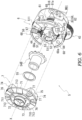
- Figure 6 is an exploded perspective view around the differential case 50 of the differential mechanism 5, exposing the inside of the differential mechanism 5 by omitting one stepped pinion gear 43.
- the differential case 50 as a case accommodates the differential mechanism 5.
- the differential case 50 is formed by assembling the case member 6 (second case member) and the case member 7 (first case member) in the direction of the rotation axis X.
- the case member 6 of the differential case 50 functions as a carrier supporting the pinion shaft 44 of the planetary reduction gear 4.
- three pinion mate gears 52 and pinion mate shaft 51 are provided between the case members 6 and 7 of the differential case 50.
- the pinion mate shaft 51 functions as a support shaft for supporting the pinion mate gears 52.
- the pinion mate shaft 51 has three shaft members 511 provided at equal intervals in the circumferential direction around the rotation axis X (see Figure 6 ).
- each shaft member 511 is connected to a central member 510 arranged on the rotation axis X. That is, the shaft members 511 are arranged radially with respect to the central member 510.
- the pinion mate shaft 51 may be formed integrally with the central member 510 and the shaft members 511.
- Each of the pinion mate gears 52 is extrapolated on each shaft member 511.
- Each of the pinion mate gears 52 is in contact with the central member 510 from the radially outer side of the rotation axis X. In this state, each of the pinion mate gears 52 is rotatably supported by the shaft members 511.
- spherical washers 53 are extrapolated on the shaft members 511.
- the spherical washers 53 are in contact with the spherical outer periphery of the pinion mate gears 52.
- the side gear 54A is located on one side of the central member 510 in the direction of the rotation axis X, and the side gear 54B is located on the other side.
- the side gear 54A is rotatably supported by the case member 6, and the side gear 54B is rotatably supported by the case member 7.
- the side gear 54A engages with three pinion mate gears 52 from one side in the direction of the rotation axis X.
- the side gear 54B engages with three pinion mate gears 52 from the other side in the direction of the rotation axis X.
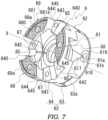
- Figures 7 to 12 are diagrams explaining the case member 6.
- Figure 7 is a perspective view of the case member 6 of the differential mechanism 5 as viewed from the side of the case member 7.
- Figure 8 is a plan view of the case member 6 of the differential mechanism 5 as viewed from the side of the case member 7.
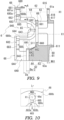
- Figure 9 is a schematic view of the A-A cross-section in Figure 8 , showing the arrangement of the shaft member 511 of the pinion mate shaft 51 in dotted lines.
- Figure 10 is an arrow diagram of the A-A direction in Figure 9 .
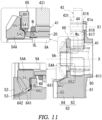
- Figure 11 is a schematic view of the A-A cross-section in Figure 8 , omitting the plate member 68 and the connecting beam 62 on the back side of the paper.
- Figure 11 shows the side gear 54A, stepped pinion gear 43, and drive shaft 9A in dotted lines.
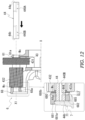
- Figure 12 shows the upper region of the rotation axis X in Figure 9 .
- the stepped pinion gear 43 is shown in solid lines.
- the case member 6 has a ring-shaped base 61.
- the base 61 is a plate member having a thickness W61 in the direction of the rotation axis X.
- an opening 60 is provided in the center of the base 61.
- a cylindrical tubular wall portion 611 surrounding the opening 60 is provided on the base 61.
- the cylindrical tubular wall portion 611 is provided on the side opposite (right side in Figure 9 ) to the case member 7 of the base 61.
- the outer circumference of the cylindrical tubular wall portion 611 is supported by a plate member 8 via a bearing B3 (see Figure 2 ).
- the base 61 is provided with three connecting beams 62 that extend toward the case member 7 side.
- the connecting beams 62 are provided on the surface of the base 61 on the case member 7 side (the left side in FIG. 9 ).
- the three connecting beams 62 are provided at equal intervals in the circumferential direction around the rotation axis X (see FIGS. 7 and 8 ).
- the connecting beams 62 have a base 63 that is connected to the base 61.
- the base 63 extends in a direction orthogonal to the base 61.
- the connecting beams 62 have a connecting portion 64 that is connected to the case member 7 side of the base 63 (the left side in the figure).
- the connecting portion 64 is wider than the base 63.
- the connecting portion 64 has a greater width in the circumferential direction around the rotation axis X than the base 63.
- a circular space is formed when viewed from the direction of the rotation axis X.
- the central member 510 of the pinion mate shaft 51, the pinion mate gear 52, and the spherical washer 53 are accommodated in this space.
- the spherical washer 53 is positioned on the outer circumference of the pinion mate gear 52, and the central member 510 is positioned on the inner circumference of the pinion mate gear 52.
- Connecting member 64 is provided at equal intervals in the circumferential direction around the rotation axis X, as shown in Figure 8 .
- Three plate portions 68 are arranged between the connecting portions 64.
- the plate portions 68 extend along the circumferential direction around the rotation axis X and connect the adjacent connecting portions 64.
- the plate portions 68 have an arc shape as viewed from the direction of the rotation axis X.
- the plate portions 68 protrude toward the case member 7 side (left side in the figure) more than the connecting portions 64.
- the plate portions 68 face the base 61 with a gap.
- the stepped pinion gear 43 and pinion shaft 44 are accommodated in this gap (see Figure 5 ).
- a step portion 63a is formed along the circumferential direction around the rotation axis X on the outer peripheral surface of the base 63.
- the case member 6 is divided into a first portion 6A on the case member 7 side (left side in the figure) and a second portion 6B on the base 61 side (right side in the figure) separated by the step portion 63a.
- the diameter of the outer peripheral surface of the second portion 6B is larger than that of the outer peripheral surface of the first portion 6A.
- the weight of the case member 6 is reduced by making the thickness of the first portion 6A in the radial direction of the rotation axis X smaller than the thickness of the second portion 6B.
- the step portion 63a shown in FIG. 7 is formed near the center of the rotation axis X of the base 63 in the X direction. The position where the step portion 63a is formed can be changed appropriately.
- a recess 640 is provided at the center of the direction of the rotation axis X in the circumferential direction of the connecting portion 64. As shown in FIG. 7 , the recess 640 is concave toward the base 61 side with respect to the plate portion 68.
- the recess 640 has a bottom surface portion 643 and a side wall portion 644.
- the arc-shaped bottom surface portion 643 extends along the circumferential direction of the rotation axis X of the recess 640.
- the side wall portion 644 extends in the X direction toward the plate portion 68 from the bottom surface portion 643.
- a groove portion 645 extending in the radial direction of the rotation axis X is formed at the boundary between the bottom surface portion 643 and the side wall portion 644.
- the bottom surface portion 643 of the recess 640 is a surface extending in a direction perpendicular to the rotation axis X.
- a support groove 65 (second cutout portion) for supporting the shaft member 511 of the pinion mate shaft 51 is provided on the bottom surface portion 643.
- the support groove 65 when viewed from the direction of the rotation axis X, is formed linearly along the radius line L of the ring-shaped base 61.
- the support groove 65 transverses the central portion of the recess 640 in the circumferential direction of the rotation axis X from the inner diameter side to the outer diameter side.
- the support groove 65 has a semi-circular shape.
- the support groove 65 is formed by cutting out the bottom surface portion 643 along the outer diameter of the shaft member 511 of the pinion mate shaft 51.
- An arc portion 641 is formed on the inner diameter side (rotation axis X side) of the connecting portion 64, along the outer circumference of the pinion mate gear 52.
- the outer circumference of the pinion mate gear 52 is supported by a spherical washer 53.
- an oil groove 642 is provided in the direction along the above-mentioned radius line L.
- the oil groove 642 is provided in the range from the support groove 65 that supports the shaft member 511 to the gear support portion 66 fixed to the inner circumference of the connecting portion 64.
- the gear support portion 66 is connected to the boundary between the base 63 and the connecting portion 64.
- the gear support portion 66 is provided in a direction perpendicular to the rotation axis X and has a through hole 660 in the central portion.
- the outer circumference of the gear support portion 66 is connected to the inner circumference of three connecting portions 64.
- the center of the through hole 660 is located on the rotation axis X.
- a recess 661 is provided on the side opposite to the base 61 (left side in the figure).
- the recess 661 surrounds the through hole 660.
- a ring-shaped washer 55 is accommodated in the recess 661.
- the washer 55 supports the back surface of the side gear 54A.
- the back surface of the side gear 54A has a cylindrical tubular wall portion 541, and the washer 55 is extrapolated on the tubular wall portion 541.
- three oil grooves 662 are provided on the side of the recess 661 in the gear support portion 66.
- the oil grooves 662 are provided at predetermined intervals in the circumferential direction around the X-axis.
- the oil grooves 662 extend from the inner circumference to the outer circumference of the gear support portion 66 along the radius line L mentioned above.
- the oil grooves 662 are in communication with the oil groove 642 on the arc portion 641 side mentioned above.
- the support hole 61a for the pinion shaft 44 is opened in the base 61.
- the support hole 61a opens into the region between the connecting beams 62, 62 arranged at intervals in the circumferential direction around the X-axis.
- the boss portion 616 surrounding the support hole 61a is provided in the base 61.
- the washer Wc (see Figure 11 ) extrapolated from the pinion shaft 44 is in contact with the boss portion 616 from the X-axis direction of rotation.
- an oil groove 617 is provided in the range from the central opening 60 to the boss portion 616.
- the oil groove 617 is formed in a tapered shape with a gradually narrowing width in the circumferential direction around the X-axis as it approaches the boss portion 616.
- the oil groove 617 is in communication with the oil groove 618 provided in the boss portion 616.
- bolt holes 67, 67 are provided on both sides of the support groove 65.
- the connecting portion 74 on the case member 7 side is joined to the connecting portion 64 on the case member 6 from the X-axis direction of rotation.
- the case members 6 and 7 are joined to each other by bolts B (see Figure 5 ).
- the bolt B penetrates through the connecting portion 74 on the case member 7 side and is screwed into the bolt hole 67.
- the plate portion 68 is composed of an arc-shaped base 680 and an outer circumferential wall portion 681 provided on the outer peripheral edge of the base 680 when viewed from the X-axis direction of rotation.
- the base 680 is a plate member arranged along the thickness direction in the X-axis direction of rotation.
- One end surface 680a and the other end surface 680b of the base 680 in the X-axis direction of rotation are flat surfaces perpendicular to the X-axis of rotation.
- the outer circumferential wall portion 681 protrudes from one end surface 680a of the base 680 in the X-axis direction of rotation.
- the outer circumferential wall portion 681 is formed over the entire length of the base 680 in the circumferential direction around the rotation axis X when viewed from the X-axis direction.
- the inner circumferential surface 681a of the outer circumferential wall portion 681 is formed to overlap with a virtual circle Im1 having a diameter D1.
- the inner circumferential surface 680c of the base 680 is formed to overlap with a virtual circle Im2 having a diameter D2.
- a support hole 68a penetrating the base 680 in the X-axis direction of rotation is formed in the plate portion 68.
- the support hole 68a and the support hole 61a are concentrically arranged along the axis X1 parallel to the rotation axis X.
- the support hole 68a is formed in the central portion of the base 680 in the circumferential direction around the rotation axis X.
- the region on the inner diameter side of the support hole 68a in the base 680 of the plate portion 68 forms an oil receiving portion 682 (see Figure 9 ).
- the oil receiving portion 682 receives oil OL scraped up by the rotation of differential case 50.
- end face 680a, the other end face 680b, and the inner circumferential surface 680c of the base 680 on the inner diameter side of the support hole 68a are also referred to as the end face 680a, the other end face 680b, and the inner circumferential surface 680c of the oil receiving portion 682.
- a recess 683 is provided on the inner circumferential surface 680c of the oil receiving portion 682.
- the recess 683 is formed by cutting out the central portion of the circumferential direction around the rotation axis X of the inner circumferential surface 680c.
- the recess 683 When viewed from the direction of the rotation axis X, the recess 683 is open towards the radial inner diameter side.
- the recess 683 has inclined surfaces 683a and 683b.
- the inclined surfaces 683a and 683b have a decreasing circumferential opening width W68 towards the outer diameter side from the inner circumferential surface 680c.
- the inclined surface 683a and the inclined surface 683b of the recess 683 intersect at vertex P.
- the vertex P is located on a diameter line Lr passing through the rotation axis X and the axis line X1.
- the inner circumferential surface 680c and the recess 683 of the oil receiving portion 682 are inclined to be located on the radial outer side as they go from one end surface 680a to the other end surface 680b in the direction of the rotation axis X.
- the inclined surfaces 683a and 683b of the recess 683 are also inclined to be located on the radial outer side as they go from one end surface 680a to the other end surface 680b in the direction of the rotation axis X.
- an oil groove 685 is formed on the other end face 680b of the oil receiving portion 682 in the direction of the rotation axis X.
- the oil groove 685 connects the recess 683 and the support hole 68a.
- the oil groove 685 extends linearly along the diameter line Lr from the vertex P of the recess 683 (see FIG. 10 ).
- the assembly of the stepped pinion gear 43 to the case member 6 is carried out by placing the stepped pinion gear 43 in the space between the base 61 and the plate portion 68 in the direction of the rotation axis X.
- the pinion shaft 44 is inserted from the support hole 61a side (arrow direction in the figure).
- a washer Wc is interposed between the large diameter gear portion 431 and the base 61 in the direction of the rotation axis X.
- a washer Wc is also interposed between the small diameter gear portion 432 and the base 680.
- One end 44a and the other end 44b of the pinion shaft 44 are supported by support holes 61a and 68a, respectively.
- the diameter of the support hole 61a is set slightly larger than the outer diameter of the pinion shaft 44.
- the diameter of the support hole 68a is set to approximately match the outer diameter of the pinion shaft 44.
- At the other end 44b of the pinion shaft 44 it is press-fitted into the support hole 68a.
- the stepped pinion gear 43 is extrapolated onto the pinion shaft 44 and is supported so as to be rotatable around the axis X1 by the pinion shaft 44.
- a gap CL2 is formed in the area of the base 680 where the oil groove 685 of the oil receiving portion 682 is formed.
- the gap CL2 is formed between the oil groove 685 in the direction of the rotation axis X and the side wall 432a of the small diameter gear portion 432, with the washer Wc sandwiched in between.
- the oil hole 444 of the pinion shaft 44 opens into the gap CL2.
- the case member 7 (shown in a virtual line) is attached to the case member 6 from the plate portion 68 side in the direction of the rotation axis X.
- Figures 13 to 20 are parts diagrams illustrating the case member 7.
- Figure 13 is a perspective view of the case member 7 viewed from the opposite side of the case member 6.
- Figure 14 is a plan view of the case member 7 viewed from the opposite side of the case member 6.
- Figure 15 is a perspective view of the case member 7 viewed from the side of the case member 6.
- Figure 16 is a plan view of the case member 7 viewed from the side of the case member 6.
- the guide portion 78 is hatched to make its position easier to understand.
- Figure 17 is a schematic diagram of the A-A cross-section in Figure 16 .
- the arrangement of the pinion mate gear 52 is shown in dashed lines in Figure 17 .
- the boundary between the oil hole 710 and the guide portion 78 is shown in broken lines to make it easier to understand.
- Figure 18 is an A-A arrow view of Figure 17 .
- Cross-hatching is used in Figure 18 to make the position of the guide portion 78 easier to understand.
- Figure 19 is a schematic diagram of the A-A cross-section in Figure 16 .
- the illustration of the connecting portion 74 on the far side of the page is omitted in Figure 19 .
- the stepped pinion gear 43, plate portion 68, side gear 54B, and drive shaft 9B are shown in dashed lines.
- Figure 20 is a schematic diagram of the A-A cross-section in Figure 19 .
- the case member 7 has a ring-shaped base 71 (plate) when viewed from the direction of the rotation axis X.
- the base 71 is a plate member having a thickness W71 (see Figure 19 ) in the direction of the rotation axis X.
- a through-hole 70 is provided in the central portion of the base 71.
- the through-hole 70 passes through the base 71 in the thickness direction.
- the diameter (2R4, see Figure 14 ) of the outer circumferential surface 71c of the base 71 is slightly smaller than the diameter D1 of a virtual circle Im1 (see Figure 8 ) (2R4 ⁇ D1).
- the virtual circle Im1 is formed along the inner circumferential surface 681a of the outer circumferential wall portion 681 of the plate portion 68 as described above.
- one end surface 71a and the other end surface 71b of the base 71 in the direction of the rotation axis X are flat surfaces perpendicular to the rotation axis X.
- a tubular wall portion 72 and a guide portion 73 are provided on one end face 71a of the base 71.
- the tubular wall portion 72 surrounds a through-hole 70
- the guide portion 73 surrounds the tubular wall portion 72.
- the guide portion 73 is annular when viewed from the direction of the rotation axis X.
- three ribs 711 are provided on the inner diameter side of the guide portion 73 of the base 71.
- the three ribs 711 are provided at intervals in the circumferential direction around the rotation axis X.
- These ribs 711 are formed on one end face 71a of the base 71, and extend linearly in the radial direction of the rotation axis X.
- the ribs 711 are provided so as to span across the outer diameter side guide portion 73 and the inner diameter side tubular wall portion 72.
- oil holes 710 (openings) penetrating through the base 71 in the thickness direction are provided between the three ribs 711 arranged in the circumferential direction around the rotation axis X.
- the oil holes 710 are opened on the outer and inner sides of the differential case 50 in the direction of the rotation axis X.
- three ribs 713 are provided on the outer diameter side of the guide portion 73 at the base 71.
- the three ribs 713 are provided with intervals in the circumferential direction around the rotation axis X.
- These ribs 713 are formed on one end surface 71a of the base 71.
- the ribs 713 extend linearly in the radial direction of the rotation axis X from the guide portion 73 toward the outer circumferential surface 71c of the base 71.
- Bolt accommodating portions 76, 76 which are recessed toward the back of the paper, are provided on the base 71 between adjacent ribs 713. These bolt accommodating portions 76, 76 are provided in positions that are symmetric with respect to a radius line L. The bolt accommodating portion 76 is opened on the outer circumferential surface 71c of the base 71.
- a bolt insertion hole 77 is opened inside the bolt accommodating portion 76.
- the insertion hole 77 penetrates through the base 71 in the thickness direction (direction of rotation axis X).
- the three ribs 713 are formed on the outer diameter side of the oil holes 710 in the radial direction of the rotation axis X.
- oil holes 710 in the case member 7 are provided at intervals in the circumferential direction around the rotation axis X.
- the oil holes 710 have a substantially rectangular shape when viewed from the direction of the rotation axis X.
- the oil holes 710 are composed of long sides 710a and 710b that extend along the circumferential direction around the rotation axis X, and short sides 710c and 710d that connect the end portions of these long-side portions 710a and 710b.
- the long-side portion 710a is positioned on the outer diameter side relative to the long-side portion 710b.
- three guide portions 78 are provided on the other end surface 71b on the case member 6 side at the base 71.
- the three guide portions 78 surround oil holes 710, and are arranged at intervals in the circumferential direction around the rotation axis X.
- each guide portion 78 is continuous walls that surround the oil holes 710 and open toward the inner diameter side. Specifically, as shown in the enlarged area of Figure 15 , each guide portion 78 includes a long wall portion 781 that extends along the long side portion 710a of the oil hole 710, and short wall portions 783 and 784 that extend along the short side portions 710c and 710d of the oil hole 710.
- the long wall portion 781 and the short wall portions 783 and 784 are formed integrally.
- the outer circumferential surface 781b of the long wall portion 781 overlaps with a virtual circle Im3 having a diameter D4.
- the diameter D4 of the virtual circle Im3 is smaller than the diameter D2 of a virtual circle Im2 (see Figure 8 ).
- the virtual circle Im2 extends along the inner circumferential surface 680c of the base 680 in the plate portion 68 of the case member 6, as mentioned above.
- the long wall portion 781 of the guide portions 78 is a curved wall extending in the circumferential direction around the rotation axis X.
- the short wall portions 783 and 784 extend radially inward from both ends of the long wall portion 781 in the circumferential direction around the rotation axis X.
- the short wall portions 783 and 784 extend linearly along lines Lm2 and Lm3, respectively.
- the lines Lm2 and Lm3 are parallel to a line Lm1.
- the line Lm1 is a straight line passing through the rotation axis X and the midpoint C of the inner circumferential surface 781a of the long wall portion 781 in the circumferential direction around the rotation axis X.
- the inner circumferential surface 781a of the long wall portion 781 and the inner circumferential surfaces 783a and 784a of the short wall portions 783 and 784 are located in front of the broken line relative to the paper surface.
- the long side portion 710a of the oil hole 710 and the short wall portions 783 and 784 are located behind the broken line relative to the paper surface.
- the inner circumferential surface 781a is connected to the long side portion 710a without any step.
- the inner circumferential surfaces 783a and 784a are connected to the short side portions 710d and 710c, respectively, without any step.
- the guide portions 73 and 78 extend in a direction away from the base 71 in the direction of the rotation axis X.
- the inner circumferential surface 731 of the guide portion 73 is a flat surface parallel to the rotation axis X.
- the long-side portion 710a of the oil hole 710 is connected to the inner circumferential surface 731 of the guide portion 73 on the end surface 71a side of the base 71 in the direction of the rotation axis X.
- the long-side portion 710a of the oil hole 710 is an inclined surface.
- the long-side portion 710a is inclined so as to be positioned on the outer diameter side as it moves away from the inner circumferential surface 731 of the guide portion 73 in the direction of the rotation axis X.
- the long-side portion 710a of the oil hole 710 is connected to the inner circumferential surface 781a of the long wall portion 781 of the guide portion 78 on the other end surface 71b side of the base 71 in the direction of the rotation axis X.
- the inner circumferential surface 781a of the long wall portion 781 of the guide portion 78 is an inclined surface.
- the inner circumferential surface 781a is inclined so as to be positioned on the outer diameter side as it moves away from the inner circumferential surface 731 of the guide portion 73 in the direction of the rotation axis X.
- the inclination angle of the inner circumferential surface 781a of the long wall portion 781 is the same as the inclination angle of the long-side portion 710a of the oil hole 710.
- the connecting portions 74 are provided at equal intervals in the circumferential direction around the rotation axis X. As shown in Figure 15 , the connecting portions 74 have a leading end surface 743 protruding toward the case member 6 side. The connecting portions 74 also have side wall portions 744 connecting both end portions in the circumferential direction around the rotation axis X of the leading end surface 743 and the base 71.
- the connecting portions 74 have a circumferential width W2.
- the recess 640 of the connecting portion 64 on the case member 6 side has a circumferential width W1 (see Figure 5 ).
- the width W2 is smaller than the width W1.
- the width W1 refers to the length from the side wall portion 644 connected to one end in the circumferential direction around the rotation axis X of the bottom surface portion 643 to the side wall portion 644 connected to the other end.
- the width W2 refers to the length from the side wall portion 744 connected to one end in the circumferential direction around the rotation axis X of the leading end surface 743 to the side wall portion 744 connected to the other end.
- the leading end surface 743 of the connecting portions 74 is a curved surface extending along the circumferential direction of the rotation axis X when viewed from the direction of the rotation axis X.
- the side wall portion 744 extends from the leading end surface 743 toward the base 71 in the direction of the rotation axis X.
- the bolt insertion hole 77 opens in the leading end surface 743, and one end of the bolt insertion hole 77 opens to the bolt accommodating portion 76 (see Figure 13 ), penetrating through the base 71 in the thickness direction (the direction of the rotation axis X). The other end of the penetration hole 77 opens in the leading end surface 743.
- a support groove 75 (first cutout portion) is provided in the leading end surface 743.
- the support groove 75 supports the pinion mate shaft 51.
- the support groove 75 is formed between the bolt insertion holes 77 in the circumferential direction of the rotation axis X.
- the support groove 75 when viewed from the direction of the rotation axis X, is formed linearly along the radius line L of the base 71.
- the support groove 75 is formed by crossing the connecting portion 74 from the inner diameter side to the outer diameter side.
- the support groove 75 is semi-circular.
- the support groove 75 is formed by cutting out the leading end surface 743 along the outer diameter of the shaft member 511.
- the outer circumferential surface 74a of the connecting portion 74 protrudes radially outward from the outer circumferential surface 71c of the base 71 in the direction of the rotation axis X.
- the outer circumferential surface 74a of the connecting portion 74 and the outer circumferential surface 71c of the base 71 are connected by a step portion 79. That is, the step portion 79 is provided on the outer circumferential surface of the boundary between the connecting portion 74 and the base 71.
- the outer circumferential surface 74a is located on the connecting portion 74 side of the step portion 79, and the outer circumferential surface 71c is located on the base 71 side.
- the radius R3 of the outer circumferential surface 74a is longer than the radius R4 of the outer circumferential surface 71c.
- R3 and R4 respectively denote the radius from the rotation axis X.
- an arc portion 741 is provided on the inner diameter side (rotation axis X side) of the connecting portion 74.
- the arc portion 741 follows the outer circumference of the pinion mate gear 52.
- an oil groove 742 is provided along the above-mentioned radius line L.
- the oil groove 742 is provided in the range from the support groove 75 of the shaft member 511 to the base 71 located on the inner circumference of the connecting portion 74.
- the oil groove 742 communicates with an oil groove 712 provided in the other end surface 71b of the base 71.
- the oil groove 712 is provided along the radius line L when viewed from the direction of the rotation axis X.
- the oil groove 712 is formed up to the through-hole 70 provided in the base 71.
- a ring-shaped washer 55 is placed on the other end surface 71b of the base 71.
- the washer 55 supports the back surface of the side gear 54B.
- a cylindrical tubular wall portion 540 is provided on the back surface of the side gear 54B.
- the washer 55 is extrapolated to the tubular wall portion 540.
- an oil groove 721 is formed on the inner circumference of a tubular wall portion 72 surrounding the through-hole 70.
- the oil groove 721 is formed at a position where it intersects with the oil groove 712.
- the oil groove 721 is provided along the direction of the rotation axis X, over the entire length of the tubular wall portion 72 in the direction of the rotation axis X.
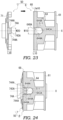
- Figure 21 is a parts diagram illustrating the assembly of the case members 6 and 7.
- Figure 22 is a parts diagram illustrating the assembly of the case members 6 and 7.
- Figure 21 shows the state before the assembly of the case members 6 and 7, while Figure 22 shows the state after the assembly of the case members 6 and 7.
- Figures 21 and 22 show the differential case 50 viewed from the A-A direction in Figure 4 . Hatching is applied to the connecting portions 64 and 74 for ease of viewing.
- the shaft member 511 of the pinion mate shaft 51 is shown in dashed lines in Figures 21 and 22 .
- the differential case 50 is constructed by assembling the case members 6 and 7 in the direction of the rotation axis X. That is, the direction of the rotation axis X follows the assembly direction of the differential case 50.
- the connecting portion 74 (convex portion) of the case member 7 is inserted into the recess 640 of the connecting portion 64 of the case member 6.
- the length L2 of the side wall portion 744 of the case member 7 in the direction of the rotation axis X matches the length L1 of the side wall portion 644 of the case member 6 in the direction of the rotation axis X. Therefore, as shown in Figure 22 , the leading end surface 743 of the connecting portion 74 inserted into the recess 640 contacts the bottom surface portion 643. This determines the position of the case members 7 and 6 in the direction of the rotation axis X.
- the outer circumferential surface 71c of the base 71 of the case member 7 is fitted into the inner circumferential surface 681a of the outer circumferential wall portion 681 on the plate portion 68 of the case member 6.
- the case members 7 and 6 are concentrically arranged on the rotation axis X.
- case members 6 and 7 are joined to each other by bolts B (see Figure 5 ) that penetrate through the connecting portion 74 on the side of the case member 7 and are screwed into bolt holes 67 and 67 on the side of the case member 6.
- the support grooves 65 of the bottom surface portion 643 and 75 of the leading end surface 743 are formed at positions that overlap when viewed from the direction of the rotation axis X.
- the semi-circular support grooves 65 and 75 face each other.
- the support grooves 65 and 75 are symmetrical with respect to a line that passes through the bottom surface portion 643 and the leading end surface 743.
- the opening of the support grooves 65 and 75 communicate with each other, forming a circular hole along the outer diameter of the shaft member 511 as a whole. The shaft member 511 is inserted and held in this circular hole.
- the width W1 in the circumferential direction around the rotation axis X of the recess 640 is greater than the width W2 in the circumferential direction around the connecting portion 74 (W1>W2). Therefore, as shown in Figure 22 , the side wall portion 644 of the recess 640 faces the side wall portion 744 of the connecting portion 74 with a gap therebetween. This gap forms an oil passage 56 that communicates with the inside and outside of the differential case 50.
- the oil passage 56 is formed on both end sides of the connecting portion 74 in the circumferential direction around the rotation axis X.
- the circumferential width of each oil passage 56 around the rotation axis X is (W1 - W2)/2.
- the oil passage 56 is located between the recess 640 and the connecting portion 74 in the circumferential direction around the rotation axis X of the differential case 50.
- the position of the oil passage 56 is indicated by hatching on the case member 6.
- the oil passage 56 extends from the inner diameter side end of the connecting portion 64 to the outside in the radial direction of the rotation axis X and opens to the outer circumferential surface of the differential case 50.
- the pinion mate gear 52 and the side gear 54B are accommodated on the inner diameter side of the connecting portion 64.
- the oil OL that the pinion mate gear 52 and the side gear 54B have stirred flows into the inner diameter side end of the oil passage 56.
- the oil passage 56 discharges the oil OL to the outside of the differential case 50 by centrifugal force.
- the outer circumferential surface 71c of the base 71 of the case member 7 is fitted into the inner circumferential surface 681a of the outer circumferential wall portion 681 of the plate portion 68 of the case member 6.
- the guide portion 78 of the case member 7 is disposed on the inner diameter side of the oil receiving portion 682 of the case member 6. In this state, the leading end surface 78a of the guide portion 78 is located between one end surface 680a and the other end surface 680b of the oil receiving portion 682 in the direction of the rotation axis X.
- the guide portion 78 of the case member 7, the oil receiving portion 682 of the case member 6, and the pinion shaft 44 overlap in the radial direction of the rotation axis X.
- Figure 20 shows a diameter line Lr passing through the rotation axis X and the axis line X1.
- the oil hole 710 of the case member 7, the guide portion 78, the recess 683 of the case member 6, the oil groove 685, the oil hole 444 of the pinion shaft 44, and the axial internal oil passage 440B are arranged in order along the diameter line Lr.
- the oil hole 710, the guide portion 78, the recess 683, the oil groove 685, the oil hole 444, and the axial internal oil passage 440B overlap with each other.
- the vertex P of the recess 683 is located on the diameter line Lr.
- the differential case 50 has the bearing B2 extrapolated to the tubular wall portion 72 of the case member 7.
- the bearing B2 is in contact with the inner race on the step portion 722 provided on the outer circumference of the tubular wall portion 72 from the direction of the rotation axis X.
- the bearing B2 extrapolated to the tubular wall portion 72 is held by the support portion 145 of the fourth box 14.
- the tubular wall portion 72 of the differential case 50 is rotatably supported by the fourth box 14 (see Figure 4 ) through the bearing B2.
- the drive shaft 9B penetrating the opening 145a of the support portion 145 of the fourth box 14 is inserted from the direction of the rotation axis X and is rotatably supported by the support portion 145.
- the tubular wall portion 72 functions as a shaft support portion that supports the outer circumference of the drive shaft 9B.
- a lip seal RS is fixed to the inner circumference of the opening 145a.
- the unillustrated lip portion of the lip seal RS elastically contacts the outer circumference of the tubular wall portion 540 of the side gear 54B extrapolated to the drive shaft 9B.
- the case member 6 of the differential case 50 is supported by the plate member 8 via a bearing B3 extrapolated to the tubular wall portion 611 (see Figure 2 ).
- a drive shaft 9A that penetrates through the through-hole 130a of the third box 13 is inserted from the direction of the rotation axis X.
- the drive shaft 9A is provided to cross the motor shaft 20 of the motor 2 and the inner diameter side of the sun gear 41 of the planetary reduction gear 4 in the direction of the rotation axis X.
- the side gears 54A and 54B are splined to the outer circumference of the leading end portions of the drive shafts 9A and 9B.
- the side gears 54A and 54B are integrally rotatably connected to the drive shafts 9A and 9B around the rotation axis X.
- the side gears 54A and 54B are arranged opposite to each other with a gap in the direction of the rotation axis X.
- the central member 510 of the pinion mate shaft 51 is positioned between the side gears 54A and 54B.
- three shaft members 511 of the pinion mate shaft 51 extend radially outward from the central member 510.
- a pinion mate gear 52 is supported on each of the shaft members 511 of the pinion mate shaft 51.
- the side gear 54A is positioned on one side of the rotation axis X of the pinion mate gear 52, and the side gear 54B is positioned on the other side.
- the pinion mate gears 52 are assembled in a state where their teeth portions are engaged with each other on the side gears 54A and 54B.
- the inside of the fourth box 14 stores lubricating oil OL.
- the lower side of the differential case 50 is located within the stored oil OL.
- the stored oil OL is stored up to the height at which, for example, the connecting beam 62 is located within the oil OL when the connecting beam 62 is located at the lowest position.
- the stored oil OL is scraped up by the differential case 50 rotating around the rotation axis X during the transmission of the output rotation of the motor 2.
- an oil catch portion 15 is provided above the fourth box 14. Part of the oil OL scraped up by the differential case 50 rotating around the rotation axis X flows into the oil catch portion 15.
- the oil catch portion 15 is connected to an oil passage 151a that extends on the inner diameter side of the fourth box 14. As shown in Figure 2 , the inner diameter end of the oil passage 151a is opened between the lip seal RS and the bearing B2.
- the oil catch portion 15 is also connected to an oil hole 136a (see Figure 2 ) provided in the cylindrical connecting wall 136 of the third box 13 via an unillustrated piping.
- the third box 13 has a radial oil passage 137 that communicates with the internal space Sc.
- the radial oil passage 137 extends radially downward from the internal space Sc.
- the radial oil passage 137 communicates with a axial oil passage 138 provided in the joint portion 132.
- a communication hole 112a is provided in the joint portion 112 of the first box 11.
- the axial oil passage 138 communicates with an oil pooling portion 128 provided in the lower part of the second box 12 via the communication hole 112a.
- the oil pooling portion 128 passes through the circumferential wall portion 121 in the direction of the rotation axis X.
- the oil pooling portion 128 communicates with the second gear chamber Sb2 provided in the fourth box 14.
- the power transmission device 1 includes a planetary reduction gear 4, a differential mechanism 5, and drive shafts 9A and 9B provided along the transmission path of the output rotation of the motor 2.
- the sun gear 41 serves as the input part of the output rotation of the motor 2 in the planetary reduction gear 4.
- the differential case 50 supporting the stepped pinion gear 43 serves as the output part of the input rotation.
- the stepped pinion gear 43 (large diameter gear portion 431, small diameter gear portion 432) rotates about the axis line X1 with the input rotation from the sun gear 41 side.
- the small diameter gear portion 432 of the stepped pinion gear 43 is engaged with the ring gear 42 fixed to the inner circumference of the fourth box 14. Therefore, while the stepped pinion gear 43 rotates about the axis line X1, it revolves around the rotation axis X.
- the drive shaft 9B is located on the inner circumference of the revolving orbit of the stepped pinion gear 43.
- the outer diameter R2 of the small diameter gear portion 432 of the stepped pinion gear 43 is smaller than the outer diameter R1 of the large diameter gear portion 431 (see Figure 3 ).
- the differential case 50 (case members 6 and 7) supporting the stepped pinion gear 43 rotates about the rotation axis X at a lower rotational speed than the input rotation from the motor 2.
- lubricating oil OL is stored inside the fourth box 14 for lubrication purposes. Therefore, the stored oil OL is scraped up by the differential case 50 rotating around the rotation axis X when transmitting the output rotation of the motor 2.
- the scraped-up oil OL lubricates the engagement portions between the sun gear 41 and the large diameter gear portion 431, between the small diameter gear portion 432 and the ring gear 42, and between the pinion mate gear 52 and the side gears 54A and 54B. Much of the oil OL scraped up by the differential case 50 flows into the oil catch portion 15.
- the inner diameter side end portion of the oil passage 151a is opened to the inner circumference of the support portion 145 (refer to FIG. 2 ). Therefore, the oil OL flowing into the oil passage 151a is discharged into a clearance Rx between the inner circumference of the support portion 145 of the fourth box 14 and the tubular wall portion 540 of the side gear 54B.
- Oil OL discharged into the clearance Rx lubricates the bearing B2 supported by the support portion 145.
- the oil OL that lubricates the bearing B2 moves to the outer side (bearing B2 side) of the differential case 50 by the centrifugal force of the rotation of the differential case 50.
- a guide portion 73 that forms a ring shape when viewed from the direction of the rotation axis X is provided. Therefore, the oil OL that has moved to the outer diameter side is captured by a portion of the guide portion 73.
- ribs 711 are provided on the inner circumferential side of the guide portion 73.
- a recess is formed between the guide portion 73, the ribs 711, and the tubular wall portion 72. This recess makes it easier for the oil OL to accumulate on the inner circumferential side of the guide portion 73.
- oil holes 710 are provided along the inner circumferential surface 731 of the guide portion 73 at the base 71 of the case member 7.
- the oil OL is prevented from further moving to the outer diameter side by the guide portion 73.
- the oil OL whose movement is obstructed passes through the oil hole 710 that opens to the inner circumference of the guide portion 73 to the case member 6 side.
- the oil OL reaches the inner circumferential surface 731 of the guide portion 73 by the centrifugal force generated by the rotation of the differential case 50. Many of the oil OL that have reached the inner circumferential surface 731 of the guide portion 73 flow into the oil hole 710 that opens in the direction of the rotation axis X without passing over the guide portion 73.
- the oil OL supplied to the oil hole 710 moves to the guide portion 78.
- the long side portion 710a of the oil hole 710 and the inner circumferential surface 781a of the long wall portion 781 of the guide portion 78 are inclined to the radial outer side as they move away from the inner circumferential surface 731 of the guide portion 73 in the direction of the rotation axis X.
- the oil OL passing through the oil hole 710 and the guide portion 78 moves along the inclination while being subjected to centrifugal force. This promotes the movement of the oil OL towards the case member 6 side.
- this inclination it is possible to reduce the re-entry of the oil OL that has moved from the guide portion 73 to the case member 6 side back to the guide portion 73, and discharge it to the outside of the differential case 50.
- the guide portion 78 is a continuous wall composed of a long wall portion 781, short wall portions 783 and 784 (see Figure 18 ).
- the guide portion 78 opens toward the inner diameter side. This allows the guide portion 78 to catch not only the oil OL flowing from the oil hole 710 but also the oil OL that scatters inside the differential case 50 (white arrow in Figure 19 ).
- the oil OL that has moved from the oil hole 710 to the case member 6 side through the guide portion 78 is discharged from the leading end surface 78a.
- the inner circumferential surface 680c of the oil receiving portion 682 and the recess 683 are transversely arranged from the base 71 side of the case member 7 to the pinion gear 43 side along the direction of the rotation axis X at the leading end surface 78a of the guide portion 78.
- the inner circumferential surface 680c and the recess 683 are inclined in the radial direction outward as they move away from the guide portion 78 along the direction of the rotation axis X.
- the oil OL caught in the recess 683 moves along the inclination from one end surface 680a side to the other end surface 680b side of the oil receiving portion 682.
- many of the oil OL caught on the inner circumferential surface 680c gather in the recess 683 during the movement along the inclination.
- the recess 683 communicates with the oil groove 685 (clearance CL2) at the vertex P.
- the oil OL in the recess 683 is gathered at the vertex P by centrifugal force and then discharged into the oil groove 685.
- the oil OL in the oil groove 685 moves radially outward by centrifugal force and flows into the oil hole 444 of the pinion shaft 44.
- the washer Wc is also lubricated by the oil OL.
- the oil OL flowing into the oil hole 444 of the pinion shaft 44 moves to the axial internal oil passage 440B and is finally discharged from the oil hole 443 (see Figure 4 ). At this time, the oil OL lubricates the needle bearing NB.
- the oil OL passes through the oil groove 712 provided at the base 71 of the case member 7 and the oil groove 742 provided on the arc portion 741.
- the oil OL that has passed through the oil groove 742 is supplied to the spherical washer 53 that supports the back surface of the pinion mate gear 52 to lubricate the spherical washer 53.
- the oil OL discharged into the internal space Sc from the oil hole 136a is stored in the internal space Sc.
- the oil OL also lubricates the bearing B4 supported by the circumferential wall portion 131 of the third box 13.
- a portion of the oil OL discharged into the internal space Sc moves to the other end 20b side of the motor shaft 20 through the gap between the outer circumference of the drive shaft 9A and the inner circumference of the motor shaft 20.
- the other end 20b of the motor shaft 20 is inserted inside the tubular wall portion 541 of the side gear 54A.
- a communication passage 542 communicating with the back surface of the side gear 54A is provided on the inner circumference of the tubular wall portion 541.
- the oil OL that lubricates the washer 55 on the back surface of the side gear 54A moves through the oil groove 662 provided on the gear support portion 66 of the case member 6 and the oil groove 642 provided on the arc portion 641.
- the oil OL that has passed through the oil groove 642 is supplied to the spherical washer 53 that supports the back surface of the pinion mate gear 52 to lubricate the spherical washer 53.
- the internal space Sc of the third box 13 communicates with the second gear chamber Sb2 provided in the fourth box 14 through the radial oil passage 137, the axial oil passage 138, the communication hole 112a, and the oil pooling portion 128 provided in the lower part of the second box 12.
- the oil OL is supplied from the oil catch portion 15 to the support portion 145 of the fourth box 14 to lubricate the bearing B2.
- the oil OL is also supplied to the internal space Sc of the third box 13 to lubricate the bearing B4.
- the oil OL in the fourth box 14 is swept up when the drive wheels W rotate and used for lubricating bearings and gear engagement parts.
- the oil OL used for lubrication is returned to the fourth box 14 and becomes available for sweeping up again.
- the support groove 65 and the support groove 75 face each other to form a circular hole that supports the shaft member 511.
- the shaft member 511 can be assembled with the case members 6 and 7 while being pre-arranged in the support groove 65 of the recess 640.
- three shaft members 511 can be pre-connected to the central member 510 and arranged in the case member 6.
- a pinion mate shaft 51 which is integrally molded with the shaft member 511 and the central member 510, can also be used.
- the circumferential width W2 of the connecting portion 74 around the rotation axis X is set smaller than the circumferential width W1 of the recess 640. Therefore, the connecting portion 74 is easier to insert into the recess 640.
- a groove portion 645 is formed at the boundary between the bottom surface portion 643 and the side wall portion 644 of the case member 6.
- This groove portion 645 extends along the oil passage 56 from the inner diameter side to the outer diameter side of the rotation axis X.
- the oil OL stirred by the pinion mate gear 52 and the side gears 54A and 54B enters the groove portion 645 and flows along the outer diameter side of the groove portion 645. This improves the discharge performance of the oil OL from the inside to the outside of the differential case 50.
- One example of the power transmission device 1 in one aspect of the present invention is listed below:
- the shaft member 511 is supported by the connecting portion 74 in the recess 640.
- the shaft member 511 is pre-arranged in the recess 640 of the case member 6.
- the connecting portion 74 of the case member 7 is inserted into the recess 640 and brought into contact with the shaft member 511, and the case member 6 and the case member 7 are assembled. This improves the freedom of assembly compared to simply inserting the shaft member 511 into the hole of the differential case 50.
- the assembly may be performed by inserting the shaft member 511 into the circular hole formed by the support grooves 65 and 75.
- the shaft member 511 and the central member 510 of the pinion mate shaft 51 are molded separately.
- the central member 510 is pre-arranged in the case member 6 together with the pinion mate gear 52 and the spherical washer 53, and the case member 7 is then assembled. Thereafter, the shaft member 511 is inserted into the circular hole and connected to the central member 510.
- the case member 7 preferably has a support groove 75 (first cutout portion) on the leading end surface 743 (leading end) of the connecting portion 74.
- the shaft member 511 is accommodated in the support groove 75.
- the shaft member 511 is supported in the recess 640 while being accommodated in the support groove 75 of the connecting portion 74. This makes it possible to stably support the shaft member 511.
- the case member 6 preferably has a support groove 65 (second cutout portion) for accommodating the shaft member 511 in the recess 640.
- the shaft member 511 is supported in the recess 640 while being accommodated in the support groove 65 of the recess 640. This makes it possible to stably support the shaft member 511. Furthermore, when the support groove 65 is provided in addition to the support groove 75, the shaft member 511 is accommodated in the support grooves 75 and 65 from both sides in the direction of the rotation axis X, and the shaft member 511 can be stably supported.
- the support grooves 65 and 75 can be formed as semi-circular cutouts that are symmetrical with respect to the contact surfaces (leading end surface 743 and bottom surface portion 643).
- the power transmission device 1 has an oil passage 56 between the recess 640 and the connecting portion 74 in the circumferential direction (circumferential direction) around the rotation axis X of the differential case 50.
- the oil passage 56 opens on the outer circumferential surface of the differential case 50.
- the power transmission device By configuring the power transmission device in this way, it becomes easier to discharge oil OL from the inside to the outside of the differential case 50 via the oil passage 56, thereby reducing the agitation resistance of the oil OL of the pinion mate gear 52 arranged inside the differential case 50.
- the width W1 in the circumferential direction around the rotation axis X of the recess 640 is set larger than the width W2 in the circumferential direction around the connecting portion 74.
- this gap is used as the oil passage 56. This eliminates the need to separately form the oil passage 56, thereby reducing manufacturing costs.
- oil passage 56 is not limited to the gap between the side wall portion 644 and the side wall portion 744, and may be separately formed.
- the oil passage 56 preferably has an elongated shape extending in the longitudinal direction of the rotation axis X.
- the oil passage 56 located between the recess 640 and the connecting portion 74 has a longitudinal shape that extends in the direction of the rotation axis X, which allows for clearance between the recess 640 and the connecting portion 74. This makes it easier to insert the connecting portion 74 into the recess 640 and to assemble the case members 6 and 7.
- the power transmission device 1 preferably has multiple shaft members 511.
- the power transmission device 1 preferably has three or more shaft members 511.
- the power transmission device 1 preferably has a pinion mate shaft 51 comprising multiple shaft members 511 and a central member 510 that supports the multiple shafts.
- the shaft members 511 and the central member 510 in the case member 6 in advance by connecting them, and perform the assembly. This improves the freedom of assembly.
- the state of pre-connecting the shaft members 511 and the central member 510 includes a case where the shaft members 511 and the central member 510 are integrally molded.
- the assembly efficiency can be improved.
- the case member 7 preferably has a base 71 (plate).
- the base 71 is connected to the connecting portion 74 and fitted to the case member 6.
- the case member 6 has a plate portion 68 that connects to the recess 640 of the connecting portion 64.
- the base 71 is provided on the side away from the case member 6 of the connecting portion 74.
- the plate portion 68 is provided on the side of the case member 7 of the recess 640.
- the case member 7 preferably has a step portion 79 provided on the outer circumferential surface at the boundary between the base 71 and the connecting portion 74.
- the radius R4 of the outer circumferential surface 71c on the base 71 side at the step portion 79 is smaller than the radius R3 of the outer circumferential surface 74a on the connecting portion 74 side.
- the connecting portion 74 side of the case member 7 that supports the shaft member 511 is made thick to increase its rigidity, while the base 71 side, where rigidity is not required, is made thin, enabling the differential case 50 to be lightweight.
- the case member 6 preferably has
- the case member 6 has a step portion 63a on the outer circumferential surface at the boundary between the first portion 6A and the second portion 6B.
- Figure 23 is a parts diagram illustrating the assembly of case members 6 and 7 in deformation example 1.
- Figure 24 is a parts diagram illustrating the assembly of case members 6 and 7 in deformation example 1.
- Figure 23 shows the state before assembly
- Figure 24 shows the state after assembly
- the case member 6 has a recess 640A that recesses in the direction of the rotation axis X.
- the case member 7 has a connecting portion 74A which is a protrusion in the direction of the rotation axis X.
- a support groove for supporting the shaft member 511 is not formed in the recess 640A and the connecting portion 74A.
- the recess 640A of the case member 6 has a bottom surface portion 643A and side wall portions 644A which connect to both ends in the circumferential direction around the rotation axis X of the bottom surface portion 643A.
- the bottom surface portion 643A is formed in a cross-sectional arc shape along the outer diameter of the shaft member 511.
- the connecting portion 74A of the case member 7 has a leading end surface 743A and side wall portions 744A.
- the side wall portions 744A are connected to both ends in the circumferential direction around the rotation axis X of the leading end surface 743A.
- the width W10 of the circumferential direction of the recess 640A is set larger than the width W20 of the circumferential direction of the connecting portion 74A. That is, the connecting portion 74A can be inserted into the recess 640A.
- the width W10 means the length from one side wall portion 644A connected to the bottom surface portion 643A to the other side wall portion 644A.
- the width W20 means the length from one side wall portion 744A connected to the leading end surface 743A to the other side wall portion 744A.
- the length L20 of the connecting portion 74A in the direction of the rotation axis X matches the length L10 shown in the case member 6.
- the length L10 means the length from the tangent line Im10 passing through the outer peripheral edge closest to the case member 7 of the shaft member 511 to the end on the case member 7 side of the side wall portion 644A.
- the assembly of the case members 6 and 7 can be performed by placing the shaft member 511 in advance in the recess 640A of the case member 6.
- the shaft member 511 is placed in contact with the bottom surface portion 643A.
- the connecting portion 74A is inserted into the recess 640A, the leading end surface 743A of the connecting portion 74A comes into contact with the outer peripheral edge of the shaft member 511.
- the shaft member 511 is supported in the recess 640A in a state of being sandwiched between the bottom surface portion 643A and the leading end surface 743A (refer to Figure 24 ).
- the power transmission device 1 has a connecting portion 74A (protrusion) that protrudes in the direction of the rotation axis X and is provided in the case member 7, and a recess 640A that is provided in the case member 6 and sinks in the direction of the rotation axis X.
- the shaft member 511 is supported by the connecting portion 74A in the recess 640A.
- This configuration improves the degree of freedom in assembly, as in the embodiment.
- the present invention is not limited to this embodiment.
- the power transmission device can also be applied to something other than a vehicle.
Landscapes
- Engineering & Computer Science (AREA)
- General Engineering & Computer Science (AREA)
- Mechanical Engineering (AREA)
- Chemical & Material Sciences (AREA)
- Combustion & Propulsion (AREA)
- Transportation (AREA)
- Retarders (AREA)
- General Details Of Gearings (AREA)
Claims (7)
- Leistungsübertragungsvorrichtung (1),
umfassend:- ein Gehäuse (50), das ein erstes Gehäuseelement (7) und ein zweites Gehäuseelement (6) umfasst, das mit dem ersten Gehäuseelement (7) zusammengebaut ist, und- ein Wellenelement (511), das von dem Gehäuse (50) getragen wird,dadurch gekennzeichnet, dass:- das erste Gehäuseelement (7) einen Vorsprung (74) aufweist, der in der axialen Richtung (X) entlang der Montagerichtung des Gehäuses (50) vorsteht,- das zweite Gehäuseelement (6) eine Aussparung (640) aufweist, die in der axialen Richtung (X) ausgespart ist,- das Wellenelement (511) von dem Vorsprung (74) in der Aussparung (640) getragen wird, und- ein Öldurchgang (56) zwischen der Aussparung (640) und dem Vorsprung (74) in einer Umfangsrichtung des Gehäuses (50) ausgebildet ist. - Leistungsübertragungsvorrichtung (1) nach Anspruch 1, wobei:- das erste Gehäuseelement (7) einen ersten Ausschnittsabschnitt (75) an einem vorderen Ende des Vorsprungs (74) aufweist, und- das Wellenelement (511) in dem ersten Ausschnittsabschnitt (75) aufgenommen ist.
- Leistungsübertragungsvorrichtung (1) nach einem der vorhergehenden Ansprüche, wobei das zweite Gehäuseelement (6) einen zweiten Ausschnittsabschnitt (65) zum Aufnehmen des Wellenelements (511) in der Aussparung (640) aufweist.
- Leistungsübertragungsvorrichtung (1) nach einem der vorhergehenden Ansprüche, wobei der Öldurchgang (56) eine längliche Form aufweist, die sich in der axialen Richtung (X) erstreckt.
- Leistungsübertragungsvorrichtung (1) nach Anspruch 1,umfassend ein Ritzelgegenzahnrad (52), das zwischen dem ersten Gehäuseelement (7) und dem zweiten Gehäuseelement (6) angeordnet ist,wobei:- das Ritzelgegenzahnrad (52) auf dem Wellenelement (511) getragen wird,- die Leistungsübertragungsvorrichtung (1) eine Ritzelgegenwelle (51), die aus dem Wellenelement (511) besteht, und ein zentrales Element (510), das das Wellenelement (511) trägt, umfasst,- das zentrale Element (510) und das Wellenelement (511) integral geformt sind, und- das Wellenelement (511) das Ritzelgegenzahnrad (52) trägt und mit dem zweiten Gehäuseelement (6) zusammengebaut ist.
- Leistungsübertragungsvorrichtung (1) nach einem der vorhergehenden Ansprüche, umfassend eine Vielzahl von Wellenelementen (511).
- Leistungsübertragungsvorrichtung (1) nach Anspruch 6, umfassend drei oder mehr der Wellenelemente (511).
Priority Applications (1)
| Application Number | Priority Date | Filing Date | Title |
|---|---|---|---|
| EP25155188.3A EP4524431A3 (de) | 2021-03-19 | 2022-02-25 | Übertragungsvorrichtung |
Applications Claiming Priority (2)
| Application Number | Priority Date | Filing Date | Title |
|---|---|---|---|
| JP2021046564 | 2021-03-19 | ||
| PCT/JP2022/008044 WO2022196305A1 (ja) | 2021-03-19 | 2022-02-25 | 動力伝達装置 |
Related Child Applications (2)
| Application Number | Title | Priority Date | Filing Date |
|---|---|---|---|
| EP25155188.3A Division EP4524431A3 (de) | 2021-03-19 | 2022-02-25 | Übertragungsvorrichtung |
| EP25155188.3A Division-Into EP4524431A3 (de) | 2021-03-19 | 2022-02-25 | Übertragungsvorrichtung |
Publications (3)
| Publication Number | Publication Date |
|---|---|
| EP4310366A1 EP4310366A1 (de) | 2024-01-24 |
| EP4310366A4 EP4310366A4 (de) | 2024-08-14 |
| EP4310366B1 true EP4310366B1 (de) | 2025-05-21 |
Family
ID=83321241
Family Applications (2)
| Application Number | Title | Priority Date | Filing Date |
|---|---|---|---|
| EP25155188.3A Pending EP4524431A3 (de) | 2021-03-19 | 2022-02-25 | Übertragungsvorrichtung |
| EP22769556.6A Active EP4310366B1 (de) | 2021-03-19 | 2022-02-25 | Kraftübertragungsvorrichtung |
Family Applications Before (1)
| Application Number | Title | Priority Date | Filing Date |
|---|---|---|---|
| EP25155188.3A Pending EP4524431A3 (de) | 2021-03-19 | 2022-02-25 | Übertragungsvorrichtung |
Country Status (5)
| Country | Link |
|---|---|
| US (1) | US11994197B2 (de) |
| EP (2) | EP4524431A3 (de) |
| JP (1) | JP7337474B2 (de) |
| CN (1) | CN116981866A (de) |
| WO (1) | WO2022196305A1 (de) |
Families Citing this family (2)
| Publication number | Priority date | Publication date | Assignee | Title |
|---|---|---|---|---|
| JP7616137B2 (ja) * | 2022-03-31 | 2025-01-17 | 株式会社アイシン | 車両用駆動装置 |
| CN119343548A (zh) * | 2022-06-13 | 2025-01-21 | 加特可株式会社 | 组件 |
Family Cites Families (8)
| Publication number | Priority date | Publication date | Assignee | Title |
|---|---|---|---|---|
| US6061907A (en) * | 1998-08-10 | 2000-05-16 | Ford Global Technologies, Inc. | Method for making a differential mechanism for an automotive vehicle |
| JPWO2004076891A1 (ja) | 2003-02-27 | 2006-06-08 | 株式会社音戸工作所 | 車両用差動装置 |
| US7695392B2 (en) | 2007-07-10 | 2010-04-13 | Ford Global Technologies, Llc | Differential mechanism assembly |
| US20090266198A1 (en) * | 2008-04-29 | 2009-10-29 | Transform Automotive Llc | Laser welded differential casings for vehicle axles |
| DE102012014950A1 (de) * | 2011-07-30 | 2013-01-31 | Daimler Ag | Gehäuse für ein Ausgleichsgetriebe sowie Ausgleichsgetriebe für einen Kraftwagen |
| DE102014000430B4 (de) * | 2014-01-16 | 2017-07-13 | Audi Ag | Differenzialgetriebe |
| JP6863115B2 (ja) * | 2017-06-19 | 2021-04-21 | 株式会社ジェイテクト | 差動装置 |
| JP2019157973A (ja) * | 2018-03-12 | 2019-09-19 | 武蔵精密工業株式会社 | 差動装置 |
-
2022
- 2022-02-25 EP EP25155188.3A patent/EP4524431A3/de active Pending
- 2022-02-25 US US18/264,817 patent/US11994197B2/en active Active
- 2022-02-25 CN CN202280021467.7A patent/CN116981866A/zh active Pending
- 2022-02-25 WO PCT/JP2022/008044 patent/WO2022196305A1/ja not_active Ceased
- 2022-02-25 JP JP2023506921A patent/JP7337474B2/ja active Active
- 2022-02-25 EP EP22769556.6A patent/EP4310366B1/de active Active
Also Published As
| Publication number | Publication date |
|---|---|
| EP4524431A2 (de) | 2025-03-19 |
| JP7337474B2 (ja) | 2023-09-04 |
| CN116981866A (zh) | 2023-10-31 |
| EP4310366A1 (de) | 2024-01-24 |
| JPWO2022196305A1 (de) | 2022-09-22 |
| US20240102544A1 (en) | 2024-03-28 |
| US11994197B2 (en) | 2024-05-28 |
| WO2022196305A1 (ja) | 2022-09-22 |
| EP4524431A3 (de) | 2025-06-11 |
| EP4310366A4 (de) | 2024-08-14 |
Similar Documents
| Publication | Publication Date | Title |
|---|---|---|
| EP4086482B1 (de) | Stromübertragungsvorrichtung | |
| JP7596050B2 (ja) | 動力伝達装置 | |
| EP4310366B1 (de) | Kraftübertragungsvorrichtung | |
| EP4086479B1 (de) | Stromübertragungsvorrichtung | |
| EP4086480B1 (de) | Stromübertragungsvorrichtung | |
| JP7573932B2 (ja) | 動力伝達装置 | |
| EP4086475B1 (de) | Stromübertragungsvorrichtung | |
| JP7536403B2 (ja) | 動力伝達装置 | |
| EP4228127A1 (de) | Kraftübertragungsvorrichtung | |
| EP4228129A1 (de) | Kraftübertragungsvorrichtung | |
| JP7118578B2 (ja) | 動力伝達装置 | |
| JP7350450B2 (ja) | 動力伝達装置 | |
| JP7350451B2 (ja) | 動力伝達装置 | |
| JP7392220B2 (ja) | 動力伝達装置 | |
| JP7371310B2 (ja) | 動力伝達装置 | |
| WO2021137280A1 (ja) | 動力伝達装置 |
Legal Events
| Date | Code | Title | Description |
|---|---|---|---|
| STAA | Information on the status of an ep patent application or granted ep patent |
Free format text: STATUS: THE INTERNATIONAL PUBLICATION HAS BEEN MADE |
|
| PUAI | Public reference made under article 153(3) epc to a published international application that has entered the european phase |
Free format text: ORIGINAL CODE: 0009012 |
|
| STAA | Information on the status of an ep patent application or granted ep patent |
Free format text: STATUS: REQUEST FOR EXAMINATION WAS MADE |
|
| 17P | Request for examination filed |
Effective date: 20230731 |
|
| AK | Designated contracting states |
Kind code of ref document: A1 Designated state(s): AL AT BE BG CH CY CZ DE DK EE ES FI FR GB GR HR HU IE IS IT LI LT LU LV MC MK MT NL NO PL PT RO RS SE SI SK SM TR |
|
| DAV | Request for validation of the european patent (deleted) | ||
| DAX | Request for extension of the european patent (deleted) | ||
| A4 | Supplementary search report drawn up and despatched |
Effective date: 20240715 |
|
| RIC1 | Information provided on ipc code assigned before grant |
Ipc: F16H 48/38 20120101ALN20240709BHEP Ipc: F16H 57/02 20120101ALN20240709BHEP Ipc: F16H 63/34 20060101ALN20240709BHEP Ipc: F16H 57/00 20120101ALN20240709BHEP Ipc: F16H 57/021 20120101ALI20240709BHEP Ipc: B60K 1/00 20060101ALI20240709BHEP Ipc: F16H 57/08 20060101ALI20240709BHEP Ipc: F16H 57/04 20100101ALI20240709BHEP Ipc: F16H 57/037 20120101ALI20240709BHEP Ipc: F16H 48/40 20120101ALI20240709BHEP Ipc: F16H 48/08 20060101AFI20240709BHEP |
|
| GRAP | Despatch of communication of intention to grant a patent |
Free format text: ORIGINAL CODE: EPIDOSNIGR1 |
|
| STAA | Information on the status of an ep patent application or granted ep patent |
Free format text: STATUS: GRANT OF PATENT IS INTENDED |
|
| GRAS | Grant fee paid |
Free format text: ORIGINAL CODE: EPIDOSNIGR3 |
|
| RIC1 | Information provided on ipc code assigned before grant |
Ipc: F16H 48/38 20120101ALN20250312BHEP Ipc: F16H 57/02 20120101ALN20250312BHEP Ipc: F16H 63/34 20060101ALN20250312BHEP Ipc: F16H 57/00 20120101ALN20250312BHEP Ipc: F16H 57/021 20120101ALI20250312BHEP Ipc: B60K 1/00 20060101ALI20250312BHEP Ipc: F16H 57/08 20060101ALI20250312BHEP Ipc: F16H 57/04 20100101ALI20250312BHEP Ipc: F16H 57/037 20120101ALI20250312BHEP Ipc: F16H 48/40 20120101ALI20250312BHEP Ipc: F16H 48/08 20060101AFI20250312BHEP |
|
| GRAA | (expected) grant |
Free format text: ORIGINAL CODE: 0009210 |
|
| STAA | Information on the status of an ep patent application or granted ep patent |
Free format text: STATUS: THE PATENT HAS BEEN GRANTED |
|
| INTG | Intention to grant announced |
Effective date: 20250325 |
|
| RIC1 | Information provided on ipc code assigned before grant |
Ipc: F16H 48/38 20120101ALN20250318BHEP Ipc: F16H 57/02 20120101ALN20250318BHEP Ipc: F16H 63/34 20060101ALN20250318BHEP Ipc: F16H 57/00 20120101ALN20250318BHEP Ipc: F16H 57/021 20120101ALI20250318BHEP Ipc: B60K 1/00 20060101ALI20250318BHEP Ipc: F16H 57/08 20060101ALI20250318BHEP Ipc: F16H 57/04 20100101ALI20250318BHEP Ipc: F16H 57/037 20120101ALI20250318BHEP Ipc: F16H 48/40 20120101ALI20250318BHEP Ipc: F16H 48/08 20060101AFI20250318BHEP |
|
| AK | Designated contracting states |
Kind code of ref document: B1 Designated state(s): AL AT BE BG CH CY CZ DE DK EE ES FI FR GB GR HR HU IE IS IT LI LT LU LV MC MK MT NL NO PL PT RO RS SE SI SK SM TR |
|
| REG | Reference to a national code |
Ref country code: GB Ref legal event code: FG4D |
|
| REG | Reference to a national code |
Ref country code: CH Ref legal event code: EP |
|
| REG | Reference to a national code |
Ref country code: DE Ref legal event code: R096 Ref document number: 602022015021 Country of ref document: DE |
|
| REG | Reference to a national code |
Ref country code: IE Ref legal event code: FG4D |
|
| REG | Reference to a national code |
Ref country code: NL Ref legal event code: MP Effective date: 20250521 |
|
| PG25 | Lapsed in a contracting state [announced via postgrant information from national office to epo] |
Ref country code: FI Free format text: LAPSE BECAUSE OF FAILURE TO SUBMIT A TRANSLATION OF THE DESCRIPTION OR TO PAY THE FEE WITHIN THE PRESCRIBED TIME-LIMIT Effective date: 20250521 Ref country code: PT Free format text: LAPSE BECAUSE OF FAILURE TO SUBMIT A TRANSLATION OF THE DESCRIPTION OR TO PAY THE FEE WITHIN THE PRESCRIBED TIME-LIMIT Effective date: 20250922 Ref country code: ES Free format text: LAPSE BECAUSE OF FAILURE TO SUBMIT A TRANSLATION OF THE DESCRIPTION OR TO PAY THE FEE WITHIN THE PRESCRIBED TIME-LIMIT Effective date: 20250521 |
|
| REG | Reference to a national code |
Ref country code: LT Ref legal event code: MG9D |
|
| PG25 | Lapsed in a contracting state [announced via postgrant information from national office to epo] |
Ref country code: NO Free format text: LAPSE BECAUSE OF FAILURE TO SUBMIT A TRANSLATION OF THE DESCRIPTION OR TO PAY THE FEE WITHIN THE PRESCRIBED TIME-LIMIT Effective date: 20250821 Ref country code: GR Free format text: LAPSE BECAUSE OF FAILURE TO SUBMIT A TRANSLATION OF THE DESCRIPTION OR TO PAY THE FEE WITHIN THE PRESCRIBED TIME-LIMIT Effective date: 20250822 |
|
| PG25 | Lapsed in a contracting state [announced via postgrant information from national office to epo] |
Ref country code: NL Free format text: LAPSE BECAUSE OF FAILURE TO SUBMIT A TRANSLATION OF THE DESCRIPTION OR TO PAY THE FEE WITHIN THE PRESCRIBED TIME-LIMIT Effective date: 20250521 Ref country code: PL Free format text: LAPSE BECAUSE OF FAILURE TO SUBMIT A TRANSLATION OF THE DESCRIPTION OR TO PAY THE FEE WITHIN THE PRESCRIBED TIME-LIMIT Effective date: 20250521 |
|
| PG25 | Lapsed in a contracting state [announced via postgrant information from national office to epo] |
Ref country code: BG Free format text: LAPSE BECAUSE OF FAILURE TO SUBMIT A TRANSLATION OF THE DESCRIPTION OR TO PAY THE FEE WITHIN THE PRESCRIBED TIME-LIMIT Effective date: 20250521 |
|
| PG25 | Lapsed in a contracting state [announced via postgrant information from national office to epo] |
Ref country code: HR Free format text: LAPSE BECAUSE OF FAILURE TO SUBMIT A TRANSLATION OF THE DESCRIPTION OR TO PAY THE FEE WITHIN THE PRESCRIBED TIME-LIMIT Effective date: 20250521 |
|
| PG25 | Lapsed in a contracting state [announced via postgrant information from national office to epo] |
Ref country code: RS Free format text: LAPSE BECAUSE OF FAILURE TO SUBMIT A TRANSLATION OF THE DESCRIPTION OR TO PAY THE FEE WITHIN THE PRESCRIBED TIME-LIMIT Effective date: 20250821 |
|
| PG25 | Lapsed in a contracting state [announced via postgrant information from national office to epo] |
Ref country code: IS Free format text: LAPSE BECAUSE OF FAILURE TO SUBMIT A TRANSLATION OF THE DESCRIPTION OR TO PAY THE FEE WITHIN THE PRESCRIBED TIME-LIMIT Effective date: 20250921 |
|
| PG25 | Lapsed in a contracting state [announced via postgrant information from national office to epo] |
Ref country code: LV Free format text: LAPSE BECAUSE OF FAILURE TO SUBMIT A TRANSLATION OF THE DESCRIPTION OR TO PAY THE FEE WITHIN THE PRESCRIBED TIME-LIMIT Effective date: 20250521 |
|
| REG | Reference to a national code |
Ref country code: AT Ref legal event code: MK05 Ref document number: 1796979 Country of ref document: AT Kind code of ref document: T Effective date: 20250521 |
|
| PG25 | Lapsed in a contracting state [announced via postgrant information from national office to epo] |
Ref country code: DK Free format text: LAPSE BECAUSE OF FAILURE TO SUBMIT A TRANSLATION OF THE DESCRIPTION OR TO PAY THE FEE WITHIN THE PRESCRIBED TIME-LIMIT Effective date: 20250521 Ref country code: SM Free format text: LAPSE BECAUSE OF FAILURE TO SUBMIT A TRANSLATION OF THE DESCRIPTION OR TO PAY THE FEE WITHIN THE PRESCRIBED TIME-LIMIT Effective date: 20250521 Ref country code: AT Free format text: LAPSE BECAUSE OF FAILURE TO SUBMIT A TRANSLATION OF THE DESCRIPTION OR TO PAY THE FEE WITHIN THE PRESCRIBED TIME-LIMIT Effective date: 20250521 |
|
| PG25 | Lapsed in a contracting state [announced via postgrant information from national office to epo] |
Ref country code: CZ Free format text: LAPSE BECAUSE OF FAILURE TO SUBMIT A TRANSLATION OF THE DESCRIPTION OR TO PAY THE FEE WITHIN THE PRESCRIBED TIME-LIMIT Effective date: 20250521 |
|
| PG25 | Lapsed in a contracting state [announced via postgrant information from national office to epo] |
Ref country code: EE Free format text: LAPSE BECAUSE OF FAILURE TO SUBMIT A TRANSLATION OF THE DESCRIPTION OR TO PAY THE FEE WITHIN THE PRESCRIBED TIME-LIMIT Effective date: 20250521 |
|
| PG25 | Lapsed in a contracting state [announced via postgrant information from national office to epo] |
Ref country code: SK Free format text: LAPSE BECAUSE OF FAILURE TO SUBMIT A TRANSLATION OF THE DESCRIPTION OR TO PAY THE FEE WITHIN THE PRESCRIBED TIME-LIMIT Effective date: 20250521 |
|
| PG25 | Lapsed in a contracting state [announced via postgrant information from national office to epo] |
Ref country code: IT Free format text: LAPSE BECAUSE OF FAILURE TO SUBMIT A TRANSLATION OF THE DESCRIPTION OR TO PAY THE FEE WITHIN THE PRESCRIBED TIME-LIMIT Effective date: 20250521 |
|
| PLBE | No opposition filed within time limit |
Free format text: ORIGINAL CODE: 0009261 |
|
| STAA | Information on the status of an ep patent application or granted ep patent |
Free format text: STATUS: NO OPPOSITION FILED WITHIN TIME LIMIT |