EP4310244A1 - Resin for use in setting a crease in a garment, a method and apparatus for applying the same and a garment including the resin - Google Patents
Resin for use in setting a crease in a garment, a method and apparatus for applying the same and a garment including the resin Download PDFInfo
- Publication number
- EP4310244A1 EP4310244A1 EP23275105.7A EP23275105A EP4310244A1 EP 4310244 A1 EP4310244 A1 EP 4310244A1 EP 23275105 A EP23275105 A EP 23275105A EP 4310244 A1 EP4310244 A1 EP 4310244A1
- Authority
- EP
- European Patent Office
- Prior art keywords
- resin
- garment
- crease line
- along
- crease
- Prior art date
- Legal status (The legal status is an assumption and is not a legal conclusion. Google has not performed a legal analysis and makes no representation as to the accuracy of the status listed.)
- Pending
Links
Images

Classifications
-
- D—TEXTILES; PAPER
- D06—TREATMENT OF TEXTILES OR THE LIKE; LAUNDERING; FLEXIBLE MATERIALS NOT OTHERWISE PROVIDED FOR
- D06M—TREATMENT, NOT PROVIDED FOR ELSEWHERE IN CLASS D06, OF FIBRES, THREADS, YARNS, FABRICS, FEATHERS OR FIBROUS GOODS MADE FROM SUCH MATERIALS
- D06M10/00—Physical treatment of fibres, threads, yarns, fabrics or fibrous goods made from such materials, e.g. by ultrasonic waves, corona discharge, irradiation, electric currents or magnetic fields; Physical treatment combined with treatment with chemical compounds or elements
- D06M10/001—Treatment with visible light, infrared or ultraviolet, X-rays
-
- D—TEXTILES; PAPER
- D06—TREATMENT OF TEXTILES OR THE LIKE; LAUNDERING; FLEXIBLE MATERIALS NOT OTHERWISE PROVIDED FOR
- D06M—TREATMENT, NOT PROVIDED FOR ELSEWHERE IN CLASS D06, OF FIBRES, THREADS, YARNS, FABRICS, FEATHERS OR FIBROUS GOODS MADE FROM SUCH MATERIALS
- D06M15/00—Treating fibres, threads, yarns, fabrics, or fibrous goods made from such materials, with macromolecular compounds; Such treatment combined with mechanical treatment
- D06M15/19—Treating fibres, threads, yarns, fabrics, or fibrous goods made from such materials, with macromolecular compounds; Such treatment combined with mechanical treatment with synthetic macromolecular compounds
- D06M15/37—Macromolecular compounds obtained otherwise than by reactions only involving carbon-to-carbon unsaturated bonds
- D06M15/643—Macromolecular compounds obtained otherwise than by reactions only involving carbon-to-carbon unsaturated bonds containing silicon in the main chain
-
- A—HUMAN NECESSITIES
- A41—WEARING APPAREL
- A41D—OUTERWEAR; PROTECTIVE GARMENTS; ACCESSORIES
- A41D27/00—Details of garments or of their making
-
- B—PERFORMING OPERATIONS; TRANSPORTING
- B05—SPRAYING OR ATOMISING IN GENERAL; APPLYING FLUENT MATERIALS TO SURFACES, IN GENERAL
- B05C—APPARATUS FOR APPLYING FLUENT MATERIALS TO SURFACES, IN GENERAL
- B05C5/00—Apparatus in which liquid or other fluent material is projected, poured or allowed to flow on to the surface of the work
- B05C5/02—Apparatus in which liquid or other fluent material is projected, poured or allowed to flow on to the surface of the work the liquid or other fluent material being discharged through an outlet orifice by pressure, e.g. from an outlet device in contact or almost in contact, with the work
- B05C5/0208—Apparatus in which liquid or other fluent material is projected, poured or allowed to flow on to the surface of the work the liquid or other fluent material being discharged through an outlet orifice by pressure, e.g. from an outlet device in contact or almost in contact, with the work for applying liquid or other fluent material to separate articles
- B05C5/0212—Apparatus in which liquid or other fluent material is projected, poured or allowed to flow on to the surface of the work the liquid or other fluent material being discharged through an outlet orifice by pressure, e.g. from an outlet device in contact or almost in contact, with the work for applying liquid or other fluent material to separate articles only at particular parts of the articles
- B05C5/0216—Apparatus in which liquid or other fluent material is projected, poured or allowed to flow on to the surface of the work the liquid or other fluent material being discharged through an outlet orifice by pressure, e.g. from an outlet device in contact or almost in contact, with the work for applying liquid or other fluent material to separate articles only at particular parts of the articles by relative movement of article and outlet according to a predetermined path
-
- B—PERFORMING OPERATIONS; TRANSPORTING
- B05—SPRAYING OR ATOMISING IN GENERAL; APPLYING FLUENT MATERIALS TO SURFACES, IN GENERAL
- B05C—APPARATUS FOR APPLYING FLUENT MATERIALS TO SURFACES, IN GENERAL
- B05C9/00—Apparatus or plant for applying liquid or other fluent material to surfaces by means not covered by any preceding group, or in which the means of applying the liquid or other fluent material is not important
- B05C9/08—Apparatus or plant for applying liquid or other fluent material to surfaces by means not covered by any preceding group, or in which the means of applying the liquid or other fluent material is not important for applying liquid or other fluent material and performing an auxiliary operation
- B05C9/14—Apparatus or plant for applying liquid or other fluent material to surfaces by means not covered by any preceding group, or in which the means of applying the liquid or other fluent material is not important for applying liquid or other fluent material and performing an auxiliary operation the auxiliary operation involving heating or cooling
-
- B—PERFORMING OPERATIONS; TRANSPORTING
- B05—SPRAYING OR ATOMISING IN GENERAL; APPLYING FLUENT MATERIALS TO SURFACES, IN GENERAL
- B05D—PROCESSES FOR APPLYING FLUENT MATERIALS TO SURFACES, IN GENERAL
- B05D7/00—Processes, other than flocking, specially adapted for applying liquids or other fluent materials to particular surfaces or for applying particular liquids or other fluent materials
- B05D7/24—Processes, other than flocking, specially adapted for applying liquids or other fluent materials to particular surfaces or for applying particular liquids or other fluent materials for applying particular liquids or other fluent materials
-
- D—TEXTILES; PAPER
- D06—TREATMENT OF TEXTILES OR THE LIKE; LAUNDERING; FLEXIBLE MATERIALS NOT OTHERWISE PROVIDED FOR
- D06C—FINISHING, DRESSING, TENTERING OR STRETCHING TEXTILE FABRICS
- D06C23/00—Making patterns or designs on fabrics
- D06C23/04—Making patterns or designs on fabrics by shrinking, embossing, moiréing, or crêping
-
- D—TEXTILES; PAPER
- D06—TREATMENT OF TEXTILES OR THE LIKE; LAUNDERING; FLEXIBLE MATERIALS NOT OTHERWISE PROVIDED FOR
- D06M—TREATMENT, NOT PROVIDED FOR ELSEWHERE IN CLASS D06, OF FIBRES, THREADS, YARNS, FABRICS, FEATHERS OR FIBROUS GOODS MADE FROM SUCH MATERIALS
- D06M10/00—Physical treatment of fibres, threads, yarns, fabrics or fibrous goods made from such materials, e.g. by ultrasonic waves, corona discharge, irradiation, electric currents or magnetic fields; Physical treatment combined with treatment with chemical compounds or elements
- D06M10/04—Physical treatment combined with treatment with chemical compounds or elements
- D06M10/08—Organic compounds
- D06M10/10—Macromolecular compounds
-
- D—TEXTILES; PAPER
- D06—TREATMENT OF TEXTILES OR THE LIKE; LAUNDERING; FLEXIBLE MATERIALS NOT OTHERWISE PROVIDED FOR
- D06M—TREATMENT, NOT PROVIDED FOR ELSEWHERE IN CLASS D06, OF FIBRES, THREADS, YARNS, FABRICS, FEATHERS OR FIBROUS GOODS MADE FROM SUCH MATERIALS
- D06M11/00—Treating fibres, threads, yarns, fabrics or fibrous goods made from such materials, with inorganic substances or complexes thereof; Such treatment combined with mechanical treatment, e.g. mercerising
- D06M11/77—Treating fibres, threads, yarns, fabrics or fibrous goods made from such materials, with inorganic substances or complexes thereof; Such treatment combined with mechanical treatment, e.g. mercerising with silicon or compounds thereof
- D06M11/79—Treating fibres, threads, yarns, fabrics or fibrous goods made from such materials, with inorganic substances or complexes thereof; Such treatment combined with mechanical treatment, e.g. mercerising with silicon or compounds thereof with silicon dioxide, silicic acids or their salts
-
- D—TEXTILES; PAPER
- D06—TREATMENT OF TEXTILES OR THE LIKE; LAUNDERING; FLEXIBLE MATERIALS NOT OTHERWISE PROVIDED FOR
- D06M—TREATMENT, NOT PROVIDED FOR ELSEWHERE IN CLASS D06, OF FIBRES, THREADS, YARNS, FABRICS, FEATHERS OR FIBROUS GOODS MADE FROM SUCH MATERIALS
- D06M11/00—Treating fibres, threads, yarns, fabrics or fibrous goods made from such materials, with inorganic substances or complexes thereof; Such treatment combined with mechanical treatment, e.g. mercerising
- D06M11/83—Treating fibres, threads, yarns, fabrics or fibrous goods made from such materials, with inorganic substances or complexes thereof; Such treatment combined with mechanical treatment, e.g. mercerising with metals; with metal-generating compounds, e.g. metal carbonyls; Reduction of metal compounds on textiles
-
- D—TEXTILES; PAPER
- D06—TREATMENT OF TEXTILES OR THE LIKE; LAUNDERING; FLEXIBLE MATERIALS NOT OTHERWISE PROVIDED FOR
- D06M—TREATMENT, NOT PROVIDED FOR ELSEWHERE IN CLASS D06, OF FIBRES, THREADS, YARNS, FABRICS, FEATHERS OR FIBROUS GOODS MADE FROM SUCH MATERIALS
- D06M13/00—Treating fibres, threads, yarns, fabrics or fibrous goods made from such materials, with non-macromolecular organic compounds; Such treatment combined with mechanical treatment
- D06M13/10—Treating fibres, threads, yarns, fabrics or fibrous goods made from such materials, with non-macromolecular organic compounds; Such treatment combined with mechanical treatment with compounds containing oxygen
- D06M13/184—Carboxylic acids; Anhydrides, halides or salts thereof
-
- D—TEXTILES; PAPER
- D06—TREATMENT OF TEXTILES OR THE LIKE; LAUNDERING; FLEXIBLE MATERIALS NOT OTHERWISE PROVIDED FOR
- D06M—TREATMENT, NOT PROVIDED FOR ELSEWHERE IN CLASS D06, OF FIBRES, THREADS, YARNS, FABRICS, FEATHERS OR FIBROUS GOODS MADE FROM SUCH MATERIALS
- D06M13/00—Treating fibres, threads, yarns, fabrics or fibrous goods made from such materials, with non-macromolecular organic compounds; Such treatment combined with mechanical treatment
- D06M13/322—Treating fibres, threads, yarns, fabrics or fibrous goods made from such materials, with non-macromolecular organic compounds; Such treatment combined with mechanical treatment with compounds containing nitrogen
- D06M13/325—Amines
- D06M13/332—Di- or polyamines
-
- D—TEXTILES; PAPER
- D06—TREATMENT OF TEXTILES OR THE LIKE; LAUNDERING; FLEXIBLE MATERIALS NOT OTHERWISE PROVIDED FOR
- D06M—TREATMENT, NOT PROVIDED FOR ELSEWHERE IN CLASS D06, OF FIBRES, THREADS, YARNS, FABRICS, FEATHERS OR FIBROUS GOODS MADE FROM SUCH MATERIALS
- D06M13/00—Treating fibres, threads, yarns, fabrics or fibrous goods made from such materials, with non-macromolecular organic compounds; Such treatment combined with mechanical treatment
- D06M13/50—Treating fibres, threads, yarns, fabrics or fibrous goods made from such materials, with non-macromolecular organic compounds; Such treatment combined with mechanical treatment with organometallic compounds; with organic compounds containing boron, silicon, selenium or tellurium atoms
- D06M13/503—Treating fibres, threads, yarns, fabrics or fibrous goods made from such materials, with non-macromolecular organic compounds; Such treatment combined with mechanical treatment with organometallic compounds; with organic compounds containing boron, silicon, selenium or tellurium atoms without bond between a carbon atom and a metal or a boron, silicon, selenium or tellurium atom
- D06M13/507—Organic silicon compounds without carbon-silicon bond
-
- D—TEXTILES; PAPER
- D06—TREATMENT OF TEXTILES OR THE LIKE; LAUNDERING; FLEXIBLE MATERIALS NOT OTHERWISE PROVIDED FOR
- D06M—TREATMENT, NOT PROVIDED FOR ELSEWHERE IN CLASS D06, OF FIBRES, THREADS, YARNS, FABRICS, FEATHERS OR FIBROUS GOODS MADE FROM SUCH MATERIALS
- D06M13/00—Treating fibres, threads, yarns, fabrics or fibrous goods made from such materials, with non-macromolecular organic compounds; Such treatment combined with mechanical treatment
- D06M13/50—Treating fibres, threads, yarns, fabrics or fibrous goods made from such materials, with non-macromolecular organic compounds; Such treatment combined with mechanical treatment with organometallic compounds; with organic compounds containing boron, silicon, selenium or tellurium atoms
- D06M13/51—Compounds with at least one carbon-metal or carbon-boron, carbon-silicon, carbon-selenium, or carbon-tellurium bond
- D06M13/513—Compounds with at least one carbon-metal or carbon-boron, carbon-silicon, carbon-selenium, or carbon-tellurium bond with at least one carbon-silicon bond
-
- D—TEXTILES; PAPER
- D06—TREATMENT OF TEXTILES OR THE LIKE; LAUNDERING; FLEXIBLE MATERIALS NOT OTHERWISE PROVIDED FOR
- D06M—TREATMENT, NOT PROVIDED FOR ELSEWHERE IN CLASS D06, OF FIBRES, THREADS, YARNS, FABRICS, FEATHERS OR FIBROUS GOODS MADE FROM SUCH MATERIALS
- D06M15/00—Treating fibres, threads, yarns, fabrics, or fibrous goods made from such materials, with macromolecular compounds; Such treatment combined with mechanical treatment
- D06M15/19—Treating fibres, threads, yarns, fabrics, or fibrous goods made from such materials, with macromolecular compounds; Such treatment combined with mechanical treatment with synthetic macromolecular compounds
- D06M15/37—Macromolecular compounds obtained otherwise than by reactions only involving carbon-to-carbon unsaturated bonds
- D06M15/507—Polyesters
-
- D—TEXTILES; PAPER
- D06—TREATMENT OF TEXTILES OR THE LIKE; LAUNDERING; FLEXIBLE MATERIALS NOT OTHERWISE PROVIDED FOR
- D06M—TREATMENT, NOT PROVIDED FOR ELSEWHERE IN CLASS D06, OF FIBRES, THREADS, YARNS, FABRICS, FEATHERS OR FIBROUS GOODS MADE FROM SUCH MATERIALS
- D06M15/00—Treating fibres, threads, yarns, fabrics, or fibrous goods made from such materials, with macromolecular compounds; Such treatment combined with mechanical treatment
- D06M15/693—Treating fibres, threads, yarns, fabrics, or fibrous goods made from such materials, with macromolecular compounds; Such treatment combined with mechanical treatment with natural or synthetic rubber, or derivatives thereof
-
- D—TEXTILES; PAPER
- D06—TREATMENT OF TEXTILES OR THE LIKE; LAUNDERING; FLEXIBLE MATERIALS NOT OTHERWISE PROVIDED FOR
- D06M—TREATMENT, NOT PROVIDED FOR ELSEWHERE IN CLASS D06, OF FIBRES, THREADS, YARNS, FABRICS, FEATHERS OR FIBROUS GOODS MADE FROM SUCH MATERIALS
- D06M23/00—Treatment of fibres, threads, yarns, fabrics or fibrous goods made from such materials, characterised by the process
- D06M23/02—Processes in which the treating agent is releasably affixed or incorporated into a dispensing means
-
- D—TEXTILES; PAPER
- D06—TREATMENT OF TEXTILES OR THE LIKE; LAUNDERING; FLEXIBLE MATERIALS NOT OTHERWISE PROVIDED FOR
- D06M—TREATMENT, NOT PROVIDED FOR ELSEWHERE IN CLASS D06, OF FIBRES, THREADS, YARNS, FABRICS, FEATHERS OR FIBROUS GOODS MADE FROM SUCH MATERIALS
- D06M23/00—Treatment of fibres, threads, yarns, fabrics or fibrous goods made from such materials, characterised by the process
- D06M23/14—Processes for the fixation or treatment of textile materials in three-dimensional [3D] forms
-
- D—TEXTILES; PAPER
- D06—TREATMENT OF TEXTILES OR THE LIKE; LAUNDERING; FLEXIBLE MATERIALS NOT OTHERWISE PROVIDED FOR
- D06M—TREATMENT, NOT PROVIDED FOR ELSEWHERE IN CLASS D06, OF FIBRES, THREADS, YARNS, FABRICS, FEATHERS OR FIBROUS GOODS MADE FROM SUCH MATERIALS
- D06M23/00—Treatment of fibres, threads, yarns, fabrics or fibrous goods made from such materials, characterised by the process
- D06M23/16—Processes for the non-uniform application of treating agents, e.g. one-sided treatment; Differential treatment
- D06M23/18—Processes for the non-uniform application of treating agents, e.g. one-sided treatment; Differential treatment for the chemical treatment of borders of fabrics or knittings; for the thermal or chemical fixation of cuttings, seams or fibre ends
-
- A—HUMAN NECESSITIES
- A41—WEARING APPAREL
- A41D—OUTERWEAR; PROTECTIVE GARMENTS; ACCESSORIES
- A41D2500/00—Materials for garments
- A41D2500/50—Synthetic resins or rubbers
-
- A—HUMAN NECESSITIES
- A41—WEARING APPAREL
- A41H—APPLIANCES OR METHODS FOR MAKING CLOTHES, e.g. FOR DRESS-MAKING OR FOR TAILORING, NOT OTHERWISE PROVIDED FOR
- A41H43/00—Other methods, machines or appliances
-
- D—TEXTILES; PAPER
- D06—TREATMENT OF TEXTILES OR THE LIKE; LAUNDERING; FLEXIBLE MATERIALS NOT OTHERWISE PROVIDED FOR
- D06M—TREATMENT, NOT PROVIDED FOR ELSEWHERE IN CLASS D06, OF FIBRES, THREADS, YARNS, FABRICS, FEATHERS OR FIBROUS GOODS MADE FROM SUCH MATERIALS
- D06M2200/00—Functionality of the treatment composition and/or properties imparted to the textile material
- D06M2200/20—Treatment influencing the crease behaviour, the wrinkle resistance, the crease recovery or the ironing ease
-
- D—TEXTILES; PAPER
- D06—TREATMENT OF TEXTILES OR THE LIKE; LAUNDERING; FLEXIBLE MATERIALS NOT OTHERWISE PROVIDED FOR
- D06M—TREATMENT, NOT PROVIDED FOR ELSEWHERE IN CLASS D06, OF FIBRES, THREADS, YARNS, FABRICS, FEATHERS OR FIBROUS GOODS MADE FROM SUCH MATERIALS
- D06M2200/00—Functionality of the treatment composition and/or properties imparted to the textile material
- D06M2200/50—Modified hand or grip properties; Softening compositions
-
- D—TEXTILES; PAPER
- D10—INDEXING SCHEME ASSOCIATED WITH SUBLASSES OF SECTION D, RELATING TO TEXTILES
- D10B—INDEXING SCHEME ASSOCIATED WITH SUBLASSES OF SECTION D, RELATING TO TEXTILES
- D10B2501/00—Wearing apparel
- D10B2501/06—Details of garments
Definitions
- the invention to which this application relates is a resin which is provided for use to set a crease in a garment into which the resin is applied.
- the crease typically extends along at least part of the length of a trouser leg, shirt sleeve or portion of a shirt but can be provided at any required location on the garment and it will be appreciated that for each garment, for example a pair of trousers, there will be a number of crease lines each of which receives the line of resin therealong.
- the resin is applied as a ribbon, i.e. a narrow line of resin and cannot be applied as a large area surface coating as it will restrict the flexibility and/or comfort of wearing the garment.
- the aim is to provide the line of resin along the inner surface of the garment so that it lies along the base of the V shaped crease line so as to provide greater strength and rigidity to the crease line and hence allow the crease line shape to be retain for a longer period of time than would be the case if the crease line was only formed by ironing or pressing the same only into the garment material. This therefore means that the external appearance of the garment is retained for a longer period of time with the crease line visible externally.
- the line or ribbon of resin is typically applied soon after the manufacture of the garment and then may be applied from time to time, typically as an optional extra as part of a garment cleaning service.
- the resin is initially provided in a fluid condition and held in a reservoir, in one example in the form of a cartridge from which the resin is dispensed in a controlled manner as a line or ribbon of the fluid resin, via an exit aperture.
- a reservoir in one example in the form of a cartridge from which the resin is dispensed in a controlled manner as a line or ribbon of the fluid resin, via an exit aperture.
- the resin can be held in a larger reservoir such as a drum and then pumped as a fluid supply from the drum to an applicator, which may or may not include a smaller holding chamber, and from which the fluid resin is applied along the crease line as a line or ribbon from an exit aperture.
- the conventional resin is provided so that once applied to the crease, the same starts to cure and harden upon exposure to atmospheric conditions and therefore forms a relatively hard, solid ribbon of resin along the crease line. This has the effect of maintaining the crease line in the garment for a longer period of time than would be the case if the resin had not been applied thereto.
- the resin is applied on the internal surface of the garment so that when the garment is worn and the rein has been applied correctly, the once the resin has hardened, the resin is not visible externally of the garment whilst the crease line in the garment is maintained.
- This method, and the resin has been used for a considerable period of time and with significant commercial success worldwide.
- the conventional resin typically includes tin or an organo tin component, typically as a curing component.
- the resistance is due to the fact that the use of tin, or organo-tin or other tin derivatives in the resin, and the use of the resin in garments which are worn by persons, is deemed to represent a risk of health problems to, primarily, the operators who are applying the resin material to the garments but also, potentially, to the end user. This is as a result of research which indicates that tin, in an isolated condition and without use in combination with other components, could possibly be carcinogenic.
- an aim of the present invention is to provide a resin material which is sufficiently fluid so that during the application process of the resin, the resin can be applied, using the application apparatus as a line or ribbon and, once applied, will harden to a sufficient extent so as to allow the benefit of maintaining the crease in the garment for an extended period of time.
- a further aim is to provide the resin in a form which allows the same, once applied, to be substantially invisible to the naked eye and have no detrimental effect on the appearance of the garment and furthermore to ensure that the resin is retained in a condition so that, once applied to the garment the cured resin does not become easily displaced or cracked.
- the aim of the current invention is to provide further forms of resin which have the benefit of being tin and/or organo tin free and which still have the ability for the resin to be applied in a sufficiently fluid state to allow the same to be applied as a ribbon along the garment crease and then cure and harden so as to be retained in position along the base of the crease so as to maintain the crease in the garment.
- a further aim is to provide a method of application of the improved resin and to provide garments with a crease line which includes a ribbon of the resin material along at least part of the same and which resin is located on the interior surface of the garment when the garment is being worn.
- a resin for application as a ribbon or line along at least part of a crease line of a garment to assist in extending the period of time of retention of the said crease line in the garment said resin provided to be usable in a first, substantially fluid, form for a sufficient period of time to allow the resin to be applied along the crease line and attach to fibres of fabric adjacent to said crease line and, once applied, cures so as to take a second form in which the same has hardened and bonded to the said crease line and wherein the resin includes a catalyst to assist in the curing of the resin, said catalyst including any, or any combination, of platinum, peroxide, Organic amine, titanium, zirconium, tertiary amine, organosilane, iron, copper and/or a non-metal.
- said curing agent is a substantially tin and/or organo-tin free composition and preferably includes no tin or organo-tin or tin derivatives.
- the resin includes a curing system in the form of an acetate, and in one embodiment a crosslinking acetate.
- the resin includes amorphous silicate hydrate, methylsilanetriyl-triacetate, diacetoxydi-tert-butoxysilane, hexanoic acid, dodecamethyl cyclohexasiloxane, acetic acid and octamethylcyclotetrasiloxane.
- amorphous silicate hydrate is replaced with bismuth tris(2-ethylhexanoate).
- the resin includes triacetoxyethylsilane, octamethyl-cyclotetrasiloxane, Polybutylene terephthalate (PBT) and/or substances including dodecamethylcyclohexasilosane, and decamethylcyclopentasiloxane, also sometimes referred to as vRVB substances.
- the curing effect of the curing agent and hence the hardening of the resin occurs once the resin has been applied onto the garment and along the crease line.
- the curing occurs as a result of the exposure of the resin to the surrounding environment and, typically, as a result of exposure to moisture in the environment in which the resin is applied.
- curing may occur, or is encouraged, by mixing together of curing system components and/or exposure to a specific property such as heat or Ultra Violet light.
- a specific property such as heat or Ultra Violet light.
- the need for a specific property is due to the particular type of curing agent or curing agent blend which is included in the resin.
- the resin typically includes silicone and in one embodiment is a vulcanised silicone rubber.
- the resin once cured, resists damage at ongoing exposure to ambient environment conditions up to 180 degrees Celsius.
- the resin is substantially colourless.
- the resin is of a type which is a substantially non-slump to flowable resin, also referred to as a non-slump to self levelling resin.
- a substantially non-slump to flowable resin also referred to as a non-slump to self levelling resin.
- a method of applying a resin material to a crease line of a garment so as to assist in prolonging the retention of the crease line comprising the steps of providing a supply of a resin material in a fluid form to a dispensing means having an exit aperture for the controlled movement of the fluid resin therethrough and guiding the relative movement of the exit aperture along said crease line formed in the said garment so that the fluid resin is applied from the exit aperture along the base of the substantially V shaped crease line as a ribbon or line, allowing said resin to cure and so harden and bond the same to the fabric from which the garment is formed along the crease line and wherein a catalyst is provided in the resin to allow the same to cure and including as the catalyst any, or any combination of, platinum, peroxide, Organic amine, titanium, zirconium, tertiary amine, organosilane, iron, copper and/or a non-metal.
- a curing system included in the resin is a crosslinking acetate.
- the resin when the resin is applied from the exit aperture the resin is in a substantially non-slumping form and once applied from said exit aperture and typically when curing will have started to occur, the resin changes to a more flowable form to allow the resin to absorb into and bond with those fibres of the fabric adjacent the crease line and with which the resin contacts.
- a garment including at least one crease line formed therein and along at least part of a crease line in which a resin material as defined herein is applied to harden and bond to the garment fabric along the said at least part of the crease line so as to aid in the retention of the crease line in the garment.
- the said crease line is V -shaped in cross section and the said resin is applied along the base of at least part of the crease line and on the body facing surface of the garment when the garment is worn such that the resin lies between the garment fabric and the wearer of the garment.
- the garment includes a plurality of crease lines along which the resin is applied.
- apparatus for use in the application of a resin as defined herein along a crease line of a garment, said apparatus including means for moving said resin in a fluid condition from a reservoir of said resin to and through an exit aperture to which the reservoir is connected and means for causing relative movement of the exit aperture and garment so as to apply the resin as a ribbon or line along the base of at least part of said crease line in a fluid condition to then cure and harden and bond to the garment fabric.
- the said reservoir and exit aperture and at least part of the means for moving said resin are provided as integral parts of a cartridge which also includes, or is attached to, guide means to guide movement of the cartridge along the said crease line as the resin is applied along the same.
- further guide means are provided in the form of a support surface in which one or more grooves are formed to receive and retain therealong a crease line of the garment along which the resin is applied.
- the curing activation occurs during and/or after the resin material has been applied to the crease line of a garment and the resin is absorbed at least partially into the garment and hardens.
- Holding means may also be included as part of the cartridge, to allow guided relative movement of the exit aperture and crease line to apply said resin along the base thereof as the resin is pumped or otherwise moved from the said reservoir towards and through the said exit aperture to be dispensed.
- the quantity of resin, size of reservoir and/or size of cartridge is selected with respect to a particular use or number of uses required from each cartridge.
- the said cartridge is refillable.
- the reservoir is a drum or other container separate to the application means and is connected thereto via a pipe or tube so as to pump the resin towards the application means exit aperture.
- the application means includes a body portion on which the exit aperture and guide means may be located.
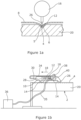
- apparatus 2 for use in the application of a fluid resin material 12 to a crease line 6 of a garment in order to increase the permanence, of the crease line i.e. duration of time in which the crease line is retained, in the garment 8 and thereby maintaining the desired appearance of the garment over a longer period of time.
- the resin material 12 is applied at the time of manufacture of the garment and/or thereafter from time to time, such as when garment is cleaned and typically, the application of the resin is applied by a commercial manufacturer or cleaner rather than being applied by the person who has purchased and wears the garment.
- the garment may of any form in which there is provided a crease line but most typically will be trousers or a shirt.
- the apparatus 2 which is used to apply the resin includes a fluid movement means in the form of a source of a pressured gas such as air and an air pump 36 is connected to a control means 38 which can be provided, as shown in this embodiment, as a hand operated switch located on mounting means 40.
- the air is supplied to an end 30 of a cartridge 16 via an air tube 34 and is connected to the air pump 36 via air tube 35.
- the size and design of the cartridge may change to suit particular uses.
- the air pump can be switched on and off and hence control of the supply of the pressurised air is achieved via the switch 38 which is connected to the tubes 34 and 35.
- the air, which is pressurised and exits the air pump, is passed to the entrance aperture 30 of the cartridge 16.
- the cartridge 16 includes a body 28 in which there is defined a reservoir for the fluid resin and which is connected to the exit aperture.
- a piston 10 is provided to be moved along the reservoir and, intermediate the piston and the exit aperture 26 of the cartridge, there is provided a quantity of the resin material 12 in a fluid condition.
- the cartridge body mounting means 40 include the finger switch 38 for the control of the air pump and which can be gripped by the user when moving the cartridge.
- the cartridge in this example, includes guide means 14 at spaced intervals along the length of the cartridge body as shown and these lie along and contact with the crease line and lie along the same axis as the elongate exit aperture 26 of the cartridge.
- the guide means are provided to be received and pass along the crease line on the surface of the garment which faces towards the wearer's body when the garment is to be worn so that the guide means guide the cartridge as it is moved along the crease line to apply the resin along the base 5 of the substantially V -shaped crease line.
- the crease line lies in a V-shaped or gull-wing shaped groove 4 provided on a support surface or arm 20 and this acts to maintain the crease line along the required linear path with the base 5 exposed and the cartridge is moved along the internal surface of the garment in the direction of arrow 18 and as the relative movement between the garment and the cartridge occurs, so the operation of the air pump operation moves the piston 10 along the cartridge reservoir to move the resin material 12 towards and through the exit aperture 26 to be dispensed as a line or ribbon of the resin material along the base 5 of the crease line 6.
- the resin may be supplied from a reservoir of the resin to an exit aperture 26 provided in a holding means and the holding means is physically separate from the reservoir as is shown in Figure 2 .
- FIG 2 there is illustrated an alternative embodiment of the apparatus and for ease of reference the same reference numerals are used for the same features as the embodiment shown in Figures 1a and b.
- the application of the resin material is also applied along the garment crease line 6 in a similar manner to that shown in Figure 1a but in this embodiment no cartridge is provided and instead the reservoir 44 is formed by a drum or container 42 which includes the resin material.
- the reservoir is connected via tubes 48, 50 and via a pump 46 to application means 52 which include a mounting means including a gripping or holding portion 54 including guide means in the form of skis or skids or wheels 56.
- the tube is connected to the exit aperture 26 and through the same to be dispensed along the base of crease 6 of the garment 8 as previously described with the crease and garment located on a groove and support table 58 or a similar support arm 20 to that shown in the embodiment of Figures 1a and b.
- the resin when the resin is dispensed from the exit aperture, the resin is still in a fluid condition and therefore flows out of the exit aperture 26 and onto and along the crease line.
- the exposure of the resin to the surrounding ambient environment and in particular the moisture in the ambient environment causes the catalyst contained within the resin to be activated to start to cure and harden the resin and as it does so bond to the fibres of the fabric of the garment adjacent to and lying along the crease line 6 of the garment 8 and when hardened and bonded retains the V-shaped form of the crease line 6 and thereby ensures that if the resin material has been applied correctly to the base 5 of the crease line 6, the resin assists in maintaining the form of the crease in the garment for a longer period of time than would be the case if the resin had not been applied to the crease line.
- the resin material 12 is provided with a catalyst in the form of any or any combination of platinum, peroxide, Organic amine, titanium, zirconium, tertiary amine, organosilane, iron, copper and/or a non-metal and react to exposure to the ambient environment and particularly the moisture in the environment.
- a catalyst in the form of any or any combination of platinum, peroxide, Organic amine, titanium, zirconium, tertiary amine, organosilane, iron, copper and/or a non-metal and react to exposure to the ambient environment and particularly the moisture in the environment.
- the resin application apparatus will include apparatus for providing, for example, heat or creating infra-red or ultraviolet or other curing effects on the resin once it has been applied so as to cure or improve the curing of the resin.
- An example of the apparatus for achieving this is provided in Figure 2 which illustrates a unit 60 positioned above the garment 8 at the location at which the resin will already have been applied and the unit can then emit a curing means such as heat or suitable light onto the resin line to cure the same.
- a platinum containing catalyst is found to effectively initiate the cross-linking of the silicone polymer provided in the resin and provide the required rate of cure and are safer and more environmentally friendly than tin containing resins..
- Peroxide containing catalysts are effective when used with the silicone contained in the resin in accordance with the invention and initiate the curing process through a free radical mechanism and can be used in relatively high-temperature application procedures and still provide good curing performance.
- Organic amine catalysts are effective when used with the silicone contained in the resin and promote the curing of the resin by initiating the condensation of silanol groups when exposed to moisture. They provide the required cure rates for the resin to allow the same to be applied to form and retain the crease line in the garment.
- Titanium containing catalysts can be used in the resin and one example of which is titanium chelates and achieve good cure rates and are generally considered safe and have low toxicity.
- Zirconium compounds such as zirconium acetylacetonate, can be used as catalysts in the silicone containing resin to promote the curing process and provide good adhesion to the fibres of the fabric and durability in the maintenance of the crease line and have good stability and resistance to water and other chemicals.
- Tertiary Amine Catalysts such as triethylenediamine (TEDA), can be used as the catalyst for the resin as they are effective in promoting the cure reaction.
- TAA triethylenediamine
- An organo silate catalyst can be used as the curing agent for the resin and in particular silanated polymers, end-capped with dimethoxy, trimethoxy or diethoxy silane groups and also eliminates methanol emissions.
- Iron and /or copper catalysts such as iron acetylacetonate or iron naphthenate, can be used as the catalyst for the silicone containing resin to promote the curing reaction and offer good cure rates.
- Non-metal catalysts can be used as the catalyst such as organic salts, such as onium salts, or organic bases, such as guanidine derivatives to initiate the curing process and provide good cure rates.
- organic salts such as onium salts
- organic bases such as guanidine derivatives
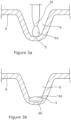
- FIGs 3a and b there is illustrated the manner in which the resin used has a non slumping to flowable characteristic. It is found that this assists in the application of the resin whilst ensuring the best possible bonding of the resin to the fabric once applied.
- the resin as it is applied from the exit aperture 26 into the crease line 6 and onto the base 5 and typically as soon as the resin leaves the exit aperture and is exposed to the ambient environment, the catalyst in the resin will start the curing effect of the resin.
- the resin will initially have the form of a body or "blob" 62 of resin in which the same has the substantially non-slumping characteristic.
- the size of the body 62 and speed of curing will be affected by the parameters of the size of exit aperture 26, the speed of movement along the crease line of the exit apertures and the ambient environment conditions.
- the characteristic of the resin will change towards a flowable characteristic which means that resin 64 starts to absorb into and bond with the fibres 66 of the fabric of the garment 8 adjacent to the base 5 of the crease line 6 as illustrated in Figure 3b .
- This improves the bonding and retention of the subsequently hardened fully cured resin with the fabric and hence retention of the crease line 6 shape.
- This change from the non-slumping to flowable characteristic of the resin allows, in conjunction with the control of the parameters referred to above, the control of the application of the resin to allow the same to absorb into and/or bond with the fabric as the resin cures and hardens.
- the resin which is used is colourless and includes silicone rubber and one or more of the catalysts as herein described and, in ambient environmental conditions of a temperature of 23 degrees Celsius and 50% relative humidity has a curing speed in the range of 1.5 to 1.7 mm/d when exposed to the ambient conditions and is preferably applied such that the line of resin has a thickness less than 0.75 mm.
- the effectiveness of the resin is improved by the provision of the same in the format as herein described.
Landscapes
- Engineering & Computer Science (AREA)
- Textile Engineering (AREA)
- Chemical & Material Sciences (AREA)
- Chemical Kinetics & Catalysis (AREA)
- Inorganic Chemistry (AREA)
- Organic Chemistry (AREA)
- General Chemical & Material Sciences (AREA)
- Life Sciences & Earth Sciences (AREA)
- Wood Science & Technology (AREA)
- Treatment Of Fiber Materials (AREA)
- Treatments For Attaching Organic Compounds To Fibrous Goods (AREA)
- Heating, Cooling, Or Curing Plastics Or The Like In General (AREA)
- Chemical Or Physical Treatment Of Fibers (AREA)
Applications Claiming Priority (1)
| Application Number | Priority Date | Filing Date | Title |
|---|---|---|---|
| GBGB2210511.8A GB202210511D0 (en) | 2022-07-18 | 2022-07-18 | Resin for use in setting a crease in a garment and a method for applying the same and the garment including the resin |
Publications (1)
| Publication Number | Publication Date |
|---|---|
| EP4310244A1 true EP4310244A1 (en) | 2024-01-24 |
Family
ID=84540273
Family Applications (1)
| Application Number | Title | Priority Date | Filing Date |
|---|---|---|---|
| EP23275105.7A Pending EP4310244A1 (en) | 2022-07-18 | 2023-07-14 | Resin for use in setting a crease in a garment, a method and apparatus for applying the same and a garment including the resin |
Country Status (7)
| Country | Link |
|---|---|
| EP (1) | EP4310244A1 (enExample) |
| JP (1) | JP2024012273A (enExample) |
| KR (1) | KR20240011112A (enExample) |
| CN (1) | CN117403443A (enExample) |
| CA (1) | CA3206713A1 (enExample) |
| GB (2) | GB202210511D0 (enExample) |
| MX (1) | MX2023008448A (enExample) |
Citations (5)
| Publication number | Priority date | Publication date | Assignee | Title |
|---|---|---|---|---|
| US4504549A (en) * | 1983-05-20 | 1985-03-12 | Union Carbide Corporation | Elastomeric silicone finishes applied to substrates and method of preparing same |
| US4549880A (en) * | 1983-09-02 | 1985-10-29 | Springs Industries, Inc. | Silicone durable press textile treatment process with radiation curing and resulting product |
| WO2002006578A1 (en) * | 2000-07-14 | 2002-01-24 | Nextec Applications, Inc. | Fabric seam sealing using sealant |
| US20200077729A1 (en) * | 2017-05-31 | 2020-03-12 | Supercrease Limited | Apparatus For The Application Of Material To A Crease Of A Garment |
| CA3164888A1 (en) * | 2020-01-15 | 2021-07-22 | Paul Stewart | Resin for use in setting a crease in a garment |
Family Cites Families (5)
| Publication number | Priority date | Publication date | Assignee | Title |
|---|---|---|---|---|
| US3531806A (en) * | 1966-06-24 | 1970-10-06 | Metro Atlantic Inc | Production of durable shaped fabric articles using two-stage curing |
| GB1253478A (en) * | 1970-06-08 | 1971-11-17 | John Andre Pinatel | Imparting durable creases and crease resistance to fabrics |
| FR2946655A1 (fr) * | 2009-06-15 | 2010-12-17 | Bluestar Silicones France | Procede d'enduction d'une composition silicone ne contenant pas d'etain sur un support souple. |
| CN101899779B (zh) * | 2010-08-12 | 2013-04-24 | 浙江传化股份有限公司 | 一种100%有机硅涂层整理剂及其应用 |
| GB2574499A (en) * | 2018-04-06 | 2019-12-11 | Supercrease Ltd | Improvements to apparatus and a method for the application of a fluid material to a garment |
-
2022
- 2022-07-18 GB GBGB2210511.8A patent/GB202210511D0/en not_active Ceased
-
2023
- 2023-07-14 EP EP23275105.7A patent/EP4310244A1/en active Pending
- 2023-07-14 GB GB2310831.9A patent/GB2620850A/en active Pending
- 2023-07-17 CA CA3206713A patent/CA3206713A1/en active Pending
- 2023-07-17 MX MX2023008448A patent/MX2023008448A/es unknown
- 2023-07-18 KR KR1020230092781A patent/KR20240011112A/ko active Pending
- 2023-07-18 JP JP2023116518A patent/JP2024012273A/ja active Pending
- 2023-07-18 CN CN202310886332.3A patent/CN117403443A/zh active Pending
Patent Citations (6)
| Publication number | Priority date | Publication date | Assignee | Title |
|---|---|---|---|---|
| US4504549A (en) * | 1983-05-20 | 1985-03-12 | Union Carbide Corporation | Elastomeric silicone finishes applied to substrates and method of preparing same |
| US4549880A (en) * | 1983-09-02 | 1985-10-29 | Springs Industries, Inc. | Silicone durable press textile treatment process with radiation curing and resulting product |
| WO2002006578A1 (en) * | 2000-07-14 | 2002-01-24 | Nextec Applications, Inc. | Fabric seam sealing using sealant |
| US20200077729A1 (en) * | 2017-05-31 | 2020-03-12 | Supercrease Limited | Apparatus For The Application Of Material To A Crease Of A Garment |
| CA3164888A1 (en) * | 2020-01-15 | 2021-07-22 | Paul Stewart | Resin for use in setting a crease in a garment |
| GB2606925A (en) | 2020-01-15 | 2022-11-23 | Supercrease Ltd | Resin for use in setting a crease in a garment |
Also Published As
| Publication number | Publication date |
|---|---|
| GB202310831D0 (en) | 2023-08-30 |
| GB202210511D0 (en) | 2022-08-31 |
| GB2620850A (en) | 2024-01-24 |
| MX2023008448A (es) | 2024-01-19 |
| CN117403443A (zh) | 2024-01-16 |
| JP2024012273A (ja) | 2024-01-30 |
| CA3206713A1 (en) | 2024-01-18 |
| KR20240011112A (ko) | 2024-01-25 |
Similar Documents
| Publication | Publication Date | Title |
|---|---|---|
| US20250361674A1 (en) | Resin for use in Setting a Crease in a Garment | |
| US20250359608A1 (en) | Resin for use in Setting a Crease in a Garment, a Method and Apparatus for Applying the Same and a Garment Including the Resin | |
| CA1273443A (en) | Silicone release coatings containing higher alkenyl functional siloxanes | |
| JP2002143300A (ja) | 医療用円筒容器の内壁に熱付着性潤滑剤コーティングを施すための方法及び装置 | |
| CA3206713A1 (en) | Resin for use in setting a crease in a garment, a method and apparatus for applying the same and a garment including the resin | |
| CL2004001022A1 (es) | Composicion acondicionadora de telas, que comprende un material suavizante de telas cationico ligado por ester, y un material no ionico, un polimero y un agente complejante. | |
| JP2023511863A5 (enExample) | ||
| CA3164888C (en) | Resin for use in setting a crease in a garment | |
| US10954626B2 (en) | Apparatus, material and method of applying the same to garments in order to maintain a crease | |
| JP3149318B2 (ja) | 紫外線硬化型オルガノポリシロキサン組成物 | |
| JP2024012273A5 (enExample) | ||
| US20110183147A1 (en) | Method for Functionalising a Textile Substrate in Order to Impart Humidity Transfer Properties Thereto | |
| EP1620502B9 (en) | Method of curing a composition by metathesis reaction using reaction control agent | |
| WO2020184193A1 (ja) | エアーバッグコーティング用シリコーンゴム組成物 | |
| ITPR20080063A1 (it) | Erogatore di fluido adesivo newtoniano e relativo procedimento di erogazione | |
| WO2001028606A3 (en) | Apparatus and methods for coating of the catheter inner lumen | |
| KR100578005B1 (ko) | 핫멜트를 이용한 신발접착장치 | |
| JP2007231172A (ja) | 電極・電気回路の保護剤組成物 | |
| ES2239852T3 (es) | Metodo para promover la adhesion. | |
| WO1992001429A1 (en) | Process for manufacturing coated hot water containers and containers thus obtained | |
| IE46452B1 (en) | Applicator for crease-setting compositions | |
| KR100722199B1 (ko) | 마이크로캡슐 및 광물질을 함유하는 폴리우레탄 코팅제 | |
| KR101312930B1 (ko) | 공기압을 이용한 치과 기공용 왁스 디스펜서 | |
| CN111283934A (zh) | 一种绳带及其制造方法 | |
| JP2014155345A (ja) | ワイヤハーネスの形成方法およびワイヤハーネス |
Legal Events
| Date | Code | Title | Description |
|---|---|---|---|
| PUAI | Public reference made under article 153(3) epc to a published international application that has entered the european phase |
Free format text: ORIGINAL CODE: 0009012 |
|
| STAA | Information on the status of an ep patent application or granted ep patent |
Free format text: STATUS: THE APPLICATION HAS BEEN PUBLISHED |
|
| AK | Designated contracting states |
Kind code of ref document: A1 Designated state(s): AL AT BE BG CH CY CZ DE DK EE ES FI FR GB GR HR HU IE IS IT LI LT LU LV MC ME MK MT NL NO PL PT RO RS SE SI SK SM TR |
|
| STAA | Information on the status of an ep patent application or granted ep patent |
Free format text: STATUS: REQUEST FOR EXAMINATION WAS MADE |
|
| 17P | Request for examination filed |
Effective date: 20240415 |