EP4307469A1 - Slope and direction detecting apparatus and antenna assembly using same - Google Patents
Slope and direction detecting apparatus and antenna assembly using same Download PDFInfo
- Publication number
- EP4307469A1 EP4307469A1 EP22767501.4A EP22767501A EP4307469A1 EP 4307469 A1 EP4307469 A1 EP 4307469A1 EP 22767501 A EP22767501 A EP 22767501A EP 4307469 A1 EP4307469 A1 EP 4307469A1
- Authority
- EP
- European Patent Office
- Prior art keywords
- tilt
- detecting apparatus
- direction detecting
- supporting
- hole
- Prior art date
- Legal status (The legal status is an assumption and is not a legal conclusion. Google has not performed a legal analysis and makes no representation as to the accuracy of the status listed.)
- Pending
Links
Images




Classifications
-
- G—PHYSICS
- G01—MEASURING; TESTING
- G01S—RADIO DIRECTION-FINDING; RADIO NAVIGATION; DETERMINING DISTANCE OR VELOCITY BY USE OF RADIO WAVES; LOCATING OR PRESENCE-DETECTING BY USE OF THE REFLECTION OR RERADIATION OF RADIO WAVES; ANALOGOUS ARRANGEMENTS USING OTHER WAVES
- G01S5/00—Position-fixing by co-ordinating two or more direction or position line determinations; Position-fixing by co-ordinating two or more distance determinations
- G01S5/16—Position-fixing by co-ordinating two or more direction or position line determinations; Position-fixing by co-ordinating two or more distance determinations using electromagnetic waves other than radio waves
- G01S5/163—Determination of attitude
-
- G—PHYSICS
- G01—MEASURING; TESTING
- G01S—RADIO DIRECTION-FINDING; RADIO NAVIGATION; DETERMINING DISTANCE OR VELOCITY BY USE OF RADIO WAVES; LOCATING OR PRESENCE-DETECTING BY USE OF THE REFLECTION OR RERADIATION OF RADIO WAVES; ANALOGOUS ARRANGEMENTS USING OTHER WAVES
- G01S3/00—Direction-finders for determining the direction from which infrasonic, sonic, ultrasonic or electromagnetic waves, or particle emission, not having a directional significance, are being received
- G01S3/78—Direction-finders for determining the direction from which infrasonic, sonic, ultrasonic or electromagnetic waves, or particle emission, not having a directional significance, are being received using electromagnetic waves other than radio waves
- G01S3/782—Systems for determining direction or deviation from predetermined direction
- G01S3/785—Systems for determining direction or deviation from predetermined direction using adjustment of orientation of directivity characteristics of a detector or detector system to give a desired condition of signal derived from that detector or detector system
-
- G—PHYSICS
- G01—MEASURING; TESTING
- G01C—MEASURING DISTANCES, LEVELS OR BEARINGS; SURVEYING; NAVIGATION; GYROSCOPIC INSTRUMENTS; PHOTOGRAMMETRY OR VIDEOGRAMMETRY
- G01C21/00—Navigation; Navigational instruments not provided for in groups G01C1/00 - G01C19/00
- G01C21/02—Navigation; Navigational instruments not provided for in groups G01C1/00 - G01C19/00 by astronomical means
- G01C21/025—Navigation; Navigational instruments not provided for in groups G01C1/00 - G01C19/00 by astronomical means with the use of startrackers
-
- G—PHYSICS
- G01—MEASURING; TESTING
- G01C—MEASURING DISTANCES, LEVELS OR BEARINGS; SURVEYING; NAVIGATION; GYROSCOPIC INSTRUMENTS; PHOTOGRAMMETRY OR VIDEOGRAMMETRY
- G01C9/00—Measuring inclination, e.g. by clinometers, by levels
-
- G—PHYSICS
- G01—MEASURING; TESTING
- G01J—MEASUREMENT OF INTENSITY, VELOCITY, SPECTRAL CONTENT, POLARISATION, PHASE OR PULSE CHARACTERISTICS OF INFRARED, VISIBLE OR ULTRAVIOLET LIGHT; COLORIMETRY; RADIATION PYROMETRY
- G01J1/00—Photometry, e.g. photographic exposure meter
- G01J1/02—Details
- G01J1/0271—Housings; Attachments or accessories for photometers
-
- G—PHYSICS
- G01—MEASURING; TESTING
- G01J—MEASUREMENT OF INTENSITY, VELOCITY, SPECTRAL CONTENT, POLARISATION, PHASE OR PULSE CHARACTERISTICS OF INFRARED, VISIBLE OR ULTRAVIOLET LIGHT; COLORIMETRY; RADIATION PYROMETRY
- G01J1/00—Photometry, e.g. photographic exposure meter
- G01J1/02—Details
- G01J1/04—Optical or mechanical part supplementary adjustable parts
- G01J1/0403—Mechanical elements; Supports for optical elements; Scanning arrangements
-
- G—PHYSICS
- G01—MEASURING; TESTING
- G01J—MEASUREMENT OF INTENSITY, VELOCITY, SPECTRAL CONTENT, POLARISATION, PHASE OR PULSE CHARACTERISTICS OF INFRARED, VISIBLE OR ULTRAVIOLET LIGHT; COLORIMETRY; RADIATION PYROMETRY
- G01J1/00—Photometry, e.g. photographic exposure meter
- G01J1/02—Details
- G01J1/04—Optical or mechanical part supplementary adjustable parts
- G01J1/06—Restricting the angle of incident light
-
- G—PHYSICS
- G01—MEASURING; TESTING
- G01J—MEASUREMENT OF INTENSITY, VELOCITY, SPECTRAL CONTENT, POLARISATION, PHASE OR PULSE CHARACTERISTICS OF INFRARED, VISIBLE OR ULTRAVIOLET LIGHT; COLORIMETRY; RADIATION PYROMETRY
- G01J1/00—Photometry, e.g. photographic exposure meter
- G01J1/42—Photometry, e.g. photographic exposure meter using electric radiation detectors
- G01J1/4228—Photometry, e.g. photographic exposure meter using electric radiation detectors arrangements with two or more detectors, e.g. for sensitivity compensation
-
- G—PHYSICS
- G01—MEASURING; TESTING
- G01J—MEASUREMENT OF INTENSITY, VELOCITY, SPECTRAL CONTENT, POLARISATION, PHASE OR PULSE CHARACTERISTICS OF INFRARED, VISIBLE OR ULTRAVIOLET LIGHT; COLORIMETRY; RADIATION PYROMETRY
- G01J1/00—Photometry, e.g. photographic exposure meter
- G01J1/42—Photometry, e.g. photographic exposure meter using electric radiation detectors
- G01J1/44—Electric circuits
-
- H—ELECTRICITY
- H01—ELECTRIC ELEMENTS
- H01Q—ANTENNAS, i.e. RADIO AERIALS
- H01Q1/00—Details of, or arrangements associated with, antennas
- H01Q1/12—Supports; Mounting means
- H01Q1/22—Supports; Mounting means by structural association with other equipment or articles
- H01Q1/24—Supports; Mounting means by structural association with other equipment or articles with receiving set
- H01Q1/241—Supports; Mounting means by structural association with other equipment or articles with receiving set used in mobile communications, e.g. GSM
- H01Q1/246—Supports; Mounting means by structural association with other equipment or articles with receiving set used in mobile communications, e.g. GSM specially adapted for base stations
-
- G—PHYSICS
- G01—MEASURING; TESTING
- G01J—MEASUREMENT OF INTENSITY, VELOCITY, SPECTRAL CONTENT, POLARISATION, PHASE OR PULSE CHARACTERISTICS OF INFRARED, VISIBLE OR ULTRAVIOLET LIGHT; COLORIMETRY; RADIATION PYROMETRY
- G01J1/00—Photometry, e.g. photographic exposure meter
- G01J1/42—Photometry, e.g. photographic exposure meter using electric radiation detectors
- G01J2001/4266—Photometry, e.g. photographic exposure meter using electric radiation detectors for measuring solar light
-
- G—PHYSICS
- G01—MEASURING; TESTING
- G01J—MEASUREMENT OF INTENSITY, VELOCITY, SPECTRAL CONTENT, POLARISATION, PHASE OR PULSE CHARACTERISTICS OF INFRARED, VISIBLE OR ULTRAVIOLET LIGHT; COLORIMETRY; RADIATION PYROMETRY
- G01J1/00—Photometry, e.g. photographic exposure meter
- G01J1/42—Photometry, e.g. photographic exposure meter using electric radiation detectors
- G01J2001/4266—Photometry, e.g. photographic exposure meter using electric radiation detectors for measuring solar light
- G01J2001/4271—Pyrrheliometer
-
- H—ELECTRICITY
- H01—ELECTRIC ELEMENTS
- H01Q—ANTENNAS, i.e. RADIO AERIALS
- H01Q3/00—Arrangements for changing or varying the orientation or the shape of the directional pattern of the waves radiated from an antenna or antenna system
- H01Q3/005—Arrangements for changing or varying the orientation or the shape of the directional pattern of the waves radiated from an antenna or antenna system using remotely controlled antenna positioning or scanning
Definitions
- the present disclosure relates to a tilt and direction detecting apparatus and an antenna assembly using the same.
- a proper installation position for an antenna is determined depending on the outcome of network design.
- a directivity angle and tilting angle for an antenna may be appropriately designed in consideration of vertical up/down tilting and horizontal sector directivity angle of an antenna beam.
- the tilting angle and the directivity angle may be optimized by carrying out a test to adapt the installed antenna to the propagation environment of the site.
- the tilting angle and directivity angle of an antenna needs to be re-adjusted according to changes in radio environment.
- the tilt of a mast where an antenna is installed may be changed, affected by external environments such as strong wind, or clamps for attaching an antenna and a mast may be horizontally misaligned.
- a tilt and direction detecting apparatus can enhance the convenience of maintenance and repair of equipment such as antennas by obtaining a three-dimensional tilt angle for the equipment by using sunlight, and immediately checking whether the current directivity angle of the equipment suits the initial design intent.
- a tilt and direction detecting apparatus makes it possible to dispose a flexible printed circuit including a plurality of optical sensors board on a dome structure.
- An embodiment of the present disclosure provides a tilt and direction detecting apparatus comprising: a dome structure including a spherical surface; a plurality of optical sensors configured to measure the intensity of sunlight; and a flexible circuit printed board configured to enclose at least a portion of the spherical surface, wherein, in a state in which the flexible circuit board is disposed on the spherical surface, the plurality of optical sensors are oriented in different directions from each other.
- a tilt and direction detecting apparatus provides highly reliable measurements since it uses sunlight, and can be offered at a low price.
- a tilt and direction detecting apparatus can have better productivity because a flexible printed circuit substrate including a plurality of optical sensors is disposed on a dome structure.
- FIG. 1 is a perspective view of an antenna assembly according to an embodiment of the present disclosure.
- an antenna assembly 1 of the present disclosure may include all or some of a tilt and direction detecting apparatus 11 and an antenna apparatus 12.
- the tilt and direction detecting apparatus 11 may be secured to the antenna apparatus 12 and measure, in real time, three-dimensional spatial direction information of the antenna apparatus 12. Based on the three-dimensional spatial direction information, the antenna assembly 1 may remotely monitor and control the direction of the antenna apparatus 12.
- the tilt and direction detecting apparatus 11 may include all or some of an IMU (inertial measurement unit) sensor, a plurality of optical sensors, a GPS module, and a camera module.
- IMU intial measurement unit
- the IMU sensor may measure the tilt and roll of the antenna apparatus 12.
- the plurality of optical sensors may measure the angle of incidence of sunlight.
- the GPS module may measure the altitude and longitude of the current position where the tilt and direction detecting apparatus 11 is installed. Also, the GPS module may provide calendar information on the date and time of receipt of output information.
- the tilt and direction detecting apparatus 11 may calculate the absolute horizontal direction angle information of the antenna apparatus 12 by using one or more pieces of information measured by the IMU sensor and the GPS module.
- the camera module may capture a foreground toward which the antenna apparauts 12 where the tilt and direction detecting apparatus 11 is installed is oriented, or may generate image or video data.
- FIG. 2 is a perspective view of a tilt and direction detecting apparatus according to an embodiment of the present disclosure.
- FIG. 3 is an exploded perspective view of a tilt and direction detecting apparatus according to an embodiment of the present disclosure.
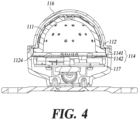
- FIG. 4 is a cross-sectional view of a tilt and direction detecting apparatus according to an embodiment of the present disclosure.
- the tilt and direction detecting apparatus 11 may include all or some of a dome structure 111, a flexible printed circuit board (FPCB) 112, a cover member 113, and a main board 114.
- FPCB flexible printed circuit board
- the dome structure 111 may include a spherical surface 1111 and a through-hole 1112.
- the spherical surface 1111 may include a plurality of supporting surfaces 1111a, and a base unit 1121 of the flexible printed circuit board 112 may be disposed on each supporting surface 1111a.
- the spherical surface 1111 of the dome structure 111 may be constructed of multiple polygons, for example, circles, triangles, pentagons, hexagons, or a combination thereof. However, the present disclosure is not limited to them, and the spherical surface 1111 of the dome surface 111 may have a curved shape as a whole.
- the flexible printed circuit board 112 may enclose at least a portion of the spherical surface 1111 of the dome surface 111.
- the flexible printed circuit board 112 may include the base unit 1121, and an optical sensor 1121a capable of receiving sunlight may be disposed on the base unit 1121. A structure of the flexible printed circuit board 112 will be described in detail later.
- the tilt and direction detecting apparatus 11 of the present disclosure has a technical feature of enhancing the productivity of the tilt and direction detecting apparatus 11 by disposing a plurality of optical sensors 1121a on the dome structure 111, by using the flexible printed circuit board 112. By disposing the flexible printed circuit board 112 in such a way as to enclose the dome structure 111, the plurality of optical sensors 1121a may be easily installed on the plurality of supporting faces 1111a.
- the tilt and direction detecting apparatus 11 can be easily assembled, and, as a result, the productivity of the tilt and direction detecting apparatus 11 can be improved.
- the plurality of optical sensors 1121a may be disposed to face different directions.
- Each optical sensor 1121a may receive sunlight in a direction in which each optical sensor 1121a is oriented.
- the optical sensors 1121a may receive sunlight in a direction normal to their corresponding supporting surface 1111a.
- the cover member 113 may be disposed on a base unit 1121 which is disposed on a supporting surface 1111a.
- the cover member 113 may include a light receiving hole 1131 corresponding to an optical sensor 1121a.
- the light receiving hole 1131 may help the optical sensor 1121a receive only sunlight that is incident in a particular direction.
- the light receiving hole 1131 may help the optical sensor 1121a receive only sunlight that is incident in a direction normal to the supporting surface 1111a and a direction contiguous to that direction.
- the light receiving hole 1131 may block sunlight from other directions other than the direction normal to the supporting surface 1111a and the direction contiguous to that direction.
- the range of sunlight reception by the light receiving hole 1131 may vary depending on the number of optical sensors 1121a provided in the tilt and direction detecting apparatus 11. For example, if there is a relatively large number of optical sensors 1121a, the light receiving hole 1131 may be designed to receive sunlight in a relatively narrow range or to receive sunlight in a particular direction, e.g., in a direction normal to the supporting surface 1111a, in order to improve the precision of sensing by each optical sensor 1121a. On the other hand, if there is a relatively small number of optical sensors 1121a, the light receiving hole 1131 may be designed to receive sunlight within a relatively wide range, in order to widen the range of sensing by each optical sensor 1121a. The range of sunlight reception by the light receiving hole 1131 may be adjusted by changing the diameter or shape of the light receiving hole 1131.
- the main board 114 may calculate the angle of incidence of sunlight from information outputted from the plurality of optical sensors 1121a.
- the main board 14 may include a first surface 1141 contiguous to the dome structure 111, a second surface 1142 opposite to the first surface 1141, and a through groove 1143.
- At least a portion of a second connecting portion 1124 of the flexible printed circuit board 112 may pass through the through groove 1143, and one end of the second connecting portion 1124 of the main board 114.
- a unit substrate having an optical sensor module may be installed on each supporting surface, and power lines extended from each unit substrate may be electrically connected to the first surface of the main board.
- the power lines are scattered between an inner surface of the dome structure and the main board, and this may deteriorate the assemblability of the tilt and direction detecting apparatus.
- the tilt and direction detecting apparatus 11 of the present disclosure is capable of improving the assemblability of the tilt and direction detecting apparatus 11, since it is configured such that the second connecting portion 1124 of the flexible printed circuit board 112 is connected to the second surface 1142 of the main board 114.
- the tilt and direction detecting apparatus 11 of the present disclosure may further include a housing 115, a protective cap 116, a surge board 117, and a control cable 118.
- the housing 115 may form an exterior of the tilt and direction detecting apparatus 11 and have a variety of parts installed in it.
- the protective cap 116 may be disposed in such a way as to fully enclose the spherical surface 1111 of the dome structure 111.
- the protective cap 116 may protect internal parts from external forces, and prevent foreign matters from getting inside the tilt and direction detecting apparatus 11.
- the surge board 117 may be disposed under the main board 114.
- the surge board 117 may supply electric power to the parts in the tilt and direction detecting apparatus 11.
- the tilt and direction detecting apparatus 11 may send and receive measurement data and control data by using the control cable 118.
- FIG. 5 is a bottom view of a cover member of a tilt and direction detecting apparatus according to an embodiment of the present disclosure.
- the cover member 113 may include all or some of the light receiving hole 1131, a plurality of supporting portions 1132, a protruding portion 1133, and a cover body 1135.
- the light receiving hole 1131 may help the optical sensor 1121a receive only sunlight that is incident in a direction normal to the supporting surface 1111a and a direction contiguous to that direction. Also, the light receiving hole 1131 may block sunlight from other directions other than the direction normal to the supporting surface 1111a and the direction contiguous to that direction. In that case, the optical sensor 1121a may have a wider sensing range.
- the present disclosure is not limited to this, and the range of sunlight reception by the light receiving hole 1131 may be limited to a particular direction.
- the light receiving hole 1131 may receive sunlight only in a direction normal to the supporting surface 1111a or in a very narrow range contiguous to that direction.
- the plurality of supporting portions 1132 may be configured to extend from one side of the cover member 113 facing the base unit 1121, and such that the cover body 1135 is supported by the supporting surface 1111a of the dome structure 111.
- the supporting portions 1132 may be laser-fused onto the supporting surface 1111a, but the present disclosure is not limited thereto.
- the supporting portions 1132 may be secured onto the supporting surface 1111a by using an adhesive or the like.
- the plurality of supporting portions 1132 may be spaced apart from one another around the light receiving hole 1131.
- a space may be formed between two neighboring supporting portions 1132, and a first connecting portion 1123 of the flexible printed circuit board 112 may be configured to pass through the space.
- the supporting portions 132 may include a first supporting portion 1132a, a second supporting portion 1132b neighboring the first supporting portion 1132a, and a third supporting portion 1132c neighboring the second supporting portion 1132b.
- the cover member 113 may be firmly secured onto the supporting surface 1111a as it is supported at three points by using the three supporting portions 1132.
- a first space 1134a which is a space between the first supporting portion 1132a and the second supporting portion 1132, may be larger than a second space 1134b, which is a space between the second supporting portion 1132b and the third supporting portion 1132c.
- the tilt and direction detecting apparatus 11 of the present disclosure is capable of increasing the degree of freedom with respect to the direction in which the first connecting portion 1123 extends, by using the first space 1134a.
- the third supporting portion 1132c and the second supporting portion 1132b may be disposed symmetrically with respect to the first supporting portion 1132a.
- a third space 1134c which is a space between the first supporting portion 1132a and the third supporting portion 1132c, may be equal in size to the second space 1134b. however, the present disclosure is not limited to this, and the third supporting portion 1132c and the second supporting portion 1132b may not be symmetrical with respect to the first supporting portion 1132a.
- the cover member 113 may include two or four or more supporting portions 1132.
- the protruding portion 1133 may be configured to be fitted to the through-hole 1112 of the dome structure 111. As the protruding portion 1133 is fitted to the through-hole 1112, the cover member 113 may be secured onto the dome structure 111.
- the through-hole 1112 may include a first through-hole 1112a and a second through-hole 1112b
- the protruding portion 1133 may include a first protruding portion 1133a having a shape corresponding to the first through-hole 1112a and a second protruding portion 1133b having a shape corresponding to the second through-hole 1112b.
- the first through-hole 1112a may have a different size or different shape from the second through-hole 1112b, and therefore the first protruding portion 1133a may have a different size or different shape from the second protruding portion 1133b.
- the first through-hole 1112a and the first protruding portion 1133a may be larger in size than the second through-hole 1112b and the second protruding portion 1133b, respectively.
- the cover member 113 on each supporting surface 111a may be installed in a particular fixed direction.
- each supporting portion 1132 also may be formed in a particular fixed direction.
- each cover member 113 may vary depending on the shape of the flexible printed circuit board 112. Specifically, it may vary depending on the direction in which the first connecting portion 1123 of the flexible printed circuit board 112 extends. Through this, the degree of freedom in the design of the flexible printed circuit board 112 according to an embodiment of the present disclosure can be further increased.
- FIG. 6 is a top view of a flexible circuit board of a tilt and direction detecting apparatus according to an embodiment of the present disclosure.
- the flexible printed circuit board 112 of the tilt and direction detecting apparatus 11 of the present disclosure may include a plurality of base units 1121, a plurality of first connecting portions 1123, and a plurality of second connecting portions 1124.
- the base units 1121 each may include an optical sensor 1121a, a circuit portion 1121b where the optical sensor 1121a is disposed, and a reinforcing board 112 disposed under the circuit portion 1121b.
- the reinforcing board 1122 may reinforce the rigidity of the circuit portion 1121b by thickening an area of the flexible printed circuit board 112 where the circuit portion 1121b is formed.
- the reinforcing board 1122 may minimize the problem of deformation of or damage to the circuit portion 1121b caused by an external force or the like, and also may minimize the problem of damage to the optical sensor 1121a, etc. disposed on the circuit portion.
- Each of the plurality of base units 1121 may be disposed on each of the plurality of supporting surfaces 1111a.
- Each of the plurality of optical sensors 1121a may be disposed on each of the plurality of base units 1121.
- the plurality of optical sensors 1121a may be disposed on the circuit portions 1121b of the base units 1121.
- the base units 1121 may be relatively larger in thickness than the first connecting portions 1123 since they reinforce the rigidity of the circuit portions 1121b by using the reinforcing board 1122. Thus, it is possible to minimize the problem of damage to the optical sensors 1121a disposed on the base units 1121 caused by unintentional bending of the base units 1121 by an external force or the like.
- the reinforcing board 1122 may not be disposed on the first connecting portions 1123.
- the first connecting portions 1123 may have a second thickness W2 which is smaller than a first thickness W1 of the base units 1121. Since the first connecting portions 1123 may be flexibly deformed due to their relatively small thickness, the flexible printed circuit board 112 may be disposed more easily on the dome structure 111.
- the circuit portion 1121b may include polyimide which is a typical material of the flexible printed circuit board 112. However, the present disclosure is not limited to this, and the circuit portion 1121b may include other materials.
- the reinforcing board 1122 may include at least one of PET, glass epoxy, and polyimide. However, the present disclosure is not limited to this, and the reinforcing board 1122 may include other materials.
- FIG. 6 illustrates sixteen base units 1121, this is merely an illustration for convenience of explanation, and the number of base units 1121 of the present disclosure is not limited to sixteen.
- the flexible printed circuit board 112 according to the present disclosure may include more or fewer than sixteen base unit 1121.
- the number of optical sensors 1121a disposed on the base units 1121 or the number of supporting surfaces 1111a on the dome structure 111 may vary depending on the number of base units 1121.
- the first connecting portions 1123 each may connect two neighboring base units 1121 among the plurality of base units 1121. Since the first connecting portions 1123 have no reinforcing board 1122 unlike the base units 1121, they may have a relatively smaller thickness than the base units 1121. Thus, the first connecting portions 1123 may be flexibly deformed, and, as a result, the flexible printed circuit board 112 may enclose the spherical surface of the dome structure 111 more easily.
- the second connecting portions 1124 may electrically connect the plurality of optical sensors 1121a and the main board 114.
- the second connecting portions 1124 may include a signal line, a power supply line, etc. Also, a terminal or connector to be electrically connected to the main board 114 may be provided at one end of the second connecting portions 1124.
- the flexible printed circuit board 112 including the base units 1121, the reinforcing board 1122, the first connecting portions 1123, and the second connecting portions 1124 may be formed as a single body.
- the arrangement of power lines for feeding or supplying power to the plurality of optical sensors 1121a may be simplified.
- the base units 1121 may include a mounting hole.
- the protruding portion 1133 formed on the cover member 113 may pass through the mounting hole. If the protruding portion 1133 includes a first protruding portion 1133a and a second protruding portion 1133b that are different in size or in shape, the mounting hole may include a first mounting hole 1121c corresponding to the first protruding portion 1133a and a second mounting hole 1121d corresponding to the second protruding portion 1133b.
- the first protruding portion 1133a may pass through the first mounting hole 1121c
- the second protruding portion 1133b may pass through the second mounting hole 1121d.
- the first protruding portion 1133a may pass through the first mounting hole 1121c of the base unit 1121 and the first through-hole 1112a of the supporting surface 1111a
- the second protruding portion 1133b may pass through the second mounting hole 1121d of the base unit 1121 and the second through-hole 1112b of the supporting surface 1111a.
- FIG. 6 illustrates one flexible printed circuit board 112 disposed on the spherical surface 1111 of the dome structure 111
- the present disclosure is not limited to this.
- a plurality of flexible printed circuits 112 may be disposed on the spherical surface 1111 of the dome structure 111.
- a plurality of optical sensors 1121a may be disposed on the plurality of flexible printed circuits 112 in a distributed manner.
- the shape of the flexible printed circuit board 112 depicted in FIG. 6 is merely an example for convenience of explanation, and the flexible printed circuit board 112 of the present disclosure may have other shapes than the one in the embodiment depicted in FIG. 6 .
Landscapes
- Physics & Mathematics (AREA)
- General Physics & Mathematics (AREA)
- Spectroscopy & Molecular Physics (AREA)
- Engineering & Computer Science (AREA)
- Radar, Positioning & Navigation (AREA)
- Remote Sensing (AREA)
- Electromagnetism (AREA)
- Astronomy & Astrophysics (AREA)
- Automation & Control Theory (AREA)
- Computer Networks & Wireless Communication (AREA)
- Photometry And Measurement Of Optical Pulse Characteristics (AREA)
- Support Of Aerials (AREA)
Abstract
Description
- The present application claims priority to Patent Application No.
10-2021-0032222, filed on March 11, 2021 10-2022-0027531, filed on March 3, 2022 in Korea - The present disclosure relates to a tilt and direction detecting apparatus and an antenna assembly using the same.
- The description in this section merely provides background information on the present disclosure and does not necessarily constitute the related art.
- In a mobile communication base station, a proper installation position for an antenna is determined depending on the outcome of network design. A directivity angle and tilting angle for an antenna may be appropriately designed in consideration of vertical up/down tilting and horizontal sector directivity angle of an antenna beam. The tilting angle and the directivity angle may be optimized by carrying out a test to adapt the installed antenna to the propagation environment of the site.
- Since a radio signal in a 5G 3.5 GHz frequency band has a strong propagation linearity, an antenna needs to be installed with a pre-designed antenna angle of direction to obtain planned service coverage and to enable design and optimization with coherent indicators for later extensions. The higher the frequency band, the more critical it becomes to minimize errors.
- The tilting angle and directivity angle of an antenna needs to be re-adjusted according to changes in radio environment. The tilt of a mast where an antenna is installed may be changed, affected by external environments such as strong wind, or clamps for attaching an antenna and a mast may be horizontally misaligned.
- A tilt and direction detecting apparatus according to an embodiment can enhance the convenience of maintenance and repair of equipment such as antennas by obtaining a three-dimensional tilt angle for the equipment by using sunlight, and immediately checking whether the current directivity angle of the equipment suits the initial design intent.
- A tilt and direction detecting apparatus according to an embodiment makes it possible to dispose a flexible printed circuit including a plurality of optical sensors board on a dome structure.
- The aspects of the present disclosure are not limited to the foregoing, and other aspects not mentioned herein will be able to be clearly understood by those skilled in the art from the following description.
- An embodiment of the present disclosure provides a tilt and direction detecting apparatus comprising: a dome structure including a spherical surface; a plurality of optical sensors configured to measure the intensity of sunlight; and a flexible circuit printed board configured to enclose at least a portion of the spherical surface, wherein, in a state in which the flexible circuit board is disposed on the spherical surface, the plurality of optical sensors are oriented in different directions from each other.
- In accordance with an embodiment, a tilt and direction detecting apparatus provides highly reliable measurements since it uses sunlight, and can be offered at a low price.
- In accordance with an embodiment, a tilt and direction detecting apparatus can have better productivity because a flexible printed circuit substrate including a plurality of optical sensors is disposed on a dome structure.
-
-
FIG. 1 is a perspective view of an antenna assembly according to an embodiment of the present disclosure. -
FIG. 2 is a perspective view of a tilt and direction detecting apparatus according to an embodiment of the present disclosure. -
FIG. 3 is an exploded perspective view of a tilt and direction detecting apparatus according to an embodiment of the present disclosure. -
FIG. 4 is a cross-sectional view of a tilt and direction detecting apparatus according to an embodiment of the present disclosure. -
FIG. 5 is a bottom view of a cover member of a tilt and direction detecting apparatus according to an embodiment of the present disclosure. -
FIG. 6 is a top view of a flexible circuit board of a tilt and direction detecting apparatus according to an embodiment of the present disclosure. - Hereinafter, some exemplary embodiments of the present disclosure will be described in detail with reference to the accompanying drawings. In the following description, like reference numerals preferably designate like elements, although the elements are shown in different drawings. Further, in the following description of some embodiments, a detailed description of known functions and configurations incorporated therein will be omitted for the purpose of clarity and for brevity.
- Additionally, various terms such as first, second, A, B, (a), (b), etc., are used solely to differentiate one component from the other but not to imply or suggest the substances, order, or sequence of the components. Throughout the present specification, when a part 'includes' or 'comprises' a component, the part is meant to further include other components, not to exclude thereof unless specifically stated to the contrary.
-
FIG. 1 is a perspective view of an antenna assembly according to an embodiment of the present disclosure. - Referring to
FIG. 1 , an antenna assembly 1 of the present disclosure may include all or some of a tilt anddirection detecting apparatus 11 and anantenna apparatus 12. - The tilt and
direction detecting apparatus 11 may be secured to theantenna apparatus 12 and measure, in real time, three-dimensional spatial direction information of theantenna apparatus 12. Based on the three-dimensional spatial direction information, the antenna assembly 1 may remotely monitor and control the direction of theantenna apparatus 12. - The tilt and
direction detecting apparatus 11 may include all or some of an IMU (inertial measurement unit) sensor, a plurality of optical sensors, a GPS module, and a camera module. - The IMU sensor may measure the tilt and roll of the
antenna apparatus 12. The plurality of optical sensors may measure the angle of incidence of sunlight. The GPS module may measure the altitude and longitude of the current position where the tilt anddirection detecting apparatus 11 is installed. Also, the GPS module may provide calendar information on the date and time of receipt of output information. The tilt anddirection detecting apparatus 11 may calculate the absolute horizontal direction angle information of theantenna apparatus 12 by using one or more pieces of information measured by the IMU sensor and the GPS module. The camera module may capture a foreground toward which theantenna apparauts 12 where the tilt anddirection detecting apparatus 11 is installed is oriented, or may generate image or video data. -
FIG. 2 is a perspective view of a tilt and direction detecting apparatus according to an embodiment of the present disclosure. -
FIG. 3 is an exploded perspective view of a tilt and direction detecting apparatus according to an embodiment of the present disclosure. -
FIG. 4 is a cross-sectional view of a tilt and direction detecting apparatus according to an embodiment of the present disclosure. - Referring to
FIGS. 2 to 4 , the tilt anddirection detecting apparatus 11 may include all or some of adome structure 111, a flexible printed circuit board (FPCB) 112, acover member 113, and amain board 114. - The
dome structure 111 may include aspherical surface 1111 and a through-hole 1112. Thespherical surface 1111 may include a plurality of supporting surfaces 1111a, and abase unit 1121 of the flexible printedcircuit board 112 may be disposed on each supporting surface 1111a. - The
spherical surface 1111 of thedome structure 111 may be constructed of multiple polygons, for example, circles, triangles, pentagons, hexagons, or a combination thereof. However, the present disclosure is not limited to them, and thespherical surface 1111 of thedome surface 111 may have a curved shape as a whole. - The flexible printed
circuit board 112 may enclose at least a portion of thespherical surface 1111 of thedome surface 111. The flexible printedcircuit board 112 may include thebase unit 1121, and anoptical sensor 1121a capable of receiving sunlight may be disposed on thebase unit 1121. A structure of the flexible printedcircuit board 112 will be described in detail later. - The tilt and
direction detecting apparatus 11 of the present disclosure has a technical feature of enhancing the productivity of the tilt anddirection detecting apparatus 11 by disposing a plurality ofoptical sensors 1121a on thedome structure 111, by using the flexible printedcircuit board 112. By disposing the flexible printedcircuit board 112 in such a way as to enclose thedome structure 111, the plurality ofoptical sensors 1121a may be easily installed on the plurality of supporting faces 1111a. - As compared with the conventional art in which a unit substrate having an optical sensor module is installed on each supporting surface, the tilt and
direction detecting apparatus 11 can be easily assembled, and, as a result, the productivity of the tilt anddirection detecting apparatus 11 can be improved. - With the flexible printed
circuit board 112 being disposed on thespherical surface 1111, the plurality ofoptical sensors 1121a may be disposed to face different directions. Eachoptical sensor 1121a may receive sunlight in a direction in which eachoptical sensor 1121a is oriented. For example, theoptical sensors 1121a may receive sunlight in a direction normal to their corresponding supporting surface 1111a. - The
cover member 113 may be disposed on abase unit 1121 which is disposed on a supporting surface 1111a. Thecover member 113 may include alight receiving hole 1131 corresponding to anoptical sensor 1121a. Thelight receiving hole 1131 may help theoptical sensor 1121a receive only sunlight that is incident in a particular direction. For example, thelight receiving hole 1131 may help theoptical sensor 1121a receive only sunlight that is incident in a direction normal to the supporting surface 1111a and a direction contiguous to that direction. Also, thelight receiving hole 1131 may block sunlight from other directions other than the direction normal to the supporting surface 1111a and the direction contiguous to that direction. - The range of sunlight reception by the
light receiving hole 1131 may vary depending on the number ofoptical sensors 1121a provided in the tilt anddirection detecting apparatus 11. For example, if there is a relatively large number ofoptical sensors 1121a, thelight receiving hole 1131 may be designed to receive sunlight in a relatively narrow range or to receive sunlight in a particular direction, e.g., in a direction normal to the supporting surface 1111a, in order to improve the precision of sensing by eachoptical sensor 1121a. On the other hand, if there is a relatively small number ofoptical sensors 1121a, thelight receiving hole 1131 may be designed to receive sunlight within a relatively wide range, in order to widen the range of sensing by eachoptical sensor 1121a. The range of sunlight reception by thelight receiving hole 1131 may be adjusted by changing the diameter or shape of thelight receiving hole 1131. - The
main board 114 may calculate the angle of incidence of sunlight from information outputted from the plurality ofoptical sensors 1121a. The main board 14 may include afirst surface 1141 contiguous to thedome structure 111, asecond surface 1142 opposite to thefirst surface 1141, and a throughgroove 1143. - At least a portion of a second connecting
portion 1124 of the flexible printedcircuit board 112 may pass through the throughgroove 1143, and one end of the second connectingportion 1124 of themain board 114. - In the case of a conventional tilt and direction detecting apparatus, a unit substrate having an optical sensor module may be installed on each supporting surface, and power lines extended from each unit substrate may be electrically connected to the first surface of the main board. In this case, the power lines are scattered between an inner surface of the dome structure and the main board, and this may deteriorate the assemblability of the tilt and direction detecting apparatus.
- In comparison with this, the tilt and
direction detecting apparatus 11 of the present disclosure is capable of improving the assemblability of the tilt anddirection detecting apparatus 11, since it is configured such that the second connectingportion 1124 of the flexible printedcircuit board 112 is connected to thesecond surface 1142 of themain board 114. - The tilt and
direction detecting apparatus 11 of the present disclosure may further include ahousing 115, aprotective cap 116, asurge board 117, and acontrol cable 118. - The
housing 115 may form an exterior of the tilt anddirection detecting apparatus 11 and have a variety of parts installed in it. Theprotective cap 116 may be disposed in such a way as to fully enclose thespherical surface 1111 of thedome structure 111. Theprotective cap 116 may protect internal parts from external forces, and prevent foreign matters from getting inside the tilt anddirection detecting apparatus 11. Thesurge board 117 may be disposed under themain board 114. Thesurge board 117 may supply electric power to the parts in the tilt anddirection detecting apparatus 11. The tilt anddirection detecting apparatus 11 may send and receive measurement data and control data by using thecontrol cable 118. -
FIG. 5 is a bottom view of a cover member of a tilt and direction detecting apparatus according to an embodiment of the present disclosure. - Referring to
FIG. 5 , thecover member 113 may include all or some of thelight receiving hole 1131, a plurality of supportingportions 1132, a protrudingportion 1133, and acover body 1135. - The
light receiving hole 1131 may help theoptical sensor 1121a receive only sunlight that is incident in a direction normal to the supporting surface 1111a and a direction contiguous to that direction. Also, thelight receiving hole 1131 may block sunlight from other directions other than the direction normal to the supporting surface 1111a and the direction contiguous to that direction. In that case, theoptical sensor 1121a may have a wider sensing range. - However, the present disclosure is not limited to this, and the range of sunlight reception by the
light receiving hole 1131 may be limited to a particular direction. For example, thelight receiving hole 1131 may receive sunlight only in a direction normal to the supporting surface 1111a or in a very narrow range contiguous to that direction. - The plurality of supporting
portions 1132 may be configured to extend from one side of thecover member 113 facing thebase unit 1121, and such that thecover body 1135 is supported by the supporting surface 1111a of thedome structure 111. The supportingportions 1132 may be laser-fused onto the supporting surface 1111a, but the present disclosure is not limited thereto. For example, the supportingportions 1132 may be secured onto the supporting surface 1111a by using an adhesive or the like. - The plurality of supporting
portions 1132 may be spaced apart from one another around thelight receiving hole 1131. A space may be formed between two neighboring supportingportions 1132, and a first connectingportion 1123 of the flexible printedcircuit board 112 may be configured to pass through the space. - The supporting portions 132 may include a first supporting
portion 1132a, a second supportingportion 1132b neighboring the first supportingportion 1132a, and a third supportingportion 1132c neighboring the second supportingportion 1132b. Thecover member 113 may be firmly secured onto the supporting surface 1111a as it is supported at three points by using the three supportingportions 1132. - A
first space 1134a, which is a space between the first supportingportion 1132a and the second supportingportion 1132, may be larger than asecond space 1134b, which is a space between the second supportingportion 1132b and the third supportingportion 1132c. The tilt anddirection detecting apparatus 11 of the present disclosure is capable of increasing the degree of freedom with respect to the direction in which the first connectingportion 1123 extends, by using thefirst space 1134a. - The third supporting
portion 1132c and the second supportingportion 1132b may be disposed symmetrically with respect to the first supportingportion 1132a. Athird space 1134c, which is a space between the first supportingportion 1132a and the third supportingportion 1132c, may be equal in size to thesecond space 1134b. however, the present disclosure is not limited to this, and the third supportingportion 1132c and the second supportingportion 1132b may not be symmetrical with respect to the first supportingportion 1132a. - Referring to
FIG. 5 , although three supportingportions 1132b are depicted, the present disclosure is not limited to this. For example, thecover member 113 may include two or four or moresupporting portions 1132. - The protruding
portion 1133 may be configured to be fitted to the through-hole 1112 of thedome structure 111. As the protrudingportion 1133 is fitted to the through-hole 1112, thecover member 113 may be secured onto thedome structure 111. - The through-
hole 1112 may include a first through-hole 1112a and a second through-hole 1112b, and the protrudingportion 1133 may include a first protrudingportion 1133a having a shape corresponding to the first through-hole 1112a and a second protrudingportion 1133b having a shape corresponding to the second through-hole 1112b. - The first through-
hole 1112a may have a different size or different shape from the second through-hole 1112b, and therefore the first protrudingportion 1133a may have a different size or different shape from the second protrudingportion 1133b. For example, the first through-hole 1112a and the first protrudingportion 1133a may be larger in size than the second through-hole 1112b and the second protrudingportion 1133b, respectively. - Since the first through-
hole 1112a and the first protrudingportion 1133a have a different size or different shape from the second through-hole 1112b and the second protrudingportion 1133b, respectively, thecover member 113 on each supporting surface 111a may be installed in a particular fixed direction. - Once the
cover member 113 on each supporting surface 111a is installed in a particular fixed direction, the space between each supportingportion 1132 also may be formed in a particular fixed direction. - The direction of installation of each
cover member 113 may vary depending on the shape of the flexible printedcircuit board 112. Specifically, it may vary depending on the direction in which the first connectingportion 1123 of the flexible printedcircuit board 112 extends. Through this, the degree of freedom in the design of the flexible printedcircuit board 112 according to an embodiment of the present disclosure can be further increased. -
FIG. 6 is a top view of a flexible circuit board of a tilt and direction detecting apparatus according to an embodiment of the present disclosure. - Referring to
FIG. 6 , the flexible printedcircuit board 112 of the tilt anddirection detecting apparatus 11 of the present disclosure may include a plurality ofbase units 1121, a plurality of first connectingportions 1123, and a plurality of second connectingportions 1124. - The
base units 1121 each may include anoptical sensor 1121a, a circuit portion 1121b where theoptical sensor 1121a is disposed, and a reinforcingboard 112 disposed under the circuit portion 1121b. The reinforcingboard 1122 may reinforce the rigidity of the circuit portion 1121b by thickening an area of the flexible printedcircuit board 112 where the circuit portion 1121b is formed. The reinforcingboard 1122 may minimize the problem of deformation of or damage to the circuit portion 1121b caused by an external force or the like, and also may minimize the problem of damage to theoptical sensor 1121a, etc. disposed on the circuit portion. - Each of the plurality of
base units 1121 may be disposed on each of the plurality of supporting surfaces 1111a. Each of the plurality ofoptical sensors 1121a may be disposed on each of the plurality ofbase units 1121. For example, the plurality ofoptical sensors 1121a may be disposed on the circuit portions 1121b of thebase units 1121. - The
base units 1121 may be relatively larger in thickness than the first connectingportions 1123 since they reinforce the rigidity of the circuit portions 1121b by using the reinforcingboard 1122. Thus, it is possible to minimize the problem of damage to theoptical sensors 1121a disposed on thebase units 1121 caused by unintentional bending of thebase units 1121 by an external force or the like. - The reinforcing
board 1122 may not be disposed on the first connectingportions 1123. Thus, the first connectingportions 1123 may have a second thickness W2 which is smaller than a first thickness W1 of thebase units 1121. Since the first connectingportions 1123 may be flexibly deformed due to their relatively small thickness, the flexible printedcircuit board 112 may be disposed more easily on thedome structure 111. - The circuit portion 1121b may include polyimide which is a typical material of the flexible printed
circuit board 112. However, the present disclosure is not limited to this, and the circuit portion 1121b may include other materials. - The reinforcing
board 1122 may include at least one of PET, glass epoxy, and polyimide. However, the present disclosure is not limited to this, and the reinforcingboard 1122 may include other materials. - Meanwhile, although
FIG. 6 illustrates sixteenbase units 1121, this is merely an illustration for convenience of explanation, and the number ofbase units 1121 of the present disclosure is not limited to sixteen. Thus, the flexible printedcircuit board 112 according to the present disclosure may include more or fewer than sixteenbase unit 1121. In this case, the number ofoptical sensors 1121a disposed on thebase units 1121 or the number of supporting surfaces 1111a on thedome structure 111 may vary depending on the number ofbase units 1121. - The first connecting
portions 1123 each may connect twoneighboring base units 1121 among the plurality ofbase units 1121. Since the first connectingportions 1123 have no reinforcingboard 1122 unlike thebase units 1121, they may have a relatively smaller thickness than thebase units 1121. Thus, the first connectingportions 1123 may be flexibly deformed, and, as a result, the flexible printedcircuit board 112 may enclose the spherical surface of thedome structure 111 more easily. - The second connecting
portions 1124 may electrically connect the plurality ofoptical sensors 1121a and themain board 114. The second connectingportions 1124 may include a signal line, a power supply line, etc. Also, a terminal or connector to be electrically connected to themain board 114 may be provided at one end of the second connectingportions 1124. - The flexible printed
circuit board 112 including thebase units 1121, the reinforcingboard 1122, the first connectingportions 1123, and the second connectingportions 1124 may be formed as a single body. Thus, the arrangement of power lines for feeding or supplying power to the plurality ofoptical sensors 1121a may be simplified. - The
base units 1121 may include a mounting hole. The protrudingportion 1133 formed on thecover member 113 may pass through the mounting hole. If the protrudingportion 1133 includes a first protrudingportion 1133a and a second protrudingportion 1133b that are different in size or in shape, the mounting hole may include a first mounting hole 1121c corresponding to the first protrudingportion 1133a and asecond mounting hole 1121d corresponding to the second protrudingportion 1133b. When thecover member 113 is attached to a supporting surface 1111a, the first protrudingportion 1133a may pass through the first mounting hole 1121c, and the second protrudingportion 1133b may pass through thesecond mounting hole 1121d. - For example, when the
cover member 113 is attached to a supporting surface 1111a, the first protrudingportion 1133a may pass through the first mounting hole 1121c of thebase unit 1121 and the first through-hole 1112a of the supporting surface 1111a, and the second protrudingportion 1133b may pass through thesecond mounting hole 1121d of thebase unit 1121 and the second through-hole 1112b of the supporting surface 1111a. - Meanwhile, although
FIG. 6 illustrates one flexible printedcircuit board 112 disposed on thespherical surface 1111 of thedome structure 111, the present disclosure is not limited to this. For example, a plurality of flexible printedcircuits 112 may be disposed on thespherical surface 1111 of thedome structure 111. In this case, a plurality ofoptical sensors 1121a may be disposed on the plurality of flexible printedcircuits 112 in a distributed manner. - In addition, the shape of the flexible printed
circuit board 112 depicted inFIG. 6 is merely an example for convenience of explanation, and the flexible printedcircuit board 112 of the present disclosure may have other shapes than the one in the embodiment depicted inFIG. 6 . - Although exemplary embodiments of the present disclosure have been described for illustrative purposes, those having ordinary skill in the art will appreciate that various modifications, additions, and substitutions are possible, without departing from the idea and scope of the claimed invention. Therefore, exemplary embodiments of the present disclosure have been described for the sake of brevity and clarity. The scope of the technical idea of the present embodiments is not limited by the illustrations. Accordingly, one of ordinary skill would understand that the scope of the claimed invention is not to be limited by the above explicitly described embodiments but by the claims and equivalents thereof.
Claims (16)
- A tilt and direction detecting apparatus comprising:a dome structure including a spherical surface;a plurality of optical sensors configured to measure the intensity of sunlight; anda flexible circuit printed board configured to enclose at least a portion of the spherical surface,wherein, the flexible circuit board is disposed on the spherical surface such that the plurality of optical sensors are oriented in different directions from each other.
- The tilt and direction detecting apparatus of claim 1, wherein the flexible printed circuit board includes a plurality of base units and a plurality of first connecting portions connecting two neighboring base units among the plurality of base units.
- The tilt and direction detecting apparatus of claim 2, wherein the flexible printed circuit board including the plurality of base units and the plurality of first connecting portions is formed as a single body.
- The tilt and direction detecting apparatus of claim 2, wherein the thickness of the base units is larger than the thickness of the first connecting portions.
- The tilt and direction detecting apparatus of claim 2, wherein the spherical surface includes a plurality of supporting surfaces, and each of the plurality of base units is disposed on each of the plurality of supporting surfaces.
- The tilt and direction detecting apparatus of claim 5, further comprising a plurality of cover members disposed on the plurality of base units, respectively,
wherein the cover members each include a light receiving hole corresponding to each of the optical sensors. - The tilt and direction detecting apparatus of claim 6, wherein either the dome structure or the cover member includes a through-hole, and the other one includes a protruding portion capable of being fitted to the through-hole.
- The tilt and direction detecting apparatus of claim 7, wherein the through-hole includes a first hole and a second hole, and the protruding portion includes a first protruding portion having a shape corresponding to the first hole and a second protruding portion having a shape corresponding to the second hole.
- The tilt and direction detecting apparatus of claim 8, wherein the first hole configures in that at least one of size and shape is different from the second hole.
- The tilt and direction detecting apparatus of claim 6, wherein the cover members each include:a cover body; anda plurality of supporting portions configured to support the cover body, that extended from one side of the cover member facing the base unit,wherein each of the plurality of supporting portions is spaced apart from one another around the light receiving hole.
- The tilt and direction detecting apparatus of claim 10, wherein the plurality of supporting portions include a first supporting portion, a second supporting portion neighboring the first supporting portion, and a third supporting portion neighboring the second supporting portion,
wherein a first space, which is a space between the first supporting portion and the second supporting portion, is larger than a second space, which is a space between the second supporting portion and the third supporting portion. - The tilt and direction detecting apparatus of claim 10, wherein the supporting portions are laser-fused onto the supporting surface.
- The tilt and direction detecting apparatus of claim 1, further comprising a main board that is configured to calculate the angle of incidence of sunlight from information outputted from the plurality of optical sensors, and that includes a first surface contiguous to the dome structure and a second surface opposite to the first surface,wherein the flexible printed circuit board further includes a second connecting portion for electrically connecting the plurality of optical sensors and the main board,wherein one end of the second connecting portion is connected to the second surface.
- The tilt and direction detecting apparatus of claim 13, wherein the main board further includes a through groove, and at least a portion of the second connecting portion is configured to pass through the through groove.
- The tilt and direction detecting apparatus of claim 1, further comprising at least one of a GPS module and a camera module.
- An antenna assembly comprising a tilt and direction detecting apparatus according to one of claims 1 to 15 and an antenna apparatus,
wherein the tilt and direction detecting apparatus is installed on the antenna apparatus.
Applications Claiming Priority (3)
| Application Number | Priority Date | Filing Date | Title |
|---|---|---|---|
| KR20210032222 | 2021-03-11 | ||
| KR1020220027531A KR20220127748A (en) | 2021-03-11 | 2022-03-03 | Apparatus for Detecting Tilt and Direction of Antenna and Antenna Assembly Using the Same |
| PCT/KR2022/003305 WO2022191605A1 (en) | 2021-03-11 | 2022-03-08 | Slope and direction detecting apparatus and antenna assembly using same |
Publications (2)
| Publication Number | Publication Date |
|---|---|
| EP4307469A1 true EP4307469A1 (en) | 2024-01-17 |
| EP4307469A4 EP4307469A4 (en) | 2025-04-30 |
Family
ID=82642491
Family Applications (1)
| Application Number | Title | Priority Date | Filing Date |
|---|---|---|---|
| EP22767501.4A Pending EP4307469A4 (en) | 2021-03-11 | 2022-03-08 | Slope and direction detecting apparatus and antenna assembly using same |
Country Status (5)
| Country | Link |
|---|---|
| US (1) | US20230417867A1 (en) |
| EP (1) | EP4307469A4 (en) |
| JP (1) | JP2024510444A (en) |
| CN (1) | CN217134679U (en) |
| WO (1) | WO2022191605A1 (en) |
Family Cites Families (15)
| Publication number | Priority date | Publication date | Assignee | Title |
|---|---|---|---|---|
| US4361758A (en) * | 1980-09-02 | 1982-11-30 | Dow Corning Corporation | Sun position sensor for two axis tracking |
| JPS5797405A (en) * | 1980-12-10 | 1982-06-17 | Meidensha Electric Mfg Co Ltd | Position detector for energy source |
| US6774988B2 (en) * | 2002-07-30 | 2004-08-10 | Gentex Corporation | Light source detection and categorization system for automatic vehicle exterior light control and method of manufacturing |
| JP4318338B2 (en) * | 1999-03-18 | 2009-08-19 | パナソニック株式会社 | Solid-state imaging device and mounting method thereof |
| JP3851174B2 (en) * | 2001-01-25 | 2006-11-29 | 松下電器産業株式会社 | Light emitting unit, light emitting unit combination, and lighting device |
| KR100543971B1 (en) * | 2003-12-24 | 2006-01-20 | 한국항공우주연구원 | Posture Azimuth Measurement System Using Sun and GPS |
| JP2005189653A (en) * | 2003-12-26 | 2005-07-14 | Olympus Corp | Image projector |
| JP5399828B2 (en) * | 2009-09-07 | 2014-01-29 | 株式会社ジャパンディスプレイ | Electro-optic device |
| KR101000267B1 (en) * | 2010-04-07 | 2010-12-10 | (주)스마텍 | Solar sensor device for sensing sunlight |
| KR102132653B1 (en) * | 2013-07-03 | 2020-07-13 | 엘지전자 주식회사 | Signal input module and mobile terminal having the same |
| KR101725843B1 (en) * | 2015-06-30 | 2017-04-13 | (주) 파루 | Solar angle detecting apparatus |
| JP2019029320A (en) * | 2017-08-03 | 2019-02-21 | 株式会社Lixil | Sensor device and watering device |
| KR101903753B1 (en) * | 2018-02-26 | 2018-10-05 | 김태희 | Apparatus for detecting tilt of antenna |
| JP2019191018A (en) * | 2018-04-26 | 2019-10-31 | ソニー株式会社 | Ranging device and ranging module |
| JP6989829B2 (en) * | 2018-07-05 | 2022-01-12 | キム、テヒ | 3D tilt sensing device and tilt sensing method using it |
-
2022
- 2022-03-08 EP EP22767501.4A patent/EP4307469A4/en active Pending
- 2022-03-08 WO PCT/KR2022/003305 patent/WO2022191605A1/en not_active Ceased
- 2022-03-08 JP JP2023555529A patent/JP2024510444A/en active Pending
- 2022-03-11 CN CN202220526492.8U patent/CN217134679U/en active Active
-
2023
- 2023-09-09 US US18/244,221 patent/US20230417867A1/en active Pending
Also Published As
| Publication number | Publication date |
|---|---|
| US20230417867A1 (en) | 2023-12-28 |
| WO2022191605A1 (en) | 2022-09-15 |
| CN217134679U (en) | 2022-08-05 |
| JP2024510444A (en) | 2024-03-07 |
| EP4307469A4 (en) | 2025-04-30 |
Similar Documents
| Publication | Publication Date | Title |
|---|---|---|
| US8299962B2 (en) | AISG inline tilt sensor system and method | |
| US10637150B2 (en) | Radio wave reflection device | |
| KR101709142B1 (en) | Three-axis pedestal having motion platform and piggy back assemblies | |
| US20190131703A1 (en) | System and method of adjusting antenna beam on antenna tower | |
| KR102031250B1 (en) | Automatic tracking antenna of satellite wave and ground wave having 360 degree azimuth rotation structure | |
| EP3340586B1 (en) | Dual-camera module assembly and mobile terminal | |
| US11276920B2 (en) | Antenna structure | |
| KR20020033064A (en) | Above deck unit for automatic identification system | |
| KR101824220B1 (en) | Apparatus for guiding antenna alignment | |
| EP4307469A1 (en) | Slope and direction detecting apparatus and antenna assembly using same | |
| KR20200096123A (en) | Wireless Communication Device Support Bracket and Support Assembly Using the Same | |
| KR20220079788A (en) | Method And System for Managing Orientation Direction of Mobile Communication Base Station Antenna | |
| CA2860405C (en) | Rotatable gps compass and method | |
| CN102474003B (en) | Antenna device | |
| US10797386B2 (en) | Electronic device including antenna module | |
| KR20220127748A (en) | Apparatus for Detecting Tilt and Direction of Antenna and Antenna Assembly Using the Same | |
| JP7573750B2 (en) | Method and system for managing the direction of a mobile communication base station antenna | |
| US7468706B2 (en) | Antenna system and method for measuring the azimuth and elevation angles of an active, signal sending radiosonde | |
| CN116982221A (en) | Device for sensing tilt and direction and antenna assembly utilizing same | |
| US9293805B2 (en) | Tapered slot antenna hemispherical array | |
| CN214411548U (en) | Spiral antenna array | |
| WO2009008601A1 (en) | Support bracket for satellite antenna | |
| CN117579112B (en) | Spherical radio interference system capable of self-correcting in real time | |
| CN109845035A (en) | Antenna, wireless base station apparatus and position measuring system | |
| KR101188779B1 (en) | Antena devices for monitoring and diagnosis apparatus of power transmission line |
Legal Events
| Date | Code | Title | Description |
|---|---|---|---|
| STAA | Information on the status of an ep patent application or granted ep patent |
Free format text: STATUS: THE INTERNATIONAL PUBLICATION HAS BEEN MADE |
|
| PUAI | Public reference made under article 153(3) epc to a published international application that has entered the european phase |
Free format text: ORIGINAL CODE: 0009012 |
|
| STAA | Information on the status of an ep patent application or granted ep patent |
Free format text: STATUS: REQUEST FOR EXAMINATION WAS MADE |
|
| 17P | Request for examination filed |
Effective date: 20231004 |
|
| AK | Designated contracting states |
Kind code of ref document: A1 Designated state(s): AL AT BE BG CH CY CZ DE DK EE ES FI FR GB GR HR HU IE IS IT LI LT LU LV MC MK MT NL NO PL PT RO RS SE SI SK SM TR |
|
| DAV | Request for validation of the european patent (deleted) | ||
| DAX | Request for extension of the european patent (deleted) | ||
| A4 | Supplementary search report drawn up and despatched |
Effective date: 20250401 |
|
| RIC1 | Information provided on ipc code assigned before grant |
Ipc: G01J 1/42 20060101ALI20250326BHEP Ipc: G01J 1/06 20060101ALI20250326BHEP Ipc: G01J 1/04 20060101ALI20250326BHEP Ipc: H01Q 1/24 20060101ALI20250326BHEP Ipc: G01C 21/00 20060101ALI20250326BHEP Ipc: G01S 3/785 20060101ALI20250326BHEP Ipc: G01C 21/02 20060101ALI20250326BHEP Ipc: G01C 9/00 20060101ALI20250326BHEP Ipc: G01J 1/02 20060101ALI20250326BHEP Ipc: H01Q 1/12 20060101AFI20250326BHEP |
|
| GRAP | Despatch of communication of intention to grant a patent |
Free format text: ORIGINAL CODE: EPIDOSNIGR1 |
|
| STAA | Information on the status of an ep patent application or granted ep patent |
Free format text: STATUS: GRANT OF PATENT IS INTENDED |