EP4300548A1 - Verkapselungsstoff für eine verbindung mit nichtstöchiometrischer zusammensetzung und verfahren zur herstellung davon - Google Patents
Verkapselungsstoff für eine verbindung mit nichtstöchiometrischer zusammensetzung und verfahren zur herstellung davon Download PDFInfo
- Publication number
- EP4300548A1 EP4300548A1 EP22759741.6A EP22759741A EP4300548A1 EP 4300548 A1 EP4300548 A1 EP 4300548A1 EP 22759741 A EP22759741 A EP 22759741A EP 4300548 A1 EP4300548 A1 EP 4300548A1
- Authority
- EP
- European Patent Office
- Prior art keywords
- layer
- sealing material
- polymer
- polymer layer
- inorganic oxide
- Prior art date
- Legal status (The legal status is an assumption and is not a legal conclusion. Google has not performed a legal analysis and makes no representation as to the accuracy of the status listed.)
- Pending
Links
Images









Classifications
-
- H—ELECTRICITY
- H10—SEMICONDUCTOR DEVICES; ELECTRIC SOLID-STATE DEVICES NOT OTHERWISE PROVIDED FOR
- H10P—GENERIC PROCESSES OR APPARATUS FOR THE MANUFACTURE OR TREATMENT OF DEVICES COVERED BY CLASS H10
- H10P14/00—Formation of materials, e.g. in the shape of layers or pillars
- H10P14/60—Formation of materials, e.g. in the shape of layers or pillars of insulating materials
- H10P14/63—Formation of materials, e.g. in the shape of layers or pillars of insulating materials characterised by the formation processes
- H10P14/6326—Deposition processes
- H10P14/6342—Liquid deposition, e.g. spin-coating, sol-gel techniques or spray coating
-
- B—PERFORMING OPERATIONS; TRANSPORTING
- B05—SPRAYING OR ATOMISING IN GENERAL; APPLYING FLUENT MATERIALS TO SURFACES, IN GENERAL
- B05D—PROCESSES FOR APPLYING FLUENT MATERIALS TO SURFACES, IN GENERAL
- B05D1/00—Processes for applying liquids or other fluent materials
- B05D1/60—Deposition of organic layers from vapour phase
-
- C—CHEMISTRY; METALLURGY
- C23—COATING METALLIC MATERIAL; COATING MATERIAL WITH METALLIC MATERIAL; CHEMICAL SURFACE TREATMENT; DIFFUSION TREATMENT OF METALLIC MATERIAL; COATING BY VACUUM EVAPORATION, BY SPUTTERING, BY ION IMPLANTATION OR BY CHEMICAL VAPOUR DEPOSITION, IN GENERAL; INHIBITING CORROSION OF METALLIC MATERIAL OR INCRUSTATION IN GENERAL
- C23C—COATING METALLIC MATERIAL; COATING MATERIAL WITH METALLIC MATERIAL; SURFACE TREATMENT OF METALLIC MATERIAL BY DIFFUSION INTO THE SURFACE, BY CHEMICAL CONVERSION OR SUBSTITUTION; COATING BY VACUUM EVAPORATION, BY SPUTTERING, BY ION IMPLANTATION OR BY CHEMICAL VAPOUR DEPOSITION, IN GENERAL
- C23C16/00—Chemical coating by decomposition of gaseous compounds, without leaving reaction products of surface material in the coating, i.e. chemical vapour deposition [CVD] processes
- C23C16/22—Chemical coating by decomposition of gaseous compounds, without leaving reaction products of surface material in the coating, i.e. chemical vapour deposition [CVD] processes characterised by the deposition of inorganic material, other than metallic material
- C23C16/30—Deposition of compounds, mixtures or solid solutions, e.g. borides, carbides, nitrides
- C23C16/40—Oxides
- C23C16/403—Oxides of aluminium, magnesium or beryllium
-
- C—CHEMISTRY; METALLURGY
- C23—COATING METALLIC MATERIAL; COATING MATERIAL WITH METALLIC MATERIAL; CHEMICAL SURFACE TREATMENT; DIFFUSION TREATMENT OF METALLIC MATERIAL; COATING BY VACUUM EVAPORATION, BY SPUTTERING, BY ION IMPLANTATION OR BY CHEMICAL VAPOUR DEPOSITION, IN GENERAL; INHIBITING CORROSION OF METALLIC MATERIAL OR INCRUSTATION IN GENERAL
- C23C—COATING METALLIC MATERIAL; COATING MATERIAL WITH METALLIC MATERIAL; SURFACE TREATMENT OF METALLIC MATERIAL BY DIFFUSION INTO THE SURFACE, BY CHEMICAL CONVERSION OR SUBSTITUTION; COATING BY VACUUM EVAPORATION, BY SPUTTERING, BY ION IMPLANTATION OR BY CHEMICAL VAPOUR DEPOSITION, IN GENERAL
- C23C16/00—Chemical coating by decomposition of gaseous compounds, without leaving reaction products of surface material in the coating, i.e. chemical vapour deposition [CVD] processes
- C23C16/44—Chemical coating by decomposition of gaseous compounds, without leaving reaction products of surface material in the coating, i.e. chemical vapour deposition [CVD] processes characterised by the method of coating
- C23C16/455—Chemical coating by decomposition of gaseous compounds, without leaving reaction products of surface material in the coating, i.e. chemical vapour deposition [CVD] processes characterised by the method of coating characterised by the method used for introducing gases into reaction chamber or for modifying gas flows in reaction chamber
- C23C16/45523—Pulsed gas flow or change of composition over time
- C23C16/45525—Atomic layer deposition [ALD]
-
- H—ELECTRICITY
- H10—SEMICONDUCTOR DEVICES; ELECTRIC SOLID-STATE DEVICES NOT OTHERWISE PROVIDED FOR
- H10D—INORGANIC ELECTRIC SEMICONDUCTOR DEVICES
- H10D30/00—Field-effect transistors [FET]
- H10D30/60—Insulated-gate field-effect transistors [IGFET]
- H10D30/67—Thin-film transistors [TFT]
- H10D30/674—Thin-film transistors [TFT] characterised by the active materials
- H10D30/6755—Oxide semiconductors, e.g. zinc oxide, copper aluminium oxide or cadmium stannate
-
- H—ELECTRICITY
- H10—SEMICONDUCTOR DEVICES; ELECTRIC SOLID-STATE DEVICES NOT OTHERWISE PROVIDED FOR
- H10P—GENERIC PROCESSES OR APPARATUS FOR THE MANUFACTURE OR TREATMENT OF DEVICES COVERED BY CLASS H10
- H10P14/00—Formation of materials, e.g. in the shape of layers or pillars
- H10P14/60—Formation of materials, e.g. in the shape of layers or pillars of insulating materials
- H10P14/63—Formation of materials, e.g. in the shape of layers or pillars of insulating materials characterised by the formation processes
- H10P14/6326—Deposition processes
- H10P14/6328—Deposition from the gas or vapour phase
- H10P14/6329—Deposition from the gas or vapour phase using physical ablation of a target, e.g. physical vapour deposition or pulsed laser deposition
-
- H—ELECTRICITY
- H10—SEMICONDUCTOR DEVICES; ELECTRIC SOLID-STATE DEVICES NOT OTHERWISE PROVIDED FOR
- H10P—GENERIC PROCESSES OR APPARATUS FOR THE MANUFACTURE OR TREATMENT OF DEVICES COVERED BY CLASS H10
- H10P14/00—Formation of materials, e.g. in the shape of layers or pillars
- H10P14/60—Formation of materials, e.g. in the shape of layers or pillars of insulating materials
- H10P14/63—Formation of materials, e.g. in the shape of layers or pillars of insulating materials characterised by the formation processes
- H10P14/6326—Deposition processes
- H10P14/6328—Deposition from the gas or vapour phase
- H10P14/6334—Deposition from the gas or vapour phase using decomposition or reaction of gaseous or vapour phase compounds, i.e. chemical vapour deposition
-
- H—ELECTRICITY
- H10—SEMICONDUCTOR DEVICES; ELECTRIC SOLID-STATE DEVICES NOT OTHERWISE PROVIDED FOR
- H10P—GENERIC PROCESSES OR APPARATUS FOR THE MANUFACTURE OR TREATMENT OF DEVICES COVERED BY CLASS H10
- H10P14/00—Formation of materials, e.g. in the shape of layers or pillars
- H10P14/60—Formation of materials, e.g. in the shape of layers or pillars of insulating materials
- H10P14/63—Formation of materials, e.g. in the shape of layers or pillars of insulating materials characterised by the formation processes
- H10P14/6326—Deposition processes
- H10P14/6328—Deposition from the gas or vapour phase
- H10P14/6334—Deposition from the gas or vapour phase using decomposition or reaction of gaseous or vapour phase compounds, i.e. chemical vapour deposition
- H10P14/6339—Deposition from the gas or vapour phase using decomposition or reaction of gaseous or vapour phase compounds, i.e. chemical vapour deposition deposition by cyclic CVD, e.g. ALD, ALE or pulsed CVD
-
- H—ELECTRICITY
- H10—SEMICONDUCTOR DEVICES; ELECTRIC SOLID-STATE DEVICES NOT OTHERWISE PROVIDED FOR
- H10P—GENERIC PROCESSES OR APPARATUS FOR THE MANUFACTURE OR TREATMENT OF DEVICES COVERED BY CLASS H10
- H10P14/00—Formation of materials, e.g. in the shape of layers or pillars
- H10P14/60—Formation of materials, e.g. in the shape of layers or pillars of insulating materials
- H10P14/65—Formation of materials, e.g. in the shape of layers or pillars of insulating materials characterised by treatments performed before or after the formation of the materials
- H10P14/6502—Formation of materials, e.g. in the shape of layers or pillars of insulating materials characterised by treatments performed before or after the formation of the materials of treatments performed before formation of the materials
- H10P14/6506—Formation of intermediate materials
-
- H—ELECTRICITY
- H10—SEMICONDUCTOR DEVICES; ELECTRIC SOLID-STATE DEVICES NOT OTHERWISE PROVIDED FOR
- H10P—GENERIC PROCESSES OR APPARATUS FOR THE MANUFACTURE OR TREATMENT OF DEVICES COVERED BY CLASS H10
- H10P14/00—Formation of materials, e.g. in the shape of layers or pillars
- H10P14/60—Formation of materials, e.g. in the shape of layers or pillars of insulating materials
- H10P14/66—Formation of materials, e.g. in the shape of layers or pillars of insulating materials characterised by the type of materials
- H10P14/662—Laminate layers, e.g. stacks of alternating high-k metal oxides
-
- H—ELECTRICITY
- H10—SEMICONDUCTOR DEVICES; ELECTRIC SOLID-STATE DEVICES NOT OTHERWISE PROVIDED FOR
- H10P—GENERIC PROCESSES OR APPARATUS FOR THE MANUFACTURE OR TREATMENT OF DEVICES COVERED BY CLASS H10
- H10P14/00—Formation of materials, e.g. in the shape of layers or pillars
- H10P14/60—Formation of materials, e.g. in the shape of layers or pillars of insulating materials
- H10P14/68—Organic materials, e.g. photoresists
- H10P14/683—Organic materials, e.g. photoresists carbon-based polymeric organic materials, e.g. polyimides, poly cyclobutene or PVC
-
- H—ELECTRICITY
- H10—SEMICONDUCTOR DEVICES; ELECTRIC SOLID-STATE DEVICES NOT OTHERWISE PROVIDED FOR
- H10P—GENERIC PROCESSES OR APPARATUS FOR THE MANUFACTURE OR TREATMENT OF DEVICES COVERED BY CLASS H10
- H10P14/00—Formation of materials, e.g. in the shape of layers or pillars
- H10P14/60—Formation of materials, e.g. in the shape of layers or pillars of insulating materials
- H10P14/69—Inorganic materials
- H10P14/692—Inorganic materials composed of oxides, glassy oxides or oxide-based glasses
- H10P14/6921—Inorganic materials composed of oxides, glassy oxides or oxide-based glasses containing silicon
- H10P14/69215—Inorganic materials composed of oxides, glassy oxides or oxide-based glasses containing silicon the material being a silicon oxide, e.g. SiO2
-
- H—ELECTRICITY
- H10—SEMICONDUCTOR DEVICES; ELECTRIC SOLID-STATE DEVICES NOT OTHERWISE PROVIDED FOR
- H10P—GENERIC PROCESSES OR APPARATUS FOR THE MANUFACTURE OR TREATMENT OF DEVICES COVERED BY CLASS H10
- H10P14/00—Formation of materials, e.g. in the shape of layers or pillars
- H10P14/60—Formation of materials, e.g. in the shape of layers or pillars of insulating materials
- H10P14/69—Inorganic materials
- H10P14/692—Inorganic materials composed of oxides, glassy oxides or oxide-based glasses
- H10P14/6938—Inorganic materials composed of oxides, glassy oxides or oxide-based glasses the material containing at least one metal element, e.g. metal oxides, metal oxynitrides or metal oxycarbides
- H10P14/6939—Inorganic materials composed of oxides, glassy oxides or oxide-based glasses the material containing at least one metal element, e.g. metal oxides, metal oxynitrides or metal oxycarbides characterised by the metal
- H10P14/69391—Inorganic materials composed of oxides, glassy oxides or oxide-based glasses the material containing at least one metal element, e.g. metal oxides, metal oxynitrides or metal oxycarbides characterised by the metal the material containing aluminium, e.g. Al2O3
-
- H—ELECTRICITY
- H10—SEMICONDUCTOR DEVICES; ELECTRIC SOLID-STATE DEVICES NOT OTHERWISE PROVIDED FOR
- H10P—GENERIC PROCESSES OR APPARATUS FOR THE MANUFACTURE OR TREATMENT OF DEVICES COVERED BY CLASS H10
- H10P14/00—Formation of materials, e.g. in the shape of layers or pillars
- H10P14/60—Formation of materials, e.g. in the shape of layers or pillars of insulating materials
- H10P14/69—Inorganic materials
- H10P14/692—Inorganic materials composed of oxides, glassy oxides or oxide-based glasses
- H10P14/6938—Inorganic materials composed of oxides, glassy oxides or oxide-based glasses the material containing at least one metal element, e.g. metal oxides, metal oxynitrides or metal oxycarbides
- H10P14/6939—Inorganic materials composed of oxides, glassy oxides or oxide-based glasses the material containing at least one metal element, e.g. metal oxides, metal oxynitrides or metal oxycarbides characterised by the metal
- H10P14/69392—Inorganic materials composed of oxides, glassy oxides or oxide-based glasses the material containing at least one metal element, e.g. metal oxides, metal oxynitrides or metal oxycarbides characterised by the metal the material containing hafnium, e.g. HfO2
-
- H—ELECTRICITY
- H10—SEMICONDUCTOR DEVICES; ELECTRIC SOLID-STATE DEVICES NOT OTHERWISE PROVIDED FOR
- H10P—GENERIC PROCESSES OR APPARATUS FOR THE MANUFACTURE OR TREATMENT OF DEVICES COVERED BY CLASS H10
- H10P14/00—Formation of materials, e.g. in the shape of layers or pillars
- H10P14/60—Formation of materials, e.g. in the shape of layers or pillars of insulating materials
- H10P14/69—Inorganic materials
- H10P14/692—Inorganic materials composed of oxides, glassy oxides or oxide-based glasses
- H10P14/6938—Inorganic materials composed of oxides, glassy oxides or oxide-based glasses the material containing at least one metal element, e.g. metal oxides, metal oxynitrides or metal oxycarbides
- H10P14/6939—Inorganic materials composed of oxides, glassy oxides or oxide-based glasses the material containing at least one metal element, e.g. metal oxides, metal oxynitrides or metal oxycarbides characterised by the metal
- H10P14/69394—Inorganic materials composed of oxides, glassy oxides or oxide-based glasses the material containing at least one metal element, e.g. metal oxides, metal oxynitrides or metal oxycarbides characterised by the metal the material containing titanium, e.g. TiO2
-
- H—ELECTRICITY
- H10—SEMICONDUCTOR DEVICES; ELECTRIC SOLID-STATE DEVICES NOT OTHERWISE PROVIDED FOR
- H10P—GENERIC PROCESSES OR APPARATUS FOR THE MANUFACTURE OR TREATMENT OF DEVICES COVERED BY CLASS H10
- H10P14/00—Formation of materials, e.g. in the shape of layers or pillars
- H10P14/60—Formation of materials, e.g. in the shape of layers or pillars of insulating materials
- H10P14/69—Inorganic materials
- H10P14/692—Inorganic materials composed of oxides, glassy oxides or oxide-based glasses
- H10P14/6938—Inorganic materials composed of oxides, glassy oxides or oxide-based glasses the material containing at least one metal element, e.g. metal oxides, metal oxynitrides or metal oxycarbides
- H10P14/6939—Inorganic materials composed of oxides, glassy oxides or oxide-based glasses the material containing at least one metal element, e.g. metal oxides, metal oxynitrides or metal oxycarbides characterised by the metal
- H10P14/69395—Inorganic materials composed of oxides, glassy oxides or oxide-based glasses the material containing at least one metal element, e.g. metal oxides, metal oxynitrides or metal oxycarbides characterised by the metal the material containing zirconium, e.g. ZrO2
-
- H—ELECTRICITY
- H10—SEMICONDUCTOR DEVICES; ELECTRIC SOLID-STATE DEVICES NOT OTHERWISE PROVIDED FOR
- H10P—GENERIC PROCESSES OR APPARATUS FOR THE MANUFACTURE OR TREATMENT OF DEVICES COVERED BY CLASS H10
- H10P14/00—Formation of materials, e.g. in the shape of layers or pillars
- H10P14/60—Formation of materials, e.g. in the shape of layers or pillars of insulating materials
- H10P14/69—Inorganic materials
- H10P14/692—Inorganic materials composed of oxides, glassy oxides or oxide-based glasses
- H10P14/6938—Inorganic materials composed of oxides, glassy oxides or oxide-based glasses the material containing at least one metal element, e.g. metal oxides, metal oxynitrides or metal oxycarbides
- H10P14/6939—Inorganic materials composed of oxides, glassy oxides or oxide-based glasses the material containing at least one metal element, e.g. metal oxides, metal oxynitrides or metal oxycarbides characterised by the metal
- H10P14/69397—Inorganic materials composed of oxides, glassy oxides or oxide-based glasses the material containing at least one metal element, e.g. metal oxides, metal oxynitrides or metal oxycarbides characterised by the metal the material containing two or more metal elements
-
- H—ELECTRICITY
- H10—SEMICONDUCTOR DEVICES; ELECTRIC SOLID-STATE DEVICES NOT OTHERWISE PROVIDED FOR
- H10W—GENERIC PACKAGES, INTERCONNECTIONS, CONNECTORS OR OTHER CONSTRUCTIONAL DETAILS OF DEVICES COVERED BY CLASS H10
- H10W74/00—Encapsulations, e.g. protective coatings
- H10W74/01—Manufacture or treatment
-
- H—ELECTRICITY
- H10—SEMICONDUCTOR DEVICES; ELECTRIC SOLID-STATE DEVICES NOT OTHERWISE PROVIDED FOR
- H10W—GENERIC PACKAGES, INTERCONNECTIONS, CONNECTORS OR OTHER CONSTRUCTIONAL DETAILS OF DEVICES COVERED BY CLASS H10
- H10W74/00—Encapsulations, e.g. protective coatings
- H10W74/10—Encapsulations, e.g. protective coatings characterised by their shape or disposition
- H10W74/111—Encapsulations, e.g. protective coatings characterised by their shape or disposition the semiconductor body being completely enclosed
- H10W74/121—Encapsulations, e.g. protective coatings characterised by their shape or disposition the semiconductor body being completely enclosed by multiple encapsulations, e.g. by a thin protective coating and a thick encapsulation
-
- H—ELECTRICITY
- H10—SEMICONDUCTOR DEVICES; ELECTRIC SOLID-STATE DEVICES NOT OTHERWISE PROVIDED FOR
- H10W—GENERIC PACKAGES, INTERCONNECTIONS, CONNECTORS OR OTHER CONSTRUCTIONAL DETAILS OF DEVICES COVERED BY CLASS H10
- H10W74/00—Encapsulations, e.g. protective coatings
- H10W74/10—Encapsulations, e.g. protective coatings characterised by their shape or disposition
- H10W74/131—Encapsulations, e.g. protective coatings characterised by their shape or disposition the semiconductor body being only partially enclosed
- H10W74/137—Encapsulations, e.g. protective coatings characterised by their shape or disposition the semiconductor body being only partially enclosed the encapsulations being directly on the semiconductor body
-
- H—ELECTRICITY
- H10—SEMICONDUCTOR DEVICES; ELECTRIC SOLID-STATE DEVICES NOT OTHERWISE PROVIDED FOR
- H10W—GENERIC PACKAGES, INTERCONNECTIONS, CONNECTORS OR OTHER CONSTRUCTIONAL DETAILS OF DEVICES COVERED BY CLASS H10
- H10W74/00—Encapsulations, e.g. protective coatings
- H10W74/40—Encapsulations, e.g. protective coatings characterised by their materials
- H10W74/43—Encapsulations, e.g. protective coatings characterised by their materials comprising oxides, nitrides or carbides, e.g. ceramics or glasses
-
- H—ELECTRICITY
- H10—SEMICONDUCTOR DEVICES; ELECTRIC SOLID-STATE DEVICES NOT OTHERWISE PROVIDED FOR
- H10W—GENERIC PACKAGES, INTERCONNECTIONS, CONNECTORS OR OTHER CONSTRUCTIONAL DETAILS OF DEVICES COVERED BY CLASS H10
- H10W74/00—Encapsulations, e.g. protective coatings
- H10W74/40—Encapsulations, e.g. protective coatings characterised by their materials
- H10W74/47—Encapsulations, e.g. protective coatings characterised by their materials comprising organic materials, e.g. plastics or resins
-
- B—PERFORMING OPERATIONS; TRANSPORTING
- B05—SPRAYING OR ATOMISING IN GENERAL; APPLYING FLUENT MATERIALS TO SURFACES, IN GENERAL
- B05D—PROCESSES FOR APPLYING FLUENT MATERIALS TO SURFACES, IN GENERAL
- B05D2507/00—Polyolefins
-
- H—ELECTRICITY
- H10—SEMICONDUCTOR DEVICES; ELECTRIC SOLID-STATE DEVICES NOT OTHERWISE PROVIDED FOR
- H10P—GENERIC PROCESSES OR APPARATUS FOR THE MANUFACTURE OR TREATMENT OF DEVICES COVERED BY CLASS H10
- H10P14/00—Formation of materials, e.g. in the shape of layers or pillars
- H10P14/20—Formation of materials, e.g. in the shape of layers or pillars of semiconductor materials
- H10P14/26—Formation of materials, e.g. in the shape of layers or pillars of semiconductor materials using liquid deposition
- H10P14/265—Formation of materials, e.g. in the shape of layers or pillars of semiconductor materials using liquid deposition using solutions
-
- H—ELECTRICITY
- H10—SEMICONDUCTOR DEVICES; ELECTRIC SOLID-STATE DEVICES NOT OTHERWISE PROVIDED FOR
- H10P—GENERIC PROCESSES OR APPARATUS FOR THE MANUFACTURE OR TREATMENT OF DEVICES COVERED BY CLASS H10
- H10P14/00—Formation of materials, e.g. in the shape of layers or pillars
- H10P14/20—Formation of materials, e.g. in the shape of layers or pillars of semiconductor materials
- H10P14/34—Deposited materials, e.g. layers
- H10P14/3402—Deposited materials, e.g. layers characterised by the chemical composition
- H10P14/3424—Deposited materials, e.g. layers characterised by the chemical composition being Group IIB-VIA materials
- H10P14/3426—Oxides
-
- H—ELECTRICITY
- H10—SEMICONDUCTOR DEVICES; ELECTRIC SOLID-STATE DEVICES NOT OTHERWISE PROVIDED FOR
- H10P—GENERIC PROCESSES OR APPARATUS FOR THE MANUFACTURE OR TREATMENT OF DEVICES COVERED BY CLASS H10
- H10P14/00—Formation of materials, e.g. in the shape of layers or pillars
- H10P14/20—Formation of materials, e.g. in the shape of layers or pillars of semiconductor materials
- H10P14/34—Deposited materials, e.g. layers
- H10P14/3402—Deposited materials, e.g. layers characterised by the chemical composition
- H10P14/3434—Deposited materials, e.g. layers characterised by the chemical composition being oxide semiconductor materials
-
- H—ELECTRICITY
- H10—SEMICONDUCTOR DEVICES; ELECTRIC SOLID-STATE DEVICES NOT OTHERWISE PROVIDED FOR
- H10W—GENERIC PACKAGES, INTERCONNECTIONS, CONNECTORS OR OTHER CONSTRUCTIONAL DETAILS OF DEVICES COVERED BY CLASS H10
- H10W42/00—Arrangements for protection of devices
-
- H—ELECTRICITY
- H10—SEMICONDUCTOR DEVICES; ELECTRIC SOLID-STATE DEVICES NOT OTHERWISE PROVIDED FOR
- H10W—GENERIC PACKAGES, INTERCONNECTIONS, CONNECTORS OR OTHER CONSTRUCTIONAL DETAILS OF DEVICES COVERED BY CLASS H10
- H10W74/00—Encapsulations, e.g. protective coatings
- H10W74/10—Encapsulations, e.g. protective coatings characterised by their shape or disposition
- H10W74/131—Encapsulations, e.g. protective coatings characterised by their shape or disposition the semiconductor body being only partially enclosed
- H10W74/147—Encapsulations, e.g. protective coatings characterised by their shape or disposition the semiconductor body being only partially enclosed the encapsulations being multilayered
Definitions
- the present invention relates to a sealing material for a compound having a non-stoichiometric composition and a method for manufacturing the same.
- AOS amorphous metal oxide semiconductor
- the AOS has characteristics such as high mobility, low voltage driving, high affinity with a gate insulating film, transparency, and high thermal stability, and is expected to be applied to next-generation devices such as transparent flexible TFTs and electronic paper.
- TFT thin film transistor
- AOS amorphous metal oxide semiconductor
- the AOS has high sensitivity to the environment such as molecules present in ambient including oxygen and water, and is unstable in mobility, a threshold voltage, bias stress, and the like, there are problems in that the AOS is deteriorated due to a manufacturing process and has a difficulty in performing a practical long-term stable operation. Therefore, a sealing material (passivation) that suppresses the influence of ambient molecules including oxygen and water on the AOS is used, and thus the AOS is protected.
- Insulating inorganic oxide sealing materials such as SiOx, SiOx/SiNx, AlOx, YOx, and the like exhibit low gas permeability and water permeability.
- a film forming process such as an atomic layer deposition method (ALD) method or a sputtering method is used to form such an inorganic oxide sealing material, the AOS may be damaged and the performance of the TFT may be deteriorated.
- ALD atomic layer deposition method
- sputtering method a sputtering method
- CVD chemical vapor deposition
- Non-Patent Literature 1 proposes a technique of forming a parylene layer, which is an organic substance, and then laminating AlOx, which is an inorganic oxide insulator layer, by using the ALD method to perform sealing.
- Non-Patent Literature 1 S. Zhan et al., Phys. Status Solidus, 2020, 217, 1900832 .
- sealing materials can be used for the amorphous metal oxide semiconductor (AOS) formed by a vacuum process, but when used for an AOS formed by printable solution process, the AOS is damaged.
- AOS formed by the solution process has a non-stoichiometric composition in which oxygen or the like is deficient and thus has very high environmental sensitivity and is easily damaged by a known forming process of the sealing material.
- the gist of an embodiment of the present invention is as follows.
- a sealing material suitable for a compound having a non-stoichiometric composition can be provided.
- the present disclosure is directed to a sealing material for a compound having a non-stoichiometric composition, the sealing material including a polymer layer and an inorganic oxide insulator layer, in which the polymer layer includes a first polymer layer containing an organic solvent soluble polymer.
- a sealing material of the present disclosure damage to a compound having a non-stoichiometric composition can be suppressed even under air atmosphere in which moisture or oxygen is present. Therefore, according to the sealing material of the present disclosure, an electronic device containing the compound having a non-stoichiometric composition can be stably operated under air atmosphere for a long time.
- a damage to the compound having a non-stoichiometric composition due to a step of disposing the sealing material and a subsequent step of fabricating an electronic element or an electronic device can also be suppressed.
- a complicated integrated device including the compound having a non-stoichiometric composition for example, a complementary metal oxide semiconductor or an inorganic/organic hybrid semiconductor can be fabricated.
- the sealing material of the present disclosure can provide convenient and effective sealing, particularly in the printed electronics.
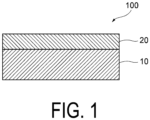
- FIG. 1 illustrates a schematic cross-sectional view of a sealing material 100 of the present disclosure.
- the sealing material 100 includes a polymer layer 10 and an inorganic oxide insulator layer 20.
- the polymer layer 10 includes a first polymer layer containing an organic solvent soluble polymer.
- the polymer layer 10 may be composed of only the first polymer layer.
- the first polymer layer preferably contains the organic solvent soluble polymer.
- the organic solvent soluble polymer means a polymer which is soluble in an organic solvent and examples thereof includes those that are polymers or oligomers when dissolved in the organic solvent.
- the organic solvent is a solvent which can dissolve the organic solvent soluble polymer but does not dissolve the compound having a non-stoichiometric composition, and examples thereof include butyl acetate, toluene, xylene, and acetonitrile.
- the first polymer layer containing the organic solvent soluble polymer can be formed by a mild method such as solution process. Since the solution process does not use vacuum or radical reaction, further formation of oxygen defects due to desorption of oxygen can be avoided, and there is an advantage of very low or no reactivity with the compound having a non-stoichiometric composition. In the solution process, there is also no reaction in which acid is generated. Therefore, the first polymer layer can be formed directly on the compound having a non-stoichiometric composition without substantially damaging the compound.
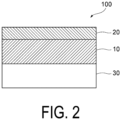
- FIG. 2 illustrate a schematic cross-sectional view when the sealing material 100 of the present disclosure is disposed so as to be in contact with a compound layer 30 having a non-stoichiometric composition.
- the sealing material 100 may be used such that the polymer layer 10 of the sealing material 100 is located on the side of the compound layer 30 having a non-stoichiometric composition included in the electronic element, and the inorganic oxide insulator layer 20 is located on the side opposite to the compound layer 30 having a non-stoichiometric composition.
- the polymer layer 10 of the sealing material 100 is disposed so as to be in contact with the compound layer 30 having a non-stoichiometric composition, but another layer may be present between the polymer layer 10 of the sealing material 100 and the compound layer 30 having a non-stoichiometric composition, and the polymer layer 10 of the sealing material 100 and the compound layer 30 having a non-stoichiometric composition may not be in direct contact with each other.
- the sealing material of the present disclosure when used as a sealing material of a thin-film solar cell, the compound layer having a non-stoichiometric composition may be located inside an intermediate layer of the thin-film solar cell, and another material or an electrode may be laminated on the compound layer having a non-stoichiometric composition.
- an inorganic oxide insulator layer such as an AlOx layer is directly formed on a material to be sealed and used as the sealing material.
- an inorganic oxide insulator layer is tried to be directly formed by using an atomic layer deposition (ALD) method on the compound having a non-stoichiometric composition such as an IZOx layer fabricated by the solution process, the compound having a non-stoichiometric composition is deteriorated because the ALD method is process in which the substrate is heated under vacuum and is mediated by water.
- ALD atomic layer deposition
- the inorganic oxide insulator layer is tried to be directly formed by using the sputtering method on the compound having a non-stoichiometric composition such as the IZOx layer fabricated by the solution process, the compound having a non-stoichiometric composition is deteriorated because the sputtering method is vacuum process.
- a chemical vapor deposition film such as parylene can be formed by a chemical vapor deposition method (CVD) which is relatively milder than the ALD method and does not require substrate heating
- the chemical vapor deposition film such as parylene is also formed as a base for forming the inorganic oxide insulator layer.
- the compound having a non-stoichiometric composition has very high environmental sensitivity, the compound having a non-stoichiometric composition is also easily damaged by a vacuum environment and generated radicals during formation of the chemical vapor deposition film.
- the polymer layer when the first polymer layer containing the organic solvent soluble polymer is formed by the solution process on the compound having a non-stoichiometric composition, the polymer layer can be disposed without substantially damaging the compound having a non-stoichiometric composition.
- the first polymer layer can protect the compound having a non-stoichiometric composition from moisture associated with the ALD method or the vacuum environment of the sputtering process. Therefore, the inorganic oxide insulator layer can be formed on the polymer layer without substantially damaging the compound having a non-stoichiometric composition. Since the first polymer layer has a low density and has low gas barrier performance, oxygen passes through the first polymer layer to some extent.
- the density of the first polymer layer is preferably from 0.4 g/cm 3 to 1.3 g/cm 3 , more preferably from 0.5 g/cm 3 to 1.2 g/cm 3 , still more preferably 0.6 g/cm 3 to 1.1 g/cm 3 , and even still more preferably from 0.7 g/cm 3 to 1.0 g/cm 3 .
- the density of the first polymer layer is calculated from X-ray reflectivity measurement. By fitting the X-ray reflectivity data, the film thickness and the film density can be simultaneously estimated as fitting parameters.
- Examples of the compound having a non-stoichiometric composition include an amorphous metal oxide inorganic semiconductor (AOS), metal chalcogenide, and halide perovskite.
- AOS amorphous metal oxide inorganic semiconductor
- metal chalcogenide metal chalcogenide
- halide perovskite examples include ZnO, In 2 O 3 , In-Zn-O (IZO), and In-Ga-Zn-O (IGZO), and particularly, the AOS formed by the solution process.
- Examples of the metal chalcogenide include layered substances such as molybdenum sulfide, tungsten sulfide, and molybdenum selenide, and quantum dots such as lead sulfide and cadmium sulfide.
- halide perovskite examples include organic/inorganic hybrid substances represented by ABX 3 and A 2 BX 4 (A is an organic ammonium substance or an alkali metal, B is a metal such as lead or tin, and X is a halogen element) and inorganic metal substances. Whether the AOS layer is amorphous can be confirmed by thin film X-ray diffraction.
- Examples of the electronic device including the compound having a non-stoichiometric composition include a transistor, a complementary metal oxide semiconductor device, an organic electroluminescence (organic EL), a battery, an organic solar cell, and an oxide sensor.
- the transistor includes a thin film transistor and a field effect transistor.
- the oxide sensor includes a chemical sensor and an optical sensor. The same applies hereinafter.
- the sealing material of the present disclosure may have any shape, and may be a sealing film, a sealing sheet, or the like.
- the first polymer layer preferably has a thickness of 50 nm or greater, more preferably 75 nm or greater, and still more preferably 100 nm or greater.
- the upper limit of the thickness of the first polymer layer is not particularly limited.
- the thickness of the first polymer layer may be preferably 1000 nm or less, more preferably 500 nm or less, and may be 100 nm or less, 50 nm or less, or 30 nm or less, and thus the thickness of the electronic device including the sealing material does not increase.
- the polymer layer further includes a second polymer layer located between the first polymer layer and the inorganic oxide insulator layer, and the second polymer layer includes a chemical vapor deposition film.
- the second polymer layer including the chemical vapor deposition film is located between the first polymer layer and the inorganic oxide insulator layer, damage to the compound having a non-stoichiometric composition during formation of the inorganic oxide insulator layer can be further suppressed.
- the compound having a non-stoichiometric composition can be protected from attack of radical due to the CVD process for forming the second polymer layer.
- a preferable thickness of the first polymer layer may be thin, or may be 10 nm or greater.
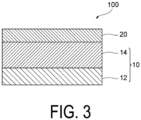
- FIG. 3 is a schematic cross-sectional view of the sealing material 100 including a first polymer layer 12, a second polymer layer 14, and the inorganic oxide insulator layer 20.
- the sealing material 100 includes the second polymer layer 14 located between the first polymer layer 12 and the inorganic oxide insulator layer 20.
- the first polymer layer 12 including the organic solvent soluble polymer and the second polymer layer 14 including the chemical vapor deposition film function as a buffer layer against damage due to the ALD process or the sputtering process during the formation of the inorganic oxide insulator layer 20, and the inorganic oxide insulator layer 20 has a strong barrier effect.
- the chemical vapor deposition film is formed by a dry process. Therefore, since the second polymer layer includes the chemical vapor deposition film, the second polymer layer is dense and has a high barrier effect.
- the density of the second polymer layer including the chemical vapor deposition film is higher than the density of the first polymer layer containing the organic solvent soluble polymer.
- the density of the second polymer layer is preferably from 1.0 g/cm 3 to 1.5 g/cm 3 , and more preferably from 1.0 g/cm 3 to 1.45 g/cm 3 .
- the density of the second polymer layer is measured by ASTM D1505 or ASTM E1461.
- the thickness of the second polymer layer including the chemical vapor deposition film is preferably from 10 nm to 40 nm, and more preferably from 15 nm to 35 nm. Since the second polymer layer has a higher density, the barrier effect can be obtained even in the above-described preferable thickness range, and thus the total thickness of the sealing material can be reduced.
- the thickness of the inorganic oxide insulator layer is preferably from 5 nm to 100 nm, more preferably from 15 nm to 75 nm, and still more preferably from 25 nm to 55 nm. Since the inorganic oxide insulator layer has a higher barrier effect than the polymer layer, which is the organic film, the total thickness of the sealing material can be reduced while exhibiting a good barrier effect in the above-described preferable thickness range. Since the inorganic oxide insulator layer has the dense structure and is relatively hard, the thickness of the inorganic oxide insulator layer is preferably 100 nm or less from the viewpoint of ensuring flexibility of the electronic element or electronic device including sealing material.
- the total thickness of the sealing material is preferably 100 nm or less, more preferably 90 nm or less, and still more preferably 80 nm or less.
- the second polymer layer including the chemical vapor deposition film is provided, the total thickness of the sealing material can be reduced.
- the lower limit of the thickness of the sealing material is preferably 25 nm or greater, and more preferably 40 nm or greater.
- the organic solvent soluble polymer is preferably an acrylic polymer, a styrenic polymer, a fluorine-based polymer, a thermally crosslinkable polymer, or a combination thereof.
- the acrylic polymer is preferably polymethyl methacrylate (PMMA), polyadamantyl methacrylate (PADMA), or polycyclohexyl methacrylate (PCMA).
- PMMA polymethyl methacrylate
- PADMA polyadamantyl methacrylate
- PCMA polycyclohexyl methacrylate
- the styrenic polymer is preferably polystyrene, poly- ⁇ -methylstyrene (P ⁇ MS), poly-4-methylstyrene (PMS), or polyvinylphenol (PVP).
- the fluorine-based polymer is preferably CYTOP (trade name) or Teflon (trade name) AF.
- the thermally crosslinkable polymer is preferably an epoxy resin or a thermally curable cycloolefin polymer.
- An inorganic oxide insulator of the inorganic oxide insulator layer is preferably AlOx, HfOx, ZrOx, SiOx, TiOx, or a combination thereof.
- x may be a value satisfying the stoichiometric composition or may be a value not satisfying the stoichiometric composition.
- the inorganic oxide insulator layer has a high density, and large molecules such as water molecules and oxygen in the air cannot pass through the inorganic oxide insulator layer, and thus the inorganic oxide insulator layer has a high barrier effect against moisture and gases.
- the chemical vapor deposition film is preferably parylene. Parylene is sequentially formed at around room temperature, and thus is preferable in terms of high denseness and uniformity. Parylene also includes derivatives thereof.
- the sealing material preferably has a three layer hybrid structure of a PMMA layer as the first polymer layer, a parylene layer as the second polymer layer, and an AlOx layer as the inorganic oxide insulator layer.
- the hybrid three layer sealing film of PMMA/parylene/AlOx can obtain strong protection without deteriorating the performance of the compound having a non-stoichiometric composition.
- the compound having a non-stoichiometric composition is preferably the amorphous metal oxide inorganic semiconductor (AOS) film.
- AOS amorphous metal oxide inorganic semiconductor
- the AOS film preferably has different distribution of oxygen deficiency state in a direction perpendicular to a main surface of the AOS film, and includes a surface and an inside, the surface including more oxygen deficiency than the inside.
- the distribution of the oxygen defect amount of the AOS layer in the thickness direction can be evaluated by measuring an angle dependence of a ratio ( ⁇ M-O-M ) of M-O-M (in a metal oxide state) to the entire O1s by angle-resolved X-ray photoelectron spectroscopy (XPS).
- ⁇ M-O-M a ratio of M-O-M (in a metal oxide state) to the entire O1s by angle-resolved X-ray photoelectron spectroscopy (XPS).
- XPS angle-resolved X-ray photoelectron spectroscopy
- a ratio of ⁇ M-O-M of the outermost surface to ⁇ M-O-M of the inside is preferably smaller by 10% or more, more preferably smaller by 15% or more, and still more preferably smaller by 20% or more.
- the sealing material of the present disclosure can be used in the electronic element.
- the sealing film of the present disclosure can be used as a sealing material for covering an electronic element containing the compound having a non-stoichiometric composition preferably disposed on a flexible substrate.
- the electronic device including the electronic element include a transistor, a complementary metal oxide semiconductor device, an organic EL, a battery, a solar cell, and an oxide sensor.
- the present disclosure is also directed to a method for manufacturing a sealing material for a compound having a non-stoichiometric composition, the method including providing a substrate, preparing an organic solvent containing a first polymer dissolved, forming a polymer layer including a first polymer layer on the substrate by applying an organic solvent containing the first polymer dissolved, and forming an inorganic oxide insulator layer on the polymer layer by using an atomic layer deposition method or a sputtering method to obtain a sealing material.
- an organic solvent containing the first polymer dissolved is prepared.
- the organic solvent containing the first polymer dissolved can be prepared.
- the concentration of the first polymer may be changed depending on the desired thickness of the first polymer layer, and is, for example, from 1 mg/mL to 80 mg/mL, from 2 mg/mL to 70 mg/mL or from 3 mg/mL to 60 mg/mL.
- an application method is preferably a spin coating method, a bar coating method, a spray coating method, a dip coating method, an ink-jet method, a flexographic printing method, or a gravure printing method, more preferably the spin coating method, the bar coating method, the spray coating method, the dip coating method, or the ink-jet method, and still more preferably the spin coating method.
- the inorganic oxide insulator layer is formed using the atomic layer deposition (ALD) method or the sputtering method, and preferably the atomic layer deposition (ALD) method.
- ALD atomic layer deposition
- the ALD method is preferable in that a film having a large area can be formed and cost can be reduced.
- the film formation temperature of the inorganic oxide insulator layer is preferably 200°C or less, more preferably 150°C or less, and still more preferably 125°C or less.
- a layer below the inorganic oxide insulator layer is less likely to be damaged.
- the flexible substrate contains an organic material such as polyethylene terephthalate (PET) or polyimide, by forming the film in the preferable temperature range, the damage to the substrate can be suppressed.
- the forming the polymer layer includes forming a second polymer layer which is a chemical vapor deposition film on the first polymer layer by using a chemical vapor deposition method (CVD), and the forming the inorganic oxide insulator layer includes forming the inorganic oxide insulator layer on the second polymer layer.
- CVD chemical vapor deposition method
- the second polymer layer which is the chemical vapor deposition film, is formed by CVD.
- CVD is gentle vacuum process and is preferable in terms of deposition rate, processing area, denseness, and uniformity.
- the contents regarding the above-described the sealing material are applied to the polymer layer, the first polymer layer, the second polymer layer, the inorganic oxide insulator layer, the organic solvent soluble polymer, the organic solvent, and other configurations.
- a precursor solution of indium zinc oxide (IZO) was prepared by the sol-gel method schematically illustrated in FIG. 16 .
- IZO indium zinc oxide
- 0.462 g of In(NO 3 ) 3 -xH 2 O (Aldrich) was added to 10 mL of 2-methoxyethanol, and the mixture was stirred under air atmosphere for 6 hours to obtain a precursor solution (0.1 M) of indium.
- 0.297 g of Zn(NO 3 ) 2 -xH 2 O (Aldrich) was added to 10 mL of 2-methoxyethanol, and the mixture was stirred under air atmosphere for 6 hours to obtain a precursor solution (0.1 M) of zinc.
- a P-doped Si wafer substrate including thermally oxidized SiO 2 (having a thickness of 100 nm) as a gate insulating film was ultrasonically cleaned in acetone and then in 2-propanol for 10 minutes each, and then dried at 100°C for 10 minutes under air atmosphere by using a hotplate.
- the cleaned and dried substrate was subjected to a treatment with a UV ozone cleaner (UV253H available from Filgen, Inc.) for 10 minutes to remove the organic residue and improve wettability.
- UV ozone cleaner UV253H available from Filgen, Inc.
- the prepared IZO precursor solution was spin coated on the substrate subjected to the above-described UV treatment at 500 rpm for 5 seconds and then at 5000 rpm for 30 seconds to form an IZO intermediate film.
- the formed IZO intermediate film was subjected to the heat treatment at 150°C for 5 minutes in the air atmosphere and further subjected to the heat treatment at 370°C for 1 hour to form the AOS film (IZO film) having a thickness of 6 nm.
- the source/drain (S/D) electrodes (Al, 40 nm) were formed and patterned on the IZO film by thermal evaporation using a metal mask. Further, the IZO film was patterned by an yttrium aluminum garnet (YAG) laser, subjected to a heat treatment at 90°C for 3 hours under air atmosphere, and gradually cooled to a room temperature to obtain the IZO active layer.
- YAG yttrium aluminum garnet
- Butyl acetate solution (50 mg/mL) in which PMMA (Mw: 120000) was dissolved was spin coated at 500 rpm for 5 seconds and at 4000 rpm for 30 seconds on the gate insulating layer on which the IZO active layer and the S/D electrodes were formed, and then subjected to heat treatment at 150°C for 2 hours to form the PMMA layer having a thickness of 100 nm.
- AlOx having a thickness of 40 nm was deposited on the PMMA layer by the ALD method while the substrate temperature was maintained at 110°C to form a sealing film of two layers of PMMA layer/AlOx layer.
- the bottom-gate-top-contact TFT including the sealing material and the IZO film was fabricated.
- FIG. 4 illustrates a schematic cross-sectional view of the fabricated TFT.
- the fabricated TFT had the channel length (L) of 100 ⁇ m and the channel width (W) of 2000 ⁇ m.
- TFT including Three layer sealing material and IZO
- An IZO precursor solution was prepared under the same conditions as in Example 1.
- a lift-off method in which Cr/Au/Cr was vapor-deposited on a pattern formed of photoresist (TLOR, Tokyo Ohka Kogyo Co., Ltd.) and then the photoresist was removed, a gate electrode of Cr/Au/Cr having thicknesses of 5 nm/25 nm/5 nm, respectively, was formed on a glass substrate.
- An AlOx gate insulating film having a thickness of 75 nm was formed by the ALD method.
- the substrate on which the AlOx gate insulating film was formed was treated with a UV ozone cleaner for 10 minutes, and then the IZO film was formed under the same conditions as in Example 1.
- the formed IZO film was subjected to photolithography using a photosensitive dielectric (PDM, TAIYO INK MFG. CO., LTD.) and wet etching using a 1.75 mass% oxalic acid aqueous solution to form an IZO active layer which was a patterned n-type semiconductor.
- PDM photosensitive dielectric
- PDM photosensitive dielectric
- Al thermal evaporation and lift-off was performed using the resulting PDM as a shadow mask to form source/drain S/D electrodes having a thickness of 60 nm.
- a laminate body on which the S/D electrodes were formed was subjected to the heat treatment at 90°C for 3 hours under air atmosphere, and gradually cooled to a room temperature.
- Butyl acetate solution (5 mg/mL) in which PMMA (Mw: 120000) was dissolved was spin coated at 500 rpm for 5 seconds and at 4000 rpm for 30 seconds on the gate insulating layer on which the IZO active layer and the S/D electrodes were formed, and then subjected to heat treatment at 150°C for 1 hour to form the PMMA layer having a thickness of 13 nm.
- a parylene layer having a thickness of 25 nm was deposited on the PMMA layer by using the CVD method.
- AlOx having a thickness of 40 nm was deposited on the parylene layer by the ALD method while the substrate temperature was maintained at 110°C to form a sealing film of three layers of PMMA layer/parylene layer/AlOx layer.
- the bottom-gate-top-contact TFT including the sealing material and the IZO film was fabricated.
- FIG. 5 illustrates a schematic cross-sectional view of the fabricated TFT.
- FIG. 6 is optical microscope photographs of the fabricated TFT. The fabricated TFT had the channel length (L) of 10 ⁇ m and the channel width (W) of 200 ⁇ m.
- FIG. 6(a) is an optical microscope photograph of the fabricated TFT observed from above, and
- FIG. 6(b) is an enlarged photograph of a portion surrounded by a square in FIG. 6(a) .
- a TFT was fabricated in the same manner as in Example 2 except that the sealing film was a PMMA single layer having a thickness of 13 nm.
- a TFT was fabricated in the same manner as in Example 2 except that the sealing film was a parylene single layer having a thickness of 25 nm.
- a TFT was fabricated in the same manner as in Example 2 except that the sealing film was an AlOx single layer having a thickness of 40 nm.
- a TFT was fabricated in the same manner as in Example 2 except that the sealing film was not formed.
- a TFT was fabricated in the same manner as in Example 2, except that the sealing film was the PMMA layer having a thickness of 13 nm and a parylene layer having a thickness of 25 nm disposed on the PMMA layer.
- the transfer characteristics of the TFTs fabricated in Comparative Examples 1 to 4 were measured to evaluate the influence by the TFT fabrication process on the performance of the active layer.
- FIG. 7 shows measurement results of transfer characteristics of the TFTs each including a respective one of the sealing materials of Comparative Example 1 (PMMA single layer), Comparative Example 2 (parylene single layer), and Comparative Example 3 (AlOx single layer), and the TFT not including the sealing material of Comparative Example 4.
- the TFT of Comparative Example 4 (without sealing material) had a saturation mobility ( ⁇ sat ) of 2.3 cm 2 V -1 s -1 , an on/off current ratio (I on /I off ) of about 10 8 , and a threshold voltage (Vth) of 2.0 V This value is the reference value for comparison.
- the TFT of Comparative Example 1 (PMMA single layer) exhibited desirable characteristics such as ⁇ sat of 2.0 cm 2 V -1 s -1 , I on /I off ⁇ 10 8 , Vth of 1.7 V, and negligible hysteresis.
- Vth was greatly shifted to the negative side. This is considered to be because the IZO active layer having a non-stoichiometric composition was affected by a long-time vacuum state during parylene vapor deposition and reactive radical species derived from a parylene source that may react with weakly bonded oxygen atoms.
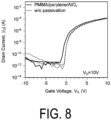
- FIG. 8 shows measurement results of transfer characteristics of the TFT including the sealing material of Example 2 (three layers of PMMA layer/parylene layer/AlOx layer), and the TFT not including the sealing material of Comparative Example 4.
- the TFT of Example 2 showed substantially the same characteristics. That is, it was confirmed that the two layers of PMMA layer/parylene layer functioned as a protective layer during formation of the AlOx film by the ALD method.
- the TFT of Comparative Example 1 PMMA single layer
- the TFT of Comparative Example 4 without sealing material
- the TFT of Comparative Example 5 PMMA/parylene bilayer
- the transfer characteristics of each TFT subjected to the water treatment were measured to evaluate the waterproof characteristics. Evaluation was performed based on the characteristics of the TFT of Comparative Example 4 (without sealing material) before the water treatment as a reference.
- FIG. 9 shows the characteristics of the TFT of Comparative Example 4 (without sealing material) before and after the water treatment, and the characteristics of the TFT of Comparative Example 1 (PMMA single layer) and the TFT of Comparative Example 5 (PMMA/parylene bilayer) after the water treatment.
- the TFT of Comparative Example 5 (PMMA/parylene bilayer) exhibited substantially the same characteristics as the TFT of Comparative Example 4 (without sealing material) before the water treatment. That is, it was found that the PMMA/parylene bilayer has a strong protective ability against moisture, and it can be seen that the PMMA/parylene bilayer also has a protective ability against the film forming process by the ALD method. Due to the low moisture permeability of parylene, the PMMA/parylene bilayer has a better buffer function than the PMMA single layer during AlOx deposition.
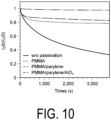
- FIG. 10 shows the measurement results of the bias stress stability.
- I D drop rate 1 ⁇ I D t I D 0 ⁇ 100 %
- I D (0) is an initial drain current and I D (t) is the I D after applying bias stress at a respective time (t).
- the I D decrease rate was 67%, and the stability of the bias stress was the worst.
- the I D decrease rate of the TFT of Comparative Example 1 (PMMA single layer) was suppressed to 21%, and the I D decrease rate of the TFT of Comparative Example 5 (PMMA/parylene bilayer) was suppressed to 17%.
- the I D decrease rate was significantly suppressed, and the I D decrease rate was 2%.
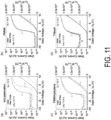
- the transfer characteristics were measured before and after the bias stress to estimate the Vth shift values ( ⁇ Vth).
- FIG. 11 shows measurement results of the transfer characteristics before and after the bias stress.
- the ⁇ Vth of the TFT of Comparative Example 4 was 2.8 V
- the ⁇ Vth of the TFT of Comparative Example 1 PMMA single layer
- the ⁇ Vth of the TFT of Comparative Example 5 PMMA/parylene bilayer
- Example 11(d) in the TFT of Example 2 (three layers of PMMA layer/parylene layer/AlOx layer), the ⁇ Vth was suppressed to 0.2 V This is because the IZO active layer was not damaged by the barrier effect of the PMMA/parylene buffer layer when the AlOx film was formed by the ALD method.
- FIG. 12 shows measurement results of transfer characteristics of the TFT including the sealing material of Comparative Example 5 (PMMA/parylene bilayer), and the TFT not including the sealing material of Comparative Example 4.
- FIG. 13 shows the measurement result of the X-ray reflectivity of the PMMA layer formed under the same conditions as in Comparative Example 5. It can be seen that the IZO active layer having a non-stoichiometric composition could be effectively protected from radicals during parylene deposition despite the fact that the PMMA layer was only 13 nm thick.
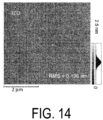
- FIG. 14 shows an AFM measurement image of the IZO layer fabricated under the same conditions as in Example 1.
- FIG. 15 shows an AFM measurement image of the PMMA layer formed on the IZO layer fabricated under the same conditions as in Example 1.
- the surface roughness RMS of the IZO layer was 0.196 nm, and the PMMA layer formed on the IZO layer had a flat and pinhole-free structure and had the surface roughness RMS of 0.334 nm.
- FIG. 18 shows the measurement results of the angle-resolved XPS of O1s of the AOS layer (IZO film) fabricated by the same method as in Example 1.
- FIG. 18(a) is a graph showing a summary of measured spectra of O1s of the AOS layer when the inclination angle ⁇ is set to 0°, 40°, 55°, 63°, and 70°.
- 18(b) to 18(f) illustrate graphs obtained by decomposing the measurement spectra measured at the inclination angles ⁇ of 0°, 40°, 55°, 63°, and 70° and fitting into M-O-M having a peak at 529.7 eV, M-O(H) having a peak at 531.1 eV, and M-O-R having a peak at 532.0 eV
- M refers to In or Zn.
- M-O-M means oxygen bridging between metal centers and means an oxide of a stoichiometric composition having no oxygen defect.
- M-O (H) means oxygen or a hydroxyl group having an unpaired electron that does not bridge between metal centers
- M-O-R means oxygen in an organic material such as H 2 O, CO 2 , or alcohol bonded to a metal center, and means compositions each having oxygen defects.
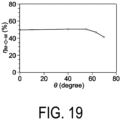
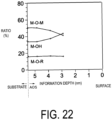
- FIGS. 19 and 22 and Table 1 show an angle dependence of the ratio ( ⁇ M-O-M ) of M-O-M (in a metal oxide state) to the entire O1s calculated by the above fitting.
- the ratio of the M-O-M bond was constant at about 50% in the inside of the AOS film, but the closer to the surface of the AOS film, the smaller the ratio of the M-O-M bond, and the ratio was decreased to about 40%, that is, the ratio of the M-O-M bond was decreased by about 20%.
- the AOS layer had more oxygen defects near the surface than in the inside and had a non-uniform chemical composition in the film thickness direction. In FIG.
- each of three points at 5.5 nm on the horizontal axis is a ratio of an integrated value of a respective one of M-O species from the AOS outermost surface to the depth of 5.5 nm
- each of three points at 2.8 nm is a ratio of the integrated value of a respective one of the M-O species from the outermost surface to the depth of 2.8 nm.
Landscapes
- Chemical & Material Sciences (AREA)
- Engineering & Computer Science (AREA)
- Chemical Kinetics & Catalysis (AREA)
- Mechanical Engineering (AREA)
- General Chemical & Material Sciences (AREA)
- Materials Engineering (AREA)
- Metallurgy (AREA)
- Organic Chemistry (AREA)
- Inorganic Chemistry (AREA)
- Formation Of Insulating Films (AREA)
- Ceramic Engineering (AREA)
- Physics & Mathematics (AREA)
- Optics & Photonics (AREA)
- Sealing Material Composition (AREA)
- Electroluminescent Light Sources (AREA)
Applications Claiming Priority (2)
| Application Number | Priority Date | Filing Date | Title |
|---|---|---|---|
| JP2021029328A JP7637942B2 (ja) | 2021-02-25 | 2021-02-25 | 非化学量論組成を有する化合物用封止材及びその製造方法 |
| PCT/JP2022/007657 WO2022181706A1 (ja) | 2021-02-25 | 2022-02-24 | 非化学量論組成を有する化合物用封止材及びその製造方法 |
Publications (2)
| Publication Number | Publication Date |
|---|---|
| EP4300548A1 true EP4300548A1 (de) | 2024-01-03 |
| EP4300548A4 EP4300548A4 (de) | 2024-08-14 |
Family
ID=83049144
Family Applications (1)
| Application Number | Title | Priority Date | Filing Date |
|---|---|---|---|
| EP22759741.6A Pending EP4300548A4 (de) | 2021-02-25 | 2022-02-24 | Verkapselungsstoff für eine verbindung mit nichtstöchiometrischer zusammensetzung und verfahren zur herstellung davon |
Country Status (6)
| Country | Link |
|---|---|
| US (1) | US20240128144A1 (de) |
| EP (1) | EP4300548A4 (de) |
| JP (1) | JP7637942B2 (de) |
| KR (1) | KR102882953B1 (de) |
| CN (1) | CN116941019A (de) |
| WO (1) | WO2022181706A1 (de) |
Families Citing this family (1)
| Publication number | Priority date | Publication date | Assignee | Title |
|---|---|---|---|---|
| DE102023004582A1 (de) * | 2023-11-13 | 2025-05-15 | Mercedes-Benz Group AG | Orts- und kontextbasierte automobile Videospiel-Plattform |
Family Cites Families (8)
| Publication number | Priority date | Publication date | Assignee | Title |
|---|---|---|---|---|
| US7521710B2 (en) * | 2006-02-16 | 2009-04-21 | Idemitsu Kosan Co., Ltd. | Organic thin film transistor |
| US8173906B2 (en) * | 2007-02-07 | 2012-05-08 | Raytheon Company | Environmental protection coating system and method |
| KR100926030B1 (ko) * | 2008-02-25 | 2009-11-11 | 한국과학기술연구원 | 산소와 수분 투과의 차단 및 가스 배리어 특성 향상을 위한유/무기 복합 박막 보호층 및 그의 제조방법 |
| JP2010093172A (ja) * | 2008-10-10 | 2010-04-22 | Fujifilm Corp | 封止デバイス |
| KR20190045396A (ko) * | 2009-09-16 | 2019-05-02 | 가부시키가이샤 한도오따이 에네루기 켄큐쇼 | 트랜지스터 |
| KR101688739B1 (ko) * | 2015-07-30 | 2016-12-23 | 연세대학교 산학협력단 | 침습형 생체소자 제조방법 및 그 생체소자 |
| JP6561366B2 (ja) * | 2016-03-16 | 2019-08-21 | 株式会社Joled | 半導体装置とその製造方法 |
| US11139164B2 (en) * | 2019-12-12 | 2021-10-05 | Raytheon Company | Electronic device including hermetic micro-cavity and methods of preparing the same |
-
2021
- 2021-02-25 JP JP2021029328A patent/JP7637942B2/ja active Active
-
2022
- 2022-02-24 EP EP22759741.6A patent/EP4300548A4/de active Pending
- 2022-02-24 WO PCT/JP2022/007657 patent/WO2022181706A1/ja not_active Ceased
- 2022-02-24 KR KR1020237032186A patent/KR102882953B1/ko active Active
- 2022-02-24 CN CN202280016616.0A patent/CN116941019A/zh active Pending
- 2022-02-24 US US18/277,129 patent/US20240128144A1/en active Pending
Also Published As
| Publication number | Publication date |
|---|---|
| JP2022130244A (ja) | 2022-09-06 |
| EP4300548A4 (de) | 2024-08-14 |
| KR102882953B1 (ko) | 2025-11-10 |
| KR20230148221A (ko) | 2023-10-24 |
| US20240128144A1 (en) | 2024-04-18 |
| CN116941019A (zh) | 2023-10-24 |
| JP7637942B2 (ja) | 2025-03-03 |
| TW202235280A (zh) | 2022-09-16 |
| WO2022181706A1 (ja) | 2022-09-01 |
Similar Documents
| Publication | Publication Date | Title |
|---|---|---|
| Shao et al. | Field‐effect transistors based on formamidinium tin triiodide perovskite | |
| Lee et al. | Inkjet printed high-mobility indium zinc tin oxide thin film transistors | |
| JP6061858B2 (ja) | 電界効果トランジスタおよびその製造方法 | |
| US7507618B2 (en) | Method for making electronic devices using metal oxide nanoparticles | |
| KR101920127B1 (ko) | 태양 전지 및 그 제조 방법, 반도체 소자 및 그 제조 방법 | |
| US9053937B2 (en) | Semiconductor device and method of manufacturing the same | |
| US20100132762A1 (en) | Environmental barrier coating for organic semiconductor devices and methods thereof | |
| JP2011018777A (ja) | 電子素子及びその製造方法、表示装置、並びにセンサー | |
| US20120086008A1 (en) | Field-effect transistor, processes for producing the same, and electronic device using the same | |
| US7977214B2 (en) | Method of manufacturing field-effect transistor, field-effect transistor, and method of manufacturing display device | |
| Wang et al. | Reduction of the ambient effect in multilayer InSe transistors and a strategy toward stable 2D-based optoelectronic applications | |
| Park et al. | Functional Self‐Assembled Monolayers for Optimized Photoinduced Charge Transfer in Organic Field Effect Transistors | |
| Wu et al. | Ultraviolet light sensitive In‐doped ZnO thin film field effect transistor printed by inkjet technique | |
| EP4300548A1 (de) | Verkapselungsstoff für eine verbindung mit nichtstöchiometrischer zusammensetzung und verfahren zur herstellung davon | |
| KR100960808B1 (ko) | 산화물 반도체 박막 및 그 제조 방법 | |
| JP2007150156A (ja) | トランジスタおよびその製造方法 | |
| Lee et al. | Inkjet-printed oxide thin-film transistors using double-active layer structure | |
| KR20150120911A (ko) | 그래핀 포토디텍터 및 그 제조 방법 | |
| Ogawa et al. | Photoinduced doping of organic field effect transistors studied by displacement current measurement and infrared absorption spectroscopy in multiple internal reflection geometry | |
| CN112088432B (zh) | 含有氧化物半导体层的薄膜晶体管 | |
| TWI918865B (zh) | 具有非化學計量組成之化合物用密封材及其製造方法 | |
| US20130277661A1 (en) | Field-effect transistor, process for producing the same, and electronic device including the same | |
| Chen et al. | Investigation of electrical properties of individual GaN nanowire‐based ferroelectric field effect transistor | |
| EP4300592A1 (de) | Anorganisch-organische hybride komplementäre halbleitervorrichtung und herstellungsverfahren dafür | |
| Pannemann et al. | PTFE encapsulation for pentacene based organic thin film transistors |
Legal Events
| Date | Code | Title | Description |
|---|---|---|---|
| STAA | Information on the status of an ep patent application or granted ep patent |
Free format text: STATUS: THE INTERNATIONAL PUBLICATION HAS BEEN MADE |
|
| PUAI | Public reference made under article 153(3) epc to a published international application that has entered the european phase |
Free format text: ORIGINAL CODE: 0009012 |
|
| STAA | Information on the status of an ep patent application or granted ep patent |
Free format text: STATUS: REQUEST FOR EXAMINATION WAS MADE |
|
| 17P | Request for examination filed |
Effective date: 20230814 |
|
| AK | Designated contracting states |
Kind code of ref document: A1 Designated state(s): AL AT BE BG CH CY CZ DE DK EE ES FI FR GB GR HR HU IE IS IT LI LT LU LV MC MK MT NL NO PL PT RO RS SE SI SK SM TR |
|
| DAV | Request for validation of the european patent (deleted) | ||
| DAX | Request for extension of the european patent (deleted) | ||
| REG | Reference to a national code |
Ref country code: DE Ref legal event code: R079 Free format text: PREVIOUS MAIN CLASS: H01L0021310000 Ipc: H01L0029786000 |
|
| A4 | Supplementary search report drawn up and despatched |
Effective date: 20240715 |
|
| RIC1 | Information provided on ipc code assigned before grant |
Ipc: H01L 23/00 20060101ALI20240709BHEP Ipc: H01L 23/31 20060101ALI20240709BHEP Ipc: H01L 21/02 20060101ALI20240709BHEP Ipc: H01L 29/786 20060101AFI20240709BHEP |