EP4297425B1 - Lichtabhängige audioparameter - Google Patents
Lichtabhängige audioparameter Download PDFInfo
- Publication number
- EP4297425B1 EP4297425B1 EP23181139.9A EP23181139A EP4297425B1 EP 4297425 B1 EP4297425 B1 EP 4297425B1 EP 23181139 A EP23181139 A EP 23181139A EP 4297425 B1 EP4297425 B1 EP 4297425B1
- Authority
- EP
- European Patent Office
- Prior art keywords
- audio
- parameters
- processing unit
- values
- playback equipment
- Prior art date
- Legal status (The legal status is an assumption and is not a legal conclusion. Google has not performed a legal analysis and makes no representation as to the accuracy of the status listed.)
- Active
Links
Images


Classifications
-
- H—ELECTRICITY
- H04—ELECTRIC COMMUNICATION TECHNIQUE
- H04R—LOUDSPEAKERS, MICROPHONES, GRAMOPHONE PICK-UPS OR LIKE ACOUSTIC ELECTROMECHANICAL TRANSDUCERS; DEAF-AID SETS; PUBLIC ADDRESS SYSTEMS
- H04R1/00—Details of transducers, loudspeakers or microphones
- H04R1/02—Casings; Cabinets ; Supports therefor; Mountings therein
- H04R1/028—Casings; Cabinets ; Supports therefor; Mountings therein associated with devices performing functions other than acoustics, e.g. electric candles
-
- G—PHYSICS
- G06—COMPUTING OR CALCULATING; COUNTING
- G06F—ELECTRIC DIGITAL DATA PROCESSING
- G06F3/00—Input arrangements for transferring data to be processed into a form capable of being handled by the computer; Output arrangements for transferring data from processing unit to output unit, e.g. interface arrangements
- G06F3/16—Sound input; Sound output
- G06F3/165—Management of the audio stream, e.g. setting of volume, audio stream path
-
- G—PHYSICS
- G06—COMPUTING OR CALCULATING; COUNTING
- G06T—IMAGE DATA PROCESSING OR GENERATION, IN GENERAL
- G06T7/00—Image analysis
- G06T7/90—Determination of colour characteristics
-
- H—ELECTRICITY
- H03—ELECTRONIC CIRCUITRY
- H03G—CONTROL OF AMPLIFICATION
- H03G3/00—Gain control in amplifiers or frequency changers
- H03G3/20—Automatic control
- H03G3/30—Automatic control in amplifiers having semiconductor devices
- H03G3/3005—Automatic control in amplifiers having semiconductor devices in amplifiers suitable for low-frequencies, e.g. audio amplifiers
-
- H—ELECTRICITY
- H05—ELECTRIC TECHNIQUES NOT OTHERWISE PROVIDED FOR
- H05B—ELECTRIC HEATING; ELECTRIC LIGHT SOURCES NOT OTHERWISE PROVIDED FOR; CIRCUIT ARRANGEMENTS FOR ELECTRIC LIGHT SOURCES, IN GENERAL
- H05B47/00—Circuit arrangements for operating light sources in general, i.e. where the type of light source is not relevant
- H05B47/10—Controlling the light source
- H05B47/105—Controlling the light source in response to determined parameters
- H05B47/11—Controlling the light source in response to determined parameters by determining the brightness or colour temperature of ambient light
-
- H—ELECTRICITY
- H04—ELECTRIC COMMUNICATION TECHNIQUE
- H04R—LOUDSPEAKERS, MICROPHONES, GRAMOPHONE PICK-UPS OR LIKE ACOUSTIC ELECTROMECHANICAL TRANSDUCERS; DEAF-AID SETS; PUBLIC ADDRESS SYSTEMS
- H04R2420/00—Details of connection covered by H04R, not provided for in its groups
- H04R2420/01—Input selection or mixing for amplifiers or loudspeakers
-
- H—ELECTRICITY
- H04—ELECTRIC COMMUNICATION TECHNIQUE
- H04R—LOUDSPEAKERS, MICROPHONES, GRAMOPHONE PICK-UPS OR LIKE ACOUSTIC ELECTROMECHANICAL TRANSDUCERS; DEAF-AID SETS; PUBLIC ADDRESS SYSTEMS
- H04R2430/00—Signal processing covered by H04R, not provided for in its groups
- H04R2430/01—Aspects of volume control, not necessarily automatic, in sound systems
-
- H—ELECTRICITY
- H04—ELECTRIC COMMUNICATION TECHNIQUE
- H04R—LOUDSPEAKERS, MICROPHONES, GRAMOPHONE PICK-UPS OR LIKE ACOUSTIC ELECTROMECHANICAL TRANSDUCERS; DEAF-AID SETS; PUBLIC ADDRESS SYSTEMS
- H04R3/00—Circuits for transducers, loudspeakers or microphones
- H04R3/04—Circuits for transducers, loudspeakers or microphones for correcting frequency response
-
- H—ELECTRICITY
- H04—ELECTRIC COMMUNICATION TECHNIQUE
- H04R—LOUDSPEAKERS, MICROPHONES, GRAMOPHONE PICK-UPS OR LIKE ACOUSTIC ELECTROMECHANICAL TRANSDUCERS; DEAF-AID SETS; PUBLIC ADDRESS SYSTEMS
- H04R5/00—Stereophonic arrangements
- H04R5/04—Circuit arrangements, e.g. for selective connection of amplifier inputs/outputs to loudspeakers, for loudspeaker detection, or for adaptation of settings to personal preferences or hearing impairments
Definitions
- the invention relates to the field of electrical audio reproduction equipment.
- Audio parameters allow, for example, the adjustment of an equalization curve that specifies a gain to be applied depending on the frequency, in order to emphasize or attenuate the bass, midrange, or treble. Audio parameters can also allow the adjustment of filters, such as a reverb filter or a background noise attenuator.
- Audio settings are generally adjustable by the user either by acting directly on the audio playback equipment (via a button, a dimmer, etc.), or by interacting with a configuration menu offered by the audio playback equipment itself, or via other equipment connected to said audio playback equipment.
- the sound reproduction of certain speakers may can thus be configured via a dedicated application downloaded to a smartphone.
- the user must therefore "manually” modify the various audio parameters themselves, which can be complicated, especially if the user is not used to handling such equipment.
- the user does not necessarily choose the most suitable audio parameters, and therefore it is very common for a user never to fully exploit the sound reproduction capabilities of their equipment.
- the document US 2016/162255 A1 describes an audio reproduction device comprising a brightness sensor.
- the document US 2016/057555 A1 describes audio playback equipment that includes an internal camera used to detect the presence of a user.
- the object of the invention is to improve the hearing experience of the user of audio reproduction equipment.
- the processing unit therefore selects, depending on the light illuminating the equipment's environment, current values of the audio parameters which are applied to the audio signal reproduced by the equipment.
- the selection is entirely automatic and does not require any user intervention.
- the user thus benefits from sound reproduction optimized according to the lighting and therefore, in particular, according to the time of day.
- the processing unit being arranged to compare the light parameter with at least one predetermined threshold, and to select the first values of the audio parameters or the second values of the audio parameters as a function of said comparison.
- the processing unit is arranged so that, if said light parameter is between the predetermined low threshold and the predetermined high threshold, it continues to apply the current values of the previously selected audio parameters to the primary audio signal.
- the processing unit is arranged to, if said light parameter is between the predetermined low threshold and the predetermined high threshold, produce the secondary audio signal using a weighting coefficient, the first values of the audio parameters and the second values of the audio parameters, the weighting coefficient being calculated from the predetermined low threshold, the predetermined high threshold and said light parameter.
- the audio reproduction equipment comprising or being connected to a camera, an automatic exposure module being integrated in or connected to said camera, the at least one light parameter comprising a brightness, the processing unit being arranged to estimate the brightness from exposure parameters selected by the automatic exposure module.
- an audio rendering apparatus as previously described, the processing unit being arranged to, when new current values of the audio parameters have been selected to replace previous current values of the audio parameters, wait for the occurrence of a period of silence in the primary audio signal, and perform the replacement during said period of silence.
- Audio playback equipment is further provided as previously described, the processing unit being arranged to, when new current values of the audio parameters have been selected to replace previous current values of the audio parameters, wait for receipt of a change order from a user and intended to apply a change to the primary audio signal, then carry out the replacement by at the same time as the change is made.
- the processing unit being arranged to receive metadata identifying a program being broadcast including the primary audio signal, and, when new current values of the audio parameters have been selected to replace previous current values of the audio parameters, wait for the metadata to indicate a change to the program being broadcast, then perform the replacement at the same time as the change is made.
- the filter(s) comprise a physiological correction filter and/or a compressor filter and/or a voice intelligibility improvement filter and/or a reverberation filter and/or a background noise attenuating filter.
- Audio reproduction equipment as previously described is further provided, the audio reproduction equipment being a decoder box.
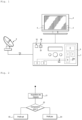
- the audio reproduction equipment is an audio-video decoder box 1, which makes it possible to transmit an audio-video stream Fav, produced by a source 2, to one or more external devices which reproduce the audio-video stream Fav.
- Source 2 is for example a broadcast network.
- the broadcast network can be a satellite television network, an Internet connection, a digital terrestrial television (DTT) network, a cable television network, etc.
- Source 2 can also be another device connected to the decoder box 1, and for example a CD, DVD or BlueRay player.
- Source 2 can also be a storage medium such as a USB key or a memory card connected to the decoder box 1.
- the external equipment here includes a television 3 which incorporates one or more external speakers 4.
- the decoder box 1 firstly comprises a processing unit 5.
- the processing unit 5 comprises one or more processing components 6, and for example any processor or microprocessor, general or specialized (for example a DSP, for Digital Signal Processor, or a GPU, for Graphics Processing Unit ), a microcontroller, or a programmable logic circuit such as an FPGA (for Field Programmable Gate Arrays ) or an ASIC (for Application Specific Integrated Circuit ) .
- processor or microprocessor general or specialized (for example a DSP, for Digital Signal Processor, or a GPU, for Graphics Processing Unit ), a microcontroller, or a programmable logic circuit such as an FPGA (for Field Programmable Gate Arrays ) or an ASIC (for Application Specific Integrated Circuit ) .
- the processing unit 5 also comprises memories 7. At least one of these memories 7 forms a computer-readable recording medium, on which is recorded at least one computer program comprising instructions which cause the processing unit 5 to execute at least some of the steps of the audio reproduction method which will be described. One of these memories 7 can be integrated into one of the processing components 6.
- the decoder box 1 further comprises one or more internal speakers 8, and an audio module 9 which is here integrated into the processing unit 5 and which is connected to the internal speakers 8.
- the decoder box 1 also comprises means of connection to the external speakers 4 of the television 3. It is noted here that the invention can be implemented in electrical equipment which integrates at least one internal speaker and/or which comprises means of connection with at least one external speaker.
- the decoder box 1 is thus capable of reproducing audio signals via its own internal speakers 8, or via the external speakers 4 of the television 3.
- the secondary audio signal Sas is then played back via the internal speakers 8 and/or the external speakers 4.
- the processing consists in particular of applying a particular audio profile from among different audio profiles to the primary Sap audio signal.
- audio profile we mean specific values of audio parameters that affect sound reproduction.
- Equalization settings define an equalization curve that specifies a gain to be applied as a function of frequency, in order to emphasize or attenuate bass, midrange, or treble. Equalization settings therefore include gains or gain lists for different frequency bands.
- Frequency bands include, for example, a band corresponding to low frequencies (bass sounds, frequencies for example between 20Hz and 500Hz), a band corresponding to midrange frequencies (frequencies for example between 500Hz and 5kHz), and a band corresponding to high frequencies (treble sounds, frequencies for example above 2kHz).
- the filter(s) include, for example, a physiological correction filter (commonly called “ loudness”).
- the filter activation parameter is a Boolean signal that can take a first Boolean value that activates the filter or a second Boolean value that does not activate the filter.
- the filter(s) include, for example, a compressor filter.
- the activation parameter is a Boolean signal.
- Audio parameters may also include filter parameters including a trigger threshold and a compression ratio.
- the filter(s) include, for example, a voice intelligibility enhancement filter.
- the activation parameter is a Boolean signal.
- the filter(s) include, for example, a reverb filter or a background noise attenuator filter.
- the activation parameter is a Boolean signal.
- the audio settings used may include one or more of the settings just mentioned.
- the current possible values of the audio parameters are stored in one of the memories 7 of the processing unit 5.
- the current values of the audio parameters can be selected from first values of the audio parameters and second values of the audio parameters.
- the first values of the audio parameters form a “night” profile and the second values of the audio parameters form a “day” profile.
- the "day” profile may contain parameter values that provide optimal listening quality at high volume, while the “night” profile may include parameter values that provide optimal listening quality at lower volume.
- the night profile is such that low frequencies are attenuated. Indeed, it is known that bass carries further and is therefore more annoying to neighbors.
- the Night profile can lower the volume overall while choosing EQ parameter values such that the bass and treble are less attenuated than the midrange, which can give the listener the impression of a louder volume than it actually is (this effect was particularly called " loudness" on old Hi-Fi systems).
- the Night profile can activate a "compressor” or “limiter” effect that reduces the volume of noisy sequences while preserving the volume of quiet sequences. This way, the loudest sequences (such as explosions in a movie) are attenuated, but quiet sequences remain audible.
- the decoder box 1 further integrates at least one internal photosensitive sensor and/or comprises means of connection with at least one external photosensitive sensor.
- the decoder box 1 can therefore comprise at least one internal photosensitive sensor 10.
- the photosensitive sensor 10 is for example a brightness sensor or a color temperature sensor.
- the photosensitive sensor used may be a sensor integrated into the camera 30 - and for example the sensor allowing the capture of images by said camera 30.
- the decoder box 1 may also include several internal photosensitive sensors 10, possibly of different types.
- the decoder box 1 can also be connected to an external photosensitive sensor, located in equipment separate from the decoder box 1.
- the decoder box 1 can thus, for example, be connected to a camera incorporating a photosensitive sensor.
- the decoder box 1 comprises means for connection to the external photosensitive sensor. In the case of a camera, this is, for example, a USB link.
- the light in the environment of the decoder box 1 can come from a natural and/or artificial light source.
- the photosensitive sensor 10 used is a brightness sensor.
- the processing unit 5 acquires or estimates, using at least one measurement produced by the brightness sensor, a light parameter representative of the light illuminating the environment of the decoder box 1 (i.e. the light prevailing in the room in which the decoder box 1 is positioned).
- the light parameter is the brightness.
- the processing unit 5 therefore acquires the measurements produced by the brightness sensor 10 and therefore estimates the brightness as being equal to said measurements (the processing unit 5 can optionally process the measurements and for example use an average of several measurements): step E1.
- Brightness measurements are taken and acquired continuously or at regular intervals, for example every 10s.
- the processing unit 5 selects, depending on the brightness, current values of the audio parameters.
- the current values of the audio parameters are selected from first values of the audio parameters (defining the night profile) and second values of the audio parameters (defining the day profile).
- the processing unit 5 compares the brightness with at least one predetermined threshold, and selects the first values of the audio parameters or the second values of the audio parameters according to said comparison.
- the processing unit 5 compares the brightness with a predetermined threshold S, equal for example to 200 lux: step E2.
- the processing unit 5 selects as current values of the audio parameters the first values of the audio parameters (night profile): step E3
- the processing unit 5 selects as current values of the audio parameters the second values of the audio parameters (day profile): step E4.
- the processing unit 5 then causes the audio module 9 to apply the current values of the audio parameters to the primary audio signal Sap to produce a secondary audio signal Sas, and causes the secondary audio signal Sas to be played back via the internal speakers 8 or the external speakers 4.
- the brightness measurement can be performed with hysteresis.
- the comparison with a single predetermined threshold has the disadvantage that, if the actual brightness is close to said threshold, then the measured brightness risks alternating between a value above the threshold and a value below the threshold, which can cause an unpleasant effect when the audio parameters alternate between the “day” profile and the “night” profile.
- the processing unit 5 therefore acquires the measurements produced by the brightness sensor and therefore estimates the brightness as being equal to said measurements (the processing unit 5 can possibly process the measurements and for example use an average of several measurements): step E10.
- Brightness measurements are taken and acquired continuously or at regular intervals, for example every 10s.
- the processing unit 5 compares the brightness with a predetermined low threshold Sb: step E11.
- the processing unit 5 selects as current values of the audio parameters the first values of the audio parameters (night profile): step E12.
- step E11 if the brightness is greater than or equal to the predetermined low threshold Sb, the processing unit 5 compares the brightness with a predetermined high threshold Sh, which is equal for example to 1000 lux: step E13.
- the processing unit 5 selects as current values of the audio parameters the second values of the audio parameters (day profile): step E14.
- the processing unit 5 continues to apply to the primary audio signal the current values of the previously selected audio parameters, i.e. the first values of the audio parameters if these were used, or the second values of the audio parameters if these were used: step E15.
- step E15 if the brightness is between the predetermined low threshold Sb and the predetermined high threshold Sh, the processing unit 5 combines two sets of parameter values according to a weighting coefficient ⁇ between 0 and 1.
- the weighting coefficient is therefore calculated from the predetermined low threshold, the predetermined high threshold and the light parameter (here the brightness).
- the processing unit 5 produces the secondary audio signal Sas using the weighting coefficient ⁇ , the first values of the audio parameters and the second values of the audio parameters.
- the secondary audio signal can be produced in this case according to the method illustrated in Figure 4 .
- the input signal i.e. the primary audio signal, is duplicated: step E20.
- Each copy is processed independently with one of two sets of parameter values.
- the first values of the audio parameters are applied to a first copy Sap1 of the signal to obtain a first processed signal Sat1: step E21.
- the second values of the audio parameters are applied to a second copy Sap2 of the signal to obtain a second processed signal Sat2: step E22.
- this embodiment can be used even in the case where the processing operations carried out in step E21 and in step E22 are different processing operations.
- this embodiment can be used even if one of the processing operations carried out in step E21 and in step E22 does not modify the primary audio signal, which makes it possible, for example, to carry out a smooth activation or deactivation of an effect.
- This embodiment has the advantage of being completely generic: it can be applied to any pair of E21, E22 processing operations. On the other hand, this embodiment is relatively computationally expensive since it requires processing the primary audio signal twice.
- the first audio parameter value and the second audio parameter value associated with said audio parameter are combined independently. In this way, combined parameter values are obtained, forming an audio profile which is then applied in one go to the primary audio signal Sap.
- the parameter values of some parameters are numerical values.
- these parameter values are combined by a weighted average, using the weighting coefficient ⁇ , to obtain combined parameter values.
- filter activation parameters i.e., boolean signals that define whether a filter should be applied or not.
- filters themselves are usually associated with filter parameters (which define not the activation or deactivation of the filter, but the response of the filter).
- a “parameter set” associated with a filter is therefore defined as a set comprising an activation parameter and filter parameters.
- a “parameter value set” is used to describe the values that the parameters in the parameter set can take.
- the combined parameter value takes the value "true”.
- the parameter values of the filtering parameters are combined (using the weighting coefficient ⁇ ) as if the set of inactive values included minimum parameter values for the filtering parameters.
- the combined parameter value for the level parameter is calculated as if the inactive value set included a value of -60 dB for that parameter, and the combined parameter value for the duration parameter is calculated as if the inactive value set included a value of zero for that parameter.
- the filter controlled by said activation parameter has a parameter of filtering affecting the magnitude of its effect.
- the combined parameter value for said parameter is calculated as if the inactive value set had a minimum value for the parameter affecting the magnitude of the effect, and the combined parameter values for the other parameters of said filter take a value equal to the value in the active value set.
- the combined parameter value for the level parameter is calculated as if the inactive value set had a value of -60 dB for that parameter, and the combined parameter value for the duration parameter is equal to the value of the duration parameter in the active value set.
- certain parameter values are combined independently in order to obtain a partial combined value set which can be applied at once, and other parameter values are combined by independent processing.
- the values of the equalization parameters can be combined to be applied to the primary audio signal Sap in one go: step E30.
- the processed audio signal Sat is duplicated to form a first copy Sat1 and a second copy Sat2: step E31.
- step E34 The first audio parameter values and the second audio parameter values are then applied independently (steps E32, E33) and combined afterwards: step E34.
- the light parameter used is brightness.
- the photosensitive sensor 10 used may be a color temperature sensor, and the light parameter used may then be the color temperature of the light illuminating the environment of the set-top box 1.
- artificial lighting generally has a color temperature between 1800K and 6000K, while natural lighting generally has a color temperature between 5500K and 8000K.
- the processing unit 5 selects as current values of the audio parameters the first values of the audio parameters (night profile).
- the processing unit 5 selects as current values of the audio parameters the second values of the audio parameters (day profile).
- the processing unit 5 then causes the audio module 9 to apply the current values of the audio parameters to the primary audio signal to produce a secondary audio signal, and causes the secondary audio signal to be played back via the internal speakers 8 or the external speakers 4.
- the color temperature measurement can be performed with hysteresis.
- the processing unit 5 compares the color temperature with a predetermined low threshold and with a predetermined high threshold.
- the processing unit 5 selects as current values of the audio parameters the first values of the audio parameters (night profile).
- the processing unit 5 selects as current values of the audio parameters the second values of the audio parameters (day profile).
- the processing unit 5 continues to apply to the primary audio signal the current values of the previously selected audio parameters, that is to say the first values of the audio parameters if these were used, or the second values of the audio parameters if these were used.
- the processing unit 5 combines two sets of parameters according to a weighting coefficient ⁇ between 0 and 1, as described earlier.
- the predetermined low threshold T - is for example equal to 5500 K, and the predetermined high threshold T + is for example equal to 6000 K.
- the processing unit 5 acquires or estimates, using measurements produced by one or more photosensitive sensors 10, a first light parameter and a second light parameter, in this case brightness and color temperature.
- the processing unit 5 can use the measurements produced by a brightness sensor and by a color temperature sensor, if the set-top box 1 is equipped with these two sensors.
- the processing unit 5 can also estimate the parameters from the measurements produced by a single sensor.
- the processing unit 5 compares the brightness with a first predetermined threshold (for example equal to 200 lux), and the color temperature with a second predetermined threshold (for example equal to 5750K).
- a first predetermined threshold for example equal to 200 lux
- a second predetermined threshold for example equal to 5750K
- the processing unit 5 selects and applies the first values of the audio parameters (night profile) to the primary audio signal.
- the processing unit 5 selects and applies the second values of the audio parameters (day profile) to the primary audio signal.
- processing unit 5 continues to apply the current values of the previously selected audio parameters to the primary audio signal.
- the x-axis represents the measured brightness
- the y-axis represents the measured color temperature.
- the two predetermined thresholds cut the graph in four sectors 20, 21, 22, and 23.
- the processing unit 5 applies the parameters of the “day” profile.
- the processing unit 5 applies the parameters of the “night” profile.
- the processing unit 5 maintains the current parameters.
- the processing unit 5 when the combination is in sector 21 or 23, the processing unit 5 applies a predefined set of parameters chosen according to the sector.
- this set of parameters has been defined by the user through a configuration interface.
- the decoder box 1 does not include a brightness sensor but instead includes a camera 30.
- the photosensitive sensor used is integrated into the camera 30.
- the processing unit 5 does not necessarily have direct access to brightness measurements.
- An automatic exposure module 31 is here integrated into the camera 30.
- the processing unit 5 can use the automatic exposure module 31 to estimate the brightness.
- the automatic exposure module 31 chooses the exposure parameters (aperture, exposure time and sensitivity) so as to optimize the rendering of the captured image.
- This choice does not necessarily require an explicit brightness measurement step.
- the processing unit 5 can directly compare the exposure time to one or more fixed thresholds rather than explicitly performing the conversion and comparing the brightness.
- the processing unit 5 will apply the “night” profile (first values of the audio parameters) if the exposure time is greater than the threshold (which corresponds to a brightness lower than the threshold) and will apply the “day” profile (second values of the audio parameters) if the exposure time is lower than the threshold (which corresponds to a brightness higher than the threshold).
- the automatic exposure module 31 can be integrated into the camera 30 itself or be a module of the decoder box 1, connected to the camera 30, which controls the exposure parameters of the camera 30 for optimize image rendering. Similarly, if the camera is connected to the decoder box 1 (and not integrated into it), the automatic exposure module can be integrated into the camera or connected to it.
- the photosensitive sensor 10 of the decoder box 1 is not necessarily a sensor dedicated to measuring this light parameter.
- the photosensitive sensor 10 used can be integrated into the camera 30, and the processing unit 5 then does not necessarily have direct access to color temperature measurements.
- Some cameras' autoexposure modules measure color temperature along with illumination and can therefore be used to obtain the color temperature of ambient lighting, but many cameras have a fixed colorimetric setting.
- the camera 30 may therefore not have an automatic exposure module 31 capable of measuring the color temperature.
- the processing unit 5 acquires an image produced by the camera and estimates the color temperature from said image.
- the processing unit 5 obtains a measurement of the color temperature by following the following steps.
- the processing unit 5 acquires an image produced by the camera 30 in RGB (Red Green Blue) format.
- Processing unit 5 calculates the average color of the pixels in the image.
- the processing unit 5 then estimates the color temperature from the average color of the pixels in the image, for example using the open source software “color-temperature”.
- the processing unit 5 searches by dichotomy for the color temperature which corresponds to a color having the same ratio between its red component and its blue component.
- the processing unit 5 can directly compare the ratio ⁇ to one or more fixed thresholds rather than explicitly performing the conversion and comparing the color temperatures in Kelvin.
- the photosensitive sensor 10 used is integrated into a camera 30, the measurement of brightness or color temperature may be strongly affected by the scene seen by the camera.
- the presence of blue curtains or wallpaper may result in a warmer measured color temperature than if the curtains or wallpaper were red under the same lighting conditions. It may therefore be interesting to plan, during a calibration phase, to automatically adjust the predetermined thresholds to the conditions of use of the decoder box 1.
- the processing unit 5 calculates a rolling average over several days of the measured brightnesses and color temperatures and adjusts the thresholds predetermined based on said average.
- the processing unit 5 calculates a predetermined threshold equal to the average multiplied by a fixed coefficient (equal for example to 0.75). This operating mode is particularly suitable for brightness.
- the processing unit 5 calculates a predetermined threshold equal to the average to which a predetermined constant is added (or subtracted).
- the processing unit 5 can further calculate a sliding standard deviation over several days, and the predetermined threshold is then equal to the average to which is added (or subtracted) the standard deviation multiplied by a predetermined constant.
- ⁇ ⁇ + k ⁇ ⁇
- ⁇ denotes the predetermined threshold
- ⁇ denotes the mean
- ⁇ denotes the standard deviation
- the color temperature measurement is not reliable if the brightness is too low.
- the calculation of the mean and standard deviation of the color temperature ignores measurements for which the brightness is lower than a fixed threshold (for example 10 lux).
- the processing unit 5 compares the ambient brightness with a very low predetermined threshold (for example equal to 10 lux) and applies the “night” mode if the ambient brightness is lower than said low threshold. If the measured brightness is greater than said low threshold, then the processing unit 5 chooses the profile taking into account at least the color temperature.
- a very low predetermined threshold for example equal to 10 lux
- the processing unit 5 applies a smooth transition in order to avoid audible artifacts in the sound signal broadcast by the decoder box 1 (via the loudspeakers 8 and 4).
- the processing unit 5 initializes a combination coefficient ⁇ at the start of a transition period of predetermined duration, then gradually varies the combination coefficient ⁇ during the predetermined duration of the transition period.
- the processing unit 5 produces the secondary audio signal using the combination coefficient ⁇ , the previous current values of the audio parameters and the new current values of the audio parameters.
- the processing unit 5 applies current values of the audio parameters equal to combinations between the previous current values of the audio parameters and the new current values of the audio parameters.
- the processing unit 5 may, when new current values of the audio parameters have been selected, replace previous values current audio settings, wait for a period of silence to occur in the primary audio signal, and perform the replacement during said period of silence. This again avoids audible artifacts in the audio signal broadcast by decoder box 1 (via speakers 8 and 4).
- the processing unit 5 calculates for example an average energy of the primary (or secondary) audio signal and considers that there is silence if this energy is lower than a predetermined threshold (for example -40dB FS ) for a sufficiently long predetermined duration (for example 500ms). Alternatively, the processing unit 5 considers that there is silence if the peak value of the primary audio signal is lower than the threshold for a sufficiently long predetermined duration (possibly equal to the predetermined duration above).
- a predetermined threshold for example -40dB FS
- a sufficiently long predetermined duration for example 500ms.
- the processing unit 5 may also, when new current values of the audio parameters have been selected to replace previous current values of the audio parameters, wait for the reception of a change order from a user and intended to apply a change to the primary audio signal. The processing unit 5 then performs the replacement at the same time as the change is made.
- the change order is for example a source change order (" zapping "), or pausing or restarting playback.
- the decoder box 1 receives metadata in the audio-video stream Fav, which identifies the program currently being broadcast (for example the EIT, for “ Event Information Tables” of the DVB standard).
- the program currently being broadcast includes the primary audio signal being played back.
- Processing unit 5 acquires this metadata.
- the processing unit 5 waits until the metadata indicates a change in the program being broadcast (and therefore in the primary audio signal), then performs the replacement at the same time as the change is made.
- the invention can also be applied to a larger number of profiles with corresponding operating ranges, for example there could be three profiles "day”, "night” and “intermediate” with three operating ranges corresponding to very low brightness, medium brightness and high brightness.
- the electrical equipment in which the invention is implemented is not necessarily a decoder box, but can be any electrical equipment capable of reproducing audio signals: connected speaker, computer, smartphone, games console, etc.
Landscapes
- Engineering & Computer Science (AREA)
- Theoretical Computer Science (AREA)
- Physics & Mathematics (AREA)
- General Physics & Mathematics (AREA)
- Multimedia (AREA)
- General Engineering & Computer Science (AREA)
- Audiology, Speech & Language Pathology (AREA)
- General Health & Medical Sciences (AREA)
- Human Computer Interaction (AREA)
- Health & Medical Sciences (AREA)
- Computer Vision & Pattern Recognition (AREA)
- Signal Processing (AREA)
- Acoustics & Sound (AREA)
- Circuit Arrangement For Electric Light Sources In General (AREA)
- Stereophonic System (AREA)
Claims (19)
- Audiowiedergabegerät (1), umfassend:- zumindest einen internen Lautsprecher (8) und/oder Anschlussmittel zum Verbinden mit zumindest einem externen Lautsprecher (4);- zumindest einen internen Fotosensor (10), der in einer in dem Audiowiedergabegerät integrierten Kamera (30) eingebaut ist, und/oder Anschlussmittel zum Verbinden mit zumindest einem externen Fotosensor, der in einer an das Audiowiedergabegerät angeschlossenen Kamera eingebaut ist;- eine Verarbeitungseinheit (5), die dafür ausgelegt ist:o unter Verwendung zumindest eines von dem internen Fotosensor und/oder von dem externen Fotosensor erzeugten Messwerts zumindest einen Lichtparameter, der ein eine Umgebung des Audiowiedergabegeräts (1) beleuchtendes Licht darstellt, zu erfassen oder zu schätzen, wobei der zumindest eine Lichtparameter zumindest einen Parameter bestehend aus einer Helligkeit und einer Farbtemperatur umfasst;o in Abhängigkeit von dem Lichtparameter aktuelle Werte von Audioparametern auszuwählen;o die Anwendung der aktuellen Werte der Audioparameter auf ein primäres Audiosignal (Sap) zu veranlassen, um ein sekundäres Audiosignal (SAS) zu erzeugen;o die Wiedergabe des sekundären Audiosignals über den internen Lautsprecher (8) und/oder den externen Lautsprecher (4) zu veranlassen.
- Audiowiedergabegerät nach Anspruch 1, wobei die aktuellen Werte der Audioparameter aus ersten Werten der Audioparameter und aus zweiten Werten der Audioparameter ausgewählt werden, wobei die Verarbeitungseinheit (5) dafür ausgelegt ist, den Lichtparameter mit zumindest einem vorbestimmten Schwellenwert zu vergleichen und die ersten Werte der Audioparameter oder die zweiten Werte der Audioparameter in Abhängigkeit von besagtem Vergleich auszuwählen.
- Audiowiedergabegerät nach Anspruch 2, wobei die Verarbeitungseinheit (5) dafür ausgelegt ist:- den Lichtparameter mit einem vorbestimmten niedrigen Schwellenwert und mit einem vorbestimmten hohen Schwellenwert zu vergleichen;- wenn der Lichtparameter unterhalb des vorbestimmten niedrigen Schwellenwerts liegt, die ersten Werte der Audioparameter auszuwählen und auf das primäre Audiosignal anzuwenden;- wenn der Lichtparameter oberhalb des vorbestimmten hohen Schwellenwerts liegt, die zweiten Werte der Audioparameter auszuwählen und auf das primäre Audiosignal anzuwenden;
- Audiowiedergabegerät nach Anspruch 3, wobei die Verarbeitungseinheit (5) dafür ausgelegt ist, wenn der Lichtparameter zwischen dem vorbestimmten niedrigen Schwellenwert und dem vorbestimmten hohen Schwellenwert liegt, die Anwendung der aktuellen Werte der zuvor ausgewählten Audioparameter auf das primäre Audiosignal weiterhin fortbestehen zu lassen.
- Audiowiedergabegerät nach Anspruch 3, wobei die Verarbeitungseinheit (5) dafür ausgelegt ist, wenn der Lichtparameter zwischen dem vorbestimmten niedrigen Schwellenwert und dem vorbestimmten hohen Schwellenwert liegt, die Erzeugung des sekundären Audiosignals unter Verwendung eines Gewichtungskoeffizienten, der ersten Werte der Audioparameter und der zweiten Werte der Audioparameter zu veranlassen, wobei der Gewichtungskoeffizient aus dem vorbestimmten niedrigen Schwellenwert, dem vorbestimmten hohen Schwellenwert und dem Lichtparameter errechnet wird.
- Audiowiedergabegerät nach Anspruch 1, wobei die Verarbeitungseinheit (5) dafür ausgelegt ist, einen ersten Lichtparameter und einen zweiten Lichtparameter zu erfassen oder zu schätzen, wobei es sich bei dem ersten Lichtparameter um die Helligkeit und bei dem zweiten Lichtparameter um die Farbtemperatur handelt, wobei die aktuellen Werte der Audioparameter aus den ersten Werten der Audioparameter und aus den zweiten Werten der Audioparameter ausgewählt sind, wobei die Verarbeitungseinheit (5) ferner dafür ausgelegt ist,- den ersten Lichtparameter mit einem ersten vorbestimmten Schwellenwert und den zweiten Lichtparameter mit einem zweiten vorbestimmten Wert zu vergleichen;- wenn der erste Lichtparameter und der zweite Lichtparameter jeweils unterhalb des ersten vorbestimmten Schwellenwerts bzw. des zweiten vorbestimmten Schwellenwerts liegen, die ersten Werte der Audioparameter auszuwählen und deren Anwendung auf das primäre Audiosignal zu veranlassen;- wenn der erste Lichtparameter und der zweite Lichtparameter jeweils oberhalb des ersten vorbestimmten Schwellenwerts bzw. des zweiten vorbestimmten Schwellenwerts liegen, die zweiten Werte der Audioparameter auszuwählen und deren Anwendung auf das primäre Audiosignal zu veranlassen.
- Audiowiedergabegerät nach einem der vorhergehenden Ansprüche, wobei ein automatisches Belichtungsmodul (31) in der Kamera integriert ist oder mit dieser verbunden ist, wobei der zumindest eine Lichtparameter eine Helligkeit umfasst, wobei die Verarbeitungseinheit (5) dafür ausgelegt ist, aus von dem automatischen Belichtungsmodul ausgewählten Belichtungsparametern die Helligkeit zu schätzen.
- Audiowiedergabegerät nach einem der vorhergehenden Ansprüche, wobei der zumindest eine Lichtparameter eine Farbtemperatur umfasst, wobei die Verarbeitungseinheit (5) dafür ausgelegt ist:- ein von der Kamera (30) erzeugtes Bild zu erfassen;- aus diesem Bild die Farbtemperatur zu schätzen.
- Audiowiedergabegerät nach Anspruch 8, umfassend den Schritt, in dem eine mittlere Pixelfarbe des Bildes errechnet wird und aus der mittleren Farbe die Farbtemperatur geschätzt wird.
- Audiowiedergabegerät nach einem der vorhergehenden Ansprüche, wobei die Verarbeitungseinheit (5) dafür ausgelegt ist, wenn neue aktuelle Werte der Audioparameter ausgewählt worden sind, welche die vorherigen aktuellen Werte der Audioparameter ersetzen:- zu Beginn einer Übergangsperiode von vorbestimmter Dauer einen Kombinationskoeffizienten zu initialisieren und während der Übergangsperiode eine schrittweise Veränderung des Kombinationskoeffizienten zu veranlassen;- während der Übergangsperiode unter Verwendung des Kombinationskoeffizienten, der vorherigen aktuellen Werte der Audioparameter und der neuen aktuellen Werte der Audioparameter das sekundäre Audiosignal (SAS) zu erzeugen;- im Anschluss an die Übergangsperiode unter Verwendung der neuen aktuellen Werte der Audioparameter das sekundäre Audiosignal (SAS) zu erzeugen.
- Audiowiedergabegerät nach einem der Ansprüche 1 bis 9, wobei die Verarbeitungseinheit (5) dafür ausgelegt ist, wenn neue aktuelle Werte der Audioparameter ausgewählt worden sind, welche die vorherigen aktuellen Werte der Audioparameter ersetzen, auf das Eintreten einer Stilleperiode in dem primären Audiosignal zu warten und die Ersetzung während dieser Stilleperiode durchzuführen.
- Audiowiedergabegerät nach einem der Ansprüche 1 bis 9, wobei die Verarbeitungseinheit (5) dafür ausgelegt ist, wenn neue aktuelle Werte der Audioparameter ausgewählt worden sind, welche die vorherigen aktuellen Werte der Audioparameter ersetzen, auf einen Empfang eines Änderungsbefehls seitens eines Benutzers zu warten, welcher darauf abzielt, eine Änderung auf das primäre Audiosignal anzuwenden, und anschließend die Ersetzung zeitgleich mit der Änderung durchzuführen.
- Audiowiedergabegerät nach einem der Ansprüche 1 bis 9, wobei die Verarbeitungseinheit (5) dafür ausgelegt ist, Metadaten zu empfangen, die ein das primäre Audiosignal enthaltendes, gerade laufendes Programm kennzeichnen, und, wenn neue aktuelle Werte der Audioparameter ausgewählt worden sind, welche die vorherigen aktuellen Werte der Audioparameter ersetzen, darauf zu warten, dass die Metadaten eine Änderung des gerade laufenden Programms anzeigen, und anschließend die Ersetzung zeitgleich mit der Änderung durchzuführen.
- Audiowiedergabegerät nach einem der vorhergehenden Ansprüche, wobei die Audioparameter umfassen:- Ausgleichsparameter, die Verstärkungen oder Listen von Verstärkungen für verschiedene Frequenzbänder umfassen, und/oder- Aktivierungsparameter eines oder mehrerer Filter, und/oder- Filterparameter, die für jeden Filter eine Filterantwort definieren.
- Audiowiedergabegerät nach Anspruch 14, wobei der eine oder die mehreren Filter einen physiologischen Korrekturfilter und/oder einen Kompressionsfilter und/oder einen Filter zur Verbesserung der Sprachverständlichkeit und/oder einen Nachhallfilter und/oder einen Filter zur Dämpfung von Grundgeräuschen umfassen.
- Audiowiedergabegerät nach einem der vorhergehenden Ansprüche, wobei es sich bei dem Audiowiedergabegerät um eine Decoderbox (1) handelt.
- Verfahren zur Audio-Wiedergabe, welches in der Verarbeitungseinheit (5) eines Audiowiedergabegeräts nach einem der vorhergehenden Ansprüche ausgeführt wird und die Schritte umfasst, dass:- unter Verwendung zumindest eines von dem internen Fotosensor und/oder von dem externen Fotosensor erzeugten Messwerts zumindest ein Lichtparameter, der ein eine Umgebung des Audiowiedergabegeräts (1) beleuchtendes Licht darstellt, erfasst oder geschätzt wird, wobei der zumindest eine Lichtparameter zumindest einen Parameter bestehend aus einer Helligkeit und einer Farbtemperatur umfasst;- in Abhängigkeit von dem Lichtparameter aktuelle Werte von Audioparametern ausgewählt werden;- die Anwendung der aktuellen Werte der Audioparameter auf ein primäres Audiosignal (Sap) veranlasst wird, um ein sekundäres Audiosignal (Sas) zu erzeugen;- die Wiedergabe des sekundären Audiosignals über den internen Lautsprecher (8) und/oder den externen Lautsprecher (4) veranlasst wird.
- Computerprogramm, das Befehle umfasst, welche die Verarbeitungseinheit des Audiowiedergabegeräts nach einem der Ansprüche 1 bis 16 dazu veranlassen, die Schritte des Verfahren zur Audio-Wiedergabe nach Anspruch 17 auszuführen, wenn das Programm von einem Computer ausgeführt wird.
- Computerlesbares Speichermedium, auf welchem das Computerprogramm nach Anspruch 18 abgespeichert ist.
Applications Claiming Priority (1)
| Application Number | Priority Date | Filing Date | Title |
|---|---|---|---|
| FR2206276A FR3137206A1 (fr) | 2022-06-23 | 2022-06-23 | Paramètres audio fonction de la lumière |
Publications (2)
| Publication Number | Publication Date |
|---|---|
| EP4297425A1 EP4297425A1 (de) | 2023-12-27 |
| EP4297425B1 true EP4297425B1 (de) | 2025-04-30 |
Family
ID=83505950
Family Applications (1)
| Application Number | Title | Priority Date | Filing Date |
|---|---|---|---|
| EP23181139.9A Active EP4297425B1 (de) | 2022-06-23 | 2023-06-23 | Lichtabhängige audioparameter |
Country Status (3)
| Country | Link |
|---|---|
| US (1) | US20230418552A1 (de) |
| EP (1) | EP4297425B1 (de) |
| FR (1) | FR3137206A1 (de) |
Family Cites Families (8)
| Publication number | Priority date | Publication date | Assignee | Title |
|---|---|---|---|---|
| US5666028A (en) * | 1994-04-06 | 1997-09-09 | Gentex Corporation | Automobile headlamp and running light control system |
| US9521497B2 (en) * | 2014-08-21 | 2016-12-13 | Google Technology Holdings LLC | Systems and methods for equalizing audio for playback on an electronic device |
| US20160149547A1 (en) * | 2014-11-20 | 2016-05-26 | Intel Corporation | Automated audio adjustment |
| US20160162255A1 (en) * | 2014-12-04 | 2016-06-09 | Kabushiki Kaisha Toshiba | Electronic device |
| US9886954B1 (en) * | 2016-09-30 | 2018-02-06 | Doppler Labs, Inc. | Context aware hearing optimization engine |
| CN107979349A (zh) * | 2017-11-28 | 2018-05-01 | 戴惠英 | 收音机自适应音量调节平台 |
| US11317206B2 (en) * | 2019-11-27 | 2022-04-26 | Roku, Inc. | Sound generation with adaptive directivity |
| FR3124304B1 (fr) * | 2021-06-16 | 2023-11-24 | Monday Noise | Dispositif de traitement d’un signal audio |
-
2022
- 2022-06-23 FR FR2206276A patent/FR3137206A1/fr active Pending
-
2023
- 2023-06-23 EP EP23181139.9A patent/EP4297425B1/de active Active
- 2023-06-23 US US18/340,728 patent/US20230418552A1/en active Pending
Also Published As
| Publication number | Publication date |
|---|---|
| EP4297425A1 (de) | 2023-12-27 |
| FR3137206A1 (fr) | 2023-12-29 |
| US20230418552A1 (en) | 2023-12-28 |
Similar Documents
| Publication | Publication Date | Title |
|---|---|---|
| TWI431613B (zh) | 資源受限的客戶端裝置之上游品質增強信號處理 | |
| CA2337176C (fr) | Procede d'ajustement du volume sonore d'un enregistrement sonore numerique | |
| JP7410082B2 (ja) | クロストークプロセッシングb-チェーン | |
| US20100046765A1 (en) | System for processing audio data | |
| EP3826316B1 (de) | Decodiergerät, das eine anweisung eines anzuwendenden audioprofils erzeugt | |
| TW201143418A (en) | Optimizing content calibration for home theaters | |
| FR2727272A1 (fr) | Dispositif d'adaptation automatique du niveau sonore moyen d'un recepteur de television | |
| EP4297425B1 (de) | Lichtabhängige audioparameter | |
| EP1258168A1 (de) | Verfahren und anordnung zum signalenvergleich zur wandlersteuerung und wandlersteuerungssystem | |
| EP1886535B1 (de) | Verfahren zum herstellen mehrerer zeitsignale | |
| FR3118558A1 (fr) | Procédé d’étalonnage d’une matrice de photodétecteurs, dispositif d’étalonnage et système d’imagerie associés | |
| EP3637792A1 (de) | Steuerungsvorrichtung eines lautsprechers und entsprechende klangwiedergabeanlage | |
| EP2514219B1 (de) | Gerät mit vorrichtung für den anschluss von einem oder mehreren aussenlautsprechern sowie mit vorrichtung zur erkennung eines derartigen anschlusses | |
| FR3040522B1 (fr) | Procede et systeme de rehaussement d'un signal audio | |
| EP2636227A2 (de) | Mehrkanallautsprecher | |
| CA2974156C (fr) | Amplificateur a reglage de niveau sonore automatique | |
| LU83854A1 (fr) | Perfectionnements a des montages permettant de modifier une gamme dynamique | |
| WO2026032789A1 (fr) | Methode d'optimisation de la reponse en frequence d'au moins deux enceintes placees dans un environnement specifique | |
| EP4472358A1 (de) | Programmabhängige umgebungslichtverwaltung | |
| FR2596191A1 (fr) | Simulateur polyphonique et procede de simulation polyphonique ainsi que leurs applications dans le domaine audio-visuel | |
| CA3163814A1 (fr) | Procede et dispositif associe pour transformer des caracteristiques d'un signal audio | |
| FR3096197A1 (fr) | Methode de determination des performances audio d'un amplificateur | |
| EP4319201A1 (de) | Verfahren zur kalibrierung einer nomadischen audiovorrichtung, system zur kalibrierung einer nomadischen audiovorrichtung und computerprogrammprodukt dafür | |
| FR2840759A1 (fr) | Procede de sonorisation | |
| FR3149456A1 (fr) | Répartition des signaux audio pour l’optimisation thermique des haut-parleurs |
Legal Events
| Date | Code | Title | Description |
|---|---|---|---|
| PUAI | Public reference made under article 153(3) epc to a published international application that has entered the european phase |
Free format text: ORIGINAL CODE: 0009012 |
|
| STAA | Information on the status of an ep patent application or granted ep patent |
Free format text: STATUS: REQUEST FOR EXAMINATION WAS MADE |
|
| STAA | Information on the status of an ep patent application or granted ep patent |
Free format text: STATUS: EXAMINATION IS IN PROGRESS |
|
| 17P | Request for examination filed |
Effective date: 20230623 |
|
| AK | Designated contracting states |
Kind code of ref document: A1 Designated state(s): AL AT BE BG CH CY CZ DE DK EE ES FI FR GB GR HR HU IE IS IT LI LT LU LV MC ME MK MT NL NO PL PT RO RS SE SI SK SM TR |
|
| 17Q | First examination report despatched |
Effective date: 20231212 |
|
| RBV | Designated contracting states (corrected) |
Designated state(s): AL AT BE BG CH CY CZ DE DK EE ES FI FR GB GR HR HU IE IS IT LI LT LU LV MC ME MK MT NL NO PL PT RO RS SE SI SK SM TR |
|
| GRAP | Despatch of communication of intention to grant a patent |
Free format text: ORIGINAL CODE: EPIDOSNIGR1 |
|
| STAA | Information on the status of an ep patent application or granted ep patent |
Free format text: STATUS: GRANT OF PATENT IS INTENDED |
|
| RIC1 | Information provided on ipc code assigned before grant |
Ipc: H04R 5/04 20060101ALN20241112BHEP Ipc: H04R 3/04 20060101ALN20241112BHEP Ipc: H03G 1/00 20060101ALI20241112BHEP Ipc: H03G 3/30 20060101ALI20241112BHEP Ipc: H04R 1/02 20060101AFI20241112BHEP |
|
| INTG | Intention to grant announced |
Effective date: 20241125 |
|
| GRAS | Grant fee paid |
Free format text: ORIGINAL CODE: EPIDOSNIGR3 |
|
| GRAA | (expected) grant |
Free format text: ORIGINAL CODE: 0009210 |
|
| STAA | Information on the status of an ep patent application or granted ep patent |
Free format text: STATUS: THE PATENT HAS BEEN GRANTED |
|
| AK | Designated contracting states |
Kind code of ref document: B1 Designated state(s): AL AT BE BG CH CY CZ DE DK EE ES FI FR GB GR HR HU IE IS IT LI LT LU LV MC ME MK MT NL NO PL PT RO RS SE SI SK SM TR |
|
| REG | Reference to a national code |
Ref country code: CH Ref legal event code: EP Ref country code: GB Ref legal event code: FG4D Free format text: NOT ENGLISH |
|
| REG | Reference to a national code |
Ref country code: DE Ref legal event code: R096 Ref document number: 602023003153 Country of ref document: DE |
|
| REG | Reference to a national code |
Ref country code: IE Ref legal event code: FG4D Free format text: LANGUAGE OF EP DOCUMENT: FRENCH |
|
| PGFP | Annual fee paid to national office [announced via postgrant information from national office to epo] |
Ref country code: DE Payment date: 20250520 Year of fee payment: 3 |
|
| PGFP | Annual fee paid to national office [announced via postgrant information from national office to epo] |
Ref country code: FR Payment date: 20250520 Year of fee payment: 3 |
|
| PGFP | Annual fee paid to national office [announced via postgrant information from national office to epo] |
Ref country code: AT Payment date: 20250721 Year of fee payment: 3 |
|
| REG | Reference to a national code |
Ref country code: NL Ref legal event code: MP Effective date: 20250430 |
|
| REG | Reference to a national code |
Ref country code: AT Ref legal event code: MK05 Ref document number: 1791203 Country of ref document: AT Kind code of ref document: T Effective date: 20250430 |
|
| PG25 | Lapsed in a contracting state [announced via postgrant information from national office to epo] |
Ref country code: FI Free format text: LAPSE BECAUSE OF FAILURE TO SUBMIT A TRANSLATION OF THE DESCRIPTION OR TO PAY THE FEE WITHIN THE PRESCRIBED TIME-LIMIT Effective date: 20250430 Ref country code: PT Free format text: LAPSE BECAUSE OF FAILURE TO SUBMIT A TRANSLATION OF THE DESCRIPTION OR TO PAY THE FEE WITHIN THE PRESCRIBED TIME-LIMIT Effective date: 20250901 Ref country code: ES Free format text: LAPSE BECAUSE OF FAILURE TO SUBMIT A TRANSLATION OF THE DESCRIPTION OR TO PAY THE FEE WITHIN THE PRESCRIBED TIME-LIMIT Effective date: 20250430 |
|
| REG | Reference to a national code |
Ref country code: LT Ref legal event code: MG9D |
|
| PG25 | Lapsed in a contracting state [announced via postgrant information from national office to epo] |
Ref country code: NO Free format text: LAPSE BECAUSE OF FAILURE TO SUBMIT A TRANSLATION OF THE DESCRIPTION OR TO PAY THE FEE WITHIN THE PRESCRIBED TIME-LIMIT Effective date: 20250730 Ref country code: GR Free format text: LAPSE BECAUSE OF FAILURE TO SUBMIT A TRANSLATION OF THE DESCRIPTION OR TO PAY THE FEE WITHIN THE PRESCRIBED TIME-LIMIT Effective date: 20250731 |
|
| PG25 | Lapsed in a contracting state [announced via postgrant information from national office to epo] |
Ref country code: NL Free format text: LAPSE BECAUSE OF FAILURE TO SUBMIT A TRANSLATION OF THE DESCRIPTION OR TO PAY THE FEE WITHIN THE PRESCRIBED TIME-LIMIT Effective date: 20250430 Ref country code: PL Free format text: LAPSE BECAUSE OF FAILURE TO SUBMIT A TRANSLATION OF THE DESCRIPTION OR TO PAY THE FEE WITHIN THE PRESCRIBED TIME-LIMIT Effective date: 20250430 |
|
| PG25 | Lapsed in a contracting state [announced via postgrant information from national office to epo] |
Ref country code: BG Free format text: LAPSE BECAUSE OF FAILURE TO SUBMIT A TRANSLATION OF THE DESCRIPTION OR TO PAY THE FEE WITHIN THE PRESCRIBED TIME-LIMIT Effective date: 20250430 |
|
| PG25 | Lapsed in a contracting state [announced via postgrant information from national office to epo] |
Ref country code: HR Free format text: LAPSE BECAUSE OF FAILURE TO SUBMIT A TRANSLATION OF THE DESCRIPTION OR TO PAY THE FEE WITHIN THE PRESCRIBED TIME-LIMIT Effective date: 20250430 |
|
| PG25 | Lapsed in a contracting state [announced via postgrant information from national office to epo] |
Ref country code: AT Free format text: LAPSE BECAUSE OF FAILURE TO SUBMIT A TRANSLATION OF THE DESCRIPTION OR TO PAY THE FEE WITHIN THE PRESCRIBED TIME-LIMIT Effective date: 20250430 |
|
| PG25 | Lapsed in a contracting state [announced via postgrant information from national office to epo] |
Ref country code: RS Free format text: LAPSE BECAUSE OF FAILURE TO SUBMIT A TRANSLATION OF THE DESCRIPTION OR TO PAY THE FEE WITHIN THE PRESCRIBED TIME-LIMIT Effective date: 20250731 |
|
| PG25 | Lapsed in a contracting state [announced via postgrant information from national office to epo] |
Ref country code: IS Free format text: LAPSE BECAUSE OF FAILURE TO SUBMIT A TRANSLATION OF THE DESCRIPTION OR TO PAY THE FEE WITHIN THE PRESCRIBED TIME-LIMIT Effective date: 20250830 |
|
| PG25 | Lapsed in a contracting state [announced via postgrant information from national office to epo] |
Ref country code: LV Free format text: LAPSE BECAUSE OF FAILURE TO SUBMIT A TRANSLATION OF THE DESCRIPTION OR TO PAY THE FEE WITHIN THE PRESCRIBED TIME-LIMIT Effective date: 20250430 |
|
| PG25 | Lapsed in a contracting state [announced via postgrant information from national office to epo] |
Ref country code: SM Free format text: LAPSE BECAUSE OF FAILURE TO SUBMIT A TRANSLATION OF THE DESCRIPTION OR TO PAY THE FEE WITHIN THE PRESCRIBED TIME-LIMIT Effective date: 20250430 Ref country code: DK Free format text: LAPSE BECAUSE OF FAILURE TO SUBMIT A TRANSLATION OF THE DESCRIPTION OR TO PAY THE FEE WITHIN THE PRESCRIBED TIME-LIMIT Effective date: 20250430 |
|
| PG25 | Lapsed in a contracting state [announced via postgrant information from national office to epo] |
Ref country code: CZ Free format text: LAPSE BECAUSE OF FAILURE TO SUBMIT A TRANSLATION OF THE DESCRIPTION OR TO PAY THE FEE WITHIN THE PRESCRIBED TIME-LIMIT Effective date: 20250430 |
|
| PG25 | Lapsed in a contracting state [announced via postgrant information from national office to epo] |
Ref country code: EE Free format text: LAPSE BECAUSE OF FAILURE TO SUBMIT A TRANSLATION OF THE DESCRIPTION OR TO PAY THE FEE WITHIN THE PRESCRIBED TIME-LIMIT Effective date: 20250430 |
|
| PG25 | Lapsed in a contracting state [announced via postgrant information from national office to epo] |
Ref country code: SK Free format text: LAPSE BECAUSE OF FAILURE TO SUBMIT A TRANSLATION OF THE DESCRIPTION OR TO PAY THE FEE WITHIN THE PRESCRIBED TIME-LIMIT Effective date: 20250430 |
|
| PG25 | Lapsed in a contracting state [announced via postgrant information from national office to epo] |
Ref country code: IT Free format text: LAPSE BECAUSE OF FAILURE TO SUBMIT A TRANSLATION OF THE DESCRIPTION OR TO PAY THE FEE WITHIN THE PRESCRIBED TIME-LIMIT Effective date: 20250430 |
|
| PG25 | Lapsed in a contracting state [announced via postgrant information from national office to epo] |
Ref country code: MC Free format text: LAPSE BECAUSE OF FAILURE TO SUBMIT A TRANSLATION OF THE DESCRIPTION OR TO PAY THE FEE WITHIN THE PRESCRIBED TIME-LIMIT Effective date: 20250430 |