EP4296887B1 - Registrierungshilfsvorrichtung mit kapazitiven koppelpads, biometrisches system und registrierungsverfahren - Google Patents
Registrierungshilfsvorrichtung mit kapazitiven koppelpads, biometrisches system und registrierungsverfahren Download PDFInfo
- Publication number
- EP4296887B1 EP4296887B1 EP23179932.1A EP23179932A EP4296887B1 EP 4296887 B1 EP4296887 B1 EP 4296887B1 EP 23179932 A EP23179932 A EP 23179932A EP 4296887 B1 EP4296887 B1 EP 4296887B1
- Authority
- EP
- European Patent Office
- Prior art keywords
- enrollment
- conductor
- assistance device
- mobile phone
- spiral
- Prior art date
- Legal status (The legal status is an assumption and is not a legal conclusion. Google has not performed a legal analysis and makes no representation as to the accuracy of the status listed.)
- Active
Links
Images




Classifications
-
- G—PHYSICS
- G06—COMPUTING OR CALCULATING; COUNTING
- G06K—GRAPHICAL DATA READING; PRESENTATION OF DATA; RECORD CARRIERS; HANDLING RECORD CARRIERS
- G06K7/00—Methods or arrangements for sensing record carriers, e.g. for reading patterns
- G06K7/10—Methods or arrangements for sensing record carriers, e.g. for reading patterns by electromagnetic radiation, e.g. optical sensing; by corpuscular radiation
- G06K7/10009—Methods or arrangements for sensing record carriers, e.g. for reading patterns by electromagnetic radiation, e.g. optical sensing; by corpuscular radiation sensing by radiation using wavelengths larger than 0.1 mm, e.g. radio-waves or microwaves
- G06K7/10158—Methods or arrangements for sensing record carriers, e.g. for reading patterns by electromagnetic radiation, e.g. optical sensing; by corpuscular radiation sensing by radiation using wavelengths larger than 0.1 mm, e.g. radio-waves or microwaves methods and means used by the interrogation device for reliably powering the wireless record carriers using an electromagnetic interrogation field
- G06K7/10178—Methods or arrangements for sensing record carriers, e.g. for reading patterns by electromagnetic radiation, e.g. optical sensing; by corpuscular radiation sensing by radiation using wavelengths larger than 0.1 mm, e.g. radio-waves or microwaves methods and means used by the interrogation device for reliably powering the wireless record carriers using an electromagnetic interrogation field including auxiliary means for focusing, repeating or boosting the electromagnetic interrogation field
- G06K7/10188—Methods or arrangements for sensing record carriers, e.g. for reading patterns by electromagnetic radiation, e.g. optical sensing; by corpuscular radiation sensing by radiation using wavelengths larger than 0.1 mm, e.g. radio-waves or microwaves methods and means used by the interrogation device for reliably powering the wireless record carriers using an electromagnetic interrogation field including auxiliary means for focusing, repeating or boosting the electromagnetic interrogation field the repeating consisting of intelligently propagating data from record carriers via intermediate stations to the interrogation device, e.g. a distant RFID or RFID falling in a "shadow" region sending its identification data to an interrogation device using at least the help of one further RFID that is positioned in a region "visible" to the interrogation device, the further RFID therefore functioning as a relay station
-
- G—PHYSICS
- G06—COMPUTING OR CALCULATING; COUNTING
- G06K—GRAPHICAL DATA READING; PRESENTATION OF DATA; RECORD CARRIERS; HANDLING RECORD CARRIERS
- G06K19/00—Record carriers for use with machines and with at least a part designed to carry digital markings
- G06K19/06—Record carriers for use with machines and with at least a part designed to carry digital markings characterised by the kind of the digital marking, e.g. shape, nature, code
- G06K19/067—Record carriers with conductive marks, printed circuits or semiconductor circuit elements, e.g. credit or identity cards also with resonating or responding marks without active components
- G06K19/07—Record carriers with conductive marks, printed circuits or semiconductor circuit elements, e.g. credit or identity cards also with resonating or responding marks without active components with integrated circuit chips
- G06K19/073—Special arrangements for circuits, e.g. for protecting identification code in memory
- G06K19/07309—Means for preventing undesired reading or writing from or onto record carriers
- G06K19/07345—Means for preventing undesired reading or writing from or onto record carriers by activating or deactivating at least a part of the circuit on the record carrier, e.g. ON/OFF switches
- G06K19/07354—Means for preventing undesired reading or writing from or onto record carriers by activating or deactivating at least a part of the circuit on the record carrier, e.g. ON/OFF switches by biometrically sensitive means, e.g. fingerprint sensitive
-
- G—PHYSICS
- G06—COMPUTING OR CALCULATING; COUNTING
- G06K—GRAPHICAL DATA READING; PRESENTATION OF DATA; RECORD CARRIERS; HANDLING RECORD CARRIERS
- G06K19/00—Record carriers for use with machines and with at least a part designed to carry digital markings
- G06K19/06—Record carriers for use with machines and with at least a part designed to carry digital markings characterised by the kind of the digital marking, e.g. shape, nature, code
- G06K19/067—Record carriers with conductive marks, printed circuits or semiconductor circuit elements, e.g. credit or identity cards also with resonating or responding marks without active components
- G06K19/07—Record carriers with conductive marks, printed circuits or semiconductor circuit elements, e.g. credit or identity cards also with resonating or responding marks without active components with integrated circuit chips
- G06K19/0723—Record carriers with conductive marks, printed circuits or semiconductor circuit elements, e.g. credit or identity cards also with resonating or responding marks without active components with integrated circuit chips the record carrier comprising an arrangement for non-contact communication, e.g. wireless communication circuits on transponder cards, non-contact smart cards or RFIDs
- G06K19/0727—Record carriers with conductive marks, printed circuits or semiconductor circuit elements, e.g. credit or identity cards also with resonating or responding marks without active components with integrated circuit chips the record carrier comprising an arrangement for non-contact communication, e.g. wireless communication circuits on transponder cards, non-contact smart cards or RFIDs the arrangement being a circuit facilitating integration of the record carrier with a hand-held device such as a smart phone of PDA
-
- G—PHYSICS
- G06—COMPUTING OR CALCULATING; COUNTING
- G06K—GRAPHICAL DATA READING; PRESENTATION OF DATA; RECORD CARRIERS; HANDLING RECORD CARRIERS
- G06K7/00—Methods or arrangements for sensing record carriers, e.g. for reading patterns
- G06K7/10—Methods or arrangements for sensing record carriers, e.g. for reading patterns by electromagnetic radiation, e.g. optical sensing; by corpuscular radiation
- G06K7/10009—Methods or arrangements for sensing record carriers, e.g. for reading patterns by electromagnetic radiation, e.g. optical sensing; by corpuscular radiation sensing by radiation using wavelengths larger than 0.1 mm, e.g. radio-waves or microwaves
- G06K7/10316—Methods or arrangements for sensing record carriers, e.g. for reading patterns by electromagnetic radiation, e.g. optical sensing; by corpuscular radiation sensing by radiation using wavelengths larger than 0.1 mm, e.g. radio-waves or microwaves using at least one antenna particularly designed for interrogating the wireless record carriers
- G06K7/10336—Methods or arrangements for sensing record carriers, e.g. for reading patterns by electromagnetic radiation, e.g. optical sensing; by corpuscular radiation sensing by radiation using wavelengths larger than 0.1 mm, e.g. radio-waves or microwaves using at least one antenna particularly designed for interrogating the wireless record carriers the antenna being of the near field type, inductive coil
-
- H—ELECTRICITY
- H02—GENERATION; CONVERSION OR DISTRIBUTION OF ELECTRIC POWER
- H02J—CIRCUIT ARRANGEMENTS OR SYSTEMS FOR SUPPLYING OR DISTRIBUTING ELECTRIC POWER; SYSTEMS FOR STORING ELECTRIC ENERGY
- H02J50/00—Circuit arrangements or systems for wireless supply or distribution of electric power
- H02J50/05—Circuit arrangements or systems for wireless supply or distribution of electric power using capacitive coupling
-
- H—ELECTRICITY
- H02—GENERATION; CONVERSION OR DISTRIBUTION OF ELECTRIC POWER
- H02J—CIRCUIT ARRANGEMENTS OR SYSTEMS FOR SUPPLYING OR DISTRIBUTING ELECTRIC POWER; SYSTEMS FOR STORING ELECTRIC ENERGY
- H02J50/00—Circuit arrangements or systems for wireless supply or distribution of electric power
- H02J50/10—Circuit arrangements or systems for wireless supply or distribution of electric power using inductive coupling
Definitions
- the present invention relates to an enrollment assistance device, for facilitating biometric enrollment of a user of a contactless smartcard including a biometric arrangement, and to a method of enrolling the user.
- Biometric arrangements are widely used as means for increasing the convenience and security of personal electronic devices, such as mobile phones etc. Fingerprint sensing arrangements, in particular, are now included in a large proportion of all newly released personal communication devices, such as mobile phones.
- biometric arrangements such as fingerprint sensing arrangements
- other devices that may have less computing power and/or available energy.
- biometric arrangements such as fingerprint sensing arrangements
- smartcards such as smartcards, door locks, and devices in the so-called internet of things (IoT) category etc.
- IoT internet of things
- biometrically enabled smartcard may typically have no user interface integrated in the smartcard.
- US 2020/0327533 proposes to power and communicate with the smartcard during enrollment using the user's mobile device.
- a visual marker is displayed on the screen of the mobile device to guide the user to correctly arrange the smartcard on the backside of the mobile device during the enrollment procedure.
- US 2018/0294845 A1 relates to the recharging of microcircuit cards (smartcards) equipped with a rechargeable battery and with a near field communication antenna.
- US 2018/0294845 A1 discloses a case with a flap for a portable phone, including, in the case; at least one housing intended to receive a microcircuit card; and at least one first contactless communication antenna, the first antenna being electrically connected to a second antenna placed in a base of the case.
- US 2016/322867 A1 relates to a hybrid resonator comprising capacitive electrodes; and an induction coil electrically connected to the capacitive electrodes.
- the capacitive electrodes and the induction coil are configured to: responsive to a generated field, extract power from the generated field; and responsive to the extracted power, generate a field.
- an enrollment assistance device as defined by claim 1.
- the present invention is based upon the realization that enrollment in a biometrically enabled contactless smartcard can be improved by utilizing wireless power transfer from a mobile phone and facilitating arrangement of the contactless smartcard in relation to the mobile phone, so that the user is not required to actively hold the smartcard in relation to the mobile phone during the enrollment procedure.
- an enrollment assistance device comprising a first conductor spiral arranged to form a first wireless power transfer link with a wireless power transfer arrangement of the mobile phone when the mobile phone is arranged on a first surface portion of the enrollment assistance device, a second conductor spiral arranged to form a second wireless power transfer link with a wireless power transfer arrangement of the contactless smartcard when the contactless smartcard is arranged on a second surface portion of the enrollment assistance device, and capacitive coupling pads arranged to capacitively connect the first and second conductor spirals such that power can be transferred from the mobile phone to the contactless smartcard via the first and second conductor spirals and the capacitive coupling pads.
- the contactless smartcard and the mobile phone can, for example, be arranged so that the user has easy access to a biometric sensor, such as a fingerprint sensor, on the smartcard during the entire enrollment procedure.
- a biometric sensor such as a fingerprint sensor
- the user can also be guided during the enrollment, using the GUI of the mobile phone. This may provide for a shorter and more convenient enrollment procedure, and may also result in a higher quality of the enrolled biometric template.
- the configuration with first and second conductor spirals that are conductively separated, but capacitively coupled by the capacitive coupling pads provides the desired wireless power transfer without the need for any conductive vias in the enrollment assistance device, while allowing multi-layer configurations.
- the capacitive coupling between the capacitive coupling pads can thus be said to functionally replace conductive vias.
- the enrollment assistance device can be made with the first conductor spiral in a first conductor layer on a first side of a first carrier and the second conductor spiral in a second conductor layer on a second side of the first carrier, opposite the first side.
- the first conductor spiral may be printed on the first side of the first carrier
- the second conductor spiral may be printed on the second side of the carrier.
- the first conductor spiral may be formed on the first carrier
- the second conductor spiral may be formed on a second carrier
- the first and second carriers, with conductor spirals may be laminated together so that the first conductor layer (with the first conductor spiral) and the second conductor layer (with the second conductor spiral) are separated by the insulating first carrier.
- the latter configuration may be advantageous from a production perspective, since sheet lamination is an established technique in high volume production.
- the enrollment assistance device can be distributed to users together with, or separately from, a contactless smartcard with a biometric arrangement.
- the enrollment assistance device may be provided in the form of a sheet having the first and second conductor spirals provided on, or embedded in, the sheet.
- the sheet may at least partly be made of paper, and may be a laminated multi-layer sheet.
- the enrollment assistance device may, furthermore, be included in a biometric system, further comprising a contactless smartcard including a biometric arrangement and a wireless power transfer arrangement, wherein the contactless smartcard is arranged on the second surface portion of the enrollment assistance device.
- the method may further comprise the steps of performing a user authentication using the mobile phone; and allowing completion of the biometric enrollment only if the user authentication is successful.
- the user authentication using the mobile phone may, for example, involve inputting a password, a PIN, or an OTP to the mobile phone, or performing biometric authentication using the mobile phone.
- the biometric enrollment functionality of the contactless smartcard may be unlocked by a signal provided by the mobile phone to the contactless smartcard.
- enrollment in the contactless smartcard may be performed before the above-mentioned user authentication is carried out, and the contactless smartcard may be locked or the enrolled biometric information may be erased if the subsequent user authentication fails or is not performed.
- the method according to embodiments of the present invention may advantageously, at least partly, be carried out by a computer program (such as an app) that is run on the mobile phone.
- a computer program may, for example, be provided to the user by the party issuing the contactless smartcard.
- the contactless smartcard may, for example, be a dual interface smartcard.
- Fig 1A schematically illustrates an exemplary contactless smartcard 1 including a biometric arrangement 3, here in the form of a fingerprint sensor module.
- the contactless smartcard 1 may, for example, be a biometrically enabled payment card, and payments may be authorized by biometrically authenticating the user, as is schematically indicated in fig 1A .
- a payment card such as that shown in fig 1A is not the only kind of biometrically enabled contactless smartcard for which embodiments of the present invention may be useful.
- Examples of other kinds of biometrically enabled contactless smartcards may include access cards, storage cards, identity cards, etc.
- the smartcard 1 additionally comprises a wireless power transfer arrangement 5, and, in this particular embodiment, a secure element 7.
- the wireless power transfer arrangement 5 may be used for harvesting electrical power from a time-varying electrical field, and for wirelessly communicating with a remote device, such as a card reader (not shown), typically through load modulation.
- the secure element 7 may, for example, contain information for authorizing a transaction, and is connected to the biometric arrangement 3. When the user is authenticated by the biometric arrangement 3 (or by the biometric arrangement 3 in cooperation with the secure element 7), the information contained in the secure element 7 may be unlocked and allowed to be wirelessly communicated to the remote device via the wireless power transfer arrangement 5.
- Fig 2 is a schematic illustration of a biometric system 9, including an enrollment assistance device 11 according to an example embodiment of the present invention, and the contactless smartcard 1 in fig 1A arranged on, such as fixed on, a predefined second surface portion of the enrollment assistance device 11.
- the biometric system 9 in fig 2 may be similar to the letter sent by an issuer of a smartcard to a user, but the enrollment assistance device 11 taking the place of an ordinary sheet of paper in such a letter can assist the user to effortlessly perform a biometric enrollment using the biometric arrangement 3 of the contactless smartcard 1.
- the contactless smartcard 1 may, for example, be fixed by a suitable adhesive, may be inserted in a sleeve comprised in the enrollment assistance device 11, or may be loosely arranged on the predefined second surface portion.
- a mobile phone 13 is indicated as being placed on a first surface portion of the enrollment assistance device 11, for wirelessly powering the contactless smartcard 11 during the above-mentioned biometric enrollment.
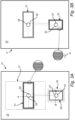
- Fig 3A is a frontside view
- fig 3B is a backside view of the enrollment assistance device 11 in fig 2 .
- the enrollment assistance device 11 comprises at least a first carrier 15, and has a first surface portion 17 and a second surface portion 19 spaced apart from the first surface portion 17.
- the first surface portion 17 is for arrangement of a mobile phone 13
- the second surface portion 19 is for arrangement of a contactless smartcard 1.
- the enrollment assistance device 11 further comprises an electrically conductive first conductor spiral 21 in a first conductor layer, here on the frontside of the enrollment assistance device 11 (indicated by a solid line in fig 3A and by a dashed line in fig 3B ), and an electrically conductive second conductor spiral 23 in a second conductor layer, here on the backside of the enrollment assistance device 11 (indicated by a dashed line in fig 3A and by a solid line in fig 3B ).
- first conductor spiral 21 and the second conductor spiral 23 are schematically indicated in figs 3A-B as being generally rectangular, it should be noted that this need not be the case, and that one or both of the first 21 and second 23 conductor spirals may have a different outline, such as circular or elliptical, etc.
- the at least first carrier 15 may advantageously be cellulose-based, for minimum environmental impact, but could alternatively be made of a plastic material, which may be recycled and/or manufactured without the use of fossil material.
- the enrollment assistance device 11 may comprise additional carriers.
- the second conductor spiral 23 may be formed on a second carrier, which may be laminated with the first carrier 15.
- the first conductor spiral 21 is arranged to form a first wireless power transfer link with a wireless power transfer arrangement (not shown) of the mobile phone 13, when the mobile phone 13 is arranged on the first surface portion 17.
- the first conductor spiral 21 has a first conductor end 25 inside, in other words circumscribed by, the first conductor spiral 21 and a second conductor end 27 outside, in other words not circumscribed by, the first conductor spiral 21.
- the first conductor end 25 is conductively connected to a first capacitive coupling pad 29 of the first conductor spiral 21, and the second conductor end 27 is conductively connected to a second capacitive coupling pad 31 of the first conductor spiral 21.
- the second conductor spiral 23 is arranged to form a second wireless power transfer link with the wireless power transfer arrangement 5 (in fig 1B ) of the contactless smartcard 1, when the contactless smartcard 1 is arranged on the second surface portion 19.
- the second conductor spiral 23 has a first conductor end 33 inside, in other words circumscribed by, the second conductor spiral 23 and a second conductor end 35 outside, in other words not circumscribed by, the second conductor spiral 23.
- the first conductor end 33 is conductively connected to a first capacitive coupling pad 37 of the second conductor spiral 23, and the second conductor end 35 is conductively connected to a second capacitive coupling pad 39.
- the second conductor spiral 23 is optimized for power transfer with the wireless power transfer arrangement 5 in the contactless smartcard 1.
- the capacitive coupling pads are indicated as being disc-shaped. As will be immediately apparent to one of ordinary skill in the relevant art, the particular shape of the coupling pads is not critical, but many different shapes could be used.
- Each pair of (at least partly) overlapping capacitive coupling pads forms a parallel plate capacitor, which can easily be dimensioned and adapted to, for example, different materials and thicknesses of the insulating layer between the first and second conductor layers.
- the number of turns in the first conductor spiral 21 and the second conductor spiral may advantageously be 5 to 15, and the spacing w between adjacent conductors may be in the range 0.05 mm to 0.5 mm.
- Fig 4A schematically illustrates a cross-section taken along the line A-A' of an exemplary configuration of the enrollment assistance device 11 in fig 3A
- fig 4B schematically illustrates a cross-section taken along the line B-B' of an exemplary configuration of the enrollment assistance device 11 in fig 3A
- the first conductor layer 41 including the first conductor spiral 21 and the first 29 and second 31 capacitive coupling pads of the first conductor spiral 21 is separated from the second conductor layer 43, including the second conductor spiral 23 and the first 37 and second 39 capacitive coupling pads of the second conductor spiral 23 by an insulating layer in form of the first carrier 15.
- the enrollment assistance device 11 may advantageously be provided as a laminated structure, where the first conductor layer 41 is formed on the first carrier 15 and the second conductor layer 43 is formed on a second carrier.
- the first capacitive coupling pad 29 of the first conductor spiral 21 overlaps with the second capacitive coupling pad 39 of the second conductor spiral 23, and the second capacitive coupling pad 31 of the first conductor spiral 21 overlaps with the first capacitive coupling pad 37 of the second conductor spiral 23.
- the antenna formed by the first conductor spiral 21 is connected to the antenna formed by the second conductor spiral 23 without the need for relatively costly and complicated via interconnects.
- first 41 and second 43 conductor layers need not be on opposite sides of the first carrier 15 as in figs 4A-B , but may be on the same side of the first carrier 15, and separated by another insulating layer.
- the first conductor spiral 21 and the second conductor spiral 23 may be printed using conductive ink or paste using per se known techniques. Alternatively, at least one of the first conductor spiral 21 and the second conductor spiral 23 may be pre-formed on a sticker, which may be attached to the first carrier 15.
- the conductor spirals may be covered by dielectric layers, such as thin plastic layers.
- first conductor spiral 21 is indicated as being on the frontside of the enrollment assistance device 11 and the second conductor spiral 23 is indicated as being on the backside, it should be noted that this may be reversed, so that the first conductor spiral 21 is on the backside and the second conductor spiral 23 is on the frontside.
- the first conductor spiral 21 may be dimensioned to simplify optimal arrangement of the mobile phone 13.
- the first conductor spiral 21 is wider than the mobile phone 13 (compare fig 2 and figs 3A-B ) to allow the user to find the optimal arrangement by movement in the longitudinal direction of the enrollment assistance device 11.
- the conductor spiral 21 may be taller than the mobile phone 13 to allow optimization by movement perpendicular to the longitudinal direction. Accordingly, the first conductor spiral 21 may advantageously have one dimension that is smaller than the corresponding dimension of the mobile phone (all applicable mobile phones) and one dimension that is greater than the corresponding dimension of the mobile phone (all applicable mobile phones).
- the enrollment assistance device 11 may therefore be provided with at least one indicium for guiding the user to correctly arrange the mobile phone 13 on the first portion 17, in relation to the first conductor spiral 21.
- the at least one indicium may, for instance, comprise a number of outlines corresponding to the physical outlines of the most common mobile phones 13.
- the user has a biometric system 9 such as that described above with reference to fig 2 .
- the biometric system 9, including the enrollment assistance device 11 and the contactless smartcard 1 arranged on the second surface portion 19 may have been sent to the user by mail from the issuer of the card, such as a financial institution or the like.
- the user is also in possession of a mobile phone 13, including a wireless power transfer arrangement arranged to provide an electric field for power transfer adjacent to a backside of the mobile phone, and a display arranged on a frontside of the mobile phone 13.
- a first step 501 the user is instructed to arrange the mobile phone 13 on the first surface portion 17 of the enrollment assistance device 11 comprised in the biometric system 9, with the backside of the mobile phone 13 facing the first surface portion 17.
- the instructing step may include providing guidance to the user.
- Such guidance may, for example, be included in the biometric system 9 that is provided to the user.
- written and/or graphical guidance may be printed on the enrollment assistance device 11.
- such graphical guidance may include outlines of popular mobile phones, etc.
- the user may be guided by controlling the mobile phone 13 to provide an alignment pattern on the display of the mobile phone 13.
- the alignment pattern on the display may be aligned with the at least one indicium on the enrollment assistance device 11.
- the mobile phone 13 transmits, to the contactless smartcard 1 a signal encoding an instruction to the contactless smartcard 1 to start to perform biometric enrollment.
- the signal is transmitted wirelessly to the contactless smartcard 1, and may be transmitted, using per se known techniques for near field communication (NFC), via the first conductor spiral 21, capacitive coupling between the overlapping capacitive coupling pads (see figs 4A-B ), and the second conductor spiral 23 comprised in the enrollment assistance device 11.
- this signal may be wirelessly transmitted using another wireless communication link, such as using low-power radio transmission.
- the user may be guided by instructions and/or illustrations provided on the display of the mobile phone 13. Such instructions and/or illustrations may be based on information provided wirelessly from the contactless smartcard 1 to the mobile phone 13. For instance, the user may be instructed in respect of finger placement and/or receive information about the status of the enrollment procedure.
- the mobile phone 13 receives, in step 503, a signal indicating that the enrollment has been completed.
- the signal indicating that the enrollment has been completed may be received via the second conductor spiral 23, capacitive coupling between the overlapping capacitive coupling pads (see figs 4A-B ), and the first conductor spiral 21 comprised in the enrollment assistance device 11 included in the biometric system 9.
- the ability to successfully finalize the enrollment and enable use of the biometric capabilities of the contactless smartcard 1 may be conditional on a user authentication performed using the mobile phone 13. This may particularly be the case for a so-called initial enrollment, where no biometric template is stored on the smartcard.
- the mobile phone 13 may locally carry out the user authentication, for example using a fingerprint sensor or other biometric arrangement comprised in the mobile phone 13.
- the mobile phone 13 may be used as an input device for input of a code, such as a password, PIN or OTP, for transmission to a remote server for authentication there.
- the signal encoding a (correct) instruction to the contactless smartcard 1 to start to perform the enrollment may only be sent if a successful user authentication has first been performed.
- the enrollment may be carried out, but the generated biometric template may be discarded, or the biometric capabilities of the smartcard 1 may be locked unless a successful user authentication is performed.
Landscapes
- Engineering & Computer Science (AREA)
- Physics & Mathematics (AREA)
- Computer Networks & Wireless Communication (AREA)
- General Physics & Mathematics (AREA)
- Theoretical Computer Science (AREA)
- Electromagnetism (AREA)
- Health & Medical Sciences (AREA)
- Toxicology (AREA)
- Computer Hardware Design (AREA)
- Power Engineering (AREA)
- Microelectronics & Electronic Packaging (AREA)
- General Health & Medical Sciences (AREA)
- Artificial Intelligence (AREA)
- Computer Vision & Pattern Recognition (AREA)
- Computer Security & Cryptography (AREA)
- General Engineering & Computer Science (AREA)
- Measurement Of The Respiration, Hearing Ability, Form, And Blood Characteristics Of Living Organisms (AREA)
- Near-Field Transmission Systems (AREA)
Claims (13)
- Registrierungsunterstützungsvorrichtung (11) zum Ermöglichen einer biometrischen Registrierung eines Benutzers einer kontaktlosen Chipkarte (1), die eine biometrische Anordnung (3) und eine Drahtlos-Energieübertragungsanordnung (5) aufweist, wobei die Registrierungsunterstützungsvorrichtung (11) umfasst:eine erste Leiterspirale (21) in einer ersten Leiterschicht (41) der Registrierungsunterstützungsvorrichtung (11), die dafür ausgelegt ist, eine erste Drahtlos-Energieübertragungsverbindung mit einer Drahtlos-Energieübertragungsanordnung eines Mobiltelefons (13) zu bilden, wenn das Mobiltelefon (13) auf einem ersten Oberflächenabschnitt (17) der Registrierungsunterstützungsvorrichtung (11) angeordnet ist, wobei die erste Leiterspirale (21) ein erstes Leiterende (25) innerhalb der ersten Leiterspirale (21) und ein zweites Leiterende (27) außerhalb der ersten Leiterspirale (21) aufweist, undeine zweite Leiterspirale (23) in einer zweiten Leiterschicht (43) der Registrierungsunterstützungsvorrichtung (11), die von der ersten Leiterschicht (41) durch eine Isolierschicht (15) so getrennt ist, dass keine leitende Verbindung zwischen ihnen besteht, und dafür ausgelegt ist, eine zweite Drahtlos-Energieübertragungsverbindung mit der Drahtlos-Energieübertragungsanordnung (5) der kontaktlosen Chipkarte (1) zu bilden, wenn die kontaktlose Chipkarte (1) auf einem zweiten Oberflächenabschnitt (19) der Registrierungsunterstützungsvorrichtung (11) angeordnet ist, wobei die zweite Leiterspirale (23) ein erstes Leiterende (33) innerhalb der zweiten Leiterspirale (23) und ein zweites Leiterende (35) außerhalb der zweiten Leiterspirale (23) aufweist,wobei die Registrierungsunterstützungsvorrichtung (11) dadurch gekennzeichnet ist, dass:das erste Leiterende (25) der ersten Leiterspirale (21) leitend mit einem ersten kapazitiven Kopplungspad (29) der ersten Leiterspirale (21) verbunden ist und das zweite Leiterende (27) der ersten Leiterspirale (21) leitend mit einem zweiten kapazitiven Kopplungspad (31) der ersten Leiterspirale (21) verbunden ist, und das erste Leiterende (33) der zweiten Leiterspirale (23) leitend mit einem ersten kapazitiven Kopplungspad (37) der zweiten Leiterspirale (23) verbunden ist und das zweite Leiterende (35) der zweiten Leiterspirale (23) leitend mit einem zweiten kapazitiven Kopplungspad (39) der zweiten Leiterspirale (23) verbunden ist,wobei das erste kapazitive Kopplungspad (29) der ersten Leiterspirale (21) das zweite kapazitive Kopplungspad (39) der zweiten Leiterspirale (23) überlappt, und das zweite kapazitive Kopplungspad (31) der ersten Leiterspirale (21) das erste kapazitive Kopplungspad (37) der zweiten Leiterspirale (23) überlappt.
- Registrierungsunterstützungsvorrichtung (11) nach Anspruch 1, wobei:die Registrierungsunterstützungsvorrichtung (11) mindestens einen ersten Träger (15) umfasst; unddie erste Leiterschicht (41) sich auf einer ersten Seite des ersten Trägers (15) befindet, und die zweite Leiterschicht (43) sich auf einer zweiten Seite des ersten Trägers (15) befindet, die der ersten Seite gegenüber liegt.
- Registrierungsunterstützungsvorrichtung (11) nach Anspruch 2, wobei die erste Leiterspirale (21) auf den ersten Träger (15) gedruckt ist.
- Registrierungsunterstützungsvorrichtung (11) nach Anspruch 2 oder 3, wobei:die Registrierungsunterstützungsvorrichtung (11) einen zweiten Träger umfasst;die zweite Leiterschicht (43) sich auf einer ersten Seite des zweiten Trägers befindet; undder erste Träger mit der ersten Leiterschicht (41) und der zweite Träger mit der zweiten Leiterschicht (43) miteinander laminiert sind.
- Registrierungsunterstützungsvorrichtung (11) nach Anspruch 4, wobei die zweite Leiterspirale (23) auf den zweiten Träger gedruckt ist.
- Registrierungsunterstützungsvorrichtung (11) nach einem der vorangehenden Ansprüche, wobei die Registrierungsunterstützungsvorrichtung (11) mindestens einen Hinweis umfasst, um den Benutzer anzuleiten, das Mobiltelefon (13) auf dem ersten Abschnitt (17) der Registrierungsunterstützungsvorrichtung (11) in Bezug auf die erste Leiterspirale (21) richtig anzuordnen.
- Registrierungsunterstützungsvorrichtung (11) nach einem der Ansprüche 2 bis 5, wobei der mindestens erste Träger (15) in Form eines Flachmaterials vorliegt.
- Registrierungsunterstützungsvorrichtung (11) nach einem der Ansprüche 2 bis 5, wobei der mindestens erste Träger (15) zellulosebasiert ist.
- Biometrisches System (9), das umfasst:die Registrierungsunterstützungsvorrichtung (11) nach einem der vorangehenden Ansprüche; undeine kontaktlose Chipkarte (1), die eine biometrische Anordnung (3) und eine Drahtlos-Energieübertragungsanordnung (5) aufweist,wobei die kontaktlose Chipkarte (1) auf dem zweiten Oberflächenabschnitt (19) der Registrierungsunterstützungsvorrichtung (11) angeordnet ist.
- Verfahren zum Registrieren eines Benutzers, der das biometrische System (9) nach Anspruch 9 und ein Mobiltelefon (13) hat, das eine Drahtlos-Energieübertragungsanordnung aufweist, die dafür ausgelegt ist, ein elektrisches Feld für die Energieübertragung neben einer Rückseite des Mobiltelefons (13) bereitzustellen, und ein Display aufweist, das auf einer Vorderseite des Mobiltelefons (13) angeordnet ist, wobei das Verfahren die folgenden Schritte umfasst:Anweisen (501) des Benutzers, das Mobiltelefon (13) auf dem ersten Oberflächenabschnitt (17) der in dem biometrischen System (9) enthaltenen Registrierungsunterstützungsvorrichtung (11) so anzuordnen, dass die Rückseite des Mobiltelefons (13) dem ersten Oberflächenabschnitt (17) zugewandt ist;Senden (502), durch das Mobiltelefon (13) an die kontaktlose Chipkarte (1), die auf dem zweiten Oberflächenabschnitt (19) der R Registrierungsunterstützungsvorrichtung (11) angeordnet ist, eines Signals, das eine Anweisung an die kontaktlose Chipkarte (1) codiert, mit der Durchführung der biometrischen Registrierung zu beginnen; undEmpfangen (503), durch das Mobiltelefon (13) von der kontaktlosen Chipkarte (1), die auf dem zweiten Oberflächenabschnitt (19) der Registrierungsunterstützungsvorrichtung (11) angeordnet ist, nachdem die biometrische Registrierung vollendet wurde, eines Signals, das die Vollendung der biometrischen Erfassung angibt.
- Verfahren nach Anspruch 10, wobei:das Signal, das die Anweisung an die kontaktlose Chipkarte (1), eine biometrische Registrierung durchzuführen, codiert, über die erste Leiterspirale (21), die kapazitive Kopplung zwischen den überlappenden kapazitiven Kopplungspads und die zweite Leiterspirale (23), die in der Registrierungsunterstützungsvorrichtung (11) enthalten ist, die in dem biometrischen System (9) enthalten ist, gesendet wird; unddas Signal, das angibt, dass die Registrierung vollendet wurde, über die zweite Leiterspirale (23), die kapazitive Kopplung zwischen den überlappenden kapazitiven Kopplungspads und die erste Leiterspirale (21), die in der Registrierungsunterstützungsvorrichtung (11) enthalten ist, die in dem biometrischen System (9) enthalten ist, empfangen wird.
- Verfahren nach Anspruch 10 oder 11, das des Weiteren folgende Schritte umfasst:Durchführen einer Benutzerauthentifizierung unter Verwendung des Mobiltelefons (13); undGestatten der Vollendung der biometrischen Registrierung nur dann, wenn die Benutzerauthentifizierung erfolgreich ist.
- Computerprogramm, das dafür konfiguriert ist, wenn es auf einem Mobiltelefon (13) ausgeführt wird, das eine Drahtlos-Energieübertragungsanordnung auf einer Rückseite des Mobiltelefons und eine Display auf einer Vorderseite des Mobiltelefons aufweist, das Mobiltelefon zu veranlassen, die Schritte nach einem der Ansprüche 10 bis 12 auszuführen.
Applications Claiming Priority (1)
| Application Number | Priority Date | Filing Date | Title |
|---|---|---|---|
| SE2250780 | 2022-06-23 |
Publications (2)
| Publication Number | Publication Date |
|---|---|
| EP4296887A1 EP4296887A1 (de) | 2023-12-27 |
| EP4296887B1 true EP4296887B1 (de) | 2024-06-26 |
Family
ID=86899194
Family Applications (1)
| Application Number | Title | Priority Date | Filing Date |
|---|---|---|---|
| EP23179932.1A Active EP4296887B1 (de) | 2022-06-23 | 2023-06-19 | Registrierungshilfsvorrichtung mit kapazitiven koppelpads, biometrisches system und registrierungsverfahren |
Country Status (3)
| Country | Link |
|---|---|
| US (1) | US20250342335A1 (de) |
| EP (1) | EP4296887B1 (de) |
| WO (1) | WO2023249540A1 (de) |
Family Cites Families (10)
| Publication number | Priority date | Publication date | Assignee | Title |
|---|---|---|---|---|
| WO2014036248A1 (en) * | 2012-09-01 | 2014-03-06 | Mophie, Inc. | Wireless communication accessory for a mobile device |
| US20160322867A1 (en) * | 2012-09-07 | 2016-11-03 | Nagesh POLU | Wireless electric/magnetic field power transfer system, transmitter and receiver |
| CA2992507A1 (en) * | 2015-07-17 | 2017-01-26 | The Governors Of The University Of Alberta | Method and system for wireless and single conductor power transmission |
| US10187212B2 (en) * | 2016-06-20 | 2019-01-22 | Fingerprint Cards Ab | Communication arrangement |
| FR3062539B1 (fr) * | 2017-01-31 | 2019-03-29 | Stmicroelectronics (Tours) Sas | Etui pour telephone portable |
| US11250307B2 (en) * | 2017-03-23 | 2022-02-15 | Idex Biometrics Asa | Secure, remote biometric enrollment |
| GB2575087A (en) * | 2018-06-28 | 2020-01-01 | Zwipe As | Biometric Enrolment |
| US10956881B2 (en) * | 2018-07-09 | 2021-03-23 | Mastercard International Incorporated | Methods and systems for biometric card enrollment |
| FR3095056B1 (fr) | 2019-04-15 | 2021-10-22 | Idemia France | Affichage sur un écran de smartphone d’un motif de positionnement d’une carte sans contact pour améliorer la communication en champ proche |
| FR3095735B1 (fr) * | 2019-05-03 | 2021-05-21 | Idemia Identity & Security France | Etui d’enrôlement pour carte à puce |
-
2023
- 2023-06-19 EP EP23179932.1A patent/EP4296887B1/de active Active
- 2023-06-19 US US18/874,600 patent/US20250342335A1/en active Pending
- 2023-06-19 WO PCT/SE2023/050618 patent/WO2023249540A1/en not_active Ceased
Also Published As
| Publication number | Publication date |
|---|---|
| US20250342335A1 (en) | 2025-11-06 |
| EP4296887A1 (de) | 2023-12-27 |
| WO2023249540A1 (en) | 2023-12-28 |
Similar Documents
| Publication | Publication Date | Title |
|---|---|---|
| EP4068570B1 (de) | Biometrisches system und registrierungsverfahren | |
| US7543156B2 (en) | Transaction authentication card | |
| US8505826B2 (en) | Anti-interrogation for portable device | |
| CN114341876A (zh) | 生物识别智能卡的登记装置 | |
| EP2819107A1 (de) | Sicherheitstoken und Transaktionsermächtigungs-System | |
| WO2020051553A1 (en) | Biometric lever wallet | |
| KR20240128862A (ko) | 안테나 확장기 | |
| US20190156098A1 (en) | Fingerprint authorisable device | |
| EP4296887B1 (de) | Registrierungshilfsvorrichtung mit kapazitiven koppelpads, biometrisches system und registrierungsverfahren | |
| EP4307164B1 (de) | Registrierungshilfsvorrichtung | |
| EP4296886B1 (de) | Registrierungshilfsvorrichtung mit leiterspirale, biometrisches system und registrierungsverfahren | |
| EP4468615A1 (de) | Registrierungshilfsvorrichtung mit induktiven spulen, biometrisches system und registrierungsverfahren | |
| EP4468614A1 (de) | Registrierungshilfsvorrichtung mit bifilaren spulen, biometrisches system und registrierungsverfahren | |
| US20210244146A1 (en) | Biometric lever wallet | |
| US20240354742A1 (en) | Personalization device and method for integrated circuit card | |
| US12061947B2 (en) | Load matching in a smart card | |
| JP2003016418A (ja) | 携帯端末及びその制御方法、並びに、icカード | |
| JP2024009611A (ja) | 無線認証デバイス | |
| JP2007026138A (ja) | 不正カードの利用防止システムおよびatm | |
| JP2005202505A (ja) | 情報送信装置 | |
| HK40071648A (en) | Enrolment device for a biometric smart card | |
| JP2007087140A (ja) | 認証システム | |
| JP2009251885A (ja) | 音声認証機能を備えたsimホルダー | |
| KR20070017764A (ko) | 드라이브업 금융 자동화 기기와 연동하는 무선 단말기 및드라이브업 금융 자동화 기기 | |
| JP2007087141A (ja) | 認証システム |
Legal Events
| Date | Code | Title | Description |
|---|---|---|---|
| PUAI | Public reference made under article 153(3) epc to a published international application that has entered the european phase |
Free format text: ORIGINAL CODE: 0009012 |
|
| STAA | Information on the status of an ep patent application or granted ep patent |
Free format text: STATUS: REQUEST FOR EXAMINATION WAS MADE |
|
| 17P | Request for examination filed |
Effective date: 20231102 |
|
| AK | Designated contracting states |
Kind code of ref document: A1 Designated state(s): AL AT BE BG CH CY CZ DE DK EE ES FI FR GB GR HR HU IE IS IT LI LT LU LV MC ME MK MT NL NO PL PT RO RS SE SI SK SM TR |
|
| GRAJ | Information related to disapproval of communication of intention to grant by the applicant or resumption of examination proceedings by the epo deleted |
Free format text: ORIGINAL CODE: EPIDOSDIGR1 |
|
| STAA | Information on the status of an ep patent application or granted ep patent |
Free format text: STATUS: GRANT OF PATENT IS INTENDED |
|
| GRAP | Despatch of communication of intention to grant a patent |
Free format text: ORIGINAL CODE: EPIDOSNIGR1 |
|
| INTG | Intention to grant announced |
Effective date: 20240205 |
|
| GRAS | Grant fee paid |
Free format text: ORIGINAL CODE: EPIDOSNIGR3 |
|
| GRAA | (expected) grant |
Free format text: ORIGINAL CODE: 0009210 |
|
| STAA | Information on the status of an ep patent application or granted ep patent |
Free format text: STATUS: THE PATENT HAS BEEN GRANTED |
|
| AK | Designated contracting states |
Kind code of ref document: B1 Designated state(s): AL AT BE BG CH CY CZ DE DK EE ES FI FR GB GR HR HU IE IS IT LI LT LU LV MC ME MK MT NL NO PL PT RO RS SE SI SK SM TR |
|
| REG | Reference to a national code |
Ref country code: GB Ref legal event code: FG4D |
|
| REG | Reference to a national code |
Ref country code: CH Ref legal event code: EP |
|
| REG | Reference to a national code |
Ref country code: DE Ref legal event code: R096 Ref document number: 602023000183 Country of ref document: DE |
|
| PG25 | Lapsed in a contracting state [announced via postgrant information from national office to epo] |
Ref country code: BG Free format text: LAPSE BECAUSE OF FAILURE TO SUBMIT A TRANSLATION OF THE DESCRIPTION OR TO PAY THE FEE WITHIN THE PRESCRIBED TIME-LIMIT Effective date: 20240626 |
|
| PG25 | Lapsed in a contracting state [announced via postgrant information from national office to epo] |
Ref country code: HR Free format text: LAPSE BECAUSE OF FAILURE TO SUBMIT A TRANSLATION OF THE DESCRIPTION OR TO PAY THE FEE WITHIN THE PRESCRIBED TIME-LIMIT Effective date: 20240626 Ref country code: FI Free format text: LAPSE BECAUSE OF FAILURE TO SUBMIT A TRANSLATION OF THE DESCRIPTION OR TO PAY THE FEE WITHIN THE PRESCRIBED TIME-LIMIT Effective date: 20240626 |
|
| REG | Reference to a national code |
Ref country code: LT Ref legal event code: MG9D |
|
| PG25 | Lapsed in a contracting state [announced via postgrant information from national office to epo] |
Ref country code: GR Free format text: LAPSE BECAUSE OF FAILURE TO SUBMIT A TRANSLATION OF THE DESCRIPTION OR TO PAY THE FEE WITHIN THE PRESCRIBED TIME-LIMIT Effective date: 20240927 |
|
| PG25 | Lapsed in a contracting state [announced via postgrant information from national office to epo] |
Ref country code: LV Free format text: LAPSE BECAUSE OF FAILURE TO SUBMIT A TRANSLATION OF THE DESCRIPTION OR TO PAY THE FEE WITHIN THE PRESCRIBED TIME-LIMIT Effective date: 20240626 |
|
| REG | Reference to a national code |
Ref country code: NL Ref legal event code: MP Effective date: 20240626 |
|
| PG25 | Lapsed in a contracting state [announced via postgrant information from national office to epo] |
Ref country code: NO Free format text: LAPSE BECAUSE OF FAILURE TO SUBMIT A TRANSLATION OF THE DESCRIPTION OR TO PAY THE FEE WITHIN THE PRESCRIBED TIME-LIMIT Effective date: 20240926 Ref country code: LV Free format text: LAPSE BECAUSE OF FAILURE TO SUBMIT A TRANSLATION OF THE DESCRIPTION OR TO PAY THE FEE WITHIN THE PRESCRIBED TIME-LIMIT Effective date: 20240626 Ref country code: HR Free format text: LAPSE BECAUSE OF FAILURE TO SUBMIT A TRANSLATION OF THE DESCRIPTION OR TO PAY THE FEE WITHIN THE PRESCRIBED TIME-LIMIT Effective date: 20240626 Ref country code: GR Free format text: LAPSE BECAUSE OF FAILURE TO SUBMIT A TRANSLATION OF THE DESCRIPTION OR TO PAY THE FEE WITHIN THE PRESCRIBED TIME-LIMIT Effective date: 20240927 Ref country code: FI Free format text: LAPSE BECAUSE OF FAILURE TO SUBMIT A TRANSLATION OF THE DESCRIPTION OR TO PAY THE FEE WITHIN THE PRESCRIBED TIME-LIMIT Effective date: 20240626 Ref country code: BG Free format text: LAPSE BECAUSE OF FAILURE TO SUBMIT A TRANSLATION OF THE DESCRIPTION OR TO PAY THE FEE WITHIN THE PRESCRIBED TIME-LIMIT Effective date: 20240626 Ref country code: RS Free format text: LAPSE BECAUSE OF FAILURE TO SUBMIT A TRANSLATION OF THE DESCRIPTION OR TO PAY THE FEE WITHIN THE PRESCRIBED TIME-LIMIT Effective date: 20240926 |
|
| PG25 | Lapsed in a contracting state [announced via postgrant information from national office to epo] |
Ref country code: NL Free format text: LAPSE BECAUSE OF FAILURE TO SUBMIT A TRANSLATION OF THE DESCRIPTION OR TO PAY THE FEE WITHIN THE PRESCRIBED TIME-LIMIT Effective date: 20240626 |
|
| REG | Reference to a national code |
Ref country code: AT Ref legal event code: MK05 Ref document number: 1698324 Country of ref document: AT Kind code of ref document: T Effective date: 20240626 |
|
| PG25 | Lapsed in a contracting state [announced via postgrant information from national office to epo] |
Ref country code: NL Free format text: LAPSE BECAUSE OF FAILURE TO SUBMIT A TRANSLATION OF THE DESCRIPTION OR TO PAY THE FEE WITHIN THE PRESCRIBED TIME-LIMIT Effective date: 20240626 |
|
| PG25 | Lapsed in a contracting state [announced via postgrant information from national office to epo] |
Ref country code: PT Free format text: LAPSE BECAUSE OF FAILURE TO SUBMIT A TRANSLATION OF THE DESCRIPTION OR TO PAY THE FEE WITHIN THE PRESCRIBED TIME-LIMIT Effective date: 20241028 |
|
| PG25 | Lapsed in a contracting state [announced via postgrant information from national office to epo] |
Ref country code: PT Free format text: LAPSE BECAUSE OF FAILURE TO SUBMIT A TRANSLATION OF THE DESCRIPTION OR TO PAY THE FEE WITHIN THE PRESCRIBED TIME-LIMIT Effective date: 20241028 |
|
| PG25 | Lapsed in a contracting state [announced via postgrant information from national office to epo] |
Ref country code: PL Free format text: LAPSE BECAUSE OF FAILURE TO SUBMIT A TRANSLATION OF THE DESCRIPTION OR TO PAY THE FEE WITHIN THE PRESCRIBED TIME-LIMIT Effective date: 20240626 |
|
| PG25 | Lapsed in a contracting state [announced via postgrant information from national office to epo] |
Ref country code: EE Free format text: LAPSE BECAUSE OF FAILURE TO SUBMIT A TRANSLATION OF THE DESCRIPTION OR TO PAY THE FEE WITHIN THE PRESCRIBED TIME-LIMIT Effective date: 20240626 |
|
| PG25 | Lapsed in a contracting state [announced via postgrant information from national office to epo] |
Ref country code: IS Free format text: LAPSE BECAUSE OF FAILURE TO SUBMIT A TRANSLATION OF THE DESCRIPTION OR TO PAY THE FEE WITHIN THE PRESCRIBED TIME-LIMIT Effective date: 20241026 Ref country code: AT Free format text: LAPSE BECAUSE OF FAILURE TO SUBMIT A TRANSLATION OF THE DESCRIPTION OR TO PAY THE FEE WITHIN THE PRESCRIBED TIME-LIMIT Effective date: 20240626 |
|
| PG25 | Lapsed in a contracting state [announced via postgrant information from national office to epo] |
Ref country code: CZ Free format text: LAPSE BECAUSE OF FAILURE TO SUBMIT A TRANSLATION OF THE DESCRIPTION OR TO PAY THE FEE WITHIN THE PRESCRIBED TIME-LIMIT Effective date: 20240626 |
|
| PG25 | Lapsed in a contracting state [announced via postgrant information from national office to epo] |
Ref country code: RO Free format text: LAPSE BECAUSE OF FAILURE TO SUBMIT A TRANSLATION OF THE DESCRIPTION OR TO PAY THE FEE WITHIN THE PRESCRIBED TIME-LIMIT Effective date: 20240626 Ref country code: SK Free format text: LAPSE BECAUSE OF FAILURE TO SUBMIT A TRANSLATION OF THE DESCRIPTION OR TO PAY THE FEE WITHIN THE PRESCRIBED TIME-LIMIT Effective date: 20240626 |
|
| PG25 | Lapsed in a contracting state [announced via postgrant information from national office to epo] |
Ref country code: SM Free format text: LAPSE BECAUSE OF FAILURE TO SUBMIT A TRANSLATION OF THE DESCRIPTION OR TO PAY THE FEE WITHIN THE PRESCRIBED TIME-LIMIT Effective date: 20240626 Ref country code: ES Free format text: LAPSE BECAUSE OF FAILURE TO SUBMIT A TRANSLATION OF THE DESCRIPTION OR TO PAY THE FEE WITHIN THE PRESCRIBED TIME-LIMIT Effective date: 20240626 |
|
| PG25 | Lapsed in a contracting state [announced via postgrant information from national office to epo] |
Ref country code: SM Free format text: LAPSE BECAUSE OF FAILURE TO SUBMIT A TRANSLATION OF THE DESCRIPTION OR TO PAY THE FEE WITHIN THE PRESCRIBED TIME-LIMIT Effective date: 20240626 Ref country code: SK Free format text: LAPSE BECAUSE OF FAILURE TO SUBMIT A TRANSLATION OF THE DESCRIPTION OR TO PAY THE FEE WITHIN THE PRESCRIBED TIME-LIMIT Effective date: 20240626 Ref country code: RO Free format text: LAPSE BECAUSE OF FAILURE TO SUBMIT A TRANSLATION OF THE DESCRIPTION OR TO PAY THE FEE WITHIN THE PRESCRIBED TIME-LIMIT Effective date: 20240626 Ref country code: PL Free format text: LAPSE BECAUSE OF FAILURE TO SUBMIT A TRANSLATION OF THE DESCRIPTION OR TO PAY THE FEE WITHIN THE PRESCRIBED TIME-LIMIT Effective date: 20240626 Ref country code: IS Free format text: LAPSE BECAUSE OF FAILURE TO SUBMIT A TRANSLATION OF THE DESCRIPTION OR TO PAY THE FEE WITHIN THE PRESCRIBED TIME-LIMIT Effective date: 20241026 Ref country code: ES Free format text: LAPSE BECAUSE OF FAILURE TO SUBMIT A TRANSLATION OF THE DESCRIPTION OR TO PAY THE FEE WITHIN THE PRESCRIBED TIME-LIMIT Effective date: 20240626 Ref country code: EE Free format text: LAPSE BECAUSE OF FAILURE TO SUBMIT A TRANSLATION OF THE DESCRIPTION OR TO PAY THE FEE WITHIN THE PRESCRIBED TIME-LIMIT Effective date: 20240626 Ref country code: CZ Free format text: LAPSE BECAUSE OF FAILURE TO SUBMIT A TRANSLATION OF THE DESCRIPTION OR TO PAY THE FEE WITHIN THE PRESCRIBED TIME-LIMIT Effective date: 20240626 Ref country code: AT Free format text: LAPSE BECAUSE OF FAILURE TO SUBMIT A TRANSLATION OF THE DESCRIPTION OR TO PAY THE FEE WITHIN THE PRESCRIBED TIME-LIMIT Effective date: 20240626 |
|
| PG25 | Lapsed in a contracting state [announced via postgrant information from national office to epo] |
Ref country code: IT Free format text: LAPSE BECAUSE OF FAILURE TO SUBMIT A TRANSLATION OF THE DESCRIPTION OR TO PAY THE FEE WITHIN THE PRESCRIBED TIME-LIMIT Effective date: 20240626 |
|
| REG | Reference to a national code |
Ref country code: DE Ref legal event code: R097 Ref document number: 602023000183 Country of ref document: DE |
|
| PG25 | Lapsed in a contracting state [announced via postgrant information from national office to epo] |
Ref country code: DK Free format text: LAPSE BECAUSE OF FAILURE TO SUBMIT A TRANSLATION OF THE DESCRIPTION OR TO PAY THE FEE WITHIN THE PRESCRIBED TIME-LIMIT Effective date: 20240626 |
|
| PLBE | No opposition filed within time limit |
Free format text: ORIGINAL CODE: 0009261 |
|
| STAA | Information on the status of an ep patent application or granted ep patent |
Free format text: STATUS: NO OPPOSITION FILED WITHIN TIME LIMIT |
|
| 26N | No opposition filed |
Effective date: 20250327 |
|
| PGFP | Annual fee paid to national office [announced via postgrant information from national office to epo] |
Ref country code: DE Payment date: 20250627 Year of fee payment: 3 |
|
| PGFP | Annual fee paid to national office [announced via postgrant information from national office to epo] |
Ref country code: FR Payment date: 20250625 Year of fee payment: 3 |
|
| PG25 | Lapsed in a contracting state [announced via postgrant information from national office to epo] |
Ref country code: SE Free format text: LAPSE BECAUSE OF FAILURE TO SUBMIT A TRANSLATION OF THE DESCRIPTION OR TO PAY THE FEE WITHIN THE PRESCRIBED TIME-LIMIT Effective date: 20240626 |
|
| PG25 | Lapsed in a contracting state [announced via postgrant information from national office to epo] |
Ref country code: MC Free format text: LAPSE BECAUSE OF FAILURE TO SUBMIT A TRANSLATION OF THE DESCRIPTION OR TO PAY THE FEE WITHIN THE PRESCRIBED TIME-LIMIT Effective date: 20240626 |