EP4468614A1 - Registrierungshilfsvorrichtung mit bifilaren spulen, biometrisches system und registrierungsverfahren - Google Patents
Registrierungshilfsvorrichtung mit bifilaren spulen, biometrisches system und registrierungsverfahren Download PDFInfo
- Publication number
- EP4468614A1 EP4468614A1 EP24176859.7A EP24176859A EP4468614A1 EP 4468614 A1 EP4468614 A1 EP 4468614A1 EP 24176859 A EP24176859 A EP 24176859A EP 4468614 A1 EP4468614 A1 EP 4468614A1
- Authority
- EP
- European Patent Office
- Prior art keywords
- enrollment
- surface portion
- carrier
- user device
- biometric
- Prior art date
- Legal status (The legal status is an assumption and is not a legal conclusion. Google has not performed a legal analysis and makes no representation as to the accuracy of the status listed.)
- Pending
Links
Images


Classifications
-
- H—ELECTRICITY
- H04—ELECTRIC COMMUNICATION TECHNIQUE
- H04B—TRANSMISSION
- H04B5/00—Near-field transmission systems, e.g. inductive or capacitive transmission systems
- H04B5/70—Near-field transmission systems, e.g. inductive or capacitive transmission systems specially adapted for specific purposes
- H04B5/79—Near-field transmission systems, e.g. inductive or capacitive transmission systems specially adapted for specific purposes for data transfer in combination with power transfer
-
- H—ELECTRICITY
- H02—GENERATION; CONVERSION OR DISTRIBUTION OF ELECTRIC POWER
- H02J—ELECTRIC POWER NETWORKS; CIRCUIT ARRANGEMENTS OR SYSTEMS FOR SUPPLYING OR DISTRIBUTING ELECTRIC POWER; SYSTEMS FOR STORING ELECTRIC ENERGY
- H02J50/00—Circuit arrangements or systems for wireless supply or distribution of electric power
- H02J50/10—Circuit arrangements or systems for wireless supply or distribution of electric power using inductive coupling
-
- G—PHYSICS
- G06—COMPUTING OR CALCULATING; COUNTING
- G06F—ELECTRIC DIGITAL DATA PROCESSING
- G06F21/00—Security arrangements for protecting computers, components thereof, programs or data against unauthorised activity
- G06F21/30—Authentication, i.e. establishing the identity or authorisation of security principals
- G06F21/31—User authentication
- G06F21/32—User authentication using biometric data, e.g. fingerprints, iris scans or voiceprints
-
- G—PHYSICS
- G06—COMPUTING OR CALCULATING; COUNTING
- G06K—GRAPHICAL DATA READING; PRESENTATION OF DATA; RECORD CARRIERS; HANDLING RECORD CARRIERS
- G06K19/00—Record carriers for use with machines and with at least a part designed to carry digital markings
- G06K19/06—Record carriers for use with machines and with at least a part designed to carry digital markings characterised by the kind of the digital marking, e.g. shape, nature, code
- G06K19/067—Record carriers with conductive marks, printed circuits or semiconductor circuit elements, e.g. credit or identity cards also with resonating or responding marks without active components
- G06K19/07—Record carriers with conductive marks, printed circuits or semiconductor circuit elements, e.g. credit or identity cards also with resonating or responding marks without active components with integrated circuit chips
- G06K19/0716—Record carriers with conductive marks, printed circuits or semiconductor circuit elements, e.g. credit or identity cards also with resonating or responding marks without active components with integrated circuit chips at least one of the integrated circuit chips comprising a sensor or an interface to a sensor
- G06K19/0718—Record carriers with conductive marks, printed circuits or semiconductor circuit elements, e.g. credit or identity cards also with resonating or responding marks without active components with integrated circuit chips at least one of the integrated circuit chips comprising a sensor or an interface to a sensor the sensor being of the biometric kind, e.g. fingerprint sensors
-
- G—PHYSICS
- G06—COMPUTING OR CALCULATING; COUNTING
- G06K—GRAPHICAL DATA READING; PRESENTATION OF DATA; RECORD CARRIERS; HANDLING RECORD CARRIERS
- G06K19/00—Record carriers for use with machines and with at least a part designed to carry digital markings
- G06K19/06—Record carriers for use with machines and with at least a part designed to carry digital markings characterised by the kind of the digital marking, e.g. shape, nature, code
- G06K19/067—Record carriers with conductive marks, printed circuits or semiconductor circuit elements, e.g. credit or identity cards also with resonating or responding marks without active components
- G06K19/07—Record carriers with conductive marks, printed circuits or semiconductor circuit elements, e.g. credit or identity cards also with resonating or responding marks without active components with integrated circuit chips
- G06K19/0723—Record carriers with conductive marks, printed circuits or semiconductor circuit elements, e.g. credit or identity cards also with resonating or responding marks without active components with integrated circuit chips the record carrier comprising an arrangement for non-contact communication, e.g. wireless communication circuits on transponder cards, non-contact smart cards or RFIDs
-
- G—PHYSICS
- G06—COMPUTING OR CALCULATING; COUNTING
- G06K—GRAPHICAL DATA READING; PRESENTATION OF DATA; RECORD CARRIERS; HANDLING RECORD CARRIERS
- G06K19/00—Record carriers for use with machines and with at least a part designed to carry digital markings
- G06K19/06—Record carriers for use with machines and with at least a part designed to carry digital markings characterised by the kind of the digital marking, e.g. shape, nature, code
- G06K19/067—Record carriers with conductive marks, printed circuits or semiconductor circuit elements, e.g. credit or identity cards also with resonating or responding marks without active components
- G06K19/07—Record carriers with conductive marks, printed circuits or semiconductor circuit elements, e.g. credit or identity cards also with resonating or responding marks without active components with integrated circuit chips
- G06K19/0723—Record carriers with conductive marks, printed circuits or semiconductor circuit elements, e.g. credit or identity cards also with resonating or responding marks without active components with integrated circuit chips the record carrier comprising an arrangement for non-contact communication, e.g. wireless communication circuits on transponder cards, non-contact smart cards or RFIDs
- G06K19/0727—Record carriers with conductive marks, printed circuits or semiconductor circuit elements, e.g. credit or identity cards also with resonating or responding marks without active components with integrated circuit chips the record carrier comprising an arrangement for non-contact communication, e.g. wireless communication circuits on transponder cards, non-contact smart cards or RFIDs the arrangement being a circuit facilitating integration of the record carrier with a hand-held device such as a smart phone of PDA
-
- G—PHYSICS
- G06—COMPUTING OR CALCULATING; COUNTING
- G06K—GRAPHICAL DATA READING; PRESENTATION OF DATA; RECORD CARRIERS; HANDLING RECORD CARRIERS
- G06K7/00—Methods or arrangements for sensing record carriers, e.g. for reading patterns
- G06K7/10—Methods or arrangements for sensing record carriers, e.g. for reading patterns by electromagnetic radiation, e.g. optical sensing; by corpuscular radiation
- G06K7/10009—Methods or arrangements for sensing record carriers, e.g. for reading patterns by electromagnetic radiation, e.g. optical sensing; by corpuscular radiation sensing by radiation using wavelengths larger than 0.1 mm, e.g. radio-waves or microwaves
- G06K7/10158—Methods or arrangements for sensing record carriers, e.g. for reading patterns by electromagnetic radiation, e.g. optical sensing; by corpuscular radiation sensing by radiation using wavelengths larger than 0.1 mm, e.g. radio-waves or microwaves methods and means used by the interrogation device for reliably powering the wireless record carriers using an electromagnetic interrogation field
- G06K7/10178—Methods or arrangements for sensing record carriers, e.g. for reading patterns by electromagnetic radiation, e.g. optical sensing; by corpuscular radiation sensing by radiation using wavelengths larger than 0.1 mm, e.g. radio-waves or microwaves methods and means used by the interrogation device for reliably powering the wireless record carriers using an electromagnetic interrogation field including auxiliary means for focusing, repeating or boosting the electromagnetic interrogation field
-
- H—ELECTRICITY
- H04—ELECTRIC COMMUNICATION TECHNIQUE
- H04B—TRANSMISSION
- H04B5/00—Near-field transmission systems, e.g. inductive or capacitive transmission systems
- H04B5/20—Near-field transmission systems, e.g. inductive or capacitive transmission systems characterised by the transmission technique; characterised by the transmission medium
- H04B5/24—Inductive coupling
- H04B5/26—Inductive coupling using coils
- H04B5/263—Multiple coils at either side
Definitions
- the present invention relates to an enrollment assistance device, for facilitating biometric enrollment of a user of a contactless smartcard including a biometric arrangement, and to a method of enrolling the user.
- Biometric arrangements are widely used as means for increasing the convenience and security of personal electronic devices, such as mobile phones etc. Fingerprint sensing arrangements, in particular, are now included in a large proportion of all newly released personal communication devices, such as mobile phones.
- biometric arrangements such as fingerprint sensing arrangements
- other devices that may have less computing power and/or available energy.
- biometric arrangements such as fingerprint sensing arrangements
- smartcards such as smartcards, door locks, and devices in the so-called internet of things (IoT) category etc.
- IoT internet of things
- biometrically enabled smartcard may typically have no user interface integrated in the smartcard.
- US 2020/0327533 proposes to power and communicate with the smartcard during enrollment using the user's mobile device.
- a visual marker is displayed on the screen of the mobile device to guide the user to correctly arrange the smartcard on the backside of the mobile device during the enrollment procedure.
- an enrollment assistance device for facilitating biometric enrollment of a user of a contactless smartcard including a biometric arrangement and a wireless power transfer arrangement
- the enrollment assistance device comprising: a carrier having a first surface portion for arrangement of a user device including a wireless power transfer arrangement, and a second surface portion, spaced apart from the first surface portion, for arrangement of the contactless smartcard; and a first electrical conductor supported by the carrier and forming a first conductor spiral at the first surface portion and a second conductor spiral at the second surface portion; a second electrical conductor supported by the carrier and forming a third conductor spiral at the first surface portion and a fourth conductor spiral at the second surface portion; the first and third conductor spirals of the respective first and second electrical conductor being interleaved to form a first bifilar coil at the first surface portion and the second and fourth conductor spirals of the respective first and second electrical conductor being interleaved to form a second bifilar coil at the second
- first and second electrical conductors forming the first and second bifilar coils provides for wireless coupling with both the user device and the contactless smartcard, and that this may be achieved without any conductor crossing in the enrollment assistance device. This will enable new alternatives for manufacturing of enrollment assistant devices using for example low-cost RFID-antenna manufacturing techniques.
- the present invention is based upon the realization that enrollment in a biometrically enabled contactless smartcard can be improved by utilizing wireless power transfer from a user device and facilitating arrangement of the contactless smartcard in relation to the user device, so that the user is not required to actively hold the smartcard in relation to the user device during the enrollment procedure.
- an enrollment assistance device having a carrier and first and second bifilar coils supported by the carrier and being configured to form a first wireless power transfer link with a wireless power transfer arrangement of the user device when the user device is arranged on a first surface portion of the carrier, and a second wireless power transfer link with a wireless power transfer arrangement of the contactless smartcard when the contactless smartcard is arranged on a second surface portion of the carrier.
- the first and second electrical conductors are configured to enable power transfer and communication between the first and second bifilar coils.
- power can be transferred from the user device to the contactless smartcard via the conductor spirals supported by the carrier and communication between the user device and the contactless smartcard is enabled.
- the first and second electrical conductors are arranged in the same plane, such as on the same surface of the carrier.
- the manufacturing of the enrollment assistance device is thereby simplified since all of the electrical conductors forming the wireless power transfer links can be made at the same time and at the same manufacturing step. Ease of manufacturing, which in turn provides the possibility of low-cost large scale production, is important for the described enrollment assistance device which thereby can be provided along with e.g. a biometric smartcard without significantly impacting the overall cost.
- Embodiments of the present invention allow the contactless smartcard and the user device to be arranged so that the user has easy access to a biometric sensor, such as a fingerprint sensor, on the smartcard during the entire enrollment procedure.
- a biometric sensor such as a fingerprint sensor
- the user device has a GUI (graphical user interface)
- the user can also be guided during the enrollment, using the GUI of the user device. This may provide for a shorter and more convenient enrollment procedure, and may also result in a higher quality of the enrolled biometric template.
- the configuration with a carrier and first and second electrical conductors supported by the carrier and forming first and second bifilar coils provides the desired wireless power transfer without the need for any crossing conductors in the enrollment assistance device.
- the enrollment assistance device according to the present invention can be made as a single layer device, including a single conductor layer.
- the enrollment assistance device can be distributed to users together with, or separate from, a contactless smartcard with a biometric arrangement, with reduced cost and environmental impact.
- the enrollment assistance device may be provided in the form of a sheet having the electrical conductors forming the first and second bifilar coils provided on, or embedded in, the sheet.
- the sheet may at least partly be made of paper.
- the enrollment assistance device may, furthermore, be included in a biometric system, further comprising a contactless smartcard including a biometric arrangement and a wireless power transfer arrangement, wherein the contactless smartcard is arranged on the second surface portion of the carrier of the enrollment assistance device.
- the method may further comprise the steps of performing a user authentication using the user device; and allowing completion of the biometric enrollment only if the user authentication is successful.
- the user authentication using the user device may, for example, involve inputting a password, a PIN, or an OTP to the user device, or performing biometric authentication using the user device.
- the biometric enrollment functionality of the contactless smartcard may be unlocked by a signal provided by the user device to the contactless smartcard. Such a procedure is, per se, well-known to the person skilled in the relevant art.
- enrollment in the contactless smartcard may be performed before the above-mentioned user authentication is carried out, and the contactless smartcard may be locked, or the enrolled biometric information may be erased if the subsequent user authentication fails or is not performed.
- the method according to embodiments of the present invention may advantageously, at least partly, be carried out by a computer program (such as an app) that is run on the mobile user device.
- a computer program may, for example, be provided to the user by the party issuing the contactless smartcard.
- the contactless smartcard may, for example, be a dual interface smartcard.
- the present invention thus relates to an enrollment assistance device comprising a carrier with a first surface portion for a user device, and a second surface portion for a contactless smartcard; first and second bifilar coils supported by the carrier and overlapping the respective first surface portion and the second surface portion of the carrier.
- the first and second bifilar coils are connected and configured to form a first wireless power transfer link with the wireless power transfer arrangement of the user device when the user device is arranged on the first surface portion of the carrier, and a second wireless power transfer link with the wireless power transfer arrangement of the contactless smartcard when the contactless smartcard is arranged on the second surface portion of the carrier.
- the enrollment assistance device according to the present invention are mainly discussed with reference to enrollment of a payment card using a smartphone.
- the enrollment assistance device may equally well be used for other types of user devices and smartcards as will be outlined in the following.
- Fig. 1A schematically illustrates an exemplary contactless smartcard 1 including a biometric arrangement 3, here in the form of a fingerprint sensor module.
- the contactless smartcard 1 may, for example, be a biometrically enabled payment card, and payments may be authorized by biometrically authenticating the user, as is schematically indicated in Fig. 1A .
- a payment card such as that shown in Fig. 1A is not the only kind of biometrically enabled contactless smartcard for which embodiments of the present invention may be useful.
- Examples of other kinds of biometrically enabled contactless smartcards may include access cards, storage cards, identity cards, etc.
- the smartcard 1 additionally comprises a wireless power transfer arrangement 5, and, in this particular embodiment, a secure element 7.
- the wireless power transfer arrangement 5 may be used for harvesting electrical power from a time-varying electrical field, and for wirelessly communicating with a remote device, such as a card reader (not shown), typically through load modulation.
- the secure element 7 may, for example, contain information for authorizing a transaction, and is connected to the biometric arrangement 3. When the user is authenticated by the biometric arrangement 3 (or by the biometric arrangement 3 in cooperation with the secure element 7), the information contained in the secure element 7 may be unlocked and allowed to be wirelessly communicated to the remote device via the wireless power transfer arrangement 5.
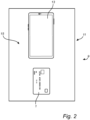
- Fig. 2 is a schematic illustration of a biometric system 9, including an enrollment assistance device 11 according to an example embodiment of the present invention, and the contactless smartcard 1 in Fig. 1A arranged on, such as fixed on, a predefined second surface portion of the enrollment assistance device 11.
- the biometric system 9 in Fig. 2 may be similar to the letter sent by an issuer of a smartcard to a user, but the enrollment assistance device 11 taking the place of an ordinary sheet of paper in such a letter can assist the user to effortlessly perform a biometric enrollment using the biometric arrangement 3 of the contactless smartcard 1.
- the contactless smartcard 1 may, for example, be fixed by a suitable adhesive, may be inserted in a sleeve comprised in the enrollment assistance device 11, or may be loosely arranged on the predefined second surface portion.
- a user device 12 is indicated as being placed on a predefined location on the enrollment assistance device 11, for wirelessly powering the contactless smartcard 11 during the above-mentioned biometric enrollment.
- Fig. 3 schematically shows the enrollment assistance device according to the first example embodiment of the invention, without the user device and the contactless smartcard.
- the enrollment assistance device 11 comprises a carrier 15 having a first surface portion 17 and a second surface portion 19 spaced apart from the first surface portion 17.
- the first surface portion 17 is for arrangement of a user device 13
- the second surface portion 19 is for arrangement of a contactless smartcard 1.
- the enrollment assistance device 11 further comprises a first electrical conductor 30 supported by the carrier 15 and forming a first conductor spiral 32 at the first surface portion 17 and a second conductor spiral 34 at the second surface portion 19.
- the enrollment assistance device 11 further comprises a second electrical conductor 36 supported by the carrier 15 and forming a third conductor spiral 38 at the first surface portion 17 and a fourth conductor spiral 40 at the second surface portion 19.
- a bifilar coil is an electromagnetic coil that contains two closely spaced, parallel windings, where the two windings are not in physical contact with each other.
- the bifilar coils are herein configured to act as antennas for communication and power transfer between the contactless smartcard 1 and the user device 13.
- the two windings are formed by respective portions the first and second electrical conductor 30, 36.
- the second and fourth conductor spirals 34, 40 of the respective first and second electrical conductor 30, 36 are interleaved to form a second bifilar coil 44 at the second surface portion 19.
- Each of the first and second electrical conductor 30, 36 are continuous so that there is no interruption of the respective conductor between the two bifilar coils 42, 44. Since the first surface portion 17 and second surface portion 19 are spaced apart from each other, each of the first and second electrical conductors 30, 36 contain a substantially straight connection portion reaching between the first surface portion 17 and second surface portion 19 to form an electrical connection between the first and second bifilar coils 42, 44. Moreover, there is no overlap between the first and second conductor 30, 36.
- the first bifilar coil 42 is configured to form a first wireless power transfer link with the wireless power transfer arrangement of the user device 13 when the user device 13 is arranged on the first surface portion 17 of the carrier 15, and the second bifilar coil 44 is configured to form a second wireless power transfer link with the wireless power transfer arrangement of the contactless smartcard 1 when the contactless smartcard 1 is arranged on the second surface portion 19 of the carrier.
- the physical design of the bifilar coils 42, 44 describing parameters such as wire widths, lengths, distances between the wires and size of coil pattern, are optimized to maximize the power transfer of the total system from the user device 13 to the smartcard 1 by considering the four coupled conductor spirals 32, 34, 38, 40 (i.e. antennas) in combination. This is done at a frequency specified by the NFC standard.
- Fig. 3 it is further illustrated that the innermost revolution of the first conductor spiral 32 is shorter than the innermost revolution of the third conductor spiral 38, meaning that the two conductor spirals 32, 38 do not fully overlap at the innermost revolution of the first bifilar coil 42.
- the amount of overlap between the respective conductor spirals can be used to tune the properties of the resonant circuit.
- first and second bifilar coils 42, 44 are schematically indicated in Fig. 3 as being generally rectangular, it should be noted that this need not be the case, and that the bifilar coils 42 ,44 may have a different outline, such as elliptical, etc.
- the carrier 15 may advantageously be cellulose-based, for minimum environmental impact, but could alternatively, or in combination, be made of a plastic material, which may be recycled and/or manufactured without the use of fossil material.
- the first and second electrical conductors 30, 36 do not cross each other, thereby making it possible to arrange the first and second electrical conductors 30, 36 in the same plane on a surface of the carrier.
- the entire circuit illustrated in Fig. 3 can thereby be formed in the same manufacturing step.
- the carrier may however comprise additional layers such as a dielectric or plastic layer for protecting the electrical conductors so that the electrical conductors become embedded in the carrier.
- the first and second electrical conductors 30, 36 may be printed using conductive ink or paste using per se known techniques. Alternatively, the first and second electrical conductors 30, 36 may be pre-formed on a sticker, which may be attached to the carrier 15. The first and second electrical conductors 30, 36 may be covered by a dielectric layer, such as a thin plastic layer to prevent damage to the conductors. Accordingly, the surface of the carrier on which the first and second electrical conductors 30, 36 is formed is not necessarily the outer surface of the enrollment assistance device 11.
- the user has a biometric system 9 such as that described above with reference to Fig. 2 and Fig. 3 .
- the biometric system 9, including the enrollment assistance device 11 and the contactless smartcard 1 arranged on the second surface portion 19 of the carrier 15 may have been sent to the user by mail from the issuer of the card, such as a financial institution or the like.
- the user is also in possession of a user device 13, such as a mobile phone or tablet, including a wireless power transfer arrangement arranged to provide an electric field for power transfer adjacent to a backside of the mobile user device, and a display arranged on a frontside of the user device 13.
- a user device 13 such as a mobile phone or tablet
- a wireless power transfer arrangement arranged to provide an electric field for power transfer adjacent to a backside of the mobile user device, and a display arranged on a frontside of the user device 13.
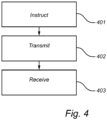
- a first step 401 the user is instructed to arrange the user device 13 on the first surface portion 17 of the carrier 15 of the enrollment assistance device 11 comprised in the biometric system 9, with the backside of the user device 13 facing the first surface portion 17.
- the instructing step may include providing guidance to the user.
- Such guidance may, for example, be included in the biometric system 9 that is provided to the user.
- written and/or graphical guidance may be printed on the carrier 15.
- such graphical guidance may include outlines of popular mobile phones, etc.
- the user may be guided by controlling the user device 13 to provide an alignment pattern on the display of the mobile user device 13.
- the alignment pattern on the display may be aligned with the at least one indicium on the carrier 15.
- the user device 13 transmits, to the contactless smartcard 1 a signal encoding an instruction to the contactless smartcard 1 to start to perform biometric enrollment.
- the signal is transmitted wirelessly to the contactless smartcard 1, and may be transmitted, using per se known techniques for near field communication (NFC), transmitted via the bifilar coils 42, 44 comprised in the enrollment assistance device 11.
- NFC near field communication
- this signal may be wirelessly transmitted using another wireless communication link, such as using low-power radio transmission.
- the user may be guided by instructions and/or illustrations provided on the display of the user device 13. Such instructions and/or illustrations may be based on information provided wirelessly from the contactless smartcard 1 to the mobile user device 13. For instance, the user may be instructed in respect of finger placement and/or receive information about the status of the enrollment procedure.
- the user device 13 receives, in step 403, a signal indicating that the enrollment has been completed.
- the signal indicating that the enrollment has been completed may be received via the first and second bifilar coils 42, 44 comprised in the enrollment assistance device 11.
- the ability to successfully finalize the enrollment and enable use of the biometric capabilities of the contactless smartcard 1 may be conditional on a user authentication performed using the user device 13. This may particularly be the case for a so-called initial enrollment, where no biometric template is stored on the smartcard.
- the user device 13 may locally carry out the user authentication, for example using a fingerprint sensor or other biometric arrangement comprised in the user device 13.
- the user device 13 may be used as an input device for input of a code, such as a password, PIN or OTP, for transmission to a remote server for authentication there.
- the signal encoding a (correct) instruction to the contactless smartcard 1 to start to perform the enrollment may only be sent if a successful user authentication has first been performed.
- the enrollment may be carried out, but the generated biometric template may be discarded, or the biometric capabilities of the smartcard 1 may be locked unless a successful user authentication is performed.
Landscapes
- Engineering & Computer Science (AREA)
- Physics & Mathematics (AREA)
- Computer Networks & Wireless Communication (AREA)
- Theoretical Computer Science (AREA)
- General Physics & Mathematics (AREA)
- Computer Hardware Design (AREA)
- Microelectronics & Electronic Packaging (AREA)
- Electromagnetism (AREA)
- Health & Medical Sciences (AREA)
- Toxicology (AREA)
- Signal Processing (AREA)
- Computer Security & Cryptography (AREA)
- Computer Vision & Pattern Recognition (AREA)
- Artificial Intelligence (AREA)
- General Health & Medical Sciences (AREA)
- Automation & Control Theory (AREA)
- Software Systems (AREA)
- General Engineering & Computer Science (AREA)
- Power Engineering (AREA)
- Credit Cards Or The Like (AREA)
Applications Claiming Priority (1)
| Application Number | Priority Date | Filing Date | Title |
|---|---|---|---|
| SE2350625A SE2350625A1 (en) | 2023-05-23 | 2023-05-23 | Enrollment assistance device with bifilar coils, biometric system and enrollment method |
Publications (1)
| Publication Number | Publication Date |
|---|---|
| EP4468614A1 true EP4468614A1 (de) | 2024-11-27 |
Family
ID=89984428
Family Applications (1)
| Application Number | Title | Priority Date | Filing Date |
|---|---|---|---|
| EP24176859.7A Pending EP4468614A1 (de) | 2023-05-23 | 2024-05-20 | Registrierungshilfsvorrichtung mit bifilaren spulen, biometrisches system und registrierungsverfahren |
Country Status (3)
| Country | Link |
|---|---|
| EP (1) | EP4468614A1 (de) |
| SE (1) | SE2350625A1 (de) |
| WO (1) | WO2024242610A1 (de) |
Citations (3)
| Publication number | Priority date | Publication date | Assignee | Title |
|---|---|---|---|---|
| US20200327533A1 (en) | 2019-04-15 | 2020-10-15 | Idemia France | Display on a smartphone screen of a positioning pattern of a contactless card to improve near field communication |
| US20210151888A1 (en) * | 2016-10-12 | 2021-05-20 | Norimitsu HIRATA | Booster antenna and portable terminal stand |
| EP4068570A1 (de) * | 2021-03-30 | 2022-10-05 | Fingerprint Cards Anacatum IP AB | Registrierungsunterstützungsvorrichtung, biometrisches system und registrierungsverfahren |
Family Cites Families (4)
| Publication number | Priority date | Publication date | Assignee | Title |
|---|---|---|---|---|
| DE112016002976T5 (de) * | 2015-06-30 | 2018-04-19 | Murata Manufacturing Co., Ltd. | Kopplungsunterstützungsgerät und RFID-Kommunikationssystem |
| FR3062539B1 (fr) * | 2017-01-31 | 2019-03-29 | Stmicroelectronics (Tours) Sas | Etui pour telephone portable |
| GB2609598A (en) * | 2021-06-24 | 2023-02-15 | Zwipe As | Structure and methods for mobile enrolment of biometrically-authorisable smartcards |
| EP4113361A1 (de) * | 2021-06-28 | 2023-01-04 | Thales DIS France SA | Verfahren zur verwaltung einer kontaktlosen karte |
-
2023
- 2023-05-23 SE SE2350625A patent/SE2350625A1/en not_active Application Discontinuation
-
2024
- 2024-05-20 WO PCT/SE2024/050485 patent/WO2024242610A1/en not_active Ceased
- 2024-05-20 EP EP24176859.7A patent/EP4468614A1/de active Pending
Patent Citations (3)
| Publication number | Priority date | Publication date | Assignee | Title |
|---|---|---|---|---|
| US20210151888A1 (en) * | 2016-10-12 | 2021-05-20 | Norimitsu HIRATA | Booster antenna and portable terminal stand |
| US20200327533A1 (en) | 2019-04-15 | 2020-10-15 | Idemia France | Display on a smartphone screen of a positioning pattern of a contactless card to improve near field communication |
| EP4068570A1 (de) * | 2021-03-30 | 2022-10-05 | Fingerprint Cards Anacatum IP AB | Registrierungsunterstützungsvorrichtung, biometrisches system und registrierungsverfahren |
Also Published As
| Publication number | Publication date |
|---|---|
| WO2024242610A1 (en) | 2024-11-28 |
| SE2350625A1 (en) | 2024-01-23 |
Similar Documents
| Publication | Publication Date | Title |
|---|---|---|
| US12452237B2 (en) | Biometric system comprising a contactless smartcard and an enrollment assistance device, and a method for enrolling a user having the system | |
| US10223555B2 (en) | Smart card systems comprising a card and a carrier | |
| US20130081127A1 (en) | Smart card and communication method thereof | |
| US20090100511A1 (en) | Method and apparatus for use in personalizing identification token | |
| CN114341876A (zh) | 生物识别智能卡的登记装置 | |
| AU2020439471B2 (en) | Multi-purpose smart card with user trusted bond | |
| KR20220089871A (ko) | 디지털 아이디 정보를 제공하는 전자 장치 및 그 방법 | |
| EP4307164B1 (de) | Registrierungshilfsvorrichtung | |
| US20190156098A1 (en) | Fingerprint authorisable device | |
| EP4468615A1 (de) | Registrierungshilfsvorrichtung mit induktiven spulen, biometrisches system und registrierungsverfahren | |
| US20250315637A1 (en) | Enrollment assistance device with conductor spiral, biometric system and enrollment method | |
| WO2024242610A1 (en) | Enrollment assistance device with bifilar coils, biometric system and enrollment method | |
| EP4296887B1 (de) | Registrierungshilfsvorrichtung mit kapazitiven koppelpads, biometrisches system und registrierungsverfahren | |
| JP2003016418A (ja) | 携帯端末及びその制御方法、並びに、icカード | |
| US12353946B2 (en) | Multipath authentication of security-relevant applications and devices | |
| KR101633968B1 (ko) | 바이오 정보 상호 처리 방법 | |
| WO2023121549A1 (en) | Communication arrangement and method of controlling communication in a smartcard comprising a fingerprint sensor module | |
| JP2024009611A (ja) | 無線認証デバイス | |
| HK40071648A (en) | Enrolment device for a biometric smart card | |
| KR20230029177A (ko) | 단말에 부착되는 nfc 스티커 | |
| TW201507432A (zh) | 具有非接觸式信用卡的手持通訊裝置 |
Legal Events
| Date | Code | Title | Description |
|---|---|---|---|
| PUAI | Public reference made under article 153(3) epc to a published international application that has entered the european phase |
Free format text: ORIGINAL CODE: 0009012 |
|
| STAA | Information on the status of an ep patent application or granted ep patent |
Free format text: STATUS: THE APPLICATION HAS BEEN PUBLISHED |
|
| AK | Designated contracting states |
Kind code of ref document: A1 Designated state(s): AL AT BE BG CH CY CZ DE DK EE ES FI FR GB GR HR HU IE IS IT LI LT LU LV MC ME MK MT NL NO PL PT RO RS SE SI SK SM TR |
|
| STAA | Information on the status of an ep patent application or granted ep patent |
Free format text: STATUS: REQUEST FOR EXAMINATION WAS MADE |
|
| 17P | Request for examination filed |
Effective date: 20250311 |