EP4294648B1 - Quick change two-piece railroad wheel assembly - Google Patents
Quick change two-piece railroad wheel assembly Download PDFInfo
- Publication number
- EP4294648B1 EP4294648B1 EP22708686.5A EP22708686A EP4294648B1 EP 4294648 B1 EP4294648 B1 EP 4294648B1 EP 22708686 A EP22708686 A EP 22708686A EP 4294648 B1 EP4294648 B1 EP 4294648B1
- Authority
- EP
- European Patent Office
- Prior art keywords
- tire
- wheel assembly
- railway vehicle
- holes
- assembly
- Prior art date
- Legal status (The legal status is an assumption and is not a legal conclusion. Google has not performed a legal analysis and makes no representation as to the accuracy of the status listed.)
- Active
Links
Images






Classifications
-
- B—PERFORMING OPERATIONS; TRANSPORTING
- B60—VEHICLES IN GENERAL
- B60B—VEHICLE WHEELS; CASTORS; AXLES FOR WHEELS OR CASTORS; INCREASING WHEEL ADHESION
- B60B17/00—Wheels characterised by rail-engaging elements
-
- B—PERFORMING OPERATIONS; TRANSPORTING
- B60—VEHICLES IN GENERAL
- B60B—VEHICLE WHEELS; CASTORS; AXLES FOR WHEELS OR CASTORS; INCREASING WHEEL ADHESION
- B60B17/00—Wheels characterised by rail-engaging elements
- B60B17/0006—Construction of wheel bodies, e.g. disc wheels
-
- B—PERFORMING OPERATIONS; TRANSPORTING
- B60—VEHICLES IN GENERAL
- B60B—VEHICLE WHEELS; CASTORS; AXLES FOR WHEELS OR CASTORS; INCREASING WHEEL ADHESION
- B60B27/00—Hubs
- B60B27/06—Hubs adapted to be fixed on axle
-
- B—PERFORMING OPERATIONS; TRANSPORTING
- B60—VEHICLES IN GENERAL
- B60B—VEHICLE WHEELS; CASTORS; AXLES FOR WHEELS OR CASTORS; INCREASING WHEEL ADHESION
- B60B2360/00—Materials; Physical forms thereof
- B60B2360/10—Metallic materials
- B60B2360/102—Steel
-
- B—PERFORMING OPERATIONS; TRANSPORTING
- B60—VEHICLES IN GENERAL
- B60B—VEHICLE WHEELS; CASTORS; AXLES FOR WHEELS OR CASTORS; INCREASING WHEEL ADHESION
- B60B2900/00—Purpose of invention
- B60B2900/50—Improvement of
- B60B2900/541—Servicing
-
- B—PERFORMING OPERATIONS; TRANSPORTING
- B60—VEHICLES IN GENERAL
- B60B—VEHICLE WHEELS; CASTORS; AXLES FOR WHEELS OR CASTORS; INCREASING WHEEL ADHESION
- B60B37/00—Wheel-axle combinations, e.g. wheel sets
- B60B37/04—Wheel-axle combinations, e.g. wheel sets the wheels being rigidly attached to solid axles
Definitions
- the present invention relates to the railway industry and, more particularly, to a two-piece rail wheel assembly or railroad wheel assembly respectively, for use on rail cars.
- Conventional rail wheels comprise a single component that is secured to an axle of a rail car utilizing an interference press fit at the wheel/axle interface.
- the process of securing the wheel to the axle requires a specialized press capable of forces over 100 tons (e.g., a specialized 400-ton press) to remove and attach the wheel.
- the operation requires highly-specialized knowledge by the press operators to assure proper and safe fit of the wheel to the axle.
- a typical interference may be 0.004-0.006 inches.
- This press fit design has a high risk of damage to both the wheel during installation and removal. Therefore, any method to replace a wheel while eliminating removal of press fit components would be of great benefit to the vehicle operator.
- KR20140086001A discloses a railway wheel, wherein a tire unit is fastened to a web plate integrated with a hub with bolts such that the tire unit is coupled to an outer side of the web plate. The web plate and the tire unit are coupled to each other by fastening the bolts horizontally.
- CN107719012A discloses an air railway vehicle running gear comprising a hub, a running wheel, an axle, and a vehicle body connecting plate.
- the rail wheel assembly comprises a center wheel hub and a tire configured to engage a rail.
- the center wheel hub is attached to an axle of a railway vehicle with an interference press fit and includes an outward facing stepped interface located at an outer edge of the center hub.
- the tire includes an inward facing stepped interface located at an inner edge of the tire.
- the outward facing stepped interface of the center hub is configured to receive the inward facing stepped interface of the tire.
- Each of the outward facing stepped interface on the center wheel hub and the inward facing stepped interface of the tire include a plurality of holes configured to receive bolts configured to secure the tire to the rail wheel assembly via the center wheel hub.
- the outward facing stepped interface of the center hub interfaces directly with the inward facing stepped interface of the tire (i.e., without any components between the outward facing stepped interface and the inward facing stepped interface).
- the invention described herein relates to a two-piece railroad wheel assembly that allows a tire to be replaced without requiring disassembly of the rail vehicle or removal of components directly attached to the axle. While this wheel assembly is designed specifically for rail wheels on rail cars, this wheel assembly design and the corresponding methods described herein may be utilized with any transit system or railway vehicle that utilizes press-fit wheel/axle assemblies.
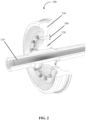
- FIGs. 1 and 2 depict a two-piece railroad wheel assembly 100 attached to an axle 110 of a rail car.
- FIG. 1 depicts a perspective view of two-piece railroad wheel assembly 100 attached to an axle 110 of a rail car
- FIG. 2 depicts a perspective sectional view of two-piece railroad wheel assembly 100.
- two-piece railroad wheel assembly 100 may comprise a center hub 120, a tire 130, and/or one or more other components.
- center hub 120 and tire 130 may be connected to form two-piece railroad wheel assembly 100, which when attached to an axle of a rail car, may comprise a single wheel of the rail car.
- center hub 120 and tire 130 may be bolted together via a stepped (or recessed) interface 140.
- the stepped or recessed interface 140 between center hub 120 and tire 130 may not allow shear stress in the lateral or load carrying direction on the bolts used to secure tire 130 to center hub 120.
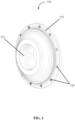
- FIG. 3 depicts a front perspective view of center hub 120, according to one or more aspects described herein.
- center hub 120 may comprise an interior interface 122 and a front axial interface 124.
- front axial interface 124 of center hub 120 may include a plurality of holes 126.
- front axial interface 124 may comprise a recessed or stepped interface facing outward from center hub 120 (i.e., away from the center of the rail car) and located at an outer edge of center hub 120.
- center hub 120 may be configured to be permanently or semi-permanently attached to an axle of a rail car with an interference press fit (as is consistent with common practice for standard wheel designs).
- FIG. 4 depicts a rear perspective view of tire 130, according to one or more aspects described herein.
- tire 130 may comprise a rail interface 132 and a rear axial interface 134.
- Rail interface 132 of tire 130 may be configured to engage a rail when tire is attached to a rail car via center hub 120.
- rear axial interface 134 of tire 130 may include a plurality of holes 136.
- rear axial interface 134 may comprise a recessed or stepped interface facing inward from tire 130 (i.e., toward the center of the rail car) and located at an inner edge of tire 130.
- an internal diameter of tire 130 is greater than an outer dimension of a bearing configured to attach a wheelset comprising two-piece railroad wheel assembly 100 to a truck assembly.
- an inner diameter of tire 130 is large enough for tire 130 to be slid off the axle without having to remove the bearing when used on a rail car having an out-board bearing configuration.
- tire 130 may comprise a steel tire configured to interface with a rail in a similar manner to a conventional rail wheel.
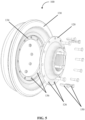
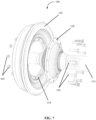
- FIGs. 5-7 depict exploded perspective views of two-piece railroad wheel assembly 100, which does not fall under the scope of the claimed invention.
- FIGs. 5 and 6 depict exploded perspective views of two-piece railroad wheel assembly 100 comprising center hub 120 and tire 130 bolted together via a stepped or recessed interface
- FIG. 7 depicts an exploded perspective view of two-piece railroad wheel assembly 100 comprising center hub 120 attached to axle 110 and tire 130 bolted to center hub 120 via a stepped or recessed interface, according to one or more aspects described herein.
- features of center hub 120 must be aligned to corresponding features of tire 130 in order to attach tire 130 to axle 110 via center hub 120.
- the combination of bolts 150 and nuts 160 may include a custom fastener specifically designed for use in two-piece railroad wheel assembly 100.
- a no mare fastener may be used to further secure tire 130 to center hub 120 without marking either the tire 130 or center hub 120.
- the two-piece railroad wheel assembly 100 includes one or more bolt retaining plates (also interchangeably referred to herein as "bolt retainers”) positioned on the rear (or interior) side of center hub 120 and configured to hold two or more of bolts 150 in place.
- FIGs. 8 and 9 depict two-piece railroad wheel assembly 100 comprising bolt retainers 170, according to one or more aspects described herein.
- FIG. 8 depicts a rear perspective view of two-piece railroad wheel assembly 100 comprising bolt retainers 170
- FIG. 9 depicts a rear perspective sectional view of two-piece railroad wheel assembly 100 comprising bolt retainers 170, according to one or more aspects described herein. As depicted in FIGs.
- FIG. 10 depicts a perspective view of an axle 110 of a rail car with a two-piece railroad wheel assembly 100 comprising a center hub 120 and a tire 130 attached to axle 110 on each side of the rail car, which does not fall under the scope of the claimed invention.
- axle 110 may comprise a rail car axle.
- two-piece railroad wheel assembly 100 is a replacement for one-piece solid steel wheels conventionally used on rail cars and other rail vehicles.
- two-piece railroad wheel assembly 100 may be compatible with all existing axle designs.
- Two-piece railroad wheel assembly 100 may also be utilized with any transit system that utilizes press-fit wheel/axle assemblies.
- removing a conventional rail wheel requires the use of a large, factory-based press machine that cannot be used to remove the wheel if the wheel set is attached to the truck.
- the wheelset must then be moved to a wheel press facility wherein the wheels, journal bearings, brake discs, and gearbox are removed from the axle.
- the components of conventional rail wheels are mounted to the axle with interference press fits. As such, disassembly places all the components of the wheelset at risk of damage.
- AAR Manual of Standards and Recommended Practices, Section G-II, Sub-Section 1.1.9 when a journal bearing is removed from an axle, the axle must be wet magnetic particle tested prior to remounting a bearing.
- AAR Manual of Standards and Recommended Practices, Section G-II, Sub-Section 1.8.1.2.4 further requires that any journal bearing that is removed from an axle for any reason be sent for reconditioning or replaced with a new bearing.
- the axles when removing a conventional rail wheel from an out-board bearing configuration (which is more common for freight cars and heavier passenger cars), the axles must also be requalified dimensionally and by magnetic particle inspection, and the bearings must be requalified or replaced.
- the brake disc may also need to be requalified or replaced, and the gearbox may need to be rebuilt. Only once these components have been requalified, replaced, and/or rebuilt can the wheelset be reassembled with new wheels.
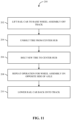
- FIG. 11 illustrates an example of a process 200 for changing tire 130 of two-piece railroad wheel assembly 100 when utilized in an in-board bearing configuration, according to one or more aspects described herein.
- process 200 may include lifting the rail car on which two-piece railroad wheel assembly 100 is affixed to raise tire 130 off the track.
- the rail car may be moved to a maintenance facility where the rail car is lifted.
- process 200 may include unbolting tire 130 from center hub 120 and removing tire 130 from axle 110.
- tire 130 can be removed from the axle 110 once unbolted from center hub 120 without having to remove the wheelset from the truck because the frame of the truck is inside two-piece railroad wheel assembly 100.
- process 200 may include sliding a new tire 130 onto axle 110 and bolting the new tire 130 to center hub 120.
- the hardware used to affix the old tire 130 to the center hub 120 e.g., the bolts 150, nuts 160, and/or bolt retainers 170
- process 200 may include repeating operation 204 and operation 206 for the two-piece railroad wheel assembly 100 on the opposite side of axle 110.
- detaching the wheelset from the truck assembly may require moving the truck assembly to a maintenance stand.
- process 300 may include unbolting tire 130 from center hub 120 and removing tire 130 from axle 110. Unlike in an in-board bearing configuration, tire 130 cannot be removed from the axle 110 in an out-board bearing configuration without first removing the wheelset from the truck because the frame of the truck is outside the two-piece railroad wheel assembly 100 and would block removal of tire 130.
- process 300 may include sliding a new tire 130 over the bearing and bolting the new tire 130 to center hub 120.
- process 300 may include repeating operation 306 and operation 308 for the two-piece railroad wheel assembly 100 on the opposite side of axle 110.
- process 300 may include reattaching the wheelset to the truck and replacing the truck assembly beneath the rail car.
- process 300 may include lowering the rail car back onto the track.
- replacing a tire 130 of a two-piece railroad wheel assembly 100 in an out-board bearing configuration does not require using a press machine or removing any other components of wheelset from axle 110 (including the bearings, brake discs, gearbox, grounding system, and/or any other components of the wheelset attached to axle 110).
- neither the axle nor any other components need to be tested or requalified, and no bearings need to be reconditioned or replaced when replacing tire 130 of two-piece railroad wheel assembly 100.
- two-piece railroad wheel assembly 100 represents an improvement over conventional rail wheels.
- Two-piece railroad wheel assembly 100 does not require special tools to remove or replace the wear surface on the wheel (i.e., tire 130). Indeed, the large hydraulic press machine required to change a conventional rail wheel is not needed to change tire 130.
- Two-piece railroad wheel assembly 100 also eliminates the need to remove certain components when removing and replacing tire 130, including any components directly attached to axle 110. As such, the risk of damage to axle 110 when replacing a wheel is reduced compared to common practices for replacing conventional interference press fit wheels. Indeed, when removing a conventional rail wheel, the axle itself is frequently gauged in the process, which often requires replacing the axle.
- two-piece railroad wheel assembly 100 represent a significant operating cost advantage compared to prior art wheel designs by reducing labor cost, as well as by reducing the time the rail car spends out of service when replacing worn or damaged wheels.
Landscapes
- Engineering & Computer Science (AREA)
- Mechanical Engineering (AREA)
- Rolling Contact Bearings (AREA)
- Vehicle Cleaning, Maintenance, Repair, Refitting, And Outriggers (AREA)
Description
- The present invention relates to the railway industry and, more particularly, to a two-piece rail wheel assembly or railroad wheel assembly respectively, for use on rail cars.
- Conventional rail wheels comprise a single component that is secured to an axle of a rail car utilizing an interference press fit at the wheel/axle interface. The process of securing the wheel to the axle requires a specialized press capable of forces over 100 tons (e.g., a specialized 400-ton press) to remove and attach the wheel. The operation requires highly-specialized knowledge by the press operators to assure proper and safe fit of the wheel to the axle. A typical interference may be 0.004-0.006 inches. This press fit design has a high risk of damage to both the wheel during installation and removal. Therefore, any method to replace a wheel while eliminating removal of press fit components would be of great benefit to the vehicle operator.
- In order to replace and/or repair a conventional rail wheel, the entire truck must be removed from the rail car and the axle/wheel assembly must be removed from the truck. Then it is possible to remove the wheel from the axle using press equipment. Indeed, as the current state of the art requires a large, factory-based press machine, it is not possible to change wheels in the field or on the rail. Instead, the current state of the art requires changing the wheels at the factory where the specialized press machine is available. As a result, the process to replace or repair a wheel of a rail car requires significant time out of service. Additionally, because conventional rail wheels comprise a single component, any damage to the wheel requires removing and potentially replacing the entire wheel in order to place the train back in service.
- A wheel design that does not require removing and disassembling the truck (and the frame that holds the axles) when changing a wheel and that allows less than the entirety of the rail wheel to be removed and replaced when a wheel is damaged would be a significant improvement.
KR20140086001A CN107719012A discloses an air railway vehicle running gear comprising a hub, a running wheel, an axle, and a vehicle body connecting plate. Axle holes in the form of horizontal blind holes are respectively symmetrically formed in the two sides of the vehicle body connecting plate. The hub and the running wheel are installed at one end of the axle, and the other end of the axle is installed in the axle hole in an interference fit manner and is located through a step surface on the axle. A further rail wheel assembly is disclosed inKR 101 440 143 B1 - According to a first aspect of the invention, there is provided a rail wheel assembly as defined in claim 1. According to a second aspect of the invention, there is provided a method for changing a tire of a railroad wheel assembly affixed to a railway vehicle, as defined in claim 9. Aspects of this invention relate to a rail wheel assembly that allows a tire to be replaced without requiring disassembly of the rail vehicle or removal of components directly attached to the axle. In various embodiments, the rail wheel assembly comprises a center wheel hub and a tire configured to engage a rail. The center wheel hub is attached to an axle of a railway vehicle with an interference press fit and includes an outward facing stepped interface located at an outer edge of the center hub. The tire includes an inward facing stepped interface located at an inner edge of the tire. The outward facing stepped interface of the center hub is configured to receive the inward facing stepped interface of the tire. Each of the outward facing stepped interface on the center wheel hub and the inward facing stepped interface of the tire include a plurality of holes configured to receive bolts configured to secure the tire to the rail wheel assembly via the center wheel hub. In various embodiments, the outward facing stepped interface of the center hub interfaces directly with the inward facing stepped interface of the tire (i.e., without any components between the outward facing stepped interface and the inward facing stepped interface).
- The two-piece rail wheel assembly described herein may serve a replacement for a one-piece solid steel wheel conventionally used on rail cars and other rail vehicles. Unlike conventional rail car wheels, however, the tire of the rail wheel assembly described herein may be removed and replaced without requiring removal of any of the components affixed directly to the axle. For example, in an in-board bearing configuration, a tire may be replaced on the rail wheel assembly described herein by simply lifting the rail car up, unbolting the tire from the center hub, sliding the tire off the axle, sliding a new tire on, bolting the new tire to the center hub, and lowering the rail car down onto the track. Unlike the process for removing conventional rail wheels, this process does not require using a press machine, detaching the truck assembly from the rail car, or detaching the wheelset (which includes at least the axle, gearbox, bearings, and wheels) from the truck. In order to replace a tire in an out-board bearing configuration using the rail wheel assembly described herein, the truck assembly will need to be detached from the rail car, and the wheelset removed from the truck assembly. However, unlike the process for removing conventional rail wheels in out-board bearing configurations, the rail wheel assembly described herein eliminates the need to use a press machine or remove any other components of the wheelset from axle, including the bearings, brake discs, gearbox, grounding system, and/or any other components of the wheelset. As such, the likelihood of these components being damaged or these components needing to be requalified or replaced is reduced.
- These and other objects, features, and characteristics of the invention disclosed herein will become more apparent upon consideration of the following description and the appended claims with reference to the accompanying drawings, all of which form a part of this specification, wherein like reference numerals designate corresponding parts in the various figures. It is to be expressly understood, however, that the drawings are for the purpose of illustration and description only and are not intended as a definition of the limits of the invention.
- The present invention is illustrated by way of example and not limited in the accompanying figures in which like reference numerals indicate similar elements and in which:
-
FIG. 1 depicts a perspective view of a two-piece railroad wheel assembly attached to an axle of a rail car and comprising a center hub and a tire bolted together via a stepped interface, which does not fall under the scope of the claimed invention; -
FIG. 2 depicts a perspective sectional view of the example two-piece railroad wheel assembly depicted inFIG. 1 ; -
FIG. 3 depicts a front perspective view of an example center wheel hub of a two-piece railroad wheel assembly, according to one or more aspects described herein; -
FIG. 4 depicts a rear perspective view of an example tire of a two-piece railroad wheel assembly, according to one or more aspects described herein; -
FIG. 5 depicts an exploded perspective view of a two-piece railroad wheel assembly comprising a center wheel hub and a tire bolted together via a stepped interface, which does not fall under the scope of the claimed invention; -
FIG. 6 depicts another exploded perspective view of the example two-piece railroad wheel assembly depicted inFIG. 5 ; -
FIG. 7 depicts an exploded perspective view of a two-piece railroad wheel assembly attached to an axle of a rail car and comprising a center wheel hub and a tire bolted together via a stepped interface; -
FIG. 8 depicts a rear perspective view of an example two-piece railroad wheel assembly comprising bolt retaining plates, according to the invention; -
FIG. 9 depicts a rear perspective sectional view of the example two-piece railroad wheel assembly comprising bolt retaining plates depicted inFIG. 8 , according to the invention; -
FIG. 10 depicts a perspective view of an axle of a rail car with a two-piece railroad wheel assembly attached on each side of a rail car, which does not fall under the scope of the claimed invention; -
FIG. 11 depicts a flow diagram of an example process for changing a tire of a two-piece railroad wheel assembly described herein when utilized in an in-board bearing configuration, according to one or more aspects described herein; -
FIG. 12 depicts a flow diagram of an example process for changing a tire of a two-piece railroad wheel assembly described herein when utilized in an out-board bearing configuration, according to one or more aspects described herein. - These drawings are provided for purposes of illustration only and merely depict typical or example embodiments. These drawings are provided to facilitate the reader's understanding and shall not be considered limiting of the breadth, scope, or applicability of the disclosure. For clarity and ease of illustration, these drawings are not necessarily drawn to scale.
- In the following description of various examples of the invention, reference is made to the accompanying drawings, which form a part hereof, and in which are shown by way of illustration various example structures, systems, and steps in which aspects of the invention may be practiced. It is to be understood that other specific arrangements of parts, structures, example devices, systems, and steps may be utilized, and structural and functional modifications may be made without departing from the scope of the present invention. Also, while the terms "top," "bottom," "front," "back," "side," and the like may be used in this specification to describe various example features and elements of the invention, these terms are used herein as a matter of convenience, e.g., based on the example orientations shown in the figures. Nothing in this specification should be construed as requiring a specific three-dimensional orientation of structures in order to fall within the scope of this invention.
- The invention described herein relates to a two-piece railroad wheel assembly that allows a tire to be replaced without requiring disassembly of the rail vehicle or removal of components directly attached to the axle. While this wheel assembly is designed specifically for rail wheels on rail cars, this wheel assembly design and the corresponding methods described herein may be utilized with any transit system or railway vehicle that utilizes press-fit wheel/axle assemblies.
-
FIGs. 1 and2 depict a two-piecerailroad wheel assembly 100 attached to anaxle 110 of a rail car. Specifically,FIG. 1 depicts a perspective view of two-piecerailroad wheel assembly 100 attached to anaxle 110 of a rail car, andFIG. 2 depicts a perspective sectional view of two-piecerailroad wheel assembly 100. In various embodiments, two-piecerailroad wheel assembly 100 may comprise acenter hub 120, atire 130, and/or one or more other components. In various embodiments,center hub 120 andtire 130 may be connected to form two-piecerailroad wheel assembly 100, which when attached to an axle of a rail car, may comprise a single wheel of the rail car. In various embodiments,center hub 120 andtire 130 may be bolted together via a stepped (or recessed)interface 140. In various embodiments, the stepped or recessedinterface 140 betweencenter hub 120 andtire 130 may not allow shear stress in the lateral or load carrying direction on the bolts used to securetire 130 tocenter hub 120. -
FIG. 3 depicts a front perspective view ofcenter hub 120, according to one or more aspects described herein. In various embodiments,center hub 120 may comprise aninterior interface 122 and a frontaxial interface 124. In various embodiments, frontaxial interface 124 ofcenter hub 120 may include a plurality ofholes 126. As depicted inFIG. 3 , frontaxial interface 124 may comprise a recessed or stepped interface facing outward from center hub 120 (i.e., away from the center of the rail car) and located at an outer edge ofcenter hub 120. In various embodiments,center hub 120 may be configured to be permanently or semi-permanently attached to an axle of a rail car with an interference press fit (as is consistent with common practice for standard wheel designs). For example,center hub 120 may be slid onto an axle of a rail car and press fit to the axle atinterior interface 122. In various embodiments,center hub 120 may be configured to remain with an axle of a rail car for the life of the axle or until components inboardcenter hub 120 require removal from the axle for overhaul or replacement. In some embodiments,center hub 120 may be reinstalled on the axle and reused if in acceptable condition after being removed. -
FIG. 4 depicts a rear perspective view oftire 130, according to one or more aspects described herein. In various embodiments,tire 130 may comprise arail interface 132 and a rearaxial interface 134.Rail interface 132 oftire 130 may be configured to engage a rail when tire is attached to a rail car viacenter hub 120. In various embodiments, rearaxial interface 134 oftire 130 may include a plurality ofholes 136. As depicted inFIG. 4 , rearaxial interface 134 may comprise a recessed or stepped interface facing inward from tire 130 (i.e., toward the center of the rail car) and located at an inner edge oftire 130. In various embodiments, an internal diameter oftire 130 is greater than an outer dimension of a bearing configured to attach a wheelset comprising two-piecerailroad wheel assembly 100 to a truck assembly. Thus, an inner diameter oftire 130 is large enough fortire 130 to be slid off the axle without having to remove the bearing when used on a rail car having an out-board bearing configuration. In various embodiments,tire 130 may comprise a steel tire configured to interface with a rail in a similar manner to a conventional rail wheel. -
FIGs. 5-7 depict exploded perspective views of two-piecerailroad wheel assembly 100, which does not fall under the scope of the claimed invention. Specifically,FIGs. 5 and6 depict exploded perspective views of two-piecerailroad wheel assembly 100 comprisingcenter hub 120 andtire 130 bolted together via a stepped or recessed interface, andFIG. 7 depicts an exploded perspective view of two-piecerailroad wheel assembly 100 comprisingcenter hub 120 attached toaxle 110 andtire 130 bolted to centerhub 120 via a stepped or recessed interface, according to one or more aspects described herein. In various embodiments, features ofcenter hub 120 must be aligned to corresponding features oftire 130 in order to attachtire 130 toaxle 110 viacenter hub 120. For example, frontaxial interface 124 ofcenter hub 120 may be configured to receive rearaxial interface 134 oftire 130. When pressed together, frontaxial interface 124 ofcenter hub 120 and rearaxial interface 134 oftire 130 define steppedinterface 140 as identified inFIG. 1 . In various embodiments, steppedinterface 140 may provide circumferential alignment betweencenter hub 120 andtire 130 and is capable of carrying vehicle forces in operation. - In various embodiments, front
axial interface 124 ofcenter hub 120 directly interfaces with rearaxial interface 134 oftire 130. In other words, frontaxial interface 124 ofcenter hub 120 is flush against rearaxial interface 134 oftire 130. Any components, material, or space between frontaxial interface 124 ofcenter hub 120 and rearaxial interface 134 oftire 130 would causetire 130 to move relative tocenter hub 120, which would reduce the load carrying capacity of two-piecerailroad wheel assembly 100 and the speed with which two-piecerailroad wheel assembly 100 would be able to travel. For example, any components betweencenter hub 120 andtire 130 would reduce the load carrying capacity and maximum speed of two-piecerailroad wheel assembly 100 such that it would be suitable for use with freight cars or heavier passenger cars. As such, in various embodiments,center hub 120 interfaces directly with tire 130 (i.e., without any components between frontaxial interface 124 and rear axial interface 134). - In some embodiments, stepped
interface 140 may include a taper on corresponding horizontal portions of frontaxial interface 124 and rearaxial interface 134 to ease mounting oftire 130 ontocenter hub 120. In some embodiments, corrosion prevention features may be utilized in stepped interface 140 (i.e., between frontaxial interface 124 and rear axial interface 134). For example, rust prevention features may be utilized in stepped interface 140 (i.e., between frontaxial interface 124 and rear axial interface 134). - In various embodiments, the plurality of
holes 126 on frontaxial interface 124 may align with the plurality ofholes 136 on rearaxial interface 134 to form a plurality of holes via which tire 130 may be bolted tocenter hub 120. For example,bolts 150 may be inserted into the plurality ofholes nuts 160 on the opposite side to affix or "lock"tire 130 toaxle 110 viacenter hub 120. In various embodiments,bolts 150 may comprise screws, pins, and/or any other mechanical fastener that is known and used in the art, andnuts 160 may comprise any corresponding component known and used in the art that is configured to receivebolts 150. In various embodiments, thenuts 160 may comprise self-contained locking nuts. In some embodiments, thenuts 160 may include multiple locking features for redundancy. For example, one or moreindividual nuts 160 may include slits in the side of the nuts 160 (one on each side) that force the nuts to bind on themselves when removed. The top part above the slit will not want to move where the part below the slit does. In some embodiments, thenuts 160 may include slits on each side of the nut that run the entire way through the nut. In some embodiments, thenuts 160 may be used in connection with a Belleville-style washer. A Belleville-style washer is a type of conical spring washer that spreads out as you tighten it and acts as a spring force to further lockbolts 150 in place using nuts 160. In some embodiments, the combination ofbolts 150 andnuts 160 may include a custom fastener specifically designed for use in two-piecerailroad wheel assembly 100. For example, in some embodiments, a no mare fastener may be used to furthersecure tire 130 tocenter hub 120 without marking either thetire 130 orcenter hub 120. - In various embodiments, a plurality of
bolts 150 may be utilized to securetire 130 tocenter hub 120 via the plurality ofholes bolts 150 may range from two bolts to ten or even more bolts. In various embodiments, the plurality ofholes axle 110. For example, twelvebolts 150 evenly spaced around the wheel may be utilized to securetire 130 tocenter hub 120 via the plurality ofholes - In various embodiments,
bolts 150 may be configured to provide only clamping force betweentire 130 andcenter hub 120 and not carry shear forces perpendicular to the bolt centerline. In some embodiments, one or more alignment/shear pins may be utilized in conjunction withbolts 150 andnuts 160 to securetire 130 tocenter hub 120. For example, in an example embodiment, one or more of the plurality ofbolts 150 may be replaced with alignment/shear pins. The alignment/shear pins may be utilized to carry loads betweencenter hub 120 andtire 130 to avoid shear forces on the bolts. - According to the invention, the two-piece
railroad wheel assembly 100 includes one or more bolt retaining plates (also interchangeably referred to herein as "bolt retainers") positioned on the rear (or interior) side ofcenter hub 120 and configured to hold two or more ofbolts 150 in place. For example,FIGs. 8 and9 depict two-piecerailroad wheel assembly 100 comprisingbolt retainers 170, according to one or more aspects described herein. Specifically,FIG. 8 depicts a rear perspective view of two-piecerailroad wheel assembly 100 comprisingbolt retainers 170, andFIG. 9 depicts a rear perspective sectional view of two-piecerailroad wheel assembly 100 comprisingbolt retainers 170, according to one or more aspects described herein. As depicted inFIGs. 8 and9 , boltretainers 170 may comprise a plate that includes two holes configured to receive two ormore bolts 150 prior tobolts 150 being inserted intoholes 126 ofcenter hub 120. In some embodiments, eachbolt 150 may be inserted into abolt retainer 170 with at least oneother bolt 150, as depicted inFIGs. 8 and9 .Bolt retainers 170 may be configured to temporarily holdbolts 150 in position for assembly of the two-piecerailroad wheel assembly 100. For example, boltretainers 170 may be configured to holdbolts 150 in position within the plurality ofholes 126 ofcenter hub 120 such thatbolts 150 are aligned for receipt by the plurality ofholes 136 oftire 130.Bolt retainers 170 may be configured to preventbolts 150 from rotating when attachingnuts 160 on the opposite side of two-piecerailroad wheel assembly 100. As such,bolt retainers 170 may eliminate the need for a wrench to screw anut 160 onto abolt 150, which can reduce the time and difficulty associated with changing atire 130 of two-piecerailroad wheel assembly 100 as the rear (or interior) side ofcenter hub 120 may be difficult to reach whencenter hub 120 is affixed to anaxle 110.Bolt retainers 170 may also be configured to lock bolts in places once tightened. In other words, boltretainers 170 may be configured to preventbolts 150 from coming loose during travel. In some embodiments, boltretainers 170 may further eliminate the need to include features in wheel that would provide crack propagation point, asbolt retainers 170 preventbolts 150 from contacting a side ofcenter hub 120. -
FIG. 10 depicts a perspective view of anaxle 110 of a rail car with a two-piecerailroad wheel assembly 100 comprising acenter hub 120 and atire 130 attached toaxle 110 on each side of the rail car, which does not fall under the scope of the claimed invention. As described herein,axle 110 may comprise a rail car axle. In various embodiments, two-piecerailroad wheel assembly 100 is a replacement for one-piece solid steel wheels conventionally used on rail cars and other rail vehicles. However, two-piecerailroad wheel assembly 100 may be compatible with all existing axle designs. Two-piecerailroad wheel assembly 100 may also be utilized with any transit system that utilizes press-fit wheel/axle assemblies. - Utilizing a two-piece
railroad wheel assembly 100 comprising acenter hub 120 and atire 130 may provide many benefits over prior art designs. For example, two-piecerailroad wheel assembly 100 may allow replacement oftire 130 without the need for major disassembly of the rail vehicle. For example, in order to replace and/or repair a conventional rail wheel, the entire rail vehicle must first be moved to a maintenance facility and then lifted with a crane in order to detach the truck assembly. The truck assembly must then be moved to a maintenance stand where the wheelset (which includes the axle, gearbox, bearings, and wheels) is detached from the truck. As described herein, removing a conventional rail wheel requires the use of a large, factory-based press machine that cannot be used to remove the wheel if the wheel set is attached to the truck. The wheelset must then be moved to a wheel press facility wherein the wheels, journal bearings, brake discs, and gearbox are removed from the axle. As described herein, the components of conventional rail wheels are mounted to the axle with interference press fits. As such, disassembly places all the components of the wheelset at risk of damage. - Once disassembled, various components must be requalified or replaced per Association of American Railroads (AAR) requirements depending on whether the rail car has a in-board or out-board bearing configuration. Trucks are attached to axles at journal bearings. In an in-board bearing configuration, the journal bearings are located inside the wheels. In an out-board bearing configuration, the journal bearings are located outside the wheels. Because removing conventional rail wheels requires use of a press machine, and press machines require the wheelset be removed from the truck, the wheelset must be removed from the truck to replace a conventional rail wheel regardless of whether it is in an in-board or out-board bearing configuration. In an out-board bearing configuration (in which the bearing is located outside the wheels), the bearings must also be removed because conventional rail wheels cannot be slid over the bearing. According to AAR Manual of Standards and Recommended Practices, Section G-II, Sub-Section 1.1.9, when a journal bearing is removed from an axle, the axle must be wet magnetic particle tested prior to remounting a bearing. AAR Manual of Standards and Recommended Practices, Section G-II, Sub-Section 1.8.1.2.4 further requires that any journal bearing that is removed from an axle for any reason be sent for reconditioning or replaced with a new bearing. As such, when removing a conventional rail wheel from an out-board bearing configuration (which is more common for freight cars and heavier passenger cars), the axles must also be requalified dimensionally and by magnetic particle inspection, and the bearings must be requalified or replaced. In some instances, the brake disc may also need to be requalified or replaced, and the gearbox may need to be rebuilt. Only once these components have been requalified, replaced, and/or rebuilt can the wheelset be reassembled with new wheels.
- In order to reassemble the wheelset with new wheels, the wheels, journal bearings, brake discs, and gearbox must all be press fit on the axle. Similar to disassembly, reassembly of these interference fit components places each component at risk of damage. The reassembled wheelset must then be moved to a truck maintenance stand where the truck is rebuilt before being replaced under the vehicle. Before being replaced under the vehicle, however, the same extensive process performed for one wheelset must also be performed on its mate. Per AAR Manual of Standards and Recommended Practices, Section G-II, Sub-Section 1.4.7.3, any time a single wheel is dismounted from an axle, it's mate must also be dismounted regardless of condition.
- The process required to replace and/or repair a conventional rail wheel is both labor, cost, and time-intensive. Indeed, in addition to requiring a large, factory-based press machine and posing increased risk of damage to the wheelset and its components, the process to replace or repair a wheel of a rail car also requires significant time out of service. Unlike the labor, cost, and time-intensive process required to replace a conventional rail wheel, replacing
tire 130 of two-piecerailroad wheel assembly 100 does not require even removing or disassembling the truck assembly when two-piecerailroad wheel assembly 100 is utilized in an in-board bearing configuration. -
FIG. 11 illustrates an example of aprocess 200 for changingtire 130 of two-piecerailroad wheel assembly 100 when utilized in an in-board bearing configuration, according to one or more aspects described herein. In anoperation 202,process 200 may include lifting the rail car on which two-piecerailroad wheel assembly 100 is affixed to raisetire 130 off the track. In various embodiments, the rail car may be moved to a maintenance facility where the rail car is lifted. In anoperation 204,process 200 may include unboltingtire 130 fromcenter hub 120 and removingtire 130 fromaxle 110. In an in-board bearing configuration,tire 130 can be removed from theaxle 110 once unbolted fromcenter hub 120 without having to remove the wheelset from the truck because the frame of the truck is inside two-piecerailroad wheel assembly 100. In anoperation 206,process 200 may include sliding anew tire 130 ontoaxle 110 and bolting thenew tire 130 tocenter hub 120. In various embodiments, the hardware used to affix theold tire 130 to the center hub 120 (e.g., thebolts 150,nuts 160, and/or bolt retainers 170) may disposed of and new hardware may be used to affix thenew tire 130 tocenter hub 120. In anoperation 208,process 200 may include repeatingoperation 204 andoperation 206 for the two-piecerailroad wheel assembly 100 on the opposite side ofaxle 110. In various embodiments, each time atire 130 is replaced, thetire 130 of the two-piecerailroad wheel assembly 100 on the opposite side of the wheelset (or axle 110) must also be replaced to ensure the wheel diameter is similar on opposite sides of the rail car. In anoperation 210,process 200 may include lowering the rail car back onto the track. Thus, unlike the process required to replace a conventional rail wheel in an in-board bearing configuration, replacing atire 130 of a two-piecerailroad wheel assembly 100 in an in-board bearing configuration does not require using a press machine, detaching the truck assembly from the rail car, or detaching the wheelset from the truck. - When used in an out-board bearing configuration, the process to replace
tire 130 of two-piecerailroad wheel assembly 100 also represents an improvement over the process to replace a conventional rail wheel in the same configuration.FIG. 12 illustrates an example of aprocess 300 for changingtire 130 of two-piecerailroad wheel assembly 100 when utilized in an out-board bearing configuration, according to one or more aspects described herein. In anoperation 302,process 300 may include lifting the rail car high enough to detach the truck assembly from the rail car. In various embodiments, lifting the rail car high enough to detach the truck assembly may require moving the rail car to a maintenance facility and/or lifting the rail car using a crane or similar machine. In anoperation 304,process 300 may include removing the truck assembly from beneath the rail car and detaching the wheelset from the truck assembly. In some embodiments, detaching the wheelset from the truck assembly may require moving the truck assembly to a maintenance stand. In anoperation 306,process 300 may include unboltingtire 130 fromcenter hub 120 and removingtire 130 fromaxle 110. Unlike in an in-board bearing configuration,tire 130 cannot be removed from theaxle 110 in an out-board bearing configuration without first removing the wheelset from the truck because the frame of the truck is outside the two-piecerailroad wheel assembly 100 and would block removal oftire 130. In anoperation 308,process 300 may include sliding anew tire 130 over the bearing and bolting thenew tire 130 tocenter hub 120. In various embodiments, the hardware used to affix theold tire 130 to the center hub 120 (e.g., thebolts 150,nuts 160, and/or bolt retainers 170) may disposed of and new hardware may be used to affix thenew tire 130 tocenter hub 120. In anoperation 310,process 300 may include repeatingoperation 306 andoperation 308 for the two-piecerailroad wheel assembly 100 on the opposite side ofaxle 110. In various embodiments, each time atire 130 is replaced, thetire 130 of the two-piecerailroad wheel assembly 100 on the opposite side of the wheelset (or axle 110) must also be replaced to ensure the wheel diameter is similar on opposite sides of the rail car. In anoperation 312,process 300 may include reattaching the wheelset to the truck and replacing the truck assembly beneath the rail car. In anoperation 314,process 300 may include lowering the rail car back onto the track. Thus, unlike the process required to replace a conventional rail wheel in an out-board bearing configuration, replacing atire 130 of a two-piecerailroad wheel assembly 100 in an out-board bearing configuration does not require using a press machine or removing any other components of wheelset from axle 110 (including the bearings, brake discs, gearbox, grounding system, and/or any other components of the wheelset attached to axle 110). As such, neither the axle nor any other components need to be tested or requalified, and no bearings need to be reconditioned or replaced when replacingtire 130 of two-piecerailroad wheel assembly 100. - Accordingly, in both in-board and out-board bearing configurations, two-piece
railroad wheel assembly 100 represents an improvement over conventional rail wheels. Two-piecerailroad wheel assembly 100 does not require special tools to remove or replace the wear surface on the wheel (i.e., tire 130). Indeed, the large hydraulic press machine required to change a conventional rail wheel is not needed to changetire 130. Two-piecerailroad wheel assembly 100 also eliminates the need to remove certain components when removing and replacingtire 130, including any components directly attached toaxle 110. As such, the risk of damage toaxle 110 when replacing a wheel is reduced compared to common practices for replacing conventional interference press fit wheels. Indeed, when removing a conventional rail wheel, the axle itself is frequently gauged in the process, which often requires replacing the axle. By reducing the risk of damage toaxle 110 and other components affixed toaxle 110, the two-piece railroad wheel assembly described herein reduces the number of scraped axles and other components, resulting in less steel consumed each time the wear surface of the wheel is renewed, which is good for the environment as it uses less energy to manufacture and machine. Also, as described above, if any components of a truck are removed from an axle (e.g., pressed on wheel, bearing, brake, or gearbox), the axle and bearings must be fully requalified per Association of American Railroads (AAR) requirements. For example, as provided above, AAR Manual of Standards and Recommended Practices, Section G-II, Sub-Section 1.8.1.2.4 currently states that if a journal bearing is removed from an axle for any reason, it must be sent for reconditioning or replaced with a new bearing. However, bearings have a performance life upwards of 5 times the life of a wheel. Thus, by allowing a wheel to be changed without having to recondition or replace bearings or other components, two-piecerailroad wheel assembly 100 represent a significant operating cost advantage compared to prior art wheel designs by reducing labor cost, as well as by reducing the time the rail car spends out of service when replacing worn or damaged wheels. - It is to be understood that the invention is not limited in its application to the details of construction and the arrangement of the components set forth herein. The invention is capable of other embodiments and of being practiced or being carried out in various ways. The scope of the invention is defined by the appended claims.
Claims (14)
- A rail wheel assembly (100) for a railway vehicle comprising:a center wheel hub (120) attached to an axle (110) of a railway vehicle with an interference press fit, wherein the center wheel hub (120) includes an outward facing stepped interface (124) located at an outer edge of the center hub (120), the outward facing stepped interface (124) comprising a first set of holes (126); anda tire (130) configured to engage a rail, wherein the tire (130) includes an inward facing stepped interface (134) located at an inner edge of the tire (130), the inward facing stepped interface (134) comprising a second set of holes (136);wherein the outward facing stepped interface (124) of the center wheel hub (120) is configured to receive the inward facing stepped interface (134) of the tire (130),wherein when the first set of holes (126) is aligned with the second set of holes (136), the first set of holes (126) and the second set of holes (136) are together configured to receive bolts (150) configured to secure the tire (130) to the center wheel hub (120), characterised in that,the bolts (150) are configured to be inserted into the first set of holes (126) via an interior side of the outward facing stepped interface (124), wherein each bolt (150) is configured to be inserted into one of a set of bolt retaining plates (170) before being inserted into one of the first set of holes (126), wherein each bolt retaining plate (170) includes at least two holes configured to receive adjacent bolts (150), andwherein the tire (130) is configured to be removed and replaced once secured to the center wheel hub (120) without requiring removal of any components affixed directly to the axle (110).
- The rail wheel assembly of claim 1, wherein the outward facing stepped interface (124) of the center hub (120) interfaces directly with the inward facing stepped interface (134) of the tire (130) without any components between the outward facing stepped interface (124) and the inward facing stepped interface (134).
- The rail wheel assembly of claim 1, wherein the tire (130) comprises a steel tire.
- The rail wheel assembly of claim 1, wherein the bolts (150) inserted into the first set of holes (126) and the second set of holes (136) secure the tire (130) to the center wheel hub (120) using self-contained locking nuts (160).
- The rail wheel assembly of claim 1, wherein each bolt retaining plate (170) is configured to hold two or more bolts (150) in position within the first set of holes (126) and prevent bolts from coming loose during travel.
- The rail wheel assembly of claim 1, wherein an internal diameter of the tire (130) is greater than an outer dimension of a bearing configured to attach a wheelset comprising the rail wheel assembly (100) to a truck assembly.
- The rail wheel assembly of claim 1, wherein the tire (130) is configured to be removed from the rail wheel assembly (100) and replaced without requiring use of a press machine.
- The rail wheel assembly of claim 1, wherein the railway vehicle has an in-board bearing configuration, and wherein the tire (130) is configured to be removed from the rail wheel assembly (100) and replaced without requiring detachment of a truck assembly from the railway vehicle or detachment of a wheelset that includes the rail wheel assembly from a truck assembly.
- A method for changing a tire (130) of a railroad wheel assembly (100) according to one of the preceding claims affixed to a railway vehicle, wherein the railroad wheel assembly comprises a center wheel hub (120) affixed to an axle (110) of the railway vehicle and a tire (130) secured to the railway vehicle via the center wheel hub (120), the method comprising:lifting a railway vehicle on which the railroad wheel assembly is affixed;unbolting the tire (130) from the center wheel hub (120);removing the tire (130) from the railway vehicle without using a press machine or having to remove any components affixed directly to the axle (110);sliding a new tire (130) onto the axle (110), wherein the new tire (130) is secured to the railway vehicle via the center wheel hub (120) using bolts (150) inserted into both a first set of holes (126) of the center wheel hub (120) and a second set of holes (136) of the tire (130) via an interior side of the center wheel hub (120), wherein each bolt (150) is inserted into one of a set of bolt retaining plates (170) before being inserted into one of the first set of holes (126), wherein each bolt retaining plate (170) includes at least two holes configured to receive adjacent bolts (150); andlowering the railway vehicle back onto the track.
- The method of claim 9, wherein the railway vehicle has an in-board bearing configuration, and wherein the tire (130) is removed from the railway vehicle without having to detach a truck assembly from the railway vehicle or having to remove a wheelset comprising the railroad wheel assembly (100) from a truck assembly of the railway vehicle.
- The method of claim 9, wherein the railway vehicle has an out-board bearing configuration, and wherein sliding the new tire onto the axle (110) comprises sliding the new tire over a bearing used to affix a wheelset comprising the railroad wheel assembly (100) to a truck assembly of the railway vehicle.
- The method of claim 11, wherein an internal diameter of the tire (130) is greater than an outer dimension of the bearing.
- The method of claim 11, the method further comprising:removing a truck assembly from beneath the railway vehicle;detaching a wheelset comprising the railroad wheel assembly (100) from a truck assembly of the railway vehicle;reattaching the wheelset comprising the railroad wheel assembly having the new tire to the truck assembly; andreplacing the truck assembly beneath the railway vehicle.
- The method of claim 9, wherein the changing the tire (130) does not require any other components to be requalified or replaced.
Applications Claiming Priority (2)
| Application Number | Priority Date | Filing Date | Title |
|---|---|---|---|
| US202163152041P | 2021-02-22 | 2021-02-22 | |
| PCT/US2022/017008 WO2022178268A1 (en) | 2021-02-22 | 2022-02-18 | Quick change two-piece railroad wheel assembly |
Publications (2)
| Publication Number | Publication Date |
|---|---|
| EP4294648A1 EP4294648A1 (en) | 2023-12-27 |
| EP4294648B1 true EP4294648B1 (en) | 2025-07-09 |
Family
ID=80683061
Family Applications (1)
| Application Number | Title | Priority Date | Filing Date |
|---|---|---|---|
| EP22708686.5A Active EP4294648B1 (en) | 2021-02-22 | 2022-02-18 | Quick change two-piece railroad wheel assembly |
Country Status (5)
| Country | Link |
|---|---|
| US (1) | US20220266626A1 (en) |
| EP (1) | EP4294648B1 (en) |
| CN (1) | CN117177867A (en) |
| CA (1) | CA3208823A1 (en) |
| WO (1) | WO2022178268A1 (en) |
Families Citing this family (1)
| Publication number | Priority date | Publication date | Assignee | Title |
|---|---|---|---|---|
| CN119388125B (en) * | 2024-10-31 | 2025-10-10 | 中车大连机车车辆有限公司 | Method for disassembling wheelset device of low-floor vehicle |
Citations (5)
| Publication number | Priority date | Publication date | Assignee | Title |
|---|---|---|---|---|
| DE4415422A1 (en) * | 1994-05-02 | 1995-11-09 | Klaue Hermann | Light alloy wheel with hollow spokes for large motor vehicles |
| DE4421470A1 (en) * | 1994-05-02 | 1996-02-15 | Klaue Hermann | Light alloy cast vehicle wheel equipped with hollow spokes |
| DE10024765A1 (en) * | 2000-05-19 | 2001-11-22 | Volkswagen Ag | Alloy disc wheel for vehicles has electric heating system such as resistance wire integrated direct to melt ice and snow when switched on |
| KR100539144B1 (en) * | 2004-06-23 | 2005-12-26 | 한국타이어 주식회사 | Inner air cooling method of heavy vehicle tire and a heavy vehicle wheel having inner air cooling apparatus |
| KR101815670B1 (en) * | 2016-09-05 | 2018-01-30 | 넥센타이어 주식회사 | Wheel system |
Family Cites Families (10)
| Publication number | Priority date | Publication date | Assignee | Title |
|---|---|---|---|---|
| US1007707A (en) * | 1911-01-26 | 1911-11-07 | Emmet P King | Car-wheel. |
| US1479373A (en) * | 1923-05-02 | 1924-01-01 | Thomas M Cook | Car wheel |
| US2027303A (en) * | 1933-09-09 | 1936-01-07 | Austro Daimler Puchwerke Ag | Running gear |
| GB687657A (en) * | 1949-03-12 | 1953-02-18 | Hadfields Ltd | Improvements in or relating to travelling-crane wheels or wheels for similar purposes |
| GB966566A (en) * | 1960-05-08 | 1964-08-12 | Thomas Watt | Improved rail wheel |
| FR2750650B1 (en) * | 1996-07-03 | 1998-11-06 | Valdunes | METHOD FOR SOUNDPROOFING A RAILWAY WHEEL AND SOUNDPROOFED RAILWAY WHEEL |
| US20080095481A1 (en) * | 2006-02-22 | 2008-04-24 | John Kummings | Differential wheel mounting for a railroad car |
| KR101440143B1 (en) * | 2012-12-28 | 2014-09-15 | 한국철도기술연구원 | A railway wheel formed of two different material parts |
| CN107719012A (en) * | 2017-10-31 | 2018-02-23 | 中车资阳机车有限公司 | A kind of overhead rail vehicle running gear |
| CN107984962A (en) * | 2017-12-26 | 2018-05-04 | 北京北摩高科摩擦材料股份有限公司 | A kind of split type train wheel |
-
2022
- 2022-02-18 CN CN202280029564.0A patent/CN117177867A/en active Pending
- 2022-02-18 CA CA3208823A patent/CA3208823A1/en active Pending
- 2022-02-18 EP EP22708686.5A patent/EP4294648B1/en active Active
- 2022-02-18 WO PCT/US2022/017008 patent/WO2022178268A1/en not_active Ceased
- 2022-02-18 US US17/675,615 patent/US20220266626A1/en not_active Abandoned
Patent Citations (5)
| Publication number | Priority date | Publication date | Assignee | Title |
|---|---|---|---|---|
| DE4415422A1 (en) * | 1994-05-02 | 1995-11-09 | Klaue Hermann | Light alloy wheel with hollow spokes for large motor vehicles |
| DE4421470A1 (en) * | 1994-05-02 | 1996-02-15 | Klaue Hermann | Light alloy cast vehicle wheel equipped with hollow spokes |
| DE10024765A1 (en) * | 2000-05-19 | 2001-11-22 | Volkswagen Ag | Alloy disc wheel for vehicles has electric heating system such as resistance wire integrated direct to melt ice and snow when switched on |
| KR100539144B1 (en) * | 2004-06-23 | 2005-12-26 | 한국타이어 주식회사 | Inner air cooling method of heavy vehicle tire and a heavy vehicle wheel having inner air cooling apparatus |
| KR101815670B1 (en) * | 2016-09-05 | 2018-01-30 | 넥센타이어 주식회사 | Wheel system |
Also Published As
| Publication number | Publication date |
|---|---|
| US20220266626A1 (en) | 2022-08-25 |
| CA3208823A1 (en) | 2022-08-25 |
| WO2022178268A1 (en) | 2022-08-25 |
| CN117177867A (en) | 2023-12-05 |
| EP4294648A1 (en) | 2023-12-27 |
Similar Documents
| Publication | Publication Date | Title |
|---|---|---|
| US11260692B2 (en) | Portal-axle of low floor rail vehicles and rail-and-tram vehicles | |
| EP4294648B1 (en) | Quick change two-piece railroad wheel assembly | |
| US9670962B2 (en) | Axlebox comprising split housing parts, vehicle comprising at least one such axlebox and processes | |
| US3926285A (en) | Mounting device for a brake disk | |
| US12172465B2 (en) | Wheel hub and removable bolt ring assembly for air disk braking system | |
| CN116811926B (en) | Motor mounting structure, bogie and motor dismounting method | |
| US20180312001A1 (en) | Mechanically Fastened Wheel Assembly | |
| EP2876020B1 (en) | Backing device, axlebox, vehicle and methods for mounting and dismounting such a backing device | |
| US6604794B1 (en) | Uni-pilot hub/drum system | |
| EP3560729A1 (en) | Mechanically fastened wheel assembly | |
| CN111703456B (en) | Wheel pair assembly and track-distance-variable bogie | |
| US20020041122A1 (en) | Truck and trailer hub | |
| CN111457036B (en) | Split wheel-mounted brake disc for railway vehicle | |
| CN111703457A (en) | Variable gauge bogie | |
| EP4549281A1 (en) | Rear cover assembly for an axle box of a railcar bogie, wheelset, bogie, and railway vehicle comprising such rear cover assembly | |
| CN115122822A (en) | Wheel end assembly and method of servicing | |
| CN113895180A (en) | Rail power wheel with replaceable tread | |
| DE102004012667A1 (en) | Wheel, for a railway wagon wheel assembly, is mounted to the shaft and stub axle by support journals with matching outer and inner fits pressed together for bonding in a force fit and/or a positive fit | |
| Bracciali et al. | Maintainability of wheelsets: a novel solution to save time and money | |
| SU1191312A1 (en) | Car wheel pair axle | |
| CN212828386U (en) | Variable gauge bogie | |
| US4771529A (en) | Apparatus for tramming railway trucks | |
| CN101475017A (en) | Couple yoke of lorry coupler buffering apparatus | |
| EP3065995B1 (en) | Wheelset for a rail vehicle | |
| US20210086555A1 (en) | Air disk brake for commercial vehicle |
Legal Events
| Date | Code | Title | Description |
|---|---|---|---|
| STAA | Information on the status of an ep patent application or granted ep patent |
Free format text: STATUS: UNKNOWN |
|
| STAA | Information on the status of an ep patent application or granted ep patent |
Free format text: STATUS: THE INTERNATIONAL PUBLICATION HAS BEEN MADE |
|
| PUAI | Public reference made under article 153(3) epc to a published international application that has entered the european phase |
Free format text: ORIGINAL CODE: 0009012 |
|
| STAA | Information on the status of an ep patent application or granted ep patent |
Free format text: STATUS: REQUEST FOR EXAMINATION WAS MADE |
|
| 17P | Request for examination filed |
Effective date: 20230911 |
|
| AK | Designated contracting states |
Kind code of ref document: A1 Designated state(s): AL AT BE BG CH CY CZ DE DK EE ES FI FR GB GR HR HU IE IS IT LI LT LU LV MC MK MT NL NO PL PT RO RS SE SI SK SM TR |
|
| DAV | Request for validation of the european patent (deleted) | ||
| DAX | Request for extension of the european patent (deleted) | ||
| P01 | Opt-out of the competence of the unified patent court (upc) registered |
Effective date: 20240501 |
|
| GRAP | Despatch of communication of intention to grant a patent |
Free format text: ORIGINAL CODE: EPIDOSNIGR1 |
|
| STAA | Information on the status of an ep patent application or granted ep patent |
Free format text: STATUS: GRANT OF PATENT IS INTENDED |
|
| INTG | Intention to grant announced |
Effective date: 20250131 |
|
| GRAS | Grant fee paid |
Free format text: ORIGINAL CODE: EPIDOSNIGR3 |
|
| GRAA | (expected) grant |
Free format text: ORIGINAL CODE: 0009210 |
|
| STAA | Information on the status of an ep patent application or granted ep patent |
Free format text: STATUS: THE PATENT HAS BEEN GRANTED |
|
| AK | Designated contracting states |
Kind code of ref document: B1 Designated state(s): AL AT BE BG CH CY CZ DE DK EE ES FI FR GB GR HR HU IE IS IT LI LT LU LV MC MK MT NL NO PL PT RO RS SE SI SK SM TR |
|
| REG | Reference to a national code |
Ref country code: GB Ref legal event code: FG4D |
|
| REG | Reference to a national code |
Ref country code: CH Ref legal event code: EP |
|
| REG | Reference to a national code |
Ref country code: IE Ref legal event code: FG4D |
|
| REG | Reference to a national code |
Ref country code: DE Ref legal event code: R096 Ref document number: 602022017296 Country of ref document: DE |
|
| REG | Reference to a national code |
Ref country code: NL Ref legal event code: MP Effective date: 20250709 |
|
| PG25 | Lapsed in a contracting state [announced via postgrant information from national office to epo] |
Ref country code: PT Free format text: LAPSE BECAUSE OF FAILURE TO SUBMIT A TRANSLATION OF THE DESCRIPTION OR TO PAY THE FEE WITHIN THE PRESCRIBED TIME-LIMIT Effective date: 20251110 |
|
| PG25 | Lapsed in a contracting state [announced via postgrant information from national office to epo] |
Ref country code: NL Free format text: LAPSE BECAUSE OF FAILURE TO SUBMIT A TRANSLATION OF THE DESCRIPTION OR TO PAY THE FEE WITHIN THE PRESCRIBED TIME-LIMIT Effective date: 20250709 |
|
| REG | Reference to a national code |
Ref country code: AT Ref legal event code: MK05 Ref document number: 1811535 Country of ref document: AT Kind code of ref document: T Effective date: 20250709 |
|
| PG25 | Lapsed in a contracting state [announced via postgrant information from national office to epo] |
Ref country code: IS Free format text: LAPSE BECAUSE OF FAILURE TO SUBMIT A TRANSLATION OF THE DESCRIPTION OR TO PAY THE FEE WITHIN THE PRESCRIBED TIME-LIMIT Effective date: 20251109 |
|
| PG25 | Lapsed in a contracting state [announced via postgrant information from national office to epo] |
Ref country code: NO Free format text: LAPSE BECAUSE OF FAILURE TO SUBMIT A TRANSLATION OF THE DESCRIPTION OR TO PAY THE FEE WITHIN THE PRESCRIBED TIME-LIMIT Effective date: 20251009 |
|
| REG | Reference to a national code |
Ref country code: LT Ref legal event code: MG9D |
|
| PG25 | Lapsed in a contracting state [announced via postgrant information from national office to epo] |
Ref country code: AT Free format text: LAPSE BECAUSE OF FAILURE TO SUBMIT A TRANSLATION OF THE DESCRIPTION OR TO PAY THE FEE WITHIN THE PRESCRIBED TIME-LIMIT Effective date: 20250709 |
|
| PG25 | Lapsed in a contracting state [announced via postgrant information from national office to epo] |
Ref country code: FI Free format text: LAPSE BECAUSE OF FAILURE TO SUBMIT A TRANSLATION OF THE DESCRIPTION OR TO PAY THE FEE WITHIN THE PRESCRIBED TIME-LIMIT Effective date: 20250709 |
|
| PG25 | Lapsed in a contracting state [announced via postgrant information from national office to epo] |
Ref country code: HR Free format text: LAPSE BECAUSE OF FAILURE TO SUBMIT A TRANSLATION OF THE DESCRIPTION OR TO PAY THE FEE WITHIN THE PRESCRIBED TIME-LIMIT Effective date: 20250709 |
|
| PG25 | Lapsed in a contracting state [announced via postgrant information from national office to epo] |
Ref country code: GR Free format text: LAPSE BECAUSE OF FAILURE TO SUBMIT A TRANSLATION OF THE DESCRIPTION OR TO PAY THE FEE WITHIN THE PRESCRIBED TIME-LIMIT Effective date: 20251010 |
|
| PG25 | Lapsed in a contracting state [announced via postgrant information from national office to epo] |
Ref country code: SE Free format text: LAPSE BECAUSE OF FAILURE TO SUBMIT A TRANSLATION OF THE DESCRIPTION OR TO PAY THE FEE WITHIN THE PRESCRIBED TIME-LIMIT Effective date: 20250709 |
|
| PG25 | Lapsed in a contracting state [announced via postgrant information from national office to epo] |
Ref country code: LV Free format text: LAPSE BECAUSE OF FAILURE TO SUBMIT A TRANSLATION OF THE DESCRIPTION OR TO PAY THE FEE WITHIN THE PRESCRIBED TIME-LIMIT Effective date: 20250709 |
|
| PG25 | Lapsed in a contracting state [announced via postgrant information from national office to epo] |
Ref country code: PL Free format text: LAPSE BECAUSE OF FAILURE TO SUBMIT A TRANSLATION OF THE DESCRIPTION OR TO PAY THE FEE WITHIN THE PRESCRIBED TIME-LIMIT Effective date: 20250709 Ref country code: BG Free format text: LAPSE BECAUSE OF FAILURE TO SUBMIT A TRANSLATION OF THE DESCRIPTION OR TO PAY THE FEE WITHIN THE PRESCRIBED TIME-LIMIT Effective date: 20250709 |
|
| PG25 | Lapsed in a contracting state [announced via postgrant information from national office to epo] |
Ref country code: RS Free format text: LAPSE BECAUSE OF FAILURE TO SUBMIT A TRANSLATION OF THE DESCRIPTION OR TO PAY THE FEE WITHIN THE PRESCRIBED TIME-LIMIT Effective date: 20251009 |
|
| PG25 | Lapsed in a contracting state [announced via postgrant information from national office to epo] |
Ref country code: ES Free format text: LAPSE BECAUSE OF FAILURE TO SUBMIT A TRANSLATION OF THE DESCRIPTION OR TO PAY THE FEE WITHIN THE PRESCRIBED TIME-LIMIT Effective date: 20250709 |
|
| PG25 | Lapsed in a contracting state [announced via postgrant information from national office to epo] |
Ref country code: SM Free format text: LAPSE BECAUSE OF FAILURE TO SUBMIT A TRANSLATION OF THE DESCRIPTION OR TO PAY THE FEE WITHIN THE PRESCRIBED TIME-LIMIT Effective date: 20250709 |
|
| PGFP | Annual fee paid to national office [announced via postgrant information from national office to epo] |
Ref country code: GB Payment date: 20260225 Year of fee payment: 5 |
|
| PG25 | Lapsed in a contracting state [announced via postgrant information from national office to epo] |
Ref country code: DK Free format text: LAPSE BECAUSE OF FAILURE TO SUBMIT A TRANSLATION OF THE DESCRIPTION OR TO PAY THE FEE WITHIN THE PRESCRIBED TIME-LIMIT Effective date: 20250709 |
|
| PG25 | Lapsed in a contracting state [announced via postgrant information from national office to epo] |
Ref country code: IT Free format text: LAPSE BECAUSE OF FAILURE TO SUBMIT A TRANSLATION OF THE DESCRIPTION OR TO PAY THE FEE WITHIN THE PRESCRIBED TIME-LIMIT Effective date: 20250709 |
|
| PG25 | Lapsed in a contracting state [announced via postgrant information from national office to epo] |
Ref country code: CZ Free format text: LAPSE BECAUSE OF FAILURE TO SUBMIT A TRANSLATION OF THE DESCRIPTION OR TO PAY THE FEE WITHIN THE PRESCRIBED TIME-LIMIT Effective date: 20250709 |
|
| PG25 | Lapsed in a contracting state [announced via postgrant information from national office to epo] |
Ref country code: SK Free format text: LAPSE BECAUSE OF FAILURE TO SUBMIT A TRANSLATION OF THE DESCRIPTION OR TO PAY THE FEE WITHIN THE PRESCRIBED TIME-LIMIT Effective date: 20250709 Ref country code: EE Free format text: LAPSE BECAUSE OF FAILURE TO SUBMIT A TRANSLATION OF THE DESCRIPTION OR TO PAY THE FEE WITHIN THE PRESCRIBED TIME-LIMIT Effective date: 20250709 |