EP4288029B1 - Gel diffuseur de pheromones - Google Patents
Gel diffuseur de pheromones Download PDFInfo
- Publication number
- EP4288029B1 EP4288029B1 EP22701660.7A EP22701660A EP4288029B1 EP 4288029 B1 EP4288029 B1 EP 4288029B1 EP 22701660 A EP22701660 A EP 22701660A EP 4288029 B1 EP4288029 B1 EP 4288029B1
- Authority
- EP
- European Patent Office
- Prior art keywords
- acid
- animal
- gel
- methyl
- diffusing
- Prior art date
- Legal status (The legal status is an assumption and is not a legal conclusion. Google has not performed a legal analysis and makes no representation as to the accuracy of the status listed.)
- Active
Links
Images
Classifications
-
- A—HUMAN NECESSITIES
- A61—MEDICAL OR VETERINARY SCIENCE; HYGIENE
- A61K—PREPARATIONS FOR MEDICAL, DENTAL OR TOILETRY PURPOSES
- A61K31/00—Medicinal preparations containing organic active ingredients
- A61K31/21—Esters, e.g. nitroglycerine, selenocyanates
- A61K31/215—Esters, e.g. nitroglycerine, selenocyanates of carboxylic acids
- A61K31/22—Esters, e.g. nitroglycerine, selenocyanates of carboxylic acids of acyclic acids, e.g. pravastatin
- A61K31/23—Esters, e.g. nitroglycerine, selenocyanates of carboxylic acids of acyclic acids, e.g. pravastatin of acids having a carboxyl group bound to a chain of seven or more carbon atoms
-
- A—HUMAN NECESSITIES
- A61—MEDICAL OR VETERINARY SCIENCE; HYGIENE
- A61K—PREPARATIONS FOR MEDICAL, DENTAL OR TOILETRY PURPOSES
- A61K31/00—Medicinal preparations containing organic active ingredients
- A61K31/21—Esters, e.g. nitroglycerine, selenocyanates
- A61K31/215—Esters, e.g. nitroglycerine, selenocyanates of carboxylic acids
- A61K31/22—Esters, e.g. nitroglycerine, selenocyanates of carboxylic acids of acyclic acids, e.g. pravastatin
- A61K31/23—Esters, e.g. nitroglycerine, selenocyanates of carboxylic acids of acyclic acids, e.g. pravastatin of acids having a carboxyl group bound to a chain of seven or more carbon atoms
- A61K31/231—Esters, e.g. nitroglycerine, selenocyanates of carboxylic acids of acyclic acids, e.g. pravastatin of acids having a carboxyl group bound to a chain of seven or more carbon atoms having one or two double bonds
-
- A—HUMAN NECESSITIES
- A61—MEDICAL OR VETERINARY SCIENCE; HYGIENE
- A61K—PREPARATIONS FOR MEDICAL, DENTAL OR TOILETRY PURPOSES
- A61K31/00—Medicinal preparations containing organic active ingredients
- A61K31/21—Esters, e.g. nitroglycerine, selenocyanates
- A61K31/215—Esters, e.g. nitroglycerine, selenocyanates of carboxylic acids
- A61K31/22—Esters, e.g. nitroglycerine, selenocyanates of carboxylic acids of acyclic acids, e.g. pravastatin
- A61K31/23—Esters, e.g. nitroglycerine, selenocyanates of carboxylic acids of acyclic acids, e.g. pravastatin of acids having a carboxyl group bound to a chain of seven or more carbon atoms
- A61K31/232—Esters, e.g. nitroglycerine, selenocyanates of carboxylic acids of acyclic acids, e.g. pravastatin of acids having a carboxyl group bound to a chain of seven or more carbon atoms having three or more double bonds, e.g. etretinate
-
- A—HUMAN NECESSITIES
- A61—MEDICAL OR VETERINARY SCIENCE; HYGIENE
- A61K—PREPARATIONS FOR MEDICAL, DENTAL OR TOILETRY PURPOSES
- A61K47/00—Medicinal preparations characterised by the non-active ingredients used, e.g. carriers or inert additives; Targeting or modifying agents chemically bound to the active ingredient
- A61K47/30—Macromolecular organic or inorganic compounds, e.g. inorganic polyphosphates
- A61K47/36—Polysaccharides; Derivatives thereof, e.g. gums, starch, alginate, dextrin, hyaluronic acid, chitosan, inulin, agar or pectin
-
- A—HUMAN NECESSITIES
- A61—MEDICAL OR VETERINARY SCIENCE; HYGIENE
- A61K—PREPARATIONS FOR MEDICAL, DENTAL OR TOILETRY PURPOSES
- A61K9/00—Medicinal preparations characterised by special physical form
- A61K9/0012—Galenical forms characterised by the site of application
- A61K9/0014—Skin, i.e. galenical aspects of topical compositions
- A61K9/0017—Non-human animal skin, e.g. pour-on, spot-on
-
- A—HUMAN NECESSITIES
- A61—MEDICAL OR VETERINARY SCIENCE; HYGIENE
- A61K—PREPARATIONS FOR MEDICAL, DENTAL OR TOILETRY PURPOSES
- A61K9/00—Medicinal preparations characterised by special physical form
- A61K9/0012—Galenical forms characterised by the site of application
- A61K9/007—Pulmonary tract; Aromatherapy
-
- A—HUMAN NECESSITIES
- A61—MEDICAL OR VETERINARY SCIENCE; HYGIENE
- A61K—PREPARATIONS FOR MEDICAL, DENTAL OR TOILETRY PURPOSES
- A61K9/00—Medicinal preparations characterised by special physical form
- A61K9/06—Ointments; Bases therefor; Other semi-solid forms, e.g. creams, sticks, gels
-
- A—HUMAN NECESSITIES
- A61—MEDICAL OR VETERINARY SCIENCE; HYGIENE
- A61P—SPECIFIC THERAPEUTIC ACTIVITY OF CHEMICAL COMPOUNDS OR MEDICINAL PREPARATIONS
- A61P25/00—Drugs for disorders of the nervous system
-
- A—HUMAN NECESSITIES
- A61—MEDICAL OR VETERINARY SCIENCE; HYGIENE
- A61P—SPECIFIC THERAPEUTIC ACTIVITY OF CHEMICAL COMPOUNDS OR MEDICINAL PREPARATIONS
- A61P25/00—Drugs for disorders of the nervous system
- A61P25/22—Anxiolytics
-
- A—HUMAN NECESSITIES
- A61—MEDICAL OR VETERINARY SCIENCE; HYGIENE
- A61P—SPECIFIC THERAPEUTIC ACTIVITY OF CHEMICAL COMPOUNDS OR MEDICINAL PREPARATIONS
- A61P25/00—Drugs for disorders of the nervous system
- A61P25/24—Antidepressants
-
- A—HUMAN NECESSITIES
- A61—MEDICAL OR VETERINARY SCIENCE; HYGIENE
- A61P—SPECIFIC THERAPEUTIC ACTIVITY OF CHEMICAL COMPOUNDS OR MEDICINAL PREPARATIONS
- A61P43/00—Drugs for specific purposes, not provided for in groups A61P1/00-A61P41/00
Definitions
- the present invention relates to diffuser devices for dogs and cats containing formulations capable of passively diffusing semiochemical compositions.
- the present invention relates in particular to devices containing formulations capable of diffusing semiochemical compositions effective on dogs or cats for a longer period of time than devices known from the prior art and not requiring connection to an electrical power supply to operate.
- the present invention also relates to the diffusion formulations contained in such devices, in particular the diffuser gels comprising the semiochemical compositions effective on dogs and cats.
- Semiochemical compositions are compounds or mixtures of compounds naturally secreted by animals to communicate within the same species. For example, a dog secretes a pheromone during lactation to reassure her puppies when they are near her. Similarly, a cat secretes facial pheromones on its face, which it deposits in known locations to mark a familiar territory.
- Such mixtures of compounds are, for example, indicated to help dogs better manage stressful situations (separation situations, weaning, transport, fear of noise, fireworks, etc.) and enable them to better adapt to new situations.
- Products for pets, especially dogs and cats, concerned include, for example, sprays, active diffusers (electrical outlets heating a semiochemical composition dispersed or solubilized in an organic solvent) and collars.
- EP2954868B1 describes an Adapil ® composition in the form of a spray comprising a polyurethane foam impregnated with the pheromone composition, this composition being present in a device designed to be activated near the animal's nose, for example at the time of transport, in order to obtain an immediate calming effect, without the need for heat.
- WO2016103133A1 also discloses the commercial product Feliway ® , which contains a synthetic analogue of the F3 fraction of cat facial pheromones, solubilized in ethanol.
- the active diffusers of the prior art comprise a reservoir containing a semiochemical composition dispersed or solubilized in an organic solvent in which a wick is soaked.
- the wick is heated which causes the diffusion of the semiochemical composition into the animal's environment through this wick;
- the semiochemical composition consists of a mixture of fatty acid methyl esters or a mixture of fatty acid methyl esters and fatty acids.
- This active diffuser is effective for 4 weeks.
- a major drawback of this type of device used for dogs or cats is that it requires a power supply to activate it and implement the diffusion of the semiochemical composition. Also it cannot be used in certain places where dogs and cats move around.
- Passive diffusion devices of semiochemical composition have been used for livestock.
- pigs for example, there are blocks containing PAP or "Pig Appeasing Pheromon", which are used in livestock farms by positioning them at a height of 1.5 meters in a breeding enclosure for the entire duration of their use in order to reduce aggression and preserve the well-being of groups of weaned pigs ( Temple et al., Porcine Health Management 2, 13 (2016 )) ; however, the composition of the slow-release blocks contained in these devices for livestock is not described and their effectiveness is limited to 6 weeks.
- the inventors have developed diffusion formulations contained in portable devices that can be moved at will without restrictions, in the form of a diffuser gel comprising a semiochemical composition comprising a mixture of volatile fatty acid derivatives; this diffuser gel allows effective passive diffusion of the semiochemical composition into the environment; this formulation thus makes it possible to dispense with the need for an electrical power supply for the use of a diffuser device incorporating the formulation, and it can thus be transported and used anywhere. In addition, it has an extended duration of effectiveness compared to the diffusers of the prior art.
- the semiochemical composition formulated in this diffusion formulation shows good stability despite the fragility to humidity and light of its components and the passive diffusion device consists of an enclosure which advantageously allows the diffusion of the semiochemical composition to be controlled.
- the present invention therefore relates to the improvement of devices of the prior art, in particular diffusers for dogs and/or cats, containing a semiochemical composition comprising a mixture of volatile fatty acid derivatives.
- the polysaccharide gel matrix is an aqueous gel of polysaccharide nature, it is thus composed of a polysaccharide gelling agent and water;
- the polysaccharide gelling agent can be ⁇ -carrageenan, -carrageenan, ⁇ -carrageenan, agarose (agar), gellan gum, amylose gum, curdlan gum, alginate, xanthan gum, chitosan and deacetylated rhamsan gum or a mixture of these polysaccharide gelling agents.
- the gelled matrix is prepared from carrageenan; preferably, according to this embodiment, the carrageenan is present in a content of between 0.5 to 5%, preferably between 1 and 2%, by weight relative to the total weight of the diffuser gel.
- the organic acid can be any organic acid but citric acid will preferably be used, which proves to be particularly suitable for the semiochemical compositions according to the invention.
- the organic acid having a pKa greater than 3, in particular citric acid is generally present at a content of between 0.01 and 0.5%, preferably of the order of 0.05%, by mass of the total mass of the diffuser gel.
- the semiochemical composition used is a soothing semiochemical composition for dogs and/or cats comprising a mixture of volatile fatty acid derivatives.
- a soothing semiochemical composition means a mixture of chemical substances having signal value between living beings of natural origin, for example isolated from a living being, or of synthetic origin, for example obtained by mixing volatile derivatives of a fatty acid capable of producing a relaxing or soothing effect on the animal.
- fatty acid means a monocarboxylic or dicarboxylic acid with a hydrocarbon chain, saturated or unsaturated, linear or branched, having between 4 and 22 carbon atoms.
- the fatty acid is chosen from the group consisting of oleic acid, palmitic acid, azelaic acid, pimelic acid, capric acid, lauric acid, myristic acid, palmitoleic acid, linoleic acid, stearic acid, arachidonic acid, n-butyric acid, isobutyric acid, ⁇ -methylbutyric acid, caproic acid, pivalic acid, ⁇ -linoleic acid, eicosapentaenoic acid, pentadecanoic acid, tridecanoic acid, or docosahexaenoic acid.
- the volatile fatty acid derivatives are fatty acid methyl or ethyl ester.
- the fatty acid ester is fatty acid methyl ester.
- the soothing semiochemical composition for dogs and/or cats therefore comprises a mixture of volatile fatty acid derivatives where the fatty acid is selected from the group consisting of oleic acid, palmitic acid, azelaic acid, pimelic acid, capric acid, lauric acid, myristic acid, palmitoleic acid, linoleic acid, stearic acid, arachidonic acid, n-butyric acid, isobutyric acid, ⁇ -methylbutyric acid, caproic acid, pivalic acid, ⁇ -linoleic acid, eicosapentaenoic acid, pentadecanoic acid, tridecanoic acid, or docosahexaenoic acid, advantageously selected from the group consisting of oleic acid, palmitic acid, lauric acid, myristic acid, linoleic acid, stearic acid, and pentadecanoic acid.
- the fatty acid is selected from the group consisting
- the soothing semiochemical composition for dogs and/or cats comprises or consists of a mixture of volatile fatty acid derivatives selected from the group consisting of methyl oleate, methyl palmitate, methyl azelate, methyl pimelate, methyl caprate, methyl laurate, methyl myristate, methyl palmitoleate, methyl linoleate, methyl stearate, methyl arachidonate, methyl n-butyrate, methyl isobutyrate, methyl ⁇ -methylbutyrate, methyl caproate, methyl pivalate, methyl ⁇ -linoleate, methyl eicosapentaenoate, methyl pentadecanoate, methyl tridecanoate, methyl docosahexanoate, advantageously selected from the group consisting of methyl oleate, methyl palmitate, methyl laurate, methyl myristate, methyl linoleate, methyl stearate
- the volatile fatty acid derivatives and their relative proportions in the soothing semiochemical composition depend on the target animal.
- the soothing semiochemical composition for dogs and/or cats may be chosen from those described in the international application WO2009144321 .
- a particular mixture P of fatty acid esters for use in calming dogs comprises or consists of about 35% methyl oleate, about 2% methyl laurate, about 13% methyl stearate, about 21% methyl linoleate, about 5% methyl myristate, about 4% methyl pentadecanoate, and about 20% methyl palmitate.
- the inventors of the present invention have further demonstrated a semiochemical composition comprising or consisting of a mixture of volatile fatty acid derivatives not comprising methyl pentadecanoate which led to a similar effect on the dog to that of mixture P.
- Pentadecanoic acid being a relatively rare fatty acid naturally, the main origin of which is the fat fraction of cow's milk where it is present in small quantities (1.2%), it is difficult to obtain at a reasonable cost.
- the discovery that the absence of this fatty acid does not reduce the soothing effectiveness of a composition semiochemical therefore makes it possible to reduce the costs associated with the manufacture of the devices according to the invention.
- Another particular mixture Q of fatty acid esters intended to soothe dogs according to the invention comprises or consists of between 32% and 38% of methyl oleate, between 1 and 3% of methyl laurate, between 13 and 16% of methyl stearate, between 18 and 24% of methyl linoleate, between 3 and 7% of methyl myristate and between 18 and 24% of methyl palmitate.
- a more particular mixture R of fatty acid esters intended to soothe dogs according to the invention comprises or consists of approximately 35% methyl oleate, approximately 2% methyl laurate, approximately 15.5% methyl stearate, approximately 21% methyl linoleate, approximately 5% methyl myristate and approximately 21% methyl palmitate.
- the soothing semiochemical composition may be chosen from those described in the international application WO2015140631 .
- the soothing semiochemical composition is for example a cat soothing pheromone which is derived from skin secretions from the area between the shoulder blades and ears of cats.
- the semiochemical composition for calming cats advantageously comprises or consists of methyl palmitate, methyl linoleate, methyl oleate, methyl stearate, methyl laurate and methyl myristate.
- a particular mixture S of fatty acid esters intended for soothing cats comprises or consists of between 15% and 25% methyl palmitate, between 10% and 27% methyl linoleate, between 25% and 35% methyl oleate, between 5% and 15% methyl stearate, between 5% and 15% methyl laurate and between 5% and 15% methyl myristate.
- T- mix of fatty acid esters intended to soothe cats includes or consists of between 19% and 26% methyl palmitate, between 14% and 20% methyl linoleate, between 26% and 32% methyl oleate, between 8% and 14% methyl stearate, between 8% and 14% methyl laurate, and between 8% and 14% methyl myristate.
- An even more particular mixture U comprises or consists of 22% methyl palmitate, 17% methyl linoleate, 28% methyl oleate, 11% methyl stearate, 11% methyl laurate and 11% methyl myristate.
- the amount of semiochemical composition in the device can vary widely.
- the proportion of semiochemical composition is typically between 0.1% and 25% by mass of the total mass of the diffuser gel.
- the semiochemical composition represents from 1 to 10% by mass, more advantageously from 3 to 8% by mass, preferably about 6% of the total mass of the diffuser gel.
- x% means a variation of plus or minus 0.2% from the percentage indicated.
- the diffuser gel according to the invention comprises at least one agent which solubilises the semiochemical composition in the gelled matrix, in order to avoid the formation of two phases, the first being made up of water and the second of the semiochemical composition (demixing).
- the solubilizing agent also has the role of facilitating the evaporation of the components of the semiochemical composition. This evaporation influences the release of the semiochemical composition and therefore the effectiveness of the device according to the invention.
- the solubilizing agent may be at least one surfactant, at least one water-miscible organic solvent, or a mixture of at least one surfactant and at least one water-miscible organic solvent.
- the surfactant may be chosen from anionic, nonionic, cationic or amphoteric surfactants.
- Anionic surfactants include acylamino acids (and salts); carboxylic acids (and salts); phosphoric acids (and salts); sulfonic acids (and salts), alkylaryl sulfonates, alkyl sulfonates, alkyl sulfosuccinates (and salts), and sulfuric acid esters, such as alkyl ether sulfates, alkyl sulfates, ethoxylated alkylphenols, and sulfated alkylphenols.
- Nonionic surfactants include ethoxylated aliphatic alcohols; polyoxyethylenes; carboxylic esters; polyethylene glycol esters; anhydrosorbitol esters and their ethoxylated derivatives; fatty acid glycol esters; carboxylic amides; polyoxyethylene fatty acid amides.
- Cationic surfactants mainly include long-chain alkyl quaternary ammonium salts.
- Amphoteric surfactants include zwitterionic surfactants such as betaines (e.g., alkyl betaines, alkylamido betaines, sulfobetaines, sulfitobetaines, sulfatobetaines, phosphinate betaines, phosphonate betaines, phosphito betaines, phosphate betaines, sulfonium betaines, and phosphenium betaines).
- betaines e.g., alkyl betaines, alkylamido betaines, sulfobetaines, sulfitobetaines, sulfatobetaines, phosphinate betaines, phosphonate betaines, phosphito betaines, phosphate betaines, sulfonium betaines, and phosphenium betaines.
- the water-miscible organic solvent may be any water-miscible solvent in which the semiochemical composition is soluble.
- Water-miscible organic solvents include alcohols such as methanol, ethanol, 1-propanol, 2-propanol, 1-butanol, 2-butanol and tert-butanol; ketones such as acetone; ethers such as dioxane or dimethoxyethane; sulfoxides such as dimethyl sulfoxide; amides such as dimethylformamide or N-Methyl-2-pyrrolidone; nitriles such as acetonitrile; polyols such as 1,2-butanediol, 1,3-butanediol, 1,3-propanediol, 1,4-butanediol, 1,5-butanediol, ethylene glycol, propylene glycol, glycerol or triethylene glycol.
- alcohols such as methanol, ethanol, 1-propanol, 2-propanol, 1-butanol, 2-butanol and ter
- the solubilizing agent is a water-miscible organic solvent, in particular chosen from C1 to C4 alcohols and polyols.
- the C1 to C4 alcohol is 1-propanol or 2-propanol, more preferably 2-propanol.
- the solubilizing agent is used as little as possible. Generally, a solubilizing agent content of between 1 and 10% by mass of the total mass of the diffuser gel makes it possible to obtain a homogeneous and stable gel over time, for which no demixing is observed.
- solubilizing agent is a C1 to C4 alcohol or a polyol, in particular 1-propanol or 2-propanol, more preferably 2-propanol, it is present at a content of between 1 and 10%, advantageously between 2 and 8%, preferably of the order of 4%, by mass of the total mass of the diffuser gel.
- any preservative in particular biocide-type preservatives, can be added to the diffuser gel; this family of products is well known to those skilled in the art; it includes in particular isothiazolinones (benzoisothiazolinone, isothiazolinone, methylisothiazolinone, methylchloroisothiazolinone, n-octyl-isothiazolinone, etc.), quaternary ammoniums (benzalkonium).
- isothiazolinones benzoisothiazolinone, isothiazolinone, methylisothiazolinone, methylchloroisothiazolinone, n-octyl-isothiazolinone, etc.
- quaternary ammoniums benzalkonium
- the preservative is benzoisothiazolinone and is present at a content of between 0.05 and 1%, preferably of the order of 0.18%, by mass of the total mass of the diffuser gel.
- antioxidants include phenolic compounds such as butylated hydroxyanisole (BHA), butylated hydroxytoluene (BHT), gallic acid, propyl gallate and pyrogallol, hydroquinones such as tert-butylhydroquinone (TBHQ) and di-tert-butylhydroquinone (DTBHQ), tocopherols, amines such as octyl butyl diphenylamine (OBPA), poly(1,2-dihydro-2,2,4-trimethylquinoline (Orox PK), N,N'-phenyl-p-phenylenediamine (DPD) and ethoxyquin, and a mixture of these antioxidants.
- BHA butylated hydroxyanisole
- BHT butylated hydroxytoluene
- TBHQ tert-butylhydroquinone
- DTBHQ di-tert-butylhydroquinone
- amines such as o
- any colorant can be added to it.
- a bittering agent may be added to it; these are known to those skilled in the art such as denatonium benzoate, this compound may be added in a content of between 0.05 and 0.15% by mass relative to the total mass of the diffuser gel.
- a second object of the present invention is a diffuser device containing a diffuser gel as described according to the first object of the invention, allowing the diffusion in the environment of the dog and/or cat of the semiochemical composition which will then produce its calming effect on the animal.
- the diffuser device is a container intended to contain the diffuser gel and to allow the controlled release of the semiochemical composition. It may have any shape and necessarily includes at least one zone for exchanging the diffuser gel with the air, so that the soothing semiochemical composition for dogs and/or cats diffuses into the air around the diffuser device. Thus, positioning the diffuser device near the dog and/or cat allows the cat and/or dog to be in contact with the soothing semiochemical composition.
- the diffuser devices are portable or transportable or even nomadic, that is to say that they can be transported and positioned by the owner of the dog or cat from place to place in the places in which the domestic animals move in order to produce their effect.
- the diffuser devices according to the invention will mainly be arranged in enclosed places in which the dog or cat moves in order to avoid unnecessary dispersion of the semiochemical compounds by the wind. These include, for example, living quarters, a vehicle (a car) or a waiting room at a veterinarian's office.
- the exchange zone of the diffuser gel with the air is preferably located on the top of the container in order to avoid any risk of the diffuser gel flowing out of the container.
- the exchange zone of the diffuser gel with the air is advantageously constituted by a wall of the container in which one or a plurality of openings are provided through which the semiochemical composition can diffuse.
- the openings can have simple geometric shapes such as circles, squares, diamonds, rectangles and triangles or have shapes having an aesthetic function such as the head of the animal for which the device is intended, the silhouette of the body of the animal for which the device is intended or the paw of the animal for which the device is intended.
- This type of visual indication when it identifies the target animal, the dog or the cat, can constitute a valuable aid for an elderly owner in the proper use of the diffuser device.
- the surface in contact with the air at the level of the exchange zone of the diffuser gel with the air is controlled by adjustable means of closing the openings.
- adjustable means of closing allow, by controlling the exchange zone of the diffuser gel with the air, to reduce or increase the speed of diffusion of the semiochemical composition in the environment according to the need of the animal and/or the size of the room.
- the diameter of the openings required and the number of openings necessary to obtain adequate diffusion can be determined experimentally.
- the exchange zone of the diffuser gel with the air is advantageously covered by a removable waterproof cover which makes it possible to stop the diffusion of the semiochemical composition into the air when it is in place.
- the diffusion or natural evaporation of the semiochemical composition can be very significantly reduced, or even stopped, which is particularly useful because it is economical and ecological, when the diffuser device is no longer near the dog or cat (when the dog or cat is out walking for example, or when it is not required to administer the soothing composition to it).
- the invention relates to a container having a bottom wall, a side wall, a top wall or exchange zone of the diffuser gel with the air having a plurality of openings and a lid having a plurality of openings capable of pivoting relative to the top wall in order to align or misalign the plurality of openings of the top wall and the plurality of openings of the lid.
- the top wall and the lid define a system for controlling the diffusion of the semiochemical composition by increasing, reducing or eliminating the exchange of the diffuser gel with the air with the environment of the animal.
- Such a system for controlling the exchange surface between the diffuser gel and the air makes it possible to adapt the release to the size of the room in which the animal is located and to increase the lifespan of the diffuser device by ensuring the stability of the semiochemical composition contained in the diffuser gel when the diffuser device is sealed when it is not in use.
- the container has a double cover, the first cover comprising orifices and being fixed directly on the container, the second cover being fixed above the first and allowing the sealed closure of the orifices of the first cover; for the implementation of the device of this embodiment, the user will be able, when he has chosen the suitable place where to position the device, to open the second cover, the semiochemical composition will then be able to passively diffuse from the diffuser gel to the air through the orifices of the first cover.
- this container may include a means allowing a tight closure, such as a lid and/or a cover.
- a handle may be fitted to the diffuser device.
- the device may also include fixing means such as a hook, an adhesive strip, etc.
- the diffuser gel according to the invention is advantageously prepared by mixing the semiochemical composition and the solubilizing agent of the semiochemical composition so as to obtain a first pre-mix.
- All mixing and/or heating steps are preferably carried out with stirring.
- a second premix comprising water, the organic acid having a pKa greater than 3, the dye and the bittering agent is prepared.
- the second premix is prepared by first mixing the water and the organic acid having a pKa greater than 3, optionally the dye and the bittering agent, and heating at a sufficient temperature and for a sufficient time so as to obtain a first solution in which the ingredients are fully solubilized.
- this first solution is obtained by heating to a temperature between 50 and 100 °C, in particular to a temperature of approximately 70 °C.
- polysaccharide gelling agent To this first solution is then added the polysaccharide gelling agent and the mixture is heated to a sufficient temperature and for a sufficient time so as to obtain a second solution in which the polysaccharide gelling agent is completely dissolved. Since polysaccharide gelling agents can degrade when heated to too high a temperature and/or for too long a time, it is then necessary to heat the mixture to an appropriate temperature and for an appropriate time.
- the heating temperature and time can be determined by routine tests.
- the solution is heated to a temperature of the order of 70°C for a period of at least 1 hour.
- a simple visual check can be made to verify that the polysaccharide gelling agent is completely dissolved.
- the first premix is added to the first solution.
- the first premix may be added at a temperature the same as that at which the first solution is prepared or at a different temperature.
- the first premix is added at a temperature lower than the temperature at which the first solution is prepared but at which the polysaccharide gelling agent is always solubilized.
- Said second solution is maintained at a temperature sufficient to allow the formation of a homogeneous solution which can be distributed in diffuser devices, as described above.
- a temperature of the order of 15 to 25°C room temperature
- the second solution solidifies to form a diffuser gel as described above.
- the homogeneous solution can be cooled directly and the gel block formed after cooling to room temperature can be divided into as many parts as desired.
- the present invention also relates to a semiochemical composition as defined above for preventing manifestations of stress and/or reducing anxiety in a pet for a period of more than 1 month, more advantageously more than 2 months, preferably for a period of approximately 3 months, characterized in that the semiochemical composition is present in a diffuser gel according to the invention.
- Example 1 preparation of a diffuser gel according to the invention
- the pheromone fraction and isopropanol are mixed under stirring in a reactor.
- citric acid, denathonium benzoate, Food yellow 3 dye and water are added and heated under stirring to 70 °C.
- carrageenan is added and the mixture is stirred until a homogeneous solution is obtained at 70 °C (typically at least 1 h).
- the mixture is cooled to a temperature of 50 °C (in order not to damage the esters present in the pheromone fraction).
- the pheromone fraction dissolved in isopropanol is added to the cooled mixture, followed by benzoisothiazolinone. The final mixture is stirred at 50 °C for about 1 h and then distributed in diffuser devices.
- the diffuser devices are left at room temperature until a gel forms. They are then sealed.
- Chemical name Function %m/m Methyl laurate Pheromone fraction (total 6%) 0.118% Methyl myristate 0.287% Methyl palmitate 1.276% Methyl stearate 0.927% Methyl oleate 2.113% Methyl linoleate 1,280% Propan-2-ol Active Solubilizer & Evaporation Aid 4,000% Benzoisothiazolinone Conservative 0.180% Citric acid pH adjuster 0.050% Carrageenans Gelling agent 1,500% Denatonium benzoate Bittering 0.080% Food yellow 3 Dye 0.0002% water 88.1888%
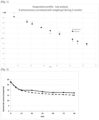
- Example 2 evaluation of the diffusion profile of the semiochemical composition from the diffuser gel of example 1: Study conducted under controlled conditions of temperature, humidity and ventilation (on average 22.5°C / 54% RH, room ventilated over the period).
- the diffusion profile of the semiochemical composition formulated in the diffusing gel of Example 1 is shown in the graph of figure 1 .
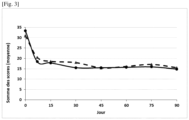
- Example 3 study of the stability of the semiochemical composition in the diffuser gel of example 1
- the pheromone dosage was then carried out by chromatography.
Landscapes
- Health & Medical Sciences (AREA)
- Chemical & Material Sciences (AREA)
- Life Sciences & Earth Sciences (AREA)
- Pharmacology & Pharmacy (AREA)
- Veterinary Medicine (AREA)
- Public Health (AREA)
- General Health & Medical Sciences (AREA)
- Animal Behavior & Ethology (AREA)
- Medicinal Chemistry (AREA)
- Epidemiology (AREA)
- Chemical Kinetics & Catalysis (AREA)
- Bioinformatics & Cheminformatics (AREA)
- Nuclear Medicine, Radiotherapy & Molecular Imaging (AREA)
- General Chemical & Material Sciences (AREA)
- Engineering & Computer Science (AREA)
- Organic Chemistry (AREA)
- Neurology (AREA)
- Biomedical Technology (AREA)
- Emergency Medicine (AREA)
- Neurosurgery (AREA)
- Inorganic Chemistry (AREA)
- Pulmonology (AREA)
- Pain & Pain Management (AREA)
- Psychiatry (AREA)
- Zoology (AREA)
- Dermatology (AREA)
- Agricultural Chemicals And Associated Chemicals (AREA)
- Medicinal Preparation (AREA)
- Acyclic And Carbocyclic Compounds In Medicinal Compositions (AREA)
Applications Claiming Priority (2)
| Application Number | Priority Date | Filing Date | Title |
|---|---|---|---|
| FR2100989A FR3119315B1 (fr) | 2021-02-02 | 2021-02-02 | « gel diffuseur de pheromones » |
| PCT/EP2022/052271 WO2022167389A1 (fr) | 2021-02-02 | 2022-02-01 | Gel diffuseur de pheromones |
Publications (3)
| Publication Number | Publication Date |
|---|---|
| EP4288029A1 EP4288029A1 (fr) | 2023-12-13 |
| EP4288029C0 EP4288029C0 (fr) | 2024-12-25 |
| EP4288029B1 true EP4288029B1 (fr) | 2024-12-25 |
Family
ID=76920812
Family Applications (1)
| Application Number | Title | Priority Date | Filing Date |
|---|---|---|---|
| EP22701660.7A Active EP4288029B1 (fr) | 2021-02-02 | 2022-02-01 | Gel diffuseur de pheromones |
Country Status (9)
| Country | Link |
|---|---|
| US (1) | US20240122892A1 (pl) |
| EP (1) | EP4288029B1 (pl) |
| JP (1) | JP7654094B2 (pl) |
| CN (1) | CN116761590A (pl) |
| CA (1) | CA3201858A1 (pl) |
| ES (1) | ES3015182T3 (pl) |
| FR (1) | FR3119315B1 (pl) |
| PL (1) | PL4288029T3 (pl) |
| WO (1) | WO2022167389A1 (pl) |
Family Cites Families (11)
| Publication number | Priority date | Publication date | Assignee | Title |
|---|---|---|---|---|
| WO1998035567A1 (en) * | 1997-02-17 | 1998-08-20 | University Of Otago | Gelling agents and gels containing them |
| GB2345635B (en) * | 1998-12-31 | 2004-02-18 | Dynavet S A R L | Compositions for modifying animal behaviour |
| US6375968B1 (en) * | 1999-10-22 | 2002-04-23 | 3M Innovative Properties Company | Encapsulated active material immobilized in hydrogel microbeads |
| EP1758557B1 (en) * | 2004-05-11 | 2011-07-13 | Egalet Ltd. | Swellable dosage form comprising gellan gum |
| FR2931676B1 (fr) * | 2008-05-30 | 2011-01-14 | Ceva Sante Animale | Nouveaux modes d'administration d'un melange d'acides gras pour le traitement de mammiferes non humains |
| JP6629286B2 (ja) * | 2014-03-18 | 2020-01-15 | アンスティテュ・ドゥ・ルシェルシュ・アン・セミオシミー・エ・エソロジー・アプリケInstitut De Recherche En Semiochimie Et Ethologie Appliquee | ネコ鎮静フェロモン |
| US10258593B2 (en) | 2014-03-18 | 2019-04-16 | Institut de Recherche en Semiochimie et Ethologie Appliquee | Semiochemical compositions to reduce social conflicts with cats |
| ES2759224T3 (es) * | 2014-06-12 | 2020-05-08 | Ceva Sante Animale | Composiciones de feromonas de espuma compuesta |
| FR3031039B1 (fr) * | 2014-12-24 | 2018-03-02 | Virbac | Composition apaisante pour animaux comprenant au moins un acide gras et de la nepetalactone |
| FR3031104B1 (fr) | 2014-12-26 | 2017-01-06 | Melchior Material & Life Science France | Composition pro-pheromonale apaisante pour les mammiferes |
| JP6896412B2 (ja) | 2016-12-15 | 2021-06-30 | エステー株式会社 | 揮散装置 |
-
2021
- 2021-02-02 FR FR2100989A patent/FR3119315B1/fr active Active
-
2022
- 2022-02-01 CN CN202280012082.4A patent/CN116761590A/zh active Pending
- 2022-02-01 CA CA3201858A patent/CA3201858A1/fr active Pending
- 2022-02-01 ES ES22701660T patent/ES3015182T3/es active Active
- 2022-02-01 WO PCT/EP2022/052271 patent/WO2022167389A1/fr not_active Ceased
- 2022-02-01 EP EP22701660.7A patent/EP4288029B1/fr active Active
- 2022-02-01 JP JP2023546507A patent/JP7654094B2/ja active Active
- 2022-02-01 US US18/263,826 patent/US20240122892A1/en active Pending
- 2022-02-01 PL PL22701660.7T patent/PL4288029T3/pl unknown
Also Published As
| Publication number | Publication date |
|---|---|
| JP2024506560A (ja) | 2024-02-14 |
| FR3119315B1 (fr) | 2022-12-30 |
| PL4288029T3 (pl) | 2025-04-22 |
| CN116761590A (zh) | 2023-09-15 |
| EP4288029C0 (fr) | 2024-12-25 |
| EP4288029A1 (fr) | 2023-12-13 |
| US20240122892A1 (en) | 2024-04-18 |
| WO2022167389A1 (fr) | 2022-08-11 |
| ES3015182T3 (en) | 2025-04-30 |
| JP7654094B2 (ja) | 2025-03-31 |
| FR3119315A1 (fr) | 2022-08-05 |
| CA3201858A1 (fr) | 2022-08-11 |
Similar Documents
| Publication | Publication Date | Title |
|---|---|---|
| US8933126B2 (en) | Methods of administering a mixture of fatty acids for the treatment of non-human mammals | |
| JP6814728B2 (ja) | ネコとの社会的対立を減少させるための情報化学物質組成物 | |
| ES2923675T3 (es) | Feromona calmante para gatos | |
| EP3237012B1 (fr) | Composition apaisante pour animaux comprenant au moins un acide gras et de la nepetalactone | |
| EP3237393B1 (fr) | Composition pro-pheromonale apaisante pour les mammiferes | |
| FR2922108A1 (fr) | Utilisation d'un derive de 1-n-(halo-3-pyridylmethyle)-n-methylamino-1-alkylamino -2- nitroethylene pour la preparation d'une composition pharmaceutique veterinaire pour lutter contre les puces | |
| EP2954886B1 (en) | Pheromonal composite foam compositions | |
| US11331296B2 (en) | Pheromone compositions and uses thereof | |
| EP3125879B1 (fr) | Compositions à base de phéromones destinées à traiter les problèmes comportementaux ou médicaux liés au stress des mammifères non humains | |
| WO2022167389A1 (fr) | Gel diffuseur de pheromones | |
| FR3117731A1 (fr) | Dispositifs portables pour animaux de compagnie avec diffusion passive de compositions sémiochimiques | |
| CN120938981A (zh) | 一种信息素组合物及其应用 | |
| JP2006249058A (ja) | 動物忌避性材質とその製造方法 |
Legal Events
| Date | Code | Title | Description |
|---|---|---|---|
| STAA | Information on the status of an ep patent application or granted ep patent |
Free format text: STATUS: UNKNOWN |
|
| STAA | Information on the status of an ep patent application or granted ep patent |
Free format text: STATUS: THE INTERNATIONAL PUBLICATION HAS BEEN MADE |
|
| PUAI | Public reference made under article 153(3) epc to a published international application that has entered the european phase |
Free format text: ORIGINAL CODE: 0009012 |
|
| STAA | Information on the status of an ep patent application or granted ep patent |
Free format text: STATUS: REQUEST FOR EXAMINATION WAS MADE |
|
| 17P | Request for examination filed |
Effective date: 20230802 |
|
| AK | Designated contracting states |
Kind code of ref document: A1 Designated state(s): AL AT BE BG CH CY CZ DE DK EE ES FI FR GB GR HR HU IE IS IT LI LT LU LV MC MK MT NL NO PL PT RO RS SE SI SK SM TR |
|
| P01 | Opt-out of the competence of the unified patent court (upc) registered |
Effective date: 20240205 |
|
| DAV | Request for validation of the european patent (deleted) | ||
| DAX | Request for extension of the european patent (deleted) | ||
| GRAP | Despatch of communication of intention to grant a patent |
Free format text: ORIGINAL CODE: EPIDOSNIGR1 |
|
| STAA | Information on the status of an ep patent application or granted ep patent |
Free format text: STATUS: GRANT OF PATENT IS INTENDED |
|
| INTG | Intention to grant announced |
Effective date: 20240905 |
|
| GRAS | Grant fee paid |
Free format text: ORIGINAL CODE: EPIDOSNIGR3 |
|
| GRAA | (expected) grant |
Free format text: ORIGINAL CODE: 0009210 |
|
| STAA | Information on the status of an ep patent application or granted ep patent |
Free format text: STATUS: THE PATENT HAS BEEN GRANTED |
|
| AK | Designated contracting states |
Kind code of ref document: B1 Designated state(s): AL AT BE BG CH CY CZ DE DK EE ES FI FR GB GR HR HU IE IS IT LI LT LU LV MC MK MT NL NO PL PT RO RS SE SI SK SM TR |
|
| REG | Reference to a national code |
Ref country code: GB Ref legal event code: FG4D Free format text: NOT ENGLISH |
|
| REG | Reference to a national code |
Ref country code: CH Ref legal event code: EP |
|
| REG | Reference to a national code |
Ref country code: DE Ref legal event code: R096 Ref document number: 602022009095 Country of ref document: DE |
|
| REG | Reference to a national code |
Ref country code: IE Ref legal event code: FG4D Free format text: LANGUAGE OF EP DOCUMENT: FRENCH |
|
| P04 | Withdrawal of opt-out of the competence of the unified patent court (upc) registered |
Free format text: CASE NUMBER: APP_2461/2025 Effective date: 20250115 |
|
| U01 | Request for unitary effect filed |
Effective date: 20250113 |
|
| U07 | Unitary effect registered |
Designated state(s): AT BE BG DE DK EE FI FR IT LT LU LV MT NL PT RO SE SI Effective date: 20250117 |
|
| U20 | Renewal fee for the european patent with unitary effect paid |
Year of fee payment: 4 Effective date: 20250115 |
|
| PG25 | Lapsed in a contracting state [announced via postgrant information from national office to epo] |
Ref country code: HR Free format text: LAPSE BECAUSE OF FAILURE TO SUBMIT A TRANSLATION OF THE DESCRIPTION OR TO PAY THE FEE WITHIN THE PRESCRIBED TIME-LIMIT Effective date: 20241225 |
|
| PG25 | Lapsed in a contracting state [announced via postgrant information from national office to epo] |
Ref country code: NO Free format text: LAPSE BECAUSE OF FAILURE TO SUBMIT A TRANSLATION OF THE DESCRIPTION OR TO PAY THE FEE WITHIN THE PRESCRIBED TIME-LIMIT Effective date: 20250325 |
|
| PG25 | Lapsed in a contracting state [announced via postgrant information from national office to epo] |
Ref country code: GR Free format text: LAPSE BECAUSE OF FAILURE TO SUBMIT A TRANSLATION OF THE DESCRIPTION OR TO PAY THE FEE WITHIN THE PRESCRIBED TIME-LIMIT Effective date: 20250326 |
|
| PG25 | Lapsed in a contracting state [announced via postgrant information from national office to epo] |
Ref country code: RS Free format text: LAPSE BECAUSE OF FAILURE TO SUBMIT A TRANSLATION OF THE DESCRIPTION OR TO PAY THE FEE WITHIN THE PRESCRIBED TIME-LIMIT Effective date: 20250325 |
|
| REG | Reference to a national code |
Ref country code: ES Ref legal event code: FG2A Ref document number: 3015182 Country of ref document: ES Kind code of ref document: T3 Effective date: 20250430 |
|
| PG25 | Lapsed in a contracting state [announced via postgrant information from national office to epo] |
Ref country code: SM Free format text: LAPSE BECAUSE OF FAILURE TO SUBMIT A TRANSLATION OF THE DESCRIPTION OR TO PAY THE FEE WITHIN THE PRESCRIBED TIME-LIMIT Effective date: 20241225 |
|
| PGFP | Annual fee paid to national office [announced via postgrant information from national office to epo] |
Ref country code: ES Payment date: 20250331 Year of fee payment: 4 |
|
| PG25 | Lapsed in a contracting state [announced via postgrant information from national office to epo] |
Ref country code: IS Free format text: LAPSE BECAUSE OF FAILURE TO SUBMIT A TRANSLATION OF THE DESCRIPTION OR TO PAY THE FEE WITHIN THE PRESCRIBED TIME-LIMIT Effective date: 20250425 |
|
| PG25 | Lapsed in a contracting state [announced via postgrant information from national office to epo] |
Ref country code: SK Free format text: LAPSE BECAUSE OF FAILURE TO SUBMIT A TRANSLATION OF THE DESCRIPTION OR TO PAY THE FEE WITHIN THE PRESCRIBED TIME-LIMIT Effective date: 20241225 |
|
| PG25 | Lapsed in a contracting state [announced via postgrant information from national office to epo] |
Ref country code: CZ Free format text: LAPSE BECAUSE OF FAILURE TO SUBMIT A TRANSLATION OF THE DESCRIPTION OR TO PAY THE FEE WITHIN THE PRESCRIBED TIME-LIMIT Effective date: 20241225 |
|
| PG25 | Lapsed in a contracting state [announced via postgrant information from national office to epo] |
Ref country code: MC Free format text: LAPSE BECAUSE OF FAILURE TO SUBMIT A TRANSLATION OF THE DESCRIPTION OR TO PAY THE FEE WITHIN THE PRESCRIBED TIME-LIMIT Effective date: 20241225 |
|
| REG | Reference to a national code |
Ref country code: CH Ref legal event code: PL |
|
| PG25 | Lapsed in a contracting state [announced via postgrant information from national office to epo] |
Ref country code: CH Free format text: LAPSE BECAUSE OF NON-PAYMENT OF DUE FEES Effective date: 20250228 |
|
| PLBE | No opposition filed within time limit |
Free format text: ORIGINAL CODE: 0009261 |
|
| STAA | Information on the status of an ep patent application or granted ep patent |
Free format text: STATUS: NO OPPOSITION FILED WITHIN TIME LIMIT |
|
| 26N | No opposition filed |
Effective date: 20250926 |
|
| PG25 | Lapsed in a contracting state [announced via postgrant information from national office to epo] |
Ref country code: IE Free format text: LAPSE BECAUSE OF NON-PAYMENT OF DUE FEES Effective date: 20250201 |
|
| U20 | Renewal fee for the european patent with unitary effect paid |
Year of fee payment: 5 Effective date: 20260106 |
|
| PGFP | Annual fee paid to national office [announced via postgrant information from national office to epo] |
Ref country code: GB Payment date: 20260220 Year of fee payment: 5 |
|
| PGFP | Annual fee paid to national office [announced via postgrant information from national office to epo] |
Ref country code: PL Payment date: 20260123 Year of fee payment: 5 |