EP4284548B1 - Vorrichtungen und verfahren zur erkennung von viren aus ausgeatmeter luft - Google Patents
Vorrichtungen und verfahren zur erkennung von viren aus ausgeatmeter luft Download PDFInfo
- Publication number
- EP4284548B1 EP4284548B1 EP22704172.0A EP22704172A EP4284548B1 EP 4284548 B1 EP4284548 B1 EP 4284548B1 EP 22704172 A EP22704172 A EP 22704172A EP 4284548 B1 EP4284548 B1 EP 4284548B1
- Authority
- EP
- European Patent Office
- Prior art keywords
- sensor
- mip
- layer
- monomer
- resistance
- Prior art date
- Legal status (The legal status is an assumption and is not a legal conclusion. Google has not performed a legal analysis and makes no representation as to the accuracy of the status listed.)
- Active
Links
Images



Classifications
-
- B—PERFORMING OPERATIONS; TRANSPORTING
- B01—PHYSICAL OR CHEMICAL PROCESSES OR APPARATUS IN GENERAL
- B01J—CHEMICAL OR PHYSICAL PROCESSES, e.g. CATALYSIS OR COLLOID CHEMISTRY; THEIR RELEVANT APPARATUS
- B01J20/00—Solid sorbent compositions or filter aid compositions; Sorbents for chromatography; Processes for preparing, regenerating or reactivating thereof
- B01J20/22—Solid sorbent compositions or filter aid compositions; Sorbents for chromatography; Processes for preparing, regenerating or reactivating thereof comprising organic material
- B01J20/26—Synthetic macromolecular compounds
- B01J20/262—Synthetic macromolecular compounds obtained otherwise than by reactions only involving carbon to carbon unsaturated bonds, e.g. obtained by polycondensation
-
- B—PERFORMING OPERATIONS; TRANSPORTING
- B01—PHYSICAL OR CHEMICAL PROCESSES OR APPARATUS IN GENERAL
- B01J—CHEMICAL OR PHYSICAL PROCESSES, e.g. CATALYSIS OR COLLOID CHEMISTRY; THEIR RELEVANT APPARATUS
- B01J20/00—Solid sorbent compositions or filter aid compositions; Sorbents for chromatography; Processes for preparing, regenerating or reactivating thereof
- B01J20/22—Solid sorbent compositions or filter aid compositions; Sorbents for chromatography; Processes for preparing, regenerating or reactivating thereof comprising organic material
- B01J20/26—Synthetic macromolecular compounds
- B01J20/268—Polymers created by use of a template, e.g. molecularly imprinted polymers
-
- B—PERFORMING OPERATIONS; TRANSPORTING
- B01—PHYSICAL OR CHEMICAL PROCESSES OR APPARATUS IN GENERAL
- B01J—CHEMICAL OR PHYSICAL PROCESSES, e.g. CATALYSIS OR COLLOID CHEMISTRY; THEIR RELEVANT APPARATUS
- B01J20/00—Solid sorbent compositions or filter aid compositions; Sorbents for chromatography; Processes for preparing, regenerating or reactivating thereof
- B01J20/28—Solid sorbent compositions or filter aid compositions; Sorbents for chromatography; Processes for preparing, regenerating or reactivating thereof characterised by their form or physical properties
- B01J20/28014—Solid sorbent compositions or filter aid compositions; Sorbents for chromatography; Processes for preparing, regenerating or reactivating thereof characterised by their form or physical properties characterised by their form
- B01J20/28033—Membrane, sheet, cloth, pad, lamellar or mat
- B01J20/28035—Membrane, sheet, cloth, pad, lamellar or mat with more than one layer, e.g. laminates, separated sheets
-
- G—PHYSICS
- G01—MEASURING; TESTING
- G01N—INVESTIGATING OR ANALYSING MATERIALS BY DETERMINING THEIR CHEMICAL OR PHYSICAL PROPERTIES
- G01N27/00—Investigating or analysing materials by the use of electric, electrochemical, or magnetic means
- G01N27/02—Investigating or analysing materials by the use of electric, electrochemical, or magnetic means by investigating impedance
- G01N27/04—Investigating or analysing materials by the use of electric, electrochemical, or magnetic means by investigating impedance by investigating resistance
- G01N27/12—Investigating or analysing materials by the use of electric, electrochemical, or magnetic means by investigating impedance by investigating resistance of a solid body in dependence upon absorption of a fluid; of a solid body in dependence upon reaction with a fluid, for detecting components in the fluid
- G01N27/125—Composition of the body, e.g. the composition of its sensitive layer
- G01N27/126—Composition of the body, e.g. the composition of its sensitive layer comprising organic polymers
-
- G—PHYSICS
- G01—MEASURING; TESTING
- G01N—INVESTIGATING OR ANALYSING MATERIALS BY DETERMINING THEIR CHEMICAL OR PHYSICAL PROPERTIES
- G01N33/00—Investigating or analysing materials by specific methods not covered by groups G01N1/00 - G01N31/00
- G01N33/48—Biological material, e.g. blood, urine; Haemocytometers
- G01N33/50—Chemical analysis of biological material, e.g. blood, urine; Testing involving biospecific ligand binding methods; Immunological testing
- G01N33/53—Immunoassay; Biospecific binding assay; Materials therefor
- G01N33/543—Immunoassay; Biospecific binding assay; Materials therefor with an insoluble carrier for immobilising immunochemicals
- G01N33/54366—Apparatus specially adapted for solid-phase testing
- G01N33/54373—Apparatus specially adapted for solid-phase testing involving physiochemical end-point determination, e.g. wave-guides, FETS, gratings
- G01N33/5438—Electrodes
-
- G—PHYSICS
- G01—MEASURING; TESTING
- G01N—INVESTIGATING OR ANALYSING MATERIALS BY DETERMINING THEIR CHEMICAL OR PHYSICAL PROPERTIES
- G01N33/00—Investigating or analysing materials by specific methods not covered by groups G01N1/00 - G01N31/00
- G01N33/48—Biological material, e.g. blood, urine; Haemocytometers
- G01N33/50—Chemical analysis of biological material, e.g. blood, urine; Testing involving biospecific ligand binding methods; Immunological testing
- G01N33/53—Immunoassay; Biospecific binding assay; Materials therefor
- G01N33/569—Immunoassay; Biospecific binding assay; Materials therefor for microorganisms, e.g. protozoa, bacteria, viruses
- G01N33/56983—Viruses
-
- G—PHYSICS
- G01—MEASURING; TESTING
- G01N—INVESTIGATING OR ANALYSING MATERIALS BY DETERMINING THEIR CHEMICAL OR PHYSICAL PROPERTIES
- G01N2333/00—Assays involving biological materials from specific organisms or of a specific nature
- G01N2333/005—Assays involving biological materials from specific organisms or of a specific nature from viruses
- G01N2333/08—RNA viruses
- G01N2333/165—Coronaviridae, e.g. avian infectious bronchitis virus
Definitions
- Severe acute respiratory syndrome coronavirus 2 SARS-CoV-2
- SARS-CoV-2 Severe acute respiratory syndrome coronavirus 2
- the respiratory symptoms of COVID-19 typically appear an average of 5-6 days after exposure but may appear in as few as 2 days or as many as 14 days after exposure, according to the U.S. Centers for Disease Control and Prevention (CDC). During all these times, the disease is transmissible.
- NAAT nucleic acid amplification tests
- rRT-PCR real-time reverse-transcription polymerase chain reaction
- a sensor comprising a doped silicon layer having an etched surface, a graphene layer on the etched surface, a MIP layer of poly(pyrrole-co-EGDMA-co-methacrylic acid) or poly(pyrrole-co-dopamine) on the graphene layer and electrodes in operative arrangement with the MIP layer and configured to provide a signal indicative of a resistance.
- the graphene layer comprises graphene and potassium ferrocyanide.
- a detector comprising the inventive sensor described herein and a voltage source configured to apply a voltage to the MIP layer.
- Also provided in a preferred embodiment is a method of detecting a viral infection in a subject.
- the method comprises measuring the resistance of a sensor described herein that is in contact with a sample from the subject to obtain a measured resistance.
- the sensor is selective for an analyte associated with the viral infection, and the measured resistance is indicative of presence or absence of the viral infection in the subject.
- the method comprises forming a graphene layer on a doped silicon layer, and forming a MIP layer derived from a MIP monomer and functional monomer on the graphene layer.
- the third generation of the electrochemical gas sensors to detect SARS-CoV-2 in the air were fabricated and tested.
- Example advantages of the third-generation sensors compared to the previous generation are improved consistency, repeatability, and selectivity. All the sensors were tested against bovine serum albumin (BSA), water, phosphate buffer solution (PBS), the Middle East respiratory syndrome (MERS), severe acute respiratory syndrome (SARS), Ebola, and flu virus.
- BSA bovine serum albumin
- PBS phosphate buffer solution
- MERS Middle East respiratory syndrome
- SARS severe acute respiratory syndrome
- Ebola Ebola
- flu virus flu virus.
- the new generation of sensors is highly selective, including as compared to the previous generations.
- First- and third-generation sensors were blind tested with an 86-sample kit. The first-generation sensor was 37.5% selective and 61% sensitive against the kit, while the third-generation sensor was 75% selective and 80% sensitive against the kit.
- a monomer can include a plurality of monomers. Further, the plurality can comprise more than one of the same monomer, or a plurality of different monomers.
- ABSOR means within an acceptable error range for the particular value, as determined by one of ordinary skill in the art. Typically, an acceptable error range for a particular value depends, at least in part, on how the value is measured or determined, e.g., the limitations of the measurement system. For example, “about” can mean within an acceptable standard deviation, per the practice in the art. Alternatively, “about” can mean a range of ⁇ 20%, e.g., ⁇ 10%, ⁇ 5% or ⁇ 1%, of a given value.
- a sensor comprising a silicon layer (e.g., doped silicon layer), a graphene layer on the silicon layer (e.g., doped silicon layer), a molecularly imprinted polymer (MIP) layer on the graphene layer, and electrodes in operative arrangement with the MIP layer and configured to provide a signal indicative of resistance.
- the MIP layer is derived from a MIP monomer and functional monomer.
- the MIP layer is derived from a MIP monomer, cross-linking monomer and functional monomer.
- the MIP layer is derived from a MIP monomer and cross-linking monomer.
- Silicon substrates such as silicon wafers, typically form a layer of silicon dioxide upon exposure to air, or come with a layer of silicon dioxide grown thereon, e.g., using one of a variety of oxidation processes known in the art (e.g., wet or dry oxidation).
- the silicon layer has an etched surface.
- a silicon layer e.g., doped silicon layer
- the silicon layer has a surface that lacks or substantially lacks a layer of silicon dioxide. Silicon dioxide can be removed from the surface of a layer of silicon using hydrofluoric acid, as described herein.
- a silicon layer e.g., doped silicon layer
- both surfaces e.g., top surface and bottom surface
- the graphene layer is on the etched surface, as depicted, for example, in FIG. 1C .
- Silicon doping is introducing impurities into silicon, typically for the purpose of modulating its properties. Doped silicon is preferred herein for its electrical properties, in particular, its lower resistance. Accordingly, in preferred aspects, a silicon layer is a doped silicon layer. In further aspects, doped silicon is highly doped. As used herein, "highly doped silicon” refers to silicon having a doping level of greater than 10 ⁇ 20 m ⁇ -3.
- a silicon layer is from about 1 nanometer to about 1 micron, from about 1 nanometer to about 500 nanometers, from about 1 nanometer to about 100 nanometers, from about 1 nanometer to about 50 nanometers or from about 1 nanometer to about 10 nanometers thick. In a particular aspect, a silicon layer is about 5 nanometers thick.
- the graphene layer is on the silicon layer (e.g., doped silicon layer).
- graphene refers to a single-layer sheet of sp 2 -bonded carbon atoms arranged in a hexagonal, honeycomb lattice. Graphene typically contains defects, such as oxygen- or nitrogen-centered defects. “Graphene” is meant to encompass these species as well. Thus, as used herein, “graphene” includes graphene oxide (GO) and reduced graphene oxide (rGO, GR).
- Graphene oxide or “GO” is graphene modified with oxygen-containing functional groups such as epoxides, carbonyls, carboxyls and alcohols. Typically, the carbon to oxygen ratio of graphene oxide is about three to about one. In some aspects, graphene is graphene oxide.
- Reduced graphene oxide is the product resulting from the reduction of graphene oxide.
- Reduced graphene oxide can be produced by a number of techniques known in the art, including the so-called Hummer method, wherein a solution of graphene oxide is exposed to hydrazine hydrate, and the solution is maintained at about 100 °C for about 24 hours. In some aspects, graphene is reduced graphene oxide.
- a graphene layer comprises graphene (e.g. , reduced graphene oxide) and potassium ferrocyanide (also known as Prussian blue).
- graphene e.g. , reduced graphene oxide
- potassium ferrocyanide also known as Prussian blue
- the template molecule has a molecular weight of less than about 500,000 daltons, for example, less than about 250,000 daltons, less than about 150,000 daltons, less than about 100,000 daltons, less than about 50,000 daltons. In some aspects, the template molecule has a molecular weight of about 35,000 daltons.
- molecularly imprinted polymers like polymers generally, are composed substantially or entirely of repeated monomeric subunits. Polymers can, therefore, be said to be derived from the monomer(s) that make up the repeated monomeric subunits.
- polypyrrole can be described as being derived from pyrrole.
- “Functional monomer,” as used herein, refers to a polymerizable monomer able to establish a covalent or non-covalent interaction with a template molecule and/or analyte.
- functional monomers include methacrylic acid, acrylamide, vinyl esters ( e.g ., 2-hydroxyethylacrylate, 2-hydroxyethylmethacrylate), dopamine, amino acids, and coumarin, or a salt of any of the foregoing.
- Other functional monomers include anthranilic acid, pyrrole, o -phenylenediamine, aniline, o -aminophenol, p -aminobenzoic acid, ⁇ -cyclodextrin, 2-mercaptobenzimidazole, 3-thiophene acetic acid, 3-acrylamidophenylboronic acid, m- aminophenylboronic acid, scopoletin, nicotinamide, dopamine, gallic acid, p- aminothiophenol, o -aminothiophenol, p -aminobenzene sulfonic acid, 5-amino-8-hydroxyquinoline, 2-amino-5-mercapto-1,3,4-thiadiazole, indole-3-acetic acid, catechol, eriochrome black T, 3-thienylboronic acid, melamine, methylene green, 3,4-ethylenedioxythiophene, protoporphyrin IX, phenol, 3,
- a functional monomer is methacrylic acid or dopamine, or a salt thereof, or a combination of any of the foregoing.
- a molecularly imprinted polymer derived from a MIP monomer, cross-linking monomer and functional monomer, wherein the MIP monomer is pyrrole, the cross-linking monomer is EGDMA and the functional monomer is methacrylic acid can be referred to as poly(pyrrole-co-EGDMA-co-methacrylic acid), and can be used to form a MIP layer of poly(pyrrole-co-EGDMA-co-methacrylic acid).
- a MIP layer or sensor described herein including a MIP "selectively binds" or “is selective for" an analyte if the MIP binds to the analyte to a greater extent than at least one other, different analyte.
- the MIP binds to its one or more cognate analytes at least two-fold, at least five-fold, at least tenfold, or at least fifty-fold more strongly than the at least one other, different analyte.
- the MIP does not bind to the at least one other, different analyte to any measurable degree.
- a MIP layer or sensor described herein including a MIP layer is selective for one or more analytes (e.g., 1, 2, 3, 4, 5, 6, 7, 8, 9, 10, etc .).
- the MIP layer or sensor including the MIP layer is selective for one analyte (e.g. a particular viral mutant, such as the delta and/or omicron mutant of SARS-COV-2).
- the MIP layer or sensor including the MIP layer is selective for more than one analyte (e.g ., wildtype SARS-CoV-2, as well as delta and omicron mutants of SARS-CoV-2), as in an array.
- the MIP layer or sensor including the MIP layer is selective for a set or subset of analytes associated with a particular disease or disorder.
- the one or more analytes will be in fluid (i.e., liquid or gas) form.
- the one or more analytes are in gas form.
- the one or more analytes are in liquid ( e.g ., aerosol) form.
- the one or more analytes are in gas or aerosol form.
- the one or more analytes are each a volatile organic compound.
- volatile organic compound refers to any organic compound having a boiling point less than or equal to 250 °C measured at an atmospheric pressure of 101.3 kPa.
- volatile organic compounds include, but are not limited to, acetone, acetic acid, butanal, carbon disulfide, ethanol, isopropyl alcohol, formaldehyde and methylene chloride.
- MIPs selective for compounds up to about 3,000 daltons are routinely prepared.
- the one or more analytes has a molecular weight of less than about 3,000 daltons, less than about 1,000 daltons or less than about 500 daltons.
- MIPs selective for larger analytes such as peptides, carbohydrates, proteins and viruses, can also be prepared.
- the MIP layer is selective for a protein or polypeptide, such as a receptor-binding domain of a virus (e.g ., SARS1, SARS2, SARS-CoV-2, flu or Ebola virus).
- a virus e.g ., SARS1, SARS2, SARS-CoV-2, flu or Ebola virus.
- the protein or polypeptide is a glycoprotein, such as a glycosylated spike protein.
- the glycosylated spike protein binds to an angiotensin-converting enzyme 2 (ACE2) receptor.
- ACE2 angiotensin-converting enzyme 2
- the MIP layer is selective for the receptor binding domain of the glycosylated spike protein of SARS-CoV-2.
- the MIP layer is selective for a virus. It will be understood that when a MIP layer is selective for a virus, such selectivity is typically mediated by a protein present on the surface of the viral particle.
- the protein is a viral fusion protein, such as a glycoprotein.
- Example viruses include, but are not limited to, Ebola, severe acute respiratory syndrome coronavirus (SARS-CoV), influenza virus (e.g., H1N1 influenza virus), Middle East respiratory syndrome coronavirus (MERS-CoV), severe acute respiratory syndrome coronavirus 2 (SARS-CoV-2), human immunodeficiency virus (HIV), Dengue virus, Chikungunya virus, hepatitis A virus, hepatitis B virus, and hepatitis C virus.
- the virus is SARS1, SARS2, SARS-CoV-2, flu or Ebola virus.
- the virus is SARS-CoV-2.
- the MIP layer is selective for one or more analytes associated with a disease or condition (e.g ., COVID-19), such as the glycosylated spike protein and/or RBD of SARS-CoV-2, which has been associated with COVID-19.
- Sensors comprising MIP layers selective for one or more disease- or condition-associated analytes (e.g. , disease- or condition-associated volatile organic compounds; disease- or condition-associated proteins) can conveniently be used as diagnostic devices to detect analyte(s) associated with a particular disease or condition and thereby diagnose a subject having the disease or condition.
- Potential sources of analytes associated with a disease or condition include the breath (e.g., exhaled breath), sweat, blood and urine of a subject.
- an analyte When an analyte is "associated with a disease or condition,” the analyte has been linked to or otherwise implicated in a particular disease or condition.
- An analyte associated with a disease or condition can be differentially present (e.g. , present in larger quantities, detectable, present) in diseased subjects or differentially absent ( e.g. , present in lesser quantities, undetectable, completely absent) in diseased subjects compared to their healthy counterparts.
- certain volatile organic compounds have been shown to be differentially present in the breath of Alzheimer's disease patients as compared to their healthy counterparts.
- the senor has a thickness of about 5 millimeters or less, about 2.5 millimeters or less, or about 1 millimeter or less. In a particular aspect, the sensor has a thickness of about 1 millimeter.
- the senor has a length and a width, and is about 50 millimeters or less ( e.g. about 5 millimeters or less) in length, and about 50 millimeters or less ( e.g., about 5 millimeters or less) in width.
- Suitable materials for the electrodes include, but are not limited to, gold and silver. Accordingly, in some aspects, the electrodes comprise gold. In some aspects, the electrodes comprise silver.
- the sensors can be used to rapidly detect one or more analytes.
- the sensor has an equilibration time of less than 60 seconds, for example, less than or about 30 seconds, less than or about 15 seconds or less than or about 10 seconds.
- the sensor has a response time (upon exposure to analyte) of less than 60 seconds, for example, less than or about 30 seconds, less than or about 15 seconds or less than or about 10 seconds.
- analyte can be removed from the sensors thereby facilitating re-use of the sensors.
- the sensor has a recovery time (e.g., to its baseline or inherent resistance upon removal of sample containing analyte) of less than 60 seconds, for example, less than or about 30 seconds, less than or about 15 seconds or less than or about 10 seconds.
- a detector comprising a sensor described herein and a voltage source configured to apply a voltage to the MIP layer.
- the detector further comprises an ohmmeter (e.g ., multimeter) in operative arrangement with the electrodes and configured to apply a voltage to the MIP layer.
- the detector further comprises a microcontroller unit capable of monitoring and transmitting data obtained from the ohmmeter (e.g ., via BLUETOOTH ® technology to a smart phone, for example).
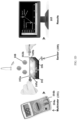
- FIG. 1D depicts incorporation of sensor 100 into a system described herein.
- multimeter 101 is configured to apply a voltage to MIP layer 102 by placing probe tips 103a, 103b of probes 104a, 104b in contact with electrodes 105a, 105b of sensor 100, and by connecting probes 104a, 104b to multimeter 101 so as to complete a circuit including sensor 100 and multimeter 101.
- electrodes 105a, 105b are on MIP layer 102, which is on graphene layer 106 comprising Prussian blue, which is on doped silicon layer 107.
- sensor 100 is allowed to equilibrate in the absence of sample for a first period of time, and multimeter 101 is used to measure the inherent resistance of sensor 100.
- Sample 108 is then brought into contact with sensor 100 for a second period of time (e.g., 10 seconds), and multimeter 101 is used to measure the resistance of sensor 100.
- the resistance(s) measured by multimeter 101 can be transmitted to a microcontroller unit (not shown) in communication with screen 105, which can be used to visualize the resistance(s) measured.
- One embodiment is a method of detecting an analyte in a sample (e.g., a breath, sweat, blood or urine sample, especially a breath sample, from a subject).
- the method comprises measuring the resistance of a sensor described herein that is in contact with the sample to obtain a measured resistance.
- the sensor is selective for the analyte, and the measured resistance is indicative of presence or absence of the analyte in the sample.
- the sensors described herein have an inherent resistance.
- a difference between the inherent resistance of the sensor and the measured resistance of the sensor typically indicates presence of the analyte and, in the case of an analyte associated with a disease or condition, that the subject has the disease or condition (e.g., viral infection).
- a difference between the inherent resistance of the sensor and the measured resistance of the sensor of 5 mOhms or greater indicates presence of an analyte and, in the case of an analyte associated with a disease or condition, that the subject has the disease or condition (e.g ., viral infection).
- inherent resistance refers to the resistance of a device described herein in the absence or substantial absence of the one or more analytes for which the device is selective.
- a person of ordinary skill in the art will appreciate that the methods described herein can be carried out by comparing the inherent resistance of the device (e.g., as an absolute number) to the resistance of the device contacted with a sample (e.g ., also as an absolute number), such that the magnitude of the difference, if calculated, is the mathematical difference between the inherent resistance and the resistance of the device contacted with the sample.
- subject includes humans, domestic animals, such as laboratory animals (e.g., dogs, monkeys, pigs, rats, mice, etc .), household pets ( e.g., cats, dogs, rabbits, etc .) and livestock (e.g., pigs, cattle, sheep, goats, horses, etc .), and non-domestic animals.
- laboratory animals e.g., dogs, monkeys, pigs, rats, mice, etc .
- household pets e.g., cats, dogs, rabbits, etc .
- livestock e.g., pigs, cattle, sheep, goats, horses, etc .
- a person of ordinary skill in the art will be able to identify those subjects suspected to have a disease or condition detectable and/or diagnosable with a sensor described herein, for example, based on a subject's symptoms, other tests or analyses, etc .
- a person of ordinary skill in the art will be able to identify those subjects at risk for developing a disease or condition detectable and/or diagnosable with a sensor described herein, for example, based on exposure information, genetic information, family history or other factors known to a person of ordinary skill in the art.
- the methods further comprise contacting the MIP layer of the sensor with the sample.
- the methods described herein further comprise providing a chamber containing the sensor and into which the subject exhales, thereby contacting the MIP layer of the sensor with the sample.
- the chamber is sealed or substantially sealed.
- a method of diagnosing a disease or condition in a subject e.g., a subject suspected to have the disease or condition, or at risk for developing the disease or condition.
- the method comprises measuring the resistance of a sensor described herein that has an inherent resistance, and is in contact with a sample (e.g., a breath, sweat, blood or urine sample, especially a breath sample) from the subject.
- a sample e.g., a breath, sweat, blood or urine sample, especially a breath sample
- a lack of difference, or a difference of insufficient magnitude between the inherent resistance of the sensor and the measured resistance of the sensor indicates the subject has the disease or condition.
- a difference of insufficient magnitude can be assessed by comparing the difference measured to the difference expected based on a healthy subject or a population of healthy subjects, optionally taking into account any error associated with the method.
- the methods further comprise comparing the measured resistance of a sensor according to the methods described herein, or an amount of analyte calculated from the measured resistance of a sensor according to the methods described herein to the resistance of a device contacted or in contact with a sample from a healthy subject or a population of healthy subjects or the amount of analyte in a comparable sample from a healthy subject or population of healthy subjects, respectively, or a relevant standard (e.g., a standard range) based on a healthy subject or population of healthy subjects.
- a difference e.g., a clinically significant difference, a statistically significant difference, a difference taking into account any error associated with the method
- the sample and the relevant comparator indicates the subject has the disease or condition.
- the methods further comprise comparing the resistance of a device contacted with a sample according to the methods described herein, or an amount of analyte calculated from the resistance of a device contacted with a sample according to the methods described herein to the resistance of a device contacted with a sample from a subject or a population of subjects having the disease or condition or the amount of analyte in a comparable sample from a subject or population of subjects having the disease or condition, respectively, or a relevant standard (e.g., a standard range) based on a subject or population of subjects having the disease or condition.
- a relevant standard e.g., a standard range
- a lack of difference e.g., a difference of insufficient magnitude, optionally taking into account any error associated with the method; a clinically insignificant difference, a statistically insignificant difference
- a lack of difference e.g., a difference of insufficient magnitude, optionally taking into account any error associated with the method; a clinically insignificant difference, a statistically insignificant difference
- measuring the resistance comprises allowing the sensor to equilibrate in the absence of the sample for a first period of time (e.g., an equilibration time), and recording a signal indicative of an inherent resistance, and bringing the sensor and the sample into contact with one another for a second period of time (e.g., a response time), and recording a signal indicative of the measured resistance.
- the first period of time (e.g., an equilibration time) and the second period of time (e.g., response time) are each independently less than 60 seconds, for example, less than or about 30 seconds, less than 30 seconds, less than or about 15 seconds, less than 15 seconds, less than or about 10 seconds or less than 10 seconds.
- measuring the resistance further comprises bringing the sensor and the sample out of contact with one another, and allowing the sensor to recover for a third period of time (e.g., a recovery time).
- the third period of time e.g., recovery time
- the third period of time is less than 60 seconds, for example, less than or about 30 seconds, less than 30 seconds, less than or about 15 seconds, less than 15 seconds, less than or about 10 seconds or less than 10 seconds.
- the first, second and third periods of time are each about 10 seconds.
- the method comprises forming a graphene layer on a doped silicon layer, and forming a MIP layer derived from a MIP monomer and functional monomer on the graphene layer.
- the method further comprises etching a surface of the doped silicon layer, and forming the graphene layer on the etched surface of the doped silicon layer.
- forming the MIP layer comprises incubating the functional monomer with a template molecule under conditions suitable to establish an interaction between the functional monomer and the template molecule, thereby forming a pre-polymerization complex; and polymerizing the pre-polymerization complex and the MIP monomer, thereby forming the MIP layer. In some aspects, forming the MIP layer further comprises removing the template molecule from the MIP layer.
- the MIP layer is derived from a MIP monomer, functional monomer and cross-linking monomer, and forming the MIP layer comprises incubating the functional monomer with a template molecule under conditions suitable to establish an interaction between the functional monomer and the template molecule, thereby forming a pre-polymerization complex; and polymerizing the pre-polymerization complex, the MIP monomer and the cross-linking monomer, thereby forming the MIP layer.
- forming the MIP layer further comprises removing the template molecule from the MIP layer.
- the method of making further comprises applying electrodes to the sensor such that the electrodes are in operative arrangement with the MIP layer and configured to provide a signal indicative of a resistance.
- the electrodes are applied to the MIP layer. Electrodes are as described herein.
- a third-generation of electrochemical gas sensors to detect SARS-CoV-2 in the air were fabricated and tested.
- the advantages of the third-generation sensors compared to the previous generations are improved consistency, repeatability, and selectivity. All the sensors were tested against bovine serum albumin (BSA), water, phosphate buffer solution (PBS), the Middle East respiratory syndrome (MERS), severe acute respiratory syndrome (SARS), Ebola, and flu virus.
- BSA bovine serum albumin
- PBS phosphate buffer solution
- MERS Middle East respiratory syndrome
- SARS severe acute respiratory syndrome
- Ebola Ebola
- flu virus flu virus
- the new generation of sensors was highly selective, particularly as compared to the previous generations of sensors.
- the first- and third- generation sensors were also blind tested with an 86-sample kit. The first-generation sensor was 37.5% selective and 61% sensitive against the kit, while the third-generation sensor was 75% selective and 80% sensitive against the kit.
- the process of fabricating the sensors is repeatable, as we made at least 20 sensors
- FIGs. 1A-1C Three generations of electrochemical gas sensors are depicted in FIGs. 1A-1C , and described below.
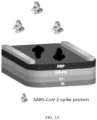
- the first generation of molecularly-imprinted polymer (MIP) sensors were polymerized around a template molecule by placing the template molecule in a polymer matrix. In the first-generation sensors, the cavities so produced ended up being larger than and with a slightly different shape from the template molecule.
- a first-generation sensor is depicted in FIG. 1A .
- First-generation-type sensors are also disclosed in U.S. Patent Appln. Publication No. US2019/0313944 .
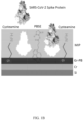
- the second generation of these sensors were functionalized sensors.
- a graphene layer was functionalized with PBSE and cysteamine to help the sensor attract the virus.
- the structure of the sensor and the MIP fabrication step were unchanged in the second-generation sensors.
- a second-generation sensor is depicted in FIG. 1B .
- Second-generation-type sensors are also disclosed in International Application No. PCT/US2021/014248 .
- the third generation of the MIP sensors were fabricated with an aim of detecting the template molecule selectively with the help of functional monomers.
- Functional monomers act as blocks around the template molecule that help for the orientation of the detecting template molecule.
- Using functional monomers improves the selectivity of the sensors.
- the selective recognition abilities of the imprinted polymers are believed to be due to the formation of a complex between a target analyte and the selected functional monomer(s) during a pre-polymerization step.
- the choice of the monomer(s) represents a useful point in the preparation of effective MIPs and is based on the ability of the monomer(s) to establish interactions with the functional groups of the template molecule in a covalent or non-covalent way.
- DA Dopamine
- MAA methacrylic acid
- HF hydrofluoric acid
- Removing chromium from the structure of the sensor helped adhesion of graphene with a silicon substrate and decreased a Schottky barrier height that forms in a metal-semiconductor junction.
- Replacing a metal-semiconductor junction with a semiconductor-semiconductor junction lowered the Schottky barrier height from almost 1.5 to 0.5 eV [1].
- a third-generation sensor is depicted in FIG. 1C .
- Dopamine (DA) was used as a functional monomer for fabricating a MIP sensor to detect bovine hemoglobin [2].
- Dopamine was discovered to self-polymerize within a weak alkaline aqueous solution into thin adherent polydopamine (PDA) films, which may be coated on various inorganic and organic substrates.
- Dopamine hydrochloride was purchased from Sigma Aldrich. After the deposition of graphene and Prussian-blue on a surface of etched silicon substrate, the surface was polymerized with a complex formed from a mixture of the template molecule and the functional monomer.
- the complex solution was made with 100 ⁇ l of the template protein solution containing 30 ⁇ g of the protein (full-length spike protein (G614 sensor) or RBD s-protein (RBD sensor)) mixed with 1mg of dopamine hydrochloride, sonicated for 10 minutes, and added to the electrolyte containing 200 ml of phosphate buffer solution and 1.38 ml of pyrrole (pH 6.8). Later, the electrolyte was used to polymerize the surface of the sensor. The sensor was then washed with hydrochloric acid solution (1 mol/L, 2 mL) and methanol (8 mL).
- Methacrylic acid was applied as a functional monomer in a sensor structure to detect many proteins and materials [3,4].
- Ethylene glycol dimethacrylate (EGDMA) is often used with MAA as a cross-linker.
- MAA and EGDMA were purchased from Sigma Aldrich. After deposition of the graphene and Prussian-blue on the surface of etched silicon substrate, the surface was polymerized with a complex formed from the mixture of the template molecule and the functional monomer. The complex was formed through mixing of 200 ⁇ l of the template protein solution (containing 60 ⁇ g of the template protein) along with 90 ⁇ l of methanol and acetonitrile (volume 1:1) and 0.51 ⁇ l of MAA.
- the generations were tested against a SARS-CoV-2 gamma-inactivated virus and a SARS-CoV-2 spike protein for sensitivity measurements.
- the sensors were tested against bovine serum albumin (BSA), water, phosphate buffer solution (PBS), Middle East respiratory syndrome (MERS), severe acute respiratory syndrome (SARS), Ebola, and flu virus.
- BSA bovine serum albumin
- PBS phosphate buffer solution
- MERS Middle East respiratory syndrome
- SARS severe acute respiratory syndrome
- Ebola Ebola
- flu virus flu virus
- the first-generation and the third-generation sensors were tested with different concentrations of a SARS-CoV-2 spike protein, the G614 mutation.
- FIGs. 2A and 2B show that, while the third-generation sensor clearly detected all the concentrations of G614 spike protein from 1 to 300 ⁇ g/ml, the first-generation sensor could not detect the lower concentrations (1-10 ⁇ g/ml).
- the initial purpose of adding the functional monomers to the polymer matrix was for increasing the selectivity, it is clear that having blocks around the template molecule increased the sensitivity as well.
- the sensors were exposed to the G614 spike protein for 10 seconds from seconds 10-20. The first 10 seconds were for the sensor to stabilize, and the last 10 seconds were for the sensor to return to its baseline resistance.
- a first-generation G614 sensor, a second-generation G614 sensor, a-third generation G614 sensor, and a third-generation RBD sensor were tested with water, PBS, Ebola, SARS, and BSA.
- the sensors were exposed for 10 seconds (from seconds 10-20). The first 10 seconds were for the sensor to stabilize, and the last 10 seconds were for the sensor to return to its baseline resistance. The results of the testing are graphed in FIGs. 3A-3D . It turned out that the first-generation sensor exhibited a false positive with Ebola and BSA, and the second-generation sensor falsely detected Ebola, SARS and BSA.
- the third-generation G614 sensor had a false positive with BSA. However, the third-generation RBD sensor did not falsely detect any of the samples.
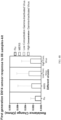
- FIGs. 4A and 4B show that the first-generation D614 sensor was 37.5% selective and 61% sensitive against the kit ( FIG. 4B ), while the third-generation RBD sensor was 75% selective and 80% sensitive against the kit ( FIG. 4A ).
- the third generation of the electrochemical gas sensors to detect SARS-CoV-2 in the air were introduced, fabricated and tested. All the sensors were tested against SARS-CoV-2 gamma-inactivated virus and SARS-CoV-2 spike protein for sensitivity. While the third-generation sensor could detect all the lower concentrations of virus, the first-generation sensor only detected the higher concentrations of virus. The sensors were also tested with bovine serum albumin (BSA), water, phosphate buffer (PBS) solution, Middle East respiratory syndrome (MERS), severe acute respiratory syndrome (SARS), Ebola, and flu virus for selectivity. The third-generation sensors are highly selective compared to the previous generations of sensors. These sensors are consistent and repeatable, as 20 of them were fabricated and tested and showed all similar behaviors.
- BSA bovine serum albumin
- PBS phosphate buffer
- MERS Middle East respiratory syndrome
- SARS severe acute respiratory syndrome
- Ebola Ebola
- flu virus flu virus
Landscapes
- Health & Medical Sciences (AREA)
- Chemical & Material Sciences (AREA)
- Life Sciences & Earth Sciences (AREA)
- Immunology (AREA)
- Engineering & Computer Science (AREA)
- Analytical Chemistry (AREA)
- Urology & Nephrology (AREA)
- Biomedical Technology (AREA)
- Hematology (AREA)
- Molecular Biology (AREA)
- Chemical Kinetics & Catalysis (AREA)
- General Health & Medical Sciences (AREA)
- Pathology (AREA)
- General Physics & Mathematics (AREA)
- Physics & Mathematics (AREA)
- Biochemistry (AREA)
- Organic Chemistry (AREA)
- Cell Biology (AREA)
- Medicinal Chemistry (AREA)
- Food Science & Technology (AREA)
- Microbiology (AREA)
- Biotechnology (AREA)
- Virology (AREA)
- Electrochemistry (AREA)
- Tropical Medicine & Parasitology (AREA)
- Investigating Or Analysing Biological Materials (AREA)
Claims (19)
- Sensor, der Folgendes umfasst:eine dotierte Siliciumschicht, die eine geätzte Oberfläche aufweist;eine Graphenschicht auf der geätzten Oberfläche der dotierten Siliciumschicht;eine Schicht aus molekular geprägtem Polymer (MIP), die von einem MIP-Monomer und funktionellen Monomer abgeleitet ist, auf der Graphenschicht; undElektroden in funktionsfähiger Anordnung mit der MIP-Schicht, und die zur Bereitstellung eines Signals konfiguriert sind, das einen Widerstand anzeigt.
- Sensor nach Anspruch 1, wobei die dotierte Siliciumschicht einen Dotierungsgrad aufweist, der größer ist als 1020 m-3.
- Sensor nach Anspruch 1 oder 2, wobei die Graphenschicht Graphen und Kaliumferrocyanid umfasst.
- Sensor nach einem der Ansprüche 1-3, wobei das MIP-Monomer Pyrrol ist.
- Sensor nach einem der Ansprüche 1-4, wobei das funktionelle Monomer Methacrylsäure oder Dopamin oder ein Salz davon oder eine Kombination aus einem der Vorstehenden ist.
- Sensor nach einem der Ansprüche 1-5, wobei die MIP-Schicht weiter von einem vernetzenden Monomer abgeleitet ist, optional wobei das vernetzende Monomer Ethylenglycoldimethacrylat (EGDMA) ist.
- Sensor nach Anspruch 1, wobei:die Graphenschicht Graphen und Kaliumferrocyanid umfasst; unddie MIP-Schicht Poly(pyrrol-co-EGDMA-co-methacrylsäure) oder Poly(pyrrol-co-dopamin) umfasst.
- Sensor nach einem der Ansprüche 1-7, wobei die MIP-Schicht für einen oder mehrere Analyten selektiv ist, optional wobei der eine oder die mehreren Analyten in Gas- oder Aerosolform vorliegen.
- Sensor nach Anspruch 8, wobei der eine oder die mehreren Analyten ein Virus, ein Protein oder Polypeptid sind,optional wobei das Protein oder Polypeptid eine Rezeptor-Bindungsdomäne eines Virus ist,optional wobei das Protein oder Polypeptid ein Glycoprotein ist,
optional wobei das Glycoprotein ein glycosyliertes Spike-Protein ist,
optional wobei das glycosylierte Spike-Protein zu einem Rezeptor des Angiotensin-konvertierenden Enzyms 2 (ACE2) bindet. - Sensor nach Anspruch 9,
wobei der Virus SARS1, SARS2, SARS-CoV-2, Grippe- oder Ebola- ist, bevorzugt wobei der Virus SARS-CoV-2 ist. - Detektor, der Folgendes umfasst:einen Sensor nach einem der Ansprüche 1-10; undeine Spannungsquelle, die zum Anlegen einer Spannung an die MIP-Schicht konfiguriert ist.
- Detektor nach Anspruch 11, der weiter ein Ohmmeter in funktionsfähiger Anordnung mit den Elektroden umfasst und zur Ausgabe einer Messung des Widerstands konfiguriert ist.
- Verfahren zum Detektieren eines Analyten in einer Probe, das Folgendes umfasst:
Messen des Widerstands eines Sensors nach einem der Ansprüche 1-10, der mit der Probe im Kontakt ist, um einen gemessenen Widerstand zu erhalten, wobei:der Sensor für den Analyten selektiv ist; undder gemessene Widerstand die Gegenwart oder Abwesenheit des Analyten in der Probe anzeigt. - Verfahren nach Anspruch 13, wobei:die Probe von einem Subjekt stammt, optional wobei die Probe ausgeatmete Atemluft umfasst;der Analyt mit einem Virus oder einer Virusinfektion verbunden ist, optional wobei der Analyt ein Virus ist; undder gemessene Widerstand die Gegenwart oder Abwesenheit der Virusinfektion bei dem Subjekt anzeigt.
- Verfahren nach Anspruch 14, wobei der Virus SARS-CoV-2 ist.
- Verfahren nach einem der Ansprüche 13 bis 15, wobei das Messen des Widerstands Folgendes umfasst:Ermöglichen, dass der Sensor bei Abwesenheit der Probe für eine erste Zeitdauer äquilibriert, und Erfassen eines Signals, das einen Eigenwiderstand anzeigt; undInkontaktbringen des Sensors und der Probe miteinander für eine zweite Zeitdauer und Erfassen eines Signals, das den gemessenen Widerstand anzeigt,optional wobei die erste Zeitdauer und die zweite Zeitdauer jeweils unabhängig weniger als 60 Sekunden betragen,
optional wobei die erste Zeitdauer und die zweite Zeitdauer jeweils unabhängig weniger als 30 Sekunden betragen. - Verfahren nach Anspruch 16, wobei das Messen des Widerstands weiter Folgendes umfasst: Lösen des Kontakts miteinander des Sensors und der Probe und Ermöglichen, dass sich der Sensor für eine dritte Zeitdauer regeneriert,optional wobei die dritte Zeitdauer weniger als 60 Sekunden beträgt,optional wobei die erste, zweite und dritte Zeitdauer jeweils etwa 10 Sekunden betragen.
- Verfahren zur Herstellung eines Sensors, das Folgendes umfasst:Ätzen einer Oberfläche einer dotierten Siliciumschicht;Bilden einer Graphenschicht auf der geätzten Oberfläche der dotierten Siliciumschicht; undBilden einer MIP-Schicht, die von einem MIP-Monomer und funktionellen Monomer abgeleitet ist, auf der Graphenschicht, was die folgenden Schritte umfasst:Inkubieren des funktionellen Monomers mit einem Templat-Molekül unter Bedingungen, die zum Herstellen einer Wechselwirkung zwischen dem funktionellen Monomer und dem Templat-Molekül geeignet sind, wodurch ein Präpolymerisationskomplex gebildet wird;Polymerisieren des Präpolymerisationskomplexes und des MIP-Monomers; undEntfernen des Templat-Moleküls von der MIP-Schicht.
- Verfahren nach Anspruch 18, wobei das Polymerisieren des Präpolymerisationskomplexes und des MIP-Monomers weiter das Polymerisieren des Präpolymerisationskomplexes, des MIP-Monomers und eines vernetzenden Monomers umfasst, wodurch die MIP-Schicht gebildet wird.
Applications Claiming Priority (2)
| Application Number | Priority Date | Filing Date | Title |
|---|---|---|---|
| US202163143763P | 2021-01-29 | 2021-01-29 | |
| PCT/US2022/013850 WO2022164863A1 (en) | 2021-01-29 | 2022-01-26 | Devices and methods for detection of viruses from exhaled breath |
Publications (2)
| Publication Number | Publication Date |
|---|---|
| EP4284548A1 EP4284548A1 (de) | 2023-12-06 |
| EP4284548B1 true EP4284548B1 (de) | 2025-05-14 |
Family
ID=80447065
Family Applications (1)
| Application Number | Title | Priority Date | Filing Date |
|---|---|---|---|
| EP22704172.0A Active EP4284548B1 (de) | 2021-01-29 | 2022-01-26 | Vorrichtungen und verfahren zur erkennung von viren aus ausgeatmeter luft |
Country Status (3)
| Country | Link |
|---|---|
| US (1) | US20240110914A1 (de) |
| EP (1) | EP4284548B1 (de) |
| WO (1) | WO2022164863A1 (de) |
Family Cites Families (6)
| Publication number | Priority date | Publication date | Assignee | Title |
|---|---|---|---|---|
| KR101523428B1 (ko) * | 2013-07-08 | 2015-05-29 | 광운대학교 산학협력단 | 그래핀-분자각인 중합체의 복합체 및 이를 포함하는 바이오센서 및 그 제조방법 |
| US11940403B2 (en) * | 2017-05-02 | 2024-03-26 | Amulet, Inc. | Food allergen detection device and methods of use thereof |
| GB201803997D0 (en) * | 2018-03-13 | 2018-04-25 | Univ Leicester | Electrochemical sensor |
| US11219387B2 (en) | 2018-04-13 | 2022-01-11 | Northeastern University | Molecularly-imprinted electrochemical sensors |
| US20220346679A1 (en) * | 2019-10-01 | 2022-11-03 | WearOptimo Pty Ltd | Analyte measurement system |
| US20230103369A1 (en) * | 2020-03-27 | 2023-04-06 | 6Th Wave Innovations Corp | The use of molecularly imprinted polymers for the rapid detection of emerging viral outbreaks |
-
2022
- 2022-01-26 US US18/260,881 patent/US20240110914A1/en active Pending
- 2022-01-26 WO PCT/US2022/013850 patent/WO2022164863A1/en not_active Ceased
- 2022-01-26 EP EP22704172.0A patent/EP4284548B1/de active Active
Non-Patent Citations (1)
| Title |
|---|
| ADAMS JASON D ET AL: "A Molecularly Imprinted Polymer-Graphene Sensor Antenna Hybrid for Ultra Sensitive Chemical Detection", IEEE SENSORS JOURNAL, IEEE, USA, vol. 19, no. 16, 15 August 2019 (2019-08-15), pages 6571 - 6577, XP011735598, ISSN: 1530-437X, [retrieved on 20190716], DOI: 10.1109/JSEN.2019.2913143 * |
Also Published As
| Publication number | Publication date |
|---|---|
| EP4284548A1 (de) | 2023-12-06 |
| WO2022164863A1 (en) | 2022-08-04 |
| US20240110914A1 (en) | 2024-04-04 |
Similar Documents
| Publication | Publication Date | Title |
|---|---|---|
| Palladino et al. | Polydopamine: surface coating, molecular imprinting, and electrochemistry—successful applications and future perspectives in (bio) analysis | |
| Ali et al. | N protein‐based ultrasensitive SARS‐CoV‐2 antibody detection in seconds via 3D nanoprinted, microarchitected array electrodes | |
| Feuz et al. | Improving the limit of detection of nanoscale sensors by directed binding to high-sensitivity areas | |
| US20230103369A1 (en) | The use of molecularly imprinted polymers for the rapid detection of emerging viral outbreaks | |
| KR102508271B1 (ko) | 피분석물의 검출 및 분석을 위한 방법 및 조성물 | |
| Buensuceso et al. | Electropolymerized-molecularly imprinted polymers (E-MIPS) as sensing elements for the detection of dengue infection | |
| EP2122353A1 (de) | Sensor | |
| Bhattacharya et al. | Carbon nanotube based sensors for the detection of viruses | |
| US20230296597A1 (en) | Devices and Methods for Detection of Viruses from Exhaled Breath | |
| KR20190049223A (ko) | 전극에 금 나노입자을 증착시키고 TNF-alpha 항체를 결합시켜 측정 감도를 높인 나노바이오센서 | |
| Mishra et al. | Carbon-based biosensors: next-generation diagnostic tool for target-specific detection of SARS-CoV-2 (COVID-19) | |
| Cennamo et al. | Quantitative detection of SARS-CoV-2 virions in aqueous mediums by IoT optical fiber sensors | |
| Ramya et al. | Disposable graphene-oxide screen-printed electrode integrated with portable device for detection of SARS-CoV-2 in clinical samples | |
| Lucena et al. | Application of concanavalin A as a new diagnostic strategy for SARS-COV-2 spike protein | |
| Shi et al. | Novel, accurate pathogen sensors for fast detection of SARS-CoV-2 in the aerosol in seconds for a breathalyzer platform | |
| Zambry et al. | A label-free electrochemical immunosensor on gold-printed electrode for the electrochemical detection of C-reactive protein from blood samples | |
| US20240110914A1 (en) | Devices and Methods for Detection of Viruses from Exhaled Breath | |
| Singla et al. | Early detection of SARS-CoV-2 with functionalized gold and molecularly imprinted polymeric nanoparticles: a mini review | |
| US20230408516A1 (en) | Method of making a portable mip-based electrochemical sensor for the detection of the sars-cov-2 antigen | |
| Lucena et al. | Microcontact printing of lectin self‐assembled monolayers for arbovirus detection | |
| Emam et al. | Handheld gas sensors for detecting the airborne SARS-CoV-2 virus: instant diagnosis from exhaled breath | |
| Massey et al. | Is this the simplest possible Biosensor? A Surface Imprinted Polymer EIS Sensor for Detecting Alpha-synuclein, a Parkinson’s Disease Biomarker | |
| Oliveira et al. | A simple electrochemical genosensor based on polythiophene acetic acid film for detection of Schistosoma mansoni | |
| Chatterjee et al. | Detection of Viruses by Molecularly Imprinted Polymer Based Smart Sensors: The Current Scenario | |
| US20250320568A1 (en) | Multiplex biosensor for rapid point-of-care diagnostics |
Legal Events
| Date | Code | Title | Description |
|---|---|---|---|
| STAA | Information on the status of an ep patent application or granted ep patent |
Free format text: STATUS: UNKNOWN |
|
| STAA | Information on the status of an ep patent application or granted ep patent |
Free format text: STATUS: THE INTERNATIONAL PUBLICATION HAS BEEN MADE |
|
| PUAI | Public reference made under article 153(3) epc to a published international application that has entered the european phase |
Free format text: ORIGINAL CODE: 0009012 |
|
| STAA | Information on the status of an ep patent application or granted ep patent |
Free format text: STATUS: REQUEST FOR EXAMINATION WAS MADE |
|
| 17P | Request for examination filed |
Effective date: 20230725 |
|
| AK | Designated contracting states |
Kind code of ref document: A1 Designated state(s): AL AT BE BG CH CY CZ DE DK EE ES FI FR GB GR HR HU IE IS IT LI LT LU LV MC MK MT NL NO PL PT RO RS SE SI SK SM TR |
|
| DAV | Request for validation of the european patent (deleted) | ||
| DAX | Request for extension of the european patent (deleted) | ||
| GRAP | Despatch of communication of intention to grant a patent |
Free format text: ORIGINAL CODE: EPIDOSNIGR1 |
|
| STAA | Information on the status of an ep patent application or granted ep patent |
Free format text: STATUS: GRANT OF PATENT IS INTENDED |
|
| RIC1 | Information provided on ipc code assigned before grant |
Ipc: G01N 33/569 20060101ALI20241211BHEP Ipc: G01N 33/543 20060101ALI20241211BHEP Ipc: G01N 27/12 20060101ALI20241211BHEP Ipc: B01J 20/28 20060101ALI20241211BHEP Ipc: B01J 20/26 20060101AFI20241211BHEP |
|
| INTG | Intention to grant announced |
Effective date: 20241223 |
|
| GRAS | Grant fee paid |
Free format text: ORIGINAL CODE: EPIDOSNIGR3 |
|
| GRAA | (expected) grant |
Free format text: ORIGINAL CODE: 0009210 |
|
| STAA | Information on the status of an ep patent application or granted ep patent |
Free format text: STATUS: THE PATENT HAS BEEN GRANTED |
|
| AK | Designated contracting states |
Kind code of ref document: B1 Designated state(s): AL AT BE BG CH CY CZ DE DK EE ES FI FR GB GR HR HU IE IS IT LI LT LU LV MC MK MT NL NO PL PT RO RS SE SI SK SM TR |
|
| P01 | Opt-out of the competence of the unified patent court (upc) registered |
Free format text: CASE NUMBER: APP_17352/2025 Effective date: 20250409 |
|
| REG | Reference to a national code |
Ref country code: GB Ref legal event code: FG4D |
|
| REG | Reference to a national code |
Ref country code: CH Ref legal event code: EP |
|
| REG | Reference to a national code |
Ref country code: IE Ref legal event code: FG4D |
|
| REG | Reference to a national code |
Ref country code: DE Ref legal event code: R096 Ref document number: 602022014638 Country of ref document: DE |
|
| REG | Reference to a national code |
Ref country code: NL Ref legal event code: MP Effective date: 20250514 |
|
| PG25 | Lapsed in a contracting state [announced via postgrant information from national office to epo] |
Ref country code: PT Free format text: LAPSE BECAUSE OF FAILURE TO SUBMIT A TRANSLATION OF THE DESCRIPTION OR TO PAY THE FEE WITHIN THE PRESCRIBED TIME-LIMIT Effective date: 20250915 Ref country code: FI Free format text: LAPSE BECAUSE OF FAILURE TO SUBMIT A TRANSLATION OF THE DESCRIPTION OR TO PAY THE FEE WITHIN THE PRESCRIBED TIME-LIMIT Effective date: 20250514 Ref country code: ES Free format text: LAPSE BECAUSE OF FAILURE TO SUBMIT A TRANSLATION OF THE DESCRIPTION OR TO PAY THE FEE WITHIN THE PRESCRIBED TIME-LIMIT Effective date: 20250514 |
|
| REG | Reference to a national code |
Ref country code: LT Ref legal event code: MG9D |
|
| PG25 | Lapsed in a contracting state [announced via postgrant information from national office to epo] |
Ref country code: NO Free format text: LAPSE BECAUSE OF FAILURE TO SUBMIT A TRANSLATION OF THE DESCRIPTION OR TO PAY THE FEE WITHIN THE PRESCRIBED TIME-LIMIT Effective date: 20250814 Ref country code: GR Free format text: LAPSE BECAUSE OF FAILURE TO SUBMIT A TRANSLATION OF THE DESCRIPTION OR TO PAY THE FEE WITHIN THE PRESCRIBED TIME-LIMIT Effective date: 20250815 |
|
| PG25 | Lapsed in a contracting state [announced via postgrant information from national office to epo] |
Ref country code: NL Free format text: LAPSE BECAUSE OF FAILURE TO SUBMIT A TRANSLATION OF THE DESCRIPTION OR TO PAY THE FEE WITHIN THE PRESCRIBED TIME-LIMIT Effective date: 20250514 Ref country code: PL Free format text: LAPSE BECAUSE OF FAILURE TO SUBMIT A TRANSLATION OF THE DESCRIPTION OR TO PAY THE FEE WITHIN THE PRESCRIBED TIME-LIMIT Effective date: 20250514 |
|
| REG | Reference to a national code |
Ref country code: AT Ref legal event code: MK05 Ref document number: 1794375 Country of ref document: AT Kind code of ref document: T Effective date: 20250514 |
|
| PG25 | Lapsed in a contracting state [announced via postgrant information from national office to epo] |
Ref country code: BG Free format text: LAPSE BECAUSE OF FAILURE TO SUBMIT A TRANSLATION OF THE DESCRIPTION OR TO PAY THE FEE WITHIN THE PRESCRIBED TIME-LIMIT Effective date: 20250514 |
|
| PG25 | Lapsed in a contracting state [announced via postgrant information from national office to epo] |
Ref country code: HR Free format text: LAPSE BECAUSE OF FAILURE TO SUBMIT A TRANSLATION OF THE DESCRIPTION OR TO PAY THE FEE WITHIN THE PRESCRIBED TIME-LIMIT Effective date: 20250514 |
|
| PG25 | Lapsed in a contracting state [announced via postgrant information from national office to epo] |
Ref country code: AT Free format text: LAPSE BECAUSE OF FAILURE TO SUBMIT A TRANSLATION OF THE DESCRIPTION OR TO PAY THE FEE WITHIN THE PRESCRIBED TIME-LIMIT Effective date: 20250514 |
|
| PG25 | Lapsed in a contracting state [announced via postgrant information from national office to epo] |
Ref country code: RS Free format text: LAPSE BECAUSE OF FAILURE TO SUBMIT A TRANSLATION OF THE DESCRIPTION OR TO PAY THE FEE WITHIN THE PRESCRIBED TIME-LIMIT Effective date: 20250814 |
|
| PG25 | Lapsed in a contracting state [announced via postgrant information from national office to epo] |
Ref country code: IS Free format text: LAPSE BECAUSE OF FAILURE TO SUBMIT A TRANSLATION OF THE DESCRIPTION OR TO PAY THE FEE WITHIN THE PRESCRIBED TIME-LIMIT Effective date: 20250914 |
|
| PG25 | Lapsed in a contracting state [announced via postgrant information from national office to epo] |
Ref country code: LV Free format text: LAPSE BECAUSE OF FAILURE TO SUBMIT A TRANSLATION OF THE DESCRIPTION OR TO PAY THE FEE WITHIN THE PRESCRIBED TIME-LIMIT Effective date: 20250514 |
|
| PG25 | Lapsed in a contracting state [announced via postgrant information from national office to epo] |
Ref country code: DK Free format text: LAPSE BECAUSE OF FAILURE TO SUBMIT A TRANSLATION OF THE DESCRIPTION OR TO PAY THE FEE WITHIN THE PRESCRIBED TIME-LIMIT Effective date: 20250514 Ref country code: SM Free format text: LAPSE BECAUSE OF FAILURE TO SUBMIT A TRANSLATION OF THE DESCRIPTION OR TO PAY THE FEE WITHIN THE PRESCRIBED TIME-LIMIT Effective date: 20250514 |
|
| PG25 | Lapsed in a contracting state [announced via postgrant information from national office to epo] |
Ref country code: CZ Free format text: LAPSE BECAUSE OF FAILURE TO SUBMIT A TRANSLATION OF THE DESCRIPTION OR TO PAY THE FEE WITHIN THE PRESCRIBED TIME-LIMIT Effective date: 20250514 |
|
| PG25 | Lapsed in a contracting state [announced via postgrant information from national office to epo] |
Ref country code: EE Free format text: LAPSE BECAUSE OF FAILURE TO SUBMIT A TRANSLATION OF THE DESCRIPTION OR TO PAY THE FEE WITHIN THE PRESCRIBED TIME-LIMIT Effective date: 20250514 |
|
| PG25 | Lapsed in a contracting state [announced via postgrant information from national office to epo] |
Ref country code: SK Free format text: LAPSE BECAUSE OF FAILURE TO SUBMIT A TRANSLATION OF THE DESCRIPTION OR TO PAY THE FEE WITHIN THE PRESCRIBED TIME-LIMIT Effective date: 20250514 |
|
| PG25 | Lapsed in a contracting state [announced via postgrant information from national office to epo] |
Ref country code: IT Free format text: LAPSE BECAUSE OF FAILURE TO SUBMIT A TRANSLATION OF THE DESCRIPTION OR TO PAY THE FEE WITHIN THE PRESCRIBED TIME-LIMIT Effective date: 20250514 |
|
| REG | Reference to a national code |
Ref country code: DE Ref legal event code: R097 Ref document number: 602022014638 Country of ref document: DE |
|
| PLBE | No opposition filed within time limit |
Free format text: ORIGINAL CODE: 0009261 |
|
| STAA | Information on the status of an ep patent application or granted ep patent |
Free format text: STATUS: NO OPPOSITION FILED WITHIN TIME LIMIT |
|
| REG | Reference to a national code |
Ref country code: CH Ref legal event code: L10 Free format text: ST27 STATUS EVENT CODE: U-0-0-L10-L00 (AS PROVIDED BY THE NATIONAL OFFICE) Effective date: 20260325 |
|
| 26N | No opposition filed |
Effective date: 20260217 |