EP4283030A2 - Textile verstärkungsstruktur, wasserbasierte wasserabdichtungsmembran, wasserabdichtungssystem und verwendungen davon - Google Patents
Textile verstärkungsstruktur, wasserbasierte wasserabdichtungsmembran, wasserabdichtungssystem und verwendungen davon Download PDFInfo
- Publication number
- EP4283030A2 EP4283030A2 EP23175508.3A EP23175508A EP4283030A2 EP 4283030 A2 EP4283030 A2 EP 4283030A2 EP 23175508 A EP23175508 A EP 23175508A EP 4283030 A2 EP4283030 A2 EP 4283030A2
- Authority
- EP
- European Patent Office
- Prior art keywords
- reinforcement structure
- waterproofing
- textile reinforcement
- textile
- membrane
- Prior art date
- Legal status (The legal status is an assumption and is not a legal conclusion. Google has not performed a legal analysis and makes no representation as to the accuracy of the status listed.)
- Granted
Links
Images

Classifications
-
- D—TEXTILES; PAPER
- D03—WEAVING
- D03D—WOVEN FABRICS; METHODS OF WEAVING; LOOMS
- D03D9/00—Open-work fabrics
-
- B—PERFORMING OPERATIONS; TRANSPORTING
- B32—LAYERED PRODUCTS
- B32B—LAYERED PRODUCTS, i.e. PRODUCTS BUILT-UP OF STRATA OF FLAT OR NON-FLAT, e.g. CELLULAR OR HONEYCOMB, FORM
- B32B27/00—Layered products comprising a layer of synthetic resin
- B32B27/12—Layered products comprising a layer of synthetic resin next to a fibrous or filamentary layer
-
- B—PERFORMING OPERATIONS; TRANSPORTING
- B32—LAYERED PRODUCTS
- B32B—LAYERED PRODUCTS, i.e. PRODUCTS BUILT-UP OF STRATA OF FLAT OR NON-FLAT, e.g. CELLULAR OR HONEYCOMB, FORM
- B32B27/00—Layered products comprising a layer of synthetic resin
- B32B27/36—Layered products comprising a layer of synthetic resin comprising polyesters
-
- B—PERFORMING OPERATIONS; TRANSPORTING
- B32—LAYERED PRODUCTS
- B32B—LAYERED PRODUCTS, i.e. PRODUCTS BUILT-UP OF STRATA OF FLAT OR NON-FLAT, e.g. CELLULAR OR HONEYCOMB, FORM
- B32B27/00—Layered products comprising a layer of synthetic resin
- B32B27/40—Layered products comprising a layer of synthetic resin comprising polyurethanes
-
- B—PERFORMING OPERATIONS; TRANSPORTING
- B32—LAYERED PRODUCTS
- B32B—LAYERED PRODUCTS, i.e. PRODUCTS BUILT-UP OF STRATA OF FLAT OR NON-FLAT, e.g. CELLULAR OR HONEYCOMB, FORM
- B32B5/00—Layered products characterised by the non- homogeneity or physical structure, i.e. comprising a fibrous, filamentary, particulate or foam layer; Layered products characterised by having a layer differing constitutionally or physically in different parts
- B32B5/02—Layered products characterised by the non- homogeneity or physical structure, i.e. comprising a fibrous, filamentary, particulate or foam layer; Layered products characterised by having a layer differing constitutionally or physically in different parts characterised by structural features of a fibrous or filamentary layer
- B32B5/024—Woven fabric
-
- D—TEXTILES; PAPER
- D03—WEAVING
- D03D—WOVEN FABRICS; METHODS OF WEAVING; LOOMS
- D03D1/00—Woven fabrics designed to make specified articles
- D03D1/0088—Fabrics having an electronic function
-
- D—TEXTILES; PAPER
- D03—WEAVING
- D03D—WOVEN FABRICS; METHODS OF WEAVING; LOOMS
- D03D15/00—Woven fabrics characterised by the material, structure or properties of the fibres, filaments, yarns, threads or other warp or weft elements used
- D03D15/20—Woven fabrics characterised by the material, structure or properties of the fibres, filaments, yarns, threads or other warp or weft elements used characterised by the material of the fibres or filaments constituting the yarns or threads
- D03D15/283—Woven fabrics characterised by the material, structure or properties of the fibres, filaments, yarns, threads or other warp or weft elements used characterised by the material of the fibres or filaments constituting the yarns or threads synthetic polymer-based, e.g. polyamide or polyester fibres
-
- D—TEXTILES; PAPER
- D03—WEAVING
- D03D—WOVEN FABRICS; METHODS OF WEAVING; LOOMS
- D03D15/00—Woven fabrics characterised by the material, structure or properties of the fibres, filaments, yarns, threads or other warp or weft elements used
- D03D15/40—Woven fabrics characterised by the material, structure or properties of the fibres, filaments, yarns, threads or other warp or weft elements used characterised by the structure of the yarns or threads
- D03D15/41—Woven fabrics characterised by the material, structure or properties of the fibres, filaments, yarns, threads or other warp or weft elements used characterised by the structure of the yarns or threads with specific twist
-
- D—TEXTILES; PAPER
- D03—WEAVING
- D03D—WOVEN FABRICS; METHODS OF WEAVING; LOOMS
- D03D15/00—Woven fabrics characterised by the material, structure or properties of the fibres, filaments, yarns, threads or other warp or weft elements used
- D03D15/50—Woven fabrics characterised by the material, structure or properties of the fibres, filaments, yarns, threads or other warp or weft elements used characterised by the properties of the yarns or threads
- D03D15/533—Woven fabrics characterised by the material, structure or properties of the fibres, filaments, yarns, threads or other warp or weft elements used characterised by the properties of the yarns or threads antistatic; electrically conductive
-
- D—TEXTILES; PAPER
- D06—TREATMENT OF TEXTILES OR THE LIKE; LAUNDERING; FLEXIBLE MATERIALS NOT OTHERWISE PROVIDED FOR
- D06N—WALL, FLOOR, OR LIKE COVERING MATERIALS, e.g. LINOLEUM, OILCLOTH, ARTIFICIAL LEATHER, ROOFING FELT, CONSISTING OF A FIBROUS WEB COATED WITH A LAYER OF MACROMOLECULAR MATERIAL; FLEXIBLE SHEET MATERIAL NOT OTHERWISE PROVIDED FOR
- D06N3/00—Artificial leather, oilcloth or other material obtained by covering fibrous webs with macromolecular material, e.g. resins, rubber or derivatives thereof
- D06N3/0002—Artificial leather, oilcloth or other material obtained by covering fibrous webs with macromolecular material, e.g. resins, rubber or derivatives thereof characterised by the substrate
- D06N3/0006—Artificial leather, oilcloth or other material obtained by covering fibrous webs with macromolecular material, e.g. resins, rubber or derivatives thereof characterised by the substrate using woven fabrics
-
- D—TEXTILES; PAPER
- D06—TREATMENT OF TEXTILES OR THE LIKE; LAUNDERING; FLEXIBLE MATERIALS NOT OTHERWISE PROVIDED FOR
- D06N—WALL, FLOOR, OR LIKE COVERING MATERIALS, e.g. LINOLEUM, OILCLOTH, ARTIFICIAL LEATHER, ROOFING FELT, CONSISTING OF A FIBROUS WEB COATED WITH A LAYER OF MACROMOLECULAR MATERIAL; FLEXIBLE SHEET MATERIAL NOT OTHERWISE PROVIDED FOR
- D06N3/00—Artificial leather, oilcloth or other material obtained by covering fibrous webs with macromolecular material, e.g. resins, rubber or derivatives thereof
- D06N3/12—Artificial leather, oilcloth or other material obtained by covering fibrous webs with macromolecular material, e.g. resins, rubber or derivatives thereof with macromolecular compounds obtained otherwise than by reactions only involving carbon-to-carbon unsaturated bonds, e.g. gelatine proteins
- D06N3/121—Artificial leather, oilcloth or other material obtained by covering fibrous webs with macromolecular material, e.g. resins, rubber or derivatives thereof with macromolecular compounds obtained otherwise than by reactions only involving carbon-to-carbon unsaturated bonds, e.g. gelatine proteins with polyesters, polycarbonates, alkyds
- D06N3/123—Artificial leather, oilcloth or other material obtained by covering fibrous webs with macromolecular material, e.g. resins, rubber or derivatives thereof with macromolecular compounds obtained otherwise than by reactions only involving carbon-to-carbon unsaturated bonds, e.g. gelatine proteins with polyesters, polycarbonates, alkyds with polyesters
-
- D—TEXTILES; PAPER
- D06—TREATMENT OF TEXTILES OR THE LIKE; LAUNDERING; FLEXIBLE MATERIALS NOT OTHERWISE PROVIDED FOR
- D06N—WALL, FLOOR, OR LIKE COVERING MATERIALS, e.g. LINOLEUM, OILCLOTH, ARTIFICIAL LEATHER, ROOFING FELT, CONSISTING OF A FIBROUS WEB COATED WITH A LAYER OF MACROMOLECULAR MATERIAL; FLEXIBLE SHEET MATERIAL NOT OTHERWISE PROVIDED FOR
- D06N3/00—Artificial leather, oilcloth or other material obtained by covering fibrous webs with macromolecular material, e.g. resins, rubber or derivatives thereof
- D06N3/12—Artificial leather, oilcloth or other material obtained by covering fibrous webs with macromolecular material, e.g. resins, rubber or derivatives thereof with macromolecular compounds obtained otherwise than by reactions only involving carbon-to-carbon unsaturated bonds, e.g. gelatine proteins
- D06N3/14—Artificial leather, oilcloth or other material obtained by covering fibrous webs with macromolecular material, e.g. resins, rubber or derivatives thereof with macromolecular compounds obtained otherwise than by reactions only involving carbon-to-carbon unsaturated bonds, e.g. gelatine proteins with polyurethanes
-
- D—TEXTILES; PAPER
- D06—TREATMENT OF TEXTILES OR THE LIKE; LAUNDERING; FLEXIBLE MATERIALS NOT OTHERWISE PROVIDED FOR
- D06N—WALL, FLOOR, OR LIKE COVERING MATERIALS, e.g. LINOLEUM, OILCLOTH, ARTIFICIAL LEATHER, ROOFING FELT, CONSISTING OF A FIBROUS WEB COATED WITH A LAYER OF MACROMOLECULAR MATERIAL; FLEXIBLE SHEET MATERIAL NOT OTHERWISE PROVIDED FOR
- D06N5/00—Roofing materials comprising a fibrous web coated with bitumen or another polymer, e.g. pitch
-
- B—PERFORMING OPERATIONS; TRANSPORTING
- B32—LAYERED PRODUCTS
- B32B—LAYERED PRODUCTS, i.e. PRODUCTS BUILT-UP OF STRATA OF FLAT OR NON-FLAT, e.g. CELLULAR OR HONEYCOMB, FORM
- B32B2262/00—Composition or structural features of fibres which form a fibrous or filamentary layer or are present as additives
- B32B2262/02—Synthetic macromolecular fibres
- B32B2262/0253—Polyolefin fibres
-
- B—PERFORMING OPERATIONS; TRANSPORTING
- B32—LAYERED PRODUCTS
- B32B—LAYERED PRODUCTS, i.e. PRODUCTS BUILT-UP OF STRATA OF FLAT OR NON-FLAT, e.g. CELLULAR OR HONEYCOMB, FORM
- B32B2262/00—Composition or structural features of fibres which form a fibrous or filamentary layer or are present as additives
- B32B2262/02—Synthetic macromolecular fibres
- B32B2262/0261—Polyamide fibres
- B32B2262/0269—Aromatic polyamide fibres
-
- B—PERFORMING OPERATIONS; TRANSPORTING
- B32—LAYERED PRODUCTS
- B32B—LAYERED PRODUCTS, i.e. PRODUCTS BUILT-UP OF STRATA OF FLAT OR NON-FLAT, e.g. CELLULAR OR HONEYCOMB, FORM
- B32B2262/00—Composition or structural features of fibres which form a fibrous or filamentary layer or are present as additives
- B32B2262/02—Synthetic macromolecular fibres
- B32B2262/0276—Polyester fibres
-
- B—PERFORMING OPERATIONS; TRANSPORTING
- B32—LAYERED PRODUCTS
- B32B—LAYERED PRODUCTS, i.e. PRODUCTS BUILT-UP OF STRATA OF FLAT OR NON-FLAT, e.g. CELLULAR OR HONEYCOMB, FORM
- B32B2262/00—Composition or structural features of fibres which form a fibrous or filamentary layer or are present as additives
- B32B2262/06—Vegetal fibres
- B32B2262/062—Cellulose fibres, e.g. cotton
- B32B2262/065—Lignocellulosic fibres, e.g. jute, sisal, hemp, flax, bamboo
-
- B—PERFORMING OPERATIONS; TRANSPORTING
- B32—LAYERED PRODUCTS
- B32B—LAYERED PRODUCTS, i.e. PRODUCTS BUILT-UP OF STRATA OF FLAT OR NON-FLAT, e.g. CELLULAR OR HONEYCOMB, FORM
- B32B2262/00—Composition or structural features of fibres which form a fibrous or filamentary layer or are present as additives
- B32B2262/10—Inorganic fibres
- B32B2262/108—Rockwool fibres
-
- B—PERFORMING OPERATIONS; TRANSPORTING
- B32—LAYERED PRODUCTS
- B32B—LAYERED PRODUCTS, i.e. PRODUCTS BUILT-UP OF STRATA OF FLAT OR NON-FLAT, e.g. CELLULAR OR HONEYCOMB, FORM
- B32B2270/00—Resin or rubber layer containing a blend of at least two different polymers
-
- B—PERFORMING OPERATIONS; TRANSPORTING
- B32—LAYERED PRODUCTS
- B32B—LAYERED PRODUCTS, i.e. PRODUCTS BUILT-UP OF STRATA OF FLAT OR NON-FLAT, e.g. CELLULAR OR HONEYCOMB, FORM
- B32B2307/00—Properties of the layers or laminate
- B32B2307/50—Properties of the layers or laminate having particular mechanical properties
- B32B2307/582—Tearability
- B32B2307/5825—Tear resistant
-
- B—PERFORMING OPERATIONS; TRANSPORTING
- B32—LAYERED PRODUCTS
- B32B—LAYERED PRODUCTS, i.e. PRODUCTS BUILT-UP OF STRATA OF FLAT OR NON-FLAT, e.g. CELLULAR OR HONEYCOMB, FORM
- B32B2307/00—Properties of the layers or laminate
- B32B2307/70—Other properties
- B32B2307/726—Permeability to liquids, absorption
- B32B2307/7265—Non-permeable
-
- B—PERFORMING OPERATIONS; TRANSPORTING
- B32—LAYERED PRODUCTS
- B32B—LAYERED PRODUCTS, i.e. PRODUCTS BUILT-UP OF STRATA OF FLAT OR NON-FLAT, e.g. CELLULAR OR HONEYCOMB, FORM
- B32B2307/00—Properties of the layers or laminate
- B32B2307/70—Other properties
- B32B2307/732—Dimensional properties
- B32B2307/737—Dimensions, e.g. volume or area
- B32B2307/7375—Linear, e.g. length, distance or width
- B32B2307/7376—Thickness
-
- D—TEXTILES; PAPER
- D06—TREATMENT OF TEXTILES OR THE LIKE; LAUNDERING; FLEXIBLE MATERIALS NOT OTHERWISE PROVIDED FOR
- D06N—WALL, FLOOR, OR LIKE COVERING MATERIALS, e.g. LINOLEUM, OILCLOTH, ARTIFICIAL LEATHER, ROOFING FELT, CONSISTING OF A FIBROUS WEB COATED WITH A LAYER OF MACROMOLECULAR MATERIAL; FLEXIBLE SHEET MATERIAL NOT OTHERWISE PROVIDED FOR
- D06N2209/00—Properties of the materials
- D06N2209/14—Properties of the materials having chemical properties
- D06N2209/142—Hydrophobic
-
- D—TEXTILES; PAPER
- D10—INDEXING SCHEME ASSOCIATED WITH SUBLASSES OF SECTION D, RELATING TO TEXTILES
- D10B—INDEXING SCHEME ASSOCIATED WITH SUBLASSES OF SECTION D, RELATING TO TEXTILES
- D10B2331/00—Fibres made from polymers obtained otherwise than by reactions only involving carbon-to-carbon unsaturated bonds, e.g. polycondensation products
- D10B2331/04—Fibres made from polymers obtained otherwise than by reactions only involving carbon-to-carbon unsaturated bonds, e.g. polycondensation products polyesters, e.g. polyethylene terephthalate [PET]
-
- D—TEXTILES; PAPER
- D10—INDEXING SCHEME ASSOCIATED WITH SUBLASSES OF SECTION D, RELATING TO TEXTILES
- D10B—INDEXING SCHEME ASSOCIATED WITH SUBLASSES OF SECTION D, RELATING TO TEXTILES
- D10B2401/00—Physical properties
- D10B2401/18—Physical properties including electronic components
-
- D—TEXTILES; PAPER
- D10—INDEXING SCHEME ASSOCIATED WITH SUBLASSES OF SECTION D, RELATING TO TEXTILES
- D10B—INDEXING SCHEME ASSOCIATED WITH SUBLASSES OF SECTION D, RELATING TO TEXTILES
- D10B2505/00—Industrial
- D10B2505/02—Reinforcing materials; Prepregs
Definitions
- the present disclosure relates to a textile reinforcement structure for waterproofing systems and a liquid water-based waterproofing membrane for liquid application on roofs and other surfaces.
- the textile reinforcement structure may also comprise coupled moisture and temperature sensing and active heating systems to accelerate the cure process and regulate the moisture during the life cycle.
- the water-based waterproofing membrane comprises radiation reflection enhancer additive, improving the thermal reflectance capacity and the sustainability and thermal comfort in buildings.
- the present invention also relates to a waterproofing system comprising such textile reinforcement structure and a water-proofing membrane, preferably the water-based waterproofing membrane of the present disclosure.
- waterproofing membranes i.e., liquid polymeric membranes - polyurethane resins - based on organic solvent or bi-components.
- Waterproofing membranes can be solvent-base waterproofing membranes or water-based waterproofing membranes.
- Water-based waterproofing membranes also known as film-forming aqueous polyurethane and acrylic dispersions, comprises an aqueous solvent, preferably water, and polyurethane (PUR).
- aqueous solvent preferably water
- PUR polyurethane
- Solvent-based waterproofing membranes also known as solvent-based polyurethane coatings, comprises an organic solvent incorporating polyurethane (PUR).
- PUR organic solvent incorporating polyurethane
- Typical market references for waterproofing membranes Solvent-based PUR membrane (Saint-Gobain): Weberdry PUR seal; Solvent-based PUR membrane (Sika): Sika lastic 614; Mapei PURTOP easy, Solvent-based PU membrane; Aquatex roof plus (Mapei), acrylic membrane in water dispersion for roofing, without mentioning tests according to EAD 030350-00-0402.
- the existing waterproofing membranes on the market are usually reinforced by a textile structure, providing a waterproofing system, wherein the most common textiles used are non-woven polypropylene (PP) or polyester (PES).
- PP polypropylene
- PET polyester
- Examples of waterproofing systems found in prior art are solvent-based PUR membrane reinforced with non-woven PES (weberdry PUR seal and BMI Sealoflex Ultima), waterbased membrane with PES reinforcement (BMI Sealoflex Protecta) and solvent-based PUR membrane reinforced with non-woven PES (Sika lastic 614), which present low resistance to tear actions and tend to tear quite easily.
- the pattern draft woven structures can be critical to the drying process and final mechanical performance.
- non-woven fabric widely used in the prior art as textile reinforcement structures, e.g., geo textile non-woven fabric in PP and PES from Jaeger
- its closed structure difficulties the drying process of the waterproofing membrane, as it absorbs the material and makes it very difficult for water to evaporate and does not allow a combined composite between the materials, resulting in a layered system.
- these non-woven fabrics present low tear resistance.
- woven fabric structures with a very open pattern and density also do not respond to the balance between mechanical reinforcement and ease of drying and transfer of the waterproofing membrane through the fabric.
- the present disclosure aims to overcome the disadvantages described above in the state of the art with the development of a textile reinforcement structure for waterproofing systems and a water-based waterproofing membrane for application on roofs and other surfaces.
- the textile reinforcement structure may also comprise coupled moisture and temperature sensing and active heating systems to accelerate the cure process and regulate the moisture during the life cycle.
- the water-based waterproofing membrane comprises radiation reflection enhancer additive, improving the thermal reflectance capacity and the sustainability and thermal comfort in buildings.
- the present invention also relates to a waterproofing system comprising such textile reinforcement structure and a waterproofing membrane, preferably the water-based waterproofing membrane of the present disclosure.
- waterproofing membranes are compositions based on film-forming polyurethane dispersions generally used in the technical field of waterproofing construction materials, for instance in roofing and balcony systems.
- Waterproofing membranes can be solvent-base waterproofing membranes or water-based waterproofing membranes.
- water-based waterproofing membranes also known as film-forming aqueous polyurethane dispersions
- a polymeric paste formulation composed by an aqueous solvent, preferably water, a polyester-polyurethane resin with film formation temperature of 0°C, 850% elongation and tensile strength of 15MPa, between 40 to 70%, fillers, talc, biocide and fungicide, polyurethane based rheological agents between 0.01 and 0.10%, pigments between 3 and 10%, pH regulator and coalescent agents.
- solvent-based waterproofing membrane also known as solvent-based polyurethane coatings, comprises an organic solvent incorporating polyurethane (PUR).
- PUR organic solvent incorporating polyurethane
- the apertures of the woven mesh also called “mesh draft pattern” represents the warp and weft yarn intersection in order to achieve a textile structure with a substantially quadrangular mesh shape design.
- an aperture of the woven mesh of 1.5 mm it means that each side of the quadrangular aperture has 1.5 mm, leading to an aperture of the woven mesh of 1.5 mm 2 .
- tack or tacking refers to the fact that the material still gives some adhesion when touched with the fingers, being a sign that film formation and drying is still incomplete.
- the textile reinforcement structure described in the present disclosure is useful for mechanical reinforcement of the waterproofing membranes and can be applied extensively in waterproofing systems for roofs and other surfaces.
- the present disclosure relates to a totally innovative and differentiated product in relation to the state of the art of the existing waterproofing systems in the construction industry for traditional and inverted roofs, and other surfaces e.g., facades, disclosing an advanced waterproofing system, comprising a water-based waterproofing membrane with radiation-reflective properties, reinforced with an intelligent textile substrate coupled with moisture and temperature sensors and active heating.
- An aspect of the present solution relates to a waterproofing system comprising active heating means to accelerate the curing process of the waterproofing membrane, that is critical in adverse climate conditions, namely at low temperatures and/or high air moisture.
- the waterproofing system comprising active heating means of the present disclosure are capable of monitoring and regulate the moisture (by increasing the temperature and thus promoting evaporation) in the interior of the membrane during the curing process and also during the life cycle of the waterproofing system, in order to accelerate the cure process and/or to prevent its large damages and facilitate the maintenance.
- the present disclosure relates to a textile reinforcement structure for waterproofing systems
- the textile reinforcement structure is a woven fabric structure with apertures; wherein the size of the apertures of the woven mesh ranges from 0.1 to 3 mm; preferably from 0.5 to 2.5 mm wherein the grammage of the textile reinforcement structure ranges from 60 to 300 g/m2; wherein the thickness of the textile reinforcement structure ranges from 0.3 to 1.8 mm; wherein the textile material is selected from the list consisting of: polyester, polypropylene, or combinations thereof.
- the apertures of the woven mesh of the textile reinforcement structure for waterproofing systems ranges from 0.3-2.5 mm; more preferably from 0.5 to 2.5 mm; even more preferably from 1 to 2.5 mm; even more preferably from 1.0 to 2.0 mm; even more preferably from 1.3 to 1.6 mm.
- the textile reinforcement structure for waterproofing systems comprises a size of the openings in the woven mesh ranging from 0.5-2.0 mm.
- the textile material is selected from the list consisting of: polyester, polypropylene, or combinations thereof.
- the grammage ranges from 90 to 200 g/m 2 ; more preferably from 147 to 163 g/m 2 . In an embodiment, the grammage ranges from 90 to 200 g/m 2 and the size of the apertures (hole size) in the woven mesh ranges from 1.0 to 2.0 mm.
- the grammage ranges from 160 to 170 g/m 2 and textile material is polypropylene.
- the grammage ranges from 150 to 160 g/m 2 and textile material is polyester.
- the textile reinforcement structure for waterproofing systems comprises a bidirectional tear resistance ranging from 250-450 N; more preferably 300-400 N, measured through measured through standard EN ISO 13937-4:2000.
- the textile reinforcement structure for waterproofing systems comprises a textile reinforcement structure grammage ranging from 60 to 300 g/m 2 ; preferably 90-200g/ m 2 ; more preferably from 147 to 170 g/m 2 .
- the textile reinforcement structure for waterproofing systems comprises a textile reinforcement structure thickness ranging from 0.3 to 1.8 mm; preferably from 0.5 to 1.5 mm; more preferably from 0.8 to 1.3 mm.
- the textile reinforcement structure for waterproofing systems comprises a textile material selected from the list consisting of: polyester, polypropylene, or combinations thereof;
- the textile reinforcement structure for waterproofing systems comprises recycled textile material.
- the textile reinforcement structure for waterproofing systems comprises filament yarns comprising a linear mass ranging from 150x2 to 250x4 dtex; preferably 167x2 to 167x4 dtex.
- the textile reinforcement structure for waterproofing systems comprises filament yarns comprising a twist ranging from 100-700 turns/meter, preferably 200-700 turns/meter, more preferably 200-400 turns/meter, preferably used in the direction of the warp.
- the twist ranges from 250 to 350 turns/meter and the textile material is polyester.
- the twist ranges from 100 to 200 turns/meter and the textile material is polypropylene.
- textile reinforcement structure for waterproofing systems comprises a warp comprising 14-30 yarns/cm, and a weft comprising 14-30 yarns/cm; preferably, a warp comprising 16-27 yarns/cm and a weft comprising 16-27 yarns/cm; more preferably, a warp comprising 18-23 yarns/cm and a weft comprising 18-23 yarns/cm; even more preferably, a warp comprising 19 yarns/cm and a weft comprising 23 yarns/cm.
- the textile reinforcement structure for waterproofing systems is a woven fabric structure and comprises the following characteristics:
- the textile reinforcement structure for waterproofing systems is a woven fabric structure and comprises the following characteristics:
- the waterproofing system is a water-based waterproofing system.
- the textile reinforcement structure for waterproofing systems comprises moisture sensor; temperature sensor; or combinations thereof.
- the textile reinforcement structure for waterproofing systems comprises control/regulation means; preferably electronic control and/or regulation.
- the textile reinforcement structure for waterproofing systems comprises means for control heating to accelerate the cure process and regulate the moisture during the life cycle of the textile reinforcement structure.
- the textile reinforcement structure for waterproofing systems comprises means for control heating comprising heating wires, preferably wherein the heating wires are integrated by weaving in the textile reinforcement structure.
- the heating wires spacing ranges from 0.5 to 4 cm.
- the heating wires are copper wires.
- the sensors are textile sensors; preferably integrated by weaving in the textile reinforcement structure.
- the temperature and moisture sensors spacing ranges from 0.5 to 50 cm.
- the conductive wires for the temperature sensors are nickel wires.
- the conductive wires for the moisture sensors are copper wires.
- the sensors are screen printed sensors; preferably integrated directly by lamination into the textile reinforcement structure.
- the printed sensors are based on silver ink.
- the present disclosure relates to a water-based waterproofing membrane comprising:
- the viscosity may be measured by different methods known in the art, in the present disclosure the membrane viscosity was measured through a Brookfield RV2+ with spindle 6 at 5 rpm, in a beaker with a diameter of 8 cm and a volume of 500ml, at a temperature of 22°C.
- the water-based waterproofing further comprises talc, antifoam agent, biocide agent, fungicide agent and a pH regulator agent, or mixtures thereof.
- the radiation reflection enhancer additive is selected from a list consisting of: pigment grade titanium dioxide, chromium iron oxide, zinc iron chromite brown spinel, chromium green-black hematite, or mixtures thereof.
- the drying time of the water-based waterproofing membrane of the present disclosure applied in the textile reinforce structure of the present disclosures is equal or less than 2 hours at a temperature of 22 °C and up to 8 hours at a temperature of 5 °C with a relative humidity up to 80%, evaluated through weight loss during time and tack effect (is considered dried when less than 10% weight loss is achieved and no tack effect on both sides of the membrane).
- the present disclosure relates to a waterproofing system comprising the textile reinforcement structure herein described and one or more layers of a waterproofing membrane; preferably two layers.
- the waterproofing membrane is the water-based waterproofing membrane herein described.
- the waterproofing system comprising the textile reinforcement structure herein described and one or more layers of a waterproofing membrane, has a final thickness ranging around 2 to 3 mm, preferably around 2 mm.
- the waterproofing system comprises two layers of a waterproofing membrane, wherein each layer comprises a thickness ranging from 0.75 to 1 mm.
- the waterproofing system further comprises a plurality of layers of different materials.
- the waterproofing system may further comprise an insulation board, a first base layer cementitious mortar, a reinforcement mesh, a second base layer cementitious mortar, a first waterproofing membrane layer, said textile reinforcement structure and a second waterproofing membrane layer, wherein:
- the waterproofing system comprises the water-based waterproofing membrane disclosed in the present invention; or a solvent-based waterproofing membrane; or a water-based waterproofing membrane.
- the present disclosure relates to a textile reinforcement structure for waterproofing systems and a water-based waterproofing membrane for application on roofs and other surfaces.
- the textile reinforcement structure may also comprise coupled moisture and temperature sensing and active heating systems to accelerate the cure process and regulate the moisture during the life cycle.
- the water-based waterproofing membrane comprises radiation reflection enhancer additive, improving the thermal reflectance capacity and the sustainability and thermal comfort in buildings.
- the present invention also relates to a waterproofing system comprising such textile reinforcement structure and a water-proofing membrane, preferably the water-based waterproofing membrane of the present disclosure.
- the textile reinforcement structure of the present disclosure comprises technical requirements as grammage, thickness, mechanical and chemical resistance, and low hydrophilicity. Such technical requirements are justified by the need for a lightweight and flexible textile reinforcement structure that is thick enough to comply with the standard minimum thickness for reinforced waterproofing membranes (2mm), with bidirectional resistance to improve the mechanical properties of membrane and maintain sufficient strength after loss of resistance caused by the alkaline environment (pH 12-14) promoted by the membrane after application and during the life cycle. Also, using yarns made with low hydrophilicity materials in balance with a specific pattern draft to enhance the fast-drying process of the membrane, which happens through the evaporation of water.
- the textile reinforcement structure of the present disclosure may comprise: several continuous filament yarns of woven fabric structure of polyester, recycled polyester, polypropylene, recycled polypropylene, or combinations thereof.
- the pattern draft and density, warp and weft yarns create a woven fabric structure with small apertures (0.1-2,5mm; preferably 0.5 to 2.5 mm; more preferably 1.0 to 2.0 mm) (size of the openings in the woven mesh/(mesh draft pattern), which surprisingly allows the optimal transfer of the membrane through the structure, promoting its adhesion with the textile structure, and fulfilling the requirements of low grammage (100-300g/m 2 ) and thickness (0.3-1.8 mm; preferably 0.8-1.4 mm) and surprisingly provides high bidirectional tear resistance (250-500N), measured through standard EN ISO 13937-4:2000.
- the textile reinforcement structure of the present disclosure may comprise continuous filament yarns of polyester, polypropylene, or combinations thereof, with a linear mass of 167x2-167x4 dtex and a twist of 100-700 turns/meter (preferably 200-700 turns) used in the direction of the warp (14-24 yarns/cm) and weft (17-27 yarns/cm) of a woven fabric structure.
- the pattern draft and density of the woven fabric structure warp and weft yarns were defined, in order to develop the woven fabric structure with small apertures of the woven mesh (0.5-2.5mm; preferably 1 to 2.5 mm; more preferably 1.0 to 2.0 mm), which allows the optimal transfer of the waterproofing membrane, through the structure, promoting its adhesion with the textile structure, and fulfilling the requirements of low grammage (150-170 g/m 2 ; preferably 155 ⁇ 5% g/m 2 ) and thickness (0.3 - 1.8 mm; preferably 0.8 ⁇ 0.5 mm) with high bidirectional tear resistance (250 N - 350 N).
- the textile reinforcement structure of the present disclosure may comprise: continuous 100% polyester (PES) composition filament yarns with a linear mass of 167x2 dtex and a twist of 300 turns/meter used in the direction of the warp (19 yarns/cm) and weft (23 yarns/cm) of a woven fabric structure.
- PES polyester
- the textile reinforcement structure of the present disclosure may comprise: continuous 100% polypropylene (PP) composition filament yarns with a linear mass of 167x2 dtex and a twist of 140 turns/meter used in the direction of the warp (19 yarns/cm) and weft (23 yarns/cm) of a woven fabric structure, a grammage of 165 g/m 2 and apertures of the woven mesh of 1.5 x 1.5 mm.
- PP polypropylene
- the pattern draft and density of the woven fabric structure warp and weft yarns were defined, to develop the woven fabric structure with small apertures (1.5mm) , which allows the optimal transfer of the waterproofing membrane, through the textile structure, promoting its adhesion with the textile structure, and fulfilling the requirements of low grammage (150-170 g/m 2 ) and thickness (0.8 mm) with high bidirectional tear resistance (300 N).
- the textile reinforcement structure after application of the water-based waterproofing membrane, presented improved breaking strength according to the ISO 13934-1.:2000, i.e., a resistance loss below 20%, preferably below 10%.
- the solution of the present disclosure responds to the cracking problems of waterproofing systems, combining a waterproofing membrane and a textile reinforcement material, not showing the lack of mechanical strength of the textile reinforcement materials described in the prior art.
- the solution of the present disclosure responds to the inappropriate curing problems of the water-based waterproofing membranes of the prior art, due to the technical characteristics of the reinforcement substrates of the prior art and the variable climatic conditions, which can difficult the internal drying of the said membrane (with long curing times, especially in winter), thereby compromising the existing system durability.
- the textile reinforcement structure of the present disclosure solves this problem by the combination of features of the woven textile, namely: material, grammage, thickness and mesh apertures.
- the present disclosure also aims to reduce the negative impacts caused on the environment and on the membrane applicator by using less toxic materials, such as water-based waterproofing membranes, improve the thermal performance of buildings by improving compatibility, mechanical and physical, with insulating panels, and also to facilitate the regulation of system internal moisture during its life cycle, with active monitoring and heating through the integration of sensors and wires in the textile reinforcement structure.
- less toxic materials such as water-based waterproofing membranes
- the present disclosure relates to a high performance water-based waterproofing membrane, wherein such membrane is a polymeric membrane (water-based polymeric dispersion) that presents a drying time of less than 2 hours at a temperature of 22°C and up to 8 hours at temperatures of 5°C with relative moisture up to 80%, after application, in order to achieve an equal or superior performance in terms of drying and mechanical resistance compared to typical values of solvent-based waterproofing membranes, recognized as effective by the market, additionally more sustainable and much less polluting and, certainly, with a performance level of drying and resistance superior to the currently available water-based solutions.
- a polymeric membrane water-based polymeric dispersion
- the drying time of the water-based waterproofing membrane herein disclosed two layers of 2mm of the water-based waterproofing membrane was applied in a textile reinforcement structure, corresponding to 4 Kg of the water-based waterproofing membrane per m 2 of textile reinforcement structure, and the drying time was controlled with a chronometer.
- the water-based waterproofing membrane is considered dry when it is verified that weight loss is lower than 10% in 8h and no tack is notice in both sides of the membrane.
- the textile reinforcement structure used comprises continuous 100% polyester (PES); preferably recycled PES; composition filament yarns with a linear mass of 167x2 dtex and a twist of 300 turns/meter used in the direction of the warp (19 yarns/cm) and weft (23 yarns/cm) of a woven fabric structure.
- PES polyester
- composition filament yarns with a linear mass of 167x2 dtex and a twist of 300 turns/meter used in the direction of the warp (19 yarns/cm) and weft (23 yarns/cm) of a woven fabric structure In terms of the texture, the pattern draft and density of the woven fabric structure warp and weft yarns were defined, to develop the woven fabric structure with small apertures (1.5mm) , which allows the optimal transfer of the waterproofing membrane, through the textile structure, promoting its adhesion with the textile structure, and fulfilling the requirements of low grammage (155g/m 2 ) and thickness (0.8 mm) with high bidirectional tear resistance (300N),
- the drying time of the water-based waterproofing membrane herein disclosed two layers of 2mm of the water-based waterproofing membrane was applied in a textile reinforcement structure, corresponding to 4 Kg of the water-based waterproofing membrane per m 2 of textile reinforcement structure, and the drying time was controlled with a chronometer.
- the water-based waterproofing membrane is considered dry when it is verified that weight loss is lower than 10% in 8h and no tack is notice in both sides of the membrane.
- the textile reinforcement structure used comprises continuous 100% polypropylene (PP) composition filament yarns with a linear mass of 167x2 dtex and a twist of 140 turns/meter used in the direction of the warp (19 yarns/cm) and weft (23 yarns/cm) of a woven fabric structure.
- PP polypropylene
- the pattern draft and density of the woven fabric structure warp and weft yarns were defined, to develop the woven fabric structure with small apertures (1.5mm), which allows the optimal transfer of the waterproofing membrane, through the textile structure, promoting its adhesion with the textile structure, and fulfilling the requirements of low grammage (165g/m 2 ) and thickness (0.8 mm) with high bidirectional tear resistance (300N).
- the water-based waterproofing membrane of the present disclosure surprisingly shows a drying time of equal or less than 2 hours at a temperature of 22 °C and up to 8 hours at a temperature of 5 °C with a relative humidity up to 80%, evaluated through weight loss during time and tack effect (is considered dried when less than 10% weight loss is achieved , preferably less than 5% weight loss, and no tack effect on both sides of the membrane)ln an embodiment, the drying process and time of the membrane was evaluated at 5°C + 80% RH (relative humidity) by the following parameters:
- drying process and time of the membrane was evaluated 22°C + 55% RH by the following parameters:
- the water-based waterproofing membrane comprises a water-based dispersion of polyester-polyurethane resin (the resin comprises a film-forming temperature of 0°C, elongation of 850%, tensile strength of 15MPa) in concentration between 40 and 70% (w/w), fillers and talc, antifoam, biocides and fungicide, polyurethane rheological agent between 0.01 and 0.10% (w/w);and optionally pigments between 3 and 10% (w/w) of the final product, pH regulator and coalescing agent.
- the water-based waterproofing membrane complies with basic requirements identified in EAD 03035000 0402. The test procedures described in the EAD may depend on the type of membrane and its categories of use, i.e., depend on:
- the membrane of the present disclosure may also comprise optimized radiation reflectance properties through the incorporation of specific additives, preferably radiation reflection enhancer additives, capable of reflecting solar rays in the infrared range, allowing the reduction of thermal absorption of roofing element and, consequently, the transfer of heat to the interior of buildings, to promote thermal comfort of those.
- specific additives preferably radiation reflection enhancer additives, capable of reflecting solar rays in the infrared range, allowing the reduction of thermal absorption of roofing element and, consequently, the transfer of heat to the interior of buildings, to promote thermal comfort of those.
- TSR Total Solar Reflection
- the reflectance property also helps to reduce damage/cracks (less tensions), since it reduces the thermal absorption in the material in climatic situations of high temperatures and solar incidence. Any of the membranes must not exceed 70°C temperatures by the action of infrared (IR) rays.
- the membrane of the present disclosure surprisingly shows the essential characteristics to be approved in EAD 030350000402 tests (resistance to mechanical damage, resistance to fatigue, resistance to weathering, UV radiation and severe climate zones), to present a minimum life cycle of 25 years, categorized to civil construction.
- Table 1 depicts the composition of an example of the water-based polymeric membrane of the present disclosure.
- Table 1 Composition of an example of the water-based polymeric membrane of the present disclosure Component % (w/w) polyester-polyurethane resin 62
- Coalescent agent DPnB (Dipropylene glycol n-butyl ether) 3 water 2 radiation reflection enhancer: titanium dioxide (TiO 2 ) 3-10 polyurethane rheological agent, 0.03 talc 7
- Biocide MIT/BIT (Methylisothiazolinone/ Benzisothiazolinone) 0.2
- Table 2 depicts some example of the textile reinforcement structure of the present disclosure.
- Table 2 Composition of an example of the textile reinforcement structure of the present disclosure
- Example 1 Material Polypropylene (PP) Polyester (PES) 100%(w/w) 100%(w/w) Apertures of the woven mesh (mm) 1.5 1.5 Grammage (g/m 2 ) 165 155 Linear mass 167/2 dtex 167/2 dtex Turn 140 turns 300 turns Thickness 0.8 mm 0.8 mm Density Warp 19 yarns/cm Warp 19 yarns/cm Weft 23 yarns/cm Weft 23 yarns/cm Bidirectional tear resistance without membrane (EN ISO 13937-4:2000) Warp value 250N (mean value) Warp value 398 N (mean value) Weft value 330 N (mean value) Weft value 318 N (mean value) Bidirectional tear resistance + membrane of table 1 (EN ISO 13937-4:2000) Warp value 130 N (mean value) Warp value 110 N (
- the water-based waterproofing membrane of the present disclosure presents the results depicted in Table 3, comparing with other solution known in the prior art. Table 3. Results obtained for an embodiment of the water-based waterproofing membrane of the present disclosure, comparing with other solution known in the prior art.
- the waterproofing system comprising the water-based waterproofing membrane and the textile reinforcement structure presents the results depicted in Table 4, comparing with other waterproofing system known in the prior art. Table 4. Results obtained for an embodiment of the waterproofing system (comprising the water-based waterproofing membrane and the textile reinforcement structure system) of the present disclosure, comparing with other solution known in the prior art Property Standard (when applicable) Result of the waterproofing system of the present disclosure with the membrane of the present disclosure + PP textile reinforcement structure Result of the waterproofing system of the present disclosure with the membrane of the present disclosure + PES textile reinforcement structure Other (prior art) Water-based waterproofing membrane of the prior art+ PES Non-woven fabric Tear resistance (N) EN ISO 13937-4:2000 Warp value 130 N (mean value) Warp value 110 N (mean value) Warp value 42 N (mean value) Weft value 150 N (mean value) Weft value 120 N (mean value) Weft value 34 N (mean value)
- the present disclosure also relates to a waterproofing system with radiation-reflective properties, comprising a quick-drying, water-based waterproofing membrane, reinforced with a textile substrate, which can also comprise intelligent systems, based on the integration of different materials and technologies, being able to achieve the technical performance equivalent to the best solvent-based waterproofing membrane solutions, with the associated environmental and health advantages.
- the membrane also can reflect solar radiation to reduce heat absorption in the material and improve technical performance, in addition to sensing and regulating moisture and temperature coupled to the textile reinforcement substrate, capable of accelerating the curing process and regulate the internal moisture and temperature through an active heating system.
- Table 5 describes the layers included in the embodiment of the waterproofing system depicted in Figure 1 , comprising a plurality of layers. Table 5.
- No of layer Description Thickness Application 1 Insulation board 60mm (or 40mm) Board with 1m x 0.5m 2
- Base layer cementitious mortar (webertherm pro) ⁇ 3mm
- First layer application 3 Reinforcement mesh * (160g/m 2 ) (webertherm normal mesh)
- Base layer cementitious mortar (webertherm pro) ⁇ 3mm
- the thickness of the mortar layer applied on the fiberglass mesh must guarantee its effective coverage.
- the finishing surface of the coating mortar must be flat.
- 5 Waterproofing membrane layer (2Kg/ m 2 ) ⁇ 0.75 - 1mm Wait seven days for the waterproofing coating to be applied. Initial application between 0.50-1 kg ensuring that it is not excessive for application of the reinforcement.
- 6 Textile reinforcement structure (integrated with moisture and temperature detection and regulation systems) ⁇ 2mm Application of the textile reinforcement structure.
- 7 Waterproofing membrane layer (2 Kg/ m 2 ) ⁇ 0.75 - 1mm Apply the remaining 1 kg after 4 to 12 hours (ensure that the previous material still has sticky power/tack). If the remaining 1 kg proves to be excessive, apply 2 times, with an interval of 4 to 8 hours.
- the present disclosure relates to a waterproofing system, comprising a textile reinforcement structure, which may also comprise systems for sensing moisture and temperature and coupled active heating, based on the study of yarn types and technical sketching design, in accordance with the needs and technical requirements previously defined.
- the present disclosure refers to the development of a woven textile structure, based on previously defined technical specifications, regarding material used, grammage, thickness, apertures of the woven mesh, mechanical and chemical resistance to withstand resistance losses caused by alkaline conditions (pH 12-14) promoted by the membrane after application and throughout its life cycle, thickness and low hydrophilicity to enhance the drying process.
- continuous filament yarns were used in the warp and weft direction of the fabric, of polyester composition, with a linear mass of 167x2 dtex and a twist of 300 turns/meter.
- the sketching and density of the warp and weft yarns were defined, in order to develop a textile structure with a net-shaped pattern (checkered shape) with small size (0.5-2mm; preferably 0.5 to 2.5 mm; more preferably 1.0 to 2.0 mm) (apertures of the woven mesh), a crucial feature to allow the optimal transfer of the membrane through the structure, promote the adhesion of the waterproofing membrane and meet the requirements of low grammage (145-165 g/m 2 ) (or 90-200g/m 2 ) and thickness (0.8-1.4mm), high-strength bidirectional tearing (400N).
- low grammage 145-165 g/m 2
- 90-200g/m 2 or 90-200g/m 2
- thickness 0.8-1.4mm
- high-strength bidirectional tearing 400N.
- the spacing between the conductive wires in the textile reinforcement structure ranges from 0.5 to 3 cm.
- a heating zone is activated that contains conductive wires that will be activated as a form of active heating and regulation of the temperature and moisture present, both in the curing process and throughout its life cycle.
- conductive wires that will be activated as a form of active heating and regulation of the temperature and moisture present, both in the curing process and throughout its life cycle.
- the textile reinforcement structure with smart features is easy to handle and apply at the construction site (work) from the point of view of users/professionals in the area (specialists), so that the structure is organized in the form of a roller/blanket.
- an advanced and innovative thermal reflective waterproofing system was developed, applicable in the contemporary context of new constructions and rehabilitation of existing buildings, so that it is possible to respond in a positive way to the detectable problems in the standard waterproofing systems usually applied, and that it fulfils all the necessary requirements to be in accordance with the established norms, through EAD 030350 00 0402 and the predefined economic aspects (final cost for selling the solution).
- the waterproofing membrane reinforced with an intelligent textile structure can be applied in different contexts, namely in conventional and inverted roofs
- a base layer was studied in terms of mechanical compatibility and adhesion (contact between the surfaces) between the membrane and the insulation materials present in conventional roofs.
- this base layer is composed of a cementitious mortar and a textile structure, to be applied in situations where the application of the waterproofing system does not occur on a standard base (concrete), but on possible insulation bases/materials, such as XPS and MW (mineral wool), conferring basic rigidity to facilitate the application of the waterproofing system, as well as to avoid membrane permeability in the porosity of thermal/acoustic insulation materials.
- the performance of the waterproofing membrane will greatly depend on its compatibility with the suitable textile reinforcement substrate, since the currently available textile structures are suitable for the application of solvent-based waterproofing membranes, being non-woven and networked structures of low mechanical and chemical strength (large size mesh checked patterns).
- the waterproofing membrane is a water-based waterproofing membrane
- the textile reinforcement substrate is fully differentiated from the solutions described in the prior art, as it has the simultaneous ability to promote high mechanical resistance, without compromising the drying process, due to its low hydrophilic properties, as well as the optimal thickness for membrane binding and transfer. Additionally, it has chemical stability suitable for final application in highly alkaline membrane media.
- the reinforcement structure has good malleability and reduced weight per square meter, allowing an easy application on site.
- the textile reinforcement structure comprises textile moisture and temperature detection and regulation systems, integrated into the weaving process.
- the introduction of textile sensors and heating systems by weaving simplifies the production process of the reinforcement structure and, in addition, it allows monitoring of system moisture and temperature to act in the regulation of these variables contributing to the active curing process of the system.
- the textile structure comprises screen printed sensors.
- the integration of functional temperature and moisture screen printed sensors directly by lamination into the textile reinforcement structure makes it possible to monitor system moisture and temperature.
- Printed sensors can be seen as an alternative to textile sensors.
- the integration of a heating system in the textile reinforcement structure allows the regulation of its temperature and moisture, contributing to an active curing process of the water-based waterproofing membrane.
- the integration of moisture detection sensors with the heating system allows the detection of cracking and consequent interior structure moisture regulation through the heating system activation, contributing to the system increase durability.
- the incorporation of radiation reflection enhancer additives on waterproofing membranes of different colours that present TSR values higher than market current solutions allows to guarantee smaller thermal amplitudes in the materials when exposed to radiation, reducing the likelihood of cracking problems and, consequently, increasing system durability, as well as increasing the thermal comfort inside buildings.
- the use of the textile reinforcement structure of the present disclosure has the following advantages: shorter curing time, allowing the system to be applied and finalized in just one day, even in colder climates; greater resistance to cracking; thermal comfort within the building promoted by IV reflectance; bidirectional mechanical resistance; maintenance and extended service life through damp setting and dampness regulation; associated environmental and health advantages (water-based); fast water-based drying, compared to the market.
- Table 6 presents the properties, evaluation methodologies (associated standard), target values and results for the base layer mortar, waterproofing membrane and textile reinforcement structure of the waterproofing system developed and coupled system, according to the identified needs, of a preferred embodiment. Table 6. Properties, evaluation methodologies (associated standard), target values and results for the base layer mortar, waterproofing membrane and textile reinforcement structure of the waterproofing system developed and coupled system of the present disclosure.
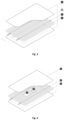
- Figure 2 refers to an example of a waterproofing system comprising the textile reinforcement structure with integration of heating wires and sensor wires, with application of the water-based waterproofing membrane.
- the textile reinforcement structure used is a woven textile fabric structure composed by continuous polyester fibers with apertures of the woven mesh (hole size) of 1.5 mm, a grammage of 155 g/m 2 , a thickness of 0.8 mm, a linear mass of 167/2 dtex. It comprises a warp of 19 yarns/cm and a weft of 23yarns/cm.
- the filament yarns comprise a twist of 300 turns/meter.
- the heating wires and the sensor wires are integrated through weaving with a spacing between them ranging from 0.5 to 4; preferably 0.5 to 3 cm for heating wires, and ranging from 0.5 to 50 cm for sensor wires.
- the heating wires and the sensor wires are selected from copper, nickel.
- the copper-based wires, for the heating system are integrated during the weaving process of the reinforcing textile structure, with a spacing between them ranging from 0.5 to 4 cm.
- the nickel and copper-based wires, for the temperature and moisture sensors, respectively, are integrated during the weaving process of the reinforcing textile structure, with a spacing between them ranging from 0.5 to 50 cm.
- a first layer of the water-based waterproofing membrane is applied in the textile reinforcement structure, in the proportion of 2kg of waterproofing membrane per m 2 of the textile reinforcement structure, leading to a thickness of 0.8 to 1 mm. Then, a second layer of the water-based waterproofing membrane is applied leading to a final thickness ranging from 1.6 to 2mm.
- Figure 3 refers to a schematic representation of an embodiment of the waterproofing system (D) that comprises a textile reinforcement structure (A) with the integration of heating wires (B) and moisture and temperature textile sensors (C) and the water-based waterproofing membrane of the present disclosure.
- the textile reinforcement structure used has a woven fabric structure and the textile material used is the one described in Figure 2 .
- the heating wires and the sensor wires are integrated through weaving with a spacing between them of 0.5 to 4 cm; preferably 0.5 to 3 cm (for heating wires), and 0.5 to 50 cm; preferably 0.5 to 30 cm (for sensor wires).
- a first layer of the water-based waterproofing membrane is applied in the textile reinforcement structure, in proportion of 2kg of waterproofing membrane per m 2 of the textile reinforcement structure, leading to a thickness of 0.8 to 1 mm. Then, a second layer of the water-based waterproofing membrane is applied until a final thickness between 1.6 and 2mm.
- Figure 4 refers to a schematic representation of an embodiment of the waterproofing system (E) comprising a textile reinforcement structure (C) with the integration of heating wires (D) and moisture and temperature screen printed sensors (A and B, respectively).
- the textile reinforcement structure used has a woven fabric structure and the textile material is the one described in Figure 2 .
- the heating wires are integrated through weaving with a spacing between them of 0.5 to 3 4 cm; preferably 0.5 to 3 cm.
- the moisture and temperature screen printed sensors were directly integrated in the textile structure by lamination with a spacing between them of 0.5 to 50 cm.
- the printed sensors of temperature and moisture are based on silver ink.
- the printed sensors are previously printed by screen-printing on a flexible substrate, preferably polyethylene terephthalate, and later laminated on the reinforcing textile structure, with a spacing between sensors of 0.5 to 50 cm; preferably 0.5 to 30 cm.
- a first layer of the water-based waterproofing membrane is applied in the textile reinforcement structure, in proportion of 2kg of waterproofing membrane per m 2 of the textile reinforcement structure, leading to a thickness ranging from 0.8 to 1 mm. Then, a second layer of the water-based waterproofing membrane is applied until a final thickness ranging from 1.6 to 2 mm.
- the various components may contain additive enhancers to decrease the surface temperature of the structure.
- the various components may contain radiation reflection enhancer additives.
- the radiation reflection enhancer additives are incorporated into the waterproofing membrane.
- the radiation reflection enhancer additives are incorporated into the waterproofing membrane using a pre-dispersion of the additive.
- water is the solvent used in the additive pre-dispersion.
- the radiation reflection enhancer additive is TAYCA's JR-1000 pigment, comprising pigment grade titanium dioxide.
- JR-1000 pigment concentration ranges between 0.5 - 50 % by mass.
- the radiation reflection enhancer additive is pigment Black 30C941 from The Sheperd Color Company, comprising chromium iron oxide.
- the radiation reflection enhancer additive is the pigment Black 10P992, comprising chromium green-black hematite.
- pigment concentration Black 10P992 range from 0.1 - 20 % mass; more preferably 0.5 - 7% mass.
- the textile structure comprises PES fabric, presenting the characteristics of heavy structure, low membrane transfer, longer curing time, lower application uniformity.
- ranges are included. Furthermore, it should be understood that unless otherwise indicated or otherwise evident from the context and/or understanding of a technical expert, the values which are expressed as ranges may assume any specific value within the ranges indicated in different achievements of the invention, at one tenth of the lower limit of the interval, unless the context clearly indicates the contrary. It should also be understood that, unless otherwise indicated or otherwise evident from the context and/or understanding of a technical expert, values expressed as range may assume any sub-range within the given range, where the limits of the sub-range are expressed with the same degree of precision as the tenth of the unit of the lower limit of the range. The following claims define additional achievements of this description.
Landscapes
- Engineering & Computer Science (AREA)
- Textile Engineering (AREA)
- Chemical & Material Sciences (AREA)
- Chemical Kinetics & Catalysis (AREA)
- Dispersion Chemistry (AREA)
- Treatments For Attaching Organic Compounds To Fibrous Goods (AREA)
- Laminated Bodies (AREA)
- Woven Fabrics (AREA)
Applications Claiming Priority (1)
| Application Number | Priority Date | Filing Date | Title |
|---|---|---|---|
| PT11799722 | 2022-05-25 |
Publications (4)
| Publication Number | Publication Date |
|---|---|
| EP4283030A2 true EP4283030A2 (de) | 2023-11-29 |
| EP4283030A3 EP4283030A3 (de) | 2024-03-27 |
| EP4283030B1 EP4283030B1 (de) | 2025-11-19 |
| EP4283030C0 EP4283030C0 (de) | 2025-11-19 |
Family
ID=88506055
Family Applications (2)
| Application Number | Title | Priority Date | Filing Date |
|---|---|---|---|
| EP22177964.8A Withdrawn EP4283029A1 (de) | 2022-05-25 | 2022-06-08 | Textile verstärkungsstruktur, wasserdichte membran auf wasserbasis, wasserdichtes system und deren verwendungen |
| EP23175508.3A Active EP4283030B1 (de) | 2022-05-25 | 2023-05-25 | Textile verstärkungsstruktur und wasserabdichtungssystem |
Family Applications Before (1)
| Application Number | Title | Priority Date | Filing Date |
|---|---|---|---|
| EP22177964.8A Withdrawn EP4283029A1 (de) | 2022-05-25 | 2022-06-08 | Textile verstärkungsstruktur, wasserdichte membran auf wasserbasis, wasserdichtes system und deren verwendungen |
Country Status (1)
| Country | Link |
|---|---|
| EP (2) | EP4283029A1 (de) |
Family Cites Families (1)
| Publication number | Priority date | Publication date | Assignee | Title |
|---|---|---|---|---|
| DE102009013874B4 (de) * | 2009-03-17 | 2015-06-03 | Siegfried Langhein | Heizgewebe |
-
2022
- 2022-06-08 EP EP22177964.8A patent/EP4283029A1/de not_active Withdrawn
-
2023
- 2023-05-25 EP EP23175508.3A patent/EP4283030B1/de active Active
Also Published As
| Publication number | Publication date |
|---|---|
| EP4283030B1 (de) | 2025-11-19 |
| EP4283030A3 (de) | 2024-03-27 |
| EP4283029A1 (de) | 2023-11-29 |
| EP4283030C0 (de) | 2025-11-19 |
Similar Documents
| Publication | Publication Date | Title |
|---|---|---|
| KR102200896B1 (ko) | 수용성 아크릴 우레탄 방수제를 이용한 중성화방지 복합시트 시공방법 | |
| US4291086A (en) | Coating system for roofs, swimming pools and the like | |
| US8323770B2 (en) | Breathable non-asphaltic roofing underlayment having tailorable breathability | |
| KR101267014B1 (ko) | 섬유보강메쉬층을 포함하는 우레탄 도막방수구조 및 이의 시공방법 | |
| JP5688614B2 (ja) | 熱遮断性能を有する塗膜防水工法の組成物とステッチボンディング法で製造された繊維シートを用いた防水施工方法 | |
| KR100921676B1 (ko) | 무용제 우레탄 방수제가 코팅된 고무화 아스팔트 시트를 이용한 복합 방수 시트 구조체 및 복합 시트 방수 공법 | |
| CA1153942A (en) | Roofing web | |
| KR101798399B1 (ko) | 수계 CHMA-Silicon Arcylic 방수조성물과 스티치본딩법으로 제조된 섬유시트를 이용한 쿨루프 차열복합방수공법 | |
| KR101408630B1 (ko) | 수용성 복합시트 방수공법 | |
| KR100982820B1 (ko) | 수용성 도막방수제를 이용한 콘크리트 구조물의 방수공법 | |
| EA022200B1 (ru) | Строительная пленка | |
| CA2982177C (en) | Building multilayer underlayments, related building assemblies and methods | |
| KR20220079215A (ko) | 탄성 도막 침투방수제 제조 방법 | |
| US20040219845A1 (en) | Fabric reinforced cement | |
| EP4283030A2 (de) | Textile verstärkungsstruktur, wasserbasierte wasserabdichtungsmembran, wasserabdichtungssystem und verwendungen davon | |
| RU199229U1 (ru) | Рулонный безосновный гидроизоляционный самоклеящийся материал | |
| KR20090056756A (ko) | 자착식 아스팔트 방수시트와 이를 이용한 방수공법 | |
| KR101332646B1 (ko) | 단열성능을 가진 이중복합직물방수시트 구조체와 이를 이용한 복합단열시트 방수공법 | |
| ES3059836T3 (en) | Textile reinforcement structure and waterproofing system | |
| KR101361966B1 (ko) | 무용제 우레탄 방수제와 고무화 아스팔트 시트를 이용한 단열복합방수시트 구조체 및 이를 이용한 단열복합방수시트공법 | |
| RU198731U1 (ru) | Рулонный безосновный гидроизоляционный материал механической фиксации | |
| JP5342792B2 (ja) | ウレタン塗膜防水用補強布及びそれを用いたウレタン塗膜防水工法 | |
| Asadi | Strength deterioration of architectural fabrics under single and combined artificial weathering impacts | |
| KR200278421Y1 (ko) | 합성수지계 도막 방수재와 절연 필름을 이용한 방수층구조 | |
| KR102845233B1 (ko) | 콘크리트 구조물의 내오염성 개선 및 중성화 방지를 위한 복합 방수 시트 시공 방법 |
Legal Events
| Date | Code | Title | Description |
|---|---|---|---|
| PUAI | Public reference made under article 153(3) epc to a published international application that has entered the european phase |
Free format text: ORIGINAL CODE: 0009012 |
|
| STAA | Information on the status of an ep patent application or granted ep patent |
Free format text: STATUS: THE APPLICATION HAS BEEN PUBLISHED |
|
| AK | Designated contracting states |
Kind code of ref document: A2 Designated state(s): AL AT BE BG CH CY CZ DE DK EE ES FI FR GB GR HR HU IE IS IT LI LT LU LV MC ME MK MT NL NO PL PT RO RS SE SI SK SM TR |
|
| PUAL | Search report despatched |
Free format text: ORIGINAL CODE: 0009013 |
|
| AK | Designated contracting states |
Kind code of ref document: A3 Designated state(s): AL AT BE BG CH CY CZ DE DK EE ES FI FR GB GR HR HU IE IS IT LI LT LU LV MC ME MK MT NL NO PL PT RO RS SE SI SK SM TR |
|
| RIC1 | Information provided on ipc code assigned before grant |
Ipc: E04B 1/62 20060101ALI20240216BHEP Ipc: B01D 71/00 20060101ALI20240216BHEP Ipc: D06N 7/00 20060101ALI20240216BHEP Ipc: B32B 13/14 20060101ALI20240216BHEP Ipc: D03D 15/533 20210101ALI20240216BHEP Ipc: D03D 15/283 20210101ALI20240216BHEP Ipc: D03D 15/41 20210101ALI20240216BHEP Ipc: D03D 1/00 20060101ALI20240216BHEP Ipc: D03D 9/00 20060101AFI20240216BHEP |
|
| STAA | Information on the status of an ep patent application or granted ep patent |
Free format text: STATUS: REQUEST FOR EXAMINATION WAS MADE |
|
| 17P | Request for examination filed |
Effective date: 20240927 |
|
| RBV | Designated contracting states (corrected) |
Designated state(s): AL AT BE BG CH CY CZ DE DK EE ES FI FR GB GR HR HU IE IS IT LI LT LU LV MC ME MK MT NL NO PL PT RO RS SE SI SK SM TR |
|
| GRAP | Despatch of communication of intention to grant a patent |
Free format text: ORIGINAL CODE: EPIDOSNIGR1 |
|
| STAA | Information on the status of an ep patent application or granted ep patent |
Free format text: STATUS: GRANT OF PATENT IS INTENDED |
|
| RIC1 | Information provided on ipc code assigned before grant |
Ipc: D03D 9/00 20060101AFI20250611BHEP Ipc: D03D 1/00 20060101ALI20250611BHEP Ipc: D03D 15/41 20210101ALI20250611BHEP Ipc: D03D 15/283 20210101ALI20250611BHEP Ipc: D03D 15/533 20210101ALI20250611BHEP Ipc: B32B 13/14 20060101ALI20250611BHEP Ipc: D06N 7/00 20060101ALI20250611BHEP Ipc: B01D 71/00 20060101ALI20250611BHEP Ipc: B32B 5/02 20060101ALI20250611BHEP Ipc: B32B 27/12 20060101ALI20250611BHEP Ipc: B32B 27/36 20060101ALI20250611BHEP Ipc: B32B 27/40 20060101ALI20250611BHEP Ipc: D06N 3/00 20060101ALI20250611BHEP Ipc: D06N 3/12 20060101ALI20250611BHEP Ipc: D06N 3/14 20060101ALI20250611BHEP Ipc: D06N 5/00 20060101ALI20250611BHEP |
|
| INTG | Intention to grant announced |
Effective date: 20250624 |
|
| GRAS | Grant fee paid |
Free format text: ORIGINAL CODE: EPIDOSNIGR3 |
|
| GRAA | (expected) grant |
Free format text: ORIGINAL CODE: 0009210 |
|
| STAA | Information on the status of an ep patent application or granted ep patent |
Free format text: STATUS: THE PATENT HAS BEEN GRANTED |
|
| RAP3 | Party data changed (applicant data changed or rights of an application transferred) |
Owner name: SAINT-GOBAIN PORTUGAL SA Owner name: TEXTEIS PENEDO S.A. Owner name: CITEVE - CENTRO TECNOLOGICO DAS INDUSTRIAS TEXTILE DO VESTUARIO DE PORTUGAL Owner name: ITECONS - INSTITUTO DE INV. E DESENV. TECN. PARA ACONSTRUCAO, ENERGIA, AMBIENTE E SUSTENTABILIDADE Owner name: CENTITVC - CENTRO DE NANOTECNOLOGIA EMATERIAIS TECNICOS, FUNCIONAIS E INTELIGENTES |
|
| AK | Designated contracting states |
Kind code of ref document: B1 Designated state(s): AL AT BE BG CH CY CZ DE DK EE ES FI FR GB GR HR HU IE IS IT LI LT LU LV MC ME MK MT NL NO PL PT RO RS SE SI SK SM TR |
|
| REG | Reference to a national code |
Ref country code: CH Ref legal event code: F10 Free format text: ST27 STATUS EVENT CODE: U-0-0-F10-F00 (AS PROVIDED BY THE NATIONAL OFFICE) Effective date: 20251119 Ref country code: GB Ref legal event code: FG4D |
|
| REG | Reference to a national code |
Ref country code: DE Ref legal event code: R096 Ref document number: 602023008687 Country of ref document: DE |
|
| REG | Reference to a national code |
Ref country code: IE Ref legal event code: FG4D |
|
| U01 | Request for unitary effect filed |
Effective date: 20251216 |
|
| U07 | Unitary effect registered |
Designated state(s): AT BE BG DE DK EE FI FR IT LT LU LV MT NL PT RO SE SI Effective date: 20251222 |
|
| REG | Reference to a national code |
Ref country code: ES Ref legal event code: FG2A Ref document number: 3059836 Country of ref document: ES Kind code of ref document: T3 Effective date: 20260324 |
|
| PG25 | Lapsed in a contracting state [announced via postgrant information from national office to epo] |
Ref country code: NO Free format text: LAPSE BECAUSE OF FAILURE TO SUBMIT A TRANSLATION OF THE DESCRIPTION OR TO PAY THE FEE WITHIN THE PRESCRIBED TIME-LIMIT Effective date: 20260219 |
|
| PG25 | Lapsed in a contracting state [announced via postgrant information from national office to epo] |
Ref country code: HR Free format text: LAPSE BECAUSE OF FAILURE TO SUBMIT A TRANSLATION OF THE DESCRIPTION OR TO PAY THE FEE WITHIN THE PRESCRIBED TIME-LIMIT Effective date: 20251119 |
|
| PG25 | Lapsed in a contracting state [announced via postgrant information from national office to epo] |
Ref country code: RS Free format text: LAPSE BECAUSE OF FAILURE TO SUBMIT A TRANSLATION OF THE DESCRIPTION OR TO PAY THE FEE WITHIN THE PRESCRIBED TIME-LIMIT Effective date: 20260219 |
|
| PG25 | Lapsed in a contracting state [announced via postgrant information from national office to epo] |
Ref country code: IS Free format text: LAPSE BECAUSE OF FAILURE TO SUBMIT A TRANSLATION OF THE DESCRIPTION OR TO PAY THE FEE WITHIN THE PRESCRIBED TIME-LIMIT Effective date: 20260319 |
|
| PG25 | Lapsed in a contracting state [announced via postgrant information from national office to epo] |
Ref country code: PL Free format text: LAPSE BECAUSE OF FAILURE TO SUBMIT A TRANSLATION OF THE DESCRIPTION OR TO PAY THE FEE WITHIN THE PRESCRIBED TIME-LIMIT Effective date: 20251119 |